Discovering Silesia: Karpacz with its churches and with Sniezka

In May 2023, we spent a week in Silesia, in “our” castle Staniszów near Jelenia Góra. From here, it was a short car ride to Karpacz, formerly called Krummhübel. Many German artists had been here at the end of the 19th century and in the beginnings of the 20th century.  Carl Ernst Morgenstern taught plein-air painting around Karpacz. Theodor Fontane wrote a criminal story for Krummhübel.


Karpacz centre with two churches from around 1900

The centre of Karpacz (Krummhübel) is a touristy place – this is the main street. 

There are two churches here, both built around 1900.

The church of the Holy Heart of Jesus, (Kirche des heiligsten Herzens Jesu, Kościół Najświętszego Serca Pana Jezusa) was inaugurated as a protestant church in 1908. 

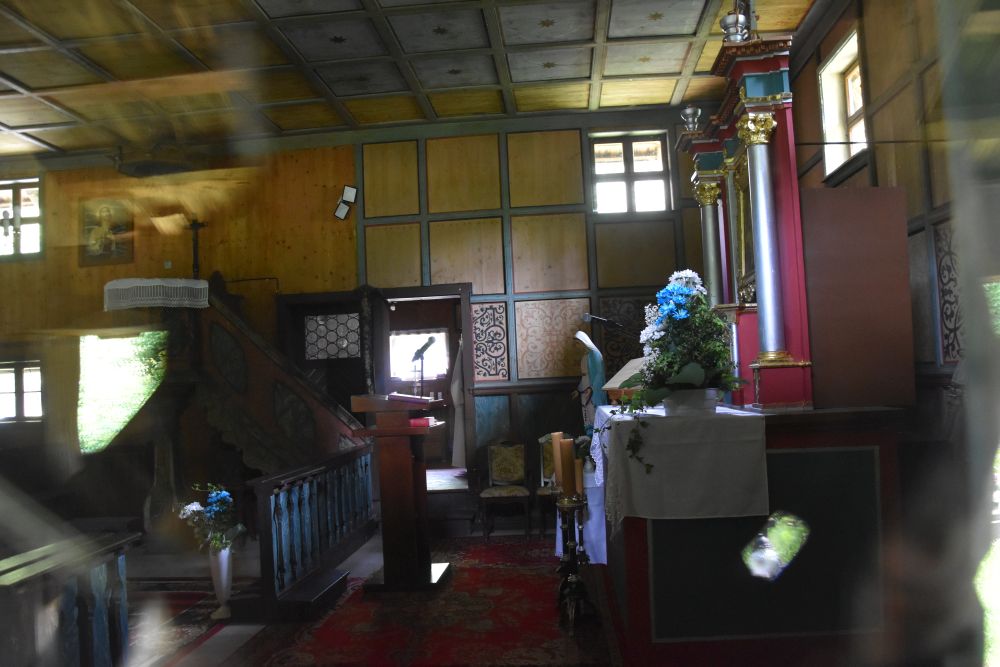
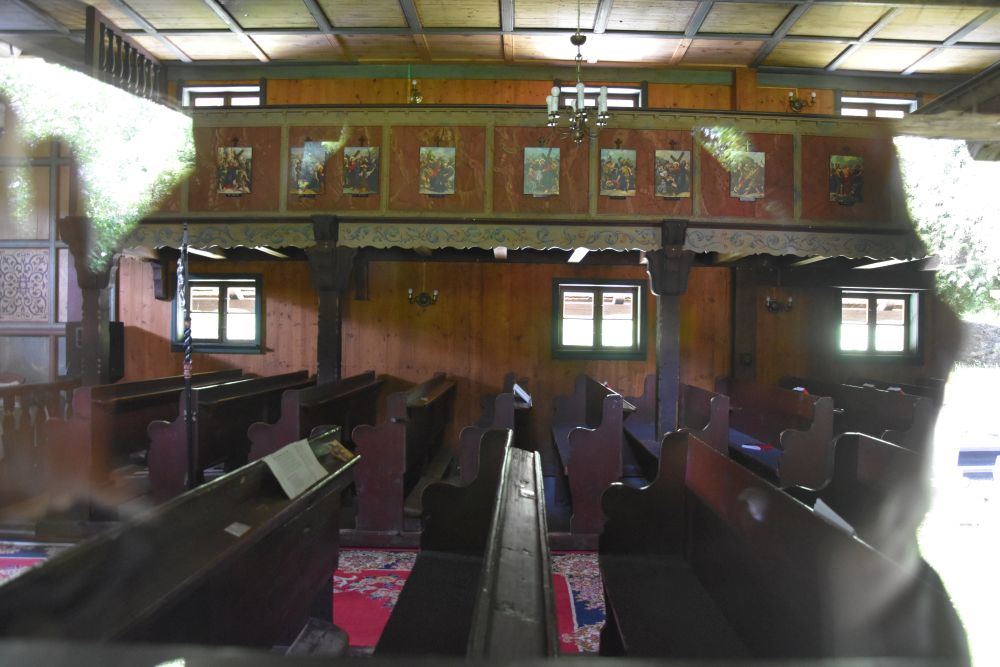
A  nice painted wooden ceiling inside. The church became catholic in 1945.

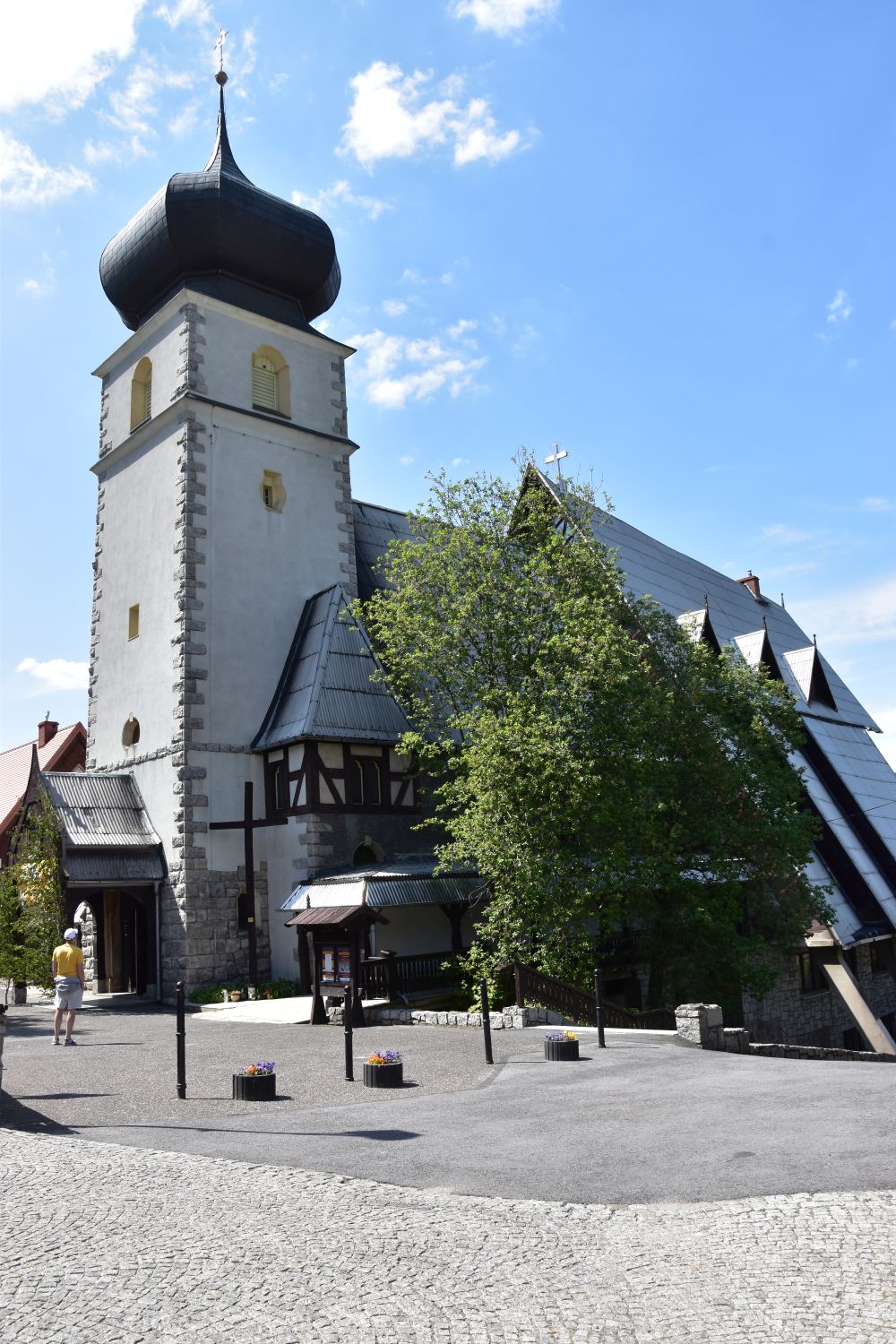
The church Visitation of our Lady (Mariä Heimsuchung, Parafia Nawiedzenia Najświętszej Maryi Panny) was inaugurated in 1910, and the nave was rebuilt after 1945.

A painted wooden ceiling here as well.

Also this church was protestant and became catholic in 1945.


Wang church (Kościół Wang)

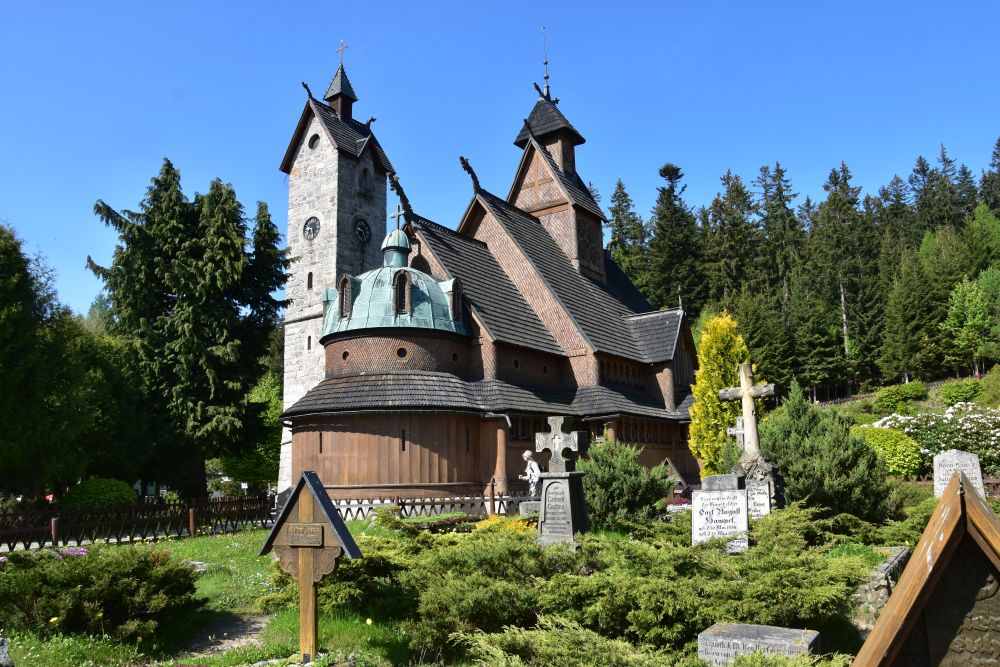
The attraction of Karpacz is the wooden Wang church. 

The church was built in Vang in southern Norway in the 12th or 13th century. In the 19th century, this church became too small for the congregation. It was decided to sell the church and use the money earned to build a larger new church. A painter from Norway, professor Jan Christian Dahl, lived at Breslau at that time, and he convinced the Prussian king Friedrich Wilhelm IV to buy the church for 427 Mark. The church was disassembled and shipped to Berlin. The king had intended to rebuild the church on the Pfaueninsel at Berlin, but then changed his plans. Count Leopold Christian von Schaffgotsch donated land between Krummhübel (Karpacz) and the Schneekoppe (Śnieżka), at Brückenberg (now Karpacz Górny). The church was reassembled here and inaugurated in summer 1844.

Two lions guard the entrance to the church.

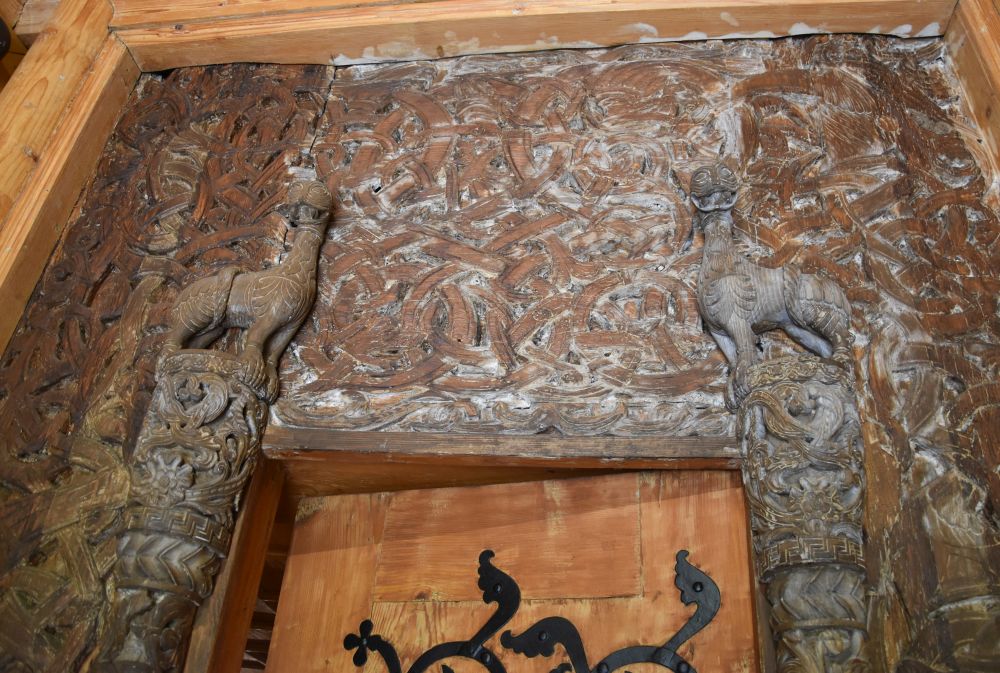
Inside, viking faces frame the door; they may be warriors with split tongues. 

This is the choir…

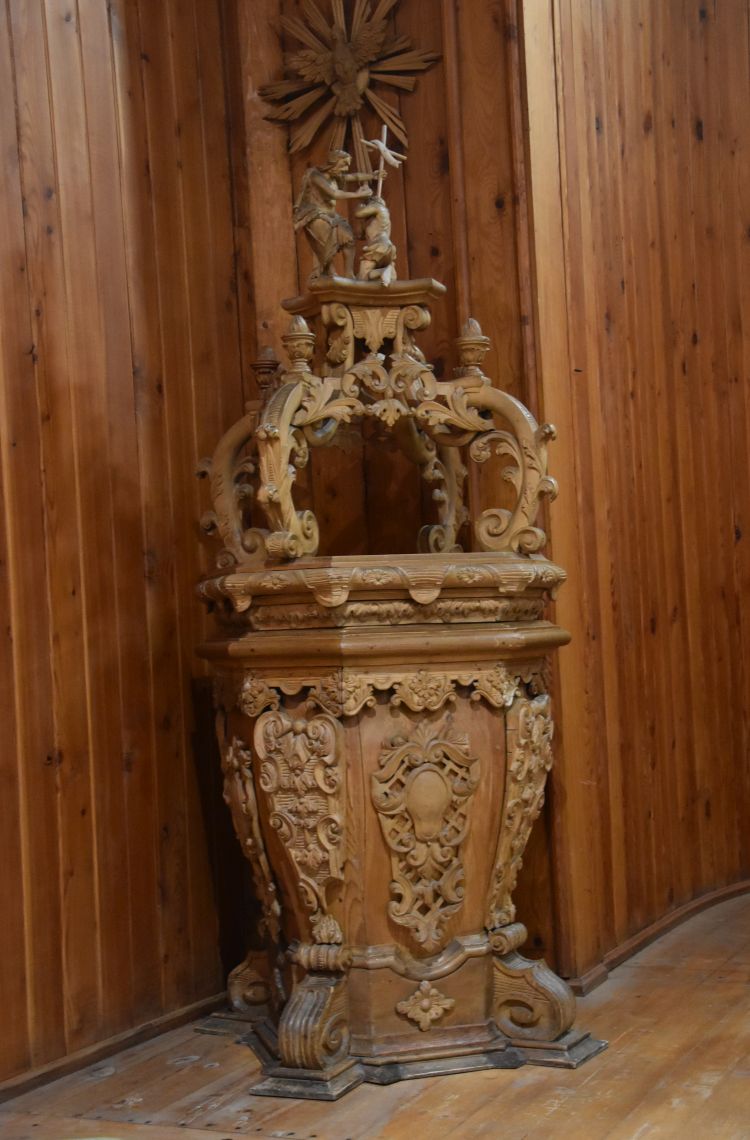
… with the baptismal font (Saint John in his fur coat baptizes Christ).

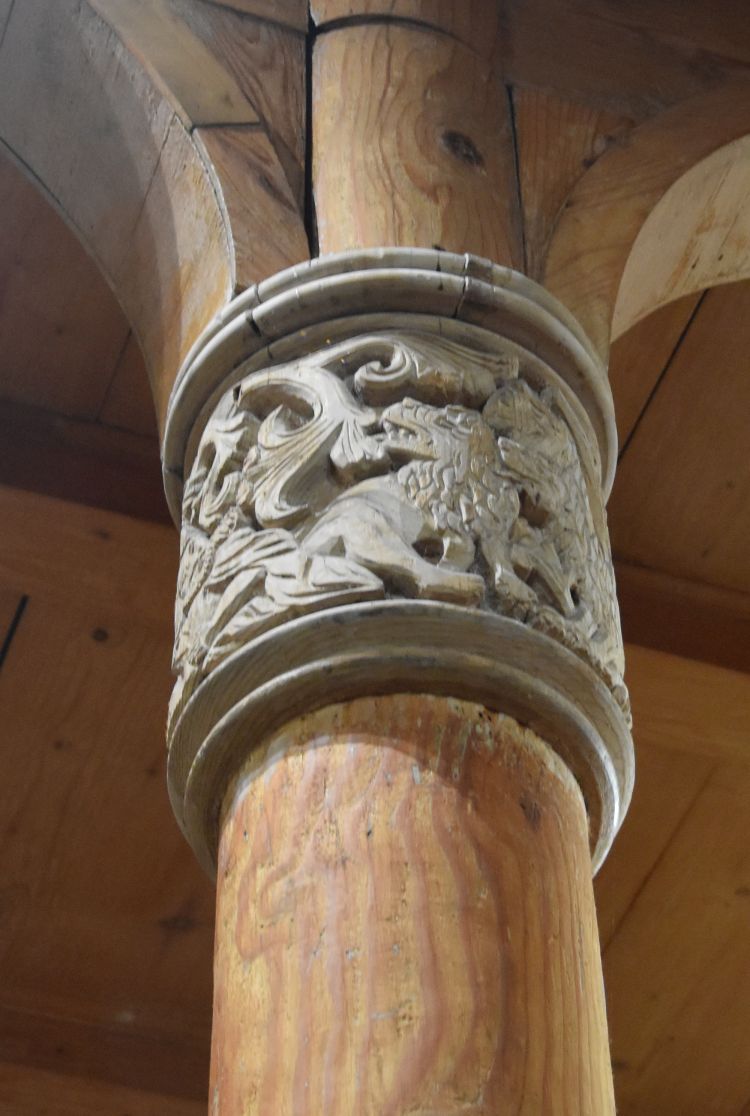
The column shows Daniel in the lion’s den.

This door leads to a corridor around the nave. 

The Vang church has become THE cultural landmark of Karpacz.


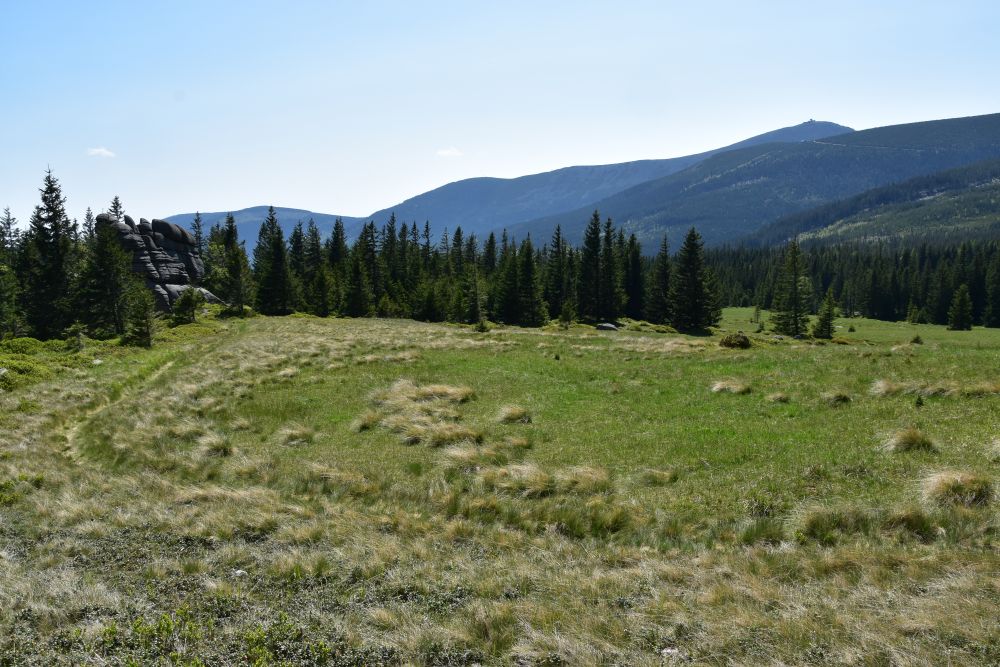
Hiking from Polana to Słonecznik, with a partial view of the Śnieżka

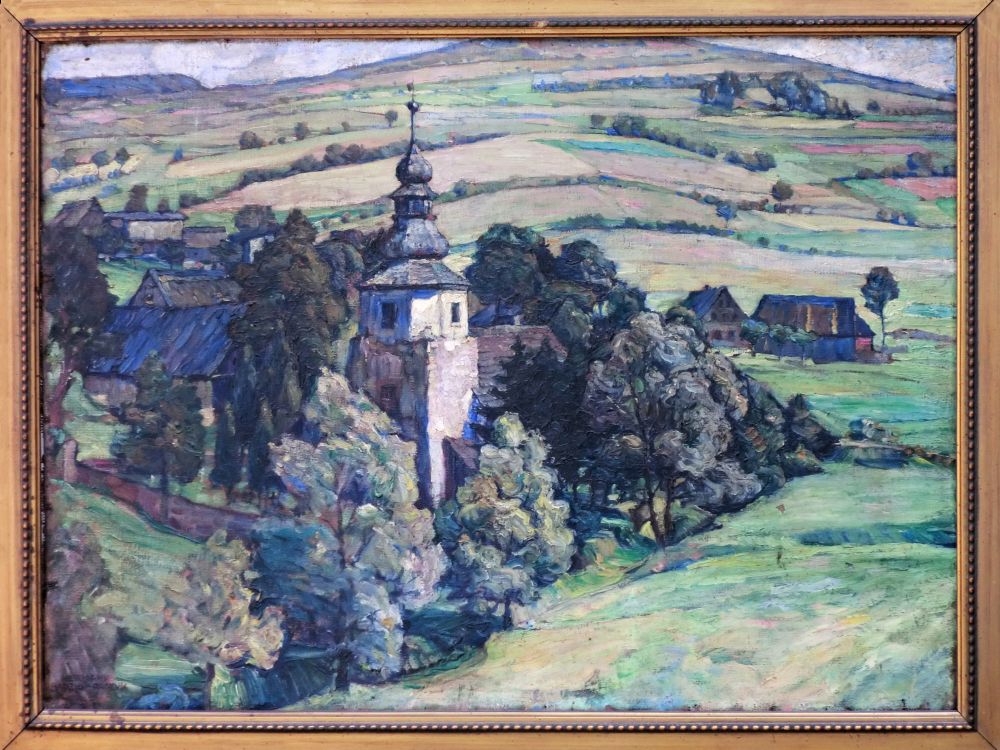
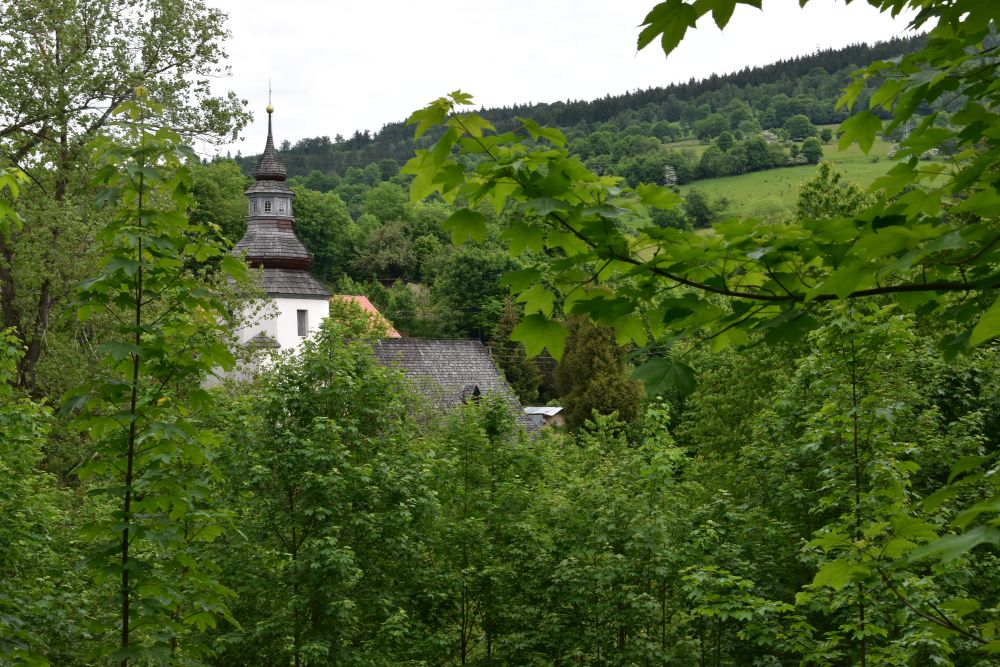
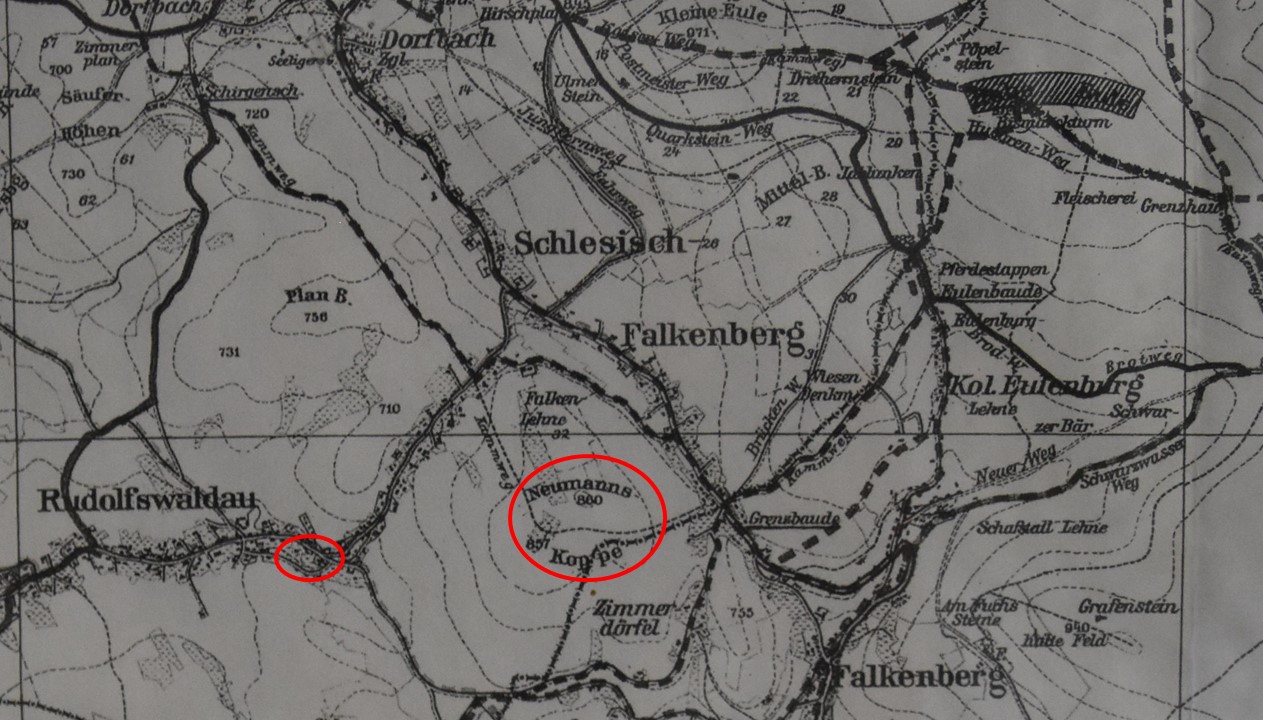
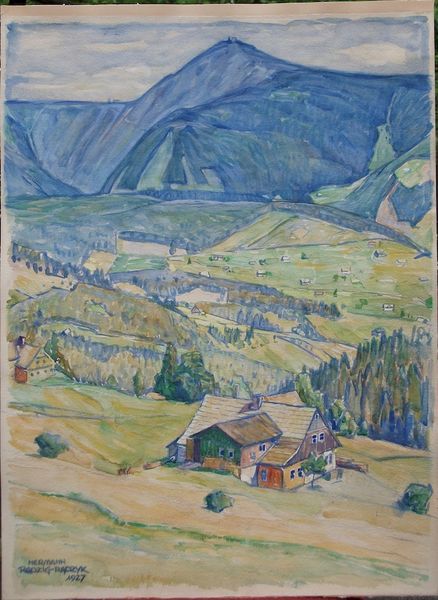
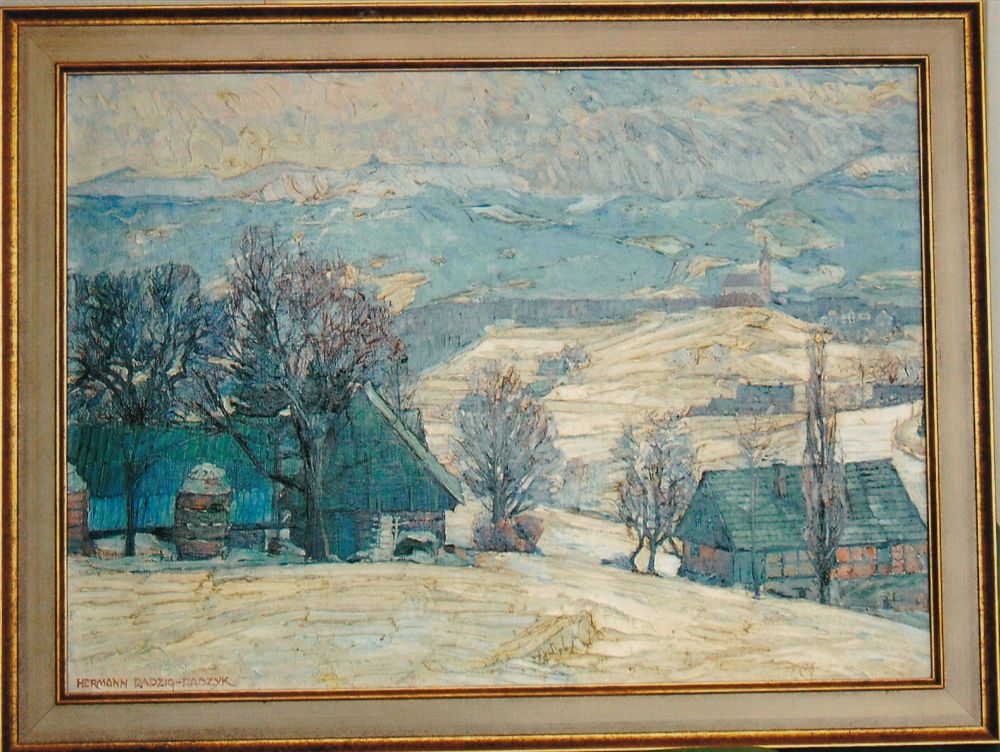
Behind the Wang church, you have to pay an entrance fee for the Karkonosze park, which is a nature reserve now. A path leads to Polana, a meadow that I suspected was the place, where my grandfather had painted the Schneekoppe (painting owned by Heimatverein Kleinmachnow).

But, when reaching the meadow Polana, it becomes clear, this is not the place, where my grandfather’s easel was. 

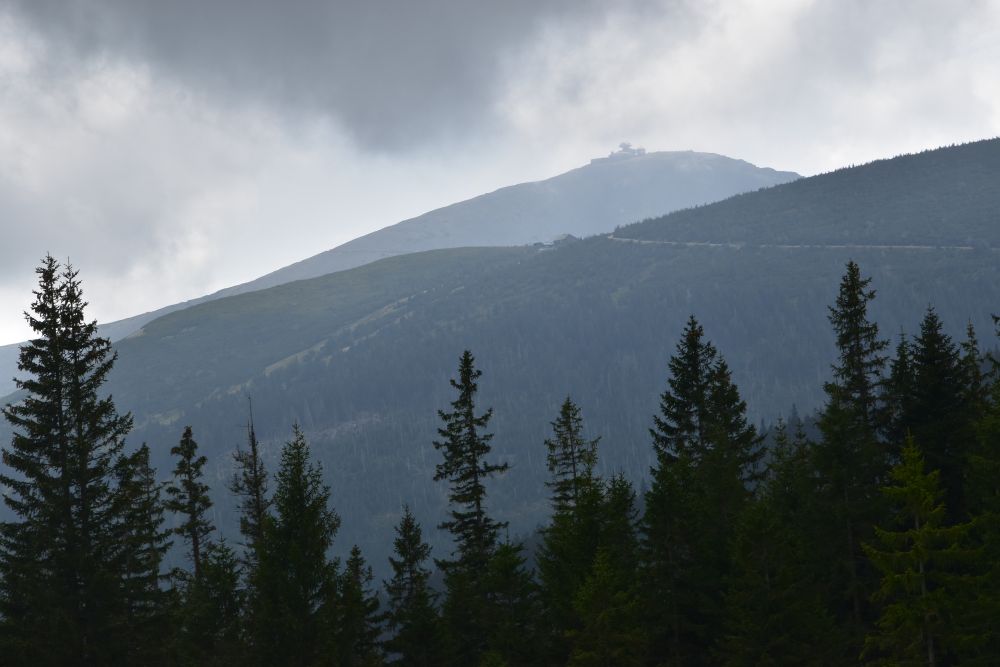
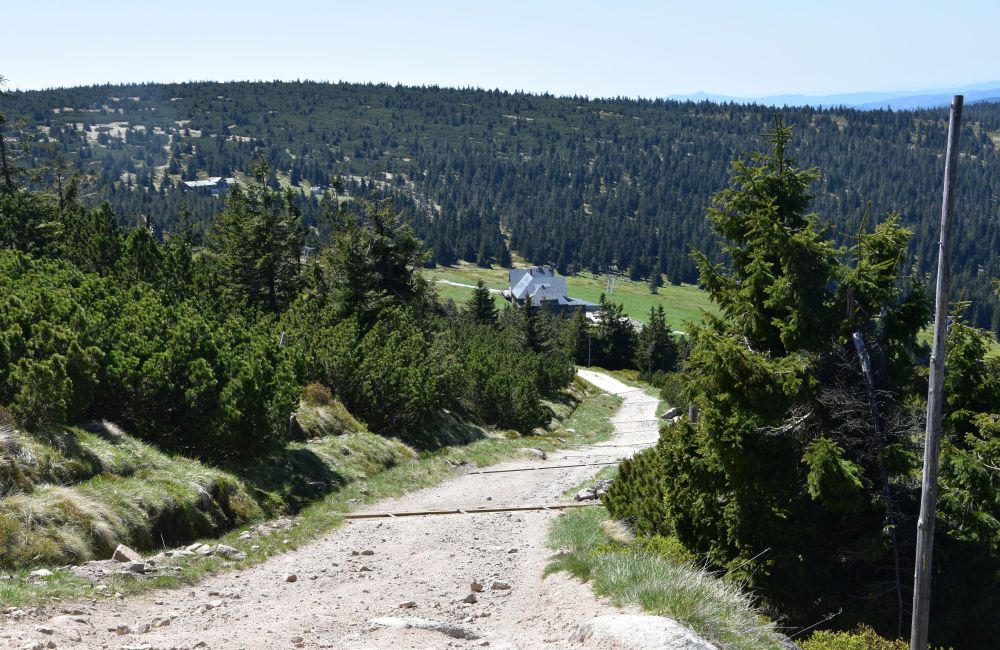
I follow the path uphill and can sometimes see the Schneekoppe between the trees.

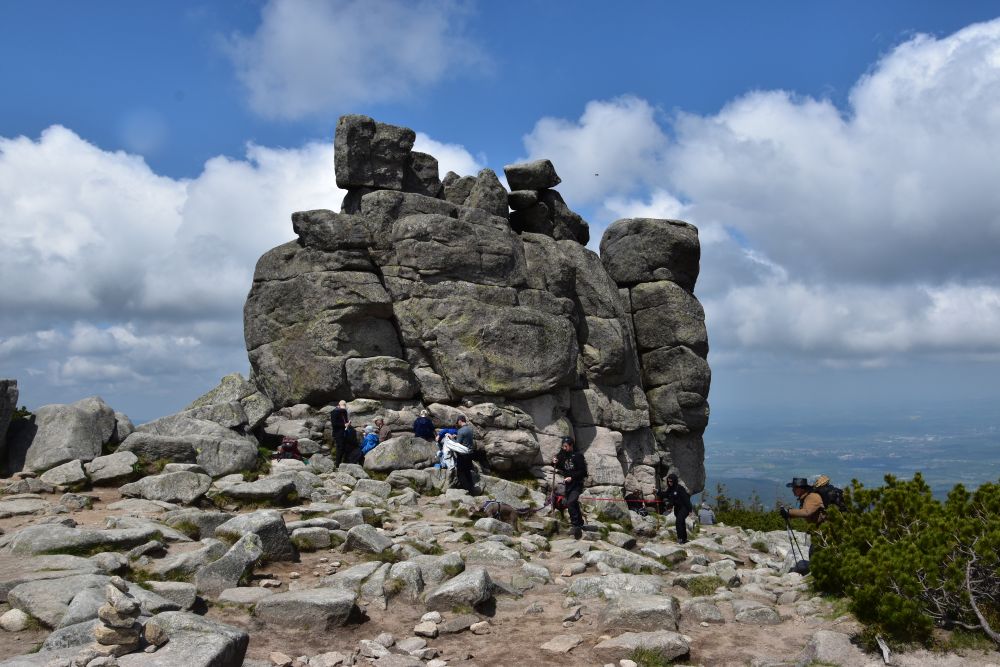
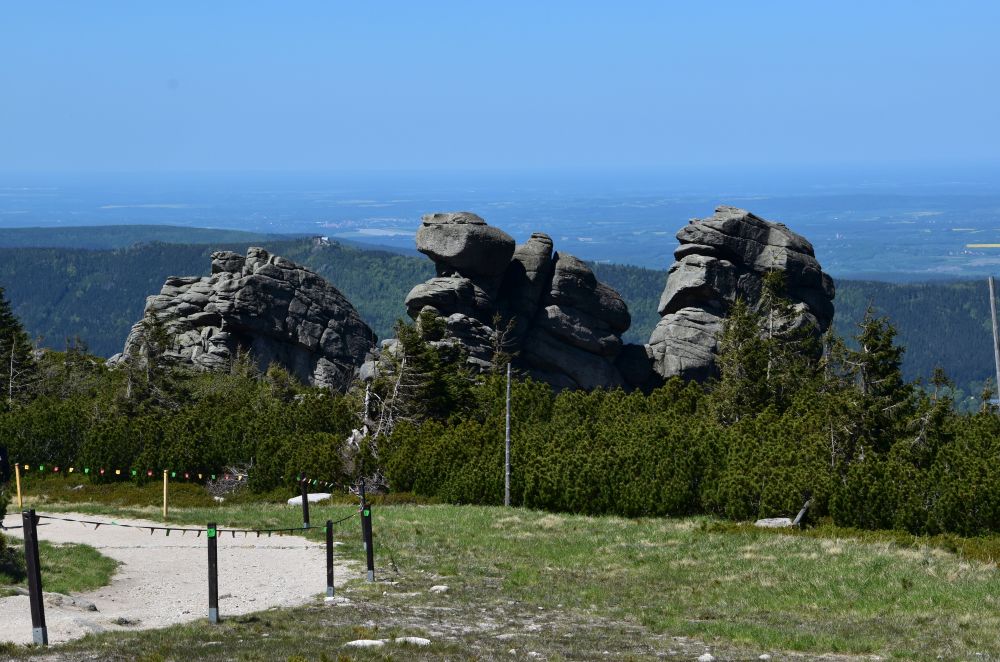
I reach one of the many granite blocks scattered around here… and I am not alone. The Poles enjoy hiking.

I reach another granite rock, the Słonecznik. A beautiful view into the Hirschberg valley. 

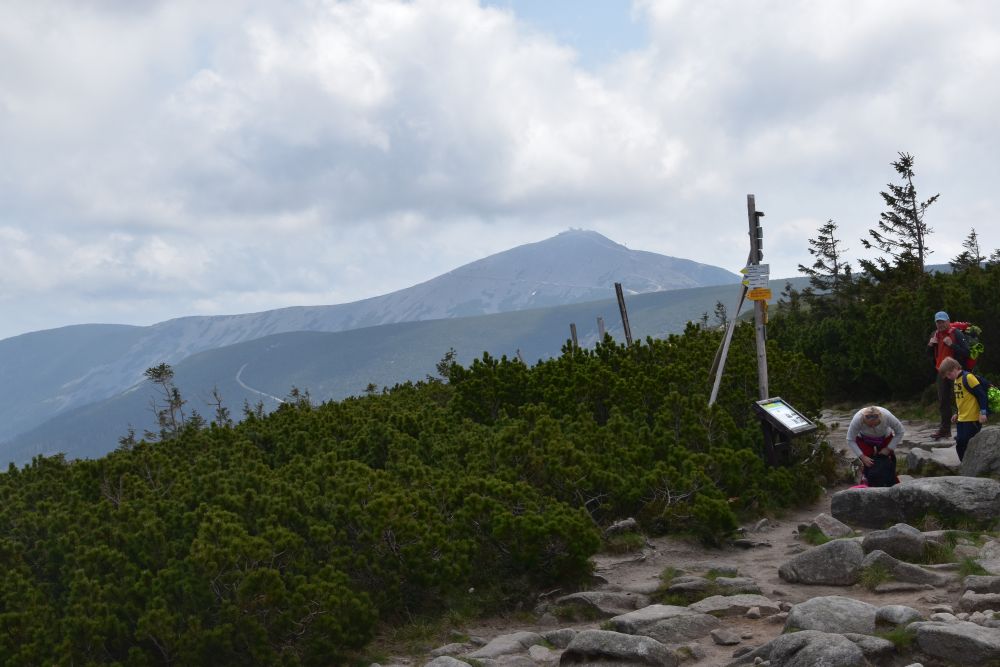
The Schneekoppe(Sniezka) can be seen from the Słonecznik as well. 

I walk back down.

On the meadow Polana, I look for the place, where the  former mountain hut Hasenbaude once was, but it seems that nothing remains of it.

No, I my grandfather’s easel was not here… may be it was south of the Schneekoppe (Sniezka), on the other side?

Back at home, I solve the puzzle. The easel WAS south of the Schneekoppe, above Petzer or Pec pod Sněžkou. I could identify Petzer and  the mountains on the painting and I believe, the easel stood at the Lenzenberg, now called Zahradky. 

There is something more to explore! The Giant Mountains in the Czech Republic. I will return!


Sources:

  • Plates on the churches
  • Description of the Vang church, handed out in the church.
  • Tomasz Torbus, “Polen – Reisen zwischen Ostseeküste und Karpaten, Oder und Bug”, Dumont Kunstreiseführer, Ostfildern 2011

Discovering Silesia – On the Szrenica, the mountain that carries frost

In May 2023, I am in Silesia, where we spend one week in the castle Staniszów to explore the area around Jelenia Góra.

Now we spend a day on the Szrenica above Szklarska Poręba.


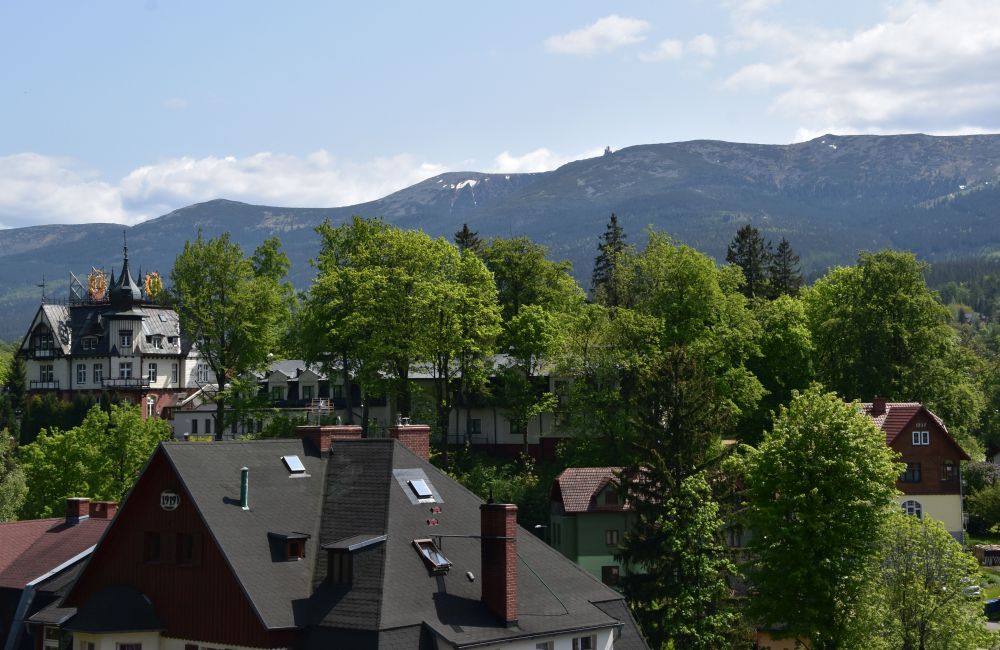
Szklarska Poręba is surrounded by mountains

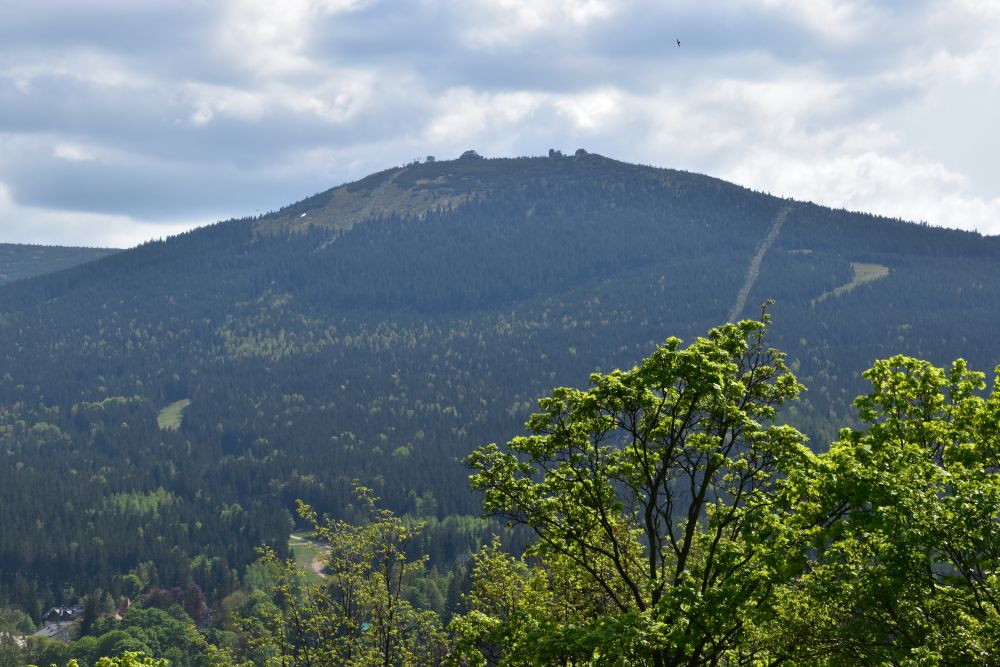
Szklarska Poręba is a resort surrounded by mountains, the main landmarks being the Szrenica (right) and the Śnieżne Kotły (left). 

The Śnieżne Kotły (“Schneegruben” or “Snow Pits”) still carry a bit of snow in the western snow pit. The pits are in geological terms “cirques” (in German: “Kare”) left by a glacier.

Chair lifts and ski lifts take hikers and – in winter – skiers up to the Szrenica, as the straight lines in the forests indicate.  

Szrenica is called “Reifträger” in German. Both in German and in Polish, this mountain carries frost (“Reif” and “szron” mean “frost”).  

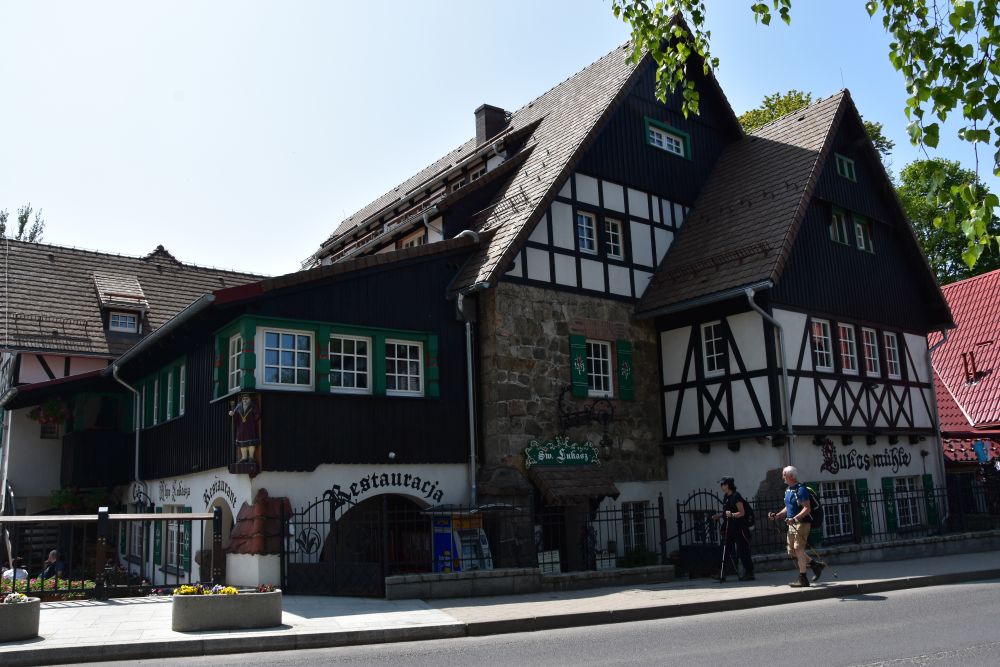
German painters have been inspired by the panorama around Szklarska Poręba (Schreiberhau). In summer 1920, they founded the Lukasgilde (guild of Saint Luke) and built the Lukasmühle as a place to meet and to exhibit their paintings. 

Georg Wichmann is one of the founders of the Lukasgilde.


Source: Hans Wichmann, “Georg Wichmann 1876-1944)”, Bergstadtverlag Wilhelm Gottlieb Korn 1996.

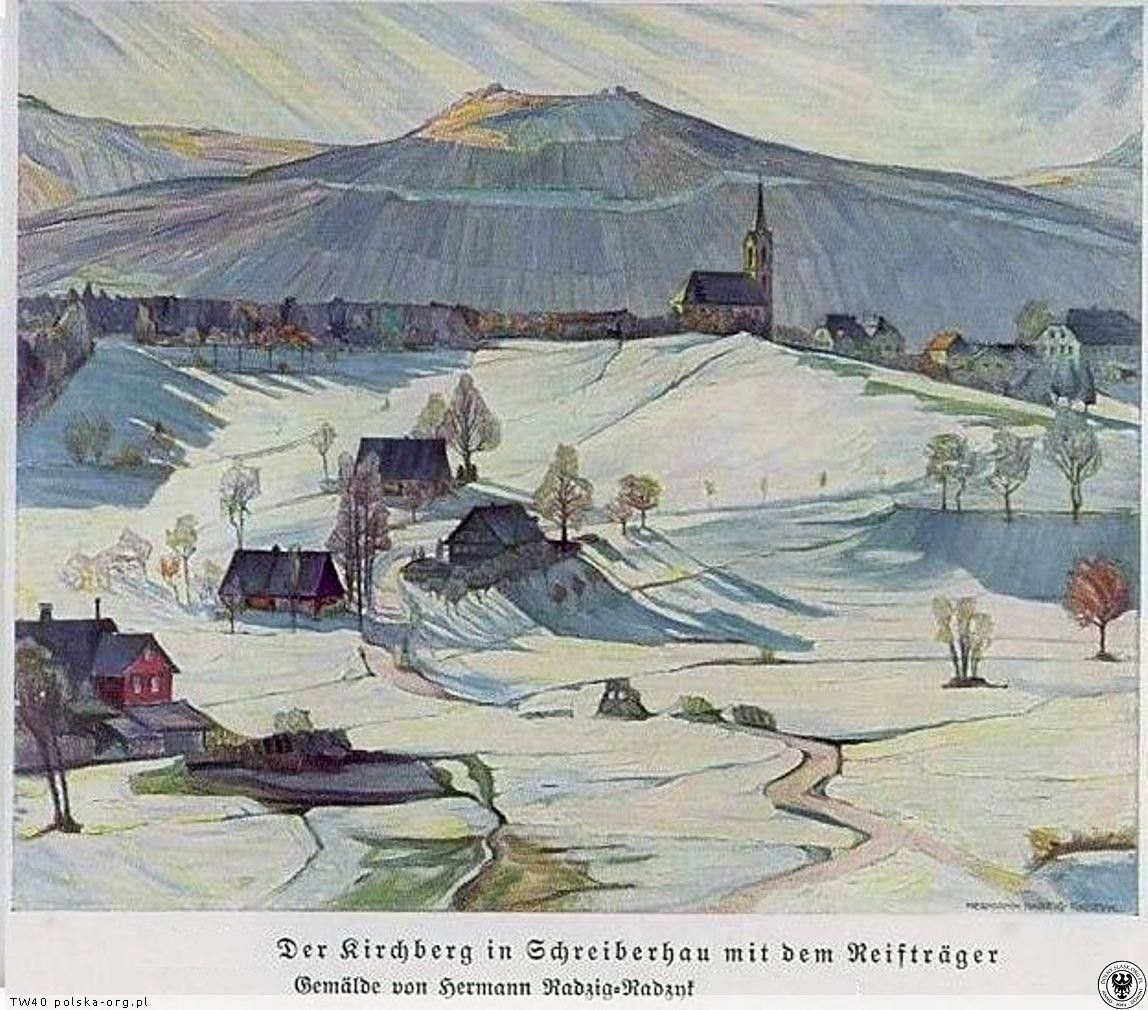
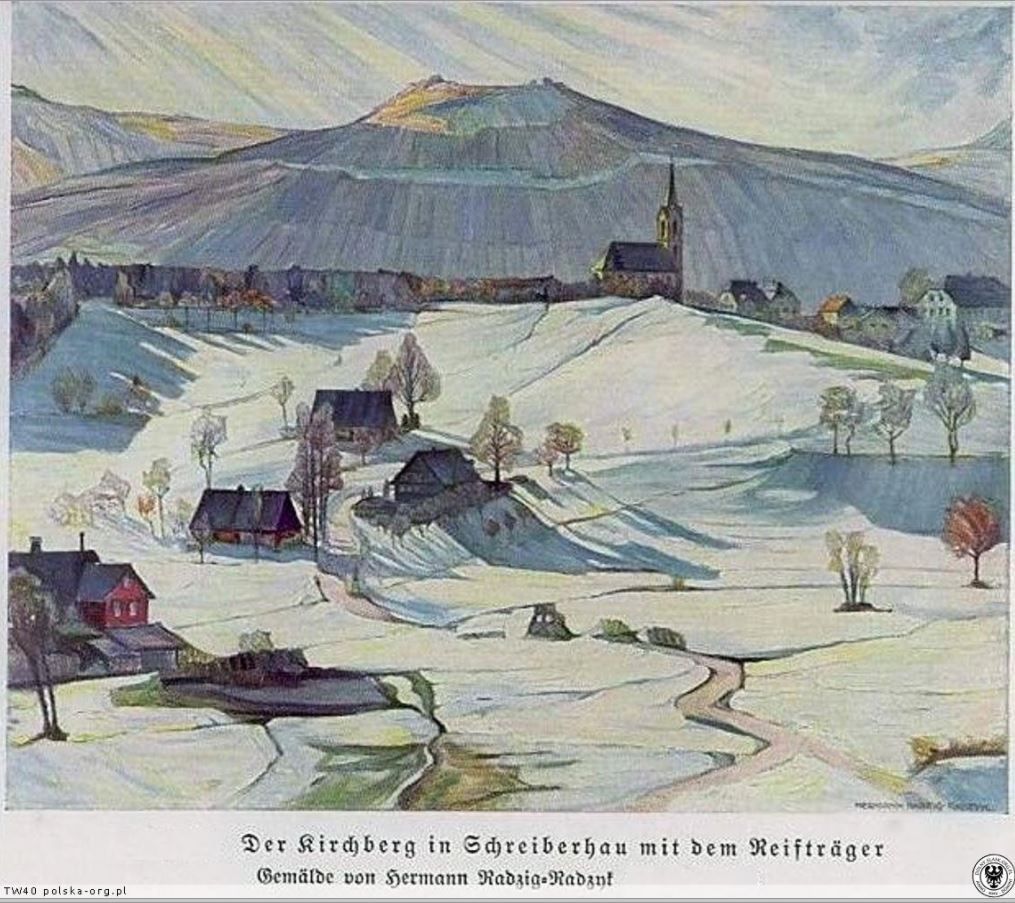
In winter 1922/23, my grandfather Hermann Radzyk was at Schreiberhau (Szklarska Poręba) and painted the Reifträger (Szrenica) with the church Kościół pw. Bożego Ciała (Corpus Christi).

Source: Polska.org – this painting has in the meantime disappeared from the website polska.org.

In addition, Hermann Radzyk painted the Schneegruben with the same church in the foreground.

Source: My own photo taken in the house of the grand-son of a friend of my grand-father.


Exploring the Szrenica with the gorgeous view

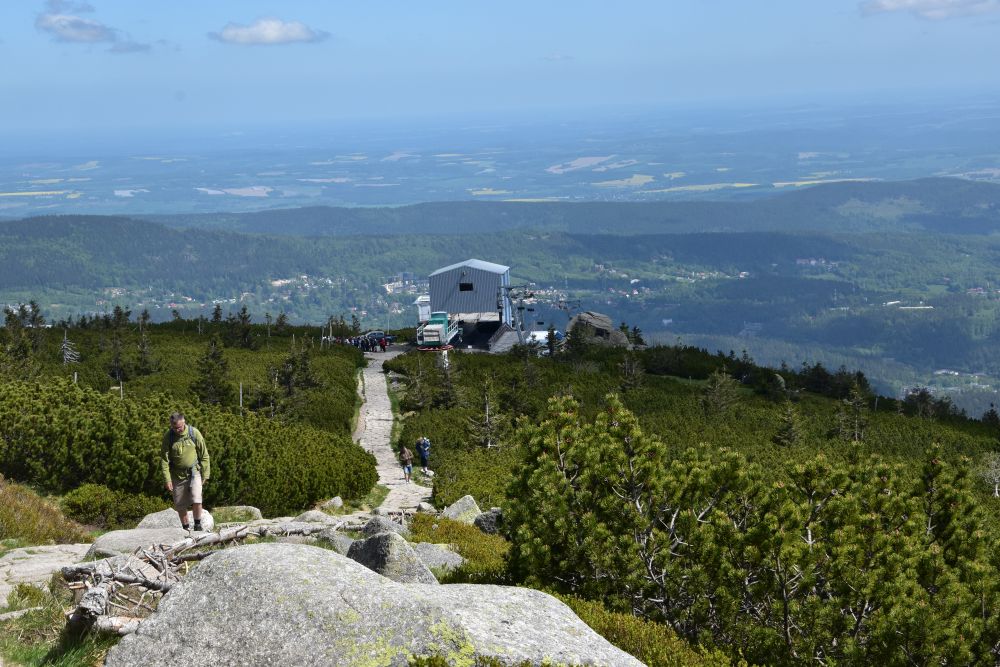
We take the chair lifts to the Szrenica – there are two sections, one after the other. 

A special experience. The small chairs  are hard to sit on and they move in “slow motion”. Slowly, but safely, we arrive on the top.

The view of Lower Silesia with Szklarska Poręba in the foreground is gorgeous.

We walk up to the top view point.

We look west, where a hiking path follows the border between Poland and the Czech Republic.

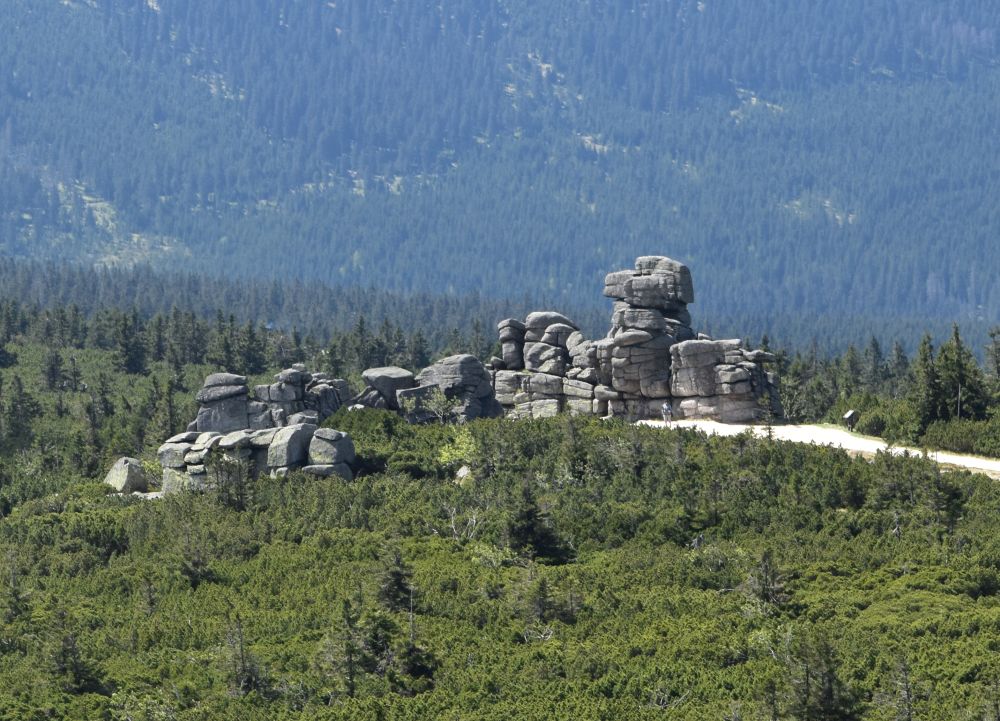
We look south east, where we can see granite rock formations. They are called Svinské kameny (“Pig stones”). They have a Czech name, as they stand already in the Czech Republic. Such granite rocks can be found all over in the Giant Mountains. In German these rocks are called “Wollsackverwitterung”, in English “spheroidal weathering”.

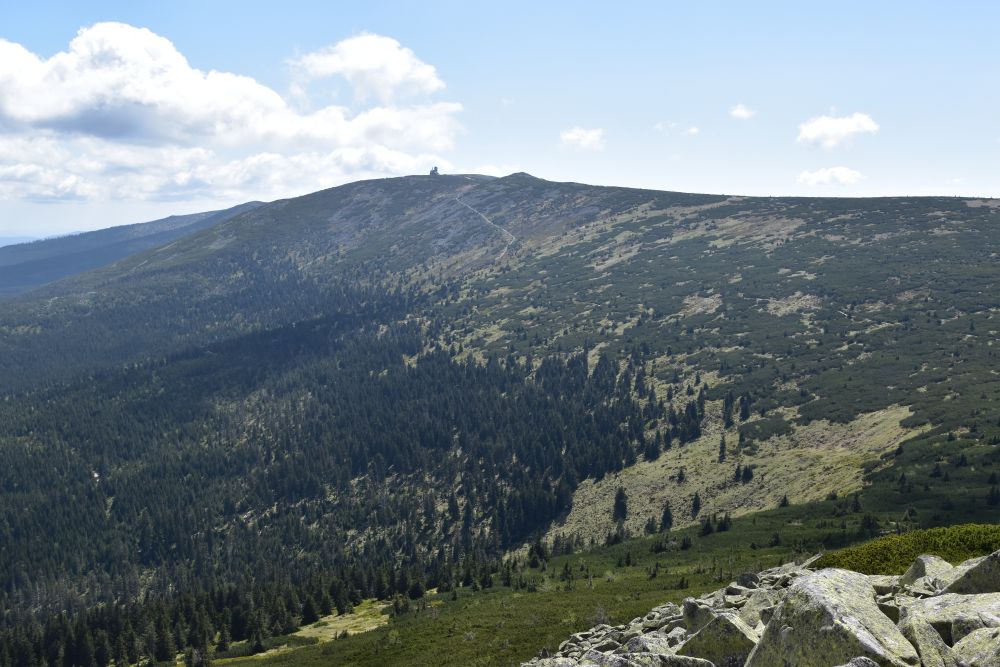
We look east to the Śnieżne Kotły. The former mountain hut (Schneegrubenbaude, it can  be seen from far) is now a radar station (Radiowo-Telewizyjny Ośrodek Nadawczy – RTON Śnieżnymi Kotłami). 

We look north towards the Isergebirge (Góry Izerskie), Szklarska Poręba and Lower Silesia.  

We have a snack at the Reifträgerbaude (Schronisko na Szrenicy)…

… and look at the fotos. They show that, indeed, the Reifträger or Szrenica does carry frost in winter. 

It must be cosy in the hut, when it is that frosty outside.

On a panorama walk,…

… we reach the shelter Hall Szrenicka located below the top.

We return to the chairlift station,…

… admiring some more of these rock stones (these are called Końskie Łby or horses). This is, where the ski run “Lolobrygida” starts – what a name for a ski run. 

We return to “our” castle Staniszów and enjoy another excellent dinner.


Sources:

To Berlin -stop over at Rothenburg ob der Tauber

In August 2022, we travel to Berlin, with stops at Riedlingen, Ulm, Rothenburg ob der Tauber and Nebra. On our way from Ulm to Nebra, we have our lunch break at Rothenburg ob der Tauber.


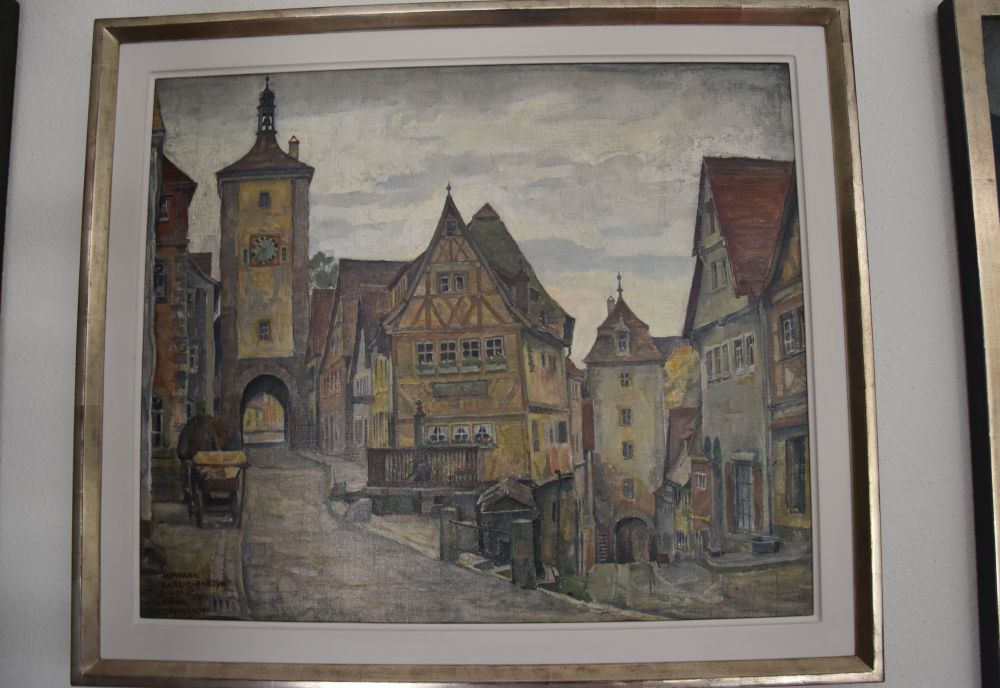
A hundred years ago, my grand-father was at Rothenburg ob der Tauber

My wish was to find the place that my grand-father Hermann Radzyk painted about a hundred years ago. 

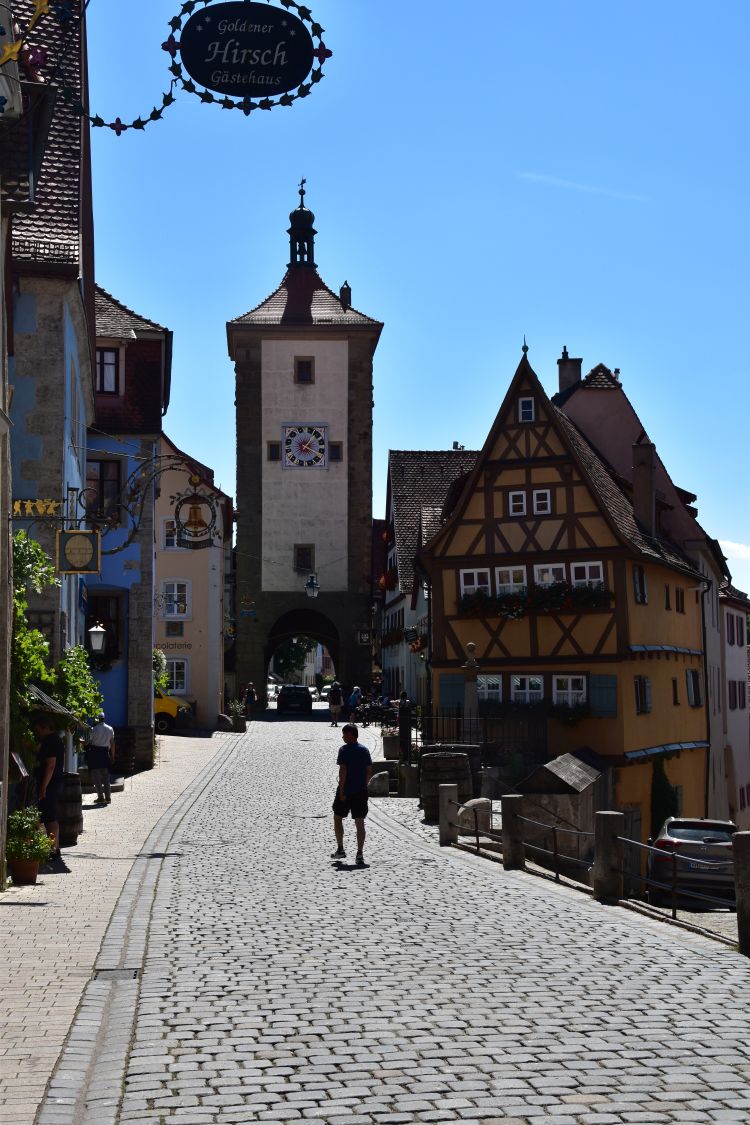
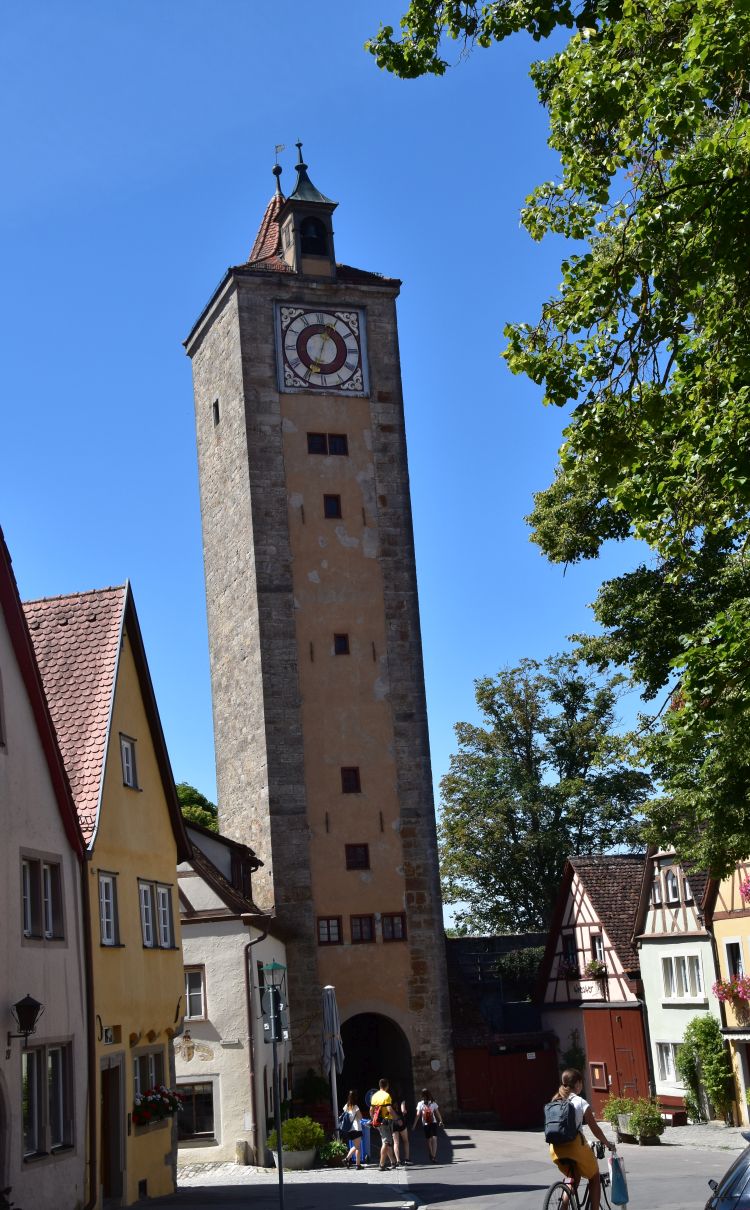
I found the place: It is the Siebersturm (city gate) and the Plönlein ( a slightly slanting half-timbered house). Rothenburg tourism says, this is probably the most photographed landmark of Rothenburg.


A short stroll through the medieval streets of Rothenburg

Rothenburg, located on a rock above the river Tauber, was a flourishig free city that lost its importance after the War of 30 Years (1618-1648). It preserved its old city image until today. It is a tourist hot spot.

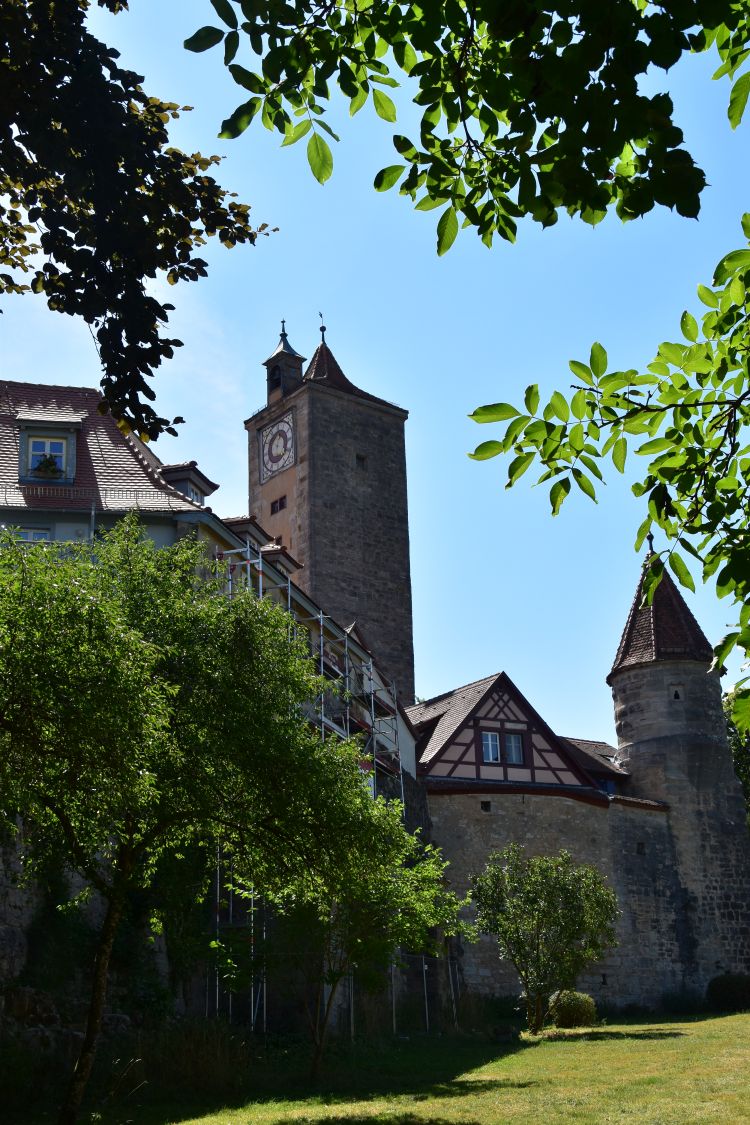
The wall with the gates surround the city. We walk outside the wall (I believe this is the Klingentor) to have a picnic under a shady tree.

We continue to the Burggarten with the wonderful view of the Tauber valley and… 

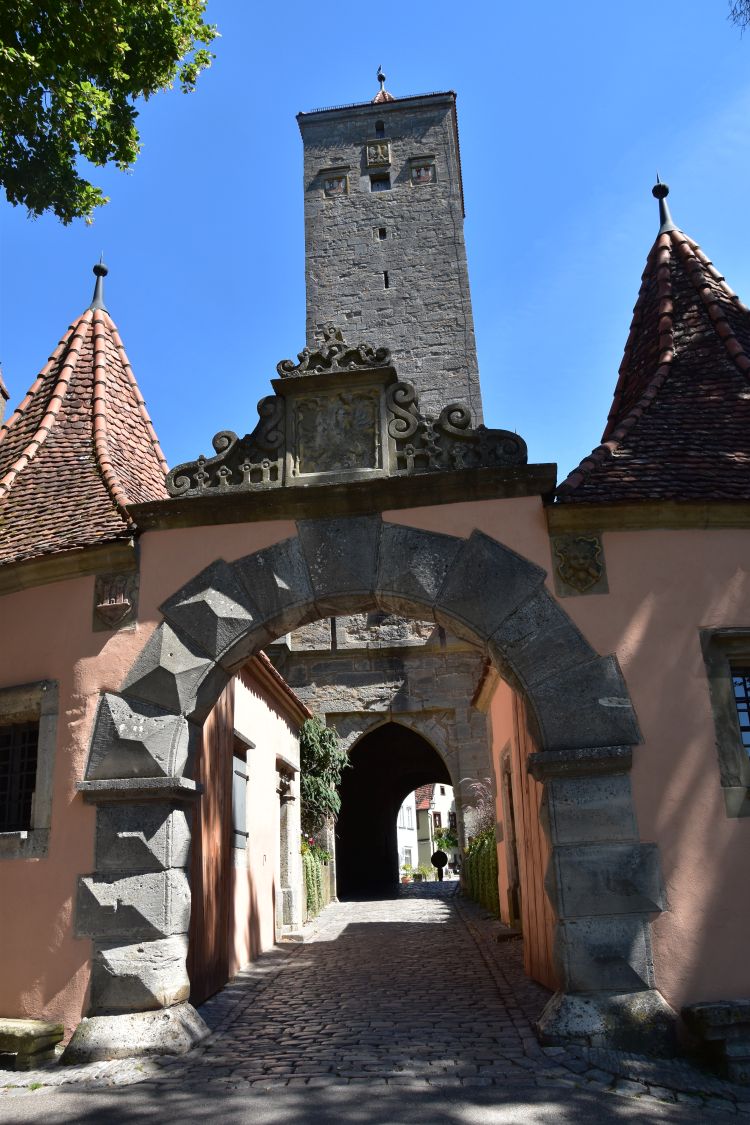
… we enter the city through the Burgtor.

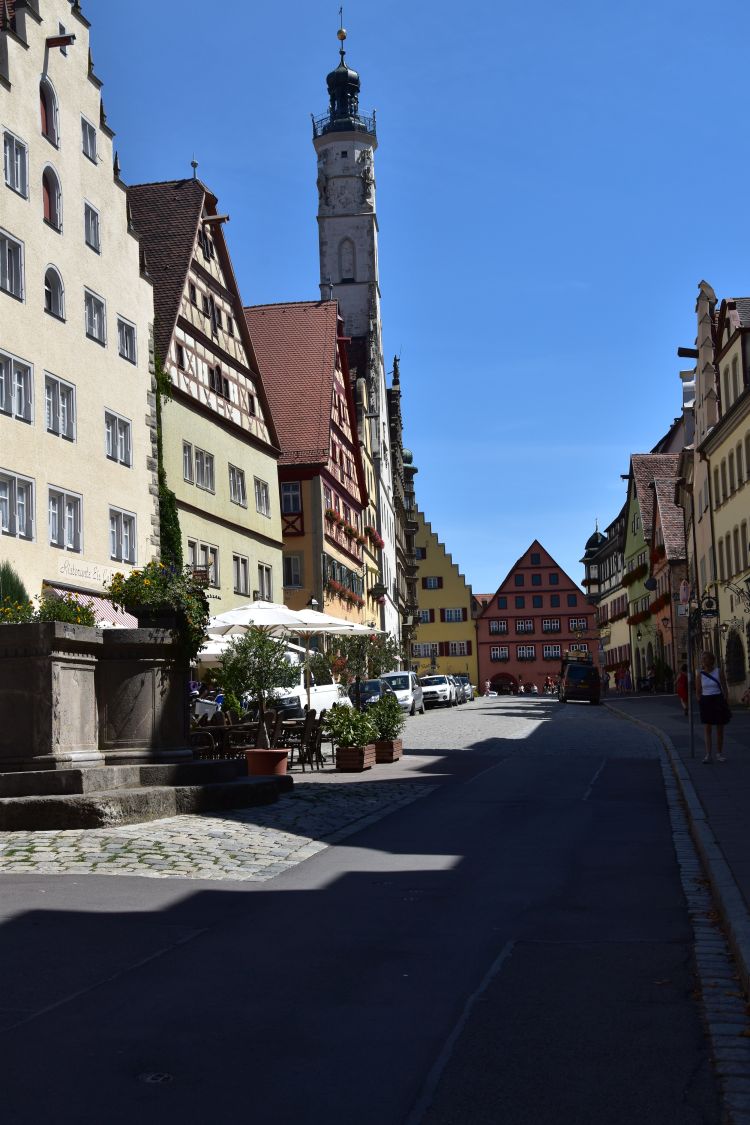
We stroll through the Herrngasse with the half-timbered houses.

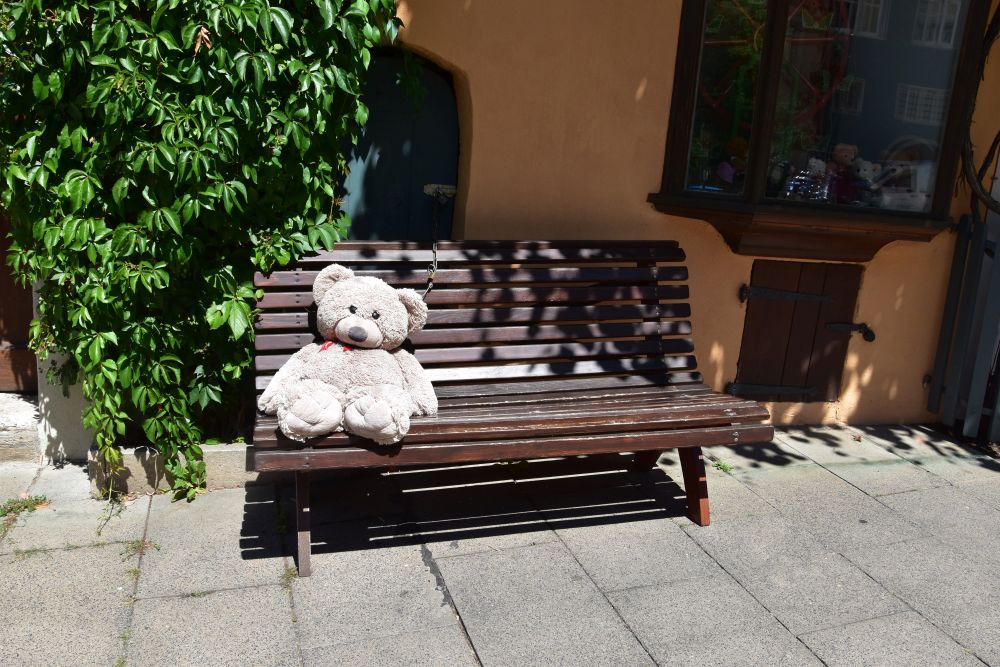
The teddy from the Teddyland Shop greets us.

We feel hot, The temperatures are at about 35 degrees and the sun burns. We eat an ice cream in the shade. Just too hot to walk in the streets now. I would like to return and explore the treasures of Rothenburg ob der Tauber, when temperatures are cooler.


Good-bye Rothenburg ob der Tauber

We return to our car. We want to get to Nebra today. A ride of three and a half hours is ahead of us.


Sources:

Website of Rothenburg ob der Tauber Tourismus https://www.rothenburg-tourismus.de/ and https://www.rothenburg-tourismus.de/entdecken/top10-sehenswuerdigkeiten/das-ploenlein/ 

Frankfurt – an old family friend is my guide

A long-year family friend at Frankfurt and a cousin at Bonn are both in their eighties. I want to visit them on my way to Berlin, mid-November 2021.

My first stop is at Frankfurt, the business capital of Germany on the Main river.

At Frankfurt, I have been invited by Dietrich and his wife. Our grand-parents were friends, after that our mothers were very close friends and now we, the grand-children, are friends. We are long-year family friends.

A hundred years ago, Dietrich’s grand-father had acquired some paintings of my grand-father-artist Hermann Radzig-Radzyk, for instance the Kirchberg at Schreiberhau, now Szklarska Poręba, in Silesia…

… and the valley at the county of Kłodsko (Glätzisches Land), also in Silesia.

Immediately, I feel at home in the house of Dietrich and his wife. I am surrounded by memories of my family, and the welcome is hearty.


Charming small Italian restaurant run by two sisters from Naples

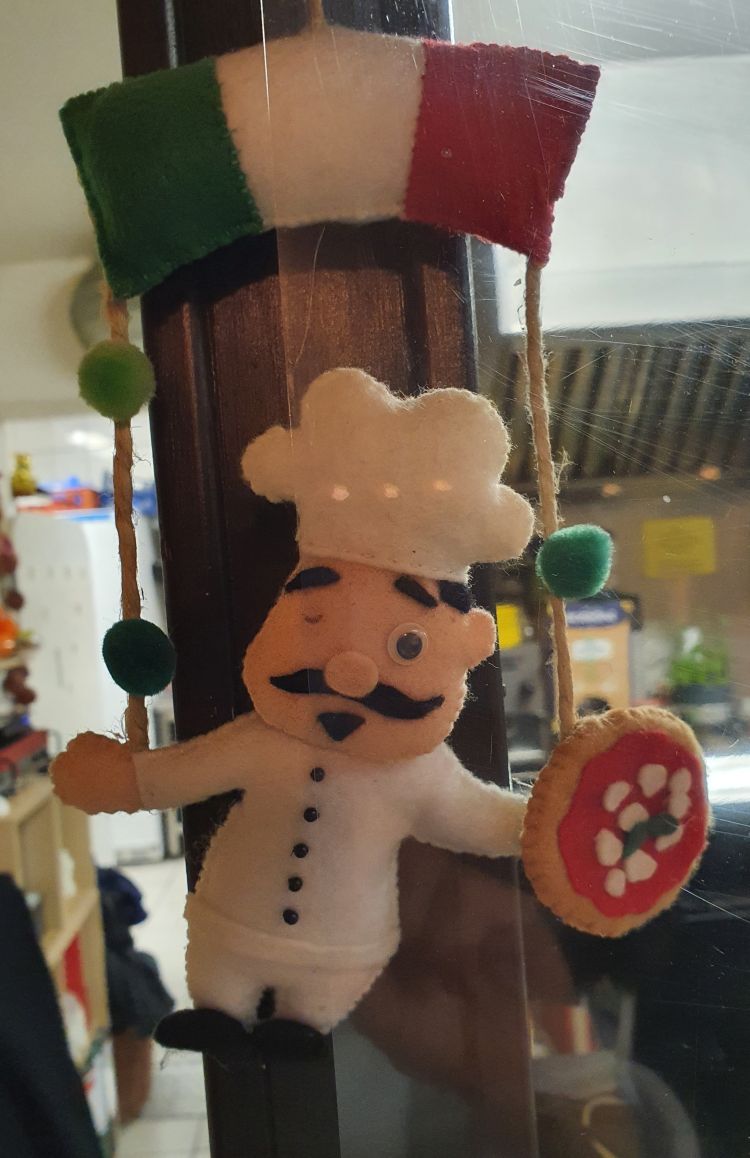
We have dinner at the charming small Pizzeria La Paesana, run by two sisters from Naples. Their nephew made the pretty felt pizzaiolo that now decorates the pizzeria of his aunts. Well, the pizzaiolo has lost one eye – that makes him look even friendlier – he seems to twinkle at me.

The small restaurant is an excellent welcome to Frankfurt. I have tasty wild boar noodles with a slightly sparkling Lambrusco, my friends have pasta Carlo Magno with Gorgonzola – it is said that Charlemagne (Karl der Grosse or Carlo Magno) loved Gorgonzola, the sisters tell us. That was around the year 800 AD – what a cheese tradition! 
(According to the wiki entry about Gorgonzola, it is said that Gorgonzola was first produced in 879; but this could well have happened a little earlier, when Charlemagne lived, and if not, it is a nice legend).

We will meet Charlemagne later again in the city centre of Frankfurt. 


My first impression of the city – Hauptwache (main guardroom) and skyscrapers touching the morning clouds

Dietrich takes me to the S-Bahn. We leave the underground station at the Hauptwache (main guardroom). Saint Catherine’s Church appears behind the stairs. 

The baroque guardroom, built in 1730, was the headquarter of the city’s soldiers. It was also a prison. It was destroyed in the Second World War and reconstructed thereafter. 

The Hauptwache is surrounded by modern buildings, with the Commerzbank building fading in the mist of the late morning. 


The lifeline of Frankfurt am Main – the river Main

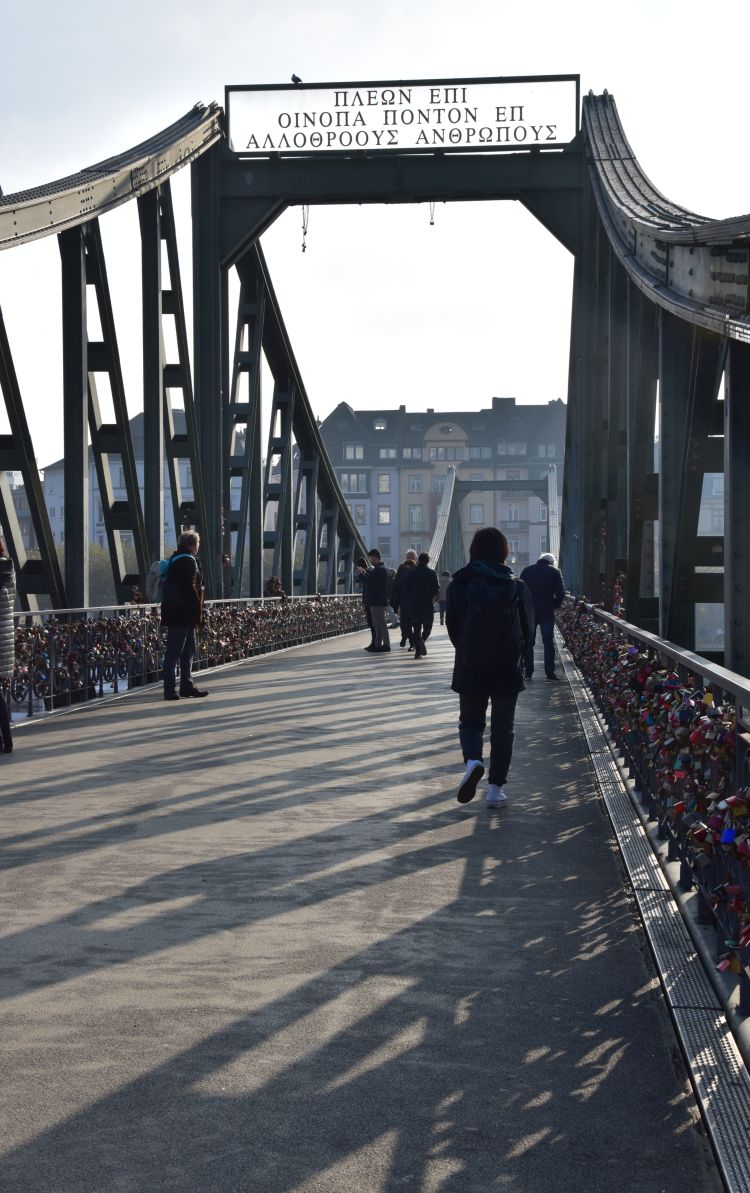
The lifeline of Frankfurt is the Main river. We approach it near the pedestrian bridge “Eiserner Steg” with the inscription in Greek saying “the sea has the colour of wine and, on this sea, we are sailing to meet other people” (auf weinfarbenem Meer segelnd zu anderen Menschen).

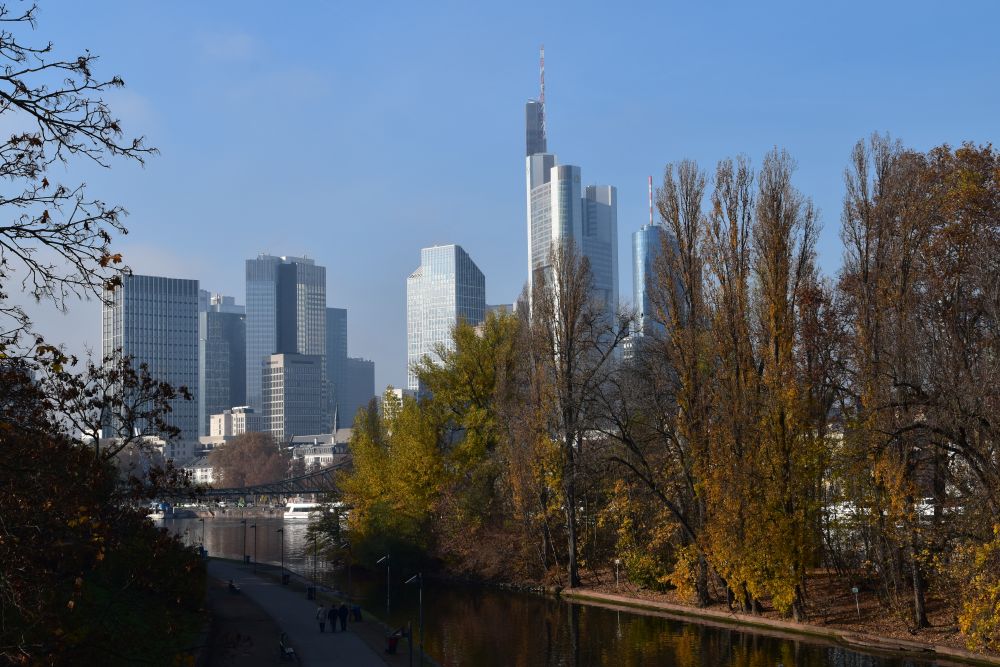
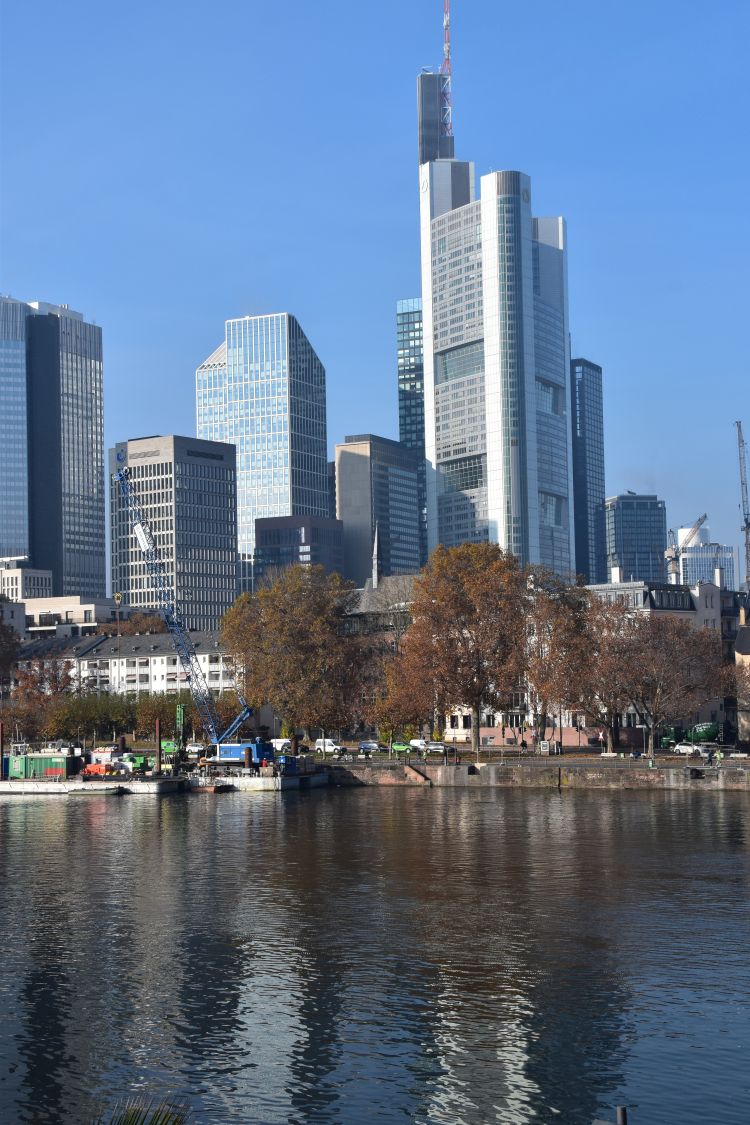
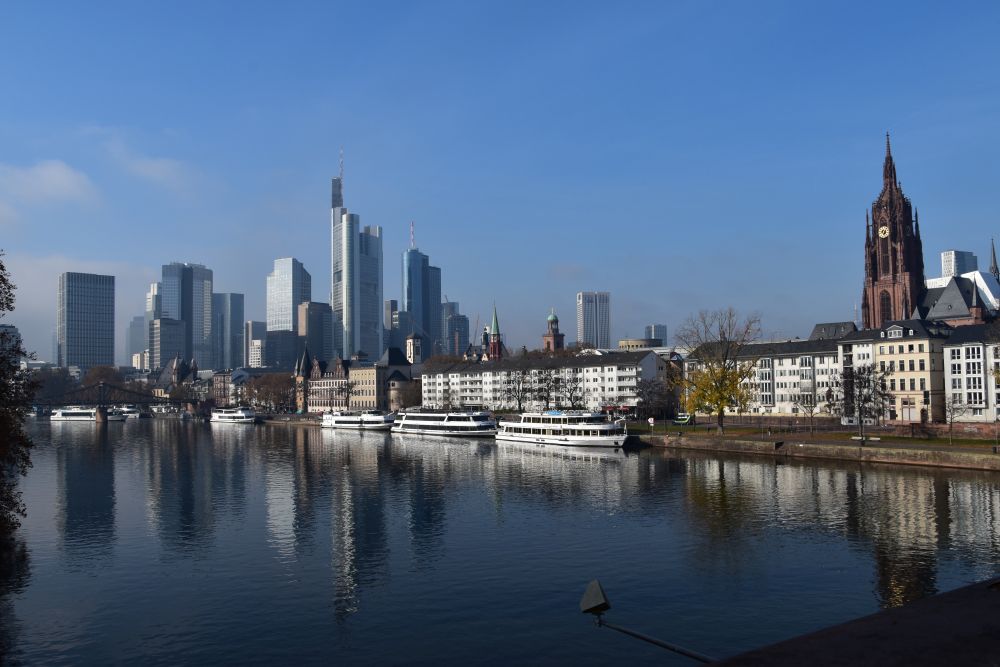
From here we can see the Commerzbank building again, now under blue sky in the sun, surrounded by many more modern buildings reflecting in the Main river . 

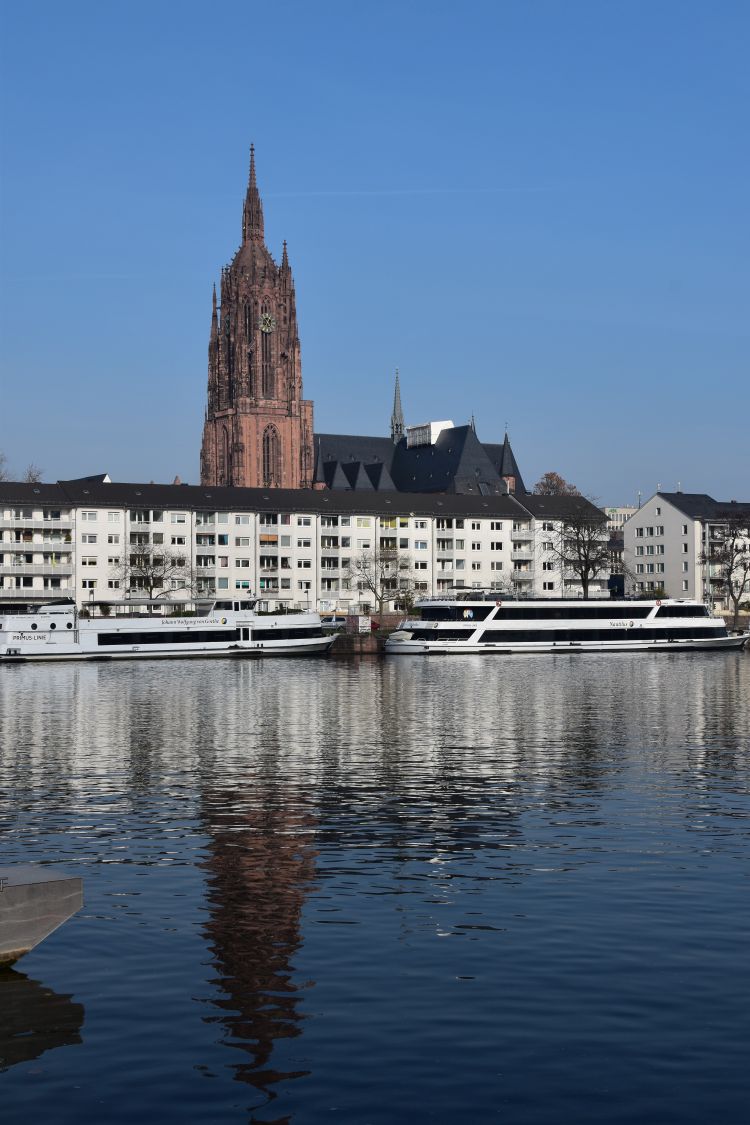
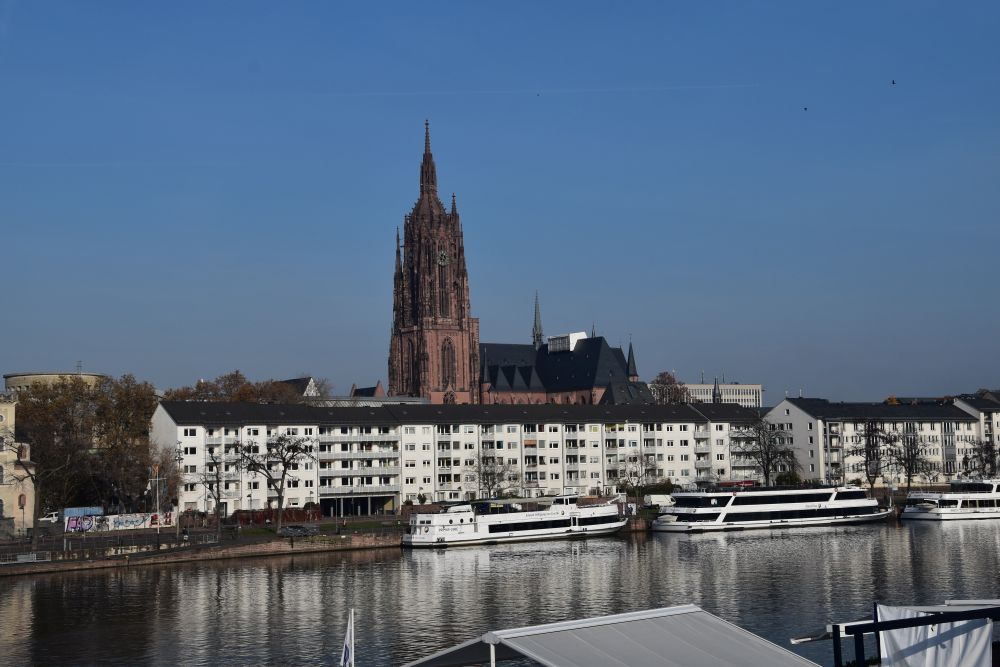
This is the Cathedral Saint Bartholomew, also reflecting in the Main river.

Across the Eiserner Steg we reach the urban district Sachsenhausen. We stroll along the waterside promenade and meet these two ducks, also citizens of Frankfurt, sleeping comfortably on one leg. 

The skyline, again with the Commerzbank tower, appears behind the island (Maininsel) that shines in golden autumn colours. 

Returning to the city centre using the Old Bridge (Alte Brücke), I make a photo of both the modern business skyline and the Gothic Cathedral of Saint Barthomolew. 

Frankfurt has charm, definitively, when seen from their lifeline, the Main river. 


Timbered houses at the Römerberg and the Old St Nicholas Church (Alte Nikolaikirche)

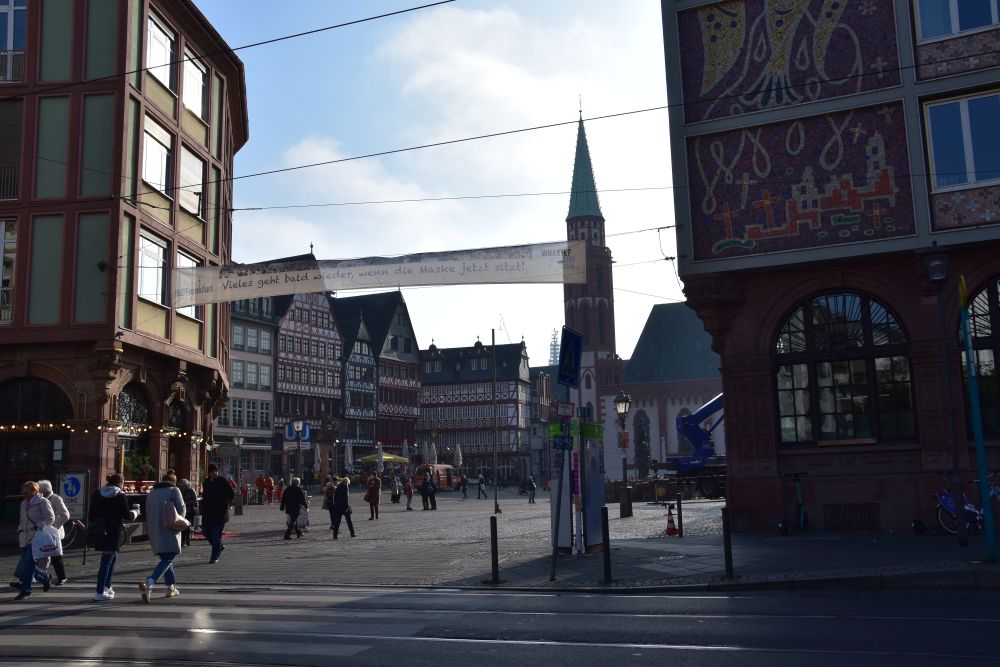
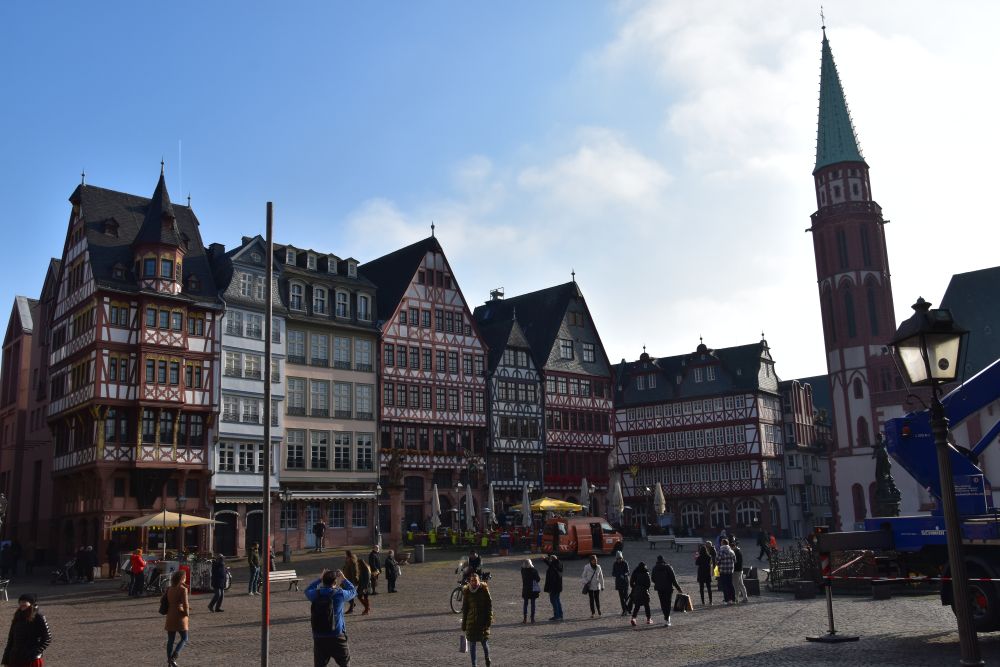
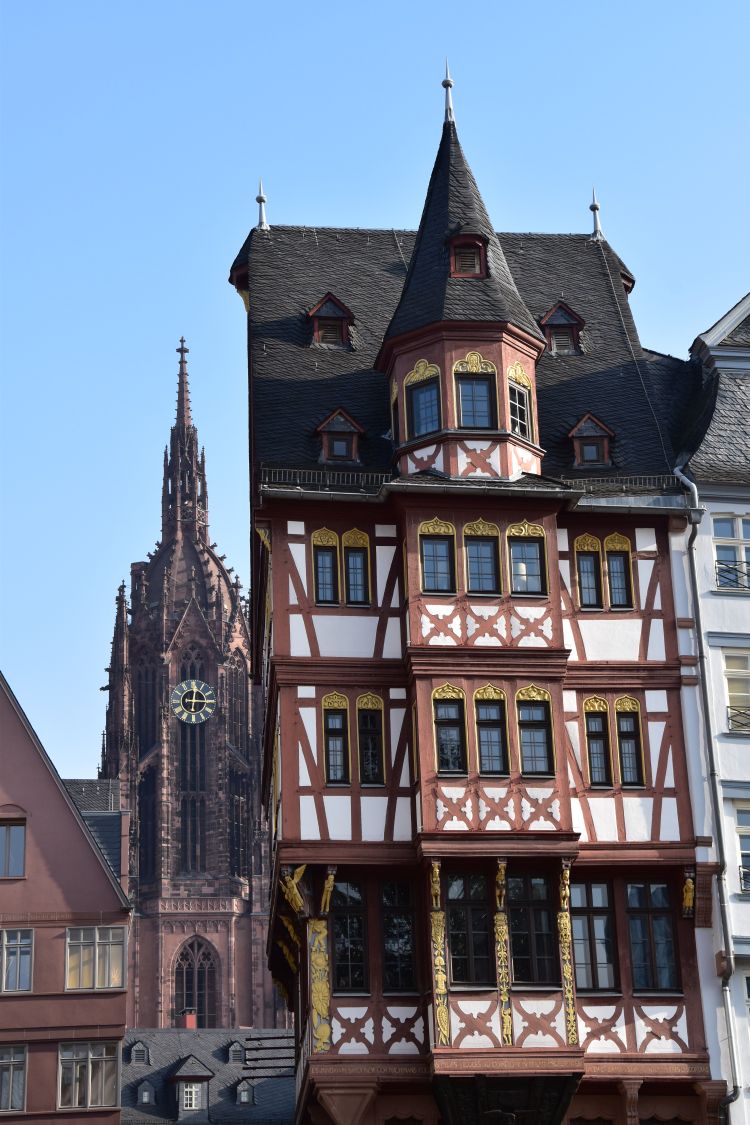
Away from the Main river, the old city centre is located on the Römerberg. It is bordered by timbered houses and the Old St Nicholas Church. 

We enter the Römerberg square under the banner that plays with German words: “Vieles geht besser, wenn die Maske jetzt sitzt” (translated literally: “much will “go” better, when the mask “sits” meaning”, when the mask fits – it is the times of COVID).  

On the Römerberg, the first fairs took place in the 11th century. Frederic the Second of Hohenstaufen granted the right to run fairs to Frankfurt in 1240. 

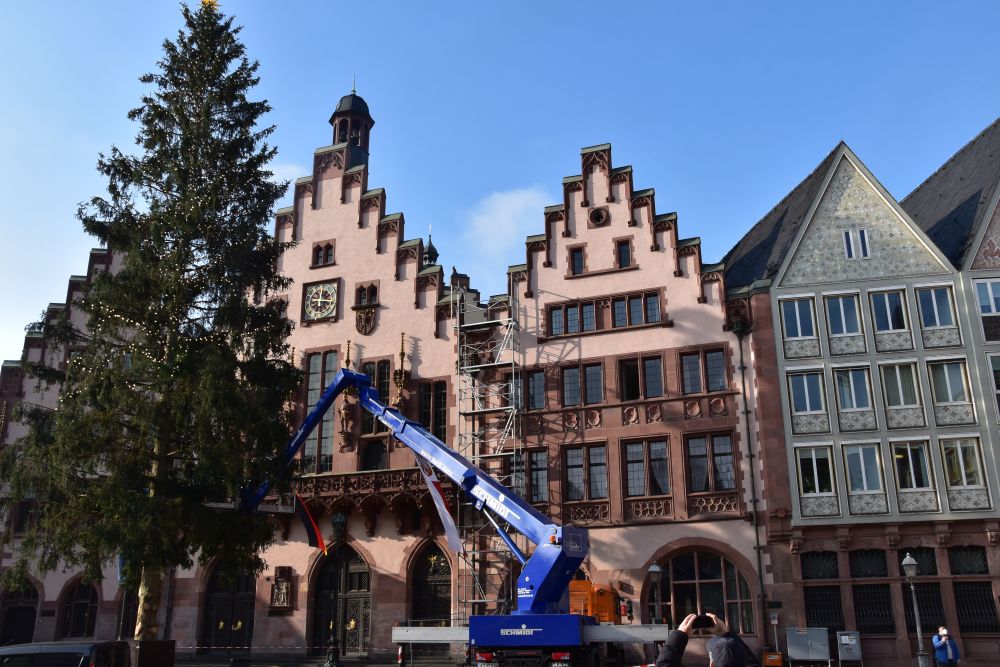
It is mid November, time to set up the Christmas tree in front of the old town hall. 

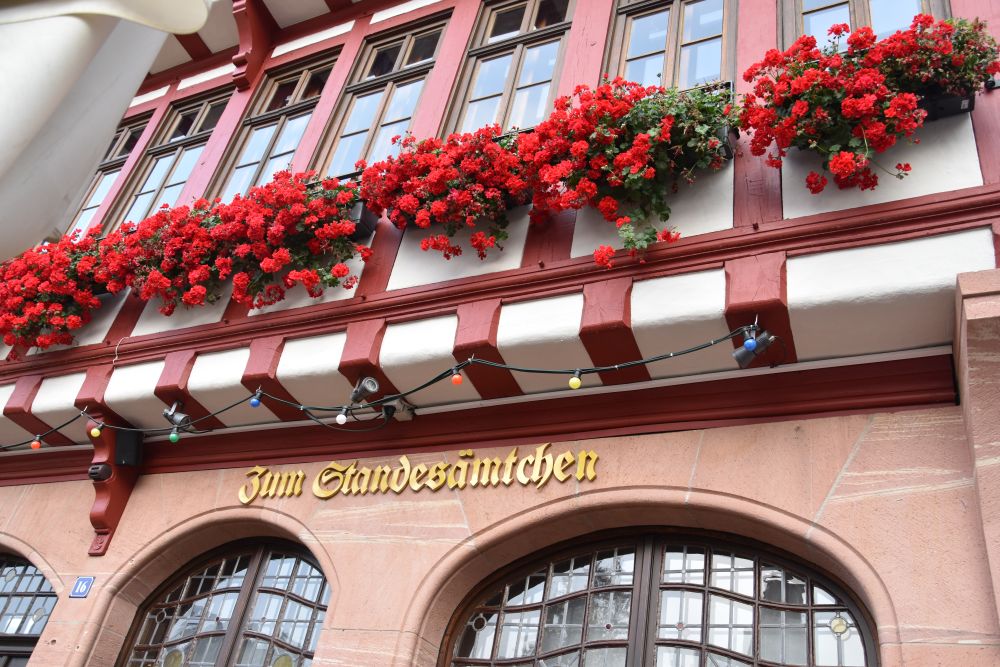
This is not the Standesamt (civil registry office), but the Standesämtchen. The ending “chen” combined with “ä” indicates that it is the “small” registry office which, in Southern Germany, adds a friendly and welcoming touch to it. Actually it is not a small civil registry office, but a restaurant that carries the name “Standesämtchen”. 

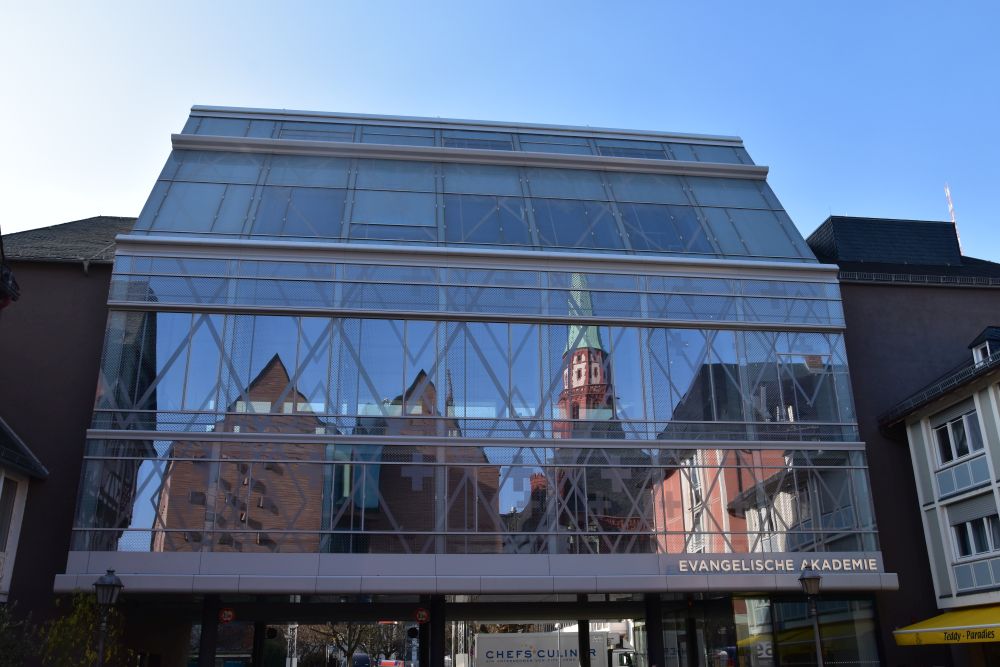
Modernity and tradition are joining. The Old St Nicholas Church reflects in the glass wall of the Evangelische Akademie (education institution and conference house). 

As a matter of fact, Frankfurt has been in ruins after the Second World War. The houses around the Römerberg, originally from the 15/16th century, have been reconstructed in  the 80-ies, except the Wertheim building nearby that survived the air raids. 

The late Gothic Old Saint Nicholas Church from the 15th century only suffered minor damage by the bombs of the Second World War.  


The Cathedral St Barthomolew behind the Römer

From the Römerberg, we can see the Cathedral of St Barthomolew.  

The cathedral can be seen from the Main river, too. 

The cathedral is also called “Kaiserdom” (Emperor Cathedral). Actually, it is a “Königsdom”, because the kings of the Holy Roman Empire were elected here since 1152 and crowned since 1562, until the Holy Roman Empire ceased to exist. No “emperors” were crowned here, kings were crowned here. Furthermore, the cathedral has never been a bishop seat, though it is called “cathedral”.

The present Gothic cathedral is mainly from the 14th and 15th century, reconstructed in the 1950’s after having been severely damaged in 1944. 

The modern organ matches the gothic vaults. 

Reading about the cathedral at home, I would like to return to explore the collection of altars from all over Germany and the chapel, where the elections of the kings took place. 


New Old City (neue Altstadt), reconstructed based on the medieval ground plans

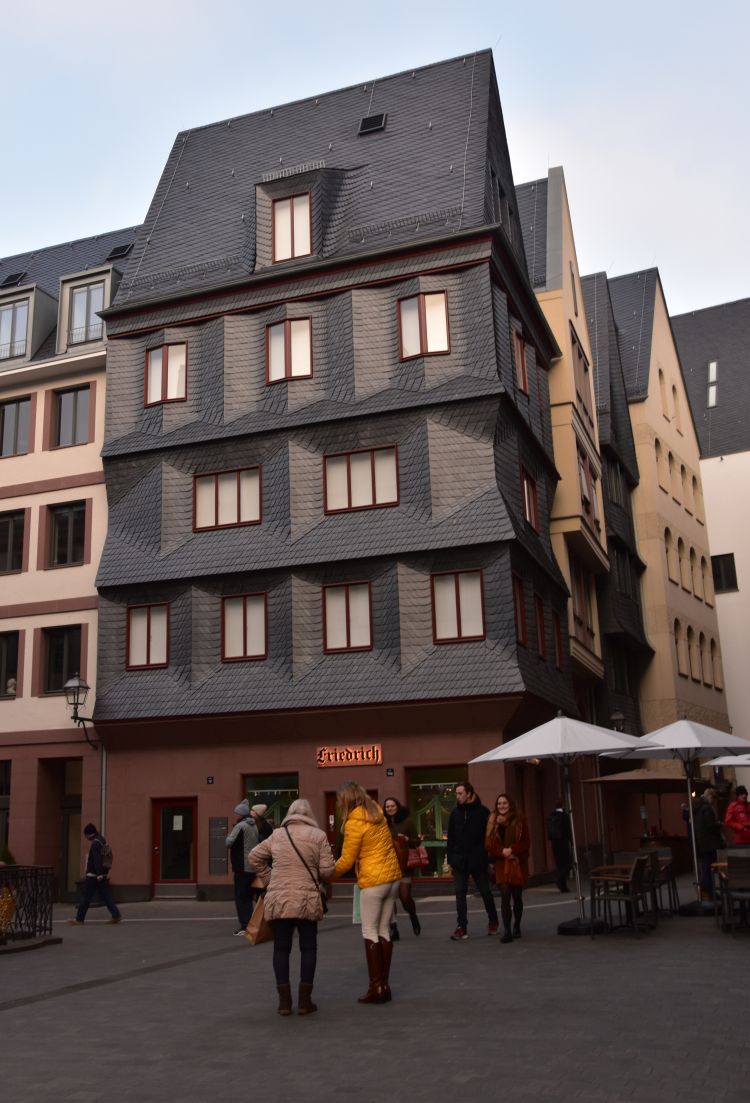
Between the Römerberg and the cathedral of St Bartholomew, the old city has been rebuilt along the medieval ground plans – this is now called “neue Altstadt” or “New Old City”.

The area is not without charm. However, to me, the houses look a bit, as if they had been cut out of cardboard. 

They are neither really old nor really modern. 


Kaiserpfalz – meeting Charlemagne again, the emperor who enjoyed the Gorgonzola cheese

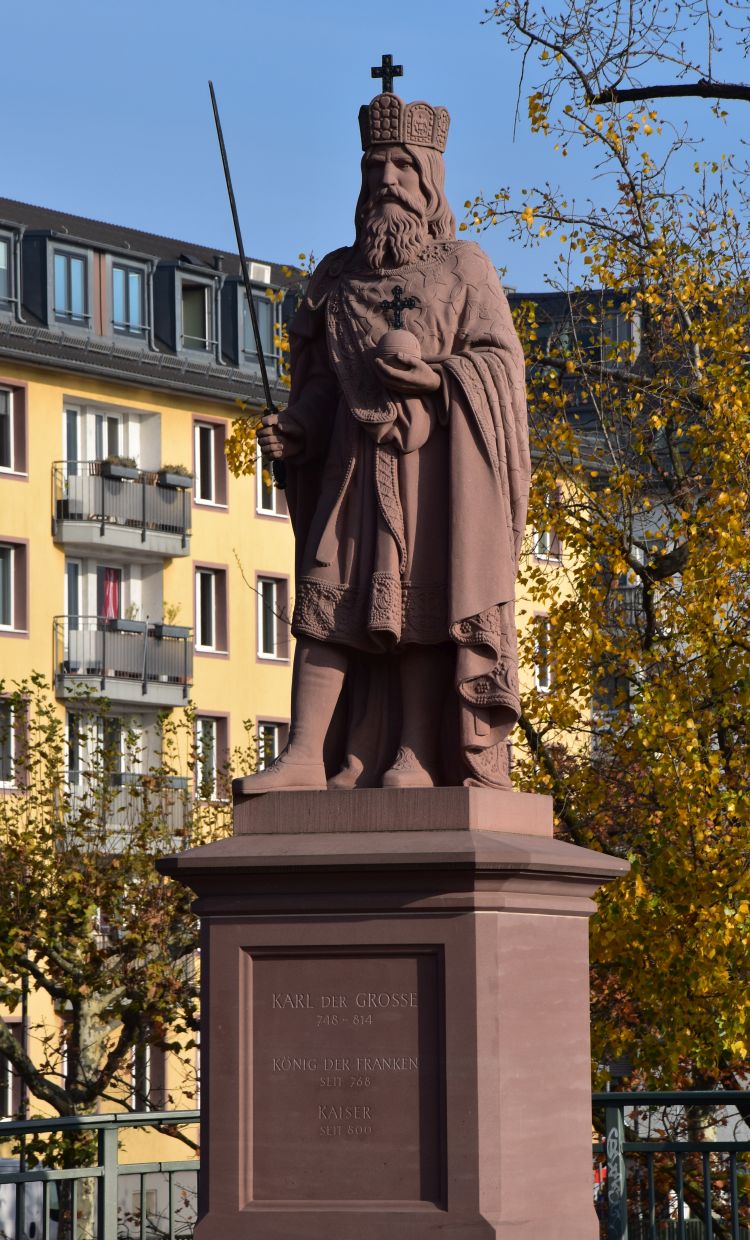
Here, he is again, Charlemagne who is said to have loved the Gorgonzola cheese. In a way, he is the founder of Frankfurt. That is why, I assume, he stands on the old bridge crossing the Main river. He looks downstream, severely frowning.

In 794, it was Charlemagne who was the first person to mention Frankfurt or “Franconofurd”. At that time, he held a synod of bishops and an imperial assembly here. 

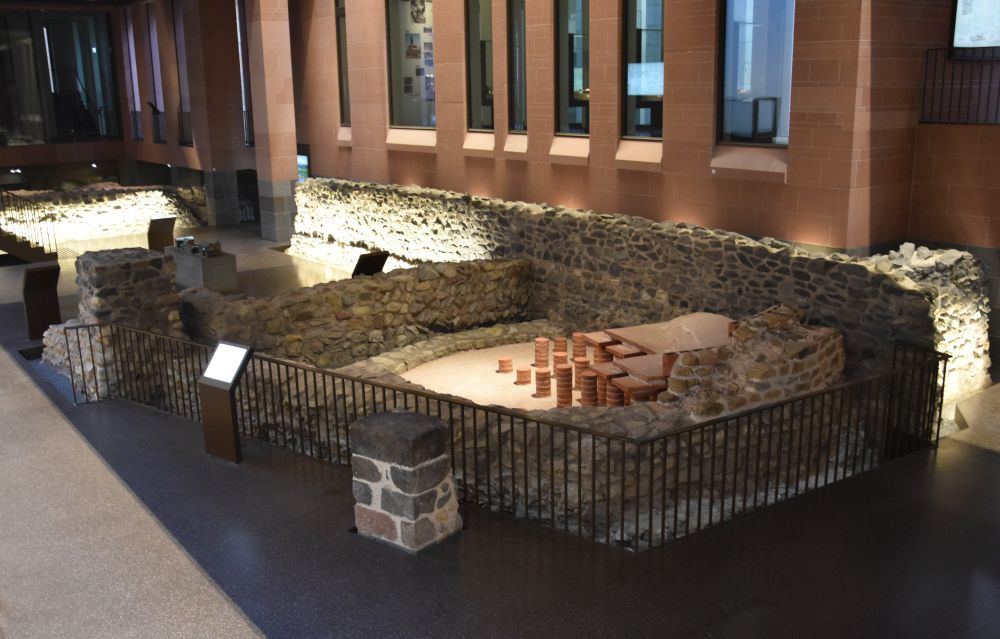
Charlemagne was at Frankfurt in 794. However, later he probably never returned to Frankfurt. It is assumed that his grand-son, Louis the German, founded the first cathedral and made Frankfurt an important royal palatinate. The ruins of the palatinate are presented in the New Old City.

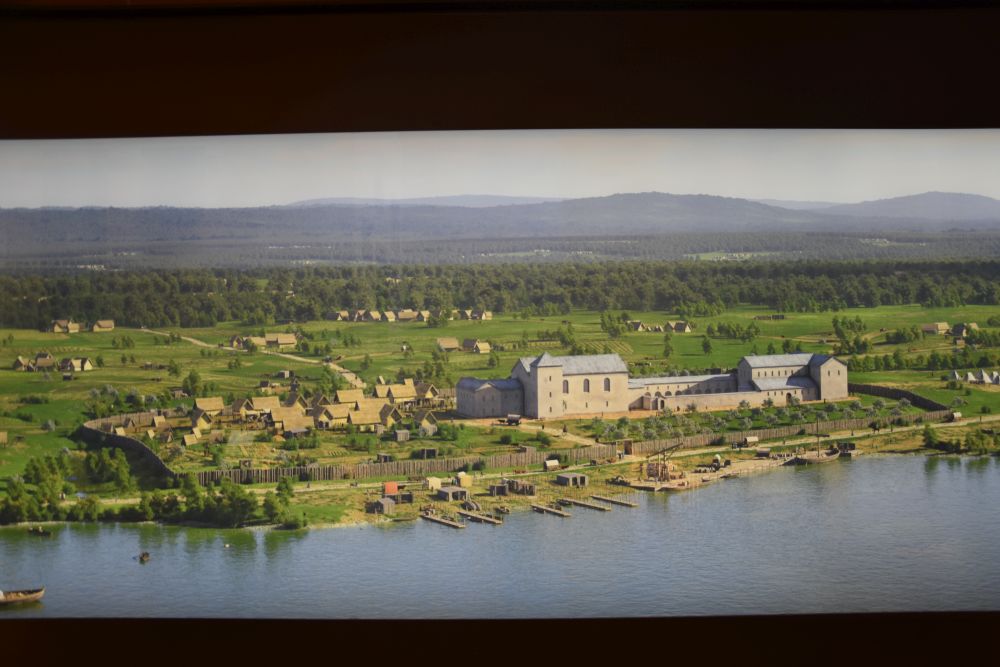
This is, what the royal palatinate (Königspfalz) might have looked like in the 9th century. 

The painting is on display in the museum.


Church St. Leonhard

The Church St Leonhard is bordering the Main river. The beginnings go back to the early 13th century, and the Romanesque structures have been largely preserved. In 1323, the church acquired a relic of Saint Leonhard which made it an important pilgrimage site. 

In the early 15th century, the choir was reconstructed in Gothic style while the Romanesque apses remained in place. Around 1500, the nave was enlarged.

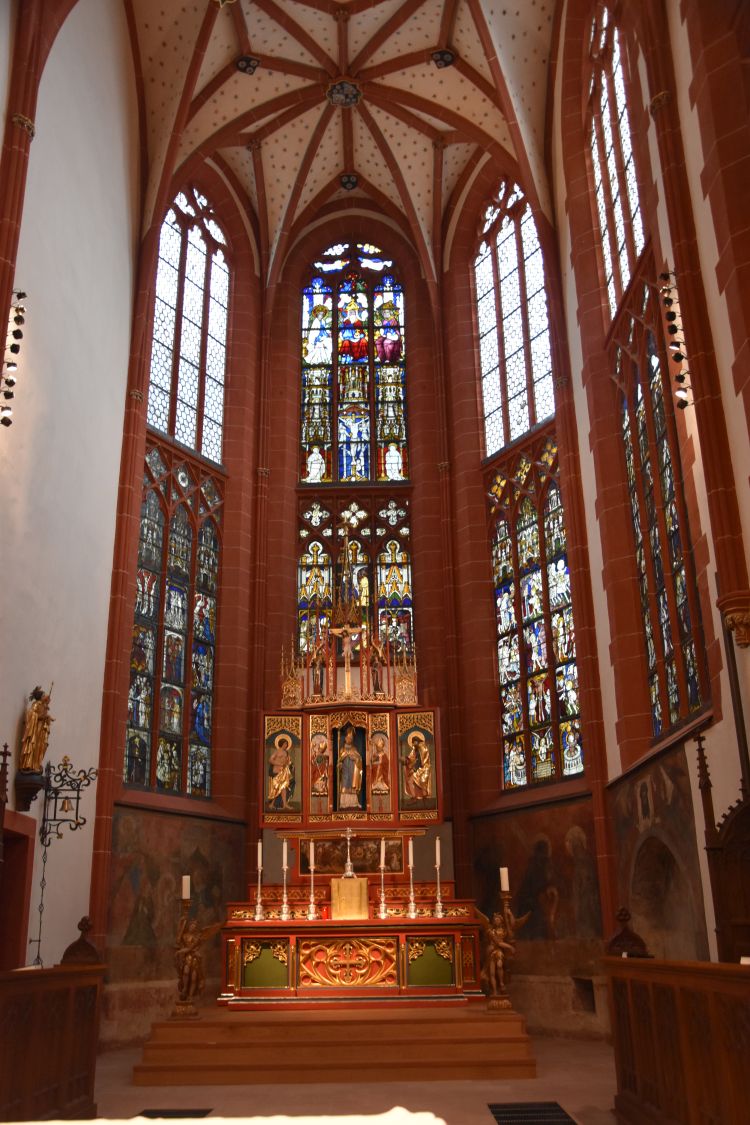
The Gothic main altar was acquired around 1850. The middle part is from Swabian Bavaria. The predella is supposed to have been crafted at Memmingen in the late 15th century; it shows the martyrium of Ursula. The two candle holders are Baroque angels from 1614.

Late Gothic frescoes decorate the walls of the choir, to the left the Annunciation scene, to the right Christ carrying the cross. Some of the stain glass windows in the choir are from the 15th century. 

The altar of Marie comes from Antwerpen (about 1480). The centre part is dedicated to Marie (her death, her ascension, her coronation). The predella shows the Last Supper.

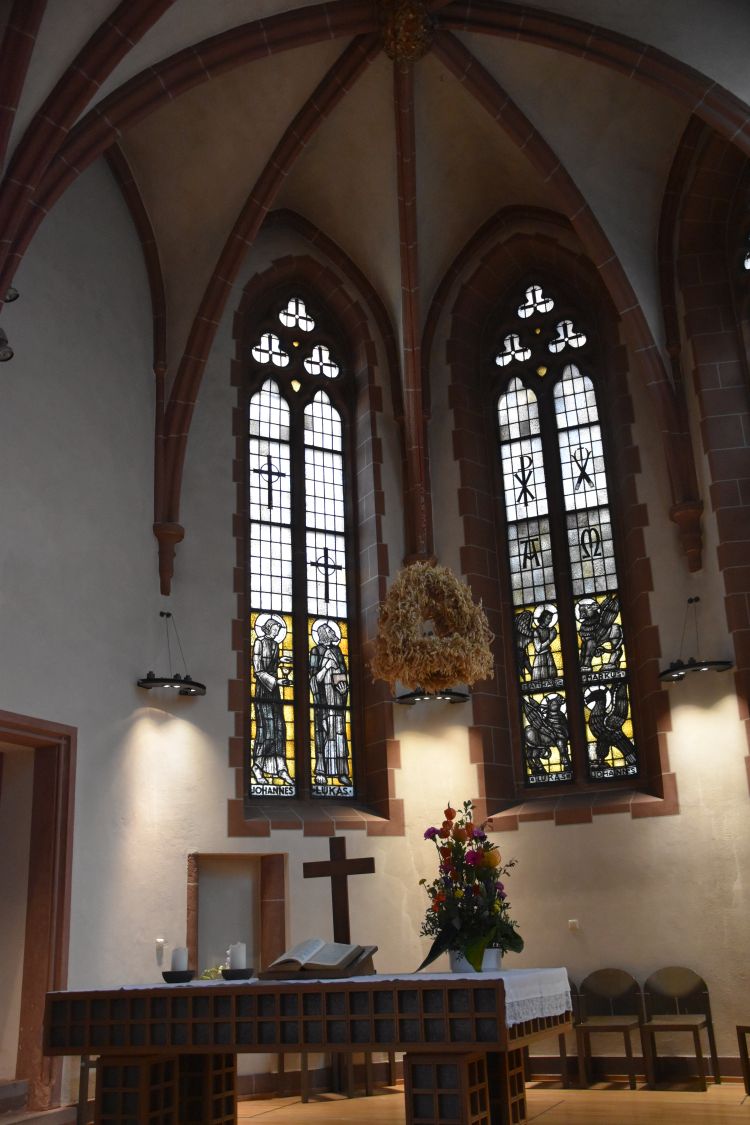
In 1944, the Church Saint Nicholas was only moderately damaged; sister Margarita prevented a devastating fire. Between 2011 and 2019 the church was completely renovated.

Reading the booklet acquired in the Church of St. Nicholas, I understand, there is more to see in this church, I would like to come back.


Goethe was born at Frankfurt

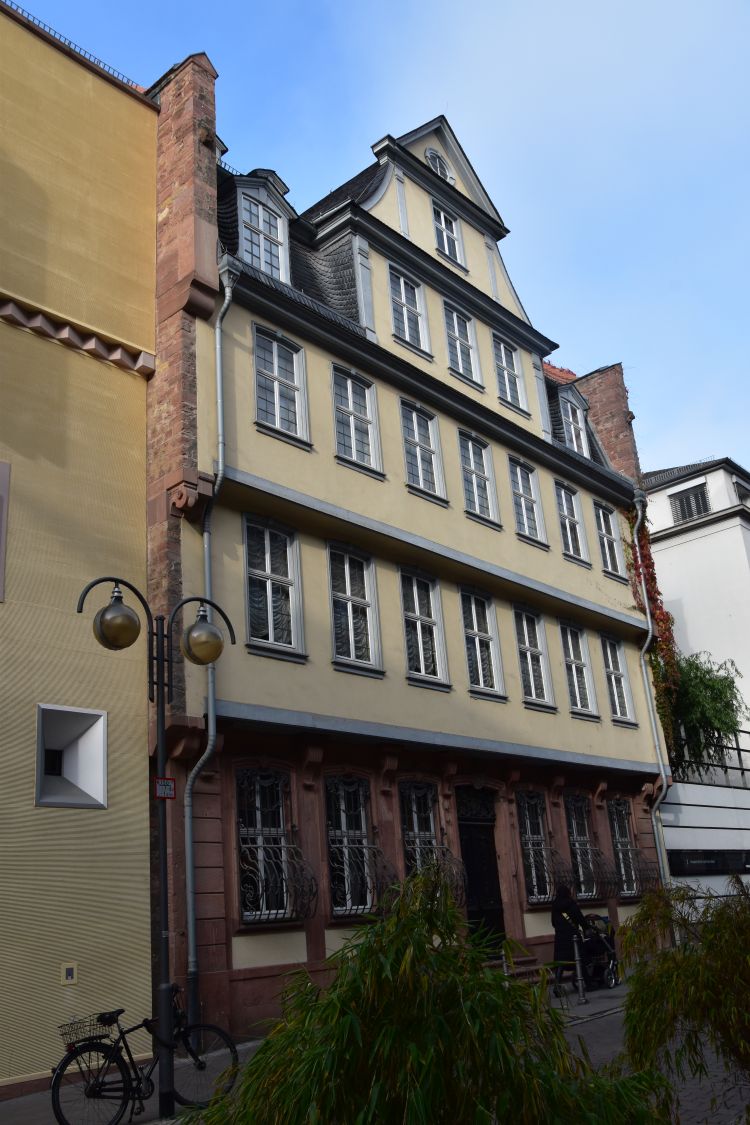
In this large, yellow house at the Grosser Hirschgraben, Goethe was born (1749-1832) . He lived in Frankfurt, until he left to study law at Leipzig in 1765.

Well, the yellow house was destroyed in 1944, and it was reconstructed after the war, exactly as it was before. 

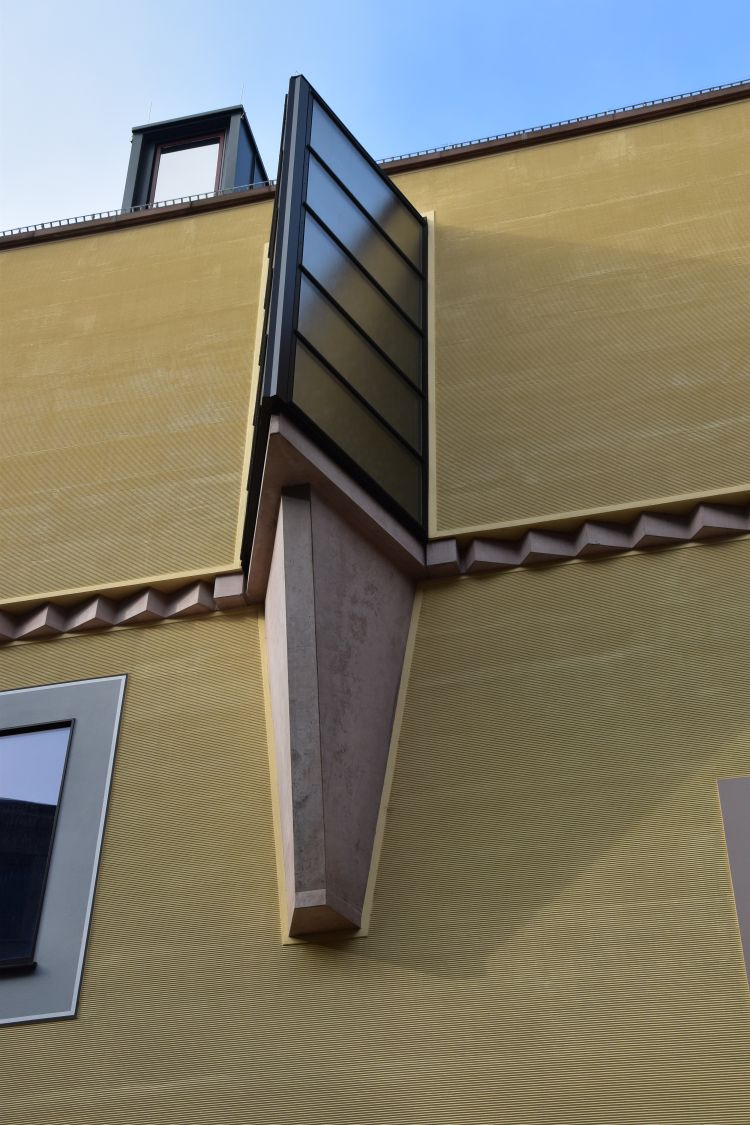
Next door is the Frankfurter Goethehaus (House of Goethe) with the Deutsches Romantikmuseum (German museum of Romanticism). I liked the highly modern oriel interpretation. 

Again next door is the Volksbühne, a theatre, with two more modern oriels swinging along the façade.  


Town Hall and Local Court (Ortsgericht)

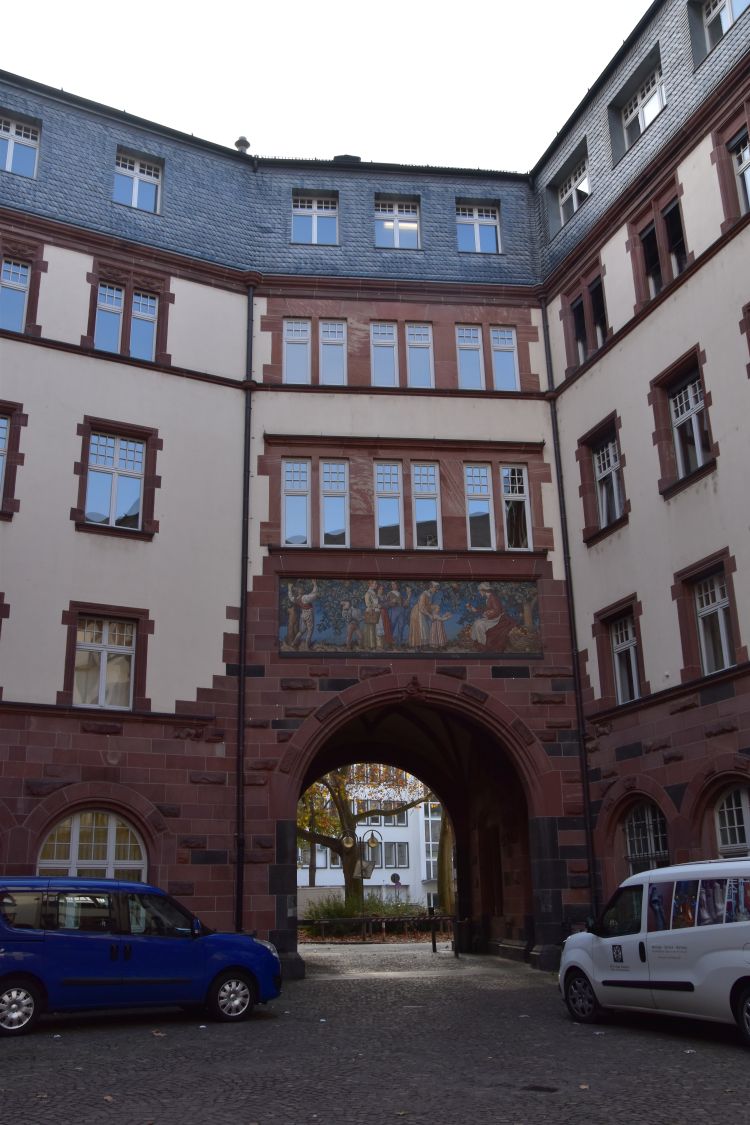
From the Goethe House we cross the busy Berlinerstrasse and reach the Local Court of Frankfurt (Ortsgericht), … 

… leaving it through the gate with the fresco showing the wine harvest. 

We now look at the rear side of the town hall, …

… with the town hall tower seen from under the Seufzerbrücke (Bridge of Sighs, a skywalk) at Bethmannstrasse. 


St Paul’s Church (Paulskirche)

Behind us, we can see the oval shaped classicist Saint Paul’s Church, completed in 1833. In 1848, the first German national assembly was held in Saint Paul’s Church. However, the attempt to found the German nation failed, as the Prussian king did not accept the emperor crown to reign over all German states. Nevertheless, the constitution elaborated by the assembly was accepted by most German states; it can be considered to be the roots of the German democracy (see Stadtführer, p. 38). 
The building was reconstructed after 1945 to become a national memorial. This is the new cupola seen from inside.

A monumental frieze makes the representatives of the 1848 assembly revive.


Sight seeing makes hungry – the Kleinmarkthalle (small market hall) is close

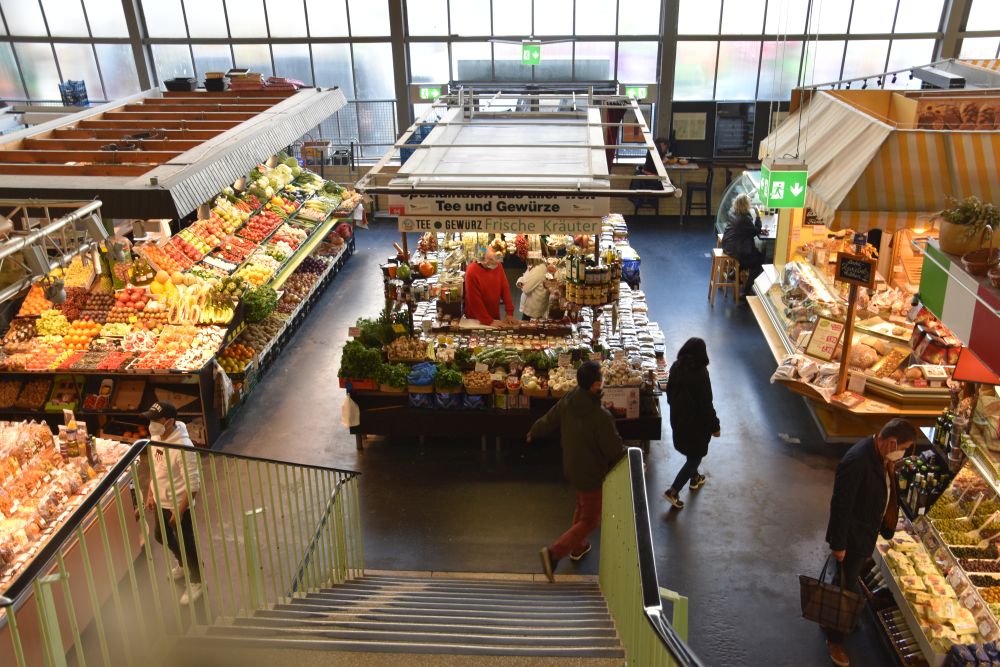
Around lunch time, I am usually hungry. We make a “pitch stop” at the Kleinmarkthalle (small market hall) near the city centre. 

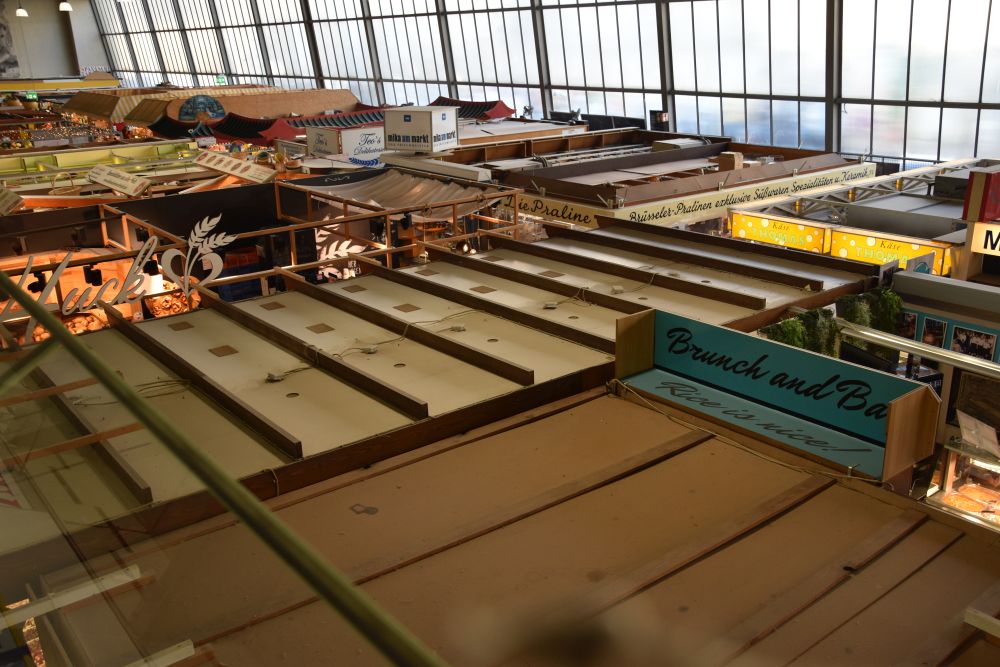
We climb up the stairs to get an overview from the gallery.

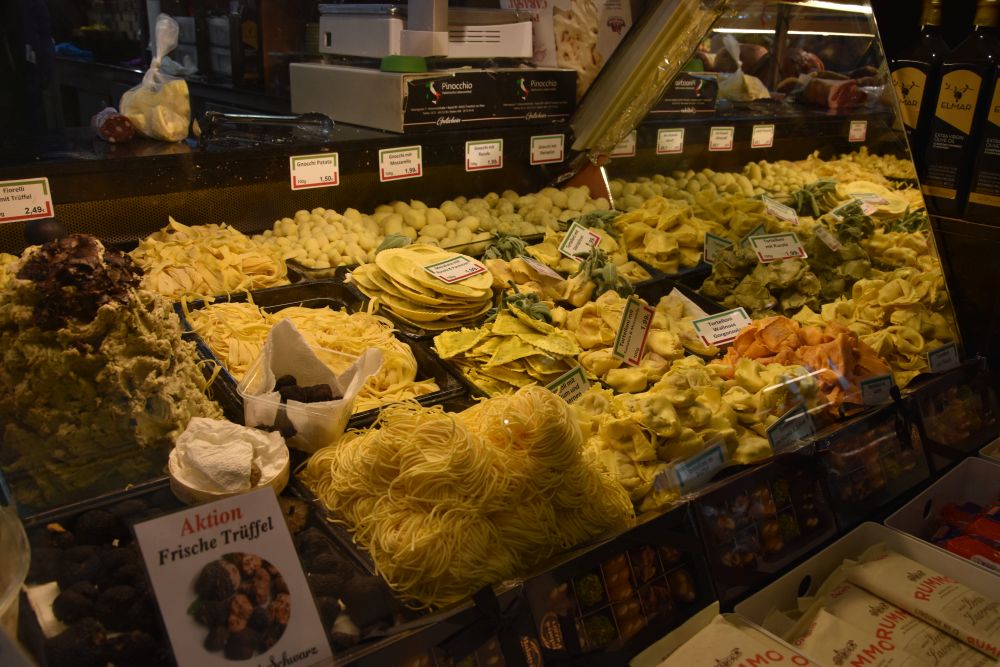
We walk around and enjoy the stands with enticing pasta,…

… apple wine (called Ebbelwei here), …

… meat offered by a citizen of Frankfurt that is obviously from Turkish origin (I love to see the mixture of nations here),…

… beautifully arranged fish… and much more.

We join the waiting queue at Dietrich’s favourite sausage stand of Ilse Schreiber, where we buy two sausages from Hessen (the state that Frankfurt belongs to). We have to eat our sausages outside, because inside the building we have to wear masks, outside, we can take them off, which is much more convenient for eating sausages. 


Good-bye Dietrich, now I am heading north to Bonn, with a stop over on the Grosser Feldberg

Thank you, Dietrich, I have spent two wonderful days with you and your wife. I have learnt much about Frankfurt, and there is more to see in Frankfurt with its museums, with the modern business centres, with the carefully preserved or reconstructed medieval sights and with its lifeline, the Main river.

Now I am heading north to Bonn.

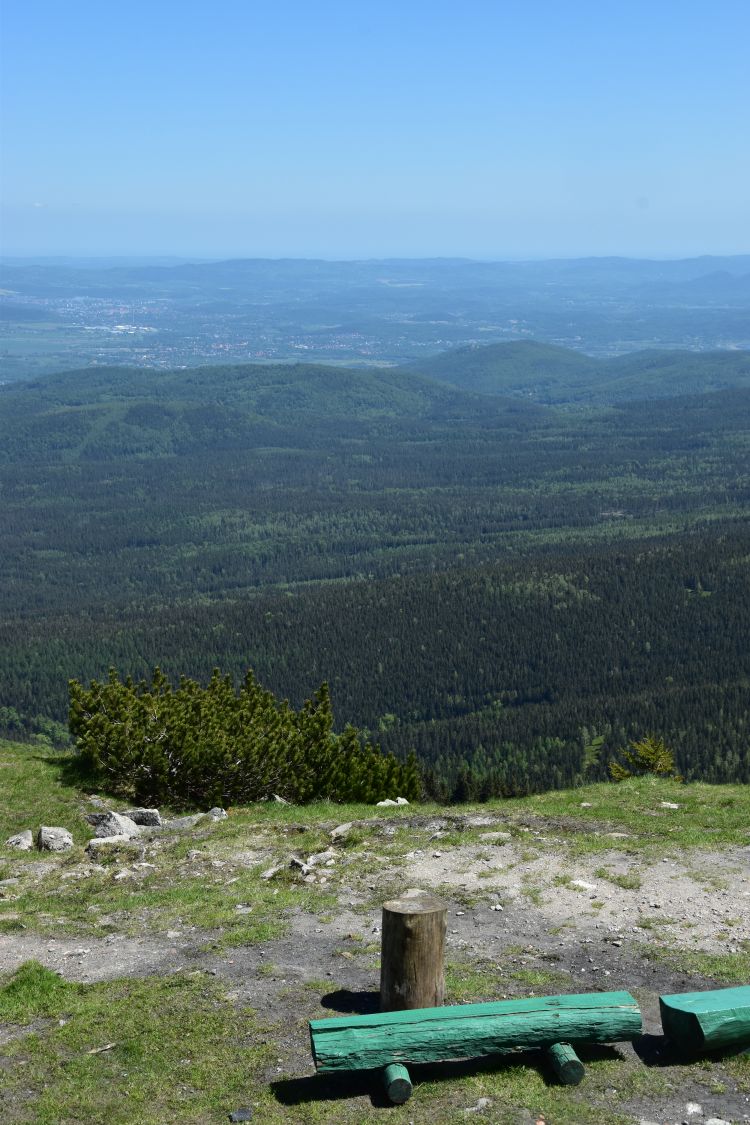
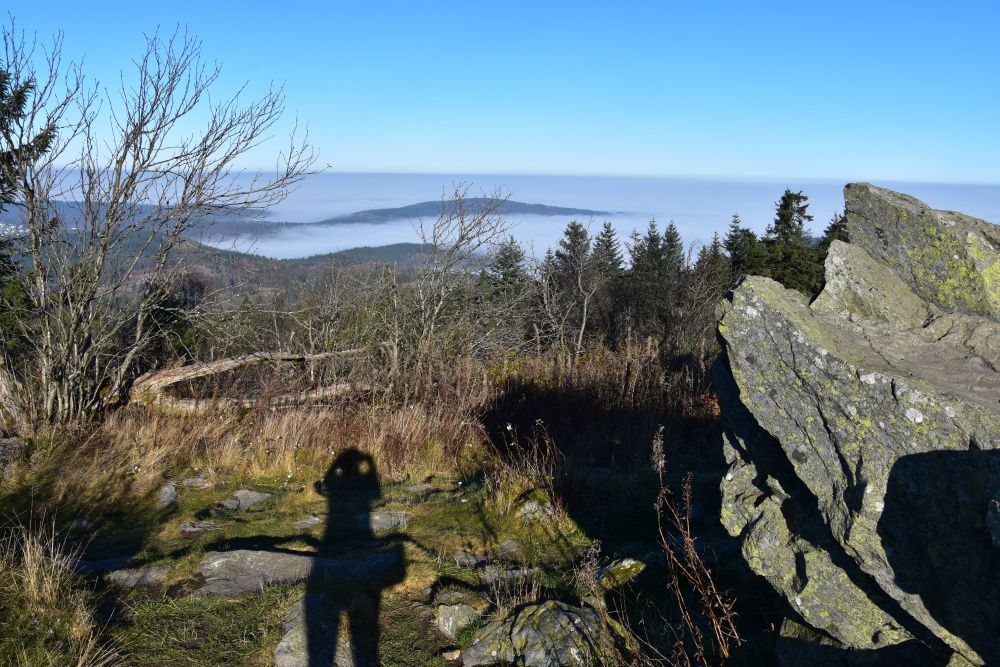
In the mist, I start driving to the Taunus mountains north of Frankfurt. My car climbs and climbs, and eventually, I am above the clouds. I stop on the local mountain of Frankfurt that is called Grosser Feldberg. I am on almost 900m. The view is superb. 

The Brunhildi’s rock (to the right of my shadow) is mentioned in a document of 1043. 

The rock is said to have been the “lectulus of Brunhilde” or “the little bed of Brunhilde”. Saint Hildegard of Bingen has spent one night here, and the rock has kept the imprint of her head, as legends tell. Around 1800, the rock was reinterpreted as the place, where Brunhilde was sleeping, until Siegfried liberated her. The rock became part of the German legend of Nibelungen. This is, what the panel near this peculiar rock says. 
I continue north – it is about two hours to drive to Bonn. On the way, I will have another stop at Limburg. 


Sources:

A Swiss butterfly in Poland: Szklarska Poręba

End of August 2021, I am on the road again, to Berlin via Slovakia and Poland.

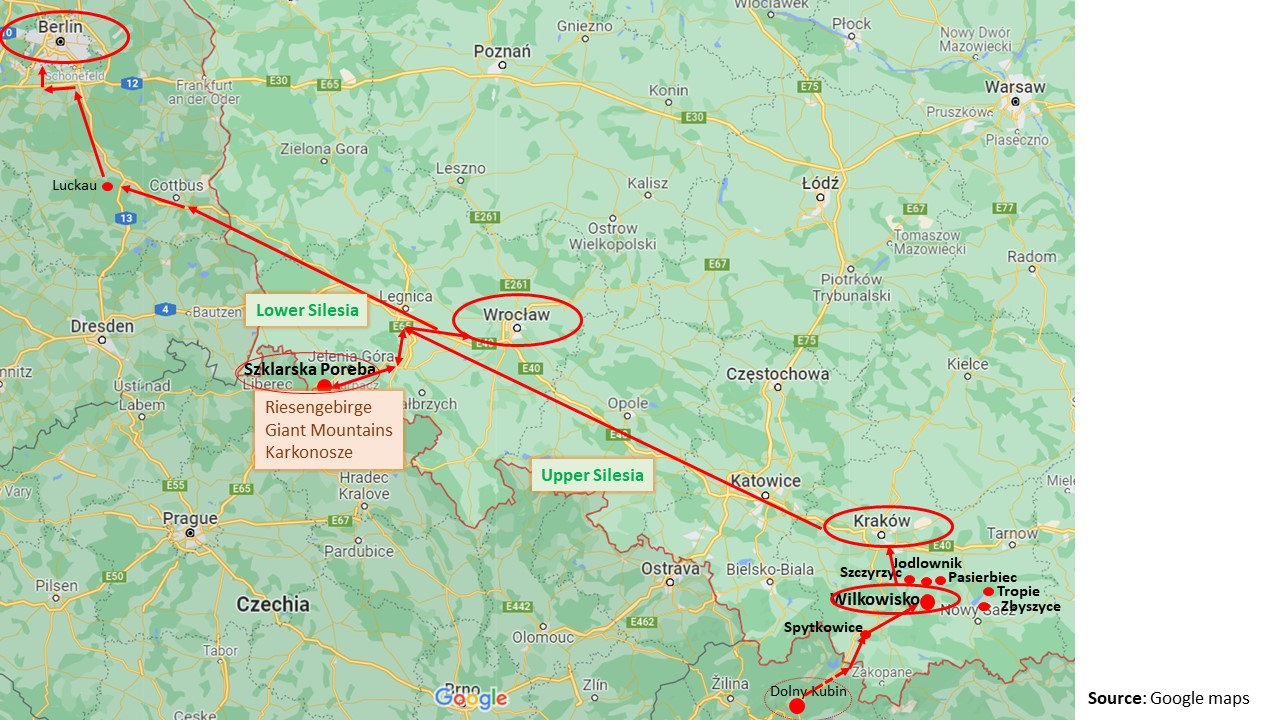
My route begins in Slovakia: Bratislava – Trnava – Nitra – Žilina – Strečno and Terchová – Dolny KubinPodbiel and Tvrdošín. It continues in Poland: WilkowiskoKraków – Szklarska Poręba – Wroclaw, and finally I am Berlin. 

Now I am at Szklarska Poręba to find out more about my grand-father, the artist.  


My motivation: Find the location of my grand-father’s painting (Hermann Radzig-Radzyk)

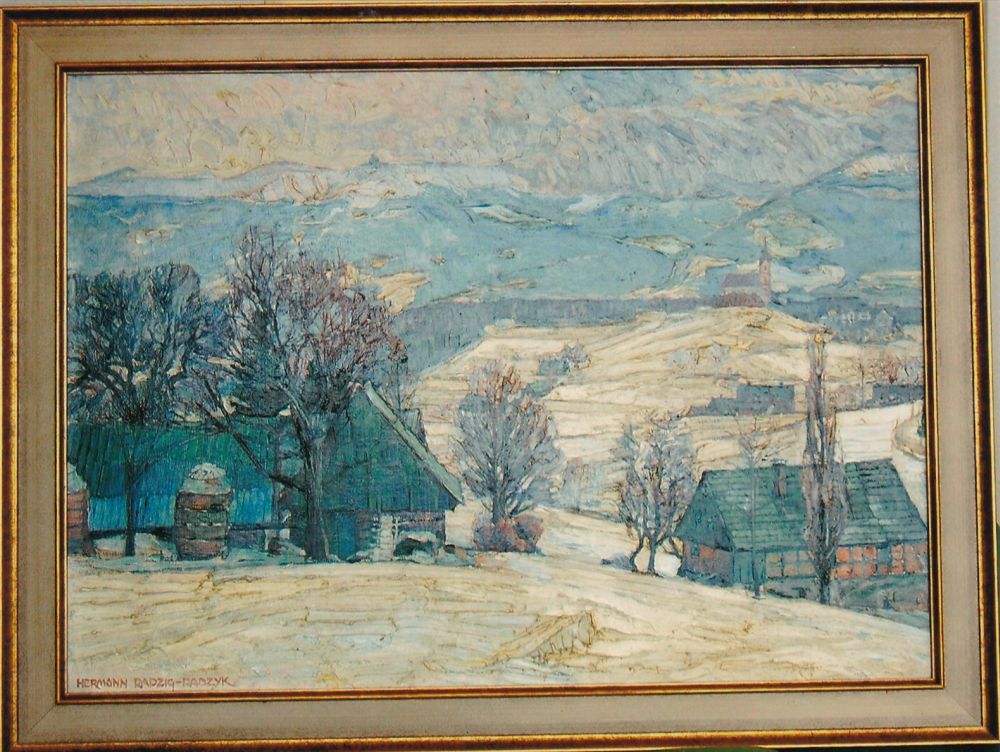
Currently, I am interested in the life of my grand-father Hermann Radzig-Radzyk who was an artist and painter. Many of his paintings decorate my house. While doing research about him, I have found more paintings that are traded in auctions, one of them being “Der Kirchberg in Schreiberhau mit dem Reifträger”. 

Source: https://polska-org.pl/7992365,foto.html 

This painting was exhibited at the art exhibition in Berlin in 1923 (see  
Grosse Berliner Kunstausstellung <1924, Berlin> [Editor]; Grosse Berliner Kunstausstellung [Editor]: Katalog: Im Landesausstellungsgebäude am Lehrter Bahnhof: [dauert vom 19. Mai bis 17. September 1923] (Berlin, 1923) (uni-heidelberg.de)

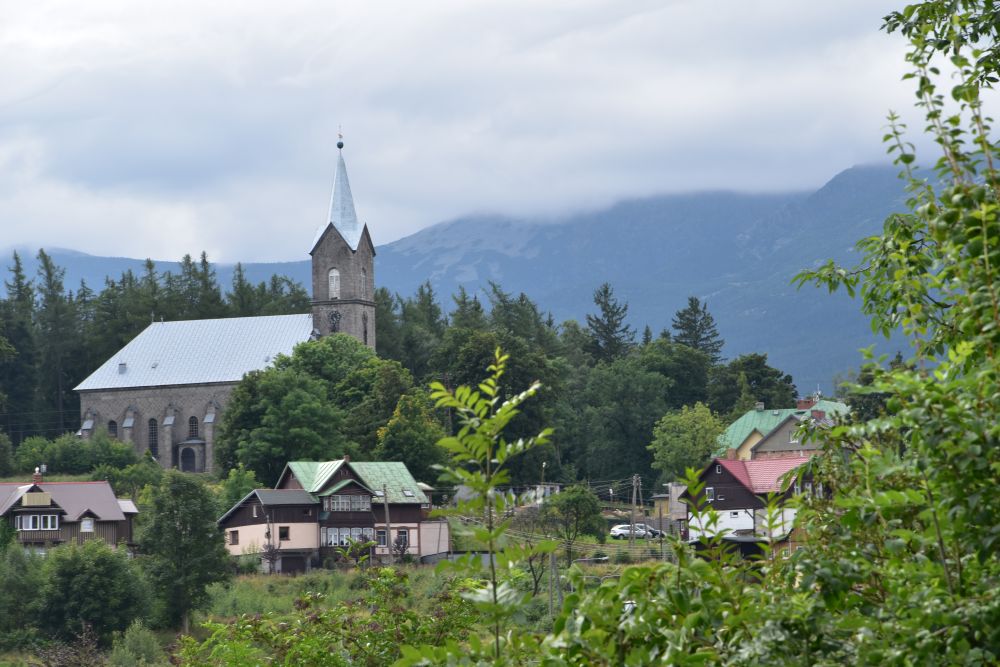
“Dr. Google” tells me that Schreiberhau is now called Szklarska Poręba, that the Reifträger is the mountain Szrenica and the church on the Kirchberg is Kościół p.w. Bożego Ciała or the Corpus Christi Church. 

I like this painting. I drive to Szklarska Poręba to find the place, where my grand-father had painted it and I come close. 

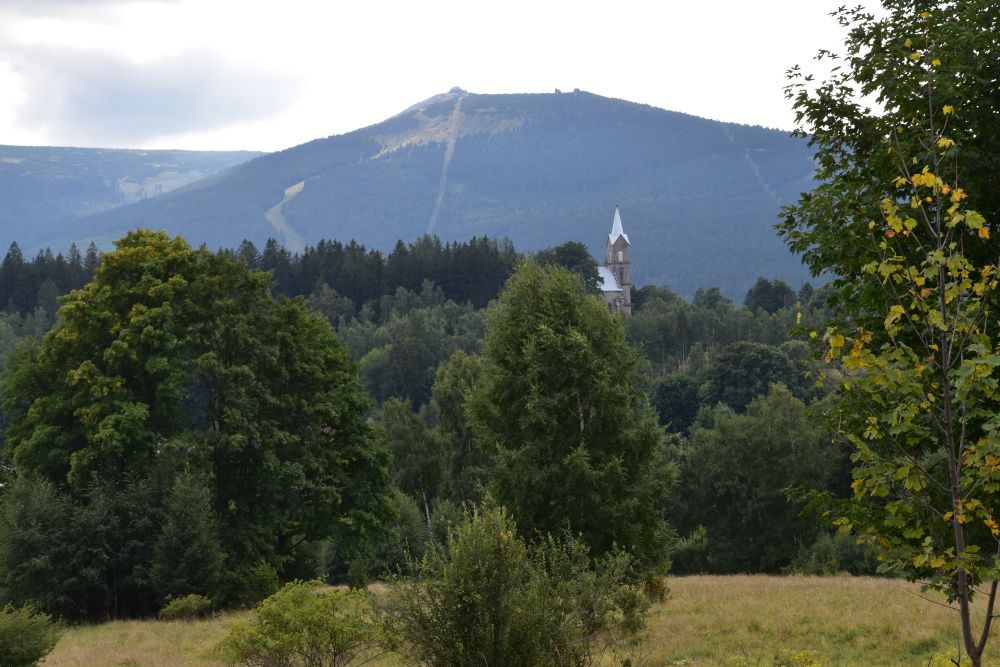
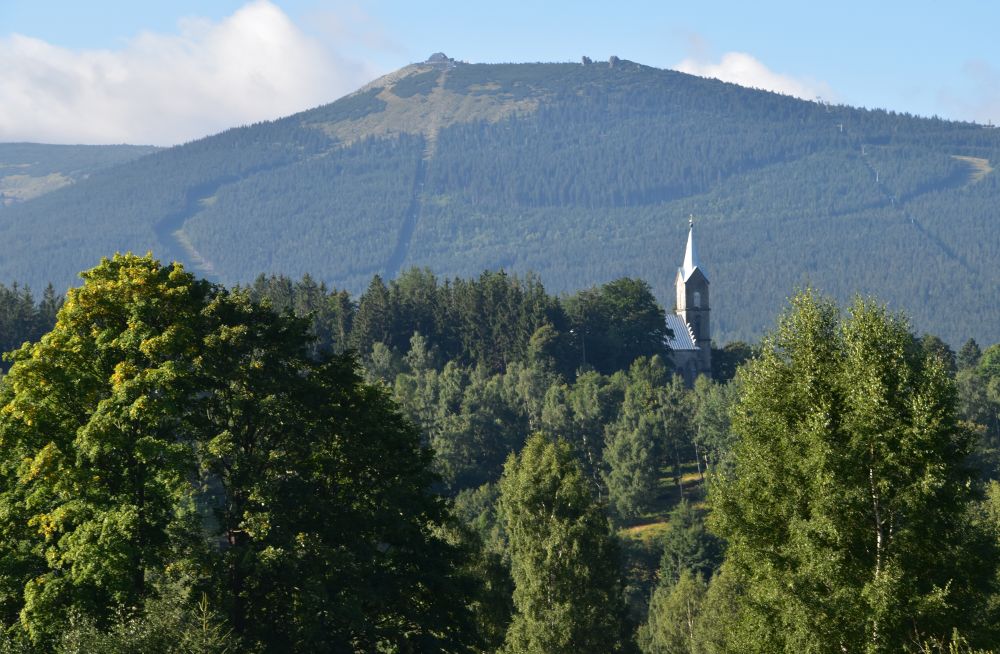
However, the landscape has changed. Much more forest here now.

I return the next morning to take a photo of the same view, but with more sun.

I assume, my grand-father stayed in a pension below the point I am standing at; I saw houses, but did not dare enter the private properties.

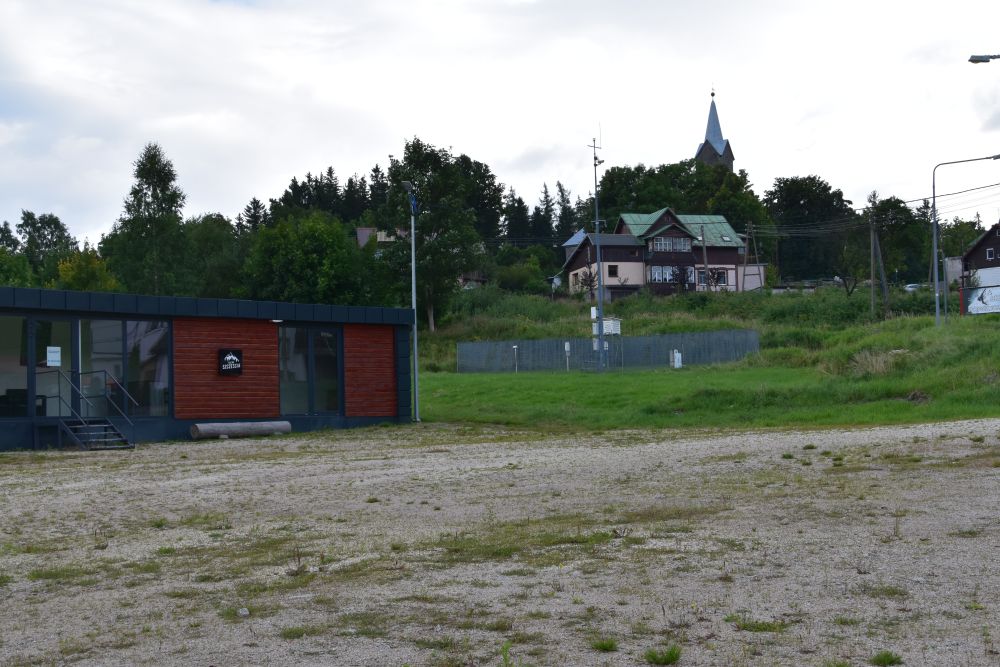
Close below the church, there are some buildings that did not exist, when my grand-father made his painting.

My “cousin” Dietrich (the son of my mother’s best friend) owns this painting which is a slightly different view of the Kirchberg. 

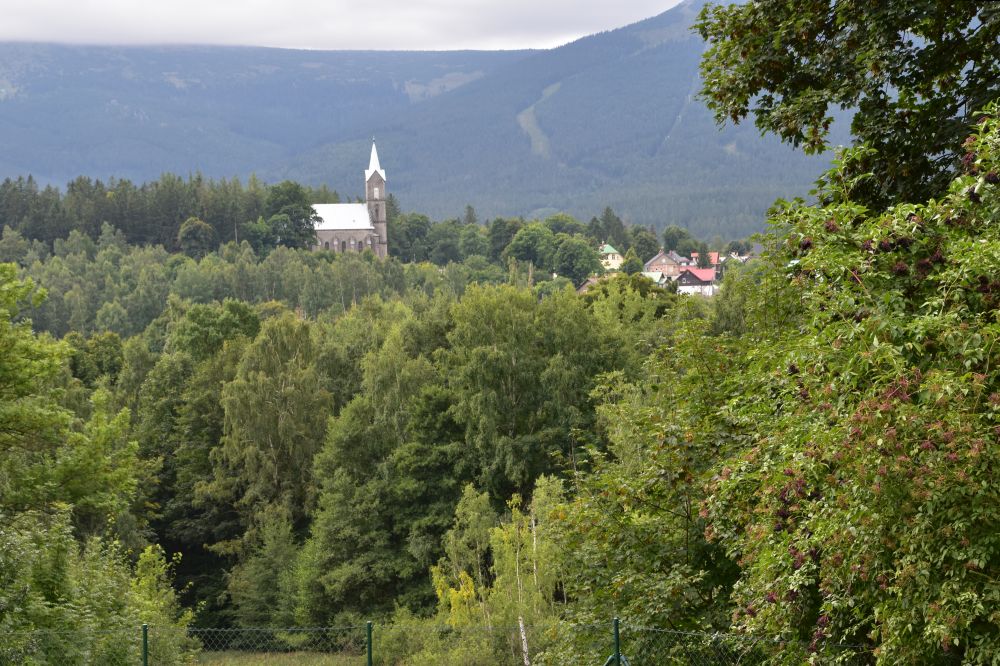
More closely to the perspective of the second painting is the following photo taken by me, when walking to Szklarska Poręba Średnia .

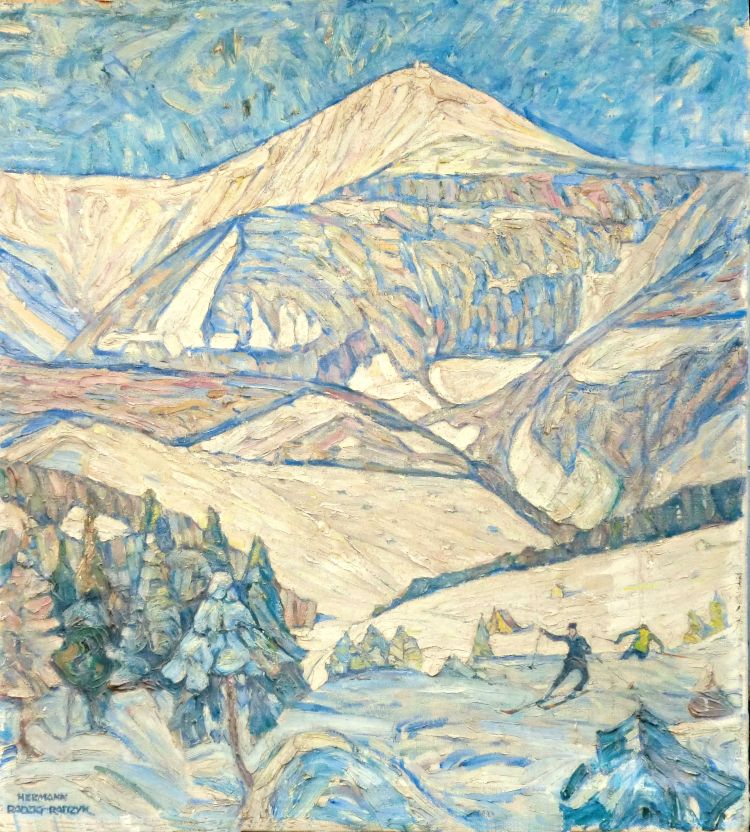
My “cousin” Dietrich knows of this painting of the mountain Szrenica (Reifträger) that is with a friend of his in Berlin. Update of February 2023: After having climbed this mountain from Karpacz (Krummhübel) in October 2022, I know that this is the Schneekoppe, today called “Snieska”. 


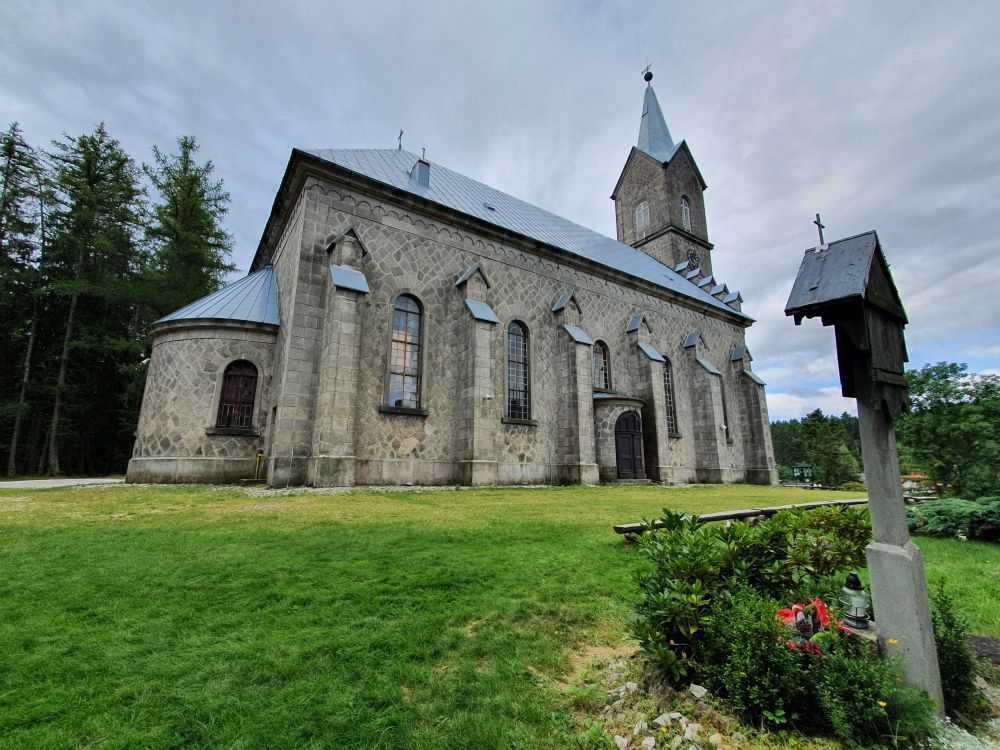
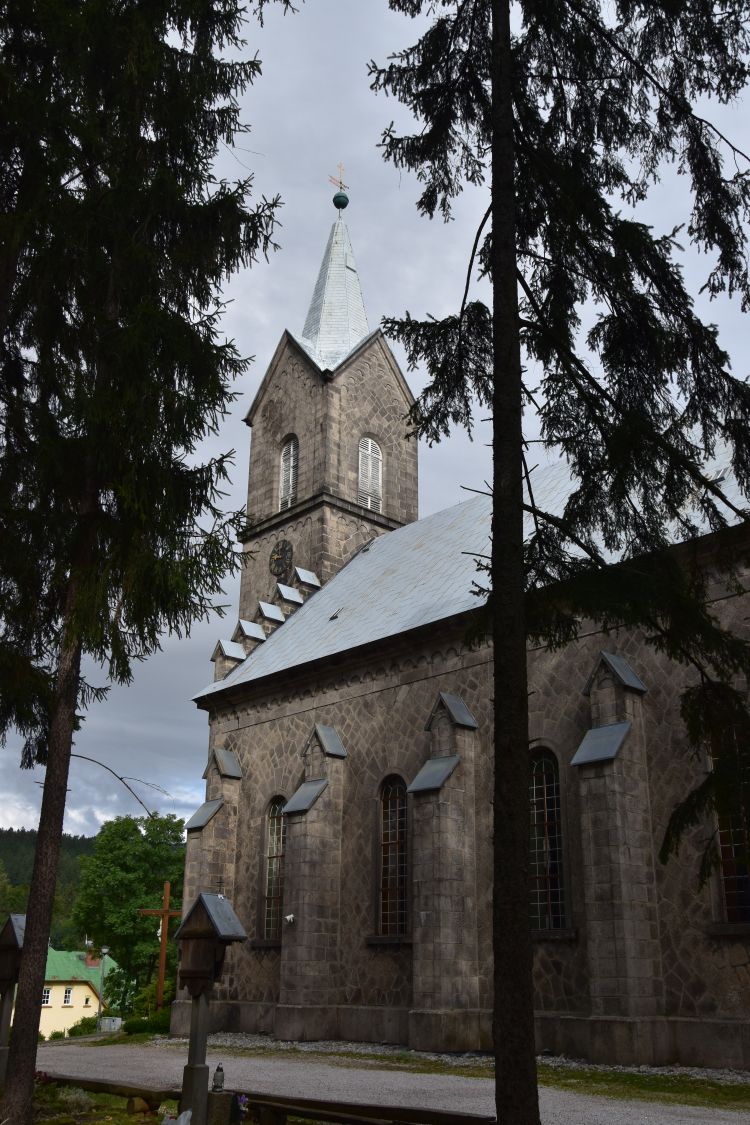
Approaching the church Corpus Christi, the church on the Kirchberg

The Corpus Christi Church was built in Neo-Roman style in 1884-86. The dukes of Schreiberhau, the family Schaffgotsch, financed the church. 

I walk around the church.

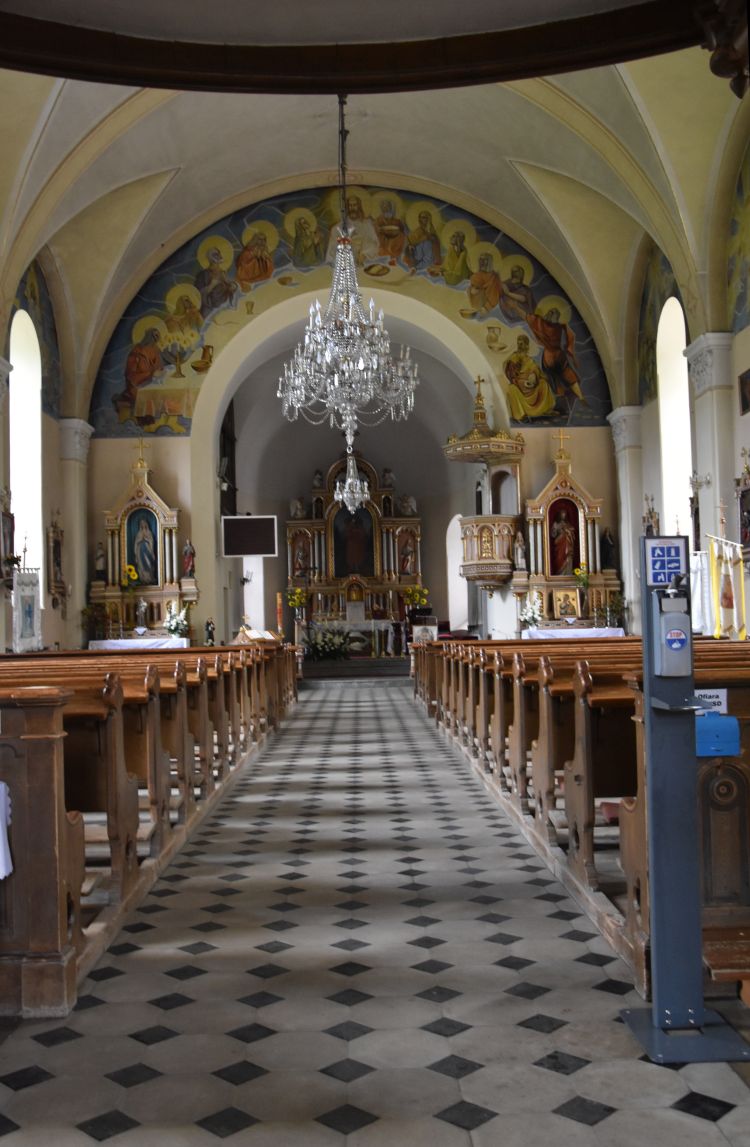
Inside are paintings by Wlastimil Hofman, a Polish painter who settled in  Szklarska Poręba after the Second World War in 1947. 

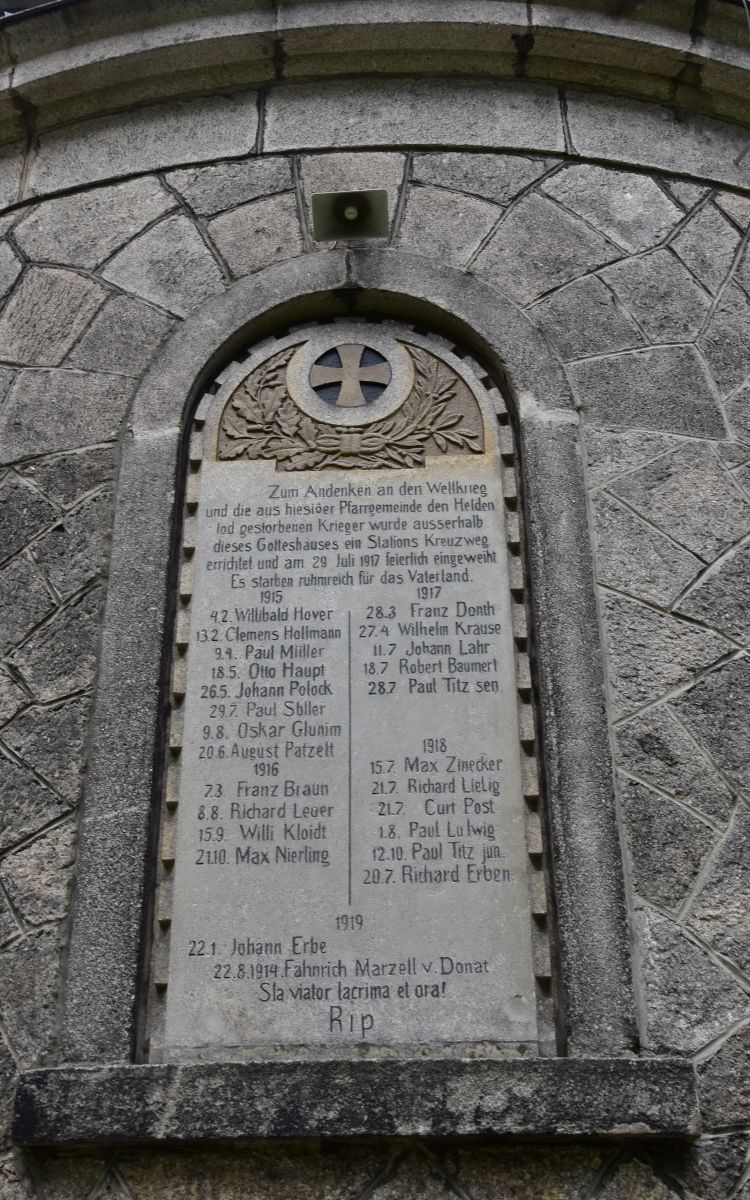
I find a tomb slab. It commemorates Germans that have died in the First World War.

The surroundings have changed since my grand-father has made his painting. There are more trees. The shop for skiing equipment indicates sports activities in winter.

The shop for mountain biking equipment may be busy in summer. Parking is free here.

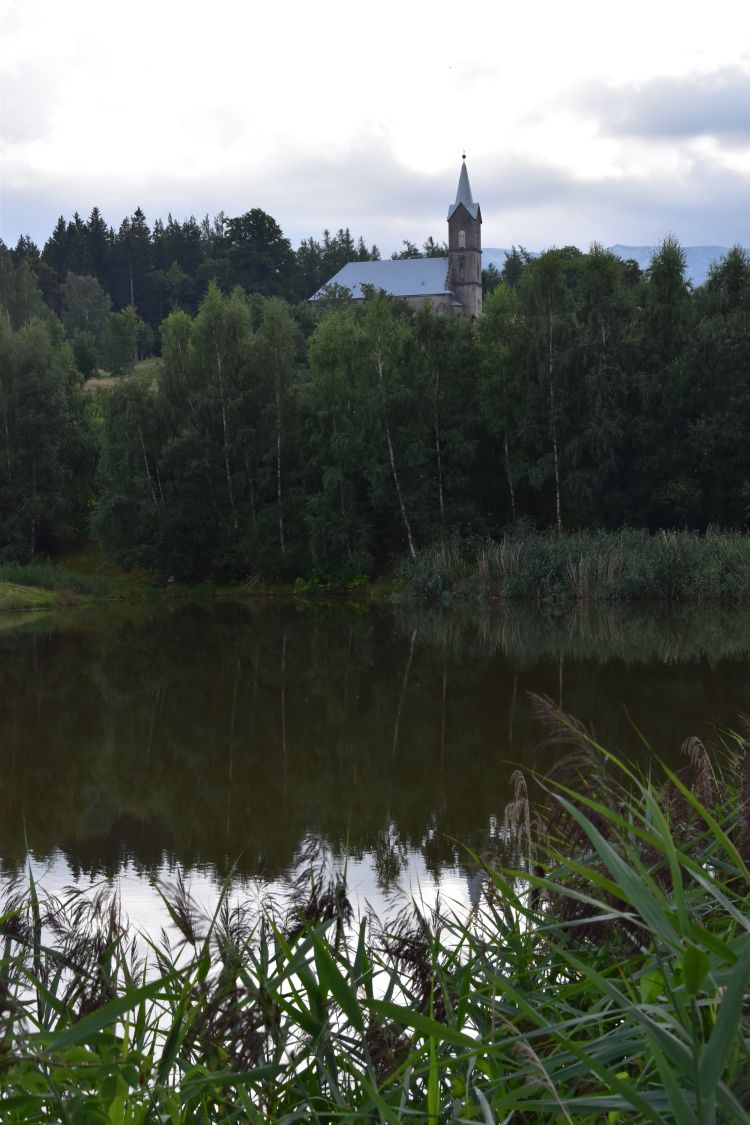
I select my own perspective to take a photo of the Church Corpus Christi; perhaps it is this pond that appears in the right hand corner of my grand-father’s painting.

One day was not enough to find out everything about the painting of my grand-father. I should return and spend several days to dig deeper. In addition, I would like to benefit from the hiking opportunities, one of them being a climb to the Reifträger or Szrenica.


Where are we geographically?

Now we are at Szklarska Poręba (in German Schreiberhau) in Silesia (in German Schlesien), close to the border between Germany, Poland and the Czech Republic. The mountains are called Giant Mountains, Riesengebirge or in Polish Karkonosze. The mountain above Szklarska Poręba, the Szrenica (in German Reifträger) is 1362m high.


Some background information about Szklarska Poręba (Schreiberhau)

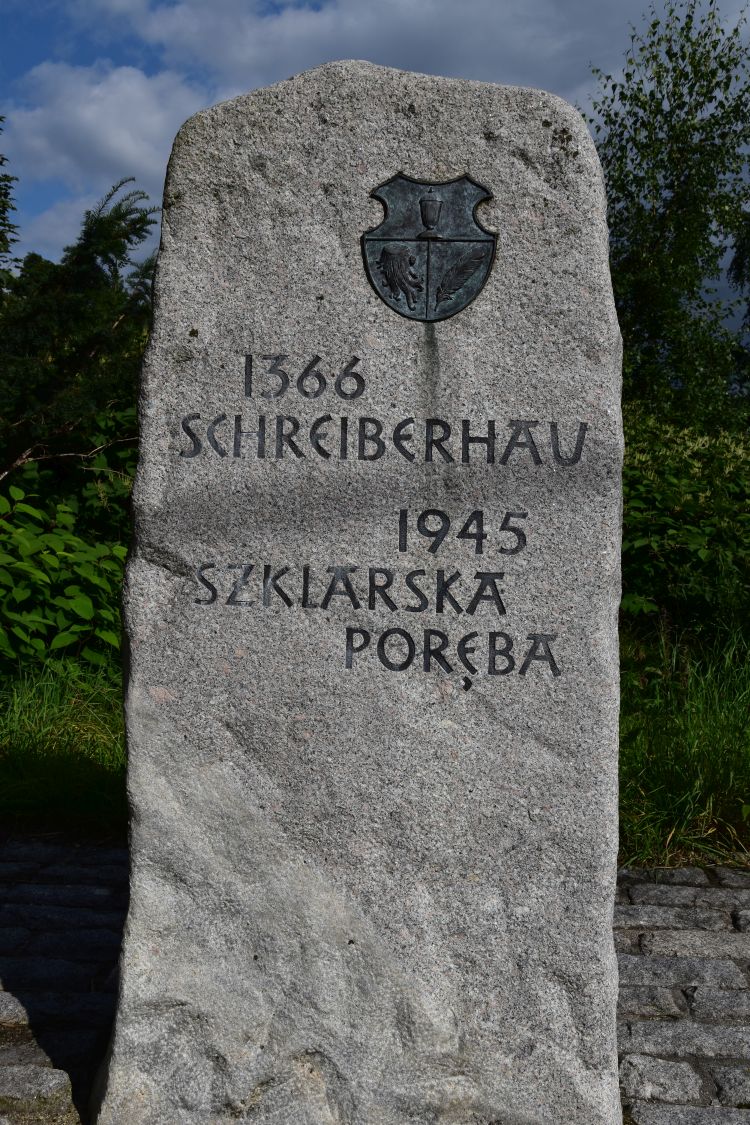
This stone indicates that Szklarska Poręba existed already in 1366. At that time, it was a settlement with the German name “Schreiberhau” (also called Schribirshau).

German colonists established Schreiberhau around the newly founded glass factory. The area was part of Bohemia (since 1335) and hence part of the Holy Roman Empire of the German Nation. The landlords here were the counts of Schaffgotsch, a family that still exists today. 

The term “hau” in “Schreiberhau”, refers to the “forest clearing” needed for the settlement and the glass factory. Why was the place not called “Glashau” to reflect the existence of the glass factory? The village chronicle (Ortschronik) of the local teacher suggests that “Schreiber” (“writer”) perhaps alludes to the man who wrote the documents required to install the factory and the settlement.

In 1617 the Preussler family took over the glass factory business and managed it until the middle of the 19th century. In 1842, Franz Pohl founded the new glass factory Josephinenhüttte; it thrived and was the largest and best-known glass factory in Silesia. 

In 1902 the railway to Schreiberhau opened. It was now easier to reach the place. It became an attractive mountain resort and a centre for artists (see below). 

In 1945, the Potsdam agreement assigned Silesia to Poland. The Poles now changed “Schreiberhau” to “Szklarska Poręba” which translates to “glass forest clearing” (the German equivalent to “Glashau”). The mountain Reifträger became the Szrenica or the “hoarfrosty” mountain (the Polish word “szron” means “hoar” or “Reif”). Most of the German inhabitants were expelled from Silesia and Poles, expelled from the east, settled instead. In 1945 Poland was literally moved to the west; it lost land to the Soviet Union in the east and gained land in the west, at the expense of Germany.

Renamed to Glashütte Julia, the Szklarska Poręba glass factory continued to operate until 2000. The family Schaffgotsch moved to Schwäbisch Gmünd. Here, the former Josephinenhütte was refounded in 1951, and it worked until 1983. 

By the way: Karkonosz in Polish translates to “Rübezahl”. He is the capricious mountain troll who lives in the Giant Mountains that the Poles now call Karkonosze. Telling stories about Rübezahl has been a tradition known since the 15/16th century. Nice, how the German past continues to live in the Polish toponyms.


How are artists and art related to Szklarska Poręba or Schreiberhau?

In the 18th century, the first artists discovered the beauty of the Riesengebirge. Carl Christoph Reinhardt (1738 – 1827), Christoph Friedrich Nathe (1753 – 1806) und Anton Balzer (1771 – 1807) were some of the names. Later, Caspar David Friedrich (1774-1840, romanticism) painted here. 

Around 1900, Szklarska Poręba became a centre for artists, among them Gerhart Hauptmann (there is a museum about him). Also around 1900, Carl Ernst Morgenstern (1847-1928), professor at the University of Breslau (1883-1913), taught pleinair painting at nearby Krummhübel (Karpacz). Some of his students later belonged to the Schreiberhau Association of Artists St. Lukas (Schreiberhauer Vereinigung bildender Künstler St. Lukas) that was founded in 1922. Their seat was the Lukasmühle at the Zackerle creek (now:  Kammiena; later, in 1930 the artists moved to the hotel “the Zackerfall”).

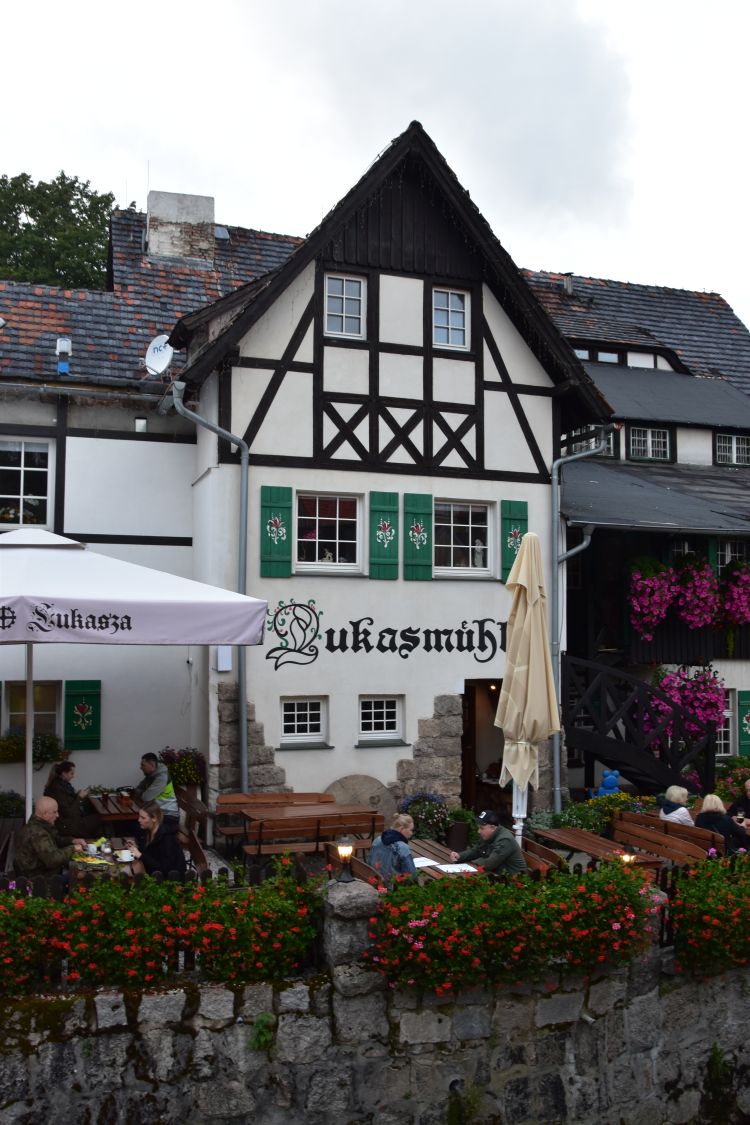
The Lukasmühle (Młyn Łukasza) is an inviting restaurant today. 

I had selected it for dinner without knowing about its history.

It could well be that my grand-father Hermann Radzig-Radzyk was a member of the Lukas association, but I cannot find any details about that in the Internet. 


Strolling around in Szklarska Poręba

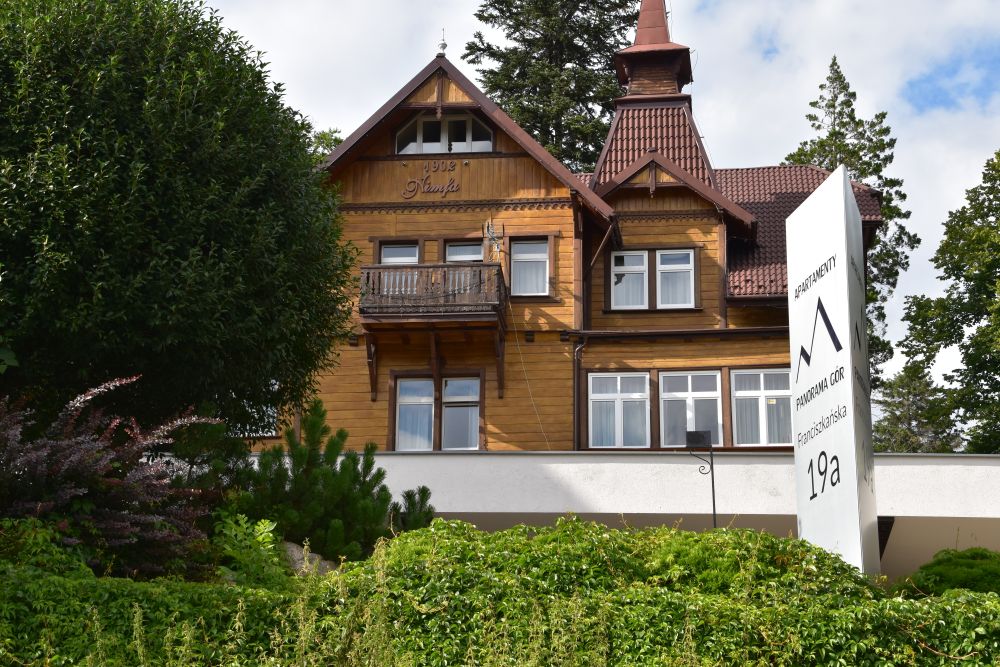
For one full day, I explore Szklarska Poręba. Here are some impressions. There are nice villas…

… and apartment houses. 

The winter must be busy here. The continental climate makes for good snow,…

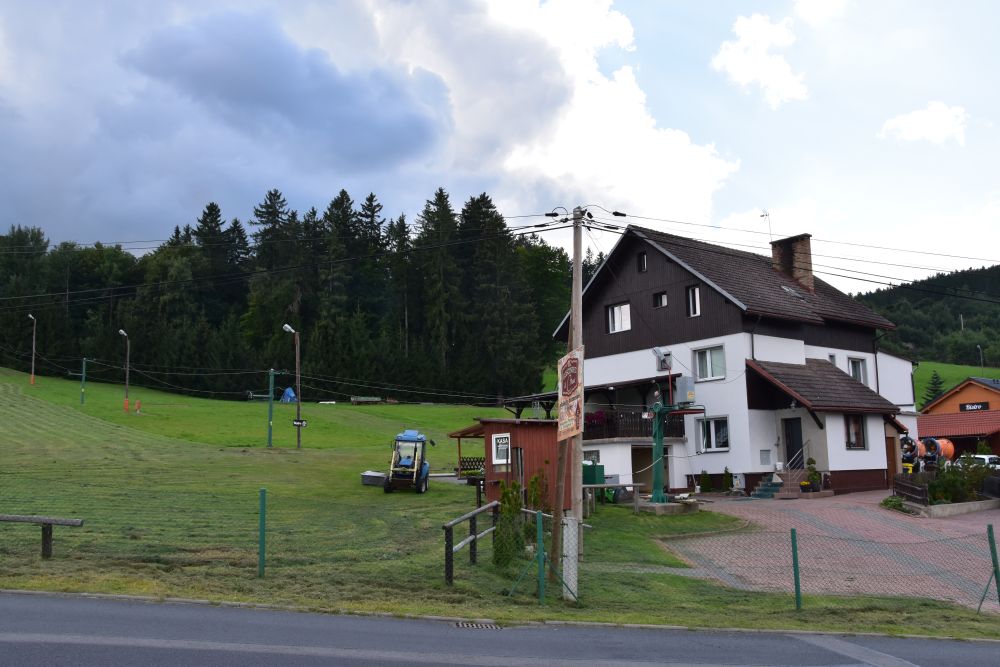
… but nevertheless snow canons hidden behind this house wait to be used in winter. 

This is a rather “flat” slope, however the Szrenica seems to offer a variety of attractive ski runs. 

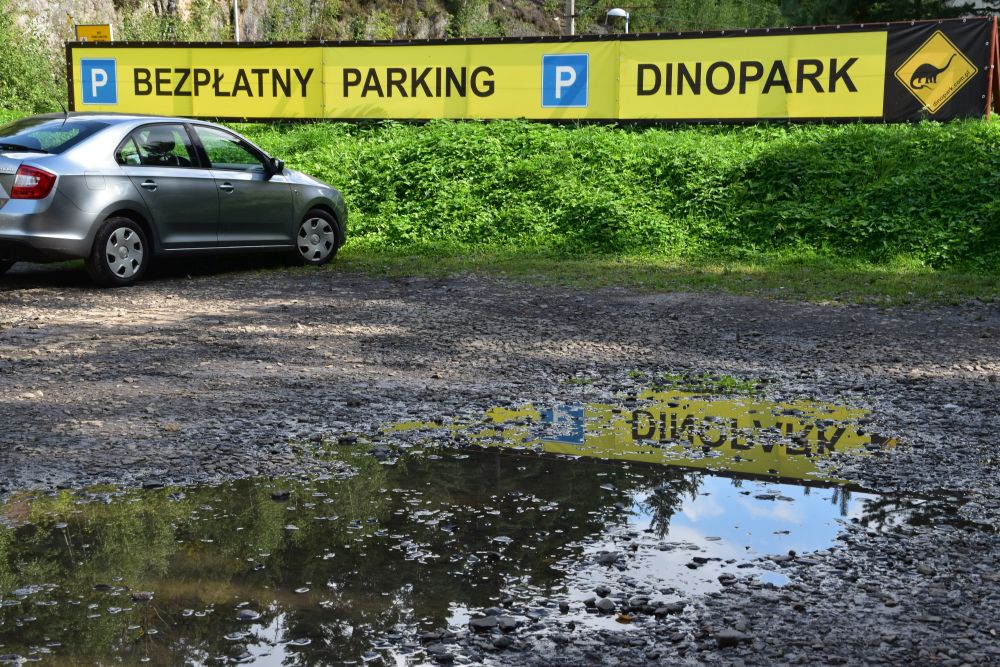
There is also a Dinopark for chlidren, with free parking (now a bit dirty…).

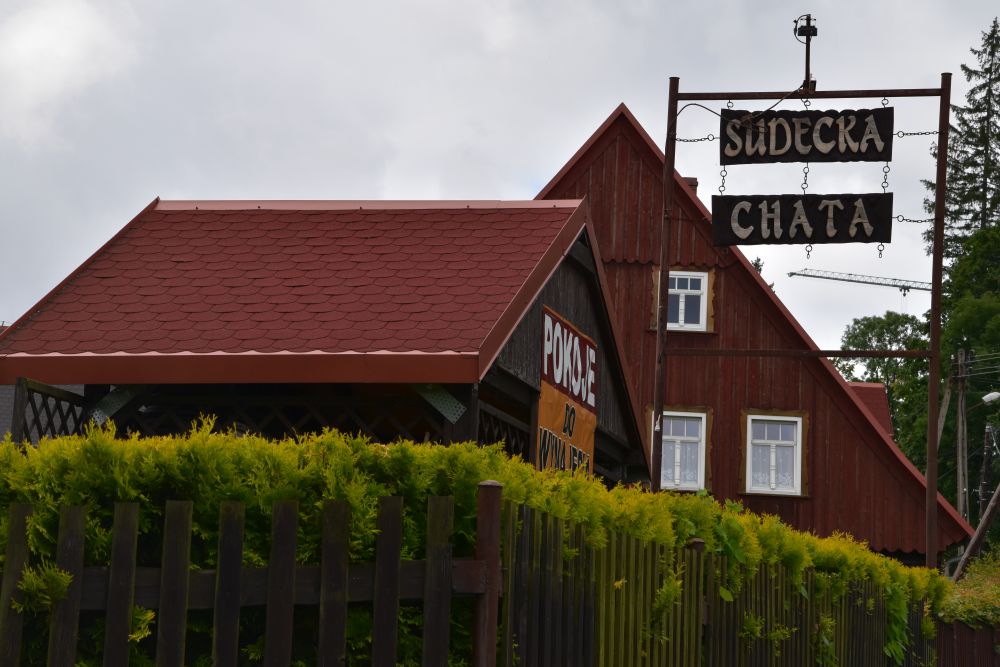
Above Szklarska Poręba Średnia I find the Sudecka Chata or Sudetenhütte. 

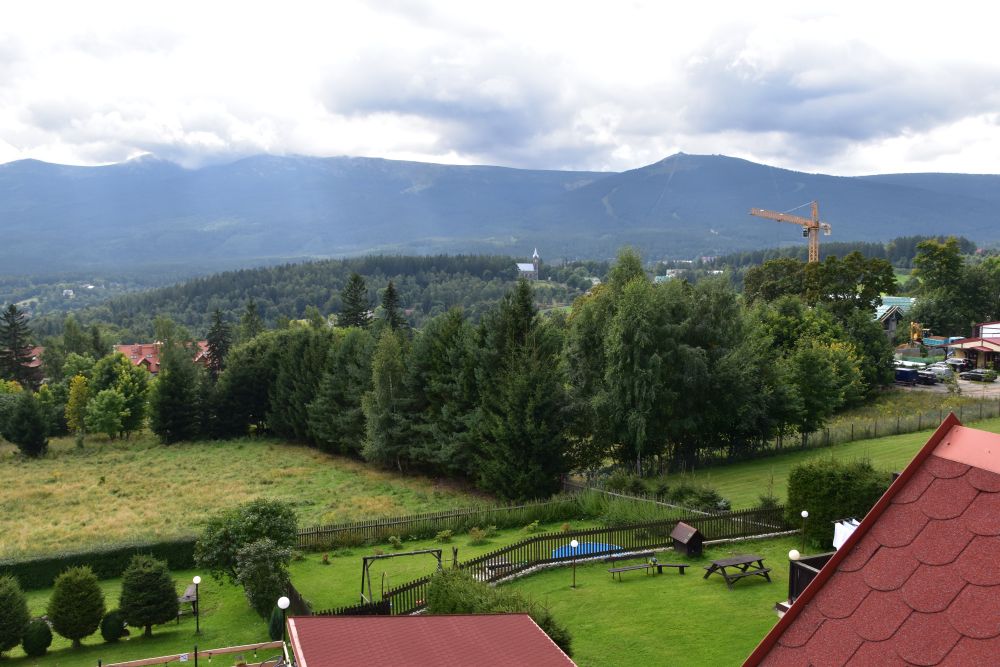
It is closed. The friendly owners prepare coffee for me. They take a vivid interest in my research and take me up to the rooms under the roof, where I have a gorgeous view of my grand-father’s church and the Szrenica or Reifträger.

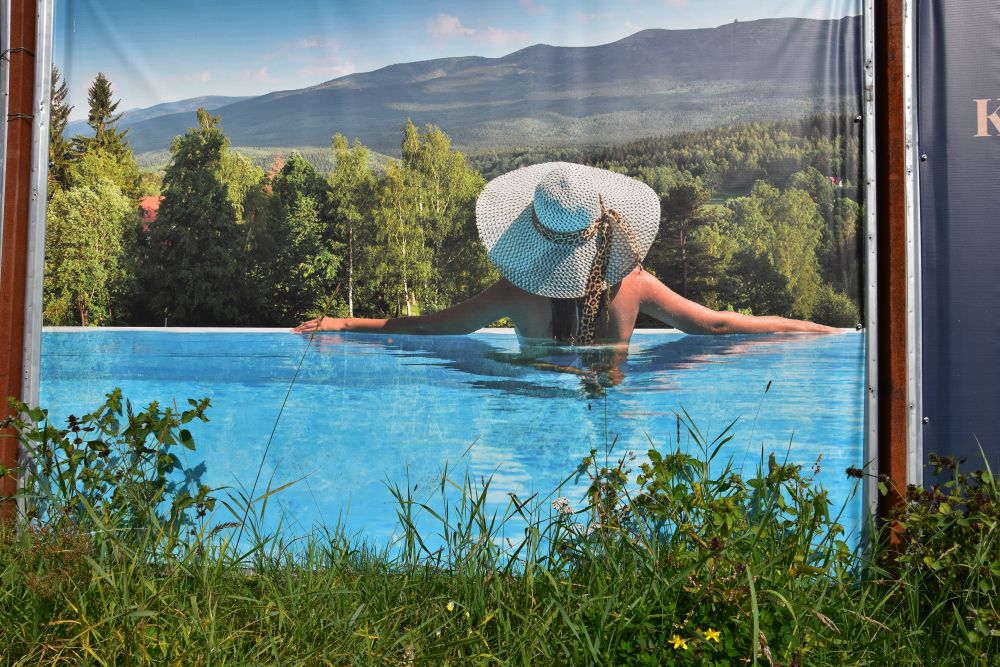
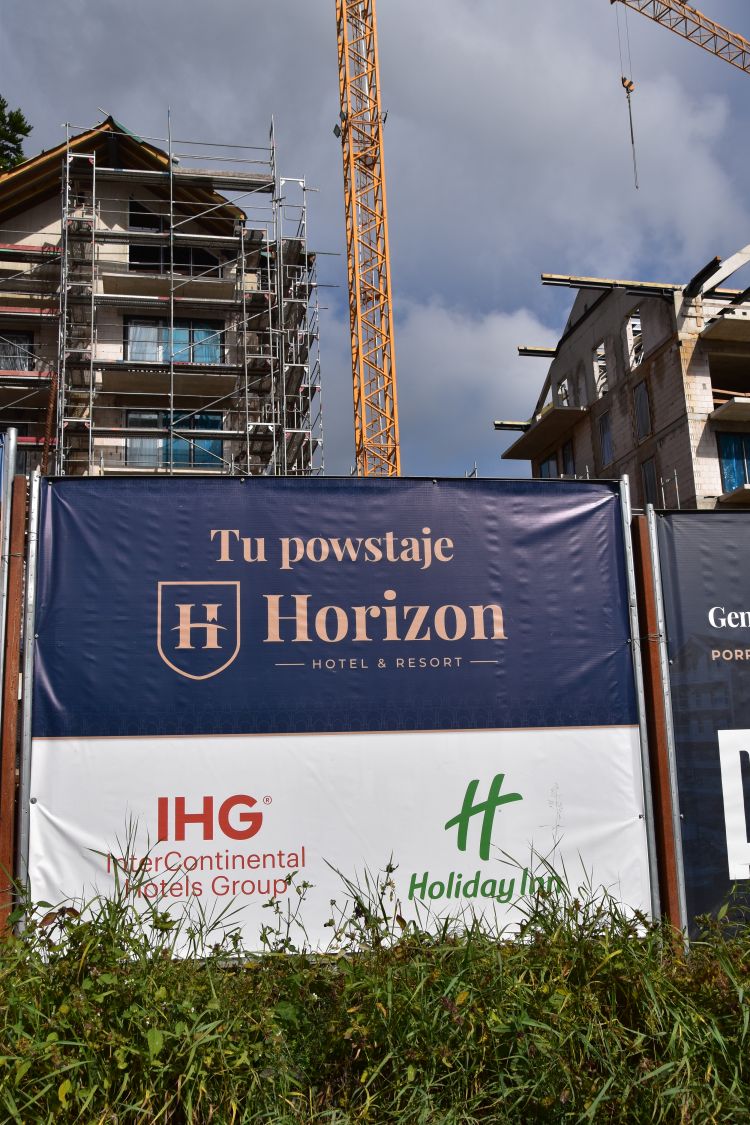
There is a crane disturbing the view: Holyday Inn builds a luxury resort. Their infinity pool is “announced” with the view from the garden of the Sudecka Chata, it seems.

This is, what is going on under the yellow crane. It seems that Holiday Inn believes in the potential of Szklarska Poręba.

At lunch time, I stop at the restaurant Płękitny Paw and have a wonderful meal in the garden, a delicious soup and excellent stuffed omelettes.


Good-bye Szklarska Poręba and Giant Mountains

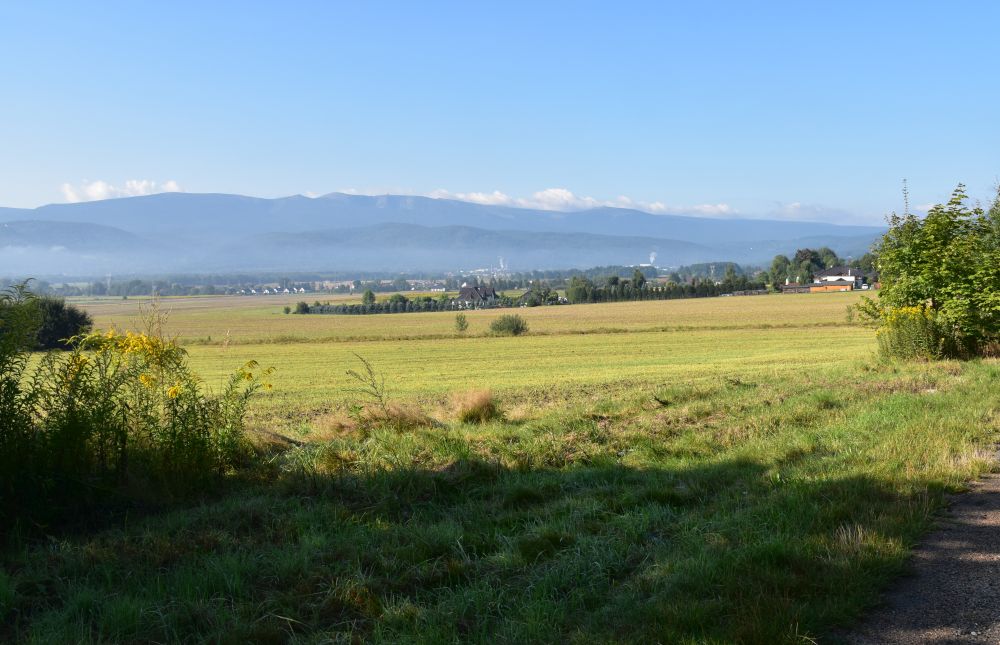
I would have liked to stay another day to hike around Szklarska Poręba, but my hotel is fully booked. I leave and look back to the Giant Mountains, where Rübezahl, the mountain troll, is up to mischief.

I may return one day for more research and for hiking.

Now, I say good-bye and drive to Wroclaw, the capital of Silesia. 


Sources:

About art and artists in Silesia and in the Giant Mountains:

On the road: Thoughts about Corona in Oberbayern (Upper Bavaria)

In August 2020, we spend a four day vacation in and around Ruhpolding in Oberbayern (Chiemgau). It has been the first time since the start of the pandemic that I am staying in a hotel, going for shopping and eating in restaurants every day.

Tourists are back in Oberbayern (Upper Bavaria). The hotels seem to be well booked. But the atmosphere has changed. The tourists are primarily Germans, except for a few Dutch, a few Englishmen and a few Swiss (besides me).

In shops, we have to wear masks. Some shops take great care, have installed separate entry and exit doors, restrict the number of clients inside and offer disinfectant. In these shops, I feel safe to do shopping. Other shops are careless: Entry and exit are not separated, many clients crowd between narrow shelves. Such shops I leave out.

In restaurants, we have to put on our masks, when moving away from our table and the waiters also wear masks (or vizors).  While some waiters follow the rules carefully, others do not cover their noses with their masks which makes it all useless. In our hotel, there is no breakfast buffet. Instead we have to indicate on a list, what we want for breakfast, and in the morning, we receive everything on a tray. The bar is lonely, the jolly barkeeper of last year has left the hotel.

Some beach places at the lakes are crowded, while others allow to keep distance, and the personnel respects the rules. We particularly enjoyed our swim at the small and less well-known Tüttensee with the friendly and corona conscious personnel and with corona aware guests.


The Bavarian language gives orders a friendly touch

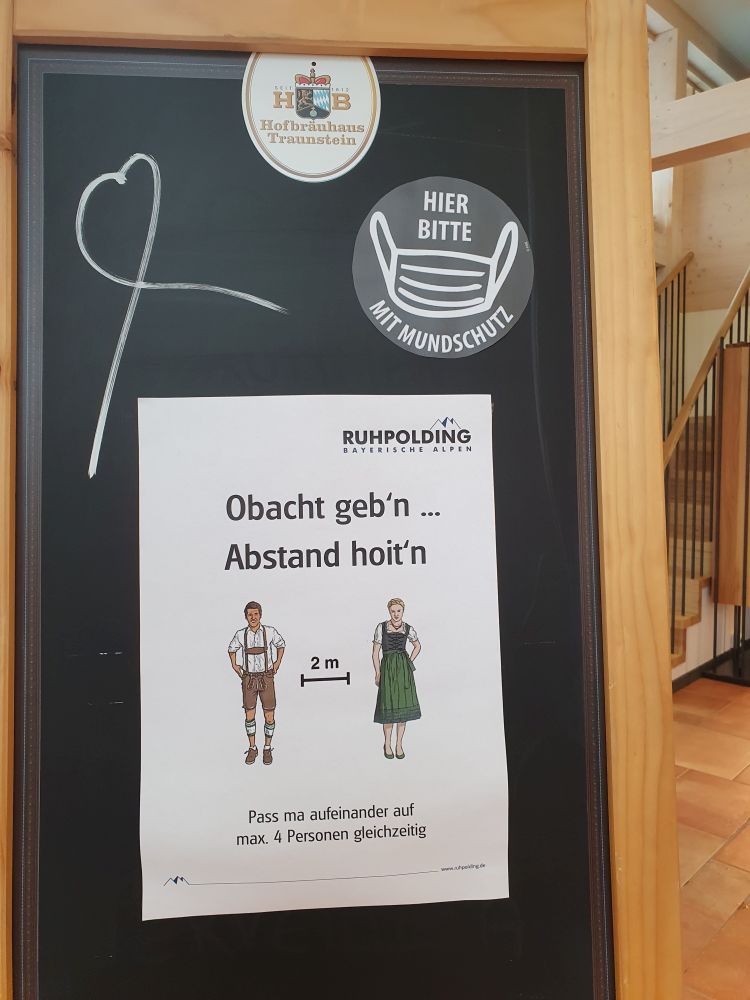
In a restaurant in Ruhpolding, I found this invitation to pay attention and to keep distance. “Obacht geb’n” means “pay attention” (“Obacht” = “Achtung” or “attention”).  “Abstand hoit’n” stands for “keep distance” (“hoit’n” means “halten” or “keep”). And, of course, you have to wear the mask inside (“hier bitte mit Mundschutz”).

In this restaurant, guests are invited to come in (“kemmt’s eina”) and the invitation to keep distance is kept in “normal” German (“bitte Abstand halten” = “please keep distance”).


Touching testimonies of children about the pandemic

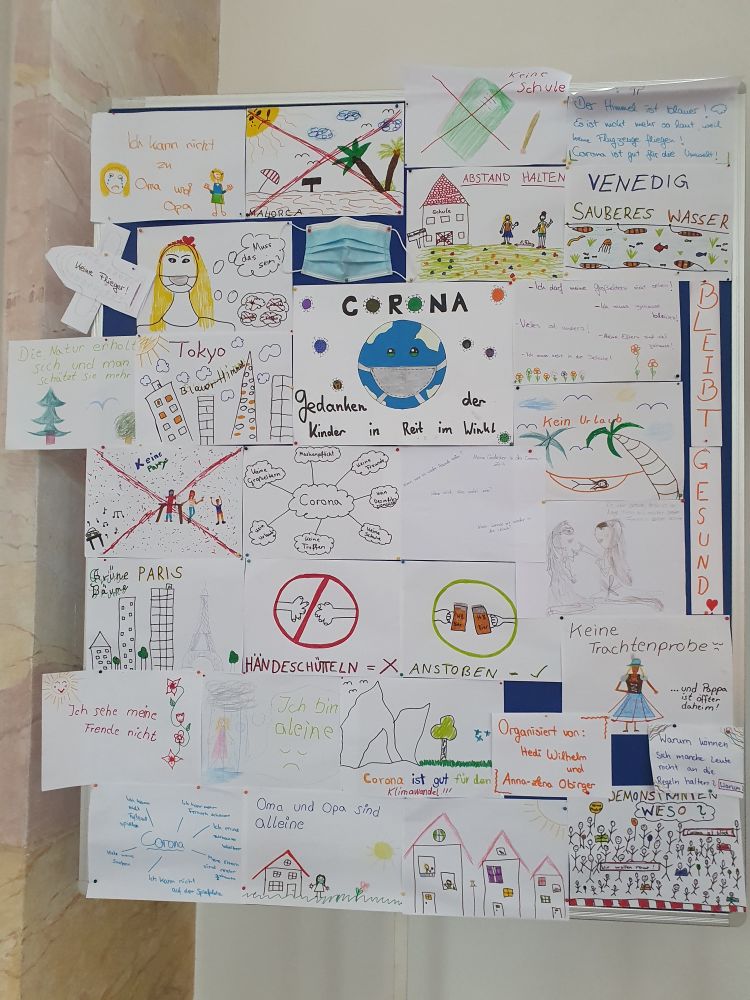
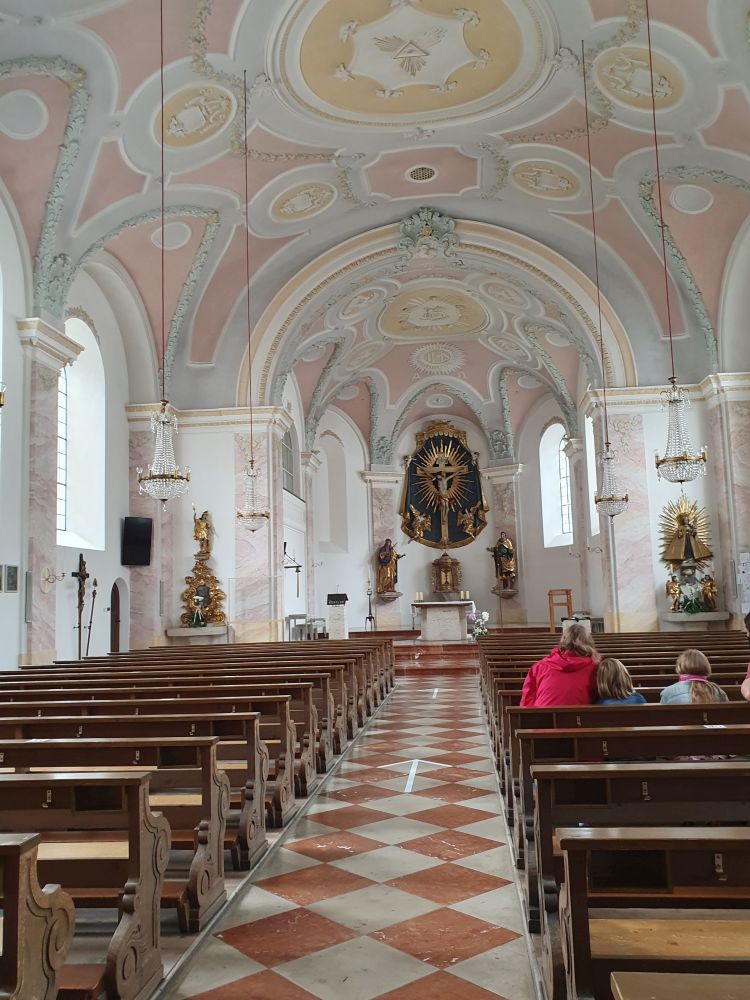
In the baroque church St. Pankratius at Reit im Winkl, we come across these thoughts about the pandemic written down by children.

Let us zoom in some of the testimonies.

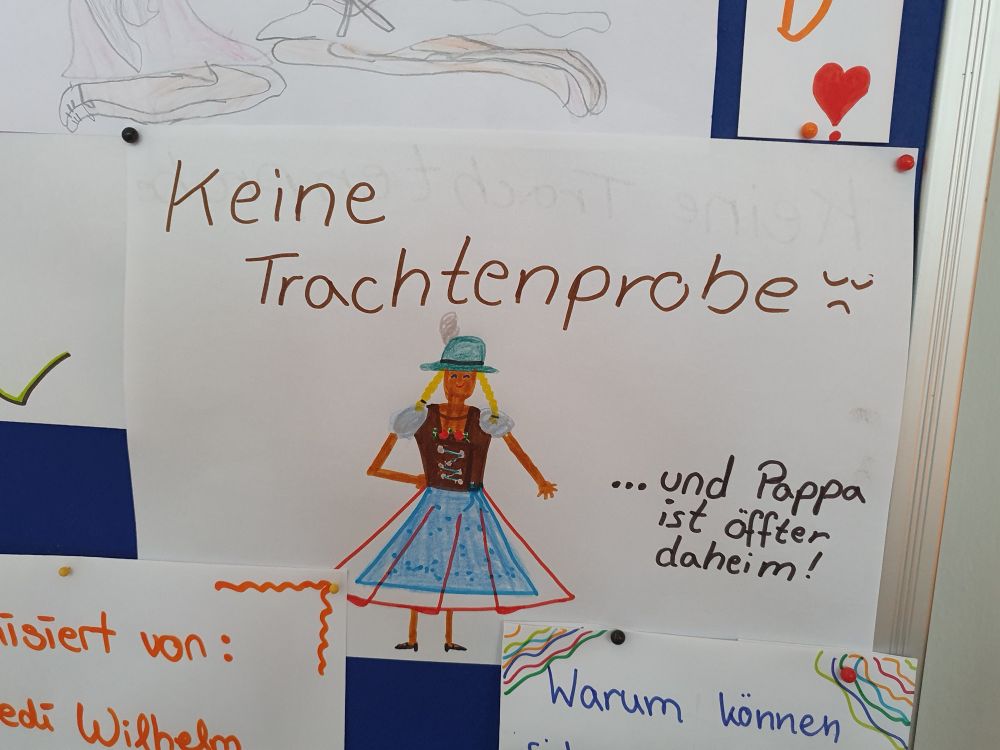
“Keine Trachtenprobe” means “no trying on traditional costumes”… and “und Pappa ist öffter daheim” translates as “and papa is at home more often”, whereby “ff” in “öffter” emphasizes “öfter” (“more often”) and also “pp” in “pappa” makes him more present. Children have their own spelling rules to express their feelings.

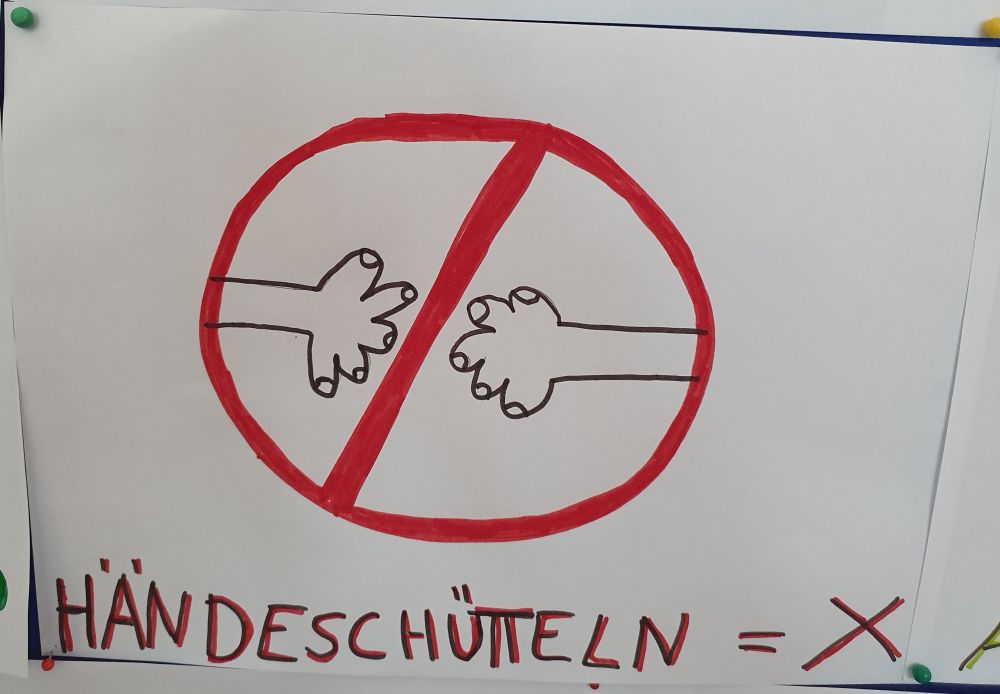
“Händeschütteln” or “shaking hands” is obviously forbidden.

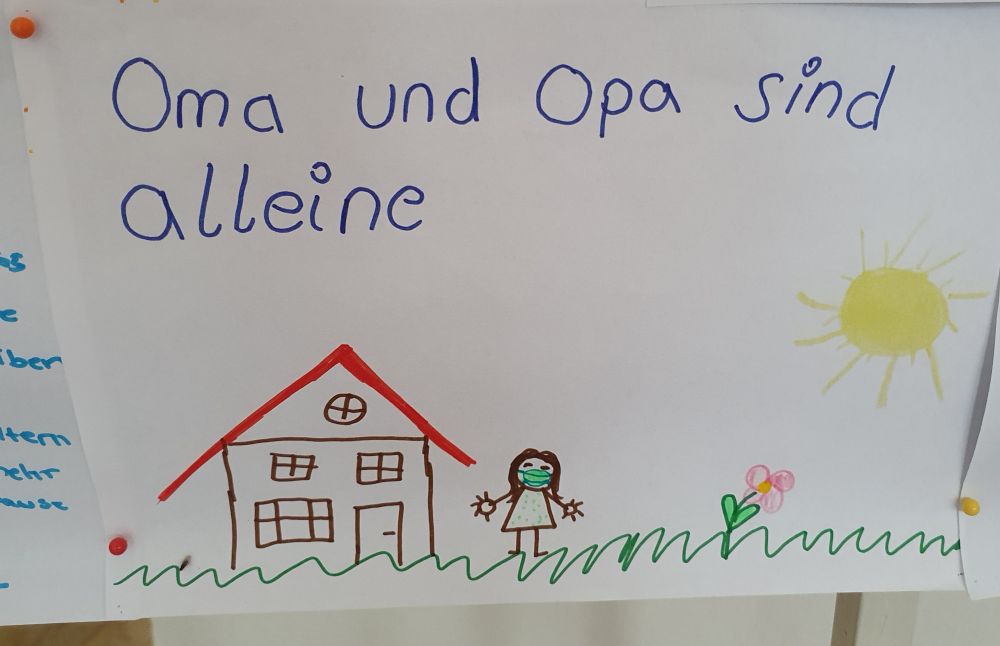
“Oma und Opa sind alleine” – “grandma and grandpa are alone”. The girl has to stay outside the house of her grand-parents, how touching. She is even wearing a mask.

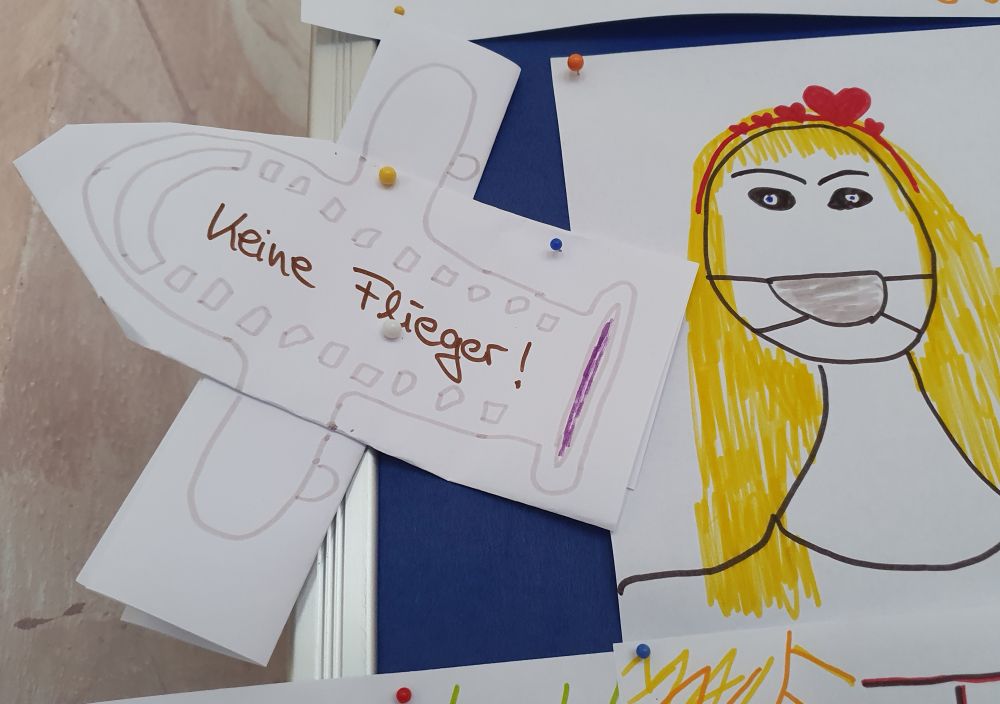
“Keine Flieger” – “no airplanes”. Yes, the sky has become much more quiet. The girl wears a mask and holds her hair back with a beautiful ribbon decorated with hearts.

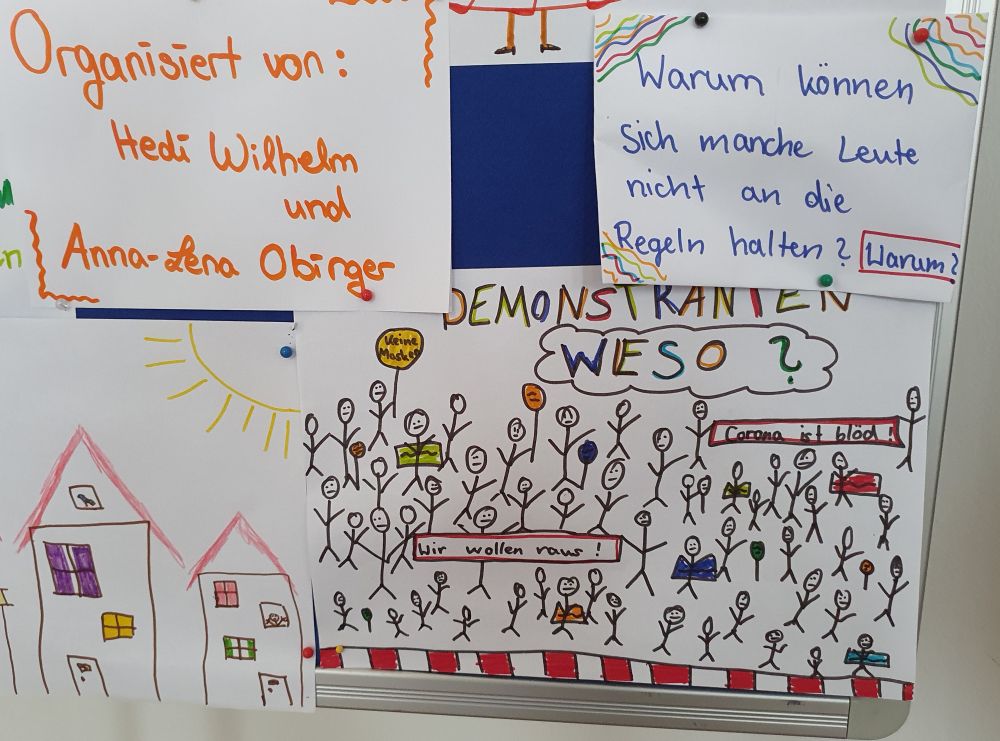
“Warum können sich manche Leute nicht an die Regeln halten? Warum?” – “Why can some people not follow the rules? Why?” And “Demonstranten – wieso?” – “demonstrators – why?” The demonstrators want “keine Masken” (“no masks”), postulate “wir wollen raus!” (“we want to go outside”) and claim that “Corona ist blöd” (Corona is dumb”).

I do feel with these touching observations and remarks of the children of Reit im Winkl. They are so young and go through this pandemic experience with their eyes open. The pandemic is even difficult for us adults. I heard a high level Swiss politician say: “Life has become less safe and it is less fun”.

The baroque church that displays the children’s thoughts is painted in soft pink. Pink is the colour of happiness. The pink colour contrasts with the moving observations of the children, but it also gives an atmosphere of hope… I do hope that these children and all our children will go through more serene times with less worries pretty soon.


Borders around Basel open again – first short bike tour to Germany

On Monday, 15th of June 2020, the country’s borders have opened up again. The “Regio Basiliensis” (region of Basle) is a “Regio” again. Yes, I can speak my Basel dialect across the border of Basel, in the Alsace (France) and in the Markgräflerland (Germany) – we ARE ONE region. Joking, we sometimes dream of “Greater Alemania” unifying those areas, where our Alemannic dialect prevails. To make it clear, we are just joking, and with “immigrants” from the rest of France, I like to switch to French and for “immigrants” from the rest of Germany I go back to my mother tongue, German.

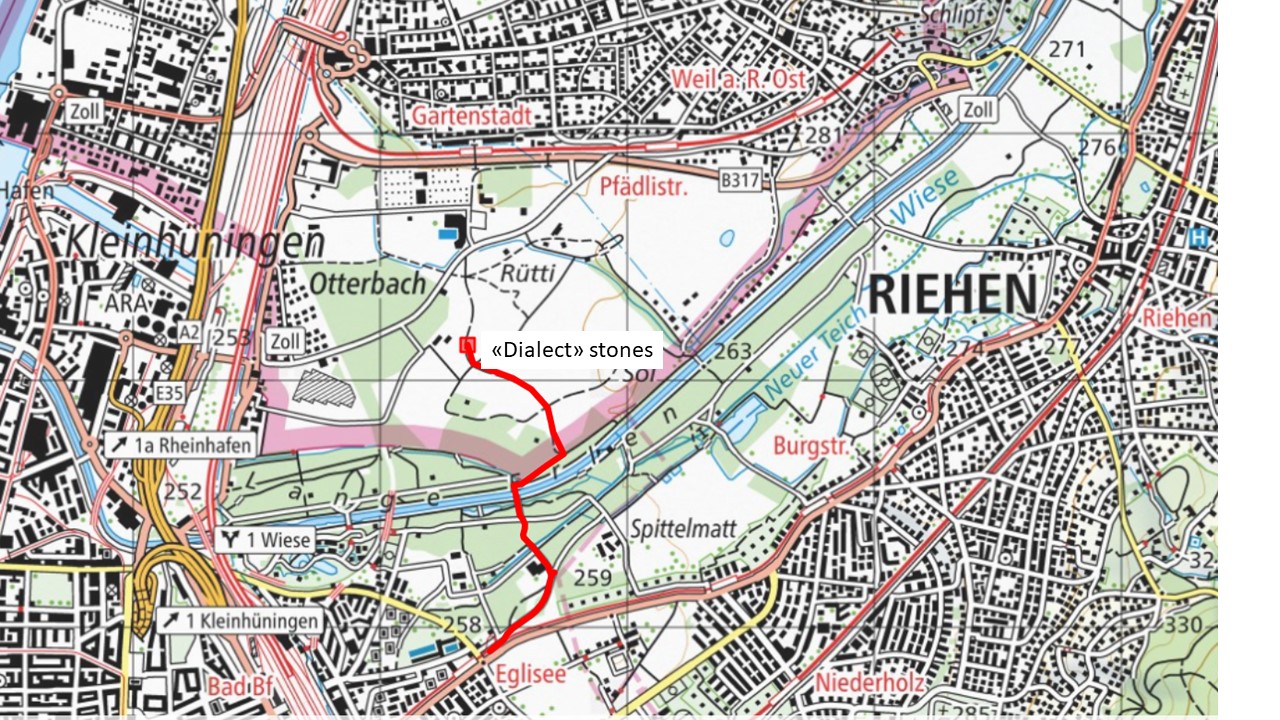
Happy to access to the “Regio Basiliensis” again, I take my bike and drive to Ötlingen (then to Binzen and the Kandertal).

Source: Swiss mobile maps

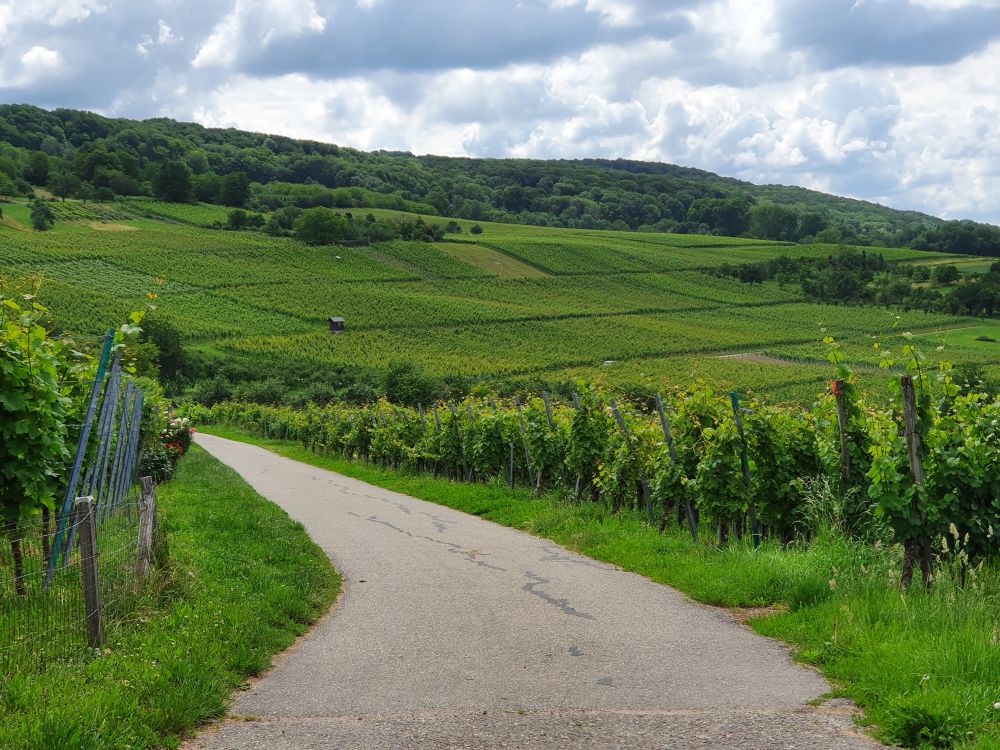
Ötlingen is on a hill above the Rhine valley and grows wine that their restaurants serve…

… with a great view of the Rhine valley and the Jura as well as the Vosges mountains.

The Regio Basiliensis looks like ONE large agglomeration around Basel, just accidentally divided by country’s frontiers that were closed for three and a half months and now are open again.

Returning to Basel, I cross the Langen Erlen, which belongs to a recreational area along the Wiese, partly in Germany, partly in Switzerland.

Source: Swiss mobile maps.

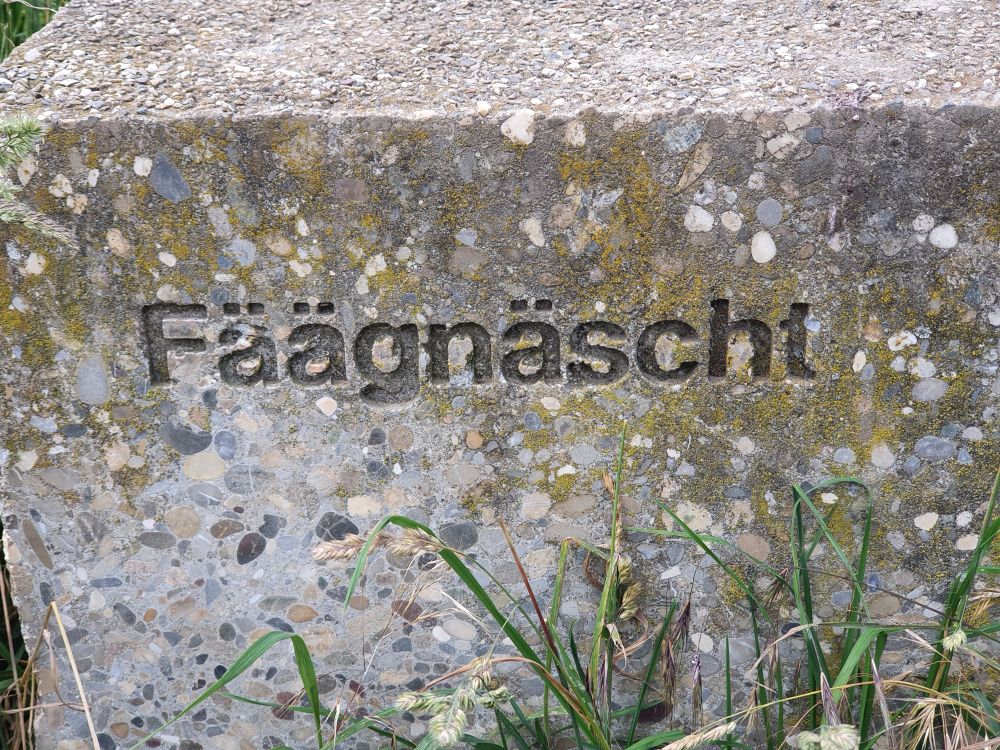
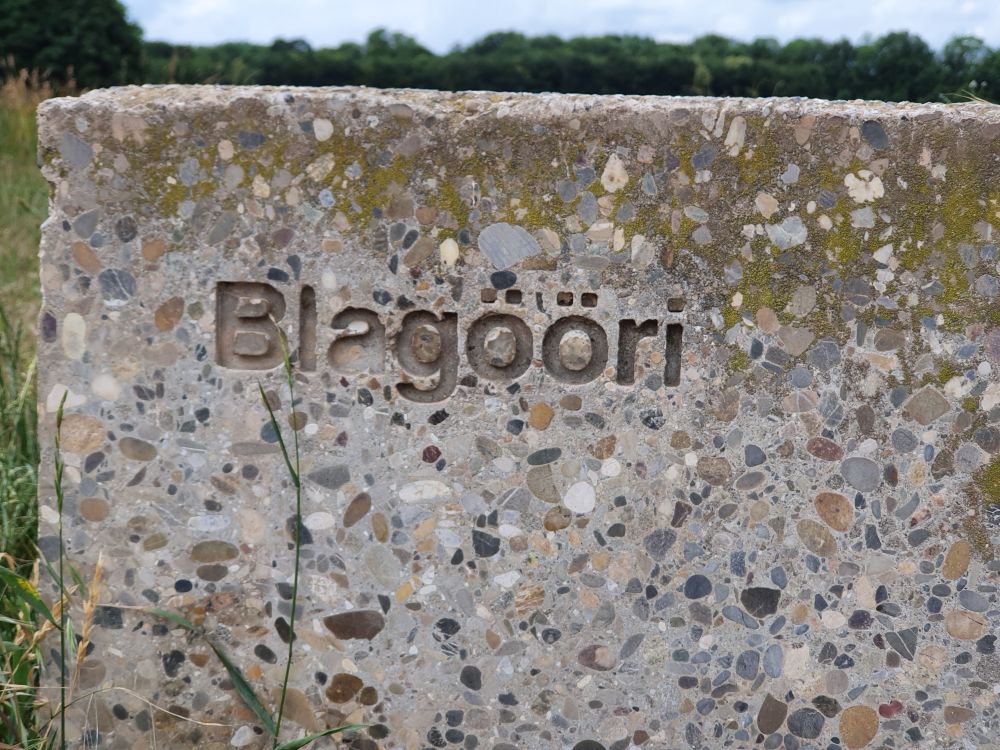
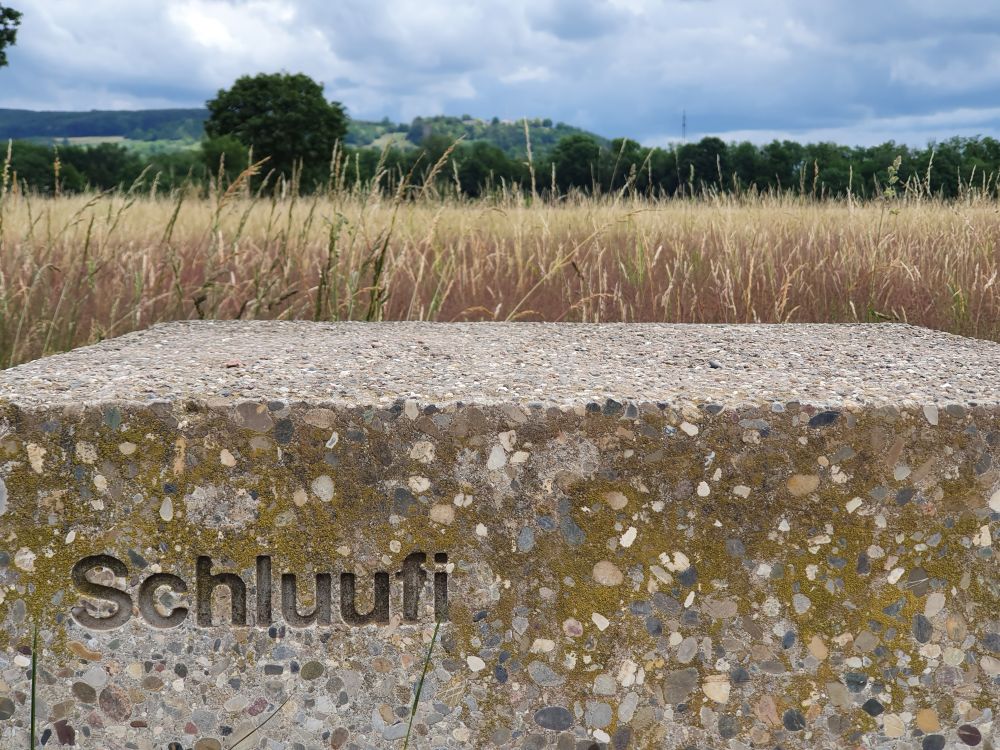
Along the path marked in red (between Eglisee and the Laguna), there are “dialect” stones displaying expressions used in Basel and across the border in Germany (Markgräflerland); the same expressions are also in use in France (Alsace). Here are some examples.

“Fäägnäscht” is, what we call a person that cannot sit or stand still – he/she is in move all the time. I like this word, I can hear the moving and rustling of the unsettled person: -f-f-f-scht-scht-scht-f-f-f-scht-scht-scht. And I know, some people would call me “Fäägnäscht”.

“Blagööri” is what we say to a person that shows off. He/she thinks, he is the “best” and knows everything. The extended “öö” illustrates, how great he/she thinks, he is – ööööööÖÖÖ.

A “Schluufi” does not have control of his life or his work or he is simply not interested in that. He is “dragging along”. I can hear that clearly from the “sch” and the two “uu”:  sch-sch-uu-uu-sch-sch-uu-uu.

A “Schnääderänte” keeps on talking and talking “schnääder-schnääder-schnääder” and it sounds like “Änte” which are ducks. I can hear the chattering of the ducks: schnääd-schnääd-schnääd, also onomatopoeic.

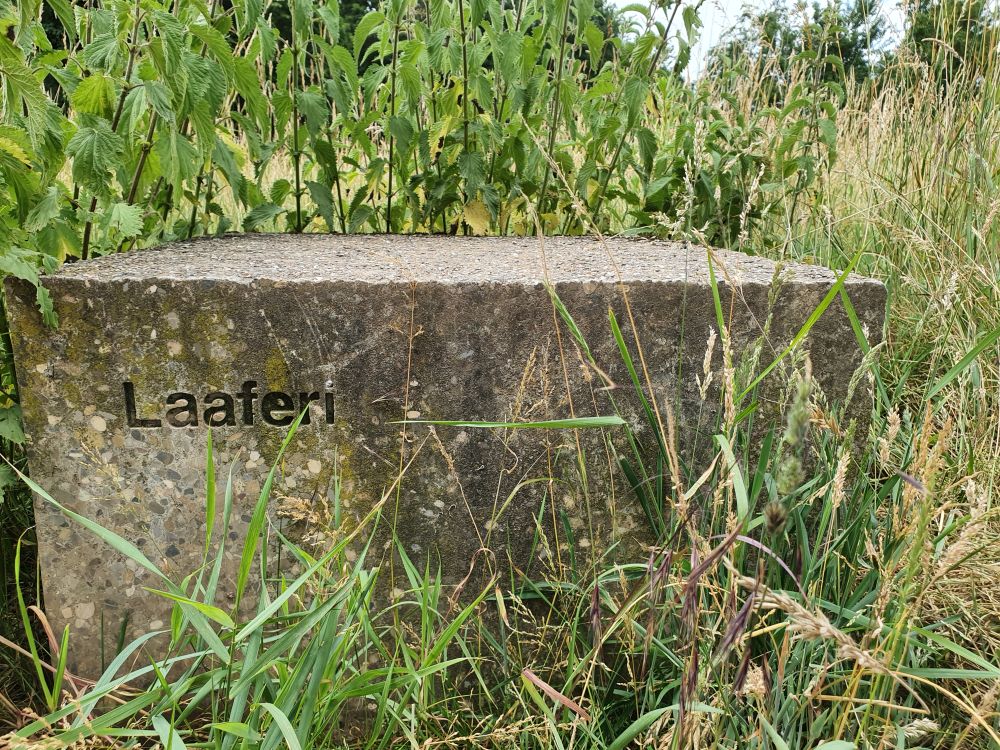
Also the “Laaferi” talks a lot, and what he says, is meaningless, a bit like “ob-la-di, ob-la-da“, I think, the Beatles used the same onomatopoeic picture.

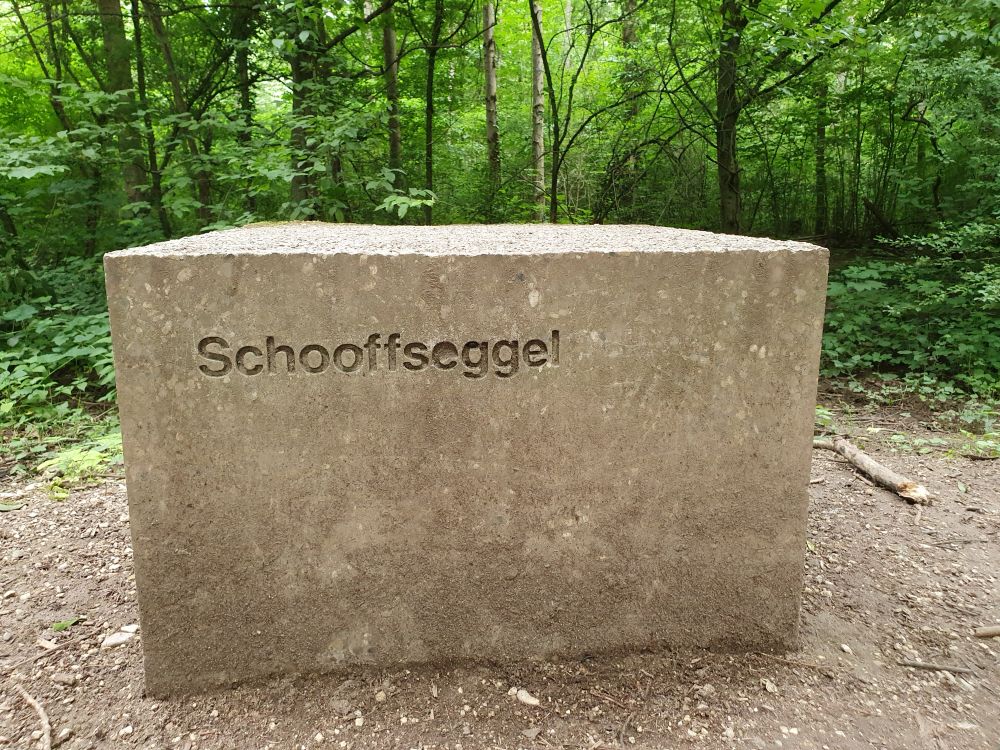
This is a difficult one. It means, I disdain you totally. I would never say this word to anyone. It is not nice, simply not lady-like. But its background is a good example of the Regio Basiliensis reaching into Germany and France.

Let us dig deeper. This word has an interesting origin in French with a detour to Latin that entered the Alemannic language. Instead of “Schooffxxx” (as on the stone), we also say “Schooffsurri” which, I believe, goes back to “chauve-souris” in French (“bat” in English). Digging deeper into late Latin, “chauve-souris” comes from “cava sorex” that means “chouette souris” or “marvellous mouse”. Hence a “marvellous mouse” (cava sorex) turned into a chauve-souris (“bold” bat”) in French, then into a term of disdain in the Alemannic dialects (Schooffsurri) and into the even uglier expression “Schooffxxx” that you find on this stone. This expression is known in Basel and in the whole Region Basiliensis across the border in Germany and France. But it is rude and I never use it.

The path with the “dialect” stones starts at the Eglisee in Switzerland and ends in Germany near the Badeland Laguna. It shows, how much the Regio Basiliensis, the region of Basle, belongs together: Across the borders we speak the same dialect (almost, we can hear nuances), and now, the borders have opened and we can visit one another again.

Let us take care and protect one another from the virus resurging; I observed that in Germany shops require medical masks, and I put on my mask, when buying fresh bread and cherries in “my” farmer’s shop in Rümmingen near Binzen.

I feel freer and I am happy that now the Regio Basiliensis is within reach again.

Listening to the stories that my home tells me: My dad’s book about Diesel’s car drive in Europe in 1950/51 / 2

In March/April/Mai 2020, the virus has stopped me travelling. Instead I listen to the stories that my home tells me.

In my former blog, I have started to talk about Eugen Diesel’s book “Philosophie am Steuer: Ein europäisches Reisbeuch” or “Philosophy at the Steering Wheel: A European Travelling Book”).

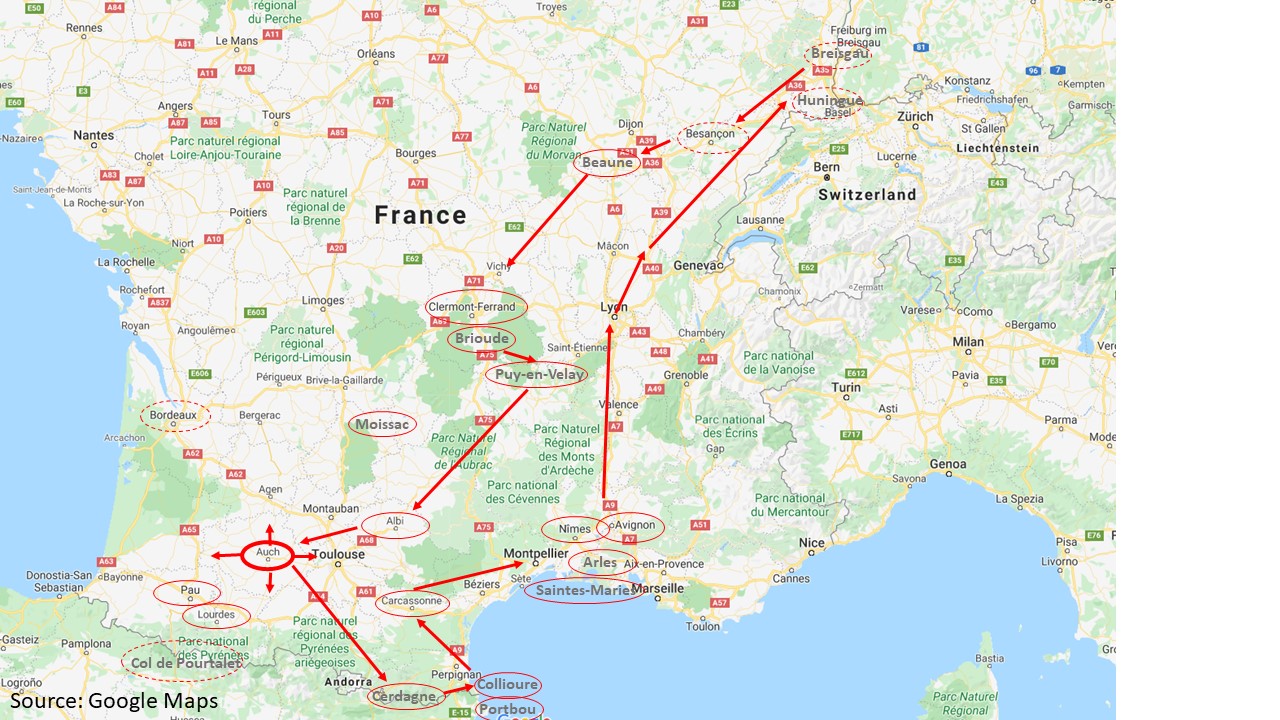
The book belonged to my dad and I have read it during the lockdown. In my former blog, I have talked about who Eugen Diesel was and how he drove to Auch in southern France. I now continue with his excursions around Auch and about his tour back to Germany, intertwining that with my own memories.


While staying with their friend in Auch, Eugen and his wife go for excursions in the south of France

In Auch, Eugen and his wife stay with their friend, and from here they go for various excursions, one of them being Pau.

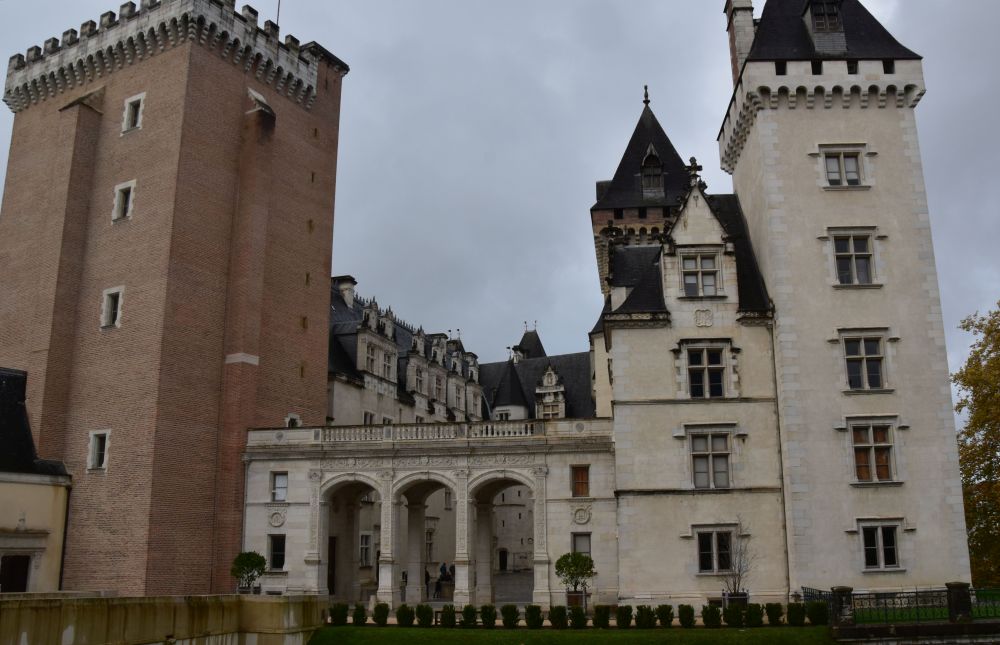
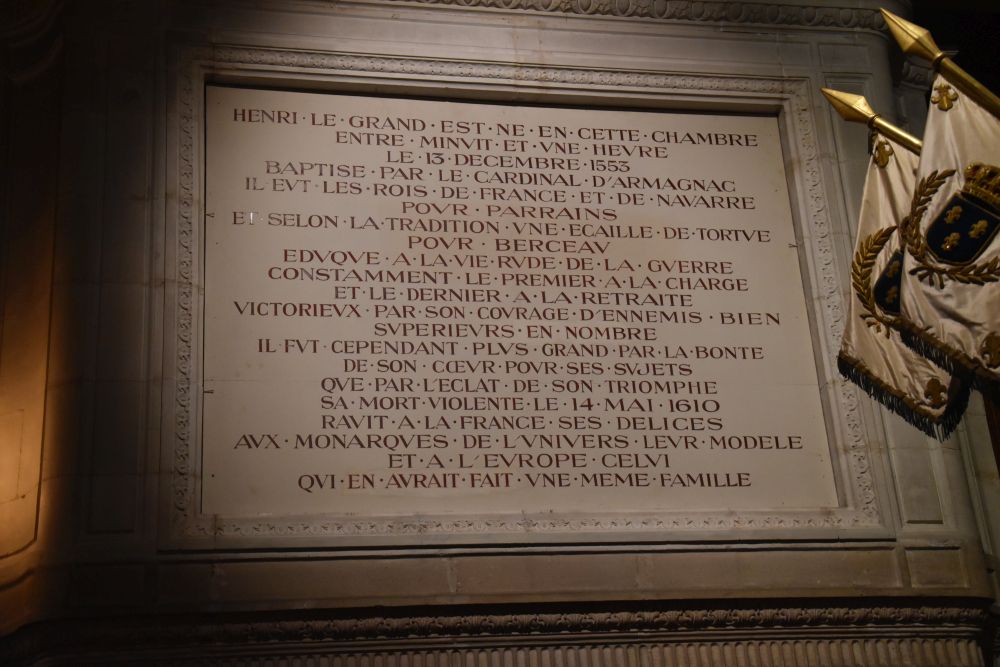
In the Renaissance castle, Jeanne d’Albret gave birth to the later king of France, Henri IV (born in 1553).

We know Henri IV for the words “Paris vaut bien un messe”. He may never have spoken them out, though he adopted the catholic religion to take over the crown of France, and, luckily, he was tolerant towards other religions.

Henri IV had children from various loves, and he played with his children. When this ambassadors entered, Henri asked him: “What do you do with your children?”. I believe that Henri IV is one of the most fascinating personalities of the history of France.

In Pau, Eugen visited the castle and he was invited to the local exhibition of furnitures, cars and engines at Pau; some people believed that it was him, Eugen, that had invented the Diesel engine, though it was his father.

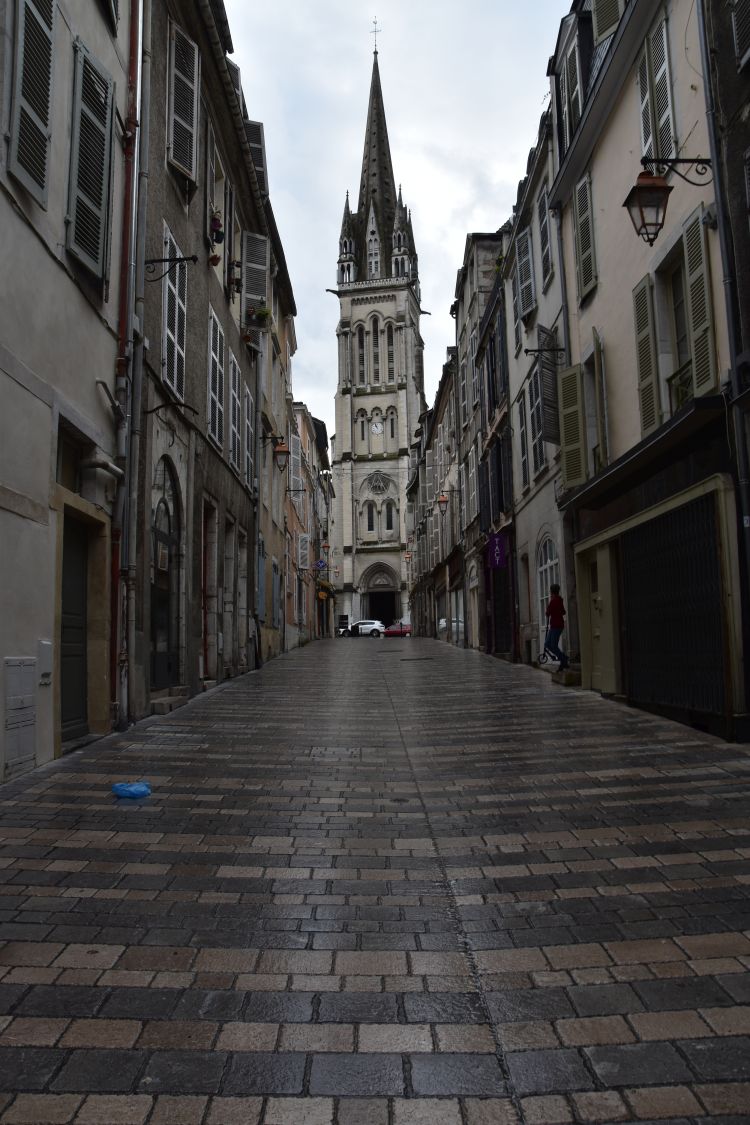
In 2017, my friend and I were in Pau. We visited the castle and the medieval city center.

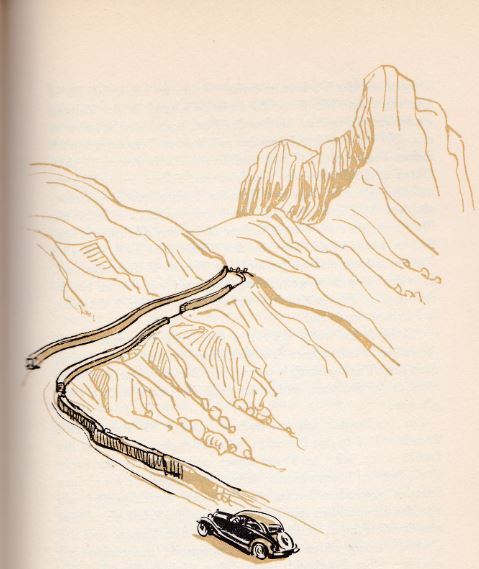
From Pau, Eugen drove up to the Pyrenees, to the Col de Pourtalet (1795m).

(Pen drawing by Willy Widman, p. 123)

The roads are narrow, but I do not think, he had to cross many cars coming down, as the border to Spain was closed. The customs officer let Eugen take a few steps in Spain. The sky was inviting blue south of the Pyrenees (Spain), while the north (France) was covered with clouds. Eugen had to return to the clouds, to France.

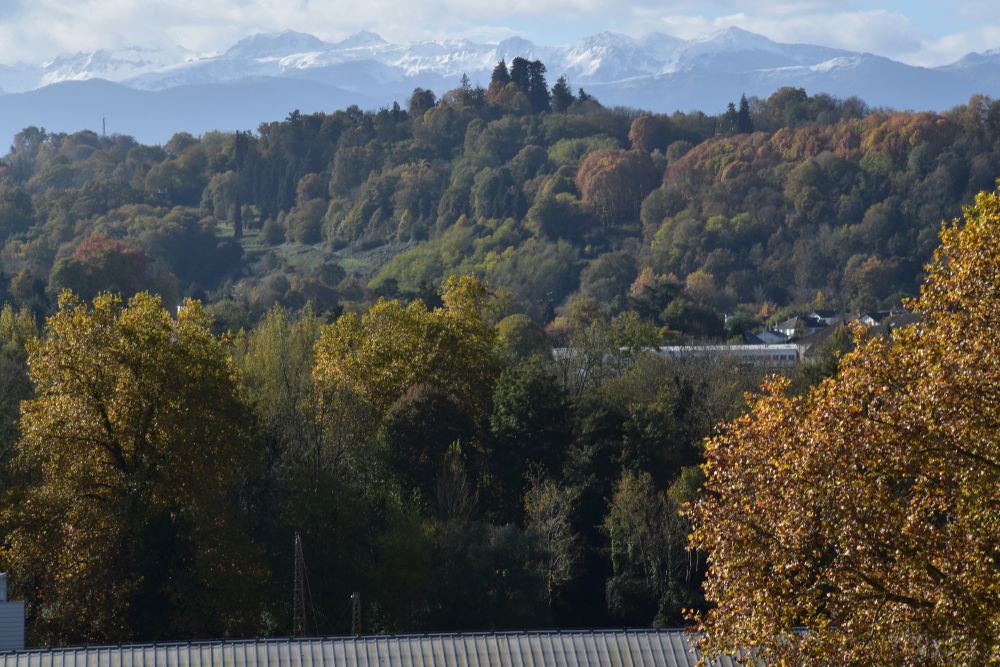
The Col de Pourtalet is one of the few passes in the Pyrenees that we have not yet used to get from France to Spain. I would love to take it, once the border to Spain opens up again and the situation looks safer after the current pandemic. This is the view of the Pyrenees in the direction of the Col de Pourtalet, taken at Pau.

In Lourdes, Eugen did not dare take photos, because it is a sacred place. But then he noticed an elderly lady take photos using an expensive camera, before laying down to pray. Lourdes is an important pilgrimage site that bases on Mary having appeared to a young girl in 1858. We were in Lourdes in 2017 and visited the grotto and the Rosary Basilica from 1899. When leaving Lourdes, the boot of our car would no longer open. A miracle? No, it turned out that the strip of one of our backpacks got caught in the lock, a problem that was solved all by itself later on a bumpy road. Perhaps not a miracle, but a reminder?

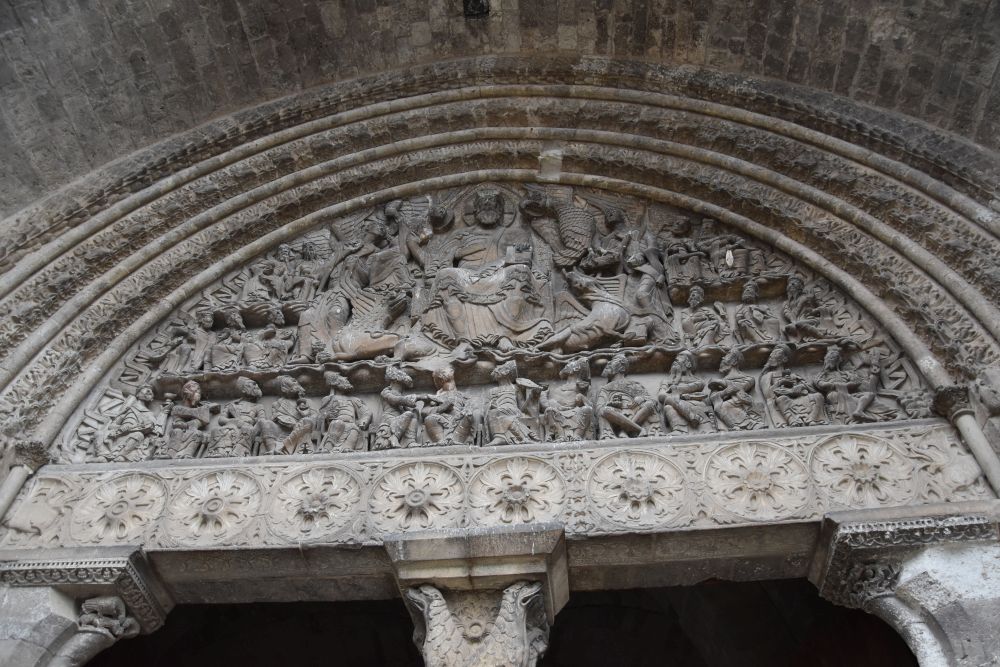
In Moissac, Eugen and his wife watched a lady ring the abbey bells manually. We saw the Abbey Saint Pierre in 2017 and in 2019. It has one of the most beautiful Romanic portals that I know; here, the 24 wise men playing music are looking up to Jesus,…

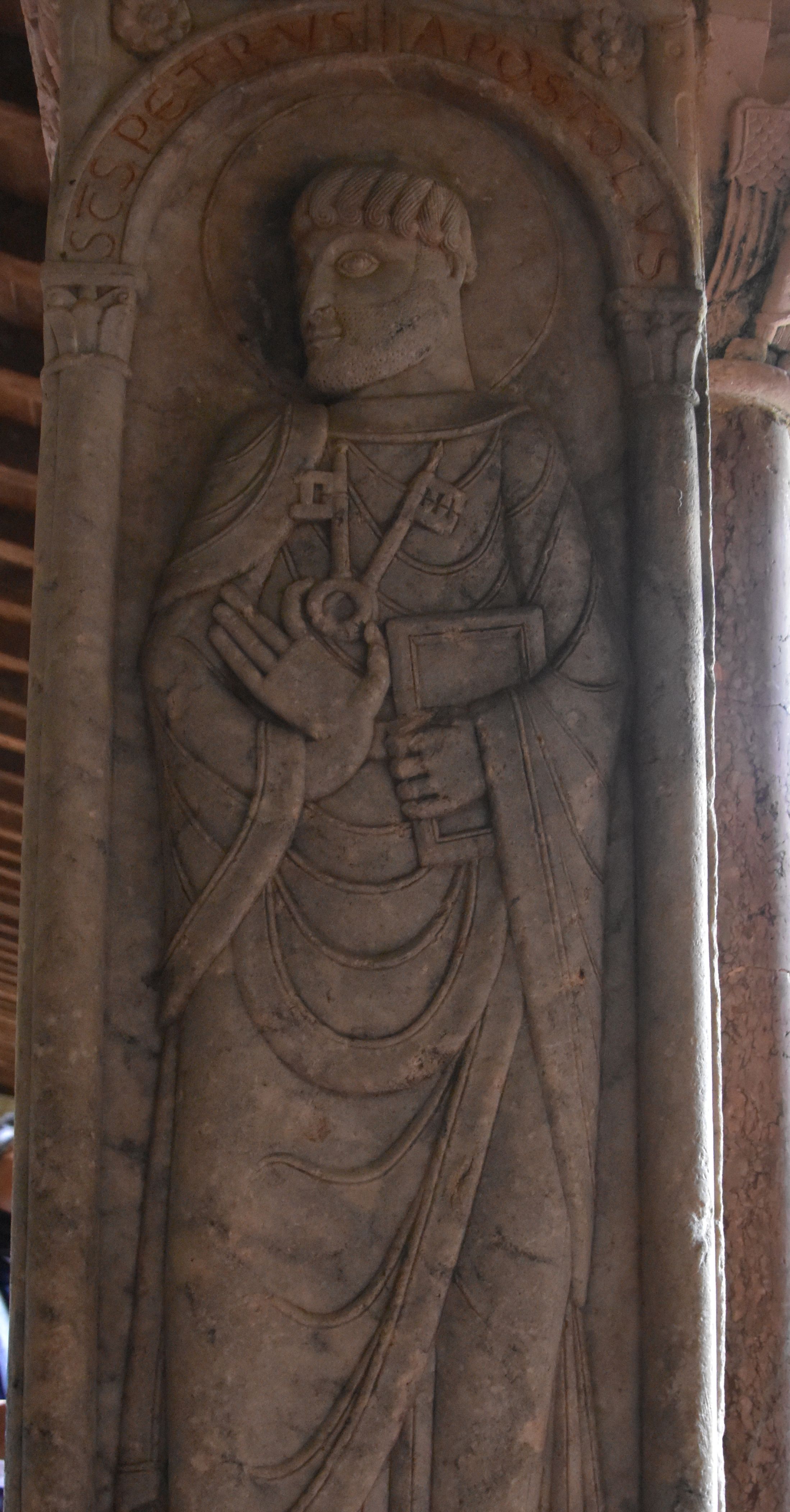
… and in the the cloister we found this beautiful Petrus.

After having visited Bordeaux, Mimizan and Toulouse, Eugen and his wife left Auch to return to Germany performing a round tour to the Mediterranean Sea.


Eugen and his wife leave Auch and return to Germany via the Mediterranean Coast

Eugen drives along the Pyrenees and tries to enter Andorra. But the customs regulations (two large books in a drawer) did not say, how to handle Germans, and hence the couple was not allowed to cross the border to Andorra. Eugen and his wife continued their way in France crossing the Cerdagne, a high plateau shared by France and Spain, with one Spanish exclave called Livía. Eugen could not find the reason for Livía being a Spanish exclave surrounded by French territory. Today, we have the internet, “Dr. Google” and Wikpedia. They tell me that in 1659, Louis XIV did not know that Livía was a town. In the Treaty of the Pyrenees, he had agreed with the Spanish crown that France would integrate all the villages of the northern half of the Cerdagne/Cerdanya in France. Livía, once the capital of the Cerdagne and registered as a town, consequently stayed with Spain. If this is the reason, it could be an indication that, even as a powerful king, you may have to study the local details, before finalizing an agreement.

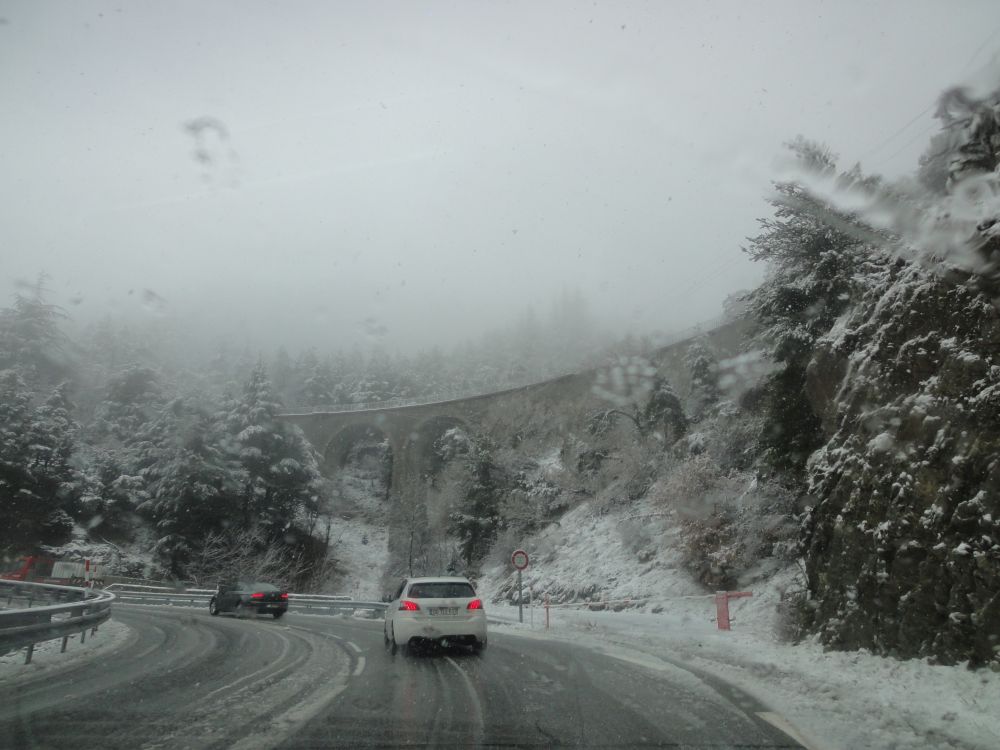
We were in the Cerdagne in May 2018, and we got caught in heavy snowfall, while on the way to Seu d’Urgell in Catalonia on the Spanish side.

Here we are on the road up to the Cerdagne. On the plateau, 1200-1600m, we will find some 10 to 20cm of fresh snow on the roads. We are in the mountains – “real” mountains – and even in May, the weather can be rough in the Pyrenees. My friend took the photo, while I was driving carefully; my car is a four-wheel drive.

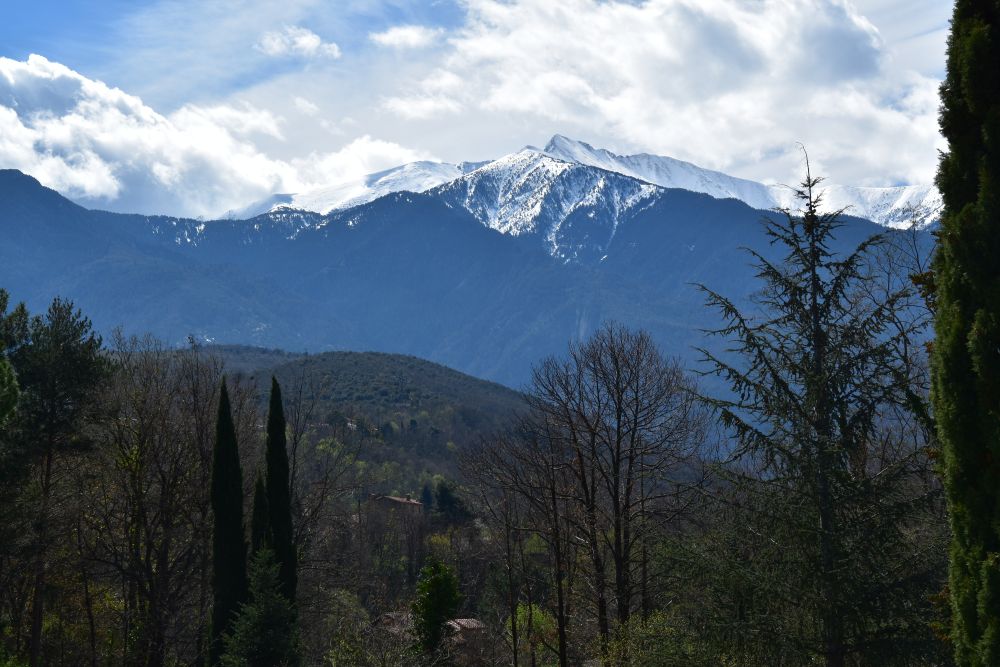
Not far from here is the beautifully shaped sacred mountain of the Catalans, the Canigou (seen from Prades, where the road up to the Cerdagne plateau starts).

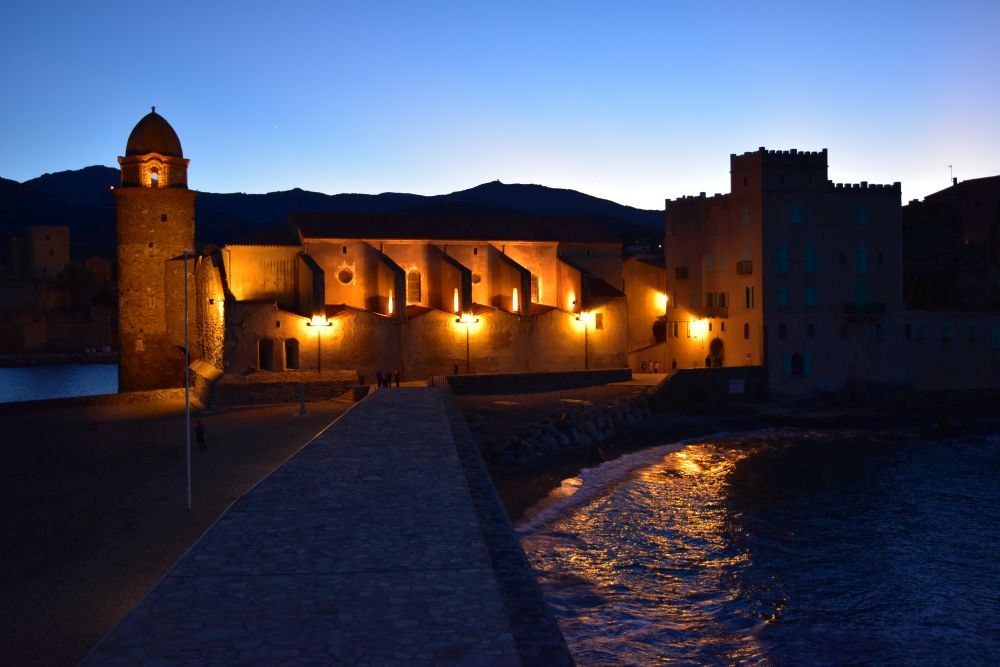
After having followed the river Têt down to the Mediterrenean Sea, Eugen stayed overnight at Collioure with the harbour and the lighthouse (“phare” in French)…

… that André Derain painted.

In the beginning of the XXth century Fauve artists around Braques, Matisse and Picasso used to meet here. Eugen enjoyed the atmosphere of this charming village with the castle and with the colorful narrow streets, and so did we in 2016.

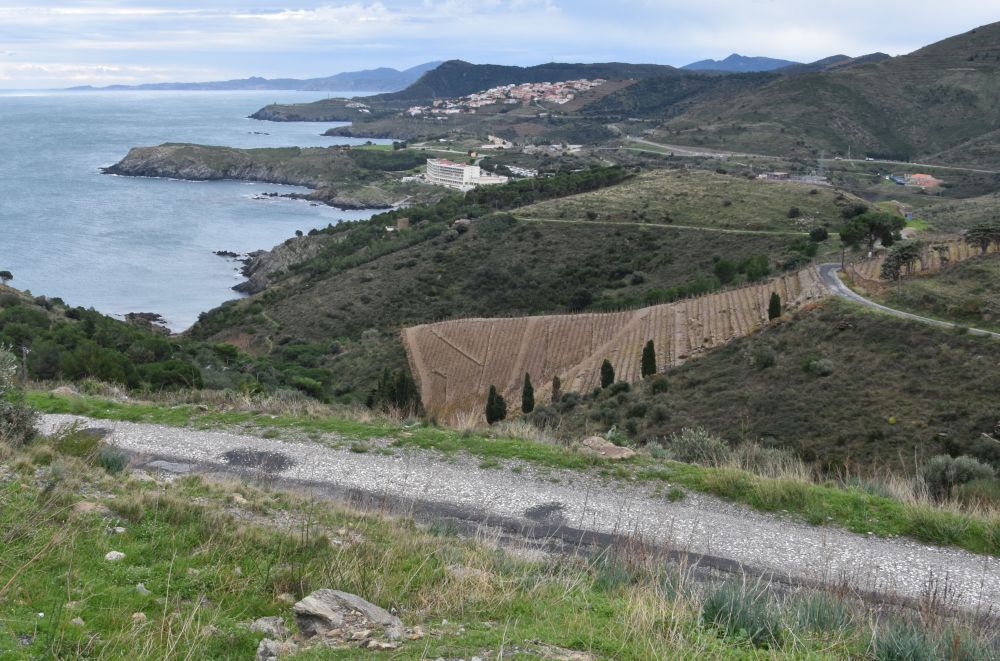
Along the beautiful coastline, Eugen and his wife drove south from Collioure to the border between France and Spain, at the Col de Belitres.

The border to Spain was closed for Eugen and his wife, also here. The customs officer talked to Eugen’s wife, while Eugen was allowed to enter Spain, just for a few steps, to admire the landscape and the huge train station squeezed between the mountains and the sea. The small settlement, Portbou, has such a large train station, because the engineers in France and Spain had selected different gauges for their railways, as Eugen, son of an engineer, explained.  The enormous train station was required for the passengers to change trains and for the goods to be reloaded.

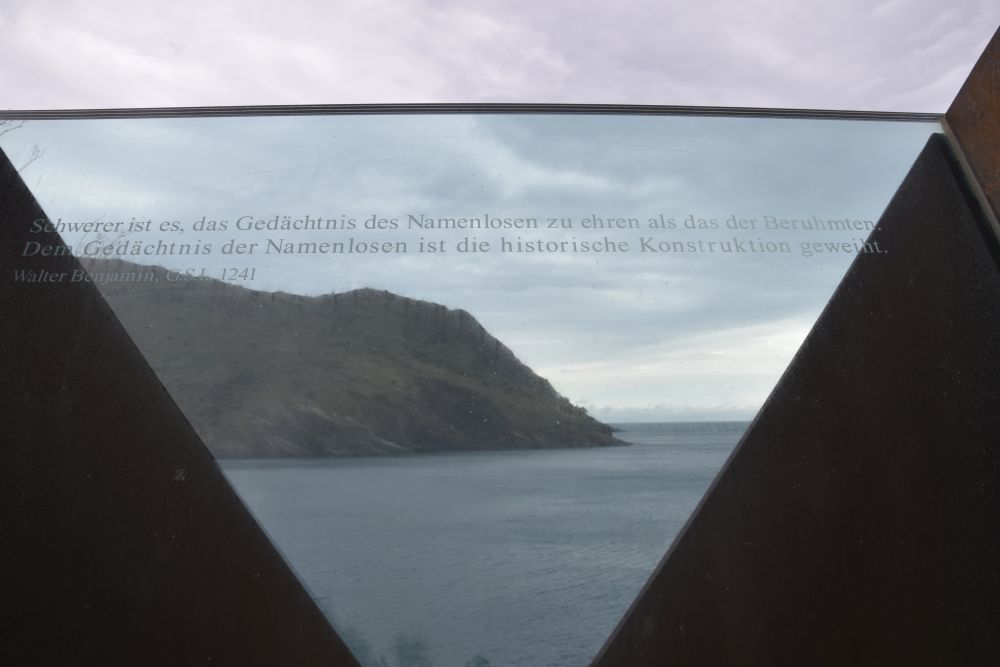
In 2018, we were at Portbou, and felt the tragedy of this border: Here, the philosopher Walter Benjamin escaped to Spain in 1940 with a transit visa in his pocket that should allow him to emigrate to the US, but Spain had just cancelled all transit visas. Walter Benjamin was about to be sent back to France. He committed suicide and since 1994, this haunting monument has reminded us of Walter Benjamin’s tragedy.

I found a beautiful blog “The Passage to Portbou, Seeking Walter Benjamin in Catalunya”, by Martin Kalfatovic. He translated the German words facing the sea like this: “It is more difficult to honor the memory of the anonymous than that of the renowned. Historical construction is devoted to the memory of the anonymous. Walter Benjamin, On the Concept of History (1940)”. Yes, in the 1940-ies, many of the “renowned” wrote history in a way that I prefer would not have happened and that I hope will never happen again – however, sometimes I am worried about our “renowned” now. Then and now, there existed and exist courageous “anonymous” that deserve to be honored.

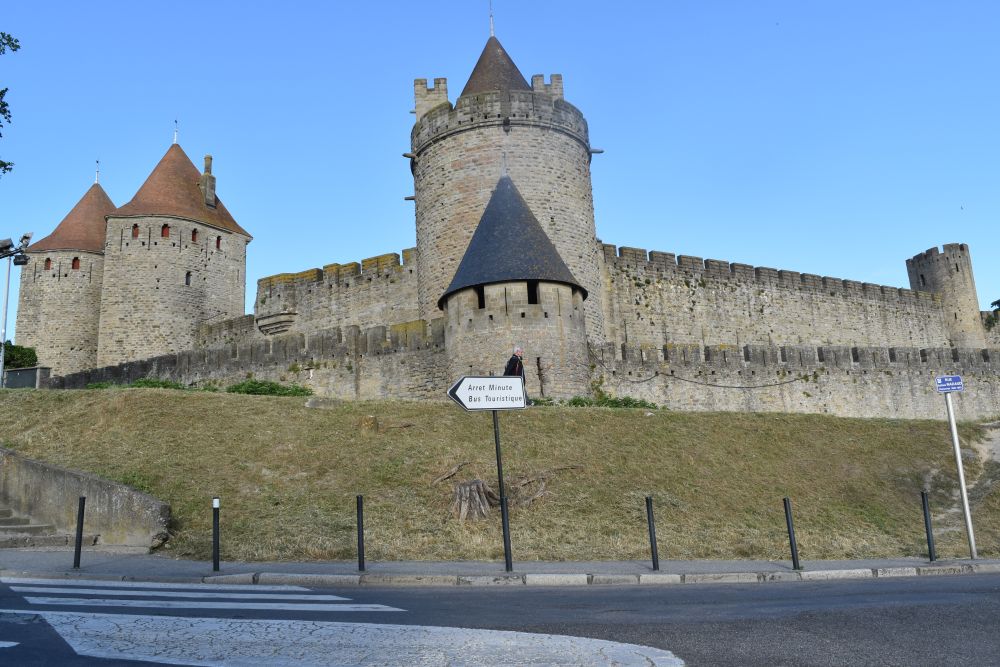
After having seen Portbou standing at the closed border, Eugen’s next stop is Carcassone, the fortified town…

… with the charming small streets inside.

We were here in 2016. In a welcoming restaurant, we watched some Asian tourists eat the “Cassoulet”, which is a local hotpot made with sausages. It is heavy stuff for people that work in the fields all day. I was not sure, whether the Asian tourists liked the dish or just found it interesting. I had a delicious lamb dish with fine herbs.

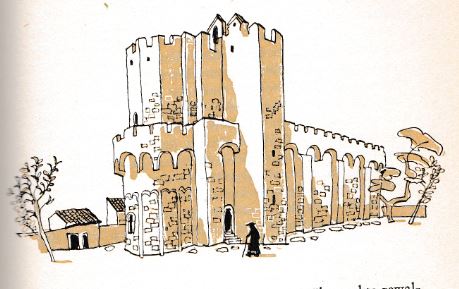
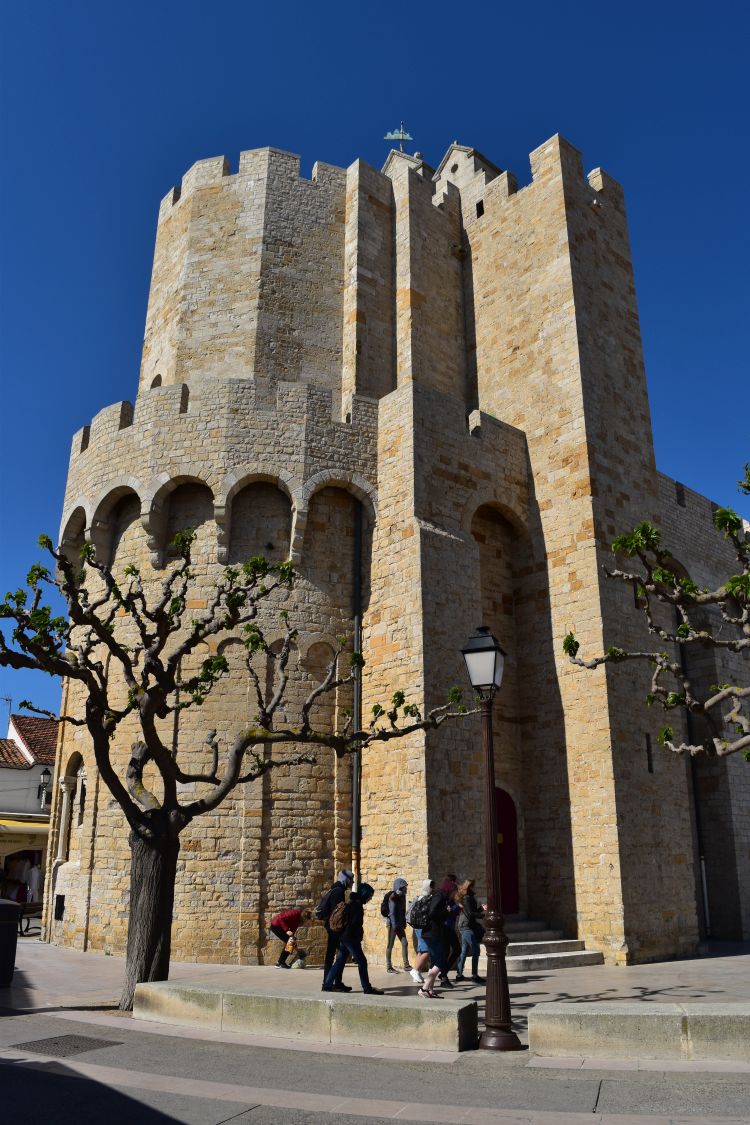
Eugen and his wife stopped in Les Saintes-Maries-de-la-Mer at the Mediterranean Coast in the Camargue. Three Saint Maries landed here with her Egyptian servant Sarah. This is the church that commemorates the landing of the sacred boat.

(Pen drawing by Willy Widman, p. 155)

We visited the church in 2017, under dark blue sky.

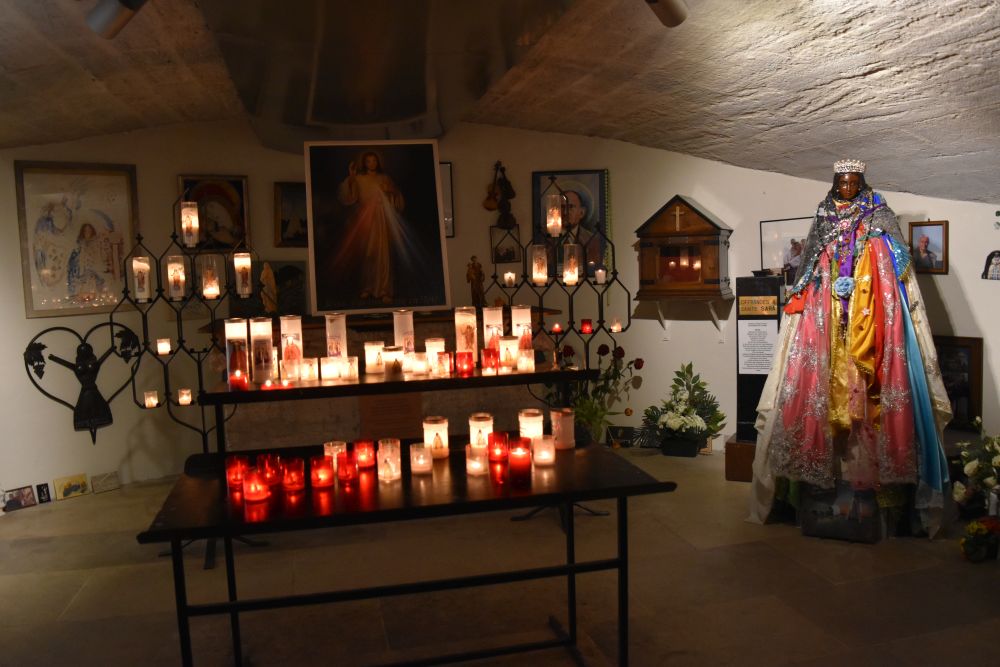
The Romani  people venerate Saint Sarah, the Egyptian servant, in the crypt of this church.

In Arles, Eugen and his wife attended a bullfight. He described it in detail with the eyes of a German that did not really enjoy the elegance of the bullfighters and the killing of the bulls. The fight took place in the old Roman arena that we saw in 2017 (but without such action, fortunately, not something I would like to watch).

Still in the Camargue, Eugen and his wife stayed overnight in the small town called Les Baux which is the origin of “Bauxite” (a rock containing aluminium, needed to build cars).

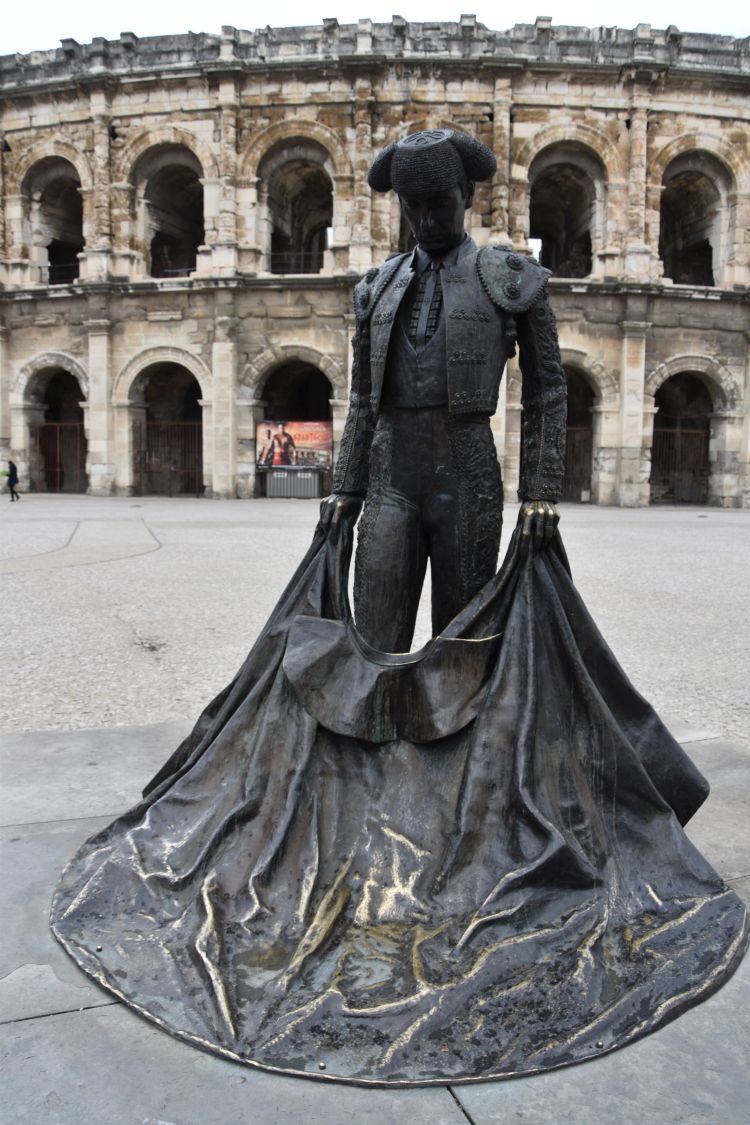
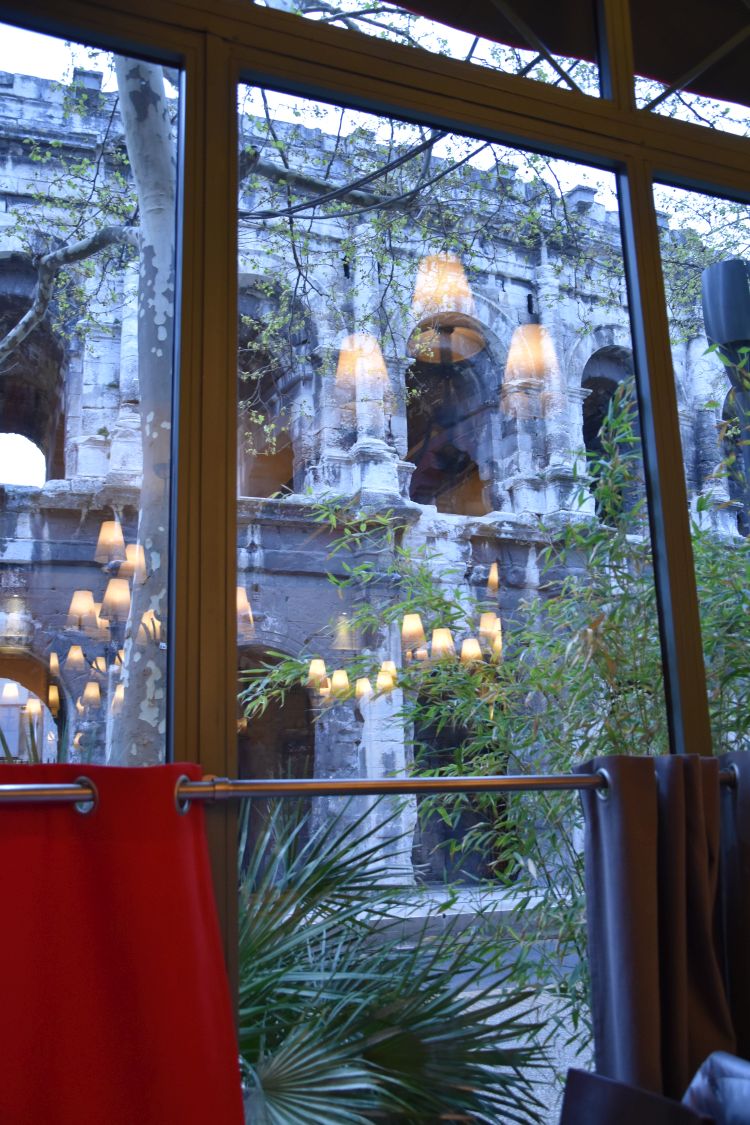
The next day, they saw Nîmes with the arena and the Roman temple (called Maison Carrée). We stayed overnight at Nîmes in 2018 and admired the Roman arena with the statue of the bull fighter.

After having strolled through the city center with its narrow streets, we had a wonderful dinner (onglet steak) just across the arena, at Chez Hubert.

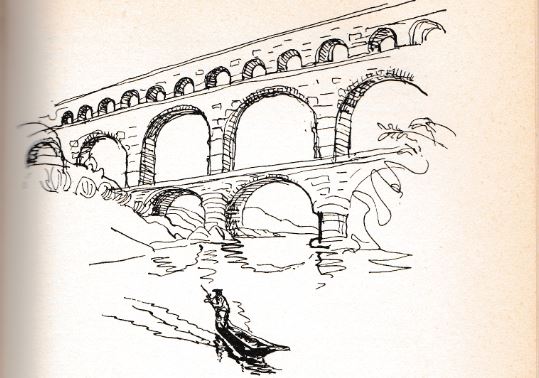
Not far from Nîmes is the Pont du Gard that, in Roman times, provided Nîmes (then called Nemasus) with water.

(Pen drawing by Willy Widman, p. 181)

In 2011, I was here with Ernst. This was our last sightseeing point on our last journey that we did together – we were on our way home from Morocco. I keep wonderful memories of all the travelling I have done with Ernst during our 18 years and now he travels with me in my heart.

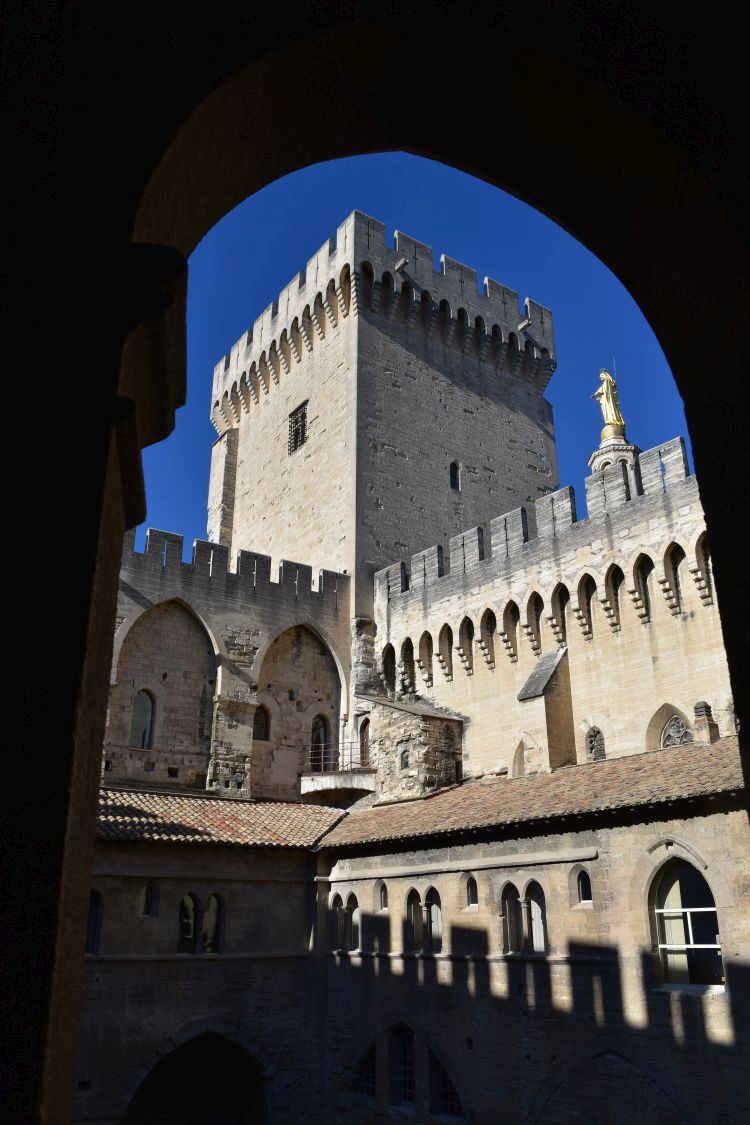
In Avignon, Eugen and his wife visited the Palace of the Popes. With my friend, I was here in autumn 2016, when the cold mistral blew down from the mountains. This is the second courtyard of the Pope Palace built in the 14th century, when six popes resided here (and not in Rome).

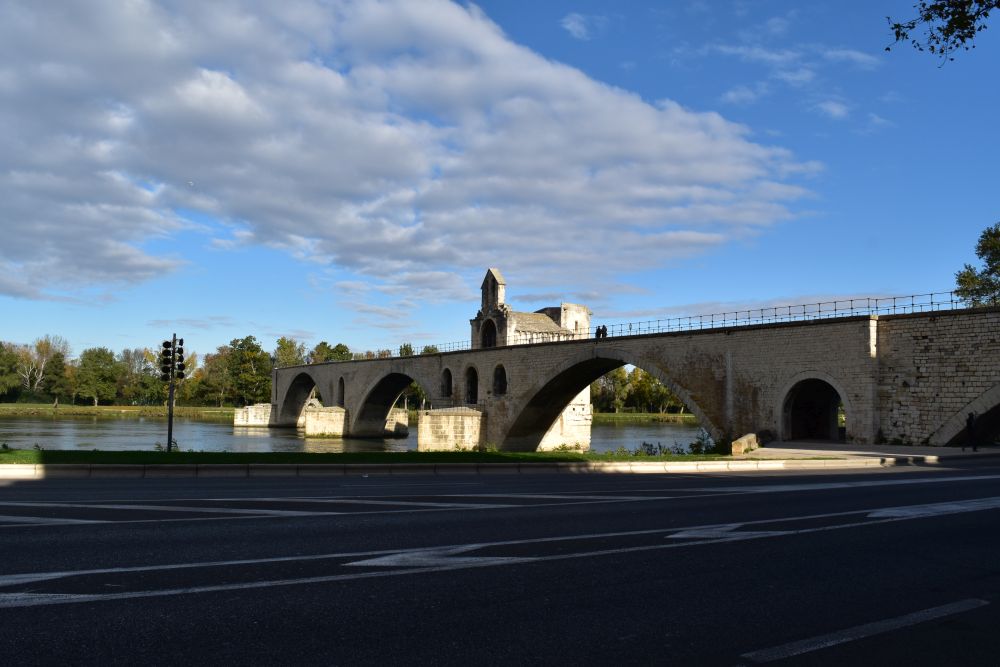
Since kindergarten, I had known the Pont d’Avignon, as we had been taught the song “sur le pont d’Avignon, l’on y danse, l’on y danse… (on the bridge of Avignon, this is where you dance, this is where you dance).” Not yet understanding French, we created our own versions of the text; this was the version of the sister of my friend: “ooni Dasse, ooni Dasse”, which in Swiss German means “without cups, without cups”. The French word “danse” sounded like “Dasse” to her.

Now in my sixties, I saw this famous bridge for the first time, and I was so disappointed! Because it is not a bridge that crosses the river, as bridges ought to do, but it ends in the middle of the river Rhone.  In the attached museum, we learned that it was conceived as a toll point on the Rhone and not really as a bridge for people and carriages.

Eugen and his wife drove “up” the Rhone valley, with stops at Montélimar, the city of nougat, then at Vienne, another Roman city, and finally at Lyon and Bourg.

They crossed the border between France and Germany near Huningue (close to my home city Basel) using the ferry (the three countries bridge will be rebuilt 57 years later, in 2007). The French customs officer, Eugen remembers, was easy going, whereby the German customs officer was tense and eager to fulfill his duty according to the regulations. Eugen and his wife had left France with its somewhat light-footed atmosphere and are now back in “dutiful” Germany. From now on, he wrote about his tours in Germany and to Switzerland. In Switzerland, Eugen reflected about the fact that a German writer, Friedrich von Schiller, became – in a way – the national writer for Switzerland, as he wrote his play “Wilhelm Tell” about the Swiss legendary national hero of the 13th century.


Epilog: France… like Eugen I love the French atmosphere and I long for being there again, be it just across the border or be it travelling farther

While not being allowed to cross the border to France due to the pandemic until mid-June, I enjoyed to follow Eugen Diesel and his wife through France to places that I have been to as well. I like to be in France, in the rural towns, in the restaurants that serve soigné meals, soaking in the rich cultural heritage and enjoying the French atmosphere. I wish that France will recover well, having been hit seriously by the pandemic of spring 2020 and having been churned by turmoils recently. I look forward to returning to France.

Source: Eugen Diesel, “Philosophie am Steuer: Ein europäisches Reisbeuch”, Reclam Verlag Stuttgart 1952 and my own photos from travelling to the same places.


Listening to the stories that my home tells me: My dad’s book about Diesel’s car drive in Europe in 1950/51 / 1

In March/April/Mai 2020, the virus has stopped me travelling. Instead I listen to the stories that my home tells me.

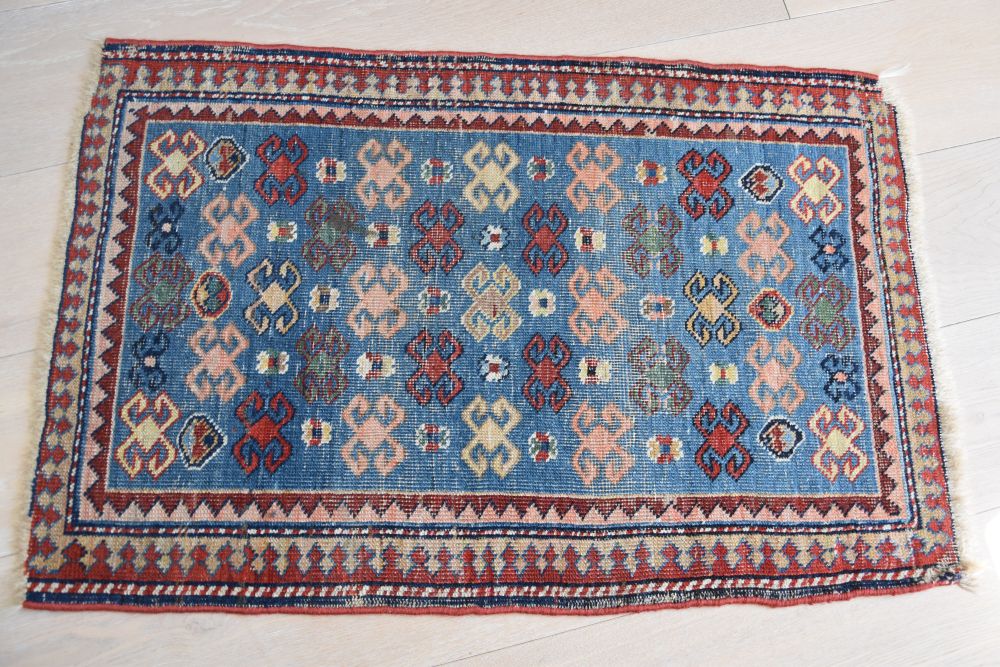
This small Kazak carpet is a souvenir of my dad. He bought it, when being in the Caucasus region as a meteorologist in the 1940’s.

I love this small carpet. It is a symbol for the good memories I have of my father that we called “Vati”. He died much too early, on Saturday, 14th of March 1970. This was my last school day, just 50 years before the Corona virus lockdown was announced in Switzerland in 2020. What a breath taking coincidence that I felt intensely.

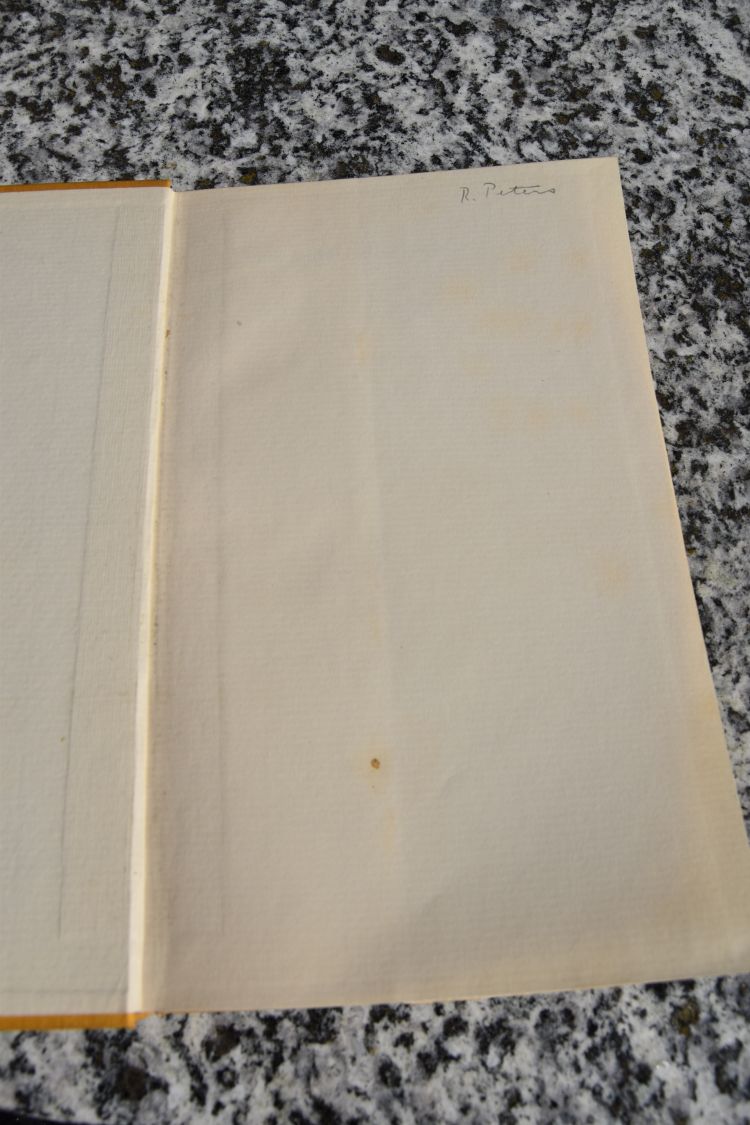
In addition to the carpet, I have some books of my father, one of them being “Philosophie am Steuer: Ein europäisches Reisbeuch” by Eugen Diesel (Reclam Verlag Stuttgart 1952; “Philosophy at the Steering Wheel: A European Travelling Book”).

I have kept this book for the signature of my dad. So far, the book has waited in my bookshelf.

Now, being confined at home, I took it out and read it. This was a fascinating experience for me.

  • At some of the places that Eugen Diesel talks about, I have been as well, but almost 70 years later.
  • Eugen Diesel reflected about what Europe – now resurrecting from the war – would be in 50 years. Some of it is interesting to read now, 70 years later.
  • Closed borders in Europe? In 1950, the borders, having been closed during the war, slowly opened up. Now, in June 2020 we expect the European borders to open, after having been closed for three months due to the pandemic.

Let us see who Eugen Diesel was, let us travel with him to places in France that I have been to later and hence have memories that I like to revive, while being at home.


Who was Eugen Diesel?

Eugen Diesel  (1889-1970) was the son of Rudolf Diesel who invented the Diesel engine in 1892. In the early 20th century, the Diesel engine replaced steam engines (such as for trains or ships), while passenger cars used gasoline only. With his father, Eugen travelled through Europe in 1905, in a red NAG car (p. 13, NAG = Nationale Auto Gesellschaft, 20-24 PS).

(Drawing made by Willy Wildmann, p. 13)

Instead of becoming an engineer, Eugen Diesel decided to become a writer. Eugen learnt French culture from his father Rudolf, who was bilingual French-German, as he had grown up in France until the age of twelve, when, in 1870/71, the war between France and Prussia/Germany forced the family to return to Germany.


Trains full of hoarders in 1947 – Eugen Diesel gets stuck in overloaded trains and decides to buy his own car

In 1947, Bayern had no apples and Württemberg had no potatoes… Hoarders from Bayern took the trains to Württemberg to buy apples and hoarders from Württemberg went by train to buy potatoes in Bayern, though hoarding was forbidden. The trains were full and the people carried large baskets that added to the mess. Eugen wanted to get from Stuttgart to Munich – and he got stuck in the overloaded trains.

Hoarding must be in the human genes: We have seen empty toilet paper shelves for weeks during the corona lockdown of spring 2020.

To travel more freely, Eugen acquired his own car in 1950. It was a Mercedes Diesel. Mercedes had just started to build passenger cars that run on Diesel.

(Drawing made by Willy Wildmann, p. 187)

Eugen had not driven a car four eleven years. Nevertheless, he left the factory at the steering wheel of his new Mercedes. He started to drive through churning and distressed Europe and enjoyed to be mobile again: “A city, 100km away, is now again becoming a neighbour”, he said (p.19). His book “Philosophy at the Steering Wheel” tells about driving 45’000km in Europe, above all in France, in 1950/51.


First excursions by car in Germany

With his new car, Eugen Diesel started to explore the area around Munich. Among his destinations was the Romanic St. James church in Urschalling with gothic frescoes (now on my agenda, when travelling to Munich again) or the Bosch Factory in Memmingen and the Daimler-Benz Factory in Sindelfingen (he had inherited the interest for engineering from his father). Then he went beyond Bayern to cities such as Augsburg or Stuttgart. He observed the ruins and how German cities strived to recover. In Mainz he attended the inauguration of the reconstructed bridge crossing the Rhine. President Heuss made a speech without mentioning the engineers, as Eugen, being the son of an engineer, noticed frowning. He visited friends again that he had been separated from for years. (I can understand the enjoyment – now, in June, I started to see more friends again, as the lockdown is opening up).

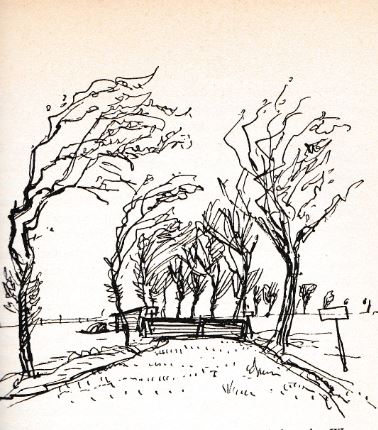
Inside Germany, Eugen encountered a new border. Signposts are pointing to Magdeburg or Halle, but these cities had become out of reach for him, as bars blocked the roads to the new Russian eastern zone of Germany and the bridges were closed. Eugen stood at the closed border for two hours and gazed on to the other side; he could not see anyone.

(Drawing made by Willy Wildmann, p. 49)

The walls built later will separate West and East Germany for 40 years, until 1989.

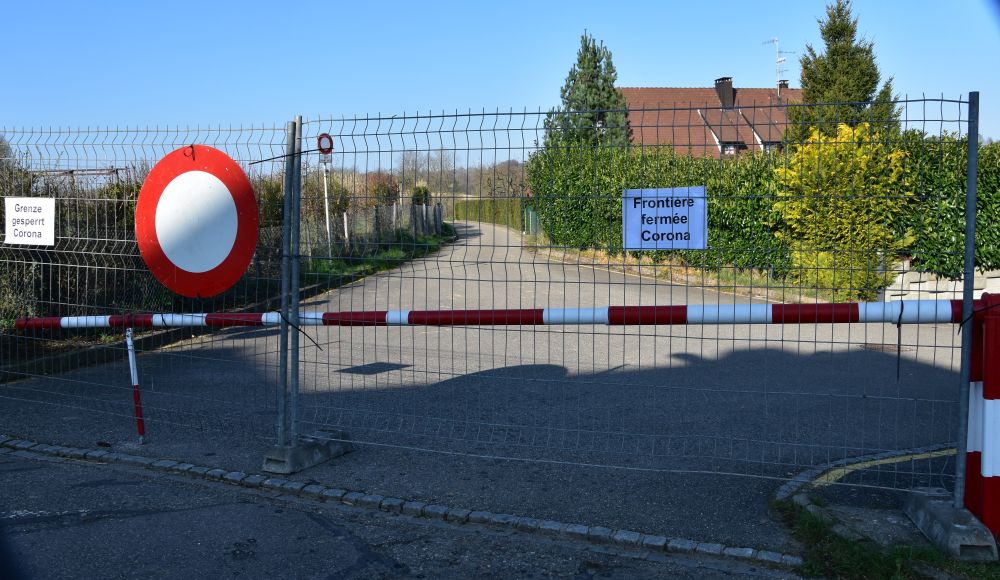
From March to June 2020, 70 years later, borders in Europe are closed again – for the pandemic. The Sundgau in France is out of reach for me now. I was sad, when seeing this bar on one of my bicycle rides.

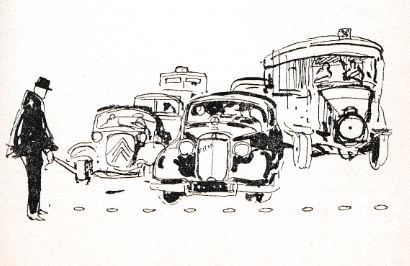
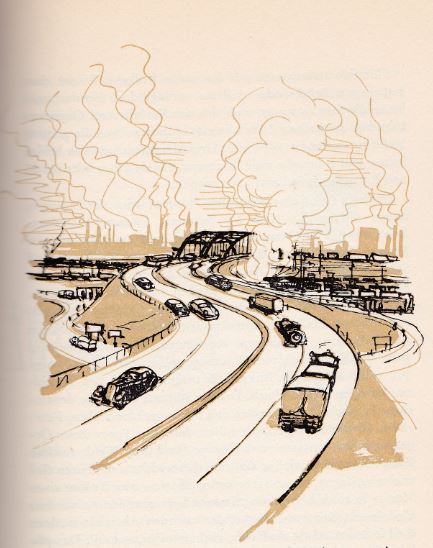
Eugen Diesel observed that the traffic in the 1950-ies was growing rapidly. Also my dad was of the opinion that there was too much traffic then. He never sat at the steering wheel of a car again after having returned from the prison camps in France in 1947, though he had driven cars since the 1930-ies – his parents had an Adler. However, compared to the traffic today, this highway does not look very crowded to me.

(Pen drawing made by Willy Wildmann, p. 55)

Eugen reflected that on highways, one accident could cause serious traffic jams, which would ask for more and more roads to connect more and more factories and cope with the rising traffic. Today’s traffic density, the network of roads, the sprawling of cities as well as pollution and climate change exceed Eugen’s fears, I believe.


France opens up for Eugen Diesel and his wife – they drive to Auch near Toulouse to visit a friend of theirs

In 1938, Eugen Diesel had connected up with a French scientist and intended to visit him in France, but the war closed the borders. After the war, in 1950, Eugen decided to visit him with his wife, Anna Luise Gräfin von Waldersee. They planned a tour to Auch near Toulouse, where the former scientist now worked for the departmental government. Eugen went through much bureaucratic pain to be able to cross the border to France.

In September 1950, Eugen left Munich with his wife and drove to Altbreisach (still in Germany), where they saw the city in ruins. They crossed the river Rhine and immediately felt that they were in France: The atmosphere was different, somewhat more light-footed than in Germany. Yes, I admit that I also feel the different atmospheres between France and Germany, both bordering my home city Basel.

Eugen continued to Neuf-Brisach, Colmar, Belfort (with Bartholdi’s monumental lion) and Montbéliard (as Mömpelgard it had belonged to Württemberg from 1397-1793, he remembered). In Besançon they had their first lunch break in the restaurant Palais de la Bière (still exists today and looks enticing).

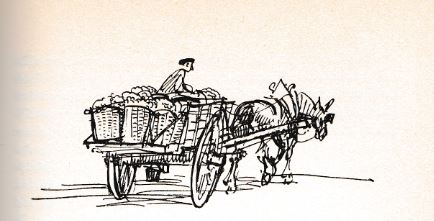
Burgundy was the next station. It was autumn and in Nuit-Saint-Georges north of Beaune, they saw many carts filled with Burgundy grapes.

Well, such carts are now in museums such as in the museum Clos Vougeot that I visited in November 2014.

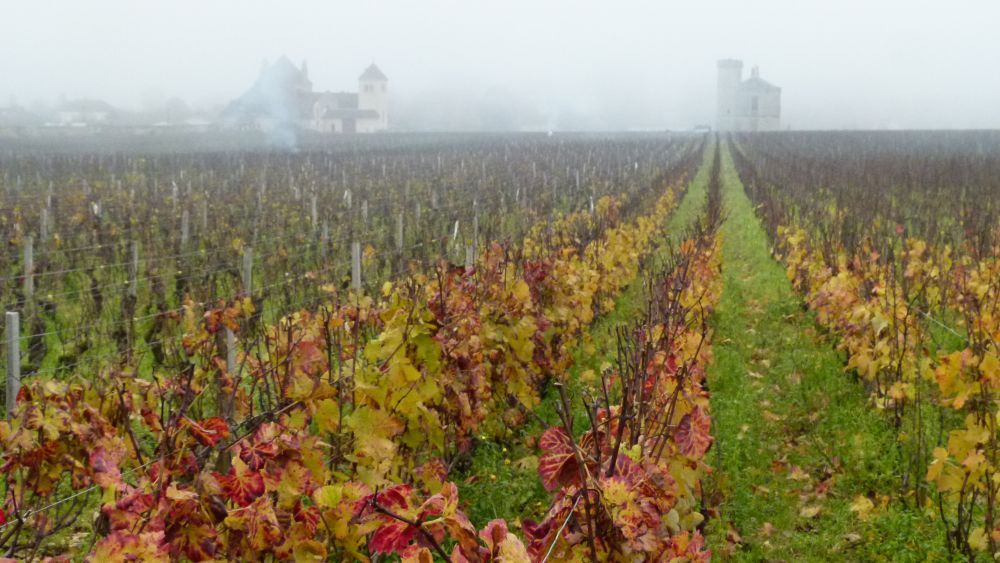
Autumn in Burgundy can be very misty, as my photo from 2014 shows (taken near Clos Vougeot).

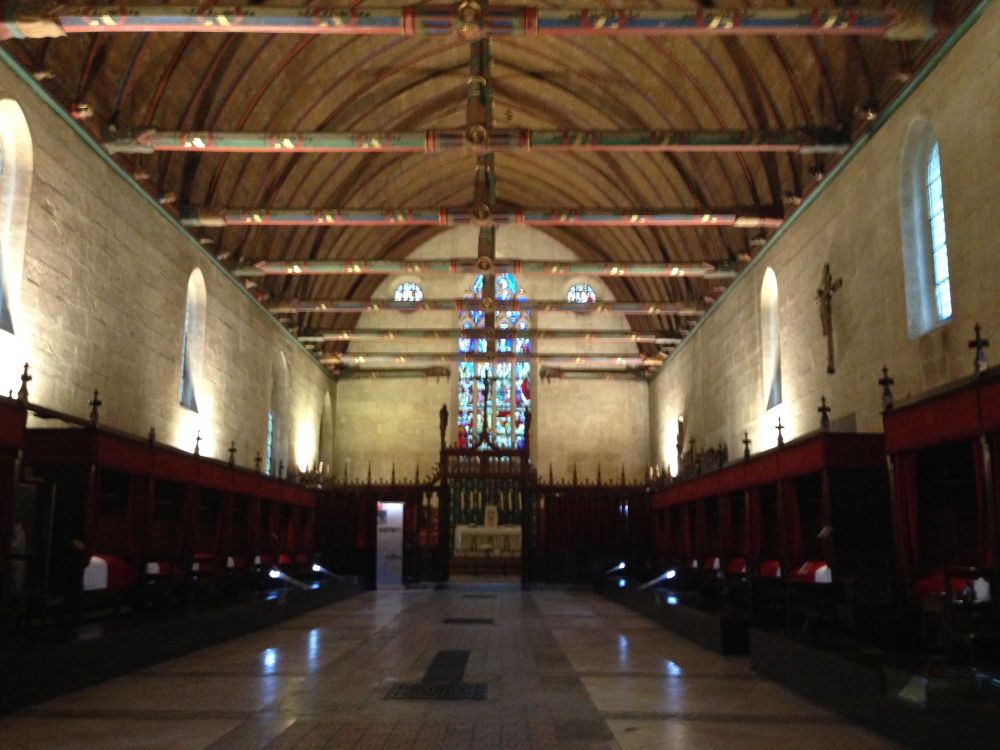
In Beaune, Eugen visited the Hôtel Dieu (Hospices de Beaune). At that time, it was still a hospital, as it had been for 500 years (since 1443). Except, the vaulted gothic room was no longer in use as a hospital in 1950. Eugen was impressed and so was I in 2014. Solemn atmosphere under the vaults…

… with the beds along the wall, covered with red blankets.

However in 2014, the Hôtel Dieu had stopped to be a hospital and had turned everything into a museum. In addition, the traditional wine auctions of November take place here.

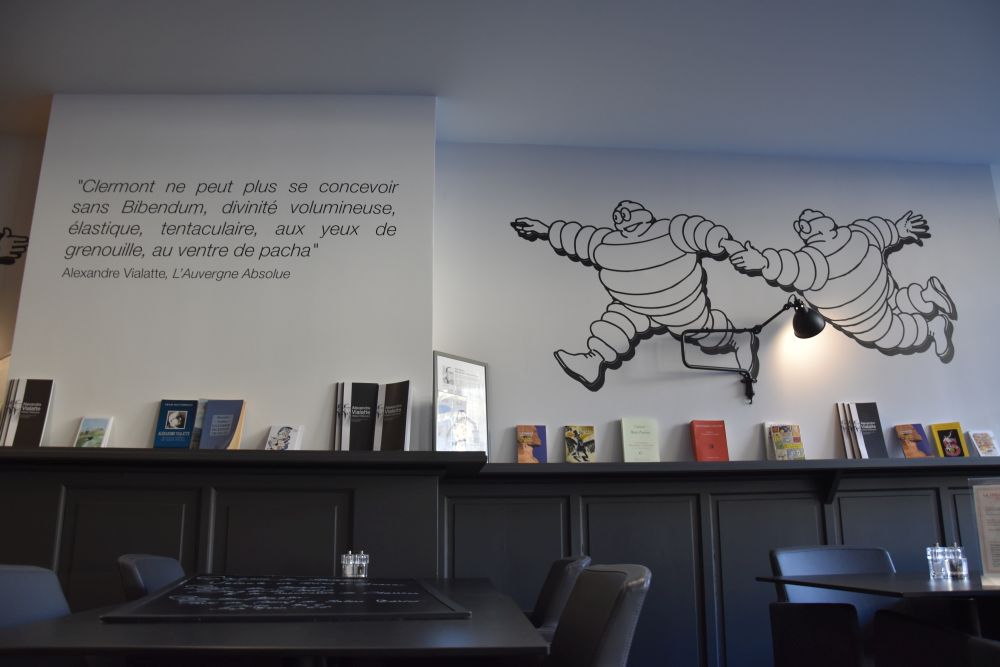
Via Autun and Vichy, Eugen Diesel reached Clermont-Ferrand, the city of the Michelin tires (as the son of an engineer notes). I was here in autumn 2017 and Michelin still matters for Clermont-Ferrand. The Michelin tire men, called Bibendum, even decorate the breakfast room of our cosy hotel.

Eugen Diesel visited the old town of Clermont-Ferrand with the gothic cathedral (to the left). Then he drove up to the summit of the volcano Puy de Dome (in the background, 1465m).

I drove up to the top of the Puy de Dome in the 1980’s, but when returning in 2017, I found the road to the top closed. Instead, there is cockwheel train to get to the summit.

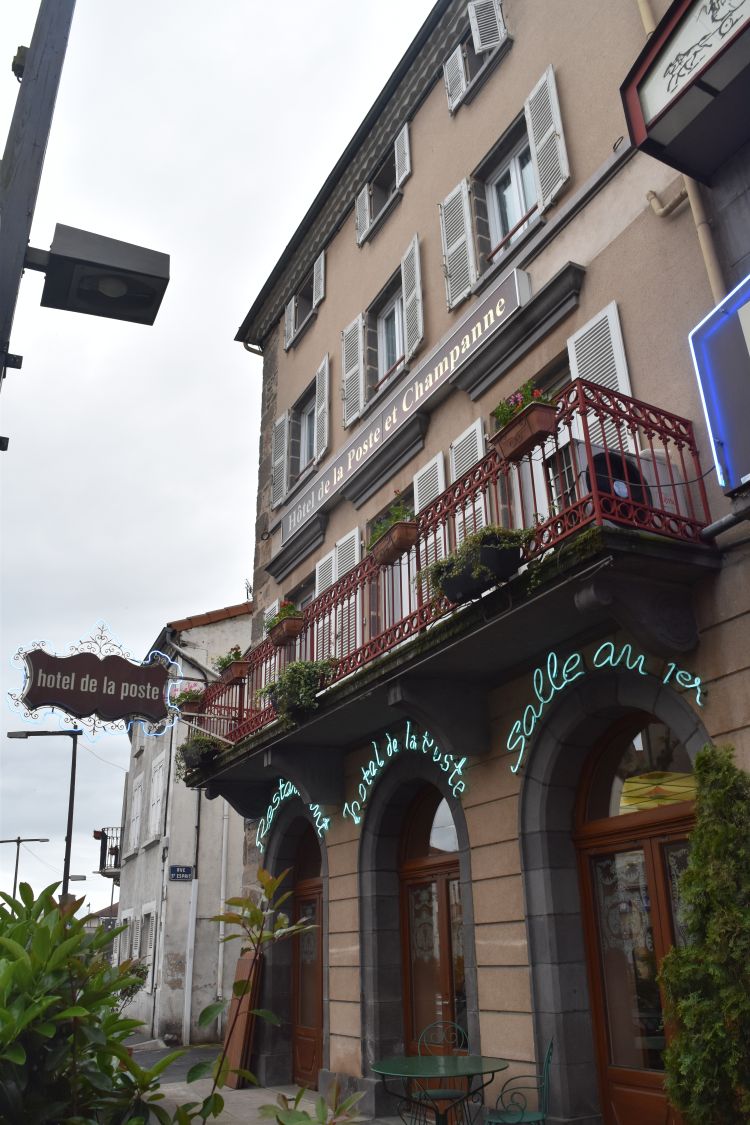
A few kilometers south of Clermont-Ferrand, Eugen Diesel and his wife stopped at Brioude and stayed overnight in the Hotel de La Poste. Eugen described, how clean and well renovated the hotel was. The couple enjoyed an excellent meal in the cosy restaurant on the first floor. One waiter served all guests – diligently and carefully. He had fair hair, his name was Erwin Voigt and he was from Pomeriana, formerly part of Germany. It was him that had renovated the Hotel de la Poste at that time; it was owned by an elderly couple.

In 2016, I was in the same hotel, with my friend. It was one of the best and cosiest hotels we have ever been at in France. We had an excellent dinner (in the restaurant on the first floor) and we slept across the street, where the hotel had built modern new rooms, even accessible by wheel chair.

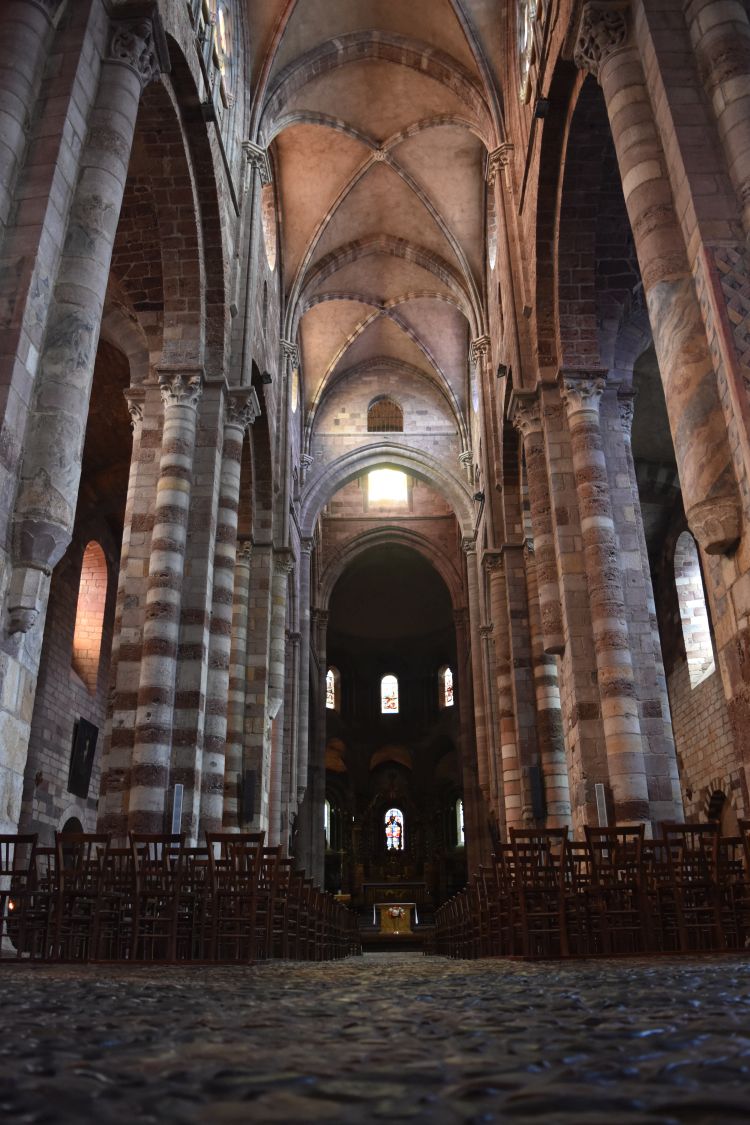
Eugen Diesel did not talk about the beautiful Romanic Baslica Saint-Julien in Brioude… perhaps it had not been renovated then and not mentioned in his Baedecker.

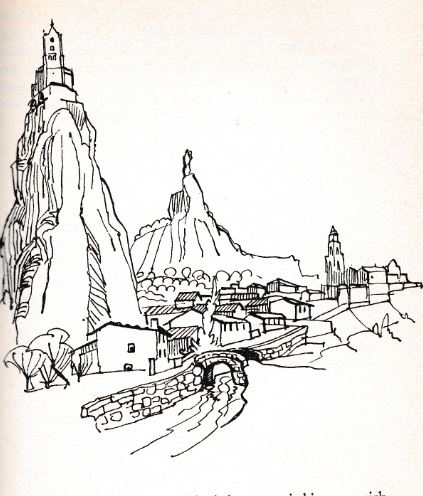
Eugen and his wife continued to Le Puy-en-Velay and were impressed by the needles topped by the church Saint Michel d’Aiguilhe and by the Madonna statue.

(Pen drawing by Willy Widman, p. 99)

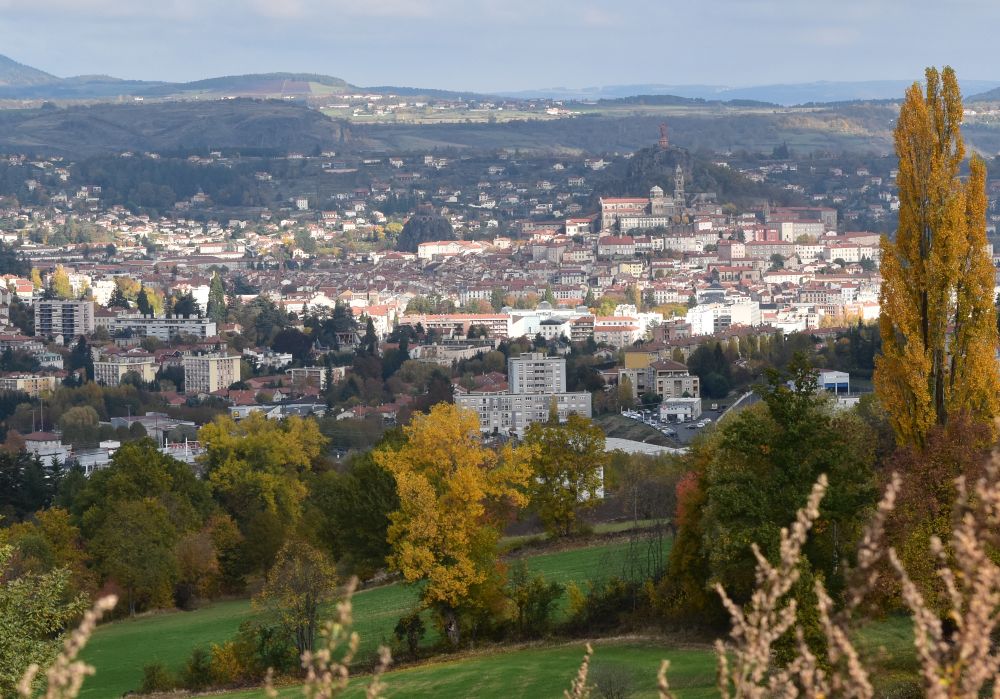
Perhaps the needles are a little inflated in the pen drawing. In 2016, we look back to Puy-en-Velay. The city has grown considerably since 1950.

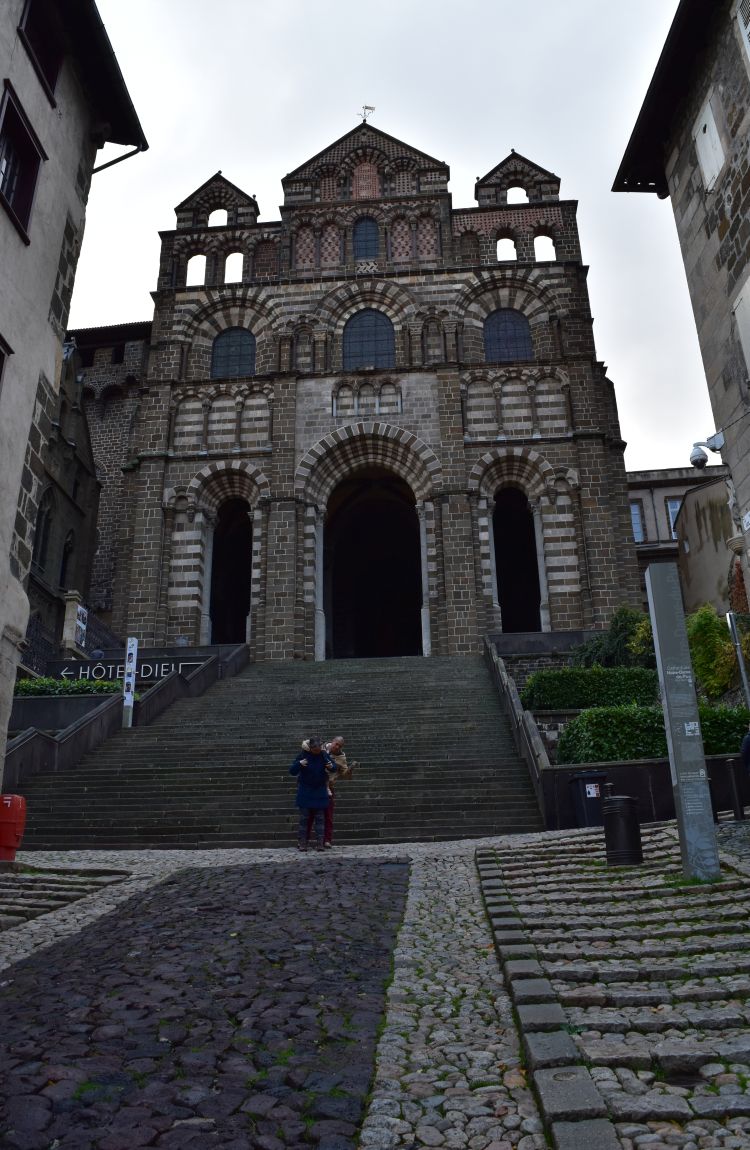
We stayed in Le Puy-en-Velay for one night to visit the romanic Annunciation Cathedral built with the typical black volcanic stones that characterize the whole city center.

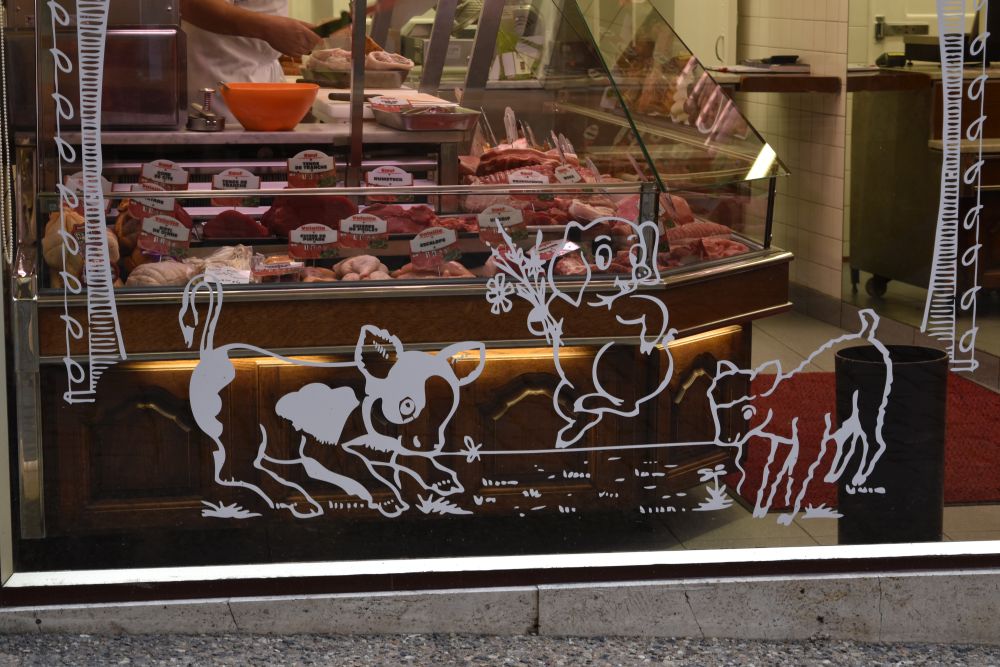
The small streets are inviting. This butcher’s window illustrates, what Eugen might have meant, when talking about the somewhat more light-footed atmosphere in France.

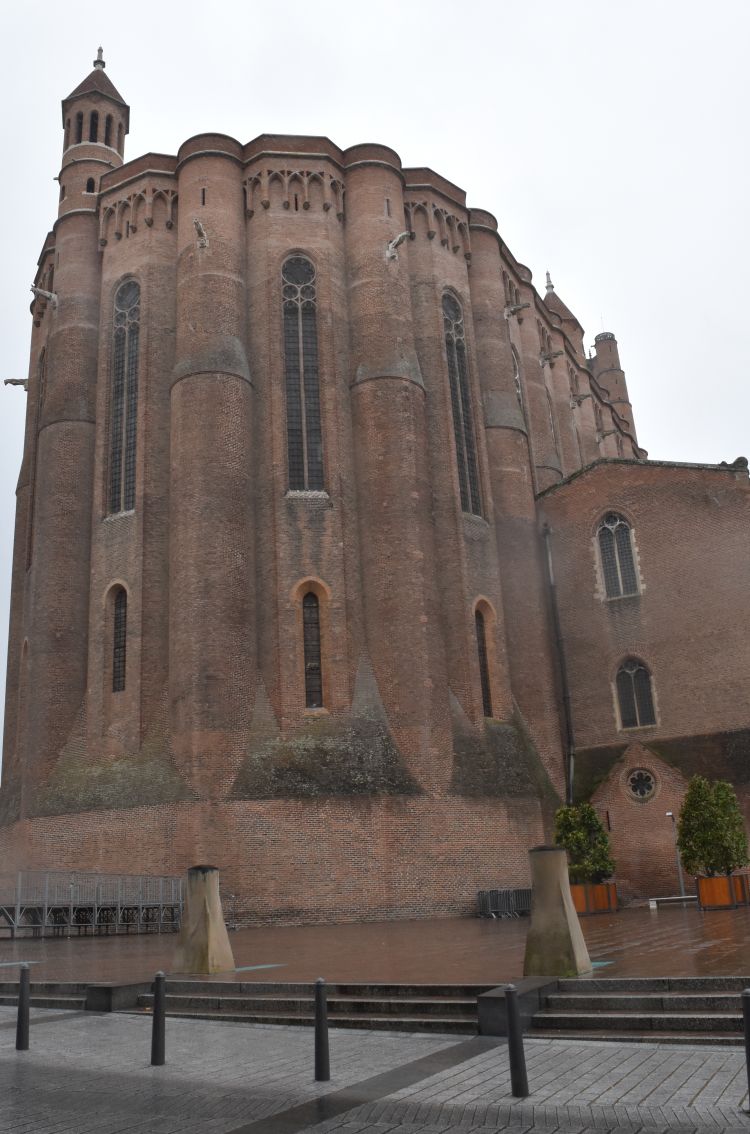
In Albi, Eugen and his wife admired the Cathedral Saint Cecilia with the red brick walls rising towards heaven. He thinks of the Albigenses or Cathars that were eradicated around 1200. We visited Albi in 2016 in the pouring rain…

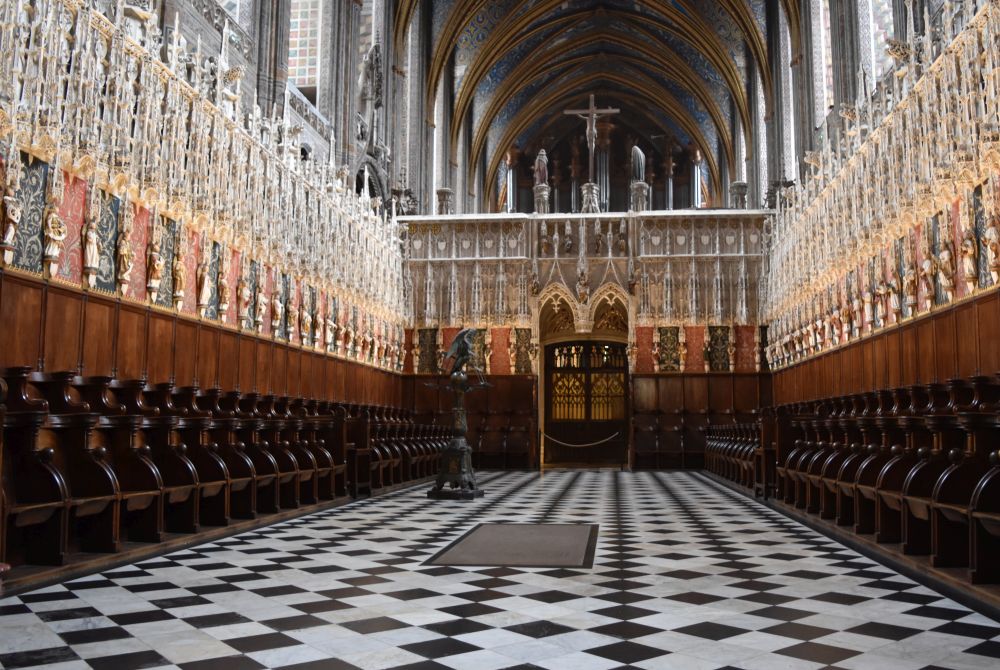
… and like Eugen, we entered the church, with the one single nave all painted in blue and with the choir separated by a finely carved rood screen (Lettner) made from stone.

Via Toulouse, Eugen and his wife reach Auch, where they stay with their friend.


Let us travel with them around Auch and back to Germany in my next blog.

Source: Eugen Diesel, “Philopsophie am Steuer: Ein europäisches Reisbeuch”, Reclam Verlag Stuttgart 1952 and my own photos from travelling in France.


Le zoo de Rome – a charming novel intertwining reality and fiction, written by Pascal Janovjak

A year ago, in May 2019, Pascal Janovjak gave me his book “le zoo de Rome” (1) with the following words: “Tu sais que les animaux sont la matière première des fables (you know that the animals are the basic material of fables).”

Let me tell you more about this beautiful novel that evoked memories of “my” zoos, that taught me much about the zoo of Rome integrated in the history of the XXth century and that made me enjoy the related fictional story lines.


Prologue: “Le zoo de Rome” evoked memories; it might evoke yours as well

“Le zoo de Rome” evoked memories of “my” zoos in Basel (Zolli) and in Karlsruhe (Stadtgarten). You may have such memories as well.

At kindergarten age, in the 1950’s, my grand-ma invited me to the Stadtgarten in Karslruhe, whereby I was very cautious, when being confronted with animals.

Some ten years later, our teacher took us to the Basel Zolli to practice drawing animals; “my” pelicans and “my” penguin are from that time.

As a student, I took photos in the Basel Zolli and developed them in the kitchen-darkroom. The black-and-white polar bear is resting calmly on its paw on a frosty-cold winter day.

No more polar bears in the Basel Zolli today. However, polar bears still live in the Stadtgarten of Karlsruhe, in their “icebergs” built in 2000 (colour photos taken in 2009). A hundred years ago, the Swiss Urs Eggenschwyler created an iceberg in the zoo of Rome; it will play a role in Pascal’s novel.

Now I go to the Basel Zolli with my grandniece and grandnephew. They very much like the flamingos – or flamands in French. The “lagoon” is near the main entrance of the zoo.

Pascal also seems to like flamingos. He has selected this flamingo for the cover of his book.

My “le zoo de Rome” shows signs of use… I have read it three times and I have read it with great pleasure.


“Le zoo de Rome” is a puzzle of essays telling intertwined stories: My summary in a nutshell

Pascal tells his novel “le zoo de Rome” as a puzzle of small essays (two to four pages long) rolling out intertwined story lines. The real story of the zoo of Rome starts shortly before 1911 (construction and inauguration), ends in 2013 (two years after the centenary) and interacts with the historical events of one century.

Superimposed to the real history of the zoo, I identified fictional story lines that begin in 1940, focus on 2009/2010 and end in 2013.

  • The first fiction is the life of the architect Chahine Gharbi (born in 1970) and his tender love story with Giovanna Di Stefano. Chahine comes to Rome in December 2009, because a sponsor from Riyad has asked him to evaluate the project of a shopping city to replace the zoo. Chahine orders his room until 16th of January 2010. Mid-January, he has to leave his hotel room, as his sponsor has stopped paying for it. He lives in the iceberg for some time and leaves with unknown destination in May 2010.
    Chahine and Giovanna meet in the zoo. They are both about 40 years old. Their love culminates end-January or beginning-February 2010, when they make love in the zoo.
  • The second fiction is the saga of the family Leonardi that worked as guards from grandfather to grandson Salvatore. Salvatore was born in 1949 (there was rinderpest in the zoo then). Salvatore works with engagement for his animals and imagines the zoo being Noah’s Ark and himself being the captain. Salvatore meets Giovanna and Chahine several times. He is the guard of the last tamandin anteater, until sent to retirement in July 2010 – which leads over to the third fiction.
  • The third fiction is about the last tamandin anteater (a fictional animal) alluding to criminal energy and overtourism. During the war, in 1940, the zoo takes over his first tamandin from another zoo. In November 2009, the veterinarian Moro of the zoo of Rome kills the two tamandins in the London zoo. By doing so, he achieves that the old tamandin anteater of the zoo of Rome, Oscar, is the last representative of this species. For the zoo, so far having attracted only few visitors, the last surviving tamandin changes everything. Visitors flood the zoo. They are channelled to the Grande Volière (aviary), where the animal lives. It is a hype, which Giovanna supports with her marketing actions.
    Meanwhile, the veterinarian of the London zoo, Nadia Monk, finds out that Moro has thrown infected ticks into the cages of her tamandins, which was the cause of their infection and death. Moro is arrested in May 2010.
    During the tamandin hype, Salvatore looks after Oscar day and night. In July 2010, the faithful guard gets the announcement of his retirement, kills the tamandin Oscar and ends up in prison. No one asks why he has shot the tamandin. Small detail: It turns out that Oscar was a female, despite its name.
    At the same time, in July 2010, Giovanna visits the gynaecologist to get the confirmation that she is pregnant. She must have been pregnant for five to six months.
  • Fourth, without having a name (I could not find it), Giovanna’s husband supports her calmly during the exciting months at the zoo. During that time, they also make love in late winter/early spring 2010. In 2013, a happy future opens up for Giovanna and her husband: Giovanna has left the zoo and is again successful at her former job in government, and the couple enjoys the life with their son that they had no longer expected.

I enjoyed the rich and dense language of Pascal. The words are concise and placed exactly where they fit. I took notes to keep track of the artfully intertwined story lines presented in small puzzle pieces with hints dispersed all over. Some of the hints I only understood, when reading the novel for the third time, for example:

  • In the first chapter, the architect Chahine Gharbi notices a metallic sphere, when settling in room number 324 in the hotel adjacent to the zoo. A metallic sphere? Reading the novel the third time, I understand: What Chahine sees, is the “Grande Volière”, the “Large Aviary”, built in the 1930’s at Mussolini’s request.
  • Soon after having started work as the head of communications and administration of the zoo, Giovanna visits the animals and notices the tamandin, marked as “in danger of extinction”. Coming back to the office, she finds an angry letter from the zoo of London asking the zoo of Rome to deliver the tamandin immediately. First, I thought, Giovanna has taken over a messy office. When reading the third time, I understand this hint: Moro, the veterinarian of Rome, has recently thrown ticks carrying viruses into the cage of the tamandins in the London zoo. Now he waits for the tamandins to pick up the ticks, catch the infection and die. For that reason, he has no intention to send his tamandin to England, as there is a good chance that Oscar will be the last anteater of its species, which will attract visitors to his zoo of Rome, desperately needed visitors.


The novel taught me much about the zoo of Rome… and about “my” Basel Zolli

These are some of the facts that Pascal’s novel told me about the zoo of Rome and other zoos:

  • I was shocked to read that Hagenbeck, the designer of the zoo of Rome (and of the Tierpark of Hamburg), was a trader of wild animals; by designing zoos, I believe, he cleverly created the market for his business. I was also dismayed to read, how many animals did not survive the transfer from wilderness to Rome, when the zoo was to be inaugurated in 1911. I was appalled that just a few years after the inauguration, cost saving efforts deprived the animals from food.
  • Urs Eggenschwyler was an eccentric Swiss who knew how to build artificial cement rocks. In the zoo of Rome, he built various rock landscapes and the iceberg. In the Basel Zolli, he built the rock for the seals. I had never thought about this rock around the pool being artificial, when watching the seals playfully “hunt” their food. The iceberg landscape in Karlsruhe should show the visitors, how the polar bears live in the Arctic. Hagenbeck was the first architect of zoos to have planned landscapes that reflect the habitat of the animals shown. Pascal describes nicely, how Hackenbeck dreamt of the animals living in their habitats, when reviewing the plans for the zoo of Rome.
  • I shivered, when “a crazy man” entered the cage of his lioness called Italia. Pascal resolves the mystery later: It was Mussolini. He ordered to enlarge the zoo, because it was smaller than other zoos of Europe. The architect de Vito was in charge of the construction. I liked to follow, how de Vito proceeded: He watched the animals intensely, he visited other zoos to gather ideas, and then, accidentally, he saw the cylindric gas reservoir of the community of Munich that became the model for the “Grande Volière” or “Large Aviary” allowing the birds to fly in circles, which is natural for them. Furthermore, he built his aviary in a sustainable way – more than 80 years later, the metal shines in the sun (as Chahine noted, when entering his hotel room with the view of the zoo). I would love to see de Vico’s aviary one day.
  • I have mixed feelings about zoos. Might be, the student Guido watching animals is right: Zoos are like Noah’s Ark. In Mongolia, I saw the Przewalski horses. They had become extinct in the wild, but they survived in various zoos. Resettlement was a success. It was beautiful to watch these elegant horses against the horizon of the Mongolian steppes.
  • Another finely observed detail: Chahine and Giovanna struggle with the zoo map. Zoo maps do seem to be a challenge; with the map of the Basel Zolli I always get lost.


The zoo is the backstage to caricature observations about people in fictional story lines 

The zoo of Rome is the backstage for creating caricatures about people and their behaviours. The observations, painted using fine brushstrokes, resonate with me. Let me give you some examples.

  • With pleasure, I observed the tender love emerge between Chahine and Giovanna, which culminates, when Chahine helps Giovanna to get rid of her wet clothes, after having been in the pouring rain during the move of the tamandin to the aviary. Wet clothes are hard to take off – I have also experienced that. Then Chahine wants to disappear in Giovanna’s body. Later I understand what he suffers from. While hiding in the iceberg until May, he visits Salvatore Leonardi guarding the tamandin in the Grande Volière and, as they do not speak the same language, he uses gestures to describe, how his seven years old daughter died in the car accident and that he was at the steering wheel. I feel sorry for Chahine devouring the soup that Leonardi offers to him, because probably he is very hungry.
    After their love night, Giovanna looks for Chahine, but cannot find him – she just finds his accessories, including the white plush polar bear that he had bought, perhaps with his daughter in mind; he has left the plush bear on the iceberg.
    I feel sympathy for Chahine’s wife that probably never saw her husband again – she had let him go to Rome saying: “What you need, is a project”, when the request to plan the shopping city came from Riyad. What a sign of love.
  • The calm love between Giovanna and her husband ends happily with their newly born son. Pascal leaves open the detail who might be the father of their son, Chahine or Giovanna’s husband. He gives a small hint: Giovanna’s husband loved their son that resembled Giovanna so much – what a tender loving care.
  • From the very first moment, I have felt bad with the veterinarian of the zoo of Rome, Moro. I hated that he thought, he knew everything better than the director of the zoo and that he disdained Giovanna by telling her that she had ink at her fingers, while she was explaining to him her ideas about the next steps to be taken for the zoo (occasionally, I came across such unfair behaviour at work…). Later, I felt Schadenfreude (malicious joy, a word that only exists in German, I believe), because Moro failed to go unnoticed, when attacking the two tamandins in the London zoo, though he had prepared everything in detail acquiring an English coat and an umbrella as well as paying cash for the bus and metro tickets to Regent’s Park. But at the entrance gate to the zoo, he felt stressed because of the long queue and he got engraved in the mind of the cashier, as he forgot the change in coins and his umbrella, his coat was too warm for the sunny day and he was too stingy to make a donation. I can imagine the man clearly.
    The veterinarian Nadia Monk of the London zoo wanted to know, why her tamandins had died and found viruses from ticks. One tick had a tiny thread of wool around its body, as she noticed in the microscope. She spent eleven nights in the office of the night shift security guard to watch the video surveillance films. The guard was not amused, as he loved to read poems during his night shifts – great caricature. After eleven nights, Nadia Monk identified a man in a coat throwing ticks at her tamandins. The cashier remembered the man. Due to Nadia’s persistence, Moro was arrested (Pascal only says that two policemen knocked at the door leaving the conclusion to the reader).
  • I relished reading about the touristic turmoil around the last tamandin anteater. The tamandin was shy and hid away in its bush. The visitors could hardly ever see it. Nevertheless, hordes of tourists came to the zoo and to the Volière, where the tamandin stayed, guarded by Salvatore Leonardi. Leonardi, also hidden, observed that the visitors were not interested in the tamandin, but only in themselves. The hype around the tamandin is a well-pictured allusion to overtourism, I find. It reminds me of what I saw in Petersburg in the Hermitage Museum: Tourists rushed to “Madonna and the Child” by Leonardo da Vinci, stopped, turned round, took a selfie “me and the must see tableau of da Vinci” and went off, without looking back – they were not interested in this magnificent work of art.
  • With sympathy, I followed the saga of the Leonardi family up to their grandson, Salvatore Leonardi that felt engaged for his animals, while he was just a bit talkative. I am sad to see him end up in prison. No one asked Salvatore Leonardi, why he killed the tamandin. I believe he wanted to protect the old animal from having to adapt to a new guard or he just felt sorry for the tamandin being the object of gawping crowds that were not interested in the animal as such. This is another detail that Pascal lets the reader solve himself.

I love history and I love novels that unfold their fictions in a historical setting. One of my favourite novels is “natural history” (historias naturales) by Juan Perucho who selected the Spanish Carlist War of 1840 to intertwine the fiction of “pursuit of the vampire by a young scientist and the scientist’s happy end with his love” (2).  With Pascal’s “le zoo de Rome”, I found a second favourite novel that joins history and fictions.


Epilogue: Animals are the basic material of fables and the rose colour of flamingos conveys happiness

Let me come back to what Pascal wrote in the dedication, when giving his book to me:

“Tu sais que les animaux sont la matière première des fables (you know that the animals are the basic material of fables).”

In fables, the animals act like humans and convey a moral lesson. In “le zoo de Rome” the animals remain animals (some of them fictional) and are a wonderful backstage for the fictional story lines. Nevertheless, I sense some moral reflections that resonate with me: For instance Mussolini entering the cage of his lioness is underlining his delusion of grandeur. The bear Fritz greeting like a fascist does not know, what it does. The chimpanzee Bungo that the animal welfare activists save from the bar to transfer it to the zoo asylum seems to suffer in its cage (good intention of the activists, but…). The rose flamingos had to move to a pond near the entrance to convey the feeling of happiness to the visitors, but they suffer, because the pebbles on the ground are too large for them to walk on (the new owners of the “Natura Park” look more for appearance than for the welfare of their protégés).

Perhaps it is for the rose colour conveying happiness that Pascal placed the elegant flamingo on the cover. Do you remember the song “la vie en rose” by Edith Piaf (3)? It gave hope to the generation of 1945 to find happiness again, now that the war was over.

I sense that the novel begins and ends with optimism: It begins with the rose colour of the flamingo on the cover to greet the reader which invited me to open the book. In the last chapter, we see the happiness of Giovanna and her husband with their son, which may makes me dream about their future.

Let us look for facets of life that makes us happy, now, that this virus confines our freedom to meet. It was wonderful to use video conferencing for discussing “le zoo of Rome” within the framework of the Solothurner Literaturtage (4).


Footnotes

(1) Pascal Janovak, “le zoo de Rome”, Actes Sud 2019

(2) See my blog about Juan Perucho, “historias naturales”, edhasa, Barcelona 2003.

(3) Edith Piaf, “la vie en rose”, YouTube officiel  written in 1945.

(4) Solothurner Literaturtage 2020