Two Swiss in Mongolia – joining the Ulanbaators for a weekend in Terelj

Terelj is about 50km from Ulanbaator and it is weekend

Our first excursion with Vikinger takes us to Terelj, a resort which is at the entrance to Gorkhi Terelj national park. It is weekend and the Ulanbaators also head there.

Our small bus fights its way through the Saturday traffic jam in Ulan Baator, passes by the Russian orthodox church built in the traditional style with ognion shaped cupolas, passes by the catholic church which looks like a stone model of a ger, follows the railway up to the mining town Nalaikh (many Kasachs live and work here), turns north into the mountains and drops us in the Guru camp that is owned by Julchin tours, the local tour operator of Wikinger.

Walking and observing the locals from town

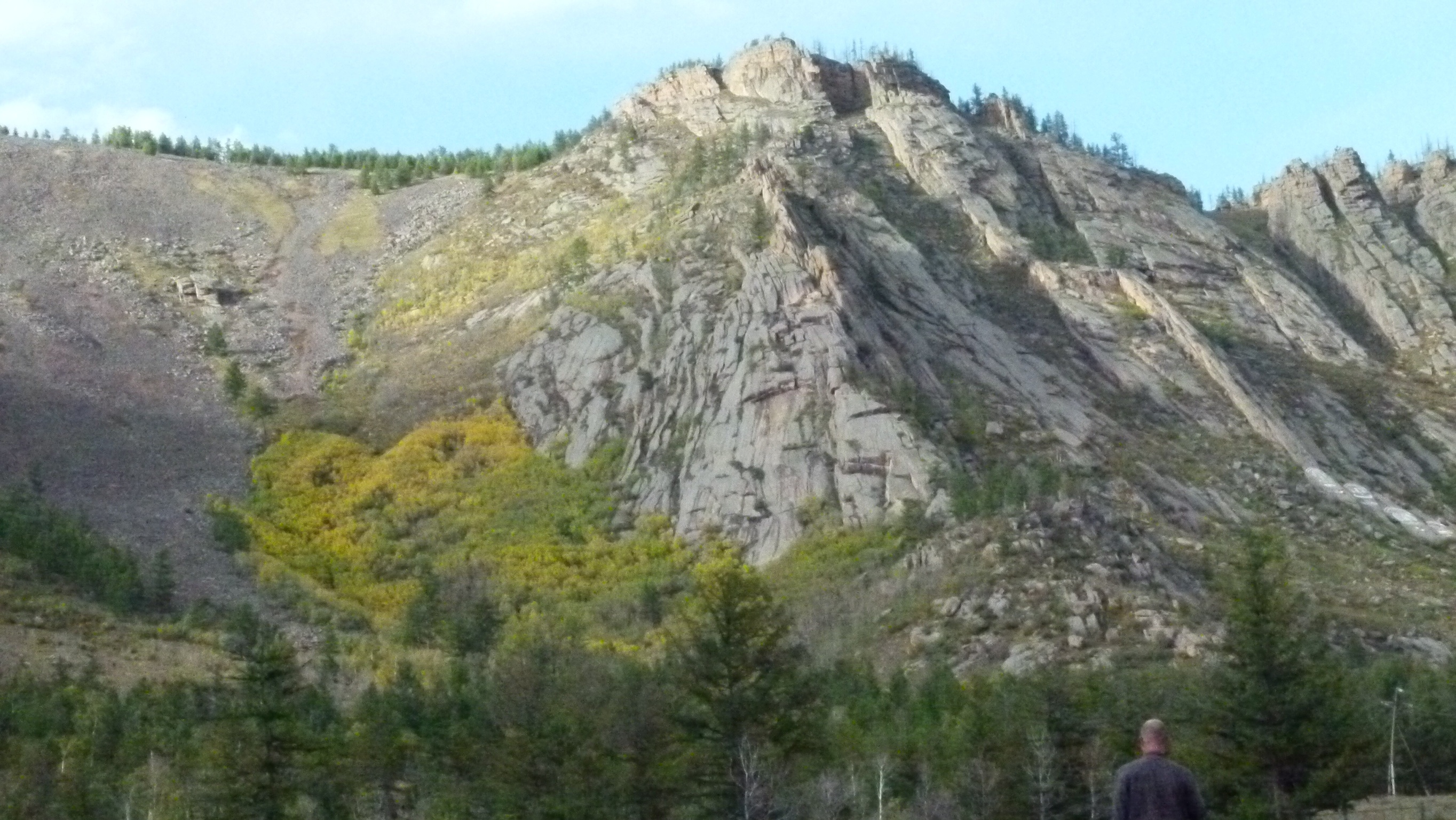
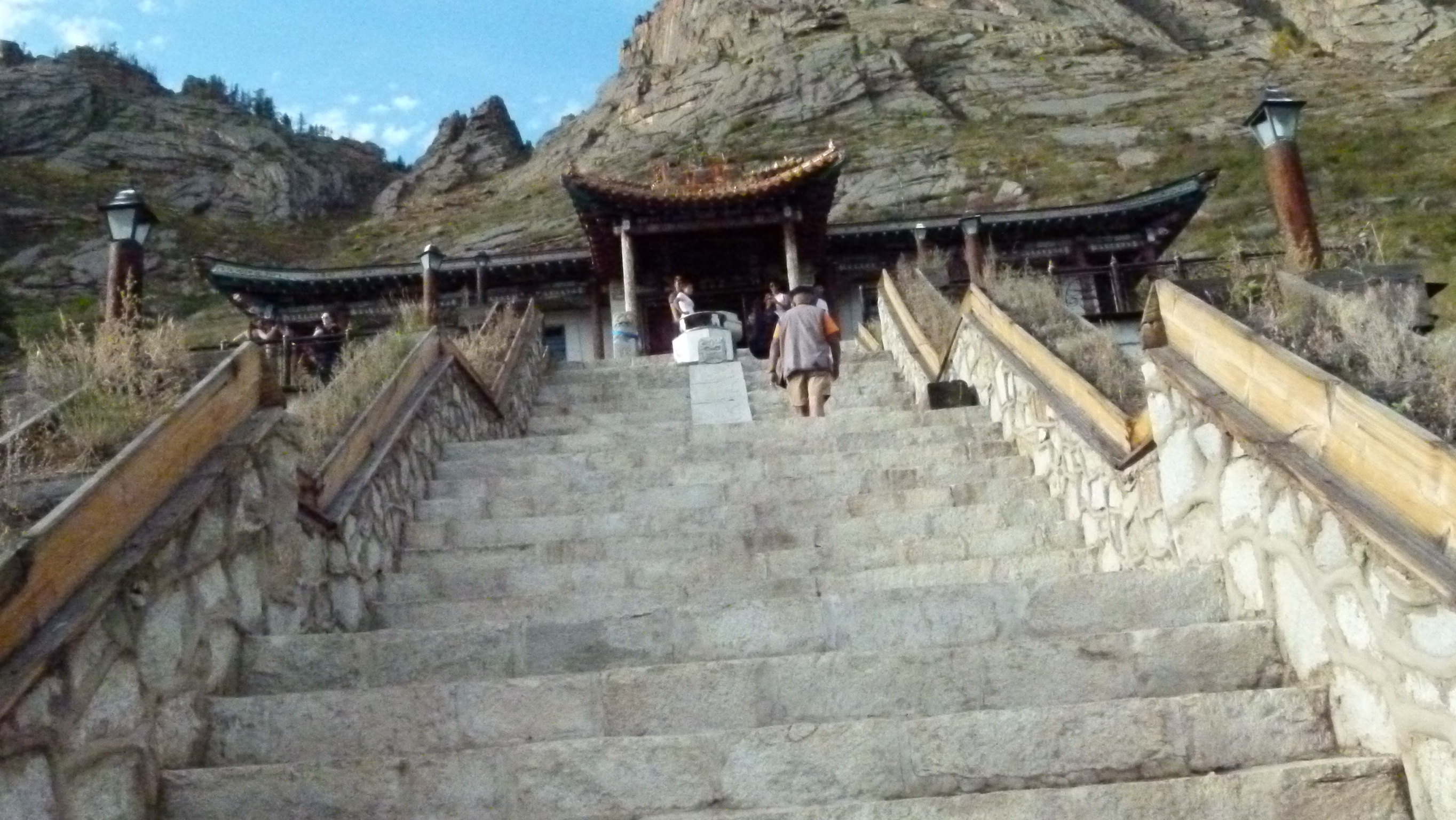
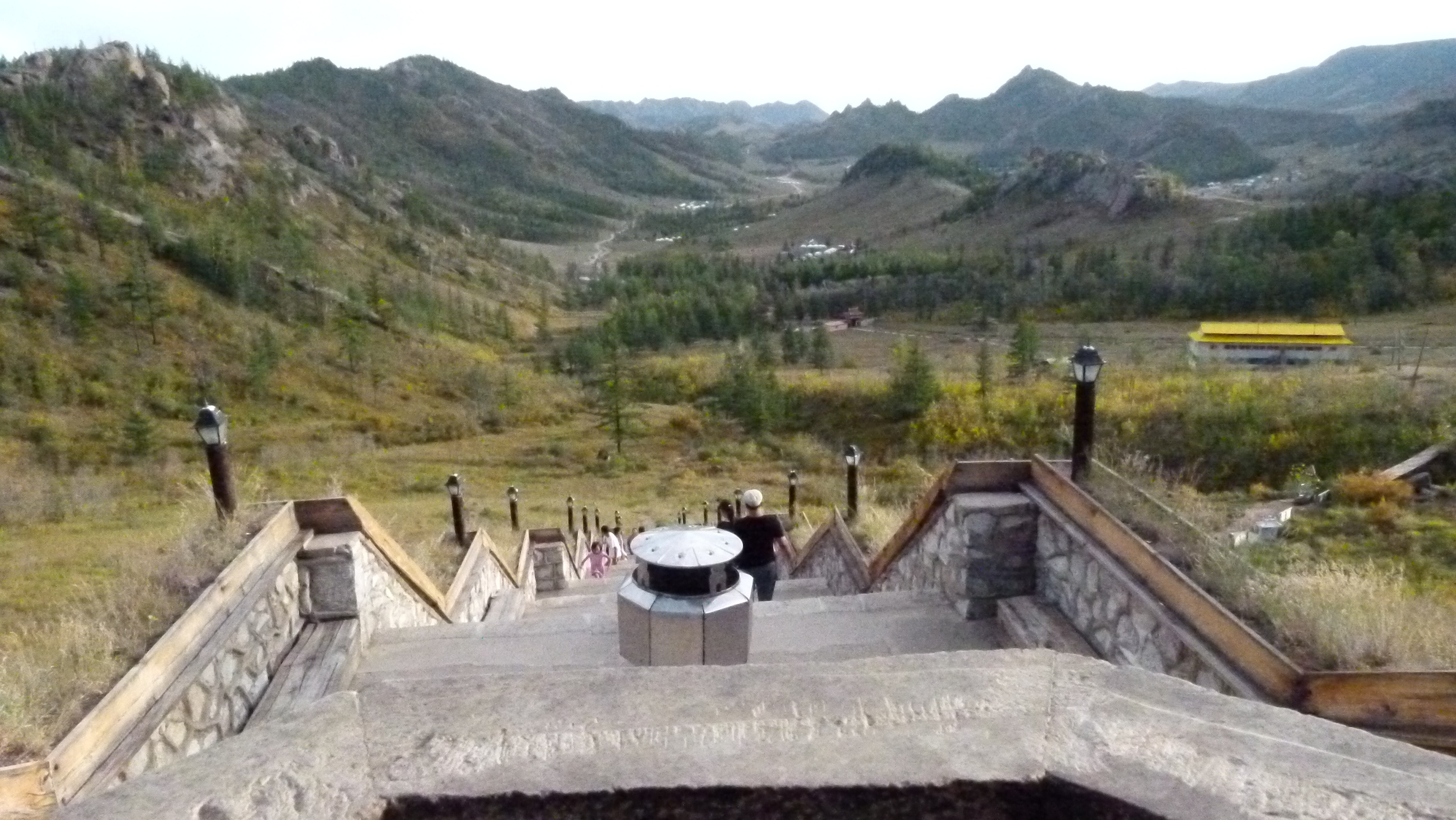
After lunch, our small group starts for a three hours walk, up and down through the hills. Our target is the Aryapala initiaton and meditation center.

Ursula sings this tune: “S’goot es Schnäggli s’Bärgli uff, s’Bärgli uff, äne wyder aabe , äne wyyder aabe, uff em Buuch, uff em Buuch.” (A small snail goes uphill, goes uphill, then again down, then again down, on its belly, on its belly).

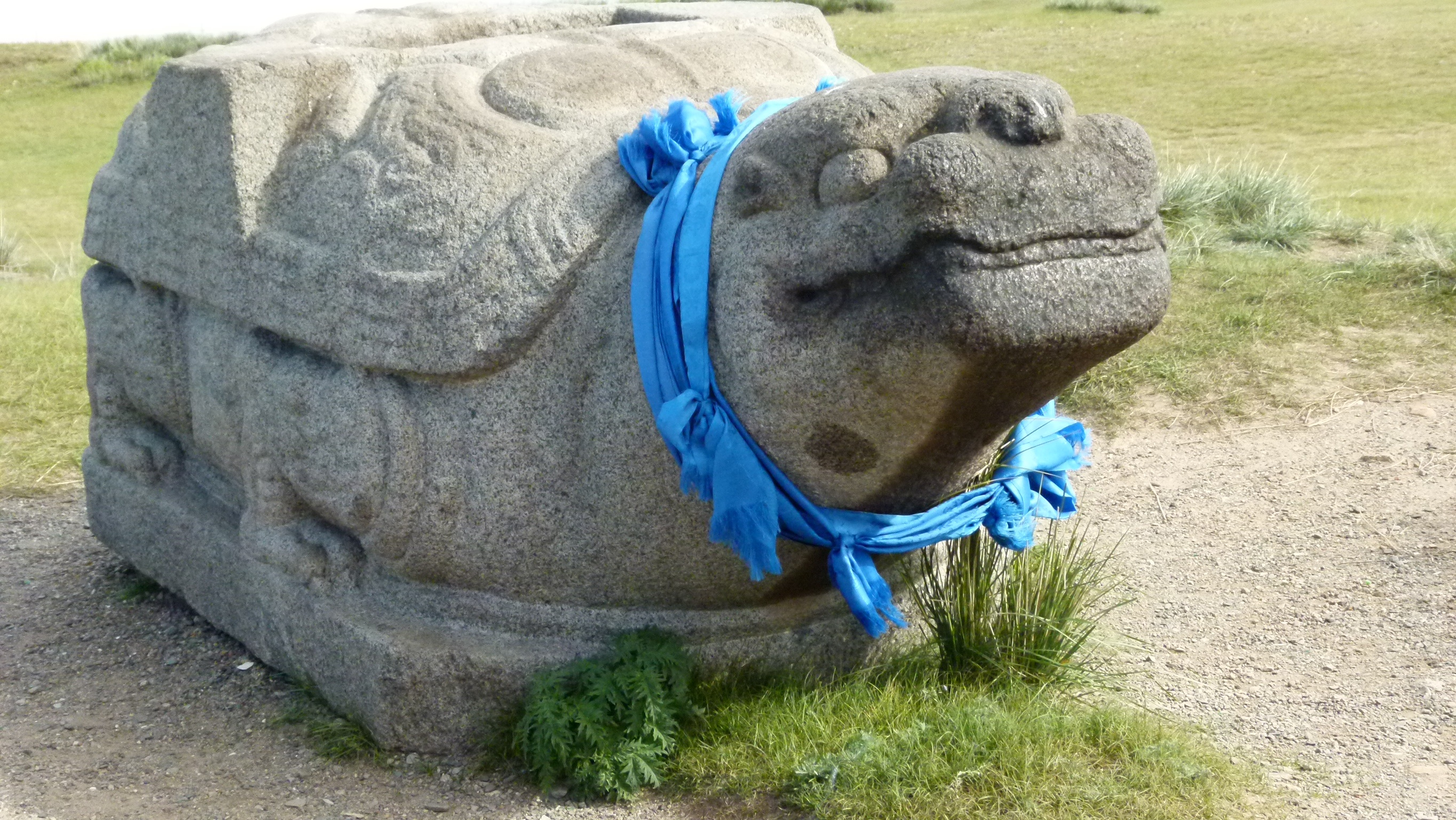
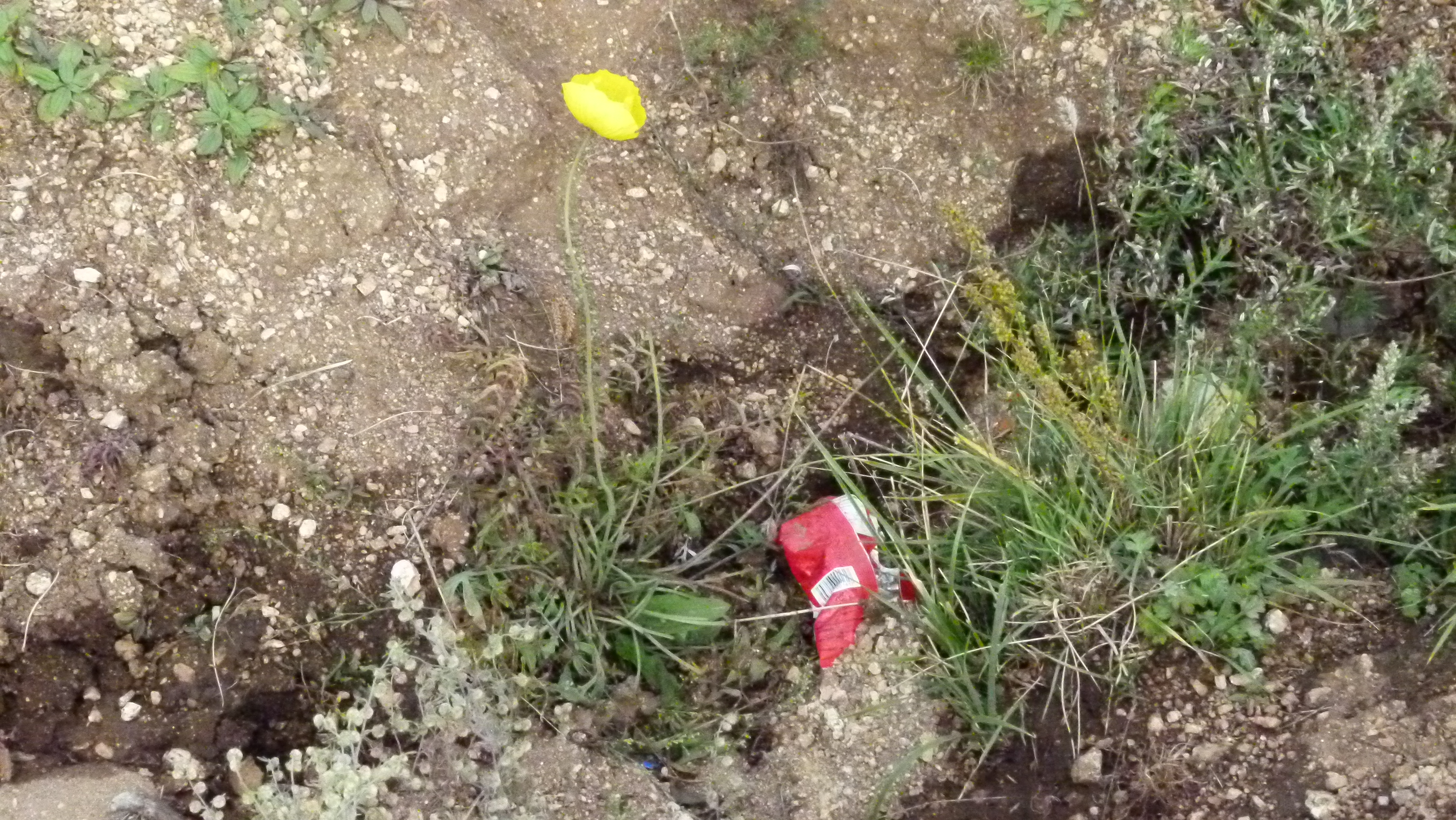
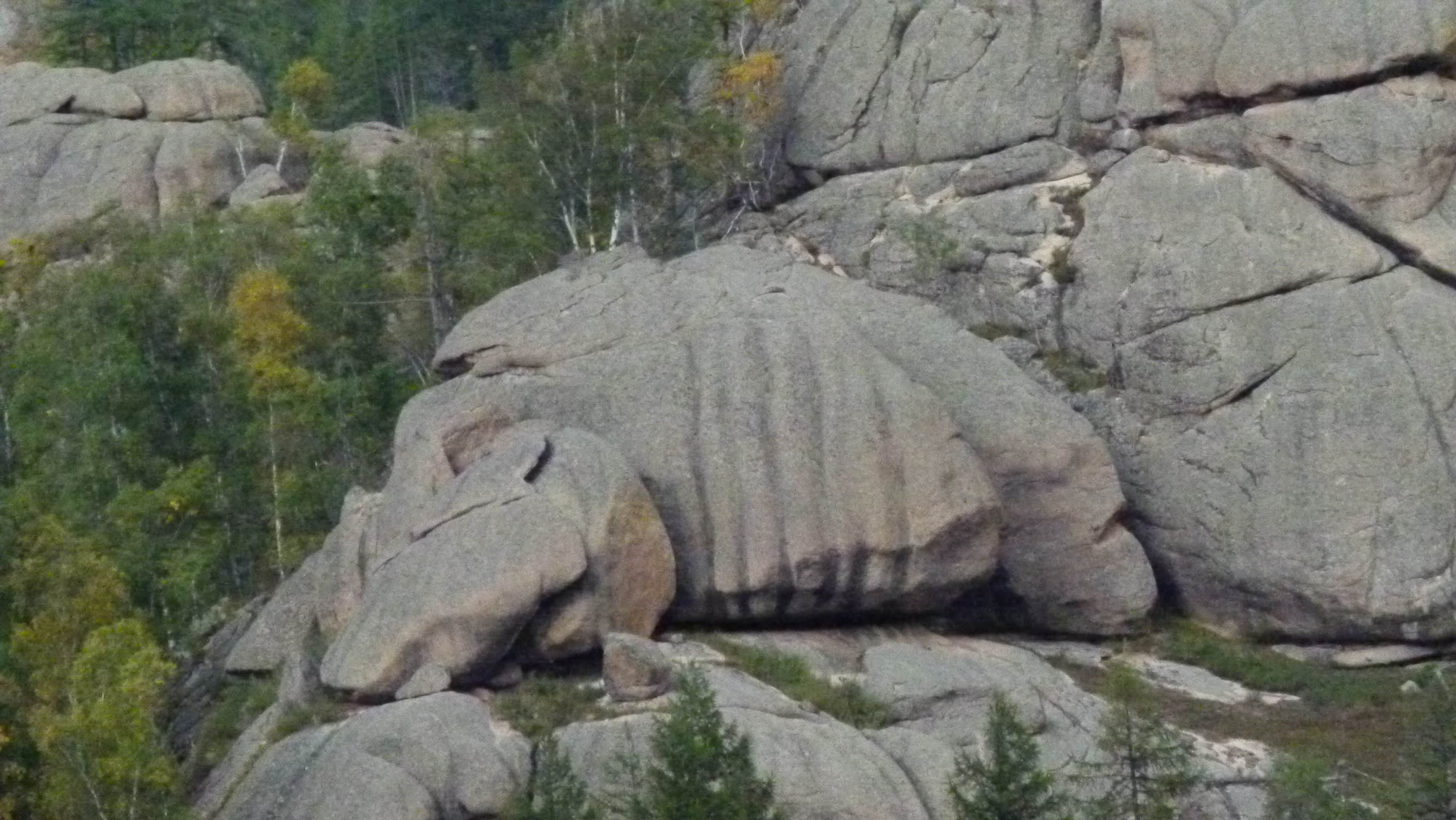
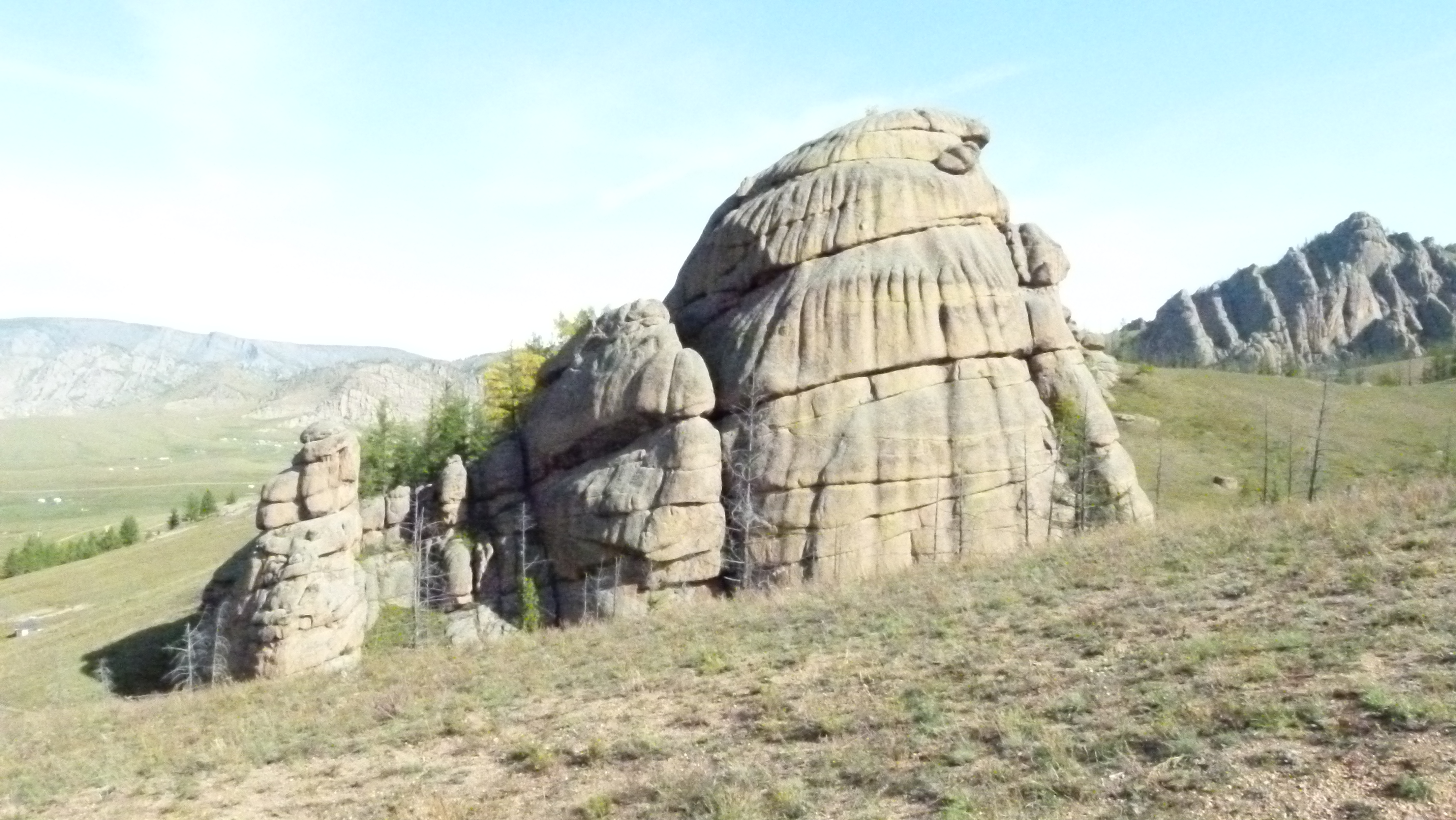
We stroll through meadows abundant with edelweiss, gentiane, astera and we even find a yellow puppy flower – next to a tin. The rocks stimulate my phantasy, there are frogs, horses and faces around us. Matthias explains, this is granit that is breaking easily and has been formed by erosion (not by glaciers, as there have never been glaciers here… the area is too dry). Well, all guide books proudly announce the turtle rock… but the turtle rock does not resemble a turtle at all, by my opinion. Below is a rock that to my opinion looks more like it…

P1030690

image

image

We share this beautiful landscape with Ulanbaators

We come across a large family that performs a wrestling contest. The winner, a strong young man of about twenty years is honored. Then he offers us (the unexpected spectators) milk and bortzig (fried unleaved bread). The five year old upspring is wrestling outside the circle and has a lot of fun.

image

We come across families sitting at the border of the lark tree forest. They are pick-nicking and singing joyfully.

And when we reach the ground of the meditation center, we share the hanging bridge and the many stairs leading up to the balcony with families that carry their young offspring, sweating and breathing. And we share the magnificent view across two mountain ridges with them.

image

image

The sun is setting and our bus picks us up.

Our camp has now more guests

In our Guru camp there are now more guests that share their weekend with us. They enjoy the camp, lightly dressed and in high heals. They seem to be happy to be together, as they chat in the night.

A second walk on Sunday

On Sunday we walk up to a hill across the valley. A great area to hike. The rocks stimulate my phantasy. I see animals and people in them. When I share my imagination with Matthias, he asks me to give him from the same stuff that I smoke. Well, some people keep their phantasy, even as they grow older and do not need to smoke for that. On the way, we meet grand’pa with his grandson on their Sunday ride solemnly circumambulating each ovoo they come across.

P1030731

P1030735

P1030746

Two Swiss in Mongolia – the boat ride on the Khövsgöl lake

Joining the group from Stuttgart for a boat ride
During breakfast, Aika organizes that we can join the boat tour with the group from Stuttgart, three men and two children. One of them is a Mongolian living in Germany. He is showing his country to his daughter and to some friends. Costs: 90’000 Törgöt or about 45 Dollars each for four hours.
The wish rock – do I have a wish?
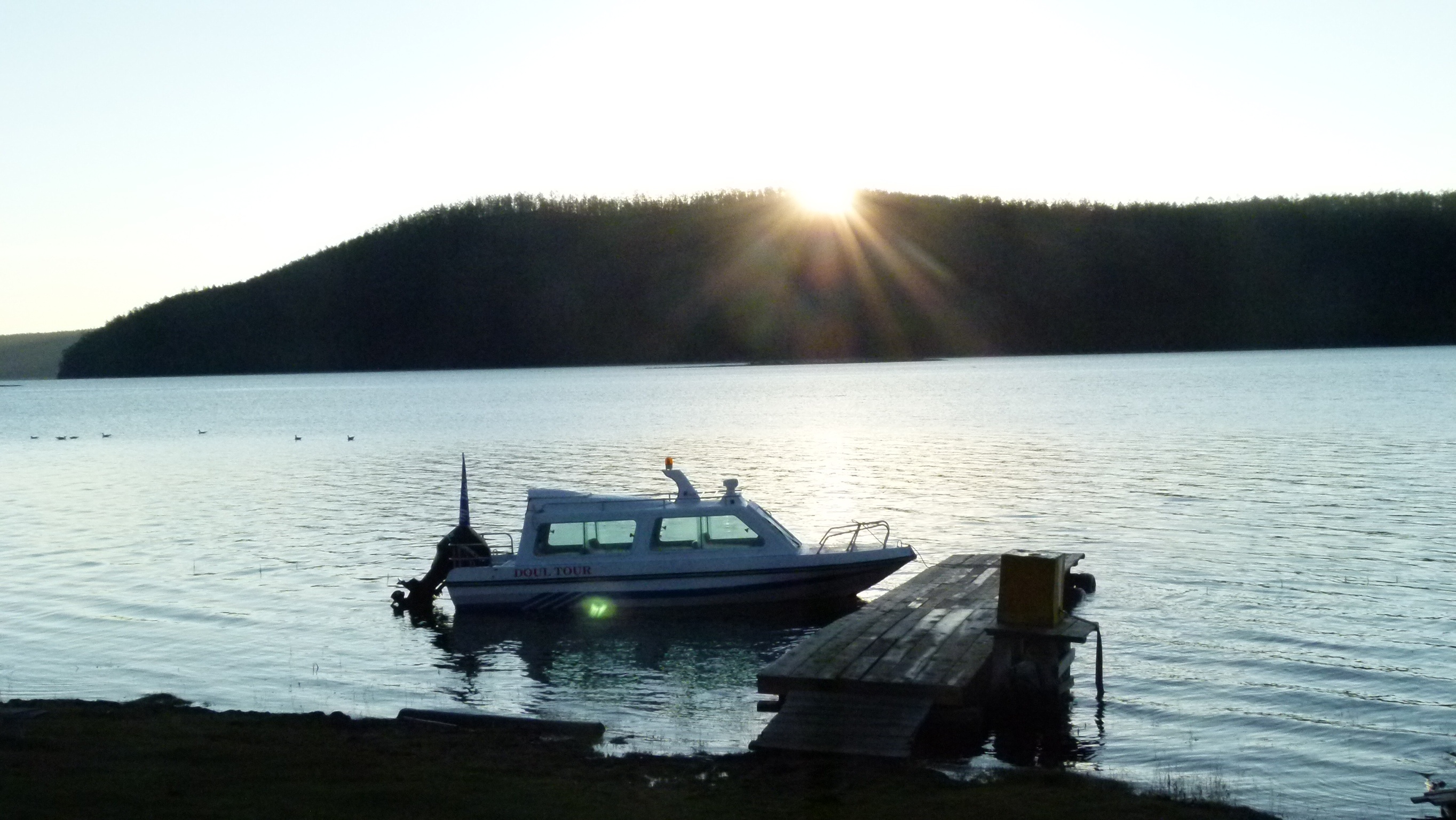
The manager of the camp drives the boat to the wish rock
image.
High above the lake there is an ovoo.
image
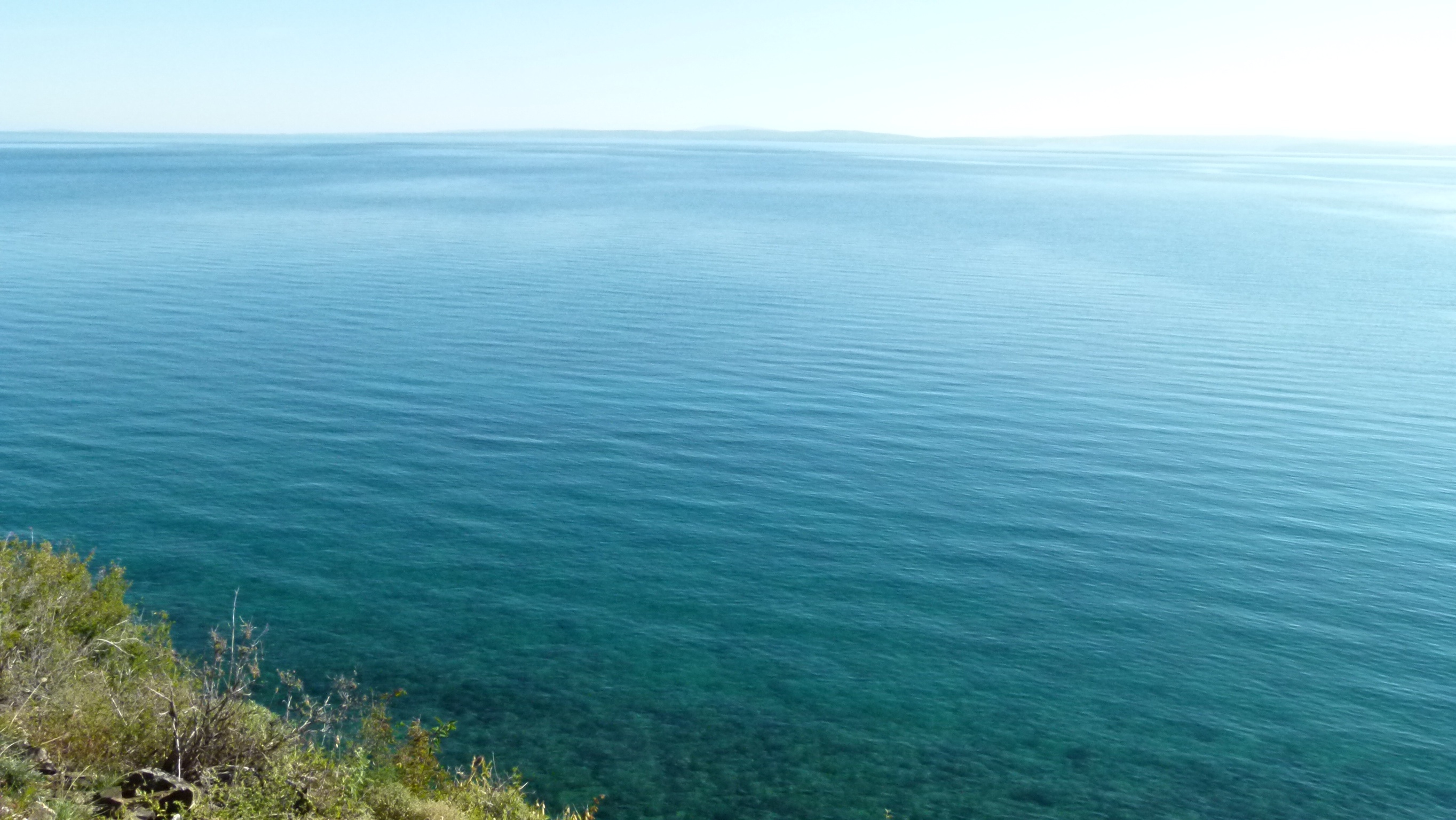
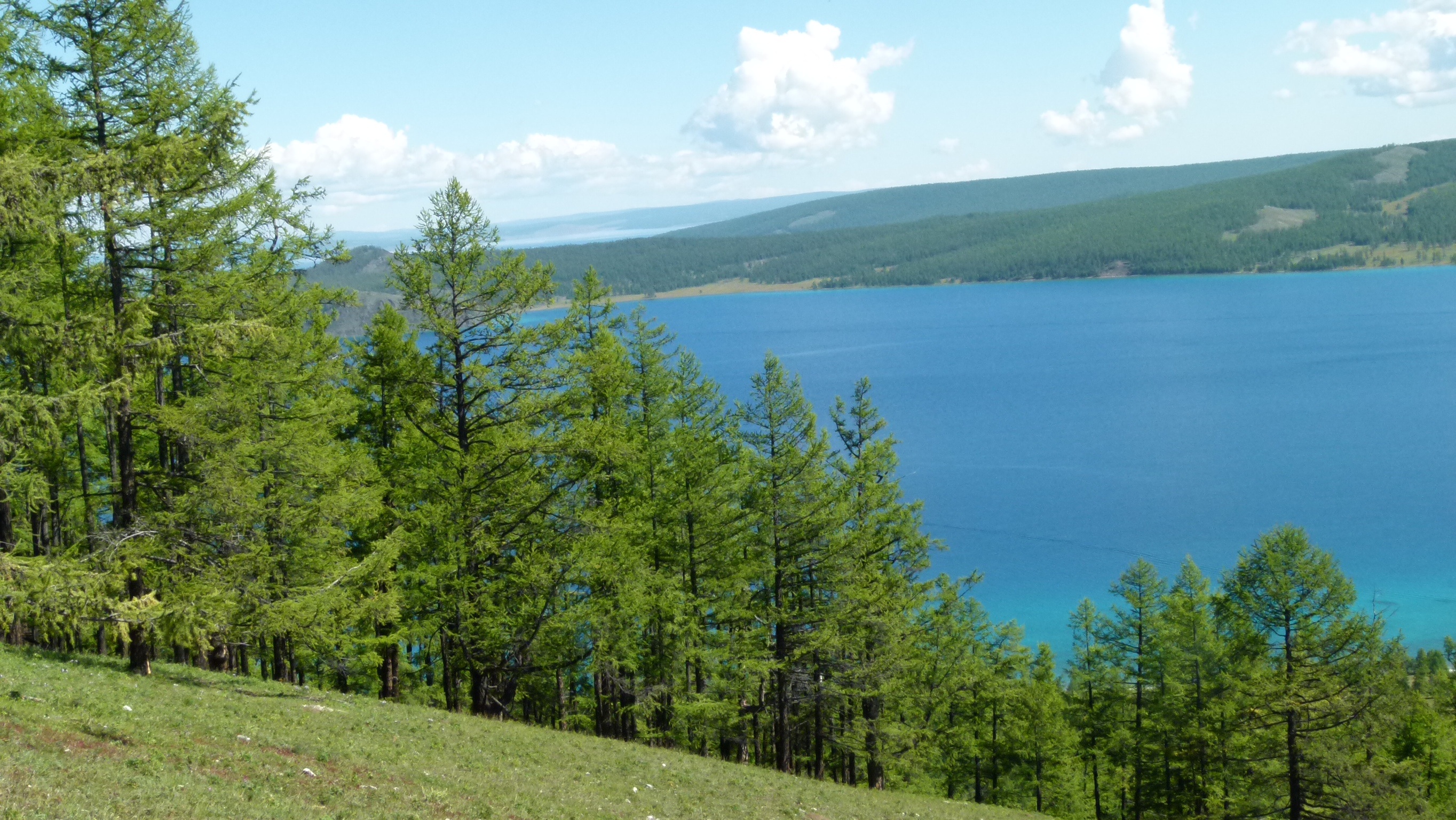
We climb the small path to the ridge, find a great view of this large lake disappearing in the horizon.
image
We circle the ovoo three times – clockwise.
image
What about my wish on this wish rock? I have Ernst in my heart and I am happy to have lived with him. I do not know what else to wish, except that I want to enjoy looking back, while sharing my live with friends – give and take. And, Ernst, forgive me for having let your son join you too early.
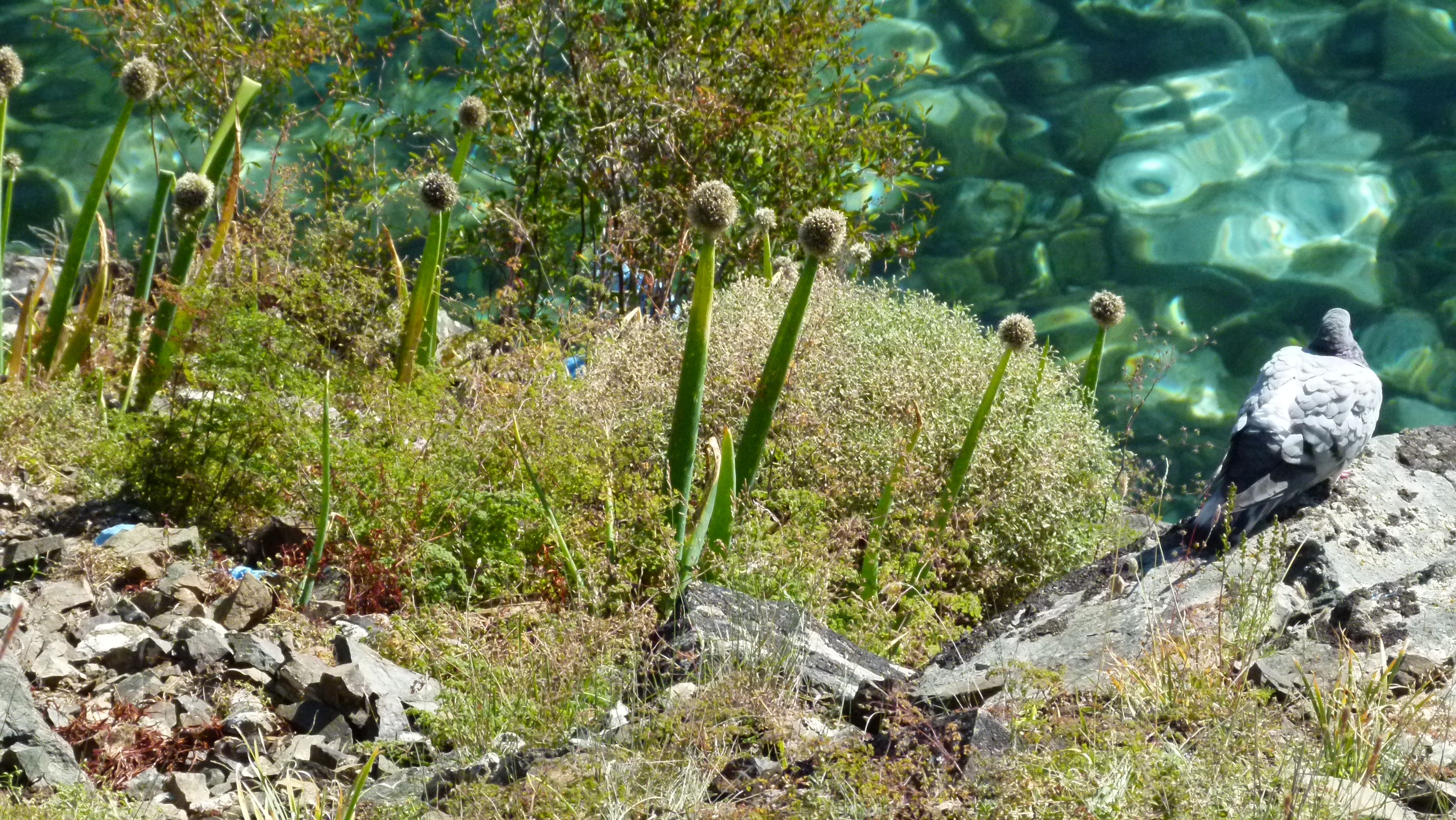
The manager points out some wild garlic (лук) to me. It is a green stem with the fluffy violett flower reminding me of the chive in my garden.
image
Berries and birds
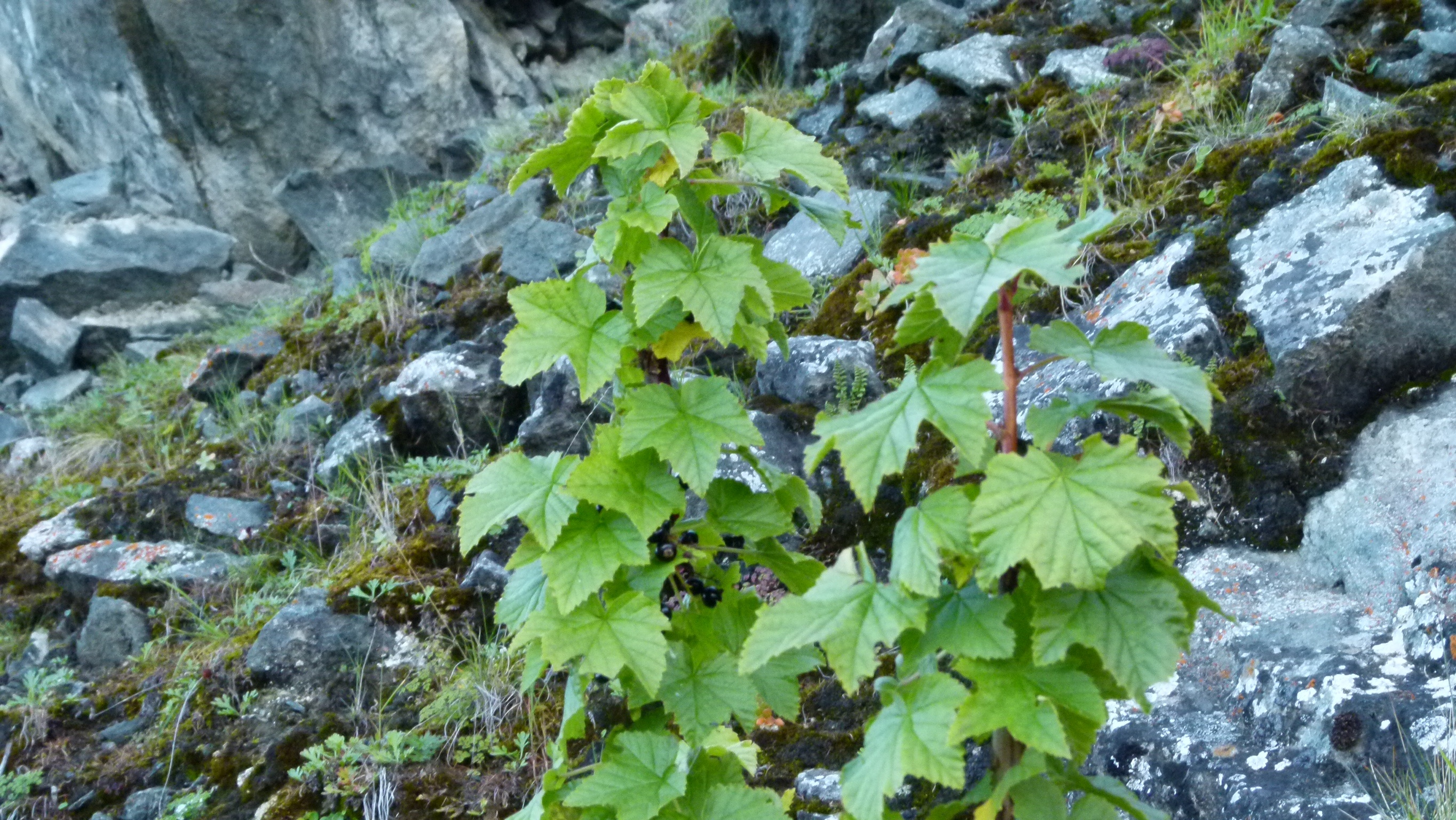
Next stop is a stony shore with some blue berries. They are blackcurrant (черная смородина). The children love to eat from the bushes in the wild.
image
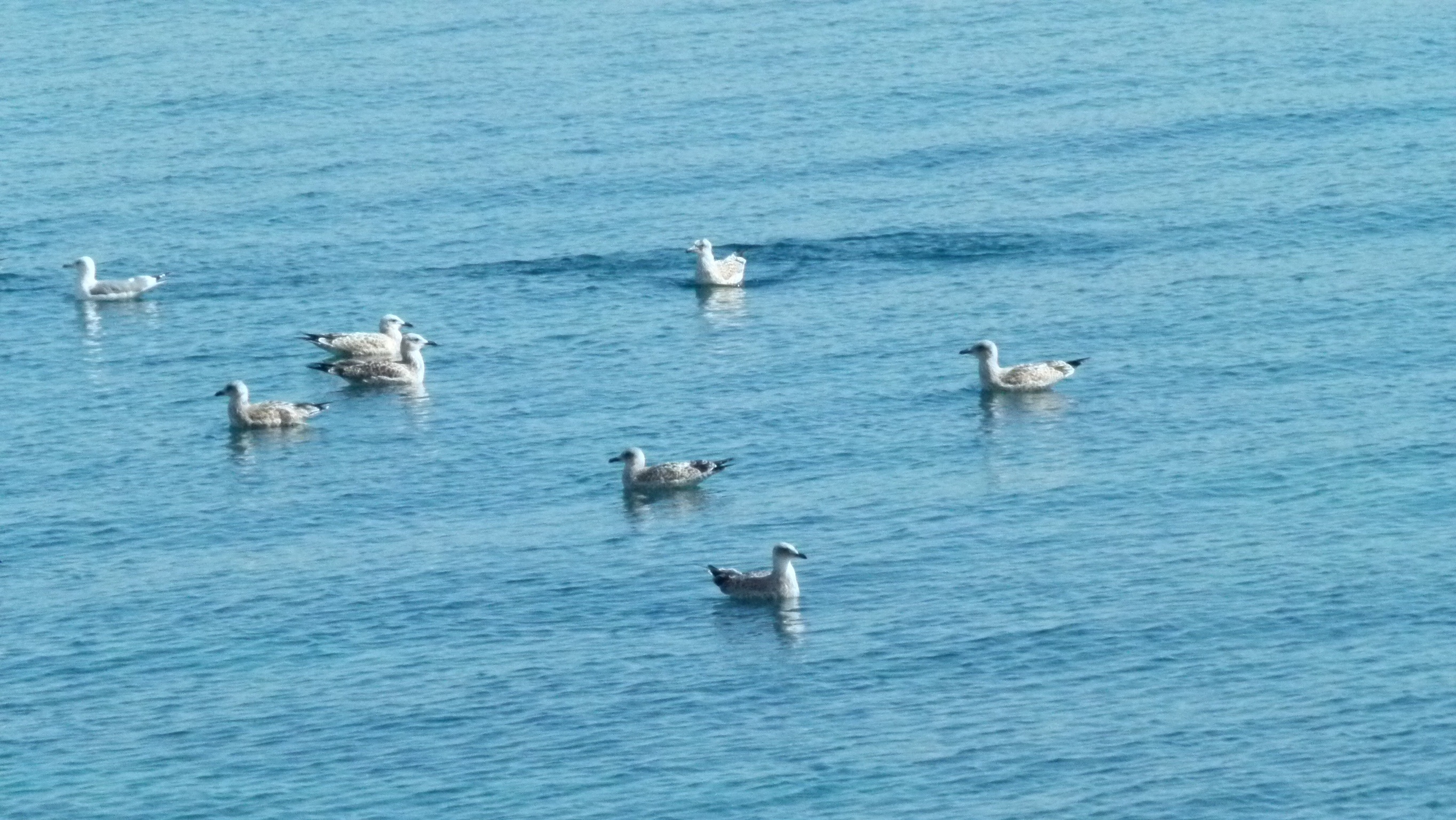
Next stop is at the birds’ rock. Our boat rund so fast that most seagulls and cormorans leave the island and wait outside on the water.
image
We stroll along the island, plough our way through swarms of small flies, hold our breath, when the smell around us gets to strong (on Galapagos they make dung out of this), sadly look at the dead birds lying around, as young seagulls risk being eaten by adults.
Fishing for the children
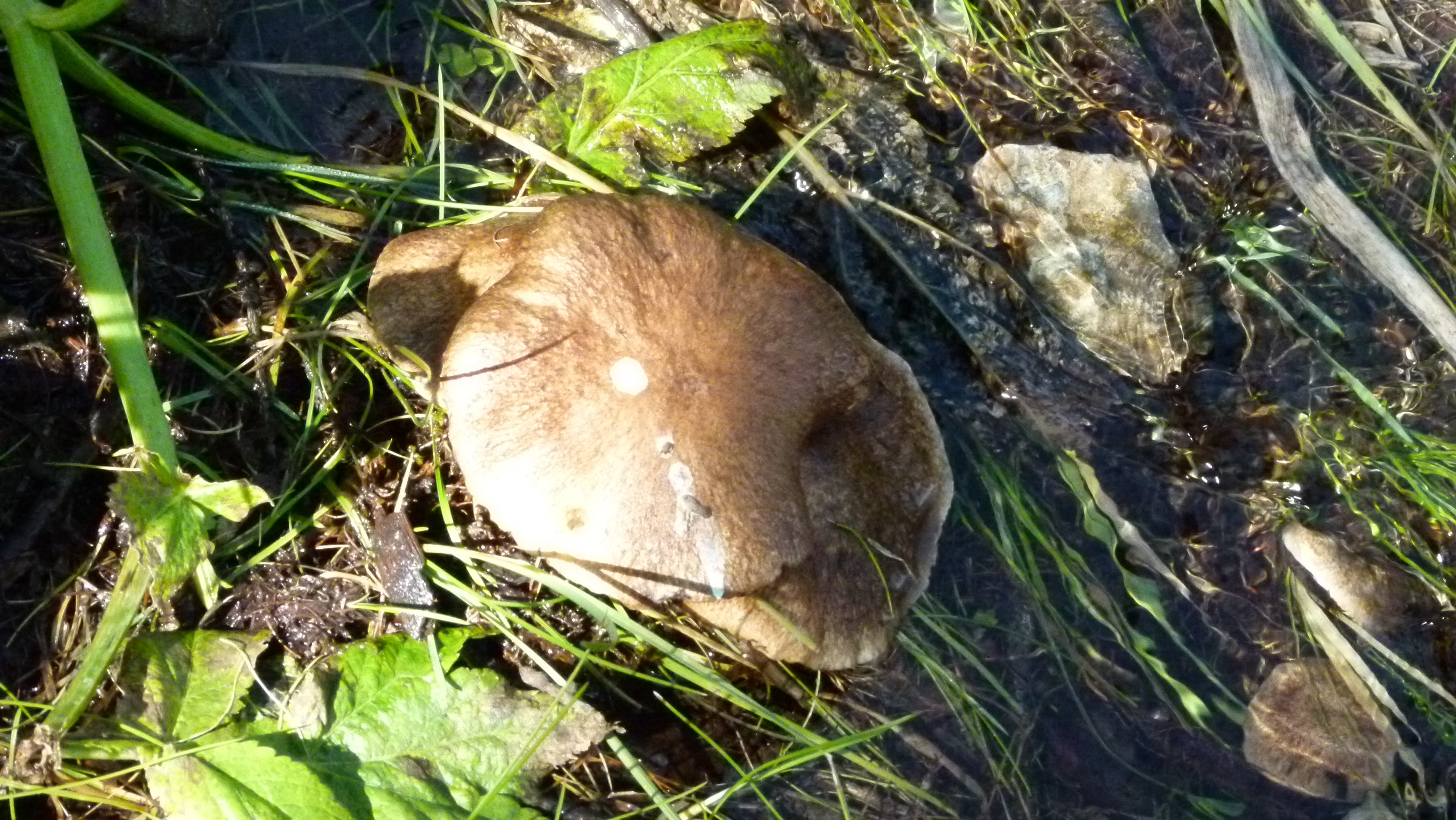
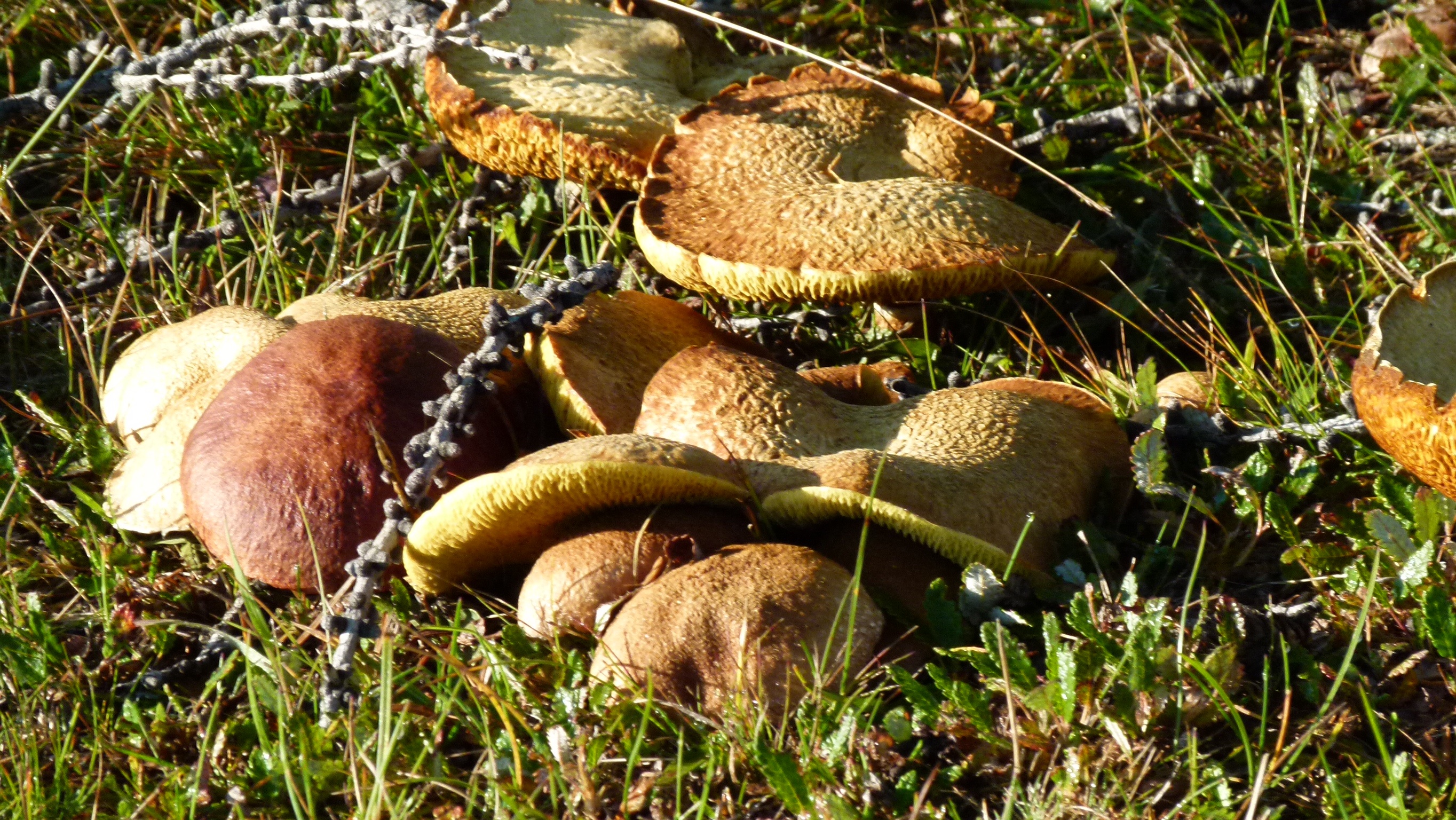
Our boat takes us back to a bay, where the children unpack angling rods for a short fishing session. We climb up the cliff and find a beautiful forest clearing with a burbling creek and a carpet of mushrooms, all relatives of the boletus.
image
image
image
After that we return to our Döltur camp for lunch and for another stroll along the lake, enjoying the cristal clear water.
Dinner – simmered ham with many delicacies
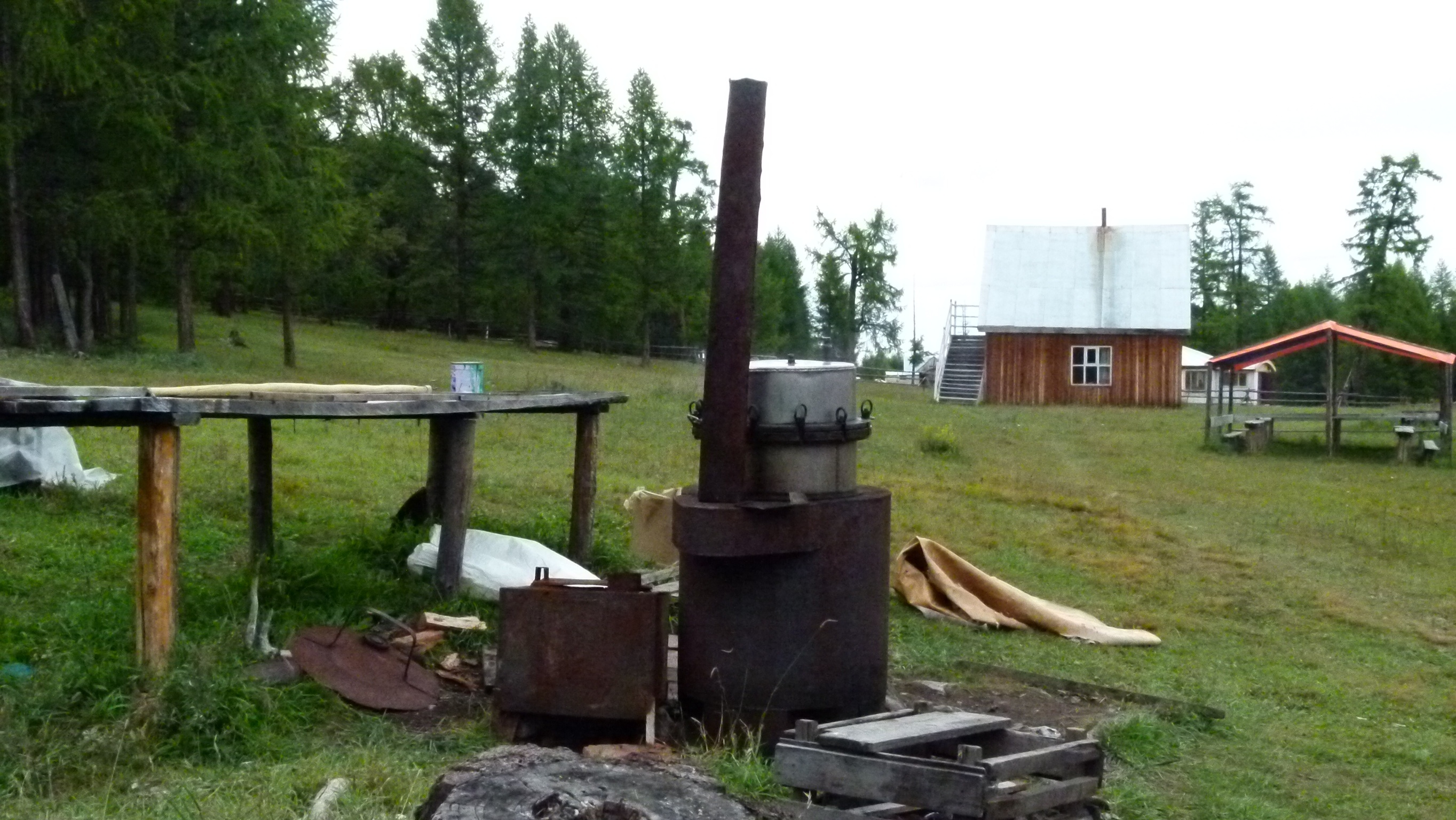
At 6:30 the camp restaurant is still closed; dinner is not ready. This camp has a very gifted lady cook, and today she is preparig a specialty: Ham that isnsimmering in an oven behind the kitchen (хорхог).
image
She serves it with rice, steamed bread (мантуу), mushrooms, cabbage in the form of salad and various vegetables, rice, potato and pickled cucumber. We take the bones into our hands and gnaw on them like real Mongolians. It is a delicious meal. As we come down to our ger, the oven has been heated so well that we feel like in a sauna.
image

Two Swiss in Mongolia – visiting the shaman lady

The interview with the shaman lady

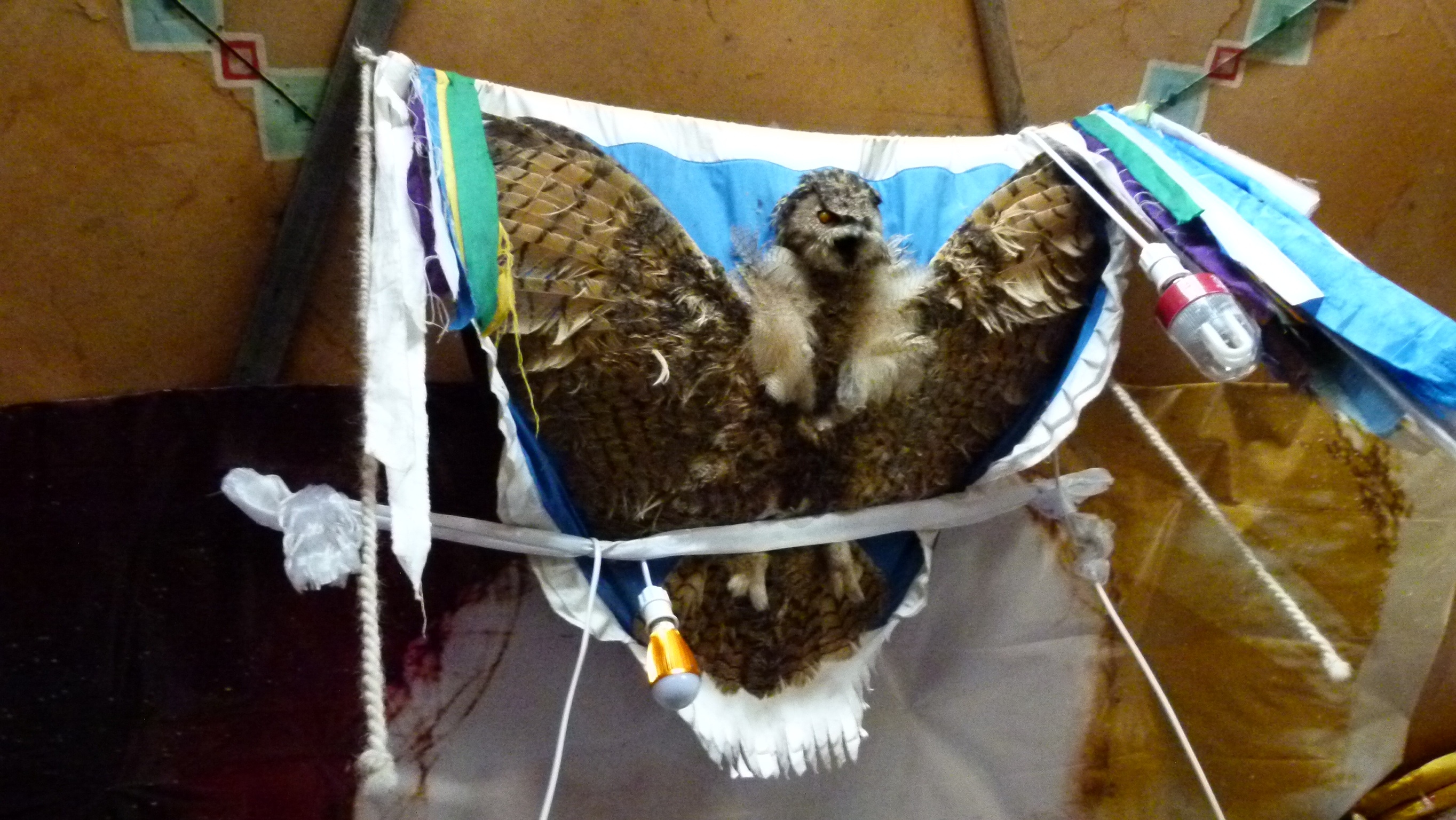
Pudje drives our car to the Shaman lady he knows. She lives in a wooden house that has the shape of a ger. Other than a ger it has windows. The kitchen and the bed as well as the altar (in this case an owl on a blue flag) are at the usual places,
image
but other than a nomadic ger, the walls are full with the “tools” she needs as a shaman and with souvenirs (I assume given by visitors) such as bottles of vodka or portwine).
image
The ger is almost overloaded and dirty. In the kitchen corner there are still bones from one of the last meals. Some ladies come and start to clean up the kitchen.
The shaman lady immediately offers us to show how she performs her cult and this would cost 250’000 Tögröt or about 150 dollars. No, we do not want a show for tourists. We just want to talk to her about her art. Ursula leads the interview – I can tell that she has a lot of practice at this (doctors practice “anamnese”). Aika translates and the shaman answers reluctantly first. At the age of thirteen she decided to become a shaman, and she is the 14th shaman in her family. No, she does not want to say, why she made this decision (which we of course respect, because the reason may be very personal, an illness or a stroke of fate). Her mum taught her the practice. She mainly tries to help people with psychic or health problems or she forecasts their future. She uses her mental abilities to cure people, she does not use medical plants. After a ceremony it takes her two days to recover. She is a Tuva and can speak Tuva and Mongolian. She has five children.
Whether she would show us her drum, we ask. No, she would do so only for 250000 Tögrök, she answers.
Then she switches and starts to ask questions. Your names? Your country? Your age? Children? And then a few compliments such as “you look younger than your age” and “your skin is still beautiful”. We return the compliments: “You look wise and you have charisma”. She starts to thaw up a bit. She invites us to join a ceremony that is planned in the forest in about an hour. Her husband comes and pulls a foto album from under her bed. In 2010 they traveled through Europe and also came to Switzerland. They met European shamans, and some of them also had visited them in Mongolia.
The room is now full with people. Three ladies and a young man from Ulanbatoor want to explore shamanism, and a man in his fifties admires her; he has already attended various sessions and has often been the only person to see the fire in front of the practicing shaman lady – and he could even take a foto of what he saw and the others could not see. He shows us the foto…
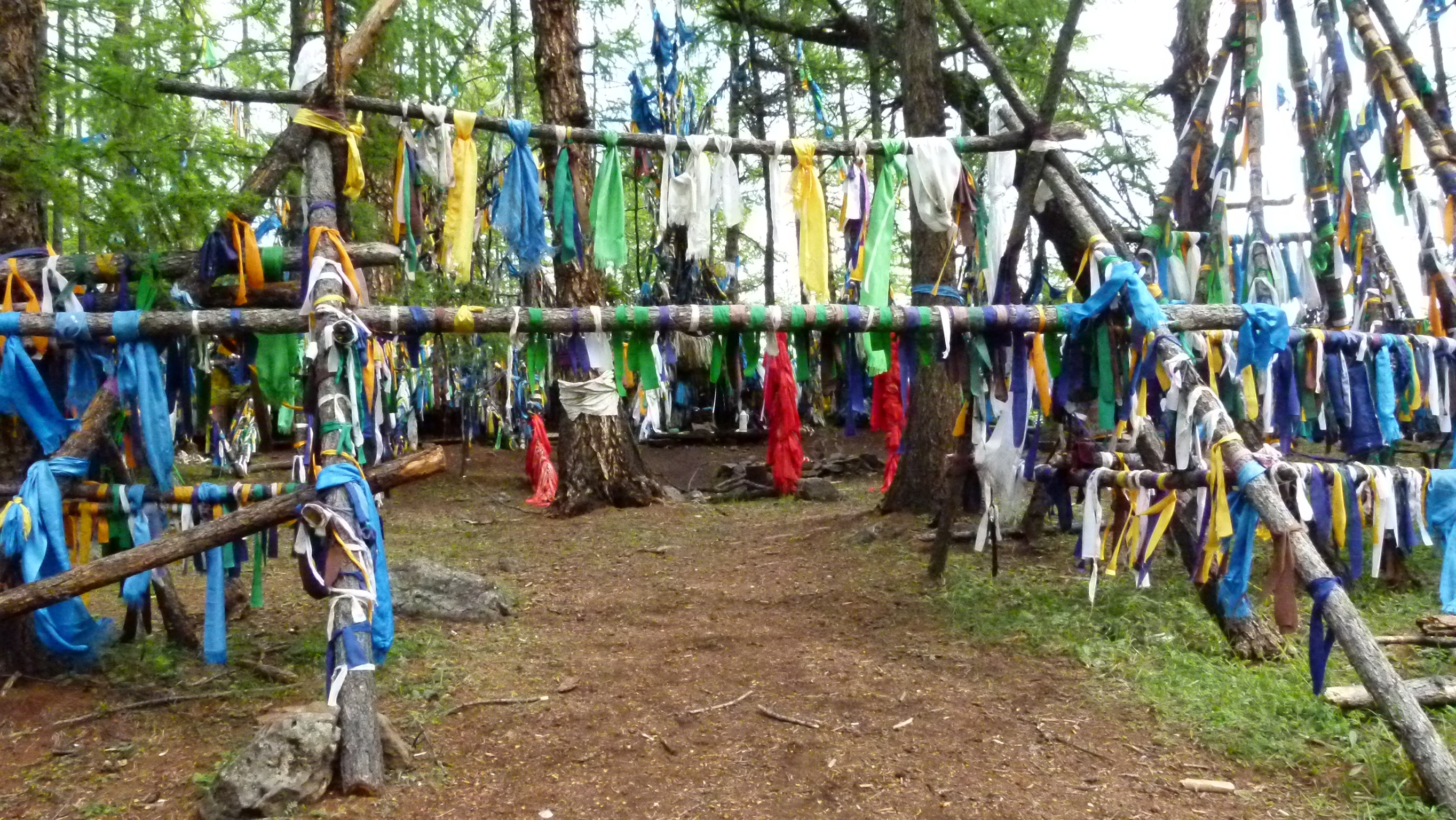
The group of people now takes their cars to get to the shaman place about five to ten kilometers north. It is on a hill in the forest. The sacred area is surrounded by a fence covered with ribbons in all colors.
image
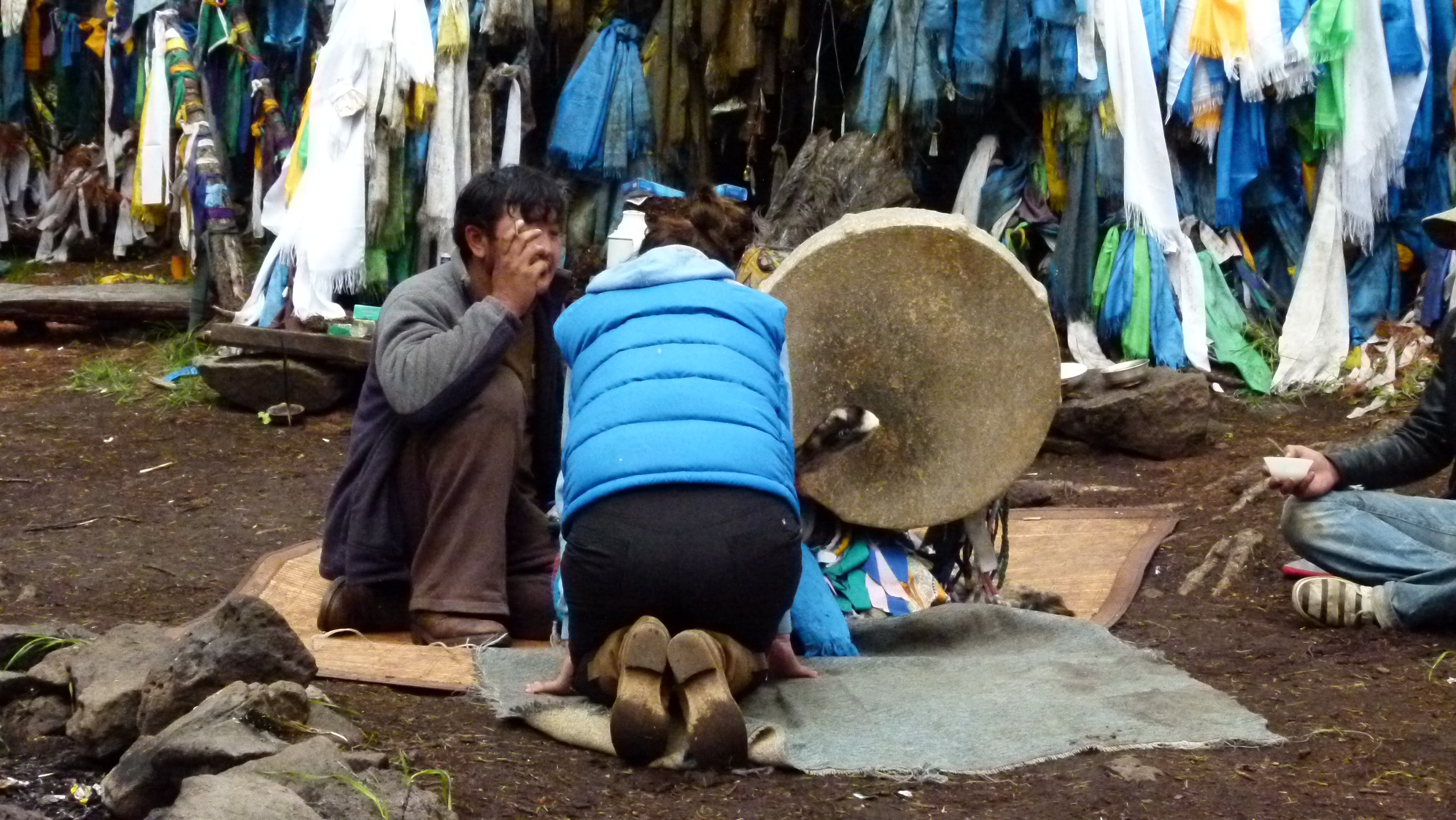
 A hut made of branches. A bench in front of the house. The guests put their gifts on to that bench: Bisquits, milk tea, vodka, cigarettes, toffees and more. A mat on the ground and a fireplace nearby. The husband tunes the drum over the fire, carefully testing it from time to time. Supported by the guests the shaman lady dresses up for her performance. She puts on a coat made of fur pieces (fox), a grim mask with feathers on top and big shoes. The guests write their wishes on white ribbons and add them to her coat. She sits down and her husband sits next to her. She starts to hit the drum with a decorated drum stick while turning her upper body. Sometimes her husband supports her carefully. Her coat must be heavy – I think what she performs requires a huge physical effort.
After some time the man in his fifties kneels and bends down in front of her. He has problems with his eyes, but wants to open up a new business. The shaman lady continues to play the drum and turn her upper body, while murmuring her advice. Her husband translates her words. The future does not look good for this man and the shaman asks him to take care for his health.
image
The three ladies bend down one after the other. They mostly have problems with men and also ask about the future of their families. When translating, the husband sometimes smiles or lights a cigarette; then he speaks with the cigarette in the edge of his mouth. From time to time the shaman lady needs a bowl of milk tea or wodka. One of the ladies has just been divorced, has a son, and would like to find a new husband. The shaman lady shows compassion by dropping the drum on her back. She foresees that this lady will find a new husband in two years. This young lady takes notes, while the shaman speaks to her.
In the background, Kleiber and squirrels enjoy the bisquits – a second performance is going on here. From time to time the guests and the husband sprinkle milk tea around or throw toffees into the air.
Last it is the turn of the young man from Ulanbatoor. Then the husband helps the shaman lady to get up and undress. She sits down again and immediately is back in this world and wants to know, whether we liked it. We leave a gift between the bisquits and the wodka and say good-bye.
Lunch in the camp
We are frozen – the ceremony had lasted about one and a half hours in the cold forest. We take our box lunch in the camp.
Siesta and a walk
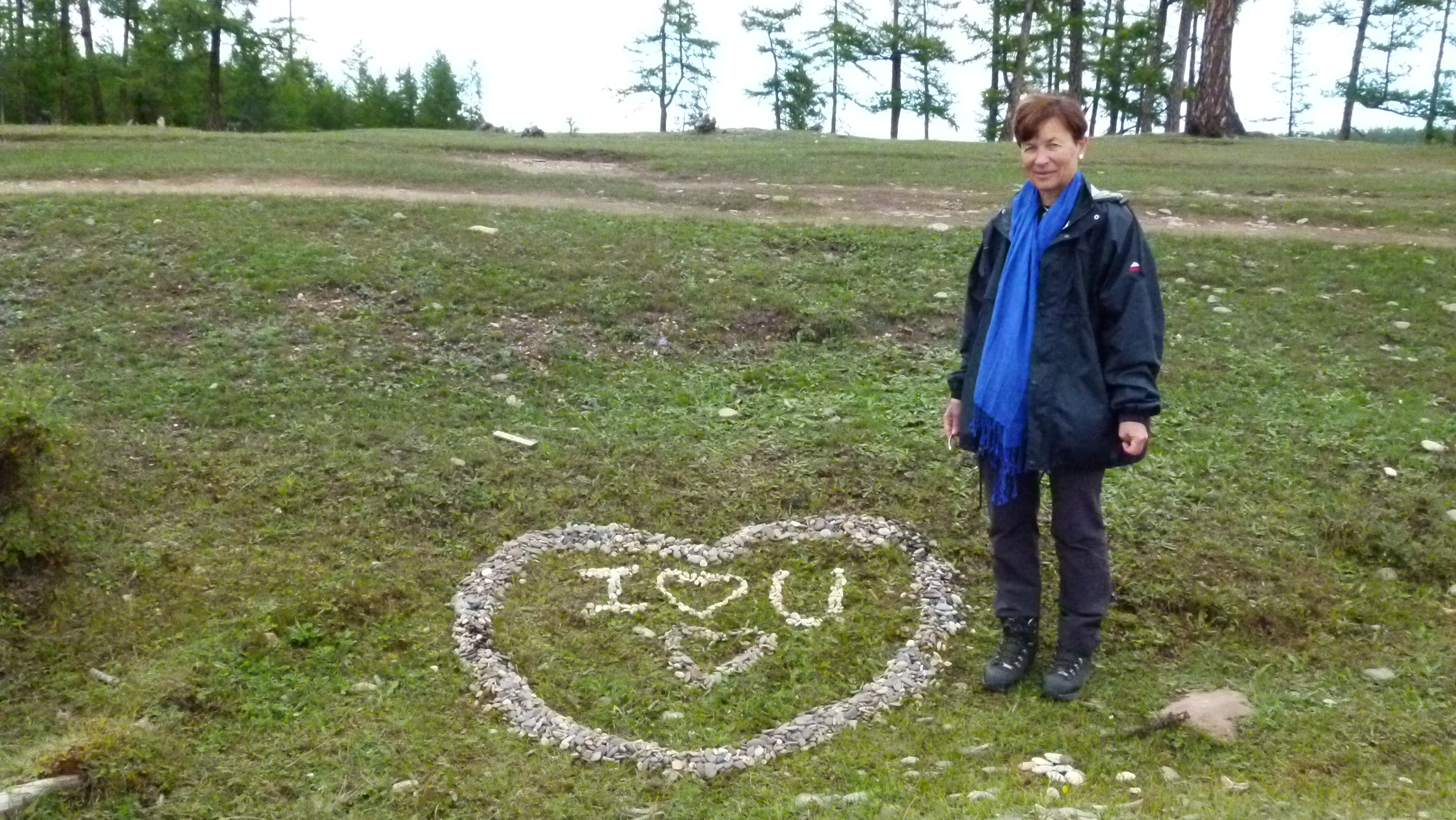
To digest our experience with shamanism, we need a rest and free Aika and Pudje for the remaining afternoon. They visit relatives of Pudje and we meet them later laying hearts for their partners. Aika takes a foto of me with her heart that says “I love you”. Yes, I do… today it is exactly two years ago that you became a star watching over me.
image

Two Swiss in Mongolia – visiting a ger

Saying good-bye to Döltur

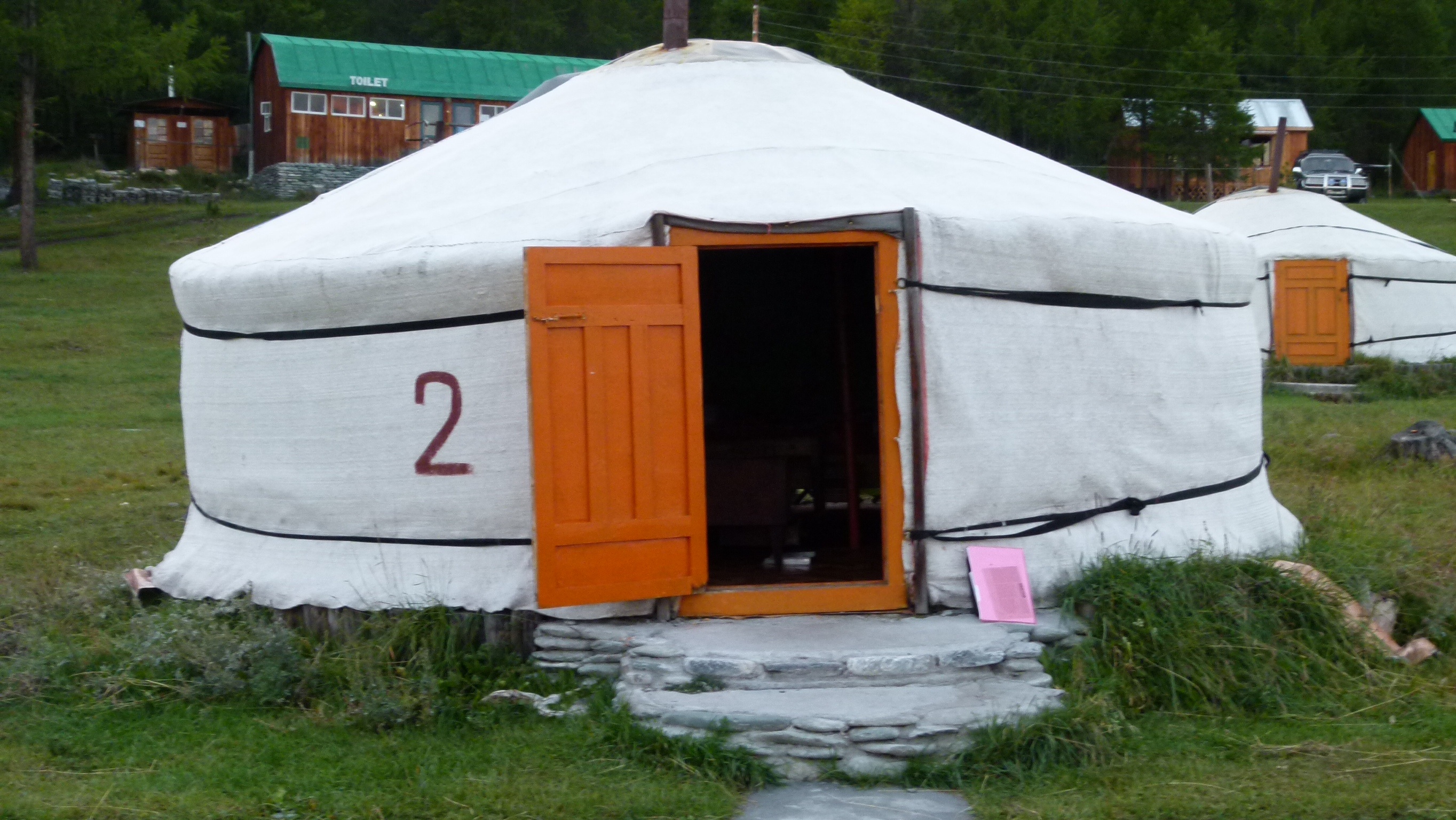
Today we move from the Döltur camp to Tolgoit which is about 50km away to the north. A the gate of Döltur, we receive a very kind farewell: Two ladies have a wooden bucket and a spoon. With the spoon they sprinkle a liquid (tea or milk) on the ground and wave, until we disappear. This is a Mongolian tradition. Waving until the guest disappears round the next corner is what we also do in Switzerland.

Grandma welcomes us in her ger

Pudje drives our car north and suddenly leaves the road heading uphill towards a lonely ger. Pagmajaw  welcomes us. Aika translates. Pagmajaw is 65 years old, and we tell her that we are 62. She has retired and selected this nomadic life with her husband.

She has two daughters and four grand children. One daughter is studying in Ulanbaator and the second daughter works as a secretary in  a national park.

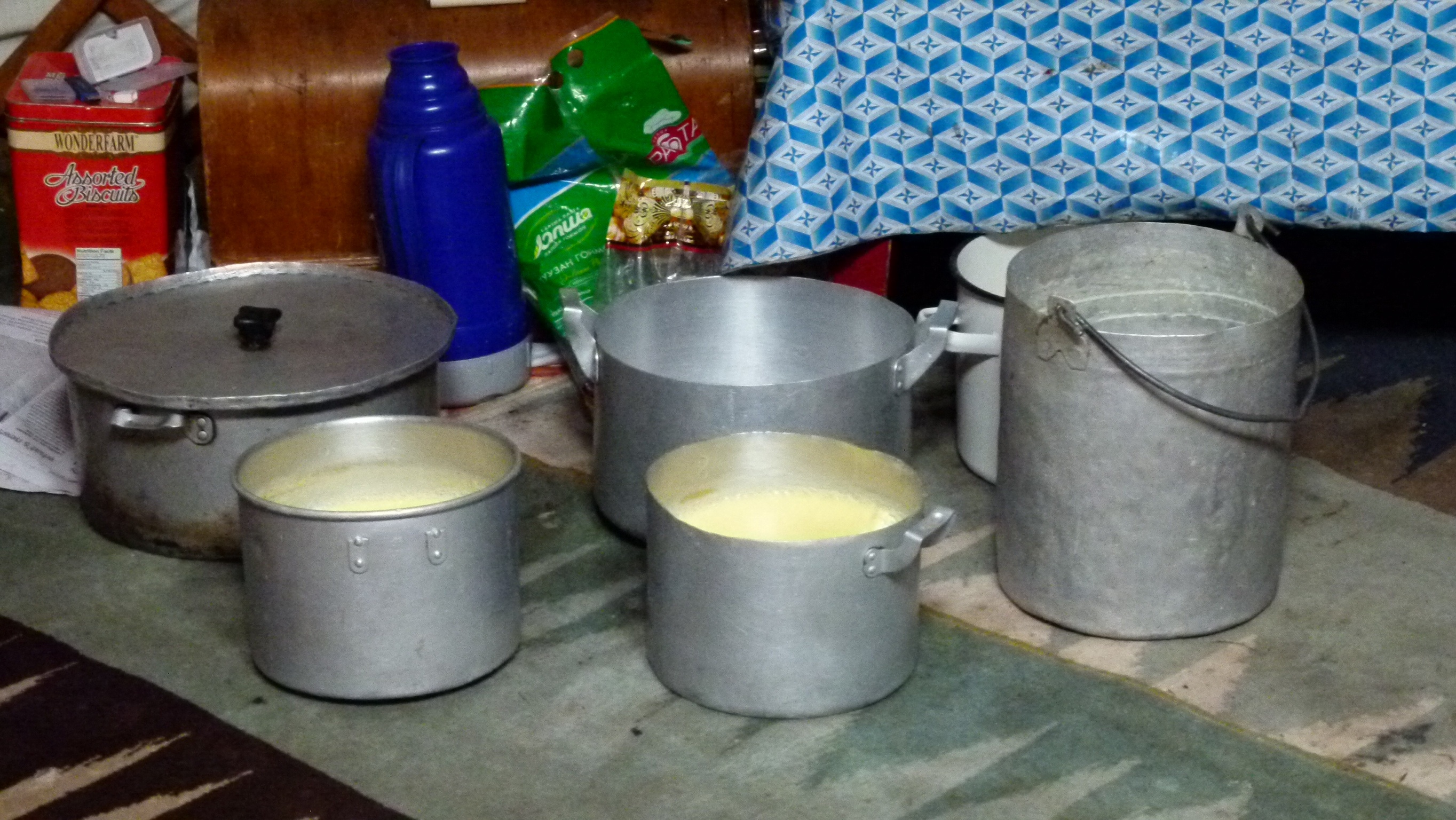
She has 60 yaks and 200 sheep. Every morning she milks 16 yak animals, her forces do not suffice for more.  We watch her boil about 20l of milk on the central oven. She carefully watches it, stirs it with a scoop and then pours the boiled milk into smaller pots. On the next day she will take the cream off the milk. She offers us bread and some of this cream which tastes like cream cheese. She also offers milk tea and explains that when preparing it, it is crucial to add water to milk and never milk to water.

Mushrooms are for animals

Next to the oven there are some brown lamella mushrooms. Pudje takes a hat of a mushroom, fills it with cream and roasts it in the wooden fire. Delicious.

image

Pagmajaw dries the mushrooms. Some hang on the side wall in the wooden grill that supports the ger. She feeds these mushrooms to the animals. Only occasionally they use mushrooms for their meals, mostly as spices. I tell her that we love to eat mushrooms, but have to look for them, while here you have to be careful not to step on them while walking, and she laughs.

image

The ger has all that is needed for life here

Pagmajew tells us that they move their ger four times per year. Construction and deconstruction is done in a few hours. They now load their material on a car to move from one place to the next. Before horses transported their household. The ger is not full with a lot of superfluous things. It has exactly, what is needed to live here.

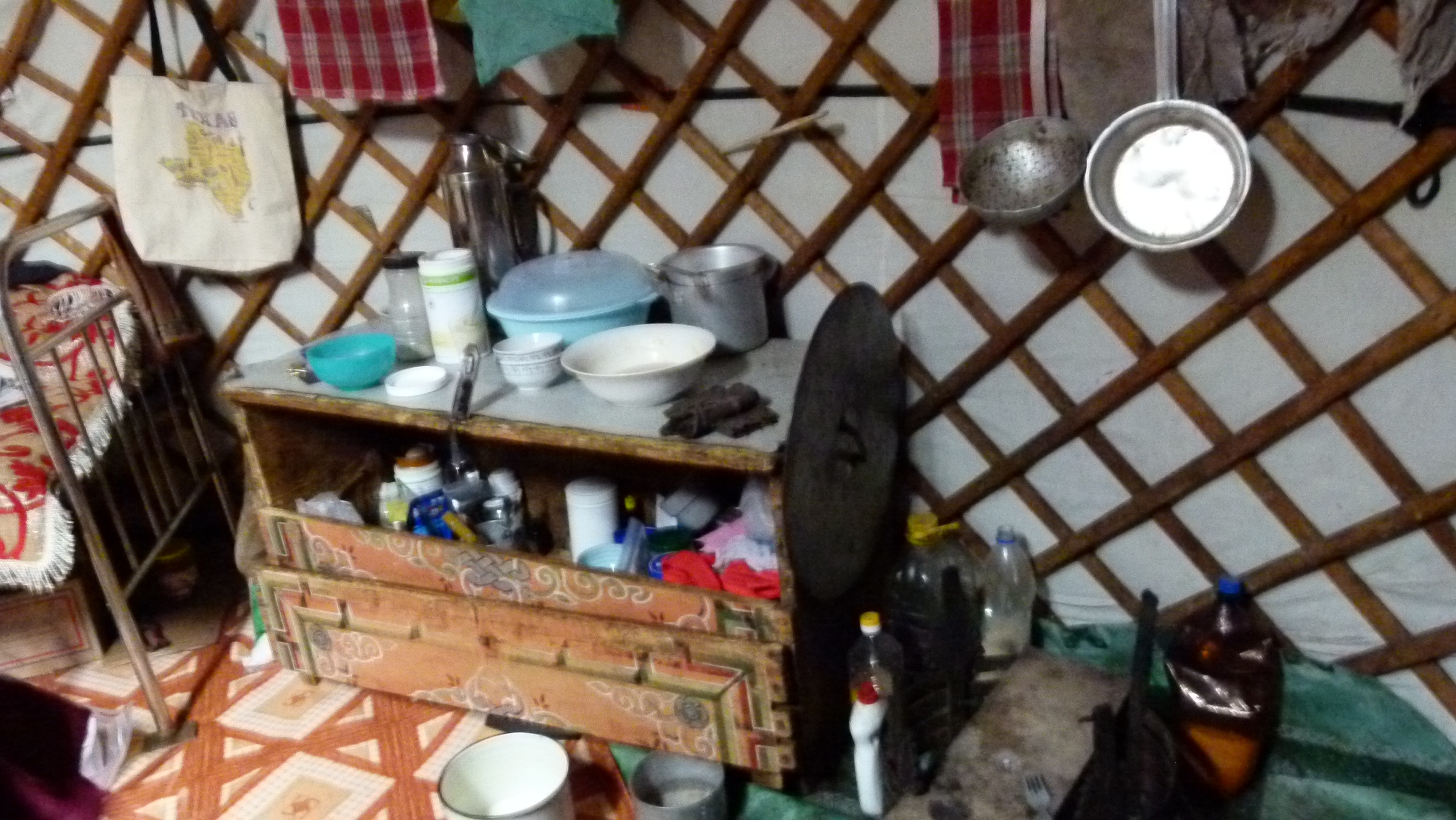
There is a kitchen to the right of the entrance,

image

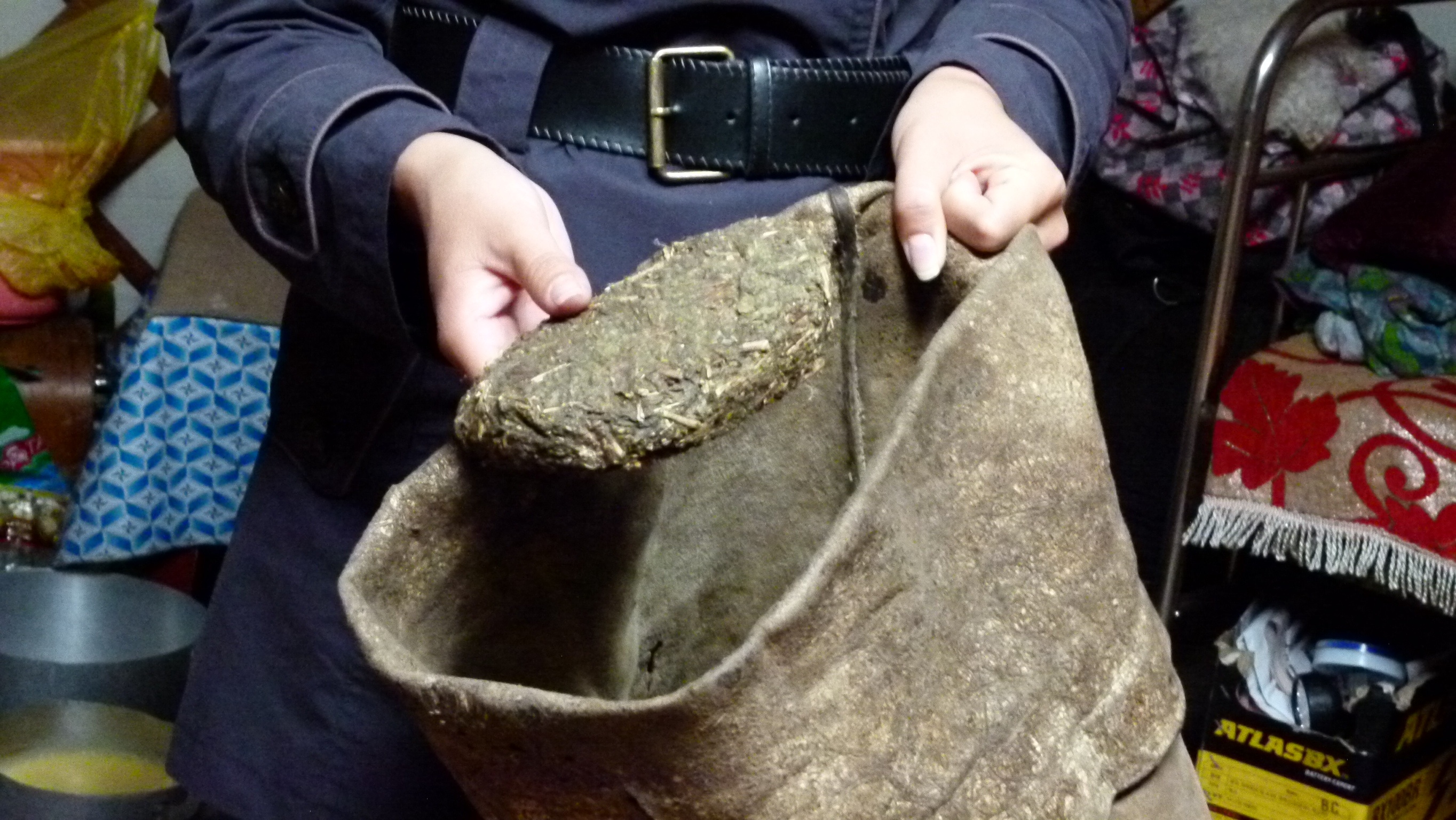
next a sack with tea leaf bricks,

image

next her bed,

image

near the bed a sack – she takes lamb skin out of it that she will use to insulate the house in winter. Next some boxes and the pots with the cooked milk.

image

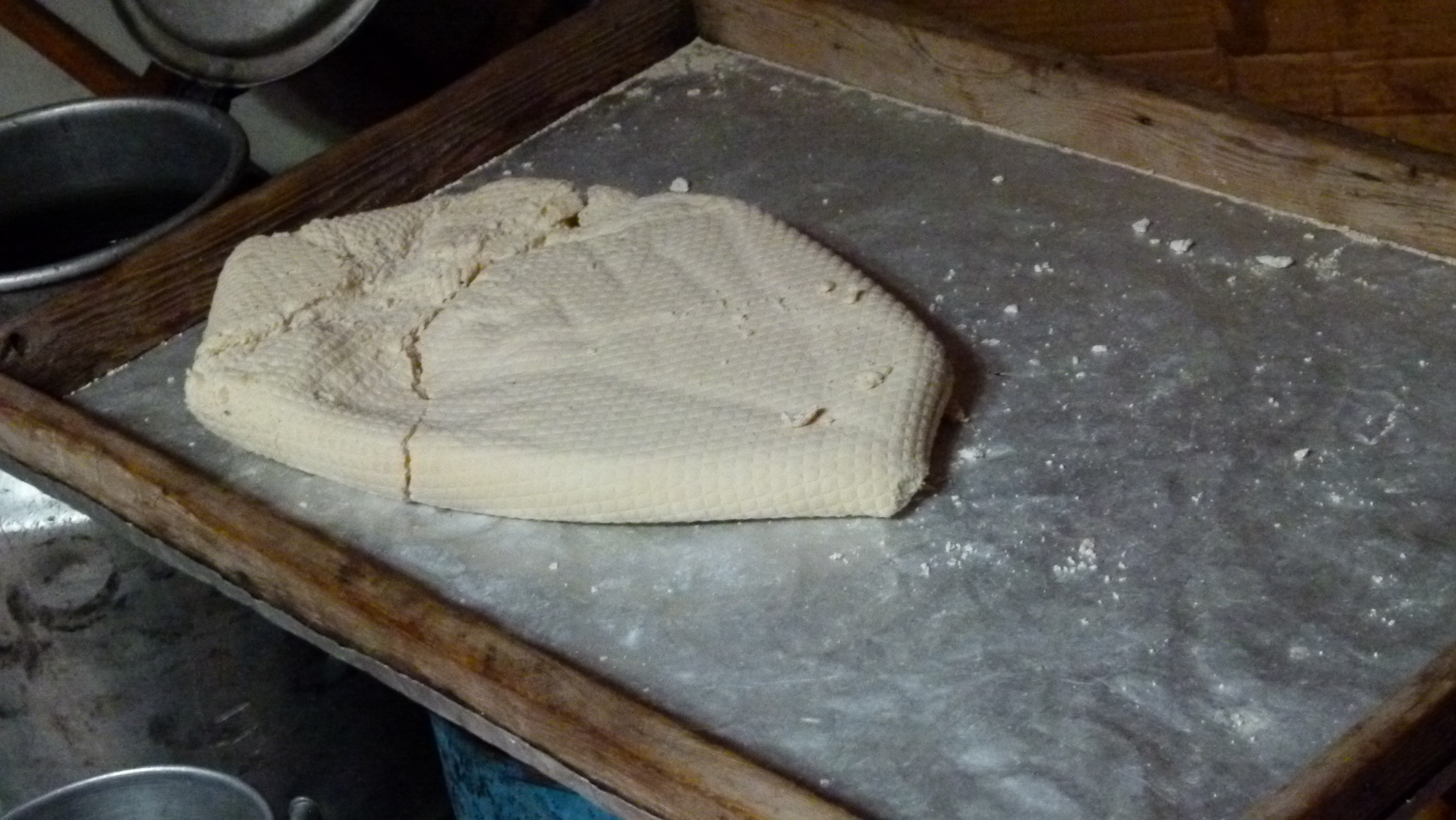
The holy corner opposite the entrance is a sack and a rolled piece of silk fabric (yellow, green, blue and red). On the men’s side are his bed, the dried mushrooms and a wooden board with cheese that is ready to be cut and then dried.

image

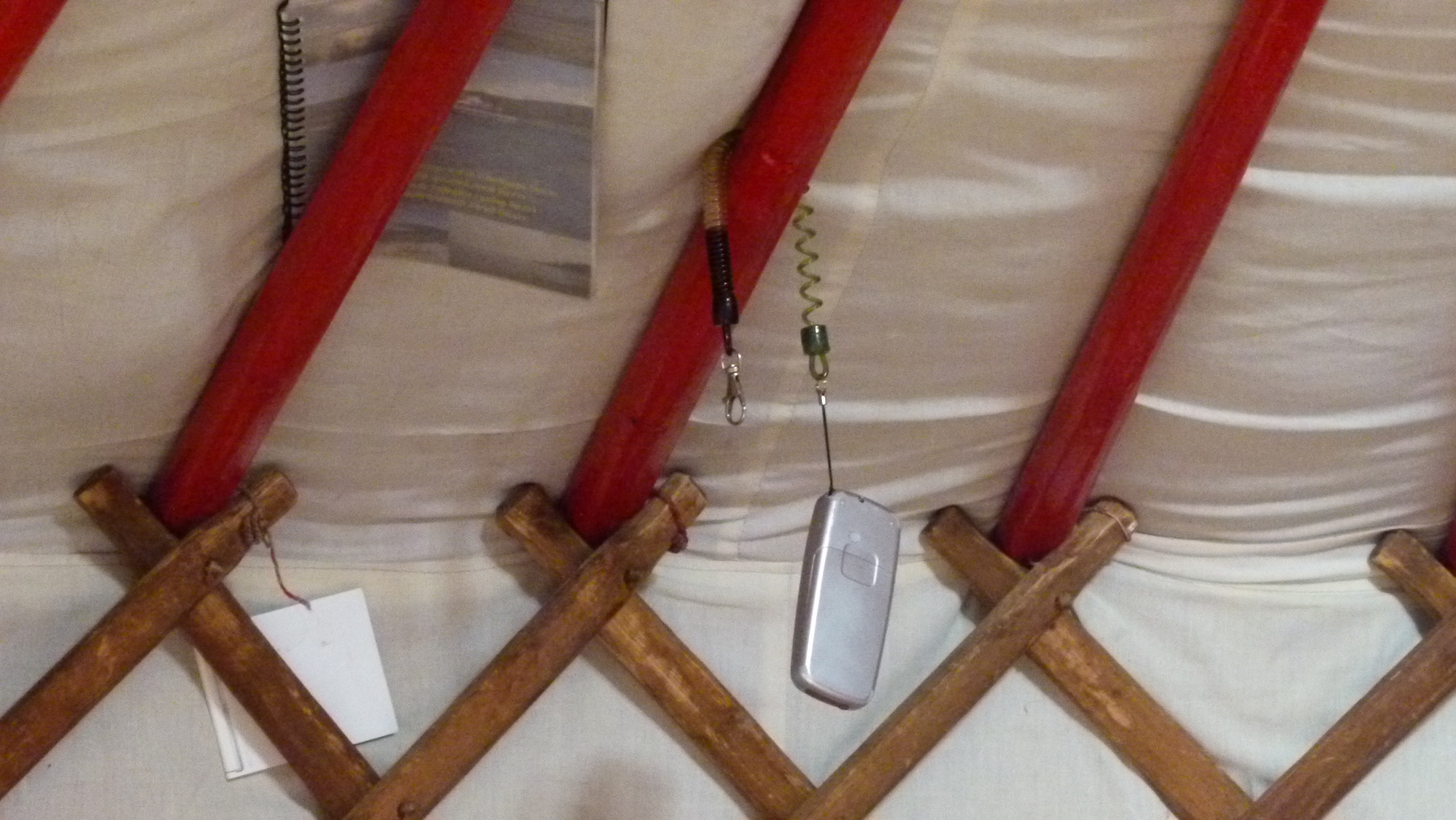
In the wooden grid are hanging tools of daily life like sun glasses or a small book.

And also there are the signs of modern times

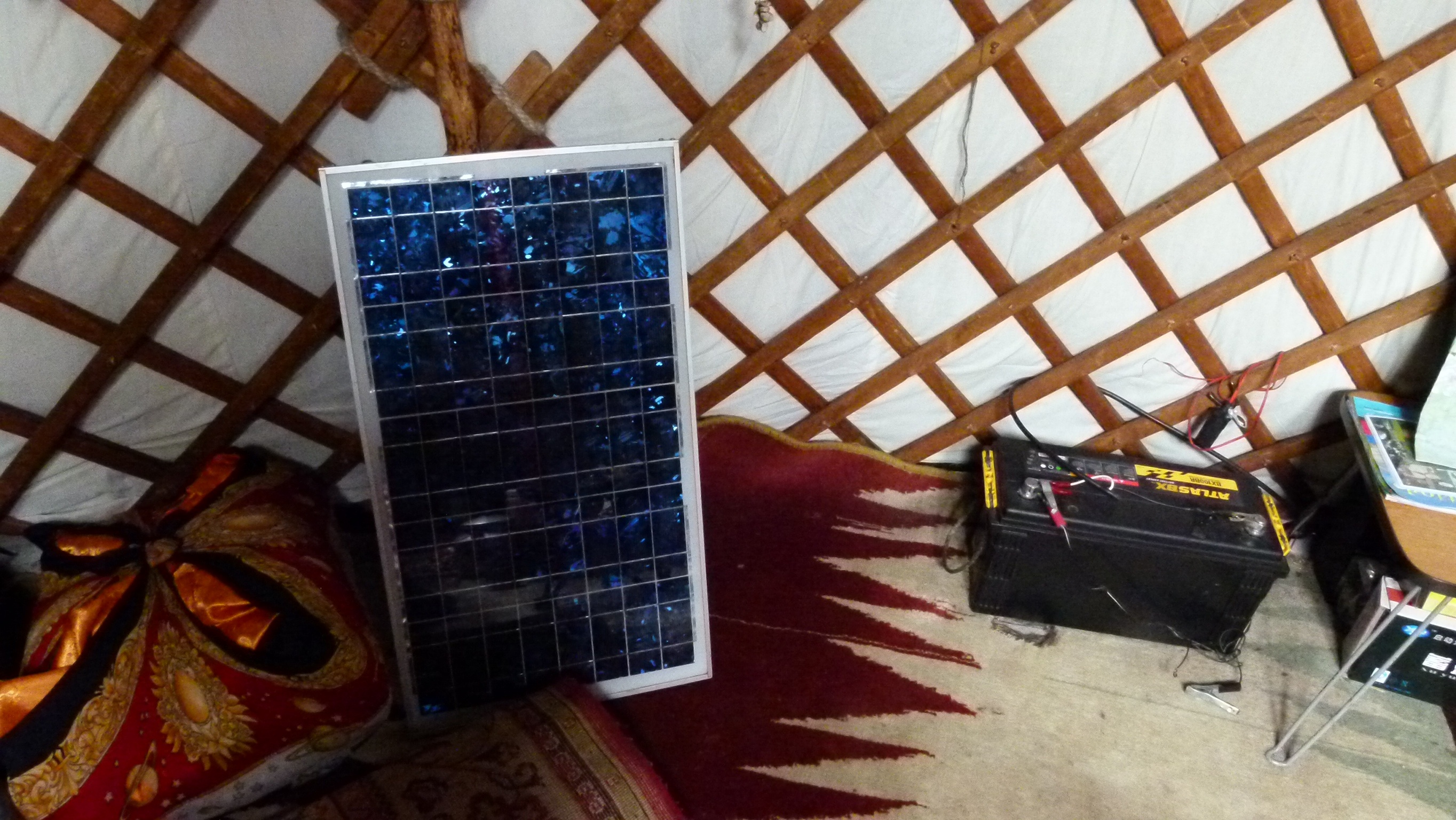
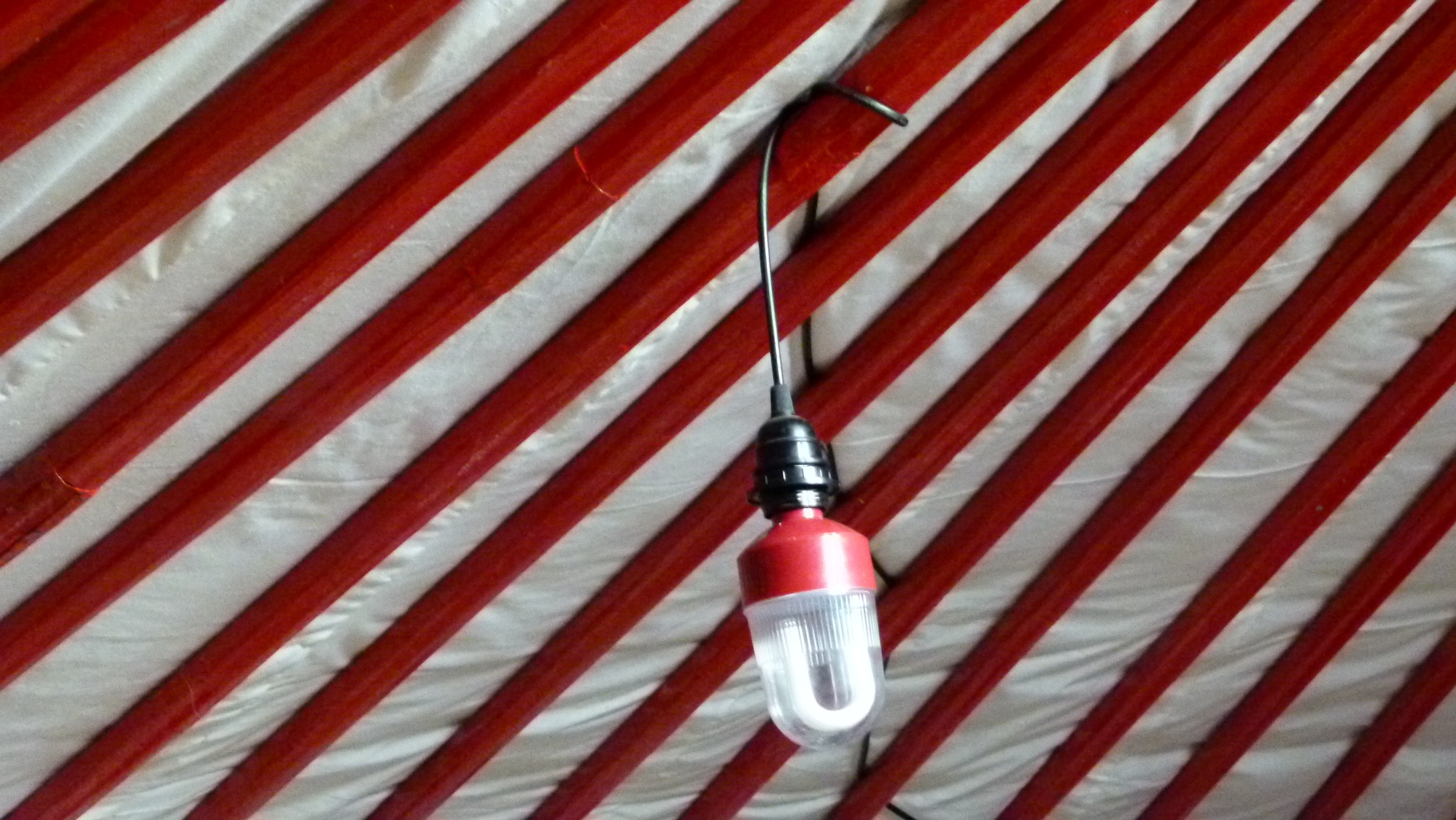
There is a satellite telephone that keeps on ringing (the daughters are calling), a mobile phone, a radio, a collection of cables, a sewing machine (she uses it to sew her traditional tuffed long jacket made out of dark red silk), an alarm clock, two batteries and a solar panel. Also this ger owns a car.

image

image

image

With a hearty good-bye we hand over our small gifts.

To the Tolgoit camp

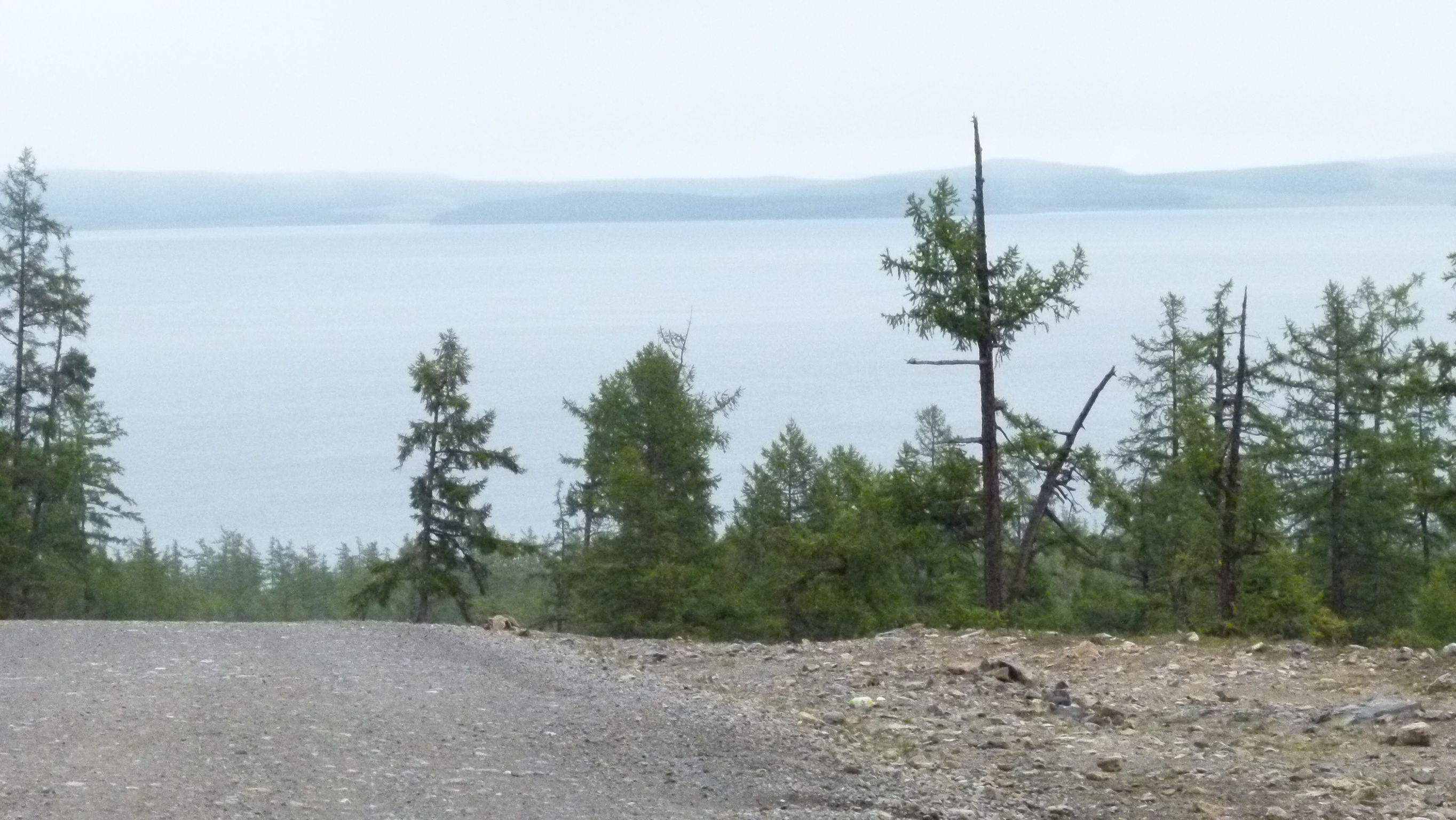
We continue our way to the Tolgoit camp. We cross the Yankhi pass. Overlooking the pass are the slopes that had ben hurt by the Russian scientists. They needed a road. In front of us the lake, a gorgeous view.

image

Shortly afterwards we enter the Toilgot camp and move into a ger that has been heated so well that we open the door to breathe.

Reflecting our visit on the afternoon walk

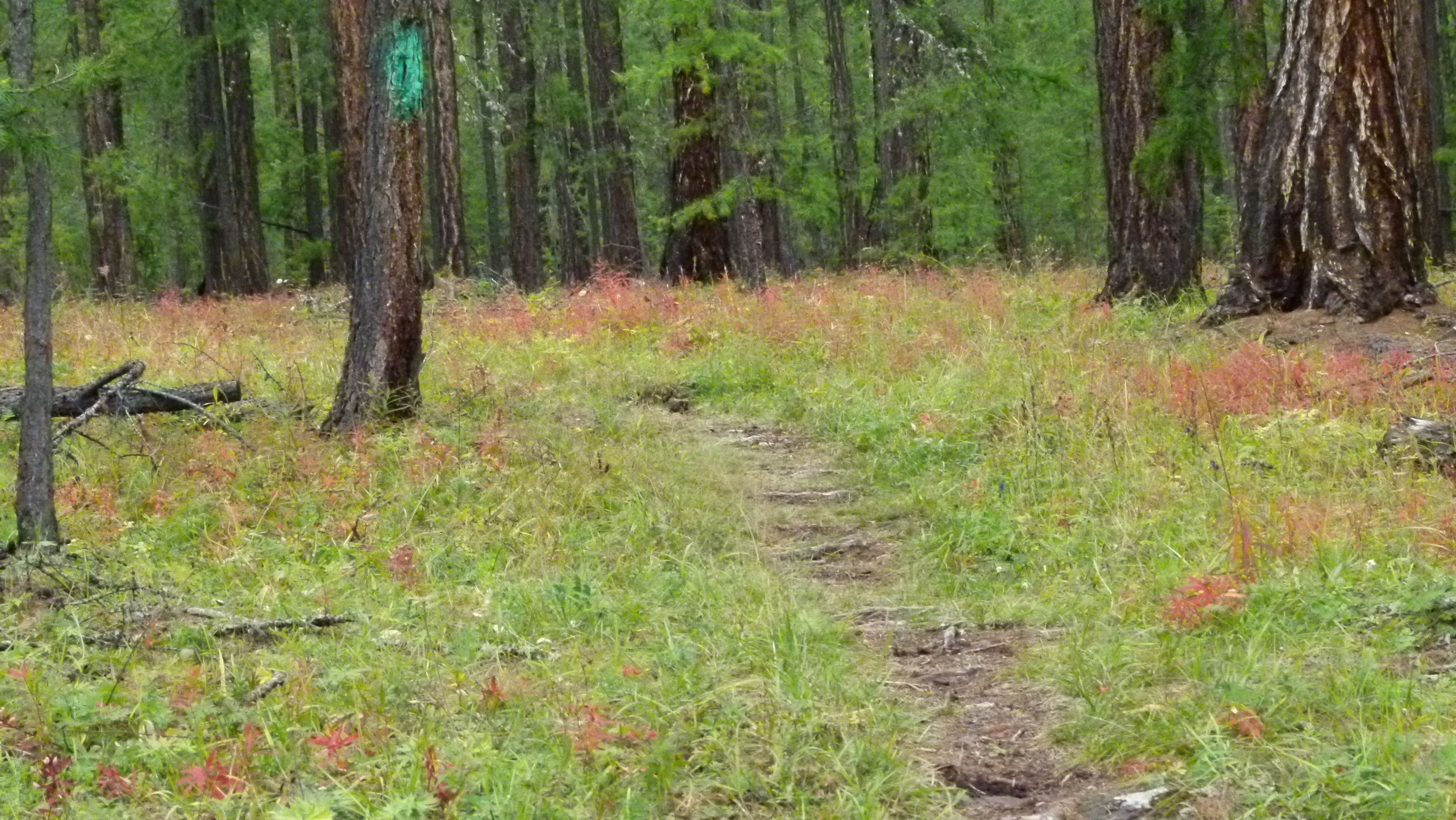
After lunch we stroll amidst lark trees and mushrooms. We walk softly on the needles.

image

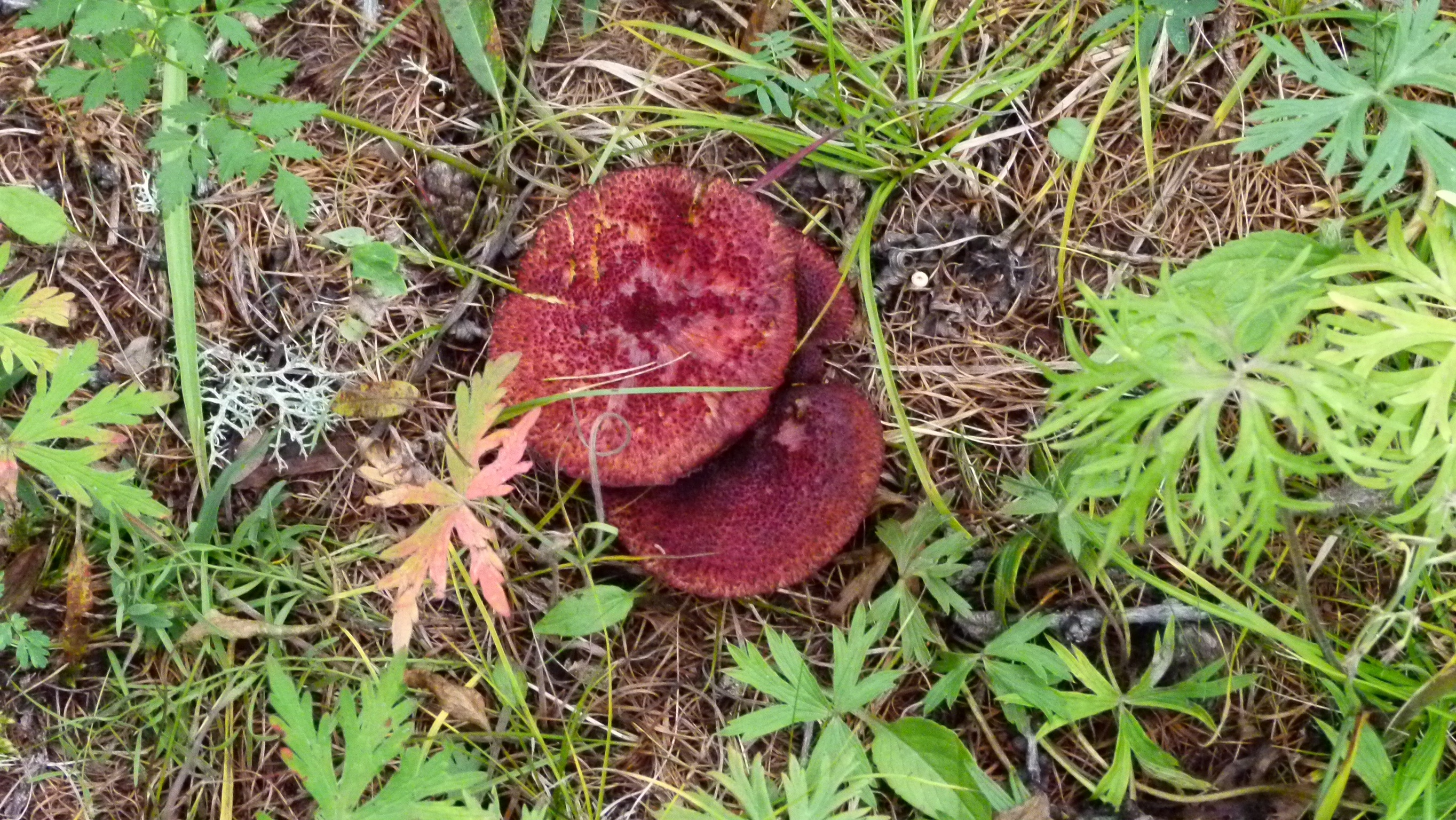
On the way back there is a nice view of the lake. Mushrooms, mushrooms, mushrooms, especially the red boletus (Rotfussröhrling)…

image

I imagine the risotto prepared with them! Ursula’s comment: “No nutritive value in mushrooms; this might be why the nomads ignore them.”

We reflect that Mongolia is transforming quickly. Half the population lives in towns now. The nomads use cars and motor cycles instead of horses. They use it to move gers and to guard their animals. At the elections four years ago, everybody came on horseback, and this year almost all came by car or motor bike.

Aika confirms that it might be true that the daughter of Pagmajew is studying in Ulanbaator, even if she might be forty years old. There are many older students. They receive a monthly salary of about USD 50, as the government thinks education to be important. Good marks lead to additional payments. “Some students go to the disco instead of studying”, she frowns.

We tell Aika about our flight that has been diverted to Edinburgh to take the army music band to some festival. She then tells me about the elections. The candidate of the opposition was in prison, until the elections were over, she says. There might be more capriciousness  such as the black market burning down and now there is room for street construction. It is said that the shopkeepers could buy an insurance  beforehand and were compensated. If this is true, there might be more room for change in Mongolia.

Two Swiss in Mongolia – visiting bronze age

We propose to visit the deer stones
Around lunch time, we  arrived in Mörön, flying in from Ulanbaator.
image
Pudje will be our driver for the next days.
We propose to visit the deer stones that are just a few kilometers away from the airport. Pudje carefully drives our car over a bumpy earth road to a dusty parking space.
About 40 stones with deer paintings
We find about 40 stones decorated with deer paintings and ornaments from the bronze age. The body of the animals is a blend of deer and bird. Their body is stretched, ends with peaks and has with wings on the back. The stones seem to have formed a ring. It must have been a place of worship.
image
image
Horse sculls within the ring
Excavation is going on. Russian and Ukrainan archaologists had found sculls of horses They explain that these sculls are from the same times as the deer stones and that they believe that they were sacrifices (жертва). Initially the archaologists were unfriendly towards us tourists that dare walk around their scientific site, but they thawed up, when I ut talked to them in Russian.
image
Later Ursula smiles… look, I saw immediately that these sculls are from horses, as I had to study and compare the sculls of frogs, sharks and horses at university.
Continuing to the Döltur camp
Now Pudje drives us to Khatgar and to the Döltur camp  beautifully located on the shore of the Khövsgöl lake.
image

Two Swiss in Mongolia – first walk near the Khövsgöl Lake

Sunrise behind the hill

When I wake up, Ursula comes back from a sunrise walk. There is a chilly wind and blue sky. Promising. And yes, it will be around 20 degrees today, a warm summer day.

image

Walking to the Ashishai Sant hill

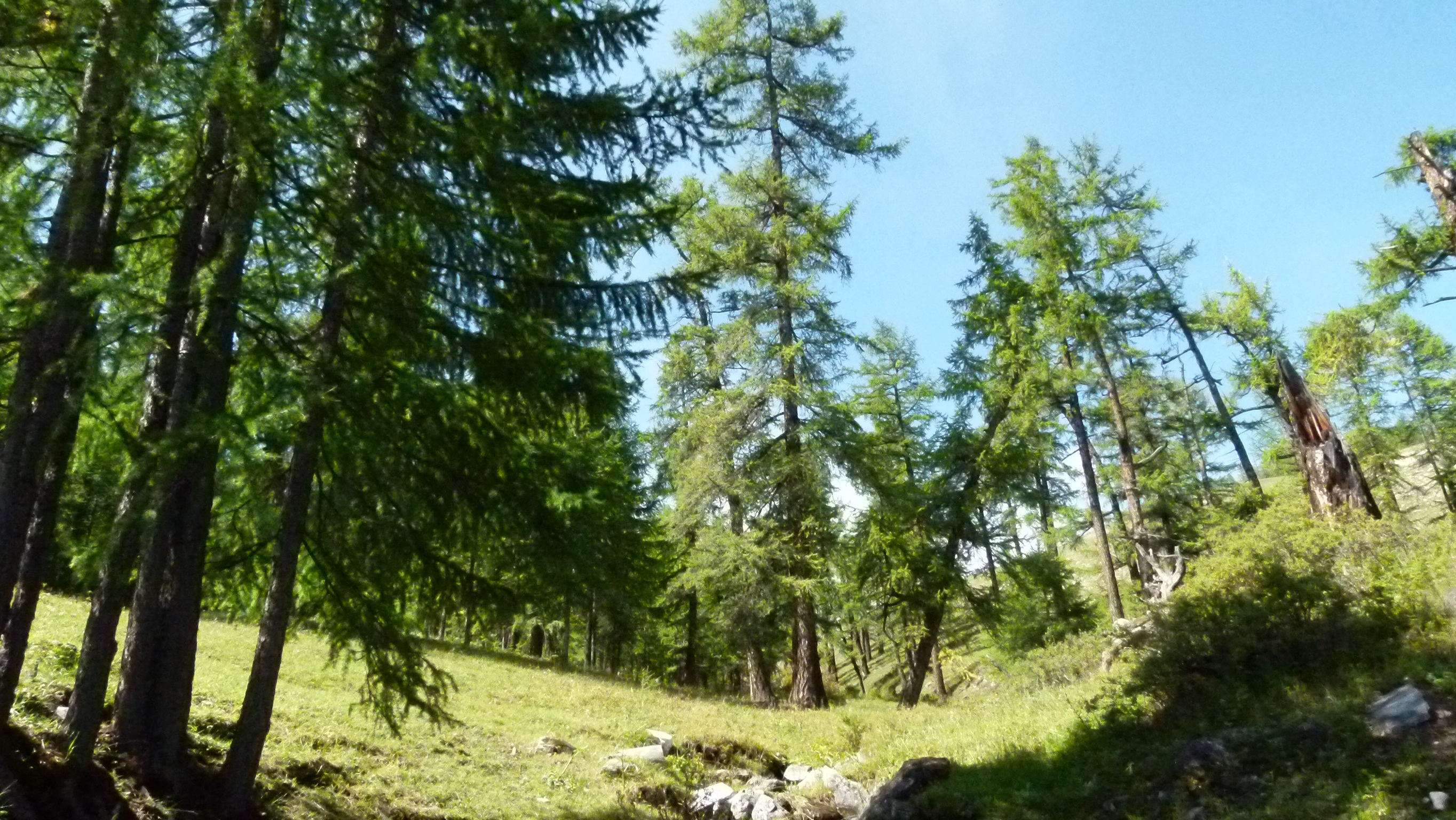
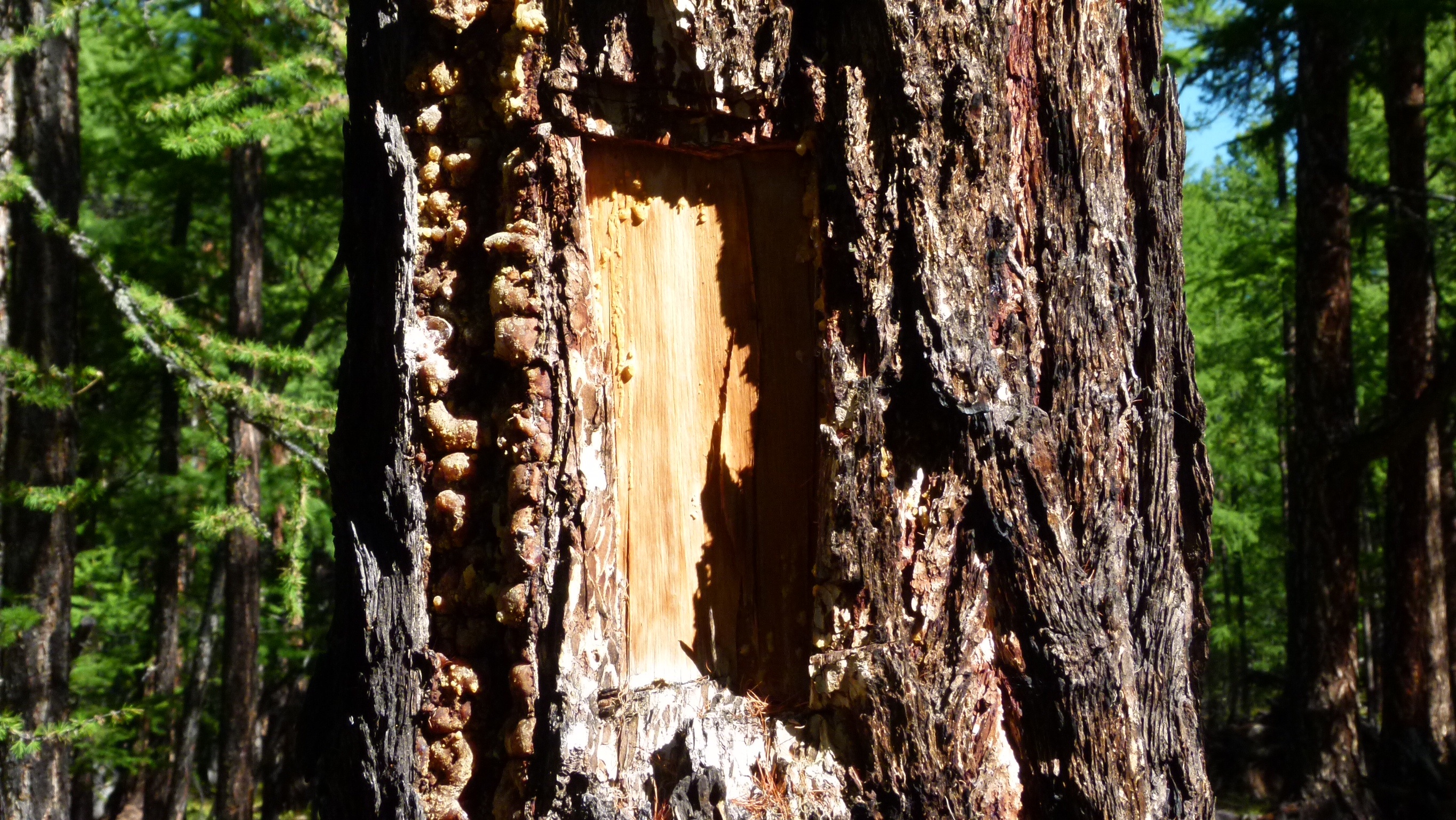
Armed with a promising box lunch, we walk uphill – directly behind our camp.  Our driver, Pudje, has taken over the lead, as he is from the area. Lark tree forest and soft ground – this is the taiga.  Pudje  scratches off the resin of the lark tree and chews it lie a chewing gum. I try it and it has a bitter taste.

image

We have to be careful not to step on the mushrooms, there are puffballs, russola, chanterelles, relatives of the bolet and many more. Here we could just collect them. Pudje kneels down in front of a white mushroom in the meadow, looks at the bottom of the stem and frowns. Yes, he is right, also the lamellas are white. It is a death cap.

image

Though late in summer, there are many flowers, like carnation or gentiane

image

Worshiping the ovoo on the top

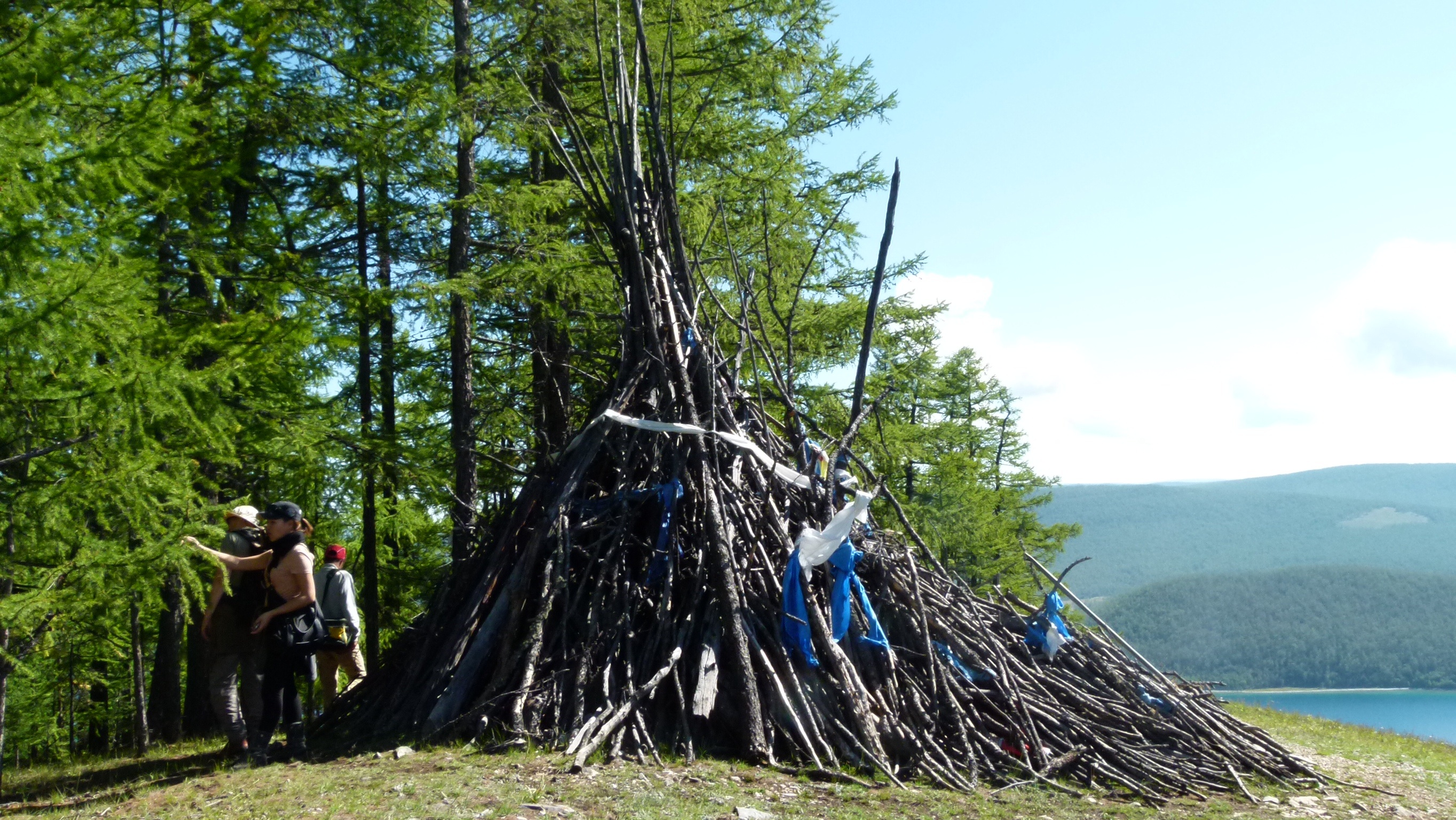
On the top of the hill, there are two piles of branches decorated with colorful ribbons. Pudje adds a few branches. As this is how Mongolians show their respect for nature in Mongolia, we do the same. Then we walk around the ovoo – clockwise- and I notice that Pudje takes his cap off.

image

image

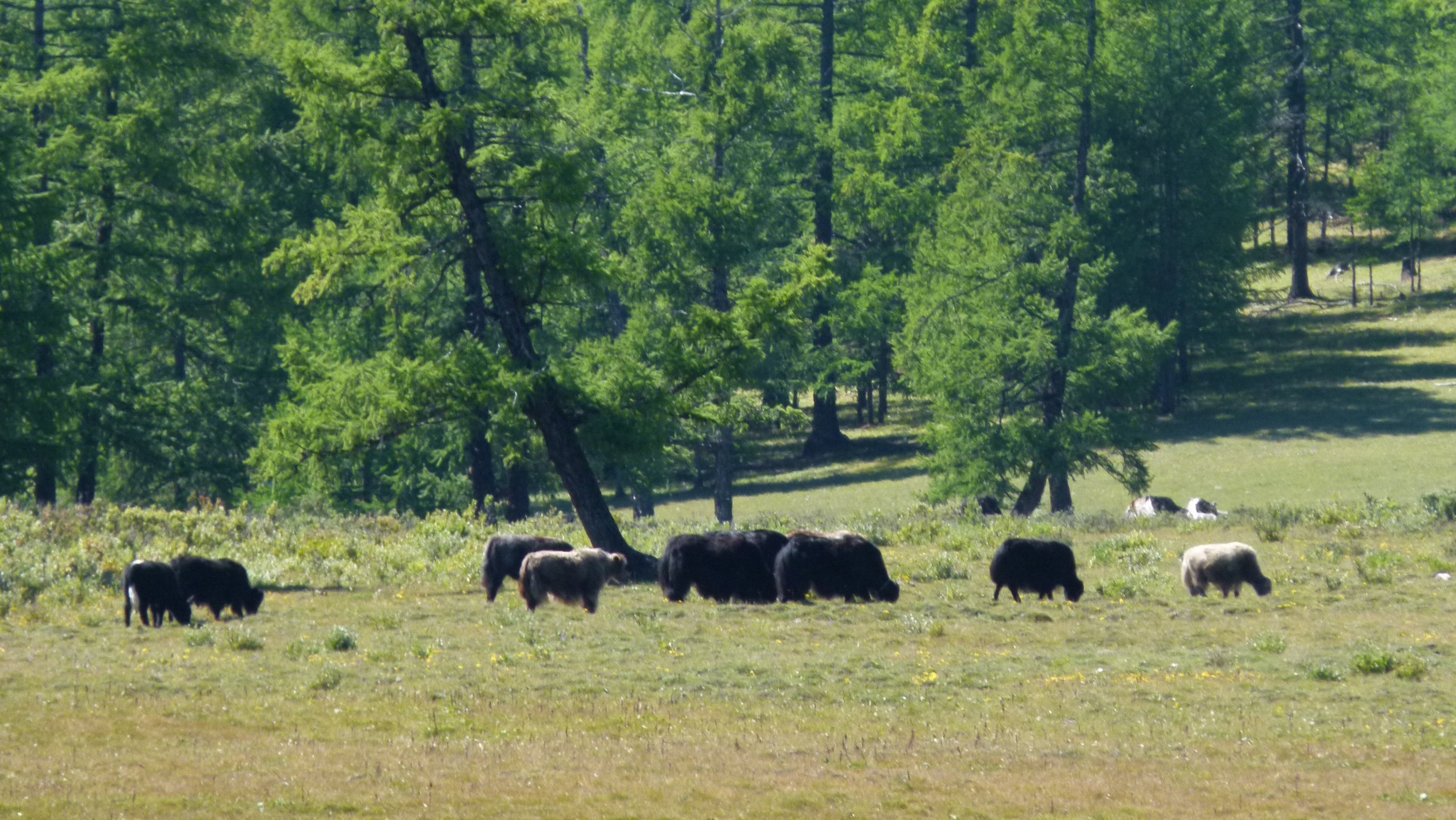
We enjoy the view. Our lunch box is delicious:  Soup, dumplings (bansh) with beef and a cabbage-carrot salad. Then we continue to a pretty swamp field. We share it with a herd of Yak.

image

Back in our ger

Around 3 PM we are back in our ger and enjoy our siesta to recover from our short night in Ulanbaator.

image

Two Swiss in Mongolia – flight delayed

Bad weather in Mongolia?

At 3PM we try to check in to our flight to Mongolia. The information desk at Tegel frowns, cannot find the flight, and then finds out that the flight of Mongolian airlines beeb delayed to tomorrow. The reason: Bad weather in Ulanbataar

Hotel Mercur and another visit to Berlin

Close to the airport there is the Hotel Mercur. It has a shuttle bus. We settle in a room here.  Then we take the bus to Bahnhof Zoo… to visit Berlin. Kaiser Wilhelm Gedächtniskirche – Ursula liked the blue modern church.  The memorial place is open and we learn that they considered to rebuild the church from 1890. S-Bahn to Hacke’scher Markt. We stroll through the Hacke’sche Höfe and we like the Freitag Shop. Then we walk to the Museumsinsel, Gendarmenmarkt and Brandenburgertor. I show once more, where the wall ended separating the two towns, as I have always done for Ernst.

Is the minister so… that he takes the whole plane?

Back at the airport we find out that a minister has taken our flight and that our plane flew to Edinburgh.  When I tell a friend about the Mongolian minister, he asks me: ” Well, does this minister need a full plane for himself?”

Well… let us hope we make it to Mongolia tomorrow, after having enjoyed our short walk through Berlin.

Saying hello to some of my favorite spots in Berlin

On Monday, I walked around Berlin, with the voice of my mum in my ears. As a Berliner, she always warned me not to underestimate the distance that I can walk. “This is not a small town like Basel”, she said, “beware of that.”

From Friedenau to Breitenbachplatz

From my cosy Literaturhotel in Friedenau I walked to Schlossstrasse and through the Treitschke Park (very nice layed back streets where must be good to live) to the Breitenbachplatz. By looking at the map, I expected a footwalk of half an hour, but Mum you are right… it was almost an hour. The Breitenbachplatz is surrounded by houses under monument protection. I met a friend here.

From Breitenbachplatz to Wittenbergplatz

Alfred Grenander was the architect of the U-Bahn or metro in Berlin. He was a very thoughtful architect. Each metro station has tiles in a different color. And at Wittenbergplatz the station is covered by a nice modern style building.

image

I say hello and move on to the top floor of Kadewe, which hosts one of the greatest gourmet food stores I know. It is time to eat.

image

image

I enjoy a delicious shrimp soup from Büsüm (Sylt).

Kaiser Wilhelm Gedächtniskirche

I love the dark blue ambiance in the new church of the Kaiser Wilhelm Gedächtniskirche; due to its shape the church is also called “powder box”. The original church has been left as a ruin, and now it is completely hidden behind scaffolds. Around the church are many, many souvenir and curry sausage kiosks. And the whole Ku’dam area is under construction.

image

image

Hacke’sche Höfe

I take the S-Bahn (town train) and through the window I proudly look at the Swiss embassy that stands in the middle of the German government area (there are rumors that the German government wanted to acquire the land from Switzerland, without success).

Train station “Hacke’scher Markt”. I stroll through the many courtyards of what is called Hacke’sche Höfe and buy ear rings. I love the atmosphere with restaurants, galleries, small shops for jewellery, clothing, soap, and – one of my prefered shops – the Ampelmann (the red and green man in the pedestrian crossing traffic light of Berlin). Ernst also loved this shop and we have a mouse mat from them.

image

Marienkirche and Neptun Fountain under Sankt Ulbricht

A short break of reflection in the quiet Marienkirche and a hello to Neptun sitting on top of his fountain. Both in the shade of Sankt Ulbricht, the TV tower. There is a cross shining on the tower restaurant, when the sun is out. The story goes that everybody called this tower “Sankt Ulbricht”, and the architect tried to convince Ulbricht that this is not a cross, but a “plus” for socialism…

image

image

Construction is going on here as well… “in Berlin wird jebuddelt”. I continue to walk.

To the Schlossplatz and Unter den Linden

What is this? A huge huge hole… it is the hole that the Palace of the Republic has left. There is an information booth called Humboldtbox. Later Antoinette tells me that they plan to rebuild the castle and are now digging out the fundaments.

image

I turn to the German History Museum. For 8€ I stroll through German history until 1918. Well curated. There are panels giving a brief overview of the period and next to it, there are the artefacts from the time or pictures and later fotos about it.

Destroyed diversity also has a special exhibition. I always feel ashamed for my German roots, when being reminded of what happened 80 years ago: The propaganda, the denunciation of those being perceived to be different and then the subsequent mass executions. I came across Carl Peters who had been integrated in the national propaganda, as he had founded the East African colony (though he died in 1918). The Nazis made a film about him in which the former Askari from Kenya, Bajume Mohammed bin Hussein, fought on the side of Hans Albers. Shortly afterwards he was arrested and died in the camp.

Hello Alter Fritz

I stop by at the monument of Friedrich the Great in Unter den Linden, greet him and apologize that this time I will not visit him in Potsdam and in his pretty castle Sanssouci.

image

A quick glance at the Brandenburgertor

image

… and then I take the S-Bahn back to Friedenau. My mum was always proud of the S-Bahn that proves the vision of the government of Berlin in the early 20th century… it allows to overcome the large distances in Berlin efficiently (much quicker than by walking).

Literature and destroyed diversity – 80 years ago in Berlin

image

The French and German Cathedral on the Gendarmenmarkt

The Gendarmenmarkt is one of my favorite spots in Berlin. Memories are tied to it. Around 1966, there were three black ruins here, and my mum (she knew the past beauty of this square) was very sad. When I came back in the 90’s, the cathedrals were beautifully restored. Ernst and I visited the museum about the Huguenots that Friedrich the Great had welcomed in Berlin. The French Cathedral was for them. Back later again… with Ernst in the Konzerthaus. And today, Antoinette takes me to the French Cathedral. Two priests are reading about the diversity in literature that has been destroyed 80 years ago (Dr. Jürgen Kaiser and Dr. Matthias Loerbroks). Here are two thoughts that I took with me.

Berlin and Babel – both striving for unity and destroying diversity

Berlin 80 years ago and Babel in the bible have similarities. Both towns longed for unity… unity of language, unity of thought, unity of the peoples, unity of art, unity of architecture (symbolized by the one tower of Babel). Yes, unity is easier to handle than diversity which is complex. But the bible condemns such unity and says that destroying diversity is sinful. Diversity is what the bible asks for… diversity is, the priests say, what God wants. But 80 years ago Berlin became a second Babel and destroyed diversity. Sorely, the priests admit that the church then supported the destruction of diversity.

Written text can be destroyed, but not the words (and thoughts)

80 years ago Berlin burnt books that did not conform to the unity of thought, not far away from the cathedral. The bible describes a similar burning of books. In Jeremias 36, God asked Jeremias to write down the history of Israel and Juda. The text was read out to Jojakim, the king of Juda. He cut the written text into pieces and burnt it. But Jojakim could only burn the written text, not the words. Jeremias wrote them on paper again. Similarly burning books in Berlin just destroyed the written text, but not the words and thoughts.

The devil in Bulgakow’s “Master and Margarita”

Master burns his book about Pontius Pilatus that had not been accepted for publication. Towards the end of this wonderful story, at the devils’ party, the devil Voland pulled Master’s book from the fire and says that his manuscripts cannot be destroyed. Did Bulgakow have Jeremias 36 in mind, when he wrote this? And, I understand, that this was a hidden hint to another ruler who tried to destroy diversity.

Dr. Kaiser invited the community into the garden of the parish hall in Taubenstrasse, where barbecue, salad, water, cake and coffee were waiting for us in the warm sun. We all sat together and chatted. Now, Dr. Kaiser will read “Master and Margarita” – his organist (from the former GDR) promised to lend him his copy and confirmed enthusiastically that it is worth reading.

image

image

Zum Schwiizer in Zeesen, south of Berlin

Jo dö könned mir jo gly Schwyzerdüütsch rede “Ahm, then we can speak Swiss German right away,” the charming young lady says, as she hears our first words. Antoinette and her husband had taken me into the restaurant “zum Schwiizer” in Zeesen, some 40km south of Berlin. We sit in a nice garden in the warm sun, and obviously Antoinette and I could not hide where we are from. The owner welcomed us in Swiss German. We order Läberli (liver) and Zürigschnätzlets (meat cut into strips in cream sauce) with Röschti (similar to hash browns) and e Gmüeswäie (vegetable pie). We also take Valser Wasser (mineral water from Vals in the Swiss mountains) and Rivella (is made from milk serum and is a drink invented in Switzerland in 1952).

The Swiss quiz

While we wait for our dishes, we smile about this quiz which we found on our table… it contains questions such as

  •  which of these dishes do not contain potatoes: Hääperebrägu, Rüeblitorte, Gschwellti, Härdöpfustock (it is “Rüeblitorte” that contains Rüebli or carrots, but not potatoes).
  • or translate please: Jetzt faart dä Löli uf em Troittoir, derbii schtoot e Tschugger hinterem Egge. (Now this idiot runs his bike on the pedestrians’ walk, but there is a policeman behind the corner).
  • or which of these products have not been invented in Switzerland or by a Swiss? The two stroke engine, democracy, the zip fastener, Chevrolet cars, the bicycle chain, the PC mouse, LSD, aluminium foil, the velcro fastener, the turbo charger, the spam and the LCD display? Answer: The spam – and I somehow think this is not a product, but a nuisance… or did they mean Spiced Pork And Meat – canned precooked meat?

Antoinette’s husband rolls his eyes, as also Germans have a hard time to understand the Swiss dialects. We enjoy our very Swiss experience here close to Berlin. We can recommend this restaurant & pension which is just near the regional railway station of Zeesen with a direct connection to the city center of Berlin (website http://www.zum-schwiizer.com). The young couple running it met in Switzerland, he being from Berlin and she from the Swiss canton of Thurgau, and they decided to start their own business here.