On the road: Following Romanesque and Gothic heritage in Oberbayern

In August 2020, I spend four days in Upper Bavaria with my long-time friend from Munich. The weather is very rainy and we take the opportunity to learn about the cultural heritage of Bavaria that goes back to Romanesque and Gothic times: The church of Sankt Georg at Ruhpolding, the chapel of Sankt Servatius auf dem Streichen, Sankt Valentin at Zell (part of Ruhpolding), Sankt Nikolaus at Einsiedl.

Source: Googlemaps


Ruhpolding: Church of Saint George

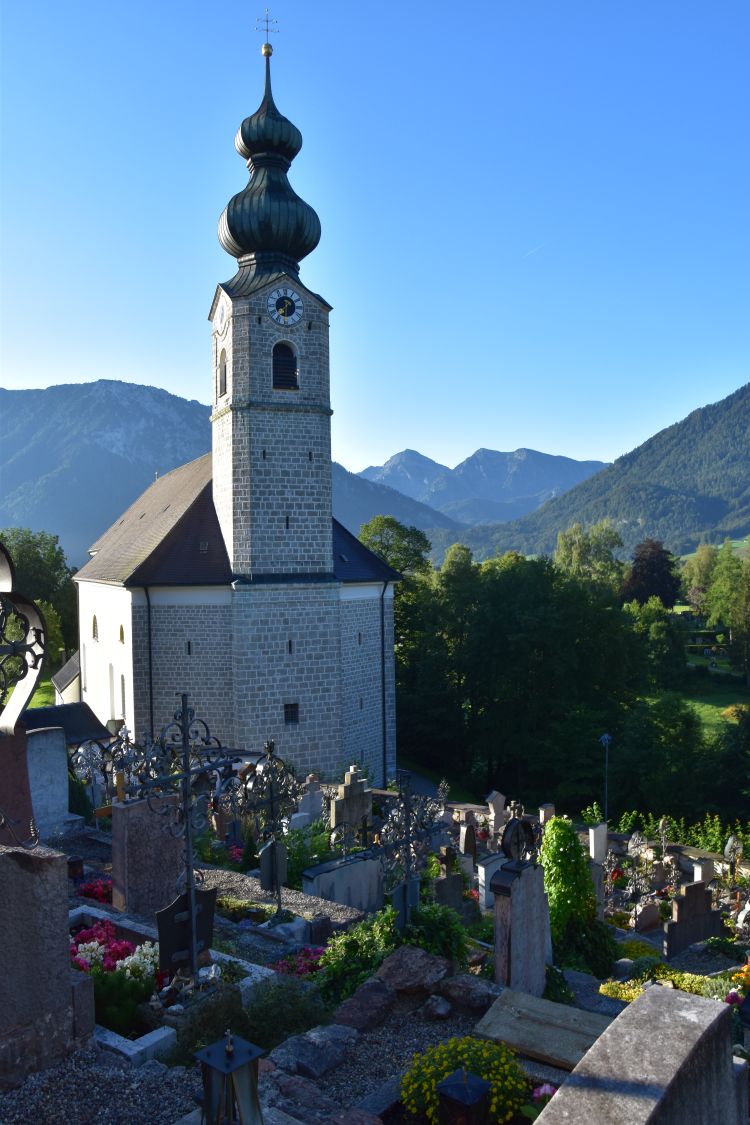
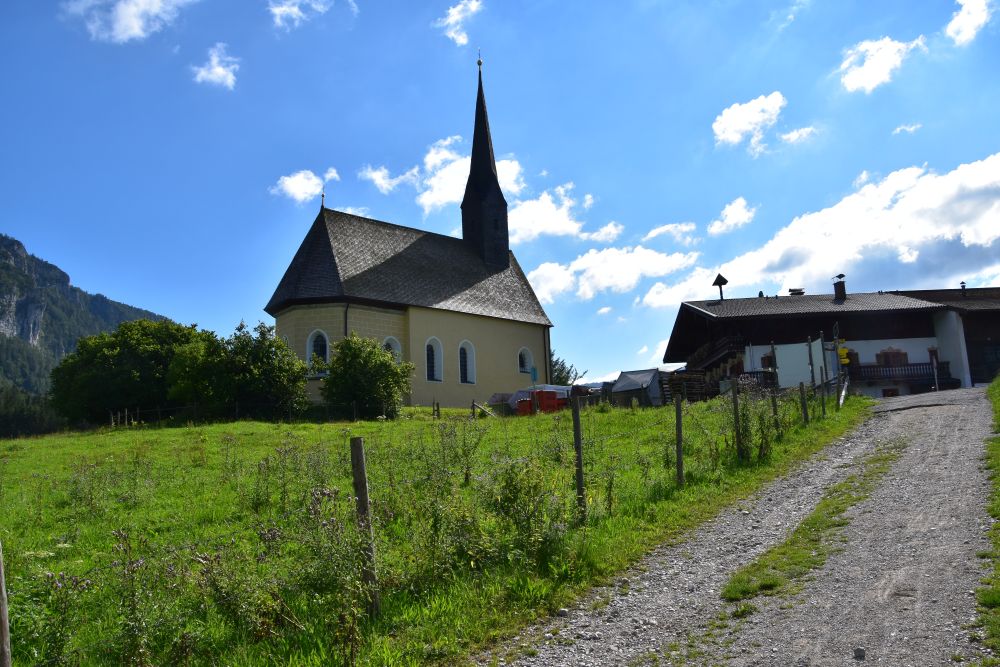
Not far from our hotel is the Church Saint George, nicely located on a hill above Ruhpolding. After the rainfalls, when the sun has returned on the last day of our vacation, I take this photo with the Sonntagshorn in the background.

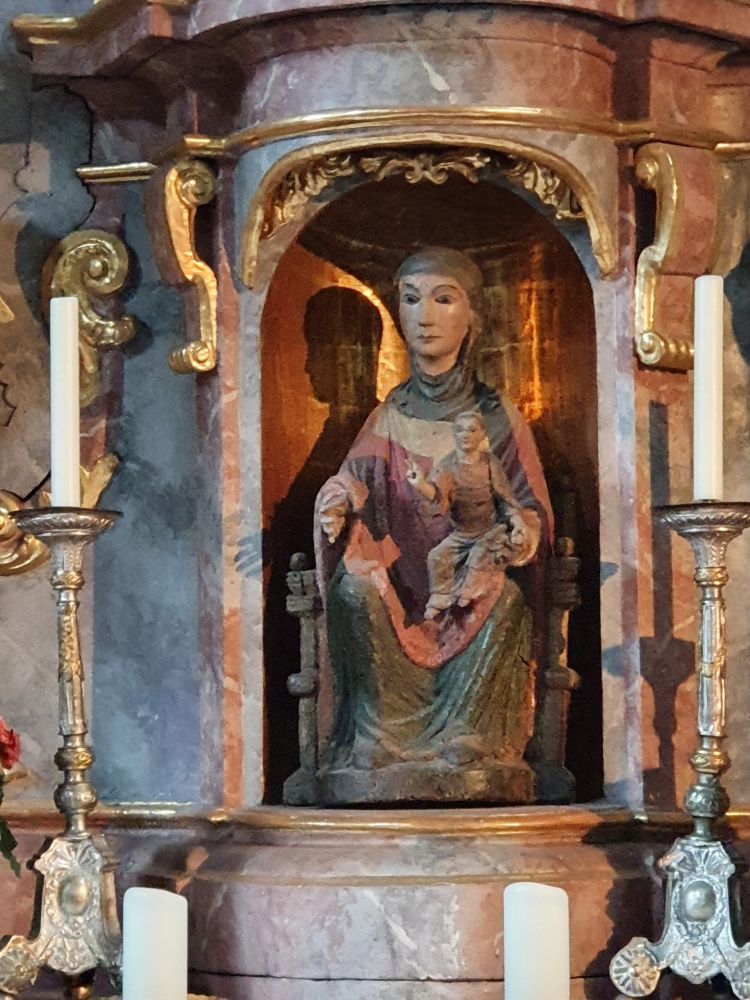
This church has the typical Bavarian Baroque or Rococo appearance, whereby the right-hand altar embeds…

… the beautiful Madonna with the Child from between 1190 and 1230.

The people from Ruhpolding call her proudly the “Ruhpoldinger Madonna”.


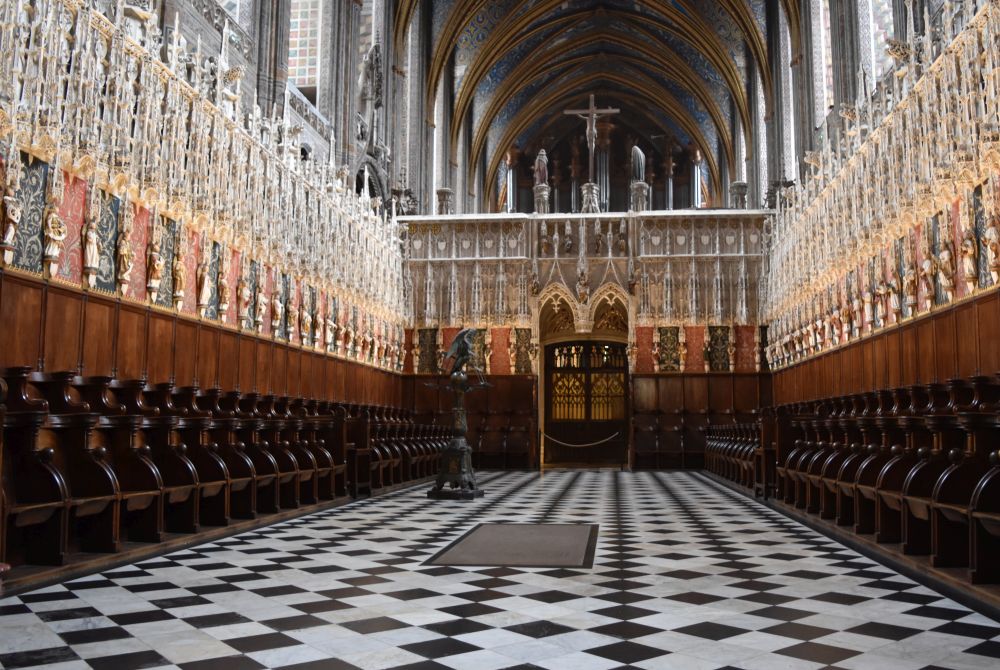
Chapel Sankt Servatius auf dem Streichen

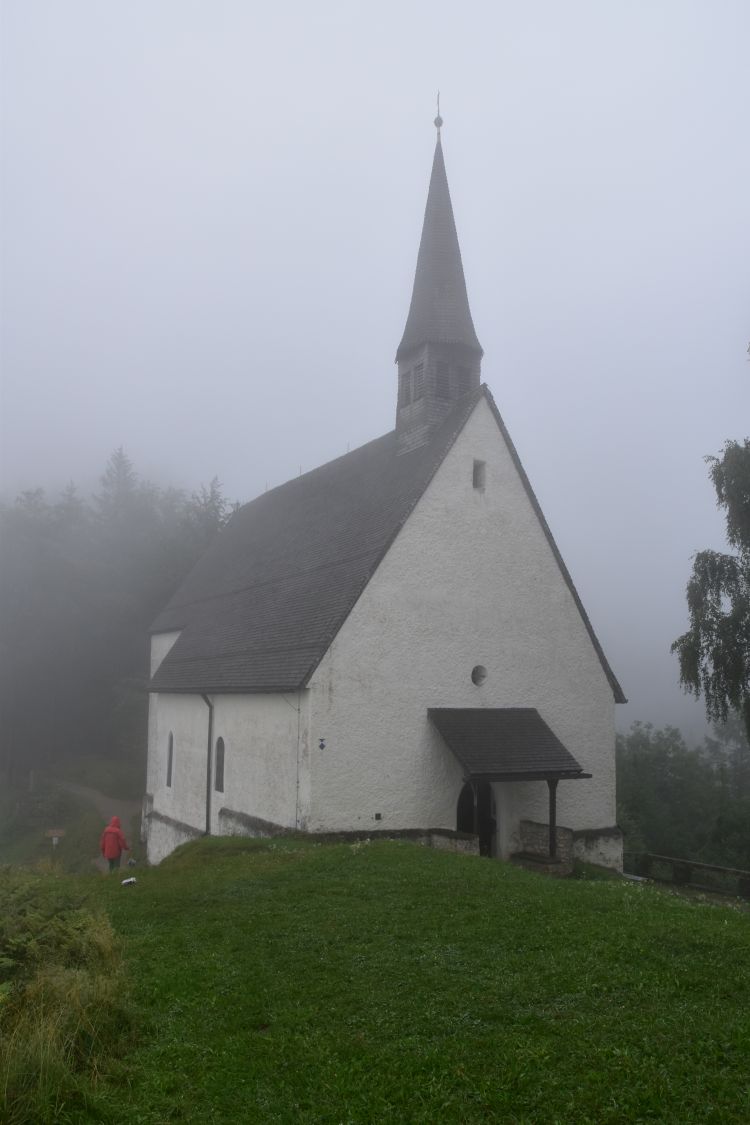
It is drizzling, when we park our car close to the border between Bavaria and Austria, above the Schlechinger Tal. In the misty forest we walk uphill to the Chapel Sankt Servatius auf dem Streichen, located on a path for traders that transported goods from Bavaria (Unterwössen) to Tirol (Kössen). The attribute “auf dem Streichen” alludes to the trading traffic: “Streichen” is an older word for “Säumerpfad”, and “Säumer” or “Streicher” are the people transporting goods; “Säumerpfad” translates as mule track – the Anglosaxons seem to think of the mules on such  tracks.

Saint Servatius is an unusual patron in Bavaria. He was a bishop in today’s Netherlands (Maasland) that died in 384.

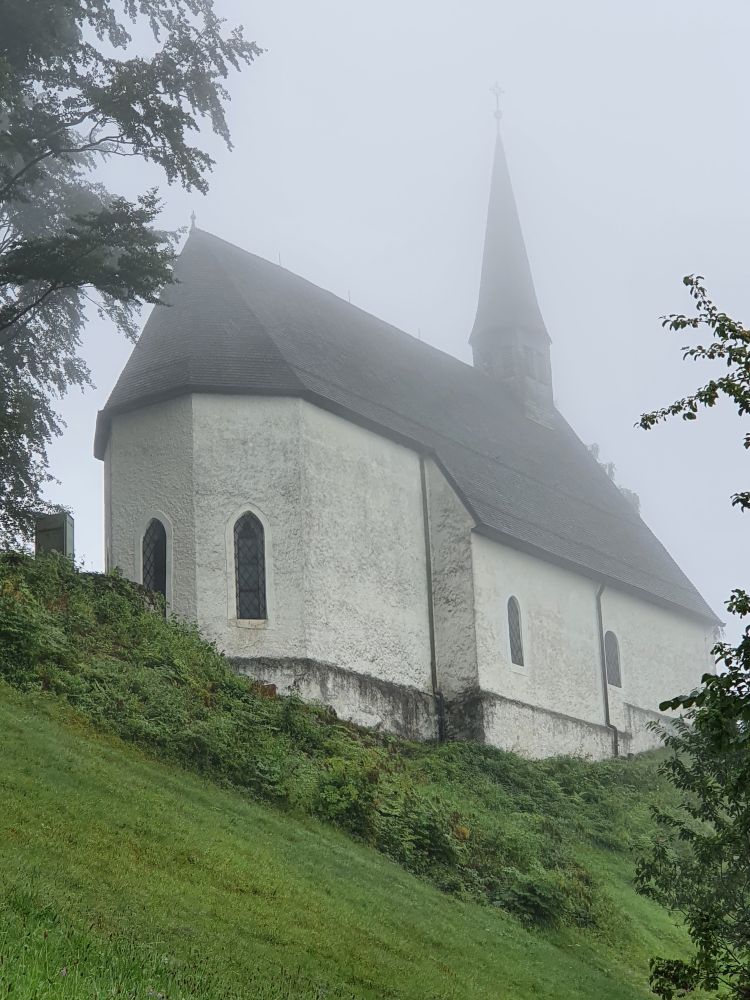
We reach our chapel Sankt Servatius in the mist. It is a mysterious atmosphere.

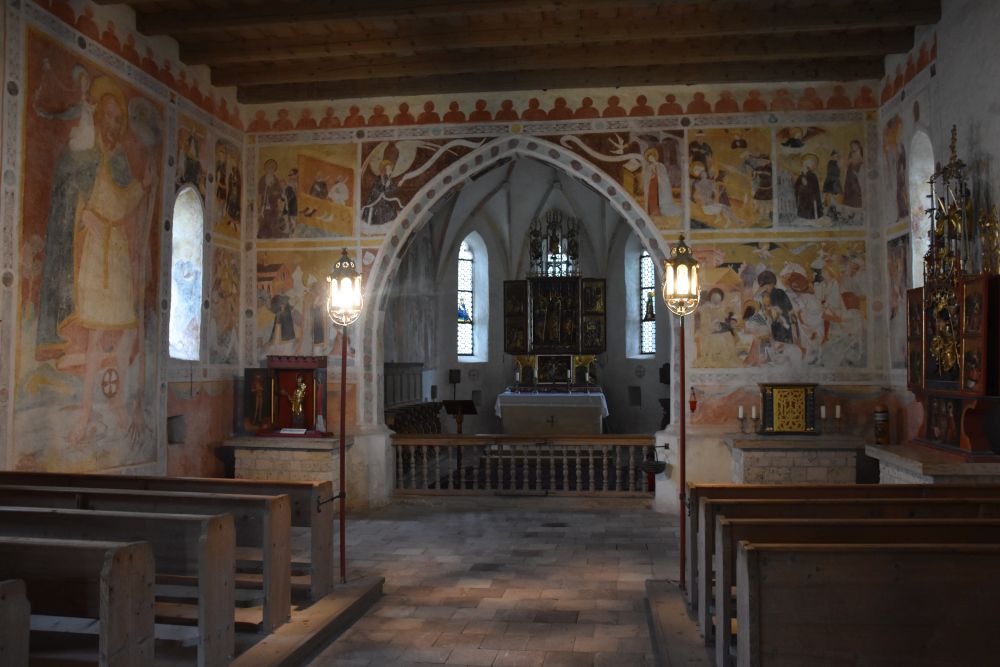
The booklet of the chapel, edited by Schnell and Steiner, assumes that the nave has been constructed in the 13th century, though the first records of the church appear only in 1440. At that time, the apsis was replaced by the more spacious choir with the rib vaults that we see today. In addition, the chapel was then decorated with frescoes that, with some changes in the 16th century, have been preserved under whitewash. It was a cultured and art-minded priest that initiated the uncovering of the frescoes in 1943/44. The stepwise renovation of the chapel was completed in 2014. Most of the windows in the choir are the originals; the glass roundels have been preserved.

An iron grating prevents visitors from entering the nave. We look at the precious frescoes of the nave from behind the grating. Above the entrance to the choir, I discern the annunciation scene with Maria and the Archangel Gabriel. The next fresco to the left shows Saint Leonhard, patron of the prisoners, with two prisoners whose feet are fixed in a block. Below, to the right hand side of the choir, the three Kings are visiting Christ after his birth. The writer of the booklet edited by Schnell and Steiner is of the opinion that this is the most precious fresco of this church.

There are more frescoes in the choir, on the wall separating the choir from the nave. One of them illustrates the Last Judgment. We cannot see them.

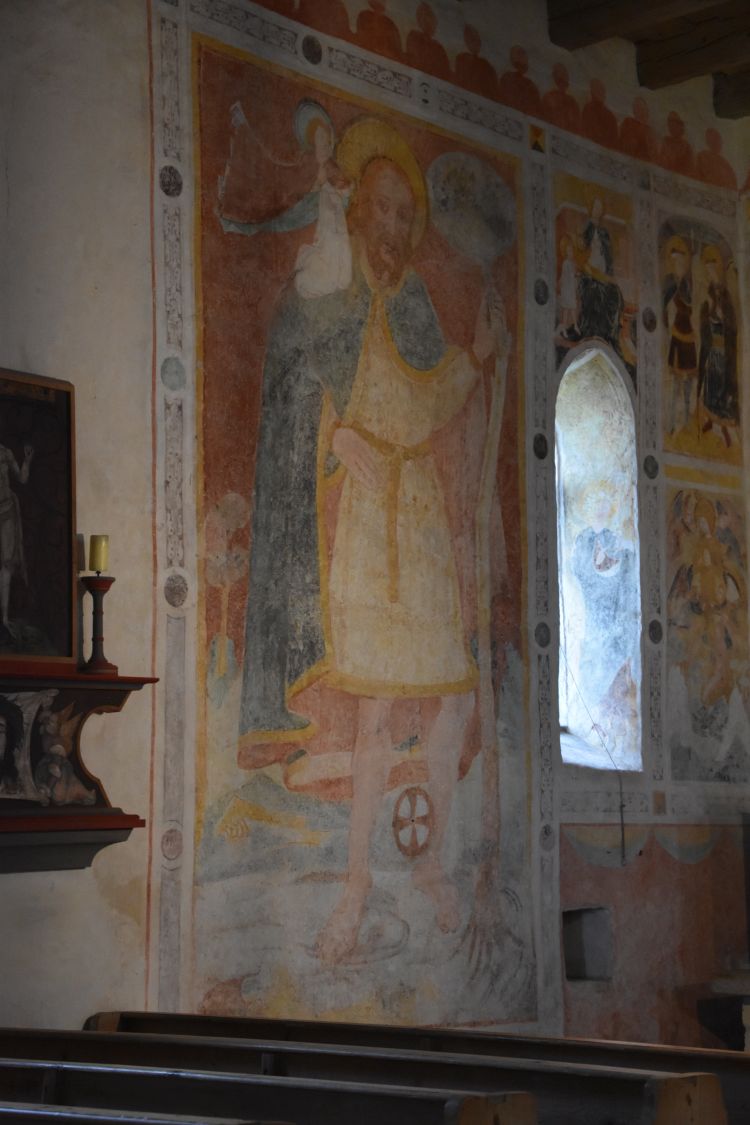
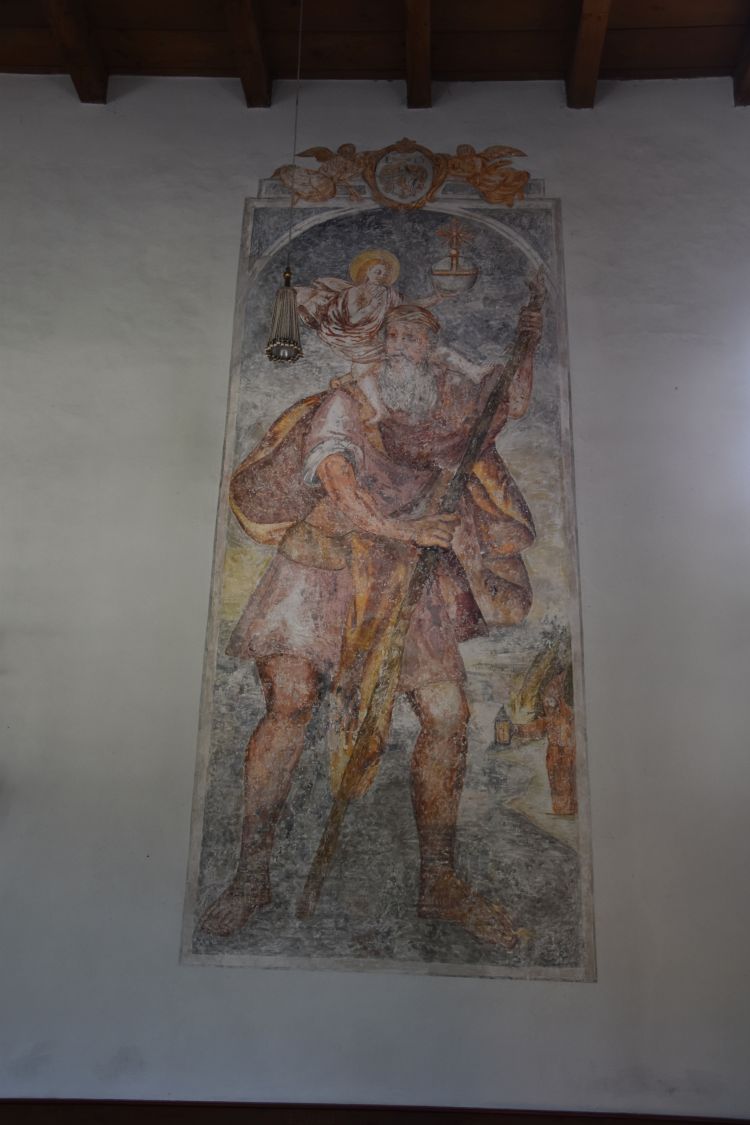
Saint Christopher greets us from the sidewall; Jesus child sits on his shoulder becoming heavier and heavier. Christopher is the patron of the travellers, ready to be invoked here by those who once transported goods across this pass.

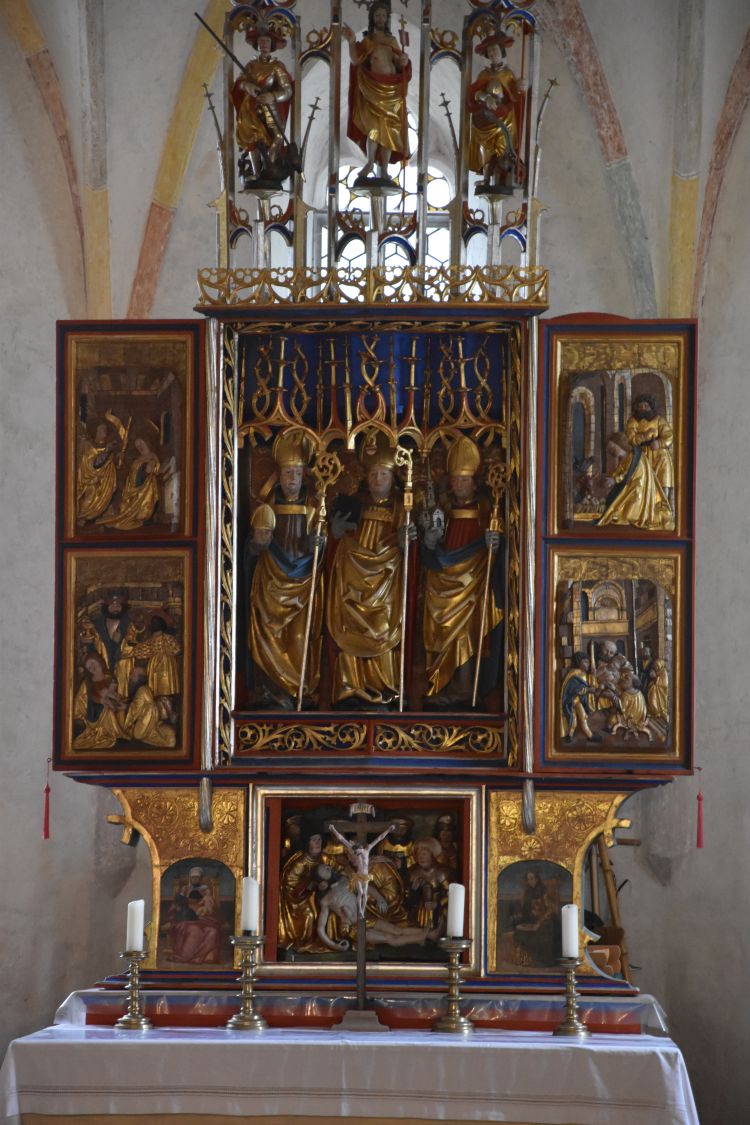
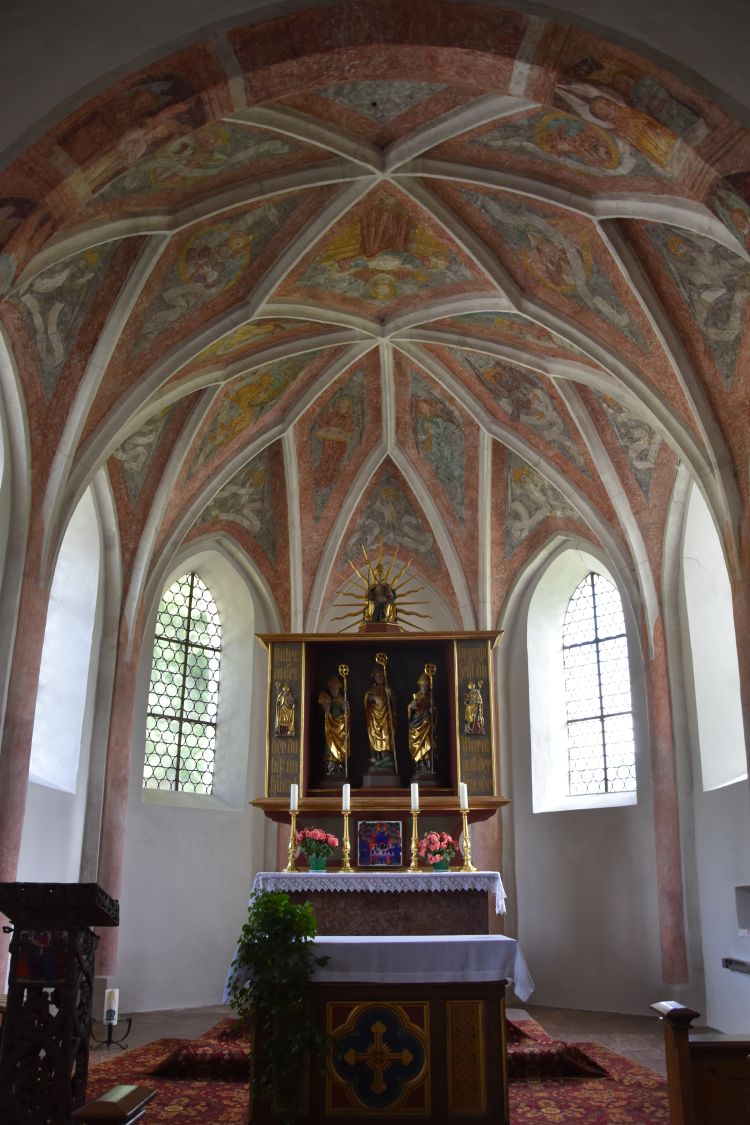
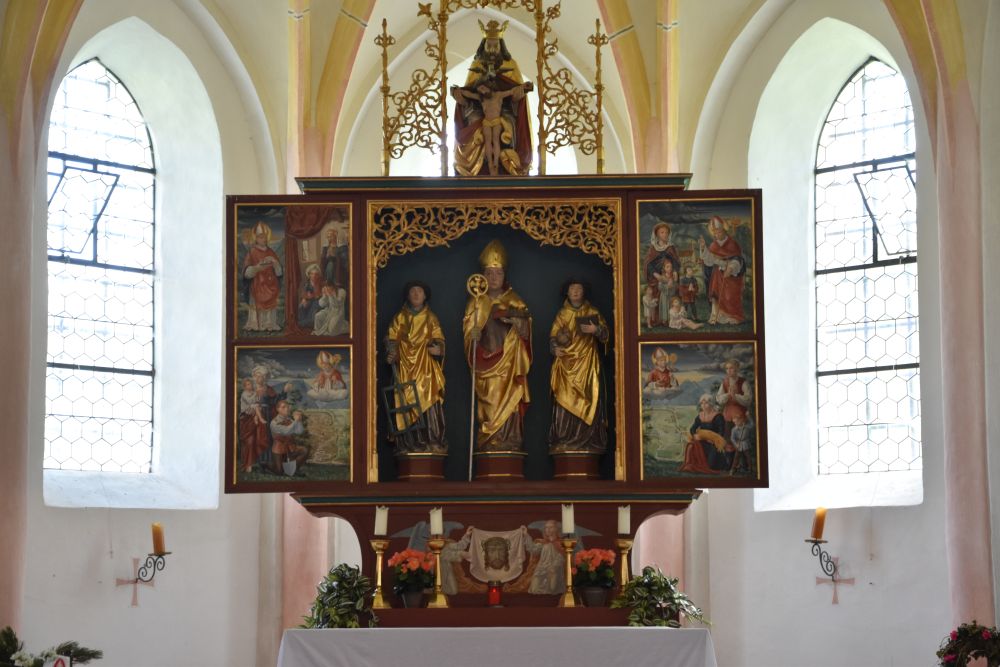
The altar in the choir was created in 1524. Saint Servatius is flanked by Saint Dionysius and Saint Wolfgang. It is interesting that Saint Dionysus or Saint Denis carries his head in his hands, but also has a head where it belongs. In Paris, he just has that one head in his hand, whereby sometimes the nimbus is around the head on his hand, sometimes above his headless body; he was bishop of Paris and was decapitated in the third century. Saint Wolfgang was bishop at Regensburg in the 10th century.

This small box altar (to the left of the choir, 1400) is deemed to be the most precious piece of art in the chapel. Only two of the eight figures can be seen, Sebastian (with the arrows) and Laurentius (with the grill). The figures are graceful, the style is called “soft gothic”.

We enjoy this lonely solemn place in the middle of the forest and say farewell.

Below the chapel, there is a mountain inn that is closed today.


Ruhpolding/Zell: Sankt Valentin

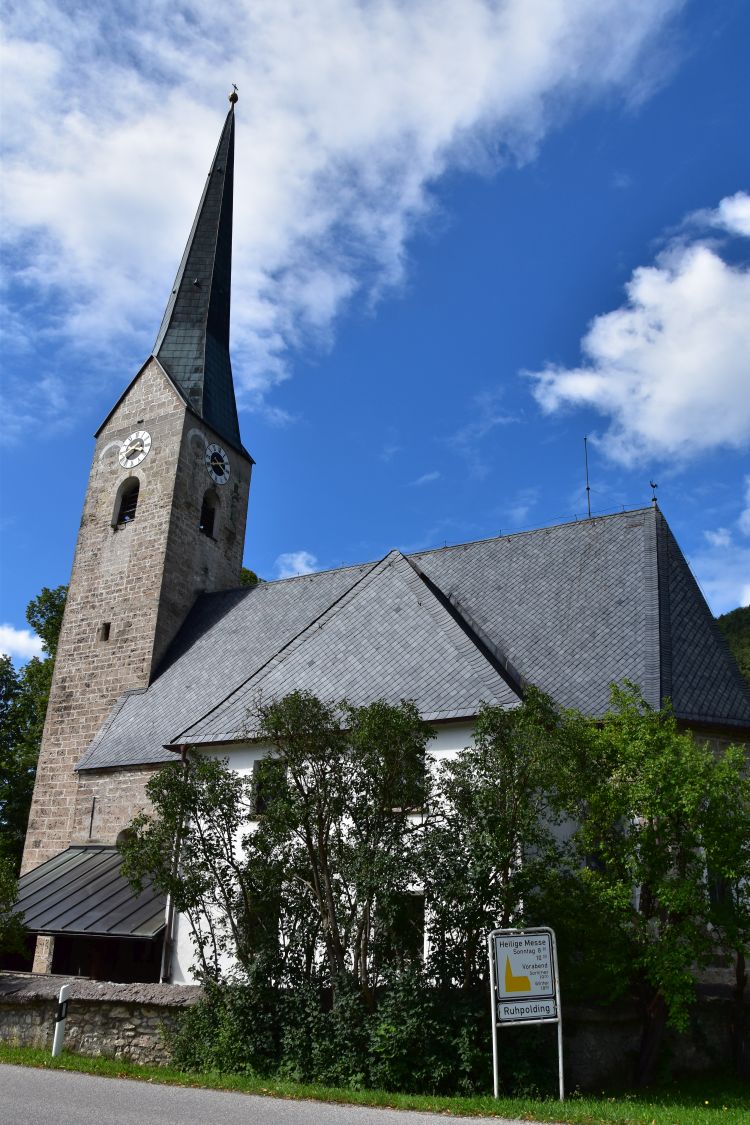
Ruhpolding and Zell have been unified to one village. Zell is proud of their church Saint Valentin.

The frescoes in the gothic choir are from 1450. They have been uncovered in 1955. Christ is in the middle.

In the altar we can see Saint Valentin in the middle, Saint Dionysus to the left (again with his second head in his hand like in the Streichen chapel) and Saint Conrad of Konstanz (his typical sign is the cup) to the right. In the wings are Saint Augustinus and Saint Zeno (the latter we have already met at Bad Reichenhall).

Looking back at the gallery with the organ, we can see the wooden ceiling that is still the original. the brochure says.

Also the church Saint Valentin has its Saint Christopher; the fresco is baroque, from the 17th century.


Einsiedl: Sankt Nikolaus im Oberland

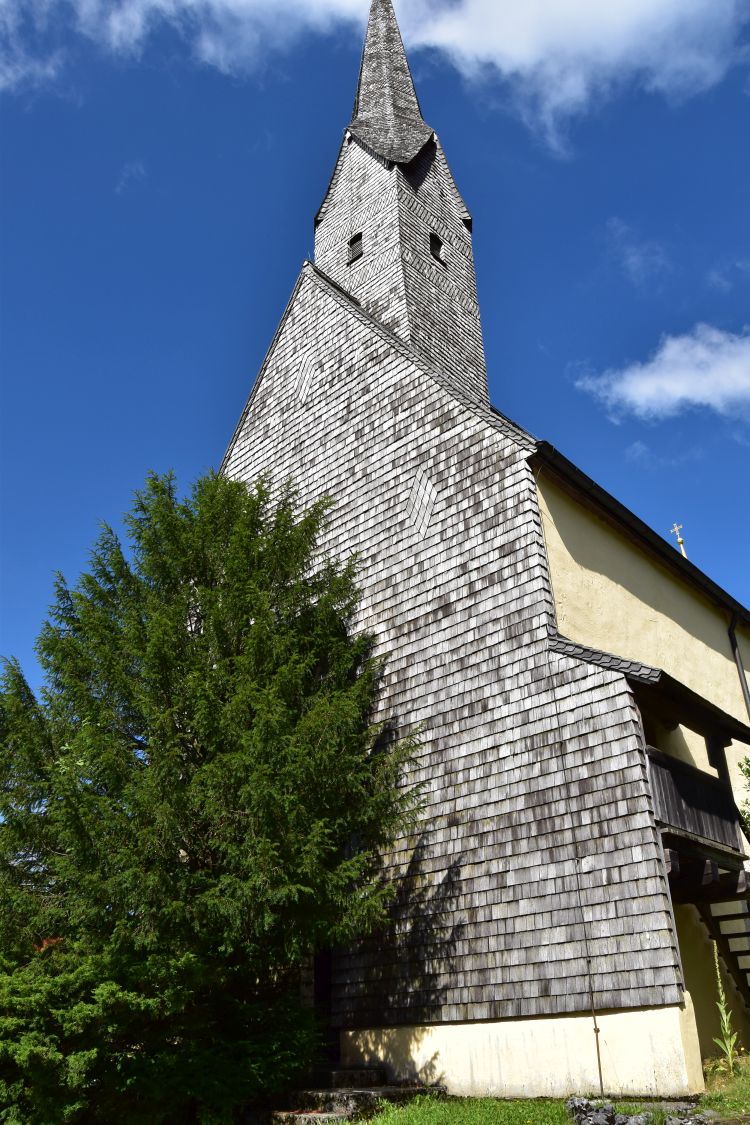
On our third day, the sky is brightening up, and we go for our first hike. We visit the nearby small church Sankt Nikolaus im Oberland in the hamlet Einsiedl. The church was built around 1200. Legend tells that a duke serving Barbarossa fought war against Salzburg and destroyed the city. This was too much. He should not have destroyed the city. Barbarossa banned him and sent him to this lonely place, where the duke built the small church dedicated to Saint Nikolaus and a farm.

The farm is called “zum Einsiedl” and the family living here looks after the church. The owners have a talent to cultivate flowers.

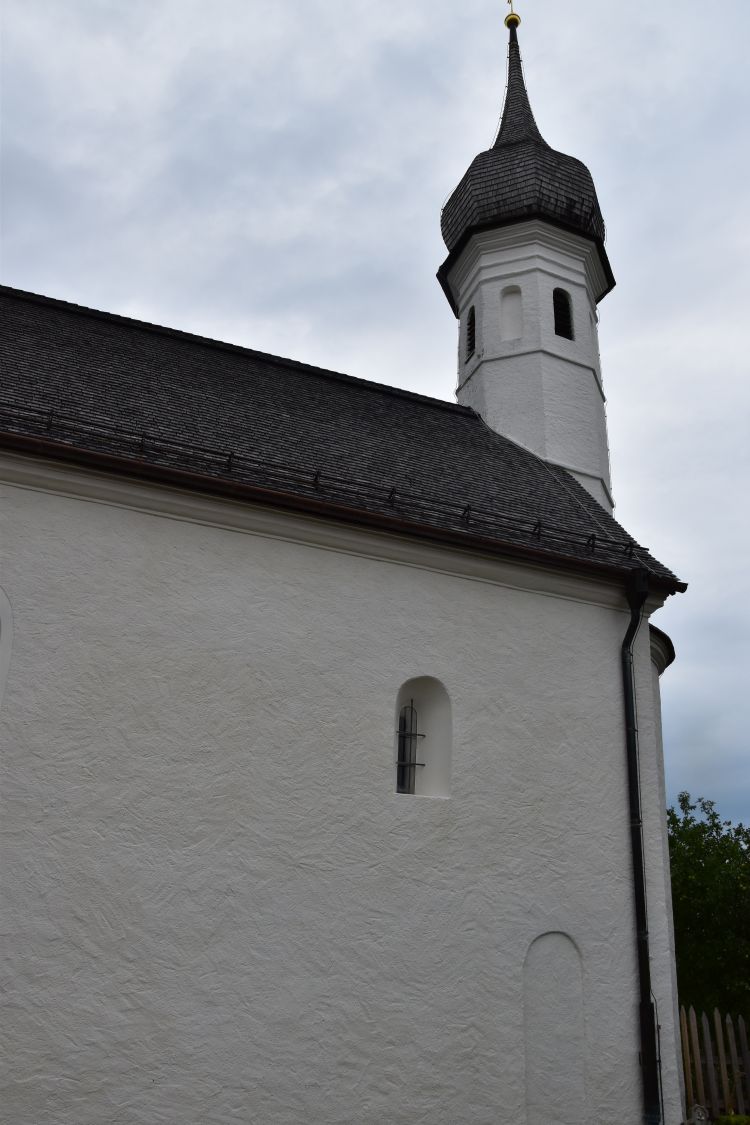
Wooden shingles cover the roof, the tower and one side of the church building.

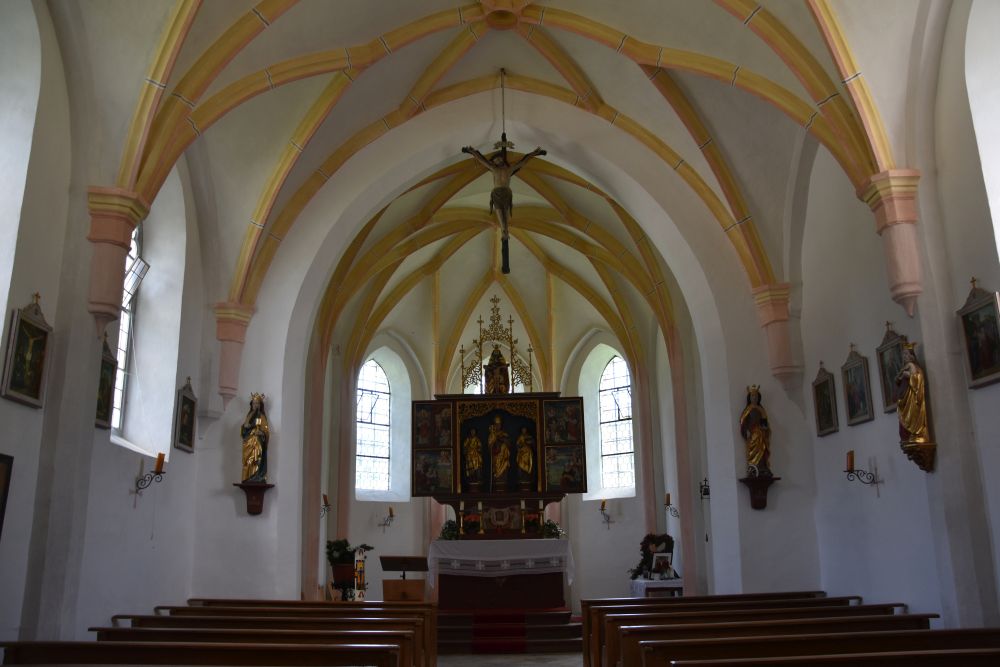
Inside the church shows its original gothic habit.

In the altar from 1940 are a figure of Saint Nicolas (around 1700) and Stephan (to the right) as well as Laurentius with the grill (to the left, both early 16th century).

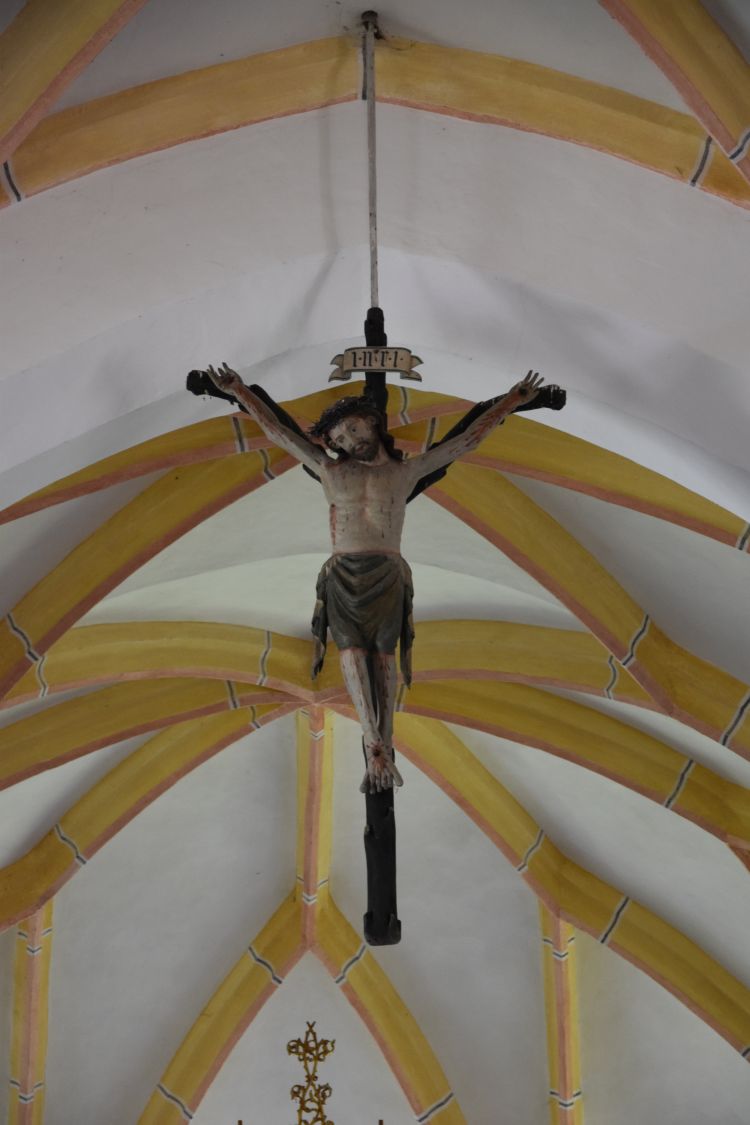
The cross in the arch to the choir has been created in the late 14th century and renovated in 1997.

The booklet by Heinz Scholz mentions the old window from 1420 showing the Annunciation and the birth of Christ. We look for that window everywhere. We see a coloured window near the entrance to the church. My friend looks through the key hole of the entry on the gallery, but no, this is not this window. What has happened to this treasure?

Or have we just not been able to find it? Perhaps we should have asked the farmer? We will do so the next time.

This ends our tour discovering cultural treasures in and around Ruhpolding. On our last evening in Upper Bavaria, we enjoy the sun set from Maria Eck.

And on our fourth and last day in and around Ruhpolding we climb the Unternberg with a magnificent view of Ruhpolding.

We say good-bye to Ruhpolding and, after a swim in the small and chilly Tütternsee, we return to the traffic jams of Munich to celebrate the sixth wedding anniversary in the restaurant with the Venetian name “Canal Grande”.


Sources:

“Ruhpolding”,Verlag Schnell und Steiner Regensburg 2002
“St. Servatius auf dem Streichen”, Verlag Schnell und Steiner 2017
Heinz Scholz, “Pfarrkirche St. Michael, Inzell”, A. Miller & Sohn Traunstein 2004

On the road: Thoughts about Corona in Oberbayern (Upper Bavaria)

In August 2020, we spend a four day vacation in and around Ruhpolding in Oberbayern (Chiemgau). It has been the first time since the start of the pandemic that I am staying in a hotel, going for shopping and eating in restaurants every day.

Tourists are back in Oberbayern (Upper Bavaria). The hotels seem to be well booked. But the atmosphere has changed. The tourists are primarily Germans, except for a few Dutch, a few Englishmen and a few Swiss (besides me).

In shops, we have to wear masks. Some shops take great care, have installed separate entry and exit doors, restrict the number of clients inside and offer disinfectant. In these shops, I feel safe to do shopping. Other shops are careless: Entry and exit are not separated, many clients crowd between narrow shelves. Such shops I leave out.

In restaurants, we have to put on our masks, when moving away from our table and the waiters also wear masks (or vizors).  While some waiters follow the rules carefully, others do not cover their noses with their masks which makes it all useless. In our hotel, there is no breakfast buffet. Instead we have to indicate on a list, what we want for breakfast, and in the morning, we receive everything on a tray. The bar is lonely, the jolly barkeeper of last year has left the hotel.

Some beach places at the lakes are crowded, while others allow to keep distance, and the personnel respects the rules. We particularly enjoyed our swim at the small and less well-known Tüttensee with the friendly and corona conscious personnel and with corona aware guests.


The Bavarian language gives orders a friendly touch

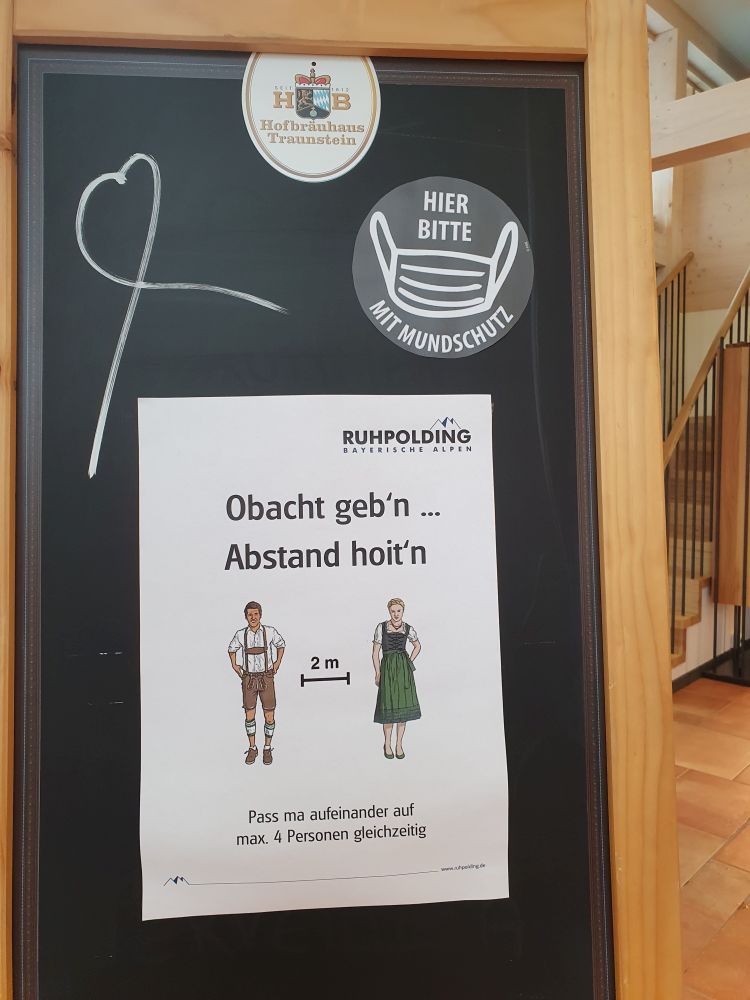
In a restaurant in Ruhpolding, I found this invitation to pay attention and to keep distance. “Obacht geb’n” means “pay attention” (“Obacht” = “Achtung” or “attention”).  “Abstand hoit’n” stands for “keep distance” (“hoit’n” means “halten” or “keep”). And, of course, you have to wear the mask inside (“hier bitte mit Mundschutz”).

In this restaurant, guests are invited to come in (“kemmt’s eina”) and the invitation to keep distance is kept in “normal” German (“bitte Abstand halten” = “please keep distance”).


Touching testimonies of children about the pandemic

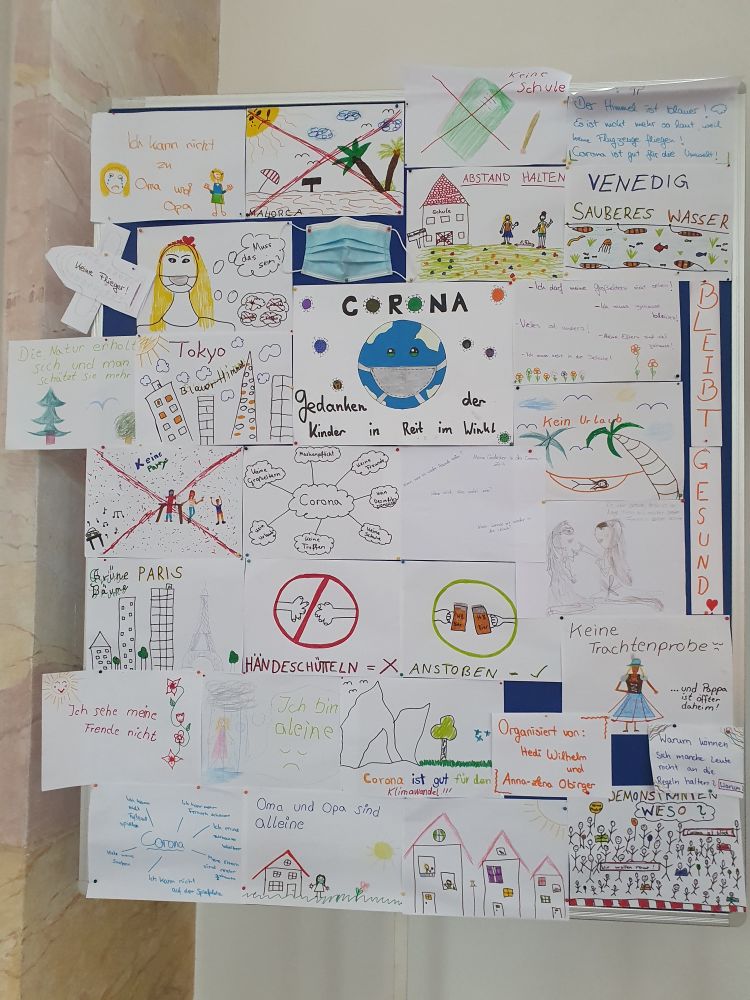
In the baroque church St. Pankratius at Reit im Winkl, we come across these thoughts about the pandemic written down by children.

Let us zoom in some of the testimonies.

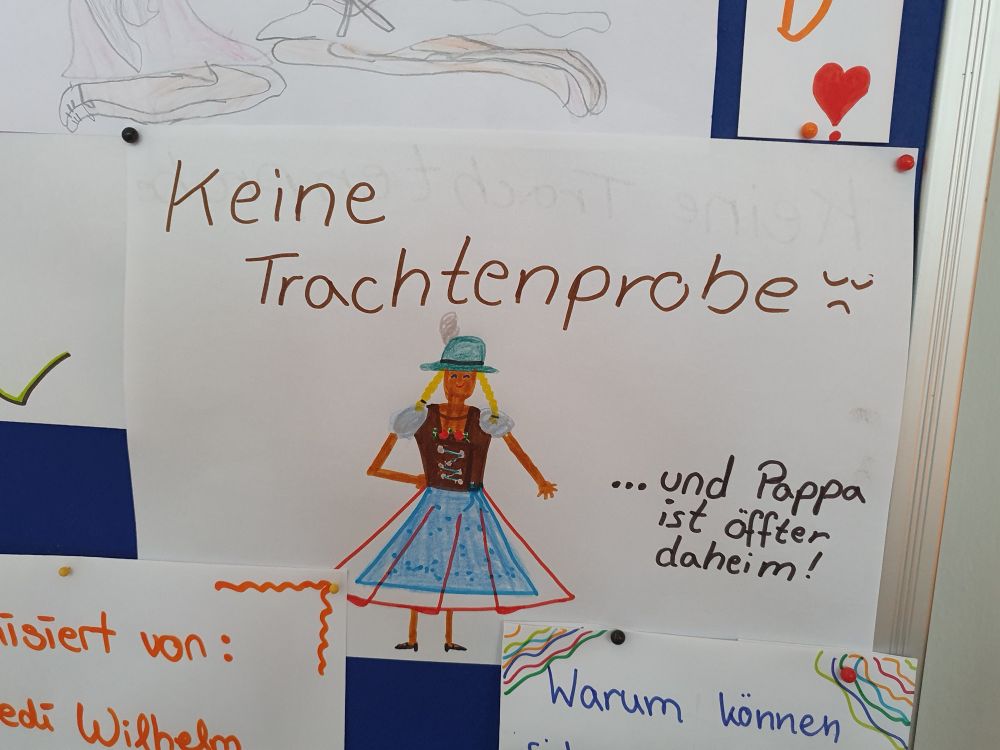
“Keine Trachtenprobe” means “no trying on traditional costumes”… and “und Pappa ist öffter daheim” translates as “and papa is at home more often”, whereby “ff” in “öffter” emphasizes “öfter” (“more often”) and also “pp” in “pappa” makes him more present. Children have their own spelling rules to express their feelings.

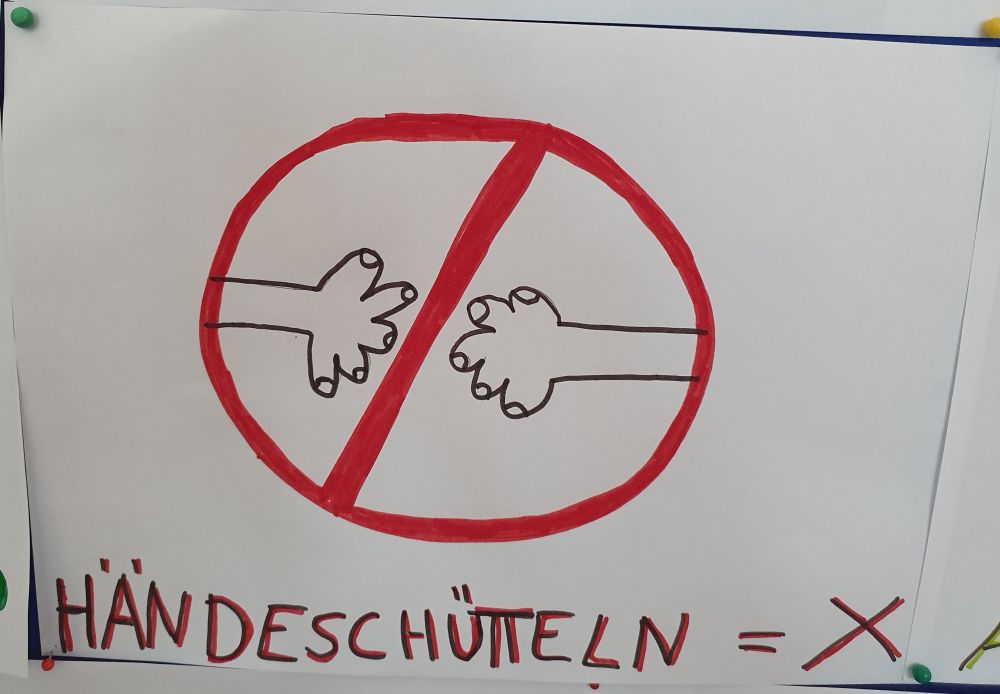
“Händeschütteln” or “shaking hands” is obviously forbidden.

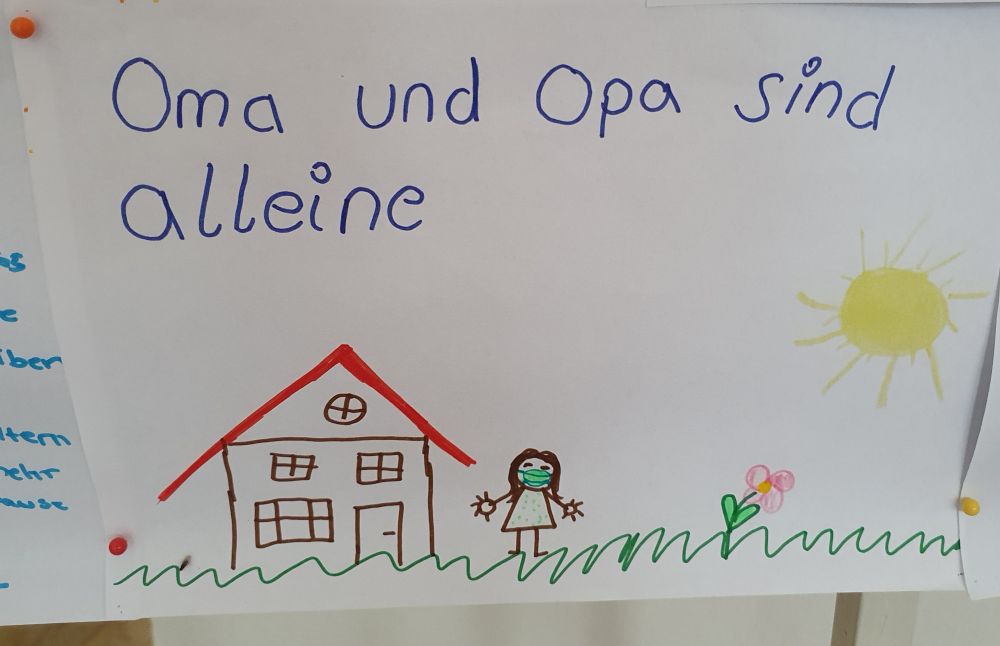
“Oma und Opa sind alleine” – “grandma and grandpa are alone”. The girl has to stay outside the house of her grand-parents, how touching. She is even wearing a mask.

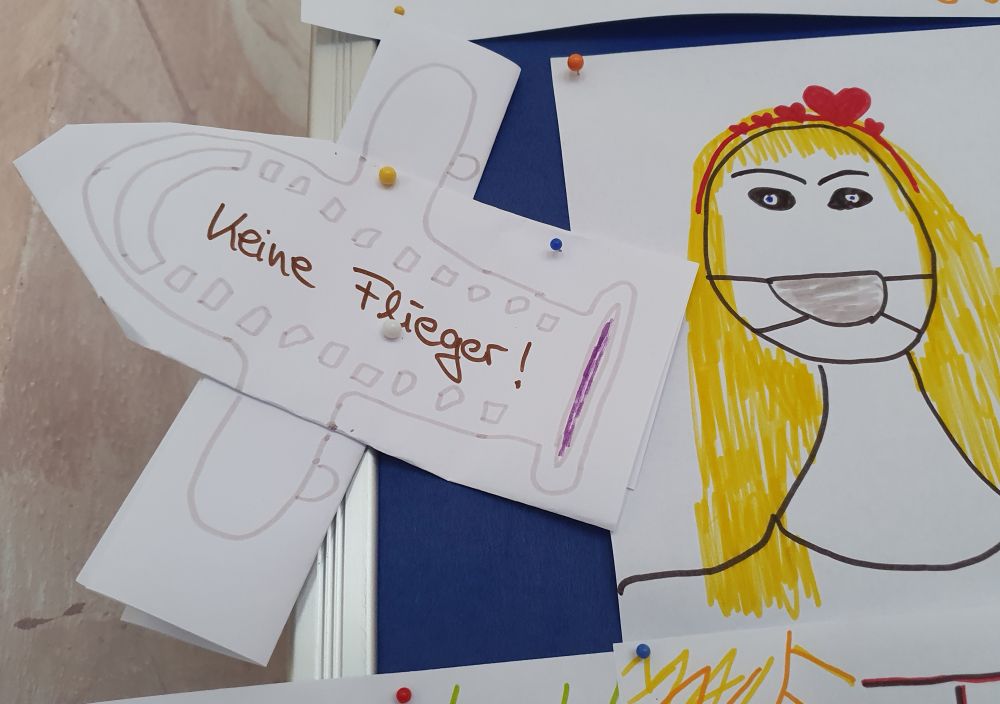
“Keine Flieger” – “no airplanes”. Yes, the sky has become much more quiet. The girl wears a mask and holds her hair back with a beautiful ribbon decorated with hearts.

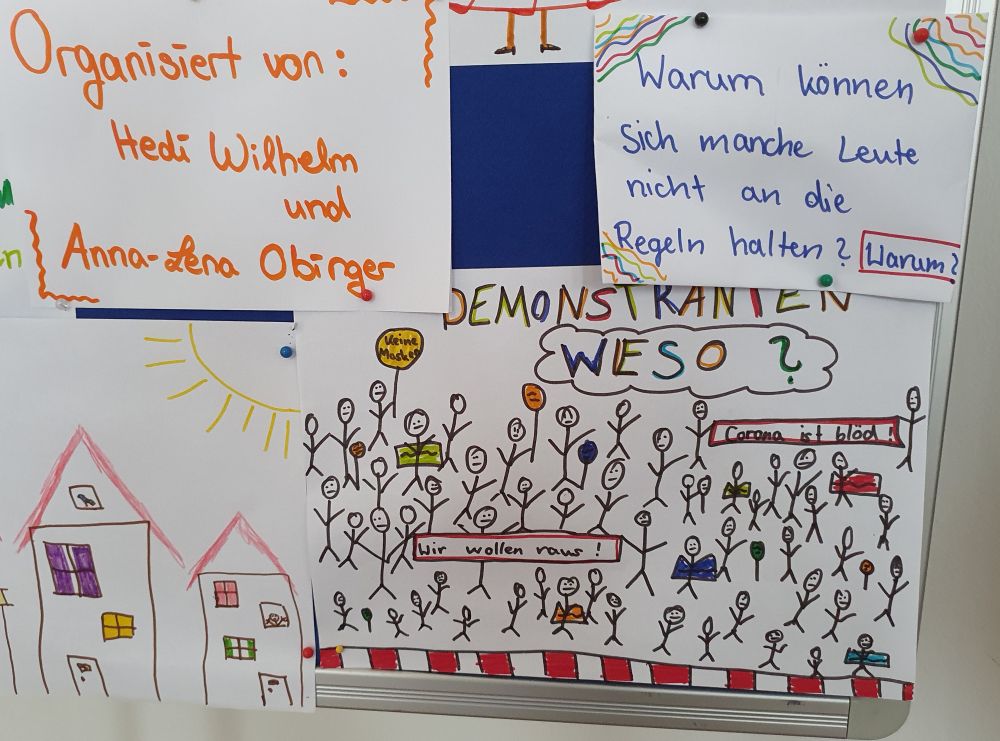
“Warum können sich manche Leute nicht an die Regeln halten? Warum?” – “Why can some people not follow the rules? Why?” And “Demonstranten – wieso?” – “demonstrators – why?” The demonstrators want “keine Masken” (“no masks”), postulate “wir wollen raus!” (“we want to go outside”) and claim that “Corona ist blöd” (Corona is dumb”).

I do feel with these touching observations and remarks of the children of Reit im Winkl. They are so young and go through this pandemic experience with their eyes open. The pandemic is even difficult for us adults. I heard a high level Swiss politician say: “Life has become less safe and it is less fun”.

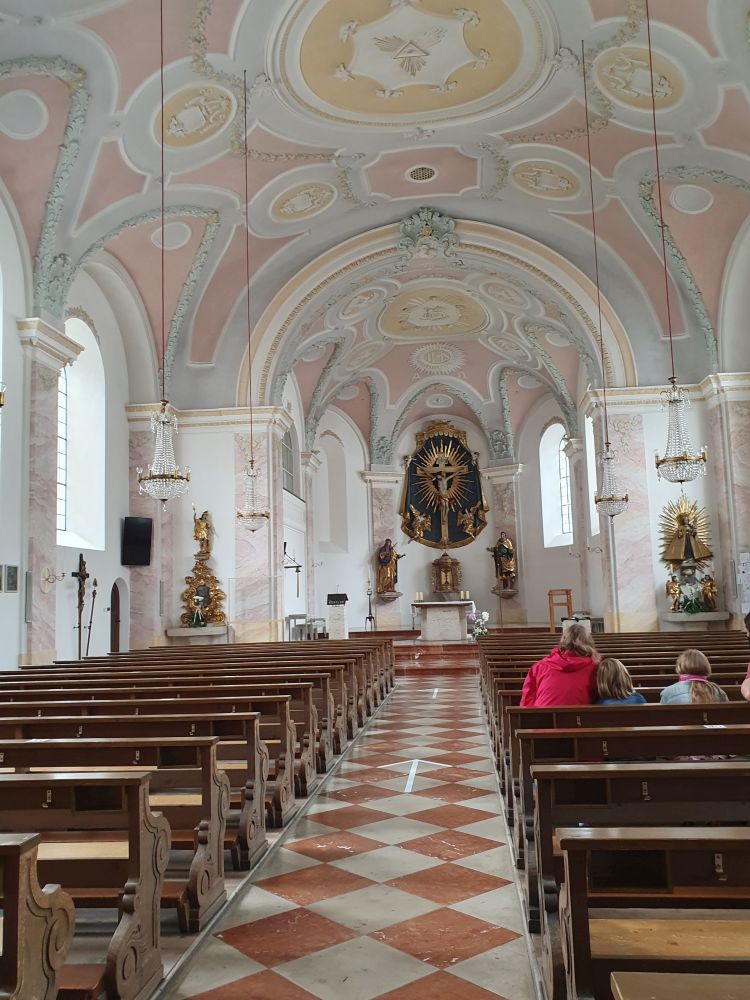
The baroque church that displays the children’s thoughts is painted in soft pink. Pink is the colour of happiness. The pink colour contrasts with the moving observations of the children, but it also gives an atmosphere of hope… I do hope that these children and all our children will go through more serene times with less worries pretty soon.


On the road: Bad Reichenhall in Upper Bavaria

In August 2020, we spend four days in Oberbayern (Upper Bavaria). We are in the middle of a severe weather front with heavy rainfall which gives us the opportunity to explore the culture of the area (instead of going for hikes). After past night with the splashing rain that made the rivers leave their beds, we visit Bad Reichenhall, where already the Romans had found salt. Bad Reichenhall is near the border with Austria.


Eye twinkling at Bad Reichenhall

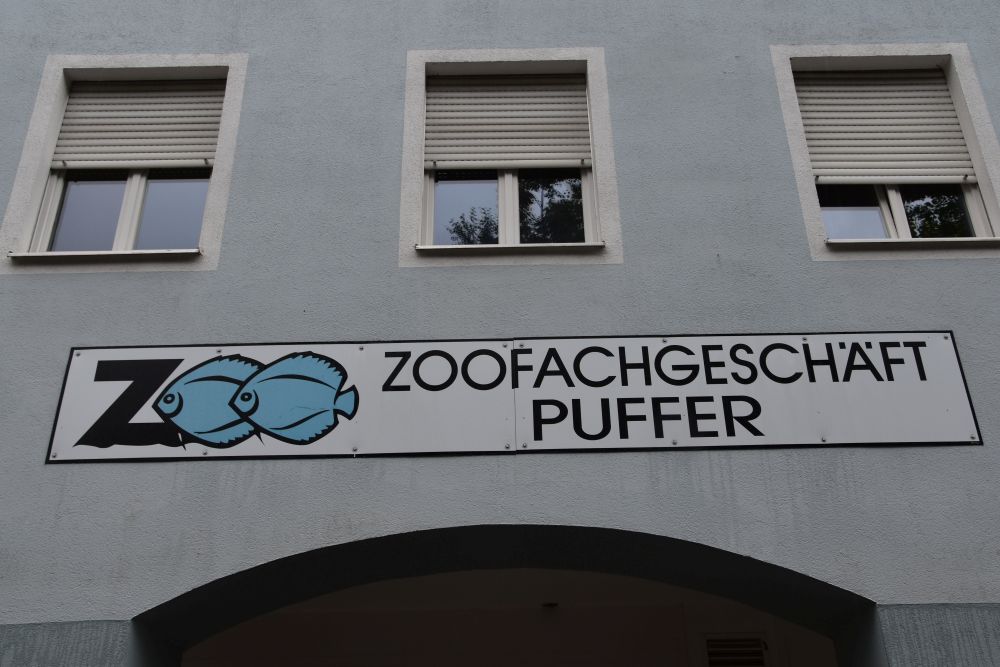
First we notice nice signs of humour at Bad Reichenhall. “Puffer” (buffer) is a nice name for a zoological shop, and the way they write “ZOO” is very inventive, even “eye twinkling”. It is a nice coincidence that “puffer” is also a fish in English (“Kugelfisch” in German).

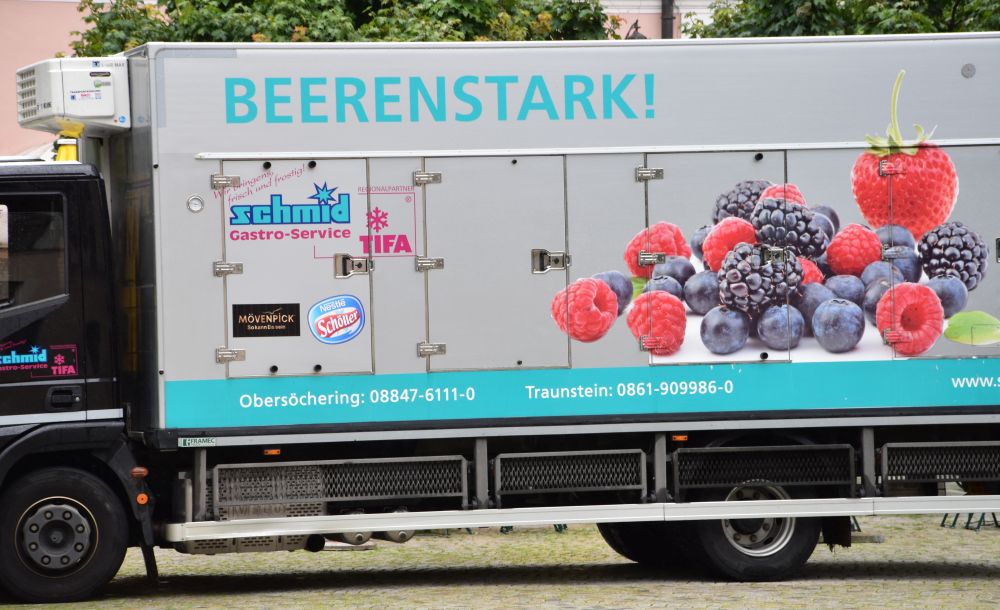
“Bärenstark” means “as strong as a bear”. May be, you will be as strong as a bear, after having eaten these berries or Beeren. “Beerenstark” is an allusion to “bärenstark” – the two words sound similar. May be, the driver is also “bärenstark”, as he has to carry the boxes with the berries when delivering them.

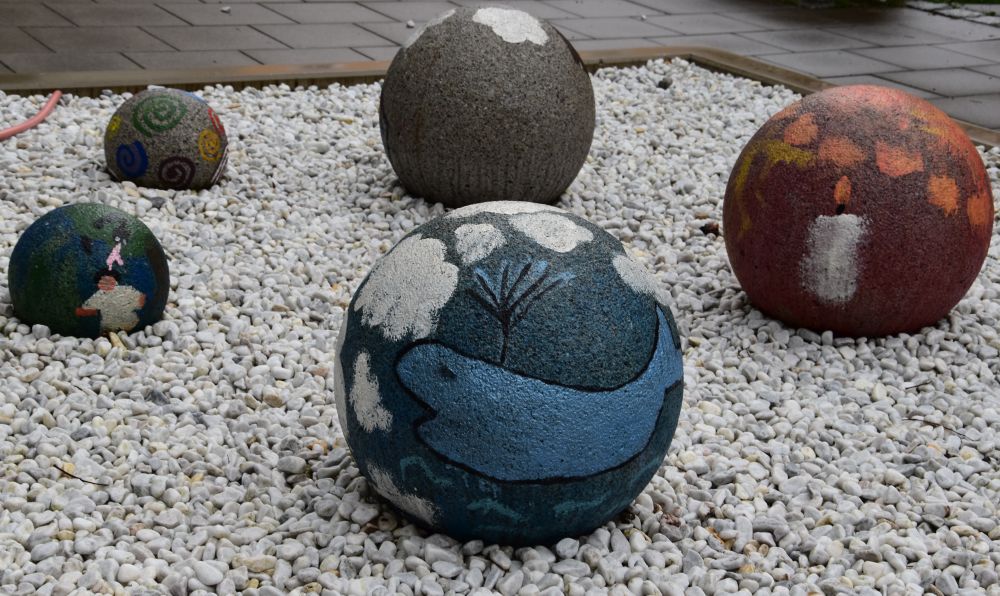
This whale reminds me of the whale that swallowed (and gave back) Jonah. Nice children’s paintings!


Welcoming city centre of Bad Reichenhall

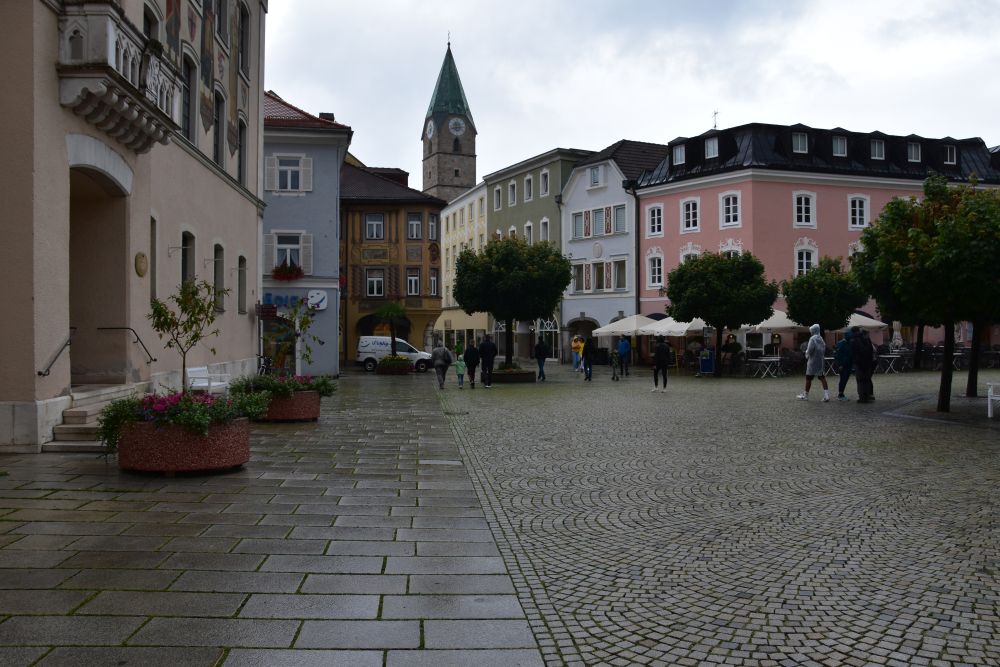
The city has an old tradition, but in 1834 a fire destroyed it completely. The city centre has been reconstructed nicely after 1834 and is now a pedestrian area.

Here we stand in front of the old townhall built in 1849.

The frescoes show Saint Rupertus (7th century), Charlemagne (emperor of the Romans 800-814, king of the Franks from 768), Frederick Barbarossa (Holy Roman Emperor, 1152-1190) and king Ludwig I of Bavaria (1825-1848). To their sides stand Caritas and Justitia.

I shake my head wondering: What an interesting mixture of personalities across so many centuries! But then I learn that they are all connected with Bad Reichenhall. Rupertus is said to have rediscovered the existence of salt after the Romans had left, Charlemagne seems to have supported the foundation of the first Zeno church (which later became the Zeno monastery), Barbarossa is one of the patrons of the Zeno monastery and Ludwig I ordered the salt factory to be rebuilt.

The pedestrian area with the Church Saint Aegidius in the background is pretty and tidy…

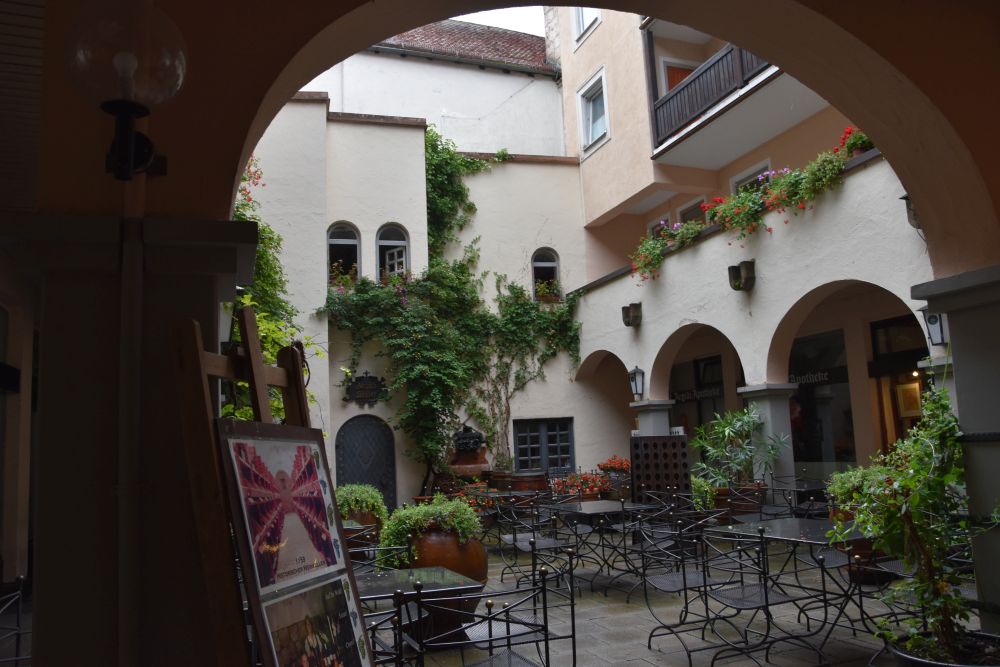
… with inviting backyards. Everything is just a bit wet at the moment after that much rain.

We enter the church Saint Aegidius. It has been remodeled in gothic style in the 15th century and had to be reconstructed entirely after the fire of 1834.


The baths of “Bad” Reichenhall must have seen better days

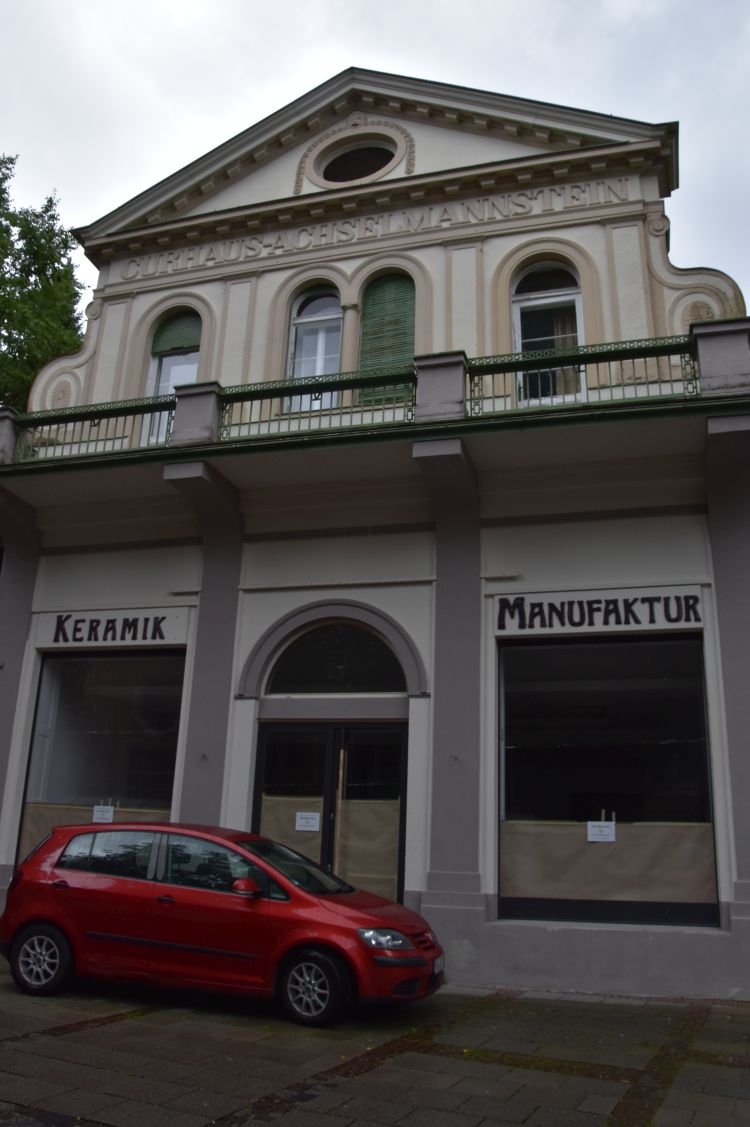
In the 19th century, Bad Reichenhall started to make use of the medicinal benefits of salt. In 1848 the Bavarian king Maximilian recovered here for five weeks, and then, Bad Reichenhall was an important venue for High Society. Art Nouveau buildings and the garden (Kurgarten) of 4 hectares remain from those days. During National Socialism Bad Reichenhall became a garrison city and after the Second World War, the caserns were used by the Americans and then by the German army. The first casino of Bayern was built here in 1955. In 1996 the German Health Care System was reformed and Health Insurance stopped paying for treatments at health resorts. Bad Reichenhall lost its main clientele. Though their government started to adapt the offerings to a younger clientele, the signs of past grandeur can be seen. For instance one of the luxury hotels offered rooms for 39 Euros per night and this “Curhaus” looks deserted.

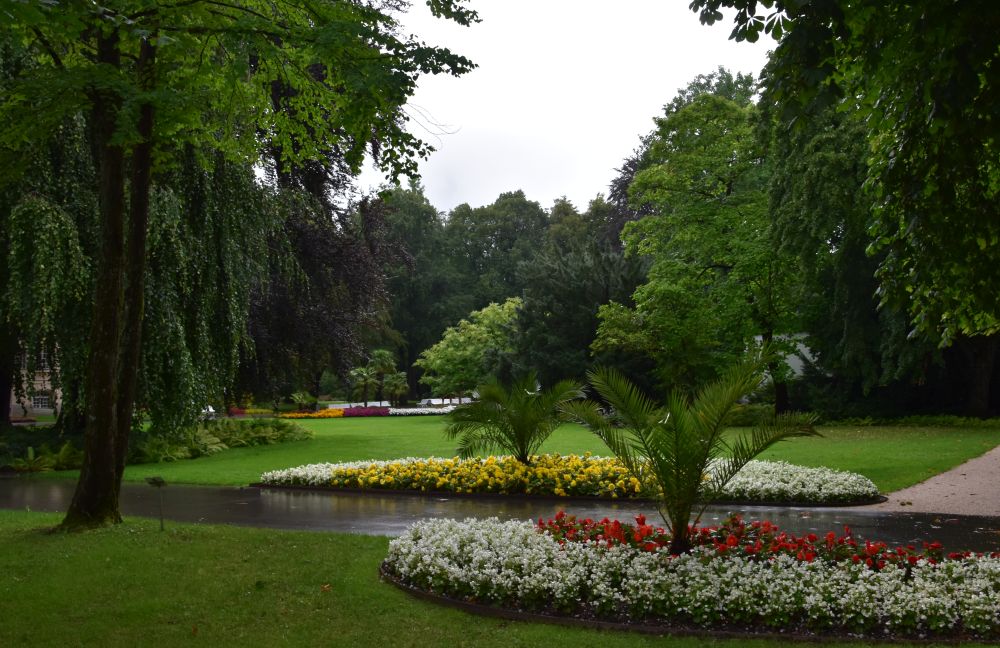
However, the “Kurgarten” is beautiful…

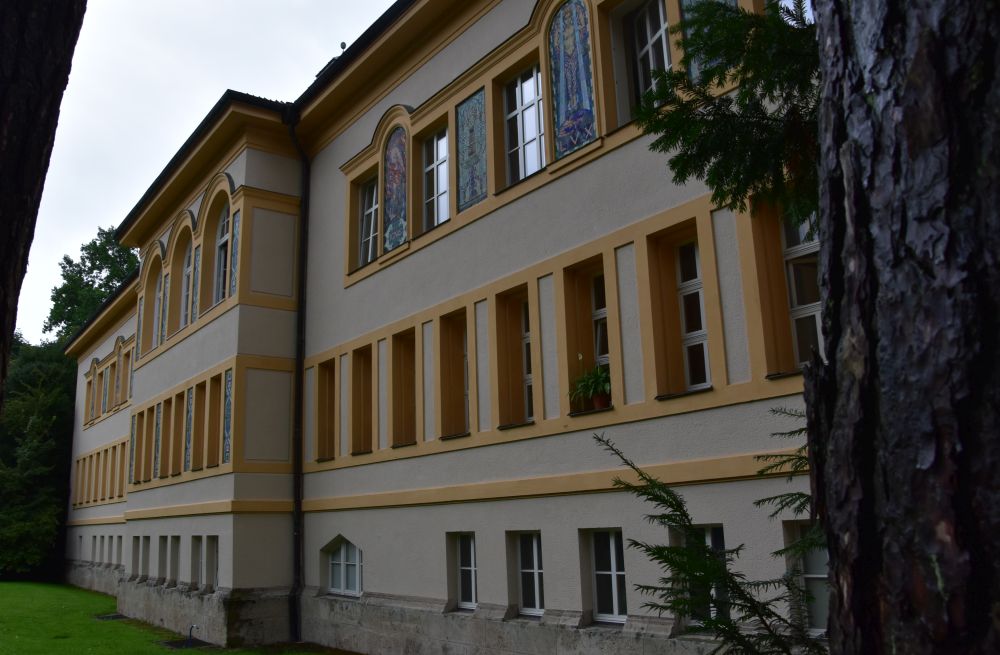
… and the adjacent Jugendstil Kurmittelhaus der Moderne from 1927 has been carefully renovated.

May the efforts of the city to attract more guests be successful, as it has more to offer than baths and health care: Hiking in the mountains with and without the support of cable cars, the tradition of winning salt (and telling about it in a museum) and the rich cultural heritage.


The Church Sankt Nikolaus with the Neo-Lombardian belfry

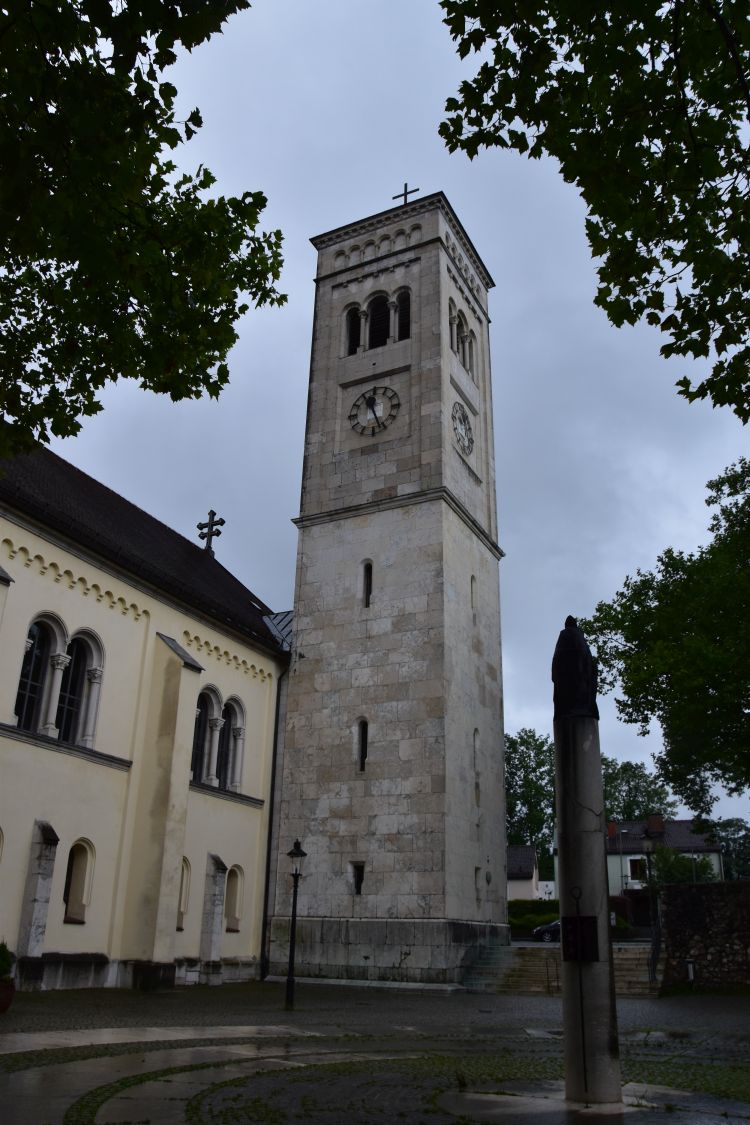
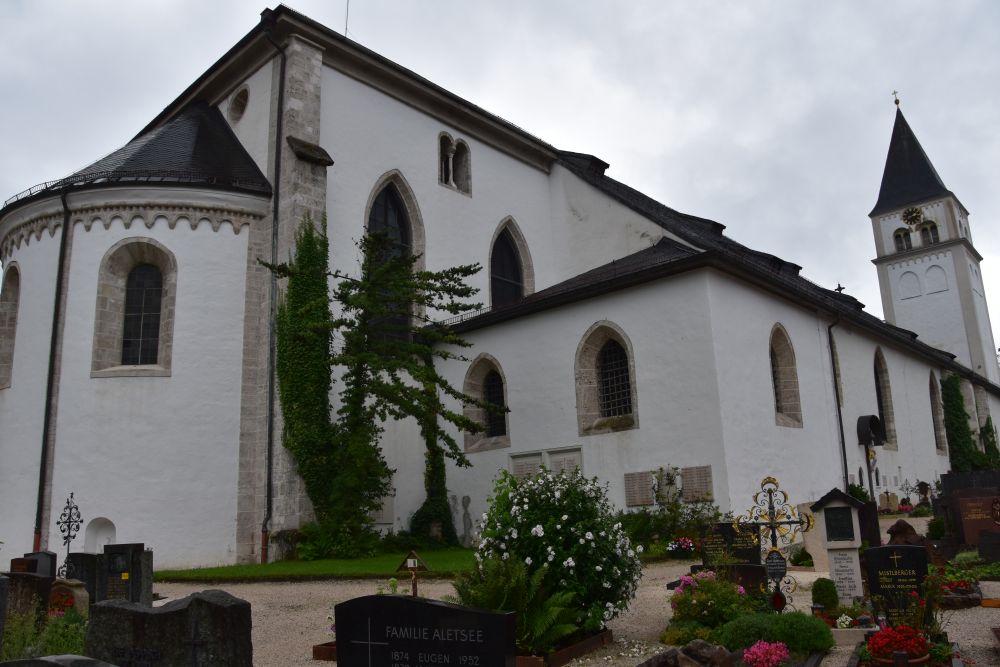
When entering Bad Reichenhall by car, I can notice the belfry of the Church Sankt Nikolaus.

The original belfry was teared down in 1861 and then reconstructed in Neo-Romanesque Lombardian style.

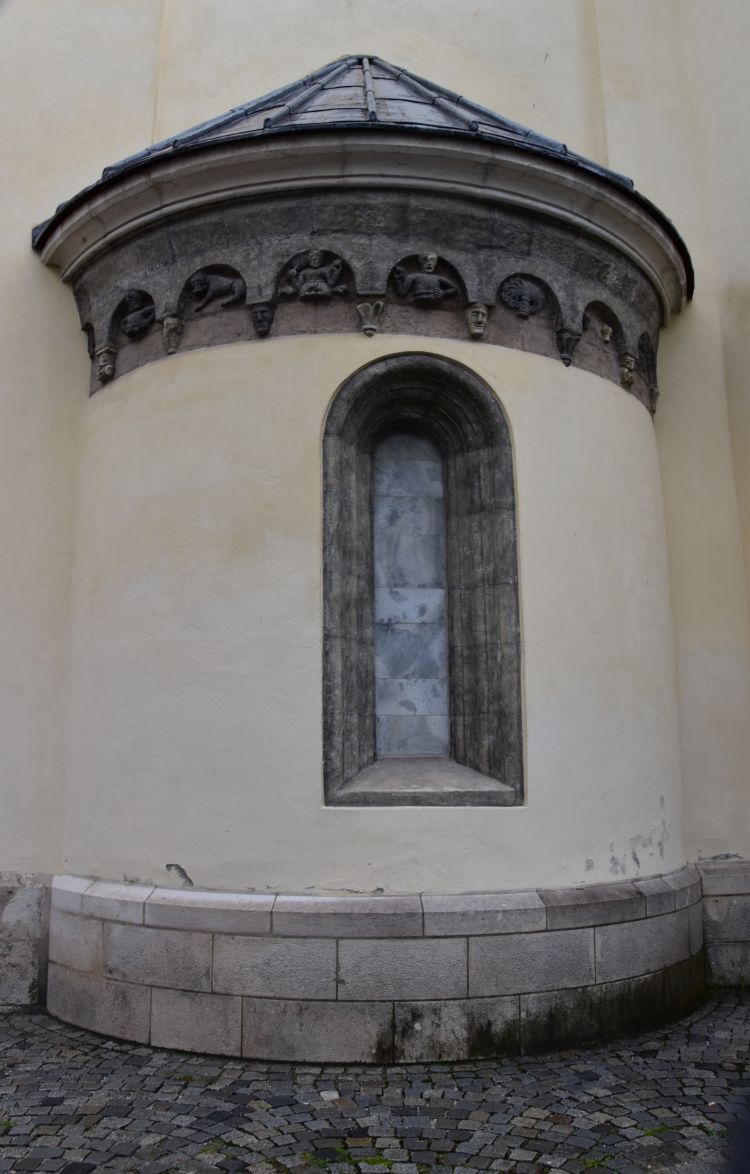
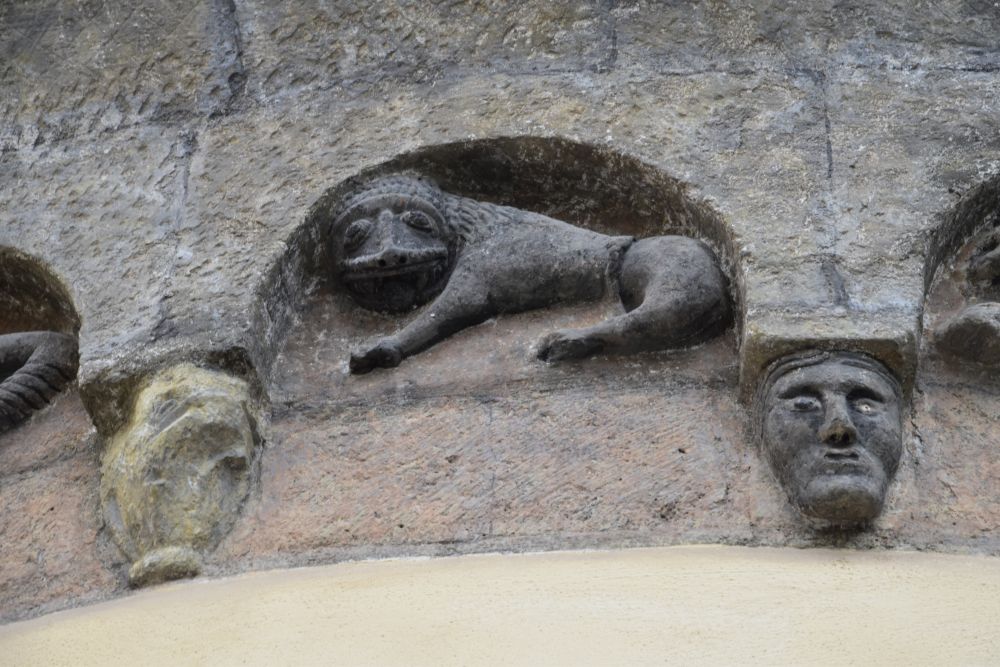
The apsis is the original from the 12th century. Human sculptures and lions are alternating in the frieze.

I like the lions that look at me.

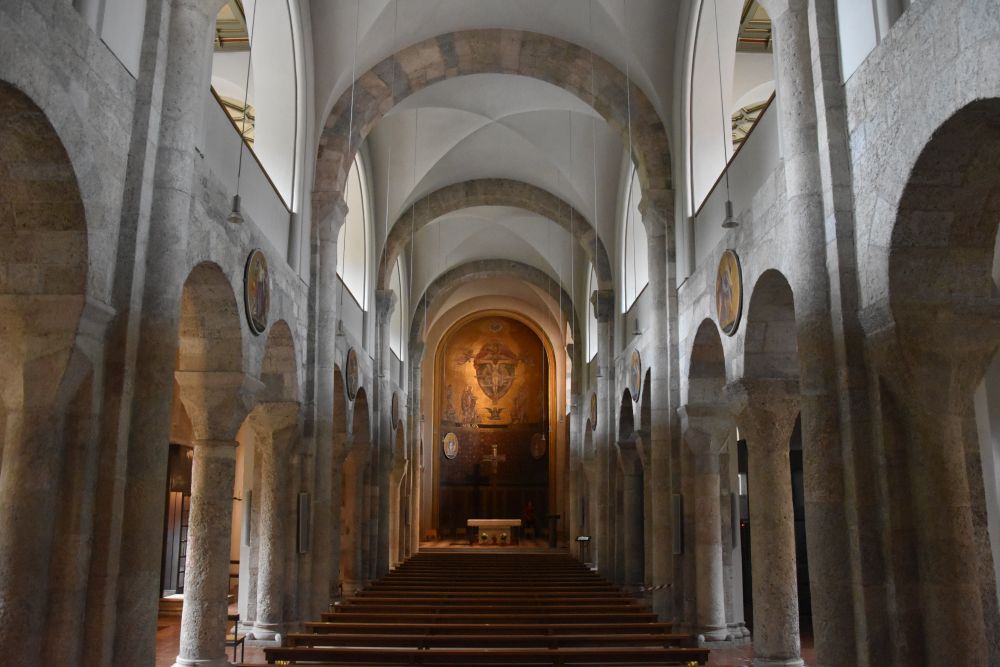
Sankt Nikolaus is the parish church of Bad Reichenhall. It was built in 1181-1189, enlarged in the 19th century and renovated in 1967 to restore the Romanesque overall impression. The fresco in the choir is from the 19th century.


A beautiful Romanesque portal and gothic treasures: The cathedral of Saint Zeno

The Augustinian monastery of Saint Zeno was founded in 1131. The cathedral replaced the former building from Carolingian times (806 A.D.). Saint Zeno protects from floodwater which was a problem at that time and it is still a problem today, as the inundations of this past night show.

The plans for the construction of the cathedral were ambitious – a nave 90m long. Construction halted around 1160, but completing the cathedral was then supported by emperor Barbarossa – the monastery thanks him with his portrait in the cloister (which we cannot visit). Built in Romanesque style, the cathedral was enhanced by gothic elements after a severe fire in 1512. Much of the equipment in the cathedral is from the early 16th century.

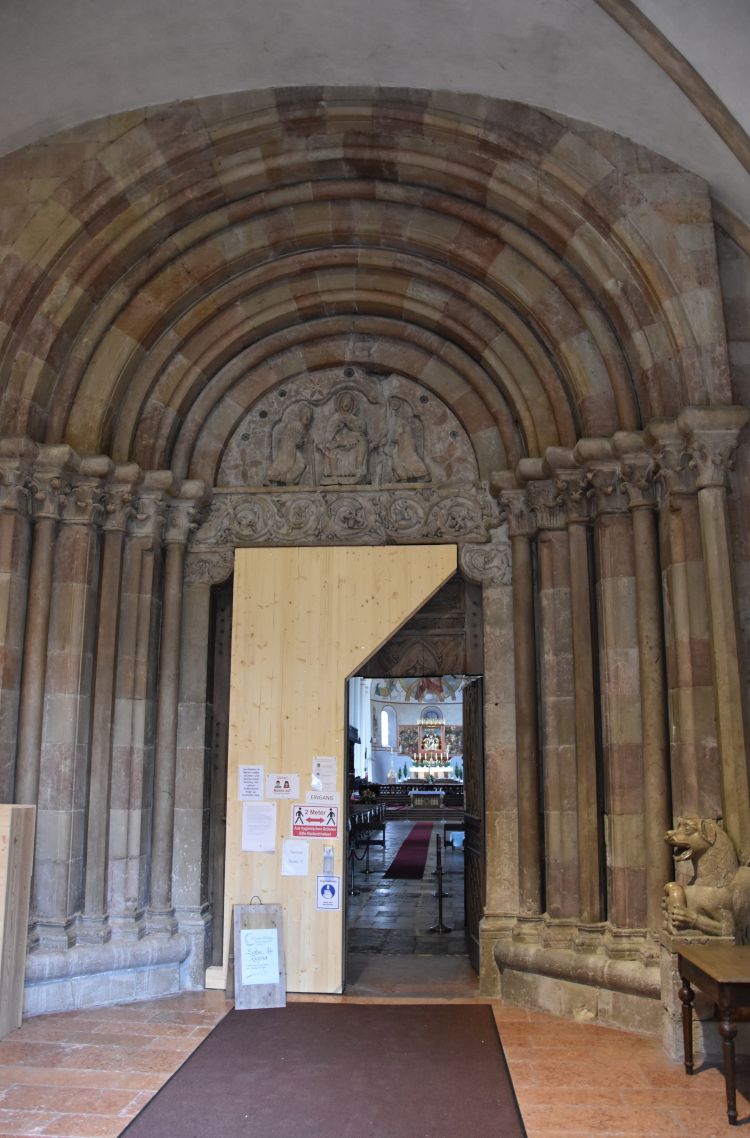
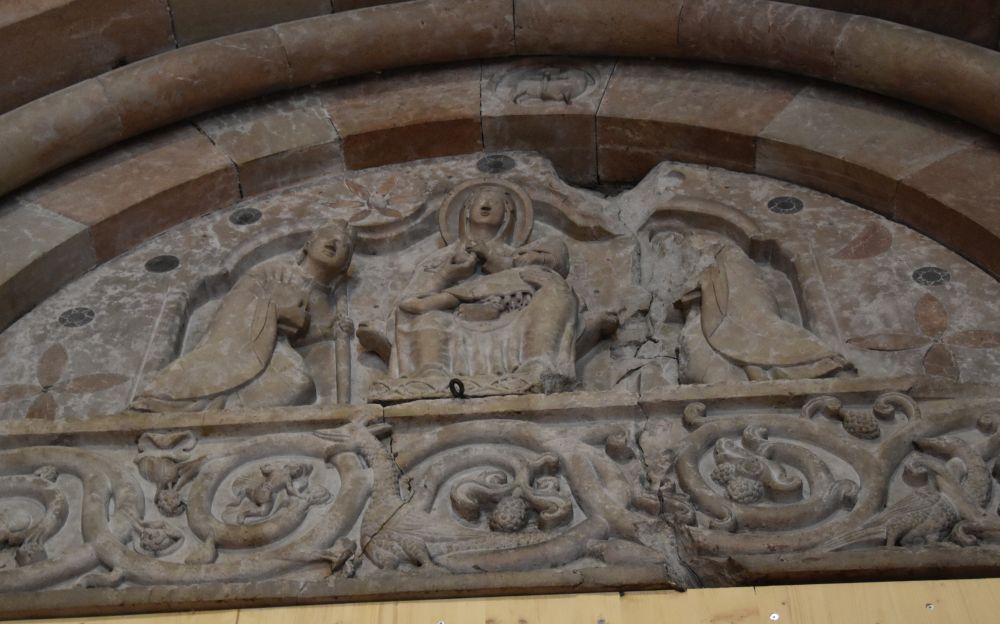
The Romanesque portal from the second half of the 12th century is the show-piece of the cathedral. It is assumed that the masters came from Piacenza. The portal is made from white and red (local) marble. Two lions holding prey animals in their paws guard the entry (one of the lions is hidden).

Madonna with the child sits in the middle of the tympanum. She is flanked by Saint Zeno (left, patron of the cathedral) and Saint Rupert (right, the man who rediscovered the existence of salt around 700).

The choir stalls of 1520 are made out of oak wood. Also the Coronation of the Virgin on the altar is from 1520. The fresco in the choir, painted in 1935, follows the tradition of early Christianism showing Christ as Pantocrator.

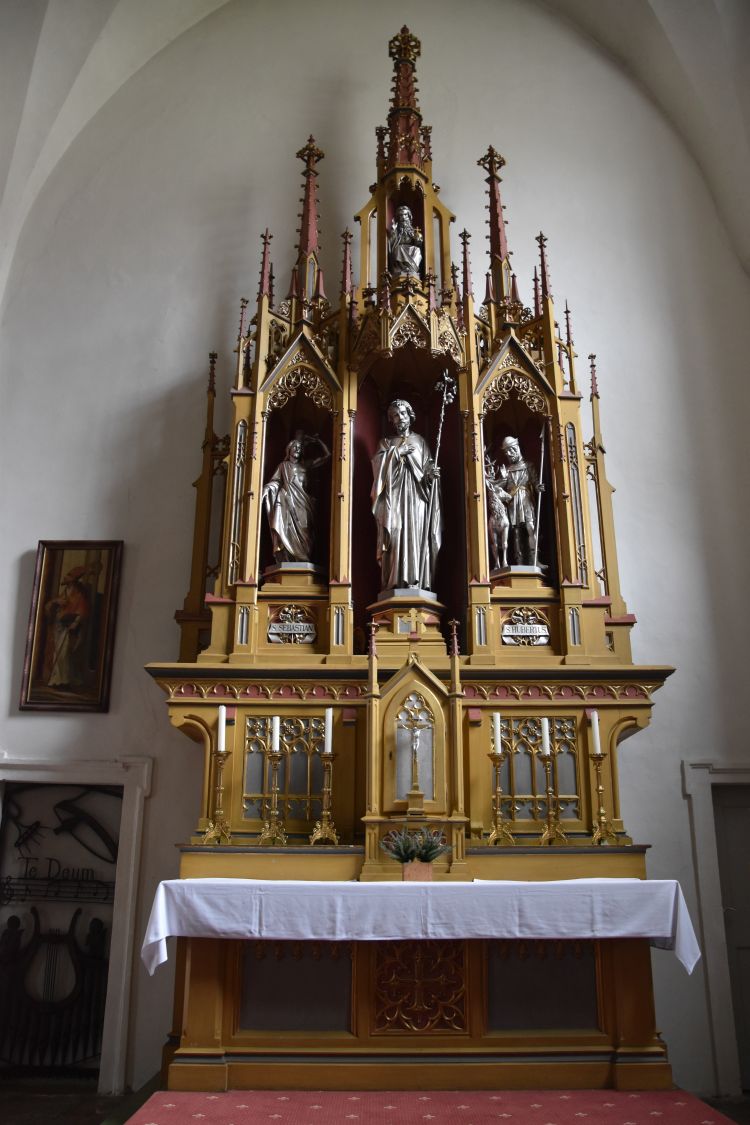
The altar of Joseph is newer; it is from 1875. I am astonished to see Hubertus with a deer. Later I learn that the baron who donated the altar was a passionate hunter and he wanted to see Hubertus on his altar. Joseph heads the altar and to his left side stands Sebastian.

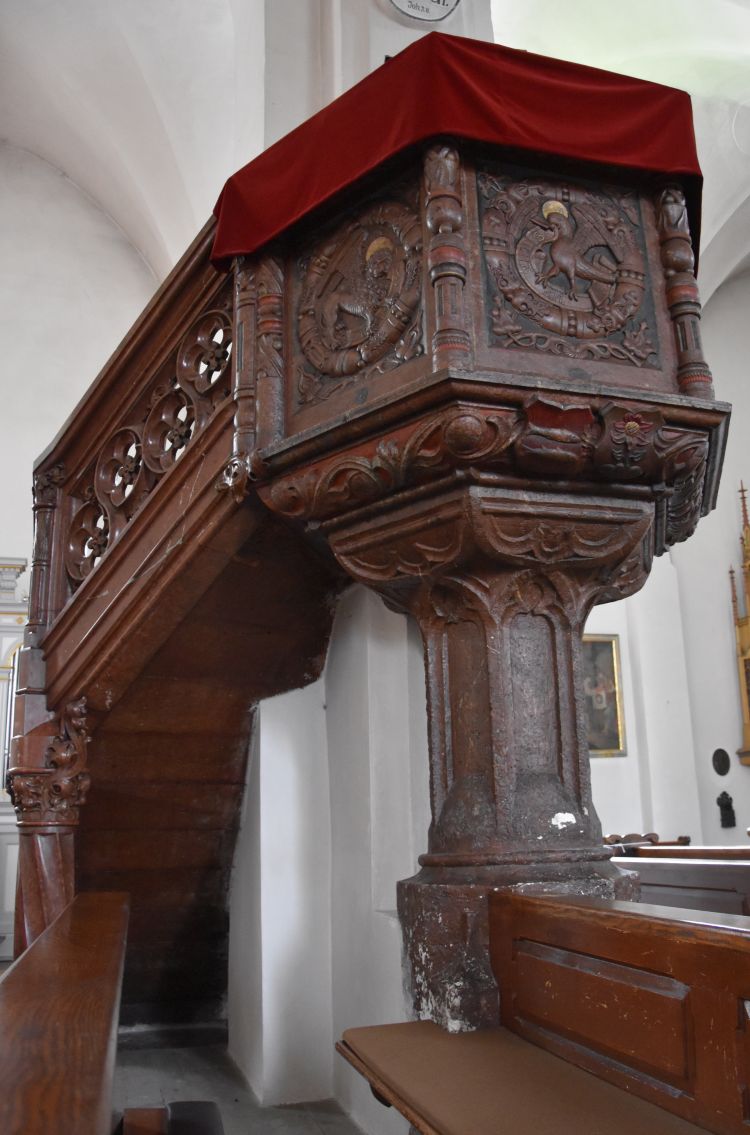
The beautifully carved wooden pulpit with the evangelists’ symbols is late gothic or even early Renaissance, from 1522.

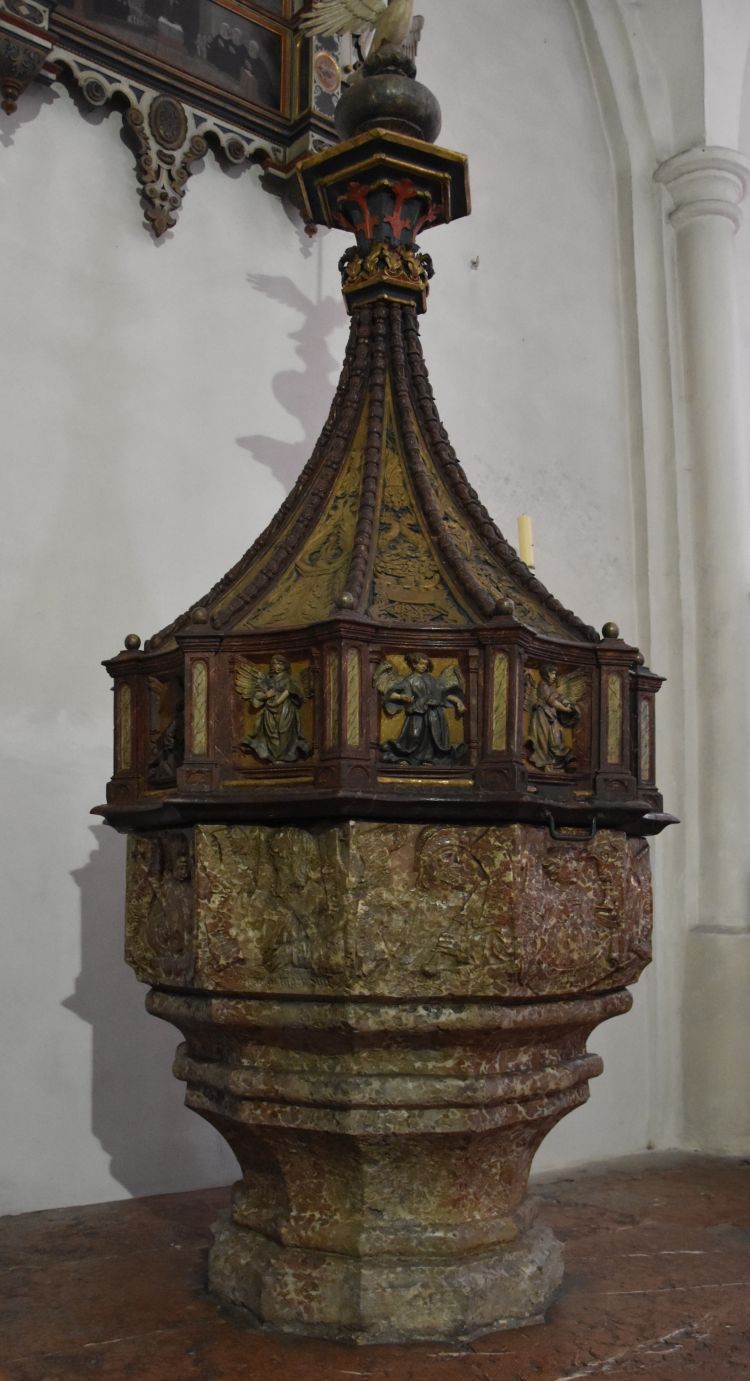
Also the baptismal font with the frieze of angels carrying instruments of the Christ’s Passion originates from 1522.

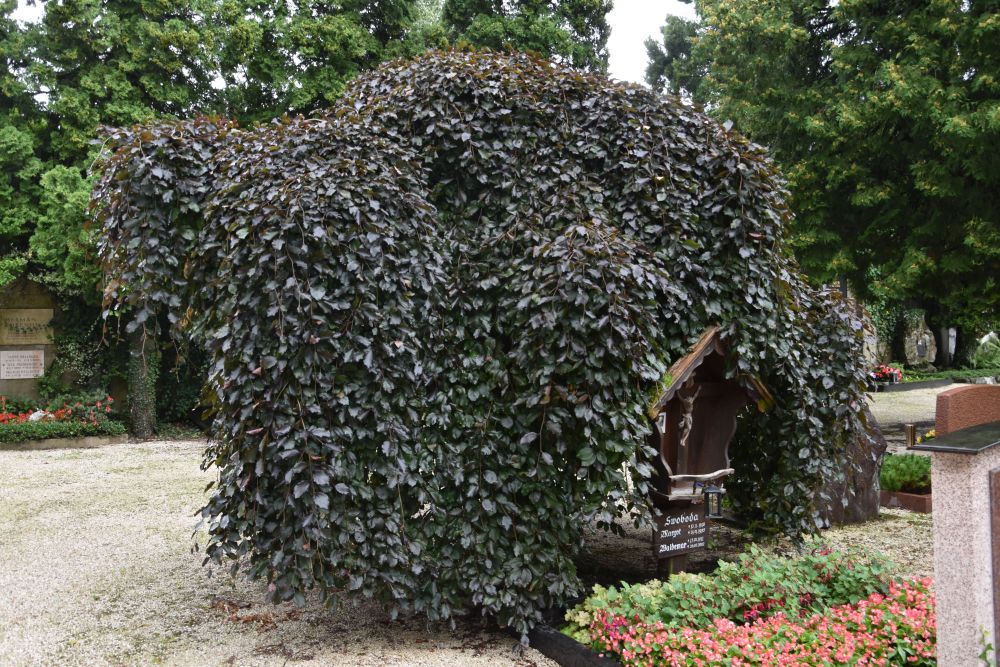
To round off our visit of Saint Zeno, we stroll through the romantic cemetery with old trees and enchanted corners.

May be we have to return one day to see the cloister that is mostly closed. This would require some pre-organization.


Salt – already used in Roman times

Already the Romans used the salt deposits in the area of Bad Reichenhall. As we already saw, Saint Rupertus found the salt fields again around 700. Even today, 50% of the salt consumed in Germany is provided by Bad Reichenhall.

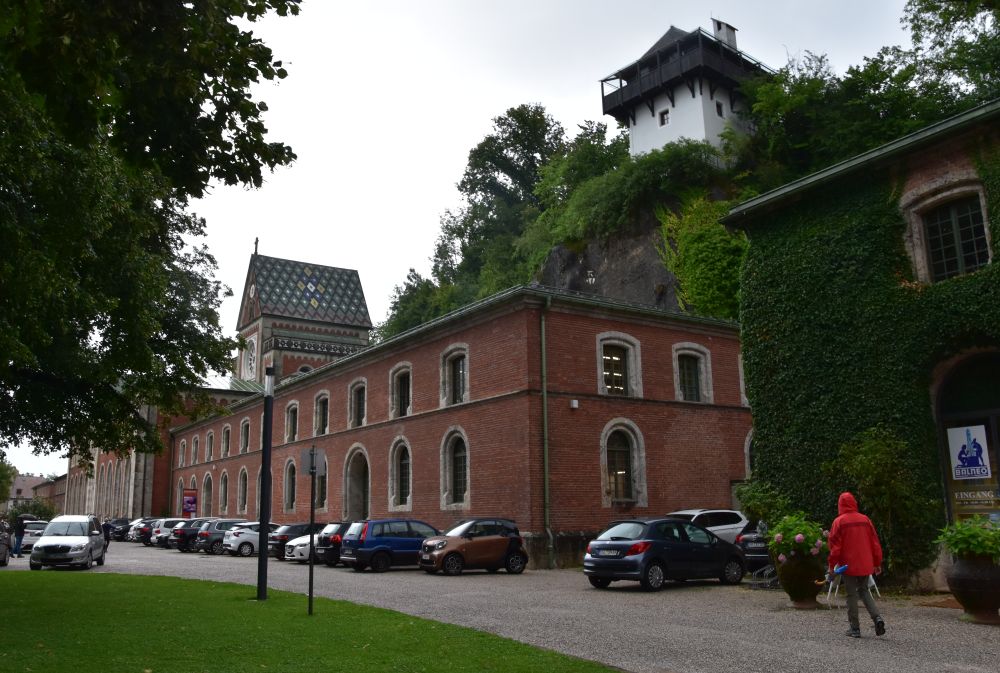
In the old salt factory built in 1844, salt was produced until 1929. It is now a museum. Unfortunately, the line of tourists at the entrance looks like an hour waiting time or so. We take a photo of the well house with the well chapel Saint Rupertus…

… and start our city excursion without waiting in line. After our stroll through the city centre we return and have lunch in the old salt factory. I love the modern furnishing in this traditional factory building and we enjoy delicious salads. To be recommended.

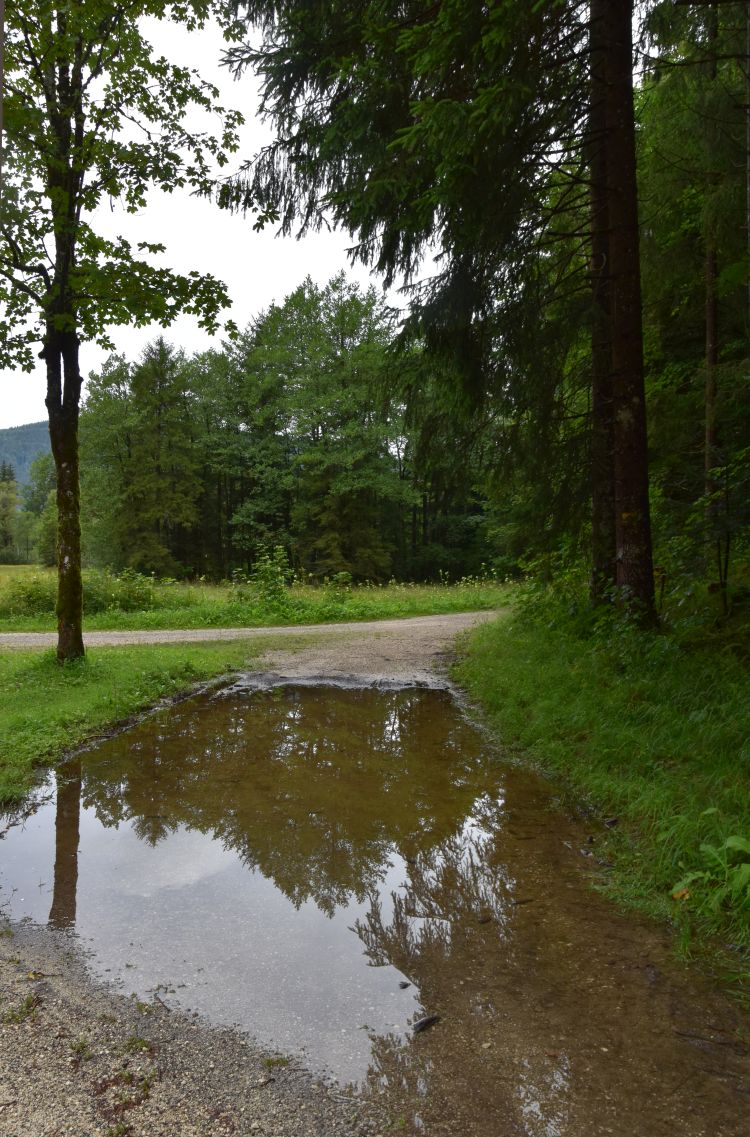
Our car waits for us not far from the salt factory. Through puddles – some pretty deep – we return to Ruhpolding.


Sources:

Markus Moderegger and Martin Wirth: “Die Kirchen in und um Bad Reichenhall”, Verlag Plenk Berchtersgaden 2019;
“Bad Reichenhall – St. Zeno”, Verlag Schnell und Steiner 2008
Bad Reichenhall in Wikipedia
St. Nikolaus in Wikipedia

On the road again: Romance and Romanesque culture at the Chiemsee

In the beginning of August 2020, I visit my friend at Munich and we spend a few days at Ruhpolding in the Chiemgauer Alps of Oberbayern (Upper Bavaria). I am surprised to find so many churches with a Romanesque and Gothic heritage here. So far I have mostly come across churches built in baroque or rococo style in Bayern.

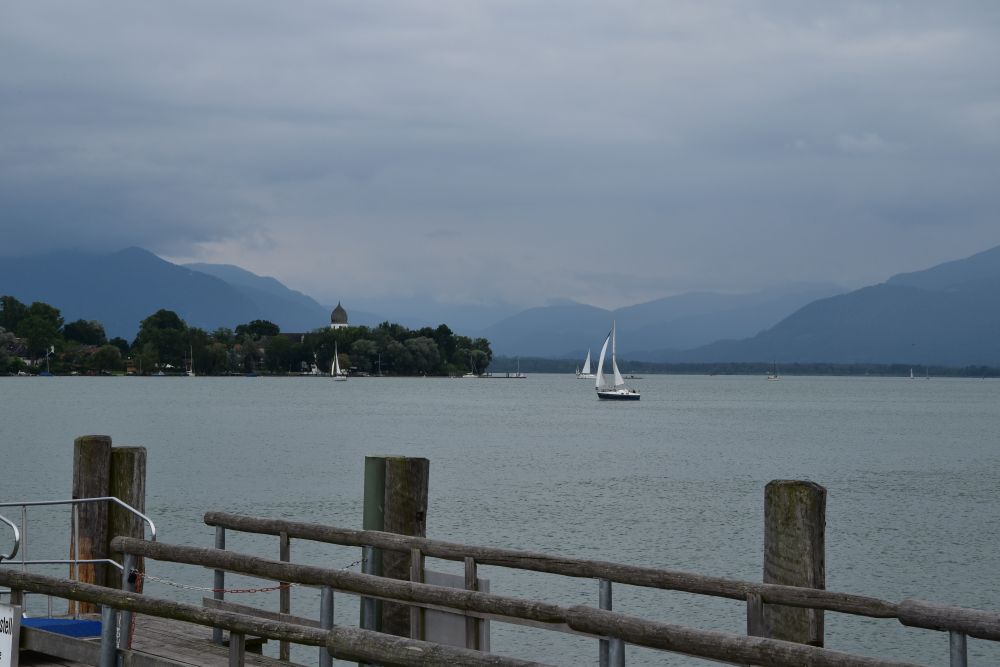
On the way from Munich to Ruhpolding, we visit first the St. James church of Urschalling with the gothic frescoes. Then we take the boat to the Fraueninsel that promises Romanesque culture and romantic gardens.


Urschalling  – St. James church with frescoes from the 12th and the 14th century

Since having read Eugen Diesel’s “philosophy at the steering wheel” (1951) earlier this year, the St. James church of Urschalling has been on my travel agenda. Now, I am here, above the Chiemsee, south of Prien.

The church originates from the 9/10th century and has been rebuilt later.

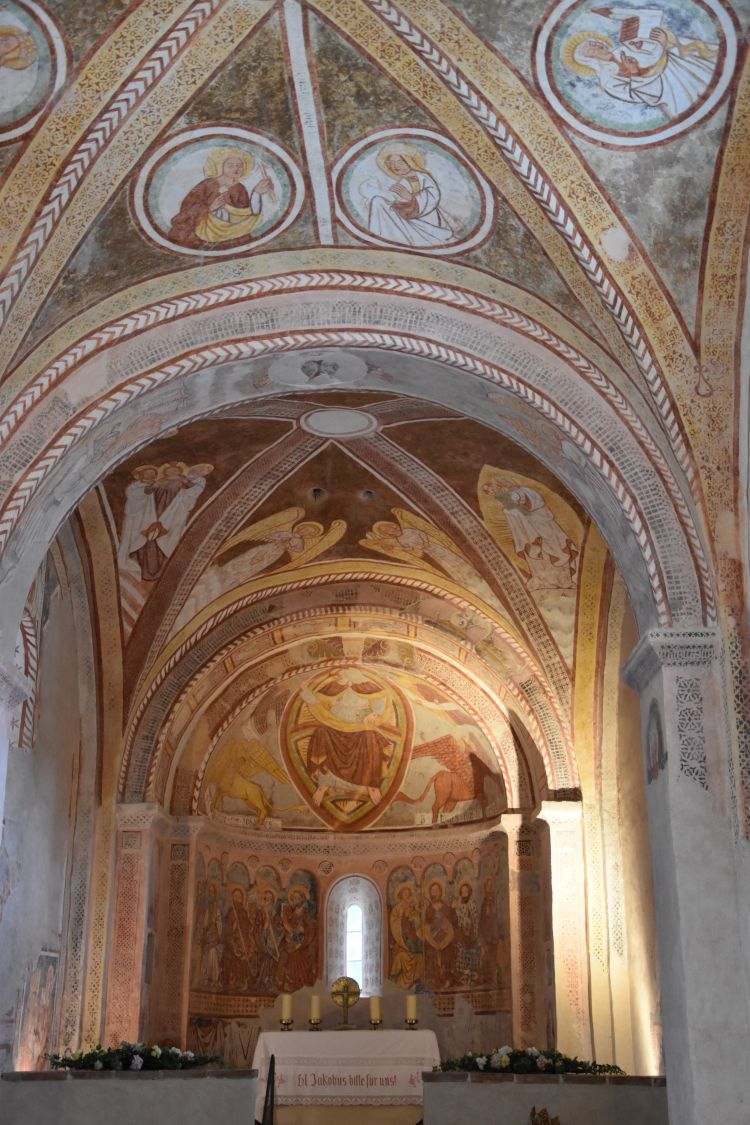
In the nave, an iron grating prevents visitors from approaching the choir. I take this photo standing behind the grating. The frescoes are from the 14th century.

Jesus Christ is in the middle of the choir, surrounded by the symbols of the evangelists. Wikipedia  assumes that in the 14th century, the frescoes from the 12th century were repainted preserving the earlier Romanesque themes. This explains the Byzantine representation of Christ as Pantocrator that was common for early “western” Christianity as well. Below Christ are the apostles.

Female Saints decorate the  vault of the choir. To the left is Saint Hedwig carrying a model of the church.

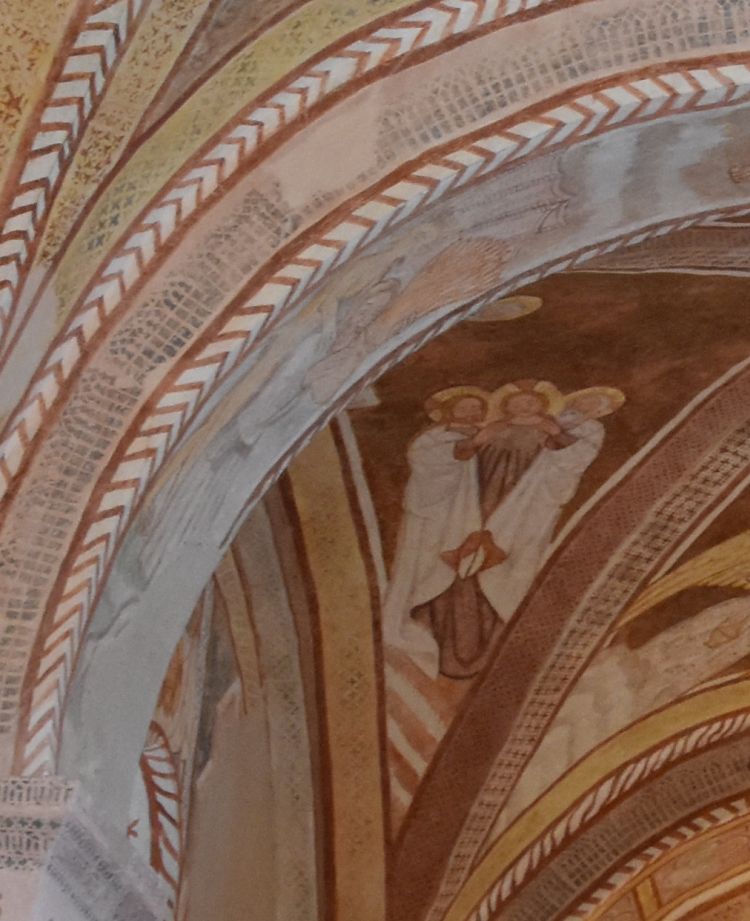
The presentation of Trinity in the northern pendentive of the choir merits a separate entry in wikipedia. It shows godfather to the right (white hair), Christ to the left (fair hair) and the Holy Spirit in the middle (looks like a woman, whereby it is under debate, whether this is a young man or a woman). At the bottom, the three elements of Trinity end in ONE dress and coat (Brugger et alii, p. 12). This is an exceptional and creative representation of the Holy Trinity.

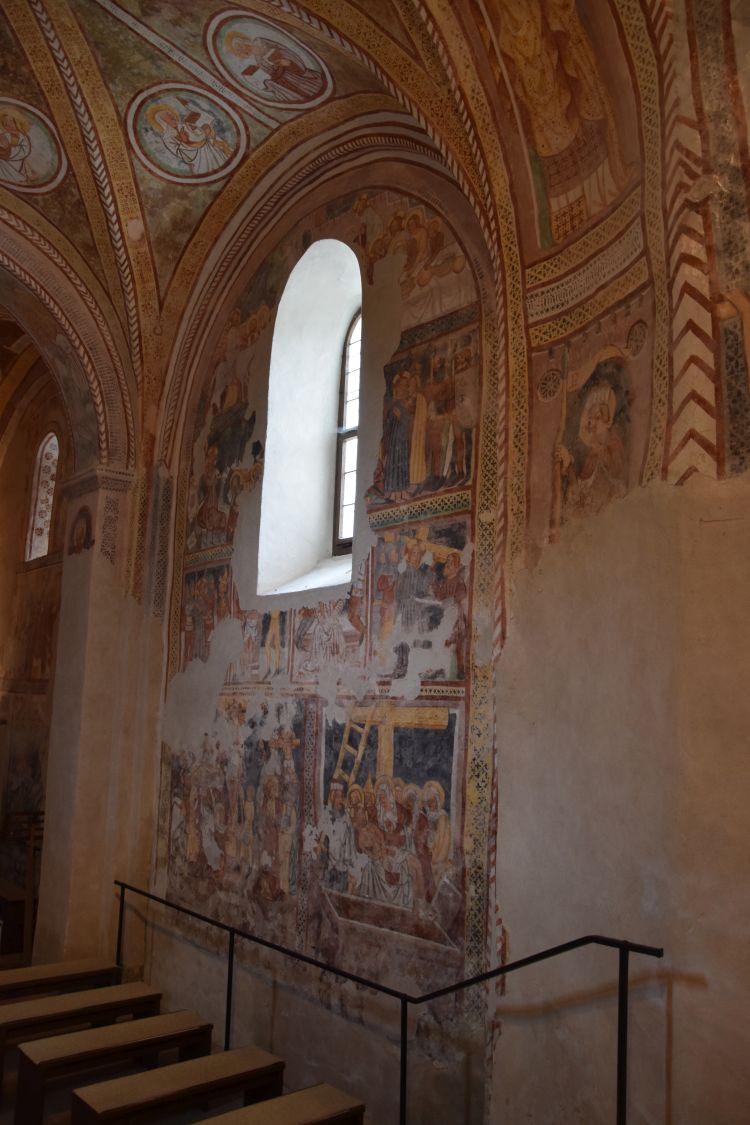
The south wall shows the passion of Christ starting with the Last Supper that has been cut out partially by the window.

Above the entrance to the tower is the gloomy picture of a hanged boy.

It is difficult to discern all frescoes from where we stand behind the grating. We enjoy the solemn atmosphere.

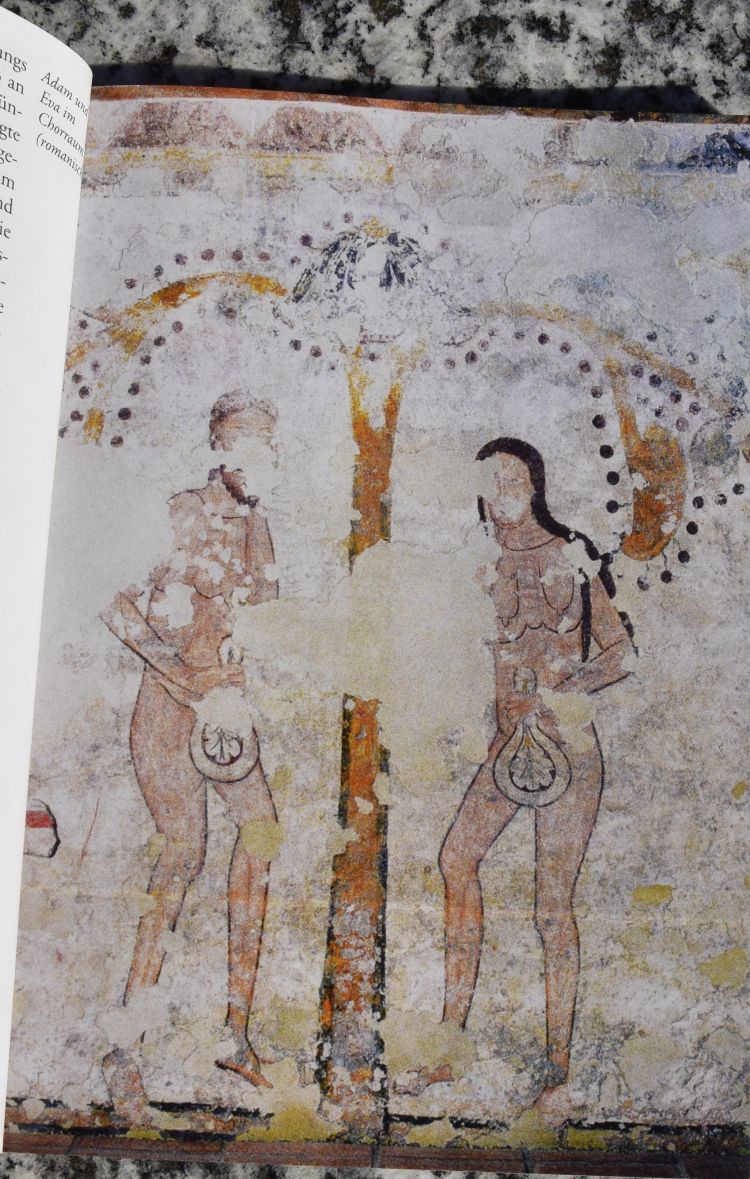
The church had already been decorated with frescoes in the 12th century. Adam and Eva have been preserved. I took them out of the brochure of Brugger et alii. This fresco is on the northern wall of the choir, and can hardly be seen from the grating.

After a delicious lunch at Urschalling, we take the boat to the Fraueninsel.

The roof of the famous cathedral belfry appears behind the trees.


Fraueninsel: The Carolingian Torhalle (gate hall) 

In 782, Tassilo III, duke of Bayern, founded the Benedictine nun monastery on the Fraueninsel. The Torhalle or gate hall has been preserved from those times.

It reminds me of the Torhalle of Lorsch near Heidelberg that I have seen in 2016.

On the first floor, we find a museum with frescoes and with some interesting exhibits.

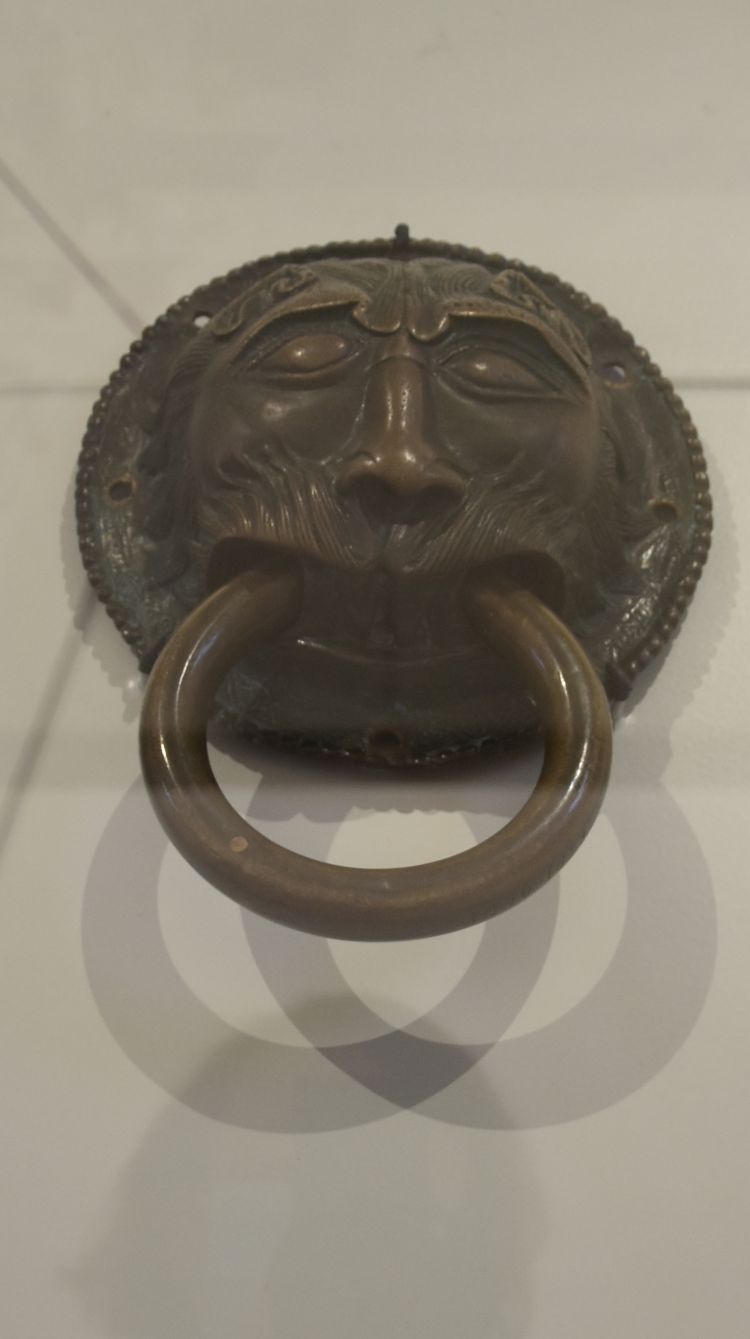
This lion served as a door handle to the cathedral. The lion was the heraldic animal of duke Tassilo.

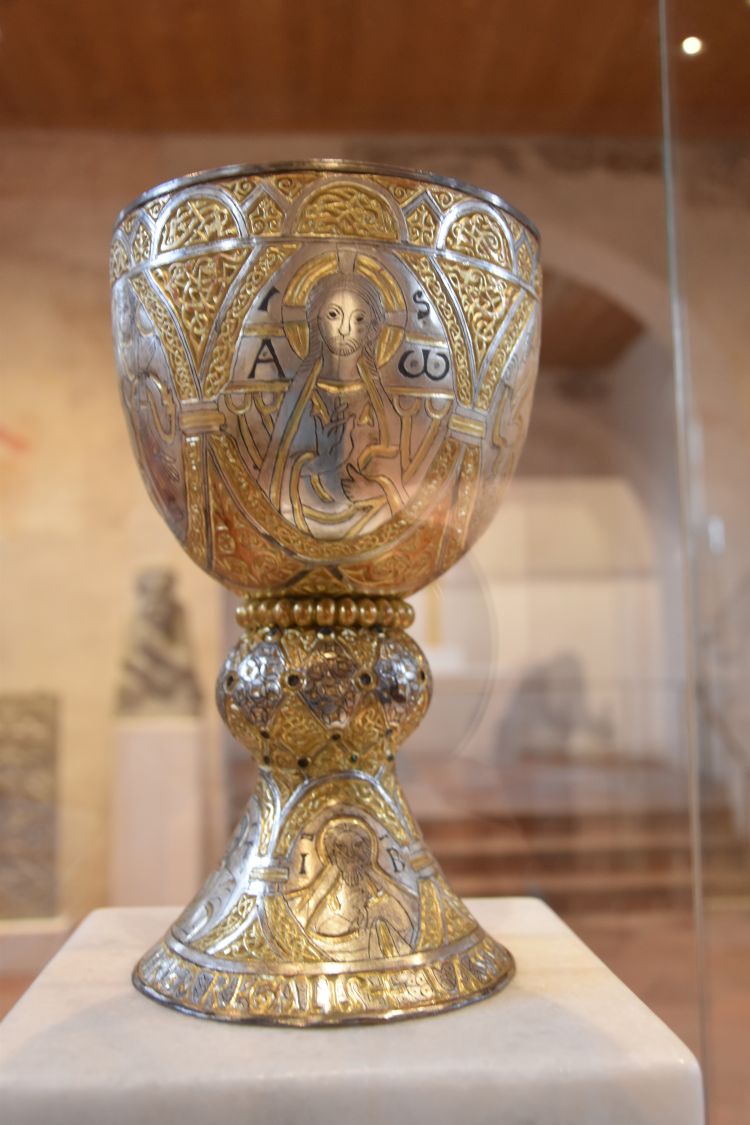
In addition, the elegant wedding cup of Tassilo III and his wife Liutberga has  been preserved.

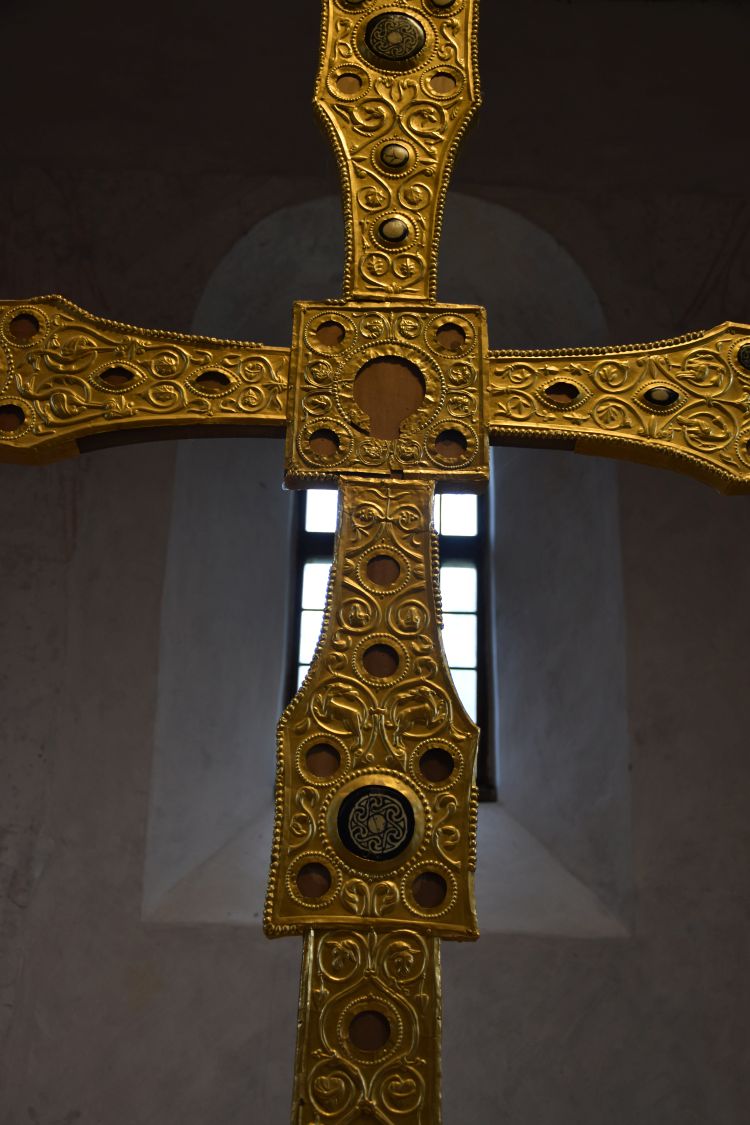
I liked the vine branches on this gilded cross from the 8th or 9th century.


Fraueninsel: The cathedral

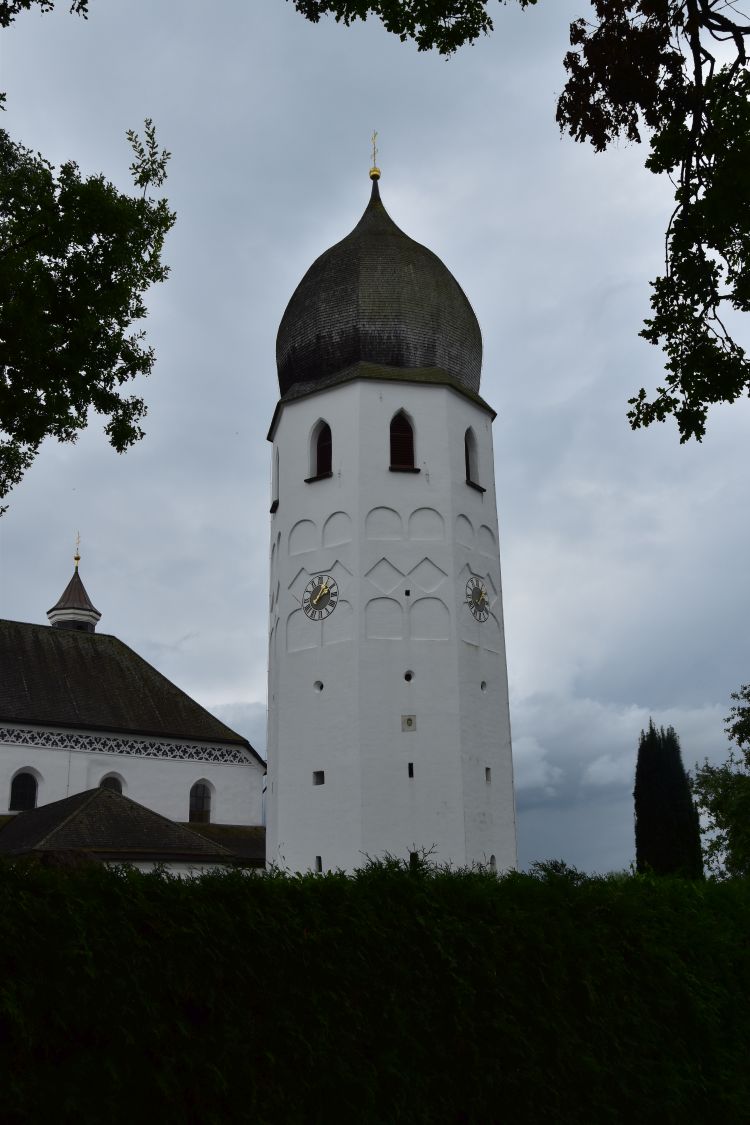
The octagonal tower of the cathedral is THE landmark of the Chiemsee region. Originally it has been built as a fortification tower in the 11th century. In the 13th/14th century it became the belfry of the cathedral. In the 16th century, the onion shaped “Bavarian” roof was added.

Irmgard, a grand-grand-daughter of Charlemagne, was the first abbess of the nun monastery. She was beatified in 1928 and was then painted for the altar of her cathedral under the gothic vaults. She is also buried here.

I look back at the organ of 1980 on the gallery.

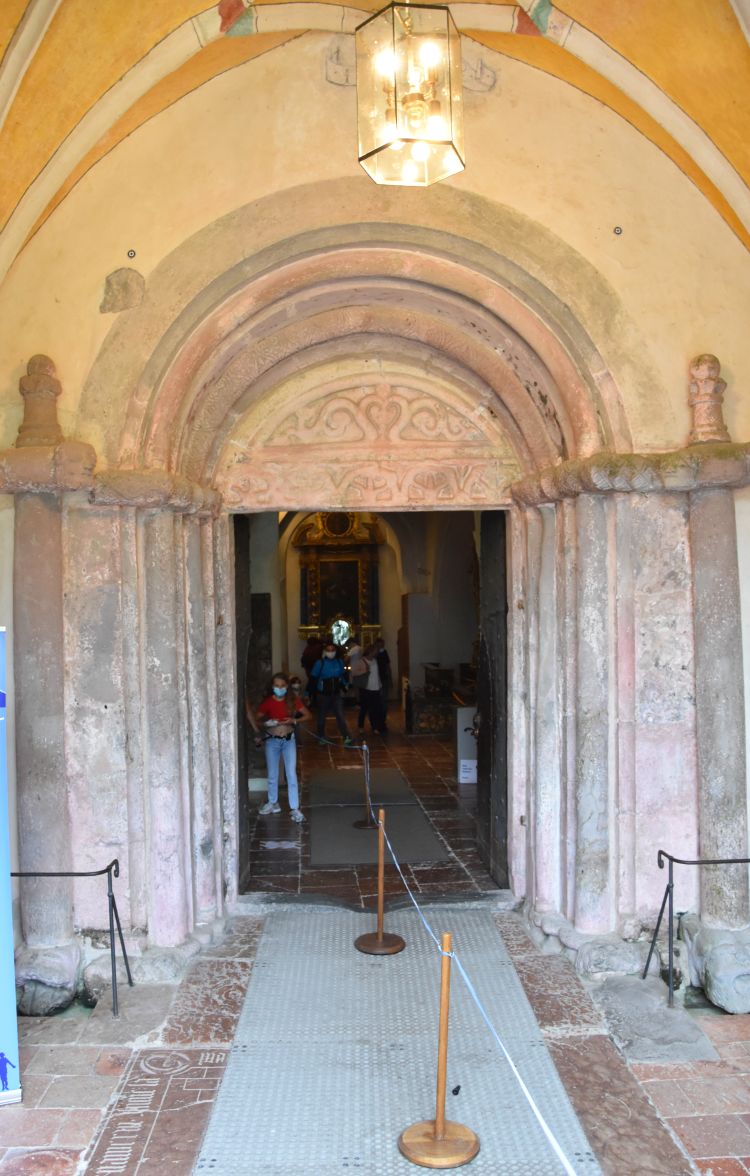
The plain Romanesque entrance is protected by a second door. Taking a photo is difficult.


Fraueninsel – romantic gardens

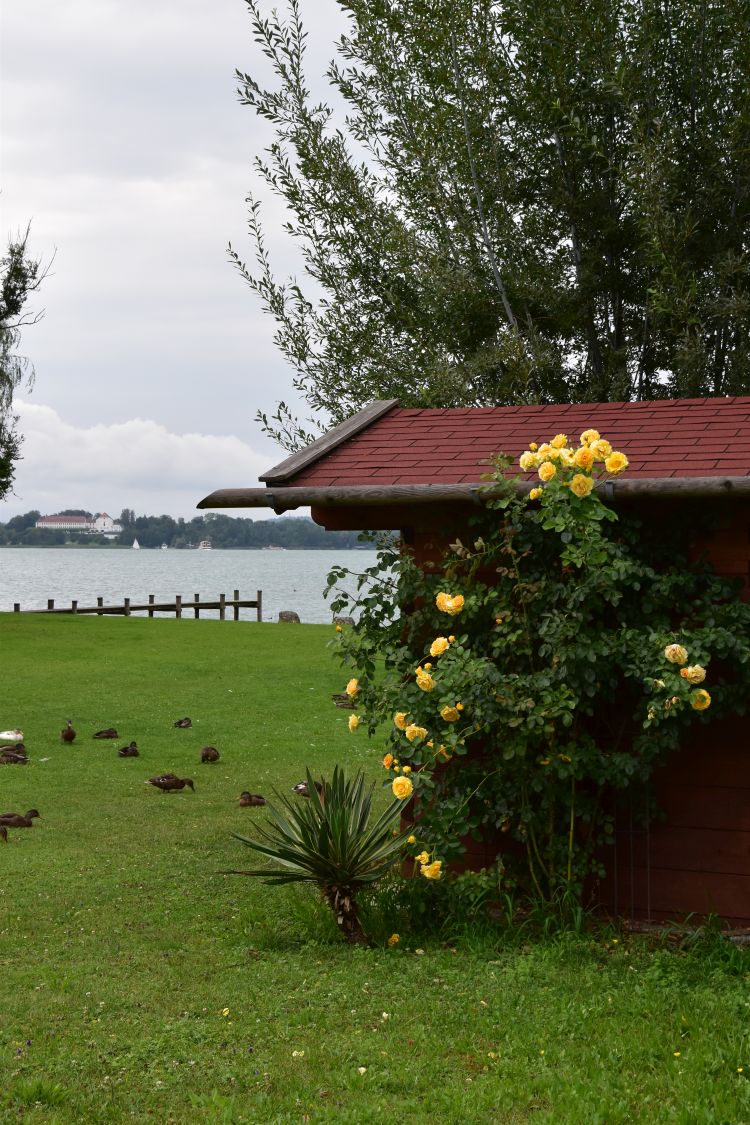
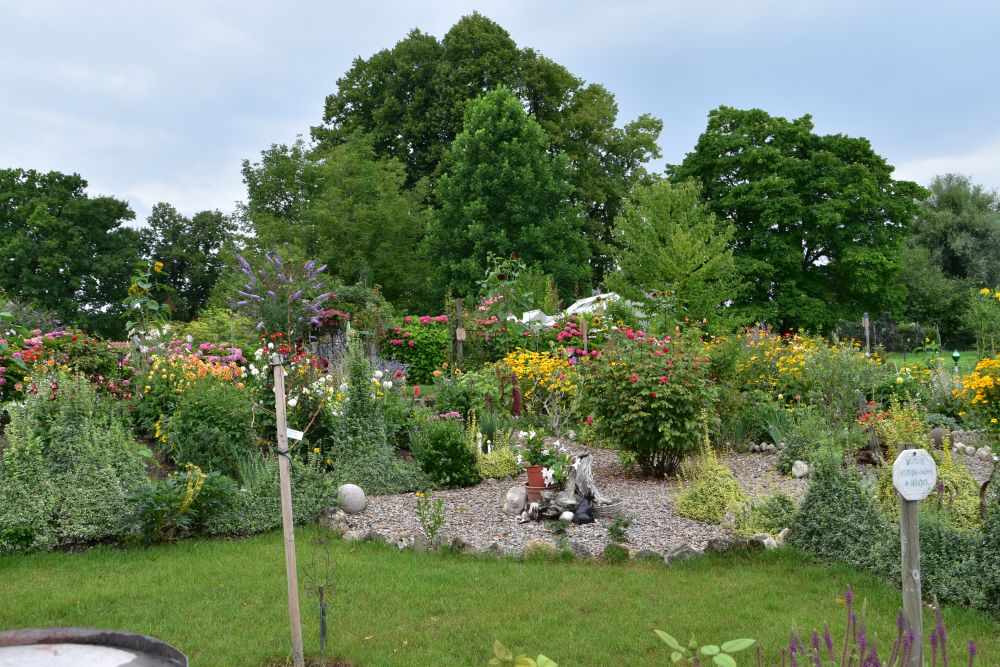
To round off our visit to the Fraueninsel, we stroll along the so-called ladies’ walk around the island and we see many beautiful gardens. From this small house with the yellow rose bush we can see the big brother of the Fraueninsel, Herrenchiemsee, with one of the castles. Ducks seem to love this garden.

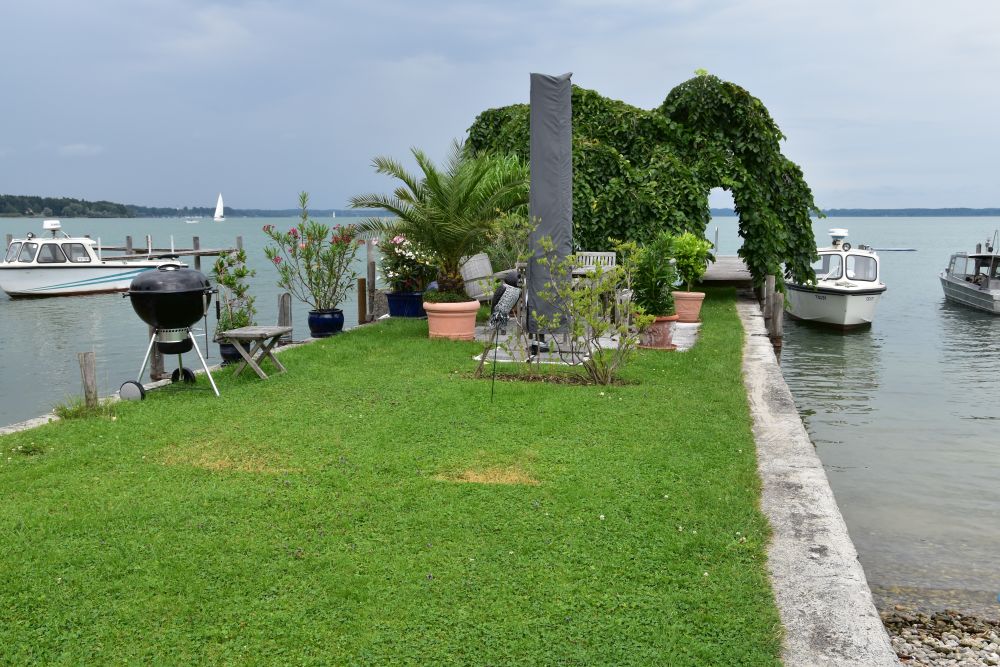
I would like to enjoy a barbecue at this charming spot…

…or just to read and rest here.

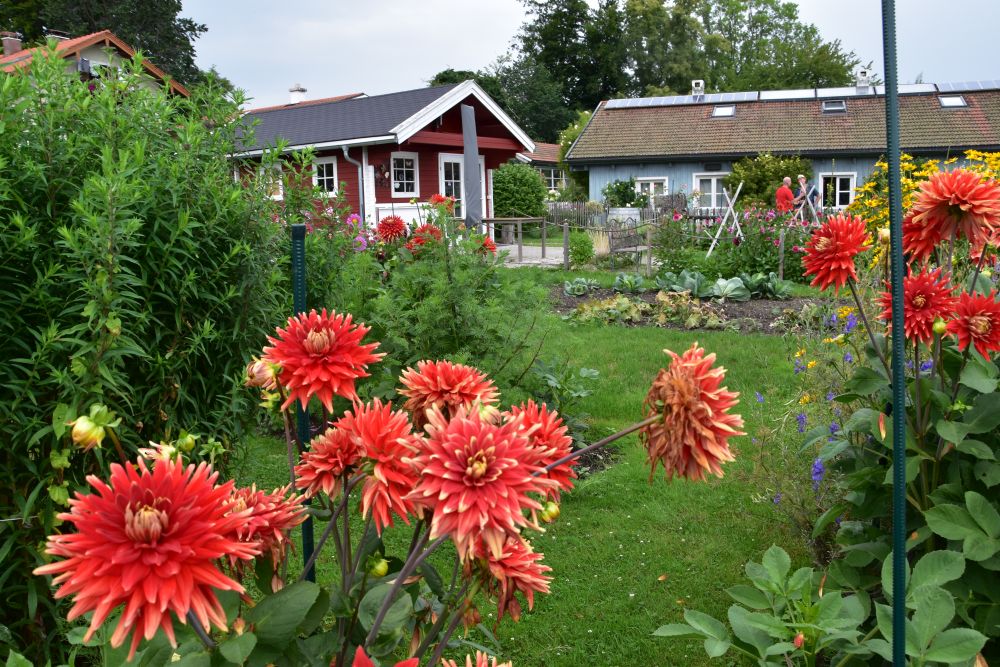
All the gardens are well kept – such as this one with dahlias.

The huge oak tree above this garden has been planted in 1901, 120 years ago, as a small seedling that was protected against the sun by a cabbage leaf. The seedling developed marvellously.

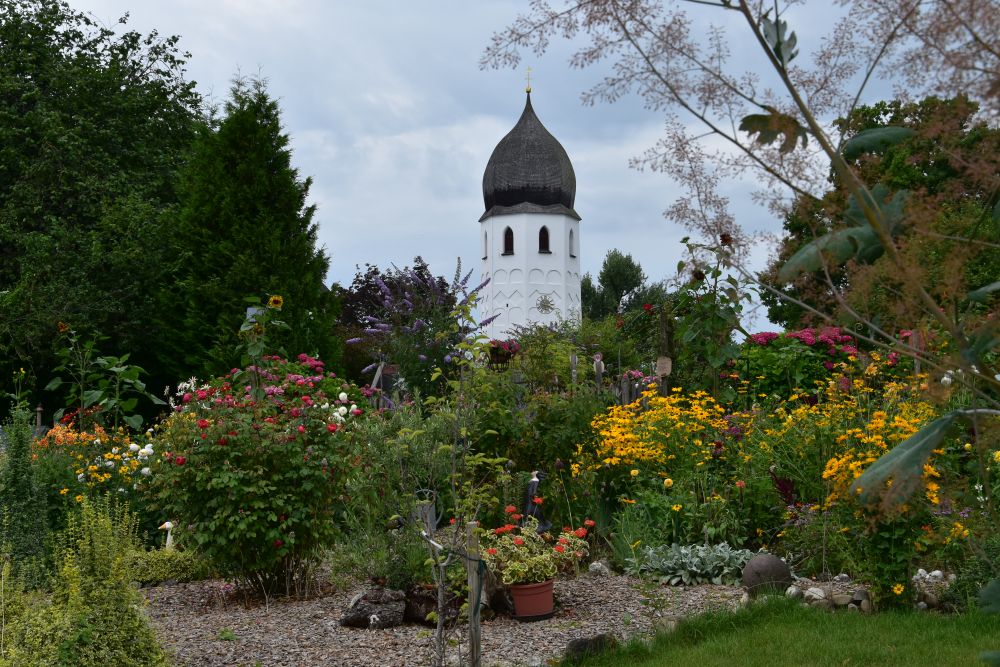
The cathedral belfry appears behind these colourful flower bushes.

My friend shows me her favourite swimming spot with the view of Herrenchiemsee.

But – no swimming today. It is already late and we have a date with my friend’s friend at Ruhpolding. We take the boat back and leave the Chiemsee to settle at Ruhpolding.


Sources:

Walter Brugger and Lisa Bahnmüller, “Urschalling”, Katholische Filialkirchenstiftung Urschalling, Prien am Chiemsee 2016.
“Abtei Frauenwörth und die Fraueninsel – kleiner Inselführer”, Benediktinerinnen-Abtei Frauenwört im Chiemsee, without year.

On the road again: Oberbayern, where severe weather is announced

August 7th 2020, my friends celebrate their sixth wedding anniversary at Munich, and I visit them. This has been my first vacation abroad since March 2020. From Sunday, 3rd to Thursday, 6th, my friend has ordered two hotel rooms in Ruhpolding in the Pre-Alps of Bayern (Oberbayern, Chiemgau Alps).

The weather forecast announces severe weather conditions for Monday and Tuesday. Let me start with our experience of the changeable and even severe weather conditions.


Warm Saturday summer evening in Munich

Saturday evening at Munich is very warm. It is a beautiful summer evening, almost too warm.

My friends prepare a delicious barbecue.

We eat in the shade of their cosy garden.


Sunday: Driving to Ruhpolding via Chiemsee. The first clouds start to cover the mountains

The next day, Sunday, we take the busy highway to Salzburg and stop at the lake, the Chiemsee. It is overcast and the mountains are hiding.

We visit the Romanesque-gothic church of Urschalling…

… and the Fraueninsel with their monastery and the beautiful gardens.

In the evening, I enjoy a delicious trout stuffed with herbs at the restaurant Fischerwirt and we close the day with a glass of wine in the garden of our hotel at Ruhpolding. It is still warm.


Monday: Excursion by car to Reit im Winkl and the Streicher church Sankt Servatius in the drizzling rain 

On Monday, we go for an excursion by car to do some shopping at Reit im Winkel and order a table for Tuesday in the restaurant Peternhof just across the border in Austria. The rain drizzles, when we walk through the foggy forest to see the charming “Streicher church” Sankt Servatius that hides between trees.


Tuesday: The rain splashes all night. We are in the centre of the severe weather front “Gitta”

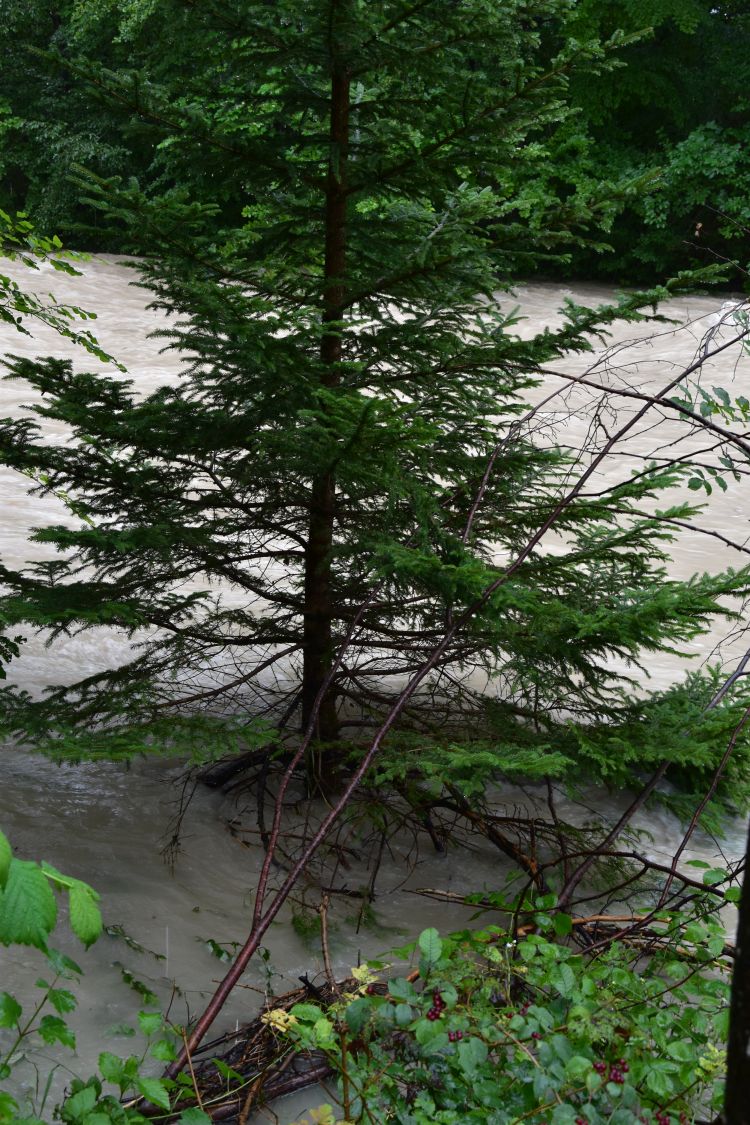
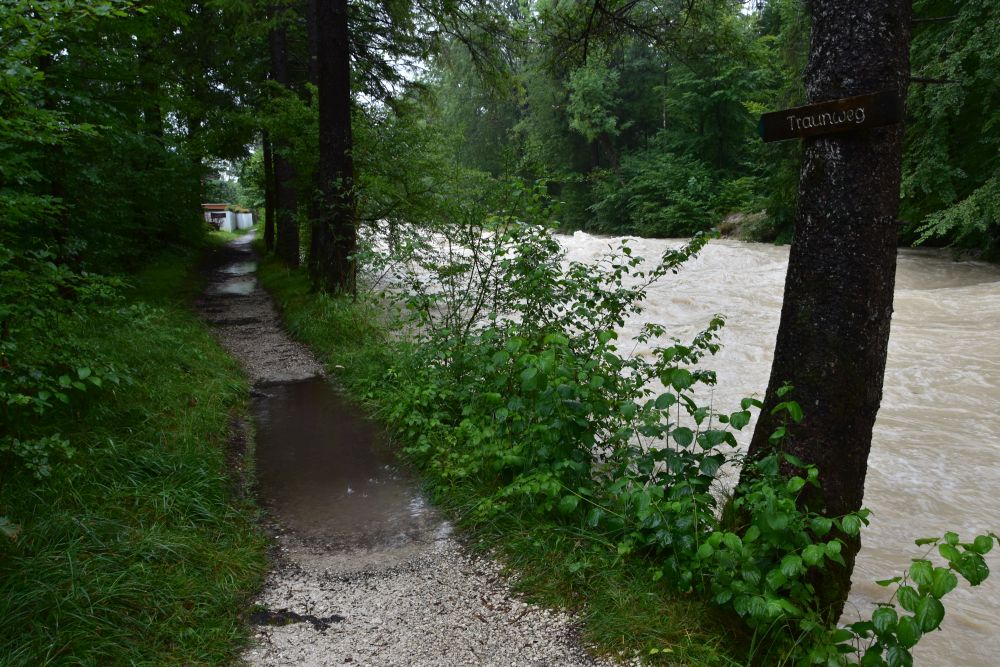
Monday night, I sleep with the windows open (under the roof), and I can hear the rain splash loudly. It is pouring with rain all night. In the morning we see that the rivers have left their beds.

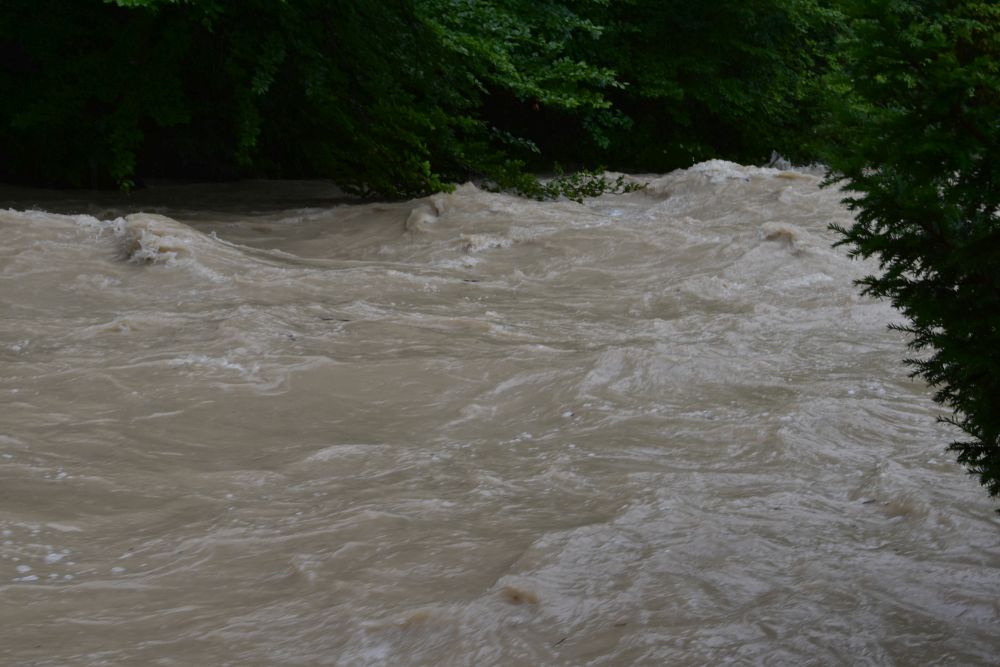
This is the raging river Traun with the “Traunweg”, the path bordering the river.

The branches are floating on the waves of the river Traun.

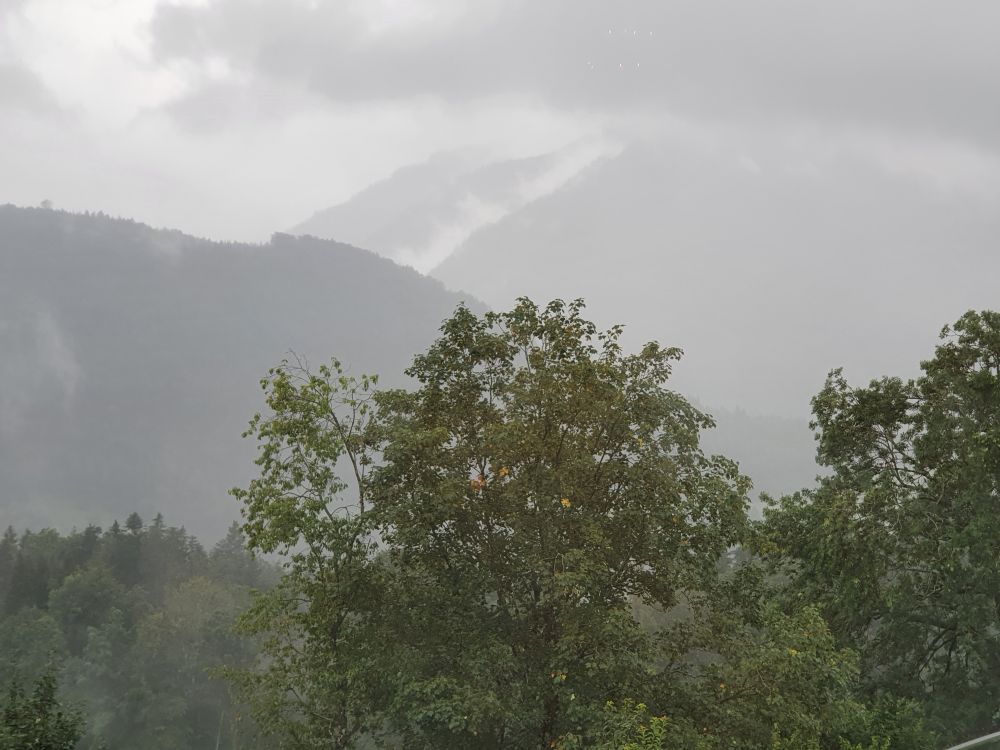
The mountains surrounding Ruhpolding have completely disappeared in the clouds.

In the news we read that in Siegsdorf, just 9km away, 146l/m2 of rain have fallen in 24 hours. The busy highway A8 to Salzburg as well as some local roads have been closed. Traffic jams all over. Cars have drowned in the floods. Some policemen are standing in water – up to their hips, also their car has drowned in the floods. In addition, train connections are interrupted. Also the Salzburg area in Austria and Eastern Switzerland have suffered under these severe weather conditions.

Bad weather is good weather for sightseeing. We drive to Bad Reichenhall and explore the charming city centre with the colourful townhall.

In the drizzling rain, we visit some Romanesque-gothic churches and have lunch in the restaurant of the salt factory.

We close the day with an excellent dinner in Austria, just across the border of Reit im Winkl, at the restaurant Peternhof, from where we watch the first shafts of sunlight appear.

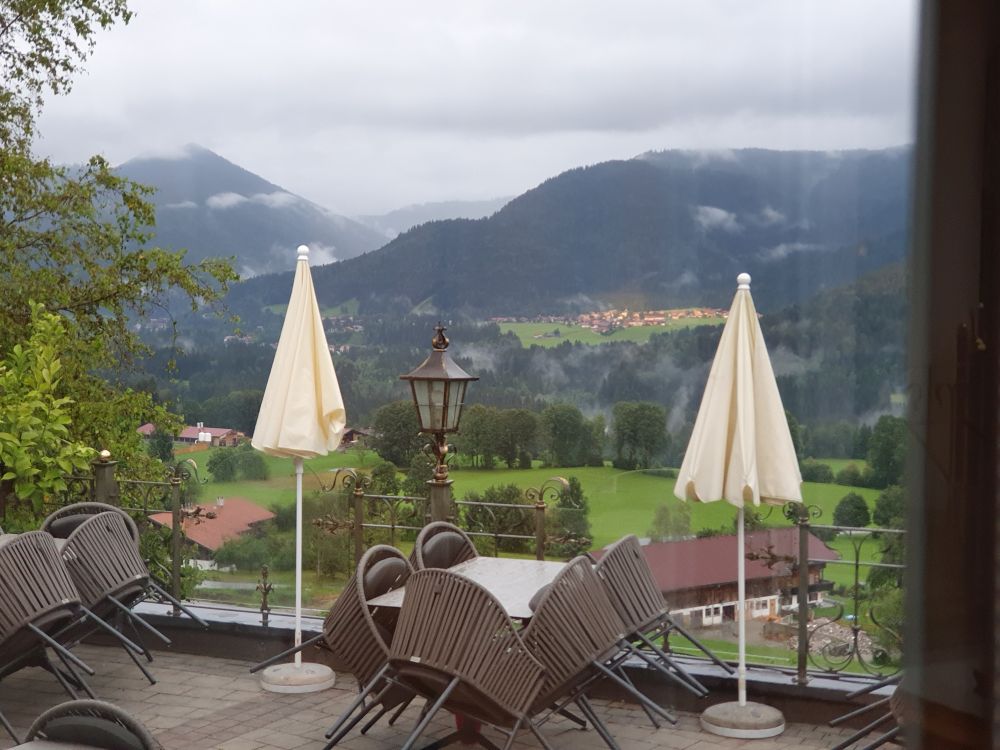
We look forward to better weather to do some hiking and to enjoy restaurant terraces again.


Wednesday: The “Falkenstein loop path”, the Einsiedl church and dinner with the setting sun at Maria Eck

In the morning, we drive to Inzell to go for our first hike, the “Falkenstein loop path”. The sky is still grey and the paths are wet, but it is no longer raining.

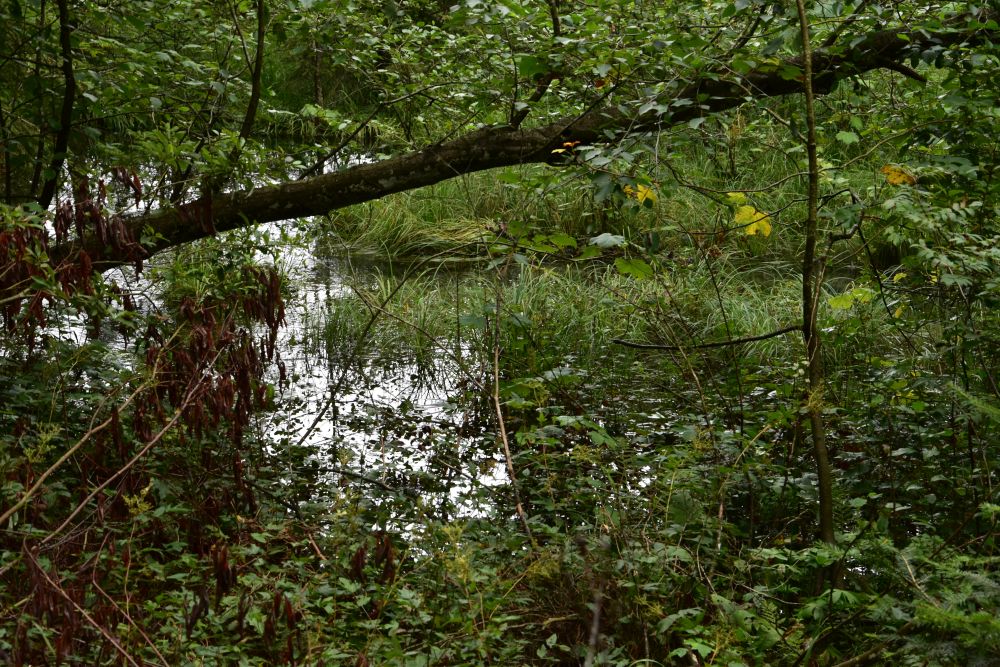
The cooler temperatures are good for walking along the romantic ponds.

In the afternoon, we visit this charming Einsiedl church “St. Nikolaus im Oberland”, covered with wooden shingles.

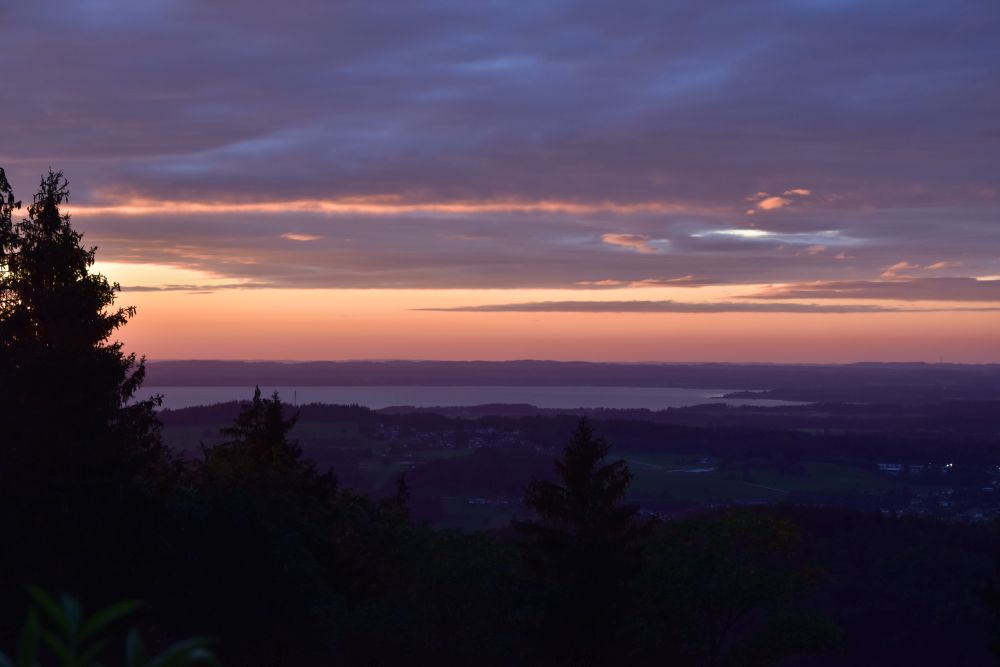
The sky is blue again. We drive to the monastery Maria Eck, where we have a wonderful dinner on the restaurant terrace…

… and enjoy the sunset above the Chiemsee.


Thursday: Ruhpolding surrounded by mountains again. Climbing the Unternberg and cooling down in the Tüttensee

Early in the morning, I go for a walk to take pictures of the St. Georgskirche with the mountains surrounding Ruhpolding, including the Sonntagshorn in the background. It is the first time during our vacation that I can see the Sonntagshorn.

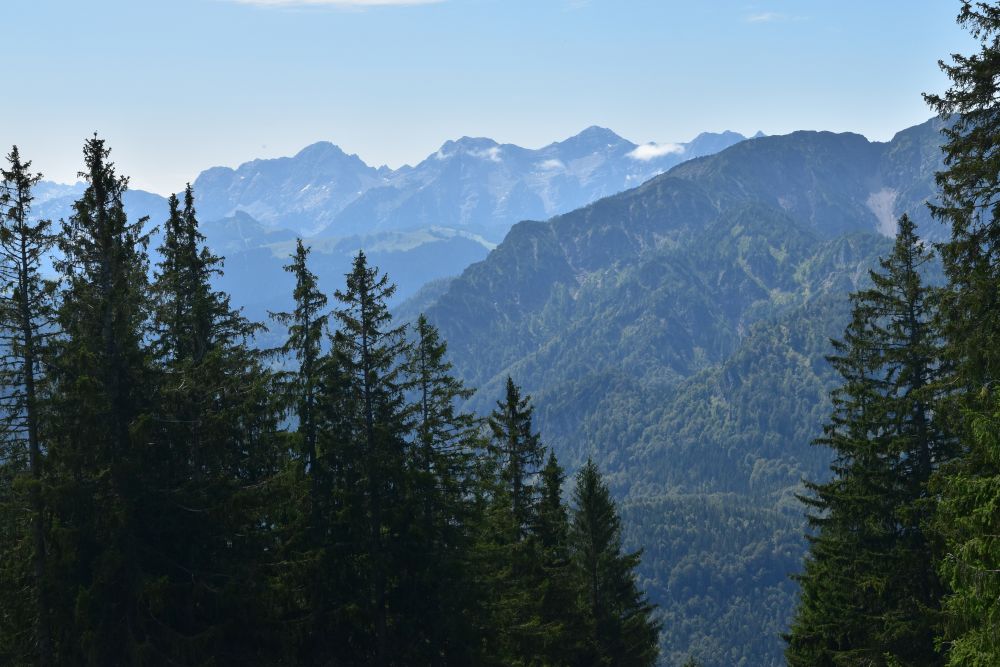
Ruhploding is surrounded by mountains again. As a farewell, we climb the Unterberghorn and enjoy the view of the Sonntagshorn from here as well.

Ruhpolding is far below us, now in the sun and under blue sky.

We take the amazingly slow chairlift to return to Ruhpolding and say good-bye. We have a short swim in the chilly Tüttensee that has been cooled down by the pouring rain. Then we return to Munich on the busy A8 escaping a traffic jam on the first kilometers by using the local roads.

We were perhaps not too lucky with the weather during our vacation in the Chiemgau Alps of Bayern. Nevertheless, we have enjoyed our stay discovering nice places, excellent restaurants and – amazingly in Bayern – quite a few Romanesque-gothic churches that I will talk about in the next blogs.


Borders around Basel open again – first short bike tour to Germany

On Monday, 15th of June 2020, the country’s borders have opened up again. The “Regio Basiliensis” (region of Basle) is a “Regio” again. Yes, I can speak my Basel dialect across the border of Basel, in the Alsace (France) and in the Markgräflerland (Germany) – we ARE ONE region. Joking, we sometimes dream of “Greater Alemania” unifying those areas, where our Alemannic dialect prevails. To make it clear, we are just joking, and with “immigrants” from the rest of France, I like to switch to French and for “immigrants” from the rest of Germany I go back to my mother tongue, German.

Happy to access to the “Regio Basiliensis” again, I take my bike and drive to Ötlingen (then to Binzen and the Kandertal).

Source: Swiss mobile maps

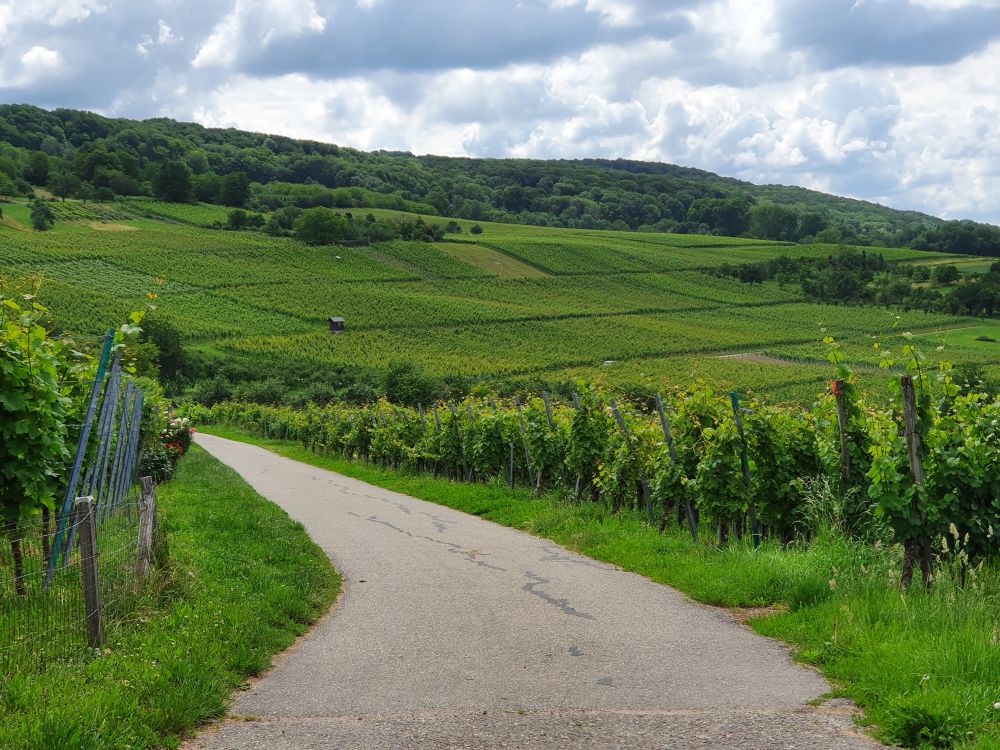
Ötlingen is on a hill above the Rhine valley and grows wine that their restaurants serve…

… with a great view of the Rhine valley and the Jura as well as the Vosges mountains.

The Regio Basiliensis looks like ONE large agglomeration around Basel, just accidentally divided by country’s frontiers that were closed for three and a half months and now are open again.

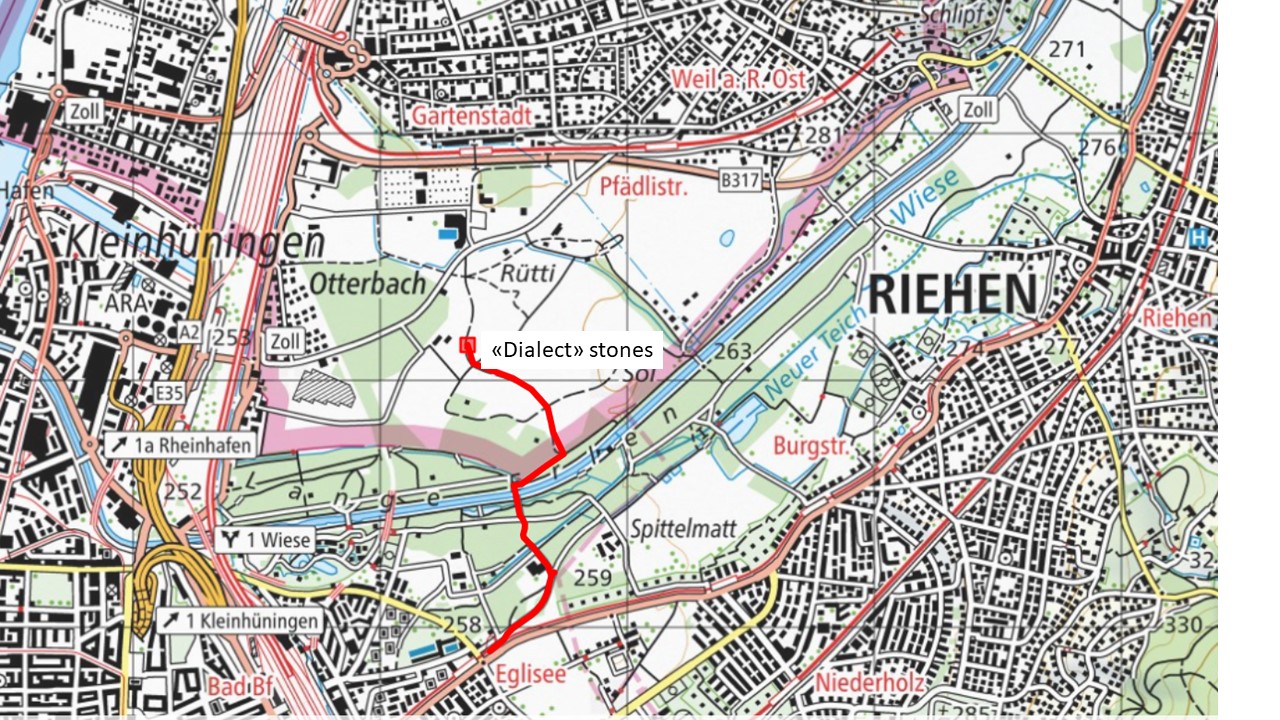
Returning to Basel, I cross the Langen Erlen, which belongs to a recreational area along the Wiese, partly in Germany, partly in Switzerland.

Source: Swiss mobile maps.

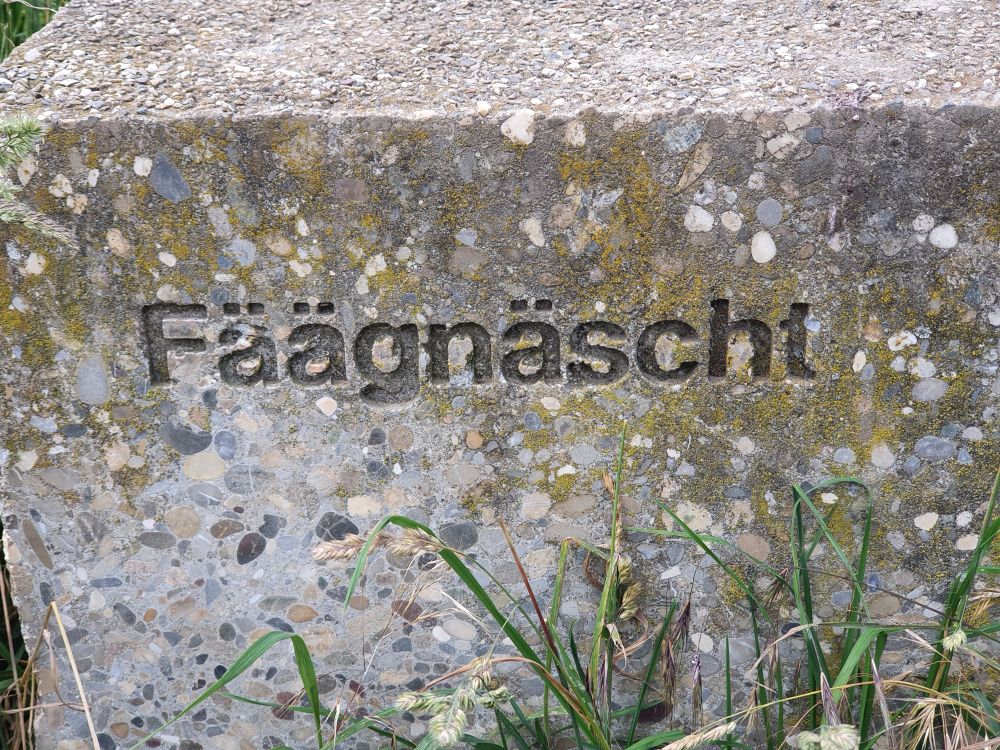
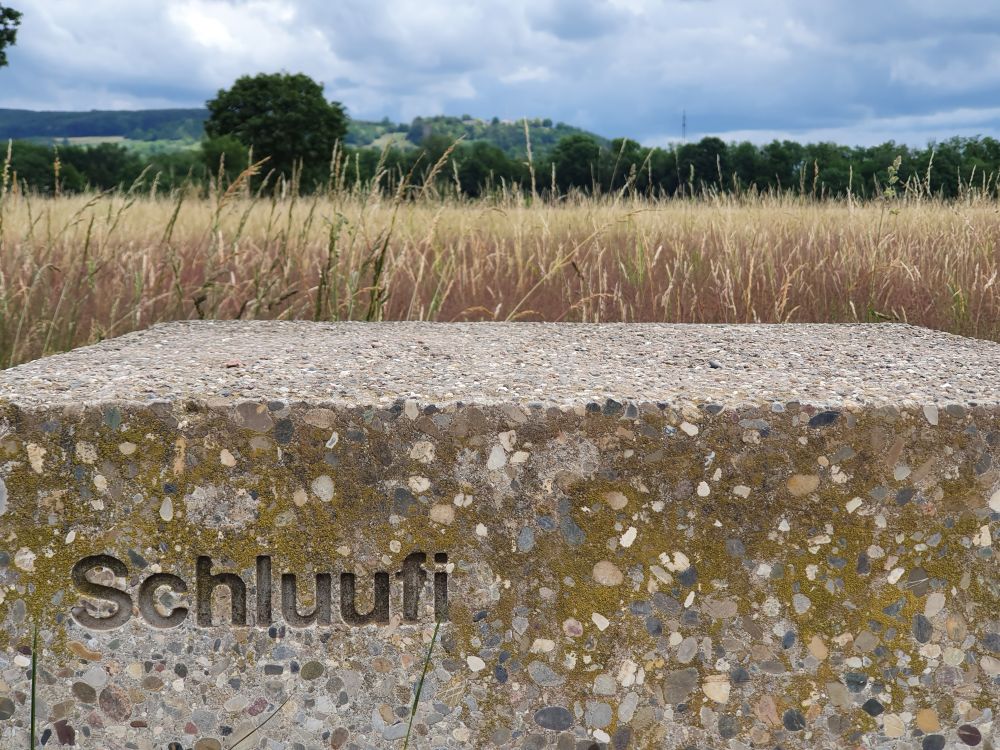
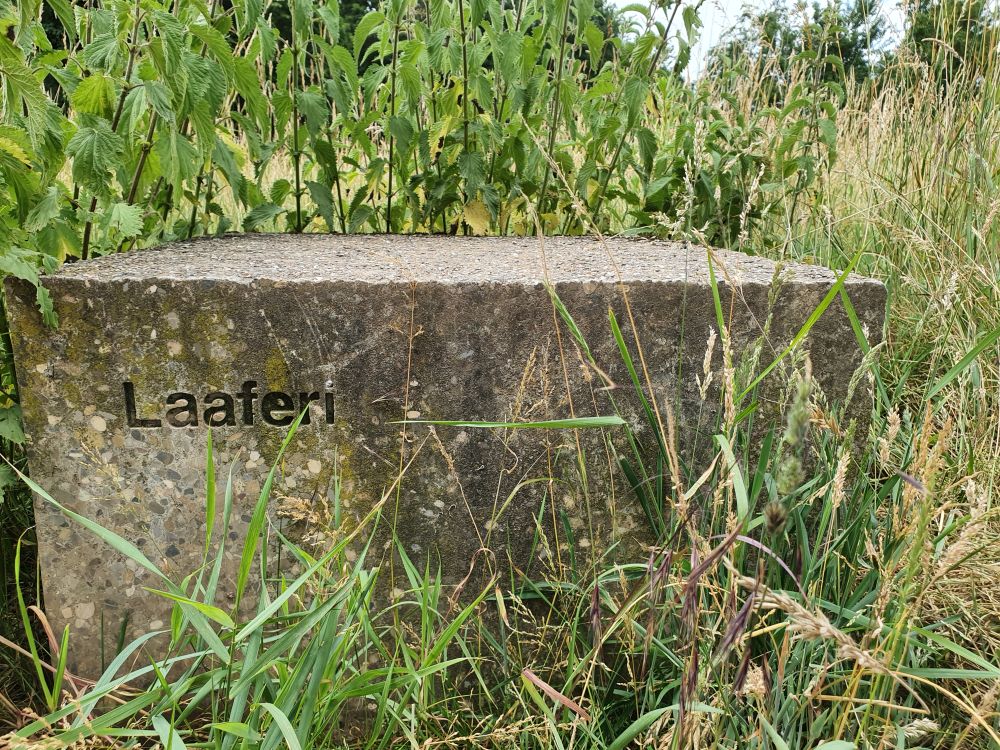
Along the path marked in red (between Eglisee and the Laguna), there are “dialect” stones displaying expressions used in Basel and across the border in Germany (Markgräflerland); the same expressions are also in use in France (Alsace). Here are some examples.

“Fäägnäscht” is, what we call a person that cannot sit or stand still – he/she is in move all the time. I like this word, I can hear the moving and rustling of the unsettled person: -f-f-f-scht-scht-scht-f-f-f-scht-scht-scht. And I know, some people would call me “Fäägnäscht”.

“Blagööri” is what we say to a person that shows off. He/she thinks, he is the “best” and knows everything. The extended “öö” illustrates, how great he/she thinks, he is – ööööööÖÖÖ.

A “Schluufi” does not have control of his life or his work or he is simply not interested in that. He is “dragging along”. I can hear that clearly from the “sch” and the two “uu”:  sch-sch-uu-uu-sch-sch-uu-uu.

A “Schnääderänte” keeps on talking and talking “schnääder-schnääder-schnääder” and it sounds like “Änte” which are ducks. I can hear the chattering of the ducks: schnääd-schnääd-schnääd, also onomatopoeic.

Also the “Laaferi” talks a lot, and what he says, is meaningless, a bit like “ob-la-di, ob-la-da“, I think, the Beatles used the same onomatopoeic picture.

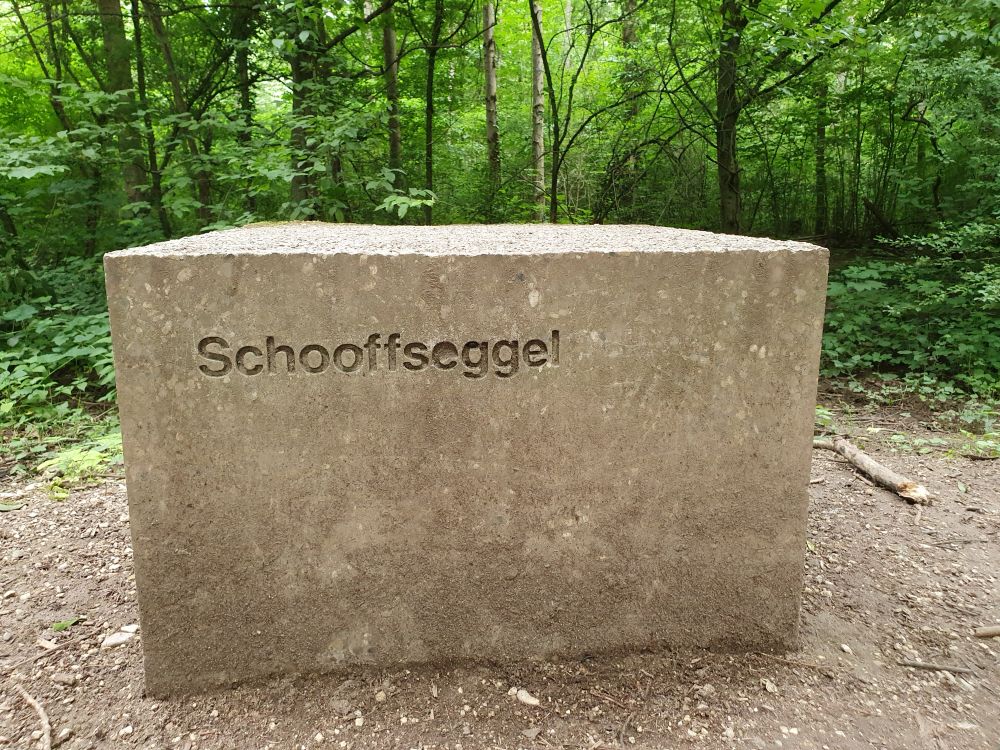
This is a difficult one. It means, I disdain you totally. I would never say this word to anyone. It is not nice, simply not lady-like. But its background is a good example of the Regio Basiliensis reaching into Germany and France.

Let us dig deeper. This word has an interesting origin in French with a detour to Latin that entered the Alemannic language. Instead of “Schooffxxx” (as on the stone), we also say “Schooffsurri” which, I believe, goes back to “chauve-souris” in French (“bat” in English). Digging deeper into late Latin, “chauve-souris” comes from “cava sorex” that means “chouette souris” or “marvellous mouse”. Hence a “marvellous mouse” (cava sorex) turned into a chauve-souris (“bold” bat”) in French, then into a term of disdain in the Alemannic dialects (Schooffsurri) and into the even uglier expression “Schooffxxx” that you find on this stone. This expression is known in Basel and in the whole Region Basiliensis across the border in Germany and France. But it is rude and I never use it.

The path with the “dialect” stones starts at the Eglisee in Switzerland and ends in Germany near the Badeland Laguna. It shows, how much the Regio Basiliensis, the region of Basle, belongs together: Across the borders we speak the same dialect (almost, we can hear nuances), and now, the borders have opened and we can visit one another again.

Let us take care and protect one another from the virus resurging; I observed that in Germany shops require medical masks, and I put on my mask, when buying fresh bread and cherries in “my” farmer’s shop in Rümmingen near Binzen.

I feel freer and I am happy that now the Regio Basiliensis is within reach again.

Listening to the stories that my home tells me: My dad’s book about Diesel’s car drive in Europe in 1950/51 / 2

In March/April/Mai 2020, the virus has stopped me travelling. Instead I listen to the stories that my home tells me.

In my former blog, I have started to talk about Eugen Diesel’s book “Philosophie am Steuer: Ein europäisches Reisbeuch” or “Philosophy at the Steering Wheel: A European Travelling Book”).

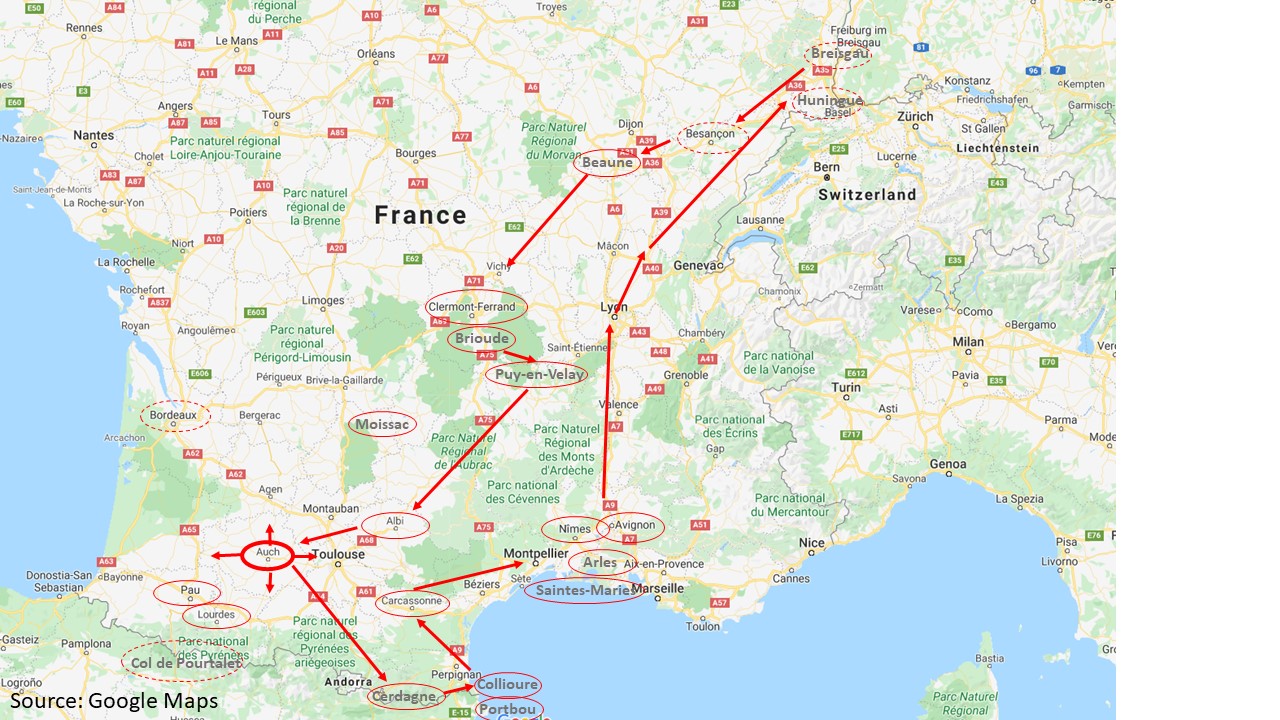
The book belonged to my dad and I have read it during the lockdown. In my former blog, I have talked about who Eugen Diesel was and how he drove to Auch in southern France. I now continue with his excursions around Auch and about his tour back to Germany, intertwining that with my own memories.


While staying with their friend in Auch, Eugen and his wife go for excursions in the south of France

In Auch, Eugen and his wife stay with their friend, and from here they go for various excursions, one of them being Pau.

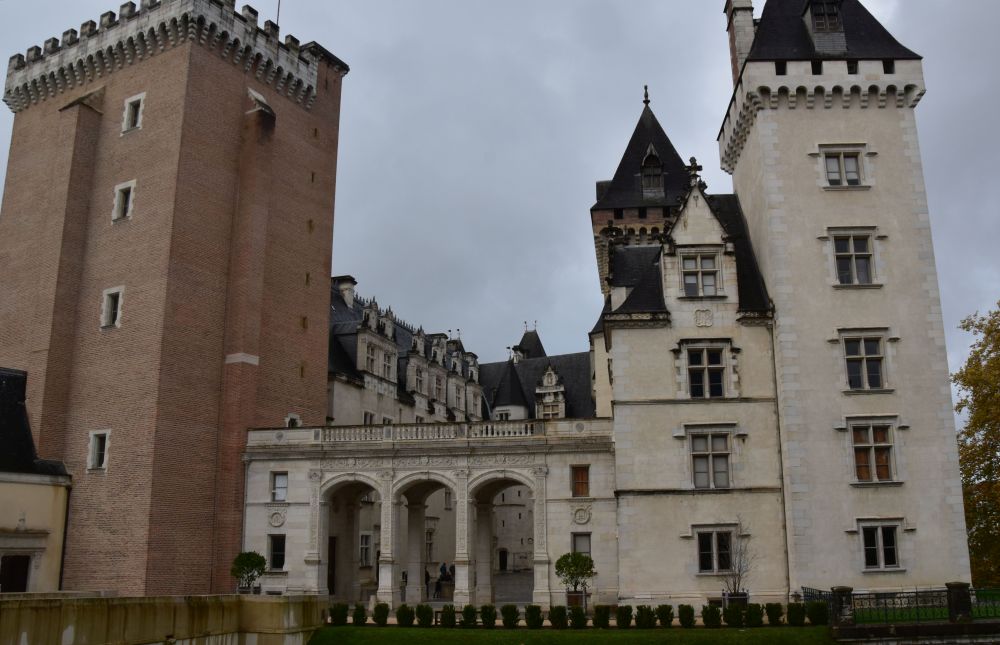
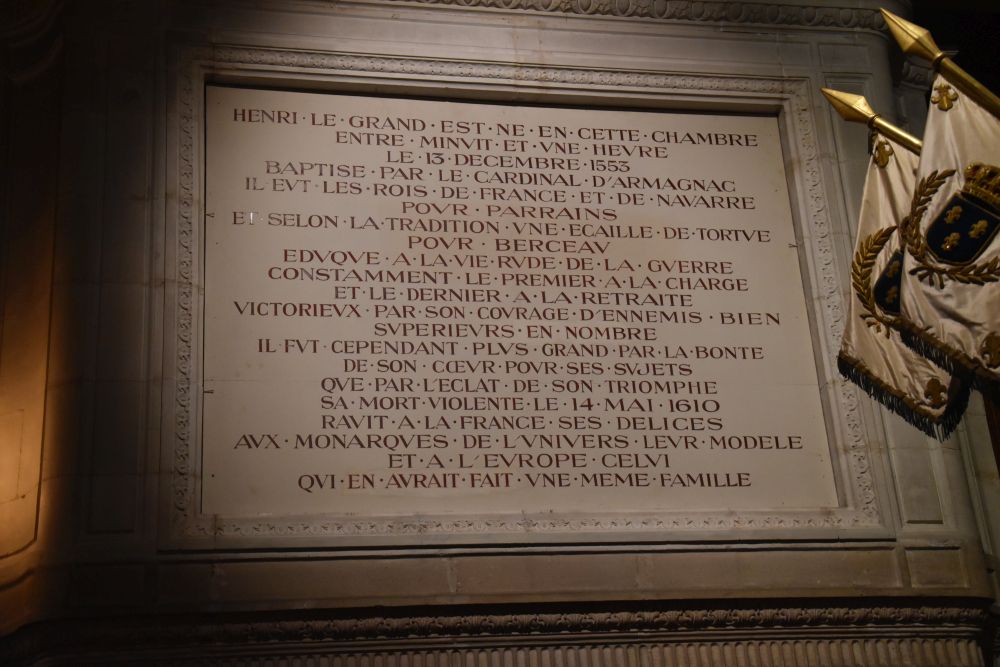
In the Renaissance castle, Jeanne d’Albret gave birth to the later king of France, Henri IV (born in 1553).

We know Henri IV for the words “Paris vaut bien un messe”. He may never have spoken them out, though he adopted the catholic religion to take over the crown of France, and, luckily, he was tolerant towards other religions.

Henri IV had children from various loves, and he played with his children. When this ambassadors entered, Henri asked him: “What do you do with your children?”. I believe that Henri IV is one of the most fascinating personalities of the history of France.

In Pau, Eugen visited the castle and he was invited to the local exhibition of furnitures, cars and engines at Pau; some people believed that it was him, Eugen, that had invented the Diesel engine, though it was his father.

In 2017, my friend and I were in Pau. We visited the castle and the medieval city center.

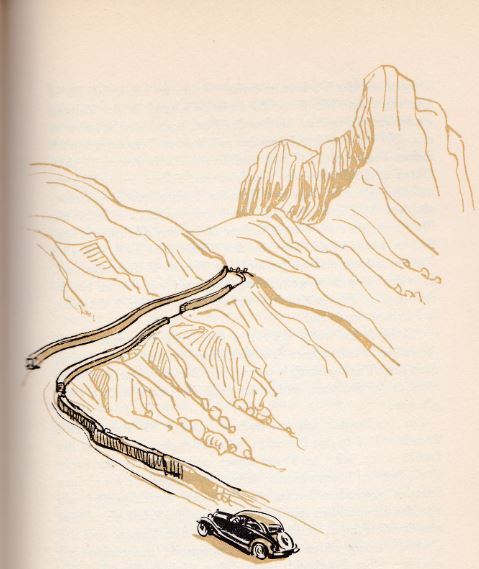
From Pau, Eugen drove up to the Pyrenees, to the Col de Pourtalet (1795m).

(Pen drawing by Willy Widman, p. 123)

The roads are narrow, but I do not think, he had to cross many cars coming down, as the border to Spain was closed. The customs officer let Eugen take a few steps in Spain. The sky was inviting blue south of the Pyrenees (Spain), while the north (France) was covered with clouds. Eugen had to return to the clouds, to France.

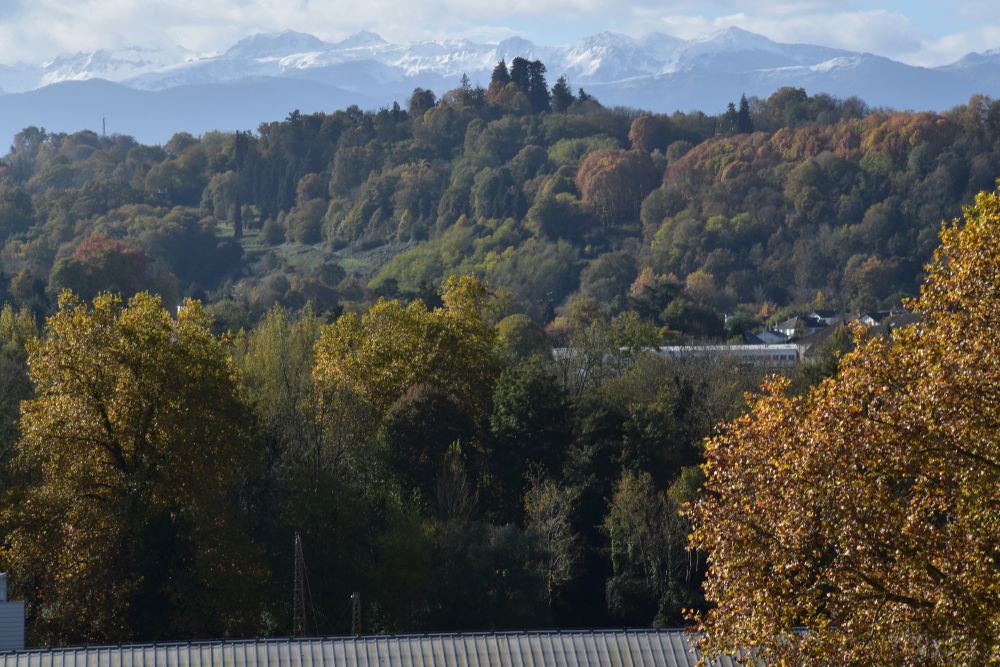
The Col de Pourtalet is one of the few passes in the Pyrenees that we have not yet used to get from France to Spain. I would love to take it, once the border to Spain opens up again and the situation looks safer after the current pandemic. This is the view of the Pyrenees in the direction of the Col de Pourtalet, taken at Pau.

In Lourdes, Eugen did not dare take photos, because it is a sacred place. But then he noticed an elderly lady take photos using an expensive camera, before laying down to pray. Lourdes is an important pilgrimage site that bases on Mary having appeared to a young girl in 1858. We were in Lourdes in 2017 and visited the grotto and the Rosary Basilica from 1899. When leaving Lourdes, the boot of our car would no longer open. A miracle? No, it turned out that the strip of one of our backpacks got caught in the lock, a problem that was solved all by itself later on a bumpy road. Perhaps not a miracle, but a reminder?

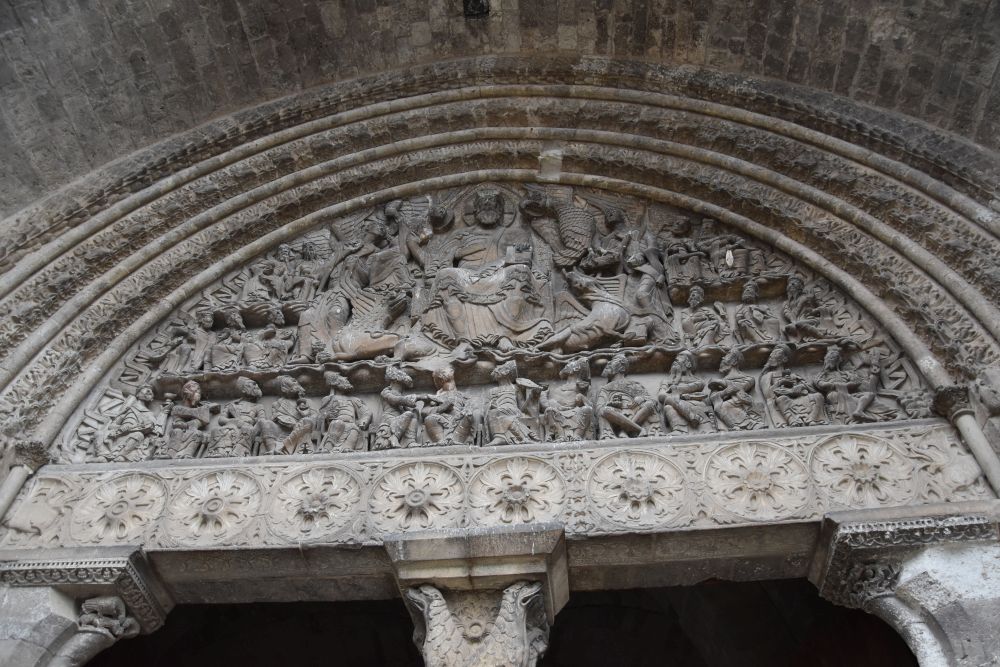
In Moissac, Eugen and his wife watched a lady ring the abbey bells manually. We saw the Abbey Saint Pierre in 2017 and in 2019. It has one of the most beautiful Romanic portals that I know; here, the 24 wise men playing music are looking up to Jesus,…

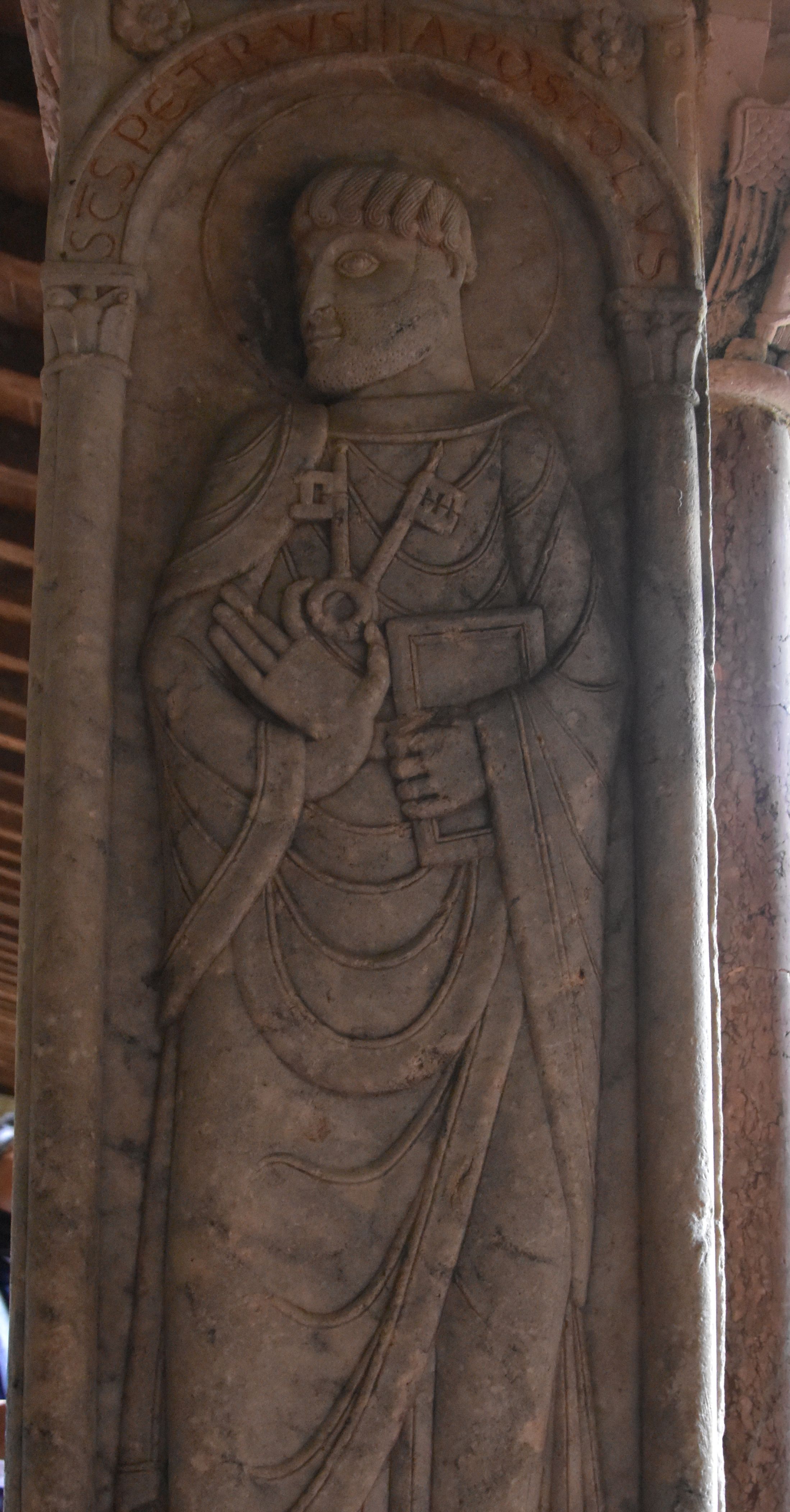
… and in the the cloister we found this beautiful Petrus.

After having visited Bordeaux, Mimizan and Toulouse, Eugen and his wife left Auch to return to Germany performing a round tour to the Mediterranean Sea.


Eugen and his wife leave Auch and return to Germany via the Mediterranean Coast

Eugen drives along the Pyrenees and tries to enter Andorra. But the customs regulations (two large books in a drawer) did not say, how to handle Germans, and hence the couple was not allowed to cross the border to Andorra. Eugen and his wife continued their way in France crossing the Cerdagne, a high plateau shared by France and Spain, with one Spanish exclave called Livía. Eugen could not find the reason for Livía being a Spanish exclave surrounded by French territory. Today, we have the internet, “Dr. Google” and Wikpedia. They tell me that in 1659, Louis XIV did not know that Livía was a town. In the Treaty of the Pyrenees, he had agreed with the Spanish crown that France would integrate all the villages of the northern half of the Cerdagne/Cerdanya in France. Livía, once the capital of the Cerdagne and registered as a town, consequently stayed with Spain. If this is the reason, it could be an indication that, even as a powerful king, you may have to study the local details, before finalizing an agreement.

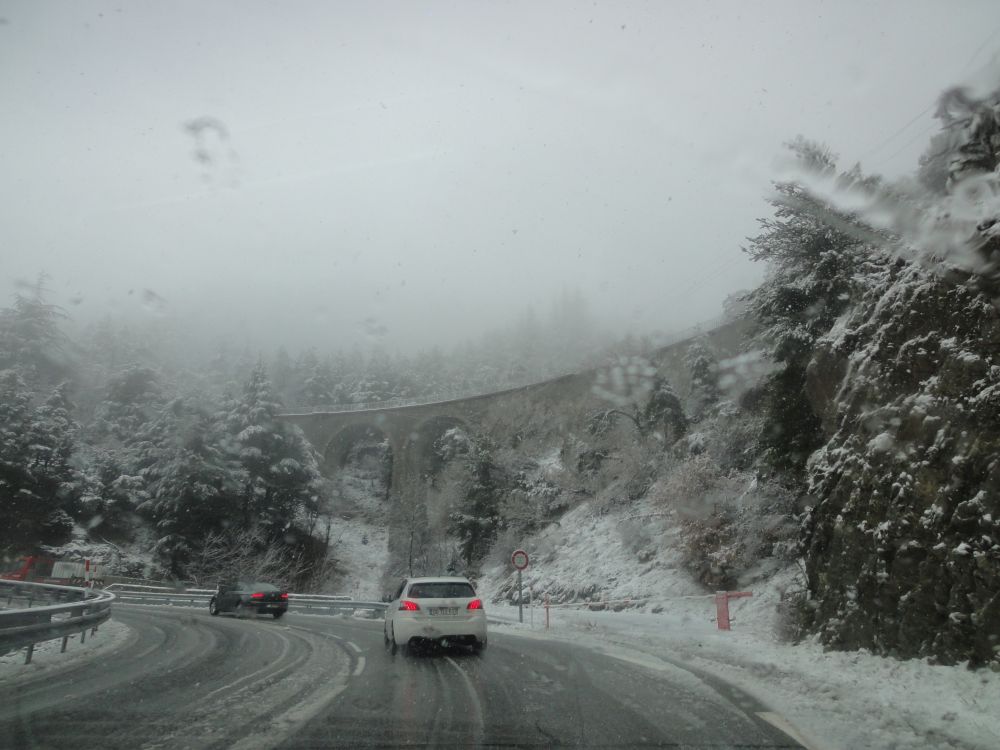
We were in the Cerdagne in May 2018, and we got caught in heavy snowfall, while on the way to Seu d’Urgell in Catalonia on the Spanish side.

Here we are on the road up to the Cerdagne. On the plateau, 1200-1600m, we will find some 10 to 20cm of fresh snow on the roads. We are in the mountains – “real” mountains – and even in May, the weather can be rough in the Pyrenees. My friend took the photo, while I was driving carefully; my car is a four-wheel drive.

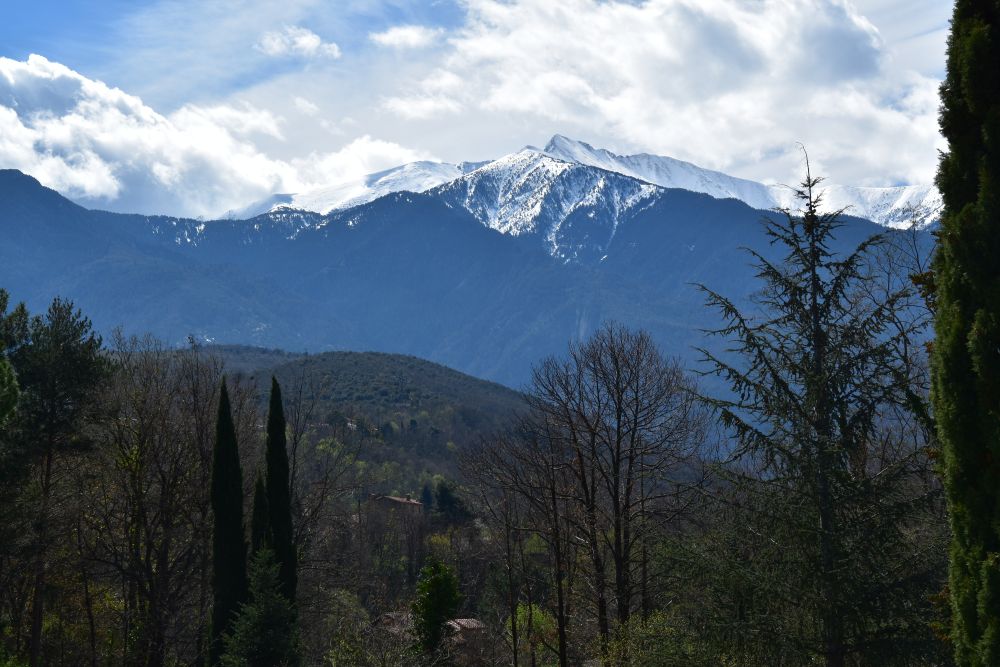
Not far from here is the beautifully shaped sacred mountain of the Catalans, the Canigou (seen from Prades, where the road up to the Cerdagne plateau starts).

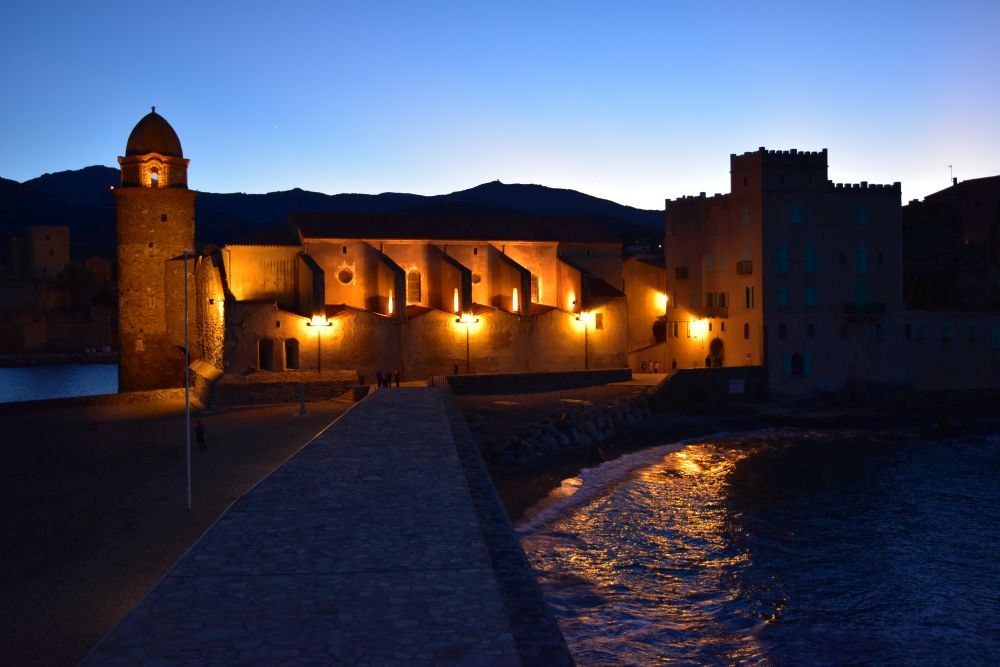
After having followed the river Têt down to the Mediterrenean Sea, Eugen stayed overnight at Collioure with the harbour and the lighthouse (“phare” in French)…

… that André Derain painted.

In the beginning of the XXth century Fauve artists around Braques, Matisse and Picasso used to meet here. Eugen enjoyed the atmosphere of this charming village with the castle and with the colorful narrow streets, and so did we in 2016.

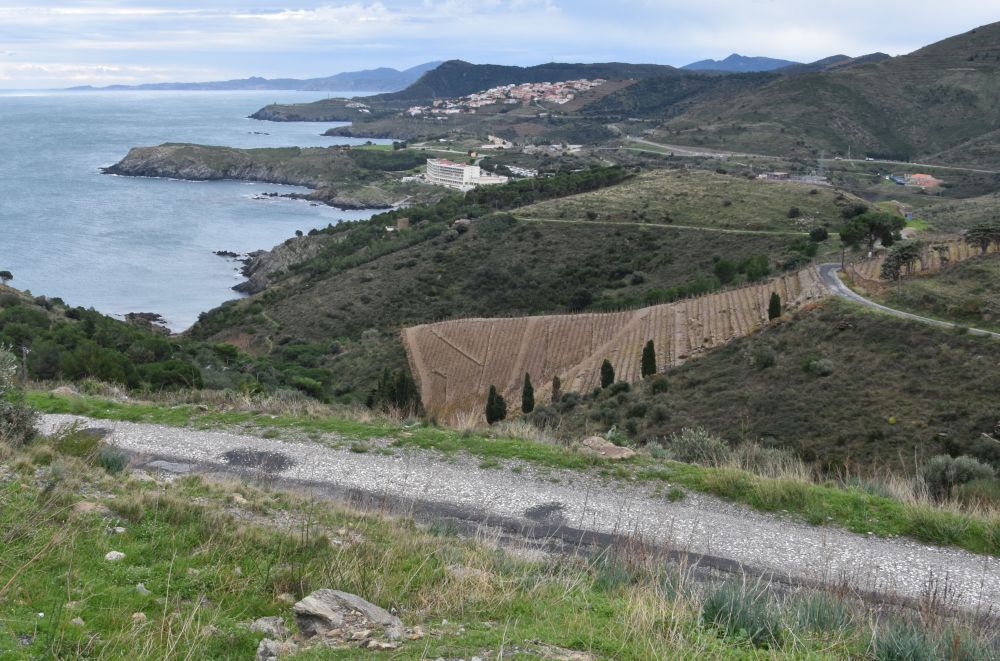
Along the beautiful coastline, Eugen and his wife drove south from Collioure to the border between France and Spain, at the Col de Belitres.

The border to Spain was closed for Eugen and his wife, also here. The customs officer talked to Eugen’s wife, while Eugen was allowed to enter Spain, just for a few steps, to admire the landscape and the huge train station squeezed between the mountains and the sea. The small settlement, Portbou, has such a large train station, because the engineers in France and Spain had selected different gauges for their railways, as Eugen, son of an engineer, explained.  The enormous train station was required for the passengers to change trains and for the goods to be reloaded.

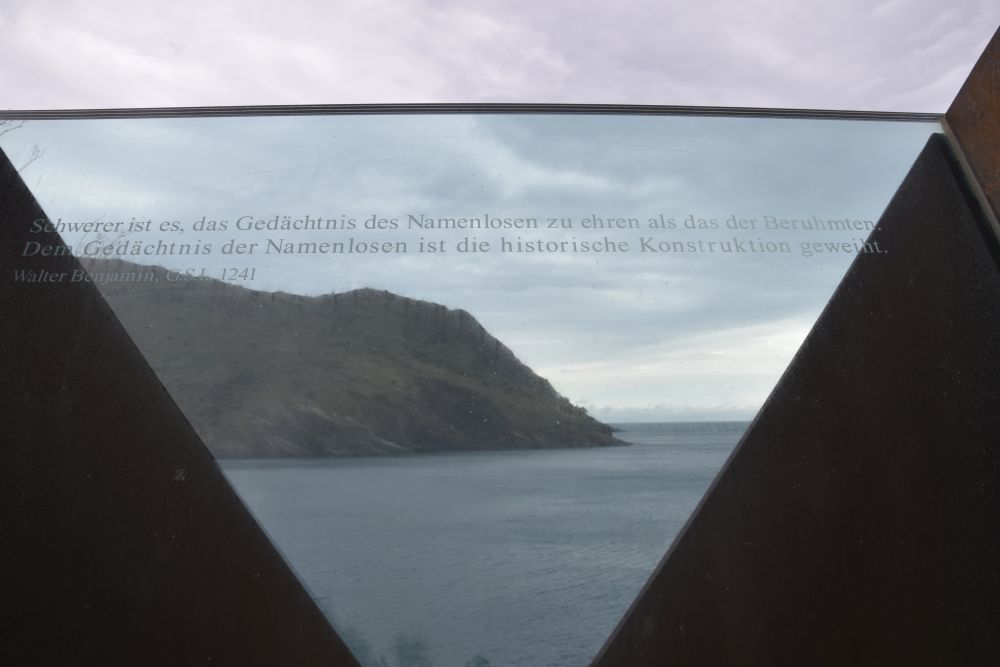
In 2018, we were at Portbou, and felt the tragedy of this border: Here, the philosopher Walter Benjamin escaped to Spain in 1940 with a transit visa in his pocket that should allow him to emigrate to the US, but Spain had just cancelled all transit visas. Walter Benjamin was about to be sent back to France. He committed suicide and since 1994, this haunting monument has reminded us of Walter Benjamin’s tragedy.

I found a beautiful blog “The Passage to Portbou, Seeking Walter Benjamin in Catalunya”, by Martin Kalfatovic. He translated the German words facing the sea like this: “It is more difficult to honor the memory of the anonymous than that of the renowned. Historical construction is devoted to the memory of the anonymous. Walter Benjamin, On the Concept of History (1940)”. Yes, in the 1940-ies, many of the “renowned” wrote history in a way that I prefer would not have happened and that I hope will never happen again – however, sometimes I am worried about our “renowned” now. Then and now, there existed and exist courageous “anonymous” that deserve to be honored.

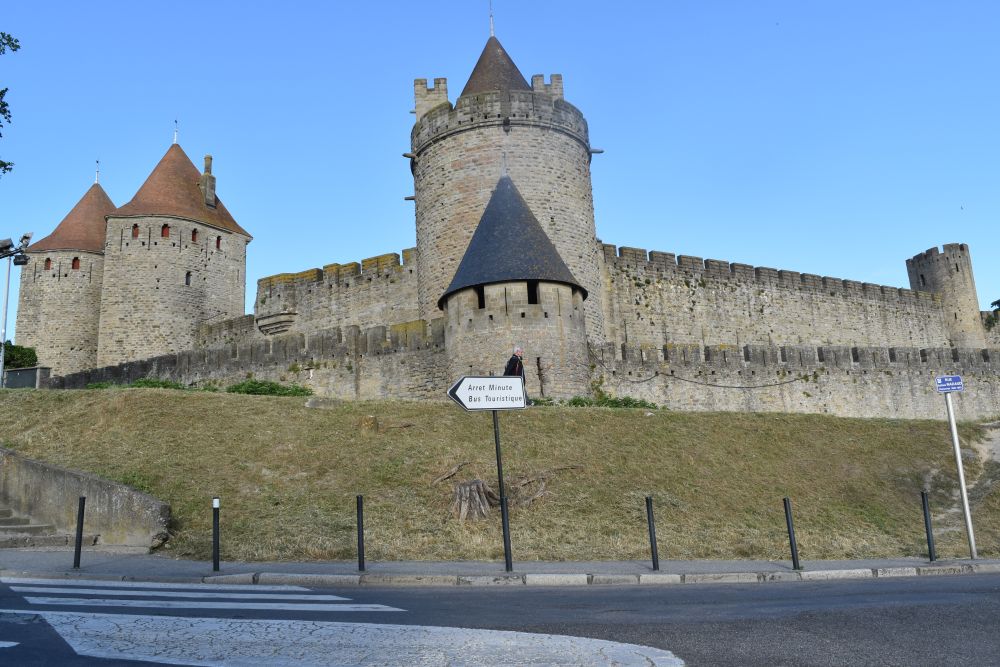
After having seen Portbou standing at the closed border, Eugen’s next stop is Carcassone, the fortified town…

… with the charming small streets inside.

We were here in 2016. In a welcoming restaurant, we watched some Asian tourists eat the “Cassoulet”, which is a local hotpot made with sausages. It is heavy stuff for people that work in the fields all day. I was not sure, whether the Asian tourists liked the dish or just found it interesting. I had a delicious lamb dish with fine herbs.

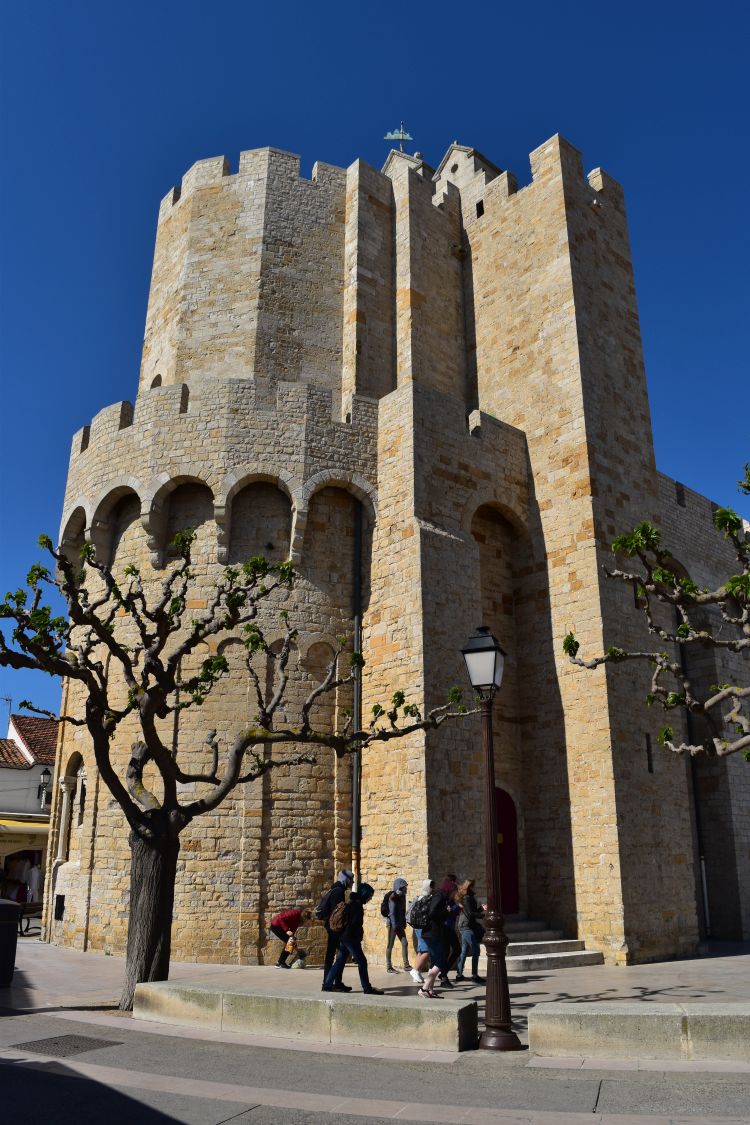
Eugen and his wife stopped in Les Saintes-Maries-de-la-Mer at the Mediterranean Coast in the Camargue. Three Saint Maries landed here with her Egyptian servant Sarah. This is the church that commemorates the landing of the sacred boat.

(Pen drawing by Willy Widman, p. 155)

We visited the church in 2017, under dark blue sky.

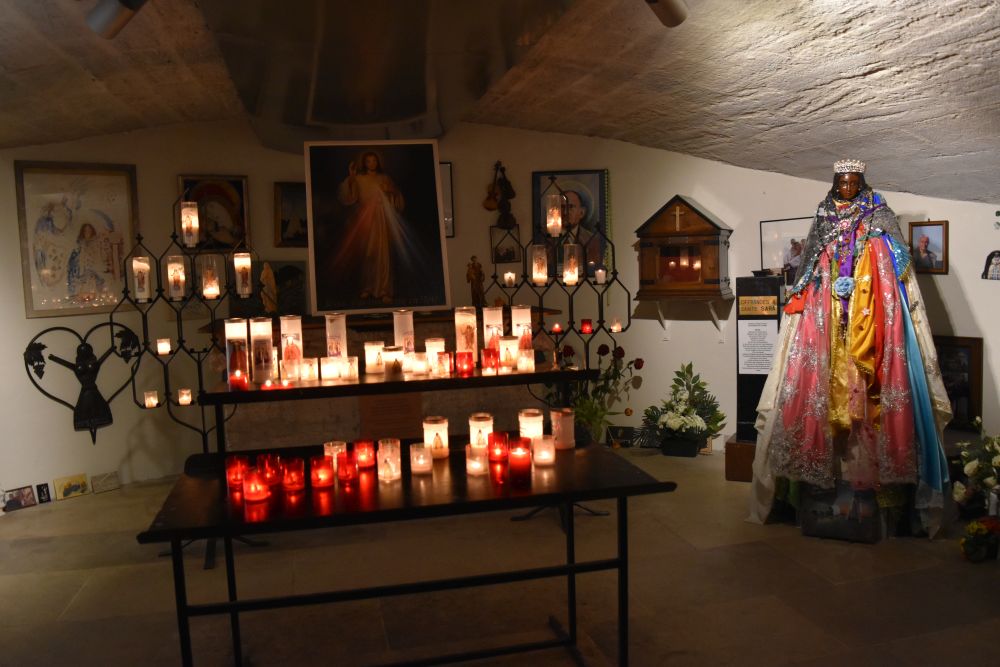
The Romani  people venerate Saint Sarah, the Egyptian servant, in the crypt of this church.

In Arles, Eugen and his wife attended a bullfight. He described it in detail with the eyes of a German that did not really enjoy the elegance of the bullfighters and the killing of the bulls. The fight took place in the old Roman arena that we saw in 2017 (but without such action, fortunately, not something I would like to watch).

Still in the Camargue, Eugen and his wife stayed overnight in the small town called Les Baux which is the origin of “Bauxite” (a rock containing aluminium, needed to build cars).

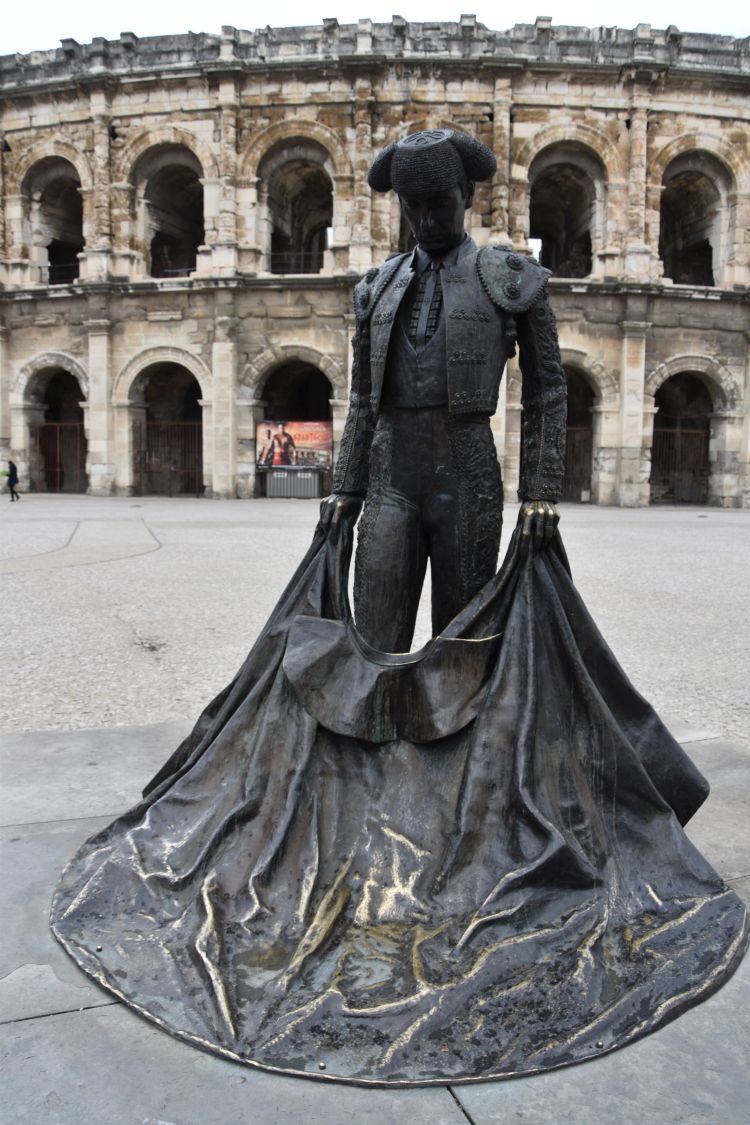
The next day, they saw Nîmes with the arena and the Roman temple (called Maison Carrée). We stayed overnight at Nîmes in 2018 and admired the Roman arena with the statue of the bull fighter.

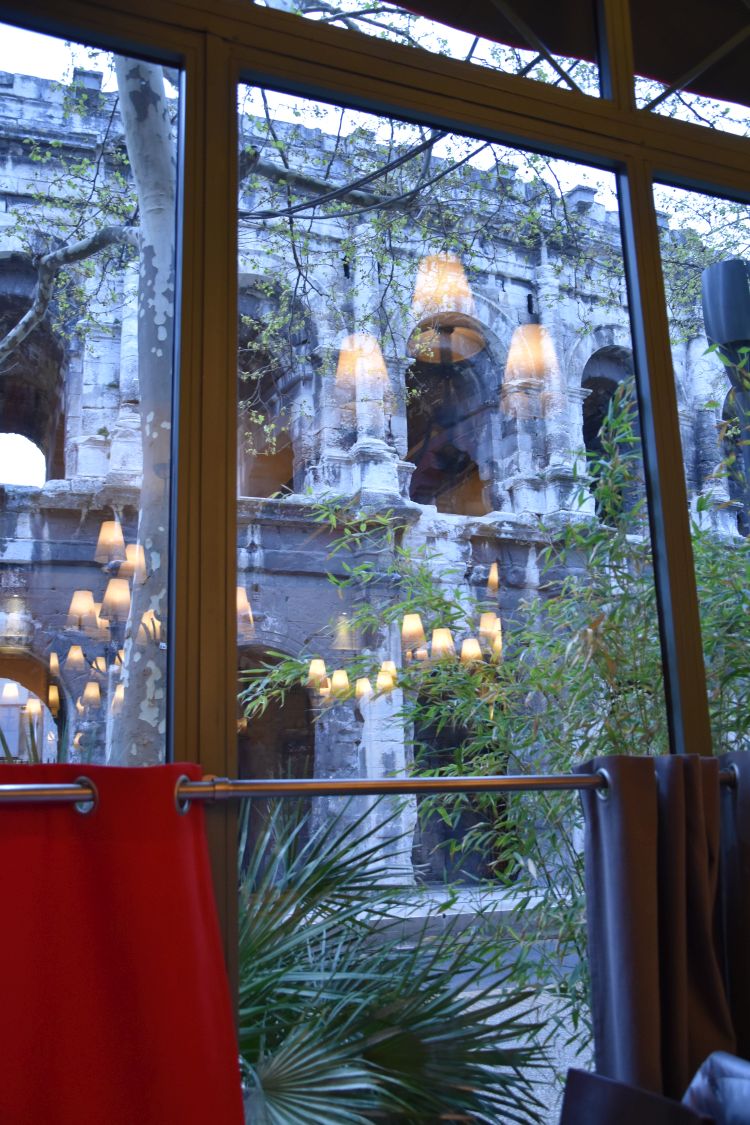
After having strolled through the city center with its narrow streets, we had a wonderful dinner (onglet steak) just across the arena, at Chez Hubert.

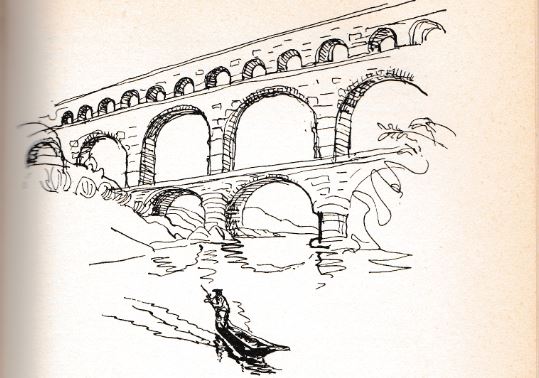
Not far from Nîmes is the Pont du Gard that, in Roman times, provided Nîmes (then called Nemasus) with water.

(Pen drawing by Willy Widman, p. 181)

In 2011, I was here with Ernst. This was our last sightseeing point on our last journey that we did together – we were on our way home from Morocco. I keep wonderful memories of all the travelling I have done with Ernst during our 18 years and now he travels with me in my heart.

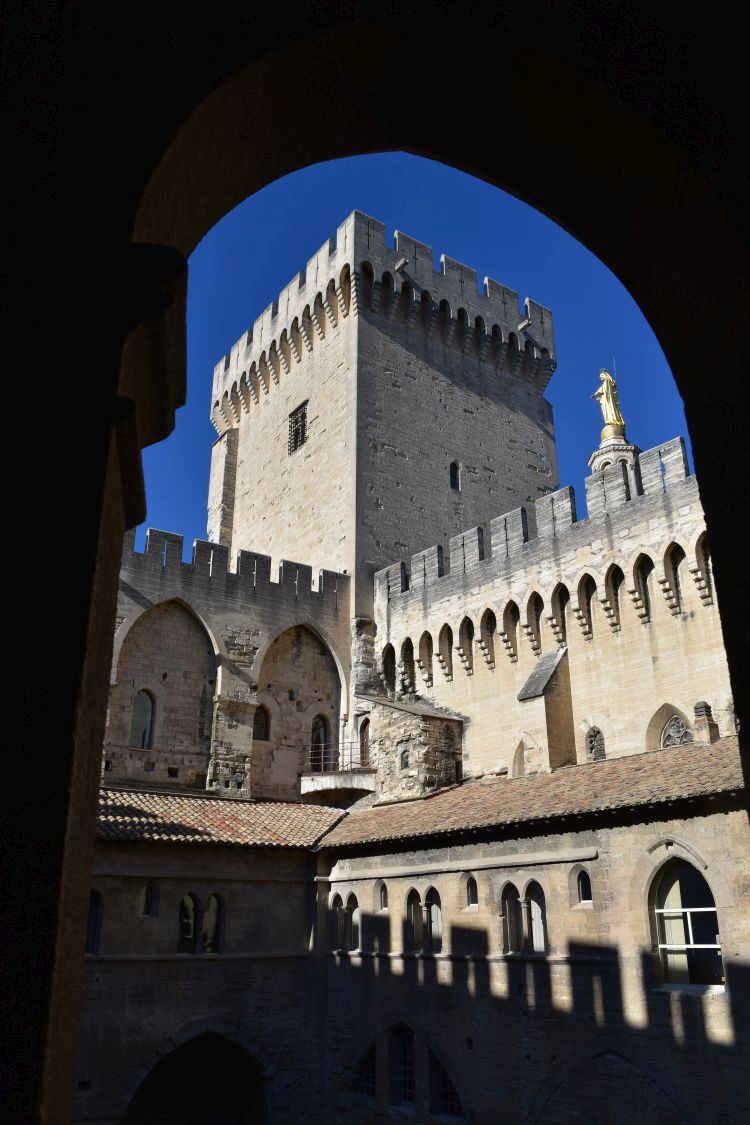
In Avignon, Eugen and his wife visited the Palace of the Popes. With my friend, I was here in autumn 2016, when the cold mistral blew down from the mountains. This is the second courtyard of the Pope Palace built in the 14th century, when six popes resided here (and not in Rome).

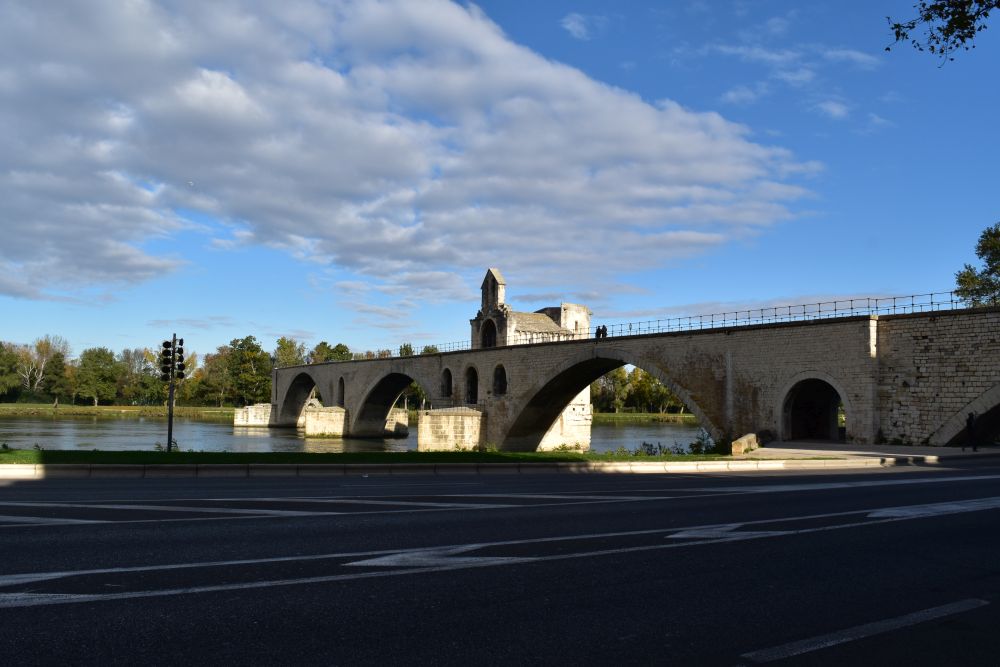
Since kindergarten, I had known the Pont d’Avignon, as we had been taught the song “sur le pont d’Avignon, l’on y danse, l’on y danse… (on the bridge of Avignon, this is where you dance, this is where you dance).” Not yet understanding French, we created our own versions of the text; this was the version of the sister of my friend: “ooni Dasse, ooni Dasse”, which in Swiss German means “without cups, without cups”. The French word “danse” sounded like “Dasse” to her.

Now in my sixties, I saw this famous bridge for the first time, and I was so disappointed! Because it is not a bridge that crosses the river, as bridges ought to do, but it ends in the middle of the river Rhone.  In the attached museum, we learned that it was conceived as a toll point on the Rhone and not really as a bridge for people and carriages.

Eugen and his wife drove “up” the Rhone valley, with stops at Montélimar, the city of nougat, then at Vienne, another Roman city, and finally at Lyon and Bourg.

They crossed the border between France and Germany near Huningue (close to my home city Basel) using the ferry (the three countries bridge will be rebuilt 57 years later, in 2007). The French customs officer, Eugen remembers, was easy going, whereby the German customs officer was tense and eager to fulfill his duty according to the regulations. Eugen and his wife had left France with its somewhat light-footed atmosphere and are now back in “dutiful” Germany. From now on, he wrote about his tours in Germany and to Switzerland. In Switzerland, Eugen reflected about the fact that a German writer, Friedrich von Schiller, became – in a way – the national writer for Switzerland, as he wrote his play “Wilhelm Tell” about the Swiss legendary national hero of the 13th century.


Epilog: France… like Eugen I love the French atmosphere and I long for being there again, be it just across the border or be it travelling farther

While not being allowed to cross the border to France due to the pandemic until mid-June, I enjoyed to follow Eugen Diesel and his wife through France to places that I have been to as well. I like to be in France, in the rural towns, in the restaurants that serve soigné meals, soaking in the rich cultural heritage and enjoying the French atmosphere. I wish that France will recover well, having been hit seriously by the pandemic of spring 2020 and having been churned by turmoils recently. I look forward to returning to France.

Source: Eugen Diesel, “Philosophie am Steuer: Ein europäisches Reisbeuch”, Reclam Verlag Stuttgart 1952 and my own photos from travelling to the same places.


Listening to the stories that my home tells me: My dad’s book about Diesel’s car drive in Europe in 1950/51 / 1

In March/April/Mai 2020, the virus has stopped me travelling. Instead I listen to the stories that my home tells me.

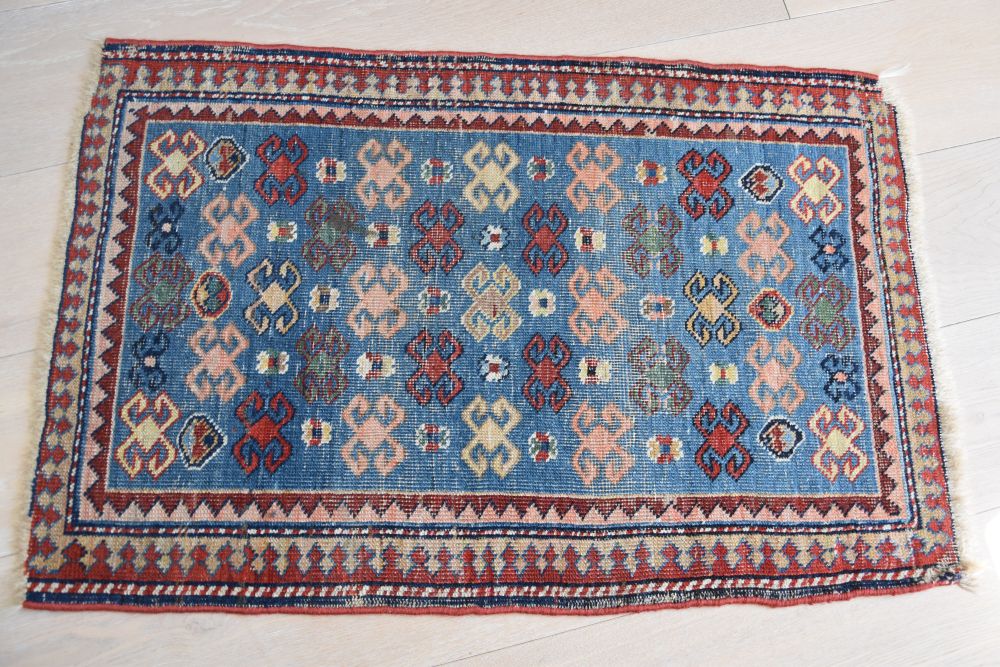
This small Kazak carpet is a souvenir of my dad. He bought it, when being in the Caucasus region as a meteorologist in the 1940’s.

I love this small carpet. It is a symbol for the good memories I have of my father that we called “Vati”. He died much too early, on Saturday, 14th of March 1970. This was my last school day, just 50 years before the Corona virus lockdown was announced in Switzerland in 2020. What a breath taking coincidence that I felt intensely.

In addition to the carpet, I have some books of my father, one of them being “Philosophie am Steuer: Ein europäisches Reisbeuch” by Eugen Diesel (Reclam Verlag Stuttgart 1952; “Philosophy at the Steering Wheel: A European Travelling Book”).

I have kept this book for the signature of my dad. So far, the book has waited in my bookshelf.

Now, being confined at home, I took it out and read it. This was a fascinating experience for me.

  • At some of the places that Eugen Diesel talks about, I have been as well, but almost 70 years later.
  • Eugen Diesel reflected about what Europe – now resurrecting from the war – would be in 50 years. Some of it is interesting to read now, 70 years later.
  • Closed borders in Europe? In 1950, the borders, having been closed during the war, slowly opened up. Now, in June 2020 we expect the European borders to open, after having been closed for three months due to the pandemic.

Let us see who Eugen Diesel was, let us travel with him to places in France that I have been to later and hence have memories that I like to revive, while being at home.


Who was Eugen Diesel?

Eugen Diesel  (1889-1970) was the son of Rudolf Diesel who invented the Diesel engine in 1892. In the early 20th century, the Diesel engine replaced steam engines (such as for trains or ships), while passenger cars used gasoline only. With his father, Eugen travelled through Europe in 1905, in a red NAG car (p. 13, NAG = Nationale Auto Gesellschaft, 20-24 PS).

(Drawing made by Willy Wildmann, p. 13)

Instead of becoming an engineer, Eugen Diesel decided to become a writer. Eugen learnt French culture from his father Rudolf, who was bilingual French-German, as he had grown up in France until the age of twelve, when, in 1870/71, the war between France and Prussia/Germany forced the family to return to Germany.


Trains full of hoarders in 1947 – Eugen Diesel gets stuck in overloaded trains and decides to buy his own car

In 1947, Bayern had no apples and Württemberg had no potatoes… Hoarders from Bayern took the trains to Württemberg to buy apples and hoarders from Württemberg went by train to buy potatoes in Bayern, though hoarding was forbidden. The trains were full and the people carried large baskets that added to the mess. Eugen wanted to get from Stuttgart to Munich – and he got stuck in the overloaded trains.

Hoarding must be in the human genes: We have seen empty toilet paper shelves for weeks during the corona lockdown of spring 2020.

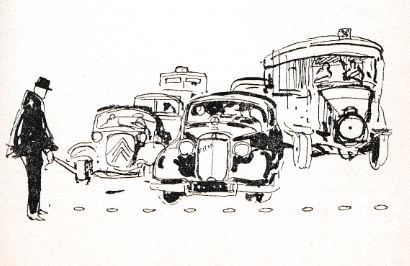
To travel more freely, Eugen acquired his own car in 1950. It was a Mercedes Diesel. Mercedes had just started to build passenger cars that run on Diesel.

(Drawing made by Willy Wildmann, p. 187)

Eugen had not driven a car four eleven years. Nevertheless, he left the factory at the steering wheel of his new Mercedes. He started to drive through churning and distressed Europe and enjoyed to be mobile again: “A city, 100km away, is now again becoming a neighbour”, he said (p.19). His book “Philosophy at the Steering Wheel” tells about driving 45’000km in Europe, above all in France, in 1950/51.


First excursions by car in Germany

With his new car, Eugen Diesel started to explore the area around Munich. Among his destinations was the Romanic St. James church in Urschalling with gothic frescoes (now on my agenda, when travelling to Munich again) or the Bosch Factory in Memmingen and the Daimler-Benz Factory in Sindelfingen (he had inherited the interest for engineering from his father). Then he went beyond Bayern to cities such as Augsburg or Stuttgart. He observed the ruins and how German cities strived to recover. In Mainz he attended the inauguration of the reconstructed bridge crossing the Rhine. President Heuss made a speech without mentioning the engineers, as Eugen, being the son of an engineer, noticed frowning. He visited friends again that he had been separated from for years. (I can understand the enjoyment – now, in June, I started to see more friends again, as the lockdown is opening up).

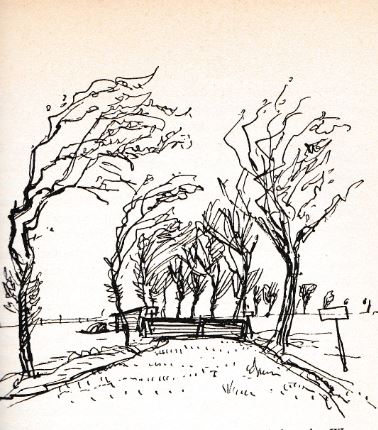
Inside Germany, Eugen encountered a new border. Signposts are pointing to Magdeburg or Halle, but these cities had become out of reach for him, as bars blocked the roads to the new Russian eastern zone of Germany and the bridges were closed. Eugen stood at the closed border for two hours and gazed on to the other side; he could not see anyone.

(Drawing made by Willy Wildmann, p. 49)

The walls built later will separate West and East Germany for 40 years, until 1989.

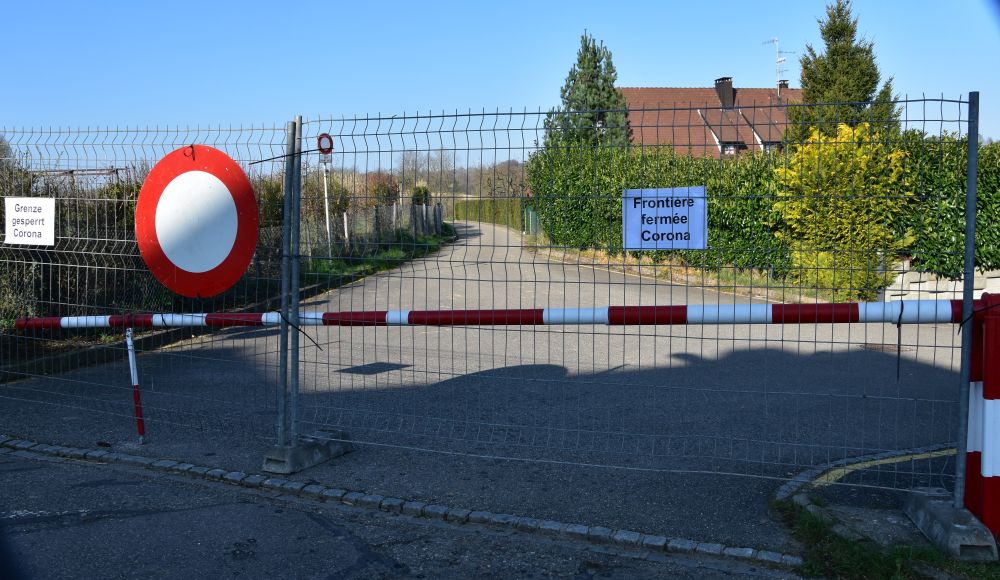
From March to June 2020, 70 years later, borders in Europe are closed again – for the pandemic. The Sundgau in France is out of reach for me now. I was sad, when seeing this bar on one of my bicycle rides.

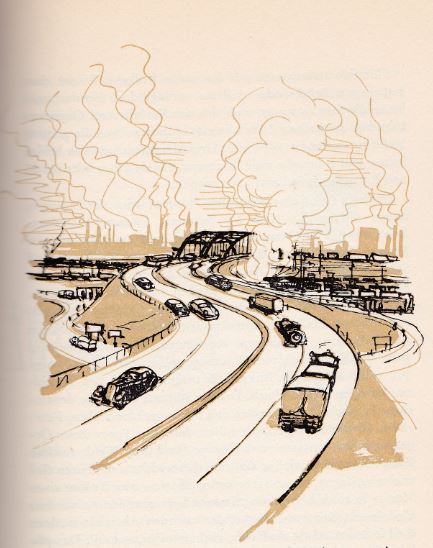
Eugen Diesel observed that the traffic in the 1950-ies was growing rapidly. Also my dad was of the opinion that there was too much traffic then. He never sat at the steering wheel of a car again after having returned from the prison camps in France in 1947, though he had driven cars since the 1930-ies – his parents had an Adler. However, compared to the traffic today, this highway does not look very crowded to me.

(Pen drawing made by Willy Wildmann, p. 55)

Eugen reflected that on highways, one accident could cause serious traffic jams, which would ask for more and more roads to connect more and more factories and cope with the rising traffic. Today’s traffic density, the network of roads, the sprawling of cities as well as pollution and climate change exceed Eugen’s fears, I believe.


France opens up for Eugen Diesel and his wife – they drive to Auch near Toulouse to visit a friend of theirs

In 1938, Eugen Diesel had connected up with a French scientist and intended to visit him in France, but the war closed the borders. After the war, in 1950, Eugen decided to visit him with his wife, Anna Luise Gräfin von Waldersee. They planned a tour to Auch near Toulouse, where the former scientist now worked for the departmental government. Eugen went through much bureaucratic pain to be able to cross the border to France.

In September 1950, Eugen left Munich with his wife and drove to Altbreisach (still in Germany), where they saw the city in ruins. They crossed the river Rhine and immediately felt that they were in France: The atmosphere was different, somewhat more light-footed than in Germany. Yes, I admit that I also feel the different atmospheres between France and Germany, both bordering my home city Basel.

Eugen continued to Neuf-Brisach, Colmar, Belfort (with Bartholdi’s monumental lion) and Montbéliard (as Mömpelgard it had belonged to Württemberg from 1397-1793, he remembered). In Besançon they had their first lunch break in the restaurant Palais de la Bière (still exists today and looks enticing).

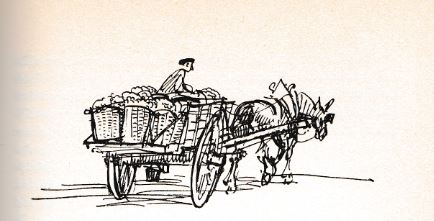
Burgundy was the next station. It was autumn and in Nuit-Saint-Georges north of Beaune, they saw many carts filled with Burgundy grapes.

Well, such carts are now in museums such as in the museum Clos Vougeot that I visited in November 2014.

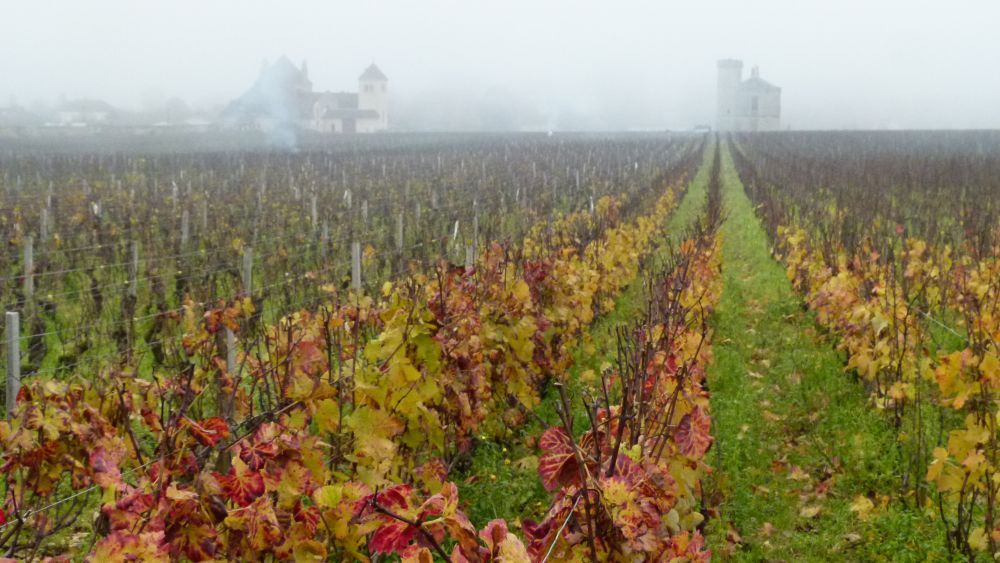
Autumn in Burgundy can be very misty, as my photo from 2014 shows (taken near Clos Vougeot).

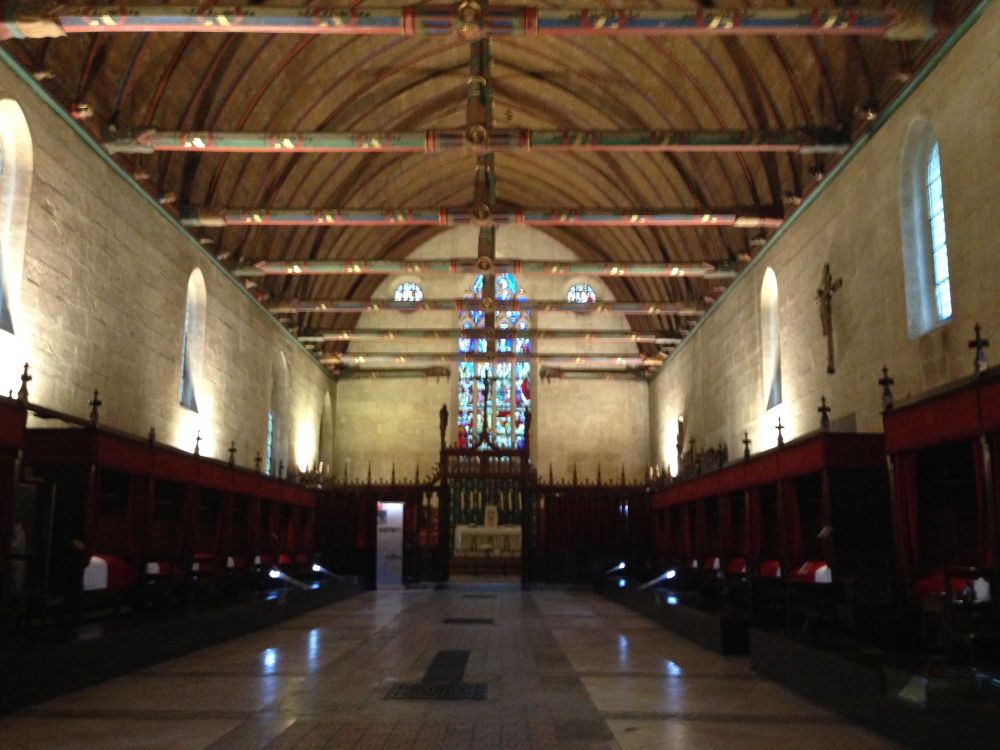
In Beaune, Eugen visited the Hôtel Dieu (Hospices de Beaune). At that time, it was still a hospital, as it had been for 500 years (since 1443). Except, the vaulted gothic room was no longer in use as a hospital in 1950. Eugen was impressed and so was I in 2014. Solemn atmosphere under the vaults…

… with the beds along the wall, covered with red blankets.

However in 2014, the Hôtel Dieu had stopped to be a hospital and had turned everything into a museum. In addition, the traditional wine auctions of November take place here.

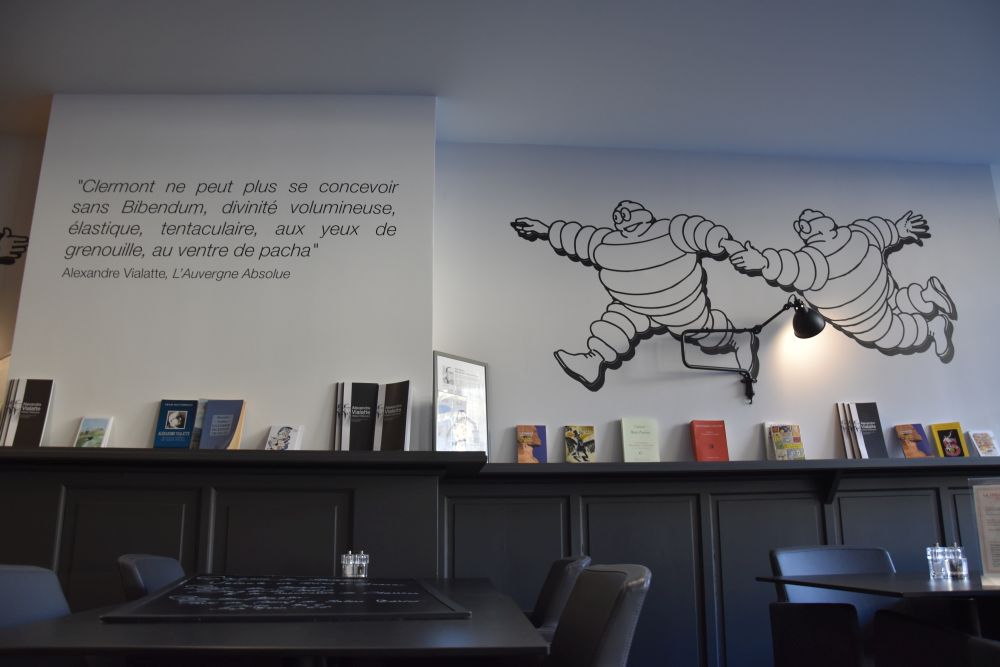
Via Autun and Vichy, Eugen Diesel reached Clermont-Ferrand, the city of the Michelin tires (as the son of an engineer notes). I was here in autumn 2017 and Michelin still matters for Clermont-Ferrand. The Michelin tire men, called Bibendum, even decorate the breakfast room of our cosy hotel.

Eugen Diesel visited the old town of Clermont-Ferrand with the gothic cathedral (to the left). Then he drove up to the summit of the volcano Puy de Dome (in the background, 1465m).

I drove up to the top of the Puy de Dome in the 1980’s, but when returning in 2017, I found the road to the top closed. Instead, there is cockwheel train to get to the summit.

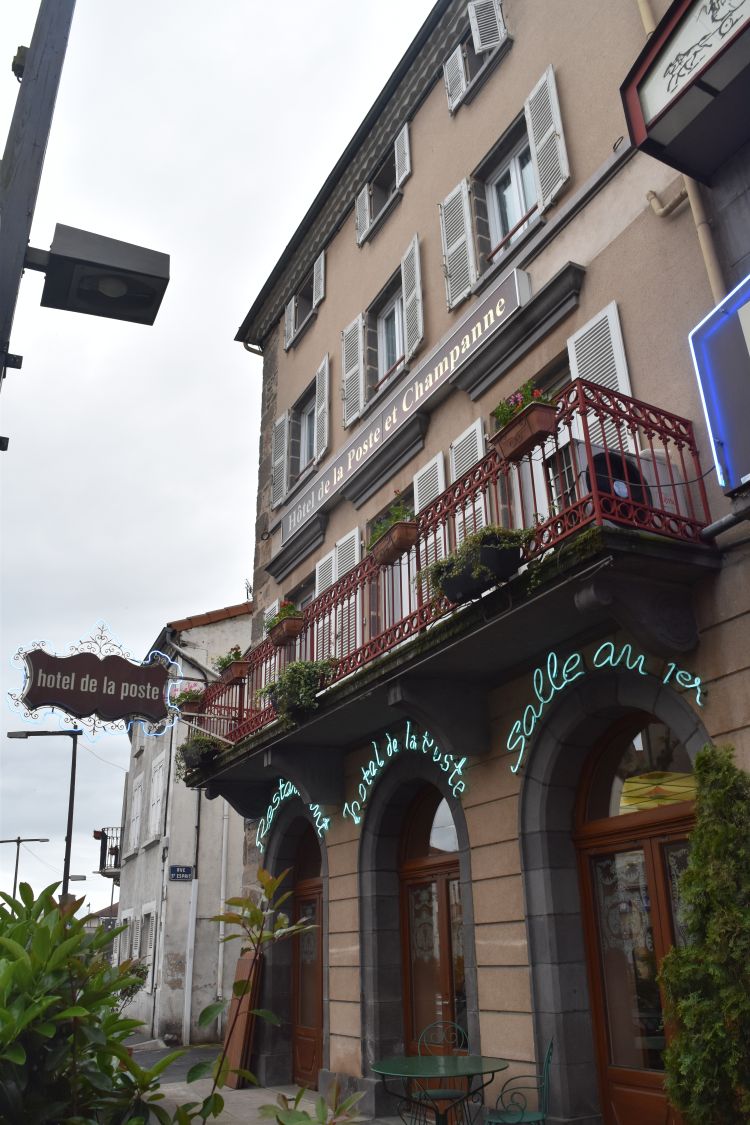
A few kilometers south of Clermont-Ferrand, Eugen Diesel and his wife stopped at Brioude and stayed overnight in the Hotel de La Poste. Eugen described, how clean and well renovated the hotel was. The couple enjoyed an excellent meal in the cosy restaurant on the first floor. One waiter served all guests – diligently and carefully. He had fair hair, his name was Erwin Voigt and he was from Pomeriana, formerly part of Germany. It was him that had renovated the Hotel de la Poste at that time; it was owned by an elderly couple.

In 2016, I was in the same hotel, with my friend. It was one of the best and cosiest hotels we have ever been at in France. We had an excellent dinner (in the restaurant on the first floor) and we slept across the street, where the hotel had built modern new rooms, even accessible by wheel chair.

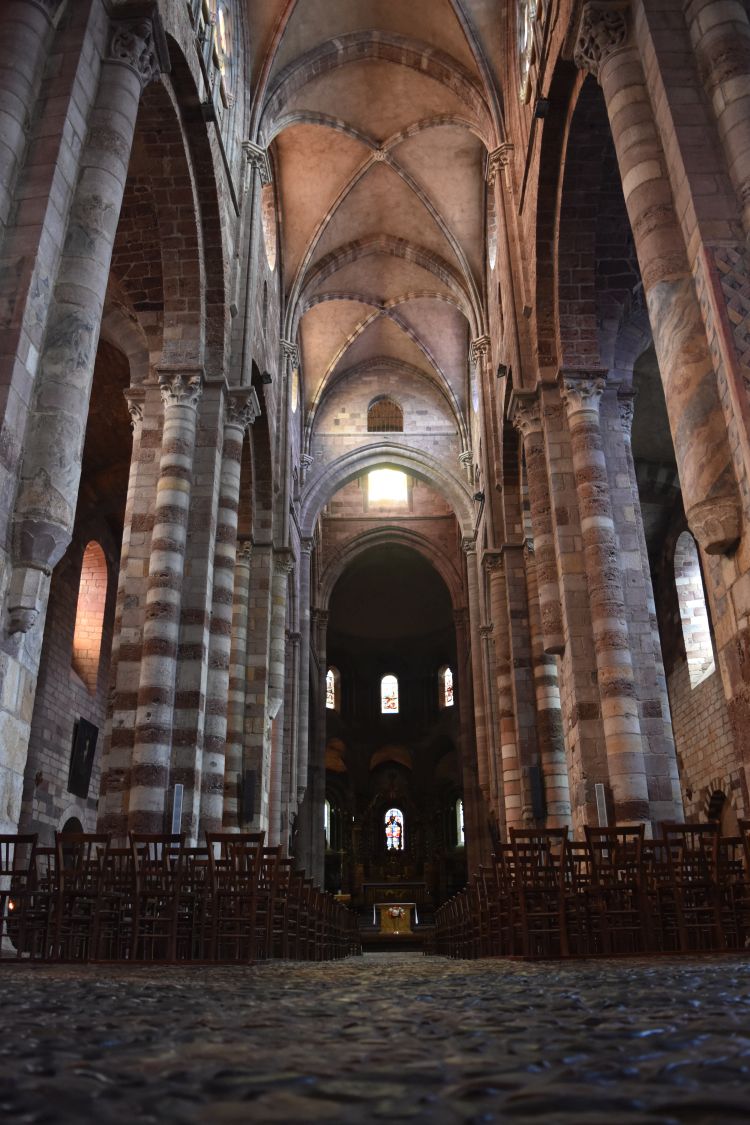
Eugen Diesel did not talk about the beautiful Romanic Baslica Saint-Julien in Brioude… perhaps it had not been renovated then and not mentioned in his Baedecker.

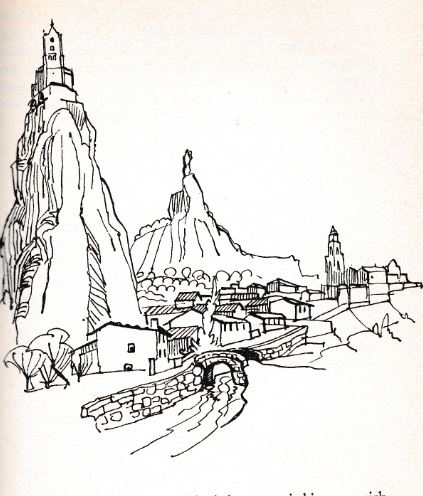
Eugen and his wife continued to Le Puy-en-Velay and were impressed by the needles topped by the church Saint Michel d’Aiguilhe and by the Madonna statue.

(Pen drawing by Willy Widman, p. 99)

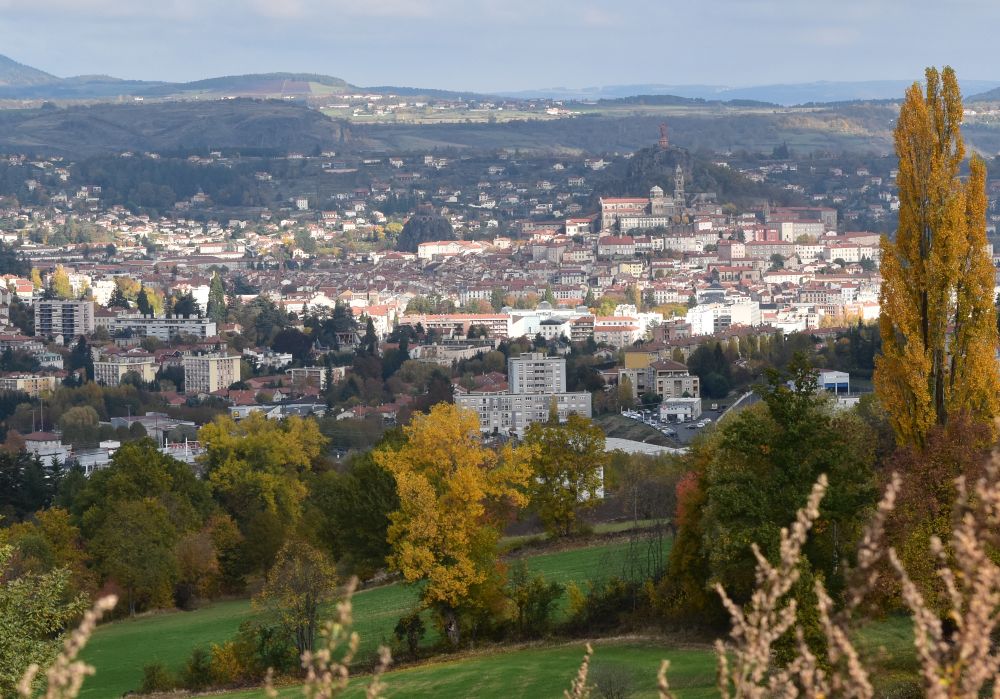
Perhaps the needles are a little inflated in the pen drawing. In 2016, we look back to Puy-en-Velay. The city has grown considerably since 1950.

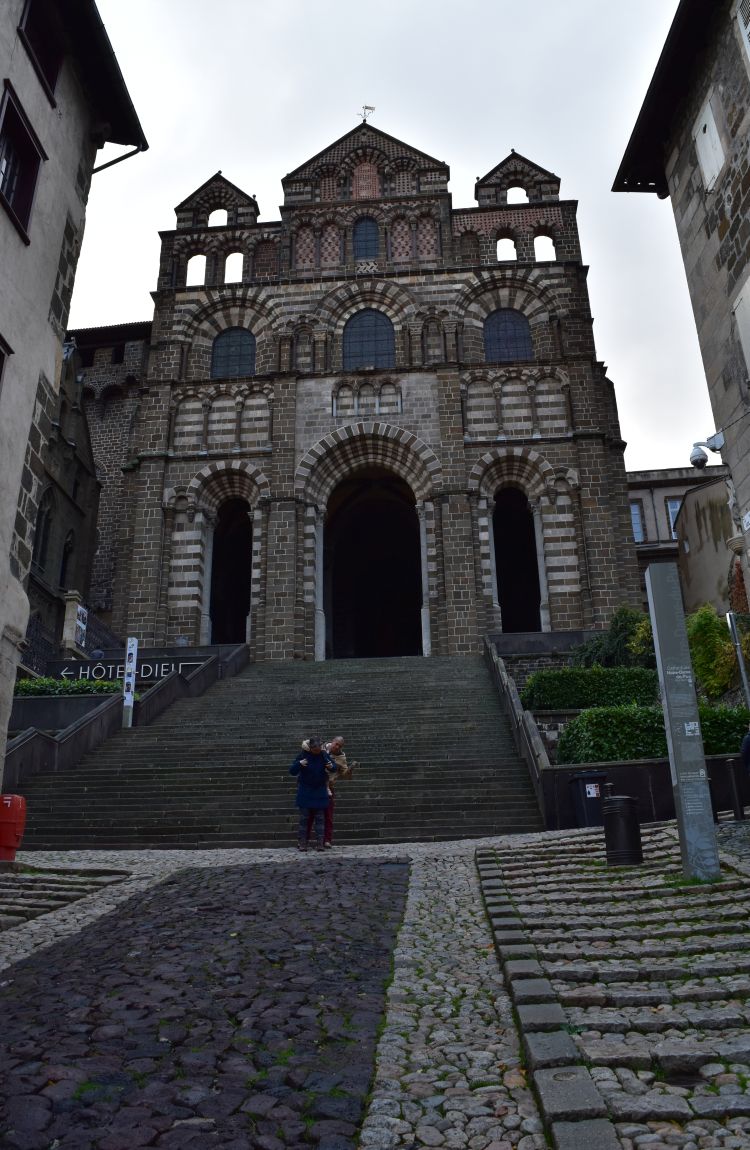
We stayed in Le Puy-en-Velay for one night to visit the romanic Annunciation Cathedral built with the typical black volcanic stones that characterize the whole city center.

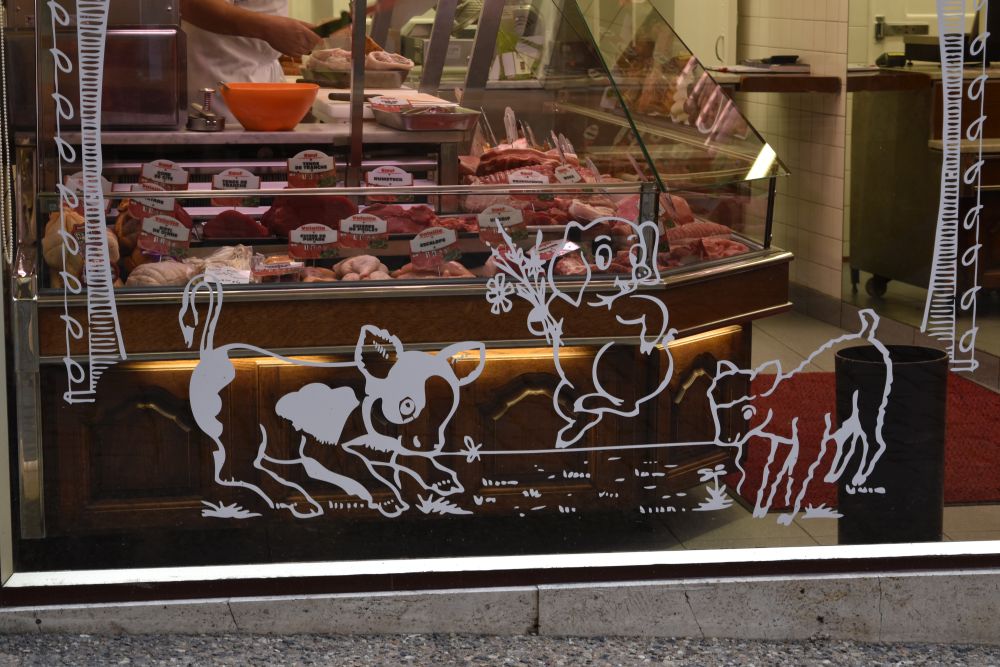
The small streets are inviting. This butcher’s window illustrates, what Eugen might have meant, when talking about the somewhat more light-footed atmosphere in France.

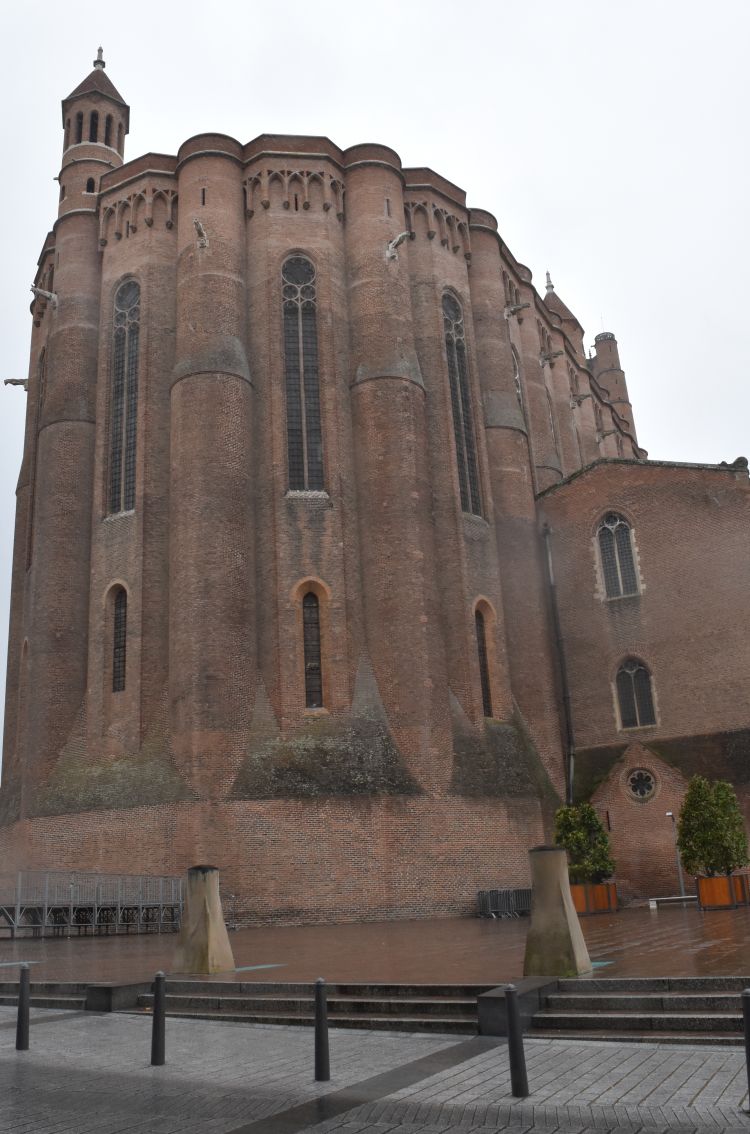
In Albi, Eugen and his wife admired the Cathedral Saint Cecilia with the red brick walls rising towards heaven. He thinks of the Albigenses or Cathars that were eradicated around 1200. We visited Albi in 2016 in the pouring rain…

… and like Eugen, we entered the church, with the one single nave all painted in blue and with the choir separated by a finely carved rood screen (Lettner) made from stone.

Via Toulouse, Eugen and his wife reach Auch, where they stay with their friend.


Let us travel with them around Auch and back to Germany in my next blog.

Source: Eugen Diesel, “Philopsophie am Steuer: Ein europäisches Reisbeuch”, Reclam Verlag Stuttgart 1952 and my own photos from travelling in France.


Le zoo de Rome – a charming novel intertwining reality and fiction, written by Pascal Janovjak

A year ago, in May 2019, Pascal Janovjak gave me his book “le zoo de Rome” (1) with the following words: “Tu sais que les animaux sont la matière première des fables (you know that the animals are the basic material of fables).”

Let me tell you more about this beautiful novel that evoked memories of “my” zoos, that taught me much about the zoo of Rome integrated in the history of the XXth century and that made me enjoy the related fictional story lines.


Prologue: “Le zoo de Rome” evoked memories; it might evoke yours as well

“Le zoo de Rome” evoked memories of “my” zoos in Basel (Zolli) and in Karlsruhe (Stadtgarten). You may have such memories as well.

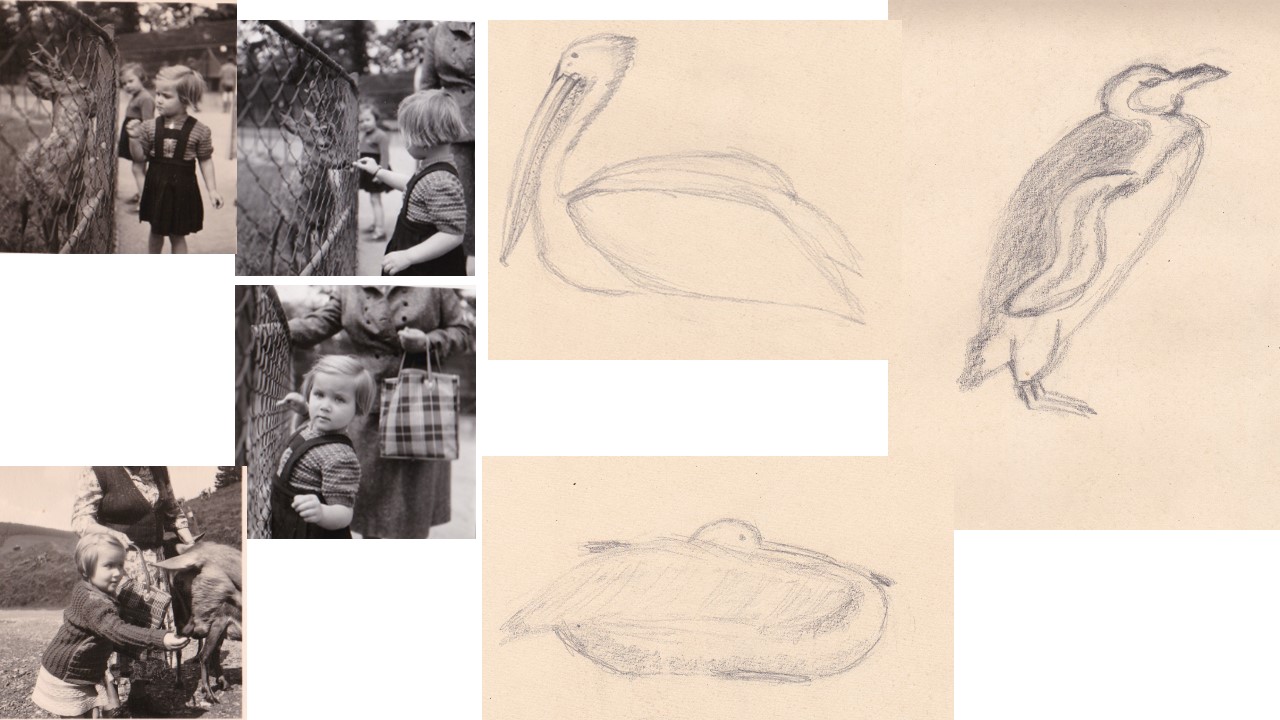
At kindergarten age, in the 1950’s, my grand-ma invited me to the Stadtgarten in Karslruhe, whereby I was very cautious, when being confronted with animals.

Some ten years later, our teacher took us to the Basel Zolli to practice drawing animals; “my” pelicans and “my” penguin are from that time.

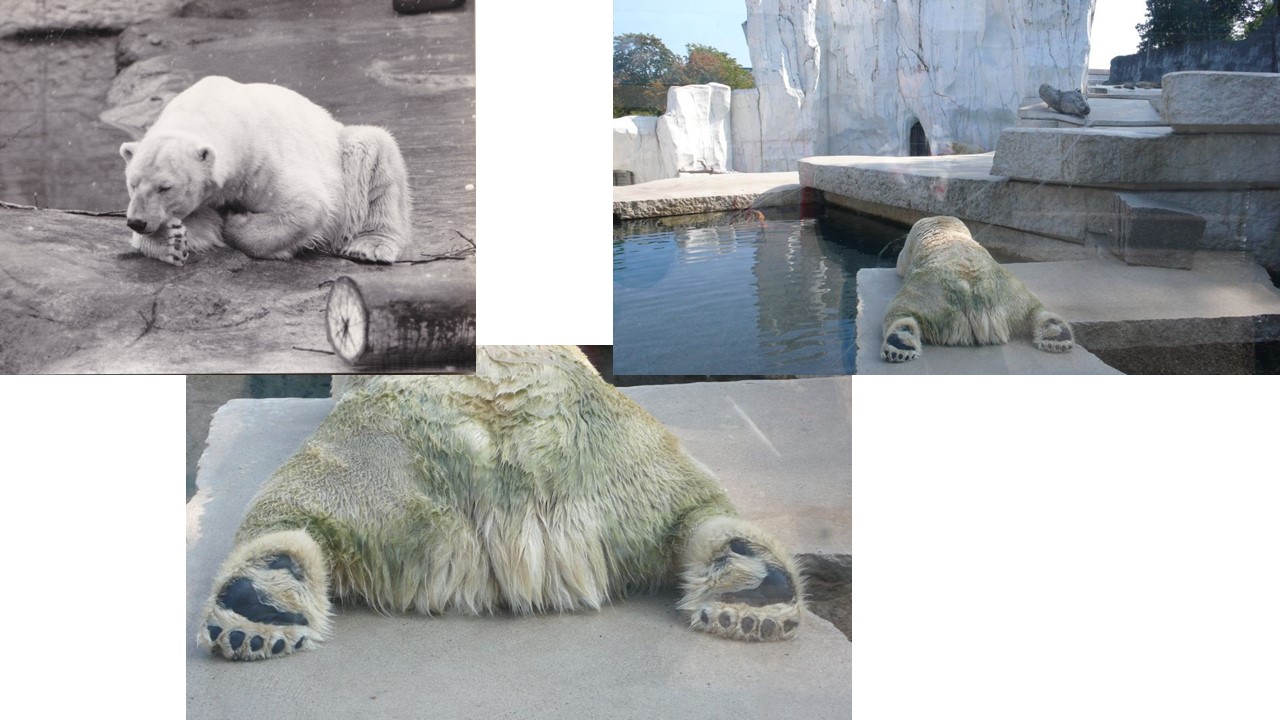
As a student, I took photos in the Basel Zolli and developed them in the kitchen-darkroom. The black-and-white polar bear is resting calmly on its paw on a frosty-cold winter day.

No more polar bears in the Basel Zolli today. However, polar bears still live in the Stadtgarten of Karlsruhe, in their “icebergs” built in 2000 (colour photos taken in 2009). A hundred years ago, the Swiss Urs Eggenschwyler created an iceberg in the zoo of Rome; it will play a role in Pascal’s novel.

Now I go to the Basel Zolli with my grandniece and grandnephew. They very much like the flamingos – or flamands in French. The “lagoon” is near the main entrance of the zoo.

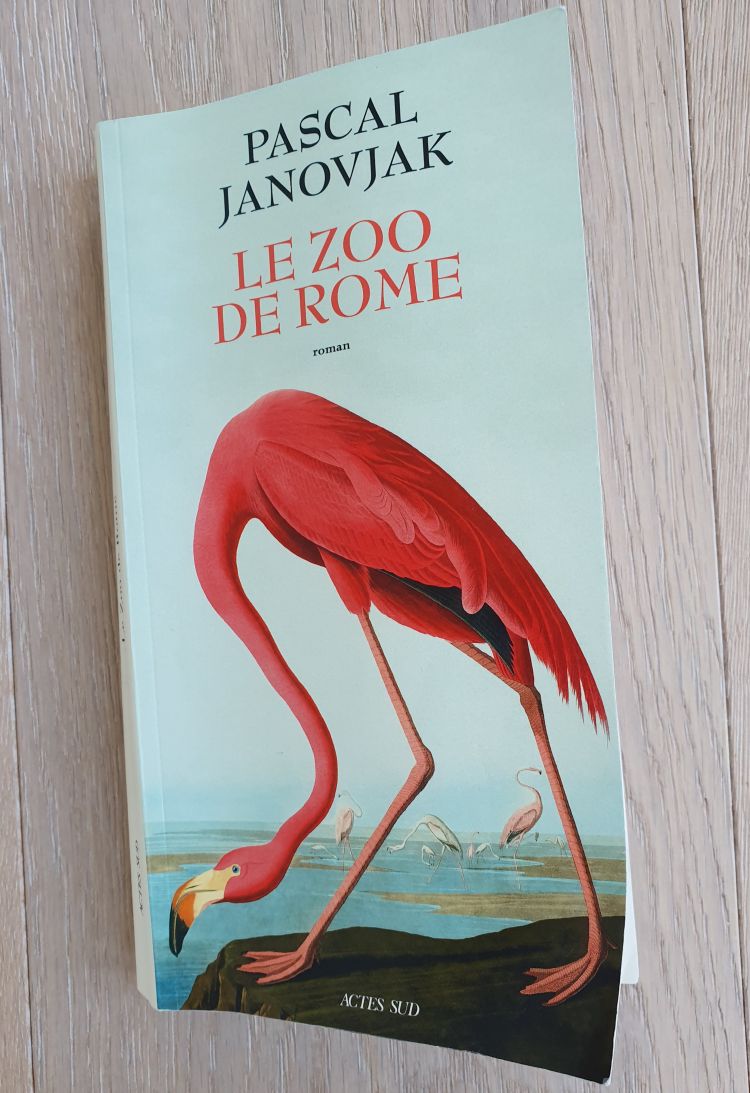
Pascal also seems to like flamingos. He has selected this flamingo for the cover of his book.

My “le zoo de Rome” shows signs of use… I have read it three times and I have read it with great pleasure.


“Le zoo de Rome” is a puzzle of essays telling intertwined stories: My summary in a nutshell

Pascal tells his novel “le zoo de Rome” as a puzzle of small essays (two to four pages long) rolling out intertwined story lines. The real story of the zoo of Rome starts shortly before 1911 (construction and inauguration), ends in 2013 (two years after the centenary) and interacts with the historical events of one century.

Superimposed to the real history of the zoo, I identified fictional story lines that begin in 1940, focus on 2009/2010 and end in 2013.

  • The first fiction is the life of the architect Chahine Gharbi (born in 1970) and his tender love story with Giovanna Di Stefano. Chahine comes to Rome in December 2009, because a sponsor from Riyad has asked him to evaluate the project of a shopping city to replace the zoo. Chahine orders his room until 16th of January 2010. Mid-January, he has to leave his hotel room, as his sponsor has stopped paying for it. He lives in the iceberg for some time and leaves with unknown destination in May 2010.
    Chahine and Giovanna meet in the zoo. They are both about 40 years old. Their love culminates end-January or beginning-February 2010, when they make love in the zoo.
  • The second fiction is the saga of the family Leonardi that worked as guards from grandfather to grandson Salvatore. Salvatore was born in 1949 (there was rinderpest in the zoo then). Salvatore works with engagement for his animals and imagines the zoo being Noah’s Ark and himself being the captain. Salvatore meets Giovanna and Chahine several times. He is the guard of the last tamandin anteater, until sent to retirement in July 2010 – which leads over to the third fiction.
  • The third fiction is about the last tamandin anteater (a fictional animal) alluding to criminal energy and overtourism. During the war, in 1940, the zoo takes over his first tamandin from another zoo. In November 2009, the veterinarian Moro of the zoo of Rome kills the two tamandins in the London zoo. By doing so, he achieves that the old tamandin anteater of the zoo of Rome, Oscar, is the last representative of this species. For the zoo, so far having attracted only few visitors, the last surviving tamandin changes everything. Visitors flood the zoo. They are channelled to the Grande Volière (aviary), where the animal lives. It is a hype, which Giovanna supports with her marketing actions.
    Meanwhile, the veterinarian of the London zoo, Nadia Monk, finds out that Moro has thrown infected ticks into the cages of her tamandins, which was the cause of their infection and death. Moro is arrested in May 2010.
    During the tamandin hype, Salvatore looks after Oscar day and night. In July 2010, the faithful guard gets the announcement of his retirement, kills the tamandin Oscar and ends up in prison. No one asks why he has shot the tamandin. Small detail: It turns out that Oscar was a female, despite its name.
    At the same time, in July 2010, Giovanna visits the gynaecologist to get the confirmation that she is pregnant. She must have been pregnant for five to six months.
  • Fourth, without having a name (I could not find it), Giovanna’s husband supports her calmly during the exciting months at the zoo. During that time, they also make love in late winter/early spring 2010. In 2013, a happy future opens up for Giovanna and her husband: Giovanna has left the zoo and is again successful at her former job in government, and the couple enjoys the life with their son that they had no longer expected.

I enjoyed the rich and dense language of Pascal. The words are concise and placed exactly where they fit. I took notes to keep track of the artfully intertwined story lines presented in small puzzle pieces with hints dispersed all over. Some of the hints I only understood, when reading the novel for the third time, for example:

  • In the first chapter, the architect Chahine Gharbi notices a metallic sphere, when settling in room number 324 in the hotel adjacent to the zoo. A metallic sphere? Reading the novel the third time, I understand: What Chahine sees, is the “Grande Volière”, the “Large Aviary”, built in the 1930’s at Mussolini’s request.
  • Soon after having started work as the head of communications and administration of the zoo, Giovanna visits the animals and notices the tamandin, marked as “in danger of extinction”. Coming back to the office, she finds an angry letter from the zoo of London asking the zoo of Rome to deliver the tamandin immediately. First, I thought, Giovanna has taken over a messy office. When reading the third time, I understand this hint: Moro, the veterinarian of Rome, has recently thrown ticks carrying viruses into the cage of the tamandins in the London zoo. Now he waits for the tamandins to pick up the ticks, catch the infection and die. For that reason, he has no intention to send his tamandin to England, as there is a good chance that Oscar will be the last anteater of its species, which will attract visitors to his zoo of Rome, desperately needed visitors.


The novel taught me much about the zoo of Rome… and about “my” Basel Zolli

These are some of the facts that Pascal’s novel told me about the zoo of Rome and other zoos:

  • I was shocked to read that Hagenbeck, the designer of the zoo of Rome (and of the Tierpark of Hamburg), was a trader of wild animals; by designing zoos, I believe, he cleverly created the market for his business. I was also dismayed to read, how many animals did not survive the transfer from wilderness to Rome, when the zoo was to be inaugurated in 1911. I was appalled that just a few years after the inauguration, cost saving efforts deprived the animals from food.
  • Urs Eggenschwyler was an eccentric Swiss who knew how to build artificial cement rocks. In the zoo of Rome, he built various rock landscapes and the iceberg. In the Basel Zolli, he built the rock for the seals. I had never thought about this rock around the pool being artificial, when watching the seals playfully “hunt” their food. The iceberg landscape in Karlsruhe should show the visitors, how the polar bears live in the Arctic. Hagenbeck was the first architect of zoos to have planned landscapes that reflect the habitat of the animals shown. Pascal describes nicely, how Hackenbeck dreamt of the animals living in their habitats, when reviewing the plans for the zoo of Rome.
  • I shivered, when “a crazy man” entered the cage of his lioness called Italia. Pascal resolves the mystery later: It was Mussolini. He ordered to enlarge the zoo, because it was smaller than other zoos of Europe. The architect de Vito was in charge of the construction. I liked to follow, how de Vito proceeded: He watched the animals intensely, he visited other zoos to gather ideas, and then, accidentally, he saw the cylindric gas reservoir of the community of Munich that became the model for the “Grande Volière” or “Large Aviary” allowing the birds to fly in circles, which is natural for them. Furthermore, he built his aviary in a sustainable way – more than 80 years later, the metal shines in the sun (as Chahine noted, when entering his hotel room with the view of the zoo). I would love to see de Vico’s aviary one day.
  • I have mixed feelings about zoos. Might be, the student Guido watching animals is right: Zoos are like Noah’s Ark. In Mongolia, I saw the Przewalski horses. They had become extinct in the wild, but they survived in various zoos. Resettlement was a success. It was beautiful to watch these elegant horses against the horizon of the Mongolian steppes.
  • Another finely observed detail: Chahine and Giovanna struggle with the zoo map. Zoo maps do seem to be a challenge; with the map of the Basel Zolli I always get lost.


The zoo is the backstage to caricature observations about people in fictional story lines 

The zoo of Rome is the backstage for creating caricatures about people and their behaviours. The observations, painted using fine brushstrokes, resonate with me. Let me give you some examples.

  • With pleasure, I observed the tender love emerge between Chahine and Giovanna, which culminates, when Chahine helps Giovanna to get rid of her wet clothes, after having been in the pouring rain during the move of the tamandin to the aviary. Wet clothes are hard to take off – I have also experienced that. Then Chahine wants to disappear in Giovanna’s body. Later I understand what he suffers from. While hiding in the iceberg until May, he visits Salvatore Leonardi guarding the tamandin in the Grande Volière and, as they do not speak the same language, he uses gestures to describe, how his seven years old daughter died in the car accident and that he was at the steering wheel. I feel sorry for Chahine devouring the soup that Leonardi offers to him, because probably he is very hungry.
    After their love night, Giovanna looks for Chahine, but cannot find him – she just finds his accessories, including the white plush polar bear that he had bought, perhaps with his daughter in mind; he has left the plush bear on the iceberg.
    I feel sympathy for Chahine’s wife that probably never saw her husband again – she had let him go to Rome saying: “What you need, is a project”, when the request to plan the shopping city came from Riyad. What a sign of love.
  • The calm love between Giovanna and her husband ends happily with their newly born son. Pascal leaves open the detail who might be the father of their son, Chahine or Giovanna’s husband. He gives a small hint: Giovanna’s husband loved their son that resembled Giovanna so much – what a tender loving care.
  • From the very first moment, I have felt bad with the veterinarian of the zoo of Rome, Moro. I hated that he thought, he knew everything better than the director of the zoo and that he disdained Giovanna by telling her that she had ink at her fingers, while she was explaining to him her ideas about the next steps to be taken for the zoo (occasionally, I came across such unfair behaviour at work…). Later, I felt Schadenfreude (malicious joy, a word that only exists in German, I believe), because Moro failed to go unnoticed, when attacking the two tamandins in the London zoo, though he had prepared everything in detail acquiring an English coat and an umbrella as well as paying cash for the bus and metro tickets to Regent’s Park. But at the entrance gate to the zoo, he felt stressed because of the long queue and he got engraved in the mind of the cashier, as he forgot the change in coins and his umbrella, his coat was too warm for the sunny day and he was too stingy to make a donation. I can imagine the man clearly.
    The veterinarian Nadia Monk of the London zoo wanted to know, why her tamandins had died and found viruses from ticks. One tick had a tiny thread of wool around its body, as she noticed in the microscope. She spent eleven nights in the office of the night shift security guard to watch the video surveillance films. The guard was not amused, as he loved to read poems during his night shifts – great caricature. After eleven nights, Nadia Monk identified a man in a coat throwing ticks at her tamandins. The cashier remembered the man. Due to Nadia’s persistence, Moro was arrested (Pascal only says that two policemen knocked at the door leaving the conclusion to the reader).
  • I relished reading about the touristic turmoil around the last tamandin anteater. The tamandin was shy and hid away in its bush. The visitors could hardly ever see it. Nevertheless, hordes of tourists came to the zoo and to the Volière, where the tamandin stayed, guarded by Salvatore Leonardi. Leonardi, also hidden, observed that the visitors were not interested in the tamandin, but only in themselves. The hype around the tamandin is a well-pictured allusion to overtourism, I find. It reminds me of what I saw in Petersburg in the Hermitage Museum: Tourists rushed to “Madonna and the Child” by Leonardo da Vinci, stopped, turned round, took a selfie “me and the must see tableau of da Vinci” and went off, without looking back – they were not interested in this magnificent work of art.
  • With sympathy, I followed the saga of the Leonardi family up to their grandson, Salvatore Leonardi that felt engaged for his animals, while he was just a bit talkative. I am sad to see him end up in prison. No one asked Salvatore Leonardi, why he killed the tamandin. I believe he wanted to protect the old animal from having to adapt to a new guard or he just felt sorry for the tamandin being the object of gawping crowds that were not interested in the animal as such. This is another detail that Pascal lets the reader solve himself.

I love history and I love novels that unfold their fictions in a historical setting. One of my favourite novels is “natural history” (historias naturales) by Juan Perucho who selected the Spanish Carlist War of 1840 to intertwine the fiction of “pursuit of the vampire by a young scientist and the scientist’s happy end with his love” (2).  With Pascal’s “le zoo de Rome”, I found a second favourite novel that joins history and fictions.


Epilogue: Animals are the basic material of fables and the rose colour of flamingos conveys happiness

Let me come back to what Pascal wrote in the dedication, when giving his book to me:

“Tu sais que les animaux sont la matière première des fables (you know that the animals are the basic material of fables).”

In fables, the animals act like humans and convey a moral lesson. In “le zoo de Rome” the animals remain animals (some of them fictional) and are a wonderful backstage for the fictional story lines. Nevertheless, I sense some moral reflections that resonate with me: For instance Mussolini entering the cage of his lioness is underlining his delusion of grandeur. The bear Fritz greeting like a fascist does not know, what it does. The chimpanzee Bungo that the animal welfare activists save from the bar to transfer it to the zoo asylum seems to suffer in its cage (good intention of the activists, but…). The rose flamingos had to move to a pond near the entrance to convey the feeling of happiness to the visitors, but they suffer, because the pebbles on the ground are too large for them to walk on (the new owners of the “Natura Park” look more for appearance than for the welfare of their protégés).

Perhaps it is for the rose colour conveying happiness that Pascal placed the elegant flamingo on the cover. Do you remember the song “la vie en rose” by Edith Piaf (3)? It gave hope to the generation of 1945 to find happiness again, now that the war was over.

I sense that the novel begins and ends with optimism: It begins with the rose colour of the flamingo on the cover to greet the reader which invited me to open the book. In the last chapter, we see the happiness of Giovanna and her husband with their son, which may makes me dream about their future.

Let us look for facets of life that makes us happy, now, that this virus confines our freedom to meet. It was wonderful to use video conferencing for discussing “le zoo of Rome” within the framework of the Solothurner Literaturtage (4).


Footnotes

(1) Pascal Janovak, “le zoo de Rome”, Actes Sud 2019

(2) See my blog about Juan Perucho, “historias naturales”, edhasa, Barcelona 2003.

(3) Edith Piaf, “la vie en rose”, YouTube officiel  written in 1945.

(4) Solothurner Literaturtage 2020

Listening to the stories that my home tells me: Namibia

Now in March/April/May 2020, the virus stopped me from being on the road. I am at home. After all, I am 65+…

My home tells me stories – I just have to listen: This is the photo gallery that reminds me of the Victoria Falls, Botswana and Namibia, where I was with Ernst in April/Mai 2008.

I have already told you about our adventures at the Victoria Falls and in Botswana. Let me continue with the last stage of our 2008 Africa adventure, about Namibia.

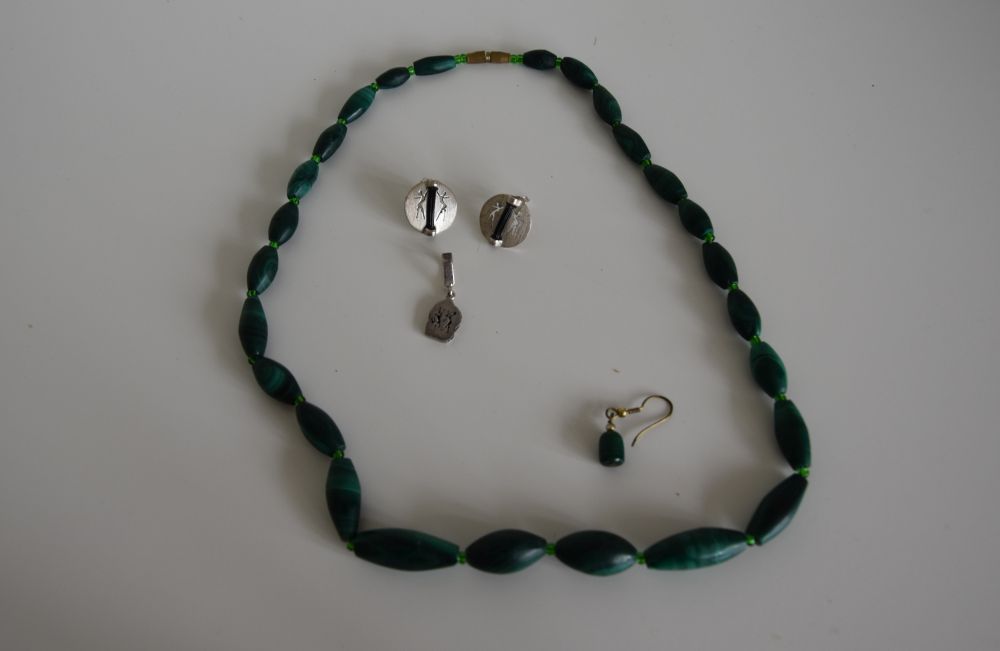
These souvenirs remind me of Namibia: The green neckless with the ear rings (I lost one of the ear rings unfortunately) and the silver studs with elephant hair and the matching pendant.

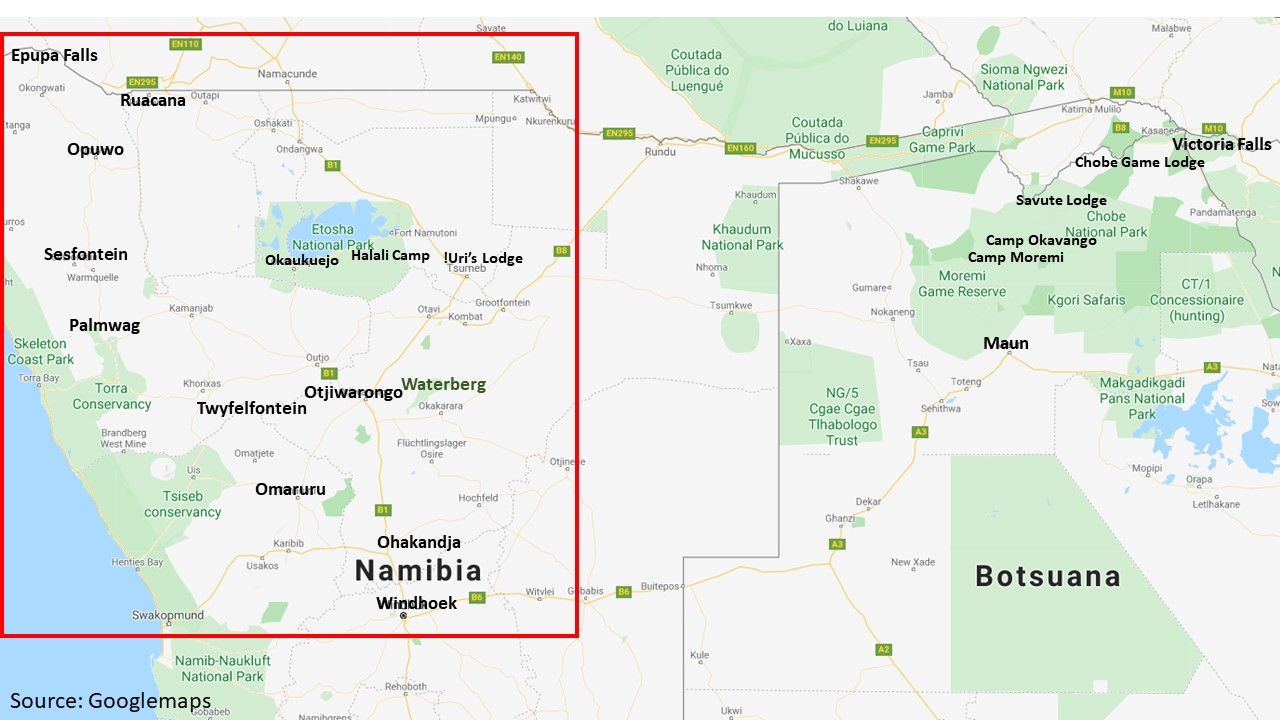
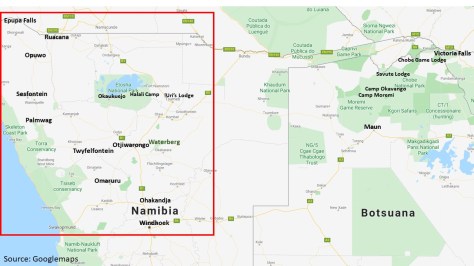
These were the points we visited: Windhoek – Ohakandja – Otjiwarongo – Waterberg – !Uri’s Lodge – Etosha Park with Halali Camp and Okaukuejo Camp – Twyfelfontein – via Opuwo to the Epupa Falls – via Epembe to the Ruacana Falls – via Palmwag, Omaruru and Ohakandja back to Windhoek

.
 

Picking up our camper from Britz at Windhoek, planning our tour in Okahandja and visiting the crocodile farm

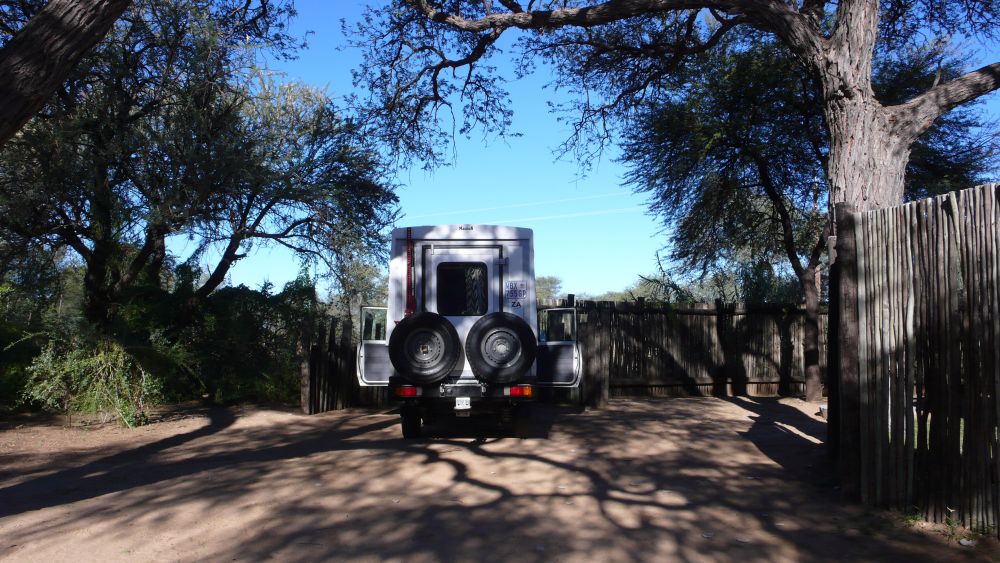
We overnight in the friendly Hotel Steiner (still exists in 2020), stroll through Windhoek (a city with some German touch), pick up our four-wheel drive camper from Britz and do some shopping: We need food and some interfaces to charge our camera, GPS and laptop in the camper.

Then we drive to Ohakandja, which is 100km north of Windhoek, to plan our tour and get settled in our new mobile home. My first camper dinner, Broccoli, steaks and pasta, tastes rather dull, because I only have salt and pepper to flavour it. Ernst comforts me: “Camper meals taste like that, do not worry.” Hm, Ernst is so patient, but I will look for more spices in the next days.
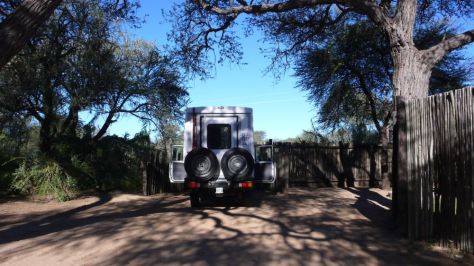
We take a shower in the chilly morning… fortunately the manager of the camping site has heated up the donkey that gives us warm water.

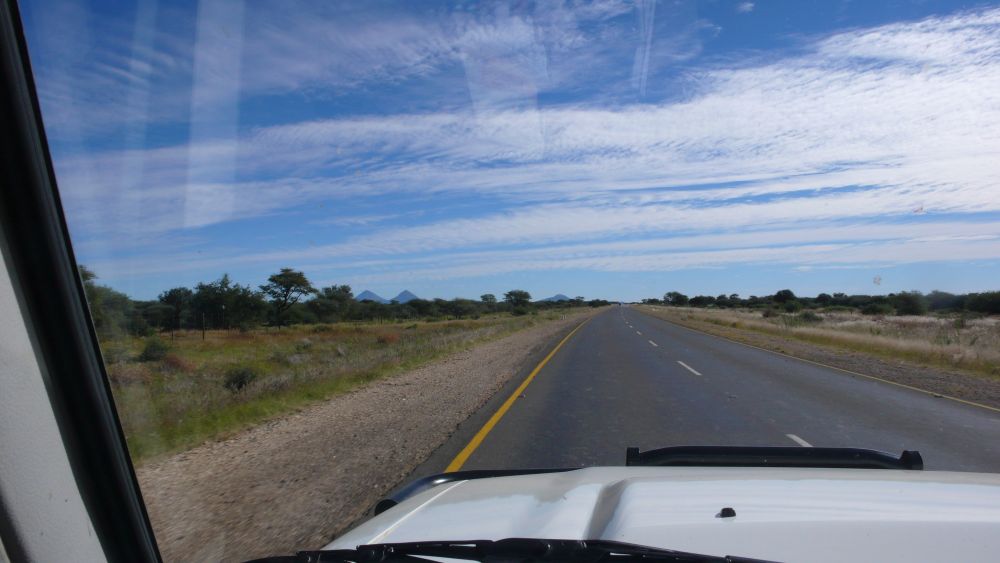
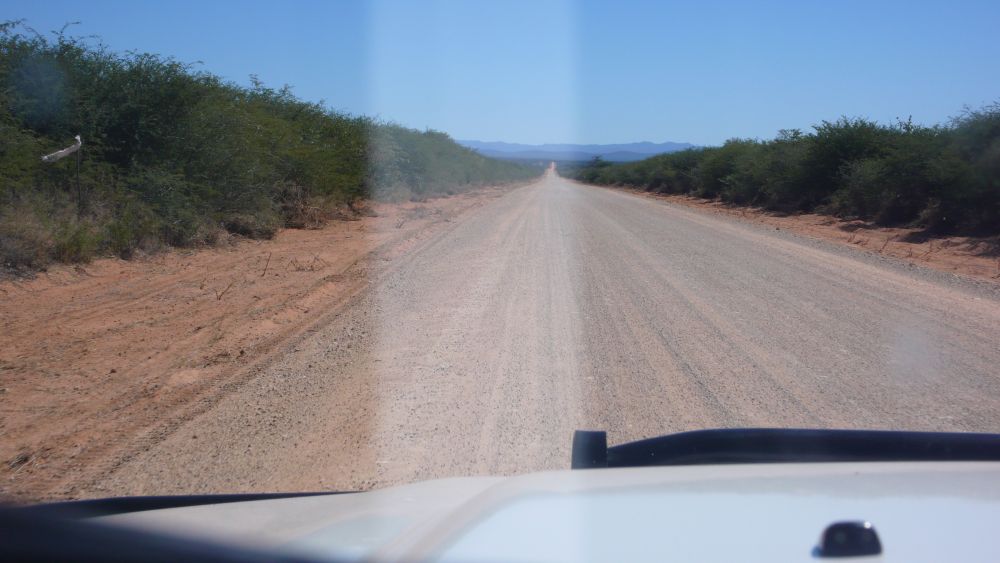
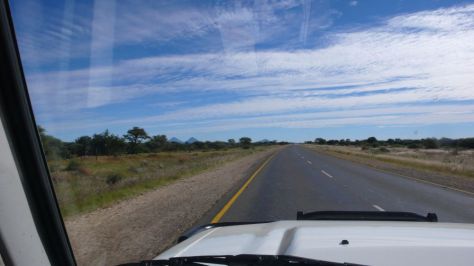
Our next destinations will be the Waterberg and the Etosha Park. The main road going out to the north of Windhoek is straight.
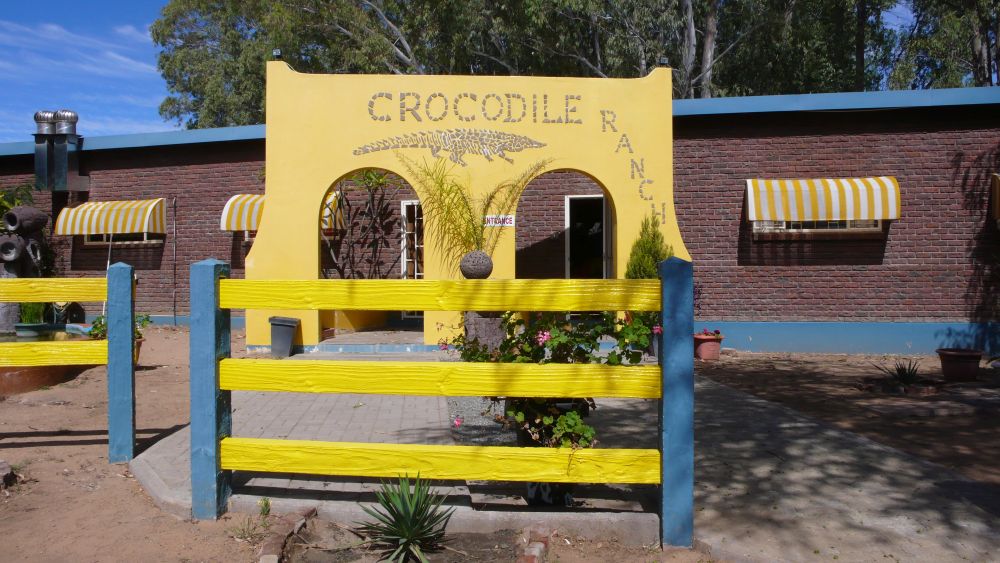
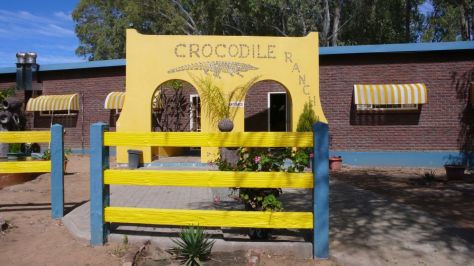
In Otjiwarongo we visit the crocodile farm – it still exists today. It is a place for breeding crocodiles and in addition, it is a tourist attraction with a restaurant attached.
A guide gives us explanations: In this huge pond of about 800’000l, there are seven adult males and about 120 female crocodiles. They live about 80 years. The animals eat until May, and then they do no longer eat for the rest of the year – what an interesting diet schedule.
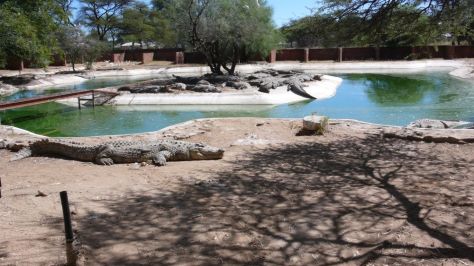
Each female lays about 40 eggs, hence 4800 eggs in total; 80% of the young crocodiles survive. There is a baby crocodile house, then the young animals are in larger ponds.
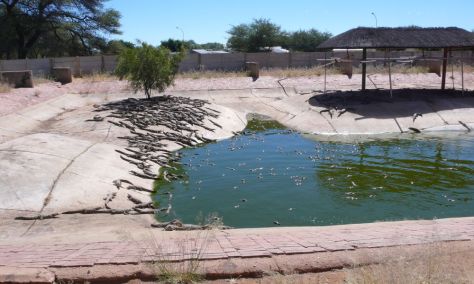
Our guide tells us to approach the pond carefully. We try, but as soon as the young crocodiles see us, they rush into the water. They grow for three to four years and then they are ready to be used for leather production.


The artificial wild life park on the Waterberg

After a delicious ostrich and kudu steak in the Otjibamba Lodge (still exists), we leave the main highway and turn east to get to the Waterberg. It is a flat top mountain. We go for a walk. We have a wonderful view of the plane looking south…
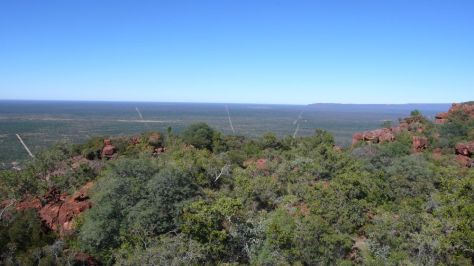
… and come across this beautiful spider hanging in the air above our footpath. Yes, there are also beautiful small animals in Africa!
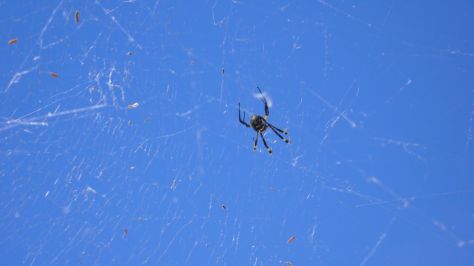
We then reach the cemetery of the Herero people that died in the battle against the Germans in 1904… this genocide is a blot in German history that makes me feel bad.

Our neighbours at the camping site are uncle Jürgen and his nephew. They give us a screwdriver and Ernst repairs one of our cupboards, mumbling that he had forgotten his Victorinox knife. “Look, I have taken this small knife with me that I had noticed lying around in our house”, I say. Ernst’s face brightens up: “Oh, great, this is my officer knife!” – I am happy that Ernst is happy about this find…

With uncle Jürgen and his nephew, we book a game drive to the plateau of the Waterberg. It is a wildlife reservation area with artificial water holes. The water is pumped up to the plateau. Some of the water holes have shelters to watch the animals without disturbing them. There is a variety of wildlife here such as giraffes, zebras, antelopes, leopards, cheetahs, buffaloes or rhinos. Our guide is called Peter. He drives far on the plateau, but all we see are two oryx antelopes (this is one of them),…
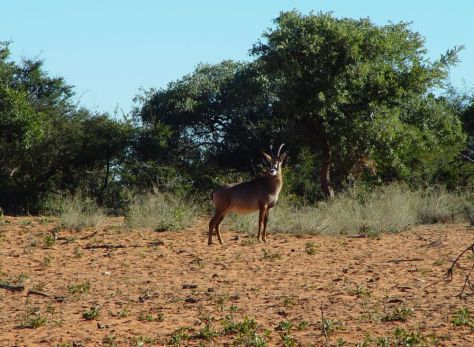
… some giraffes, this one keeps the overview,…

… and later we see two buffaloes from far – they stay in the bushes and do not dare come to the waterhole.

While we drive back in the chilly evening, I reflect about this reservation area. As long as the artificial water holes have water, it may be good for the animals to live here. And as long as tourism keeps on going, the park earns money to finance the pumps that take the water up to the plateau. But what happens, when Namibia has no more money to maintain this artificial park? Those were my reflections in 2008. Now we are in 2020, and tourism has stopped due to the pandemic. Will Namibia be able to care for the animals on this otherwise barren plateau? I hope so, because these animals have nowhere else to go. And I do hope for this place that tourism will revive soon again.


The meteorite and the luxurious lodge on the way to the Etosha Park

We drive around the Waterberg on a pebbly road, do some shopping at Grootfontein, where I find marjoram and some broth cubes that will add more flavor to our camper meals.
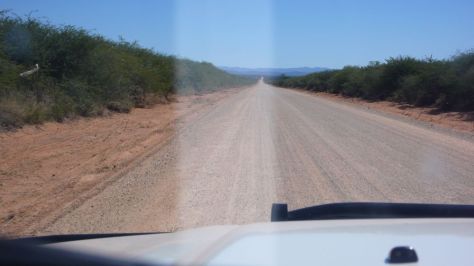
We look for the meteorite. My “Reise Know” says that the meteorite is 80% iron and hit the earth 80’000 years before our calendar system started; Hence now, in 2020, the meteorite is 82020 years old ;-).
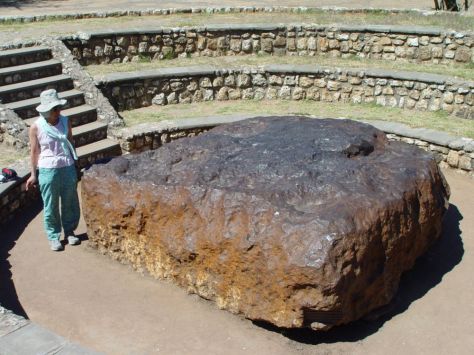
We stop at !Uri’s Safari Lodge near Tsumeb. The lodge looks inviting. We decide to sleep in a bungalow and enjoy some luxury. The “!” of “!Uri” is one of the three glottal stops of the Khoisan language that the Damara people speak here.

The manager shows me his wine cellar under a trapdoor. He has bought it with the lodge, and he asks me about the wines. I see wines from South Africa and tell the manager that he should sell (or drink) the 5 to 10 year old white wines (Sauvignon, Chardonnay) soon, but can keep some of the red Cabernet Sauvignons for 20 years, if needed. For dinner, we reserve a half bottle of Pinotage, a grape crossbreed that only exists in South Africa (Pinot and Cinsault). We have it with Kudu steaks and its cherry like taste is a good match. Then we retreat to our luxury bungalow, lay down in the canopy bed and close the mosquito net curtains.
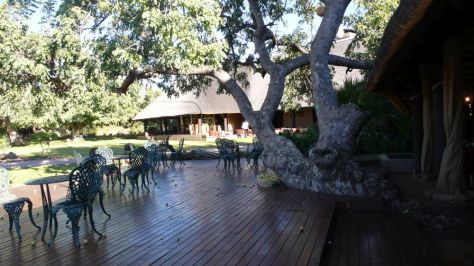
The terrace is full of Marula fruits. For breakfast we have delicious marmalade made of them – the whole breakfast is excellent and very soigné.


The Etosha Park – great for wildlife watching (no, no, not the Etosha House in the Basel Zolli)

Our next destination is the Etosha Park. Jean-Claude calls from Basel and wants to know, where we are. Etosha? He checks the Internet: “Etosha House?” “No”, Ernst laughs, “not the Etosha house in the Zoo of Basel (called Zolli), no, we are in Namibia, in the REAL Etosha Park.” – “Aha, okay…”.

We enter the park from the east and stop at Twee Palms (the water hole of the “two palm trees”; there is just one branch of the second palm tree on the photo). About 15 giraffes are here – how difficult it is for them to drink water! A herd of fine springboks, zebras, gnus, herons… we cannot get enough watching.

We are at the Fisher’s Pan in the east most part of the Etosha park. The pan is dry now. A road leads through the pan. An elephant is walking in front of us. Our car approaches the elephant from behind. It does not like that, turns back and threatens us, pulling up his trunk and waving his large ears. We back up and keep distance. When the elephant reaches firm land, Ernst honks quickly, the elephant trumpets loudly and runs into the bushes – I am surprised, how fast this clumsy looking animal runs.
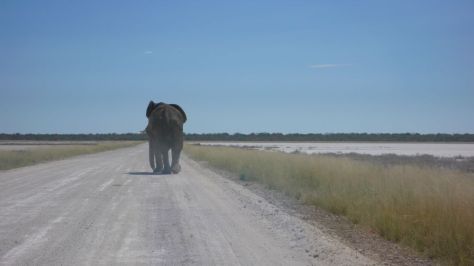
We look back at the Fisher’s Pan…

… let the ostrich cross the road…
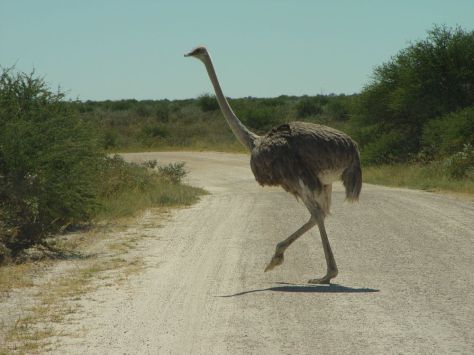
… and see much more wild life (elephants, turtles, zebras, oryx, gnus, lilac breasted rollers, herons, bustards) – this is a populated park.

We have reserved two nights in the center of the park, in the Halali Camp, and settle at slot number 43. After dinner (now more tasty with the spices from Grootfontein), we go to the artificial water hole near our campsite. There is a platform with benches, like in an amphitheatre. Two rhinos are drinking water (Ernst mumbles something about trying out the infrared program of our camera).
Then we hear loud trumpeting. About 15 elephants emerge from the bush. They drink water, play with one another, stalk in the shallow pond and keep distance to another rhino that joins them with its offspring. Even elephants stay aside, when rhinos are around.
The next morning, we try the track in the southern part of the Etosha park which is called “rhino drive”. There are trees and bushes. We find this pretty ground squirrel…
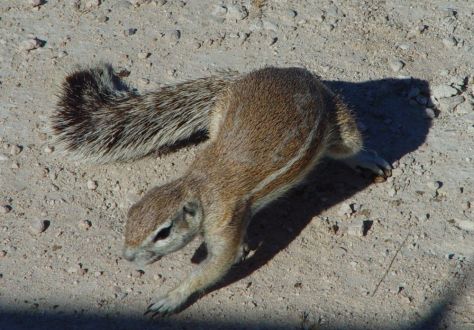
… and these cute suricates,…
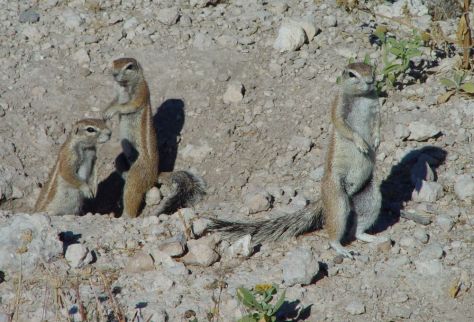
… but no rhinos, as the name of the drive would suggest.

We turn north to the Etosha Pan. There are less bushes here and the animals can be seen well such as these giraffes against the horizon,…
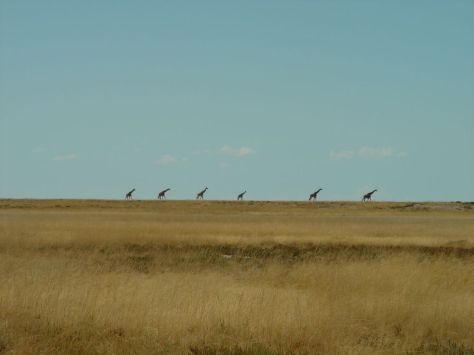
… and the lion lady with the zebra kill.
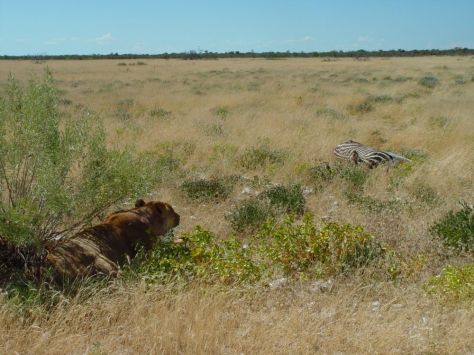
In the afternoon, we return to see, what this lion lady does. The lady is still there, but soon gets up and walks towards the forest, carefully observed by the grazing zebras.
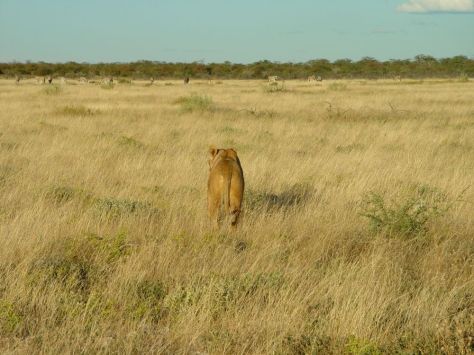
We go back the next morning – no lion lady, and where the zebra kill has been before, there is nothing left – vultures and hyenas have eaten it all.

We continue westwards, take photos of these elegant oryx antelopes and…
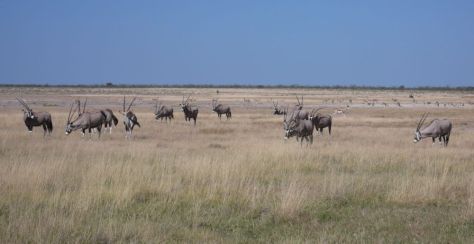
… stop at a parking lot that is extremely noisy from all the twittering of the bayas that have woven this huge nest (Webervögel).
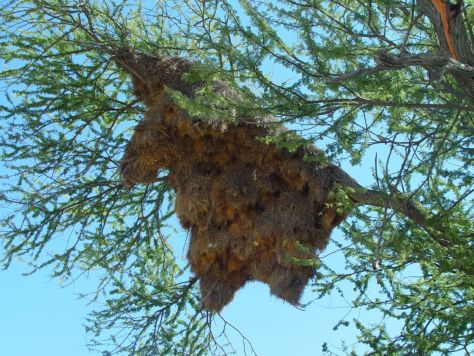
They belong to the family of sparrows and are very social.
We reach the ghost forest with these odd looking bottletrees.
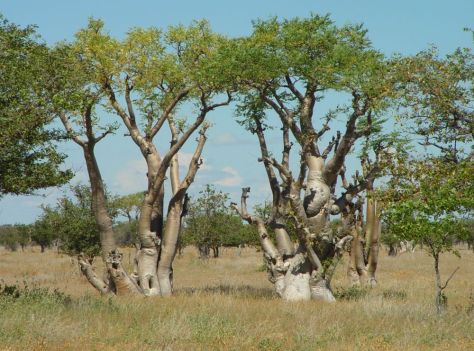
The eastern part of the Etosha Park ends soon here. The eastern part is for visitors with cameras. The western part is for visitors with rifles that shoot animals at artificial water holes… scary for me. I now understand that, in earlier times,  the habitat of the animals was much larger than the Etosha park. The animals migrated to the ocean, when looking for food and water, but now they are locked in the Etosha Park. In a way, this park is a large zoo. If I understand it correctly, the Serengeti is a much more sustainable wild life reservation concept, where the animals can migrate as they have always done.

We stop at the Okaukuejo Camp, still in the Etosha Park, and find a place to spend one more night. Also this camp has an artificial waterhole, where we can observe hyenas, zebras, springboks, elephants and the black rhino that slowly, slowly approaches the waterhole, while all other animals get out of the way. The black rhino is the one with the pointed mouth (Spitzmaulnashorn), as opposed to the white rhino (Breitmaulnashorn) with the broad mouth which is called “wyd mond” in Afrikaans. The Anglo-Saxons heard “wyd” and made “white” out of that – white rhino. Consequently, the “other” rhino must be “black” – black rhino, they may have thought. But both rhinos are neither white nor black, they are just grey.

I do like the water hole of the Okaukuejo Camp. We return in the evening and see more rhinos, jackals and a wild cat.

After three wonderful days we leave the Etosha Park, drive to Outjo to reload our gas tank (for cooking) and to do some shopping. We find an excellent butcher, where I buy Biltong (dried meat pieces, a convenient picknick), steaks and the house spice mixture for barbecues and vegetables to add even more flavour to our camper meals.

Then we continue to Twyfelfontein.


Barren landscape and rock paintings in and around Twyfelfontein

Damaraland in the west of Namibia is dry and barren…
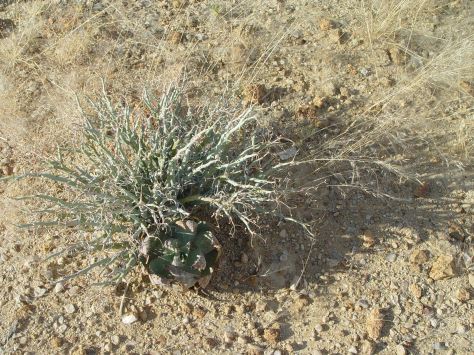
… with yellow meadows, some green bushes and blue mountains.

We sleep in a community camp that is managed by Damara people. The steak we have bought in Outjo is excellent and the butcher’s house mixture of spices is perfect. Now, my camper dinners do no longer taste dull at all.

We stop at Twyfelfontein, which is a park with rock paintings. Thekla shows them to us. I can see a giraffe, a lion and various antelopes. The tail of the lion is angled and ends as a hand – interesting.

The small gecko looks for the sun, right where the rock paintings are.
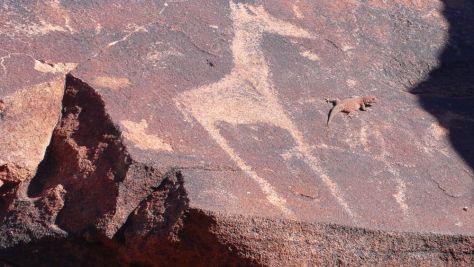
Thekla speaks the Damara language. It belongs to the Khoisan languages that use three glottal sounds. She clicks three times, and it always sounds different. We give it a try, but we can do no more than one poor click. To get an idea, look at this San man talking Khoisan.

After having seen Twyfelfontein, we drive to the doline Wondergat, where Ernst sees this beautiful grasshopper.
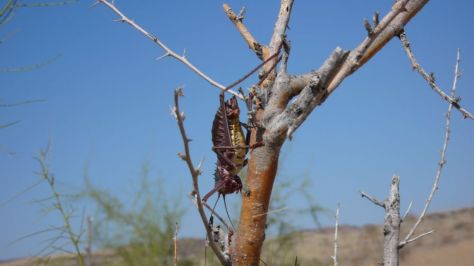
 

Driving North to the Epupa Falls

Now Ernst looks for some adventures on challenging roads. We drive north, first on good roads and then on pebbly roads…
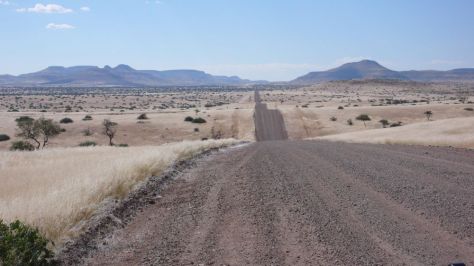
… some springboks run ahead of us. From time to time, they jump up high. We wait to give them time to get off the road.
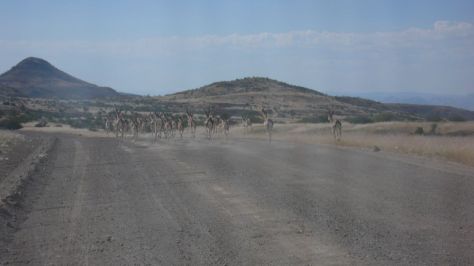
We stay overnight in Sesfontein and then head north to Opuwo. We have to cross some hills on rough roads,…
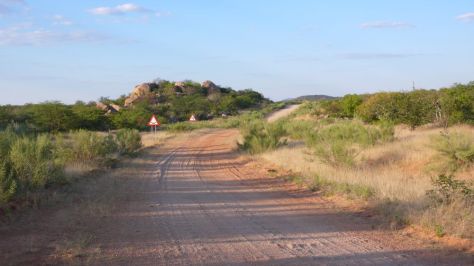
… drive up the Joubert pass (easy, it has been paved going up)…
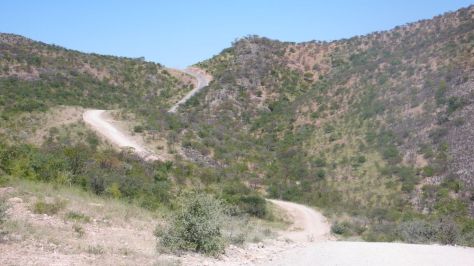
… and are now on 1300m on a high plateau with Himba villages.

The last kilometers to the Kunene river are challenging with pointed pebbles and river crossings. We advance slowly. At the Kunene river, we settle in the Omarunga Lodge & Campsite (still exists in 2020), with a view of the river. We eat in the restaurant of the Lodge & Site and Ernst invites some students for dinner – he says that he has been invited by some elderly business man, when he was a student a  long time ago and now, he wants to give it back. We have a wonderful evening with the students – they study chemistry.
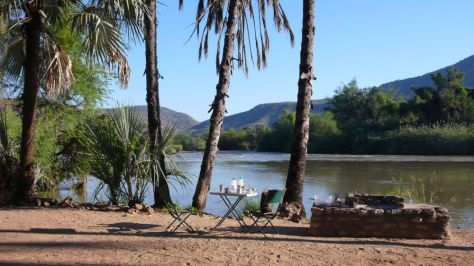
Across the river Kunene is Angola.

Swimming is forbidden here; there are crocodiles. At the reception, I hear that one of the crocodile has a name, Lucy. Lucy has not been seen for some time now, but there are more crocodiles, beware.
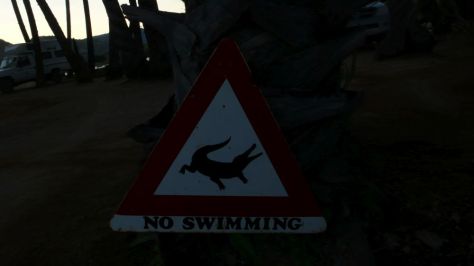
We walk along the Kunene river…
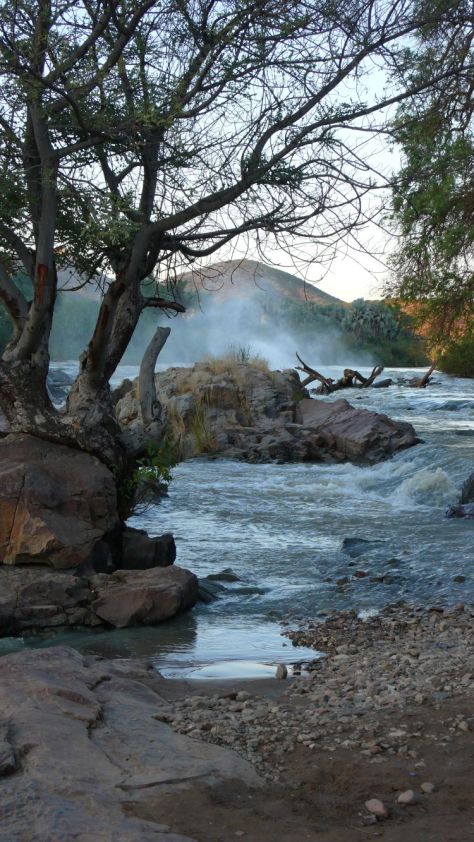
… to the Epupa Falls. The water flows around Baobab trees.
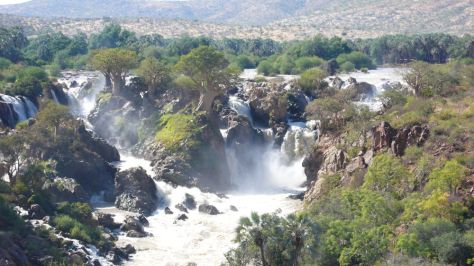
Jacy takes us to the Himba village. Jacy is a Himba that went to school in Opuwo and now guides tourists. We are hesitating. We do not want to “look at” people, we want to LIVE the countries that we visit; 15 years ago in Myanmar, we had rejected visiting tribes. But Jacy was nice and we thought, like this, he earns some money and for the Himba, we had some corn flour as a gift.
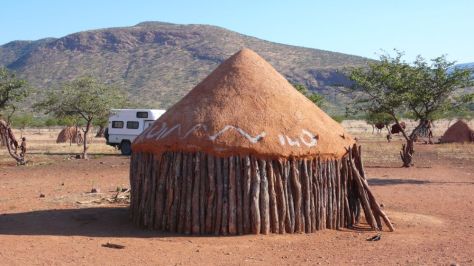
Jacy explains to us that the Himba use redwood paste to care for their skin, and that it takes three days to make these artful plaits. The Himba belong to the Herero people and have kept their traditional way of life – so far.

These are the graves of the Himba. They worship their ancestors. It is a holy place. All three of us stay at distance meditating. The more noble a man or a woman were in life, the more bull horns decorate his or her grave, for men showing upwards, for women showing downwards.
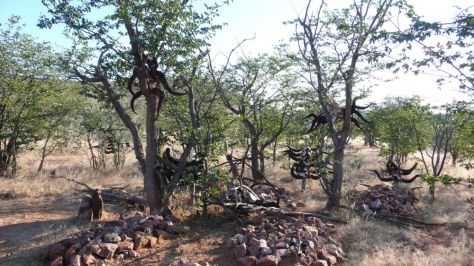
We have our last “Kunene dinner” and our last “Kunene breakfast” under the palm trees near the river.
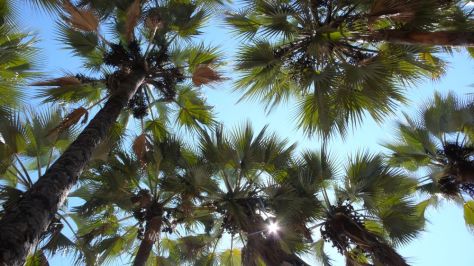
The next morning, we will drive to the Ruacana Falls. Again, there are challenging roads ahead of us.


Adventurous drive to the Ruacana Falls and returning to Windhoek

We drive back the same way from the Kunene river to Epembe and then turn left to Swartsbooisdrift.

“Road washed away”, our Tracks of Africa on the GPS warns us. This is the “road washed away”. Ernst overcomes the obstacle splashing through the water.
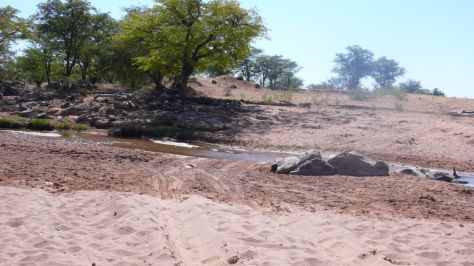
This is our next larger obstacle. Ernst masters it as well, while I get out of the car to take the picture.
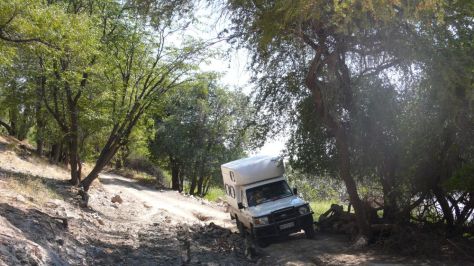
Our rear mirror is dirty after all these rough roads with obstacles. We have had our off-road adventures and Ernst is happy about that.
The Ruacanafalls are retained by a barrage. With an altitude of 80m, these waterfalls must have been impressive before. The powerstation of the Ruacana Falls has been completed in 1978 and covers more than 60% of Namibia’s energy consumption, our Lonely Planet says. In 2012, more turbines were added, as Wikipedia says.

We overnight at the camping site near the so-called hippo pool (which is part of the power station system). We settle near the river. Ernst studies all the tracks around our camper to make sure, no dangerous animals or snakes are here. There is one track that he cannot identify (we have a book for that). It turns out, these are the paw prints of the friendly dog of the camping site that joins us wagging the tail.
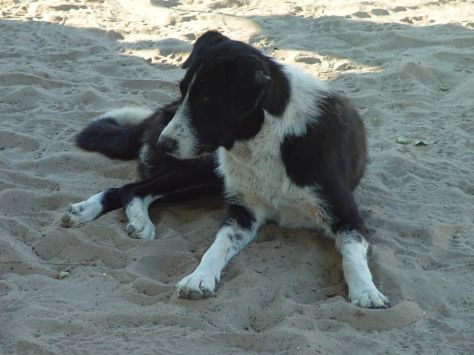
In the morning, I fall down the ladder of our camper and spill the breakfast yoghurt. The dog tries the yoghurt, does not like it at all and walks away. A huge grasshopper comes and loves the yoghurt, while a prepare a second yoghurt portion.

Then we take an easier route back to Opuwo. In the hot afternoon sun, we have a puncture, hard work – together, we manage to change the wheel. Then we stay overnight in Palmwag. Sitting at our dinner table, we enjoy this beautiful evening ambiance.
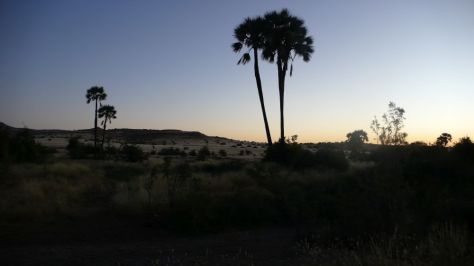
On the way back to Windhoek, we stop at the Kristall Kellerei of Mr Kluge in Omaruru. He owns about 4ha of vineyards. He grows Ruby Cabernet (red) and Colombard (white). We buy two small bottles from each. Then we stop at Okahandja for our last camper night in Namibia and have one small bottle of Ruby Cabernet with our barbecue. What a nice farewell dinner.

The other bottles we take home. I keep one bottle of Kluge’s Ruby Cabernet in my cellar. I do not know, whether now, in 2020, it is still drinkable, but it makes a somewhat melancholic souvenir of these four wonderful weeks with Ernst in Africa, 12 years ago.

Now, in 2020, I read in the Internet that the Kristall Winery belongs to Michael Weder who makes a much valued Brandy (Nappa) from the Colombard Grape.


Background information about Namibia: Khoisan speaking peoples, Bantu tribes, the German colonialization in the 19th century, protectorate of South Africa in 1920, independent in 1989

Peoples that speak the Khoisan click languages: San bushmen, Nama and Damara (this San man talks Khoisan and this is a step by step lesson about clicking).

  • The SAN (now 3% of the population of Namibia): About 8000 years B.C. pottery appeared – probably the San had settled then – they were hunters and collectors. The SAN or bushmen are small, gracefully built, have a bright (yellowish-brown) skin, high cheekbones and their hair looks like “peppercorns”. The rock paintings in Twyfelfontein may originate from that time, but it is not proven.
  • The Nama (now almost 5% of the population) lived as nomadic cattle breeders. They are a bit taller than the San, and have the same bright skin colour, cheekbones and “peppercorn” hair. Because their click language sounded like stuttering to the Europeans, they called them “Hottentotten”. The origins of the Nama are not clear. Either they descended from the San or they immigrated from East Africa and mixed up with the San. The mightiest Nama tribe, the Orlaam, immigrated from the cap region. They had learnt how to use firearms from the European settlers.
  • The Damara (or Dama, now 7% of the population) have always been a sedentary group that also speaks Khoisan. Other than the Nama and the San, they are black (and proud of that). Their origin is not clear.


Tribes that speak Bantu Languages

About 2000-2500 years ago, the first Bantu speaking tribes immigrated. Today, the two main Bantu tribes in Namibia are the Herero (about 7% of the population) and the Ovambo (about 50% of the population).

  • The Herero immigrated to North Namibia and later to East Namibia and Botswana in the 14th or 15th century – their legends say that they are from East Africa. They were cattle breeders and nomads. The Himba that now live in North West Namibia belong to the Herero.
  • The Ovambo (or Vambo) came from East Africa in the 16th/17th century. They were sedentary farmers and cattle breeders. Traditionally their culture was a matriarchy, which changed, when adopting Christianity. They had a king that leased the land to his subordinates for their lifetime. The Ovambo live primarily in the north of Namibia and in southern Angola.


European colonialists (whites – now 7% of the population; there is also a coloured population of about 8%, which includes the Basters of Rehoboth)

The Portuguese landed at the coast in 1485, but did not stay. In the 17th century the Dutch started to explore the coast line. In 1844 Germans evangelized the Herero, while the Finns cared about the Ovambo. The English annexed the Walwis Bay in 1878, because they were interested in Guano which are excrements of seabirds used to produce fertilizer and explosive substances. In 1883 Adolf Lüderitz from Germany bought the port Angra Pequena from a Nama chieftain which became then Lüderitzland. Fights between the Nama and the Herero “motivated” the Germans to send troups, first 23 soldats, then more. They built fortifications and promoted commerce and mining. The Germans founded Windhoek in 1890. Namibia became a German protectorate. German farmers settled and the Germans agreed about the borders with the other colonial rulers of the area around 1890. This included the so-called Caprivi Strip, a thin band of land bordering Botswana in the north up to the Zambesi river. The idea was to use the Zambesi river to access German East Africa (today Tanzania) by boat on the Zambesi and via the Indian Ocean. This was, however, impossible; from the Caprivi Strip downstream the Zambesi is not navigable because of the Victoria Falls.

The German farmers settling in Namibia expelled the Herero from the fertile plains. The Herero retreated to the Waterberg and revolted. The Germans lost their freshly established estates and backed up to Windhoek. Reinforced, the Germans hit back. At the battle of the Waterberg in 1904, the Herero were vanquished and those that survived escaped to the desert, where many of them died of thirst. 80% of the Herero perished – this is a genocide. The Germans apologized 100 years later and made a reparation payment.

After World War I the Germans lost their colonies. Namibia became a protectorate of South Africa. Many German farmers stayed in the country and expanded their farms. The native tribes were confined to less fertile “home lands”, a process that was completed in 1963.

Namibia struggled for independence from South Africa,  but South Africa continued to rule over Namibia, despite the UNO resolution 435 from the 1960’s. In 1983, the UNO recognized the SWAPO (South West Africa’s people Organization, dominated by the Ovambo) and, supported by Cuba, the SWAPO fought in Angola and in the north of Namibia. In 1989 Namibia became independent. The first president, Nujoma, was an Ovambo chieftain. He strived for peaceful solutions in his multi-ethnic nation which was symbolized with the flag of Namibia: The osprey stands for vision, two oryx antelopes for courage.

Source: Wikipedia, https://en.wikipedia.org/wiki/Coat_of_arms_of_Namibia#/media/File:Coat_of_arms_of_Namibia.svg

Nujoma ruled for 15 years. He was followed smoothly by Ovambo (or SWAPO) chieftain Hifikepunye Lucas Pohamba until 2015. Then, smoothly again, Hage Gottfried Geingob took over (also from the SWAPO and with a long international experience outside Namibia). I do wish all the best to this multi-ethnic country. For the people and for the animals, I hope that tourists will come again after the pandemic.
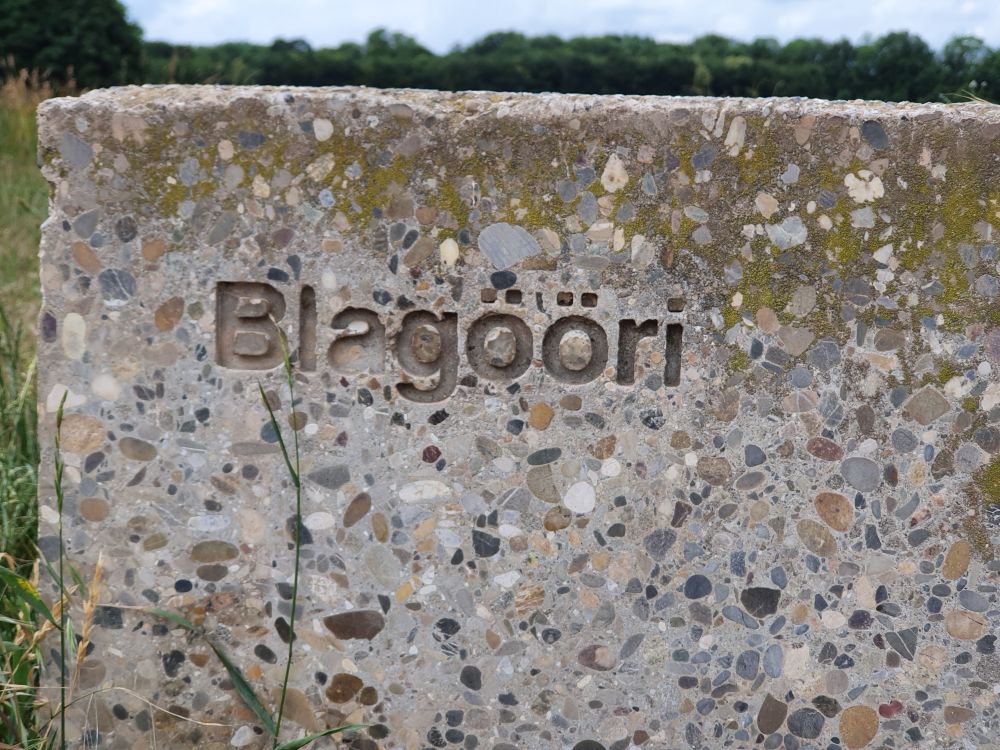
 

Former blogs about stories that my home tells me: The Schefflera plant that reminds me of having climbed the Kilimanjaro with Ernst and the ebony wood bowls that remind me of the safaris in Tanzania  (2006), “Map of Etosha”, Namibia Wildlife Resorts, Honeyguide Publications

Sources: Paula Hardy et alii, “Botswana & Namibia”, Lonely Planet 2007; Daniela Schetar et alii, “Namibia”, Reise Know-How, Markgröningen 2007; Duncan Butchart, “Wildlife of the Okavango, Struik Nature 2000; my own travel report, “Südwestafrika – Zimbabwe, Botswana, Namibia”.