On the road – mysterious ermità on a red rock and Bellmunt in the Priorat

We spend the whole month of November 2019 in Spain. Now we are staying in the appartment of our friends in L’Hospitalet de l’Infant. One day we go for an excursion to Montroig del Camp (where we buy leather bags from our favourite leather workshop) and then drive through the Llaberia mountains to the Priorat, to Bellmunt. On the way, we stop at the Ermità de la Mare de Déu.

Source: Googlemaps


La Ermità de la Mare de Déu de la Roca – spectacular location

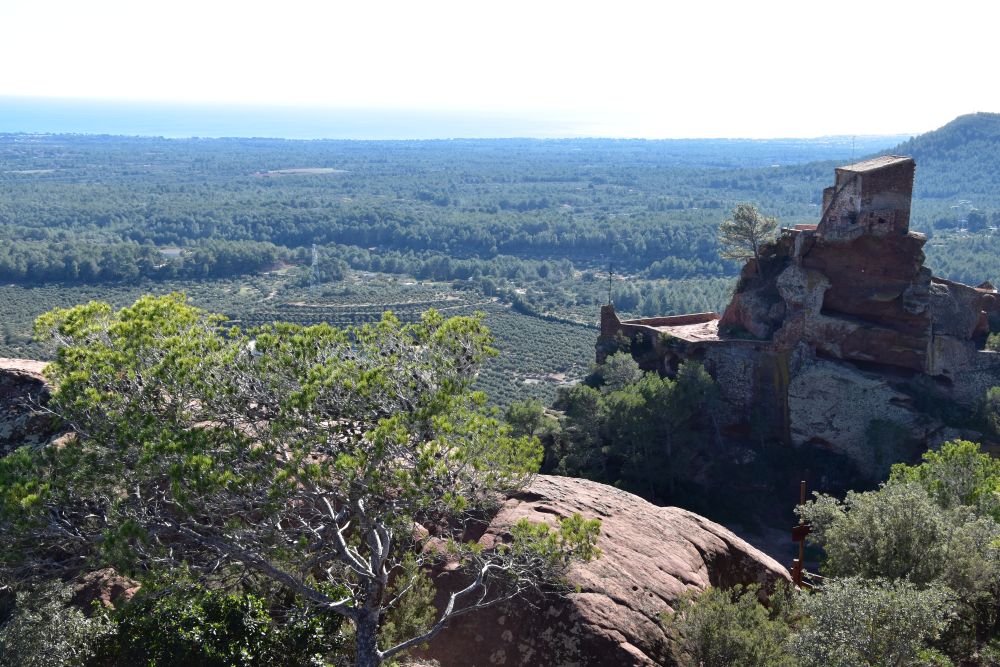
So far we have always ignored the signs pointing to the Ermità de la Mare de Déu de la Roca, when driving through the Llaberia mountains. This time, we turn left and arrive under this sandstone rock with the mysterious building on top. It is the Ermità de la Mare de Déu de la Roca, and I can understand, why this ermità is called “de la Roca”.
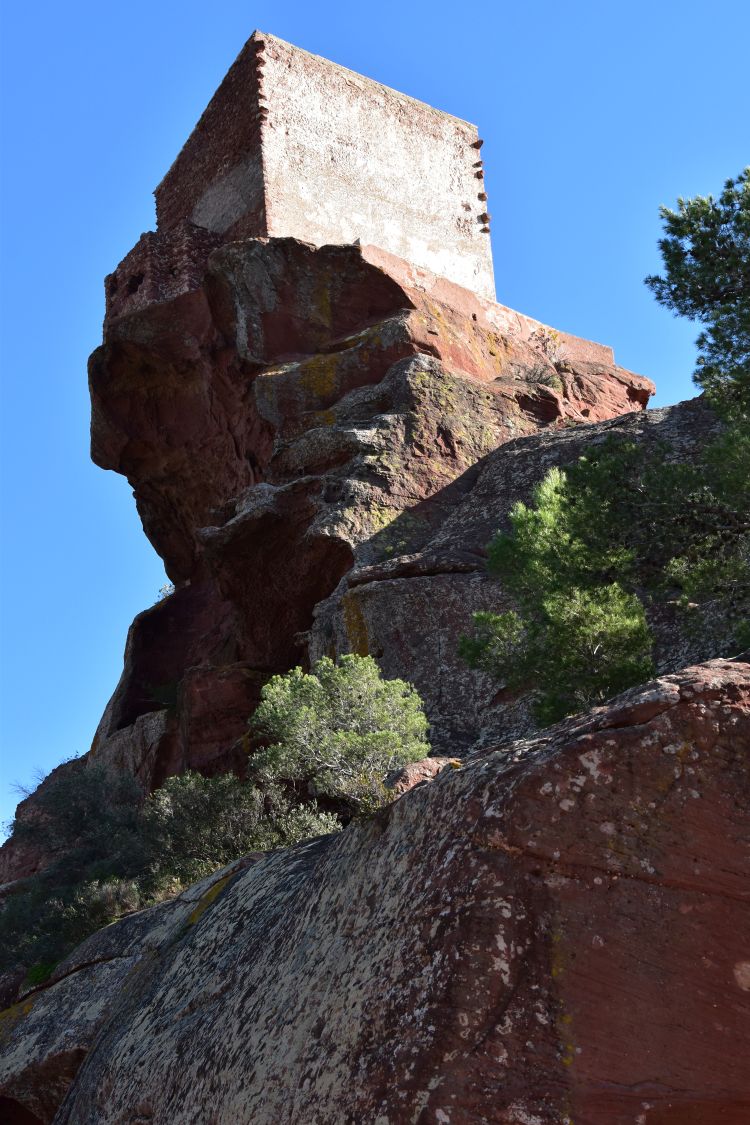
The ermità is closed. Turismo of Montroig  shows, what it looks like inside. Their site explains that the ermità, going back to the 13th century, has been ingeniously integrated with the red rock. Yes I agree, But – red rocks? Now I understand, why the village Montroig del Camp is called “Redmountain” (in Catalan “roig”, pronounced “rotsh/rotsch”, means red and “mont” is “mountain”): Montroig lies in the fields at the foot of the red sandstone mountains.

We enjoy the view towards Tarragona, with olive groves, forests and the Mediterranean Sea.
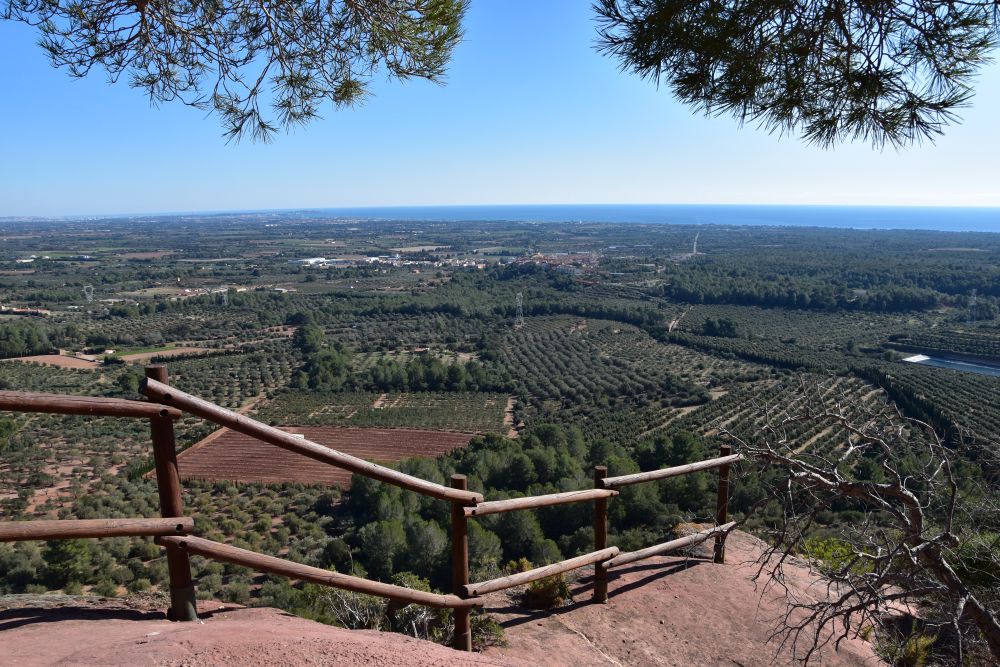
Then we climb up to the viewpoint with the pictoresque sandstone formations shaped by wind an water.

From the “sandy” rock, we look back to the ermità. Gorgeous place and very secluded.
We continue on curvy roads across the picturesque Llaberia mountains to reach Bellmunt in the Priorat.


Bellmunt – quiet village of winegrowers in the Priorat

Bellmunt stretches along a mountain edge above the river Suirana.
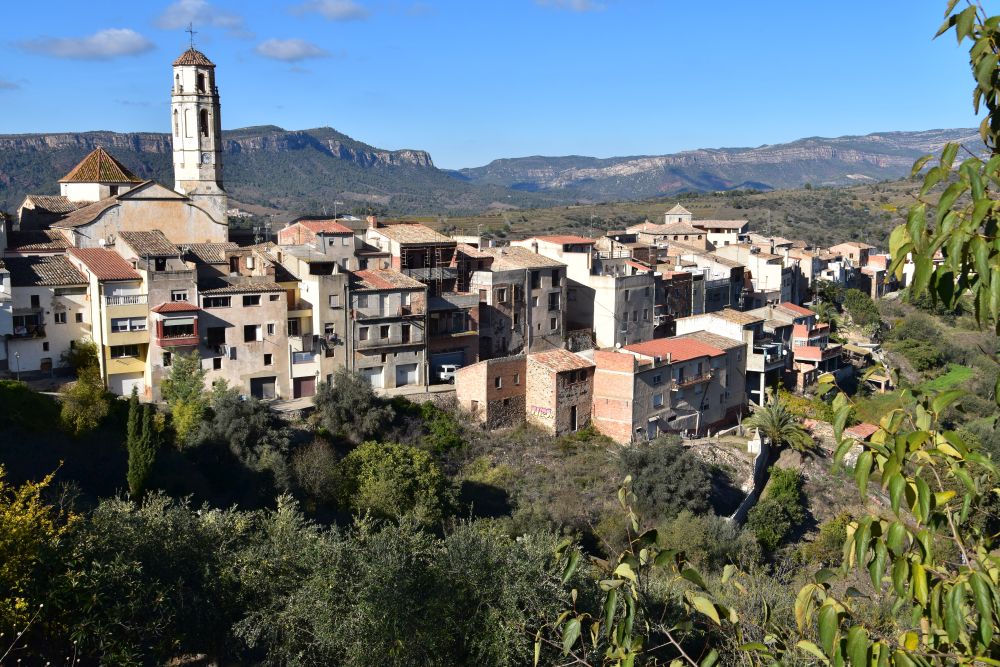
The table mountain Monsant can be seen in the background.
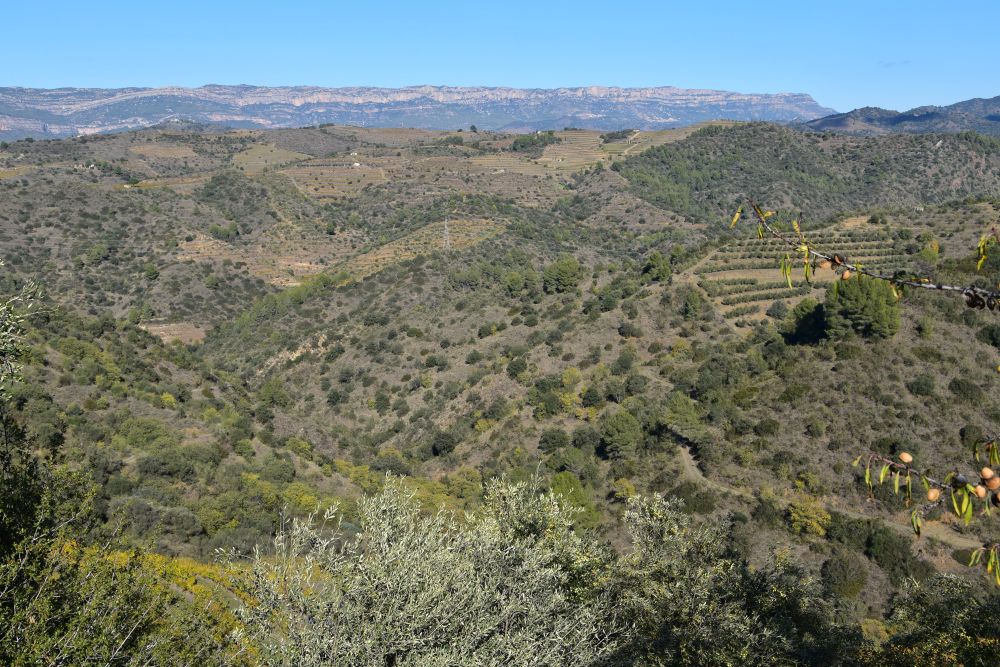
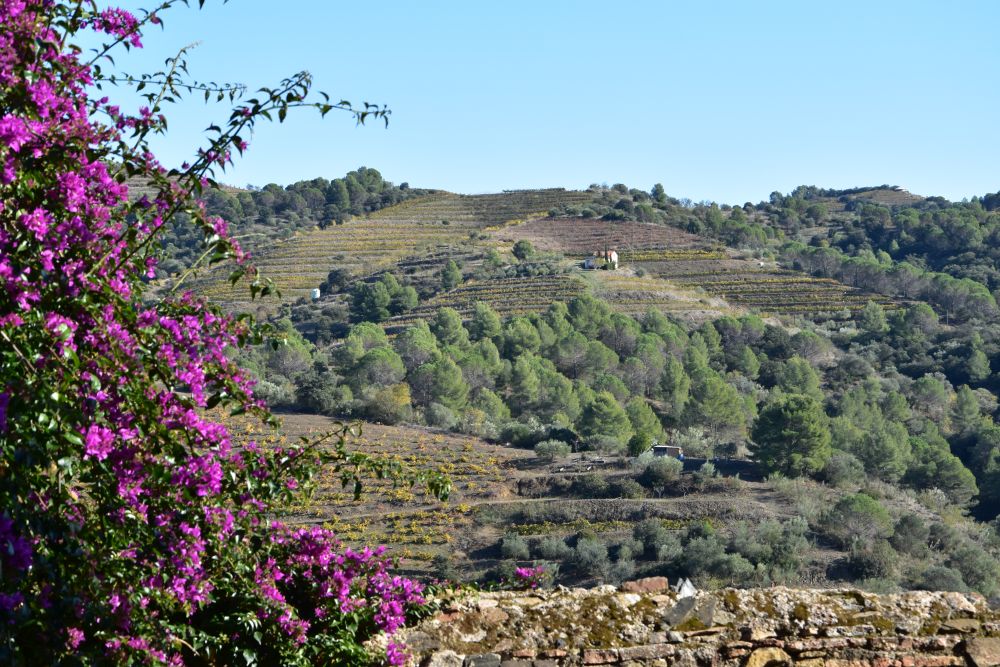
The village is surrounded by vineyards,…
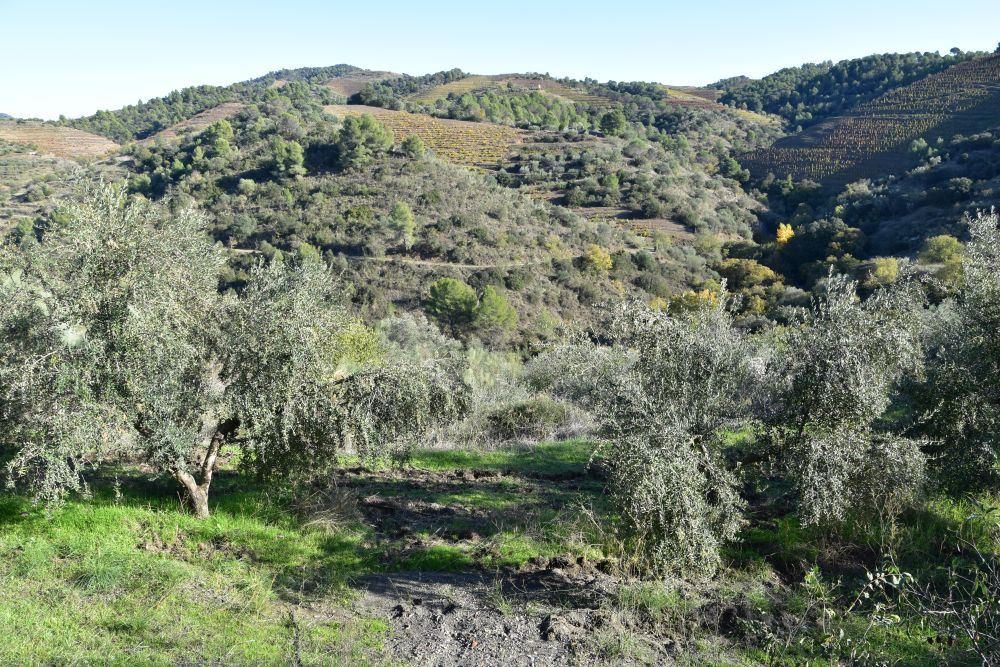
olive groves,…
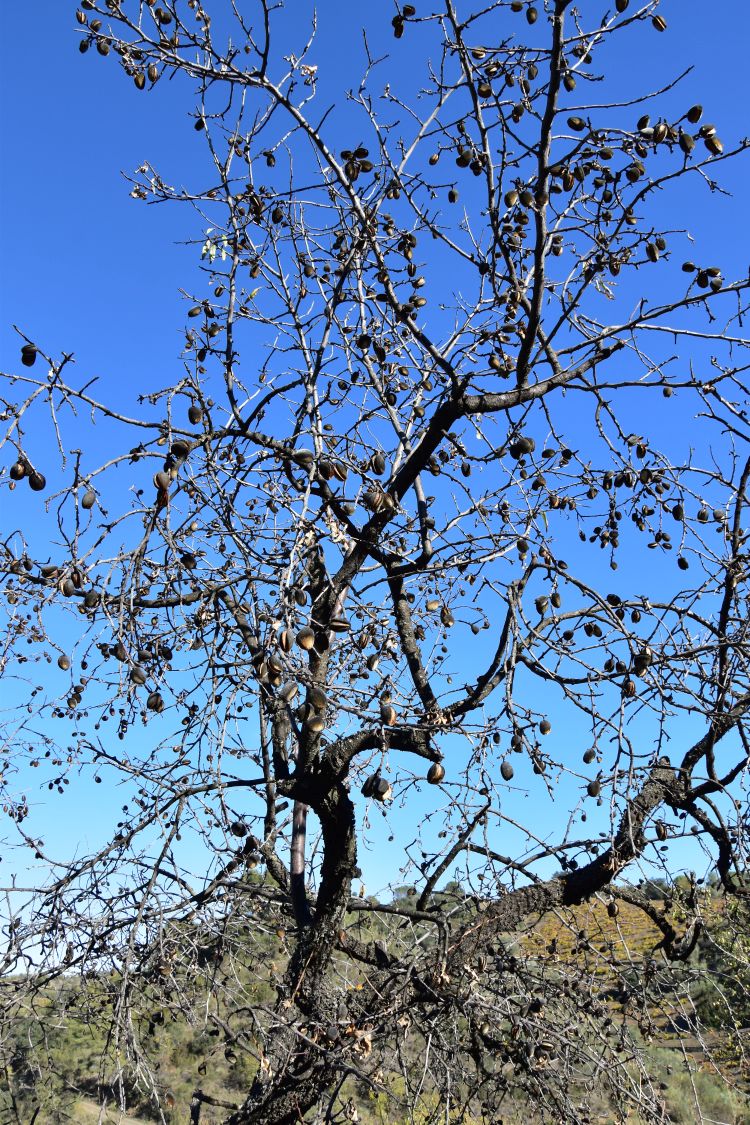
… and almond trees.
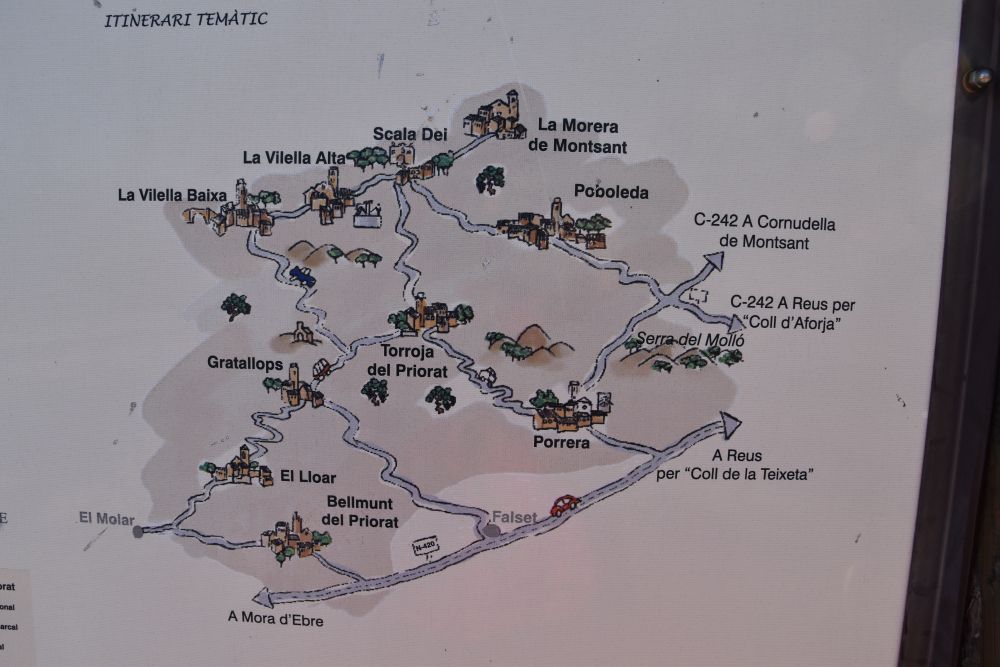
Bellmunt belongs to the wine area Priorat, one of the two highest Quality or DOQ wine areas of Spain. A panel at the village parking shows the nine wine producing villages of the Priorat.
Casa Gran del Siurana is one of the bodegas of Bellmunt. According to their website, the bodega was founded in 2000 and belongs to the Peralada Group, a family owned commercial conglomerate from the Empordà (Catalonia).
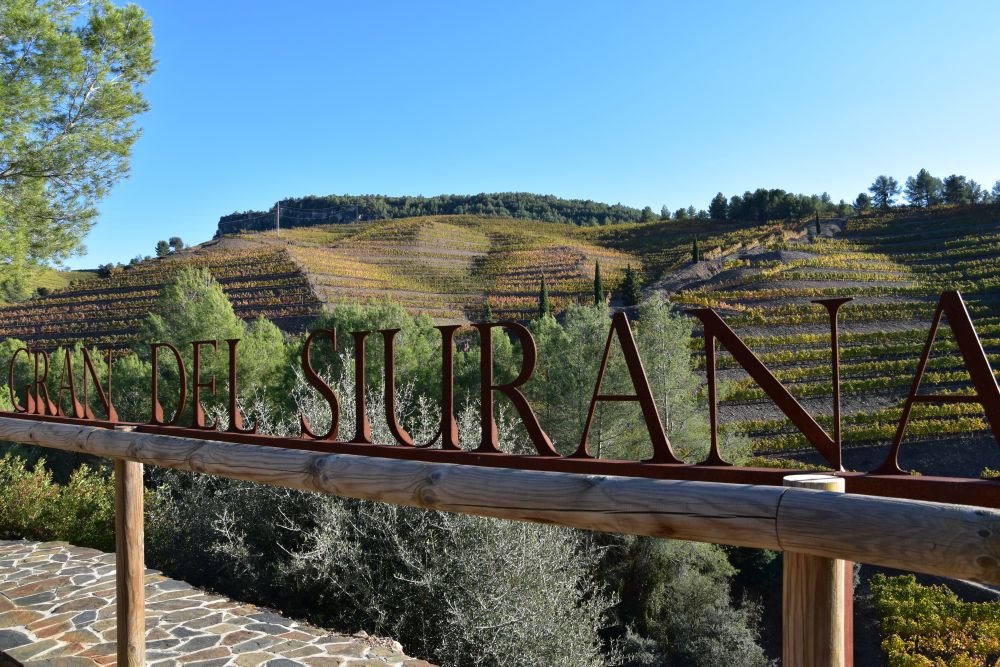
This bodega is named after a large house or “casa gran” located on the banks of the river Siurana; it once was inhabited by Carthusian monks from the monastery Scala Dei that owned all nine Priorat villages and introduced vines here in the 12th century.

We slender through the vineyards of Bellmunt that shine in autumn colours…
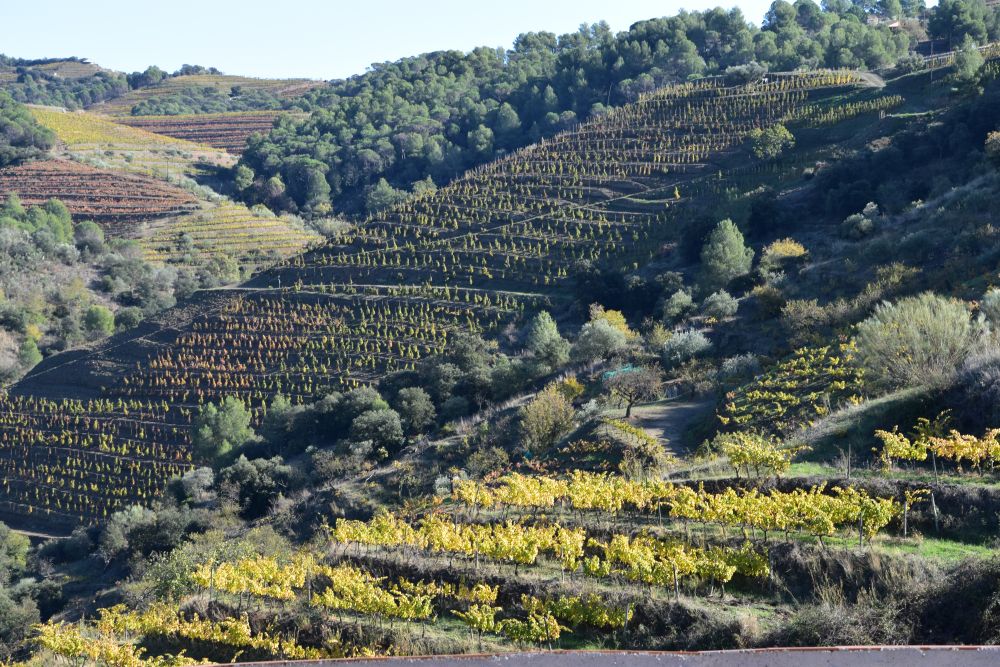
… and cross a small affluent of the river Siurana.
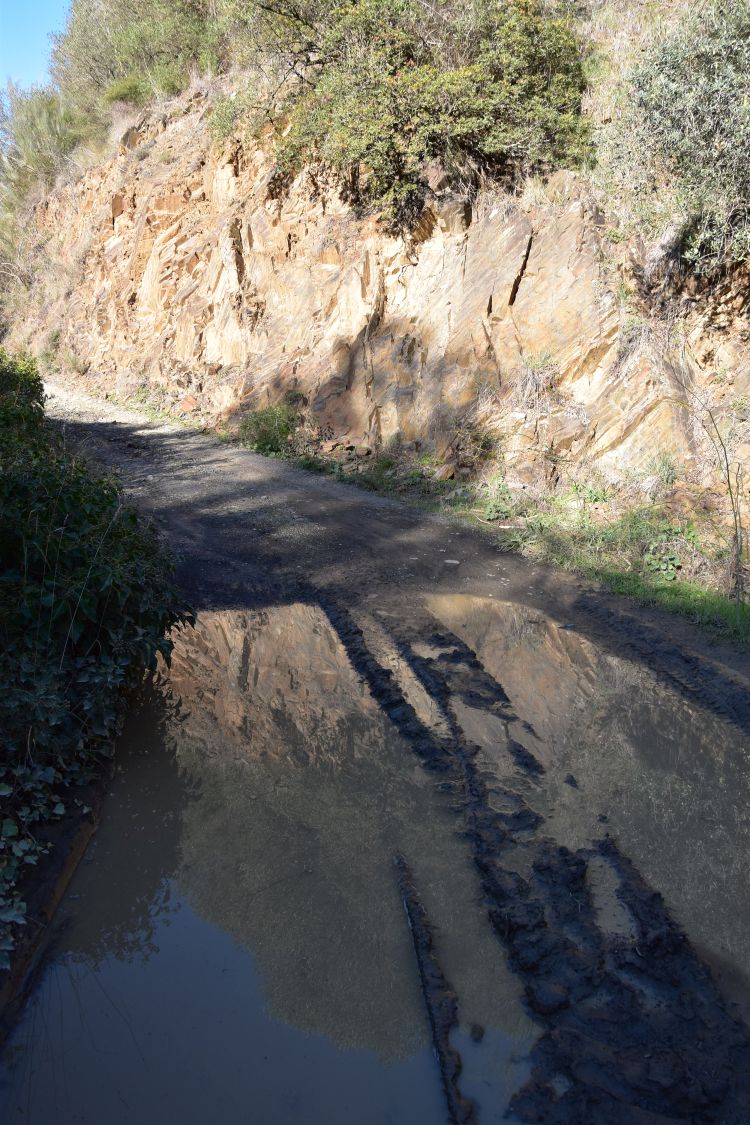
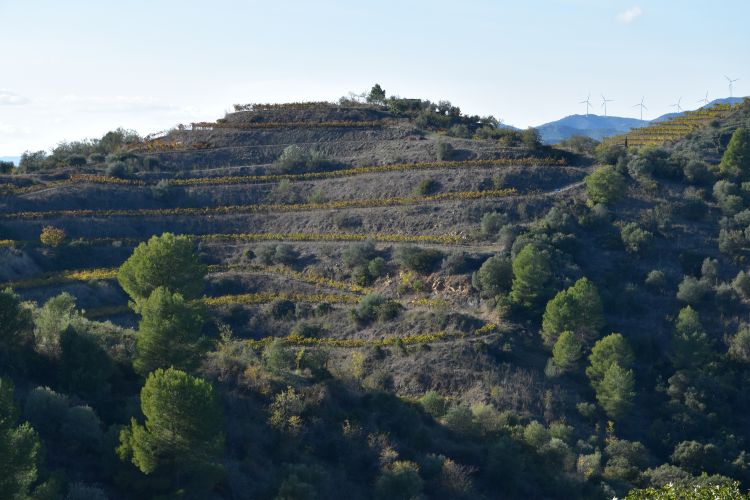
We admire the elaborate terraces made from stone and…
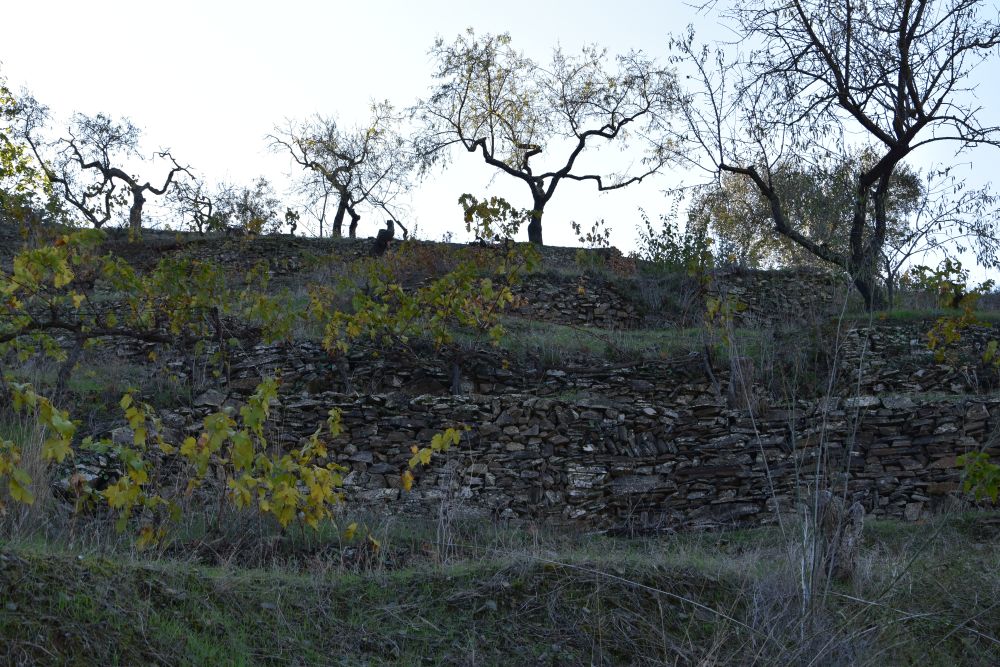
… carved into the steep mountain slopes.
We return to the village…
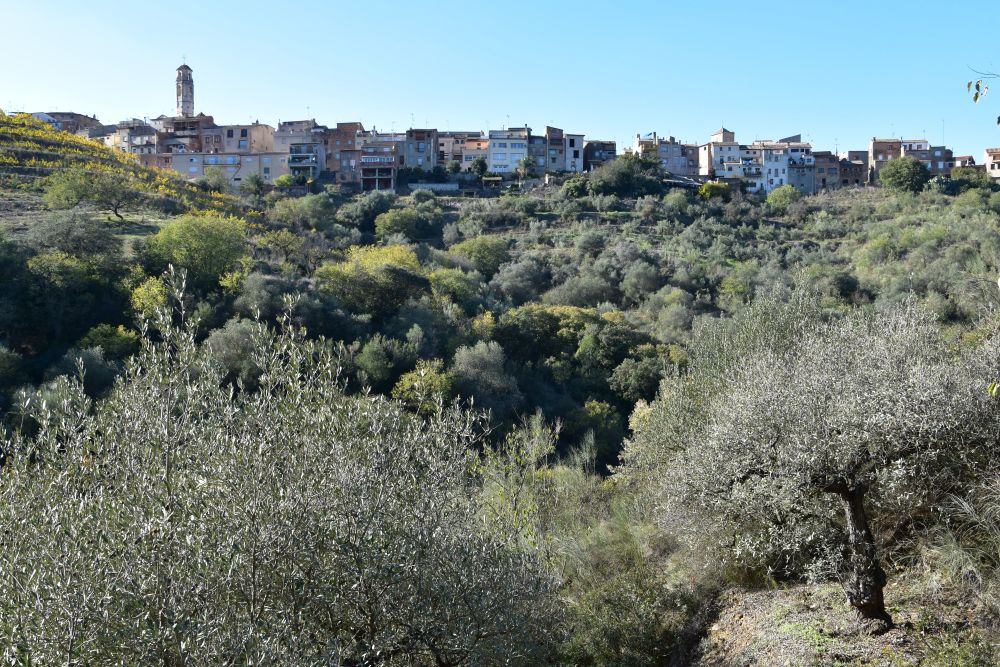
… and stroll through the narrow streets with the laundry hanging on the windows.

The village was vivid, when we arrived, as it was full of joyful children returning from school. The smell of lunch was in the air. Now the streets are empty and quiet, it is siesta time. We even do not find a bar open to have a coffee.

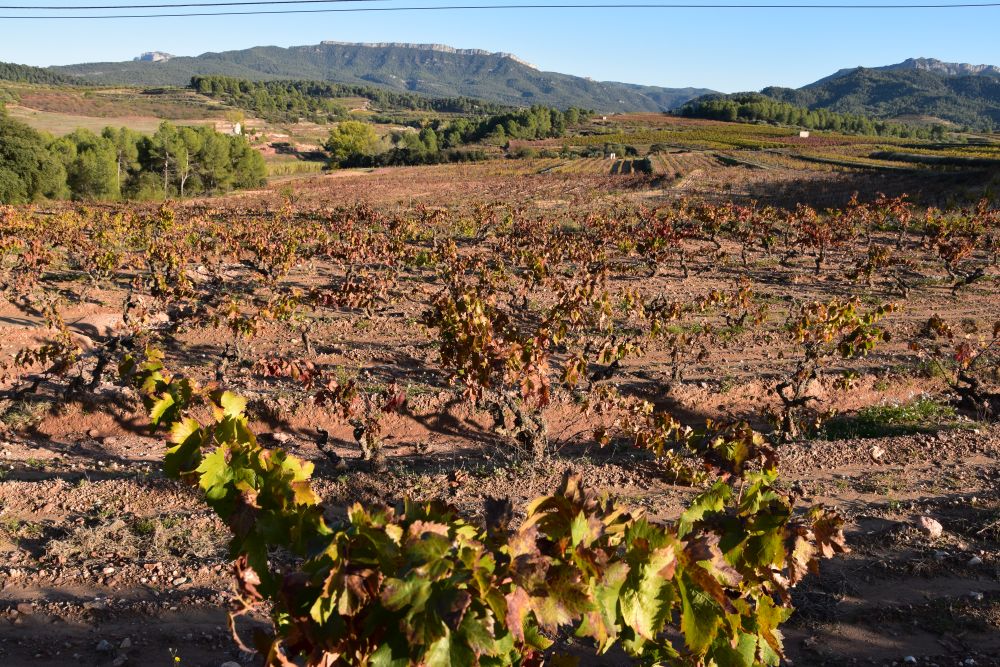
We decide to return to our appartment in Hospitalet by driving through the hills of the Montsant DO. We take a foto of this Monsant vinyeard near El Guyamets. The DO Montsant wine region forms a ring around the DOQ Priorat and in general, the Montsant vineyards are less steep and the vines planted more densely. Some innovative villages and wine growers also make excellent Montsant wines, one of the most successful being the Celler of Capçanes.
 

Some backgorund Information about the DOQ Priorat

Having arrived in L’Hospitalet de l’Infant, we stop at the city library, where we find an excellent book about the villages and winegrowers of the Priorat, written by Sebastian Alba : «Més enllà del vi – DOQ Priorat », Barcelona 2012. It gives general information about the Priorat wine area and each winegrower of the Priorat has a chapter of his own to talk about his background and about his bodega. Though the book is written in Catalan, we understand pretty much of it, as we speak both French and Spanish. From this book we learn:

  • The Carthusian monks of the monastery Scala Dei (ladder of God) introduced vines to the Priorat in the 12th century. They owned what is today the DOQ area of Priorat, and the name “Priorat” still reminds of the monastery.
  • The fate of the village Bellmunt is connected with their plumb mines. They were closed in 1972 which caused an exodus of inhabitants. The mines can now be visited and a museum tells all about them.
  • In the late 1990’s and beginnings of 2000 seven bodegas were established in Bellmunt, mostly family enterprises. The vineyards of one of them, La Gran Casa de Siurana, I have photographed, and another one, Rosa Maria Bartolomé Vernet, is the offspring of a family that immigrated from Andalusia to work in the mines. When the mines closed down, this family stayed. They started their wine growing business in 1997.

“Vinos de España”, Editions Larousse 2008 tells us more about the Priorat. The Priorat is mostly hills, some very steep – up to 30-40%, called “costers”. The best wines come from slate fragmented ground that is called “licorello” here. The Priorat wines have been almost forgotten in the 20th century and revived in the 1980’s thanks to four innovative winegrowers. In 2001 the Priorat received the label DOQ. Today about 22 winegrowers produce Priorat wine that is renowned in the large wine markets of the world and can be ordered in the best restaurants. The Priorat vineyards comprise just 1600 ha in all. 1600 ha… compare that to Rioja, the second of the two DOQ wine regions in Spain: Rioja comprises 48’000 ha. The total of vineyards of the Priorat makes just 3.3% of the total of the vineyards of Rioja. Rioja being so close to France has evolved since the 19th century, when the French turned to the Rioja area, after having been hit by Phylloxera. Rioja is stunning with some prestige winegrowers that have engaged the best architects of the world to build enormous bodegas. The Priorat is more modest with its nine villages crouched on hills among steep vineyards, where vines grow uncongestedly on terraces; the bodegas are sober and functional, mostly owned by families some of which have relations to larger companies from other Spanish wine areas.

Rioja and Priorat – both DOQ regions have their own charm, though being very, very different.
On the road to Spain – driving around the Moncayo and returning to Catalonia

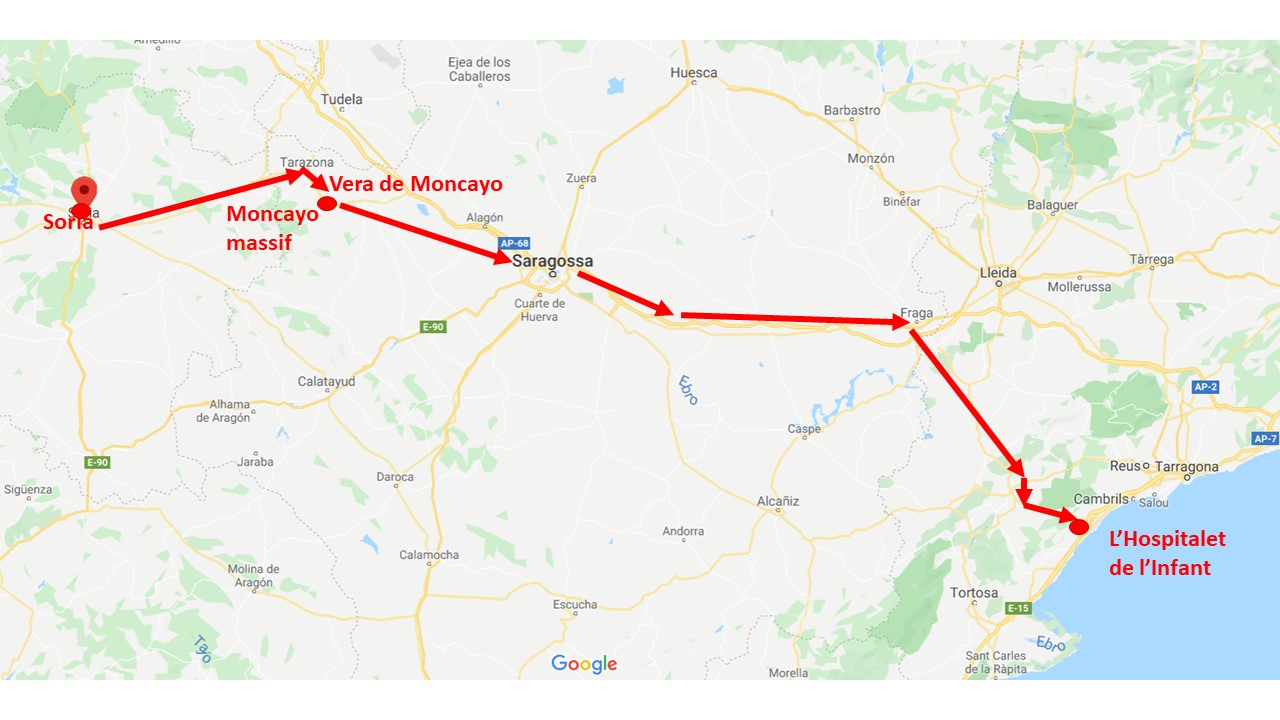
It is November 2019. We are travelling in Spain. Now we leave Soria and return to Catalonia. On the way, we stop in the Moncayo area.

Source: Googlemaps


The Moncayo mountain and the wine area Campo de Borja

We have looked at the Moncayo from the window of our room in the Posada de Soria. It reaches about 2300m and is covered with snow.

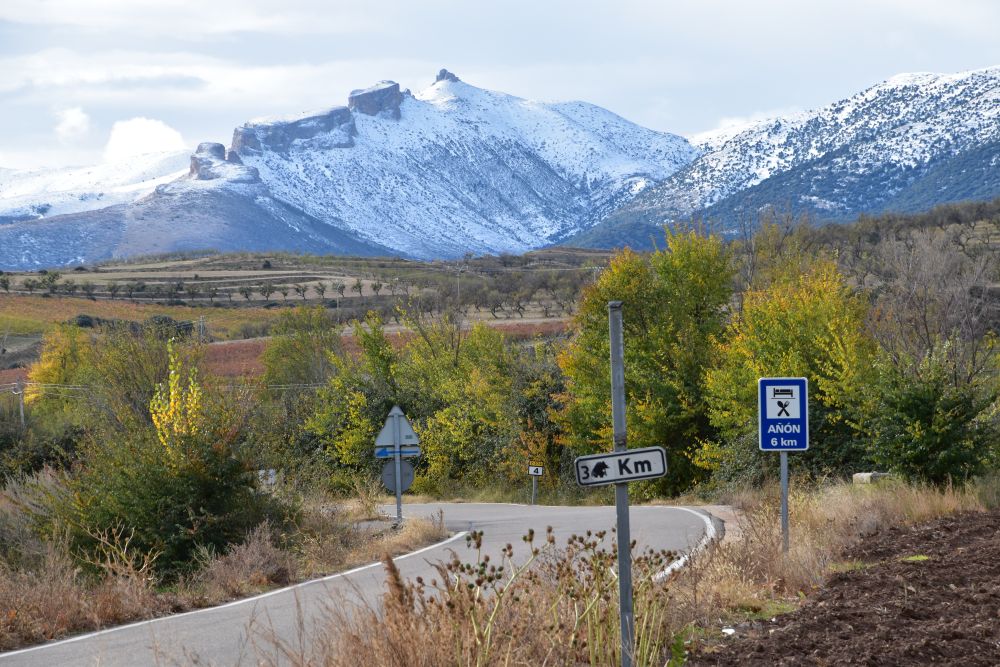
The Moncayo is located east of Soria. We are travelling eastwards today, to Catalonia, and the shortest way means driving around the Moncayo – first north of it, than east of it. And east of the Moncayo is the DO Campo de Borja wine area. The Moncayo creates a microclimate that allows to grow wine here. The Campo de Borja belongs to Aragón and we have already reached the Ebro valley, west of Zaragoza.

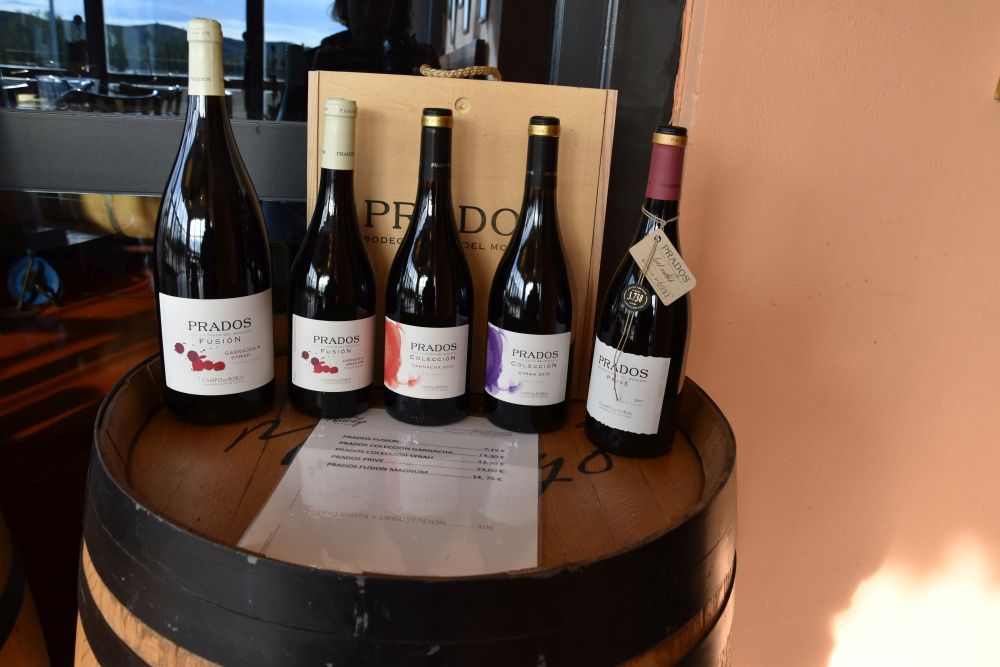
We stop at a small bodega, Prados Bodega Pagos del Moncayo in Vera de Moncayo. The bodega is young and family owned. It produces wines from the grapes Garnacha and Syrah, and their “Fusion” is a blend of the two grapes. We speak with the son. He shows us his cellar and tells us that they use traditional methods to make their wine, mostly working manually. He also mentions a wind, called el cierzo. I later find that the “cierzo” comes from the north or northwest from the Cantabrian mountains into the Ebro valley and towards Zaragoza drying out the area which is beneficial for the grapes. We feel welcomed and I buy a bottle of Garnacha and a bottle of Syrah Privé, the latter being their most valued wine.

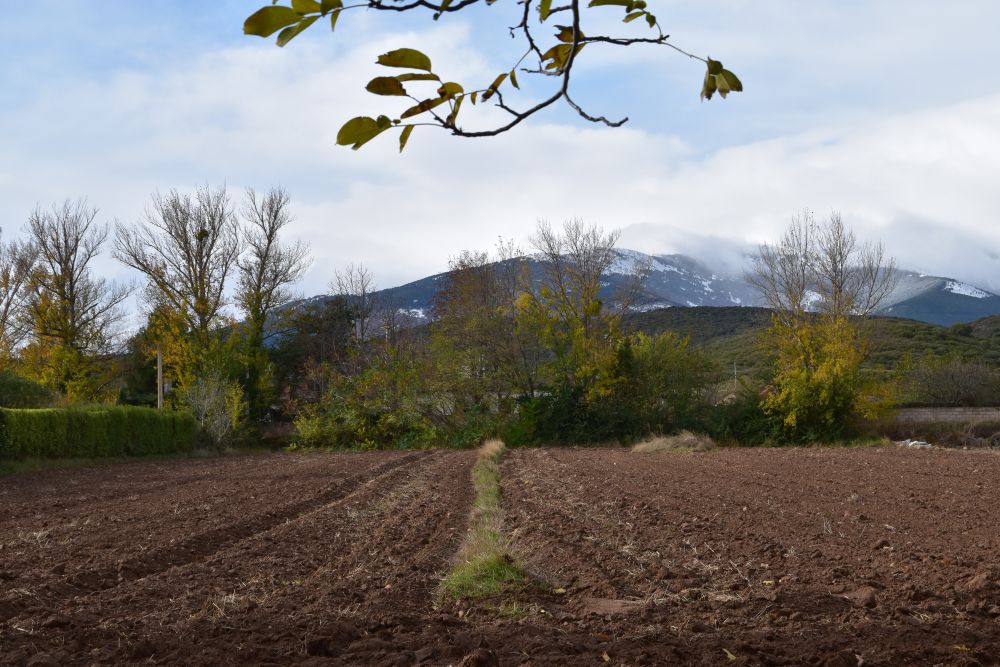
Then we look at the mountains of the Moncayo massif from the east…

… most of which is now – like from the other side, from Soria – hiding in the clouds.

We drive down to the Ebro river. I can see the snowy Moncayo massif in my rear mirror almost up to Zaragoza. We continue our way to Lleida and Flix – through the Catalan mountains and down to L’Hospitalet de l’Infant on the Mediterranean coastline, where we reach the small apartment of our friends. Here we will rest from two weeks travelling and may continue to explore the area.

Source: “Vinos de España”, Edition Larousse, Barcelona 2008, p. 201.

On the road to Spain – brave Celtiberans in Numantia and friendly Soria city

It is mid November 2019. We wake up in our luxury room of the Parador de Soria and see snow outside. The Moncayo has disappeared in the clouds. We are on about 1100m above sea level here.

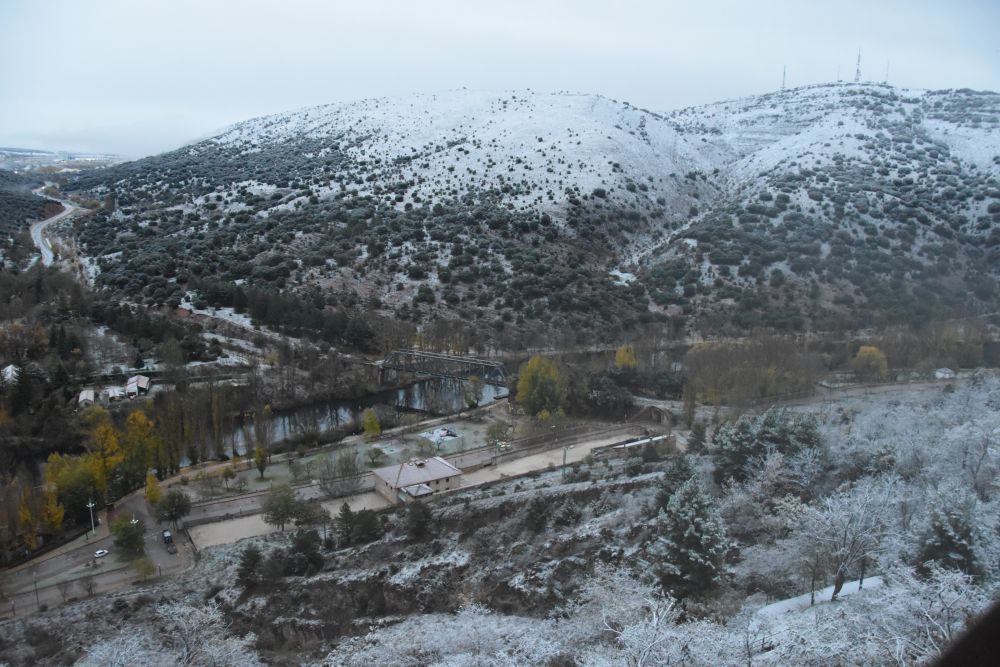
The – still young- river Duero reflects the trees. Golden autumn colours shine amidst white snow.

We admire the view from our room in the Parador de Soria. Then we put on warm clothes and drive to Garray, located some 9kms north of Soria, to visit Numantia.


Numantia – the brave Celtiberan village

The Celtiberians founded the oppidum Numantia on the hill called “Muela de Garray” in the 3rd to 2nd century BC. It was the times of the Punic Wars between Carthage and Rome, which ended with Carthage being defeated and with the Celtiberians being subdued.

Numantia withstood the attacks of the Romans twice. In 153 BC, the Numantians threw stones at the elephants, which – frightened – trampled down the Roman camps. The Numantians resisted once more to the next Roman attack in 141 BC. Is Albert Uderzo really convinced that Asterix and Obelix lived in Gaul? They would also have been worthy representatives of Numantia (or perhaps the Numantians were their ancestors, as Gaul was conquered later).

Finally, in 134 BC, Scipio the Younger besieged the village by surrounding it with fences and fortresses. The citizens had no longer access to the surroundings of their oppidum. After 13 months, they burnt their oppidum down, before surrendering. It is said that they even committed suicide, because they did not want to end as slaves of Rome. Later the Romans built a small city here, but without the public buildings typical of Roman cities

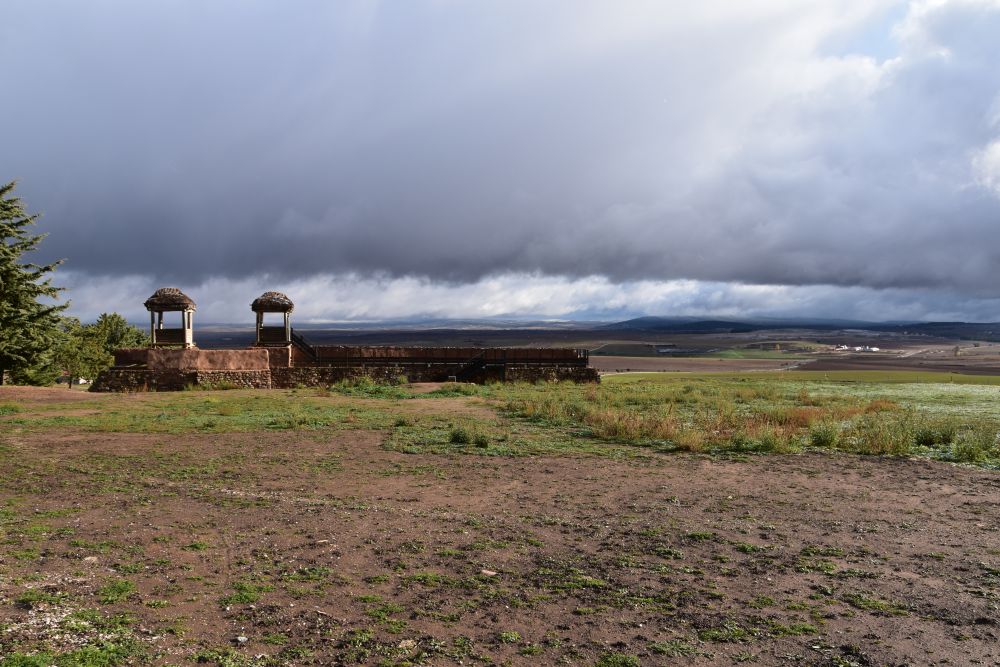
We arrive on the “Muela de Garray”, where the reconstructed Celtiberian gate welcomes us. Dark clouds are above us and a chilly wind is blowing.

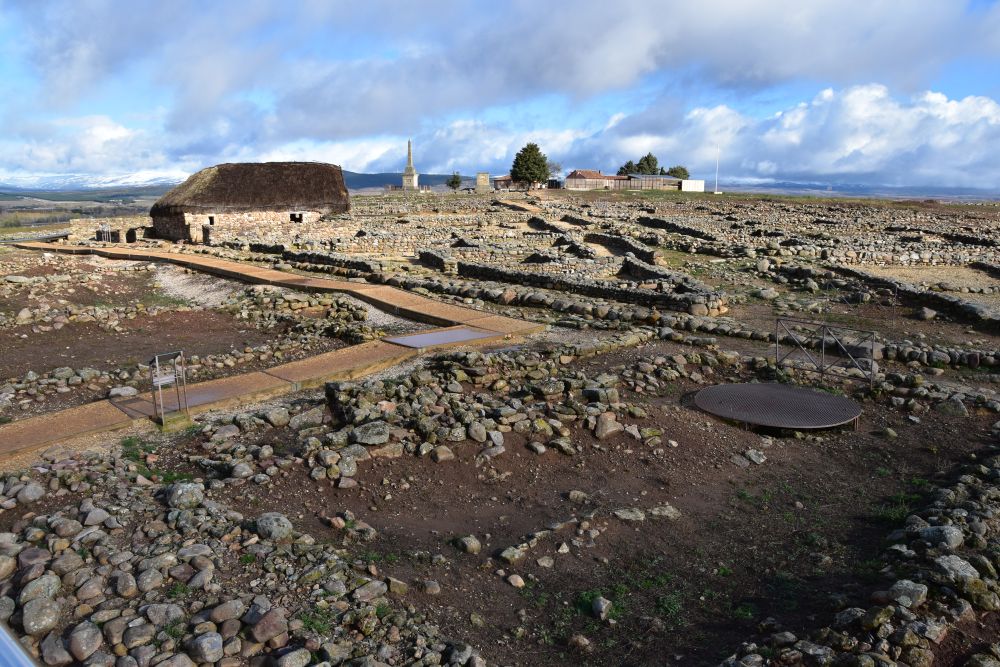
The archaeological site has been well prepared for visitors. A video explains the history. Some buildings have been reconstructed to illustrate, how the Celtiberians and the Romans lived here. This is the Celtiberian house with a fragment of the town wall (a snow flake was on my lens…).

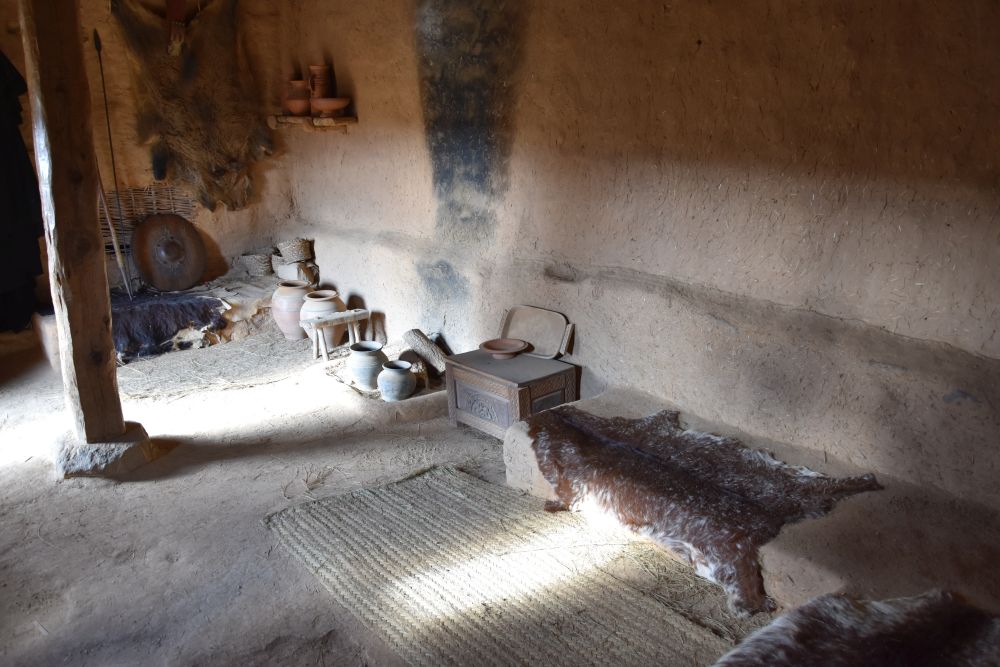
This is the Celtiberan living and working room, or it is, how the archaeologists imagined it. There is even a sofa, Ursula notices.

From the wall, the Numantians could well observe the surroundings and discover enemies from far.

This is the reconstructed Roman house…

… with the kitchen.

On the more sunny southern slopes, the archaeologists have uncovered the remains of larger Roman villas that disposed of courtyards and porticos. The archaeologists have erected some of the columns found.

In the background, we can see the snow covered Sierra de la Demanda and Pico Urbión, where the Duero starts its long journey to Portugal and to the Atlantic.

We return to Soria to visit the museum about Numantia.


The Numantine Museum in Soria

The Museo Numantino shows the items found in Numantia. The most famous artifact is this charming horse, a fibula. Many souvenirs in Soria are decorated with this pretty horse.

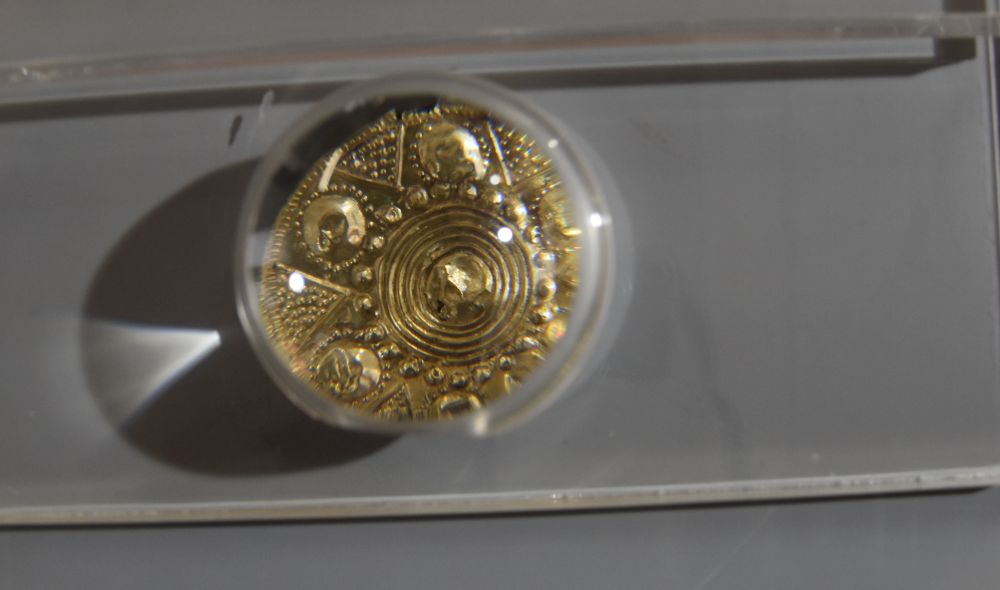
This fine piece of silver work has been enlarged under a magnifying glass. I do not recall, what it was.

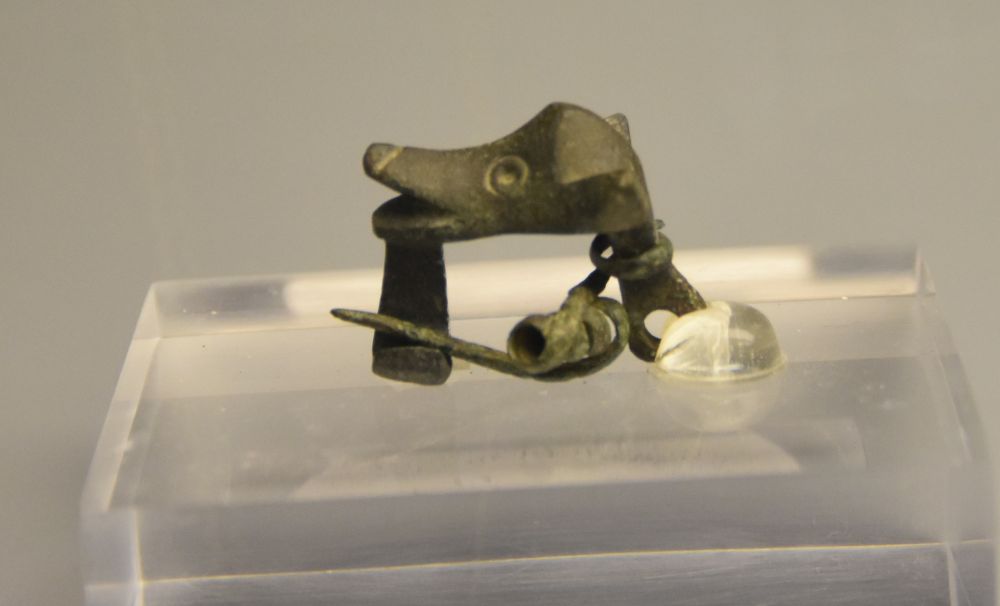
This charming dog was another fibula.

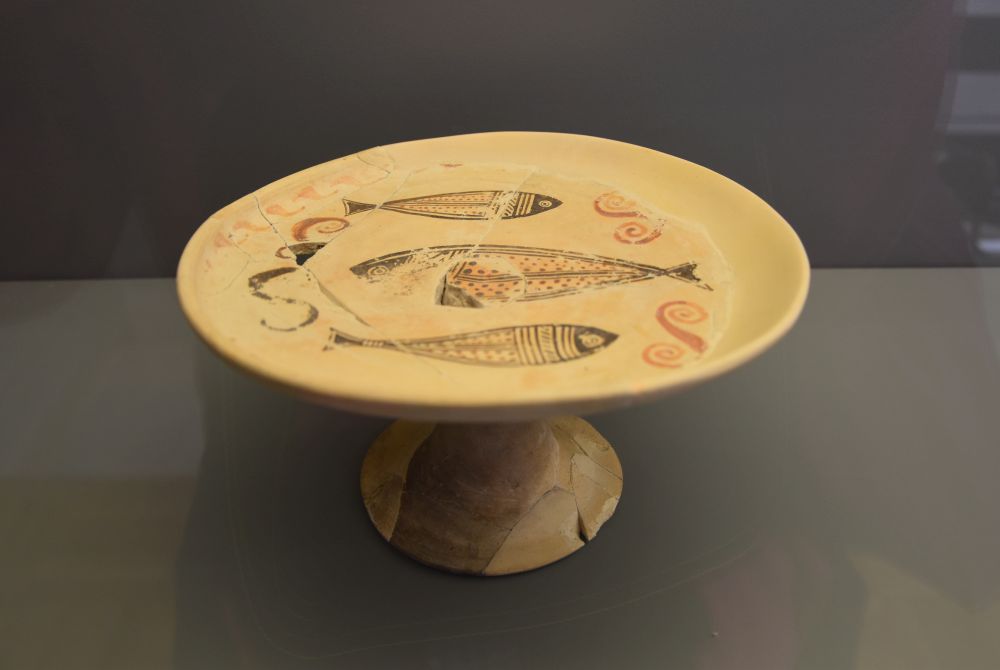
Much earthenware is on display – I particularly liked the fish platter.

In addition, the museum shows tools and weapons made out of iron uncovered in Numantia. The Celtiberians mined iron in the near Moncayo mountains.

The museum lays out the whole history of the area from prehistoric up to modern times. It is well worth seeing.


Round-up walk in Soria

We go for a round-up walk through the pedestrian zone of Soria. We stroll through the Zapatero street,…

… enjoy the windows such as this gourmet shop…,

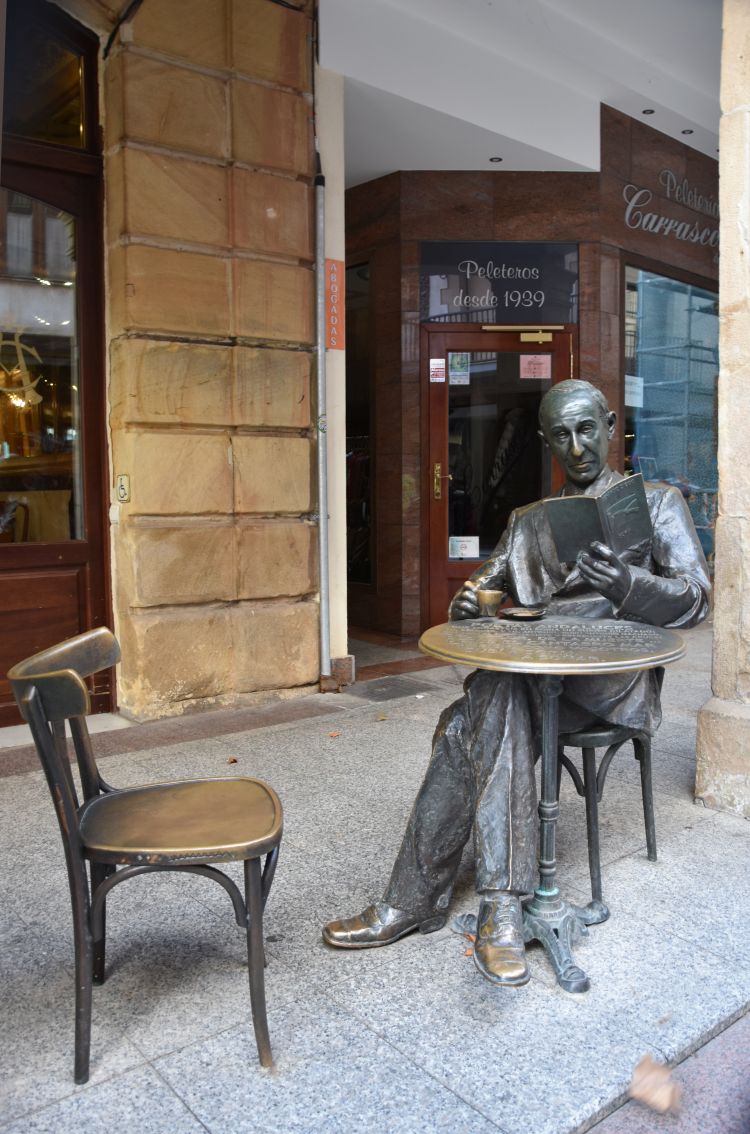
… and we say hello to the poet in front of the traditional Casa de la Amistad. It is the center for culture in Soria.

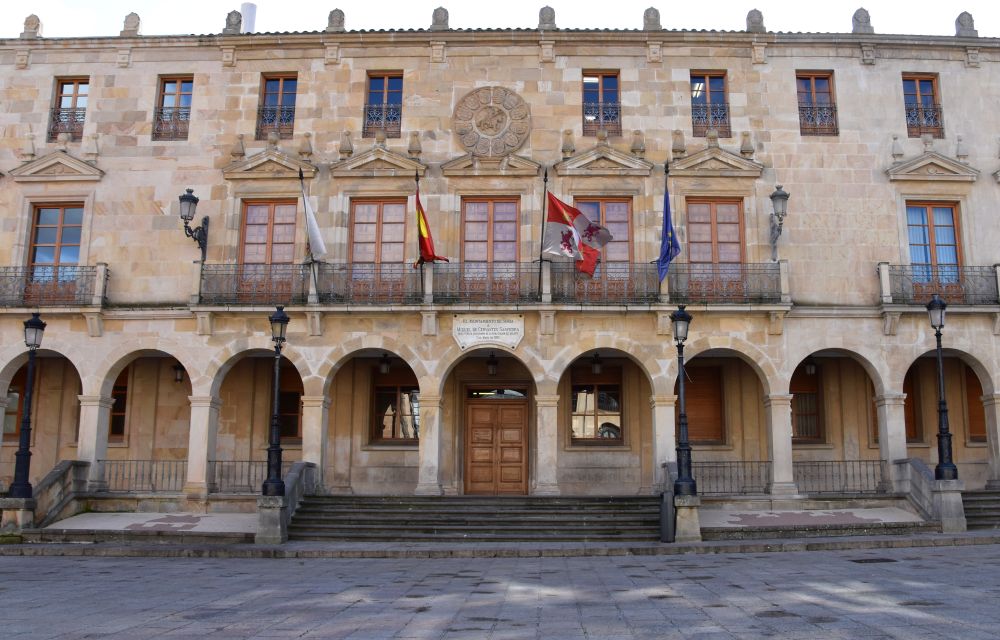
On the Plaza Mayor, we admire the town hall or Casa de Los Doce Linajes, where the twelve noble families met until the early 19th century.

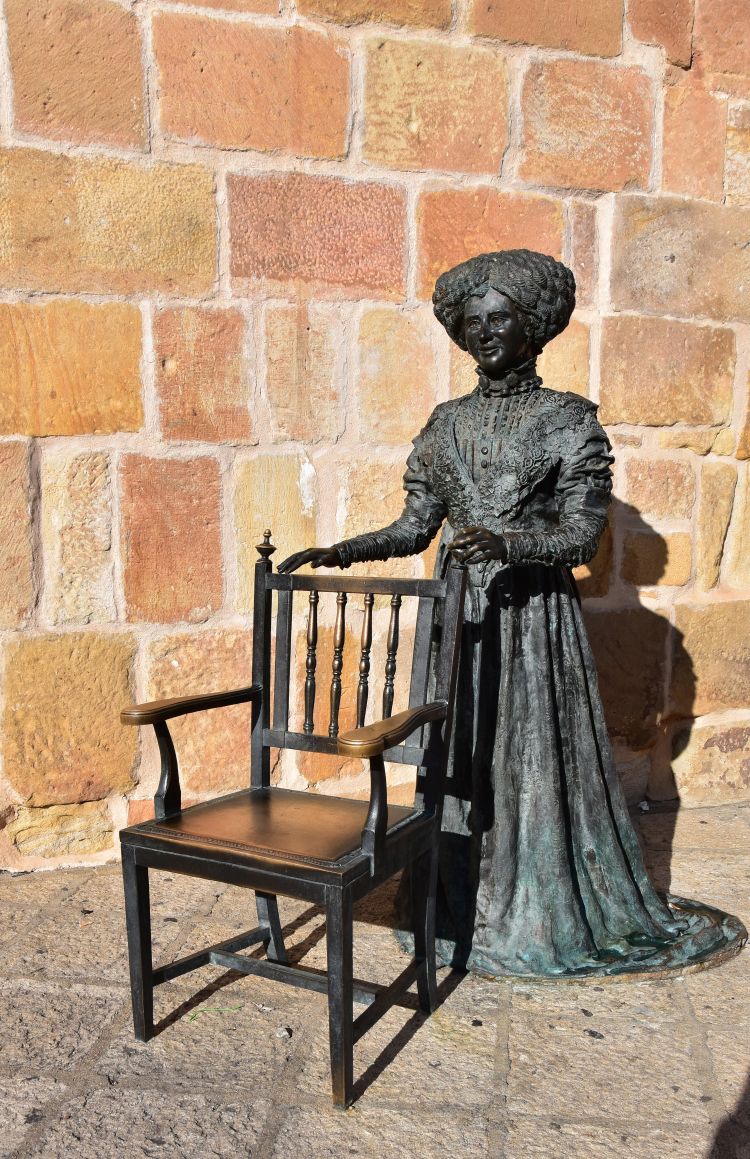
In front of the Iglesia de Nuestra Señora de la Mayor, this charming woman offers a seat to passers-by.

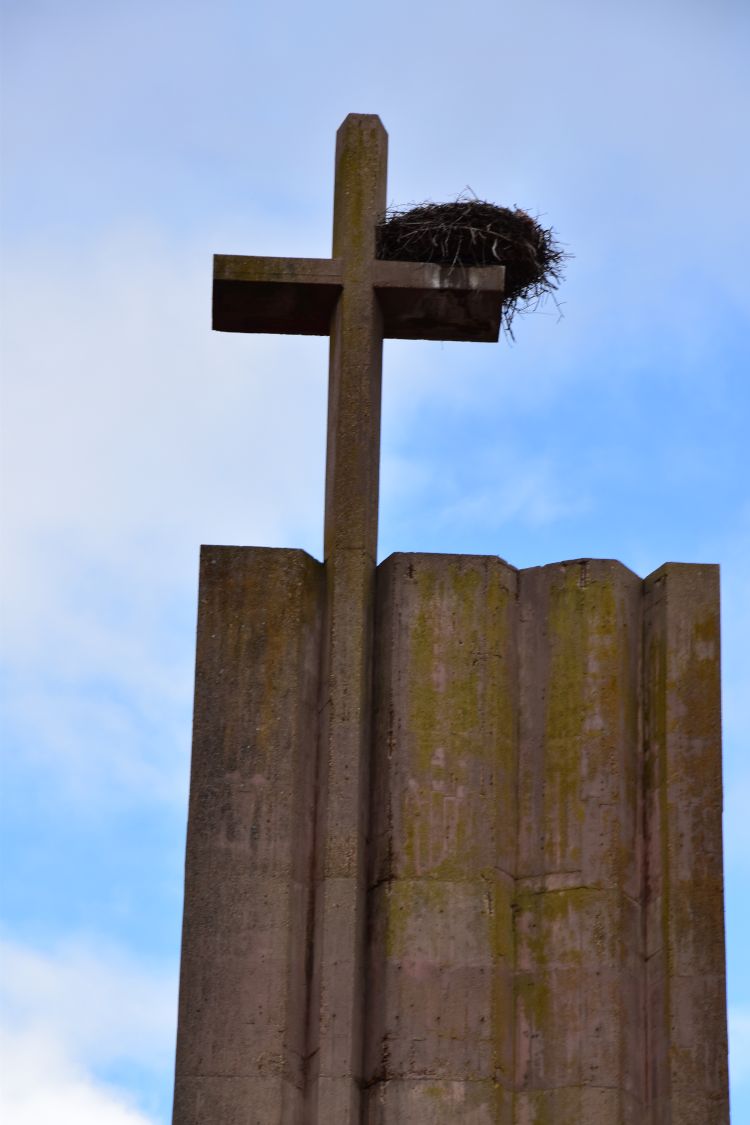
We notice that there are more shops open than one and a half years ago and that the pedestrian zone is being enlarged.  The city seems to have thrived. It is now our third time here. The former time it was a short stop over, when we visited the unparalleled cloister of the Monasterio San Juan de Duero. There is more to discover in Soria. It could well be that we will return once more, like the storks.

It IS cold today. Now we are happy to return to our Posada with the gorgeous view of Soria and the mountains that surround it. The Posada of Soria is the red building amidst trees, not really a gem from outside, but very comfortable inside.

Tomorrow we will continue our way to Catalonia.


On the road to Spain – the Cartuja Miraflores, the church Santa Maria de Lara and Fuente de Berro

It is November 2019. After having spent four days in Burgos, we continue our journey through Spain. We drive via the Cartuja of Miraflores to the Visigothic church Santa Maria de Lara, then we look for the source of the river Duero and find the source of its short affluent Berro. We arrive in Soria, where we have booked two nights in the Parador of Soria with the great view of the white Montcayo in the mountains called Sistema Ibérico.


Cartuja de Miraflores or Miraflores Charterhouse

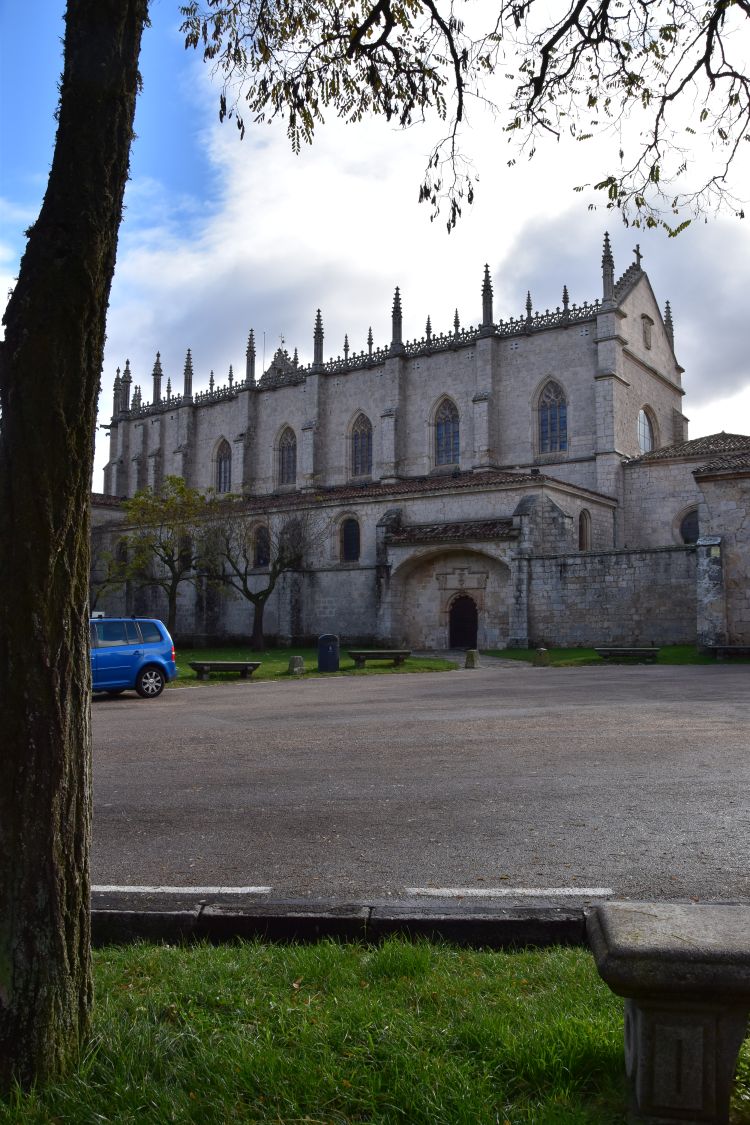
The Carthusian Monastery of Miraflores is located just 4km outside of Burgos. It is our first stop. In 1442, the monastery was founded by the parents of Queen Isabella I of Castile (called the Catholic). Her parents were John II and his wife Isabella from Portugal. This is the church of the charterhouse from outside.

The church is of late gothic style, built with just one nave. Gates divide the one nave into several consecutive sections.

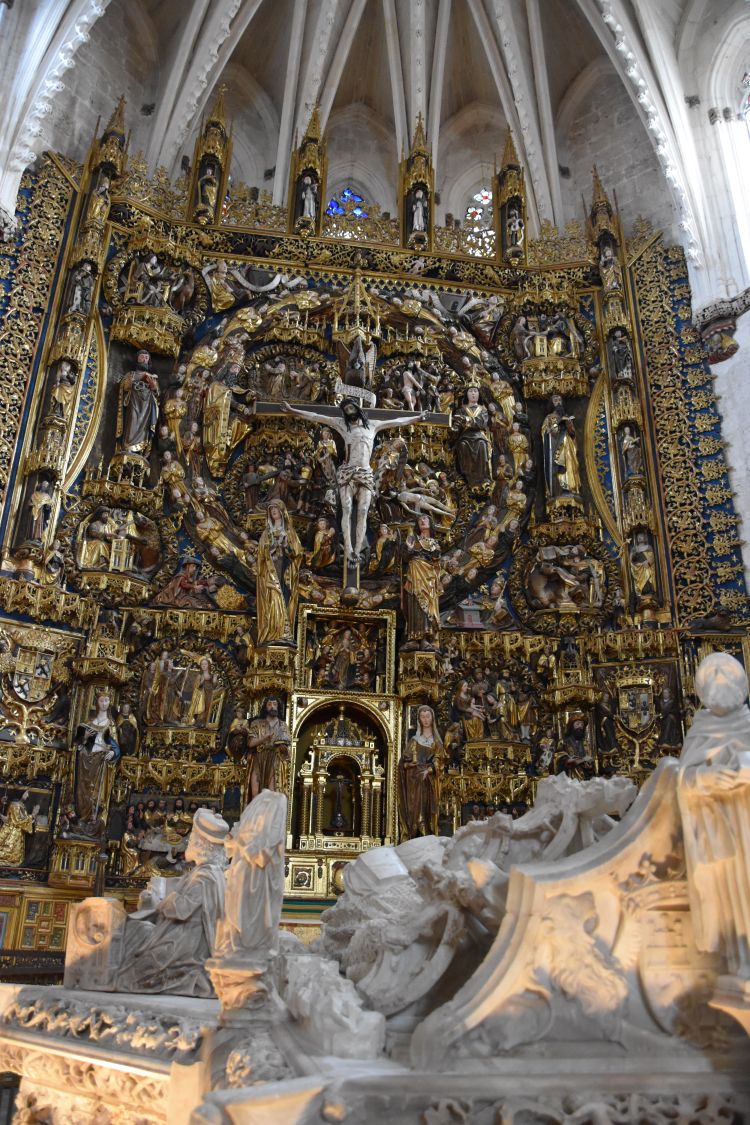
The choir is decorated with the gothic altar of Gil de Siloé. He completed it at the end of the 15th century. He broke with the strictly rectangular structure of most former altars. His altar is organized around the circle with Christ in the middle and with the scenes from his Passion grouped around him. I like the airiness of this altar that breaks with traditional rules.

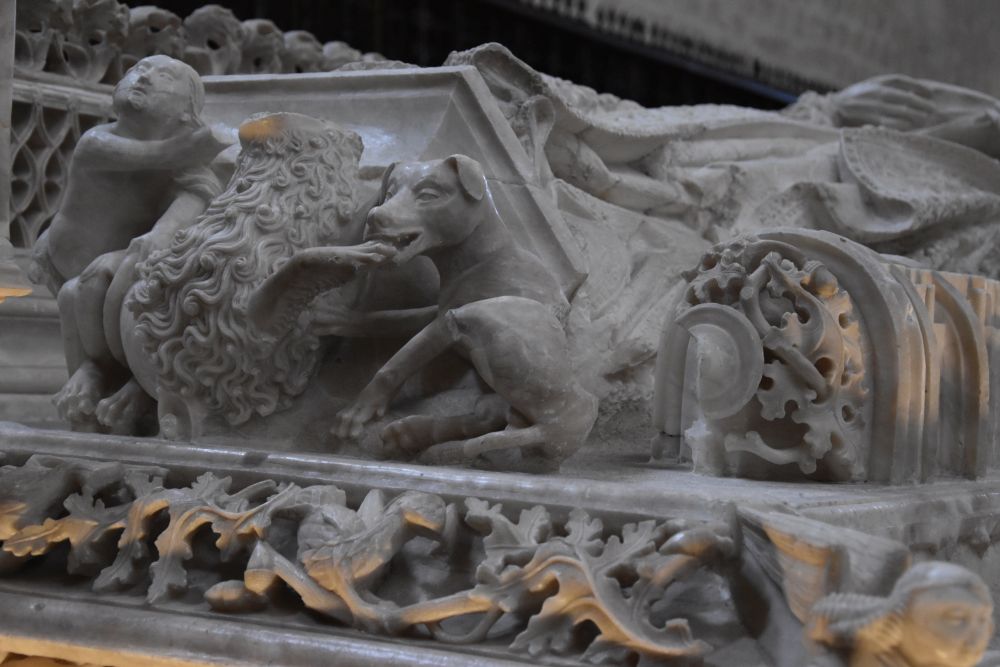
The parents of Isabelle are buried in front of the altar. Their alabaster tomb is decorated with many fine sculptures. I like the dog and the lion at the feet of Isabella’s mother.

There is a strong smell of incense in the church which makes me feel sick (my only allergy, since I have been a child). I leave the church and sit down on the steps of the porch. Here I listen to the monks singing solemnly – they are somewhere behind a thick wall, in seclusion.

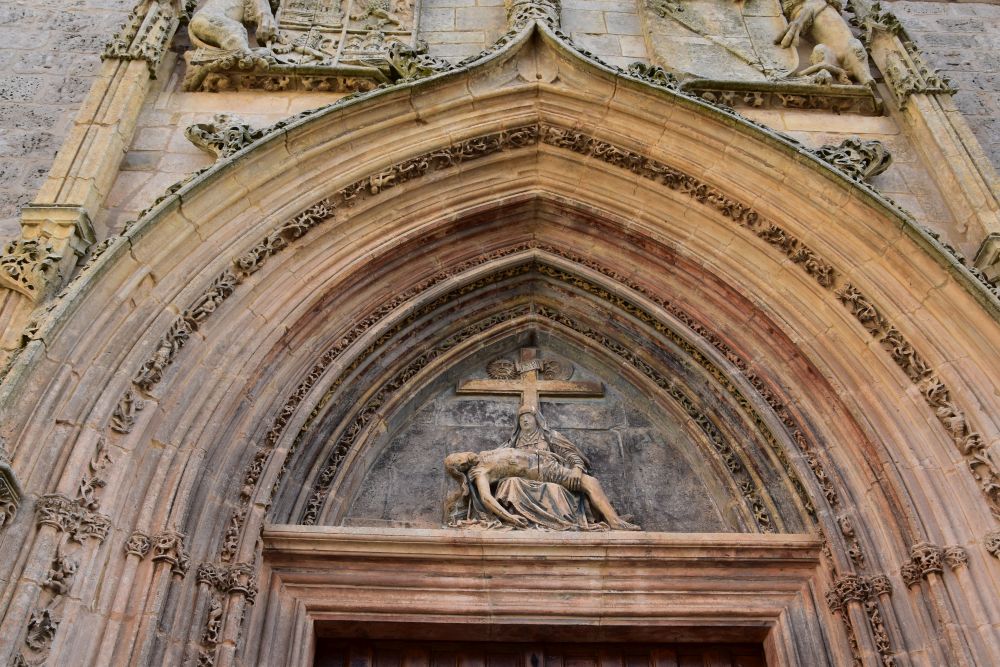
Above me is Maria mourning under the cross decorated with the moon and the sun.

The sun accompanies us, while we continue our way eastwards.


Santa Maria de Lara – the church of the Visigoths built before the Islamic invasion

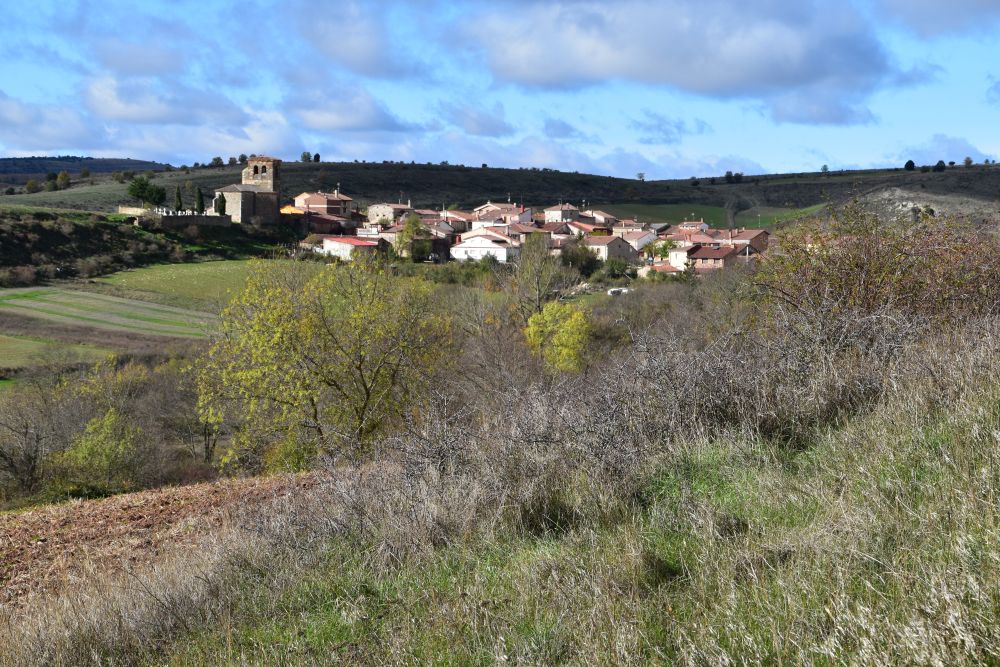
Our next stop is the mountain village Quintanilla.

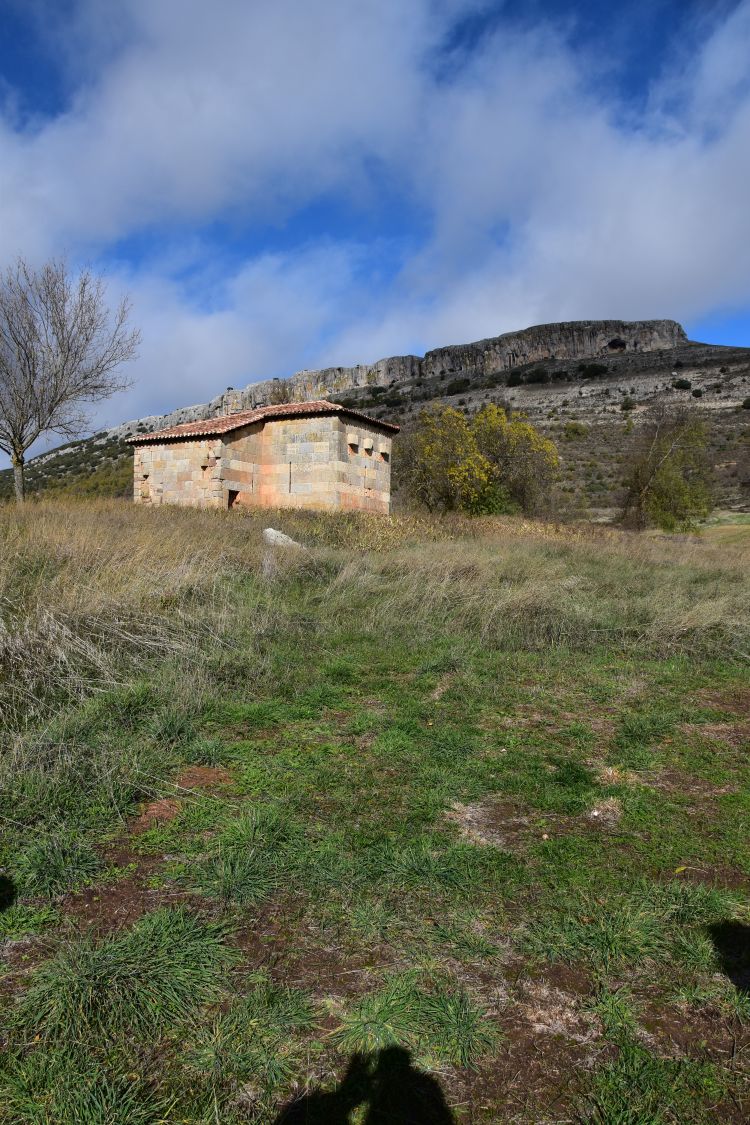
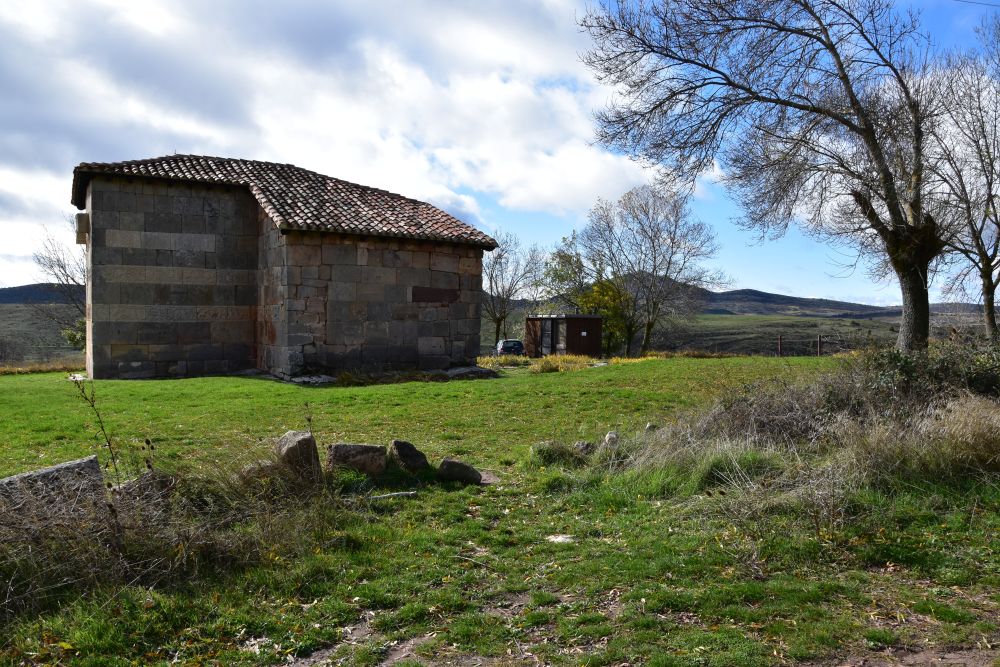
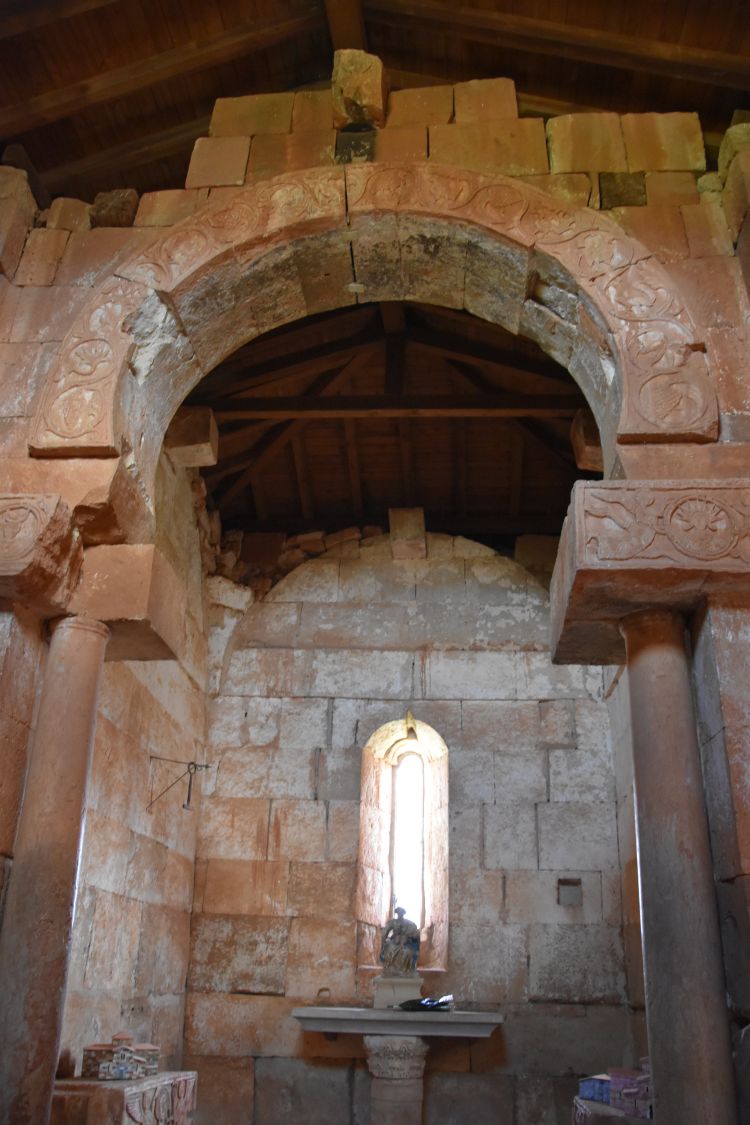
About 700m away from Quintanilla, we find the Visigothic church Santa Maria de Lara (also called Santa Maria de Quintanilla de las Viñas). The church has been built around 700, before the Islamic invasion that happened a few years later.

Next to the church is a small wooden house. The gatekeeper is in that house, waiting for visitors. He shows us round and opens the church for us.

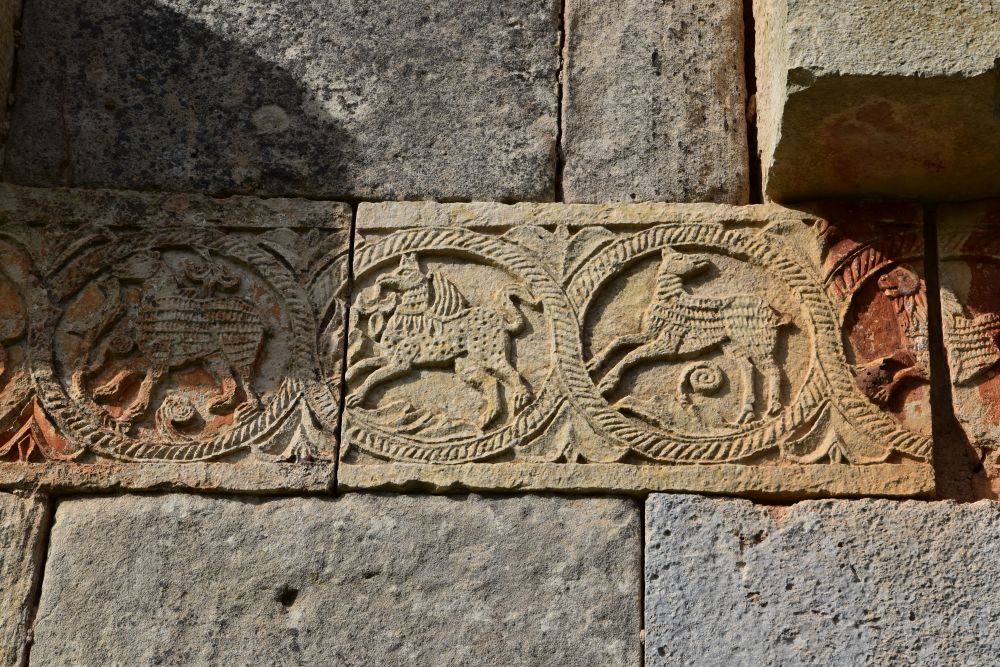
The bricks have been laid with precision and without using plaster. Three bands with elegant reliefs decorate the outside walls of the church.

Some are abstract symbols, some are animals.

We enter the church. Only the choir and part of the aisles are left. The horsehoe shaped arch is typical of the Visigoths.

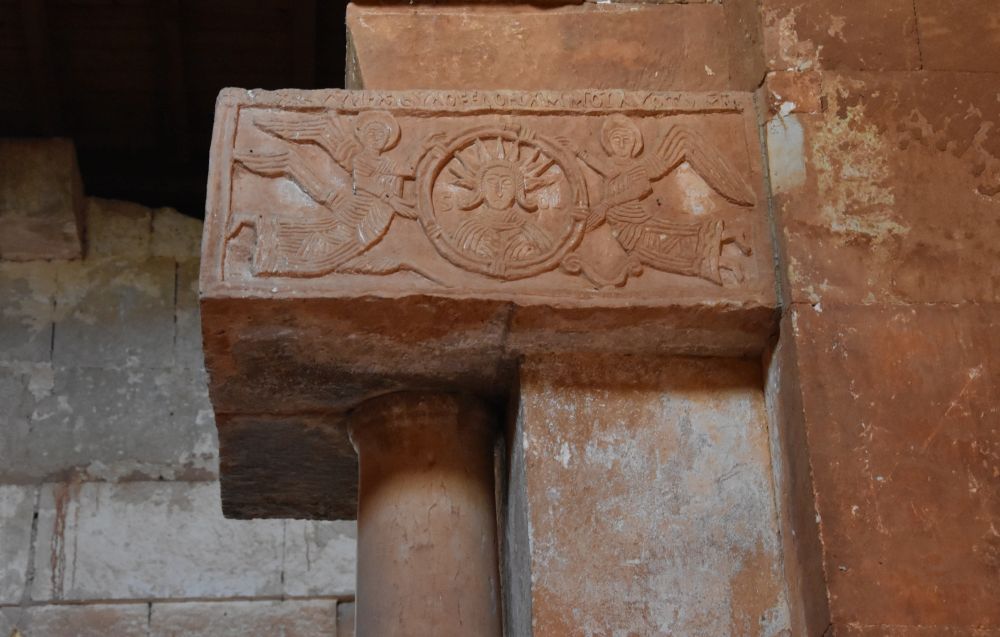
The columns on the sides are decorated with the moon and the sun that are carried by angels. This is the sun.

The gatekeeper knows the Visigothic church San Pedro de la Nave that we have seen in Zamora. We have also seen Pre-Romanesque churches in Oviedo (Santa Maria del Naranco and more), and in the Empordá we have visited the tiny Visigothic church Sant Julia de Boada. I am always impressed by these early manifestations of Christian life.


Dinos were here before – much, much earlier

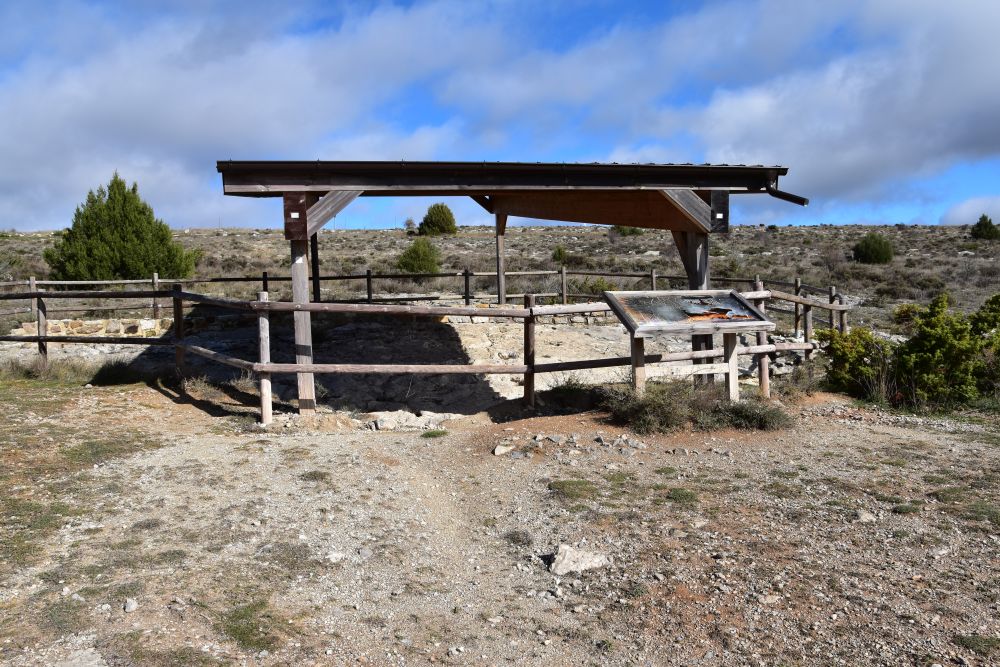
Just below Quintanilla we have noticed signs pointing to this shelter.

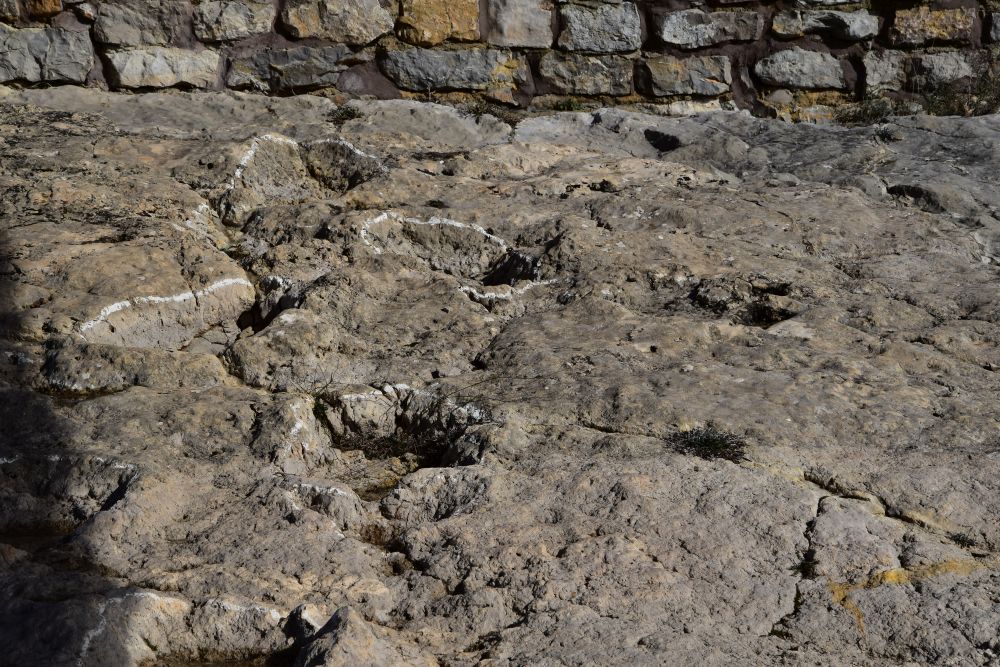
Petrified tracks of dinosaurs have been found here. They are marked with white chalk.

On the way to Soria we see more signs pointing to traces of dinosaurs or announcing museums that talk about dinosaurs. There must have been a dinosaurs’ land here,


Looking for the source of the Duero, ending up with the source of Duero’s little brother Berro

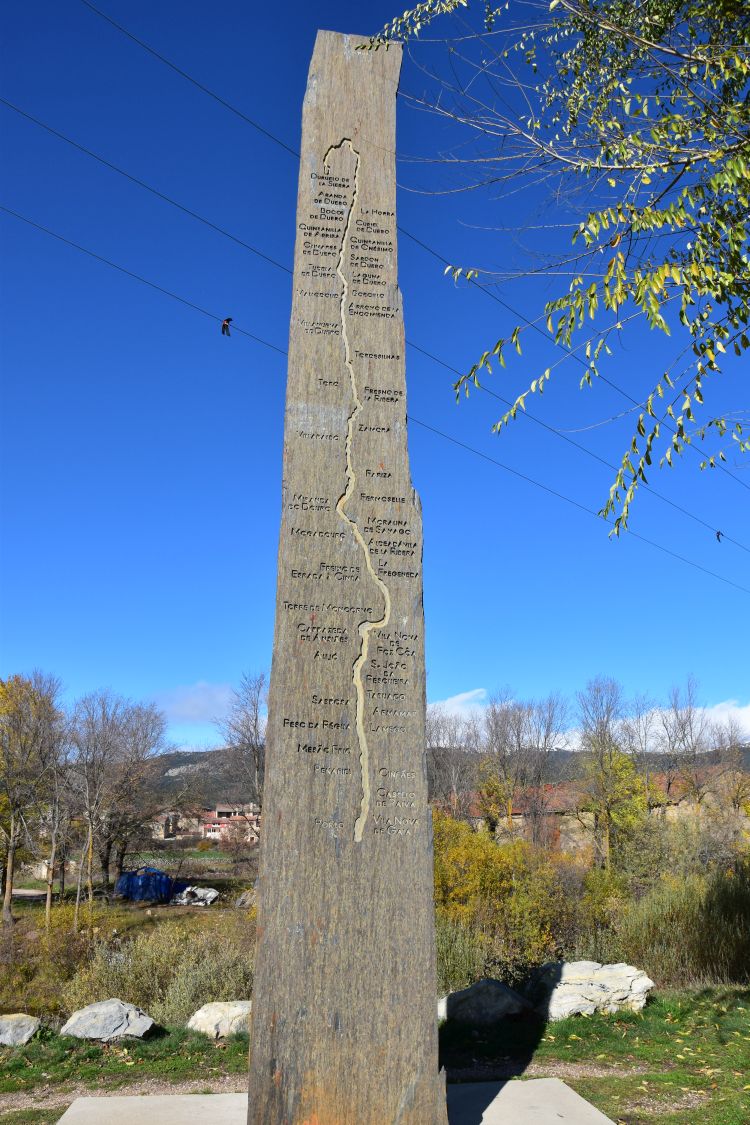
At Duruelo de la Sierra, we meet another old friend of ours, the river Duero. This stone shows the long route that the Duero takes from the source in the mountains of the Sierra de la Demanda at the Pico de Urbión to the mouth at Porto in Portugal.

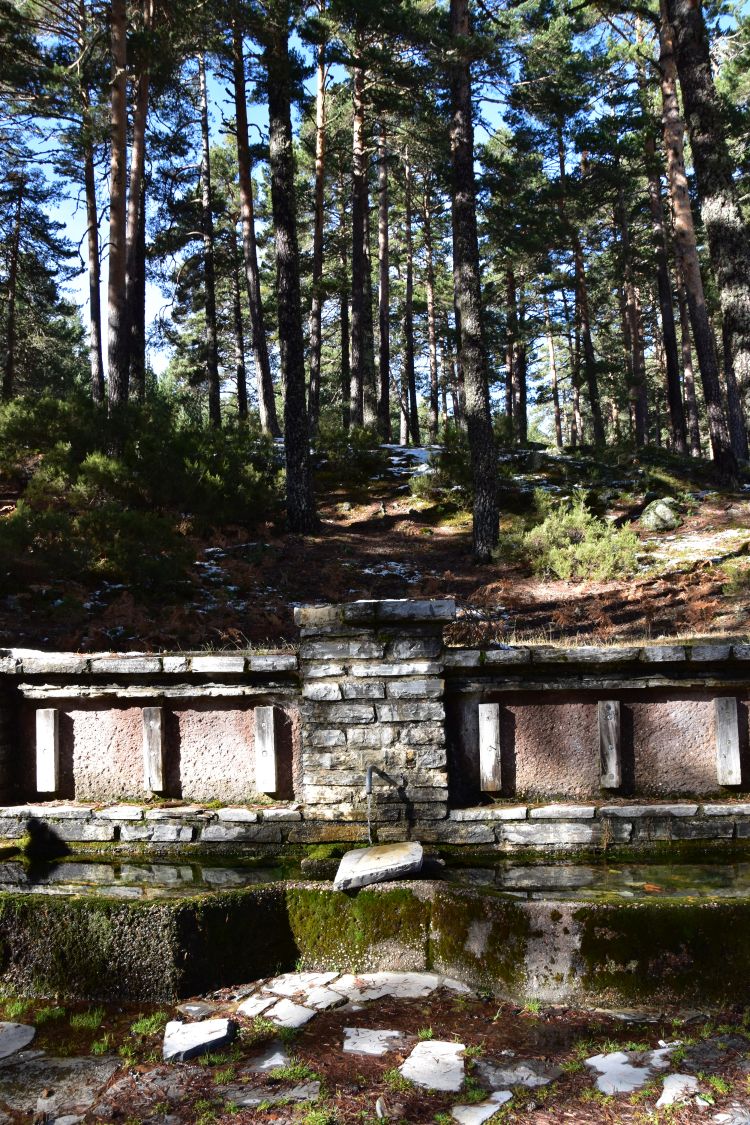
A sign points to the source of the Duero in 11km. We feel like seeing the source of the Duero and follow the sign. 11km is not a long detour, we think. After about 6km we find this source on 1600 to 1700m above sea level.

We understand that this is not the “real” source of the Duero, but the source of one of its early affluents called Berro.

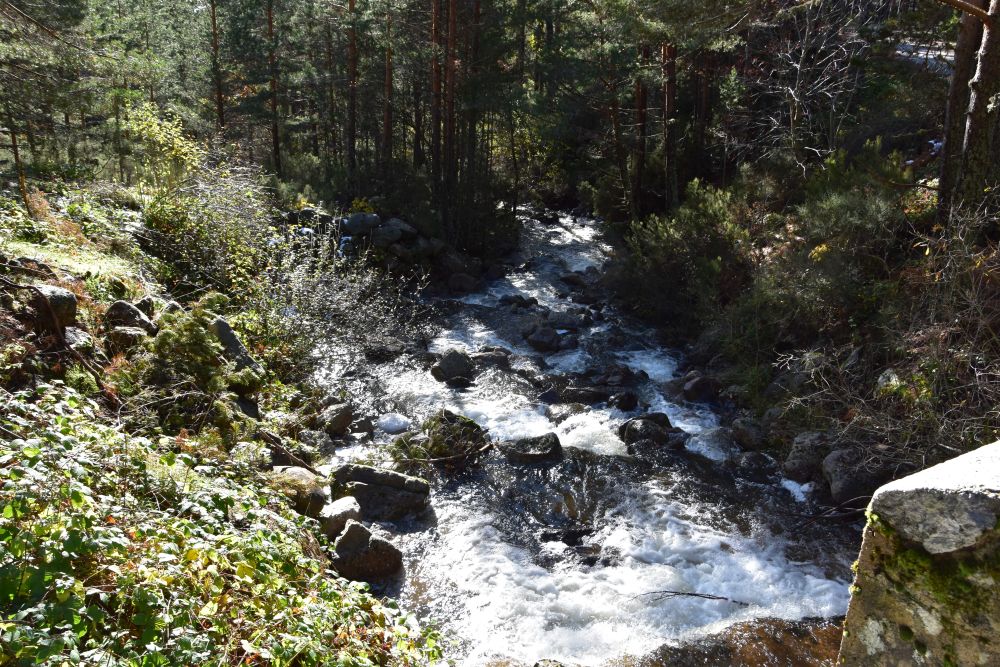
The real source of the Duero is located on 2140m just below the Pico de Urbión and it requires a real hike to get there. We are not prepared for that. We return to Duruelo de la Sierra. The Duero is still small here.

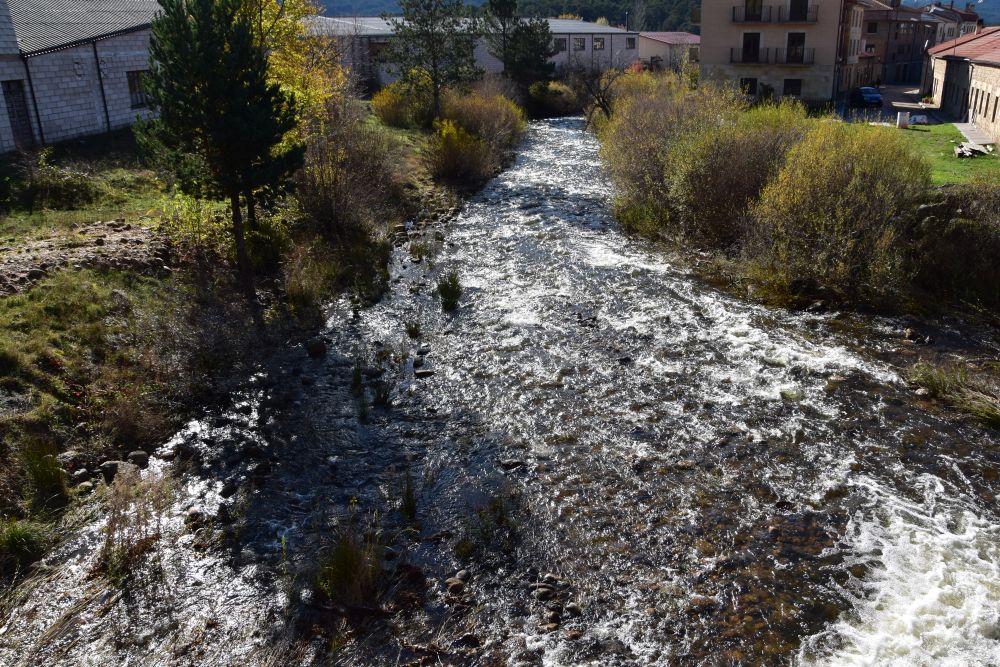
At Molinos de Duero, just before the dammed lake, the Duero is already larger.

We follow the Duero until Soria.


Settling in the Parador of Soria above the Duero with the view of the Montcayo

In Soria, we settle in the Parador high above the river Duero. Our window has a wonderful view of the mountains in the east…

… and in particular of the Moncayo (2314m) that is covered with snow. The Moncayo massif belongs to the Sistema Ibérico.

Again we notice, how rough the north of Spain is. From everywhere we see mountains that are covered with snow – already in autumn and still in spring.

Sources: Marion Golder, “Nordspanien und der Jakobsweg”, Dumont Reise-Handbuch, Ostfildern 2018; leaflet of Santa Maria de Lara; leaflet of the Cartuja Santa María de Miraflores (Burgos); “Burgos, Artística y Monumental”, Edilera 2018.

On the road to Spain – cathedral, churches, and monasteries in Burgos

In rainy November 2019, we spend four days in Burgos. We stroll through the charming city center and we visit the Cathedral, the Monastery Las Huelgas and various churches. I am now telling about us discovering the cultural-religious side of Burgos.


The Cathedral of Santa Maria – overwhelming treasures

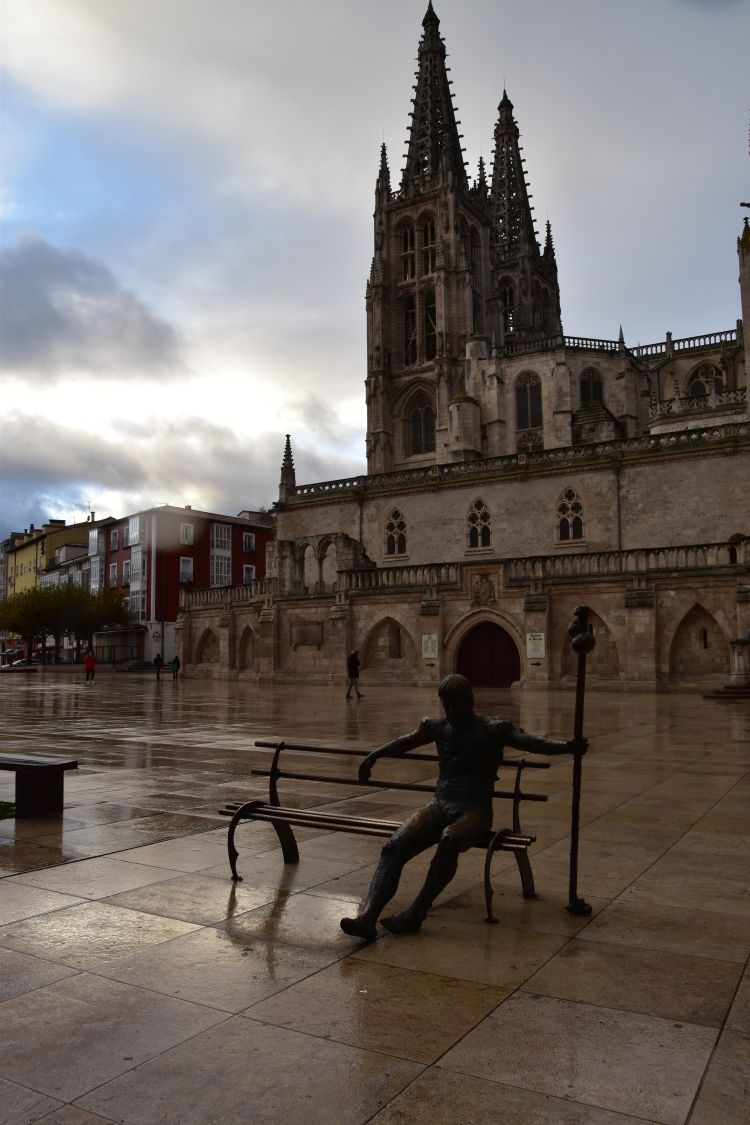
The fine towers of the Cathedral Santa Maria in Burgos have been built by Hans von Köln who had been influenced by the plans for the Dome of Cologne (Köln). The Cathedral was built and inaugurated in the 13th century, whereby constructions continued for 300 years more.

We enter the Cathedral through the southern porch. Christ, the judge, is surrounded by the four evangelists. Below are the twelve apostles. A bishop stands in the middle of the porch.

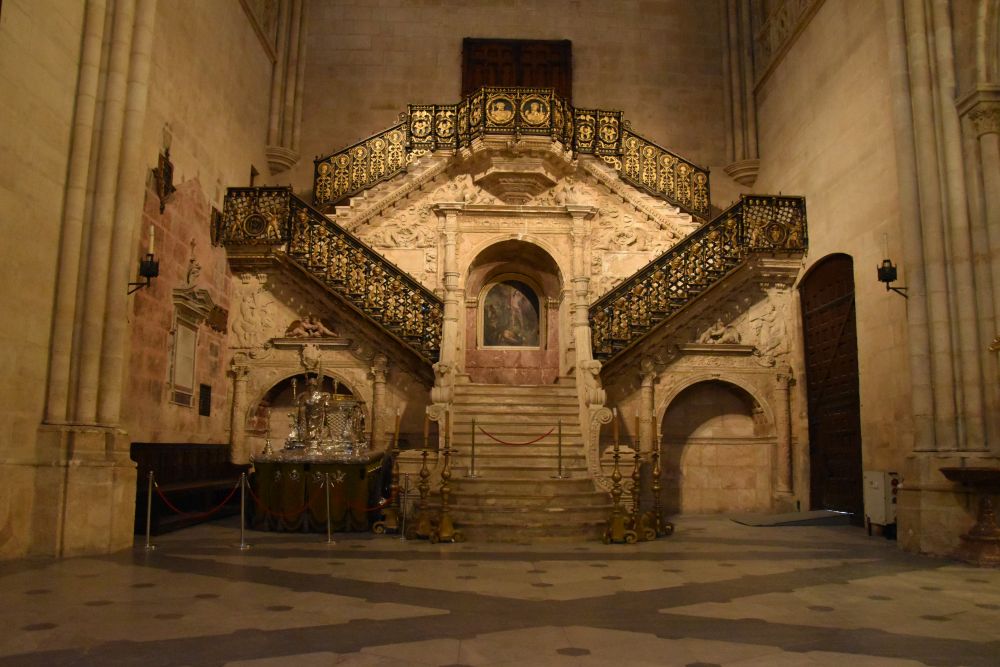
Inside, the overview of the nave is impeded by the choir that, as in most Spanish churches, has been placed in the middle. I walk around it and enjoy these fine stairs with the golden balustrade (escalera dorada). The king used them to enter the Cathedral through the western porch which is higher than the main floor, as the Cathedral has been built into the castle hill of Burgos.

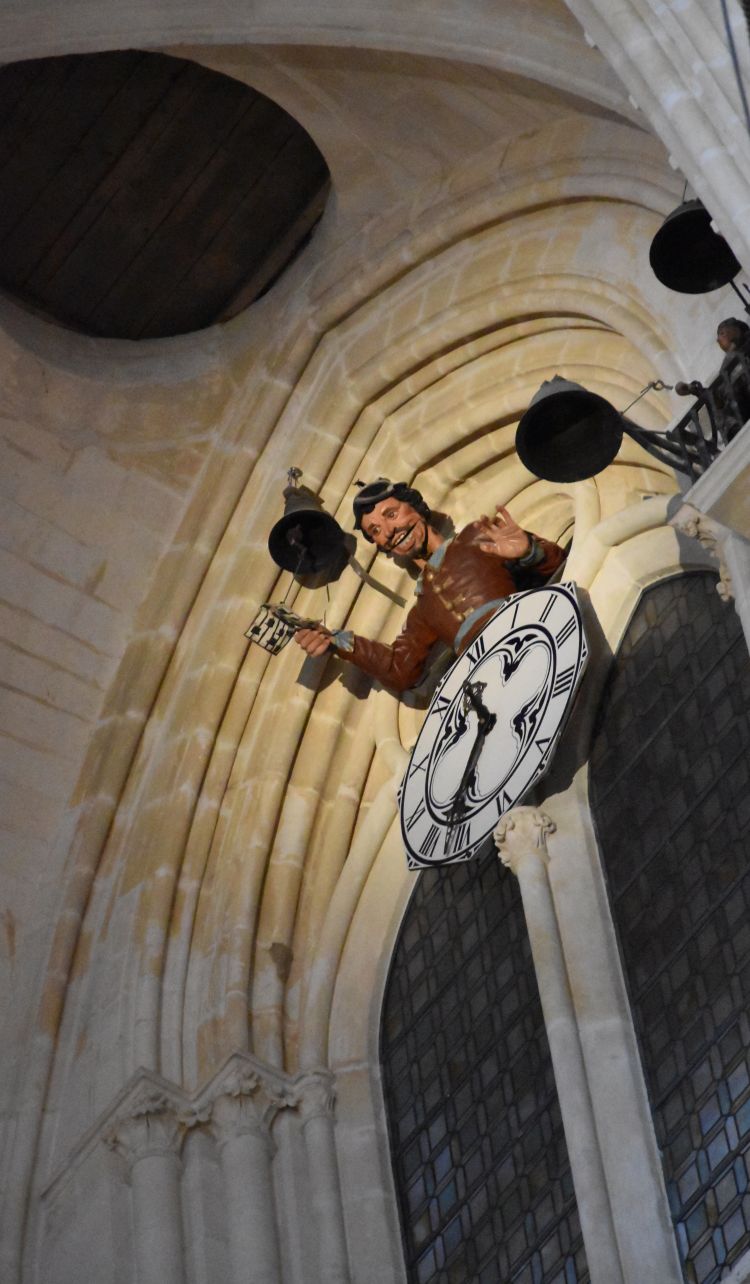
Above the stairs, I locate Papamoscas, a figure made from iron sheet that opens the mouth, when the bells ring. Papamoscas means “catch-flies”. There is room for humor in the Catholic religion – nice.

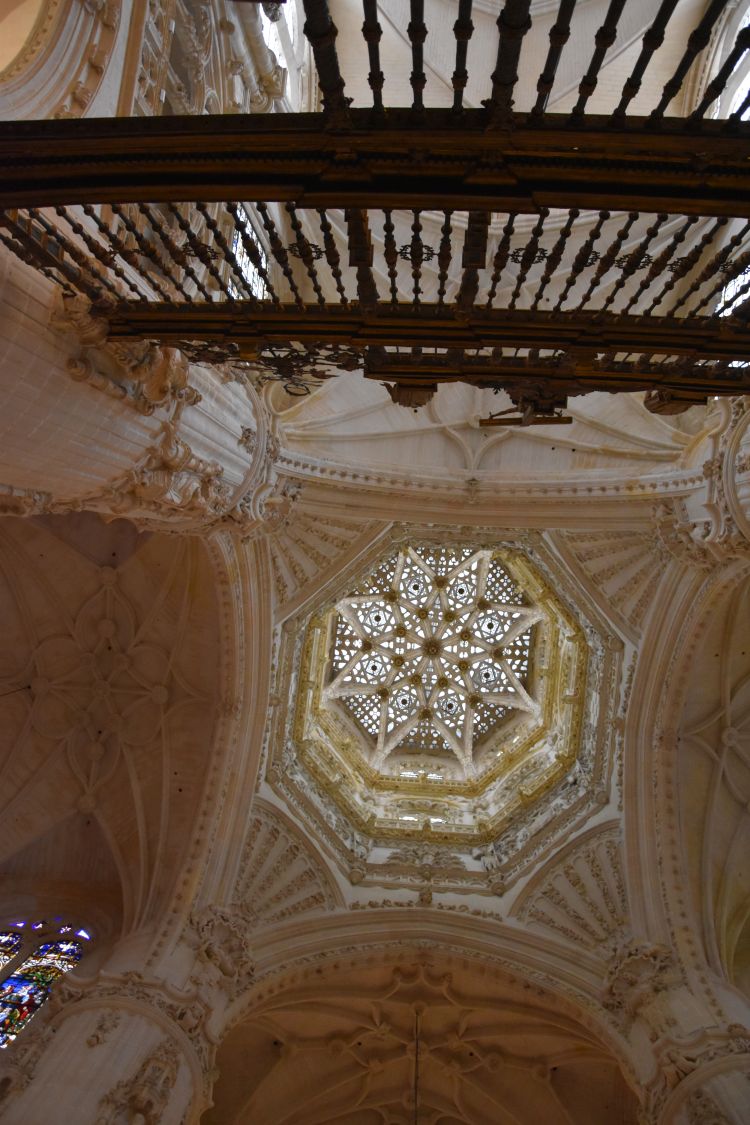
The graceful cupola tops the intersection of the naves. The fine pattern has a Moorish appeal, I believe. The grid of the choir (located in the middle) is pointing to the cupola. El Cid has been buried just in front of the choir and under the cupola. .

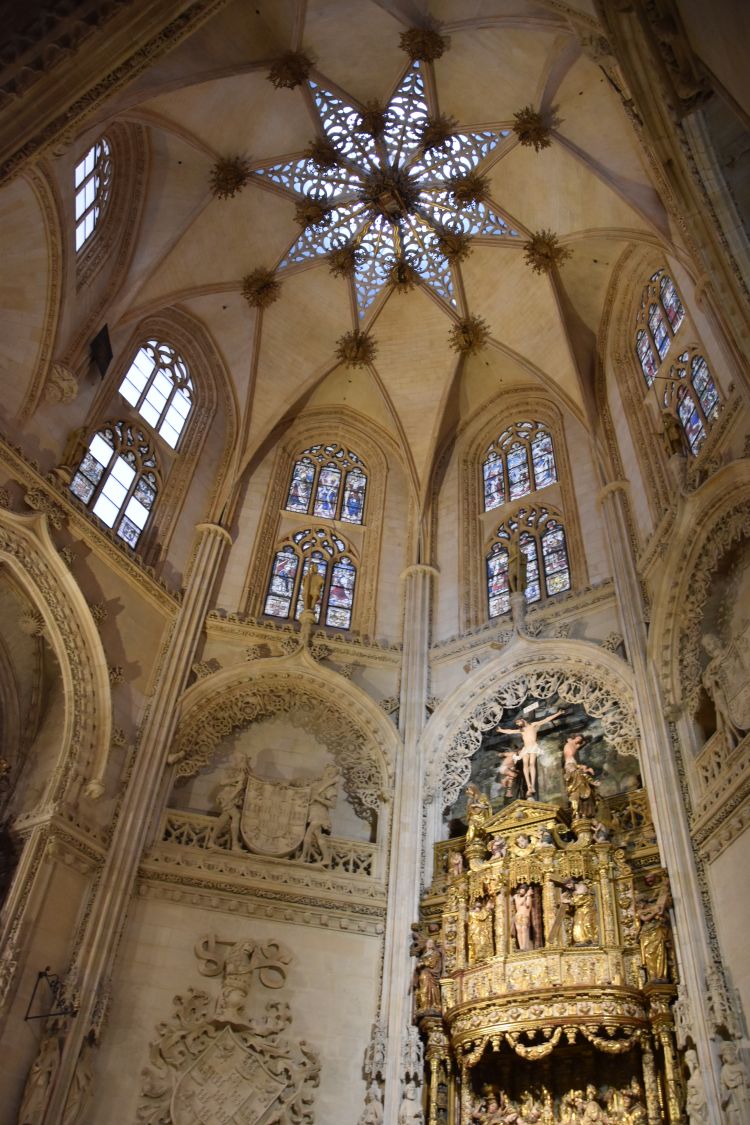
This is the chapel of the Condestable Pedro Fernandez de Velasco (ca 1425-1492). He was crown commander and died during the conquest of Granada. The Flamboyant-Gothic chapel has been constructed by the son of Hans von Köln, Simon. It is from the end of the 15th century. The noble grave of the crown commander has been made from Carrrara marble.

The crown commander and his wife look up to the altar in Renaissance style…

… and into this elegant cupola – it is like a heaven with stars.

The small dog sleeps at the feet of the commander’s wife.

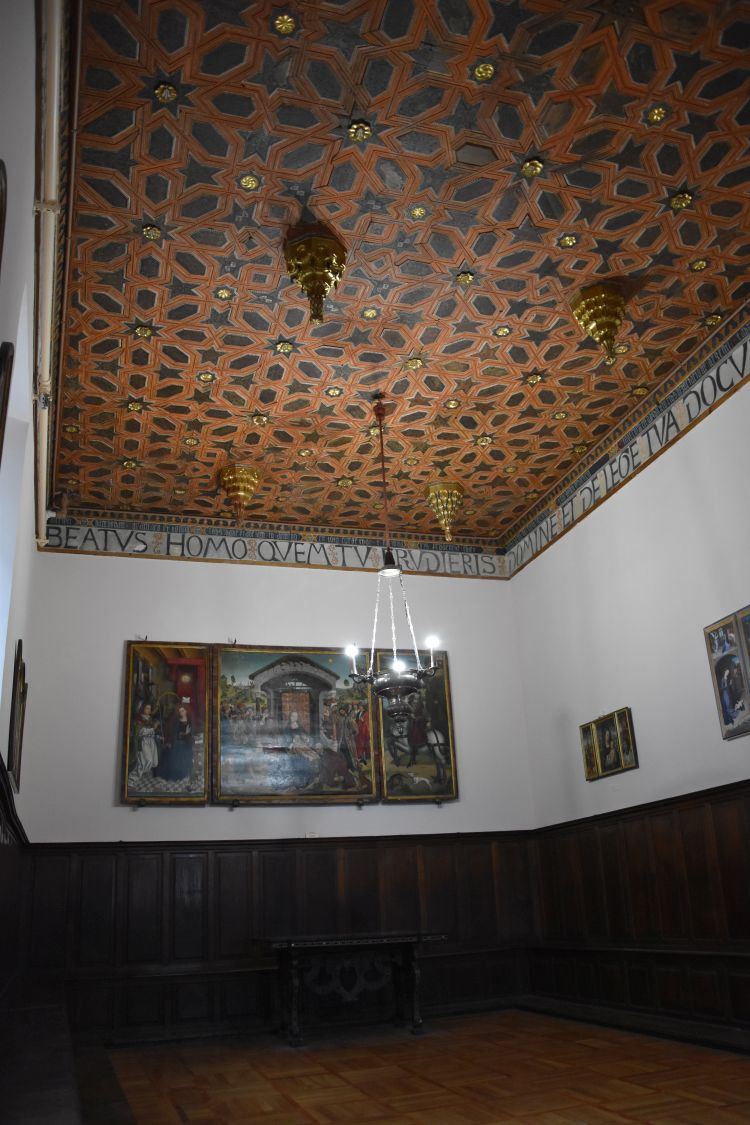
Around the cloister are many, many treasures. My take aways are the Mudejar ceiling in the chapter house…

… and the wall hanging that shows Adam and Eva in Paradise being seduced by the snake to take the apple.


The Monastery de Las Huelgas – a wealthy church with Mudejar chapels and the flag captured from the Moors

From our hotel, it takes us half an hour along the promenades of the river Arlanzón to reach the Monastery Las Huelgas. “huelga” today means “strike”. But no one is on strike in this monastery. Once the Castilian king had a hunting palace here. “Hunting” was leisure and, in Spanish, “holgar” is one of the synonyms for “descansar” or “to have a rest”. In the 11th century, king Alfonso VIII (1155-1214, married to the daughter of the king of England, Eleanor) decided to reuse his leisure palace for a Cistercian monastery. It was then named “Monastery of Santa María la Real de Las Huelgas”. The nuns originated from noble families, the first abbot being the youngest daughter of the king. Furthermore, the abbey was used as a wedding and burial place for the Castilian royal family. Today 30 nuns live in the monastery.

This large square with the fountain is part of the monastery and can be accessed freely through the solid gate.

Only guided tours are possible in the monastery. No photos are allowed, except in the cloister. This is the elegant cloister surrounded by double columns…

… with mostly floral decoration as well as some architectural representations such as this one.

We buy the “Guía Santa María Real de Huelgas – Burgos” which will remind us of all the treasures seen in this monastery.

The church contains Royal tombs of the kings of Castile from the 12th to the 14th century. Also the founder of the monastery, Alfonso VIII and his wife, Eleanor, are buried here.

In the church, the entrance to the choir shows the battle of Navas de Tolosa of 1212, where the confederated kings of Navarra, Aragón, Castile and Portugal defeated the Moorish Almohads decisively. We had come across this battle in Roncesvalles, where king Sancho VII the Strong is buried. Lead by him, the Navarrese broke the ring of slaves that were chained together as bodyguards of the Almohad calif (it is said that for this reason Navarra’s flag contains chains). The calif flew and so did his army leaving their treasures on the battlefield. One of these treasures, the standard (pendón) is hanging in the chapter house of Las Huelgas.

I very much like the Mudejar chapels of Ascension and of Santiago as well as the Mudejar ceilings in one of the cloisters. The visit closes with the exhibition of clothes from the 13th and 14th century – most of them are in perfect condition.


The gorgeous alabaster altar in the San Nicolas church

San Nicolas de Bari is the name of the church just opposite of the Cathedral of Burgos. This carved door gives access to it.

The gem inside is the alabaster altar made by Hans von Köln (who had already worked for the Cathedral of Burgos). 465 figures can be found here, mostly telling the life of Saint Nicolas. He stands in the middle of the altar. Above him is the Coronation of Maria occurring in a ring of angels – interesting, how the rectangular structure of the altar is broken up by circles and half circles.

Thinking about Saint Nicolas… when I was a child, he came from the Black Forest on 6th of December, was also called “Santi Niggi Näggi”, and he brought gifts, but also punished the nasty children, even taking them home to the Black Forest to peel carrots for a year (that was what we children were told – we then calmed him down by singing for him). When traveling to Turkey, I discovered that Saint Nicolas actually was bishop of Myra (Asia Minor) in the 4th century… Myra is called Demre in Turkey today and it is located not far from Antalya. Saint Nicolas was said to have distributed his wealth amongst the poor. Saint Nicolas later became patron of the seafarers, because he is said to have stopped a storm near Myra and saved the life of the sailors in distress at sea. Therefore, the altar shows scenes with boats and sailors.

Before the Seljuks conquered Asia Minor, Italians transfered the relics of Saint Nicolas to Bari. Now I understand, why, this church is called “Saint Nicolas de Bari”. (Source: Wikipedia)

The life of Christ and Maria are also represented on the altar such as this Annunciation and Last Supper.


Church San Gil – charming gothic with filigree pulpit 

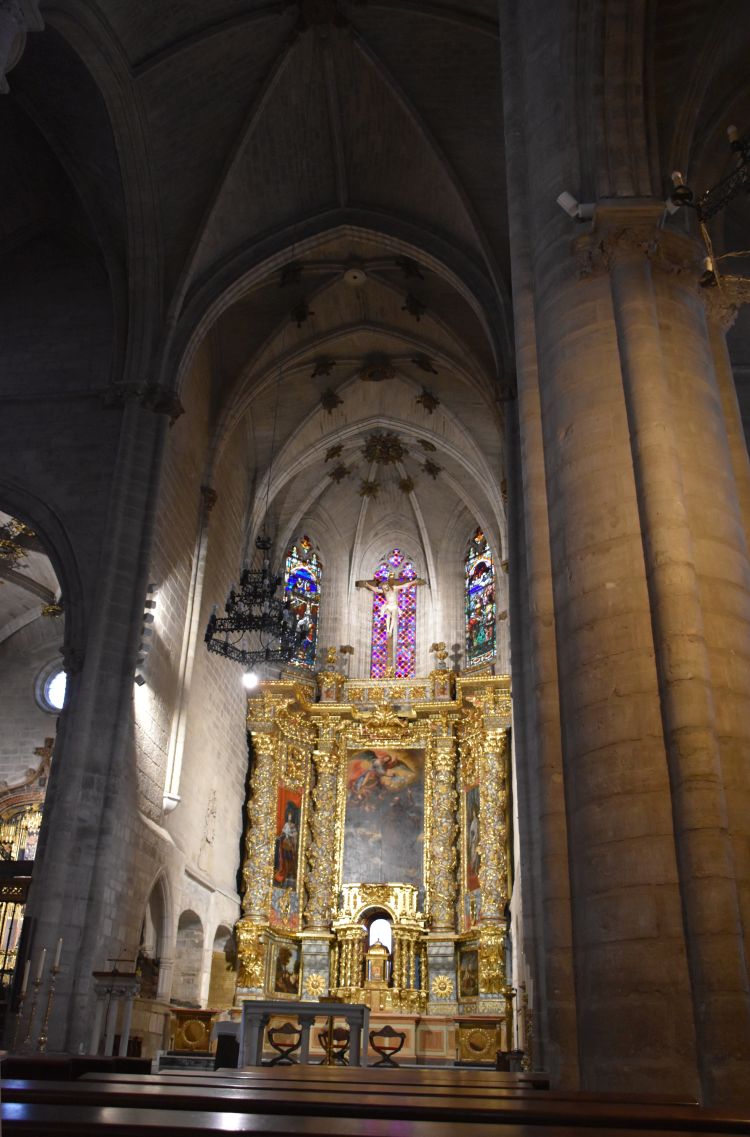
To the north east of the city center and built into the town wall is the smaller church San Gil, also gothic in style from the end of the 13 to the 14th century. Later a series of chapels were added, the most famous of them holding the Christ of Burgos. The altar is Renaissance and tells about Maria and her son.

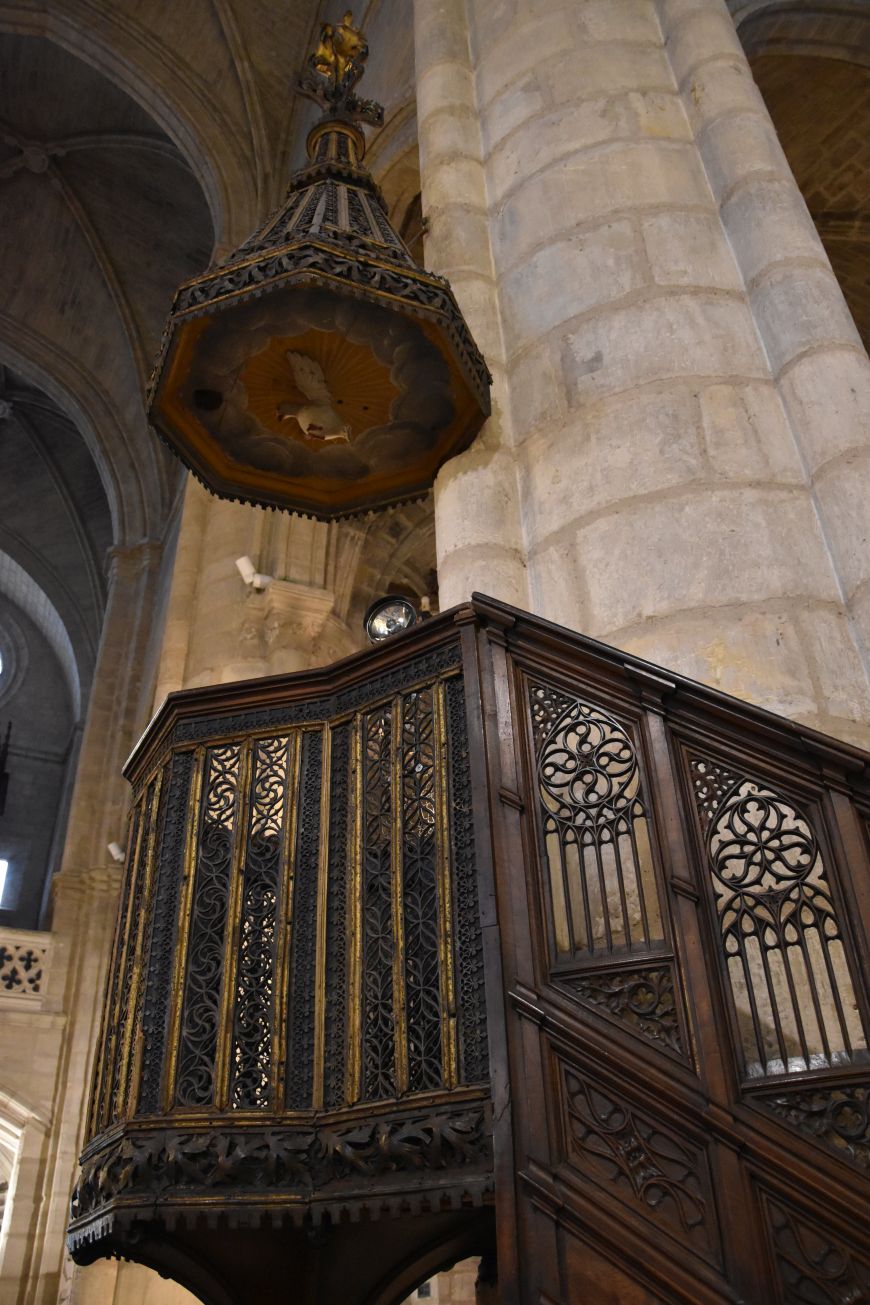
My favourite item in this church is the wooden pulpit, finely carved and adorned with a pigeon under the cupola. May the Holy Spirit inspire the priest and his speech.

I could not find any explanations about this outstanding pulpit.


The church Saint Stefan or San Estebán

The last church we visit is Saint Stefan or San Estebán, not far from the Cathedral. The church is from the 13th century. In the 1980’s, the church was converted into the museum for altars and treasures that have been collected from churches decaying in the province of Burgos. In addition, the original altar dedicated to Saint Stefan has been kept in the choir. The altars are mostly from Renaissance and Baroque. Many of the altars on display are dedicated to martyrs. It is not allowed to take photos. The Website of Saint Stefan gives an impression of the overwhelming wealth shown in this church. We are overwhelmed and have our welfare dinner in the friendly and cosy restaurant Rincón de España.


Good-bye Burgos, our next target will be Soria.


Source: Marion Golder: “Nordspanien und der Jakonsweg”, Dumont Reisehandbuch, Ostfildern 2018; “Guía Santa María la Real de las Huelgas – Burgos”, Reales Sitios de España 2014.


On the road to Spain – Santo Domingo La Calzada and city strolling in Burgos

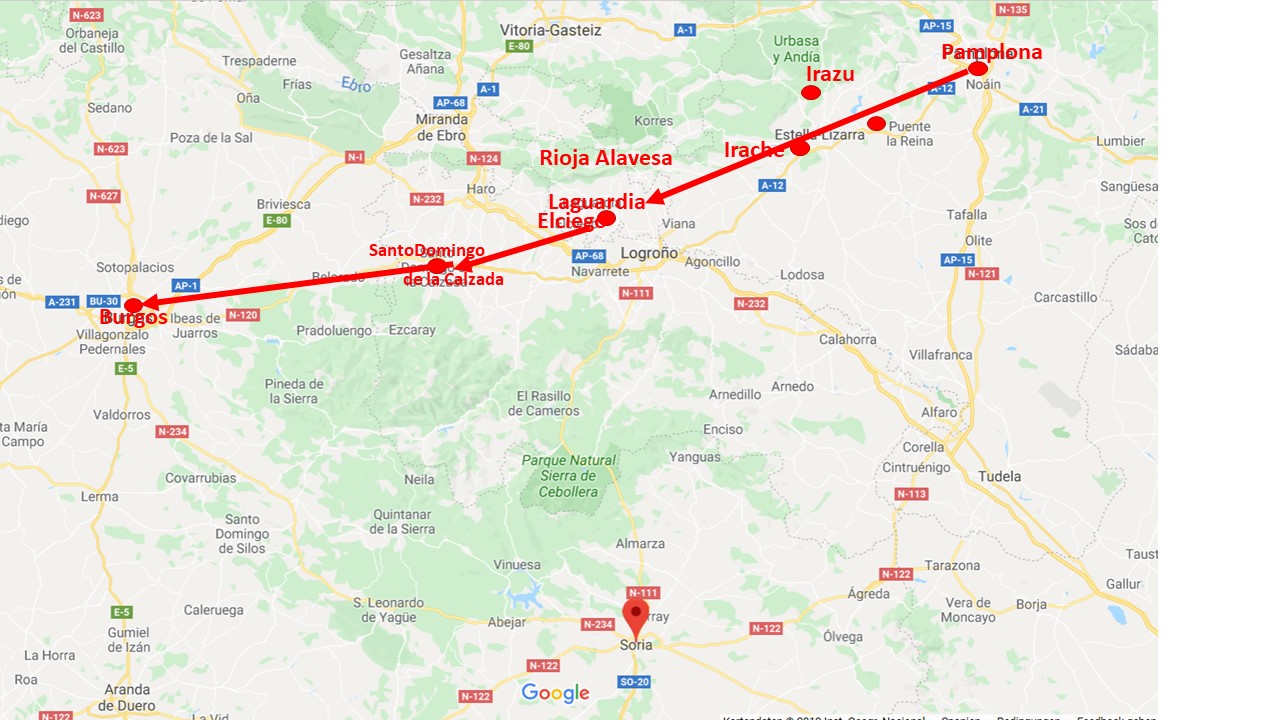
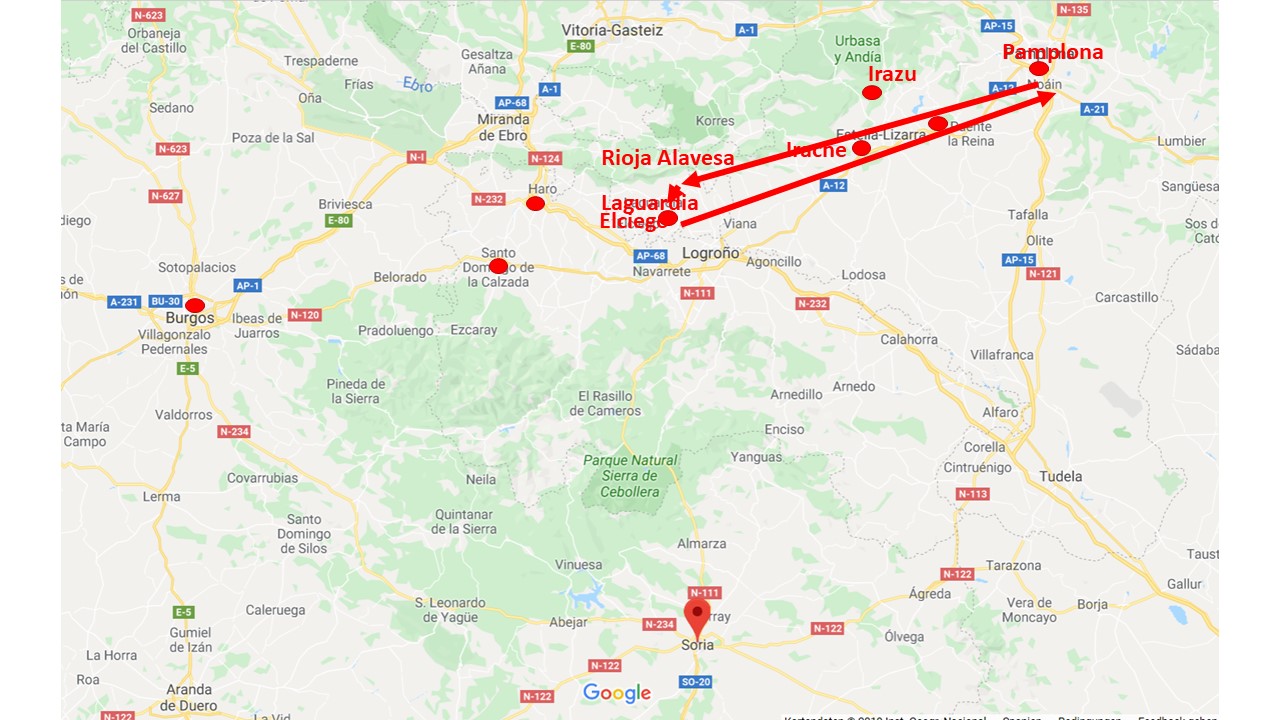
Mid November 2019 we drive from Pamplona to Burgos with the first stop over in Laguardia and Elciego and with the second stop over in Santo Domingo de la Calzada. We then settle in Burgos, where we have booked the hotel for three days.

Source: Google Maps


Stop over in Santo Domingo de la Calzada – with hens in the Cathedral

Santo Domingo la Calzada is a small town with a Cathedral. “Calzada” means “paved road”. In the 11th century, Santo Domingo noticed that the trails of the Way of St. James were bad, and he spent his life repairing them. In addition, he built a bridge, a hostel and hospital here. For fixing trails, Santo Domingo received the surname “Calzada”.

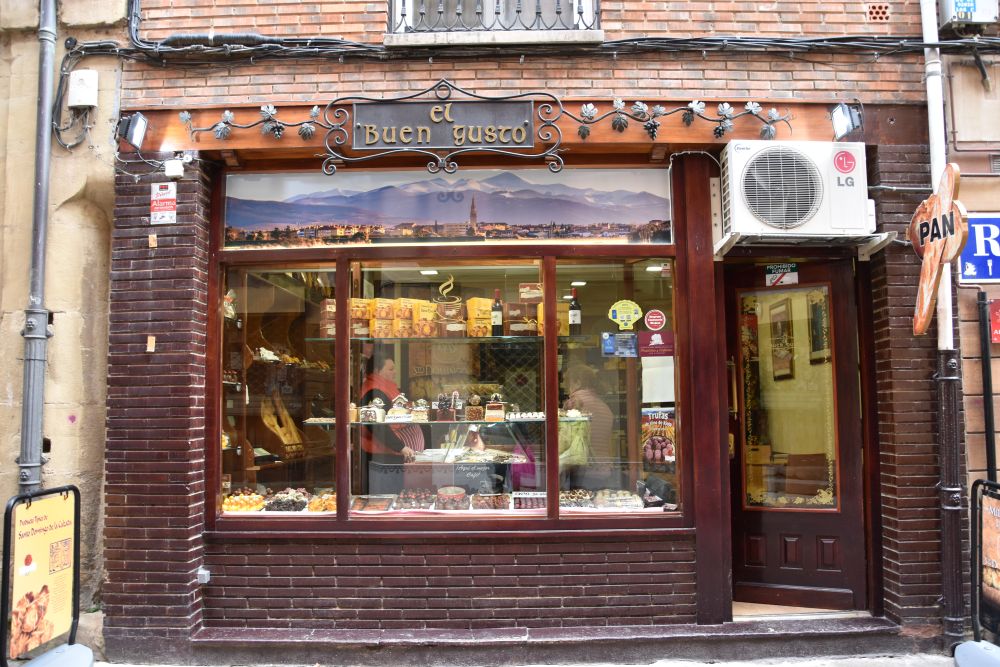
Santo Domingo de la Calzada is not far from the mountains, as the window of the nice pastry shop shows.

The hospital is now the Parador of Santo Domingo La Calzada. We have coffee here to warm up.

We enter the Cathedral. Around 1100, the king of Castile had the church of Santo Domingo built that later became the Cathedral of a newly created bishopric. The choir has been freed from the altar, which allows to admire its Romanesque structure.

Santo Domingo de la Calzada’s tomb is near the choir. He is buried in the crypt.

The attraction of this cathedral is the beautifully forged cage with one hen and one coq. The animals are being replaced regularly.

The cage goes back to the legend of a German couple that pilgrimaged with their son Hugonell. In the hostel of Santo Domingo de la Calzada, the daughter of the host fell in love with Hugonell who did not return her affection. She hid a silver cup in Hugonell’s luggage. Her father, the host, noticed that one of his silver cups was missing and he asked the police to chase Hugonell. Because the cup was found in Hugonell’s luggage, the poor boy was hanged. The parents continued their pilgrimage, and, when they returned, they found their son still alive. He said that Santo Domingo had supported him all the time. They all returned to the hostel. The host said that he would only believe that Hugonell was innocent, when this coq would come to life again – it was steaming on his table ready to be eaten. The coq became alive again – and the coq and the hen in the cage of the Cathedral remind us of the miracles around Hugonell.

The cloister is a museum with sacral artifacts. The children love the large Christmas crib built out of Playmobil elements.


Burgos – we settle in NH hotel, enjoy the view of the Cathedral and eat in the Restaurant Rincon de la España

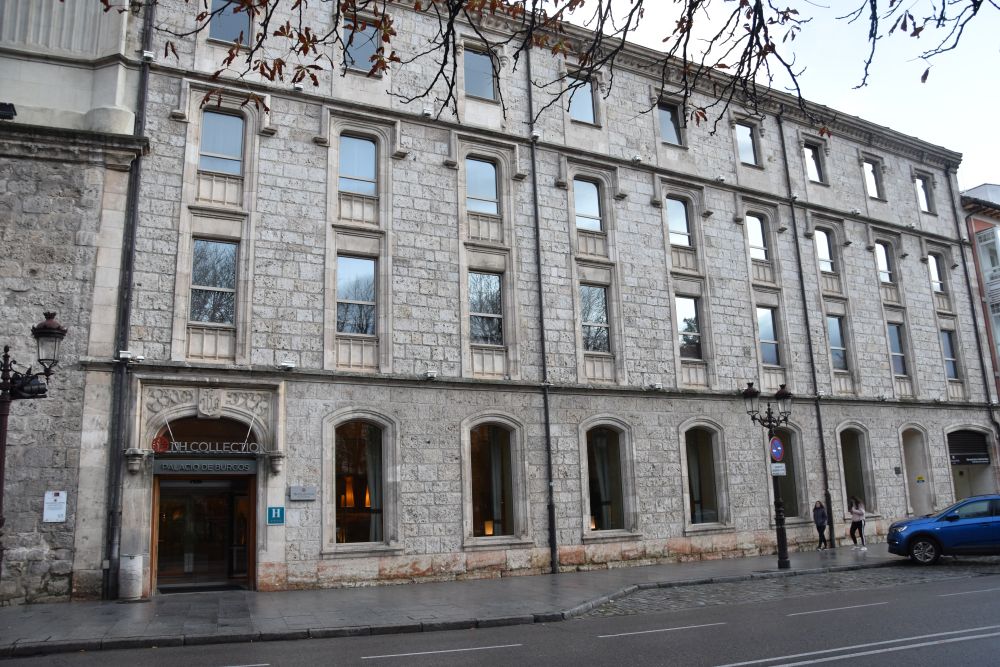
In Burgos, we settle in the NH Collection Hotel Palacio de Burgos that formerly was the Merced Monastery – a charming setting.

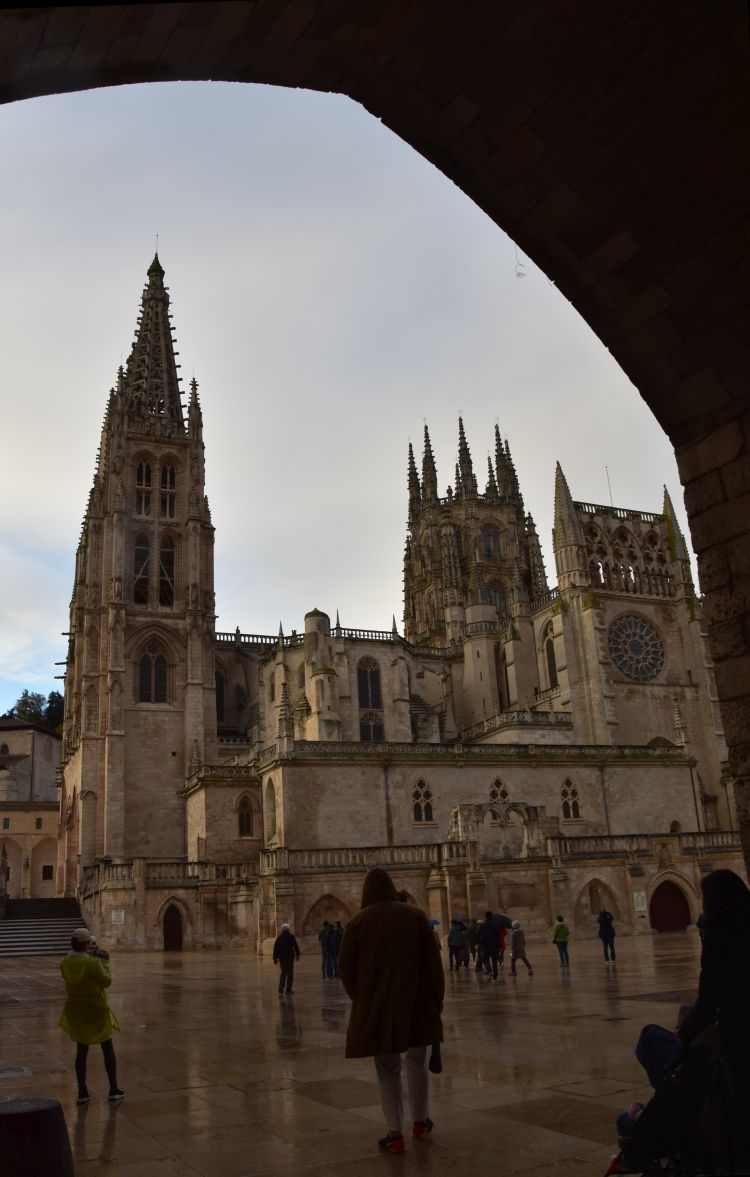
From our room we can see the Cathedral of Burgos named after Santa Maria. Even in these rainy and chilly November days, the sun comes out from time to time and the filigree towers shine in white.

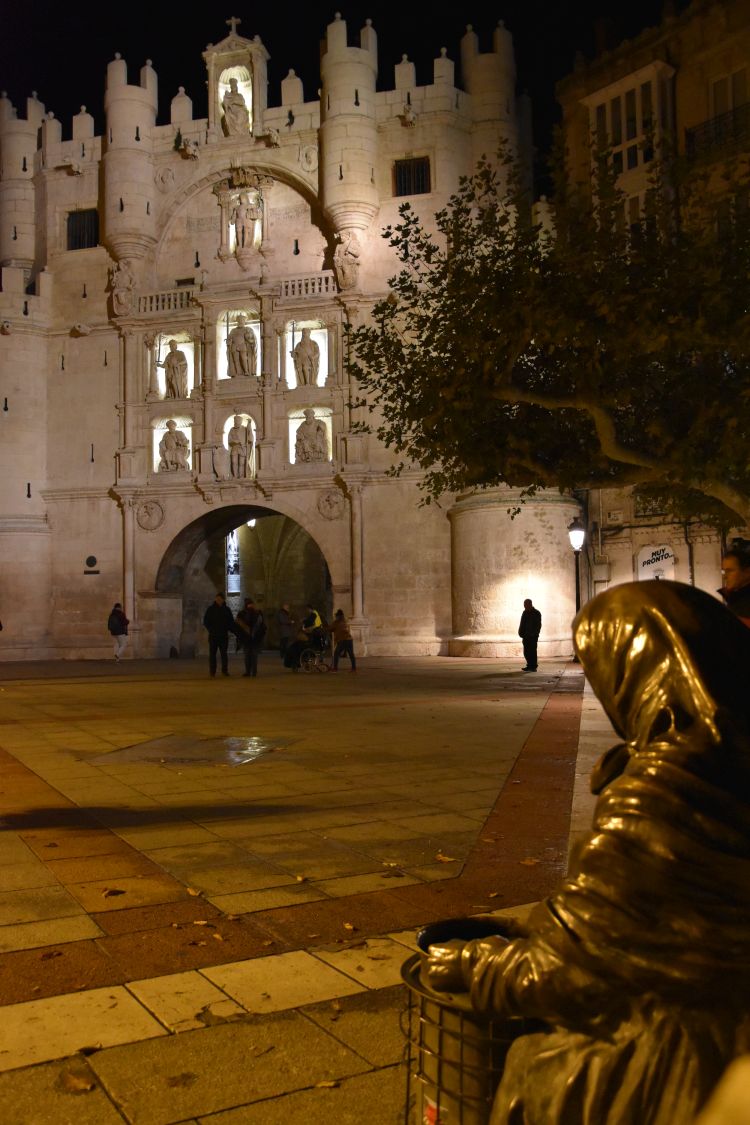
We cross the road and enter the city center through the gate of Santa Maria (called “Arch”) .

Under the Arch of Santa Maria, the view of the mighty Cathedral of Santa Maria is overwhelming.

We have dinner in the restaurant Rincón de España near the Cathedral. It serves meals already at seven pm – all other restaurants open only at 8:00 or 8:30 pm. In the Rincón, the oven with the tiles creates a cosy atmosphere.

I have delicious veil cheeks with a tasty Rioja Ardanza Reserva from the Bodega Rioja Alta.

At night, the Arco de Santa Maria is illuminated. Carlos V of Habsburg (or Carlos I of Spain) is surrounded by the founder of Castile and by El Cid who is venerated for having fought the Moors (though the historical facts say that he sometimes also fought WITH the Moors).

The woman selling chestnuts sits in front of the gate watching the citizens and tourists walk by.


Walking around the pretty city center 

Burgos stretches along the river Arlanzón.

Parks with promenades invite to walk along the river…

… and various pedestrian bridges cross the Arlanzón.

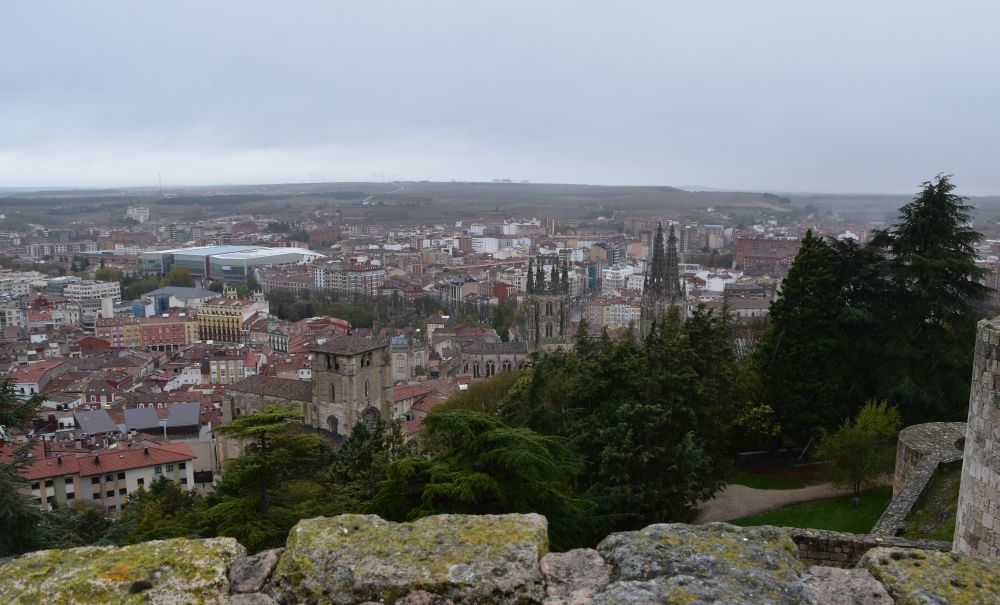
We climb up to the castle hill to get an overview of the city. Burgos has emerged around this hill with the castle from the 9th century. The castle is now a ruin for having burnt down in the early 18th century. It is snowing and raining, when we look down at the city with the Cathedral and the church San Estebán.


Strolling through the pedestrian zone of the city center

The city center of Burgos is a large zone for pedestrians.

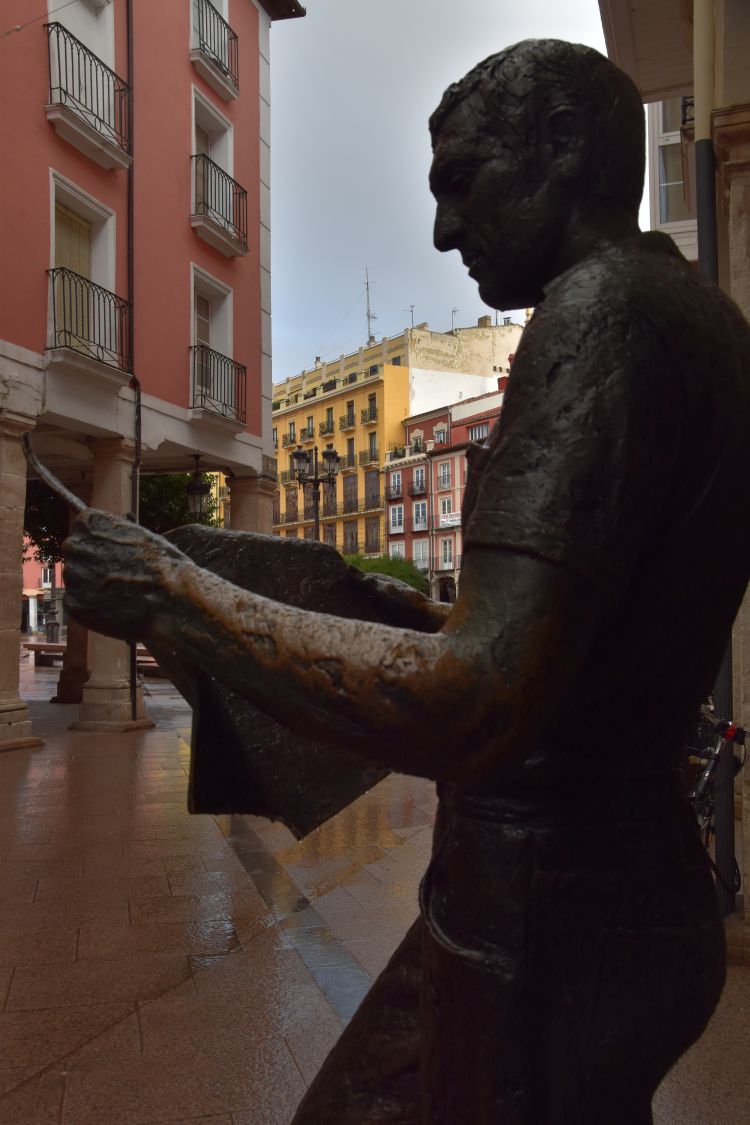
It is so quiet that you can carelessly read in the pedestrian streets.

In this inviting shop, Ursula finds the elegant shoes she has been looking for already for a long time.

We find the old-style shoe shop with the carton piles at the Plaza Mayor.

It is an evening offering nice dawn photos of the Plaza Mayor with the Cathedral in the background.

Later, red stripes appear in the sky above the Cathedral.

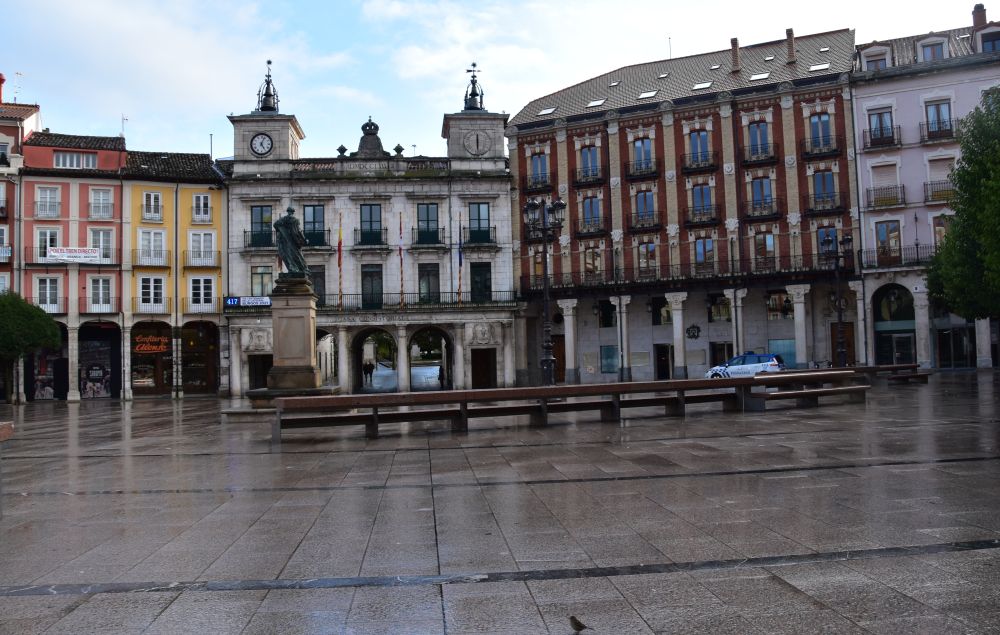
This is the townhall at the Plaza Mayor…

… the columns of which indicate that the river Arlanzón has flooded this area twice in June, once in 1874 and once in 1930.

I can hardly believe that the tame Arlanzón, now flowing calmly in its riverbed, can swell to inundate the city.

The stroll through the pedestrian city center ends at the square of El Cid. His statue is nick named “bat”, because of his “flying” coat.


The Museum of Human Evolution (Museo de la Evolución Humana)

North of Burgos is the Sierra de Atapuerca, about 1000m above sea level and about 7km long, with a karst network of galleries. Since at least 1.3 million years, human beings and their antecessors as well as animals have lived here in the karst caves.  They left their traces in sequential layers and archaeologists, uncovering meticulously one layer after the next, gained new insights into human evolution in Europe. The most famous discovery was this front jaw (mandibula). It belongs to a human being that lived about 1.2 Mio ago and was found in the Elephant Cave in 2007. These are the oldest remains of human beings found in Western Europe. The type of hominids has been named “Homo Antecessor”.

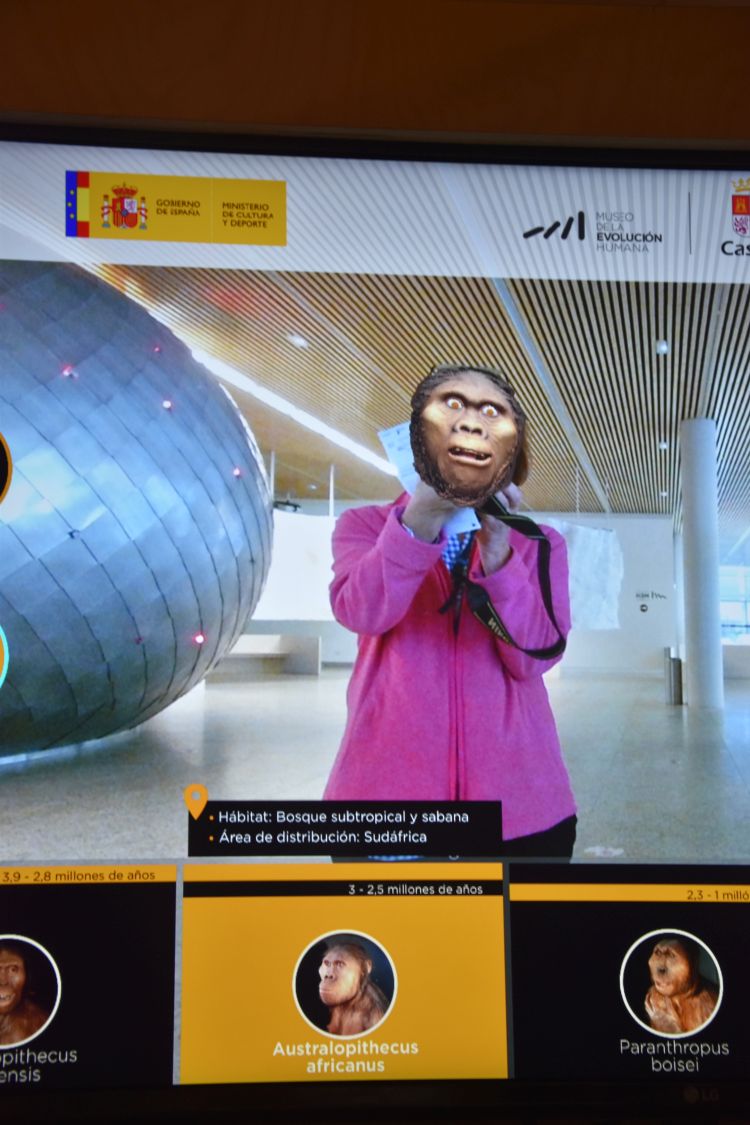
We have come to see this jaw, but it was not on display. It has been given to an institute for further investigation. Nevertheless, we found the museum exciting. It is well curated. In the basement floor, they show the excavations in the various karst galleries, the Elephant Cave being one of them. The bones and tools found are on display. The next floors explain the history of mankind and I learn that before the emergence of Homo Sapiens Sapiens some 100’000 years ago, the evolution of hominids began in Africa between 6 and 7 Mio years ago. Many varieties of hominids emerged and disappeared again. The museum displays life-sizes statues of some of them. With the twinkling of an eye, it lets the visitors become one of their human antecessors.

We decide to stay four days instead of three in Burgos. It has much to see and, above all, it is a charming city.

Source: Marion Golder: “Nordspanien und der Jakobsweg”, Dumont Reisehandbuch, Ostfildern 2018; Material seen and received in the Museum of Human Evolution.

On the road to Spain: Rioja Alavesa, Laguardia and Elciego

In rainy November 2019, we spend a few days in Pamplona and explore the city and the surroundings. Our first excursion has taken us to Puente de la Reina. Now, our second excursion takes us to the vineyards of Rioja Alavesa, Laguardia and Elciego. Because it starts to pour with rain around midday, we return to Pamplona early and return to Laguardia on the next day.

Source: Google Maps


Beautiful Rioja Alavesa in the Basque hills north of the Ebro

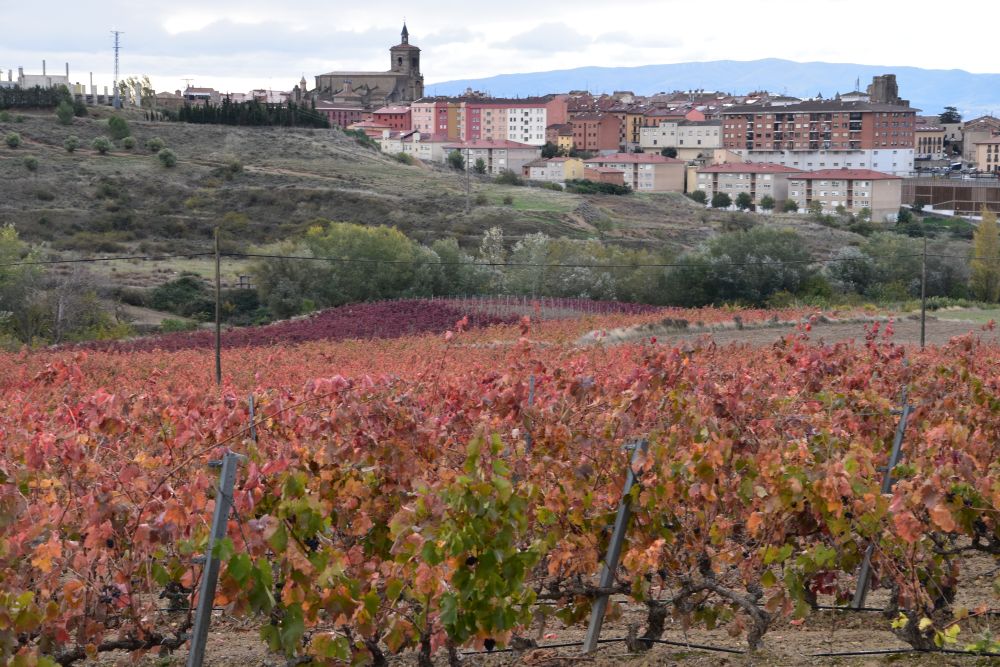
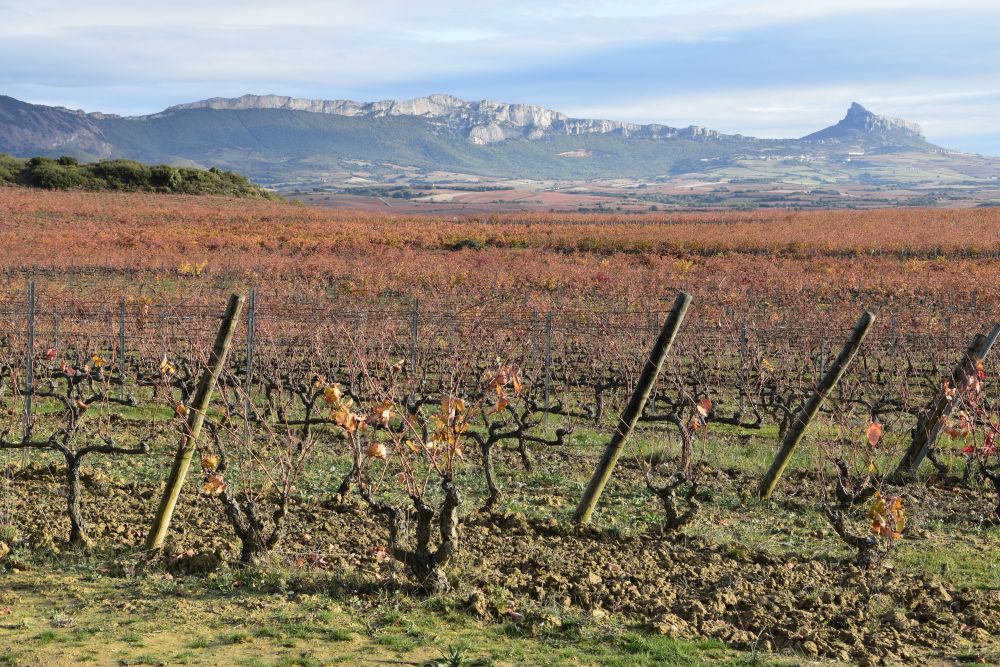
North of Laguardia in the hills, we find the yellow and red vineyards of Rioja Alavesa that politically is part of the Basque country, but belongs to the wine region Rioja.

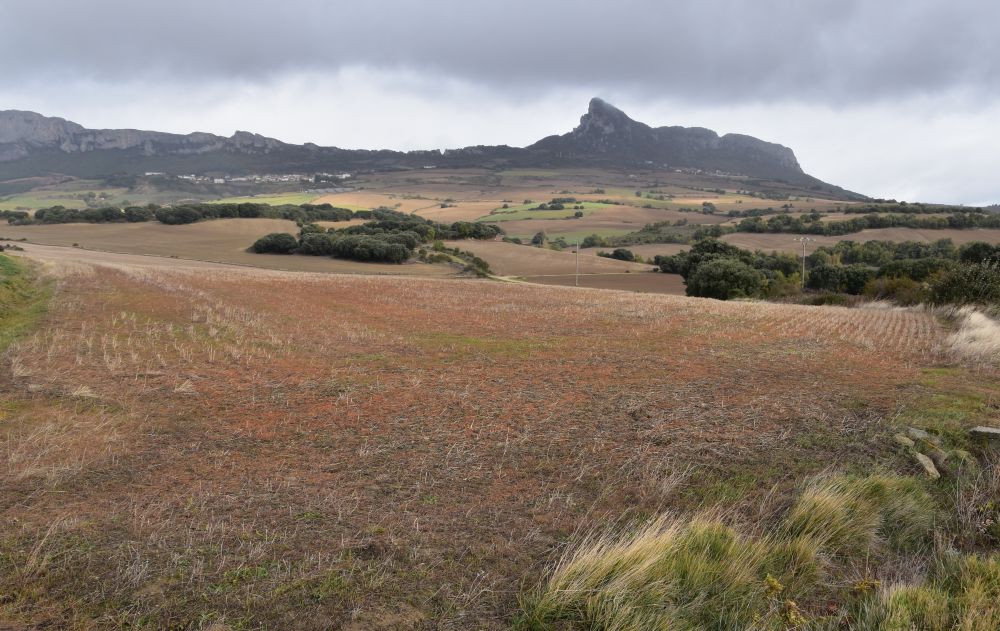
We are just below the Sierra de Cantabria. Dark clouds are looming, but the sun breaks through the clouds.

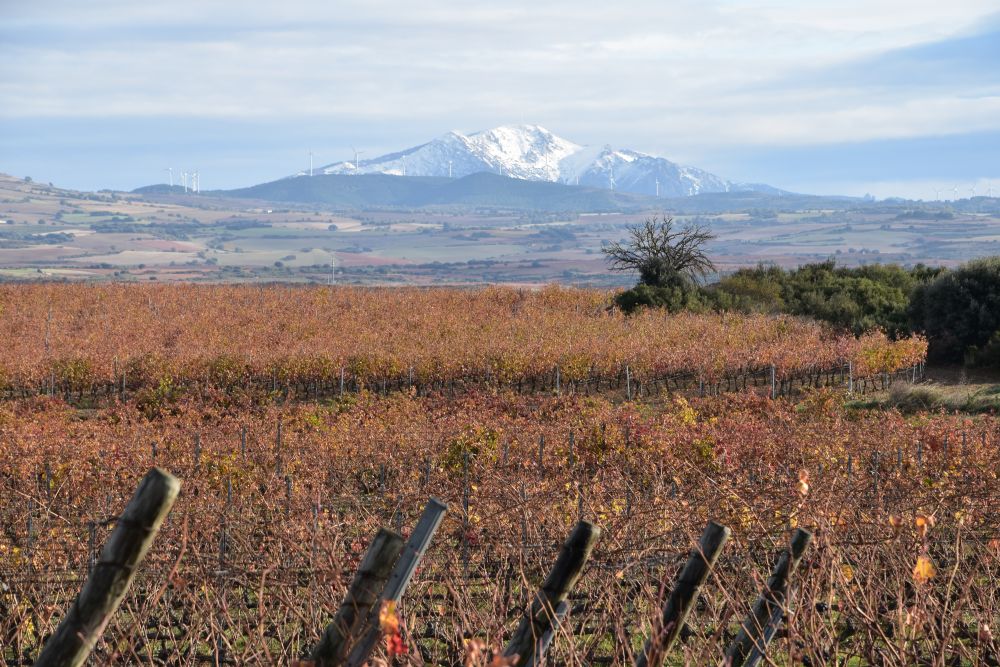
When we return the next day, the weather looks much more friendly…

… and the mountains now have a snow cap. The Rioja wine region is surrounded by mountains.

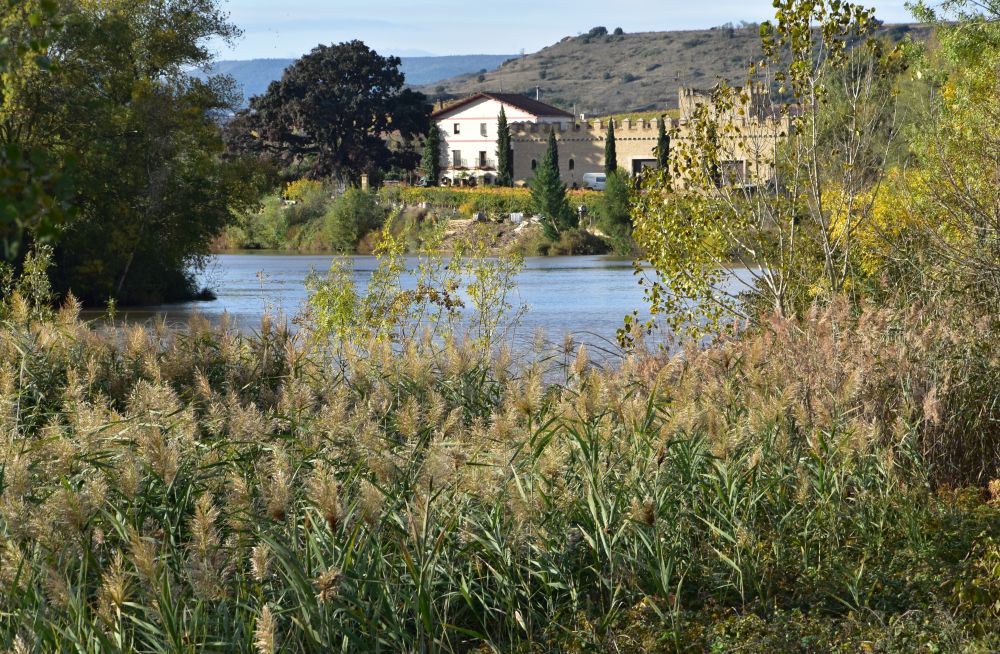
Near Laguardia, we say hello to our old friend, the river Ebro.


Elciego, where the success story of Rioja started in the 19th century

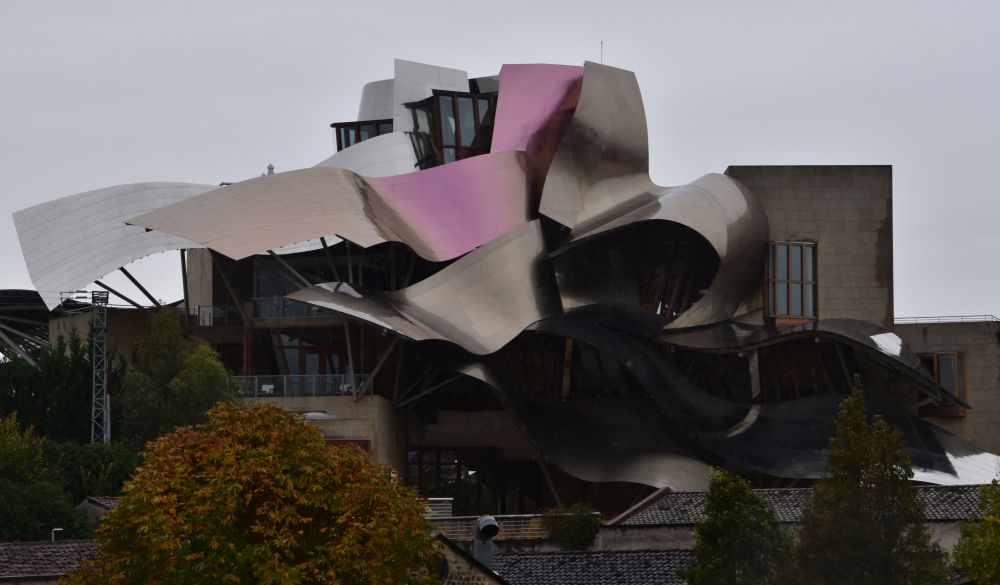
Elciego is located close to Laguardia. It is here, where in 1858 Marqués de Riscal founded the first bodega in Rioja. It is one of the most prestigious bodegas of Rioja today, with the brave architecture built by Frank Gehry.  Even on this rainy November day, the large Riscal parking is completely full with buses and cars.

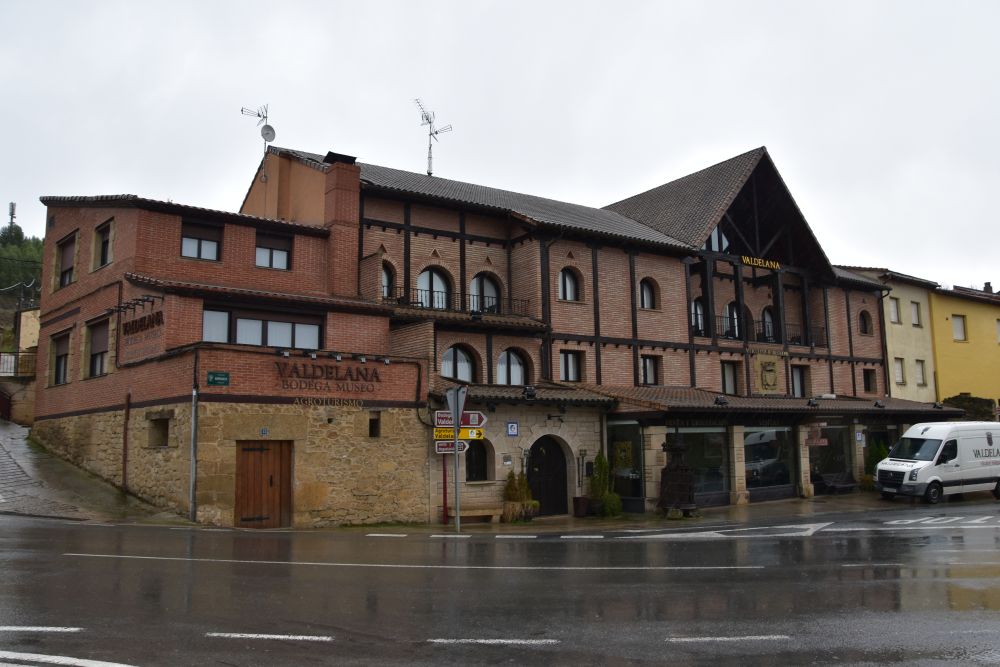
There are more such prestigious bodegas around Laguardia, one of them (Ysios) built by Calatrava.  We prefer the more modest bodega Valdelana and I buy a Tinto Reserva from 2007 and a Malvasia (I am curious about the Malvasia from Rioja).

Wine production in Rioja started to thrive, when at the end of the 19th century, Phylloxera hit Bordeaux and destroyed their vineyards. The French winemakers turned to Rioja then. In the 70’s, when I was a student, “Rioja” meant “Spanish wine” for me. That has changed – I value the diversity of the Spanish wine regions, with Rioja being one of them.


Laguardia – medieval city hiding many bodegas and the most colourful porch I have ever seen

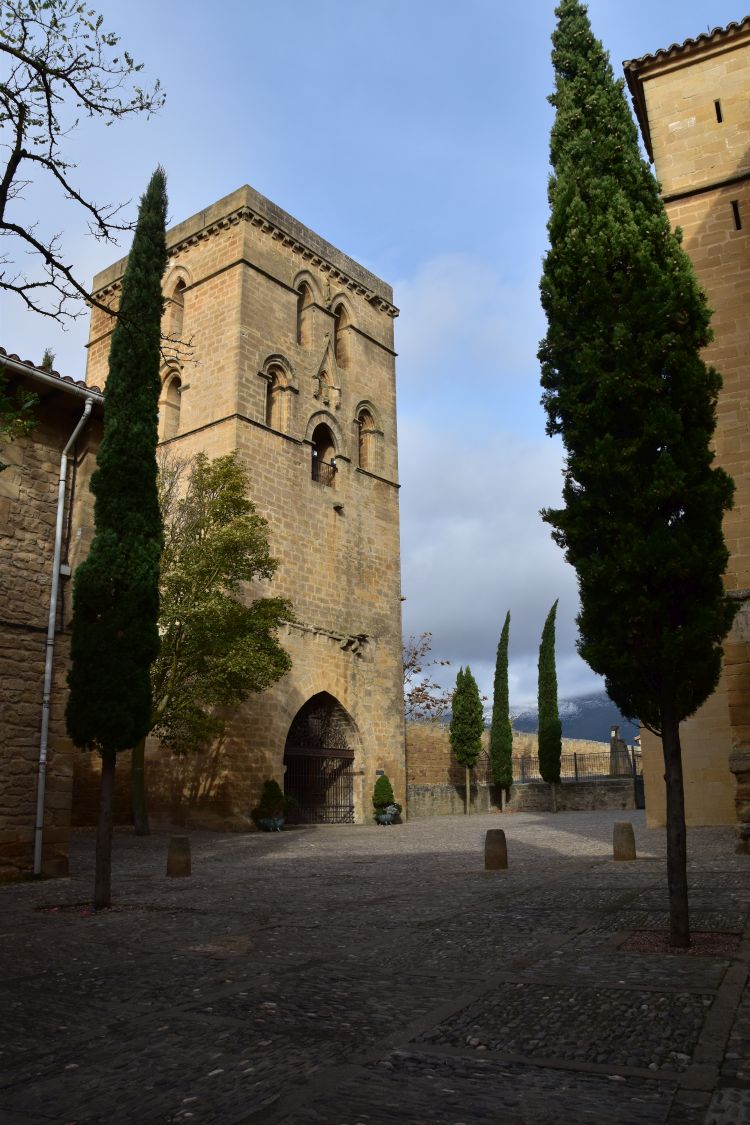
Laguardia is a medieval, small city from the 13th century, until today surrounded by the town wall. This is the defensive abbey tower from the 13th century that serves as the belfry of the “Iglesia de Santa Maria de los Reyes”.

When we return the next day, this tower shines in the sun.

On our first visit, the narrow streets are wet… we walk through them hidden under our umbrellas.

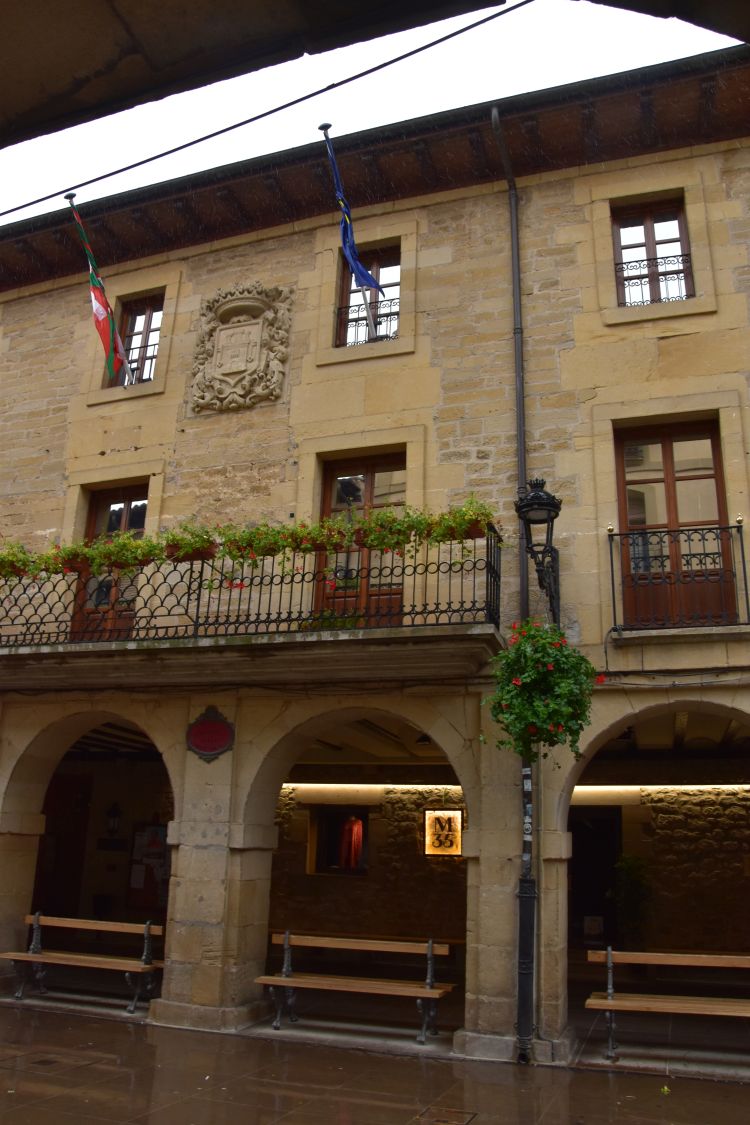
This is the Plaza Mayor in the rain, with the new town hall.

When we come back the next day, the small town welcomes us with sunshine. The houses are crouched on the hill.

Laguardia is a town full of bodegas that are visited by many tourists, now that the sun has come out.

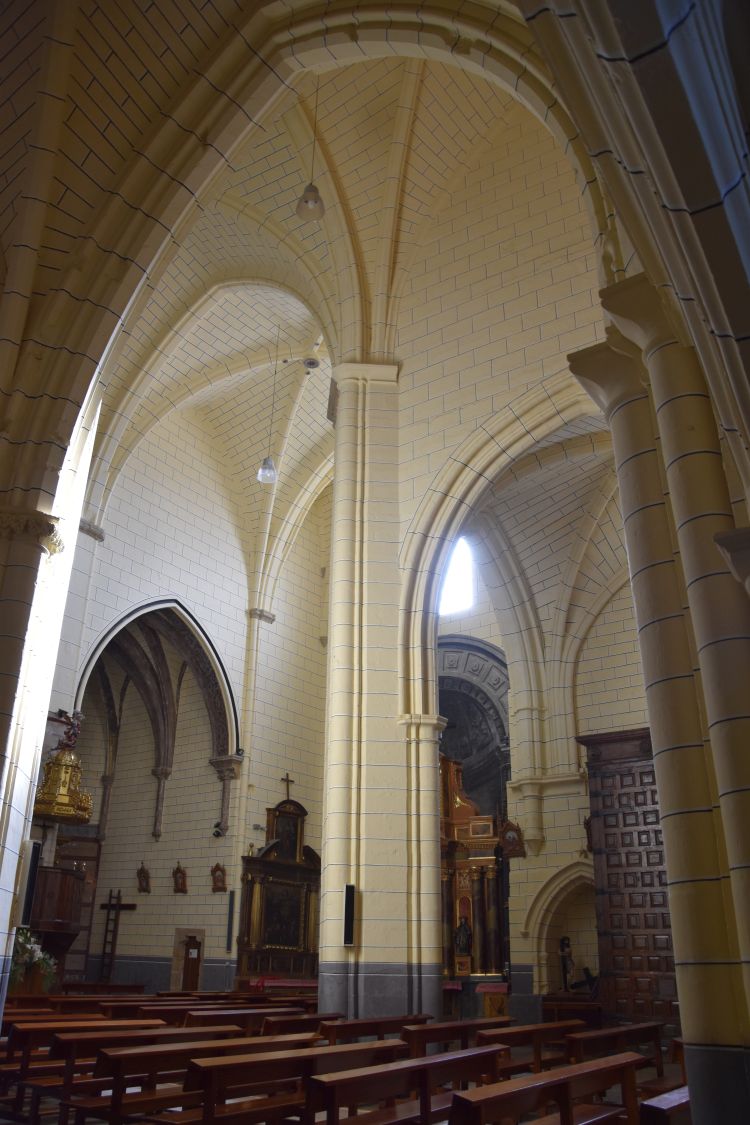
We stop at the church San Juan from the 14th century with the belfry worked into the town gate.

The church is in principle closed for a wedding today. As the doors are open, we enter and listen to the singer practicing solemnly for her performance at the wedding.

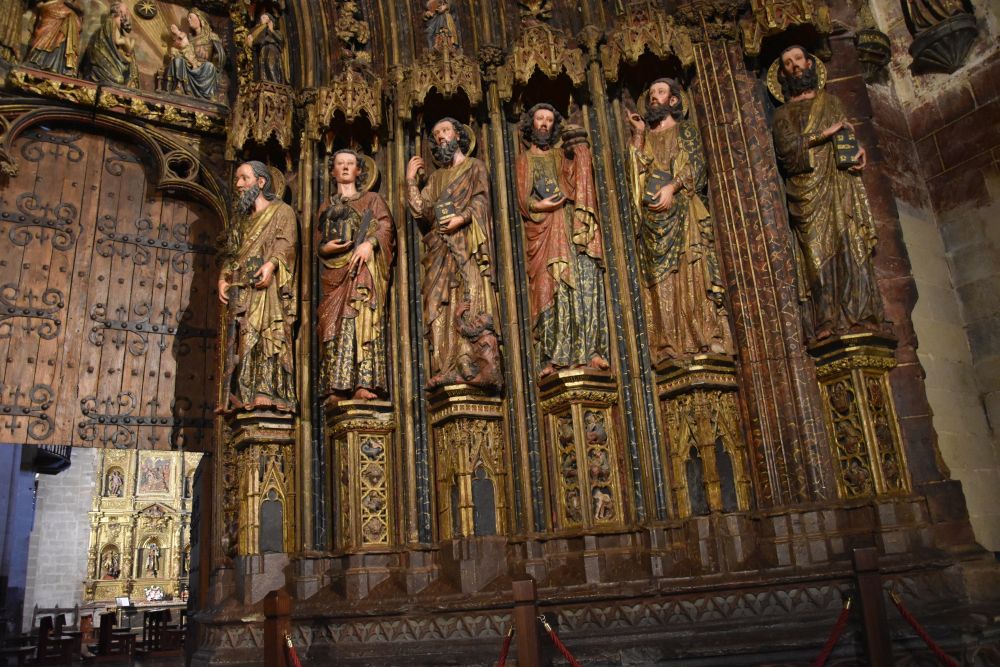
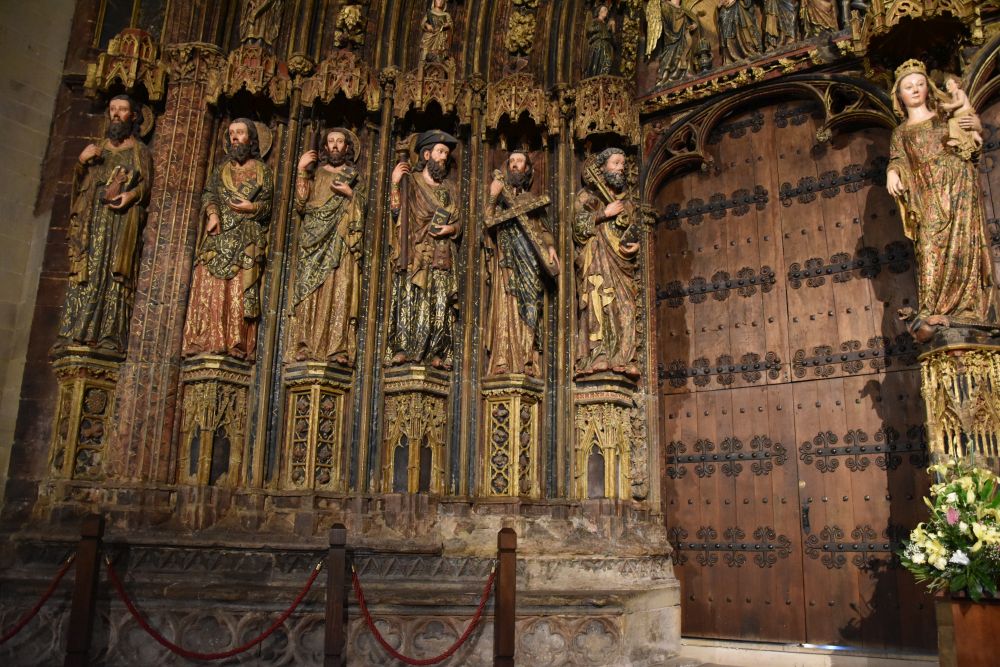
We have tickets for 11:15 to visit the porch of the Santa Maria church. It is only possible to see the porch as a guided tour. The porch is from the 14th century and has been repainted in the 17th century. To protect the colours, the porch has always been protected by a wooden door. Therefore the colours have been preserved illustrating to us, what porches might have looked like really. I have never seen that before.

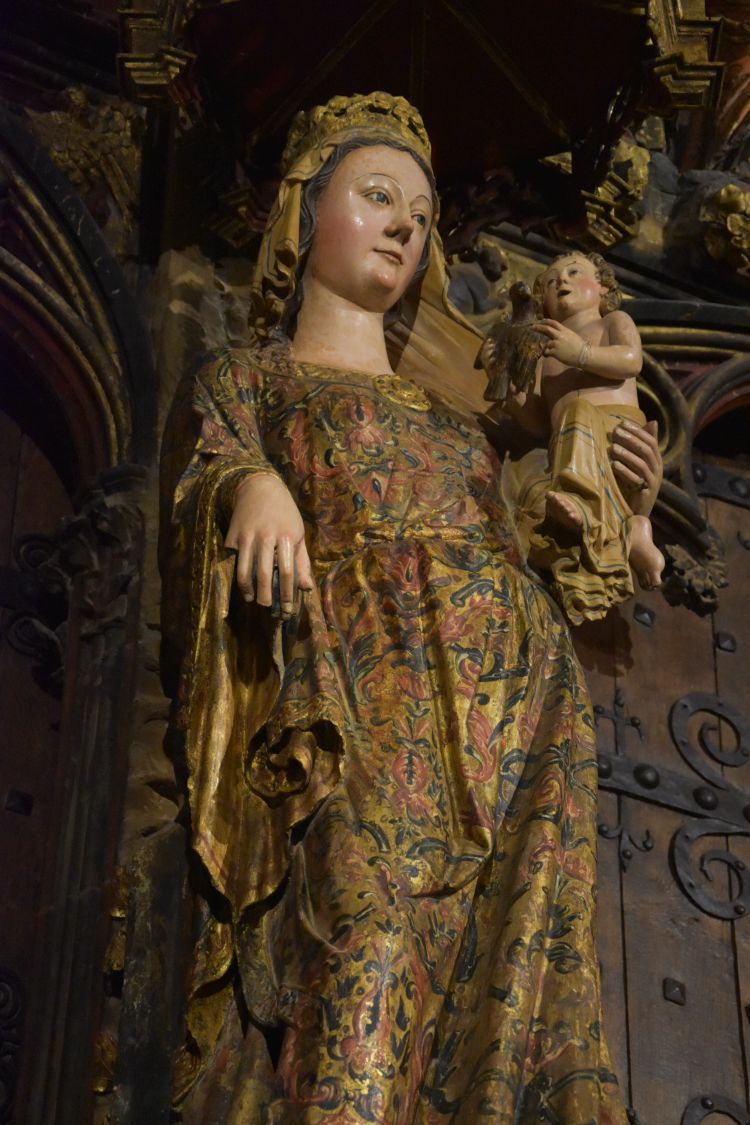
The iconography centers around Maria, as the church carries her name. She stands in the middle of the porch.

She wears a dress with a beautiful pattern, meticulously worked out. Her face expresses sadness – she may think of the fate of her son.

To her sides are the apostles, beginning with Paulus to the right…

… and with Petrus to the left.

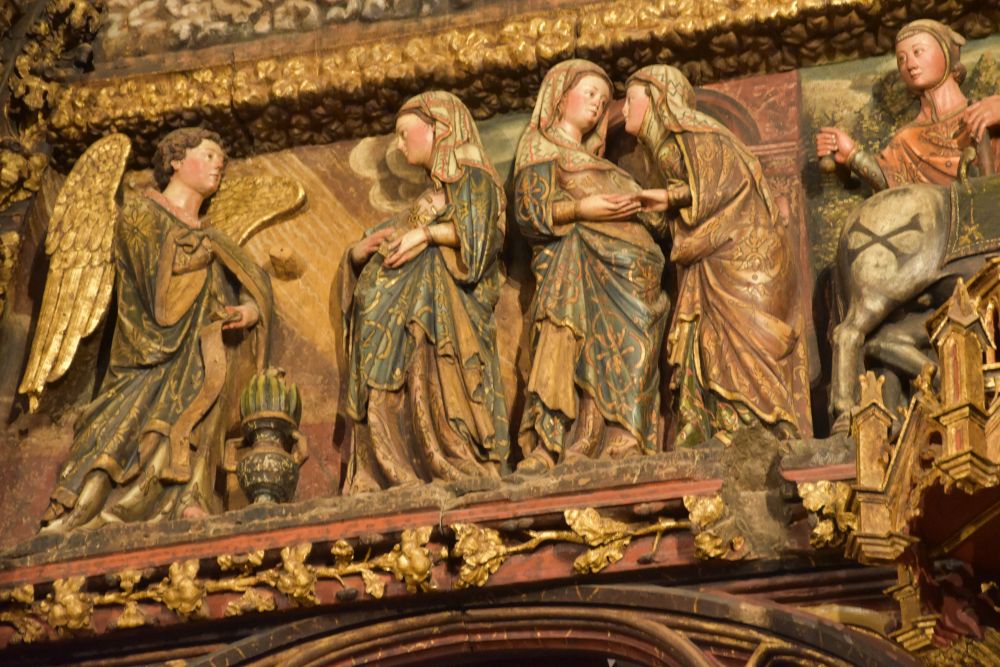
Above are the Annunciation (Gabriel announces to Maria that she will have a son) and the Visitation (Maria, pregnant from Jesus, visits Elizabeth, pregnant from Juan).

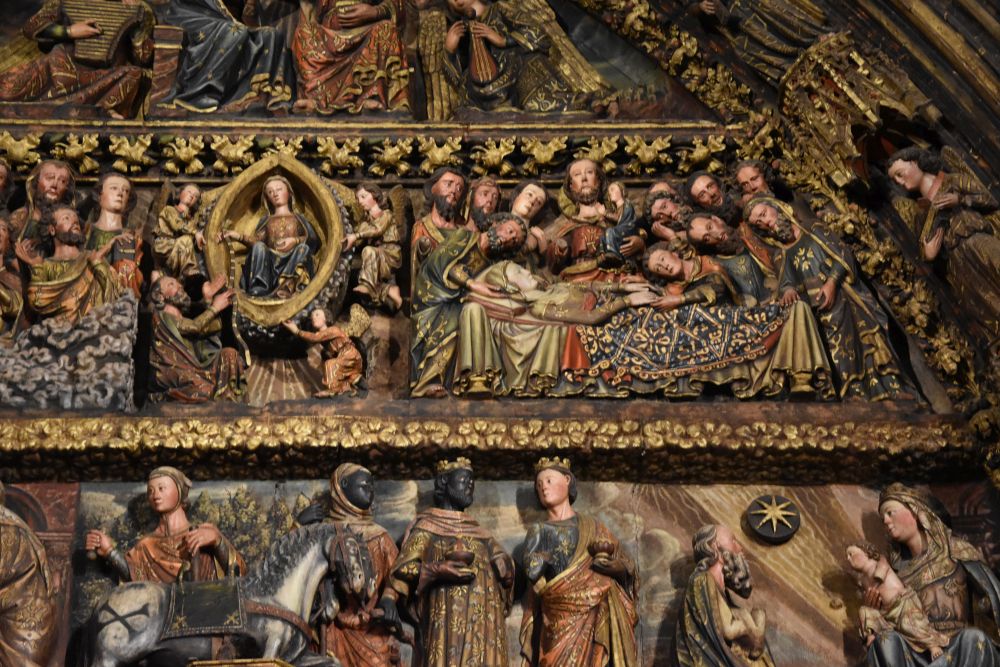
The story continues with the flight of Maria and Joseph to Egypt and the Adoration of the Kings. Above are Maria’s death and her ascension.

We leave Laguardia and continue our way to Burgos.

Sources: Marion Golder: “Nordspanien und der Jakobsweg”, Dumont Reise-Handbuch, Ostfildern 2018 and Marion Trutter (Editor): “Culinario España, Spanische Spezialitäten”, Tandem Verlag 2015.

On the road to Spain – Puente de la Reina and the monasteries Iranzu and Irache

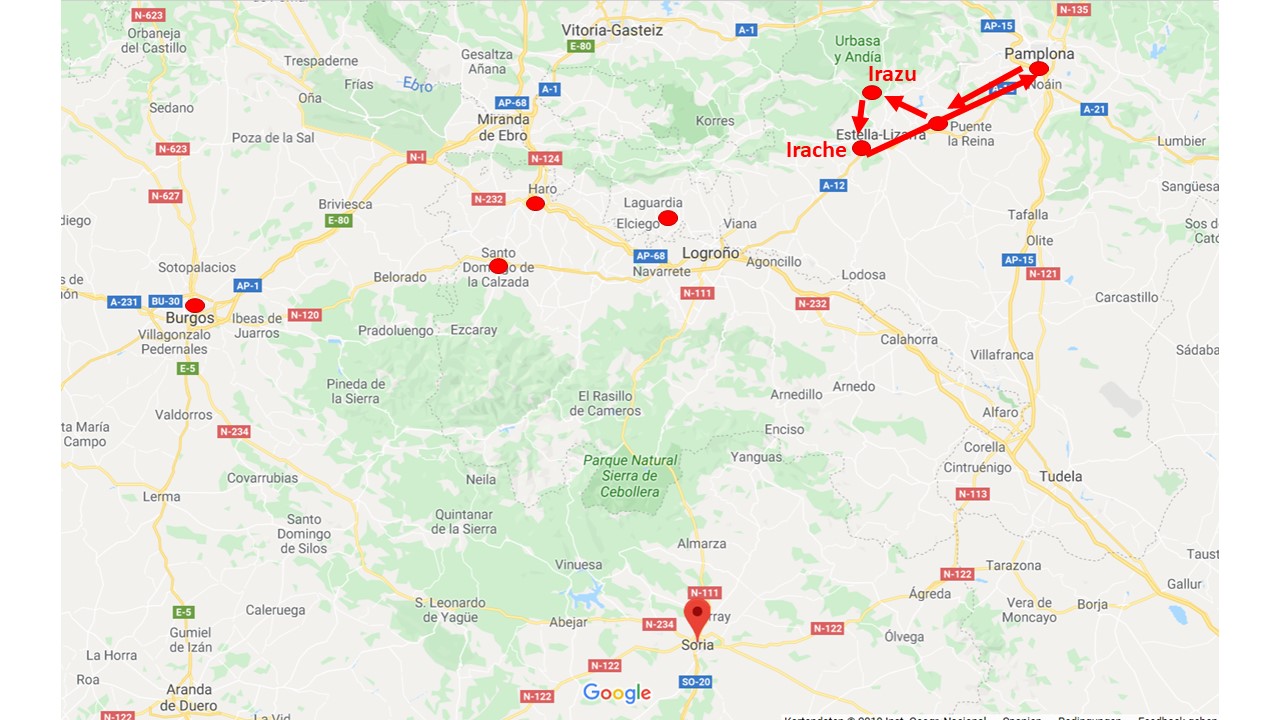
In November 2019, we spend some days in Pamplona to explore the city and the surroundings. Our first excursion takes us to Puente de la Reina (a small town with a Romanesque bridge), to the Cistersian monastery Iranzu and to the Benedictine monastery Irache (which is also a bodega).

Source: Google Maps


Puente de la Reina – Romanesque Bridge from the 11th century, built for the pilgrims

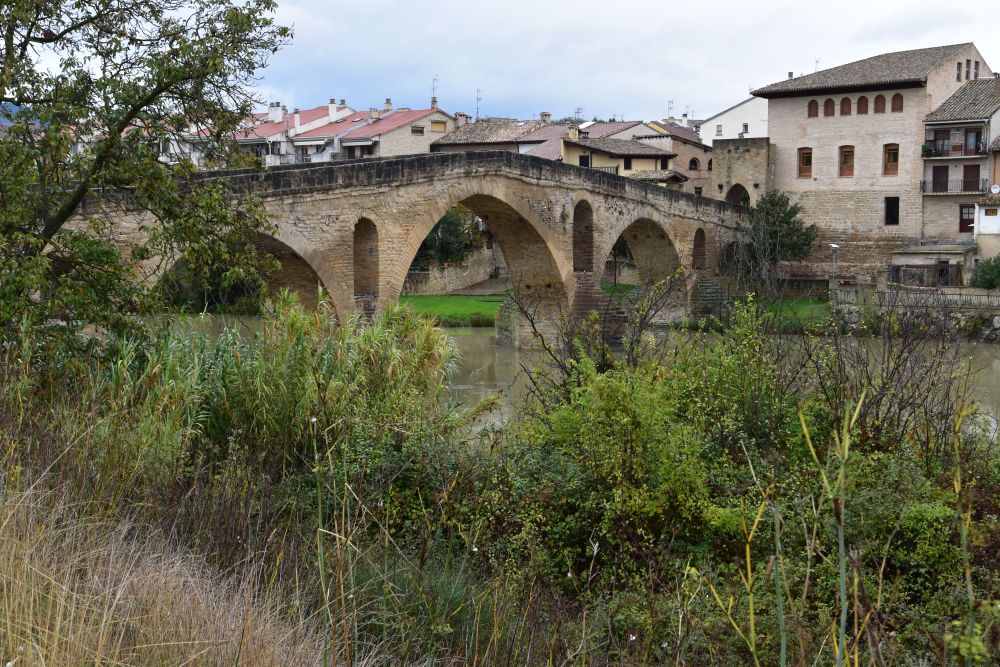
In the early 11th century, pilgrimage on the Way of St. James thrived. Two branches of the Way of St. James meet here to cross the river Agra. The wife of Sanchez III the Great (or her daughter in law) decided to build a bridge and for that it was called “Puente de la Reina”. This is the bridge providing access to the city…

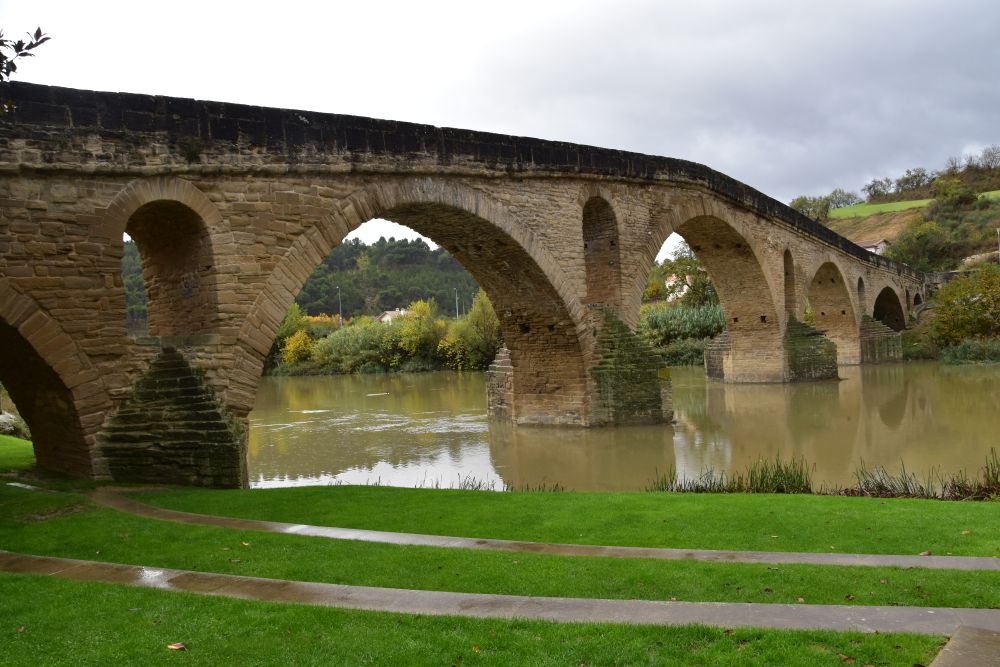
… and leading out of the city.


Puente de la Reina is a pretty town – with various churches

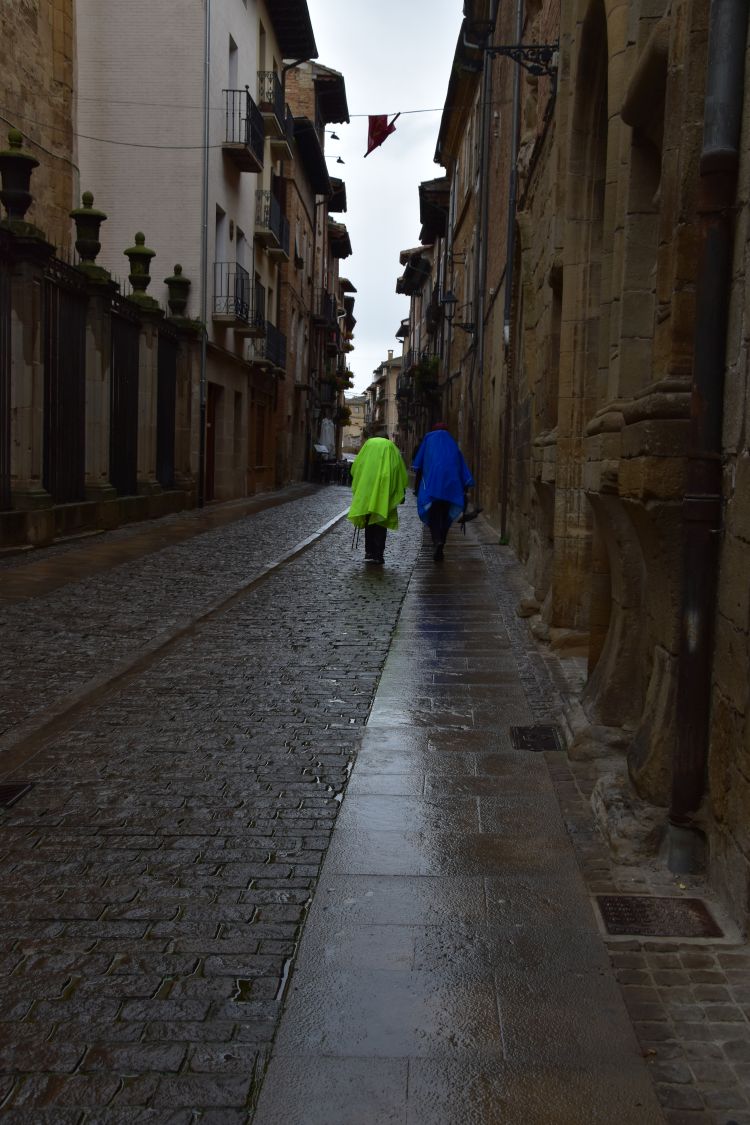
With the bridge for the pilgrims, the town Puente de la Reina evolved. Until today, brave pilgrims are withstanding the rain…

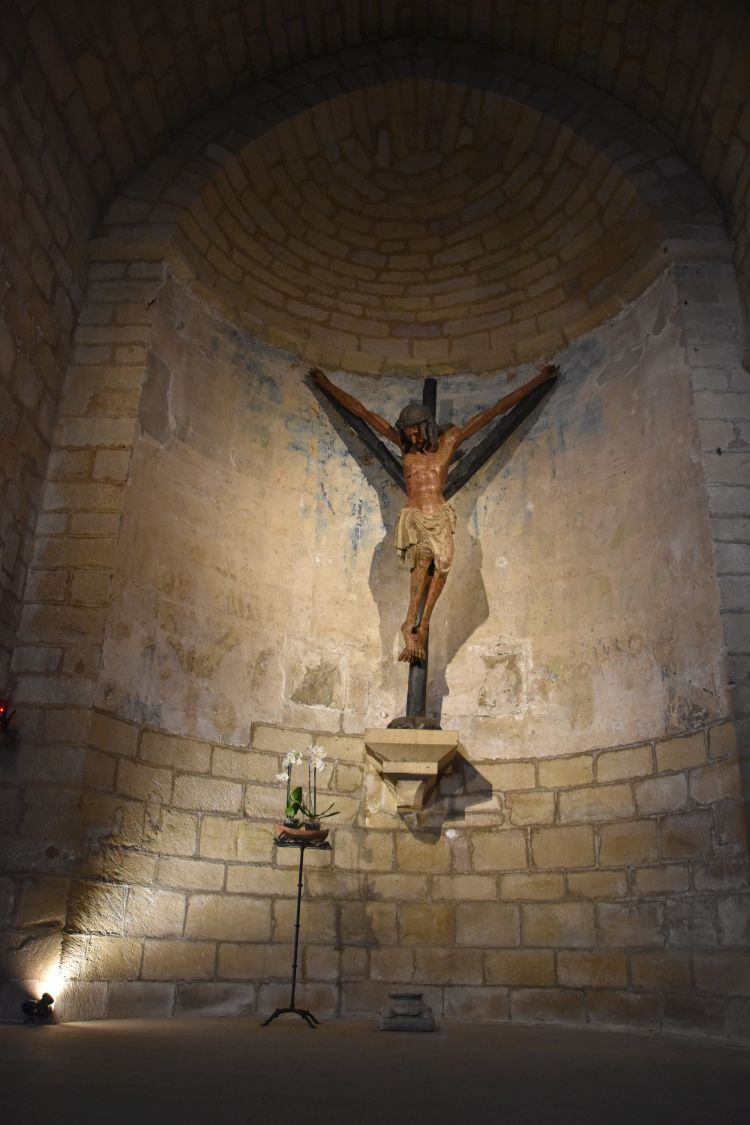
… to visit the churches such as this Crucifixion Church from the 13/14th century…

… with Christ crucified hanging inside.

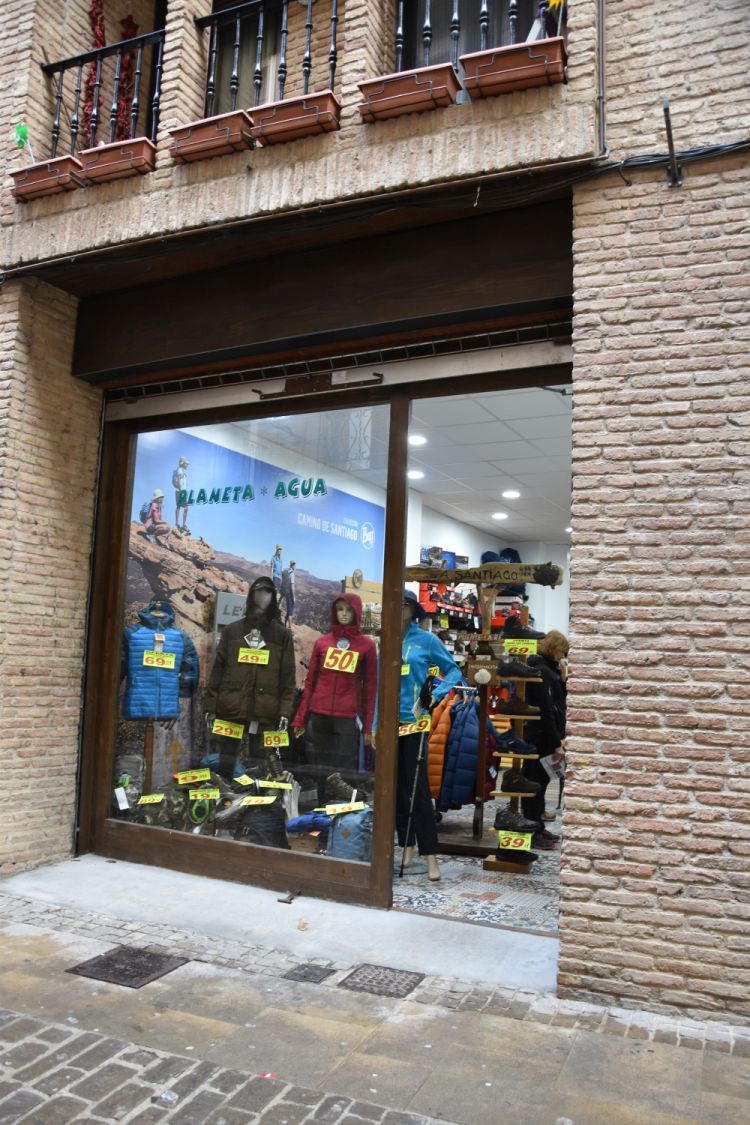
The city also caters for the pilgrims. The restaurants offer cheap pilgrim menus for 5 to 6 Euros and shops sell trekking clothes that are particularly useful now that it rains so much. We buy jackets and shoes here (though not being pilgrims). The “Planeta Agua” belongs to a chain that we also find in other towns along the Way of St. James.


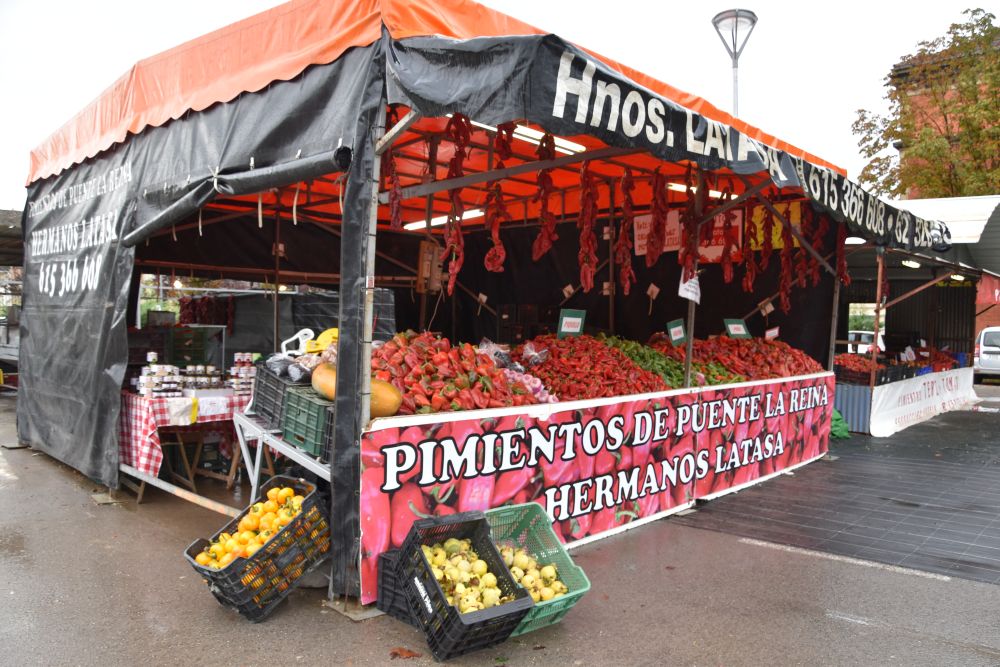
Red pimientos (sweet pepper) are omnipresent in Puente de La Reina

We have parked our car near the market that sells primarily pimientos or sweet pepper.

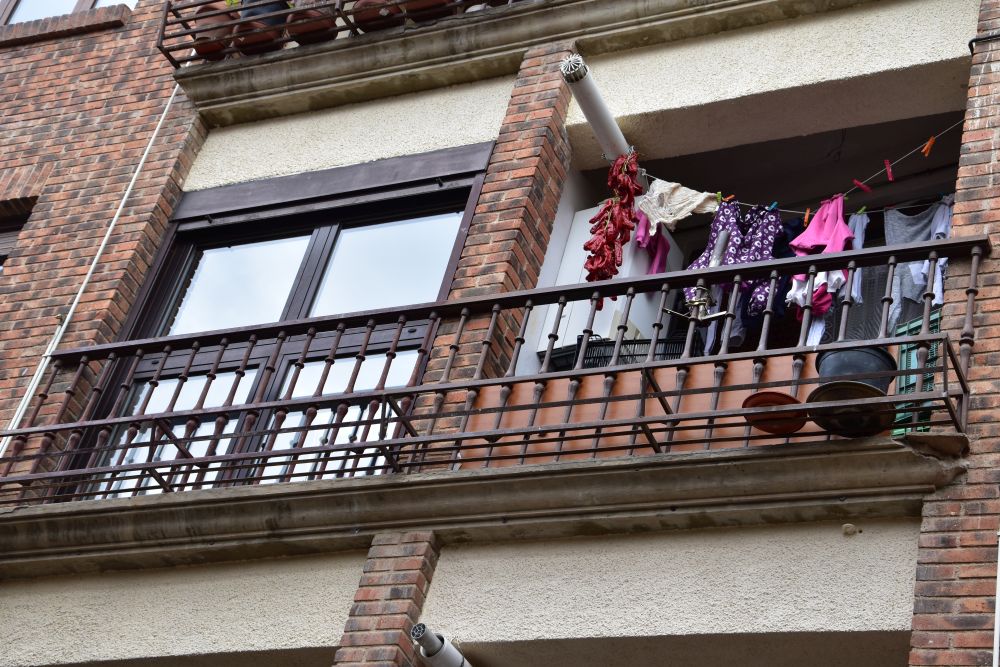
Sweet pepper hangs on the balconies…

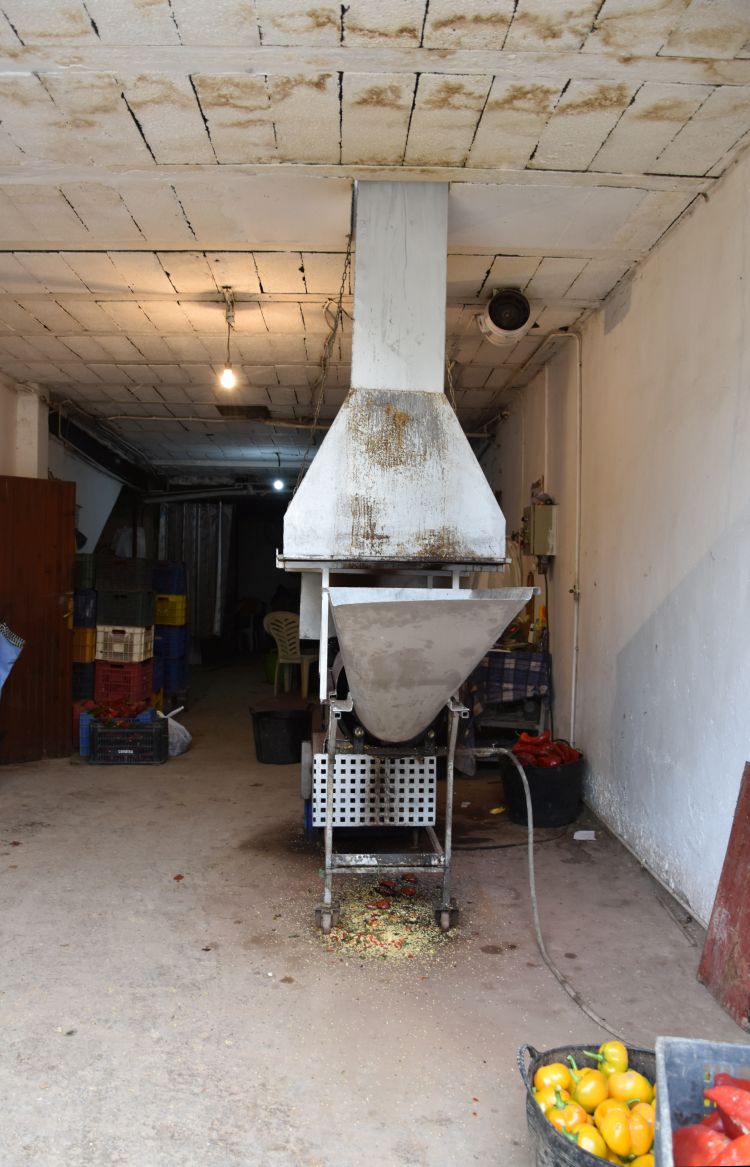
… and they are on offer in every vegetable shop, where they are being roasted and peeled using these machines.

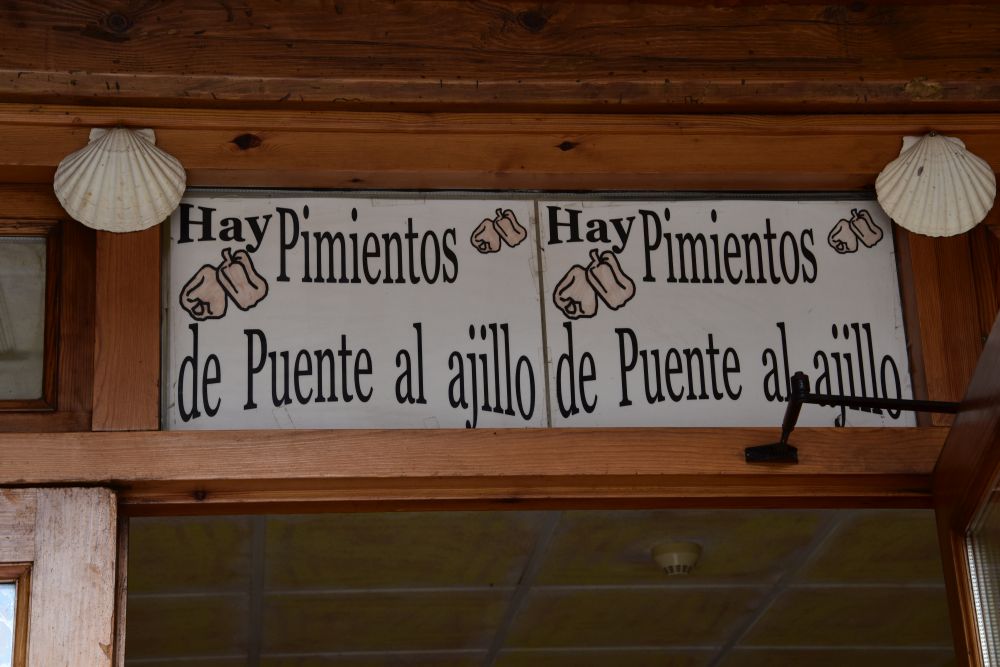
Then they are marinated in garlic. Shops and restaurants sell them (note the two pilgrim’s scallops).

In the restaurant La Plaza, I eat marinated pimientos as a pintxo (snack) and they are very, very delicious.


The monastery Iranzu

The sun shines for some hours and we benefit from this rare occurrence by driving to the mountains, where the secluded Cistersian Monastery Iranzu from the 12th century welcomes us.

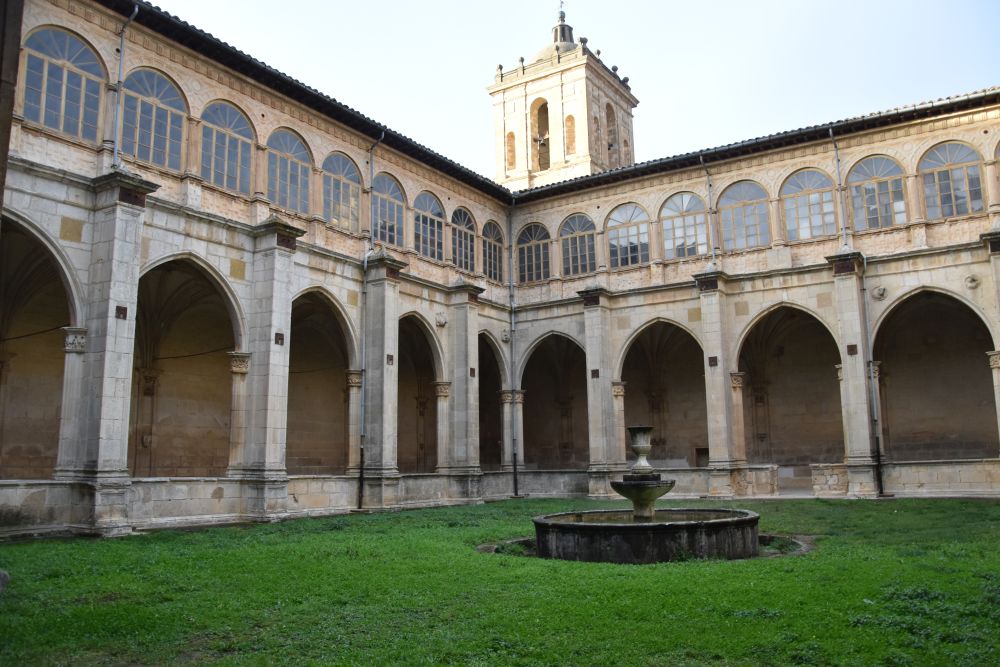
We arrive just in time to visit the monastery, before it closes. This is the cloister…

… with the beautiful fountain.

The sun brings the rosettes on to the wall of the gangway.

The church is sober. The Cistercians were masters in laying bricks precisely.

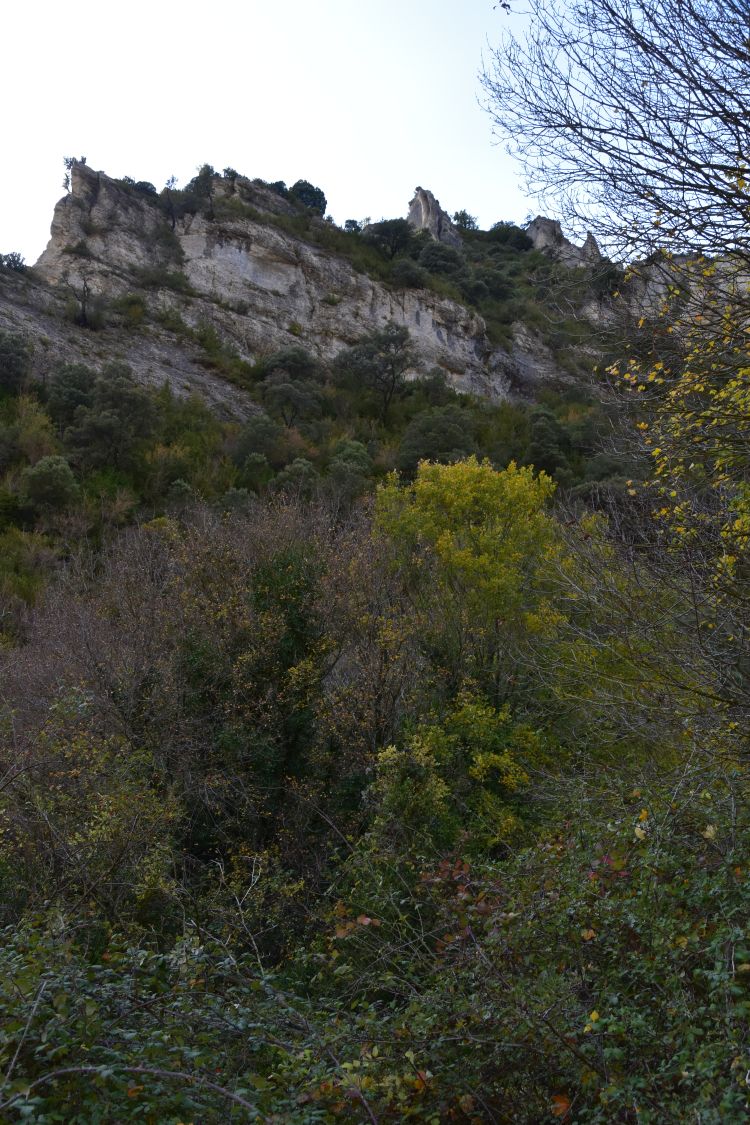
In the sun, we head off to walk in the canyon behind the monastery.

Panels explain the geology and the biology of the valley. The mediterranean vegetation is changing to a eurosiberian vegetation, as we climb higher. Typical of the mediterranean vegetation are for example ilex (Steineiche), acorns, poplars and pine-trees, whereby higher up, in the eurosiberian vegetation, oak trees and beeches are dominating.

We are caught by rain again, return to our car as fast as possible and, swish-swish-swish, drive to Irache.


The Benedictine monastery Irache is also a bodega

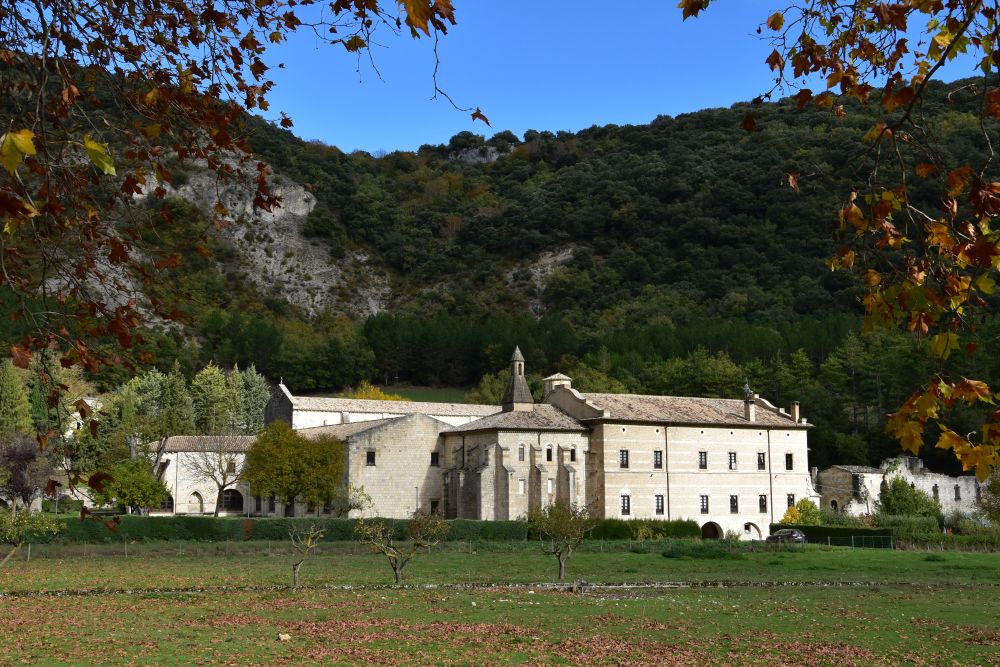
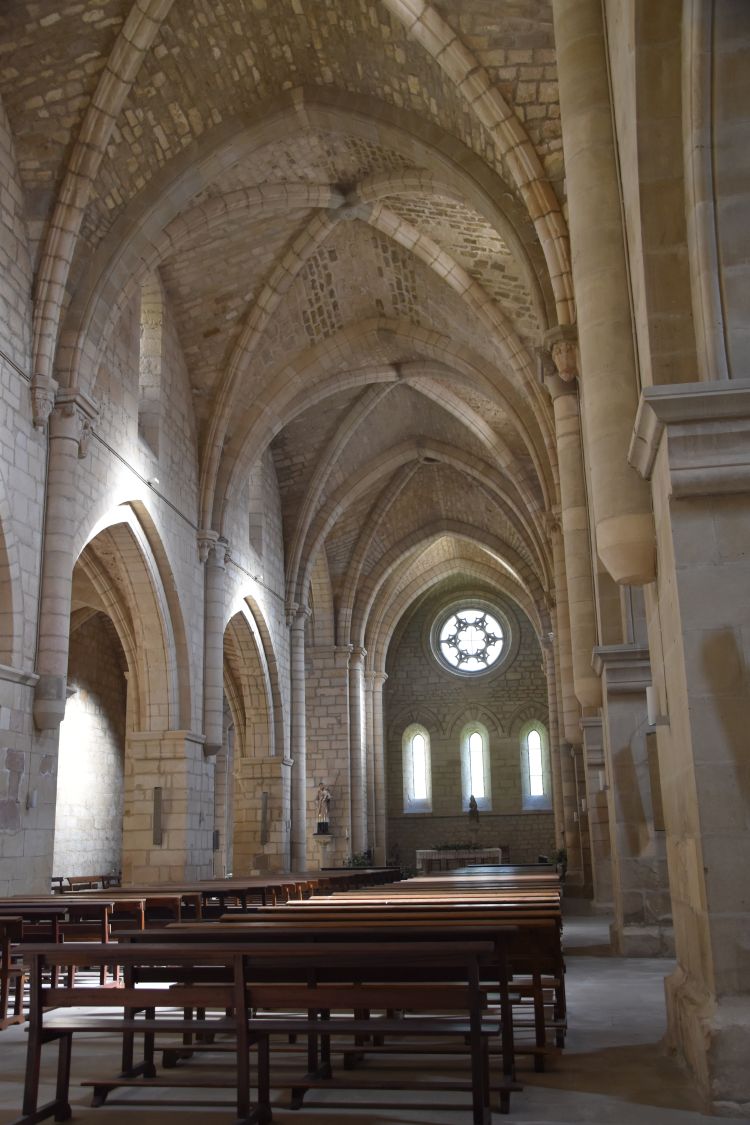
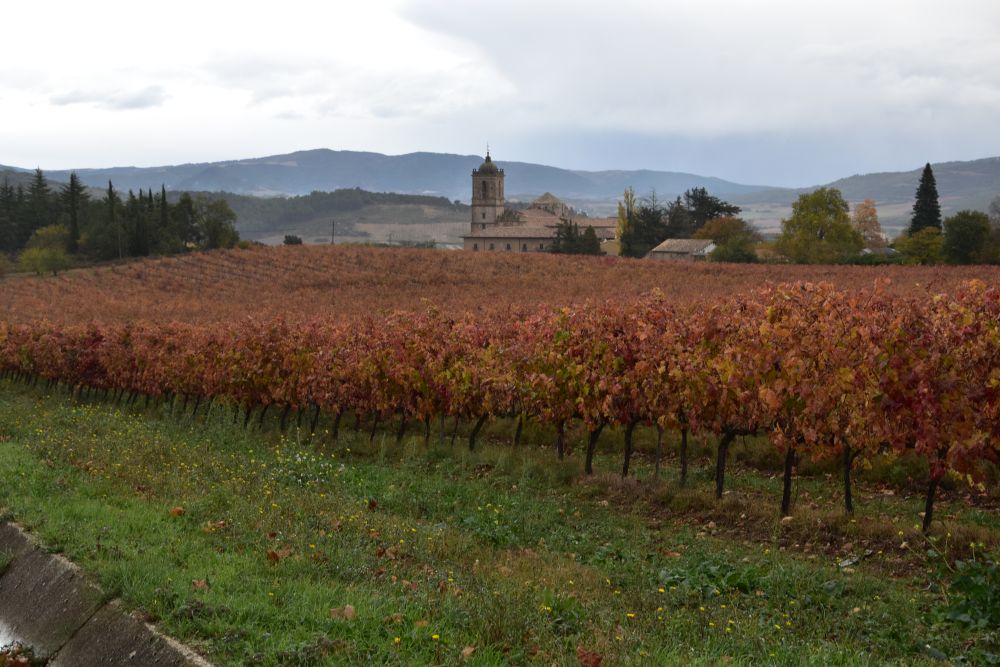
The Benedictine Monastery Irache is beautifully located within its vineyards.

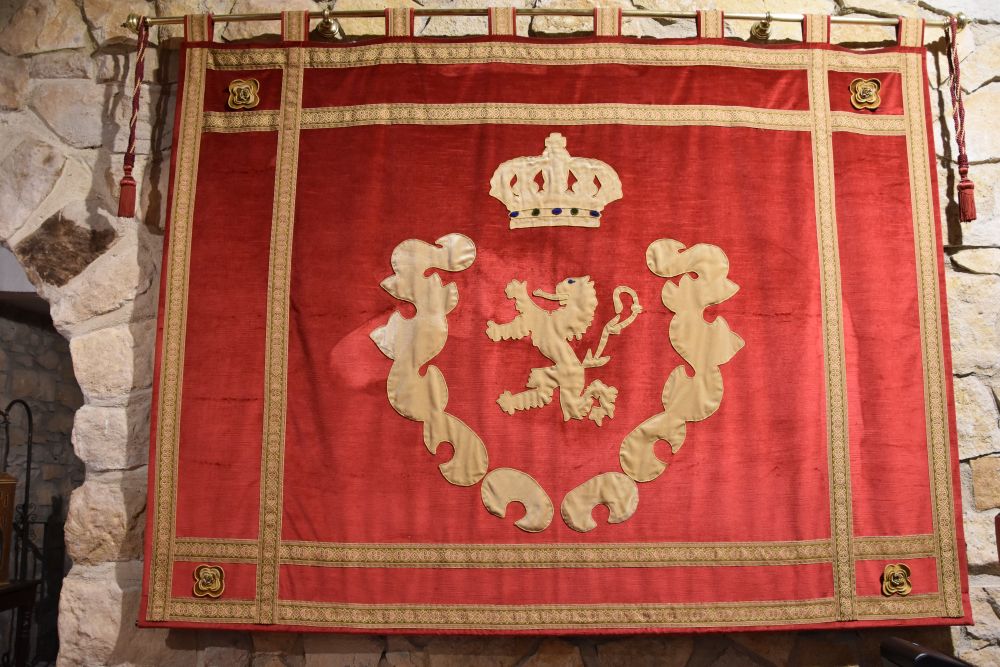
Their emblem is the golden lion on red background. In the shop, I buy a bottle of Garnacha rosé and a bottle of Vino de Pago (Tinto). Vino di Pago is a label that only three bodegas of Navarra carry, as they process their own grapes, which gives their wines the character of their territory, while the territory as such does not carry the DO label.

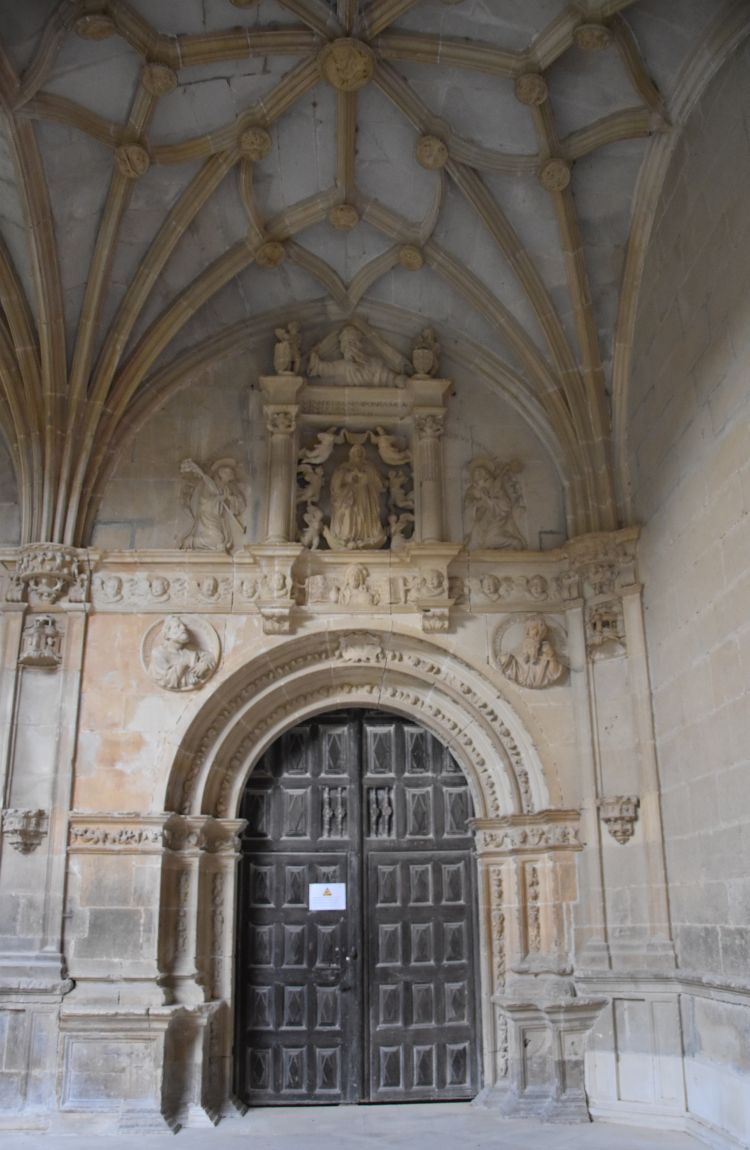
The monastery can be visited for free. It is under restoration and only the Plateresque cloister is accessible,…

… with the porch and the medaillons that they are proud of; they explain each of them.

We drive back to Pamplona. Fog and rain accompany us.

Tomorrow we plan to see Rioja Alavesa, Laguardia and Elciego.

Sources: Marion Golder: “Nordspanien und der Jakobsweg”, Dumont Reise-Handbuch, Ostfildern 2018; Marion Trutter (Editor): “Culinario España, Spanische Spezialitäten”, Tandem Verlag 2015; “El mundo del vino”, Edition Larousse.

On the road to Spain: Pamplona – treasures in the Cathedral and the Museum of Navarra

In November 2019, we spend four nights in Pamplona on the Agra River exploring the City and the treasures in the Cathedral Santa Maria La Real and in the Museum of Navarra.


The Cathedral of Santa Maria La Real

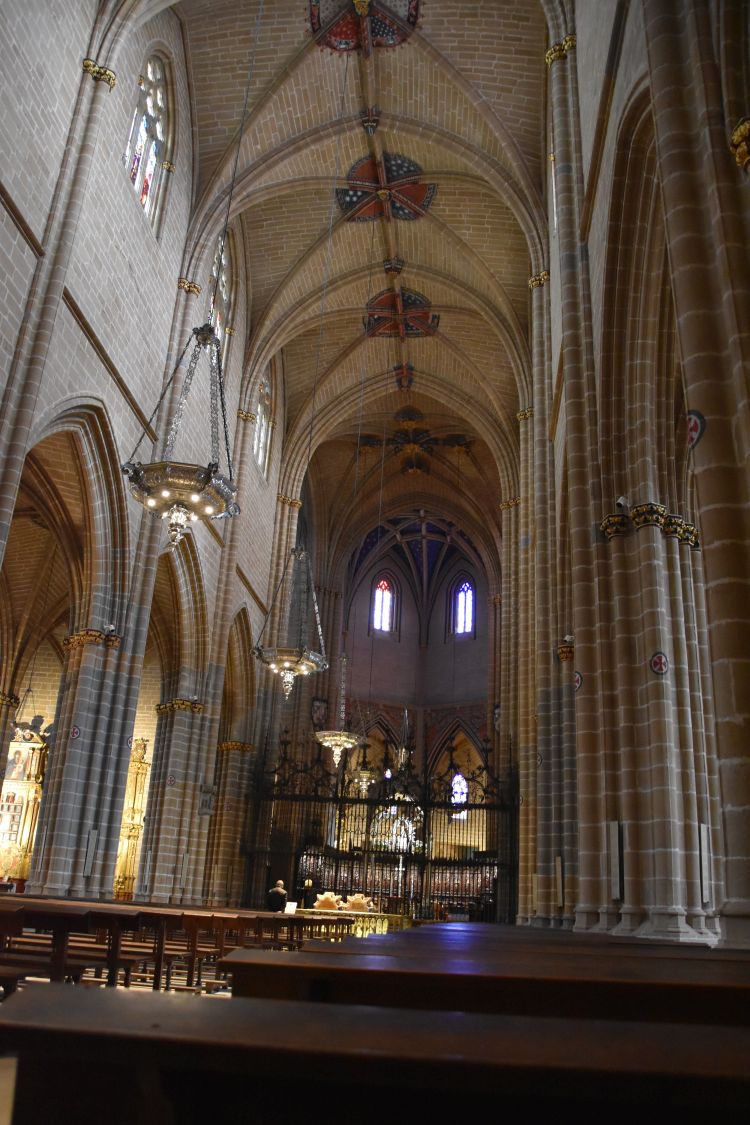
The Cathedral of Santa Maria La Real is located above the river Agra. The church was built in the 14/15th century and is of gothic style. The choir with the stalls is in front, which makes the nave open and uncongested (differing from many Spanish cathedrals, where the choir is in the middle of the nave impeding the view of the overall beauty of the nave).

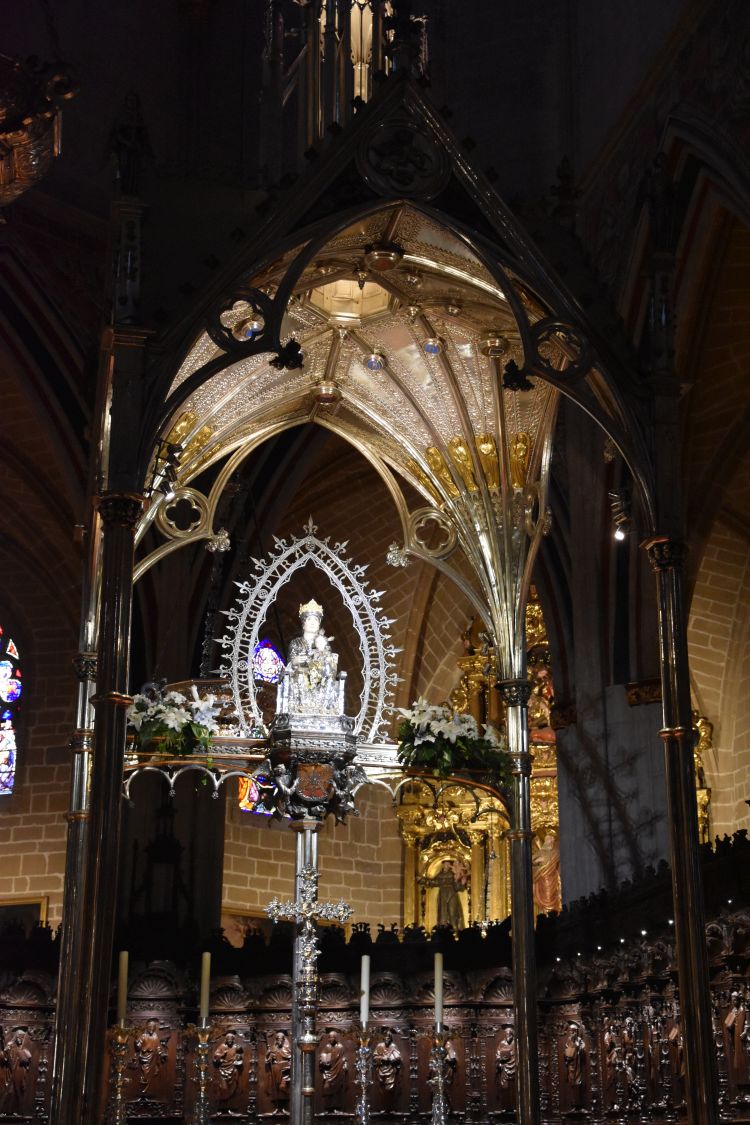
The statue of Maria from the 12th century sits under the silver baldachin.

Carlos III the Noble and his wife are buried in front of the choir. The15th century tomb slab made of alabaster has been beautifully carved. Carlos III is the king that managed to make peace between the local Navarrese and the “foreign” Franconians. The latter had immigrated to Pamplona in the 11th century and had kept on living in a town district of their own, even separated by a town wall. Carlos III mediated between the antagonists, pulled down the wall and constructed the townhall at the former borderline. With respect, I look at him.

And with respect, his subjects mourned, as the beautiful small statues around the tomb illustrate.

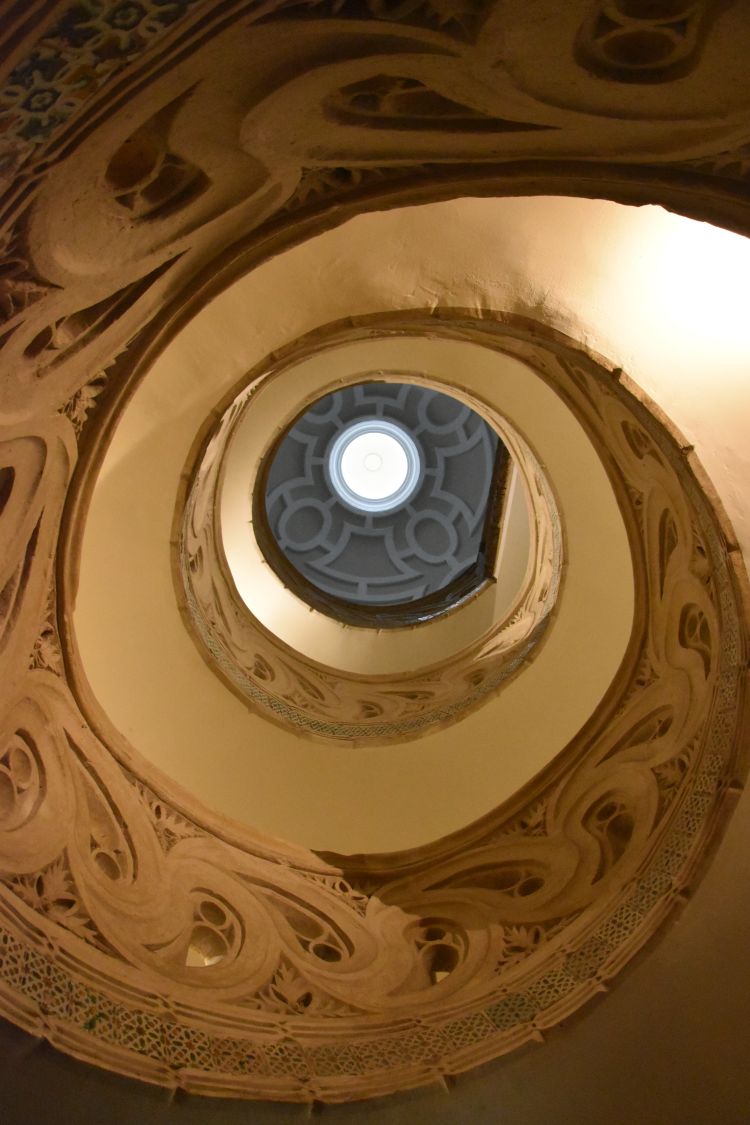
In the gangway to the cloister, I find this elegant spiral staircase.

The filigree arches in the cloister seem to dance.

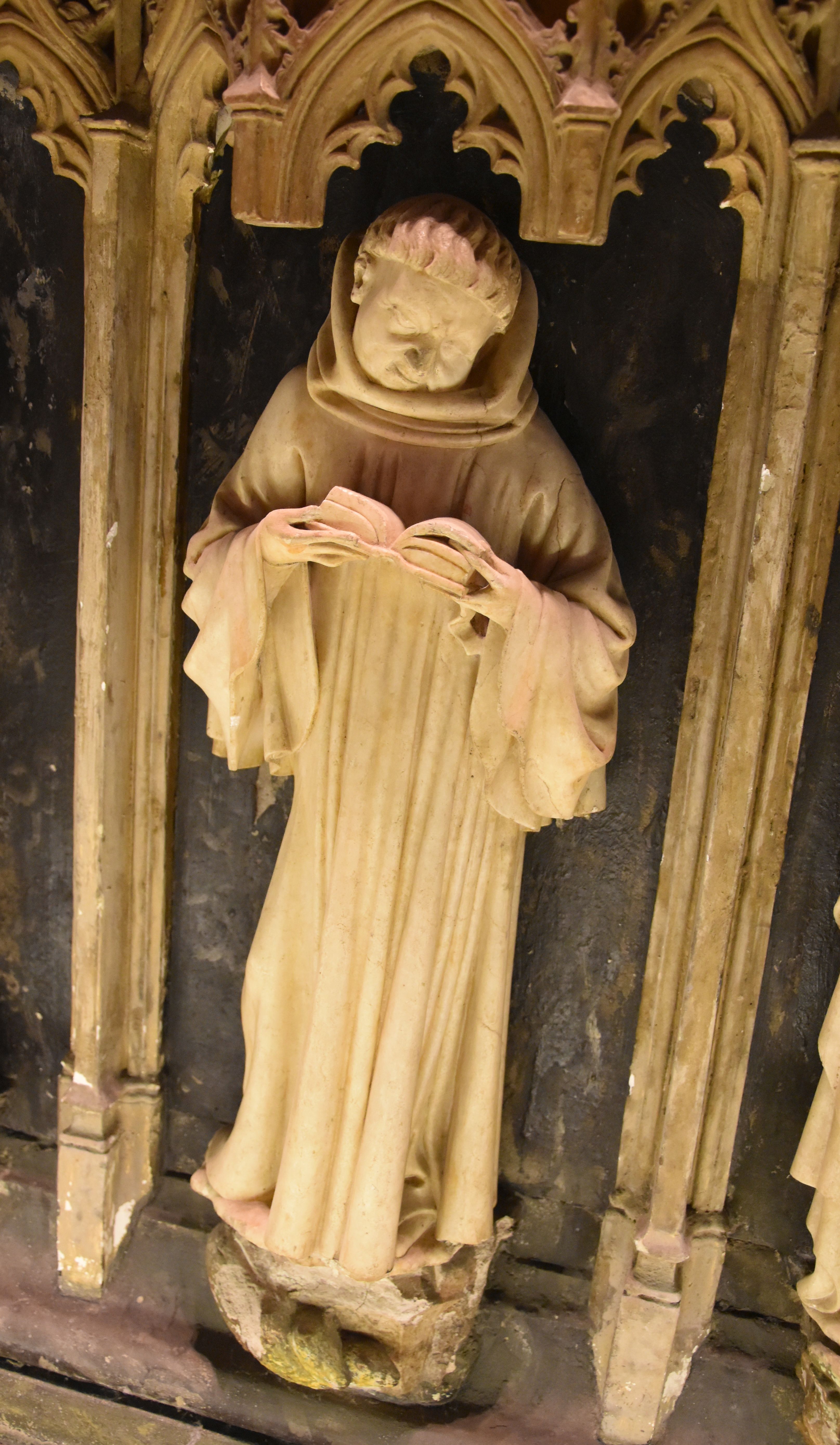
Bishop Barbazán was buried in the chapter house in 1355. A small angel seems to adjust his cushion carefully.

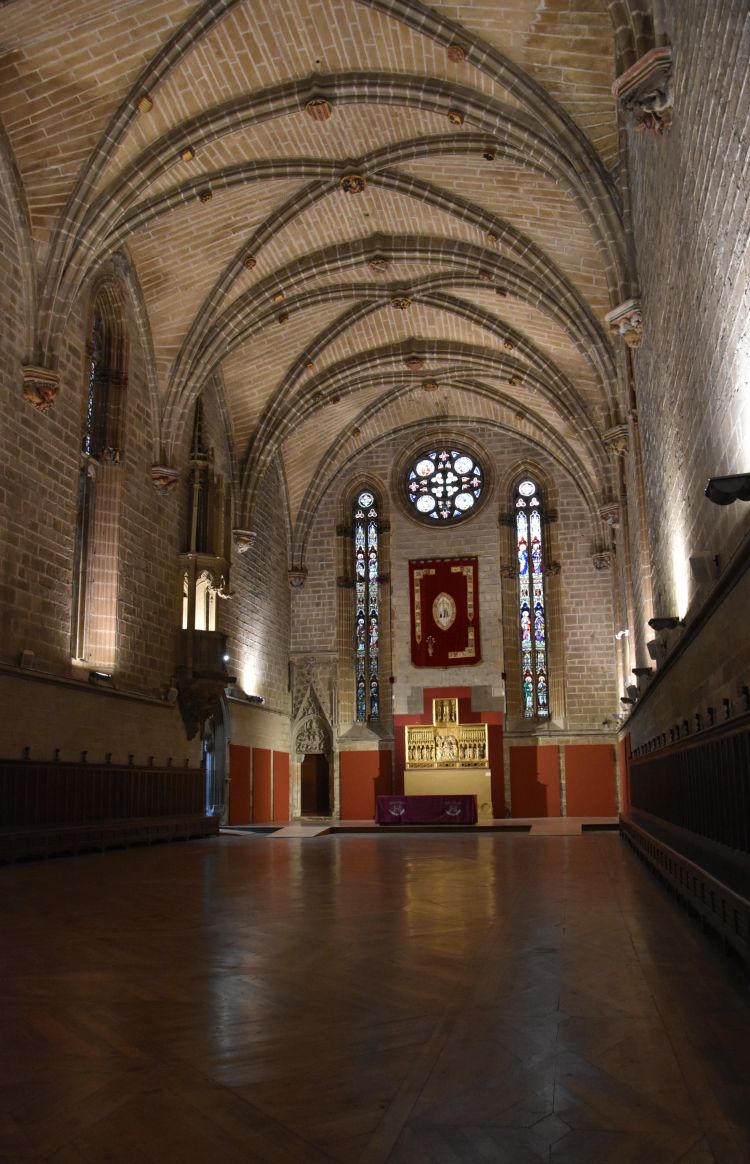
The refectory looks like it was a stylish place to eat. It was built around 1300 and measures 30mx10m.

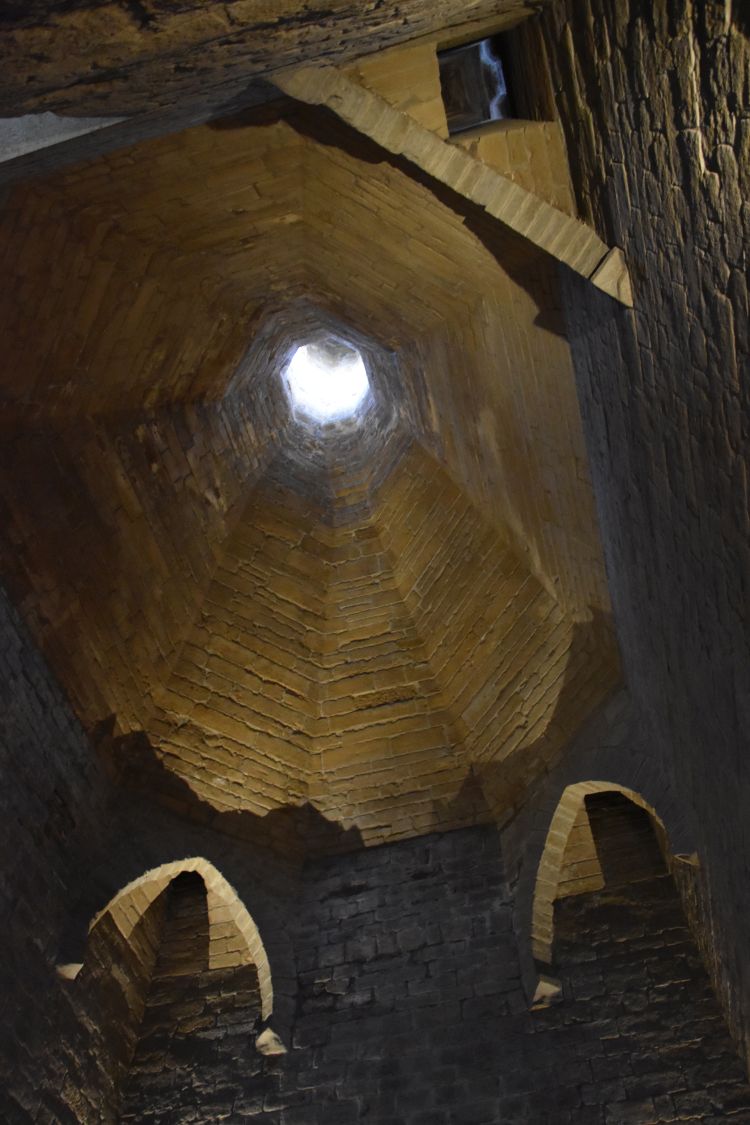
Nearby is the kitchen from the 14th century, with the long-long chimney.

Attached to the cloister is the Museo Diocesano with the exhibition “Occident” that illustrates the history of Christian culture in Europe.


The Museum of Navarra

We spend a full day in the Museum of Navarra that shows exhibits from archaeology and art that are related with the history of Navarra from prehistoric times until today.

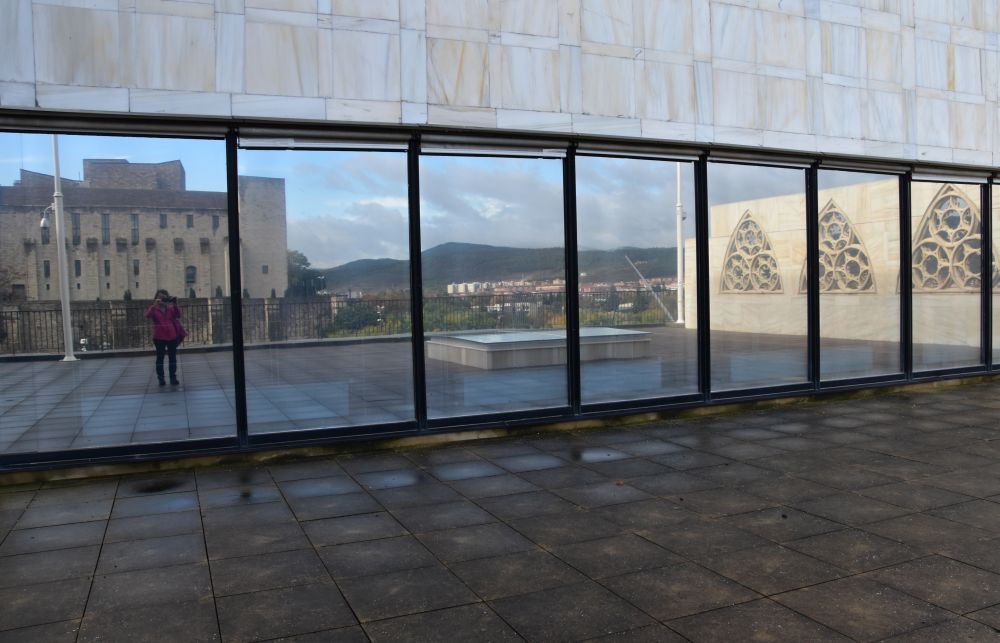
The Museum is located in a former hospital. On the terrace, we find a great view of the Pyrenees and the city.

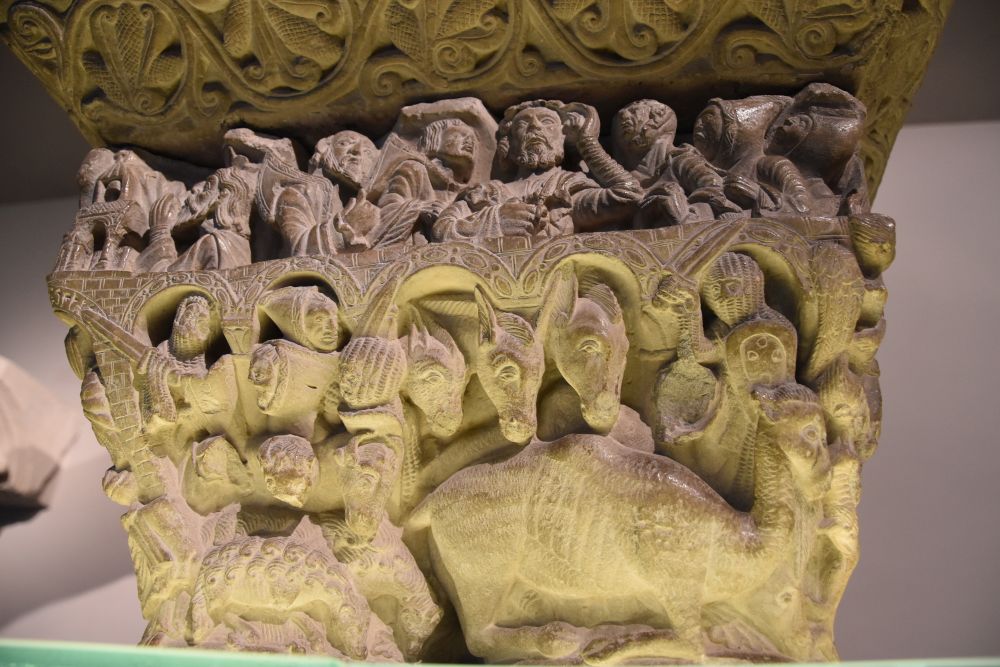
In the halls about Romanesque, we study Hiob’s fate in detail. Maestro del Claustro de la Catedral de Pamplona created it in the 12th century. The happy days of Hiob, his fall and his resurgence are illustrated on all four sides of the column. This is Hiob living happily with his family and his animals.

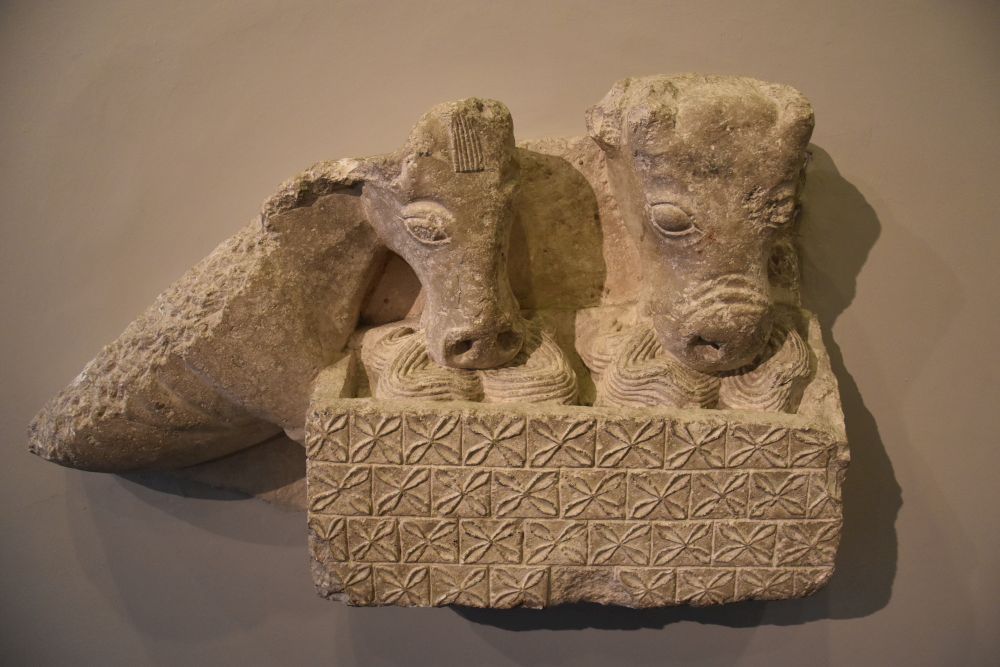
I very much like the elegance of this ox and donkey, a fragment from a nativity sculpture from the Cathedral of Pamplona.  Maestro Estebán made it in the 12th century.

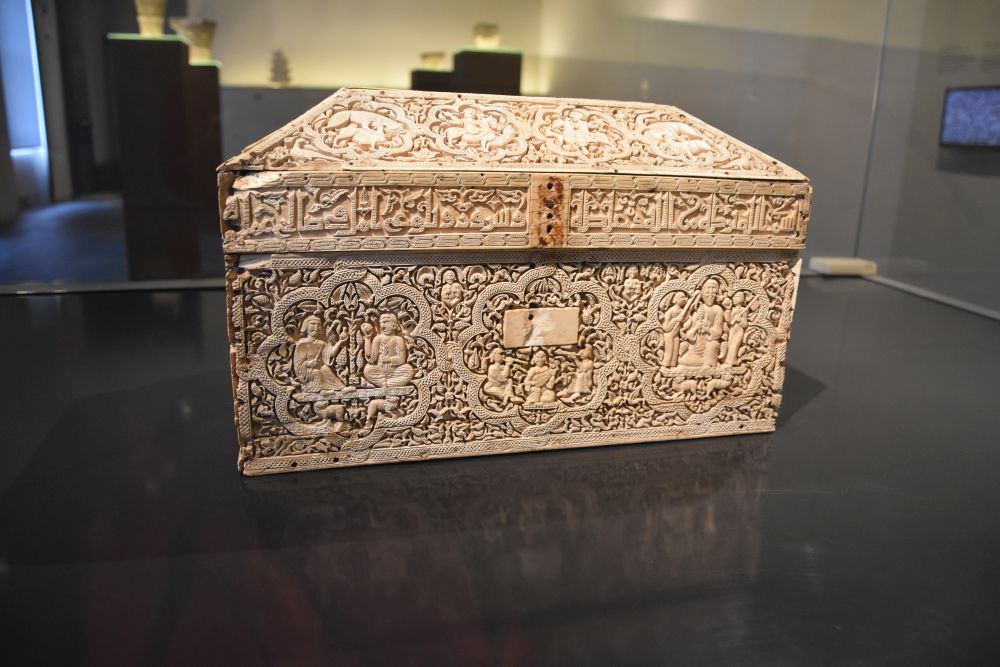
The ivory case “Arqueta de Leire” has been carved by Maestro Faray in Córdoba during the Umayyad Caliphate (up to 1031). It shows fine hunting scenes. The representation of human beings and animals is unusual for Islamic work of art. The case is from the Monasterio de San Salvator de Leyre. One of the inscriptions says “En el nombre de Allah”.

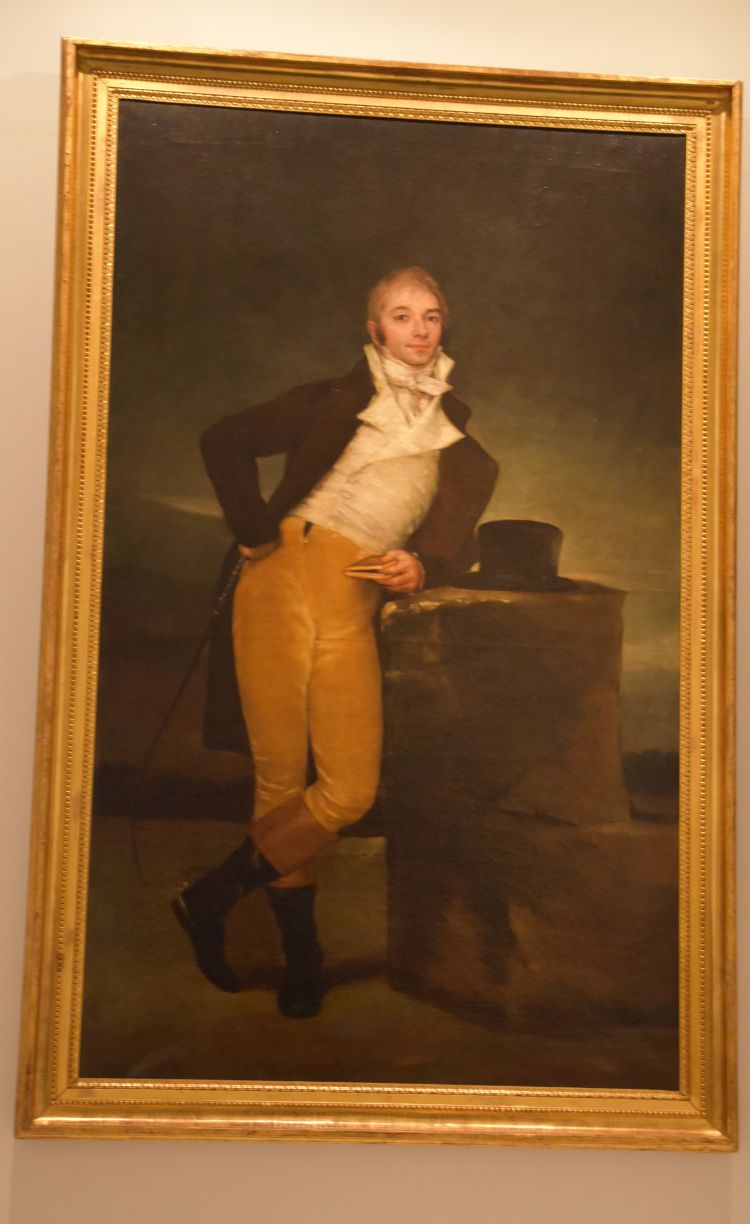
Goya painted a friend of his, Marqués de San Adrián. A noble young man in elegant velvet trousers. He has taken off his hat which creates an atmosphere of casualty and confidentiality.

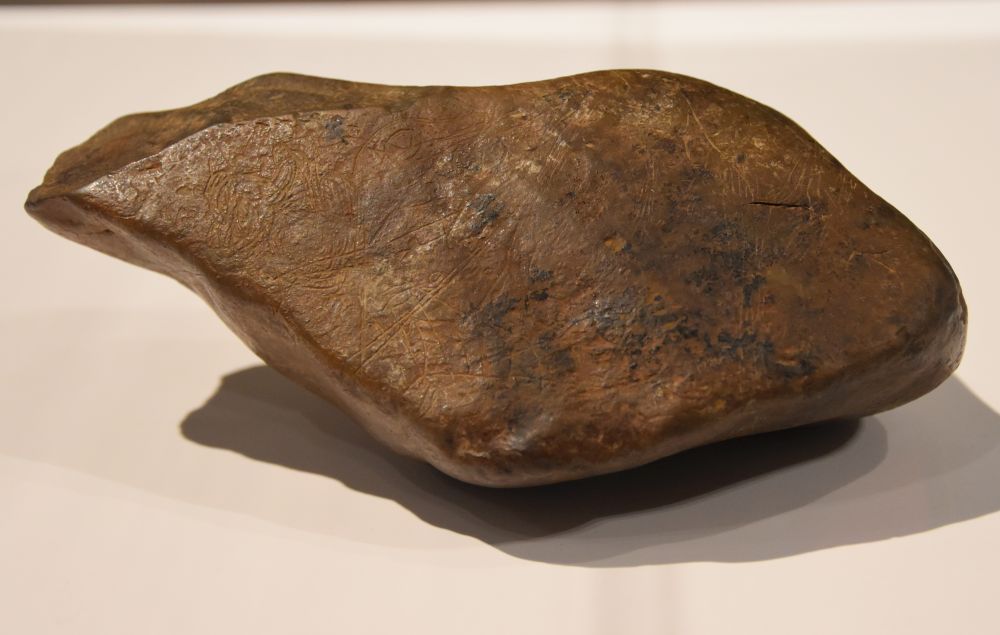
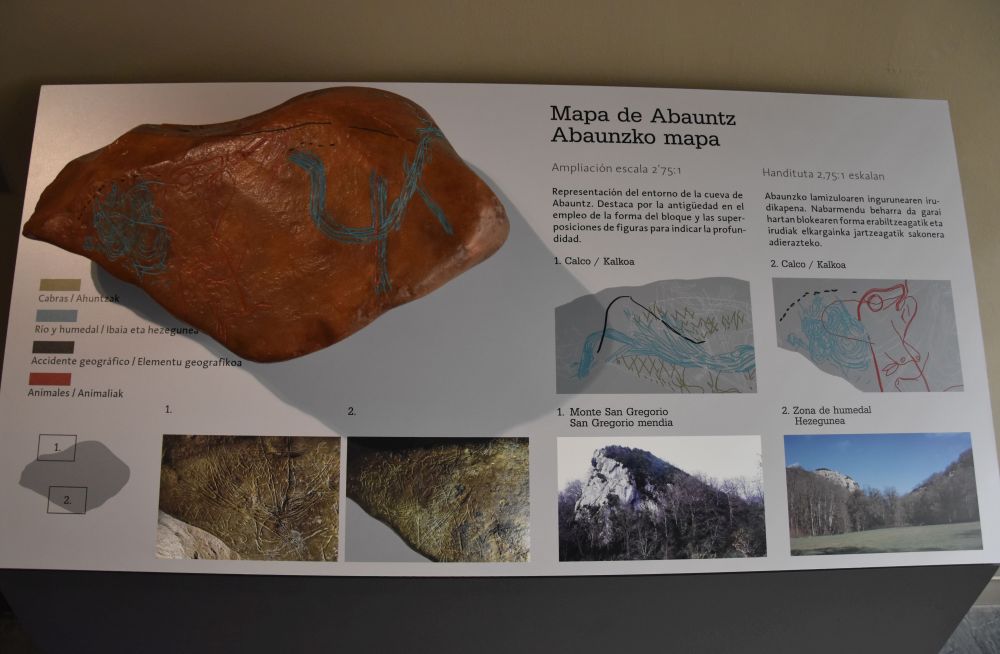
The Museum is proud of their Mapa de Abauntz. Never have I seen a prehistoric map engraved on a stone. It is the most ancient map ever found, about 13’000 years old. Abauntz is a cave located about 25km north of Pamplona.

Panels explain what archaologists found on the map: Rivers, mountais and places for hunting goats (cabras) and other animals.

These maps are not as easy to read as the Swiss topological Maps of today… I admire the imagination of the archaeologists.

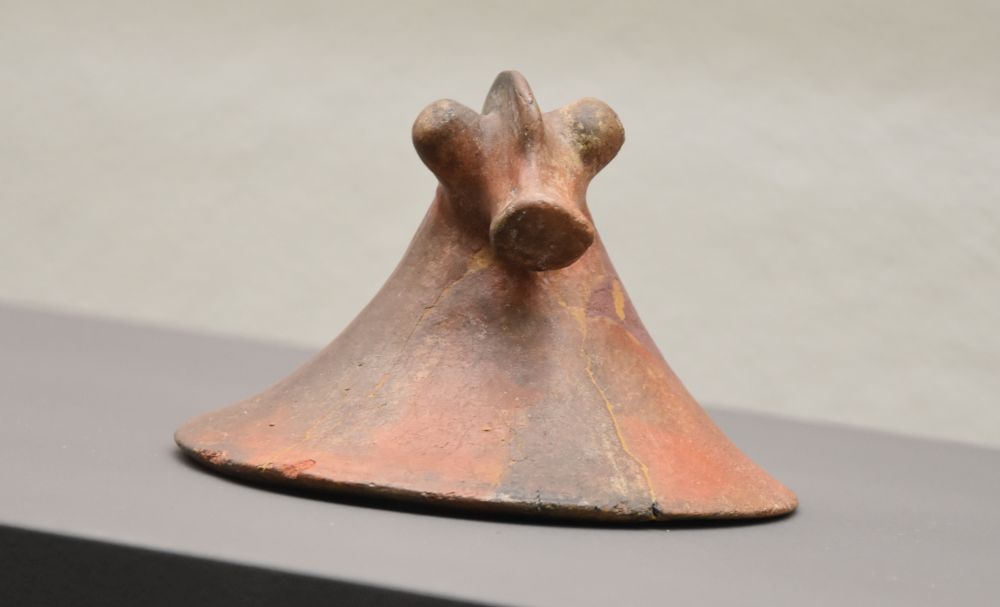
From the necropolis of Castejón (about 80km south of Pamplona), this charming horse shaped urn cover has been brought to the Museum of Navarra.

We spent a full day in this interesting Museum of Navarra – to be recommended! Especially on the rainy days that we experience now.

Next we explore the surroundings of Pamplona, Punta de Reina and Laguardia.


Sources: Marion Golder: “Nordspanien und der Jakobsweg”, Dumont Reise-Handbuch, Ostfildern 2018 and “Museo de Navarra”, edited by the Gobierno de Navarra.

On the road to Spain: Via Zubiri to Pamplona

In November 2019, we are traveling through France to Spain. From our first stop in Spain, Roncesvalles, we drive to Pamplona, with a stop over in Zubiri.

Source: Googlemaps


Crossing foggy and rainy hills to Zubiri with the Puente de la Rabia

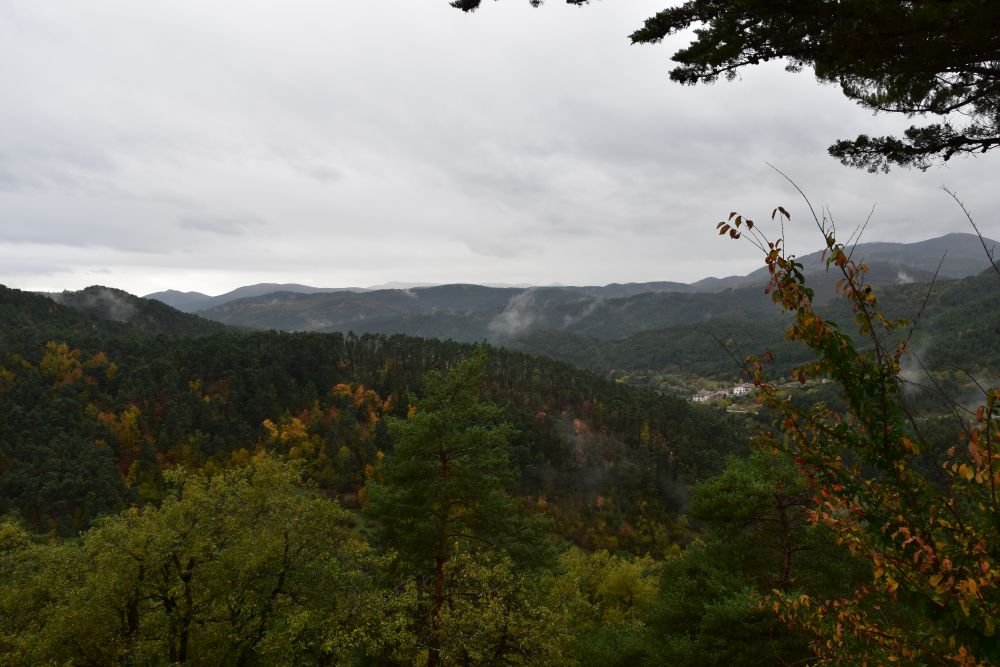
From Roncesvalles, the road leads over two passes. The rainfall never stops and we feel compassion with the humpy pilgrims that, hidden under their rain capes (covering their back bags as well), bravely walk along the path of St. James crossing the main road from time to time. It has been raining for a week now, and there is no end in sight for at least another week. I do not know, whether I would feel like joining the pilgrims walking in the rain. I am pretty sure that I prefer to remain dry in our car, while our windscreen wipers go “swish-swish-swish”.

The villages on the way are full with guest houses for pilgrims. Good business, since the 11th century.

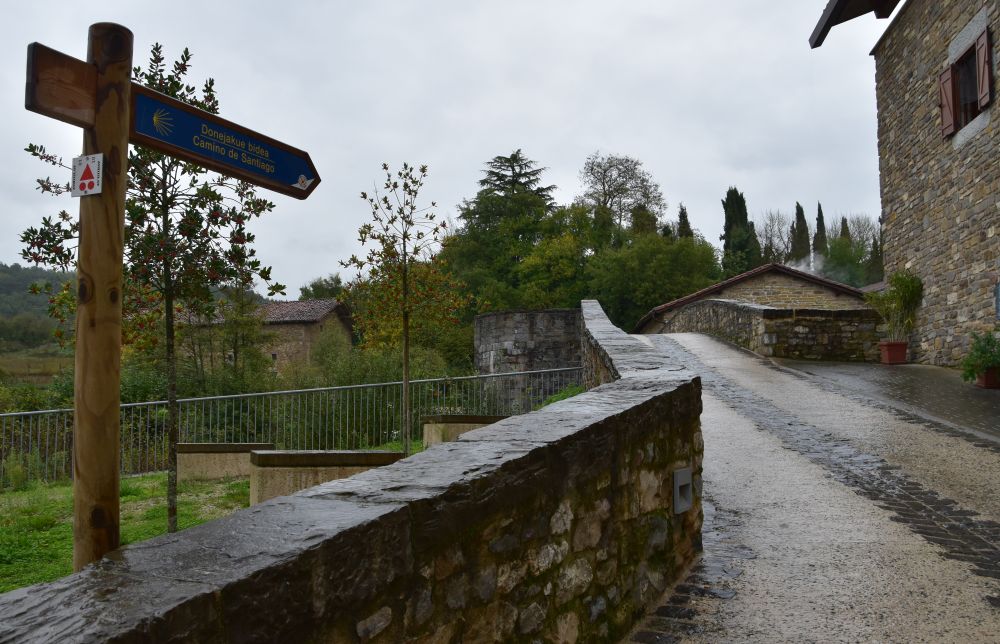
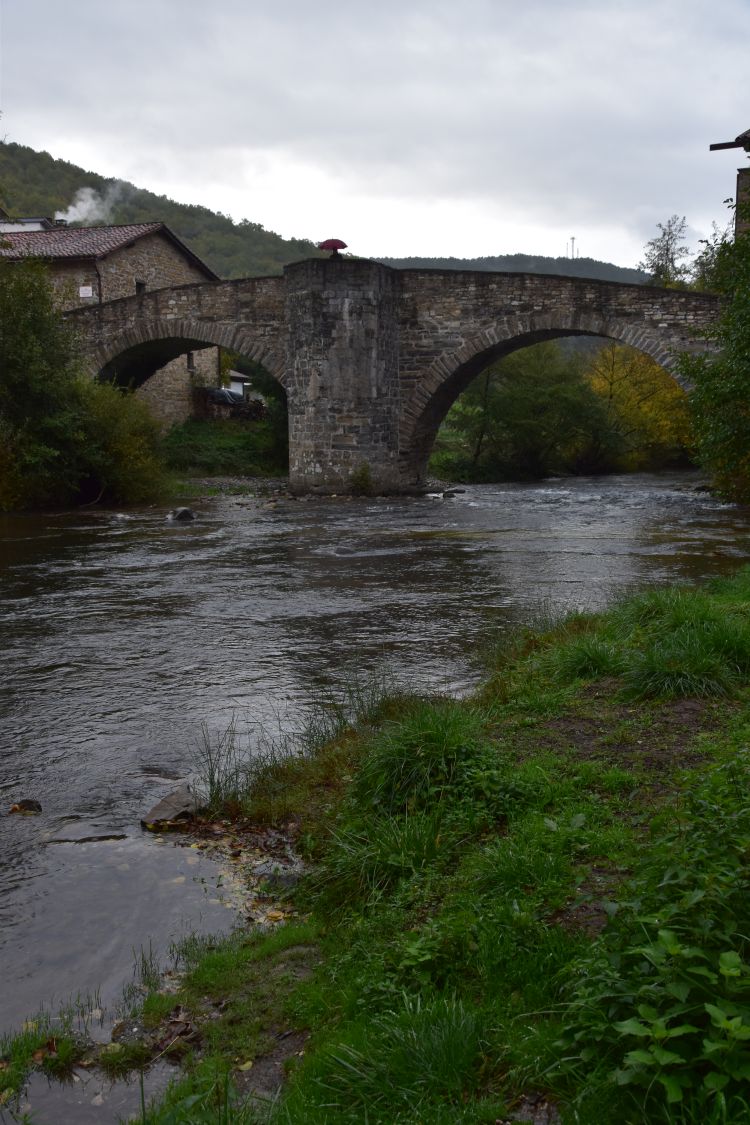
Zubiri is known for the medieval Puente de la Rabia over the river Agra. The Way of St. James crosses the bridge.

The bridge cures animals suffering from rabies – this is the legend. It seems that relics of Santa Quiteria, a martyr from the second century, have been found here. She would calm barking dogs and for this reason, she became known for curing rabia. Somewhat interesting. Nevertheless, I would not miss vaccination against rabia, when traveling to countries, where I could come across it, even after having been on this bridge.

People cross the rabies bridge with their umbrellas. Yes, it IS raining.

After Zubiri the valley opens and the mountains recede. We reach the basin of Pamplona.


Pamplona – known for their bulls

In Pamplona, we settle in the business hotel Los Tres Reyes, conveniently located, where the old city begins. Three kings, this alludes to the union of the kings of Navarra, Castilia and Aragon.

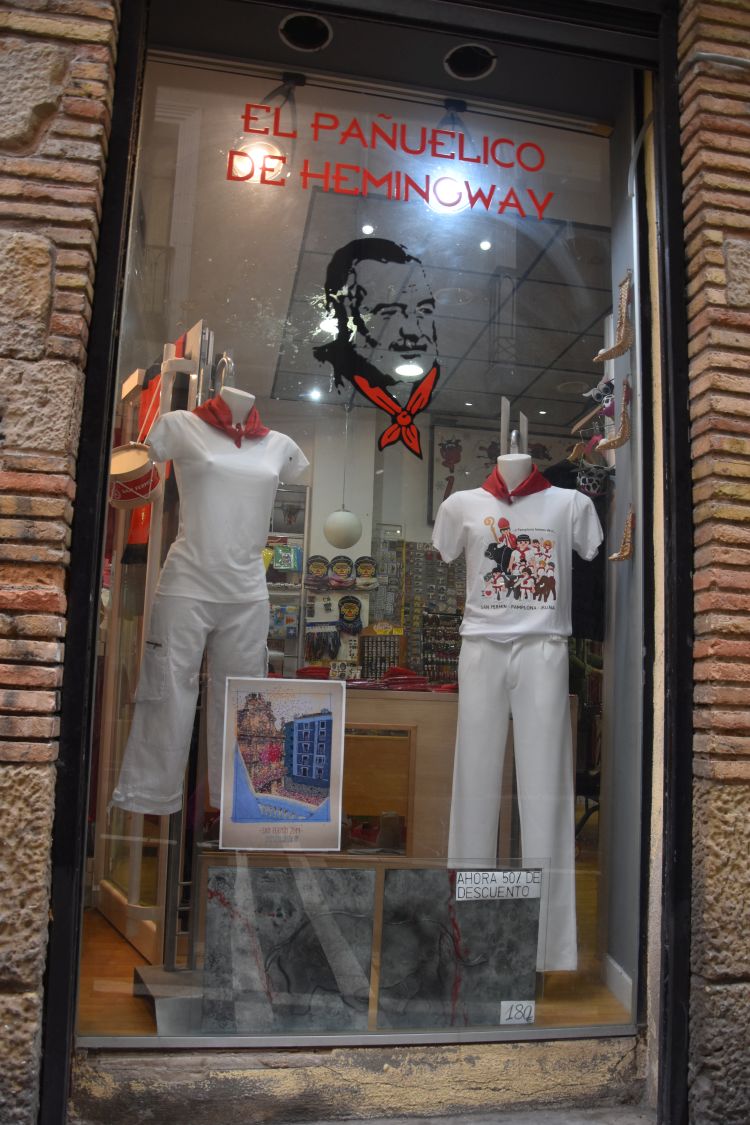
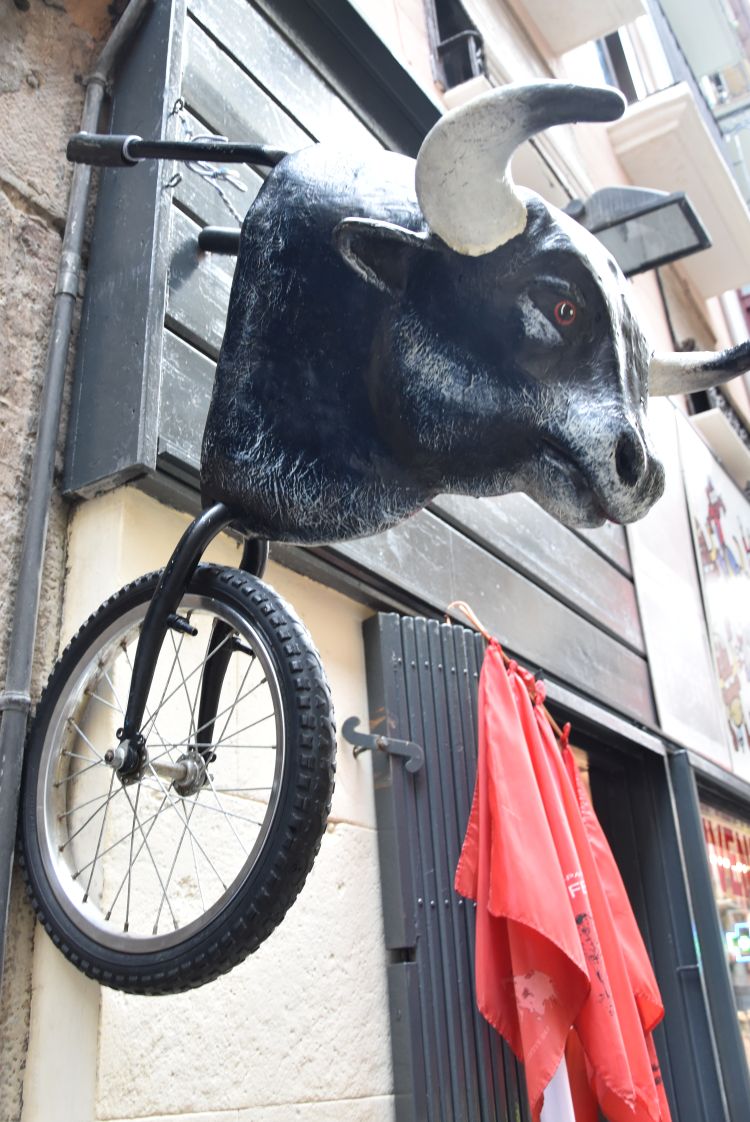
The city is known for bullfighting. In July (Sanfermin), the bulls run from their corrales through the narrow streets of the city center to the bullfight arena. Young men dressed in white with red scarves and red belts run with them, a pretty dangerous event. That is reflected in the shops. They sell the typical outfit and they also remind of Hemingway who has described Sanfermin in his novel “the sun also rises”.

Shop windows show videos about Sanfermin and childrens’ toy shops have sets to practice bullfighting.

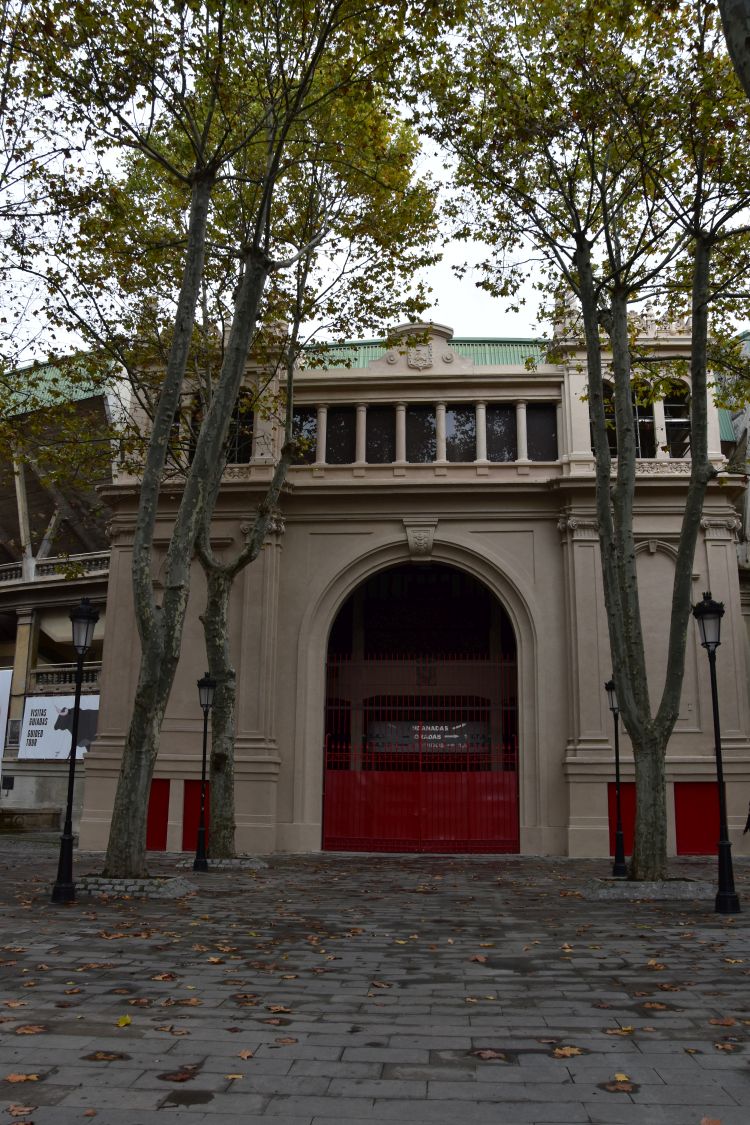
This is the entrance to the bullfighting arena.

Bullfighting is not really for me… I fell in love with Pamplona for other reasons, namely for the nice old town that invites for strolling and for all the works of art we found in the Cathedral and in the Museum of Navarra. Let me talk about some impressions in the city center first.
 

Strolling through the old city center of Pamplona

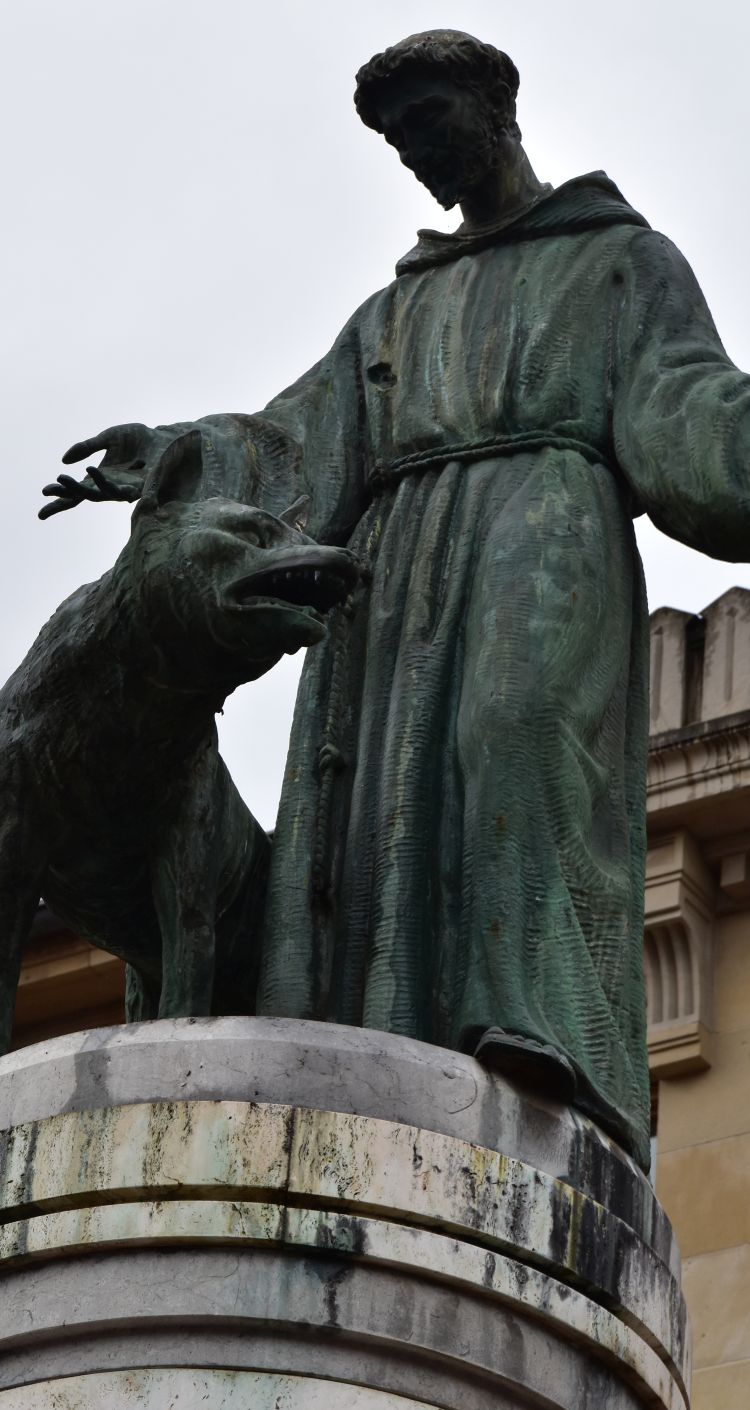
Not far from our hotel, St Francis welcomes us on the namesake square. He seems to have a discussion with this wolf.
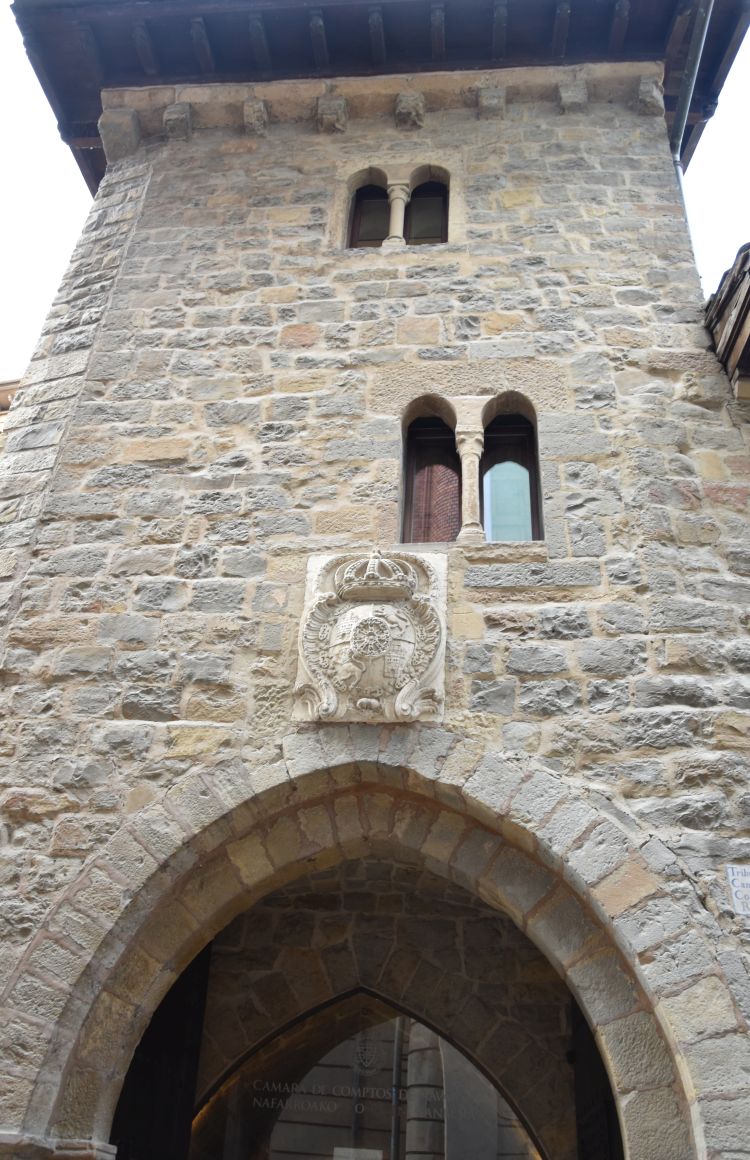
There are various Palaces in the city, with the Tribunal de Cámara de Comptos Reales being the oldest. It was built in gothic style in the 13th century. The public finances are controlled here.
The town hall or Casa Constitutional was constructed by Charles III the Noble in the 15th century at the point where two city districts fighting one another had their frontiers. In one district lived the Navarrians, in the second district the Franconians. Charles III is called “the Noble”, because he succeeded to mediate between the two antagonizing parties. The town hall was reconstructed in the 19th century, but the baroque facade was preserved.

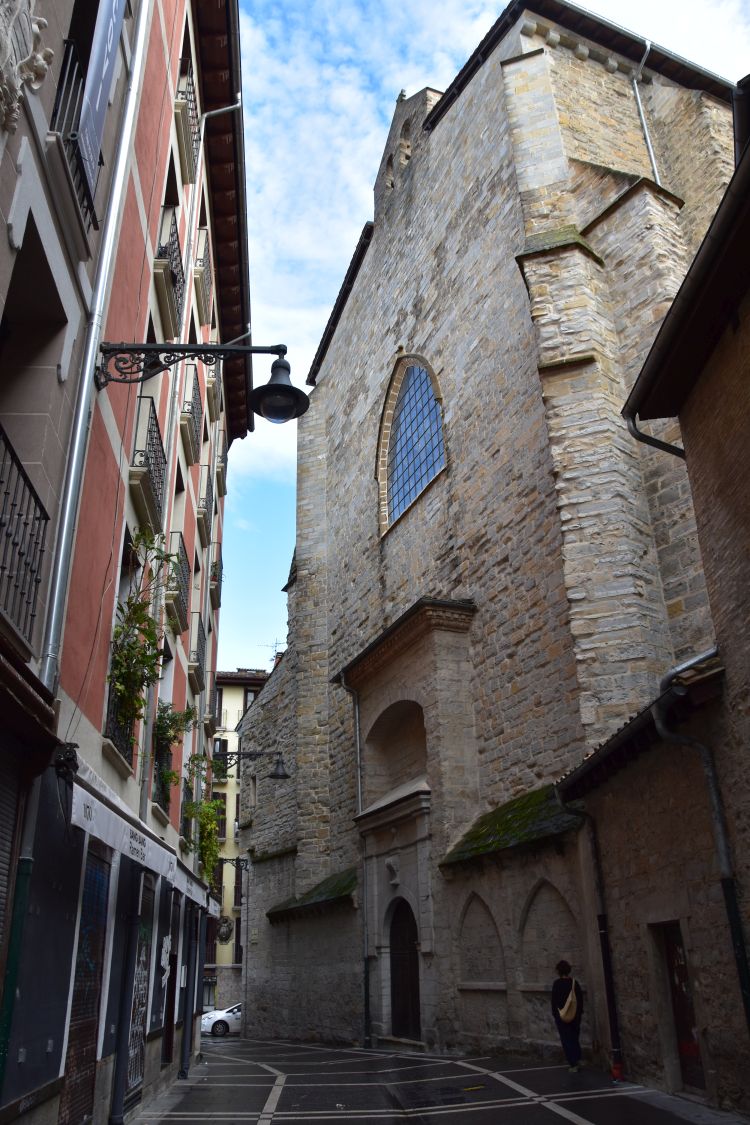
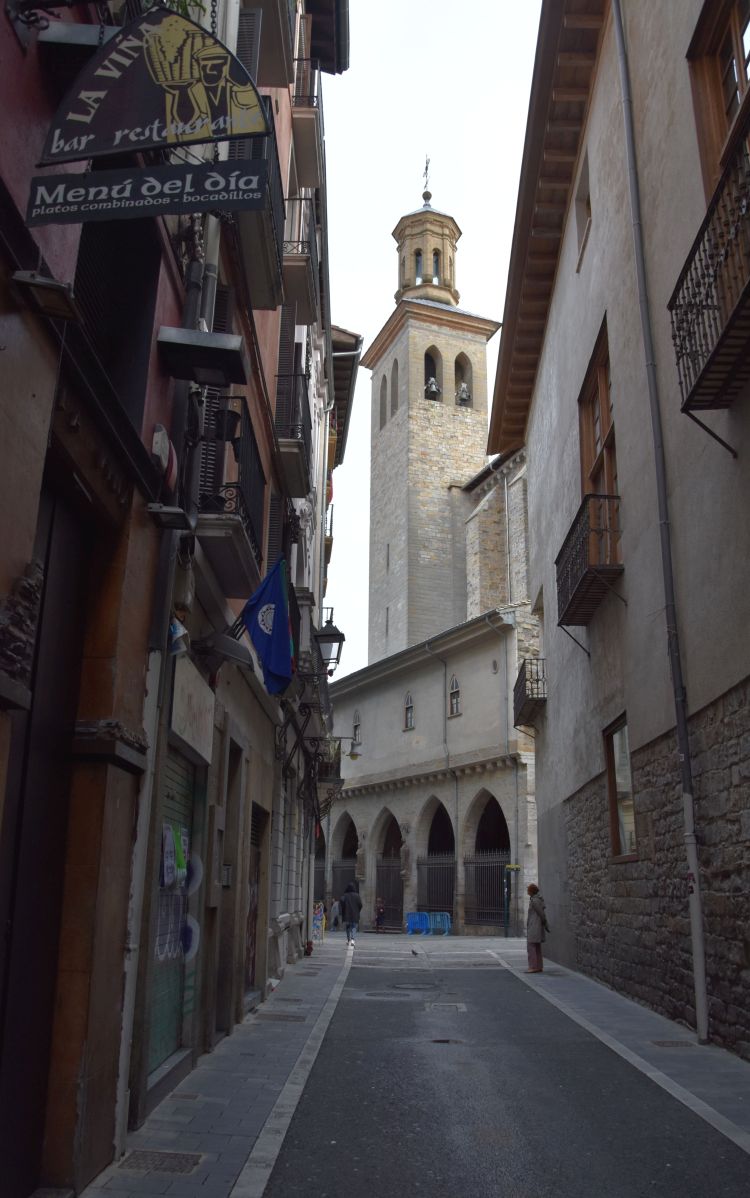
The Romanesque church of San Saturnino is from the 12/13th century.

It is of defiant stance. This is the tower with the narthex.

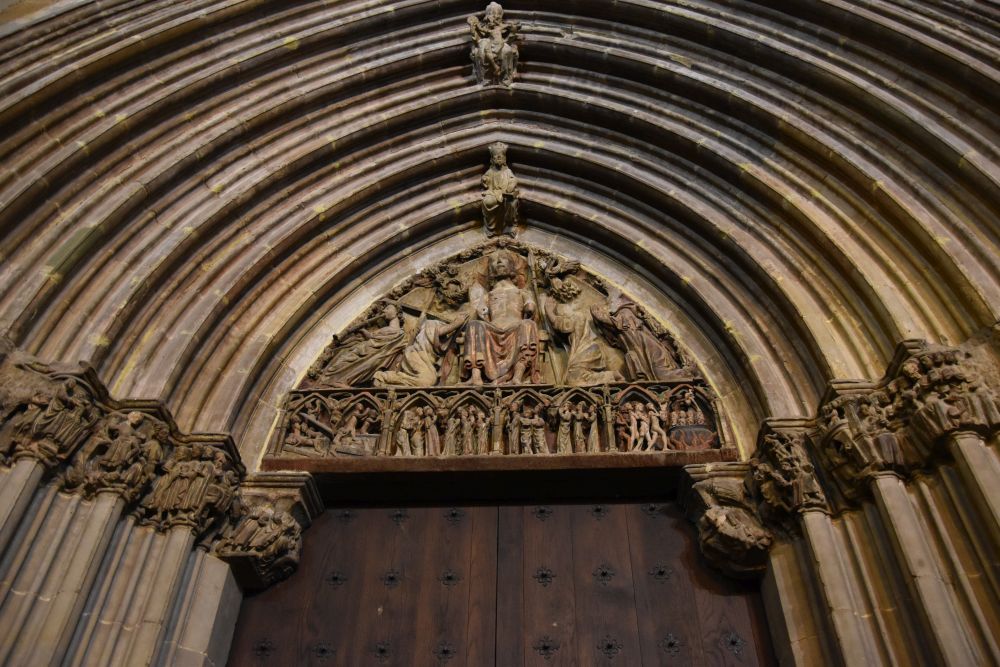
Inside the narthex, the tympanon above the porch presents the Last Judgment with Paradise and Hell.

A service is going on inside the church. We attend it for a little while. The priest in front of the altar wears a red gown. The altar is decorated with white flowers. What a solemn atmosphere under the sober Romanesque vaults!

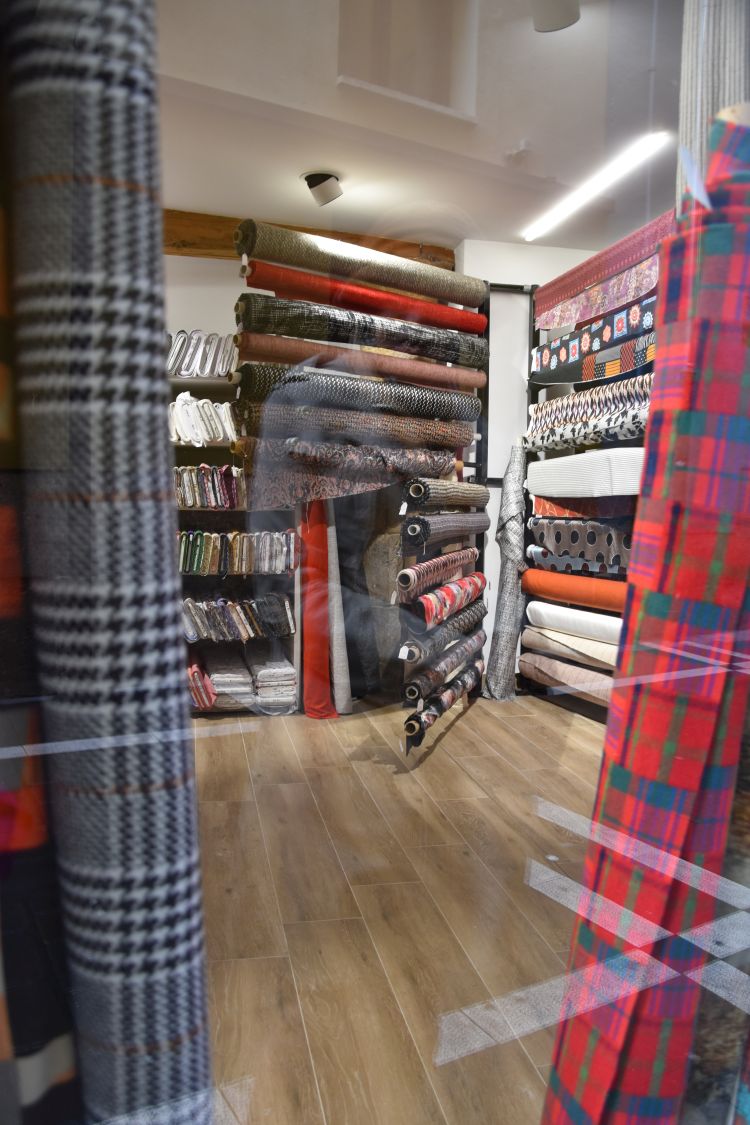
We leave the service and continue to walk through the narrow streets. Never before have we seen so many draperies and in some of them tailors are working at their sewing machines.

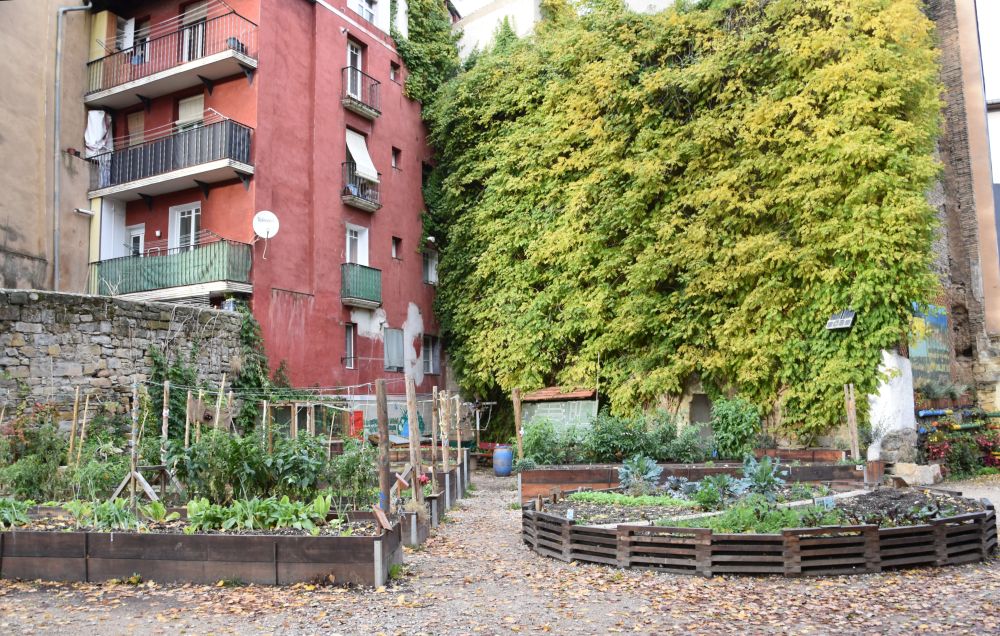
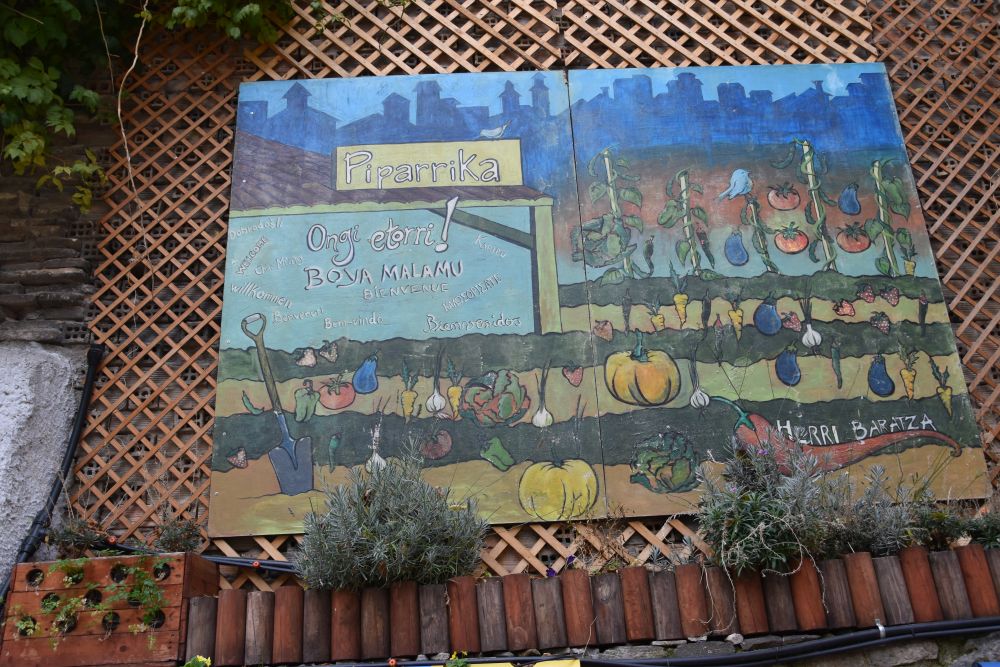
This backyard has been turned into a vegetable garden. What a great initiative.

The habitants call it “Pipparika” which might be Basque.

Inside the city, we find many small bars that sell pintxos (called tapas elsewhere in Spain). Great for short breaks, when strolling through the streets.

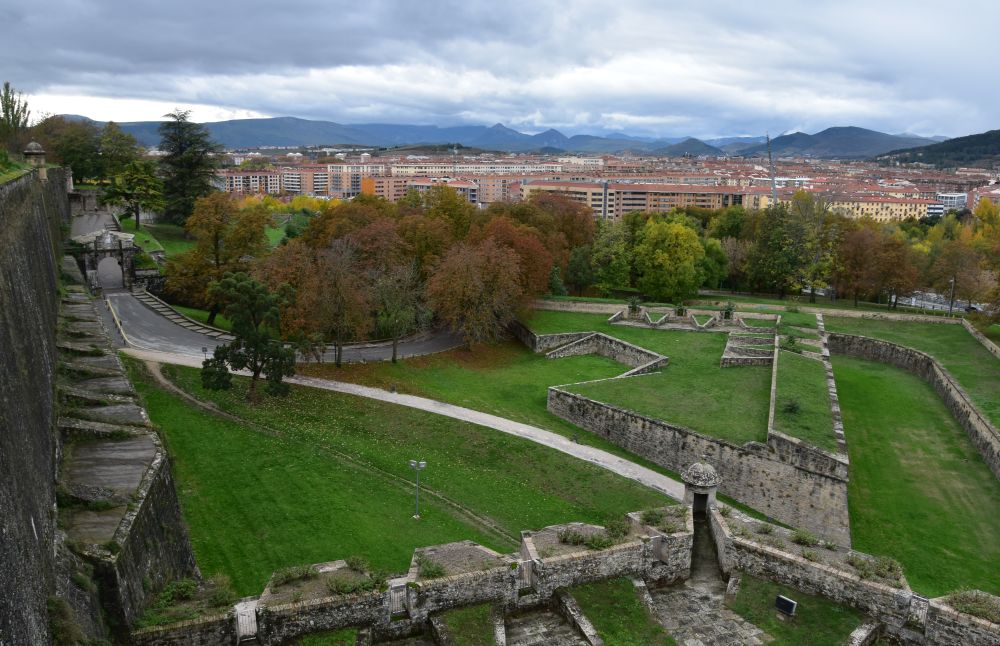
Walking along the fortifications of Pamplona tops our visit. It was the Spanish-Habsburgian king Philipp II who had fortified the city in the late 16th century, because he feared a French invasion. Part of the wall and the bastions have been kept until today and allow for a nice walk with a great view of the Pyrenees.

Sources: “Sehenswürdigkeiten und interessante Gebäude” von Tourismus Navarra und Marion Golder: “Nordspanien und der Jakosbweg”, Dumont Reise-Handbuch, Ostfildern 2018.