Listening to the stories that my home tells me: Botswana

Now in March/April 2020, the virus stopped me from being on the road. I am at home. After all, I am 65+…

My home tells me stories – I just have to listen: This photo gallery reminds me of April/Mai 2008, when I travelled to the Victoria Falls, to Botswana and to Namibia with Ernst.

I have already talked about our visit to the Victoria Falls.

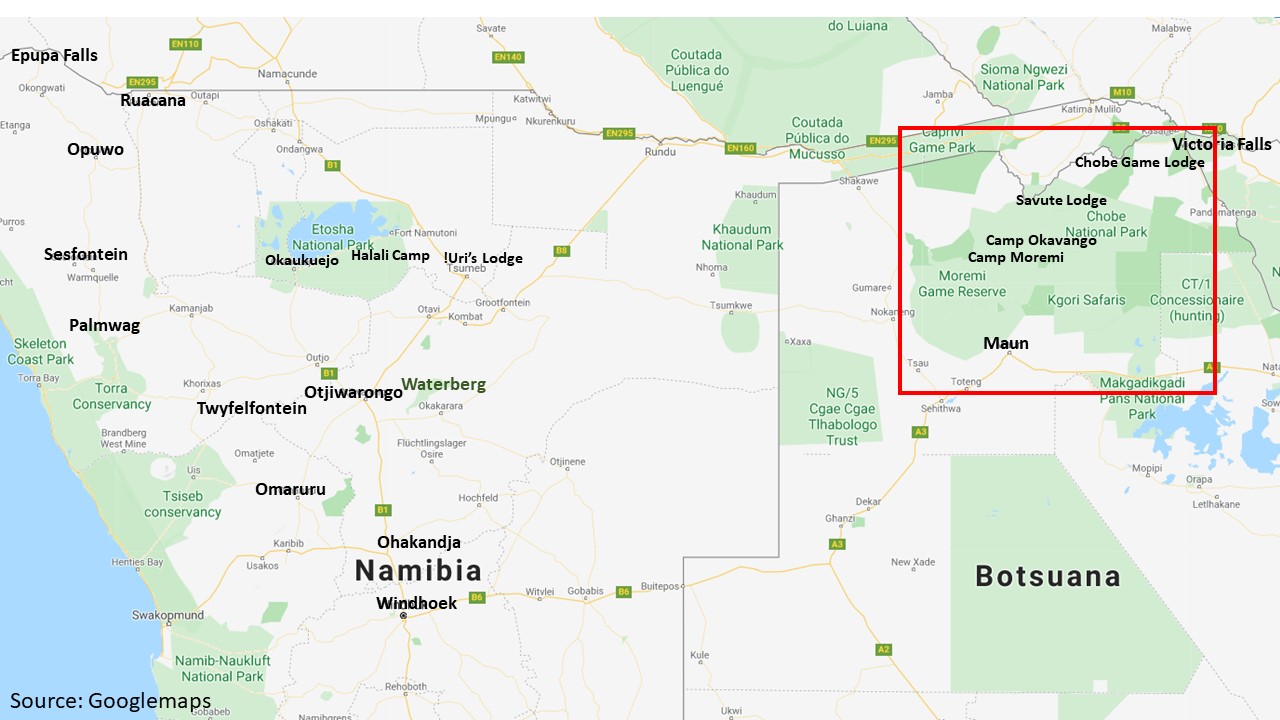
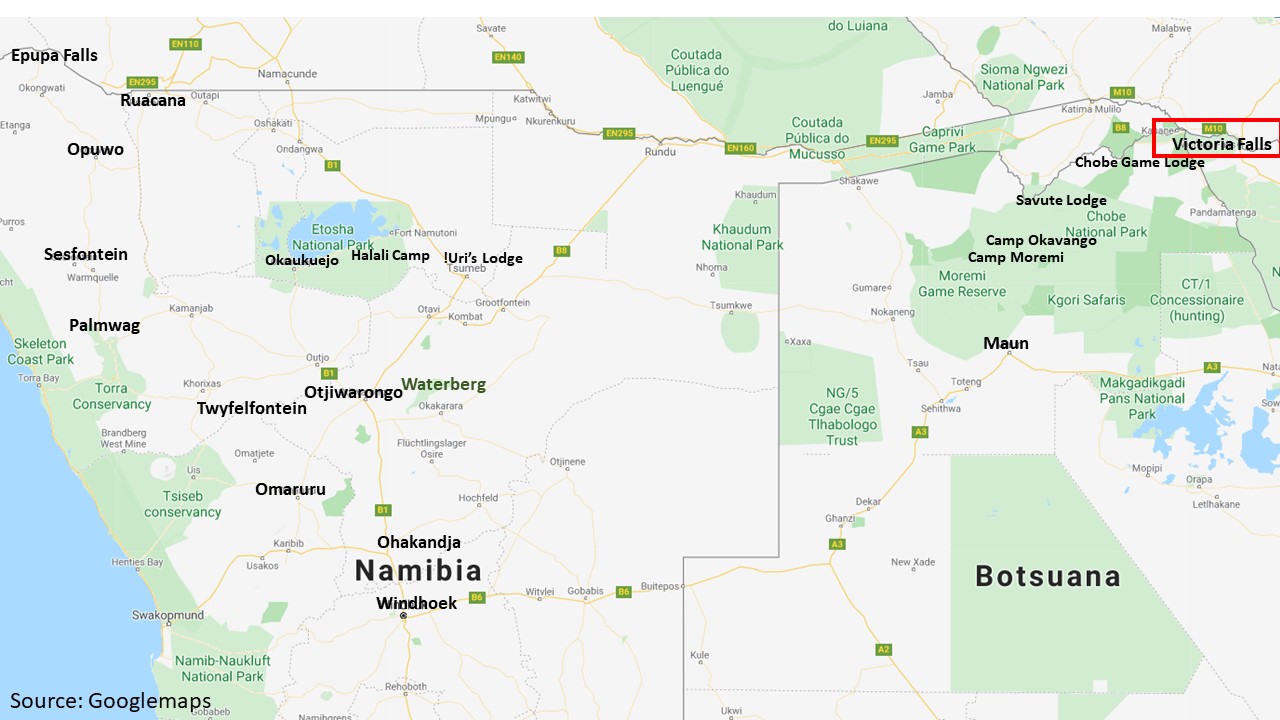
Let me now continue  with our fly-in safari in the Okavango Delta. This map (taken from google maps) shows “our” lodges: From the Victoria Falls, a car driver takes us to the Chobe Game Lodge. From Chobe we fly to the Savute Lodge and then to the Okavango Camp. By boat we get to the Camp Moremi and finally we fly out to Maun and to Windhoek, where we will pick up our camper to tour through Namibia.
 

Chobe Game Lodge – the pinnacle of Botswana

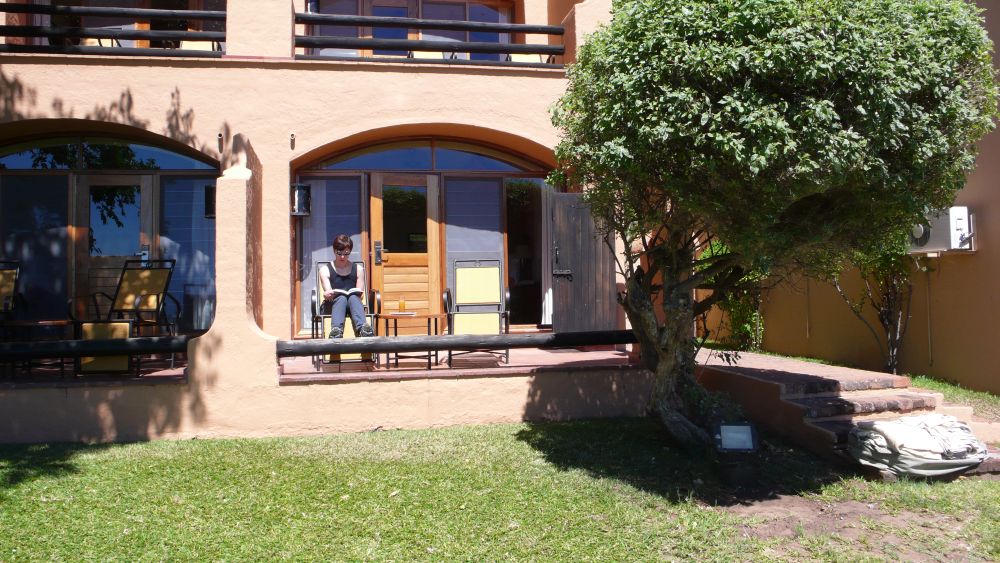
The Chobe Game Lodge is located directly on the Chobe river. We have a room with a canopy bed – wonderful. “Our” Lonely Planet says that this lodge is the pinnacle of Botswana. The meals are delicous – on our first day, we have a large first course buffet, then Impala Stroganoff and a rich dessert buffet.

From our terrace we see the river. Warthogs visit us in the garden.
We stay in the Chobe Game Lodge for two nights and go for game excursions before breakfast and after afternoon tea, with Lebuku in the safari car and once in the boat with Brigitte. Lebuku knows each animal, each bird, each plant. The early morning game excursions are very, very cold… Fortunately, Lebuku takes warm blankets along, they are needed.

Ernst was happy to see so much wild life that he took most of the photos, and I was happy that he was happy.

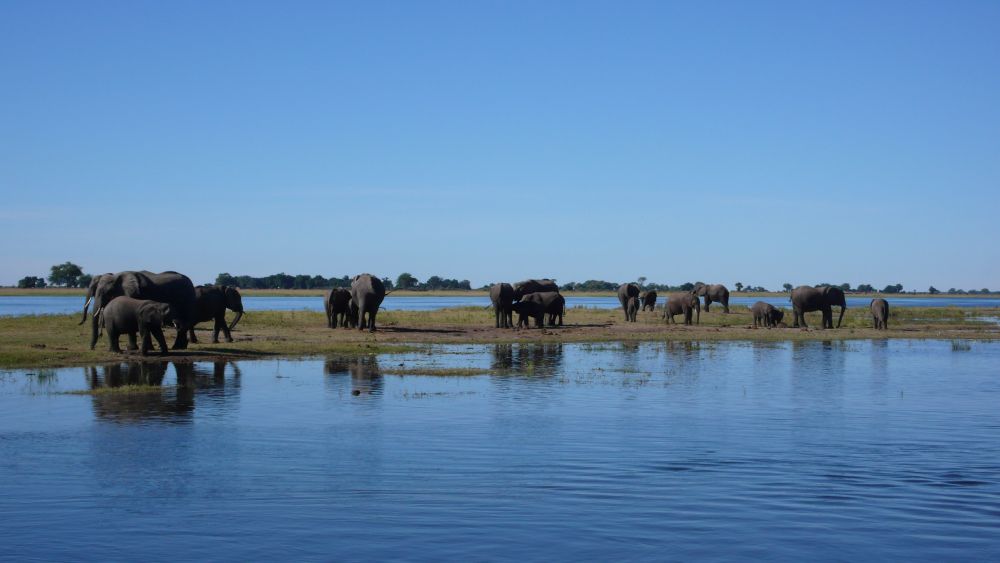
This is a herd of elephants in the Chobe river.
This huge elephant comes pretty close. It does not like to see us… Lebuku backs our car up – carefully.

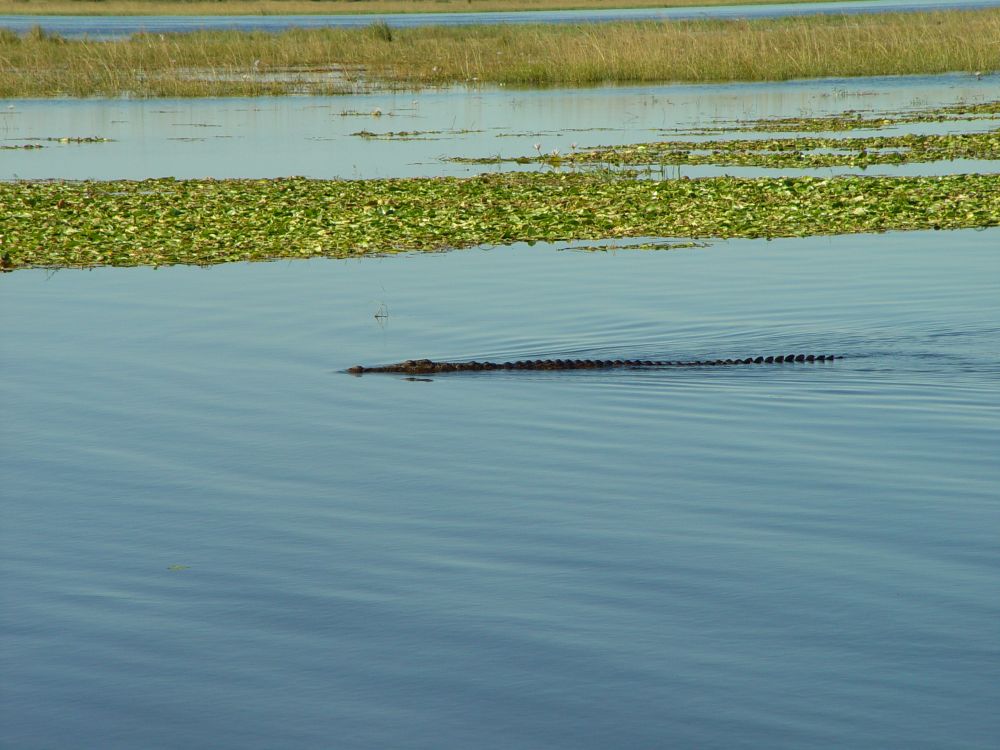
Watch out, this is a crocodile. No swimming here.
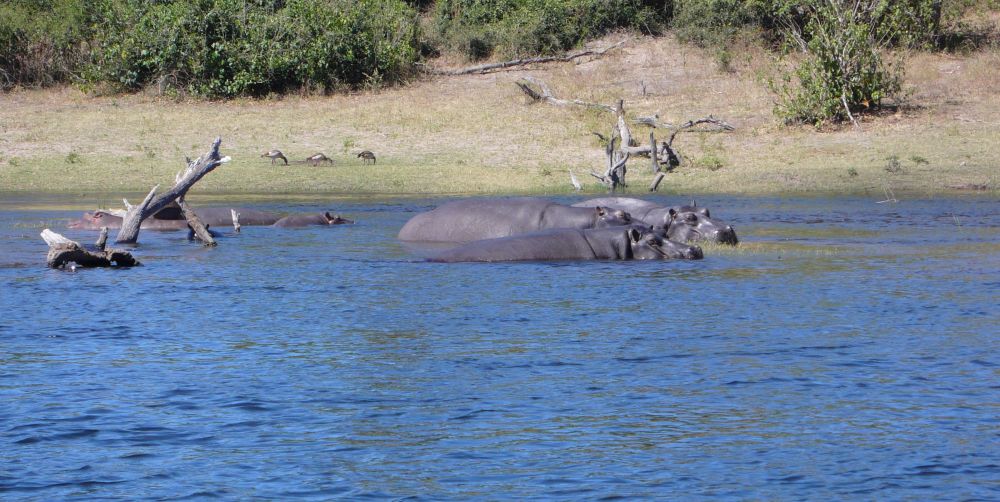
Hippos “hide” in the Chobe river. Hippos stay in water during the day and only get out to graze at night, Lebuku tells us, as they would catch a sunburn during the day. Though they are vegetarian, they can be utterly dangerous for us, when meeting them face to face.
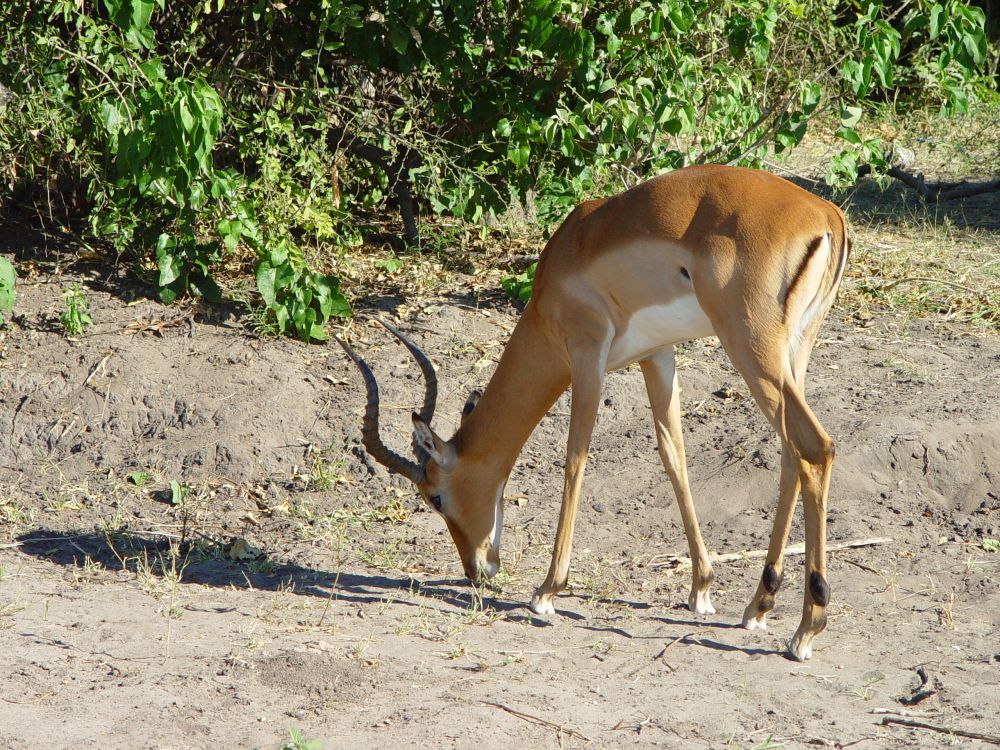
The graceful impalas are all over.
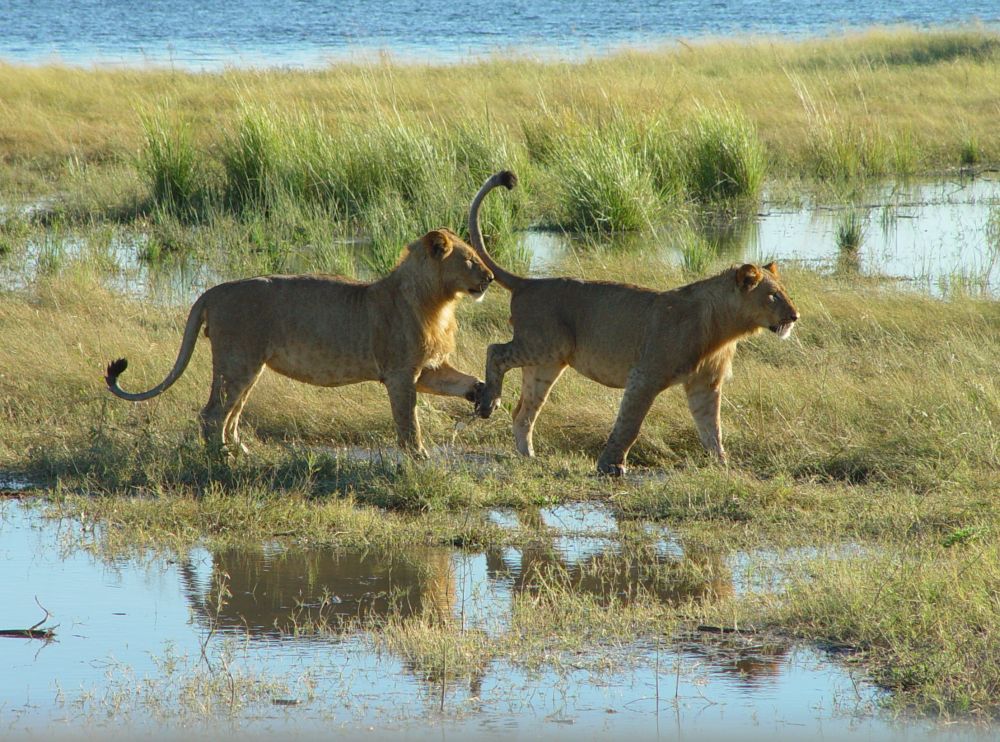
Young lions… Lebuku is good at following the tracks that I would have never noticed. He recognizes, how old the tracks are, whether they belong to a young or an old lion, to a male or a female lion, and whether someone else has passed after or before the lions.
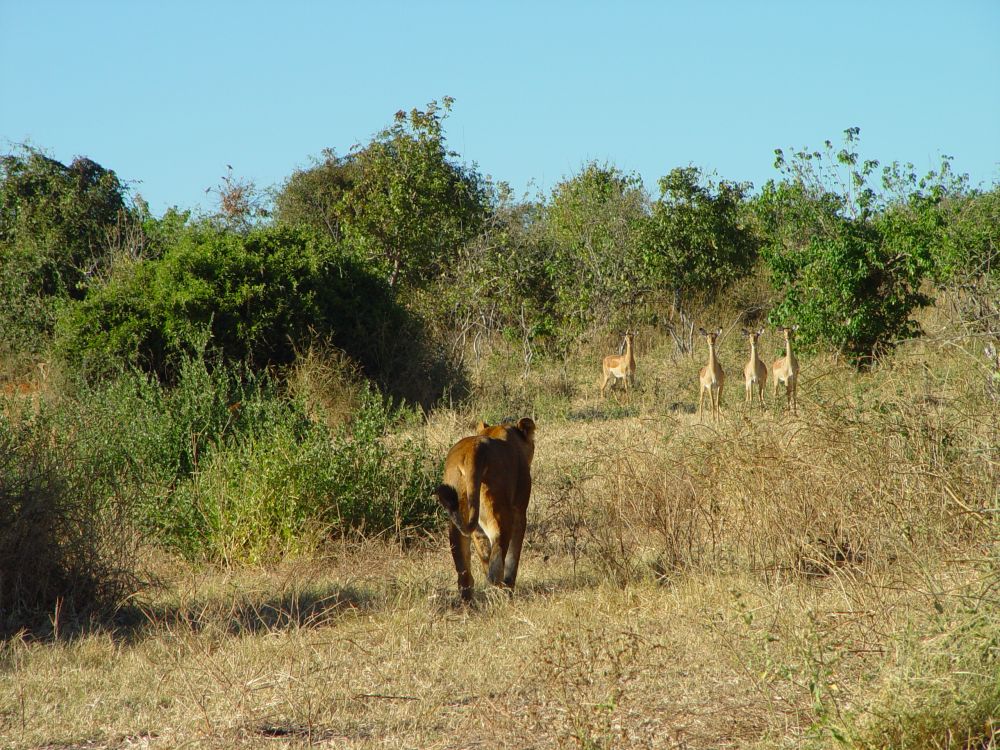
Mama lion walks into the bush, carefully watched by four impalas.
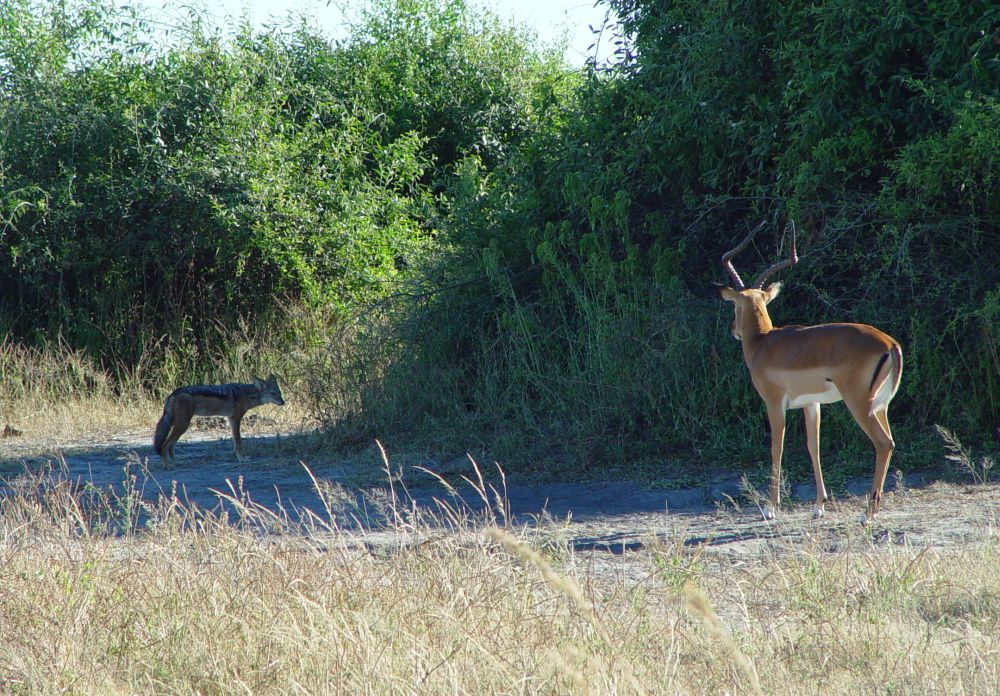
It is dangerous all over for the impalas – what might be the intentions of this jackal?
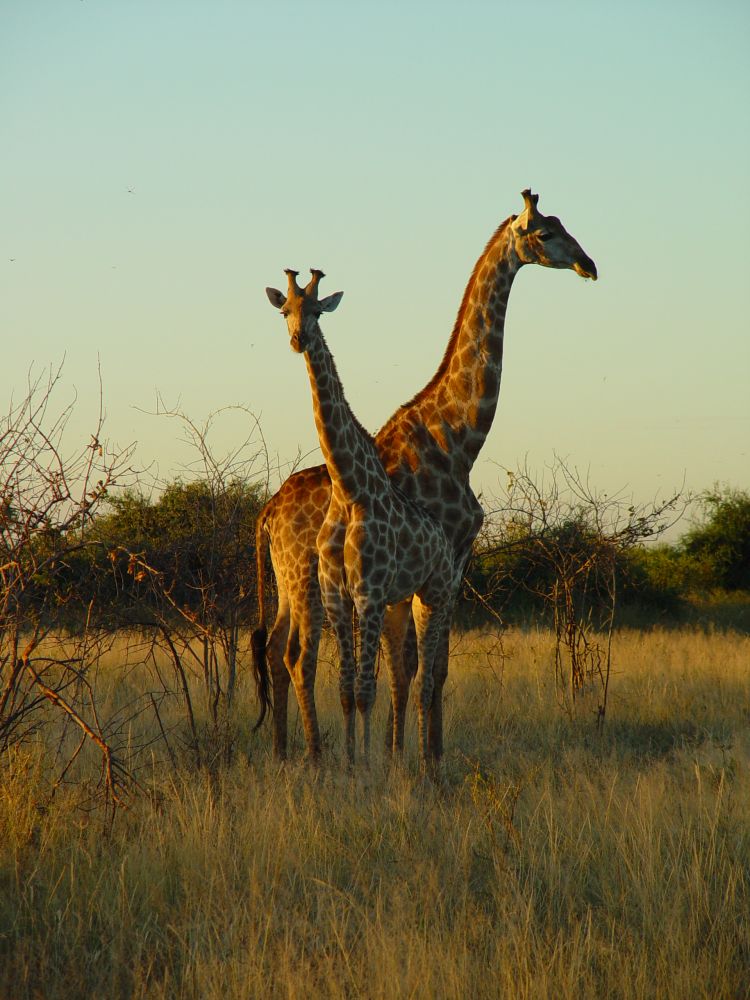
Giraffes – they look like the logo of the zoo at my hometown Basel. They keep eye contact over distance which is easy for them being so tall.
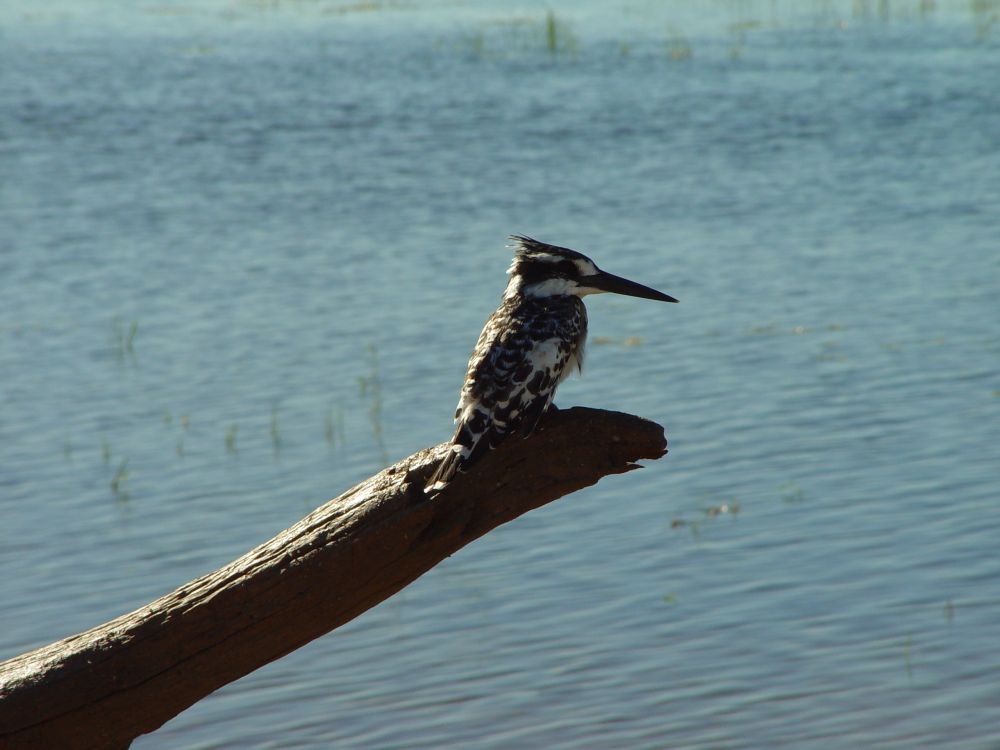
The neat pied kingfisher sits on a branch near the Chobe river.
This red-blue roller sits on a bush (Gabelracke in German).

This is an African fish eagle.

We see many more animals. I admire the dung beetle that rolls an enormous piece of dung through the sand (much larger than itself). We see phytons, squirrels, baboons, water bocks, kudus and a rich variety of birds such as guinea fowls, vultures, plovers, ducks, storks, hornbills or ibis. We see tracks of leopards, but they are hiding well.

Once we stop at a picknick area. “Is it correct, Lebuku, that lions avoid picknick areas?” I ask (jokingly). “Yes, right, look here, these are lion tracks”, Lebuku answers and points to the ground. Hm… In the evenings, we take a drink near the Chobe river, while the sun is setting.

Mankind’s role in this wonderful wildlife world provokes my doubts: The borders of the Chobe National Park have fences, ad beyond the fences live the farmers. We can see farms with cattle across the river. The fences prevent the animals from migrating to the places they went to before. I am not sure, whether the restrictions imposed on the wild animals by us men are a sustainable.

After dinner, we join the manager of the lodge on his terrace. He is a hobby-astronomer and explains the stars and planets to us using a telescope. I can see the Saturn with its rings. We recognize the southern cross and various constellations of stars such as the Orion, Castor and Pollux or the Gemini. The manager tells us that 2000 years ago the Greek could see the southern cross, because the earth is wobbling.

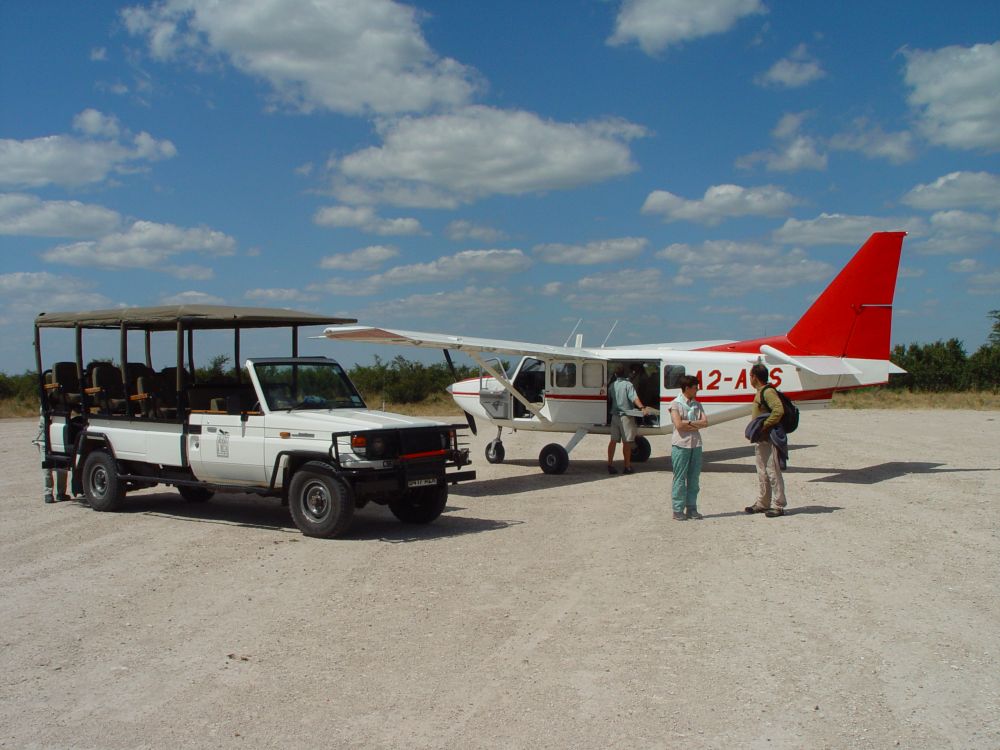
The next morning, the alarm clock wakes us at six. Ernst asks me, whether getting up is a good idea. Oh yes, it is. We have our last safari excursion with Lebuku in his jeep called Thutlwa (=giraffe). After breakfast, we leave for Kasane airport. Marco flies with us to the Savute Camp Site. Marco is from New Zealand and he wants to gather miles. With us is a freshly married couple from the Basque Country (Spain) enjoying their honey moon. Their names are Leida and Javier.


Savute Camp Site – the Savute river is dry now

Marco lands his small airplane safely on the pebbled airstrip and Gwist drives us to the Savute Camp Site, where the management awaits us with refreshing wet towels.
We now live in the Bungalow number 5 in the bush. We find two cans inside, one to kill insects and one to blow the horn, when we need help – there is no telephone here. We stay two nights and Gwist takes us out for safari rides early in the morning and after three o’clock tea. Tea and sometimes meals are served on the terrace overlooking an artificial water hole, where we can watch animals, often elephants.

Gwist explains to us that the Savute Camp is located in the southern part of the Chobe National Park. He adds, Savute is a river that due to seismic movements sometimes has water and sometimes not. In spring 2008 the river has been dry since 1982. Therefore now, the Savute area is dry.
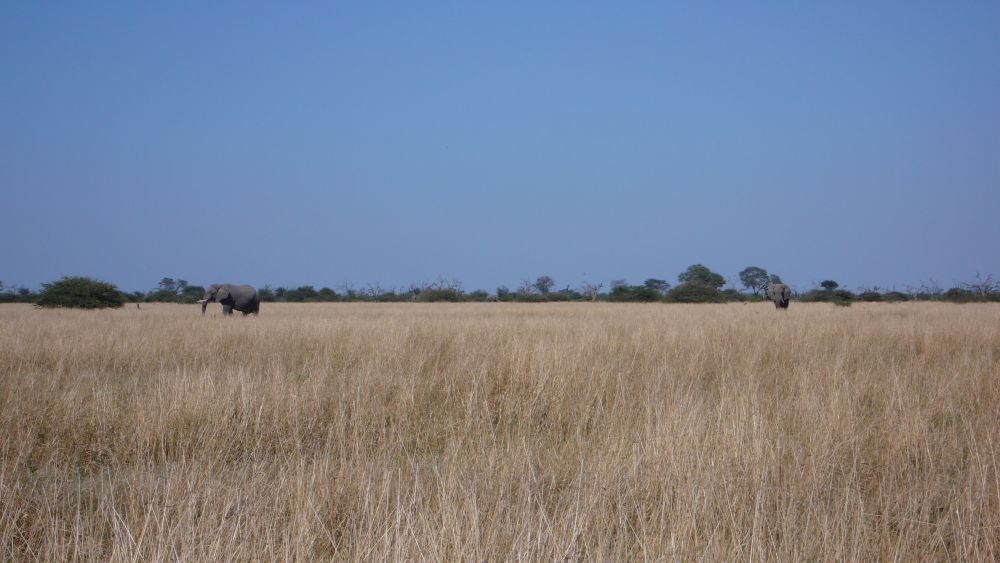
This grassland becomes marsh land or even a lake, when the Savute river has water, Gwist tells us.

Later in 2008 the Savute river started to fill with water again and since 2010 it has been full of water and the area must be greener now.

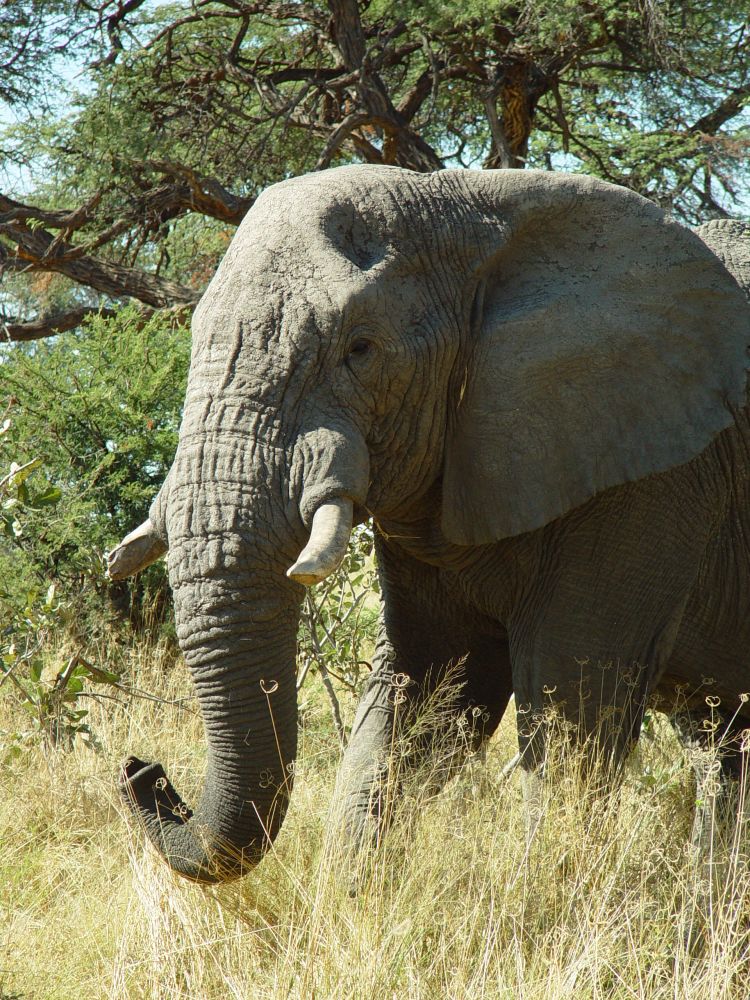
Here are some impressions from our safaris with Gwist. The wrinkled elephant, …
… zebras…

… that like to be close to Gnus,…
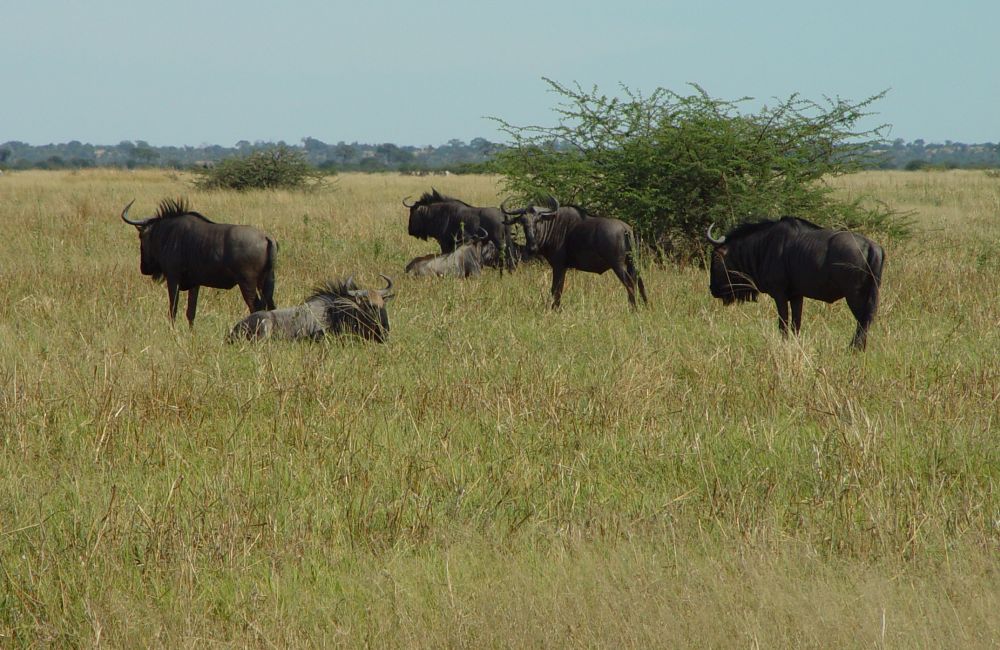
… some impalas in the now dry marshland, …

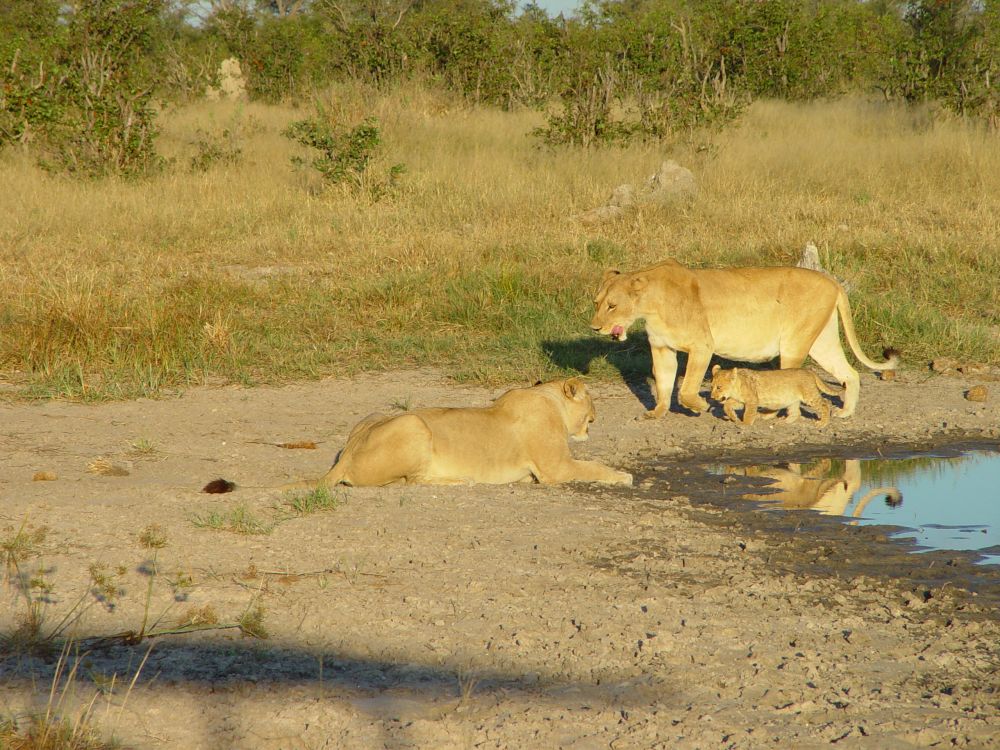
… lion ladies with a baby, …
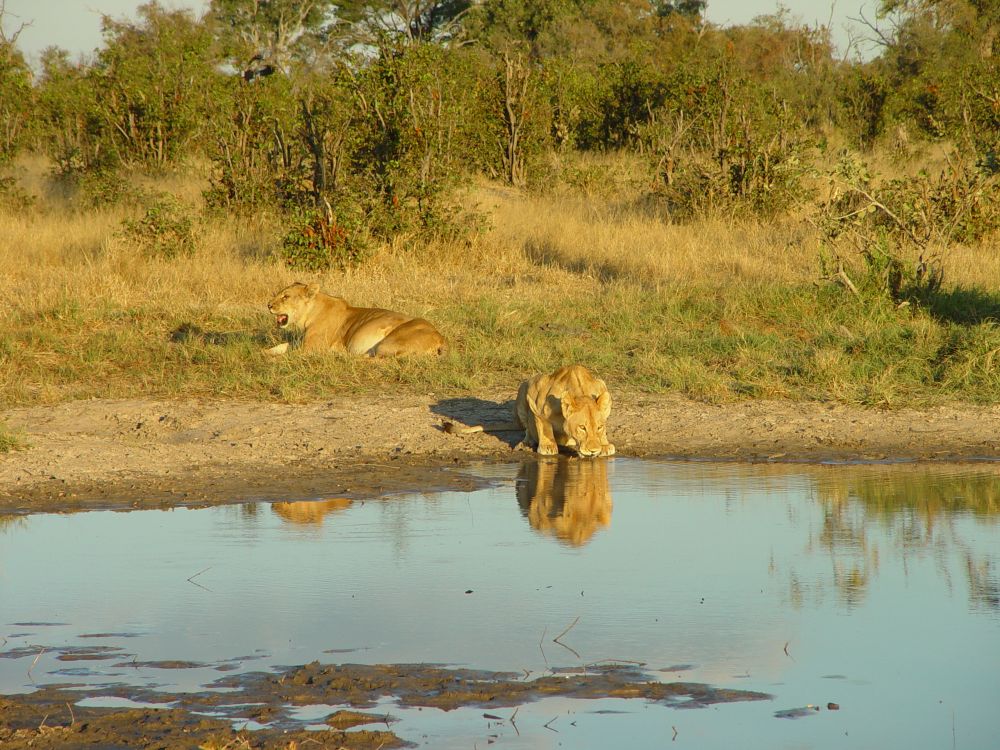
… lion ladies yawning and drinking water,…
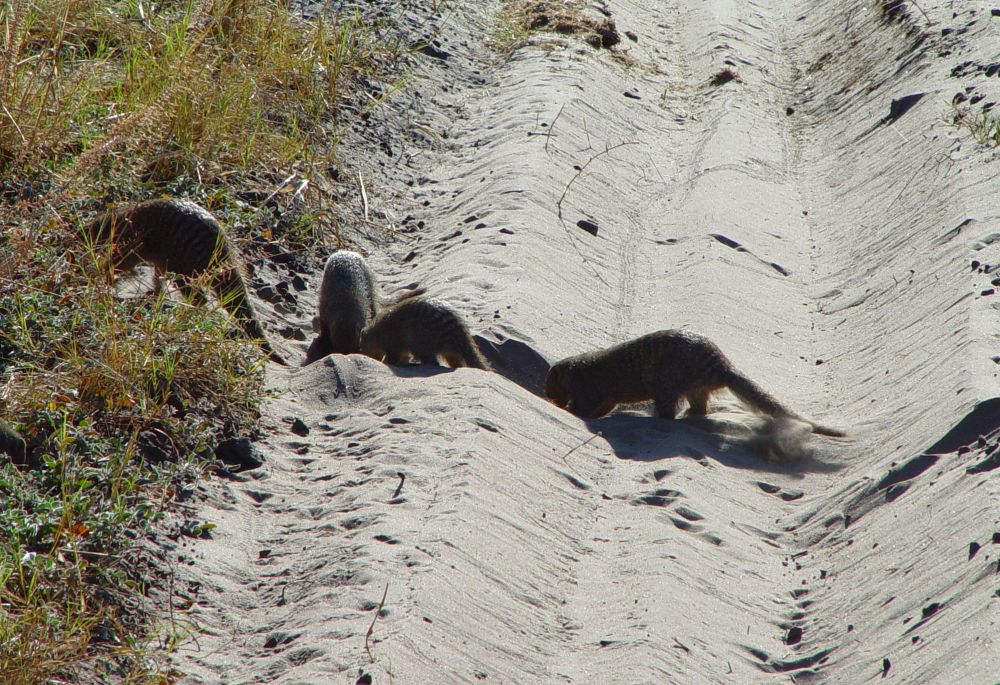
… cute mongooses,…
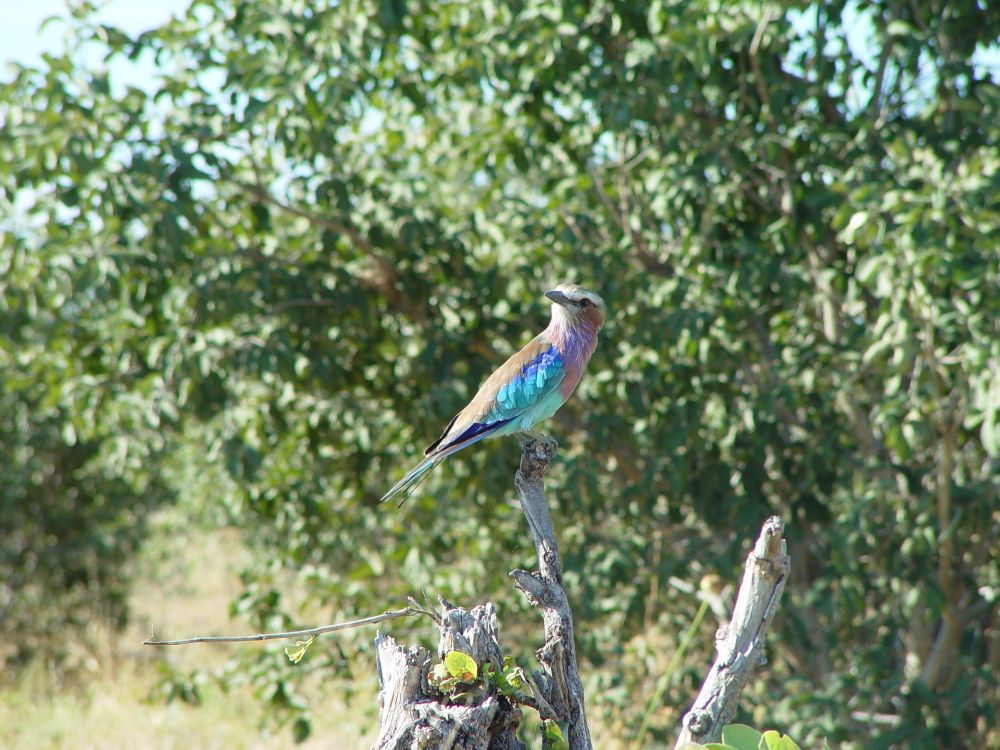
… a lilac breasted roller,…
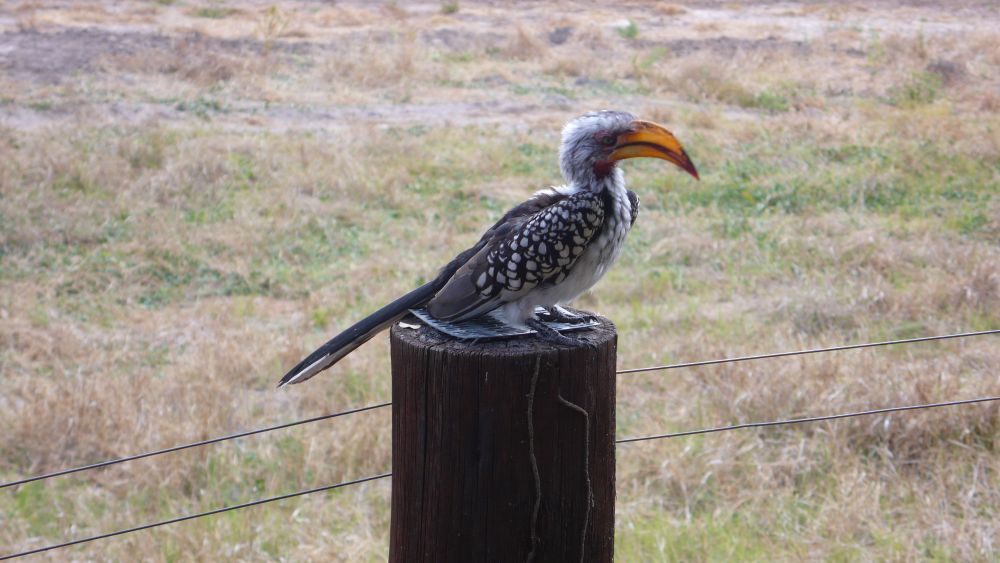
… and the hornbill (a colourful raven) on the terrace of our lodge.
This is just a small selection of our animal photos – we have seen many more – just gorgeous.

Ernst looks at his GPS and mumbles: “Behind that hill must be the rock paintings.” It is true. Gwist is excited about Ernst’s GPS with the Tracks of Africa that shows all the paths around his lodge. We climb into the rocks and discover the drawings of an elephant, an antelope, a giraffe, two snakes and perhaps a buffalo.
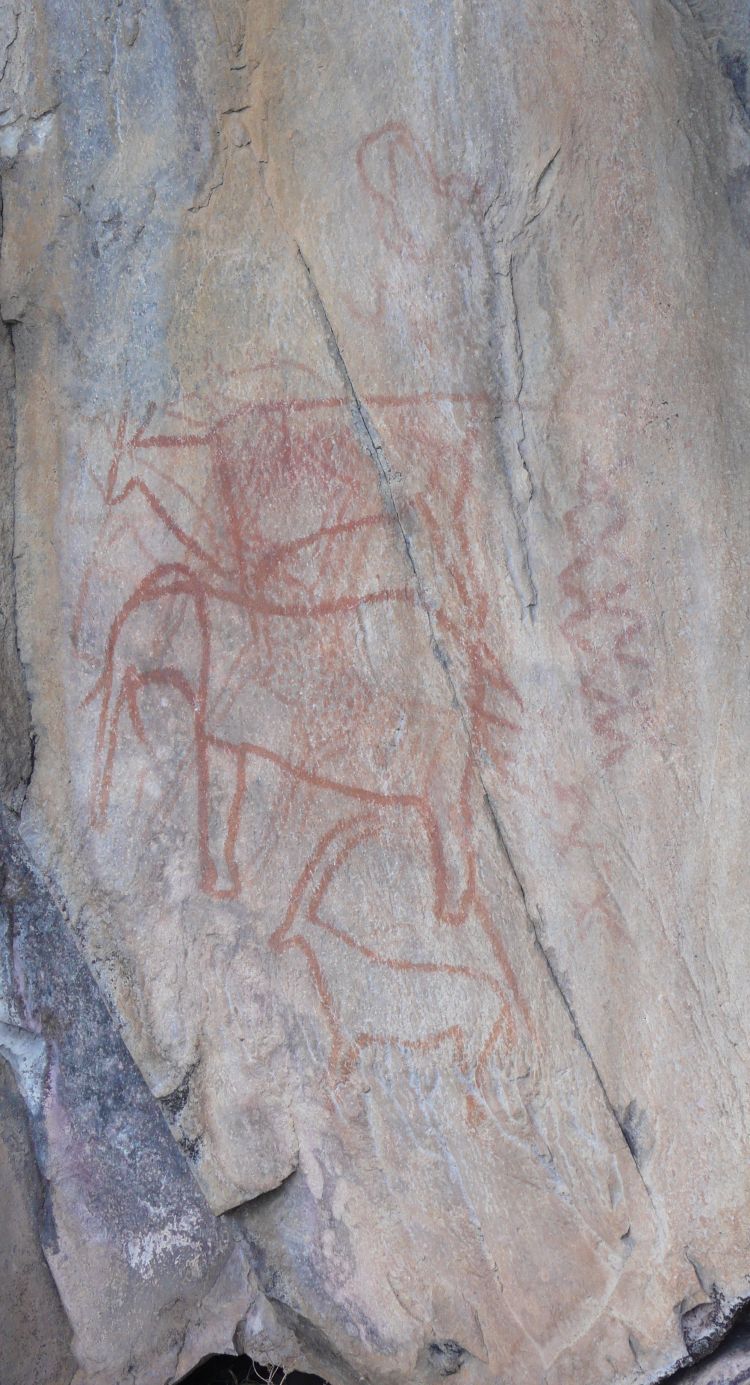
While Ernst can never believe that such paintings are old (my engineer has a very critical and down-to-earth attitude), I do some research with Gwist in the lodge library. The books say that the paintings are between 6000 and 20’000 years old. Difficult to say, how old they really are, but at least, these paintings only show wild life and no cows or horses – hence it could well be that they are old.

Our next target is the Okavango Camp.


Okavango Camp – boat and walking safaris with Obed, the San bushman

Our plane lands at the “International Airport of Okavango” (this is, what a sign says), which is an airstrip with some grass. Small and delicate Obed welcomes us. His hair is bundled to a plait. He belongs to the San people. We will spend two nights in the Okavango camp, and we are now an ad hoc group with a Dutch couple, on their honey moon. The meals are delicious in the Okavango camp and I particulary love the Amarula liqueur apéro, made from Marula fruit.

Obed and Emma take us out for a mokoro boat ride. Mokoro boats are made to glide through the shallow side channels of the Okavango river. Now the mokoro boats are made from artificial material, but before they were made from the wood of ebony trees.
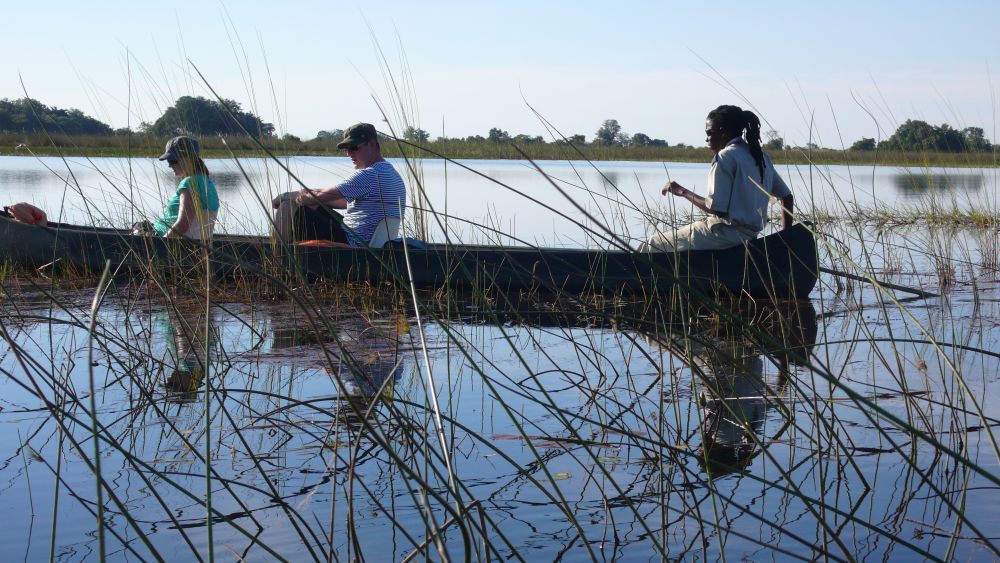
We reach the main river with miscanthus grass and water lilies.
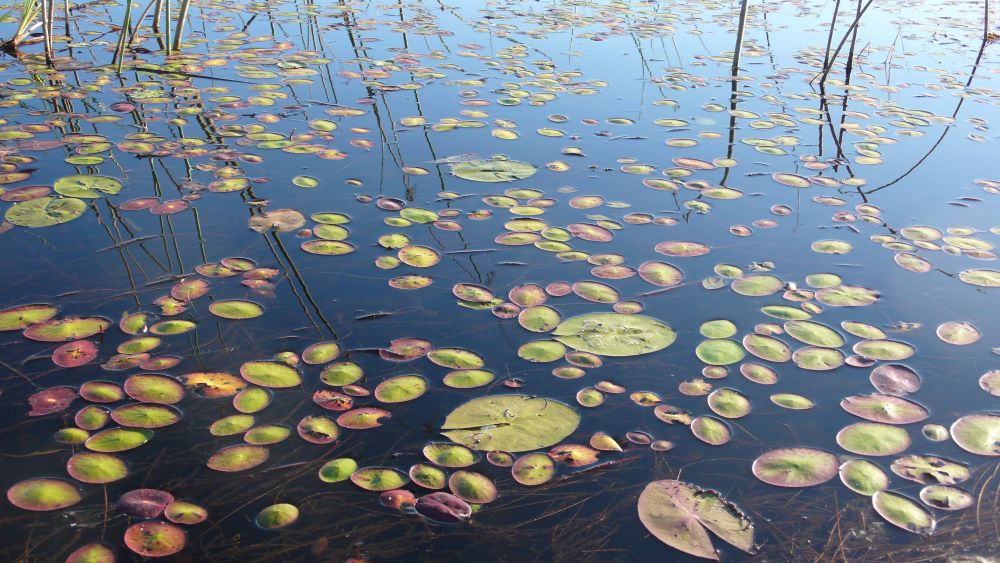
Again, we see many birds, such as kingfishers, grey louries, pigmy geese, and fish, such as catfish and barbs. Obed tells us that, to catch fish, the San people spike them using miscanthus. On our way back, we cross the elephant highway – we hear an elephant walk “splash-splash”, and then we see it. We are sitting in these light mokoro boats, pretty vulnerable. The elephant has heard us, stops and moves his ears back and forward. Obed and Emma back up our boats and we wait, until the elephant has passed by. Yes, elephants have the right of way here.

The sun is setting. Obed tells us a story, this is what the people do here, when the sun sets: The hare finds a rope and sets out to tease the elephant and the hippo. To the hippo, the hare says that  it, the hare, is very, very strong, as it will pull one end of the rope and let the the hippo pull the other end of the rope. He then tells the elephant the same story. But then the astute hare gives the hippo and the elephant the opposite ends of the rope. They both think that the hare is at the other end of the rope and they are puzzled, how strong that hare is… nice story!

Then Obed takes us out to a walking safari. By motor boat, we reach a landing stage, leave the boat, and then we are on foot in the middle of the bush. With elephants, buffalos, lions, leopards or antelopes. Obed has grown up surrounded by wild life. He leads us carefully and shows the tracks and the dung of the animals. We meet some elephants, follow the tracks of lions, get almost to close to a herd of buffaloes, see a leopard from very far… it is an interesting, yet almost scary experience.

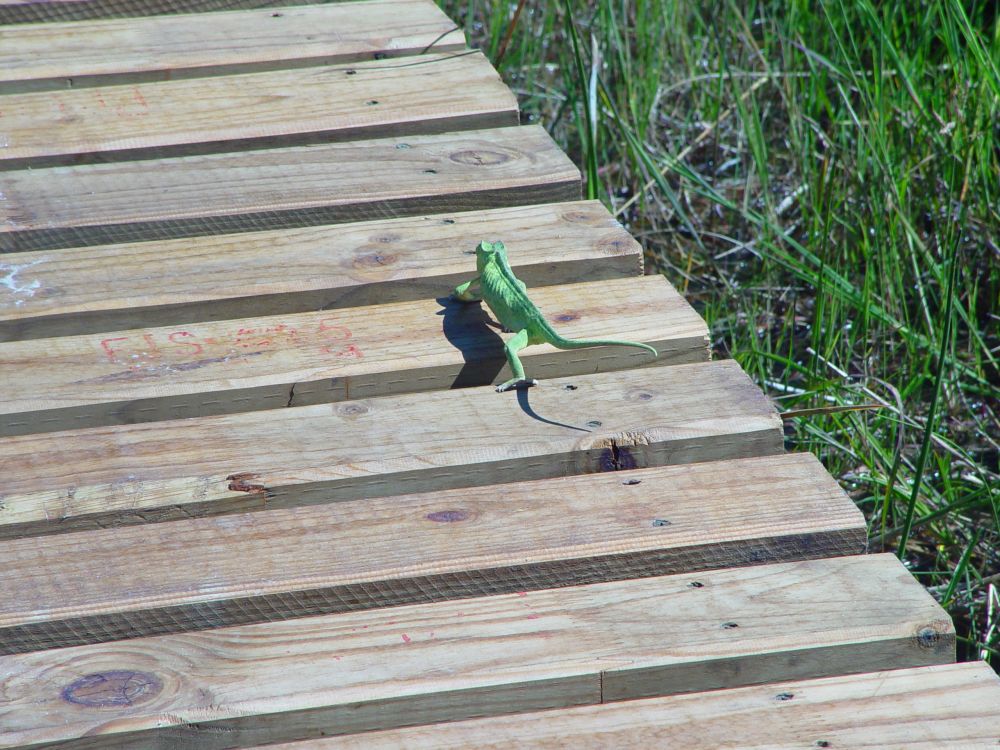
Returning from our walking safari, we find this brave chamaeleon making huge steps. It keeps on falling between the wooden planks, “gathers” its legs again and continues its way, bravely.
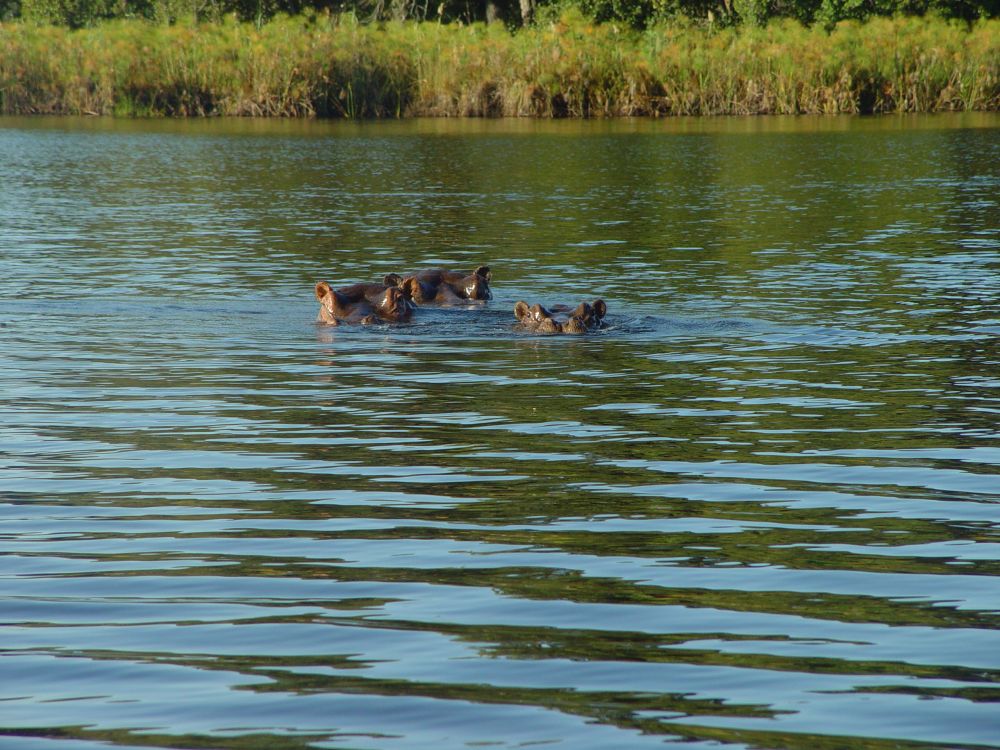
Once we go for a motor boat ride. Obed is at the steering wheel. We glide through papyrus grass, water figs and common reed. Obed sees a crocodile, but it disappears so quickly that none of us can see it. Again we see much wildlife along the water, elephants and birds. These hippos are not all amused, when we arrive. They stand up in the water and attack our boat. Obed backs up and approaches them again, when they have calmed down. Now, we just see their ears, eyes and noses in the water.
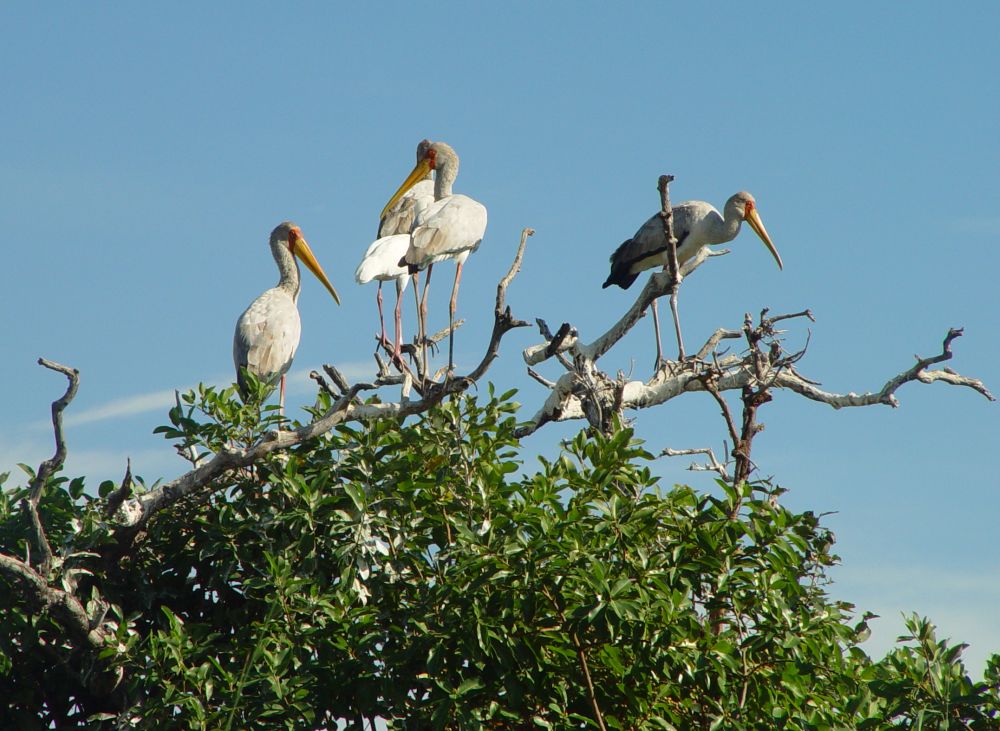
Our next destination is the Moremi Game Reserve. The Okavango Camp manager takes us by boat along the Okavango river network to a small island, where we meet Moota who came by boat from the Xugana camp with some more guests. The guests from Xugana want to go to the Okavango Camp, where we came from. Moota drives with us to yet another island, where Mod picks us up and takes us to our destination, the Moremi Game Lodge. Complex logistics in the bush that work out smoothly, and on the way, we see much wildlife, among them these storks.
 

Camp Moremi in the Moremi Game Reserve – our last wildlife experience in Botswana

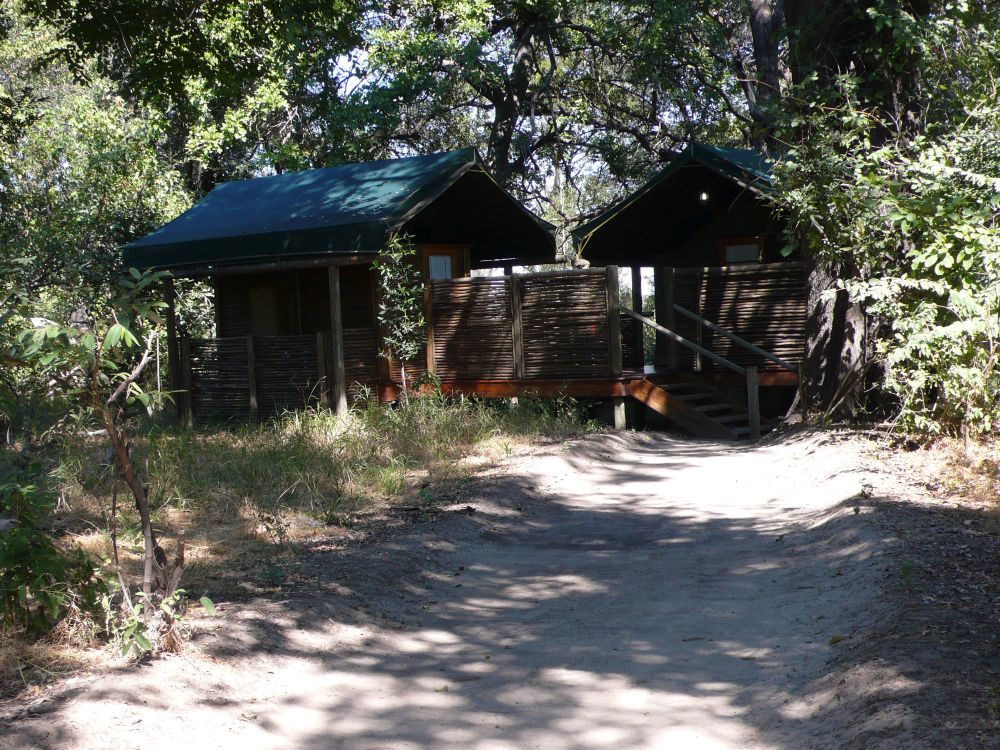
Ernst, looking at his GPS, mumbles: “Soon, we reach the large lagoon”. Right, we reach open water and the landing stage of the Moremi Camp. We settle in the bungalow number seven…
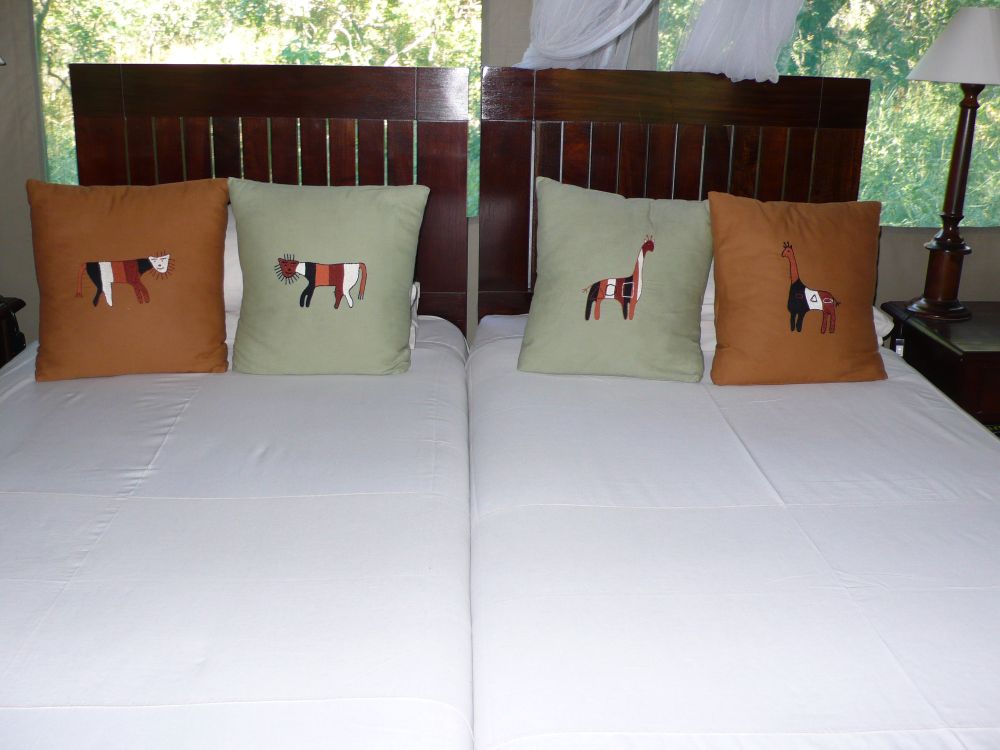
… where the beds have been prepared carefully.
We are not allowed to walk from the restaurant to our bungalow at night – the hippos might be wandering from the lagoon to their pastures and hippos are very dangerous for us.

Lucky is our safari guide, and, like all other guides, he is very knowledgeable. He has a book under his windshield that allows us to translate the names of the animals and plants or to refer to the Latin names.

Also in the Moremi Game Reserve, we see much wildlife such as this elephant herd,…

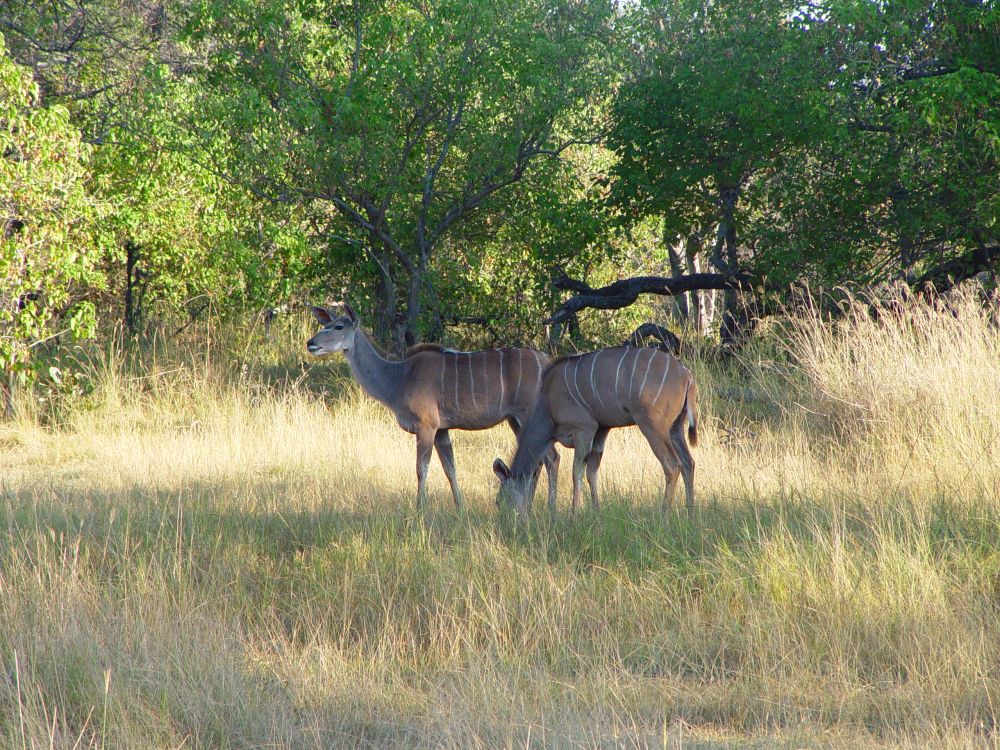
… kudus,…
… buffaloes,…

… a female lion with the prey – an impala,…

… a lion yawning,…
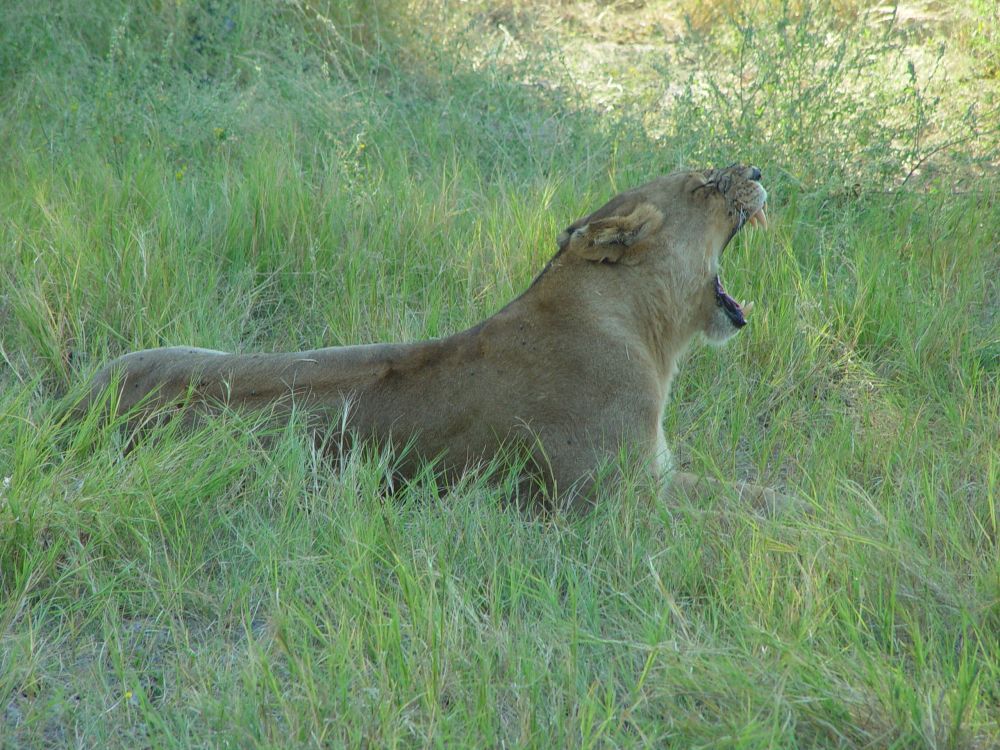
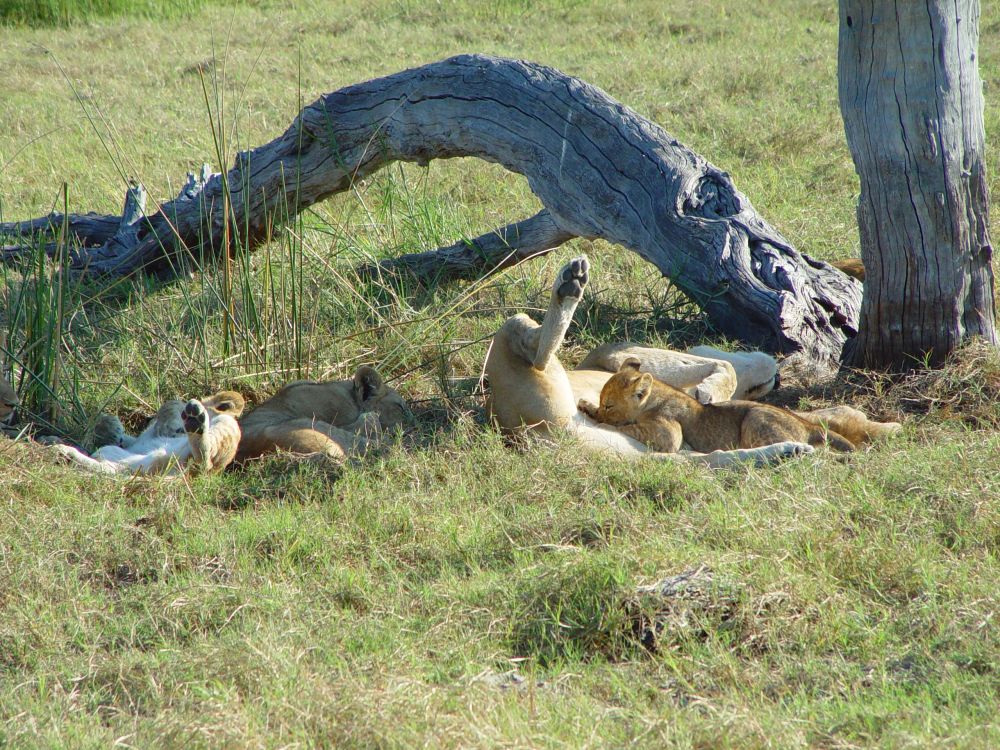
… female lions with their offspring,…
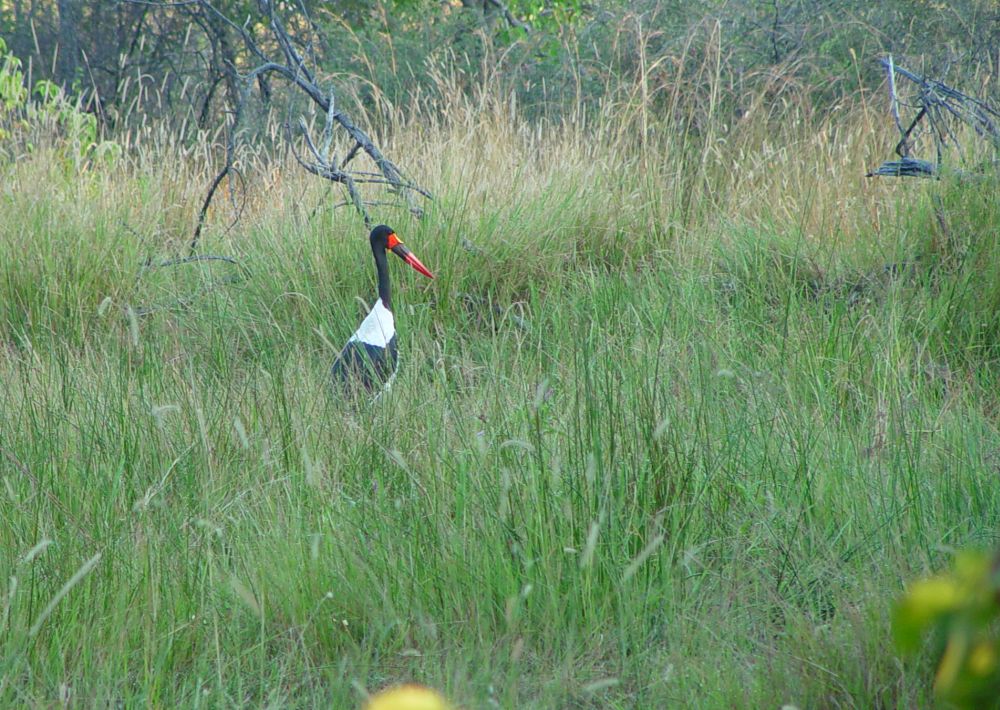
… a proud black stork,…
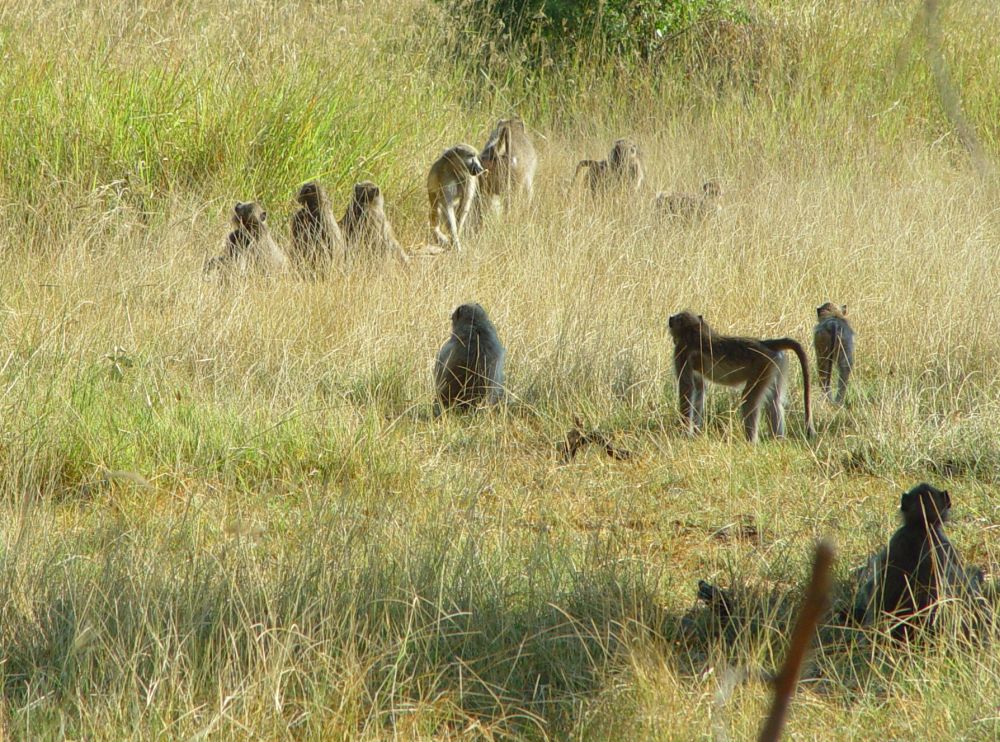
… vivid baboons,…
… and many, many more animals… another marvellous experience.

Our Lonely Planet mentions that a tame hippo, Pavarotti, likes to rest in the garden of the lodge. I can see no tame hippo. I am told that Pavarotti with its crooked tooth was indeed the pet of the lodge. One day, it did not turn up. The lodge team set out to search Pavarotti and found it dead in the lagoon. Some time ago, there was also a tame crocodile, the personnel tells me. Its name was Alison. It picked up a red towel in the laundry and then laid down near the pool. Very peculiar.

After two days, we take the plane to Maun.
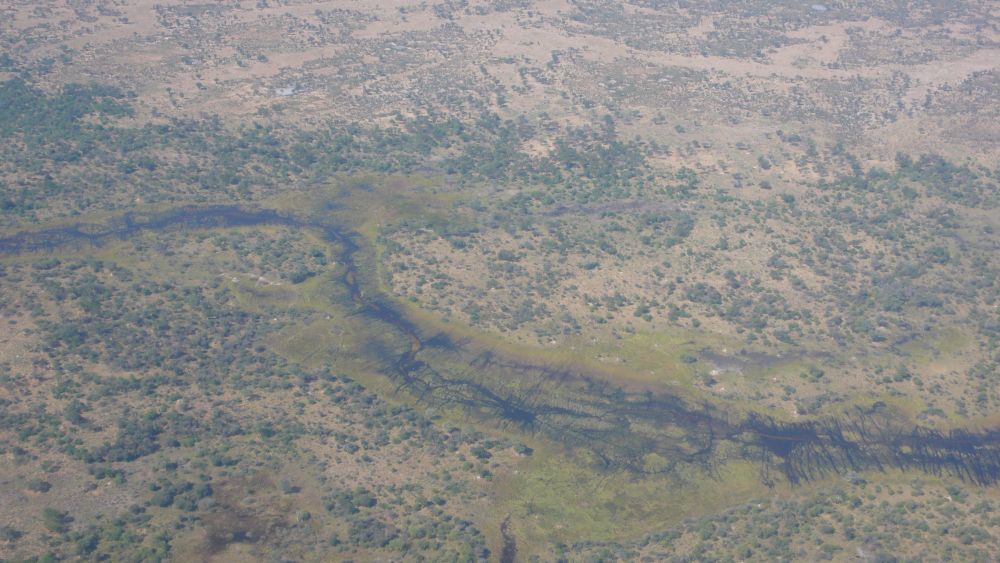
From Maun, we continue to Windhoek, where our Namibia adventure starts.

We keep wonderful memories from our fly-in safari in Botswana. Ernst had always wanted to return to Botswana… may be I will do that one day with Ernst in my heart, once we will be able to travel again.


Some background information about Botswana: A long tradition and thoughtful presidents give stability, as I understand it

Early settlers in Botswana included the San bushmen. In the years 200 to 500 AD, Bantu speaking Tswana tribes arrived. Still today, they are the main ethnos in Botswana, basing themselves on three Tswana tribes of the 14th century that three sons inherited from their father. A long tradition of 600 years.

In the 19th century, the Tswana tribes were under pressure from outside; under the charismatic king Segkoma I in 1840, they joined forces in a federation. Also the next leaders were charismatic such as Khana I in 1875 who modernized his country, supported the San people and introduced laws to protect fauna and flora.

At the end of the 19th century, the Boers had to migrate north for having been pushed out of southern Africa by the English. The Boers put pressure on Botswana. England accepted Botswana as a protectorate. The English intended to integrate Botswana with Rhodesia, but Khana II resisted. Botswana remained under English protectorate and did not become part of Rhodesia.

In 1966, Khama lead Botswana into independence from England. He was one of the tribe chieftains and was president until 1980. Also the president Festus Mogae (until 2008) was one of the chieftains. “My” Lonely Planet points out that the presidents reigned thoughtfully, without enriching themselves, and Festus Mogae could even be seen doing his own shopping in the local Spar shop. In 2008, the son of Khama followed, and in 2018 Mokgweetsi Masisi became president. All presidents belong to the Botswana Democratic Party that has the absolute majority. Botswana presents a successful mixture of democracy and thoughtful tribe policy, I believe.

When Botswana became independent, it was a country with few natural resources. A year later, in 1967, three diamond mines were detected. The profits allowed to improve the education system and the infrastructure of the country. Export of diamonds is still important today, as more diamond mines were found later. When reviewing my material and the latest information in the Internet, I find a sad piece of information. Because of diamond reserves in the Kalahari, the San people were relocated. They fought for the right to return, which was approved by the appeal court in 2011, but the San can still not return to their land. This is what I found on survivalinternational.de. and also in the NZZ from the 23.11.2018 (Neue Zürcher Zeitung). Very sad. I hope that Botswana finally will reinstall the rights of the San people and continue on the tracks that charismatic and thoughtful leaders, such as Khana and Khama, layed for the country and for the sustainable tourism in the 1960-ies.


Sources: Paula Hardy et alii, “Botswana & Namibia”, Lonely Planet 2007; Daniela Schetar et alii, “Namibia”, (update until today: Wikipedia); Reise Know-How, Markgröningen 2007; Duncan Butchart, “Wildlife of the Okavango, Struik Nature 2000; my own travel report, “Südwestafrika – Zimbabwe, Botswana, Namibia”.


Former blogs about stories that my home tells me: The Schefflera plant that reminds me of having climbed the Kilimanjaro with Ernst and the ebony wood bowls that remind me of the safaris in Tanzania,
 

Listening to the stories that my home tells me: Victoria Falls

Now in March/April 2020, the virus stopped me from being on the road. I am at home. After all, I am 65+…

My home tells me stories – I just have to listen: In my latest blog I have talked about the the Schefflera plant that reminds me of having climbed the Kilimanjaro with Ernst and the ebony wood bowls that remind me of the safaris in Tanzania.

Let me now talk about the story that this photo gallery in my guest room has to tell: In April/March 2008, Ernst and I visited the Victoria Falls, Botswana and Namibia.

This was a GORGEOUS journey.  I love to look at these photos. Let us start with the prolog and the Victoria Falls.


Prolog: Organizing the journey

Mid March 2008, Ernst has reserved flights to Africa: Frankfurt – Windhoek – Victoria Falls, then Maun – Windhoek, and Windhoek – Frankfurt. With a few leaflets from travel offices in his hands, Ernst mumbles: “Now we have the flights, would you be so  kind to fill the gaps?” Oh, yes, I will, wonderful!

I write to three travel offices in Botswana. Immediately, Susan from Phakawe answers. She offers a fly-in safari in Botswana and confirms that the lodges still have rooms available. I book her offer, pay on March 20th, but the money will only appear on her bank account in Botswana shortly before our departure on April 19th. The travel documents make it just in time. Susan cares for us sending various emails: “Take enough warm clothes, the nights are cold.” Or: “Do not take more than 20kgs of luggage, the bush airplanes are small.” Today, I do no longer find this excellent travel agency in the Internet. What a pity! The organization was perfect!

At Victoria Falls in Zimbabwe, I book a luxury room (with partial view of the falls) in THE hotel, the Victoria Falls Hotel. We had debated, whether to go to Zimbabwe at all, as elections were going on, but a friend at work told me that usually the touristy area around the Victoria Falls remains quiet. He also recommended the Victoria Falls Hotel (he grew up Rhodesia).

In additon, I reserve a four wheel drive camper from Britz to tour through Namibia. Ernst buys a small Garmin and loads it with Tracks of Africa. He transfers all the tracks to a small laptop that I have acquired to make planning the routes easier and to write my diary. Now we are ready for our adventure.


Victoria Falls and the posh Victoria Falls Hotel

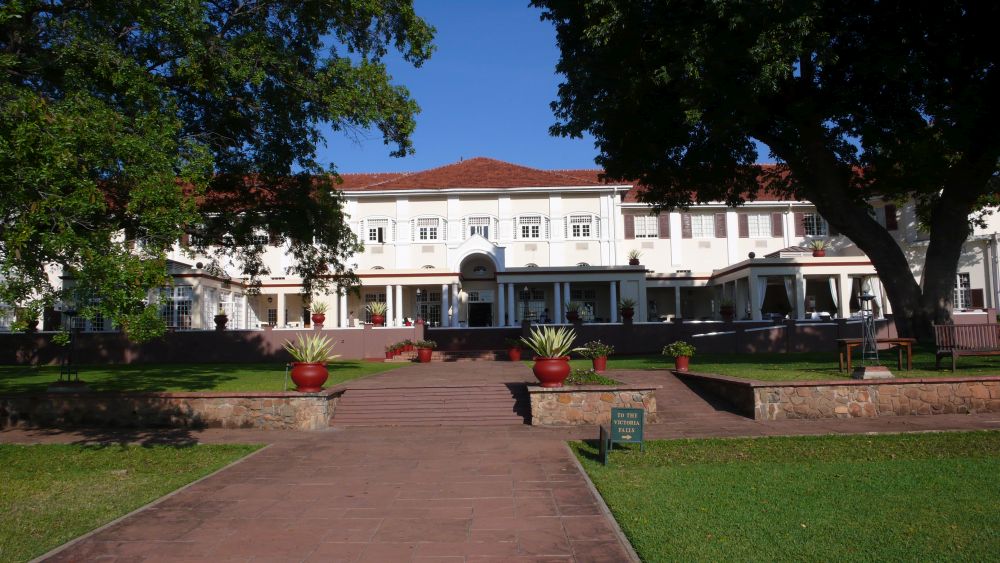
After a night flight on 19/20th April to Windhoek, then continuing to Maun and finally to Victoria Falls, we have our late afternoon tea in the posh Victoria Falls Hotel, built in 1904. I believe that I am daydreaming sitting under the colonial arcades, but it is true.

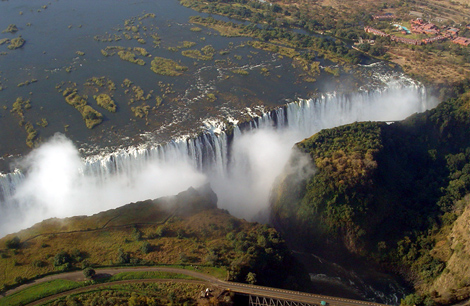
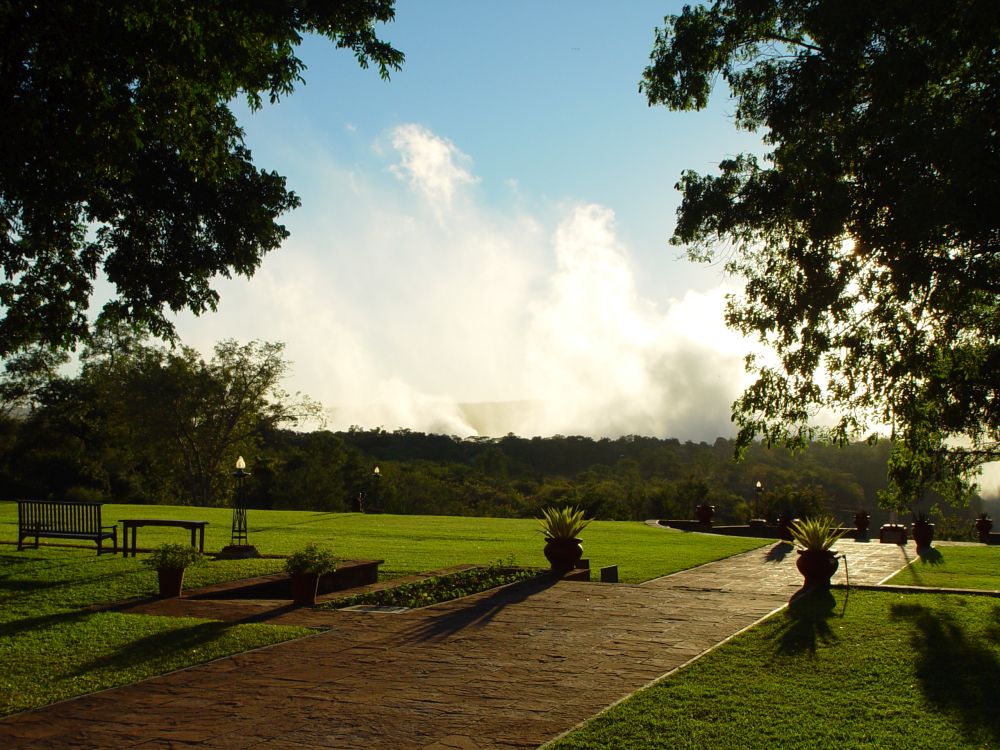
This is the view from the terrace to the falls and the railway bridge. As a matter of fact, there is no view of the falls as such. What we see, is just this spray rising and the railway bridge (built by the English in 1905).

The postcard showing the view of the falls from above makes it clear: The Zambesi – 1.7km large – falls into a ditch – about 100m deep. From the ditch, the river converges into a canyon that is crossed by the railway bridge. The Victoria Falls Hotel near the bridge gives the view of the spray, and this is, what they call “the view of the Victoria Falls”. This is somewhat unexpected for me, but nevertheless spectacular.

We have dinner at the Jungle Junction: The buffet with entries (antipasti, salad, soups, fish), main dishes (fish, meat, vegetables) and desserts is delicious.

The location of our hotel is very convenient: It is only a short foot-walk to the falls. After having paid the entry fee, we walk along the rim into the direction of the railway bridge.

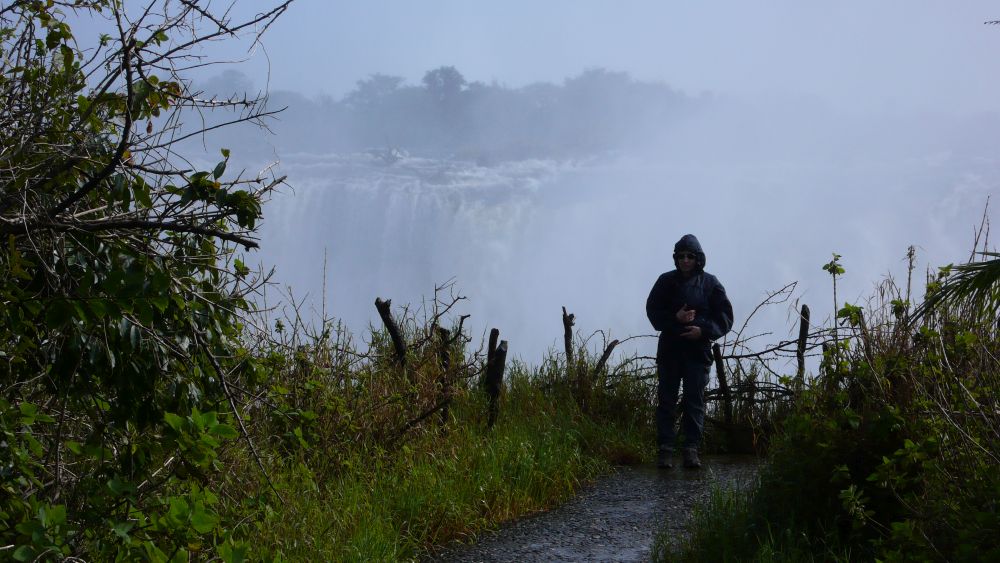
It is all over wet from the spray – we put on our rain jackets… the locals are clever, they sell umbrellas at the entry gate (which we did not need, as we had our jackets).

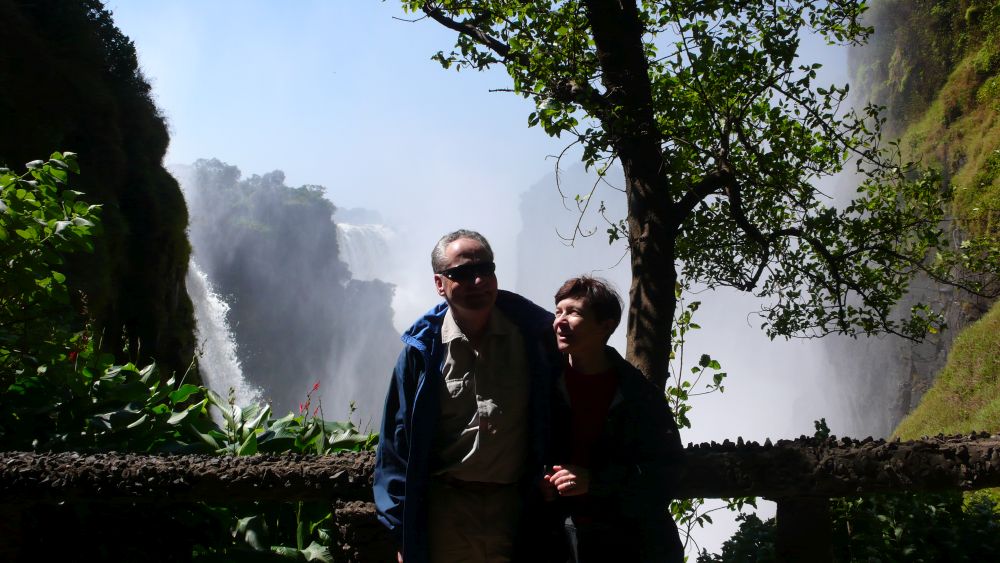
Across the Devil Fall, 72 steps lead down into the ditch…

… where we can look at the falls from below.

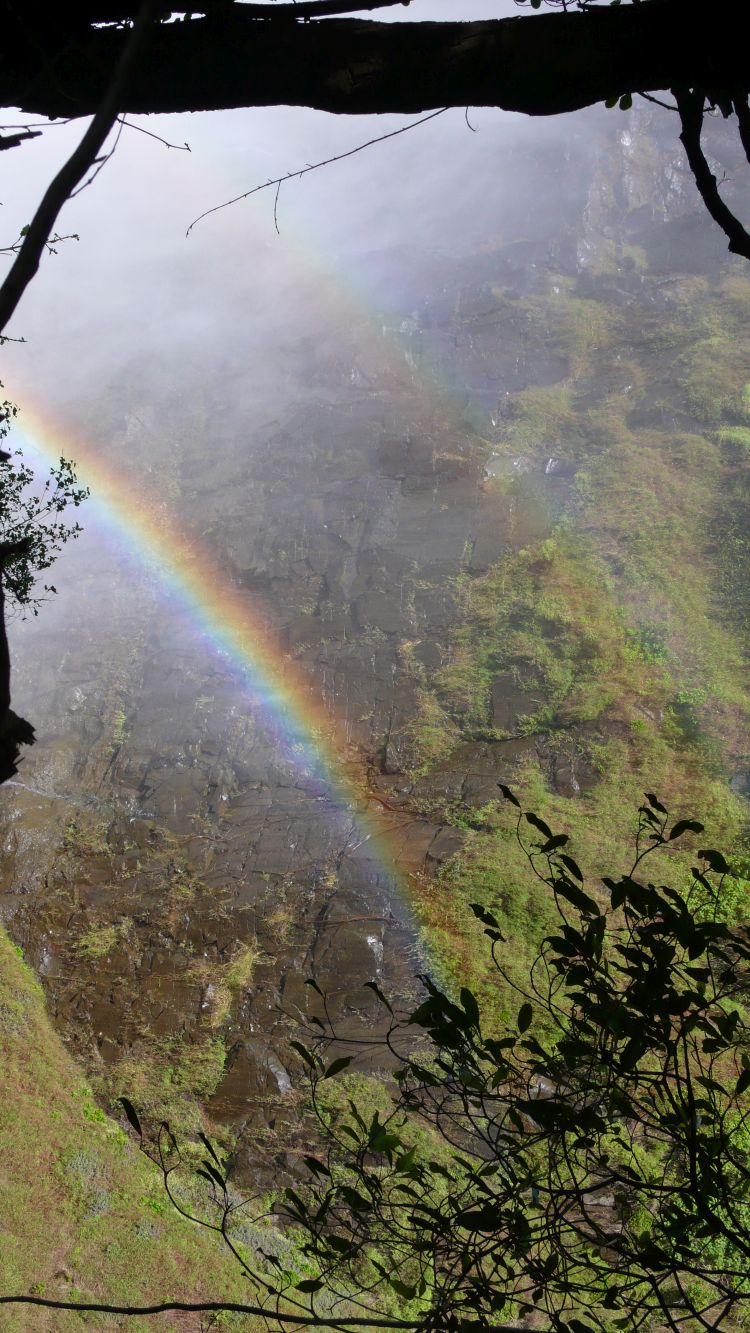
The spray makes rainbows. Ernst and I start our (usual) discussion about what can be found at the point, where the rainbow touches the ground – is it a treasure chest (my idea) or a small bucket of gold (this is what Ernst has learnt from his mother) ;-)? The place seems to be so near… but we cannot check our hypotheses – too dangerous here.

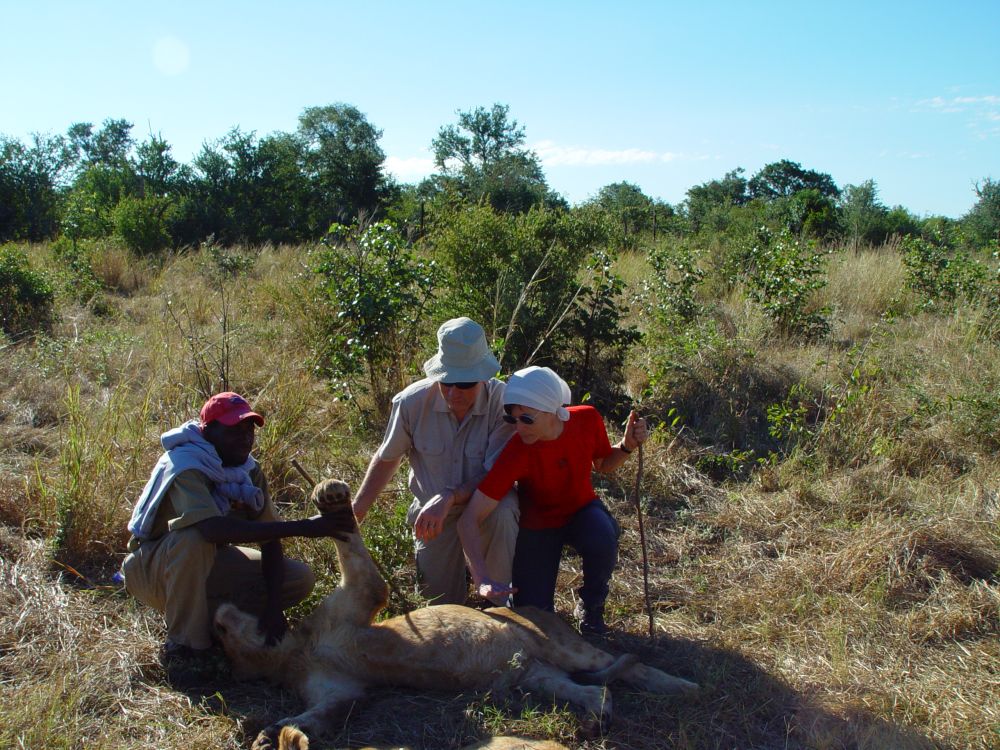
After a siesta and some swimming in the hotel pool, we join the lions’ walk. We meet young lions (still dotted) that are raised to later move to a reservation area. We have mixed feelings about this tourist event.

At full moon, we enjoy the rich evening buffet at the Jungle Junction. We retreat to our luxury room with the “partial view of the falls” (the spray is partially hidden by a tree), enjoy the Belgian chocolate “Bettmümpfeli” (goodnight snack found on the pillow) and sleep well, looking forward to our safaris in Botswana and Namibia.

In the early morning, I take this last photo from the Victoria Falls spray sparkling in the rising sun.

After the rich breakfast buffet at the Jungle Junction, we are picked up by Wild Horizon. Our target today: Cross the border to Botswana and get to the Chobe River Front Lodge.


Some geological background information about the Victoria Falls

Brett Hilton-Barber and Lee R. Berger(2010) explain the geology behind the Victoria Falls. In a nutshell, this is, what I understood: There is a volcanic basalt layer here, about 300m thick, that cracked, when ancient Gondwanaland broke up. A series of giant cracks emerged – north-south and east-west. It is a grid of cracks. The cracks were filled with (softer) sediments. Later central Zimbabwe was lifted up and a large lake appeared. At that time, the Zambesi river flew into the Limpopo river system that has its source in nowadays Botswana. More tectonic movements lead the Zambesi river to change its flow to directly reach the Indian Ocean. The Zambesi now crossed the basalt area with the grid of cracks and created the first Victoria Falls at the end. By eroding the sediments, the falls wandered upstream forming five falls over time. The existing fall is the fifth fall, the authors say. After this fifth fall, the Zambesi zigzags through the system of gorges that it has carved into the grid of cracks. Thank you for this explanation.


Sources: Paula Hardy et alii, “Botswana & Namibia”, Lonely Planet 2007; Daniela Schetar et alii, “Namibia”, Reise Know-How, Markgröningen 2007; Duncan Butchart, “Wildlife of the Okavango, Struik Nature 2000; my own travel report, “Südwestafrika – Zimbabwe, Botswana, Namibia”.

Listening to the stories that my home tells me: Safari in Tanzania

Now in March/April 2020, the virus stopped me from being on the road. I am at home. After all, I am 65+…

My home tells me stories – I just have to listen: In my latest blog I have talked about the the Schefflera plant that reminds me of having climbed the Kilimanjaro with Ernst.

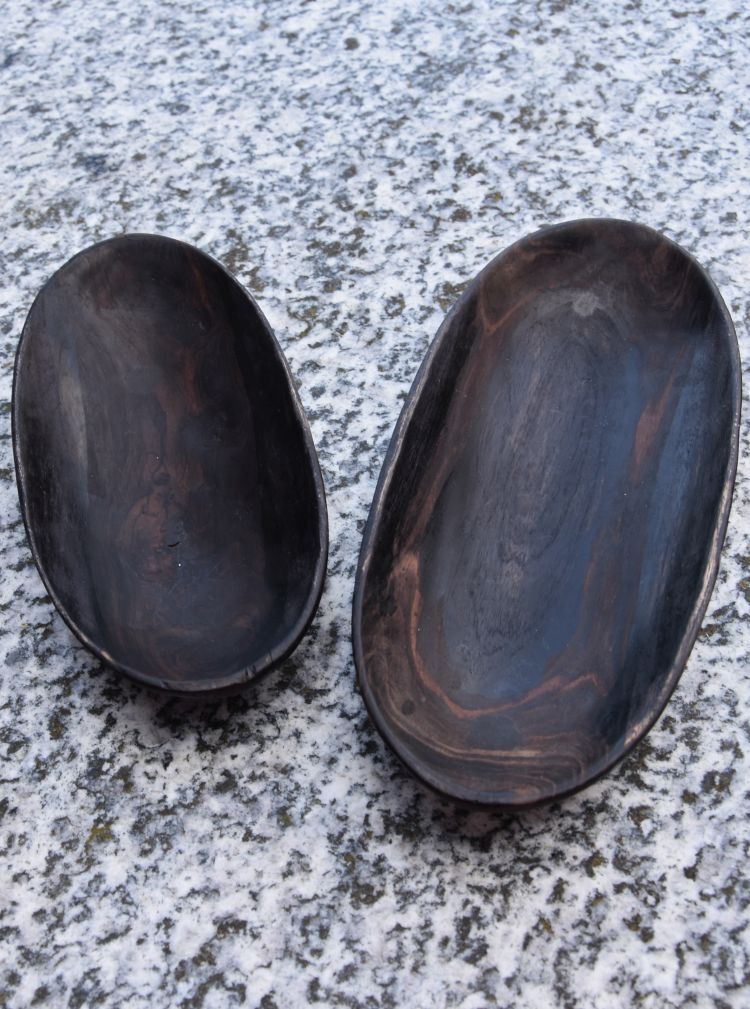
Let me continue with the Kilimanjaro tour of February 2006 that was topped off with two safaris. These bowls remind me of them. They are made from ebony wood. I often use them, when serving apéro snacks to guests. And I love to have guests – I hope that will be possible sometimes soon again.

Let me tell you about the first two Africa safaris I have experienced in my life.


After the ascent to the Kilimanjaro we recover visiting the Ngorongoro Crater and the Tarangire Park

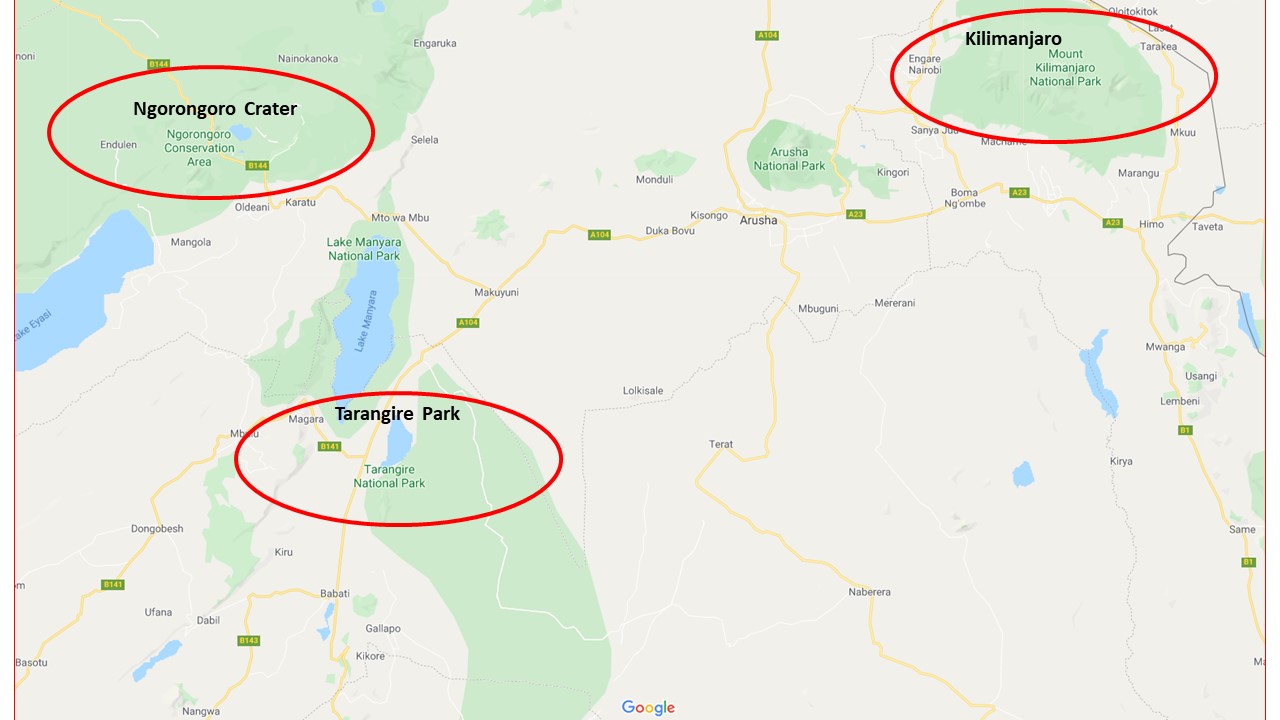
These are the destinations we visited in Tanzania in February 2006: After having climbed the Kilimanjaro, we visit the Ngorongoro Crater and the Tarangire Park.

Source: Google Maps


Ngorongoro Crater – we sit in the cage (the safari car) and are surrounded by so many animals

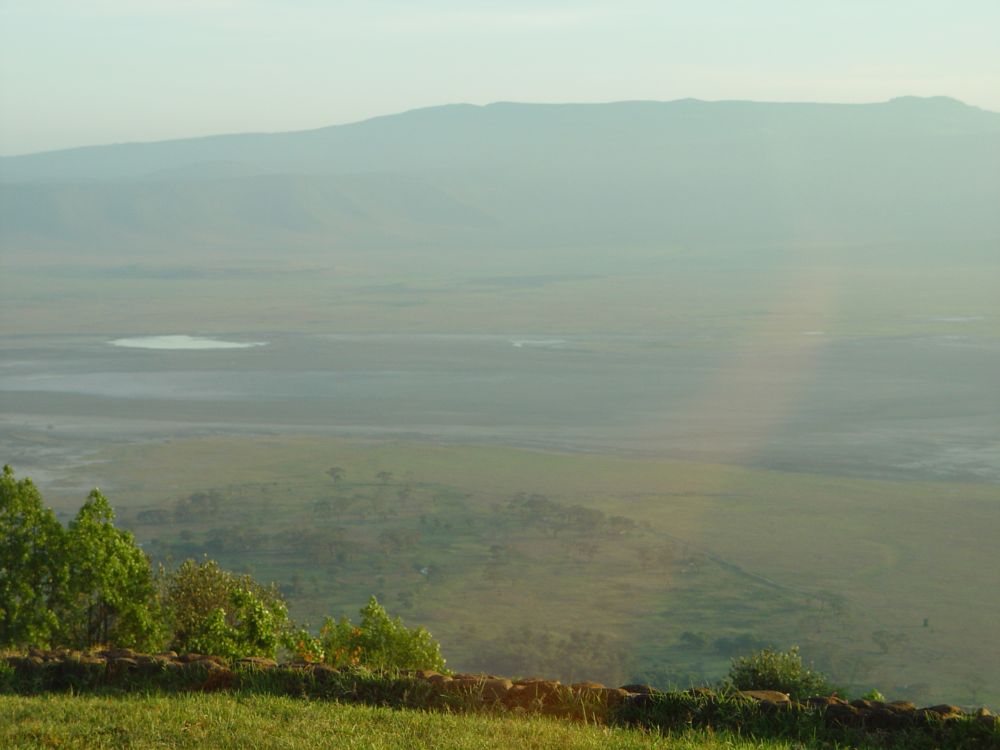
The Ngorongoro Crater is a collapsed volcano in the Ngorongoro Conservation Area. The crater or caldera is at 1700m, 400-600m deep and 17×20 km large.

We stay at the Ngorongoro Wildlife Lodge at the rim of the crater and look north to the Lake Makat and to the Olmoti mountains, if I get that right from the guidebook we have bought.

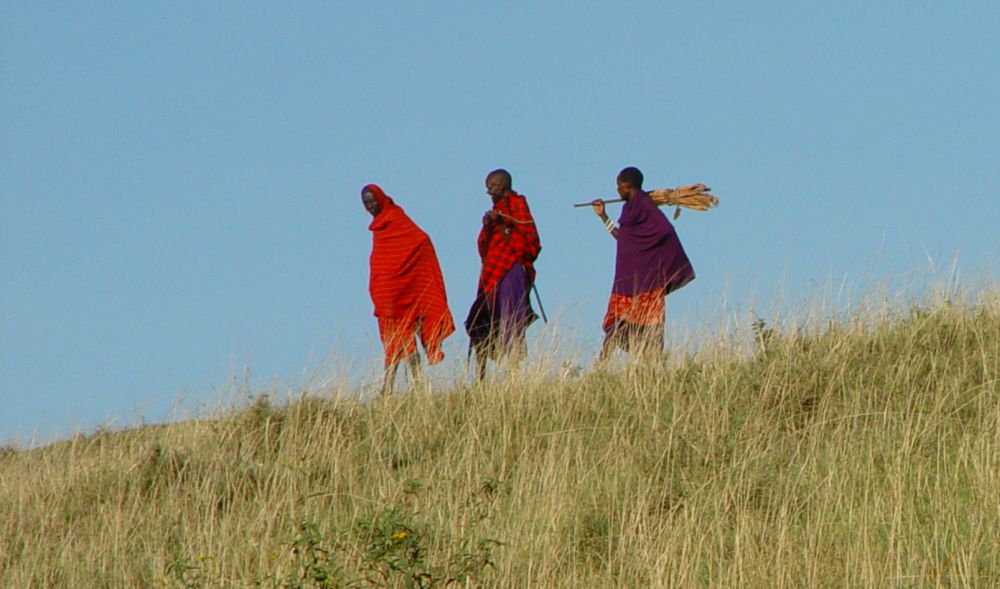
The handsome and tall Maasai (about 50’000) share the Ngorongoro Conservation Area with the animals. The crater as such is reserved for the animals.

We enter the crater in our safari car. Our driver is called Jahaia.

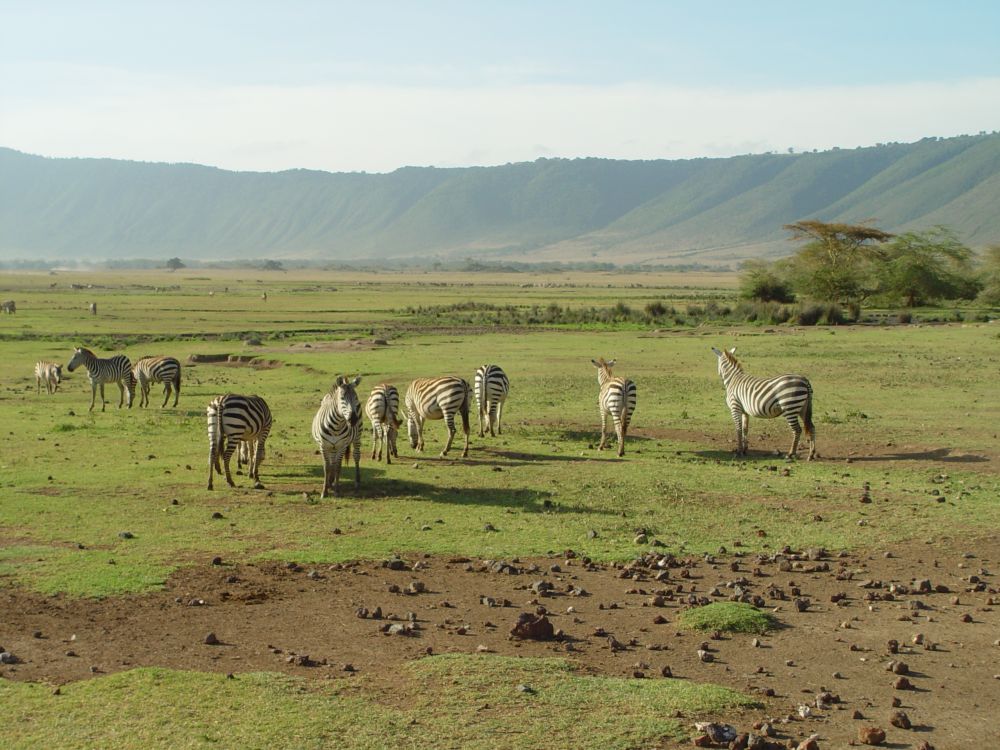
When I notice the first zebras, I am so happy – my first wildlife experience! I want to take a photo… but Jahaia – he does everything for his guests – shakes his head: “I am not going to stop for a few zebras.” Hm, yes, he is right, we see many more zebras in the crater. We wonder, whether they are “white with black stripes” or “black with white stripes”. Jahaia solves the question: “Look, their noses are black, therefore zebras are black and have white stripes.” Okay, right, the noses are black, this is a way of looking at it.

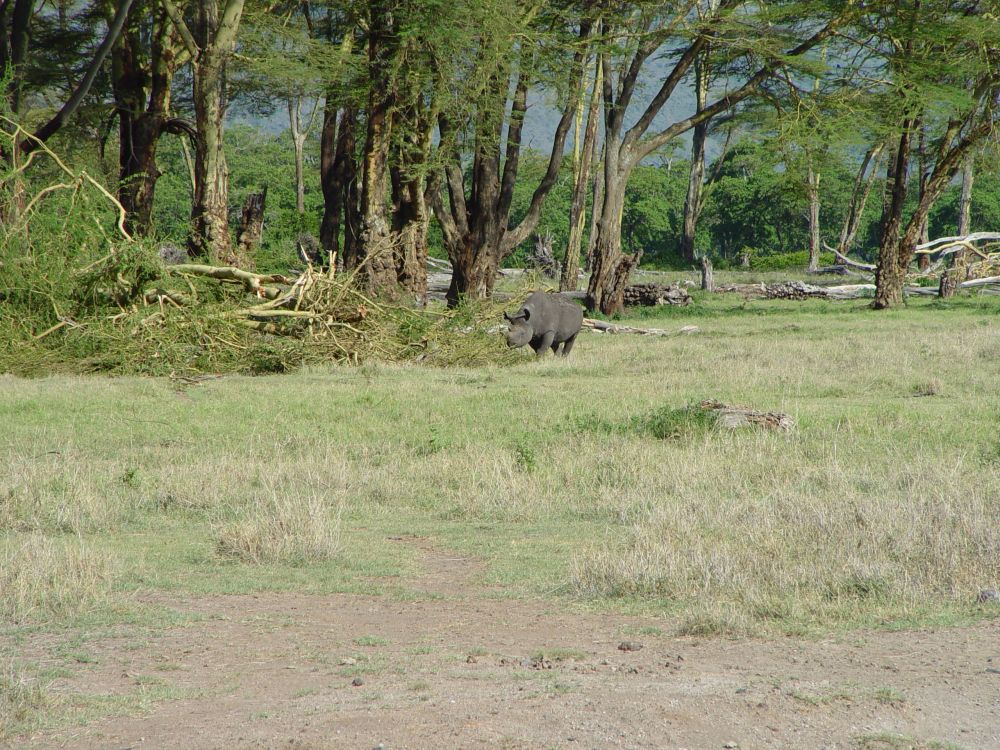
Very soon we reach a wildlife traffic jam (we are at the Lerai Forest now): About six safari cars have stopped and the binoculars of the tourists are directed towards some dead wood under the trees. I hear that a rhino is resting in the dead wood. “Yes, there it is, I can see it!” voices say around me. Hm, I cannot see any rhino. But then a vivid monkey jumps into the dead wood and disturbs the “siesta” of the rhino. It stands up and leaves the dead wood. Angrily it drops a few large pieces of brown dung, paws them away and moves on majestically.

Our driver is happy to have shown this rhino to us… we will not see another rhino on our two safaris. At the time, about 15 black rhinos  (Spitzmaulnashörner) still live in the crater (in 1965 there were about 100 of them). The rhinos are being protected carefully and my guidebook warns: “do not disturb rhinos… You can be fined… for doing so” (p. 37). Well – I asume, the cheeky monkey will not be fined and we are happy that it has disturbed “our” rhino.

We continue our tour and see gnus that graze not far away from two lions resting in the shade.

One female lion is desperately looking for shade and finds it under the car of our friends.

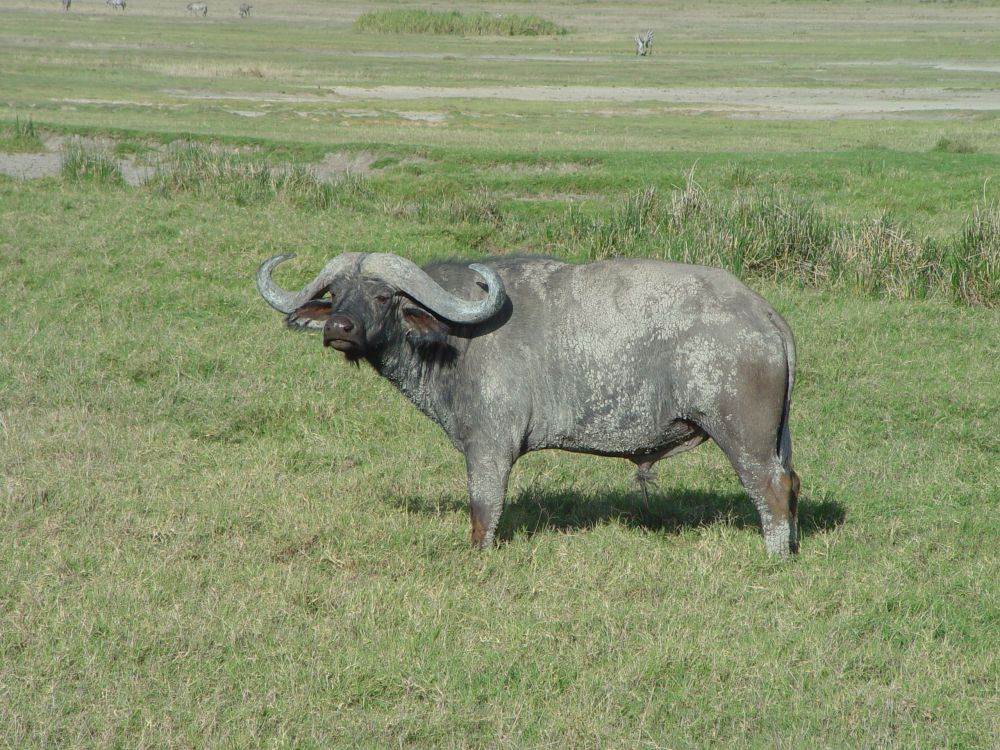
The buffalo looks frightening with these huge horns.

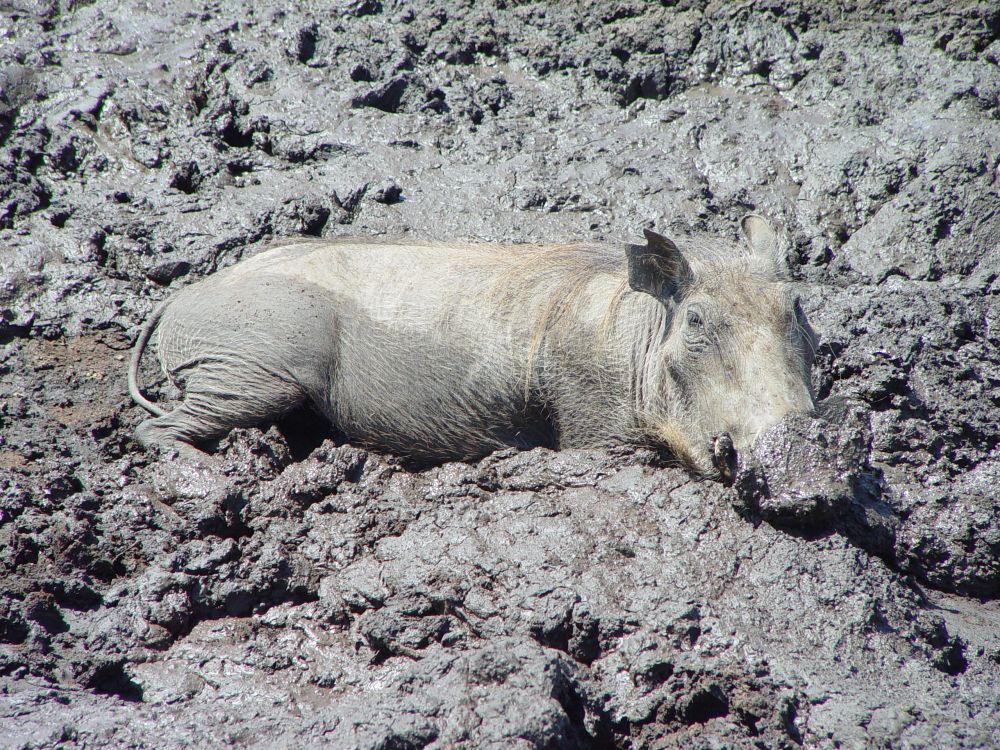
The warthogs love the mud – they have a special charm.

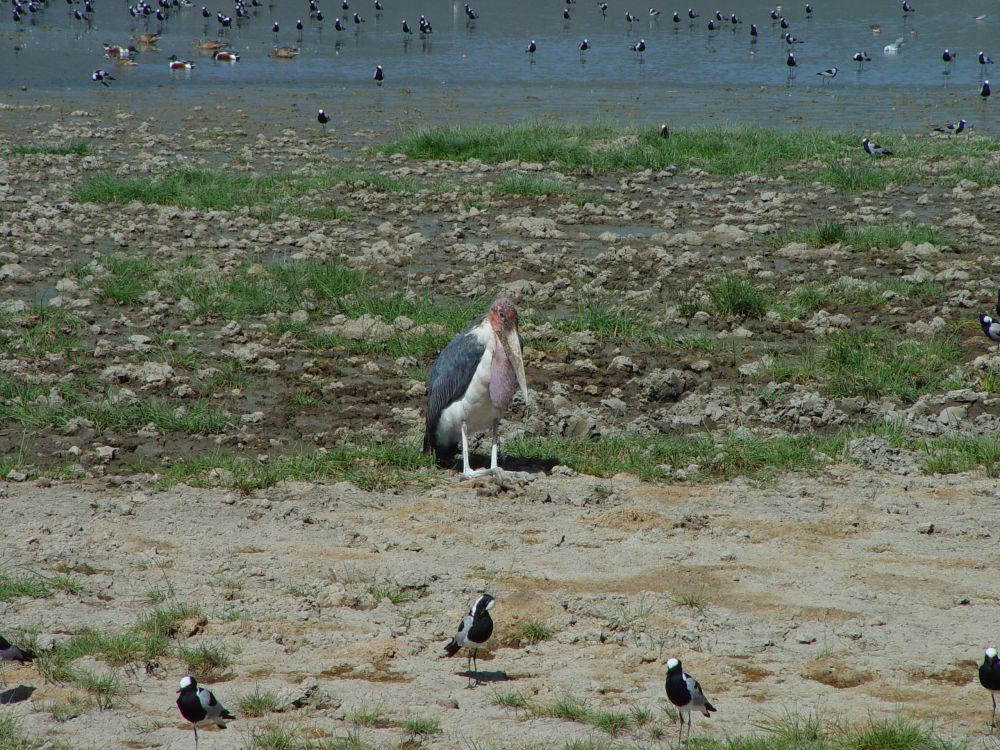
The marabou stork belongs to the family of storks (as the English name indicates). It looks peculiar to us with its short legs, the compact body, the huge pink sac and the bold head. It is a scavenger that lives from dead animals.

Wildlife is abundant in the crater; Elephants, hippos (at the hippo pool), various kinds of antelopes and gazelles, a gepard and a variety of birds such as eagles, vultures, flamingos, ducks, geese, storks, ibis, egrets, herons, kites (“Milane” in German), just no giraffes (too steep for them to get down to the crater). I have the feeling, I am in a zoo, whereby WE are in the cage and the animals walk around freely; they may look at us, strange creatures that humans are in those strange cages that safari cars are…

While taking a good-bye photo of the Ngorongoro crater, I am told by the more experienced Africa travellers that I should not expect to always see that many animals in Africa.

The Ngorongoro Conservation Area is part of an ecosystem of crater highlands at the border of the Serengeti National Park which reminds me of Bernhard and Michael Grzimek and their film “Die Serengeti darf nicht sterben” (Serengeti shall not die, 1959). The Grzimeks and their films were very present, when I was a child. Yes, I agree, the Serengeti shall not die. The Ngorongoro Crater is has been an overwhelming experience (see my post scriptum about the Grzimeks and their successors).


Tarangire National Park

The Tarangire National Park stretches along the river Tarangire. We live in luxurious tents with a sleeping room, a bath room and an outside sitting area bordering the river. Our tent has just a small problem: The zippers of the “doors” to the bathroom and to the sitting area do not glide well – they always get stuck. Ernst, my engineer, gives his best to open and close them (he is so kind to take over this task, because it needs a lot of patience which is not exactly one of my strengths). On the last day, even Ernst can no longer open the zipper and we crawl out of the tent. Nevertheless it is wonderful to fall asleep in the tent with all the noise of the jungle around us and to wake up with all that noise in the morning. From the sitting area in front of our tent we can watch elephants and giraffes drink water in the river.

Though the animals are not as close to one another as in the Ngorongoro Crater, we see a lot of them: Lions,…

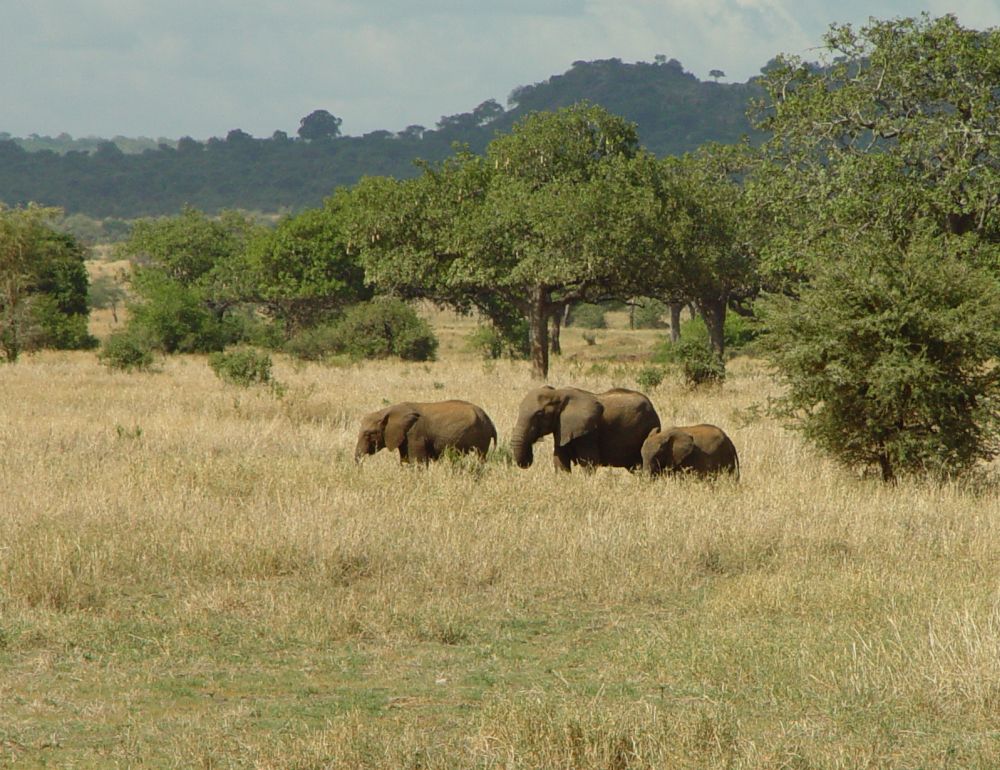
… elephants, …

… more elephants, …

… giraffes – this one keeps the overview -, …

… more giraffes, …

… and another giraffe waving its tail, …

… baboon monkeys, …

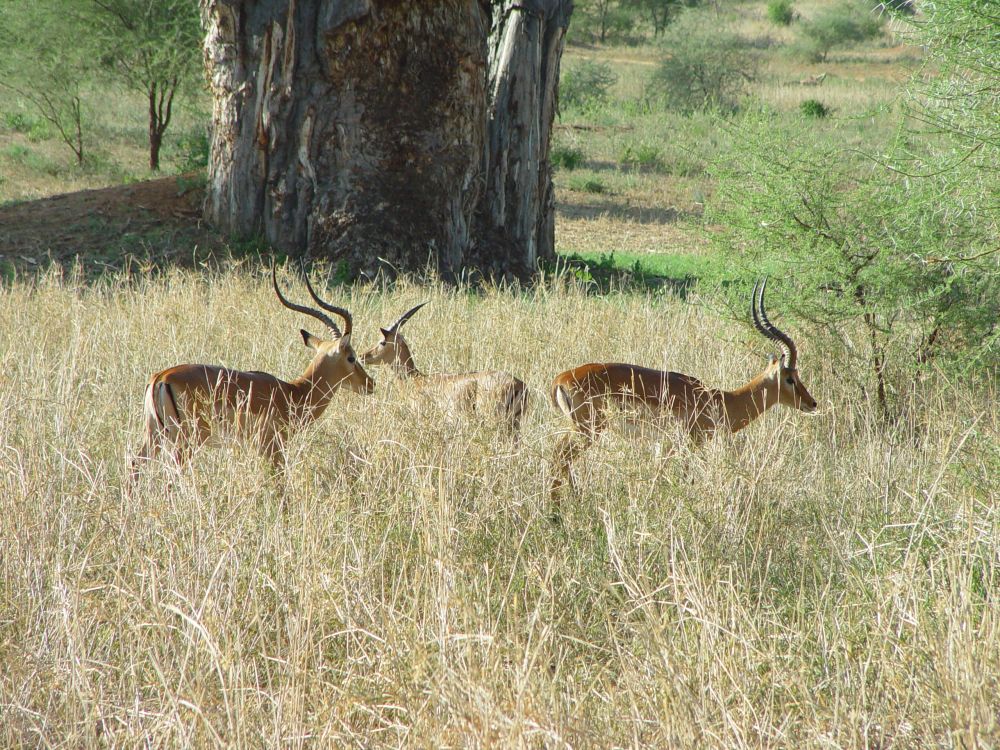
… and impala.

In addition Jahaia can show us a leopard sitting high up on the branch of a tree. And again we enjoy the rich bird life.

Near a large baobab we get out of the car. The baobab reminds me of Saint Exupéry: Le Petit Prince said that, on his small Asteroide 612, he would root out each of the Baobab germ buds carefully, as a large baobab tree would make his asteroide explode.

When leaving the Tarangire Park, we stop at a souvenir shop. This is where I buy the bowls for the snacks that I have included to start this blog about our safaris.


Chale Island – just relaxing 

We round off our tour to Africa by relaxing on Chale island in Nairobi. Looking up Chale Island in the internet, I find that it must have been refurbished since our staying there in 2006.

In 2006, the hotel offers tents and in addition two penthouses. After the experience with the zippers in the tent of the Tarangire Park, Ernst wants to stay in the penthouse. Okay for me, as he wants that so clearly. And we find a place like a fairy tale: A large living room, a large sleeping room with a canopy bed, a huge balcony and even a second floor with more beds. On the canopy bed there are three cushions, two normal ones and in the middle a pink cushion shaped like a heart. Wonderful. When going to sleep, we remove the heart shaped cushion in the middle, it is in the way…

For two days, our program now comprises activities such as eating, resting, reading, swimming, taking a mud-bath, drinking tea with our friends on the balcony of our penthouse – solving the problem of the 36 legs of dancing elephants and ostriches – how many elephants and how many ostriches? Solution: 6 elephants and 6 ostriches.

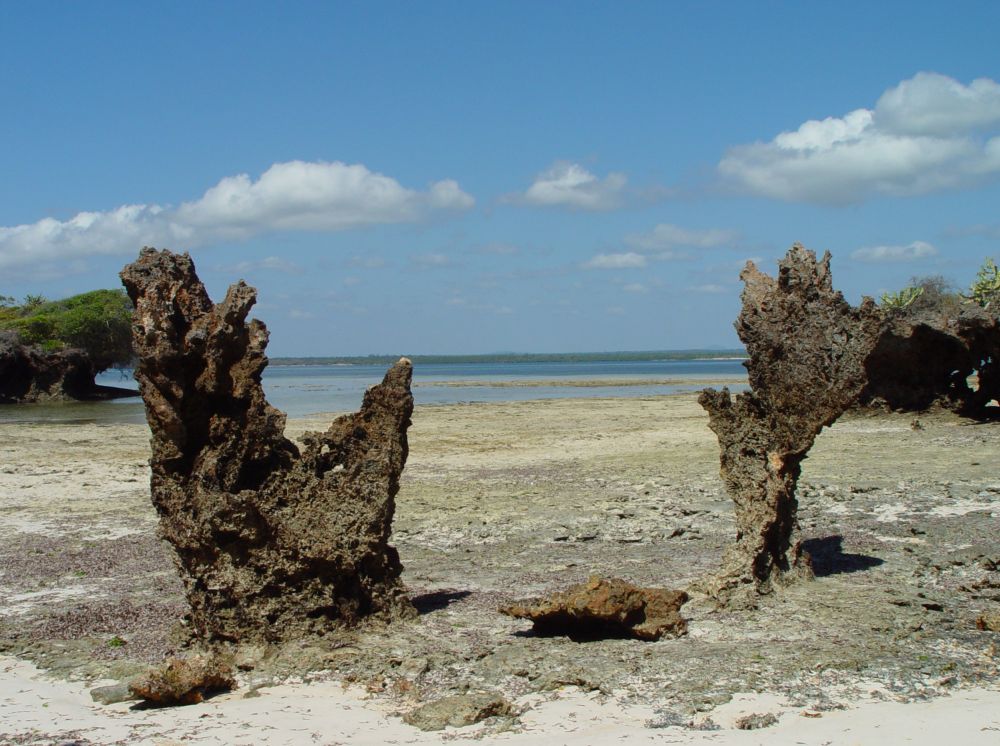
We walk along the coast line, where we can see that this island is a cliff that rose from the sea.

On Monday, 27th of February 2006 we return home. On our flight, we can see the Kilimanjaro from above. When we arrive in Zurich, we find Switzerland covered with snow – it is winter and it is cold at home.

Thank you, Hans-Ueli und Lise, for having invited us to join you and your family in Africa.


Post Scriptum: The pandemic may endanger financing the preservation of the Serengeti and other wildlife refugees in Africa

When thinking about father and son Grzimek and googling their film, I find “die Serengeti darf nicht sterben – die Erben“. It is about the Swiss Markus Borner that continued the project of the Grzimeks for the Zoogesellschaft Frankfurt, assisted by his son Felix. Markus Borner saw Grzimek at the television, when he was a child (as I did). Markus Borner then worked for the Serengeti for more than 30 years and retired in 2017. I am impressed by the film of the Borners, in particular, when they follow the migrating gnu herds in their plane. The Serengeti is an ecosystem, where one and a half million (!) Gnus migrate, as they follow water and food – and the predators follow them. Now climate change endangers this ecosystem. As the rain tracks are shifting, the animals looking for water are colliding with civilization – however, the Borners found ways to vaccinate the population and their animals against rabies that are a danger for the wild animals.

On top of the climate changes, the tourists do no longer come due to the virus and, I believe that endangers the financing of the indispensable infrastructure for the Serengeti and other wildlife refugees (just think of prohibiting poaching!)… I do hope, we will overcome this virus such that tourists return to the Serengeti. It is not only about us people and the economy… it is about much more that is in danger – it is our planet with the last ecologic reserves such as he Serengeti! We have to preserve the Serengeti and the wild life refugees of Africa for the next generations, following the Grzimeks and the Borners – both father and son.

Sources: Jeanette Hanby and David Bygott, “Ngorongoro Conservation Area”, A Kibuyu guidebook, Regal Press 2004; Mary Fitzpatrick, “Tanzania”, Lonely Planet 2002.

Listening to the stories that my home tells me: The Schefflera and the Kilimanjaro

Now in March/April 2020, the virus stopped me from being on the road. I am at home. After all, I am 65+ and I feel, this is required for solidarity.

My home tells me stories – I just have to listen: The furniture in my office is of my great grandfather – a teacher at the grammar school and the university of Basel. The dining table reminds me of my father’s mother – I called her “Omi”. All over are the paintings of my mother’s father – he was an artist and he made some beautiful portraits of his wife, my second grand-mother. There are woodcuts of my mother (being the daughter of an artist) and some souvenirs that she brought home from her journeys. The photo gallery in my guest room and the huge Schefflera plant allow me to travel to Africa with Ernst, my husband. And much more. My home is full of stories and I will now pick up some of them.


The Schefflera and the plush monkey in my living room tell about our ascent to the Kilimanjaro

Let me start with the story that this Schefflera…

… with the small plush monkey has to tell us.

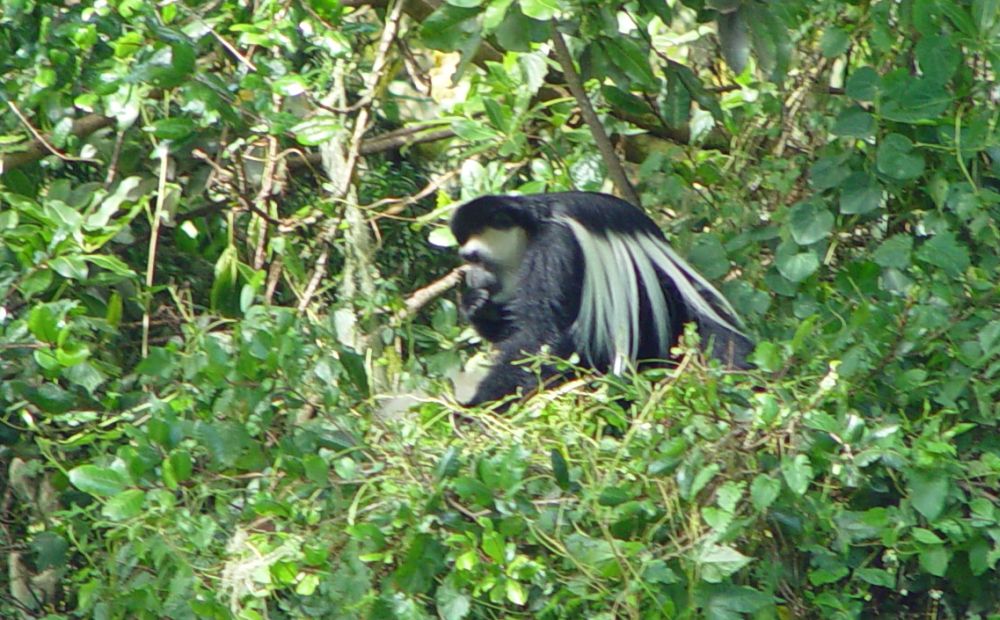
On March 6th 2006, the Schefflera (Fingeraralie) was my birthday gift for Ernst, my husband. The monkey was one of the plush animals that I had played with as a child. I gave the Schefflera with the plush monkey to Ernst as a souvenir of the ascent to the Kilimanjaro that we had just completed, in February 2006. We had seen Schefflera plants there and we had also observed mantled guereza monkeys (Mantelaffe) wearing a white “coat” and a white tail tuft; they are vivid animals jumping from branch to branch and difficult to capture.

My (much used) brown plush monkey is a very, very rough approximation of the guereza monkeys, and Ernst liked my idea.

Now that Ernst has become a star guarding over me, the Schefflera in my living room still reminds me of our Kilimanjaro adventures in Tanzania.


How the idea of the Kilimanjaro came up

Ernst’s best friend had already climbed the Kilimanjaro 30 years ago, when he was almost 30 years old. Now soon about to complete 60 years, he wanted to go back, and he invited his family and close friends to join him. Ernst asked me, what I would think of climbing the Kilimanjaro. I was all for it! This mountain had been a dream of mine, since having listened to the song of Jean-Claude Pascal, “les neiges du Kilimanjaro” (I was a teenager then).


Yes, we made it to the Uhuru peak of the Kilimanjaro – on the so-called Coca-Cola trail

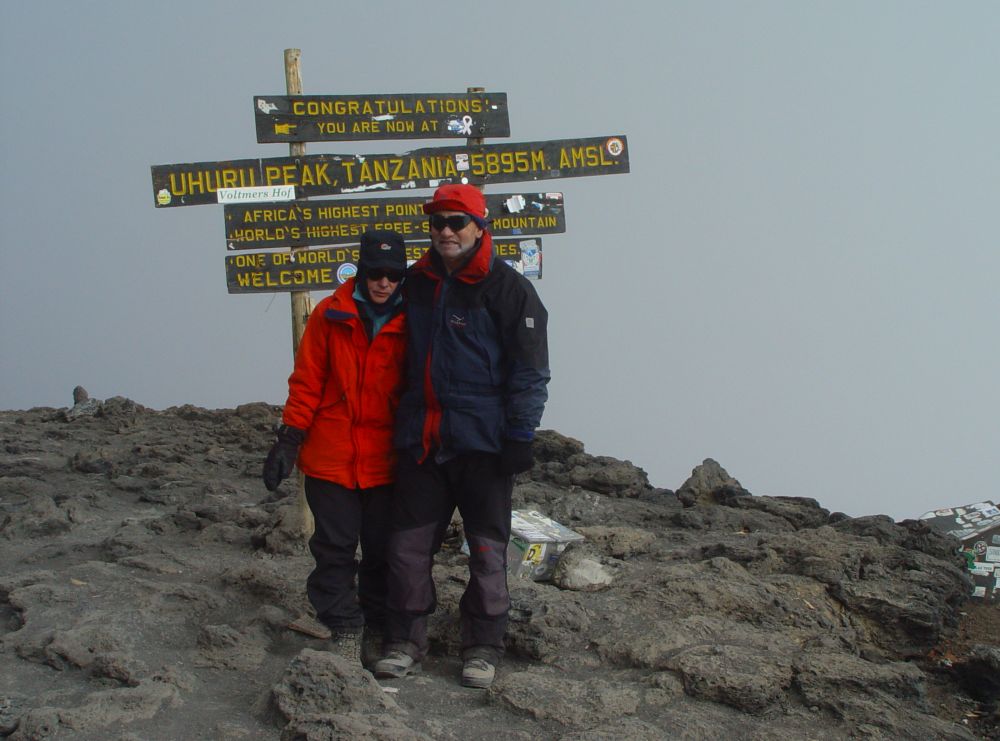
We made it to the top, the Uhuru peak, at 5895m. The whole group, about 15 participants. Here I am with Ernst. It was around 8:30 in the morning, and it was cold.


Walking up “pole, pole” is the secret for reaching the top across the vegetation zones

We have booked our tour with Aktivferien AG that hires local guides, porters and cooks to take us up. The local guides permanently warn us to advance “pole, pole” which means “slowly, slowly” in Kisuaheli. We were the slowest of all the groups, already, when leaving Marangu at 1800m.

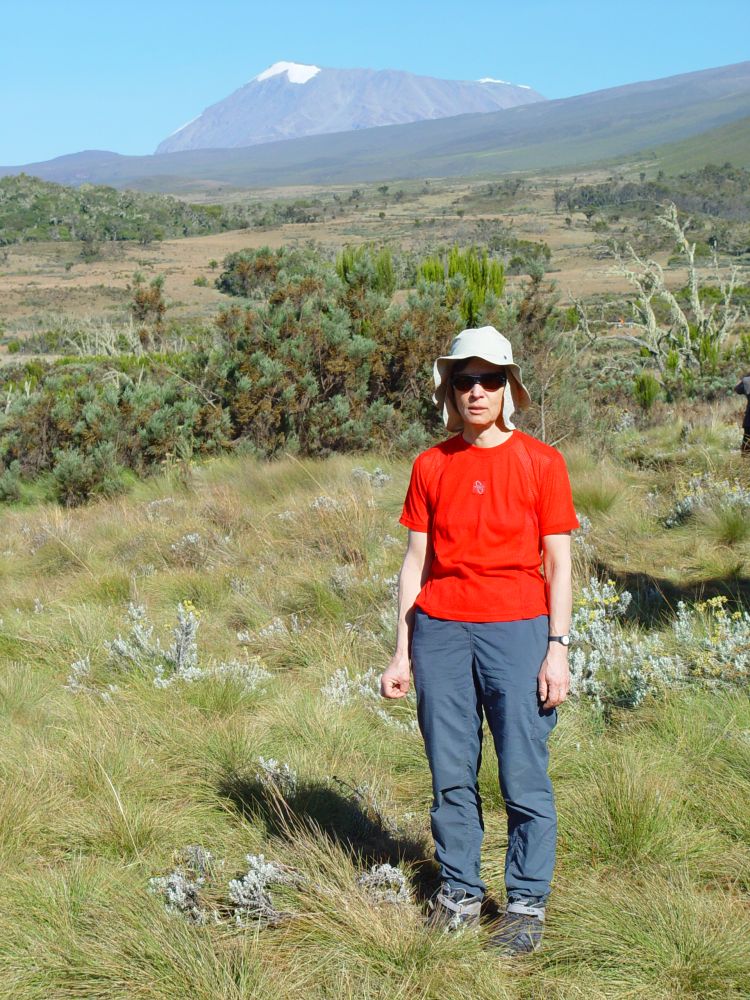
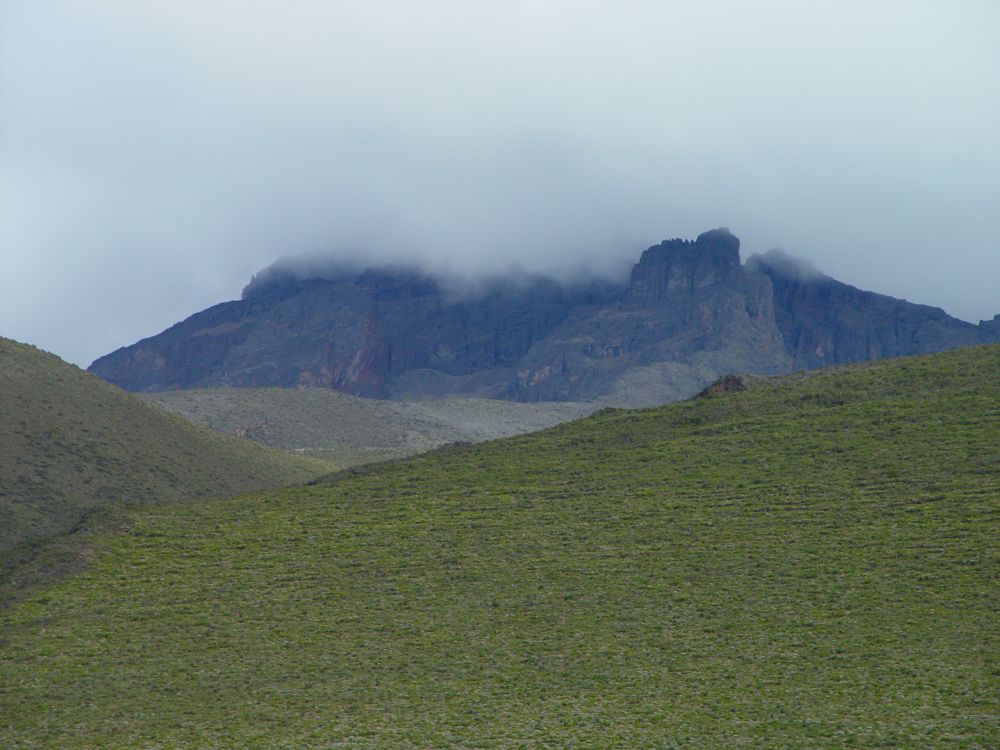
We walk through the tropical rain forest first…

… and then reach the giant heather about half an hour before arriving at the Mandara hut. The  heather is covered by bearded lichen.

The heather plants are huge and I feel like Hänschen in the empire of the Blueberry Man – a book that I loved as a child (“Hänschen im Blaubeerenland”).

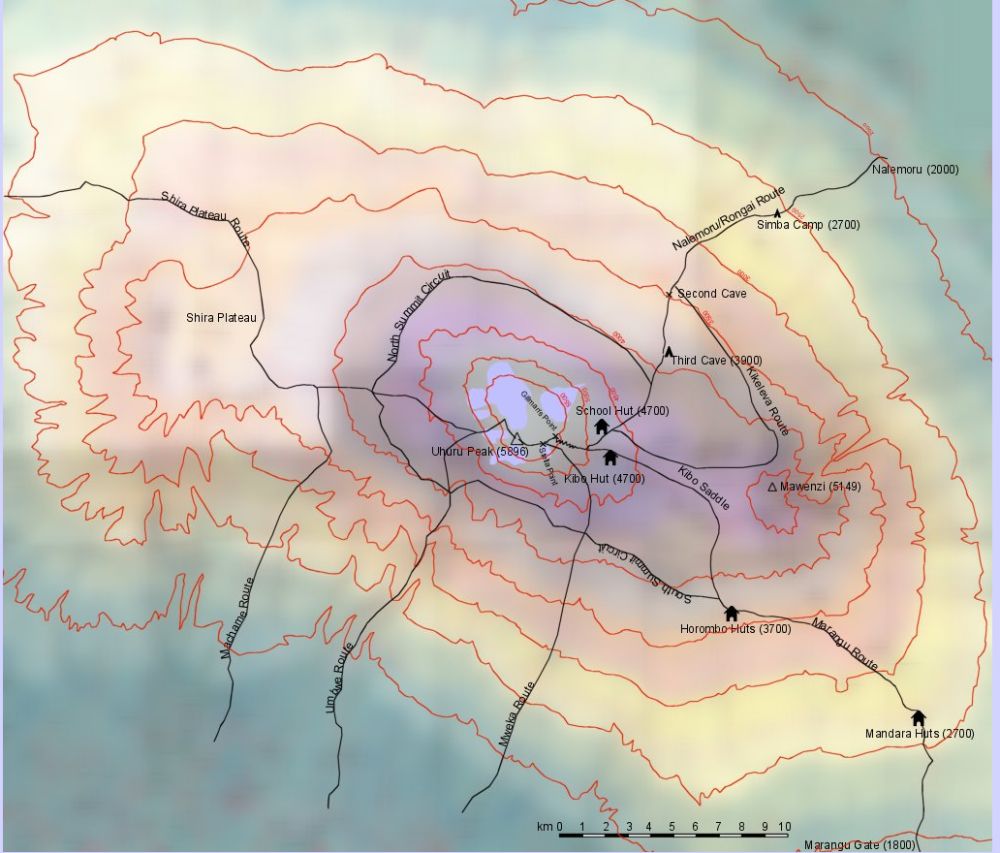
It is 900ms up from Marangu to the Manadara hut on 2700m (called after Mandara, a local chieftain in the late 19th century, known for being a tough warrior and for taking gifts from the early explorers of that time).

On the second day, we walk in the moorland above the tree level. Outstanding are Lobelia (deckenii) and Senecio (kilimanjaro or giant groundsel). This is the Senecio plant.

We reach the Horombo hut at 3650m altitude. This complex of huts was called “Petershütte” before, and yes, a distant ancestor of mine, Dr. Carl Peters, has founded the colony of Ostafrika/East Africa which is about Tansania today. I have mixed feelings about my ancestor, because I cannot not agree with his ruthless attitude towards the indigenous population.

We stay in the Horombo-Peters hut for two nights. To adapt to the altitude, we walk to the saddle separating the Kibo mountain from its “partner”, in the east, the Mawenzi, which is a volcano that is no longer active. Its name means “the dark mountain” in Kisuaheli.

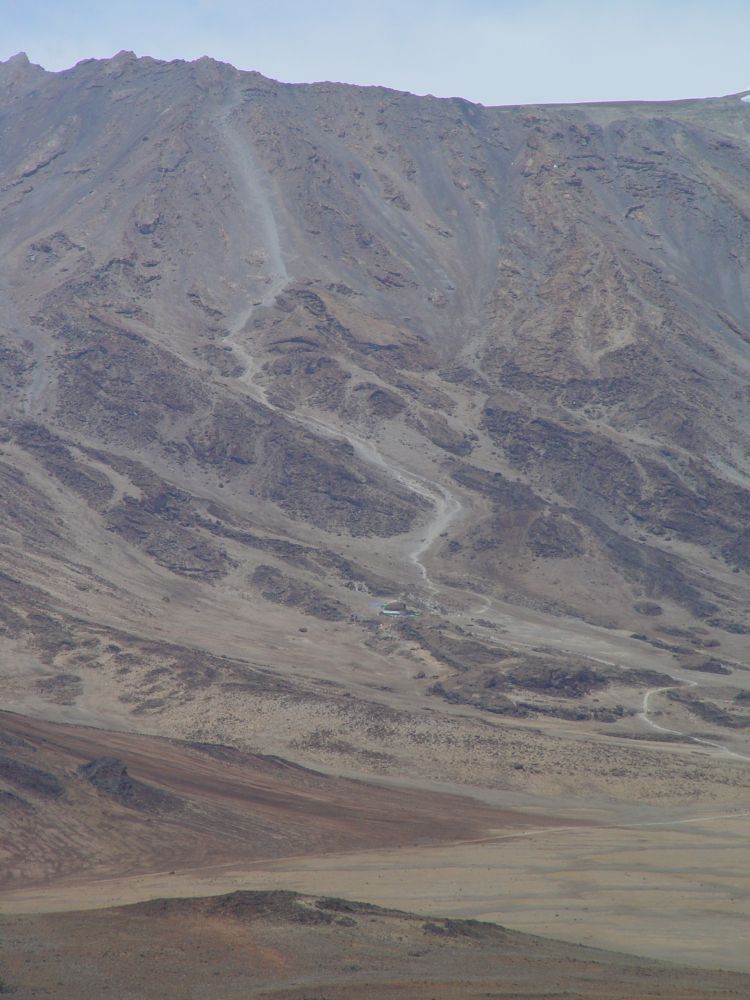
We look at the path leading from the Kibo hut to the crater rim (Gillman’s point) which we will climb up in two days from now.

The way from the Horombo hut at 3650m to the Kibo hut at 4750m takes us through barren terrain and the water supply ends on the way. No water above this point. Our porters tank water here.

Our night in the Kibo hut is very short. We get up at eleven pm and at midnight, we start to walk up along the winded path to the crater rim, “pole, pole” – zig-zag, zig-zag, zig-zag – endlessly. At the beginning, we are overtaken by others, but then the other groups sit down more and more and we overtake them, pole – pole. The local guides take care of each of us, even carrying some of our rucksacks. They do a great job motivating us to continue. At 5200m we reach the Meyer’s cave, named after Hans Meyer who was the first to reach the top of the Kilimanjaro in 1889; he called the highest point after Emperor William II of Germany (it is now called Uhuru peak, uhuru=freedom). Hans Meyer picked a stone from the very top, brought it home to Germany and gave half of it to his emperor William II. The emperor integrated this stone in the decoration of Das Neue Palais in the Sansouci castle and park complex in Potsdam – here it is.

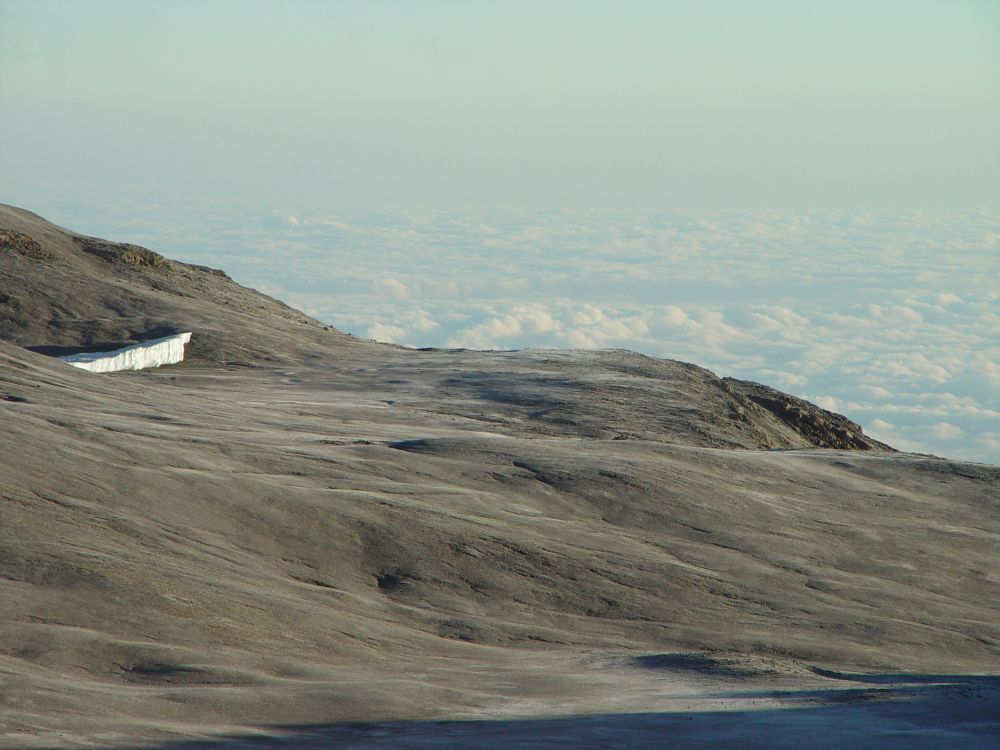
At about six o’clock, we have reached the crater rim, signposted “Gillman’s Point” (5685m). Less than 1000m ascent in six hours, this is my record in “slowness”. That WAS “pole, pole”. It is very cold. I use my red rain cape as a “tent” insulating me from the cold temperatures and warming me up. Then I hand the cape on. After a rest, we tackle the last 200m along the rim to the Uhuru peak, the highest point of the Kilimanjaro or Kibo.

At the top, we share the birthday cake – after all this ascent to the Kilimanjaro was the birthday wish of Ernst’s friend. It is around 8:30. About half an hour later, we start our descent. The idea is to get back to  “more human” altitudes as fast as possible. The couloir that we had zig-zagged up before is full of ash and we can glide down on it like on snow. From the Kibo hut, we continue our way down to the Horombo hut, where we stay overnight. The next day, we take an early start at six in the morning to walk down to Marangu, where we are invited to church in the early afternoon. Ernst sighed: “Nie han i so frie uffschtah miesse für z’Predigt z’go” – “Never have I had to get up so early to go to church.”

Marangu – Mandara hut – Horombo hut – Kibo hut – Uhuru peak – this was our route up to the Kilimanjaro, and because this seems to be the most comfortable route (with all the huts on the way), it is called Coca Cola trail. But – the altitude is nevertheless a challenge, and from the Kibo hut, we were the only group that made it to the top. The last ascent to the Uhuru peak IS demanding, also on this trail.


At the church – the safari service and the banquet

After having gotten up so early this morning to run down from the Horombo hut to Marangu, we make it in time to the church.

The church bell rings for us. The priest talks about the Israelites returning from Egypt to their homeland, just as we have safely returned from our tour (or safari) to the Kilimanjaro. After the service, we are invited to a delicious banquet with the highlight being a roasted goat. The Lutheran faith of the community shows that the Germans have evangelized Tanzania – the first missionary was Johannes Rebmann in the middle of the 19th century.


Good-bye guides, porters and cooks and good-bye Kilimanjaro, you are large mountain giving life, but also being a potential danger 

After our descent, we say good-bye to the guides, the porters and the cooks that have cared for us. Together, we sing the Kilimanjaro song:

” Kilimanjaro, Kilimanjaro, Kilimanjaro,
Kilimanjaro -mlima mrefu sana
Na Mawenzi, na Mawenzi, na Mawenzi,
na Mawenzi – mlima mrefu sana
Ewe nyoka – ewe nyoka, ewe nyoka,
ewe nyoka – mbona wanizungukaa
Wanizungukaa, wanizungukaa, wanizungukaa;
wanizungukaa – wataka kunila nyama”

The words say:

“Kilimanjaro…  is a very high mountain,
and Mawenzi… is a very high mountain.
You snake…, why do you surround me.
You want to eat my flesh”.

The people living around the Kilimanjaro are aware of the fact that this volcano is resting and could explode one day destroying all the life around it that now benefits from the fertile volcanic ground and the mountain as an obstacle in the landscape generating rain. It is very probable that a lava plug is lurking under the convexely shaped mountain.

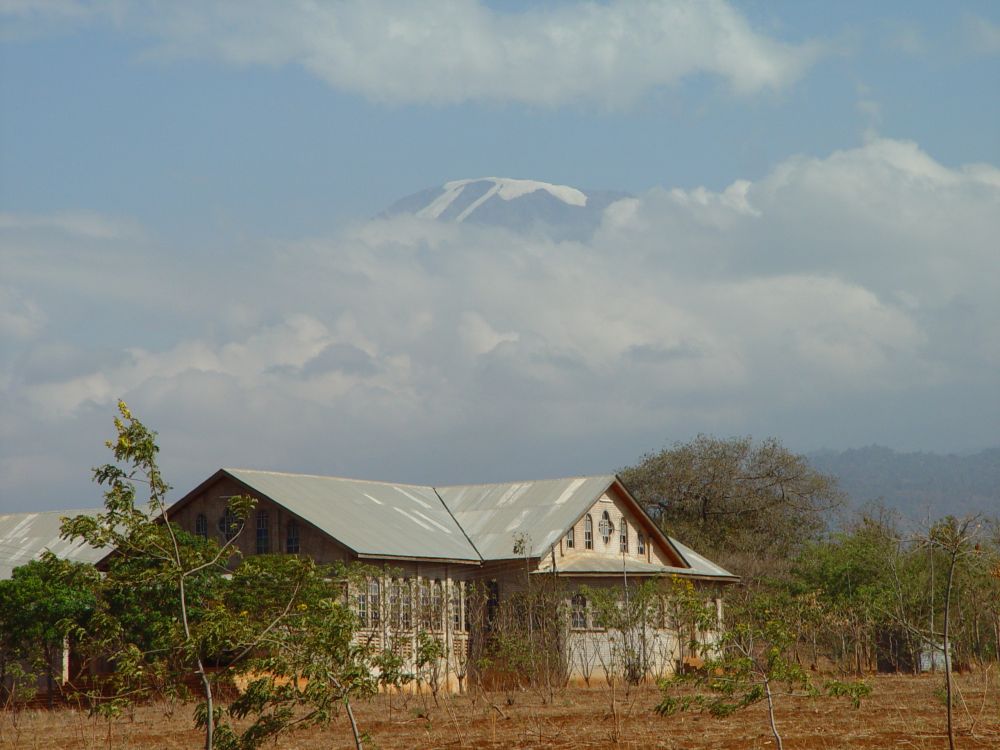
On the next day, we drive to the Ngorongoro Crater. We look back to the Kilimanjaro with its white coat or “blanc manteau”, as Jean-Claude Pascal sung in the 1960-s.

Now our wild-life safari adventure starts; we will see animals such as zebras, gnus, elefants, giraffes, lions, antilopes, warthogs, marabus and even a rhinoceros.


Sources: P. Werner Lange, “Kilimandscharo – der weisse Berg Afrikas”, AS Verlag Zürich 2005; Henry Stedman, “Kilimanjaro – a trekking guide to Africa’s highest mountain”, Trailblazer Publications 2003.

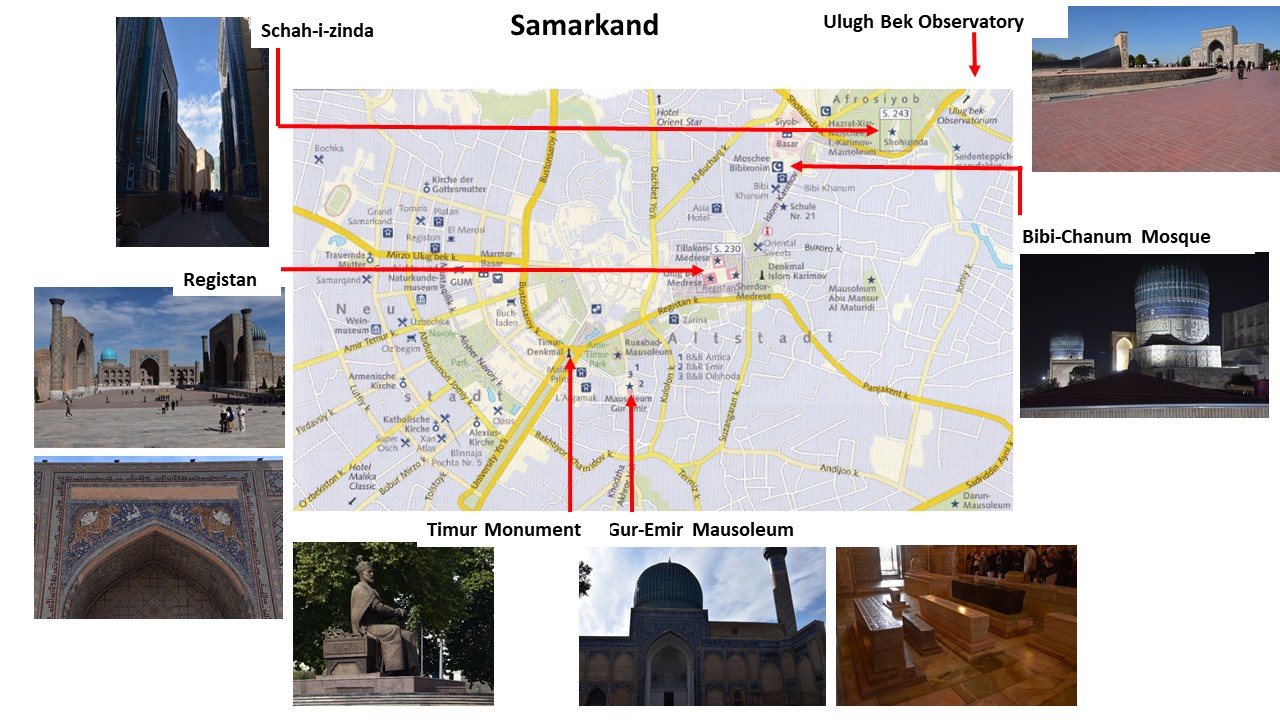
Discovering Uzbekistan – blue cupolas and dreams of 1001 nights in Samarkand

In September/October 2019, I was in Uzbekistan. Our tour ended with the city of Samarkand, where the blue cupolas seem to have come from the tales of 1001 nights. As a matter of fact, some of the tales of 1001 nights, it is said, originated in Samarkand (first told in Persian, later translated into Arab).

The city centre has been shaped by Timur who made Samarkand the capital of his large empire and by his successors, above all Ulugh Bek.

Source: “Usbekistan”, Trescher Verlag 2019, my own photos


Samarkand is the capital of Timur around 1400

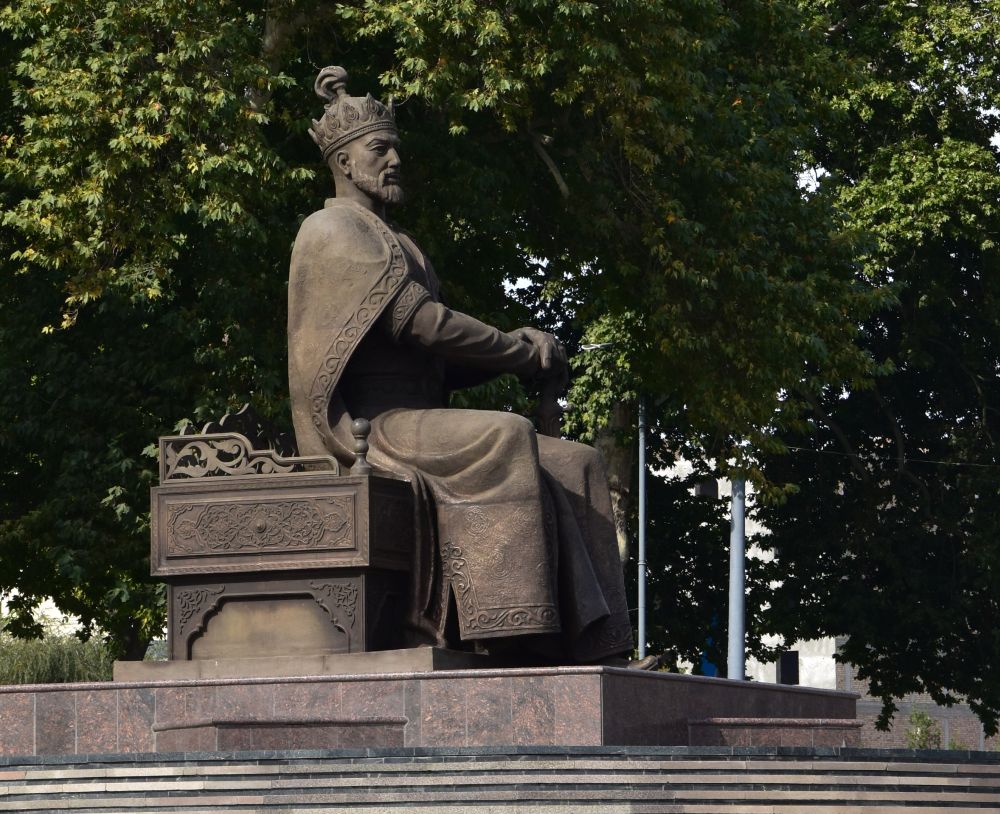
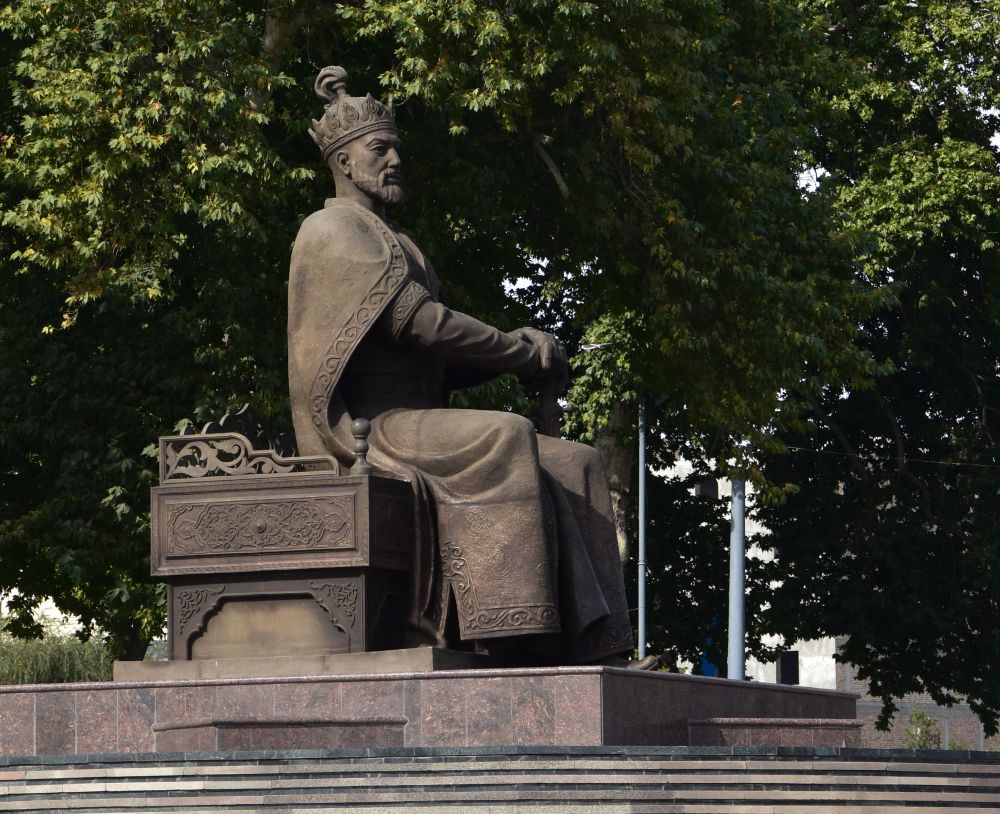
Timur (1336-1405) made Samarkand the capital of the large empire that he had conquered (see my history blog). His statue stands at the border between the old city centre and the Russian new city that emerged at the end of the 19th century. Busy traffic surrounds Timur, while he sits majestically on his throne.

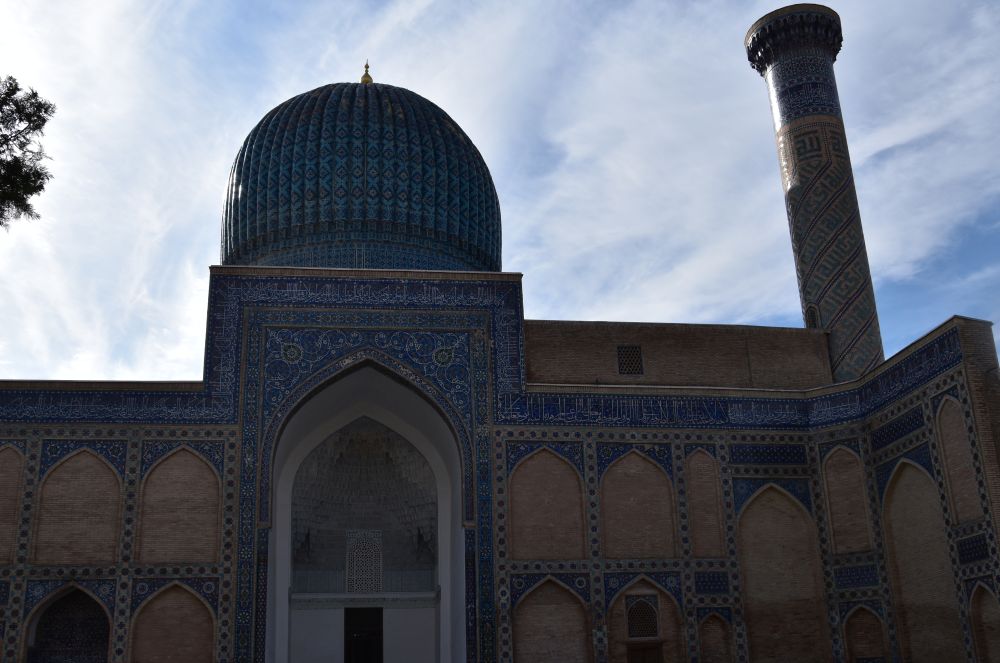
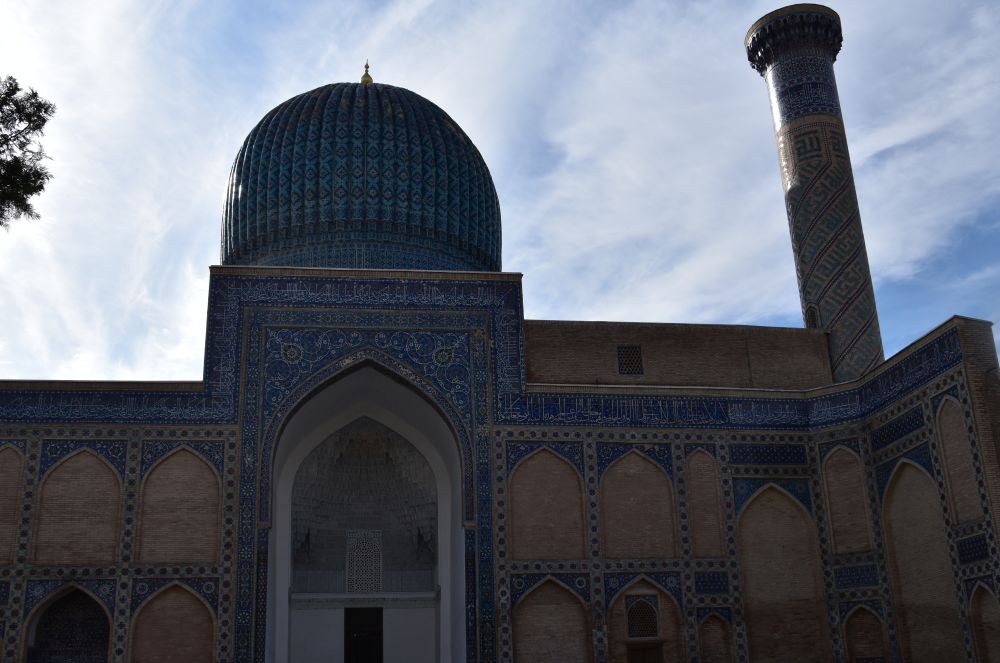
Not far from here, Timur is buried in the Gur-e-Amir Mausoleum with the graceful blue fluted cupola (around 1400). It is a double layered cupola (note: Petersburg has a copy of this cupola! – see the post scriptum).

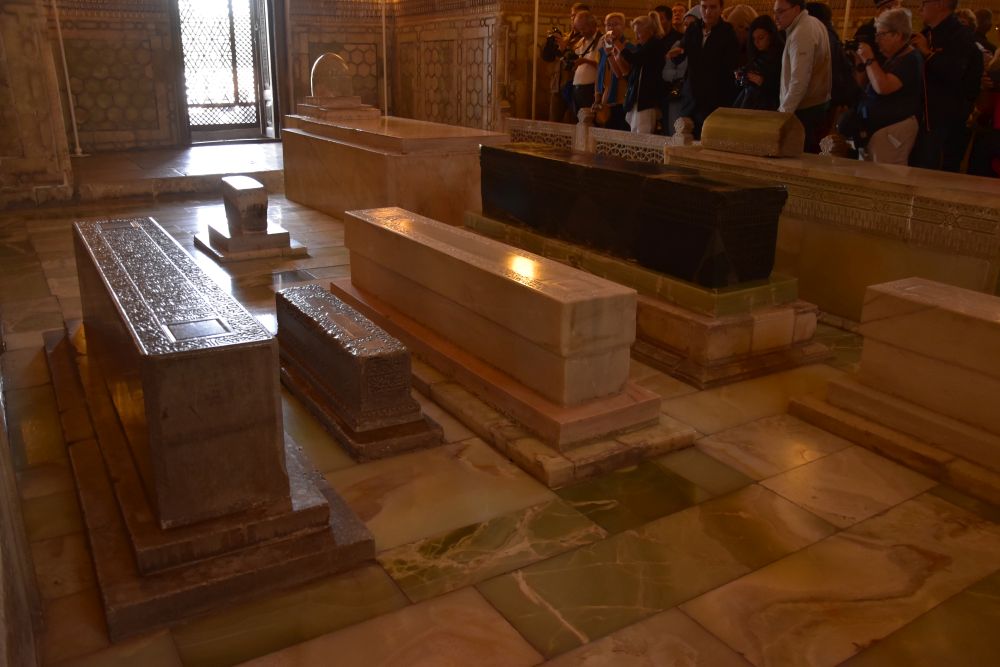
Inside, the bottom of the walls is covered with onyx slabs, the dome is decorated with gilden papier-mache and the niches are filled with stalactite pendentives. Blue banners with inscriptions all over.

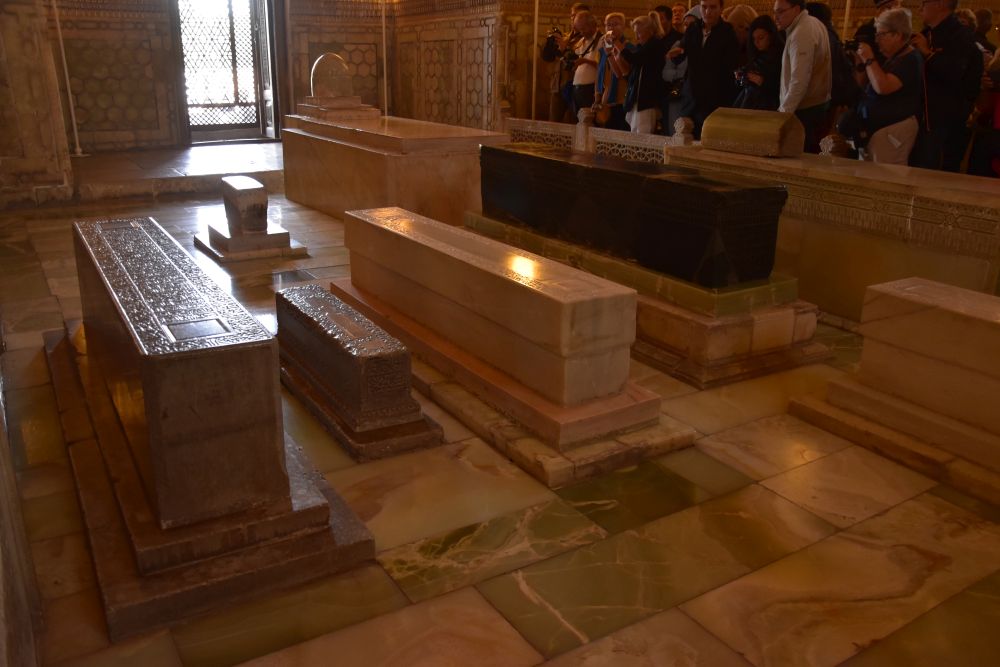
Timur is buried in the crypt; the black coffin is his cenotaph. Around him are members of his family and some close companions.


Bibi Khanym has her own mosque.; she was Timur’s main wife and a descendent of Genghis Khan

Timur was proud of his main wife, Bibi Khanym, because she was a descendent of Genghis Khan, which allowed him to base the authority of his throne on Mongolian descendance. He convinced the Imams to dedicate the Bibi Khanym mosque to his wife (that was not easy, as mosques are usually dedicated only to men).

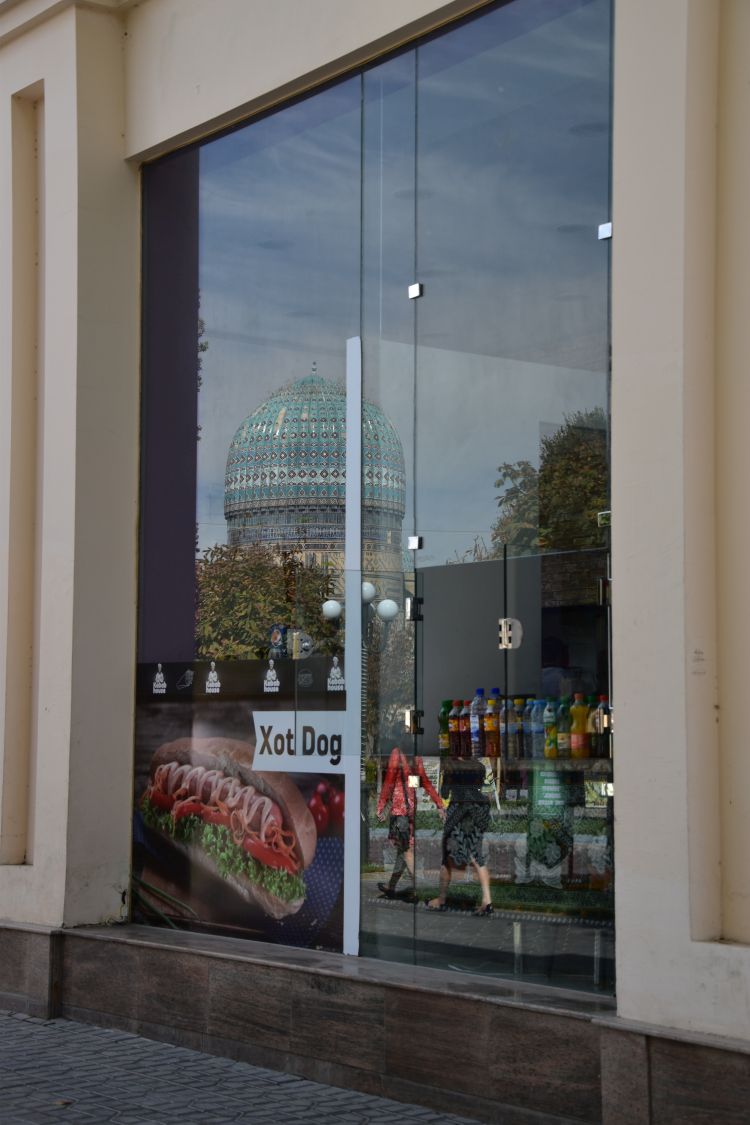
The Bibi Khanym mosque is reflected in the window of one of the shops in the pedestrian alley that connects the Registan (see below) with the Bibi Khanym ensemble. The fluted cupola resembles the cupola of the Gur-e-Amir Mausoleum.

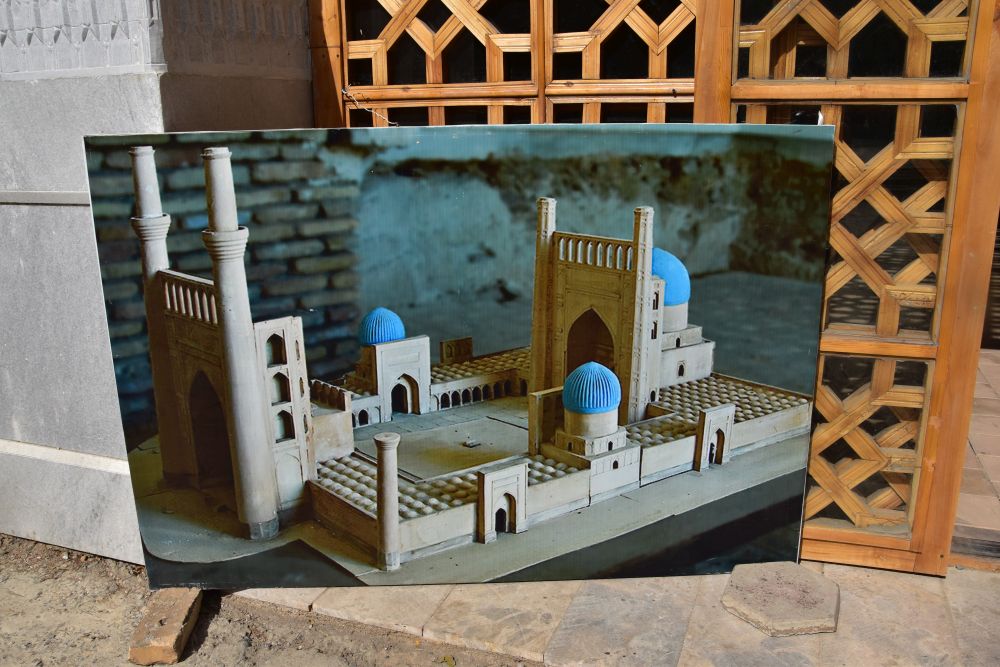
Around 1400, the Bibi Khanym Mosque was a large scale project of Timur’s. The mosque should be larger than any other Friday Mosque in his empire. Sitting in his sedan, he cheered his workers to hurry up. In 1404 the mosque was completed.

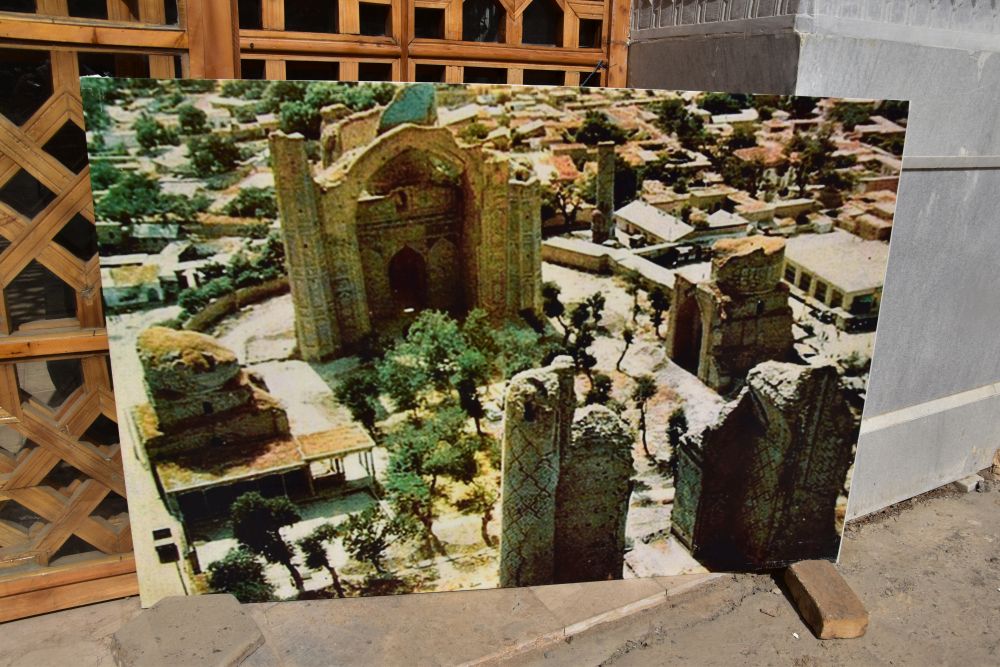
First signs of decay appeared soon, and 200 years later, the Bibi Khanym Mosque was in ruins.

It was reconstructed in the 19th century, after the Russians had conquered Central Asia.

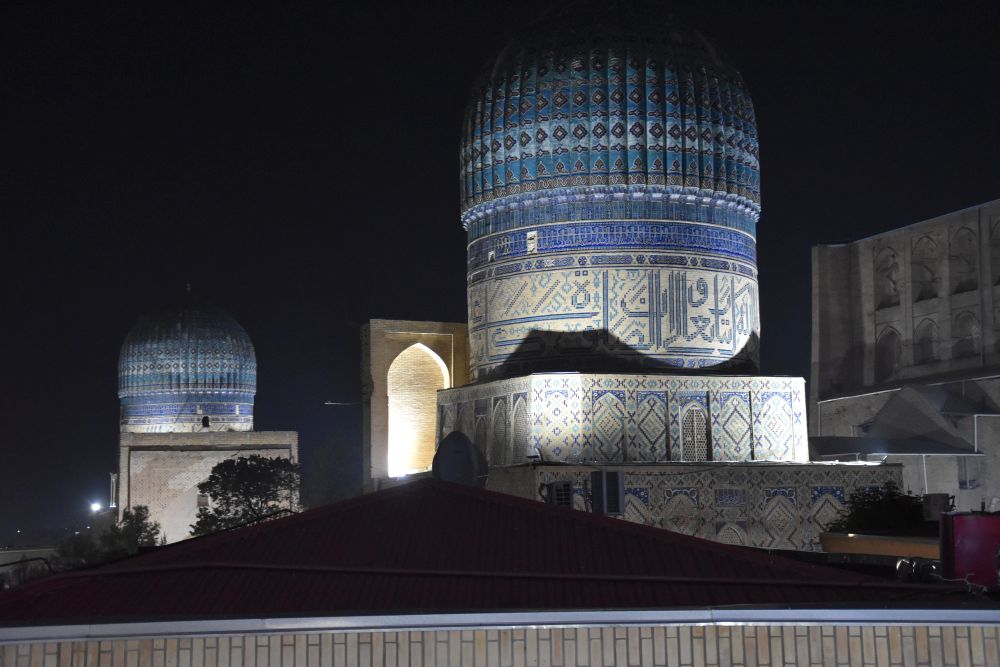
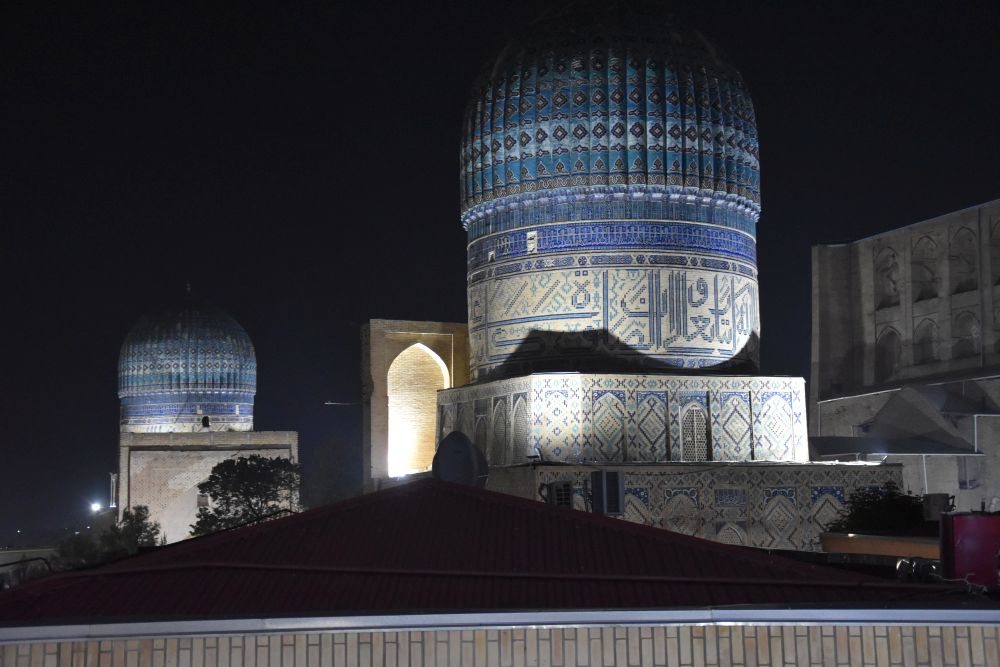
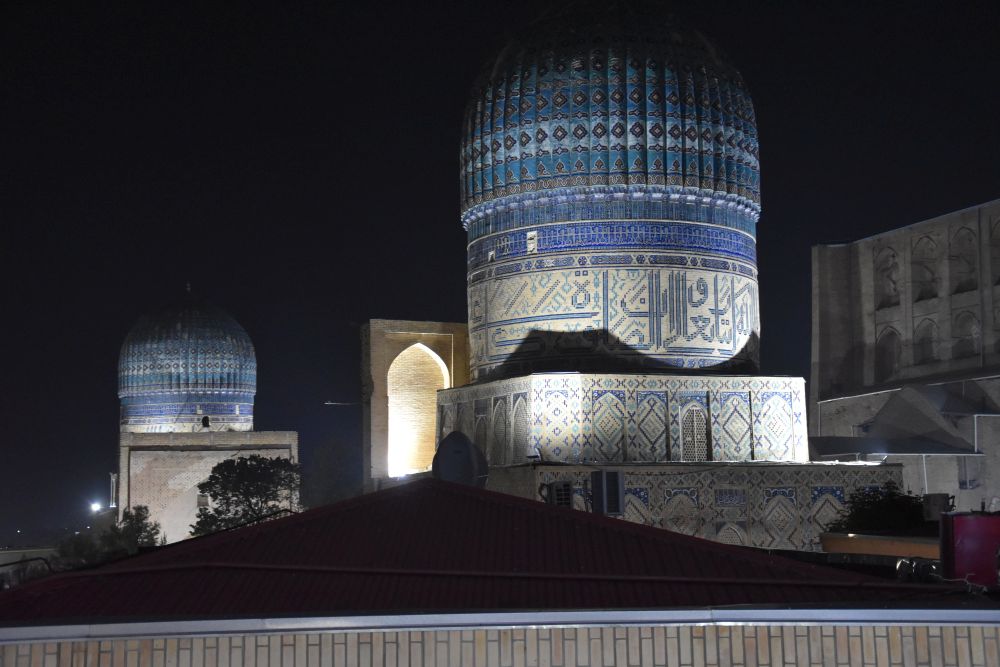
The charming blue cupolas of the Bibi Khanym Mosque made me dream, when sitting on the terrace of the nearby restaurant. Just magnificent.

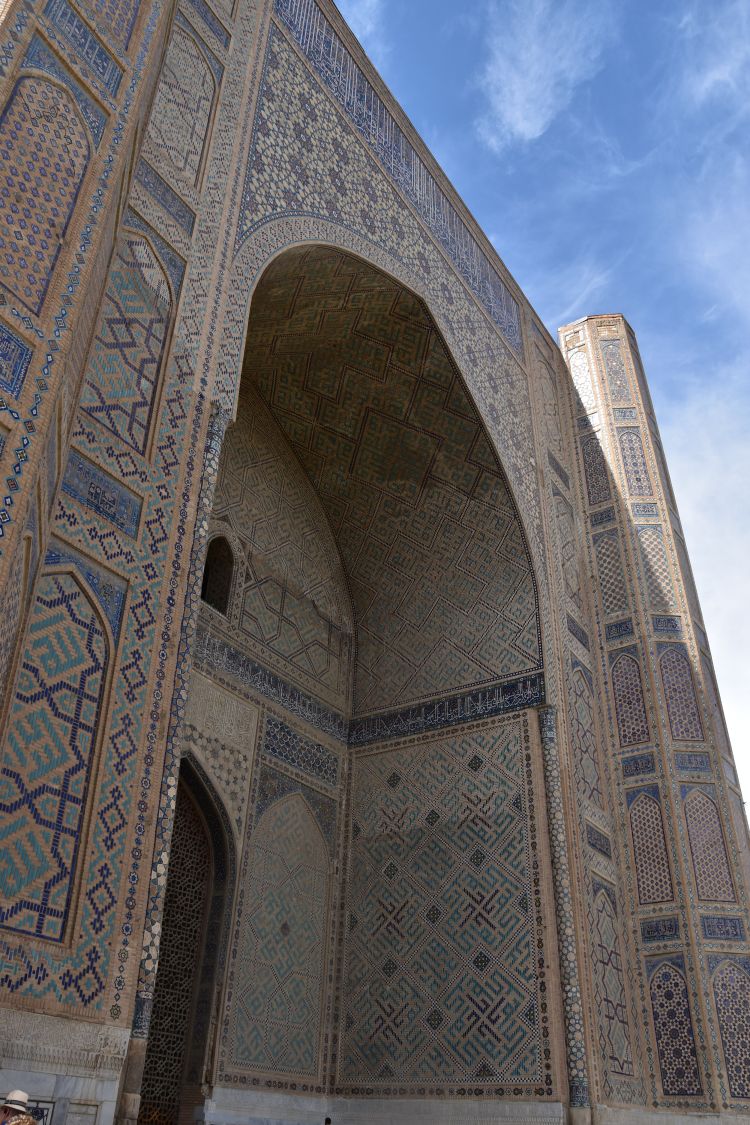
This is the portal of the mosque in day light…

… with more details – incredible harmony.

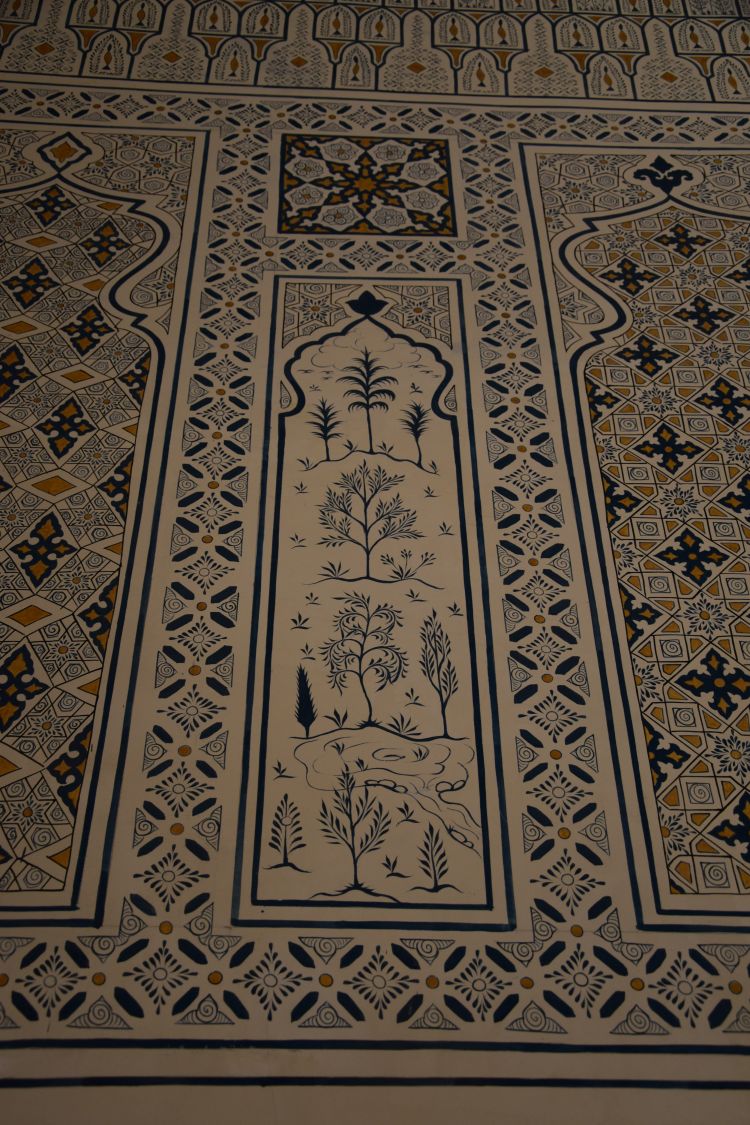
The plants are unusual in Islamic architecture.

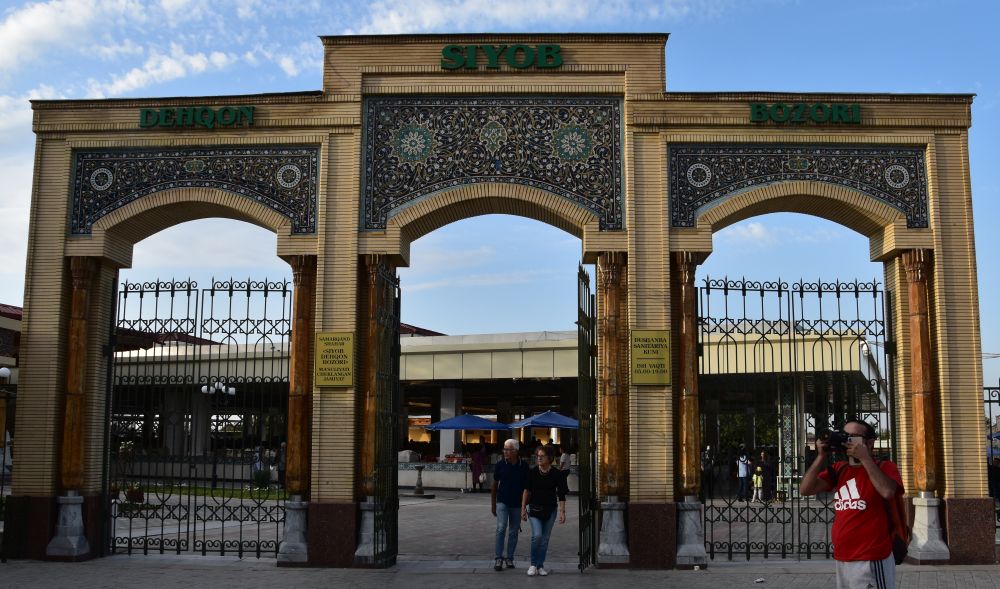
Behind the Bibi Khanym Mosque is a charming bazar.

My friends buy this jacket (Susani embroidery) for me. It is a thank you for me having guided them through Moscow. Thank you!


The Registan, the most elegant square I have ever come across

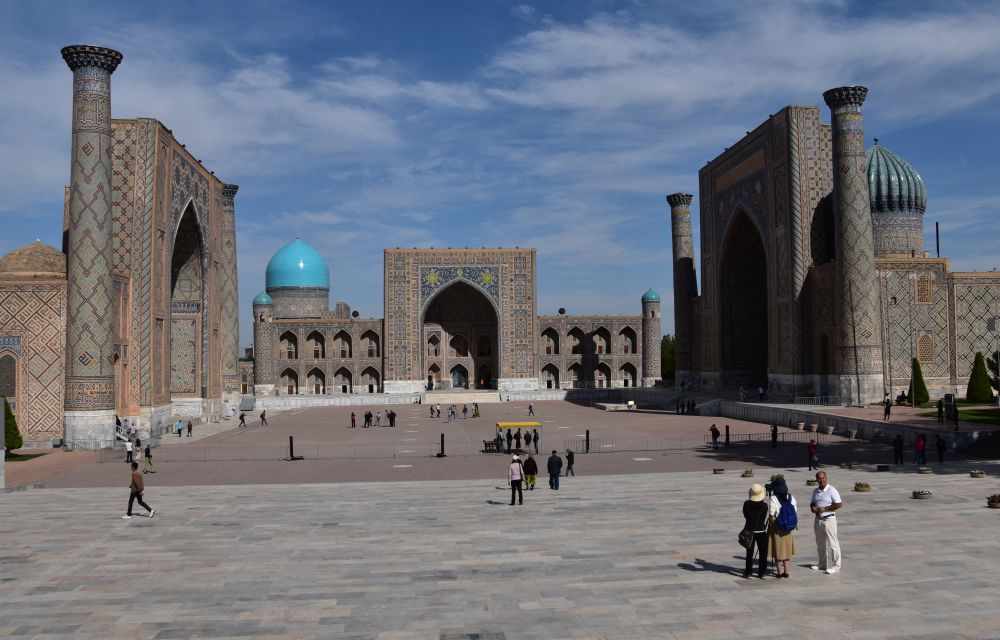
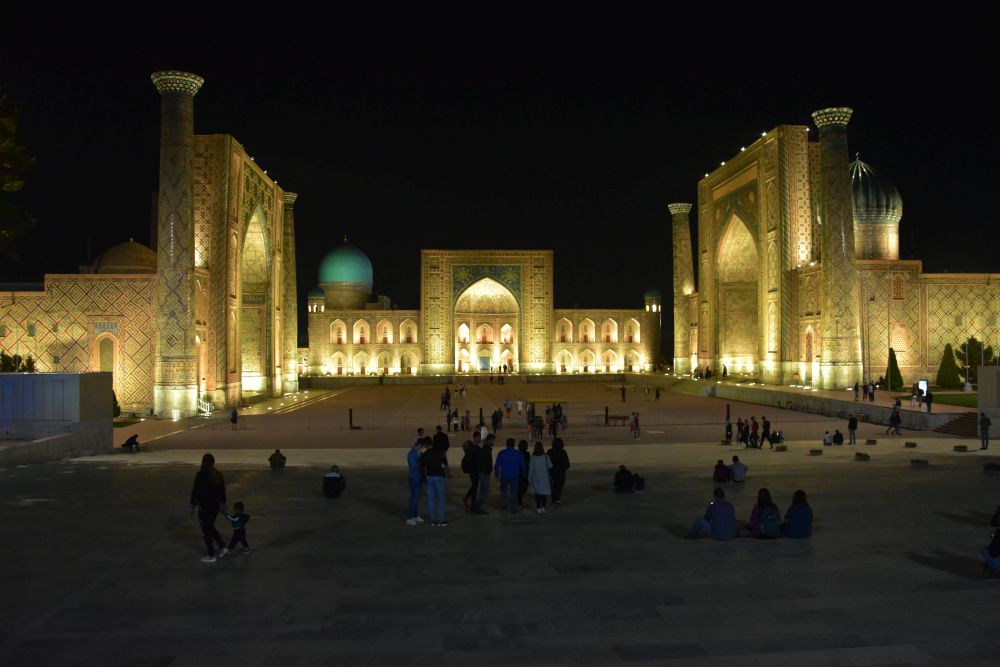
The Registan ensemble of madrasas is just breath taking… wauuu! This is the most elegant square I have ever seen. The perfect symmetry is called “Kosh principle”. It is interesting to note that the three madrasas have not been built at the same time; there is a difference of 200 years.

To the left is the oldest madrasa, built by Ulugh Bek, the grand-son of Timur. It is from the early 15th century. Ulugh Bek was a scientist, and he was of the opinion that schools are important for his empire.

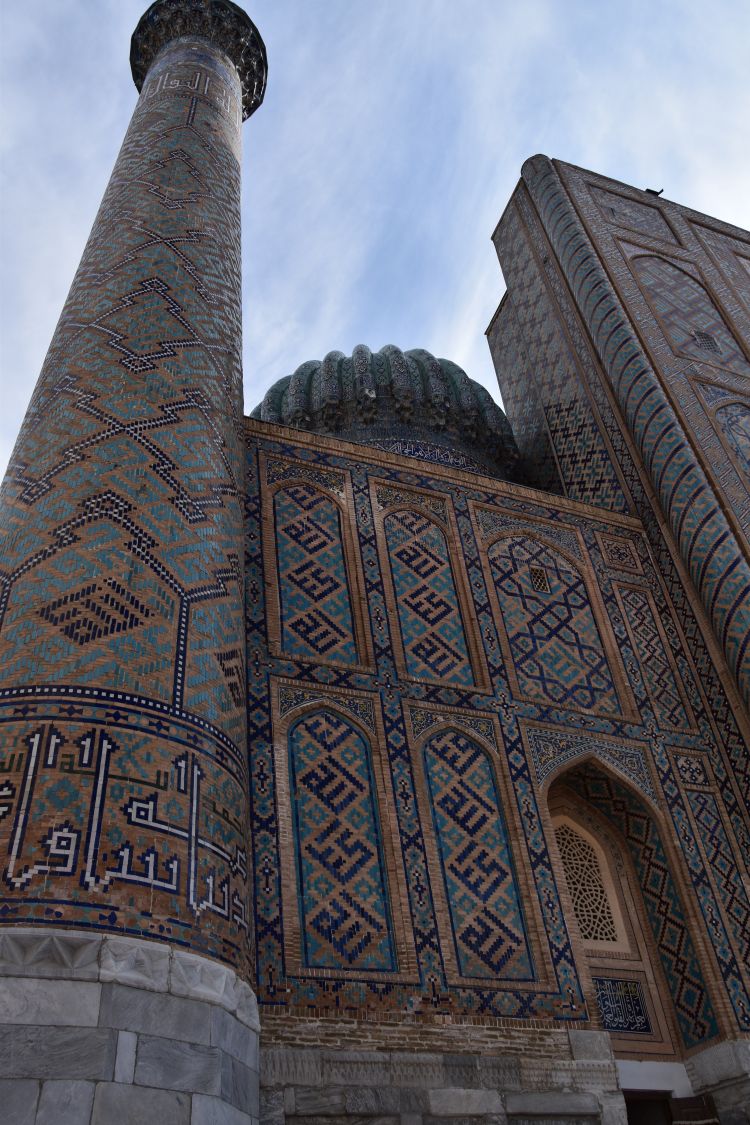
To the right, the Shirdor Madrasa, has been added in the early 17th century. It shows two tigers chasing does – on their backs are something like suns and heads. This is a rare example of animals and people represented in Islamic architecture.

Last, the Tilya Kari Madrasa was added in the mid 17th century. Both the Shirdor and the Tlya Kari Madrasa are more colourful than the older Ulugh Bek madrasa, as the techniques of producing glazed tiles had improved. The leaders of the local empire of the 17th century were called Janids, and I believe that their vision of this gorgeous symmetric arrangement of buildings was simply ingenious.

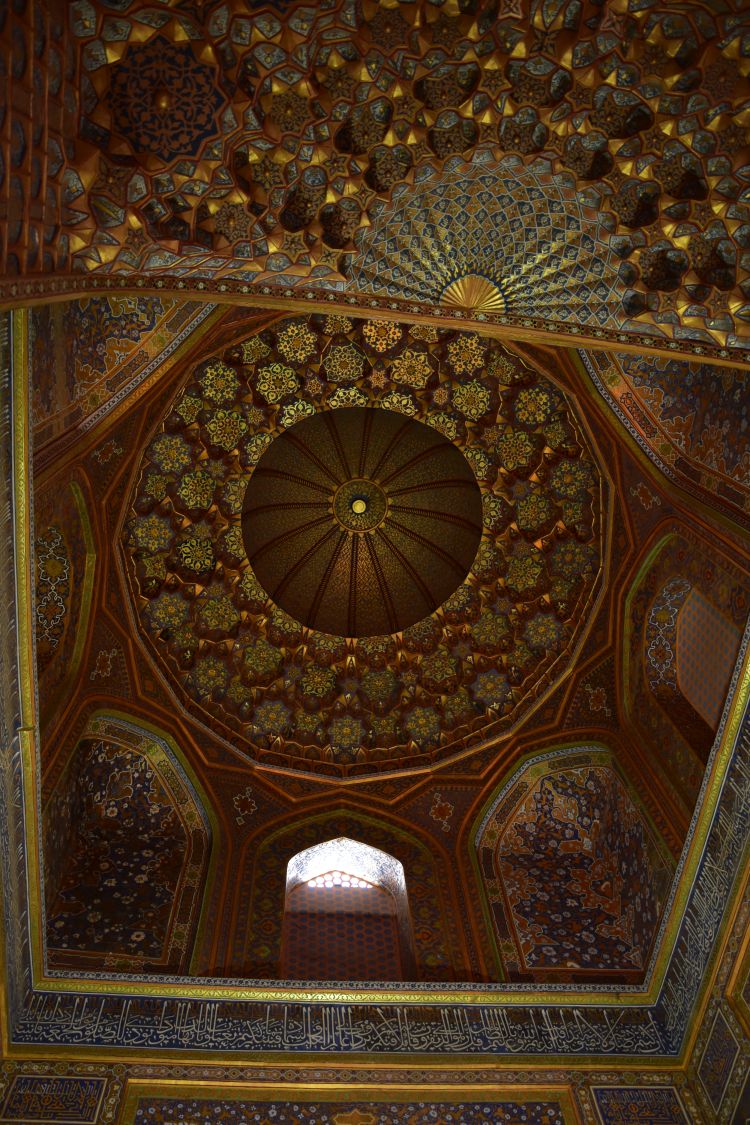
The Tilya Kari Madrasa had to be used as the Friday mosque of Samarkand, as after 200 years, the former main mosque, the Bibi Khanym Mosque, was in ruins. This is the golden cupola of the mosque in the Tilya Kari Madrasa.

Also the Shirdor Madrasa has a beautiful cupola.


Ulugh Bek, more a successful scientist than a successful ruler

Ulugh Bek was a grand-son of Timur. His empire was much smaller than Timur’s empire and he was more a scientist than a ruler, an excellent scientist.

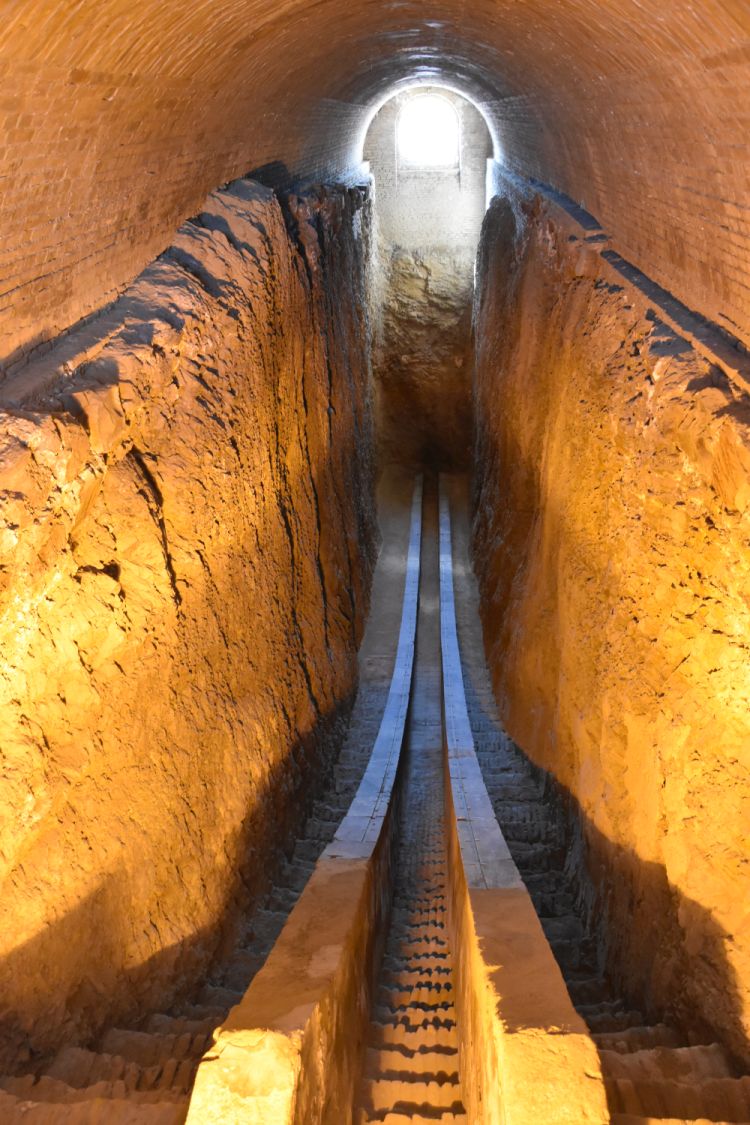
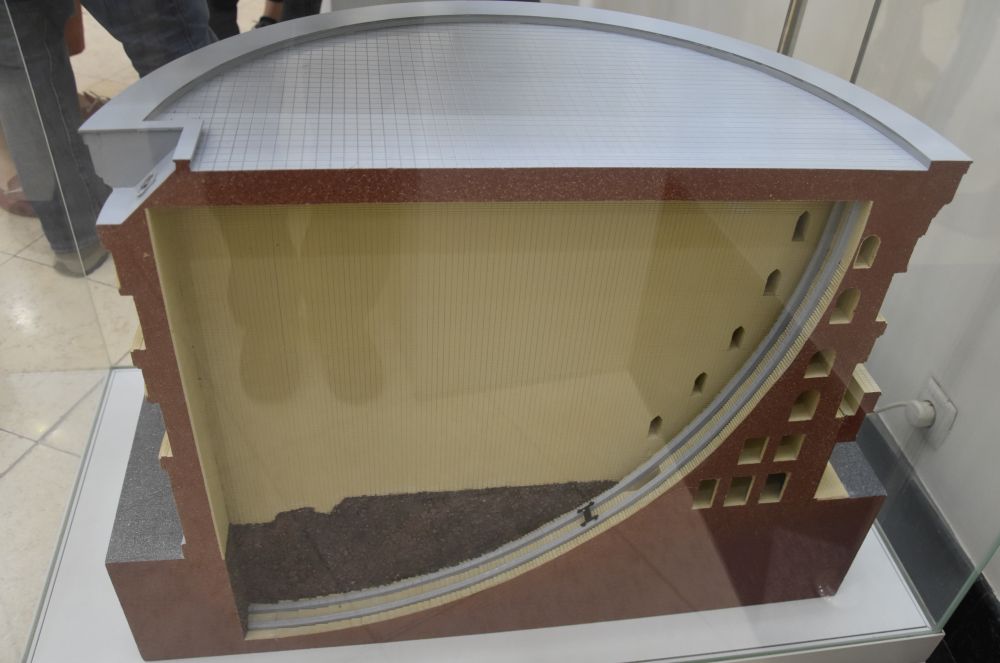
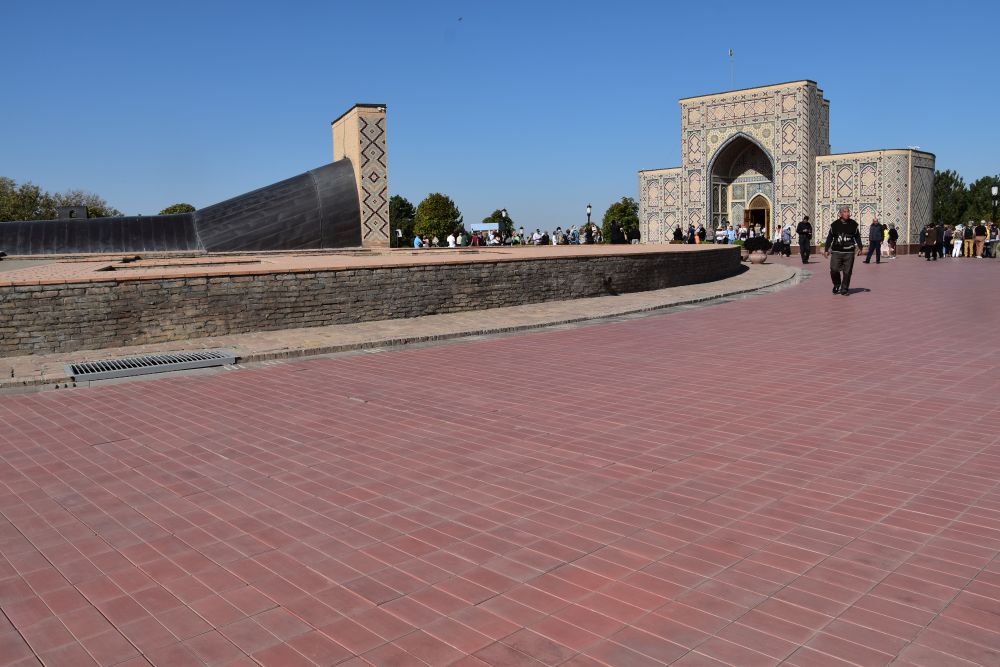
He assembled the best scientists of the time and they studied the night sky in the observatory, remains of which have been discovered by a Russian archaeologist in the beginning of the 20th century: The sextant was cut into the rock. Its orientation is strictly north-south.

The attached museum shows a model of the former observatory building with the sextant inside.

The sextant allowed Ulugh Bek and his team to determine the exact position of many stars and his unprecedented astronomical map was used by seamen for many centuries, since the 17th century also by Europeans. Ulugh Bek in addition determined the length of the year to be 365 days, 6 hours, 10 minutes and 8 seconds, which is about 20 minutes too long (actually: 365 days, 5 hours, 49 minutes and 12 seconds).

The sextant is in this black “tube” and a museum has been added that informs about the achievements of Ulugh Bek and how his scientific work has been received in the world.


Shor-i-Sinda – where noblemen around the Timurids have been buried

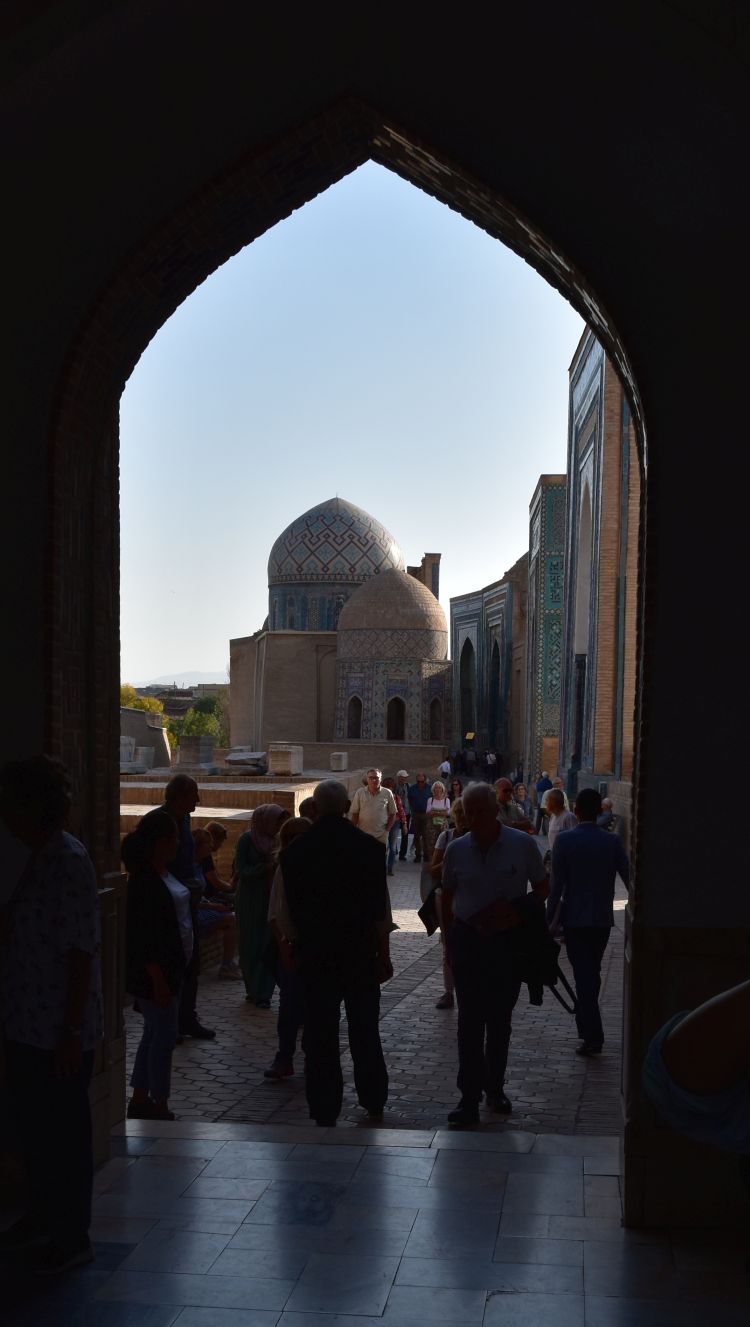
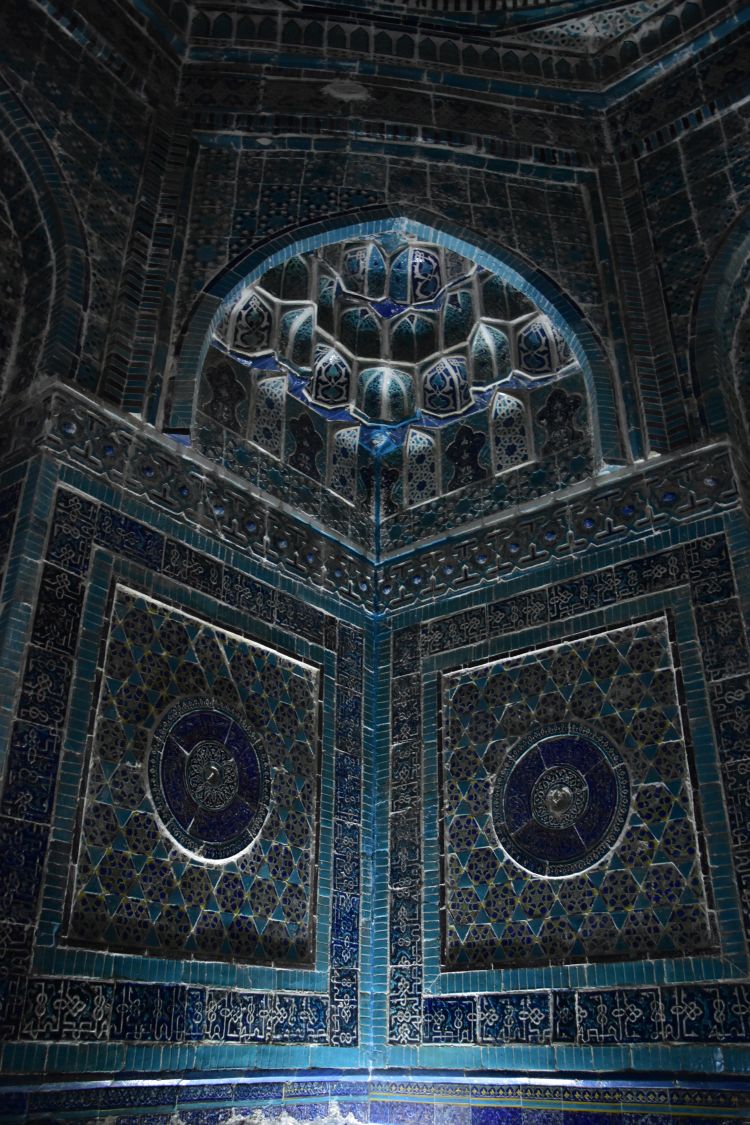
Shor-i-Sinda is a necropolis or a “city” of mausoleums. It is an amazing maze of blue glazed tiles woven into raw bricks and adorned with muqarna niches as well as with elegant cupolas. Legend tells that a cousin of Muhammad continues to live in a cave under the necropolis; he was decapitated, when praying and retreated to the cave while continuing to pray. Shor-i-Sinda means “the king who lives” (Dumont, p. 213).

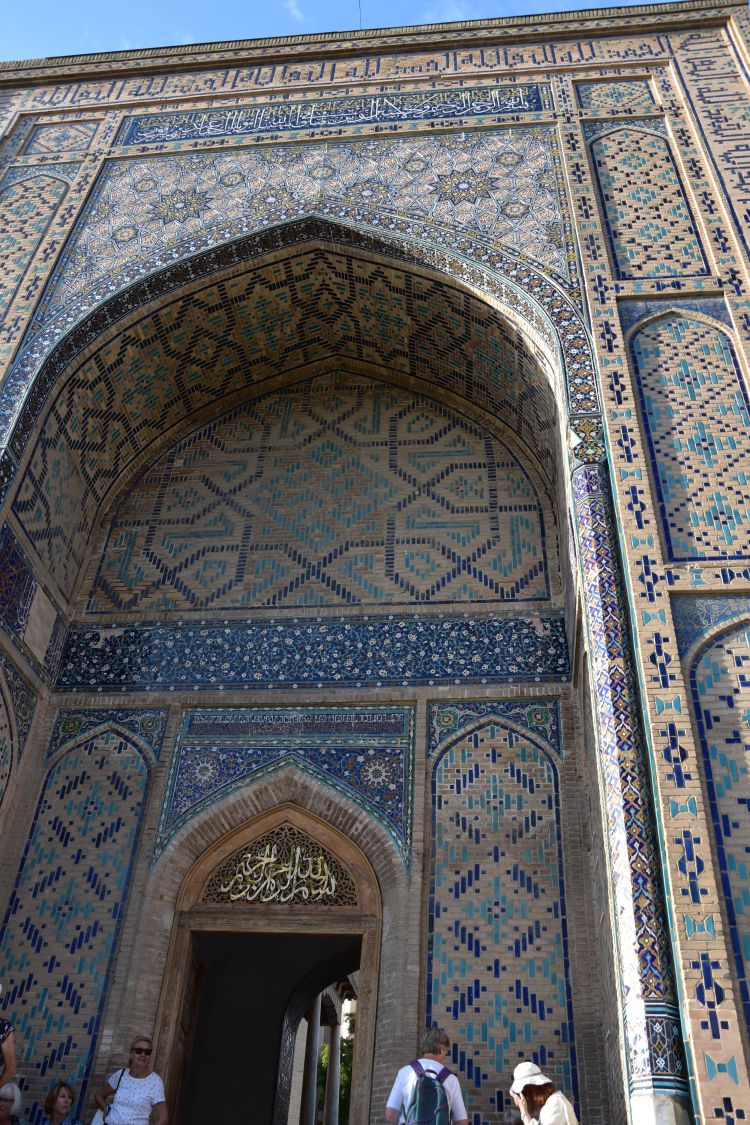
The entrance gate has been built under Ulugh Bek, in the early 15th century.

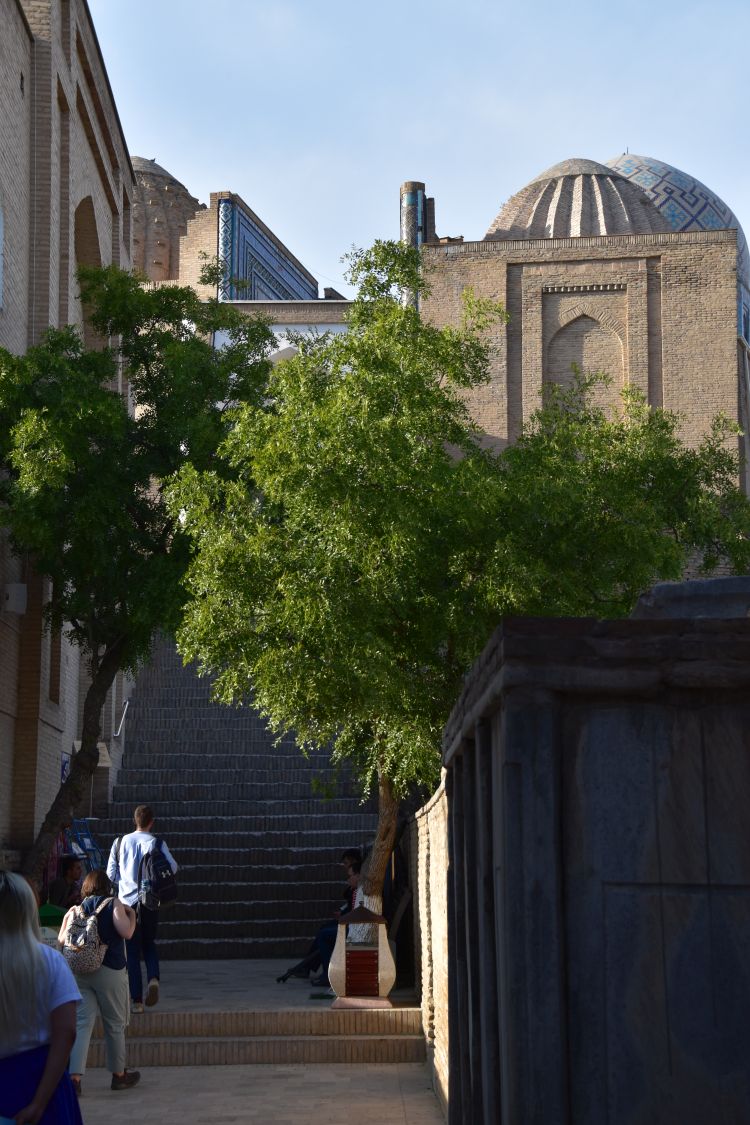
From here, stairs lead up to the centre with the mausoleums.

The mausoleums form a shady small “street”, a charm in blue.

Now I am at the end looking back at the shady small street…

… with the so-called octogonal mausoleum.

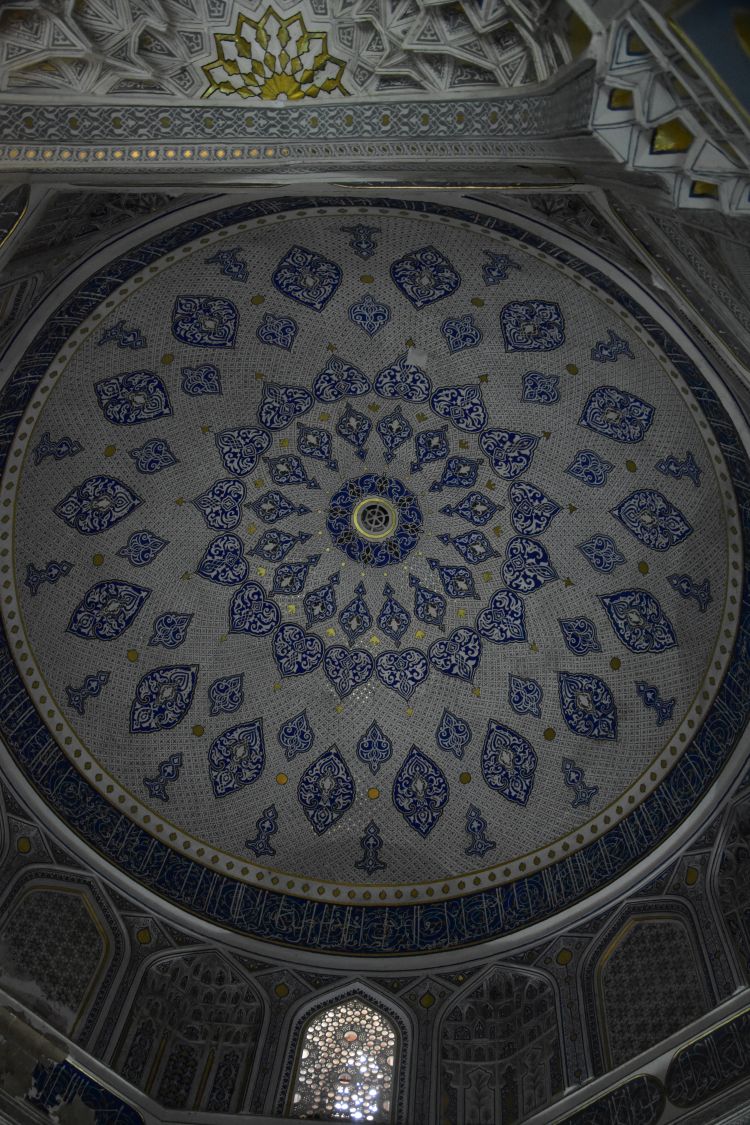
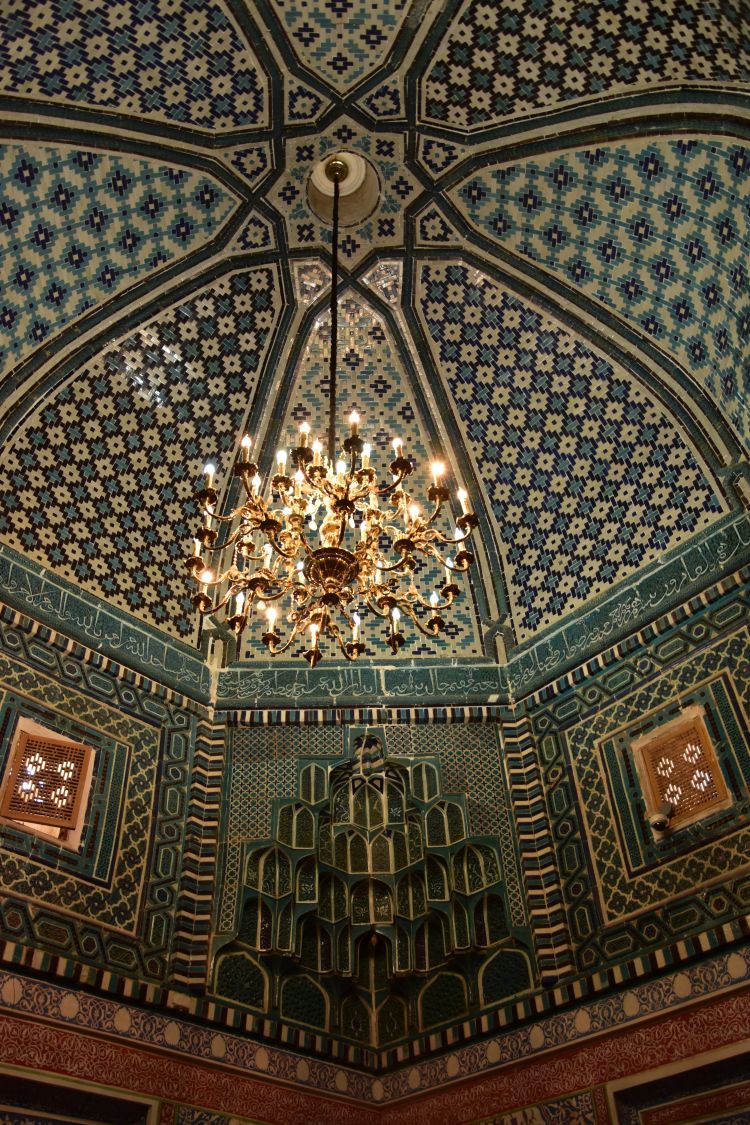
Let us look at some details. This cupola is in the Shirnin-Beka Mausoleum.

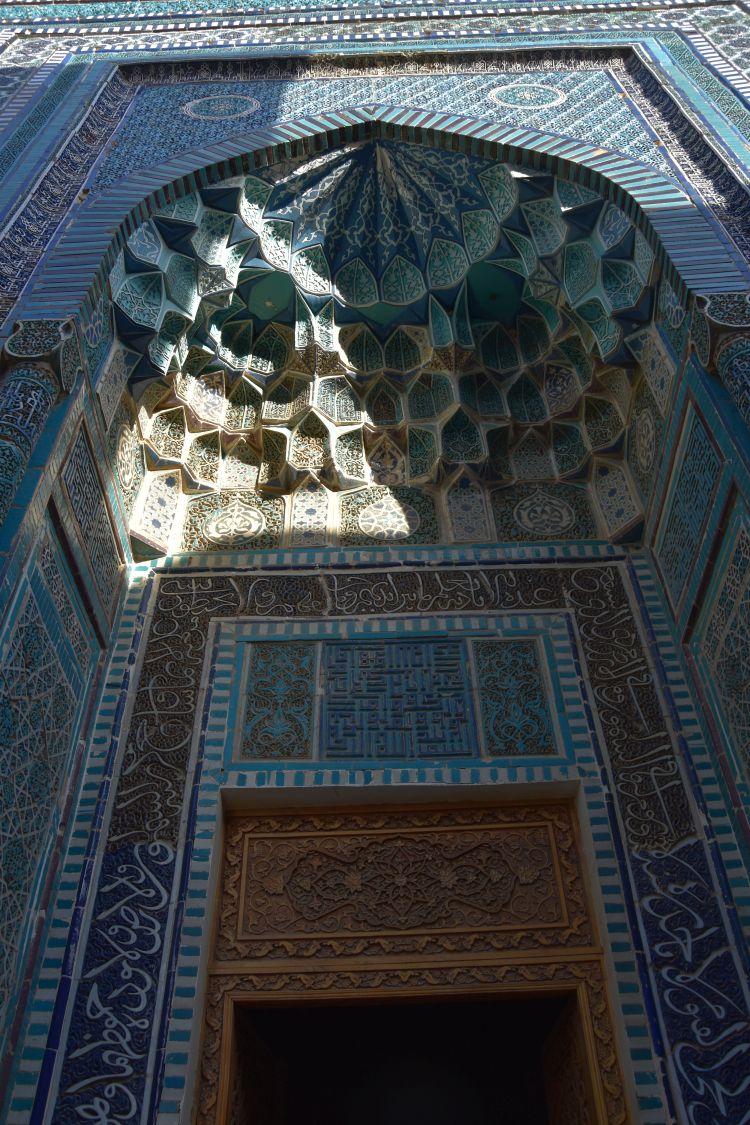
This is the Muqarna niche decoration of the Shodi Mulk Mausoleum.

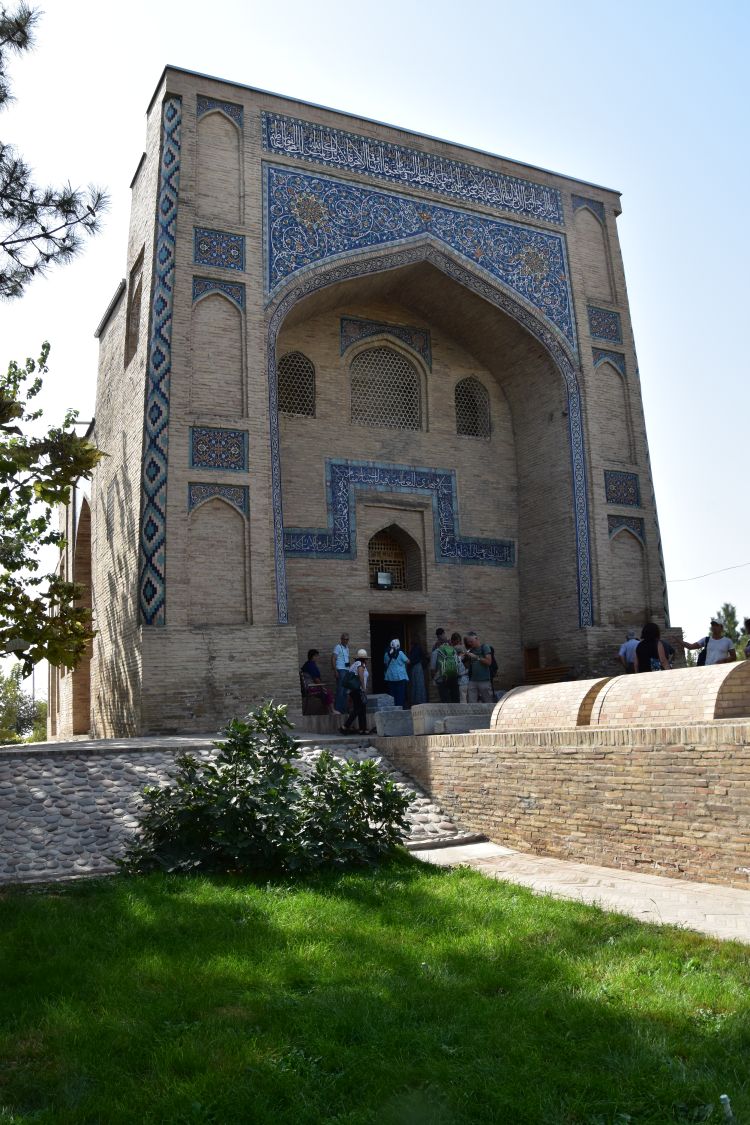
This is the entrance to the Kutlug Oko Mausoleum.

And this is the cupola of the mosque at the back of the ensemble of mausoleums.

All just too beautiful!


Good-bye Samarkand

In the evenings, I return to the city centre and the Registan, once all alone and later again with some of my friends.

On the terrace of the Bibi Khanym hotel, we had a good glass of wine from Samarkand, just across the blue cupolas of the Bibi Khanym mosque.

The young personnel of the restaurant was optimistic and full of ideas about how to improve their restaurant; together with them I thought about how to improve the English and French menu list that they had translated from Russian to English and French using google translate. The results were interesting and the guests from France and England were happy to get additional explanations, before choosing their dish. I enjoyed the hospitality of this place and I laughed with the personnel and with the other tourists.

Yes, Samarkand IS worth the trip to Central Asia. I am happy to have fulfilled this dream of mine – maybe I will return one day to enjoy the blue cupolas once more and to explore more of the Afrosiab (where ancient Marakanda was located) as well as the Russian new city and the wine culture. May there soon be opportunities again to travel and to enjoy travelling!


Post-Scriptum: Samarkand in Petersburg?

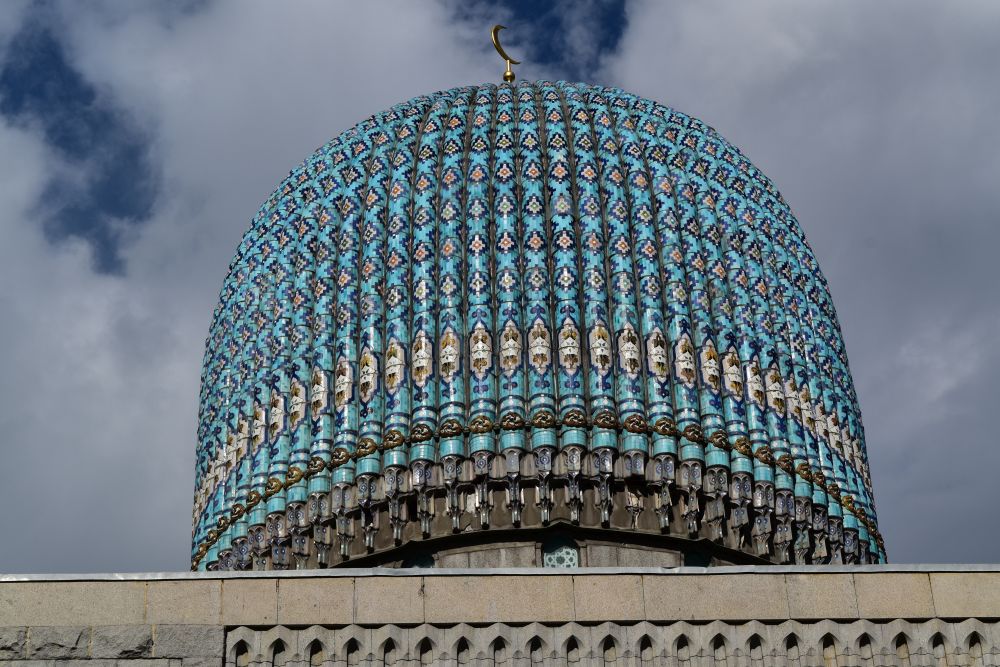
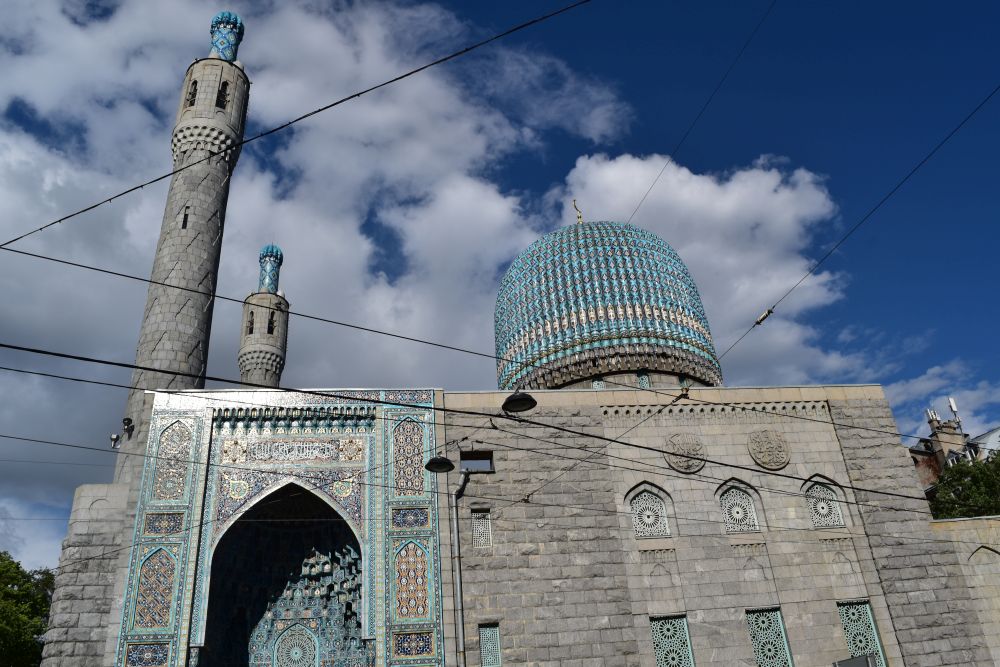
Samarkand is also present in Petersburg! The fluted cupola of this mosque, built from 1909 to 1920, has been designed after the Gur-e-Amir Mausoleum in Samarkand. Always, when in Petersburg, I visit the mosque (see my blog of 2017).

The architect Wassiljew has designed this mosque and the workshop of P.K. Vaulin has produced all the tiles and the cupola using the Central Asian technique that is called “Majolika” in Russia (DU, Heft Nr. 12, 1998, p. 56). NOW I understand, why the Russians built this mosque reminding them of Samarkand; Samarkand was part of the Russian empire and the Russians invested a lot to renovate Samarkand.

It is coincidence that the grand daughter of P. K. Vaulin, Anna Vaulina, was my Russian teacher at Basel – for more than 30 years (until 2008). Samarkand is completing the circle.

Sources: “Der grosse Plötz – Atlas zur Weltgeschichte”, Komet Verlag, Köln 2008; Isa Ducke and Natascha Thoma, “Usbekistan”, Dumont Reisehandbuch, Ostfildern 2017; Irina and Bodo Thöns, “Usbekistan”, Trescher Verlag, Berlin 2019; Irina and Bodo Thöns, “Reise durch Usbekistan”, Stürtz, Verlagshaus Würzburg 2018, Sanjeev Mehan, “Ein vergessenes Land holt auf”, Tagesanzeiger 21. September 2019 and various wiki entries.

Discovering Uzbekistan – the gorgeous city centre of Bukhara

In September/October 2019, I was in Uzbekistan.

From Tashkent, we take the night train to Bukhara.

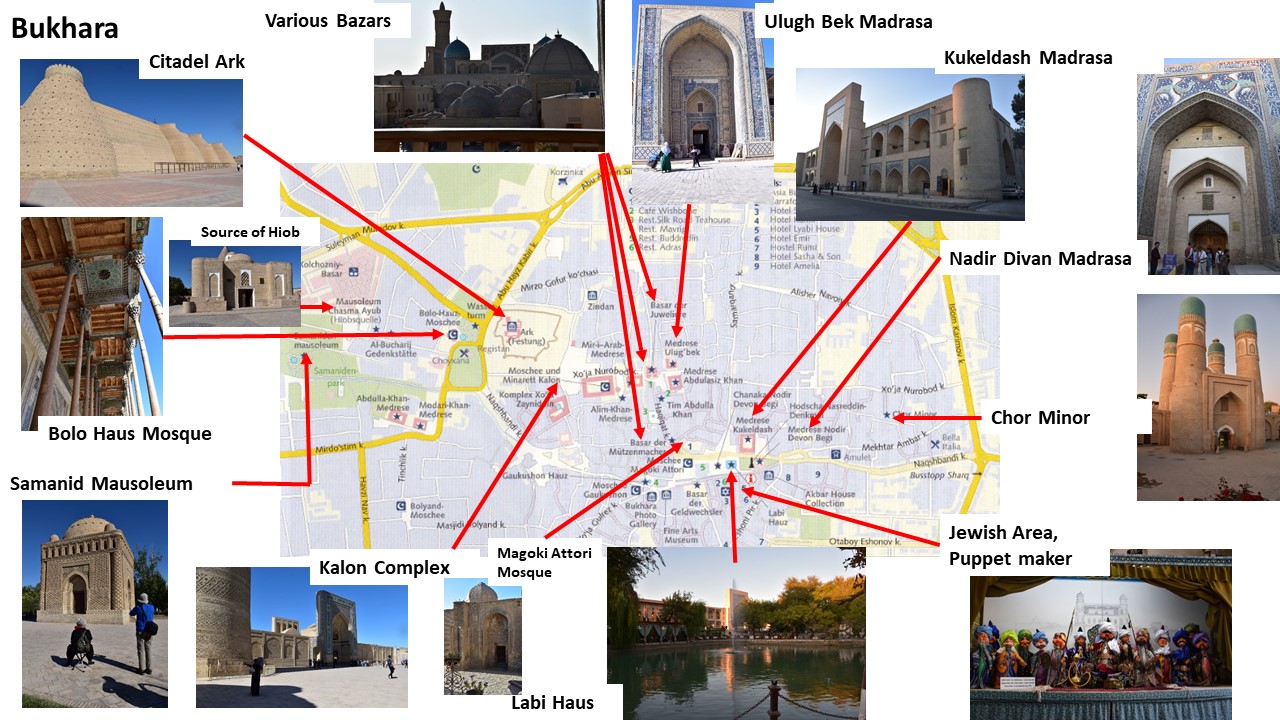
We stay in a friendly hotel outside of the city centre, and our driver, Firouz, took us to wherever we asked him for. The city centre of Bukhara as a whole is on the list of UNESCO world heritage and there is a lot to see within walking distance.

Source: “Usbekistan”, Trescher Verlag 2019, my own photos

Bukhara, located advantageously on the river Sherafshan, was an important hub on the Silk Road and, again and again, it was the capital of one of the changing empires in Central Asia. For example it was the capital of the empire of the Samanids in the 9th/10th century. Let us start with them.


The charming Samanid Mausoleum from around 900 – Ismail I is buried here

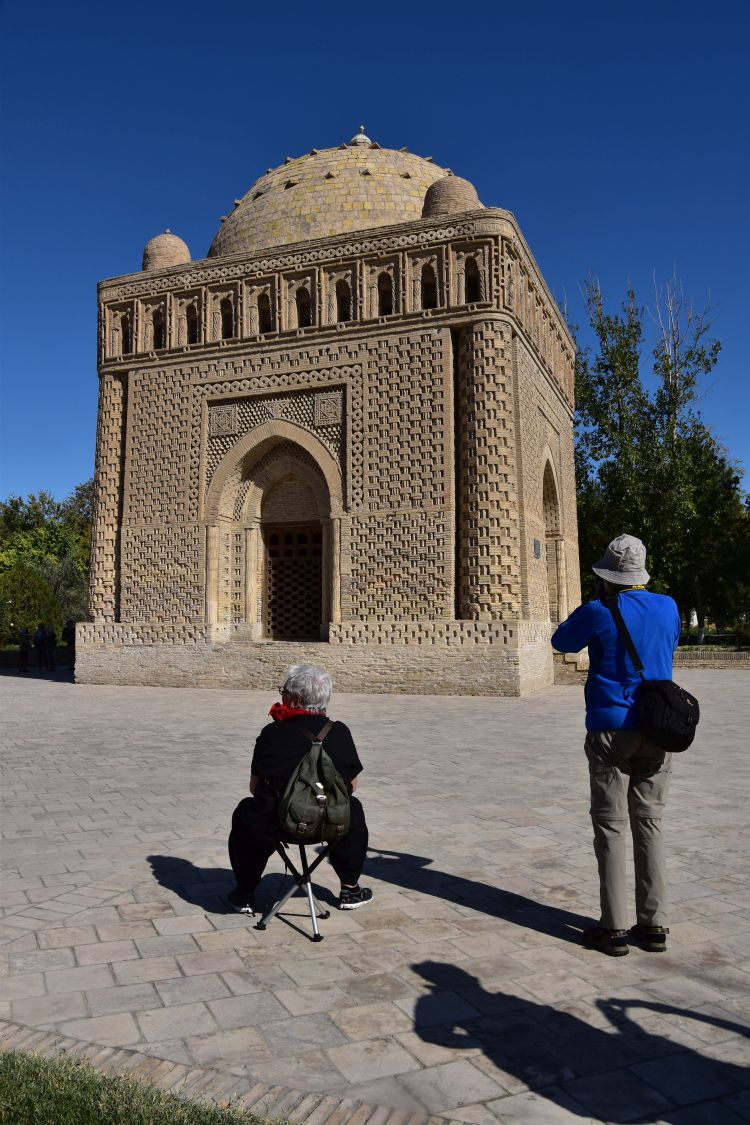
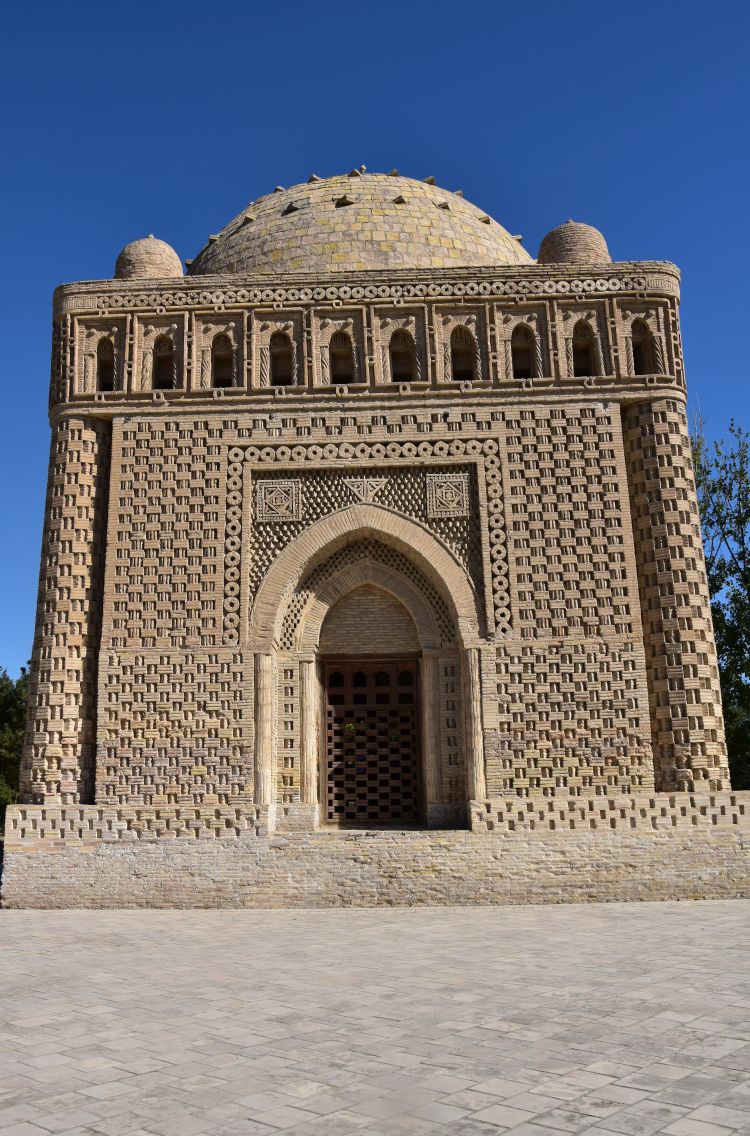
The founder of the Samanid dynasty was Ismail I, and he is buried in this graceful mausoleum from around 900 AD.

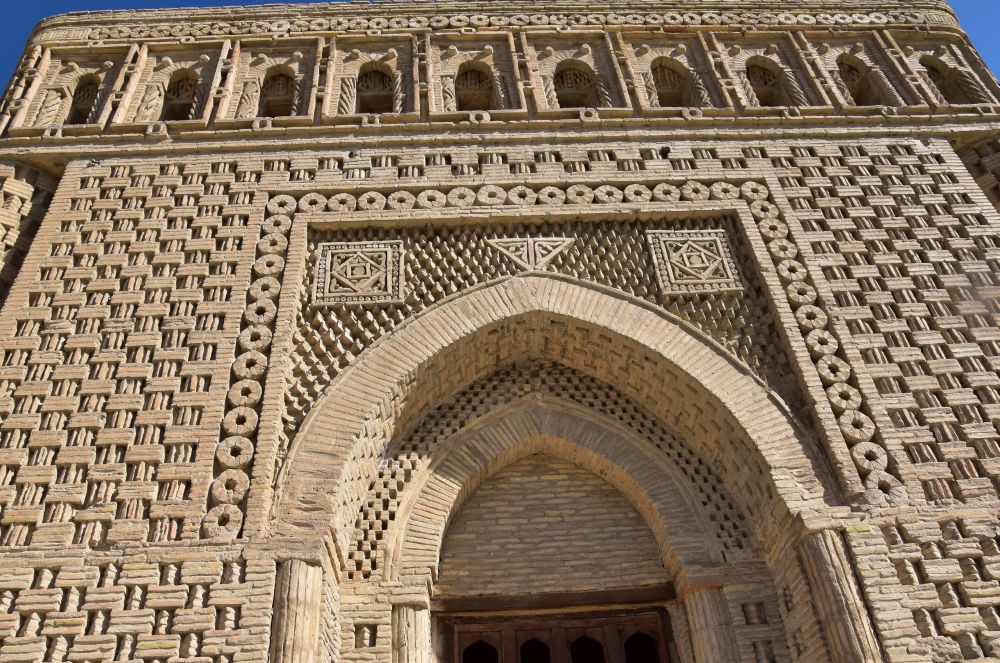
This lady has unfolded her chair and is enjoying the charm of the Samanid mausoleum. I feel like her. I cannot stop looking at this harmonic cube with the small dome on top, decorated with the amazing “weaving” pattern of unglazed bricks.

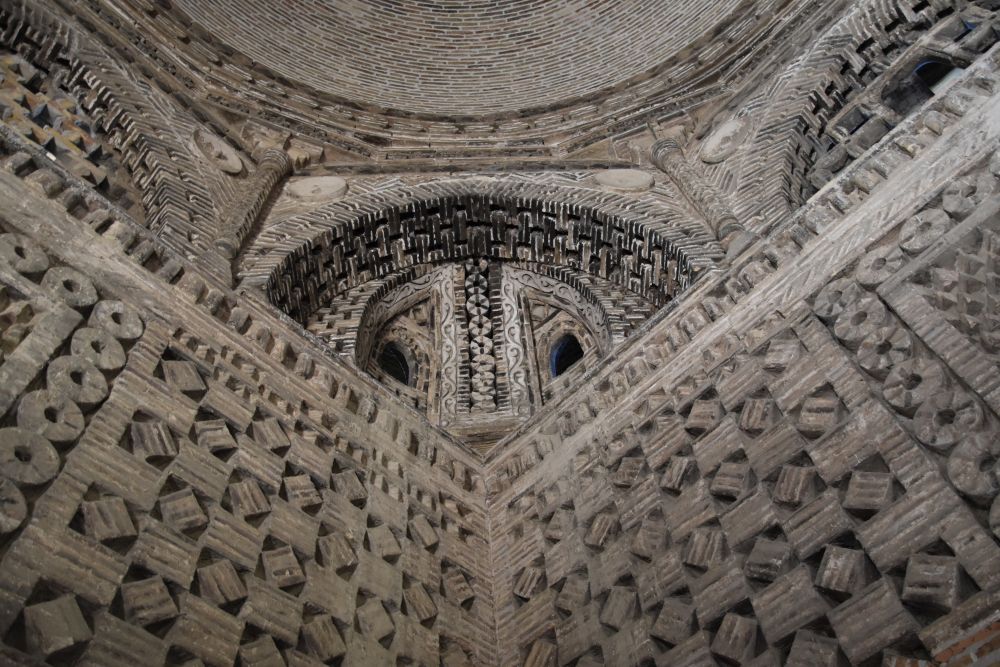
Inside the weaving brick patterns continue. The cube is translated into an octagon and then into an exagon…

… which carries the cupola that seems to swirl around the small top hole.

The weaving like arrangement of the unglazed bricks is called hazarbaf (in Persian this means: hazar=thousand and baf=weaving; first only raw bricks were used (like for the Samanid Mausoleum). Later, in the 12th century, glazed blue and white tiles were added to alternate with the unglazed bricks (example: Kalon Minaret below); finally after the 14th century, the tiles became multi-coloured. Mixing unglazed and glazed tiles is called “banna’i”, see Dumont, p. 60).

The Samanid Mausoleum survived the destructions by the Mongolians, when they conquered Central Asia. Some say, because the Mausoleum was in the middle of a cemetery, some say, because it was hidden under sand.

It is interesting to note that Ismail I, the founder of the Samanid dynasty, was of Persian origin. He is the national hero of Tajikistan, but the Tajiks have to live with the fact that the tomb of their hero is in Uzbekistan. Had the Russians drawn the frontiers differently, Bukhara would have ended up in Tajikistan and as a matter of fact, a high percentage of the inhabitants around Samarkand and Bukhara are Tajiks with a Persian background.


The source of Hiob

We walk to this place, where Hiob is said to have uncovered a source. Hiob? From the Bible? Yes, it is true, the Islam and our religion have the same sources. I would have never expected Hiob to have gone that far east.

Inside is a small museum and the pilgrims can take some of the holy water.


The Ark citadel with the Bolo Haus Mosque

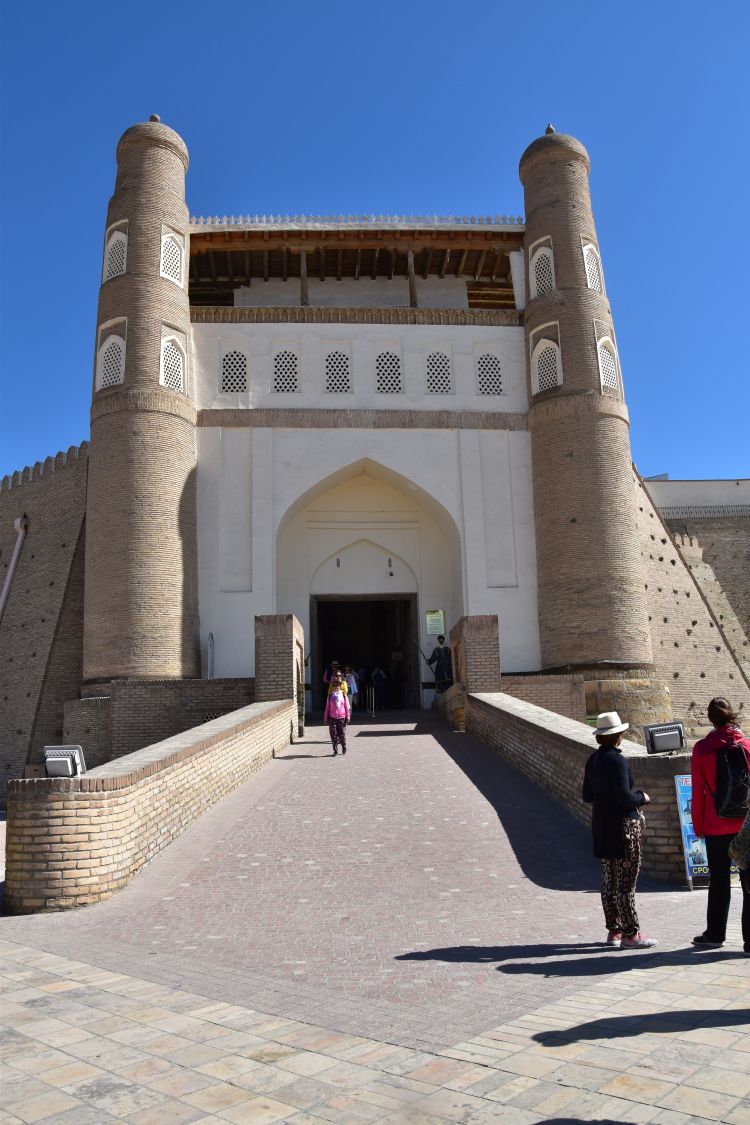
The Ark citadel was where the leaders of the empires around Bukhara resided, the pre Mongolian dynasties from the 9th to the 12th century, the Shaybanids of the Uzbek Khanates in the 16th/17th century and their more local successors, the emirs of Bukhara (the Janid dynasty), until the Russians conquered Central Asia in the 19th century. The Red Army destroyed the citadel in 1920. Some parts have been reconstructed. The defensive brick wall surrounds the palace and a small town.

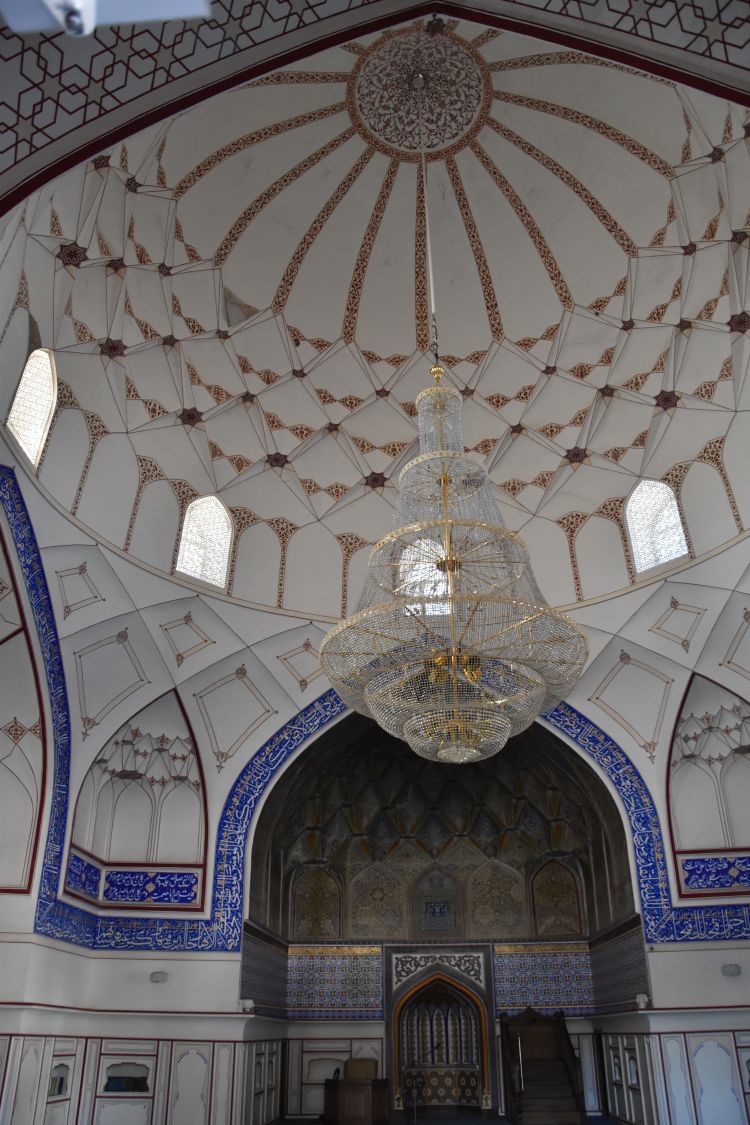
Nearby is the Bolo Haus Mosque where the emirs of Bukhara used to pray. The mosque was built around 1700 and has been rebuilt again and again. I like the wood carvings…

… and we are allowed to see the winter mosque inside.

We enter the mighty citadel, the Ark.

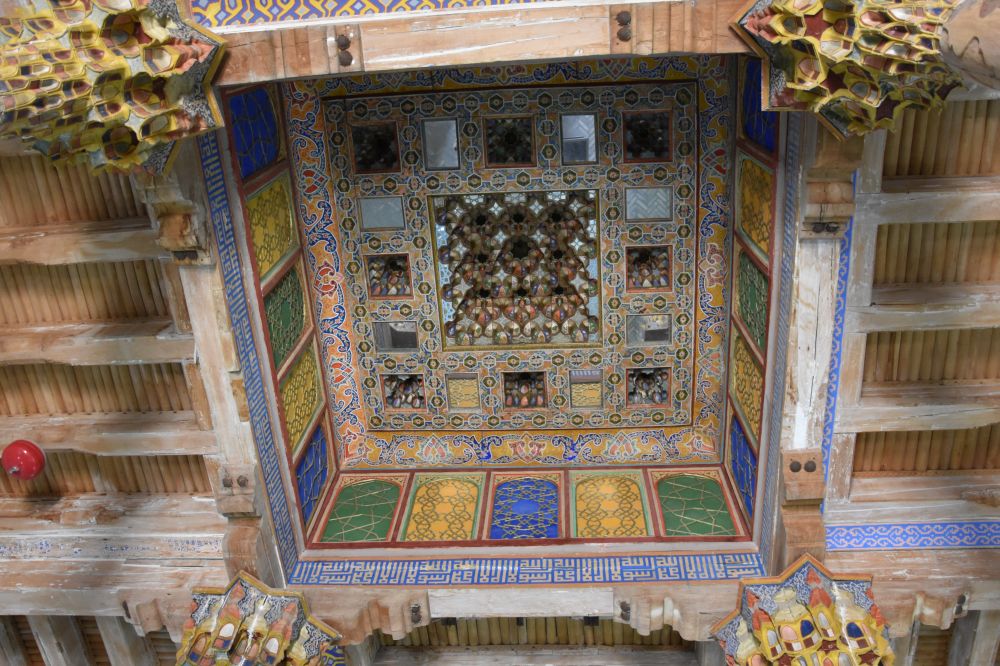
Inside we find another mosque with a finely carved wooden ceiling…

… and the throne hall that is actually a “throne courtyard”. This is the entry gate with separating wall. From here visitors were not allowed to show their backs to the emir sitting on the throne at the other end.

The elegant lion, unusual in an Islamic environment, watches the entry gate.

Many tourists sit down on the throne at the other end of the courtyard. The throne is a copy, the original is in Saint Petersburg.


The Kalon Complex

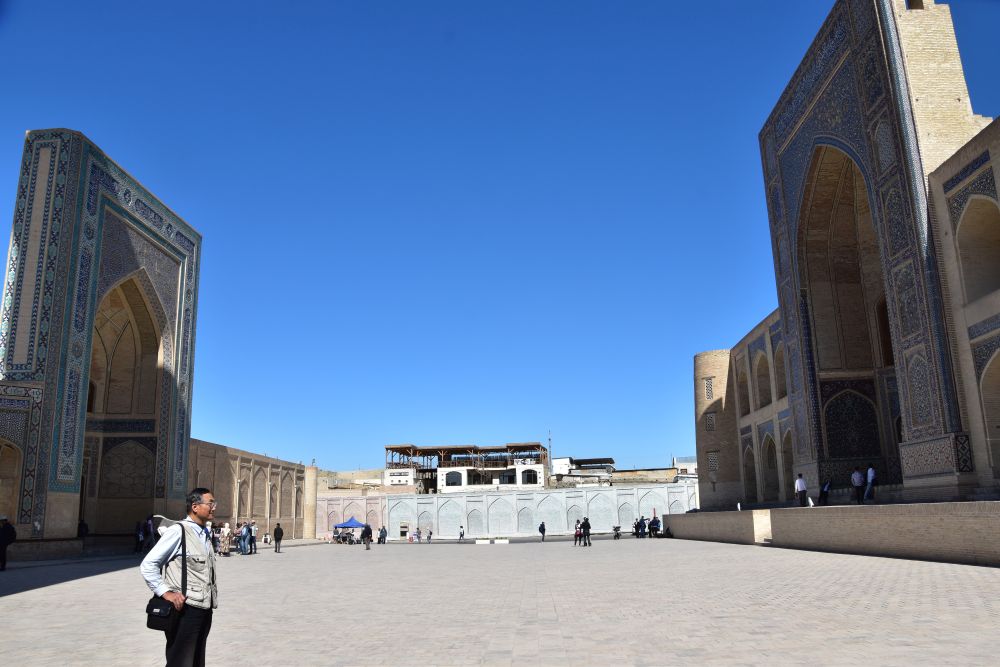
The Kalon Complex, not far from the Ark, is a magnificant example of the symmetry or Kosh concept in Central Asian architecture. Two pishtaks (gates) are facing one another: The pishtak of the Kalon Mosque and the pishtak of the Mir-i-Arab Madrasa. Both are from the early 16th century, when the dynasty of the Shaybanids ruled (the founders of the Uszbek Khanates).

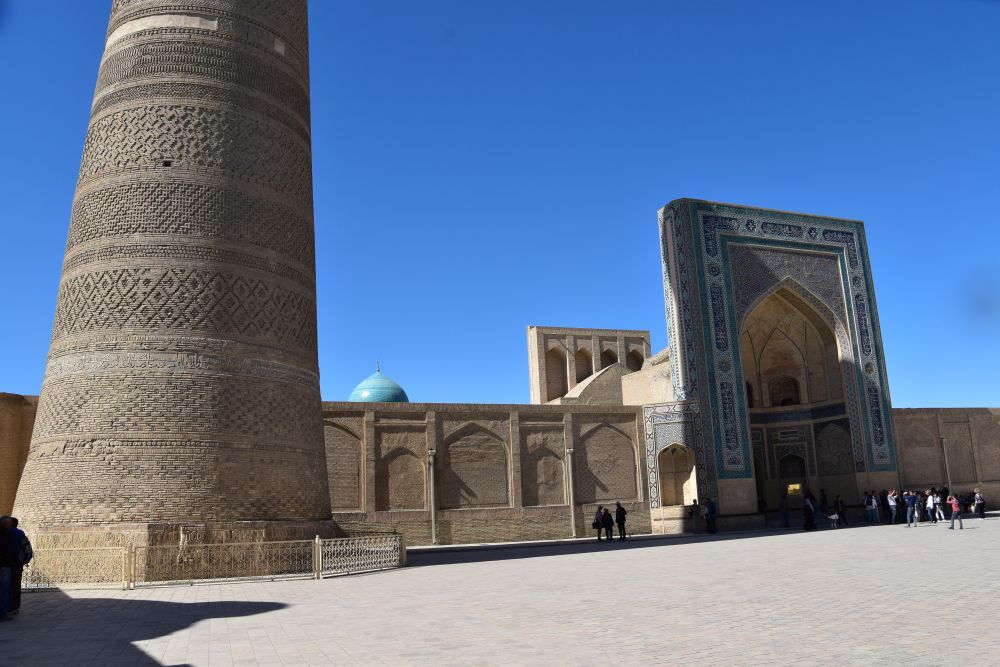
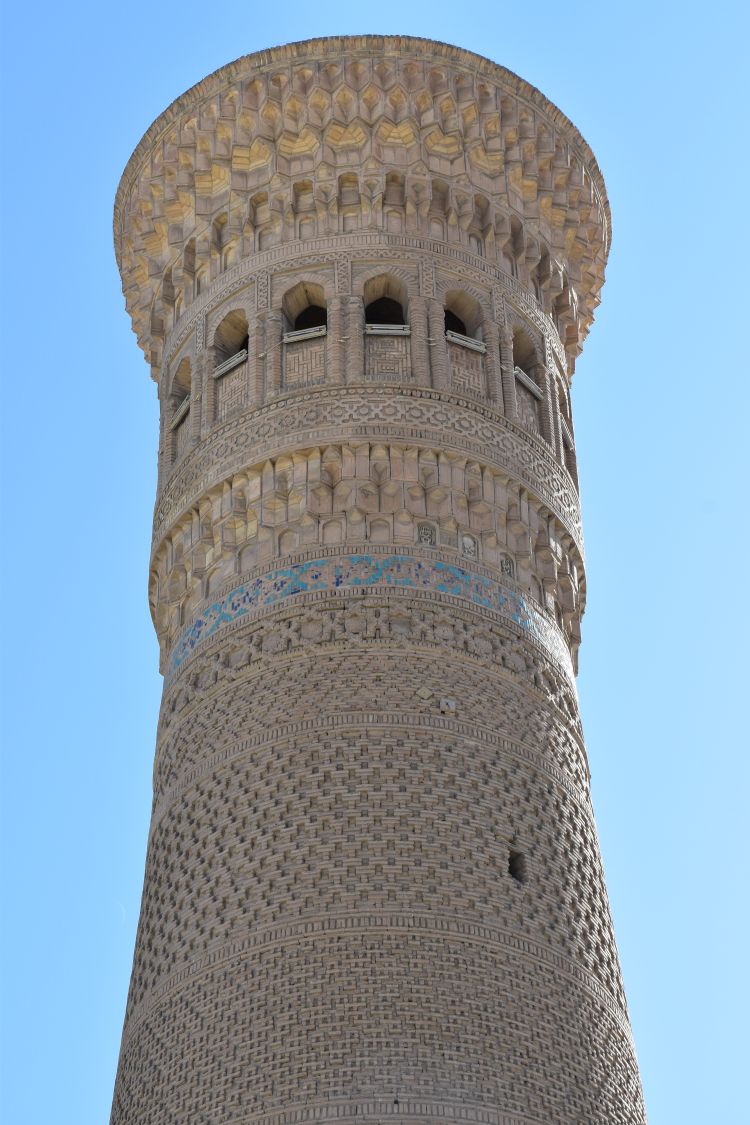
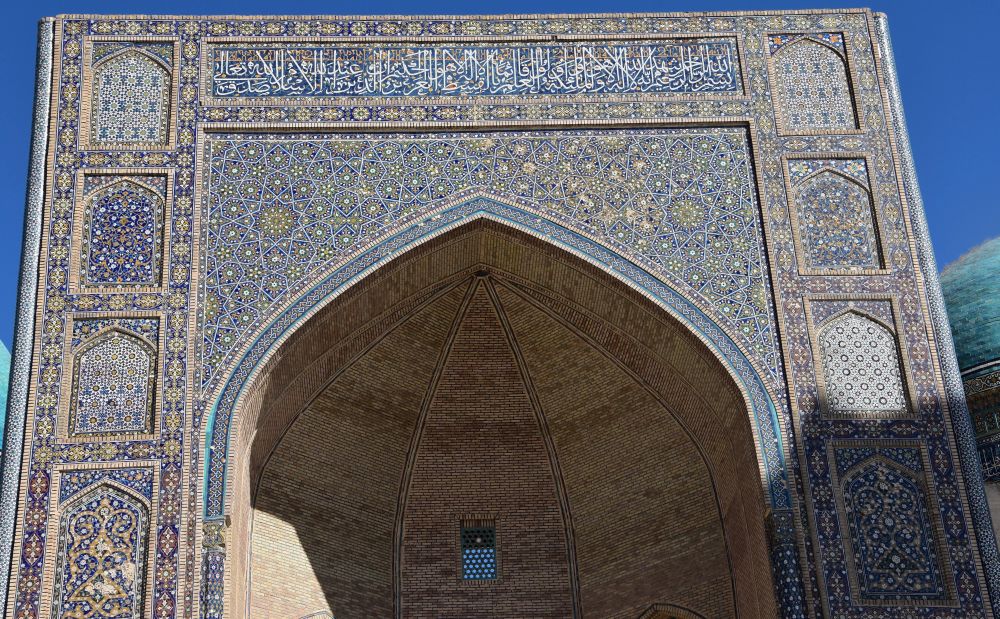
This is the entry gate (pishtak) of the Kalon Mosque (16th century) with the bottom part of the Kalon Minaret (12th century, pre Mongolian).

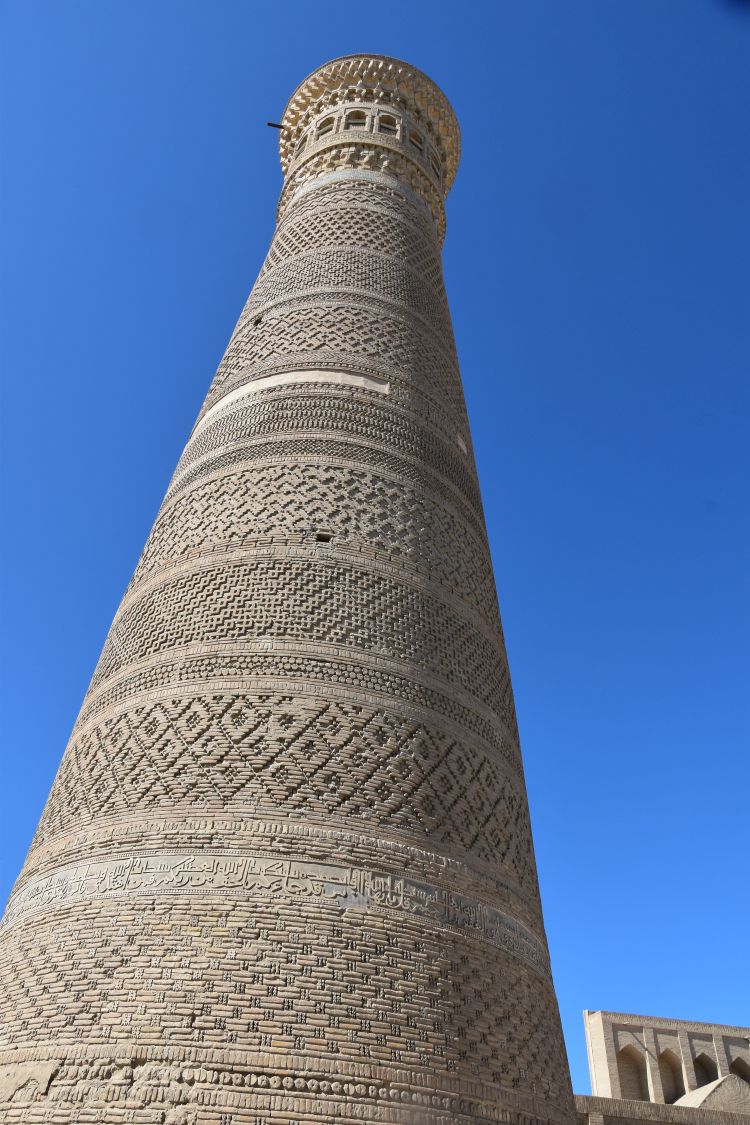
The Kalon Minaret has been built by the successors of the Persian Samanids, the Kara Khanids that were from Turkish origin. It is another great example of the hazarbaf technique where unglazed bricks are “woven” into one another.

It is interesting that at the very top, there is a narrow band of blue glazed tiles. This is an early example, where the unglazed and glazed terracotta techniques have been mixed.

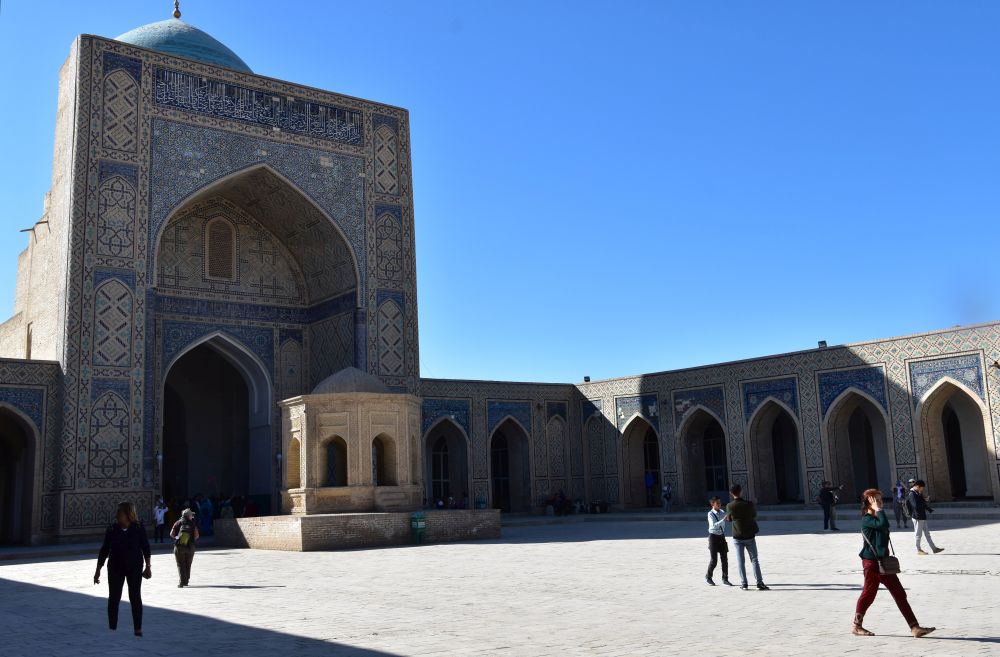
In the Kalon Mosque, glazed tiles interact with unglazed bricks. The courtyard is bordered by four galleries called “ivan”. The winter mosque marks the end of the four ivan courtyard, opposite of the entry gate.

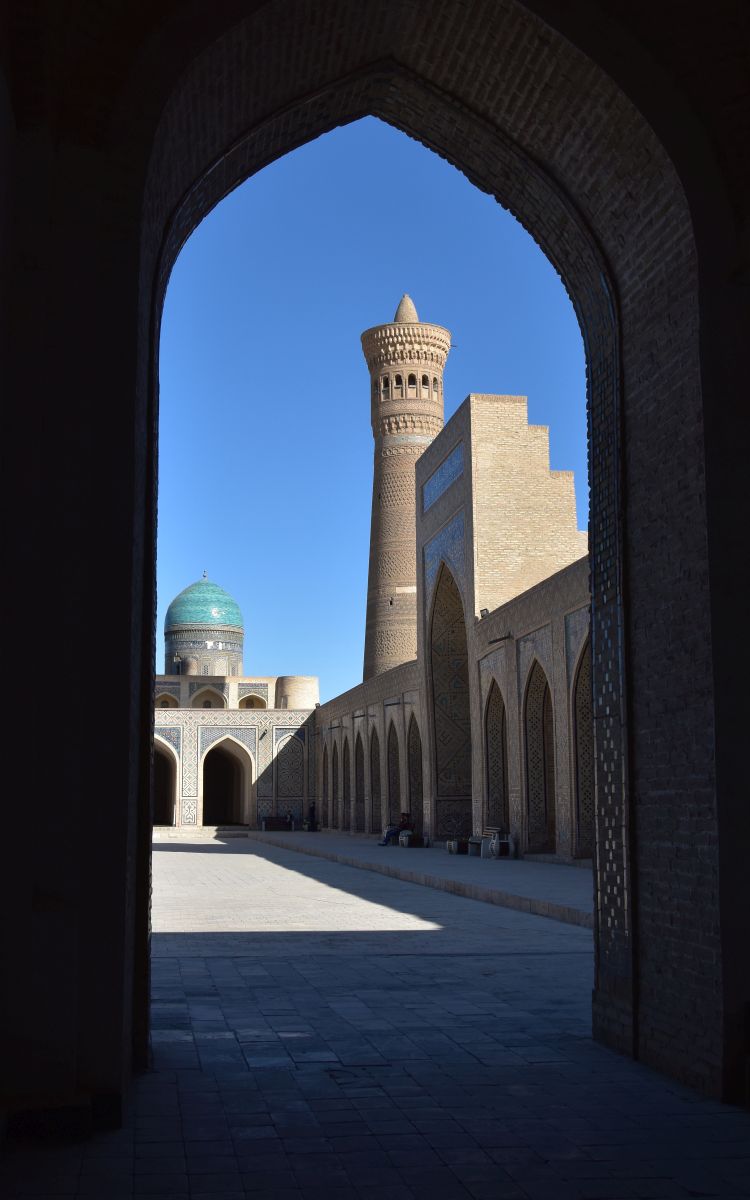
Looking back from within the winter mosque, we can see the Kalon Minaret behind the courtyard. The  blue cupola in the background belongs to the Mir-i-Arab Madrasa.

The Mir-i-Arab Madrasa has also been built by the Shaybanids, just after they had appointed Bukhara to be their new capital in 1533.

The tiles of this pishtak are not just blue and white, but also contain yellow.

It is a working Madrasa that is closed to the public. Through this iron lattice we can look into the courtyard.


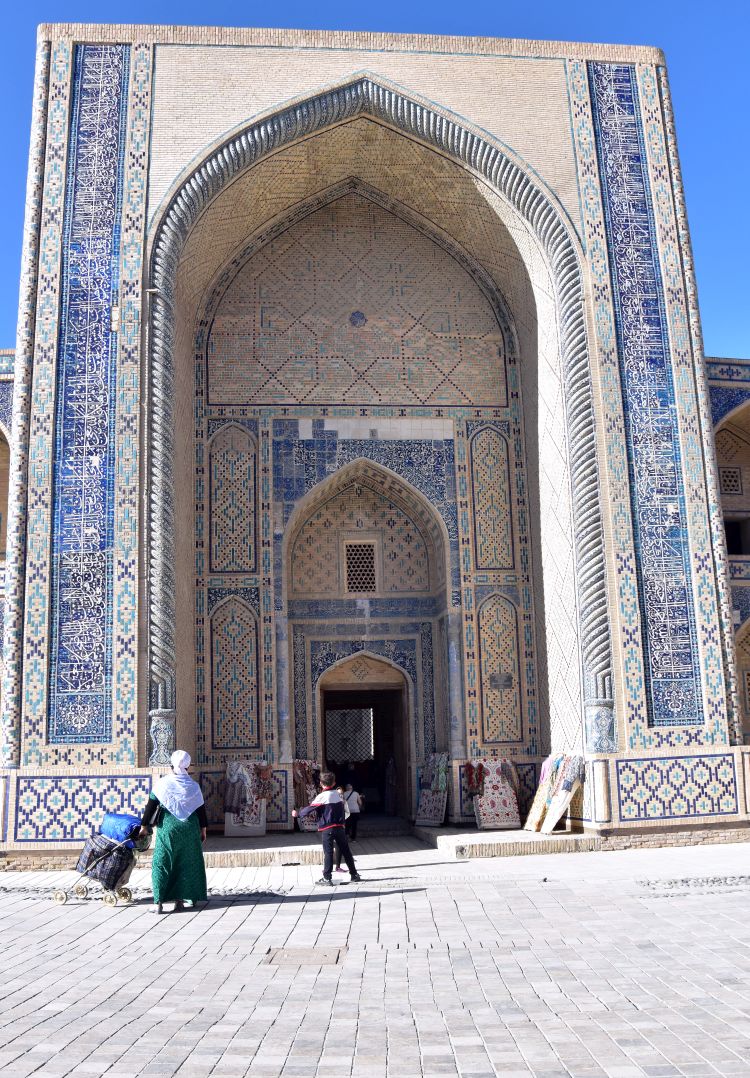
The Ulugh Bek Madresa with its kosh (symmetric) counterpart, the Abdulasis Khan Madrasa

A walk of about 150m, and we admire the Ulugh Bek Madrasa (from the 15th century) with the glazed blue and white tiles woven into the structure of unglazed bricks. The calligraphic writings are called “Thulut” and the technique of combining geometric patterns is called “Girih” (Dumont, p. 64). I like the swinging frame surrounding the gate.

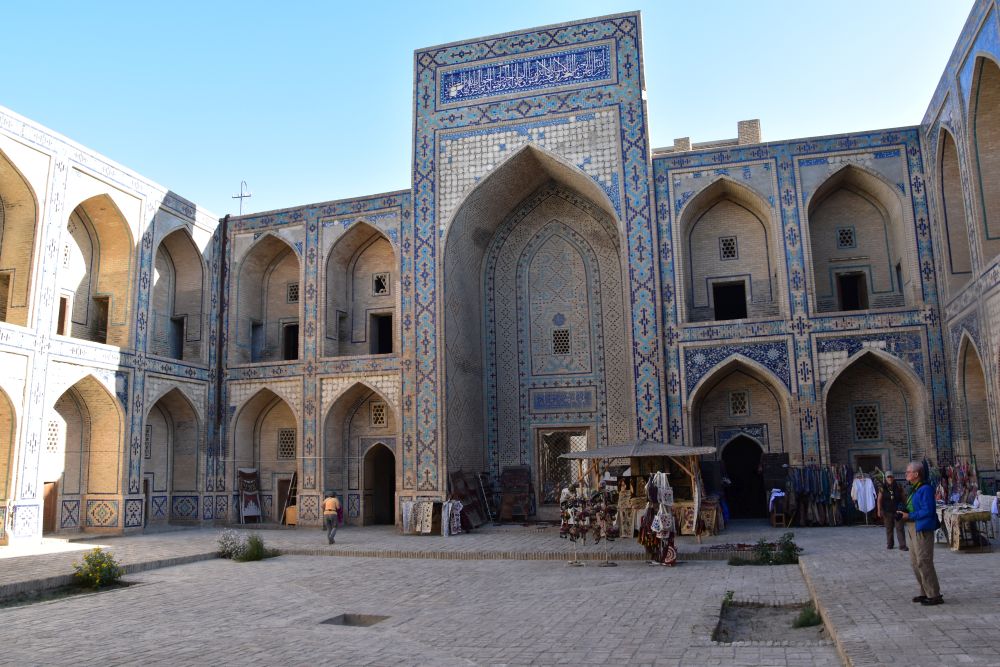
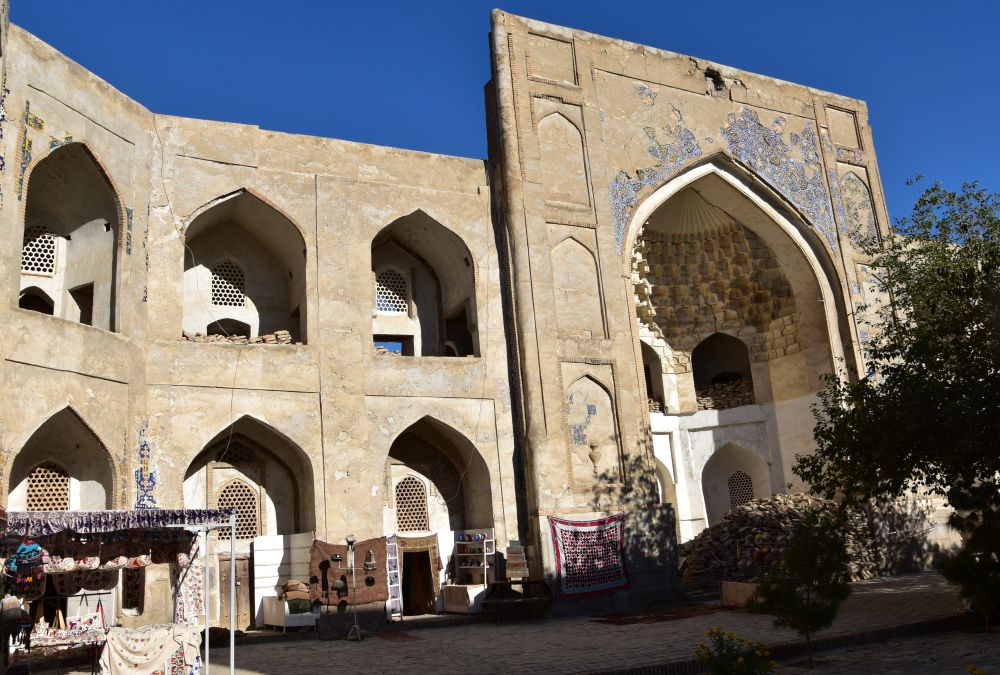
Inside the madrasa shows the signs of decay – sad. It is no longer a working madrasa, but a collection of souvenir shops.

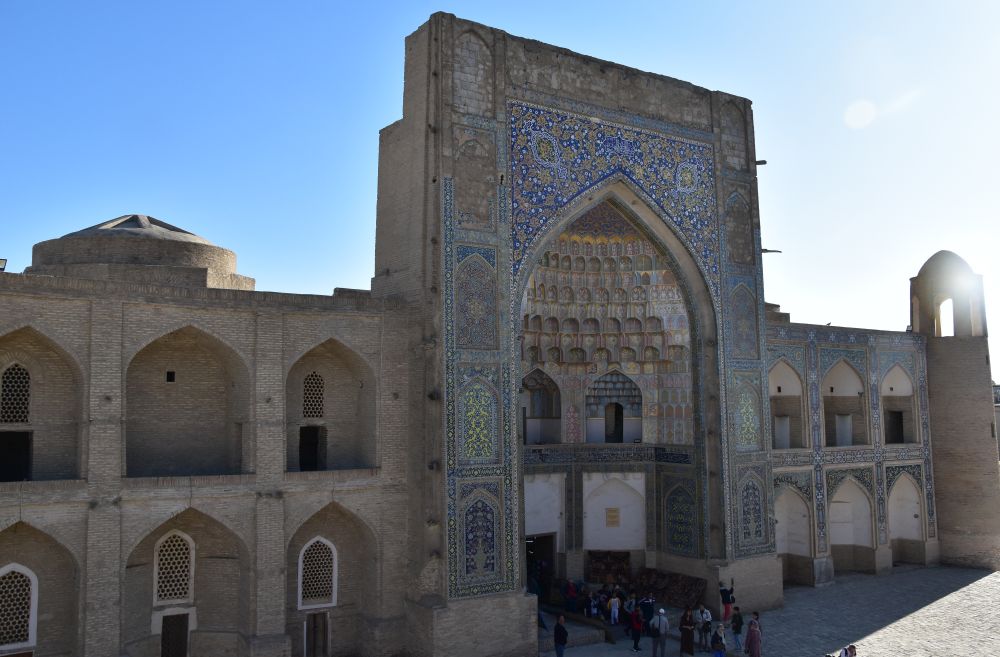
Across is the Abdulasis Khan Madrasa from the late 17th century. It is 200 years younger and much more decorated than its earlier and more modest counterpart, the Ulugh Bek Madrasa (some say, it is almost too much decoration).

Inside we find more souvenir shops.

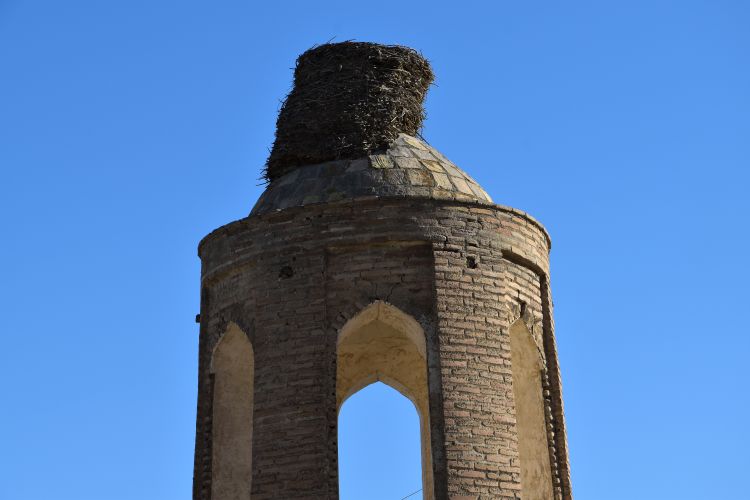
Nearby we admire this artful architecture of the local storks. My friend, a physicist with the mind of an engineer, frowns at it: “Well the stork took a suboptimal approach when starting to build the nest, but then it corrected the design cleverly.”


The Bazars

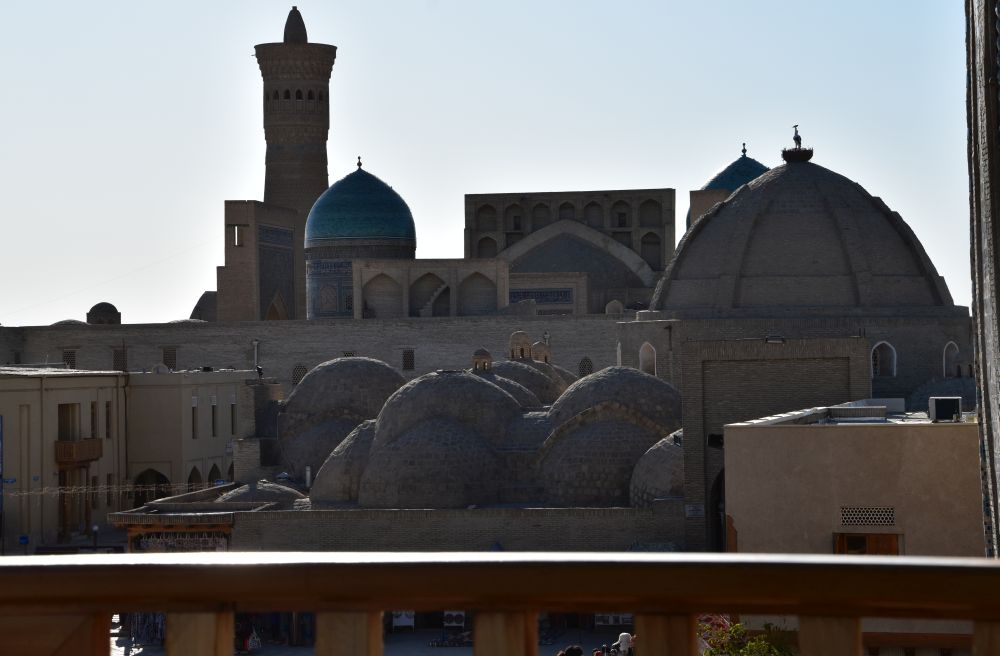
We are now in the very city centre with various bazars covered by cupolas. This is the view of the cupolas of the Toki Sagaron, the bazar of the jewelers, taken from the terrace of a nice coffee bar. In the background we can see the Kalon Minarett and the blue cupola of the Mir-i-Arab Madrasa.

Each community of traders had their own bazar, but now the bazars are more or less across the board souvenir shops.

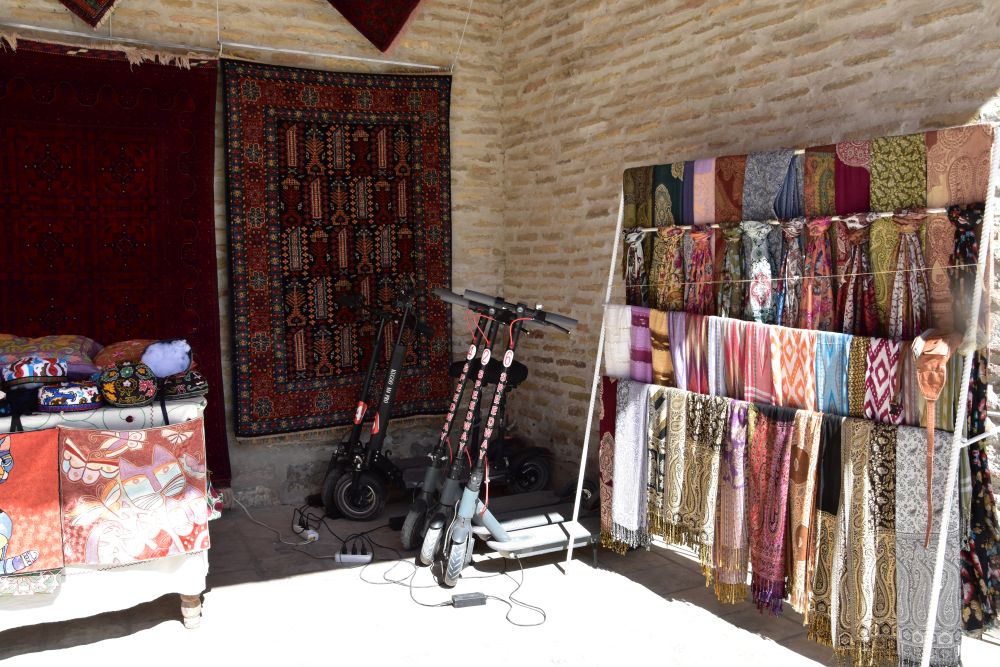
Even scooters are on offer.

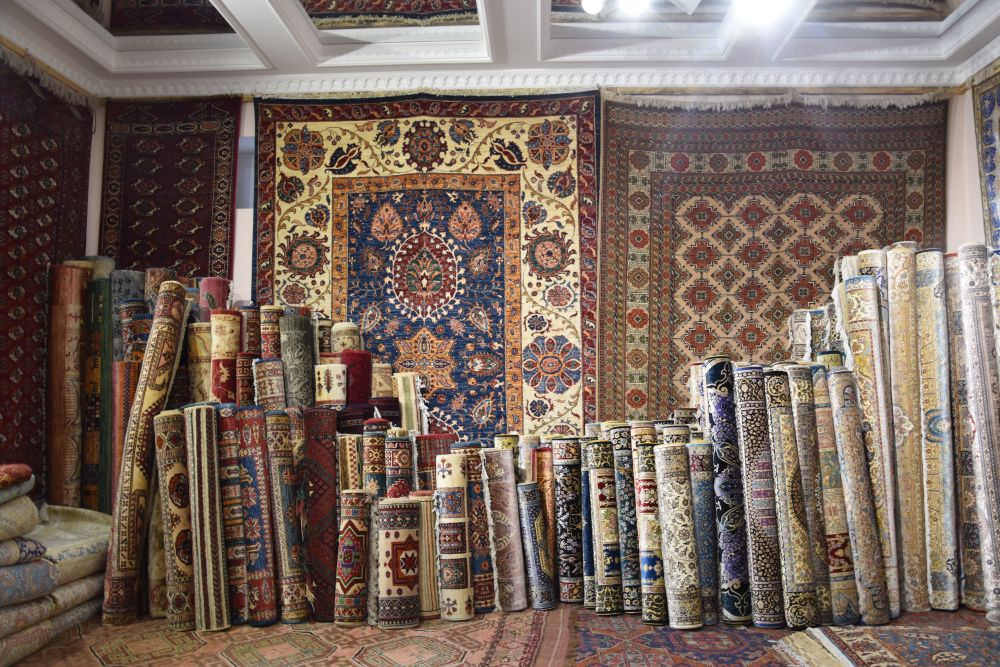
My friend buys a carpet at Magic Carpet. The carpet will be sent to Switzerland and will arrive safely.

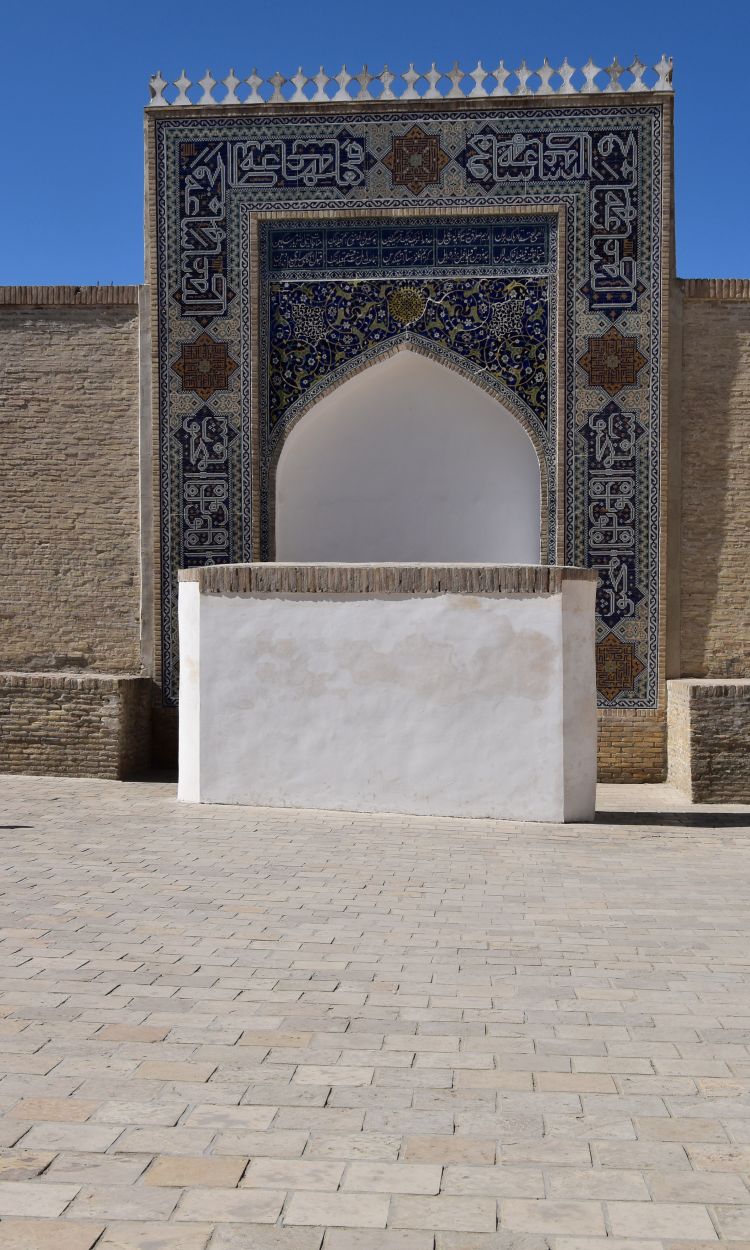
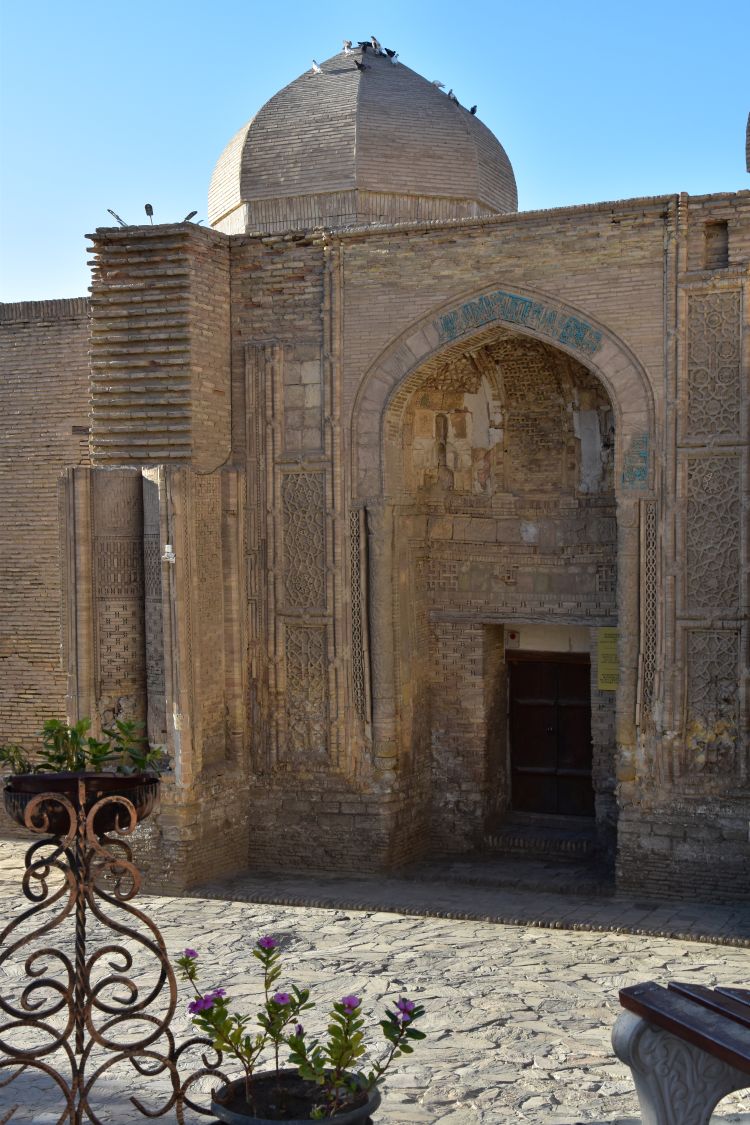
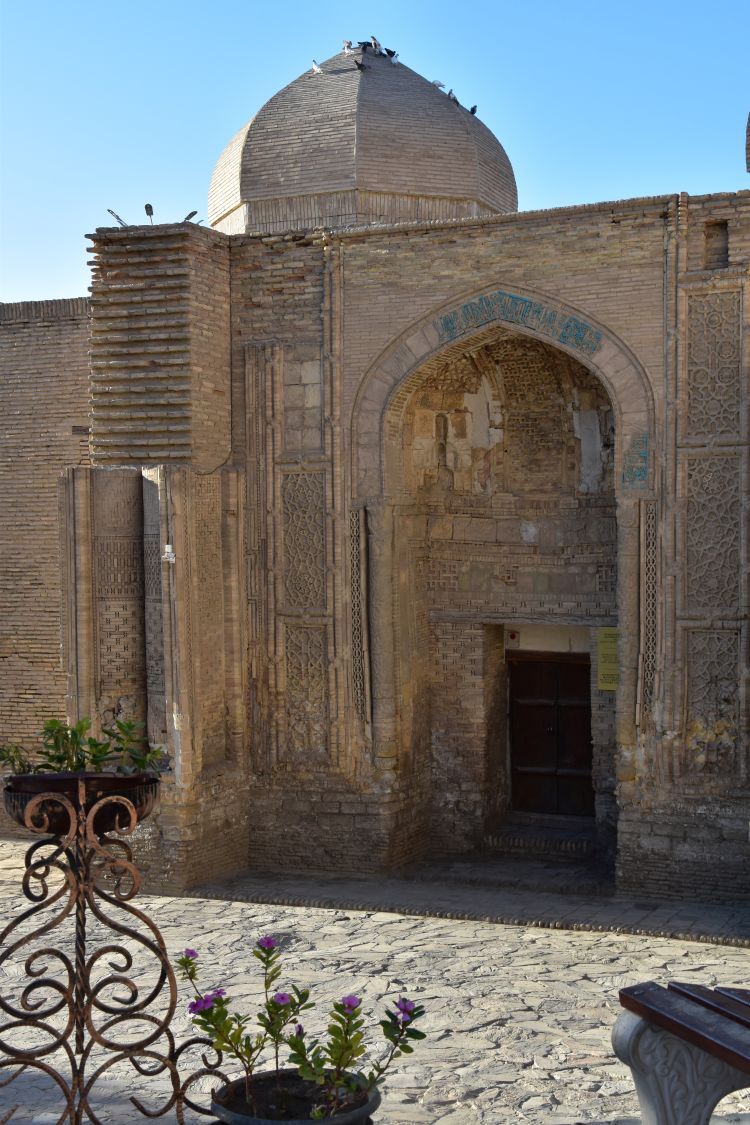
Almost unnoticed by tourists the Magoki Attari Mosque appears between the bazars. It is from the 12th century, built in the joyful weaving technique of unglazed bricks and shily adorned with a first band of glazed blue tiles (like the Kalon Minaret). My Dumont (p. 305) says that this is a carpet museum, but it seems to be no longer safe enough for that.


Around the Labi Haus with Kukeldash and Nadir Divan Bek Madrasa

The heart of Bukhara is the Labi Haus with the water pool, restaurants,…

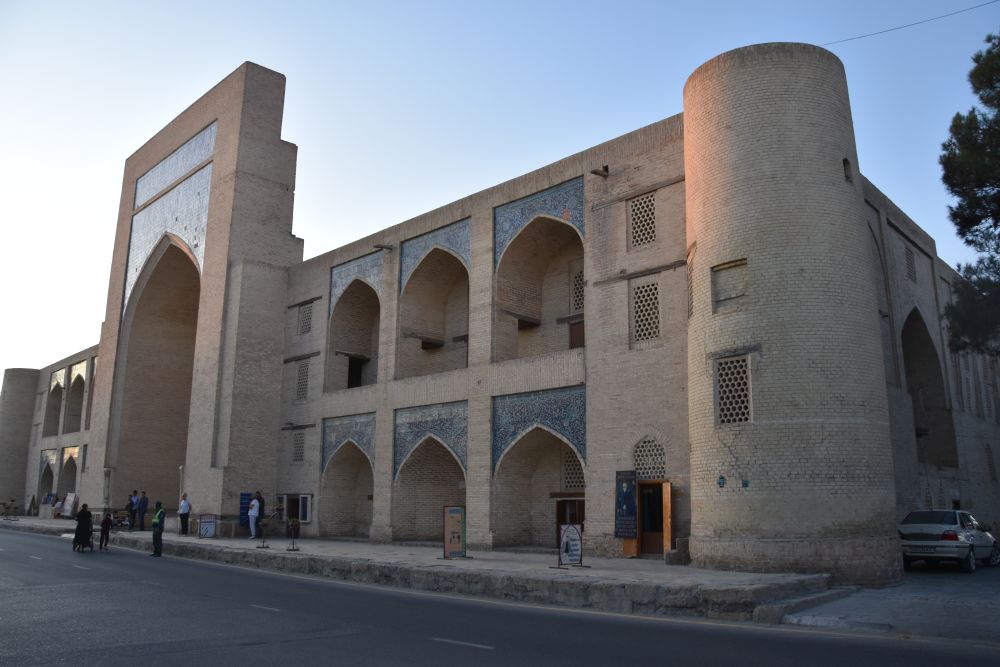
… the Kukeldash Madrasa to the north (late 16th century, this is another mosque built by the foster brother of Abdullah Khan),…

… and the Nadir Divan Bek Madrasa to the east (early 17th century) – interesting are the birds and the sun with the face. This i s an unusual decoration program in the Islam.

Nadir Divan Bek’s Chanaka to the west of the pool is under renovation.

The water pool (or Labi Haus) reminds of all the pools that once existed in the centre of Bukhara, and they seem to have been a problem, because the worms that lived in them, attacked men endangering their lives. The barbers were able to pull out the worms, but not always successfully (Dumont, p. 301).

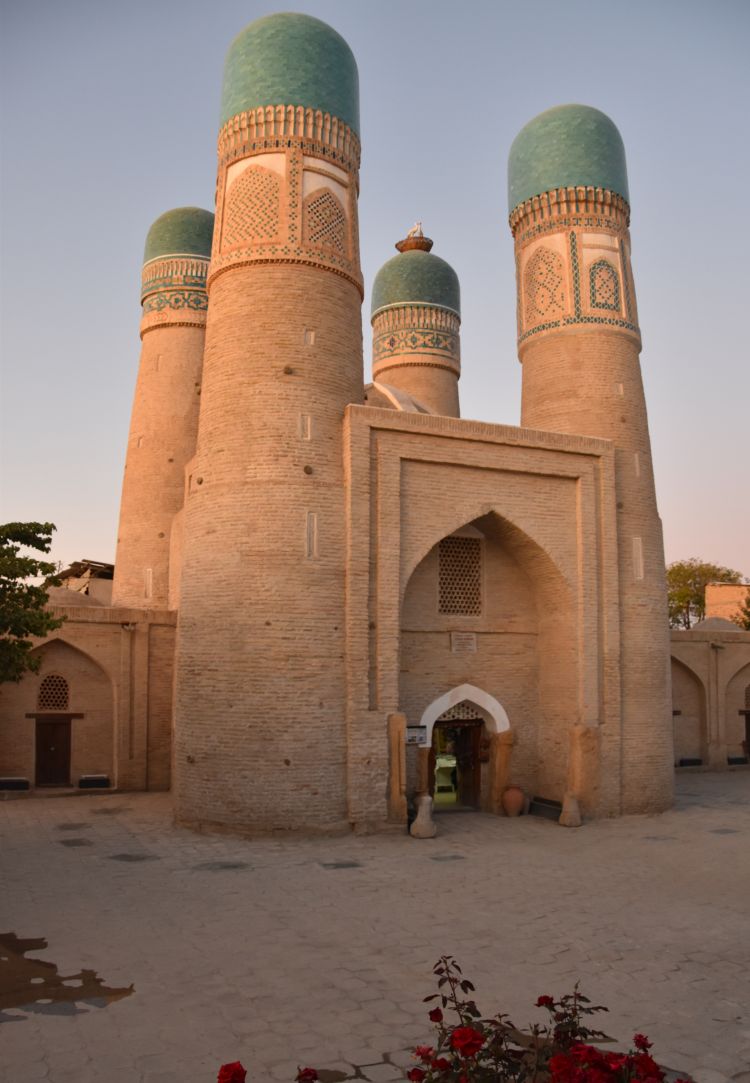
Not far from Labi Haus is the charming Chor Minor Madrasa. Only the gate is left. It has been built by a rich merchant who had four daughters – hence four towers (early 19th century).

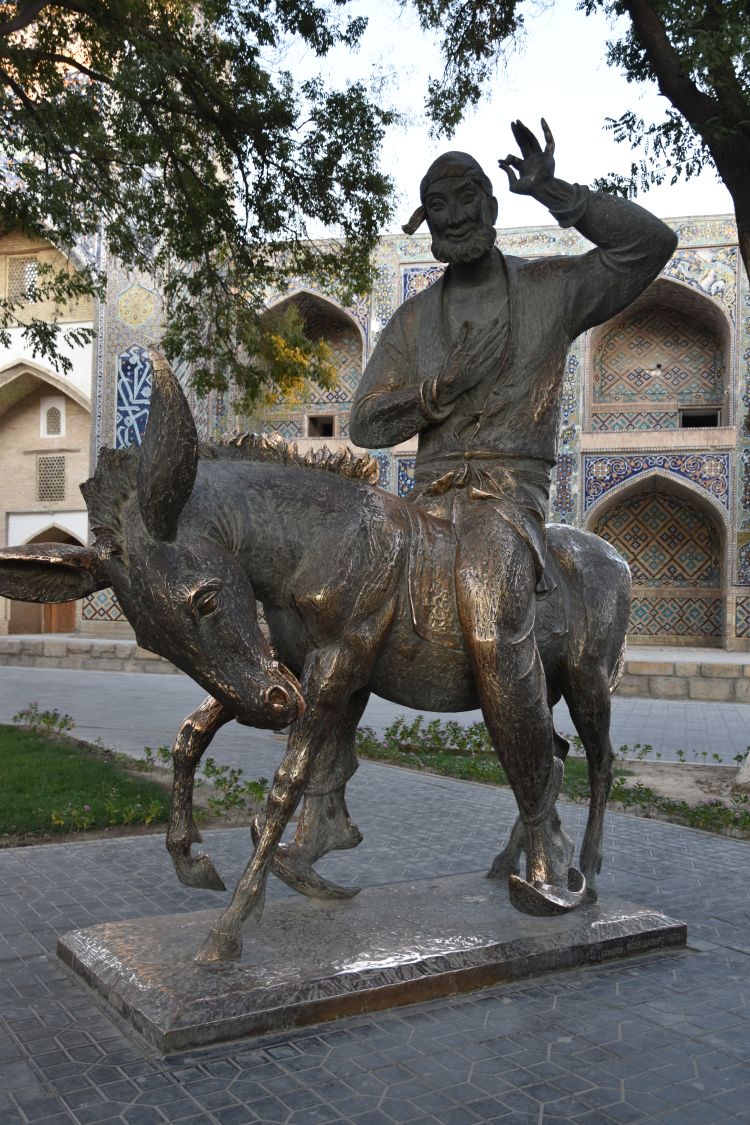
Hodscha Nasreddin rides on his donkey next to the Labi Haus. He was very wise, something like a jester.

I found a booklet with his stories in French (Mourodkhon Ergashiev: Un jour de Nasreddine, Tafakkur Bostoni, Tashkent 2011) – here is an example: One day, Nasreddin goes to the market to buy a donkey. The market is busy, there are many, many farmers. A well dressed man is angry and says: “What a jostling, there are just farmers and donkeys here.” Nasreddin asks him: “Are you a farmer?” “No, obviously not”, he replies. “Hm”, Nasreddin answers, “I would not buy you, I look for a donkey with longer ears!”


Jewish area and puppet maker

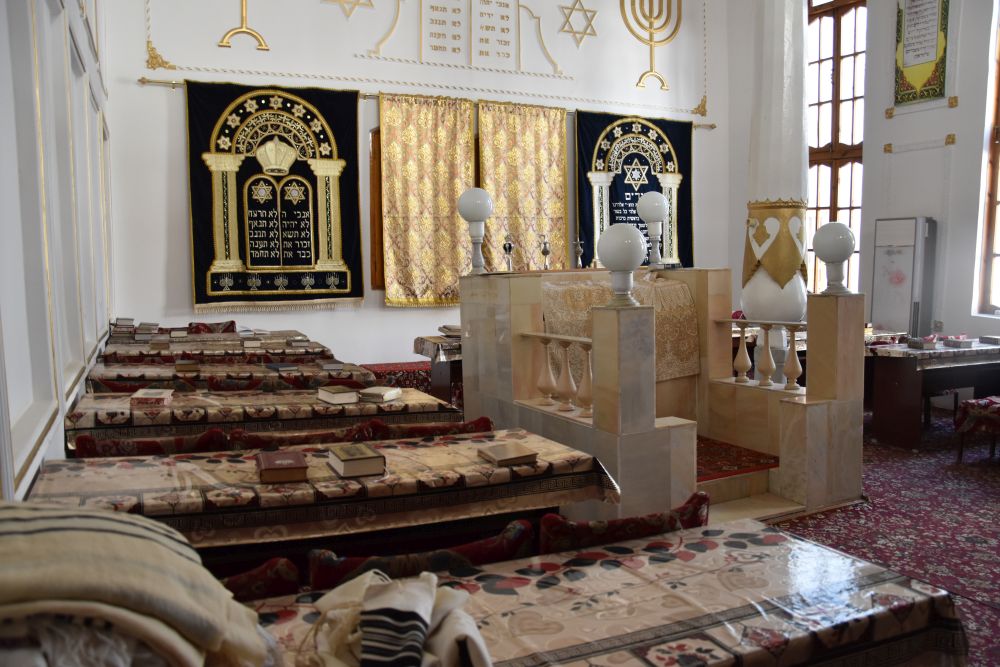
To the south of the Labi Haus is the old Jewish city. We enter the solemn synagogue.

Also here, Nasreddin is popular.

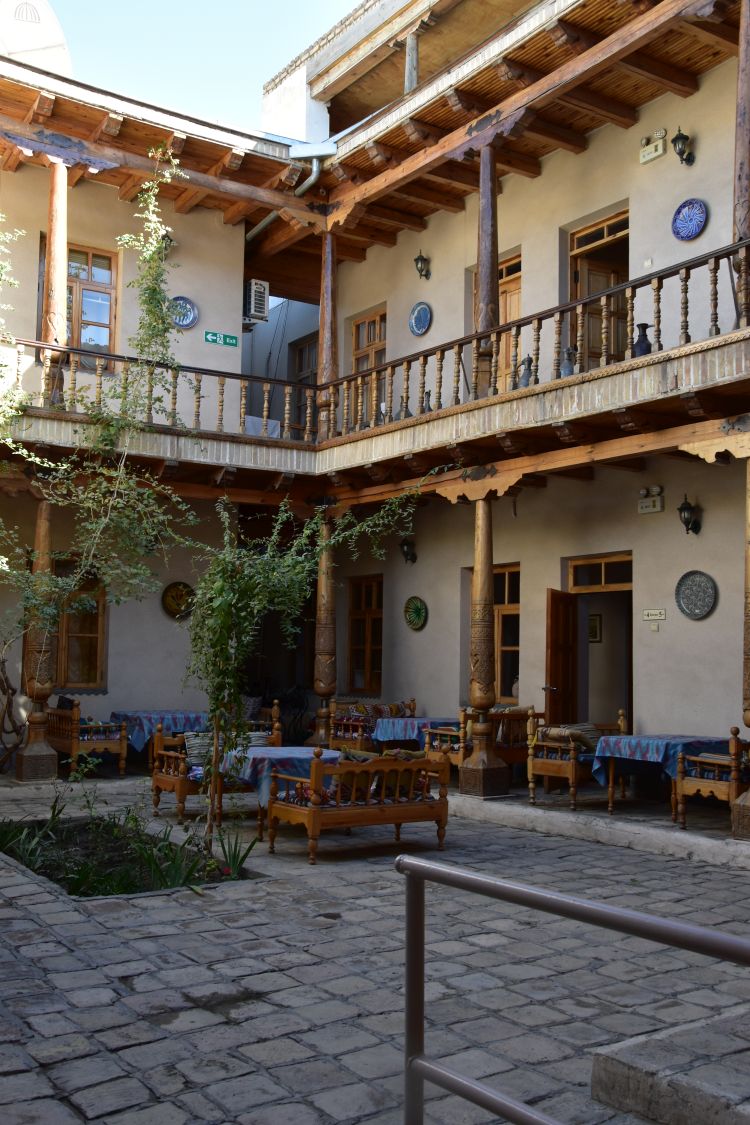
We see quite a few boutique hotels – perhaps an idea for staying overnight, in case we will return to Bukhara one day.

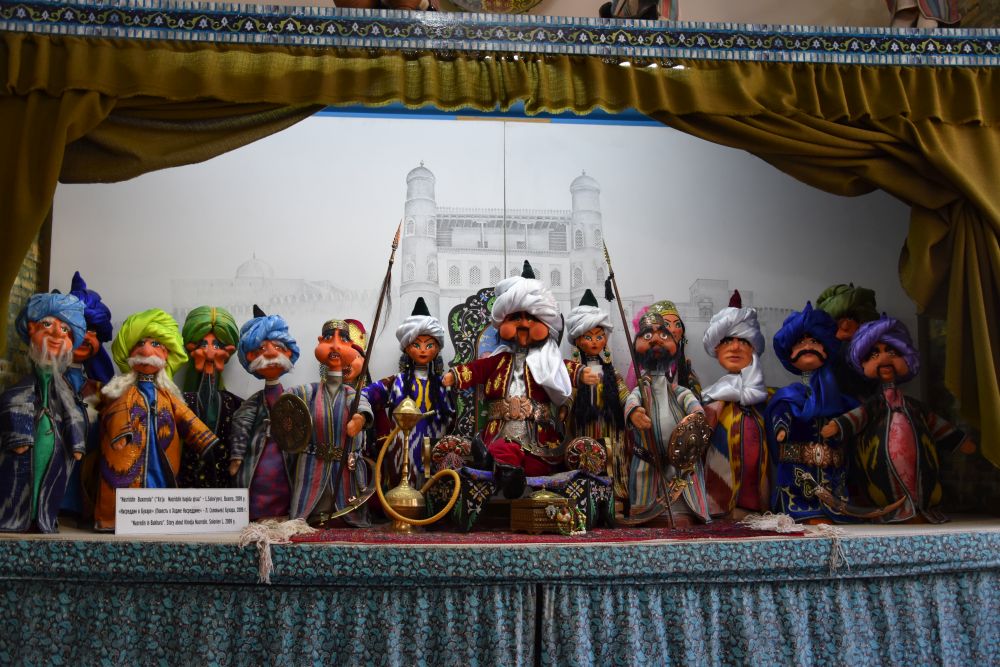
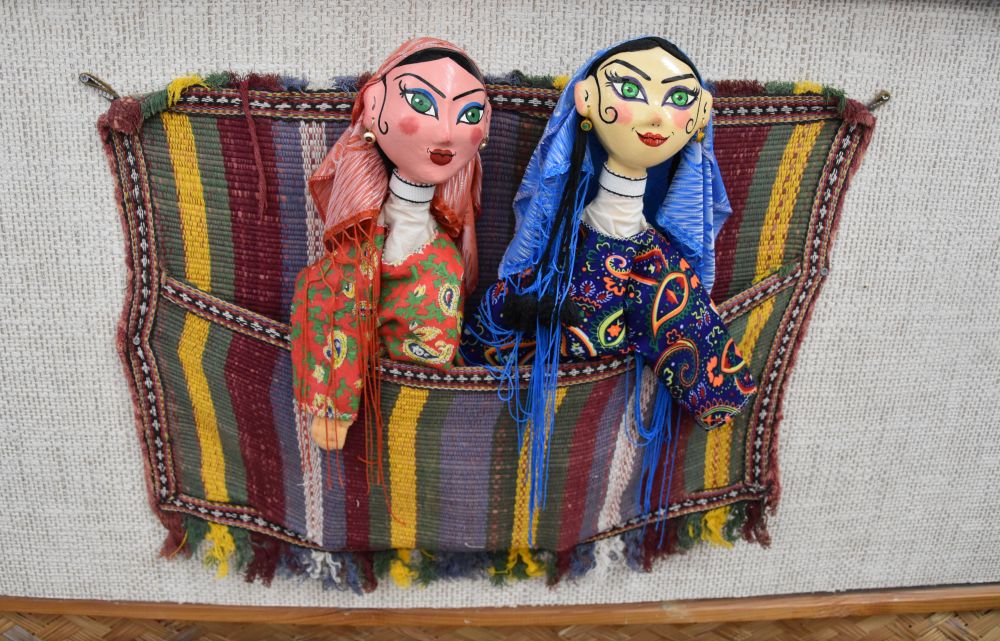
Iskandar Khamikov has a small workshop in the Jewish city, where he produces and sells puppets in traditional costumes.

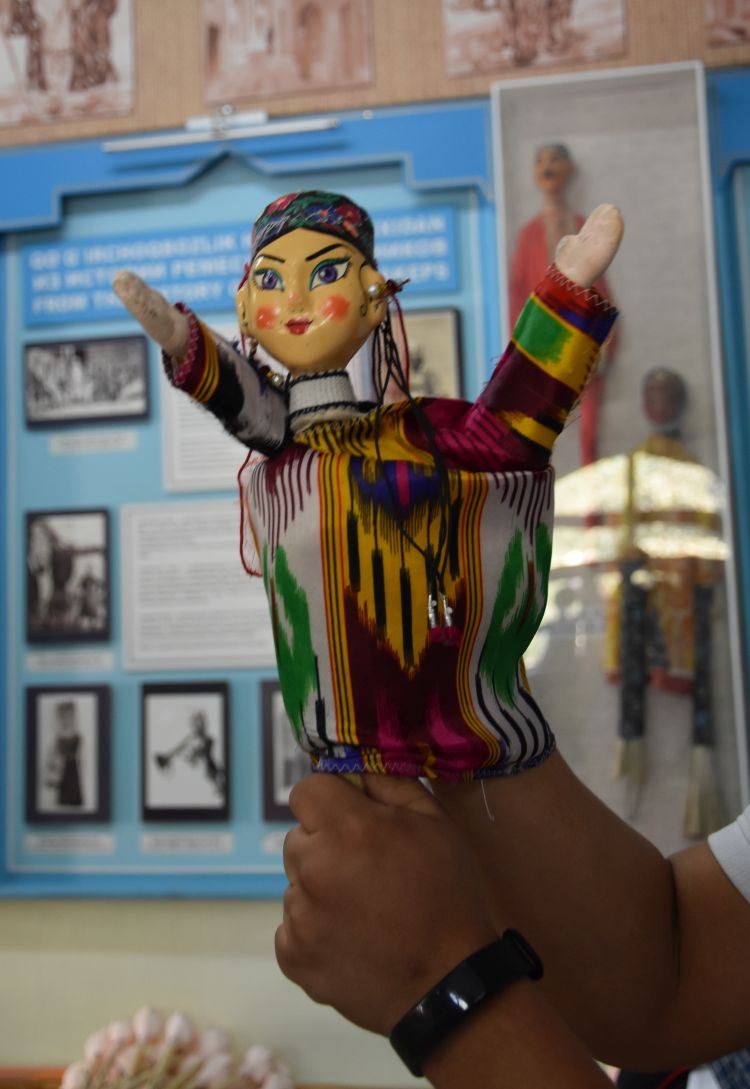
He shows, how the dolls can dance driven by his hands.

There are also smaller puppets that make a good souvenir. I acquire two of these.


Good-bye Bukhara

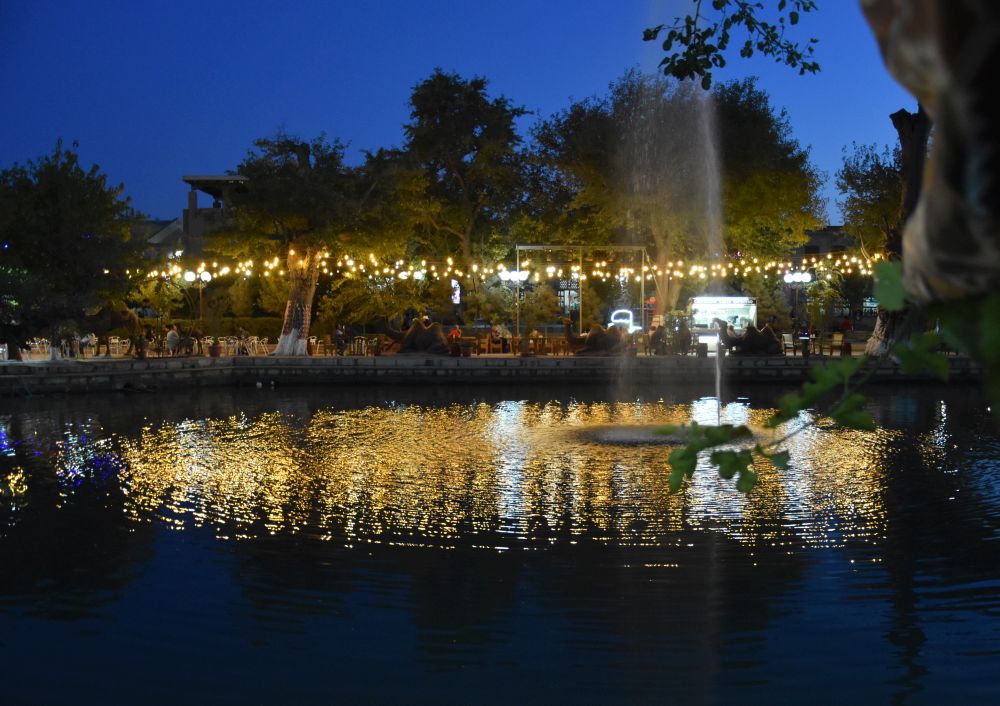
We have a farewell dinner at the Labi Haus with a good glass of Uzbek wine. I do like the Plov (rice dish) that they prepare in this country.

Bukhara is a gorgeous place to see. It provides insight into the history and architecture of Central Asia from the 9th century on. In addition the bazars offer good opportunities for shopping. Whenever I return to Bukhara, I will select a hotel in the Jewish city centre south of the Labi Haus to be in the middle of it all.


Sources: “Der grosse Plötz – Atlas zur Weltgeschichte”, Komet Verlag, Köln 2008; Isa Ducke and Natascha Thoma, “Usbekistan”, Dumont Reisehandbuch, Ostfildern 2017; Irina and Bodo Thöns, “Usbekistan”, Trescher Verlag, Berlin 2019; Irina and Bodo Thöns, “Reise durch Usbekistan”, Stürtz, Verlagshaus Würzburg 2018, Sanjeev Mehan; “Ein vergessenes Land holt auf”, Tagesanzeiger 21. September 2019; Markus Ackeret: “Usbekistans Ambitionen in Zentralasien”, NZZ 5. März 2020; Mourodkhon Ergashiev: Un jour de Nasreddine, Tafakkur Bostoni, Tashkent 20 and various wiki entries.


Discovering Uzbekistan – Tashkent, the spacious, modern city

In September/October 2019, I was in Uzbekistan. Our tour started in Tashkent, the capital of Uzbekistan. After the earthquake of 1966, the Soviets rebuilt Tashkent to become a model city, with spacious squares. There is even a metro decorated with luxurious stations. Modernisation continued after Uzbekistan had become independent in 1991. In addition, old mosques and madrasas were renovated and new ones were built, all in the traditional style with mostly blue tiles and cupolas. The city benefits from water canals fed by the Chirchiq river which touches Tashkent in the south.

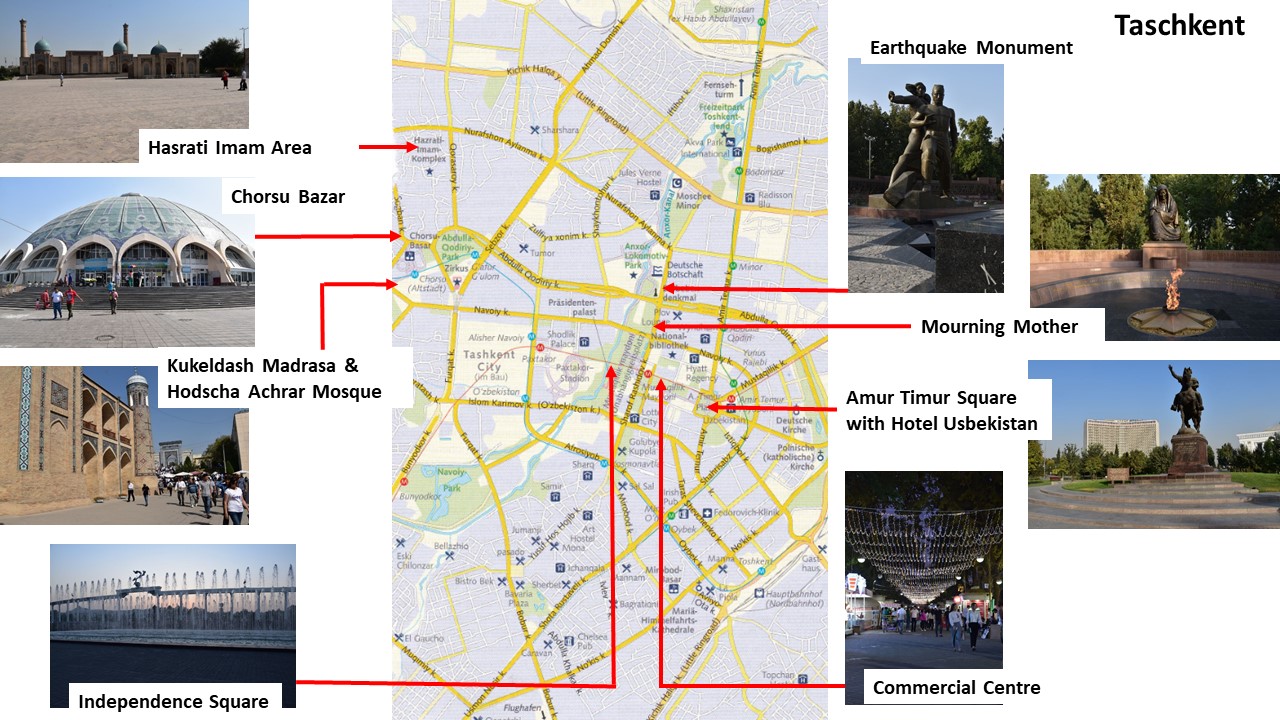
We spend half a day in Tashkent and collect a few impressions:

Source: “Usbekistan”, Trescher Verlag 2019, my own photos


Timur and our Hotel Uzbekistan welcome us

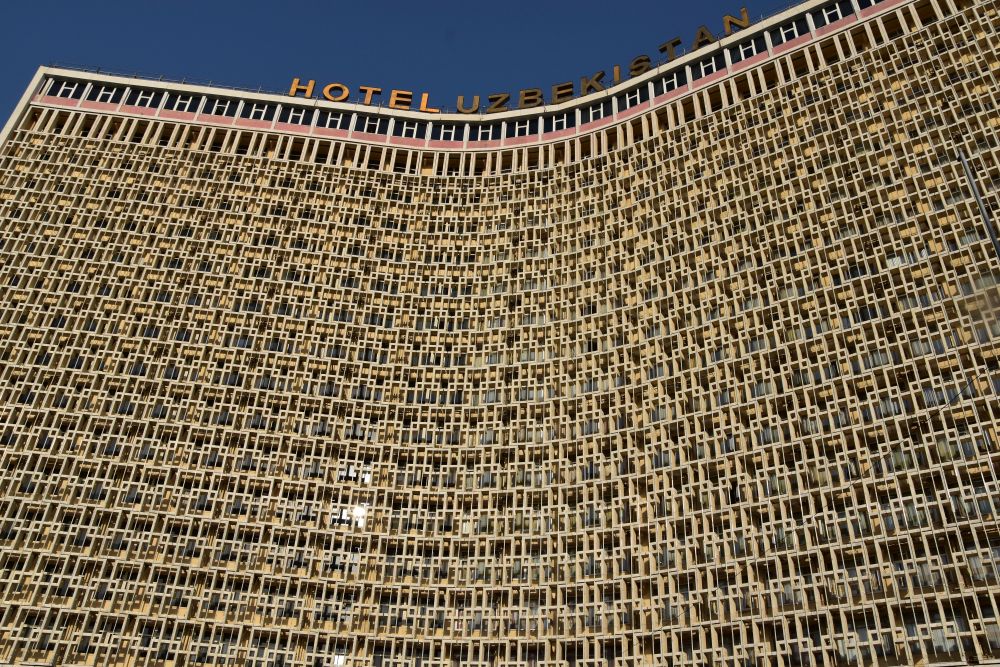
Coming from Moscow, we land in Tashkent in the early afternoon and get to our hotel Uzbekistan, a Soviet style building made from precast slabs, beautified by oriental style ornaments. My Dumont says that this hotel is for “Ostalgiker” (people with a nostalgy for (east) soviet style tradition). Yes, the hotel reminds me of that.

The hotel is comfortable and the rooms are spacious and well renovated.

At the hotel bank, we change money. I lose control of the huge pile of bank notes that I have received for 200 Dollars. We come across a street singer and give him some 1000 Som… one THOUSAND looks like a lot of money to us. We sit down on a bench and reflect, and now we blush: 1 Dollar is around 10’000 Som – and 1000 Som is just 10 Cents. A meal that costs 30’000 Som is equivalent to 3 Dollars. The easiest way to cope with these huge numbers is to just take four “0”s off the price in Som and then we understand, what the price really is in Swiss Francs, Euros or Dollars (which are all pretty close to one another). I prepare two wallets, a slimmer one with a few bank notes in the “10’000 and more Som sizes” for direct use and a fat wallet with the rest of the pile of bank notes as a reserve. And I keep some 1000 notes separate for those useful public places – this is what you are asked to pay for there.

I find out that in many Turkish languages “som” means “pure” which alludes to “pure gold”.


We meet Timur, the national hero

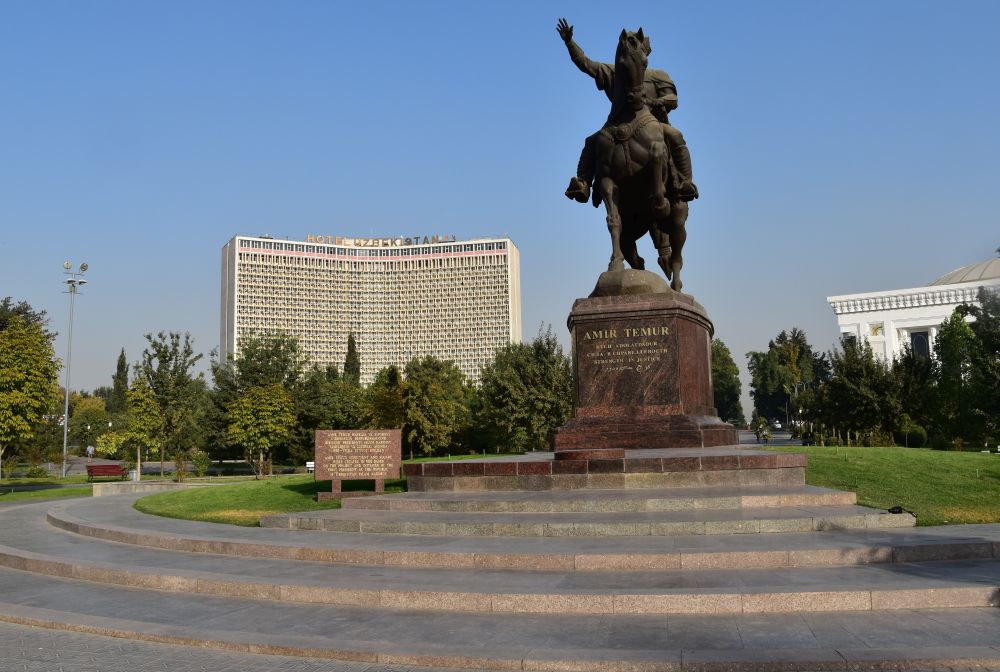
The Hotel Uzbekistan is located at the spacious Amir Timur Square, and Timur rides a horse here.

Timur is the national hero of Uzbekistan; he counts as the founder of the nation (see my blog about the history of Uzbekistan). We will come across him and his successors again and again in Uzbekistan.


Strolling around and to the Independence Square

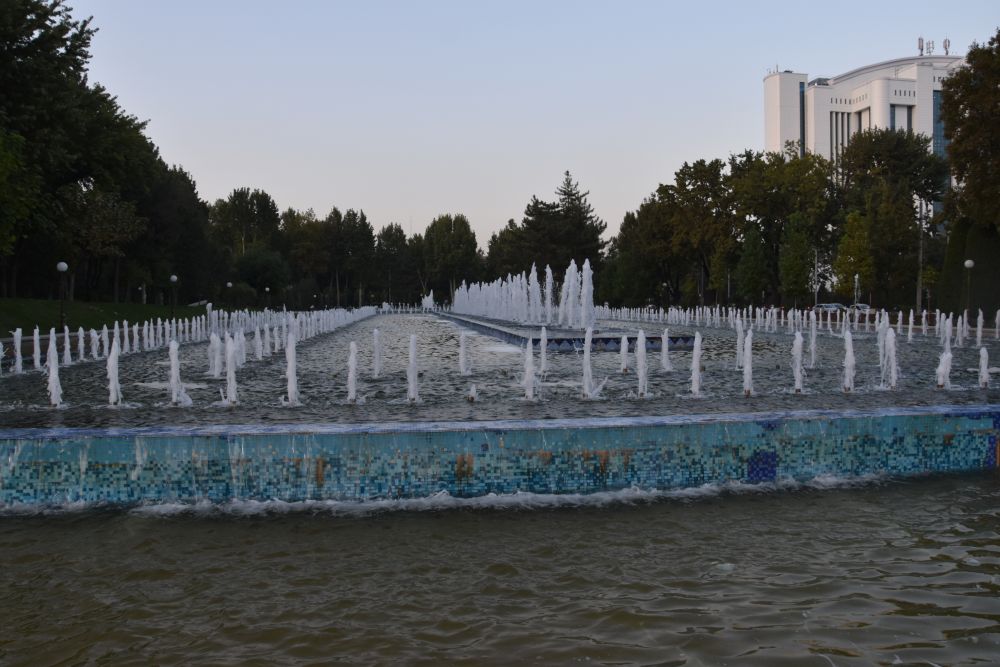
We cross a busy alley and walk to the Independence Square. We are surprised to find lines and lines of fountains. Tashkent derives water from the river Chirchik and uses some of it for all these water games.

It is an endless line of water games, here with galleries of columns.

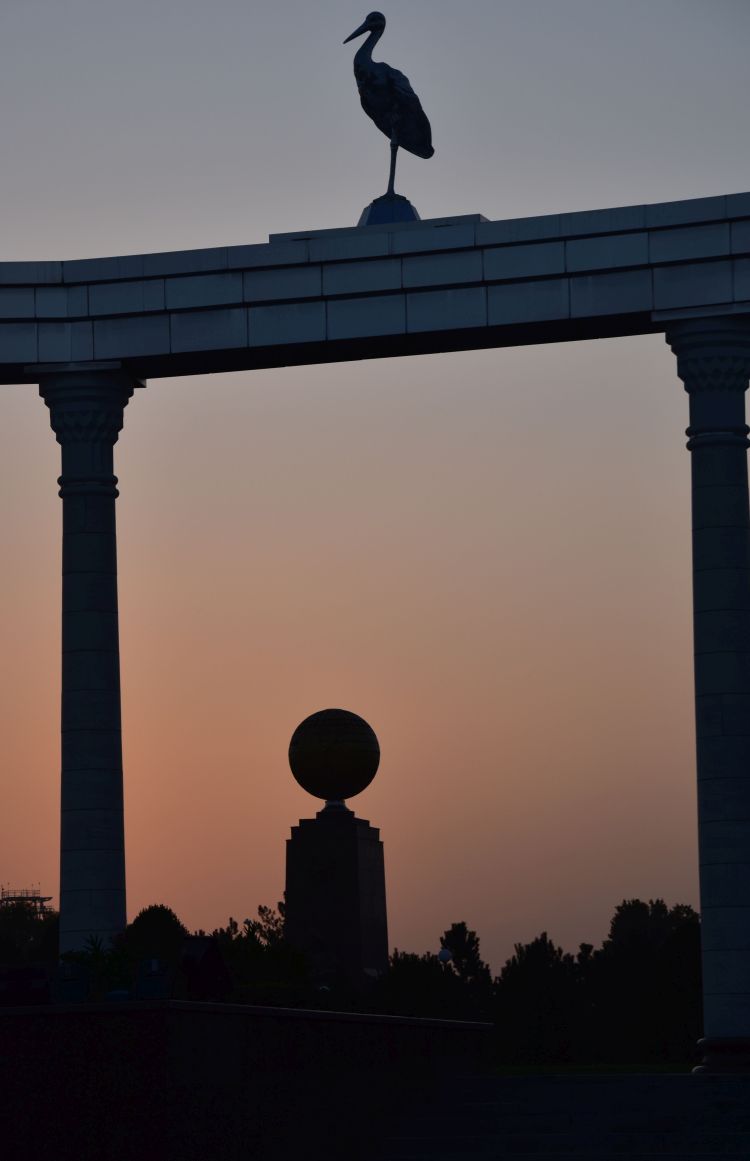
Storks are on top of the galleries. Various modern buildings appear behind the trees and the water games. This is a business center with an oriental touch.

Behind the water line, there is another park with the Independence Monument. The sun is setting.

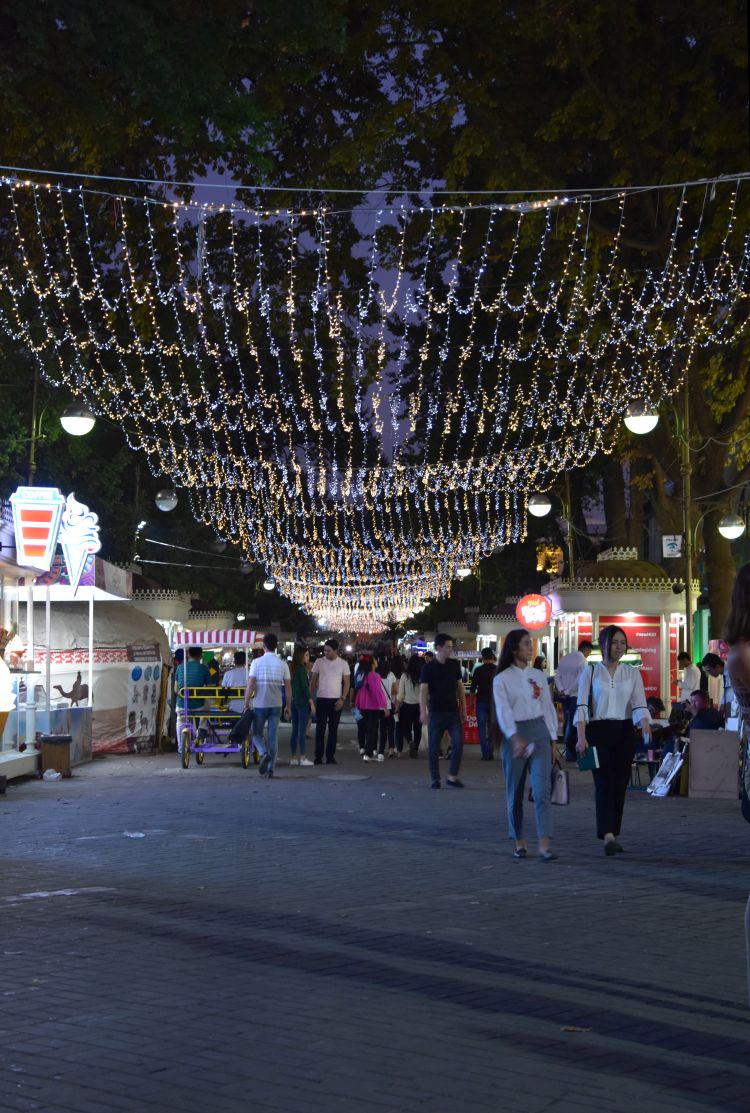
On our walk back to the hotel we join the Uzbeks strolling in their commercial centre that is also spacious and green.

We have dinner near our hotel – we need time to get used to these horrendous looking prices of 20’000 to 50’000 Som for a dish – which is only two to five Dollars. We sleep well in our comfortable Hotel Uzbekistan.


The patron of Tashkent, Hazrati Imam, and the ancient copy of the Koran

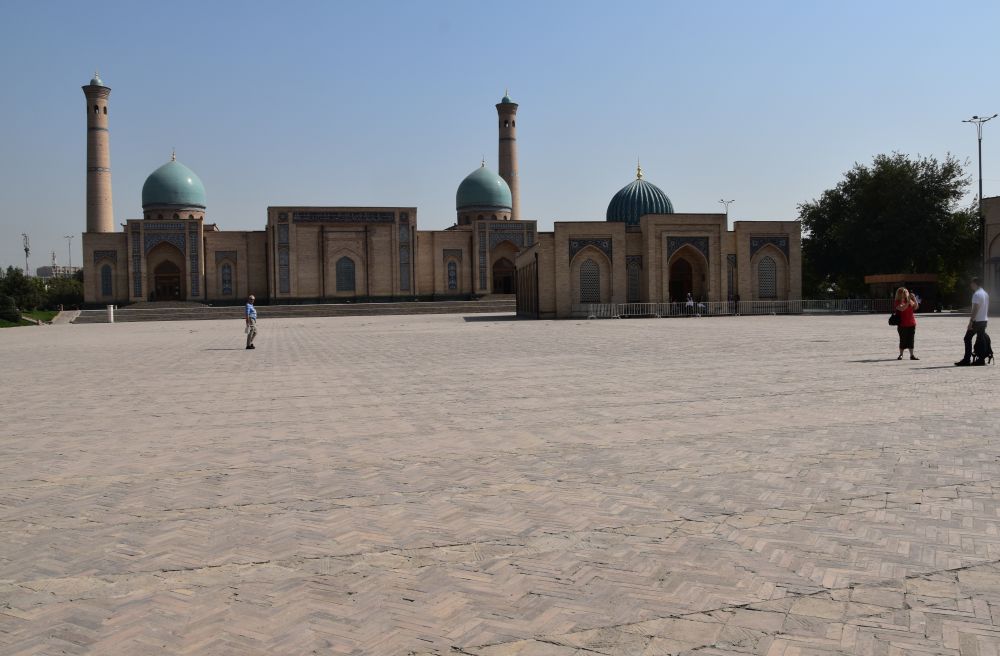
At the next morning we first visit the Hazrati Imam Ensemble.

The Imam Abu Bakr Kaffal Shashi (903-976) was a metallic worker (shashi) that became Imam and the saint patron of Tashkent. It is said that he convinced the then ruling Kara-Khanids to convert to the Islam. Abu Bakr Kaffal Shashi is buried in this mausoleum built in 1542.

Abu Bakr Kaffal Shashi is the Hazrati (holy) Imam that gave the name to this ensemble of mosques, madrasas and Islamic administrative buildings arising around his mausoleum.

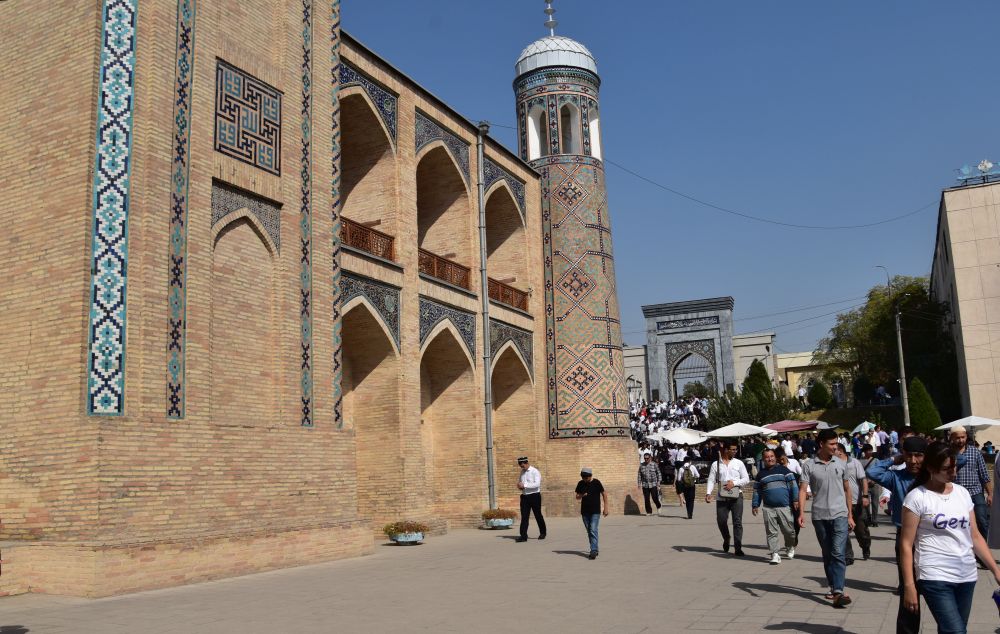
The newest mosque of the ensemble is the Hazrati Imam Mosque. It was completed in 2006. It is a modern mosque built in the “traditional” style with blue cupolas and glazed tiles mixed into the raw brownish bricks.

The small building in front is the library museum that holds the Osman Koran from the 7th century which is said to be one of five existing copies. Timur  took it from Irak to Samarkand, then the Russians transferred it to Moscow, and Lenin returned it later.

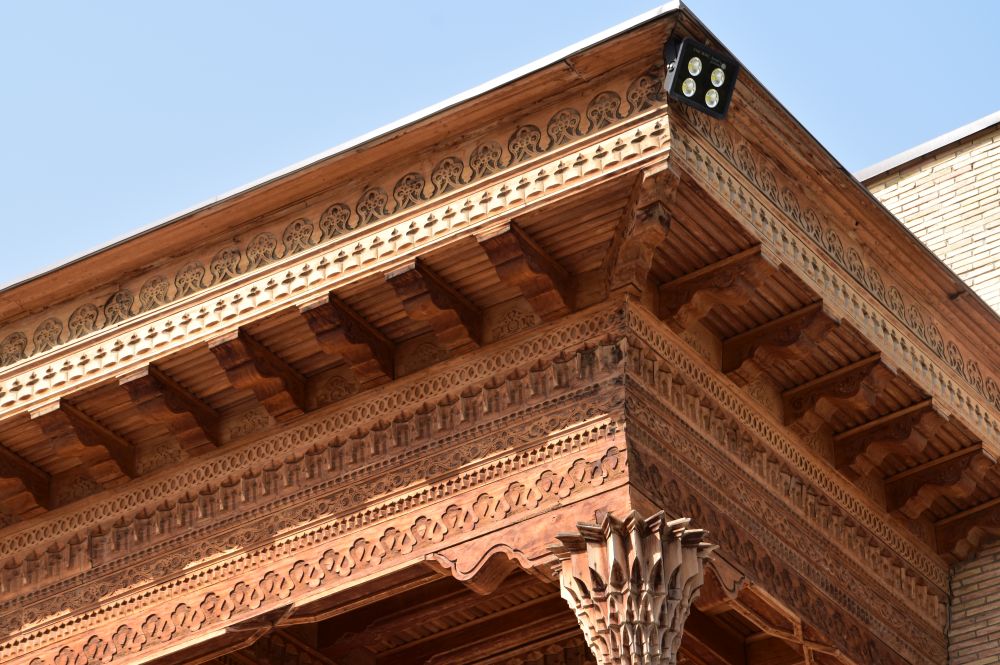
The entrance to the new Hazrati Mosque is beautifully carved. Under this roof, men are now rolling out their carpets to pray.


Strolling through the Chorsu Bazar

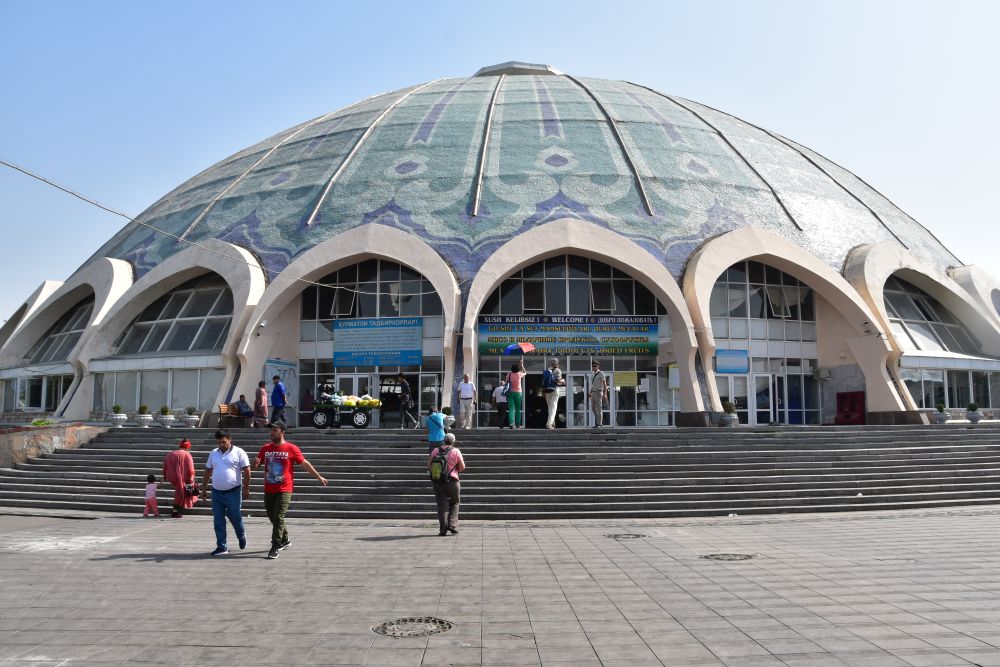
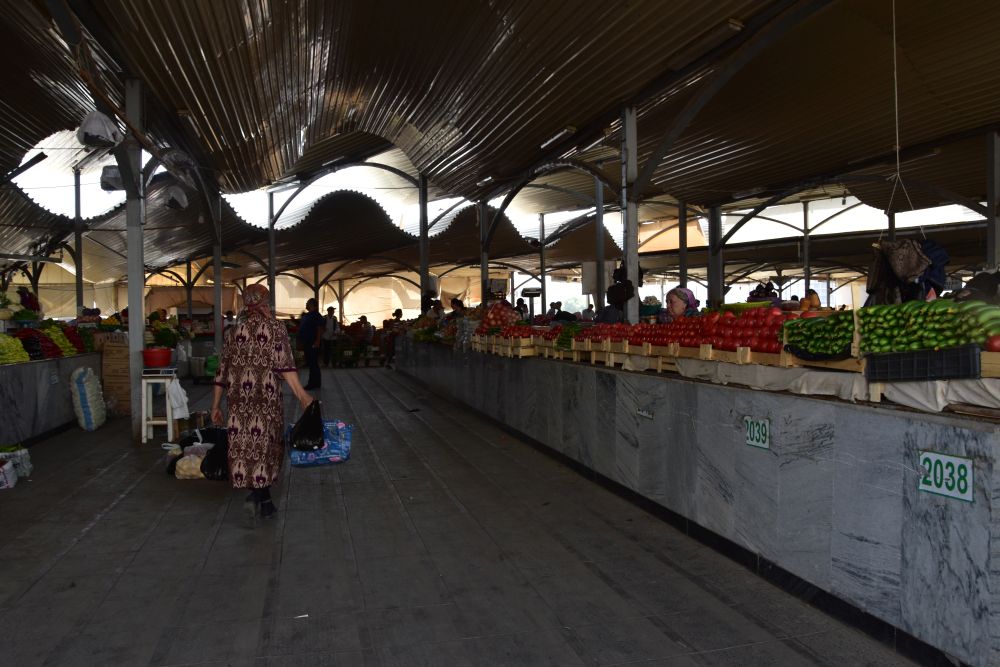
South of the Hazrati Imam Ensemble, we visit the Chorsu Basar, another blue cupola. It looks a bit like a spider with too many legs.

The disposal of vegetables and fruits is enticing.

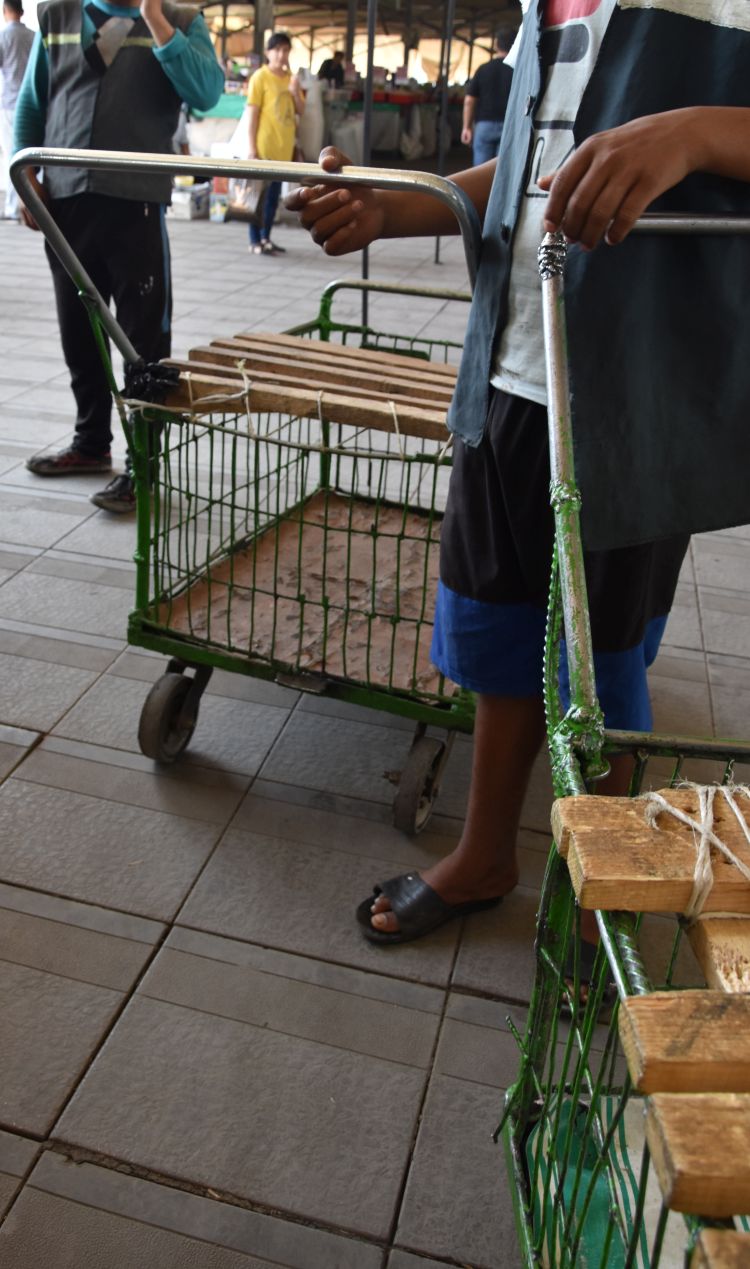
I believe that this man rents out the trolleys, what a hard job!

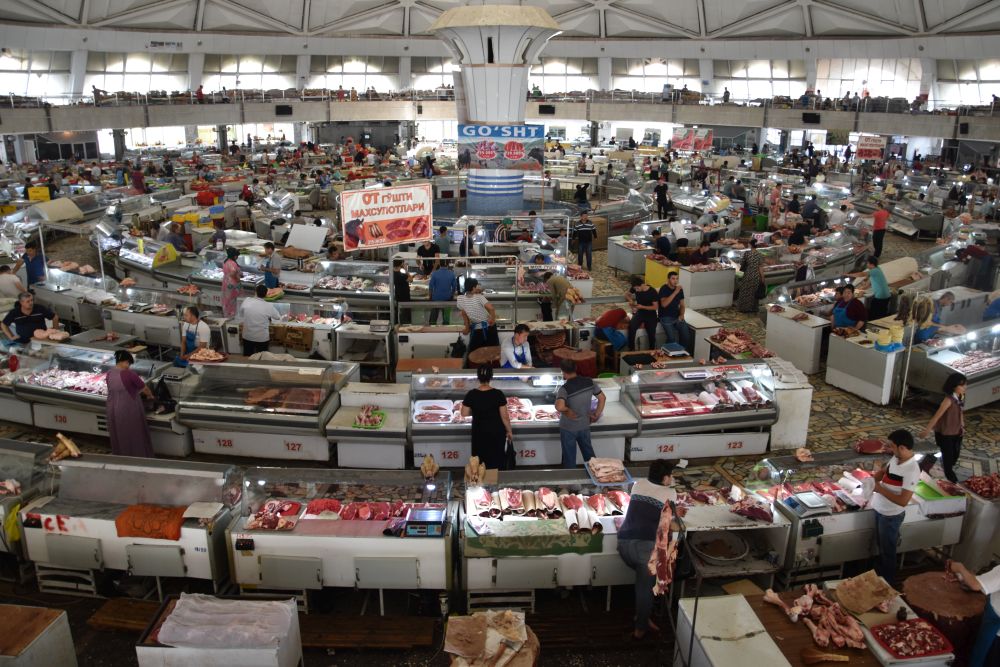
The market under the blue cupola takes place on two levels. From the upper level I take the photo of the meat department – “go’sht” means “meat” in the Uzbek language, and it is written in the Latin and in the Cyrillic alphabet.

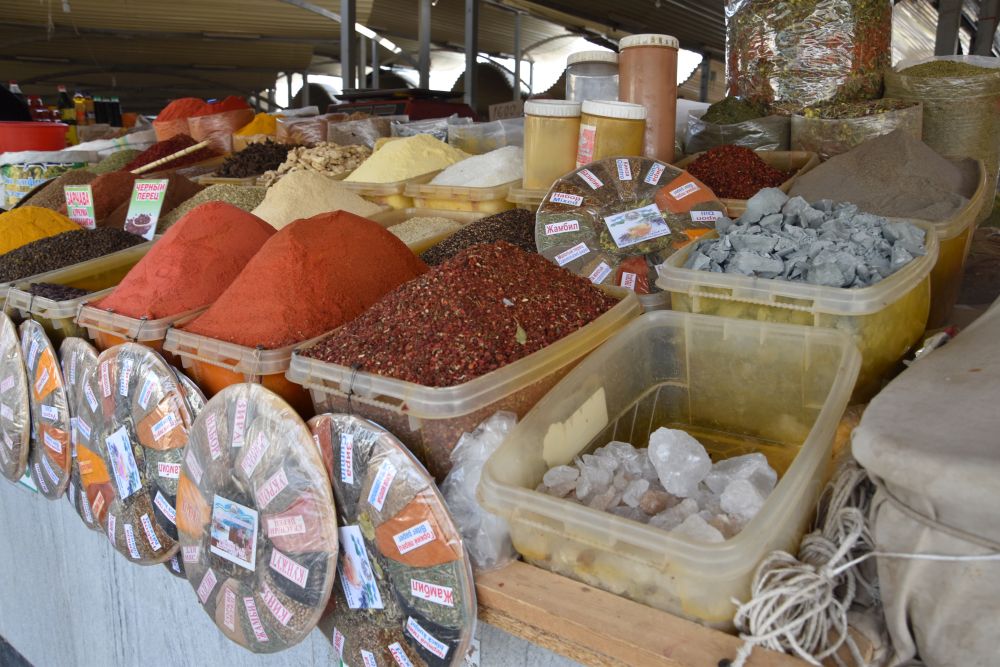
Uzbekans are multi-lingual. This round box contains a selection of spices, and they are labeled in Russian (набор) and in English (mixed). Each of the spices has two names on the label, the Russian and the English one.


The foster brother of Abdullah Khan – Kukeldash

The foster brother or “kukeldash” seems to have been an important concept in Uzbekistan: One woman feeds two boys from different mothers, and they become foster brothers. Adullah Khan (ruler in the late 16th century) had a foster brother, just called Kukeldash. Various madrasas in Uzbekistan are called after him such as this one in Tashkent. It is a working madrasa that is closed for visitors.

In the background, the Hodscha Archrar Mosque has opened its gates. The Friday service is over. It has been well visited.


Tashkent is proud of two monuments, one for the earthquake, one for the mourning mother

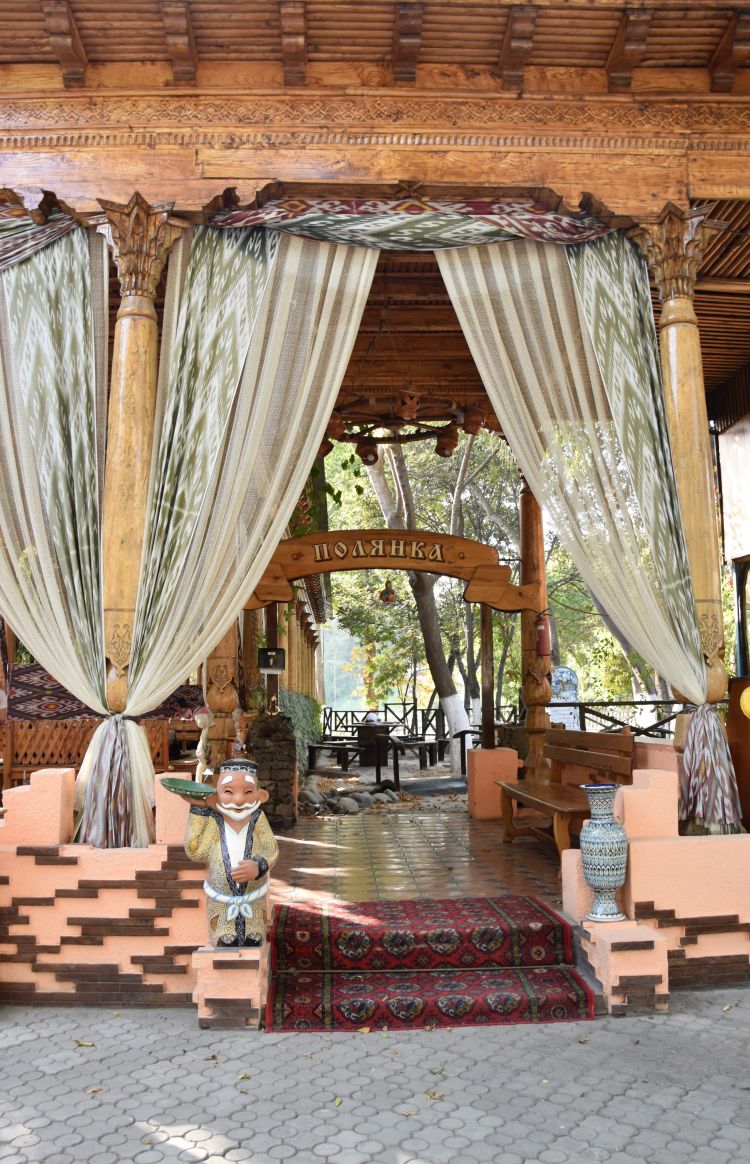
We have lunch in the restaurant Полянка (Poljanka), where this joyful old man welcomes us.

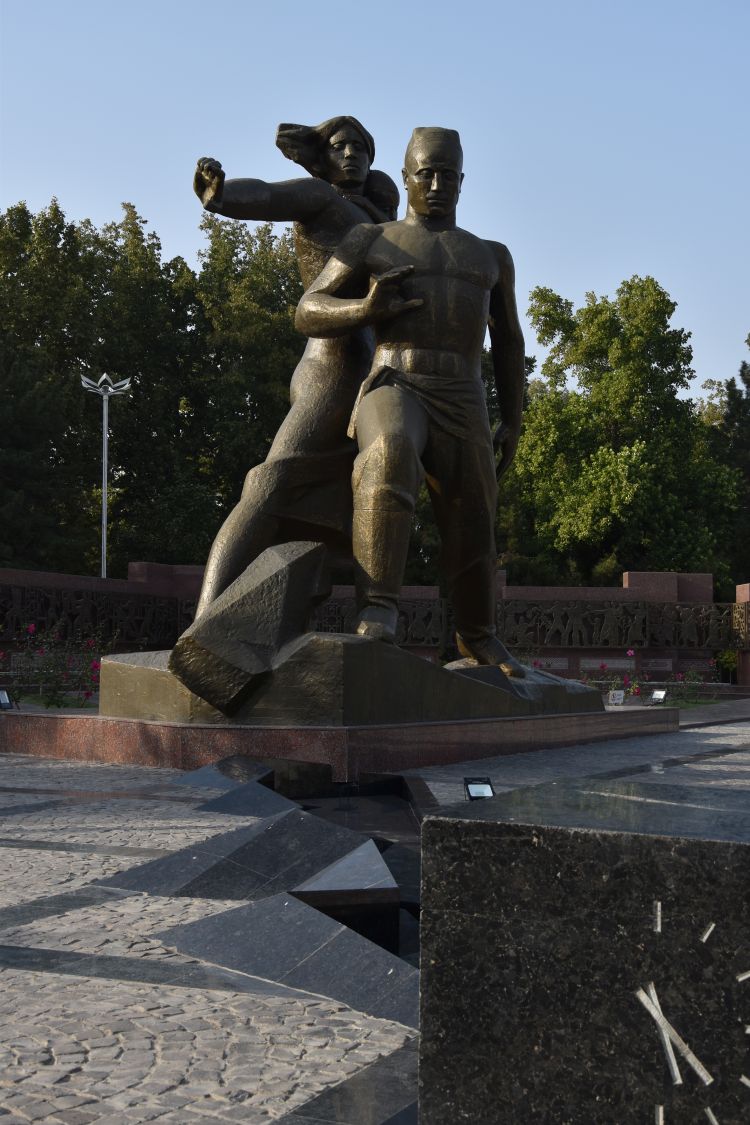
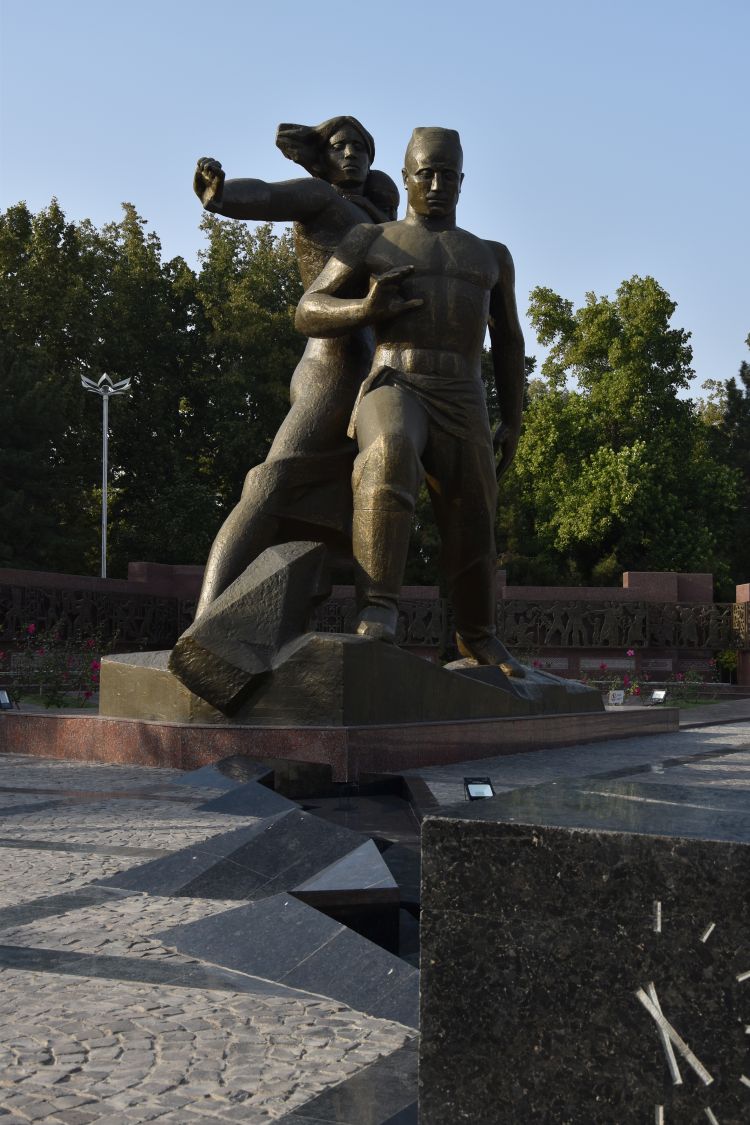
Not far from the restaurant is the earthquake monument. In 1966, the epicentre was  exactly here, some 3 to 8 kms below surface. With 7 to 8 points on the Richter magnitude scale, the earthquake devastated much of Tashkent. The memorial reminds of the hour: It happened at 5:23 in the morning. This is a Soviet style monument, and the Soviets seem to have supported the reconstruction of the spacious city that we experienced.

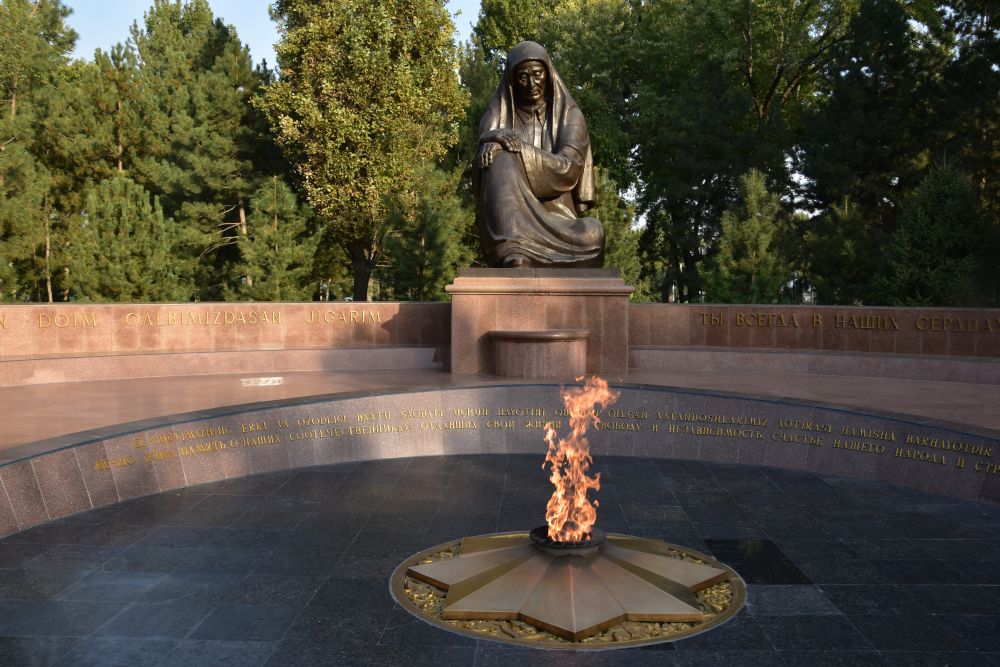
Another monument reminds of the mothers that lost their sons in the Second World War. “You will always be in our hearts” (Ты всегда в наших сердцах), the inscription says and adds that the memory of the compatriots that have given their lives will always remain alive. I am not aware of Second World War fights in Central Asia, but I believe that the Uzbeks fought in the Soviet army.


Good-bye – whenever I return, I will visit some of the museums

We leave Tashkent. Whenever I return, I would like to visit the museum for history and archaeology to learn more about the country or to see some of their arts museums, and perhaps the puppet theatre is an additional idea.

Sources: “Der grosse Plötz – Atlas zur Weltgeschichte”, Komet Verlag, Köln 2008; Isa Ducke and Natascha Thoma, “Usbekistan”, Dumont Reisehandbuch, Ostfildern 2017; Irina and Bodo Thöns, “Usbekistan”, Trescher Verlag, Berlin 2019; Irina and Bodo Thöns, “Reise durch Usbekistan”, Stürtz, Verlagshaus Würzburg 2018, Sanjeev Mehan, “Ein vergessenes Land holt auf”, Tagesanzeiger 21. September 2019 and various wiki entries.
Discovering Uzbek history mirrored in world history: Uzbek Khanates until today

End of September/beginning of October 2019, I  am in Uzbekistan. I want to find out about the roots of the Uzbeks and identify the following six highlights in their history mirrored in world history (note that I am not a professional historian):

  1. Around 300 B.C.: Alexander the Great conquers Central Asia and marries the Sogdian princess Roxane in Samarkand
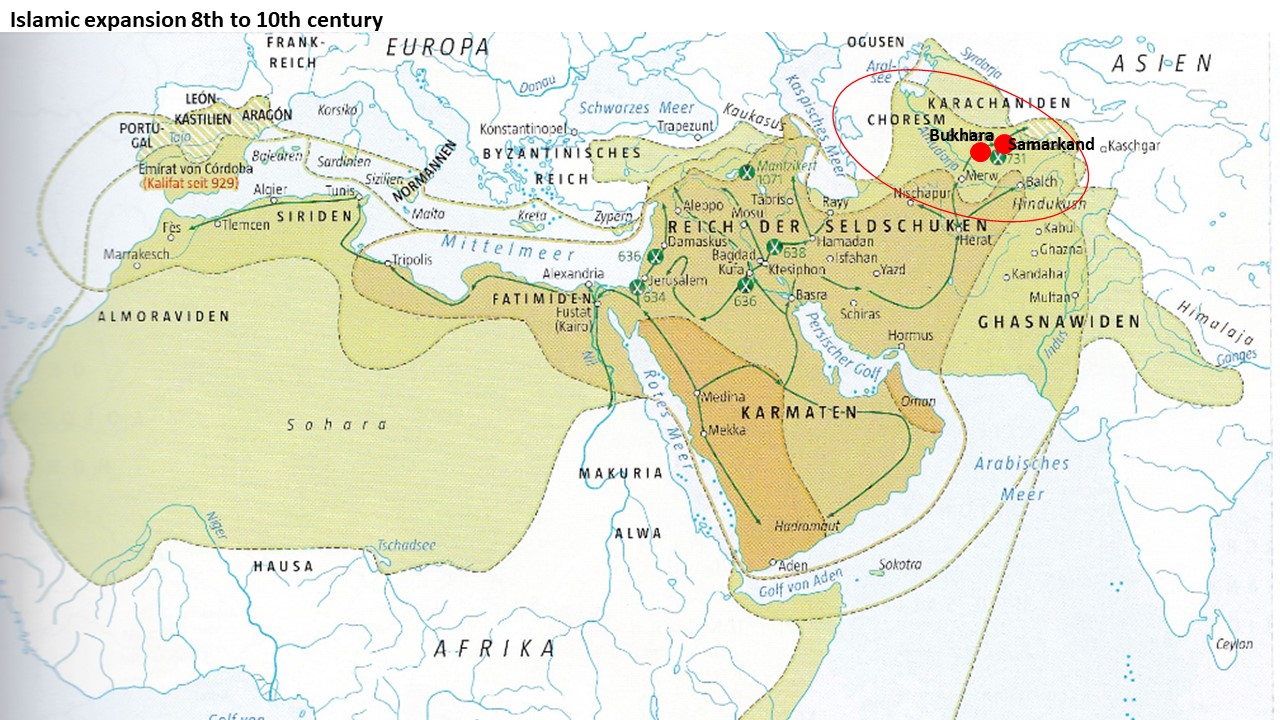
  2. 8th-12th century: The Islam expands to Central Asia conquering Samarkand in 712; the Islam is adopted by local leaders
  3. Beginning 13th to mid 15th century: The Mongols invade Central Asia and the Timurids are their successors
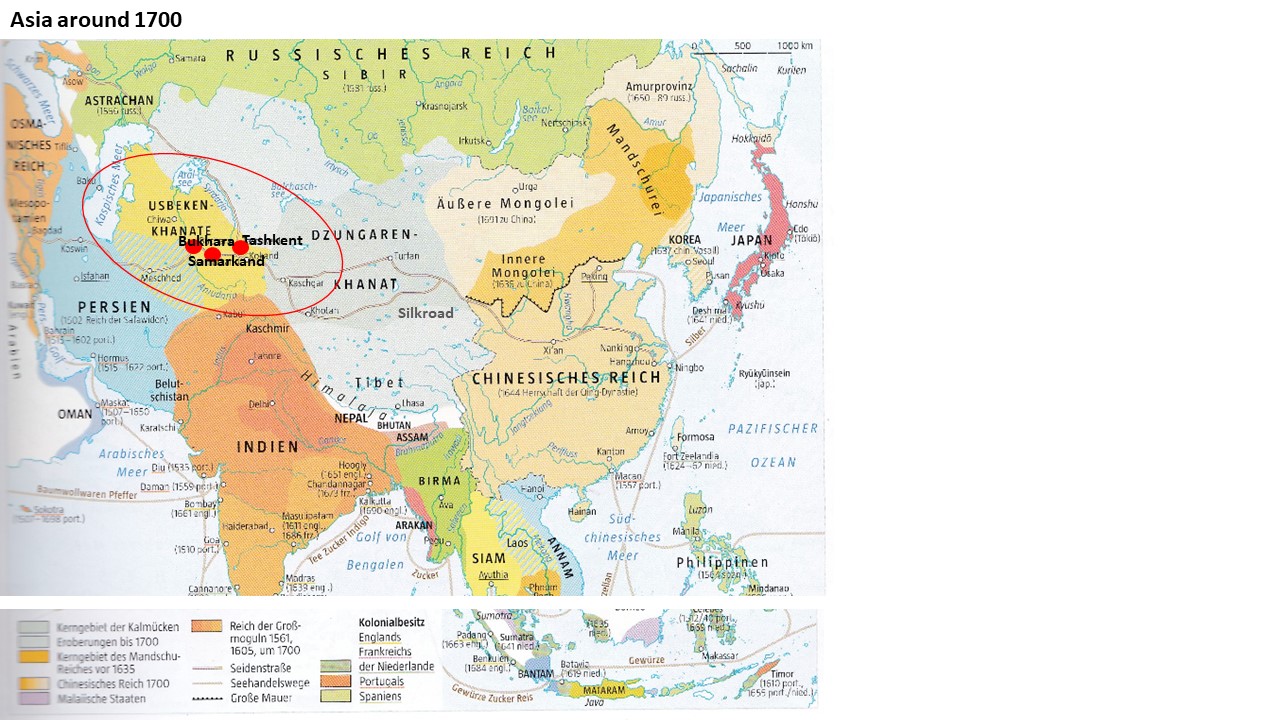
  4. Mid 15th to mid 18th century: Uzbek Khanates – the name “Uzbekistan” takes shape
  5. 19th century to 1925: The Russians conquer Central Asia and install the colony Turkestan
  6. 1925-today: Uzbekistan becomes a Soviet Republic in 1925, and it has been an independent nation since 1991

After having discussed the first three highlights in my former blog, I now intend to look at the second three highlights, (4) the Uzbek Khanates, (5) the Russian colony and (6) Uzbekistan as a Soviet republic and a nation up to today.


4. Mid 15th to mid 18th century: Uzbek Khanates – the name “Uzbekistan” takes shape

Muhammad Shaybani (1451-1510) is originally a subaltern leader in the army of the Timurids. He is of Uzbek origin (a tribe that belongs to the Golden Horde). He fights his way to power unifying the Uzbek Khanates and establishing the dynasty of the Shaybanids. To justify his authority, he claims to descend from Uzbek Khan (1282-1341), a grand-son of Batu Khan who was a grand-son of Genghis Khan. With the Shaybanids from the Uzbek Khanate, the name Uzbekistan takes shape. First Samarkand remains the capital of the Shaybanid empire, and in 1533 the capital is moved to Bukhara. The Shaybanid dynasty lasts until about 1600.

Source: “Der grosse Plötz”

After 1600, the Uzbek Khanates disintegrate into various principalities. Until 1750, the principality of Bukhara is ruled by the Janids, also tracing their origin back to Genghis Khan.

In the early 18th century and after various wars with the Ottoman empire and the Russians, Persia rises again under Nadir Schah. Persia then loses their eastern regions to Afghanistan that now is taking form.

With the discovery of the world by the Europeans, trade moves from the Silk Road to the oceans and the silk road of Central Asia loses importance.


In Bukhara, the capital of the 16th century Shaybanid empire, we find mosques and madrasas from that time. Three examples are the Kalon Mosque with the Miri-Arab Madrasa, and the Kukeldash Madrasa.

This is the Kalon Mosque with its blue tiled entry gate or pishtak (built in 1514).

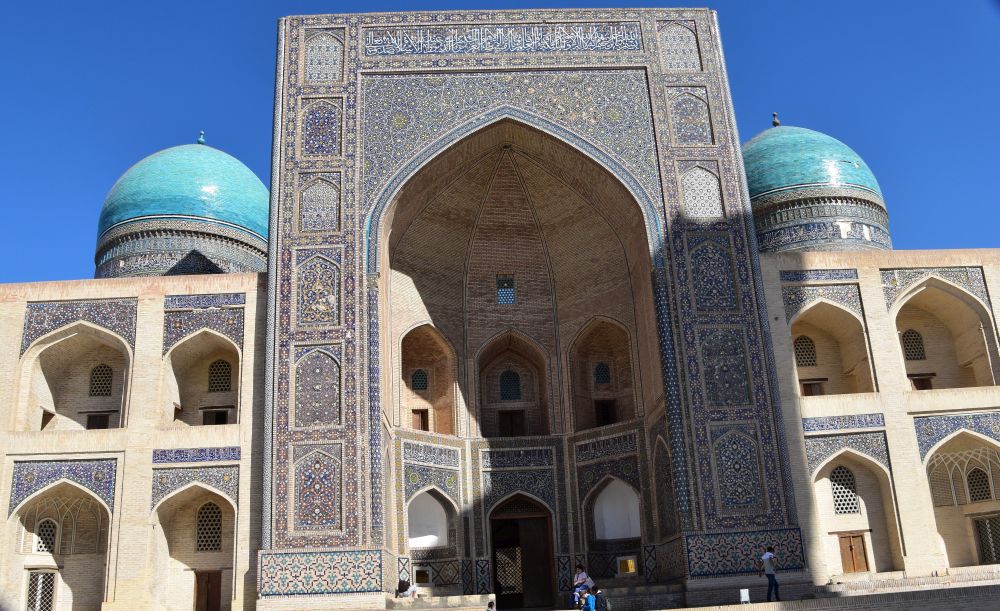
Just across is the blue tiled pishtak portal of the Miri-Arab Madrasa (built in 1536). The principle of mirroring architectural structures is common in Central Asia and is called “kosh” or “kash” (which means “mirror” or “across” in Persian). The mirroring of similar buildings conveys a monumental impression and harmony.

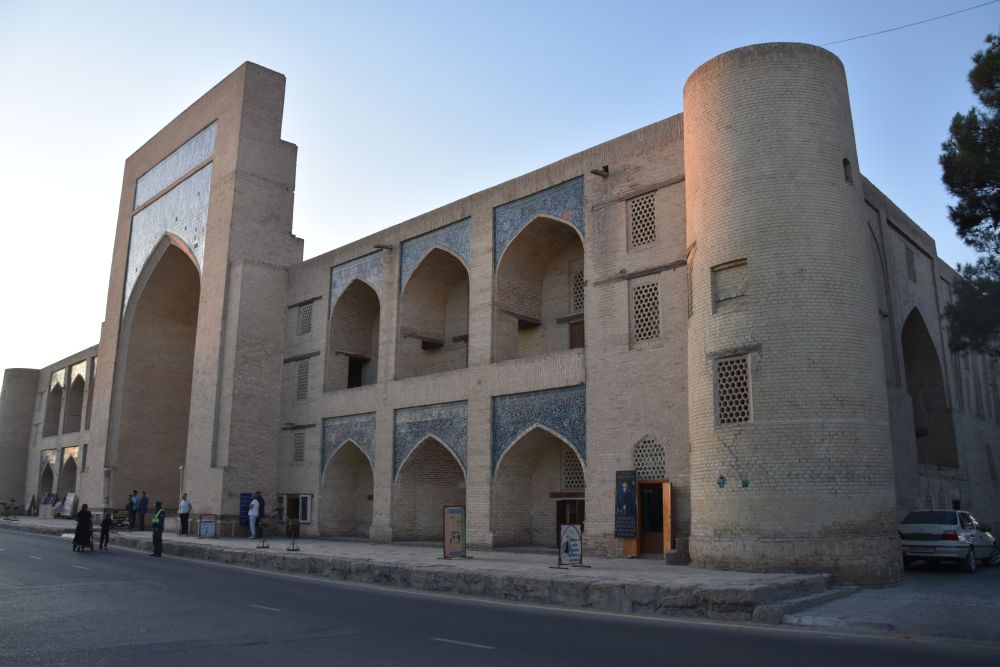
In 1568/69, the Kukeldash Madrasa, is built by the foster brother(=kukeldash) of Khan Abdullah II. It is the largest madrasa of Bukhara. Khan Abdullah II (1583-98) was one of the best Shaybanid Khans giving Bukhara years of cultural and economic heyday.

After 1600, the Uzbek Khanates disintegrate into various principalities, and the governor of the Samarkand principality, Yalangthush Bakhodur, completes the Registan. He adds two more madrasas: The Tylia Kori Madrasa in the middle and the Sher-Dor Madrasa to the right. The two new madrasas join the Ulugh Bek Madrasa from the 15th century, and, 200 years later, the Registan becomes this magnificent example of the kash/kosh mirroring architectural structures.


5. 19th century to 1925: The Russians conquer Central Asia and install the colony Turkestan

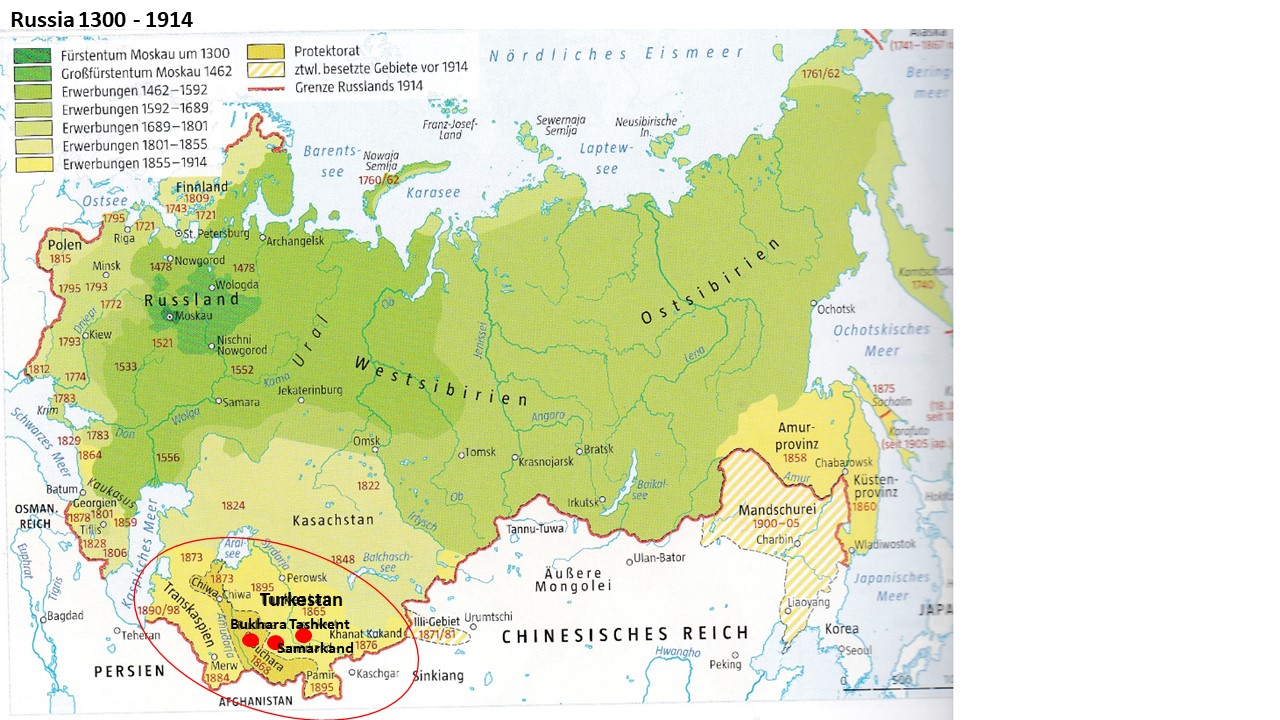
In the 19th century, the Russians and the Britains fight the “Great Game” for predominance in Central Asia. In 1895, they define the Amudarya (ancient Oxus river) as the border between their areas of influence – the Russians will stay north of the river Amudarya, the Britains south of it.

While the Britains focus on India and Myanmar, the Russian troops conquer Central Asia or what is now Kazakhstan, Uzbekistan, Tajikistan, Kyrgyzstan and Turkmenistan. In 1867 they install the governorate Turkestan with the capital Tashkent. Today’s Uzbekistan is part of Turkestan.

Source: “Der grosse Plötz”

“Russian new towns” arise around the old towns. The Russian colonists plant cotton in the steppes of Turkestan. That requires irrigation, as this view of the dry steppes around Samarkand illustrates (taken from the Hazrat Daud Cave, the Cave of David, an important Usbek pilgrimage site).


6. 1925-today: Uzbekistan becomes a Soviet Republic in 1925, and it has been an independent nation since 1991

In 1924/25 Uzbekistan becomes the Uzbek Socialist Soviet Republic, the borders of which are finalized in 1963. Since 1930, Tashkent has been the capital. More Russians move into Uzbekistan, some not voluntarily. Education and industrialization are promoted. The irrigation of the cotton plantations leads to the drying out of the Aral Sea. Buildings are made with Soviet style precast concrete slabs; they are decorated which gives them a somewhat Asian charm. Tashkent is destroyed by an earthquake in 1966 (7 to 8 on the Richter scale) and the Soviets rebuild it with large open spaces – it should be the showcase for a modern Soviet city.

In September 1st 1991, Uzbekistan becomes independent. Islom Karimov, already president of the Soviet Republic since 1990, remains until 2016, strict and distrustful. Then Shavkat Mirziyoev takes over. He brings a fresh wind, including currency liberalization and abolishing tourist visas. We benefited from that, when traveling to Uzbekistan and we wish the country all the best to successfully progress with the reforms.

Source: “Der grosse Plötz”

Uzbekistan is a multicultural nation. 70% of the population are Uzbeks of Turkish origin and 5% (perhaps more) are Tadjiks of Persian origin. The coat of arms, though, is a bird that belongs to the Persian mythology: Xumo/Humo or Simorgh. The share of the Russian population diminishes (in 2019 about 5%), but Russian is still widely spoken. The alphabet used is a mix of Latin and Cyrillic and what you see, is a mix of languages between local, Russian and English.

The primary religion is sunnite, not only among the Uzbeks and the representatives of the other Turkish peoples, but also for the Tajiks that are of Persian origin. Sufism has a long tradition here; for them, the relation of individuals with God is central. One of the most important ordens are the Naqshband the founder of which is Bahauddin Naqshband of Bukhara (14th century, Dumont, p. 334).


A good example for Soviet style precast concrete slab buildings is the Hotel Usbekistan in Tashkent. The square with Timur illustrates the open spaces that should make Tashkent a Soviet showcase, in particular after the earthquake of 1966.

In 1976, the earthquake memorial is unveiled directly above the epicentre which was in the very city centre.

The business centre Poytakht (Бизнес центр Пойтахт) is a good example for the “Asian touch” of modern buildings in Tashkent.


Let us next look at the blue oasis cities Tashkent, Bukhara and Samarkand in more detail.


Sources: “Der grosse Plötz – Atlas zur Weltgeschichte”, Komet Verlag, Köln 2008; Isa Ducke and Natascha Thoma, “Usbekistan”, Dumont Reisehandbuch, Ostfildern 2017; Irina and Bodo Thöns, “Usbekistan”, Trescher Verlag, Berlin 2019; Irina and Bodo Thöns, “Reise durch Usbekistan”, Stürtz, Verlagshaus Würzburg 2018; Sanjeev Mehan, “Ein vergessenes Land holt auf”, Tagesanzeiger 21. September 2019; Markus Ackeret: “Usbekistans Ambitionen in Zentralasien”, NZZ, 5. März 2020 and various wiki entries.

Discovering Uzbek history mirrored in world history (Alexander the Great, Islam and the Mongols)

End of September/beginning of October 2019, I  am in Uzbekistan. I want to find out about the roots of the Uzbeks and identify the following six highlights in their history mirrored in world history (note that I am not a historian by profession):

  1. Around 300 B.C.: Alexander the Great conquers Central Asia and marries the Sogdian princess Roxane in Samarkand
  2. 8th-12th century: The Islam expands to Central Asia conquering Samarkand in 712; the Islam is adopted by local leaders
  3. Beginning 13th to mid 15th century: The Mongols invade Central Asia, and the Timurids are their successors
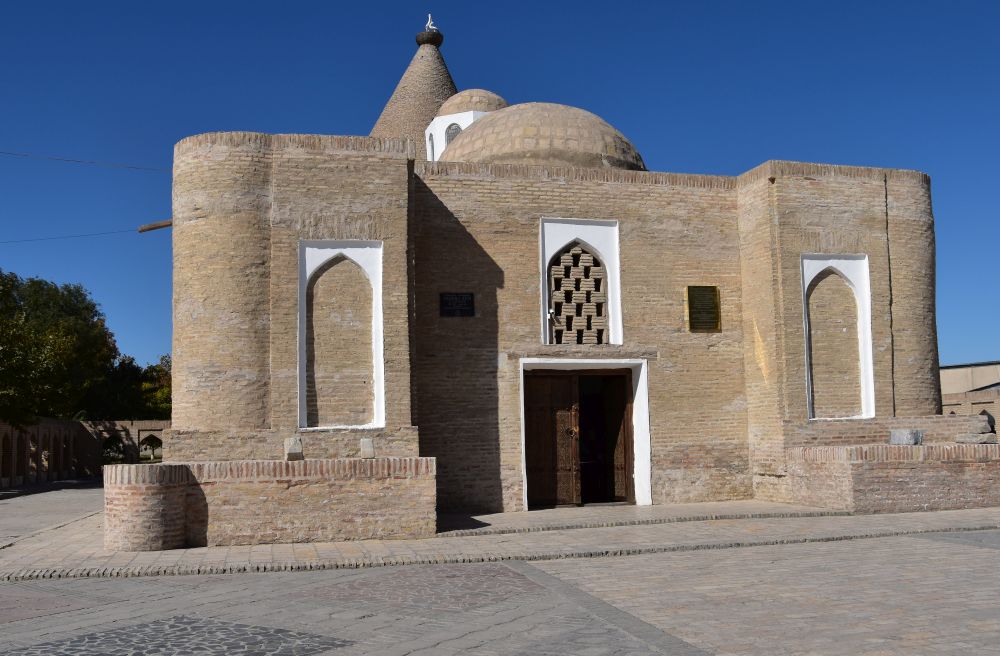
  4. Mid 15th to mid 18th century: Uzbek Khanates – the name “Uzbekistan” takes shape
  5. 19th century to 1925: The Russians conquer Central Asia and install the colony Turkestan
  6. 1925-today: Uzbekistan becomes a Soviet Republic in 1925, and it has been an independent nation since 1991

Let us start with the first three highlights, Alexander the Great, Islamic expansion and the Mongols.


1. Around 300 B.C.: Alexander the Great conquers Central Asia and marries the Sogdian princess Roxane in Samarkand

After having defeated the king of Persia, Dareios III, in Issos (333 B.C.), Alexander the Great invades the Persian empire of the Archaemenids which comprised the Middle East (including Egypt) and Central Asia up to the river Indus and to the Hindu Kush. What is Uszbekistan today belonged to Sogdia (mainly located beyond the river Oxus (now Amudarya), the area was called Transoxiana). In Marakanda (today: Samarkand), Alexander marries Roxane in 327 B.C.. She is the daughter of the local chieftain. When Alexander dies in 323 B.C., his empire is divided into four parts, whereby the eastern part becomes the empire of the Seleucids. Roxane and her son are murdered in the successor fights.
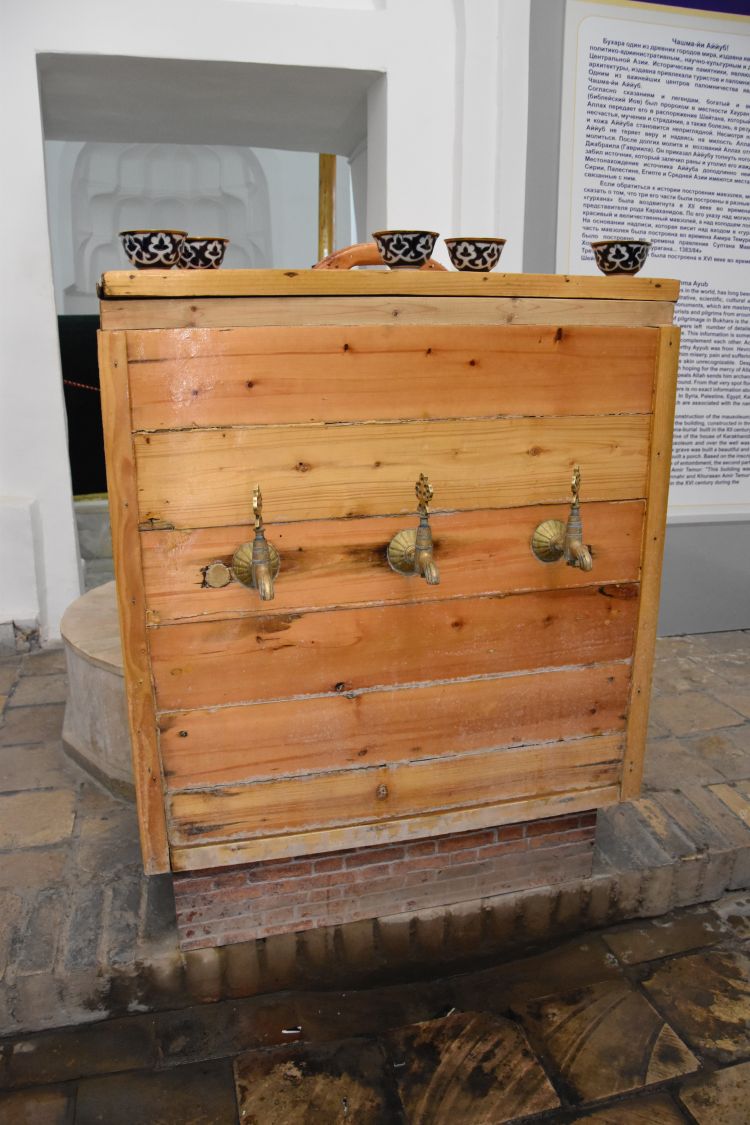
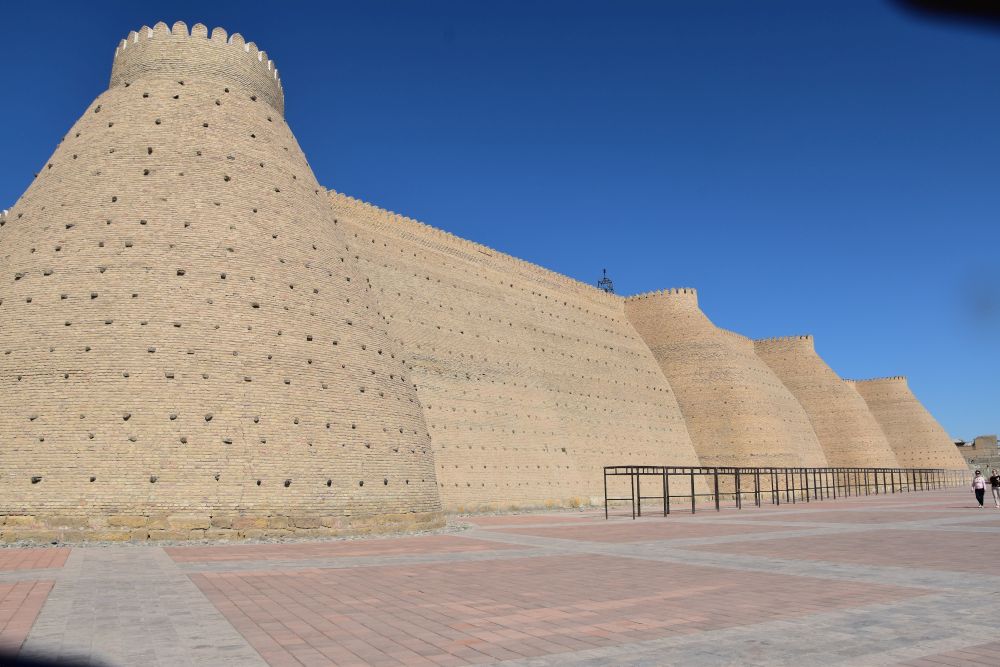
Source: Der grosse Plötz

Today, no monuments are left from this time, though Greek culture and art made a long-lasting impact here.

About the marriage of Alexander and Roxane, Händel has composed an opera called “Alessandro” that was premiered in 1725.


2. 8th-12th century: The Islam expands to Central Asia conquering Samarkand in 712; the Islam is adopted by local leaders

Muhammed, based on his monotheistic religion, unifies the (formerly competing) Arab tribes. Muhammed dies In 632.The Arabs rapidly expand not only to the west (invading Spain in 711 and being pushed back in France at Poitiers in 732), but also at the same time, they expand to the east. In 712 they definitively conquer Marakanda (later: Samarkand) which becomes a cultural and intellectual centre of the Islam.

Around 800, the Samanids take over power in the area of Transoxiana (or where Uzbekistan is today). They are of Persian origin and claim to be the successors of the Sasanians who had ruled over Persia from 224 to 651 AD. The Samanids report into the caliphate of the Abbasids in Baghdad. In the 12th century the Kara-Khanids succeed the Samanids. The Kara-Khanids are of Turkish origin. Until today Persian and Turkish heritage have cohabitated in what is Uzbekistan now.

Source: Der grosse Plötz

The capital of the Samanids is Bukhara. Trade and culture at Buchara thrive. Under Mansur I (961-976) and Nuh II (976-997) Buchara is the centre of Persian culture and contributes to the rise of the new Persian language. Rudaki (858/59-941) was an important Persian poet (his master piece was “Kalila wa Dimna”, a collection of fables; note that Persian/Farsi is an Indo-Germanic language).

We find monuments from the area of the Samanids and the Kara-Khanids in Bukhara.

This is the Samanid mausoleum where Ismail I is buried. It is the oldest Islamic building in Central Asia that still exists. Raw terracotta bricks make the magnificent patterns – just charming.

The elegant Kalon Minaret (12th century, also a pattern created by raw bricks, adorned with one narrow band of blue tiles)… and

… the Magoki Attari Mosque are from the times, when Bukhara was the capital of the empire of the (Turkish) Kara Khanids.

This is cultural heritage from pre Mongolian times.


3. Beginning 13th to mid 15th century: The Mongols invade Central Asia, and the Timurids are their successors

Genghis Khan (1206-1227) unifies the peoples of the steppe of Central Asia and conquers a large part of Asia and Northern China. His son Ögedei (1229-1241) takes over and his grand-son Batu invades Asia Minor and conquers most Russian principalities, except Novgorod. In 1241 Batu wins battles in Hungary and Poland, but then Ögedei dies and struggling for a successor halts the advance of the Mongols in Europe. In 1259, Möngke, the last Khan of the united Mongolian empire, dies. Now, the Mongolian empire disintegrates into four khanates:

  • China: Kublai Khan, a grand-son of Genghis Khan, founds the Yuan dynasty that last until 1380. It is the Mongolian emperors from the Yuan dynasty that Marco Polo (1254-1324) tells us about, when visiting in China.
  • Khanate of the Ilkhanes: Founded by Hülegü, a grand-son of Genghis Khan, it includes Persia, and the rulers adopt the Islam.
  • Khanate of the Golden Horde: Founded by grand-son Batu, the Golden Horde governs the Russian principalities until 1505. The Golden Horde converts to the Islam in the 14th century.
  •  Khanate Chagatai: Founded by Chagatai, a son of Genghis Khan, it includes, what is Uzbekistan today.

Source: Der grosse Plötz

However, borders of the Khanates change in the late 14th century. The green line on the map shows the empire of Timur (1360-1405). Timur was a lower level noble man from Transoxania (from today’s Uzbekistan). He gains control over the western Chagatai Khanate and the Empire of the Ilkhanes. Timur is a successful warlord. He weakens the Golden Horde (which marks the beginning the liberation of Russia that will be completed in 1505). In addition Timur defeats the Ottomans near Ankara in 1402 which gives Europe and Byzantium a break from the Ottoman attacks. Timur’s empire thrives economically due to internal peace, free trade routes and the post system based on messengers.

Timur believes that he needs Mongolian heritage to justify his authority, and he marries Bibi Khanym who is a descendent of Genghis Khan. Timur makes Samarkand (formerly Marakanda) the capital of his empire.

His grand-son, Ulugh Bek (1394-1445), is not only the ruler, but also an excellent mathematician and astronomer. His astronomic maps were used for centuries to navigate the world oceans. He is murdered by his own son.

It is interesting to note that Babur (1504-1530) was another descendent of Timur. In 1525, Babur conquers Delhi and founds the Mogul Dynasty in Northern India.

We meet Timur all over the country. He is venerated for being the founder of Uzbekistan, for instance riding his horse at Taschkent…

… or sitting on his throne, surrounded by traffic in Samarkand.

Timur is buried in Samarkand, in the Gur-e-Amir Mausoleum. This is Persian for “Tomb of the King”.

Inside are the sarcophagi of some Timurids and some close companions.

For his main wife, Timur builds the Bibi Khanym Mosque (he has to get permission from the Imams to devote a mosque to a woman).

Ulugh Bekh establishes his center of mathematical and astronomical research in Samarkand from which the sextant of his observatory remains.

In addition Ulugh Bekh promotes education in his empire; the Madrasa of Bukhara tells about that.

Also Samarkand has its Ulugh Bek madrasa at the Registan Square – it is the building to the left of this beautiful place.

The two other buildings at the Registan will  be added in the 17th century.

Sources: “Der grosse Plötz – Atlas zur Weltgeschichte”, Komet Verlag, Köln 2008; Burchard Brentjes: “Die Araber”, Ex Libris Zürich 1977; Isa Ducke and Natascha Thoma, “Usbekistan”, Dumont Reisehandbuch, Ostfildern 2017; Irina and Bodo Thöns, “Usbekistan”, Trescher Verlag, Berlin 2019; Irina and Bodo Thöns, “Reise durch Usbekistan”, Stürtz, Verlagshaus Würzburg 2018; Sanjeev Mehan, “Ein vergessenes Land holt auf”, Tagesanzeiger 21. September 2019 and various wiki entries.

Discovering Uzbekistan: Impressions from landscapes

In September/October 2019, we were in Uzbekistan. On the  tour we explored the landscape which is mainly desert and half desert: We saw the Chimgan mountains, touched the Kyzylkum desert, stopped near the Aydarkul Lake  and stayed at Sentyob in the Nuratau mountains.

Source: Researchgate.net

As it was autumn, the landscape was dry and dusty. To see flowers, we are told, we should rather return in spring.


The Chimgan mountains

North east of Tashkent is a small strip of Uzbekistan that reaches into Kazakhstan and Kyrgyzstan. We spend two days here doing a bit of walking in the dry and rough landscape.

In winter, Beldersoy is a skiing resort. The Beldersoy chairlift is currently being renovated.

There is a second chairlift that we take up, with many more Uzbeks. At the top, some wait to take photos of those who want a souvenir.

It must be an old Russian “light-weight” chairlift. At the top, there is a small edge to walk on, and it is not allowed to move off it. “Strictly forbidden to cross the border of the path”  or “за предел строго запрещено”. STOP!

The view is beautiful, to the west and down into the valley in the direction of Tashkent…

… with the sandy hills dotted with some green trees…

… and to the east to the mountains of Kyrgyzstan that have been covered with snow during last night.

The mountains in Kyrgyzstan are higher and perhaps more spectacular, but we loved our small metallic green chairlift.


The Yurt camp in the Kyzylkum desert

From Bukhara, our driver Firouz takes us to the red sand desert Kyzylkum where we stay overnight in the yurt camp Sputnik Navoi. (I am later told that “Firouz” is Persian and means “the victorious” or “the intelligent”).

It seems that in this area, the Uzbeks no longer live in yurts, but they want to give their tourists an interesting experience of the Central Asian way of life. In the evening we sat at the camp fire singing songs with other tourists from France, from Germany, from England… not really an authentic Uzbek experience, but nevertheless it was fun.

The desert has its charm and really looks somewhat reddish, covered with scrubs. I enjoy the atmosphere…

… and a small ride on the camel Bumba. I stroke its neck, while it carried me through the desert.


The Aydarkul Lake

The Ayarkul Lake emerged accidentally, when after a heavy rainfall the Chardarya irrigation dam in Kazakhstan had to be opened which resulted in the Arnasay basin in Uzbekistan to be filled with water. The lake adds to the scarce water supply of Uzbekistan. We eat excellent fish from the lake in this “restaurant” – I remember that the fish was called Wobla.

We then go for a small walk on the shores of the lake…

… meeting a herd of Karakul sheep, a race that originates from Central Asia and is used to produce Persian fur. As I learn, the fur is made from newly born lamb – a scary idea for me.

There are some hills in the background.

We continue our way to Sentyob in the Nuratau mountains.


Uzbek hospitality in the Nuratau mountains and at the village Sentyob

Sentyob is a village in the Nuratau mountains, located on 600-700m above sea level.

Sobek picks us up near the main road and takes us to his shady guesthouse Manzaralari; he has just finished building his guesthouse in summer 2019.

We sit in the shade on this sofa and we enjoy delicious meals under the trees near the creek.

Once they serve a delicious Plov which is the national dish of Usbekistan: Rice, meat, carrots, onions and dried fruit.

The village Sentyob stretches along the creek originating in the mountains.

At the end of the village is the mosque. Today the people from the village celebrate the circumcision of three boys (we are told that the cirumcision took place in the hospital).

We are invited to have lunch (hotpot with meat, potato and vegetables) and to drink vodka. We join the community dancing.

Then we continue our way into the valley…

… climbing up to a deserted village…

… with some hens (one house between the ruins is inhabited).

We come across some petroglyphs with Farsi text.

Along the creek we see cows…,

… sheep,…

… fields and gardens.

Behind the valley barrier is a lake, but that is now too far – some 10 km more going there and another 15km to return back to Sentyob.

We watch some sheep climbing up the rocks…

… and get back to our comfortable guest house.

The next day we walk along this lush creek…

… with mulberry trees…

… up to this huge platycladus (arbor vitae) that is said to have been planted by soldiers of the army of Alexander the Great. May be that the age of the tree is exaggerated, but surely it IS old.

The girth of the trunk measures 24m, as a plate explains.

A tree planted by Alexander the Great? In 300 B.C.? Has Alexander really been that far in Central Asia? Yes, he was here where he found his wife – let us explore the history of Uzbekistan as part of Central Asia. It has been invaded by various peoples from the west and from the east to become this mix of ethnics that it is today.

Sources: Isa Ducke et alii: “Usbekistan”, Dumont Reisehandbuch Ostfildern 2017, Irina und Bodo Thöns, “Reise durch Usbekistan”, Stürz Würzburg 2018, “Der grosse Plötz”, Herder Freiburg 2008