Discovering Silesia: Karpacz with its churches and with Sniezka

In May 2023, we spent a week in Silesia, in “our” castle Staniszów near Jelenia Góra. From here, it was a short car ride to Karpacz, formerly called Krummhübel. Many German artists had been here at the end of the 19th century and in the beginnings of the 20th century.  Carl Ernst Morgenstern taught plein-air painting around Karpacz. Theodor Fontane wrote a criminal story for Krummhübel.


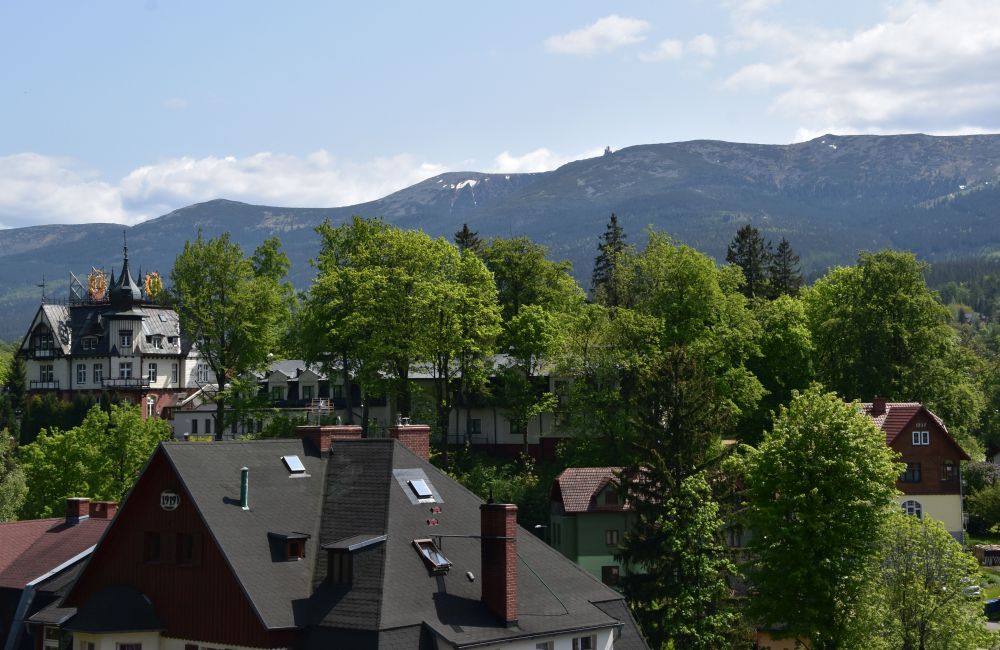
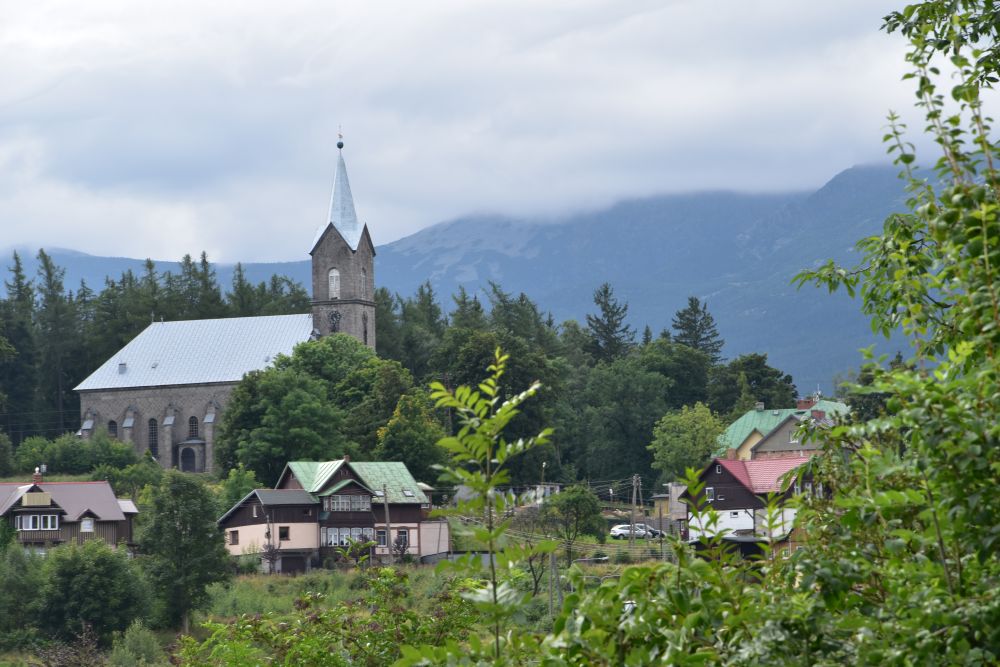
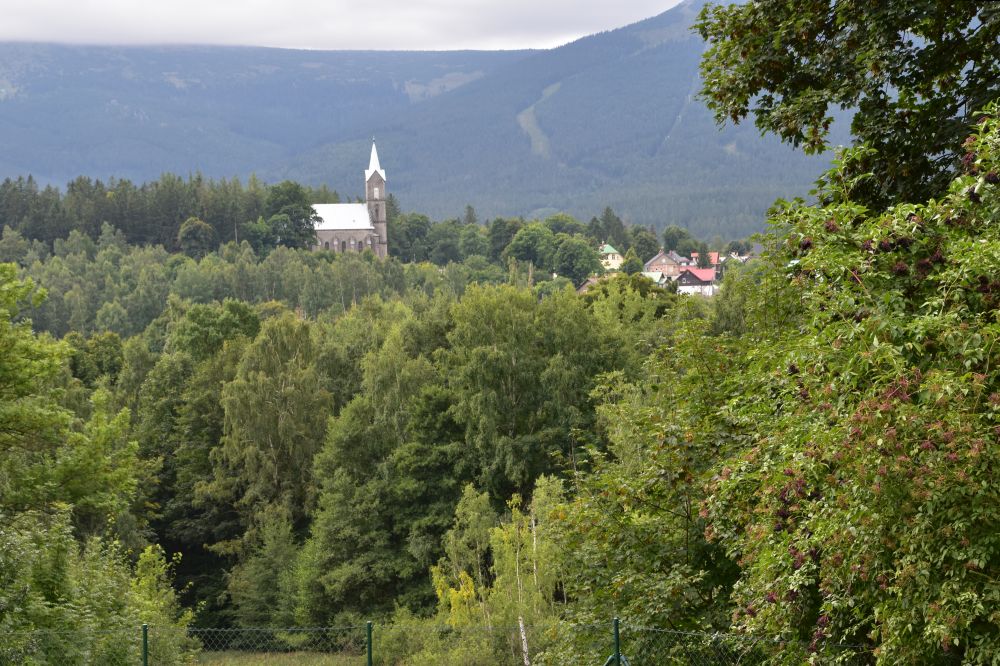
Karpacz centre with two churches from around 1900

The centre of Karpacz (Krummhübel) is a touristy place – this is the main street. 

There are two churches here, both built around 1900.

The church of the Holy Heart of Jesus, (Kirche des heiligsten Herzens Jesu, Kościół Najświętszego Serca Pana Jezusa) was inaugurated as a protestant church in 1908. 

A  nice painted wooden ceiling inside. The church became catholic in 1945.

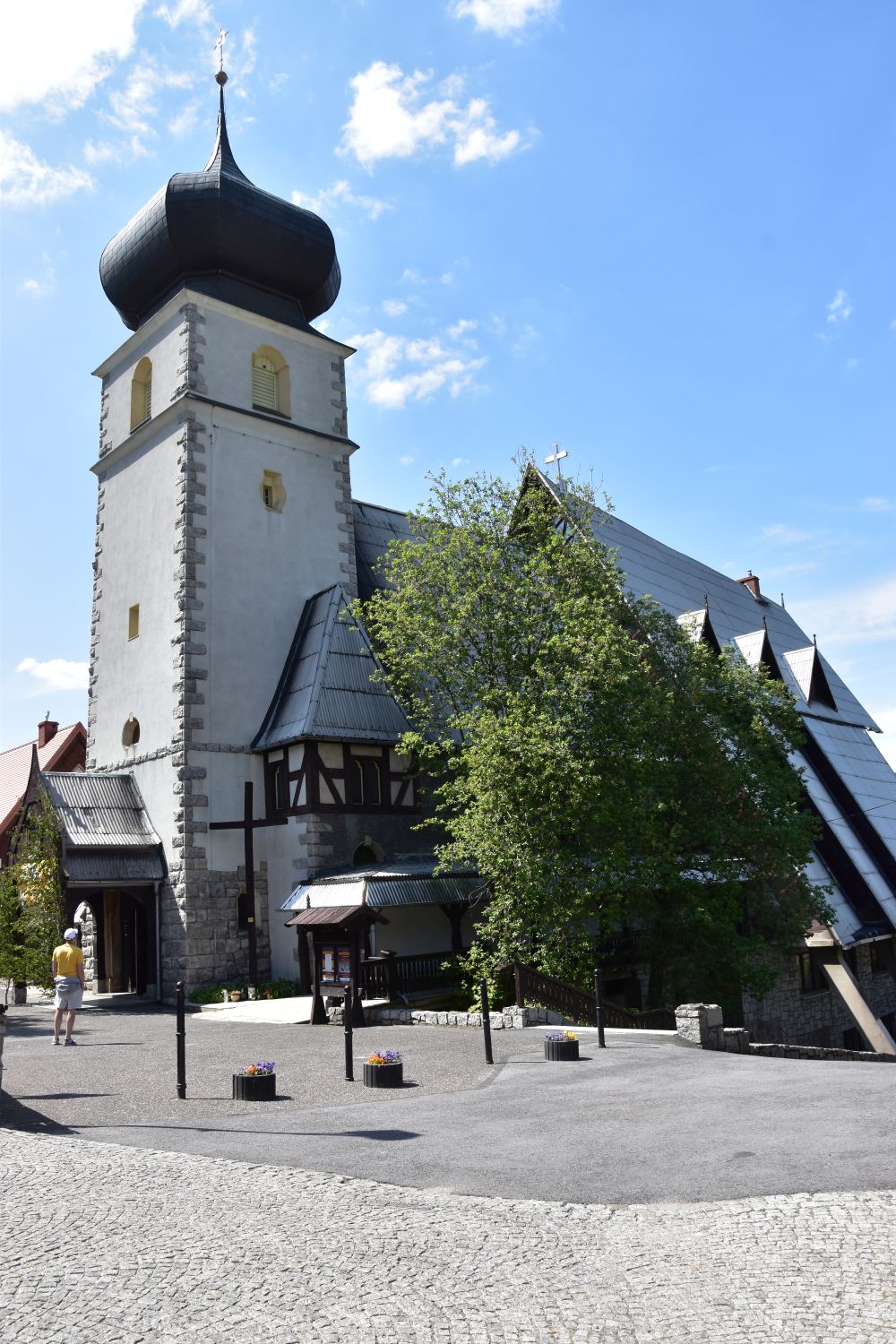
The church Visitation of our Lady (Mariä Heimsuchung, Parafia Nawiedzenia Najświętszej Maryi Panny) was inaugurated in 1910, and the nave was rebuilt after 1945.

A painted wooden ceiling here as well.

Also this church was protestant and became catholic in 1945.


Wang church (Kościół Wang)

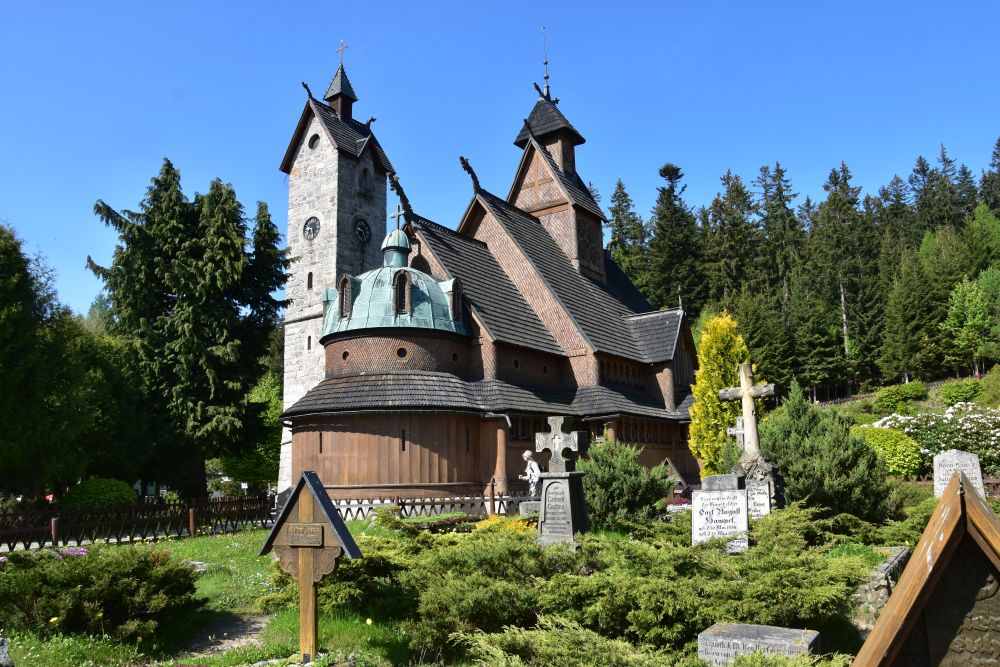
The attraction of Karpacz is the wooden Wang church. 

The church was built in Vang in southern Norway in the 12th or 13th century. In the 19th century, this church became too small for the congregation. It was decided to sell the church and use the money earned to build a larger new church. A painter from Norway, professor Jan Christian Dahl, lived at Breslau at that time, and he convinced the Prussian king Friedrich Wilhelm IV to buy the church for 427 Mark. The church was disassembled and shipped to Berlin. The king had intended to rebuild the church on the Pfaueninsel at Berlin, but then changed his plans. Count Leopold Christian von Schaffgotsch donated land between Krummhübel (Karpacz) and the Schneekoppe (Śnieżka), at Brückenberg (now Karpacz Górny). The church was reassembled here and inaugurated in summer 1844.

Two lions guard the entrance to the church.

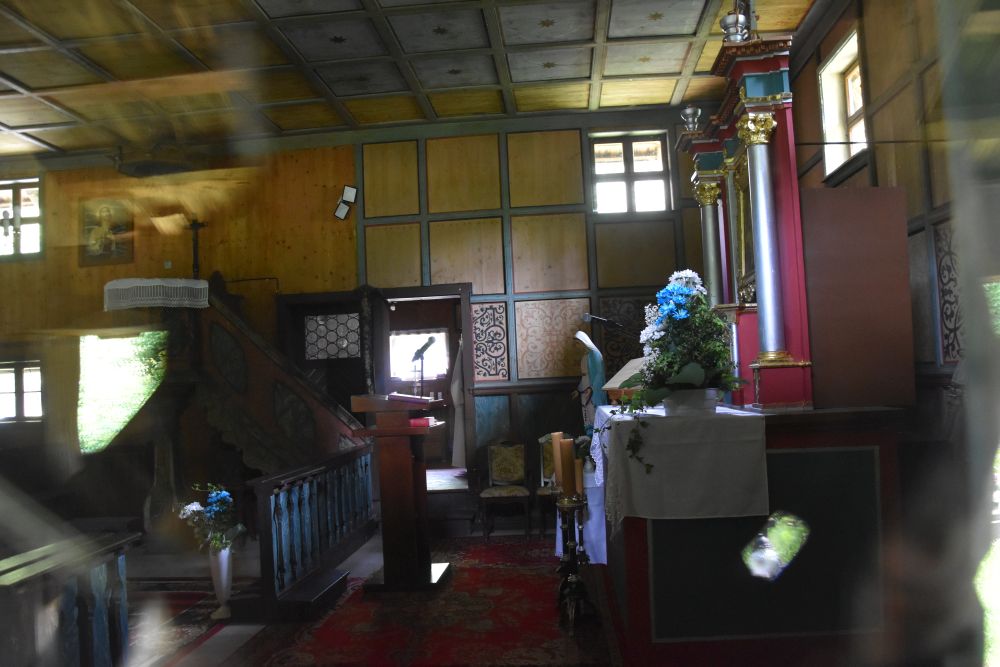
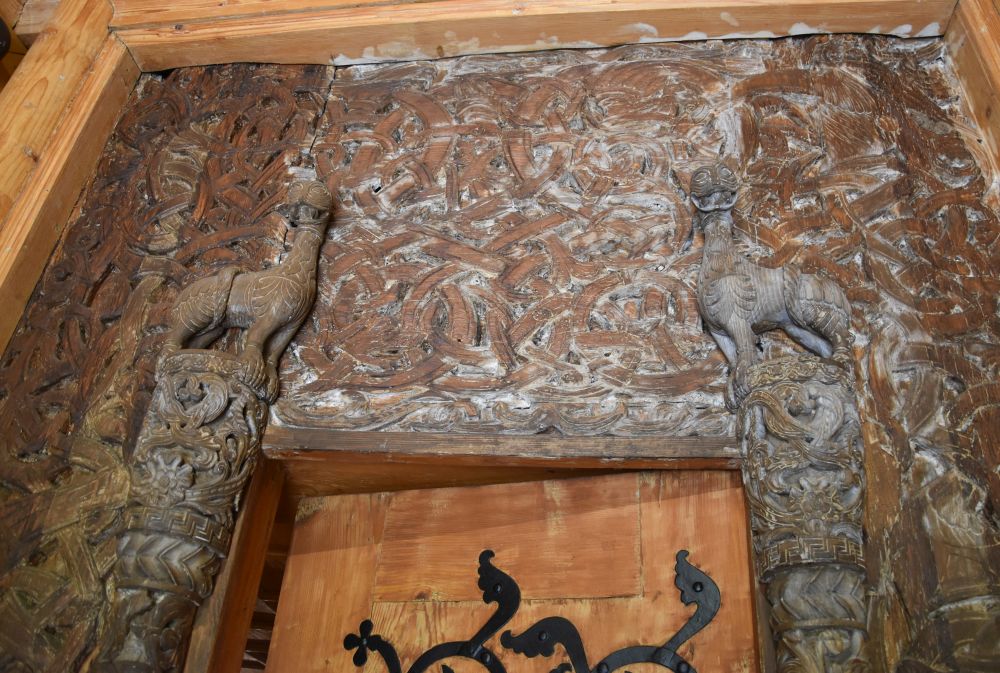
Inside, viking faces frame the door; they may be warriors with split tongues. 

This is the choir…

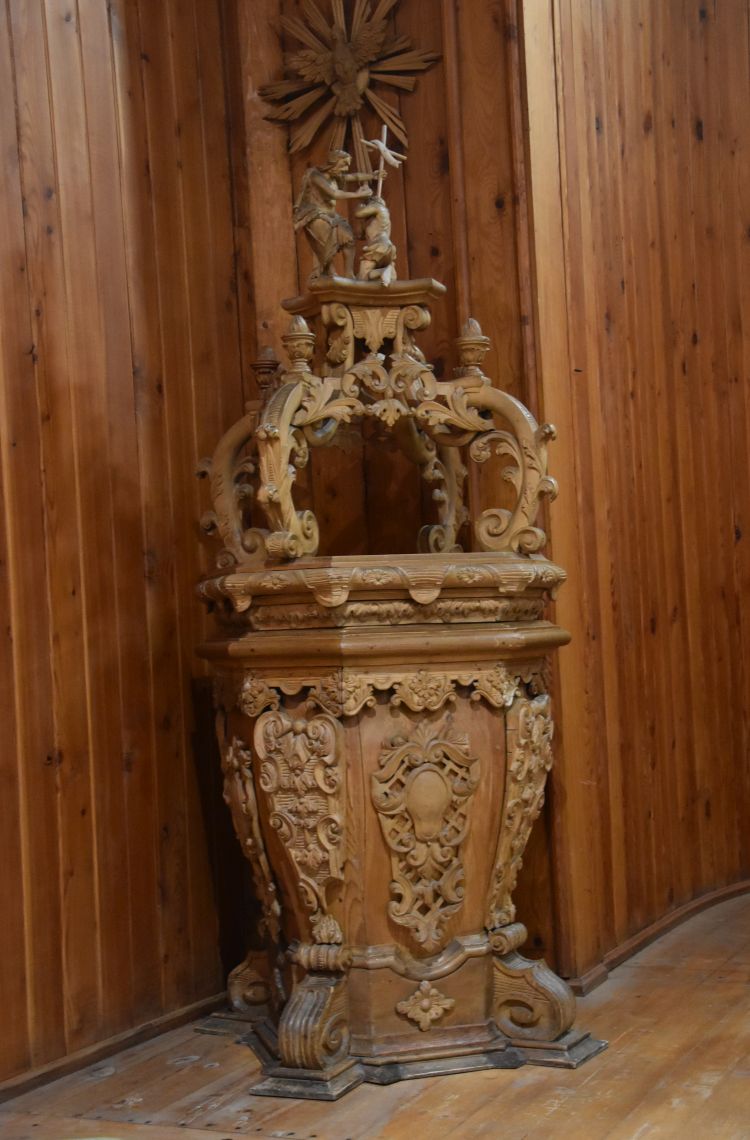
… with the baptismal font (Saint John in his fur coat baptizes Christ).

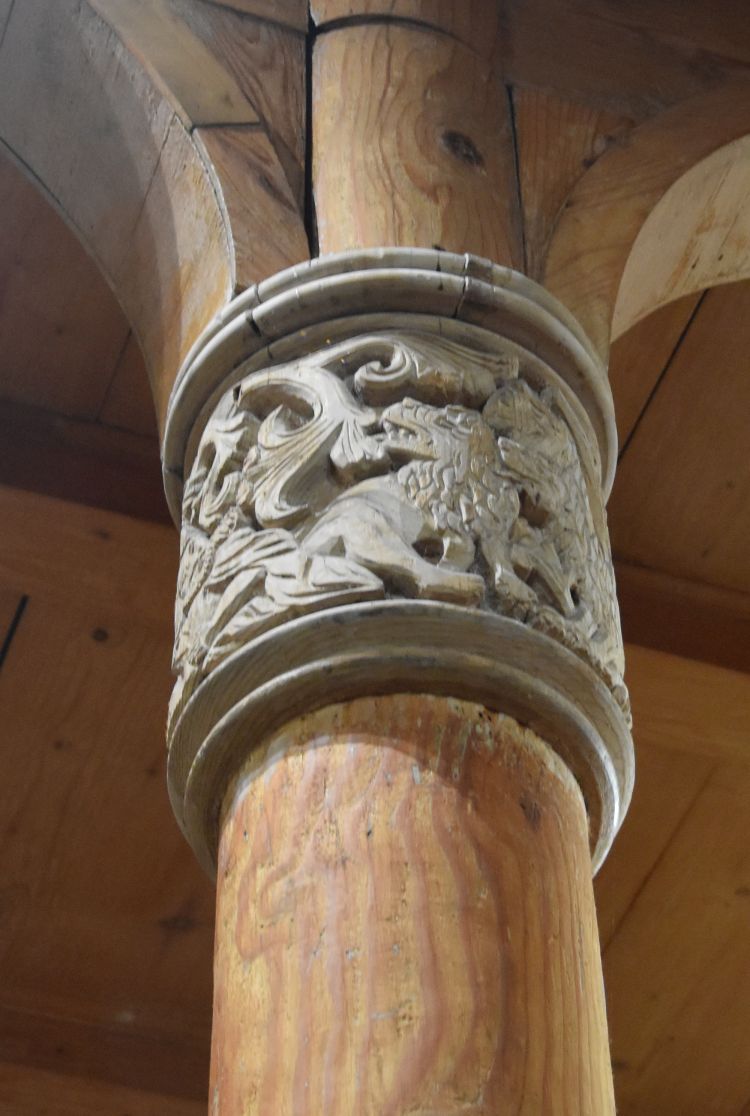
The column shows Daniel in the lion’s den.

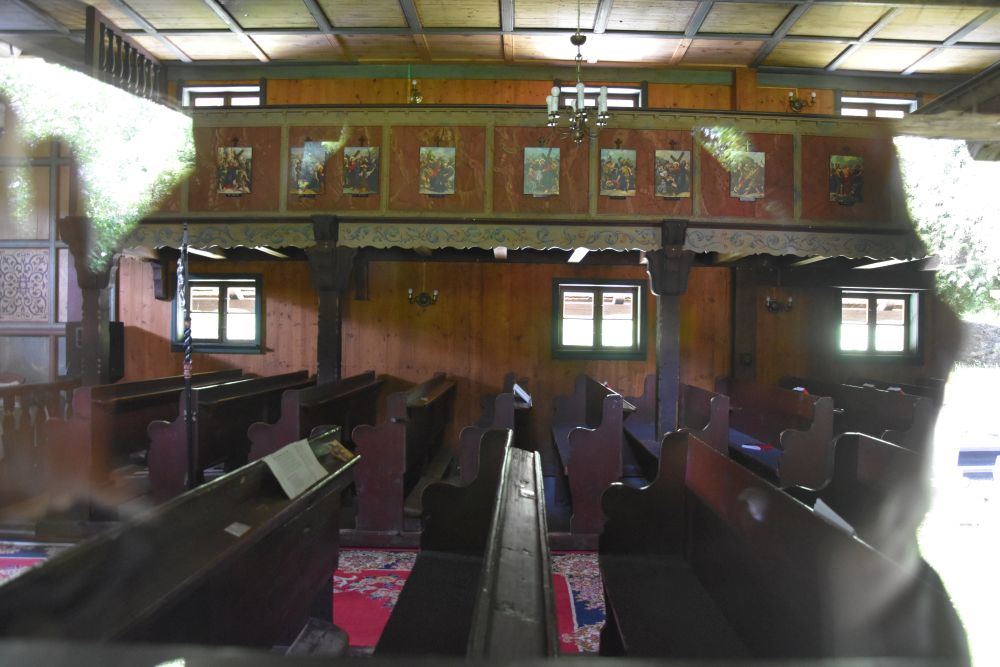
This door leads to a corridor around the nave. 

The Vang church has become THE cultural landmark of Karpacz.


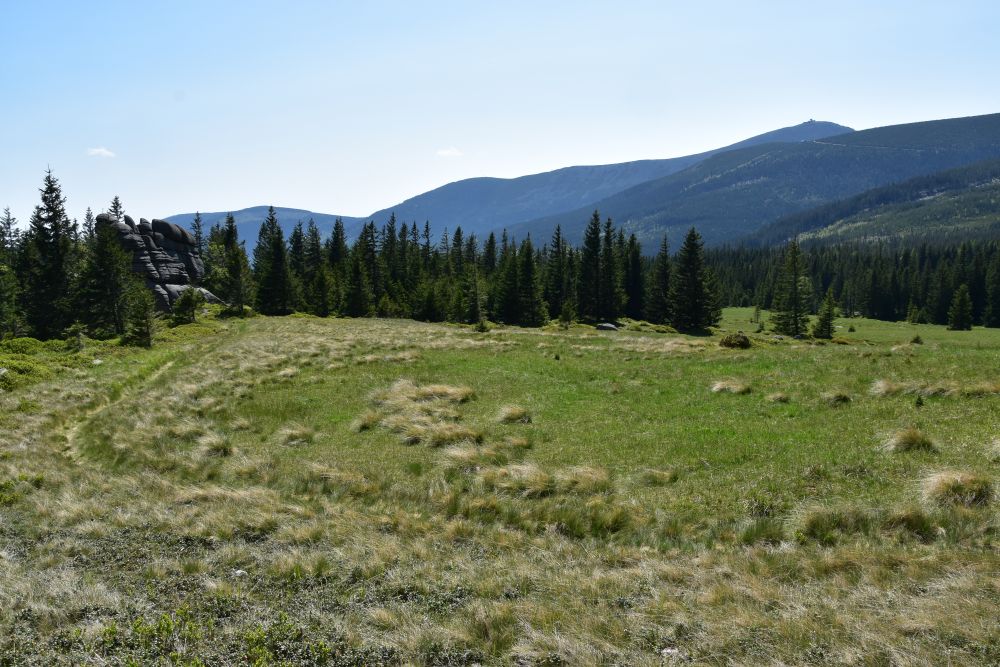
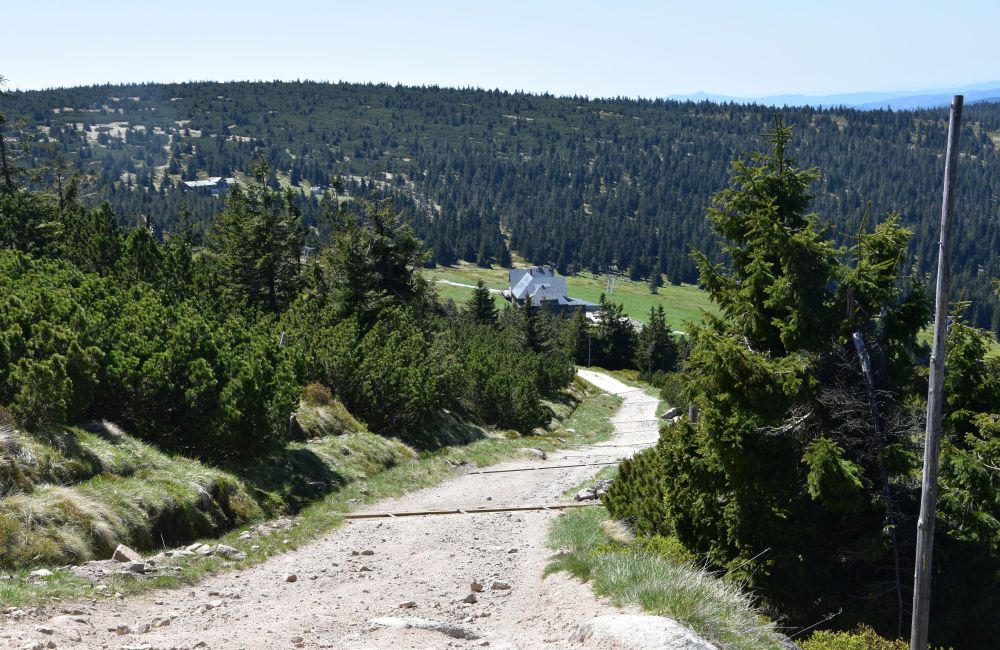
Hiking from Polana to Słonecznik, with a partial view of the Śnieżka

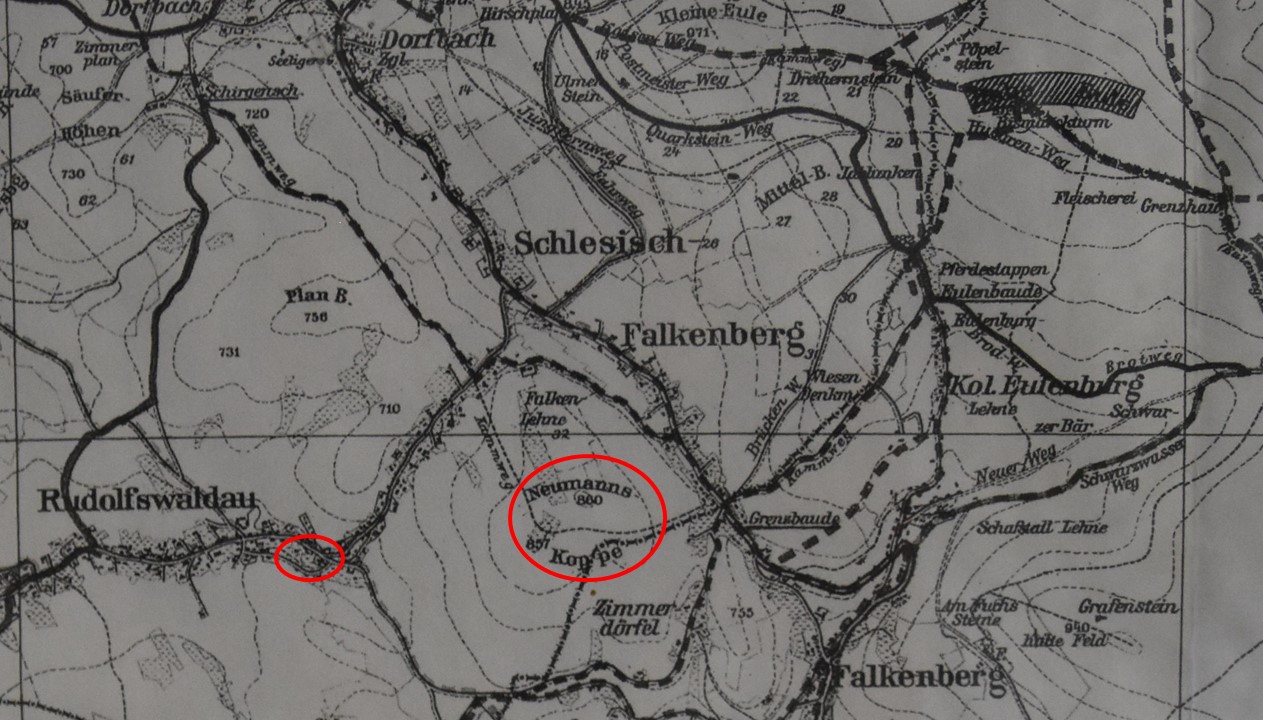
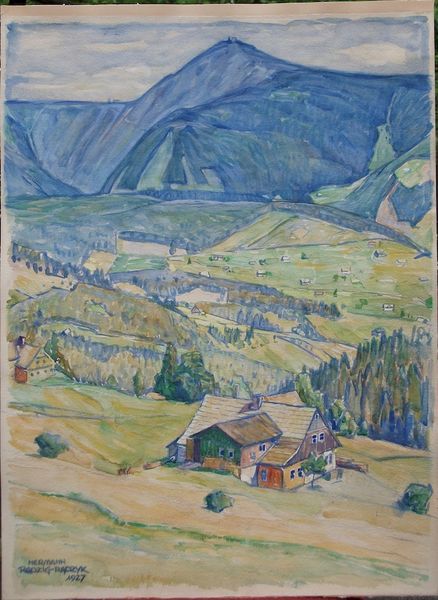
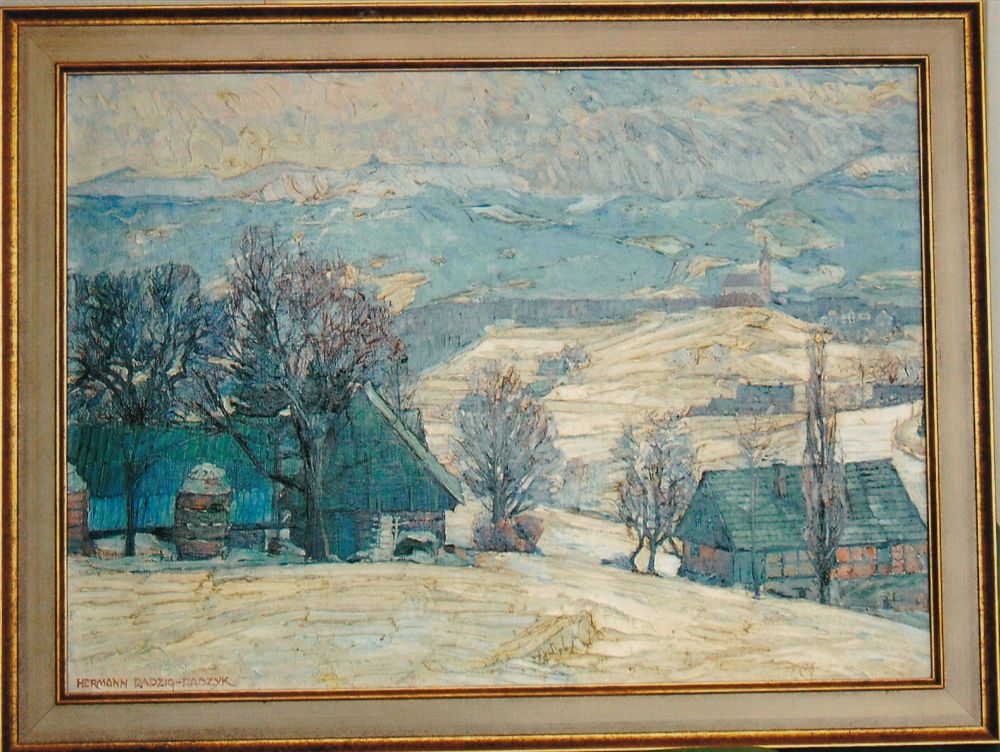
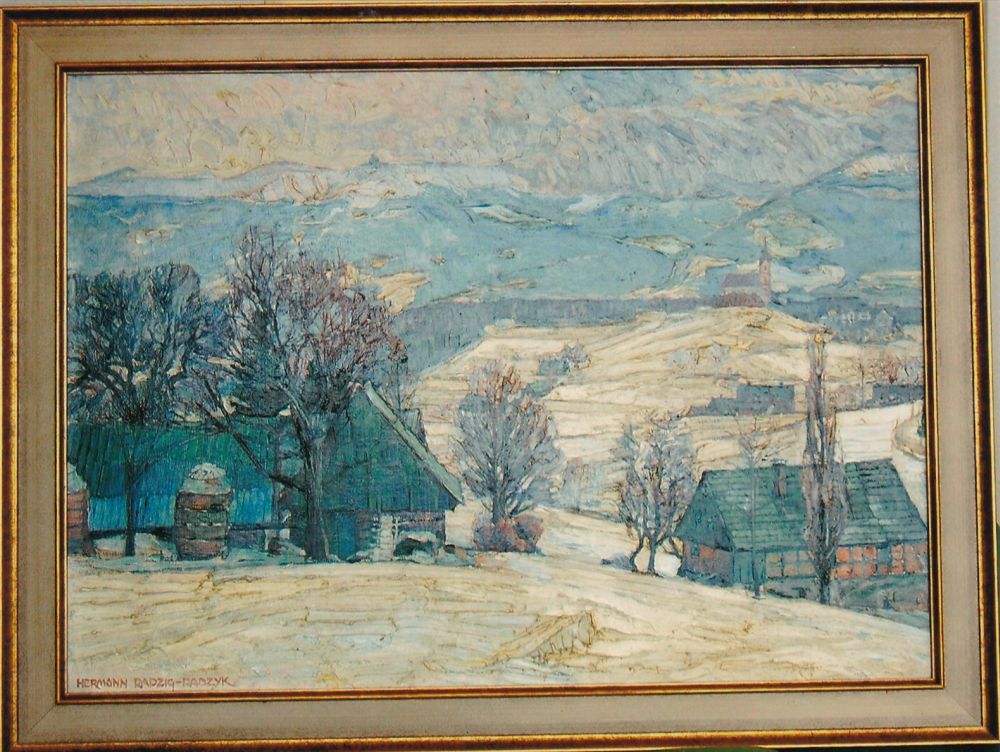
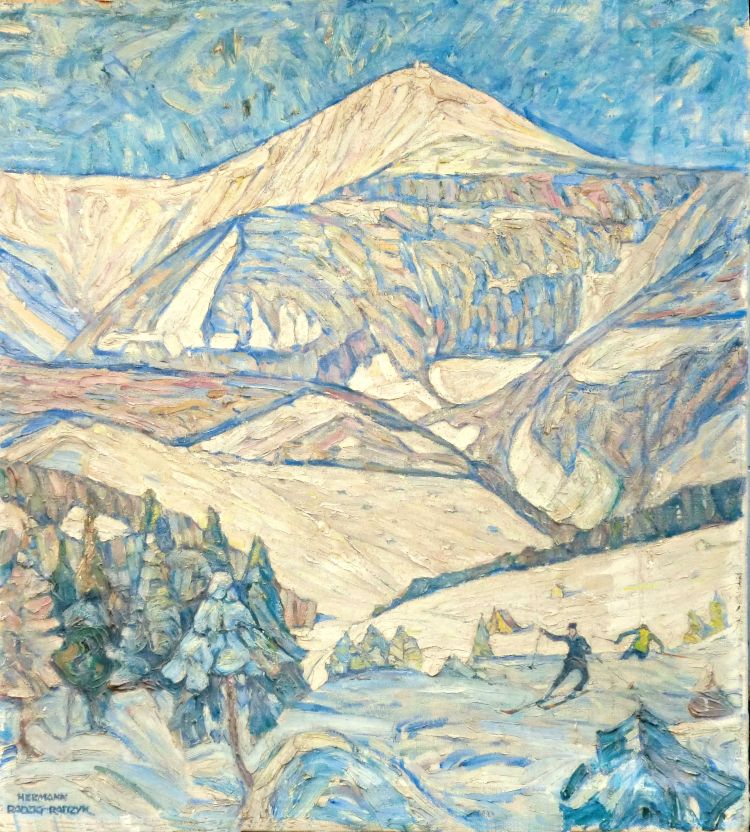
Behind the Wang church, you have to pay an entrance fee for the Karkonosze park, which is a nature reserve now. A path leads to Polana, a meadow that I suspected was the place, where my grandfather had painted the Schneekoppe (painting owned by Heimatverein Kleinmachnow).

But, when reaching the meadow Polana, it becomes clear, this is not the place, where my grandfather’s easel was. 

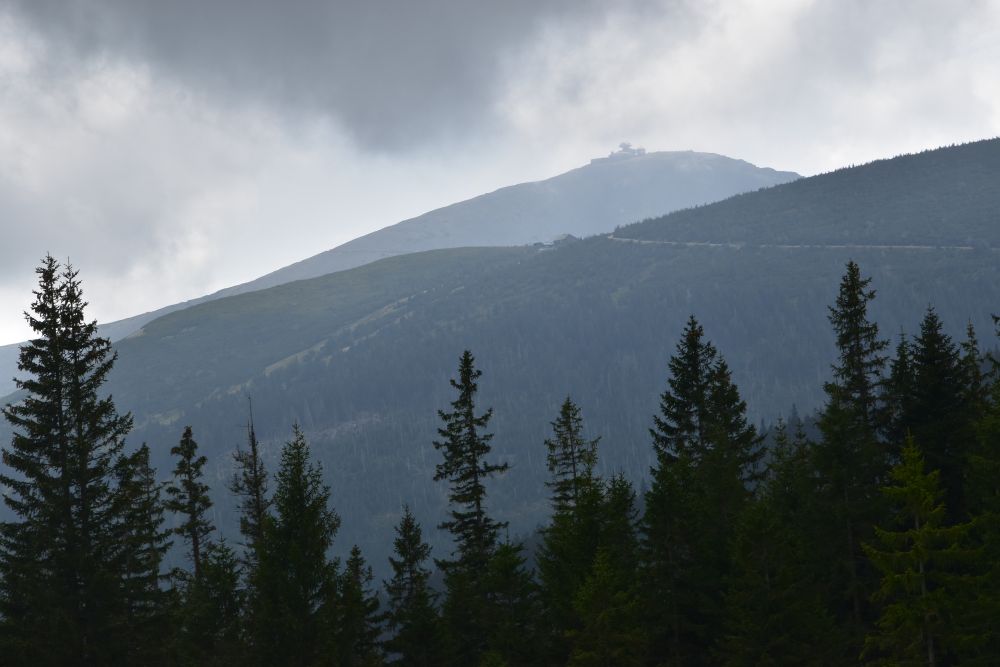
I follow the path uphill and can sometimes see the Schneekoppe between the trees.

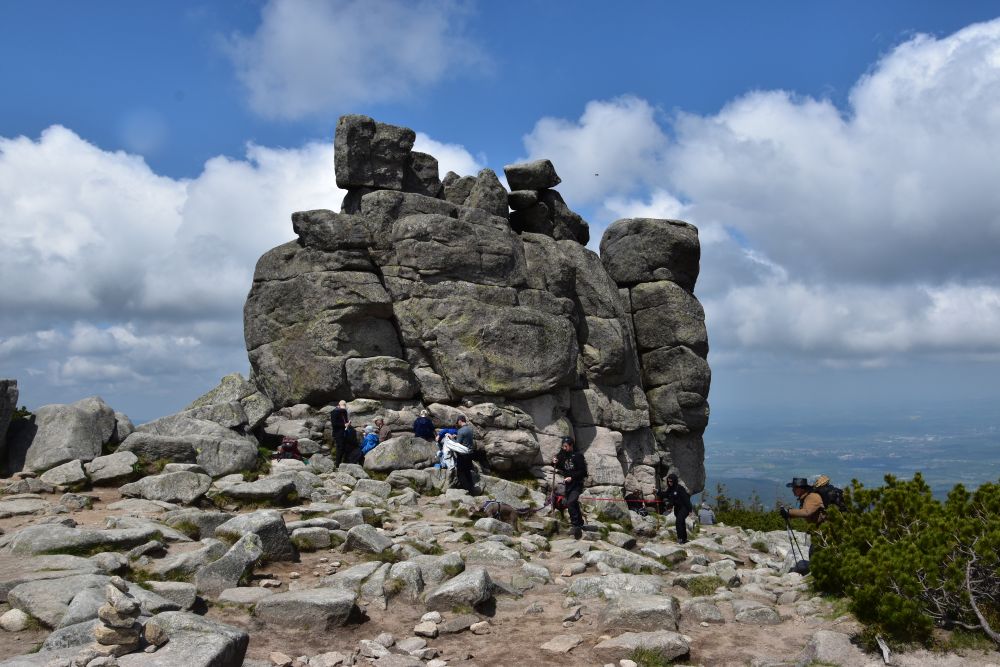
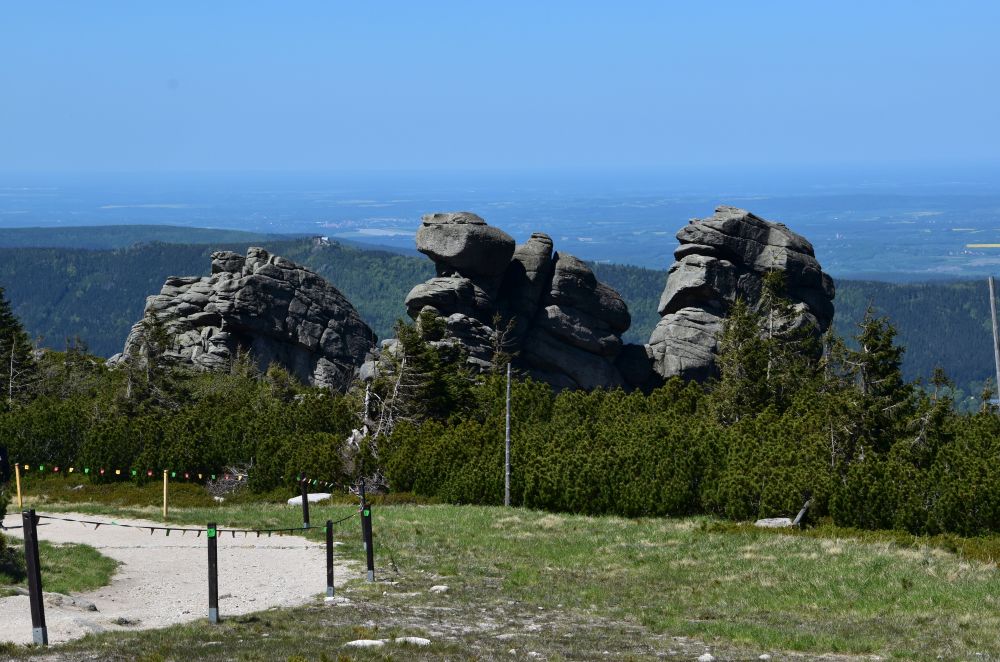
I reach one of the many granite blocks scattered around here… and I am not alone. The Poles enjoy hiking.

I reach another granite rock, the Słonecznik. A beautiful view into the Hirschberg valley. 

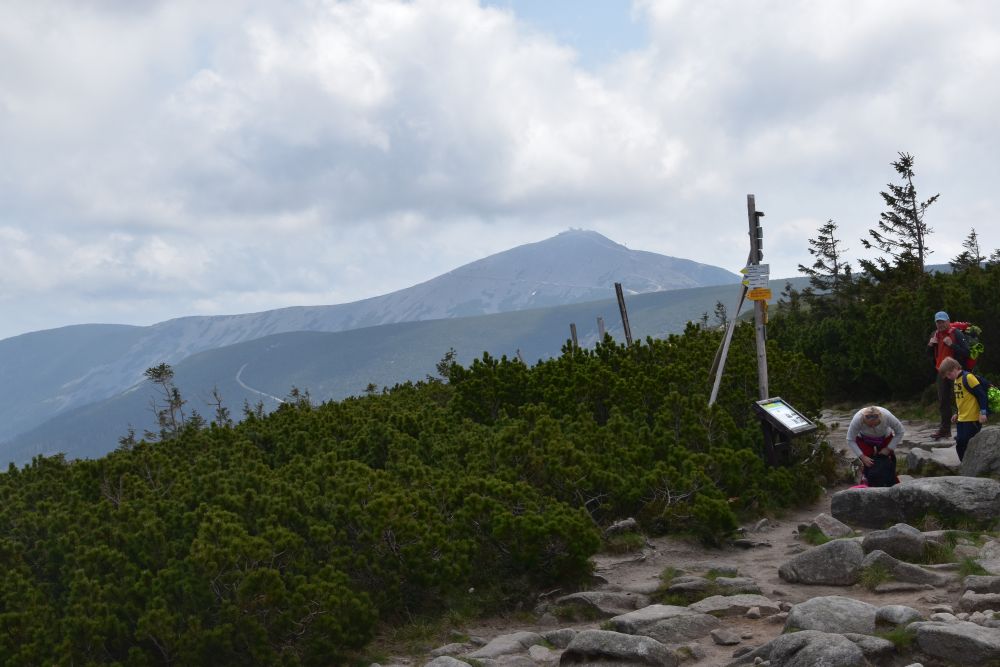
The Schneekoppe(Sniezka) can be seen from the Słonecznik as well. 

I walk back down.

On the meadow Polana, I look for the place, where the  former mountain hut Hasenbaude once was, but it seems that nothing remains of it.

No, I my grandfather’s easel was not here… may be it was south of the Schneekoppe (Sniezka), on the other side?

Back at home, I solve the puzzle. The easel WAS south of the Schneekoppe, above Petzer or Pec pod Sněžkou. I could identify Petzer and  the mountains on the painting and I believe, the easel stood at the Lenzenberg, now called Zahradky. 

There is something more to explore! The Giant Mountains in the Czech Republic. I will return!


Sources:

  • Plates on the churches
  • Description of the Vang church, handed out in the church.
  • Tomasz Torbus, “Polen – Reisen zwischen Ostseeküste und Karpaten, Oder und Bug”, Dumont Kunstreiseführer, Ostfildern 2011

Discovering Silesia – On the Szrenica, the mountain that carries frost

In May 2023, I am in Silesia, where we spend one week in the castle Staniszów to explore the area around Jelenia Góra.

Now we spend a day on the Szrenica above Szklarska Poręba.


Szklarska Poręba is surrounded by mountains

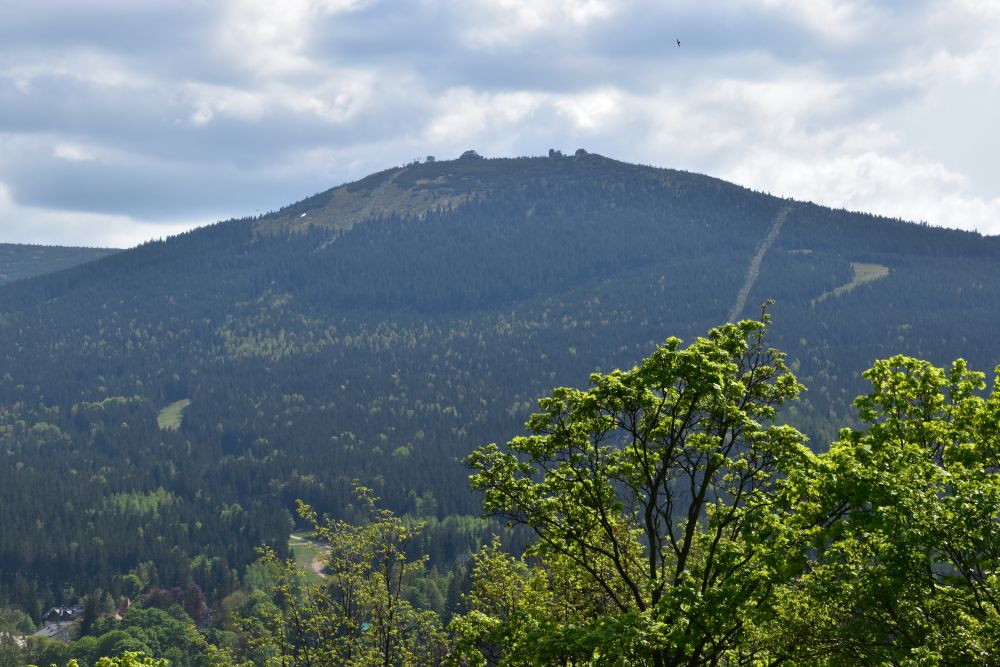
Szklarska Poręba is a resort surrounded by mountains, the main landmarks being the Szrenica (right) and the Śnieżne Kotły (left). 

The Śnieżne Kotły (“Schneegruben” or “Snow Pits”) still carry a bit of snow in the western snow pit. The pits are in geological terms “cirques” (in German: “Kare”) left by a glacier.

Chair lifts and ski lifts take hikers and – in winter – skiers up to the Szrenica, as the straight lines in the forests indicate.  

Szrenica is called “Reifträger” in German. Both in German and in Polish, this mountain carries frost (“Reif” and “szron” mean “frost”).  

German painters have been inspired by the panorama around Szklarska Poręba (Schreiberhau). In summer 1920, they founded the Lukasgilde (guild of Saint Luke) and built the Lukasmühle as a place to meet and to exhibit their paintings. 

Georg Wichmann is one of the founders of the Lukasgilde.


Source: Hans Wichmann, “Georg Wichmann 1876-1944)”, Bergstadtverlag Wilhelm Gottlieb Korn 1996.

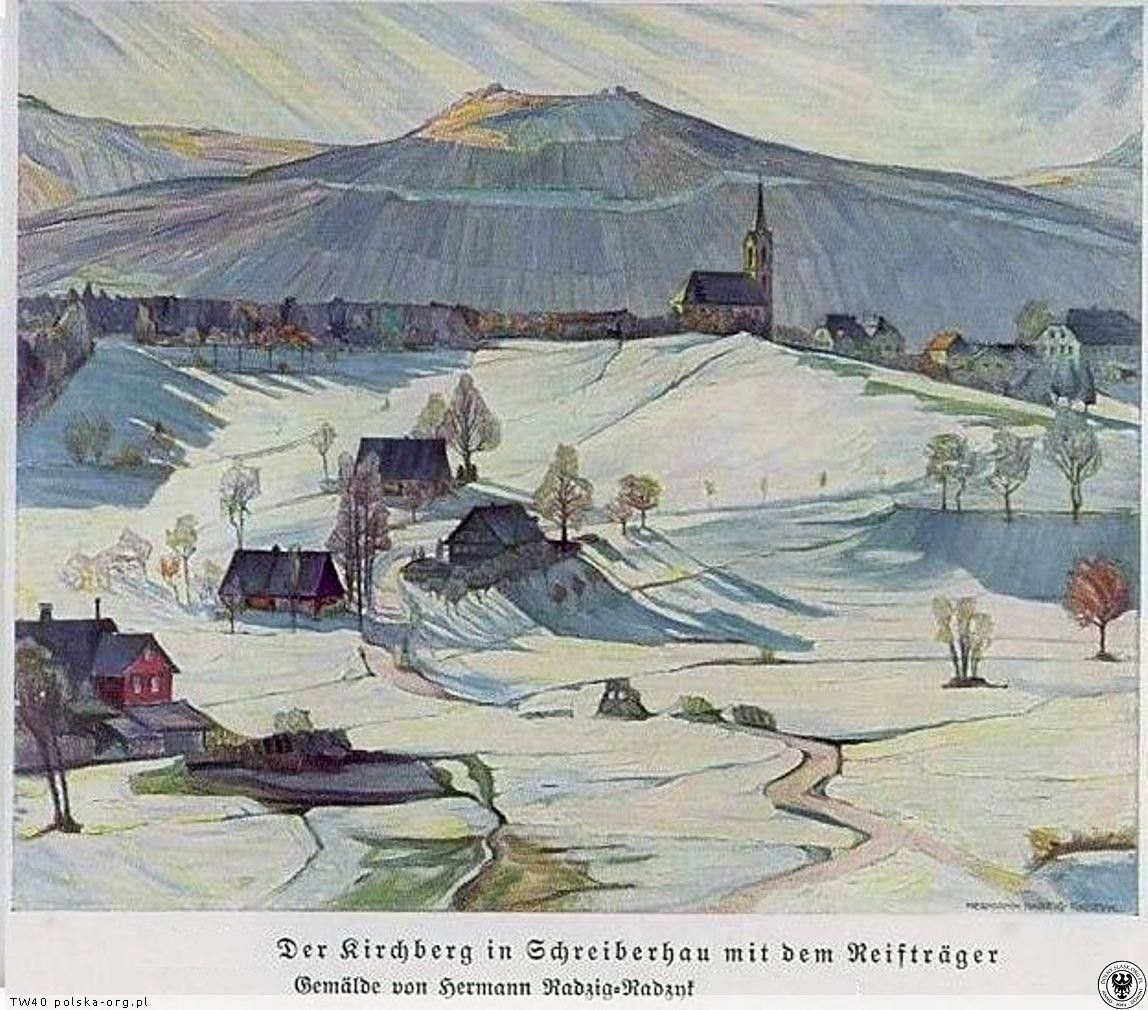
In winter 1922/23, my grandfather Hermann Radzyk was at Schreiberhau (Szklarska Poręba) and painted the Reifträger (Szrenica) with the church Kościół pw. Bożego Ciała (Corpus Christi).

Source: Polska.org – this painting has in the meantime disappeared from the website polska.org.

In addition, Hermann Radzyk painted the Schneegruben with the same church in the foreground.

Source: My own photo taken in the house of the grand-son of a friend of my grand-father.


Exploring the Szrenica with the gorgeous view

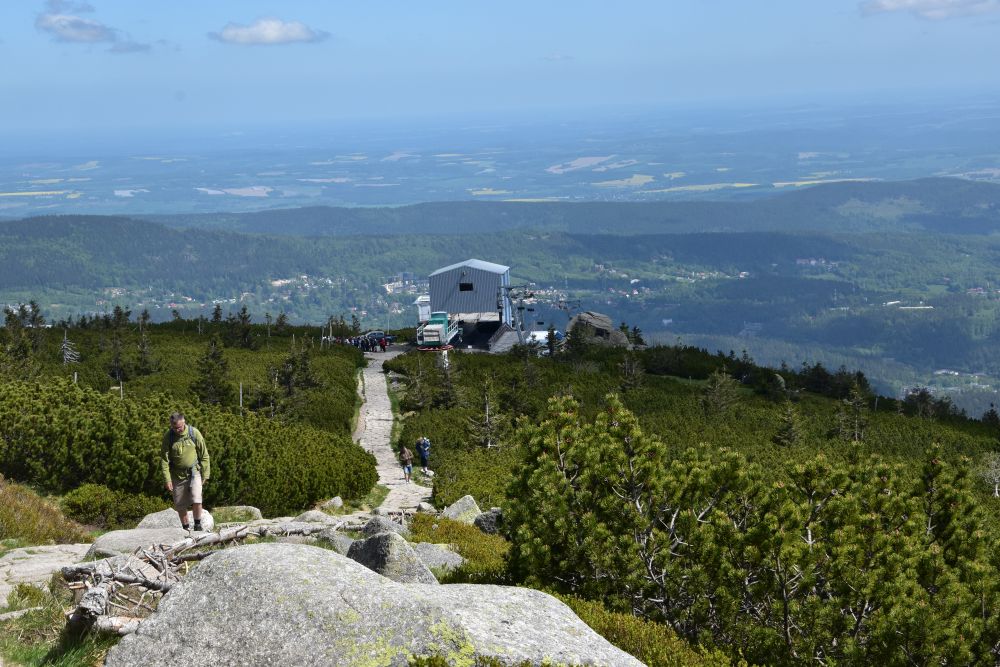
We take the chair lifts to the Szrenica – there are two sections, one after the other. 

A special experience. The small chairs  are hard to sit on and they move in “slow motion”. Slowly, but safely, we arrive on the top.

The view of Lower Silesia with Szklarska Poręba in the foreground is gorgeous.

We walk up to the top view point.

We look west, where a hiking path follows the border between Poland and the Czech Republic.

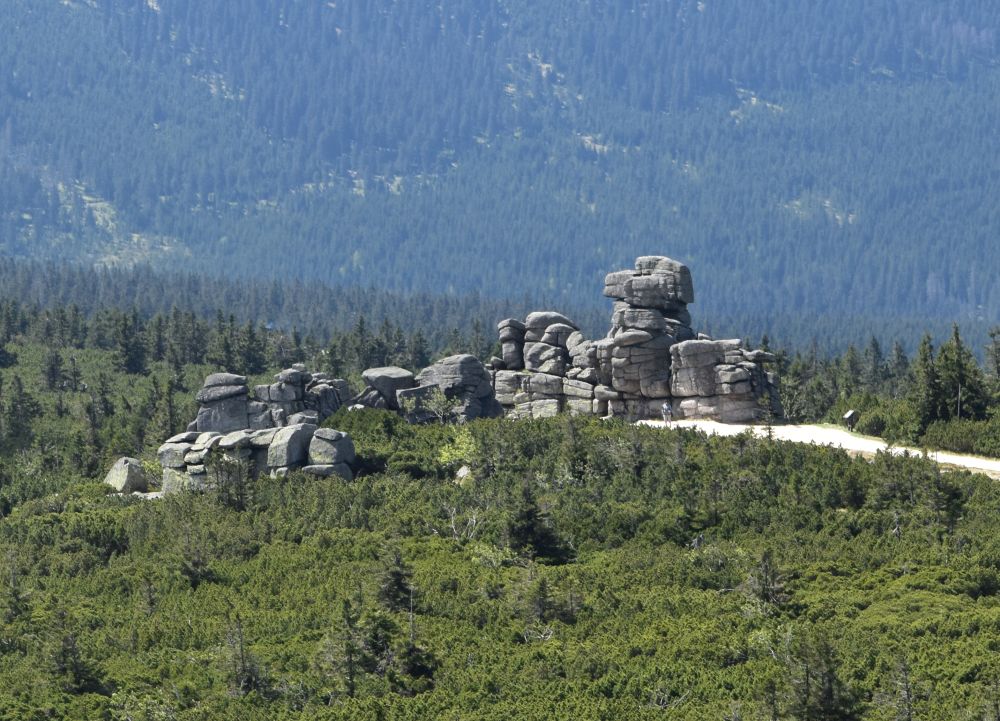
We look south east, where we can see granite rock formations. They are called Svinské kameny (“Pig stones”). They have a Czech name, as they stand already in the Czech Republic. Such granite rocks can be found all over in the Giant Mountains. In German these rocks are called “Wollsackverwitterung”, in English “spheroidal weathering”.

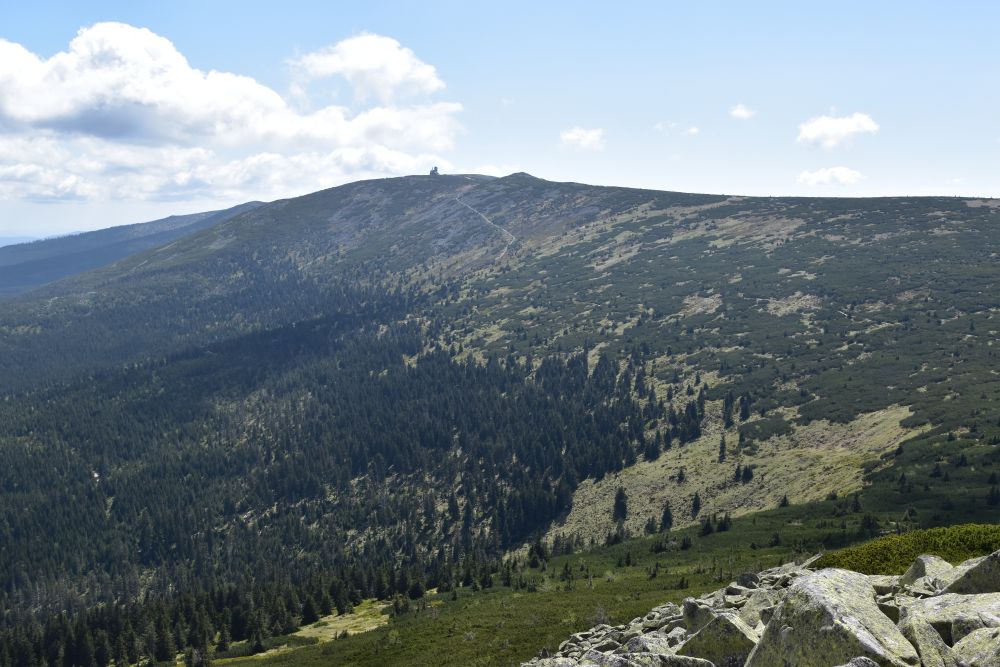
We look east to the Śnieżne Kotły. The former mountain hut (Schneegrubenbaude, it can  be seen from far) is now a radar station (Radiowo-Telewizyjny Ośrodek Nadawczy – RTON Śnieżnymi Kotłami). 

We look north towards the Isergebirge (Góry Izerskie), Szklarska Poręba and Lower Silesia.  

We have a snack at the Reifträgerbaude (Schronisko na Szrenicy)…

… and look at the fotos. They show that, indeed, the Reifträger or Szrenica does carry frost in winter. 

It must be cosy in the hut, when it is that frosty outside.

On a panorama walk,…

… we reach the shelter Hall Szrenicka located below the top.

We return to the chairlift station,…

… admiring some more of these rock stones (these are called Końskie Łby or horses). This is, where the ski run “Lolobrygida” starts – what a name for a ski run. 

We return to “our” castle Staniszów and enjoy another excellent dinner.


Sources:

To Berlin -stop over at Rothenburg ob der Tauber

In August 2022, we travel to Berlin, with stops at Riedlingen, Ulm, Rothenburg ob der Tauber and Nebra. On our way from Ulm to Nebra, we have our lunch break at Rothenburg ob der Tauber.


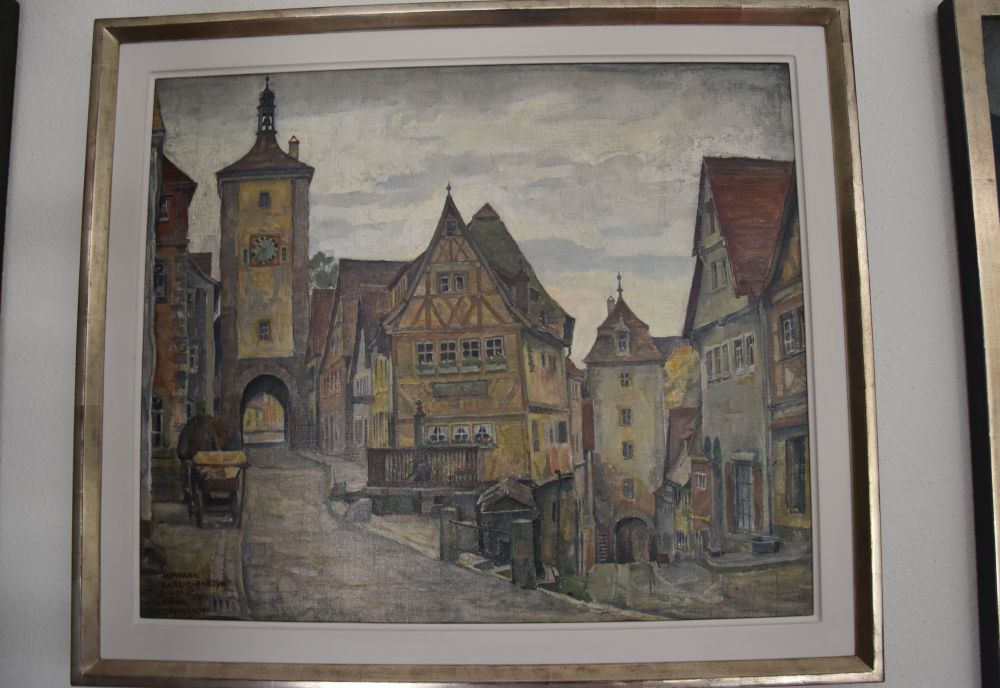
A hundred years ago, my grand-father was at Rothenburg ob der Tauber

My wish was to find the place that my grand-father Hermann Radzyk painted about a hundred years ago. 

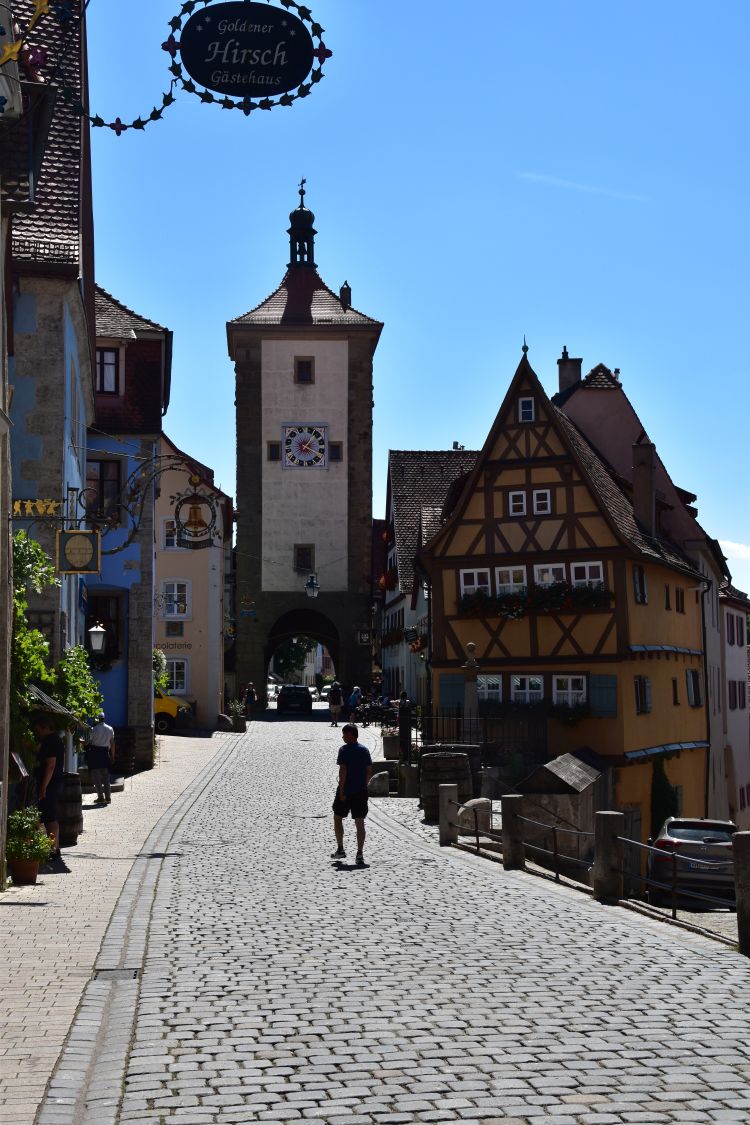
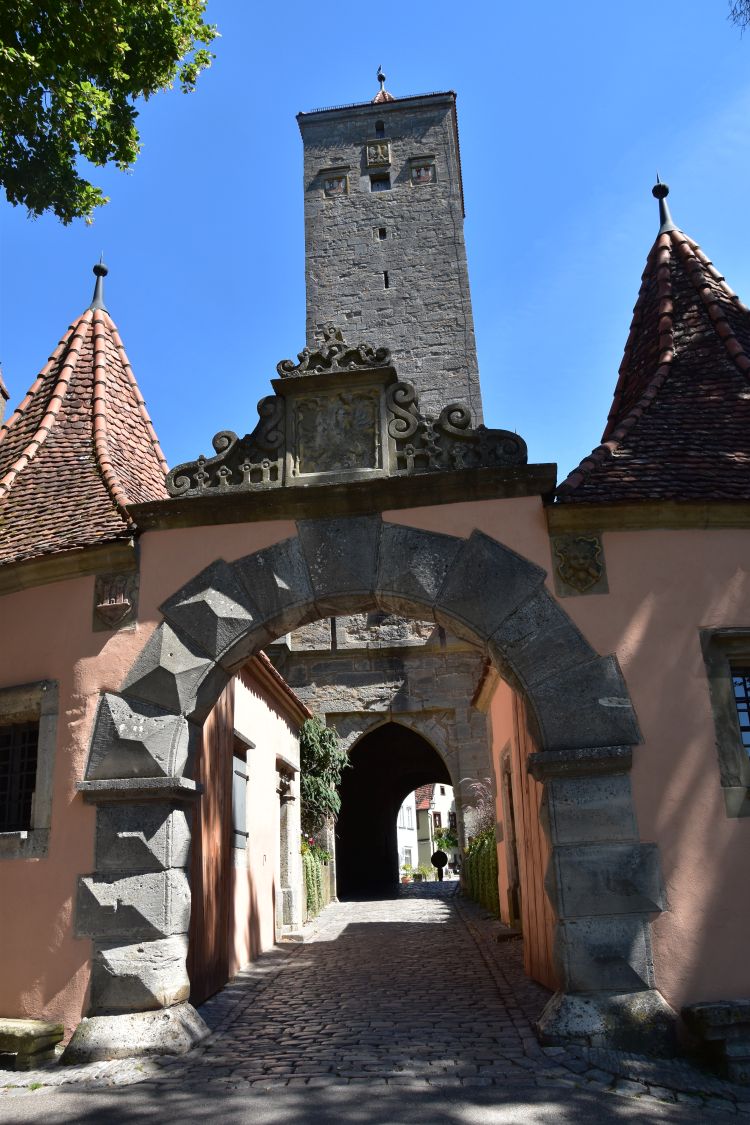
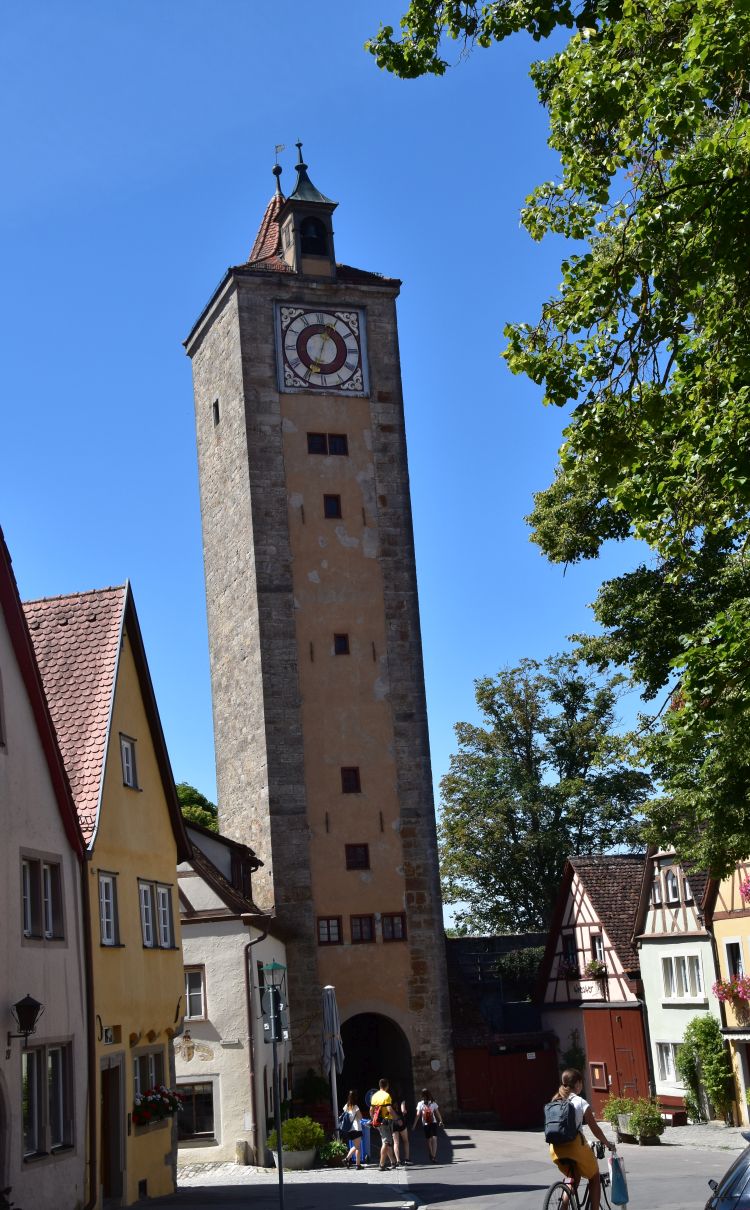
I found the place: It is the Siebersturm (city gate) and the Plönlein ( a slightly slanting half-timbered house). Rothenburg tourism says, this is probably the most photographed landmark of Rothenburg.


A short stroll through the medieval streets of Rothenburg

Rothenburg, located on a rock above the river Tauber, was a flourishig free city that lost its importance after the War of 30 Years (1618-1648). It preserved its old city image until today. It is a tourist hot spot.

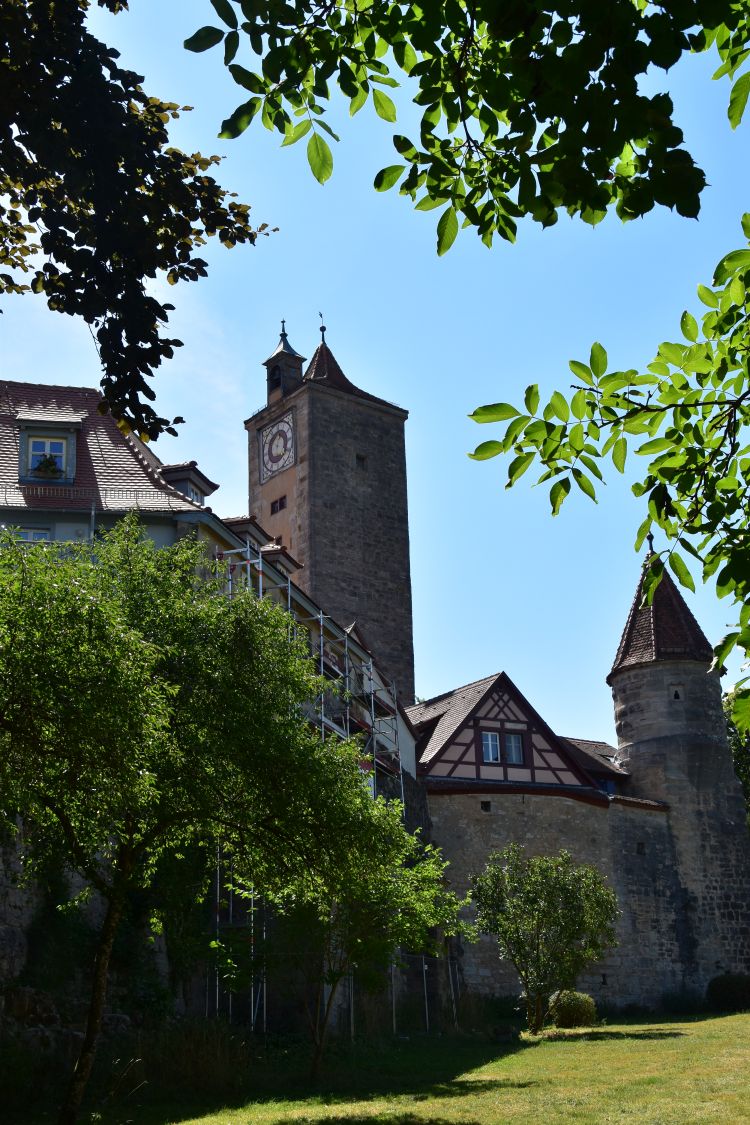
The wall with the gates surround the city. We walk outside the wall (I believe this is the Klingentor) to have a picnic under a shady tree.

We continue to the Burggarten with the wonderful view of the Tauber valley and… 

… we enter the city through the Burgtor.

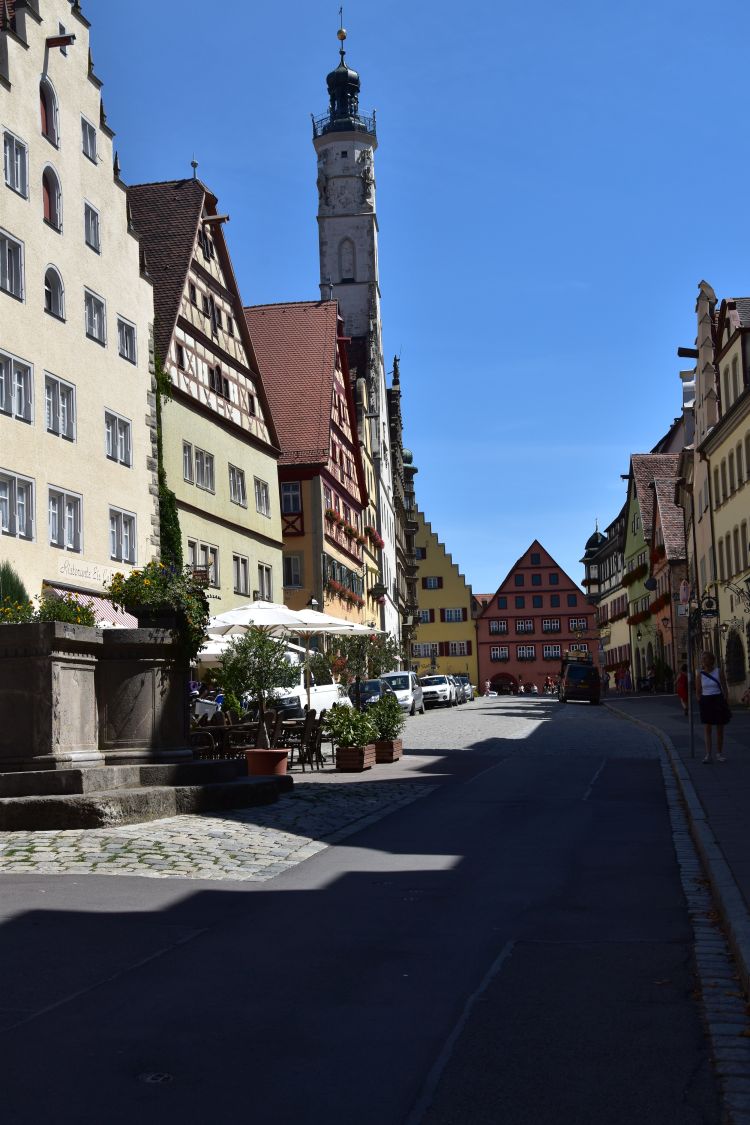
We stroll through the Herrngasse with the half-timbered houses.

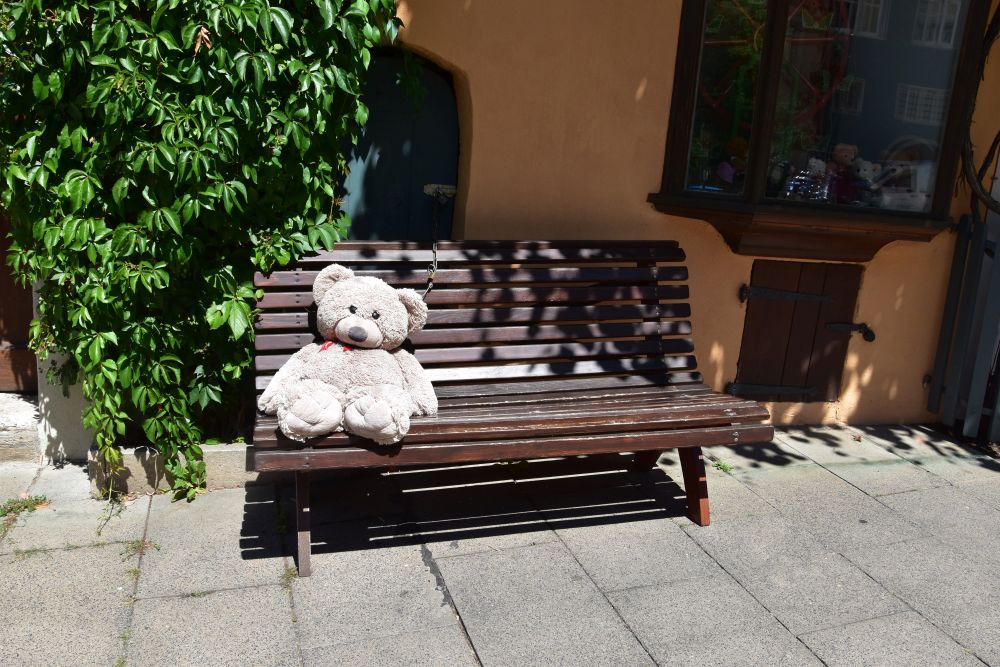
The teddy from the Teddyland Shop greets us.

We feel hot, The temperatures are at about 35 degrees and the sun burns. We eat an ice cream in the shade. Just too hot to walk in the streets now. I would like to return and explore the treasures of Rothenburg ob der Tauber, when temperatures are cooler.


Good-bye Rothenburg ob der Tauber

We return to our car. We want to get to Nebra today. A ride of three and a half hours is ahead of us.


Sources:

Website of Rothenburg ob der Tauber Tourismus https://www.rothenburg-tourismus.de/ and https://www.rothenburg-tourismus.de/entdecken/top10-sehenswuerdigkeiten/das-ploenlein/ 

Frankfurt – an old family friend is my guide

A long-year family friend at Frankfurt and a cousin at Bonn are both in their eighties. I want to visit them on my way to Berlin, mid-November 2021.

My first stop is at Frankfurt, the business capital of Germany on the Main river.

At Frankfurt, I have been invited by Dietrich and his wife. Our grand-parents were friends, after that our mothers were very close friends and now we, the grand-children, are friends. We are long-year family friends.

A hundred years ago, Dietrich’s grand-father had acquired some paintings of my grand-father-artist Hermann Radzig-Radzyk, for instance the Kirchberg at Schreiberhau, now Szklarska Poręba, in Silesia…

… and the valley at the county of Kłodsko (Glätzisches Land), also in Silesia.

Immediately, I feel at home in the house of Dietrich and his wife. I am surrounded by memories of my family, and the welcome is hearty.


Charming small Italian restaurant run by two sisters from Naples

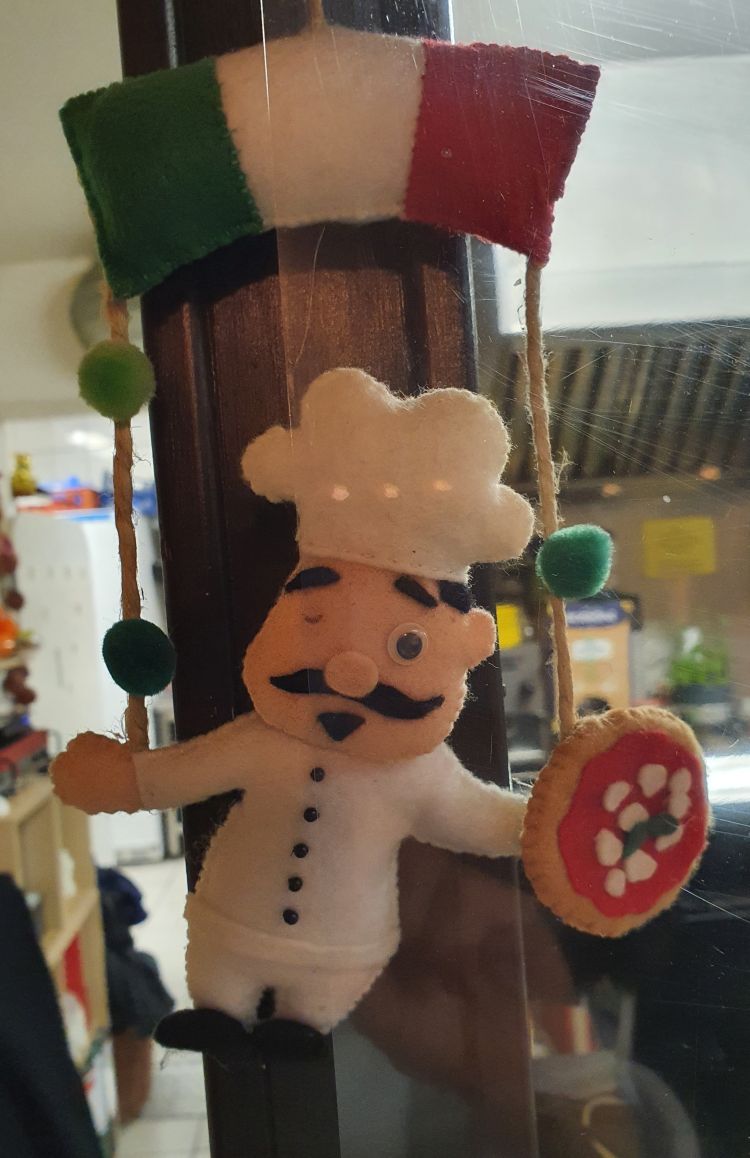
We have dinner at the charming small Pizzeria La Paesana, run by two sisters from Naples. Their nephew made the pretty felt pizzaiolo that now decorates the pizzeria of his aunts. Well, the pizzaiolo has lost one eye – that makes him look even friendlier – he seems to twinkle at me.

The small restaurant is an excellent welcome to Frankfurt. I have tasty wild boar noodles with a slightly sparkling Lambrusco, my friends have pasta Carlo Magno with Gorgonzola – it is said that Charlemagne (Karl der Grosse or Carlo Magno) loved Gorgonzola, the sisters tell us. That was around the year 800 AD – what a cheese tradition! 
(According to the wiki entry about Gorgonzola, it is said that Gorgonzola was first produced in 879; but this could well have happened a little earlier, when Charlemagne lived, and if not, it is a nice legend).

We will meet Charlemagne later again in the city centre of Frankfurt. 


My first impression of the city – Hauptwache (main guardroom) and skyscrapers touching the morning clouds

Dietrich takes me to the S-Bahn. We leave the underground station at the Hauptwache (main guardroom). Saint Catherine’s Church appears behind the stairs. 

The baroque guardroom, built in 1730, was the headquarter of the city’s soldiers. It was also a prison. It was destroyed in the Second World War and reconstructed thereafter. 

The Hauptwache is surrounded by modern buildings, with the Commerzbank building fading in the mist of the late morning. 


The lifeline of Frankfurt am Main – the river Main

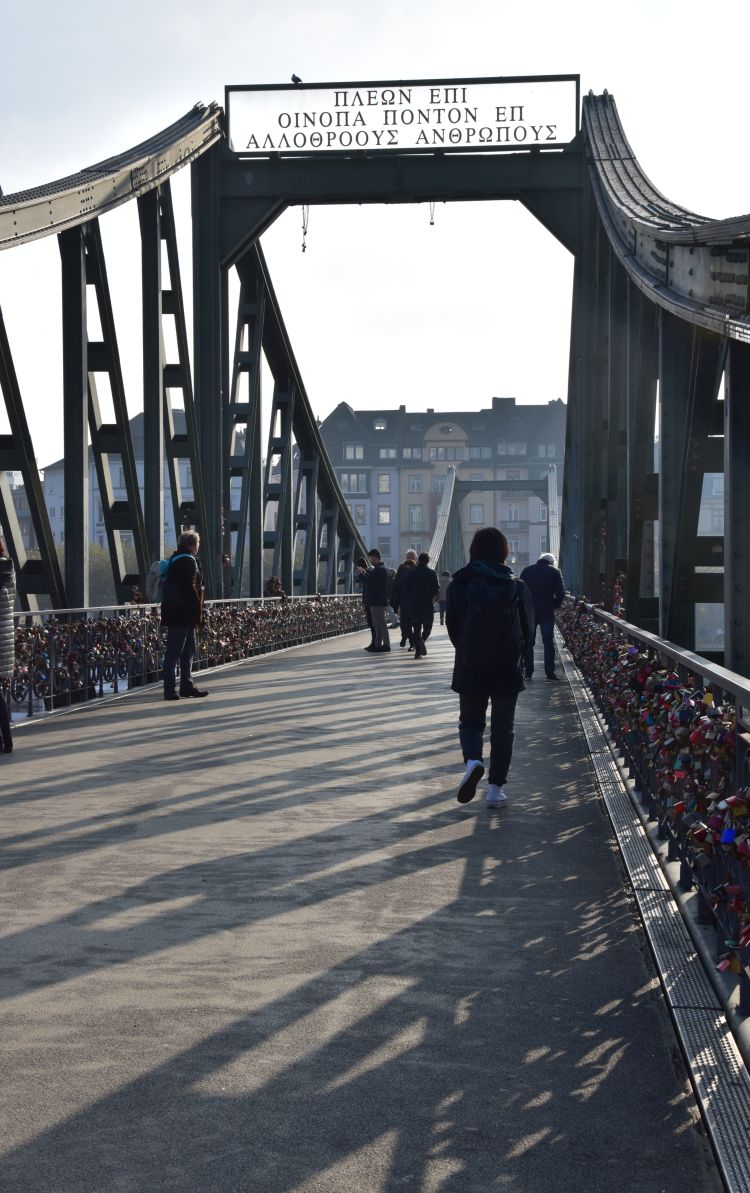
The lifeline of Frankfurt is the Main river. We approach it near the pedestrian bridge “Eiserner Steg” with the inscription in Greek saying “the sea has the colour of wine and, on this sea, we are sailing to meet other people” (auf weinfarbenem Meer segelnd zu anderen Menschen).

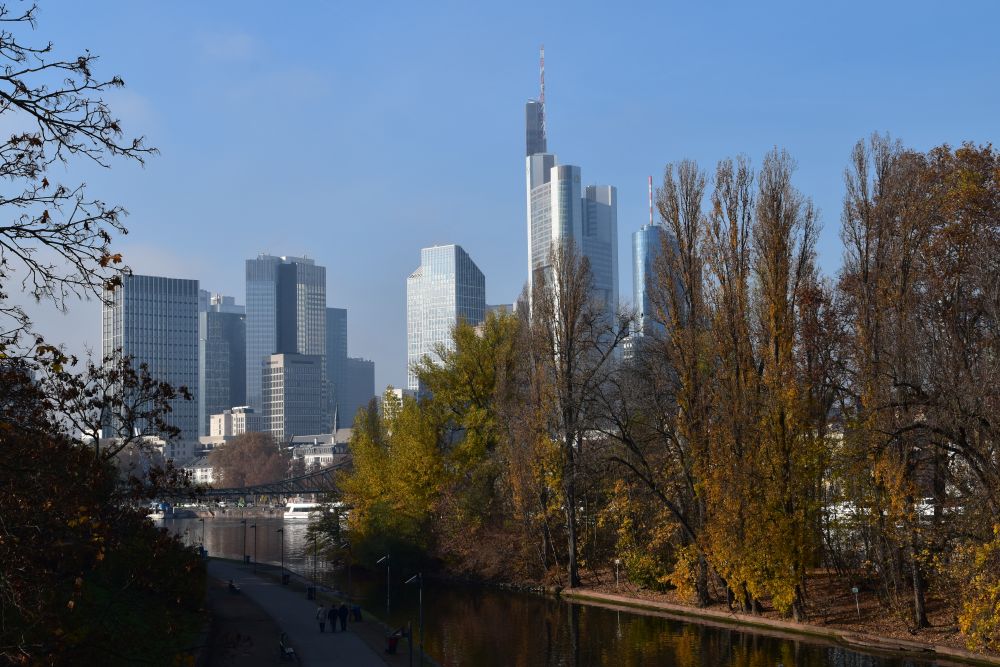
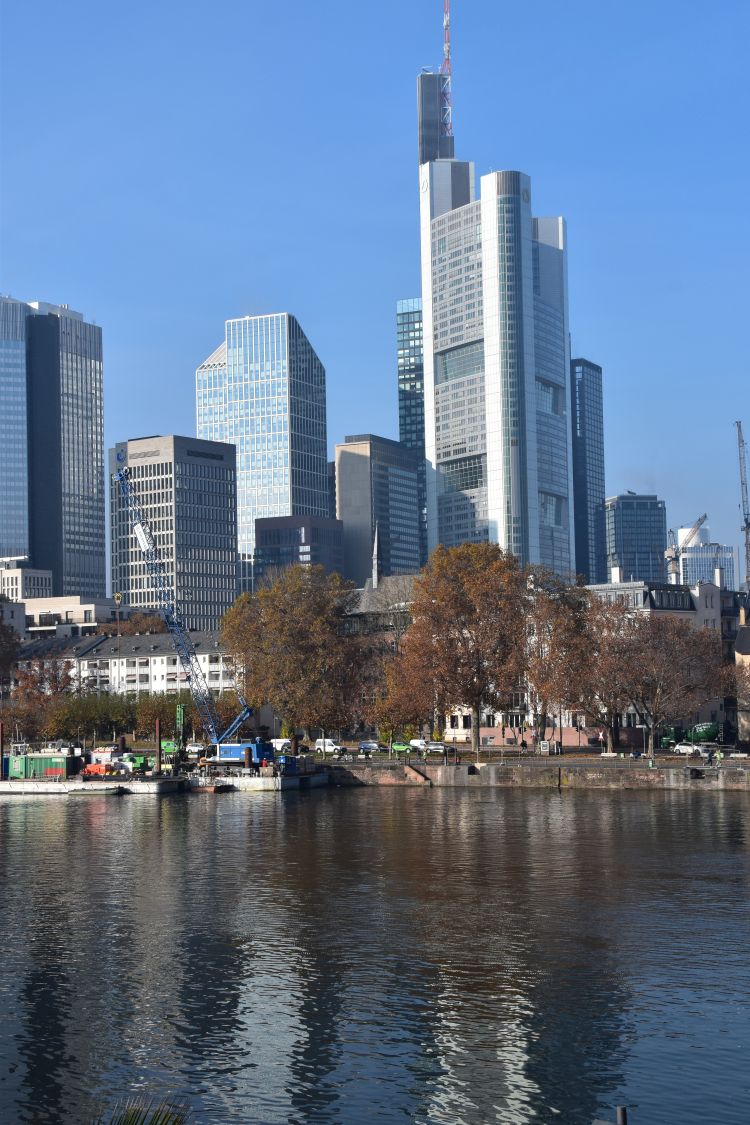
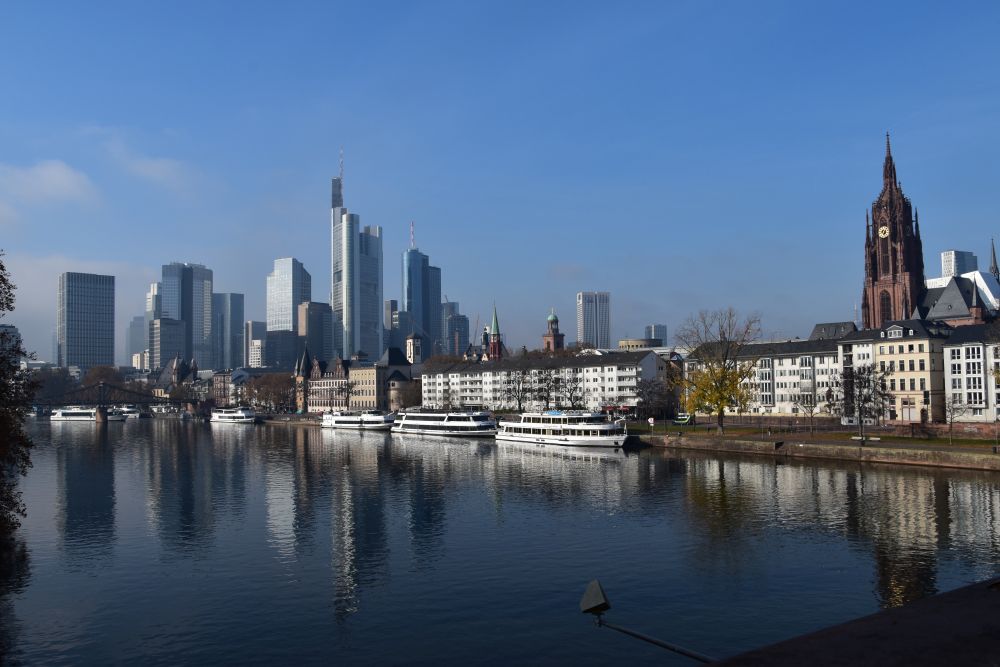
From here we can see the Commerzbank building again, now under blue sky in the sun, surrounded by many more modern buildings reflecting in the Main river . 

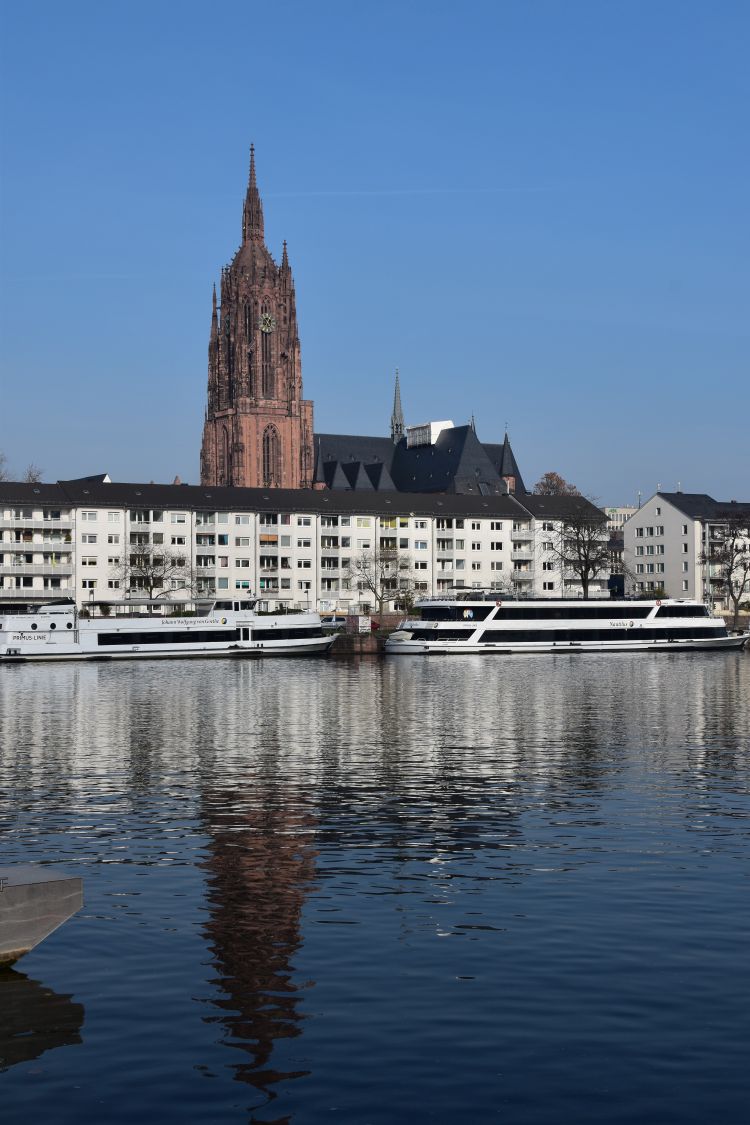
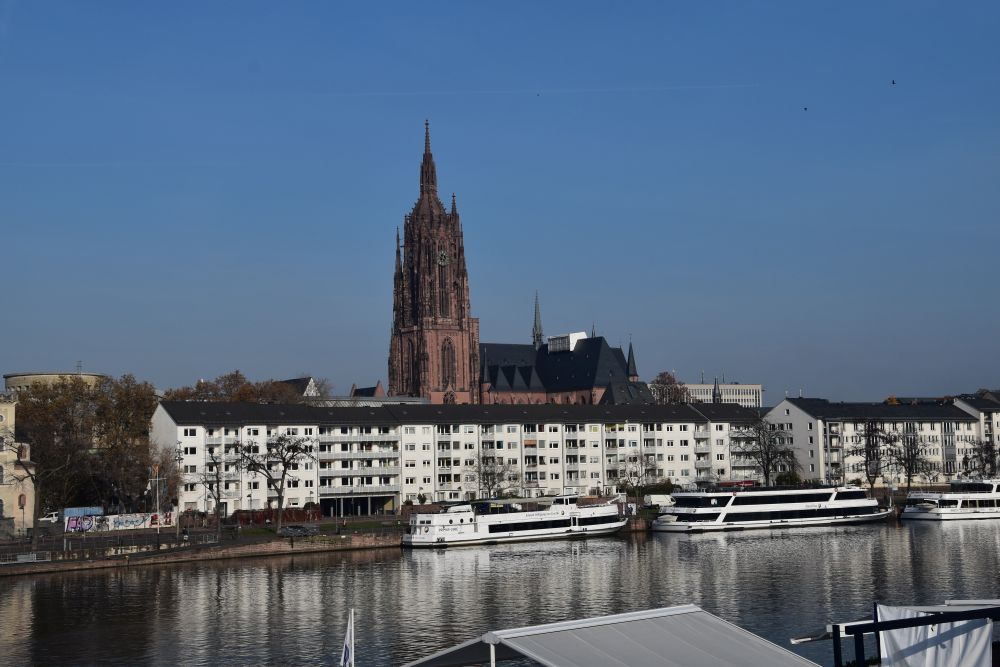
This is the Cathedral Saint Bartholomew, also reflecting in the Main river.

Across the Eiserner Steg we reach the urban district Sachsenhausen. We stroll along the waterside promenade and meet these two ducks, also citizens of Frankfurt, sleeping comfortably on one leg. 

The skyline, again with the Commerzbank tower, appears behind the island (Maininsel) that shines in golden autumn colours. 

Returning to the city centre using the Old Bridge (Alte Brücke), I make a photo of both the modern business skyline and the Gothic Cathedral of Saint Barthomolew. 

Frankfurt has charm, definitively, when seen from their lifeline, the Main river. 


Timbered houses at the Römerberg and the Old St Nicholas Church (Alte Nikolaikirche)

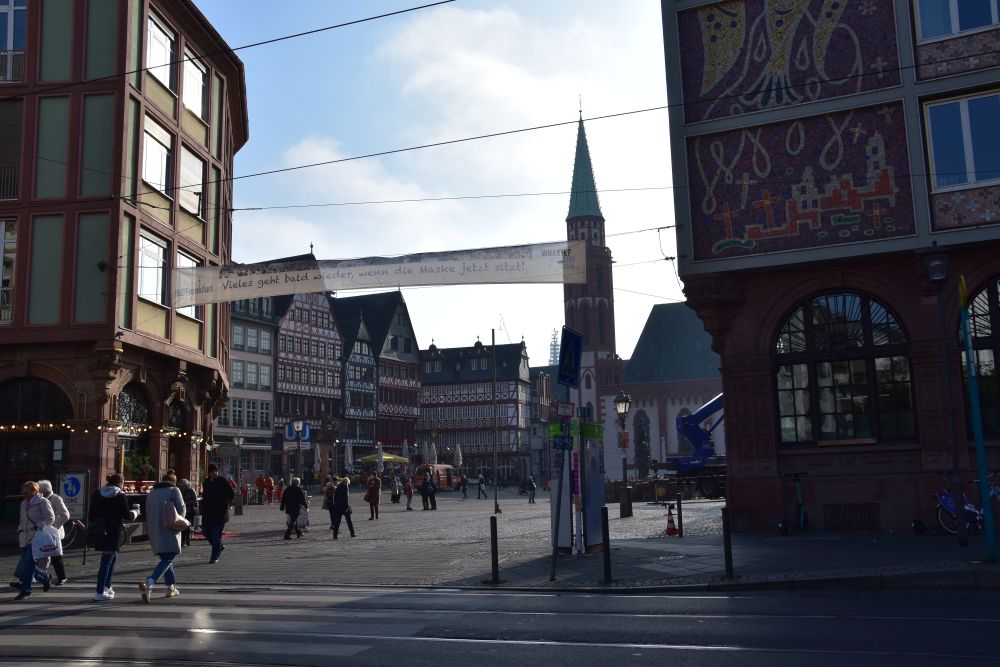
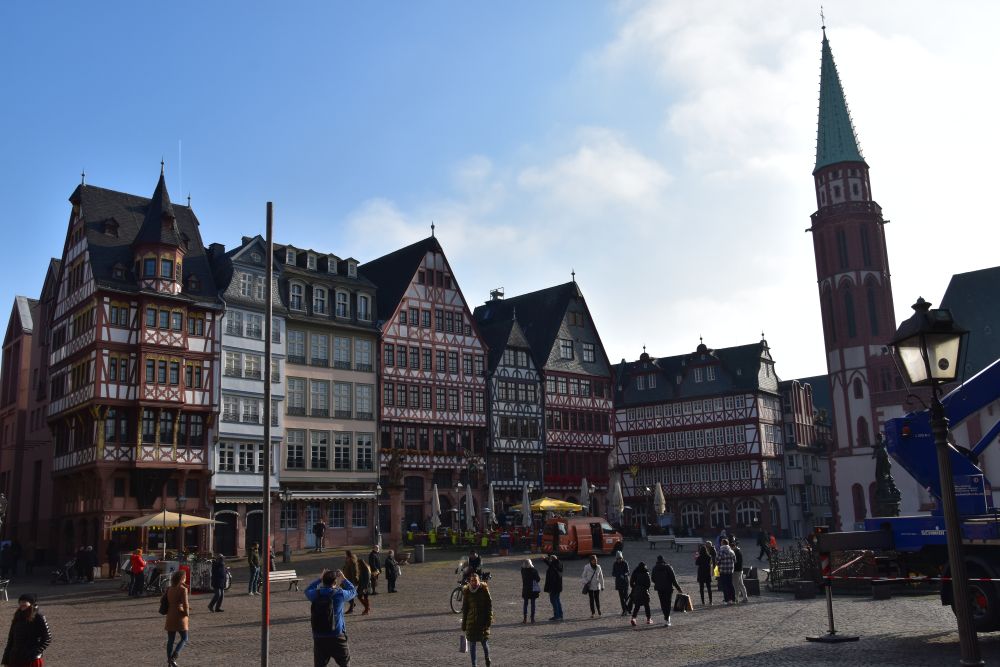
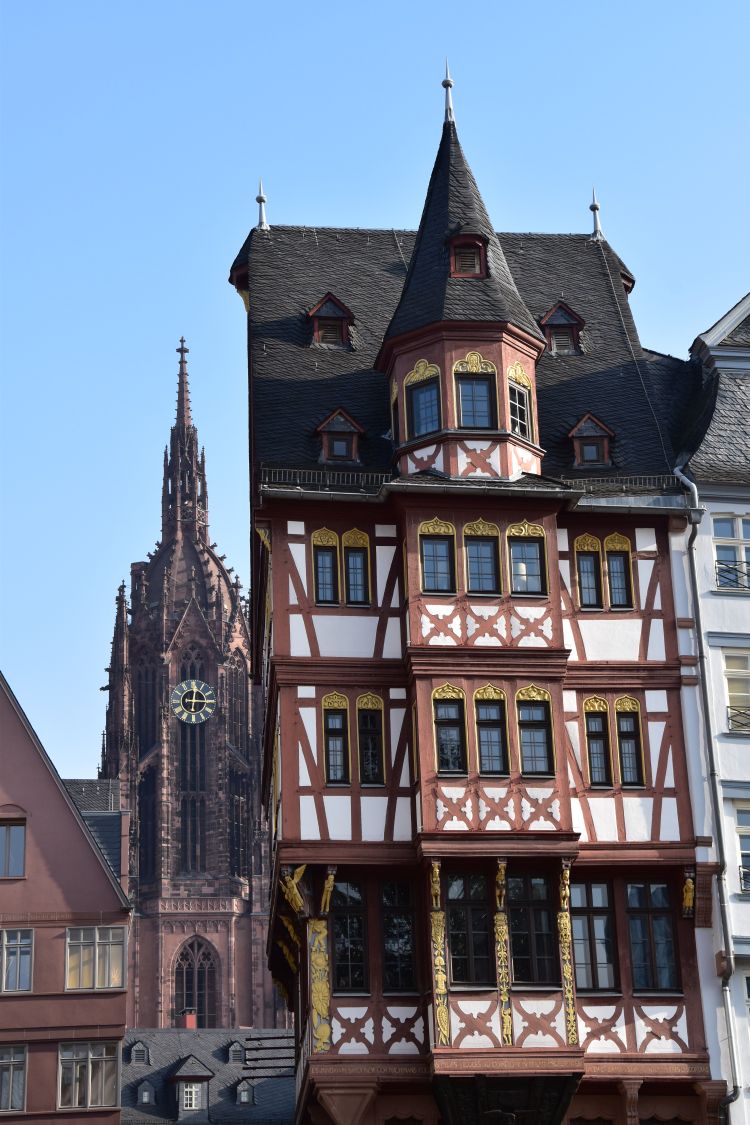
Away from the Main river, the old city centre is located on the Römerberg. It is bordered by timbered houses and the Old St Nicholas Church. 

We enter the Römerberg square under the banner that plays with German words: “Vieles geht besser, wenn die Maske jetzt sitzt” (translated literally: “much will “go” better, when the mask “sits” meaning”, when the mask fits – it is the times of COVID).  

On the Römerberg, the first fairs took place in the 11th century. Frederic the Second of Hohenstaufen granted the right to run fairs to Frankfurt in 1240. 

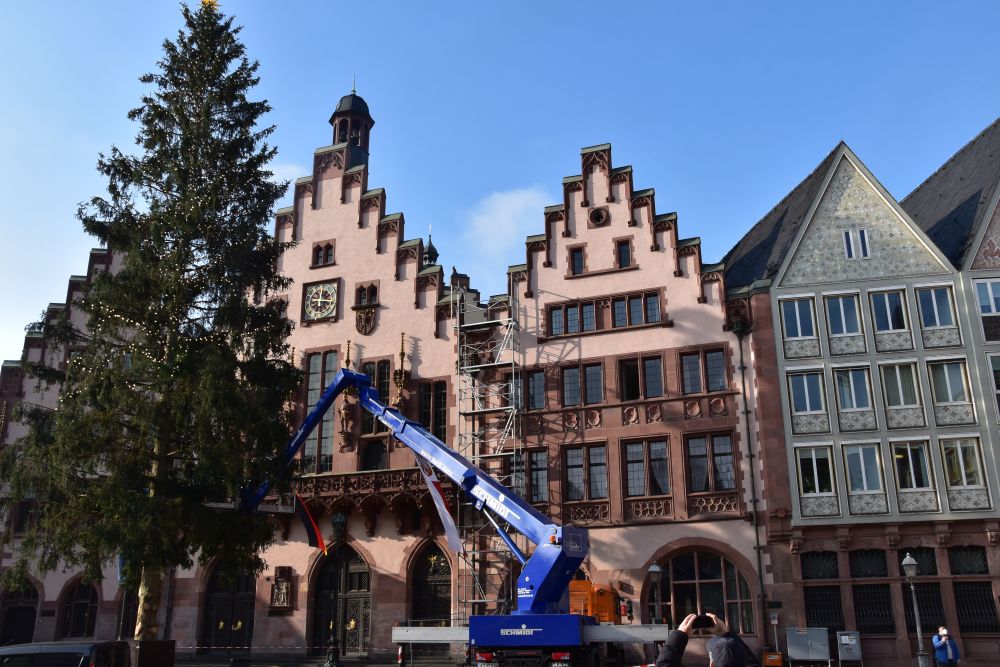
It is mid November, time to set up the Christmas tree in front of the old town hall. 

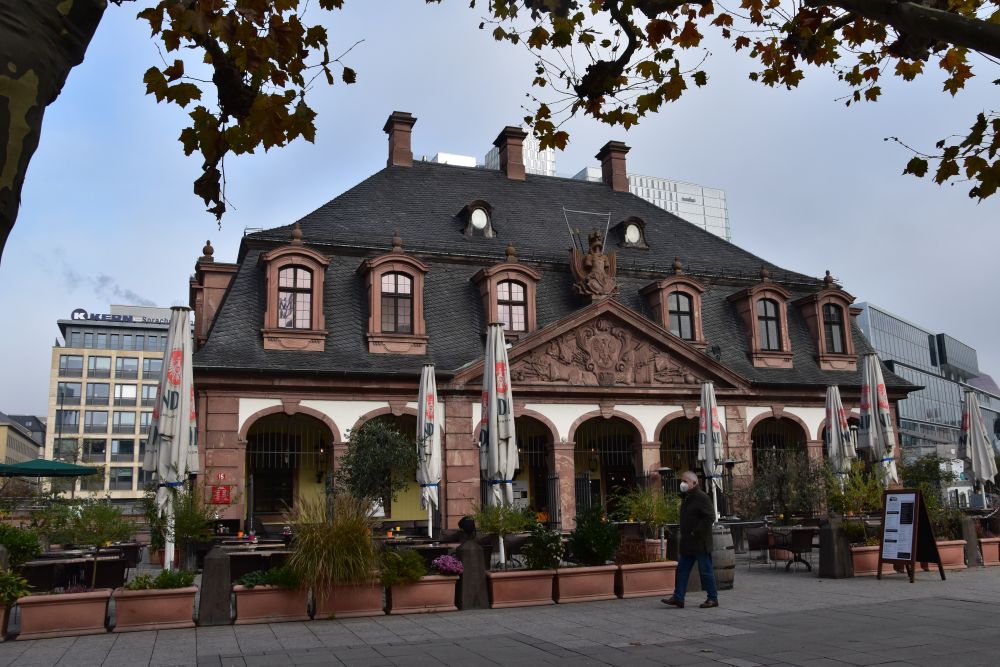
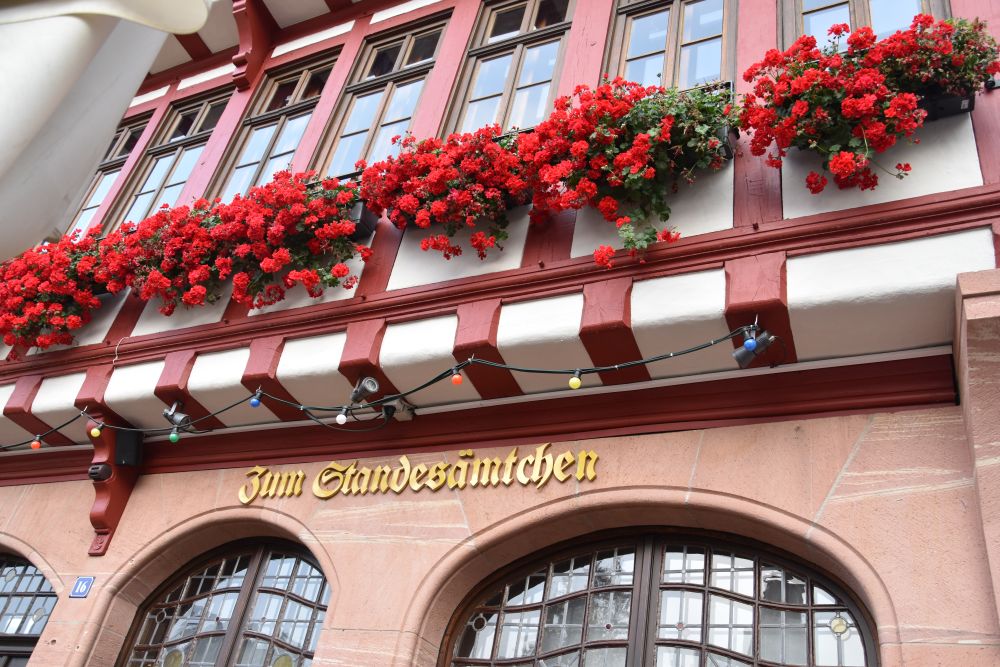
This is not the Standesamt (civil registry office), but the Standesämtchen. The ending “chen” combined with “ä” indicates that it is the “small” registry office which, in Southern Germany, adds a friendly and welcoming touch to it. Actually it is not a small civil registry office, but a restaurant that carries the name “Standesämtchen”. 

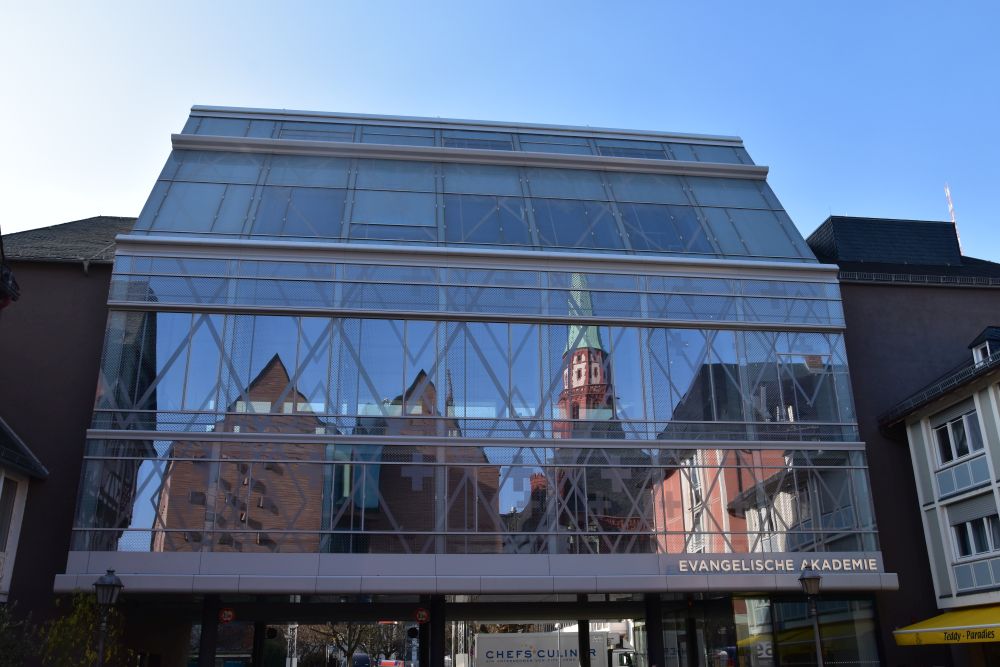
Modernity and tradition are joining. The Old St Nicholas Church reflects in the glass wall of the Evangelische Akademie (education institution and conference house). 

As a matter of fact, Frankfurt has been in ruins after the Second World War. The houses around the Römerberg, originally from the 15/16th century, have been reconstructed in  the 80-ies, except the Wertheim building nearby that survived the air raids. 

The late Gothic Old Saint Nicholas Church from the 15th century only suffered minor damage by the bombs of the Second World War.  


The Cathedral St Barthomolew behind the Römer

From the Römerberg, we can see the Cathedral of St Barthomolew.  

The cathedral can be seen from the Main river, too. 

The cathedral is also called “Kaiserdom” (Emperor Cathedral). Actually, it is a “Königsdom”, because the kings of the Holy Roman Empire were elected here since 1152 and crowned since 1562, until the Holy Roman Empire ceased to exist. No “emperors” were crowned here, kings were crowned here. Furthermore, the cathedral has never been a bishop seat, though it is called “cathedral”.

The present Gothic cathedral is mainly from the 14th and 15th century, reconstructed in the 1950’s after having been severely damaged in 1944. 

The modern organ matches the gothic vaults. 

Reading about the cathedral at home, I would like to return to explore the collection of altars from all over Germany and the chapel, where the elections of the kings took place. 


New Old City (neue Altstadt), reconstructed based on the medieval ground plans

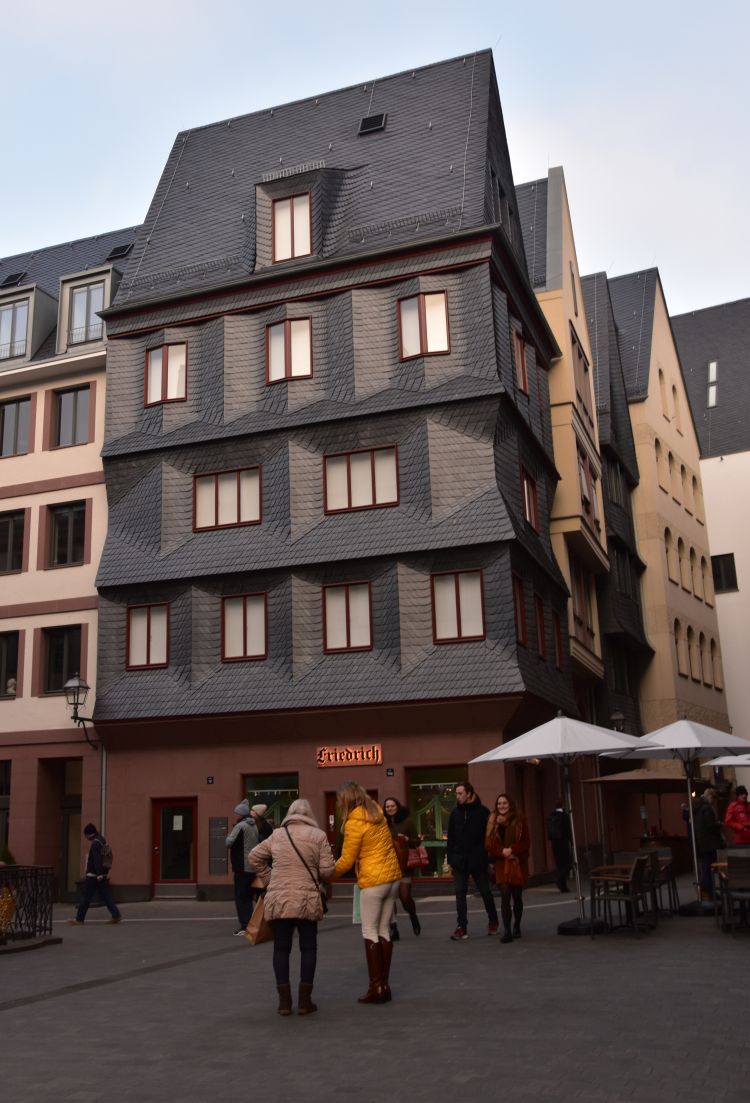
Between the Römerberg and the cathedral of St Bartholomew, the old city has been rebuilt along the medieval ground plans – this is now called “neue Altstadt” or “New Old City”.

The area is not without charm. However, to me, the houses look a bit, as if they had been cut out of cardboard. 

They are neither really old nor really modern. 


Kaiserpfalz – meeting Charlemagne again, the emperor who enjoyed the Gorgonzola cheese

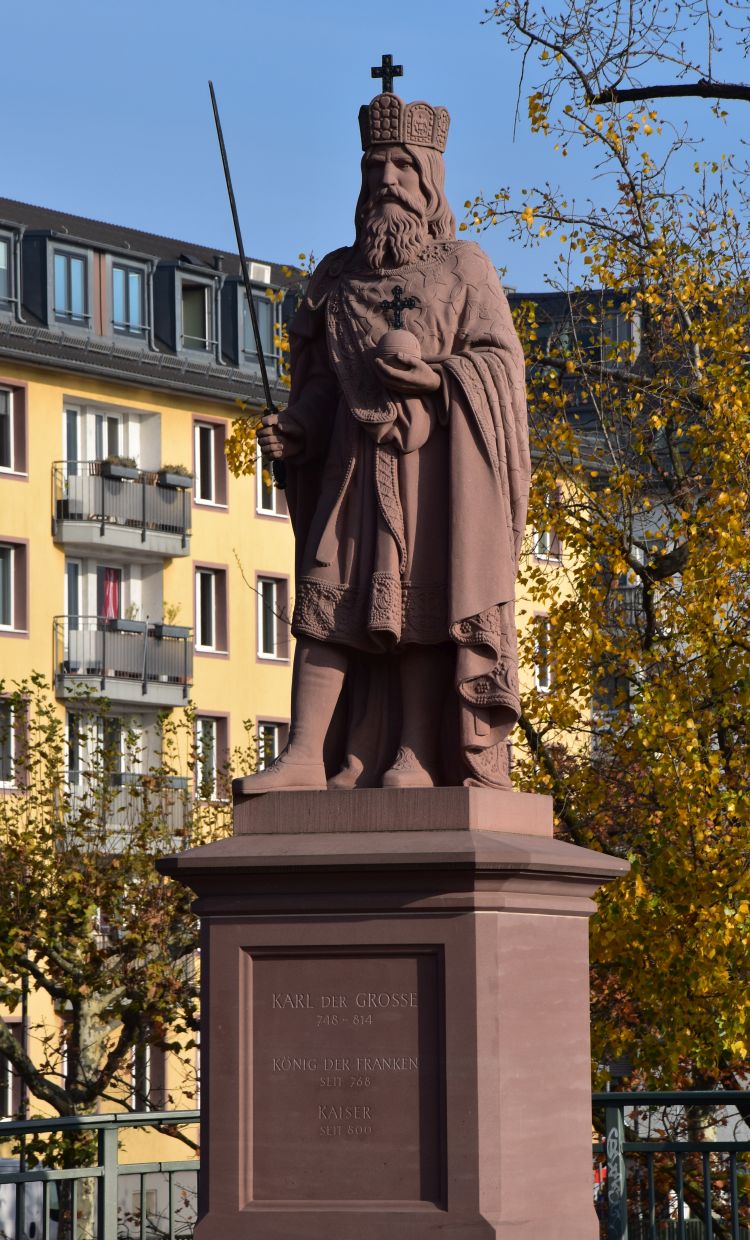
Here, he is again, Charlemagne who is said to have loved the Gorgonzola cheese. In a way, he is the founder of Frankfurt. That is why, I assume, he stands on the old bridge crossing the Main river. He looks downstream, severely frowning.

In 794, it was Charlemagne who was the first person to mention Frankfurt or “Franconofurd”. At that time, he held a synod of bishops and an imperial assembly here. 

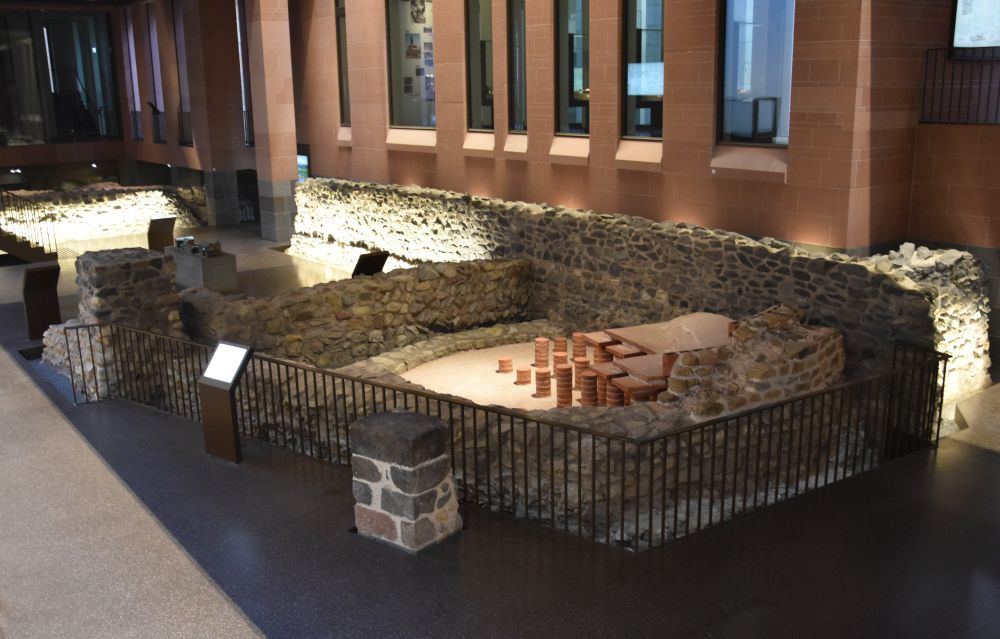
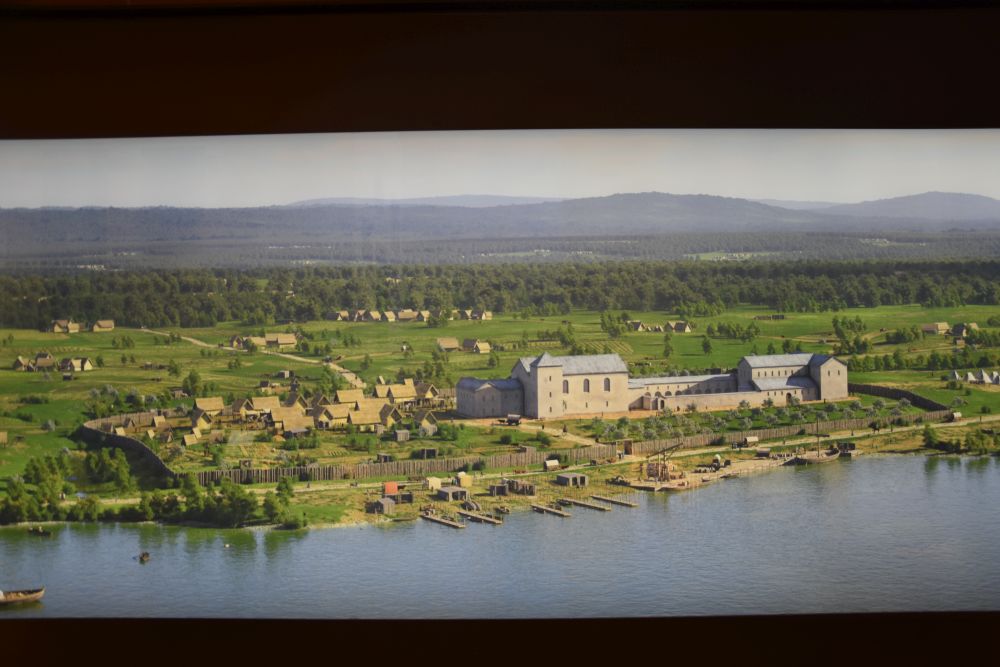
Charlemagne was at Frankfurt in 794. However, later he probably never returned to Frankfurt. It is assumed that his grand-son, Louis the German, founded the first cathedral and made Frankfurt an important royal palatinate. The ruins of the palatinate are presented in the New Old City.

This is, what the royal palatinate (Königspfalz) might have looked like in the 9th century. 

The painting is on display in the museum.


Church St. Leonhard

The Church St Leonhard is bordering the Main river. The beginnings go back to the early 13th century, and the Romanesque structures have been largely preserved. In 1323, the church acquired a relic of Saint Leonhard which made it an important pilgrimage site. 

In the early 15th century, the choir was reconstructed in Gothic style while the Romanesque apses remained in place. Around 1500, the nave was enlarged.

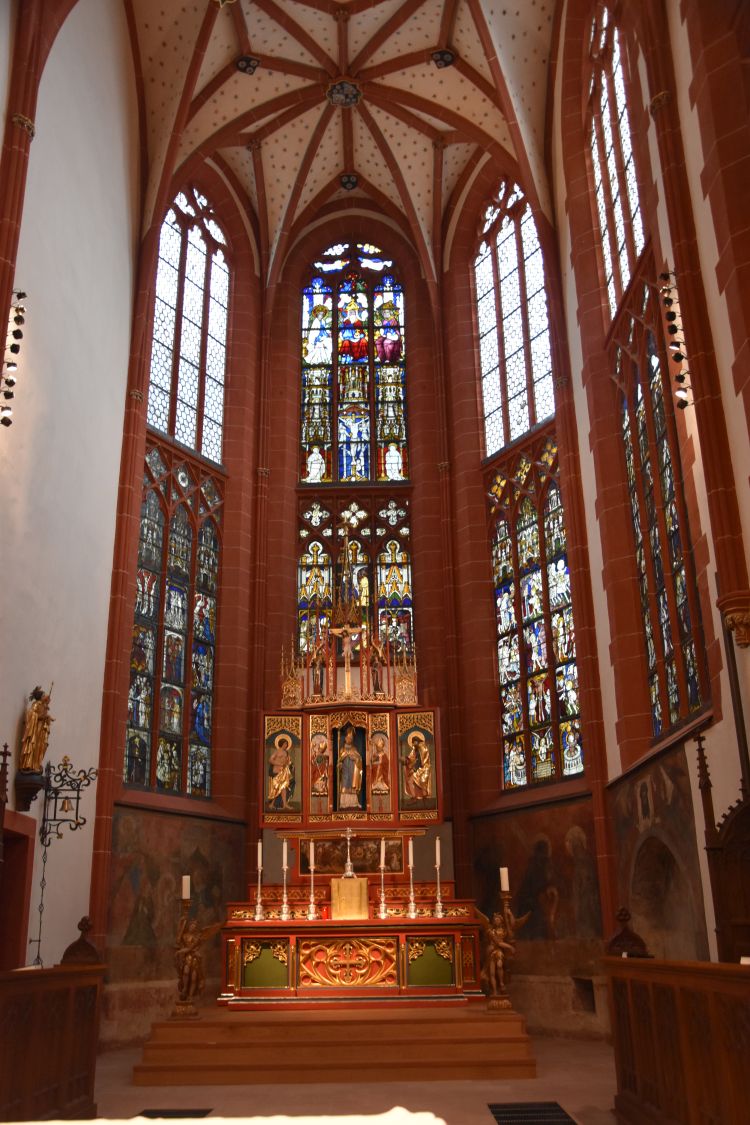
The Gothic main altar was acquired around 1850. The middle part is from Swabian Bavaria. The predella is supposed to have been crafted at Memmingen in the late 15th century; it shows the martyrium of Ursula. The two candle holders are Baroque angels from 1614.

Late Gothic frescoes decorate the walls of the choir, to the left the Annunciation scene, to the right Christ carrying the cross. Some of the stain glass windows in the choir are from the 15th century. 

The altar of Marie comes from Antwerpen (about 1480). The centre part is dedicated to Marie (her death, her ascension, her coronation). The predella shows the Last Supper.

In 1944, the Church Saint Nicholas was only moderately damaged; sister Margarita prevented a devastating fire. Between 2011 and 2019 the church was completely renovated.

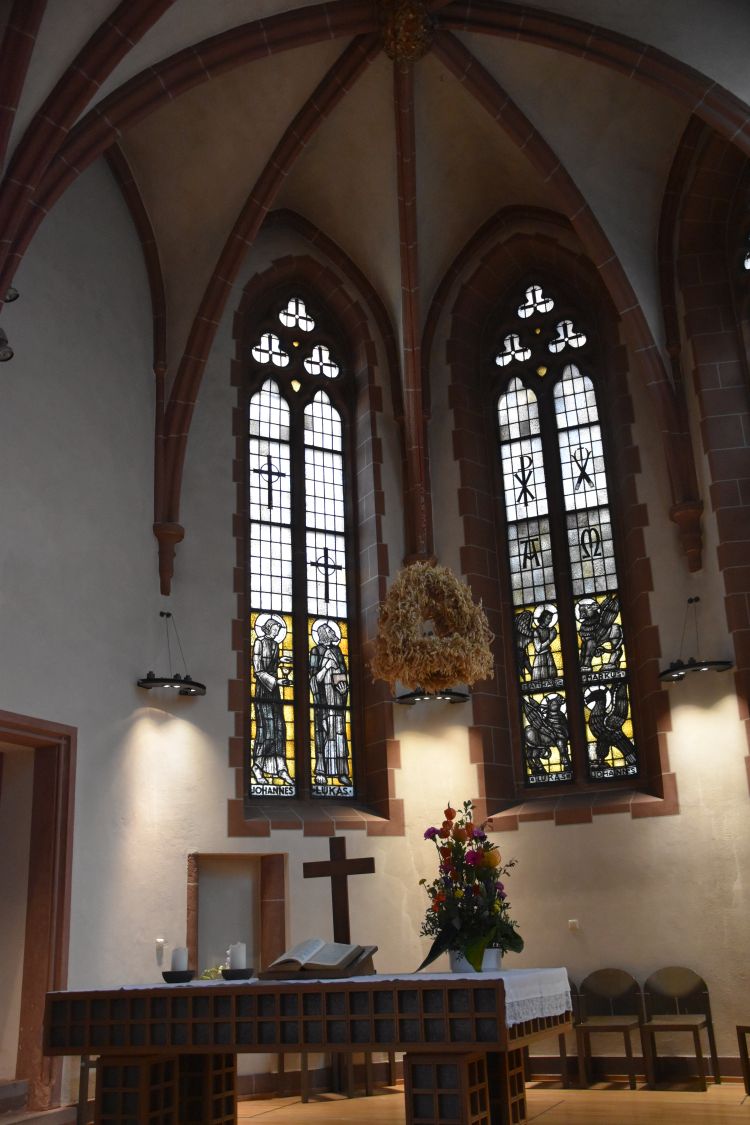
Reading the booklet acquired in the Church of St. Nicholas, I understand, there is more to see in this church, I would like to come back.


Goethe was born at Frankfurt

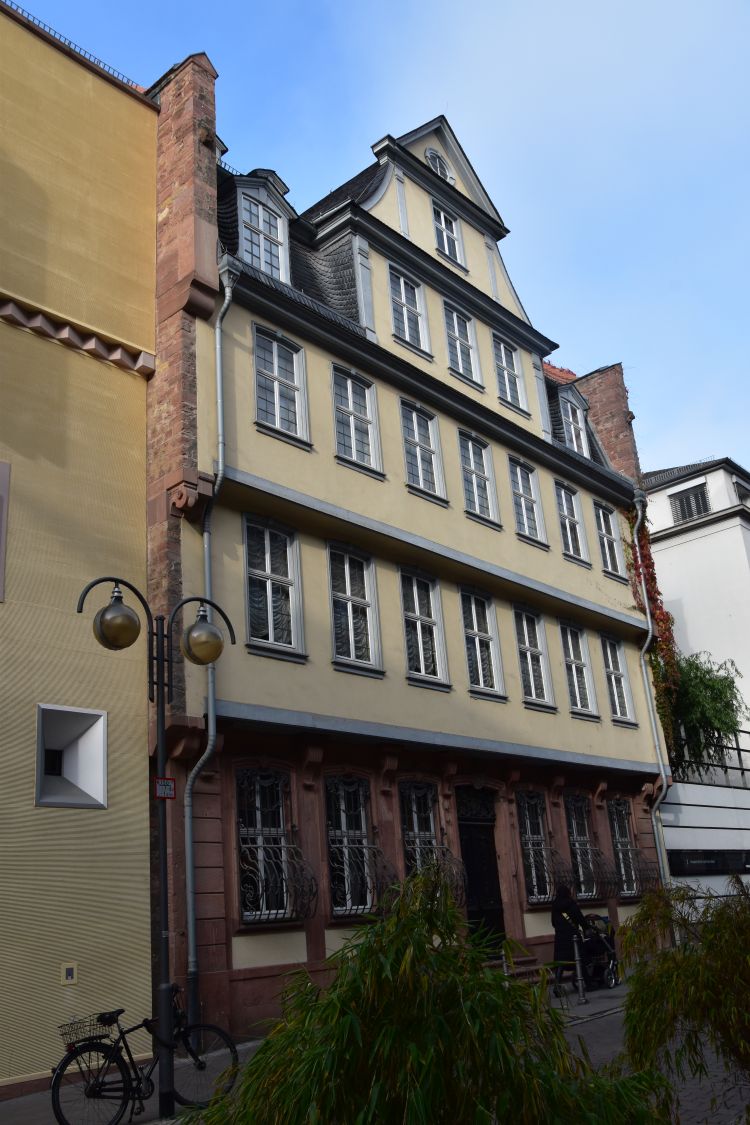
In this large, yellow house at the Grosser Hirschgraben, Goethe was born (1749-1832) . He lived in Frankfurt, until he left to study law at Leipzig in 1765.

Well, the yellow house was destroyed in 1944, and it was reconstructed after the war, exactly as it was before. 

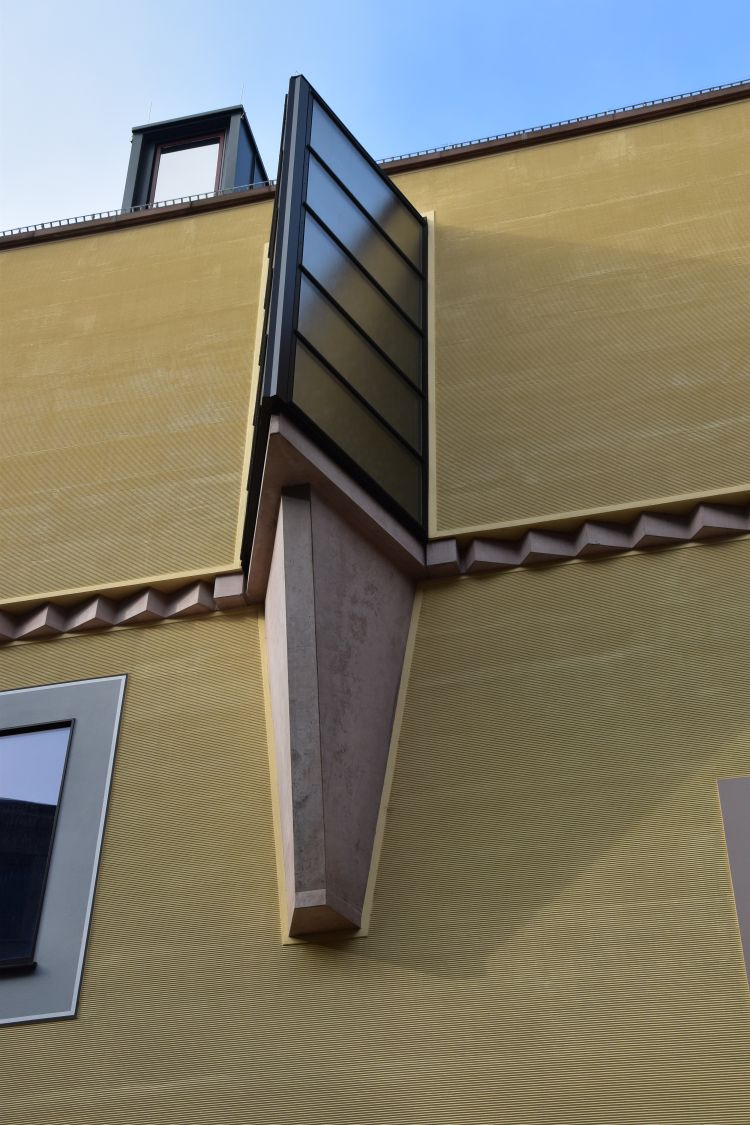
Next door is the Frankfurter Goethehaus (House of Goethe) with the Deutsches Romantikmuseum (German museum of Romanticism). I liked the highly modern oriel interpretation. 

Again next door is the Volksbühne, a theatre, with two more modern oriels swinging along the façade.  


Town Hall and Local Court (Ortsgericht)

From the Goethe House we cross the busy Berlinerstrasse and reach the Local Court of Frankfurt (Ortsgericht), … 

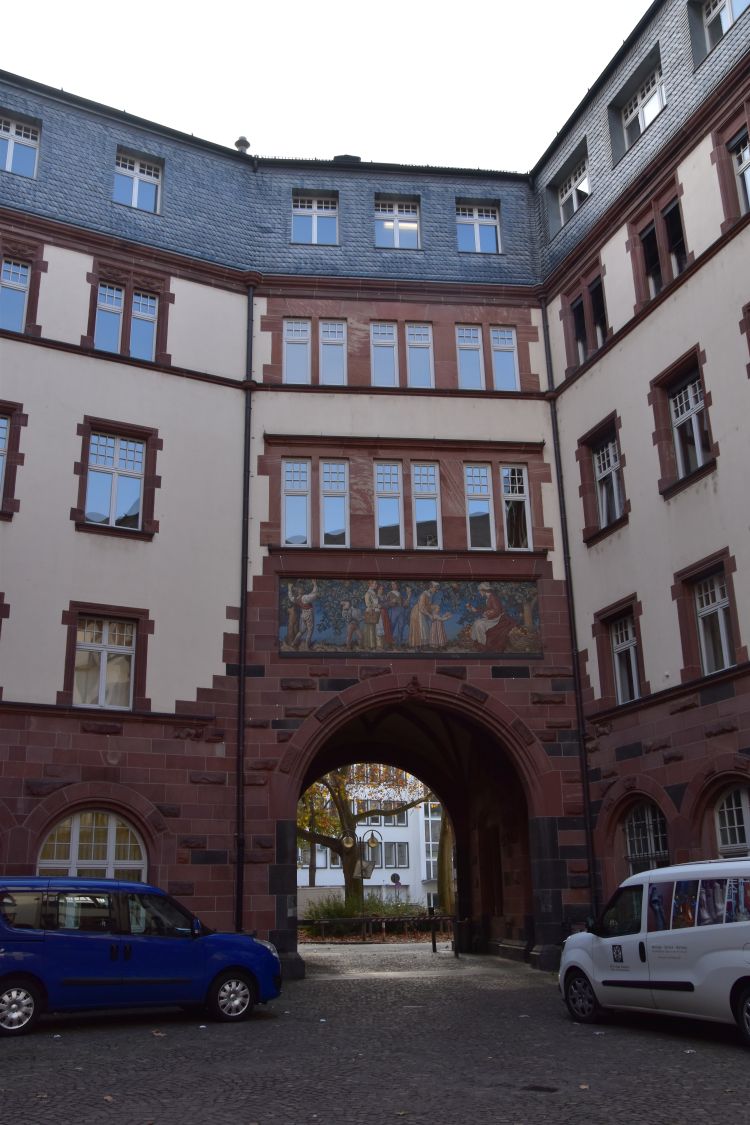
… leaving it through the gate with the fresco showing the wine harvest. 

We now look at the rear side of the town hall, …

… with the town hall tower seen from under the Seufzerbrücke (Bridge of Sighs, a skywalk) at Bethmannstrasse. 


St Paul’s Church (Paulskirche)

Behind us, we can see the oval shaped classicist Saint Paul’s Church, completed in 1833. In 1848, the first German national assembly was held in Saint Paul’s Church. However, the attempt to found the German nation failed, as the Prussian king did not accept the emperor crown to reign over all German states. Nevertheless, the constitution elaborated by the assembly was accepted by most German states; it can be considered to be the roots of the German democracy (see Stadtführer, p. 38). 
The building was reconstructed after 1945 to become a national memorial. This is the new cupola seen from inside.

A monumental frieze makes the representatives of the 1848 assembly revive.


Sight seeing makes hungry – the Kleinmarkthalle (small market hall) is close

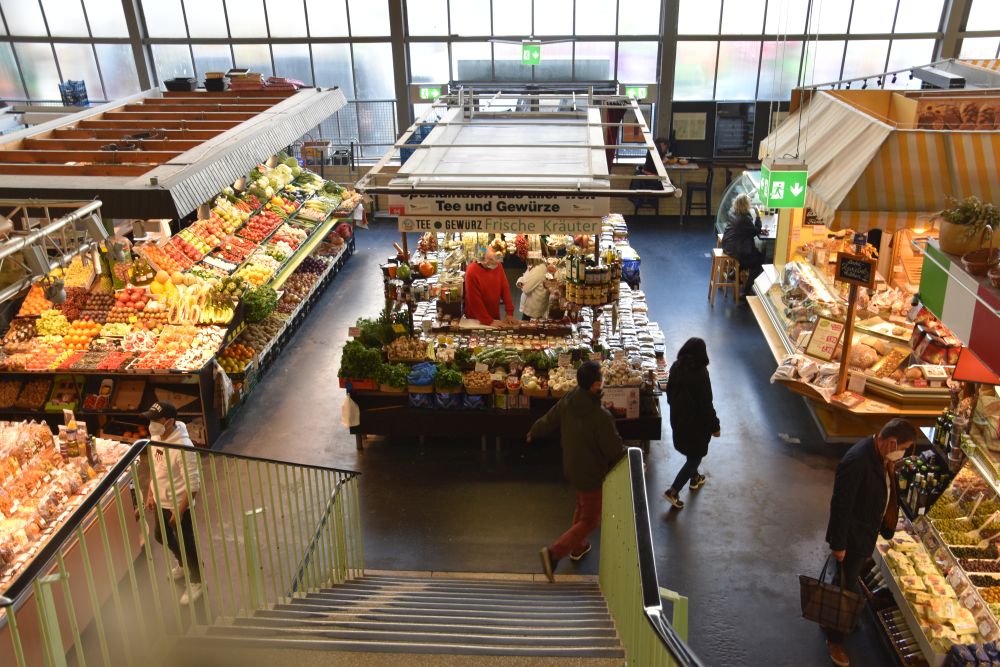
Around lunch time, I am usually hungry. We make a “pitch stop” at the Kleinmarkthalle (small market hall) near the city centre. 

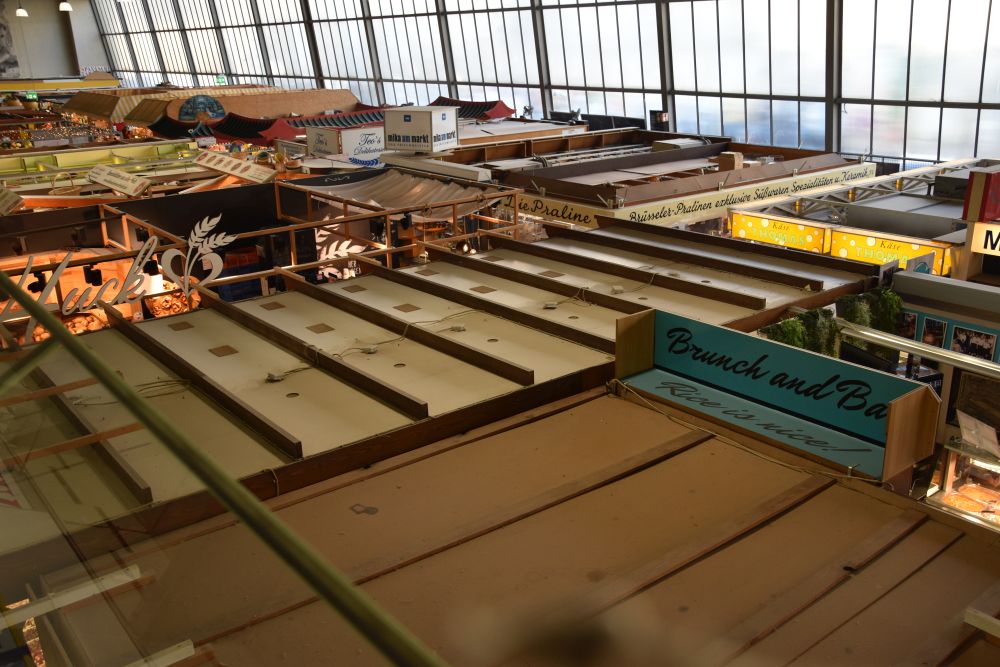
We climb up the stairs to get an overview from the gallery.

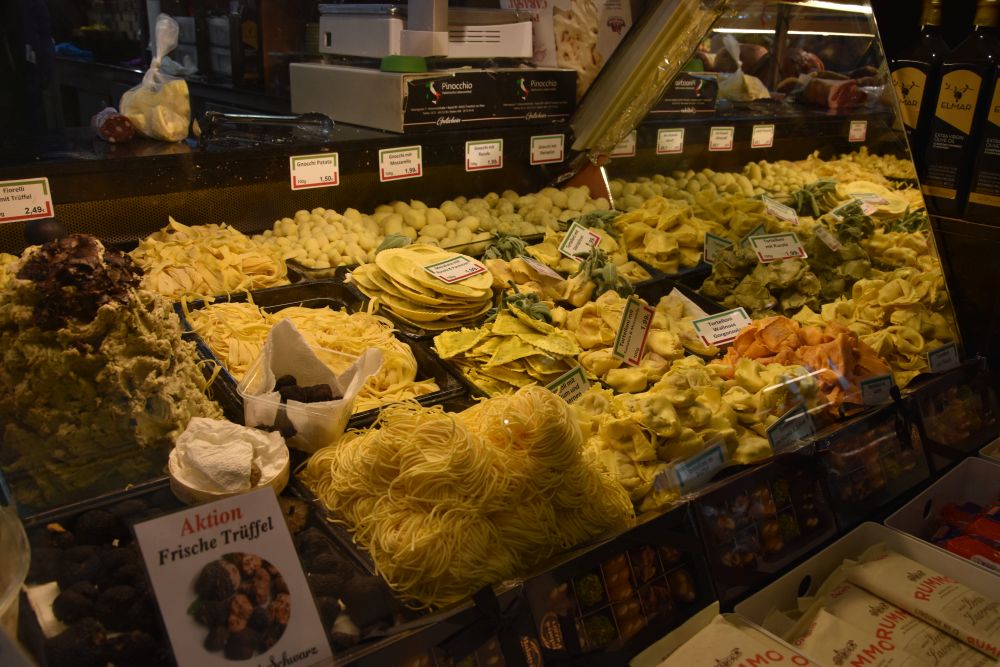
We walk around and enjoy the stands with enticing pasta,…

… apple wine (called Ebbelwei here), …

… meat offered by a citizen of Frankfurt that is obviously from Turkish origin (I love to see the mixture of nations here),…

… beautifully arranged fish… and much more.

We join the waiting queue at Dietrich’s favourite sausage stand of Ilse Schreiber, where we buy two sausages from Hessen (the state that Frankfurt belongs to). We have to eat our sausages outside, because inside the building we have to wear masks, outside, we can take them off, which is much more convenient for eating sausages. 


Good-bye Dietrich, now I am heading north to Bonn, with a stop over on the Grosser Feldberg

Thank you, Dietrich, I have spent two wonderful days with you and your wife. I have learnt much about Frankfurt, and there is more to see in Frankfurt with its museums, with the modern business centres, with the carefully preserved or reconstructed medieval sights and with its lifeline, the Main river.

Now I am heading north to Bonn.

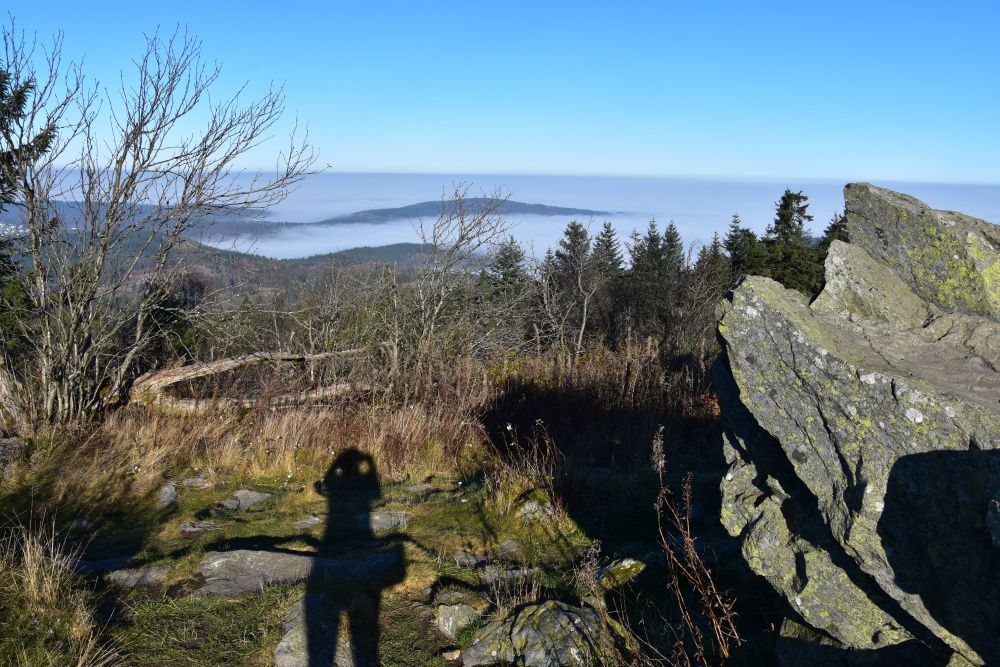
In the mist, I start driving to the Taunus mountains north of Frankfurt. My car climbs and climbs, and eventually, I am above the clouds. I stop on the local mountain of Frankfurt that is called Grosser Feldberg. I am on almost 900m. The view is superb. 

The Brunhildi’s rock (to the right of my shadow) is mentioned in a document of 1043. 

The rock is said to have been the “lectulus of Brunhilde” or “the little bed of Brunhilde”. Saint Hildegard of Bingen has spent one night here, and the rock has kept the imprint of her head, as legends tell. Around 1800, the rock was reinterpreted as the place, where Brunhilde was sleeping, until Siegfried liberated her. The rock became part of the German legend of Nibelungen. This is, what the panel near this peculiar rock says. 
I continue north – it is about two hours to drive to Bonn. On the way, I will have another stop at Limburg. 


Sources:

A Swiss butterfly in Poland: Szklarska Poręba

End of August 2021, I am on the road again, to Berlin via Slovakia and Poland.

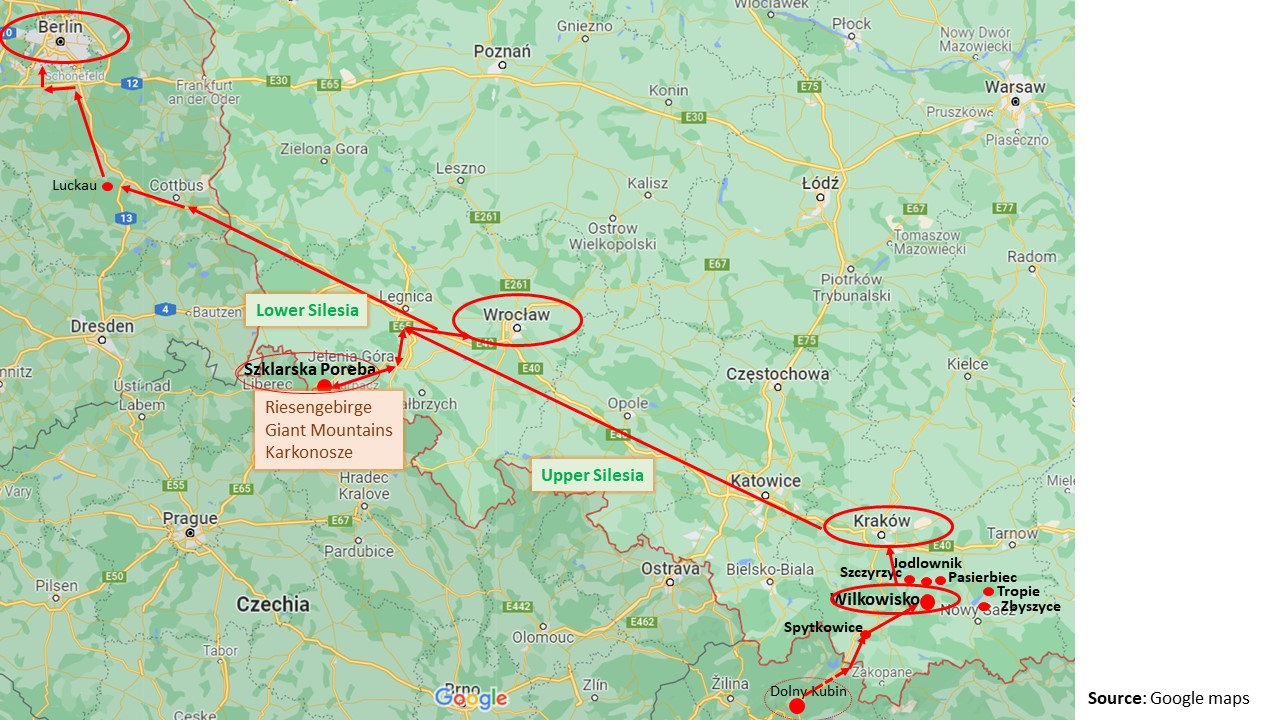
My route begins in Slovakia: Bratislava – Trnava – Nitra – Žilina – Strečno and Terchová – Dolny KubinPodbiel and Tvrdošín. It continues in Poland: WilkowiskoKraków – Szklarska Poręba – Wroclaw, and finally I am Berlin. 

Now I am at Szklarska Poręba to find out more about my grand-father, the artist.  


My motivation: Find the location of my grand-father’s painting (Hermann Radzig-Radzyk)

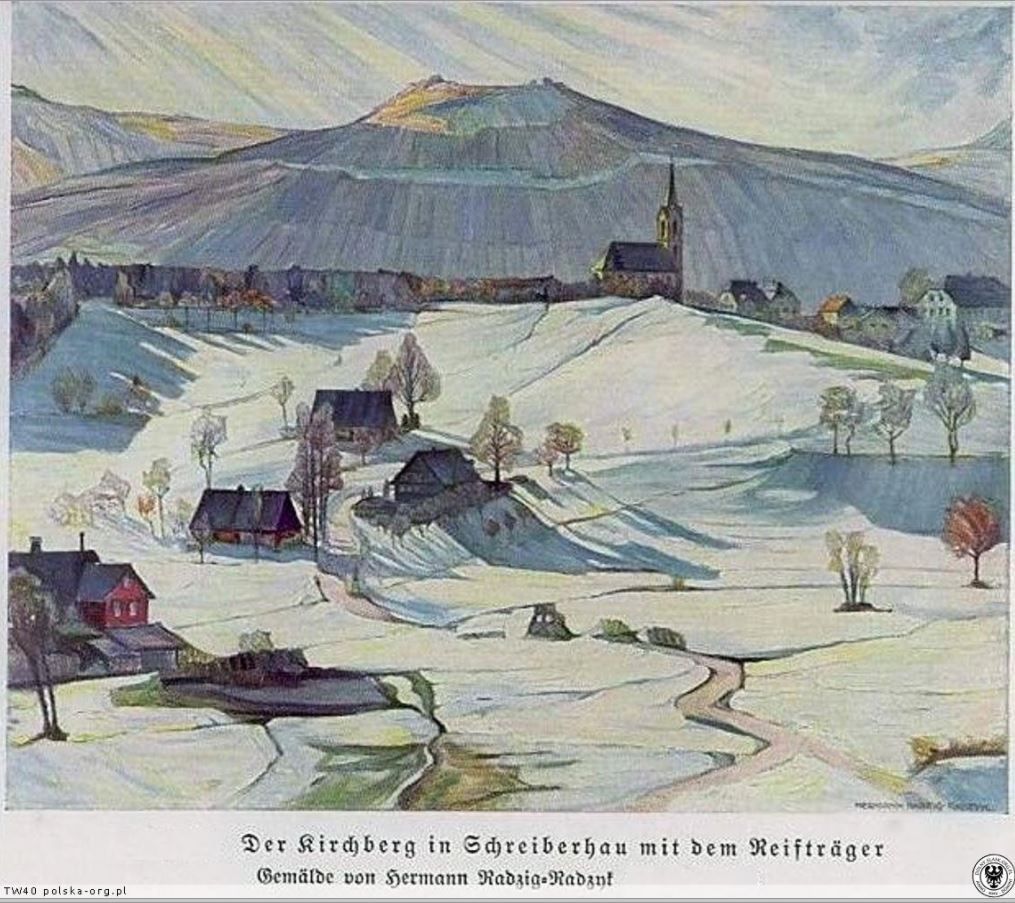
Currently, I am interested in the life of my grand-father Hermann Radzig-Radzyk who was an artist and painter. Many of his paintings decorate my house. While doing research about him, I have found more paintings that are traded in auctions, one of them being “Der Kirchberg in Schreiberhau mit dem Reifträger”. 

Source: https://polska-org.pl/7992365,foto.html 

This painting was exhibited at the art exhibition in Berlin in 1923 (see  
Grosse Berliner Kunstausstellung <1924, Berlin> [Editor]; Grosse Berliner Kunstausstellung [Editor]: Katalog: Im Landesausstellungsgebäude am Lehrter Bahnhof: [dauert vom 19. Mai bis 17. September 1923] (Berlin, 1923) (uni-heidelberg.de)

“Dr. Google” tells me that Schreiberhau is now called Szklarska Poręba, that the Reifträger is the mountain Szrenica and the church on the Kirchberg is Kościół p.w. Bożego Ciała or the Corpus Christi Church. 

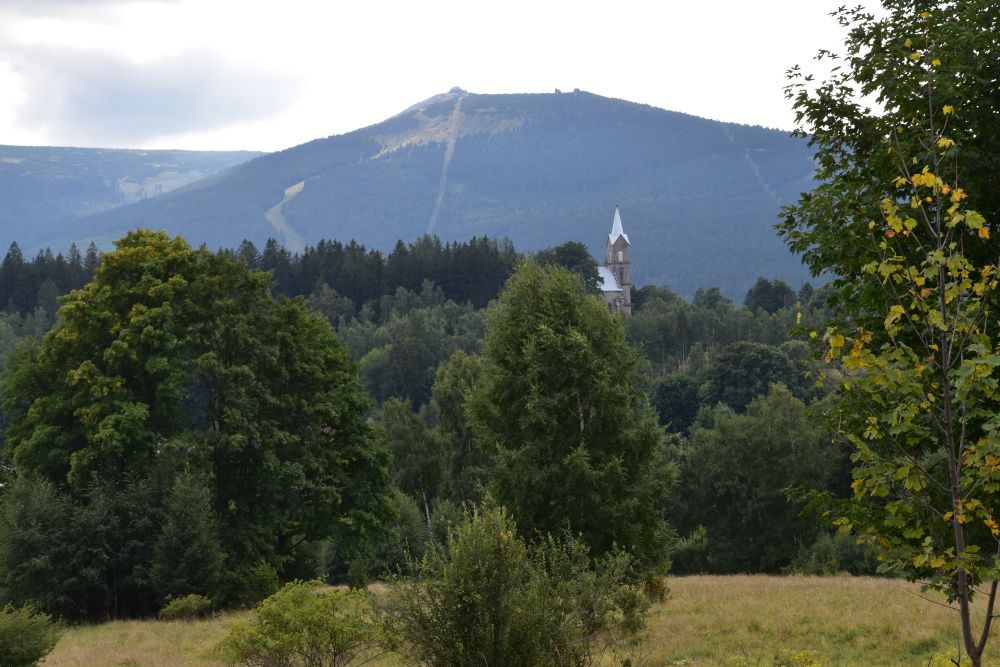
I like this painting. I drive to Szklarska Poręba to find the place, where my grand-father had painted it and I come close. 

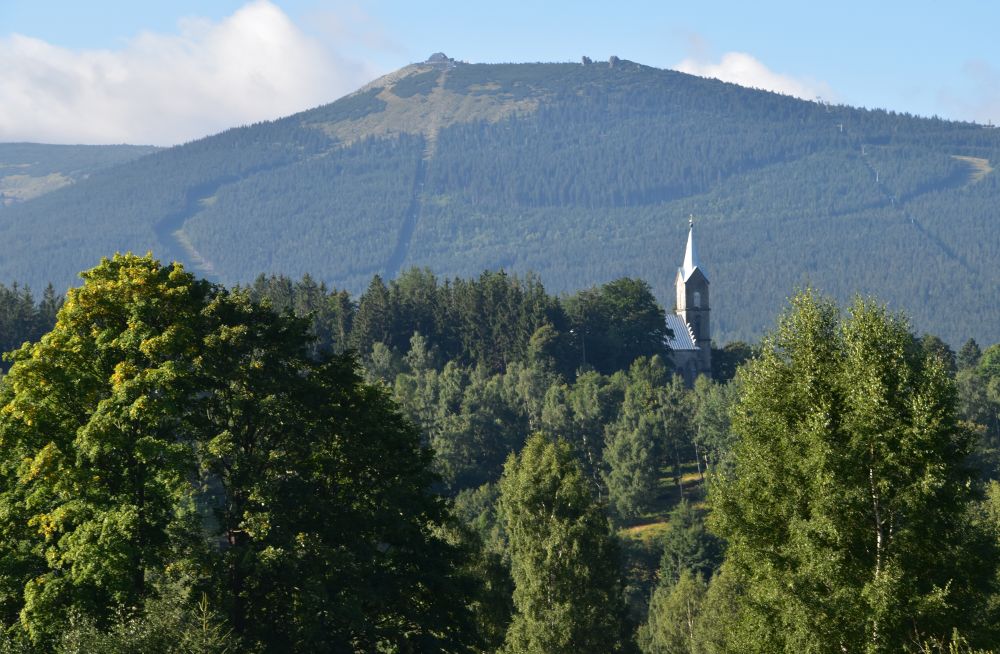
However, the landscape has changed. Much more forest here now.

I return the next morning to take a photo of the same view, but with more sun.

I assume, my grand-father stayed in a pension below the point I am standing at; I saw houses, but did not dare enter the private properties.

Close below the church, there are some buildings that did not exist, when my grand-father made his painting.

My “cousin” Dietrich (the son of my mother’s best friend) owns this painting which is a slightly different view of the Kirchberg. 

More closely to the perspective of the second painting is the following photo taken by me, when walking to Szklarska Poręba Średnia .

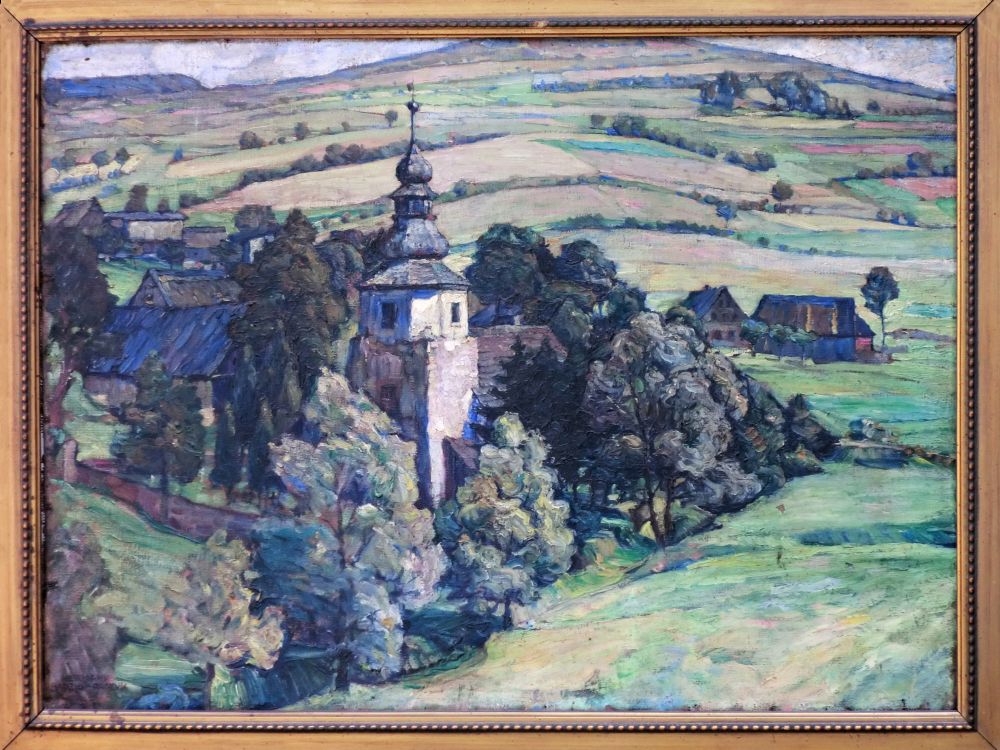
My “cousin” Dietrich knows of this painting of the mountain Szrenica (Reifträger) that is with a friend of his in Berlin. Update of February 2023: After having climbed this mountain from Karpacz (Krummhübel) in October 2022, I know that this is the Schneekoppe, today called “Snieska”. 


Approaching the church Corpus Christi, the church on the Kirchberg

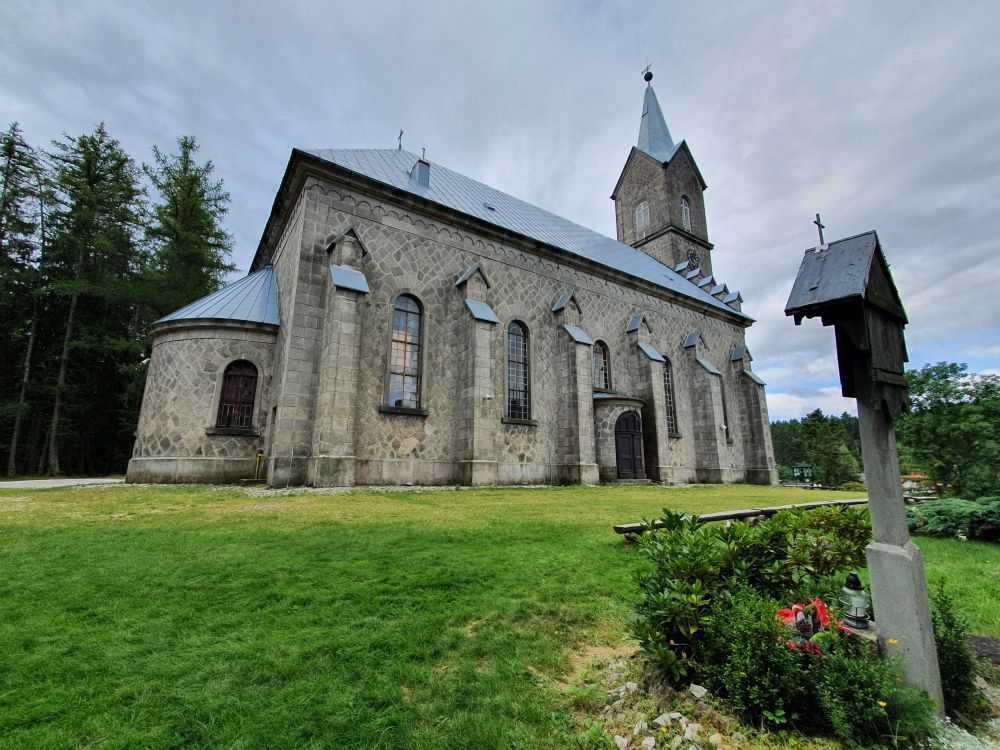
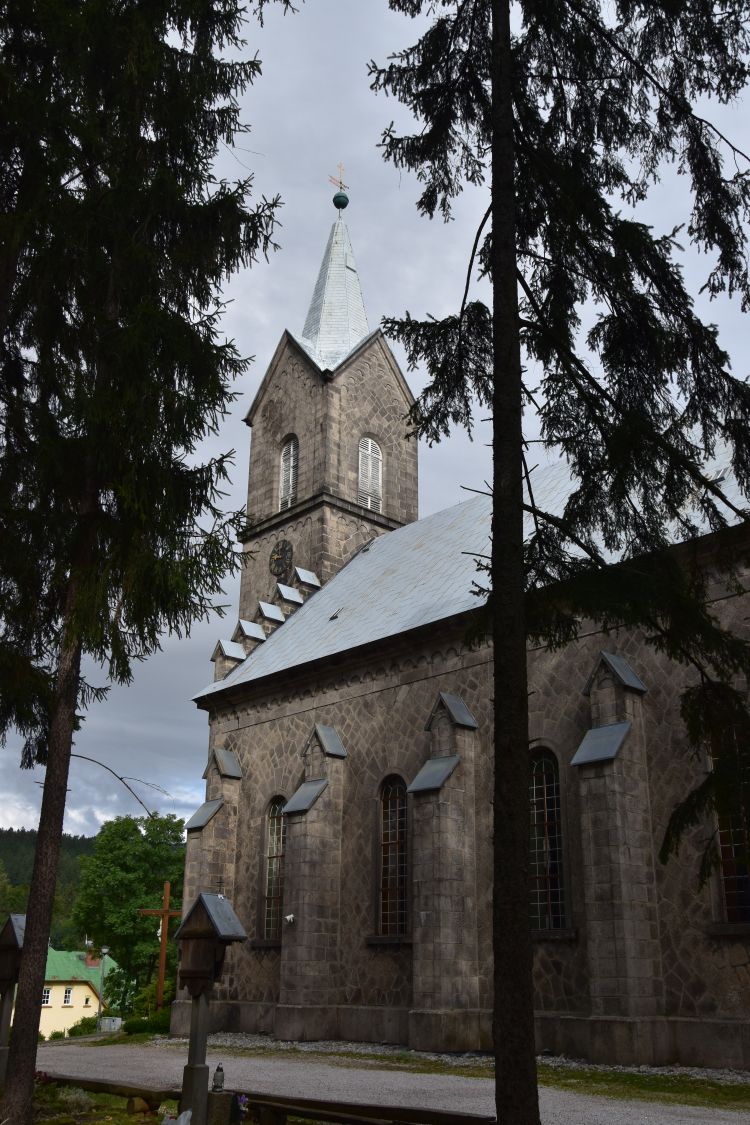
The Corpus Christi Church was built in Neo-Roman style in 1884-86. The dukes of Schreiberhau, the family Schaffgotsch, financed the church. 

I walk around the church.

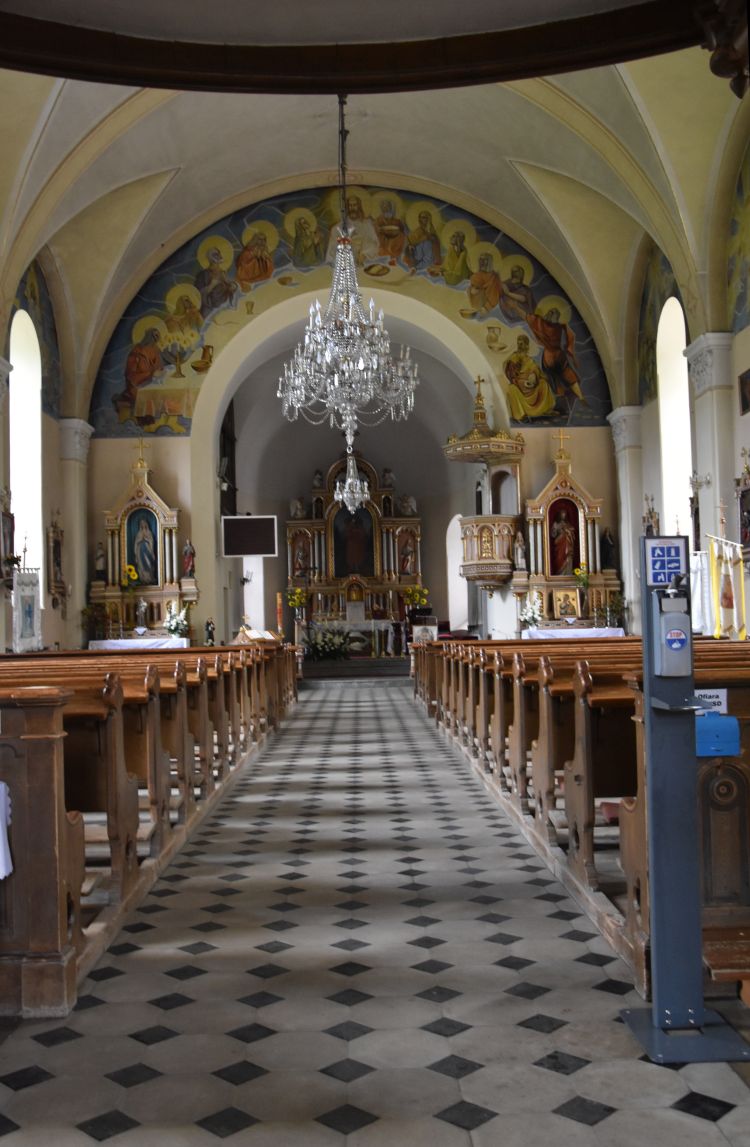
Inside are paintings by Wlastimil Hofman, a Polish painter who settled in  Szklarska Poręba after the Second World War in 1947. 

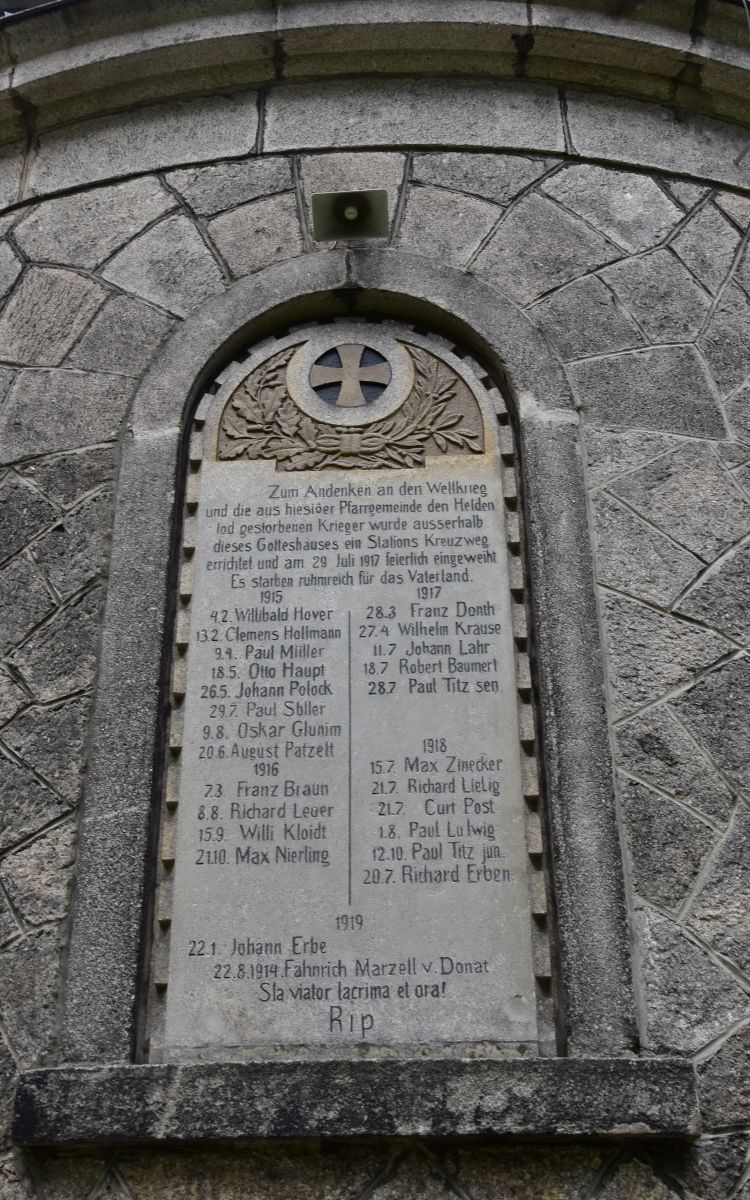
I find a tomb slab. It commemorates Germans that have died in the First World War.

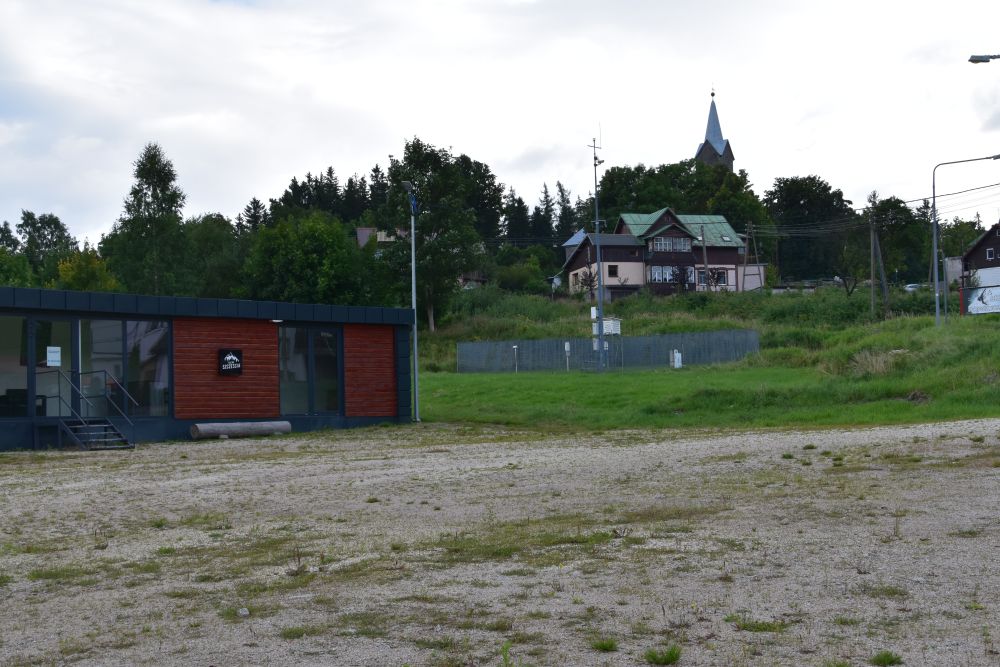
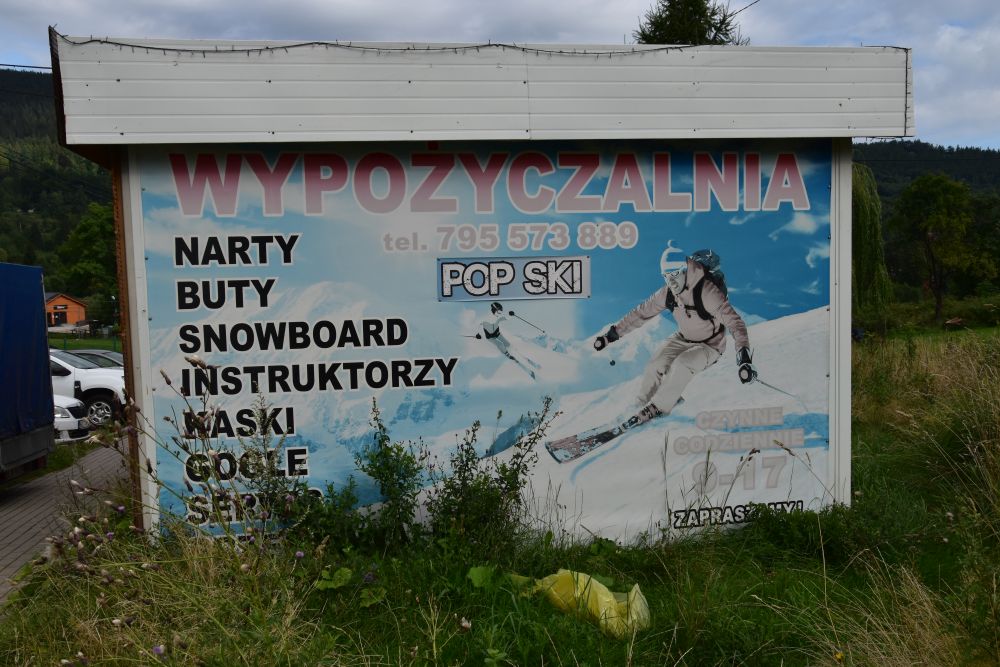
The surroundings have changed since my grand-father has made his painting. There are more trees. The shop for skiing equipment indicates sports activities in winter.

The shop for mountain biking equipment may be busy in summer. Parking is free here.

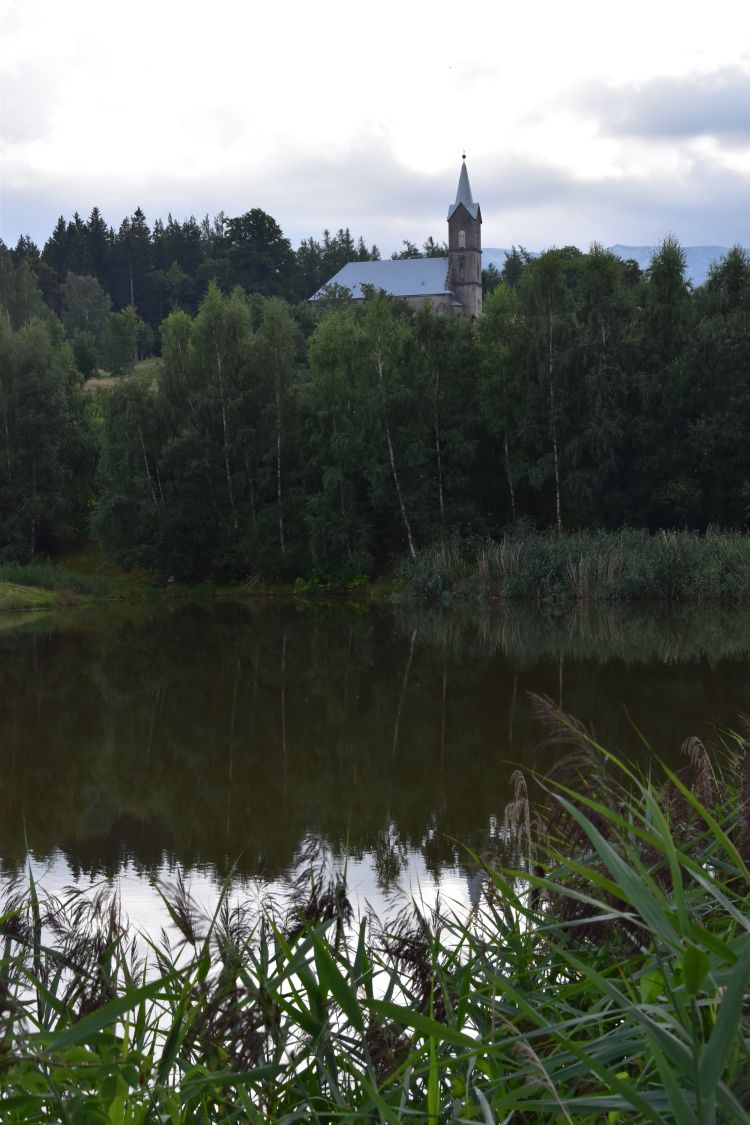
I select my own perspective to take a photo of the Church Corpus Christi; perhaps it is this pond that appears in the right hand corner of my grand-father’s painting.

One day was not enough to find out everything about the painting of my grand-father. I should return and spend several days to dig deeper. In addition, I would like to benefit from the hiking opportunities, one of them being a climb to the Reifträger or Szrenica.


Where are we geographically?

Now we are at Szklarska Poręba (in German Schreiberhau) in Silesia (in German Schlesien), close to the border between Germany, Poland and the Czech Republic. The mountains are called Giant Mountains, Riesengebirge or in Polish Karkonosze. The mountain above Szklarska Poręba, the Szrenica (in German Reifträger) is 1362m high.


Some background information about Szklarska Poręba (Schreiberhau)

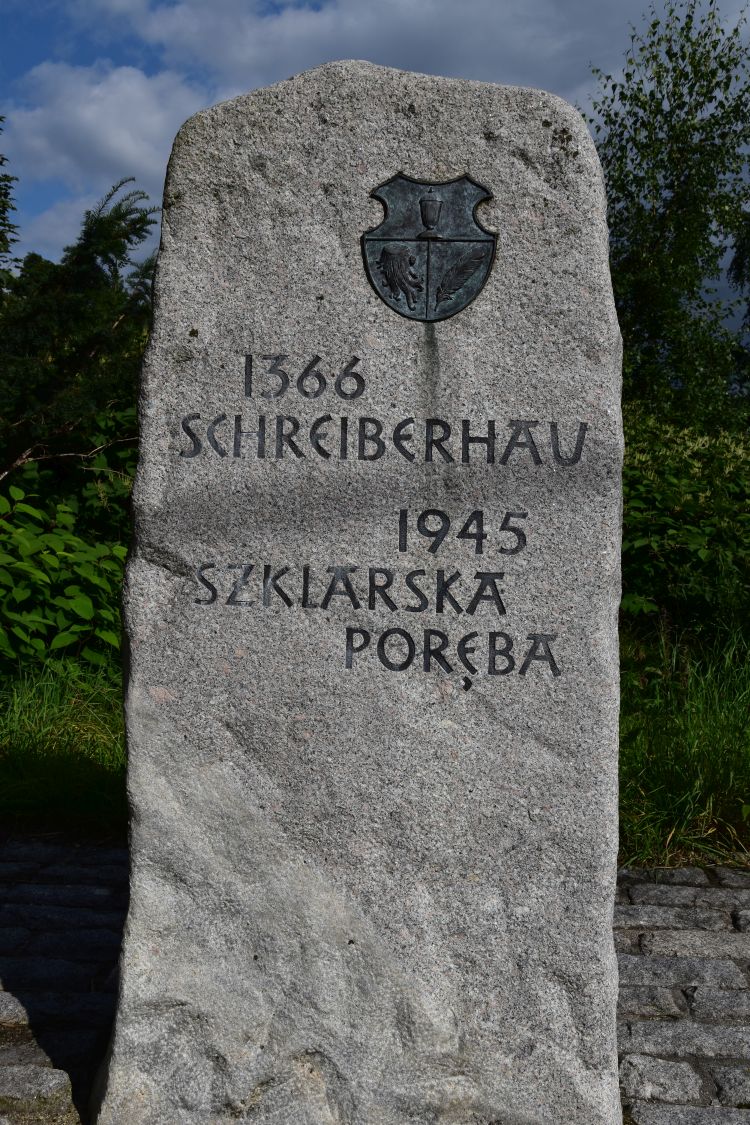
This stone indicates that Szklarska Poręba existed already in 1366. At that time, it was a settlement with the German name “Schreiberhau” (also called Schribirshau).

German colonists established Schreiberhau around the newly founded glass factory. The area was part of Bohemia (since 1335) and hence part of the Holy Roman Empire of the German Nation. The landlords here were the counts of Schaffgotsch, a family that still exists today. 

The term “hau” in “Schreiberhau”, refers to the “forest clearing” needed for the settlement and the glass factory. Why was the place not called “Glashau” to reflect the existence of the glass factory? The village chronicle (Ortschronik) of the local teacher suggests that “Schreiber” (“writer”) perhaps alludes to the man who wrote the documents required to install the factory and the settlement.

In 1617 the Preussler family took over the glass factory business and managed it until the middle of the 19th century. In 1842, Franz Pohl founded the new glass factory Josephinenhüttte; it thrived and was the largest and best-known glass factory in Silesia. 

In 1902 the railway to Schreiberhau opened. It was now easier to reach the place. It became an attractive mountain resort and a centre for artists (see below). 

In 1945, the Potsdam agreement assigned Silesia to Poland. The Poles now changed “Schreiberhau” to “Szklarska Poręba” which translates to “glass forest clearing” (the German equivalent to “Glashau”). The mountain Reifträger became the Szrenica or the “hoarfrosty” mountain (the Polish word “szron” means “hoar” or “Reif”). Most of the German inhabitants were expelled from Silesia and Poles, expelled from the east, settled instead. In 1945 Poland was literally moved to the west; it lost land to the Soviet Union in the east and gained land in the west, at the expense of Germany.

Renamed to Glashütte Julia, the Szklarska Poręba glass factory continued to operate until 2000. The family Schaffgotsch moved to Schwäbisch Gmünd. Here, the former Josephinenhütte was refounded in 1951, and it worked until 1983. 

By the way: Karkonosz in Polish translates to “Rübezahl”. He is the capricious mountain troll who lives in the Giant Mountains that the Poles now call Karkonosze. Telling stories about Rübezahl has been a tradition known since the 15/16th century. Nice, how the German past continues to live in the Polish toponyms.


How are artists and art related to Szklarska Poręba or Schreiberhau?

In the 18th century, the first artists discovered the beauty of the Riesengebirge. Carl Christoph Reinhardt (1738 – 1827), Christoph Friedrich Nathe (1753 – 1806) und Anton Balzer (1771 – 1807) were some of the names. Later, Caspar David Friedrich (1774-1840, romanticism) painted here. 

Around 1900, Szklarska Poręba became a centre for artists, among them Gerhart Hauptmann (there is a museum about him). Also around 1900, Carl Ernst Morgenstern (1847-1928), professor at the University of Breslau (1883-1913), taught pleinair painting at nearby Krummhübel (Karpacz). Some of his students later belonged to the Schreiberhau Association of Artists St. Lukas (Schreiberhauer Vereinigung bildender Künstler St. Lukas) that was founded in 1922. Their seat was the Lukasmühle at the Zackerle creek (now:  Kammiena; later, in 1930 the artists moved to the hotel “the Zackerfall”).

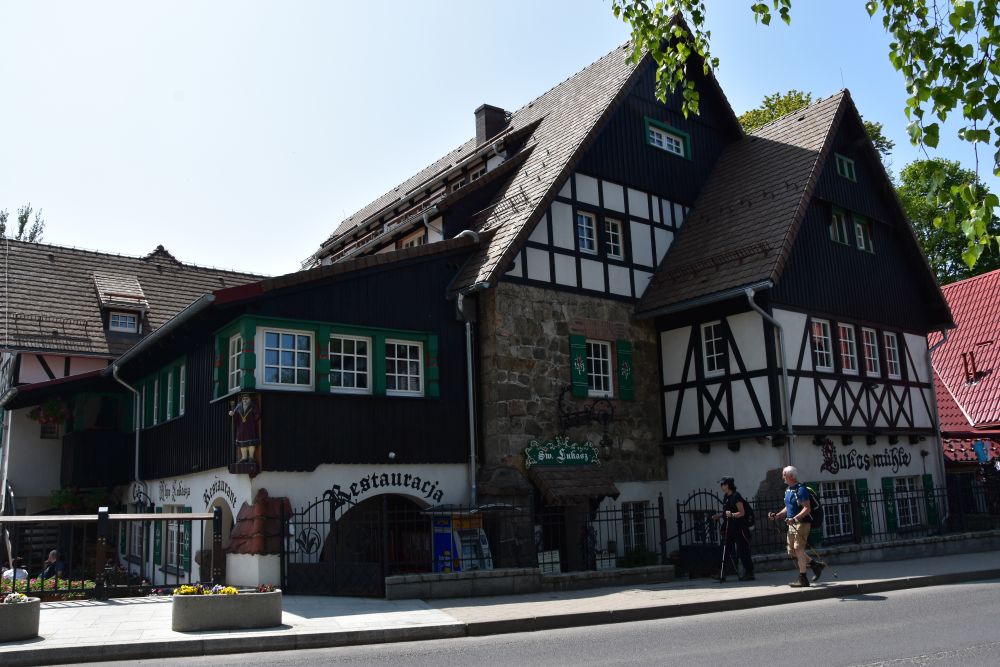
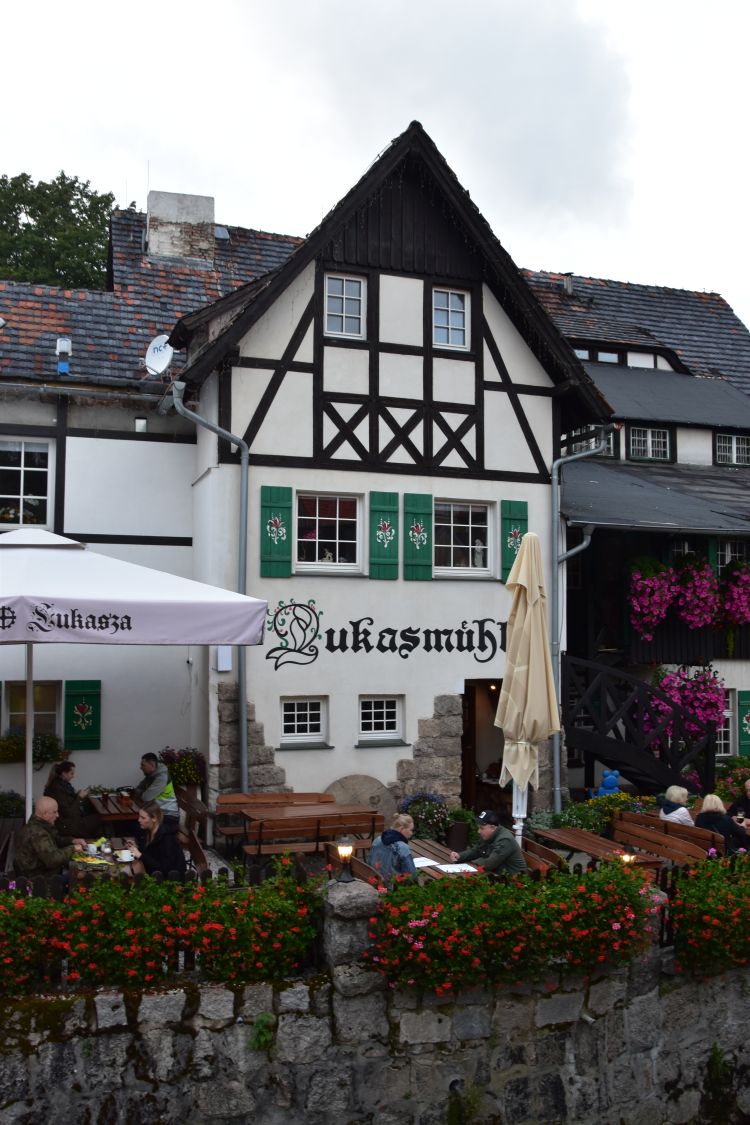
The Lukasmühle (Młyn Łukasza) is an inviting restaurant today. 

I had selected it for dinner without knowing about its history.

It could well be that my grand-father Hermann Radzig-Radzyk was a member of the Lukas association, but I cannot find any details about that in the Internet. 


Strolling around in Szklarska Poręba

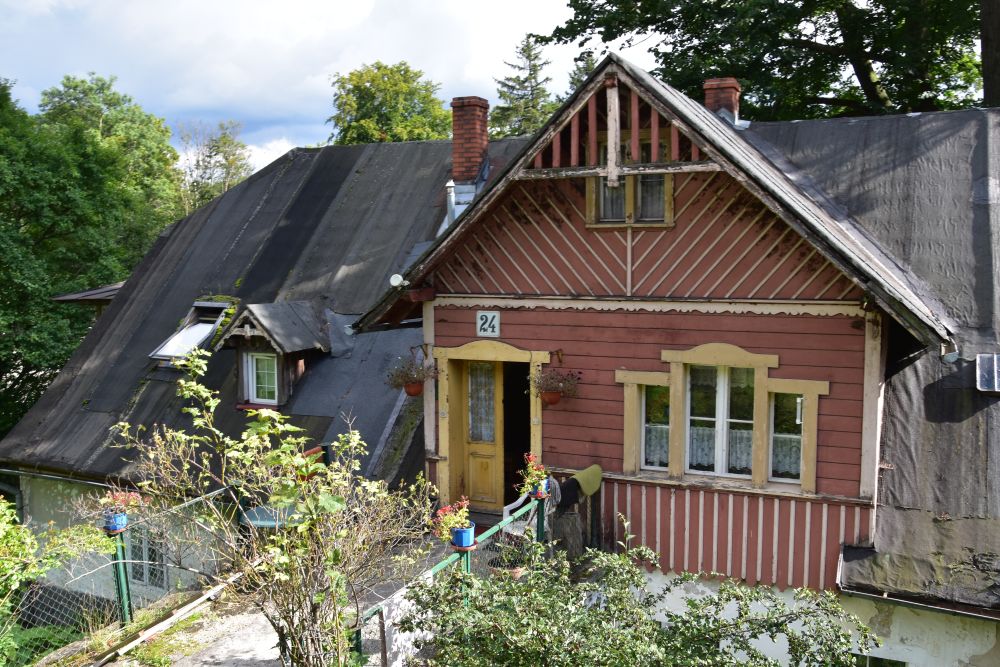
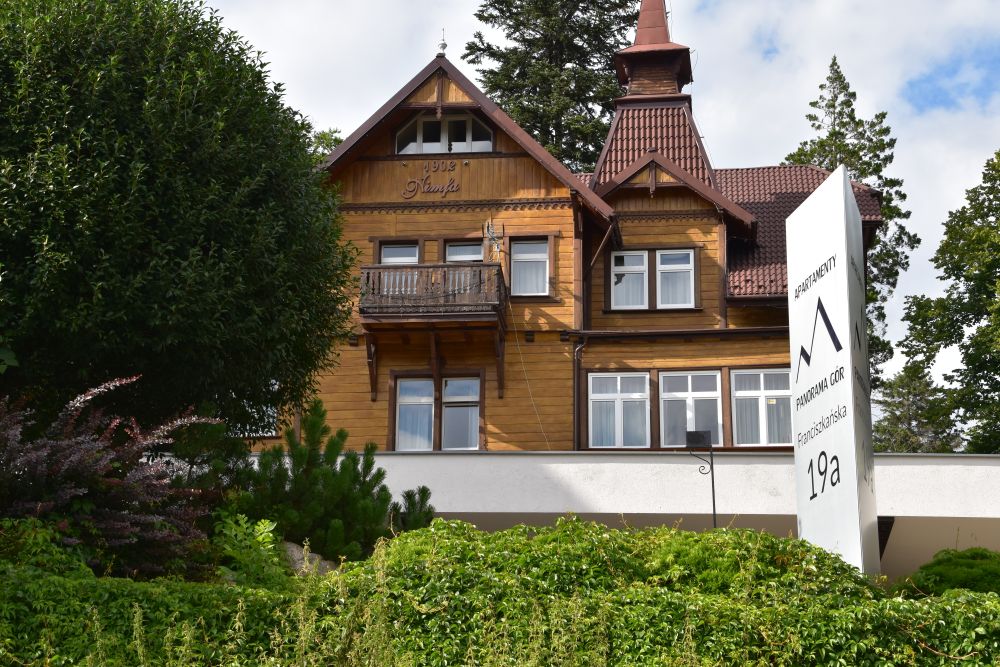
For one full day, I explore Szklarska Poręba. Here are some impressions. There are nice villas…

… and apartment houses. 

The winter must be busy here. The continental climate makes for good snow,…

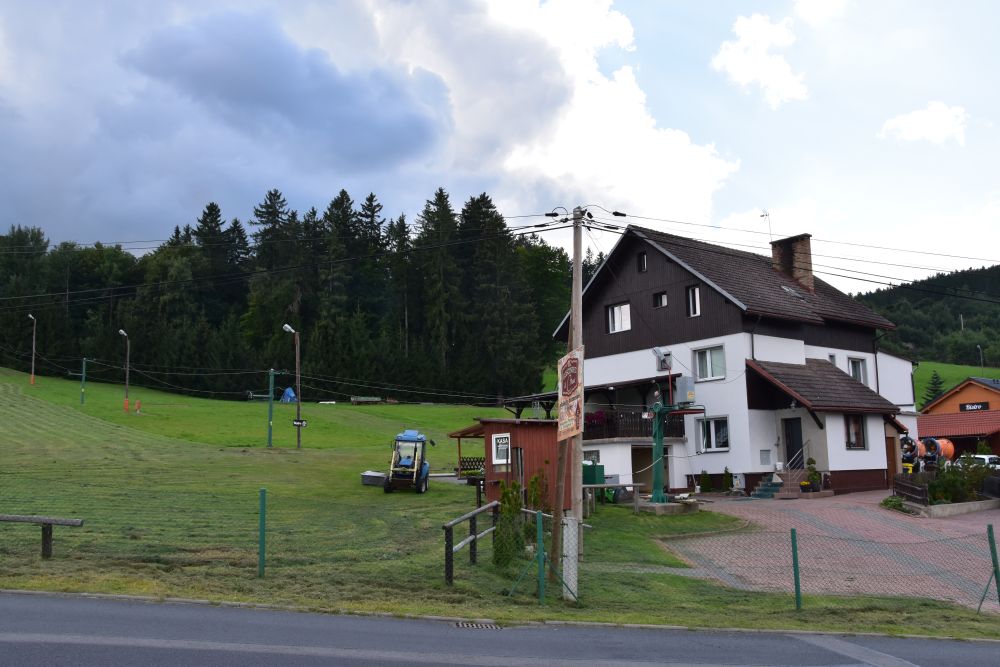
… but nevertheless snow canons hidden behind this house wait to be used in winter. 

This is a rather “flat” slope, however the Szrenica seems to offer a variety of attractive ski runs. 

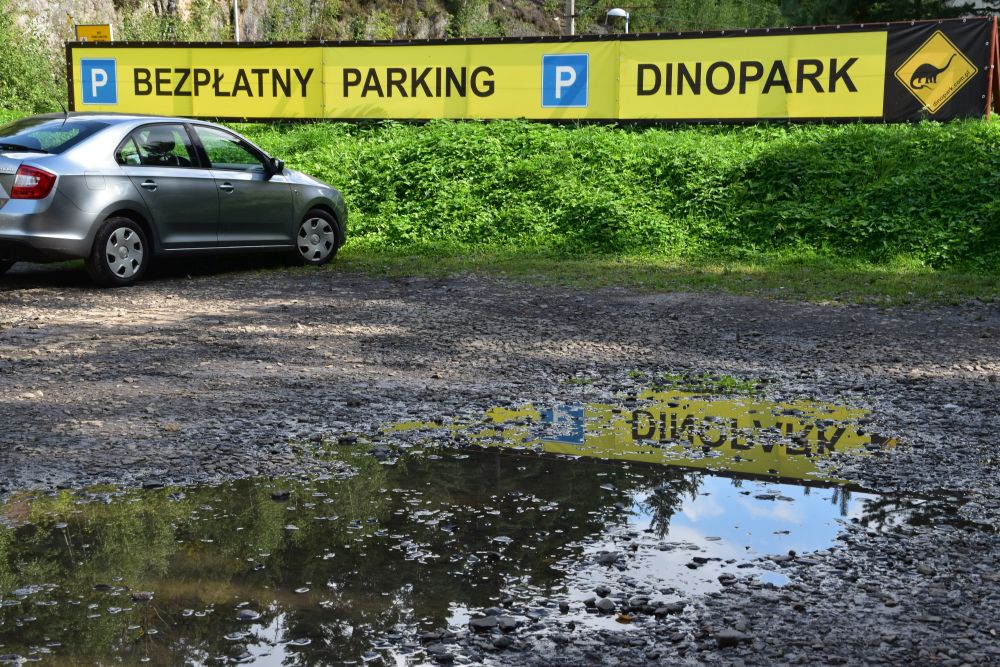
There is also a Dinopark for chlidren, with free parking (now a bit dirty…).

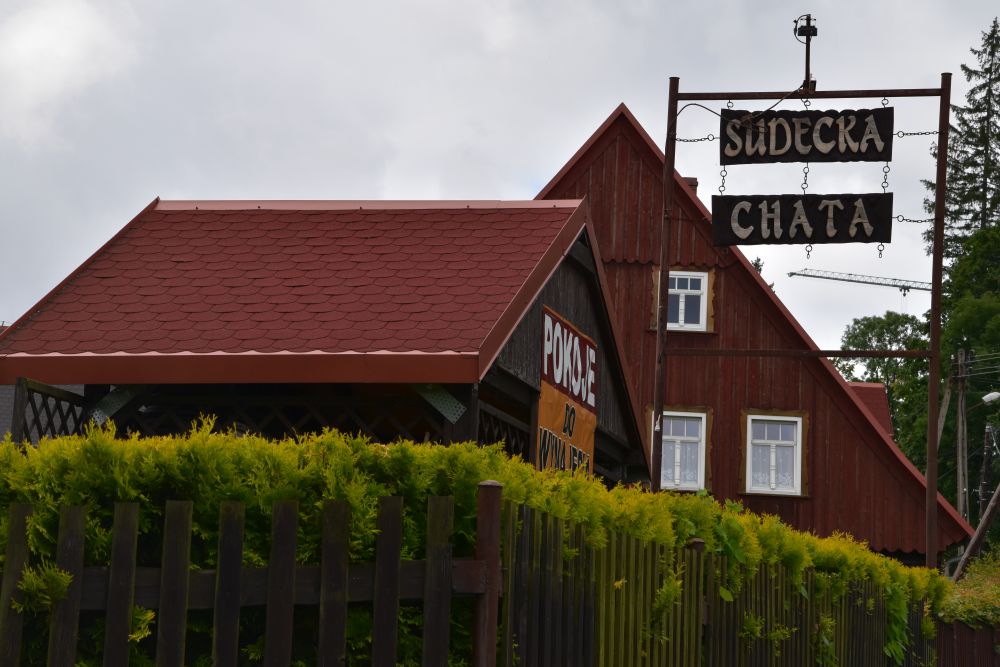
Above Szklarska Poręba Średnia I find the Sudecka Chata or Sudetenhütte. 

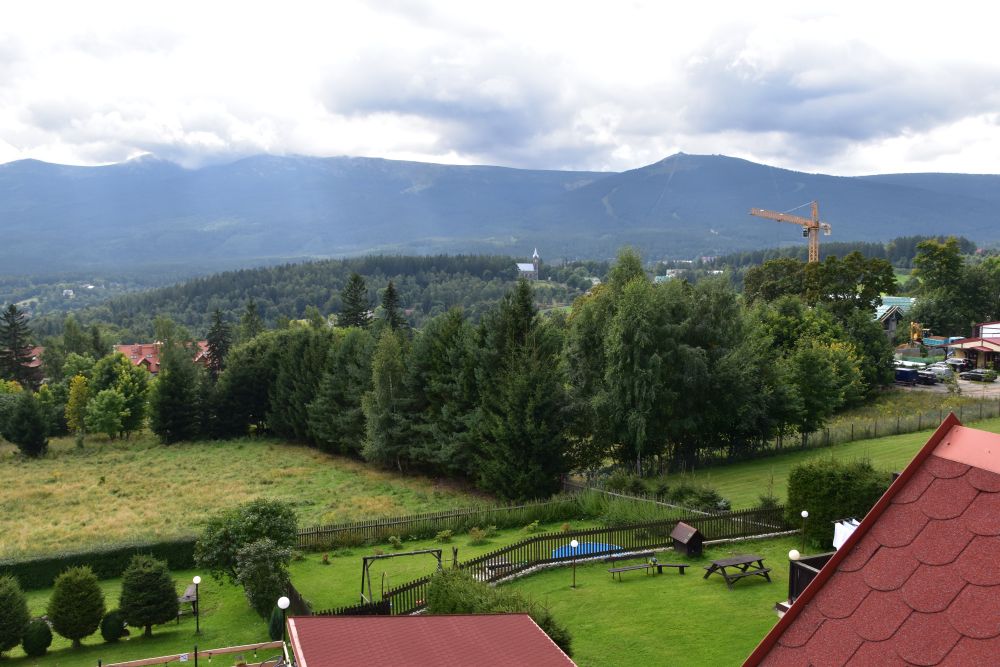
It is closed. The friendly owners prepare coffee for me. They take a vivid interest in my research and take me up to the rooms under the roof, where I have a gorgeous view of my grand-father’s church and the Szrenica or Reifträger.

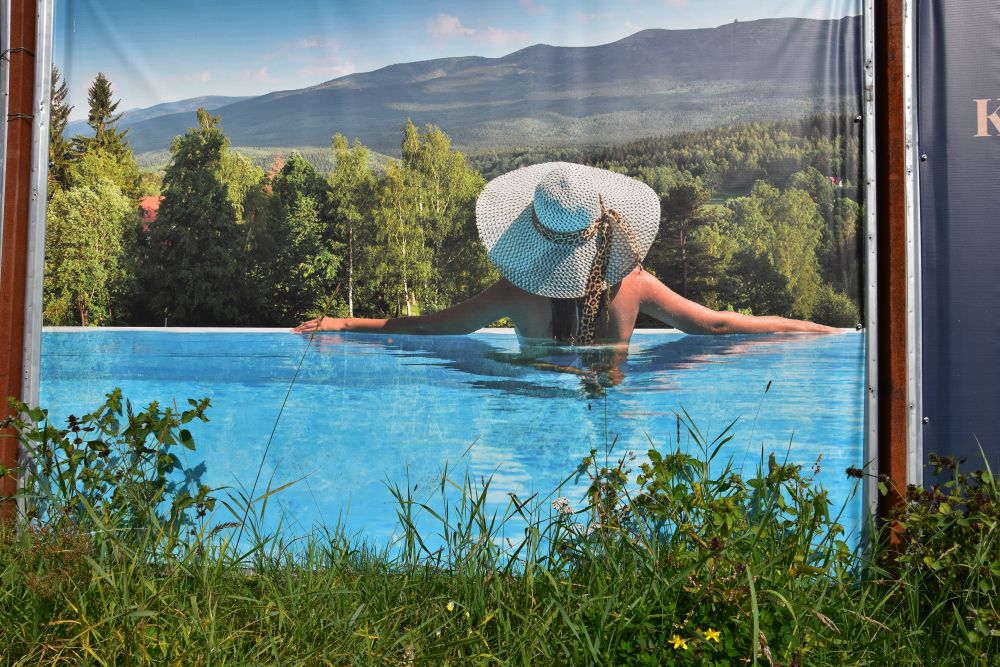
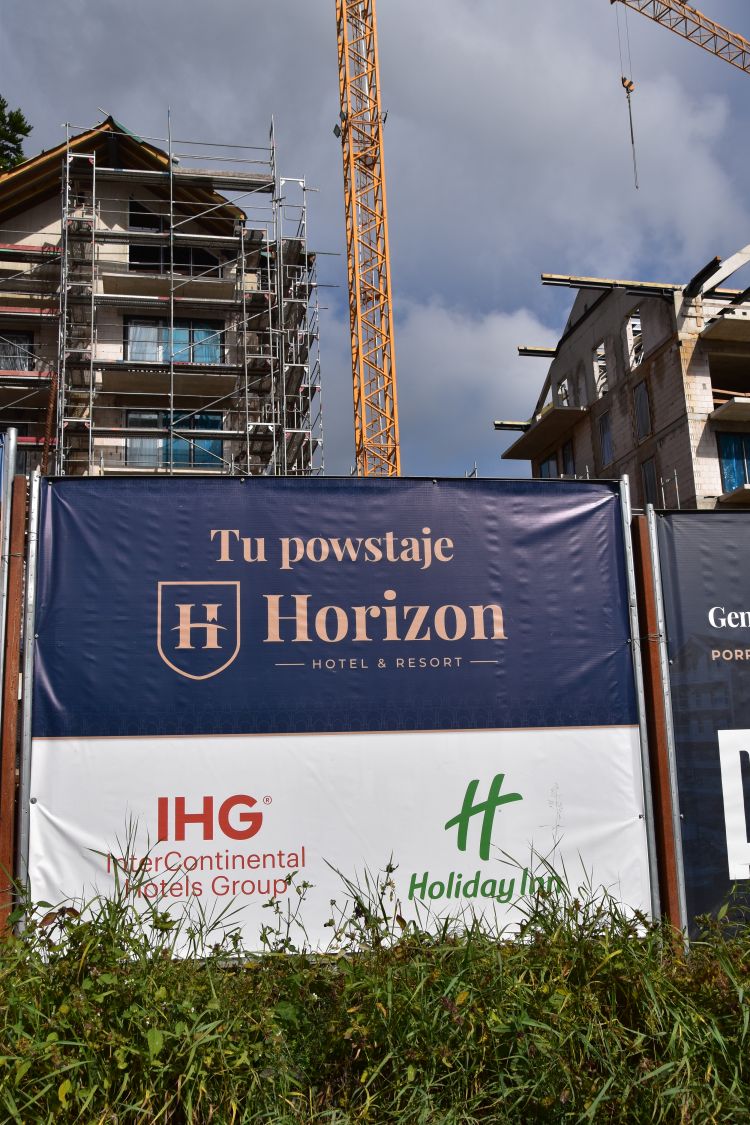
There is a crane disturbing the view: Holyday Inn builds a luxury resort. Their infinity pool is “announced” with the view from the garden of the Sudecka Chata, it seems.

This is, what is going on under the yellow crane. It seems that Holiday Inn believes in the potential of Szklarska Poręba.

At lunch time, I stop at the restaurant Płękitny Paw and have a wonderful meal in the garden, a delicious soup and excellent stuffed omelettes.


Good-bye Szklarska Poręba and Giant Mountains

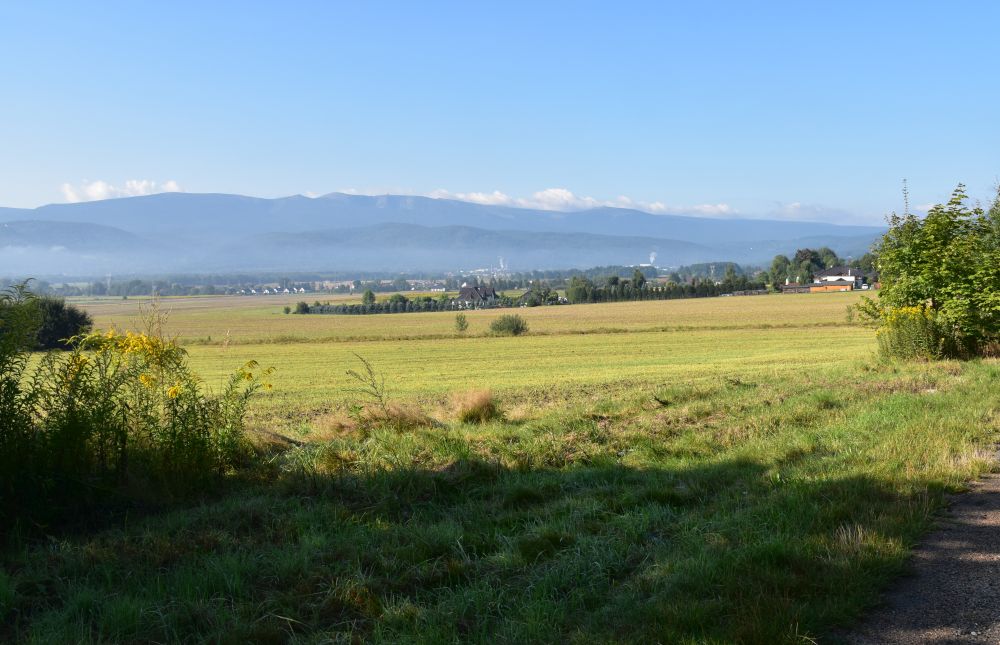
I would have liked to stay another day to hike around Szklarska Poręba, but my hotel is fully booked. I leave and look back to the Giant Mountains, where Rübezahl, the mountain troll, is up to mischief.

I may return one day for more research and for hiking.

Now, I say good-bye and drive to Wroclaw, the capital of Silesia. 


Sources:

About art and artists in Silesia and in the Giant Mountains: