Exploring Morella with Perucho in mind

In November 2018 we spend three weeks not far from Tarragona.

After having crossed the mountains of the Maestrazgo with Perucho in mind, I now continue with Morella, also with Perucho in mind. 

Let us quickly recapitulate, what happened in the Maestrazgo and in Morella in Perucho’s novel “Las historias naturales”(see separate blog): In 1840, during the first Carlist War, the protagonist, liberal Antonio de Montpalau traverses the mountains of the Maestrazgo in search of the vampire, alias El Mochuelo, alias Onofro de Dip de Pratdip. Montpalau and his followers are captured by the conservative Carlist troups and taken to Morella, where the general of the Carlists, Ramón Cabrera, has his headquarter. Cabrera had been bitten by the vampire. Later Cabrera with his troups leaves Morella for Berga, where Montpalau will help Cabrera escape from the gloomy fate of becoming a vampire.

.

Morella – this eagle’s nest could well be the castle of King Arthur

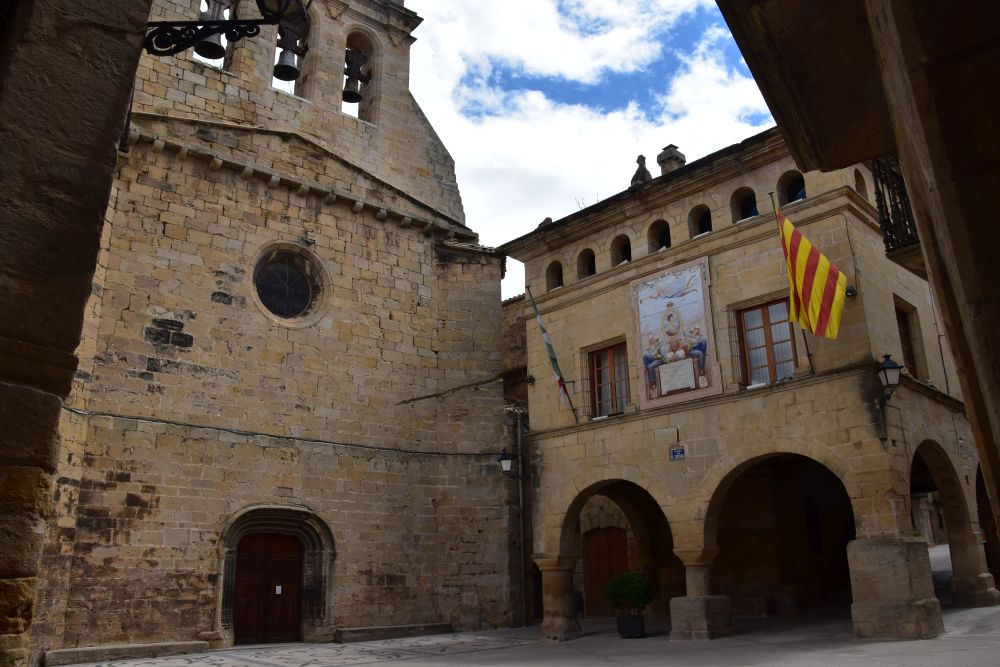
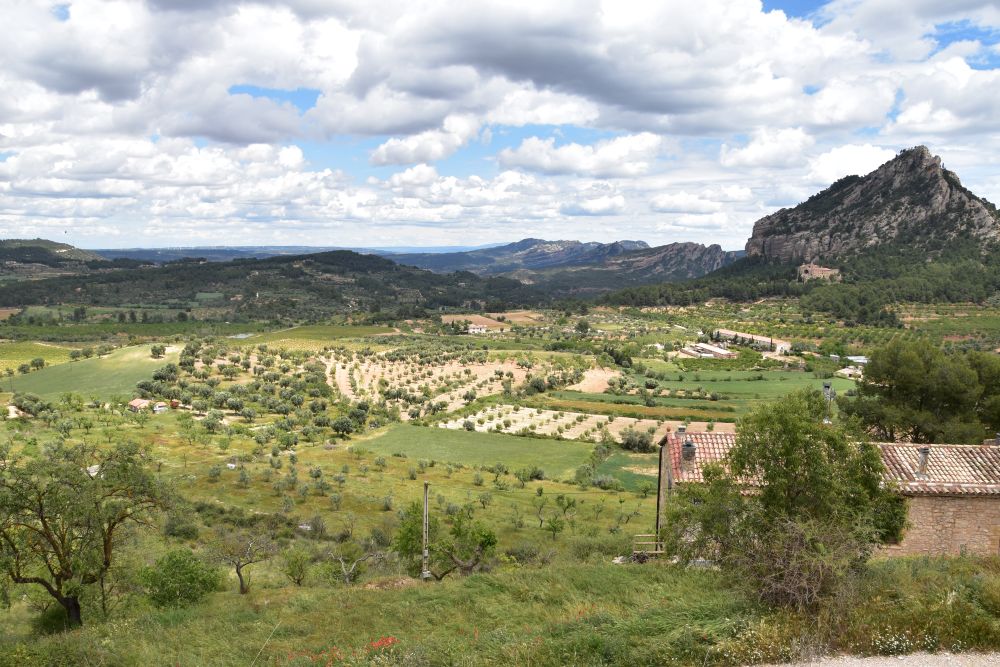
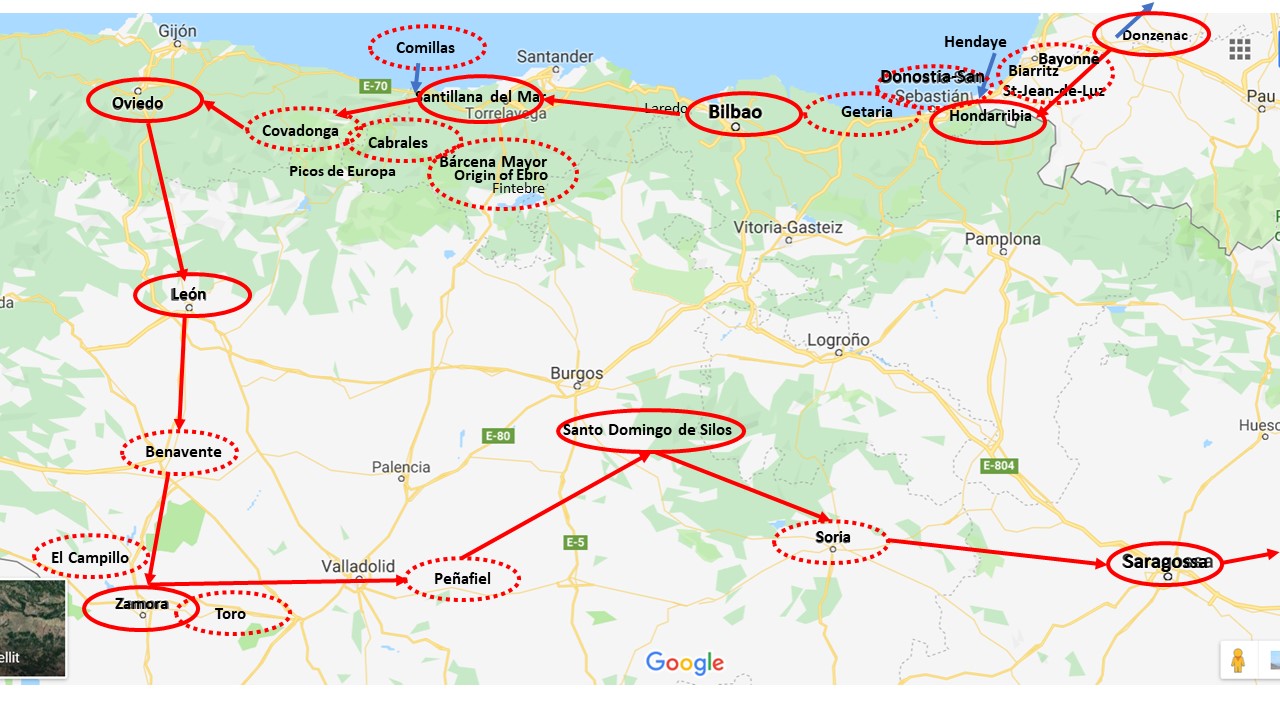
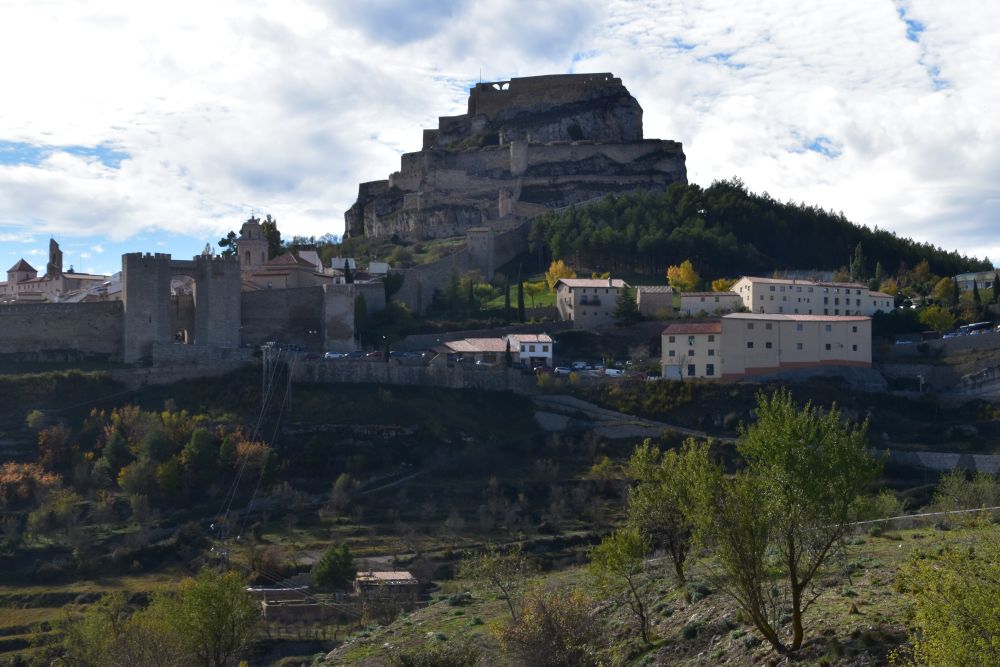
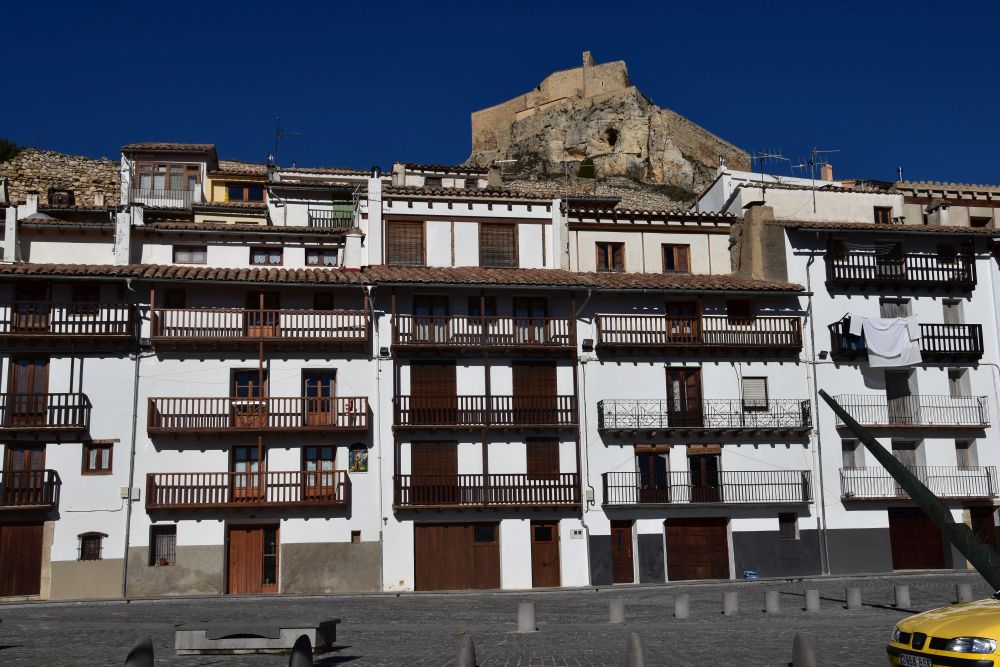
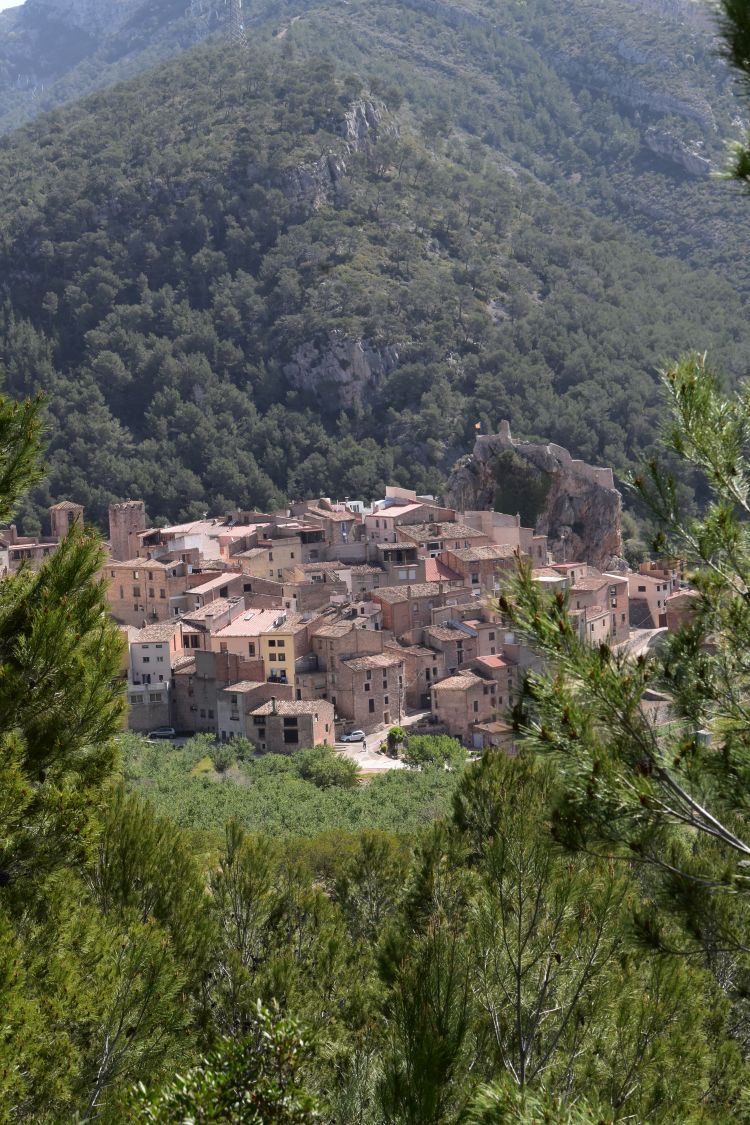
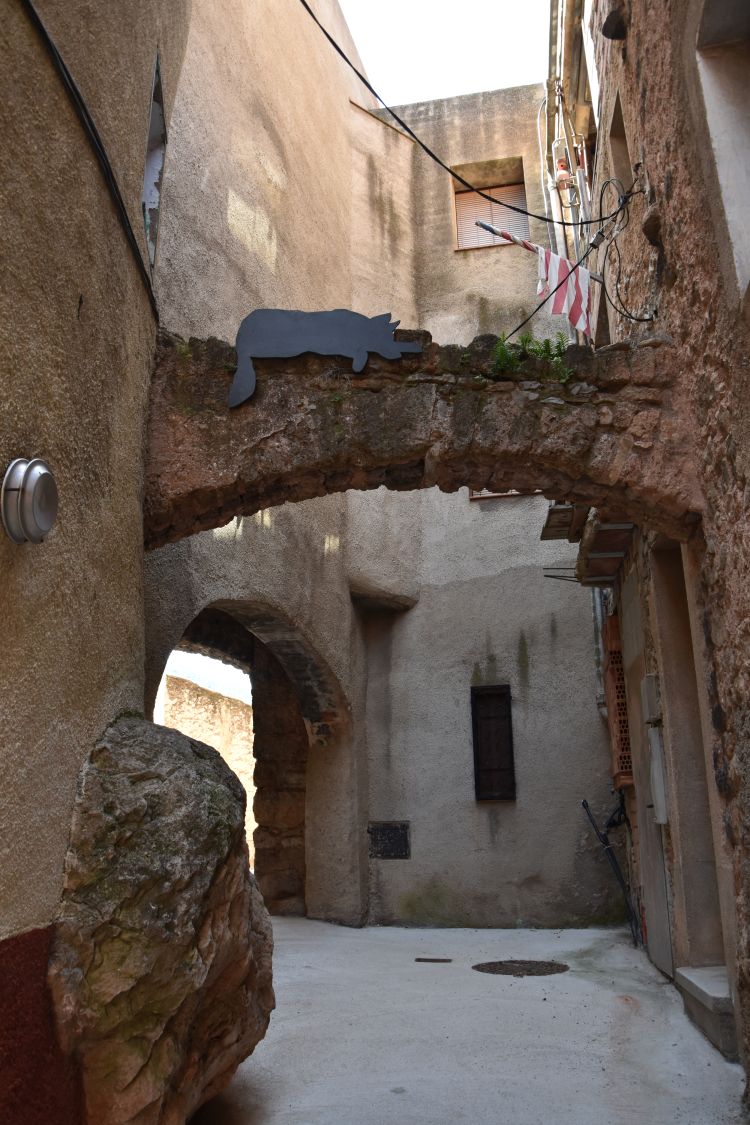
We descend from Port de Torre Miró. Approaching Morella from the north, we see the medieval city towered by the castle. Actually, the whole City, with the walls surrounding it, might be part of the castle.

It looks like the nest of an eagle, as Perucho writes: “el escarpado nido de águilas realista” (p. 172, at that time occupied by the royal (realista) Carlists). Like Perucho, I could imagine King Arthur having resided here (p.181): “Llegando por la carretera de Monroyo…, uno cree estar ante de una de aquellas ciudades del Rey Arturo y de los caballeros de la Tabla Redonda, adecuadísima para albergar el Santo Grial”. (Arriving on the road from Monroyo…, one thinks to stand in front of one of those cities of King Arthur and His Knights of the Round Table, well suited to keep the Holy Grail). Furthermore, Perucho compares Morella to Mont Saint Michel in France, just without the sea around it.
We park our car along the town wall and stroll through the narrow, cobbled streets. “Morella tiene mucho carácter,” Perucho says (p. 178, Morella has much character). It was an important city connecting the Ebro valley and the coastal planes around Valencia.

.

Strolling through the medieval city with its palaces

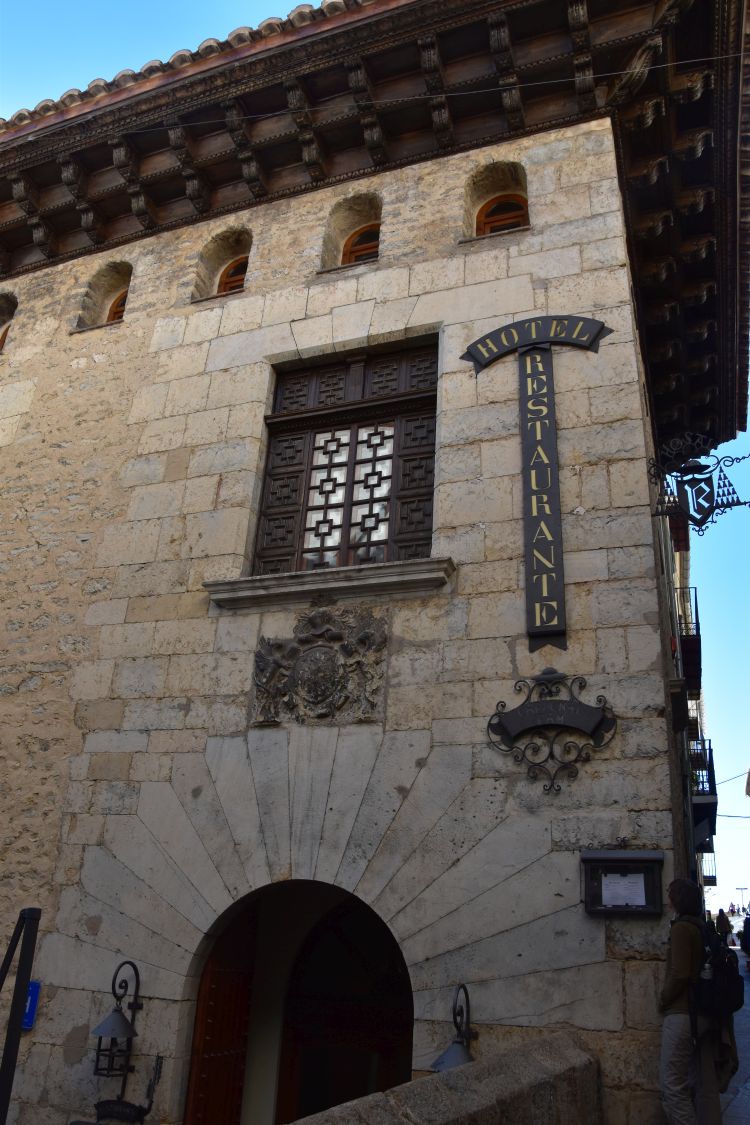
The strategic position of Morella is reflected in numerous palaces. The palace of the Cardinal Ram (built in the 15th century) is now a hotel.

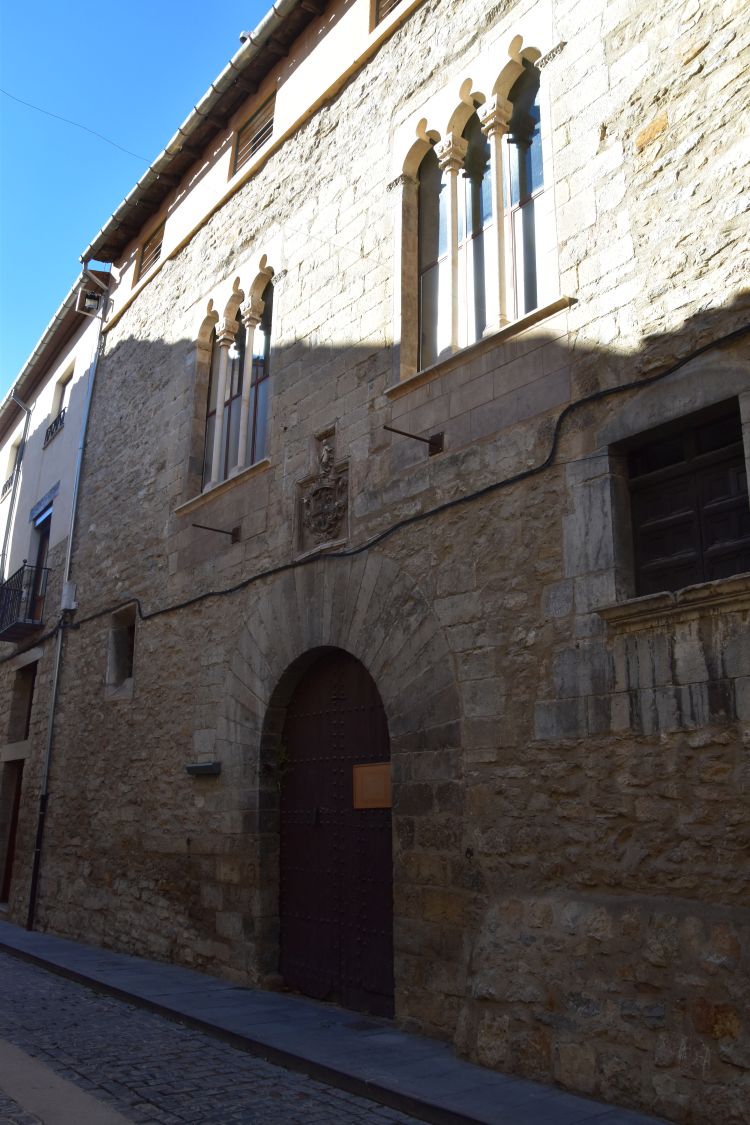
Another Gothic palace has belonged to the Marquès de Cruilles.

Next door is the Casa Rovira. In 1414, Vincent Ferrer, a famous Dominican friar and preacher from Valencia, stayed in this house on his way to meet the antipope Benedict XIII and the Spanish king Ferdinand I (Vincent wanted to convince the antipope to abdicate, in which he did not succeed). The hosts of the Casa Rovira agreed that for Vincent they would prepare a meal made out of the best they owned which was their son. When being served the meal, Vincent understood, what had happened, did not eat, but revived the son successfully – the boy now lacked only one finger, because the mother had tried the meal before serving it. Vincent Ferrer later became Sant Vincent. Legend mixed with reality, explained on these ceramic tiles.  

.

The church of Santa Maria la Mayor – also valued by Perucho

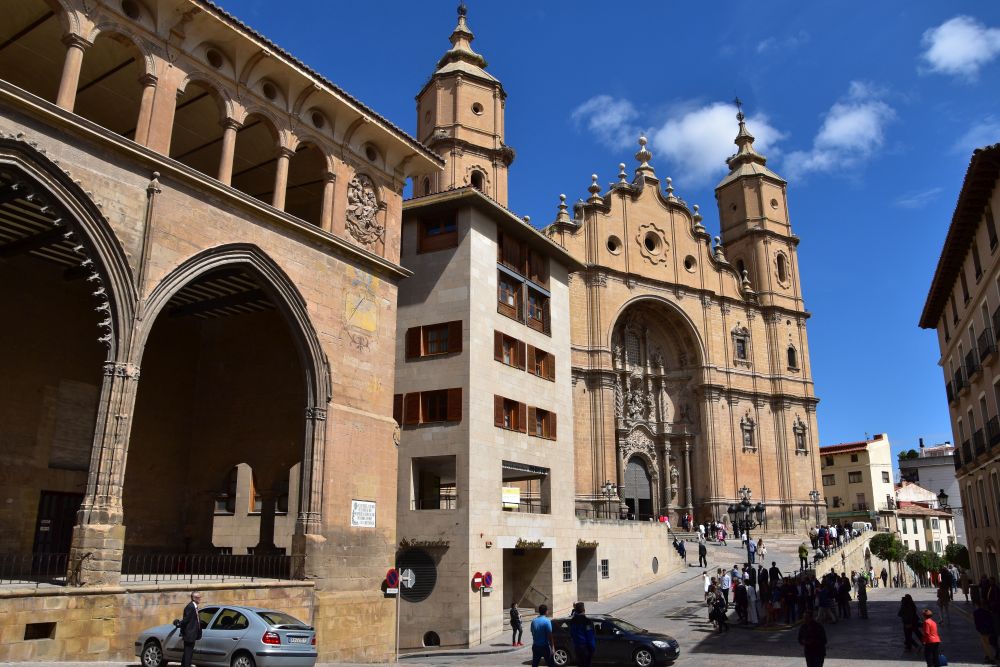
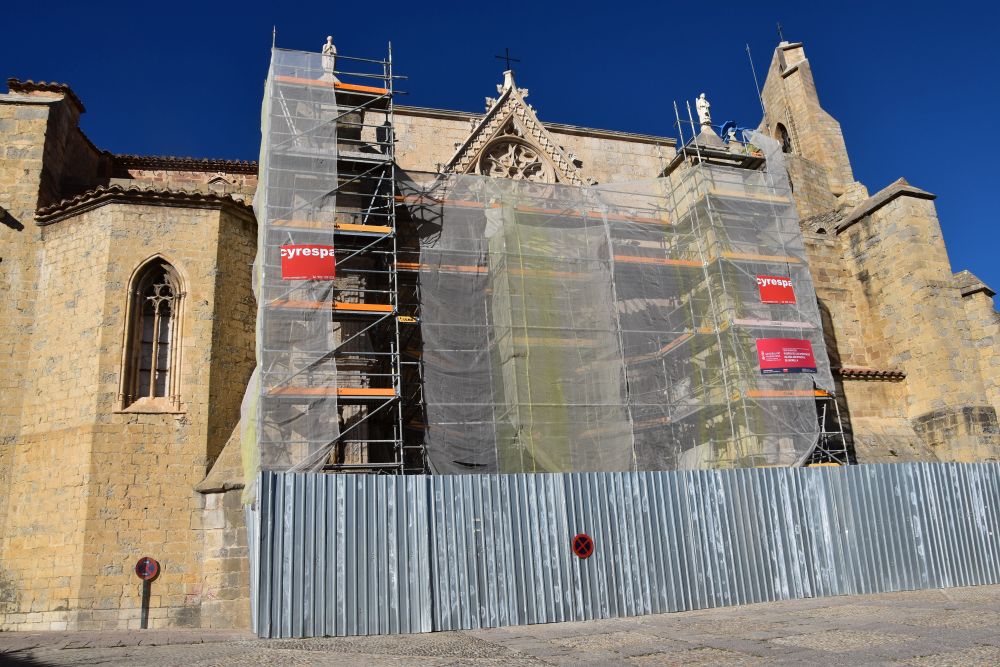
Now I look forward to seeing the famous apostle portal of the Gothic church Santa Maria La Mayor (built around 1300). Here it is, hidden because of renovation. Bad luck.

Next to it, the virgin’s gate is still waiting for renovation.

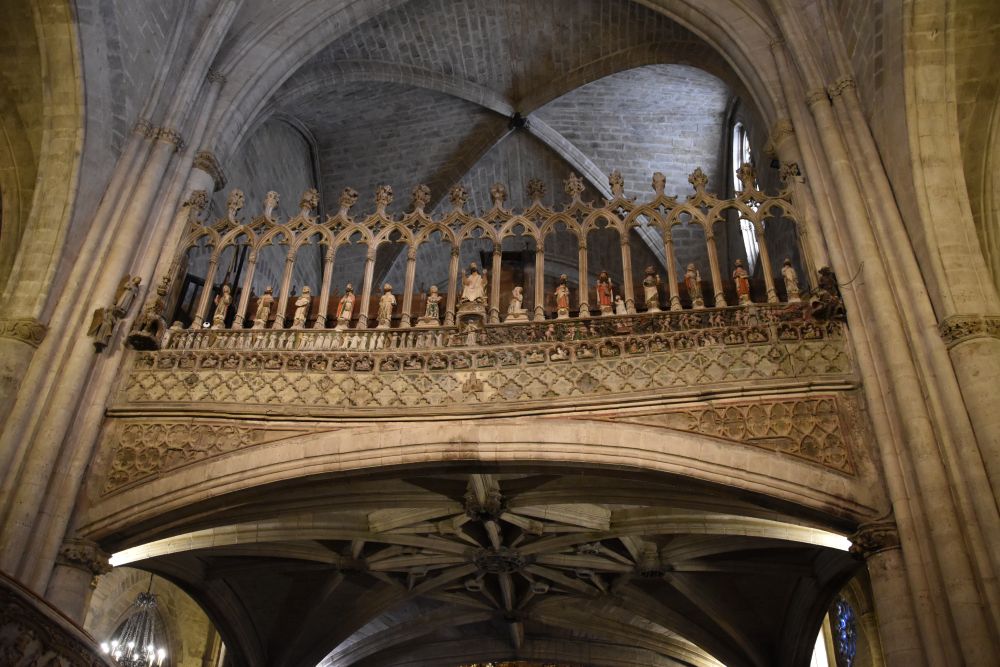
Perucho’s description of this church is very much to the point (p. 182): “La cathedral es una joya de piedra profusamente esculpida y con un coro construido de manera ingeniosa, en medio de la nave” (the cathedral is a jewel made out of stone lavishly sculptured and with a choir constructed in an ingenious manner, in the middle of the nave).

This is the ingeniously constructed choir elevated in the middle of the nave and decorated with the representation of the Last Judgment. 

Spiral stairs with magnificent sculptures explaining the life of Jesus are leading up to the Choir.

.

The Convento San Francesco with its Danse Macabre

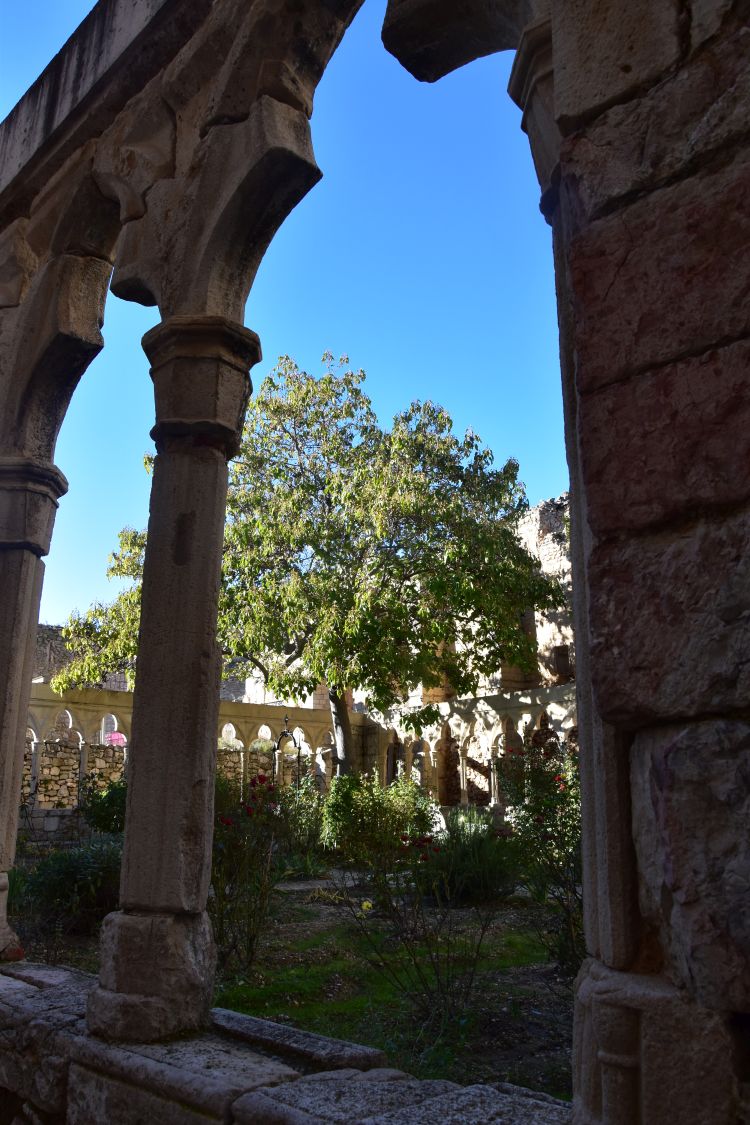
Above the cathedral we buy tickets for the Convento de San Francesc, now in ruins. This is the Gothic cloister.

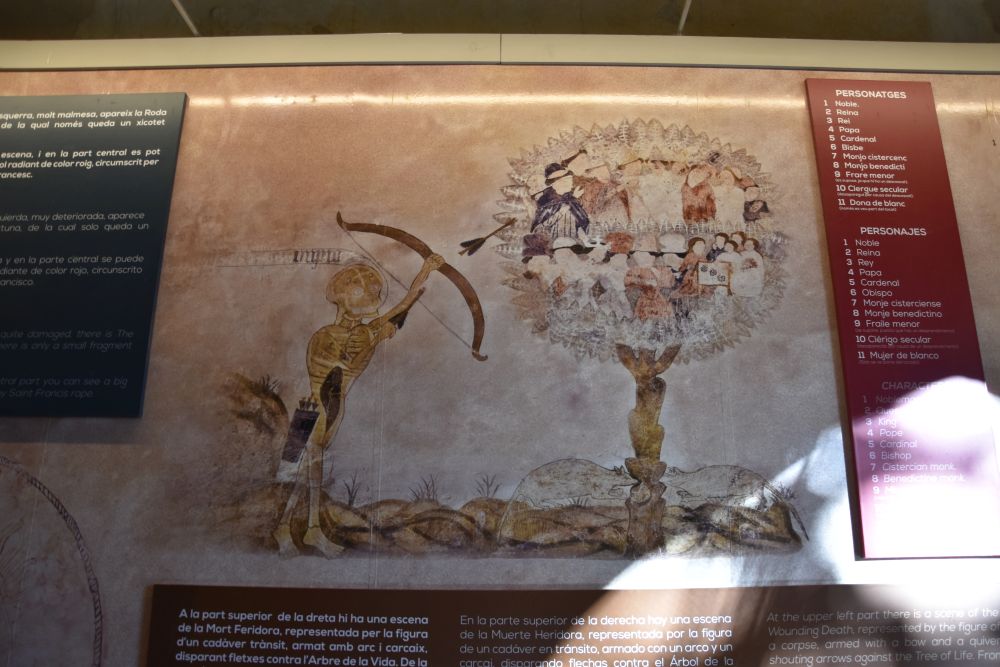
We admire the Danse Macabre. Every one will be the victim of godfather death – and they are all sitting on this tree. 

.

Climbing up to the castle with Cabrera in mind

High above the Convento San Francesc is the castle. The access is in the cloister. This is the castle seen through one of the arches of the cloister.

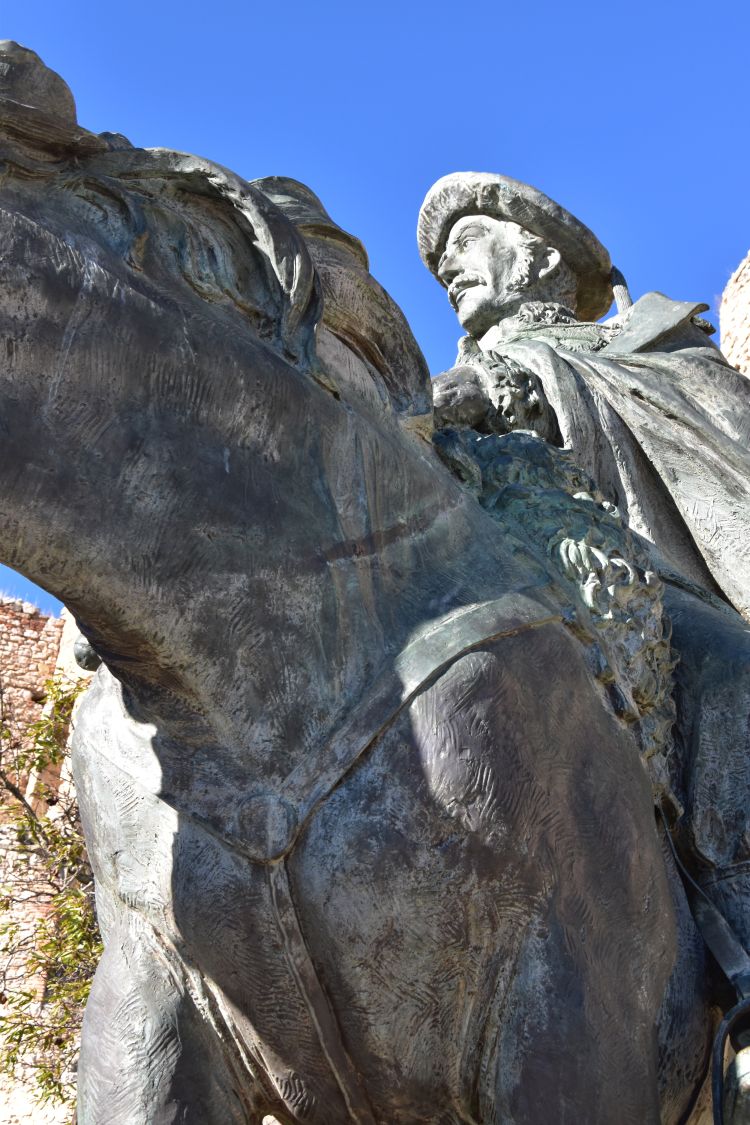
“Who is this man?” a family father asks, “ah, hm, Ramón Cabrera, okay”, and he makes selfies of Cabrera with his children and his wife. Yes, Ramón Cabrera, the Carlist leader, has the honour to greet visitors of the castle still today. The castle was his headquarter in the First Carlist War. Cabrera had the title “Count of Morella” and his surname was “the Tiger of the Maestrazgo”.

Walking up to the castle I notice that there is no direct way up. I have to go around the rock, until I reach these steep stairs with high steps. A young man approaching the top of these stairs sighs “Madre!” Come on, you are much younger than I am…

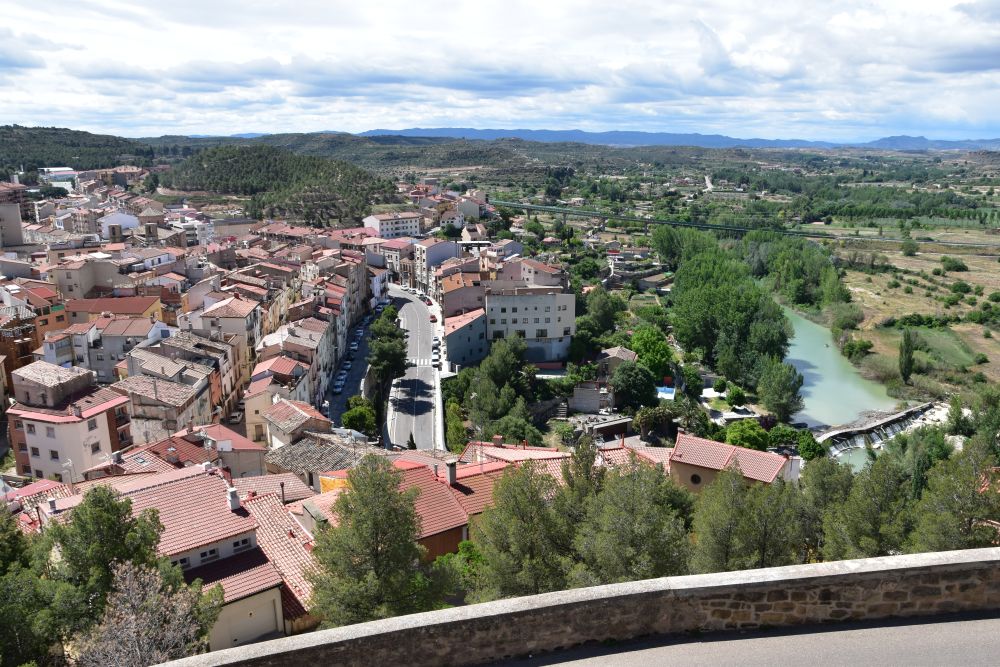
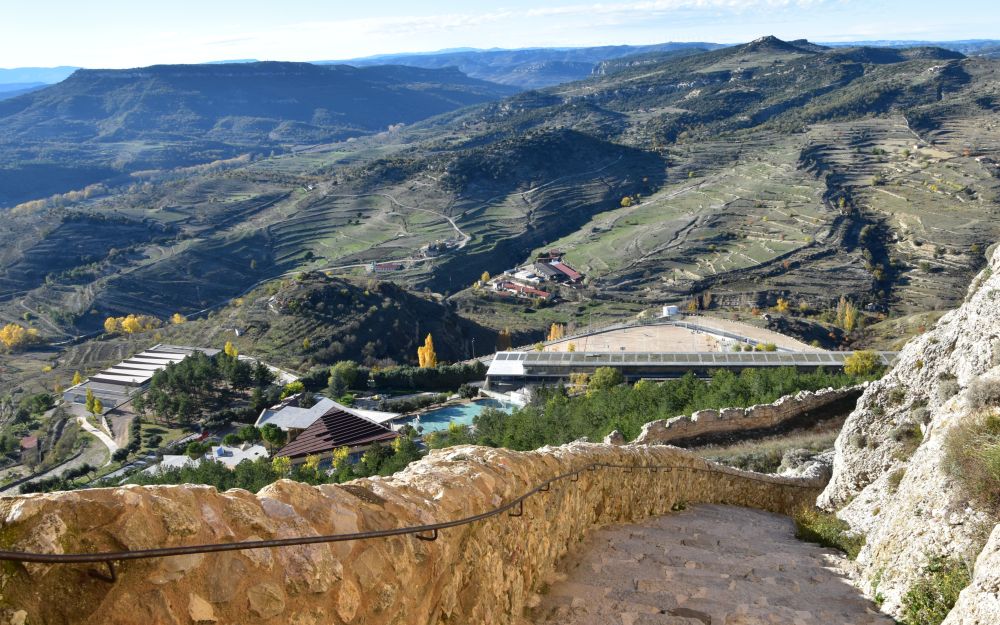
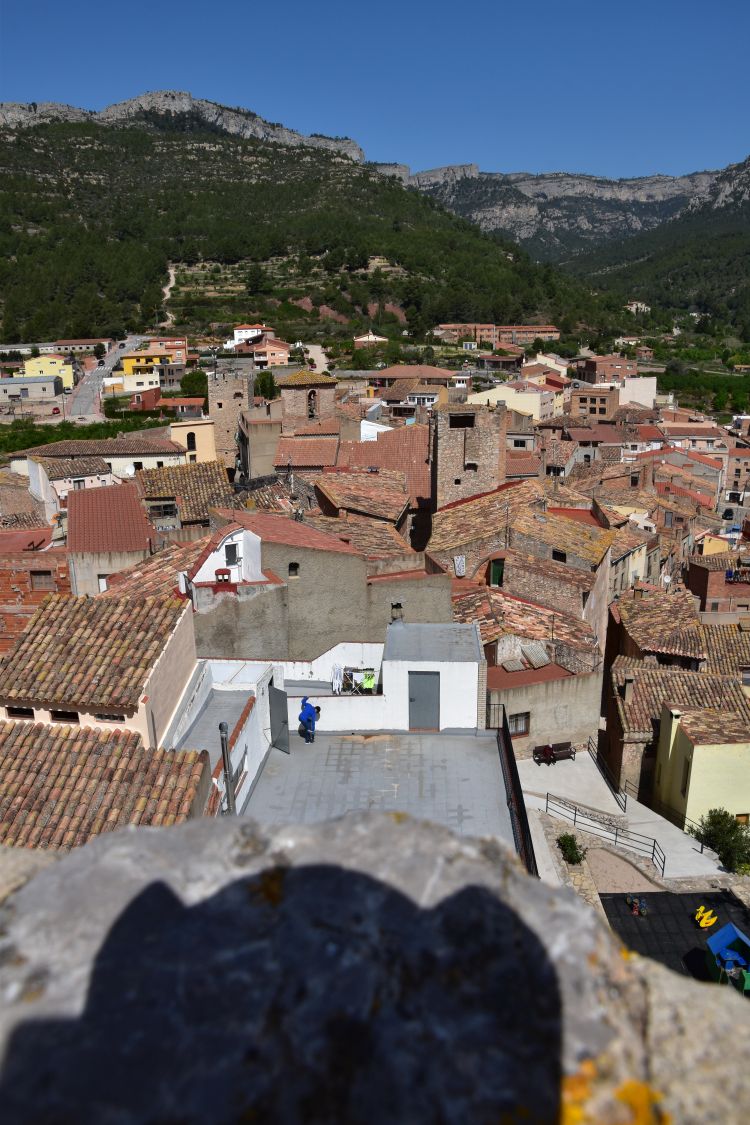
From the top of the castle I enjoy the gorgeous view. It is almost impossible to approach Morella without being noticed from here. And with the clever system of defensive walls protecting the castle on top of the steep rock, it seems almost unconquerable.

I can well imagine, how Cabrera and Montpalau sat on one of the terraces of the castle and had a coffee, with the magic view of the stone city at their feet: “Una tarde, mientras tomaban un café en una de las terrazas del castillo, con el mágico visto de la ciudad de piedras a sus pies, …” (p. 183).

Not much later after that coffee break, Cabrera left Morella with most of his troops to retreat north to Berga. They did so early in the morning. It was very cold then and they intended to reach the warmer Ebro valley as quickly as possible. “Cabrera y el ejército emprendieron la marcha al rayar el alba. Hacía un frío que pelaba, y la tropa… llevaba tapabocas. El Maestrazgo era una región terrible y necesitaban llegar a la cálida ribereña lo más pronto posible.” (p. 190). My guidebook says that temperatures in winter can feel as low as minus 20 degrees centogrades, as wind and frost are cumulating.

Soon after Cabrera had left Morella, Baldomero Espartero (who fought for the cause of Queen Isabel II) conquered the castle and elevated the conservative flag of the Queen on the castle.

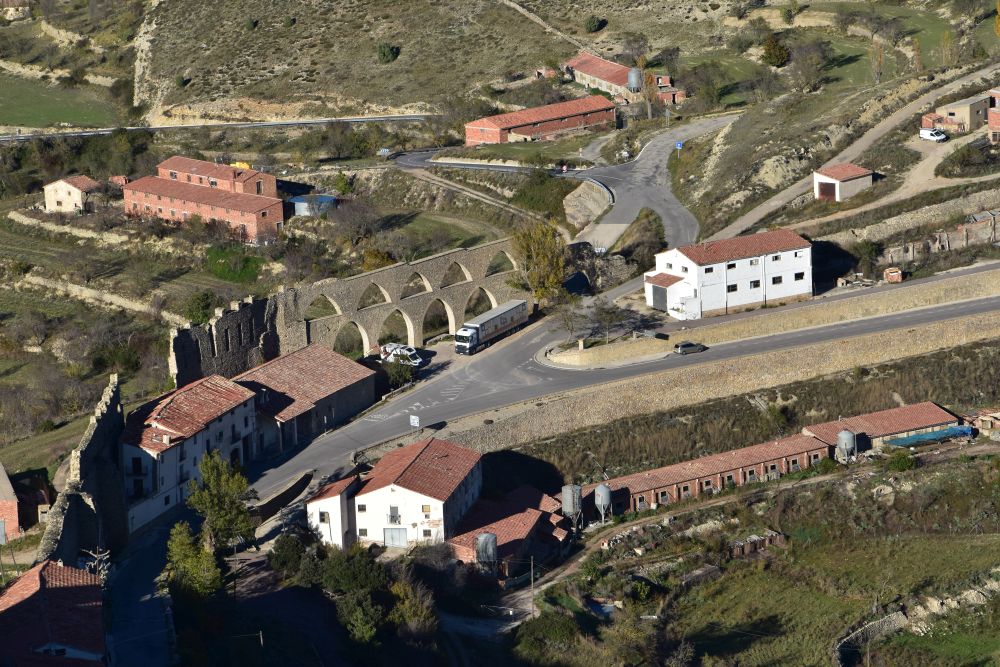
Zooming I can see the medieval aqueduct from the 14th century that up to the 19th century provided Morella with water from the near mountains. I believe that I see a ditch behind the aqueduct.

Now I understand, what Prince Lichnowsky experienced here, as described by Perucho. Lichnowsky was a nobleman from the Prussian Army that fought for the Carlists and Ramón Cabrera in the First Carlist War. Lichnowsky did not know that Espartero had taken over Morella in the meantime. He wanted to warn Cabrera of spies believing that Cabrera still resided in Morella. Lichnowsky approached the gate near the aqueduct. He noticed that he was received in a hostile manner. He retreated to one of the arches of the aqueduct. From here, he looked up and noticed the enemy’s flag wave on the castle. He understood, Espartero has conquered Morella and he, Lichnowsky, has to escape. He turned around, crossed the ditch to his right and disappeared towards Catalonia. (“El príncipe Lichnowsky… montó al caballo… y, a trote ligero, se dirigió a Morella… después de pasar bajo un arco del acueducto, llevaba, derecho, a la maciza puerta fortificida… Súbitamente vio como saltaban minúsculas salpicaduras de tierra a su alrededor… Oía las detonaciones agrias, … hacía dar la vuelta a su caballo. Encontró protección de uno de los pilares del acueducto, mientras una bala rebotaba contra la piedra, a un palmo de su cabeza. Entonces con mucho cuidado, miró hacia arriba. En la torre del castillo ondeaba la bandera de la reina… ¡Dio mío! Qué había pasado?… Lo urgente era escapar,… A la derecha se abría una barranca medio cubierto con matas de brezo florido. Espoleó a su caballo. El salto fue a la desesperada, cerrando los ojos y mientras sentía a la Muerte a su espalda… El Principe huía como un gamo hacia tierras de Catalunña…” (p. 229)).

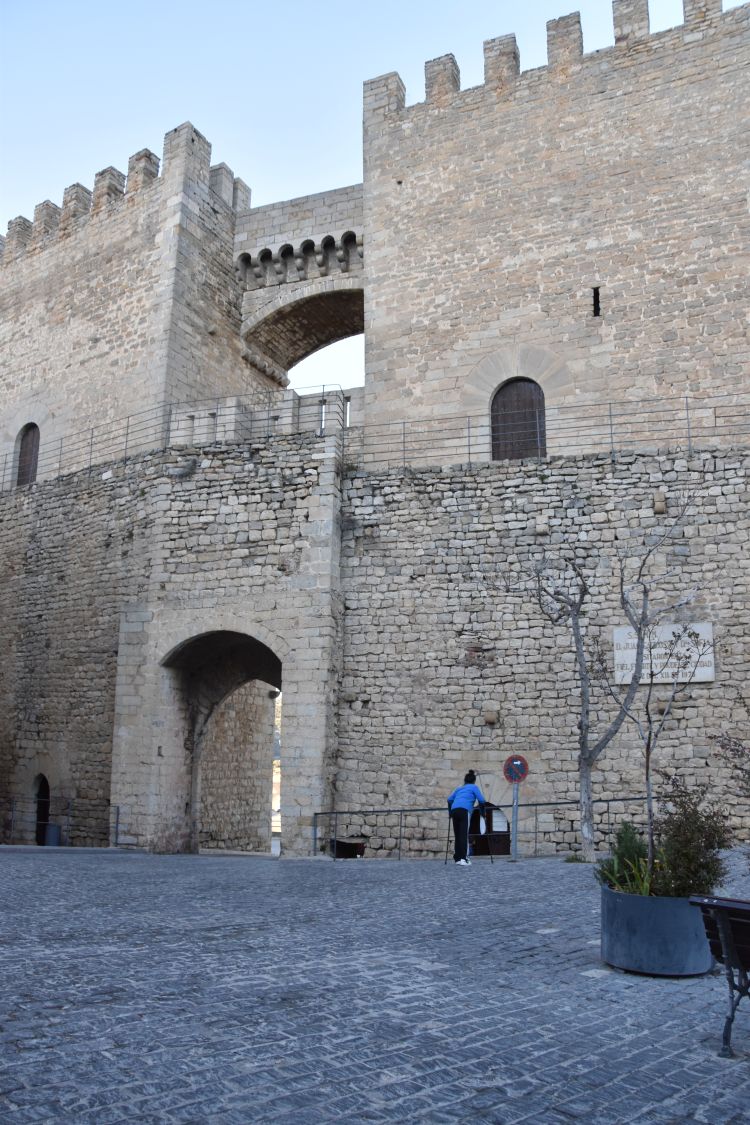
This is the gate closest to the aqueduct (seen from inside the city) that gave the unfriendly welcome to the Prince Lichnowsky.  

.

Wrapping up the visit of Morella

After having visited the castle, we walk back through the city…

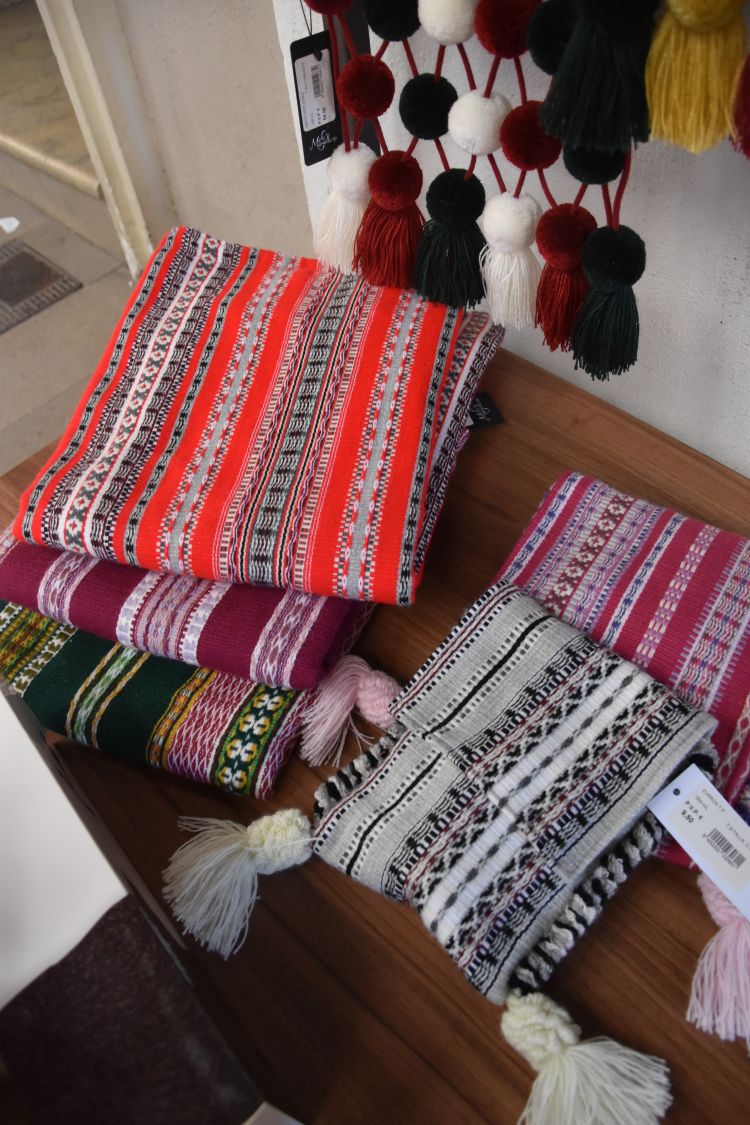
… and evaluate the woven blankets with the typical pattern of Morella.

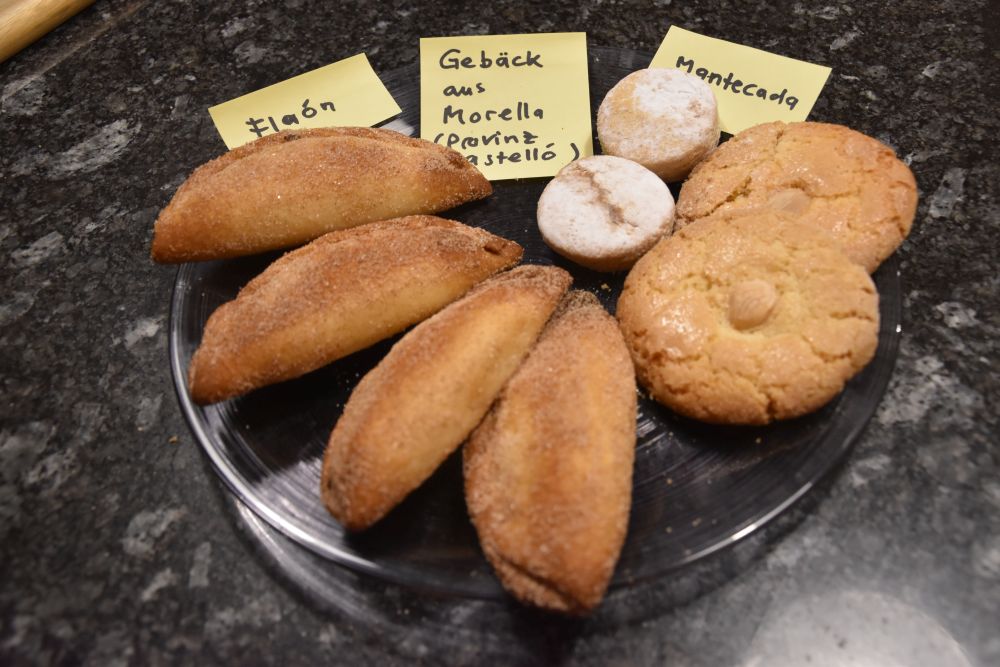
All blankets that we looked at, were made out of synthetic fiber containing some 10 or 20% of pure wool. Not what we had expected. We buy some sweet specialties instead, flaons and mantecados.

We stop at the beautiful townhall dating from the 15th century.

Inside the courtyard we find some giants (used at Corpus Christi) and a film of the Sexenni that the town celebrates every six years to commemorate the end of the plague in 1672.

We return to the town wall to pick up our car. We notice a heavy fine behind our wiper for having parked where only those authorised are allowed to, not foreigners like us. On this busy Saturday with many cars parked all over, we had not noticed the prohibition sign… but we find it okay to leave some money to support the ongoing renovation in this charming town.

In the evening we unpack our souvenirs, the flaons and the mantecados.

The sweets accompany our afternoon coffee times. From our selection of sweets, our favourites the larger mantecados with the almond in the middle.

Yes, Morella is worth a visit.


Sources:

David Navarro: “Morello”, Reihe Tourismus Spanien, Fisa Escudo de Oro.

Juan Perucho: “Las Historias Naturales”, Hurope, Barcelona 2003.

Morella in Wikipedia and tourist home site of Morella


The Maestrazgo: On the way to Morella with Perucho in mind

In November 2018 we spend three weeks not far from Tarragona.  

Having read “Las historias naturales” by Juan Perucho, I wanted to cross the mountains of the Maestrazgo and visit Morella.

Let us quickly recapitulate, what happened in the Maestrazgo and in Morella in Perucho’s novel “Las historias naturales”(see separate blog): In 1840, during the first Carlist War, the protagonist, liberal Antonio de Montpalau traverses the mountains of the Maestrazgo in search of the vampire, alias El Mochuelo, alias Onofro de Dip de Pratdip. Montpalau and his followers are captured by the conservative Carlist troups and taken to Morella, where the general of the Carlists, Ramón Cabrera, has his headquarter. Cabrera had been bitten by the vampire. Later Cabrera with his troups leaves Morella for Berga, where Montpalau will help Cabrera escape from the gloomy fate of becoming a vampire.

Now, let us follow the tracks of Perucho and Montpalau by crossing the Maestrazgo on the way to Morella.

.

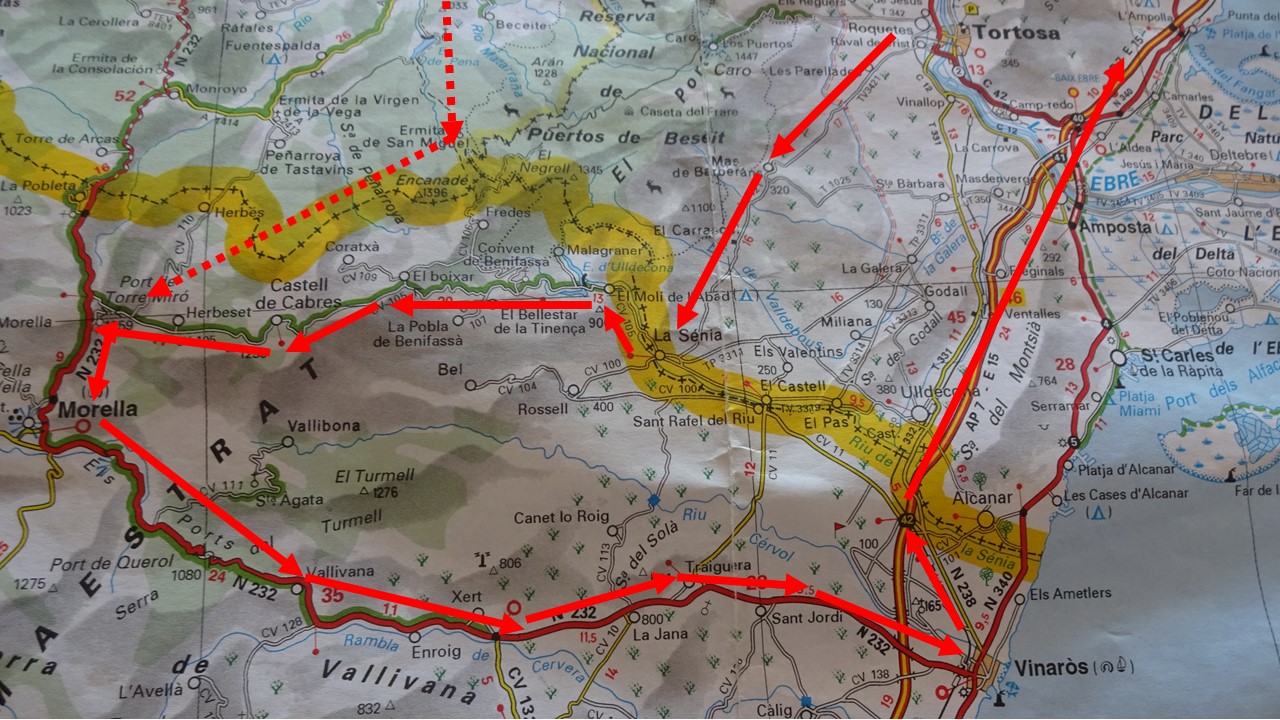
Our routes to Morella crossing the Maestrazgo mountains

Montpalau crossed the Maestrazgo mountains coming from Horta San Juan and Valderrobres (just outside the map above, see the dotted red line). We traversed them farther south starting at Tortosa (continuous red line leading to Morella).

Source: Street map Michelin “España Noreste”

.

Approaching the Maestrazgo mountains

This is, how Montpalau approached the Maestrazgo (p. 164): “En Horta de San Juan visitaron la plaza gótica porticada y el Convento de San Salvador… el aire era muy frío y tuvieron que abrocharse hasta el último botón de la levita. El paisaje había cambiado ahora; salvaje, grandioso y como telón de fondo, las altas montañas del Maestrazgo.” (In Horta de San Juan we visited the gothic main square and the monastery San Salvador… the air was very cold and they had to close their frock coats up to the last button. The landscape has now changed; wild and grand and with, in the background, the high mountains of the Maestrazgo).

We, however, ascend to the Maestrazgo mountains via Más de Barbera where we have a wonderful view of the Montsia mountains and of the Galera plane with its utterly tidy olive groves.

We take a coffee in the Lo Racò that would make a good stop for eating, recommended in Tripadvisor. Nearby we find a signboard that lays out enticing hiking paths.

.

The Maestrazgo mountains – fresh pristine air and wild barren landscape

We continue ascending to the village La Senia where we reach the Maestrazgo mountains. The road becomes narrow curving through wild rocks.


The Cistercian monastery Benifassà is closed and opens on Thursdays from one to three p.m., just two hours per week, not more. Very secluded.

The village of Benifassà looks like an aery – a nest for eagles – in a barren landscape.


The road winds up and down along a rocky mountain ridge. We are on about 1000m above sea level.  

We agree with Perucho and Montpalau (p. 165) “Era un paisaje de maravilla. A media que se ascendían se renovaba el aire, se hacía más puro, y un perfume salvaje de bosque y de animal en libertad se mezclaban curiosamente… Pasaron por debajo de grandes cascadas de agua ensorcedoras…; descubrieron cuevas… enormes… En verdad, el Maestrazgo era una tierra muy extraña y sorprendente…” (It was a marvellous landscape. As they climbed higher and higher, the air refreshed, became more pristine, and a perfume of wild forest and animal in freedom mixed up strangely… they passed under large and ear-deafening waterfalls; they discovered big caves… as a matter of fact the Maestrazgo was a strange and surprising area).

We reach a barren high plateau with some lonely farms dispersed on meagre meadows. Ever once in a while we see some cows, some sheep, some goats. We are alone here – like Montpalau and his friends in Perucho’s novel (p. 165): “Desde que se hallaban en el Maestrazgo no habían visto a nadie. Se acercaba el puesto del sol. Vieron una masía, medio abandonada… Decidieron de pasar la noche en la triste masía… “ (Since they had arrived in the Maestrazgo, they had not seen anyone. The sun was about to set. They saw a farm, half abandoned… They decided to stay in the desolate farm for the night…).

The next day, Montpalau and his followers succeeded to escape giant fleas that were attacking them… their weapons were branches of pine trees that they ignited and carried like torches. Very fancy… but perhaps… why not… I could almost imagine giant fleas jumping around us in this wild landscape and if they came, thanks to Montpalau, I would know, how to fight them – with ignited branches of pine trees..

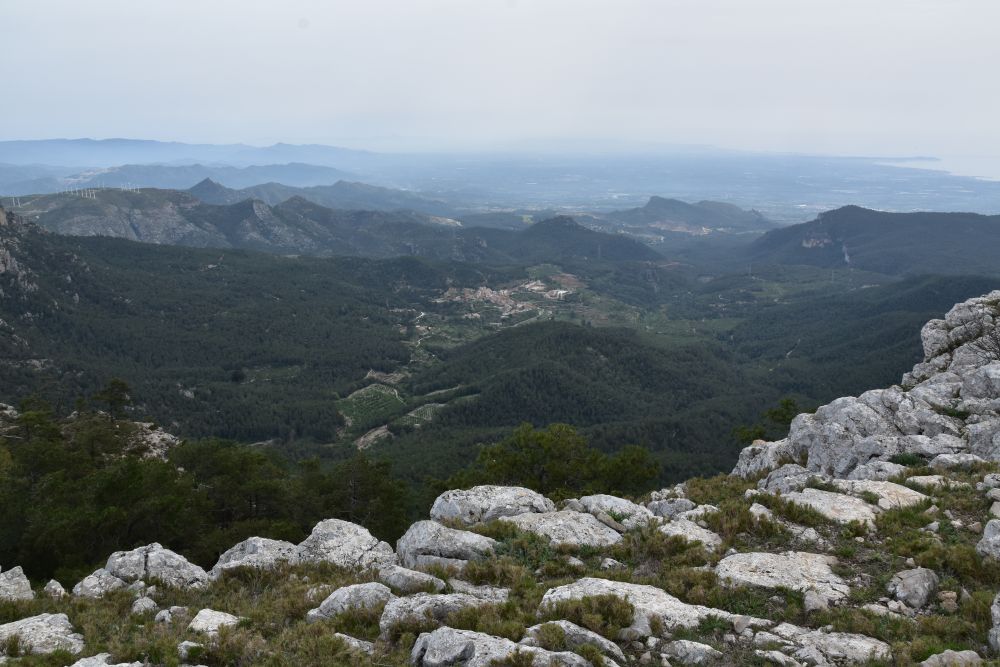
After more than two hours on narrow roads, we reach the Port de Torre Miró. We are now above the valley of Morella and enjoy the gigantic windmills and the view together with other tourists. We are no longer alone.

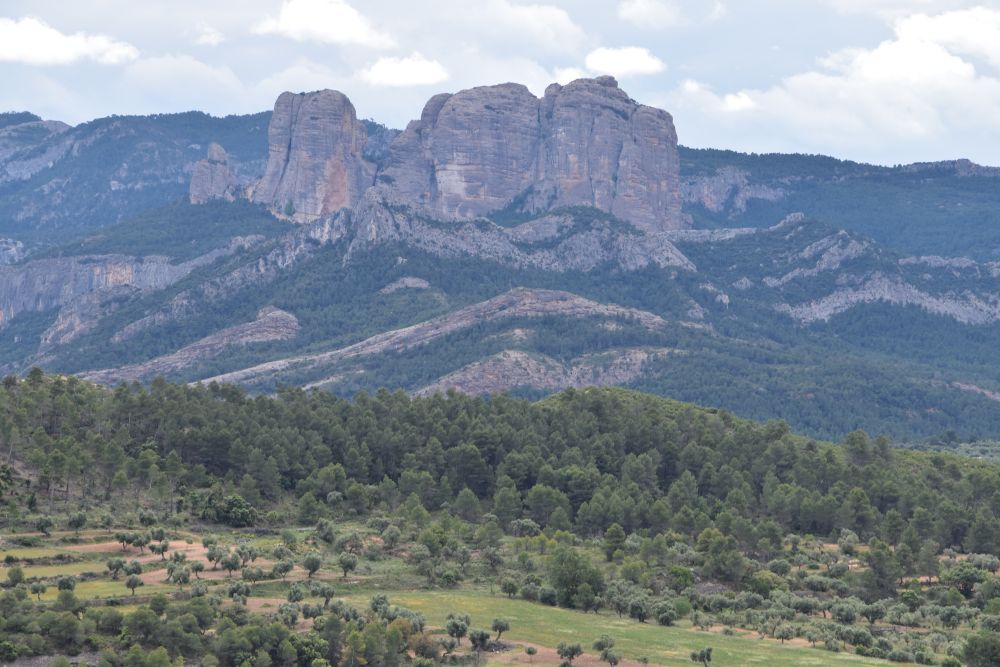
Mountains around us. Ursula captures them with a panoramic view.


We continue our way to Morella – and I will talk about this small and fortified in my next blog.

.

Source:

Juan Perucho: “Las Historias Naturales”, Hurope, Barcelona 2003.


Pratdip (Catalonia) and Perucho’s natural history of the vampire Dip


Again and again we traveled to Catalonia, south of Tarragona. Again and again we noticed the sign to the village Pratdip pointing to the mountains. One day, we followed them and we found Dip and Joan Perucho’s novel „natural history“ or in Spanish “las historias naturales”.

Let me tell you more about Pratdip and its vampire Dip.

.

Pratdip is a small village and the inhabitants are proud of their Dip

Pratdip is located in the mountains of Llaberia, some 40km southwest of Tarragona.

Narrow steep streets are overseen by the ruins of their castle that sits on a steep rock.

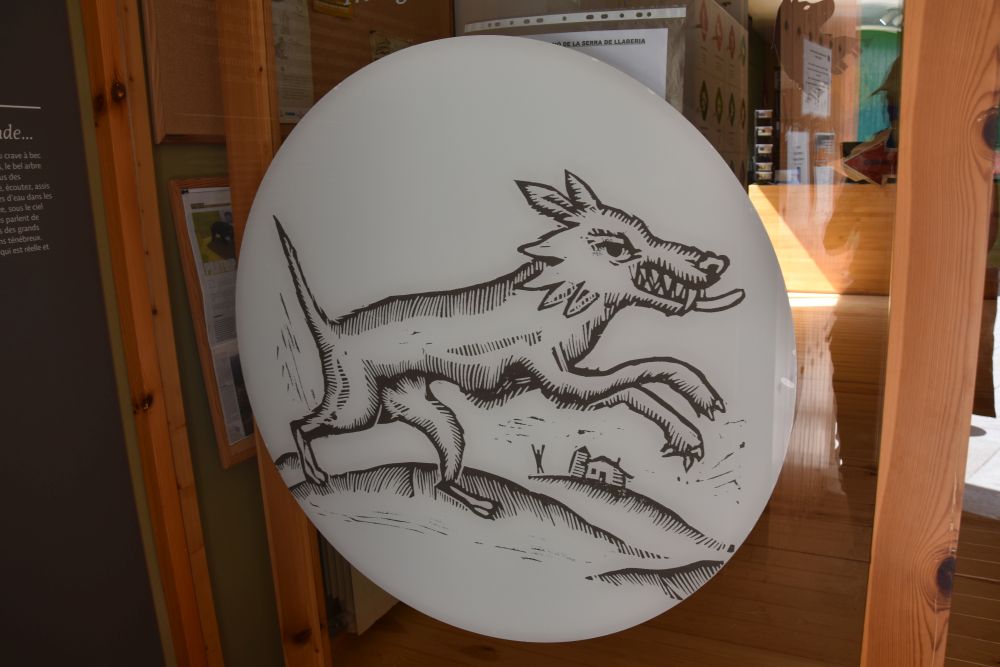
In the village there are various portraits of the vampire Dip in his incarnation as a dog-vampire (vampires can change their appearances rapidly).

When we enter the tourist office, we find another dip.

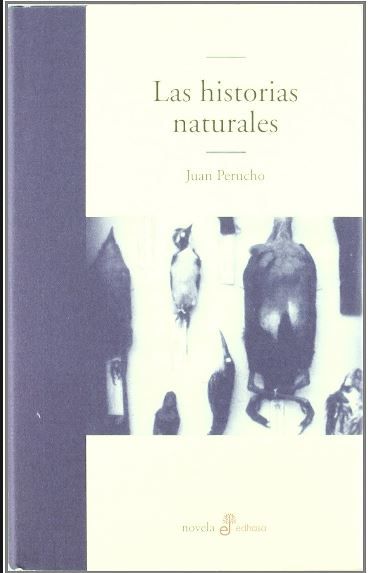
The assistant laughs: „You are looking for the vampire Dip“, she asks and proudly shows us the book of Joan Perucho with the title „Las historias naturales“. She adds: „Perucho tells you everything about the Dip and what he has done to Pratdip.“ The original version of the novel is in Catalan. I buy the Spanish version.

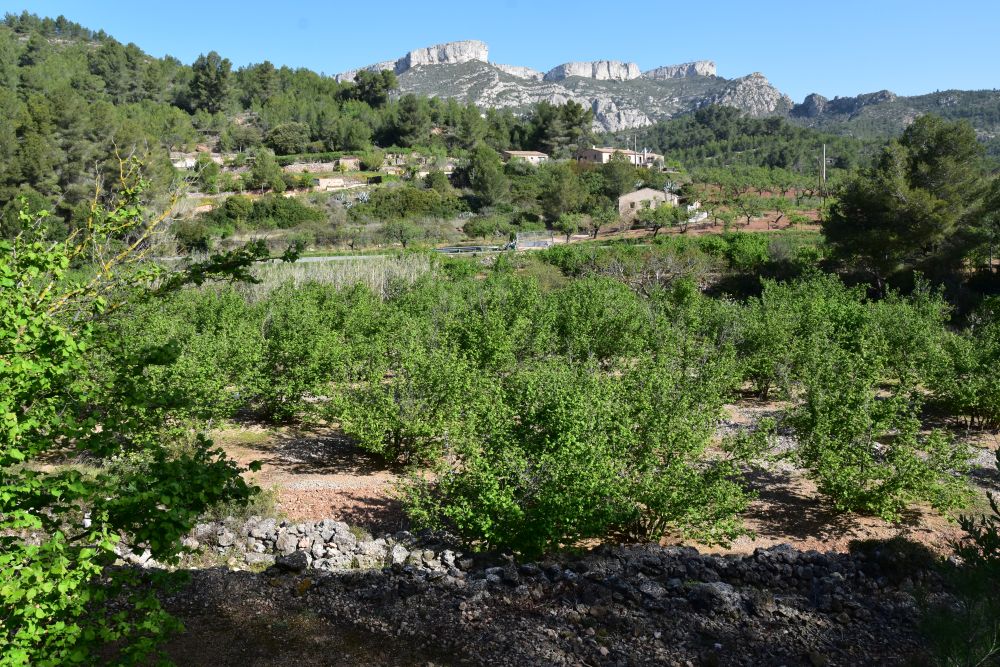
Then we walk to the hermitage of Santa Maria, along orchards with hazelnut trees…

… and enjoy the hermitage Santa Marina in the mountains…

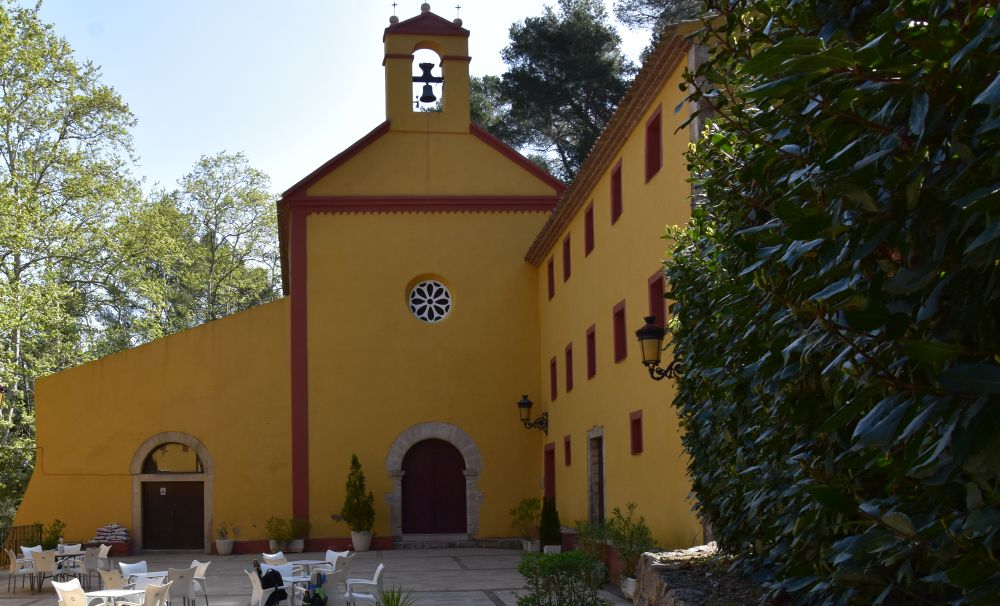
… where we find a friendly restaurant.

To round our excursion up, we climb the castle rock and enjoy the view.

.

Back at home: I enjoy reading „natural history“ by Joan Perucho to learn all about the dip

Back at home I read the novel of Joan Perucho. In his normal life, Perucho was a serious judge. When writing his „historias naturales“ or „natural history“, he must have twinkled with his eyes. The novel can be located somewhere between fable and reality and is full of humor. I could find five threads of interlaced actions.

  • First, the novel is about the vampire Dip –  his full name is Onofro de Dip. In the 13th century, he had owned the „meadows“ around Pratdip (hence the “prats of dip”). He traveled to Hungary to prepare the marriage for his king James I with Yolanda (or Violant) of Hungary (James and Violant are a historical fact). On the way to Hungary, Onofro de Dip fell in love with the lady vampire Meczyr who turned him into a vampire and „Non-Dead“ (No Muerto). He returned to Pratdip in the early 19th century and terrorized the village killing inhabitants every night. The current owner of Pratdip, Baroness Urpí, asks her brother, Marqués de La Gralla, for help (Gralla is a „real“ noble family from Barcelona; they owned a palace that no longer exists today). A friend of the Marqués de Gralla, the young natural scientist Antonio de Montpalau (an invented person), travels to Pratdip, neutralizes the vampire with the help of garlic, parsley and wooden crosses. Then he finds Dip’s grave in the castle and expulses Dip from Pratdip. Onofro de Dip morphs into the solo guerillero El Mochuelo (the Owl) fighting for the (conservative) Carlists and terrorizing the region of Tortosa and Berga. Montpalau pursues him, finds him finally in a crypta near Berga (castle Mataplana) and by speaking out some magic words, Montpalau makes Onofro de Dip die „properly“ and find his peace.
  • Second, the novel is the portrait of the higher society of the Barcelona area in the early 19th century. Montpalau as a young scientist belongs to that higher society. The members of the high society enjoy meeting in the Gralla palace, eating and discussing history, natural science, mathematics or music. As a reader you feel the luxury and shake your head about the sometimes detached, elitist or even absurd discussions. Once Frédéric Chopin and George Sand are invited to a banquet, as they stop over in Barcelona.
    Antonio de Montpalau is a scientist focused on classifying animals and plants around him. He is also interested in geography and geology. Before going to Pratdip, he  researches all literature available and he finds scientific literature about vampires that recommends using garlic, parsley, portulak, wooden crosses and mirrors to fight vampires (I can feel Perucho smile, when he lets Montpalau buy ten dozens of mirrors before leaving for Pratdip).
  • Third, the novel has a historical background: The year 1840 in the first Carlist War in which the male pretendent of the throne, Carl V, fought against his niece, the actual Queen Isabel II.
    • One one hand, the Carlists that fought for Carl V, were conservative. Their target was a federation of several states unified by the king of Spain and the catholic church as the only two common denominators of the federation, conserving, what Spain had been before. A man made constitution was not required in their eyes. Federation, of course, was welcomed by Catalonia (or also by the Basque region). Carlists were strong in Catalonia.
    • On the other hand, the followers of the actual Queen Isabel II were classified as liberals, as they based their ideas on the French Revolution. The wanted the separation of church and state, a centralized state based on the constitution (as set up in 1812, like France). The idea of the centralized state was not, what Catalonia strived for, but the high society in Barcelona, including Antonio de Montpalau, was liberal.
    • Some real persons give a realistic background, the most important being Ramón Cabrera. He was the outstanding leader of the conservative Carlists in Catalonia. His liberal (pro Isabel) opponent was Baldomero Espartero.  In 1840, Espartero defeated Cabrera and his Carlists in Berga not far from the Pyrenees.
    • Montpalau and Onofro de Dip interact with the real persons. Ramón Cabrera has been photographed wearing a large scarf around the collar of his shirt. Furthermore, he has been reported to feel ill, when trying to conquer Gandesa. Perucho tells us the reason. Cabrera attacked Gandesa at the time, when Dip morphed into the Carlist guerilla „El Mochuelo” that wanted to become a Carlist leader himself. He bit Cabrera such that he will become an immortal vampire. This is why Cabrera felt weak and this is why, he had to wear a large scarf (to hide the stitches of the vampire – twinkle). Perucho continues to describe that the liberal Antonio de Montpalau was captured by the conservative (Carlist) troups of Cabrera, how he could ease the symptoms of the bite for Cabrera and how finally Montpalau succeeded to free Cabrera from his gloomy destiny by making Onofro de Dip die properly – as described in the first thread of actions – in the crypta near Berga, just after the Carlist Cabrera had been fully defeated in Berga by the (pro Isabel) Espartero.
  • Fourth, the novel is a travel report about Catalonia in the early 19th century. Antonio de Montpalau, his nephew Novau and his coachman Amadeo travel from Barcelona via Villafranca, Reus and Falset to Pratdip. After having expulsed the vampire-Dip from Pratdip, they leave to pursue the vampire-El Mochuelo, cross the Ebro near Miravet, stay for some time in Gandesa, continue to Morella. Cabrera resides in Morella and Montpalau and his followers are captured here. Then as prisoners, they accompany Cabrera to Berga. Our travelers visit places of interest on the way (e.g. the monastery Vallbona de los Monges where the Queen Violant from Hungary has been buried), admire the beauty of the landscape, eat local specialties and drink delicious wines from Terra Alta. The travel reports are full of humor, e.g. about real places of interest such as the cathedral of Tarragona that they like though their travel handbook by (real) Alexandre Laborde does not recommend to visit it. Or about less real events: The three heroes meet giant fleas, but luckily Monpalau knows, how to escape them: They inflame branches of pine trees and carry them like torches (twinkle).
  • Fifth, it is a love story with a very, very happy end. While Antonio de Montpalau is fighting the Dip in Pratdip, he and Inés fall in love. Inés is the daughter of the baroness Urpí that has asked her brother, Marqués de Gralla, for help against the Dip. Montpalau has to leave his love to pursue the Dip.  A historian has encouraged Montpalau to do so, as he found (historic-scientific) sources that reveil, it is Montpalau’s fate to defeat the Dip (twinkle). After having vanquished the vampire Dip-El Mochuelo near Berga, Montpalau returns to Barcelona. At the palace of Marqués de Gralla he finds his love Inés (the Marqués‘ niece) waiting for him. What a happy end!

Perucho’s novel was the first book that I accomplished reading in Spanish. In the beginning, it was a bit of a tough start for me, because Perucho takes his time to set the stage. But then, when the action of neutralizing and chasing the Dip-El Mochuelo accelerates, what a pleasure! And it was even more pleasure to go back to the start to enjoy the setting of the stage, once I understood more about the historical background. The novel is full of humor and of fantasy with links to real history and geography. I did enjoy reading about many places in Catalonia that I know and that Perucho moves to the early 19th century presenting them with the eyes of Antonio Montpalau and his followers. And I did enjoy to learn more about Spanish history which helps to understand what is going on in Spain today.


Home is not here or there, but inside yourself or nowhere


In 2017 I travelled and travelled. I soaked up culture and history. I met and found friends. I gathered souvenirs, my eyes wide open.

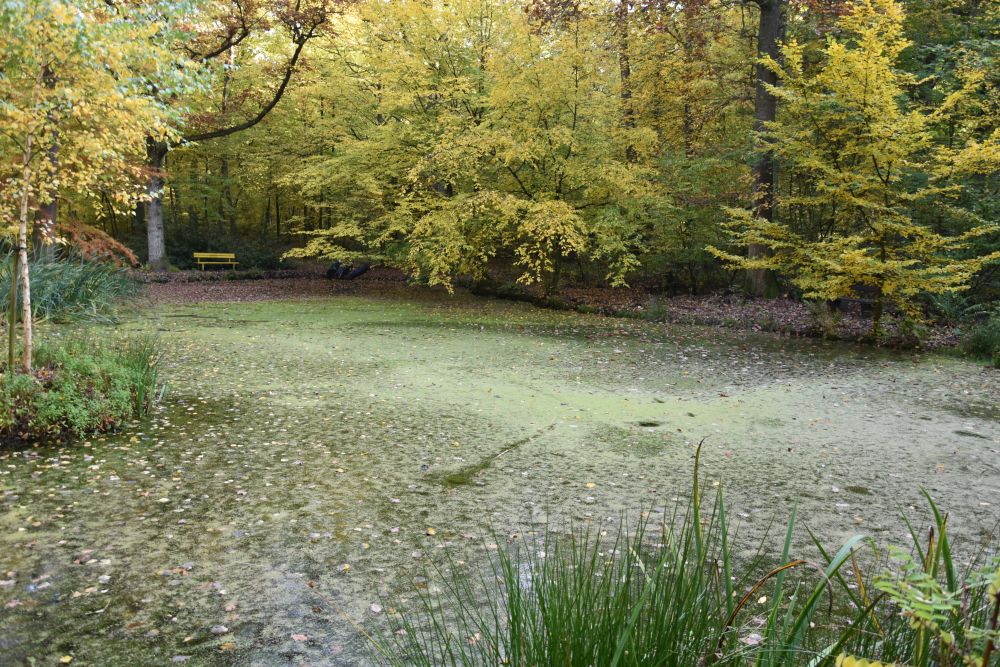
One souvenir is this lake called “Zypressenteich” near Nuremberg (Nürnberg) in Germany: An inviting yellow bench to sit on and just dream and reflect under trees covered with yellow leaves surrounding the mysterious lake hiding its ground.

It could have been here that Hermann Hesse thought about home (or in German: Heimat).

“Heimat ist nicht da oder dort, Heimat ist in Dir drinnen oder nirgends” which can be translated to “Home is not here or there, home is inside yourself or nowhere.” This struck me.

I must admit that, when travelling in 2017, I found my second home in Brandenburg, because everyone around me spoke like my mum. I have never experienced that before. I had found my second home in Brandenburg, while  my first roots are in Basel, the town of my dad, where I live.

Yes, I feel home in Basel and in Brandenburg… here and there… which gives me roots. But nevertheless I sense like Hermann Hesse that my real roots are not here and there, but home is inside myself. He may have used his words to warn from growing nationalism and growing rejection of everything outside.

While travelling, I sensed some signs of growing nationalism which I fear… Hermann Hesse came in right for me and motivated me to work on his thoughts my way, in German first, then trying to translate that.

.

Heimat ist in Dir drinnen oder nirgends

Warum Heimat da oder dort suchen?

Warum nach Heimat in der Geschichte forschen?

Warum für Heimat verbissen kämpfen?

Warum Fremde aus der Heimat sperren?

Warum?

Ist denn Heimat nicht in Dir drinnen – oder nirgendwo?

.

Home is inside yourself or nowhere

Why look for home here and there?

Why search for home in history?

Why fight for home like do-or-die?

Why lock out others from home?

Why?

Is home not inside yourself – or nowhere?

.

Родина внутри тебя или нигде
Почему ищут Родину тут или там?

Почему истоки Родины ищут в истории?

Почему сражаються ожесточённо за Родину?

Почему закрывать Родину чужим?

Почему?

Разве Родина не внутри тебя – или нигде.

.

Las raíces están en tí mismo o por ninguna parte

Porqué buscar las raíces por ahí o por allá ?

Porqué investigar las raíces en la historía ?

Porqué batirse por las raíces tan reñidamente ?

Porqué bloquear el ingreso de los extranjeros en nuestras raíces ?

Porqué ?

No es que nuestras raíces están en tí mismo o por ninguna parte ?

.

Well, for 2018 I do hope that we look for home inside ourselves and nowhere else!

.

Source: “Demian” (1919), requoted in the anthology about trees “Hermann Hesses Betrachtungen und Gedichte über Bäume” edited by the Insel Verlag.


Back to some business – mentoring a student at the verge of work life

Recently I have signed up with the alumni organisation of “my” university to participate in their mentoring program for students at the verge of work life. Mentoring – I have done that before and my former mentee is now a good friend of mine.

Let me reflect about what mentoring is and what an effective approach may look like.

.

What is mentoring?

In the Internet I found this definition of the Alberta Learning Information Service ALIS that resonates with me:

«Mentors are experienced, trusted advisors or counsellors who have successful careers and proven track records. Mentors are not usually paid for their services.

As a mentor, your role will be to:

  • make a commitment to support and encourage your mentee
  • encourage your mentee to develop careers that reflect their skills, potential and goals
  • offer wisdom, knowledge, experience, constructive criticism, connections and resources
  • focus on the overall career directions like advancement and training rather than on day-to-day concerns of your mentee
  • set an example for the level of professional conduct and success your mentee hopes to achieve»

In alignment with this definition and with my previous mentoring experience I understand that…

  • The mentor accompanies the overall career development of his mentee in a one to one setup independent of the current work place. He acts as a sparring partner bringing in his long year experience, with the target to help the mentee find a career path that matches his/her strengths and interests. The relationship is based on mutual trust and confidentiality. The time horizon is longer term and can be several years.
  • Mentoring is different from coaching. I understand that a coach accompanies an employee at his/her work place – to perform efficiently and effectively according to his potential.

.

How would I conceive our mentoring process to be effective?

To mentor a student at the verge of work life, I think of these steps for the process to be satisfactory and effective. 

for blogwhite

  • Basis: Initiative is with Mentee / Mentor is a responsive sparring partner
    From the mentee, I expect that he/she will drive the relationship, invite for meetings and/or ask for support, when he is ready or needs it. As a mentor, I will be the responsive (reachable) and  supportive sparring partner bringing in my experience and network. The mentee has to solve his “problem” and he can count on my mentor support. As a mentor, I cannot impose my ideas, I just give suggestions, hopefully good suggestions based on my experience.
  • Align mentor and mentee / revise relation: Trust and commitment
    As a first step, we, the mentor and the mentee will get to know one another, exchange about our motivations and backgrounds and find alignment. The target is to build trust. Trust is indispensable for our mentor/mentee relationship. Without trust it is not possible to proceed and achieve results. Based on trust, we make the commitment to start our mentor/mentee relationship. This relationship is not expected to be short term, and hence it is also necessary to revise it from time to time to verify trust and commitment still exist.
  • Identify mentee strengths/interests/personality: Profile
    As a second step, the mentee will identify his profile, with my mentor support. The profile consists out of his strengths (capabilities/talents/knowledge), his personality (e.g. more a researcher or an entrepreneur) and his interests (what activities turn me on). Useful structures to identify the profile are provided by Tim Clark, Alexander Osterwald and Yves Pingeur: “Business Model You“, Campus Verlag, Frankfurt am Main 2012). They call it “key resources”.
  • Find targets: Value propositions
    Based on the profile or key resources, the next step is to find the activities that are of value for potential customers and that allow my mentee to make a living (earn money) and perhaps harness more personal benefits (such as satisfaction from living his mission or from doing what he likes to do). Tim Clark et alii recommend to find the “value propositions” using their structured “business canvas“.
  • Sell and apply: CVs, job selection > job
    Based on the profile and targets identified, we can act and apply for jobs. The profile will be phrased out in CVs (for media such as LinkedIn and for the “paper” CV that  might need adaption for individual applications. As a mentor, I also think of using my network and of coaching the interview process (letter of motivation, what the interviewer may ask/expect or ideas on how to react when being rejected). 
  • Digest lessons: Updated profiles, value propositions and CVs
    The experience gained during job applications will help us to loop back and update the profile and value proposition and the CVs (in the media (such as LinkedIn) and in the paper CV. Then more applications may follow – or it is also an alternative to look for options to open a business.
  • Hand over to work life: Business mentor
    Once, a job is found, I will have to retreat. I suggest to find a business mentor for similar support in the new work life. Well, in case our mentor/mentee relation was one of trust all the way through, I might have found another friend that would perhaps come back and ask for ideas and support from time to time.


Wonderful, I will be a godmother (Gotte) – what does that mean?

“Will you be godmother to my son”, my nephew asks me…

Around Christmas, I try to calm down my nephew’s half year old son – I am his grand-auntie. Not his auntie, his GRAND-antie. Then my nephew asks me, whether I would be the godmother of my grand-nephew. I feel touched. Yes, of course, I agree.

I have never been a godmother before. Another new adventure at my – not so young-  age. I look forward to that and start to think about what matters.

After looking back to my childhood and listening to friends I think that care and love matter, being authentic and reliable, finding an atmosphere of trust, and living this by creating habits, by exchanging, by showing you are always there when needed and – yes, also – by making presents that will be remembered. It all has to come from the heart. Accept that this is a mutual relation and enjoy that. And it may become a friendship that lasts beyond the age of 20.

.

Looking back to my childhood: I enjoyed the love and care of my godfather and my godmother though they lived far away

My godfather was Onkel Nante and my godmother was Tante Christine.

Bilder petra

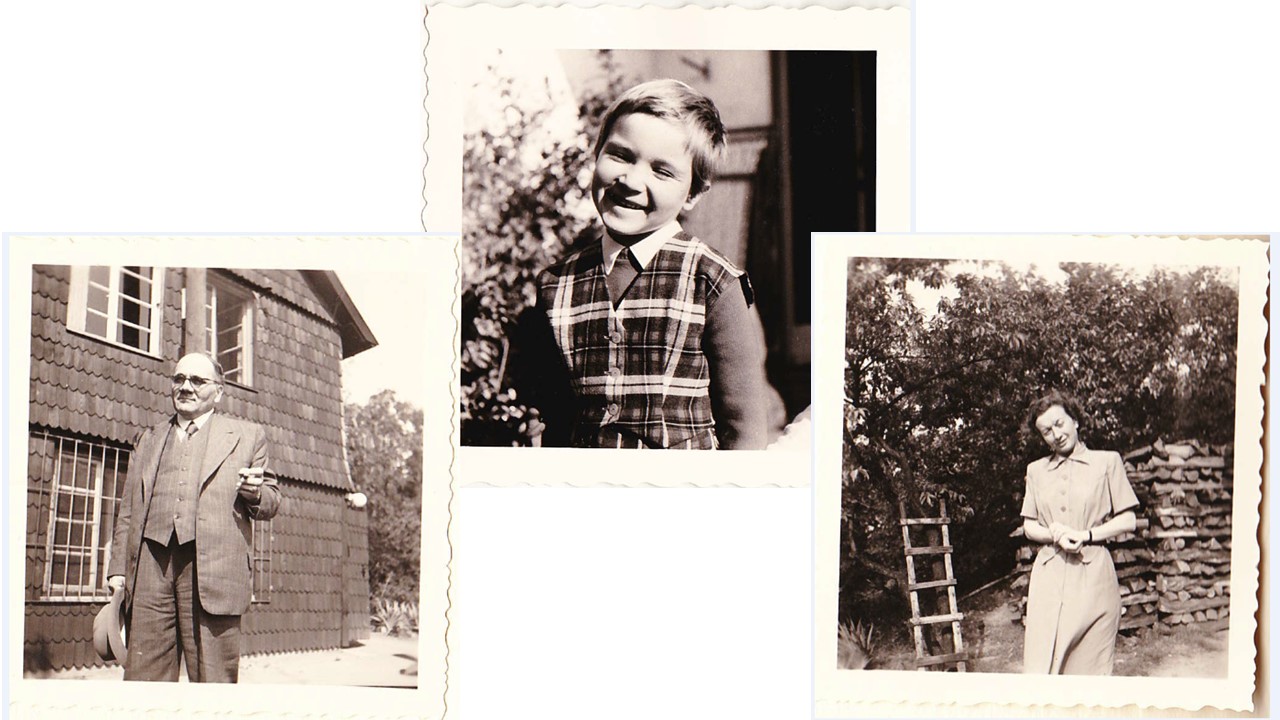
Onkel Nante must have been my age (around 65), when he started his journey with me. He was my mum’s uncle and my grand uncle. He lived in Berlin. I could feel his love in the carefully selected presents, in the letters we exchanged and during my visits in Berlin. One present I remember were the Christmas angels singing “Holy Night”. It was a music box with a windup mechanism, and after some time, the tune would slow down: H-oo-oo-ll-yyy—- n-iii… and then it would fade away. These angels accompanied me every Christmas. When I was seven, Onkel Nante gave me a skirt with a matching vest, modeled after the red-green-white Scottish kilt, and I was proud of wearing it for many years – I also wear it on the foto. Then I received a summer dress in ice rose – so beautiful. And, when I was fifteen, he had a blue costume made for me to cover my (temporary) overweight. I often exchanged letters with Onkel Nante and his wife. Both were always interested in my life. When I was a student, I traveled to Spain staying in a tent, and I sent him a travel report. The result: An angry letter to my mum: “Please give your daughter enough money to stay in a hotel – tents are extremely unhealthy!” He was more than 80 years old by then, but he was still worrying about me. When I started studying economics at university, he sat down with me, looked at me firmly and asked, whether I will be able to earn a living with that. So – what I remember, are some great gifts and his loving care. And today, I always go to see his house in Berlin, not far from the mosque, to – virtually – say hello to him (his house has been sold).

My godmother, Tante Christine, was a friend of my mum’s and lived in Köln. She always lived alone and may not have had a lot of opportunities to travel. I have not met her often. But we regularly exchanged letters, and she always selected her gifts with great care. For my birthday and for Christmas, she would send me jumpers – they always became my favourite jumpers. I particularly remember an ice blue jumper. Through the letters and her gifts I could also feel her love. One day my letters were no longer answered. I was very sad. I think she must have been lonely and sharing her love with me was also important to her.

.

Ernst, my husband, shared adventures with his godson

In my first summer with Ernst I heard him mumble: “My godson left a message on the answering machine. He wants to spend a few days with me. I will pick him up at the train station.”  We had a few wonderful days – I particularly remember the mini golf tournament that he won. Sometimes we all would take the camper, roast sausages, sleep near a lake in the mountains, go for hikes and climbs or visit the caves in the area. In winter we went out skiing. Every Christmas, Ernst renewed the subscription to “Spick”, a scientific newspaper for kids. After having finished school, the godson shyly said that perhaps he does not need the “Spick” newspaper any more. Now he is a scientist himself, and for his doctorate exam, Ernst promised him a globe based on his specifications… a wish that I eventually fulfilled, when Ernst was already a star watching over us. There was this regular tradition of presents and also sharing time and adventures. The relationship carried on into adulthood and I inherited it in a way after Ernst had left us.

.

Some of my friends add that for them regularity, independent advice and a mutual relationship for ever are important

From various friends I gathered their godfather and godmother experience.

A friend of mine had a godfather that was a farmer with nine children: “He was not rich. But every birthday and every Christmas, he gave me a five franc piece (Fünfliber). He slipped it firmly into my hand looking at me with warm and kind eyes. I loved these moments. And they came back every birthday and every Christmas, with regularity. Being able to rely on this regular gift was very important for me”, he pointed out to me.

A couple told me that they had selected a very good friend as the godmother for their daughter. It all started well, but then the friendship broke. The godmother wanted to give back her duty. But the mother said: “Well, you may give back your godmother duties, but do not tell my daughter. She is very proud of you and she loves to think of presents for your birthday and for Christmas. We do not want to take that away from her.” So, the daughter, not knowing about the problem, continued to handicraft presents for her godmother. Eventually, the friendship between the parents and the godmother was restored and the daughter had never noticed the problem… Yes, the relationship between godparents and godchild is mutual.

My friend from Munich (now also in her sixties) told me that she has just visited Tante Bärbel in the hospital. She is her godmother and is now in her nineties. The friendship with the godmother lasted far beyond her childhood – beautiful.   And her husband added that he valued the advice of his godparents that added an independent view to the opinion of his parents.

.

So – let me try to live up to that…

… and I do hope that I will be able to accompany my godson into his adulthood.


The Rainbow – the treasures hidden at its end make me dream of conciliation

The rainbow near Gjirokastra in Albania

It rained all day until late afternoon, when I was in Gjirokaster in September 2015. With Ben I followed the tracks of Ismail Kadaré’s “chronicle in stone” – his house, the airport and the castle… (see  “On the tracks of Ismail Kadaré“). Late in the afternoon, the sun started to emerge and we saw the rainbow.

P1100007

This rainbow linked us up with Ismail’s rainbow. Ismail saw his rainbow in 1940 and he was 4 years old. “The houses in the town made of stone have cisterns to collect rain water… In the morning the river is flooding the road below the town, after having tried to get rid of the bridge. The child sees hatred between the river, the bridge, the wind, the mountains and the creeks attacking from the mountains – and between all this hatred is the town – all lonesome – with their stone walls that the boy loves. In the morning the boy sees a rainbow that makes peace between the elements, but Ismail is convinced that this is only a temporary peace (see my earlier blog)”.

Yes, seeing a rainbow near Gjirokaster linked me up with Ismail Kadaré’s rainbow.

.

The rainbows in Switzerland point to buckets of gold (Kübeli Gold) or treasure chests (Schatzkisten)

In Switzerland you have to run fast,  when you see a rainbow. Where it touches the ground, there are buckets of gold or treasure chests (depends on the canton; in Berne – buckets of gold and in Basel – treasure chests; I do not know precisely about the other cantons). Whatever kind of treasure, you have to run fast to reach it.

.

The Swiss – Albanian combination of rainbows made me dream of conciliation

Rainbows and their treasures, this made me dream of conciliation and peace. I wrote down my feelings for the turn of the years 2015/2016, first in German…

Ein Regenbogen…

Die Stürme – vorbei,
Die Kräfte – versöhnt.
Der Bogen verbindet
Zwei Schätze am Boden.

Zwei Schätze – verschieden?
Und dennoch – verbunden?
Zwei Schätze – versöhne,
Was scheinbar verschieden,

Du, mein Regenbogen…


… and then in some other languages to share my thoughts with more friends.

A rainbow…

The storms – passed,
The forces – reconciled.
The arc connects
Two treasures on the ground.

Two treasures – different?
Nevertheless – connected?
Two treasures – reconcile,
What seems to be different,

You, my rainbow.


Радуга…

Бури прошли,
Силы примирились,
Арка соединяет
Два сокровища в земле.

Два сокровища – они разные?
И всё таки – соединились?
Два сокровища – примири то
Что кажется разным.

О! Моя радуга.


Un arc-en-ciel…

Les tempêtes – passées,
Les forces – réconciliées.
L’ arc – relie
Deux trésors sur terre.

Deux trésors – différents?
Et pourtant – reliés?
Deux trésors – réconcilie
Ceux qui paraissent différents,

Toi, mon arc-en-ciel.


Un arco-iris

Las tempestadas passadas,
Las fuerzas conciliadas.
El arco conecta
Dos tesoros al suelo.

Dos tesoros – diferentes?
E sin embargo – conectados?
Dos tesoros – concilia
Los que parecen diferentes.

Tú, mi arco-iris.

Albania – on the tracks of Ismail Kadaré in Gjirokaster

Gjirokaster – a town made of stone

How much have I looked forward to this day. Today I will follow the tracks of Ismail Kadaré’s “chronicle in stone”. I had read the chronicle a year ago. It is the story of the three to seven year old boy that observed the war as a child: The first years from 1939-1940 and the second part from 1941-1943.

Today, we slender through the town where “it could happen that the basement of one house touched the roof of another house. It was a town made of stone.” As illustrated in the castle museum:

P1090871

The houses look like fortresses:  Basement with vaults, then large windows behind which the guestrooms with the divans were.

P1090969

Rich landowners lived here. They had farmers working for them. The town was wealthy due to agriculture, trade and craftmanship (eg leather).

Enver Hoxha’s house is now an ethnographics museum showing the rooms for guests, men, children and women as well as the kitchen.

P1090915

In his chronicle, Kadaré talks about Hoxha. He was a communist partisan at that time and his house was a ruin. ““This ruin was his house”, Ilir whispers to Ismail in winter 41/42 and in the ruins they find this notice: “Wanted: The dangerous communist Enver Hoxha. He is about 30 years old and tall…”” (see my blog 1941-1943)

This is another example of a fortified house; it belonged to the Skenduli family.

P1090919

The entry door is horizontal – what a clever design.

P1090922

.

The castle above the town 

The castle above the town has been fortified by Ali Pasha around 1800 to become a stronghold that could withstand bombing. In Kadaré’s chronicle, there was a prison here. Later the whole city hid from the English bombs. ” The number of air raids by the English is augmenting. The citizens move into the castle above the town. Only Grand-Ma Selfixhe stays in the house of the Kadarés. ” (see 1941-1943)

P1090911

The vaults were thick – here is a photo with the galerie of canons.

P1090860

During his dictatorship, Hoxha added an ugly communist building (now hosting an exhibition of rifles) and in addition tunnels underneath the castle.

.

The house of Ismail Kadaré – it is stronger than all other houses and the boy is proud of it…

The house of Ismail Kadaré is on a horizontal street. From above it almost looks small.

P1090933

From the hotel Kodra I can see, what a large house it is. Yes, Ismail, you are right to be proud of this house.

P1090964

Ismail Kadaré has donated his house to the state. It is being renovated and is closed. We are allowed in. Currently they are redoing the room where Ismail was born, the foreman explains to us.

P1090946

So – may be it was from this room that the boy Ismail stood at the window and watched,  how “… in summer 1940 the Italians have built an airport below the town. The boy has observed the process. The cows have disappeared… The  boy admires the parade of white planes. He is proud that Gjirokaster now also has planes… He watches the planes go south and he is always happy to see them come back.” (see 1939-1940)

P1090943

Today the airport is not in use, but there are some plans to reuse it as a local airport.

The house has a cistern that collects rain water. ” … the rain drops land on the roof of the house – not yet knowing about their fate. Their fate is to get caught in the drainspout and to be captivated in the dark cistern, until mum lifts some of them into a bucket to clean the floors in the house. During the stormy night, the cistern fills with water – too much water. The boy shouts “huuuh” into the cistern, but it is angry and does not reply. ” (see 1939-1940). This must be, where the boy shouted “huuuh” and the angry cistern did not reply… it was too full with water and had to be emptied, with the help of the neighbours.

P1090935

The foreman shows us, where the bunker is. How proud Ismail was of “his” house! “One morning the boy discovers a metallic plate next to the door of their house: “Air raid shelter for 90 persons”. Passerbies read the plate. The boy smiles proudly at them: “Look, this is a house, it is stronger than all the other houses, it is the only one with such a plate.” The adults do not notice him. The boy goes down into the vault and admires the thick walls.” (see 1939-1940)

P1090942

In this bunker the boy listened to the conversations – one of them was about Albania: “The former artillerist Avdo Barbamo says that a Dervish wanted to know from him, what he prefers, his family or Albania. “Albania, this is evident”, the artillerist answered. His reasoning: You create a family over night, after having met a woman in a café. But Albania? You do no create Albania in a night, even 1001 nights do not suffice. ” (see 1939-1940)

I am very happy to have found the house of Ismail Kadaré. The foreman does not want any money – he is too proud, but in the end he accepts. I must have been the only tourist that has come to this construction site officially closed for tourists. I dream of a “tour Kadaré” that leads to all the places of his “chronicle of stone” displaying some relevant quotes on panels. Perhaps I should suggest this to the tourist office of Gjirokaster?

.

German support for border controls in the hotel Kodra

Under the square that once has hosted the memorial for Enver Hoxha there is the new hotel Kodra. We meet some German policemen that help control the border to avoid Albanians going to Greece. “Why only repression? What about coaching for business?” I ask. They answer: “Our mission is controling the border, we cannot do anything about it”. I am sighing. If only we could change the world for the better instead of only adding violence.

.

Our afternoon program: Hiking on the Lunxhëri hills and visiting a small church, the hermit’s cave and Antigonea, the ancient capital of Pyrrhus

It is no longer raining, just drizzling. Ben drives our car on to the Lunxhëri hills. We walk uphill. There are herds of sheep and goats with dogs guarding them. They bark at us, angrily. We find this church… the remains of a monastery called Shën Mërisë. According to Reise Know How Albania, p. 445, it contains frescoes.

P1090989

Above the church, there is a small chapel in the rock. According to Reise Know How (p.445), this is the cave of a hermit and it is called Spile.

P1090993

The stairs are dizzying. There are many excrements of goats – After having visited the cave, we wash our hands in a creek nearby. The weather starts to  clear up.

P1090996

The shepherds come home and we have a chat with them.

P1100003

The rainbow does not fit on to our photo lenses – and as we move, it moves with us…

P1100007

Antigonea was the capital of Epirus in the 3rd century BC. It was destroyed in 167 BC. Pyrrhus (famous for his victory) named the town after his wife Antigone.

P1100015

We say hello to Antigonea and, as it becomes dark, we return to Gjirokaster. We have dinner in the Taverna (I believe it is just across the building where the partisans had burnt the cadasters, as observed by the boy Ismail).

P1090959

This has been another great day. Thank you, Ben.

Tomorrow, we will visit Ali Pasha in Tepelene and continue to Permet.

WordPress – some lessons learned from a full media library

A lot of pleasure with WordPress for two and a half years – now I am blocked

When retiring, I set up my WordPress site with the “dusk to dawn” theme, wrote more than 100 blogs and uploaded many, many photos to my media library. About a month ago, I receive the howdy-message that I have reached the free limit of 3GB. I can no longer upload photos. Well, I have to admit, I have blogged a lot, I have never looked at the size of my photos – and I knew, now I have to start thinking about all that first.

.

Why have I hit a limit in WordPress in the first place, though all my blogs sit on a private server?

All my petrapeters.ch blogs sit on a private server and not in the Wordpress “cloud”. So, why have I hit a WordPress storage limit in the first place? As I understand eventually, the media library is in the WordPress cloud and not on the local server. I do not understand why, but I can also not figure out, whether it would be possible to change this. Okay, I accept the fact that my media library has to fit into the storage space provided by WordPress. Freely available are 3GB – more space is available at a price.

My conclusion: Plan for the premium upgrade, but try to understand more before doing so.

.

Can I resize my photos in the media library – after the fact?

I look at the size of my photos and understand that they are 4-5MB large. Well, I know I should have thought about this before.

So I start to tidy up my media library. I delete all unused photos – a very handy feature in WordPress. The howdy message becomes less frightening: I am at some 97% of my maximum storage (and no longer 99%). Next I start to downsize the used photos by editing them in the WordPress media library. After some time, the howdy message becomes frightening again: I am at 101% now. Why? I have downsized so many photos and as a result I use more space? Yes, WordPress has ADDED the smaller photos TO the existing ones. My wish to WordPress: What about adding a feature that allows to resize photos after having uploaded them AND delete the larger versions at the same time?

My conclusion: Resizing the photos can only be done BEFORE uploading them to the media library. Oh dear.

.

What image editing software is recommended to resize the photos before uploading them?

For image optimization, this WordPress support blog recommends various image editing software programs, on top of the list being Irfanview. I find it straightforward to use. I will set up a shadow media library in my picture folders for my downsized photos. The blog also tells me that smaller photos will make my page load faster, when people look at it.

In addition I learn that JPEG is the recommended format for photos, PNG for details such as text (e.g. maps)  and GIF for line art such as logos.

My conclusion: Resize photos using Irfanview, keep a shadow media library and upload photos to WordPress after resizing.

.

What number of pixels and what file size are optimal for my photos, before uploading them to WordPress? 

File size: An entry in the wordpress codex teaches me: “Typically, large high quality images should be kept between 100K and 60K.” Oh, sorry, 4-5 KB might have been a bit much. I resize some photos to about 100K and find them slightly less brilliant, but I will have to live with that knowing that loading will be much faster instead.

Number of pixels: The handle I am using to resize the photos is the number of pixels. What number is optimal? The wordpress codex article indicates that for each WordPress theme there is an optimal number of pixels. What is the optimal number for “my” theme which is “dusk to dawn”? I am confused by various recommendations in the internet, and ask the happiness engineer. He writes to me: “Suggested header images are 870px x 220px. The content of the page (left sidebar plus articles) is 870px wide. The left sidebar is 282 px wide. The right article area is 588px wide. And actual content of posts are 472px wide without padding.” Okay – 472px.

My conclusion: Resize photos to 472px wide which will resize them to some 60K to 100K.

.

Now buy the premium upgrade and start over again

Now I buy the premium upgrade. I discover that premium includes having a private domain (which I have paid for so far anyway), and I can have a discount right now. For all the pleasure I have had with WordPress, I am happy to contribute the premium price.

Immediately I can upload photos again. But from now on I restrict them to 472px wide and upload them only after having resized them. I also start to resize some of the photos in older blogs – but this is quite cumbersome and will take time.

.

May I restate my wishes – why does WordPress not allow to resize photos in THEIR media library and – at the same time – ONLY keep the small versions of the photos deleting all other versions? And why does the media library HAVE TO BE in the WordPress cloud – why cannot it not be moved to the local server that also keeps the blogs.

Are e-cars for me? – Not yet, perhaps later and for one of them…

A friend of mine owns a Tesla Model S – is he a nerd or a visionary?

A friend of mine owns a Tesla Model S. He has studied physics, and I think, he is a bit of a techie-nerd. He tells me his stories about driving from Zurich to Chiasso (about 200km), hooking up his Tesla to a hotel plug, and then the hotel went black. No way to recharge the Tesla there, and he eventually found a camping site for that.  He seems to love that thrill. I am not convinced…

As I read more and more about e-cars, I start to change my mind: My friend  may be an early adopter of e-mobility that might well become a future trend.

Traditional car providers such as BMW, Nissan, VW, Mercedes, VW, Renault and even Chinese companies (such as BYD) develop their own e-cars. They would not do so, if they saw no business in it. The Tesla Model S, has recently been rated to be the second most sold luxury car after Mercedes in the US (Newsticker). The “world top 20 half year 2015” edition of ev-sales.blogspot.ch shows Nissan Leaf as the leader worldwide (25068 cars sold in Jan-Jun 2015), while in June 2015 Tesla leads the ranking with almost 5000 cars sold worldwide. Around 200’000 e-cars sold worldwide in Jan-Jun 2015 is of course still a small share of the overall car market.

Norwegia subsidizes e-cars giving them privileges such as the right to drive in the bus lane. As a consequence, the number of e-cars ramped up more than in other European countries, in towns, and also in remote northern areas (wikipedia and EV Norway). There must be potential, if waked up by the government. Other European countries are lagging, with Switzerland a bit more ahead: In Switzerland, growth rates of e-car sales are 44%, in particular Toyota and Tesla cars are well adopted (NZZ 29.07.2015: “Das E-Auto wird in Deutschland zum Fiasko”).

I am surely not a nerd. I just like to drive my “normal” combustion car that is reliable and also a bit of fun to drive. Are e-cars now becoming reliable and fun to drive, too, even for me? Let me summarize some of my impressions just from the viewpoint of a “normal” potential consumer.

.

Yes, I find that e-cars are cute to drive around, but the range is still a problem

At an event organized by one of our local electricity providers, I have the opportunity to gain hands-on experience with e-cars.

  • The Renault Twizy reminds me of the Deux Chevaux back in my university days. Minimalistic. The Twizy may be an attractive advertisement platform for companies or handy for the Pizza service. Not for me, I prefer my “normal” bike for short distances (not yet considering “e”-bikes that recently have become somewhat hype).
  • The BMW i3 is utterly elegant with a GPS showing the charging stations on the map. But why are there so many knobs to manage the car? Why is that not integrated in the electronic cockpit?
  • The Nissan Leaf and Renault Zoe are more sober, but handy to drive.
  • The e-Golf  feels like a VW Golf, very robust. VW might have had their current clients in mind, when designing their e-car. and they will surely recognize the experience.

All these cars have one problem: The e-charge is empty after 100 to 200 kms (depending on conditions, see Wikipedia entry and 10 Electric Vehicles with the best range in 2015), and recharging takes time. My combustion car can do 700km . Opportunities to load the e-car are still patchy (interesting concept: park & charge with map LEMnet).

Some time ago, I traveled in a KIA from Basel to a village near Baden, about 100kms. We start with a reserve for 160kms, reload the car at a normal 220V plug in Baden, find out that after five hours, it has only reloaded to give us 120km. We just about make it back home with 25km left to drive, with the car warning us about “low battery”. Fortunately the navigator shows the loading infrastructure available and hence longer journeys can be tackled with the KIA, but not without hazzle. That evening we took the cable from my garage to recharge the KIA.

Though the e-cars are comfortable and so much less noisy to drive, I would not replace my combustion car with any of them right now. I hear that BMW gives out combustion cars to BMW i3 owners, when they plan their vacation in Southern Europe.

.

Tesla Model S… THIS car IS different…

Some Tesla Model S drivers are attending the hands-on experience event. They take guests out to sit in their car and feel, what it is like. One of them invites me to a ride. Proudly (Tesla owners are fans of their cars) he shows me his cockpit screen. “Well”, I say “this is different, this is innovative… it reminds me of the battle between traditonal telephone companies and Microsoft around desktop collaboration in enterprises… the telephone solutions were “clumsy telephones” and the Microsoft solution was easier for us, because it worked like all the other software we did our jobs with.”

Tesla, I sense, is similar. It is a different paradigm. It is a car designed as “e” and with a modern “tablet feel”. The computer panel in the Tesla controls most of the functions that other e-cars still have a knob for. It is connected with the Internet and the navigation is based on Google maps. The interface has become “e”, not only the “fuel” of the car.

The driver notices my enthusiasm. “Do you want to drive?”  I drive uphill on the test run. After a while we stop and try out the navigation system. “London”, we enter as a target point, and after some thinking, the board computer spits out the route that minimizes the “fuel” and shows the Tesla loading stops (“super chargers” that are free). Other than in traditional e-cars, the Tesla cockpit also takes over the task of optimizing the route, and it is all based on Google maps that we are familiar with anyway. Then, the range of the Tesla is higher to start with – 10 Electric Vehicles with the best range in 2015 says 270 miles or about 350km.

When traveling in our KIA to Baden, we met my friend, the “techie-nerd”, who owns a Tesla. He mentions that since his experience with the hotel going black when trying to recharge his Tesla, the supercharger infrastructure has improved a lot. Frowning he looks at the front trunk of the KIA:”What is this? It looks like usual combustion car, why does the electric “engine” use up all this space – look at my front trunk”. He opens it, and it is empty – well – not really – his set of Tesla plugs are carefully stowed away in an edge of the empty trunk. “Yes, they have designed the Tesla from scratch”, my friend says.

I am impressed. The Tesla Model S is different… though the entry level is still high: Around 100’000 CHF. However, the total cost of ownership may come closer to traditional cars, as charging “fuel” is free. But it is still more expensive compared to e.g. the KIA that goes for about 27’000 CHF.

.

… but not yet for me… maybe in a few years…

Though the Tesla Model S is a tempting option to replace my combustion car, I still do not intend to acquire one right now considering the high entry level prize and the size of the model S (not really for small people like me). Maybe, my eyes permitting, I would reconsider buying a Tesla, when the smaller Tesla model 3 comes out and scaling lowers its entry level price.

But I am fascinated and want to learn more about the driving force behind Tesla, Elon Musk. He seems to be a visionary and challenging leader, like Steve Jobs was… I buy his biography.