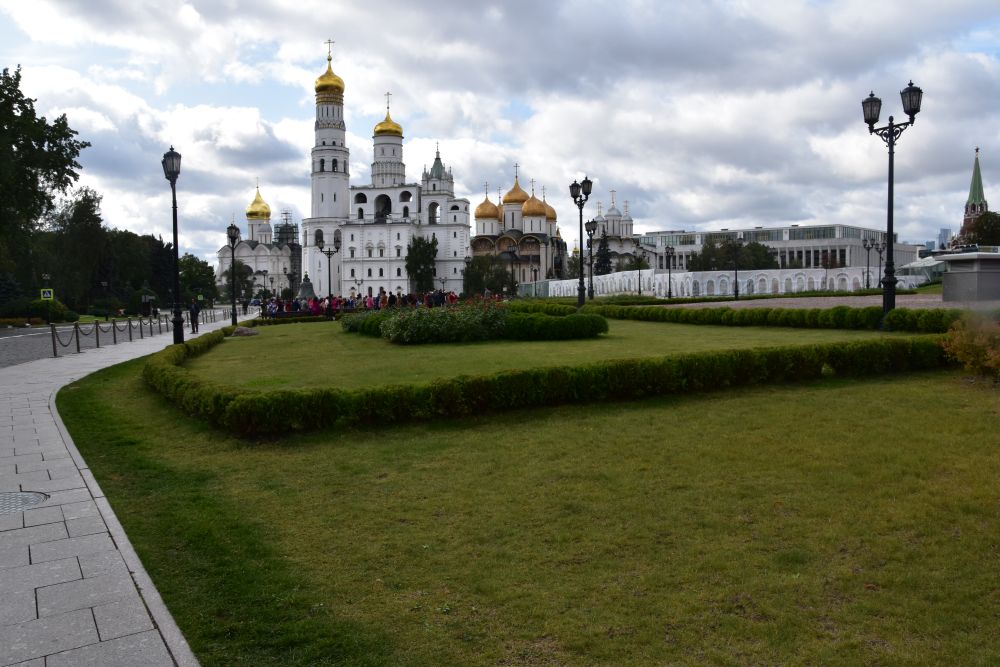
On the road to Spain: Pamplona – treasures in the Cathedral and the Museum of Navarra

In November 2019, we spend four nights in Pamplona on the Agra River exploring the City and the treasures in the Cathedral Santa Maria La Real and in the Museum of Navarra.


The Cathedral of Santa Maria La Real

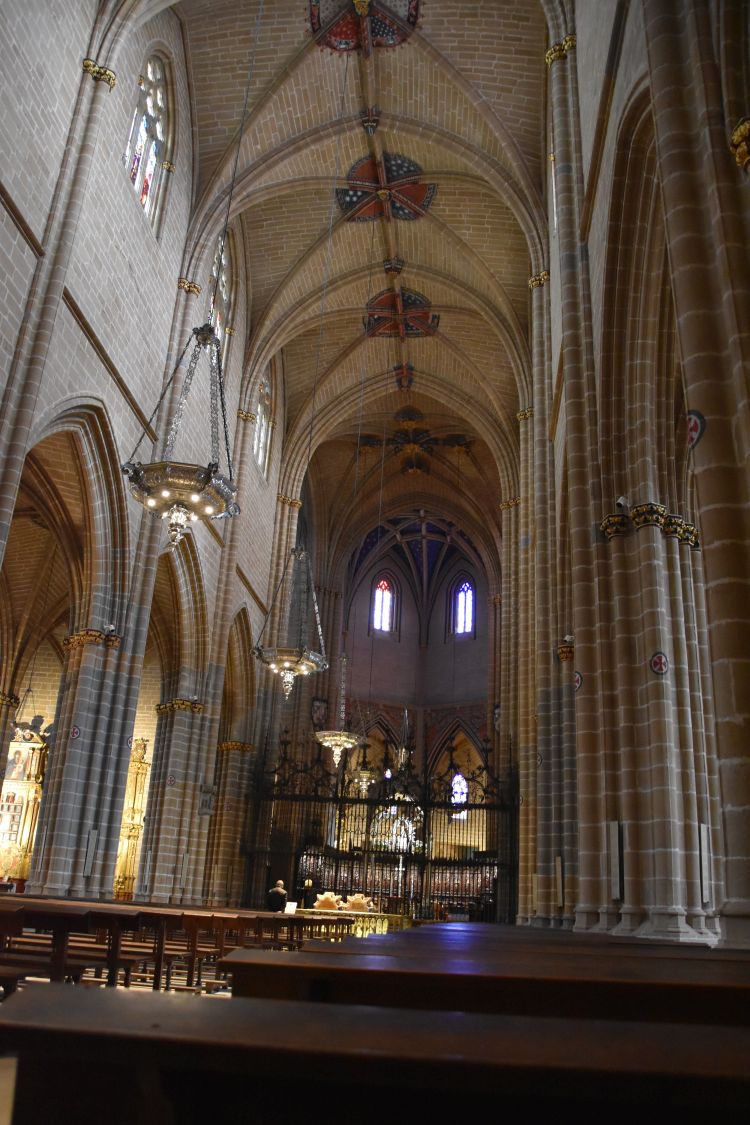
The Cathedral of Santa Maria La Real is located above the river Agra. The church was built in the 14/15th century and is of gothic style. The choir with the stalls is in front, which makes the nave open and uncongested (differing from many Spanish cathedrals, where the choir is in the middle of the nave impeding the view of the overall beauty of the nave).
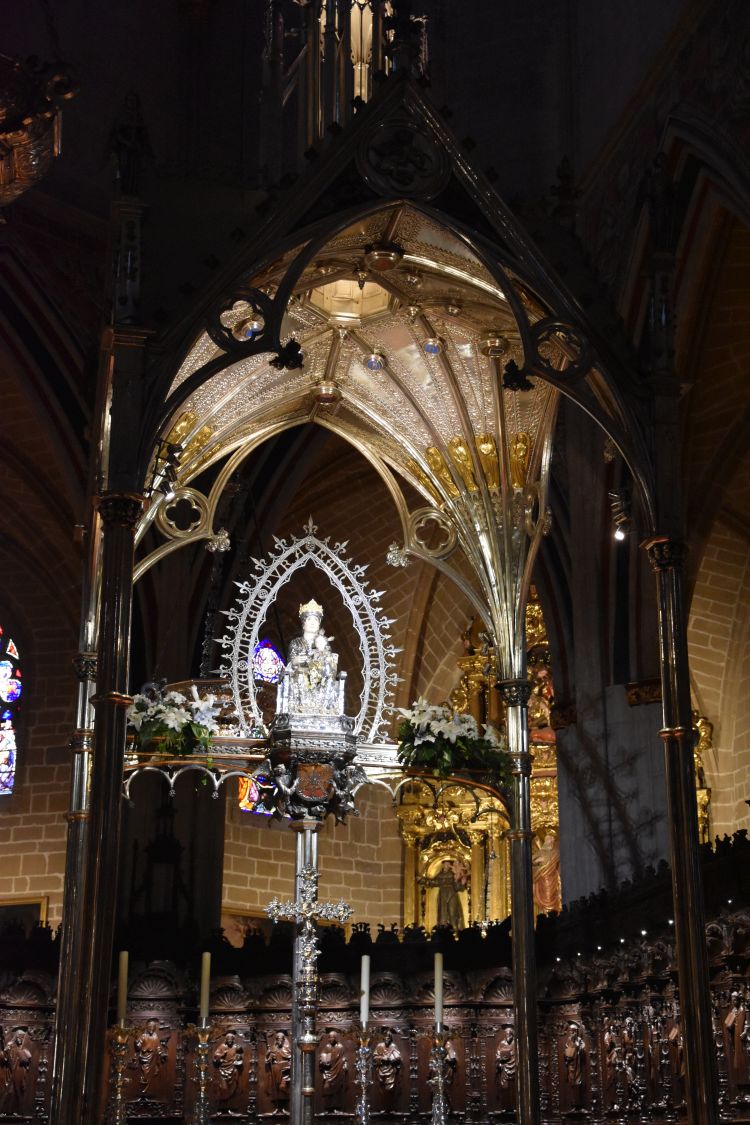
The statue of Maria from the 12th century sits under the silver baldachin.
Carlos III the Noble and his wife are buried in front of the choir. The15th century tomb slab made of alabaster has been beautifully carved. Carlos III is the king that managed to make peace between the local Navarrese and the “foreign” Franconians. The latter had immigrated to Pamplona in the 11th century and had kept on living in a town district of their own, even separated by a town wall. Carlos III mediated between the antagonists, pulled down the wall and constructed the townhall at the former borderline. With respect, I look at him.

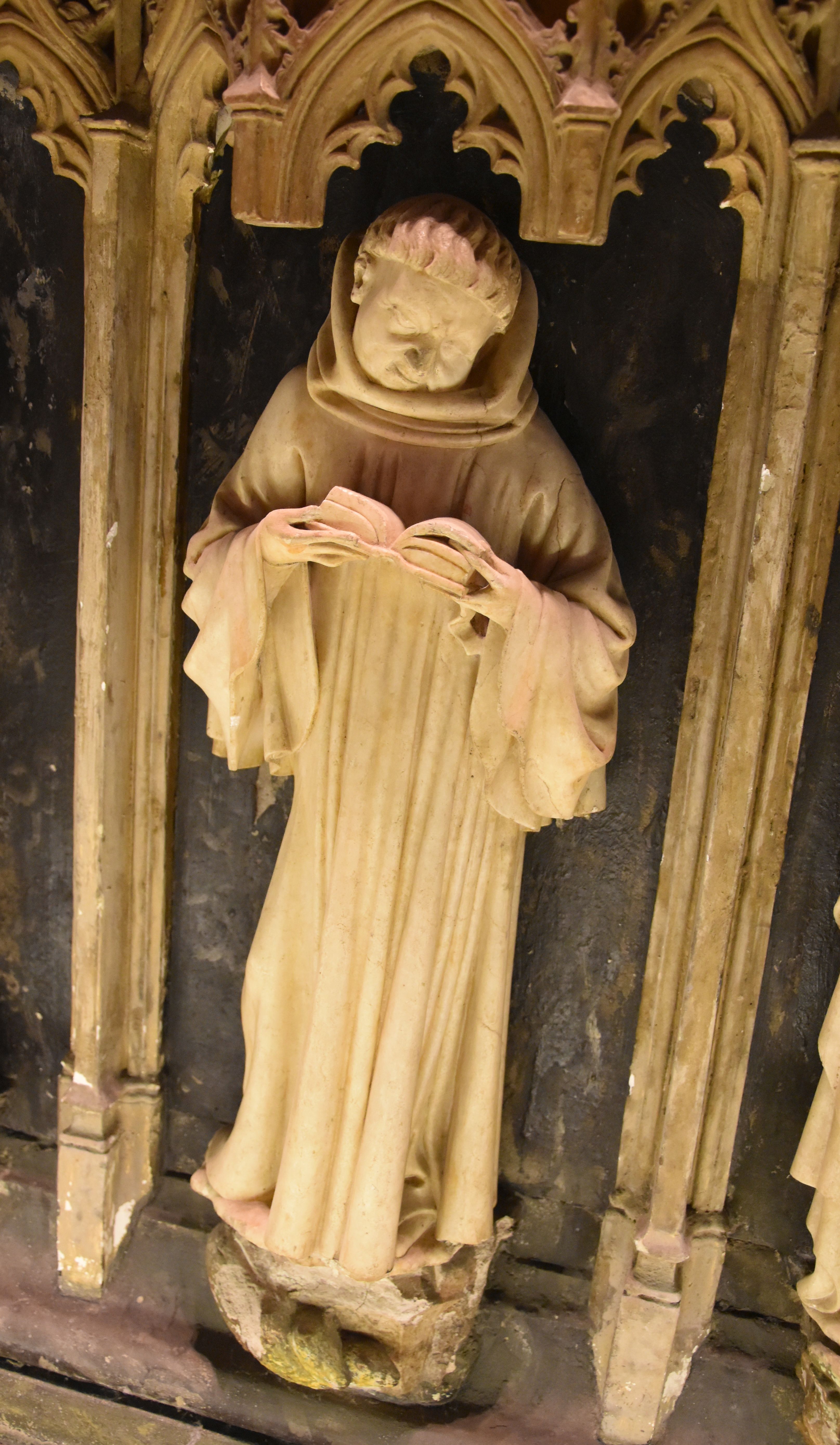
And with respect, his subjects mourned, as the beautiful small statues around the tomb illustrate.
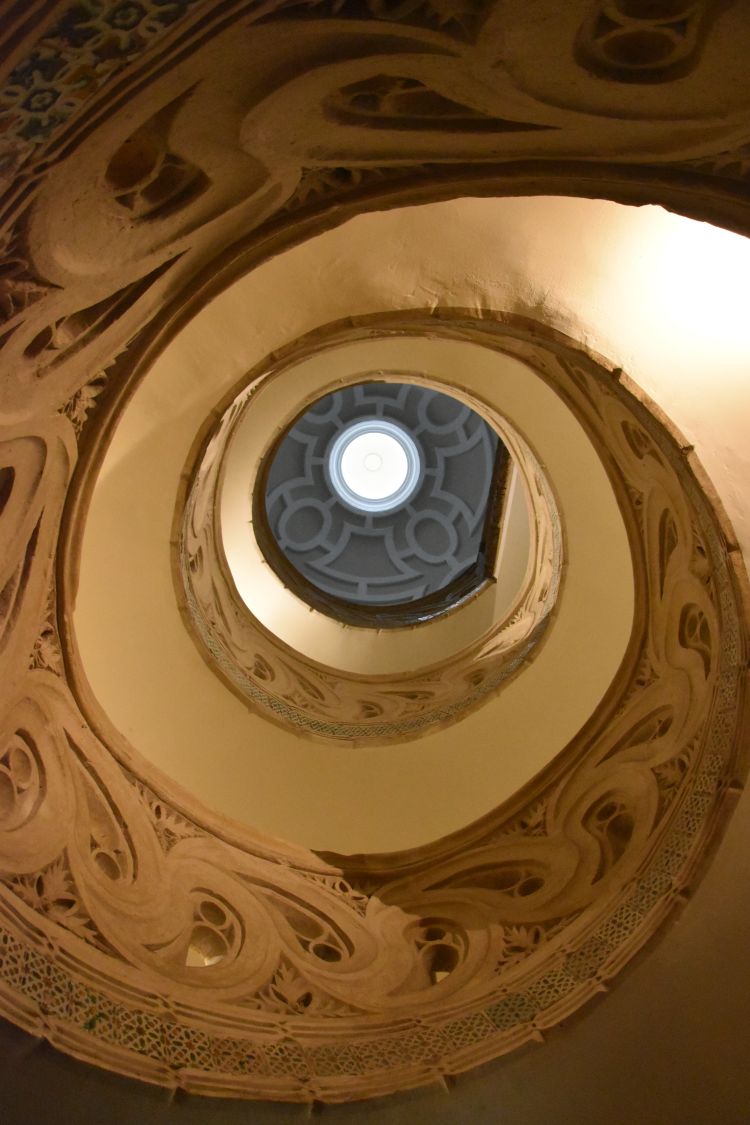
In the gangway to the cloister, I find this elegant spiral staircase.
The filigree arches in the cloister seem to dance.

Bishop Barbazán was buried in the chapter house in 1355. A small angel seems to adjust his cushion carefully.

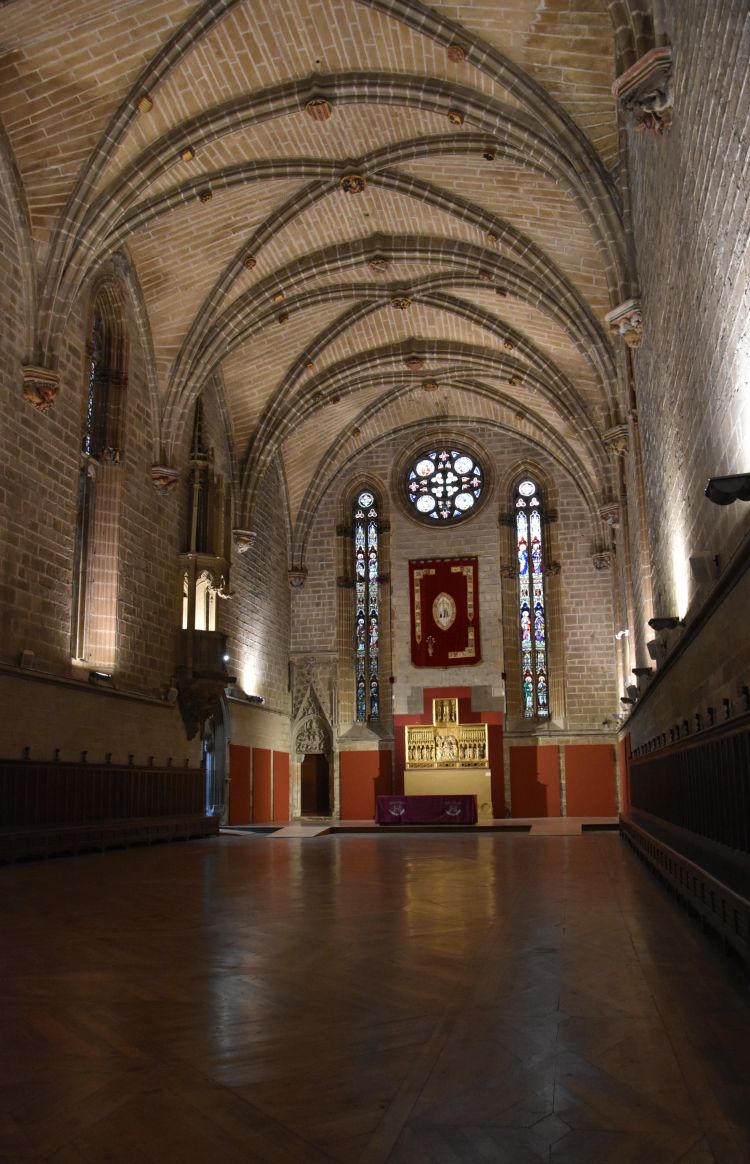
The refectory looks like it was a stylish place to eat. It was built around 1300 and measures 30mx10m.
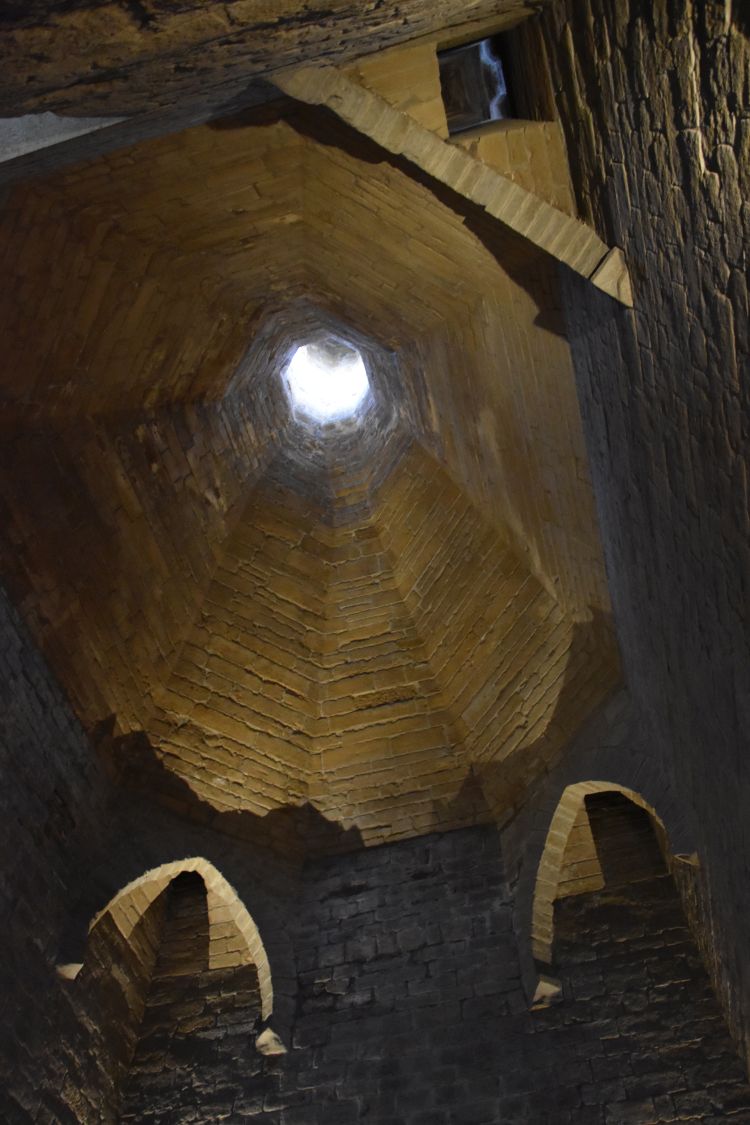
Nearby is the kitchen from the 14th century, with the long-long chimney.
Attached to the cloister is the Museo Diocesano with the exhibition “Occident” that illustrates the history of Christian culture in Europe.


The Museum of Navarra

We spend a full day in the Museum of Navarra that shows exhibits from archaeology and art that are related with the history of Navarra from prehistoric times until today.

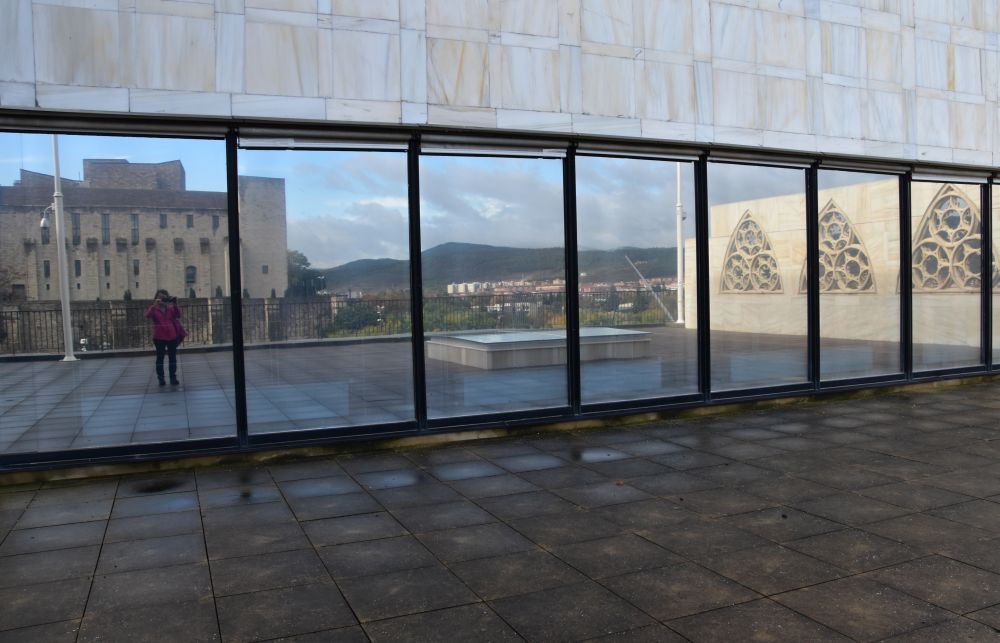
The Museum is located in a former hospital. On the terrace, we find a great view of the Pyrenees and the city.
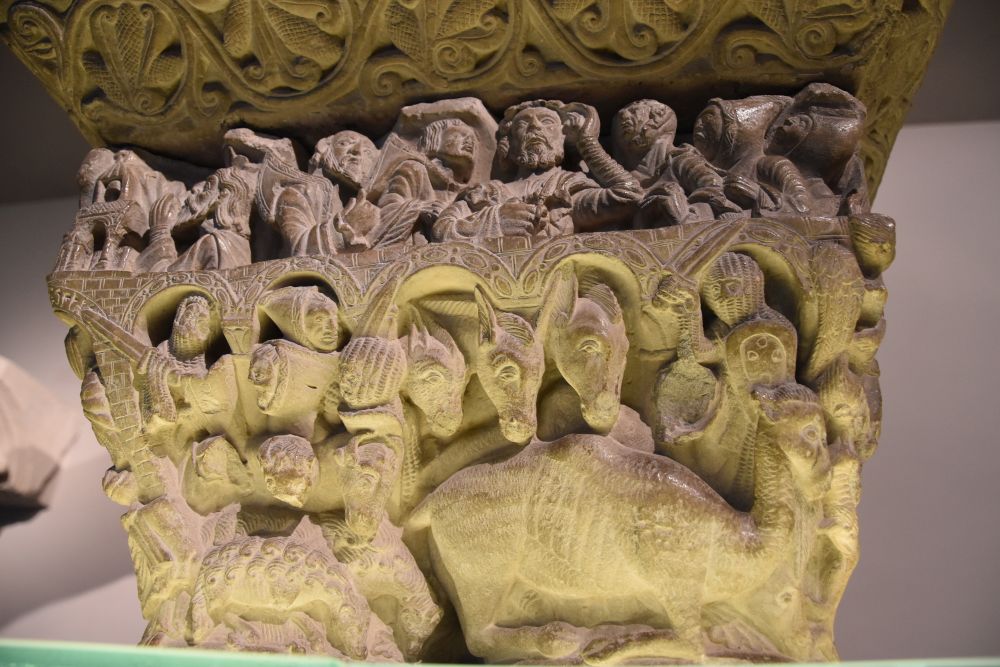
In the halls about Romanesque, we study Hiob’s fate in detail. Maestro del Claustro de la Catedral de Pamplona created it in the 12th century. The happy days of Hiob, his fall and his resurgence are illustrated on all four sides of the column. This is Hiob living happily with his family and his animals.
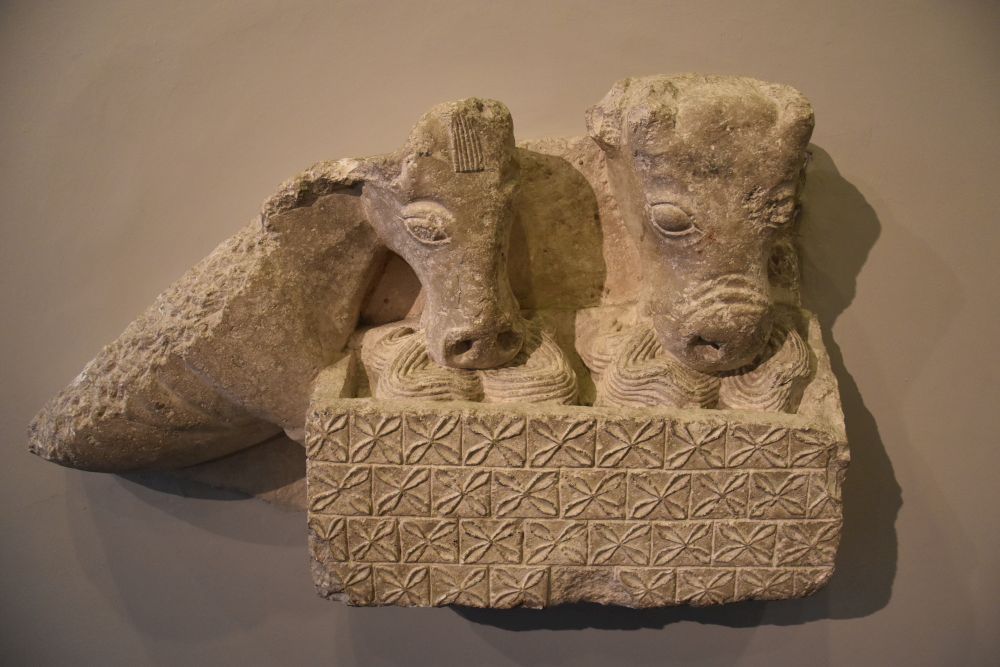
I very much like the elegance of this ox and donkey, a fragment from a nativity sculpture from the Cathedral of Pamplona.  Maestro Estebán made it in the 12th century.
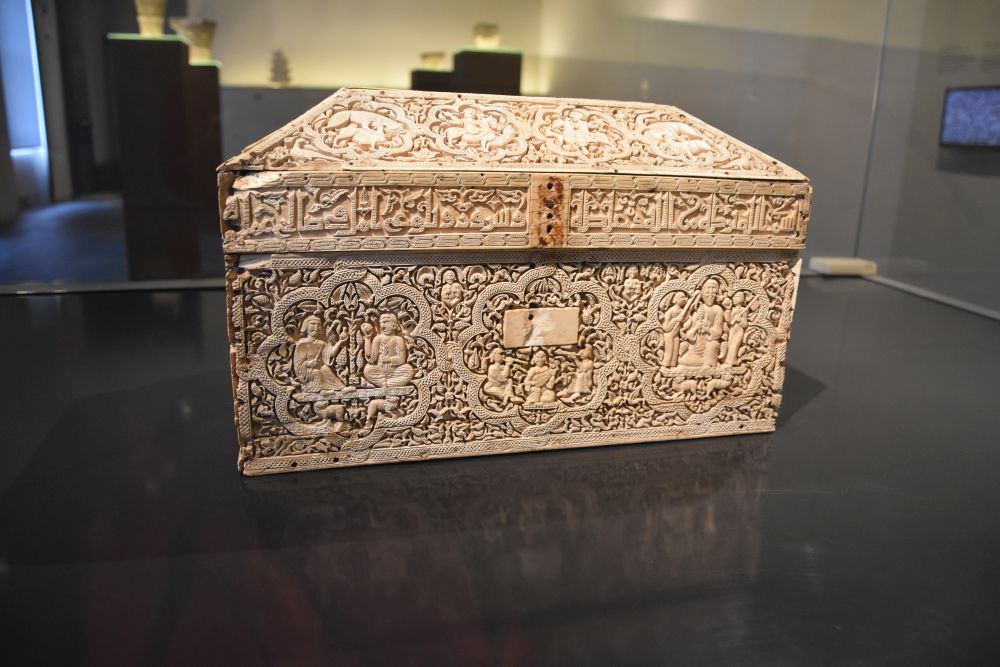
The ivory case “Arqueta de Leire” has been carved by Maestro Faray in Córdoba during the Umayyad Caliphate (up to 1031). It shows fine hunting scenes. The representation of human beings and animals is unusual for Islamic work of art. The case is from the Monasterio de San Salvator de Leyre. One of the inscriptions says “En el nombre de Allah”.
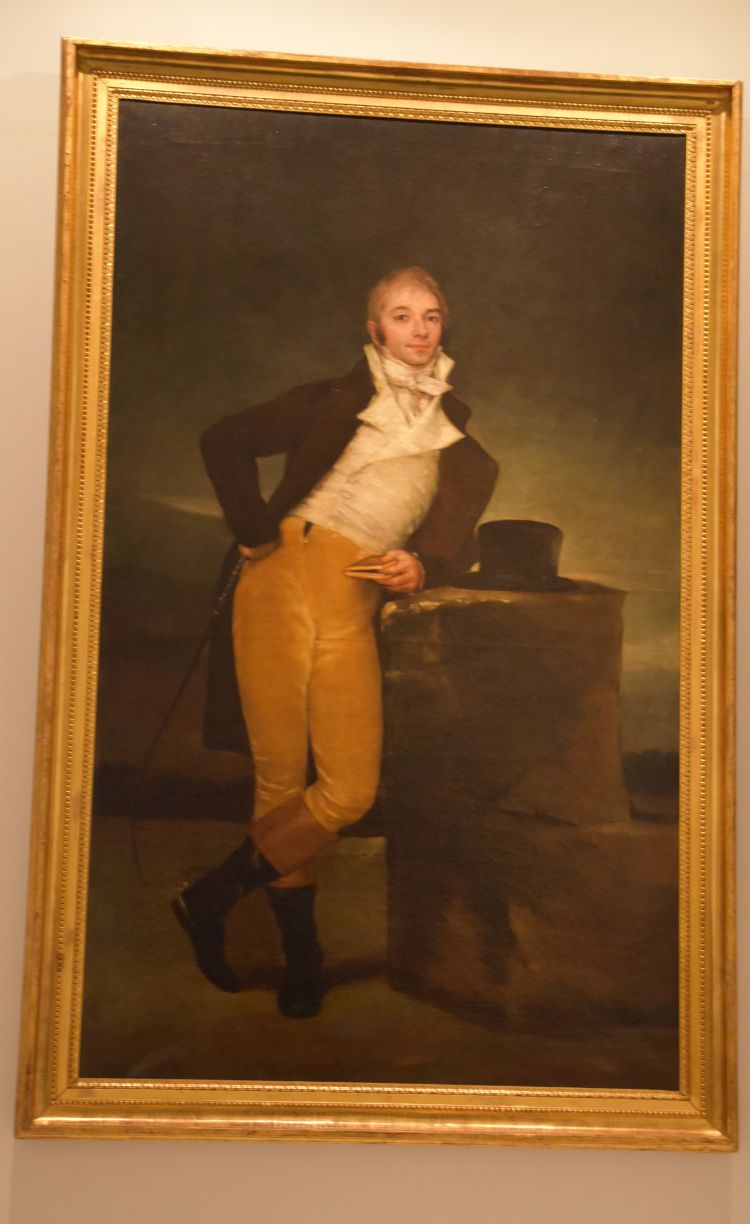
Goya painted a friend of his, Marqués de San Adrián. A noble young man in elegant velvet trousers. He has taken off his hat which creates an atmosphere of casualty and confidentiality.
The Museum is proud of their Mapa de Abauntz. Never have I seen a prehistoric map engraved on a stone. It is the most ancient map ever found, about 13’000 years old. Abauntz is a cave located about 25km north of Pamplona.
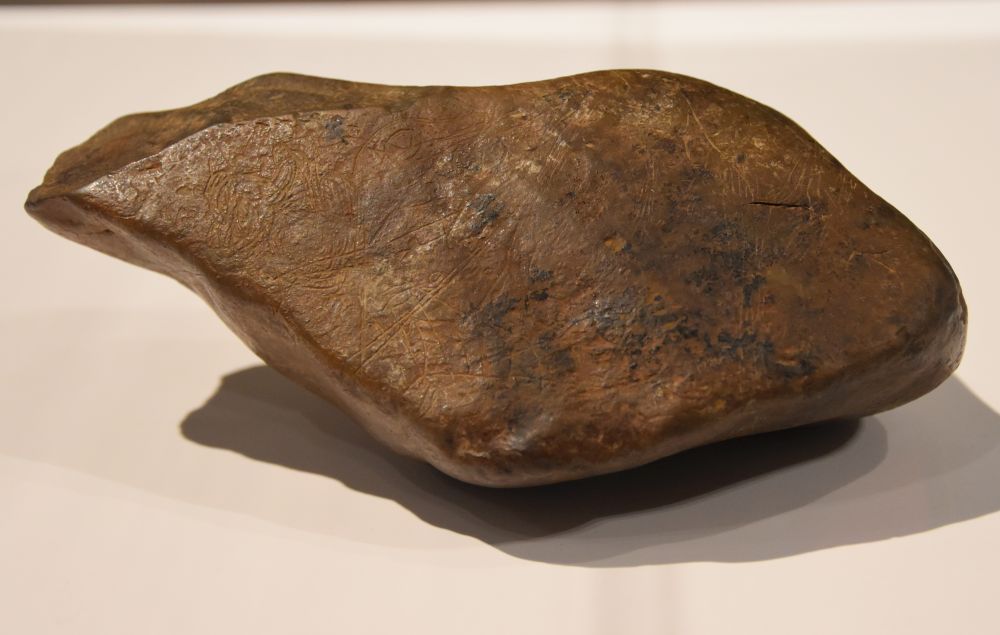
Panels explain what archaologists found on the map: Rivers, mountais and places for hunting goats (cabras) and other animals.
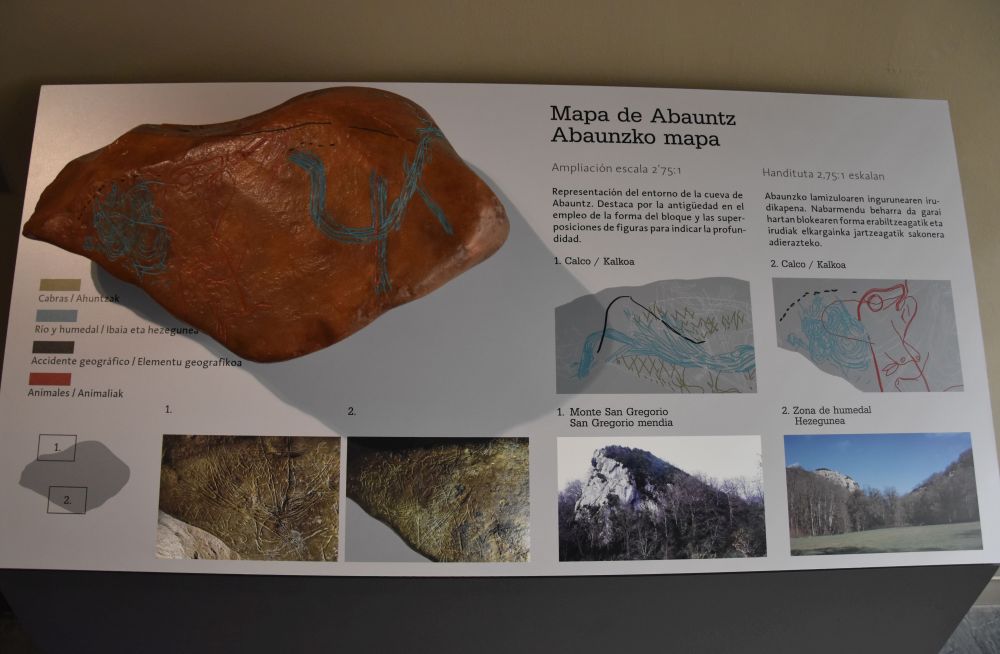
These maps are not as easy to read as the Swiss topological Maps of today… I admire the imagination of the archaeologists.

From the necropolis of Castejón (about 80km south of Pamplona), this charming horse shaped urn cover has been brought to the Museum of Navarra.
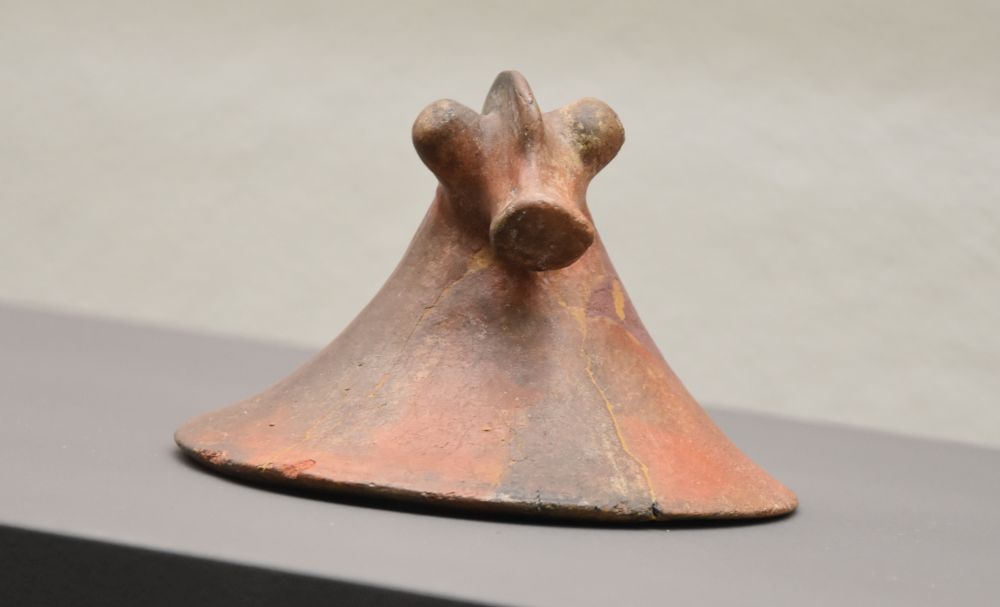
We spent a full day in this interesting Museum of Navarra – to be recommended! Especially on the rainy days that we experience now.

Next we explore the surroundings of Pamplona, Punta de Reina and Laguardia.


Sources: Marion Golder: “Nordspanien und der Jakobsweg”, Dumont Reise-Handbuch, Ostfildern 2018 and “Museo de Navarra”, edited by the Gobierno de Navarra.

On the road to Spain: Via Zubiri to Pamplona

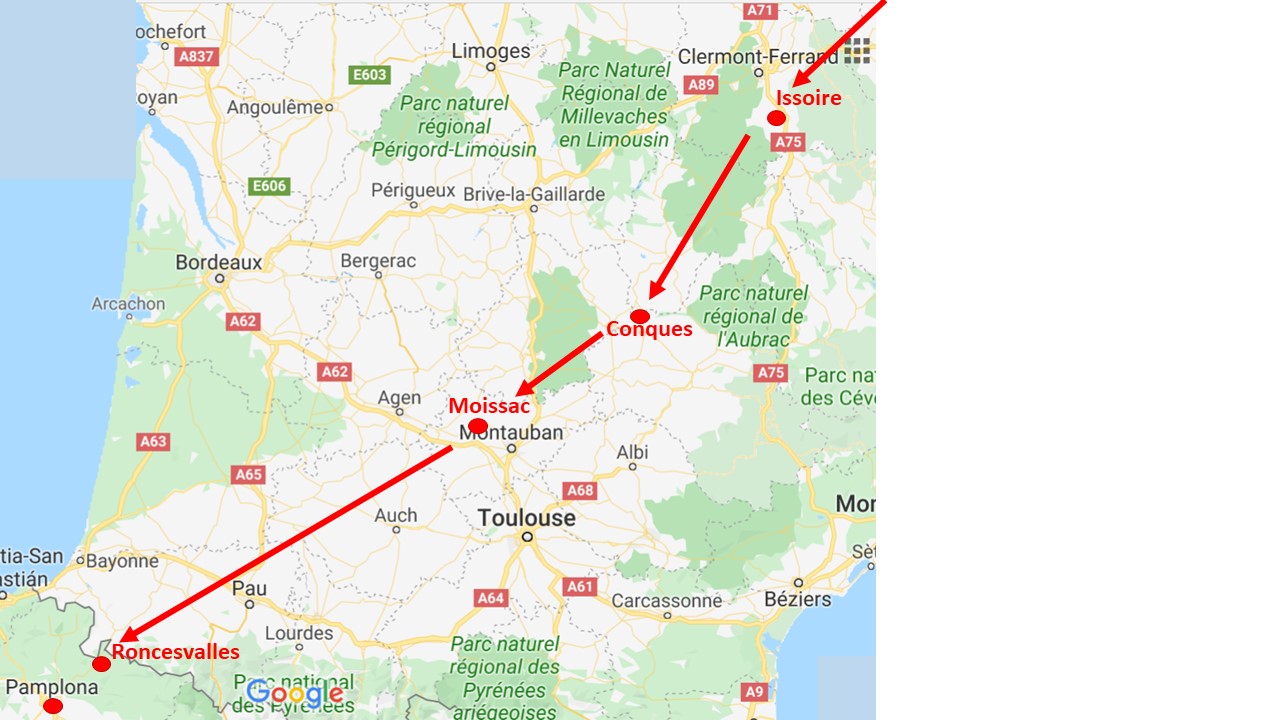
In November 2019, we are traveling through France to Spain. From our first stop in Spain, Roncesvalles, we drive to Pamplona, with a stop over in Zubiri.

Source: Googlemaps


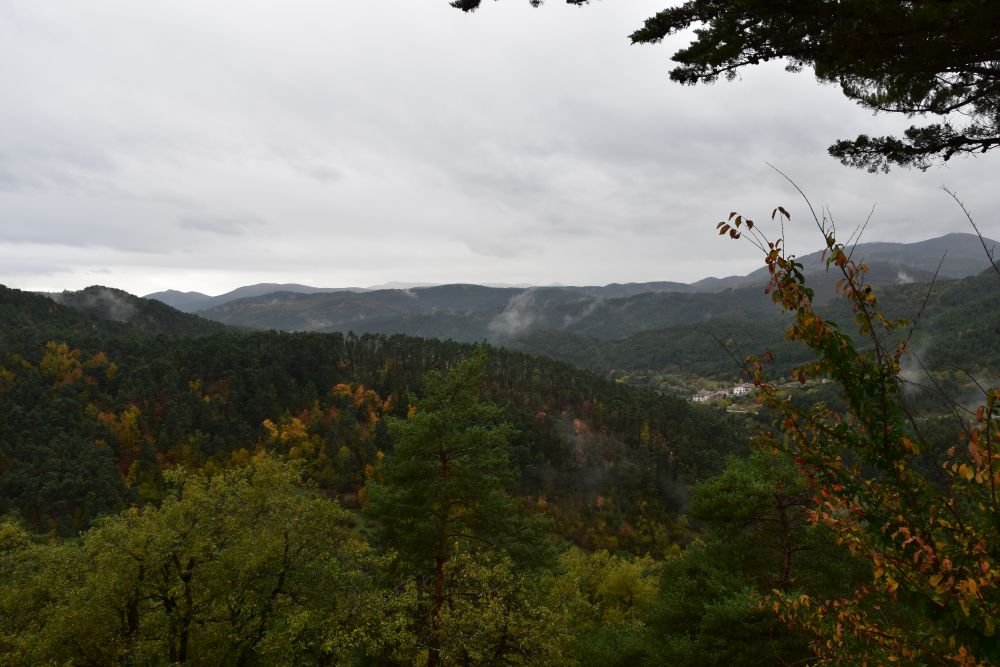
Crossing foggy and rainy hills to Zubiri with the Puente de la Rabia

From Roncesvalles, the road leads over two passes. The rainfall never stops and we feel compassion with the humpy pilgrims that, hidden under their rain capes (covering their back bags as well), bravely walk along the path of St. James crossing the main road from time to time. It has been raining for a week now, and there is no end in sight for at least another week. I do not know, whether I would feel like joining the pilgrims walking in the rain. I am pretty sure that I prefer to remain dry in our car, while our windscreen wipers go “swish-swish-swish”.

The villages on the way are full with guest houses for pilgrims. Good business, since the 11th century.

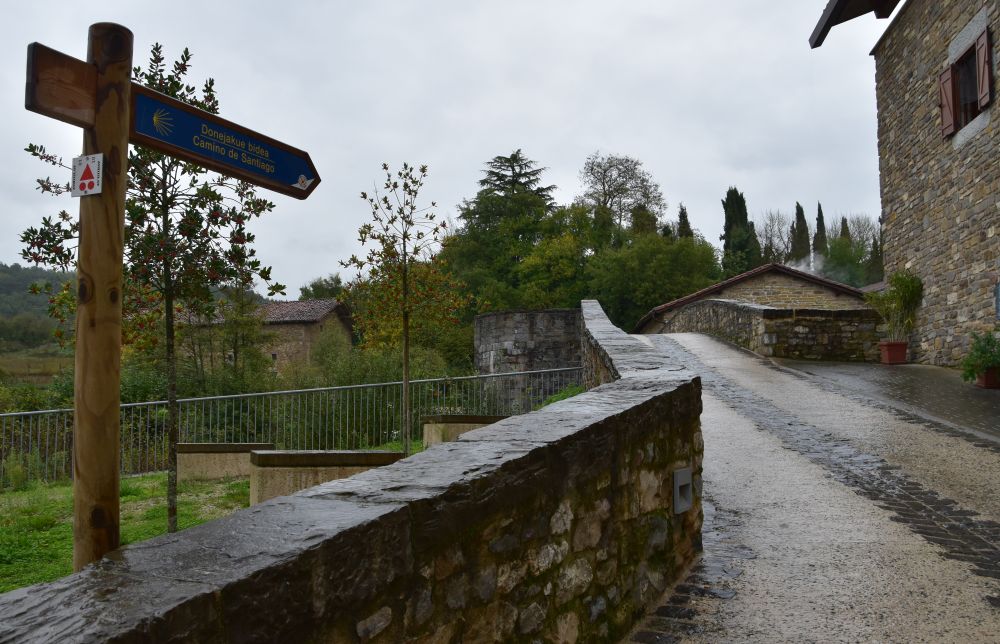
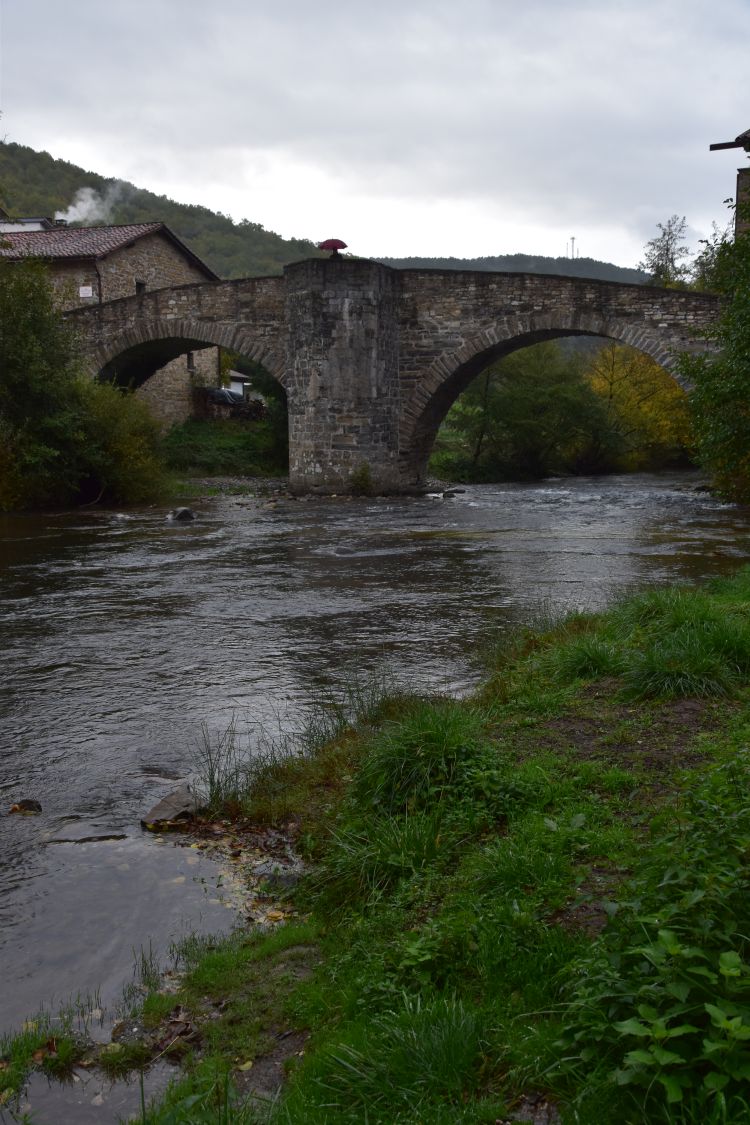
Zubiri is known for the medieval Puente de la Rabia over the river Agra. The Way of St. James crosses the bridge.

The bridge cures animals suffering from rabies – this is the legend. It seems that relics of Santa Quiteria, a martyr from the second century, have been found here. She would calm barking dogs and for this reason, she became known for curing rabia. Somewhat interesting. Nevertheless, I would not miss vaccination against rabia, when traveling to countries, where I could come across it, even after having been on this bridge.

People cross the rabies bridge with their umbrellas. Yes, it IS raining.

After Zubiri the valley opens and the mountains recede. We reach the basin of Pamplona.


Pamplona – known for their bulls

In Pamplona, we settle in the business hotel Los Tres Reyes, conveniently located, where the old city begins. Three kings, this alludes to the union of the kings of Navarra, Castilia and Aragon.

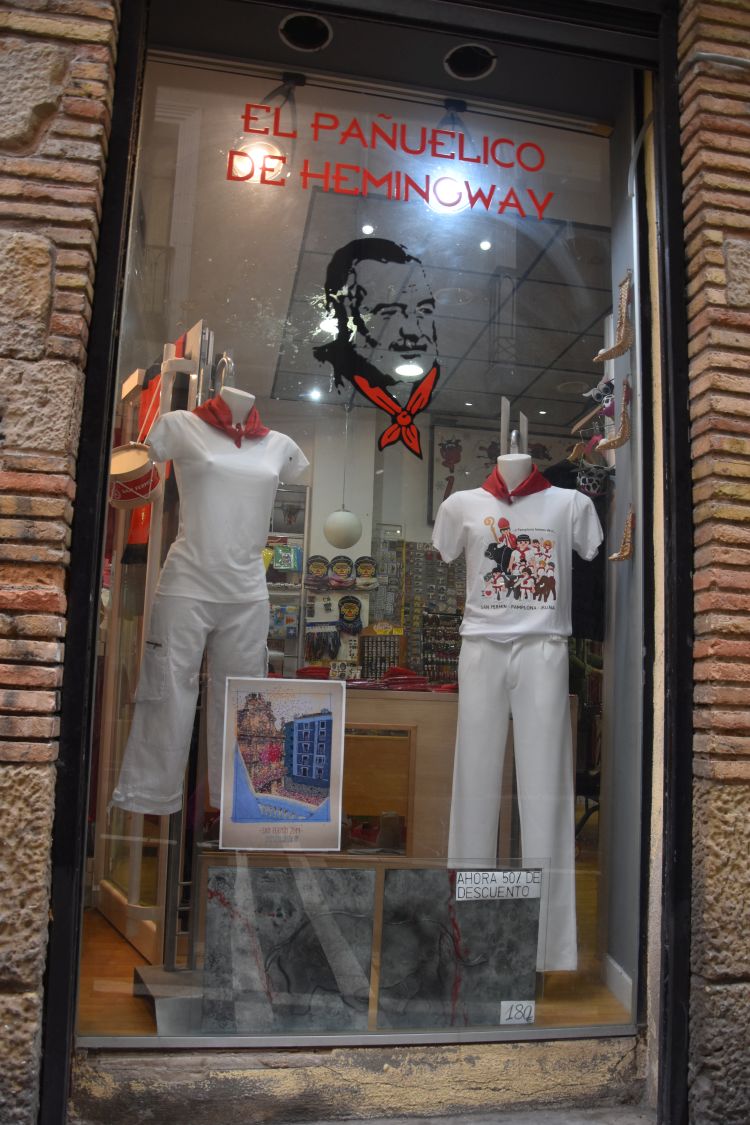
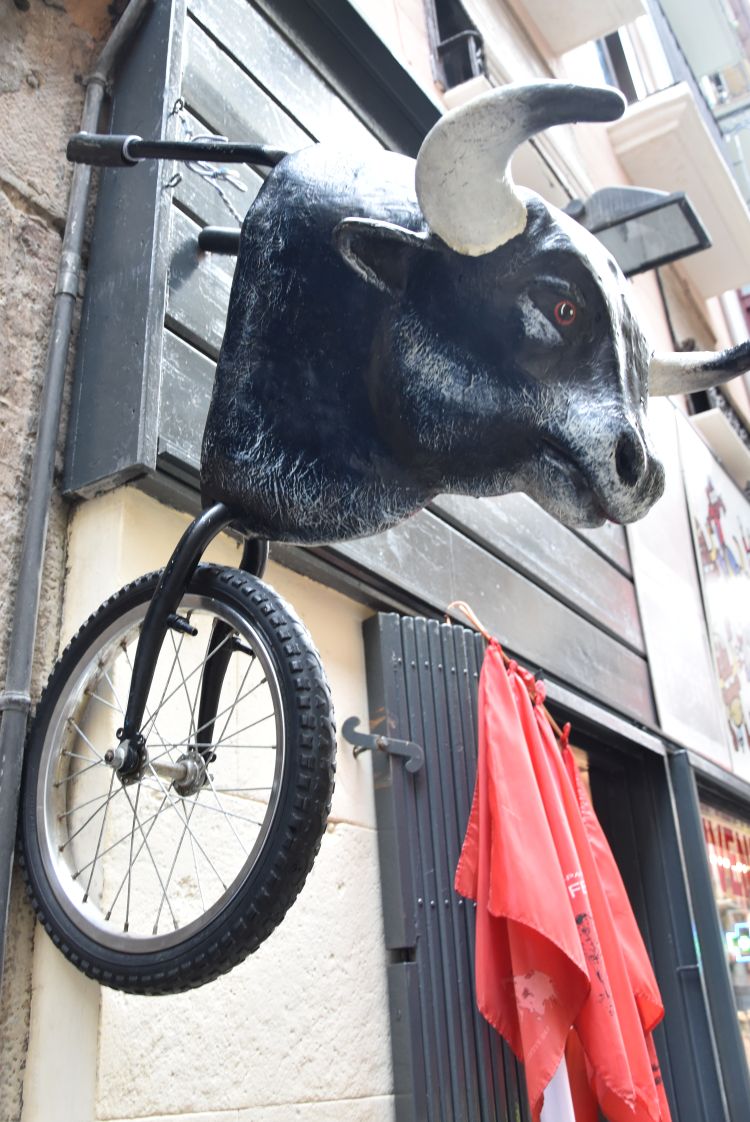
The city is known for bullfighting. In July (Sanfermin), the bulls run from their corrales through the narrow streets of the city center to the bullfight arena. Young men dressed in white with red scarves and red belts run with them, a pretty dangerous event. That is reflected in the shops. They sell the typical outfit and they also remind of Hemingway who has described Sanfermin in his novel “the sun also rises”.

Shop windows show videos about Sanfermin and childrens’ toy shops have sets to practice bullfighting.

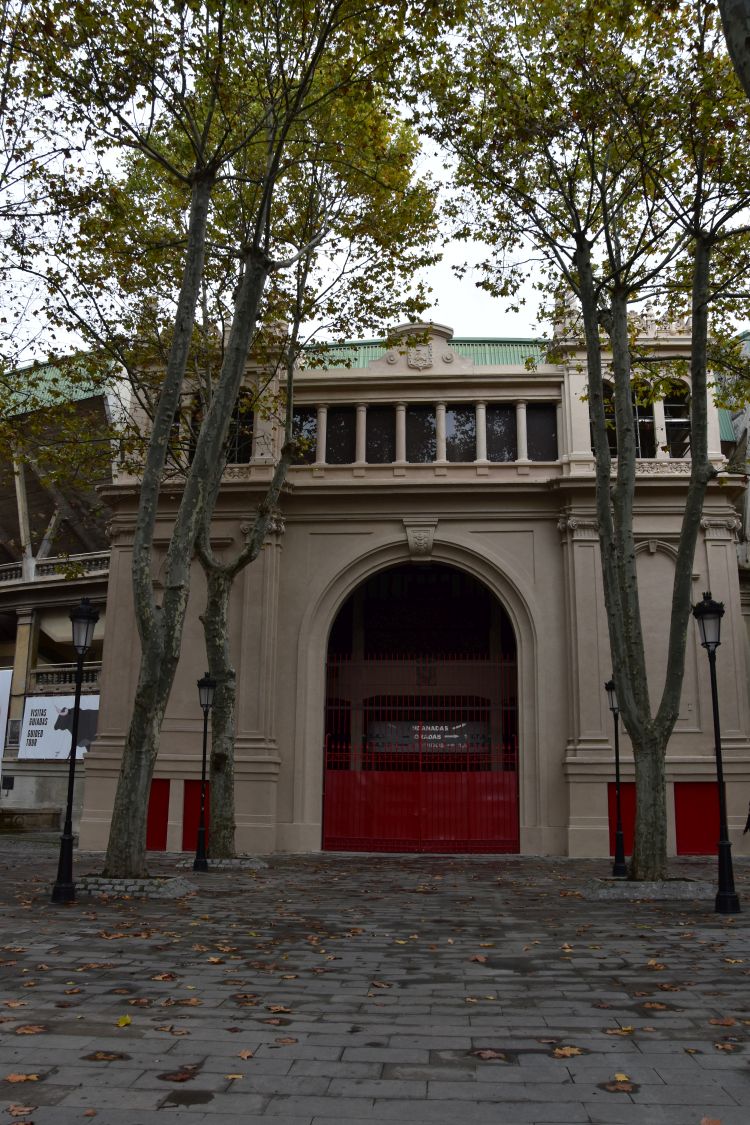
This is the entrance to the bullfighting arena.

Bullfighting is not really for me… I fell in love with Pamplona for other reasons, namely for the nice old town that invites for strolling and for all the works of art we found in the Cathedral and in the Museum of Navarra. Let me talk about some impressions in the city center first.
 

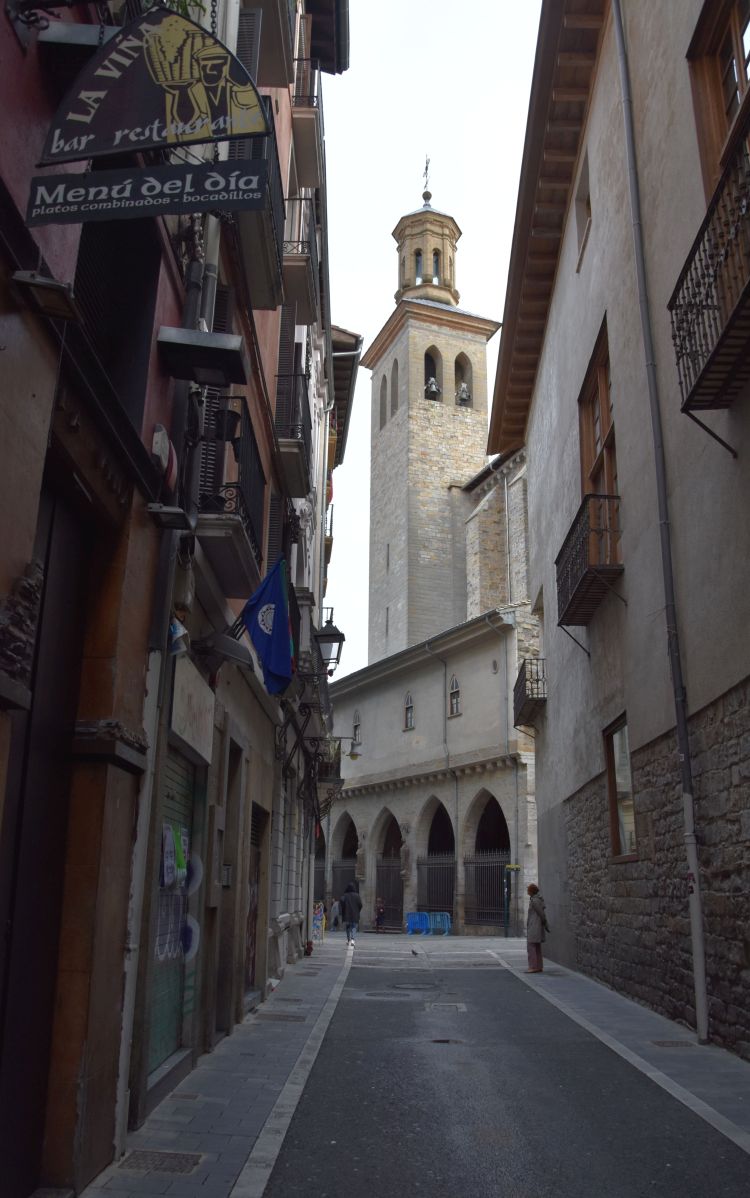
Strolling through the old city center of Pamplona

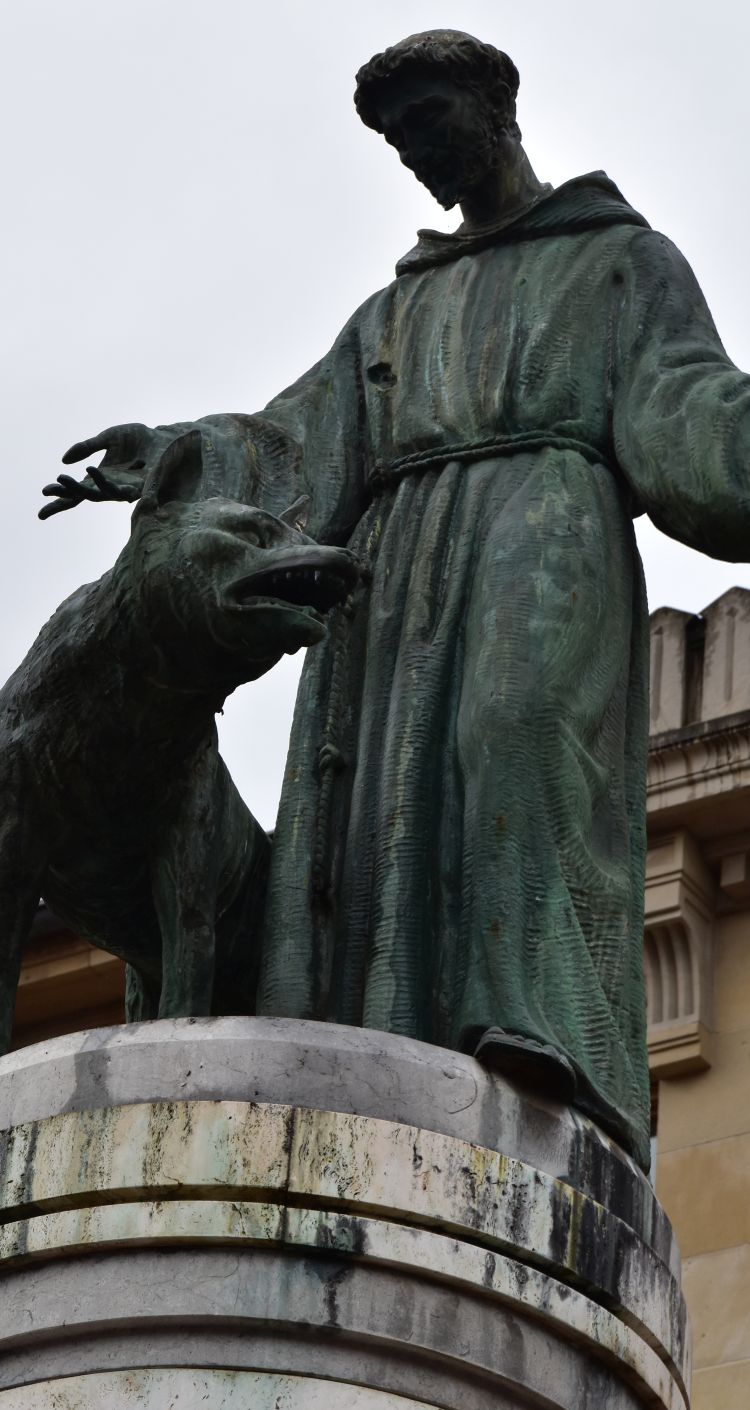
Not far from our hotel, St Francis welcomes us on the namesake square. He seems to have a discussion with this wolf.

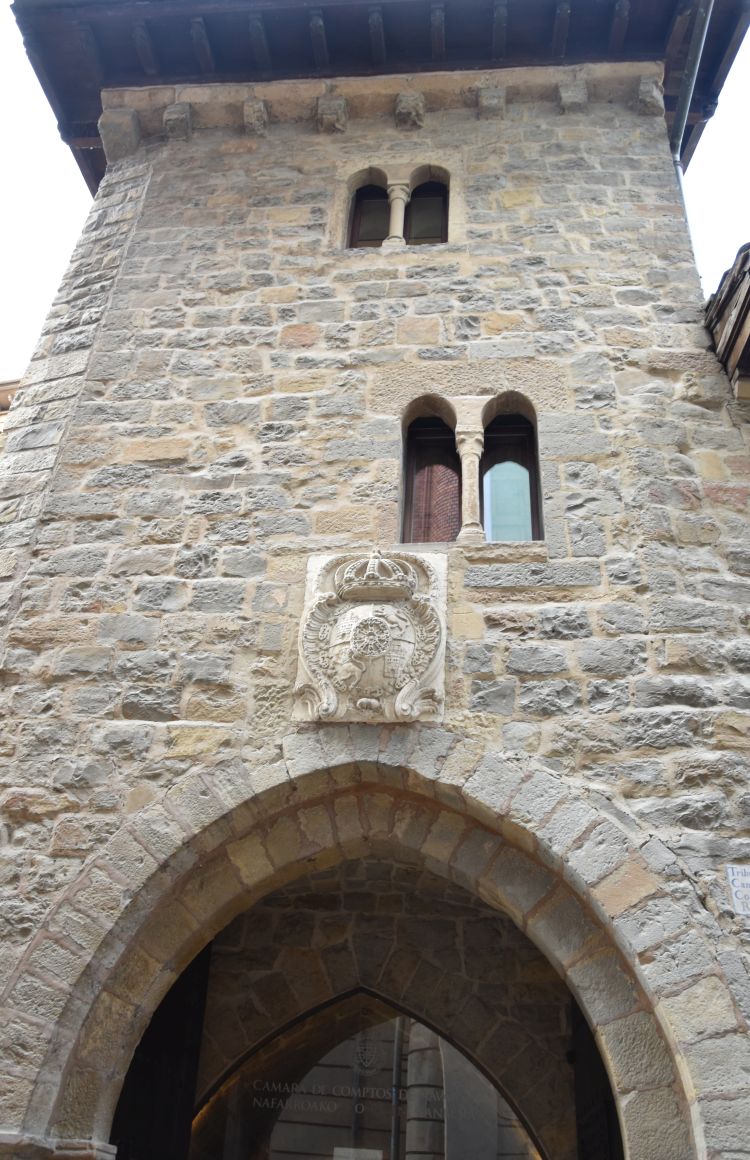
There are various Palaces in the city, with the Tribunal de Cámara de Comptos Reales being the oldest. It was built in gothic style in the 13th century. The public finances are controlled here.

The town hall or Casa Constitutional was constructed by Charles III the Noble in the 15th century at the point where two city districts fighting one another had their frontiers. In one district lived the Navarrians, in the second district the Franconians. Charles III is called “the Noble”, because he succeeded to mediate between the two antagonizing parties. The town hall was reconstructed in the 19th century, but the baroque facade was preserved.

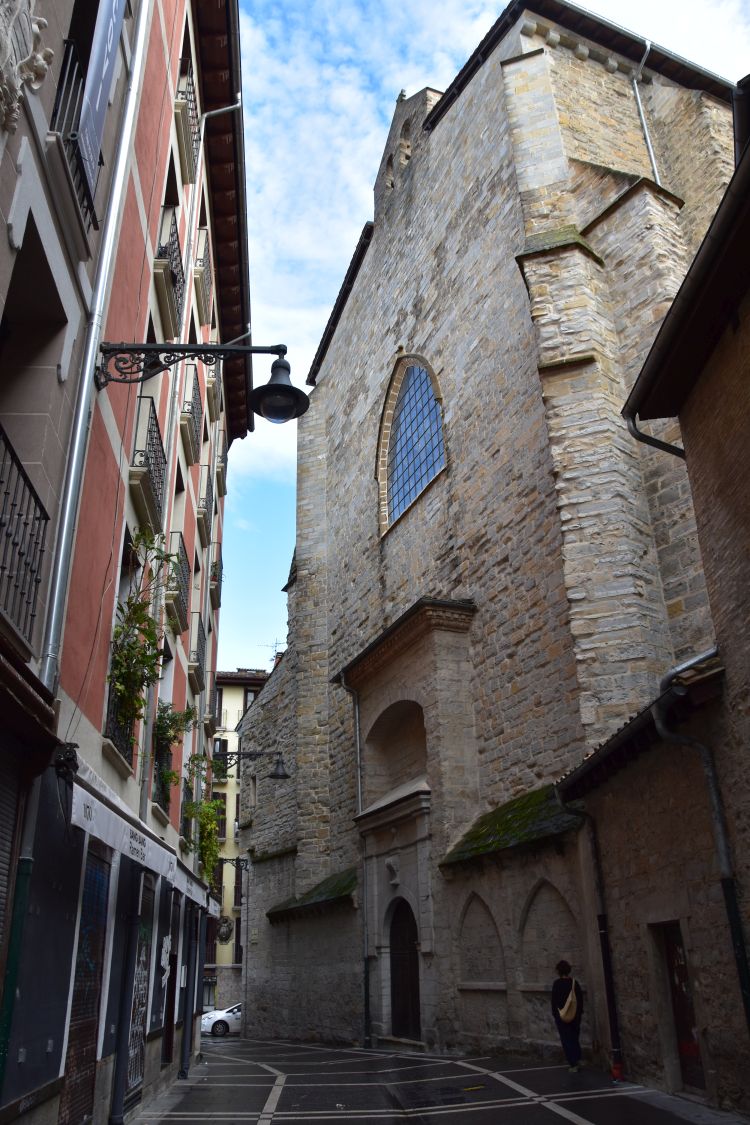
The Romanesque church of San Saturnino is from the 12/13th century.

It is of defiant stance. This is the tower with the narthex.

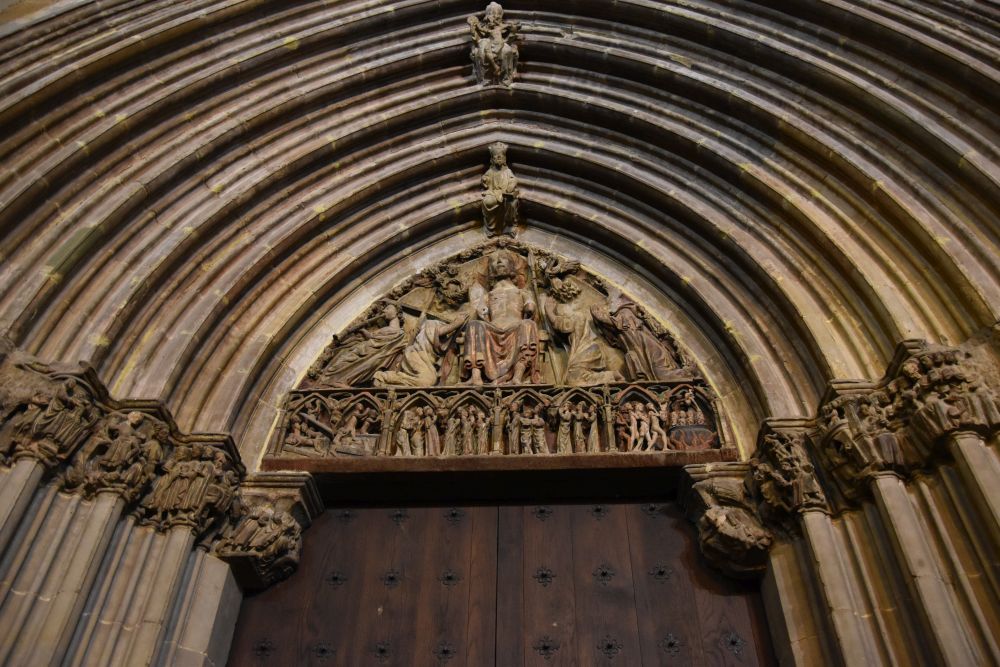
Inside the narthex, the tympanon above the porch presents the Last Judgment with Paradise and Hell.

A service is going on inside the church. We attend it for a little while. The priest in front of the altar wears a red gown. The altar is decorated with white flowers. What a solemn atmosphere under the sober Romanesque vaults!

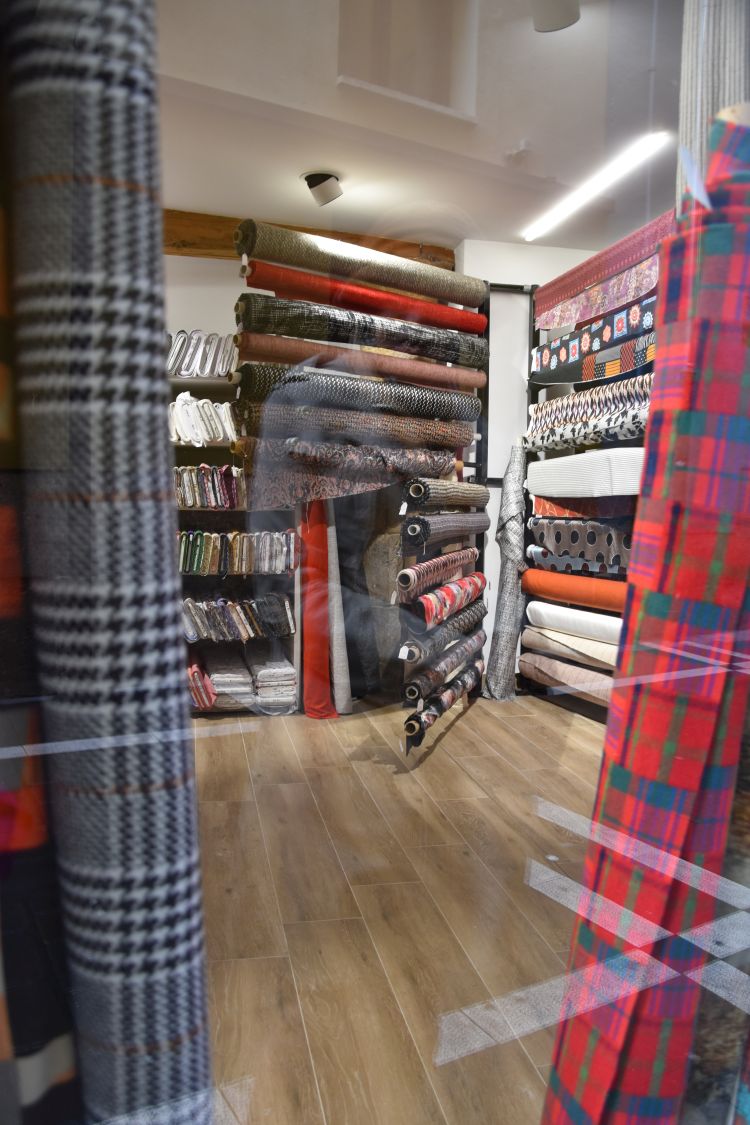
We leave the service and continue to walk through the narrow streets. Never before have we seen so many draperies and in some of them tailors are working at their sewing machines.

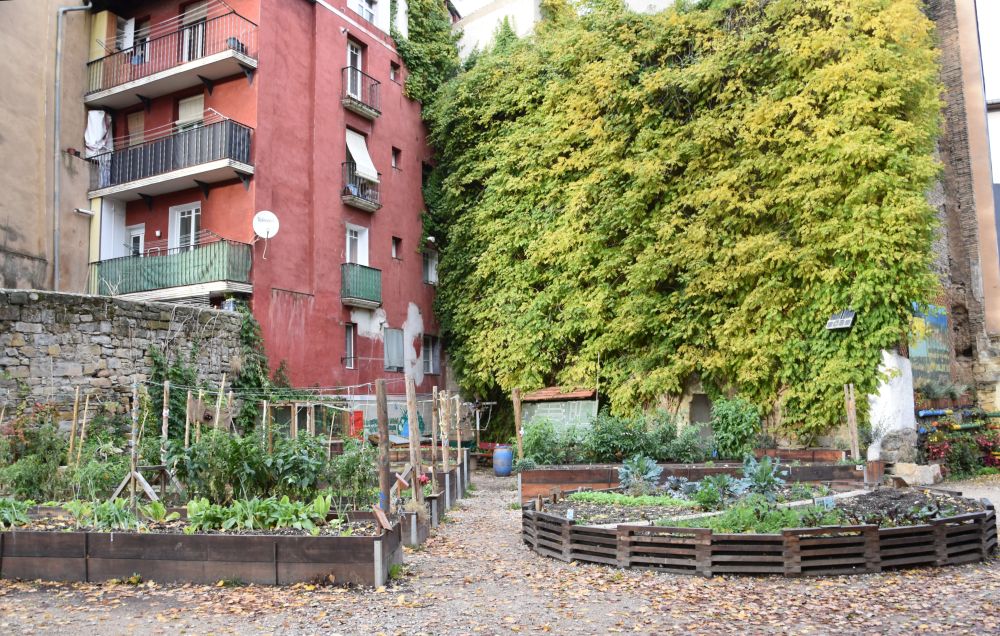
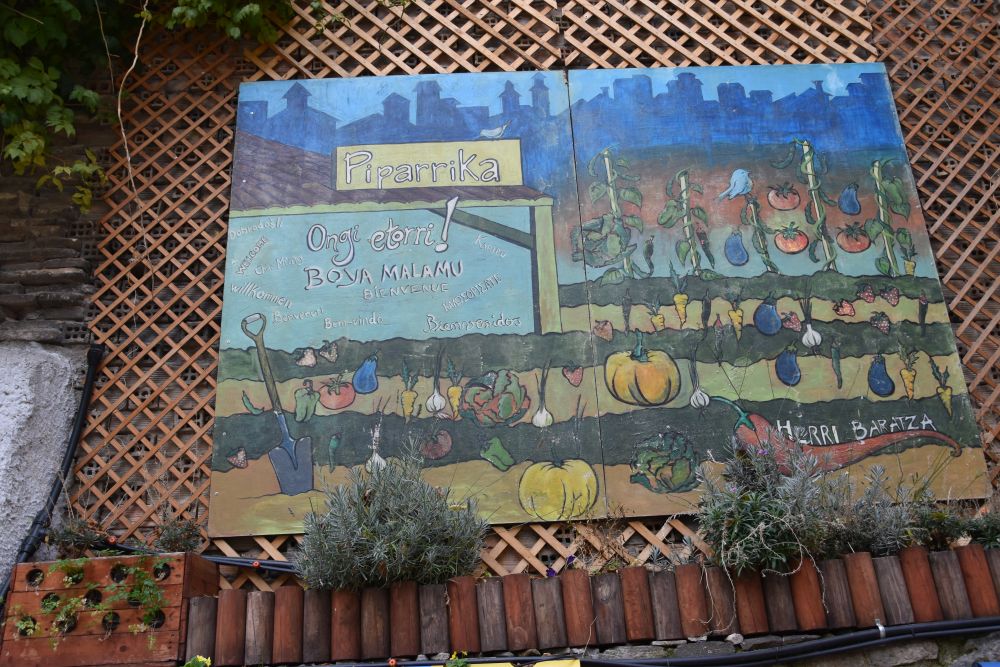
This backyard has been turned into a vegetable garden. What a great initiative.

The habitants call it “Pipparika” which might be Basque.

Inside the city, we find many small bars that sell pintxos (called tapas elsewhere in Spain). Great for short breaks, when strolling through the streets.

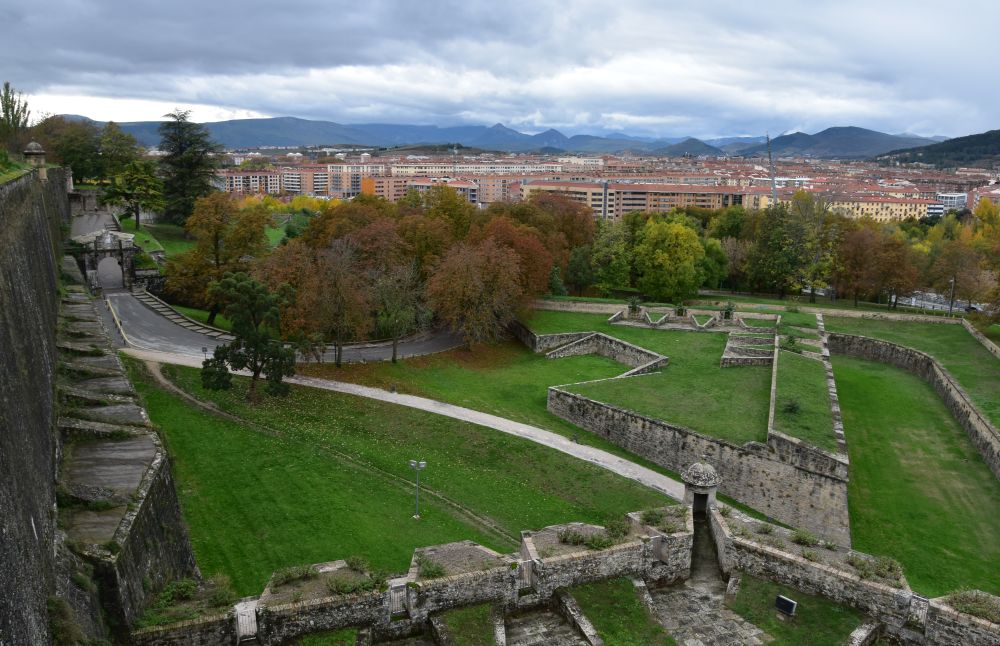
Walking along the fortifications of Pamplona tops our visit. It was the Spanish-Habsburgian king Philipp II who had fortified the city in the late 16th century, because he feared a French invasion. Part of the wall and the bastions have been kept until today and allow for a nice walk with a great view of the Pyrenees.

Sources: “Sehenswürdigkeiten und interessante Gebäude” von Tourismus Navarra und Marion Golder: “Nordspanien und der Jakosbweg”, Dumont Reise-Handbuch, Ostfildern 2018.

On the Road to Spain: Roncesvalles, where Roland was ambushed

In November 2019 we drive from Moissac to Saint-Jean-Pied-de-Port, then up to the pass Ibañeta and to Roncesvalles, where Roland was ambushed in 778 and where pilgrims stay overnight on the Way of St. James (Via Podiensis).


Saint-Jean-Pied-de-Port

Saint-Jean-Pied-de-Port is a fortified small town on the river Nive de Béhérobie.

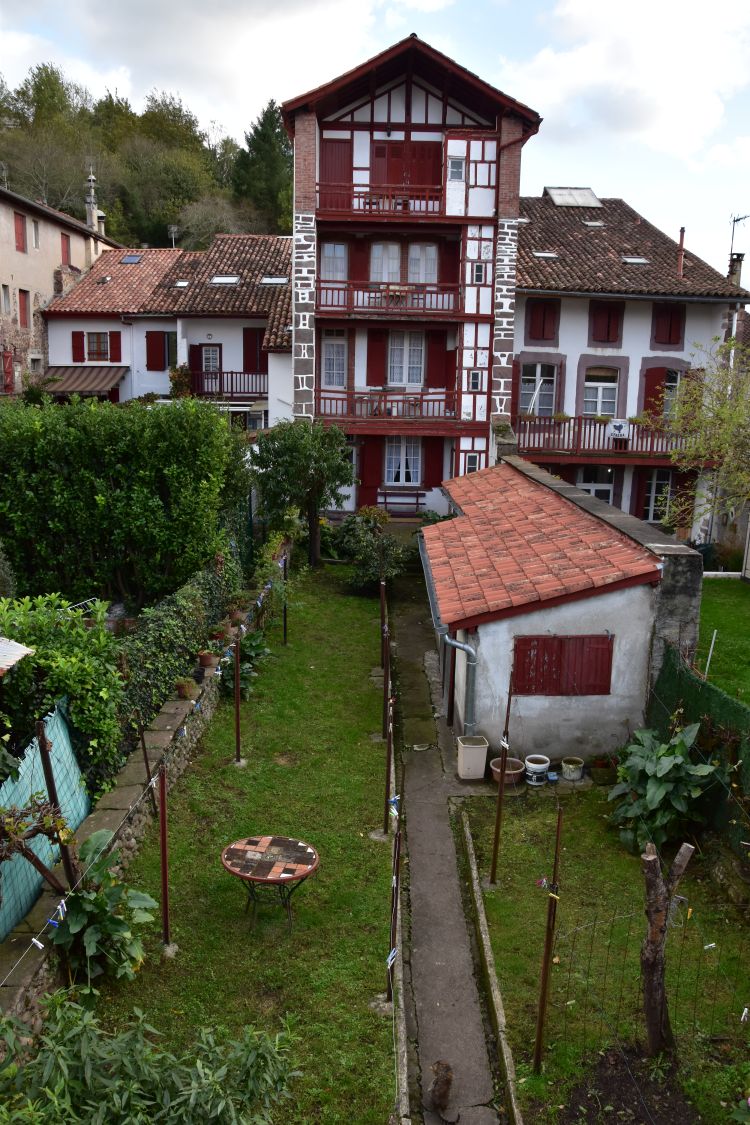
We stroll through the narrow streets, climb up to the town wall and look at the half-timbered houses from the backsides, with lush gardens.

Saint-Jean-Pied-de-Port is the last larger stop on the French side of the Pyrenees, located at about 200m above sea level. From here our car climbs up into the Pyrenees.


Puerta de Ibañeta (1057m)

We reach the pass of Ibañeta on 1057m and look back north towards Saint-Jean-Pied-de-Port, where we came from (Valcarlos). Two young pilgrims from South Korea reach the pass at the same time. They look exhausted and thankfully accept the lift to Roncesvalles in our car.

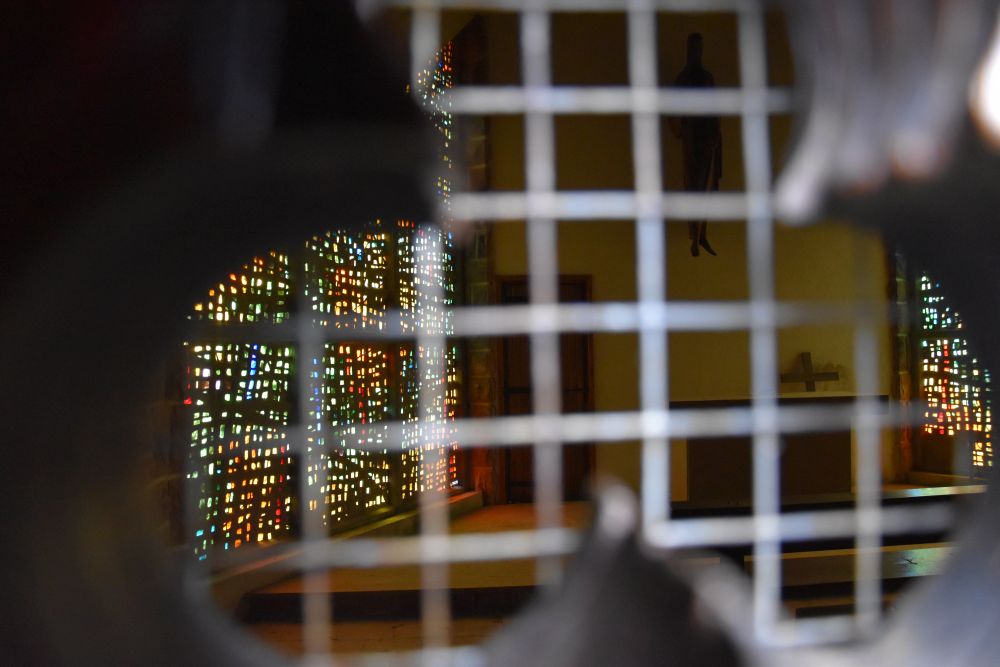
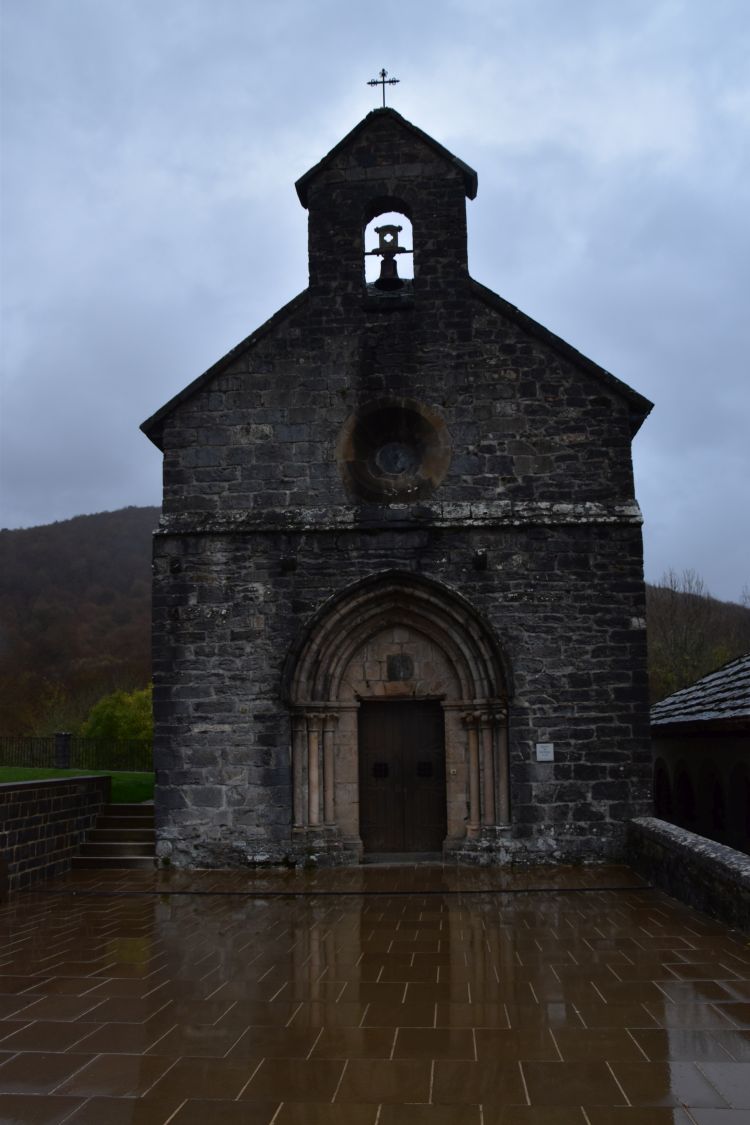
A small and modern chapel greets the pilgrims on the pass. The legend goes that monks used to ring the bell of the chapel to make sure, they do not lose their way in the fog. The chapel is locked. We look through the tiny hole. It is full of atmosphere with the colored windows and the sober altar.

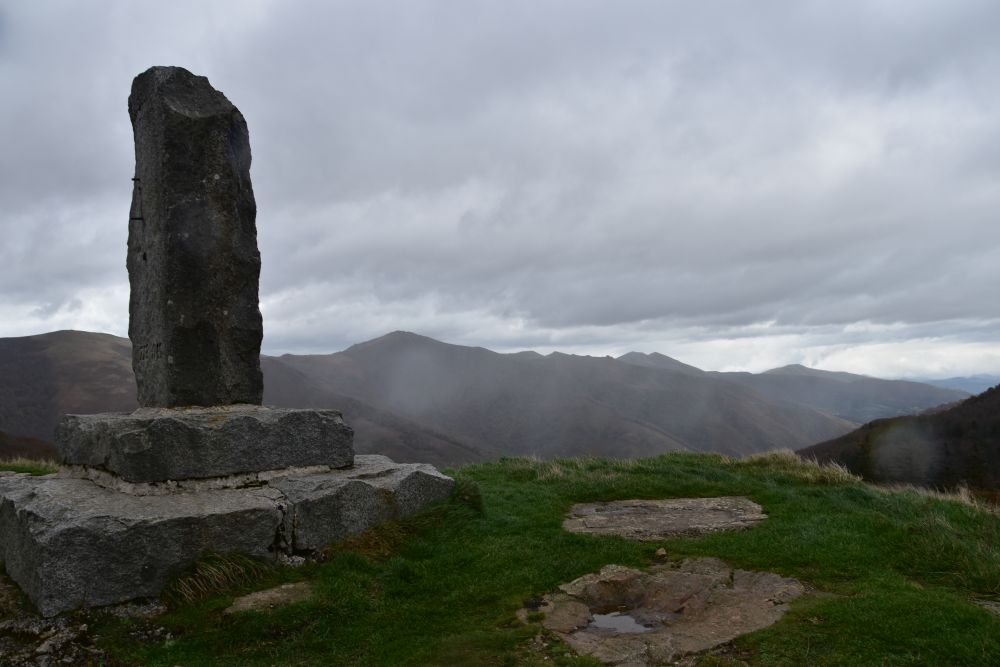
Above the chapel, the Roland monument reminds us that he has been ambushed somewhere here in 778, when returning with Charlemagne from their campaign to Spain. Charlemagne had been called by the governors of the northern Islamic principalities to support them against the Emir of Córdoba. When returning to France, Charlemagne had Pamplona destroyed, before leading his army up to the Puerta de Ibañueta. The Basques revenged the destruction of Pamplona by ambushing the Franconian rear guard led by Roland, governor of the Breton March. This is the monument – the rain has started again.

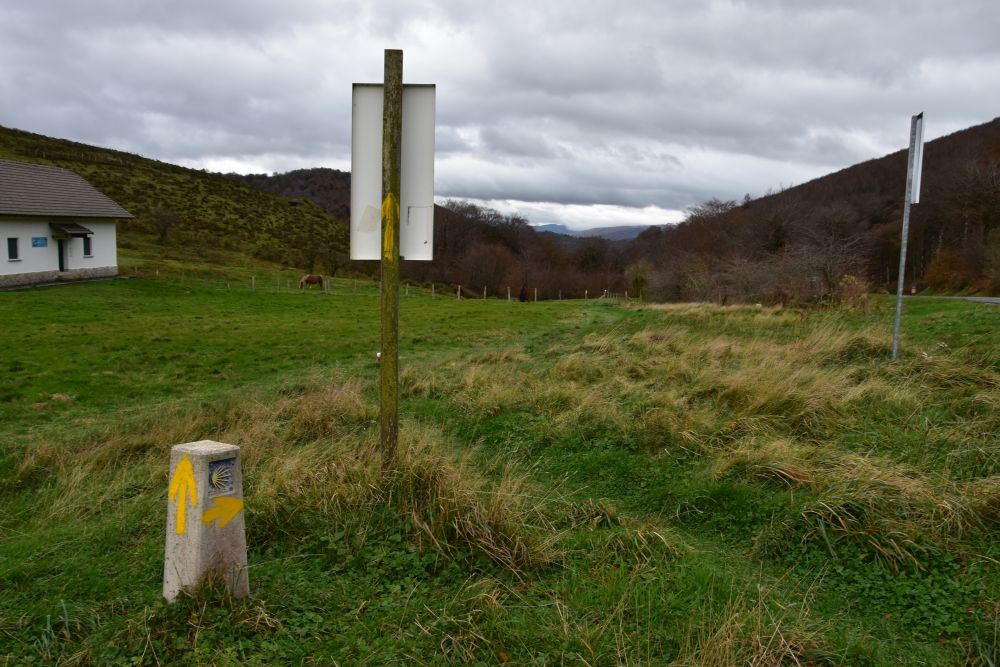
The hikers on the Way of St. James are directed to use this path down to Roncesvalles, which is at a 2kms’ foot walk from here.

Our exhausted pilgrims happily jump into our car and we drive to Roncesvalles. We settle in the Hotel Roncesvalles. They continue their way to another hostel.

.

Roncesvalles (Orreage in Basque)

We spend two nights in the cosy Hotel Roncesvalles. Roncesvalles means “valley of thorny bushes”.

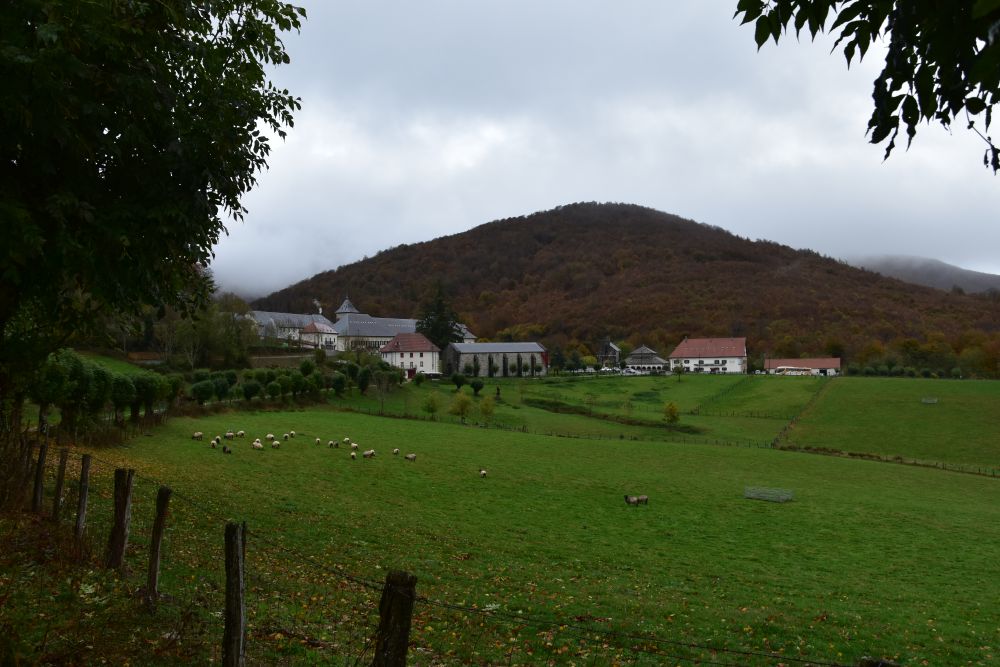
The complex of the former Augustinian monastery from the 12th century is beautifully located below green hills and on green meadows.

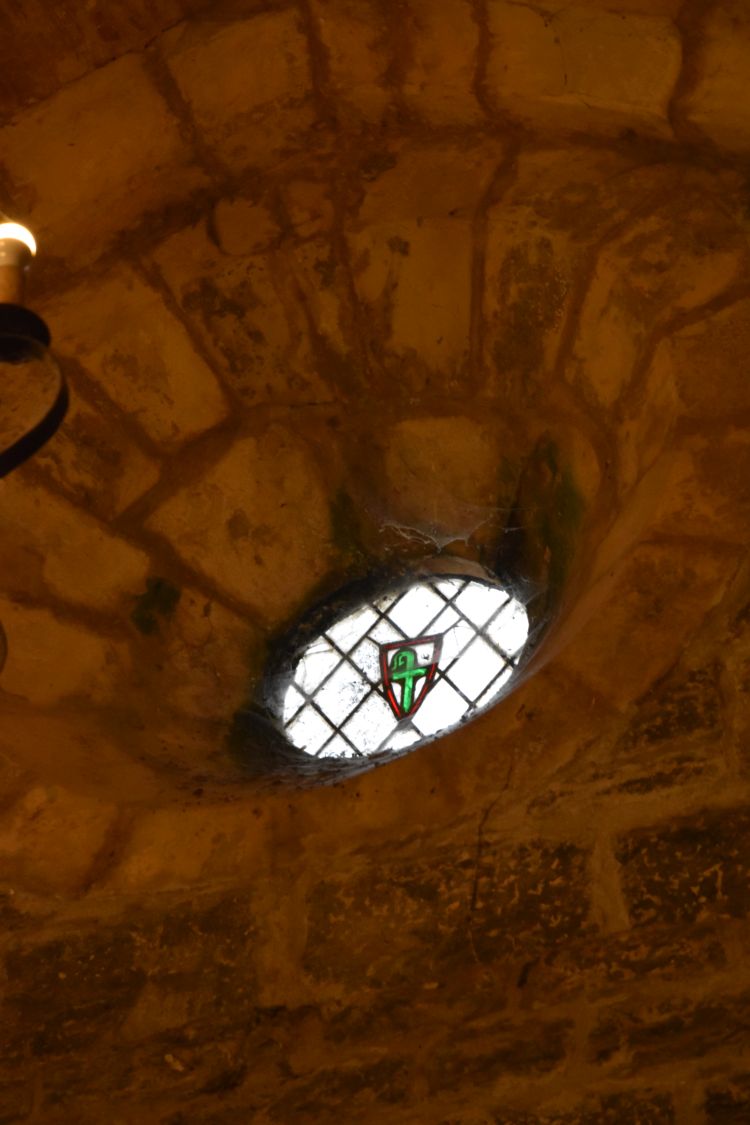
The emblem of Roncesvalles is the green bishop’s crook. It is present all over here, in windows, on fountains, tombstones, doors, ground slabs etc.

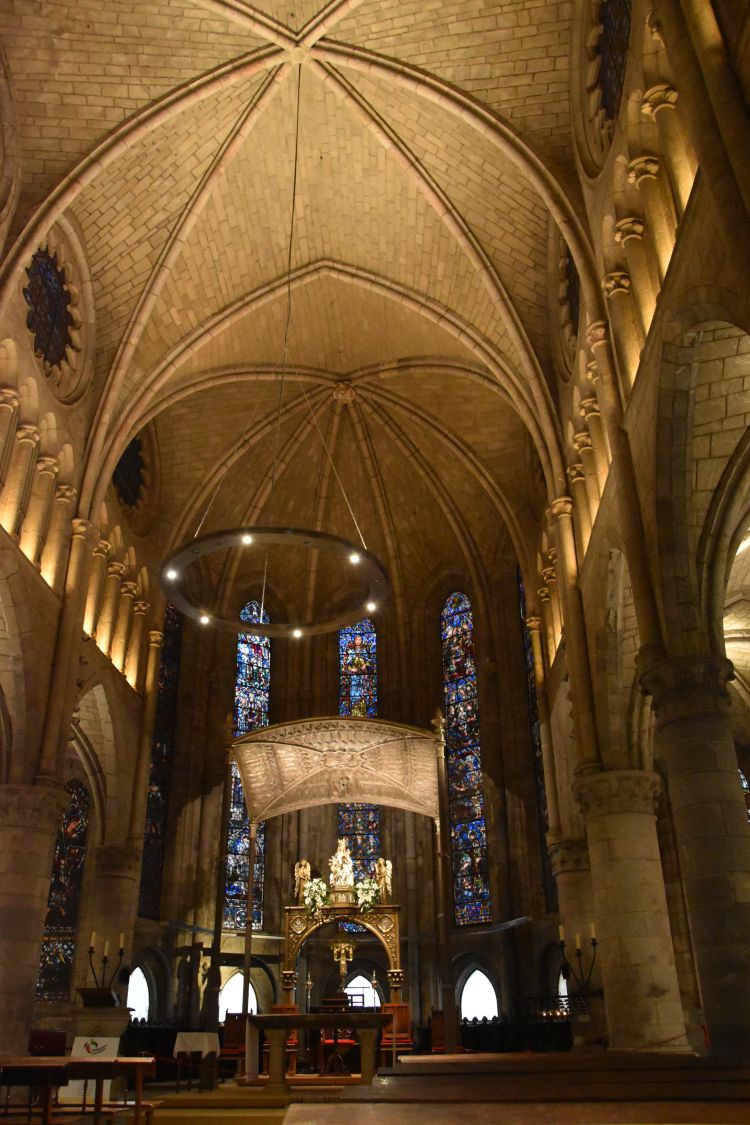
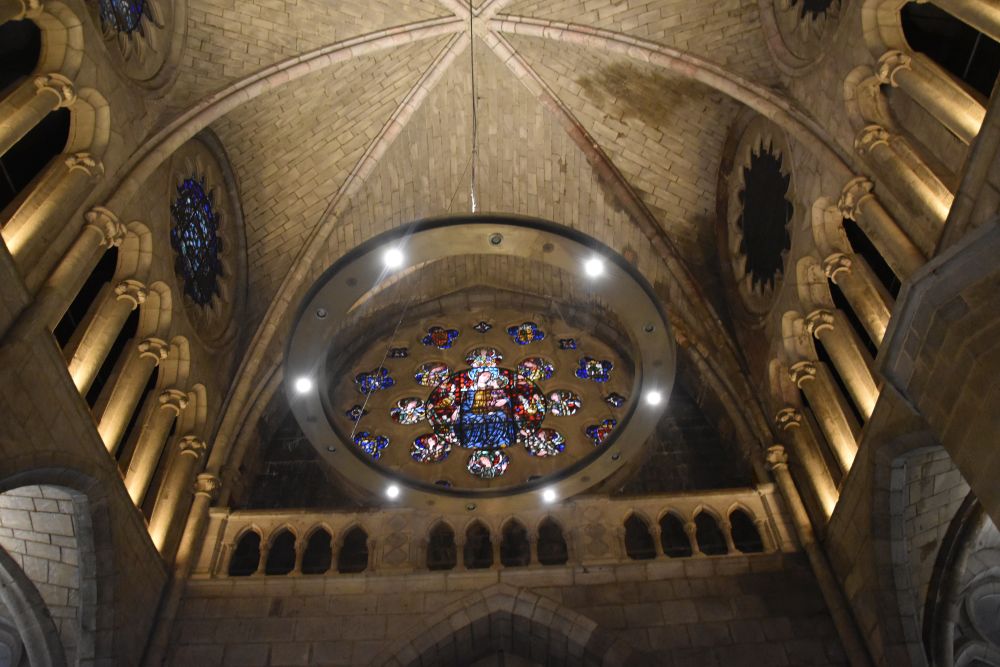
The Collegiate Church Santa Maria is of Gothic style (the construction followed the model of Notre Dame in Paris).

The choir holds the much venerated Virgen de Roncesvalles from the 13th century. It is said that a shepherd found her.

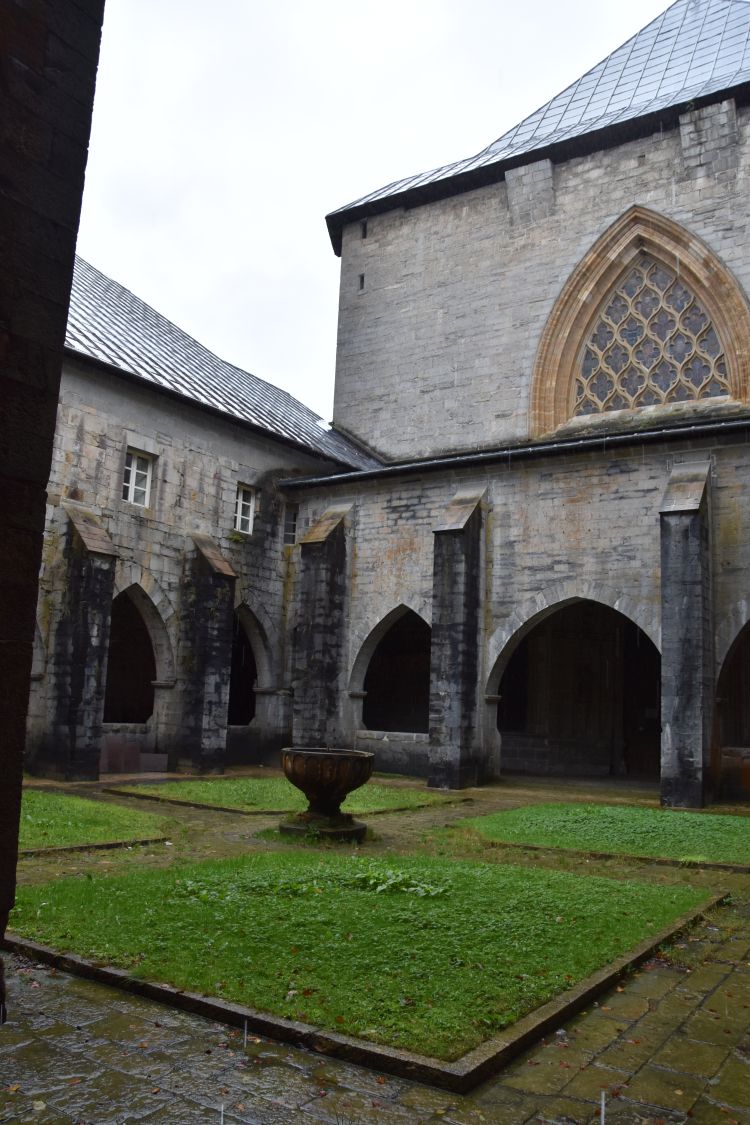
The cloister has been rebuilt after heavy snow falls that made the old gothic cloister collapse.

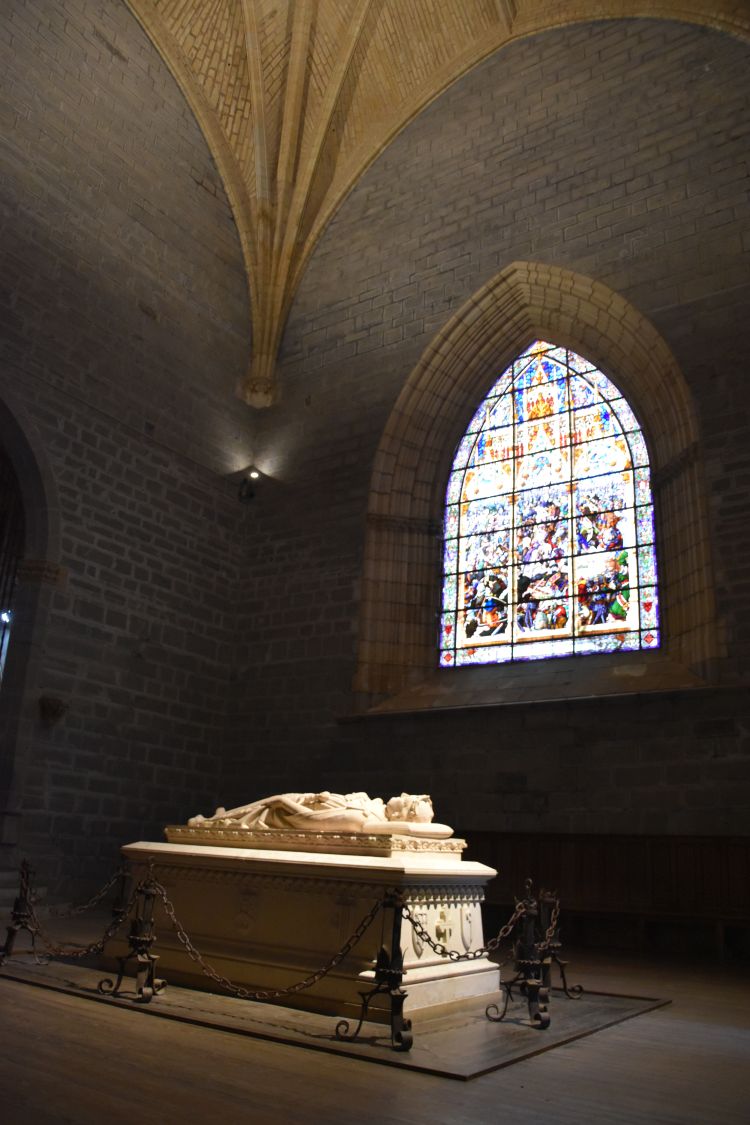
Sanchez VII, king of Navarra (1194-1234) has been buried here. He is known for the battle of Las Navas de Tolosa (1212) which was decisive for the further course of the Spanish Reconquista.

The window above his tomb tells about the battle of Las Navas de Tolosa.

The Chapel of St. James from the 12th century reflects in the ground slabs that are wet from all the rain of the last days.

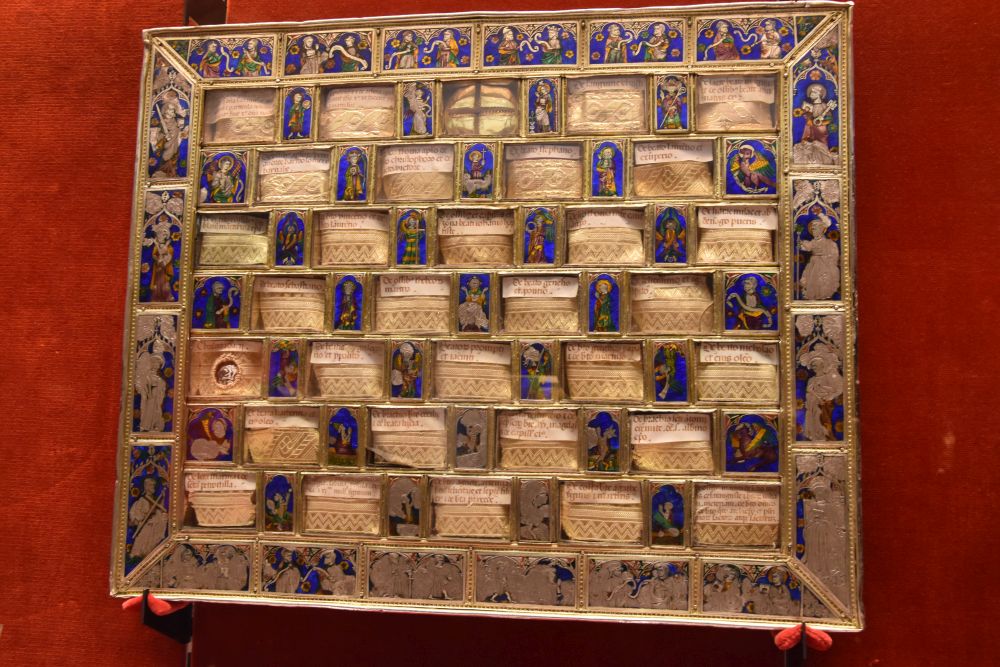
In a guided tour, we visit the Museo-Tesorio. Amongst the treasures, we admire the so-called chessboard of Charlemagne. It is not a chessboard, because it has only 63 fields. Furthermore it is not from around 800 (when Charlemagne lived), but it is a beautiful work of email from gothic times (14/15th century). But – it is known as the chessboard of Charlemagne.

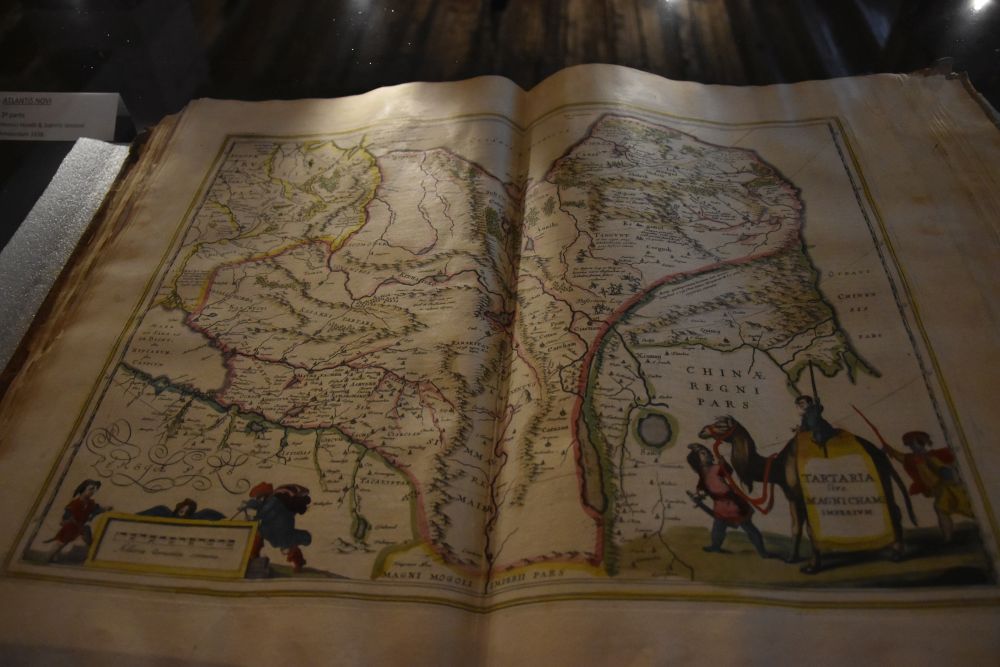
As I have just come back from Usbekistan, this map from the early 17th century fascinates me. It shows Central Asia with the country of the Tatars. In the very east, China is presented as a relatively small country, separated from the Tatars by their Chinese Wall.

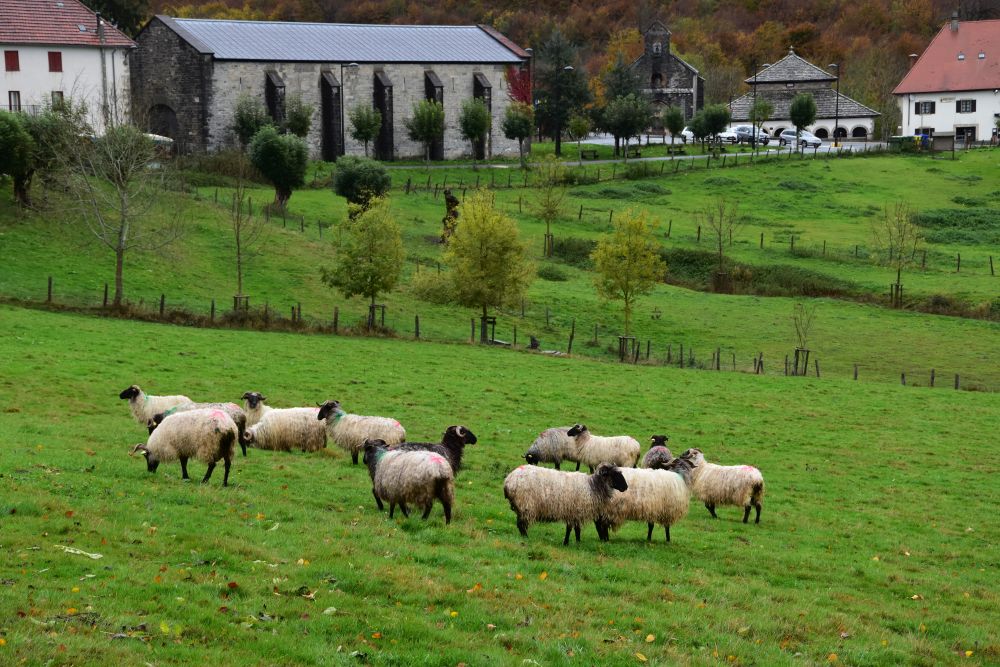
The sheep of Navarra have black legs, black tails and black faces. There are many of them here. The cheese made from them is called Roncal.

We say good-bye to Roncesvalles and continue to Pamplona.

Marion Golder: “Nordspanien und der Jakonsweg”, Dumont Reisehandbuch, Ortsfildern 2018.

On the road to France: To Moissac with the Abbey Saint Pierre

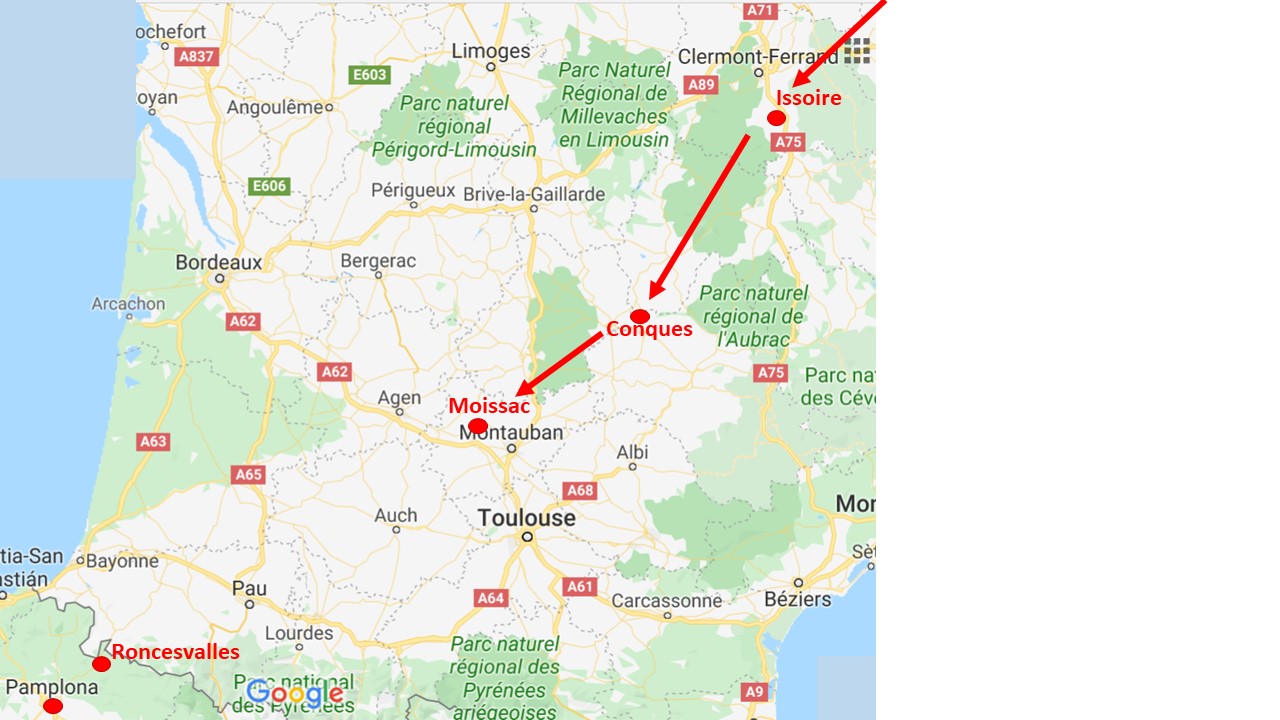
On second of November 2019, we continue our way to Moissac.

Source: Google Maps.

We have booked a room in the centrally located Maison Lydia, where friendly Beatrice welcomes us with a refreshing drink.

Immediately we set out to explore the famous cloister of the Abbey Saint-Pierre.

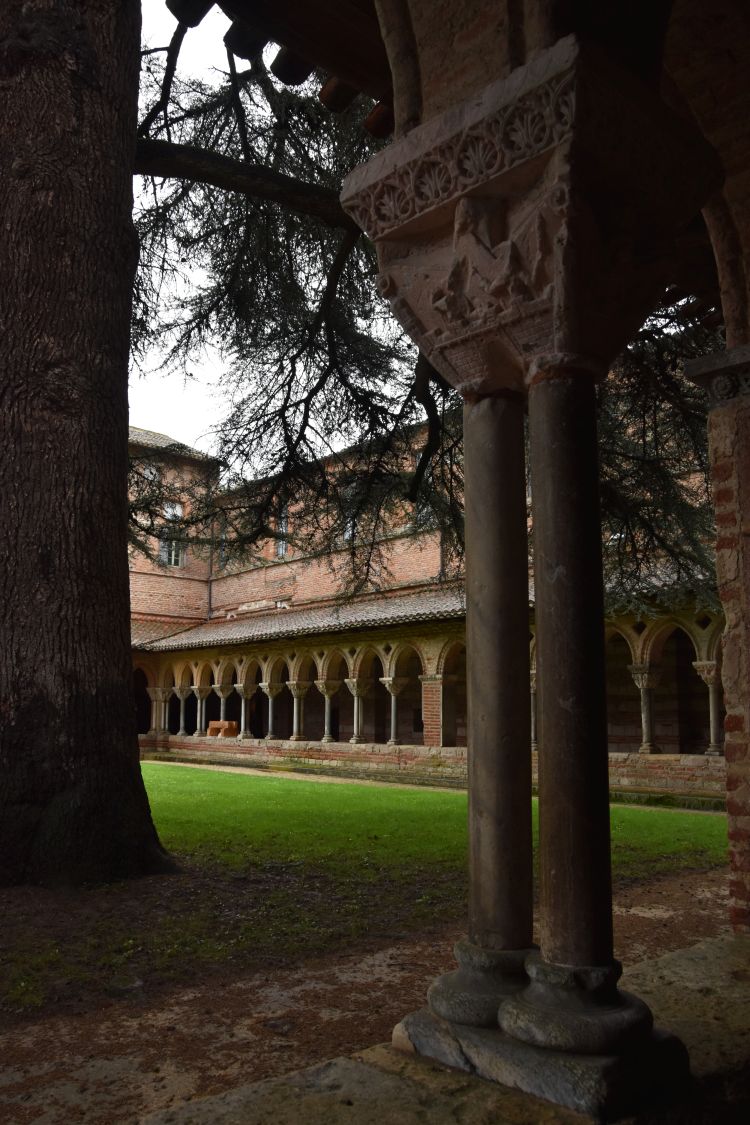
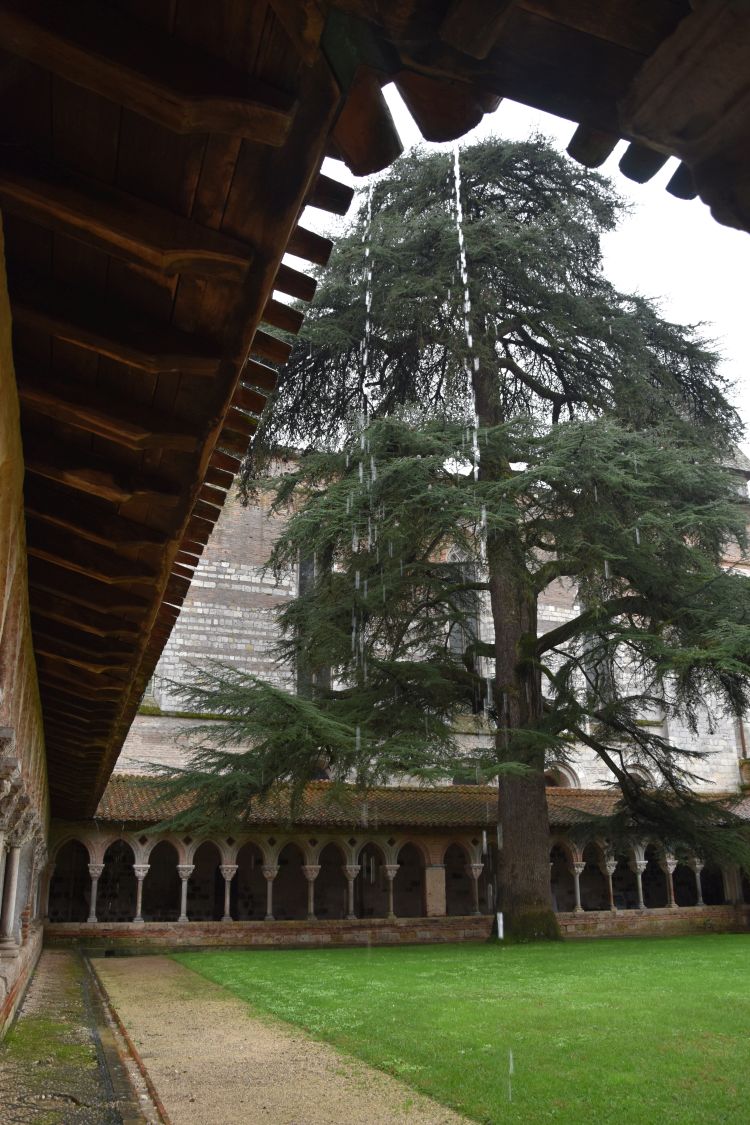
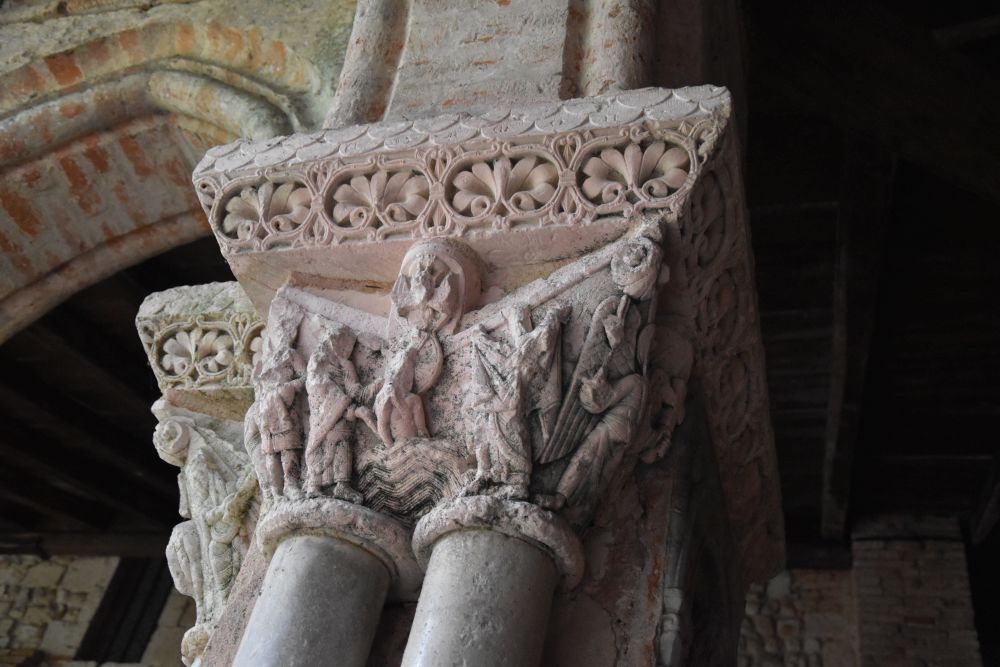
88 columns dance around the meadow and the huge cedar, alternating between single and double columns. The capitals are richly decorated. This is the baptism of Christ…

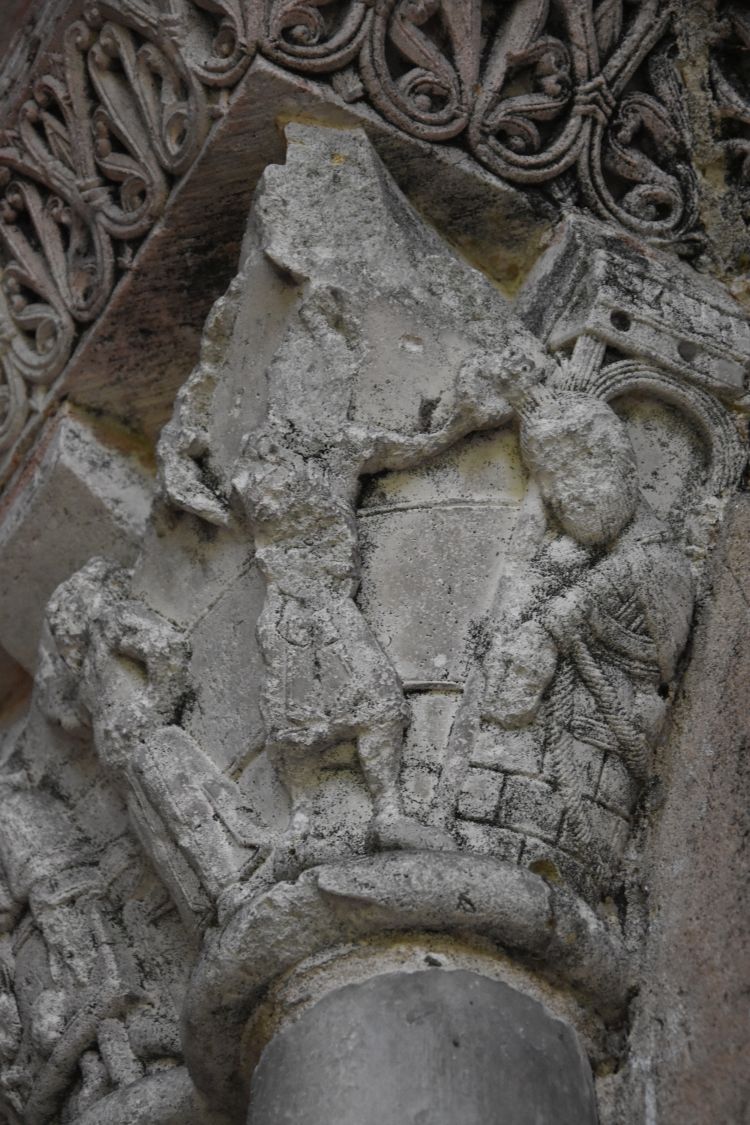
… and this is the dinner of Herod, when John the Baptist was killed – here he is in prison about to be decapitated.

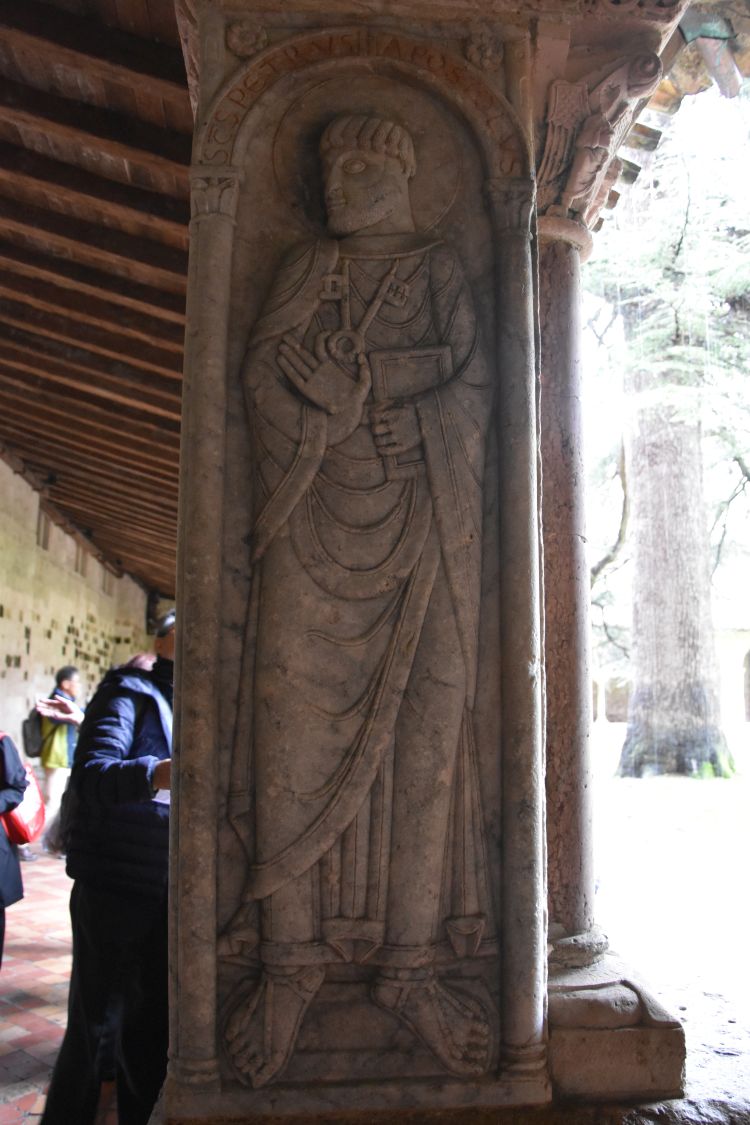
In the middle and at the egdes are larger columns, mostly with portraits of apostles or prophets such as this Petrus.

.

The capitals are damaged and difficult to see in the misty, rainy weather. See, how the rain is running down from the roof.

We escape to the side rooms, where we find a well curated museum with films that explain the works of art, in particular the beautiful porch. With what we learnt here, we look at the porch.

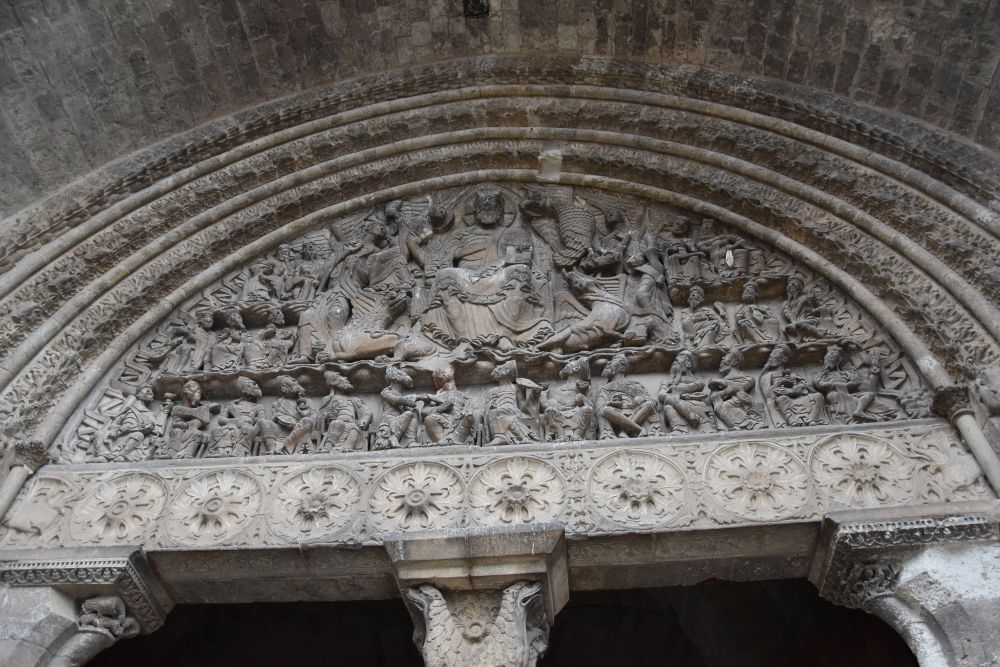
This is the tympanon with Christ in the middle above eight rosettes.

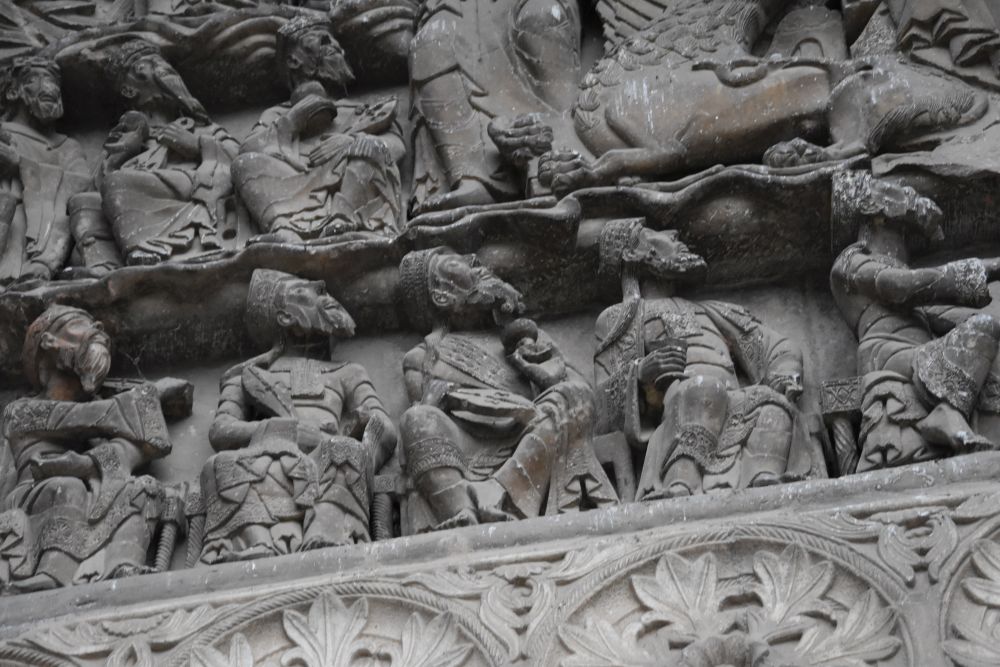
Around him are the twenty-four Elders of the Apocalypse, all turning their heads towards Christ, while playing an instrument.

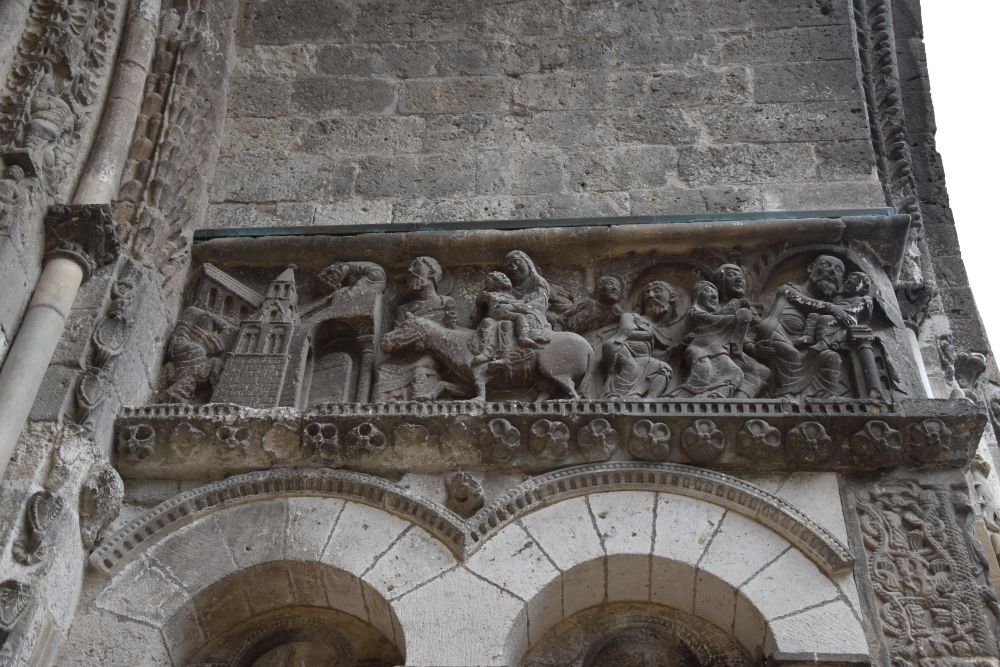
The right hand side of the porch shows the life of Christ. The top relief has to be read from right to left: Simon holds Christ on his arms tenderly looking at the child. Then there is Joseph, who is told by an angel that he should take Maria and her son to escape to Egypt. They escape with Maria and her child on the donkey and reach Egypt, where the former gods fall down from the walls.

The left hand side is dedicated to a variation of the Last Judgement: In the top panel, a rich couple eat and drink eagerly. They live in luxury, while sick Lazarus is about to starve outside – a dog licks his wounds. But then, the rich man dies and falls into Hell, while an angel takes Lazarus to Paradise, where he sits in the Bosom of Abraham.

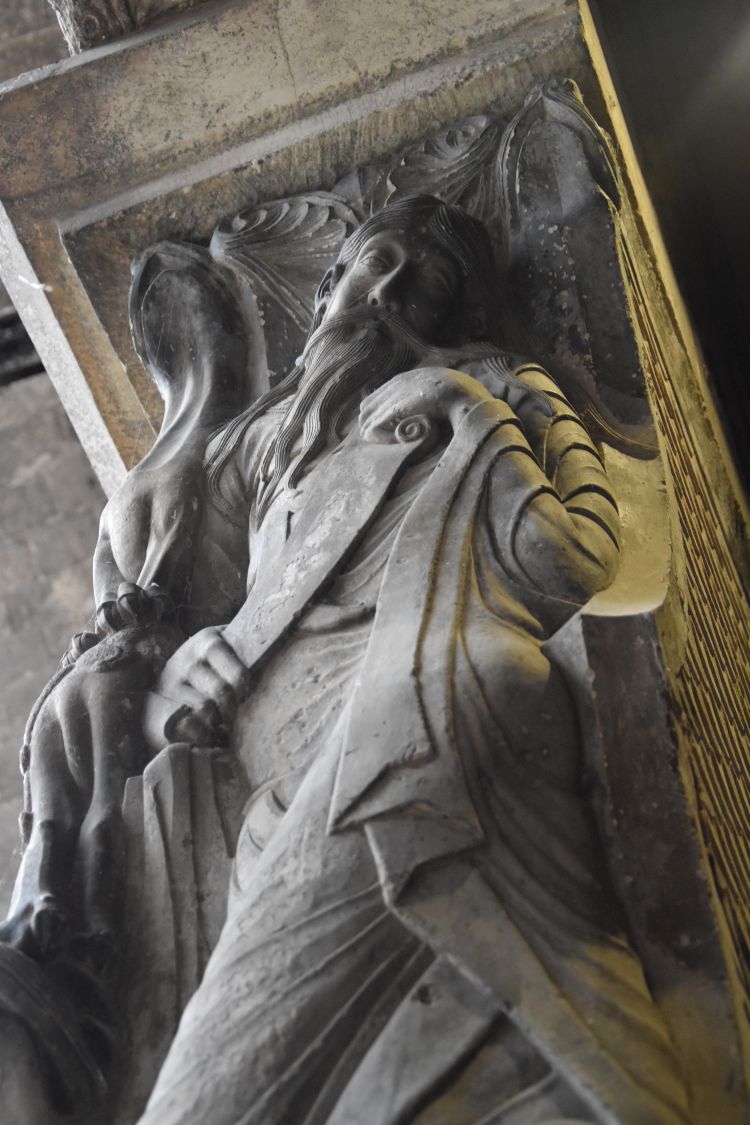
In the center of the porch (trumeau) there are statues of St. Peter, St.Paul and the Prophet Jeremy, the latter being Ursula’s favorite: Jeremy stands, his legs crossed and his head bent down to the side, with his eyes looking “inside”.

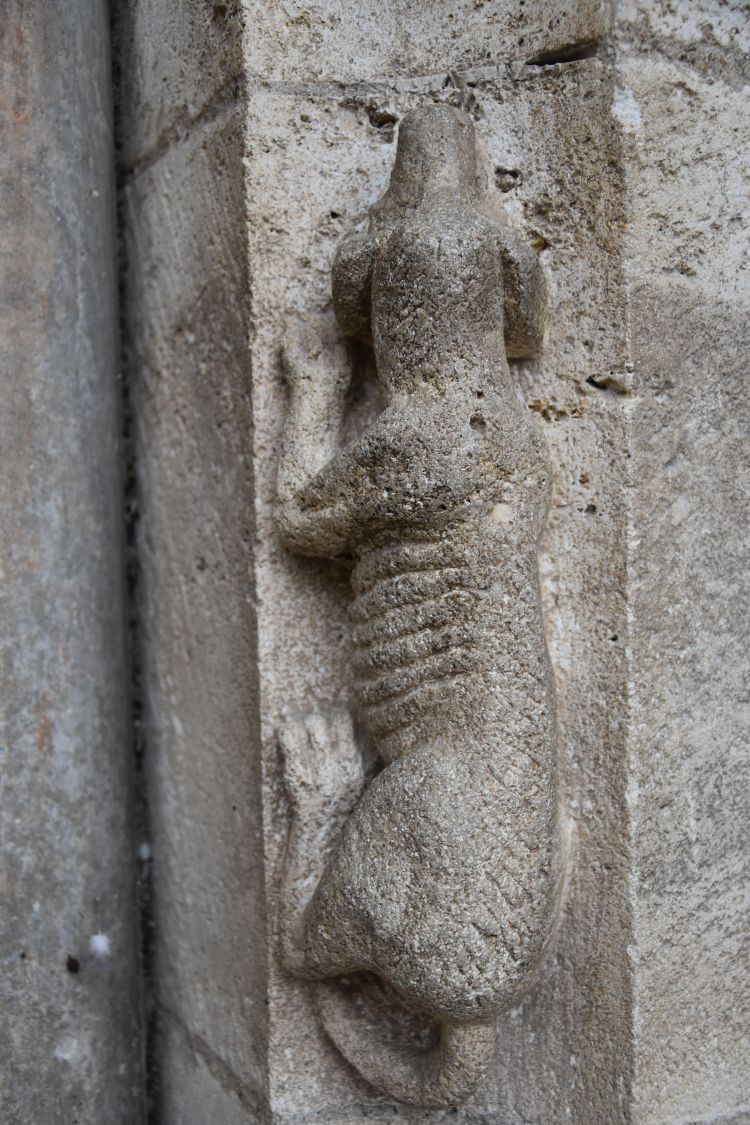
Animals creep up on the sides of the portal. My favorite is this dog.

Inside the church, we find more works of art from the 12th and the 15th century such as the Romanesque Christ or the Gothic Holy Family on the way to Egypt. A panel explains that Saint Cyprien, bishop in Carthago (Africa), was martyred in 258 and his relics were transfered to Moissac in 1122. This is, how he became the patron saint of Moissac.

Building the monastery has been completed in 1100. The golden times of this Benedictine monastery were in the 11th and 12th century. It was related with Cluny.

We return to our Maison Lydia to warm up  from the rain. Then we have a delicious dinner near the Abbey.

Tomorrow we will continue our way to Roncesvalles. We expect more rain. Though traveling in our car, we feel a  bit like pilgrims.


Sources: Presentation at the cloister of the Abbey Saint Pierre; Thorsten Droste: “Romanische Kunst in Frankreich”, DuMont Kunstreiseführer, Köln 1992; Chantal Fraïsse: “Die Abtei Saint-Pierre von Mossaic”, Yann Le Chevalier, 2019.

On the road to France: Conques in the mountains

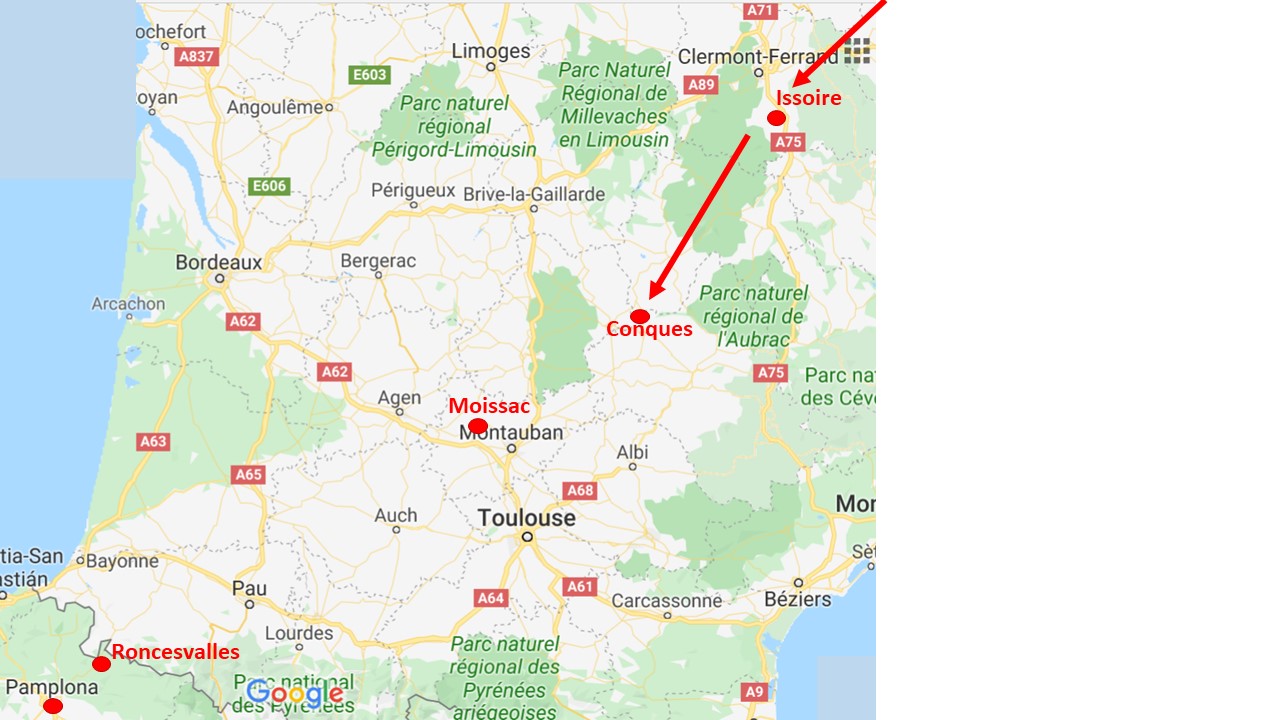
First of November 2019, we drive through the mountains of the Auvergne to Conques. 

Source: Google Maps

The weather is misty and rainy. We drive through the Aubrac. Through chestnut trees, the road takes us down to the Lot valley.

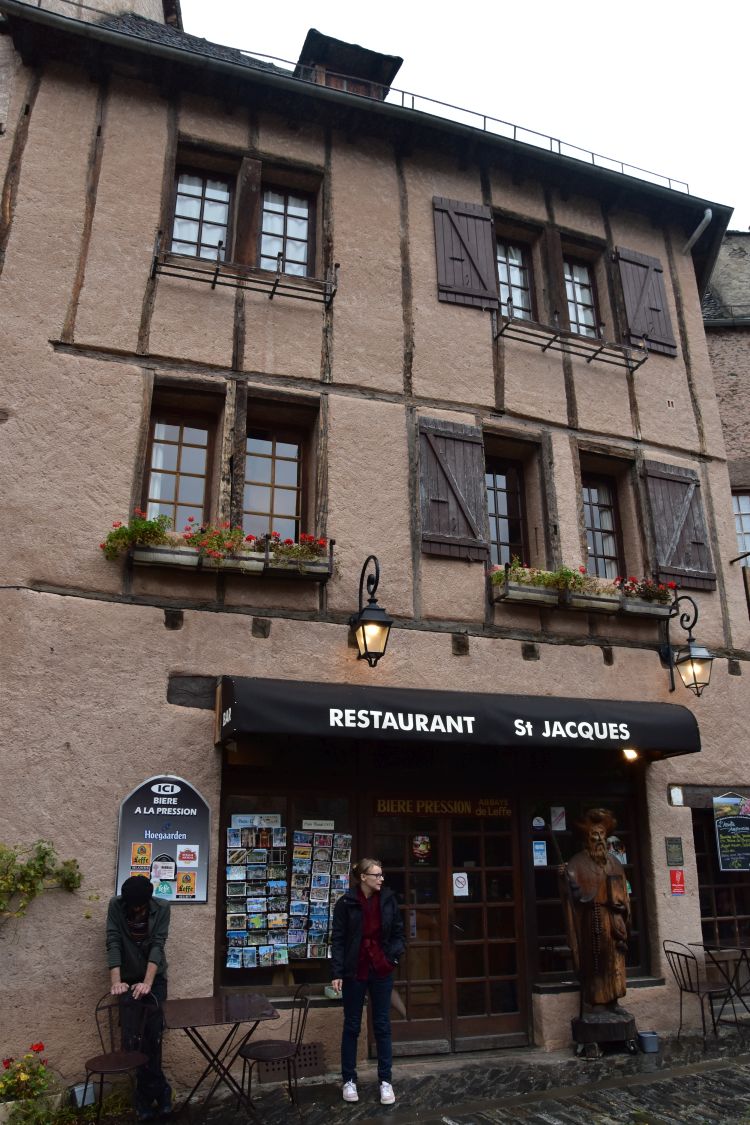
We cross the river Lot, reach Conques and settle in the Auberge Saint Jacques.

Conques became an important pilgrim place, after the relics of Saint Foye had been moved here (the story goes that a monk from Conques had stolen the relics in the monastery of Agen, where they had been located before).

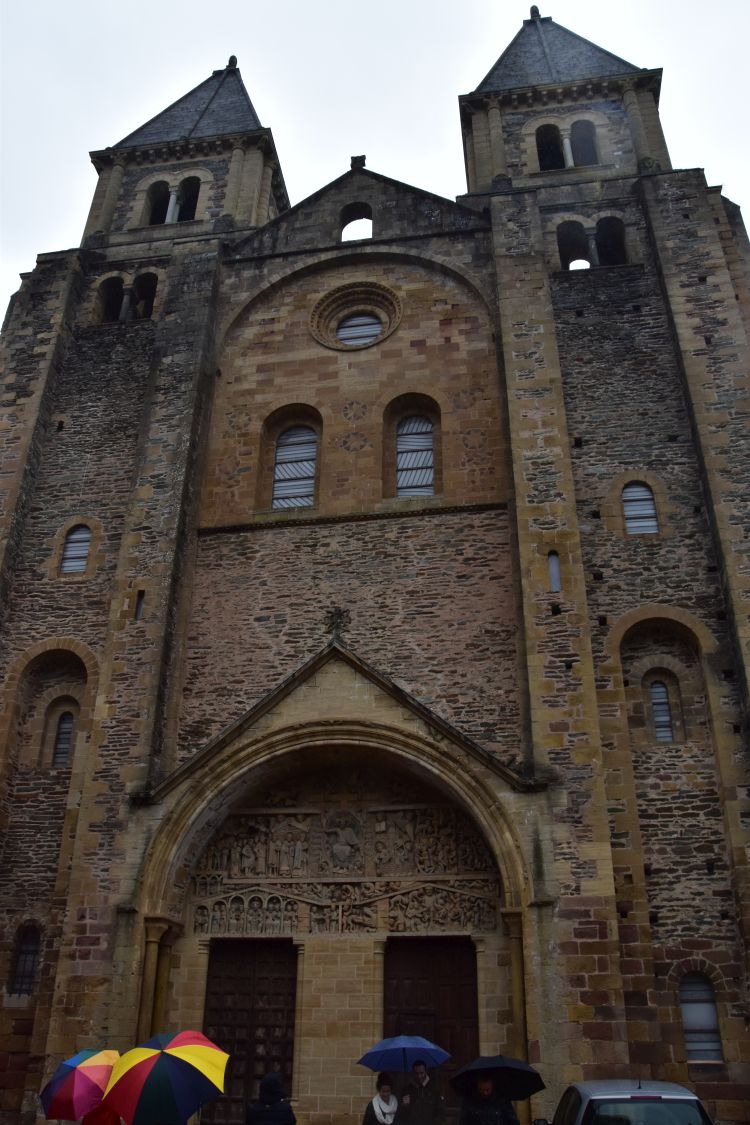
The Abbey Church of Sainte-Foye was built from the middle of the XIth to the early XIIth century.

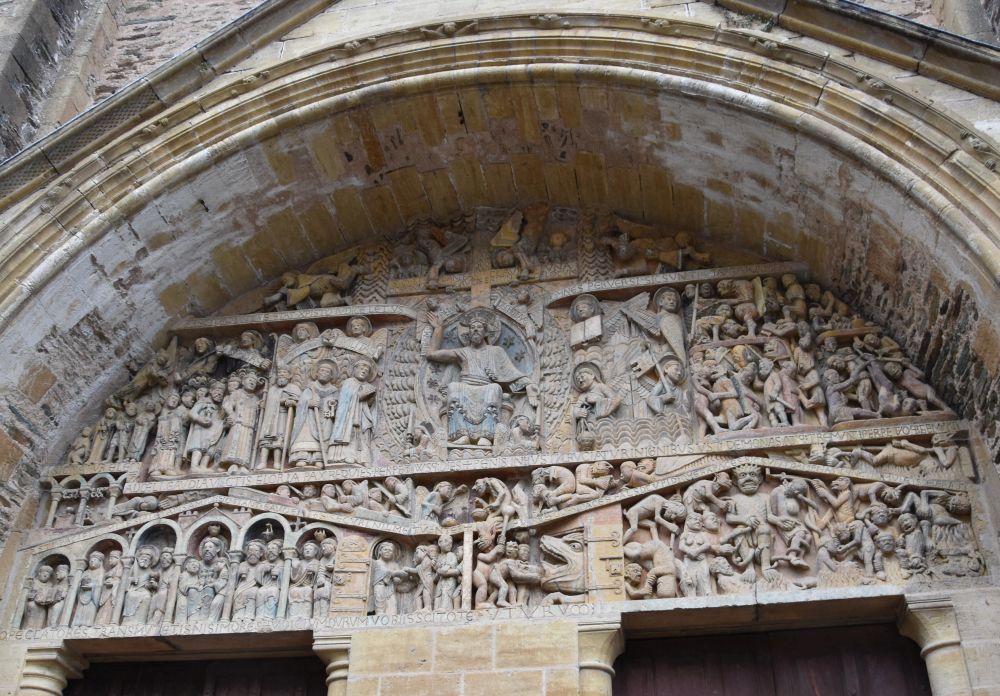
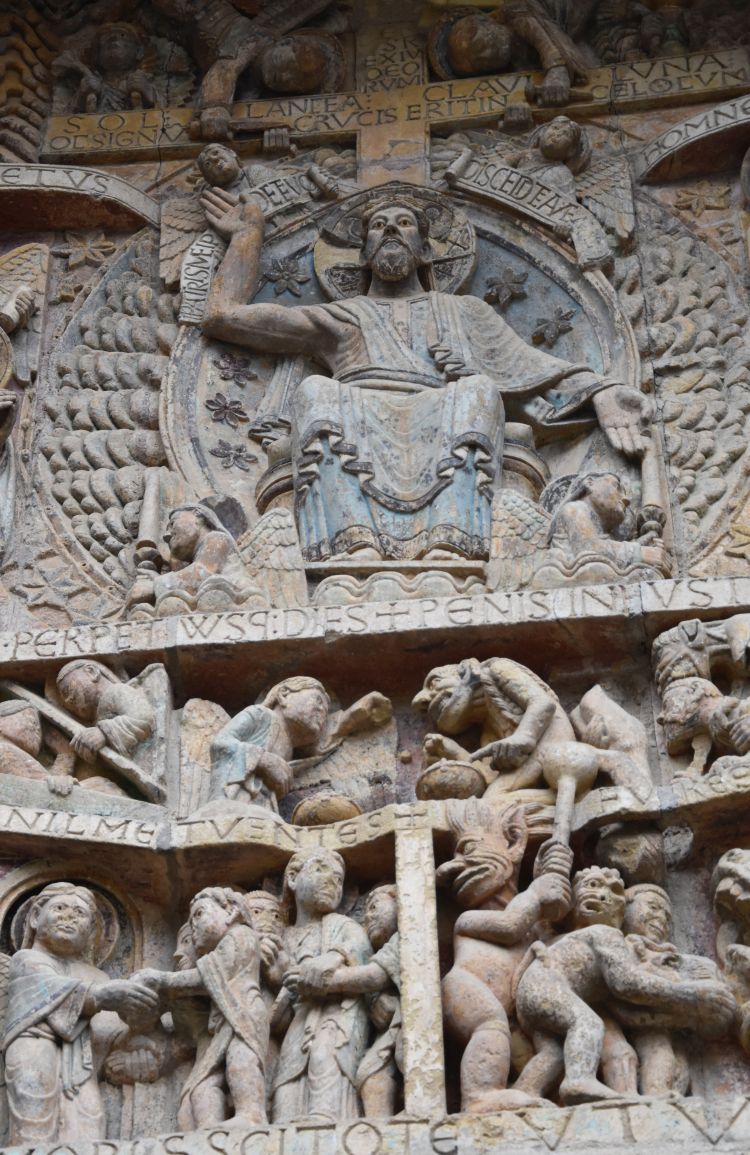
The main portal is decorated with the beautiful tympanon showing the Last Judgment (late Romanesque style). About 120 figures populate the tympanon. It can still be recognized that the Last Judgment was originally painted in colors.

Christ sits in the middle. To his right is Paradise (his right hand up), to the left is Hell (his left hand down ).

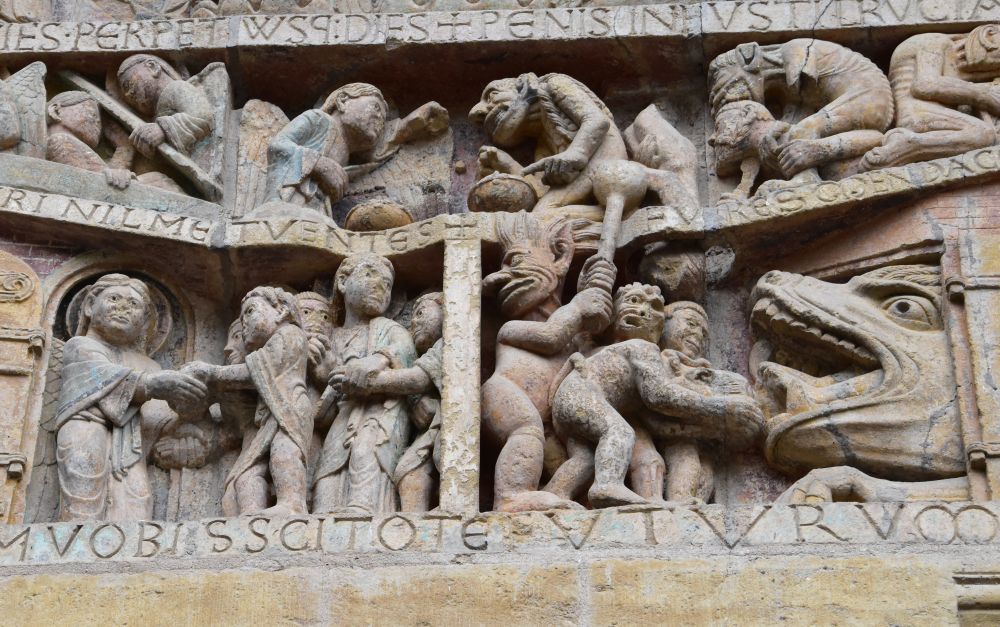
Below Christ, Archangel Michael and the grinning devil are facing one another. Between them is a set of scales, and the devil is touching one of the pans. Farther below, Petrus welcomes those that enter Paradise and a devil throws the condemned subjects into the gorge of a wild animal – this is the entry to Hell.

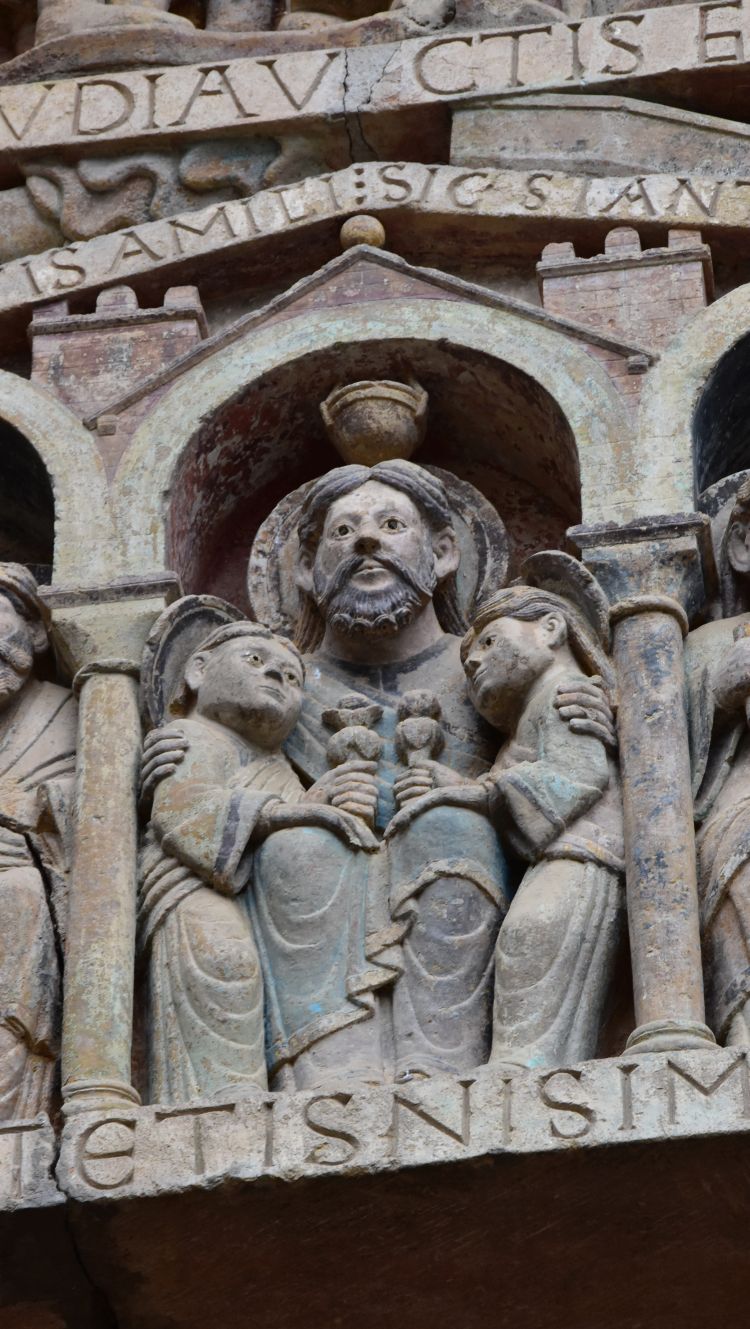
In Paradise, all is fine and people are arranged around the Bosom of Abraham.

Above to the right of Christ (seen from his viewoint), there are the donator and the founder of the abbey with Charlemagne lead by the hand.

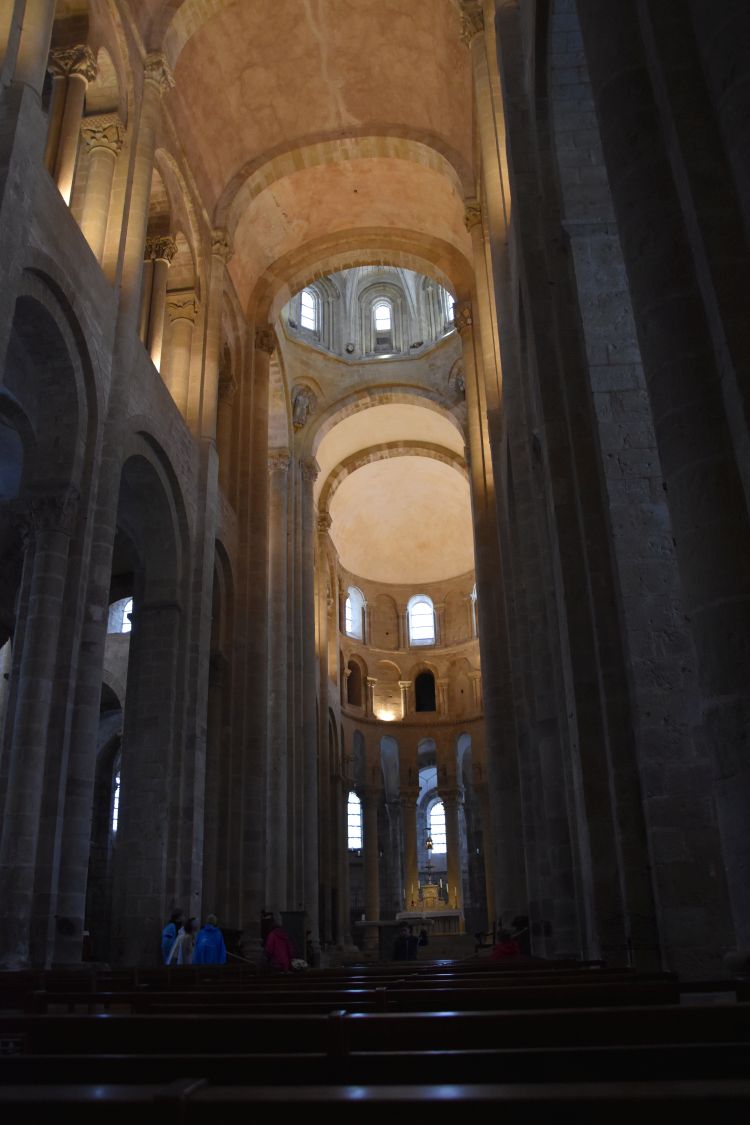
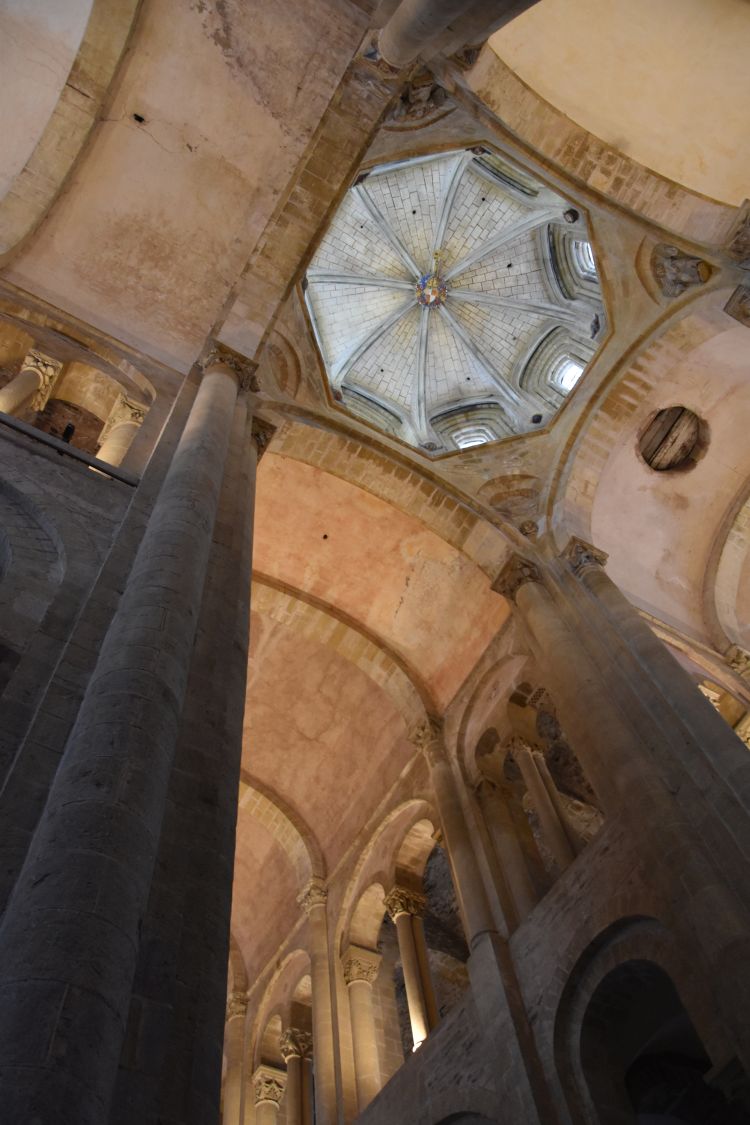
I feel overwhelmed, when entering the church. The nave is 22m high and seems to reach into heaven. The decoration is sober which adds to the solemnity.

A colored medaillon decorates the top of the crossing. To the sides of the naves are galleries with double openings.

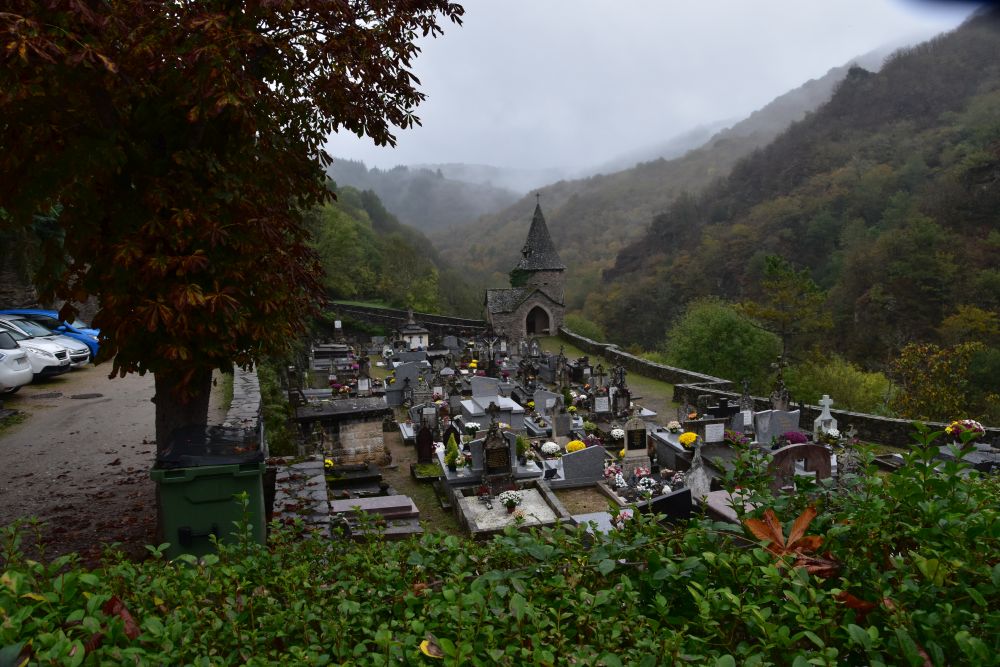
Next to the church is the cemetery, for All Saints’ Day beautifully decorated with flowers.

Across the church is the exhibition of the rich treasure of the abbey with the statue of Sainte Foye (no fotos allowed).

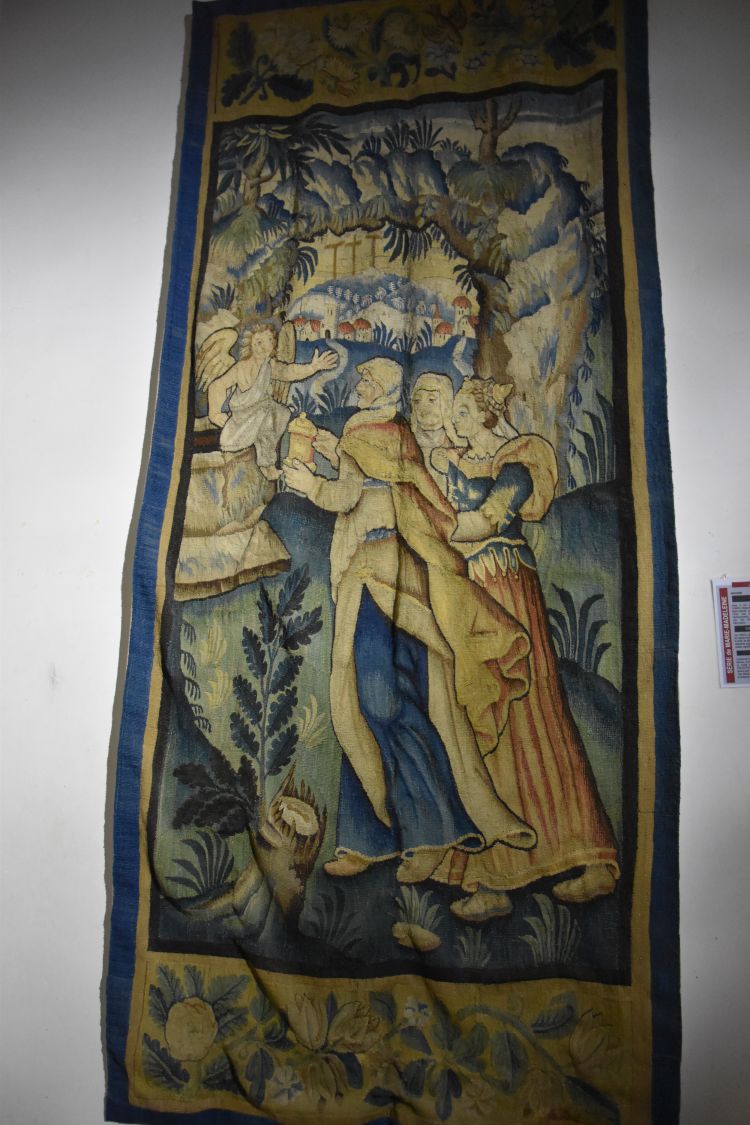
The small Museum of Joseph Fau has been carefully arranged and shows tapestry from the early 17th century such as this representation of the three women at the empty sepulcher of Christ.

It is pouring with rain. We see some pilgrims with short trousers wrapped up in their rain capes. I shiver and admire them for undertaking this long, long walk along the Way of St. James to Santiago de Compostella. We imagine, how dangerous this was in medieval times, especially here in the rough mountains of the Auvergne. We return to our cosy hotel named after St. James and have dinner.

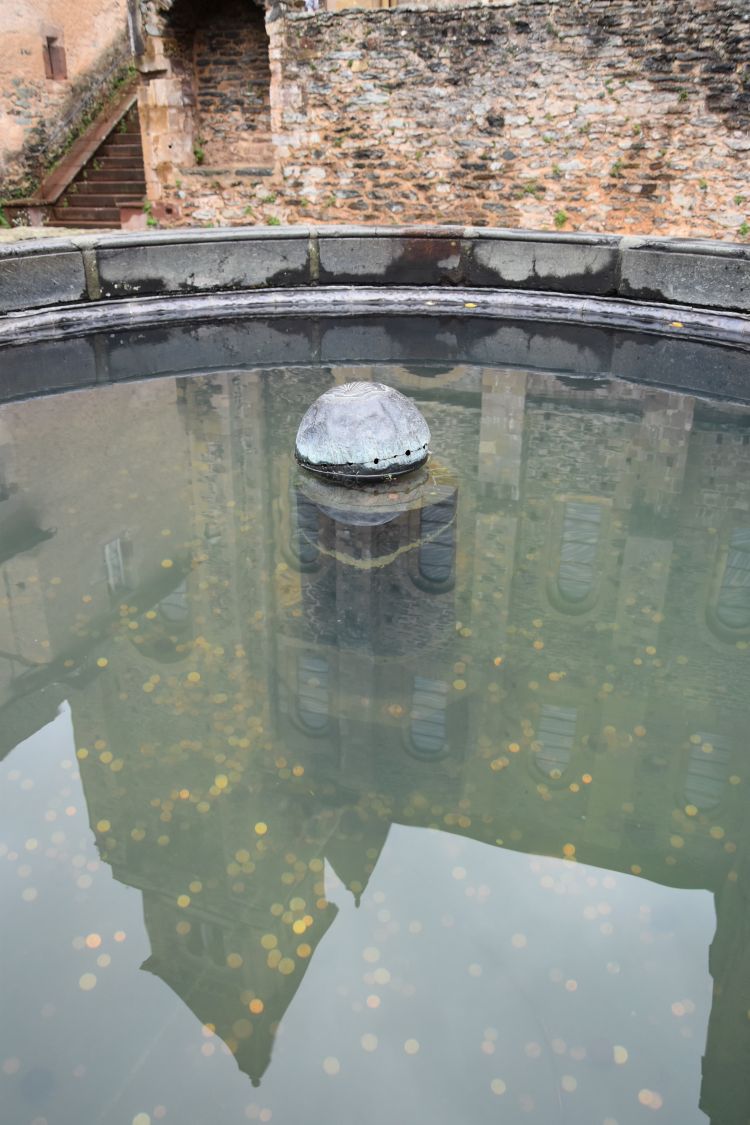
The next morning we return to the church and the cloister. I discover this fountain with the conch of St. James in the middle and with the reflection of the Abbey Church ornated with the coins thrown into the fountain.

We look back and say good-bye to Conques.

Our next target is Moissac.

Sources: Noël Graveline: “Die romanischen Schätze in der Auvergne”, Edition Debaisieux, 2006 und Thorsten Droste: “Romanische Bauten in Frankreich, DuMont Kunstreiseführer Köln 1992.


On the road to France: Issoire with its Paroisse

It is late autumn 2019. With Ursula, I travel to Spain with stop overs in France. The weather is rainy and chilly. Our first stop is in Issoire, where we spend one night in the convenient IBIS hotel.

Source: Google Maps

We visit the Paroisse St. Austremoine. Austremoine was a preacher that christianized Clermont around 250 and the church of Issoire is named after him.

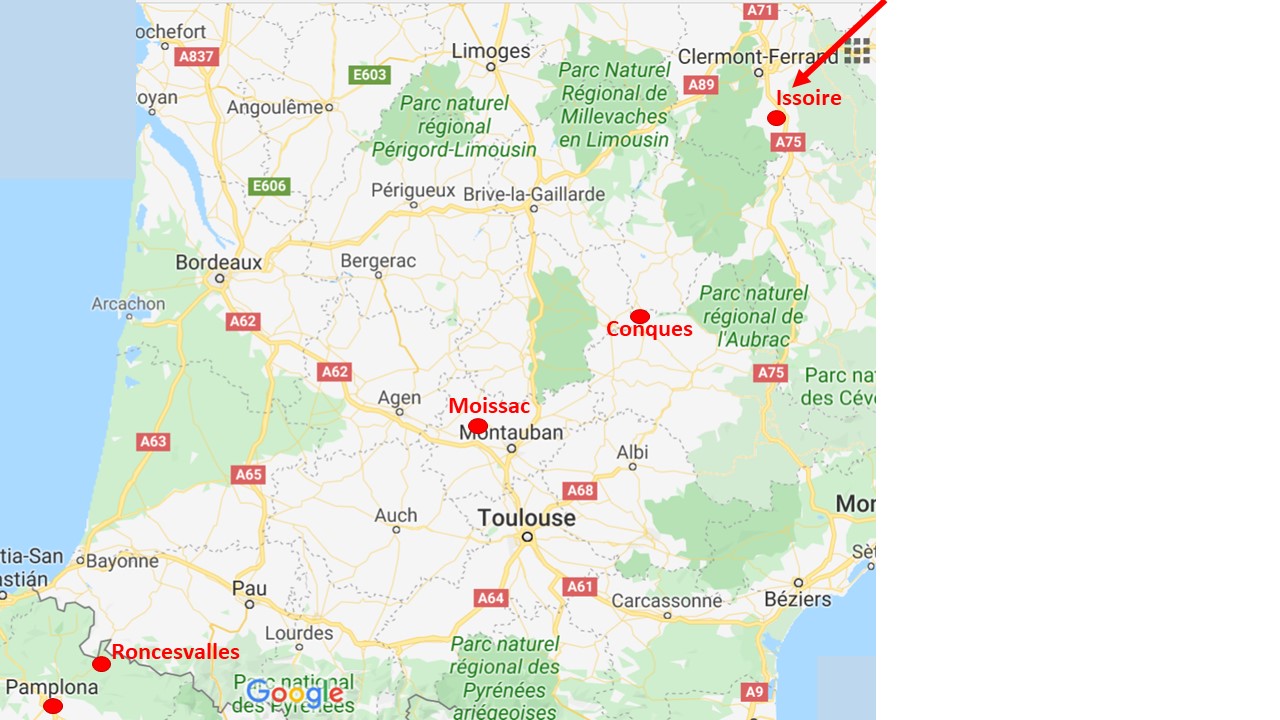
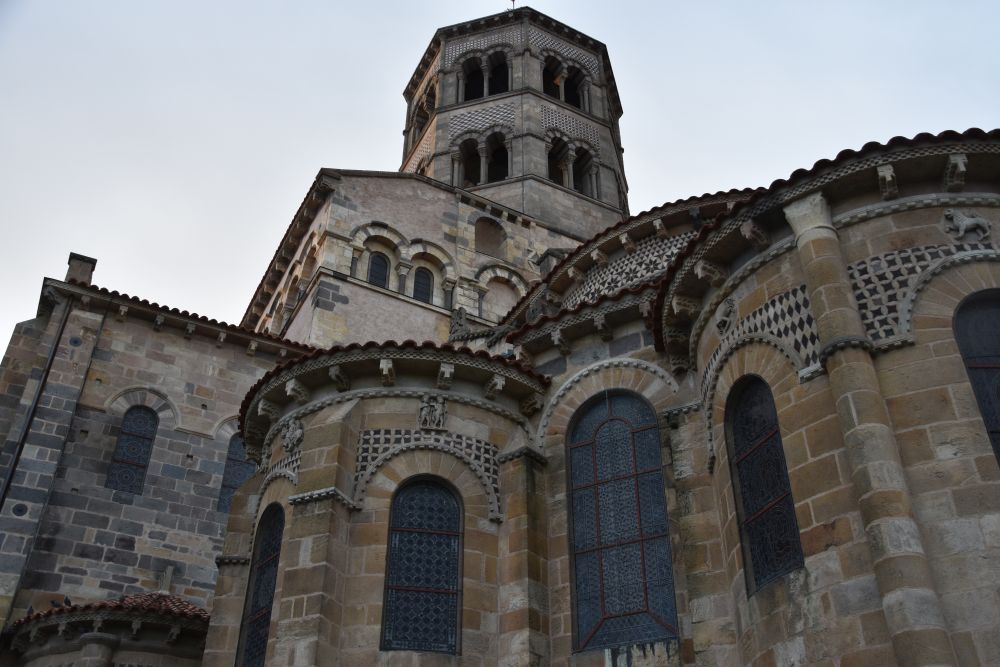
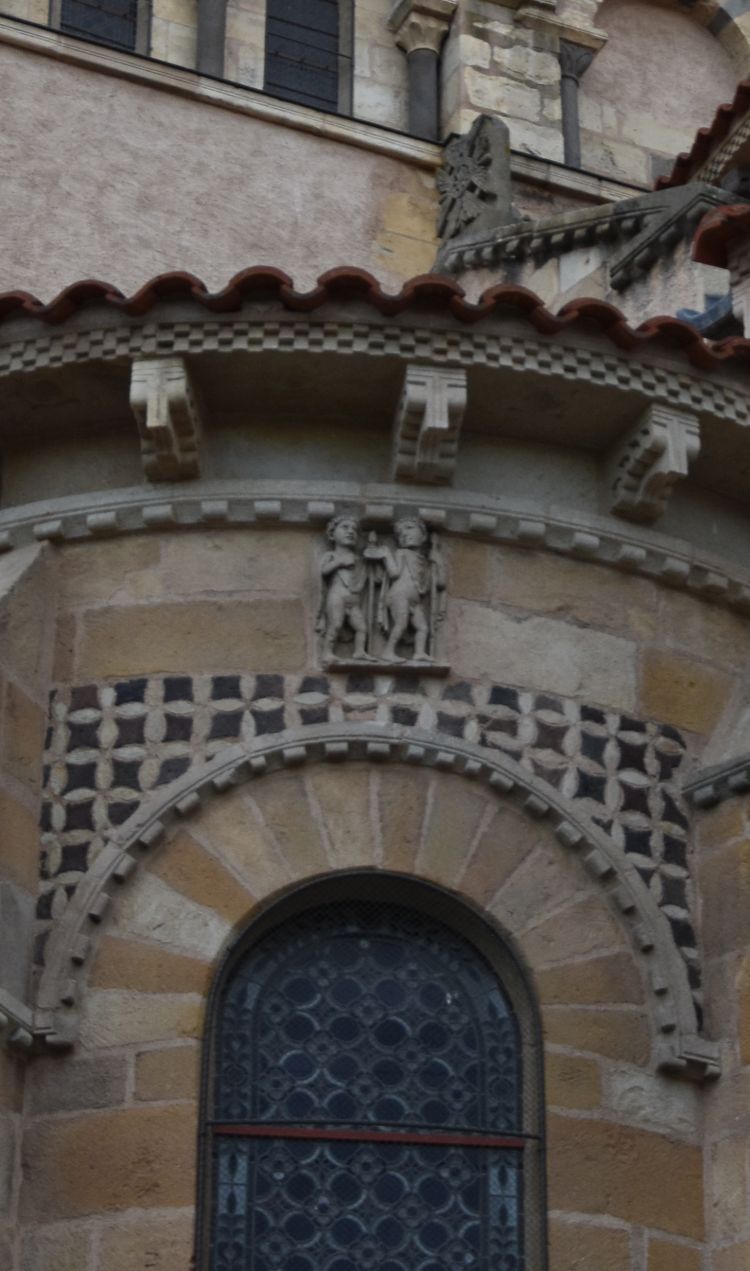
The Paroisse is famous for the choir that has been freshly renovated. We admire the fine patterns created by black basalt, grey granite and yellow arkose. We are in the area of the volcanic Puys around Clermont-Ferrand.

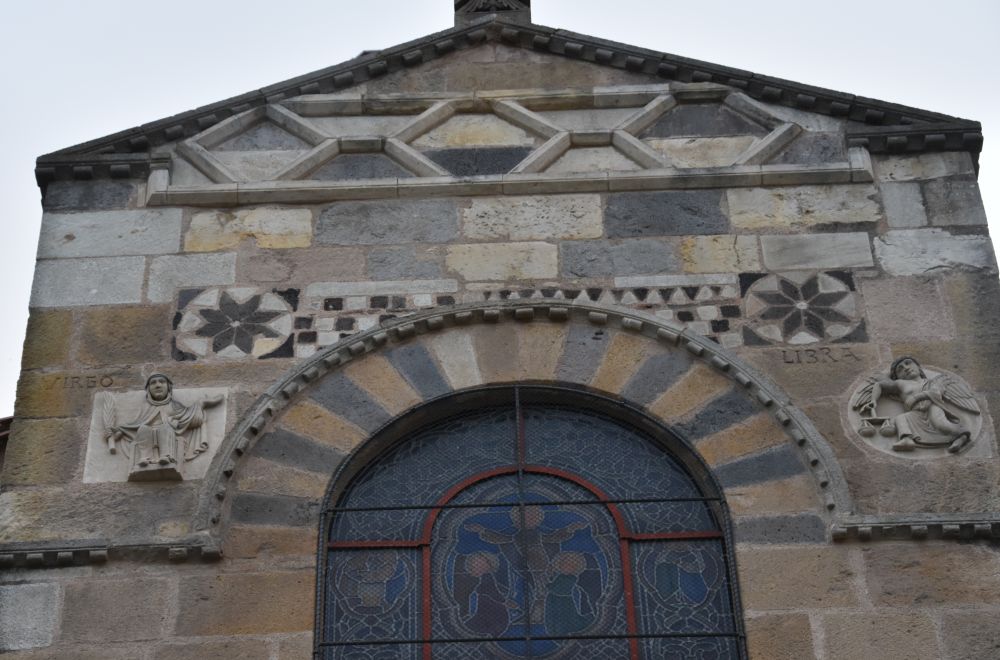
We like the reliefs of the astrological signs. Here are Virgo and Libra.
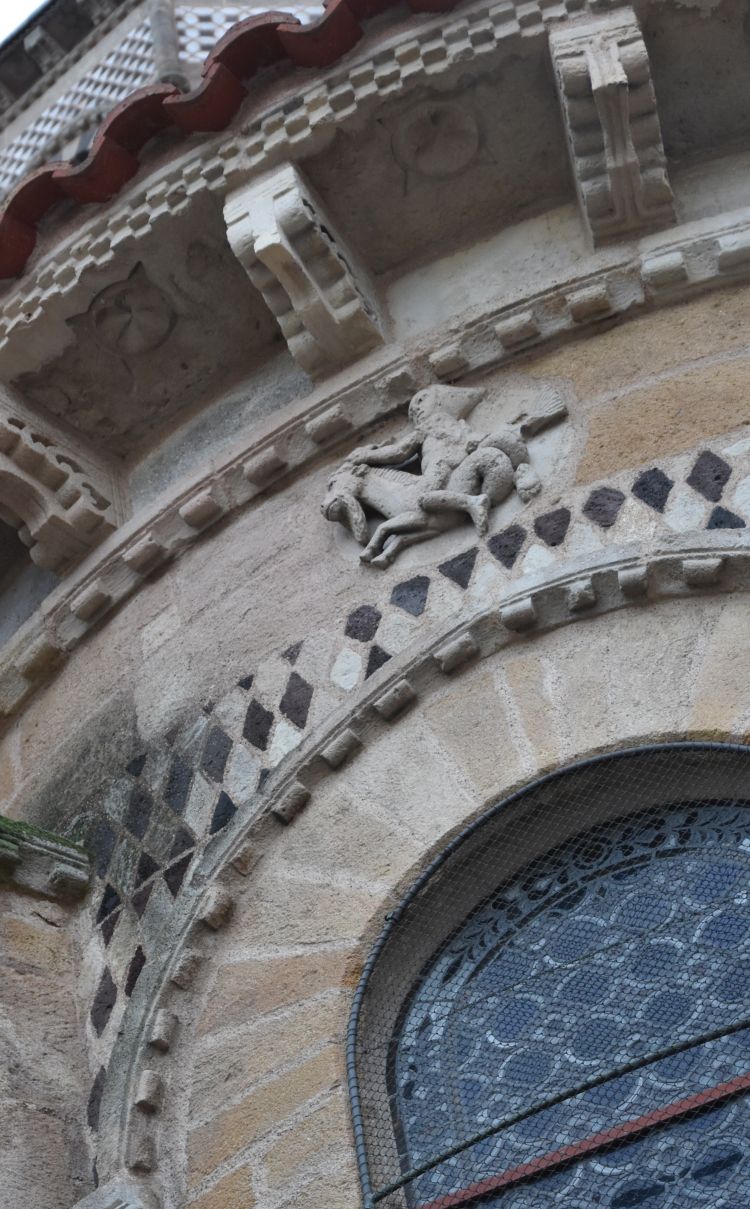
This is Capricorn.

And this is my astrological sign, Gemini. It is the third relief, as the series start in March, with Aries.

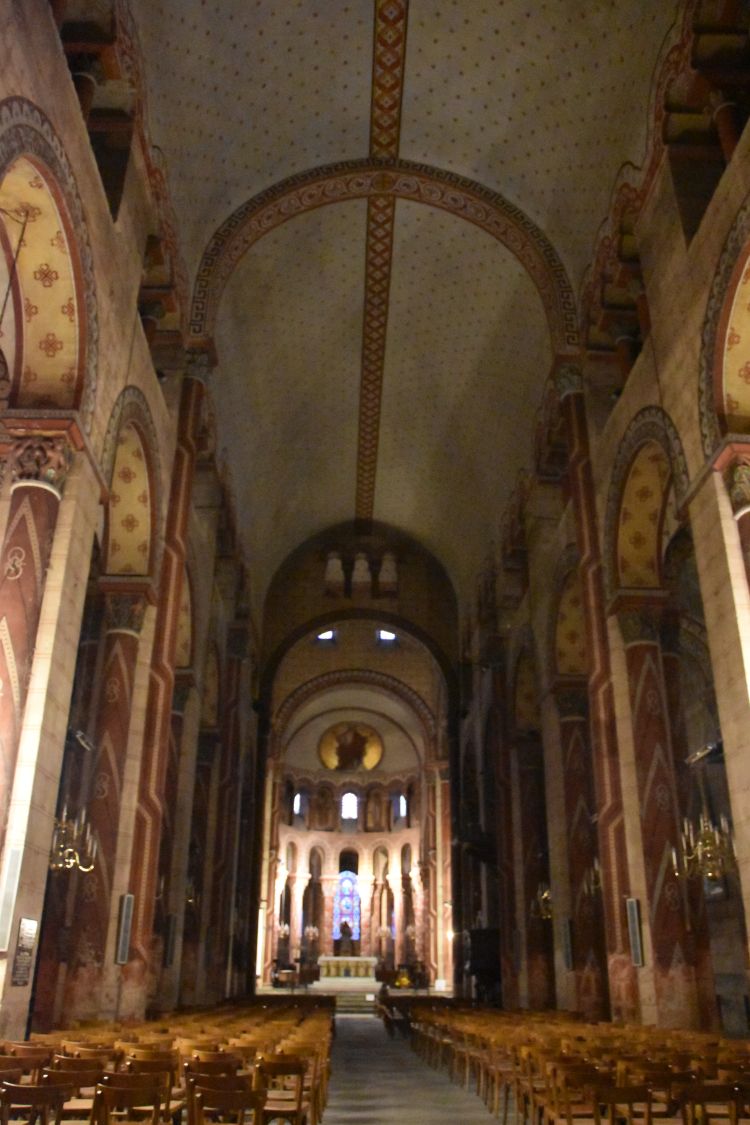
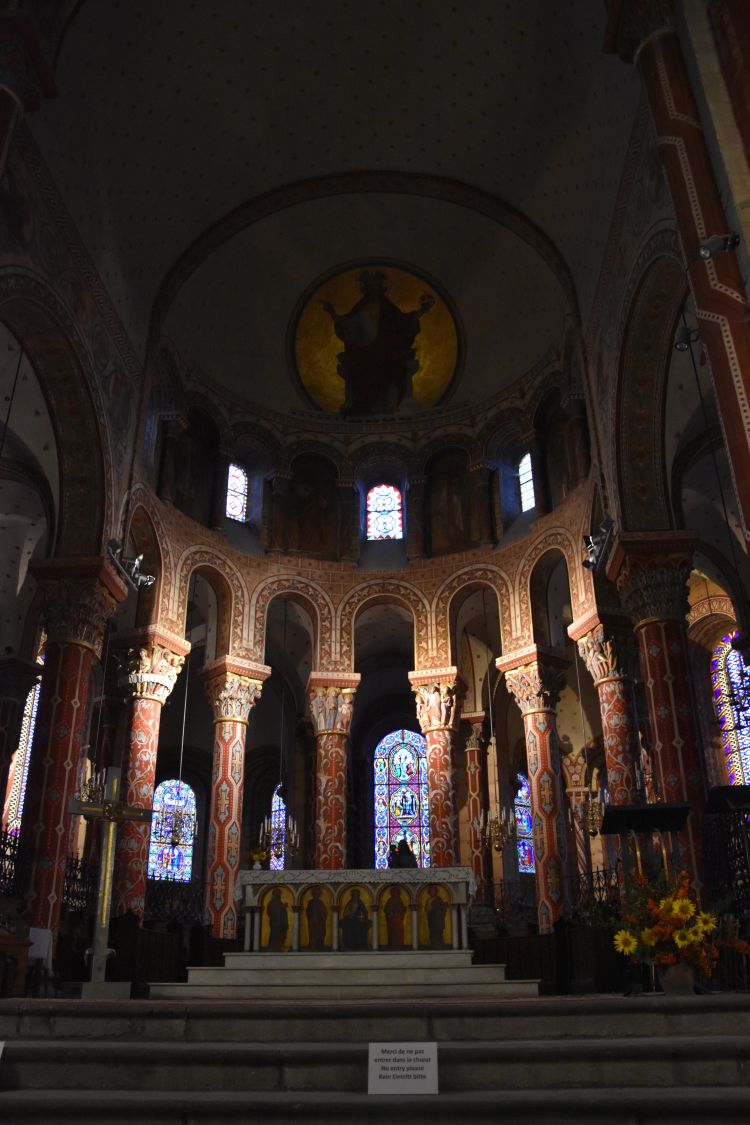
In the 19th century, the church has been painted inside. This creates the solemn atmosphere that existed in Romanesque times, though the painting is not authentic. Ursula discovers maize plants on some columns… definitively not authentic for the XIth or XIIth century.

The choir is decorated with eight columns. The ambulatory allows to walk around the choir.

Here, the Last Supper circles around the capital. I have never seen this before.

We leave the Cathedral. We may have to return once more to see the parts that are now under renovation.

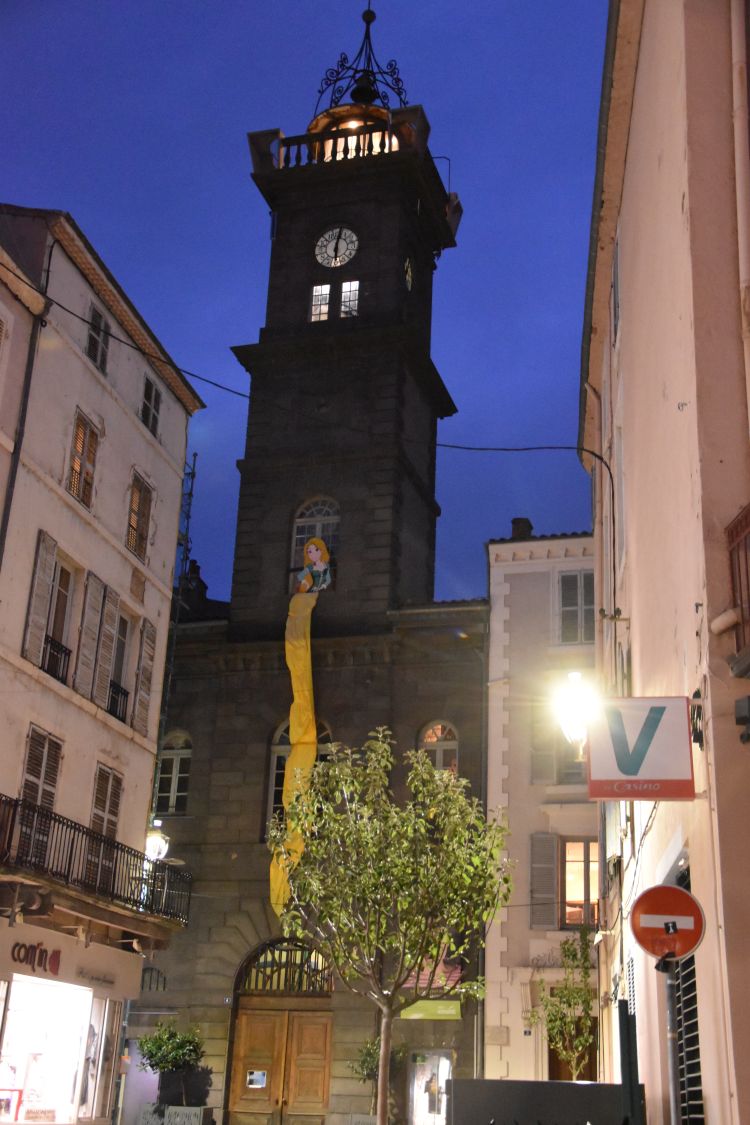
It is around six in the evening – already dark. We take a last foto of the Bell Tower near the Republic Square.

Then we return to our IBIS hotel and have a light dinner. Tomorrow we will continue our way to Conques.

Sources: Noël Graveline: “Die romanischen Schätze in der Auvergne”, Edition Debaisieux, 2006 und Thorsten Droste: “Romanische Bauten in Frankreich, DuMont Kunstreiseführer Köln 1992.

On the road – sightseeing at Moscow: The Metro

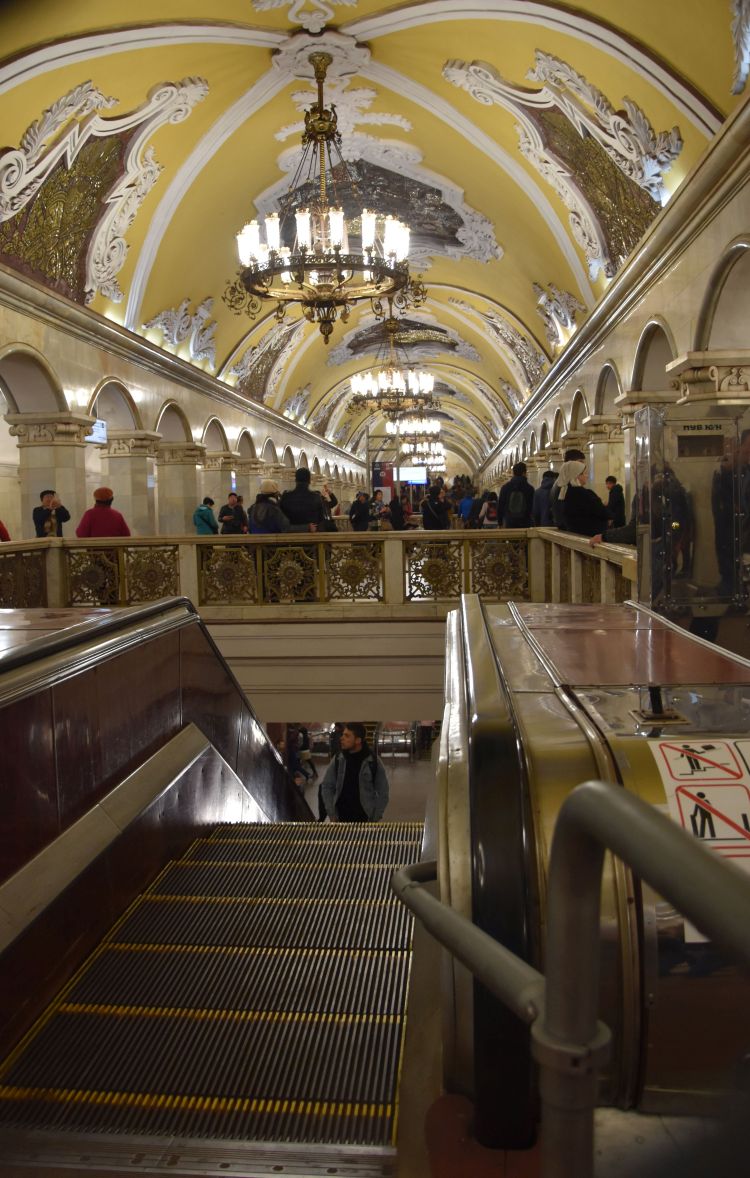
On our way from the Red Square to the Moskwa river, we get caught in the pouring rain and escape to the next metro station. Rain is a good opportunity to admire the underground palaces of Moscow.

The first lines of the Metro opened in 1935. New lines are added even today. The Moscow metro is one of the most efficient metros that I have ever come across. No Russian would run in their palaces to catch a train. There is just no need, because the next train is sure to come in about one minute.

Long escalators take the Muscovites into the underground. When I stand on them, I always hear the poem-song “песенка о московском метро” by Bulat Okudzhava (1924-1997):

“Порядок вечен, порядок свят.
Те, что справа, стоят, стоят.
Но те, что идут, всегда должны
держаться левой стороны.”

“The order is eternal, the order is holy.
Those on the right side, they are standing, they are standing.
However, those that are going (or walking), always have to
keep to the left side.”

(I have the cult vinyl record of Bulat Okudzhava that was edited in the sixties or early 70s by “le chant du monde“).

We visited some of the most beautiful metro stations.

.

Komsomalskaya  or Комсомольская

We start with the Komsomalskaya station on the ring. It was built in 1952 and received a prize at the Expo 58 in Brussels.

The hall is illuminated by chandeliers and is decorated with mosaics.

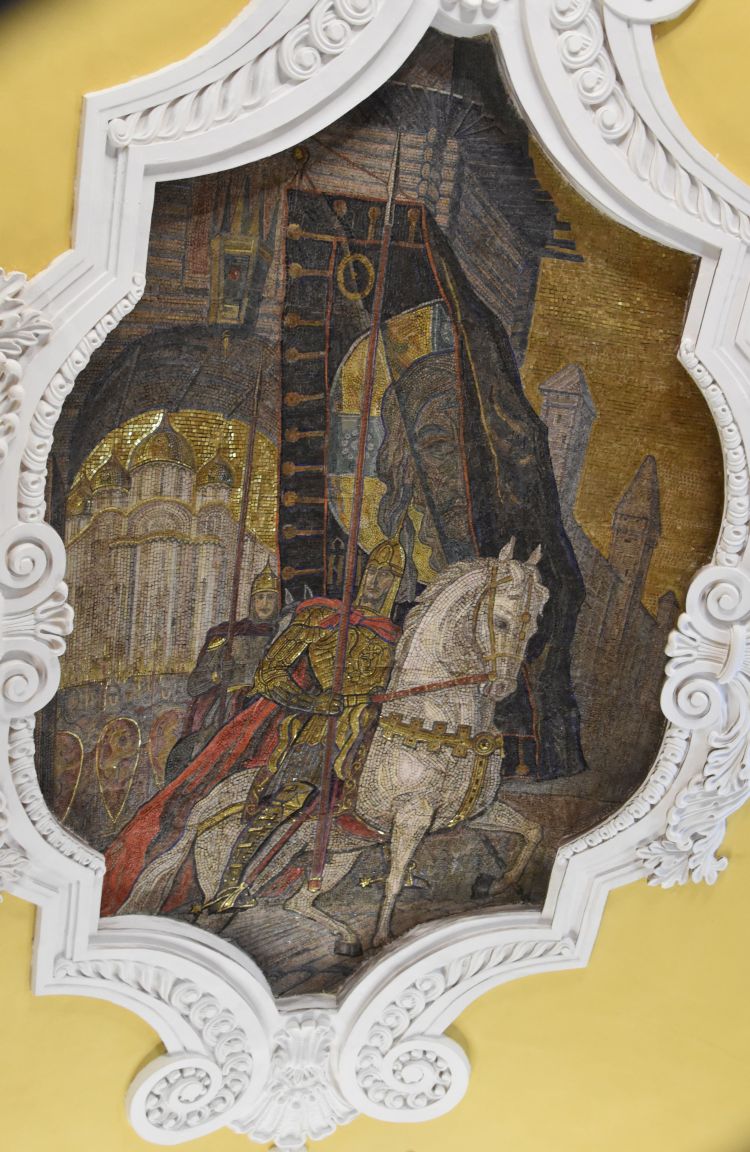
There are also mosaics on the ceiling. They show some heroes of Russian history such as Nevsky (who conquered the Baltic Sea and Karelia for the republic of Novgorod) or Donskoj (who defeated the Mongols for the first time). This is Alexander Nevsky.

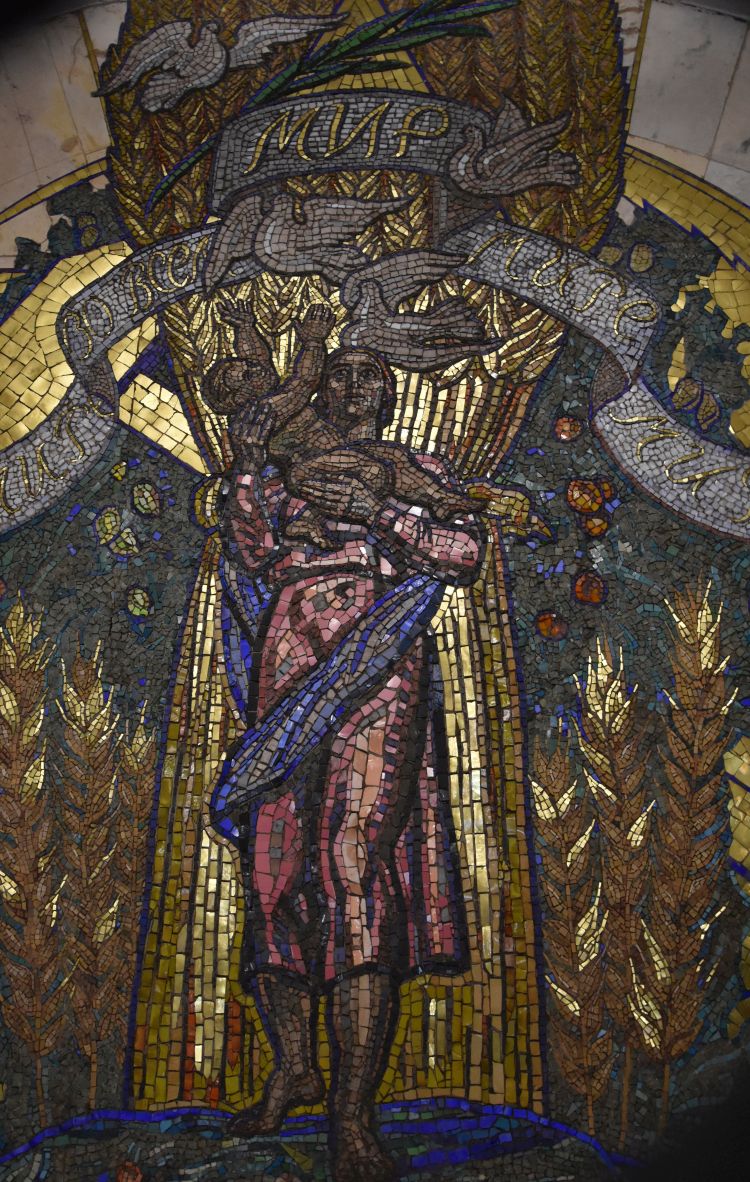
At the end of the gangway, we find the mosaic “МИР” which means both “peace” and “world” in Russian.

.

Majakowskaya or Маяковская

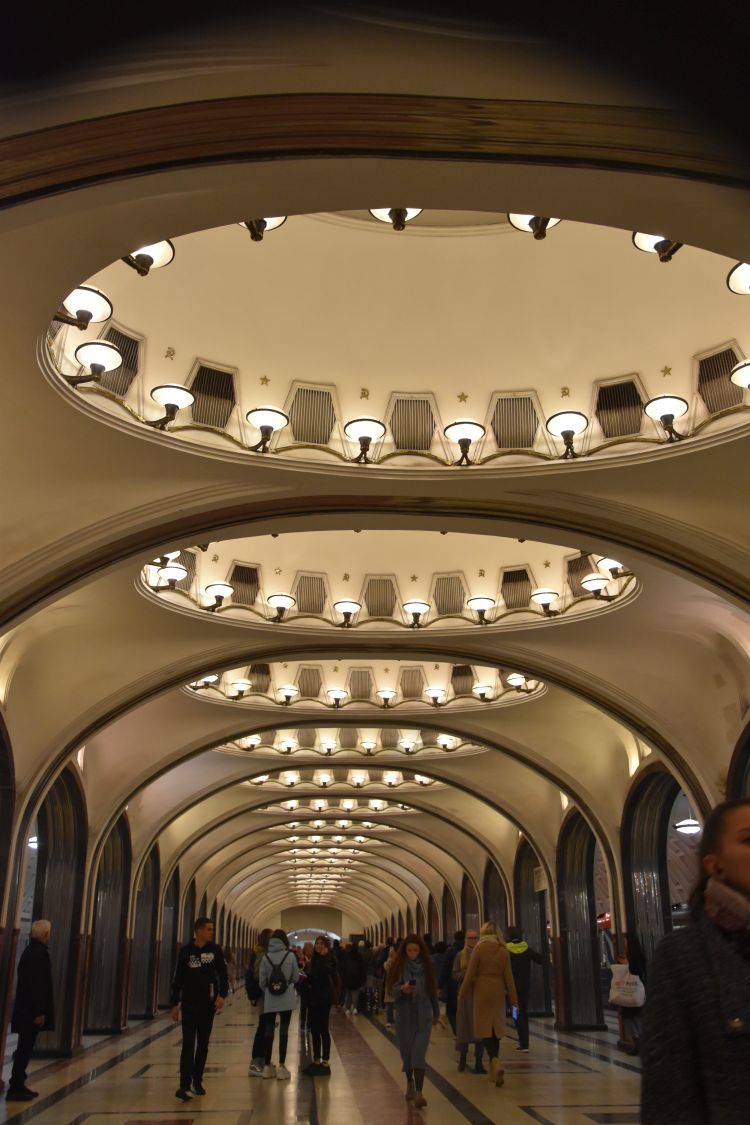
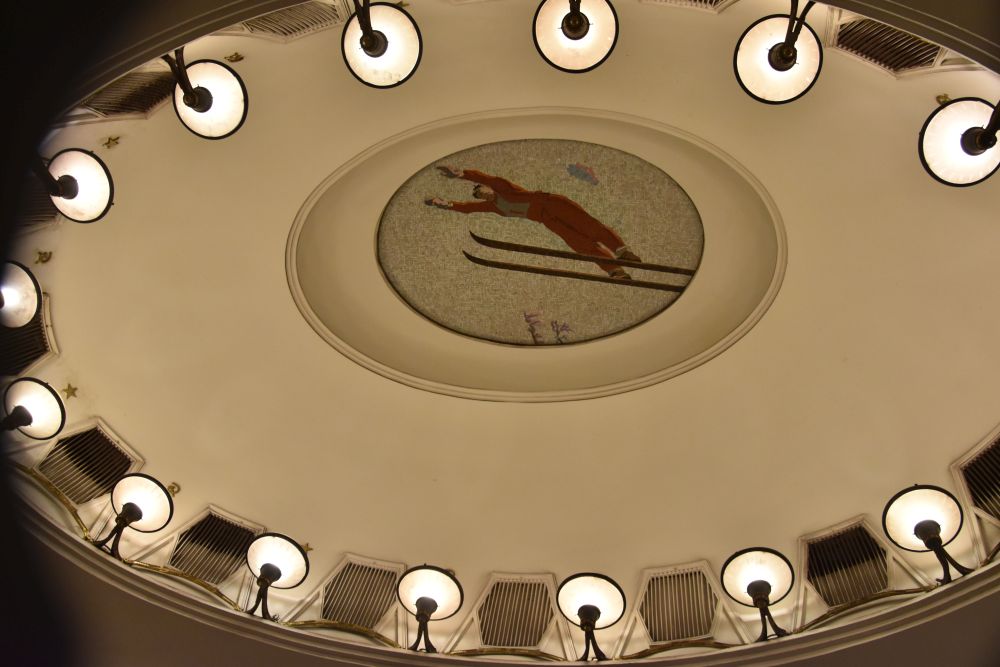
The Majakoswkaya Station has been completed in 1938. The ground is stable here, and hence the columns could be built slimmer, which gives the station a “dancing airiness”. The station won the main prize at the New York exhibition in the same year.

The cupolas are painted with various scenes showing sports such as this ski springer.

We leave the metro here through the exit built into the Tchaikoswky Concert Hall and we have coffee with cake in the cosy attached restaurant. A performance for children ends in the Concert Hall and the young connoisseurs of art fill the restaurant with joy and laughter.

.

Square of Revolution or Площадь Революции

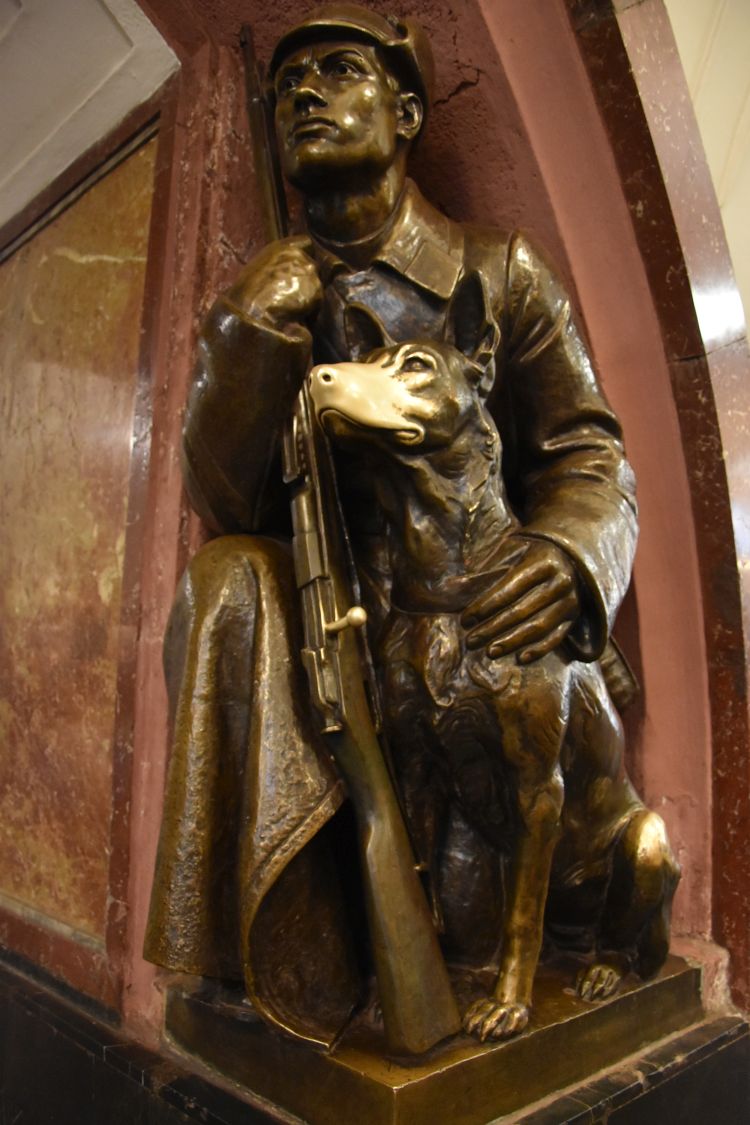
My favourite metro station is the Square of Revolution (Ploshchad Revoluzij). A line of Soviet heroes forms a guard of honour for the Muscovites rushing by. And there are some statues that shine such as this dog’s nose. The passer-bies quickly touch this nose and utter a wish that will be fulfilled – for sure!

This is statue of the Soviet hero Nikita Karazupa with his dog Indus – he was a frontier-guard.

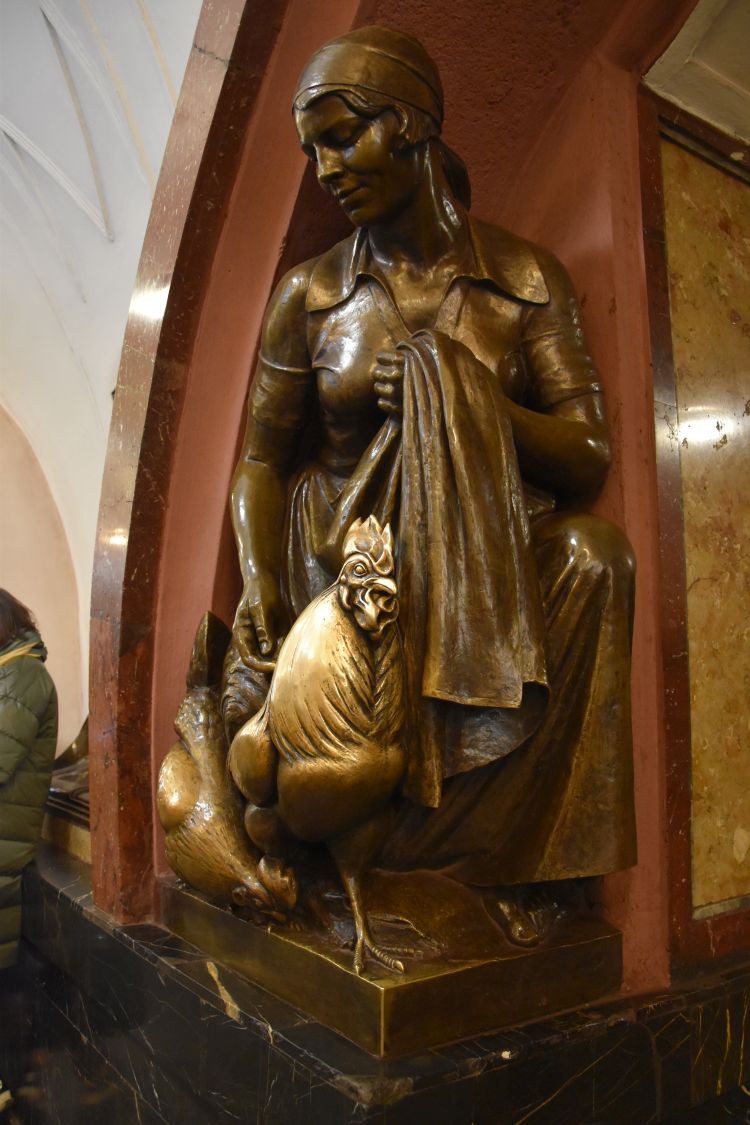
Also this coq accompanying the handsome, strong woman, seems to bring luck and is therefore shining.

.

Arbatskaya or Арбатская

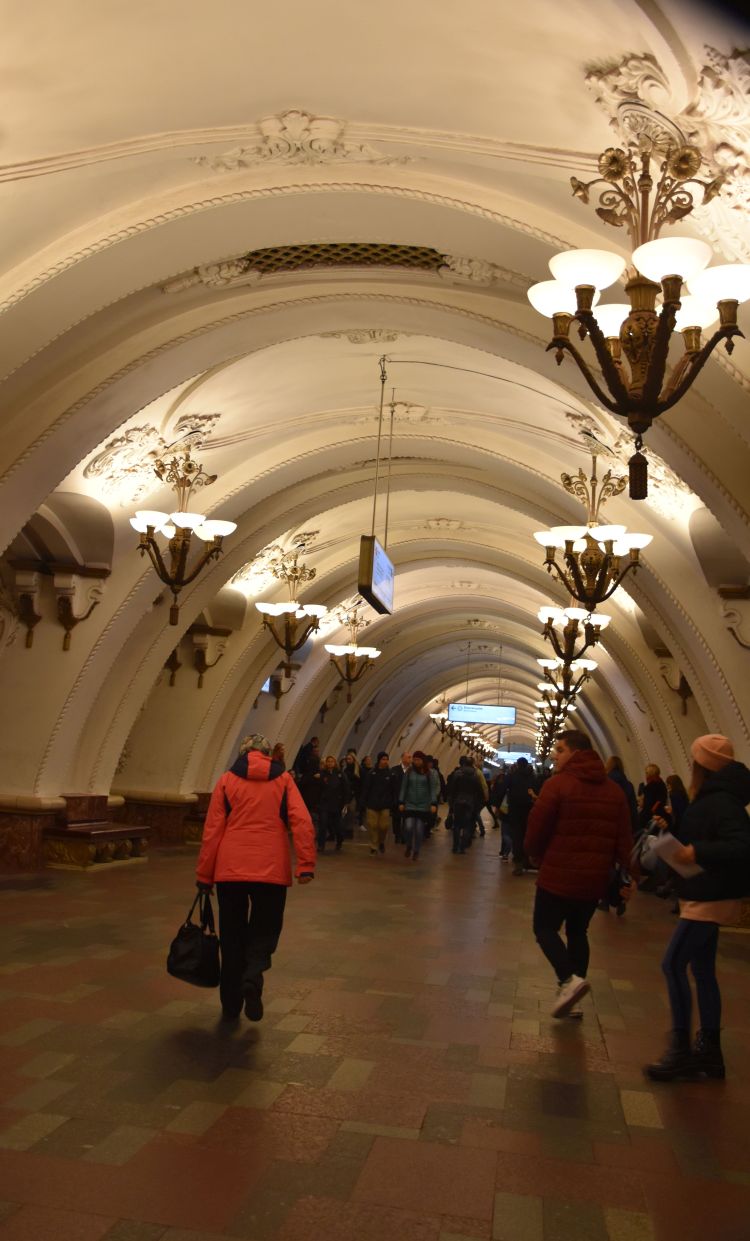
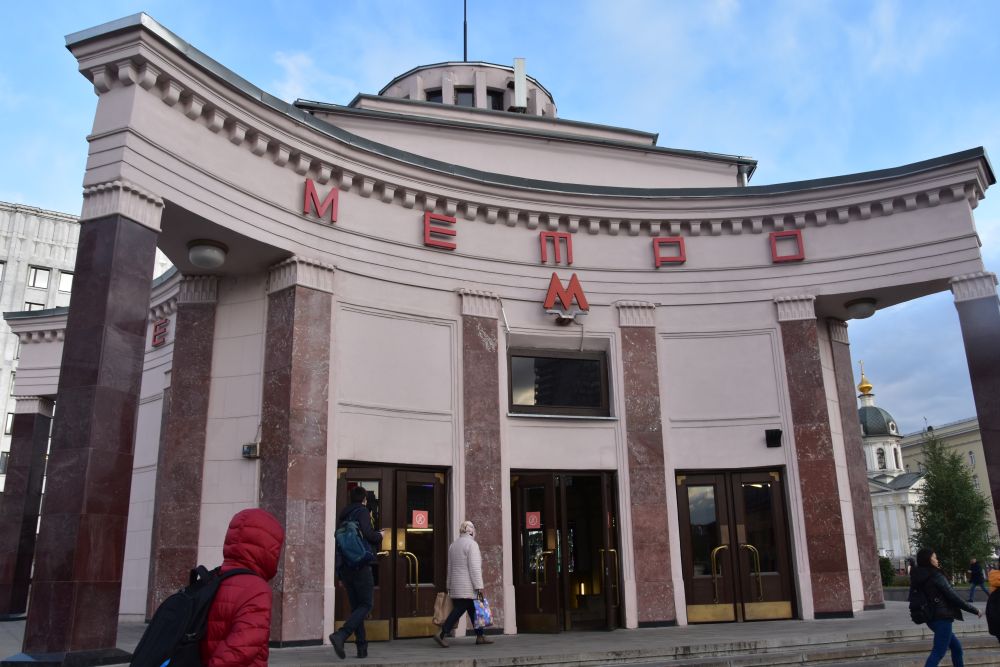
Arbatskaya was the last station we visited. It was built in 1953, another solemn palace.

The entry building of the Arbatskaya forms a star.

.

Turning to the Arbat

The rain has stopped. We leave the Arbatskaya station and stroll through the Old Arbatskaya Street.

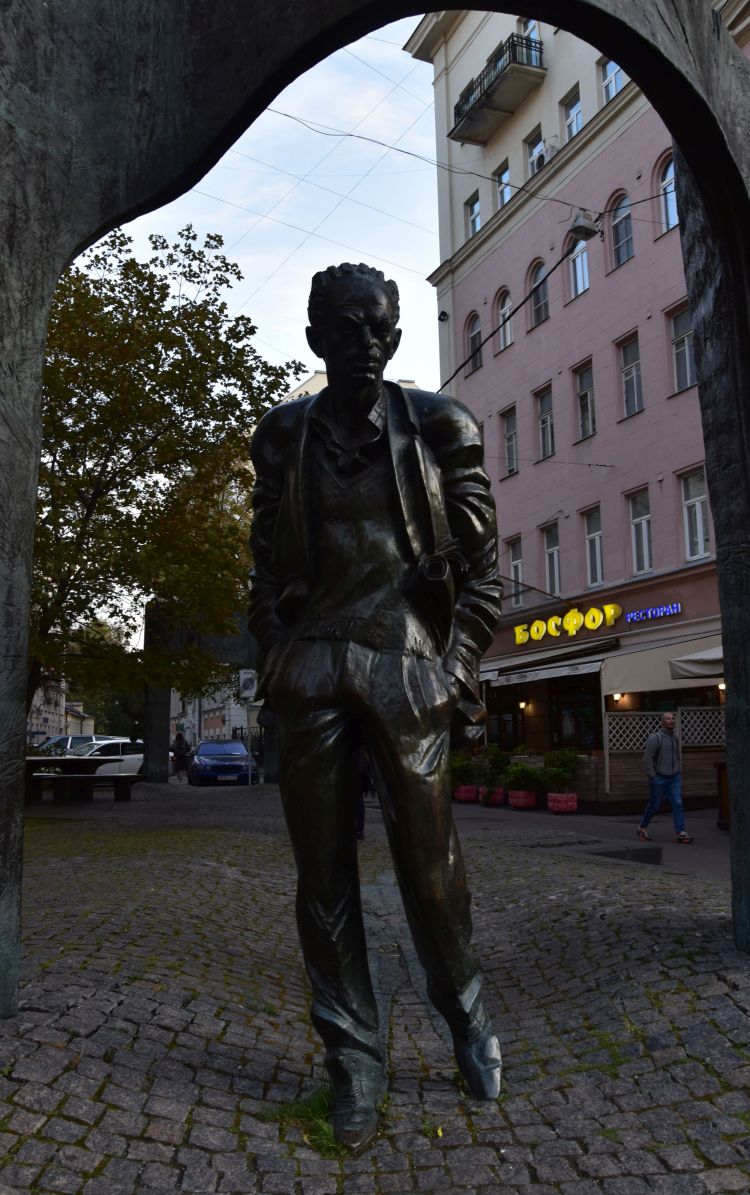
Bulat Okudzhava is here. I say hello to him who wrote and sang the poem about the metro of Moscow.

I also like his ode to the Arbat, called “песенка об Арбате” that ends with the words: “Ах Арбат, ах Арбат, ты моё отечество” – “Ach Arbat, ach Arbat, you are my homeland.” Yes, in the late 19th and in the early 20th century, the Arbat was the area, where artists and intellectuals lived. Also Bulgakow made “Master” live here – he is the protagonist of his wonderful novel “Master and Margarita” written in the 20’s and 30’s of the XXth century.

We select a Georgian restaurant in the Arbat and have a delicious dinner with a glass of red Saperavi wine.

On the road – sightseeing in Moscow: Red Square, GUM and Kremlin

With three friends, I spend a few nights in Moscow. We stay in the pricy and friendly hotel Matreshka (Матрёшка), conveniently located in a dead-end street between the Bolshoi Theatre (Большой Театр) and the Lubyanka (Лубянка).  It is end of September, chilly and wet.

.

The Red Square – the Center of Moscow

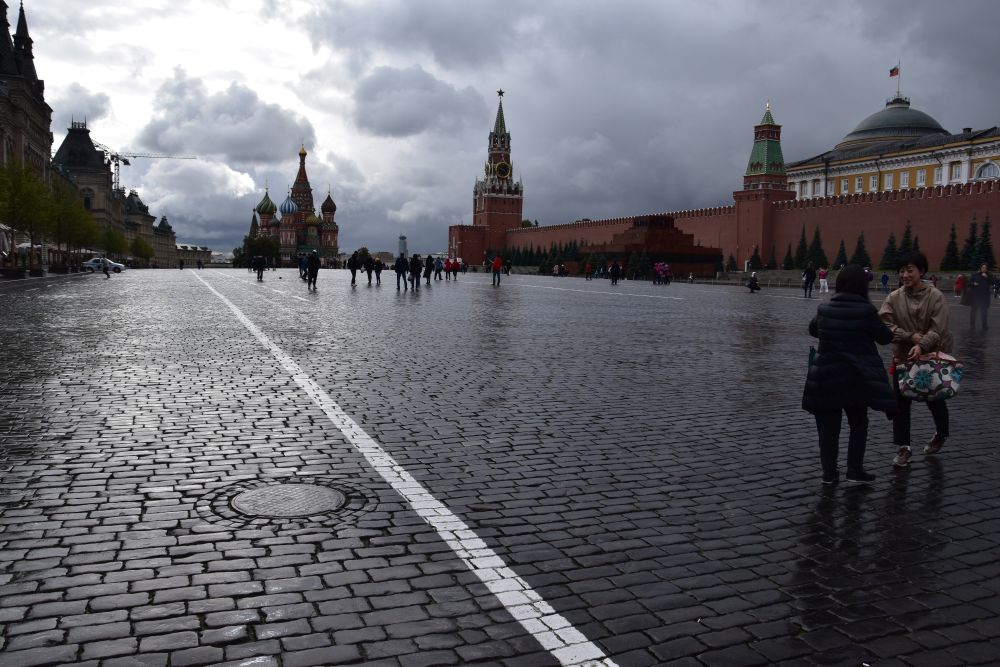
First we visit the Red Square (Красная Площадь) which is the center of Moscow. The pavement shines in the sun that from time to time breaks through the heavy rain clouds. Saint Basil’s Cathedral is at the end of the square, to the right is the Kremlin wall and to the left the department store GUM. I remember, when I entered the Red Square in 2002 with Ernst, he kept on saying “this guy is crazy, this guy is crazy.” He was alluding to the German pilot that landed his Cessna here in 1987. Well, I believe the Red Square is large enough to land a small plane here – it measures 300mx70m.

The Red Square is called Красная Площадь in Russian, and originally, krasny (красный) meant “beautiful”. Later красный changed its meaning to “red”. Indeed, the red wall of the Kremlin really makes this “Red Square” look “red” and “red” was also the color of the communists.

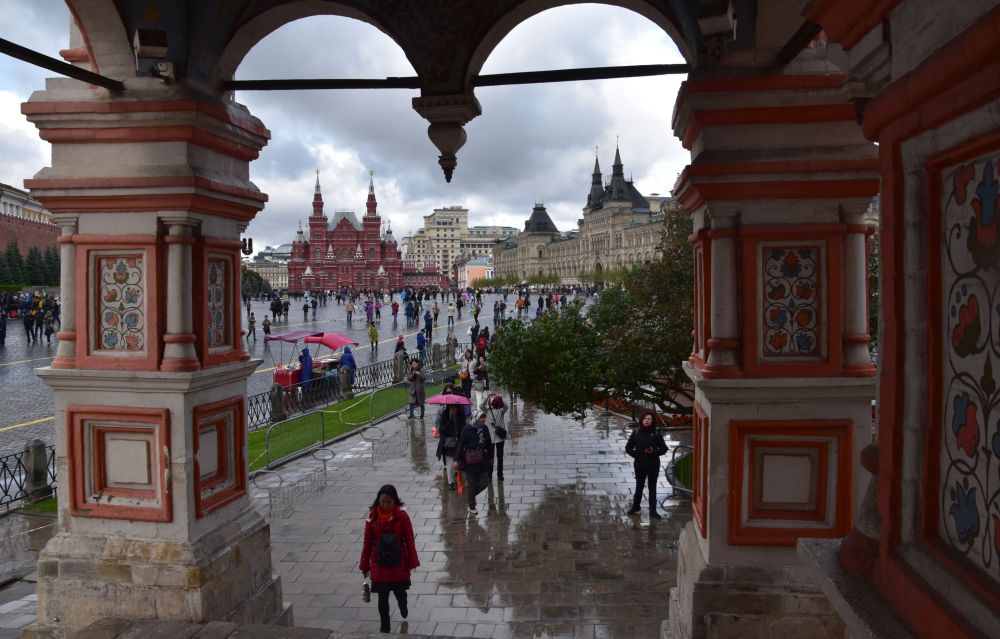
We visit the many chapels of Saint Basil’s Cathedral (Собор Василия Блаженного, building started around 1600 under Ivan IV, the Terrible). We enter all the  chapels and find some wonderful singing at various places. Then we are surprised by more rain, as the photo taken from the Cathedral to the Russian State History Museum and to the department store GUM shows.

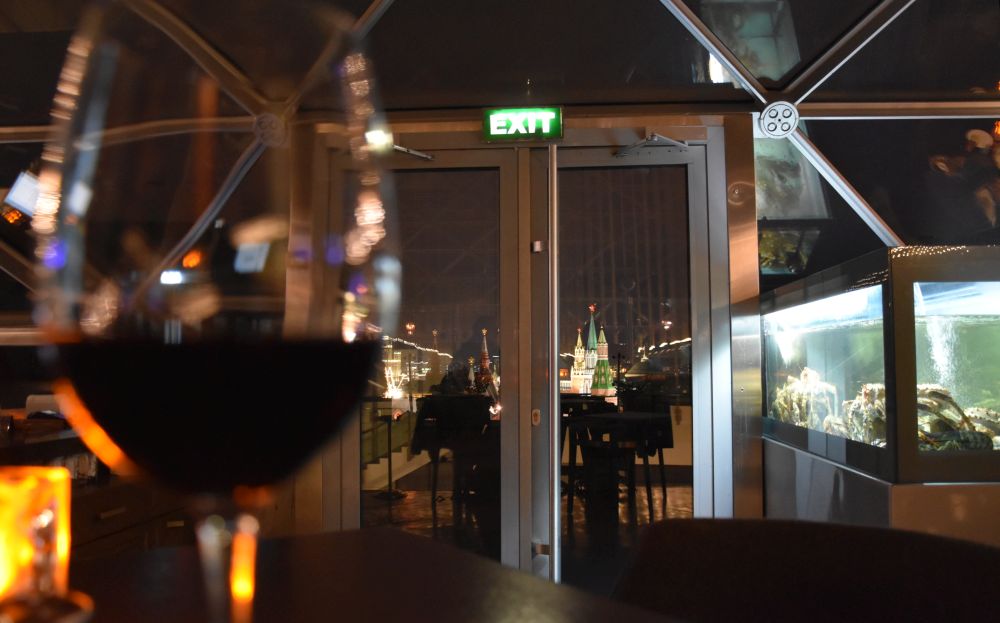
In the evening, we want to see the Red Square from above, enter the Hotel Ritz at Tverskaja, “glide up” to the top floor and have a good glass of wine.

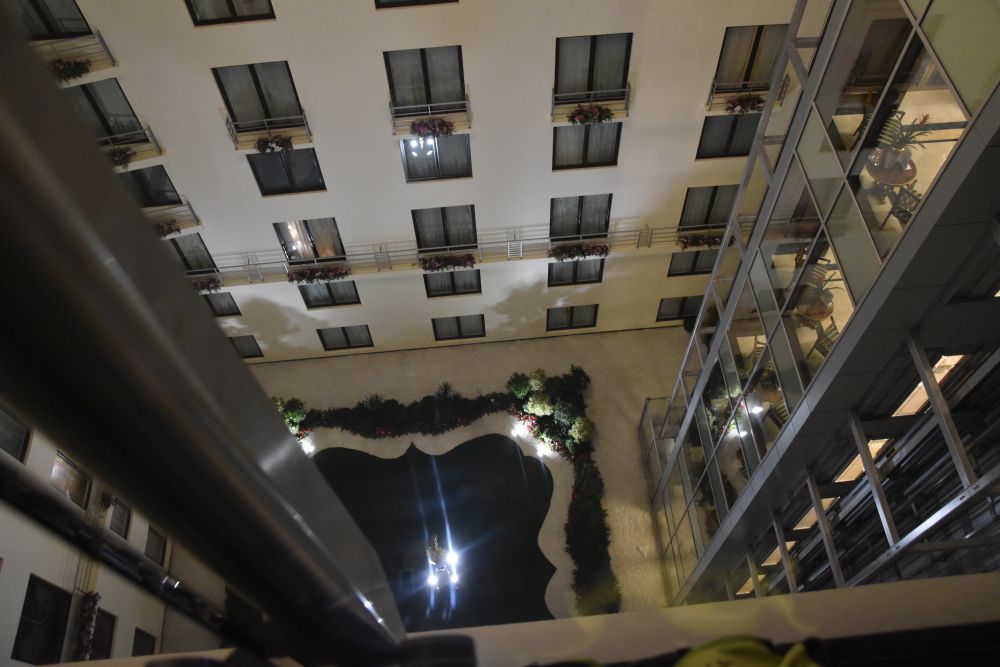
From our chairs, the view down to the ground floor is breath taking.

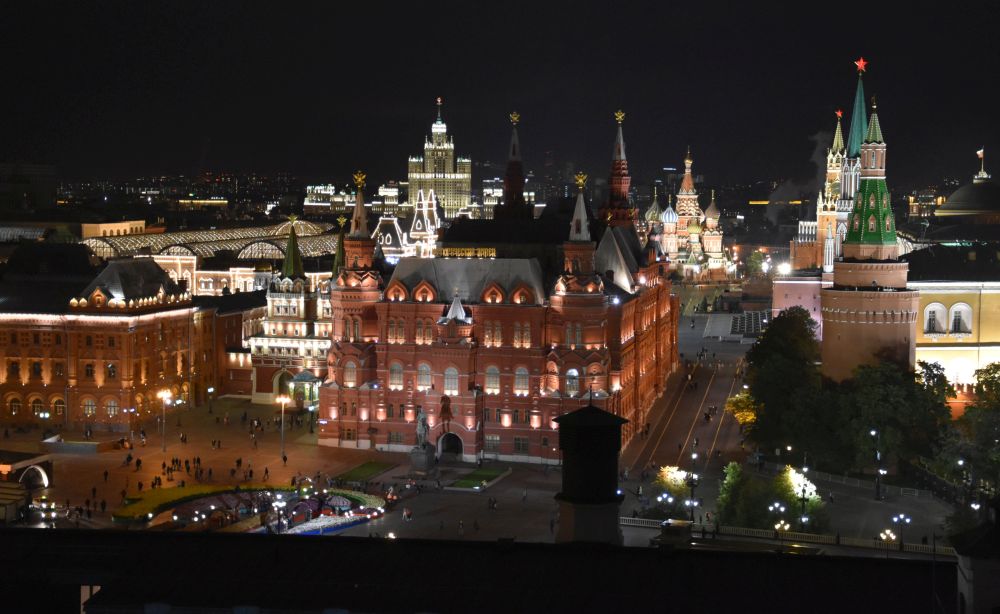
On the balcony, we find this gorgeous view of the Russian State History Museum with the statue of Zhukow, the Red Square, Saint Basil’s Cathedral and the Kremlin. (Zhukow invaded Berlin in 1945 and accepted the surrender of the Germans).

.

The traditional department store GUM

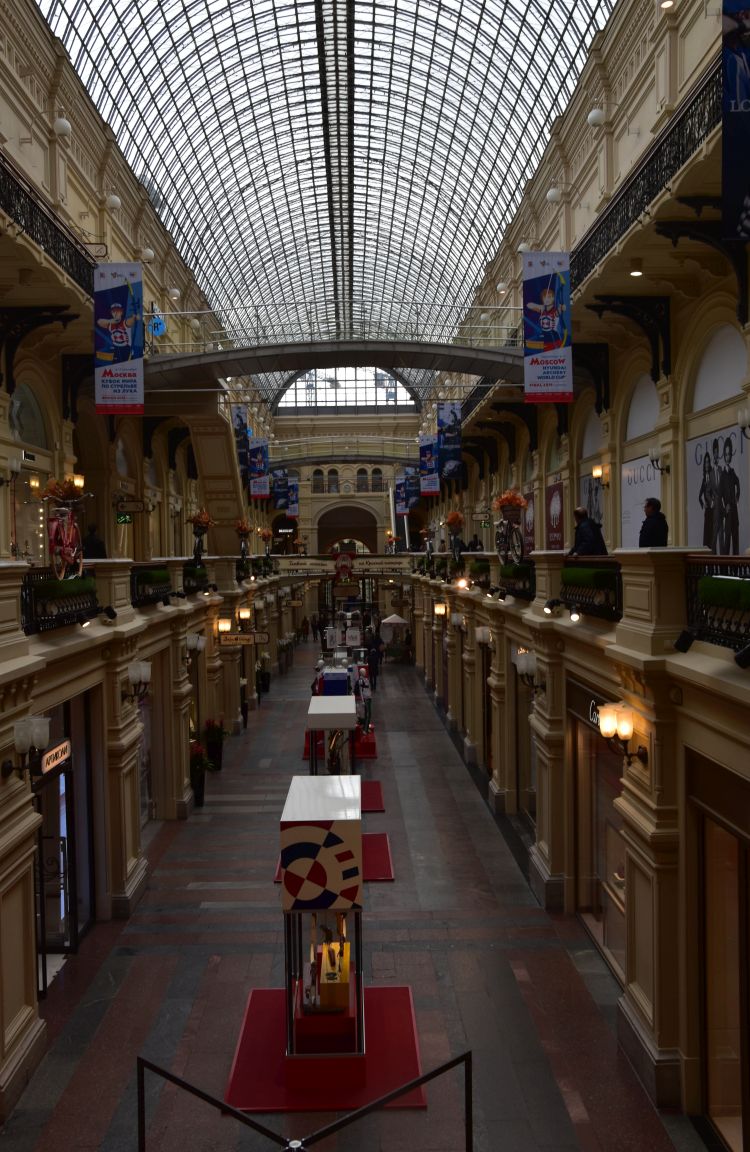
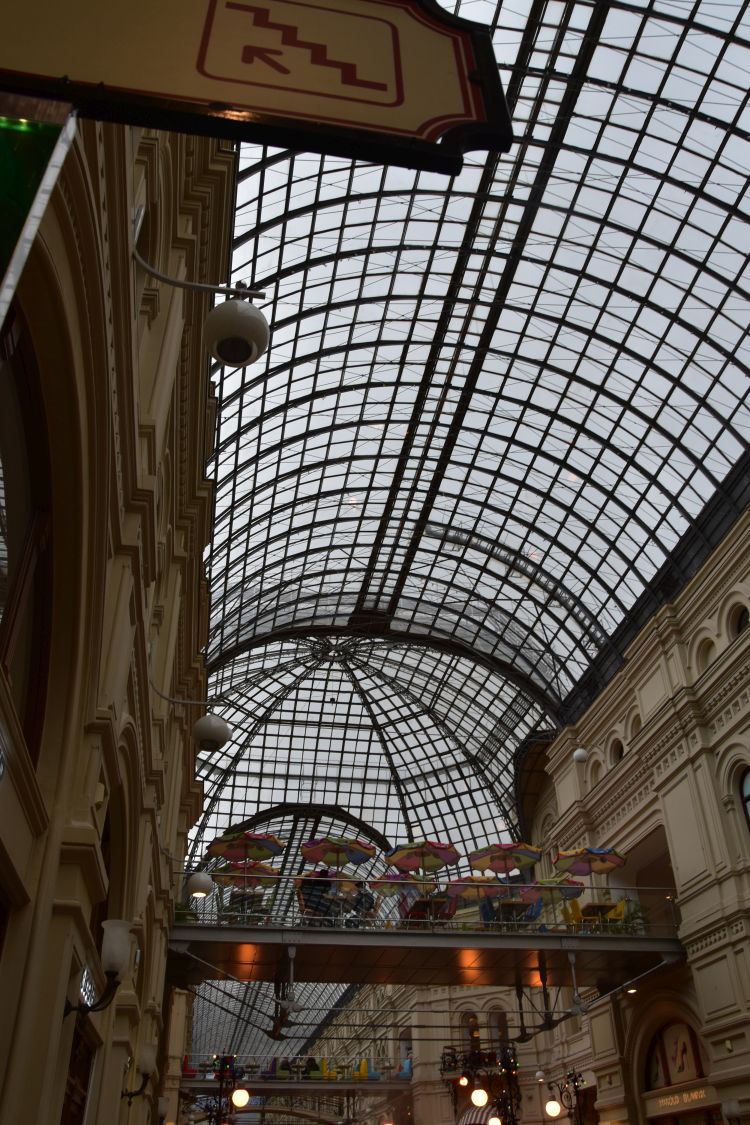
From the pouring rain, we escape into the GUM (Государственный (Главный) Универсальный Магазин). This department store was built in 1893. It is huge with its 200 stores on three levels spread over 250m versus 88m. We buy criminal stories written by B. Akunin in one of the stores. I look forward to reading them.

We have lunch on the terrace under the umbrellas.

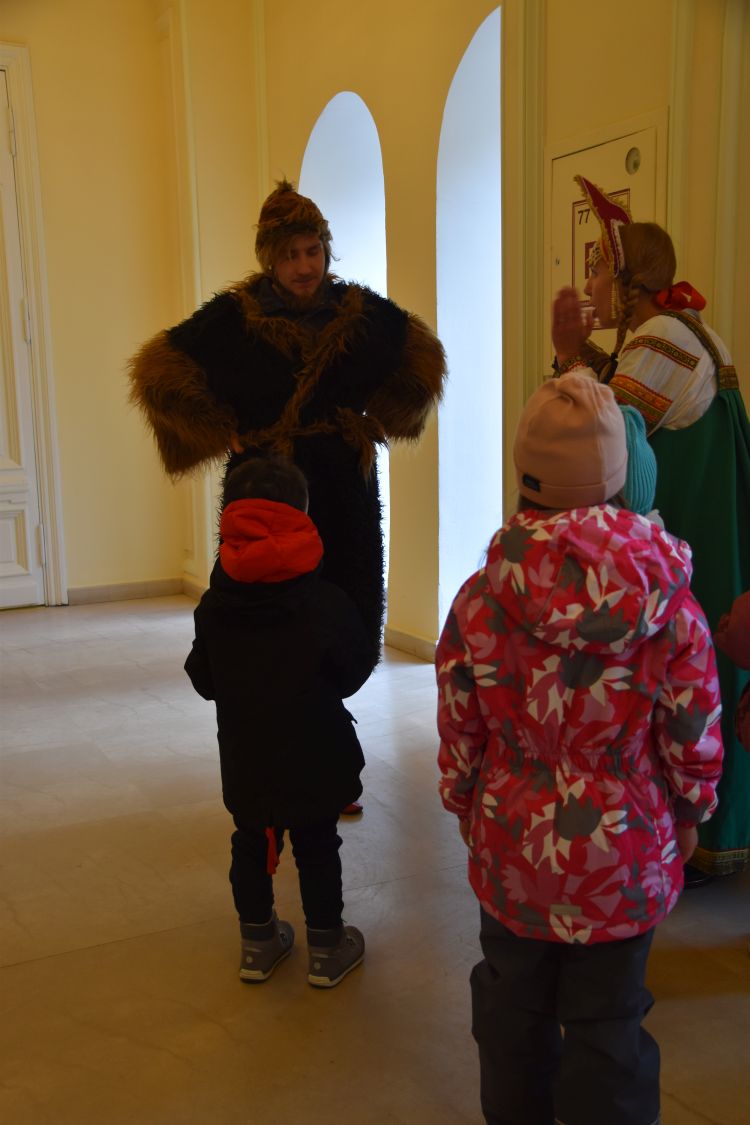
We watch a fairy tale teller with a group of children. Very lively, she talks about the bandit (разбойник) that, indeed, suddenly appears round the corner. The kids give him some money (it is a chocolate coin of ten rubles). And, because this is a good bandit, he does not keep the “money”, but hands it over to me… we all laugh together. Russians are excellent at entertaining children; even grown-up tourists enjoy that.

.

The gorgeous cathedral square in the Kremlin – worth seeing a third time

On the second day, we visit the Kremlin with its splendid Cathedral Square. It is my third time here, and it IS worth seeing it again. This a good overview that I found in the Internet.

The Dormition Cathedral (Успенский собор, the main and oldest cathedral) 

The Dormition Cathedral (Entschlafenskathedrale) celebrates, what we call “Maria Himmelfahrt”. It is the oldest Cathedral of the Kremlin, built in 1475-1490 by Aristotele Fioravanti. It mixes Russian traditional and Italian Renaissance architecture. The five golden cupolas shine, when the sun breaks through the clouds. Inside is the throne of Monomaxos alluding to the dynastic link of Iwan IV with Byzantium – he used this throne to pray (“Betstuhl”).

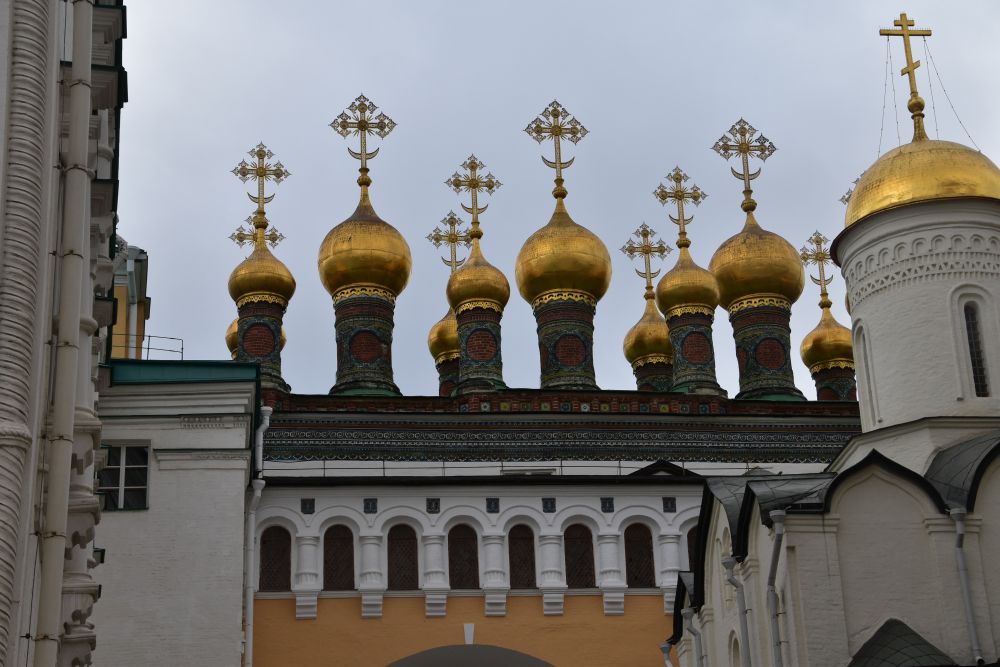
Next to the Dormition Cathedral we enter the small Church of the Deposition of the Robe (when Maria died and was accepted in Heaven, she left her robe in the grave, Церковь Ризоположения Пресвятой Богородицы)). No photos allowed in the pretty church with its frescoes. Behind the church are the joyful, slim cupolas of the Terem Palace, which used to be the main residence of the Russian Tsars.

.

Annunciation Cathedral (Благовещеский собор, house church of the Tsars)

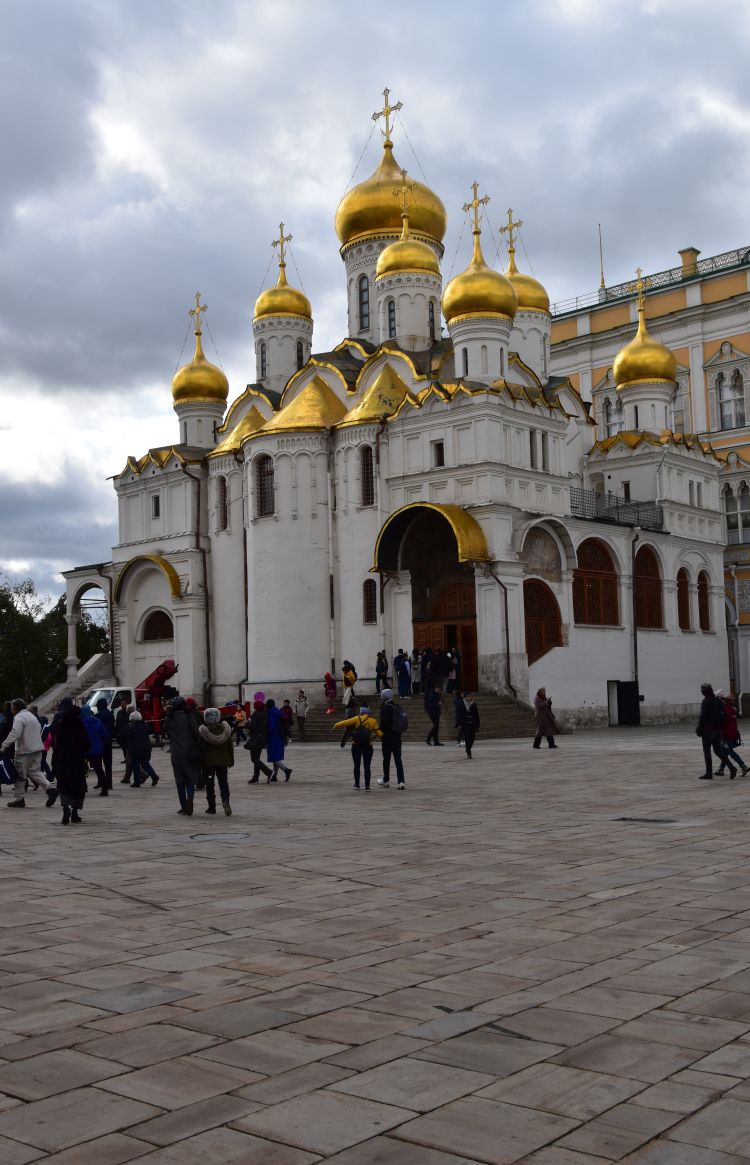
Now, we have to stand in line with a large group of Chinese tourists to enter the Annunciation Cathedral. After having entered, I see Jonas just to the left. I stop to breathe: I remember, when I was here with Ernst and we enjoyed looking at Jonas being swallowed and spat out again by the whale. Inside we admire the solemn iconostasis with the works of Andrei Rublew, Teophanos the Greek and the School of Moscow. The Cathedral was built by masters from Italy and Pskow between 1484-1489. In 1560 Iwan IV renovated the church and since then, it has had nine cupolas, because conquering Kasan lasted nine days. These churches are full of symbols.

.

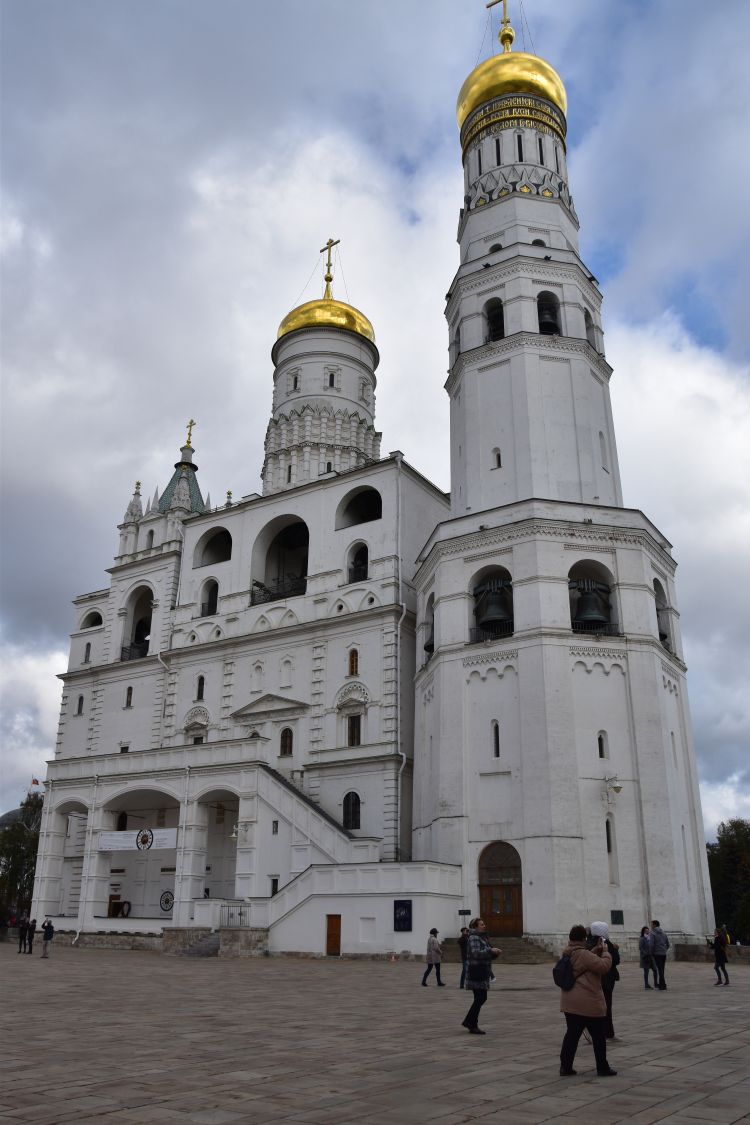
Dormition Belfry (Успенская звоница)

The Belfry was built by an Italian architect from 1505-08. It is 81m high. The cupola has been added by Boris Godunow and his name is written there. The belfry is also called Dormition Belfry, because a dormition chapel was added later and then transformed to a bell wall (звоница). In Russia, bell walls are used to make music with the bells – beautiful, I have experienced that in the monasteries on the Golden Ring around Moscow.

.

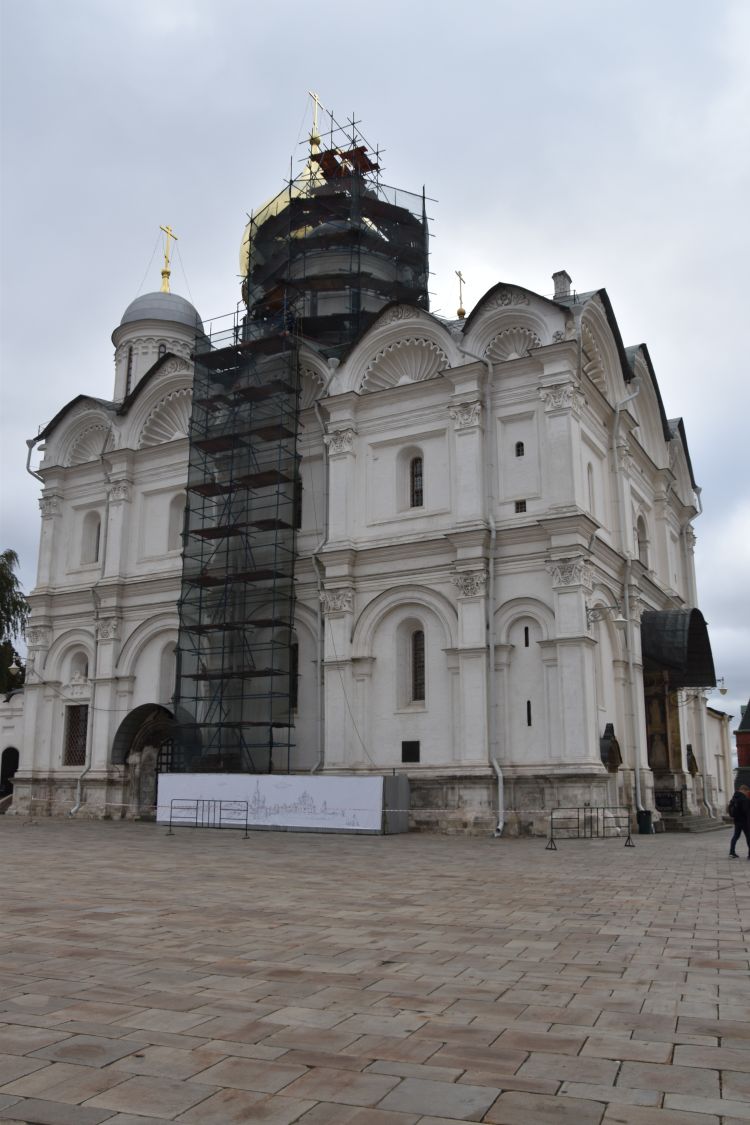
Archangel Cathedral (Archangel Michael, Архангельский собор)

Also, the Archangel Cathedral (Erzengel Kathedrale) has been built around 1500 (1505-1508) by the Italian architect Aloisio Lamberti de Montagnana (called Alevis Nowy). Inside it is a Russian church forming an equilateral cross. The grand dukes and the Tsars up to Peter I the Great are buried here. Their wives are in the crypt. From Peter I the Great on, all Tsars are buried in Petersburg. Only Boris Godunow is in Sergiyev Posad. Outside, the horizontal structure of the facade and the conch like shapes show Italian (Venetian) Renaissance influence.

Again and again, the sun defeats the clouds and the cupolas shine golden, just for some minutes. We cannot leave this place – it is too beautiful.

.

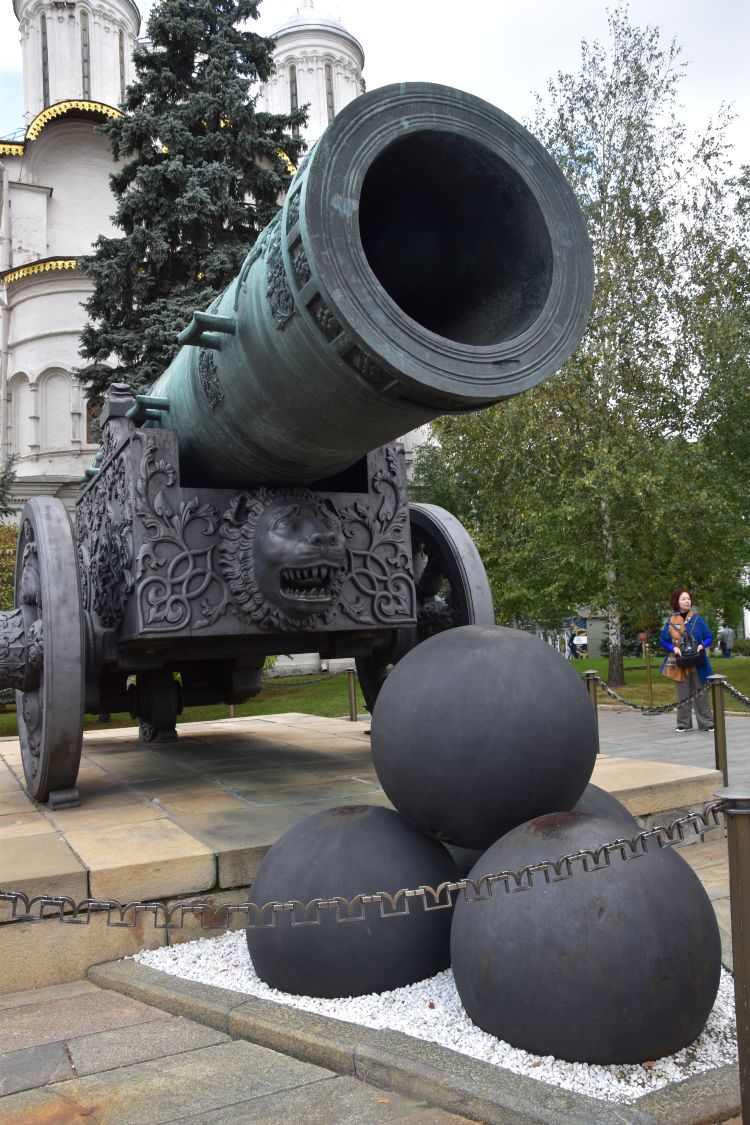
Tsar Cannon (Царь пушка)

Behind the Cathedral Square, there are two more attractions. The first is the Tsar Cannon. I remember, how Ernst laughed, when he saw the cannonballs. “These cannonballs have never been used for THIS gun”, he said. And I do think that he was right, they are just too large for this gun. Do you not agree?

.

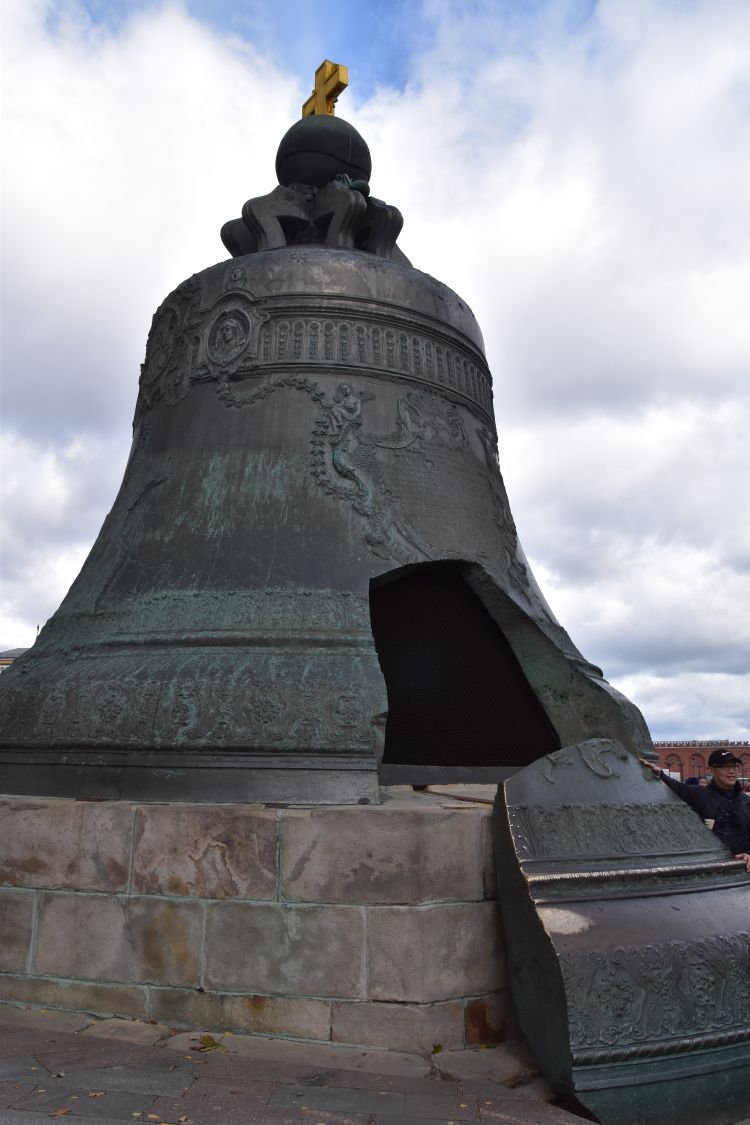
Tsar Bell (Царь-колокол)

The Tsar Bell is one of the hugest bells ever casted in the world. But when taken out of the casting pit, it broke. Hence it has never been used, but being so large, it has been placed in the Kremlin and has served as an attraction since 1836. I admire the courage of the Russians – I think, they show that sometimes you have to give it a try, even if not being always successful.

We look back to the Belfry, the Dormition Cathedral and the Archangel Cathedral with their golden cupolas.

We leave the Kremlin  to have lunch – a borshch (Борщ) and dumplings  in one of the traditional Soviet Restaurants that now can be found all over in Moscow, the Varenichnaya.
.
Sure, whenever I get a chance to go to Moscow again, I will visit the Kremlin and the Cathedral Square again. It will be my fourth time then, and it will be worth it

Sources: Christine Hamel: “Russland – von der Wolga bis zur Newa”, Dumont Kunstführer 1998. Hubert Faensen: “Siehe die Stadt, die leuchtet”, Koehler und Amelang, 1989. Eva Gerbeding: “Moskau”, Dumont Reisetaschenbuch 2018, and various Wiki-entries.