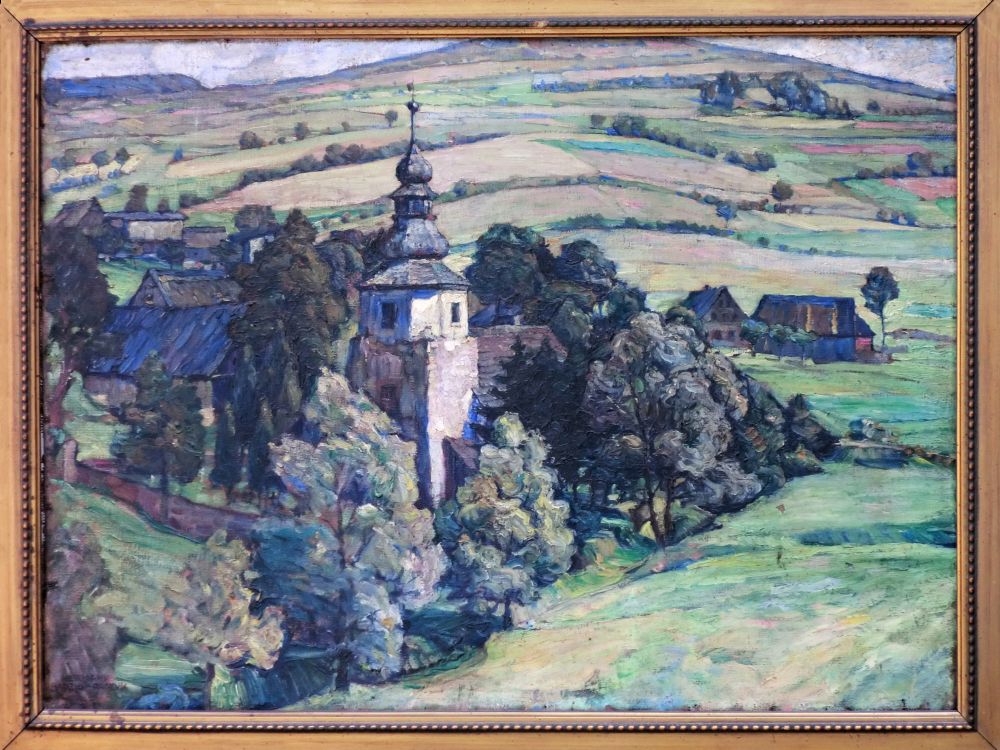
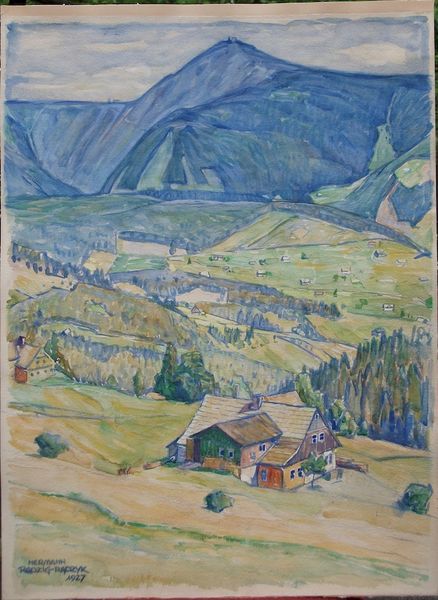
Hermann Radzig-Radzyk painted in Silesia a hundred years ago: Neumannskoppe with Maria-Schnee-Kirche

In May/June 2023, I was in Silesia, looking for some places, where my grandfather Hermann Radzyk put up his easel a hundred years ago (as an artist he painted under the name of Hermann Radzig-Radzyk).

One painting I was looking for was the “Neumannskoppe” of 1919 (belongs to my sister and me). 

I know title and year from a letter of my mother to her best friend. I acquired the painting from a friend of the son of my mother’s best friend.

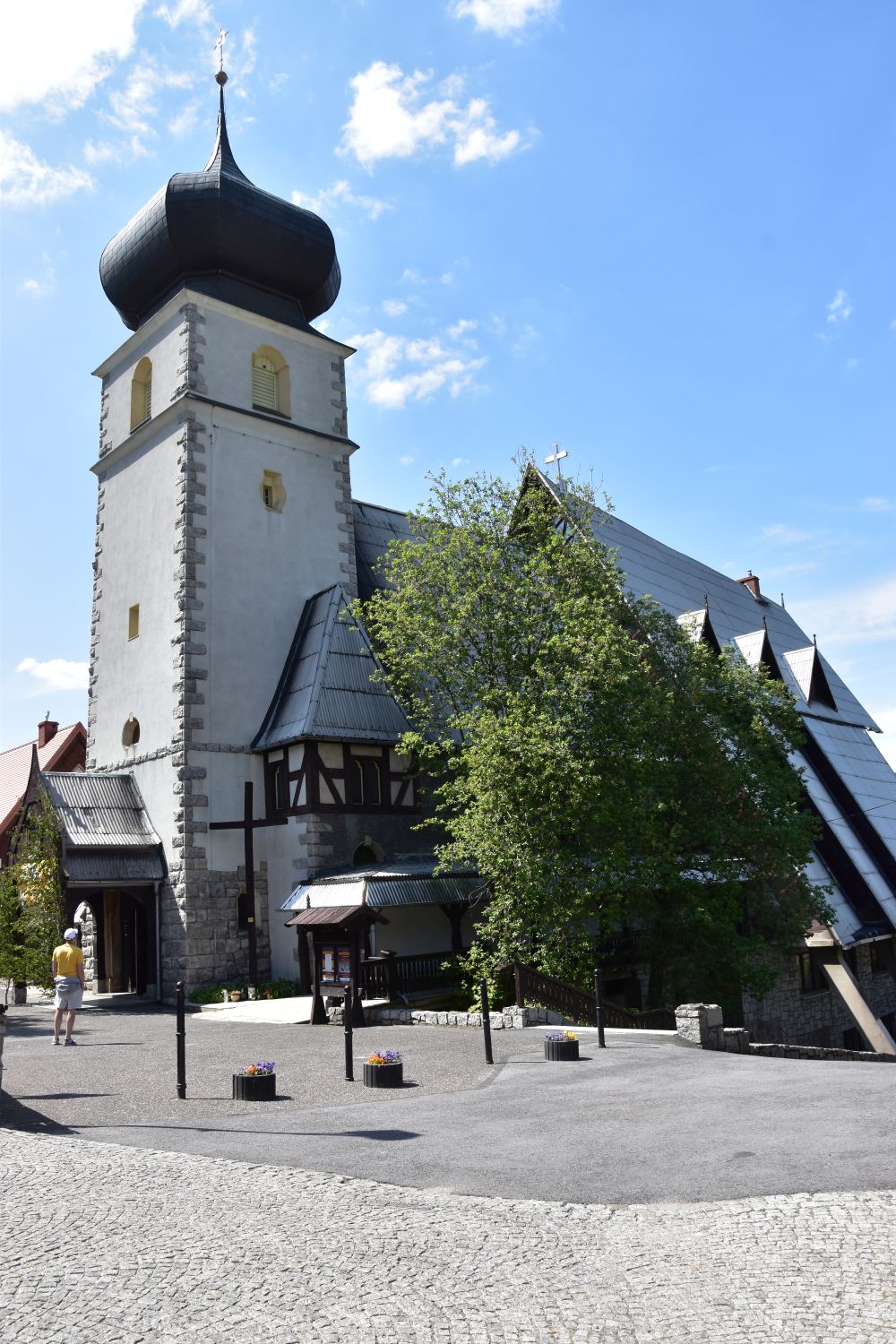
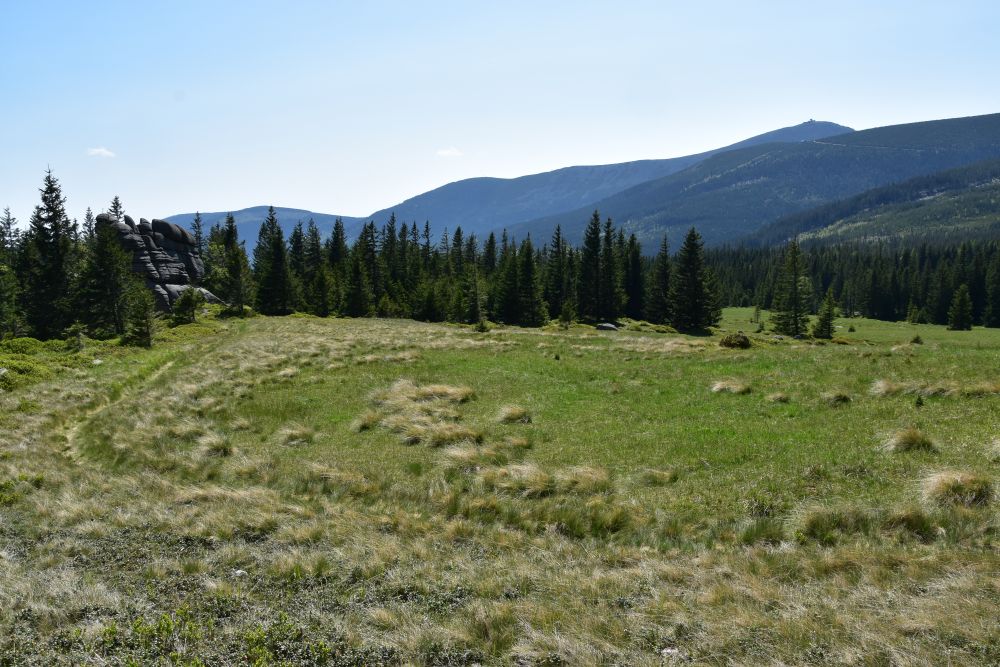
I solved the puzzle end of May 2023: To paint the “Neumannskoppe”, my grandfather had put his easel up at Rudolfswaldau, now Sierpnica. The mountain Neumannskoppe has become Niczyja. The wooden church with the baroque belfry is called Maria-Schnee-Kirche (Kościół Matki Bożej Śnieżnej, i.e. “Our Lady of the Snows”). 

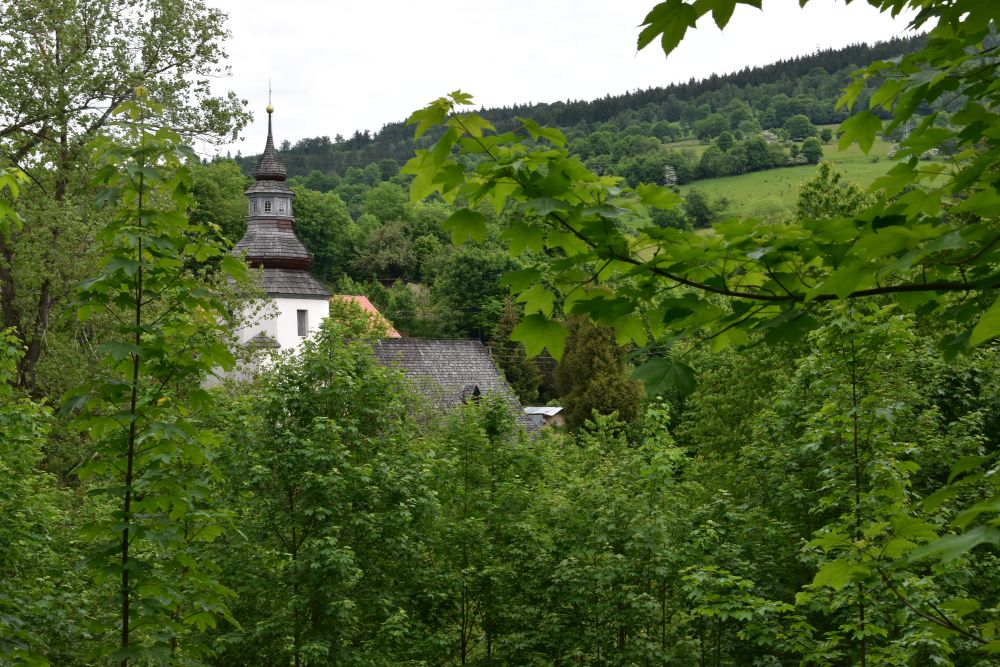
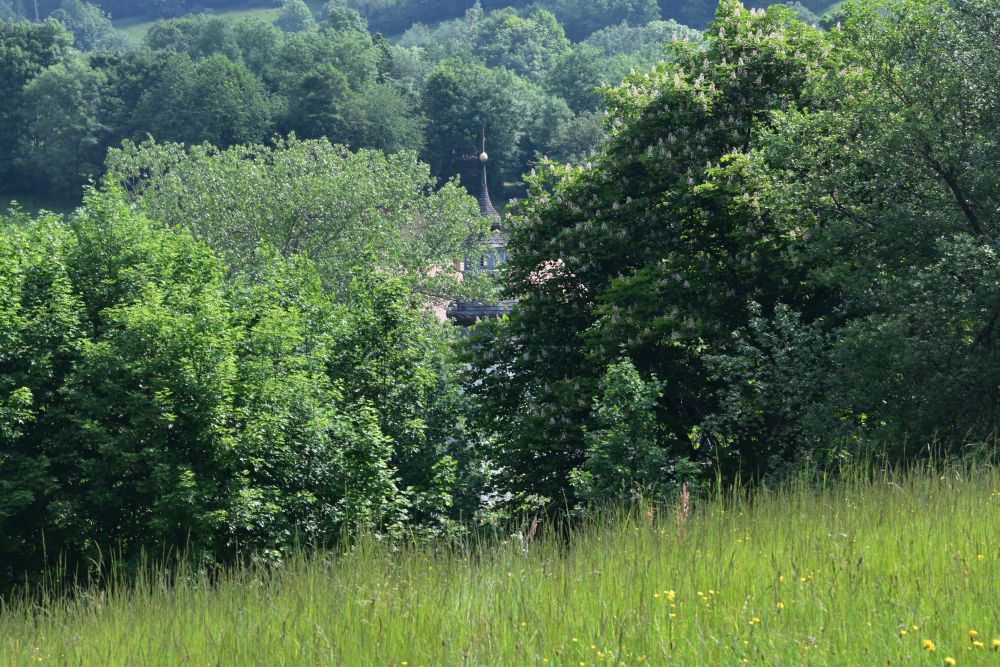
I was at Sierpnica end of May 2023 to see, what the church looks like today, and I took the photo from where the easel was (approximately).

Today the church is hidden behind trees.

While taking my photos, I met Dziki who lives near the church. He gave me his winter photo. The trees without leaves allow to see more of the church that my grandfather painted.

Source: Photo taken by Dziki Domek.

Now let me tell you, how I solved the puzzle to find the easel for the painting “Neumannskoppe”.


Where is the Neumannskoppe?

I started by looking for the Neumannskoppe. I suspected, the Neumannskoppe is a mountain somewhere in Silesia. I entered “Neumannskoppe” in google maps – no result. I continued googling and googling “Neumannskoppe” combined with various terms… and after a lot of googling, I found this old German-Silesian advertisement for the “Grenzbaude im Eulengebirge” (boundary mountain hut in the Owl Mountains). 

The advertisement says that the Grenzbaude is located between the “Neumannskoppe” and the “Hohe Eule” (1). Hence the “Neumannskoppe” is not far from the “Hohe Eule”. Googling “Hohe Eule”, I found the name “Wielka Sowa”, which is the highest mountain in the Góry Sowie (Owl Mountains). 

Conclusion: The church with the Neumannskoppe is not far away from the Wielka Sowa. I asked Google to show me the churches around Wielka Sowa and  I clicked on all of them.

At Sierpnica, I found the church that my grandfather had painted. It is now called Kościół Matki Bożej Śnieżnej, in German Maria-Schnee-Kirche.

Source: Marius Tyski, Church of our Lady of the Snows, Instagram, appeared in google maps about a year ago, in the meantime I can no longer find it there. 

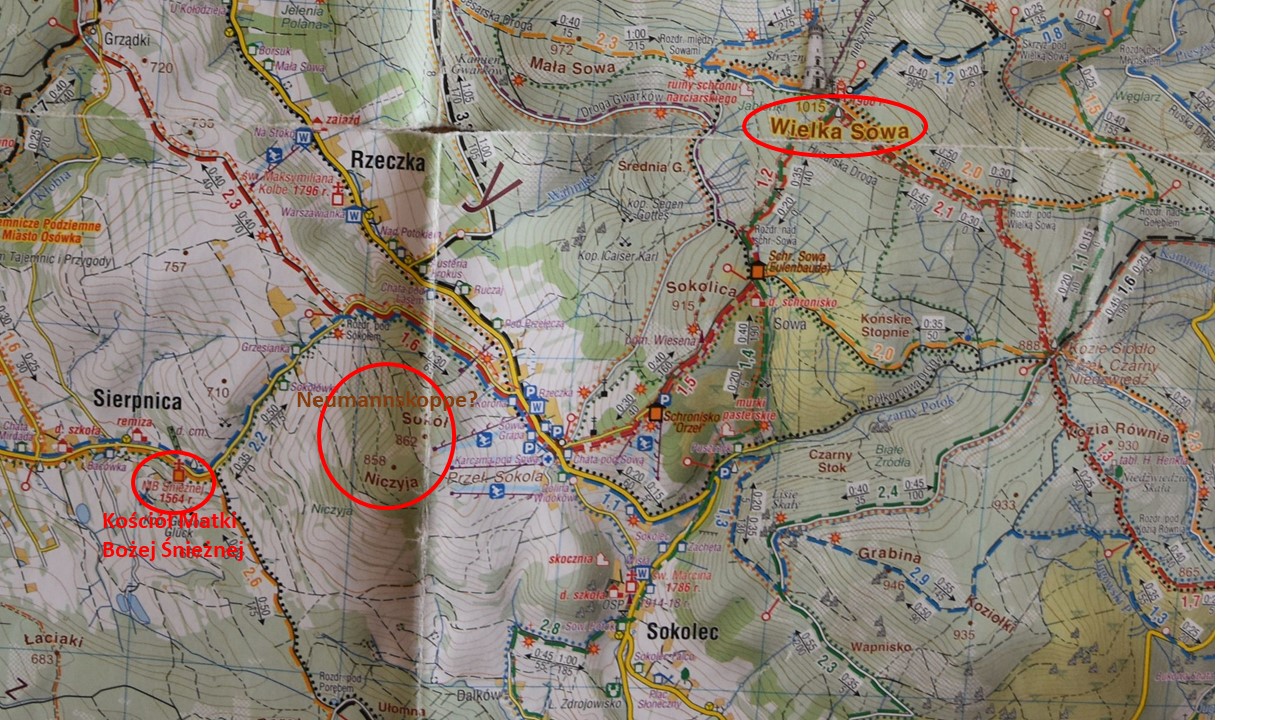
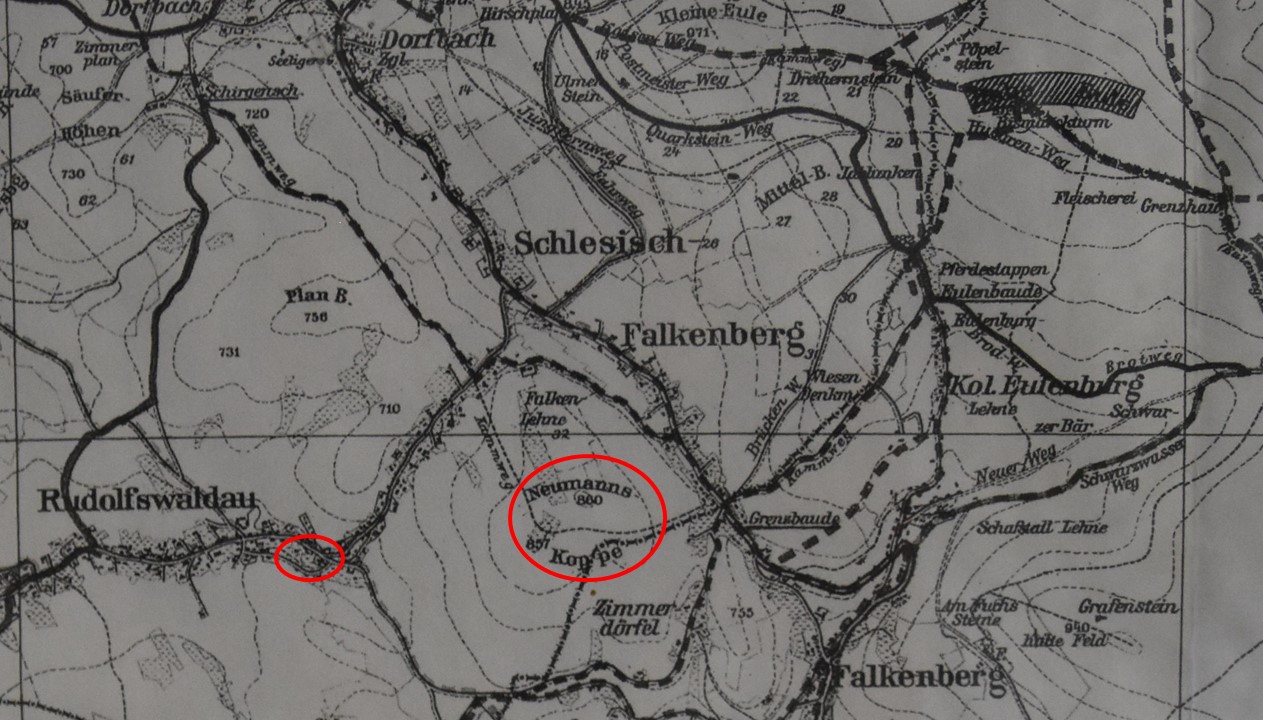
This is the location of the Kościół Matki Bożej Śnieżnej on my hiking map of the Owl Mountains, south west of the Wielka Sowa. 

Source: Compass Góry Sowie, mapa turystyczna, scala 1:35’000

But where exactly is the Neumannskoppe? It must be either the peak Sokól or the peak Niczyja – this puzzle remained. I solved it at the hotel Lesny Dvor at Wolibórz (Volpersdorf) – we stayed here a few days. The Lesny Dvor had a German map whith the Neumannskoppe – and comparing with my hiking map, it becomes clear that the Neumannskoppe is now called Niczyja.  

Source: German map that hangs in the hotel Lesny Dvor at Wolibórz

Niczyja (“nobody’s mountain”) is the approximate translation of  “Neumannskoppe” (“new man’s mountain”).

My grandparents must have spent their vacation at Rudolfswaldau in 1919, when their daughter (my mother) was 3 years old. My grandfather took his easel, canvas and colours with him to paint the Maria-Schnee-Kirche in front of the Neumannskoppe. About a hundred years later, in May 2023, I was here as well – at Sierpnica – and solved the puzzle.


The church Lady of our Snows (Kościół Matki Bożej Śnieżnej) is a historical treasure

The church Kościół Matki Bożej Śnieżnej was built out of wood in the 16th century. It is one of many “Schrotholzkirchen” in Silesia (see https://de.wikipedia.org/wiki/Liste_der_Schrotholzkirchen_in_Niederschlesien). 

It was a protestant church. After the War of 30 years, after 1648, it became a catholic church (the area belonged to catholic Austria at that time). In the 17th century, the tower burnt down, and the new baroque tower was built.

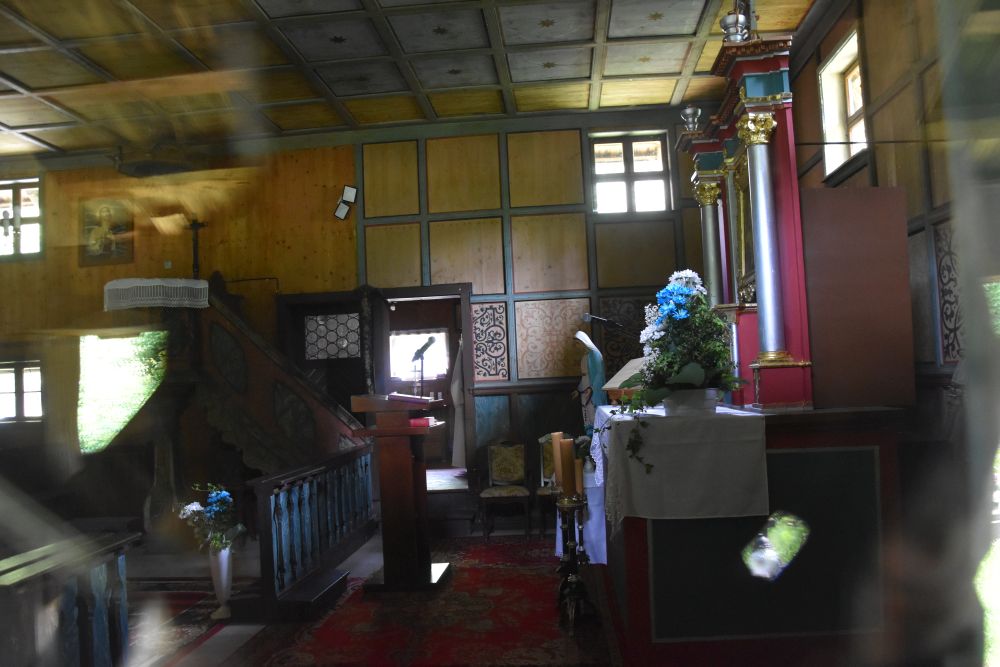
I could not enter the church,  I could just look through the window and capture the interior with the altar…

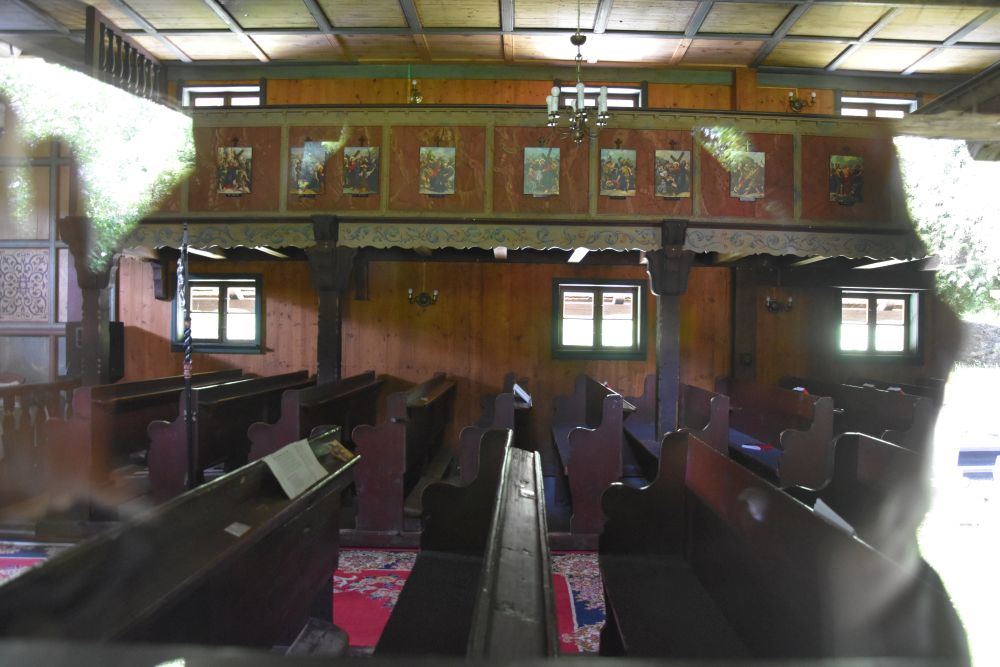
… and the benches.

Visiting more wooden churches or Schrotholzkirchen might be another interesting target in Silesia. 


Meeting today’s Silesians while wandering off the beaten tracks looking for the easel of my grandfather

When looking for the places, where my grandfather put up his easel, I usually wander off the beaten tourist tracks. At Sierpnica, I walked uphill on an unpaved path and through the adjoining meadow to get the view of the church from above. The tourists that visit the church, walk around it and leave again. They do not walk uphill to places, where they can hardly see the church. A car comes on the unpaved path and stops. “What are you doing HERE”, the driver asks me in fluent English. “Look at this”, and I show him my photo of my grandfather’s painting.  “Yes, this IS the church,” he says. We exchange addresses and he sends me the winter photo of the church. Later, I enjoy the hospitality of Dziki. He invites me to his house and family. He shows me his photos from German times before 1945, when Sierpnica was still called Rudolfswaldau. He is proud of the German photos decorating his house. The German past is an integral part of his house.

This is not the only house in Silesia that keeps memories of the German past. Karolina Kuszyk wrote the beautiful book “In den Häusern der anderen – Spuren deutscher Vergangenheit in Westpolen” (2). She  describes  places, buildings and objects that the Germans – expelled after 1945 – left behind and that the Poles took over, most of them expelled from the eastern districts taken away from Poland in 1945. Touching biographies on both sides. Years later Germans return to see the places of their early youth or of their ancestors. Sometimes they find the houses and objects left behind 50-60 years ago and sometimes friendships arise between the former and the new owners. 

My grandfather opens my eyes for Silesia from a hundred years ago, and following him opens doors to experience Silesia today.


Notes

  • Footnote (1) More precisely, the Grenzbaude is located on the top of the pass between Neumannskoppe and Hohe Eule. It is called “Grenz”-Baude or “boundary hut”, because it is located on the boundary between the districts Glatz (now Klodzko) and Waldenburg (now Walbrzych). The advertisement says, it takes 50 minutes to walk to the Bismarck tower on the Hohe Eule. The Grenzbaude is proud to have electrical light and central heating.   Above the Grenzbaude was the Grosssprungschanze or great ski jump. 
  • Footnote (2) Original title: “Poniemieckie”. German title translated to English “in the houses of the others – tracks of the German past in West Poland”, christoph-links-Verlag Berlin 5. Auflage 2023.

Discovering Silesia: Karpacz with its churches and with Sniezka

In May 2023, we spent a week in Silesia, in “our” castle Staniszów near Jelenia Góra. From here, it was a short car ride to Karpacz, formerly called Krummhübel. Many German artists had been here at the end of the 19th century and in the beginnings of the 20th century.  Carl Ernst Morgenstern taught plein-air painting around Karpacz. Theodor Fontane wrote a criminal story for Krummhübel.


Karpacz centre with two churches from around 1900

The centre of Karpacz (Krummhübel) is a touristy place – this is the main street. 

There are two churches here, both built around 1900.

The church of the Holy Heart of Jesus, (Kirche des heiligsten Herzens Jesu, Kościół Najświętszego Serca Pana Jezusa) was inaugurated as a protestant church in 1908. 

A  nice painted wooden ceiling inside. The church became catholic in 1945.

The church Visitation of our Lady (Mariä Heimsuchung, Parafia Nawiedzenia Najświętszej Maryi Panny) was inaugurated in 1910, and the nave was rebuilt after 1945.

A painted wooden ceiling here as well.

Also this church was protestant and became catholic in 1945.


Wang church (Kościół Wang)

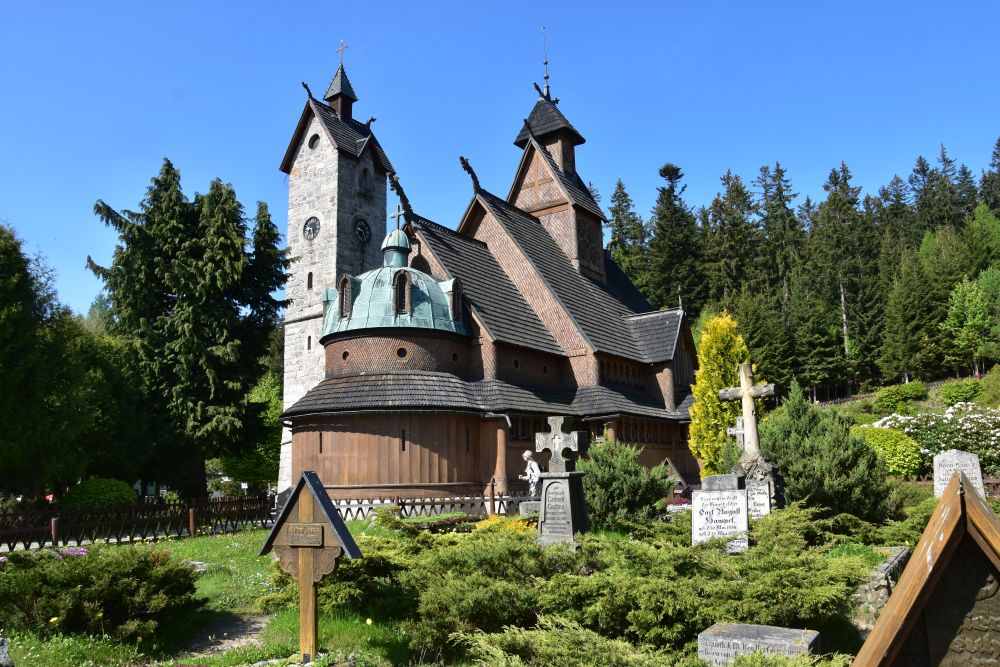
The attraction of Karpacz is the wooden Wang church. 

The church was built in Vang in southern Norway in the 12th or 13th century. In the 19th century, this church became too small for the congregation. It was decided to sell the church and use the money earned to build a larger new church. A painter from Norway, professor Jan Christian Dahl, lived at Breslau at that time, and he convinced the Prussian king Friedrich Wilhelm IV to buy the church for 427 Mark. The church was disassembled and shipped to Berlin. The king had intended to rebuild the church on the Pfaueninsel at Berlin, but then changed his plans. Count Leopold Christian von Schaffgotsch donated land between Krummhübel (Karpacz) and the Schneekoppe (Śnieżka), at Brückenberg (now Karpacz Górny). The church was reassembled here and inaugurated in summer 1844.

Two lions guard the entrance to the church.

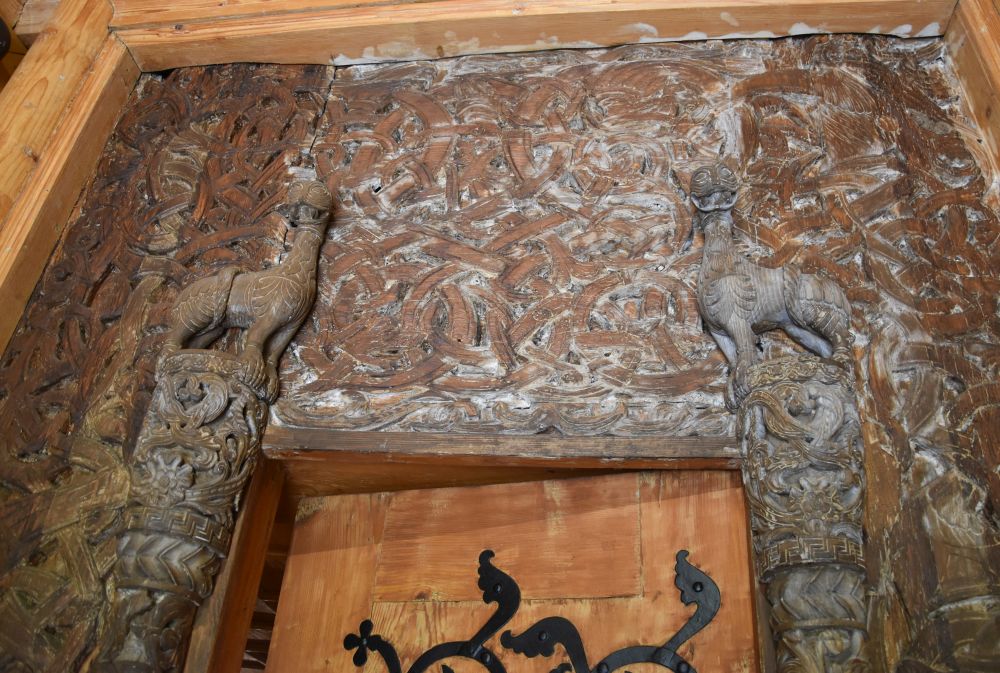
Inside, viking faces frame the door; they may be warriors with split tongues. 

This is the choir…

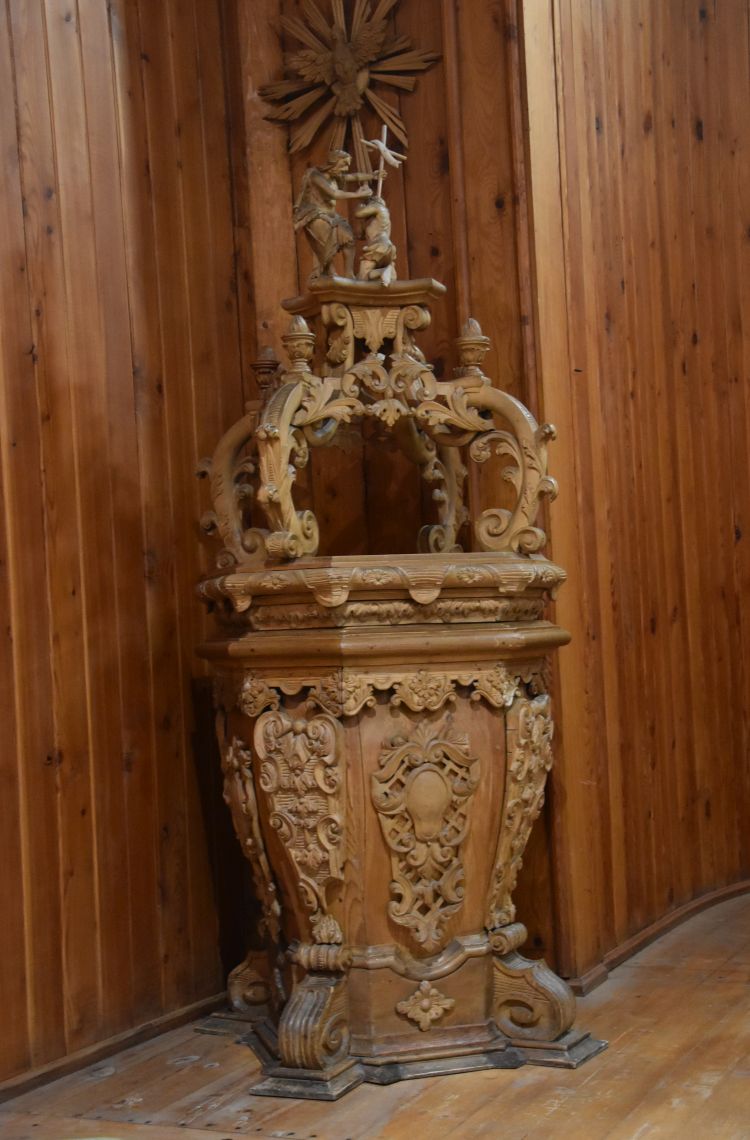
… with the baptismal font (Saint John in his fur coat baptizes Christ).

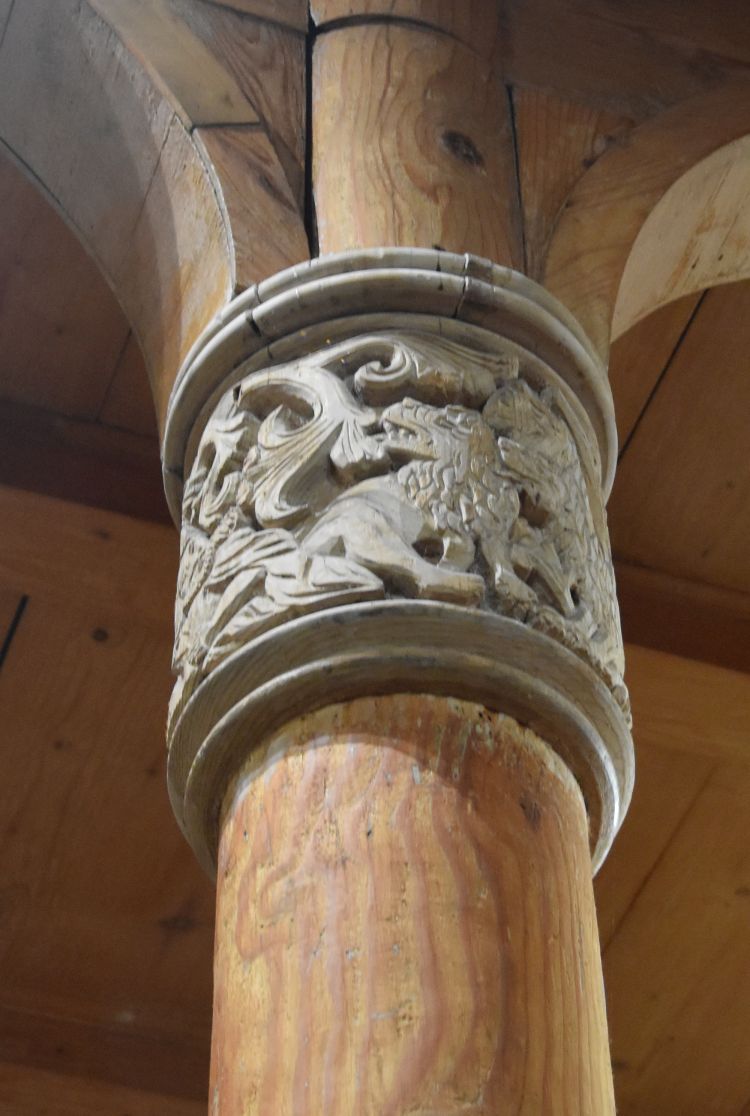
The column shows Daniel in the lion’s den.

This door leads to a corridor around the nave. 

The Vang church has become THE cultural landmark of Karpacz.


Hiking from Polana to Słonecznik, with a partial view of the Śnieżka

Behind the Wang church, you have to pay an entrance fee for the Karkonosze park, which is a nature reserve now. A path leads to Polana, a meadow that I suspected was the place, where my grandfather had painted the Schneekoppe (painting owned by Heimatverein Kleinmachnow).

But, when reaching the meadow Polana, it becomes clear, this is not the place, where my grandfather’s easel was. 

I follow the path uphill and can sometimes see the Schneekoppe between the trees.

I reach one of the many granite blocks scattered around here… and I am not alone. The Poles enjoy hiking.

I reach another granite rock, the Słonecznik. A beautiful view into the Hirschberg valley. 

The Schneekoppe(Sniezka) can be seen from the Słonecznik as well. 

I walk back down.

On the meadow Polana, I look for the place, where the  former mountain hut Hasenbaude once was, but it seems that nothing remains of it.

No, I my grandfather’s easel was not here… may be it was south of the Schneekoppe (Sniezka), on the other side?

Back at home, I solve the puzzle. The easel WAS south of the Schneekoppe, above Petzer or Pec pod Sněžkou. I could identify Petzer and  the mountains on the painting and I believe, the easel stood at the Lenzenberg, now called Zahradky. 

There is something more to explore! The Giant Mountains in the Czech Republic. I will return!


Sources:

  • Plates on the churches
  • Description of the Vang church, handed out in the church.
  • Tomasz Torbus, “Polen – Reisen zwischen Ostseeküste und Karpaten, Oder und Bug”, Dumont Kunstreiseführer, Ostfildern 2011

Discovering Silesia: Cieplice Zdrój or Bad Warmbrunn

In May 2023,  I spend a week near Jelenia Góra in Silesia exploring the surroundings. One day we visit Cieplice Zdrój (Bad Warmbrunn). 

In the 17th/18th century, Bad Warmbrunn became a well-known health resort in Silesia. In the 17th century, the queen of Poland, wife of Sobieski, stayed here with her entourage of 1500 persons. In the 19th century, Bad Warmbrunn was one of the most famous resorts of Germany, visited by artists, high nobility, statesmen and even by the (later) US president  John Quincy Adams (1825-1829).  

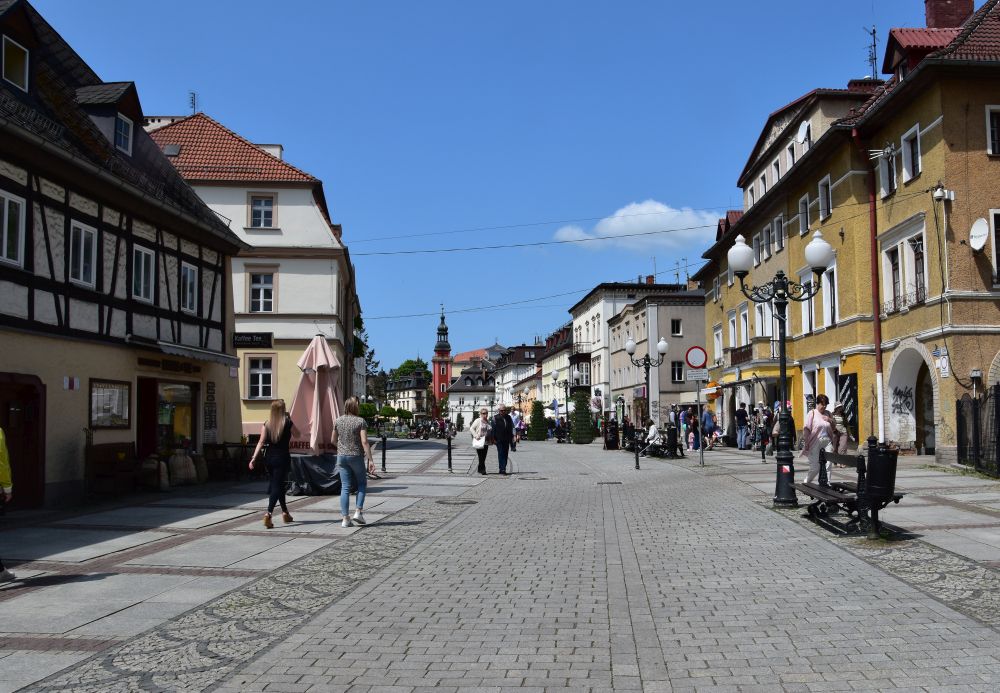
The main centre is called Plac Piastowski. Spa guests and day tourists stroll along. There are souvenir shops and inviting restaurants. 

The houses are well maintained. In the background we can see the red tower of Saint John’s church.  

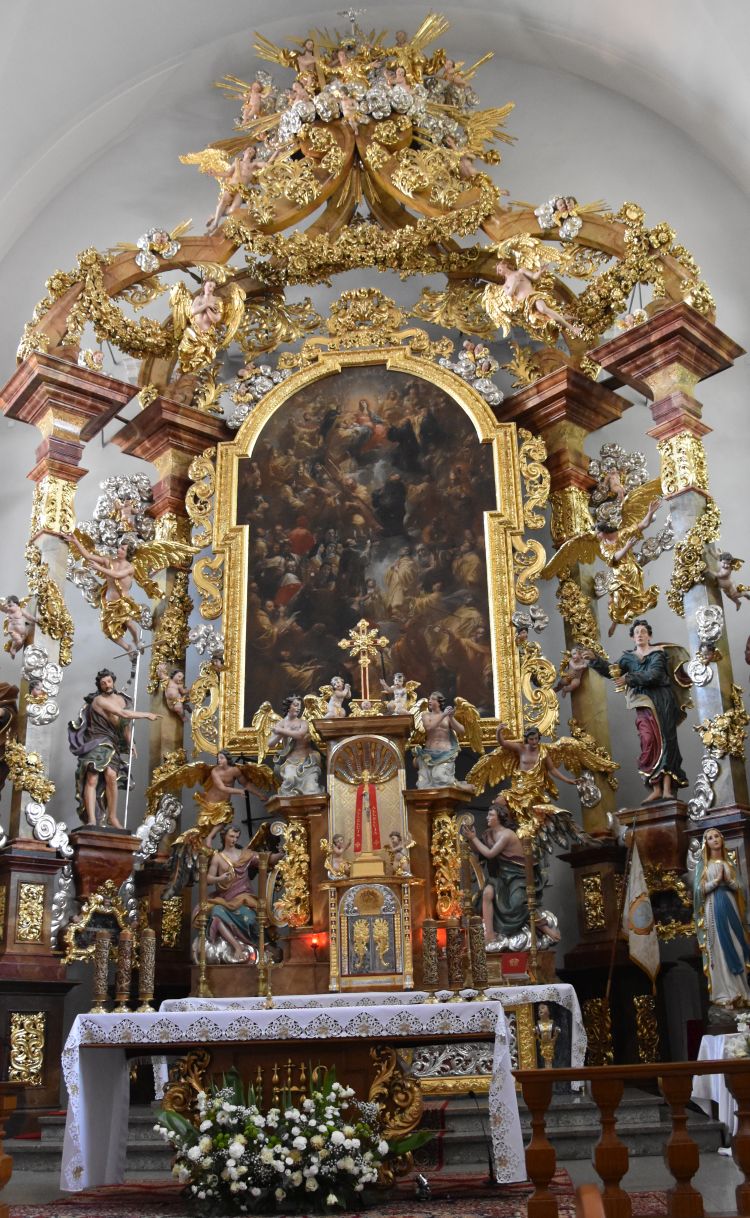
In the church of Saint John the Baptist, the high altar has been painted by Michael Willmann (1687); he is sometimes called the Raffael of Silesia. His painting shows Maria Assumption. 

Already in 1281 the Knights Hosipitallers (Johanniter) had founded a hospice that was probably visited by guests for healing.  

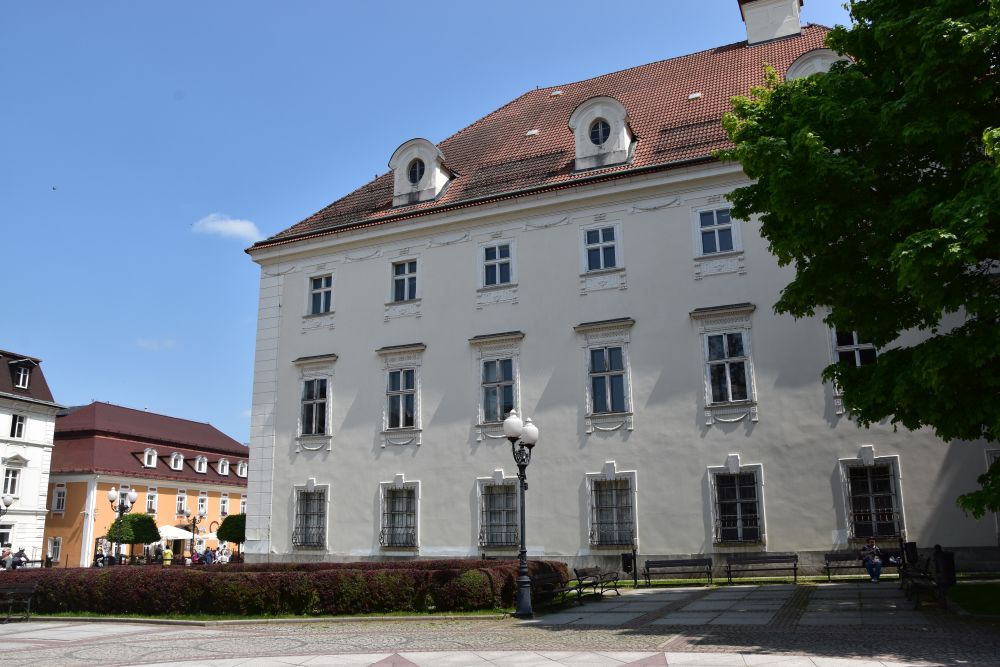
The Schaffgotsch acquired Warmbrunn in 1381 and settled here in 1400. Their castle, completed in 1788 in early neoclassical style, dominates the Plac Piastowski. 

Today it is part of the technical university of Wroclaw. 

Legend tells us that in 1175, a deer  cured his wounds at a warm fountain, after having been shot by hunters. The hunters built a hunting lodge, and this is how the spa resort originated (by legend).

Next to the palace, this cheerful “deer couple” may remind of the legend. They seem to have recovered well in Cieplice. 

Next to the Schaffgotsch Palais is the entrance to the spa gardens.

We enter, pass by the Pawilon Edward,…

… and enjoy the romantic corners. 

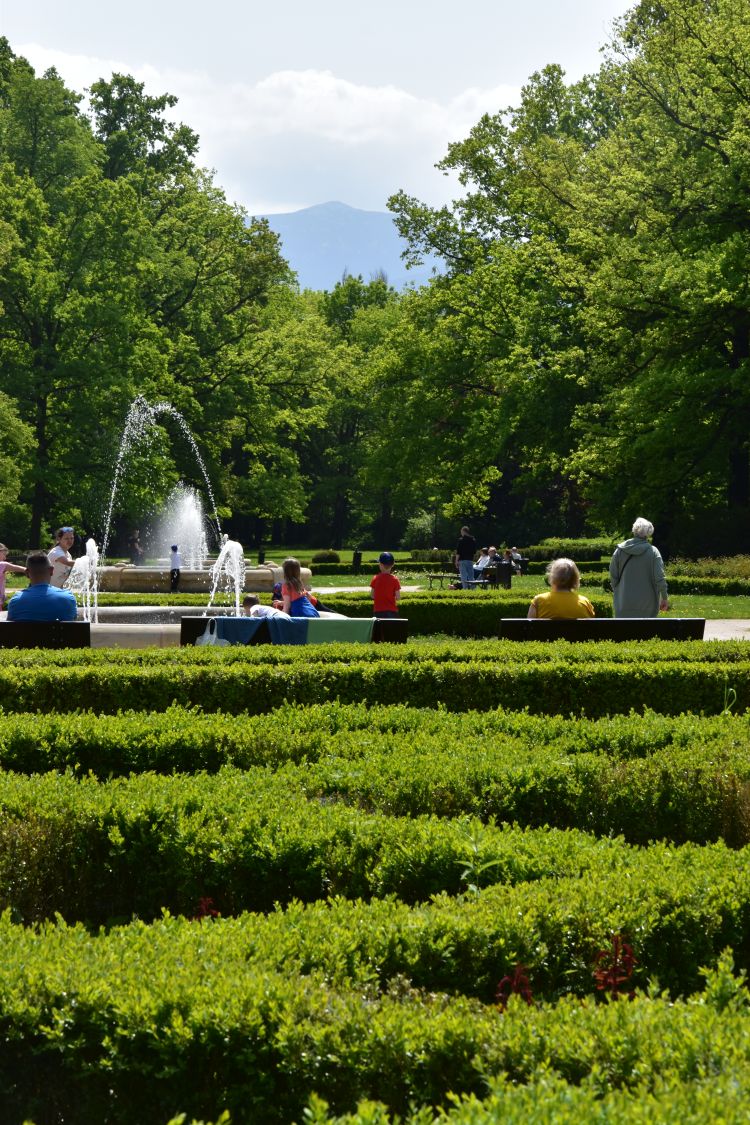
The visual axis to the Schneekoppe or Sniezka has been beautifully set up with fountains and benches.

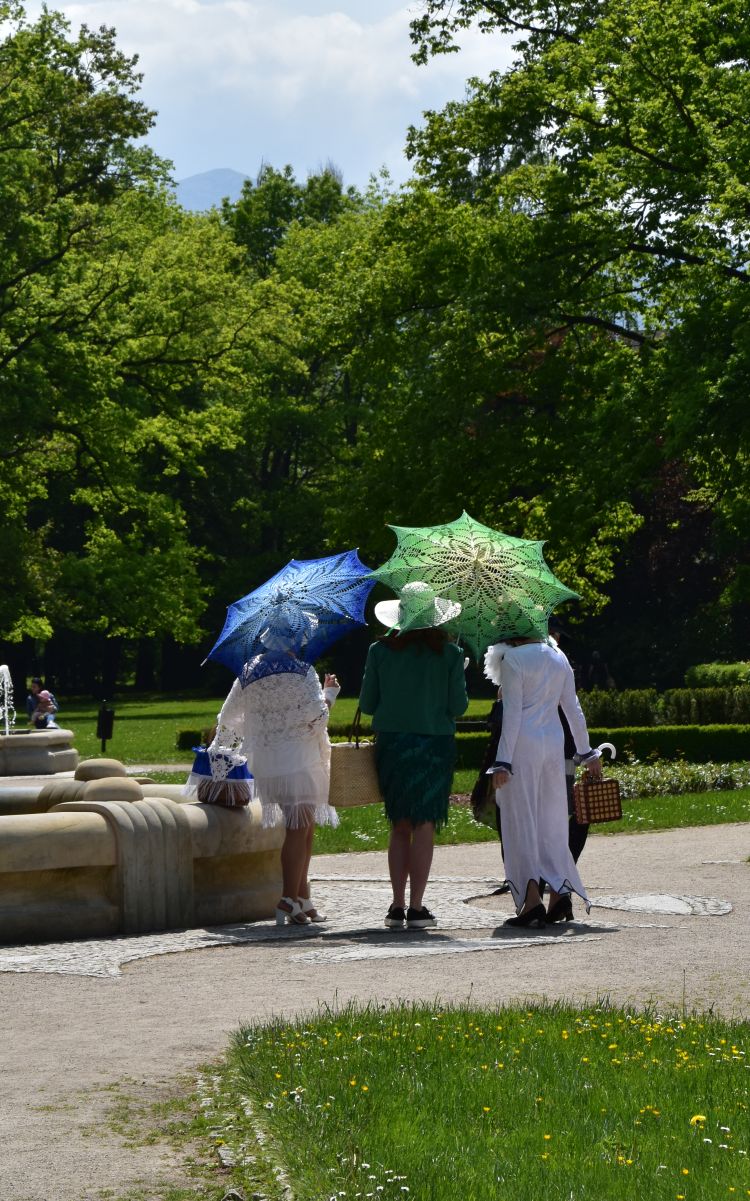
For several centuries high nobility and statesmen have strolled along the alleys of this park. We meet some of them….

… dressed up like a hundred years ago.

We return to the Plac Piastowski and have a delicious ice cream.

At Cieplice, I notice again that the Polish fill the German past of Silesia with their life and take care of it. 


Sources:

  • Frank Schüttig, “Riesengebirge”, Trescher Verlag, Berlin 2022
  • Malgorzata Ulrich-Kornacka, “Niederschlesien”, Via Nova, Wroclaw 2018
  • Dieter Schulze, “Polen der Süden”, Dumont Reisehandbuch, Osfildern 2020
  • Tomasz Turbos, “Polen”, Dumont Kunst-Reiseführer, Hamburg 2011
  • Arne Frank, “das schlesische Elysium, Burgen, Sclösser, Herrenhäuser und Parks im Hirschberger Tal”, Potsdamer Bibliothek östliches Europa Kulturreisen 2004.

Discovering Silesia – On the Szrenica, the mountain that carries frost

In May 2023, I am in Silesia, where we spend one week in the castle Staniszów to explore the area around Jelenia Góra.

Now we spend a day on the Szrenica above Szklarska Poręba.


Szklarska Poręba is surrounded by mountains

Szklarska Poręba is a resort surrounded by mountains, the main landmarks being the Szrenica (right) and the Śnieżne Kotły (left). 

The Śnieżne Kotły (“Schneegruben” or “Snow Pits”) still carry a bit of snow in the western snow pit. The pits are in geological terms “cirques” (in German: “Kare”) left by a glacier.

Chair lifts and ski lifts take hikers and – in winter – skiers up to the Szrenica, as the straight lines in the forests indicate.  

Szrenica is called “Reifträger” in German. Both in German and in Polish, this mountain carries frost (“Reif” and “szron” mean “frost”).  

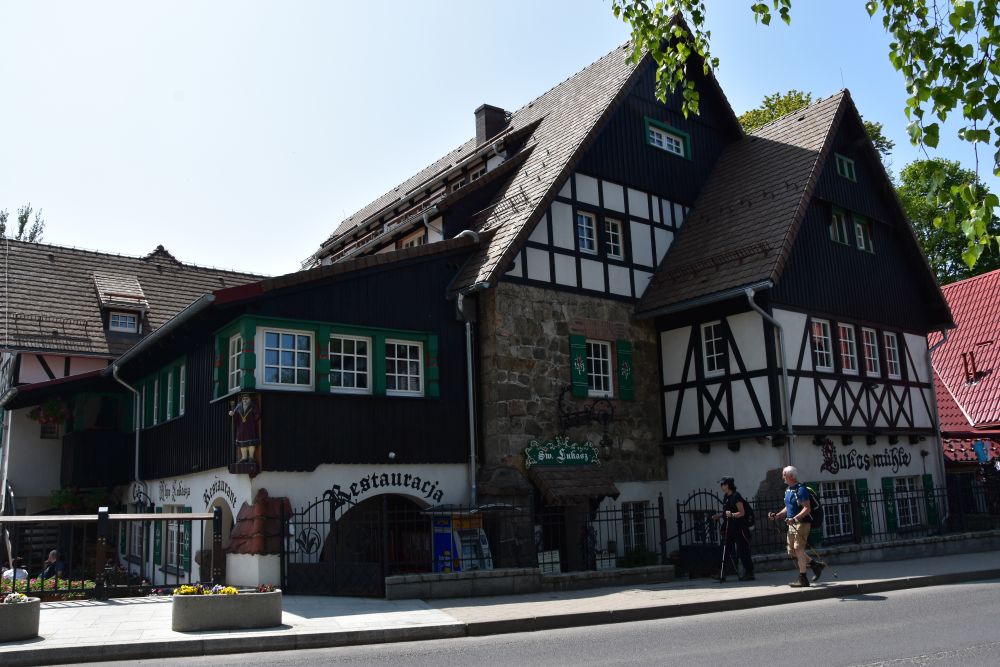
German painters have been inspired by the panorama around Szklarska Poręba (Schreiberhau). In summer 1920, they founded the Lukasgilde (guild of Saint Luke) and built the Lukasmühle as a place to meet and to exhibit their paintings. 

Georg Wichmann is one of the founders of the Lukasgilde.


Source: Hans Wichmann, “Georg Wichmann 1876-1944)”, Bergstadtverlag Wilhelm Gottlieb Korn 1996.

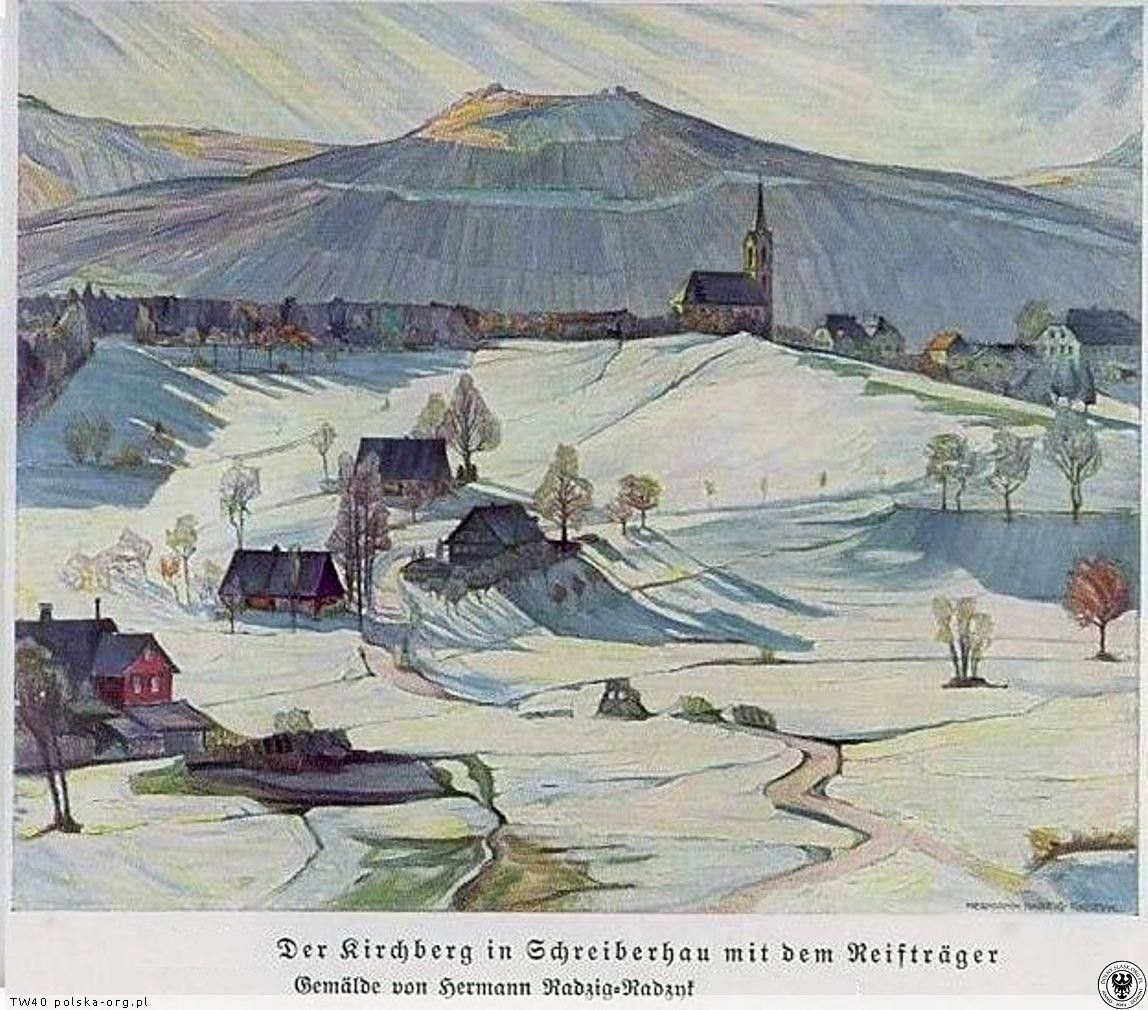
In winter 1922/23, my grandfather Hermann Radzyk was at Schreiberhau (Szklarska Poręba) and painted the Reifträger (Szrenica) with the church Kościół pw. Bożego Ciała (Corpus Christi).

Source: Polska.org – this painting has in the meantime disappeared from the website polska.org.

In addition, Hermann Radzyk painted the Schneegruben with the same church in the foreground.

Source: My own photo taken in the house of the grand-son of a friend of my grand-father.


Exploring the Szrenica with the gorgeous view

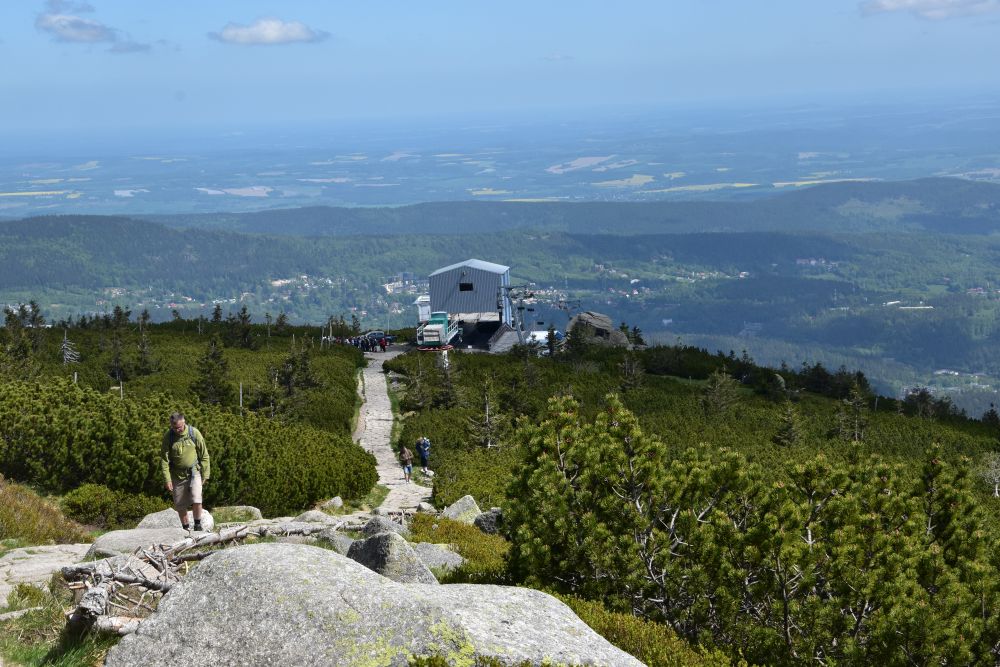
We take the chair lifts to the Szrenica – there are two sections, one after the other. 

A special experience. The small chairs  are hard to sit on and they move in “slow motion”. Slowly, but safely, we arrive on the top.

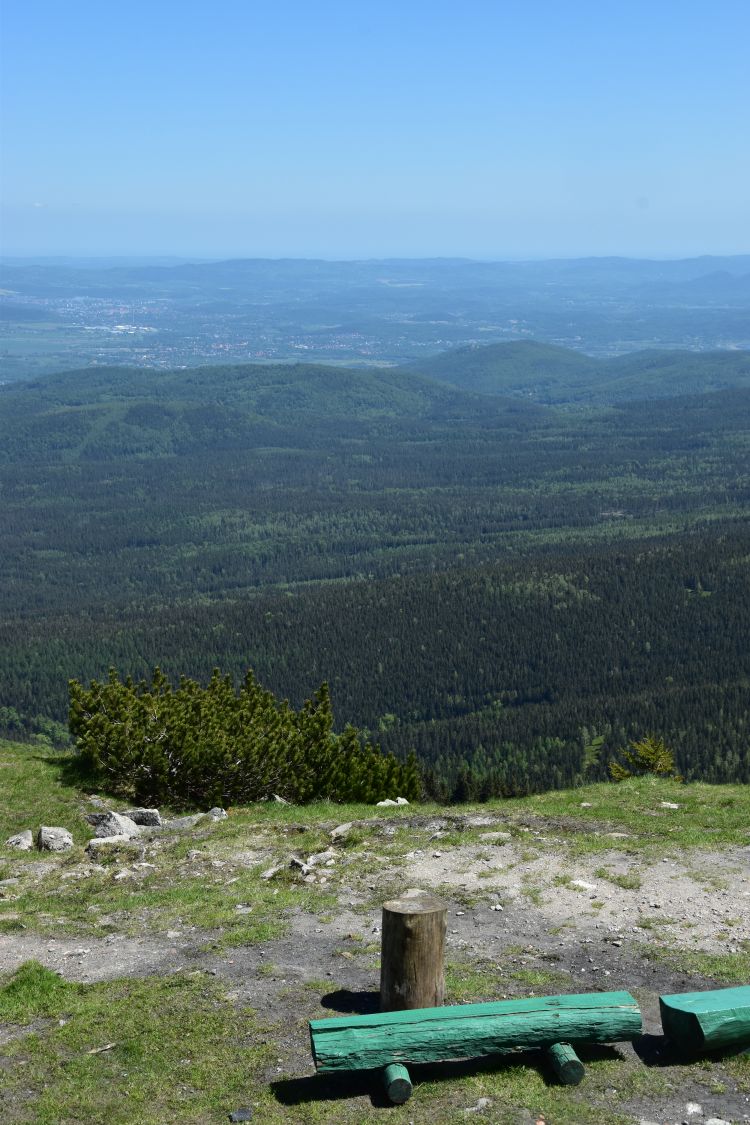
The view of Lower Silesia with Szklarska Poręba in the foreground is gorgeous.

We walk up to the top view point.

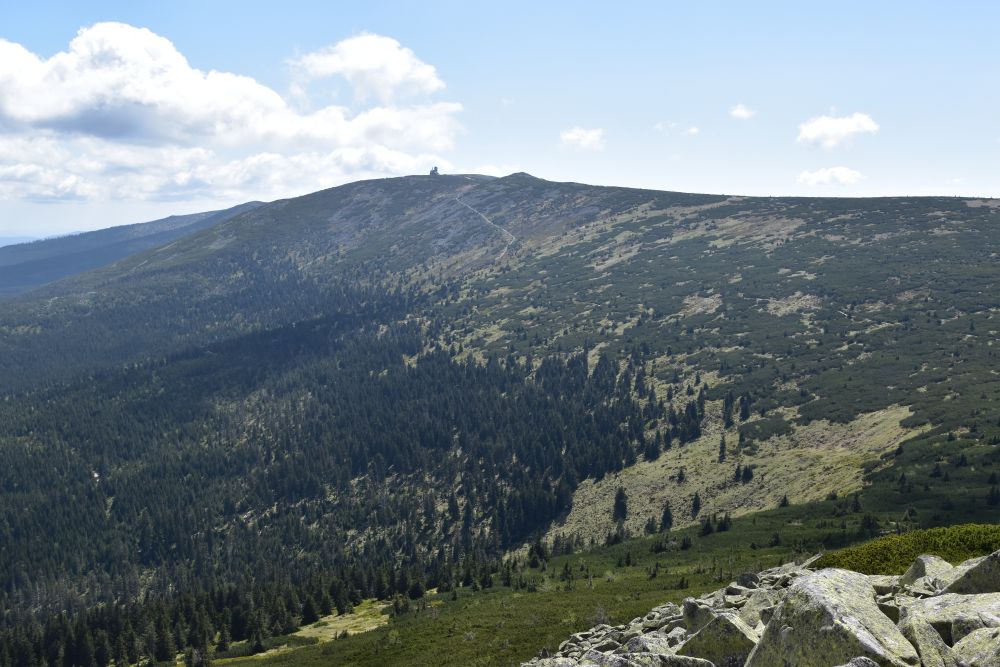
We look west, where a hiking path follows the border between Poland and the Czech Republic.

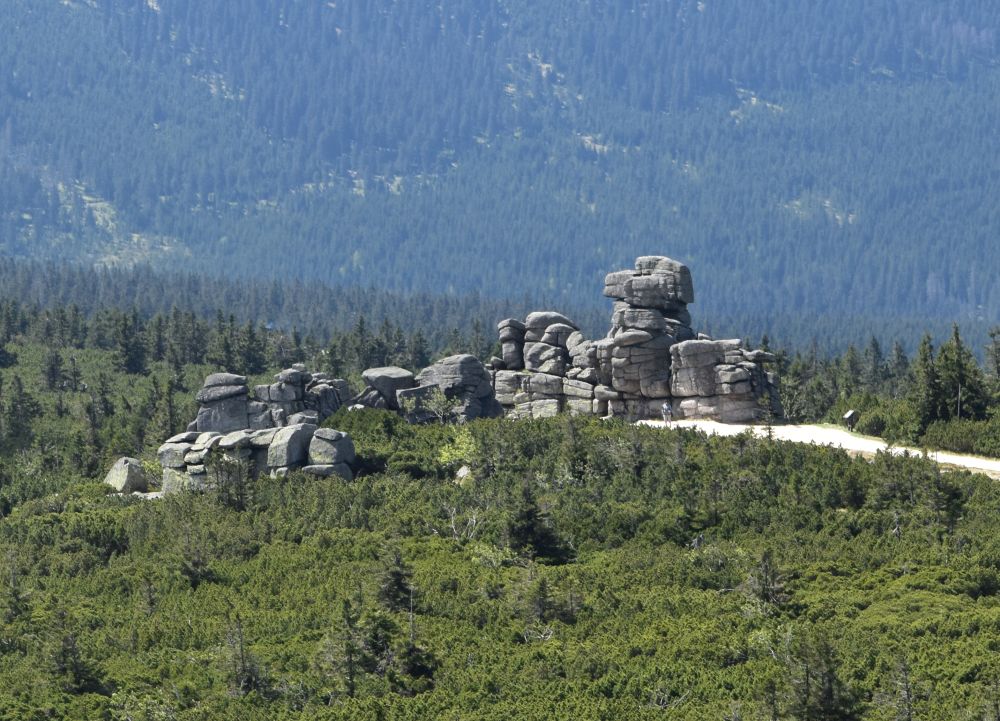
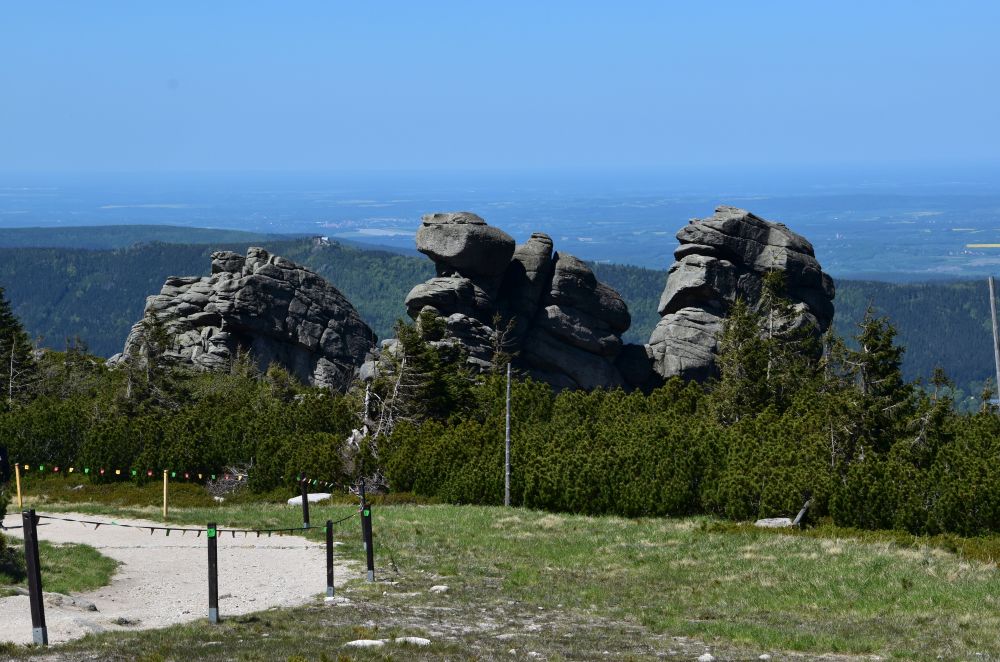
We look south east, where we can see granite rock formations. They are called Svinské kameny (“Pig stones”). They have a Czech name, as they stand already in the Czech Republic. Such granite rocks can be found all over in the Giant Mountains. In German these rocks are called “Wollsackverwitterung”, in English “spheroidal weathering”.

We look east to the Śnieżne Kotły. The former mountain hut (Schneegrubenbaude, it can  be seen from far) is now a radar station (Radiowo-Telewizyjny Ośrodek Nadawczy – RTON Śnieżnymi Kotłami). 

We look north towards the Isergebirge (Góry Izerskie), Szklarska Poręba and Lower Silesia.  

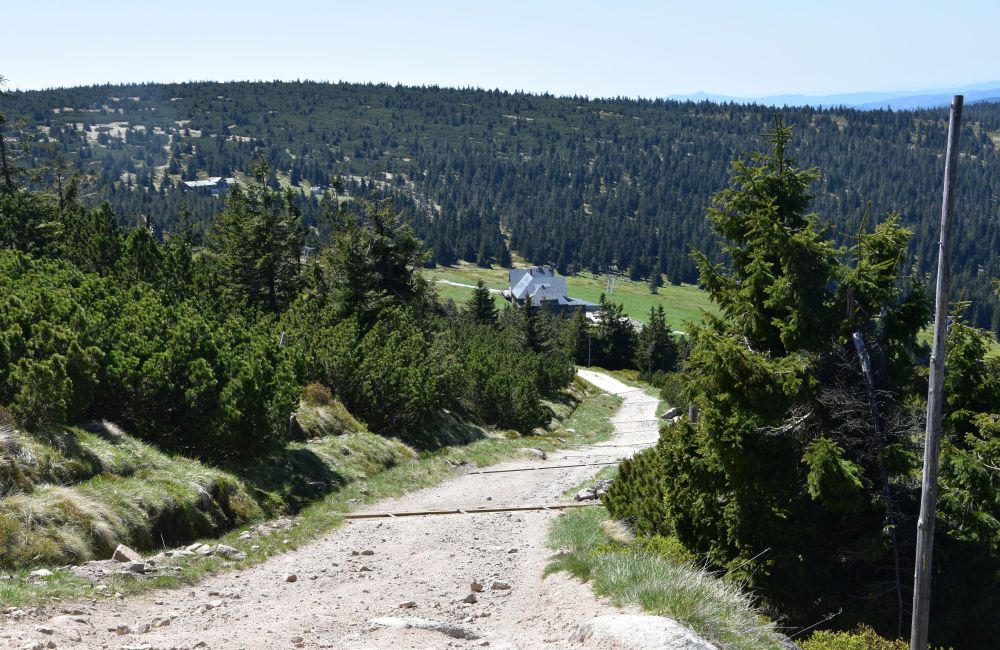
We have a snack at the Reifträgerbaude (Schronisko na Szrenicy)…

… and look at the fotos. They show that, indeed, the Reifträger or Szrenica does carry frost in winter. 

It must be cosy in the hut, when it is that frosty outside.

On a panorama walk,…

… we reach the shelter Hall Szrenicka located below the top.

We return to the chairlift station,…

… admiring some more of these rock stones (these are called Końskie Łby or horses). This is, where the ski run “Lolobrygida” starts – what a name for a ski run. 

We return to “our” castle Staniszów and enjoy another excellent dinner.


Sources:

Discovering Silesia: Across the Riesengebirge, the Zackenbahn connects countries

In May 2023, we spend a week in the castle Staniszów near Jelenia Góra and go for excursions.


The Zackenbahn

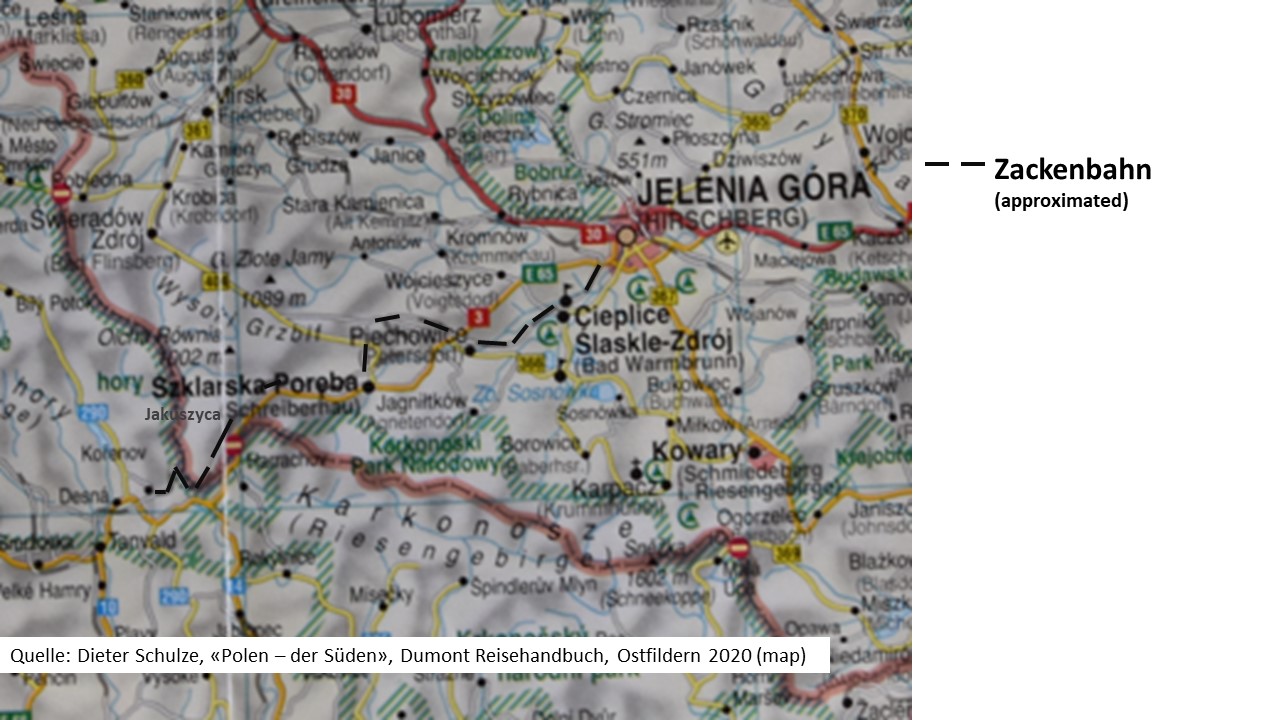
Now we take the Zackenbahn. Reopened in 2010, the Zackenbahn crosses the Riesengebirge (Karkonosze) connecting Poland (Jelenia Góra) with the Czech Republic (Kořenov and farther). 

Up to the highest point Jakuszycke, the train follows the river Kamiena. In German times, the Kamiena was called “Zacke”. Hence the name “Zackenbahn”.

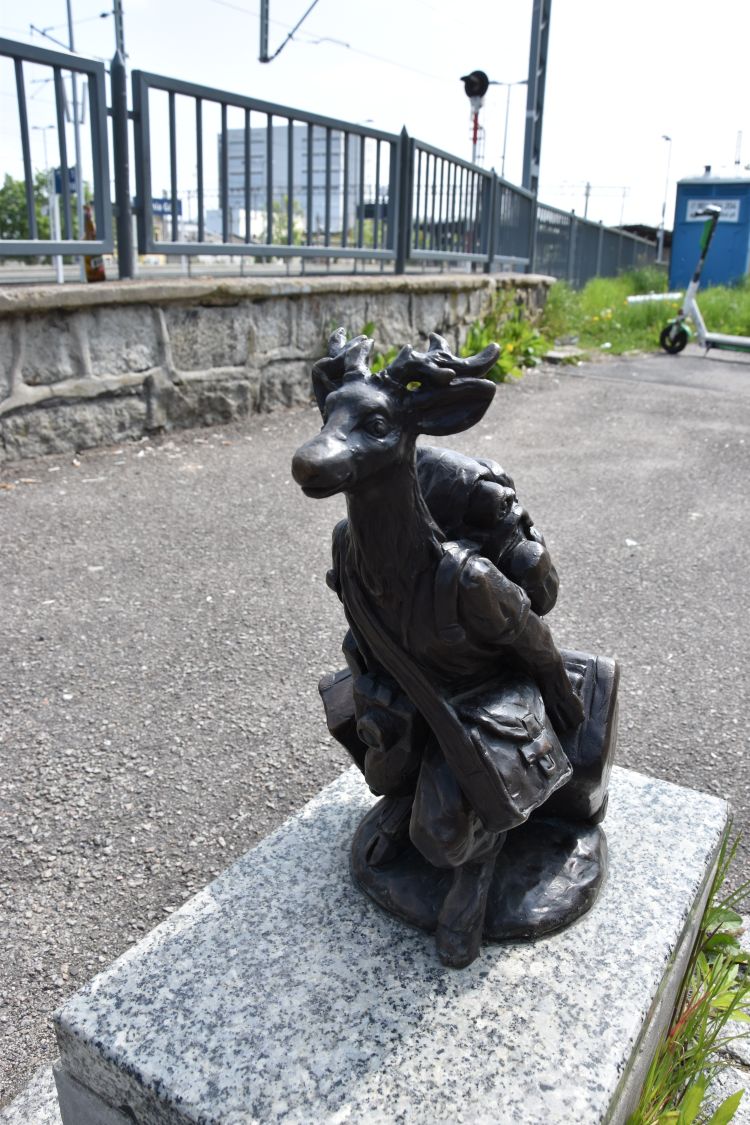
At the train station of Jelenia Góra (Hirschberg, “Deer Mountain”), this cheerful animal wishes us a good ride on the Zackenbahn. 


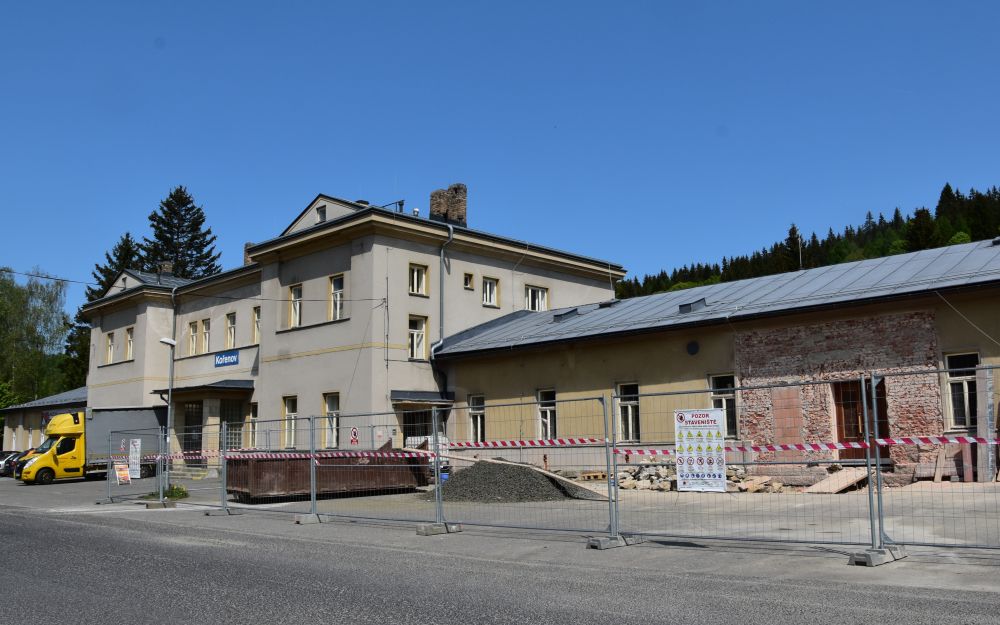
At Kořenov 

After having crossed the Riesengebirge, this somewhat lonely train station welcomes us at Kořenov …

… with charming children’s drawings.

We find a small restaurant, where we have a drink.


Back to Poland and Szklarska Poręba Górni

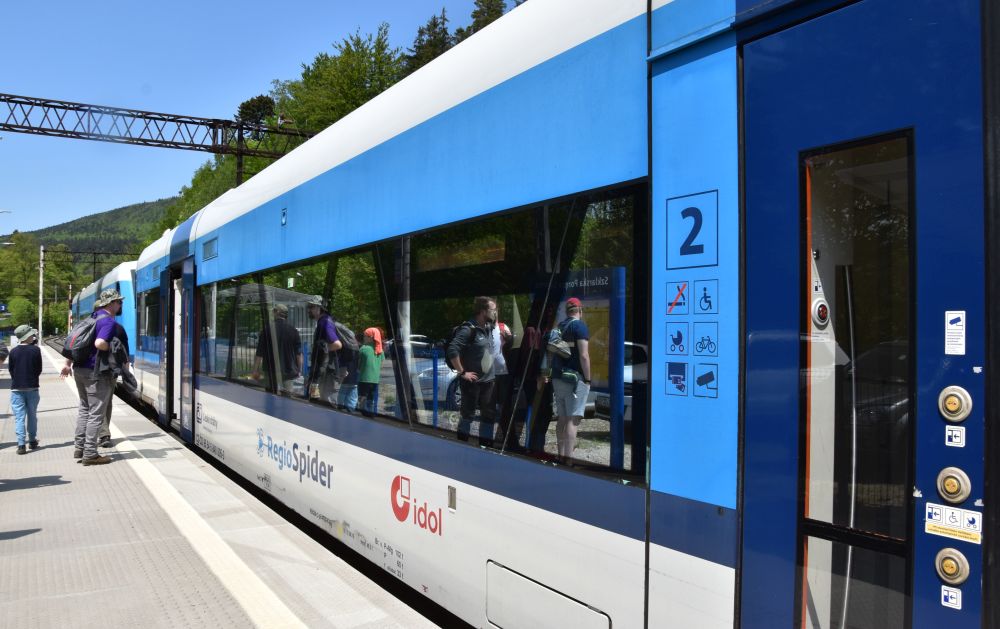
After having recovered in the restaurant of Kořenov , we take the modern Regio Spider… 

… to return to Poland….

… reaching the highest point of 882m at Jakuszyce (Jakobstal). From the Schienenradler, I learn that this is a popular area for cross country skiing.

At Szklarska Poręba Górni (Oberschreiberhau), we have to change trains. From the Czech “Regio Spider” to the Silesian Polish train ” Koleje Dolnośląskie” . 


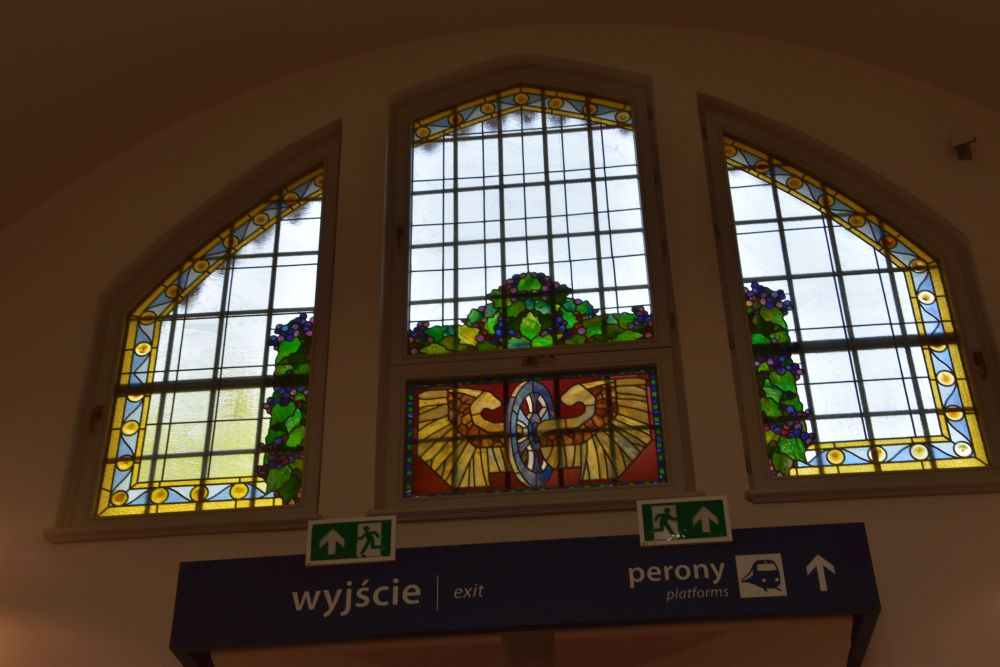
The old train station of Szklarska Poręba Górni has been beautifully renovated (2021).


The history of the Zackenbahn – from connecting Germany with Austria to connecting the Czech Republic with Poland

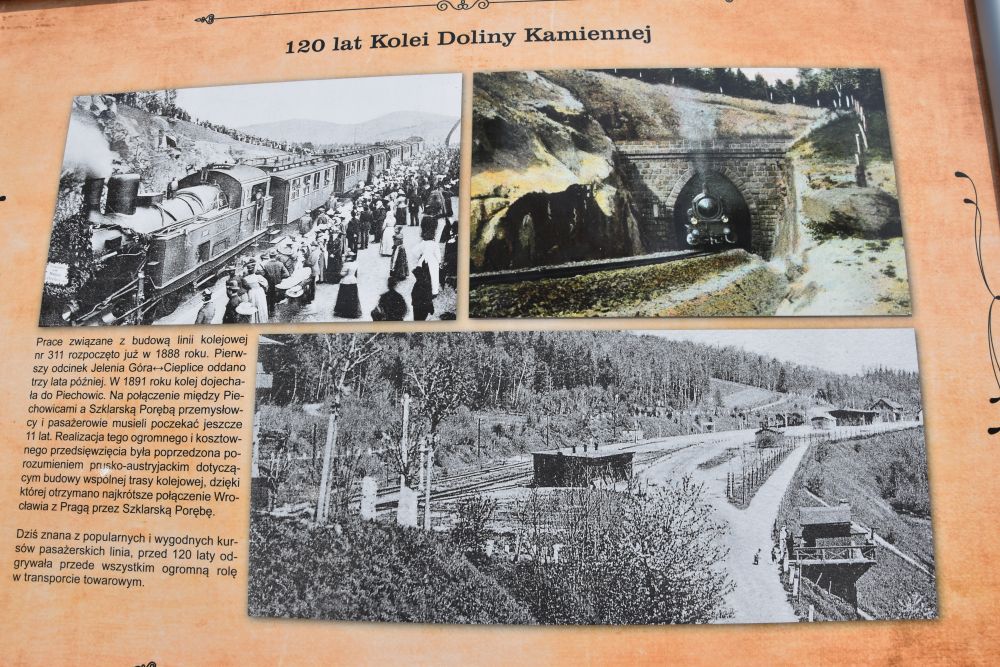
Photos at the train station of Szklarska Poręba Górni tell us about the history of the Zackenbahn.

The Zackenbahn was inaugurated in 1902. At that time, it connected German Prussia (Schlesien, Hirschberg) with Austria (Böhmen, Bad Wurzelsdorf, and farther).

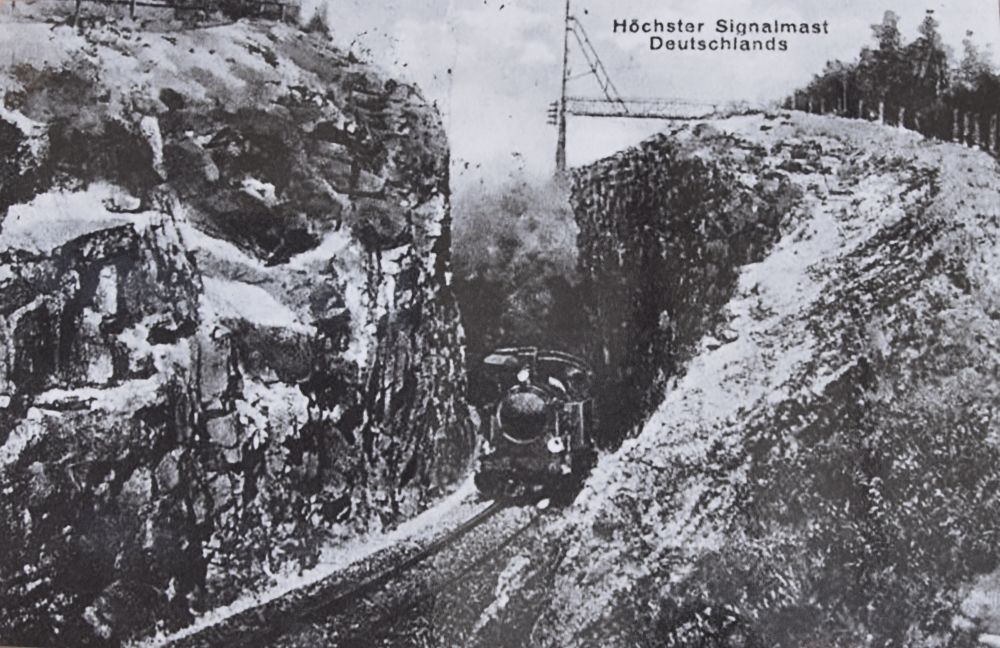
The construction was an engineering achievement, requiring tunnels and trenches. The signal post in the Moltkefels Einschnitt (cut) controlled the entrance to Niederschreiberhau (Szklarska Poręba Dolna). It was the highest signal post of Germany.

In 1927, the Zackenbahn celebrated its 25th anniversary. At that time, it connected Czechoslovakia with Germany (Prussia, Silesia). The train had been electrified. 

It was in the 1920’a that my grandfather spent his vacation at Niederschreiberhau and painted the “Kirchberg mit dem Reifträger” (my blog tells about that). 

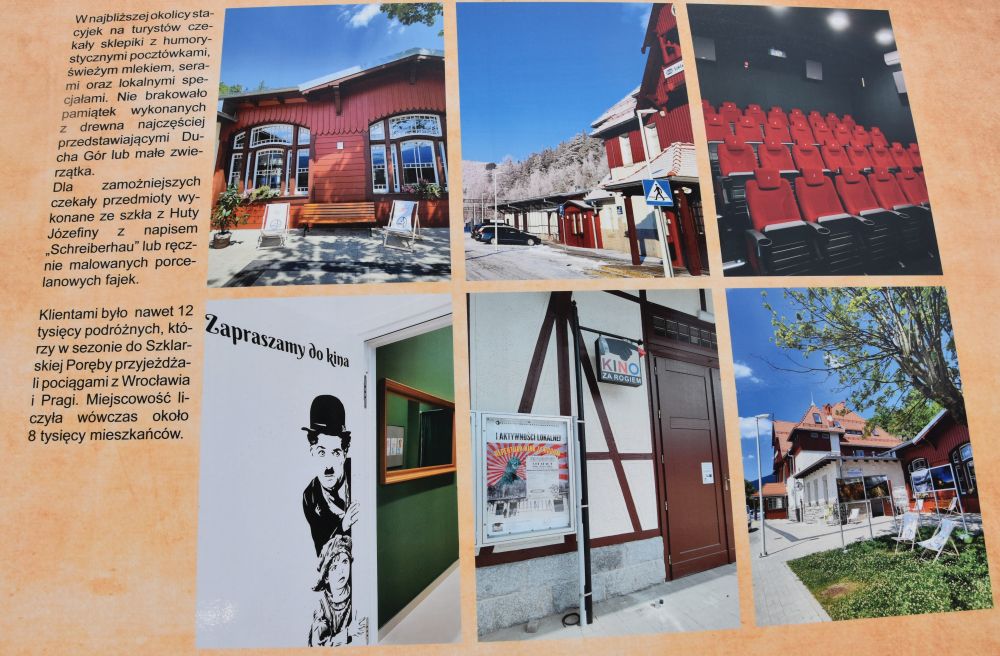
At the train station of Oberschreiberhau, there was even a cinema. It has been reopened now.

After 1945, Silesia no longer belonged to Germany. It was integrated to Poland. The train connection at the border of Czechoslovakia and Poland was eliminated and remained closed until 2010. 

In 2010, the connection across the border was reopened, now connecting Poland (Jelenia Góra) and the Czech Republic (Kořenov; this relates to the German name “Wurzeldorf”, kořen=Wurzel).  The train is now popular, “our” train was fully occupied. 

In 2022, the Zackenbahn celebrated 120 lat – or 120 years, as the photos at the station of Szklarska Poręba Górni tell us.


Back to Jelenia Góra

We wait at the carefully restored station of Szklarska Poręba Górni to take the train along the Zacke back to Jelenia Góra. 

Shortly before reaching the train station of Jelenia Góra, we cross the river Bober (Bobra) (seen from below).

What an engineering achievement, what a beautiful landscape, what a exceptional story. And how good to see that Polish Silesia takes care of the German heritage.

Take a ride with the Zackenbahn by watching this charming video published by German TV (SWR) under the title of “Eisenbahnromantik”: https://www.ardmediathek.de/video/eisenbahn-romantik/die-zackenbahn-von-tschechien-nach-polen-ein-zug-verbindet/swr/Y3JpZDovL3N3ci5kZS9hZXgvbzE3MzY2MzU.


Sources:


Discovering Silesia: Walking to Siedlęcin with its unique frescoes

May 2023 in Silesia, in the Giant Mountains. We walk from Jelenia Góra north west to Siedlęcin to see the unique medieval frescoes in the tower house. 


The gorgeous view from the top of the “mushroom”

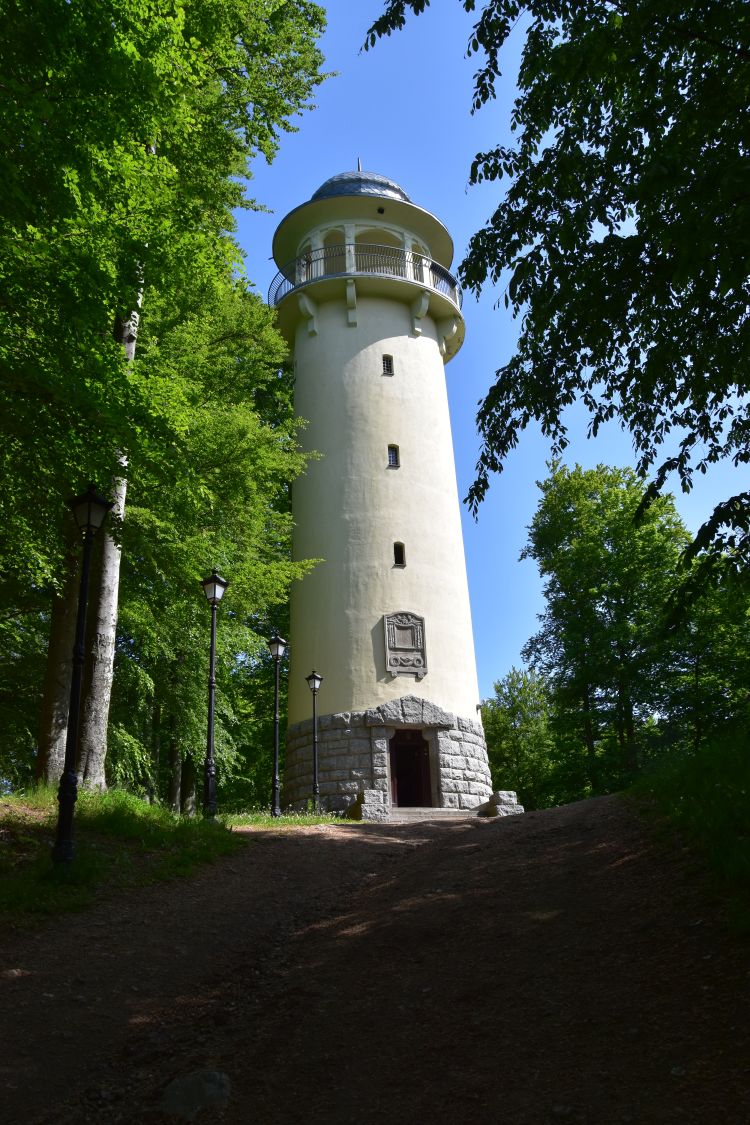
On top of the “city mountain”, called Wzgórze Krzywoustego, there is a tower.

It is called Grzybek or “little Mushroom”.

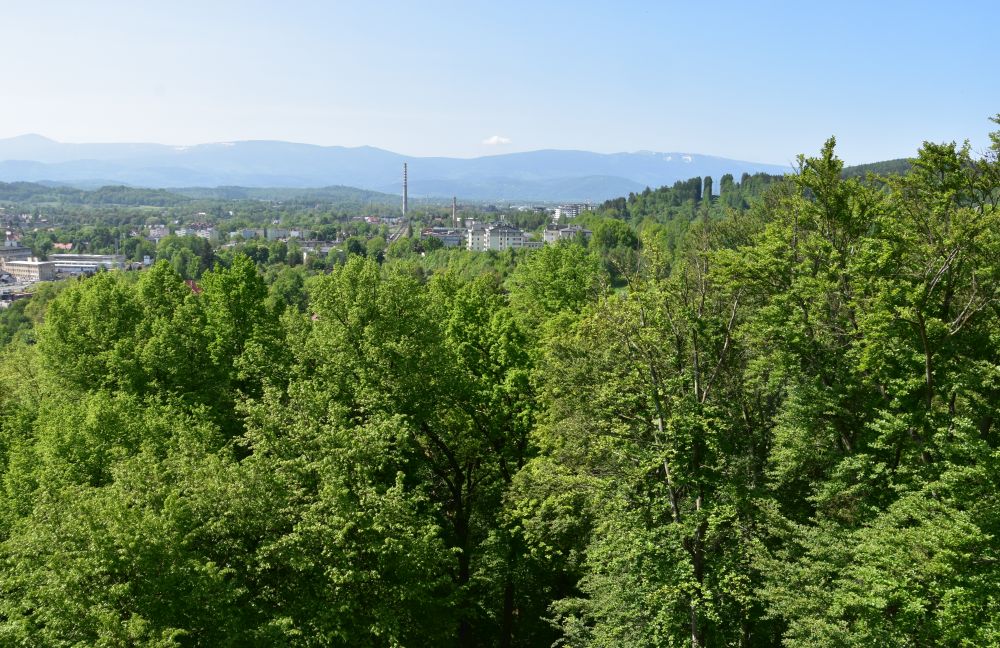
From the top we have a gorgeous view of the Giant Mountains.

We can identify the Schneekoppe (Snezka) and the Schneegruben (Śnieżne Kotły) in the haze.


Walking along the Bóbr river (Bober)

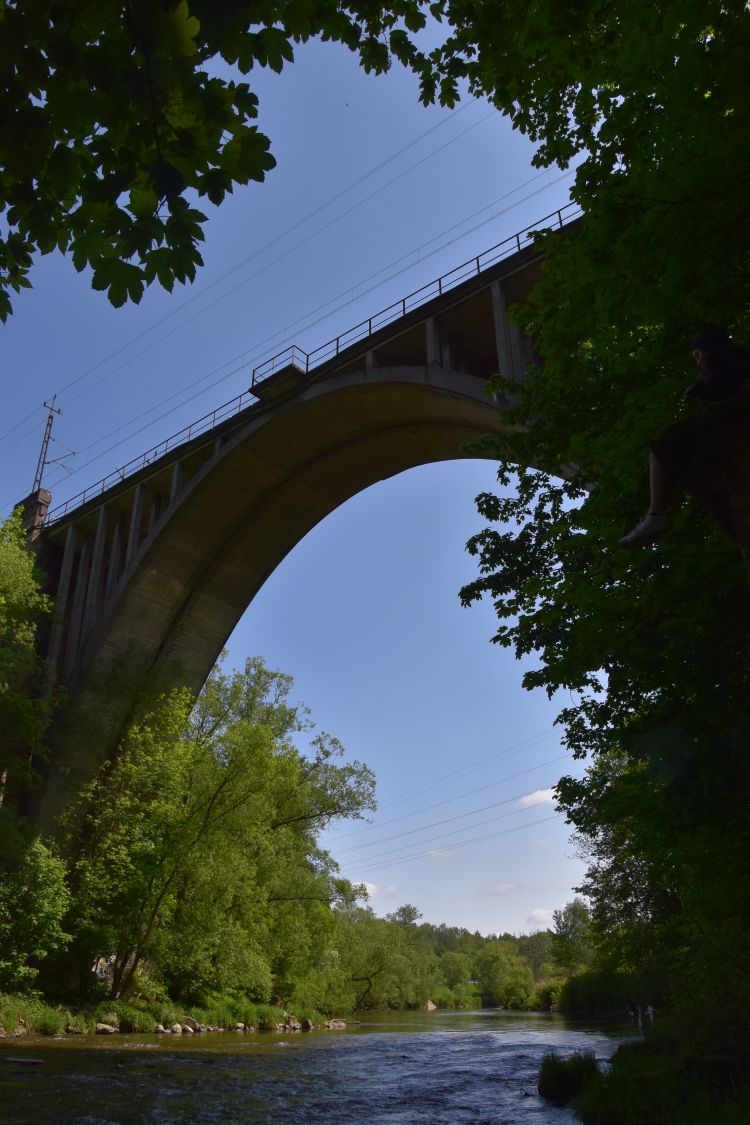
The train from Jelenia Góra to Kořenov in Czechia whistles loudly and shows us the way to the train viaduct crossing the Bóbr river. 

The train crosses the Giant Mountains up to Czechia (Korenov). It is from the early 20th century and has been reinstalled in 2010. 

We walk under the viaduct and continue our way along the river Bóbr. 

A fountain on the way… refreshment for the hikers.

A snail in the sun… hurry up, little one, the sun will dry you out.

Rocks are scattered in the forest; glaciers have dropped them a long time ago.

A restaurant in the forest, we have lunch here. 

The river Bóbr has been dammed.


Siedlęcin – our target with the medieval frescoes

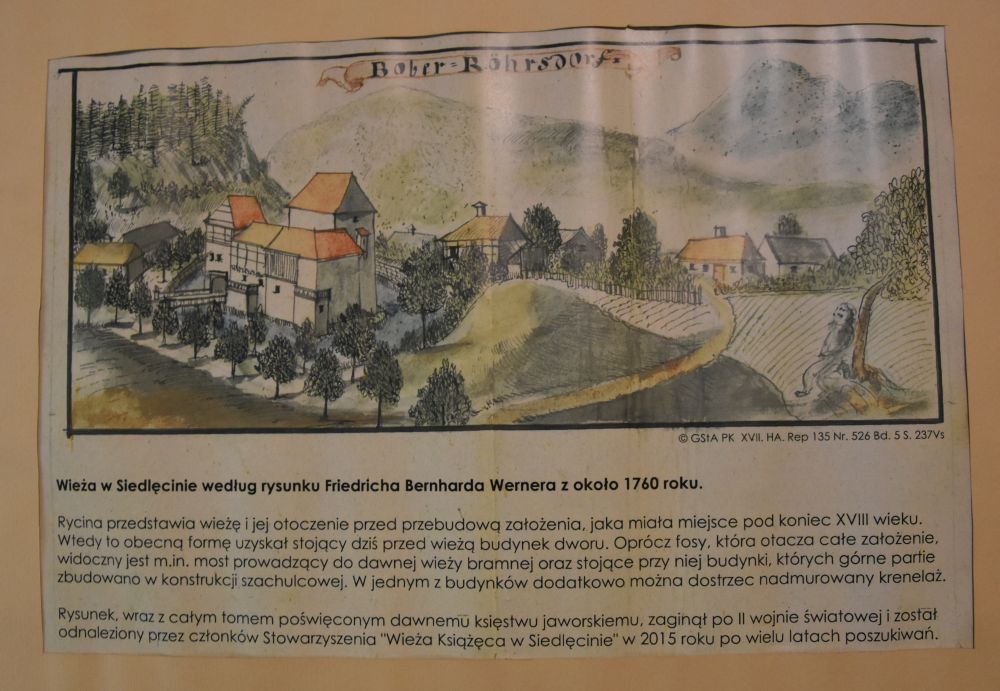
After about 6km we reach the tower house at Siedlęcin. This is, what it looked like in the 18th century.

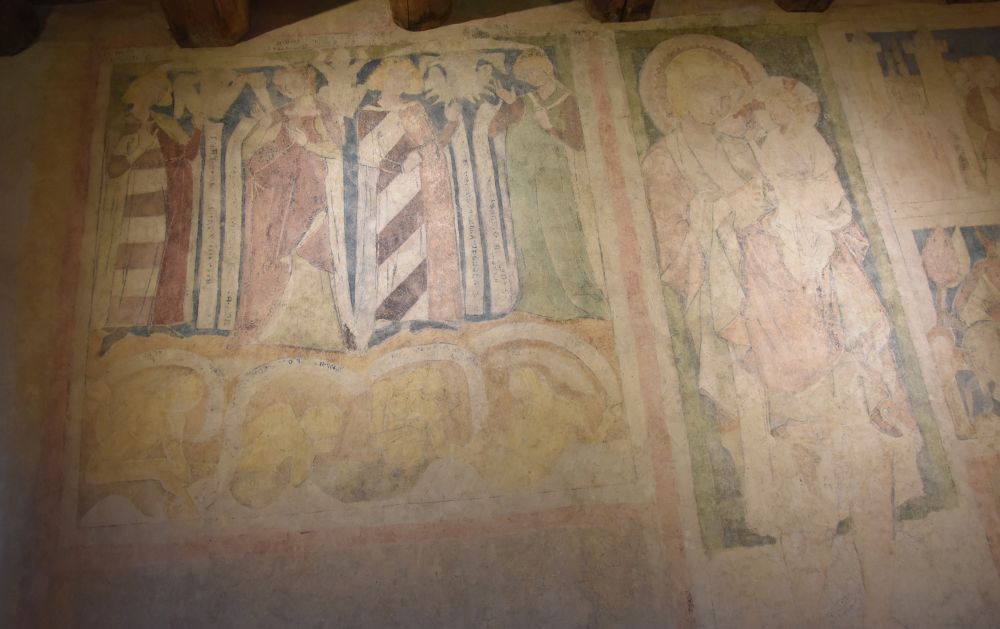
The tower house and part of the complex are still around. On the first floor of the tower, we find this wall full of frescoes.

The frescoes have been  painted in the years 1320 to 1340, applying the al seco technique on a chalk-bed. The frescoes tell us about the life of knights; this is unique in Europe. 

Christopher watches over the scenery. To the left of Christopher are two couples. One lady wears a hud – she is married. The second lady wears no hood – she is not married. They are standing on top of a line of graves. 

Chrstopher is carrying Christ across the river. He stands in the water, barefeet, and some small fish around his legs indicate, this IS water. 

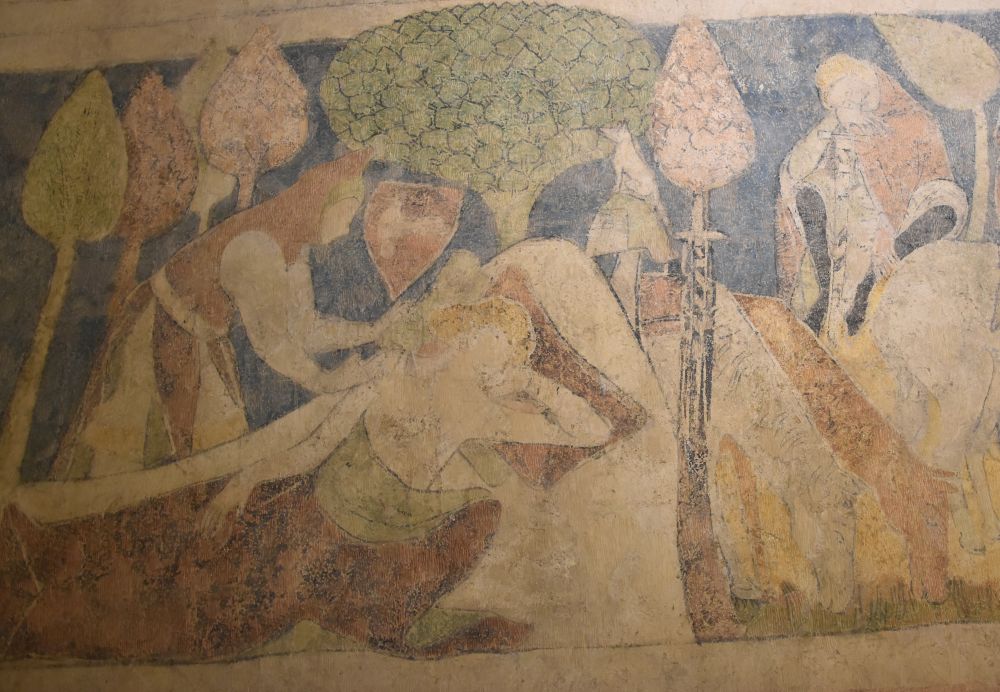
The scene to the right of Christopher tells the story of Lancelot. Lancelot is a knight of the Round Table of King Artus and he is in love of Queen Guinevere. The adultery causes a civil war, as described in literature of the 12th century. 

On this fresco, Lanzelot is sleeping and Guinevere tries to wake him up. Lancelot has deposited his helmet in the background; the helmet carries a dog sculpture.

Later Lancelot fights a duel with Tarquyn. Lancelot can be recognized by the helmet with the dog scultpure.

Some frescoes decorate the windows such as the coat of arms of the family Redern; they had acquired the tower house in 1354 and owned it for about two hundred years.  

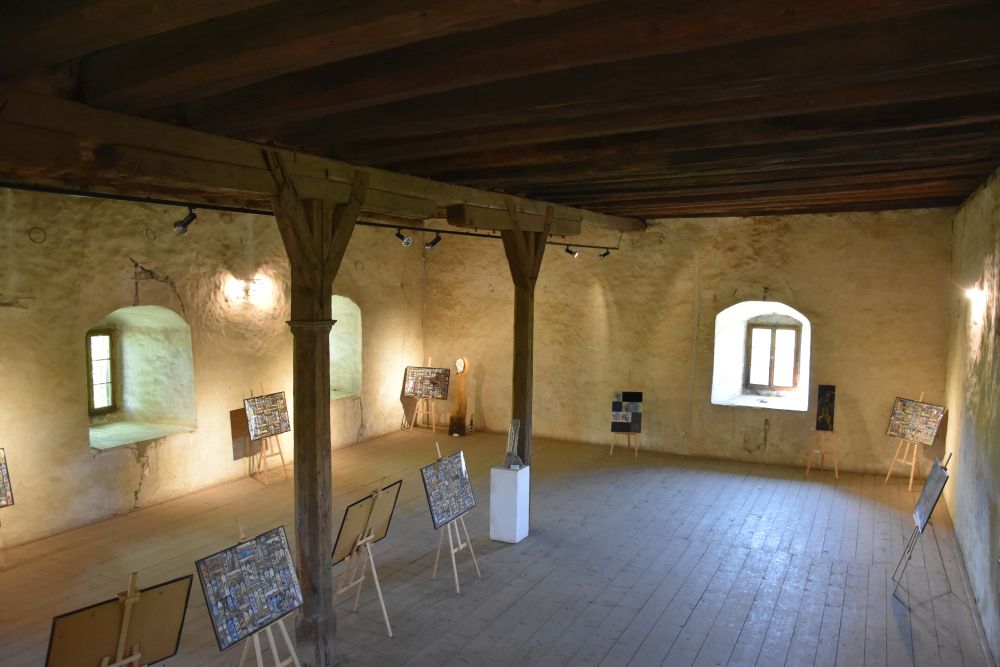
On the fourth floor, guards defended the tower house. The roof construction dates from 1315. It had to be renewed after a fire in the late 16th century. The clay floor provides heat insulation and protection against fires.

The ceiling of the third floor from 1315 has been largely preserved. Only parts of it had to be renewed after the fire of the 16th century.  

While my friend takes the bus back to Jelenia Góra, I walk back, taking a different route and getting lost, though following the green markings. Our car was waiting for us next to the central bus station which helped finding it nevertheless. After a wonderful day, we return to “our” palace, the Palac Stoniszów. 


Sources:

  • Frank Schüttig, “Riesengebirge”, Trescher Verlag, Berlin 2022
  • Malgorzata Ulrich-Kornacka, “Niederschlesien”, Via Nova, Wroclaw 2018
  • Dieter Schulze, “Polen der Süden”, Dumont Reisehandbuch, Osfildern 2020
  • Tomasz Turbos, “Polen”, Dumont Kunst-Reiseführer, Hamburg 2011
  • Explanations in the tower house of Siedlęcin


A Swiss butterfly in Poland: Wrocław or Breslau

End of August 2021, I am on the road again, to Berlin via Slovakia and Poland. 

My route begins in Slovakia: Bratislava – Trnava – Nitra – Žilina – Strečno and Terchová – Dolny KubinPodbiel and Tvrdošín. It continues in Poland: Wilkowisko – Kraków – Szklarska Poręba – Wroclaw, and finally I am Berlin. 

To round off my days in Poland, I stay one night in Wrocław (or in German Breslau).

I have selected the Hotel IBIS Styles Centrum. I look for a functioning hotel infrastructure and easy access to parking. Furthermore the IBIS is conveniently located, not too far from the city centre and across the train station. When getting lost, you can always find the train station in a city.
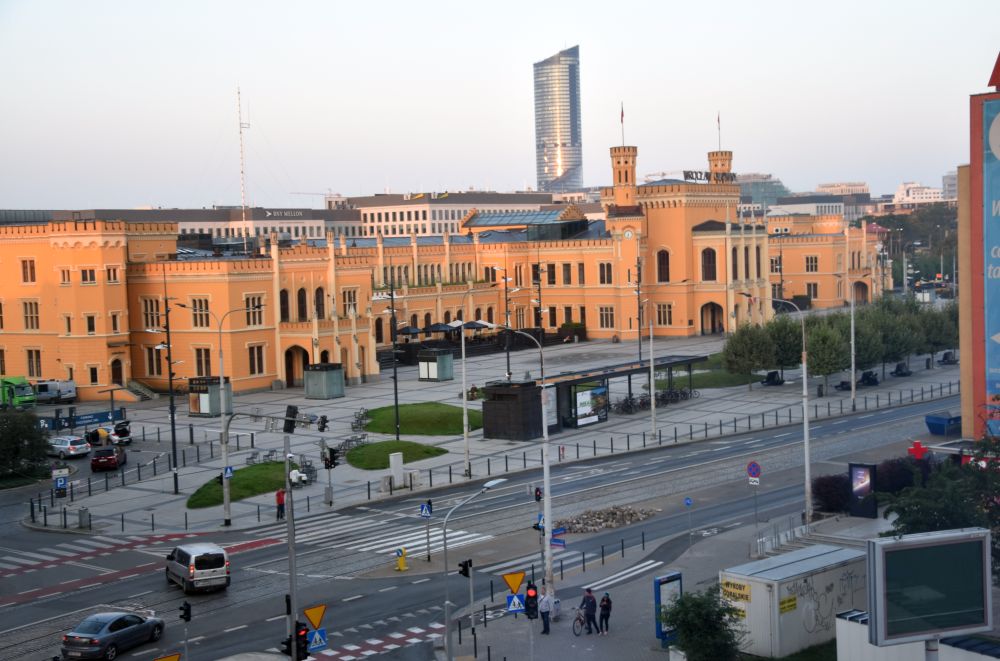
I am south of the city centre, about half an hour’s walk away from it.
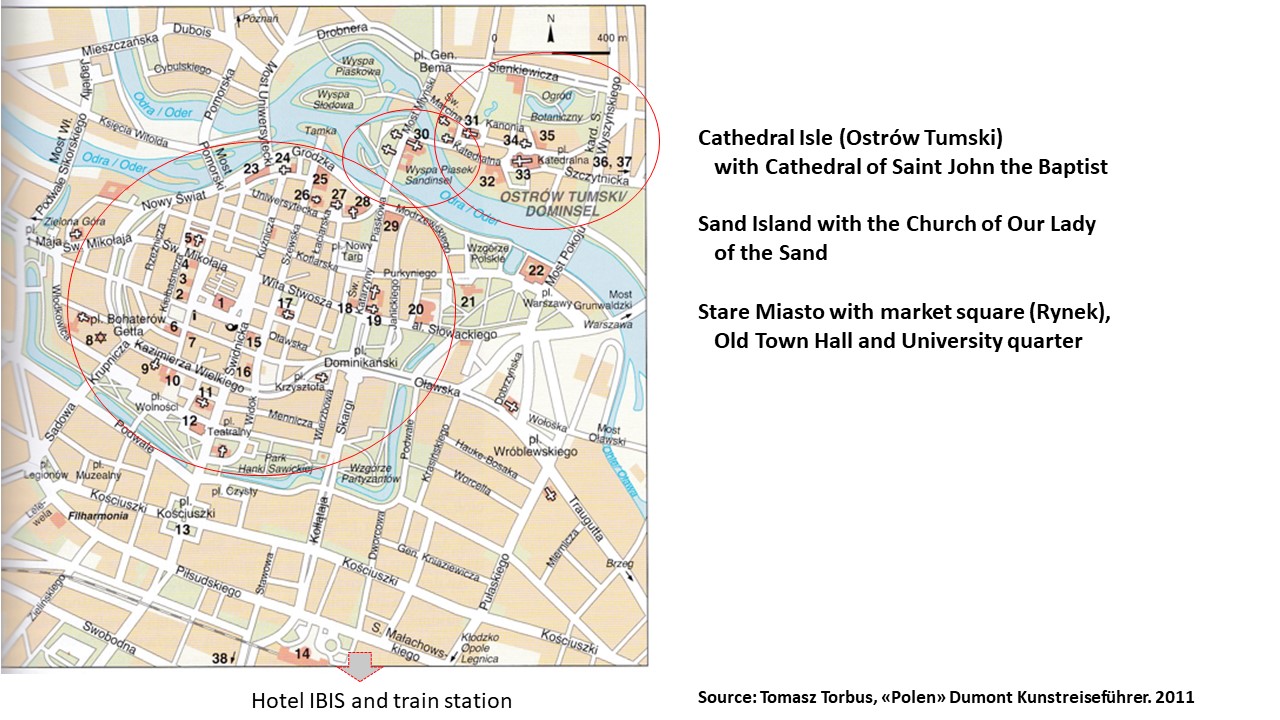
Source: Tomasz Torbus, “Polen”, Dumont Kunst-Reiseführer 2011

The city centre of Wrocław stretches along the river Odra (Oder) and consists of three main areas:

  • Stare Miasto with the market square (Rynek) and the Old Town Hall as well as the University quarter. Part of the moat has been preserved.
  • The roots of the city are on Ostrów Tumski or Cathedral Isle with the cluster of churches (founded before 1000 AD).
  • Sand Island lies between the city centre and Cathedral Isle.

I was all surprised to come across the river Oder here… I know it from the “Oderbruch”, the Oder wetlands in Brandenburg, at the border to Poland. But yes, the river Oder or Odra starts in the Czech Republic, flows through Silesia, makes the border between Poland and Germany for almost 200km and ends in the Baltic Sea. 


Walking from the hotel to the city centre

From my hotel, I walk north towards the city centre. After some ten minutes, I reach the moat, the Fosa Miejskia on Ulica Podwale.
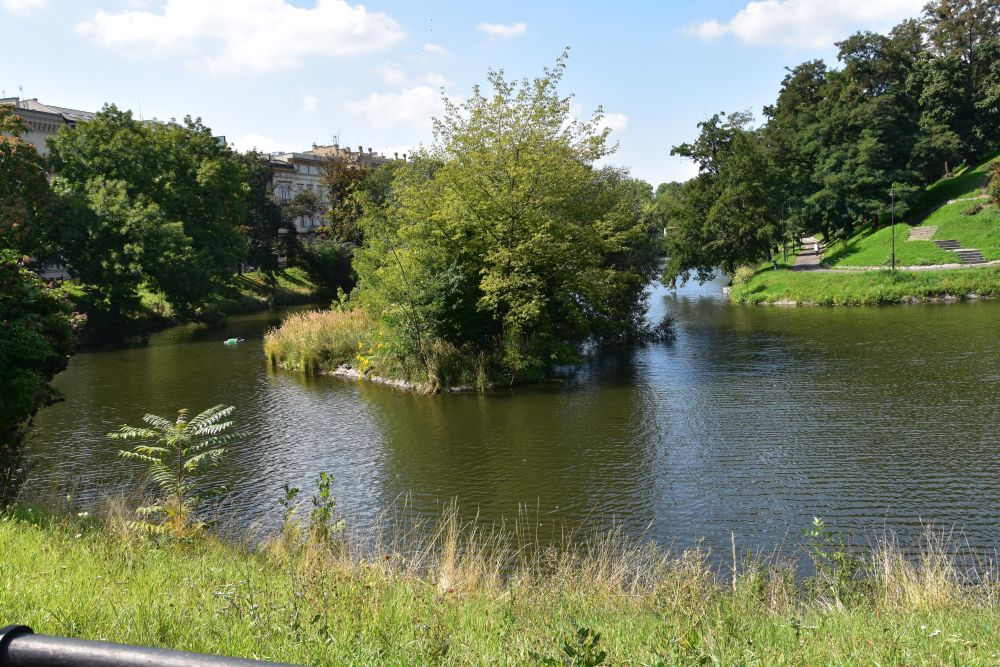
I like the pretty Art Nouveau houses along Ulica Podwale.
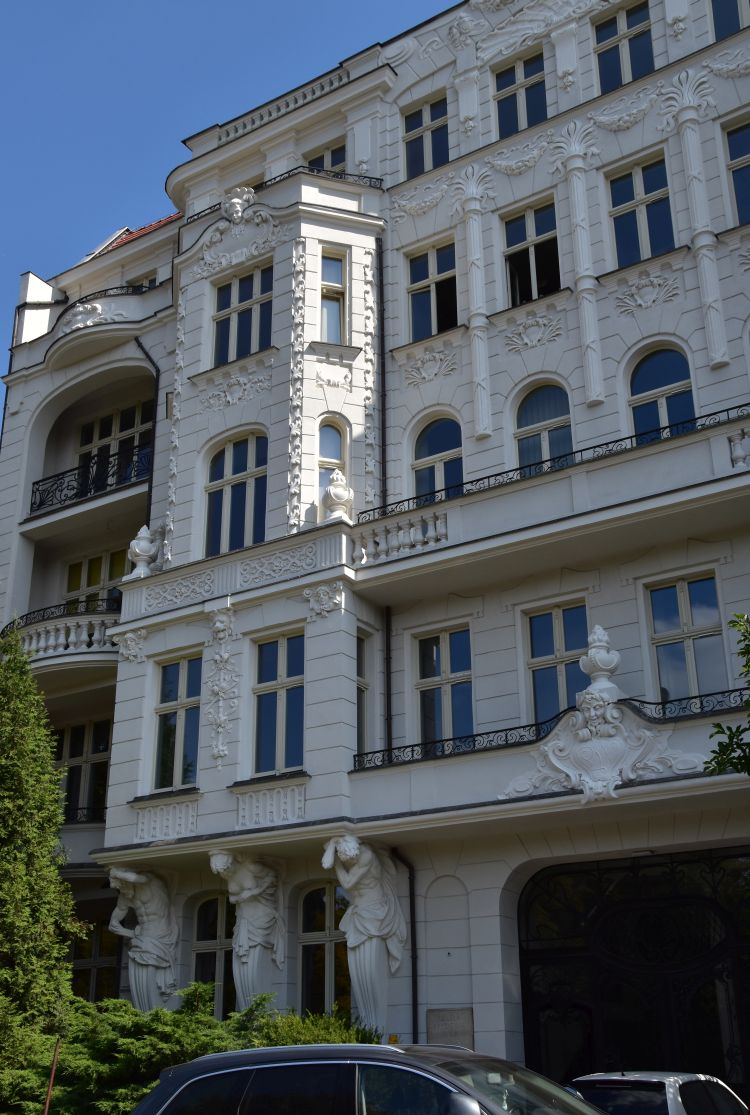
Now I am zooming in Atlas carrying not the world, but the oriel. It is so heavy that he has a brother and a sister helping him. 


Stare Miasto with the Old Town Hall and the market square (Rynek)

I reach the Old Town Hall. The construction of the mainly Gothic building lasted from about 1300 until the middle of 16th century, adapting to changing needs over time. In 1930, the Old Town Hall was converted into a museum. Dumont rates it as one of the most beautiful profane buildings in Eastern Middle Europe (p. 246). 

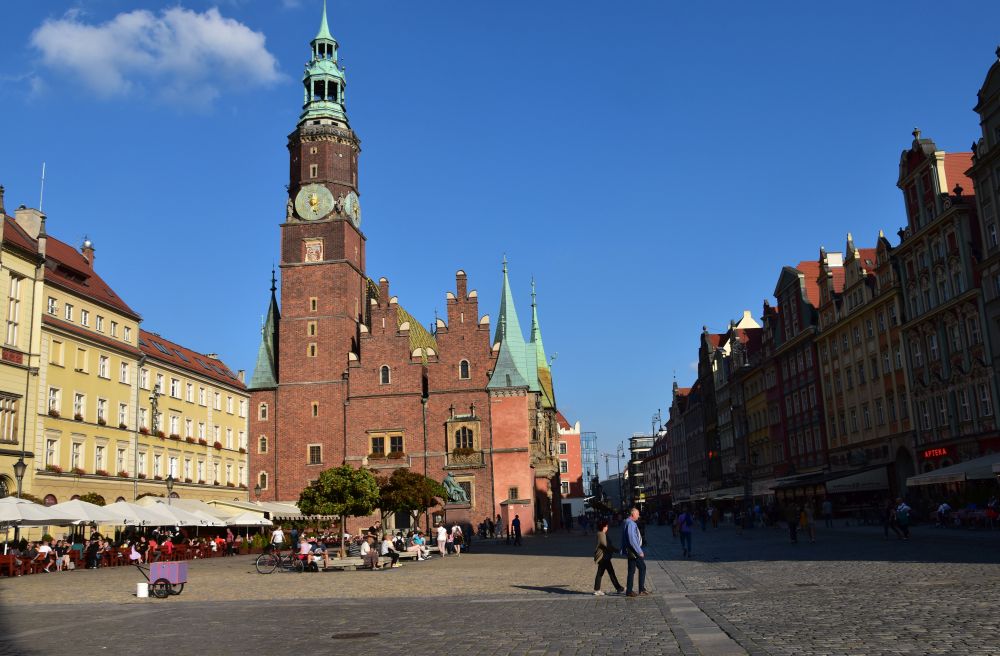
This is the eastern façade. The astronomical clock is from 1850.
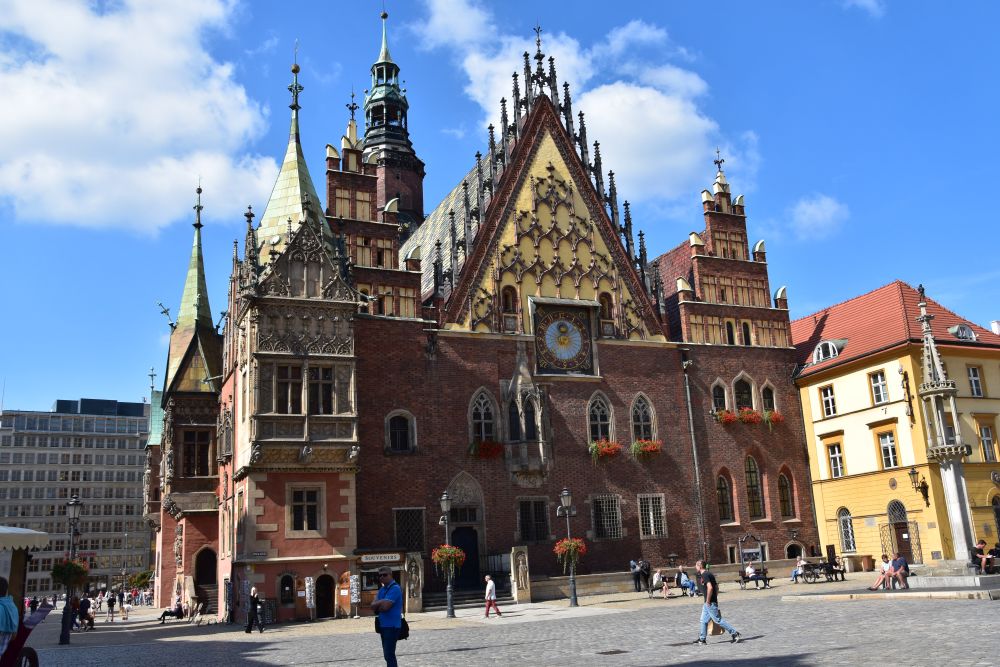
Now we look at the west side of the Old Town Hall. I stand on the Rynek.
Humorous gnomes (or dwarfs) are scattered all over the city centre. There are more than 150 of them, as I read in my “old” Lonely Planet. I come across “my” first one near the Old Town Hall. 
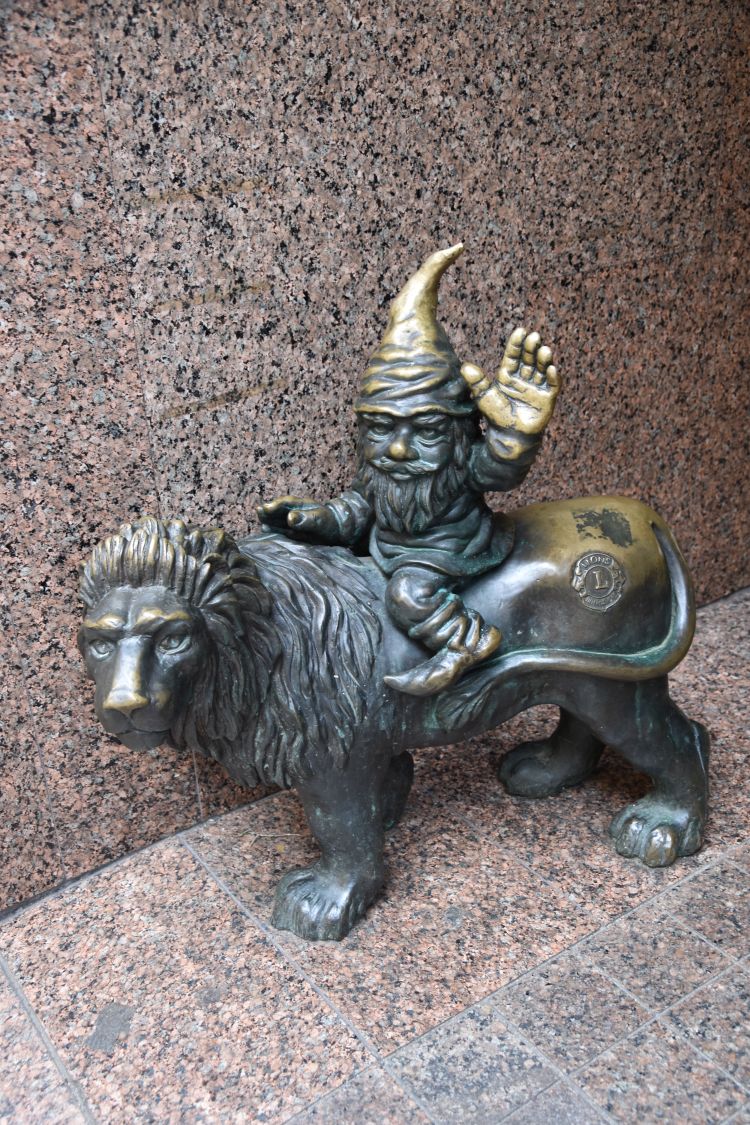
The gnomes can be considered to be an allusion to the Orange Alternative (Pomaranczowa Alternatywa), a group of communist dissidents in the 1980’s that used intelligent humour to express their political protest. Waldemar Fidrych was their leader. 

In the narrow streets north of the Old Town Hall, I have delicious Spaghetti in a tiny Italian restaurant.

Since 1240, there has been a market square, where the Rynek is today. The Rynek is a charming mixture of Gothic and Art Nouveau houses. The north and south side had been destroyed in WW II. Everything has been reconstructed or renovated. It is Poland’s second largest Rynek after Kraków.
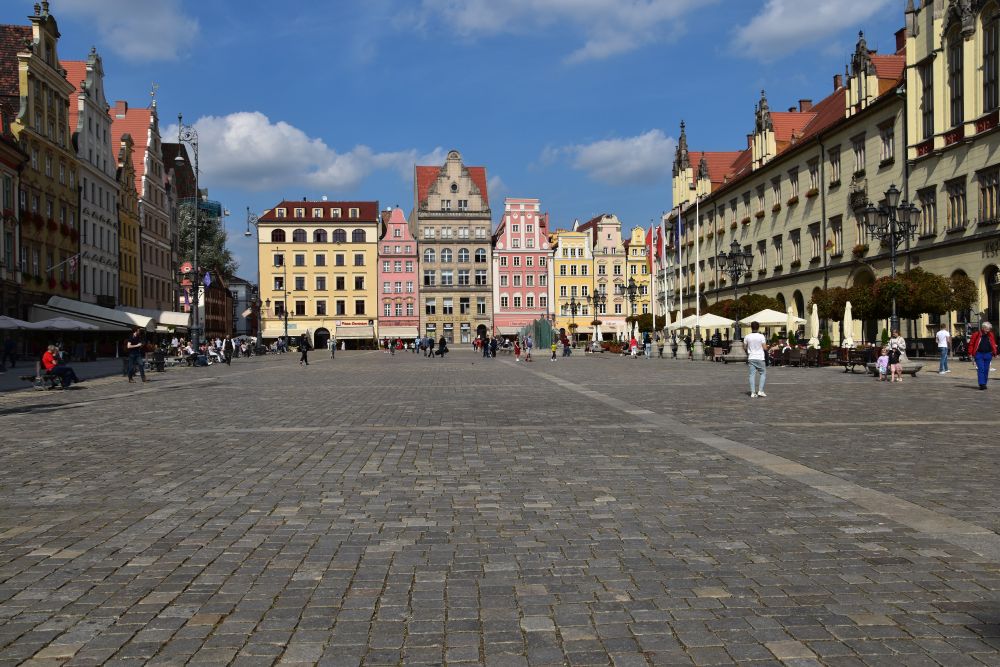
The Rynek is full of inviting restaurants.
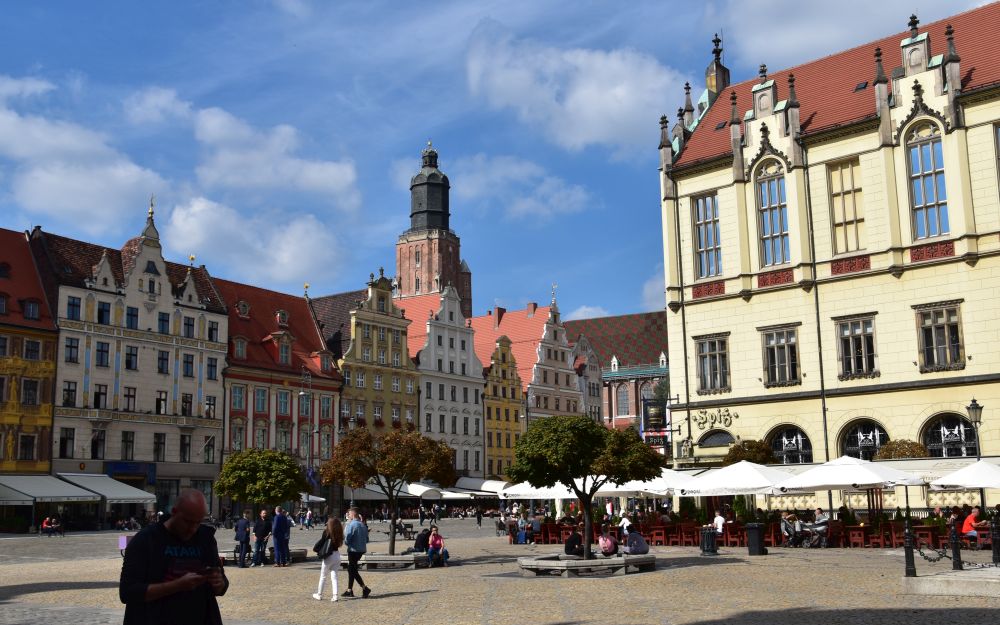
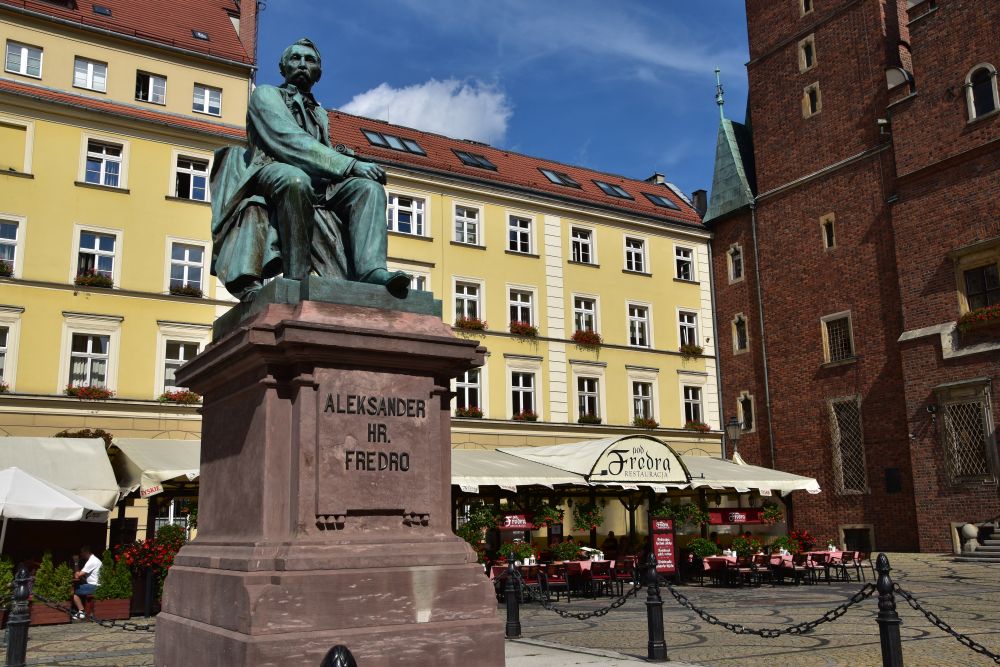
I plan dinner at Fredro’s. Count Aleksander Fredro (1793-1876 ) was a noble landowner and a poet venerated in Poland. Dumont calls him the “Polish Molière” (p. 249).
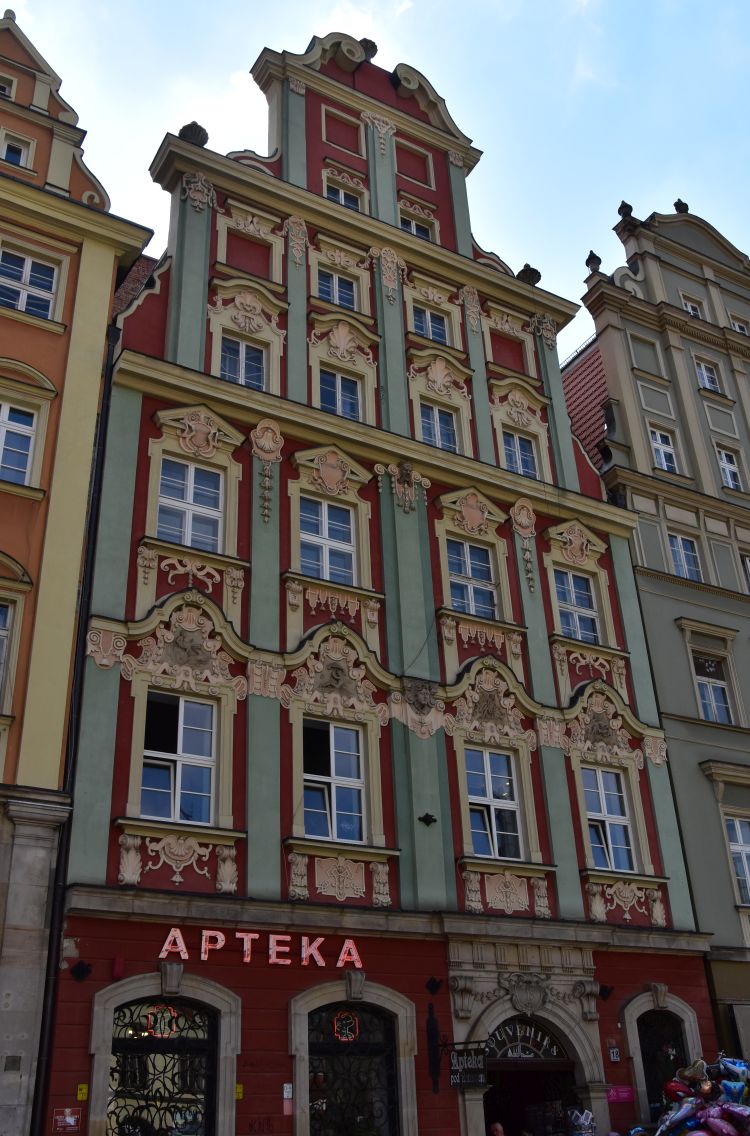
Here are some of the colourful houses at the Rynek. The playful façade of the pharmacy attracts my attention.
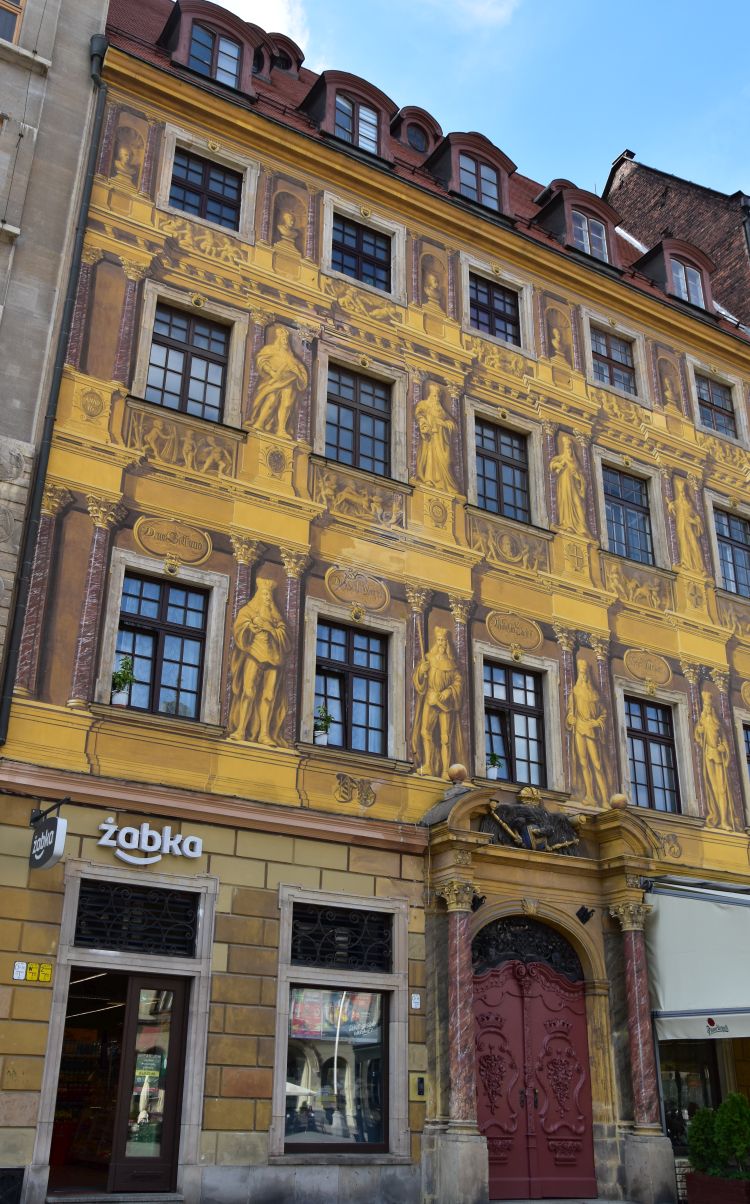
Furthermore I like this house with the frescos. Dumont tells me that it is the house of the seven electors (Haus zu den sieben Kurfürsten), painted in Baroque style by Giacomo Scianzi (1672).
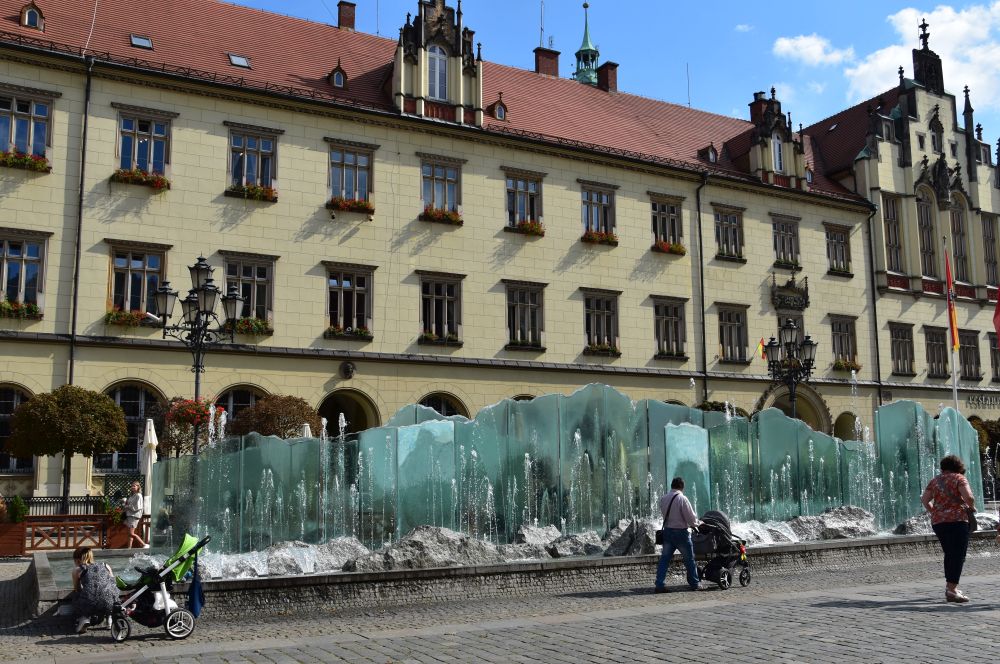
The glass wall in front of the New Town Hall symbolizes the Sudetes or Giant Mountains (Riesengebirge, Karkonosze).
Hänsel and Gretel is the name of these two tiny and slim houses. In Polish they are called “Jaś i Małgosia”.

The Church of Saint Elizabeth (Bazylika św. Elżbiety) is a  Gothic brick building from the 14th century.
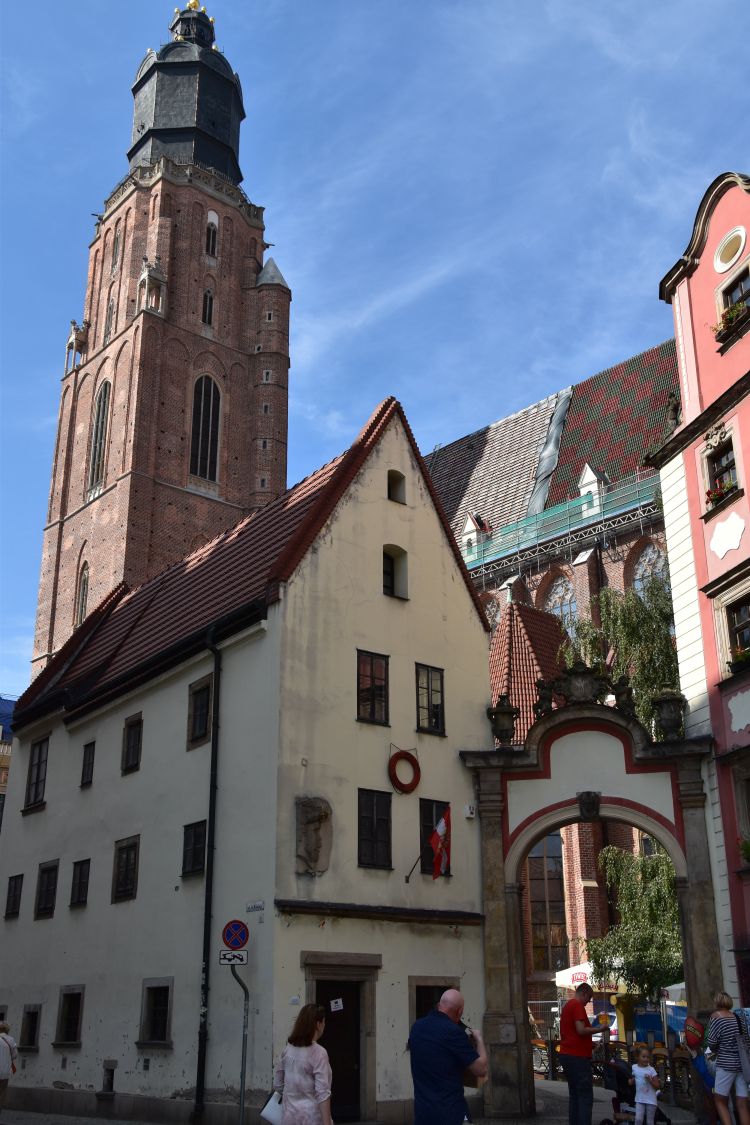
It was a Lutheran church from 1525 until 1946. Then it became a catholic church. It was heavily damaged by a fire in 1976 and has then been restored tastefully. 
 

University Quarter

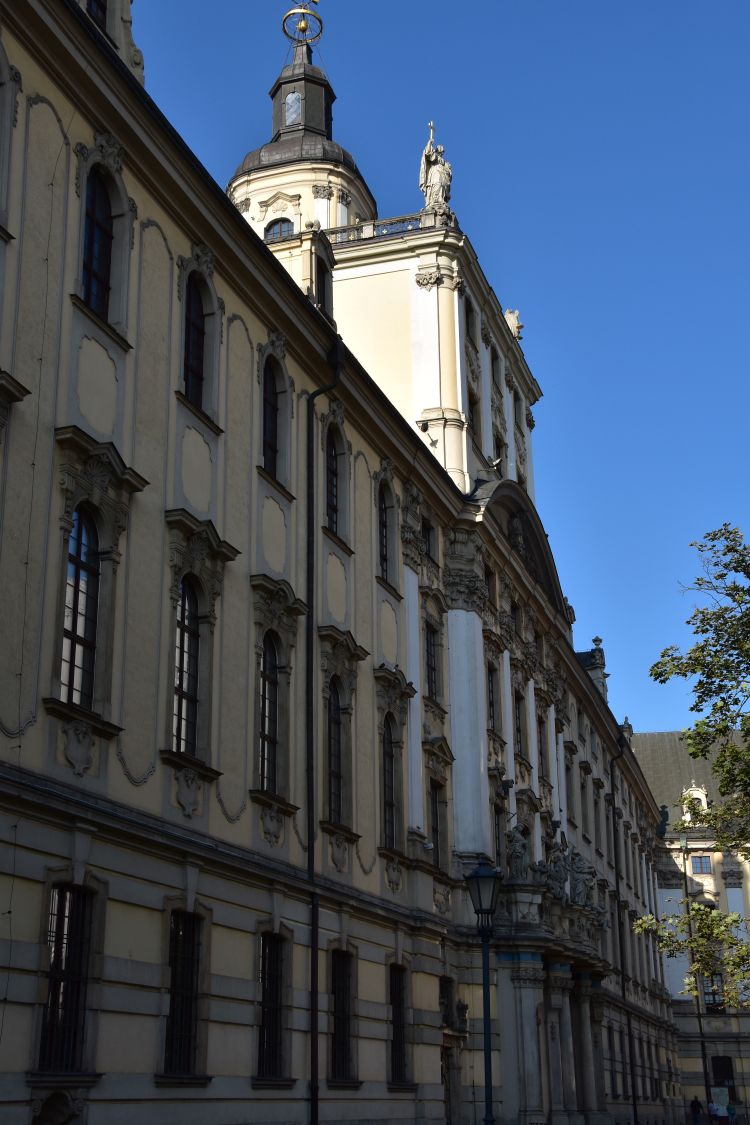
To the north of the Rynek, I find the university. The Habsburgian emperor, Leopold I, founded the university of Breslau in 1702 as a Jesuit academy. This was a catholic institution in mainly protestant Silesia and acted as a centre of the Counter-Reformation, until Silesia was conquered by the protestant Prussians in 1741. The university was re-established in 1945 replacing the former German University of Breslau. 

This is the north view from the river bank.
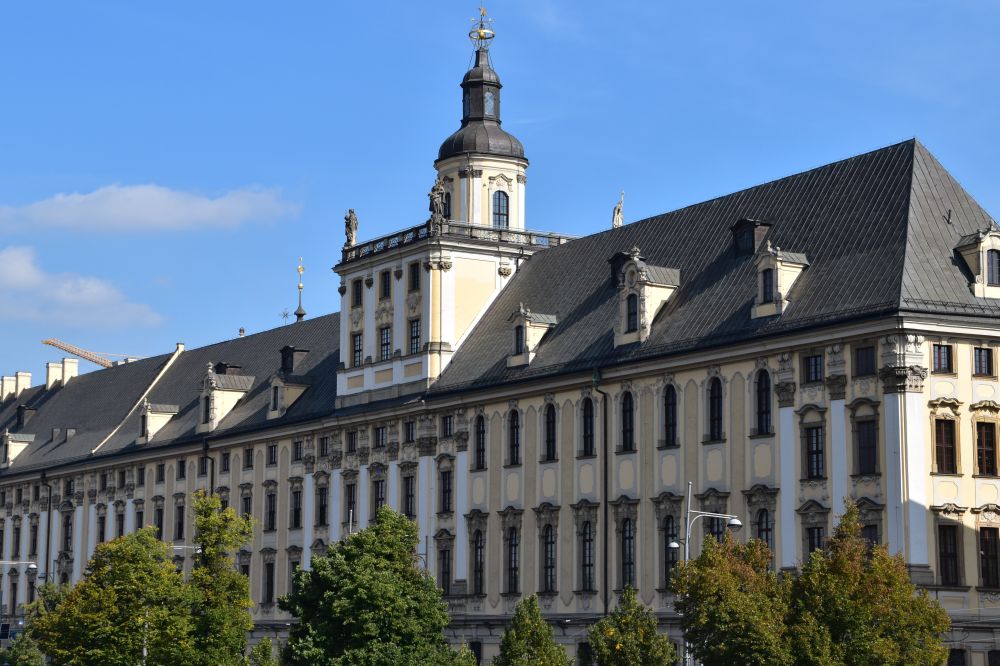
This is the view from the south.
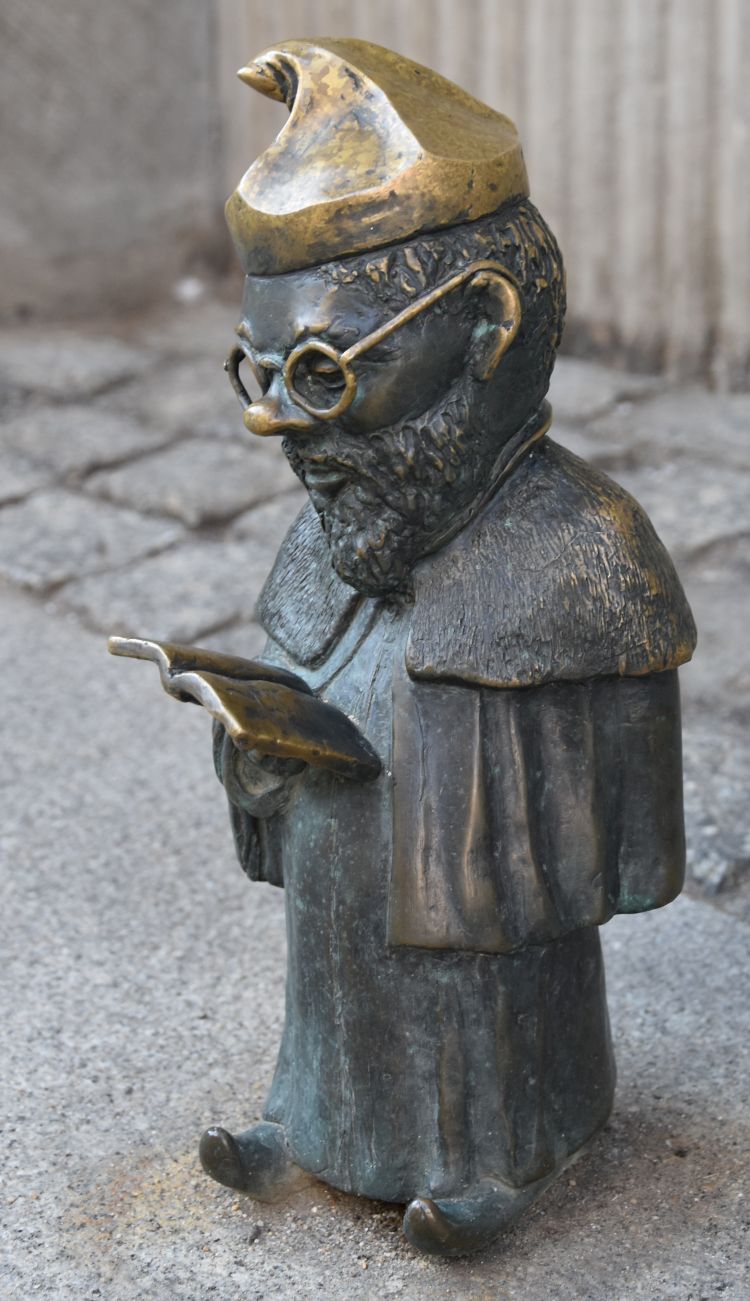
This professor-gnome-dwarf makes it very clear: This is a university!
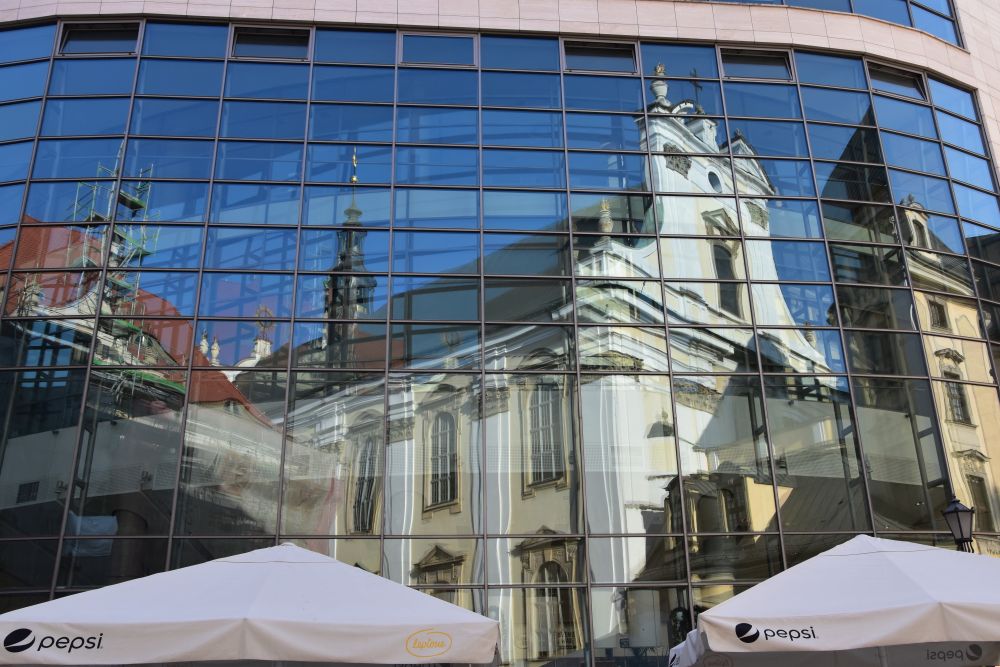
The Baroque University Church of the Holy Name of Jesus (Kościół Uniwersytecki p.w. Najświętszego Imienia Jezus) was built by the Jesuits in the late 17th century. It reflects in the windows of the modern building across.
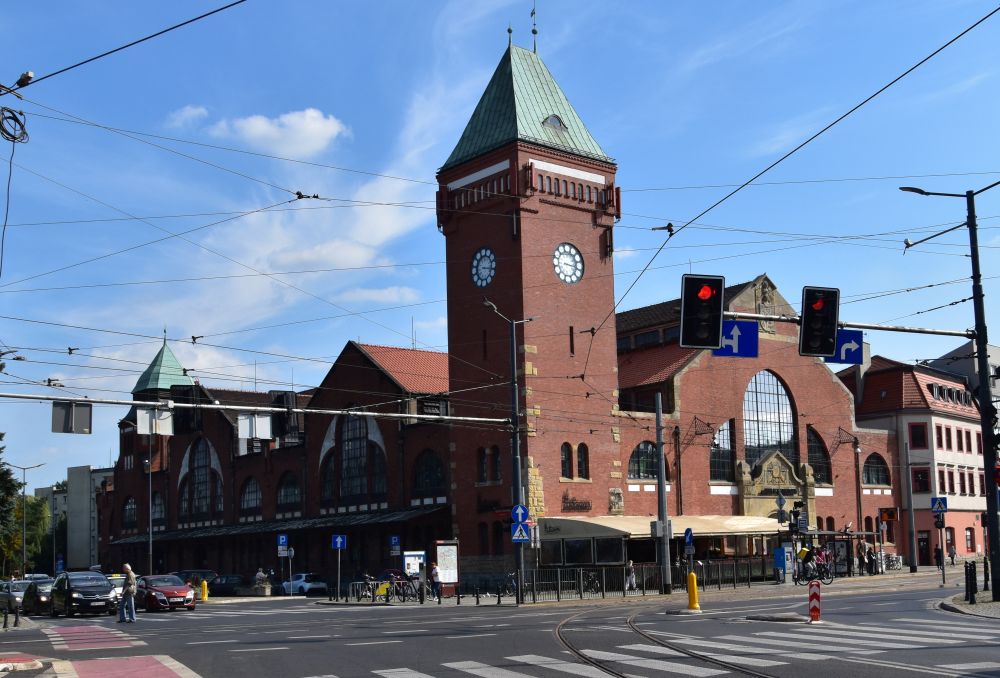
The market hall is an Art Nouveau building constructed in 1906-1908. It is in use as a product market until today.
 

Sand Island (Wyspa Piasek) with Church of our Lady on the Sand

To get to the Cathedral Island or Ostrów Tumski, I cross the small Sand Island or Wyspa Piasek. 
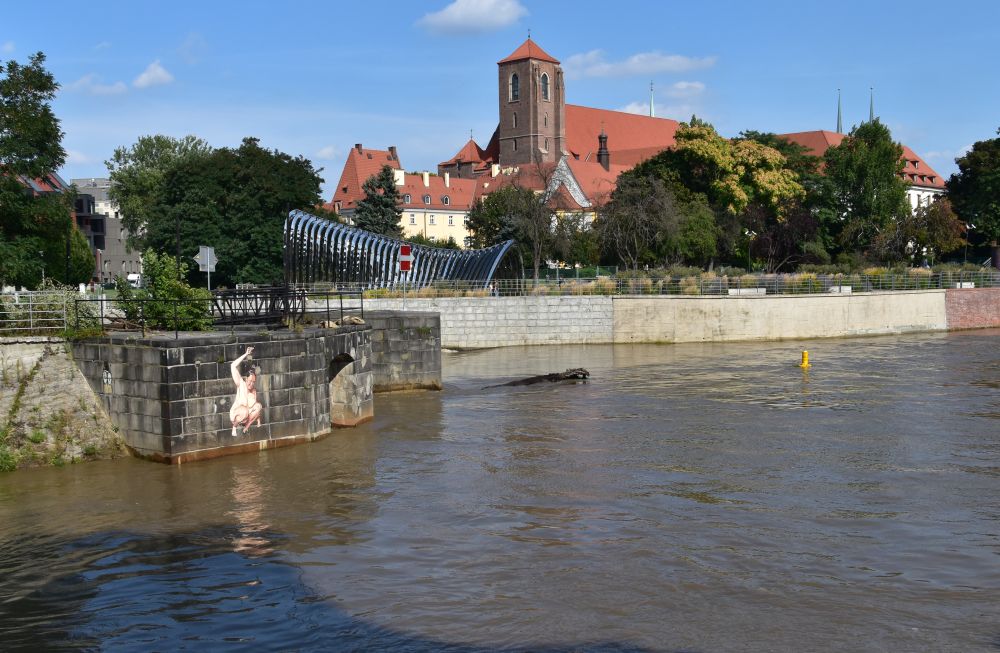
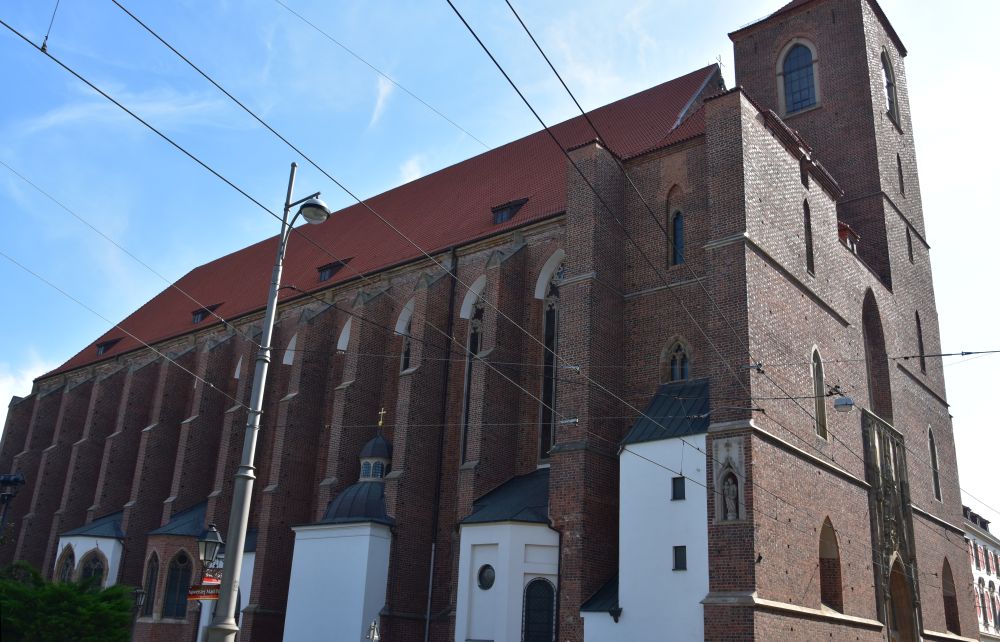
The 14th century brick Gothic Church of our Lady of the Sand (Kościół Najświętszej Marii Panny na Piasku) is the dominating building on this small island.
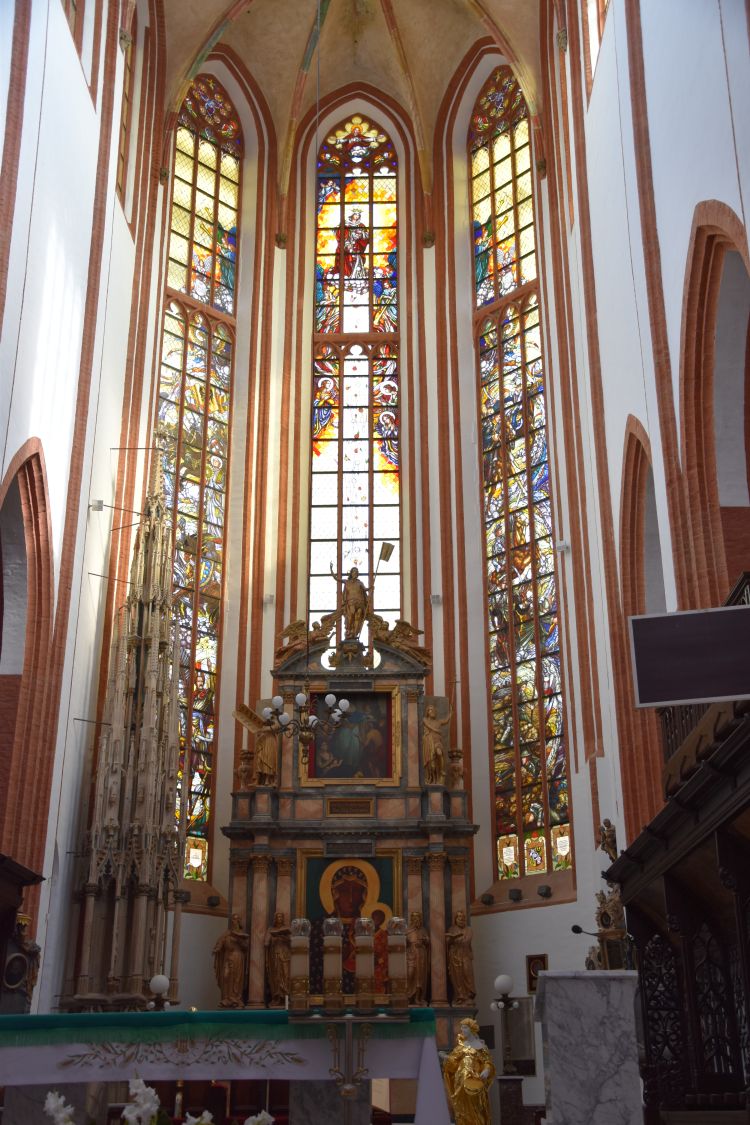
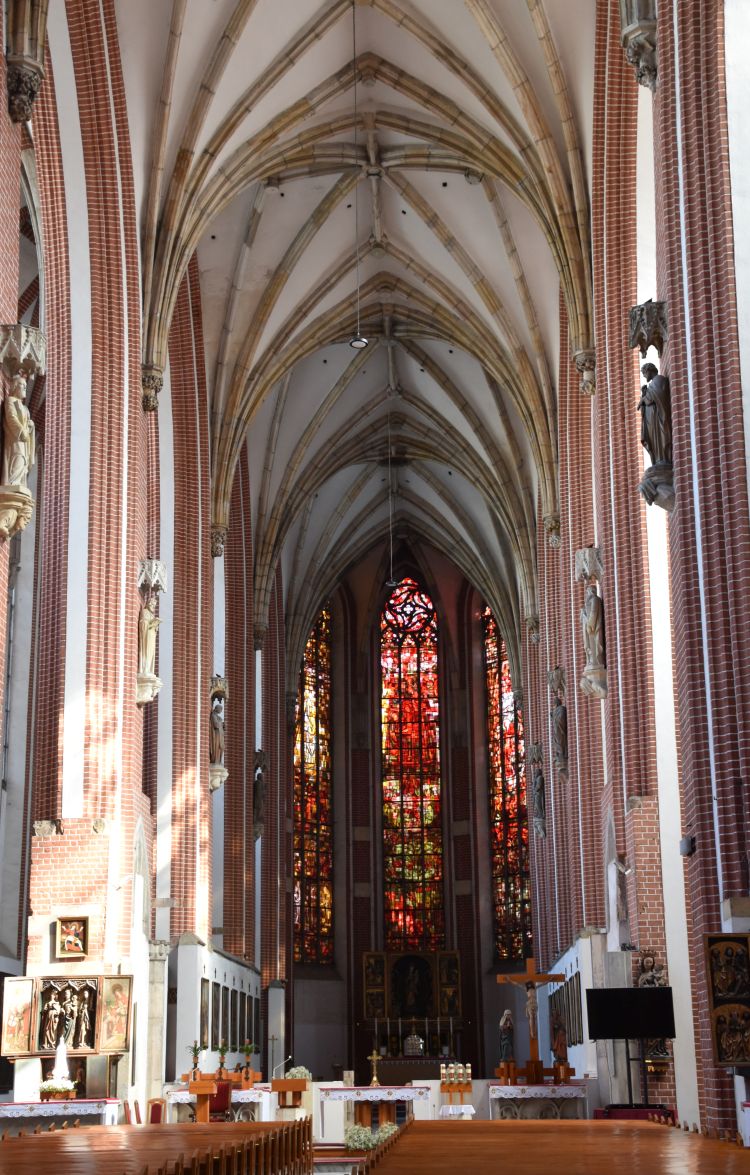
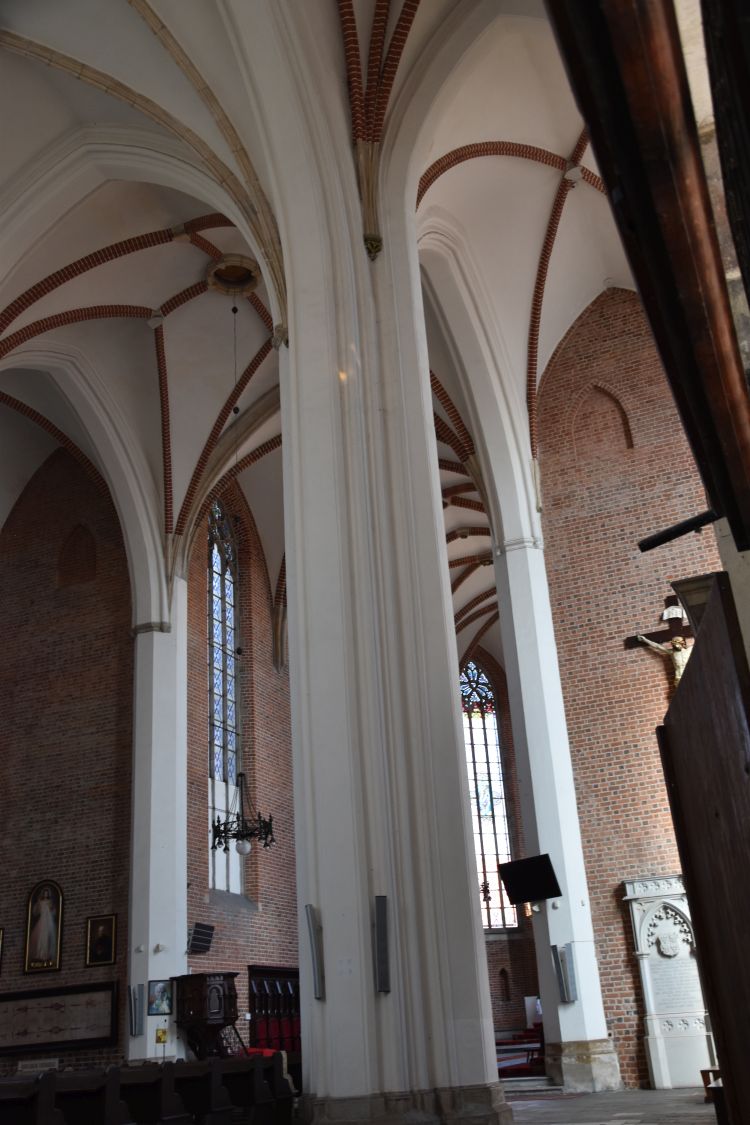
This is the inside view with the Gothic vaults, 24m high. 
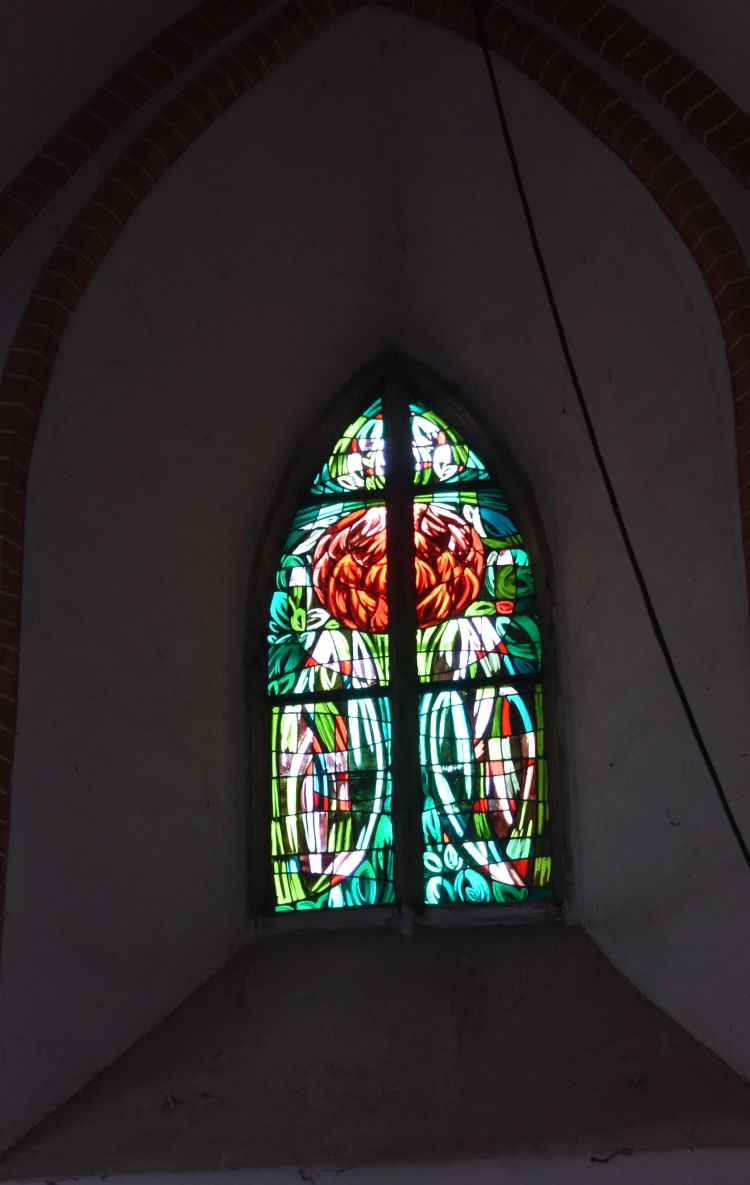
The church has been destroyed during WW II. The tasteful stain glassed windows are modern, from 1968.
 

Cathedral Isle (Ostrów Tumski)

I approach the Cathedral Isle walking along the Odra or Oder. The two towers of the Cathedral Saint John the Baptist dominate the skyline.
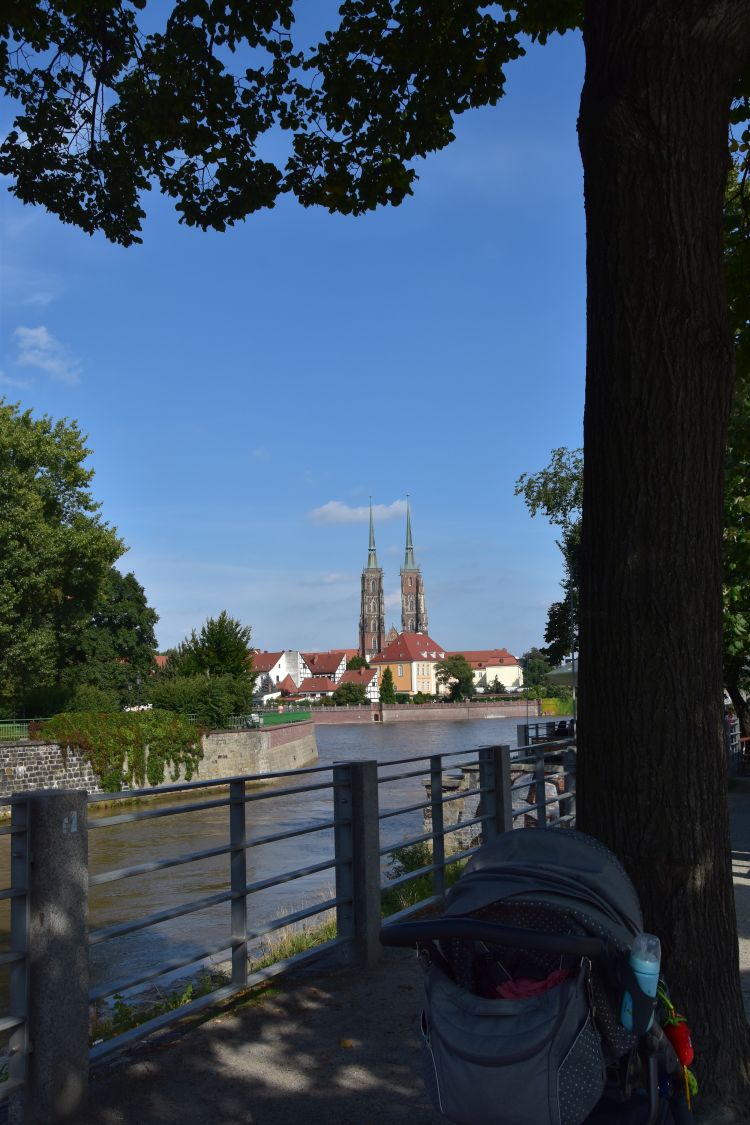
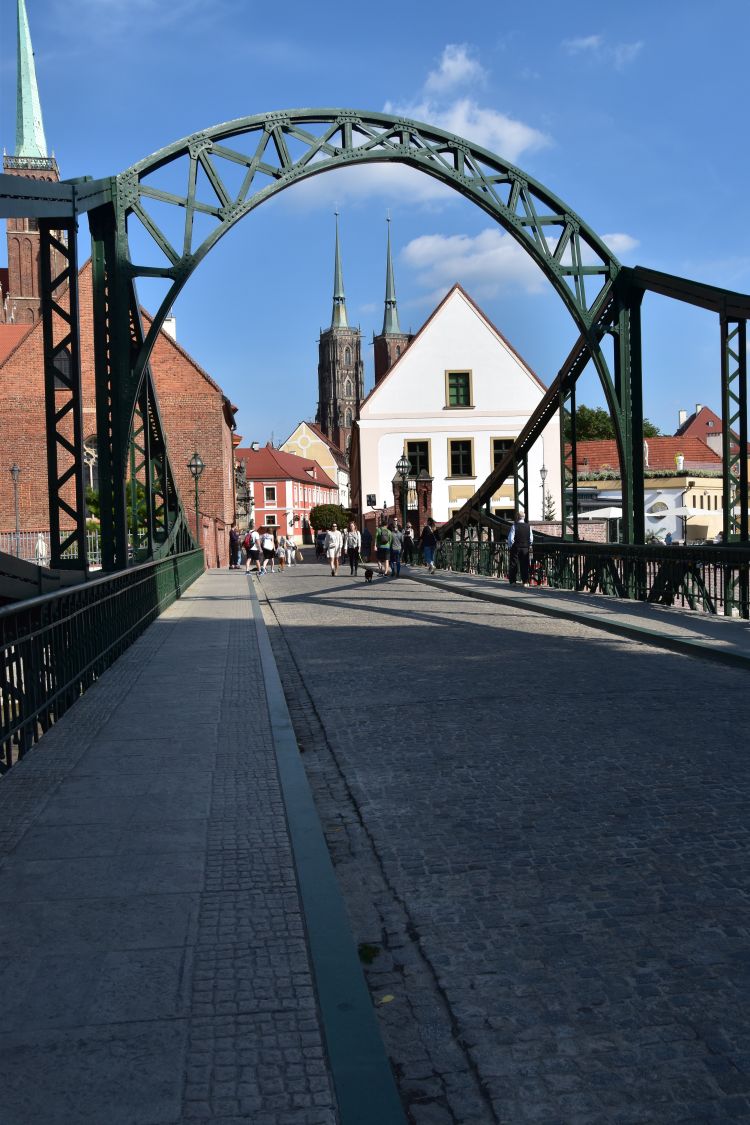
I cross the Tumski bridge that in local legends tells love stories – similar to Romeo and Juliet. To the left is the Saint Peter and Paul church and in the background we see the towers of the Cathedral.
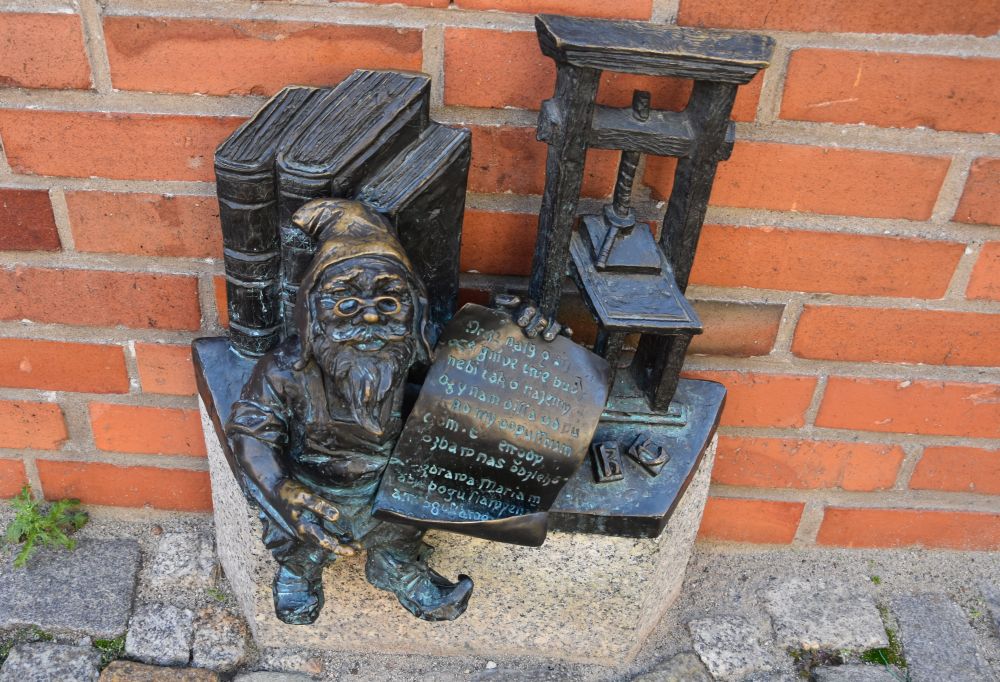
Another gnome-dwarf here.
The Collegiate Church of the Holy Cross and St. Bartholomew (Kolegiata Świętego Krzyża i św. Bartłomieja) is a late Gothic brick church with two storeys.  
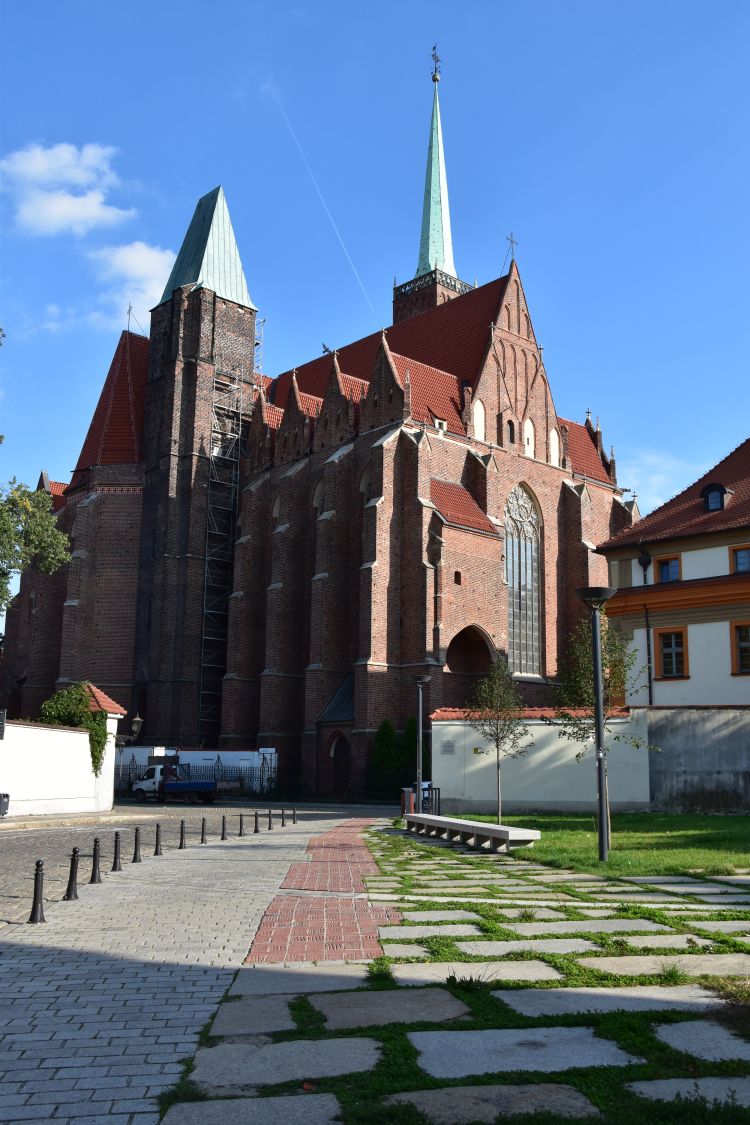
The lower level is closed. I can look through a grill locking the door to get an idea of the upper level. 
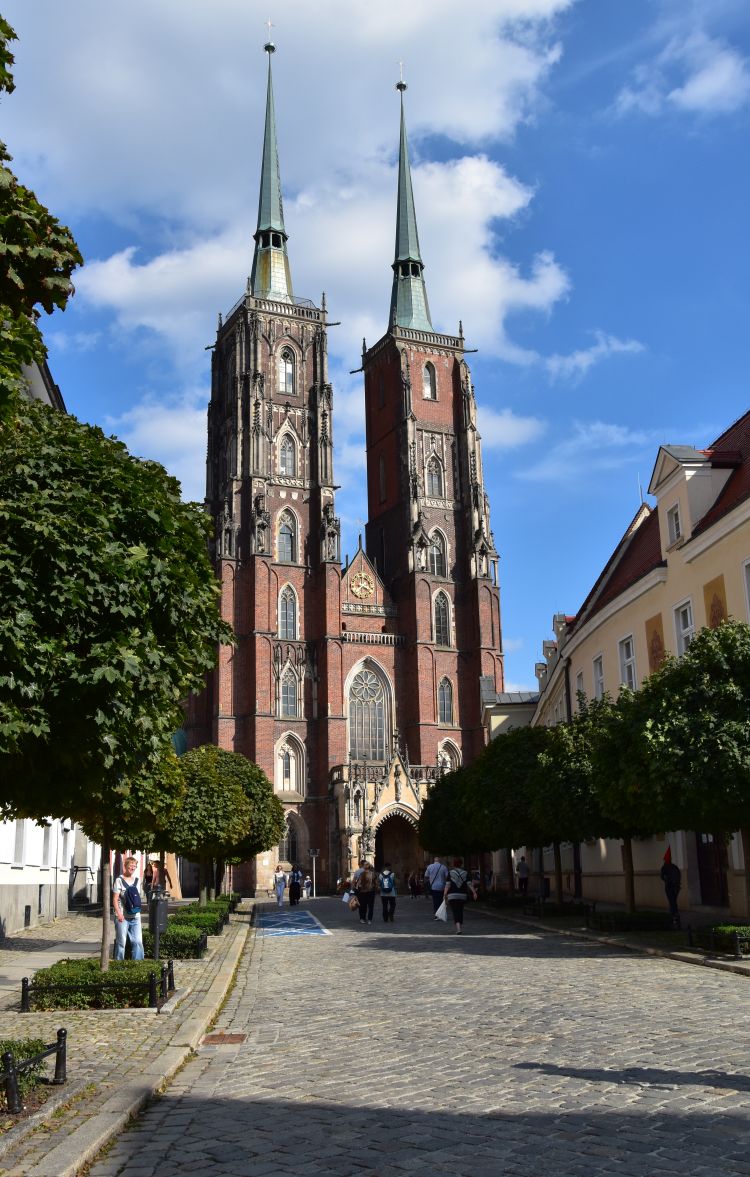
Elaborately cut trees lead to the Cathedral Saint John the Baptist. In Polish it is called Archikatedra św. Jana Chrzciciela.
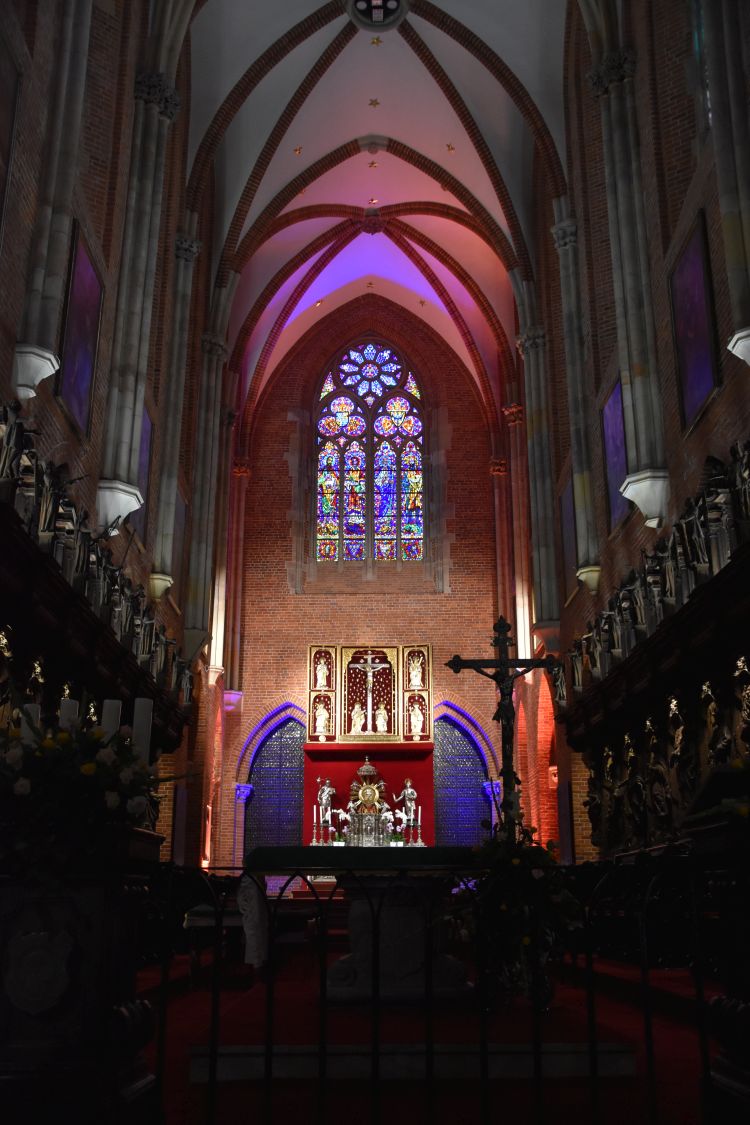
The current construction in Brick Gothic was started in 1244, after the Mongolian invasion of 1241. Fires damaged the church in 1540 and in 1759. Then during WW II 70% of the cathedral were destroyed. It was reconstructed after WW II.
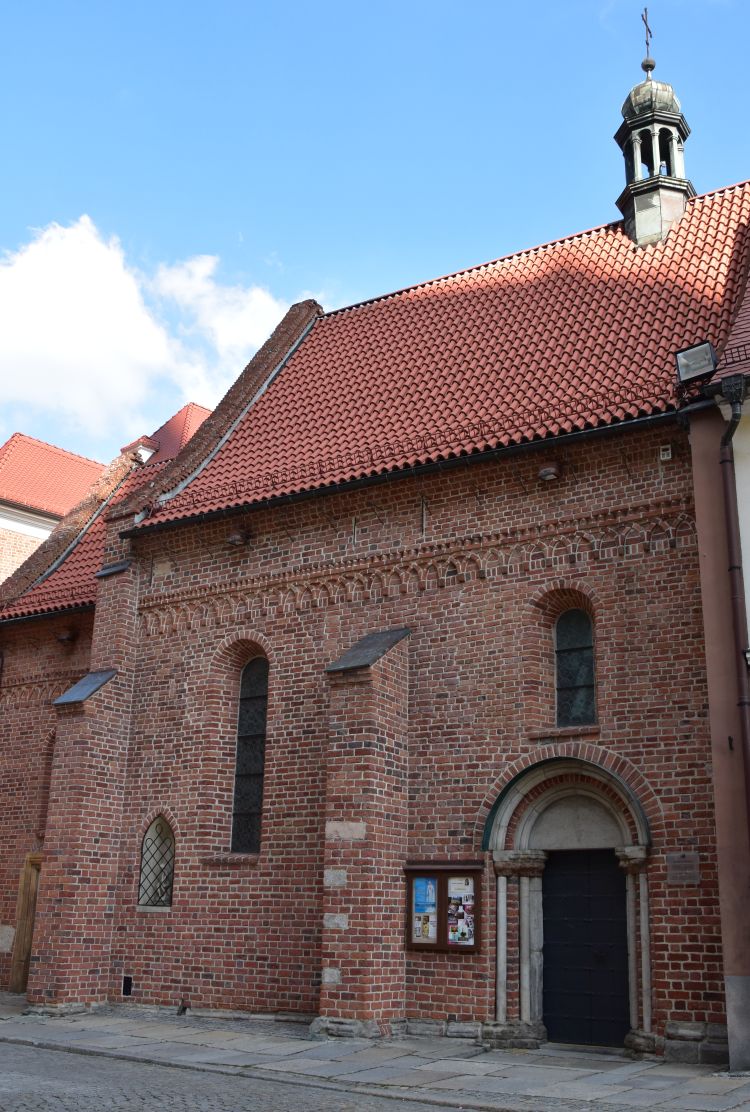
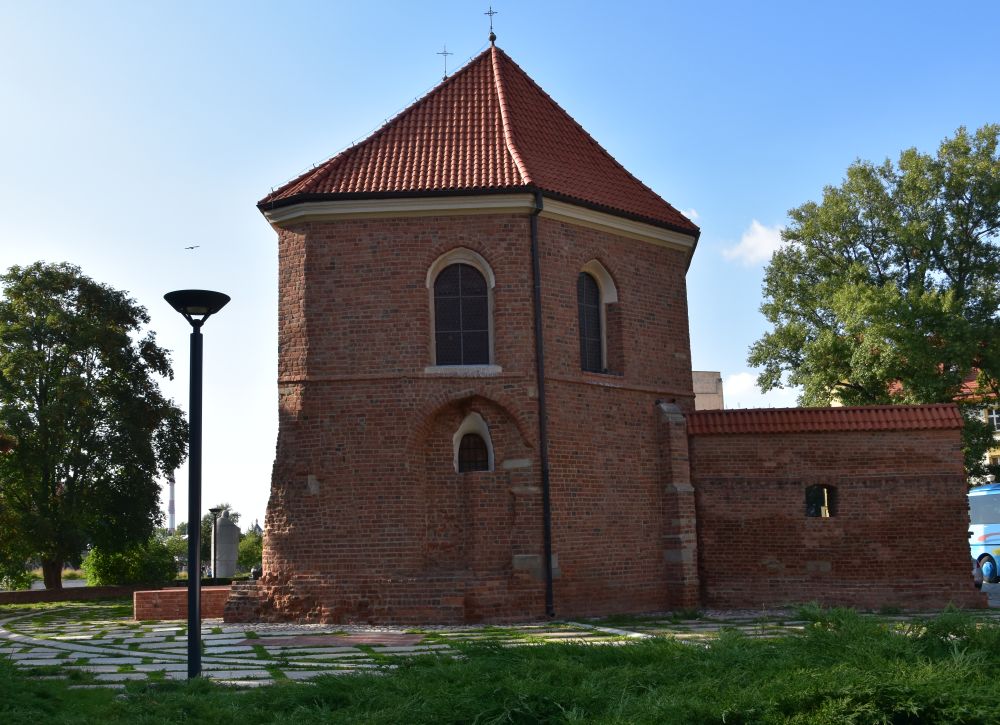
Across the street and north of the Cathedral is the small Church of St Giles (Kościół św. Idziego; in German: Aegidius). Built in Romanesque style in the early 13th century, it is the oldest active church in Wrocław. It has survived the Mongolian attacks. 
Nearby Saint Martin Church is also of Romanesque or early Gothic style. 
 

Coffee and Legends – taking a break in the Bishop’s Gardens

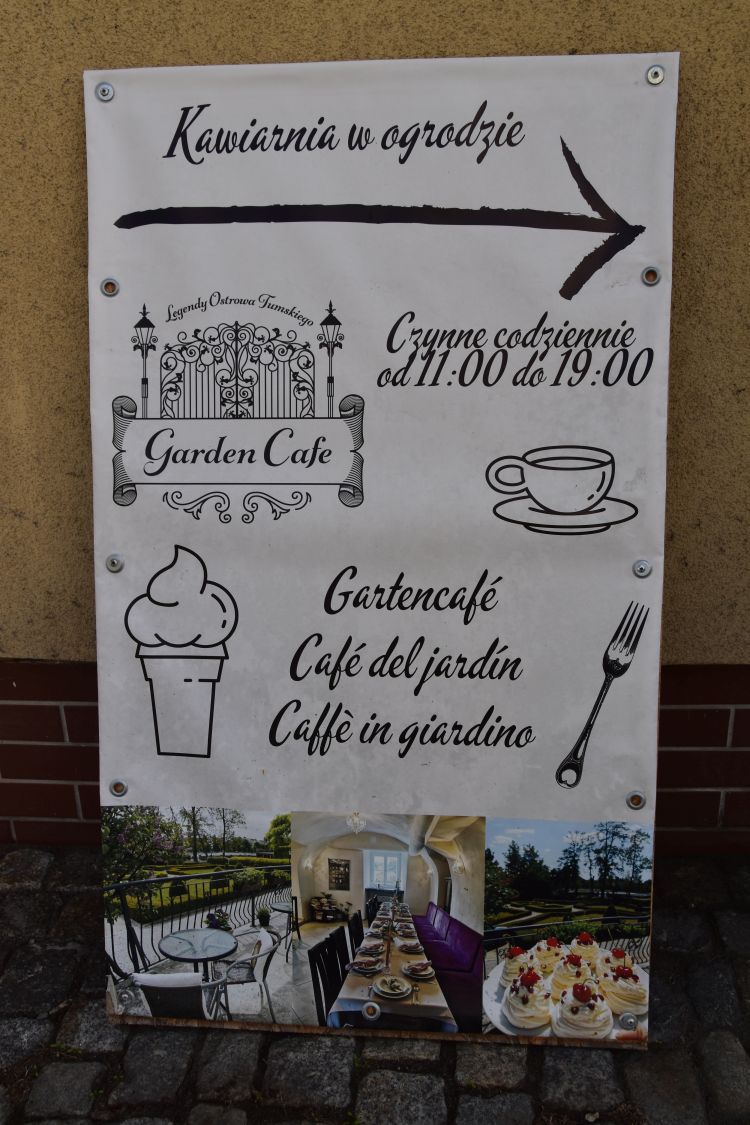
Behind the cathedral, I see this friendly invitation to the coffee place in the garden.
I enter and order a coffee. With it I receive a piece of paper, carefully rolled up with a bow. It contains legends of Ostrów Tumski.
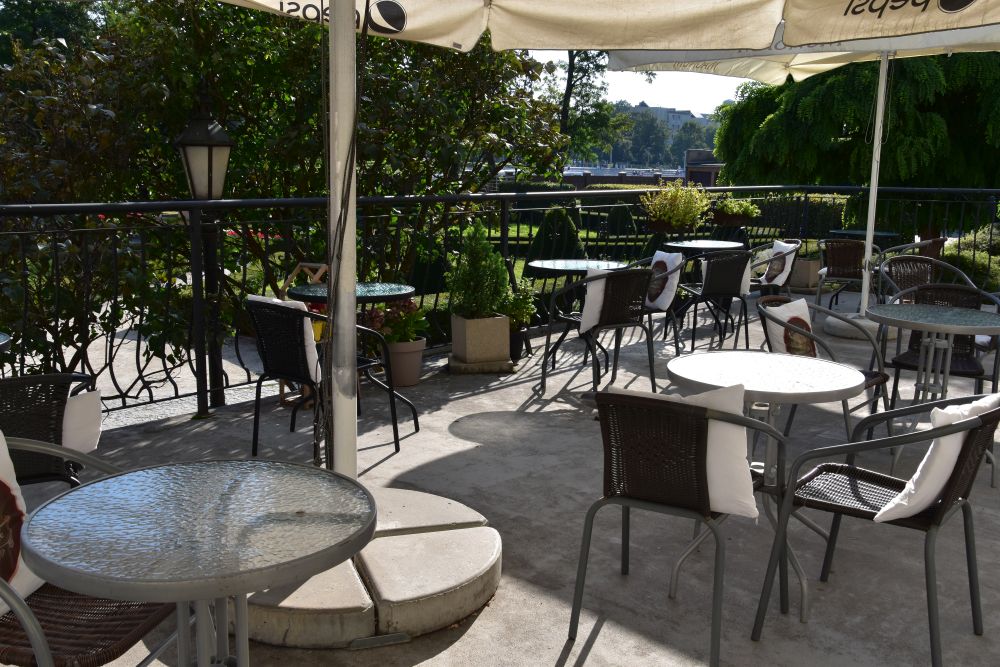
While drinking my coffee, I read the legends referring to Ostrów Tumski.

One legend tells about the dangerous power of white roses. The bishop loved Agnieszka who cultivated white roses in the Bishop’s Gardens. When Agnieszka died, the servants wanted to comfort the bishop and decorated his bedroom with white roses. The following night, the bishop died. Since that night, white roses, now considered to be dangerous, have no longer been planted in the Bishop’s Gardens.

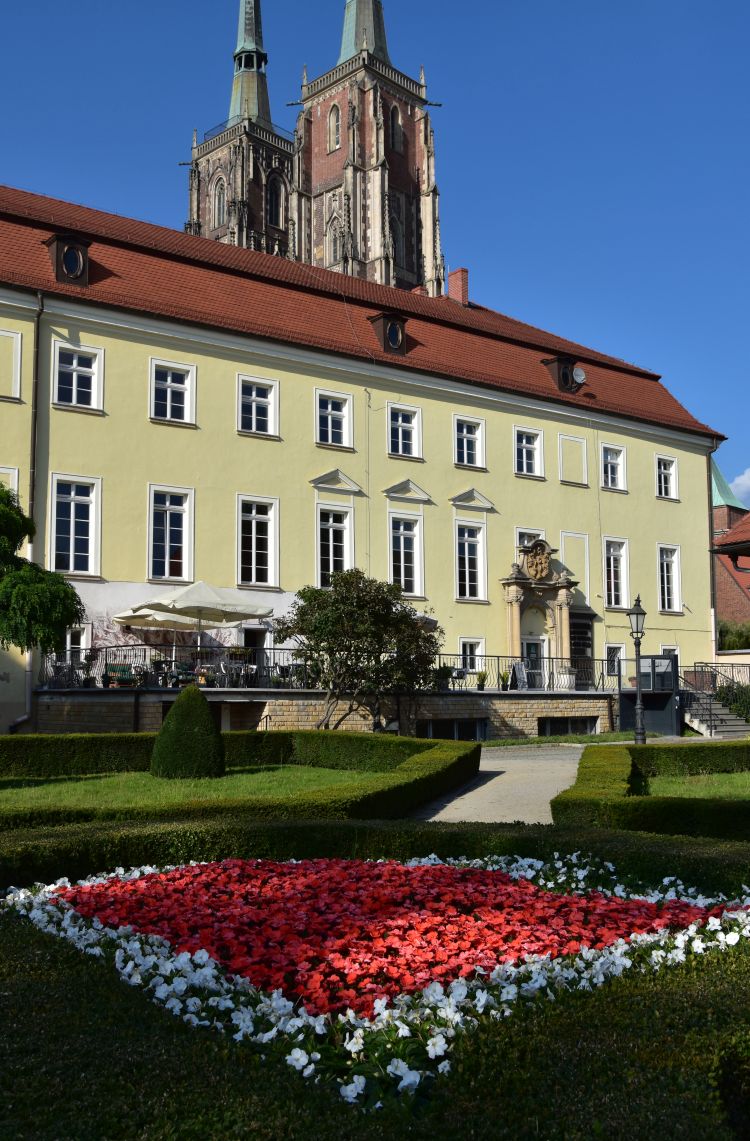
I leave the coffee place looking back at the Bishop’s Garden with the cathedral towers in the background,…
… and cross the bridge Tumski…
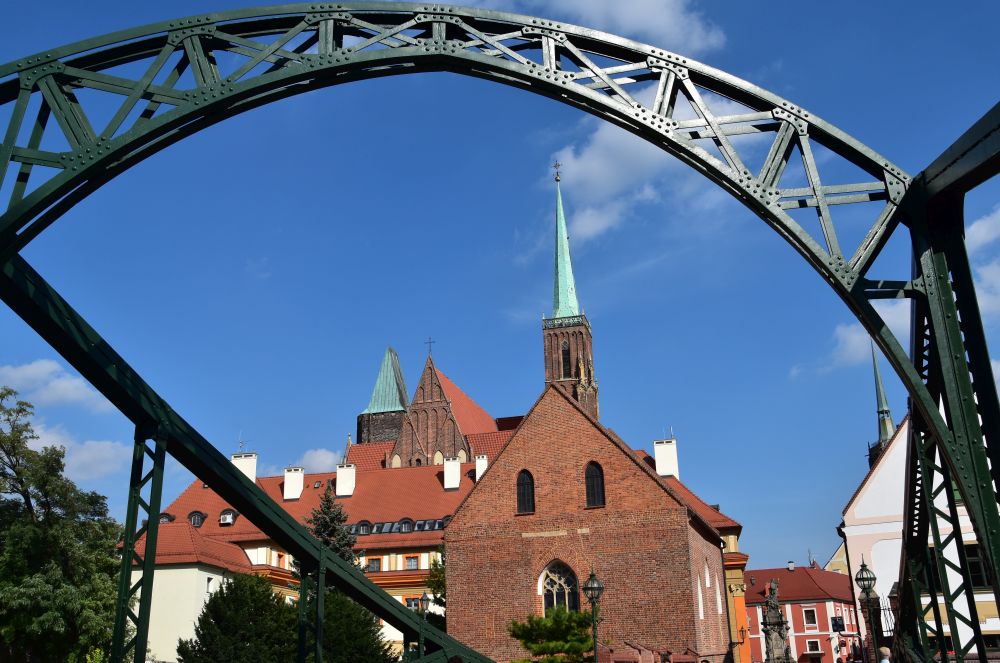
… that crosses the river Odra.
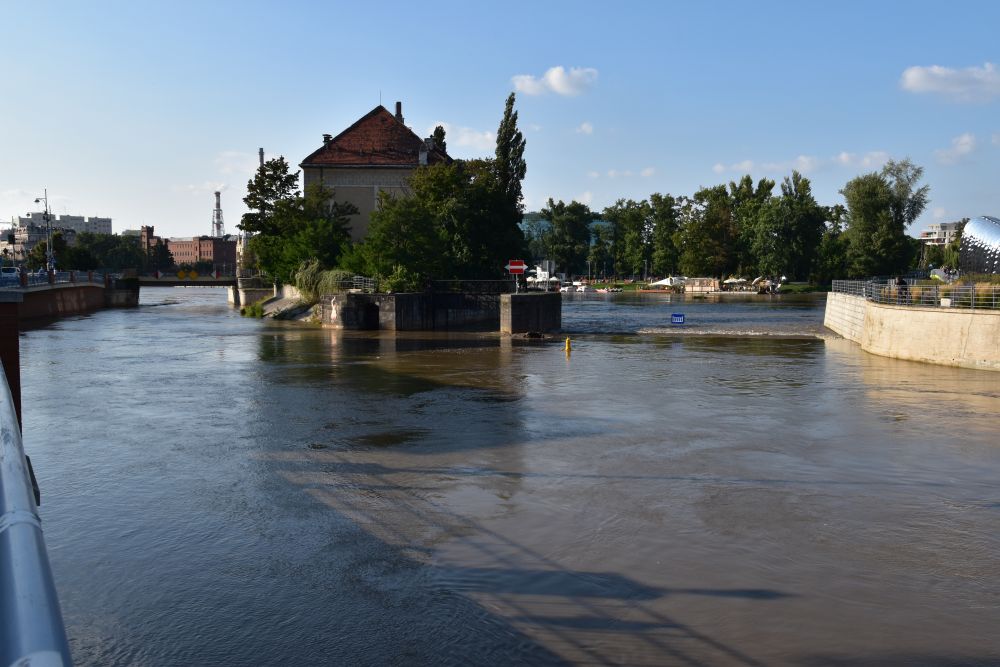
 

The White Stork Synagogue southwest of the Rynek

I return to the Rynek and continue my way southwest to visit the Jewish heritage, the White Stork Synagogue (Synagoga Pod Białym Bocianem), built in elegant neoclassical style in 1829 and restored in 2010. It is presumably called “White Stork”, because it stands where there was a restaurant with the same name before.
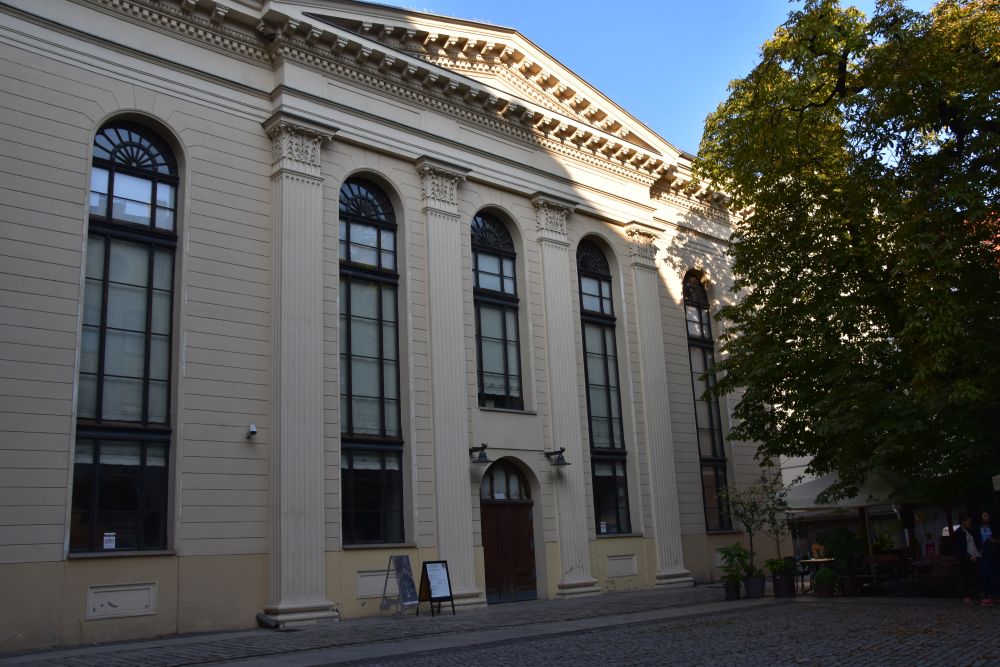
In the adjacent courtyard, I am tempted to sit down in one of the restaurants.
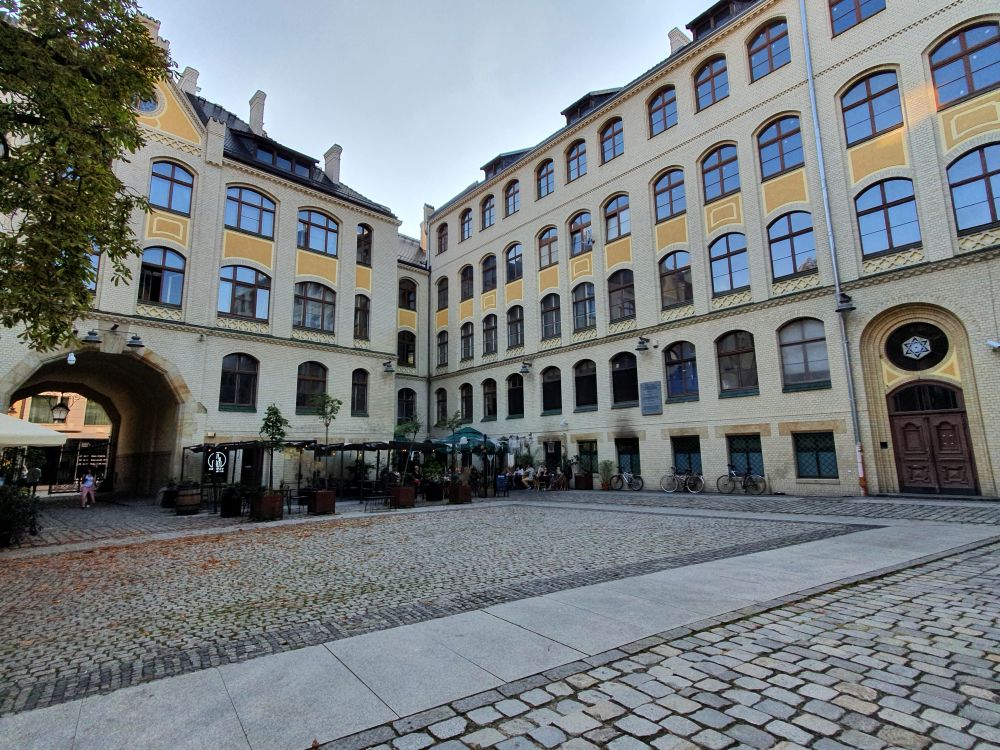
However, I return to the Rynek to eat in front of the Old Town Hall at Fredo’s. I have a salad with chicken and I complete my meal with a glass of Żubrówka, the Polish vodka with the buffalo grass.


Good-bye Wroclaw

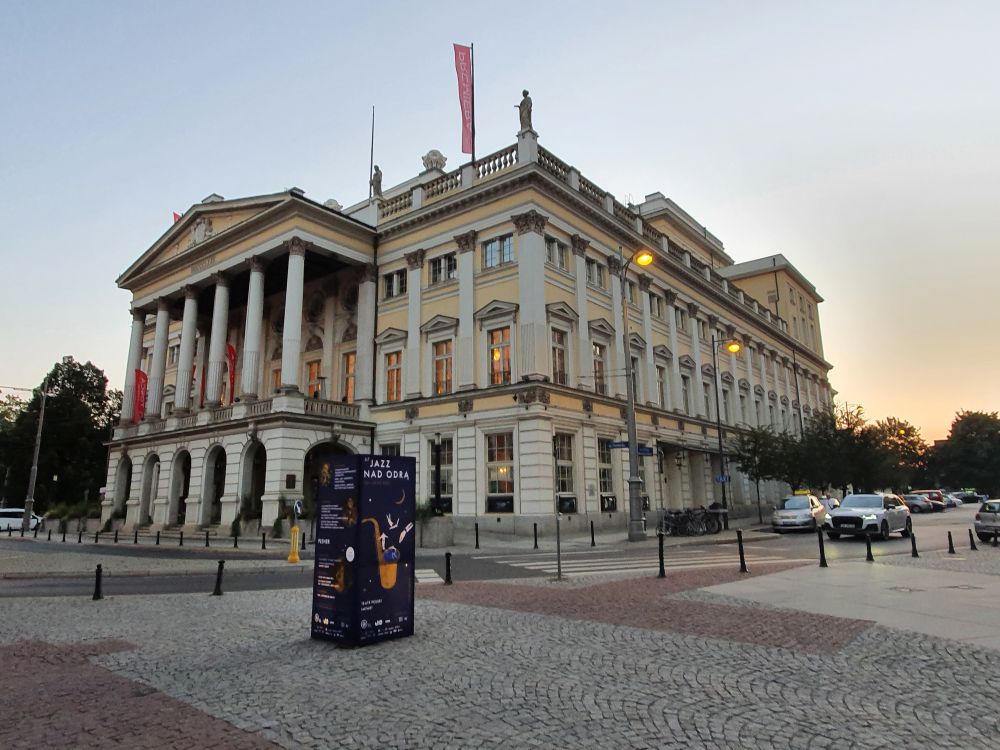
Evening falls. I walk back to my hotel. I take Ul. Świdnicka (former Schweidnitzerstrasse) that in the 19th century became the new centre of the city with the Opera House from 1839-41…
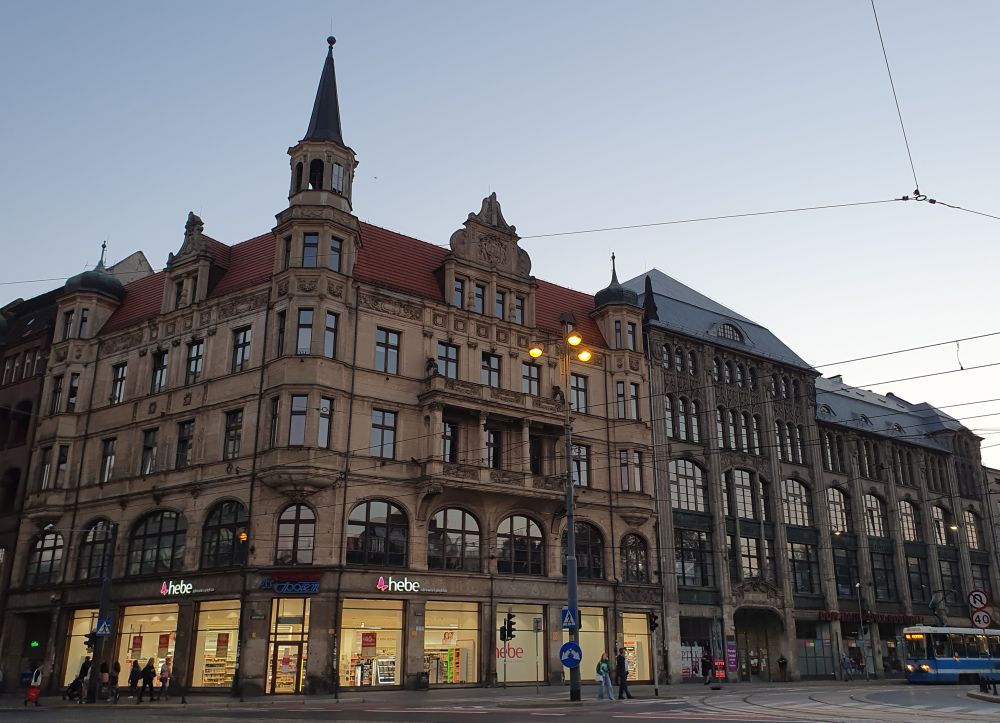
… and department stores like this Art Nouveau building across the moat.
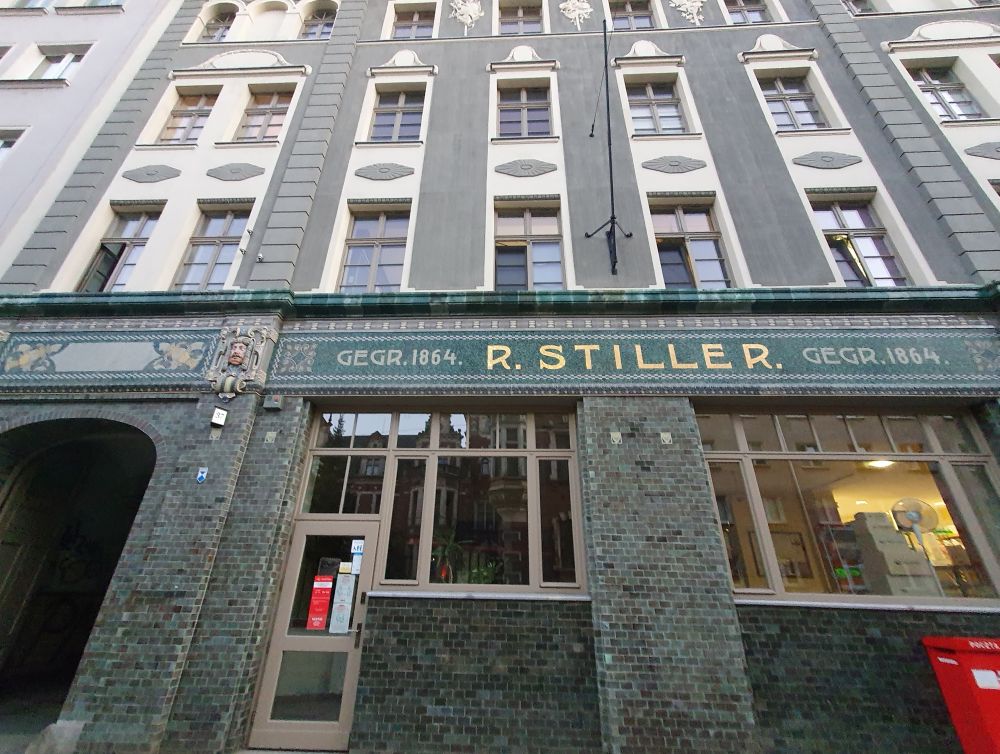
In the side streets, I come across German reminiscences. 
I settle in “my” comfortable hotel IBIS. I have a glass of wine in the friendly restaurant here to say good-bye to Wrocław and also to Poland.

Tomorrow I will drive to Germany to my mother-town Berlin.


Background information about Wrocław and Silesia: The history in a nutshell

From the “Lonely Planet”, the “Dumont” and from various Internet sources about Silesia, Wrocław, the Piast family etc. I try to understand the major history pattern. I am not a historian, but I like to acquire a structured overview, though it may not be perfect. 

Before 990: The roots of Silesia 

  • In the 4th/5th century, the Vandal tribe Silingi (in German: Silinger) settle, where Wrocław is today. In the 6th century the Slavic tribe Slegani build a fortification on Ostrów Tumski. It is under debate, which of the two tribes is the basis for the name “Silesia” (or in German: Schlesien, in Polish Śląsk).
  • Until 985 today’s Silesia belongs to Bohemia.

985-1335: Under the rule of the Piast dynasty, first Polish and then more and more tending towards the Holy Roman Empire of German Nation

  • 985: Duke Mieszko I. from the Piast family conquers Silesia with Wrocław and integrates it in the kingdom of Poland.
  • 1000: For the first time, Wrocław is mentioned under the name of Vratislavia, in a Papal bulla. The diocese of Wrocław is one of the three newly founded Polish bishoprics. It is located, where two trade routes intersect. (In 2000, Wrocław will celebrate its 1000 years anniversary).
  • 1241: The Mongolians (or Tartars) destroy Wrocław and retreat due to successor fights in Mongolia. Wrocław is rebuilt again.
  • Late 13th century: Various branches of the Piast families reign their own duchies, one of them being Silesia. Poland is now a community of duchies with one duke being elected as the leader. The dukes of Silesia balance their politics between Poland and the Holy Roman Empire of German Nation. They invite Germans to settle. Soon the German colonists are a majority in Wrocław. In 1261, Wrocław takes over the town law of Magdeburg.
  • 1335: The last member of the Silesian Piast family branch dies. The last Piast king of Poland, Cazimir III the Great, declares to abstain from Silesia; he prefers to focus on expanding the kingdom of Poland to the east.

1335-1526: Under Bohemian rule as part of the Holy Roman Empire of the German Nation

  • 1335, after the renunciation of the Polish king, Silesia and Wrocław are part of the Bohemian kingdom and hence part of the Holy Roman Empire of German Nation. Wrocław flourishes as a trade and handcraft centre.
  • 1523 Silesia and Wrocław  join the reformation, the leader is Johann Hess.
  • 1526 With Ludwig II, the last member of the Bohemian-Jagellonian dynasty dies and the Habsburgians inherit Bohemia (they have married in, as usual).

1526-1741: Under Habsburgian Rule 

  • 1526: Having inherited Silesia, the Habsburgians fortify Wrocław to withstand modern weapons. Though Austria is catholic, Wrocław continues to be protestant. 
  • 1702: The Habsburgian-Austrian Emperor Leopold I founds the university of Wrocław as the Academy of the Jesuits. 
  • 1741: The last Bohemian king, Ludwig II, dies in the War against the Turks.

1741 – 1945: Under Prussian Rule and from 1871 part of newly founded Germany

  • After the wars of Silesia, Frederic II integrates Silesia in the Prussian empire with its centralistic government. The Slavic population is under pressure (even more than under the Habsburgians).
  • 1807: Napoleon conquers Silesia, tears down the Wrocław/Breslau town fortification and installs a modern town government creating the basis for its economic development towards industrialization in the 19th century; it becomes an economic and cultural centre as a well as a railway hub.
  • 1871: The state university at Wrocław/Breslau is founded. 
  • After the First World War (1914-18) Wrocław/Breslau becomes an economic and cultural centre again, satellite settlements are built around the city centre.
  • 1933: Wrocław/Breslau is part of the fascistic machinery.
  • 1945: Having been spared from the war until January 1945, the city is declared the “Fortress Breslau”. The Soviet Army sieges Breslau for almost three months. The city surrenders on May 6th 1945. It is in ruins (67% of all buildings destroyed, Dumont says on p. 245) and the death toll is high).

1945 until today: Again Polish (like about 1000 years ago)

  • 1945: Still in May, Poland takes over, based on the Potsdam agreement between US, UK and SU. The remaining Germans are expelled and Poles start to settle, above all from the part of Poland that was integrated into the Soviet Union (Poland was basicaly shifted to the west).  The city is now called Wrocław, no longer Breslau.
  • End of the 1950’s: Wrocław is an economic, scientific and cultural centre in Poland.
  • Late 1970’s: In Wrocław, the Orange Alternative (Pomarańczowa Alternatywa) organizes humorous events to make fun of the communist regime (leader: Waldemar Fydrych ) 
  • 1989: After the fall of the iron curtain, Wrocław is thriving economically and as a centre of tourism. Like other major cities in Poland such as Kraków or Warszawa.
  • 2000: Wrocław celebrates its 1000 years anniversary. The circle closes. The city was Polish then (until 1335) and now belongs to Poland again.


Sources: