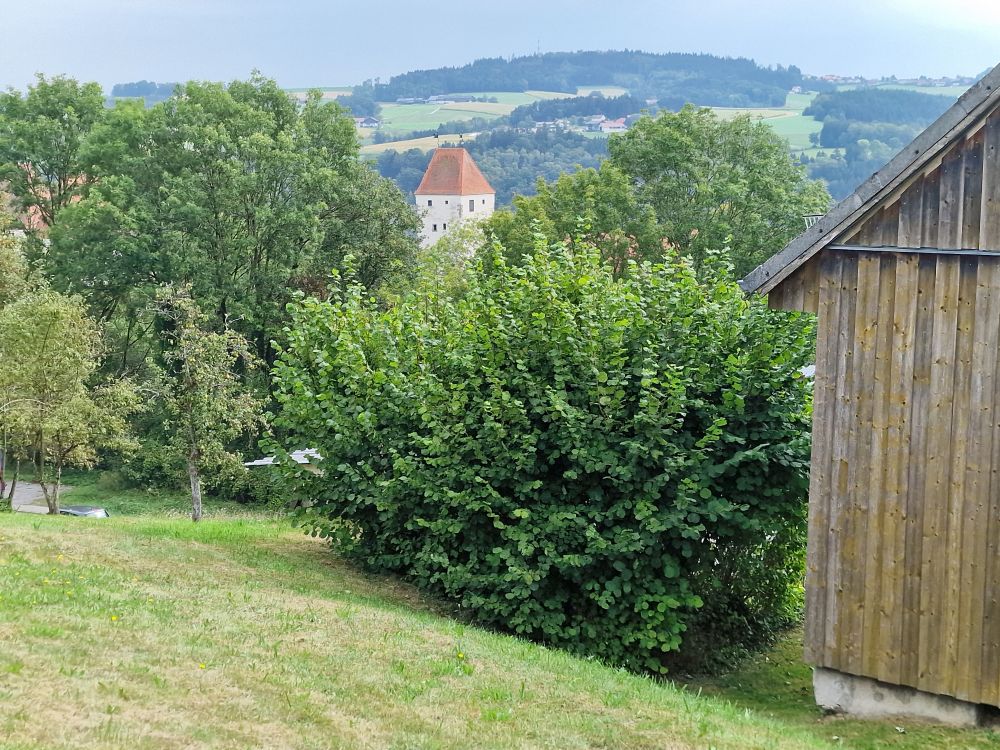
The Celtic oppidum in the Taubertal

In August 2024, the paintings of my grandfather Hermann Radzyk had motivated me to visit the Taubertal. I searched and found the easel locations at Rothenburg and Detwang. Now, I explore more of the Tauber valley. My first target is the Celtic oppidum Finsterlohr-Burgstall.

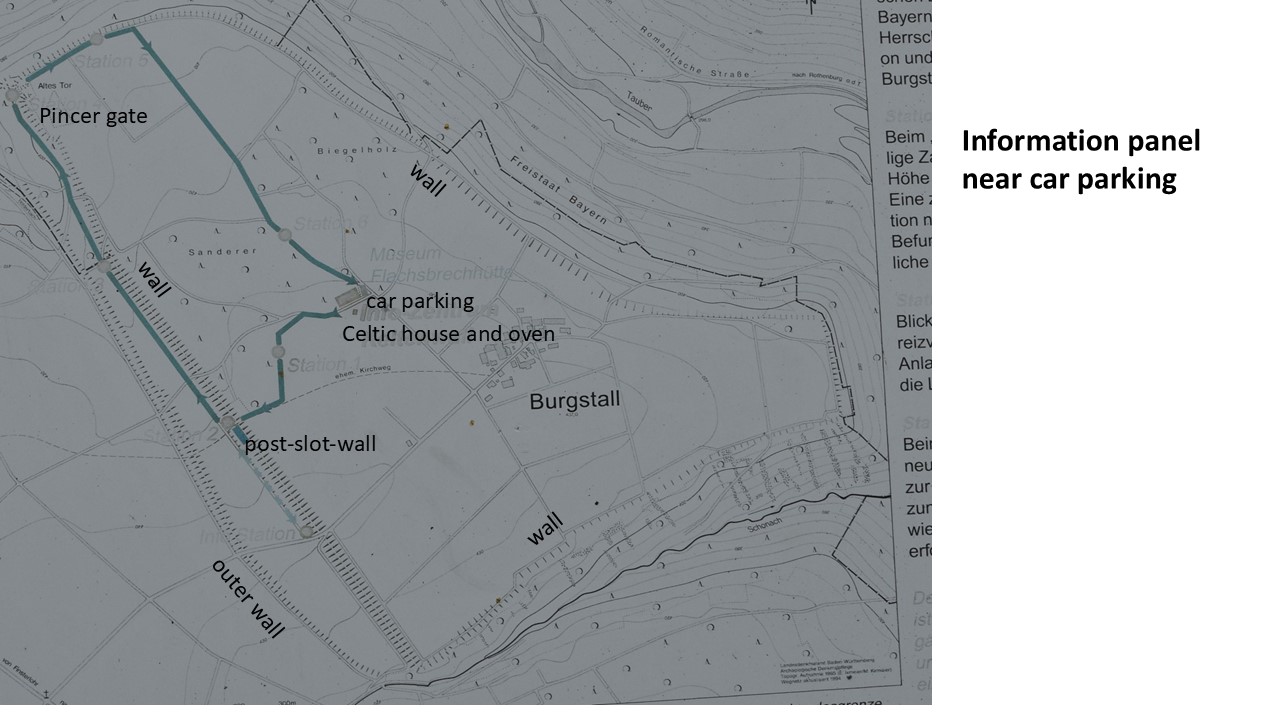
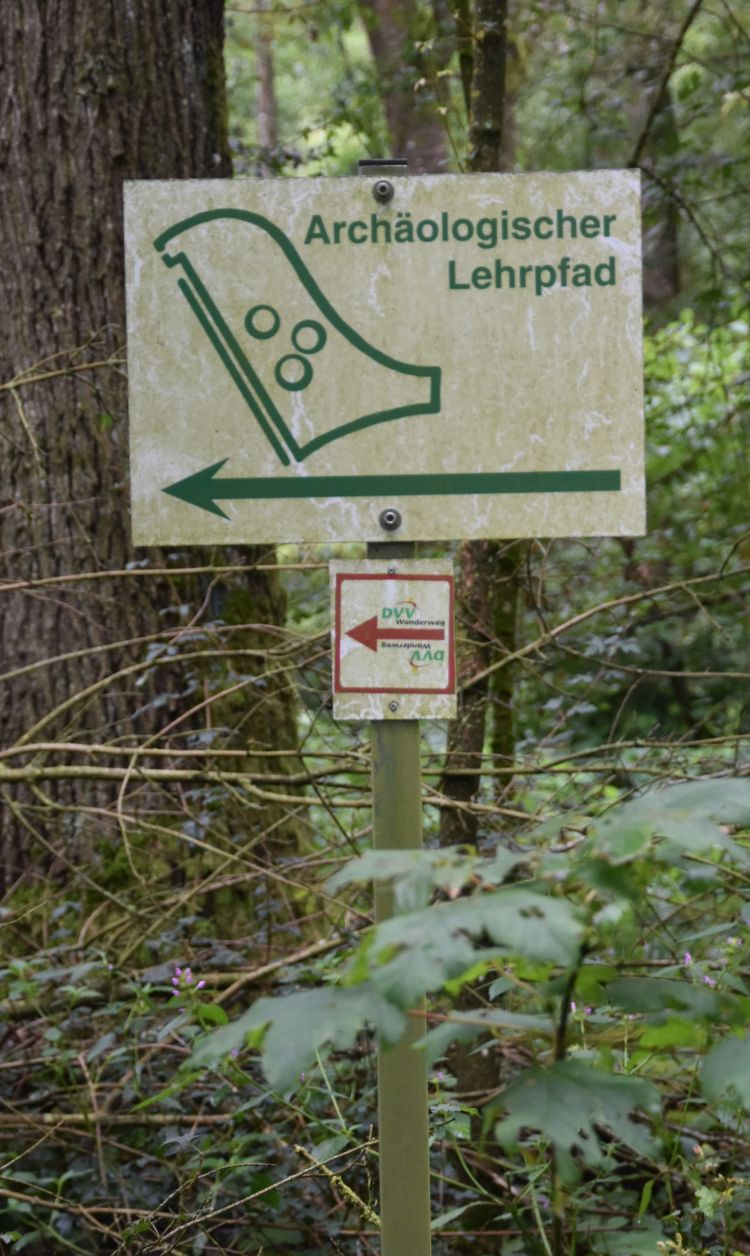
In the 2nd/1st century before Christ, the Celts had built an oppidum on a plateau above the Tauber valley. An educational trail of 2.5km was inaugurated by the association Kelten-Creglingen-Finsterlohr at Easter 2023. The trail is marked by the green coloured line on the panel ; it covers a small part of the former oppidum.

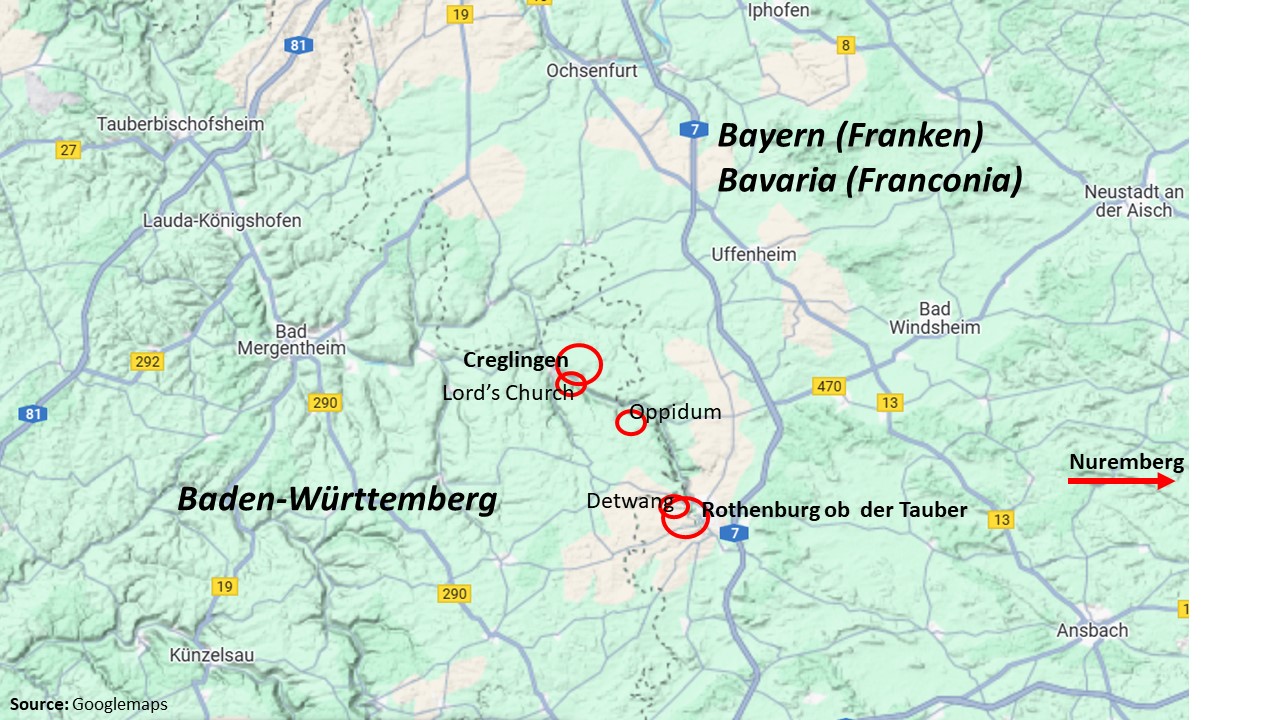
I am curious. With my car, I drive north from Rothenburg ob der Tauber following the road along the Tauber river. 

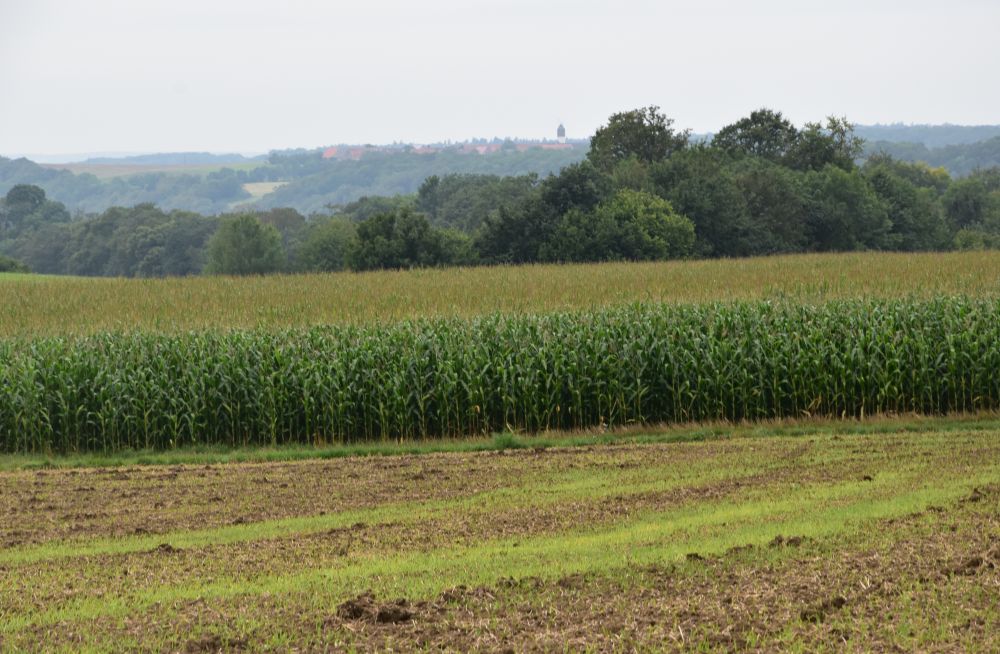
The river is cut deeply into the German plateau landscape. 

The oppidum is on the plateau. From the Tauber valley, a narrow steep road leads uphill, and I get stuck; a shepherd with his herd enters the narrow road from the right and heads down. I stop, another car coming down stops as well, and we wait. The sheep pass by my car on the steep embankment of the road, it is an enormously large herd. 


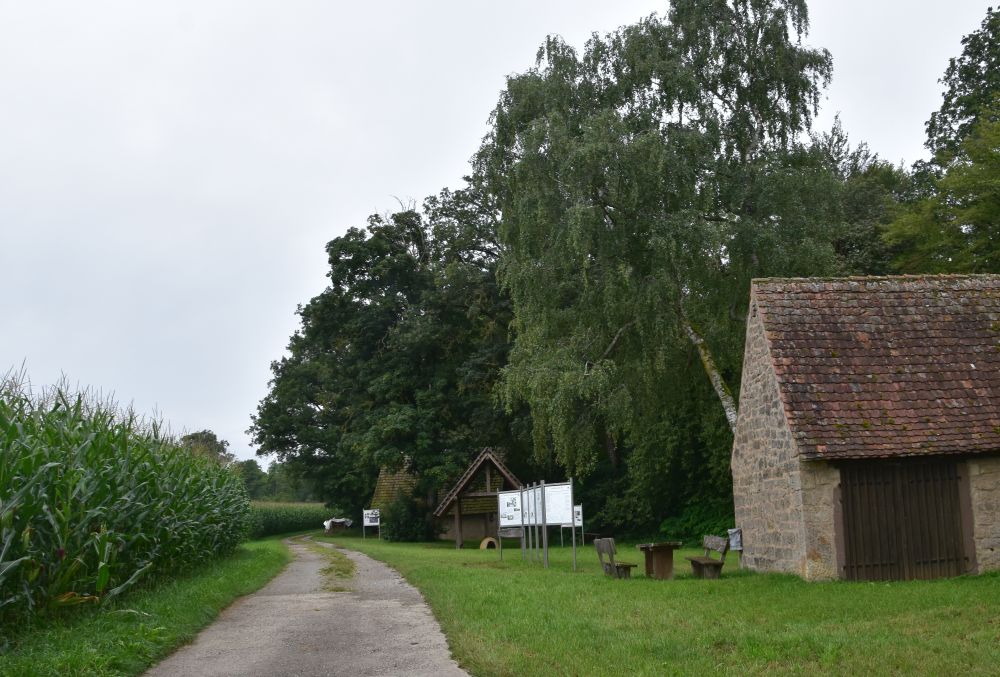
I feel sorry for the sheep. When the last sheep has past, the car coming down and me going up miraculously manage to cross each other. I drive up, reach the plateau and park my car at the start of the educational trail of the oppidum. I am the only car here and the only visitor. It is drizzling.

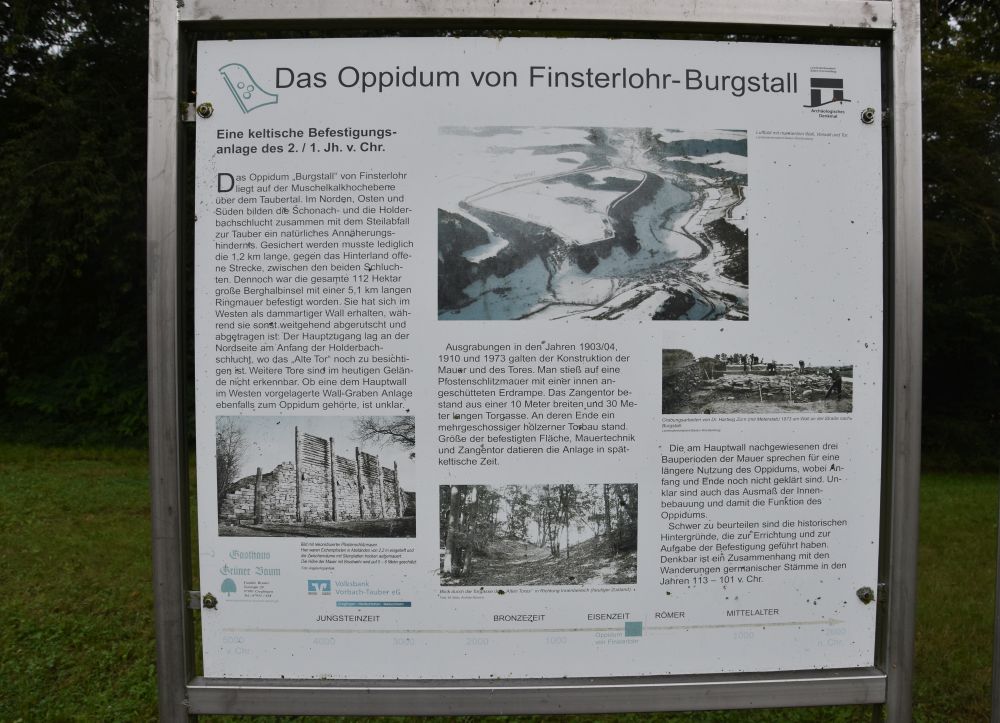
At the entrance, this panel explains to me, what I am going to see. 

On the shell limestone plateau, the Celts had selected the location for their oppidum carefully. It was well protected by the Tauber valley and two other smaller canyons. Only 1.2km of the oppidum, open towards the plateau,  would have needed protection. Nevertheless, the Celts protected the whole oppidum by a wall. Most of it has disappeared today. The main entrance to the oppidum was in the north above the Tauber valley. Excavations had uncovered the remains of the pincer gate (the panel shows the former passageway).  

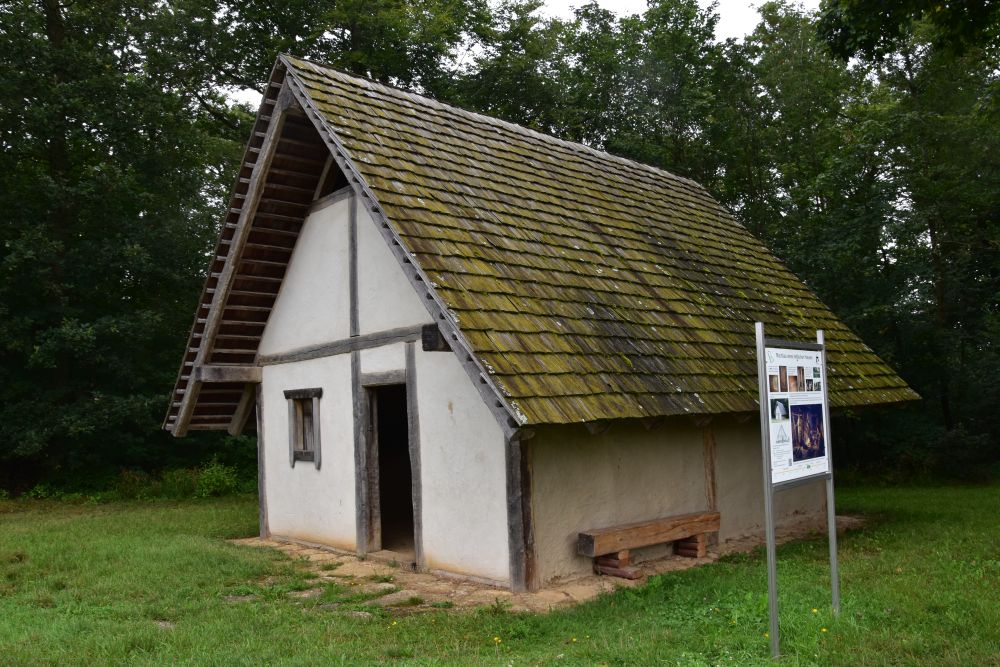
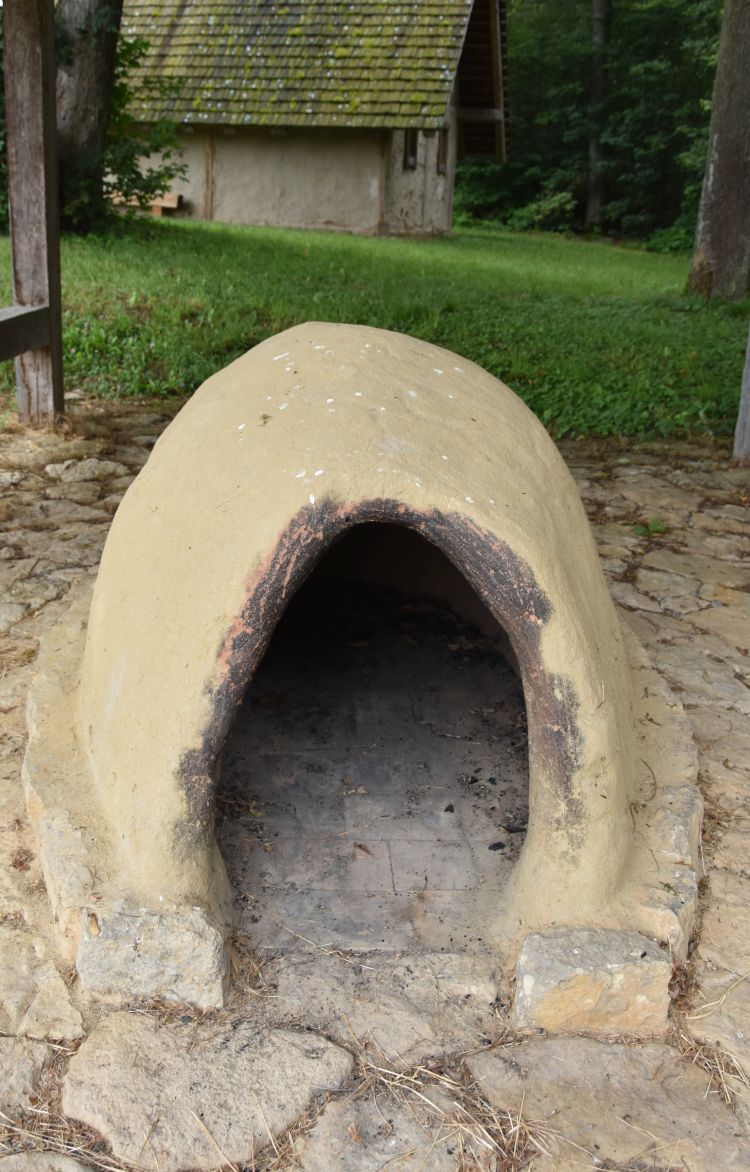
I get started. Behind the picnic table, the models of a Celtic house and a Celtic oven mark the first station on the trail. The panel next to it explains it all.

The Celts used loam to build their houses. Loam, a mixture of clay, sand and silt, is still in use today to build houses. For weather protection, the Celts painted the outside walls with white lime. 

Inside, there was a fireplace. The smoke waterproofed the roof and chased insects. 13 to 15 persons lived in such a house; with limited space and smoke, life must have been pretty uncomfortable.  

In the loam oven, the Celts baked bread at a temperature of 200 to 250 degrees. When the bread was done, they dried fruit in it, while it was cooling down. Rather sustainable production methods, we would say today.

The trail is well marked. I continue following the signs.

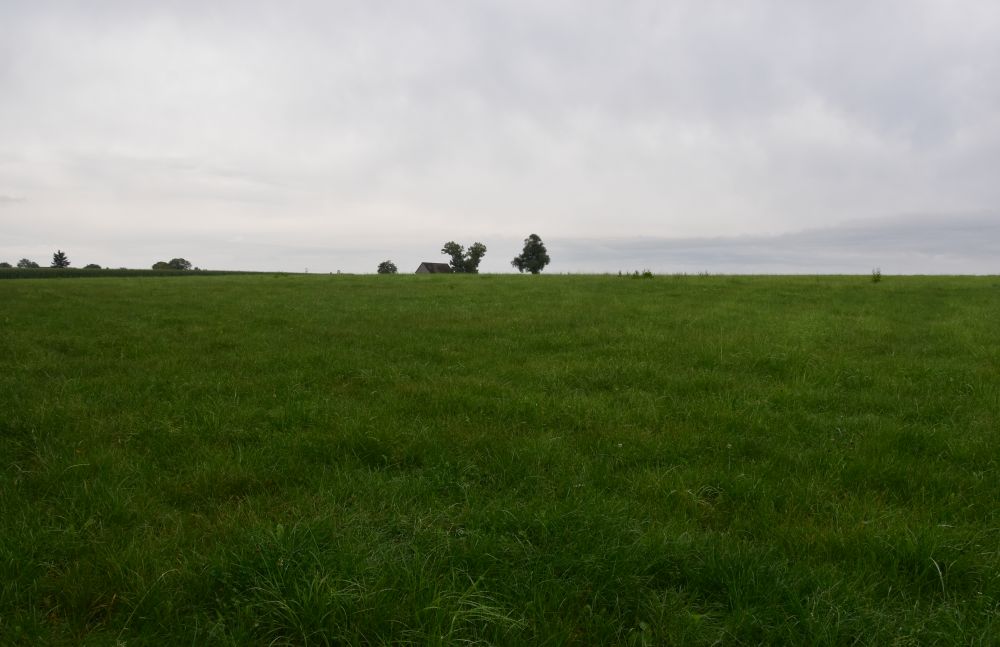
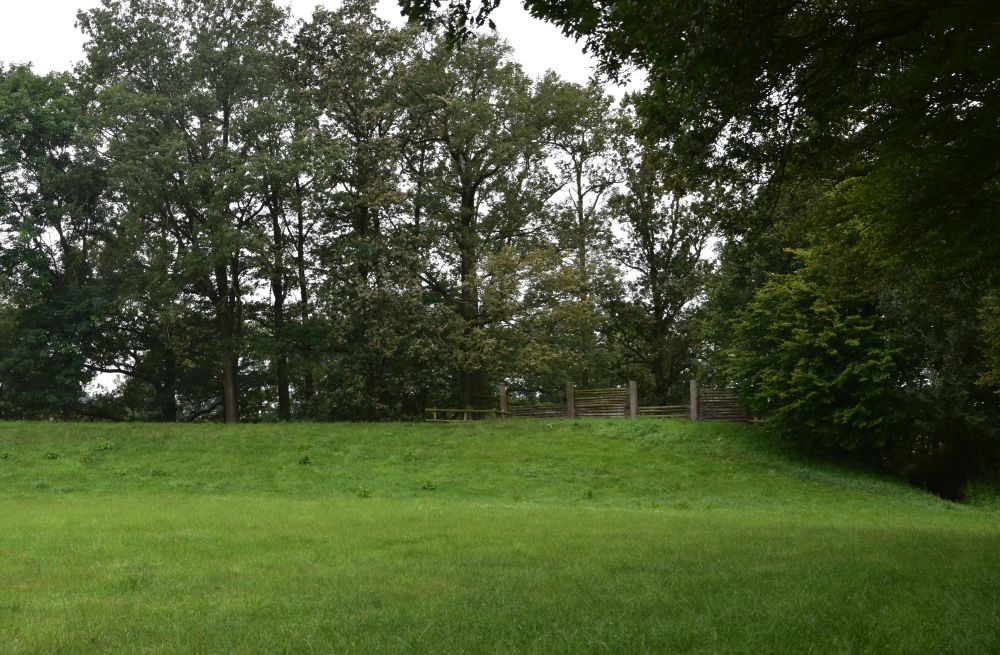
First, I walk “through the former village”. This is the view of the plateau looking south. 

In the distance, south, I can see Rothenburg ob der Tauber. 

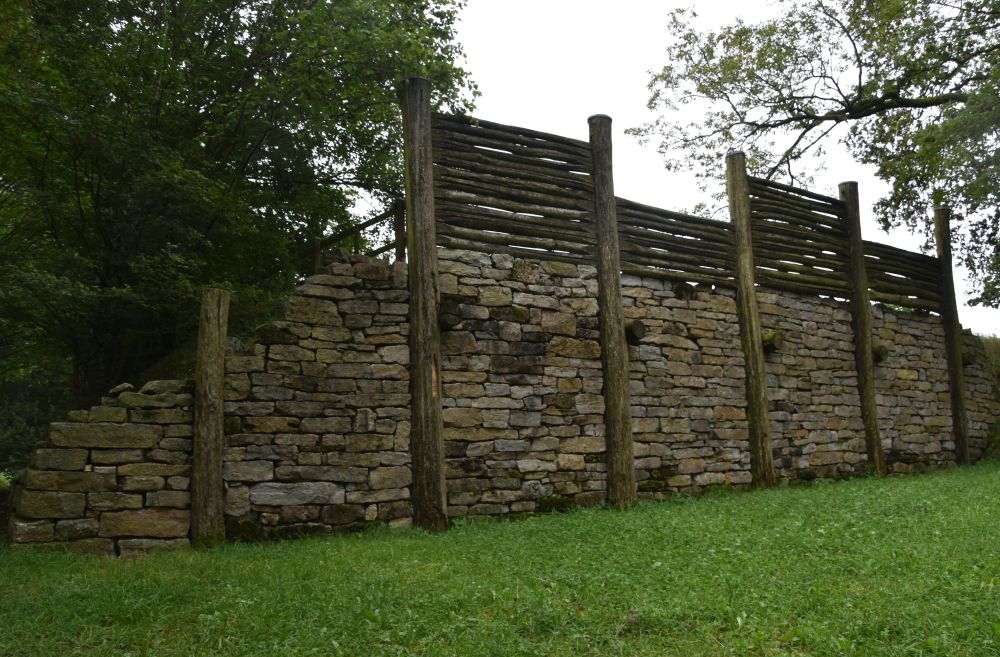
I reach the earth rampart at station 2. The post-slot-wall (Pfostenschlitzmauer) has been reconstructed; now I can see the upper wooden part above the earth rampart.

From the other side, it becomes clear that the wall was a dry masonry construction with oak beams (every 2.2 meters) and, at the back, the wall was fortified by the earth rampart. Overall, the wall was six meters high. 

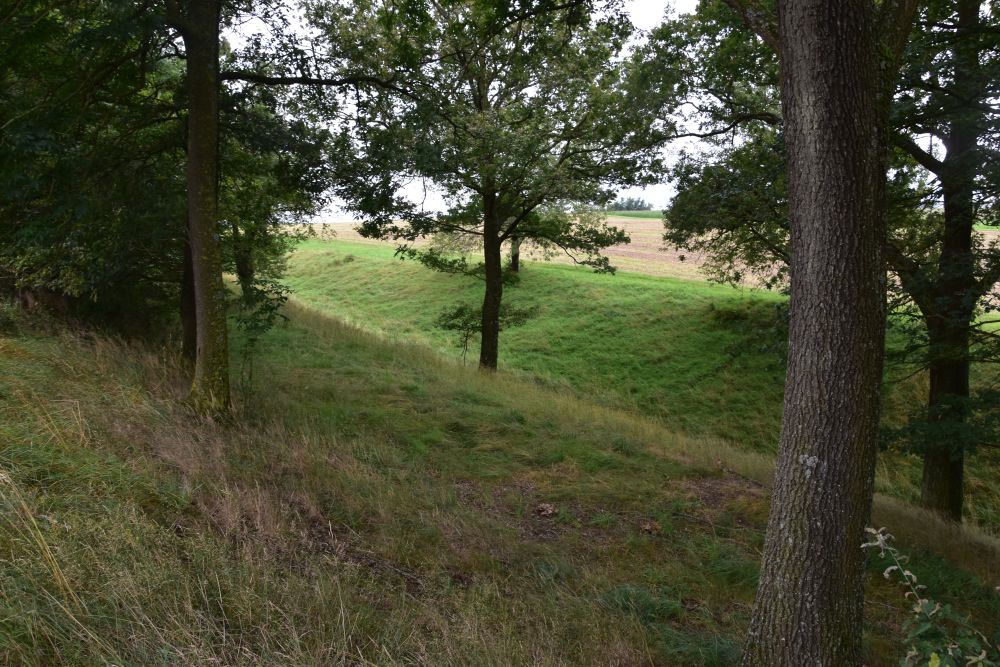
The wall went from south east to north east, the ditch indicates, where it was.

From here, the educational trail follows the former wall taking me north west and towards the Tauber valley. 

I reach the edge of the Tauber valley and the remains of the former pincer gate (Zangentor). In front of the gate, the last 30m of the exterior road were lined with two lateral walls (the “pincers”). The resulting passageway (Torgasse) lead to the wooden gate. I read the panel, and I admit, I could not identify the remains of the gate; you can see the remains of the passageway on the first information panel of the trail (above).

I walk along the edge of the Tauber valley, until the trail turns right and leads me back across the former oppidum to the starting point. 

While walking, I studied the panels informing me about the Celts. Here are some of my learnings.

The oppidum comprised about 112 hectares surrounded by the ring wall of 5.7km. The history of this oppidum is not known; it is not clear, how it was used by the Celts, as a permanent place of residence or as a shelter. The oppidum could have been part of the network of Celtic oppida, some of them covered more than 100 square kilometres. The oppida provided protection for people, their animals, the pastures and the fields. In addition, they were trade centres. 

The Celts were organized in tribes, not as nations. The Celtic society flourished in the 6th/5th century before Christ. They traded with the Mediterranean region, as archaeological finds of amphorae or tableware prove. They replaced their barter system with a money system; they minted their own silver and gold coins. Later, in medieval times, people found  pieces of gold in the fields, mostly after heavy rainfall. They believed that the pieces of gold had fallen down from heaven and that they would help to cure fever or pain.  

The Celts started to write adopting the alphabets of other peoples, e.g. the Greeks. However, writing was reserved to ordinary purposes, while the druids continued transmitting their knowledge orally. 

The Greek invented the name “Celts”. For instance Herodotus wrote about them in 450 before Christ. He was aware of the Galatians in Anatolia that were also a Celtic tribe. By the way, the Celts had also settled on the Cathedral hill of my home city Basel. Above the Rhine river,  the remains of a similar Celtic wall have been excavated, and the explanatory panels show the same post-slot-wall construction. 

The Celtic culture disappeared, when the Romans came. The Celts were romanized. I believe, they must have preferred the Roman way of living, as it was more comfortable (heating, water provision, baths, theatre, more effective agriculture and animal raising…).

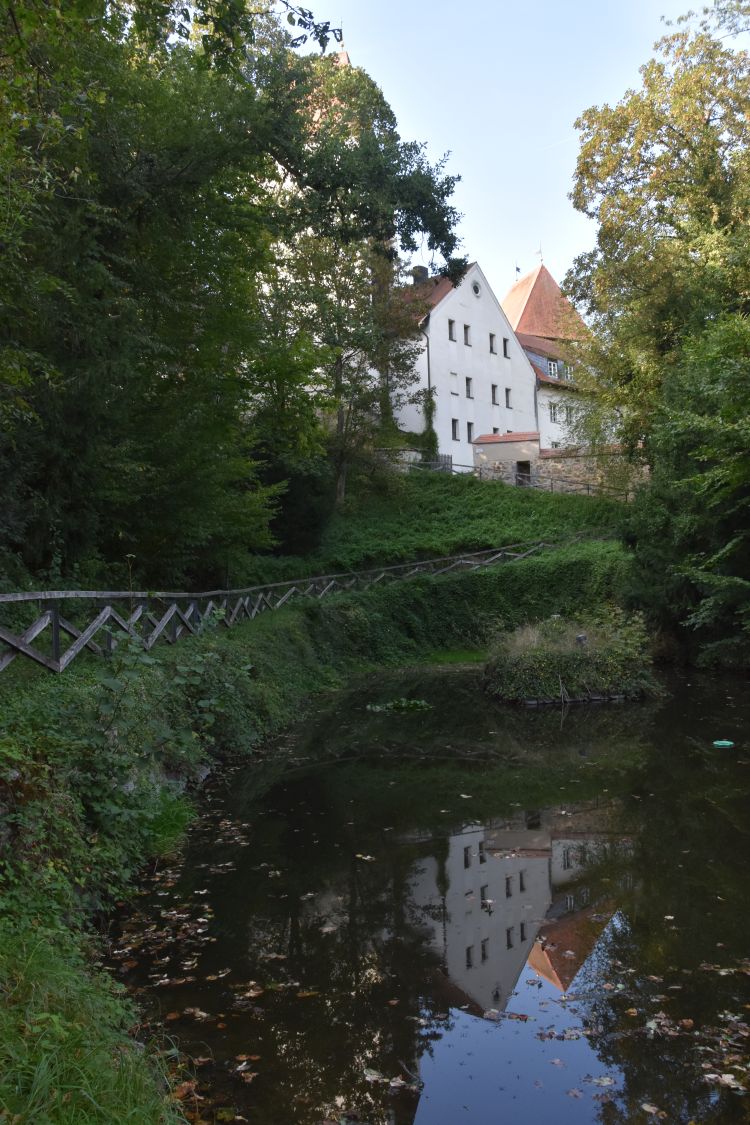
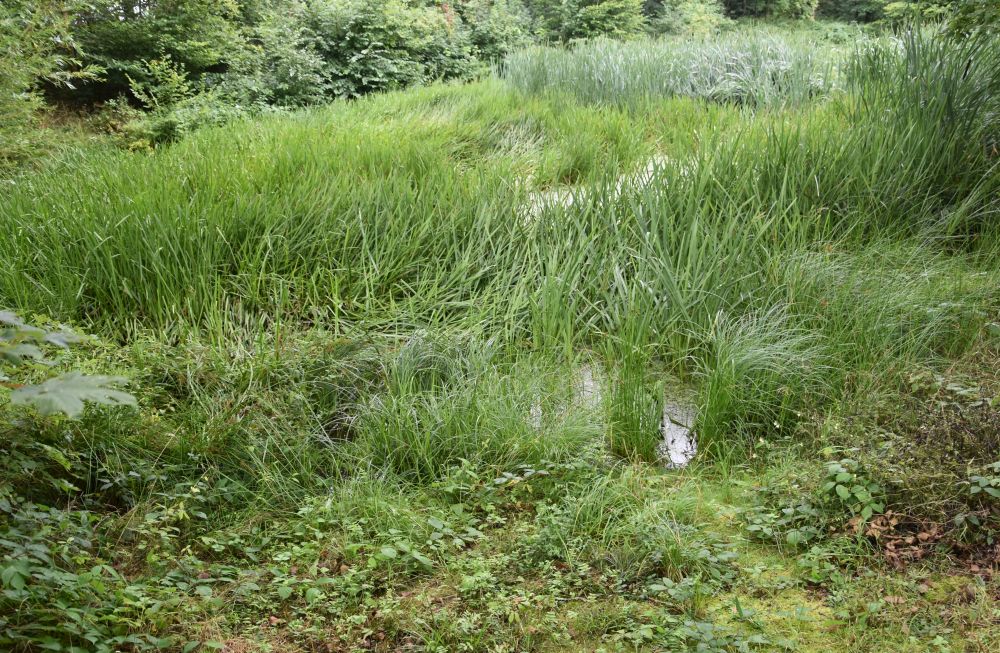
I finish my tour. I feel wet, it is drizzling. The last information panel stands near the “Old  Lake”, rather a swamp than a pond. Looking at it, I feel even wetter. 

With this swampy pond, I say good-bye to the Celts and their oppidum and continue my way to Creglingen, where another altar of Til Riemenschneider is waiting for me.  

Sources:

Strolling through Rothenburg, where Hermann Radzyk painted the Plönlein

Rothenburg’s Plönlein, painted by Hermann Radzyk in 1942, looks different now – why?

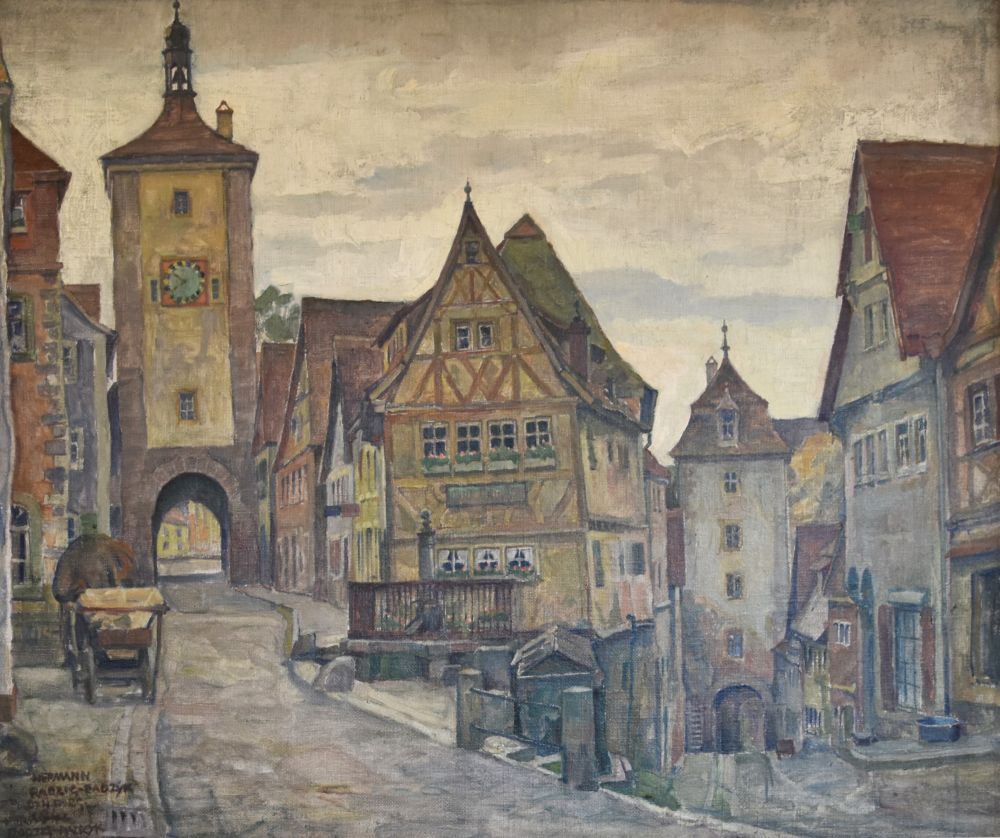
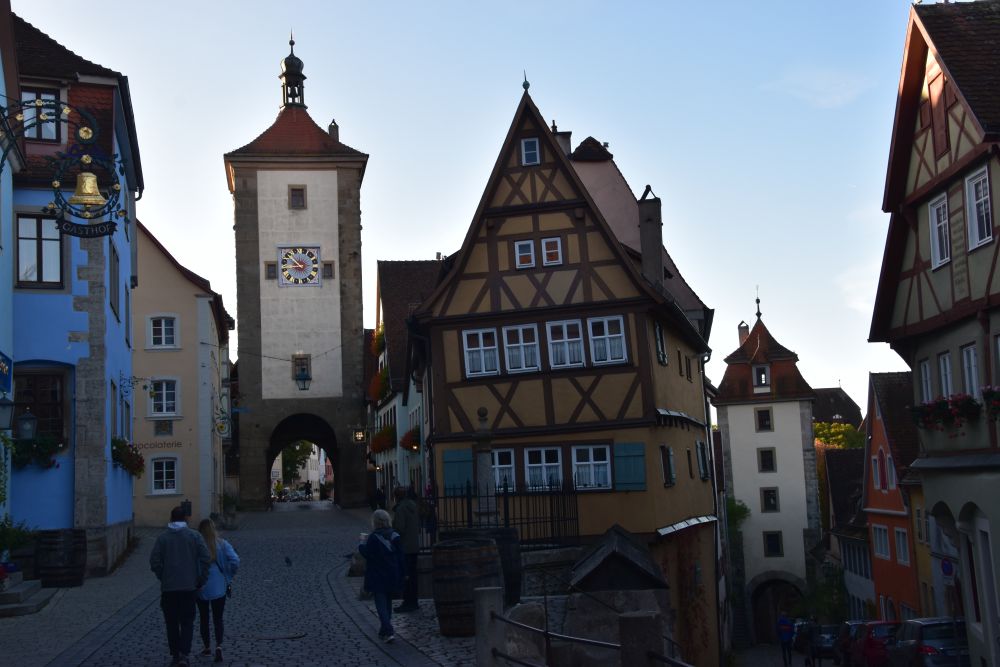
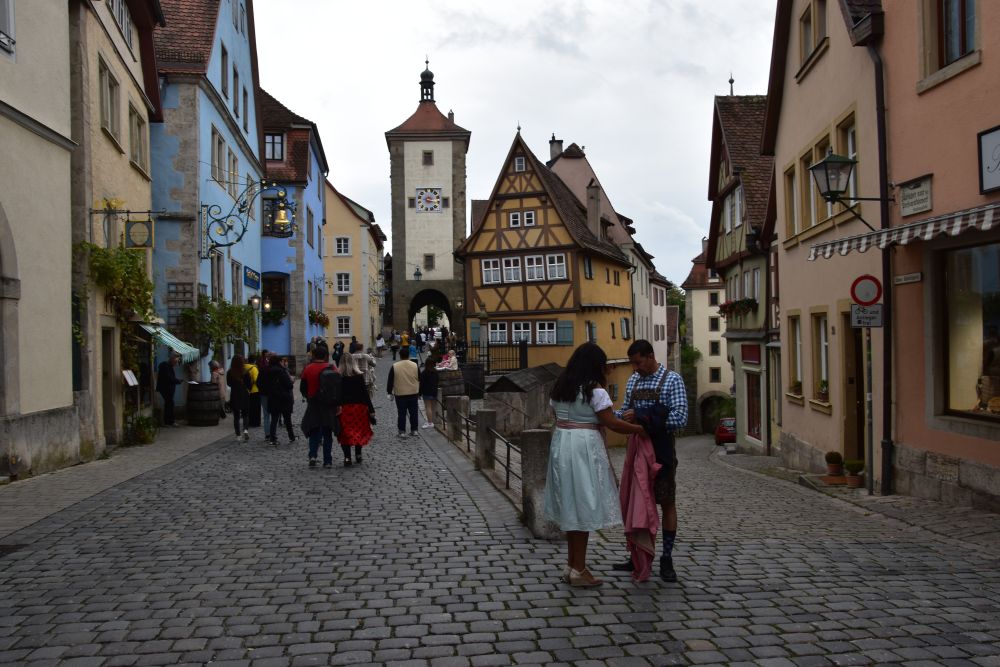
In 1942, my grandfather painted the Plönlein of Rothenburg ob der Tauber. It is the small half-timbered house with the curved beams. 

Look at my photo of the Plönlein. The architecture is different, the beams have been straightened. 

What has happened? Has the Plönlein been destroyed in World War II?

In World War II, 40% of the city of Rothenburg were destroyed. On Holy Saturday, 31st of March 1945, an American squadron set out to release their bombs near Rothenburg, but failed, because their target was in the fog. Fully loaded they were not able to land, and, on the way back, they released their bombs above Rothenburg. Bravely, the citizens of Rothenburg reconstructed their city in the medieval style (see “Rothenburg-unterm-hakenkreuz”).

I always suspected, also the Plönlein had been destroyed by the bomb attacks, but no, it was renovated after the war. I learnt that in October 2024, when I had breakfast in the Hotel Uhl next to the Plönlein. The owner’s father said that the Plönlein had not been affected by the bombs, though the house right across the street was damaged. The Plönlein was renovated in the 1950’s or 60’s, because the old beams were rotten. And now, the beams of the Plönlein are no longer curved, but straight. The tourists continue to like it.


The Plönlein is the tourists’ favourite, and Plönlein souvenirs are in high demand

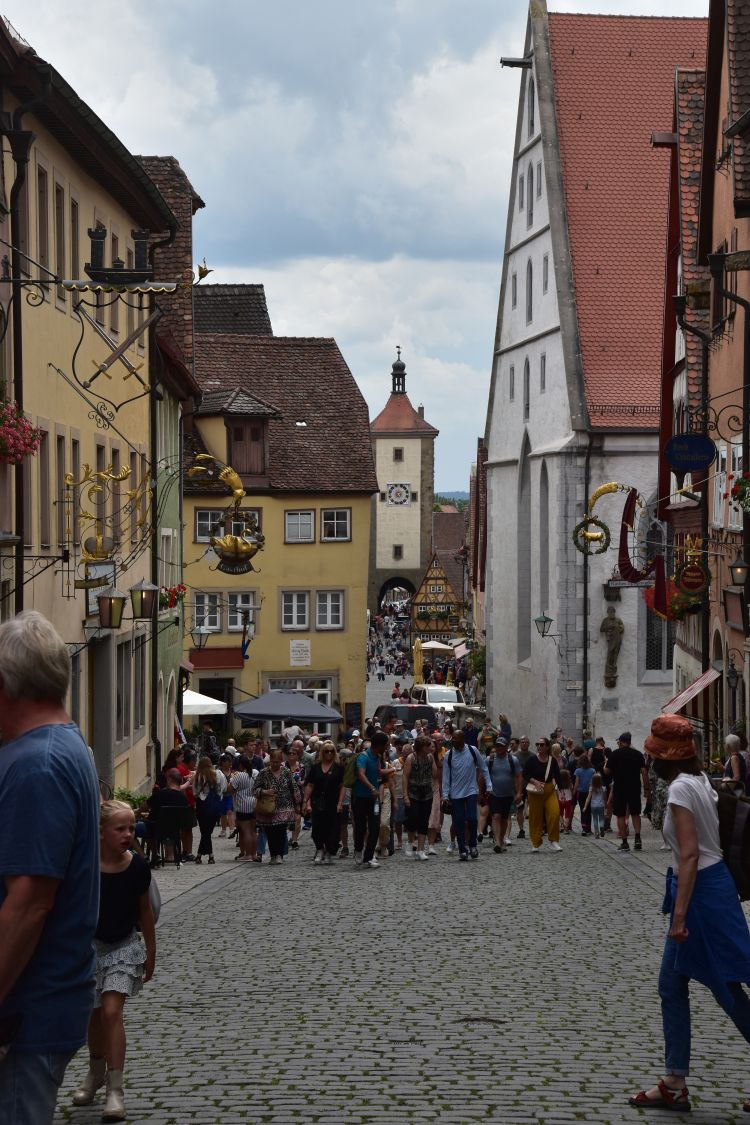
The Plönlein is THE attraction of Rothenburg. The Schmiedgasse is crowded with tourists.  What would my grandfather say?

This Japanese couple dressed as Bavarians in dirndl and leather shorts (called “Krachlederne”) is getting ready to make a selfie in front of the Plönlein. They enjoy it, they laugh, and I smile with them. 

Next to the Plönlein, the small restaurant Peking caters for Chinese tourists advertising their meals in Chinese.

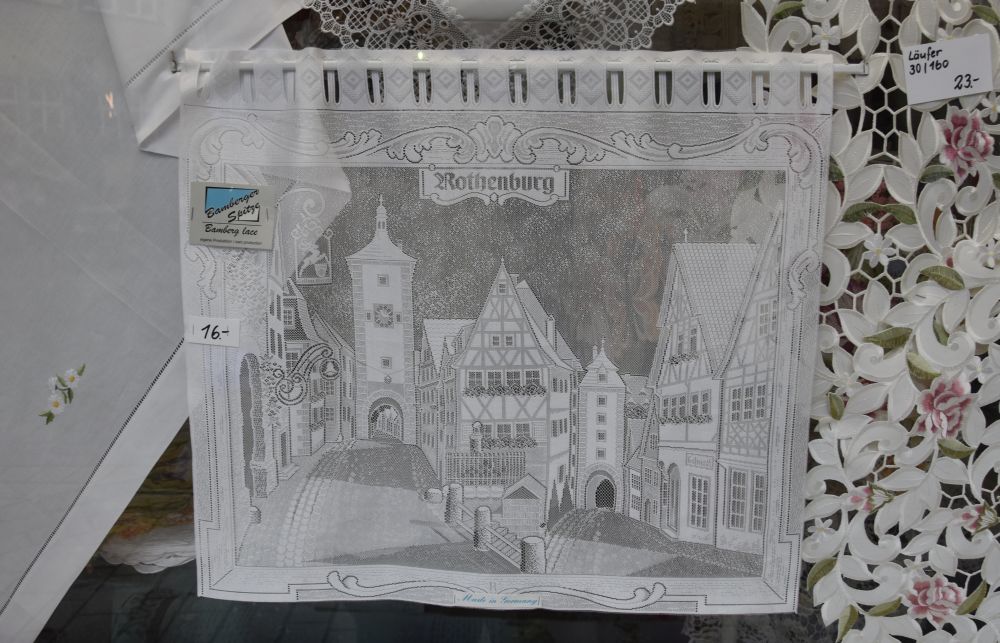
Souvenirs of the Plönlein are in high demand. They appear in the souvenir shops on curtains, …

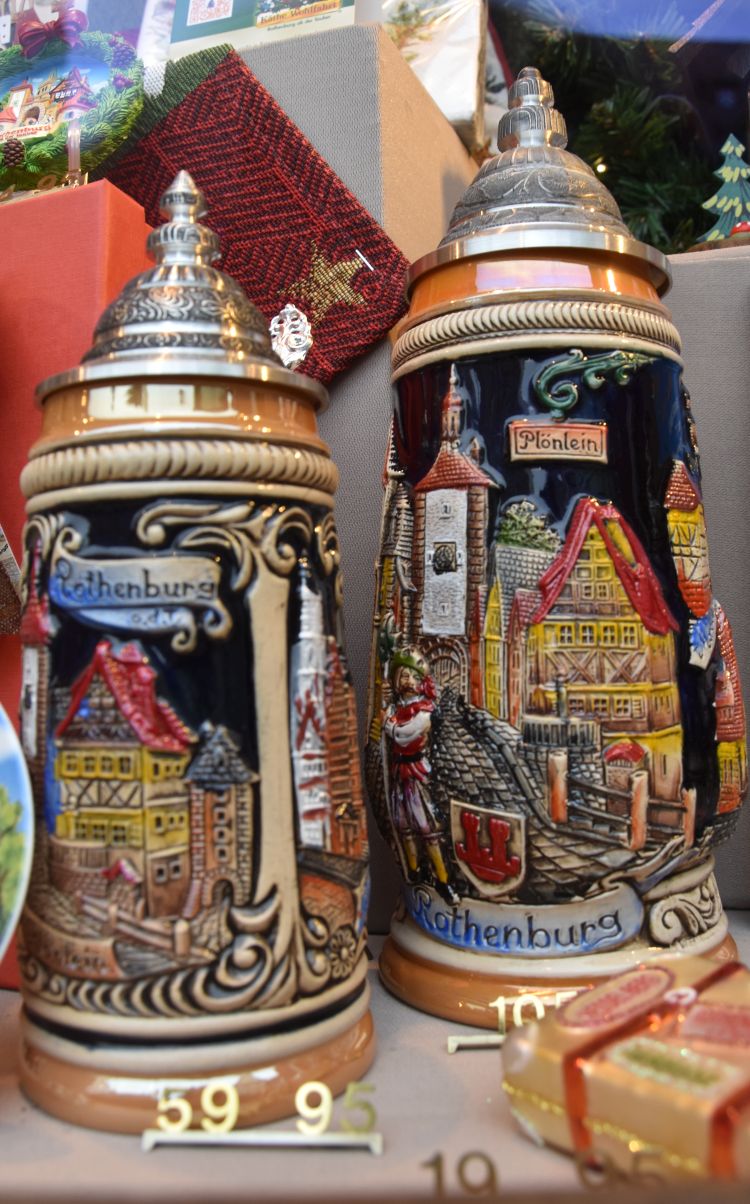
… beer tankards, … 

… ceramic tiles and plates, …. 

… bags, T-shirts, key rings, fridge magnets, snow globes, framed photos or paintings … they are sold as small model houses…  no limits to the phantasy and mostly at the brink of kitsch.


The market square: The “twin townhall” and medieval houses

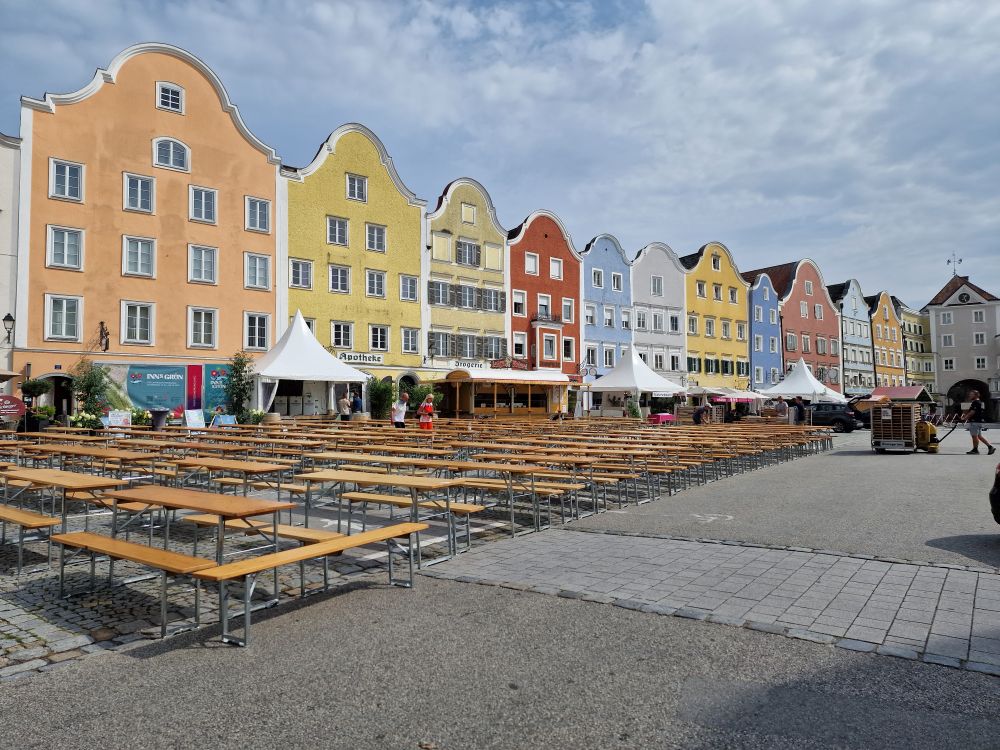
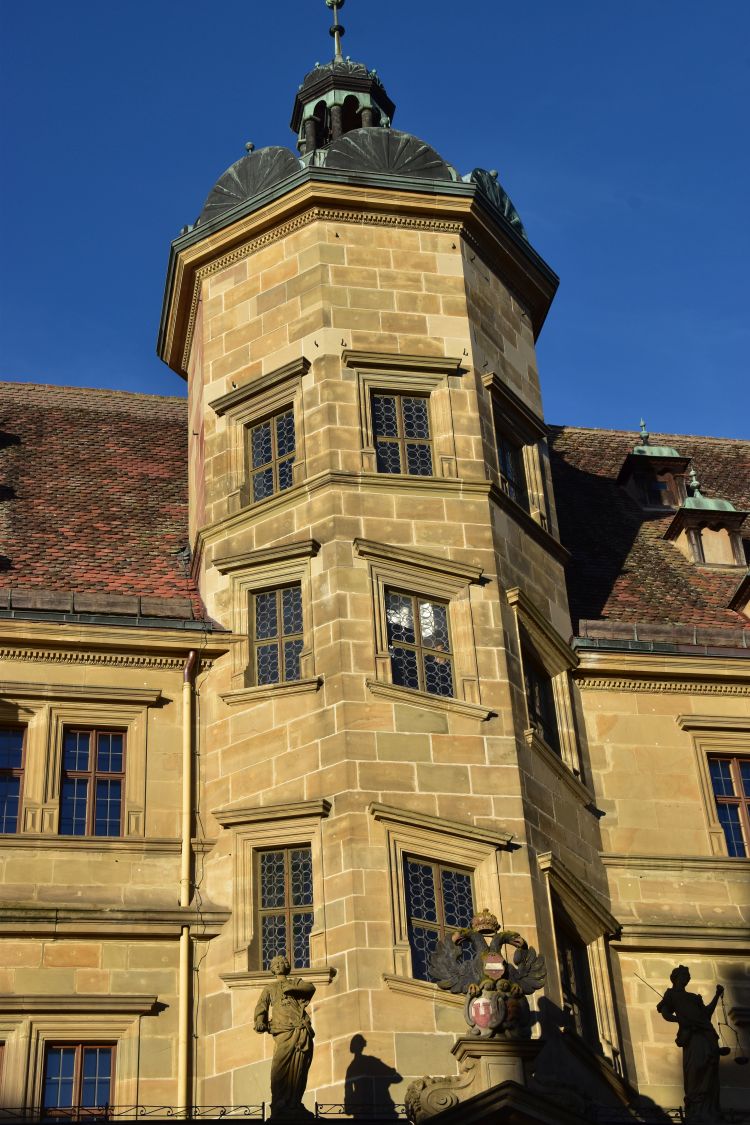
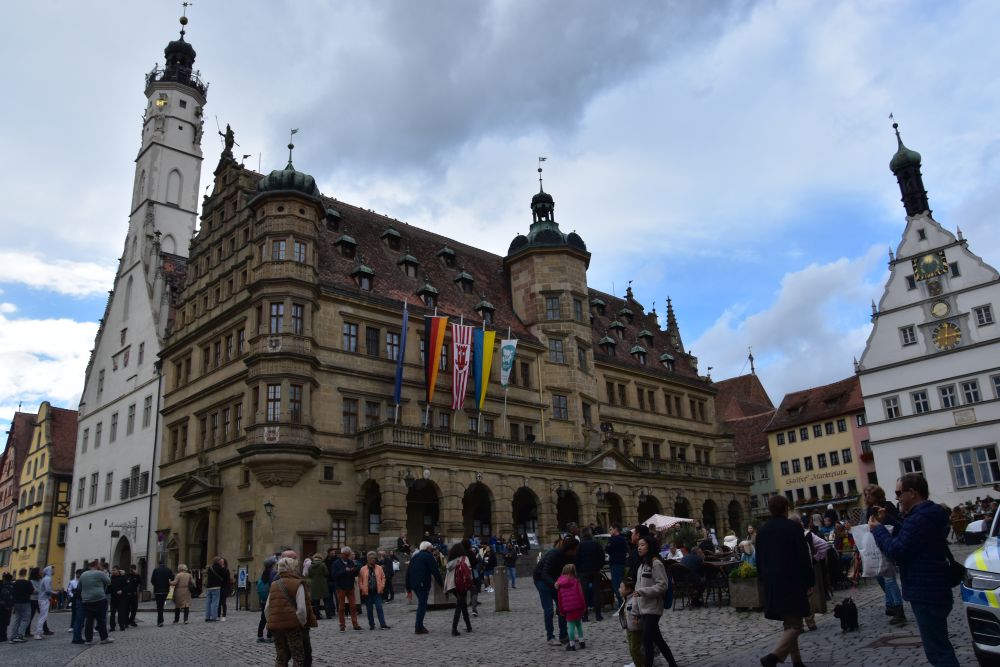
The centre of the city is the market square with the “twin townhall”. The white part with the tower is Gothic (built 1200-1400), the ochre part is Renaissance (16th century, constructed after the great city fire of 1501). 

The Renaissance staircase disappears behind the gallery that has been added in the late 17th century.

I climbed the Gothic white townhall tower. First I walked up comfortably in the Renaissance staircase. Next, in the old tower, the stairs became steeper and steeeper, and on top, I had to do almost rock climbing to lift myself from the last step on to the balcony platform. I took no photo, I stood in the mist, it was a rainy afternoon.

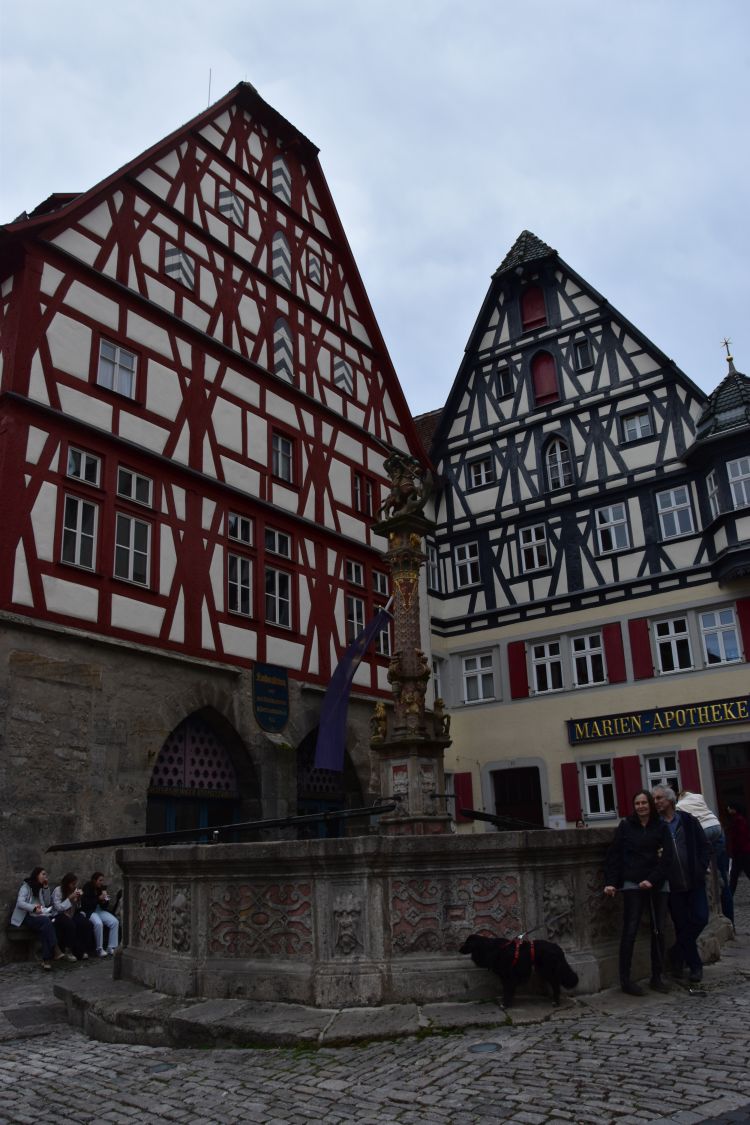
Across the townhall, these beautiful half-timbered houses line the market square; in the house labelled “Marien-Apotheke”, emperor Maximilian I was a prominent guest in 1513.  

The other building is called Meat- and Dance-House. The Künstlerbund, founded in 1923, makes exhibitions here and, according to their website, they are open every day after 13.00. I was curious, but the door was closed. I could not find out, why. The Künstlerbund seems to be a secret association. 

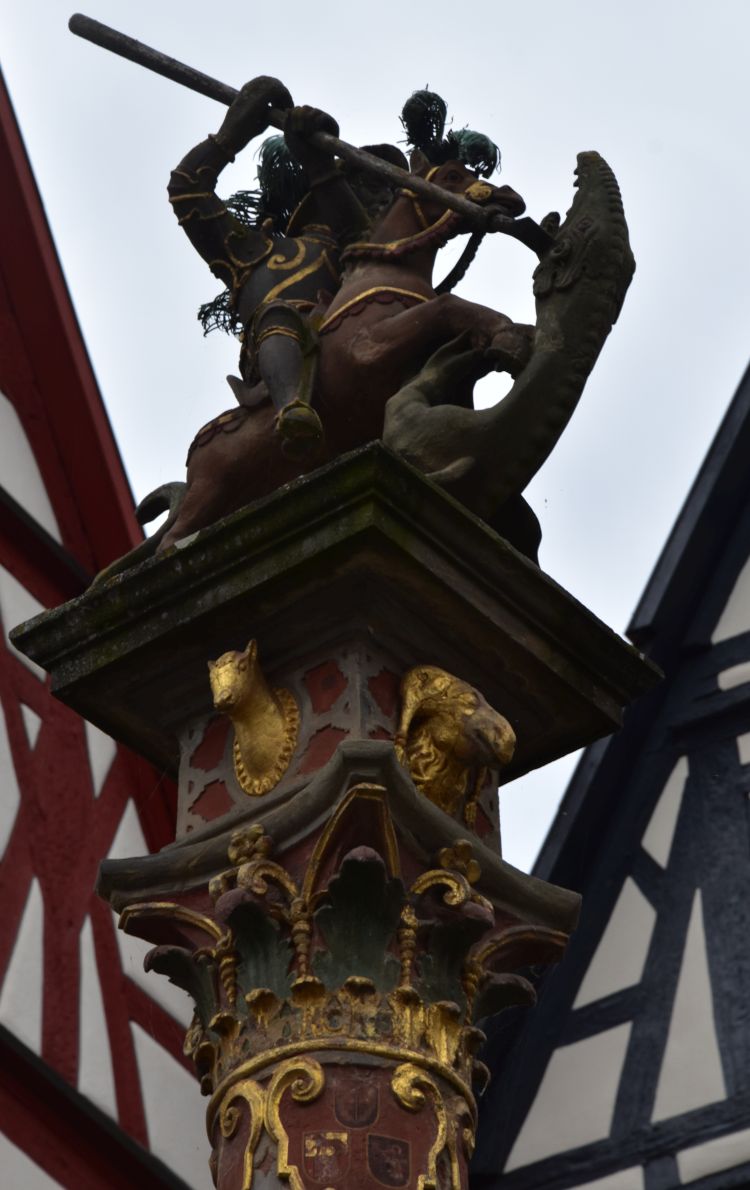
In front of these two half-timbered buildings, a fountain had been installed in 1446. In 1608, it had been replaced by the Renaissance fountain that we see today. Saint George fights the dragon.

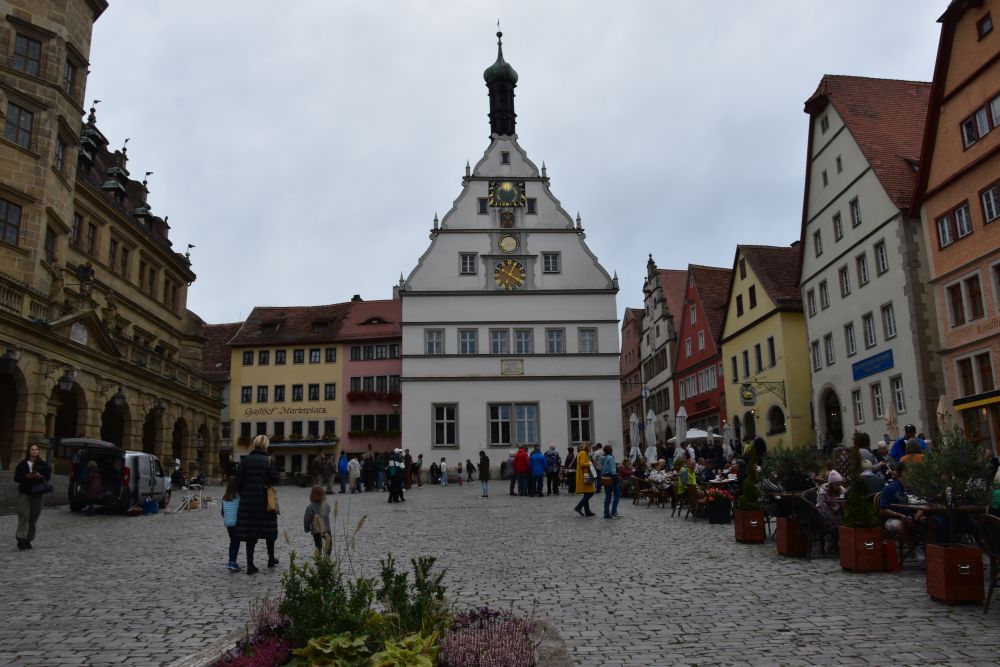
The market square is lined with medieval houses, carefully rebuilt after the bomb attack of 1945. The building with the historical clocks is the Ratstrinkstube (something like an inn reserved for the councilmen). Field marshall Jean Tilly and old mayor Georg Nusch appear every full hour in the windows besides the clock. They illustrate, how, in the 30 years’ war,  the old mayor saved the city by drinking a tankard of 3.25l of Franconian wine in one go.

Right below and behind me is the Renaissance Baumeisterhaus, the house of the main mason of Rothenburg. He built his house with the sculptures in 1596. 

Impressive medieval marketing.

Inside I find a restaurant in a court,  a wonderful atmosphere. However, the restaurant is good for people that like a lot of meat with dumplings, but hate vegetables. I found better restaurants at Rothenburg, such as the Butz or the Glocke.


The Saint James church with the Heiligkreuz altar of Riemenschneider 

The Gothic St. James church, built between 1311 and 1484, became a Lutheran church, when Rothenburg joined the reformation in 1544.

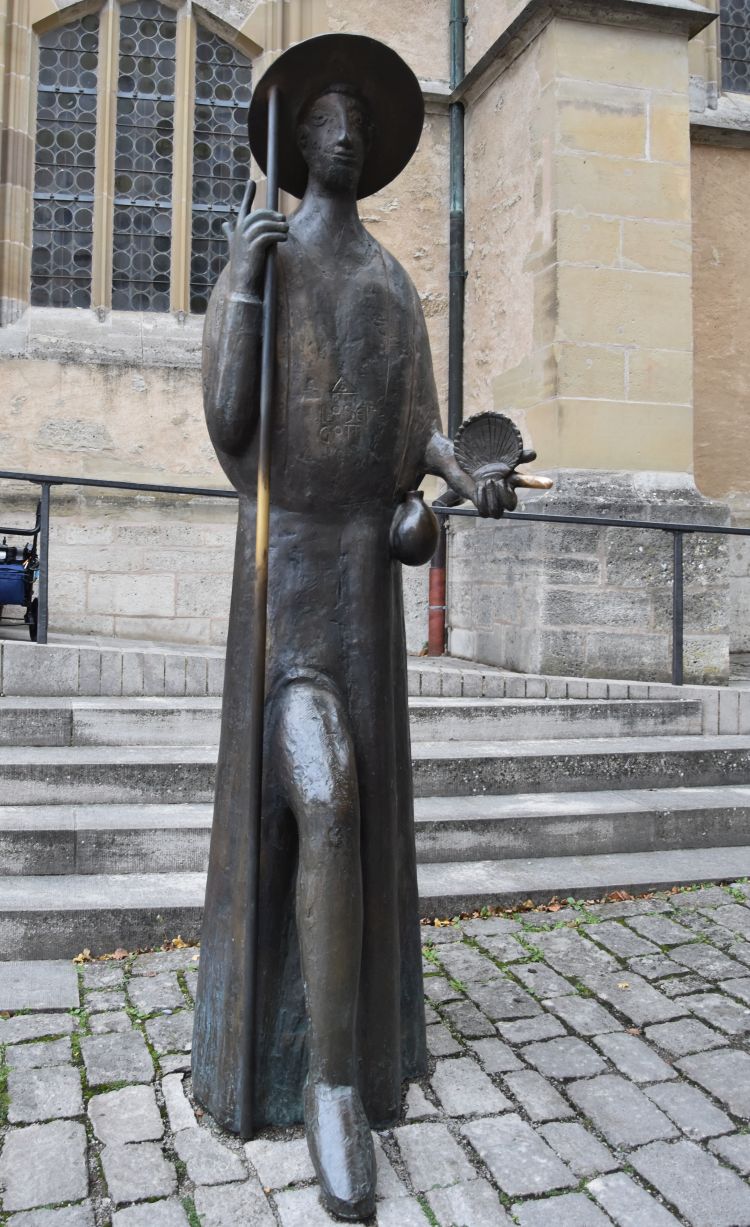
A modern friendly Saint James with a smile on his lips invites the pilgrims to enter the church (sculptor: Steinacker, 2002; see Gussmann).

There are also some tourists who follow his invitation – like me. Inside the Gothic vaults seem to rise up to heaven.

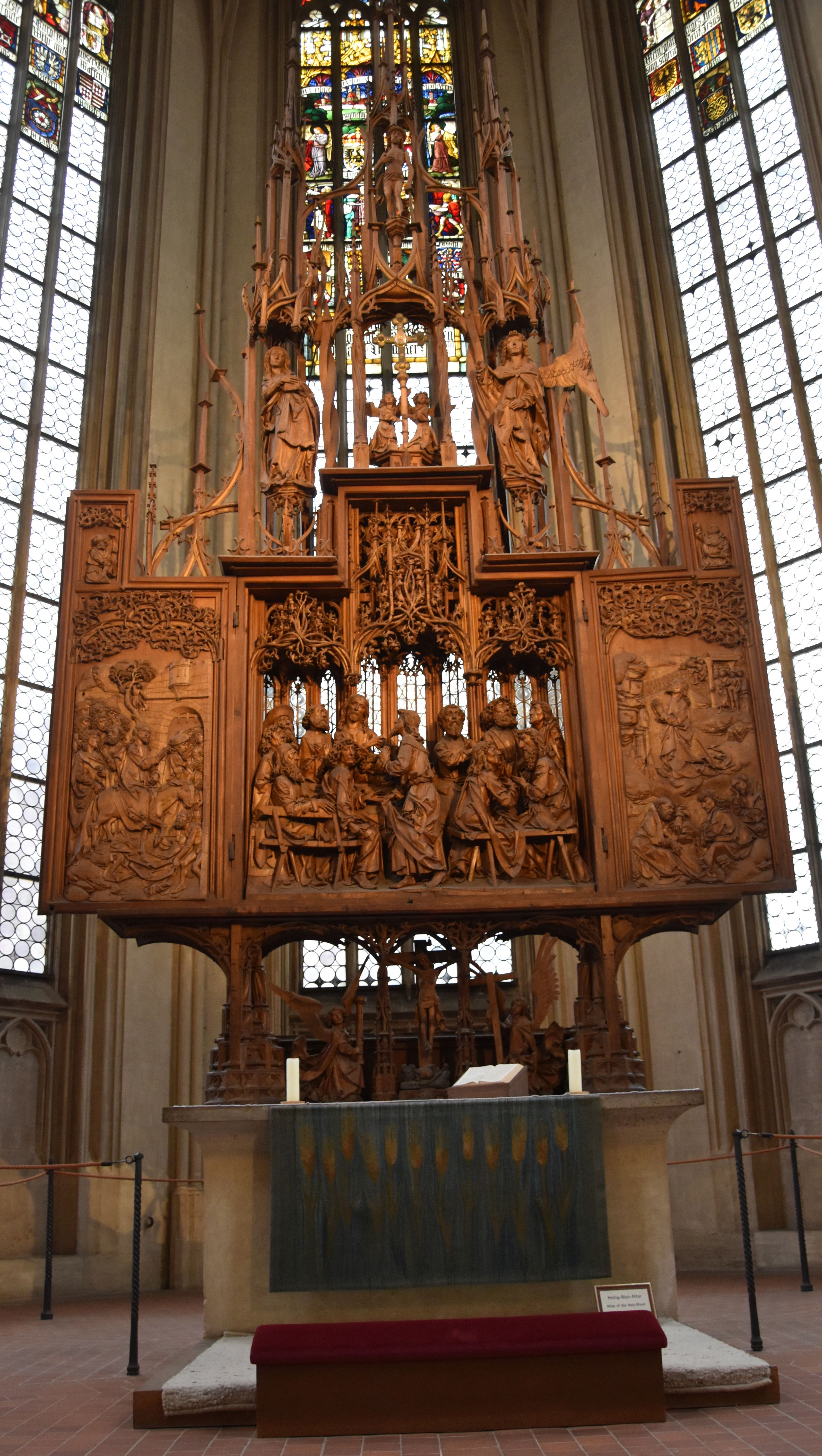
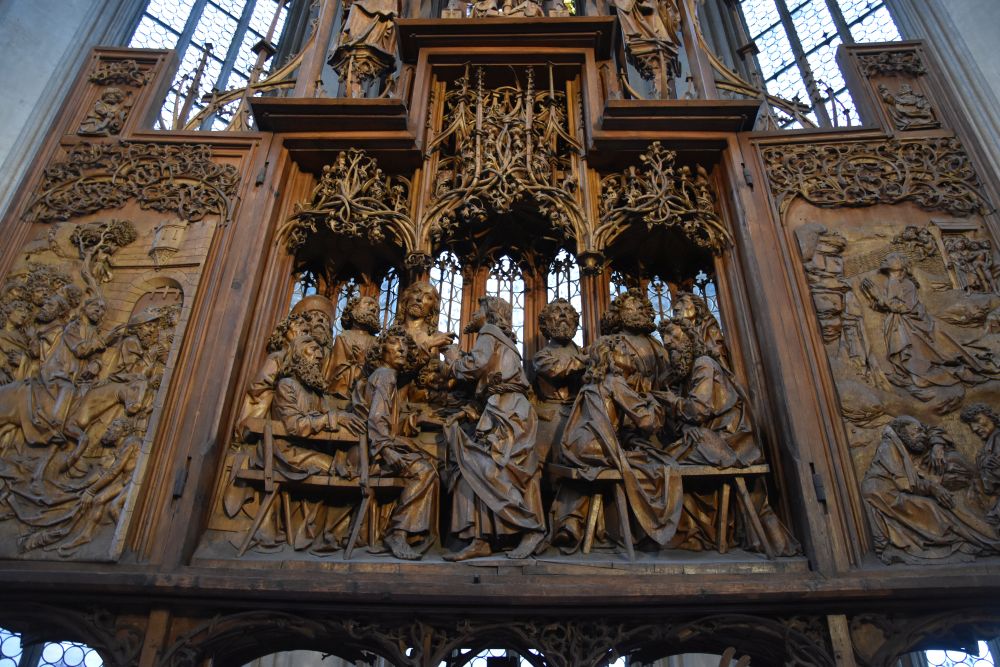
In 1499 to 1505, Til Riemenschneider created the Heilig-Blut-Altar (Holy-Blood-Altar) for the west choir that crosses the Klingengasse. Riemenschneider was asked to build the altar for the relic of the Holy Blood; he placed the relic in the gilded cross of 1270; it is held by two angels. Below and in the centre, there are the Last Supper, the Garden Gethsemane and Jesus entering Jerusalem. The altar with its relic became an important pilgrimage site. It is unique that a protestant church contains a relic for the Catholics, it is a sign of reconciliation.

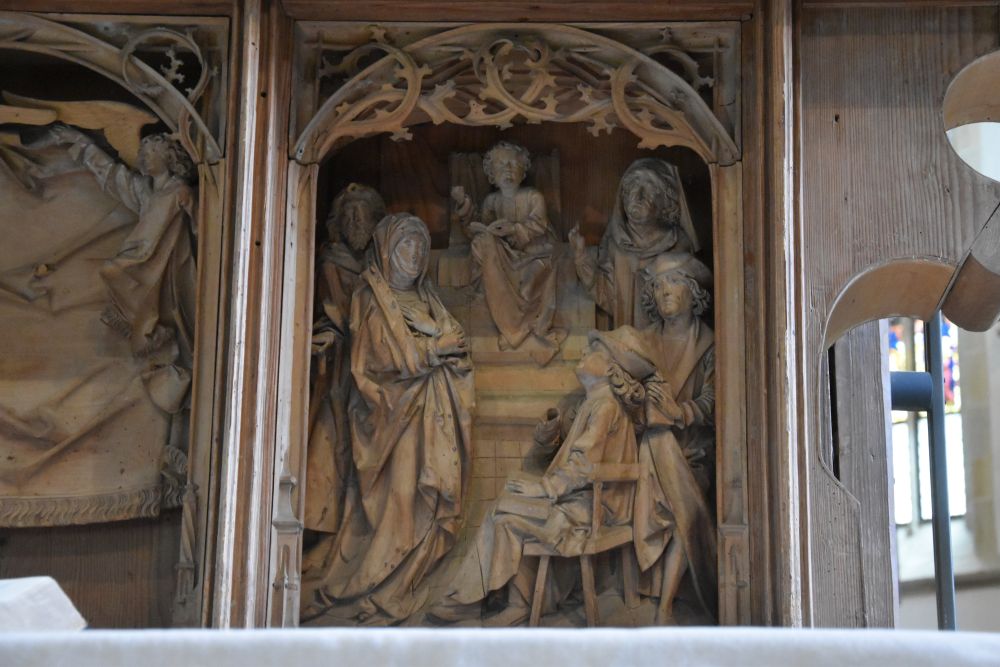
In the scene of the Last Super, Judas is in the centre, not Jesus. Jesus passes Judas the bread. It is the moment, where Jesus says: “One of you shall betray me”. I see the shock in the faces of the disciples. For instance, to the right, two of them seem to be debating: “No, it will not be me, I will not betray Jesus…”. However, the pastor Oliver Gussmann says that the disciples seem to take no interest in the scene with Judas and Jesus (https://youtu.be/An5XAw1fr78). He would perhaps say, the two debating just continue being focused on their intense debate. The unusual and vivid setting of the Last Supper is fascinating, the expressive faces of the disciples call our imagination and evoke our own interpretation. Riemenschneider had carved the figures out of limewood.

 –

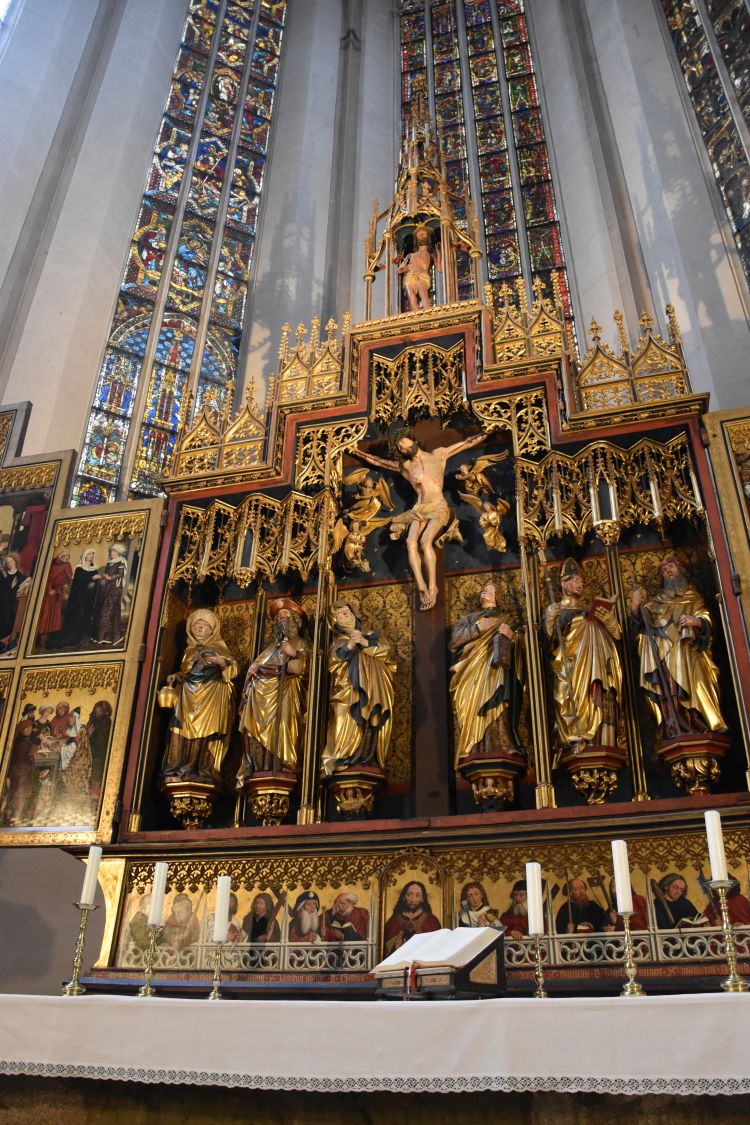
In the eastern choir, there is another gem: Friedrich Herlin was the construction manager of the “Twelve Apostles’ Altar” (Zwölfbotenaltar, 1466). It has its name from the Predella, where Jesus appears with the twelve apostles. 

In the middle, we see the crucifixion scene with Maria, James and Elisabeth von Thüringen to the left and the disciple John, a bishop (perhaps Leonhard) and Antonius with his bell to the right (Rothenburg brochure, p. 22 and video of Gussmann). 

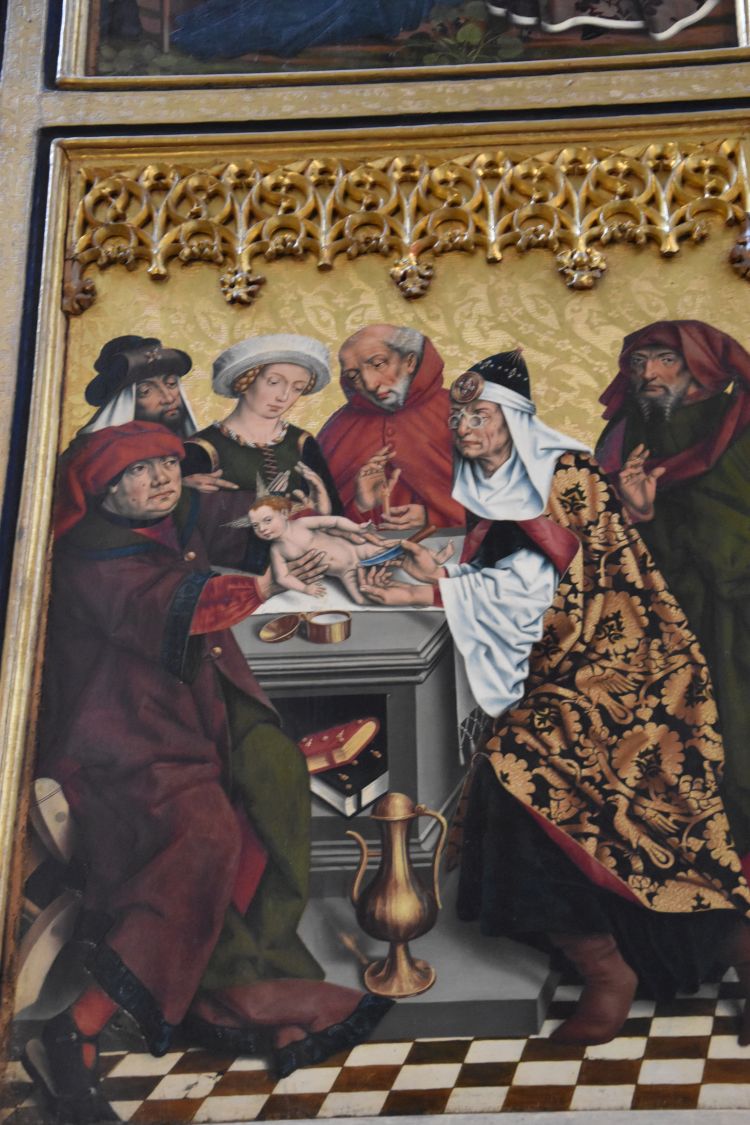
Herlin himself made the paintings on the side wings and the Predella. Some of Herlin’s figures wear glasses. When Herlin became older, he had problems to see the details; wearing glasses he could read and paint again (Gussmann). Herlin was so impressed that he gave glasses to some of the figures on the altar, for instance to the circumciser in the Circumcision scene.

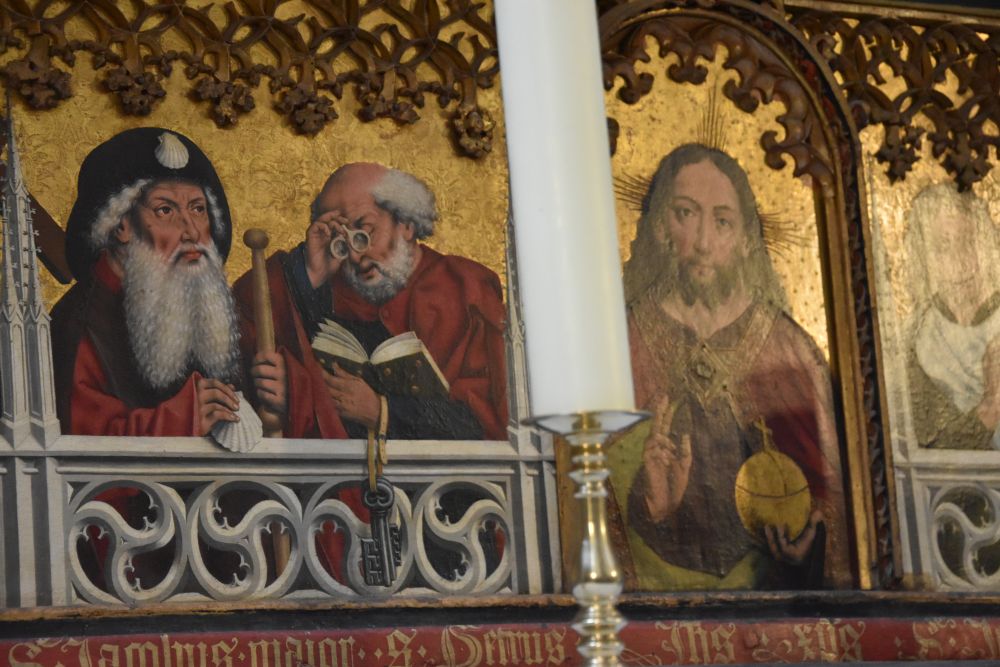
Also Petrus in the Predella wears glasses; he is an elderly man and needs them for reading. Never before have I seen people wth glasses on a medieval altar.

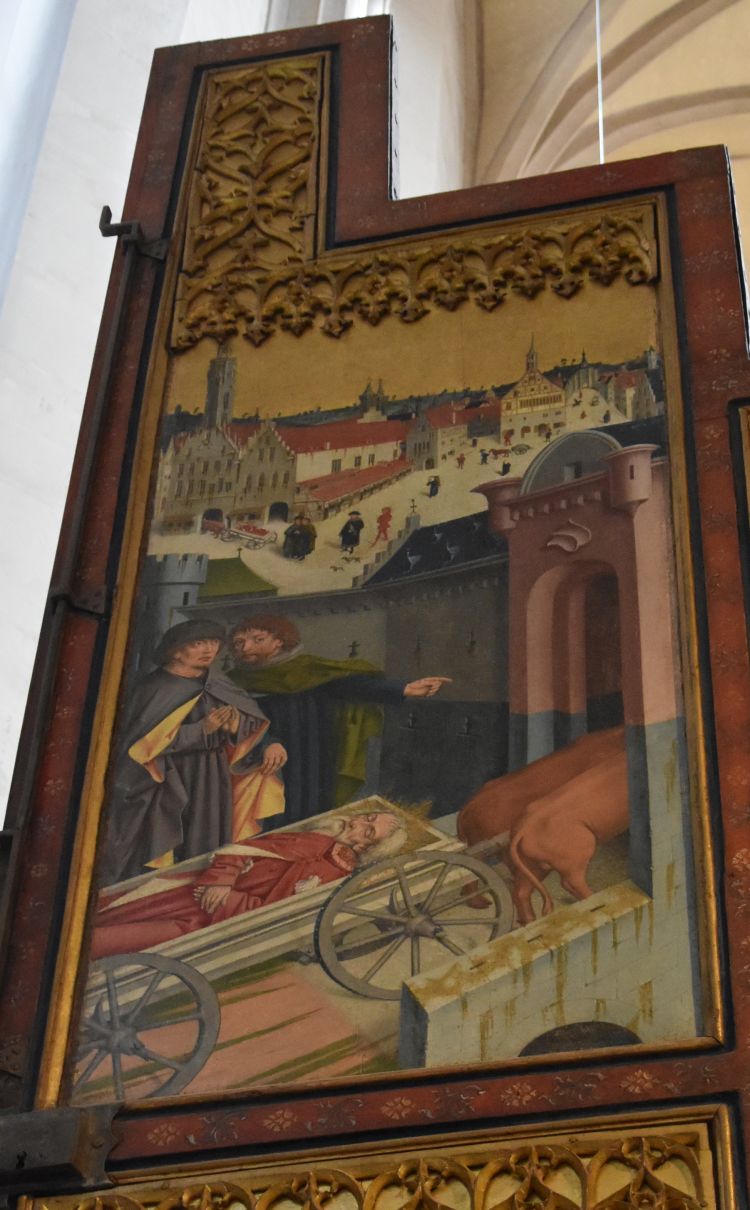
The backside of the altar hides another amazing painting: The dead body of James is carried into Rothenburg ob der Tauber; on the market place of 1466 both parts of the “twin” townhall were still of Gothic style; this happened before the great fire of 1501.

Of course, St. James entered Santiago de Compostella, but Herlin had never been there. The city he could paint best was Rothenburg.

The altar of the Coronation of the Virgin is attributed to the Riemenschneider school.  

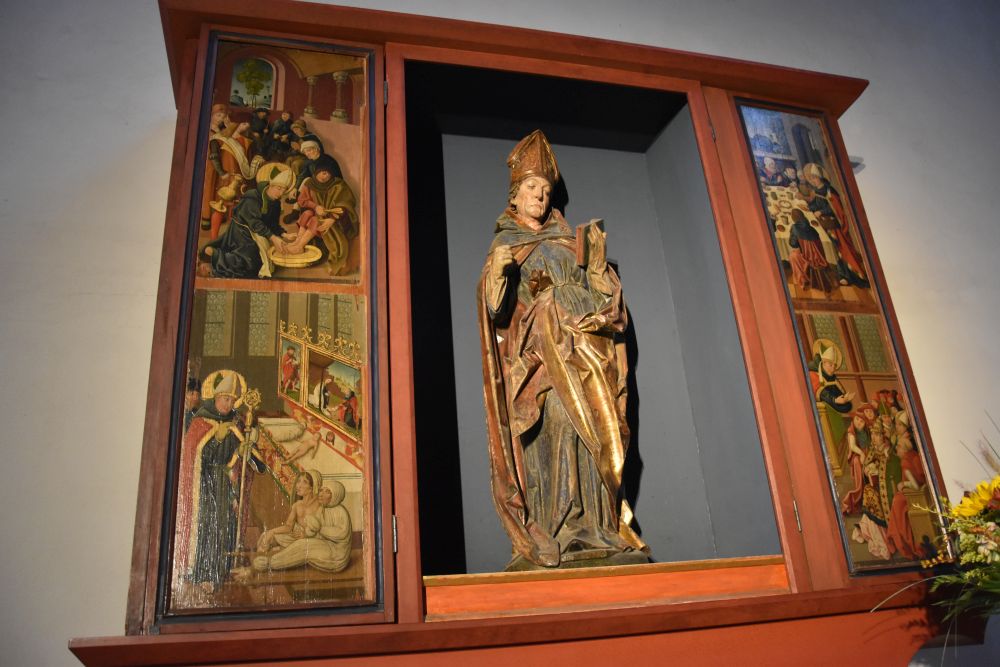
The Ludwig-von-Toulouse altar is from 1490; it is an early work of Til Riemenschneider. Louis de Toulouse was the bishop of Toulouse around 1300.

The windows in the main choir (from the late 14th) give a solemn atmosphere to the church. Gussmann explains them beautifully in his video. They were saved from the bomb attacks of 31st of March 1945, because the citizens had taken them off the church and had transferred them to a basement that withstood the bombs. Also the other treasures of this church survived the bombing there. 

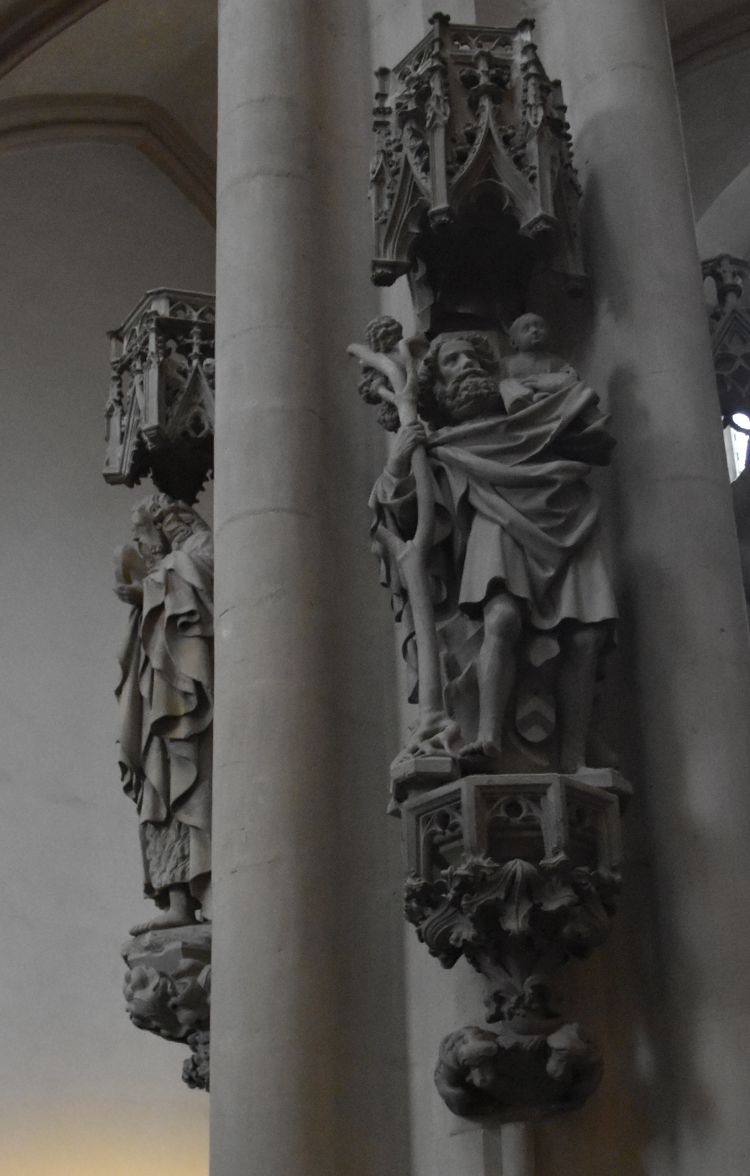
I say good-bye to Christoph carrying Jesus across the river… 

… and to St. James (now in Gothic style), …

… and I continue strolling through the city.


Some impressions from the streets with its medieval atmosphere

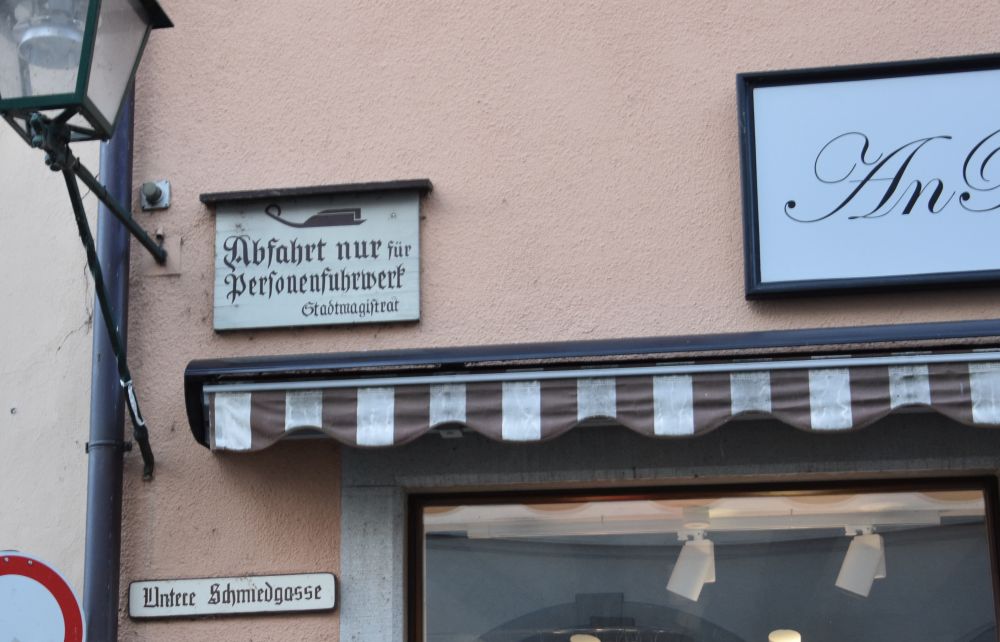
Descent is only allowed to carts carrying persons (Personenfuhrwerk). Pedestrians may also be allowed. 

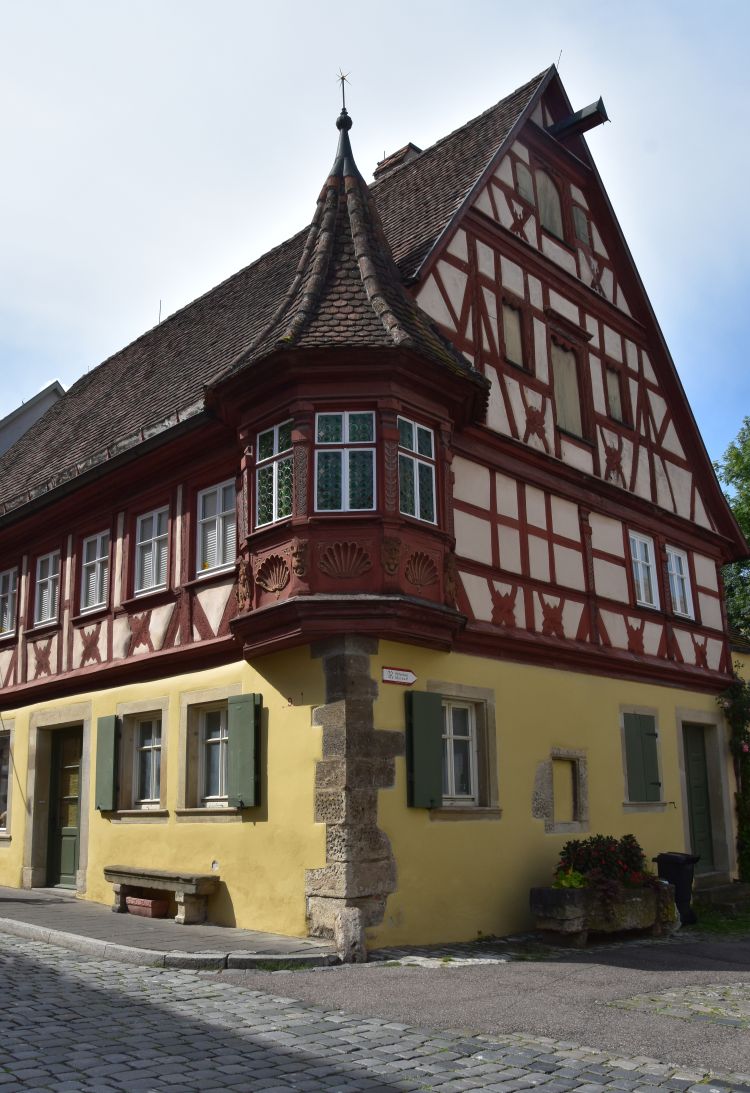
This oriel is called “Feuerleinserker” (oriel of the little fire), the house is from around 1600.

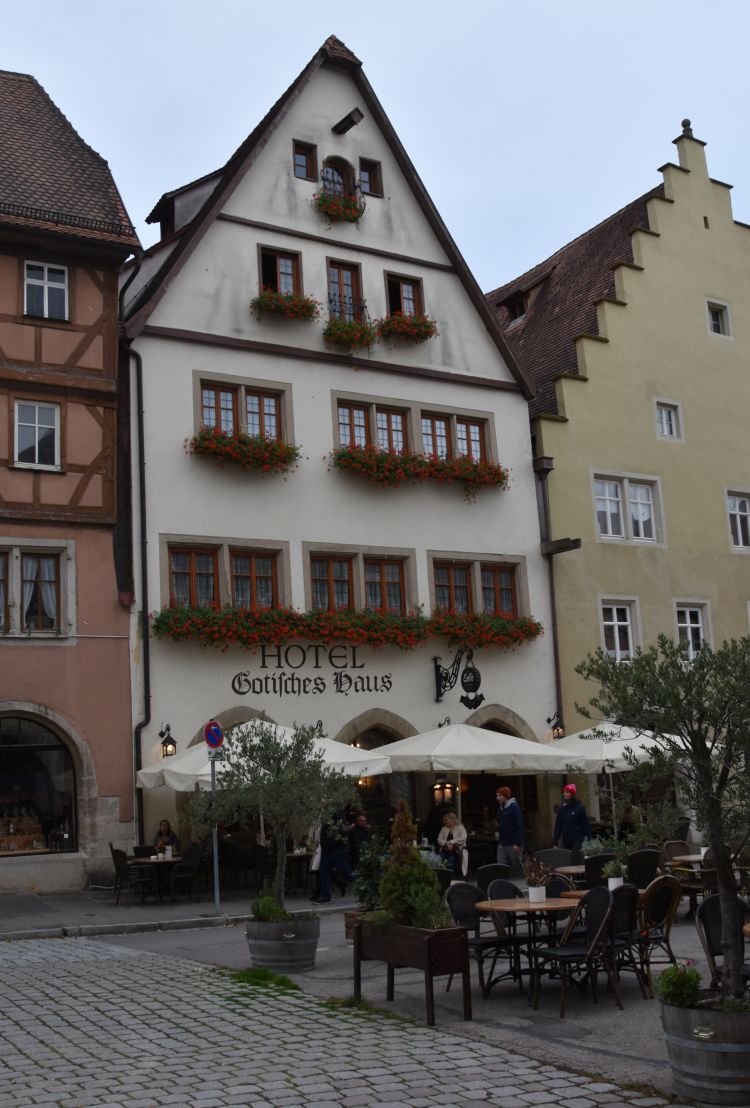
The Herrngasse was the noble address, where the patricians of the city once lived. Now it is lined with hotels, restaurants and shops, amongst them the hotel Gothic House.

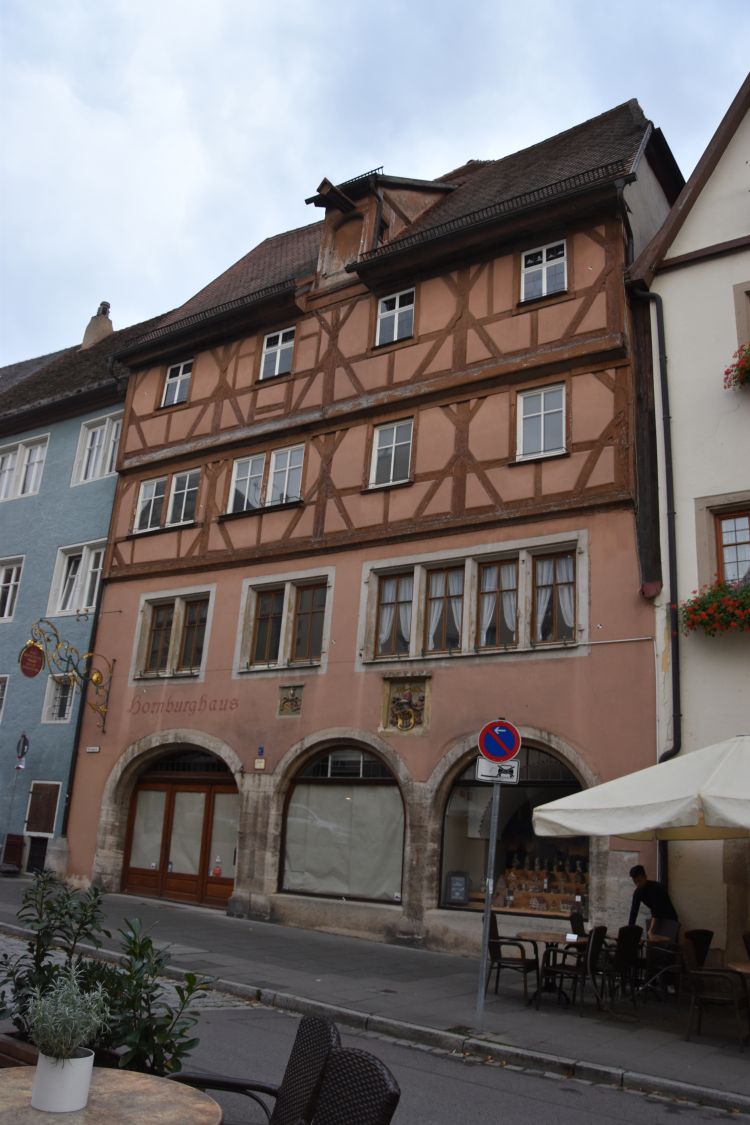
The neighbour, the Hornburg-Haus, is half-timbered. Some beams are from the year 1477. The house is in search of new shop tenants.

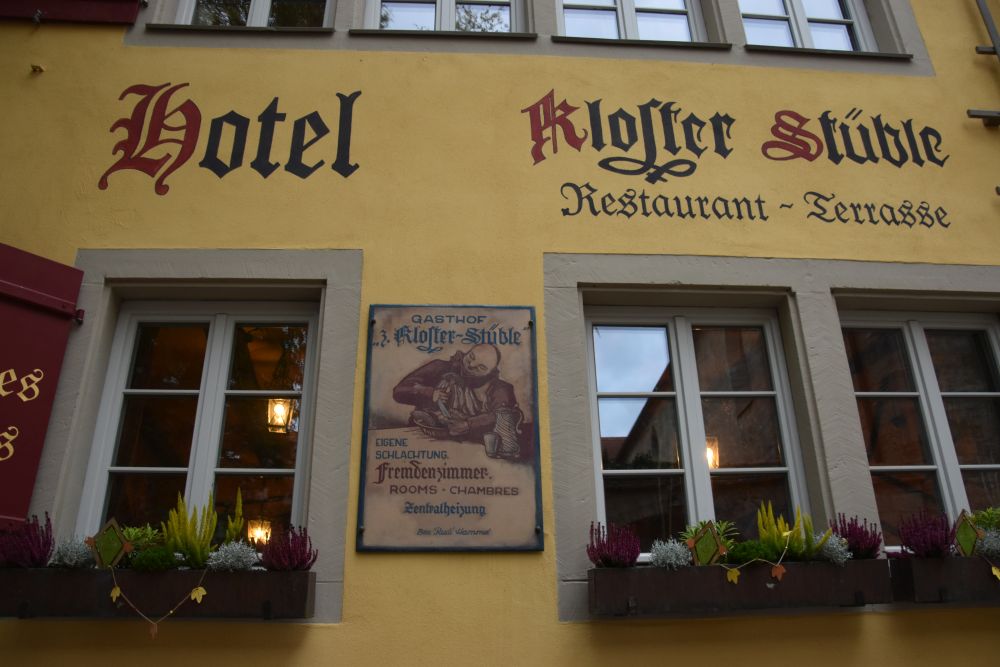
Around the corner, in the Klosterstüble, I had a delicious Bavarian-Franconian dinner with dumplings. 

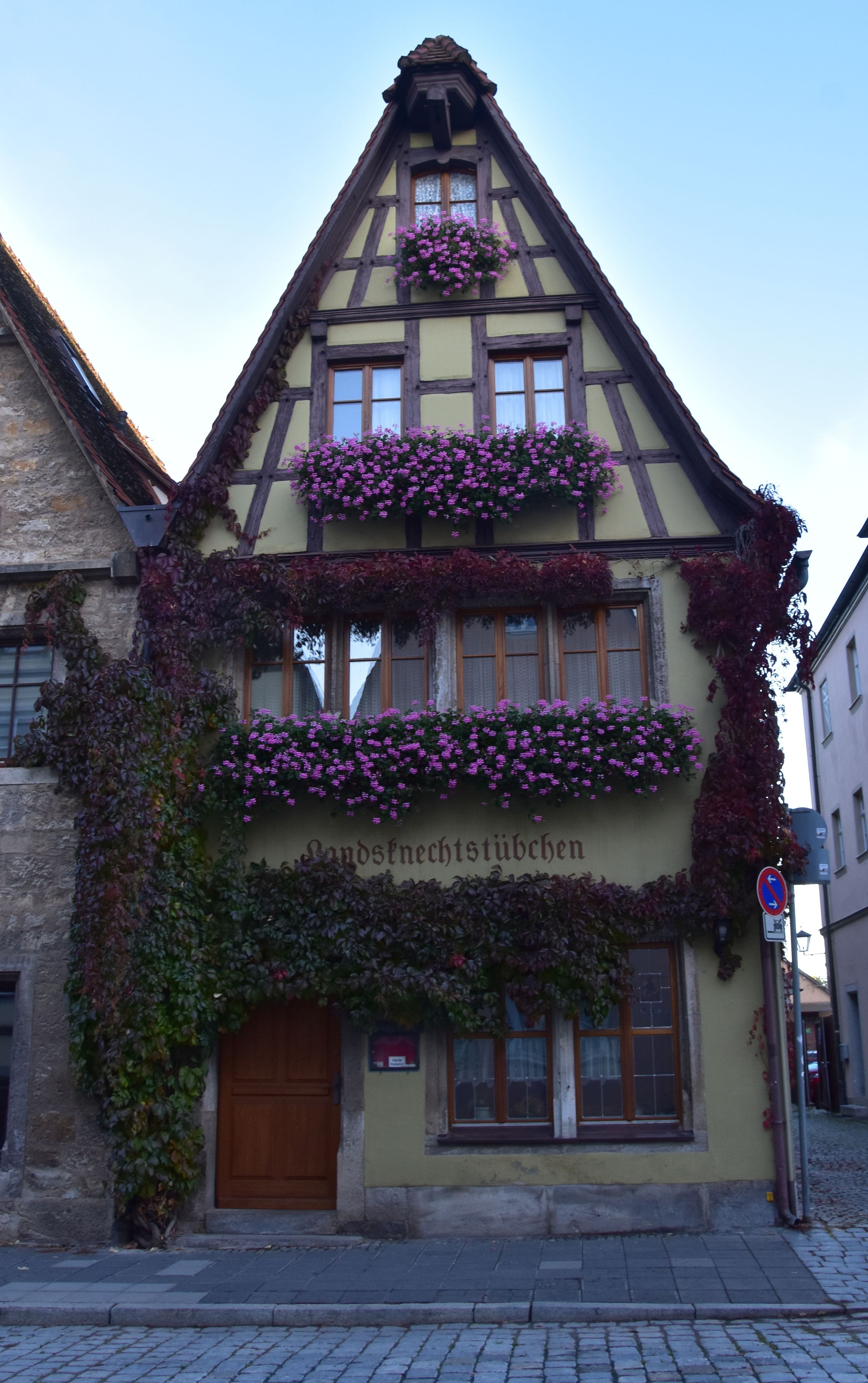
The Landsknechtstübchen is beautifully adorned with geraniums (A “Landsknecht” is a man at arms).

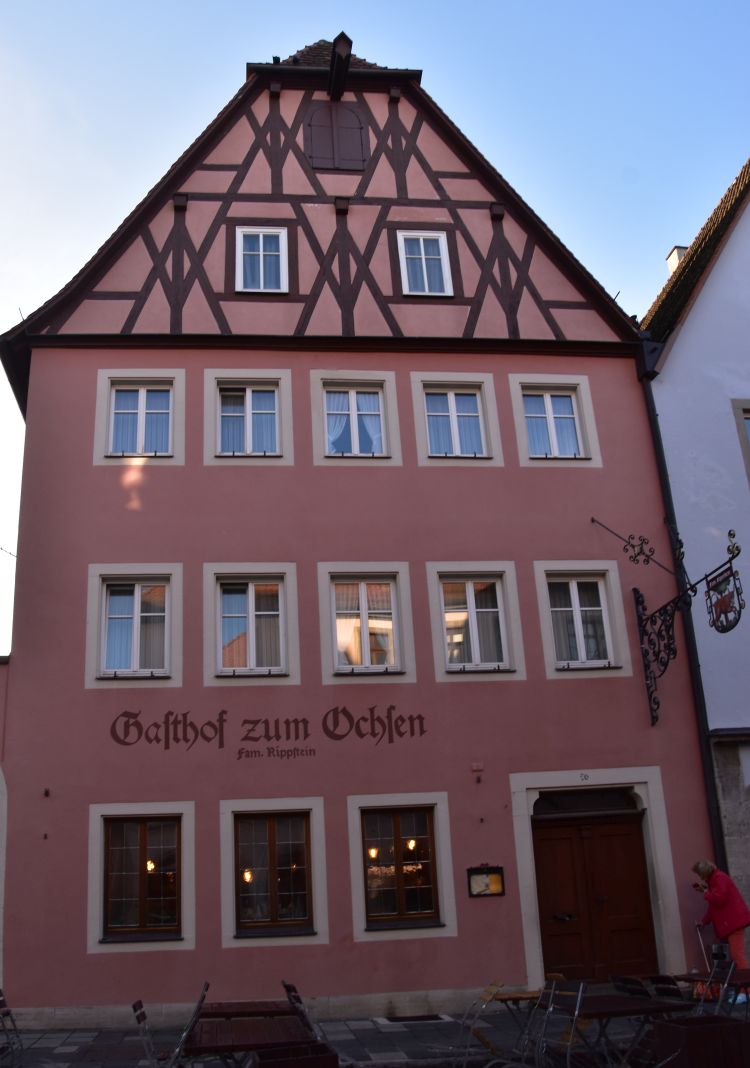
Across the street, the family owned restaurant Ochsen looks inviting. 

When strolling through the city, two more churches invited me for a visit. First the modest Franciscan church with the rood screen.

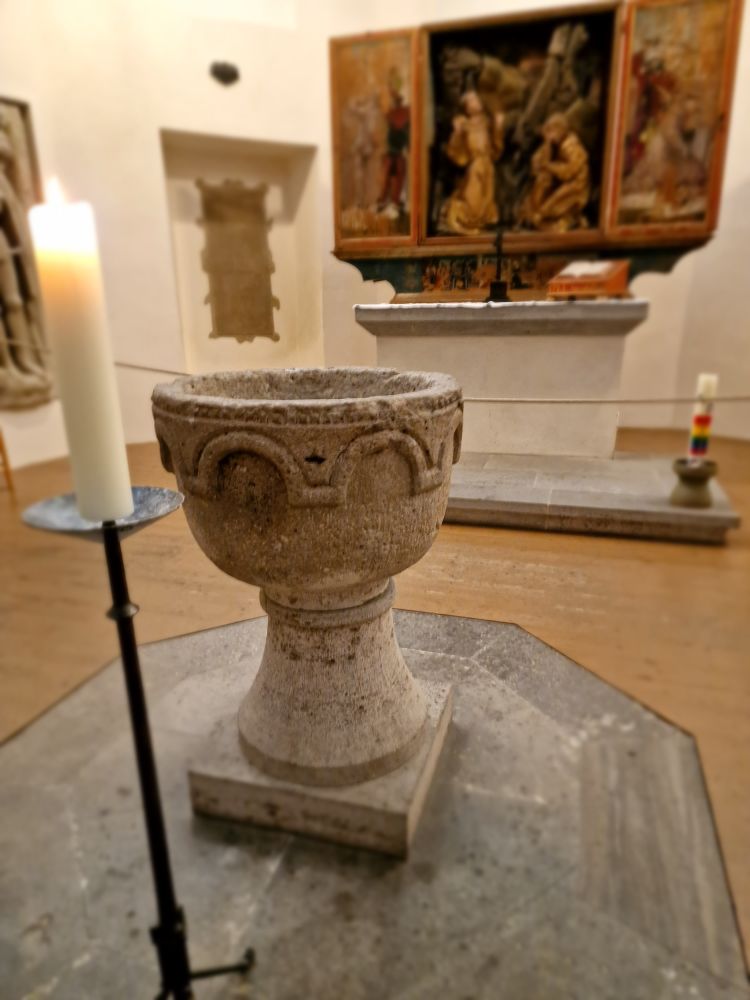
In the choir and behind the beautiful baptismal fountain, there is another small altar of Til Riemenschneidre showing the history of Franciscus.

Second, I enter the Gothic Church of Saint Wolfgang, the patron of the shepherds. It has been built into the city wall. 

Three wonderful altars are inside. 

From the choir, you can enter the wall and walk through a tunnel  that ends up on the other side of the nave. Amazing.


The city wall and the Burggarten

The city wall with the gates still today surrounds Rothenburg.

Walking along the moat west of the city centre… 

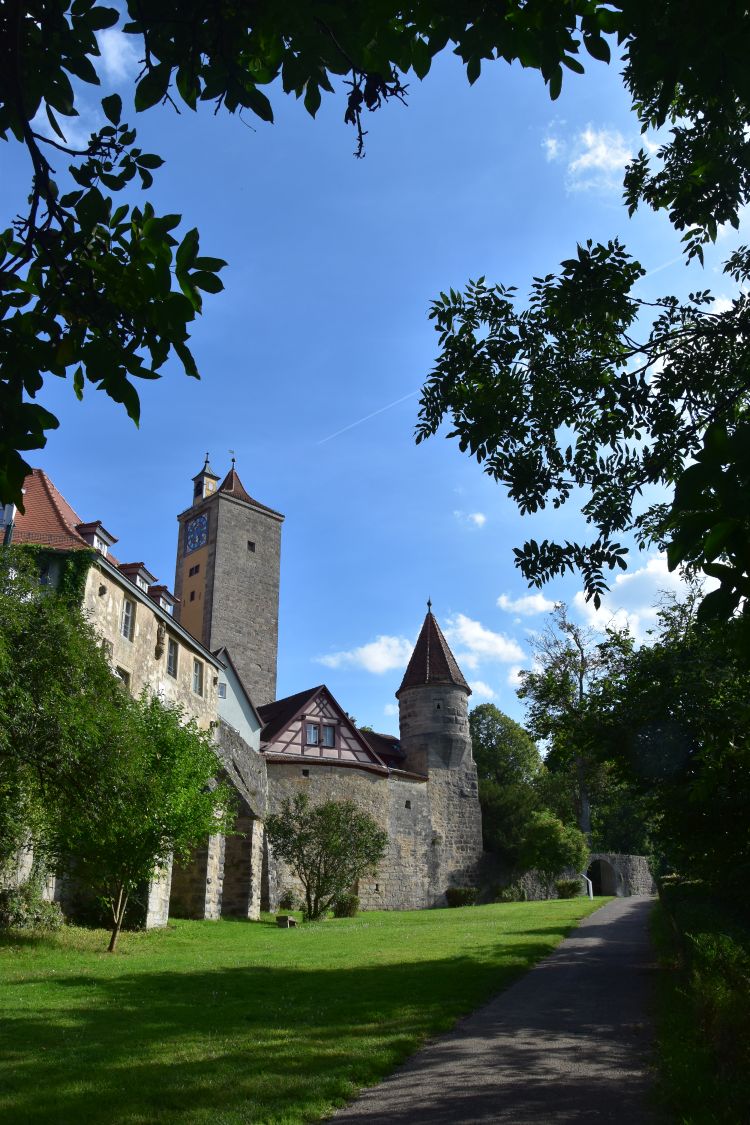
…  takes me to the Burgtor, …

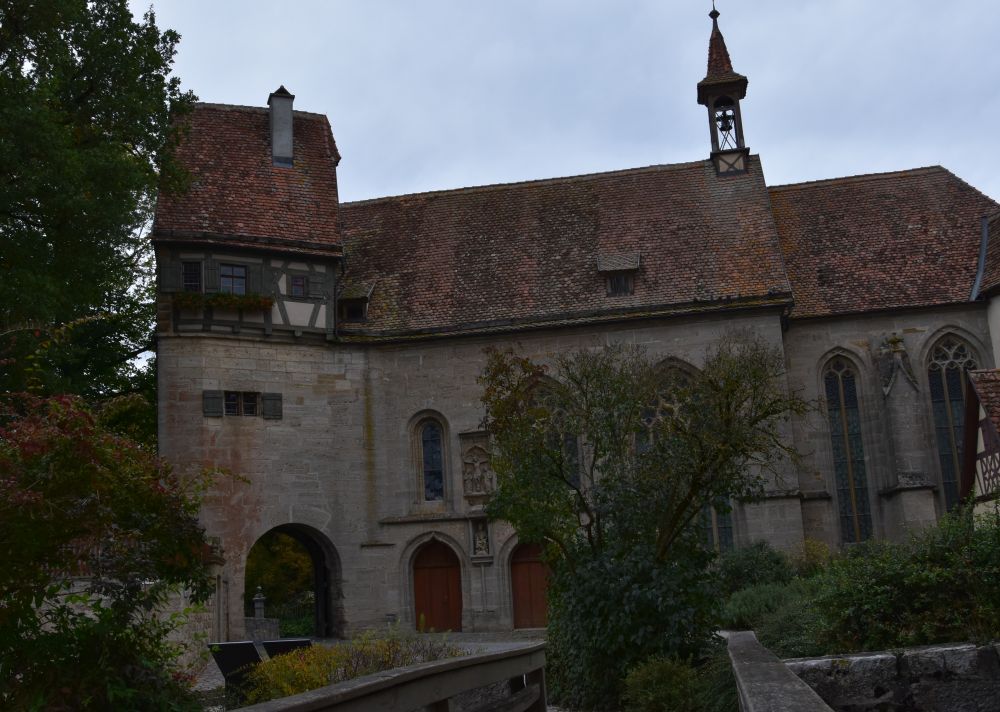
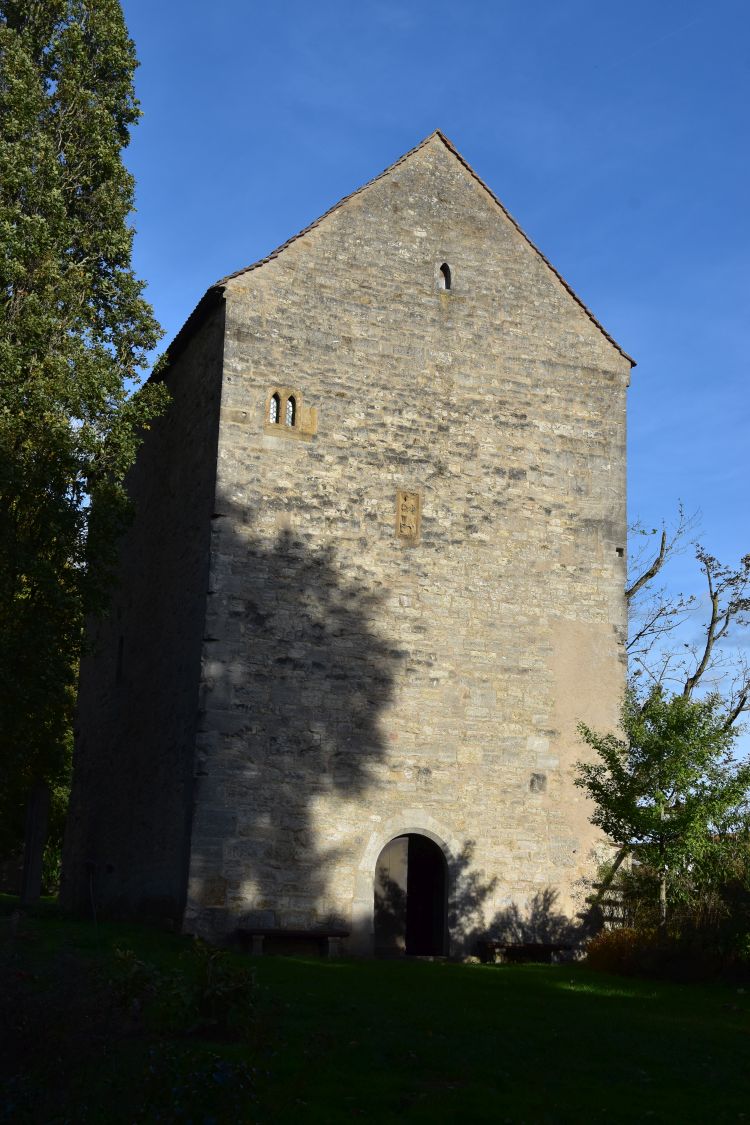
… where the Burggarten starts. Here, the Hohenstaufen had built their castle in the 12th century, after the dukes of Rothenburg had died out. The Staufen castle has disappeaered. Only a small chapel is left.

The Burggarten is well kept and romantic.

From the Burggarten, the southern part of the city line appears above the Tauber valley. 

One morning, I did the wall walk all around the city. Homely corners…   

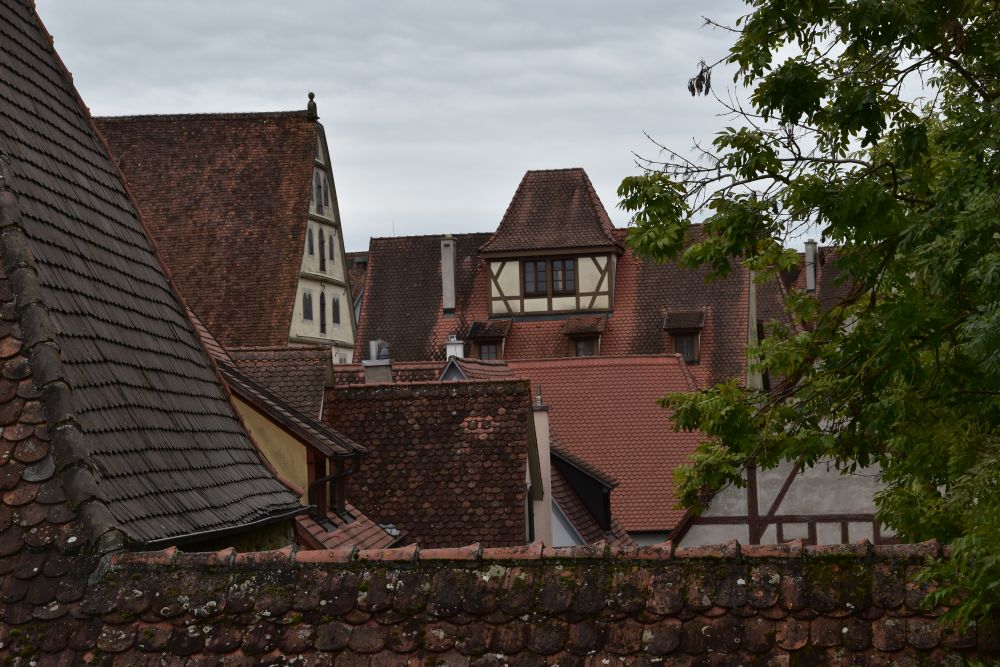
… and roof “landscapes” all along the walk.


More painters felt attracted by Rothenburg, as the museum in the former Dominican monastery tells us

The museum in the former monastery of Dominican nuns lays out the history of Rothenburg ob der Tauber. 

 In the 19th century, various journals praise Rothenburg to be the ideal medieval city with its picturesque architecture. The message is heard in Germany and  Europe. Painters from Germany, the Netherlands and England come to Rothenburg, and one department of the museum is dedicated to some of these painters. Hermann Radzyk was not the only painter that felt attracted by Rothenburg.

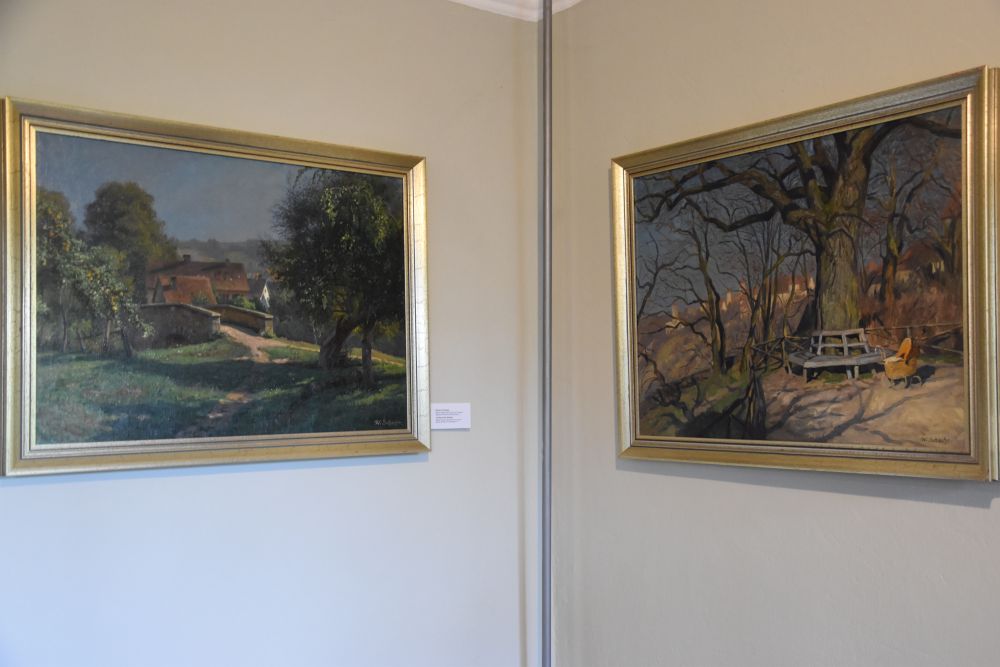
Most exhibits in the museum are paintings of Wilhelm Schacht (1872-1951). He painted the old brigde at Detwang (left), like my grandfather. On the second painting (right), we can faintly see Rothenburg behind the lime tree with the inviting bench.

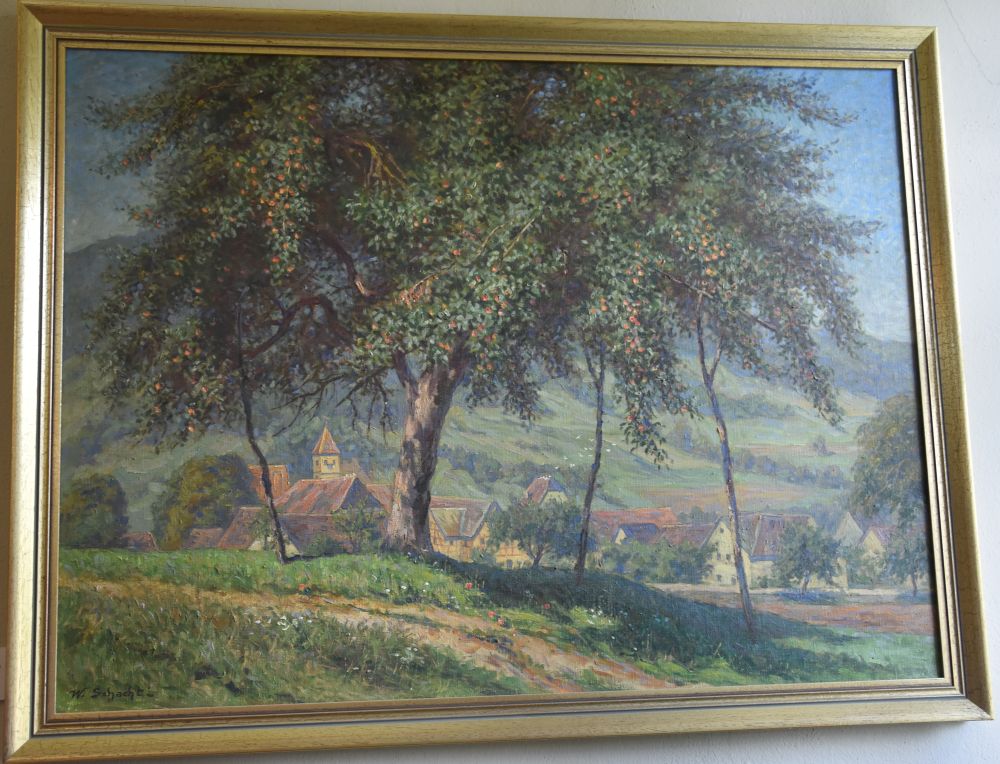
This is another view of Detwang painted by Wilhelm Schacht, with the Romanic Saint Peter and Paul church. 

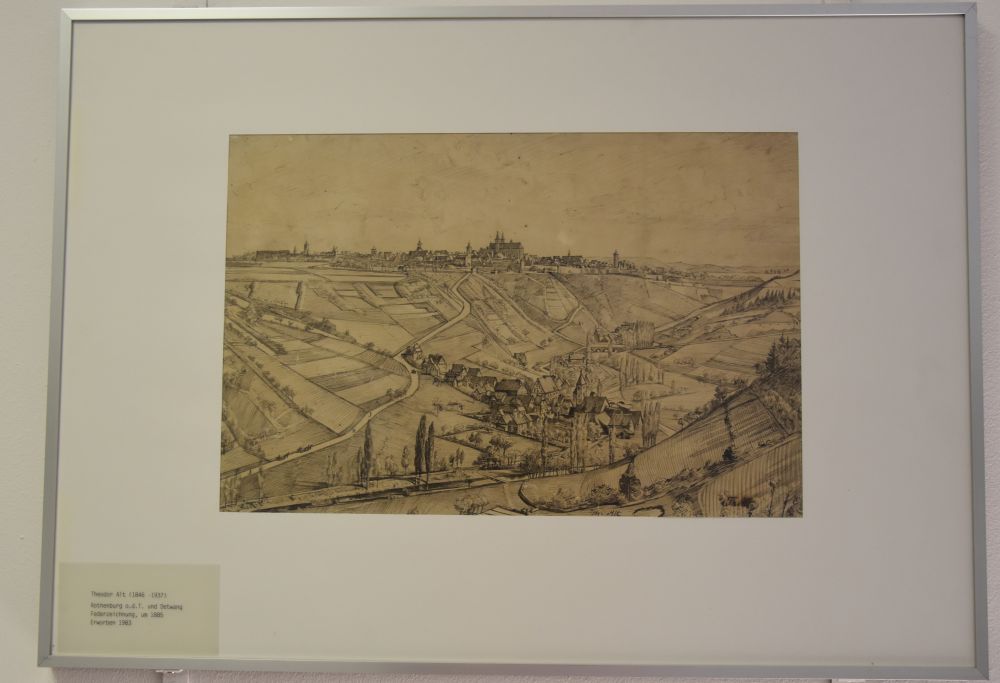
The pen drawing of Theodor Alt (1846-1937), a Franconian, shows Detwang in the valley and Rothenburg ob der Tauber above it. 

Arthur Wasse (1854-1930) was born in Manchester, studied art in Germany and finally settled at Rothenburg. His picturesque “Häuser an der Klingengasse” was reused by Disney as a suggestion for the background of the film “Pinocchio”, as the panel in the museum says. 

Elias Bancroft (1846-1924) from England painted the “Siebersturm, Rothenburg ob der Tauber”, with the still unrenovated Plönlein. 

Martin Monickendamm (1874-1943) is a Dutch painter. He painted this overview of Rothenburg and called it “Rothenburg ob der Tauber (Das kleine Rothenburg)”. 

In all I have been at Rothenburg ob der Tauber five times, always as short stop overs on my way to Berlin. The first time in the 1960’s with my best friend, the second time on a short afternoon stop over in August 2022 (then I found the location of the easel of my grandfather), the third time in October 2023 to explore the city more in detail, fourth in August 2024, when staying at its urban district Detwang to look for the moated castle, and fifth in October 2024 with a focus on St. James church. There is always something more to explore in this medieval city full of treasures and museums.

Let us say good-bye to Rothenburg ob der Tauber. Next, we will explore more treasures in the Tauber valley: The Celtic oppidum at Burgstall and the Church of Lord (Herrgottskirche) with Saint Mary’s altar by Tilman Riemenschneider.


Sources:

Hermann Radzyk painted at Detwang – I looked for one painting and found two

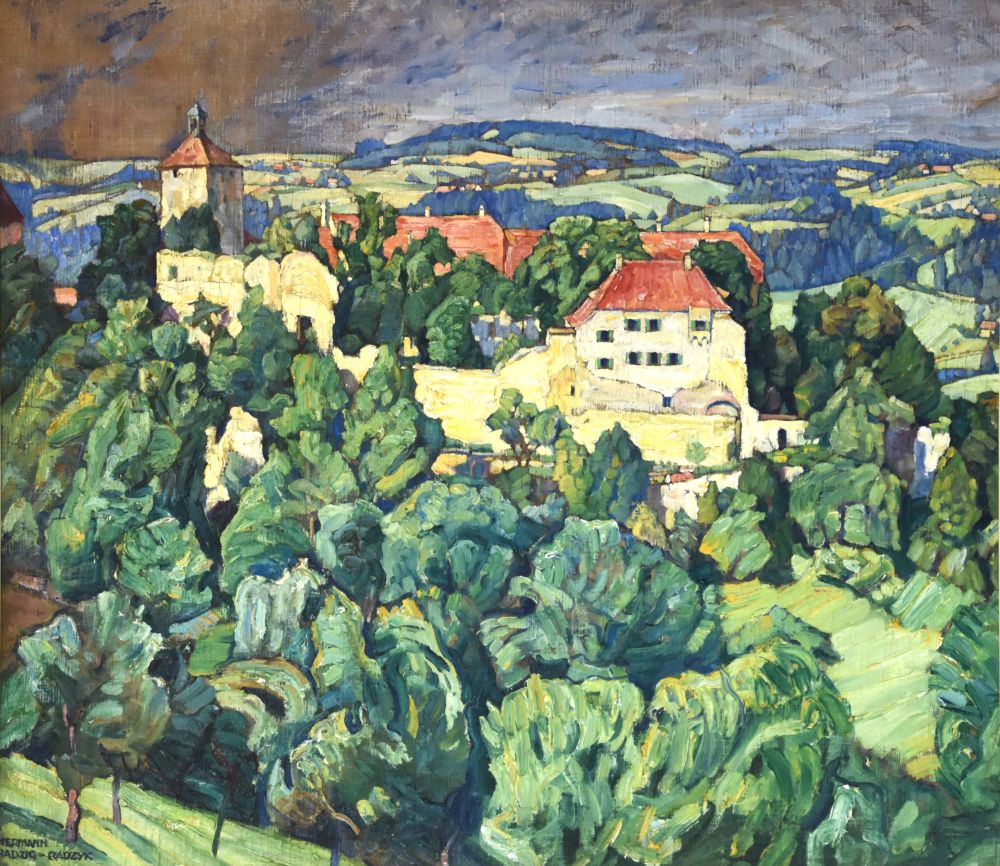
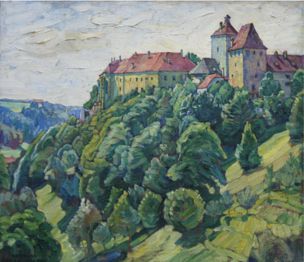
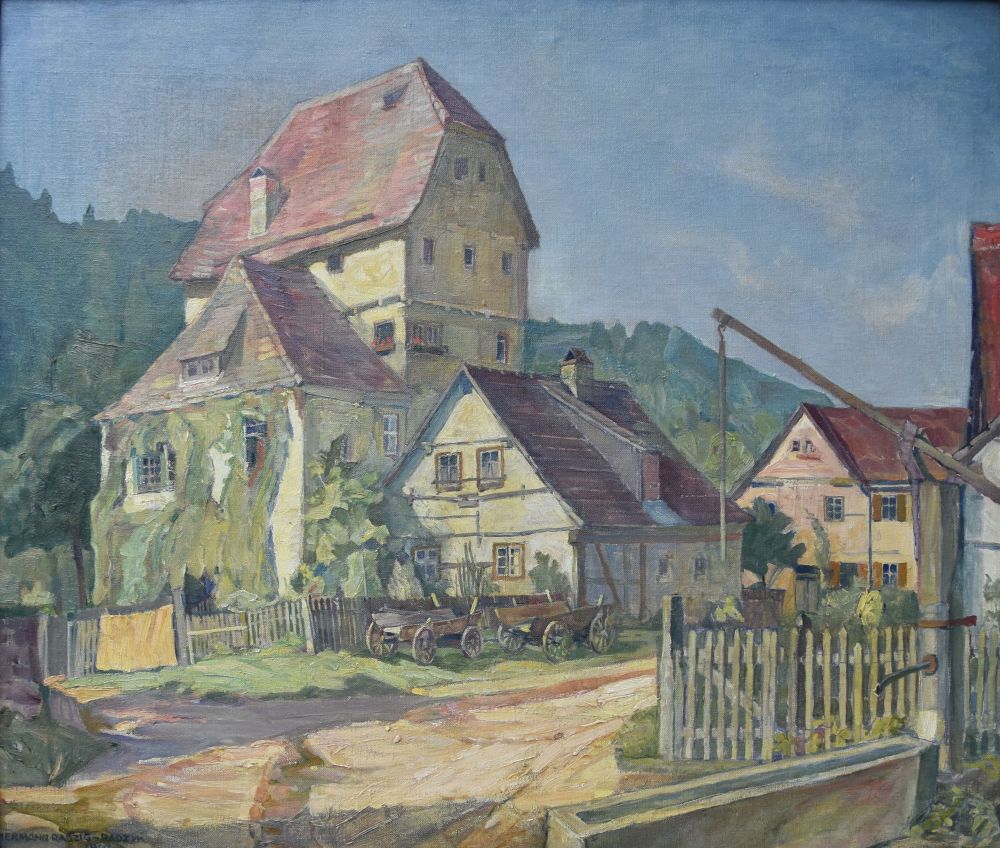
In August 2024, I settled in the hotel Schwarzes Lamm at Detwang near Rothenburg to find the noble manor that my grandfather had painted in 1942, 82 years ago.

Hermann Radzyk titled his painting on the back as “moated castle at Dettwang (Tauber valley near Rothenburg)”.

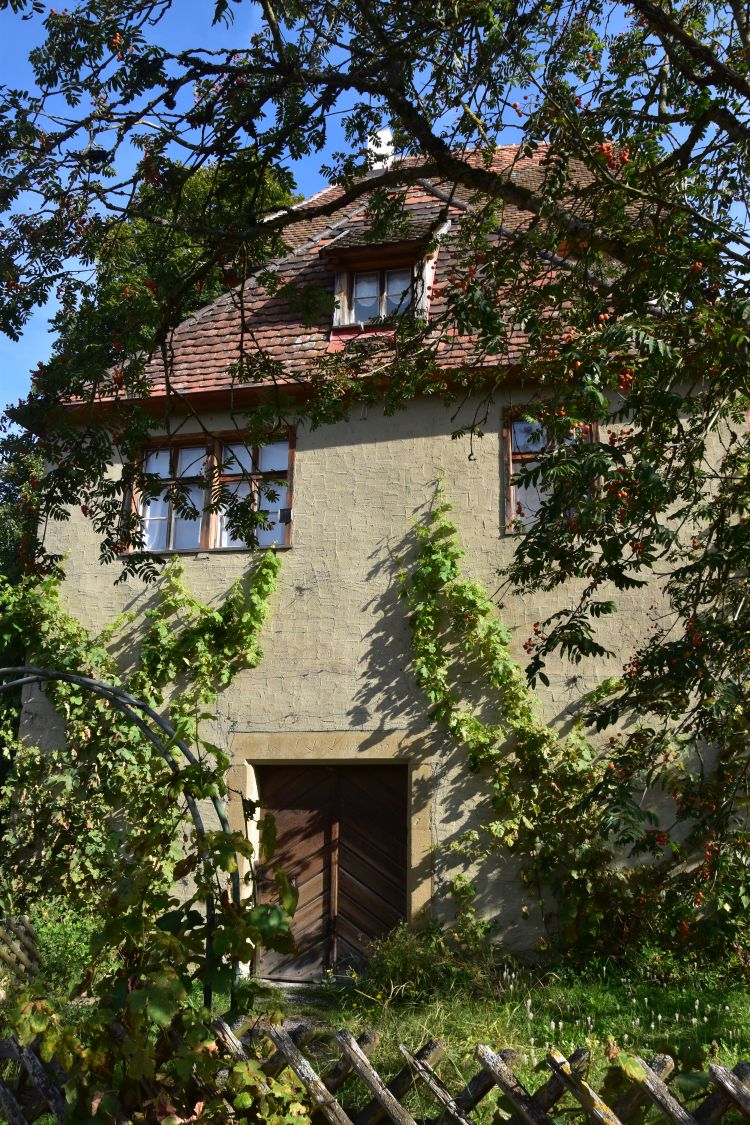
It is more than a manor, it is a small castle.


Found the manor, it is still called “Schloss Detwang” today

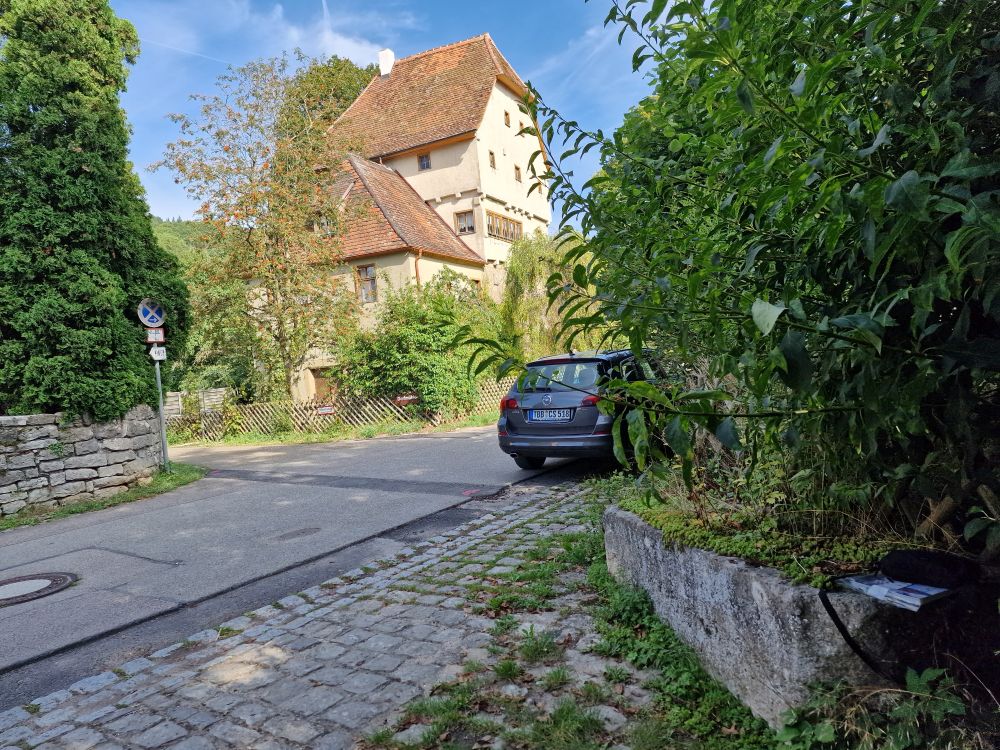
I found the manor my grandfather painted. Even the fountain is still around, though no longer in use. It has been pushed to the side and filled with earth. The sky on my photo is similar, light blue with a touch of white clouds.

Instead of a cart I find a car parked nearby. The small house in front of the castle has been removed. The street has been paved, and be careful, you are not allowed to stop everywhere.

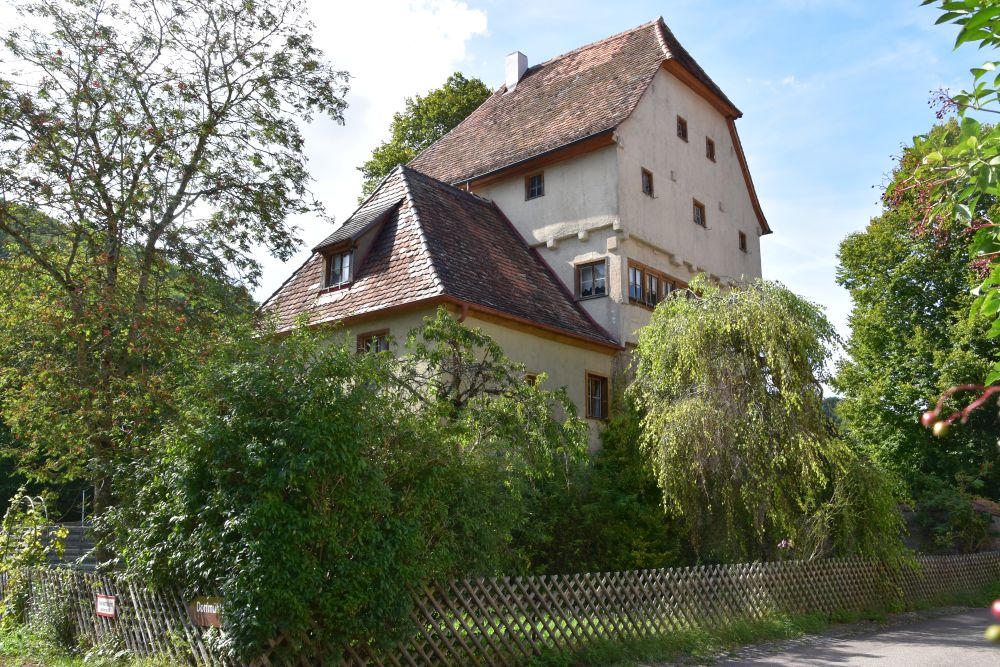
The castle is a gothic manor from the 13th/14th century and now carries the number “Detwang 29”. In former times, it was surrounded by a moat. This is why my grandfather called it “moated castle”, though it was no longer surrounded by water, when he painted it in 1942. 

I walk around the small castle with its garden. The wooden fence has been modernized. 

The above photos I took with my smartphone, and the colours convey a similar impression of the light as the painting of my grandfather.

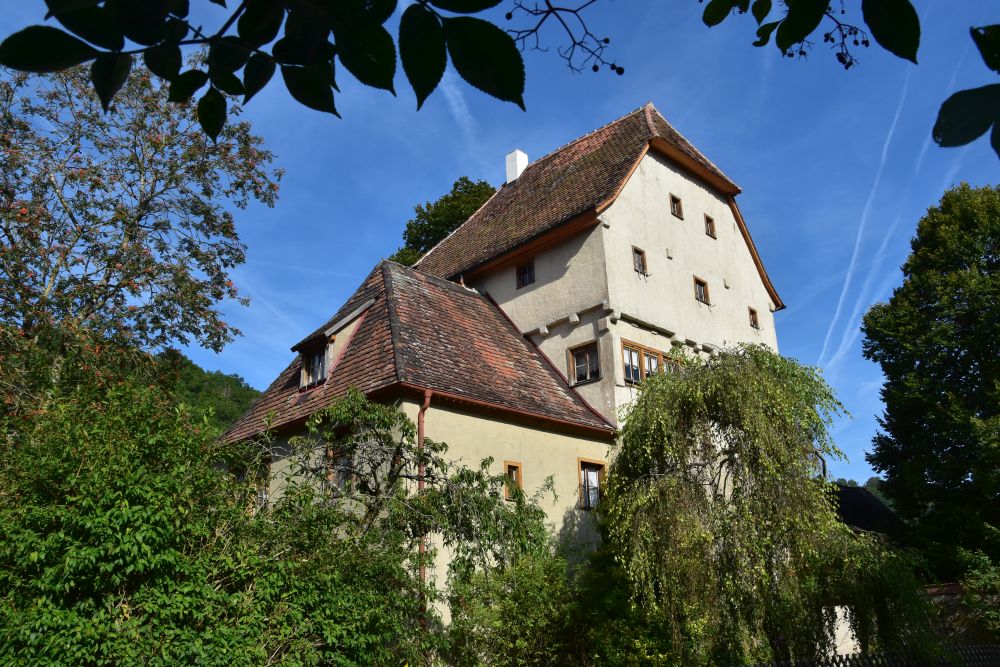
My Nikon camera leaves a different impression, there is more contrast. 

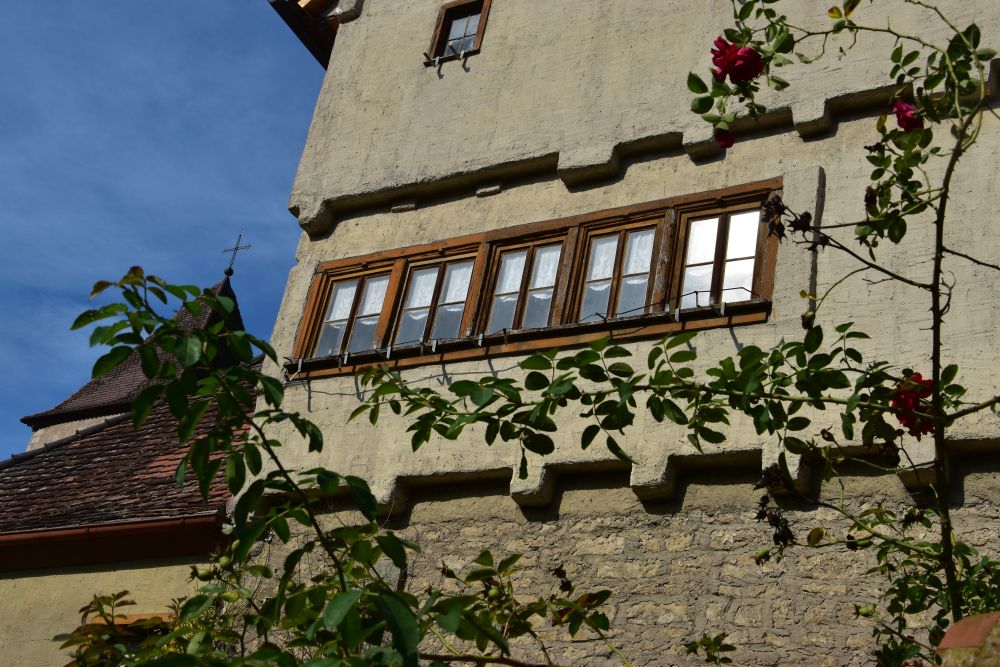
I like the red roses surrounding the windows – there are more windows here today. Does Dornröschen live in this castle? “Sleeping beauty” is called “Thorny Little Rose” in German. 

The red rowan berries repeat the colour of the red tiles. 

My grandfather wrote “Schloss Dettwang” with two “tt”, not “Detwang” with one “t”. I know, he was always precise; I looked for old postcards, and some carry the name “Dettwang”.

Easel of the castle or manor found, mission accomplished.


Easel found, next I focus on sightseeing, but… surprise, surprise – I find a second painting

 Next, I explore the pretty village Detwang. I follow the signs directing me to the Tauber river and the old bridge of Detwang.

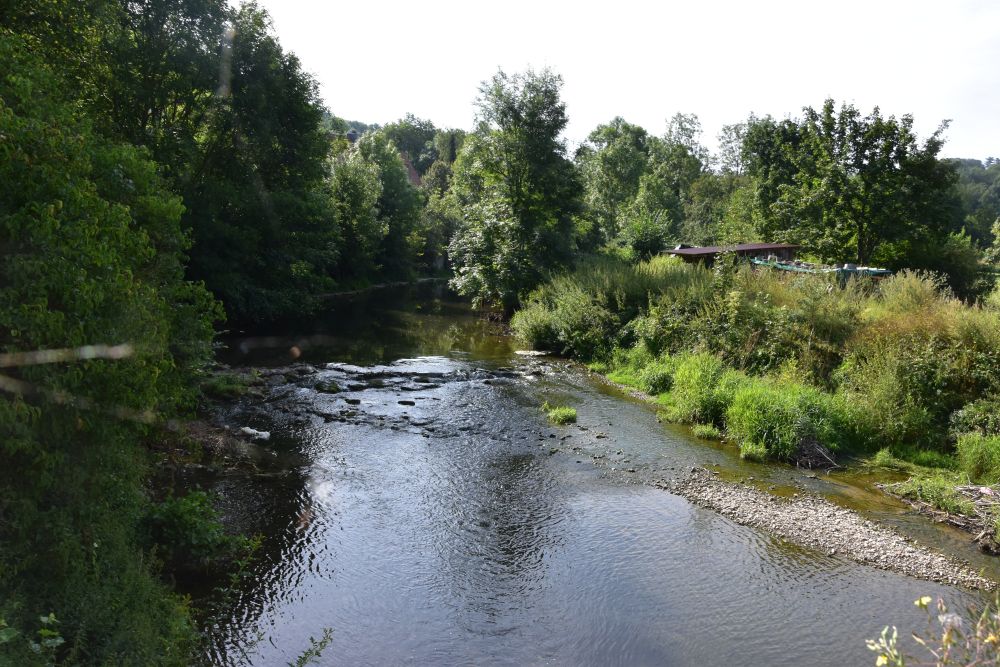
The sun reflects in the water. 

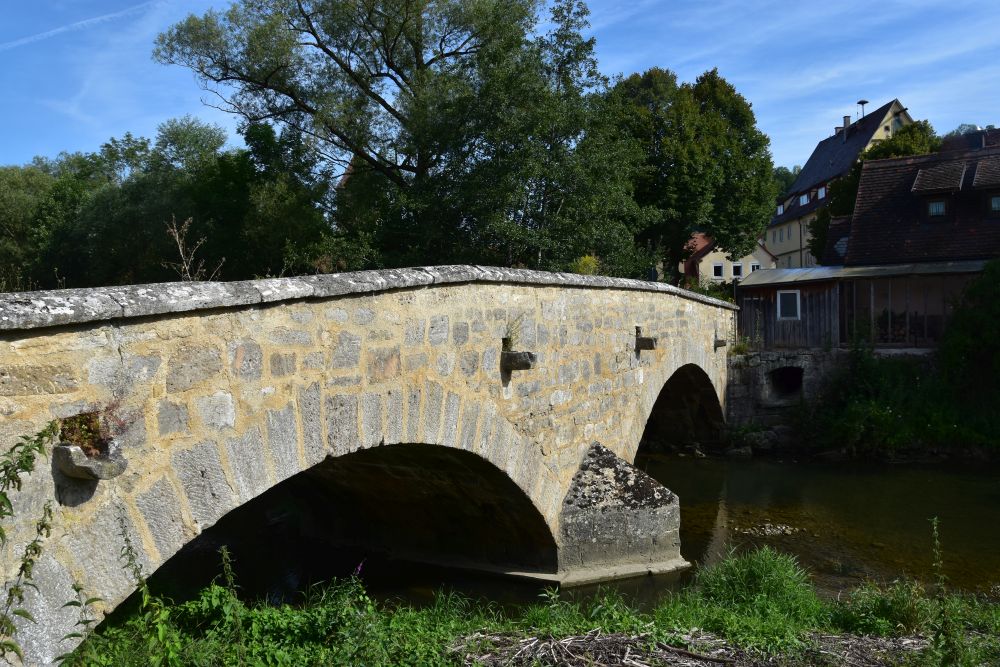
I take a photo of the bridge from the other side (did you notice the church tower hidden behind the trees?), and I continue my village tour without thinking any further. 

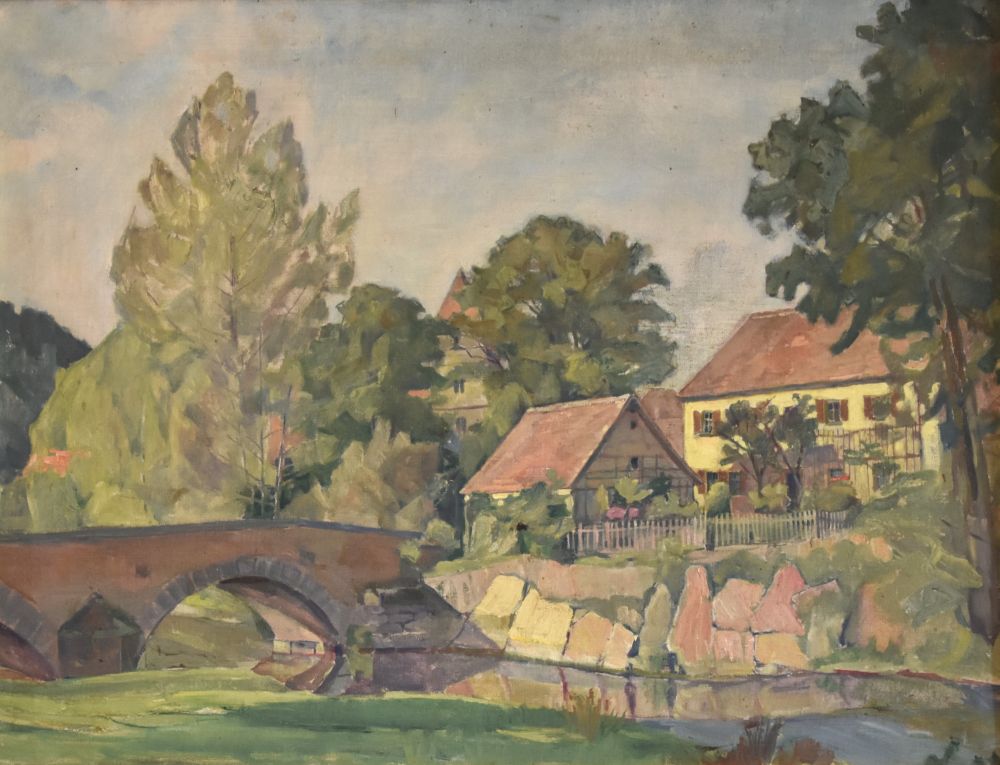
A week later, I am at Berlin. I look at the photo of the bridge of Detwang, and I frown. Have I not seen THIS BRIDGE before?

With me, I have a photo of this unsigned and undated painting of Hermann Radzyk that hangs in my guestroom. Look at the arches of the bridge and at the church tower behind the trees.

This IS the old bridge of Detwang. What a surprise. I found the location of a second painting at Detwang, and surely, my grandfather painted this bridge also in the year 1942, like the castle.  

Up to now, I had looked at this bridge over and over again without knowing, where to search for it. Now, I will return to Detwang to reproduce the angle and perhaps the light impression that my grandfather captured. For me, the colours of the bridge painting are similar to the colours of his “moated little castle of Dettwang”.


Let us now continue our tour and explore the beautiful Romanesque church of Detwang

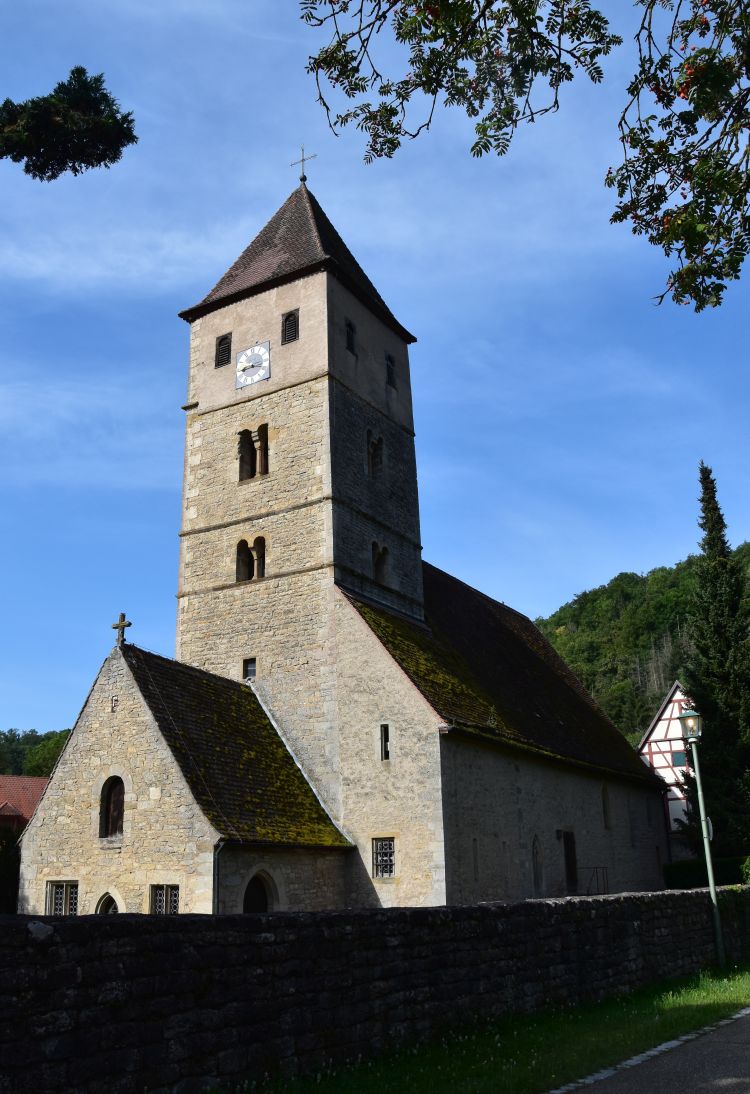
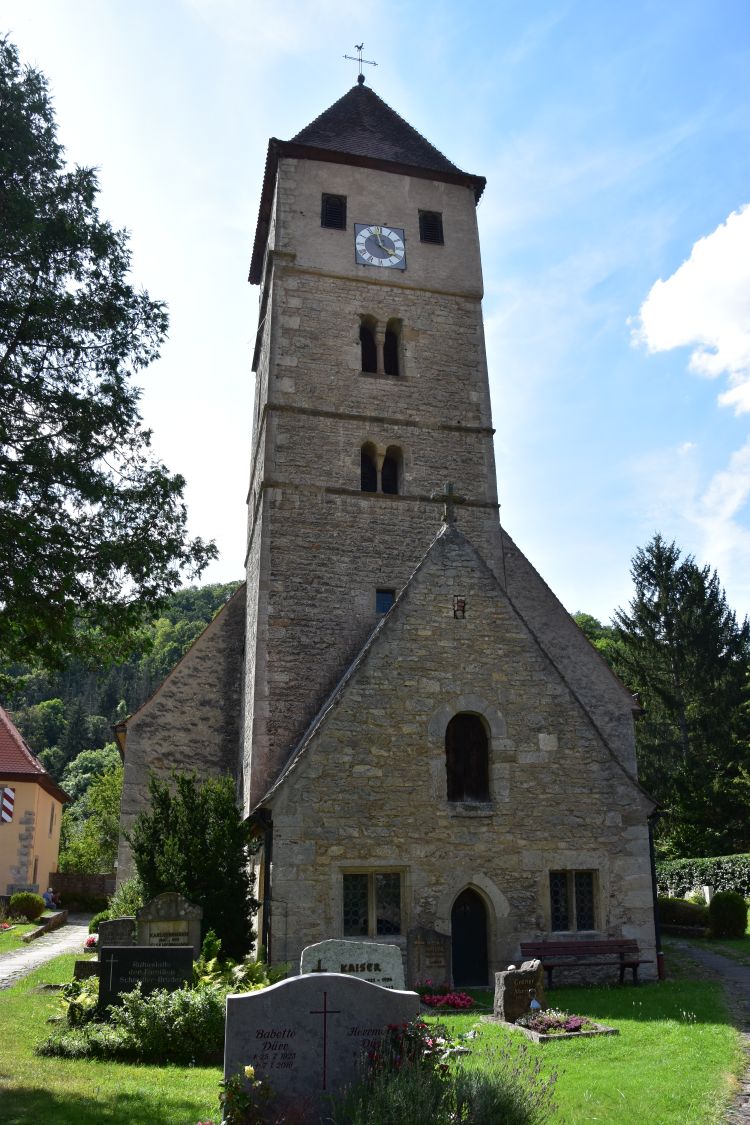
The church tower that hides behind the trees belongs to the Romanesque Peter and Paul church of Detwang. 

It is assumed that the church was built in the 12th century, with later additions (brochure of the church, p.3). The choir was removed in the 14 century and replaced by the small house; it was the oratory of the convent of Benedictine nuns and later became an ossuary. 

On the cemetery,  village citizens water the flowers. Many tomb slabs carry the name Stellwag, this seems to be a common name here. One member of this large family looks at the painting with the moated castle with great interest. He knows the man living in the castle. “Everyone”, he says, “knows everyone in this village. Detwang is fortunately much more quiet than Rothenburg, which in summer is taken over by so many tourists.” I send him the photo of the painting.

I return in the afternoon to see the treasures inside the church. I buy the brochure of the church – reading helps to see more. 

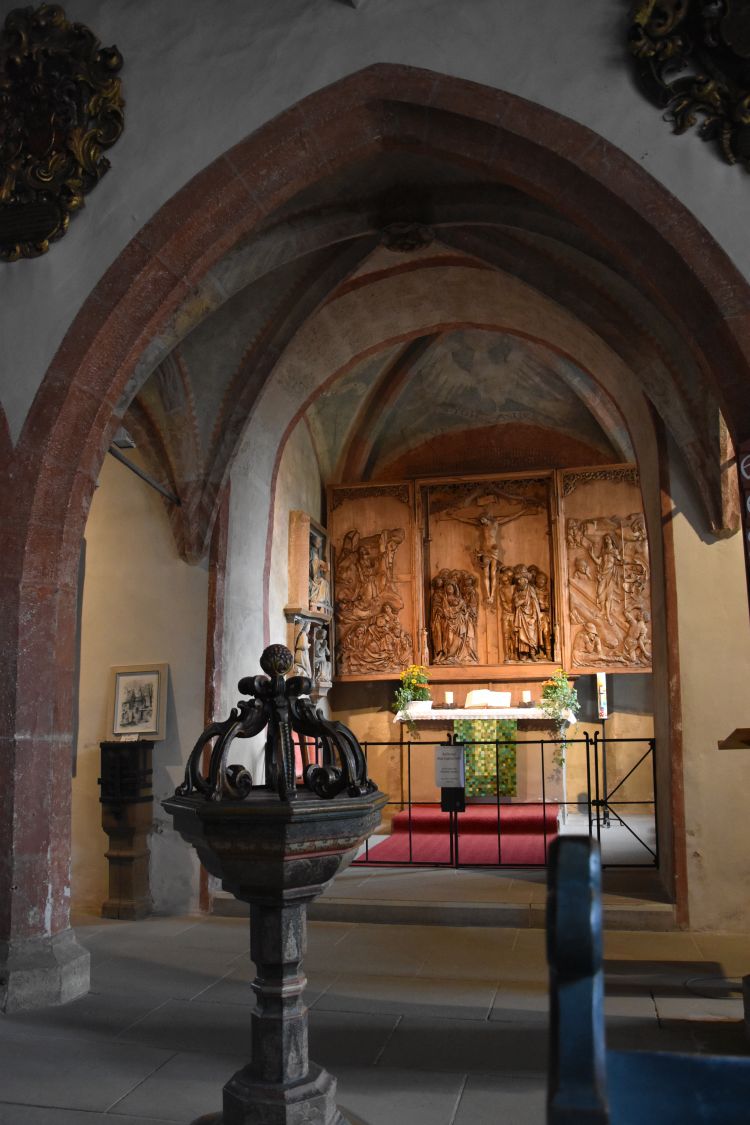
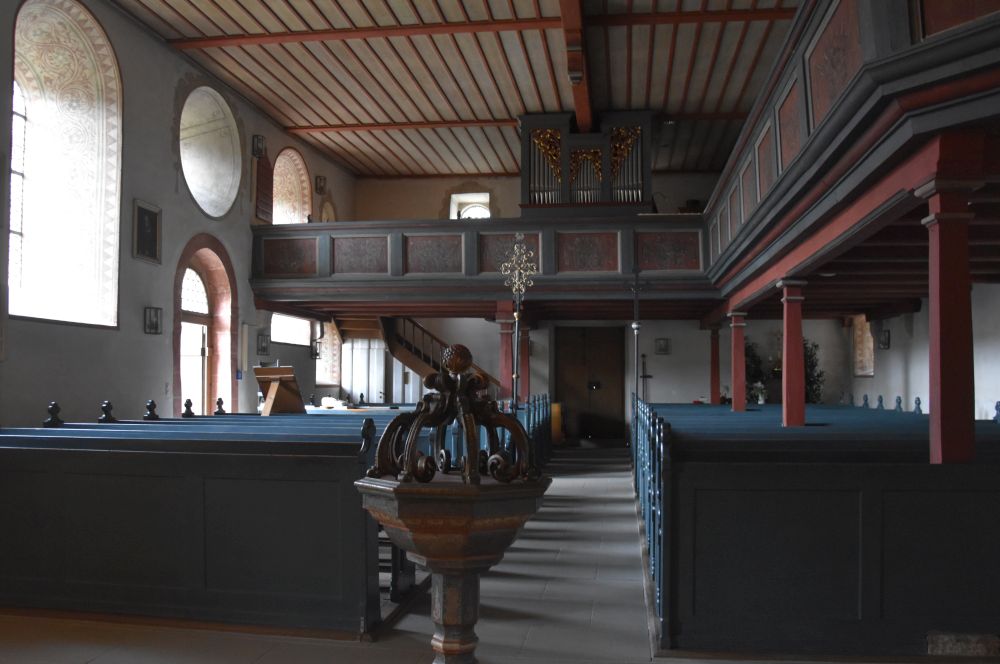
It is a solemn atmosphere. Romanesque with later additions, such us the gallery of the 17th century and the wooden ceiling of the 19th century. The baptismal font is from 1720 (brochure, p.3f).

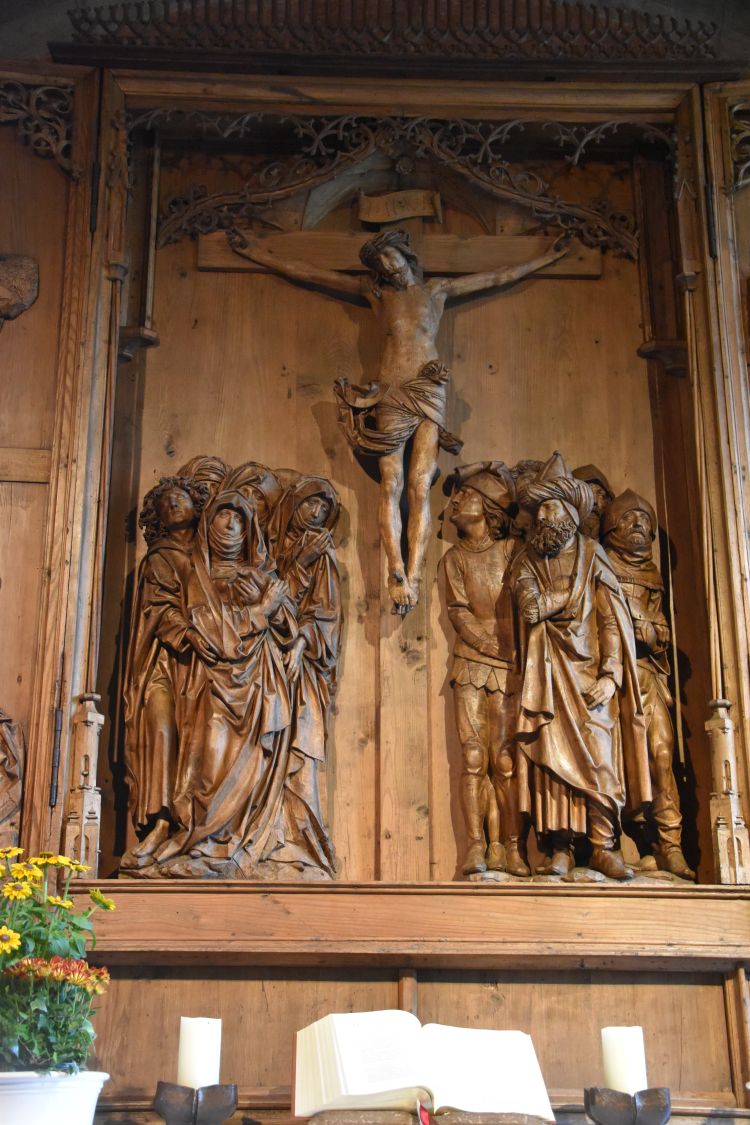
There are three gothic altars in front. Two altars stand in the niches, and, in the choir, there is the altar of  Tilman Riemenschneider, the primary treasure in this church. It is the crucifixion altar that must have been created between 1510 and 1513 (there exist no records about the date of creation).

Probably the altar was brought here from a former funeral chapel at Rothenburg. Riemenschneider did not create the altar for this small choir; some figures had to be cut away to make the altar fit (brochure, p. 9).

The crucifixion scene is in the middle. Riemenschneider has made it by himself. To the left of the cross are Maria, supported by Johannes, and more moaning women. On the right hand side of the cross, there is a group of men. In front is the well dressed Pharisee that seems to ruminate with the hand in his coat – he seems to be in doubt. The captain standing next to him looks up to the cross – he may believe that Christ is the son of God. Christ looks down to the moaning group around Maria. 

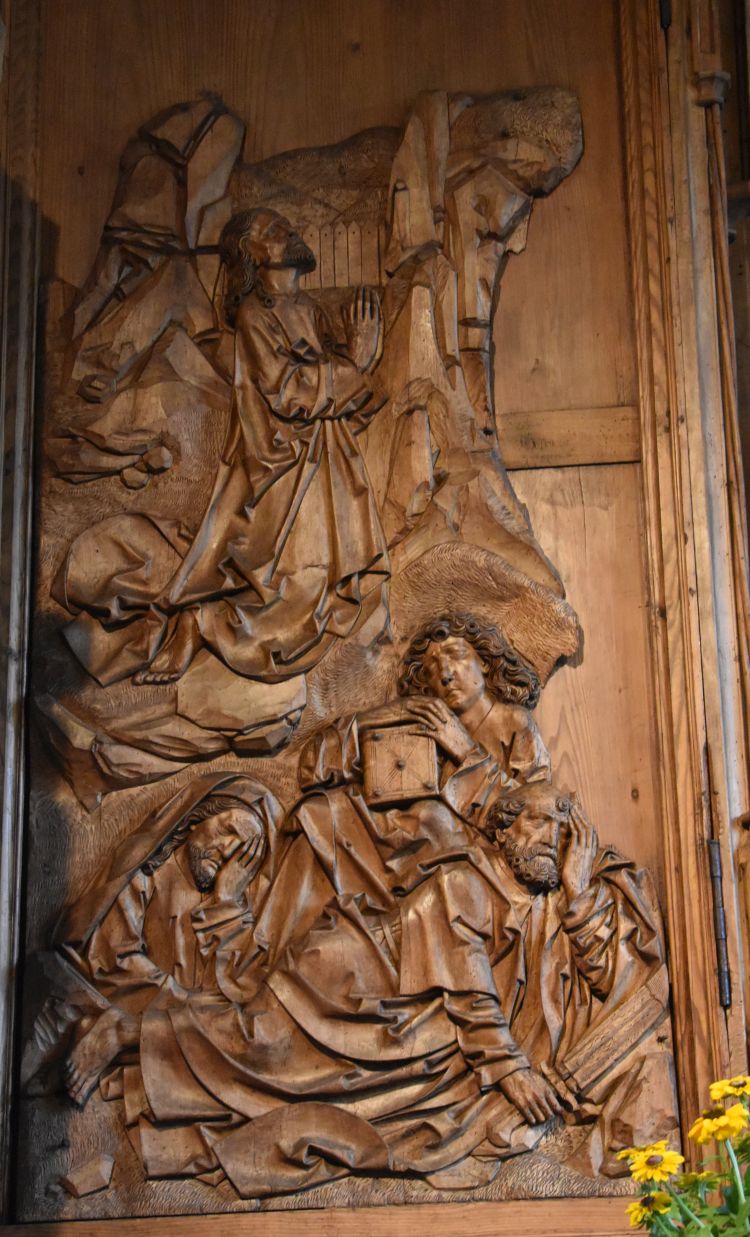
To the left is the Garden of Gethsemane, created by Riemenschneider’s workshop. The three disciples of Jesus, Petrus (with the sword), Johannes (with his book, the youngest of all three) and Jacobus are sleeping, while Christ is praying with fervour. The left side was cut off to make the altar fit. It must have shown Judas approaching the garden with the bailiffs and, in addition, some angels (brochure, p. 14).

To the right we see the Resurrection that has also been carved by Riemenschneider’s workshop. The grave is closed. One of the guardians is sleeping with the hat in his face, the second guard woke up; he is surprised and looks at what happens. The light blinds his eyes and he covers them with his hand.

The Predella has been lost. It might have shown the Lamentation (see brochure p. 10ff).

The two altars in the niches have also been transferred to here from other churches.

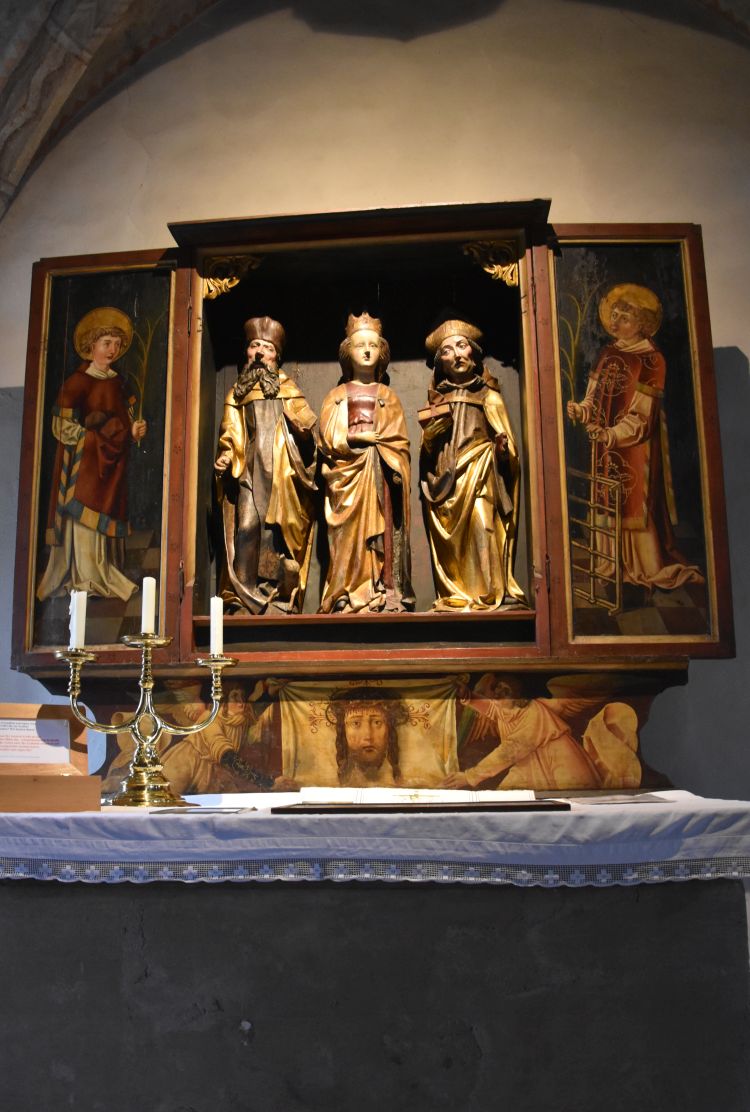
The late gothic altar in the left hand niche is from 1480/90. It shows martyrs surrounding Saint Catherine in the middle. I can also recognize Laurentius with his grill. In the Predella is Christ as the Man of Sorrows. 

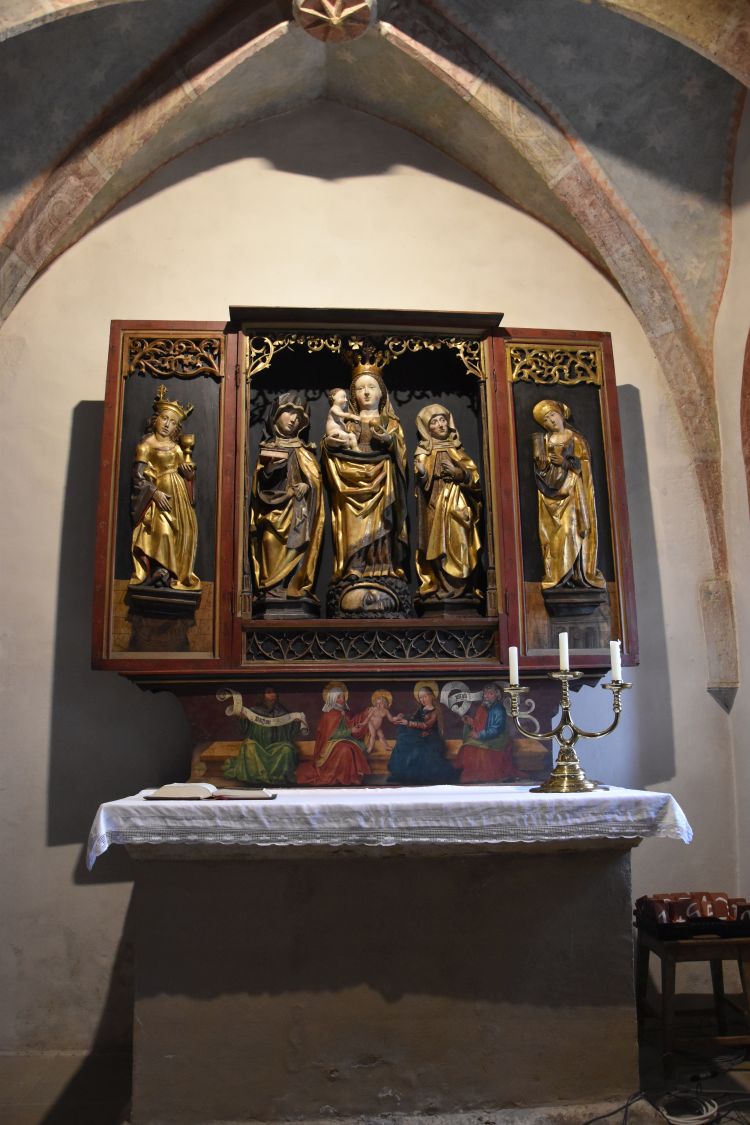
On the altar in the right niche, also late gothic from 1500/1510, we see Maria with martyrs, amongst them to her left side stands Saint Odile (brochure, p. 20f).

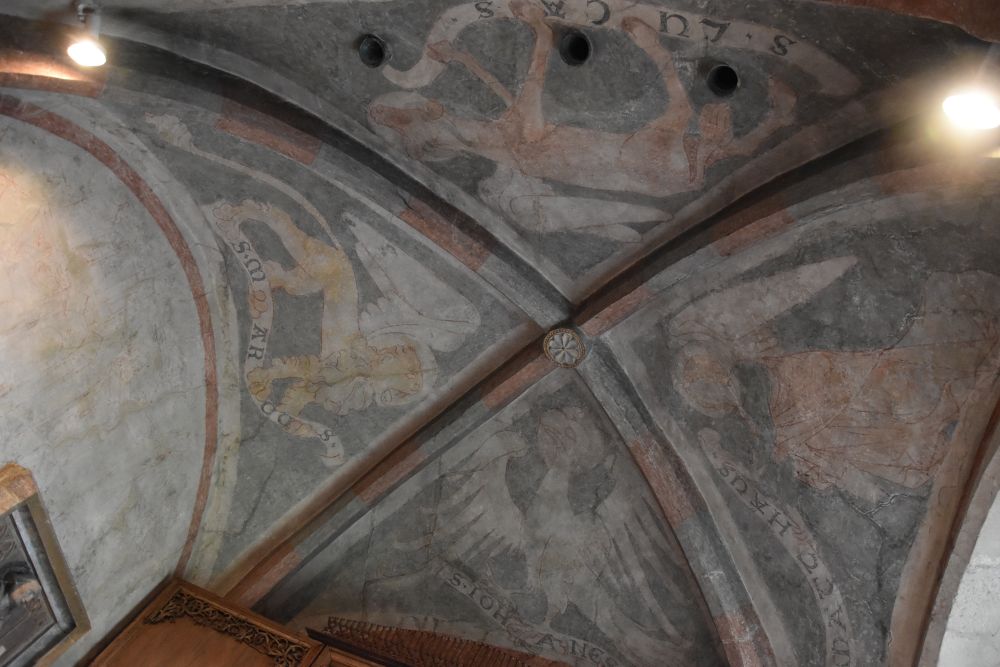
The symbols of the four evangelists decorate the ribbed vault  in the choir (frescoes from early 14th century, brochure, p. 7).

I love the introverted face in the choir – it has been here since the early 13th century (brochure, p.6).

Let us look back into the nave. The frescoes in the window frames are baroque (brochure p.5). The organ has been built in the year 1989 (wikipedia entry).

The Saint Peter and Paul church stands just next to the castle of Detwang. I am sure that my grand-parents visited the church and admired the altar of Tilmann Riemenschneider 84 years ago. Their daughter, my mother, showed many gothic altars to me, when we travelled together in Germany. She might have been taught by her parents and she surely taught me. I love to visit churches that have a solemn atmosphere and contain wonderful works of art. 


Detwang, the village around the church, is the craddle of Rothenburg

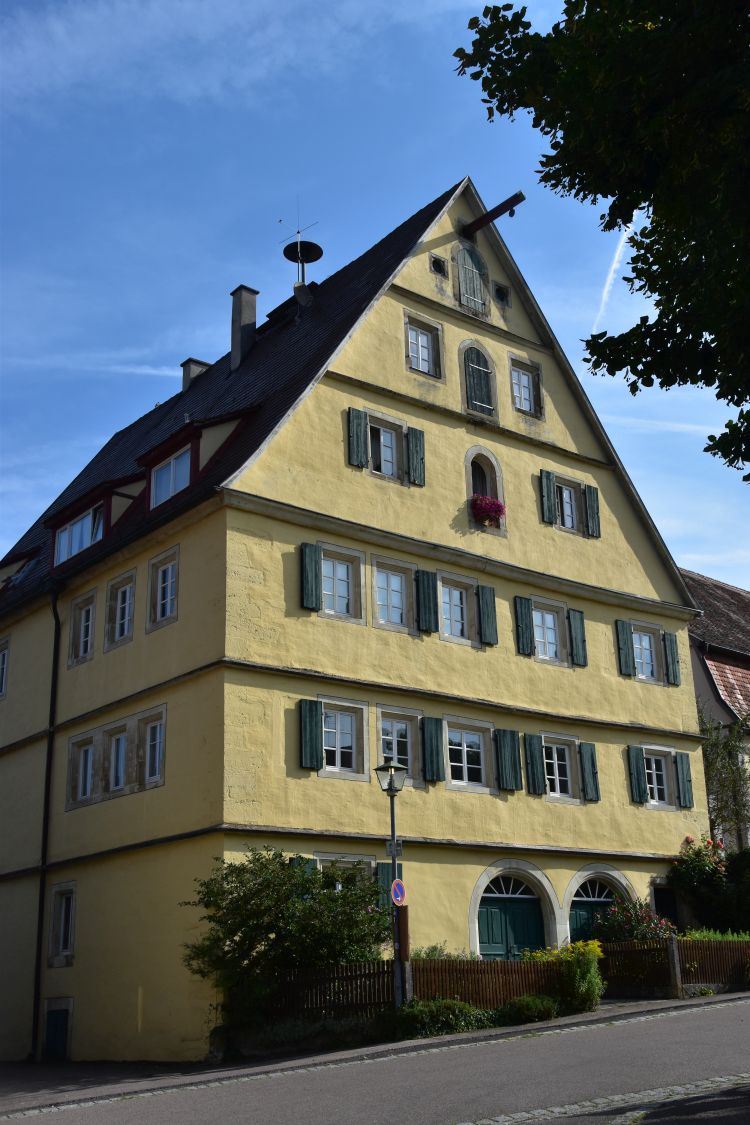
Detwang in the Tauber valley is older than Rothenburg. Detwang was first mentioned in 976 as the “field” (wang) of Teto (wiki entry). Later Rothenburg became more important, and Detwang never grew much larger than it was in medieval times. Many old houses survived the war such as the historic hotel Schwarzes Lamm (Black Lamb), where I spent two nights with the friendly hospitality of a Hungarian family. It was originally built in 1804 and was later renovated.

Next to the Black Lamb is this Patrician house from the 16th century (wiki entry about Detwang).

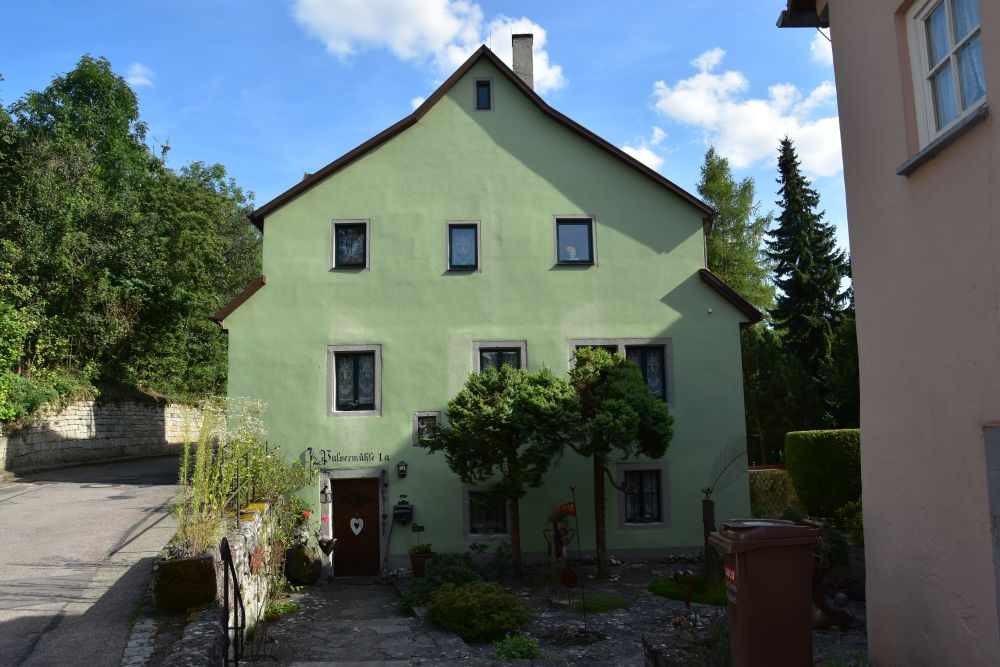
The Pulverhaus (“powder house”) was a mill built in 1400 and  processed saltpetre. In 1744 it blew up, because the owner walked around in the building with a burning light. It was a dangerous location, there was another explosion in 1903, and in 1905 the saltpetre mill was shut down (panel in front of the house).


Quiet Detwang is worth a visit – there are less tourists here than at Rothenburg

Detwang is much quieter than crowded Rothenburg ob der Tauber, and it is worth a visit.

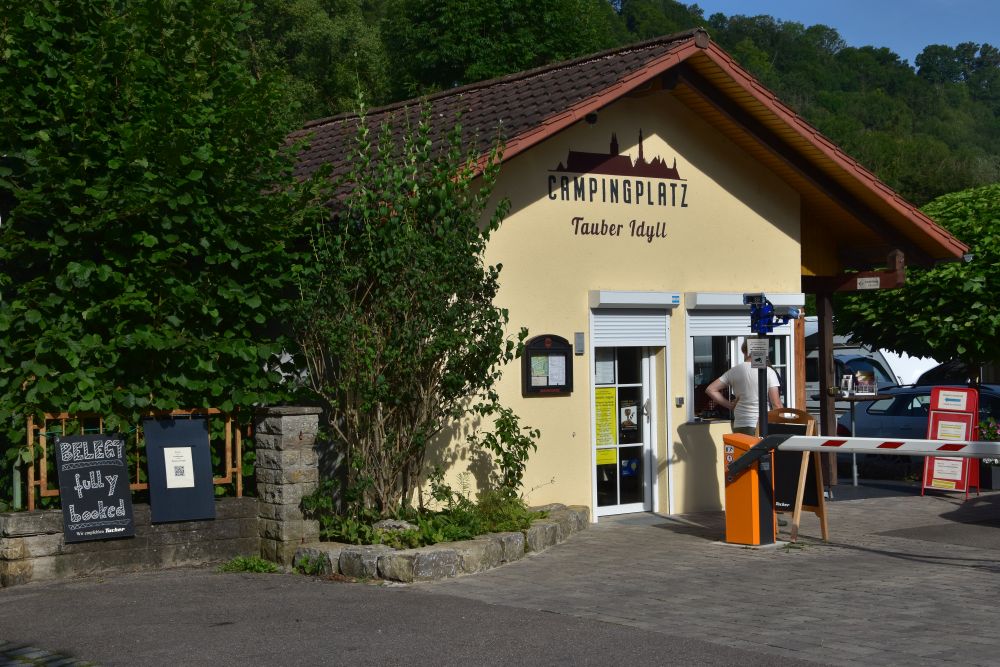
It is popular with campers. There are two camping sites at Detwang, one of them being called “Tauber Idyll”. It is booked out right now in the beginning of August. “Fully booked”, it says on the black board in English. The guests must come from far. 

From the camping site, I start my evening walk along the Tauber river that is lined with mills. I started to like this hidden village. Thank you, Hermann and Helene, my grand-parents, you have showed me another treasure that I would have never found without you.


Where are we?

The map shows, where we are. Now I talked about Detwang, an urban district of Rothenburg. 

In the next blogs, we will explore Rothenburg ob der Tauber (in Bavaria) and the Celtic Oppidum as well as the church of Lord (Hergottskirche) near Creglingen (in Baden-Württemberg). Nuremberg (Nürnberg) is located about 75km to the east of Rothenburg ob der Tauber.


Sources:

Hermann Radzyk painted the viaduct in the Góry Sowie in 1924

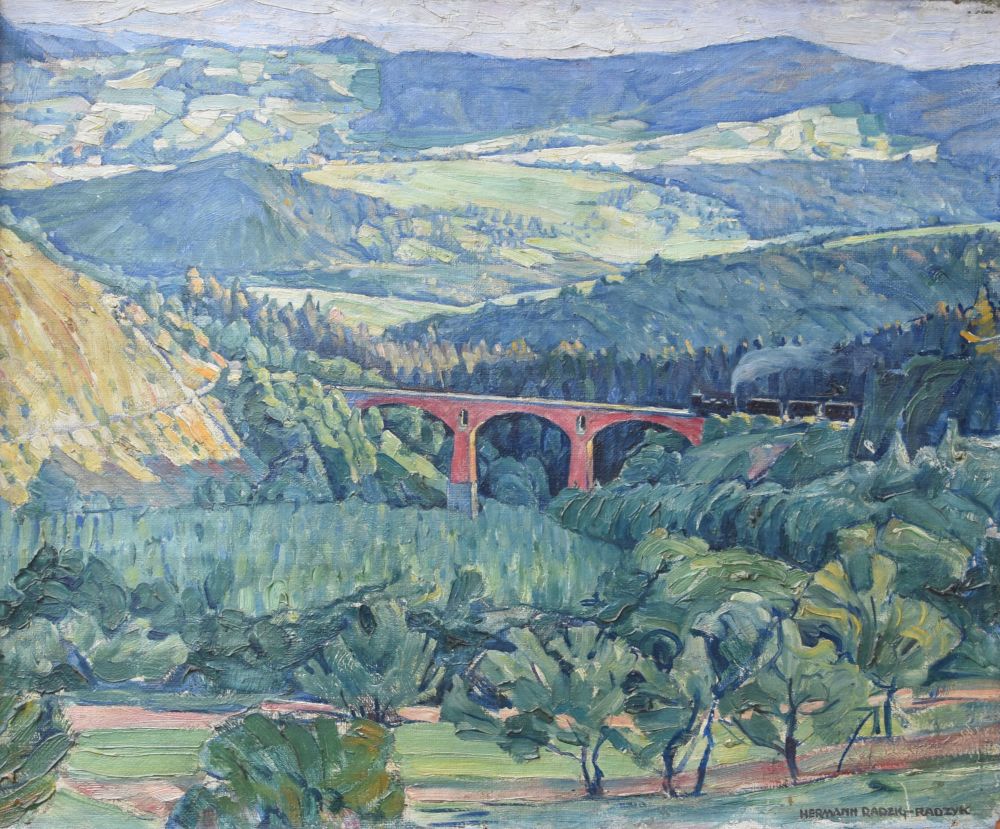
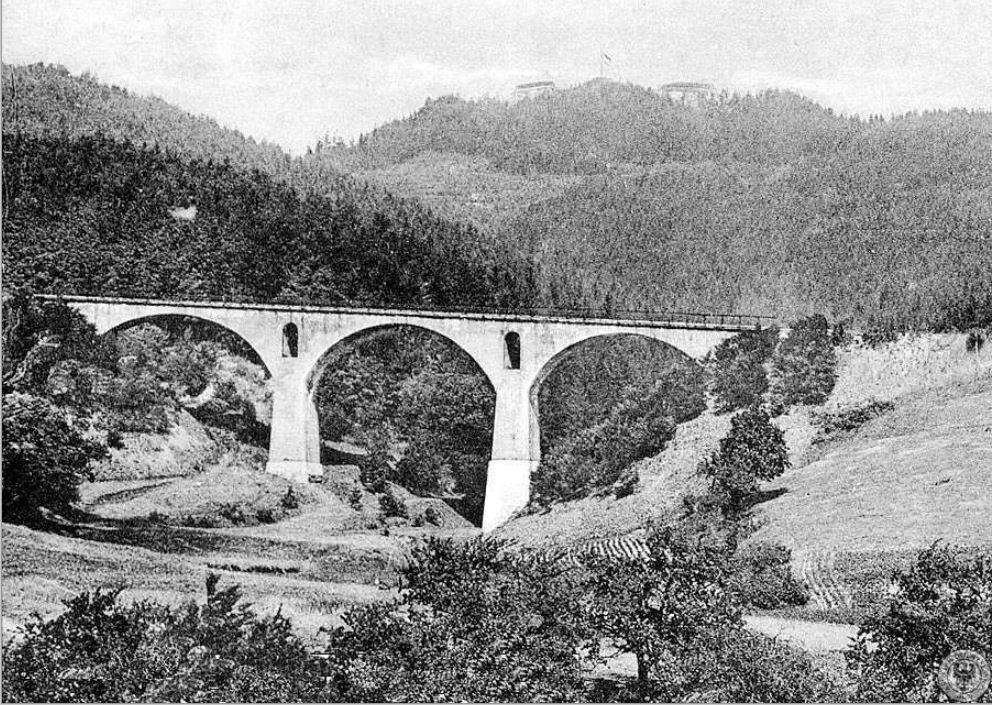
Exactly a hundred years ago, in 1924, my grandfather Hermann Radzyk painted this rack train viaduct in the Eulengebirge (Góry Sowie) in Silesia (now Poland).

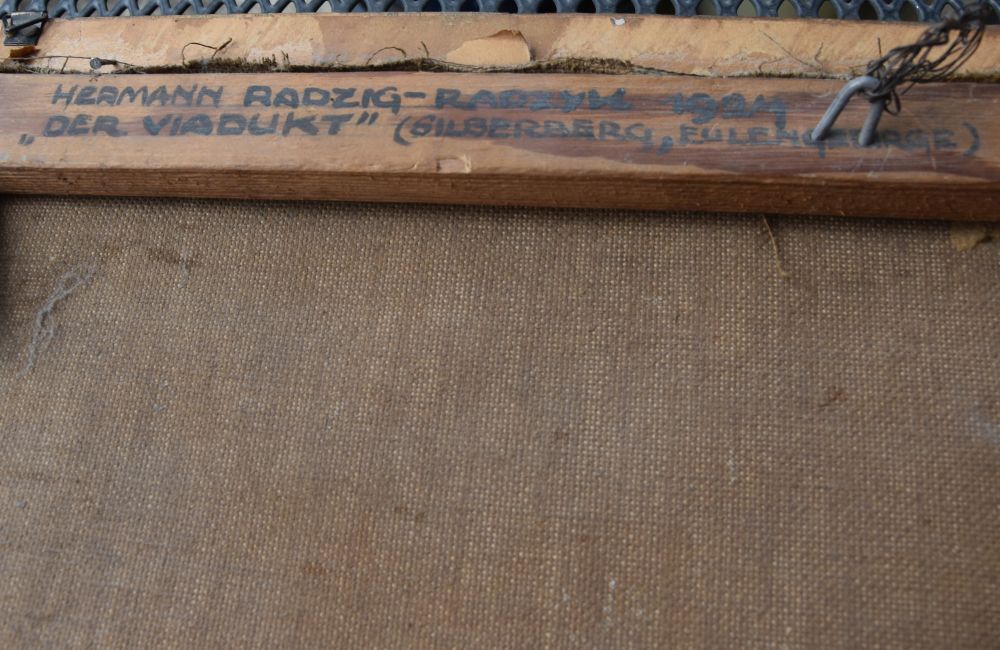
On the rear side, Hermann Radzyk wrote down the year and the name of his painting. He called it “Der Viadukt (the viaduct)”, and he added “Silberberg, Eulengebirge”. The painting is family-owned.

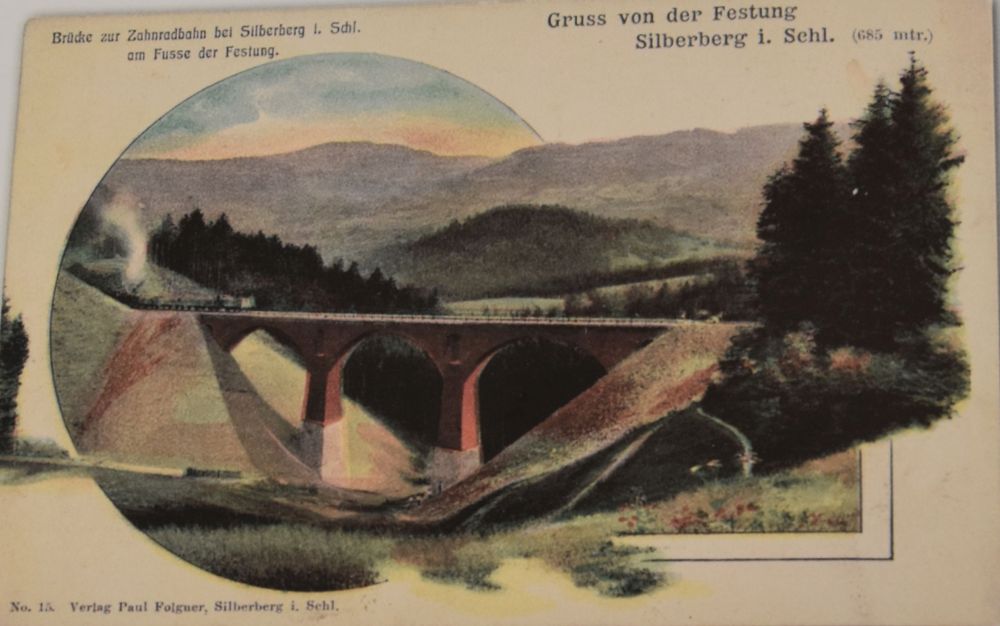
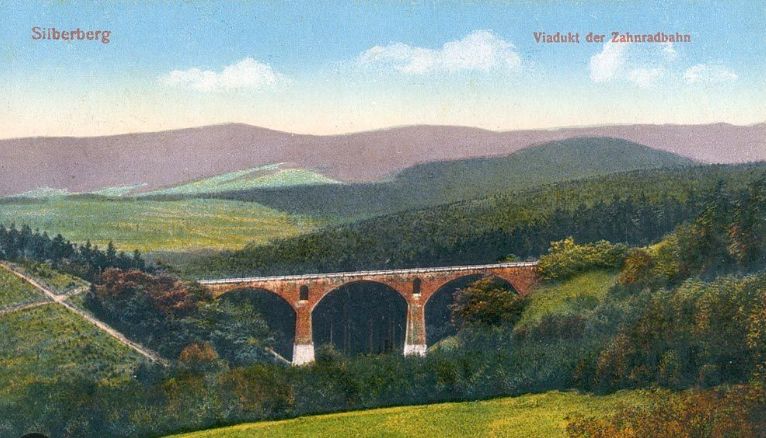
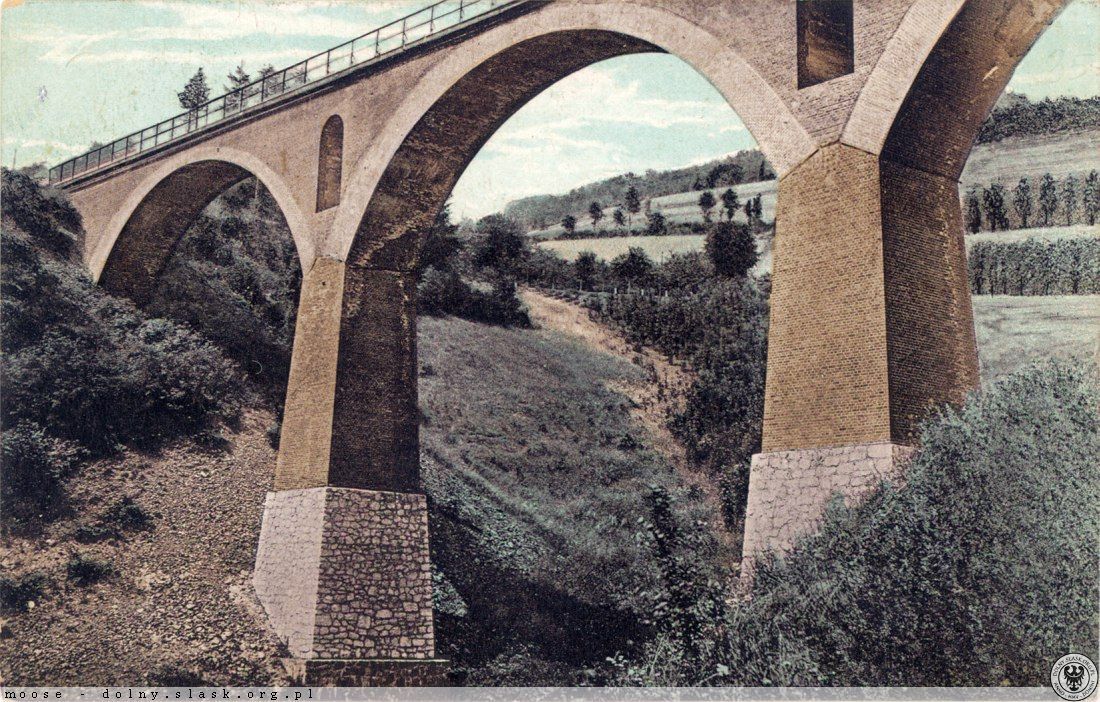
Look at the cone shaped hill behind the viaduct on this old postcard. It shows the same viaduct, the so-called “Silberbergviadukt” or, in Polish, “Wiadukt Srebrnogórski”.

(Source: Jacek Gruzlewski and Tomasz Przerwa, p. 224)

The easel of my grandfather stood on the Silberberg pass (Przełęcz Srebrna) above the viaduct. He looked south towards the valley of Herzogswalde (Zdanów) and the mountains of Wartha (Góry Bardzkie).

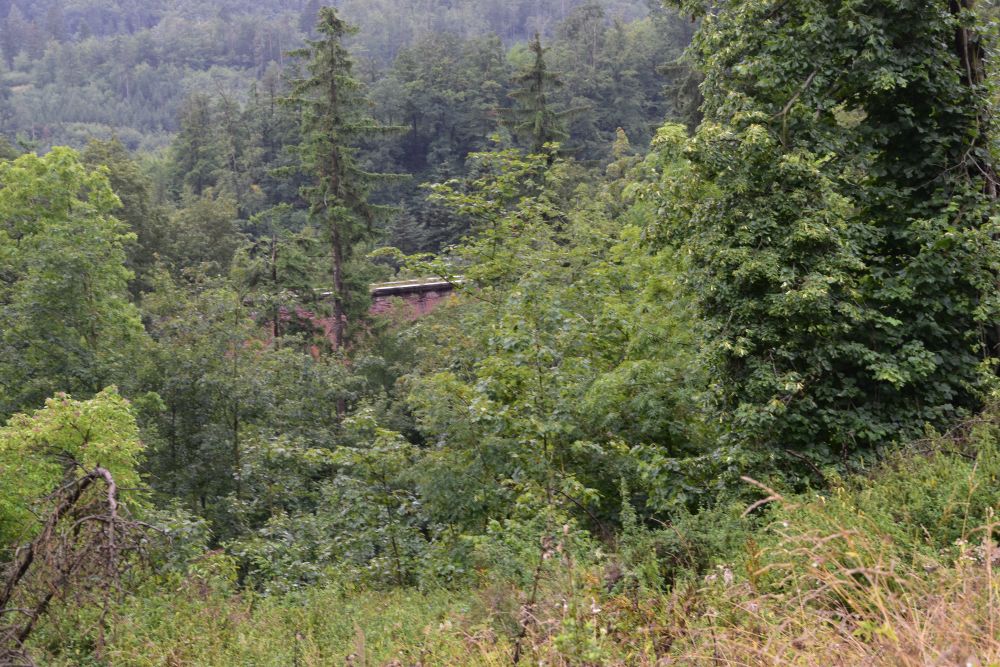
I only found two places, where I could see the viaduct from the Silberbergpass today. In summer 2023, I stepped into the high grass of the wild meadow above the viaduct. This is all I could see from the viaduct. I am a bit lower than the easel of my grandfather.

Along this wild meadow, there is a small footpath that leads down into the valley under the viaduct (see https://polska-org.pl/539823,Srebrna_Gora,Wiadukt_Srebrnogorski_Most_Katarzyny.html for a good description of the path from the car parking to the viaduct)

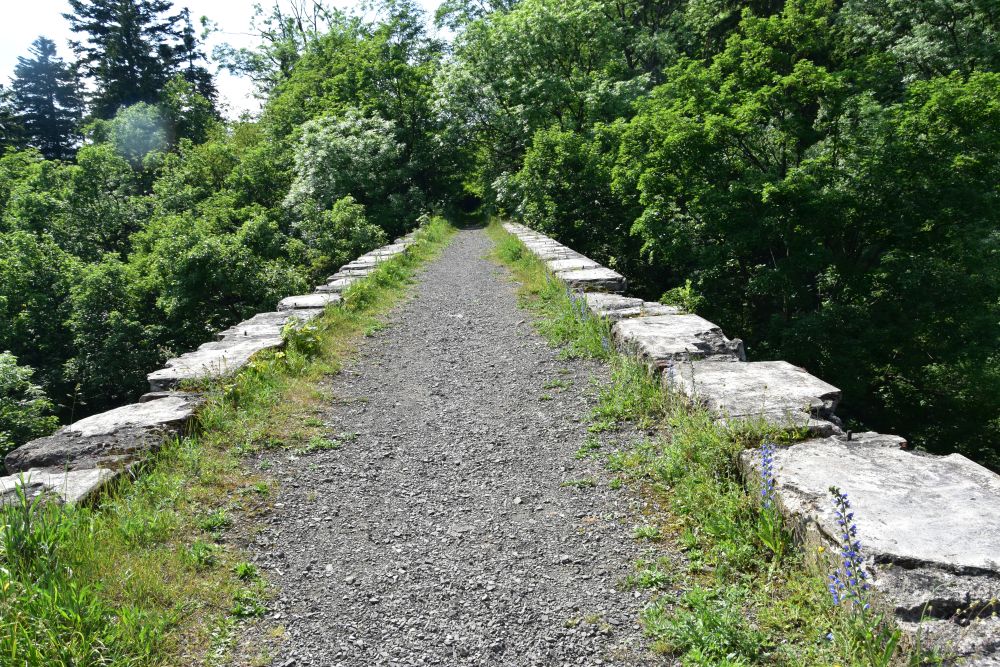
A hiking path crosses the viaduct. It was drizzling, when I was here.

The second “window” was on the local street above the pass road (Warowna Street leading to Hahnvorwerk or Budzowska Kolonia), where the viaduct appeared once more between the trees. 

However, the easel stood more to the right and not as high as I am now. Today, my grandfather Hermann Radzyk could no longer reproduce the painting of the viaduct. 

I invested quite some detective work to identify the viaduct my grandfather had painted. This was an opportunity to get to know Silberberg and the Eulengebirgsbahn, the railway of the Owl Mountains. Let me tell you.

I will start with my detective work which comes in three steps: First, where in Europe is this viaduct? Second, found two viaducts, where are they “hiding”? Third, which of the two viaducts is on the painting? Closing it up, I wanted to make sure, that it was really not the Herzogswaldeviadukt  that my grandfather painted, but it was the Silberbergviadukt.


First challenge: Where in Europe is this viaduct?

My sister owns the painting of the viaduct. In June 2024, I packed my tripod and drove to  my sister’s house to take photos. We took her paintings down from the walls. Only then I found out about the description on the rear side: 1924, “”Der Viadukt”, Silberberg, Eulengebirge”. Knowing this before would have made my detective work easier. From the beginning, I would have looked for the viaduct in the Eulengebirge (Góry Sowie, Silesia).

But I was not aware of the description on the rear side, when early in 2023, I started to look for the viaduct. I had to guess, where in Europe this viaduct stands. The vegetation looked middle or northern European. Perhaps Silesia?  I investigated all mountain railway lines in Silesia in the Internet and ended up discovering the two red brick viaducts in the Eulengebirge (Góry Sowie) near Silberberg (Srebrna Góra). They both are very similar and they both look like the viaduct on the painting of my grandfather, as the old postcards show.

(1) This is the “higher” viaduct just below the Silberberg pass, called Wiadukt Srebrnogórski (in German Silberbergviadukt).

(Source: https://polska-org.pl/539823,Srebrna_Gora,Wiadukt_Srebrnogorski_Most_Katarzyny.html)

(2) … and this is the “lower” viaduct just after Silberberg called Wiadukt Zdanówski (in German Herzogswaldeviadukt). 

(Source: https://polska-org.pl/522602,Zdanow,Wiadukt_Zdanowski_Most_Dziewiczy.html)

It is clear to me, my grandfather has painted one of the two viaducts, but it is unclear to me, which of the two and from where.

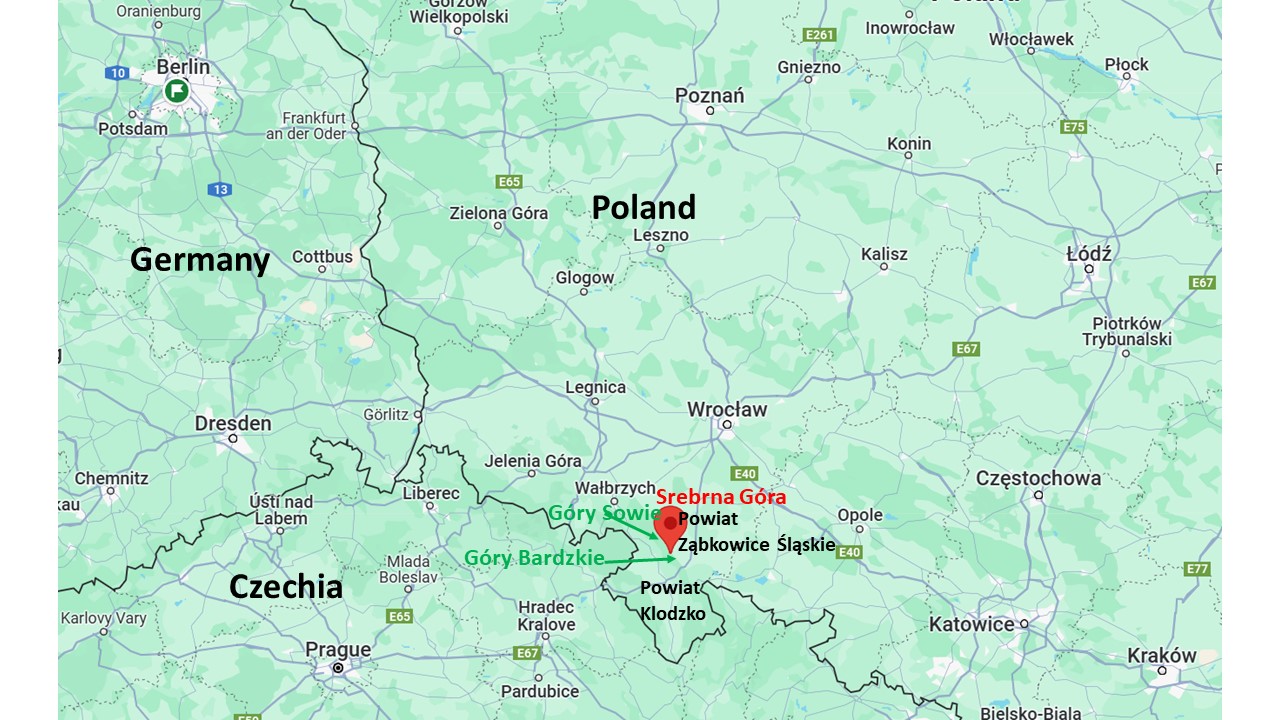
Let us check out, where we are: Srebrna Góra is in Silesia, part of the Powiat Ząbkowice Śląskie, located north of Powiat Klodzko at the south east edge of the Eulengebirge (Góry Sowie) and north of the Góry Bardzkie.

Source: Google maps and my additions.


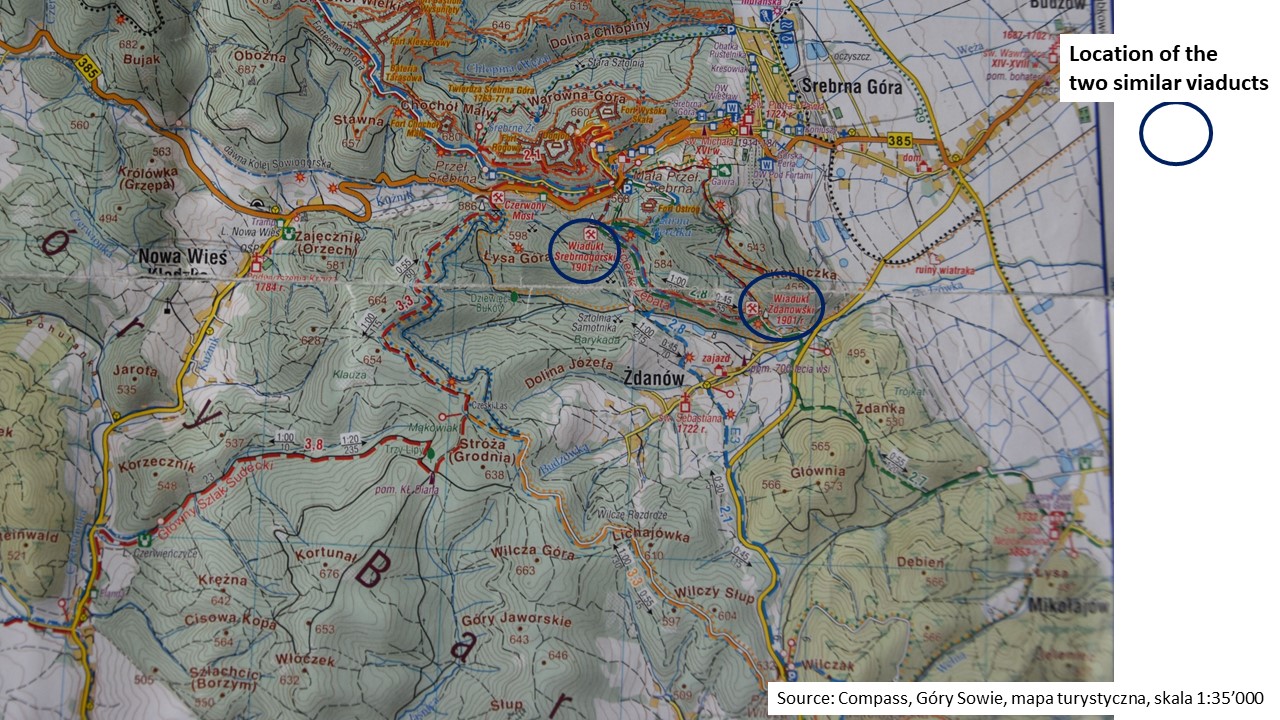
Second challenge in May 2023: Found two viaducts in the Owl Mountains in the Internet, now – where are they “hiding”?

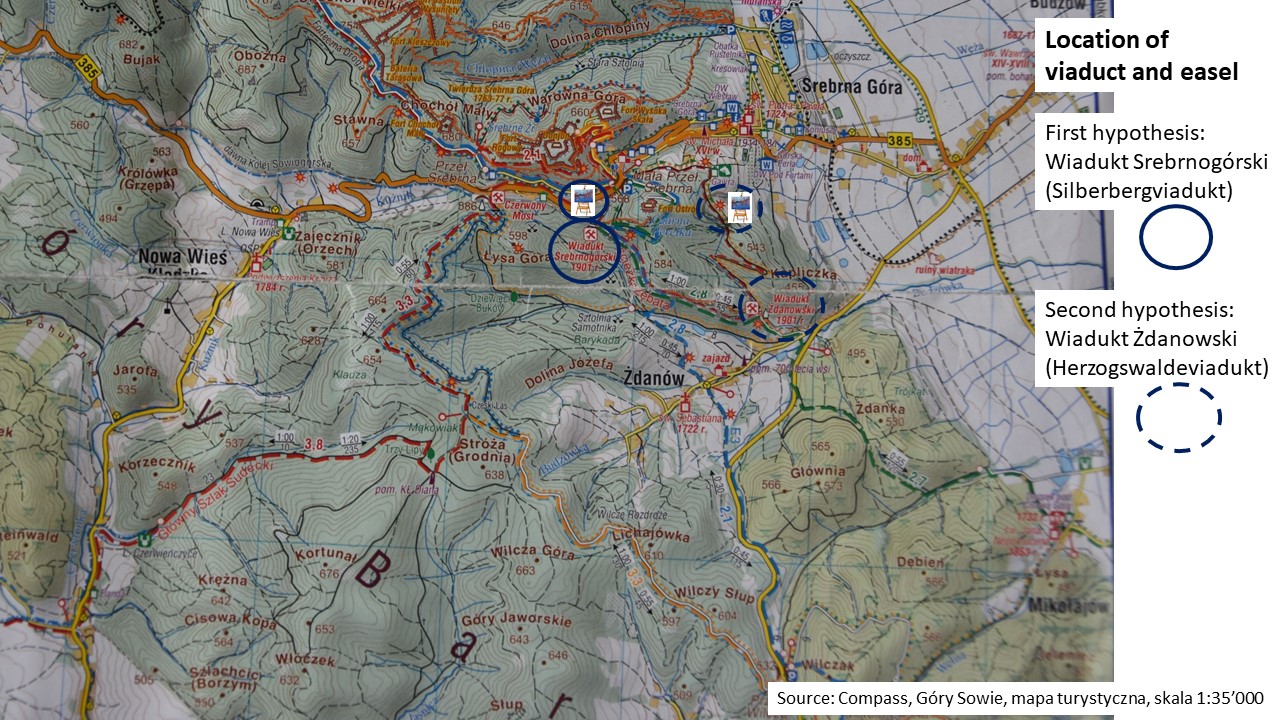
On my hiking map, I marked the two viaducts.

To find the viaducts, I settled in the Lesny Dvor in Wolibórz near Srebrna Góra in May 2023, with a friend. 

We drove to Zdanów (formerly Herzogswalde) and above Zdanów we looked north to where we knew, the viaducts should be. We could not see any viaducts, just trees and above the dense forest the Fortress of Srebrna Góra (the Srebrna Góra Twierdza). A friendly dog barked at us from a garden, wagging his tail. The owner came to the gate. “What are you doing here?” He and his wife invited us for coffee. They told us, that we can see the viaduct from the hiking path close to where the road to Srebrna Góra forks. 

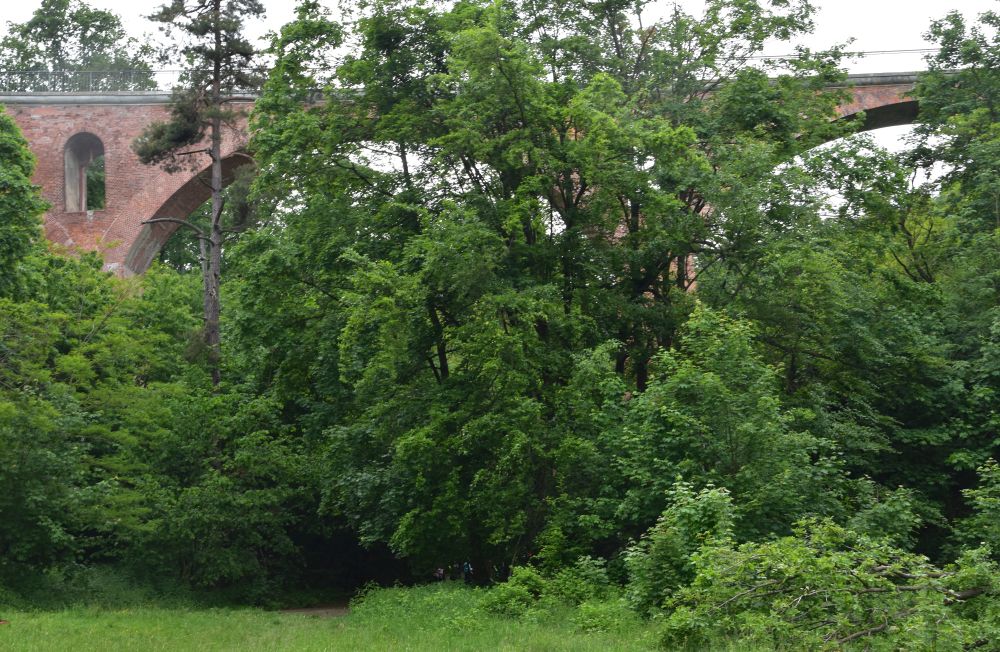
We drove to the fork. My friend left the car and her face brightened up, as she spotted one arch of the “lower” viaduct. We parked the car to walk there. We heard children laugh. We saw the “lower” viaduct, the Herzogwaldeviadukt, behind the trees.

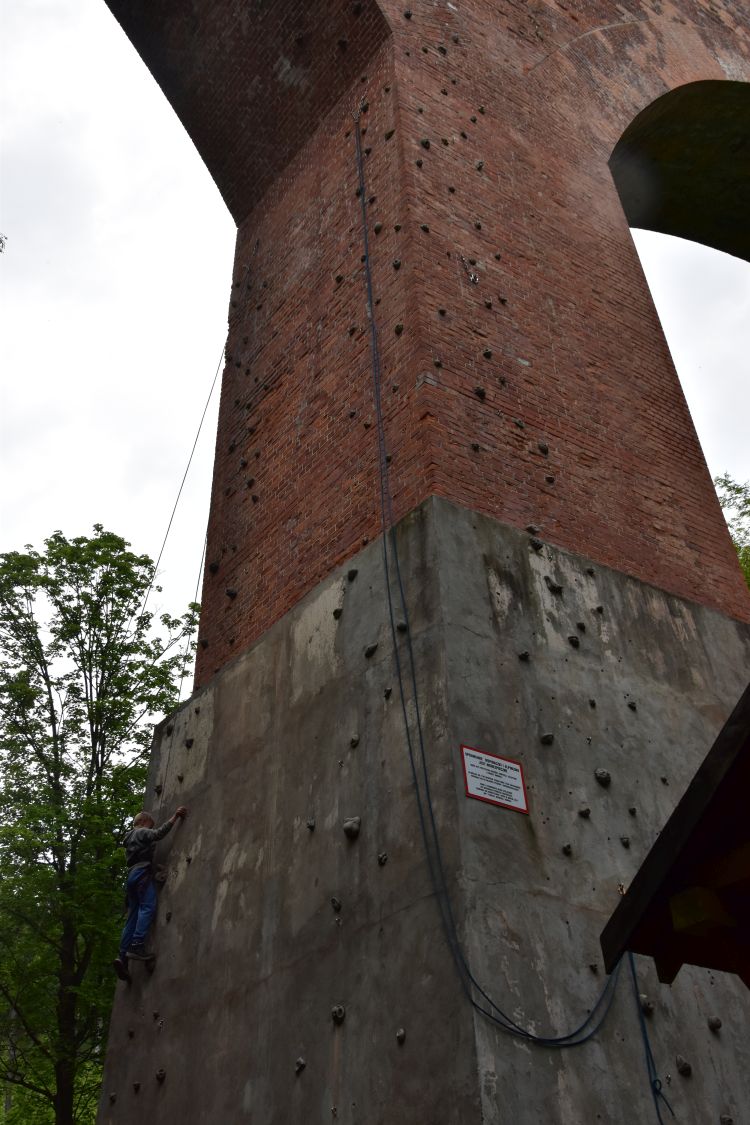
A young man sat on a stone. He said that he is a mountain guide. A mountain guide? Here? But soon we understood. The viaduct is a climbing park now! 

The children that we could hear laugh are here to learn how to climb. The viaduct has been “recycled”. 

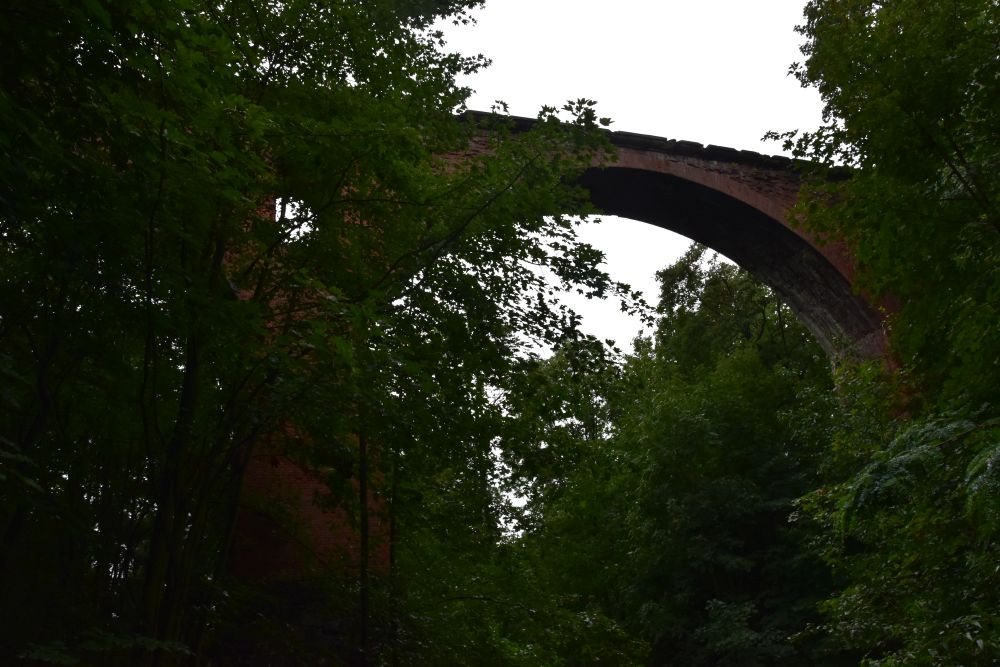
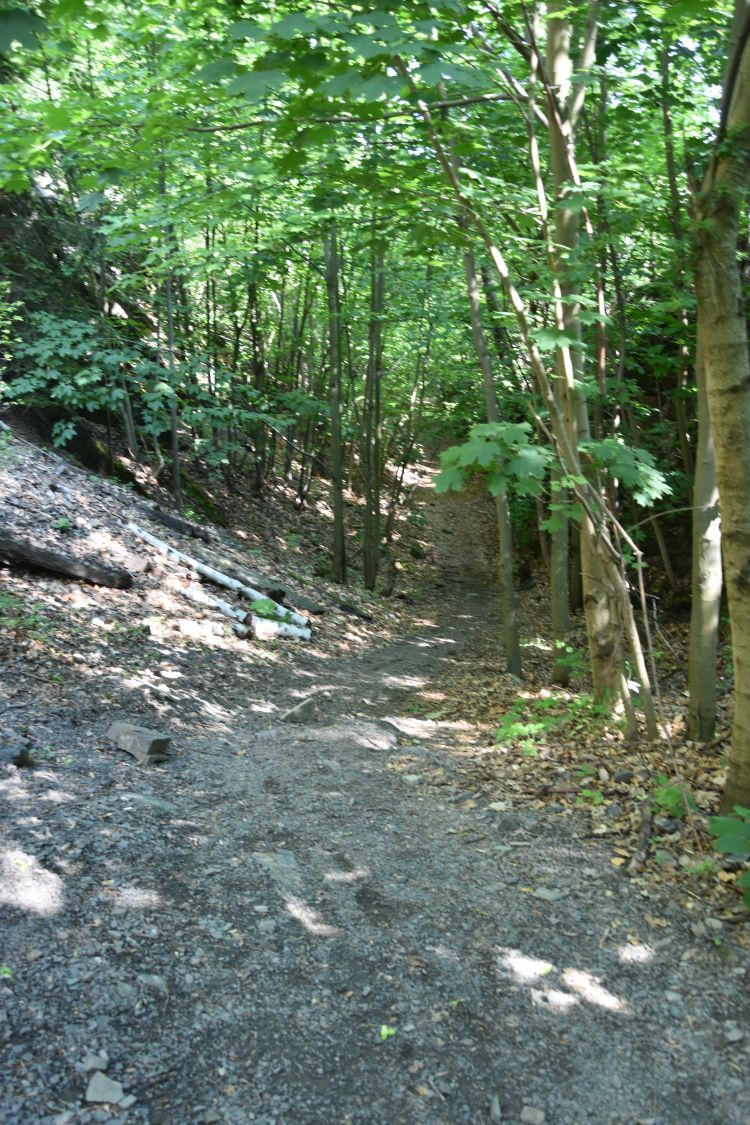
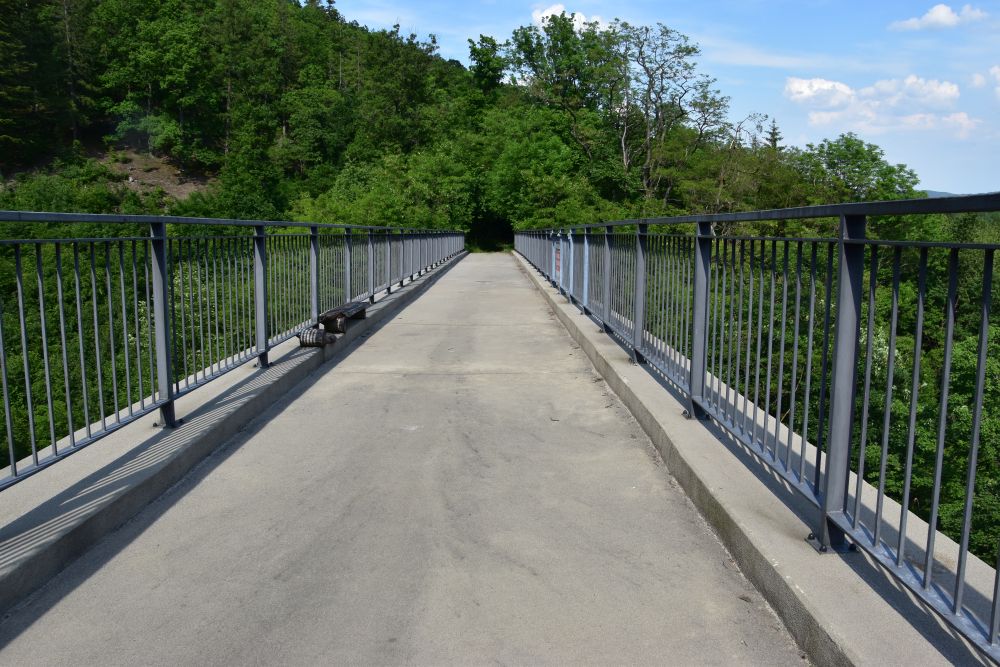
Later I drove to the parking above the Small Silberberg pass and, via Fort Ostrog (Spitzberg), I climbed down to the “upper” viaduct, the Silberbergviadukt. The area around the viaduct is very, very steep. I reached the top of the viaduct – it is now a hiking path. Not everyone might want to cross the viaduct. It looks dizzying.

Around the viaduct, it was not only steep, but also wet. I did not climb down to the bottom of the viaduct. Instead, I followed the old railway track to the “lower” viaduct, the Herzogswaldeviadukt. 

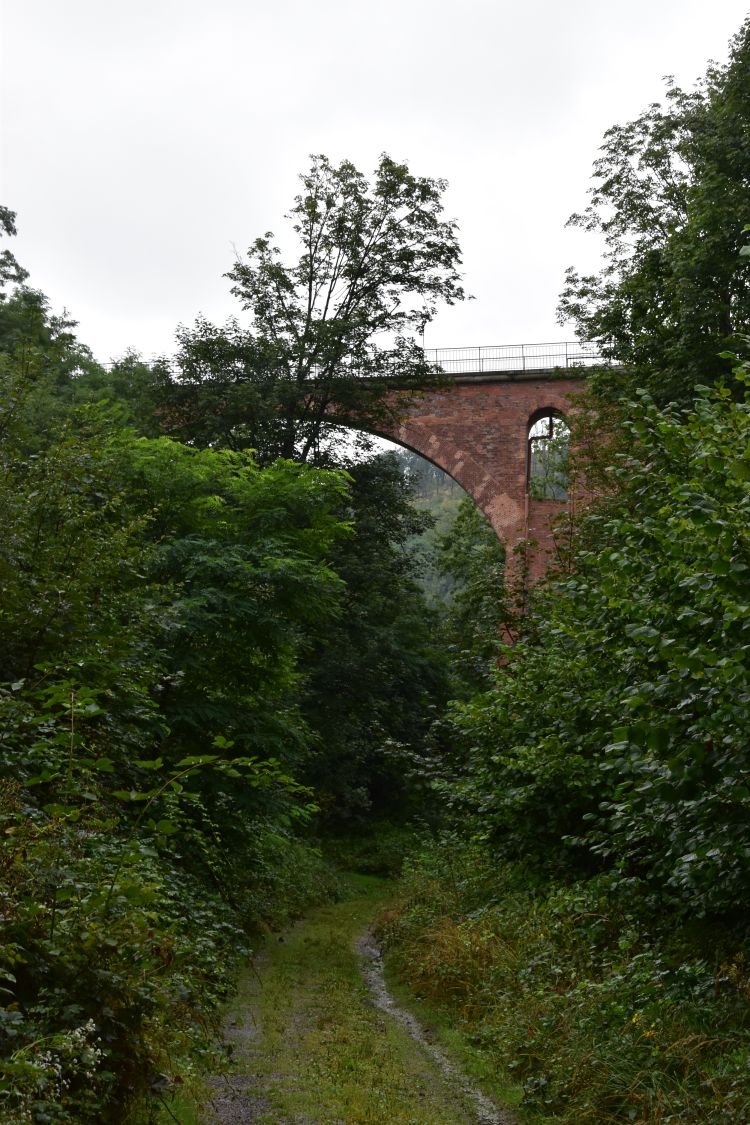
Very impressive. In some places, landslides cover the trench that the Germans had dug for the railway. The hiking pass across the Herzogswaldeviadukt is comfortable and less dizzying.

Still I do not understand, which of the two viaducts my grandfather has painted, the “upper” or the “lower”. They are so similar!


Third and final challenge in August 2023: Which of the two viaducts is on the painting and where was the easel?

I returned in August 2023 and settled in the Palac Kamieniec near Klodzko twice, once on my way to Kraków and again on my way back from Kraków. From talking to the friendly couple at Zdanów, I now understood that the easel stood north of the viaducts and Hermann Radzyk painted looking south to the valley of Zdanów and to the Góry Bardzkie. I had two alternative hypotheses for the location of the easel, one for the “lower” viaduct near Srebrna Góra and one for the “upper” viaduct near the Silberberg pass.

I do not remember, how often I walked around the two viaducts, until I understood clearly, it was the “UPPER” Silberbergviadukt that my grandfather had painted, and the easel stood on the Silberberg pass (Przełęcz Srebrna). In the meantime, I had acquired the wonderful bilingual book of Jacek Gruzlewski and Tomasz Przerwa about the history of Silberberg. The old photos were useful for my investigations.

Let us look at the painting again. The easel stood clearly ABOVE the viaduct on a meadow with bushes and not too far away from the viaduct.

The view behind the Silberberg viaduct is a good match with the background on the old postcard – there is the same cone-shaped hill behind the viaduct.

(Source: Jacek Gruzlewski and Tomasz Przerwa, p. 224)

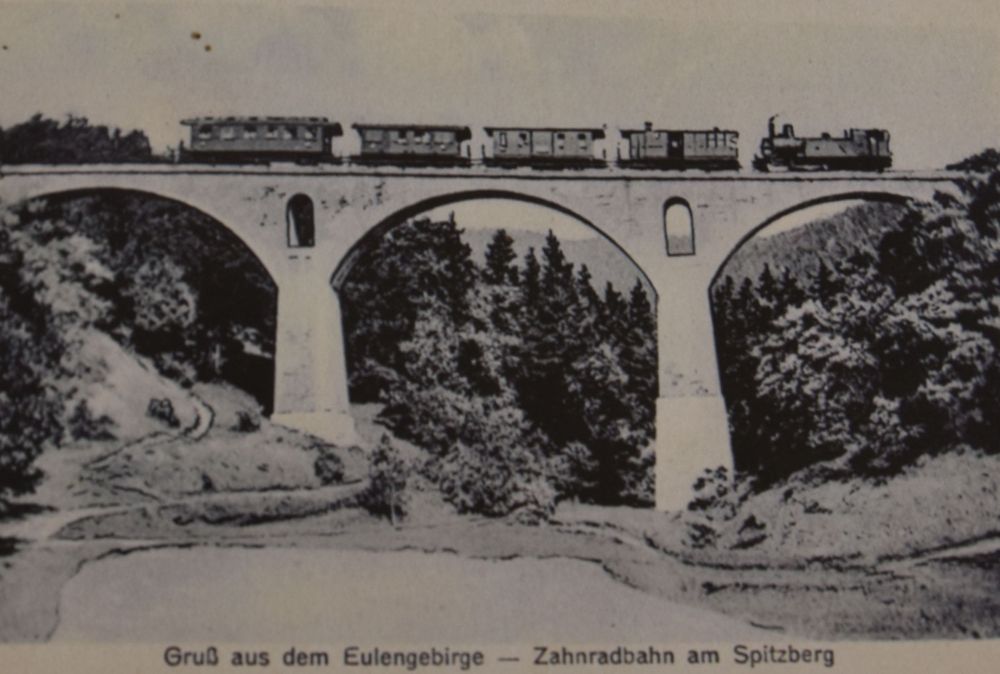
The photographer of this old postcard stood south below the Silberbergviadukt looking north to the meadow with the bushes, where the easel was.  

(Source: Jacek Gruzlewski and Tomasz Przerwa, p. 224)

Now I am convinced, Hermann Radzyk painted the “upper” viaduct, the Silberbergviadukt and the easel was ABOVE the viaduct on a MEADOW, on the Silberberg pass. 


Final check: “Lower” Herzogswaldeviadukt excluded – Hermann Radzyk did not paint the “lower” viaduct

I excluded the “lower” Herzogswaldeviadukt, first because already a hundred years ago, there were trees in the valley north of the viaduct, as this photo taken from the south shows. No meadow behind this viaduct to put down the easel.

(Source: Jacek Gruzlewski and Tomasz Przerwa, p. 221)

I excluded the Herzogswaldeviadukt, because second, in the valley north of it, I am always BELOW the viaduct. I verified that on site. I took my photo in the valley north of the Herzogswaldeviadukt  and I am looking up to the viaduct. A little bit farther, the path turns behind the mountain and the viaduct disappears. No place here to look down to the viaduct.

It would have been inconvenient to put down the easel here, there are no houses in the wild valley behind the Herzogswaldeviadukt. The couple of Zdanów had suggested, the easel was higher up and closer to the Small Silberberg pass, but at that point, I am too far away and there are hills in the visual axis to the Herzogswaldeviadukt. 

Yes, it is confirmed for me, the painting shows the “upper” Silberbergviadukt or, in Polish, the Wiaduct Srebrnogórsky. I am happy to have solved the puzzle of the viaduct.

Let us now learn more about the Railway of the Owl Mountains and about Silberberg and its fortress.


The Eulengebirgsbahn (Railway of the Owl Mountains) was built to speed up the transport of coal from Neurode to the weaving factories of Reichenbach

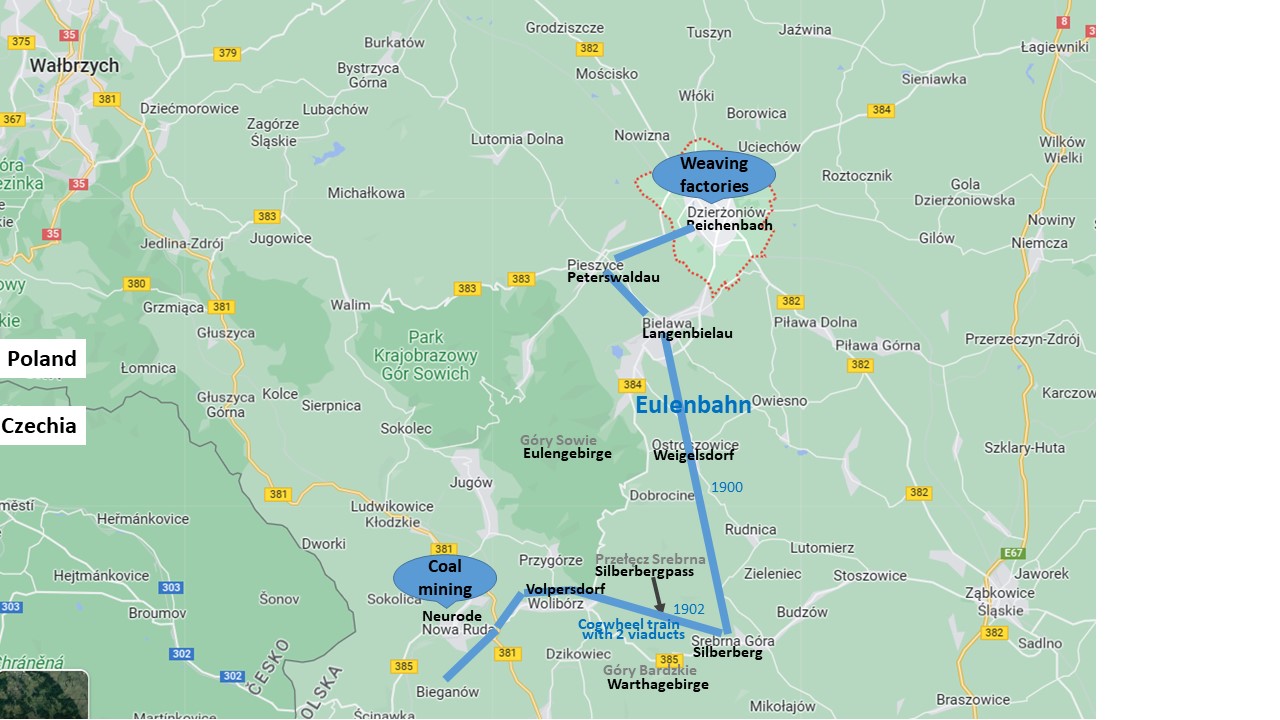
North East of the Eulengebirge (Góry Sowie) were the weaving factories, where the weavers’ rebellion took place in the year 1844. About this rebellion, the German author Gerhart Hauptmann wrote the play “die Weber (the Weavers)” in 1892 (we read it at school 60 years ago). The weaving factories around Reichenbach needed energy. Coal mining was at Neurode, on the other side of the mountains. The Eulengebirge (Góry Sowie) and the Warthagebirge (Góry Bardzkie) were in the way. The Germans decided to connect Neurode and Reichenbach by building a railway, the Eulengebirgsbahn, nick named “Eule”. The railway from Reichenbach to Silberberg was inaugurated in 1900. Two years later, in 1902, the Germans completed the section between Silberberg and Neurode. For this section, they had to overcome the Silber pass (Przełęcz Srebrna) that separates the Eulengebirge (Góry Sowie) from the Warthagebirge (Góry Bardzkie). They built the cog railway between Silberberg (Srebrna Góra) and Neudorf (Nowa Wieś). Crossing the two canyons between Silberberg and the Silber pass required constructing the two spectacular viaducts. The Herzogswaldeviadukt was 24m high and 90m long. The Silberbergviadukt was 27m high (Gruzlewski and Przerwa , p. 220 and p. 224) .     

(Source: Google maps and my own additions to lay out the approximate route of the railway and the mountains)

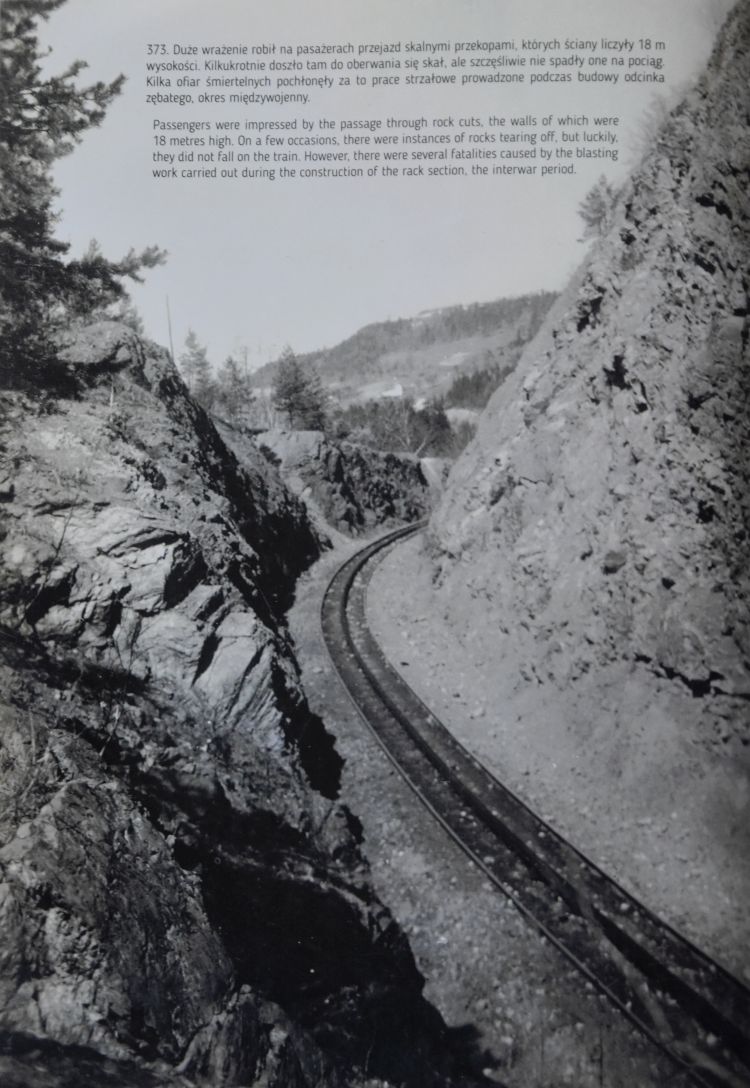
The cog train became a tourist attraction. The journey was 4.2km long and lasted about 27 minutes to overcome 175m (Gruzlewski and Przerwa , p. 230). The viaducts were spectacular. The railway had to be cut into the mountains, the rocks were 18m high.

(Gruzlewski and Przerwa , p. 223).

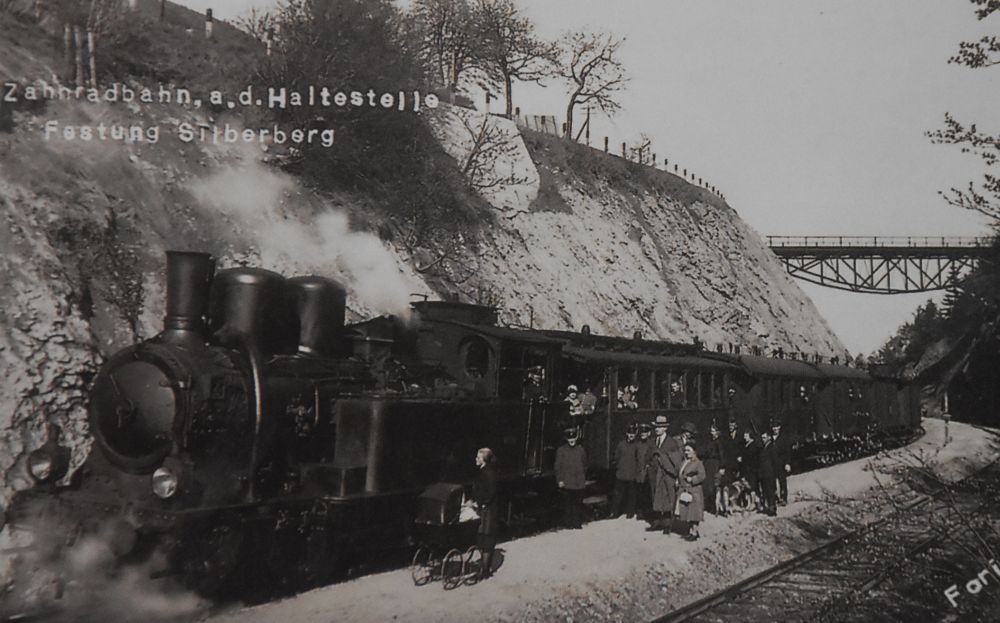
In 1924, when my grandfather put down his easel on the Silberberg pass, he surely had arrived with his family by cog train and left it at the station on the Silberberg pass.

(Gruzlewski and Przerwa , p. 216).

There were only a few tourist facilities on the Silberberg pass, the Waldfrieden (left hand side at the edge) and the Gasthaus zur Friedrichshöh (right hand side) (Gruzlewski and Przerwa , p. 58ff ). Probably my grandfather stayed in one of these facilities with his family.

(Gruzlewski and Przerwa , p.108)

Unfortunately, the cog wheel section had not been constructed carefully and was halted already in 1931. The last rack train travelled on October 11th 1931 (Gruzlewski and Przerwa, p. 228).
Today, the two viaducts belong to the cultural heritage of Poland, as indicated on the hiking map. The railway track has become the hiking path that I explored when investigating the viaducts. I came across quite a few hikers from Poland that enjoyed crossing the viaducts.


About the Silberberg Fortress built by the Prussians, now and before a tourist attraction

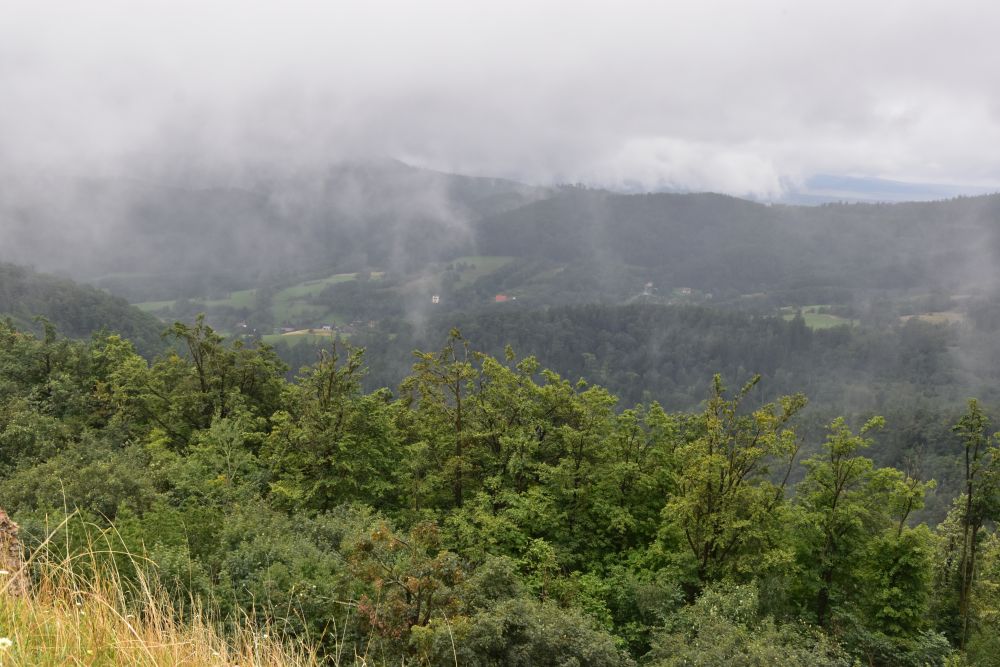
Today the Silberberg Fortress (Twierdza Srebrna) is the tourist attraction of Silberberg. I visited it in October 2022 on my first “detective tour”, then feeling desperate, because I had no idea, where to look for the places of the easel of my grandfather; I was even not aware of the viaducts below the Fortress. Almost one year later, in 2023, I knew about the viaducts. Again, I climbed up to the Fortress to get an overview of the western ridge of the Góry Bardzie that are on the painting of my grandfather. I could recognize the meadow behind Herzogswalde (Zdanów).


 It was wet and rainy. Not as sunny as on the painting of my grandfather. Today, there are more trees, but the hills of the Góry Bardzkie are still the same. 

In the souvenir shop of the Fortress, I found the wonderful book of Jacek Gruzlewski and Tomasz Przerwa (“Silberberg. A mirror of time – Srebrna Góra. Zwierciadlo czasu”, Srebrna Góra, Sova 2021). Back at the Palac Kamieniec in the evening, I read the book drinking a glass of good Polish wine. Good Polish wine? Be assured, you can find that.

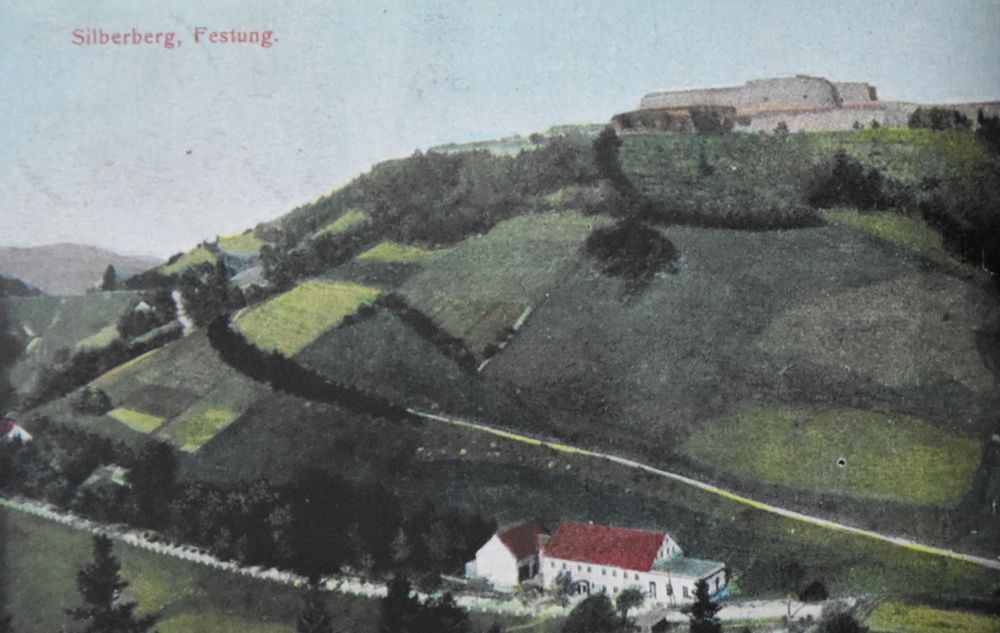
The Silberberg Fortress had been completed by Frederick II from Prussia in 1785. He had a complex of fortresses constructed on various hills above the Silberberg pass (Gruzlewski and Przerwa, p. 100). 

After 1880, the Fortress became a tourist attraction (Gruzlewski and Przerwa, p. 106).  In the time between the wars, about 60’000 tourists per year visited Fort Silberberg; they benefited from the railway station on the Silverberg pass (Gruzlewski and Przerwa, p. 130).

The fortresses have a gloomy past in the Second World War; the Nazi imprisoned Polish officers  (p. 107) and there were also Finnish prisoners (p.174).  I felt sorry for them. The vaults are very dark and wet, and I got lost in them.  

The Silberberg Fortress is a touristy place today as well. On weekends the two car parkings on the small Silberberg pass fill up quickly. Most tourists are from Poland. In addition I could hear some German; the children and grand children of the Silesians that had to emigrate after 1945 are now coming to Silesia to find the houses of their ancestors; the houses are now inhabited by the descendants of the Poles that had to emigrate from former East Poland. A beautiful testimony of the events after 1945 is given the Karolyna Kuszik’s “Poniemieckie”. 


The art scene at Srebrna Góra

Usually, my grandfather travelled to places with an active scene of artists. Gruzlewski and Przerwa included the chapter called “Artistically” on p. 239. They mention that plein-air painting arrived only shortly before the First World War;  Carl Ernst Morgenstern had painted the fortresses and Max Leipelt’s company from Cieplice (Warmbrunn) published postcards based on these paintings. In 1921-1922, the printer Franz Otto moved to Srebrna Góra and produced a calendar with wood cuts about the area. Was Hermann Radzyk aware of this calendar, when he decided to visit Srebrna Góra? In the 1920’s, the artist Max Günther moved to Srebrna Góra. Was Hermann Radzyk in contact with him, when he came to Srebrna Góra in 1924? I do not know. 


Srebrnra Góra and its rack railway – what a wonderful area

It was in October 2022 that I visited the Eulengebirge for the first time looking for the paintings of my grandfather, but not yet knowing any of the locations of the easel. I then drove along the south border of the Eulengebirge and was very surprised, when all of a sudden, the road went up steeply taking me to the Silberberg pass. In 2023 I returned three times to the area around Srebrna Góra and started to feel somewhat at home. The Poles I met off the beaten tracks asked me: “What are you doing HERE?” I showed them the painting of my grandfather – “I see”.

I thank the friendly couple at Zdanów that invited us for coffee. They spoke German and were the owners of a German diploma paper about Herzogswalde from the 1950’s. The owners of the Lesny Dvor proudly lent me their books about (German) Silesia, and German maps hang on the walls of their hotel. In addition the Palac Kamieniec is proud of their maps hanging on their walls. All that helped me to solve my puzzles about the paintings of my grandfather. And it gave me a feeling of reconciliation between Poles and Germans – this provides hope for the future.

Sources:


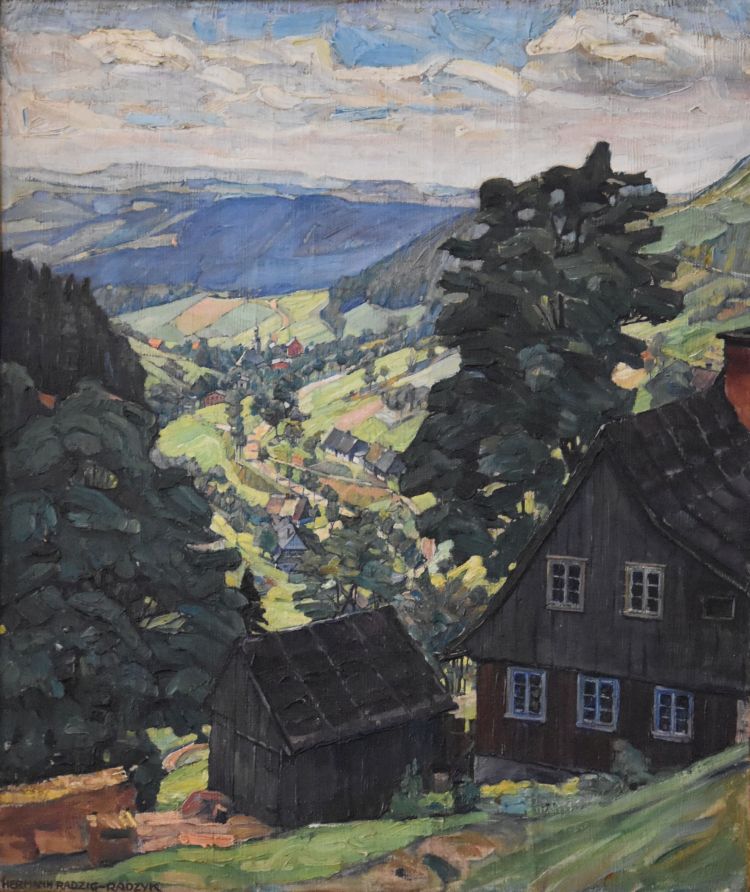
Hermann Radzyk painted the “Blick in das Glätzische Land” with Falkenberg (Silesia) in 1923

A hundred years ago, in the year 1923, my grandfather Hermann Radzyk painted the “Blick in das Glätzische Land (view of the Glatz district)” in Silesia (now Poland).

The painting is owned privately by a friend of our family.

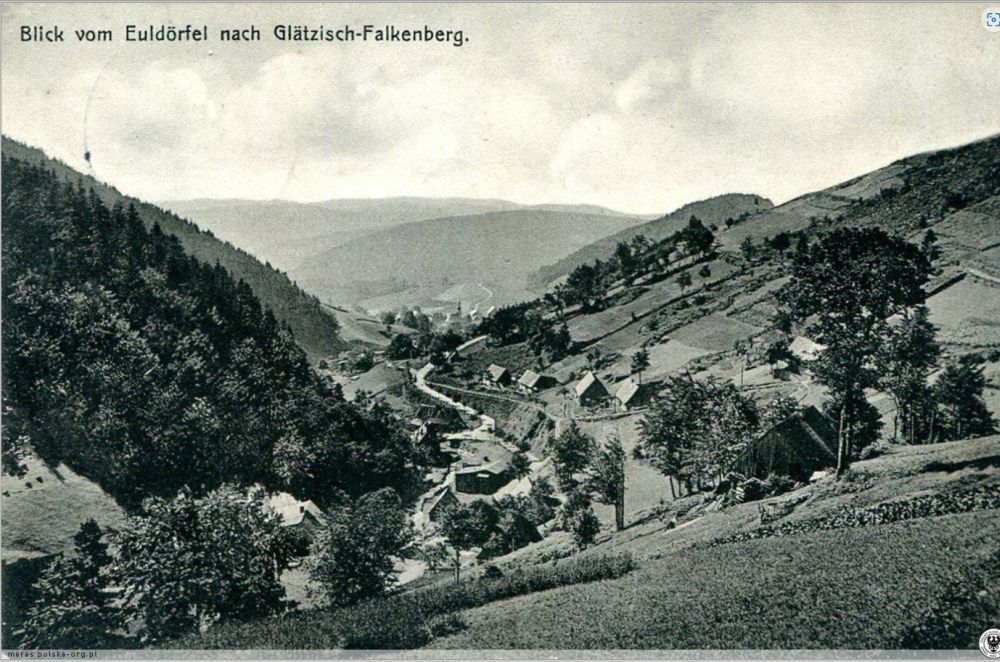
This old postcard is a very good match. 

Source: Panoramy i widoki Sokolca, Sokolec – zdjęcia (polska-org.pl)

The postcard confirms, the painting “Blick in das Glätzische Land” shows Glätzisch-Falkenberg from the Euldörfel. 

The Euldörfel was a holiday resort located above Falkenberg (today Sokolec). The “lower” houses (pensions and hotels) of the Euldörfel stood on this slope above the valley. 

Source: Euldörfel-Schwarzwasser (Eulengebirge) :: Ansichtskarten-Lexikon

The houses of the “lower” Euldörfel spread loosely along the road leading uphill (across the photo from bottom left to middle right hand side); where the road turns, the “upper” Euldörfel begins (right hand corner of the photo). From here, it is about a half hour walk to the Hohe Eule (Welka Sowa), the highest peak of the Eulengebirge (Góry Sowie).

The Euldörfel  has mostly disappeared today. Just meadows and trees, where the houses were a hundred years ago.


In August 2023, I identified the approximate position of the easel

From the valley below the former Euldörfel and above Sokolec, I climb uphill on a steep and winding footpath that ends joining this comfortable hiking path.

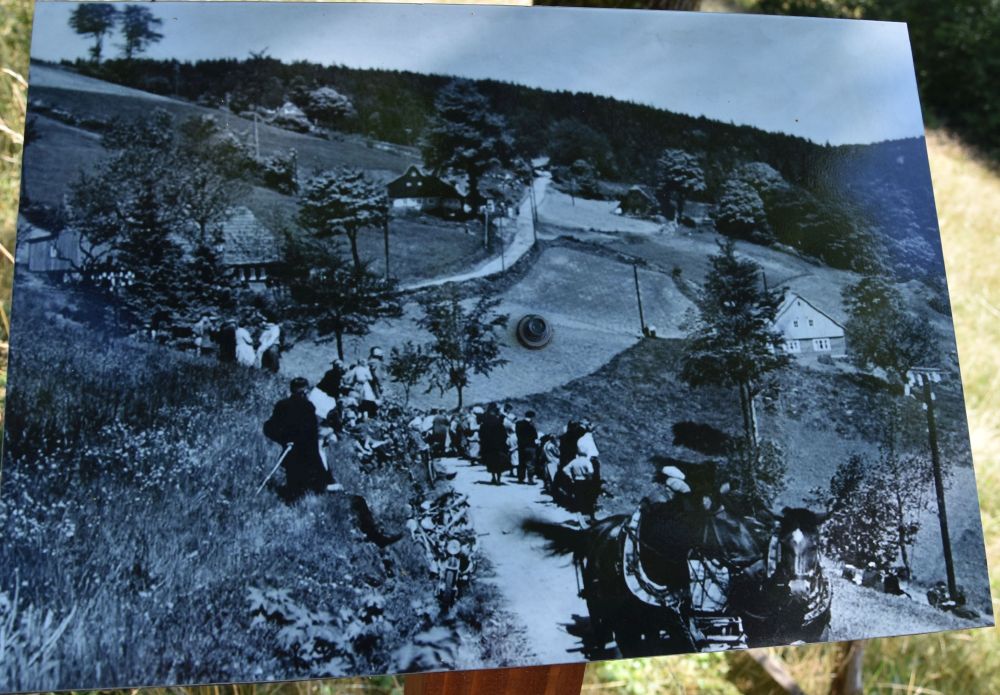
This panel shows, what the hiking path looked like a hundred years ago: It was a comfortable road that was used by coaches and pedestrians to get to the Euldörfel. 

I imagine my grandparents and their daughter (my mother) walking along this road, while a horse carriage carries the easel, the canvas, the paint brushes and the oil colours. 

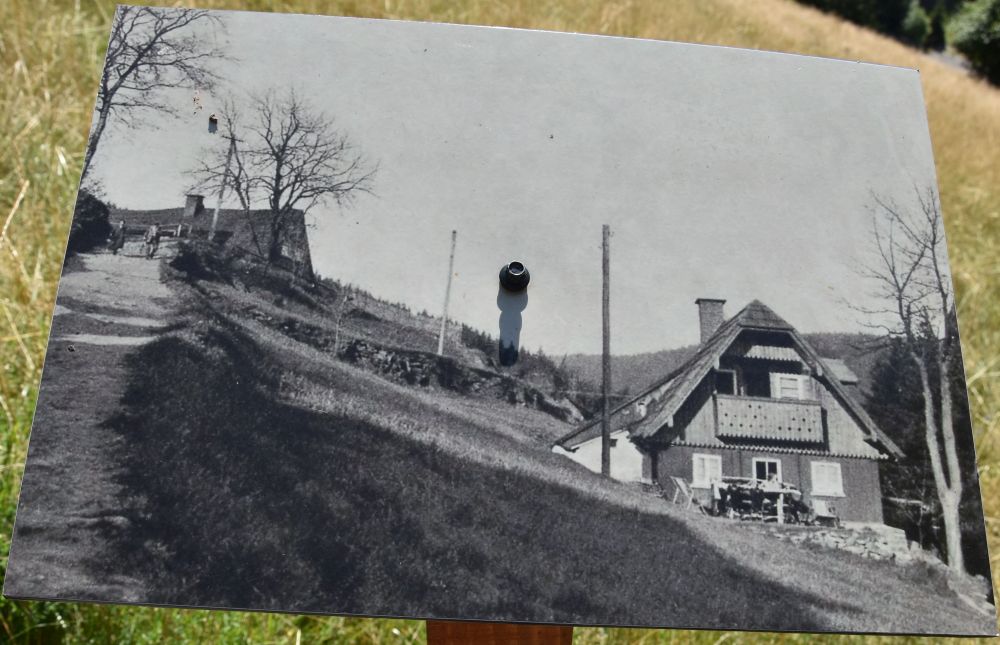
A little bit higher up, I find another panel. 

The panel shows two pensions of the former  “lower” Euldörfel, and they have totally disappeared today. Nothing but meadows here.

Where was the house with the shed and the two trees that my grandfather had painted in the foreground? Back at home I study this old postcard again, and I am pretty sure, the house in the foreground was at the turn of the road towards the “upper” Euldörfel (see red circle). 

Right above the turn, there was the famous pension called Müller Max Baude. Perhaps my grandparents stayed at the Müller Max Baude. Also this pension has disappeared.

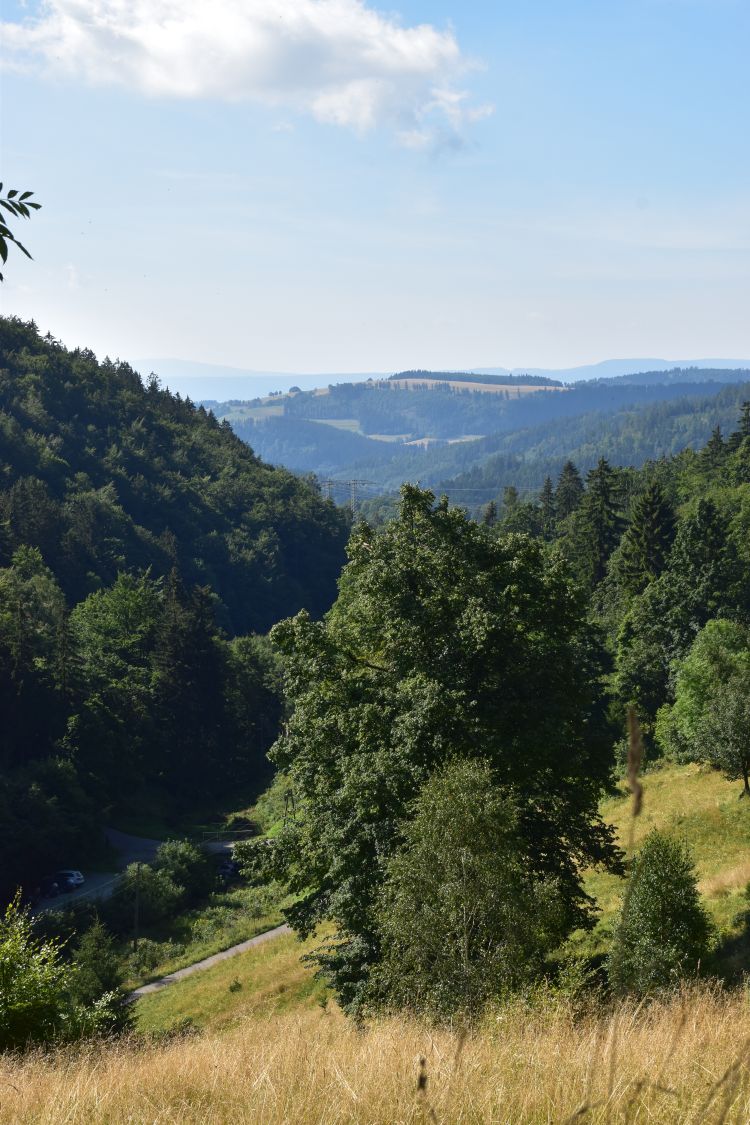
Today, the view of the valley is hidden behind trees, as my photo shows. For this photo, I stand a bit lower than where the easel of my grandfather was (red circle on postcard).  


Geographical location of the easel 

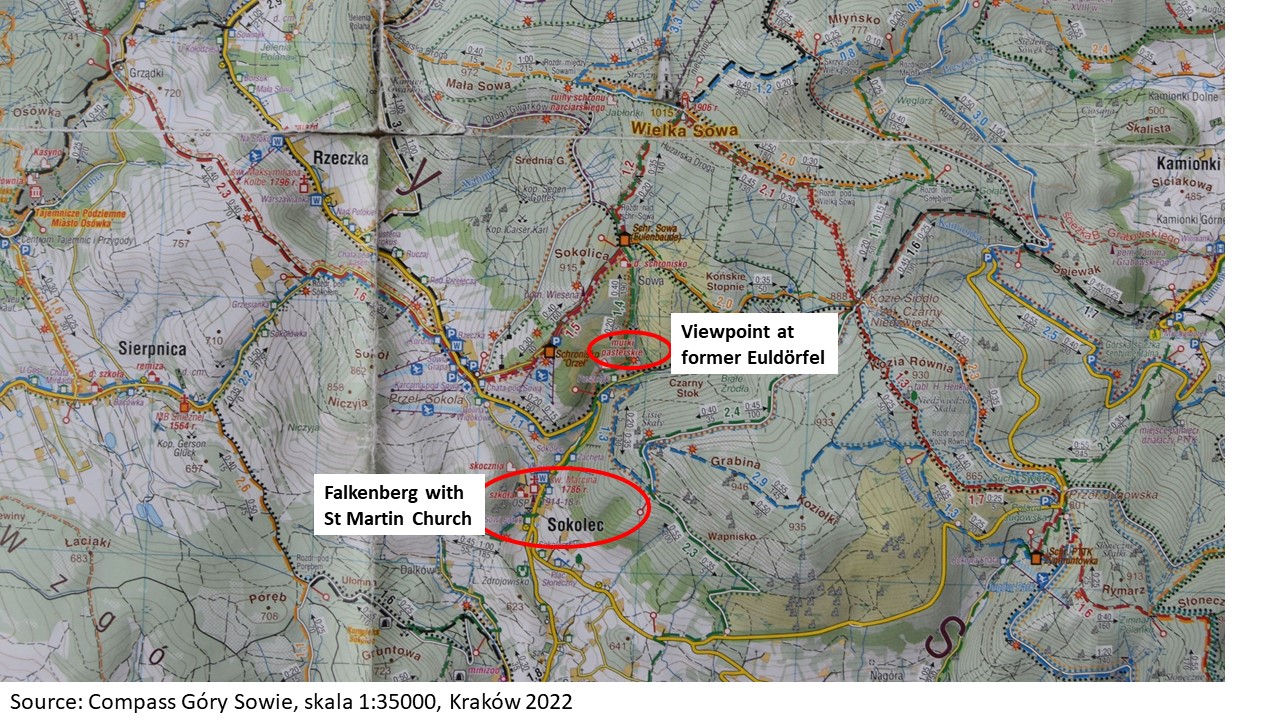
On my Compass hiking map, I have marked the location of the painting. From the  viewpoint at the former Euldörfel, my grandfather looked south towards the village Falkenberg (Sokolec) with Saint Martin’s church. 

At the viewpoint, the map mentions “Murski pasterski” which means “shepherds’ walls”. However, I believe the “shepherds’ walls” were remains of the Euldörfel. At the time the map was created, it was perhaps not allowed to mention the German past with the Euldörfel. 

With googlemaps, I give the overall geographical localization of the painting “Blick in das Glätzische Land”.  

Source: Googlemaps


I needed several excursions to find the location of the painting “Blick in das Glätzische Land”

In autumn 2022, I am at Silesia for the first time to look for some paintings of my grandfather. I just knew, he painted somewhere in the county Glatz, now called Powiat Kłodzko. I settle in the charming hotel Palac Kamienec near the city Kłodzko.

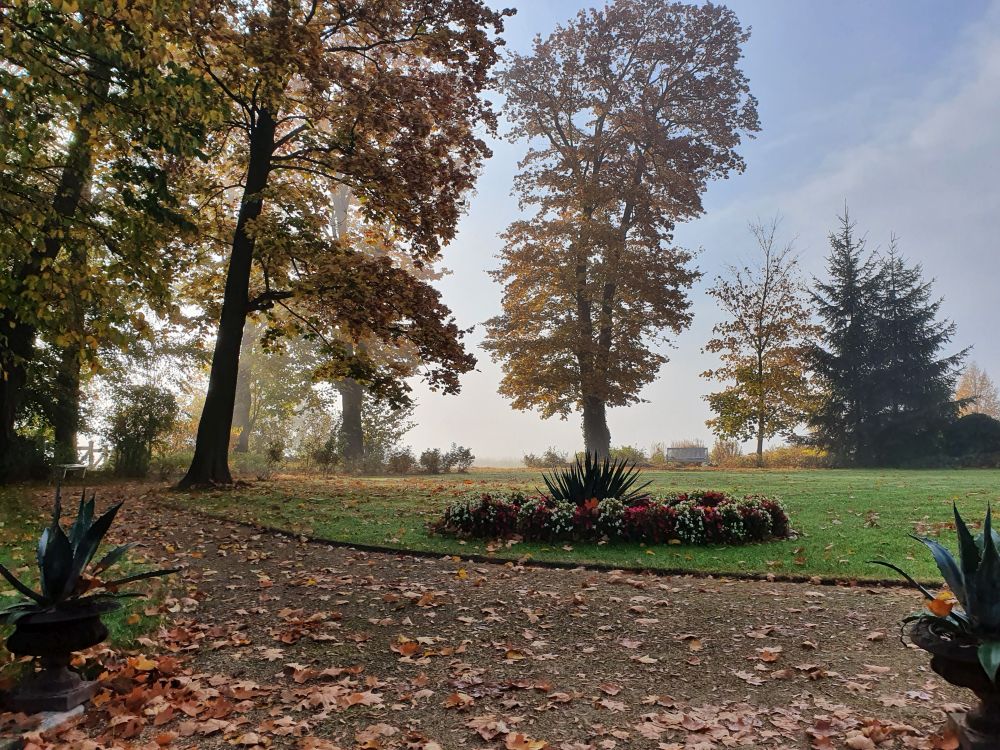
The park of the Palac is romantic, particularly on a hazy autumn morning. 

On the first day, I drive north to Sokolec, look at Saint Martin’s church, and feel helpless. Will I ever be able to find the paintings? I am not able to recognize this church from the paintings.

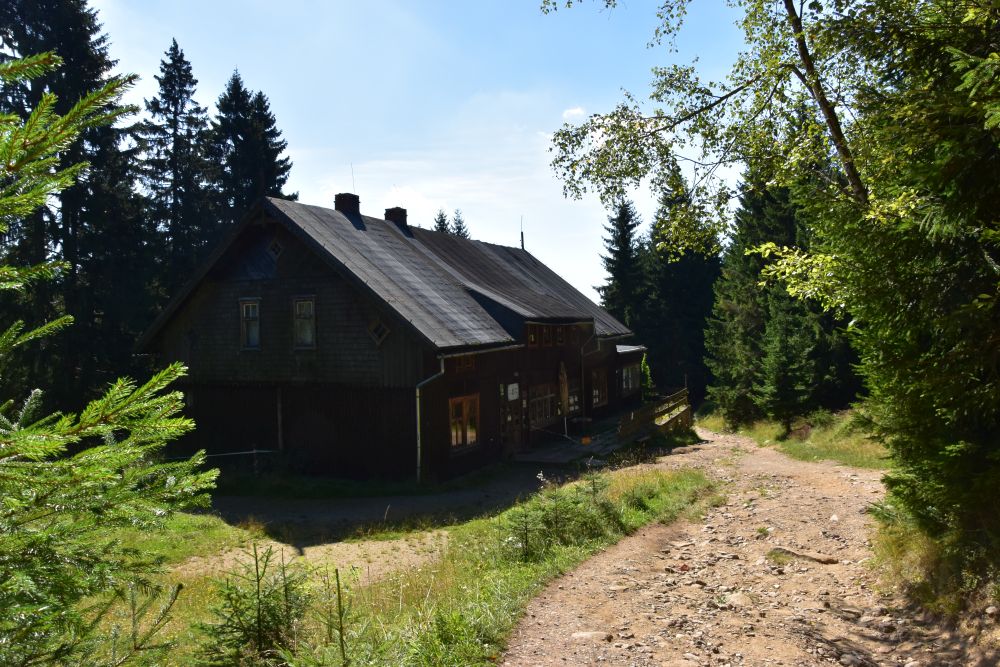
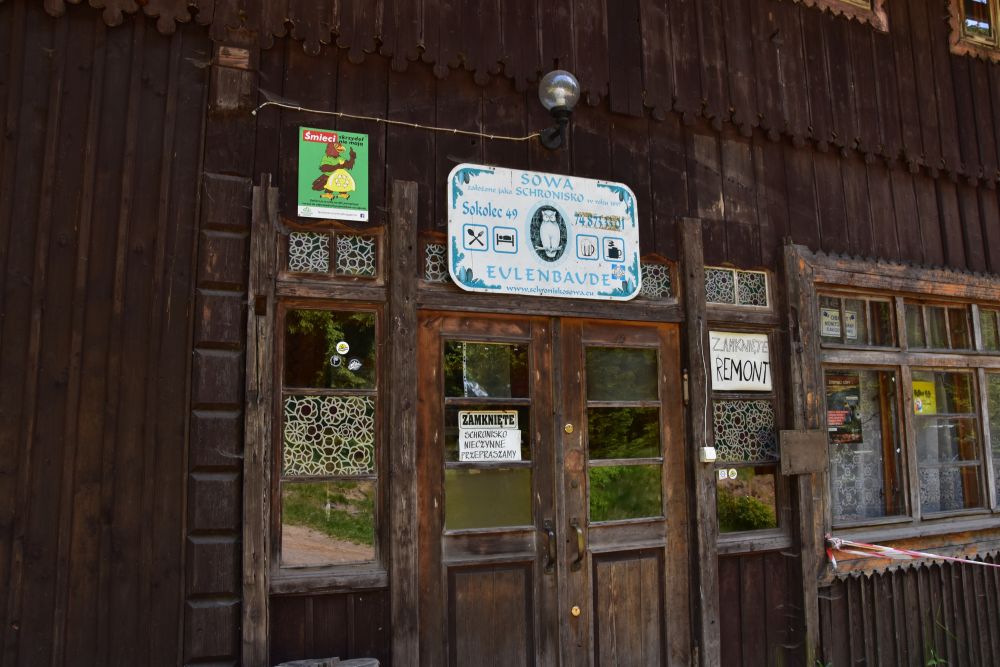
A year later, in 2023, I return to Silesia. Sokolec with Saint Martin’s church attracts me again and again. I evaluate the valley above Sokolec. I start to suspect that the “view of the Glätzisches Land” shows the valley of Sokolec. However, at the viewpoint above Sokolec, I see only meadows and trees, no houses here, even no ruins. Around the Eulenbaude, still higher above Sokolec, I find a few houses; from here, it is not possible to see the valley and Sokolec (Falkenberg).

I look at Saint Martin’s church again and again. I see that the belfry is shorter than on the painting. I notice the panel that says, the tower had been destroyed during the war; it was rebuilt after 1945. Perhaps the belfry was higher before, and it is this church that my grandfather painted?

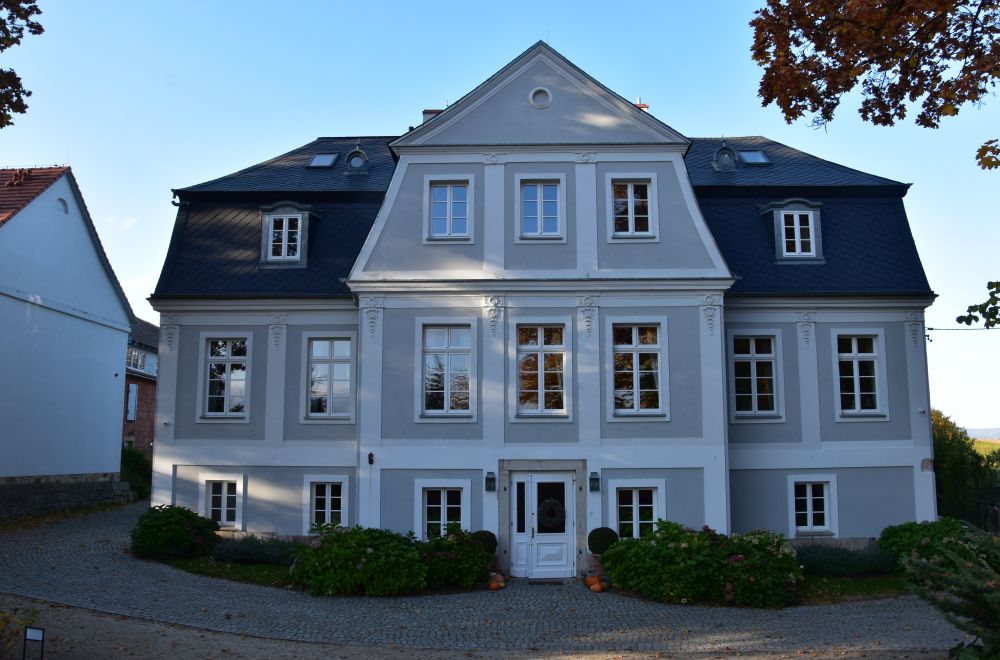
The landlady of the hotel notices that my grandfather had painted a red house next to the church in the valley. There is a red house next to Saint Martin’s church still today, she says, and it is on sale. This is what the red house looks like now; it may be difficult to sell it.

Finally, I solve the enigma; a few months later, in August 2023, I park my car above Sokolec (in the hairpin turn of the new main road leading to Rzeczka – see Compass hiking map).

Through meadows and trees, I walk uphill on the winding footpath, and I find the panels that show the houses of the former Euldörfel. Now I understand: Where I only see meadows now, there was the holiday resort Euldörfel a hundred years ago, and my grandparents were here in 1923. From here, my grandfather painted the house with the shed in the foreground, the village Sokolec, Saint Martin’s church and the mountains of the county Glatz in the background.  

The postcard confirms, the painting shows the view of Sokolec (Falkenberg) from the Euldörfel.


Source: Panoramy i widoki Sokolca, Sokolec – zdjęcia (polska-org.pl)

I am pretty sure that the easel stood at the turn of the road (red circle).

Another enigma of Hermann Radzyk solved – I feel close to my grandparents (that I have never met) and to their daughter, my mother. 


The area around Sokolec with the Welka Sowa is well worth visiting, also today

Though less well-known than the Riesengebirge (Karkonosze), the area around Sokolec with the Welka Sowa, the highest peak of the Góry Sówie, is worth visiting.

On Welka Sowa, the Bismarck tower has just been renovated. It shines in brilliant white.

I climb the tower and enjoy the view of the “Glätzisches Land”. The mountain in the middle (with meadows and forest stripes) is Niczyja (Neumanskoppe). Sokolec (Falkenberg) is located left at the foot of Niczyja. The mountains in the background are the Góry Stołowe (Heuscheuergebirge) that mostly belong to the Powiat Klodzko (County Glatz). The Góry Stołowe form the background of my grandfather’s painting “Blick in das Glätzische Land”.

By the way, behind Niczyja (former Neumanskoppe) is Sierpnica (Rudolfwaldau), where my grandfather painted the “Neumannskoppe” with the “Maria Schneekirche”  in 1919.

When hiking around the Welka Sowa, I hear the soft hissing sounds of the Poles around me. I do not come across any foreign tourists. The Poles ask me again and again: “What are YOU doing HERE?” I was the only non-Polish hiker. “Ah”, they said, when I showed them the photos of my grandfather’s Silesian paintings. 

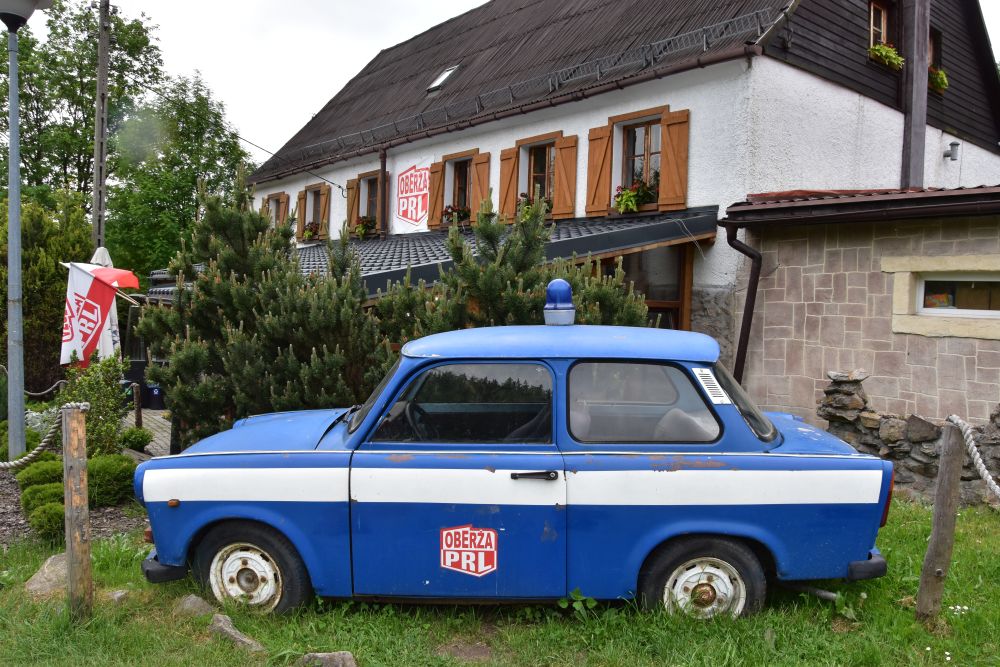
Sokolec is a laid off small village with a friendly restaurant. The Oberza PRL commemorates “socialist” times, with the Trabbi…

… and with the menu that contains meals with a communist touch.

I found some lighter meals on the list – I liked those with fish and cabbiage. I visited the Oberza several times, when investigating the area, and I enjoyed the hospitality.

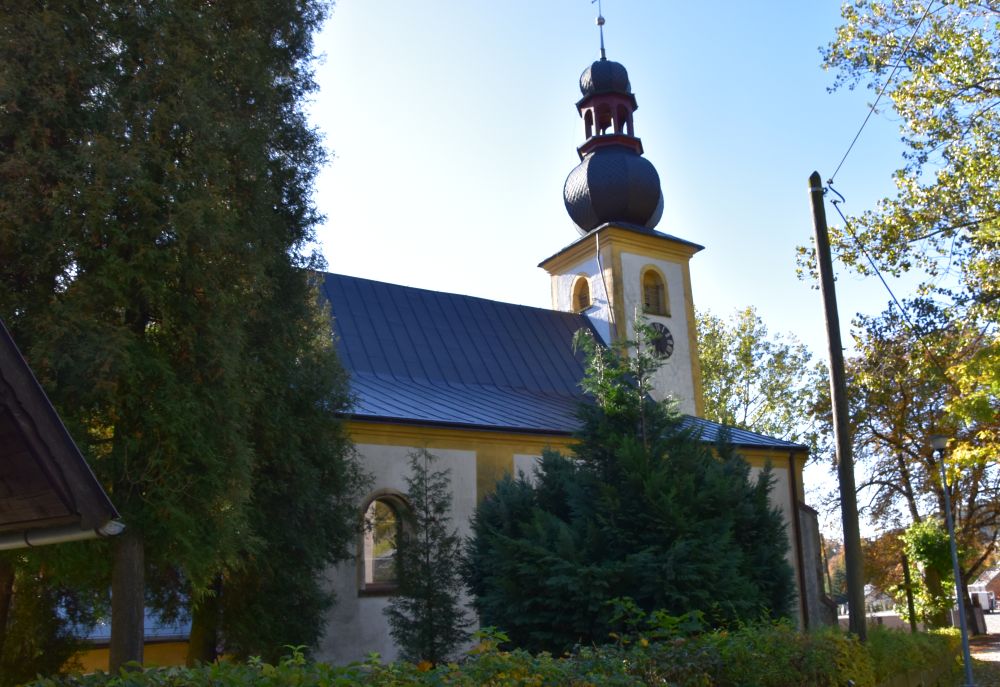
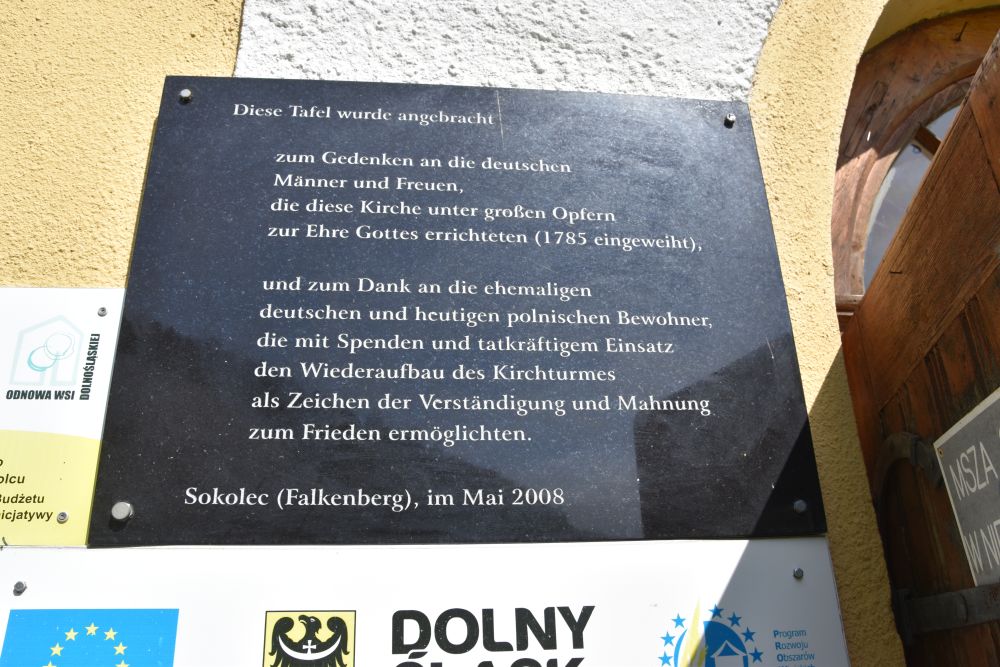
The panel on Saint Martin’s church at Sokolec thanks for the funds and the active support received by former German and present-day Polish inhabitants as “a symbol of comprehension and admonition for peace”. 

I wish that peace will prevail – now and in future.


Hermann Radzyk painted the Schneekoppe (Sněžka) in 1927 and 1930 – from where?

My grandfather painted the Schneekoppe (Sněžka) in the years 1927 and 1930, almost a hundred years ago. Where did he paint them? Where did he put up his easel? Join me to find out.


Three paintings of the Schneekoppe (Sněžka, Śnieżka) by Hermann Radzyk-Radzig are known to me

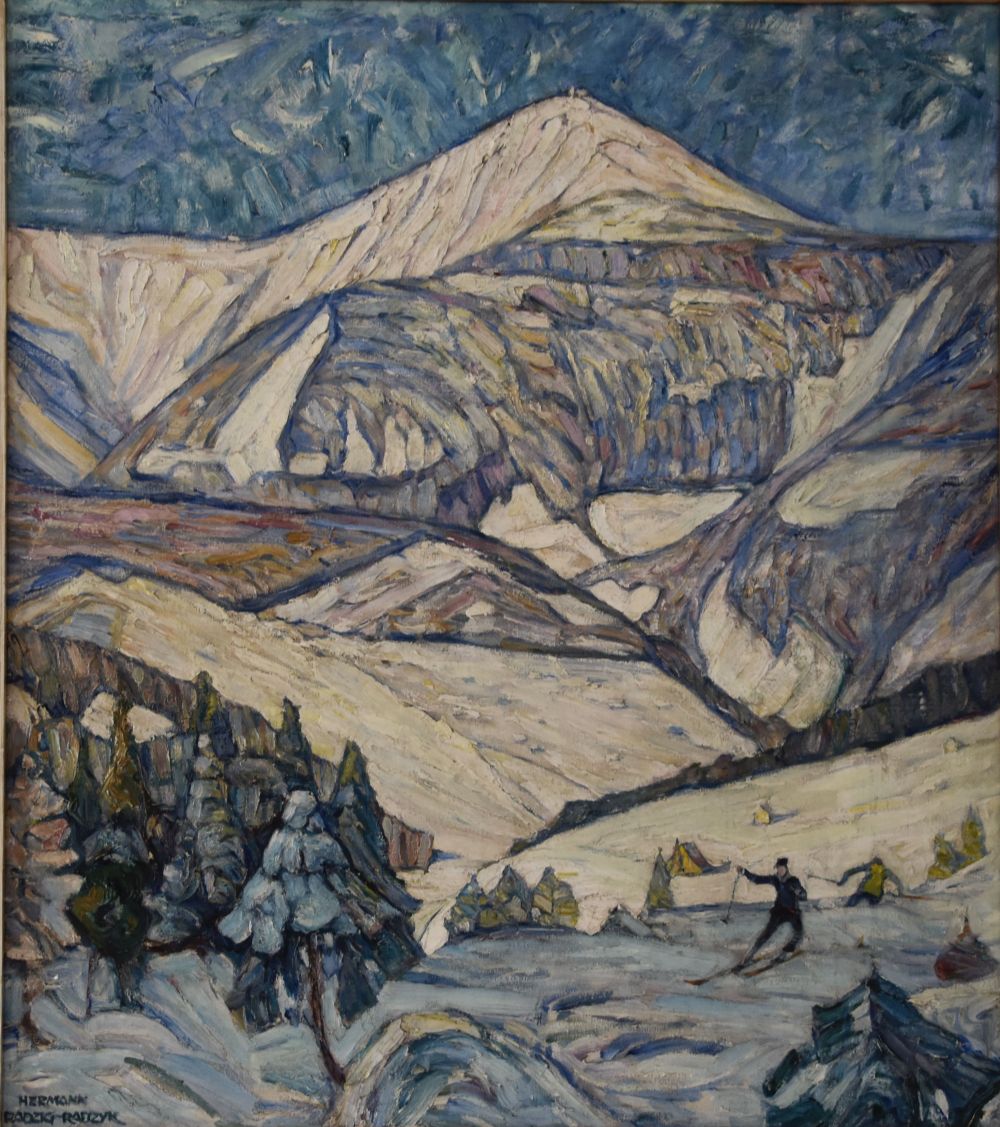
This painting of the Schneekoppe is from winter 1930. It is named “Paradies der Schneeschuhläufer (the paradise of the snow shoe walkers)”, as my mother wrote in a letter to her best friend. I acquired the painting at Kleinmachnow near Berlin, from friends of the son of my mother’s best friend.

I like the somewhat expressionist style. 

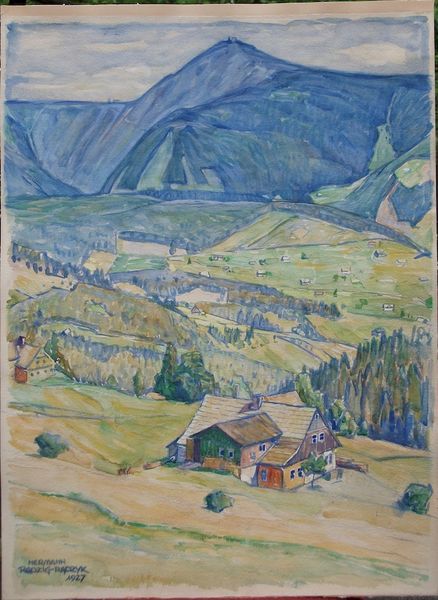
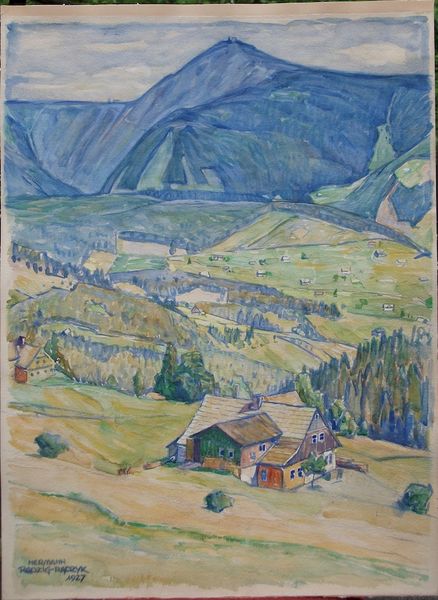
In summer 1927, Hermann Radzyk painted the Schneekoppe twice. This aquarelle is owned by the Heimatverein Kleinmachnow. 

My sister owns another summer painting showing the same hut and the Schneekoppe.  It is unsigned and undated. I assume, it is from summer 1927 as well.


Where did my grandfather put up his easel to paint the Schneekoppe?

Where did my grandfather put up his easel? I first suspected, he put it up above Krummhübel (now Karpacz in Poland). I went to Karpacz and understood, the easel was not here (see Discovering Silesia: Karpacz with its churches and the Sniezka).

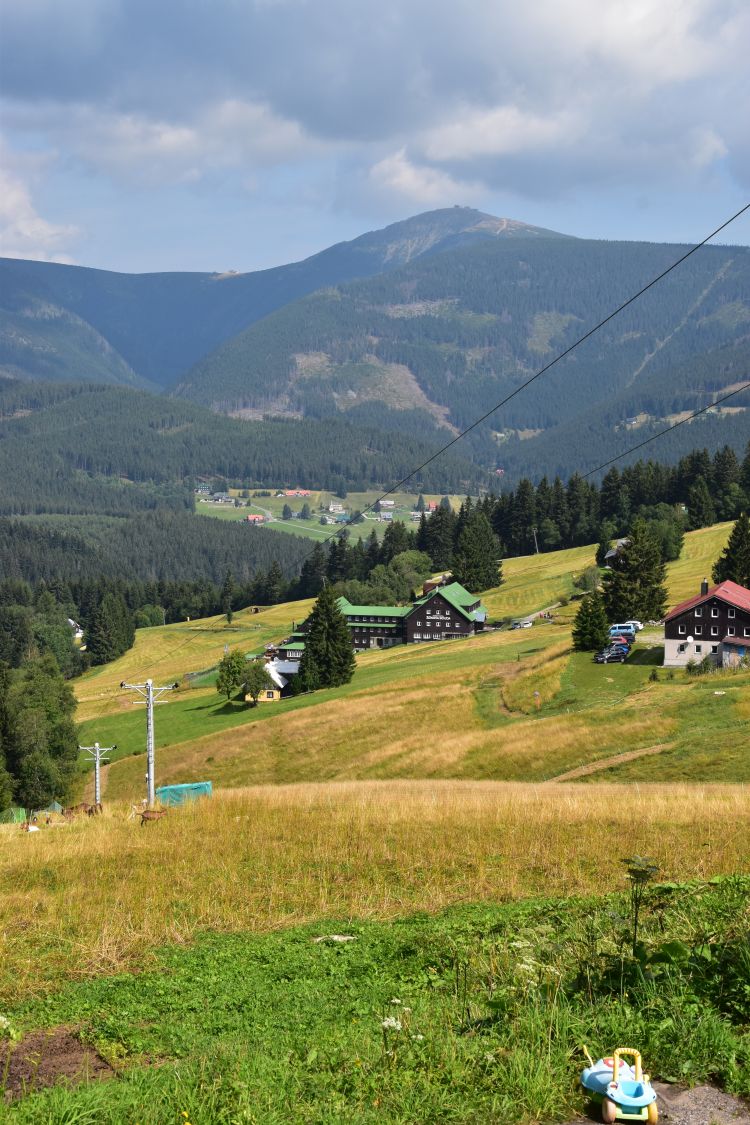
I started to google about the valleys south of the Schneekoppe, at Bohemia in Czechia. I found photos and compared them with my tourist map of the Giant mountains. I could identify the peaks and valleys near the village Petzer (Pec-pod-Sněžkou).

I conclude, my grandfather must have placed his easel above Petzer (Pec-pod-Sněžkou), either on Zahradky or on Vysoky Svah.

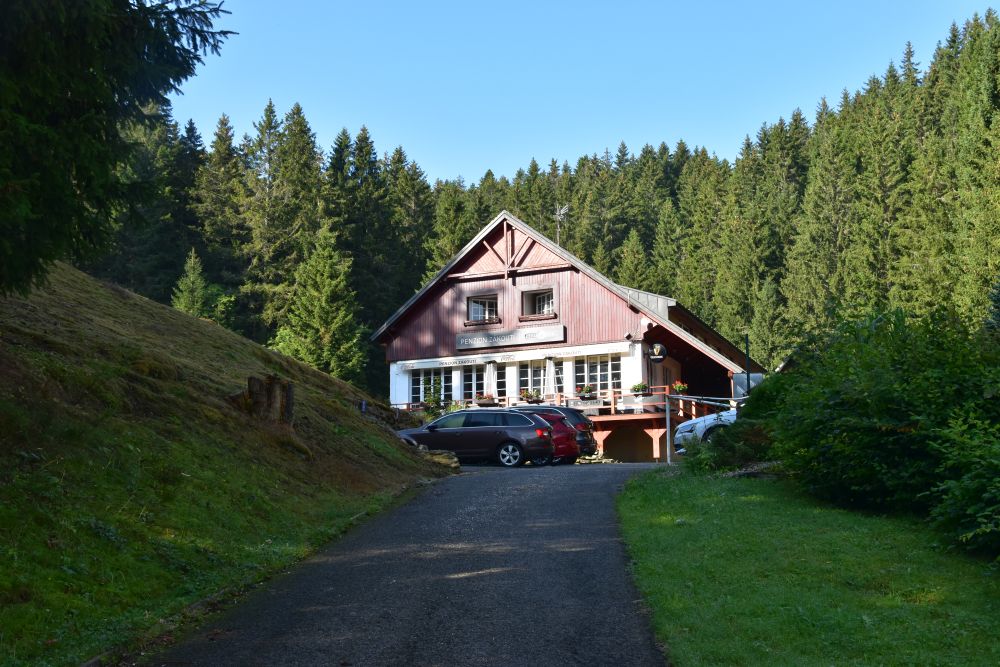
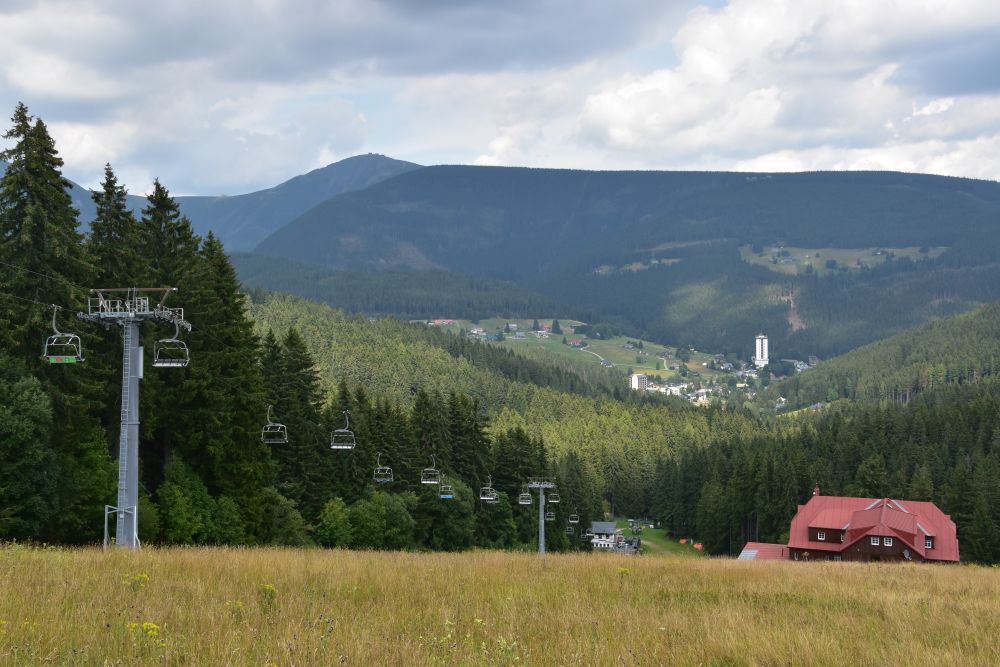
To understand, where exactly the easel was, I drive to Petzer in August 2023. I stay at the friendly small penzion Zákoutí at the very end of Pec-pod-Sněžkou, where the ski lifts and chairlifts to the surrounding hills start.  The owner of the pension gives me this winter postcard that illustrates the situation well.

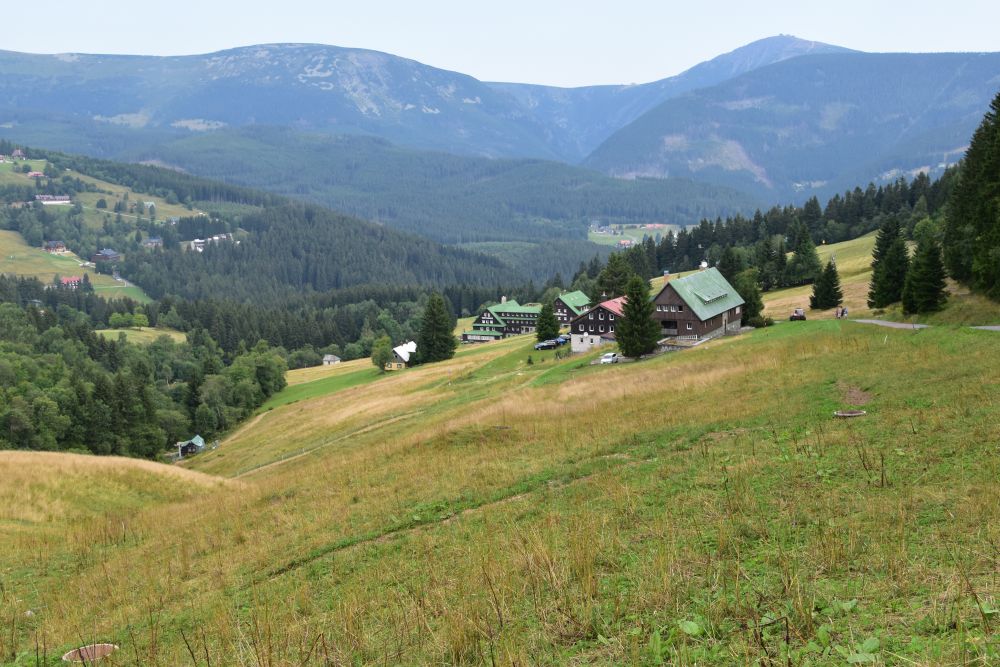
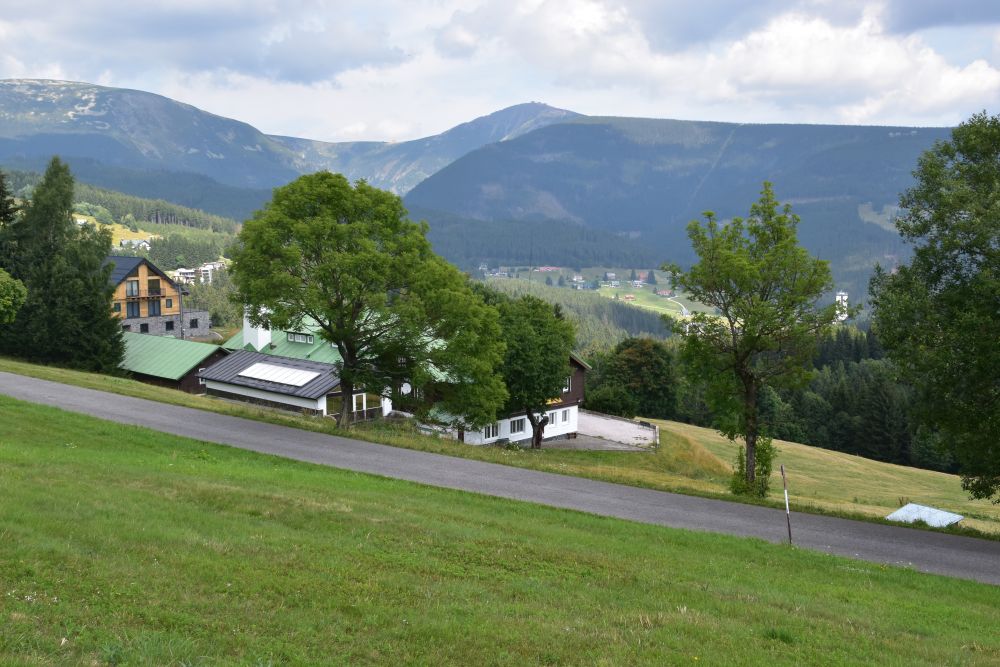
The village Pec-pod-Sněžkou is located in the valley and on the (left) slope above the ugly hotel tower. North of Pec-pod-Sněžkou in the background is the Schneekoppe. South above Pec-pod-Sněžkou is an “amphitheatre” of four meadows: Under the label “Pec-pod-Sněžkou” is Zahradky (Lenzenberg), to the right follows the triangle of Vysoky Svah and then, behind it, Javor. To the left of Zahradky are the meadows of the Braunberg (Hnědý vrch). The “amphitheatre” of meadows south of Petzer is a skiers’ paradise until today. 

From my pension I walk up to the “amphitheatre” to find the place of the easel – and I identify two places. For the winter painting, the easel stood on Vysoky Svah below Husova Bouda and for the summer paintings it was on Zahradky near Chata Seibert – yes, the hut on my grandfather’s summer paintings still exists. Let us go to Vysoky Svah and Zahradky. 


The location of the easel for the winter painting of 1930

For the paradise of the ski shoe walkers, my grandfather put up his easel on Vysoky Svah below Husova Bouda, formerly called Koppenblickbaude (literally: Hut with the view of the Schnee-Koppe).

The easel stood on the bump, flanked to the right by a trough (partially filled with snow) and to the left by a creek with trees (the creek is now called Lucny Potok). One skier directs his way into the trough and towards the painter (perhaps Helene, the painter’s wife), the other skier moves away from the painter (perhaps the daughter Marion, later my mother). 

It is an emotional moment for me. I stand on the slope, where my mum learnt, how to ski. She had always told me that she had learnt skiing in the Giant Mountains, and now I know exactly, where. My grandmother might be the more anxious skier moving towards the easel, and my mum might be the more dynamic skier moving downhill.  My mum practiced skiing all her life, until the age of 76 years. 

This is an old postcard showing the Koppenblickbaude. The photo has been taken from a higher viewpoint than the painting of my grandfather, and I can see the similarities: The meadow bordered by the line of trees (to the right of the Baude), above/behind the line of trees the houses of Petzer and behind Petzer the Rosenberg with the triangular forest clearing.  

Source: gross aupa deutsche digitale bibliothek – Google Search

I take some summer photos. Now I am just a little higher than the easel. 

I can recognize the trees covering the creek to the left, the trough (that the one skier is moving towards) too the right and the line of trees bordering the meadow behind the mountain hotels. There are more hotels here today. In the background are the houses of Petzer/Pec-pod-Sněžkou that also appear on the winter painting. Today they seem to be larger.

This is a slightly different view. I stand above the trough which is called Mulde (Muldě in Czech), and the hut hiding behind the fir tree is called Bouda na Muldě, literally “the hut above the trough”.

Again higher up, I take a photo of the former Koppenblickbaude, now Husova Bouda. 

The Koppenblickbaude was enlarged in 1930 to cater for the skiers that had started to come here since 1900, as a nearby panel explains. It could well be that my grandparents and my mum stayed at the Koppenblickbaude in 1930. There was no ski lift here at that time. My mum and my grandmother had to walk uphill. The first ski lift installation was set up later, in 1932; it was a sledge drawn by two Fiat engines. 

Now the Bouda has become a holiday colony. A group of children are attentively listening to their teacher in the dining hall on the ground floor. 


The location of the easel for the summer paintings of 1927

For the two summer paintings the easel stood above the Chata Seibert on Zahradky (in German Lenzenberg).

The Chata Seibert still exists; it has been enlarged. There are trees near the Chata. 

Now I moved closer to the hut. I can still recognize the original construction of the building. The lowest tree stands very close to the house, and it already appears on the paintings. The tree was much smaller, when my grandfather painted it.  

I believe it is a cherry tree – one branch has broken off.

The owners of the Chata have carefully tied it up.

I am sure, it is the same tree. Look at this historical photo (I found it on the Website of Chata Seibert in summer 2023; in the meantime, I do not find it any more there).  

On this historical photo, Chata Seibert is already larger than on my grandfather’s painting, the houses of Petzer in the background look very much the same as my grandfather has painted them. And the still younger tree has got both main branches. The second larger branch has later broken off.


The places of the easel on the tourist map of the Giant mountains

To sum up my findings, I enter the location of the easel in the hiking map of the Giant Mountains.

I am happy. I found the places, where my grandfather had put up his easel about a hundred years ago. And I feel to get closer to my grandparents, the more such places I find.


Some impressions from the Pec-pod-Sněžkou and the surrounding hills: Skiing and hiking liked by the Czechs 

Staying here for a few days, I start to like Pec-pod-Sněžkou and the surrounding hills. The tourists are almost exclusively Czechs. I have met exactly two German tourists, and I am the first Swiss guest in “my” small penzion Zákoutí, as the owner tells me.

The Czechs love to hike, they populate the bars and the restaurants, they walk with their children and dogs. 

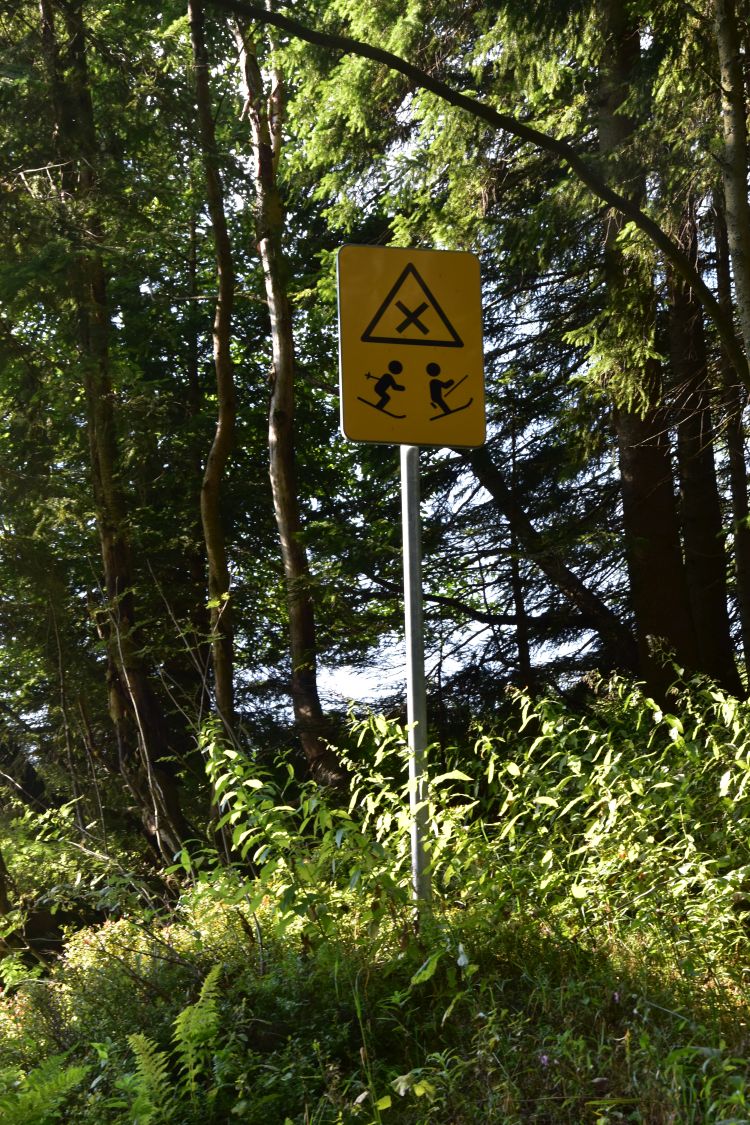
The signs of skiing are present all over, I find this panel, when walking up to Zahradky.

The ski lifts and chairlifts are standing still waiting for the next winter. The skiing area goes up to about 1200m. It may be snow reliable, because of the continental climate.

From here we see the architectural aberration of the socialist times: The Hotel Horizon at Pec-pod-Sněžkou is a tower that dominates the valley. 

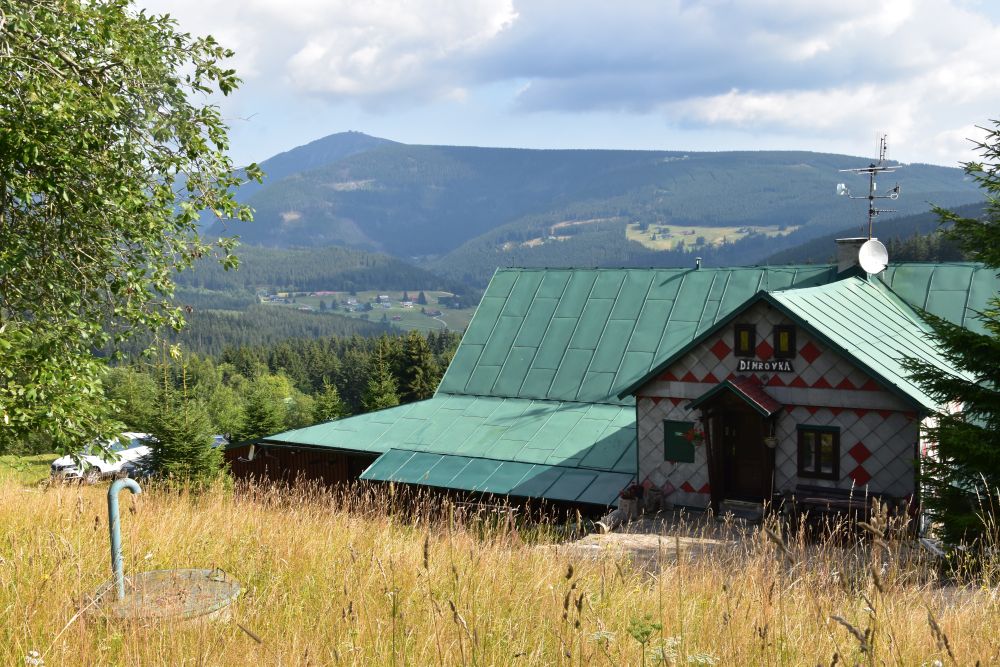
Many mountain huts receive guests on the “amphitheatre” of meadows above Pec-pod-Sněžkou. This is Dimrovka Chata on Zahradky. The owner goes for a walk with his dog and we have a chat.

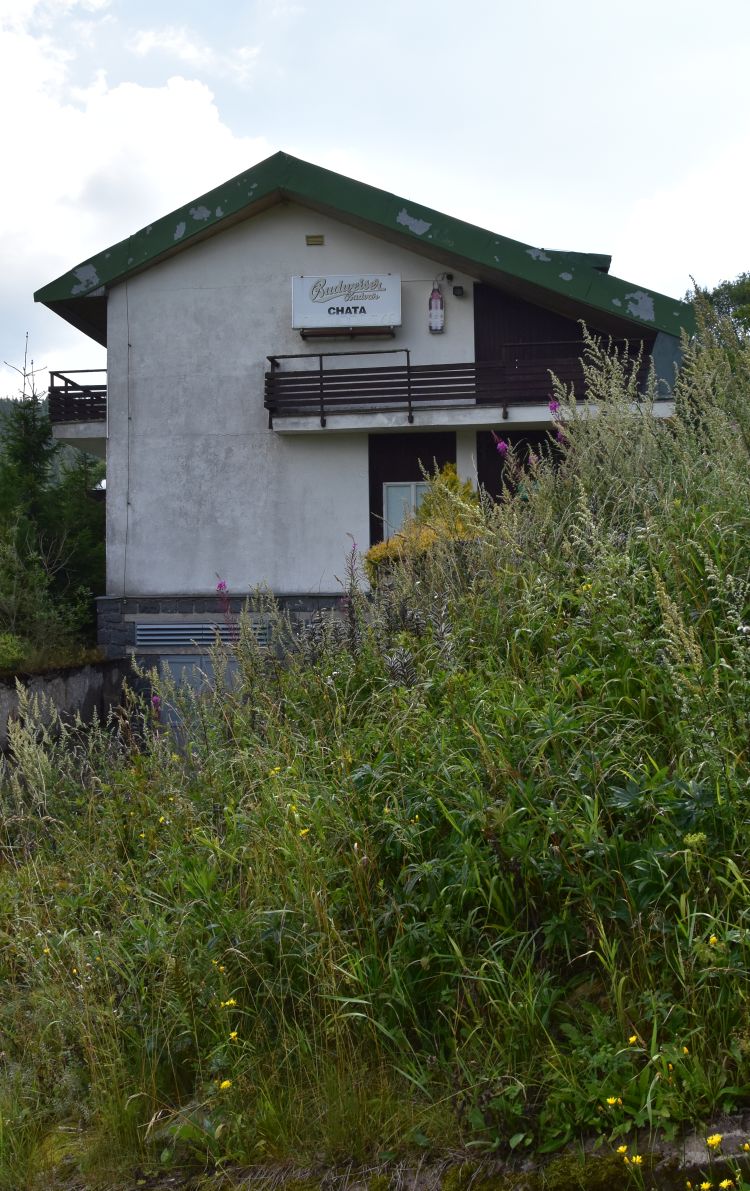
However, a few hotels here are sorely decaying – this one has no name, it is just called “CHATA”. Grass and weeds grow around it blocking the entrance.

Signs about skiing all over. The red gate “START” is waiting for children that will try out racing in the next winter. 

Children will also love this tunnel on Vysoky Sah in the upcoming winter. 

On the pass above Zahradky, I find the Bodenwiesbauden or Bobí Boudy with the small chapel.

I have a nice cake covered with plums here and try out the well marked hiking paths in the area.

Back at Pec-pod-Sněžkou, I have dinner in the garden of the Hotel Hvězda (Star), enjoying a trout fresh from the creeks of the Giant Mountains; trout is called pstruh here. 

I am happy that the Bohemian Giant Mountains and Pec-pod-Sněžkou in particular have not yet appeared in Facebook or Instagram as destinations of a life time. I have found a hidden gem that the Czechs seem to enjoy alone. My grandparents and my mum have discovered it about a hundred years ago and have handed over these three wonderful paintings to the next generation. Thank you for having opened my eyes for this beautiful corner of the world.

Hermann Radzig-Radzyk painted in Silesia a hundred years ago: Neumannskoppe with Maria-Schnee-Kirche

In May/June 2023, I was in Silesia, looking for some places, where my grandfather Hermann Radzyk put up his easel a hundred years ago (as an artist he painted under the name of Hermann Radzig-Radzyk).

One painting I was looking for was the “Neumannskoppe” of 1919 (belongs to my sister and me). 

I know title and year from a letter of my mother to her best friend. I acquired the painting from a friend of the son of my mother’s best friend.

I solved the puzzle end of May 2023: To paint the “Neumannskoppe”, my grandfather had put his easel up at Rudolfswaldau, now Sierpnica. The mountain Neumannskoppe has become Niczyja. The wooden church with the baroque belfry is called Maria-Schnee-Kirche (Kościół Matki Bożej Śnieżnej, i.e. “Our Lady of the Snows”). 

I was at Sierpnica end of May 2023 to see, what the church looks like today, and I took the photo from where the easel was (approximately).

Today the church is hidden behind trees.

While taking my photos, I met Dziki who lives near the church. He gave me his winter photo. The trees without leaves allow to see more of the church that my grandfather painted.

Source: Photo taken by Dziki Domek.

Now let me tell you, how I solved the puzzle to find the easel for the painting “Neumannskoppe”.


Where is the Neumannskoppe?

I started by looking for the Neumannskoppe. I suspected, the Neumannskoppe is a mountain somewhere in Silesia. I entered “Neumannskoppe” in google maps – no result. I continued googling and googling “Neumannskoppe” combined with various terms… and after a lot of googling, I found this old German-Silesian advertisement for the “Grenzbaude im Eulengebirge” (boundary mountain hut in the Owl Mountains). 

The advertisement says that the Grenzbaude is located between the “Neumannskoppe” and the “Hohe Eule” (1). Hence the “Neumannskoppe” is not far from the “Hohe Eule”. Googling “Hohe Eule”, I found the name “Wielka Sowa”, which is the highest mountain in the Góry Sowie (Owl Mountains). 

Conclusion: The church with the Neumannskoppe is not far away from the Wielka Sowa. I asked Google to show me the churches around Wielka Sowa and  I clicked on all of them.

At Sierpnica, I found the church that my grandfather had painted. It is now called Kościół Matki Bożej Śnieżnej, in German Maria-Schnee-Kirche.

Source: Marius Tyski, Church of our Lady of the Snows, Instagram, appeared in google maps about a year ago, in the meantime I can no longer find it there. 

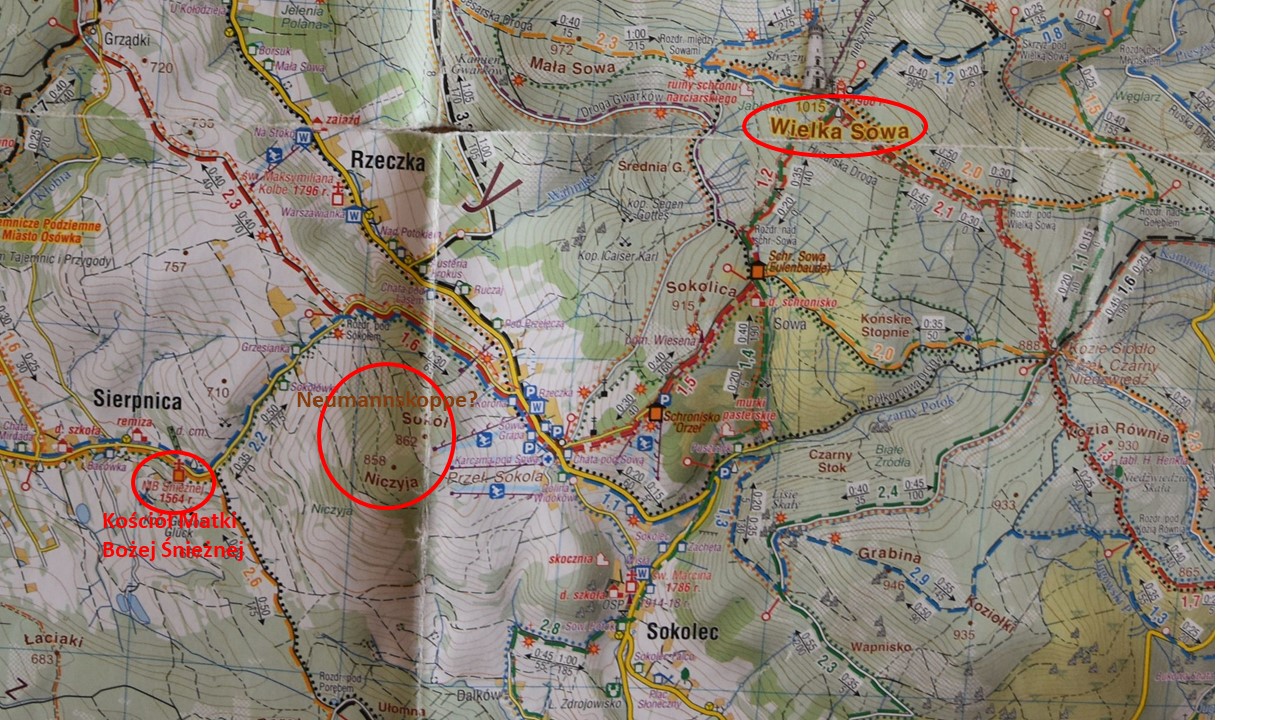
This is the location of the Kościół Matki Bożej Śnieżnej on my hiking map of the Owl Mountains, south west of the Wielka Sowa. 

Source: Compass Góry Sowie, mapa turystyczna, scala 1:35’000

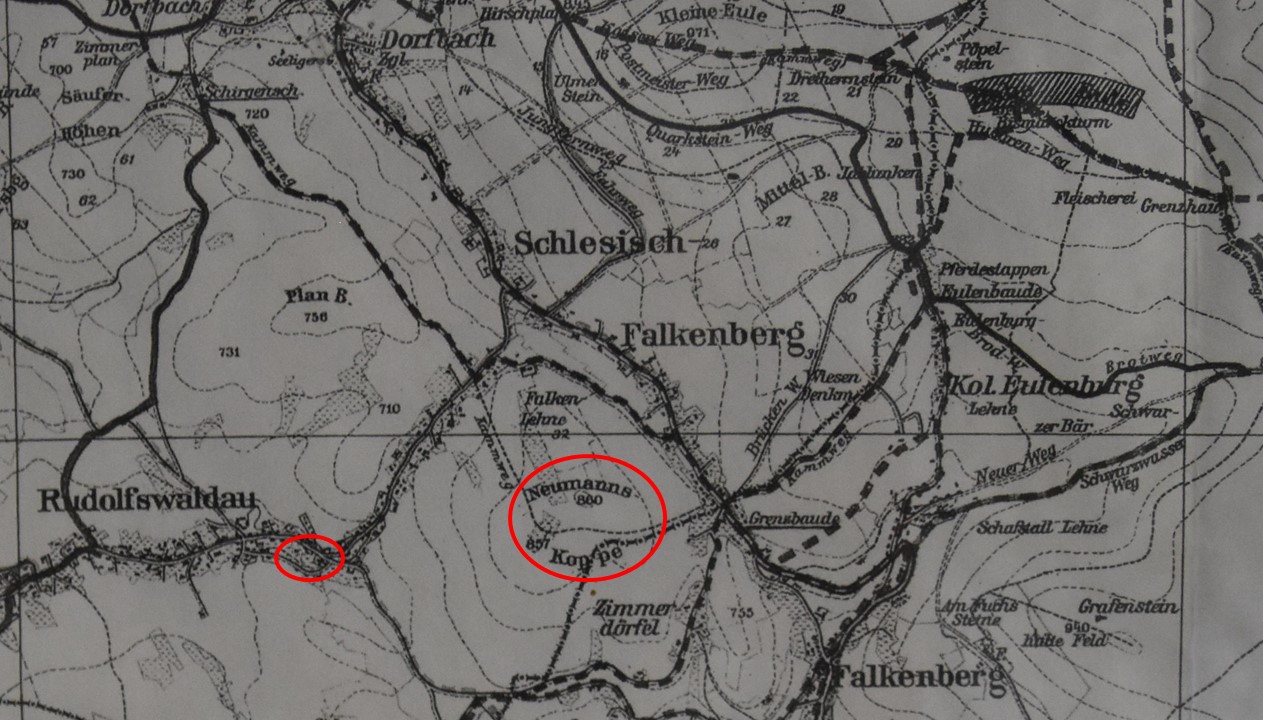
But where exactly is the Neumannskoppe? It must be either the peak Sokól or the peak Niczyja – this puzzle remained. I solved it at the hotel Lesny Dvor at Wolibórz (Volpersdorf) – we stayed here a few days. The Lesny Dvor had a German map whith the Neumannskoppe – and comparing with my hiking map, it becomes clear that the Neumannskoppe is now called Niczyja.  

Source: German map that hangs in the hotel Lesny Dvor at Wolibórz

Niczyja (“nobody’s mountain”) is the approximate translation of  “Neumannskoppe” (“new man’s mountain”).

My grandparents must have spent their vacation at Rudolfswaldau in 1919, when their daughter (my mother) was 3 years old. My grandfather took his easel, canvas and colours with him to paint the Maria-Schnee-Kirche in front of the Neumannskoppe. About a hundred years later, in May 2023, I was here as well – at Sierpnica – and solved the puzzle.


The church Lady of our Snows (Kościół Matki Bożej Śnieżnej) is a historical treasure

The church Kościół Matki Bożej Śnieżnej was built out of wood in the 16th century. It is one of many “Schrotholzkirchen” in Silesia (see https://de.wikipedia.org/wiki/Liste_der_Schrotholzkirchen_in_Niederschlesien). 

It was a protestant church. After the War of 30 years, after 1648, it became a catholic church (the area belonged to catholic Austria at that time). In the 17th century, the tower burnt down, and the new baroque tower was built.

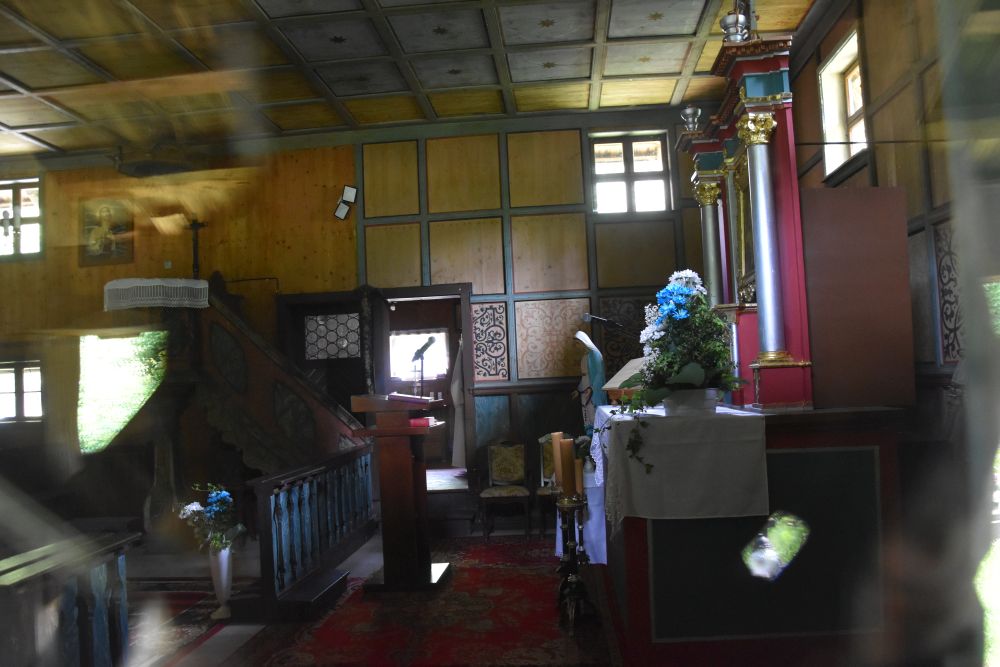
I could not enter the church,  I could just look through the window and capture the interior with the altar…

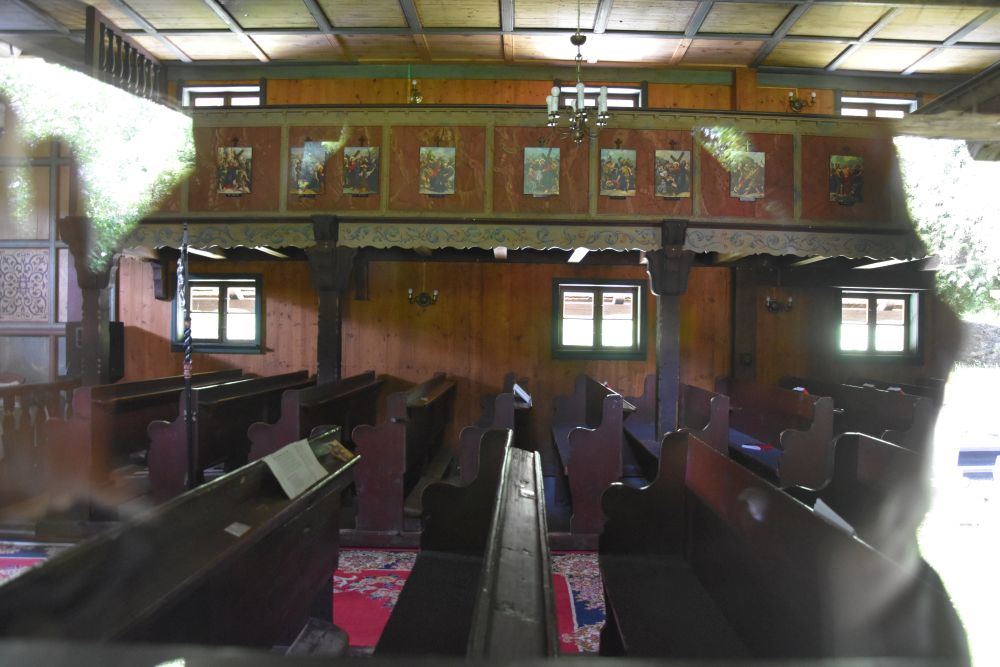
… and the benches.

Visiting more wooden churches or Schrotholzkirchen might be another interesting target in Silesia. 


Meeting today’s Silesians while wandering off the beaten tracks looking for the easel of my grandfather

When looking for the places, where my grandfather put up his easel, I usually wander off the beaten tourist tracks. At Sierpnica, I walked uphill on an unpaved path and through the adjoining meadow to get the view of the church from above. The tourists that visit the church, walk around it and leave again. They do not walk uphill to places, where they can hardly see the church. A car comes on the unpaved path and stops. “What are you doing HERE”, the driver asks me in fluent English. “Look at this”, and I show him my photo of my grandfather’s painting.  “Yes, this IS the church,” he says. We exchange addresses and he sends me the winter photo of the church. Later, I enjoy the hospitality of Dziki. He invites me to his house and family. He shows me his photos from German times before 1945, when Sierpnica was still called Rudolfswaldau. He is proud of the German photos decorating his house. The German past is an integral part of his house.

This is not the only house in Silesia that keeps memories of the German past. Karolina Kuszyk wrote the beautiful book “In den Häusern der anderen – Spuren deutscher Vergangenheit in Westpolen” (2). She  describes  places, buildings and objects that the Germans – expelled after 1945 – left behind and that the Poles took over, most of them expelled from the eastern districts taken away from Poland in 1945. Touching biographies on both sides. Years later Germans return to see the places of their early youth or of their ancestors. Sometimes they find the houses and objects left behind 50-60 years ago and sometimes friendships arise between the former and the new owners. 

My grandfather opens my eyes for Silesia from a hundred years ago, and following him opens doors to experience Silesia today.


Notes

  • Footnote (1) More precisely, the Grenzbaude is located on the top of the pass between Neumannskoppe and Hohe Eule. It is called “Grenz”-Baude or “boundary hut”, because it is located on the boundary between the districts Glatz (now Klodzko) and Waldenburg (now Walbrzych). The advertisement says, it takes 50 minutes to walk to the Bismarck tower on the Hohe Eule. The Grenzbaude is proud to have electrical light and central heating.   Above the Grenzbaude was the Grosssprungschanze or great ski jump. 
  • Footnote (2) Original title: “Poniemieckie”. German title translated to English “in the houses of the others – tracks of the German past in West Poland”, christoph-links-Verlag Berlin 5. Auflage 2023.

My dream of a lifetime: Aachen and Charlemagne’s Cathedral

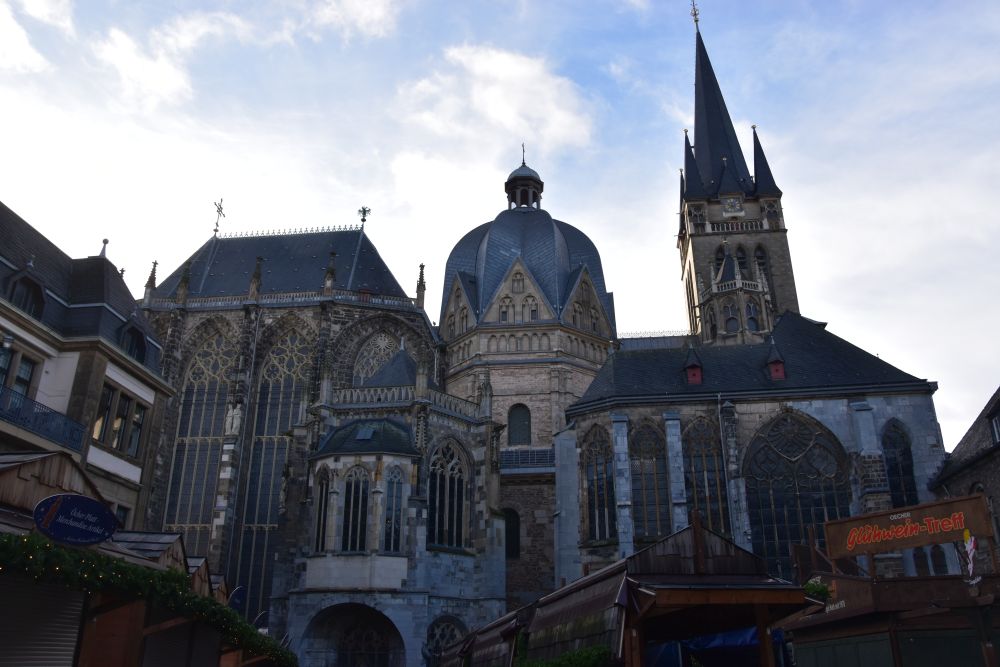
On November 10th 2023, I visit Charlemagne’s octagonal Cathedral (the Aachen Cathedral). I sit inside the octagon and look into the cupola. To see this has been my dream of a lifetime.

I breathe in the atmosphere enjoying the perfect harmony of the octagon. Today is 11/10/2023. Was it not 13 years ago that Ernst and I got married, on 11/10/2010? Yes, right, exactly 13 years ago. — I light a candle for Ernst. He is in my heart. 

Now, I explore the architecture of the Cathedral of Charlemagne. 


The Cathedral view from outside 

When I approached Charlemagne’s cathedral, I was surprised. Where is the octagonal building that I have been looking forward to seeing? Oh, I understand, it almost disappears between larger buildings of gothic appearance surrounding it. The steep roof on the octagon looks a bit like a cream topping. 

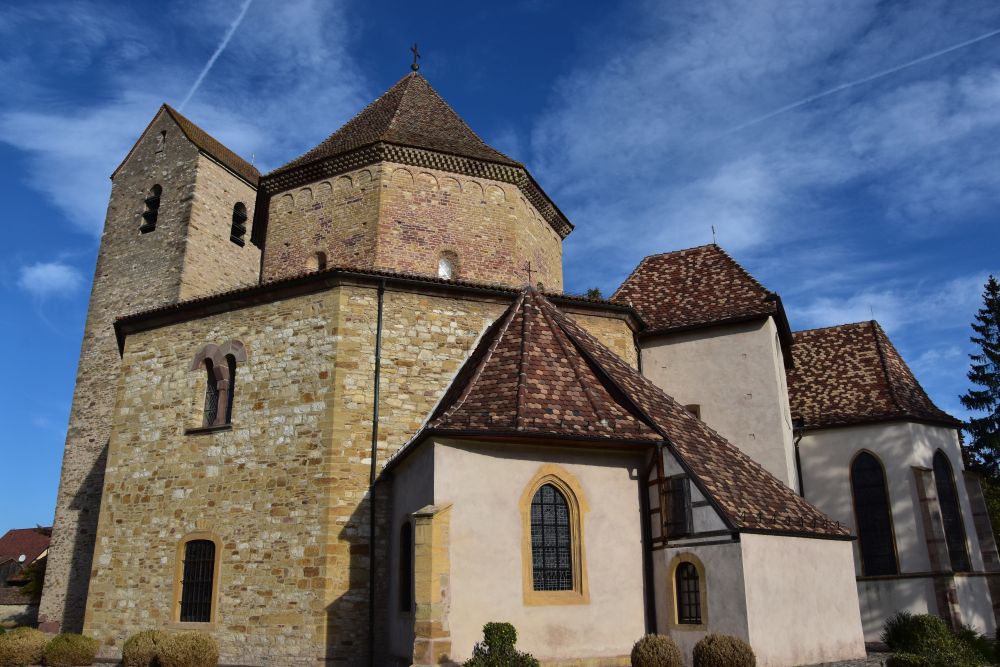
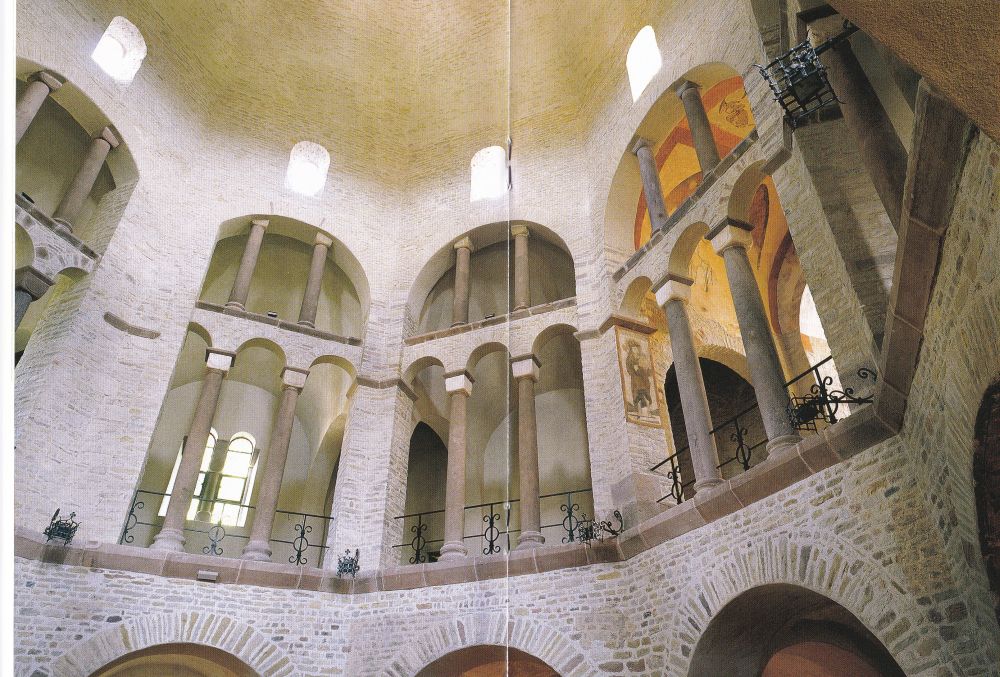
I had expected more resemblance to the abbey chapel of Ottmarsheim in the Alsace, inaugurated in 1049, two hundred years after Charlemagne’s Aachen Cathedral; Aachen was the model for Ottmarsheim. It is somehow Aachen’s “little sister”.

Around 800, Charlemagne conceived his cathedral as a modest and elegant building. This is what it looked like originally and what Rudolf von Altenburg (an ancestor of the Habsburg family) took as the model for Ottmarsheim.

 
Source: Walter Mars, p. 20

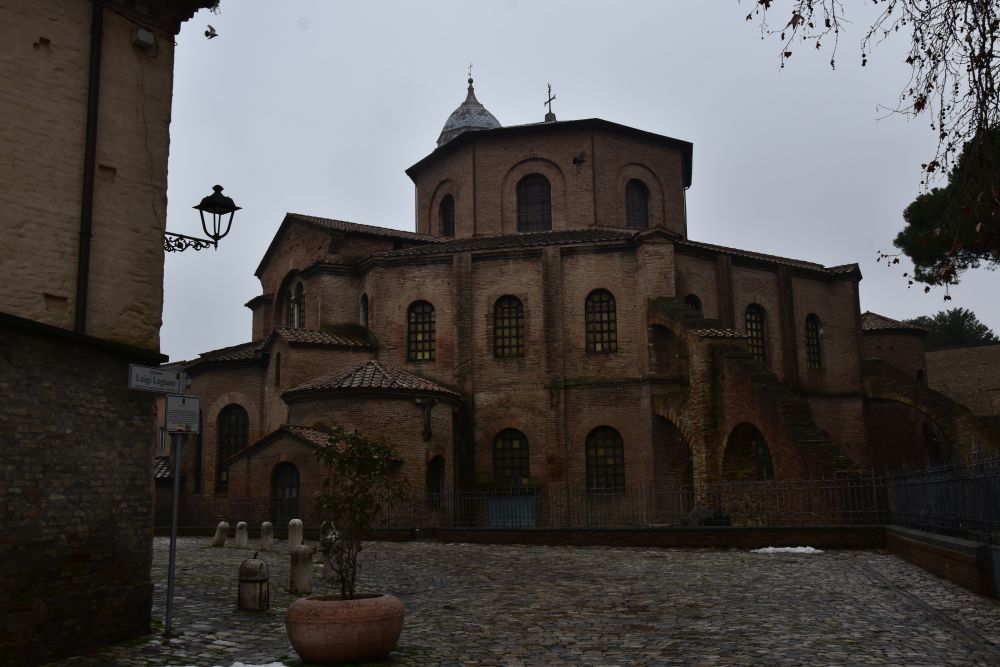
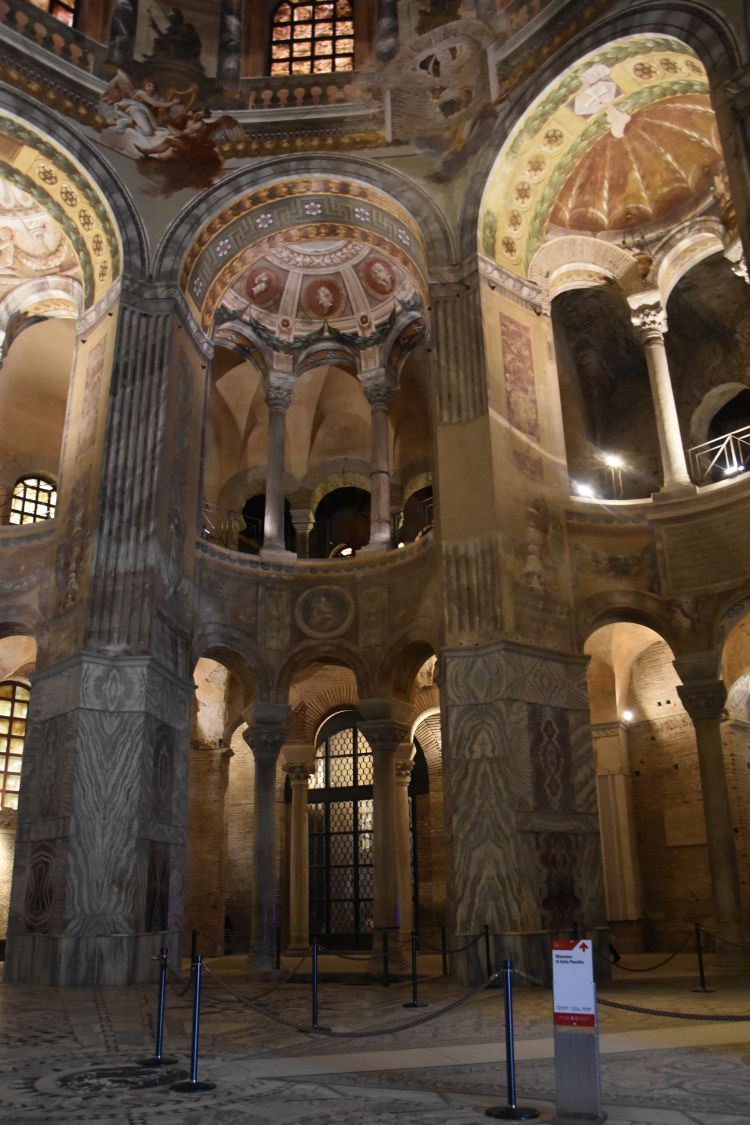
 When travelling to Rome, Charlemagne saw San Vitale in Ravenna. 

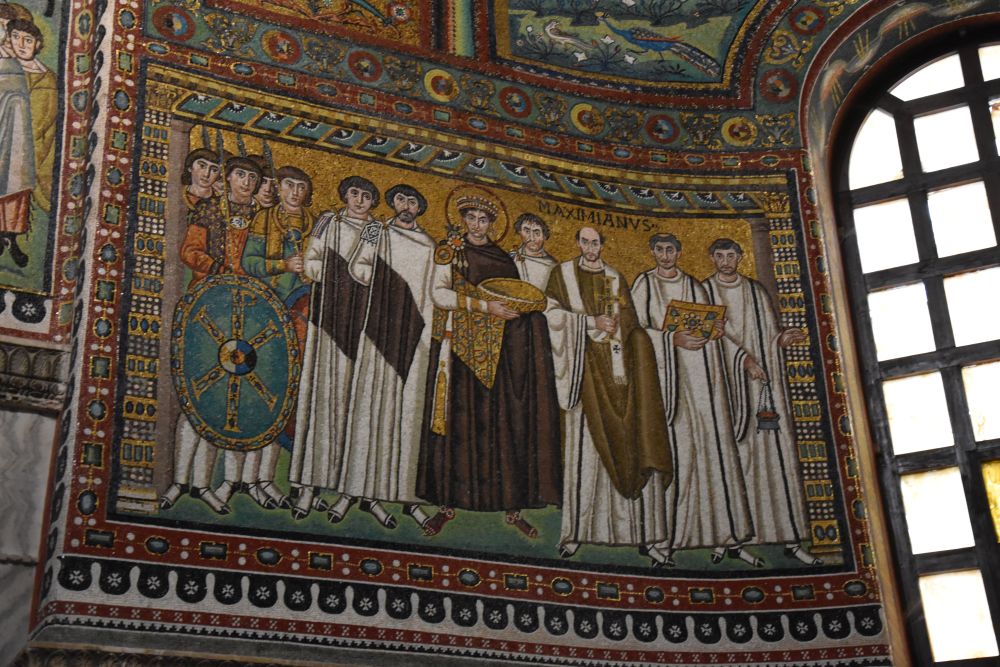
San Vitale was built under the Byzantine Rule of Justinian and was inaugurated by Bishop Maximianus in 547 AD. The mosaic shows Justinian (in the middle) and Bishop Maximianus (labeled).

San Vitale was an important inspiration for Charlemagne. Since Roman times no such domed structure building had been completed north of the Alps. 300 years after San Vitale, Charlemagne wanted to change that, and he hired craftsmen from Lombardy to have his Cathedral built, the first domed structure since Roman times north of the Alps.  

He completed his octagonal Cathedral, and today it almost disappears between the mainly gothic extensions and under the baroque roof hood (“the cream topping”) that was added after Aachen’s city fire of 1656. 


Charlemagne’s Cathedral inside – original and today

The interior of Charlemagne’s octagon is richly decorated today. This is the result of the renovations in Neo-byzantine style around 1900. 

It seems to me that the renovators took up the atmosphere of San Vitale that has also been richly decorated, as my photo shows.

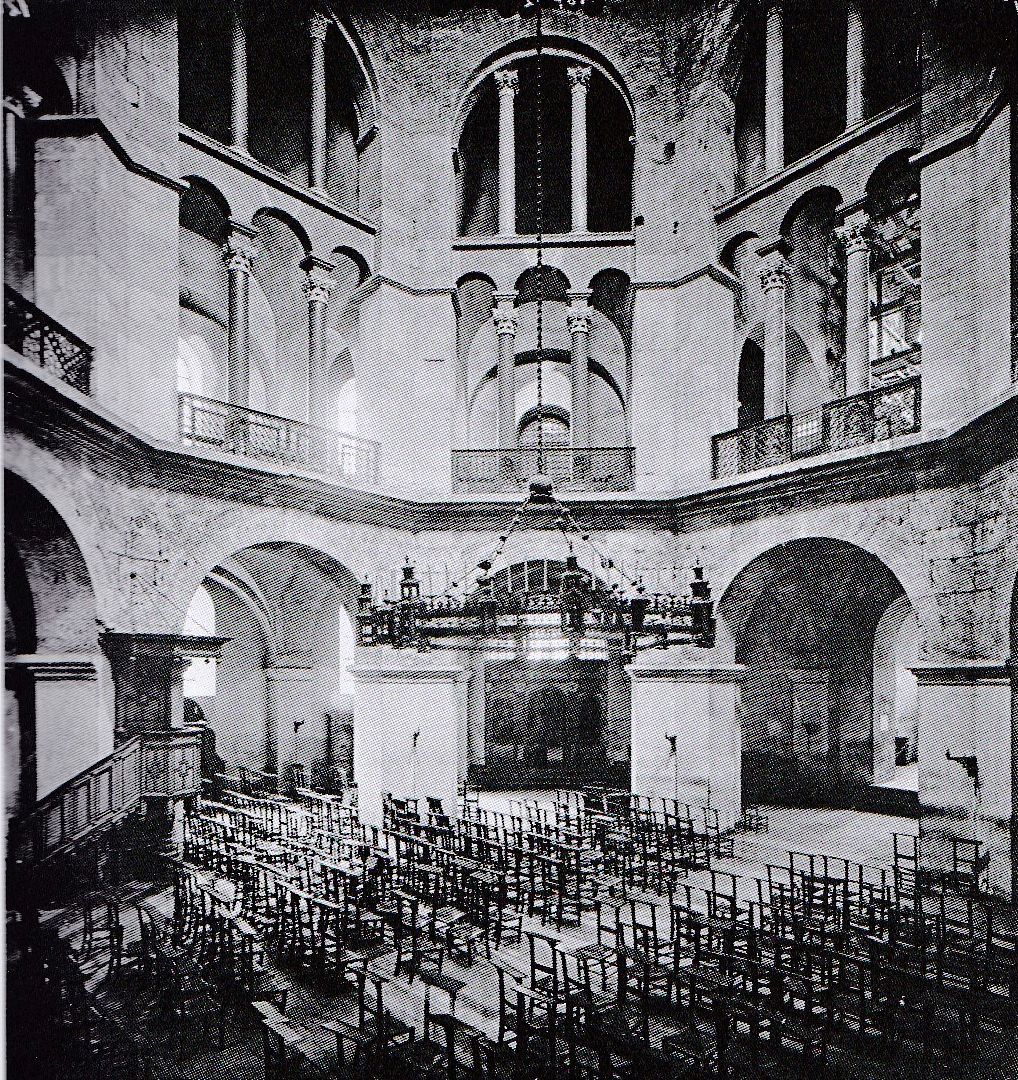
However, Charlemagne had taken a more modest approach. Whitewhashed columns interrupted by slim black columns and decorated with a gilt bronze fence.  

Source: Walter Mars, p. 50 (this is what the historians think the octagon looked like after having been built)

I like the elegance of the original. Ottmarsheim is closer to the original not only outside, but also inside. The whitewashed walls and the open brickwork give it solemnity. 

Source:  Wörner and Wörner-Hasler, p. 19.

The original mosaic in the cupola of the Aachen Cathedral showed Christ on the throne, surrounded by the Twenty-Four Elders. They had left their seats to deposit their crowns in front of Christ.  

Source: Walter Mars, p. 51, drawing  by Ciampini made in 1699

Around 1700, the original mosaics were eliminated and the church interior became baroque. 

In 1881, the baroque elements were removed and the cupola was decorated with the Neo-byzantine mosaic. 

The artists kept the theme of the original: The Twenty-Four Elders stand around Christ and deposit their crowns. However there are no seats next to the Elders and the mosaic is more abundant.

Before the German emperor William II intervened in 1900, the interior of the Cathedral resembled the modest original of Charlemagne. 

Source: Walter Mars, p. 53

After 1900, Emperor William II of Germany added the marble covering to the columns, arches and walls.  In addition, he engaged his favourite artist Hermann Schaper to create mosaics immediately below the cupola. He added more men dressed in white. What an abundant Neo-byzantine decoration. Not at all, what Charlemagne had in mind.

Mars writes that the visitor is overwhelmed by the Wilhelmine pomp and will have difficulties to find the former dignity of the Carolingian original. I can only agree with Walter Mars (Walter Mars, p.47).


The choir – the most prominent Gothic addition to Charlemagne’s Cathedral

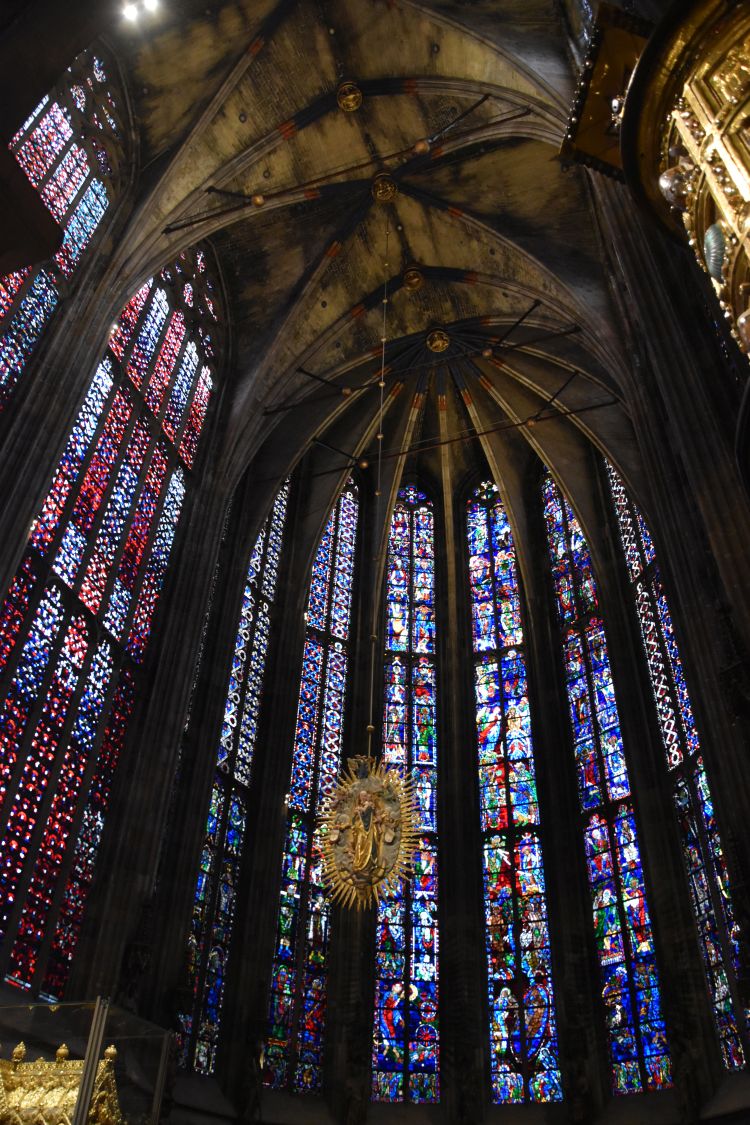
The most prominent Gothic addition to the Charlemagne’s octagonal Cathedral  is the choir (1355-1414).

Building it required to destroy the original rectangular choir (see dotted line) and part of the octagon.

Source: Walter Mars, p. 83.

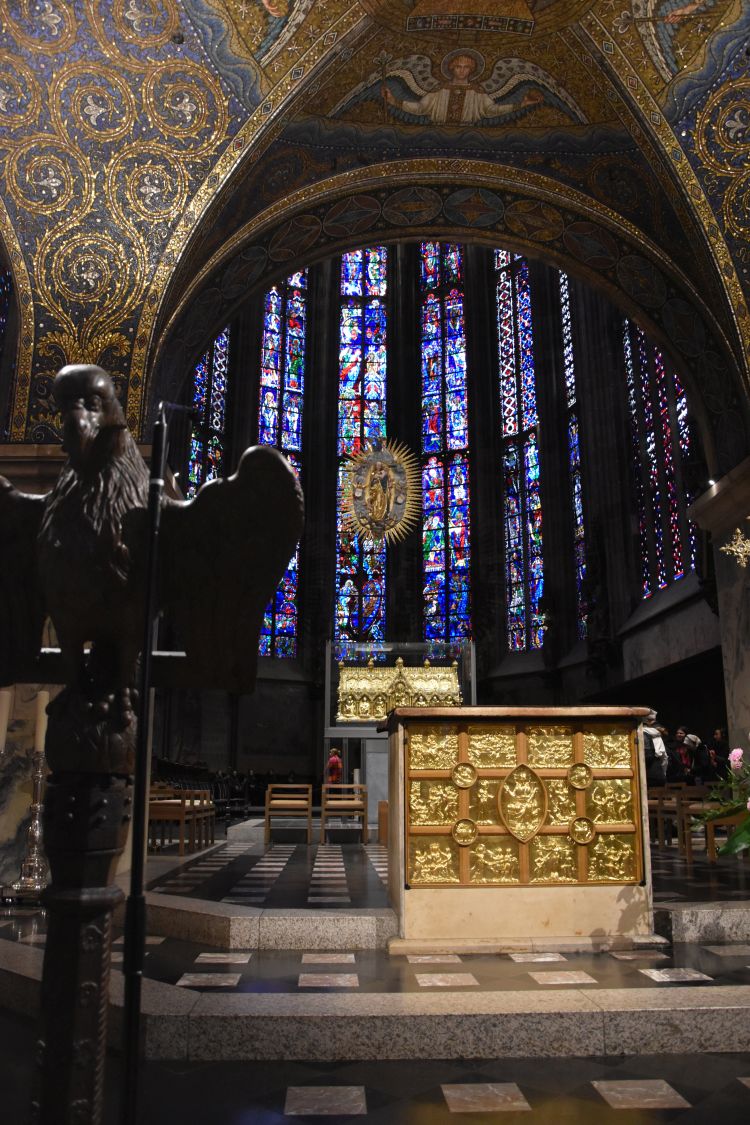
The choir with the large blue leaded windows creates the solemn atmosphere that I love in Gothic churches.

Two shrines decorate the choir: The Karlsschrein (shrine of Charlemagne, between 1182 and 1215) and the Marienschrein (shrine of Mary, 1238). The eagle lectern is from the 15th century.

However to me, the choir seems like a foreign body to he original octagon. Furthermore the choir is locked for visitors that have not paid for the guided tour. I am not a friend of guided tours and feel somewhat unwelcome here.  

I enter the other additions around the octagon, but they all leave me somewhat unimpressed. In my opinion, they do not go well with Charlemagne’s octagon Cathedral.  

When leaving the cathedral, I conclude that the first emperor of Europe, Charlemagne, has created a very elegant cathedral, and the last emperor at Europe, William II, has overdone the renovation in Neo-byzantine style.

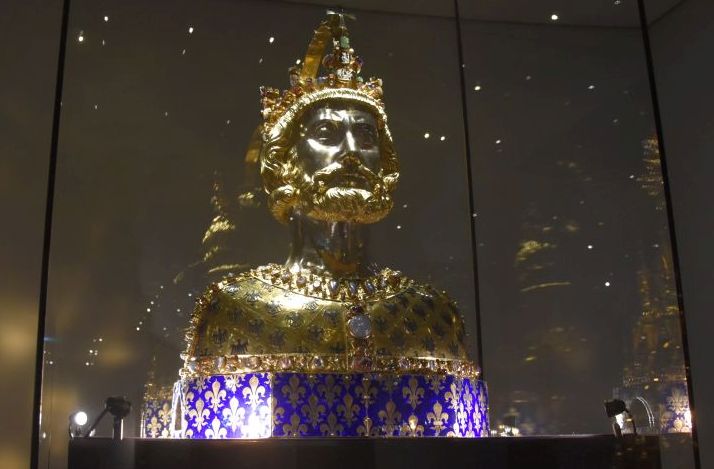
I say good-bye to Charlemagne who unifies the German Eagle with the French fleur de Lys on his reliquary bust, created in 1350 and exposed in the Aachen Cathedral Treasury. 

I will soon return to the abbey chapel of Ottmarsheim. It is just a half an hour’s drive from my home. 


Sources: 


Discovering Silesia: Karpacz with its churches and with Sniezka

In May 2023, we spent a week in Silesia, in “our” castle Staniszów near Jelenia Góra. From here, it was a short car ride to Karpacz, formerly called Krummhübel. Many German artists had been here at the end of the 19th century and in the beginnings of the 20th century.  Carl Ernst Morgenstern taught plein-air painting around Karpacz. Theodor Fontane wrote a criminal story for Krummhübel.


Karpacz centre with two churches from around 1900

The centre of Karpacz (Krummhübel) is a touristy place – this is the main street. 

There are two churches here, both built around 1900.

The church of the Holy Heart of Jesus, (Kirche des heiligsten Herzens Jesu, Kościół Najświętszego Serca Pana Jezusa) was inaugurated as a protestant church in 1908. 

A  nice painted wooden ceiling inside. The church became catholic in 1945.

The church Visitation of our Lady (Mariä Heimsuchung, Parafia Nawiedzenia Najświętszej Maryi Panny) was inaugurated in 1910, and the nave was rebuilt after 1945.

A painted wooden ceiling here as well.

Also this church was protestant and became catholic in 1945.


Wang church (Kościół Wang)

The attraction of Karpacz is the wooden Wang church. 

The church was built in Vang in southern Norway in the 12th or 13th century. In the 19th century, this church became too small for the congregation. It was decided to sell the church and use the money earned to build a larger new church. A painter from Norway, professor Jan Christian Dahl, lived at Breslau at that time, and he convinced the Prussian king Friedrich Wilhelm IV to buy the church for 427 Mark. The church was disassembled and shipped to Berlin. The king had intended to rebuild the church on the Pfaueninsel at Berlin, but then changed his plans. Count Leopold Christian von Schaffgotsch donated land between Krummhübel (Karpacz) and the Schneekoppe (Śnieżka), at Brückenberg (now Karpacz Górny). The church was reassembled here and inaugurated in summer 1844.

Two lions guard the entrance to the church.

Inside, viking faces frame the door; they may be warriors with split tongues. 

This is the choir…

… with the baptismal font (Saint John in his fur coat baptizes Christ).

The column shows Daniel in the lion’s den.

This door leads to a corridor around the nave. 

The Vang church has become THE cultural landmark of Karpacz.


Hiking from Polana to Słonecznik, with a partial view of the Śnieżka

Behind the Wang church, you have to pay an entrance fee for the Karkonosze park, which is a nature reserve now. A path leads to Polana, a meadow that I suspected was the place, where my grandfather had painted the Schneekoppe (painting owned by Heimatverein Kleinmachnow).

But, when reaching the meadow Polana, it becomes clear, this is not the place, where my grandfather’s easel was. 

I follow the path uphill and can sometimes see the Schneekoppe between the trees.

I reach one of the many granite blocks scattered around here… and I am not alone. The Poles enjoy hiking.

I reach another granite rock, the Słonecznik. A beautiful view into the Hirschberg valley. 

The Schneekoppe(Sniezka) can be seen from the Słonecznik as well. 

I walk back down.

On the meadow Polana, I look for the place, where the  former mountain hut Hasenbaude once was, but it seems that nothing remains of it.

No, I my grandfather’s easel was not here… may be it was south of the Schneekoppe (Sniezka), on the other side?

Back at home, I solve the puzzle. The easel WAS south of the Schneekoppe, above Petzer or Pec pod Sněžkou. I could identify Petzer and  the mountains on the painting and I believe, the easel stood at the Lenzenberg, now called Zahradky. 

There is something more to explore! The Giant Mountains in the Czech Republic. I will return!


Sources:

  • Plates on the churches
  • Description of the Vang church, handed out in the church.
  • Tomasz Torbus, “Polen – Reisen zwischen Ostseeküste und Karpaten, Oder und Bug”, Dumont Kunstreiseführer, Ostfildern 2011

Discovering Silesia: Cieplice Zdrój or Bad Warmbrunn

In May 2023,  I spend a week near Jelenia Góra in Silesia exploring the surroundings. One day we visit Cieplice Zdrój (Bad Warmbrunn). 

In the 17th/18th century, Bad Warmbrunn became a well-known health resort in Silesia. In the 17th century, the queen of Poland, wife of Sobieski, stayed here with her entourage of 1500 persons. In the 19th century, Bad Warmbrunn was one of the most famous resorts of Germany, visited by artists, high nobility, statesmen and even by the (later) US president  John Quincy Adams (1825-1829).  

The main centre is called Plac Piastowski. Spa guests and day tourists stroll along. There are souvenir shops and inviting restaurants. 

The houses are well maintained. In the background we can see the red tower of Saint John’s church.  

In the church of Saint John the Baptist, the high altar has been painted by Michael Willmann (1687); he is sometimes called the Raffael of Silesia. His painting shows Maria Assumption. 

Already in 1281 the Knights Hosipitallers (Johanniter) had founded a hospice that was probably visited by guests for healing.  

The Schaffgotsch acquired Warmbrunn in 1381 and settled here in 1400. Their castle, completed in 1788 in early neoclassical style, dominates the Plac Piastowski. 

Today it is part of the technical university of Wroclaw. 

Legend tells us that in 1175, a deer  cured his wounds at a warm fountain, after having been shot by hunters. The hunters built a hunting lodge, and this is how the spa resort originated (by legend).

Next to the palace, this cheerful “deer couple” may remind of the legend. They seem to have recovered well in Cieplice. 

Next to the Schaffgotsch Palais is the entrance to the spa gardens.

We enter, pass by the Pawilon Edward,…

… and enjoy the romantic corners. 

The visual axis to the Schneekoppe or Sniezka has been beautifully set up with fountains and benches.

For several centuries high nobility and statesmen have strolled along the alleys of this park. We meet some of them….

… dressed up like a hundred years ago.

We return to the Plac Piastowski and have a delicious ice cream.

At Cieplice, I notice again that the Polish fill the German past of Silesia with their life and take care of it. 


Sources:

  • Frank Schüttig, “Riesengebirge”, Trescher Verlag, Berlin 2022
  • Malgorzata Ulrich-Kornacka, “Niederschlesien”, Via Nova, Wroclaw 2018
  • Dieter Schulze, “Polen der Süden”, Dumont Reisehandbuch, Osfildern 2020
  • Tomasz Turbos, “Polen”, Dumont Kunst-Reiseführer, Hamburg 2011
  • Arne Frank, “das schlesische Elysium, Burgen, Sclösser, Herrenhäuser und Parks im Hirschberger Tal”, Potsdamer Bibliothek östliches Europa Kulturreisen 2004.