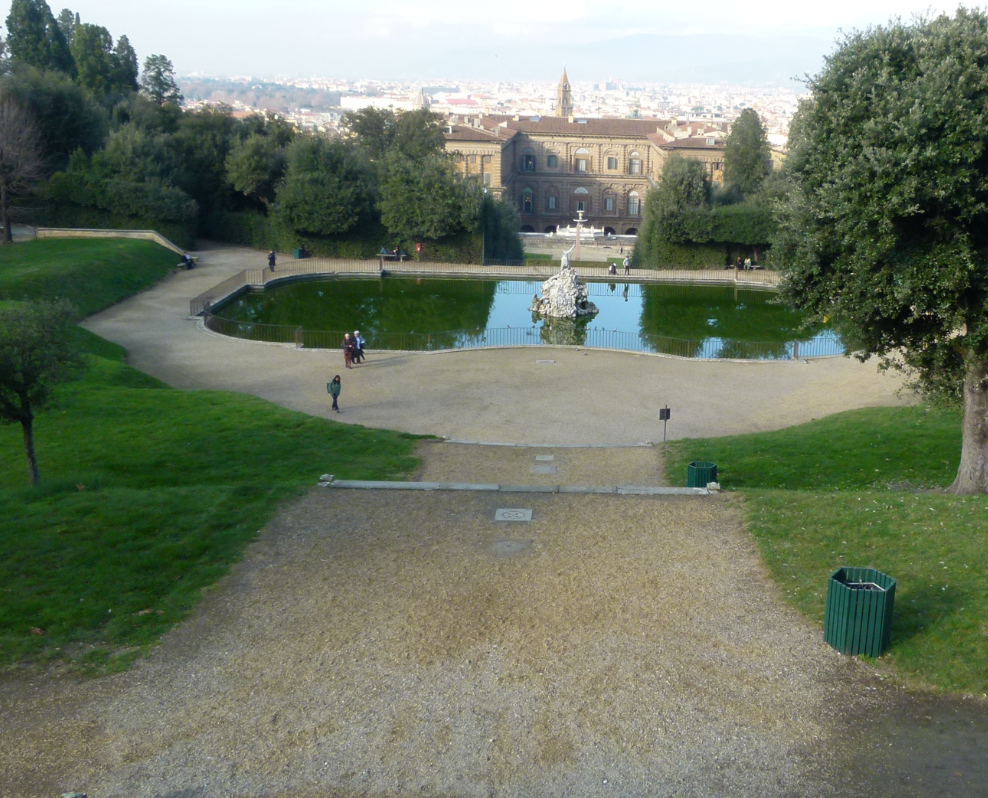
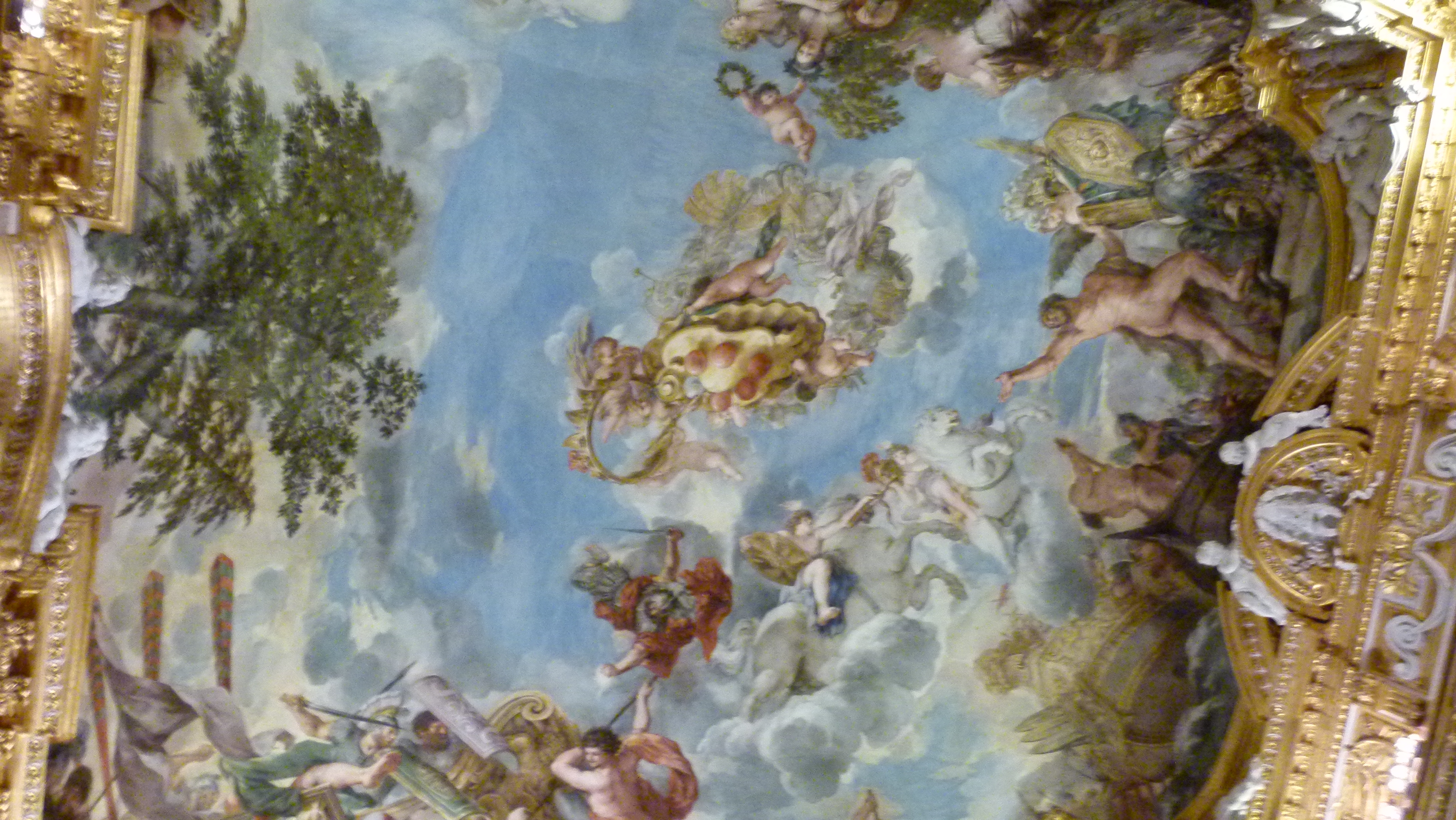
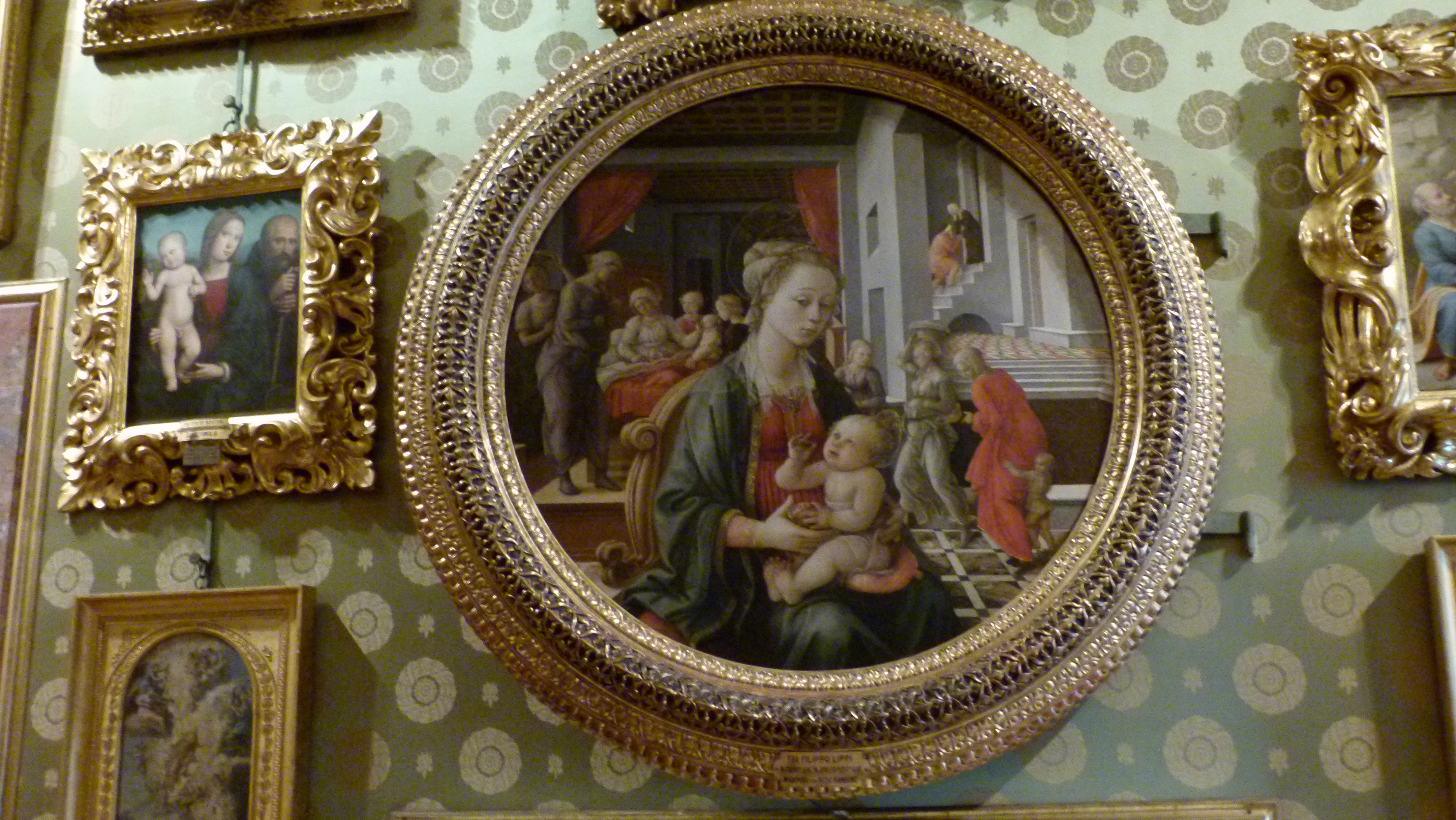
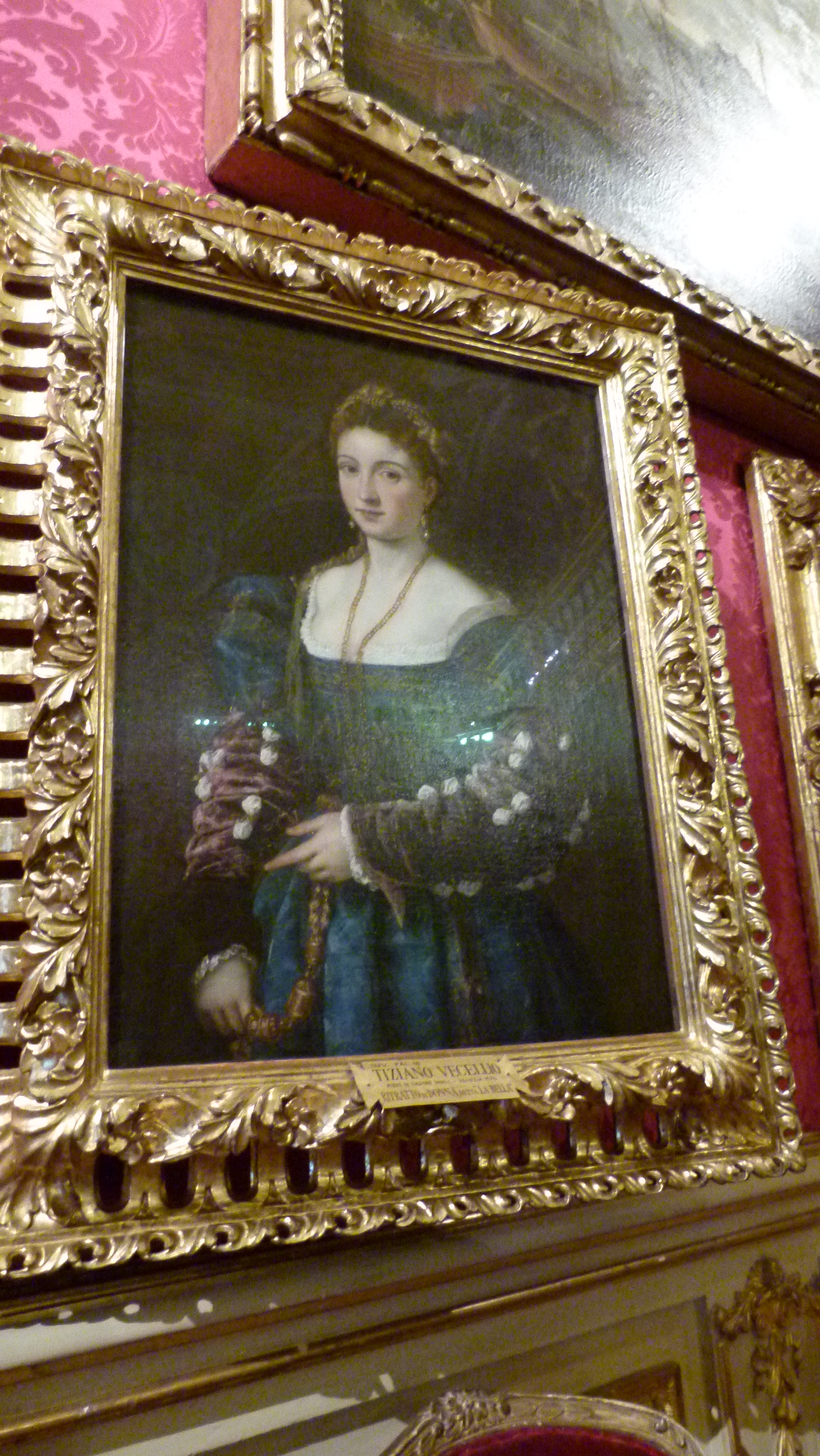
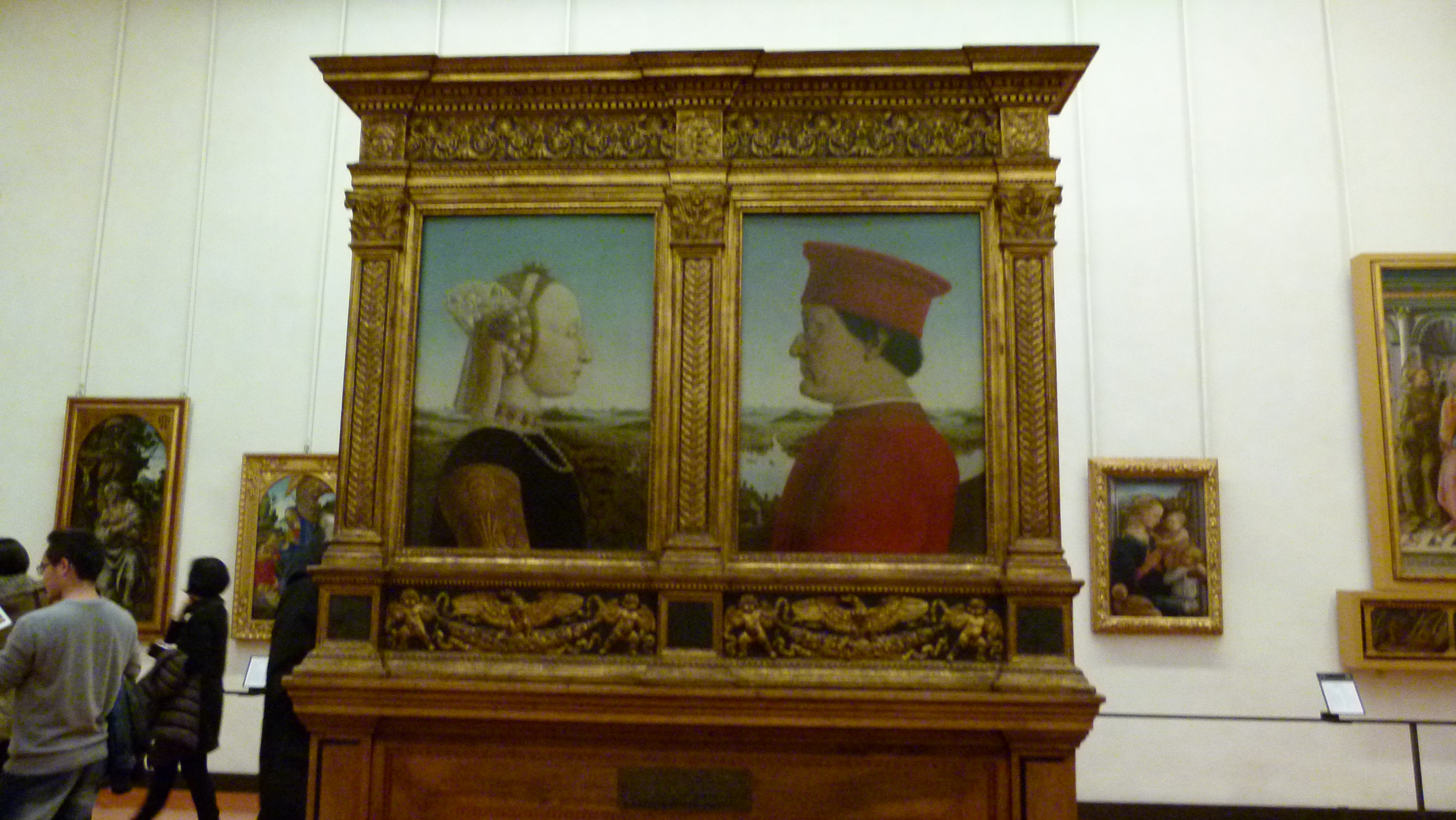
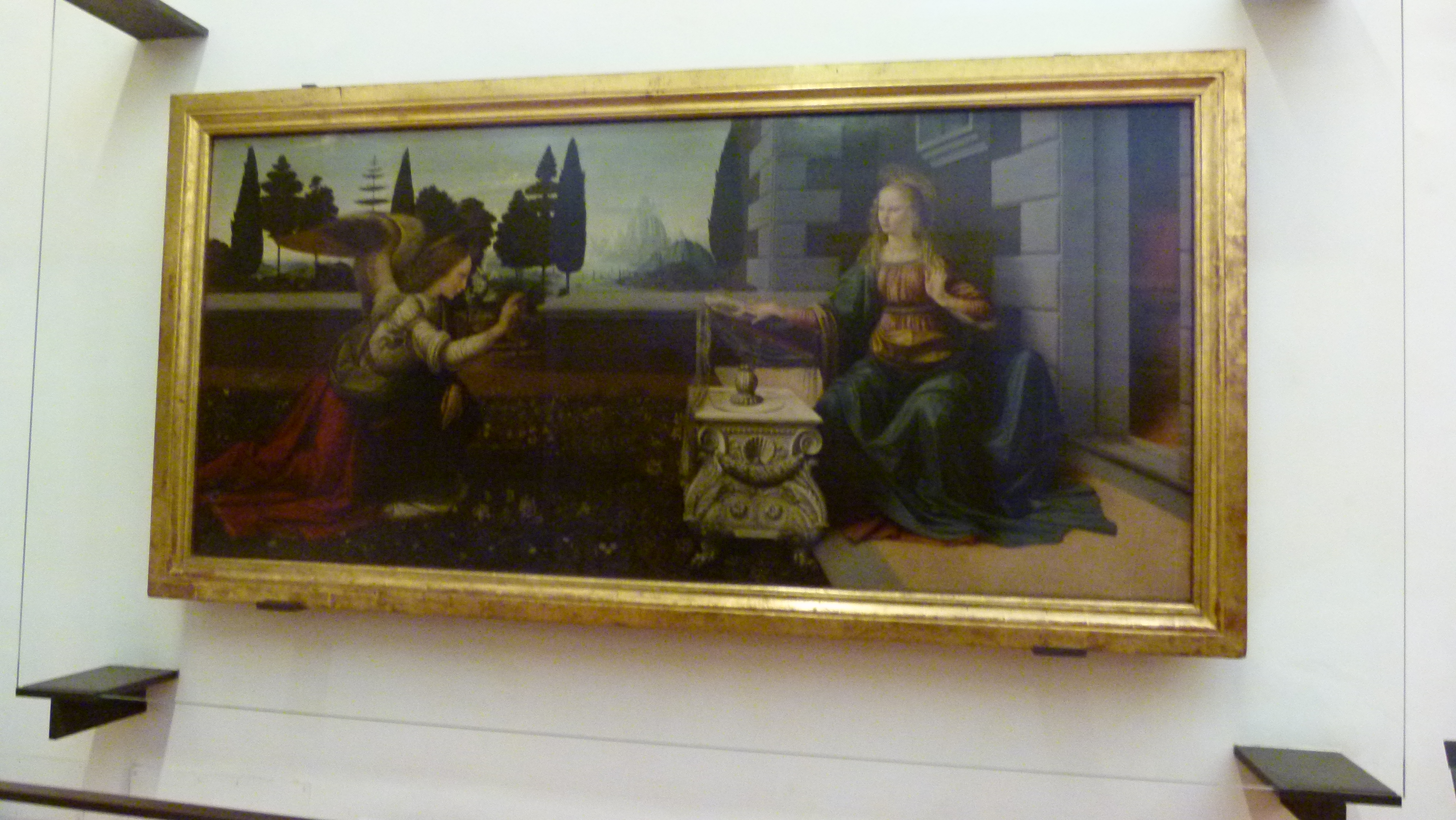
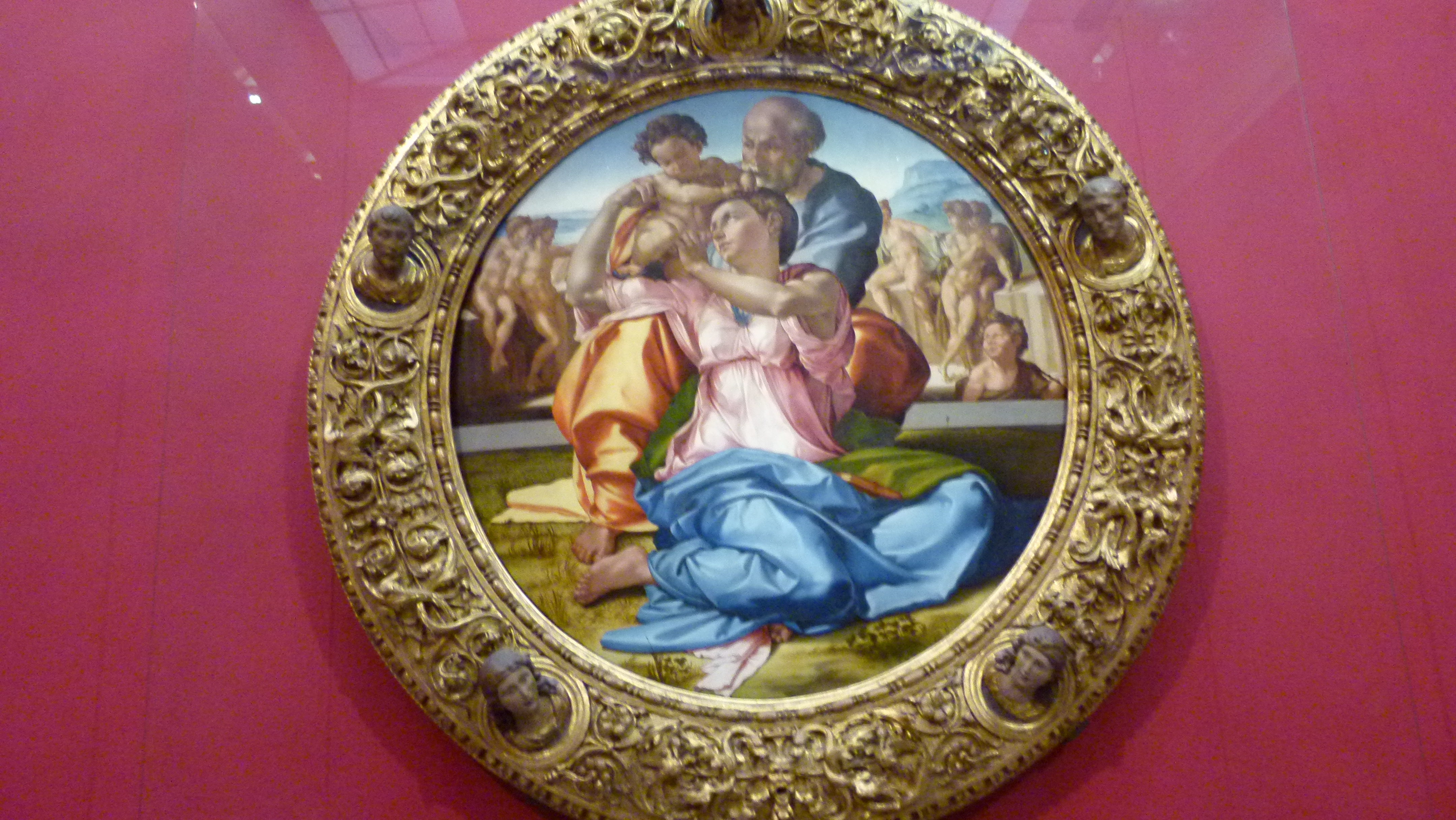
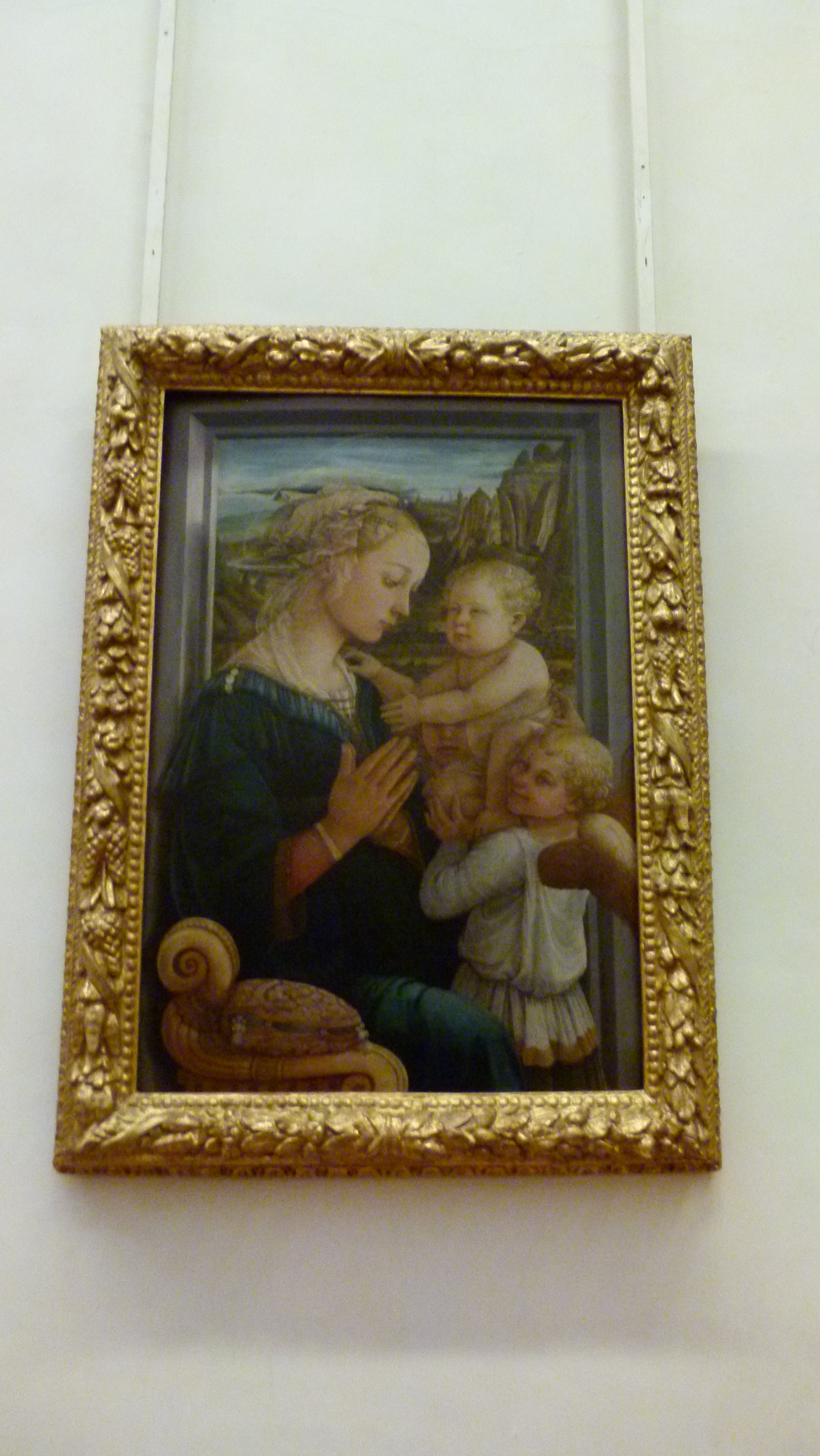
Three Swiss in Florence – Enjoying museums and palaces

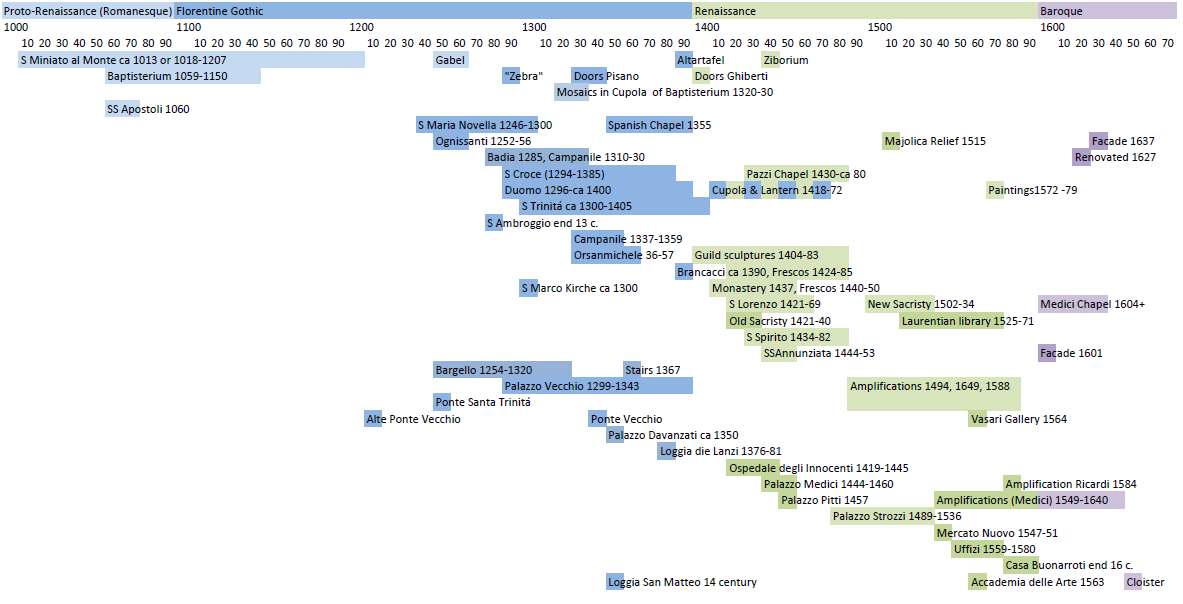
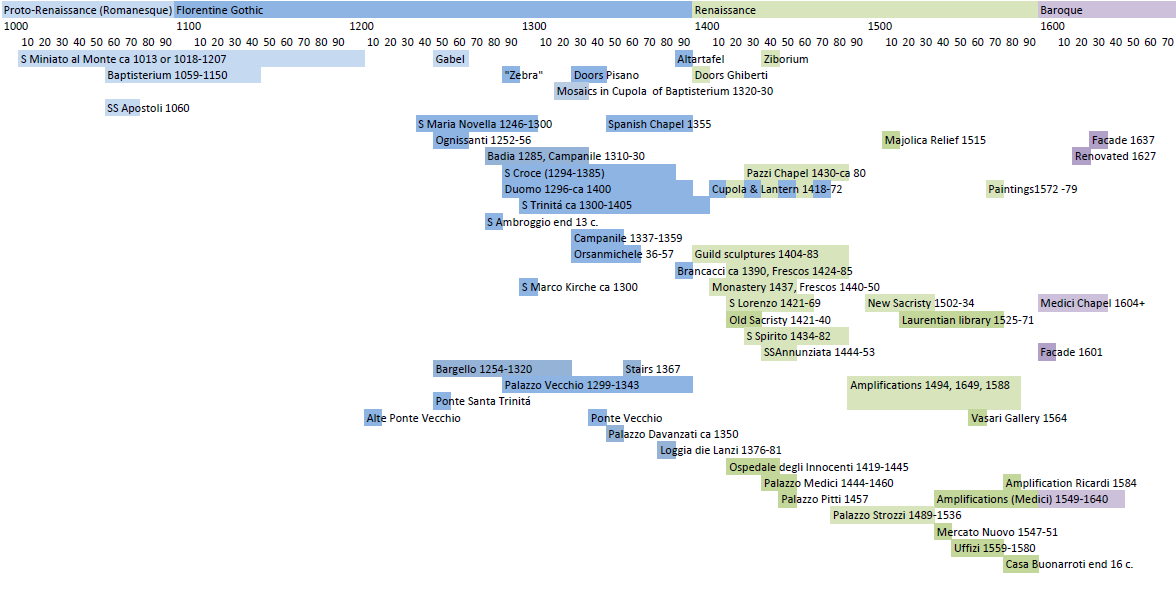
Again to recapitulate: The architecture time line – now focusing on the second part with the secular buildings

Capture_1

Let me now present some of  the museums and palaces we visited…

.

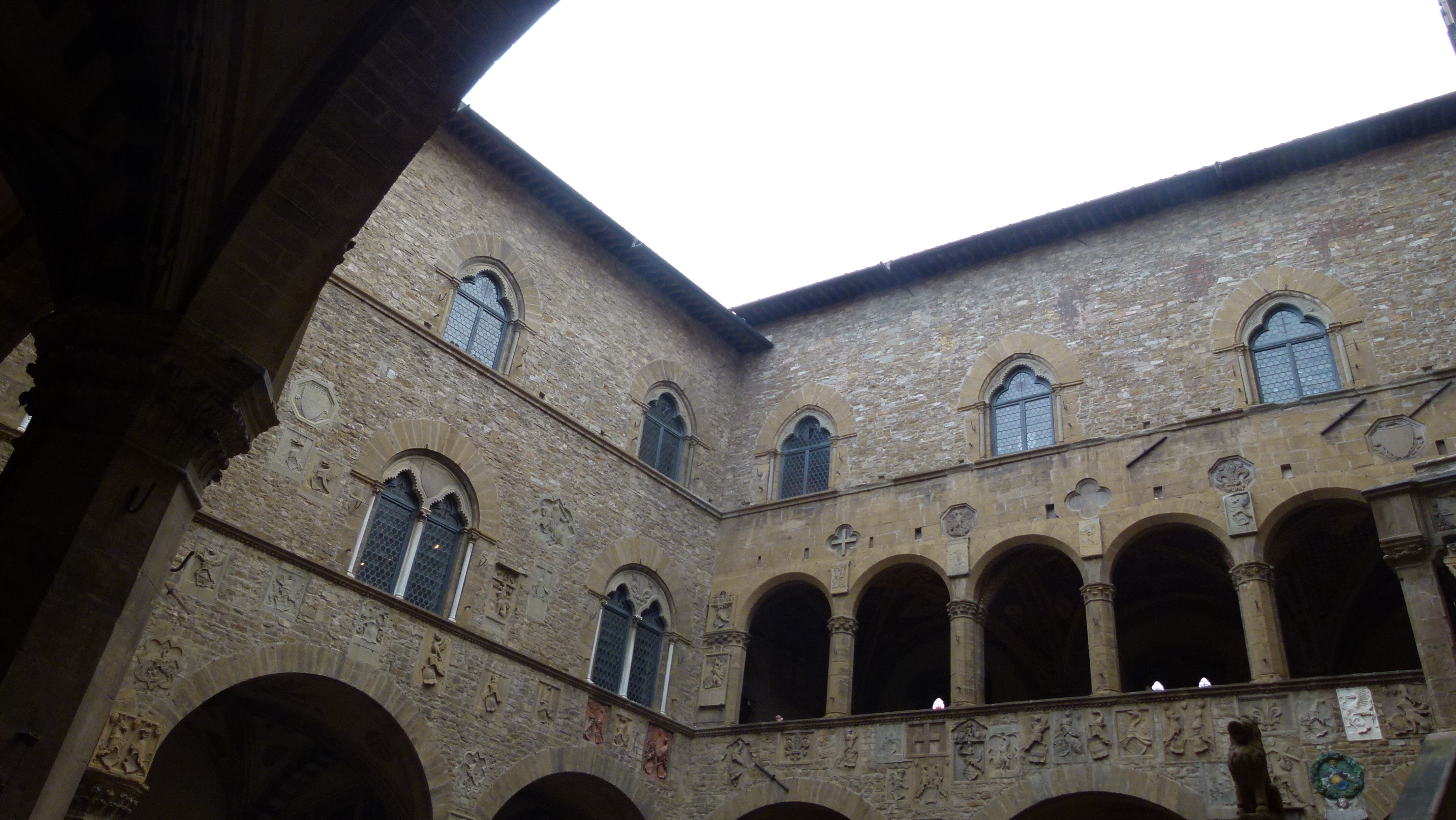
Bargello

The palace was built in 1254. Some say that 40 years later this palace was the model for the Palazzo Vecchio. I can see similiarities and even confused the two buildings in the beginning. Town leaders lived in this palace – sometimes local  representatives, sometimes representatives of the German emperor. In 1574 the Bargello became the seat of the “bargello”, the head of the Florentine police. Today, the palace is another renowned art museum.

P1070297

In the ground floor I am impressed by the works of Michelangelo – below is his Bacchus.

P1070298

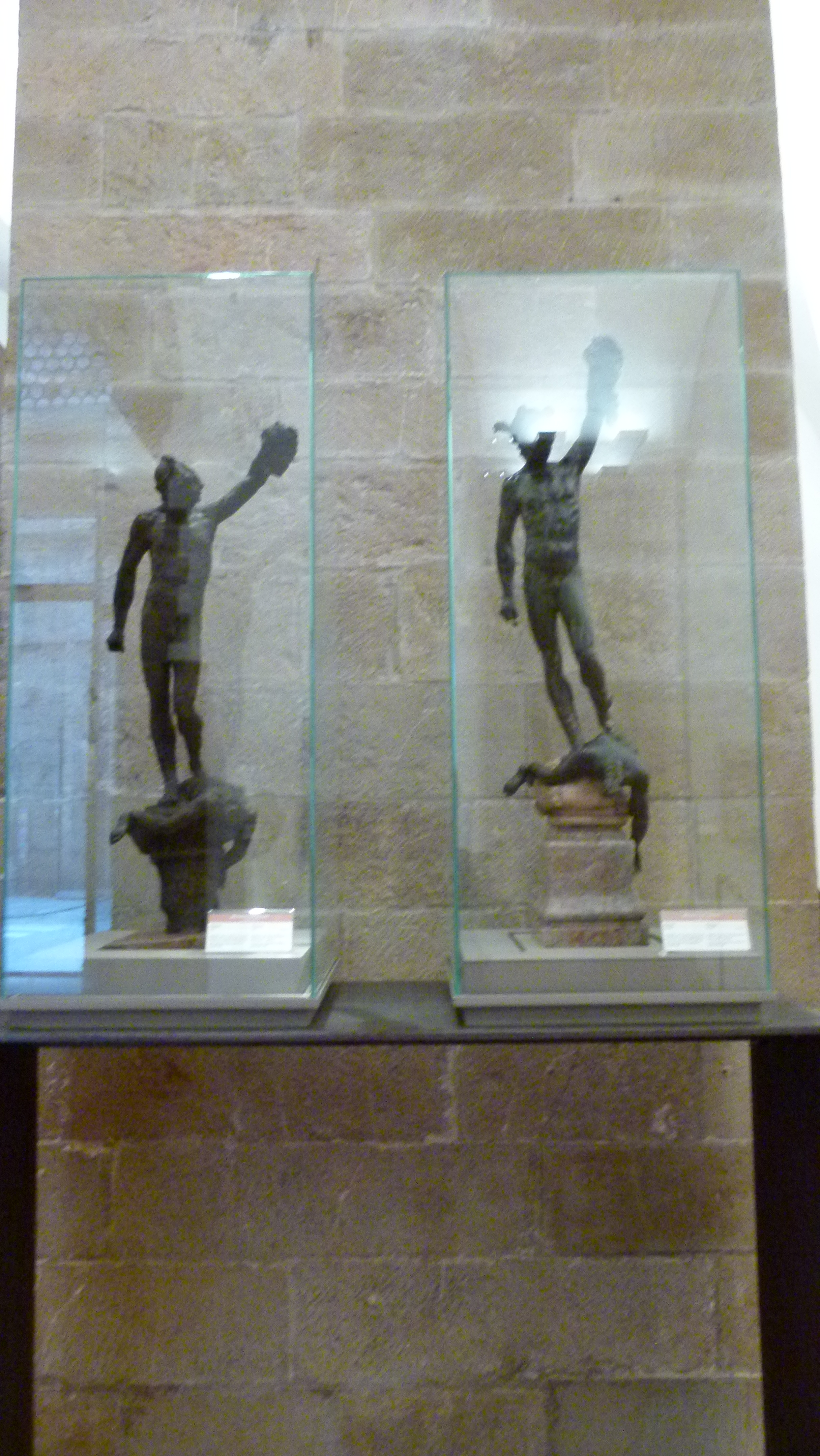
Also on the ground floor are the prototypes that Cellini casted before creating his famous Bronzeperseus with the head of Medusa around 1550.

P1070299

Cellini’s Perseus stands in the Loggia near Palazzo Vecchio. Cellini was a goldsmith. His bust is venerated on Ponte Vecchio. Franz Kotteder gives this title to the biography of Benvenuto Cellini “the life of an artist like an overheated roadmovie” (“Florenz, eine Stadt in Biographien”, Merian 2014). He repeatedly got involved in quarrels and fights. Due to his good connections (even to the Pope) he always obtained pardon.

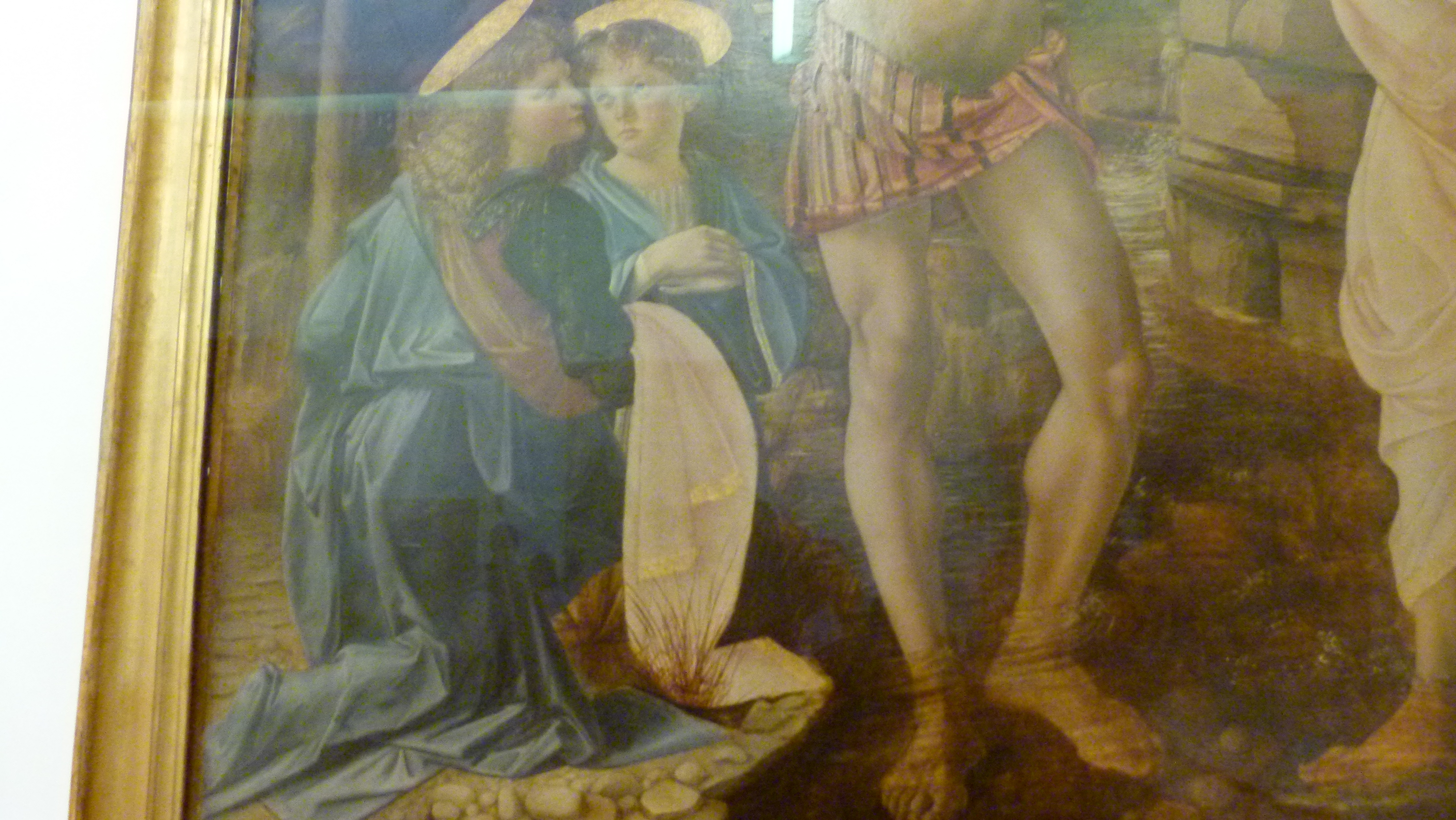
On the first floor there are various gothic and renaissance sculptures and paintings. Here is the marble statue of David that Donatello created in 1409 – it attracted my attention.

P1070309

About 30 years later Donatello made a second David out of bronze that is more famous than his first David.

On the first floor there is also an exhibition of artworks from various countries. For instance this porcelain elephant from Persia.

P1070303

.

Palazzo Vecchio

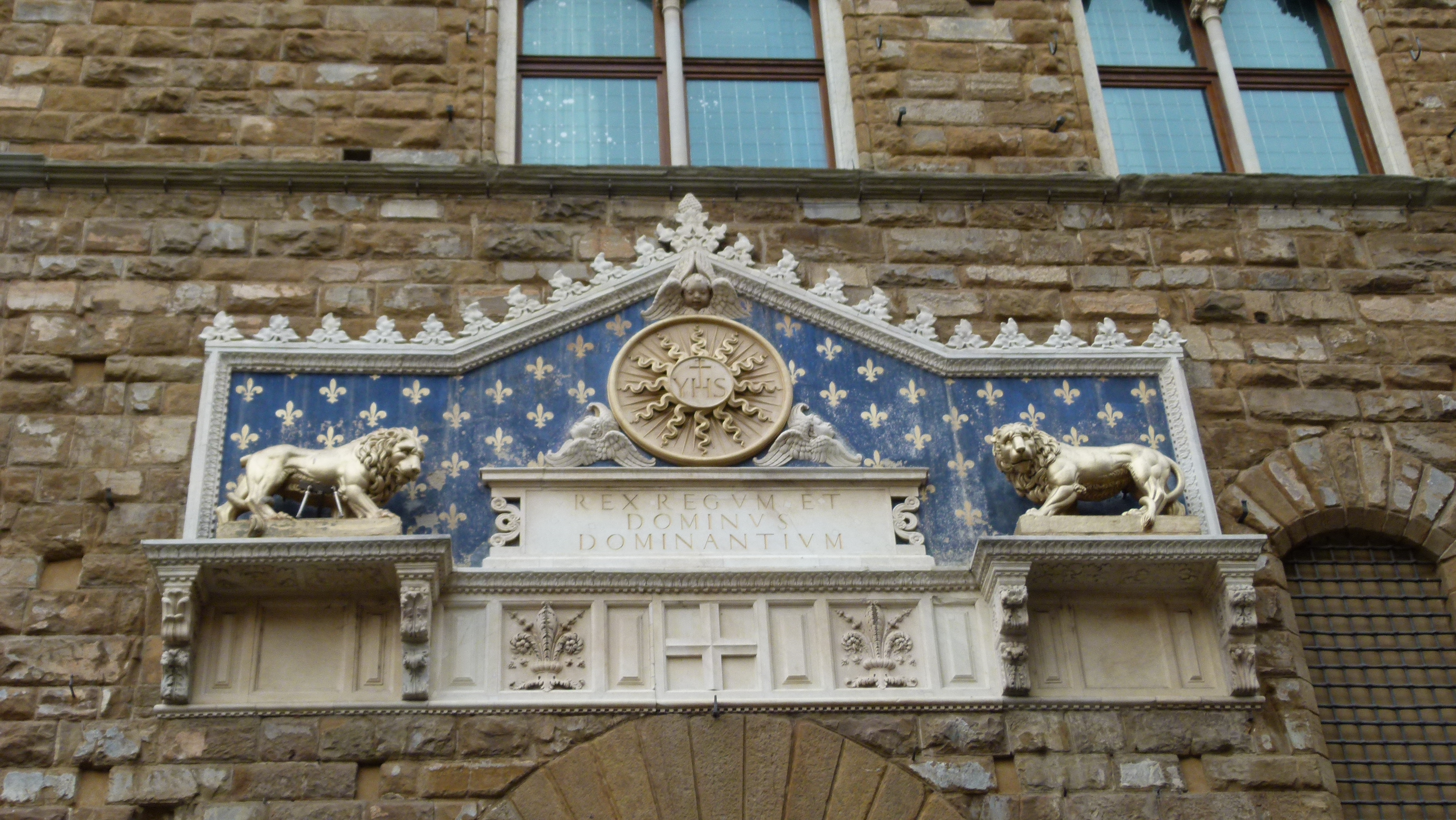
Originally the Palazzo Vecchio was called “Palazzo della Signoria”. It was built between 1299 and 1343, as the townhall for the town republic or the place of work and residence for their “Signoria”. The Palazzo was amplified several times, for instance in the 16th century, when the Medici reconstructed it – it was then their “Palazzo Duccale”. When the Medici moved to the Palazzo Pitti around 1570, they renamed their “old” palace to “Palazzo Vecchio” Above the front door are lions protecting the lily flowers. Lions and the flower are symbols of the town. Often they appear as a lion protecting a lily with his paw (called “Marzocco”). The lion is the symbol of the pope or the Guelphs (symbol of freedom as opposed to the eagle that is the symbol of the German emperor). Why the lily became the symbol of Florence is subject to guesses. Some say that the goddess “Flora” had founded Florence.

P1070181

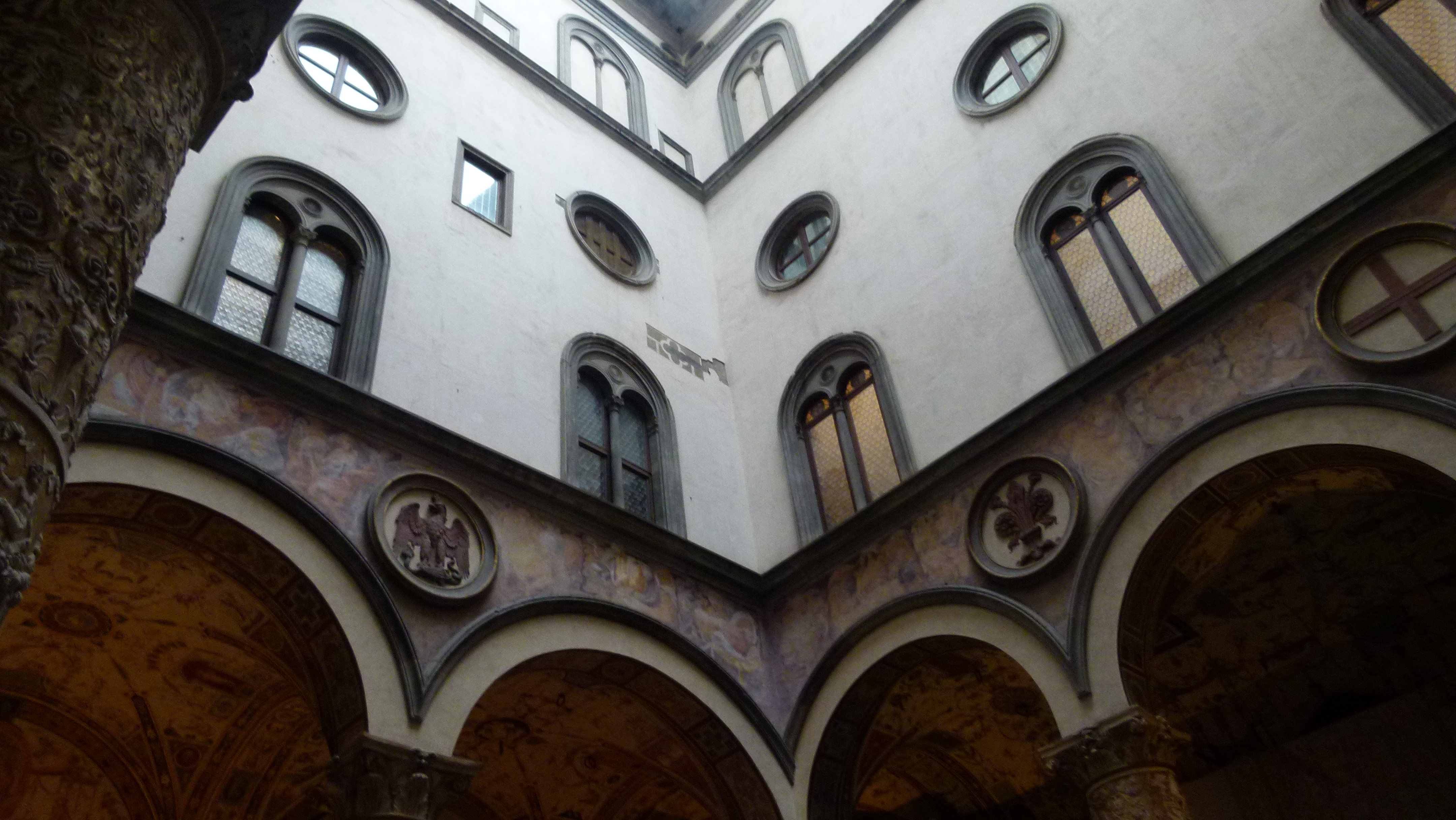
The Palazzo Vecchio can be visited, but we decided to postpone it to our next trip to Florence. This is an impression taken in the first courtyard. P1070184

.

Ponte Vecchio

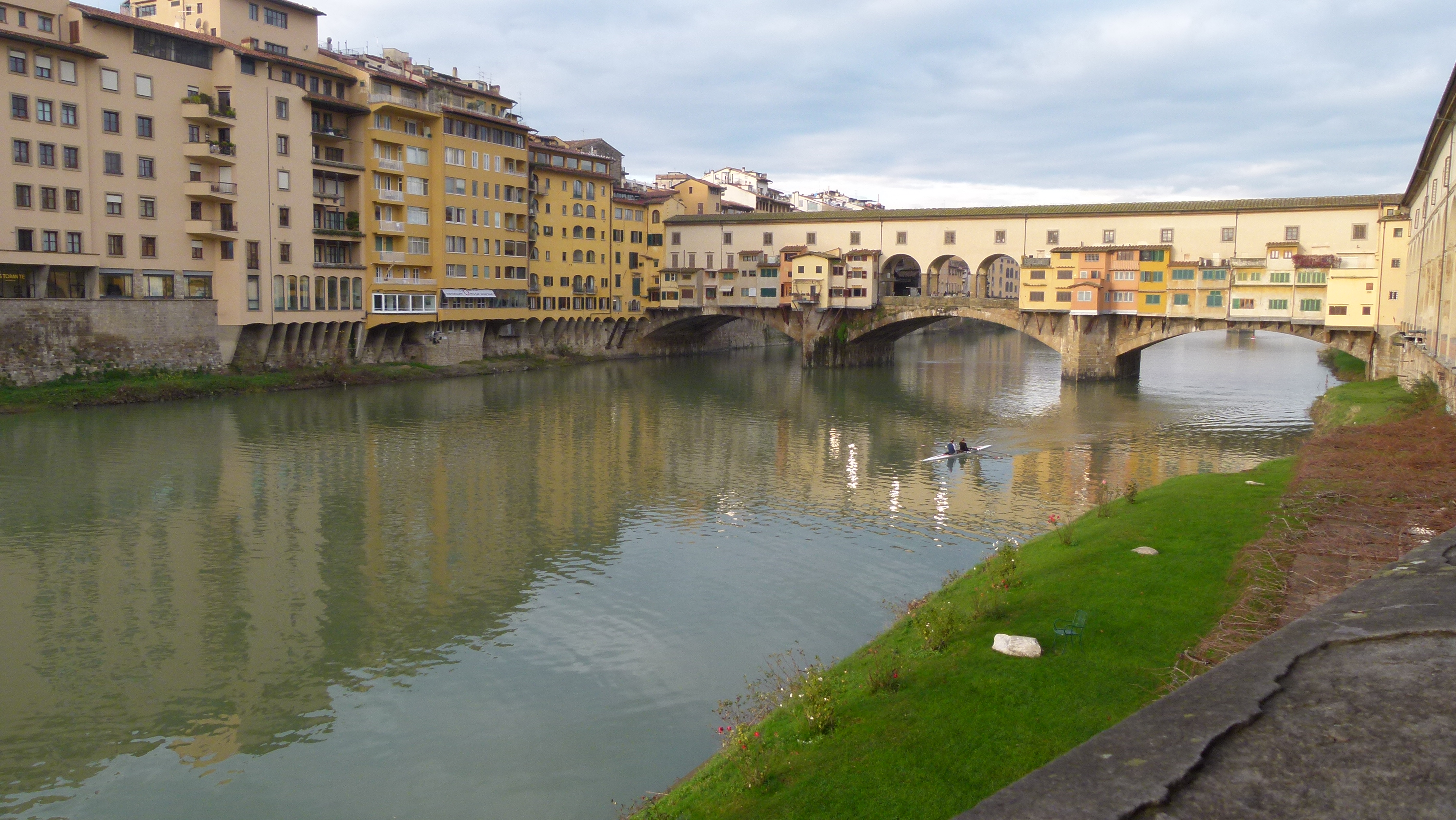
The Ponte Vecchio is THE place in Florence. If a tourist does not remember anything else, he always remembers this bridge crossing the Arno. This bridge was built around 1340.  The common roof above the small houses is the Vasari Corridor. It was ordered by the Medici after they had settled in the Palazzo Pitti around 1560 to connect their “new” palace with the Uffizi and their “old” palace. Until 1593 there were butchers in the small houses on the bridge, but the dukes did not like the smell, when walking through their corridor. They doubled the rent and goldsmiths and jewelers moved in (Dumont).

P1070264

We spent quite some time with one of the jewelers in his shop. From his workbench, he has a great view of the Arno.

.

Palazzo Davanzati

There are many, many rich palaces in the city center. We visited one of them, the Palazzo Davanzati. It was constructed around 1350.

P1070656

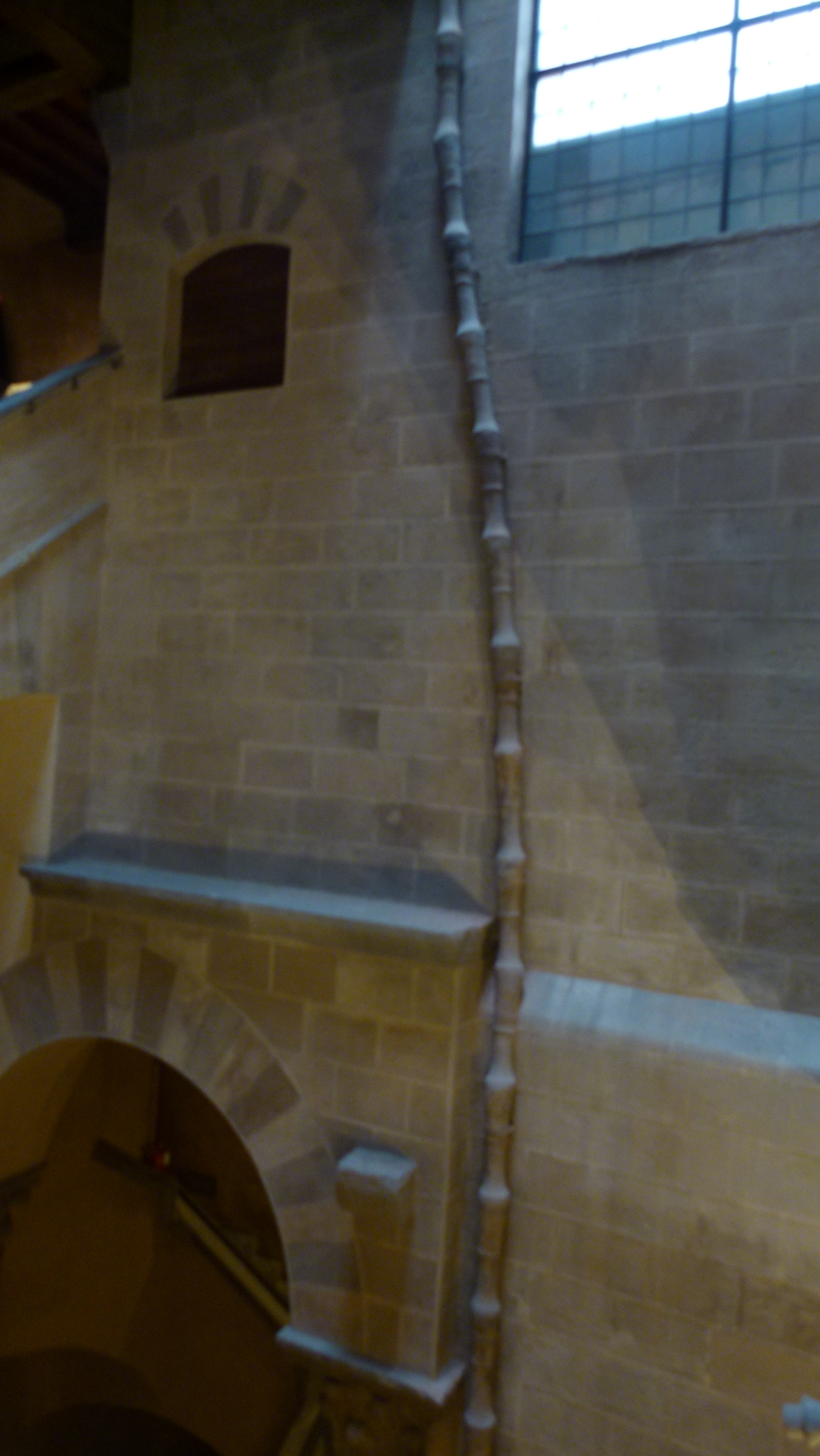
I am impressed how modern this palace is. A tube brings water into the upper floors.

P1070664

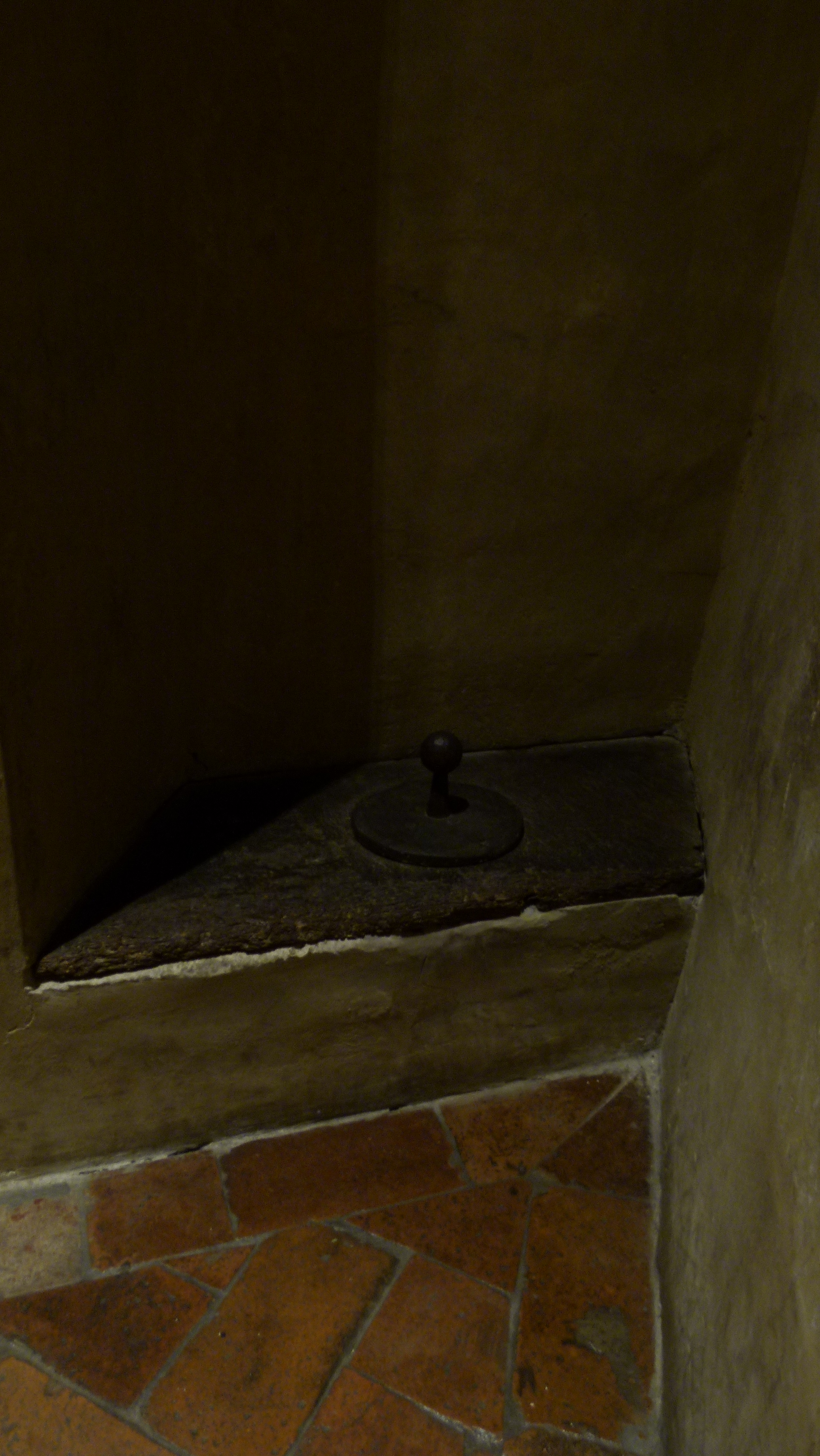
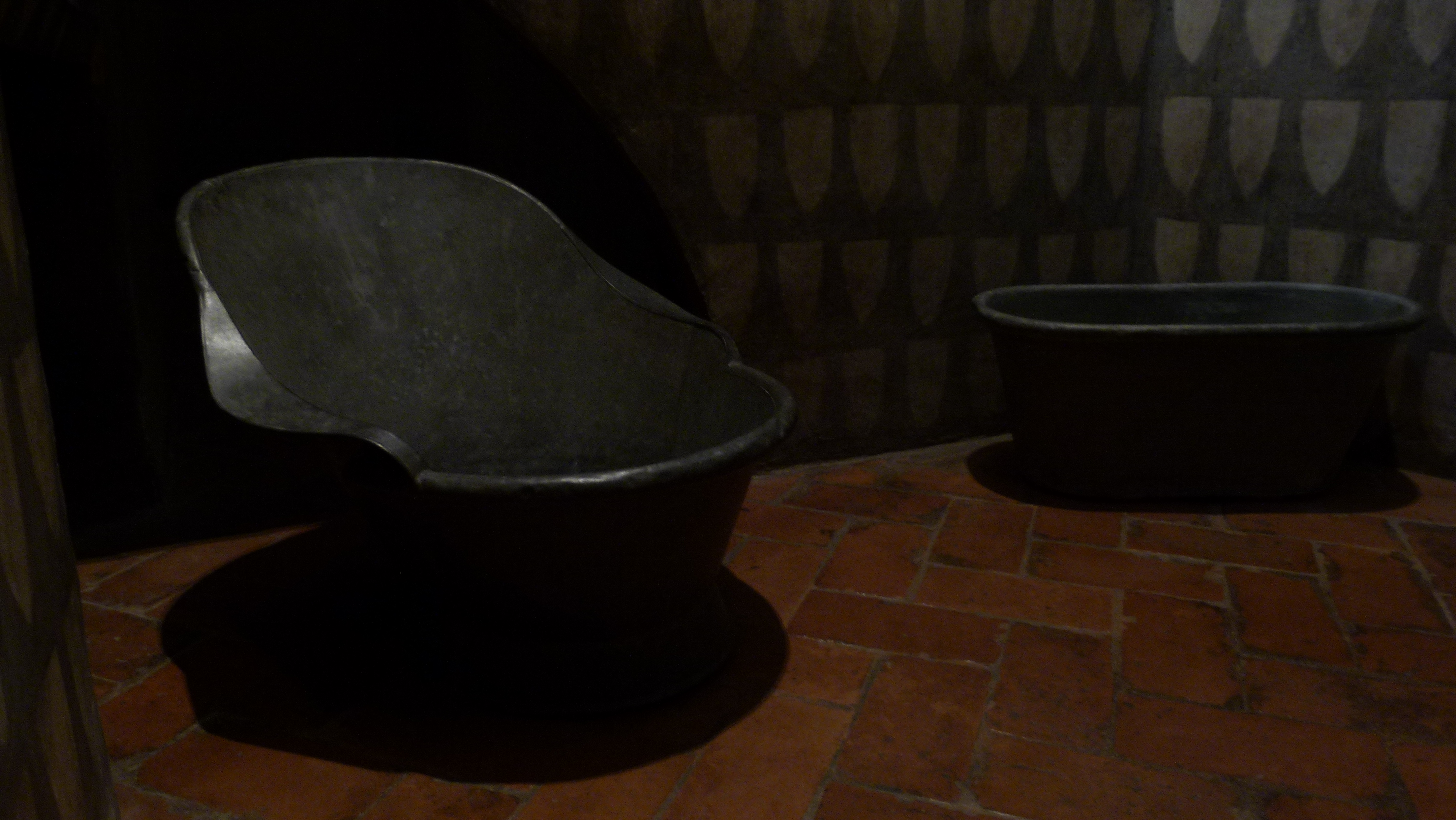
There is a toilet on each floor.

P1070672

And there is a bathroom on each floor.

P1070701

The most beautiful salon is the Papagalli room with the frescos covering the walls.

P1070667

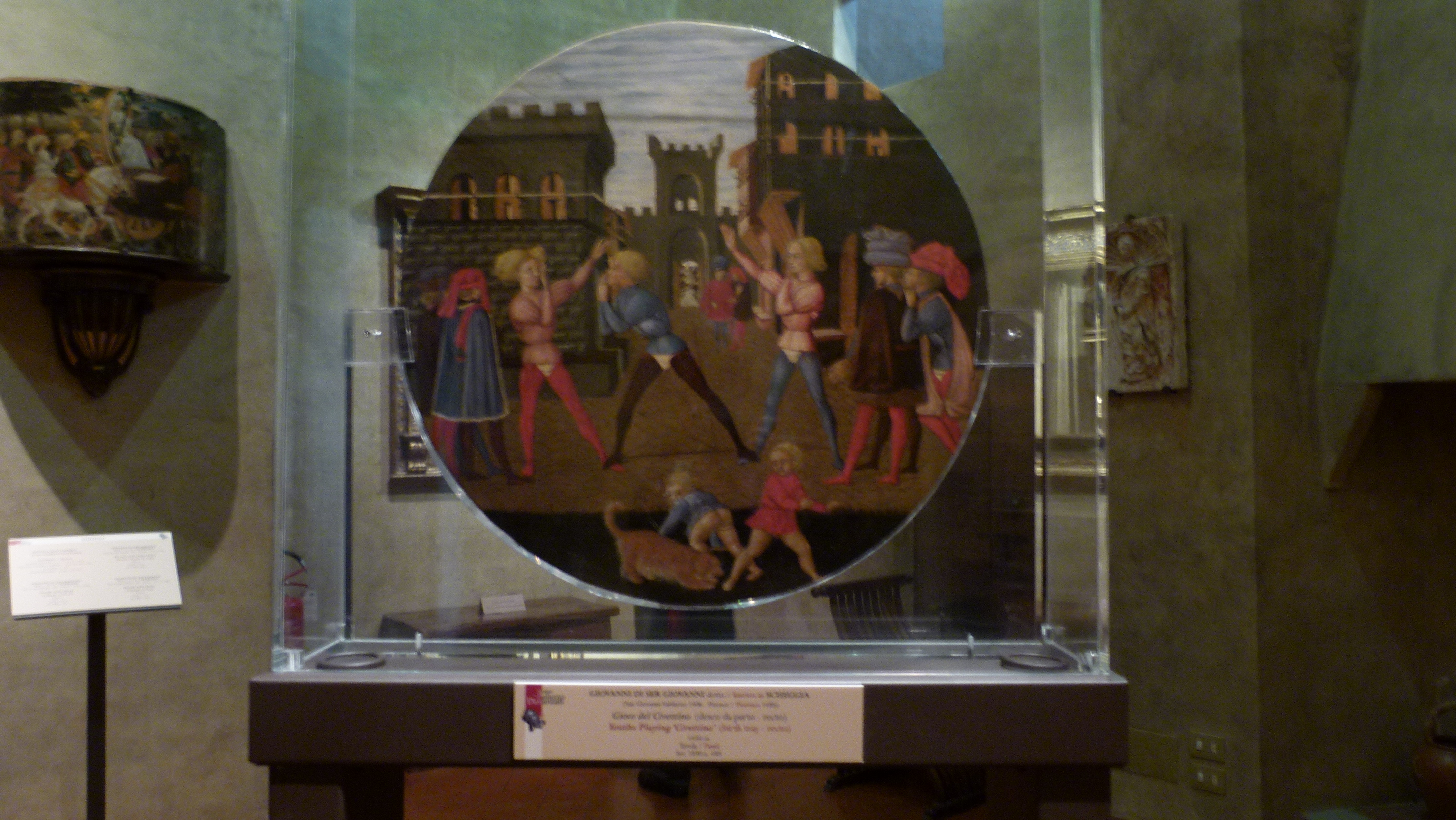
In one of the rooms we come across the brother of the famous Masaccio that died at the age of 27 after having painted the magnificent “Expulsion from the Paradise” and the “Crucification”. His brother Scheggia painted scenes from everyday life – and this helps today to understand what life in Florence was like.

P1070693

.

Ospedale degli Innocenti

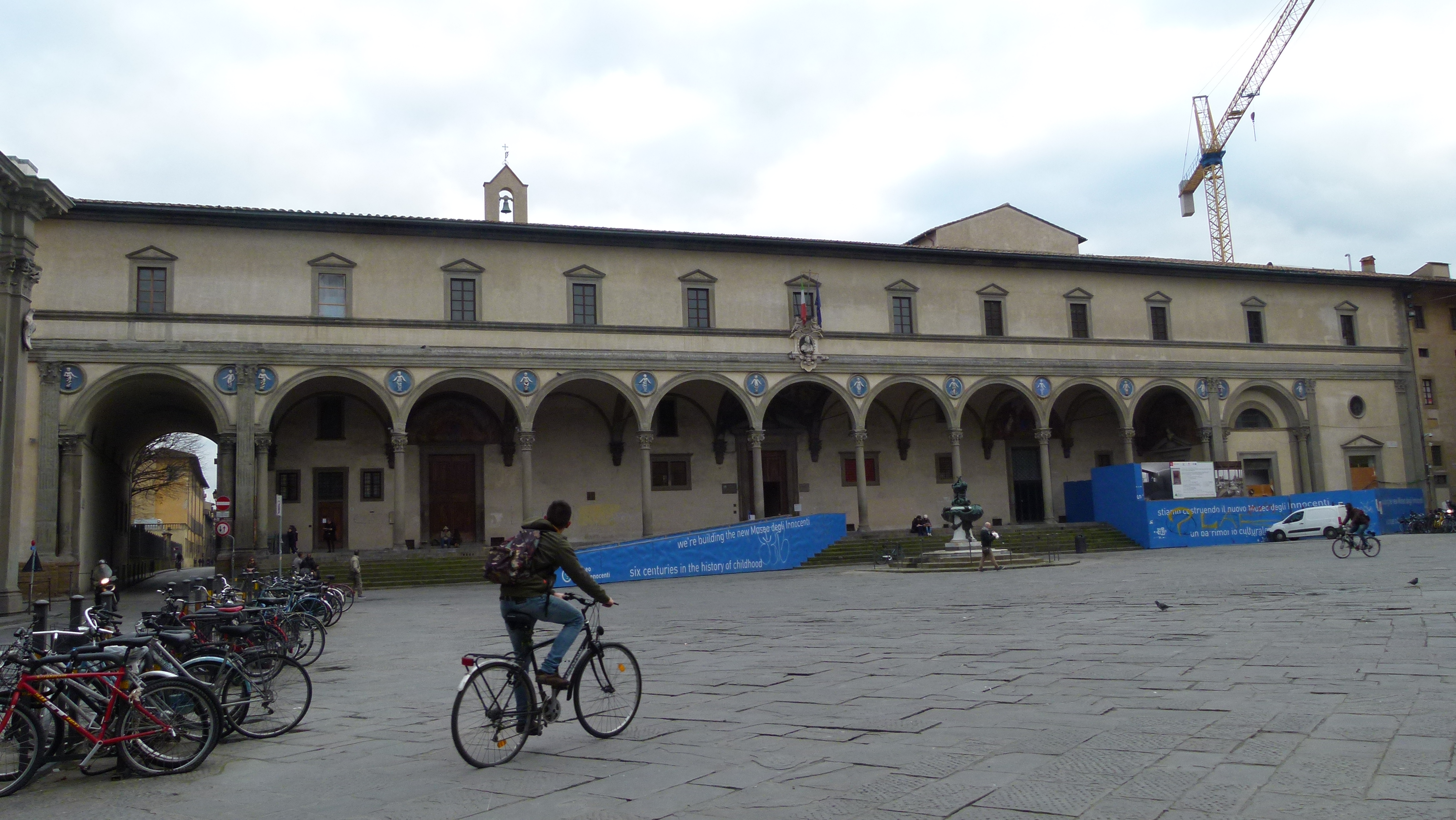
The Ospedale degli Innocenti or the house for the orphans is not only a great piece of Renaissance architecture built by Brunelleschi, but it was also a very social institution. It was completed in 1445. Today it is still an orphan house, and also a museum. We just enjoyed the harmonic architecture of the Piazza SS Annunziata dominated by the archades of the Ospedale and the church.

P1070504

.

Palazzo Medici-Ricardi

The Palazzo Medici, Renaissance from around 1450, was later amplified by Ricardi after they had acquired the palace in 1584.

P1070383

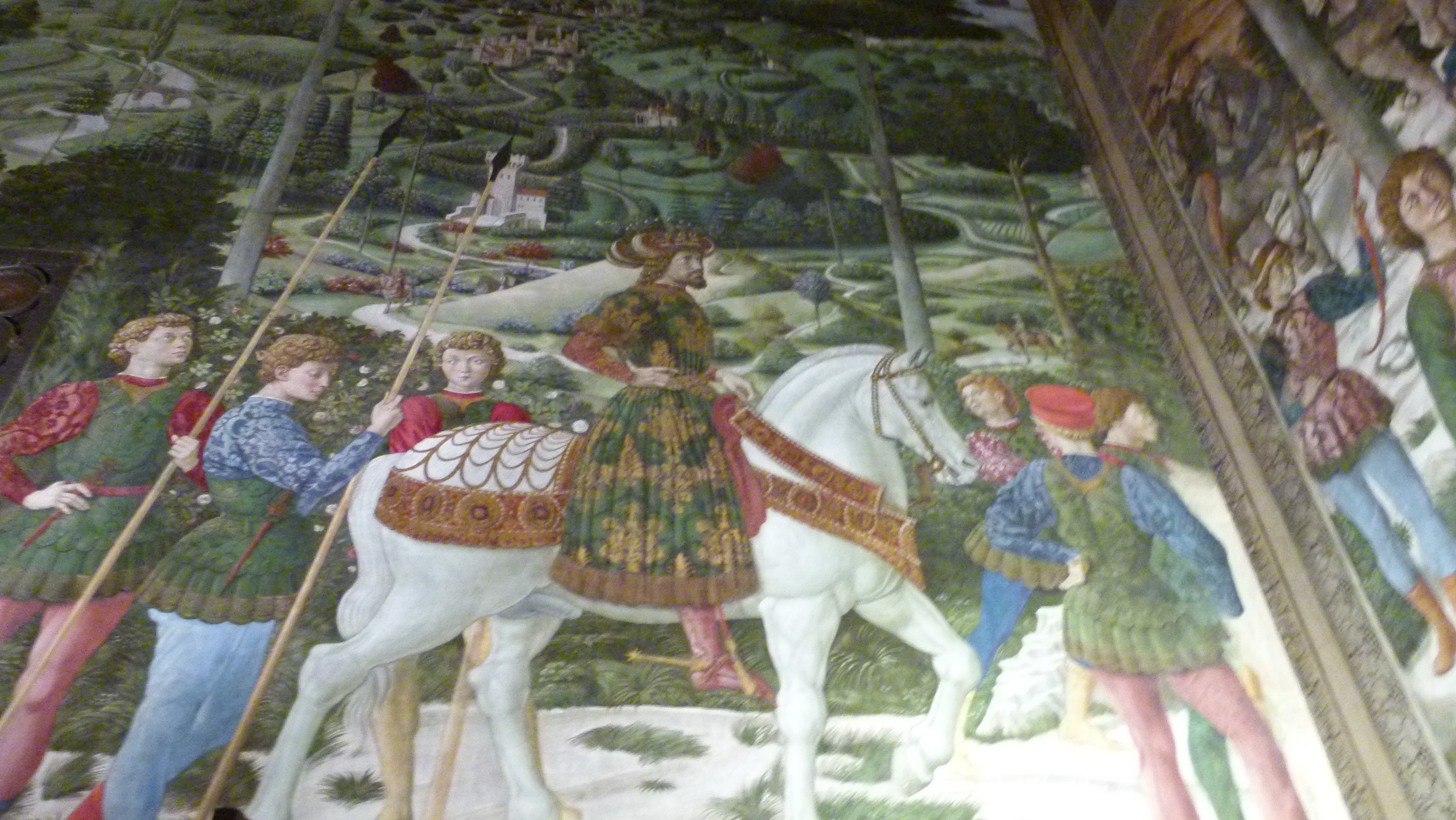
THE treasure here is the small chapel with the frescos by Benozzo Gozzoli, ca 1460, showing the adoration of the kings. There are guidebooks that claim to recognize the Zar from Byzanz and the Patriarch from Jerusalem as wel as Lorenzo Il Magnifico. Dumont does not believe this. He just recognizes Piero de Medici and the artist.

P1070377

.

Let us continue with the Palazzo Pitti, the Uffizi and the Accademia in one of the next blogs.      

Three Swiss in Florence – enjoying some more Gothic and some Renaissance churches

Again to recapitulate: The architecture time line of Florence

churches and palaces

The former blog started wîth our visiting Proto-Renaisance and Gohic churches. Let me now continue with some more Gothic churches of Florence.

.

A Gothic church for Maria and Renaissance sculptures ordered by the guilds: Orsanmichele

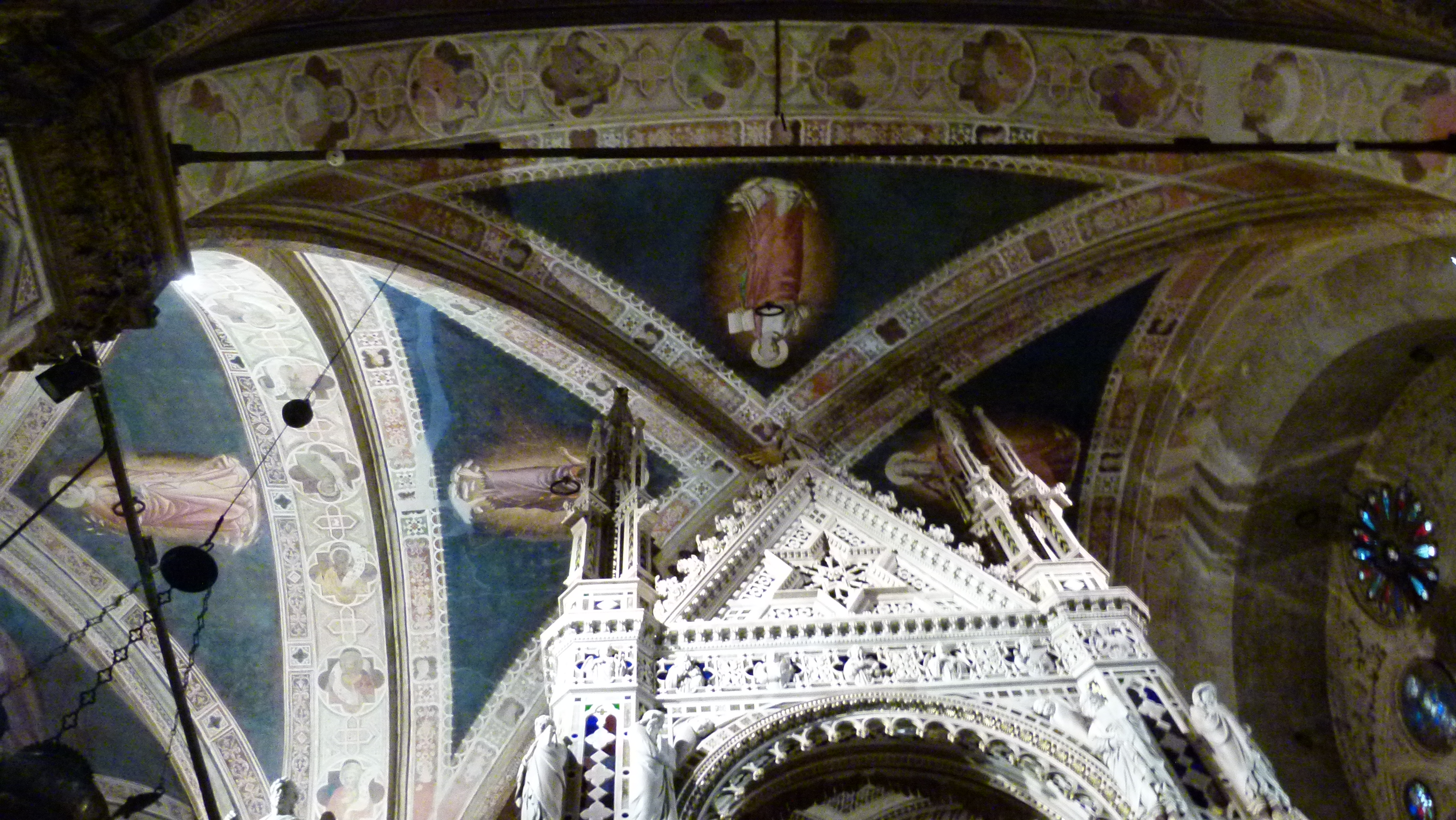
Orsanmichele was built around 1340. The oratorium or church is gothic, with harmonious blue ogives.

P1070150

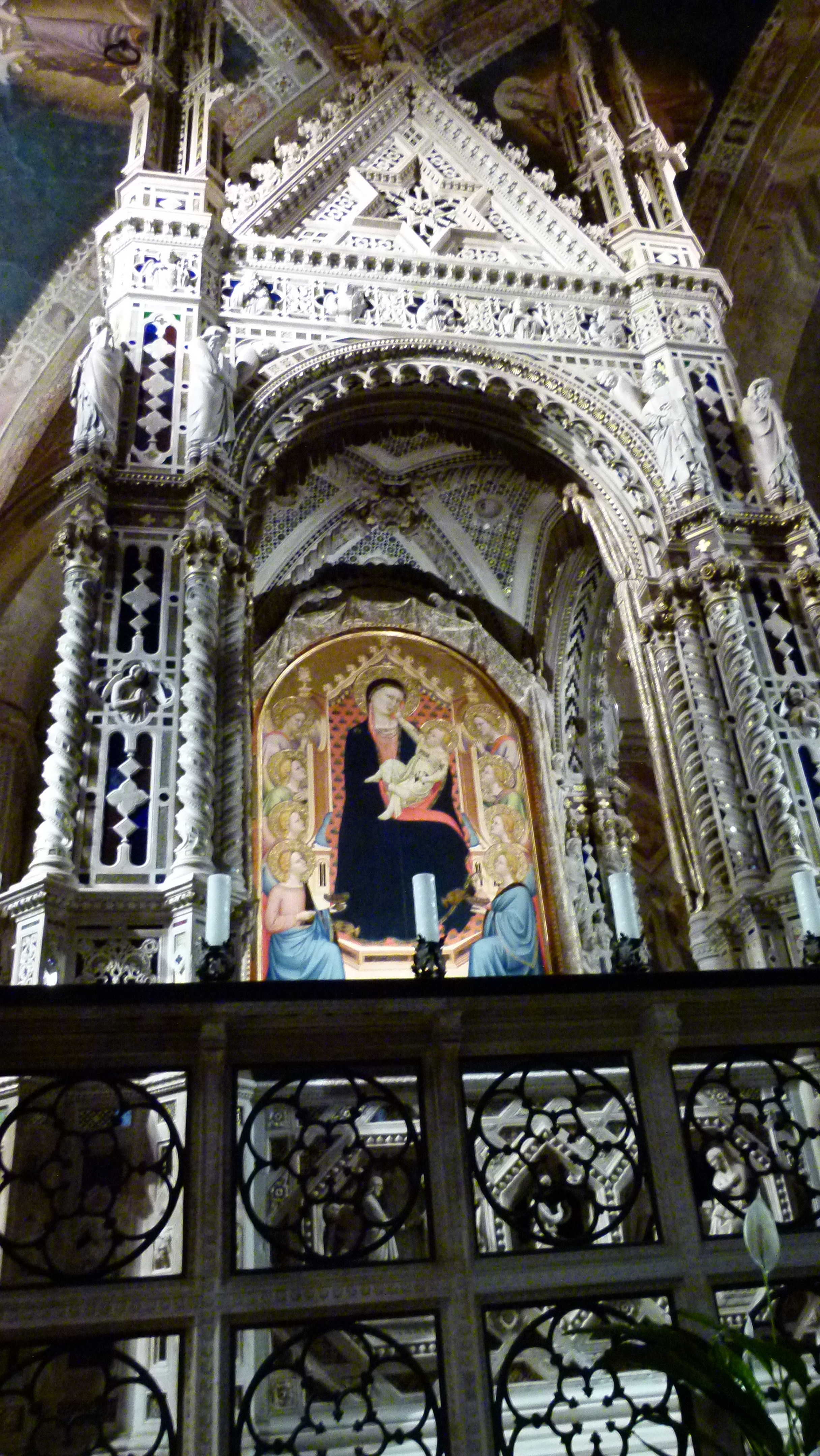
Center piece is Maria with the child painted by Bernardo Daddi  and sitting in the tabernacle shaped by Oracagna.

P1070149

There was a market here before. A Maria painting was adorning the market and it was said to have performed miracles. Daddi’s Maria replaced the original and the church was built for it. Above the church were grain stores.

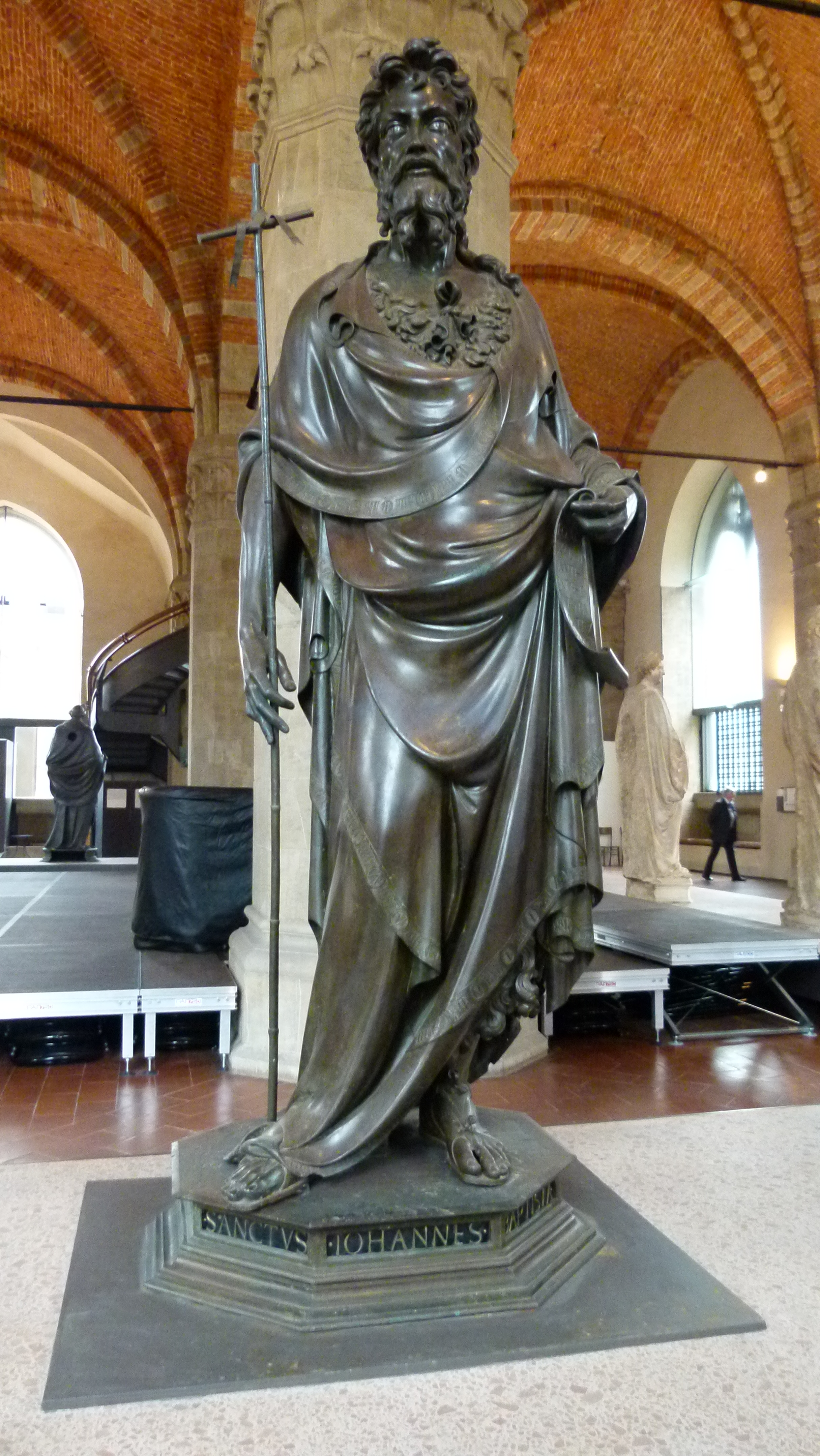
Orsanmichele belonged to the guilds of Florence. The guilds ordered statues for the niches around their building. The originals are now in the museum above the church (where the guilds had stored their grain before). Here is one example: St. John the Baptist by Ghiberti. I now start to recognize St. John, as he always carries this stick with him. There are 14 statues by Ghiberti, Donatello, Nanni di Banco and others, all from the 15th century – pure elegant Renaissance.

P1070158

.

Transition between Gothic and Renaissance: The Brancacci Chapel

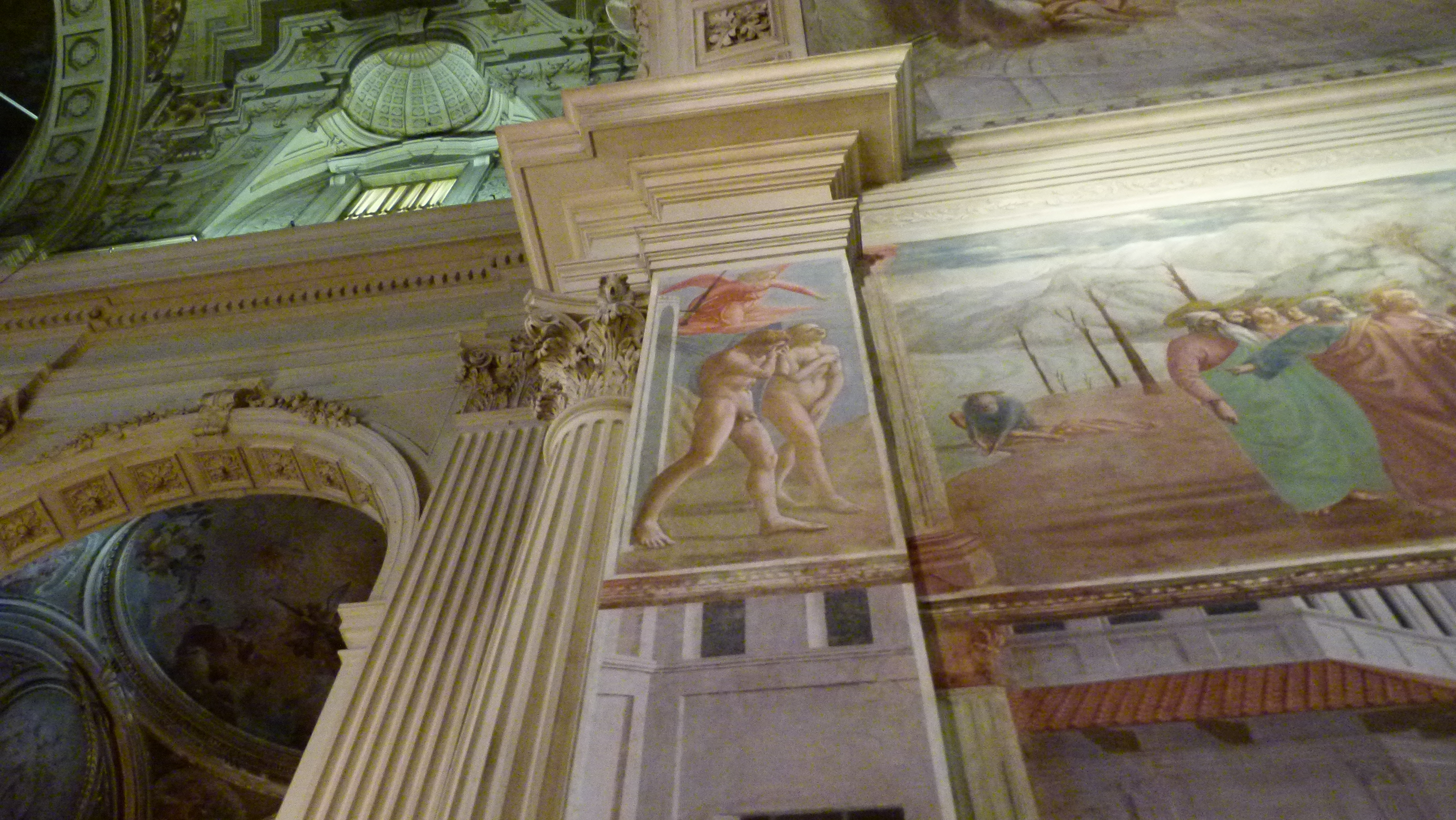
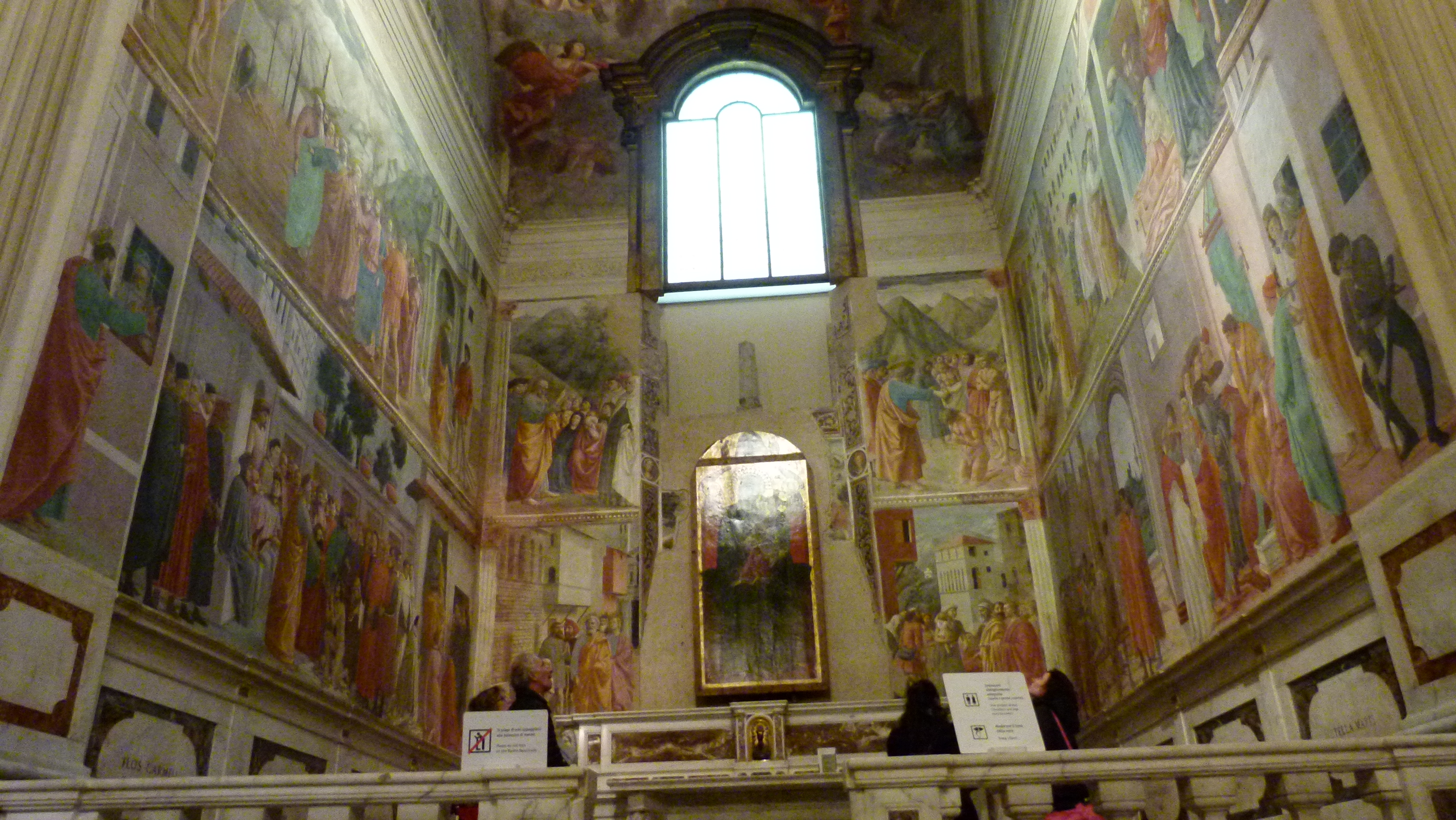
While strolling through Oltrarno on our first day in Florence, Leni and I come across the church Santa Maria del Carmine that is currently closed. A group of students from the Alsace are buying tickets for the attached Brancacci Chapel and we join them. THIS chapel is THE treasure of Santa Maria del Carmine. We sit between the students that start to copy the frescos on paper. The master piece is Massaccio’s “Expulsion from the Paradise” that marks the transition from Gothic to Renaissance painting. The angel directs Adam and Eva to leave the paradise and the distress can be seen on their faces – it is a shock for them. Massaccio is the artist that also painted the “Crucification” in Santa Maria Novella and that died at the age of 27.

P1070198

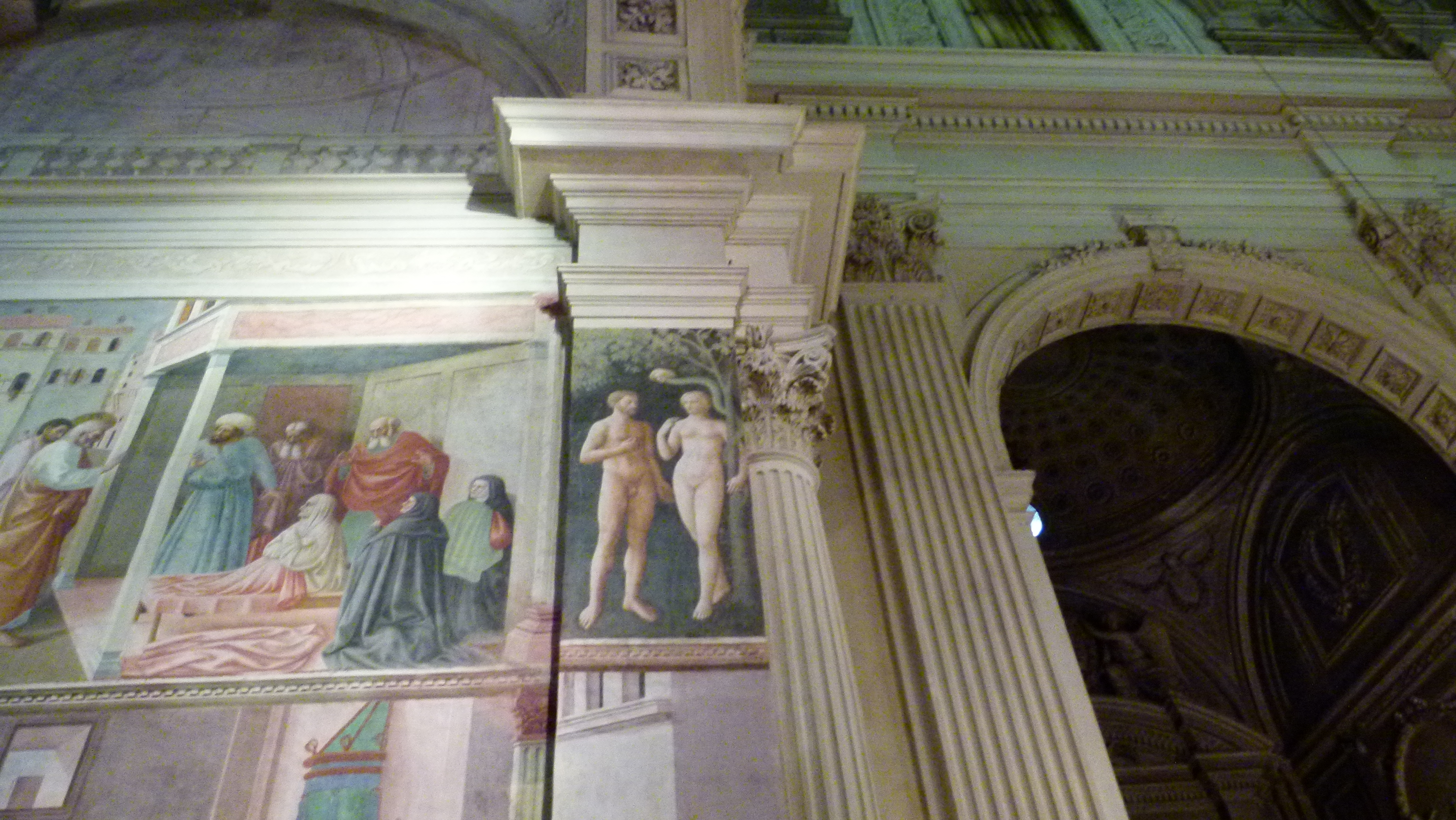
Opposed to that is the fresco of Masolino showing the “Tempation”. It is still clearly Gothic – Adam and Eva are far less natural than in Massaccios fresco.

P1070197

These two frescos made a great impression on me. Never before had I seen so clearly the difference between Gothic and Renaissance painting.

It was Lippi who completed the gorgeous fresco cycle of this chapel. Our Dumont has a detailed legend of all stories. Interesting is the scene of tax paying: Christ asks Petrus to catch a fish who will carry a double drachme in his mouth, and Christ is right. Petrus catches the fish and they pay the double drachme needed.

P1070199

.

Renaissance frescos that helped the Dominican monks meditate and pray: San Marco

Fra Angelico was both a Domincan monk and an artist. Around 1440 he adorned the cells of his brethren with frescos that tell the story of Jesus. He adorned more than forty cells.

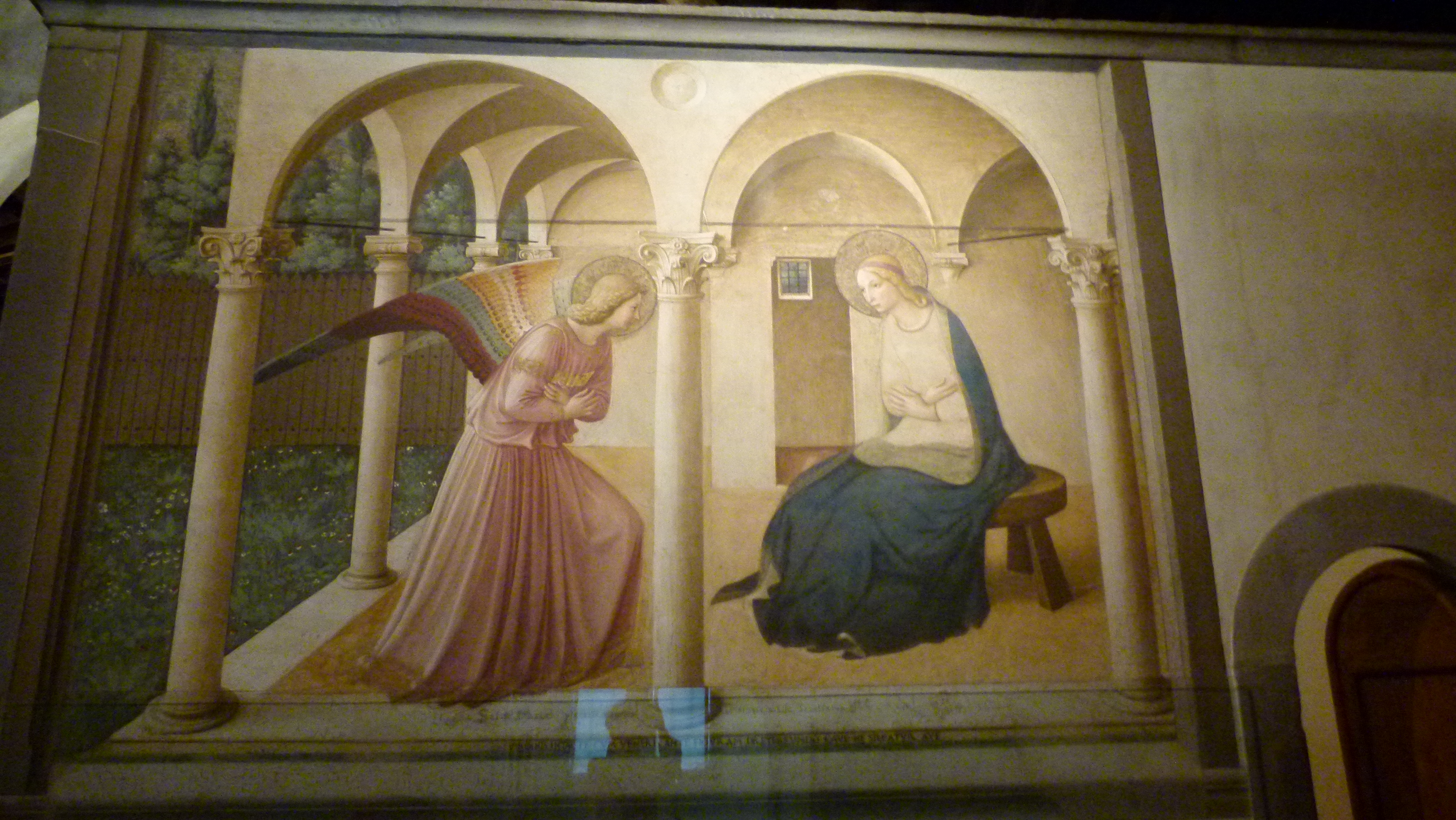
The “Annunciation” welcomes us at the entrance.

P1070451

From the 40 plus frescos I select just two. The first shows faithful people leaving the limbo towards Christ – while he devil is locked under the door to his hell, unable to move – I like the humor in this fresco.

P1070452

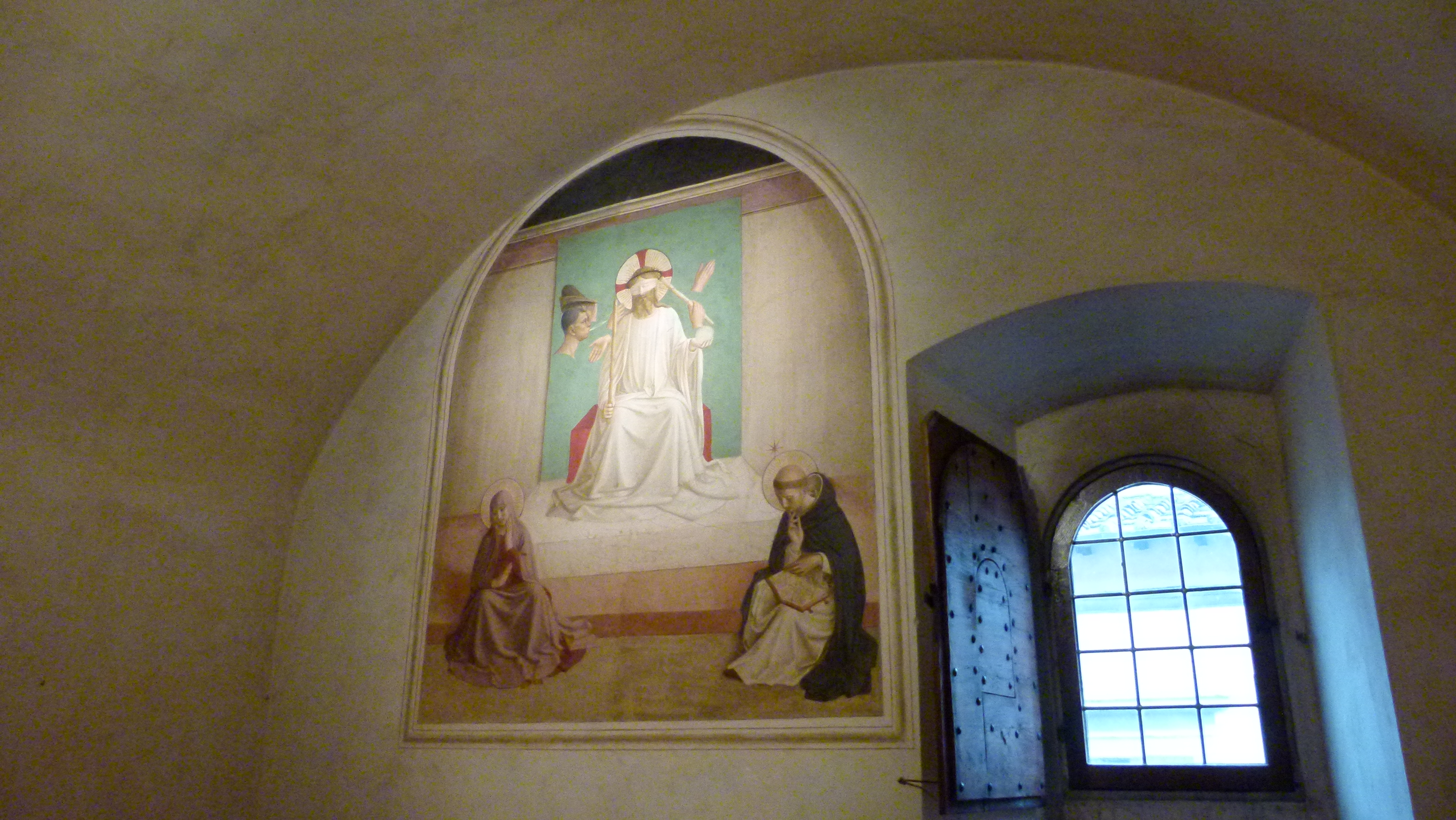
The second is an scene rarely painted: “the Mocking of Christ”. Fra Angelico symbolizes the mockers by painting a head with a speech balloon shouting at Christ.

P1070461

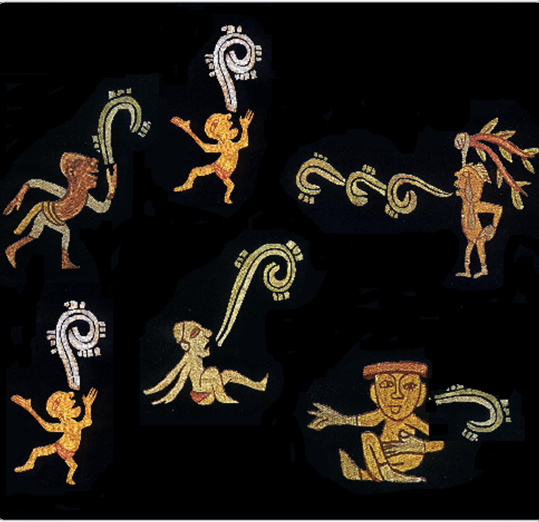
I remember such speech balloons from Mayan drawings and I am impressed that very different cultures use similar symbols to represent speech.

Capture

.

The first Renaissance church and the first oeuvre by Brunelleschi: San Lorenzo – extended later by the Baroque Medici Chapel

San Lorenzo is a clear landmark in the silhouette of Florence: The cupola of the Medici Chapel can be seen from far – the San Lorenzo church looks almost small next to it. San Lorenzo is the first Renaissance church in town and is based on the architetural principles of the former churches from Proto-Renaissance and Gothic, in particular the shape of a Basilica with 3 naves.

P1070406

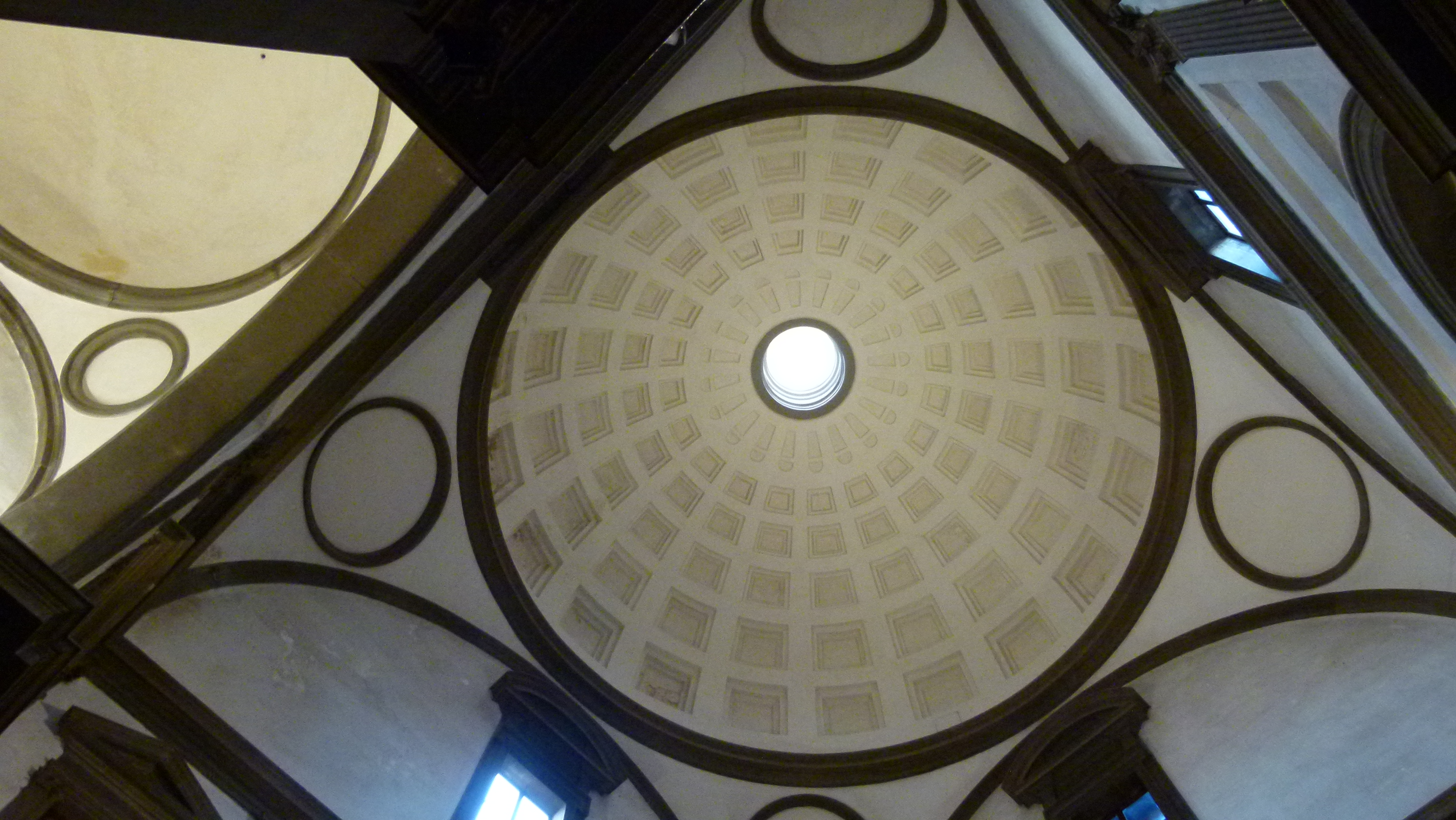
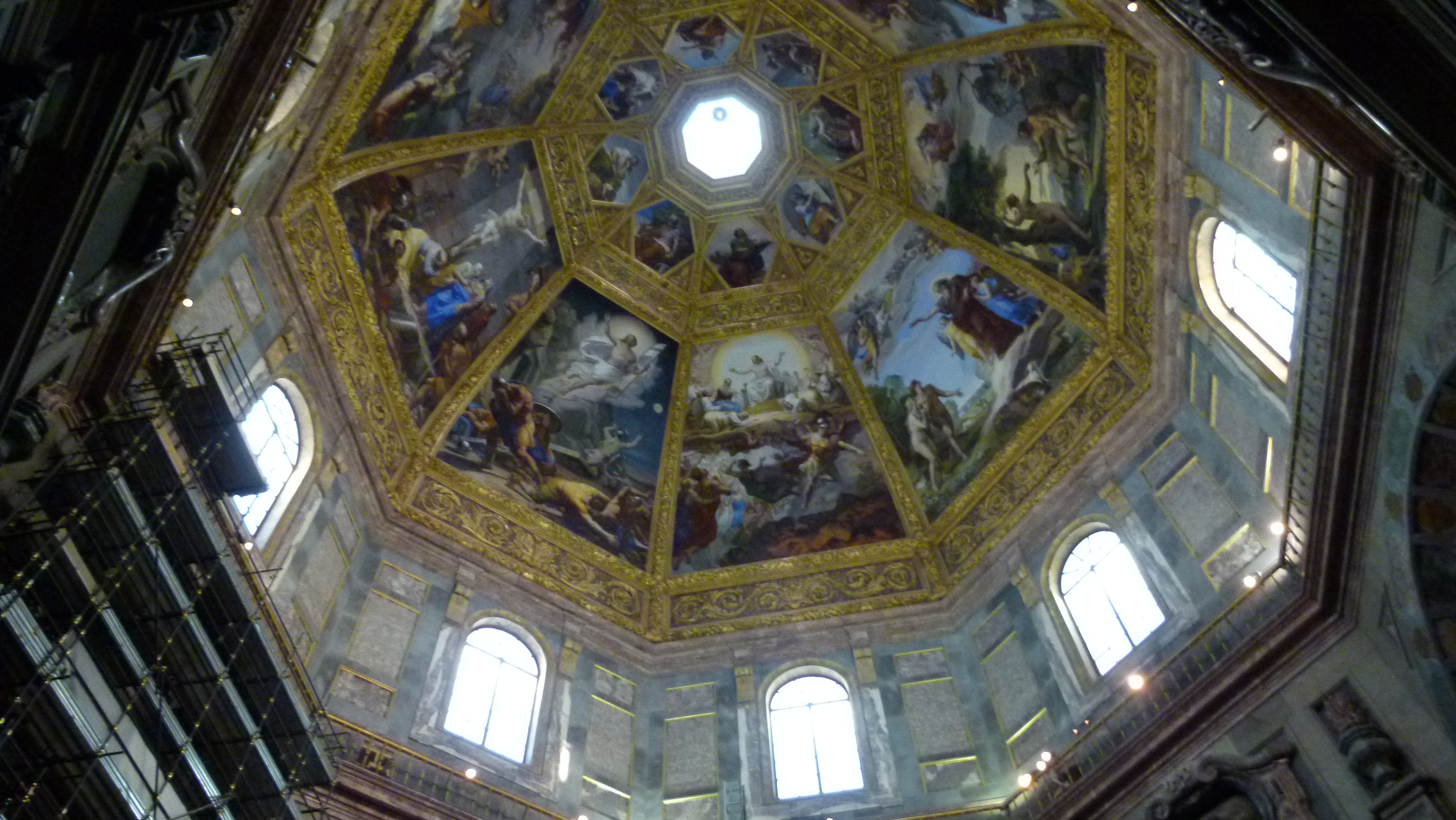
A factor that appears again and again in the Renaissance architecture are “pietra serena” (grey sandstone) combined with white plaster. This shapes the naves of San Lorenzo, the Old Sacristy built by Brunelleschi and also the New Sacristy built by Michelangelo – here is the cupola of the New Sacristy.

P1070335

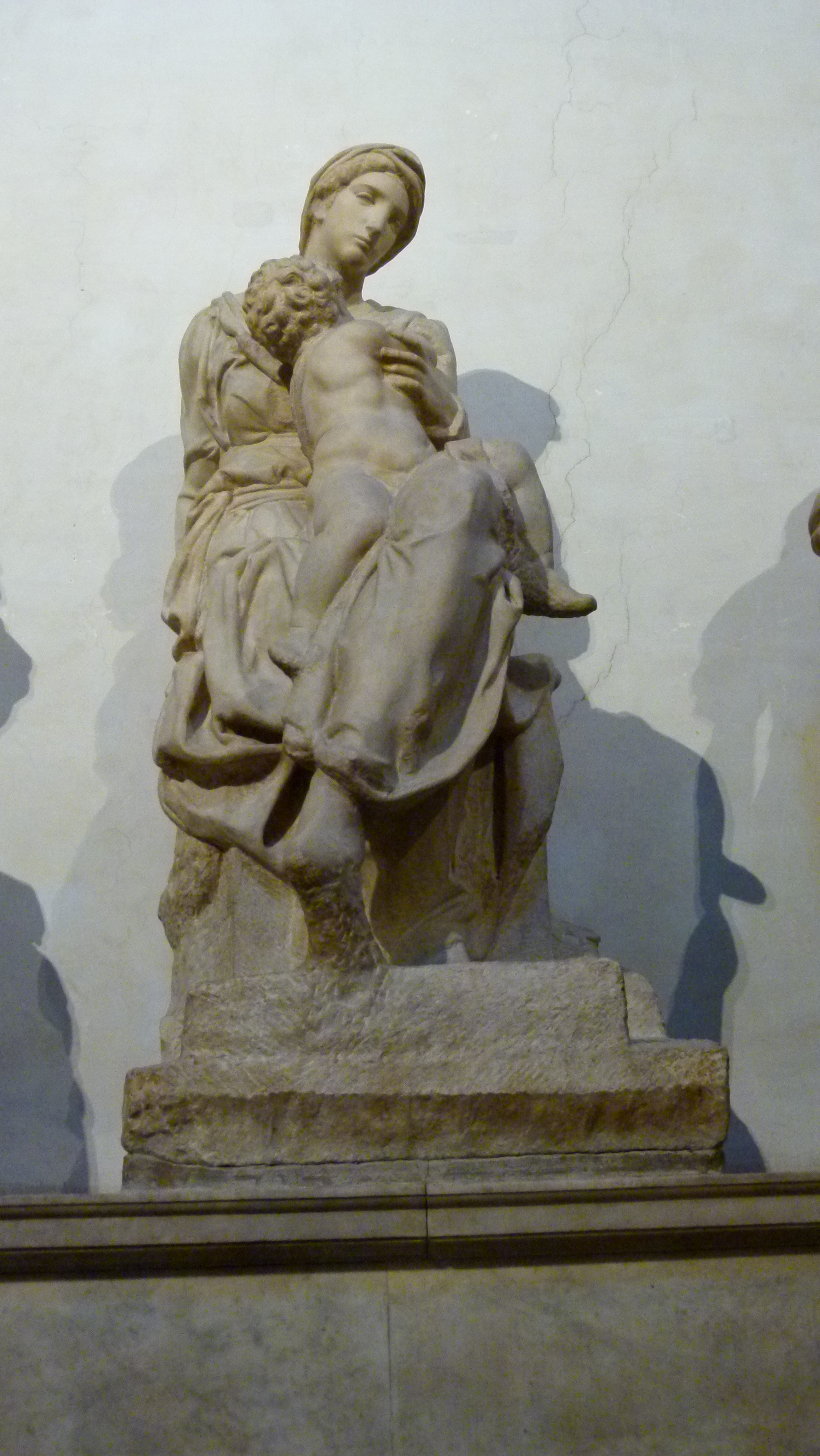
“Mother and child” is an incompleted sculpture by Michelangelo that stands at the backwall of the New Sacristy.

P1070331

The baroque Chapel has been built for the Medici in the 17th century, when they had become dukes. The Medici Chapel shows, how rich they are – the decoration is almost too much for me with all the marble tiles and precious inlays in pietra dura.

P1070321

I like this ceremonial ribbon with silk embroideries that shows the family emblem of the Medici.

P1070329

.

The second Renaissance church, also architectured by Brunelleschi: Santo Spirito

South of the Arno is the second Renaissance church that Brunelleschi has built. Inside are again three naves adorned with white plaster and pietra serena (or grey sandstone). They give harmony to the church. The Dumont complains that there is a Baroque altar in the middle interrupting the clear lines of the nave.

P1070203

.

With Santo Spirito I end our virtual walk through the churches of Florence. The target of us three Swiss – Ursula, Leni and Petra – will next be museums and palaces.


Three Swiss in Florence – enjoying some of the Gothic churches

To recapitulate – Here is the architecture timeline of Florence:

churches and palaces

After having shared some impressions about Proto-Renaissance, I will now continue with some churches from Florentine Gothic.

.

Santa Maria Novella and the Spanish Chapel built by the watchdogs of the Lord

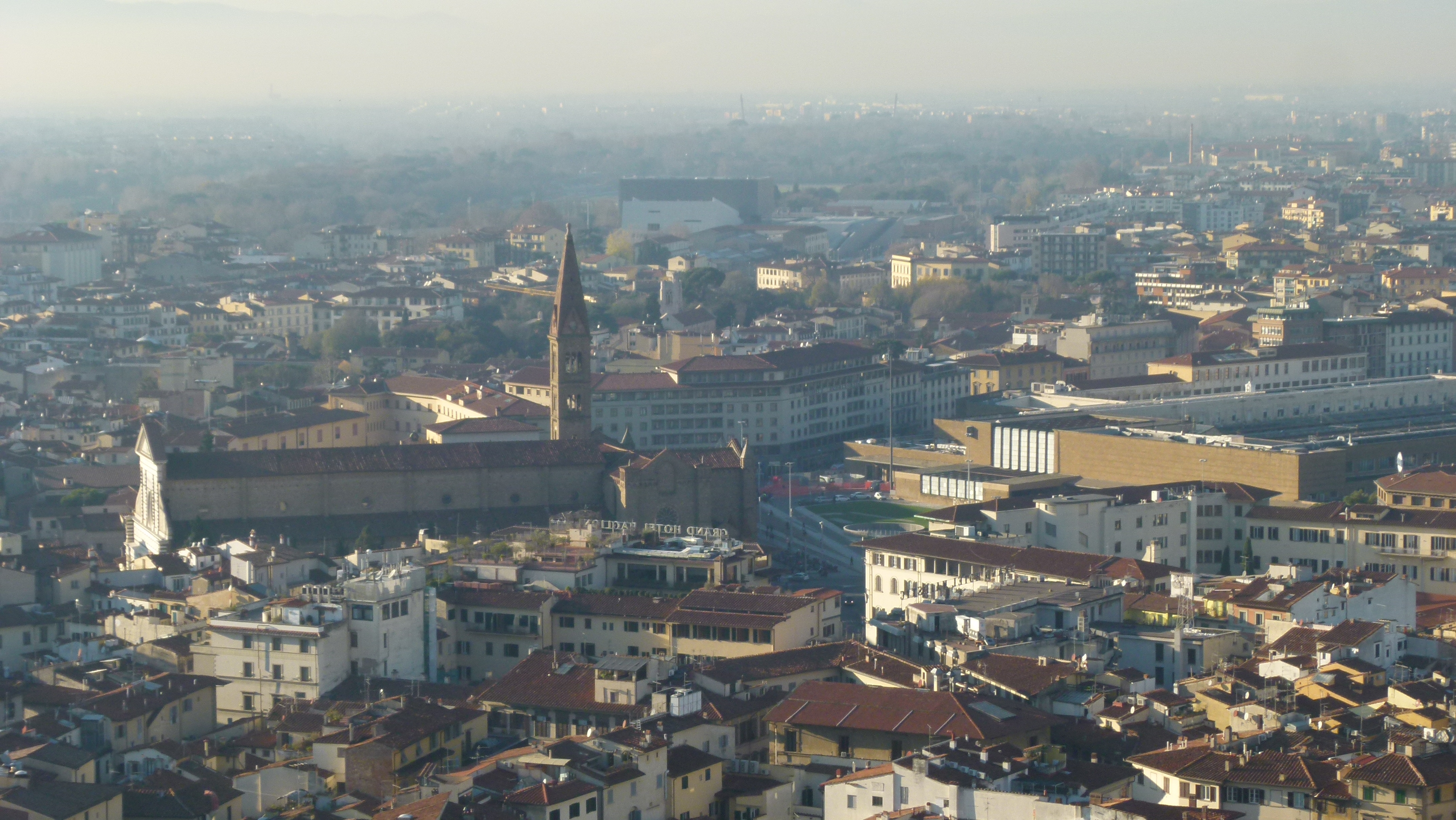
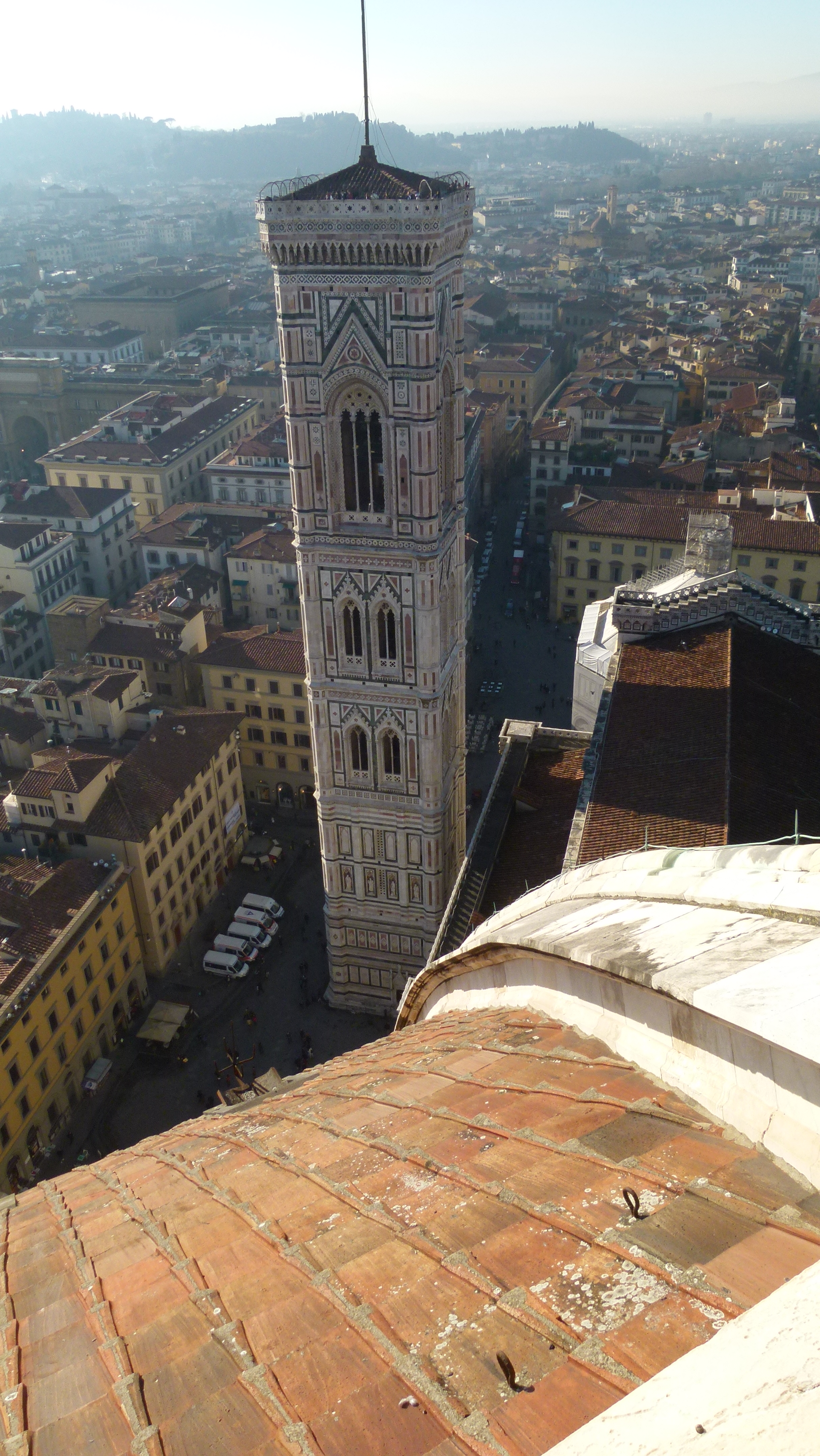
Santa Maria Novella is the first gothic church in Florence. The Dominicans started the construction in 1246. Here is a foto taken from the cupola of the Duomo. The railway station is just across.

P1070431

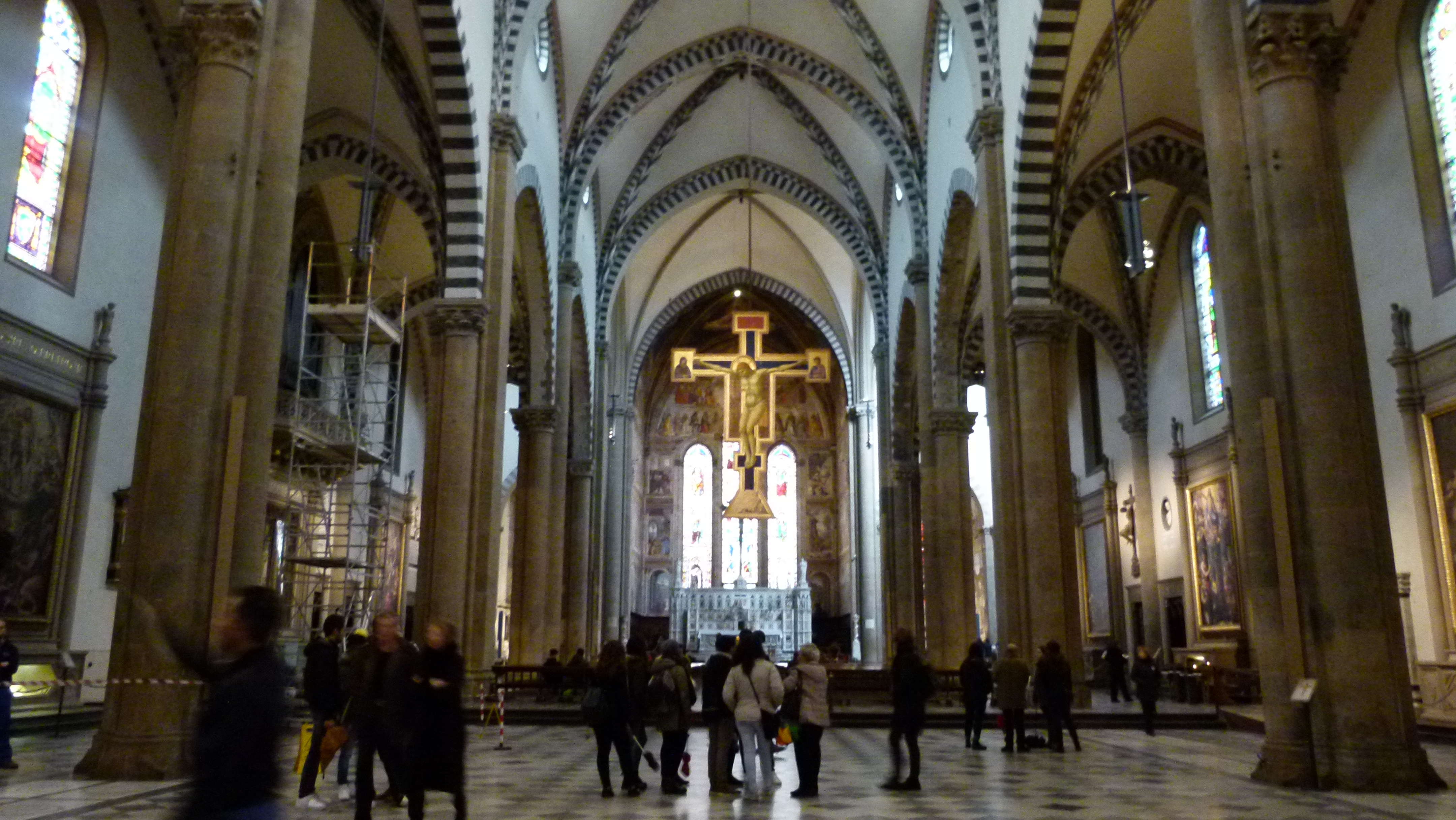
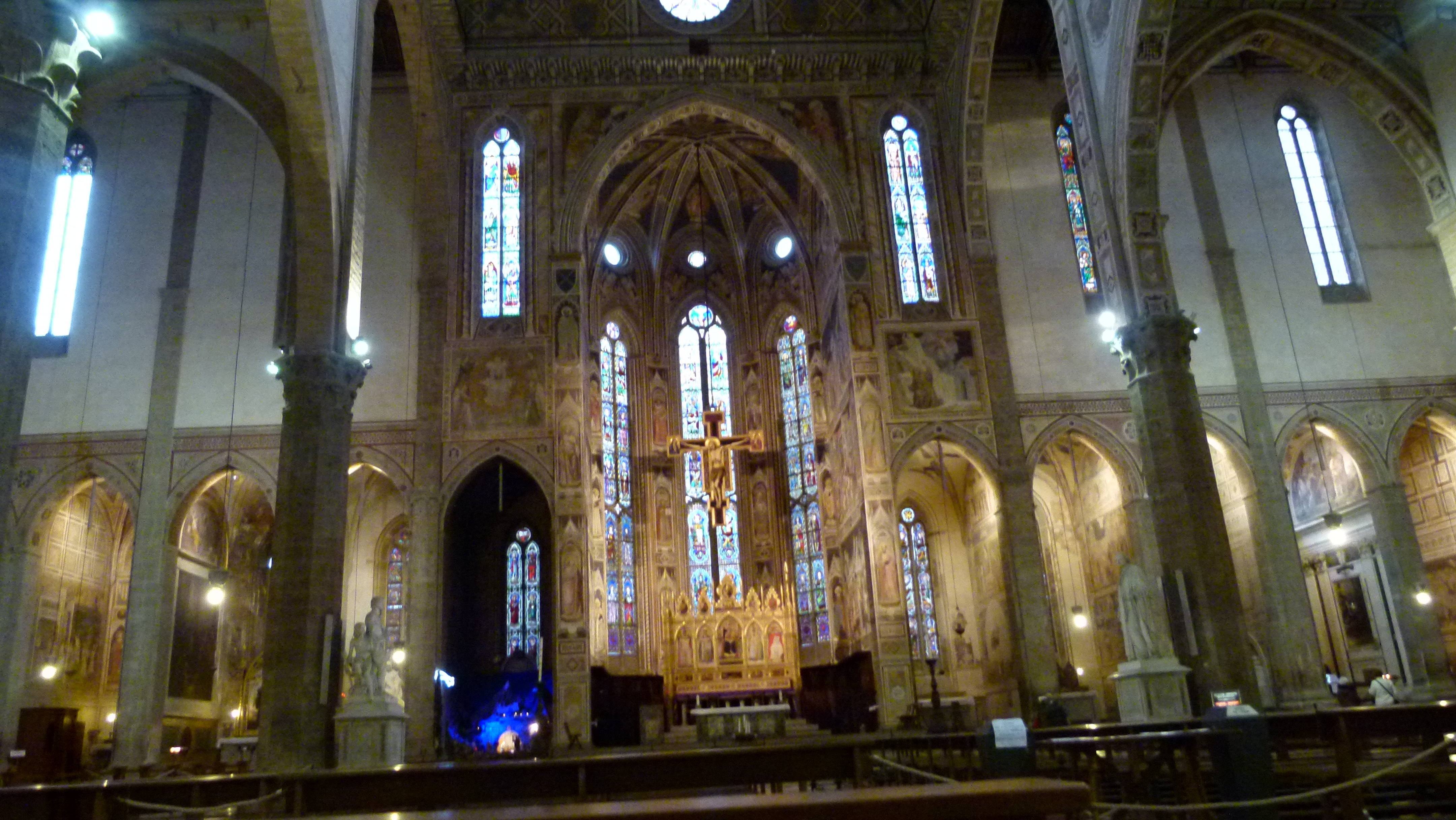
This is the nave. There are ogives, but less pronounced than in central Europe. The wooden cross of Giotto (1290) is one of the highlights.

P1070206

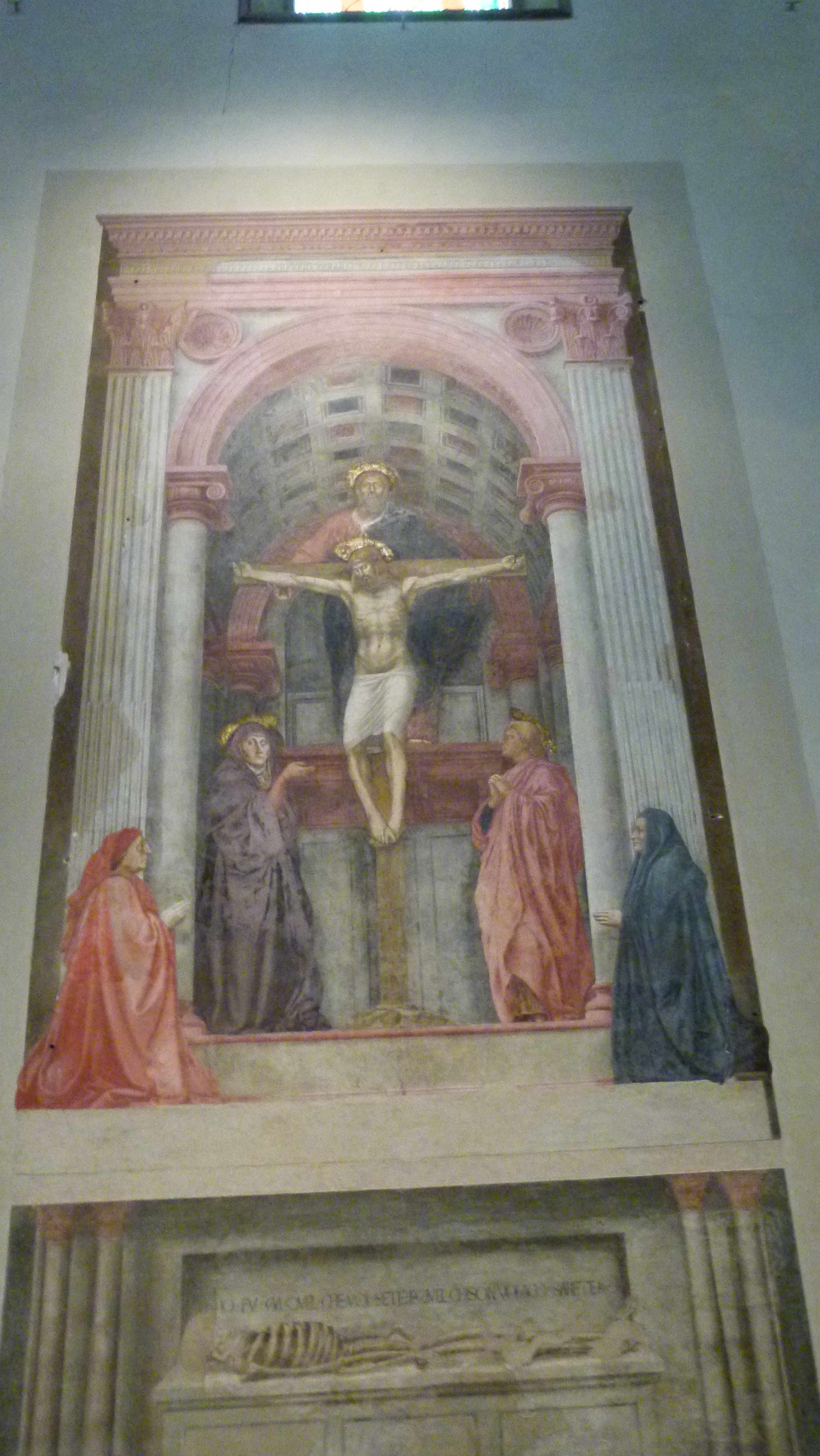
Masaccio was an outstanding artist at the transition between Gothic and Renaissance who died at the age of 27. His “Santa Trinitá” (ca 1428) is famous for the perspective that was innovative  at that time and helped pave the way for Renaissance paintings.

P1070208

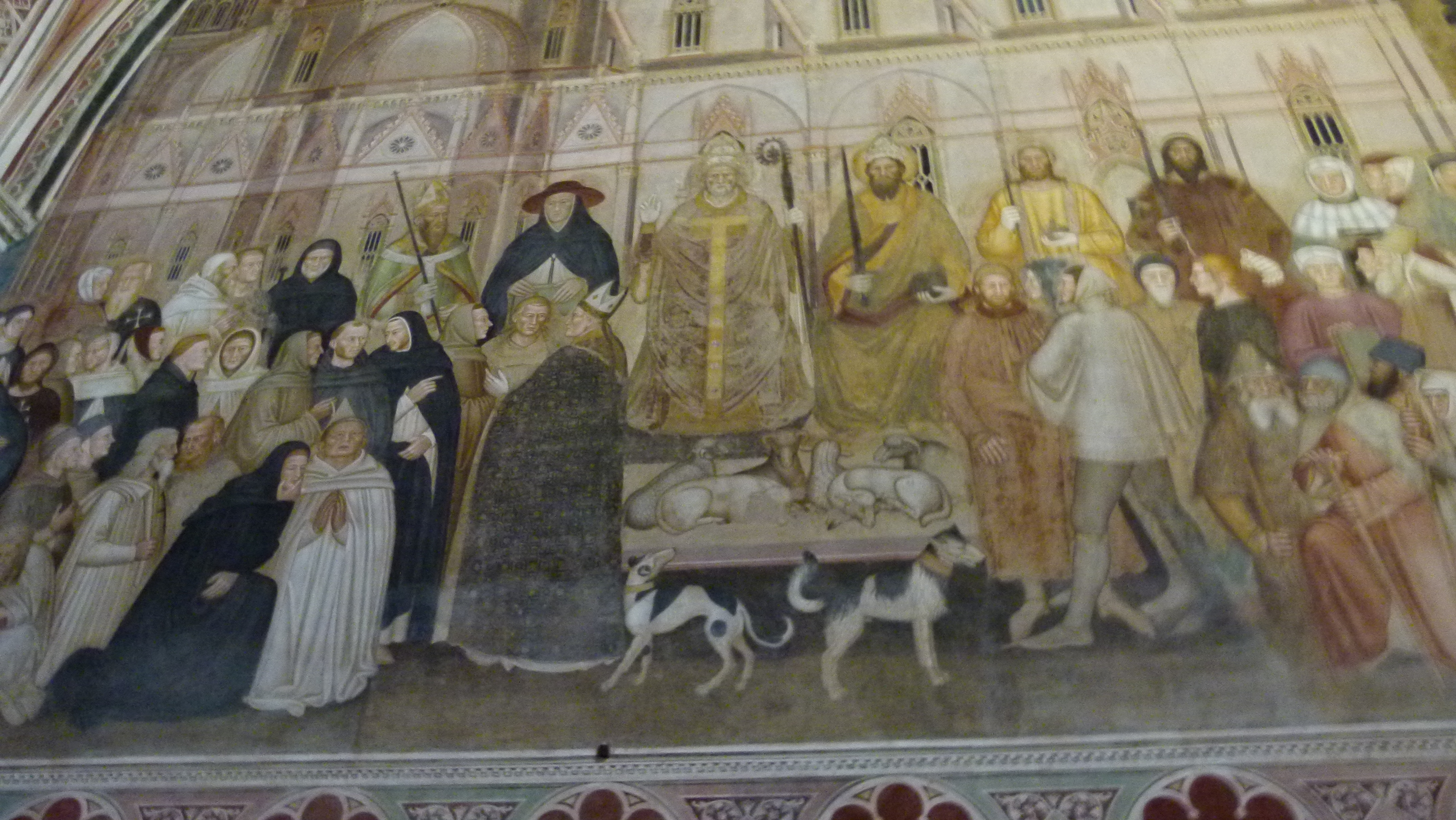
In the attached  Spanish Chapel we come across the watchdogs of the Lord. They are black and white. I learn that “Dominicans” stands for “Canes Domini” or watchdogs of the Lord. The Spanish Chapel tells the history of the Dominicans that have built Santa Maria Novella.

P1070217

.

Monastery and Campanile of Badia – a quick glance in the cloister

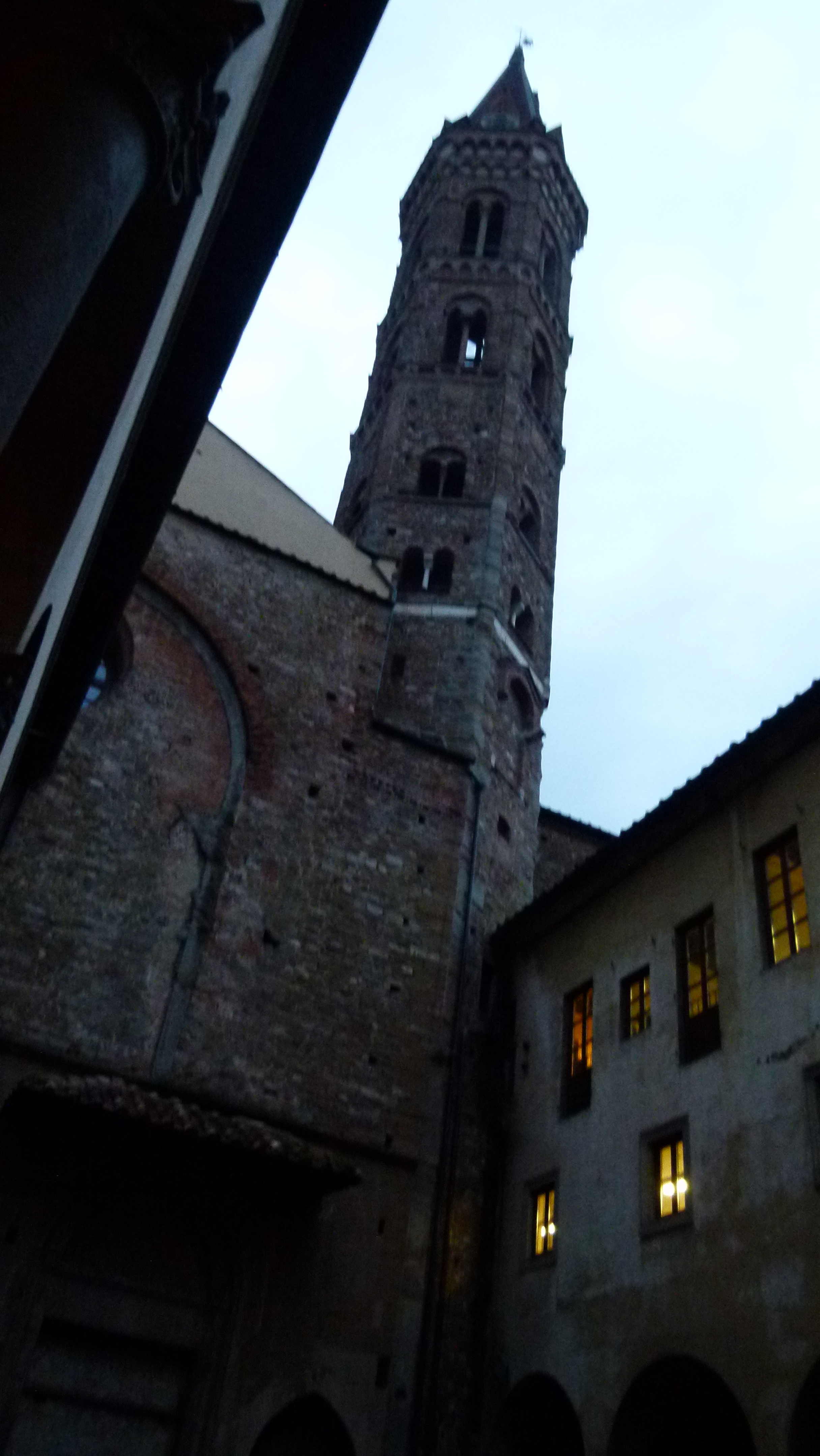
Badia means “monastery” and today belongs to the Fratenernity of Jerusalem. We just visit the cloister with the view of the gothic Campanile. The nuns are inventive and sell unusual souvenirs. I buy soap made from the milk of donkeys and some honeydrops.

P1070243

.

More Florentine Gothic: Sant’Ambrogio

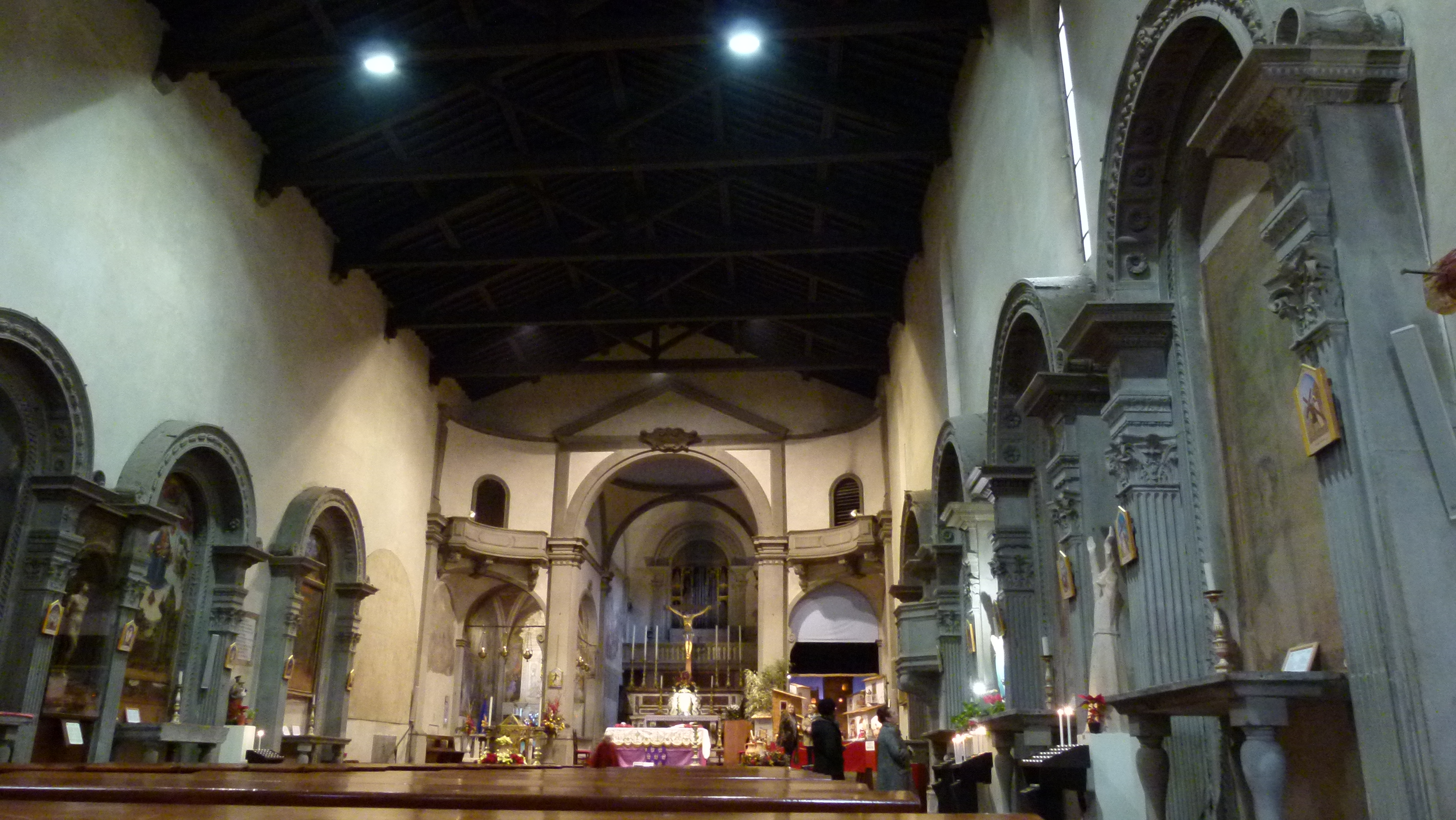
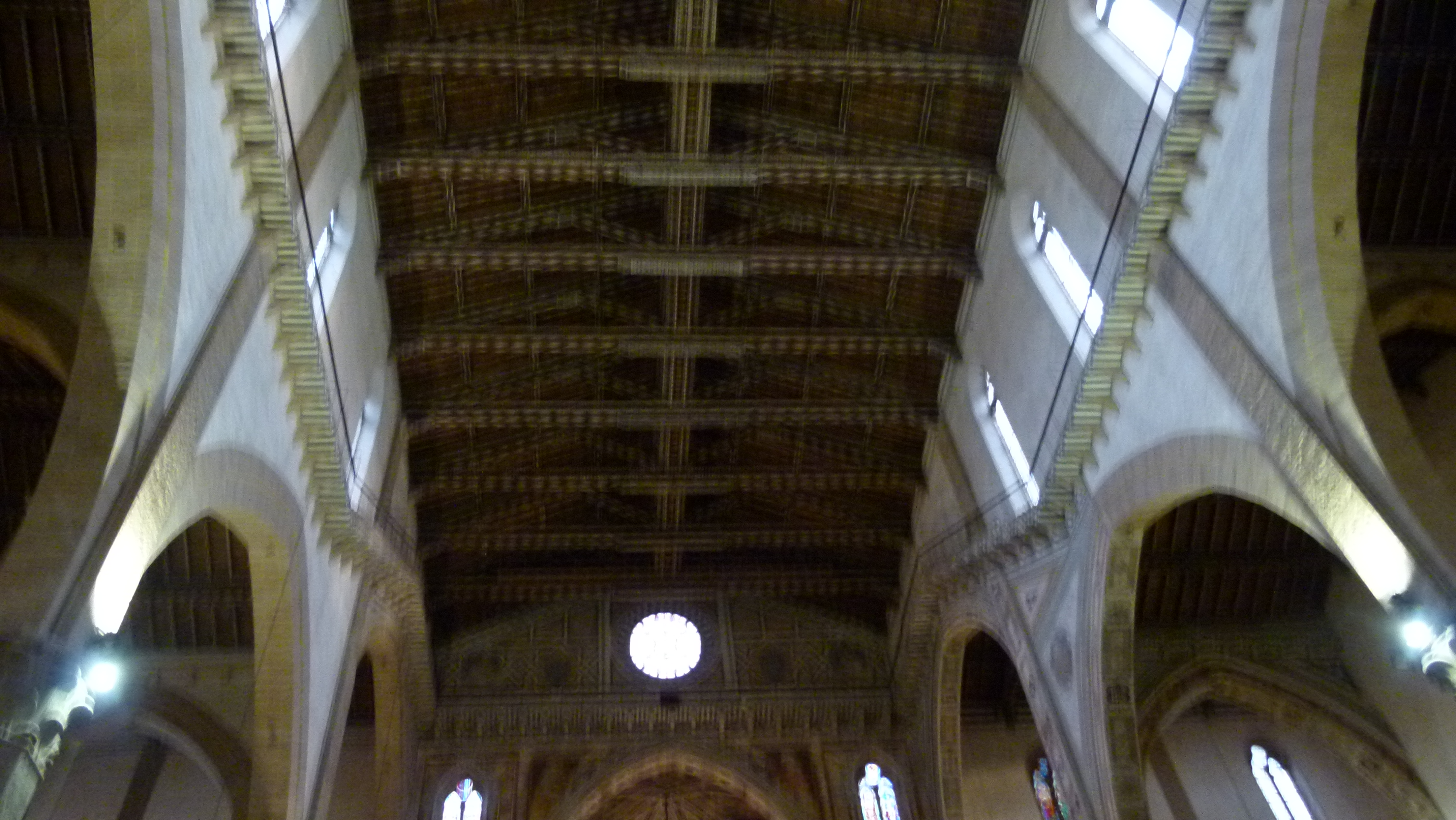
Sant’Ambrogio is located east of the city center. Very easy to reach from our hotel near Santa Maria Novella: We just have to follow the streets aligned along the old Roman Decumanus. I like this church with its open roof framework and beautiful frescos such as the “Maria Lactans” by Orcagna. My fotos of the frescos are blurred, as the church is rather dark inside.

P1070516

.

In a way the heart of Florence Gothic: The Duomo and the Campanile

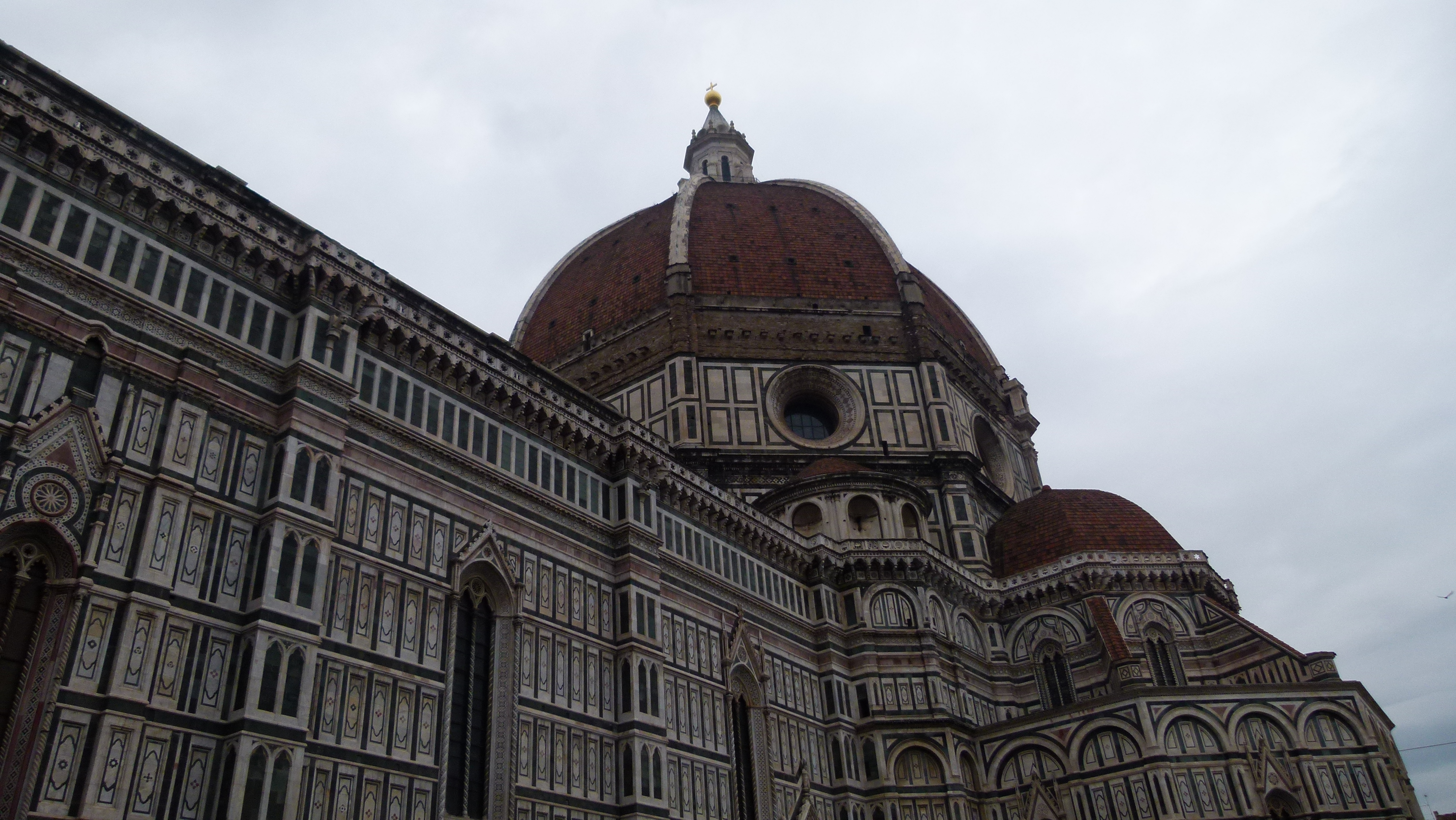
The full name of the Duomo is “Santa Maria del Fiore” and this name is related to the lilly flower that is the symbol of Florence. We loved to come back to the Duomo again and again. The gothic construction plan was followed by the architects until the Cupola and the Lantern were completed in the 15th century. The names of the architects included Cambio (1296), Talenti (1350) and above all Brunelleschi who after 1418 was the genius implementing the cupola based on the original plans. His breakthrough was the idea to avoid using a huge scaffold from the ground, but a hanging scaffold that would grow with the cupola. He meticulously planned the construction and checked the progress every day. Vasari and his successor later completed the paintings in the cupola.

P1070147

On a sunny day, I climbed Brunelleschi’s Cupola and enjoyed the magnificent view of the town.

P1070400

The Campanile (around 1340) was Giotto’s masterpiece that his successors completed, among them Andrea Pisano and Talenti.


And more Gothic: Santa Croce and the attached Pazzi Chapel, the last Renaissance masterpiece of Brunelleschi

Santa Croce is the church of the Franciscans. Like San Miniato and Santa Maria Novella, the facade is adorned with white marble and grey Pietra serena, but this facade was completed only around 1860 – it is assumed that the facade is based on the orignal plans.

P1070775

The woodwork of the ceiling is open, reflecting the modesty of the Franciscans. The nave gives the impression of a uniform entity, as the woodwork of the central nave is repeated in the aisles and the floor tiles are also the same.

P1070314

Only the choir reminds a bit of central European Gothic. Beautiful chapels are on the side, with frescos from the first half of the 14th century (many by Giotto and his workshop).

P1070313

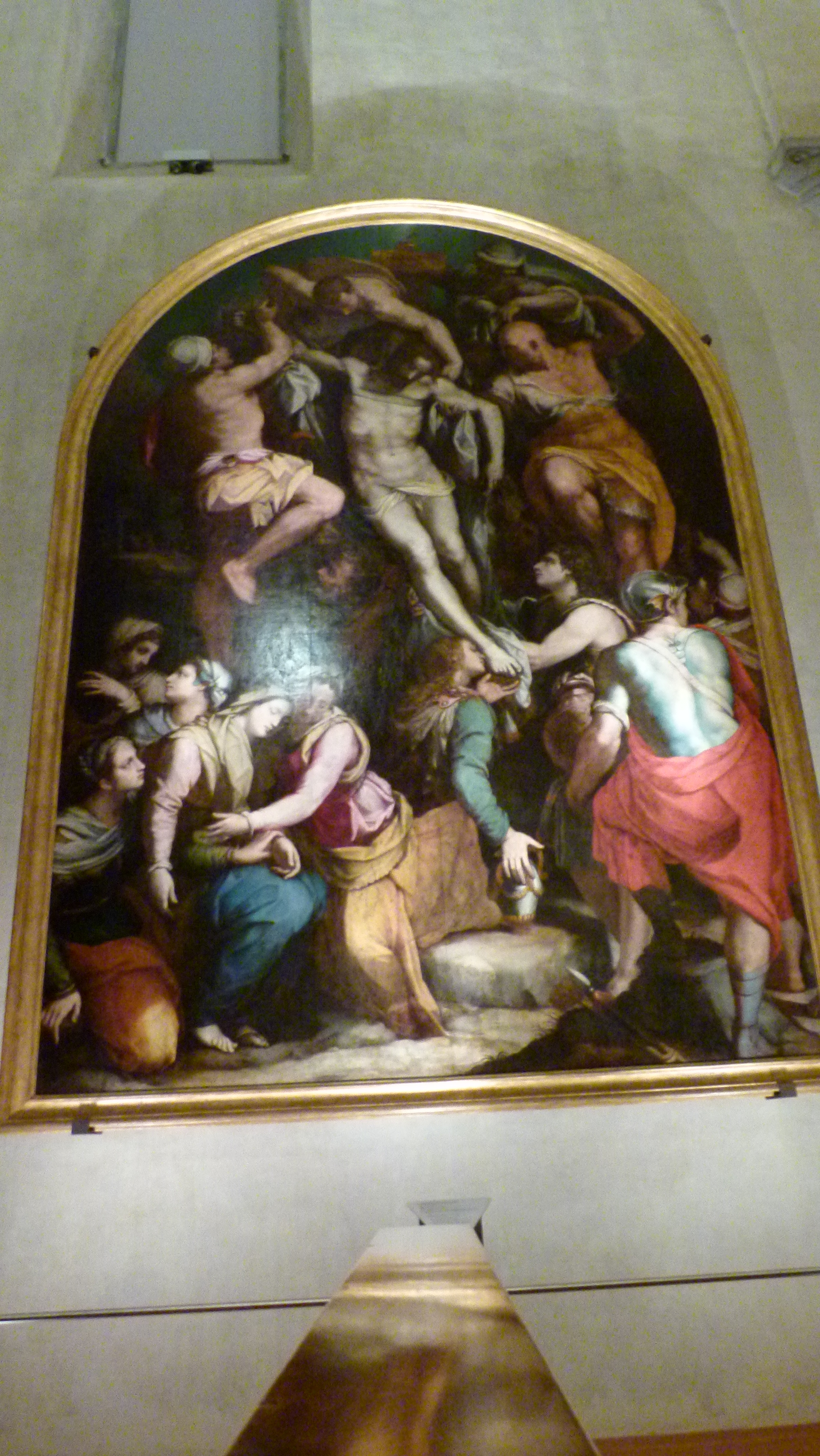
Santa Croce is rich of artwork. Leni loves this vivid painting of the “Deposition from the Cross” by Francesco Salviati.

P1070316

Leni and I spend so  much time in the main church that we miss the attached Pazzi Chapel on our first visit. The guardian watching over Santa Croce feels sorry for us: “You HAVE to see the Pazzi Chapel”, he says, “you HAVE to come back”, and he writes on our ticket that we are allowed to enter a second time, adding his personal signature. Great that the guard working here loves his church.

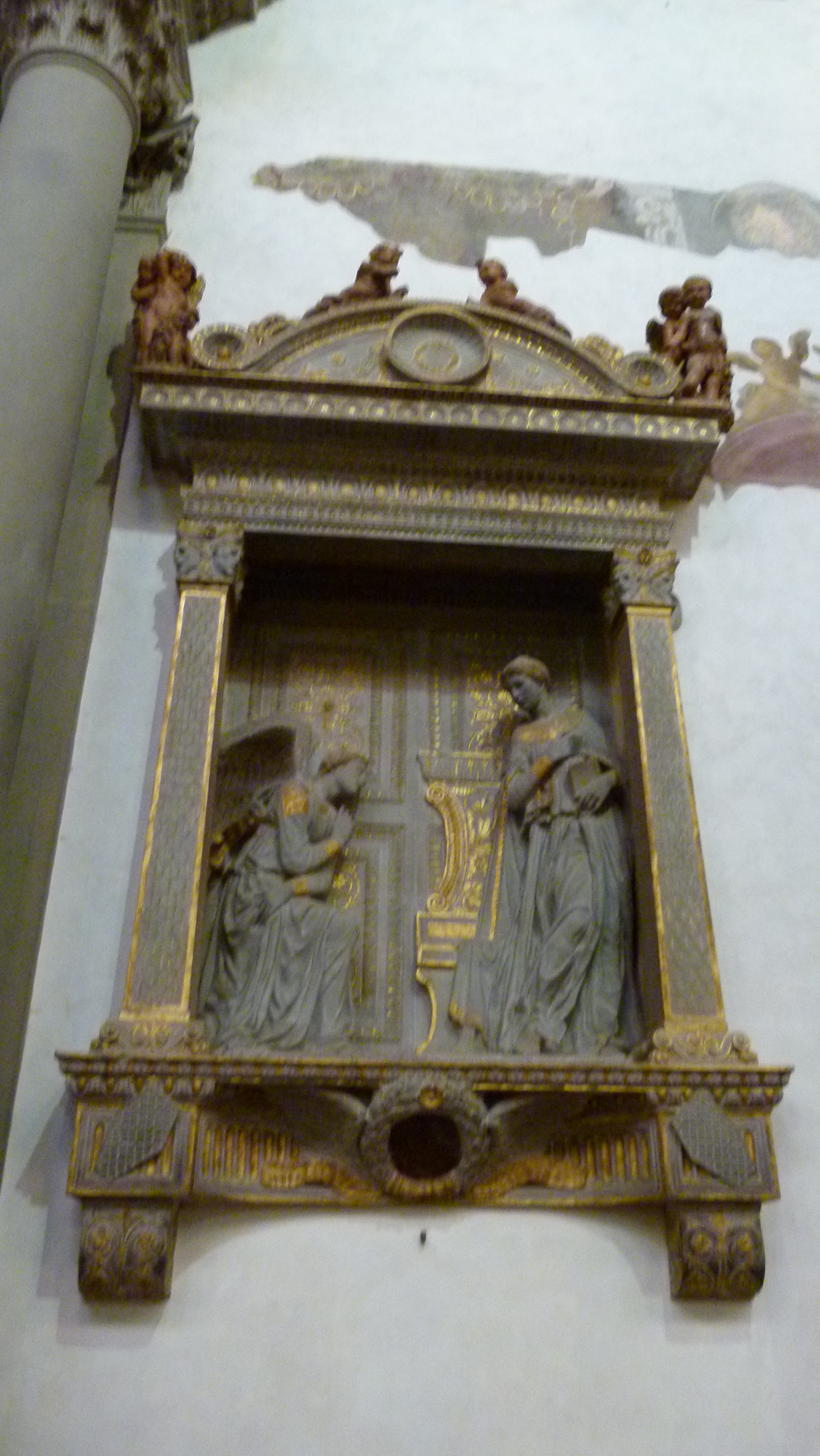
When we come back later, Ursula shows us her favorite artwork, Donatello’s “Annunciation”.

P1070436

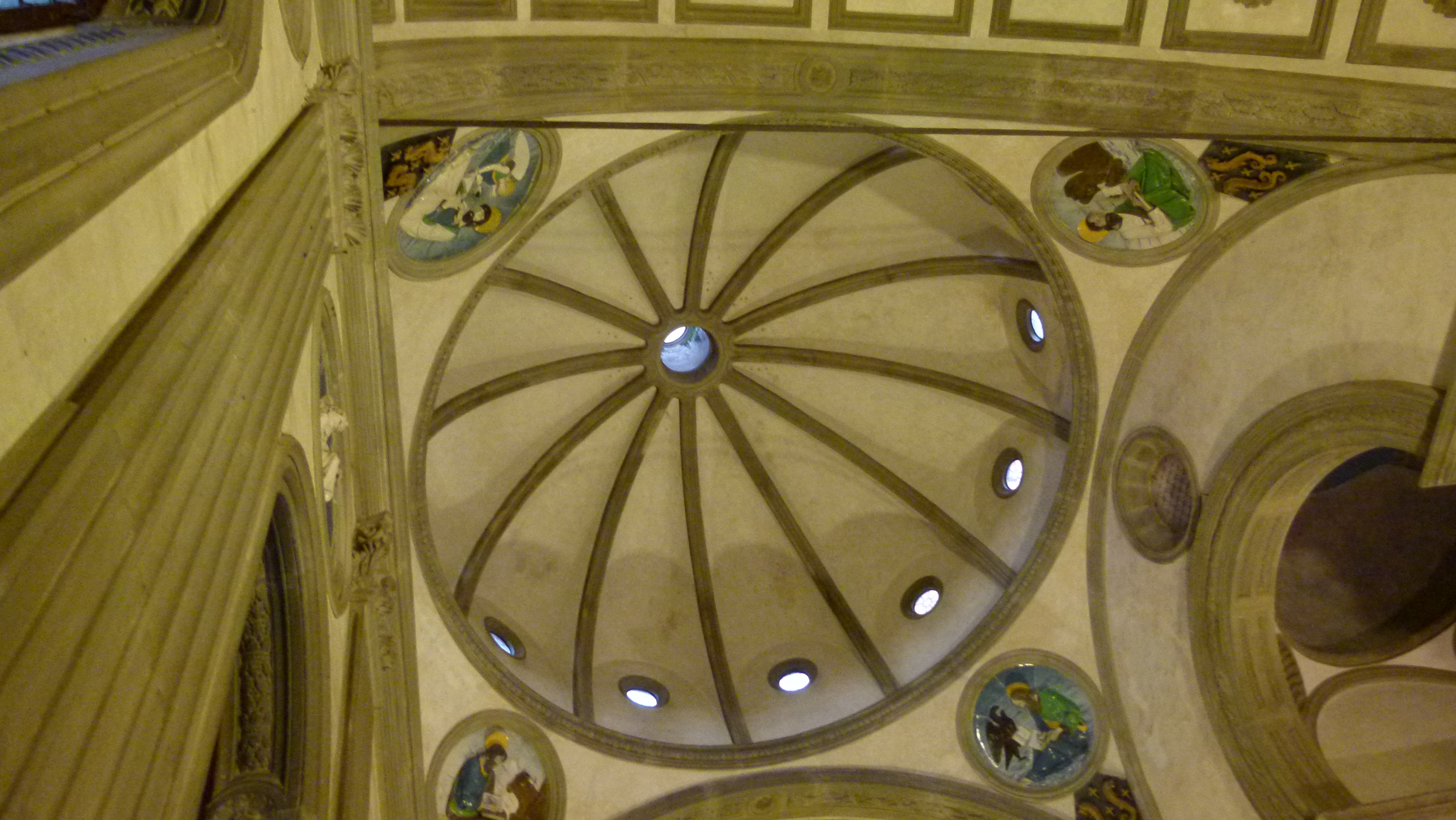
And we visit Brunelleschi’s Pazzi Chapel. The chapel was his last Renaissance master piece. We just sit inside and meditate in this unostentatious hall full of harmony.

P1070441

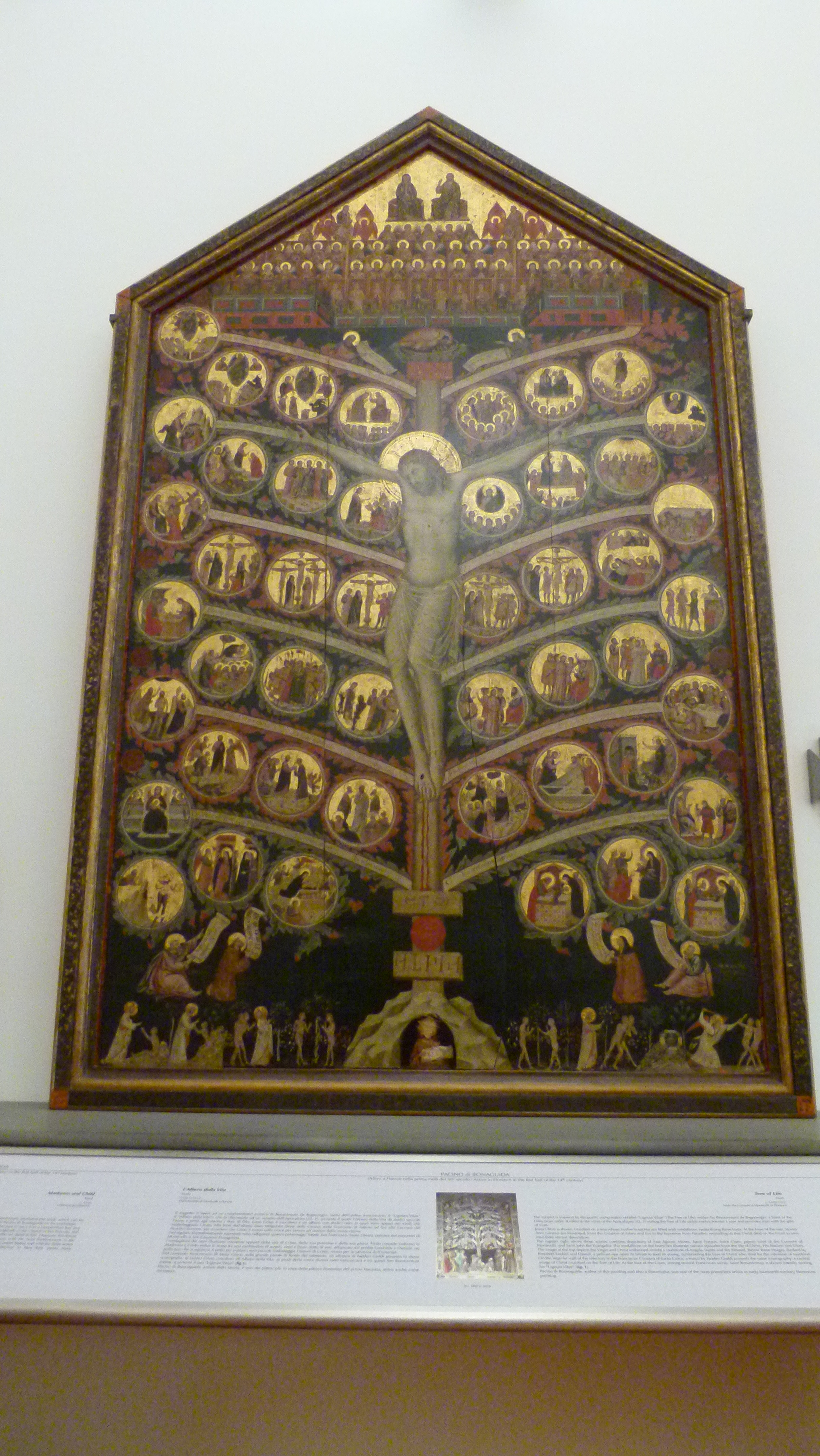
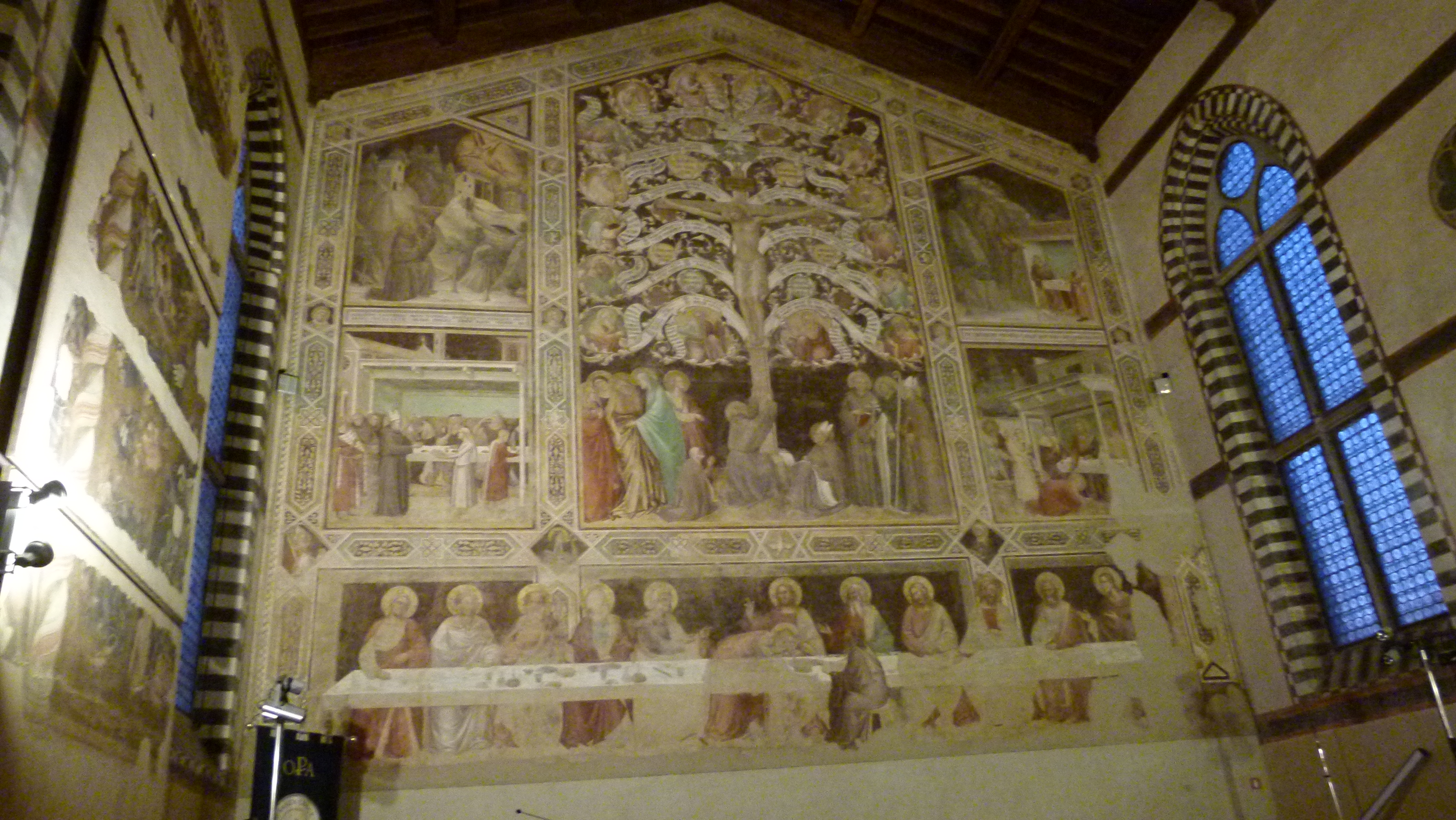
Later we enjoy the treasures in the attached museum. I particularly like the crucification on the tree that adorns the backwall of the former refectorium.

P1070443

.

Let me continue later with some more Gothic and with some Renaissance churches – again following the achitecture time line of Florence.


Three Swiss in Florence – Enjoying two churches from Proto Renaissance

After having completed my simplified town map of Florence, I want to understand where the treasures of Florence fit into the architectural history.

.

Trying to get order into my head: The churches and secular buildings from Proto-Renaissance to Baroque

As I am not a professional historian – and hence I am just “trying” to get order into my head by aligning the churches and secular building from Proto-Renaissance to Baroque, primarily based on the Dumont Kunst-Reiseführer.

When around 1000 AD Florence started to gain economic power, they built their first Romanesque churches. The period was called “Proto-Renaissance”, because the later Renaissance artists  based their clean and harmonic architectural principles on it. I also sense that the gothic period  is a smooth continuation of the Florentine Romanesque style – “Gothic” in Florence looks very different from “Gothic”  known in central Europe. The main construction activities in Florence took place between 1250 and 1600 – from Gothic to Renaissance. I have a personal preference for the clean and unostentatious taste that prevailed before the 17 century started with its baroque “gold and glitter”.

churches and palaces

Let me now present some of the churches we visited…

.

Proto-Renaissance: San Miniato al Monte

Minias – according to legend – was a martyr that was decapitated around 250 AD. At this place the construction of the monastery and church of San Miniato al Monte started around 1000 AD.

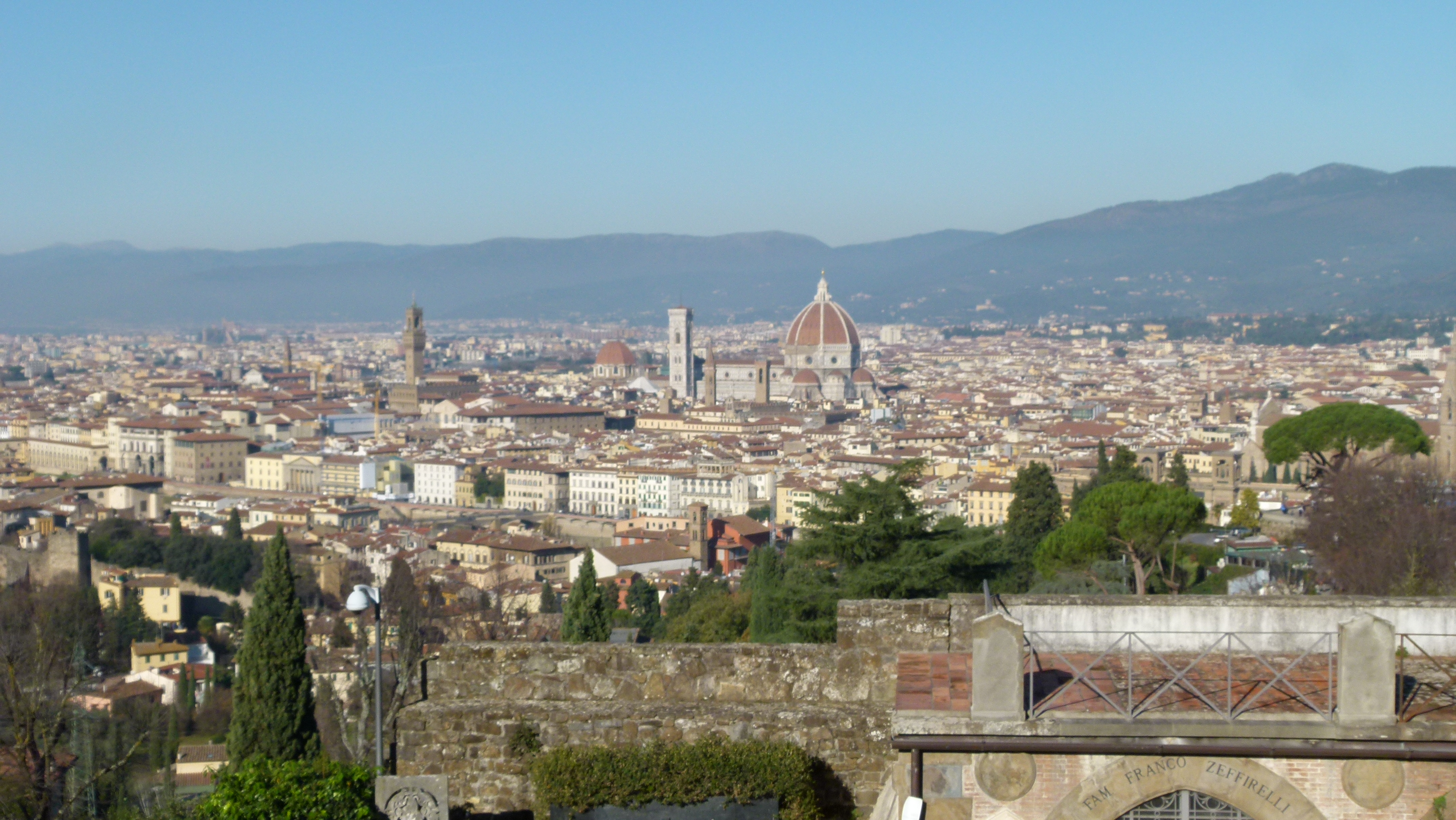
It took us about an hour to to reach San Miniato al Monte via Piazzolla Michelangelo. We enjoyed the view of the city with the Duomo, the Campanile, San Lorenzo and the Palazzo Vecchio.

P1070734

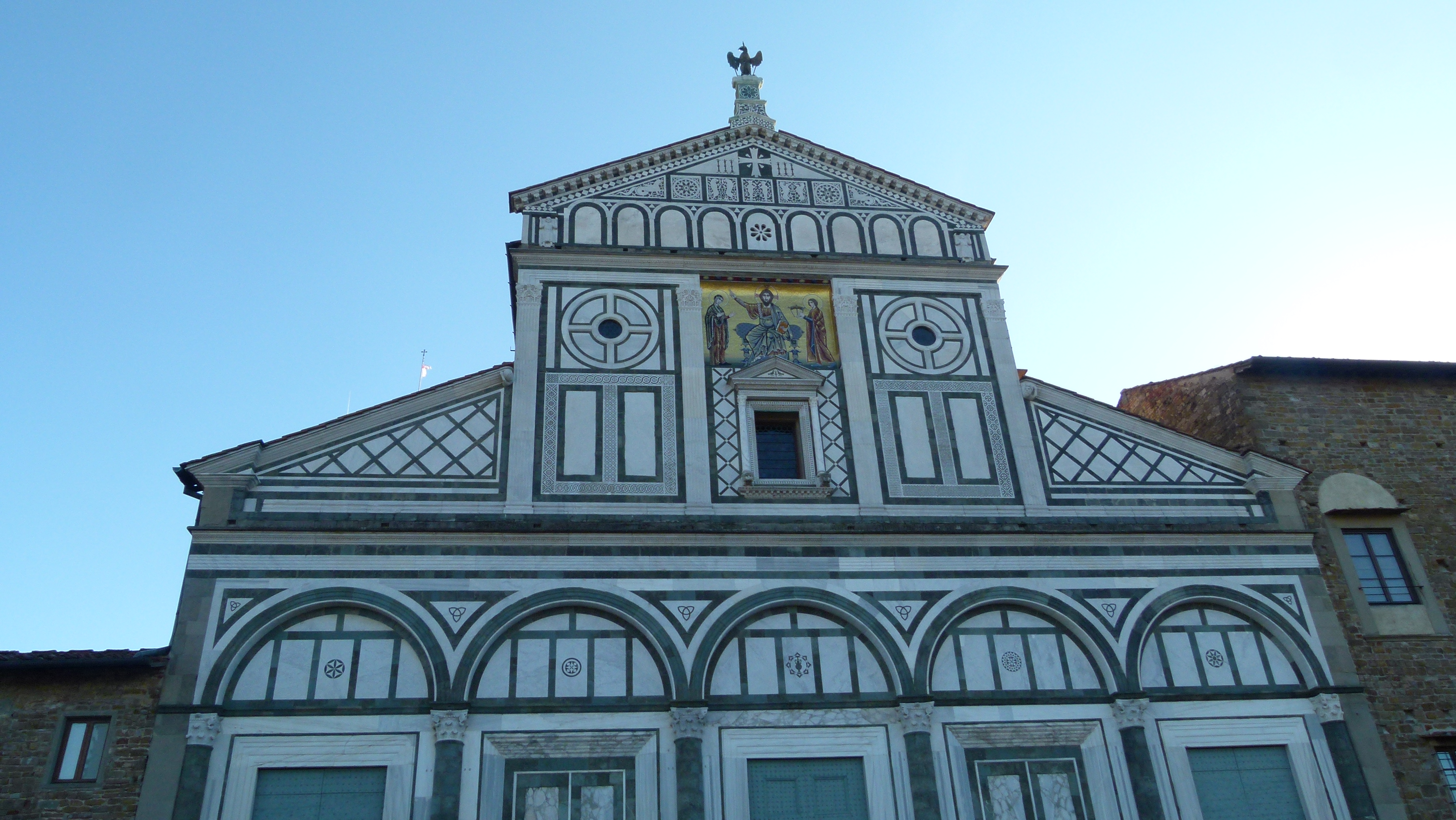
San Miniato welcomed us with the facade topped by the eagle of the woolmakers (who sponsored the church) and the mosaic completed around 1250. The patterns of this facade I recognize in the gothic churches Santa Maria Novella and Santa Croce and in the later Renaissance architecture.

P1070731

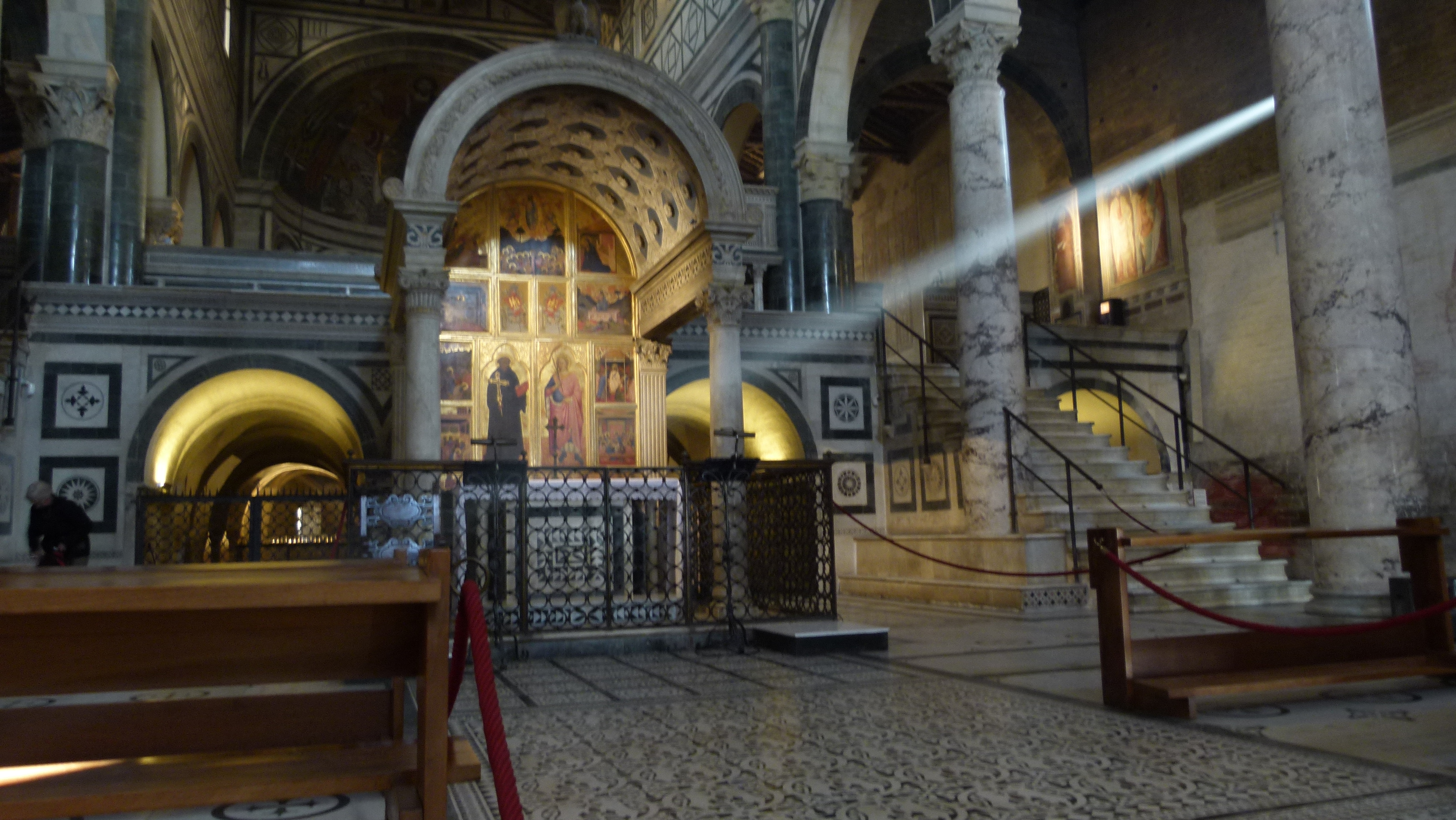
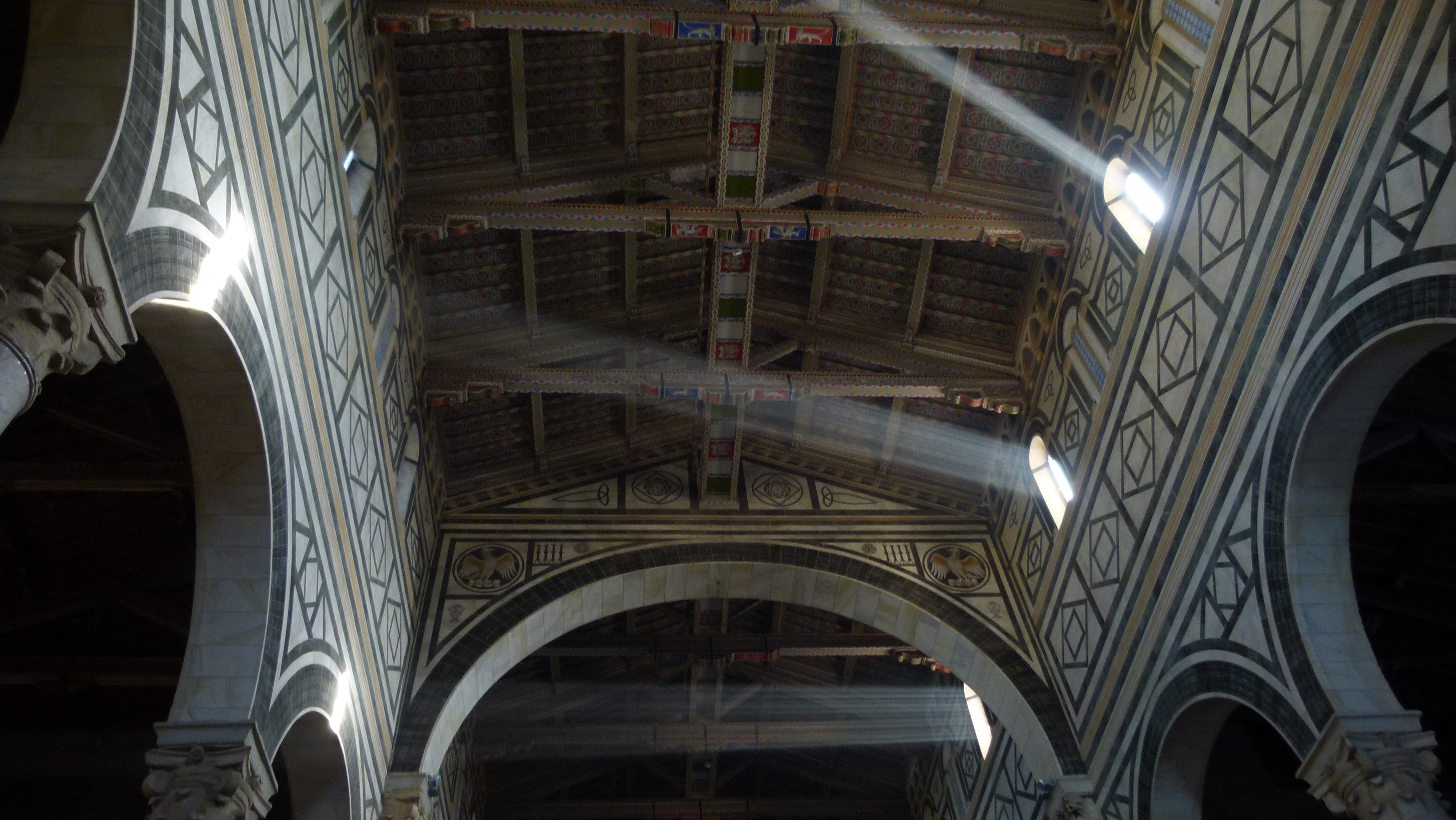
Inside the mass is going on solemnely enlighted by mystic sunrays.  The rays point to the Ziborium of Michelozzo (1448) and the altar paintings of Agnolo Gaddi (around 1400).

P1070738

I used this foto as my Christmas card, along with this small poem:

Seeing – looking – is it a dream?
Seeing – amazing – is this true?
I do thank for this renaissance,
I look and wonder, all in trance.

For me it was like being reborn (“Renaissance”), when looking at the treasures of this Renaissance town and enjoying my eyesight.

The sunrays also point to the wood framework that I find beautiful.

P1070736

.

More Proto-Renaissance: The Baptisterium of St. John the Baptist (with Gothic  and Renaissance adornments)

Currently the Baptisterium, built around 1100, is under renovation and fully wrapped up. The Baptisterium is devoted to St. John the Baptist. Until the 19th century it was the only place in Florence where Christians were baptized. It stands close to the Duomo and the Campanile that were built later.

P1070798

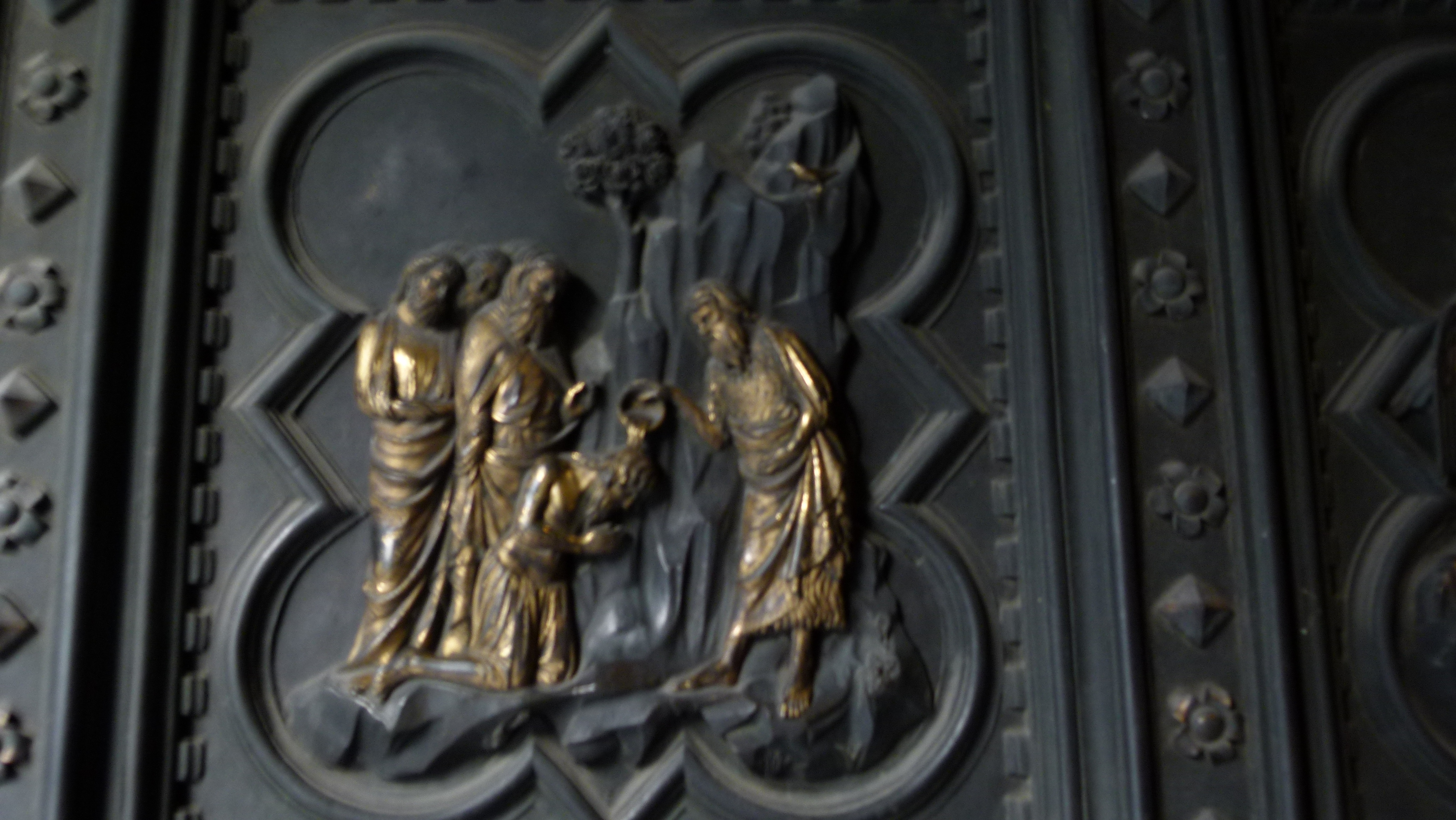
The Gothic bronze portal of Andrea Pisano was added around 1330.  This is one of the tiles showing the baptization of the people.

P1070796

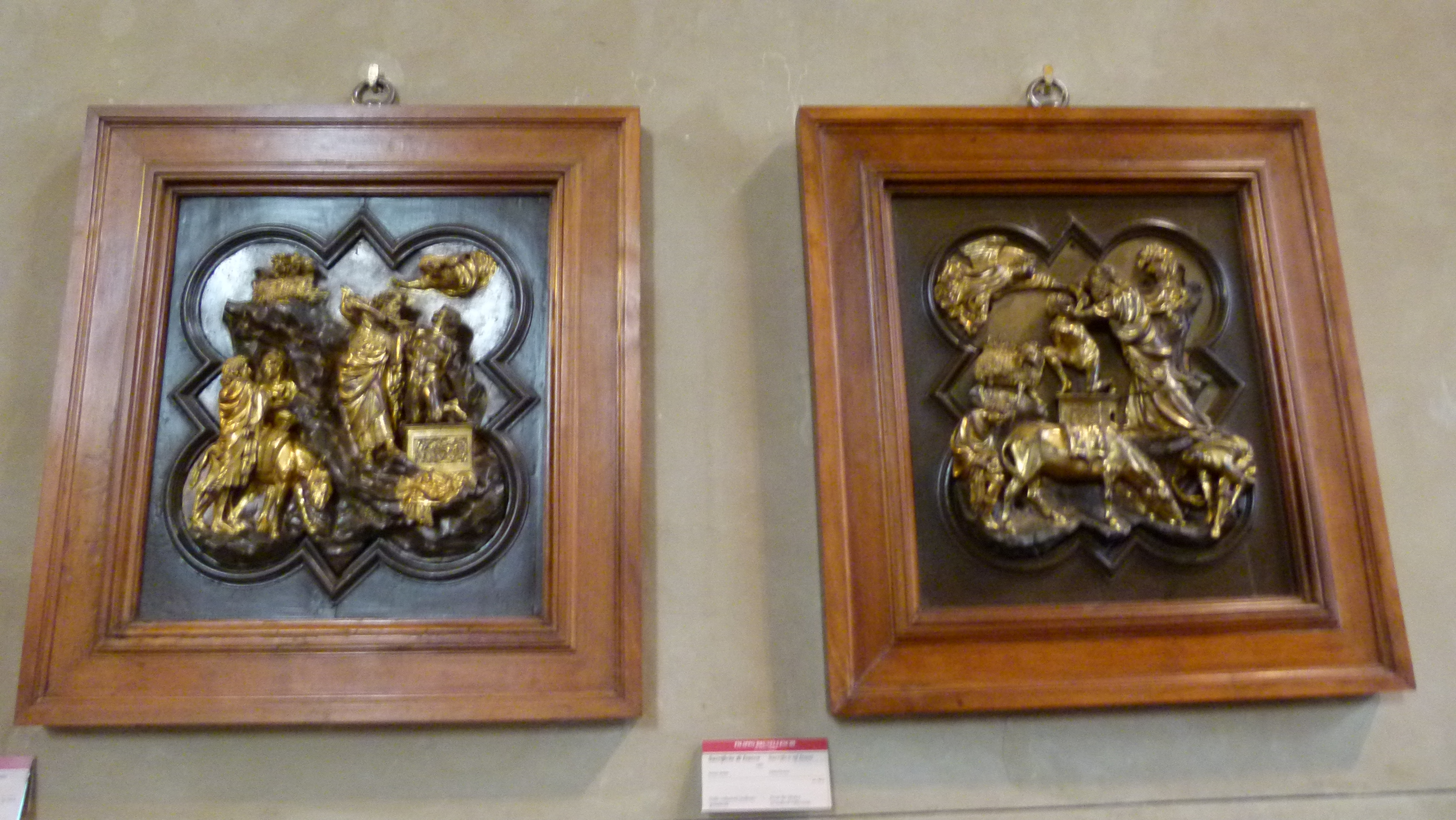
For the other, the Renaissance portal there was a competition.  The Bargello museum shows the works of Isaac’s sacrifice that Ghiberti (left) and Brunelleschi (right) had handed in. Ghiberti won the competition. Well, Bruneschelli had a lot more opportunities to embellish his town!

P1070312

Inside the Baptisterium we could not stop looking at the mosaics in the cupola. The new Dumont has a detailed map of all the mosaics. We sat on the benches and studied the life of St. John in the first line (from being announced – and his father Zacharias could not believe that his wife will give birth to a child) until his dramatic death (decapitated in the palace of Herodes). Then we followed the life of Jesus laid out in the second row, from being announced to his resurrection. An interesting detail here: After having adored the child, the three kings leave by boat. I asked myself, where their camels went, as I have always imagined them traveling with camels.

P1070224

.

In my next blogs I will continue along that architecture timeline presented at the start.

Three Swiss in Florence – overwhelmed by so much culture and history

My old dream – Florence – a mysterious town full of culture and history

Florence has always made me dream, in particular the Uffizi – one of the greatest museums in Europe. Then the Ponte Vecchio has always impressed me – topped with houses and crossing the Arno.

P1070264

I knew about three Renaissance artists that worked in Florence – Leonardo da Vinci, Michelangelo and Raffael. I knew that Catharina de Medici had married the French king Henry II and later, Maria married Henry IV – they became the grand-parents of Louis XIV. Here is a painting showing Maria (Uffizi).

P1070294

Obviously, Florence played an important role in European history. Yes, it was an old dream of mine to visit Florence. But I have never made it there so far.
.

Ursula organizes a trip to Florence for us three Swiss ladies

Ursula has spent many weeks in Florence before. I had told her about my dream. Now she makes it come true: For December 2014 she organizes a trip to Florence for her, for me and for her mum. Zurich – Milano using the Swiss Railway SBB and Milano – Florence in the high speed train Frecciarossa. She reserves rooms in the hotel Minerva at Piazza Santa Maria Novella, close to the main railway station.

When we are about to leave for Florence, I hear news about “scioperi”. The Italian railways on strike? No problem for us. SBB takes us to Milano without hesitating. And Frecciarossa is a private railway organization that does not participate in the strikes. We arrive in Florence on time, more precisely than on “normal” days, when our trains would have competed for track capacity with the public trains. After having arrived in Florence, we reach our hotel within five minutes.

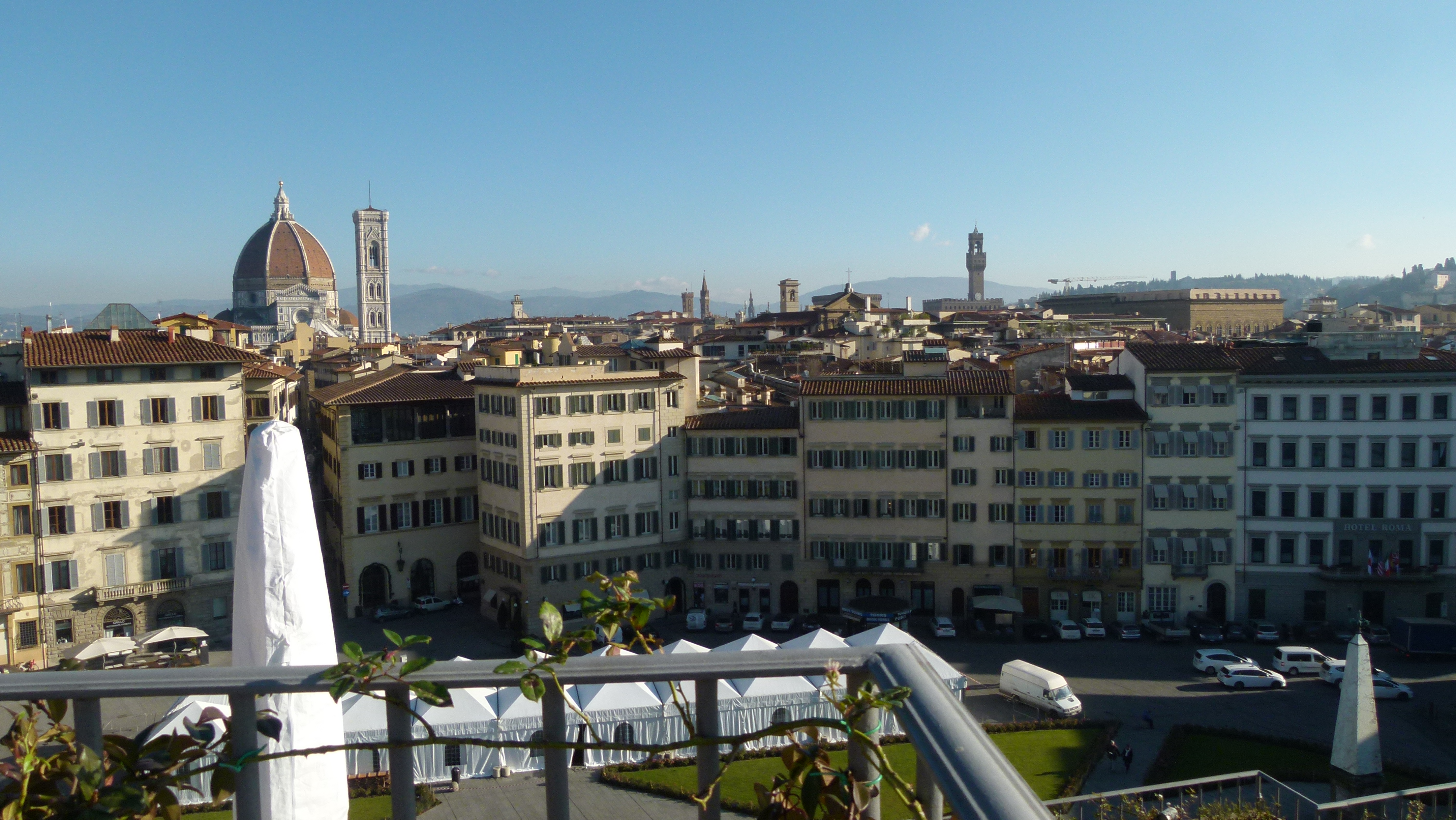
Here is the view from the roof of our hotel to the Dome with the Campanile and Palazzo Vecchio.

P1070391

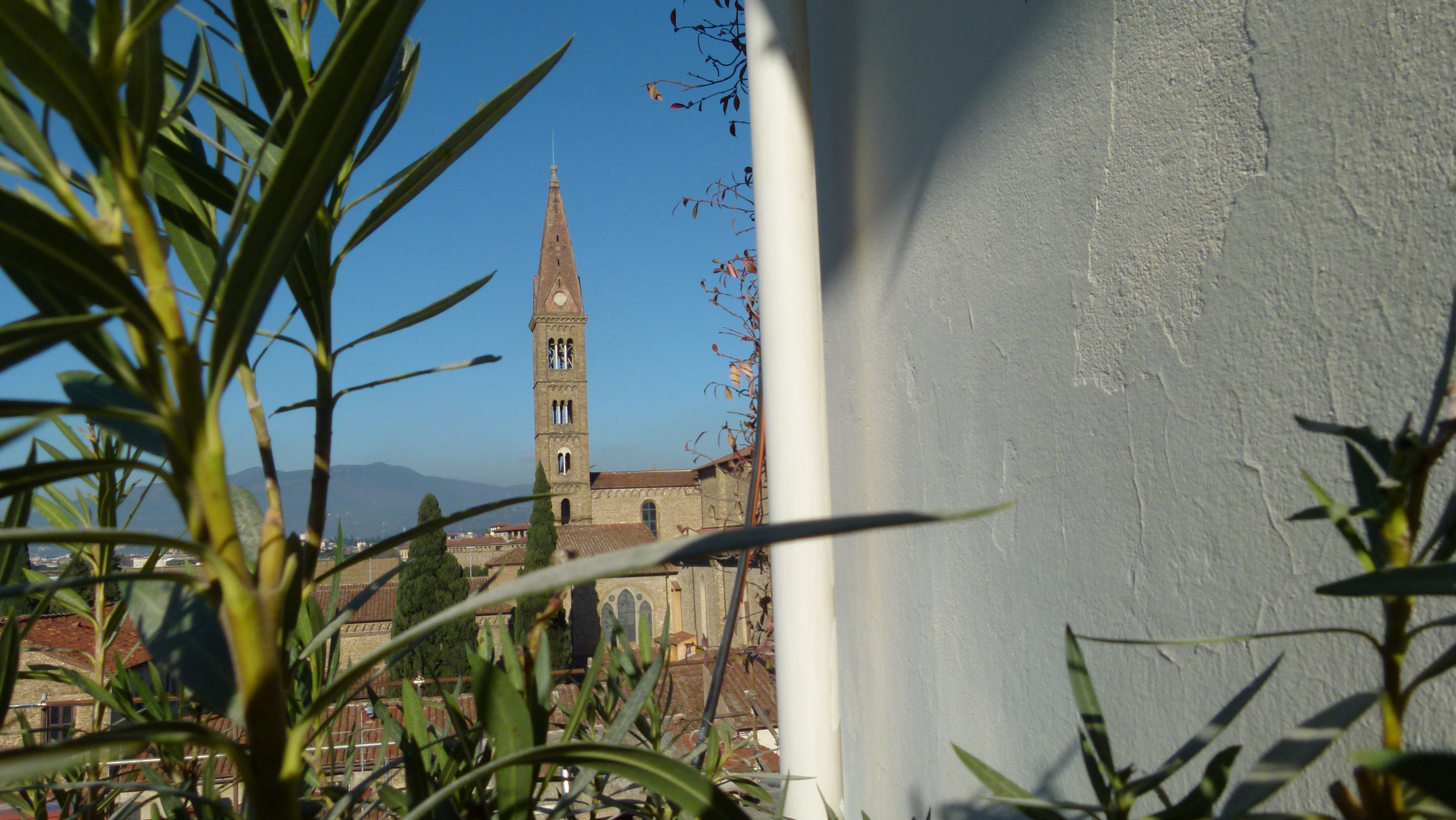
And this is view of the tower of Santa Maria Novella taken from one of the balconies – we are close.

P1070394

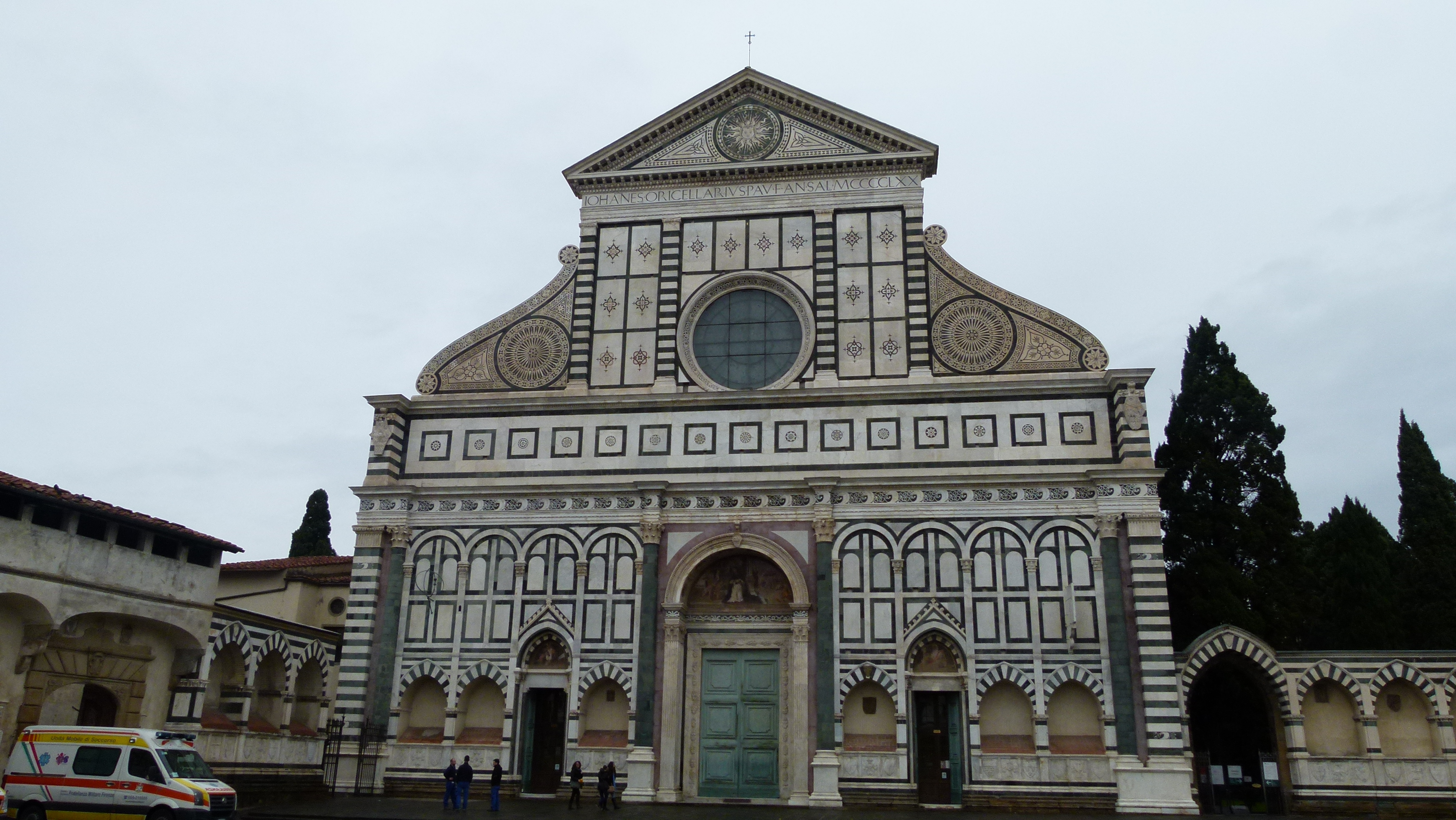
When we leave the front door of the hotel we stand in front of the renaissance facade of Santa Maria Novella.

 P1070223

.

Trying to get an overview of all this culture – my simplified map of Florence

Ursula enthusiastically tells me about San Lorenzo, the Baptisterium, the Palazzo Vecchio, Santa Croce, San Miniate al Monte, the Palazzo Pitti and… and… I feel overwhelmed. There is much, much more to be seen than just the Uffizi and the Ponte Vecchio. I hear that sometimes tourists end up in the emergency department of the local hospital, and the diagnosis is “overload with culture” – it is said to be a well-known phenomenon. I believe, if it is not true, it is well invented (or in Italian: si non è vero, è ben trovato).

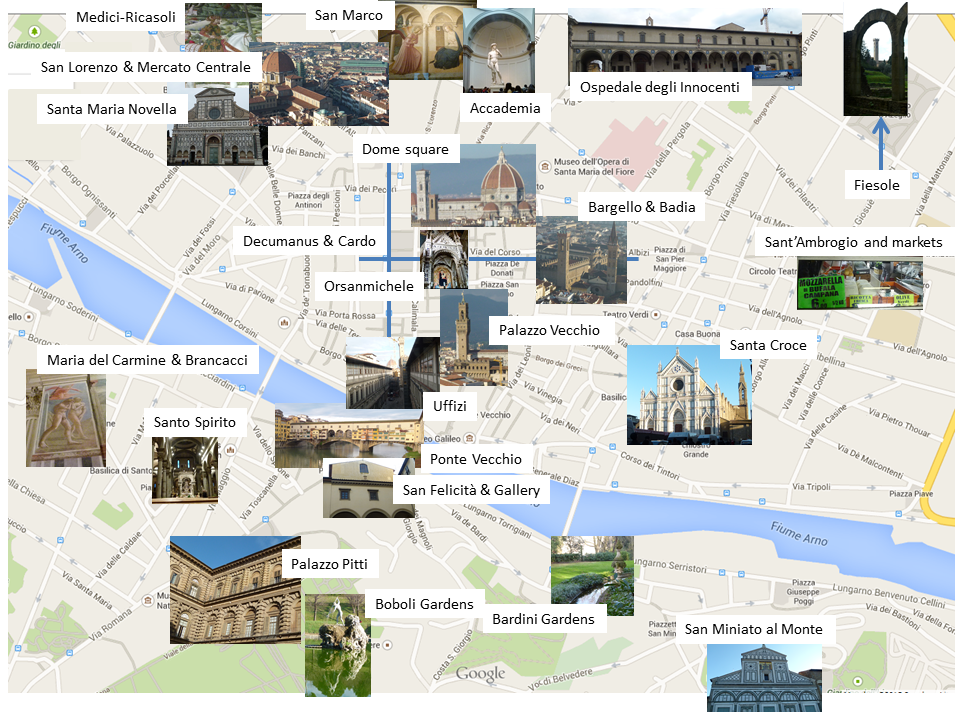
I try to get some order into my head and draw a simplified map of the town with their places of interest. Except Fiesole, they are all within walking distance.

Simplemap_florenz_english

The center of medieval Florence is the area around the Dome square (with the Dome, the Baptisterium and the Campanile). The Roman Decumanus and the Cardo  can still be noticed in the rectangular street pattern (they cross at today’s Piazza della Repubblica). Grouped in the center are the Palazzo Vecchio (the old townhall in Piazza della Signoria), the Bargello Palace (formerly the residence of the “Bargello”, the head of the police), Badia (a monastery, Brothers of Jerusalem), Orsanmichele (the center and curch of the trade- and craft guilds) and the Uffizi (the administrative center of the dukes of Medici, now THE museum). The center ends with Ponte Vecchio that connects to “Oltrarno” (the area “beyond” the Arno).

To the west/north west are Santa Maria Novella (belonging to the Dominicans), San Lorenzo (where the Medici dukes are buried), the nearby Mercato Centrale and the Palace of Medici-Ricasoli (with the chapel hosting gorgeous frescos of the kings traveling to adore Jesus).

To the north there are the monastery of San Marco (each cell decorated with a fresco), the Accademia (highlight: David by Michelangelo) and the Ospedale degli Innocenti (forming the harmony of Piazza SS Annunziata with the namesake church).

On a hill farther away to the north, the town of Fiesole can be reached using bus number 7 (archaeological center with Roman ruins).

To the east we find the beautiful church Santa Croce and – still farther more to the east – Sant’Ambrogio with its markets.

Beyond (or south of) the Arno (Oltrarno) is Santo Spirito (the small streets are the scene of Magdalen Nabb’s detective stories). Nearby is Santa Maria del Carmine with the Branccacci chapel (highlight: the fresco “expulsion from the paradise”). The Palazzo Pitti was home of the dukes of Medici (“hidden” in the Gallery they walked to the Uffizi, sometimes stopping by behind Santa Felicitá to attend the service; today the Palazzo is another art museum). Behind the Palazzo Pitti are the Boboli gardens (climbing uphill) and the Bardini gardens (with a wonderful view of the city). San Miniato al Monte on top of another hill is the oldest church in Florence  (church and monastery belong to the Benedictines).

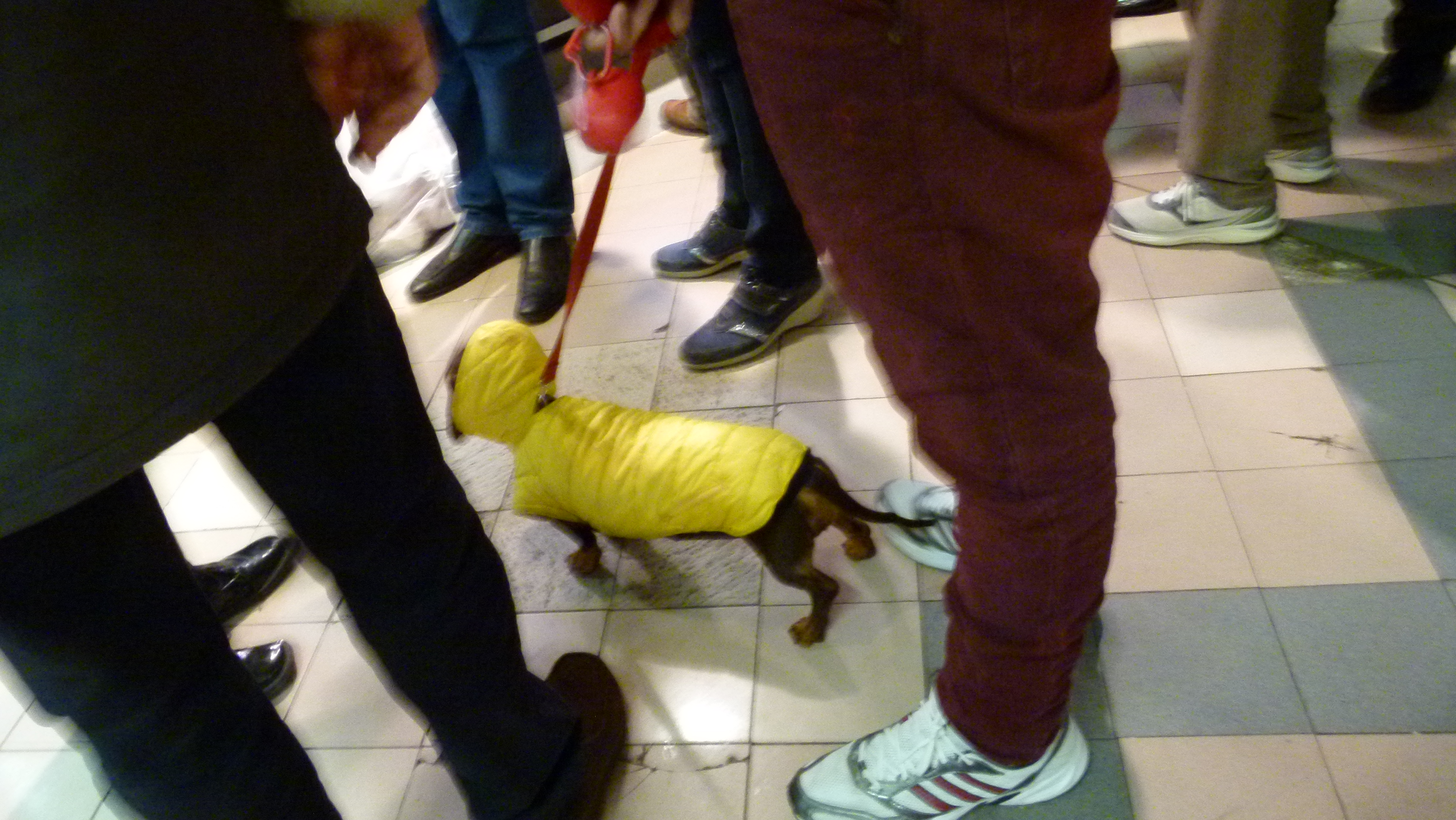
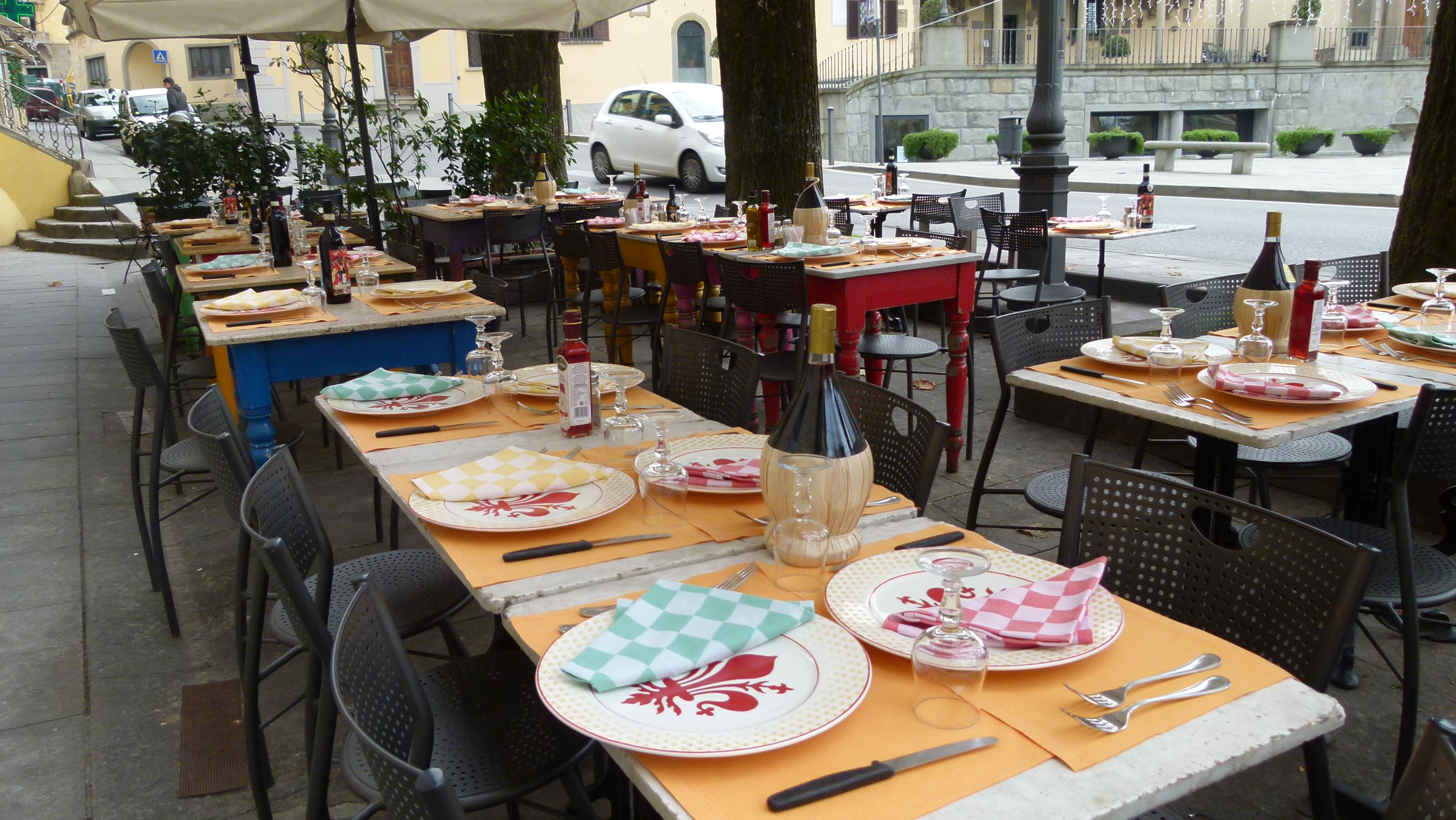
These are the cultural highlights that we visited. We also spent wonderful hours eating in exellent and friendly restaurants, shopping in the markets or leather -, dress -, gem – and book stores (Florence is famous for its design culture) or just enjoying the atmosphere in the small streets where each individual house/palace has a story to tell (such as Palazzo Strozzi, Davanzati or Antinori). It is good to be in Florence in December: There are less tourists now and the temperatures seem moderate to us (15 degrees during the day) – even if some dog owners would not agree, as this snapshot taken hastily illustrates.

P1070546

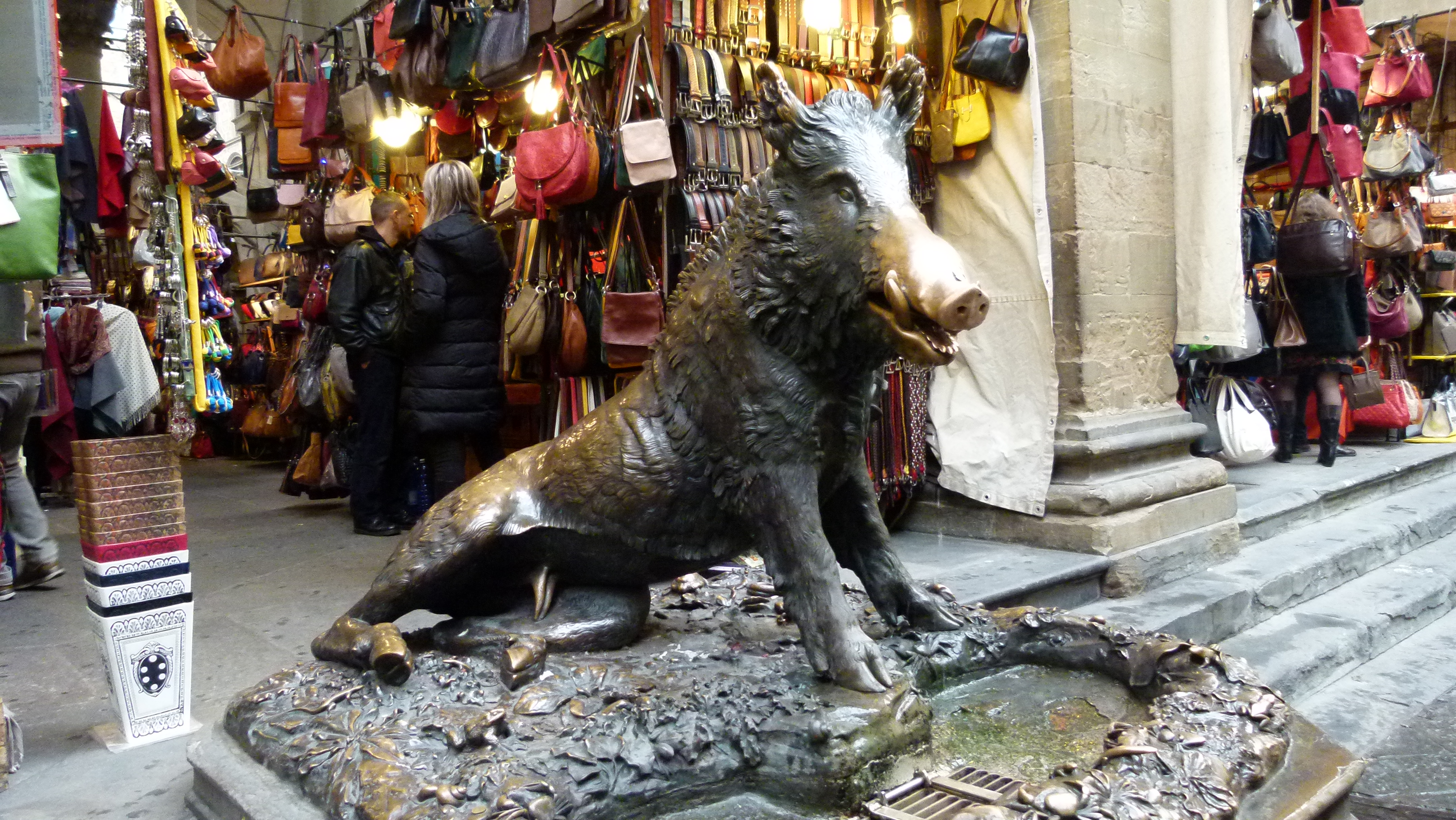
The shining nose of the Porcellino indicates that most tourists want to come back to Florence.

P1070177

I feel the same – After having spent a week here, I would like to come back. However, I do not touch this nose that so many people have touched before.

.

This is the literature that I used to understand more of Florence

  • Loney Planet: “Pocket Florence & Tuscany”, Feb 2014
  • ADAC Reiseführer: “Florenz” (extremely practical guide with a pull out map that my eyes could read – each place of interest has a number that allows to find the related explanations quickly and the depth of the explanations is exactly right, when walking around)
  • DuMont Kunstreiseführer: “Florenz”, 1988 and 2012 (in depth information to  dig deeper)
  • DuMont Reisetaschenbücher: “Florenz”, 1996
  • Merian Porträts: “Florenz, eine Stadt in Biographien”, 2014 (Franz Kotteder explores the biographies of 20 celebrities, including Dante, Giotto, Brunelleschi, Guccio Gucci or Magdalen Nabb)
  • Magdalen Nabb: “Death of an Englishman” and “Death of a Dutchman”, A Marshal Guarnaccia Investigation, Diogenes, 1992 and 1999 and Soho 2007 and 2001
  • Various information sources on the Internet, in particular the useful official website of the museums in Florence.

.

Let me pick out some memories of this rich and enticing trip to Florence

Thank you, Ursula, for organizing and guiding us and thank you, Leni, for the great company.  It was good to travel with you, as all three of us loved to stop, watch and take our time to think and digest, when visiting the churches and museums of Florence. And we all enjoyed to do shopping and recover in comfy coffee houses or restaurants.

I want to pick out some memories and think about the history of Florence that played an important part in the European history.
On the road – Finding truffles (l’Or des Valois) with Elf, the lagotto romagnole

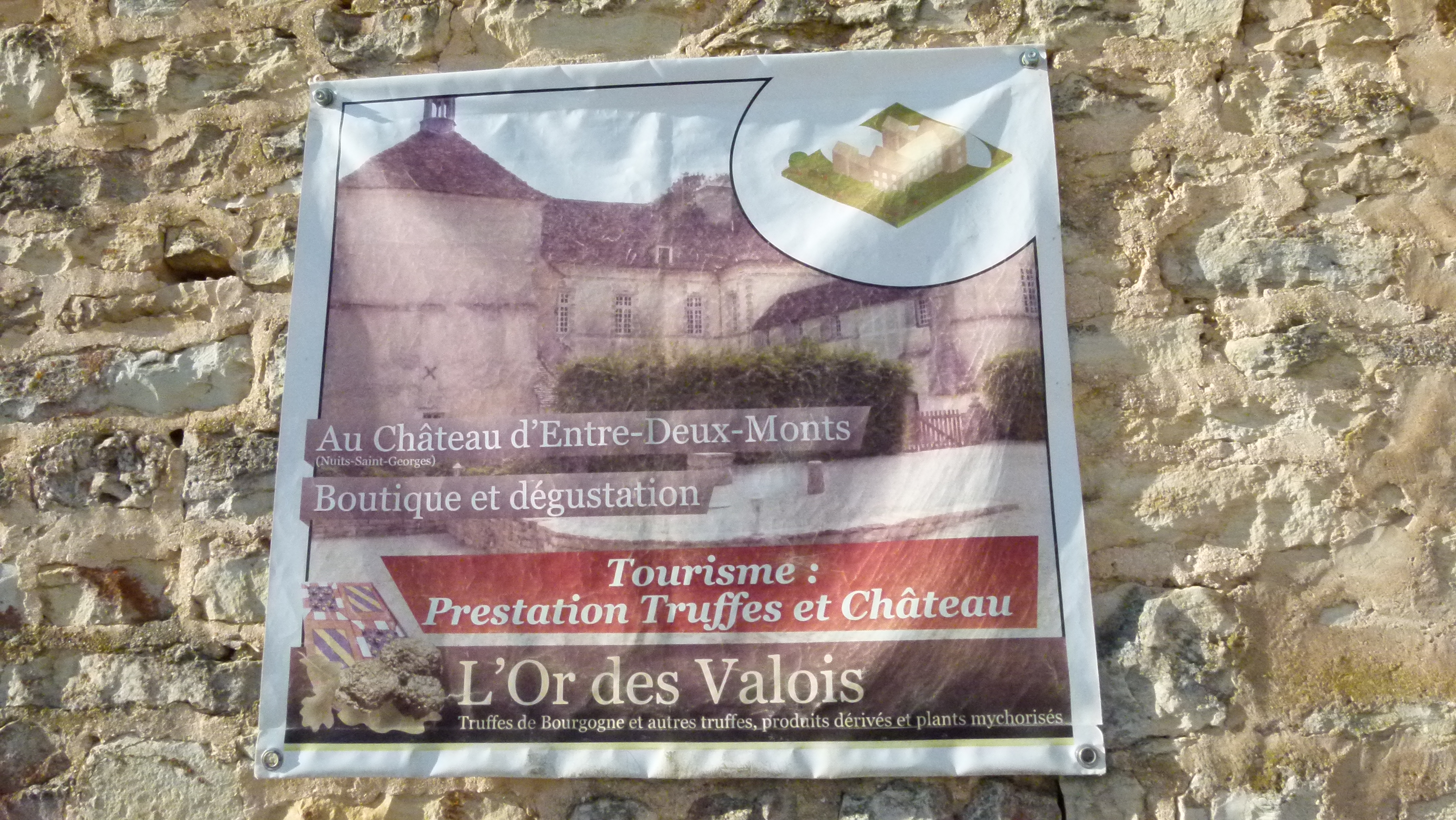
At Château d’Entre Deux Monts – the truffle farm (truffles are “the gold of the Valois” or “l’Or des Valois”)

At the Château d’Entre Deux Monts Thierry Bézeux and his family grow truffles, convert them to truffle delicacies (sold in the boutique) and in addition show tourists their truffles (visits to their orchard and truffle tastings). Tripadvisor gives good reports. Larissa has visited and liked this place before and has arranged a visit with us.

The Burgundy truffles are also called “the Gold of the Valois”” or “l’Or des Valois” (The Valois were kings of France from the early 14th to the late 16th century, then the Bourbons took over with Henry IV).

.

Finding the Château with l’Or des Valois

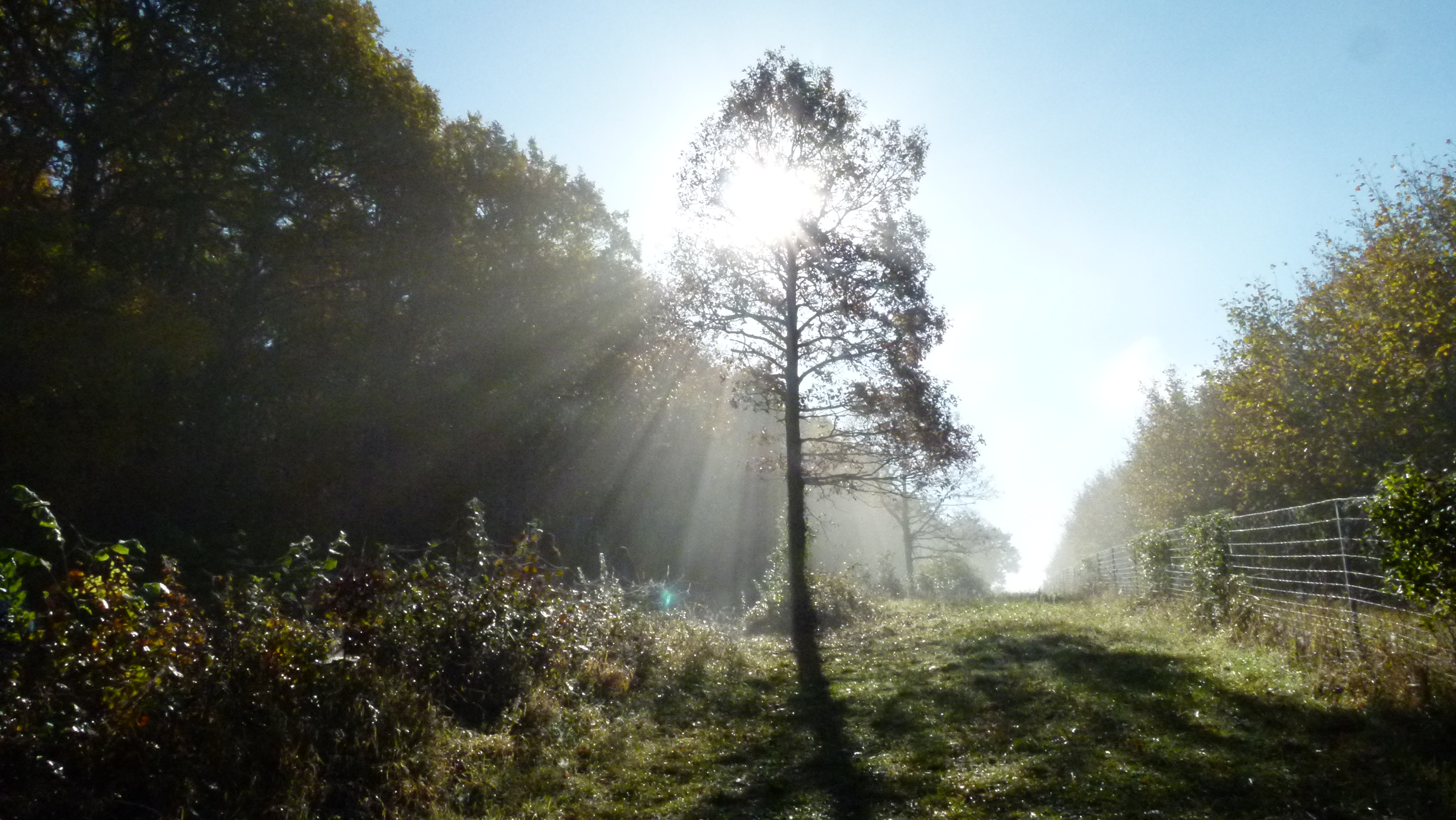
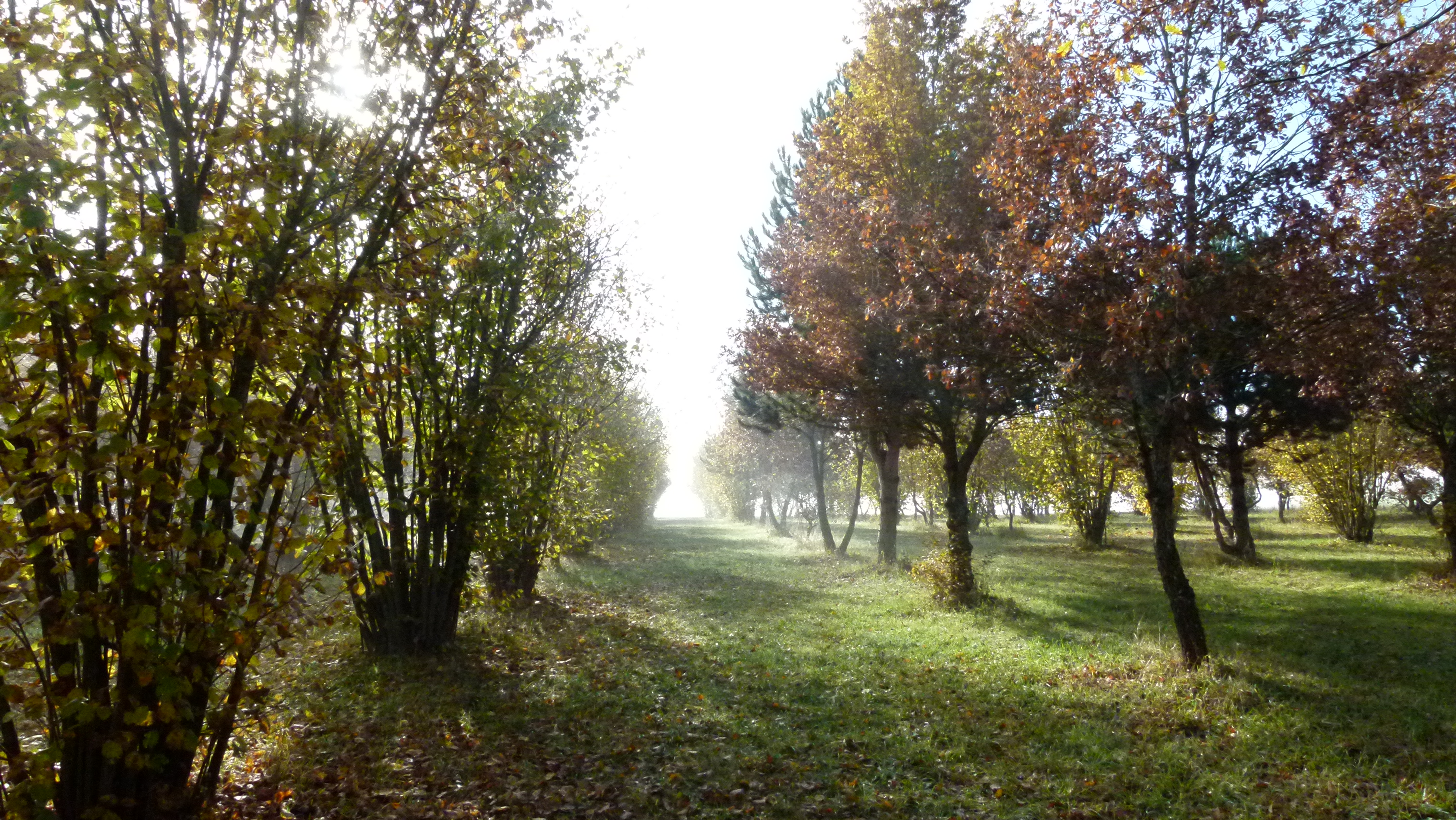
There is a mysterious mist lying over the hills above the Côte de Nuits and the village Nuits-Saint George.

P1060938

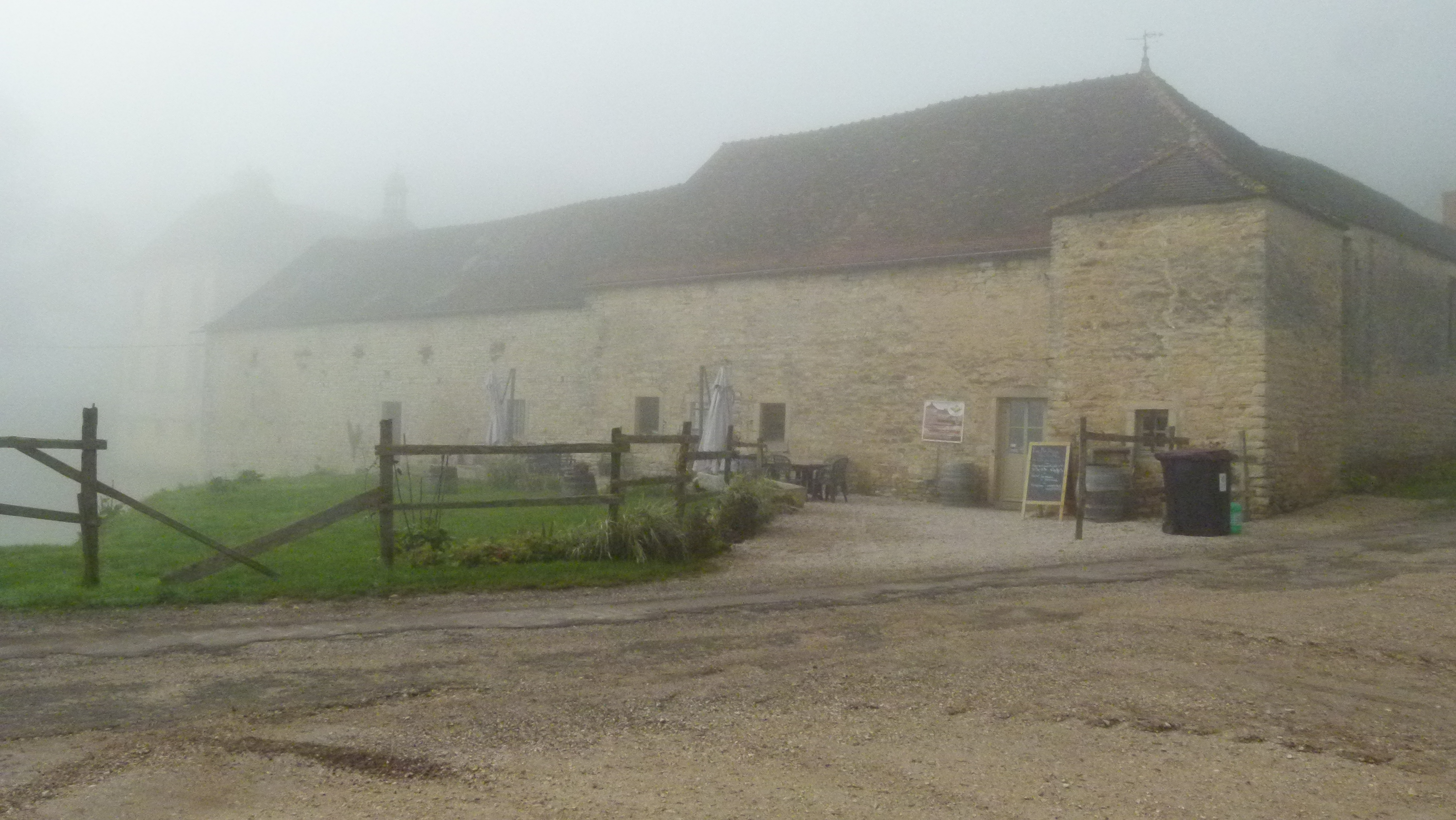
Hidden in the mist is the Château d’Entre Deux Monts de Thierry Bézeux.

P1060913

The boutique is open and Thierry Bézeux welcomes us.

P1060943

.

Looking for truffles in the “truffle orchard” – with Elf

The son of Thierry and his dog Elf take us to their “truffle orchard” planted with trees that truffles like. I later found a study about growing truffles in the US, and they say that the Burgundy truffle is well suited for plantations, in particular with trees such as hazelnut and oak, but can only be harvested with a dog, as they grow under the ground.

P1060922

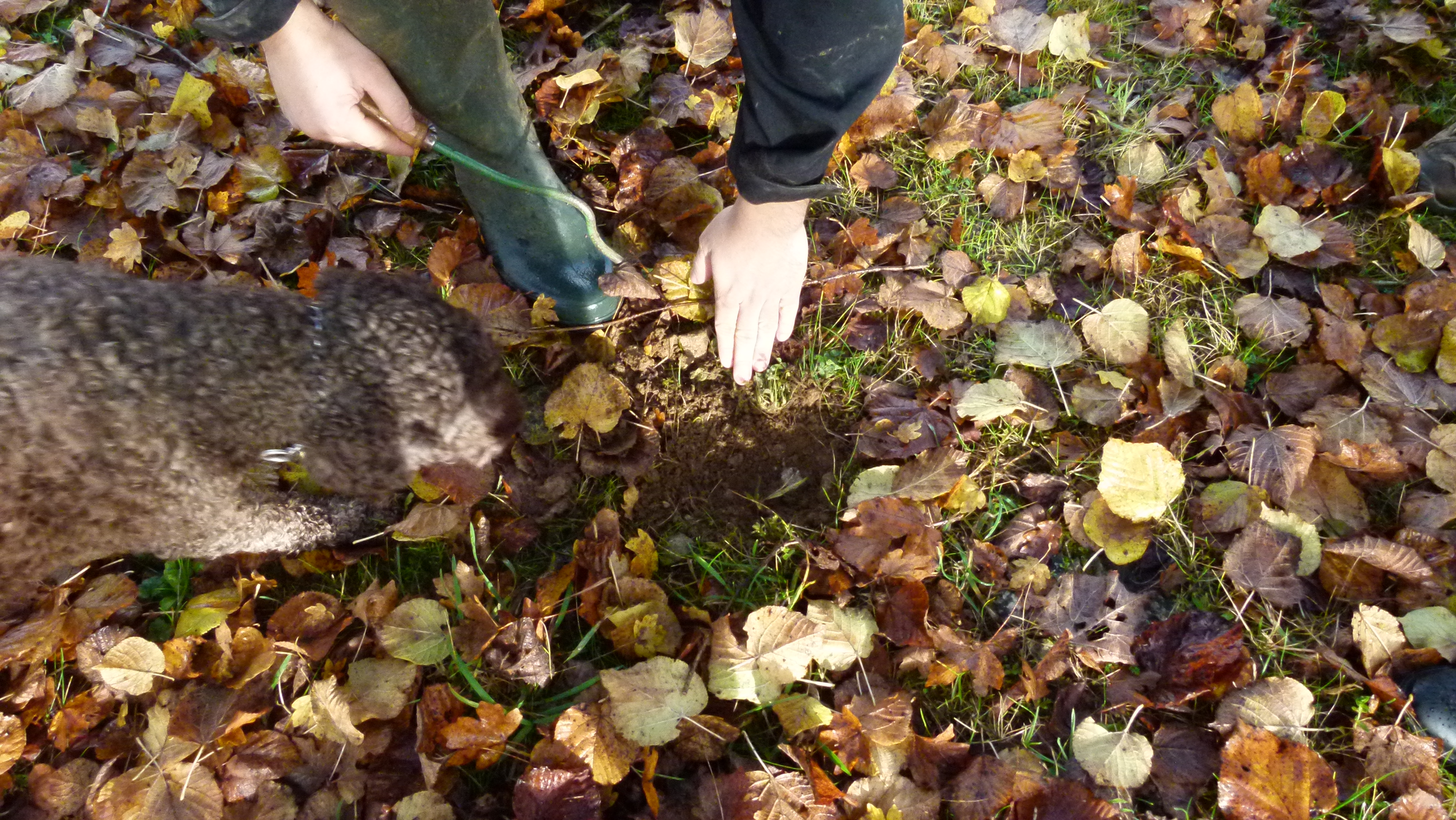
Elf is a lagotto romagnole, similar to a poodle. When Yann opens the gate to the orchard, she starts to run around and immediately finds the first truffle hidden under the ground. Elf loves truffles and wants to eat the black ball it found, but Yann stops her and gives her a dog bisquit instead. Maybe the bisquit has a truffle taste, at least?

P1060915

Elf continues to look for more truffles. Sometimes she loses interest in truffles and sniffs around the trees. Perhaps a badger (blaireau in French) has visited the orchard and Elf is reading what the bagder has to say. In the end, we have a handful of truffles to take home. Thank you, Elf.

P1060930

.

Back in the castle, we taste the truffle delicacies

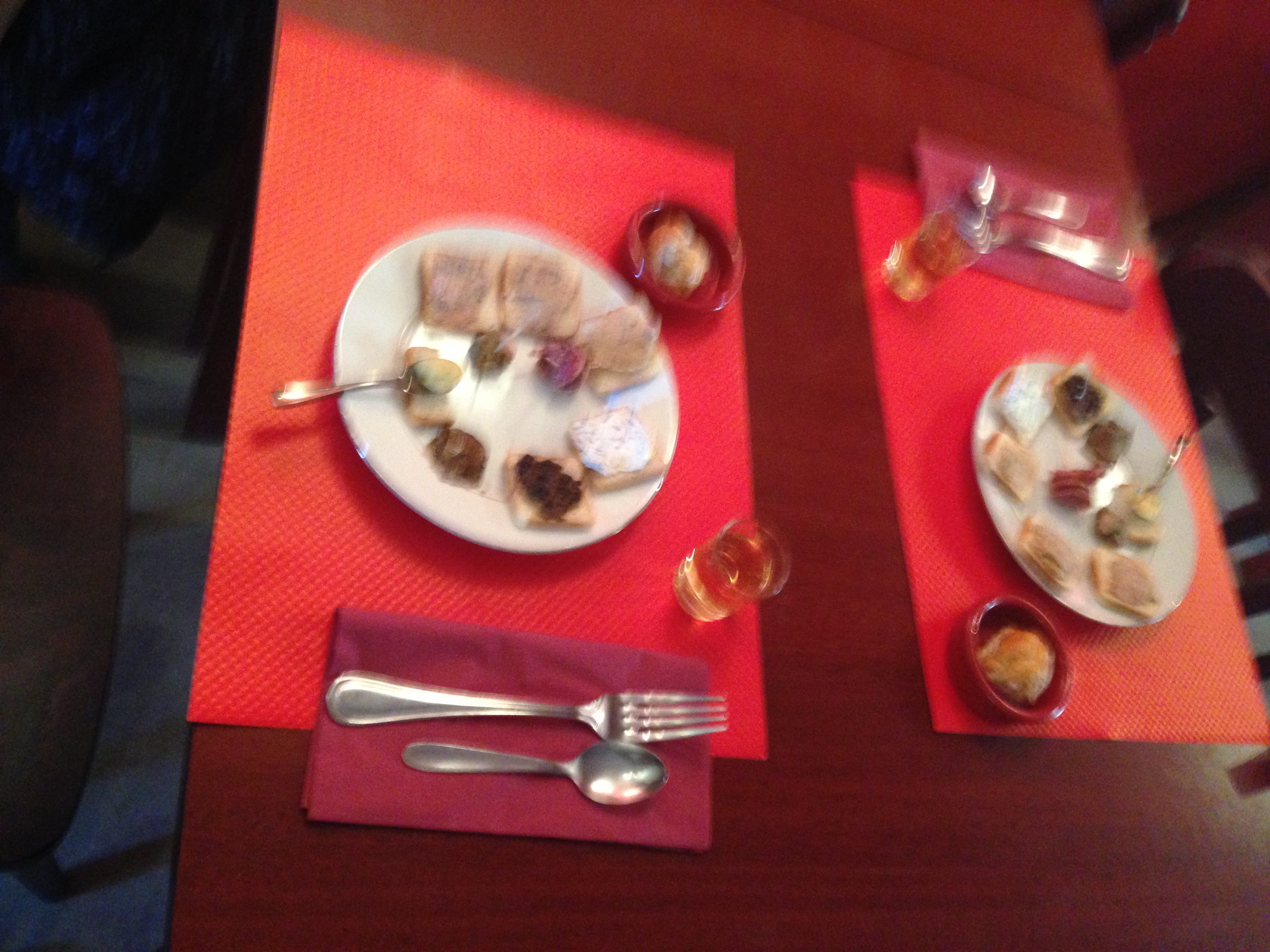
Back in the château we find the table set for our truffle tasting: Mustard, terrine of rabbit and pintade (guinea fowl or цеcарка), cheese, sauce aux truffes d’Italie, some slices of fresh truffle, ham with parsley (jambon persillé), saucisson, ice cream (glace) and Ratatruffe (Marc de Bourgogne marinated with truffles). The Ratatruffe may have influenced my camera… in the internet there are bettter images of this tasting set.


IMG_0969

.

My thanks in the Château guest book

There is a guest book on the table and I leave this entry: « Merci, Elf, tu as bien travaillé, et j’aimerais bien savoir ce que le blaireau t’as raconté. La degustation était délicieuse. Petra de Bâle en Suisse.” (Thank y ou, Elf, you have worked well, and I would like to know, what the badger has told you. The tasting was delicious.)


On the road – our Sunday tastings in Chablis: William Fèvre and La Chablisienne

Our first day in Chablis was a Sunday. A  few wine making places are open on Sundays, amongst them the boutiques of La Chablisienne and of William Fèvre. No reservations are needed. Great.

On that Sunday, we also visited the Chablis market…

P1060802

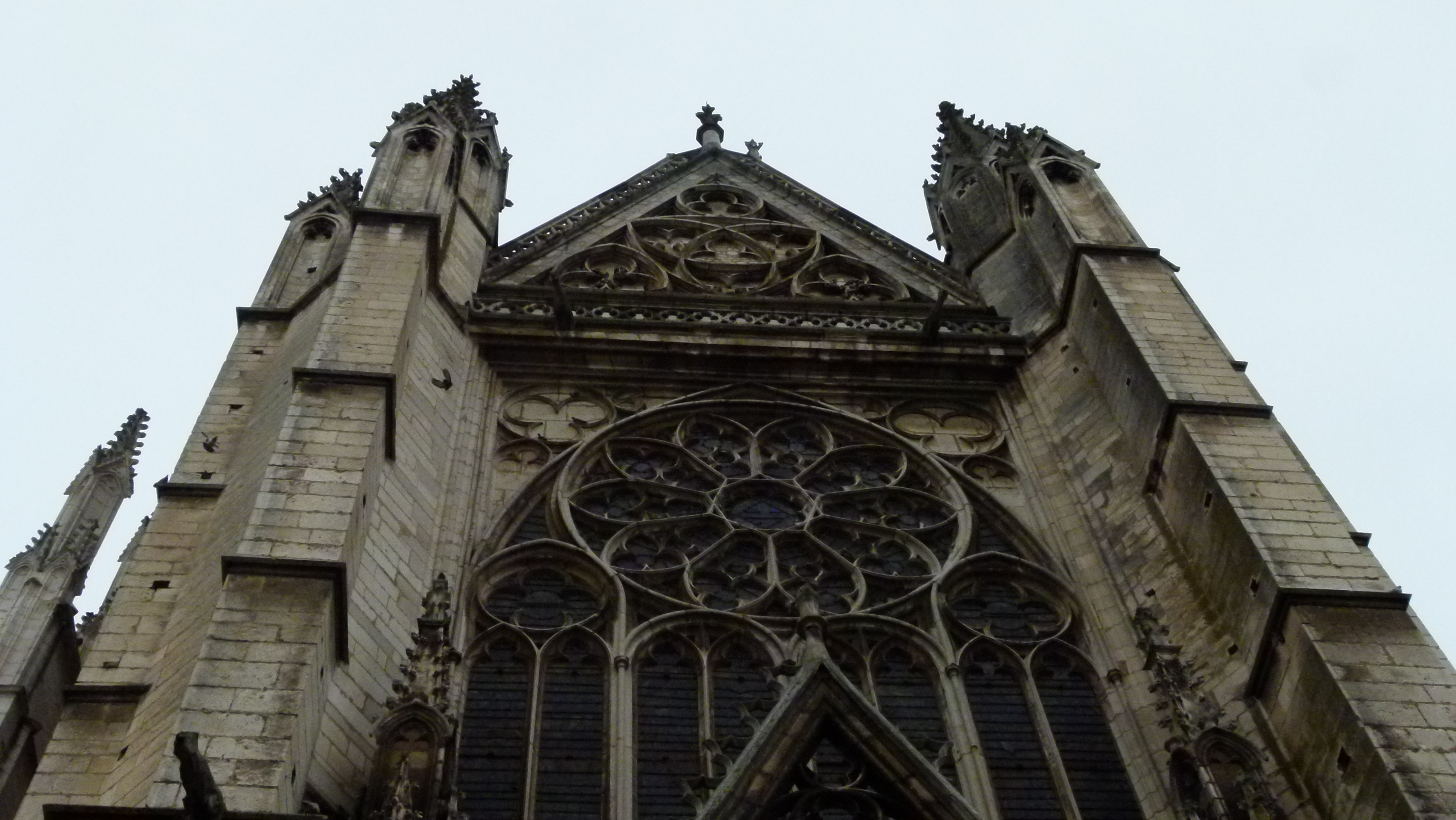
… and Auxerre with its beautiful gothic church of St. Etienne.

P1060822

.

La Chablisienne – valued in Pocket Johnson and surely worth visiting with its broad selection of wines

P1060810

P1060816

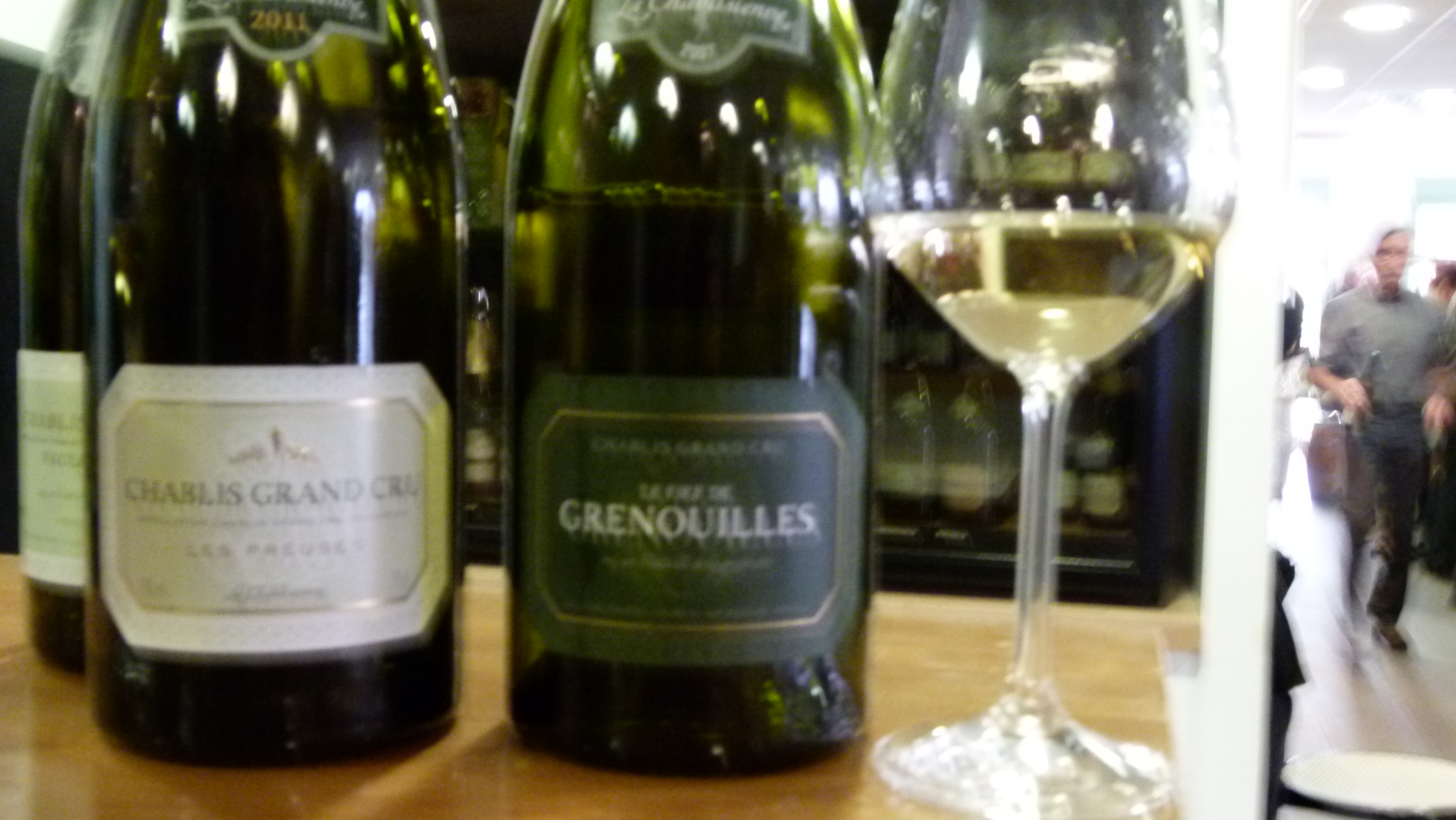
La Chablisienne is a Cooperative that makes wines for about 300 wine growers. They are the largest wine maker in Chablis. They offer wines from a broad variety of climats (about 30 different Chablis wines), and they own the Château Grand Cru “Grenouilles”, the smallest of the seven Grands Crus terroirs (they acquired the quasi-monopole of Grenouilles in 1999).

Jean-Michel guides us through our tasting – with a lot of charm – listening and reacting, e.g. by bringing another Grenouilles from a different year… This is what we tasted:

  • Beauroy 1er Cru: Fruity – perhaps quince. Nose is more pronounced than taste.
  • Vaulorent 1er Cru : Fruity – perhaps quince and nuts. Nose also stronger than taste.
  • Fourchaume 1er Cru 2013: Young, fruity – orange, both nose and taste. Would like it with shellfish. Liked it and bought a bottle.
  • Montmains 1er Cru 2009: Liked it and bought a bottle.
  • Les Preuses Grand Cru 2011: More yellow than 1er Cru, less acidity, flowery, can imagine it with Asian food. Can age more.
  • Les Grenouilles Grand Cru 2007: Ready to drink, salty, mineral note, but somewhat ponderous (on “heavy feet” or “schwerfüssig”). 2010 is fresher than 2007.

It is surely worth visiting La Chablisienne with its broad selection. On  our Sunday they also hosted a cheese tasting event. Unfortunately, the cheese tasting lady was a little grumpy.

.

William Fèvre – “three stars” in Pocket Johnson and a lot of enthusiasm in the boutique – for me my second tasting highlight in Chablis

William Fèvre has three stars in the “Pocket Johnson”. For lack of family heirs, he sold his business to Henriot in 1998. He has the largest Grand Crus possessions in Chablis.

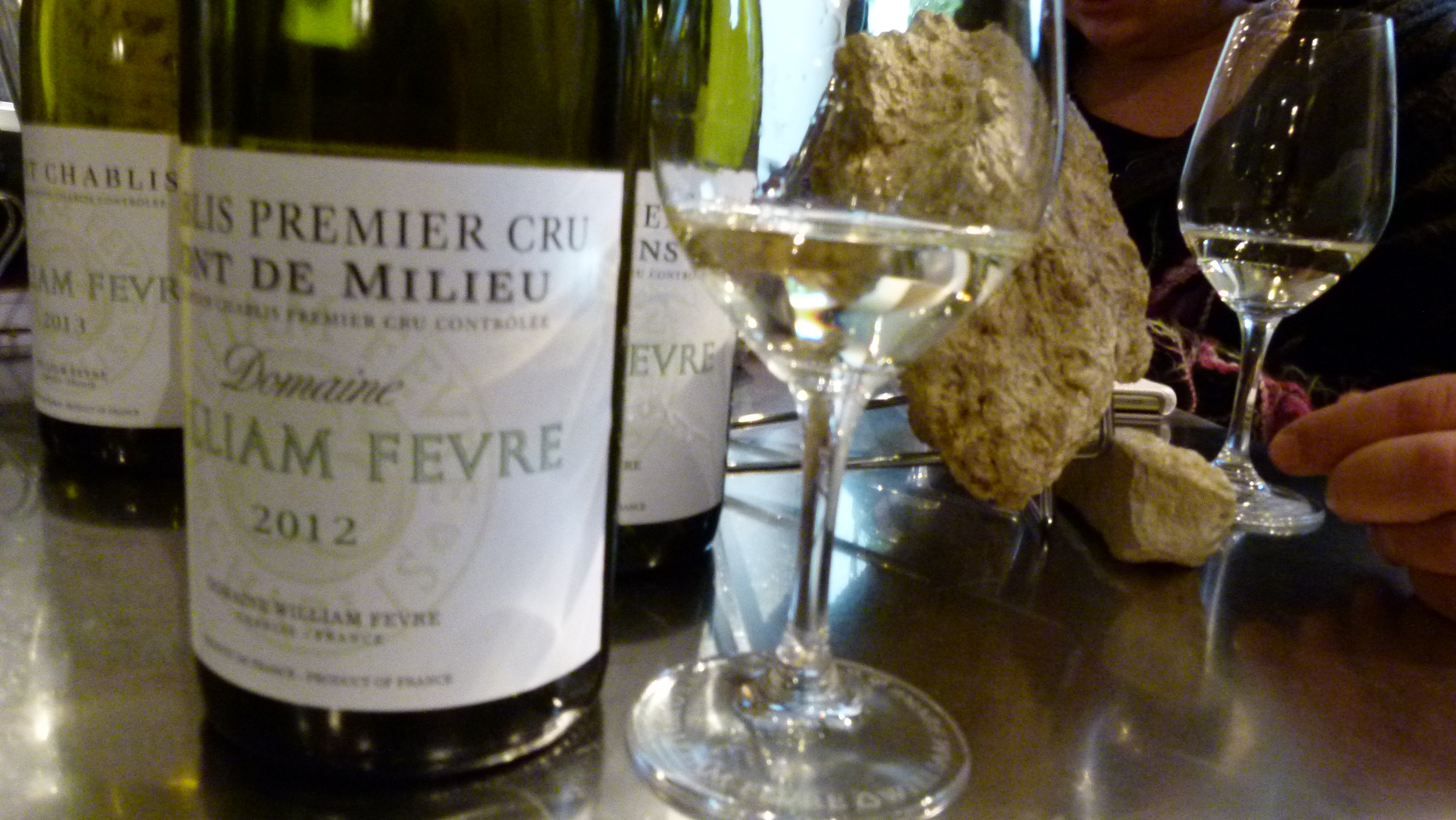
His boutique is nicely set up. To illustrate the terroir, there are brochures and samples of the Kimmeridgian soil. I enjoy the enthusiasm that the boutique assistant shows when explaining the Kimmeridgian stone samples to us. I ask him why William Fèvre is called “William”, though the family has long lived in Chablis – no Anglosaxon background. He smiles. And then tells me the story: When William was born, his parents could not agree on his name. After three days, the mayor reset the date of birth and gave him the name “William”. The assistant sees the “Pocket Johnson” in my hands. “May I see, what Johnson has written about us, I have not checked this out recently”, he says and then adds: “I have met Johnson once, he is an impressive person.”

This is what we tasted:

  • Petit Chablis 2013: Fresh, brisk, on “light feet” (“leichtfüssig”)
  • “Plain” Chablis: Almost no nose, a little more dense than the Petit Chablis
  • Chablis 1er Cru 2012, Montmains:  Round and crispy, I liked it again (liked it already at Chablisienne)
  • Chablis 1er Cru 2012, Mont de Milieu: Mineral taste, I like it less than Montmains.
  • Grand Cru Les Preuses: They assemble the wine from two vineyards in this climat, the one having more sun in the morning, the other more in the evening.
  • Grand Cru Les Clos: Touch of peach, sold out, but still some half bottles from 2010 left .

P1060833

I buy a half bottle of Petit Chablis (great for an apéritif in summer), a half bottle of Les Clos and a bottle of  Montmains. The assistant packs my buyings carefully into boxes, whereby he fixes the half bottles with a “collar” to prevent them from bouncing in the box. I like these details. To me it shows that the winemaker is caring about his wines and his clients.

On the road – my Chablis tasting highlight: Patrick Piuze

Finding Patrick Piuze

When doing my research about Chablis, I came across Patrick Piuze . The “Pocket Johnson” mentioned him and on the Internet there were great comments.

Larissa was also impressed. I wrote an email to Patrick referring to the comments found. And the next day, I called. Patrick and his partner were very welcoming and we arranged a tasting for Wednesday morning, our last day in Chablis.

This is Patrick’s address: 25, rue Emile Zola in Chablis. We have found the address, but there are no signs, and no plates – nothing. Eventually, we see the label on the letter box: “Patrick Piuze”, in small letters. That is all. I ring the bell, and Patrick opens the gate. He gives us a friendly welcome and makes things clear right away: “You cannot buy any wine – I am sold out for 2014, but for the tasting, there is no problem.” And later he adds: “Usually, I do not make wine tastings for private people, but Petra was really insisting by writing and calling…”

Patrick has an interesting background – and I think that explains also his approach to winemaking. In a way he is an outsider in Chablis. He grew up in Canada, did not like school and traveled – working, when he needed money. He learnt about the wine growing business in Australia, South Africa and then came to Chablis, where he worked for Brocard.

Some years ago, Patrick started his own business buying grapes (often harvesting them himself) and producing his own wine. One of his specialties are (plain) Chablis wines from one terrain to bring them to a higher level. And he makes also 1er and Grand Cru selections. Patrick sells his wine to wholesalers in 30 countries.

.

The tasting: Patrick has prepared this “barrel” table for us

IMG_0942

These were the wines we tasted (with my own personal impressions):

  • Terroir de Fye 2012,  2010 (“plain” Chablis from one climat): Round, herbs, acidity.
  • Vaillons, Melinots, 2010 (“plain” Chablis from one climat, warmest corner of Chablisienne with clay): more fruity.
  • Vaucoupin 2009 (1er Cru – slope exposed to the west, as I remember from the explanations): Flowery, metallic, “round”.
  • Bougros (Grand Cru): Rich, dense, fruity, good for aging.
  • Les Clos, 2012 (Grand Cru): fruity, “more heavy legs” (“schwerfüssiger”), for ageing.

I am overly happy to see my friends smile, when tasting the wines of Patrick. They never frown. For each glass they try I see a nodding compliment.

Patrick explained that he does not look for specific tastes such as lychees and quinces for “fruity” or violets and roses for “flowery”. He is just interested in the texture and whether he finds fruit, flowers, herbs or acidity. This makes him down to earth for me, and his honest modesty might also be part of his success. Modesty also speaks from Patrick’s Website: “Je tiens par-dessus tout à respecter le travail des ancêtres qui ont dessiné ce terroir, et j’essaie de trouver avec humilité mon identité de vigneron dans la splendeur et la diversité du terroir de Chablis.” (It is most important for me to respect the work of our ancestors that have shaped this terroir and I aspire  humbly to find my identity as a winemaker in the shine and diversity of the Chablis terroir).

.

Where to get Patrick’s wines

Back at home I searched who sells the wines of Patrick in Basel and found that DuBonVin has them. I will surely visit this shop very soon to have some of his wines in my cellar.

On the road – The jurassic Kimmeridgian is the secret of my favorite Chardonnay, the Chablis wines

After thirty years it was great to be back in Chablis in 2014 and to reexperience my favorite Chardonnay that grows on the rocks from jurassic times called Kimmeridgian.

.

My memories of Chablis from 30 years ago – an unplanned happy event

In the 1980’s and in my thirties, we visited Chablis on a Sunday. Only the bakery was open. There was a long queue – the French do not forgo their baguette on Sundays. We asked, whether it would be possible to taste wine today. “Yes”, one of the men standing in line says, “my cousin is a winegrower. He has 1er Cru wines, not here in Chablis, but nearby in Milly. I can take you there right now.” “No, no, we have enough time, please buy your Sunday baguette first and then we will follow your car”, we answer happily. He buys his baguette and then we follow him to Milly. Henri Coulaudin opens the door, welcomes us by taking his hat off and bowing down, as if we were the king of France. We follow him to his cellar and taste his wines. I liked the clean crispiness of his 1er Cru. For years I had his 1er Crus Côte de Léchet and Côte de Tonnerre in my cellar and we exchanged wonderful letters (French is a beautiful language). Then we lost one another out of sight. As I am now in my sixties, he must be in his seventies. I keep this great memory of our visit to Chablis that we experienced thirty years ago…

.

Now I am back in Chablis with my Russian friends – the town has become more organized

Now I am back and notice that Chablis has received this pretty plate announcing “la Ville de Chablis” (the town of Chablis)…

P1060860

… and that the streets have become calmer – there is “zone 30”.

P1060856

.

What is Chablis? It is Chardonnay wine growing on jurassic rocks

This is the map of the wines around the town of Chablis, as shown by Johnson. The Grands Crus are dark purple. Les Clos is the largest climat. The 1er Cru climats are light purple with terrain names. Without terrain labels the wines are Chablis or Petit Chablis.

Karte_Johnson

Source: Hugh Johnson and Jancis Robinson: “The World Atalas of Wine”, Mitchell Beazley, 2005

The soil of the Grand Cru and (most) 1er Cru wines is the older jurassic Kimmeridgian formation consisting of limestone, clay and fossiles, while Chablis and Petit Chablis grow on the younger (also jurassic) Portlandian sediment (both named after places in England). It is said that the organic fossiles create the mineral/flintstone character of the Chablis wines. Typically their color is yellow-green.  (Sources: Wikipedia, “Johnson World Atlas”, “Pocket Johnson” and Laure Casparotto: “L’Atlas des Vins de France”, Editions de Monza 2012).

To get an overview of the vineyards, Katja drives our car to the Grand Crus climats. Some few grapes are still hanging on the wines. We know that nobody is going to pick them – it is November now. Hence we dare taste them. They are deliciously sweet!

P1060808

.

 “Chablis” sometimes means “cheap wine” – perhaps this is better for us

Larissa tells us that in the US “Chablis” means “cheap wine”. I came across that in Ushuaia (Argentina) as well. I found “Chablis” on the menu of a small restaurant, asked the waitor, whether this was Chardonnay from Chablis, and was not understood: “This is just “Chablis””, was all the explanation I could get from him. I ordered that Chablis wine and was disappointed. Now I know why. Wikipedia says that the Chablis trademark is not recognized across the world, but often means “almost any white wine”. Perhaps we should not change this and keep Chablis as a secret for us.

.

Our tasting plan

Larissa has planned our wine tastings carefully. Our sources were Larissa’s friend-sommelière, Alina, the “Pocket Johnson 2014” and the Internet. We came up with this list of domains to see: Règnard, Brocard, LaRoche, La Chablisienne (cooperative making almost one third of all Chablis wines), William Fèvre (“three stars” in Johnson) and Patrick Piuze (a newcomer, sometimes compared with the top rated Davissaut and Ravenaud). This is just a small selection of domains, but we could not fit more into two and a half days.

.

Result of the tastings – Chablis confirms to be my favorite Chardonnay

30 years ago, Chardonnay from Chablis became my favorite Chardonnay, and I found this confirmed now. I will come back sooner than in another thirty years – for sure!

Let me summarize my highlights and impressions from the tastings in the next blogs.


On the road – a quiet day in Noyers-sur-Sérein

While my friends drive to Champagne early in the morning, I decide to stay in Noyers-sur-Sérein to recover from my cough. I sleep in the morning, get some medicine and some honey toffees from the local pharmacy and then I set out to discover Noyers-sur-Sérein.

This is the town map. Noyers is surrounded by the river Serein. There are remains of the town wall with the gates.

stadplan noyers

Source: Noyers-sur-Serein

.

Noyers-sur-Serein is a gorgeous medieval town

This is the southern gate, called “la Porte Peinte”.

P1060834

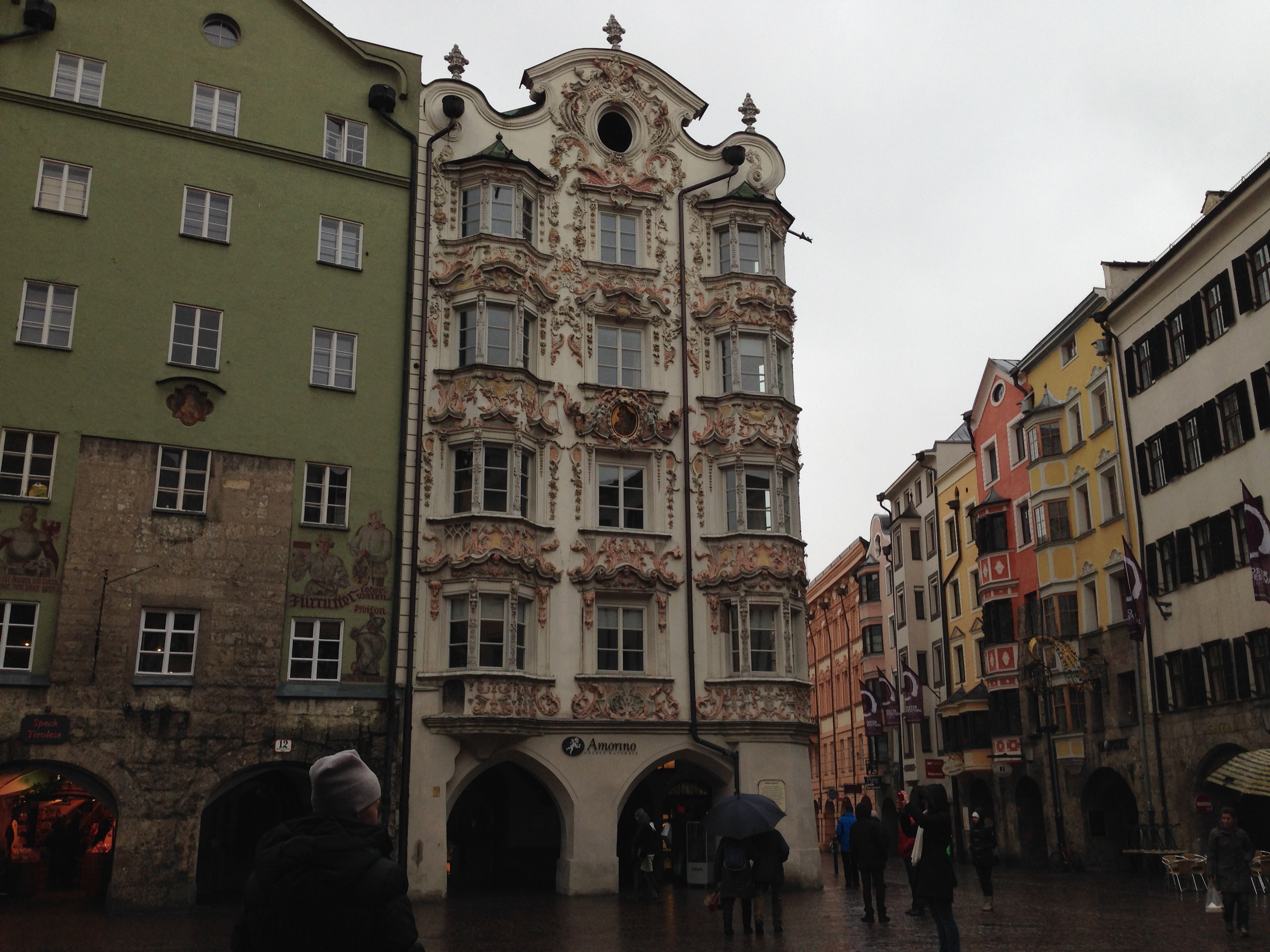
There are half-timbered houses – 78 of them are historical monuments from the 13th to th 19th century. The streets are narrow and cobbled …
P1060794

.. some hidden behind small passages.

P1060837

Above the town are the ruins of the castle. Like in Châtillon-sur-Seine, this castle has been destroyed by Henry IV. Yes, Henri was the grand-father of Louis XIV and fostered the power of the French king paving the way for his grand-son.

P1060842

The river Sérein makes a natural water ditch that protects the town on three sides.

P1060851

.

The recommended walk outside the city

In front of the southern gate I find a poster that announces signed round walks. They promise houses with dry stone walls which have remained from the vineyards that surrounded Noyers until the late 19th century. After having been hit by the phylloxera, these vineyards have been abandoned, but the dry stone houses are still there. I would like to see them…
P1060839

… and set out to follow the signs. I can see the village with the surrounding hills that were vineyards.

P1060844

The next sign directs me into an “impasse” (or “dead-end street”).

P1060846

I get lost in a large garden with an open gate. I oscillate a bit, and eventually find the sign where I should have turned left (it is all at the bottom and has become faint)..

P1060847

The sign directs me to this garage. To the left there is private garden and to the right nothing but mud.

P1060848

The hiking trail is disappearing in the middle of nowhere. This can happen in France. I change my plans. I will surely find a charming place to have a tea or coffee in Noyers.

.

The “Centre pour les Arts” with the large selection of tea and coffee

The “Centre pour les Arts” is just opposite of  the townhall. It is run by a friendly couple. I enter to sit down and enjoy the tasteful ambiance. I order a cup of hot chocolate. “How do you want your hot chocolate, with water or milk?” the owner asks me. “You make hot chocolate with water? Then I want it with water. Like I know it from Mexico, but this is so difficult to get here,” I answer happily. The eyes of the owner shine bright: “So you want to drink the chocolate as it should be, you are a connaisseur.” I sip my hot chocolate with a tasty biscuit. I study the menu. It has coffee from various countries in Latin America (such as Costa Rica) – a great selection. They also have tea. They assign tasting notes, like we do for wine.
P1060853

I rest, read and recover in this welcoming place that also has good reviews in Tripadvisor. I should perhaps add another review.

.

“This car does not disturb ME” – a wonderful market appears in Noyers two days later and gives us another charming French experience

Our cars are parked on the Place de la Mairie. I come down in the morning to load my car, because we intend to leave for Beaune today.  I notice a lot of activity. A stand is emerging around the car of my Russian friends. “Is this your car”, the stall owner asks me. “No, THAT is my car”, and I point to my Audi. “Cette voiture -là ne me gêne pas”, he says (that car does not disturb me). When Katja comes down to repark her car, the fish seller drives in with his lorry that opens up to become a stall. He frowns at me. I say  that I had been told that my car is not in the way. “Well may be your car does not disturb HIM, but THIS is is my place.” he says pointing to my Audi. So, I move my car away as well. More stands are being installed. This is a wonderful small market with local products. We leave nevertheless, as we are have arranged to meet Patrick Piuze in Chablis.