Albania – on the tracks of Ismail Kadaré in Gjirokaster

Gjirokaster – a town made of stone

How much have I looked forward to this day. Today I will follow the tracks of Ismail Kadaré’s “chronicle in stone”. I had read the chronicle a year ago. It is the story of the three to seven year old boy that observed the war as a child: The first years from 1939-1940 and the second part from 1941-1943.

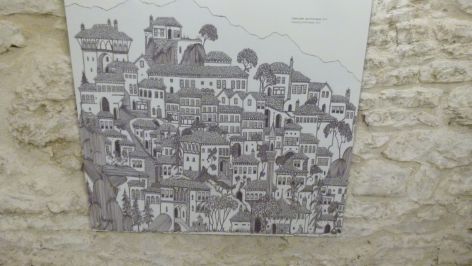
Today, we slender through the town where “it could happen that the basement of one house touched the roof of another house. It was a town made of stone.” As illustrated in the castle museum:

P1090871

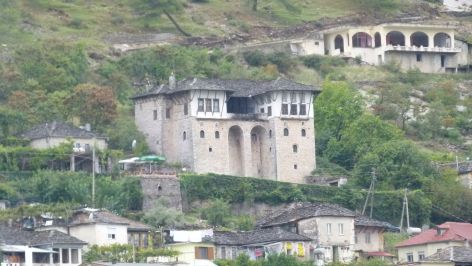
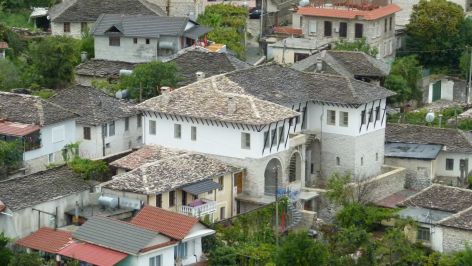
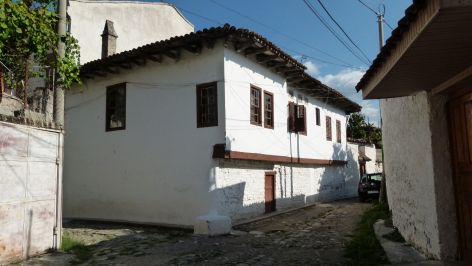
The houses look like fortresses:  Basement with vaults, then large windows behind which the guestrooms with the divans were.

P1090969

Rich landowners lived here. They had farmers working for them. The town was wealthy due to agriculture, trade and craftmanship (eg leather).

Enver Hoxha’s house is now an ethnographics museum showing the rooms for guests, men, children and women as well as the kitchen.

P1090915

In his chronicle, Kadaré talks about Hoxha. He was a communist partisan at that time and his house was a ruin. ““This ruin was his house”, Ilir whispers to Ismail in winter 41/42 and in the ruins they find this notice: “Wanted: The dangerous communist Enver Hoxha. He is about 30 years old and tall…”” (see my blog 1941-1943)

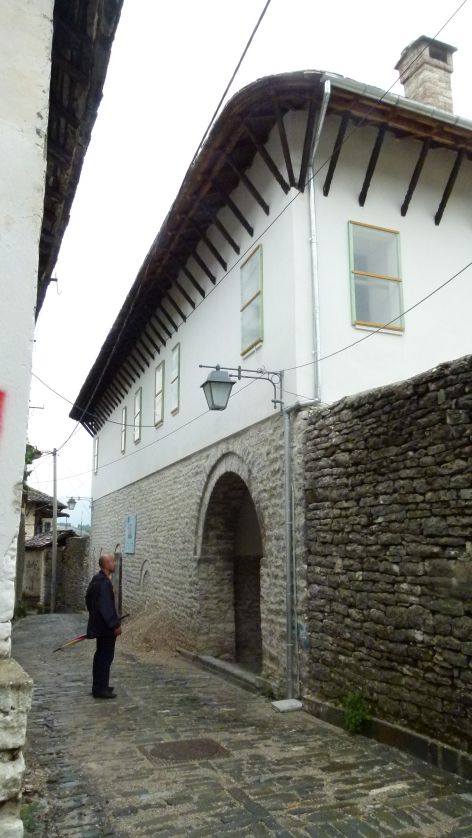
This is another example of a fortified house; it belonged to the Skenduli family.

P1090919

The entry door is horizontal – what a clever design.

P1090922

.

The castle above the town 

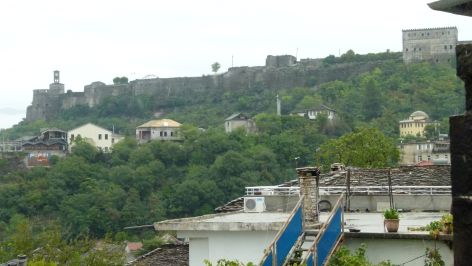
The castle above the town has been fortified by Ali Pasha around 1800 to become a stronghold that could withstand bombing. In Kadaré’s chronicle, there was a prison here. Later the whole city hid from the English bombs. ” The number of air raids by the English is augmenting. The citizens move into the castle above the town. Only Grand-Ma Selfixhe stays in the house of the Kadarés. ” (see 1941-1943)

P1090911

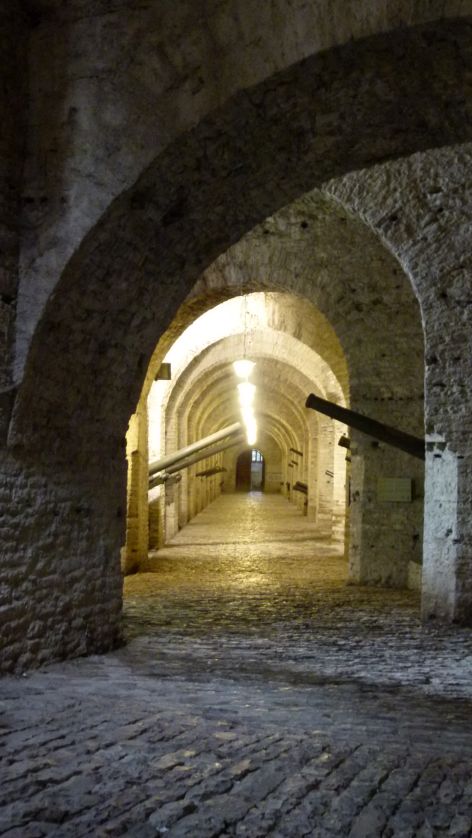
The vaults were thick – here is a photo with the galerie of canons.

P1090860

During his dictatorship, Hoxha added an ugly communist building (now hosting an exhibition of rifles) and in addition tunnels underneath the castle.

.

The house of Ismail Kadaré – it is stronger than all other houses and the boy is proud of it…

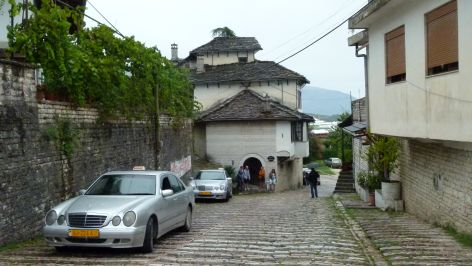
The house of Ismail Kadaré is on a horizontal street. From above it almost looks small.

P1090933

From the hotel Kodra I can see, what a large house it is. Yes, Ismail, you are right to be proud of this house.

P1090964

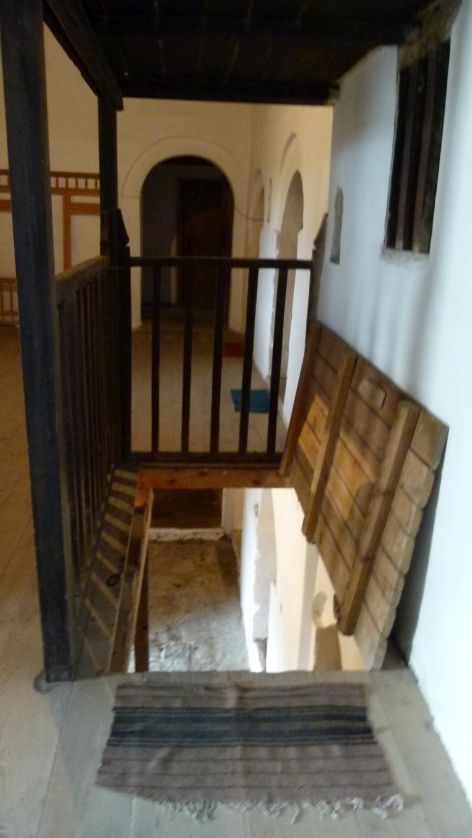
Ismail Kadaré has donated his house to the state. It is being renovated and is closed. We are allowed in. Currently they are redoing the room where Ismail was born, the foreman explains to us.

P1090946

So – may be it was from this room that the boy Ismail stood at the window and watched,  how “… in summer 1940 the Italians have built an airport below the town. The boy has observed the process. The cows have disappeared… The  boy admires the parade of white planes. He is proud that Gjirokaster now also has planes… He watches the planes go south and he is always happy to see them come back.” (see 1939-1940)

P1090943

Today the airport is not in use, but there are some plans to reuse it as a local airport.

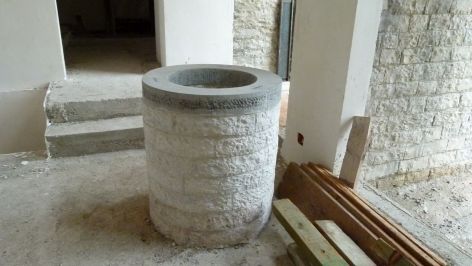
The house has a cistern that collects rain water. ” … the rain drops land on the roof of the house – not yet knowing about their fate. Their fate is to get caught in the drainspout and to be captivated in the dark cistern, until mum lifts some of them into a bucket to clean the floors in the house. During the stormy night, the cistern fills with water – too much water. The boy shouts “huuuh” into the cistern, but it is angry and does not reply. ” (see 1939-1940). This must be, where the boy shouted “huuuh” and the angry cistern did not reply… it was too full with water and had to be emptied, with the help of the neighbours.

P1090935

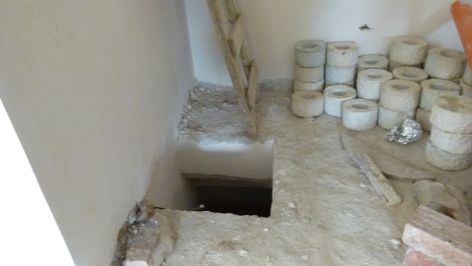
The foreman shows us, where the bunker is. How proud Ismail was of “his” house! “One morning the boy discovers a metallic plate next to the door of their house: “Air raid shelter for 90 persons”. Passerbies read the plate. The boy smiles proudly at them: “Look, this is a house, it is stronger than all the other houses, it is the only one with such a plate.” The adults do not notice him. The boy goes down into the vault and admires the thick walls.” (see 1939-1940)

P1090942

In this bunker the boy listened to the conversations – one of them was about Albania: “The former artillerist Avdo Barbamo says that a Dervish wanted to know from him, what he prefers, his family or Albania. “Albania, this is evident”, the artillerist answered. His reasoning: You create a family over night, after having met a woman in a café. But Albania? You do no create Albania in a night, even 1001 nights do not suffice. ” (see 1939-1940)

I am very happy to have found the house of Ismail Kadaré. The foreman does not want any money – he is too proud, but in the end he accepts. I must have been the only tourist that has come to this construction site officially closed for tourists. I dream of a “tour Kadaré” that leads to all the places of his “chronicle of stone” displaying some relevant quotes on panels. Perhaps I should suggest this to the tourist office of Gjirokaster?

.

German support for border controls in the hotel Kodra

Under the square that once has hosted the memorial for Enver Hoxha there is the new hotel Kodra. We meet some German policemen that help control the border to avoid Albanians going to Greece. “Why only repression? What about coaching for business?” I ask. They answer: “Our mission is controling the border, we cannot do anything about it”. I am sighing. If only we could change the world for the better instead of only adding violence.

.

Our afternoon program: Hiking on the Lunxhëri hills and visiting a small church, the hermit’s cave and Antigonea, the ancient capital of Pyrrhus

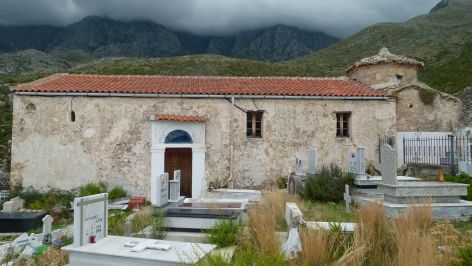
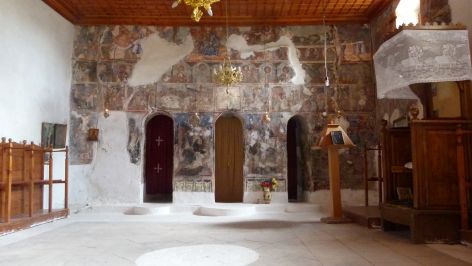
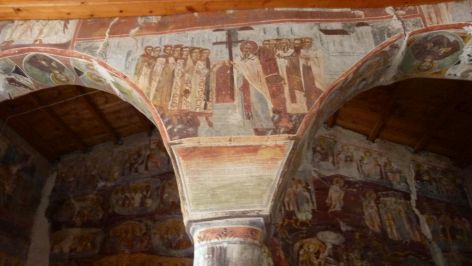
It is no longer raining, just drizzling. Ben drives our car on to the Lunxhëri hills. We walk uphill. There are herds of sheep and goats with dogs guarding them. They bark at us, angrily. We find this church… the remains of a monastery called Shën Mërisë. According to Reise Know How Albania, p. 445, it contains frescoes.

P1090989

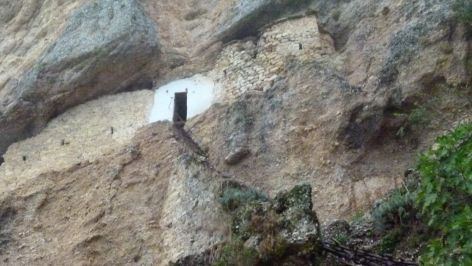
Above the church, there is a small chapel in the rock. According to Reise Know How (p.445), this is the cave of a hermit and it is called Spile.

P1090993

The stairs are dizzying. There are many excrements of goats – After having visited the cave, we wash our hands in a creek nearby. The weather starts to  clear up.

P1090996

The shepherds come home and we have a chat with them.

P1100003

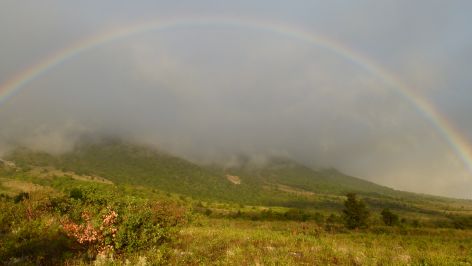
The rainbow does not fit on to our photo lenses – and as we move, it moves with us…

P1100007

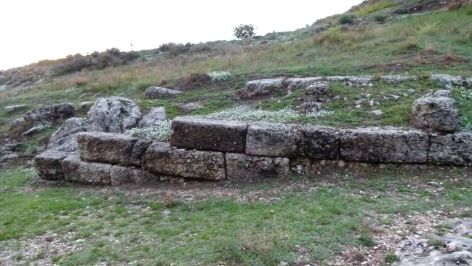
Antigonea was the capital of Epirus in the 3rd century BC. It was destroyed in 167 BC. Pyrrhus (famous for his victory) named the town after his wife Antigone.

P1100015

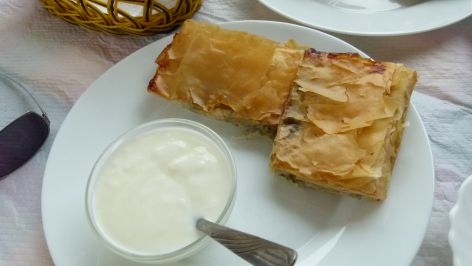
We say hello to Antigonea and, as it becomes dark, we return to Gjirokaster. We have dinner in the Taverna (I believe it is just across the building where the partisans had burnt the cadasters, as observed by the boy Ismail).

P1090959

This has been another great day. Thank you, Ben.

Tomorrow, we will visit Ali Pasha in Tepelene and continue to Permet.

Albania – from Saranda via Butrint to Gjirokaster

Today is 25th of September. Butrint and Gjirokastra are on the program. I do look forward to the excavations at Butrint and to the town in stone, described by Ismail Kadaré.

.

Saranda – early morning walk

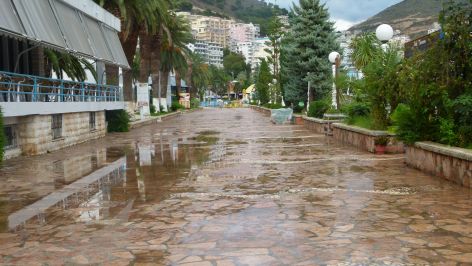
It pours with rain at six in the morning, but when I get out a little later, the rain had stopped and I catch some early morning views – this is the tidy promenade along the bay.

P1090690

.

Butrint – heavy rain and then dry weather

Butrint is located on the half island of a brackwater lake. South of Butrint, the Vivari channel connects the lake with the sea. When we arrive at Butrint, it pours with rain again.

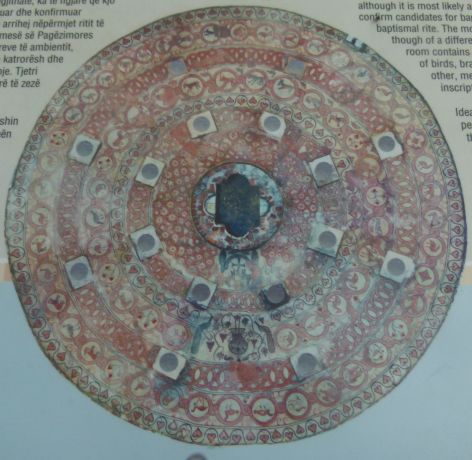
At the entrance gate, a panel lays out the periods of Butrint: Chaonian/Epirus/hellenistic (inner circle, 4th century BC), Roman (outer circle, an aqueduct crossed the Vivari channel, as illustrated on Roman coins; until about 300 AD), early Byzantine (Baptistery and Basilika, until about 1200 AD), Medieval times with changing rulers (Venetian tower and museum building), around 1800 used as a fortress by Ali Pasha (he fought against Napoleon). I buy the book about Butrint  by Çondi (on sale at the kiosk near the museum).

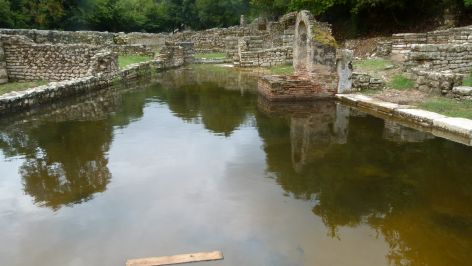
We enter the site. It has stopped raining. Lucky us. I am surprised to see the city center (agora and forum) under water. This may have been caused by the earthquake around 300 AD.

P1090711

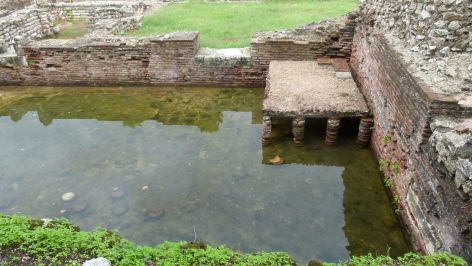
I recognize the Roman heating – the thermae were here. Such hypocausts have also been dug out in Augusta Raurica near Basel.

P1090718

The baptistery is the place where Christians were baptized. Arranged in seven rings the mosaic contains symbols that illustrate, what becoming Christian means. For instance the fish are the symbol for the sinners that are being saved by Christ. (Condi, p. 85).

P1090730

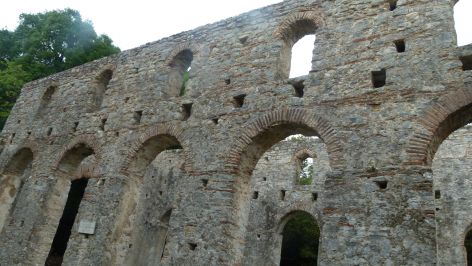
The basilica remaining from the early Byzantine times is relatively well kept.

P1090736

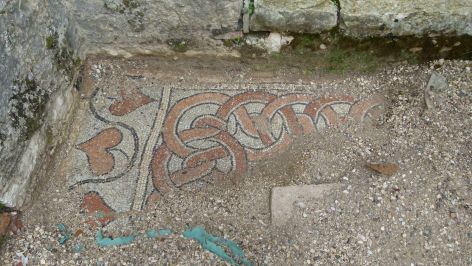
The mosaic is covered with sand, but a small edge is free and gives an impression of its beauty.

P1090741

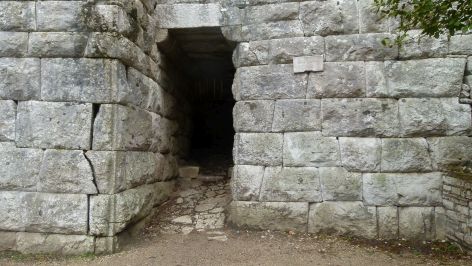
This is an Illyrian gate, almost hidden. I am impressed by the strength of these walls that withstood earthquake despite the damages. Like the Inca in South America, the Chaonians knew how to construct stable walls.

P1090745

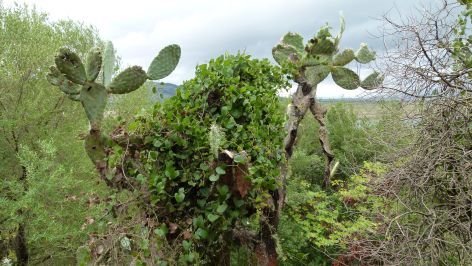
We pass the Lion’s gate, a fountain, and more sites, visit the museum (no photos allowed) and then – with the twinkle of an eye. I take this picture of a “Roman” Opuntia.

P1090761

Butrint is full with tourists that follow their guides. The guides speak like water falls, and I can tell from the eyes of many of their followers that they are no longer listening. Perhaps we should hire the tour guide from Thun that challenges his followers by brainteasers. In Butrint, one such brainteaser could be: “Using the elements of the Opuntia, the Romans prepared a salad called Nopalae, right?” –  Wrong – Nopales is a stunningly delicious meal in Mexico, but only after 1492 the Opuntia travelled to Europe and the Old World – whereby Nopales salad has not become widely known here.

.

Lunch at Ksamil village

We have lunch at the small restaurant Rilindja in Ksamil village. It has started to pour with rain now.

P1090768

The place looks romantic and the chief prepares an excellent merluc (hake) with rosemary. I hear a French accent… it is a tourist from Strassbourg that has entered the restaurant. He owns a house on the Ksamil island. He spends some days here to prepare his boat for the winter.

.

Excursions around Saranda: the castle Lekures and the monastery of the 40 Saints.

The castle Lekures is located on top of a hill west of Saranda.

P1090803

It is a restaurant. The deal with the owner seems to bee: You look after the castle and you can use it as a restaurant. It is foggy right now.

P1090781

But then, the fog dissipates and gives way to the view of the bay and of Korfu.

P1090785

The monastery of the 40 Saints (manastir 40 shenjtoret) is a ruin. The panel gives an idea of what it was before.

P1090805

This monastery gave the name to “Saranda” which is “forty” in Greek.

.

Crossing the mountains on the way to Gjirokaster – a stop at the Blue Eye Spring (Syri y Kalter)

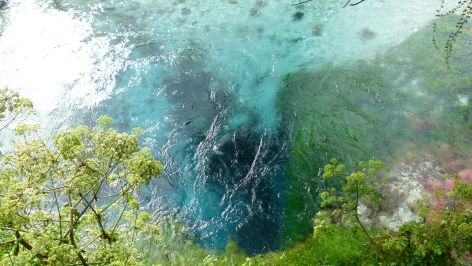
The Blue Eye Spring is a favourite stop over for tourists and Albanians on the way to Gjirokaster. The spring really looks like a blue eye.

P1090821

.

Gjirokaster – the town that I already know from Ismail Kadaré

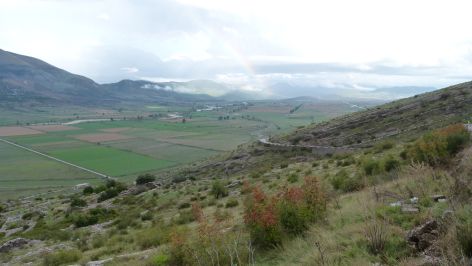
We reach the fertile valley of the Drino.

P1090834

This is the valley of Gjirokaster, the town I already know from having read Ismail Kadaré’s “chronicle in stone”. The town has steep and narrow streets, and it is not a pedestrian zone. Cars are omnipresent. We look for our hotel Kalemi 1, land in Kalemi 2 first, have to drive backwards and turn around rectangular corners – I admire the driving skills of Ben.

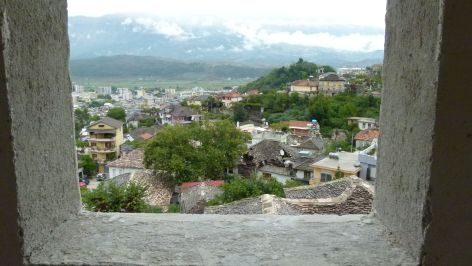
My room is small and the toilet does not work. The manager is very kind and gives me a huge room with a great view of the town, the Drino valley and the Lunxhëri mountains.

P1090976

Tomorrow we will follow the tracks of Ismail Kadaré’s “chronicle in stone”. I do look forward to that.


Albania – from Llogara Village to Saranda

Today we go for an early morning walk in the Llogara hills and then drive down to Saranda along the beautiful Albanian Riviera. It is now 24th of September 2015.

.

Early morning walk to see the Ionian Sea

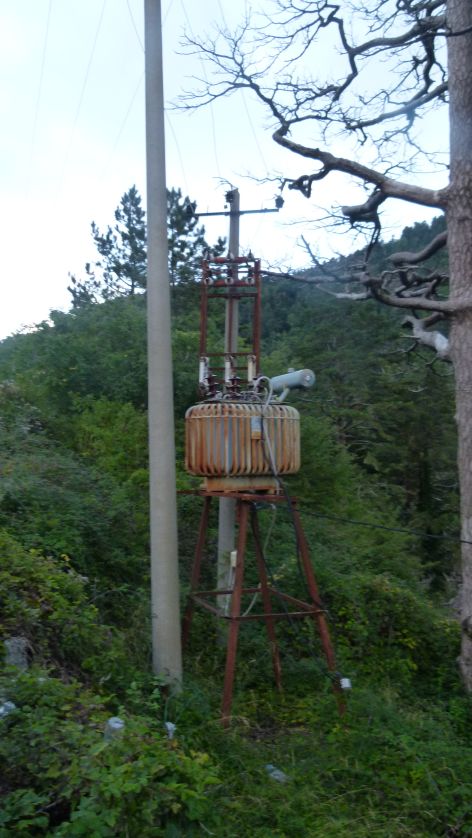
Ben and I meet in the hotel reception early in the morning at six. Great that the coffee bar already serves an espresso. We walk up to the neck coming across this interesting electrical installation.

P1090532

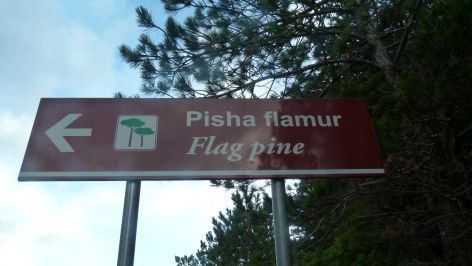
Flag pines are our companions on the way up – they are called “pisha flamur” in Albanian.

P1090560

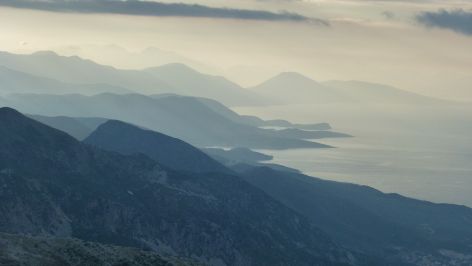
From the neck we climb uphill towards a peak. There is a gorgeous view of the Ionian coast line. In Albanian “jon” means “our”, Ben explains to me. Hence for the Albanians the “Ionian Sea” is “Our Sea”.

P1090553

Clouds are announcing that the weather will change soon. There is also a cloud covering the peak in front of us.  We return to our hotel to have breakfast. The coffee is so bad that I refuse to drink it. But milk with honey is fine…

P1090565

The young guy at the hotel reception has an excellent American accent. “Where have you studied English”, I ask him. “In Utah”, he answers. Aha, in Utah, in the beehive state? Are the Mormons present in Albania? Yes, he is a Mormon. His whole family has converted. His friends are just on their way to Switzerland, because the nearest Mormon Temple in Europe is in Berne. Albania seems to be open for all religions – I like that.

.

Driving back to the neck and along the Albanian Riviera 

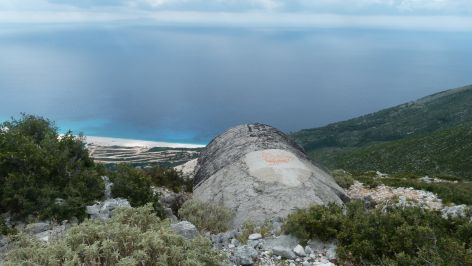
We load our car and drive to the neck now. There are German bunkers here – looking down to the coast line and the bungalow resort “Green Coast” that is planned in the bay.

P1090577

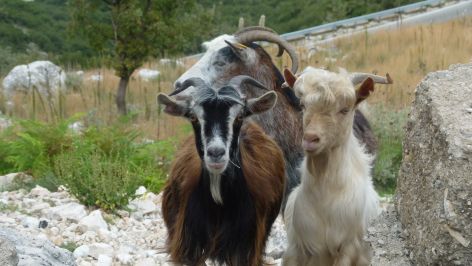
Between bushes of thyme and salvia we find a stand that sells honey. Ben tries the honey and likes it. We buy a pot. A herd of goats is crossing the road. They seem to think that cars are strange animals…

P1090587

.

Stop in Dhermi with the monastery and church Shën Mërisë 

Now we are in Dhermi. White houses are greeting us. Above them is the church Shën Mërisë. On a small path, we climb up. Most of the tombs are Greek here.

P1090612

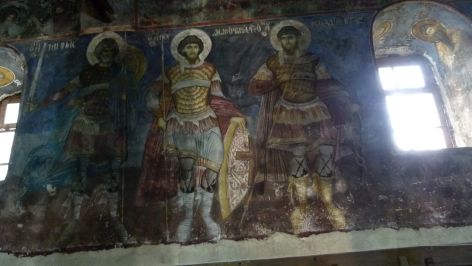
There are the frescoes inside the church.

P1090603

P1090601

When we walk down, a car from Poland comes up the steep and sinuous street. The priest is following fast in his Mercedes. It is almost eleven and he must soon ring the bell.

.

Our next stop is Himara

The Illyrian town Himara lies on a rock at about 150m above sea level. This town has the oldest castle in Albania (7th century B.C.). Himara withstood the Ottomans, kept its orthodox religion and stayed somewhat independent.

P1090625

The village is now decaying. This romantic spot would have potential for tourism. Now there is no touristic infrastructure, even not a kiosk selling souvenirs or drinks.

P1090633

A Greek minority lives in this area. My mobile phone beeps and  says “welcome to Greece”. But we are still far from Greece. Ben mumbles that here he once got caught and had to pay roaming fees, though he was still in Albania. I am surprised – a kind of battle takes place between the Albanian and Greek Telecom companies.

Below Himara village we stop in the sea resort Himara. It looks ugly. The buildings are decaying. The fountain is falling apart. Only a few tourists are here – to me they look like “old 68’s”.  A ghosty atmosphere. I want to leave this place immediately.

.

Porto Palermo with the castle of Ali Pasha and the submarine garage

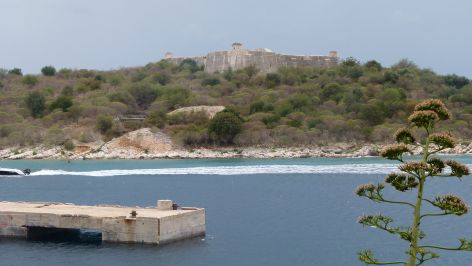
Porto Palermo has always been a natural port. Ali Pasha built a fortification in 1804, with the help of French engineers, as an engraving shows. Later this fortification has been a prison and it was also used by the Italians and the Germans in the second World War.

P1090645

In an unfriendly restaurant, we have lunch (at least the fish was fresh). Then we get the key from the guard who has escaped the pouring rain by retreating to his apartment. With a group of students from Poland we explore the fortress.  The students have come here from Saranda, driving in a convoi of small cars from Sipa Tours. A cheerful group of young people – dzien dobry!

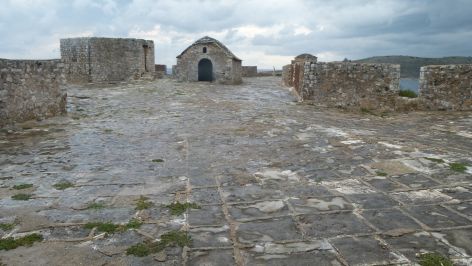
The ground floor of the fortress is groomy, damp and dark. We are happy to climb to the roof and find fresh air with a view of the bay.

P1090655

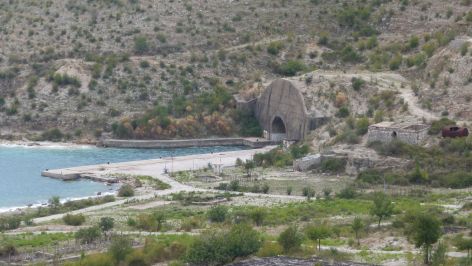
Not far from here is the garage for submarines that has been built during communist times.

P1090641

After a stop in a bar that sits on top of water falls (Borsh – unfortunately closed), we drive to Saranda.

.

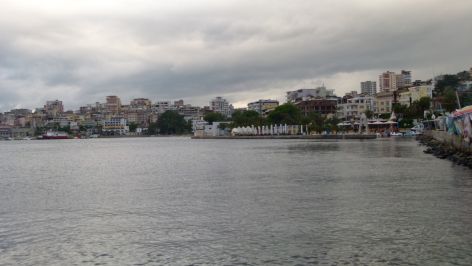
Saranda is a vibrant sea resort in a beautiful bay just across Korfu

We stay in the Kaonia hotel directly facing the sea. Saranda has been an Illyrian and Greek settlement, but in ancient times it has always been dwarfed by Butrint that is not far from here. The name “Saranda” derives from the “40 saints”.

P1090672

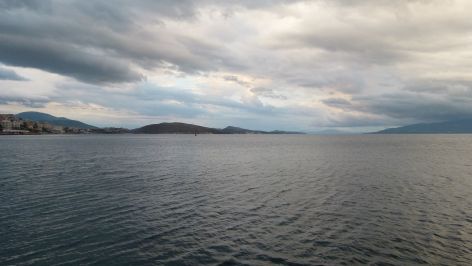
Korfu and Greece are just across the bay.

P1090677

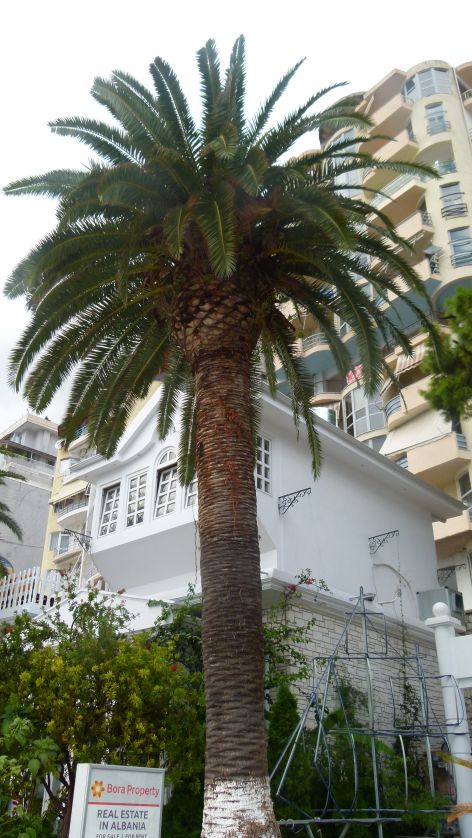
We walk along the seafront. Some palm trees are beautiful – like this one -, while some have caught a disease – just the stems are left. Saranda makes a good impression. Real estate is on sale, in English and in Russian.

P1090683

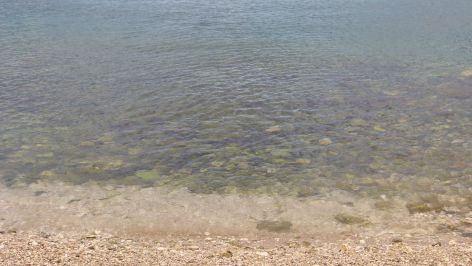
The public beach is clean and the water would invite for a swim… well, not today. It is raining.

P1090688

Tomorrow we will see Butrint – the Unesco World Heritage Site south of Saranda – I look forward to that.


WordPress – some lessons learned from a full media library

A lot of pleasure with WordPress for two and a half years – now I am blocked

When retiring, I set up my WordPress site with the “dusk to dawn” theme, wrote more than 100 blogs and uploaded many, many photos to my media library. About a month ago, I receive the howdy-message that I have reached the free limit of 3GB. I can no longer upload photos. Well, I have to admit, I have blogged a lot, I have never looked at the size of my photos – and I knew, now I have to start thinking about all that first.

.

Why have I hit a limit in WordPress in the first place, though all my blogs sit on a private server?

All my petrapeters.ch blogs sit on a private server and not in the Wordpress “cloud”. So, why have I hit a WordPress storage limit in the first place? As I understand eventually, the media library is in the WordPress cloud and not on the local server. I do not understand why, but I can also not figure out, whether it would be possible to change this. Okay, I accept the fact that my media library has to fit into the storage space provided by WordPress. Freely available are 3GB – more space is available at a price.

My conclusion: Plan for the premium upgrade, but try to understand more before doing so.

.

Can I resize my photos in the media library – after the fact?

I look at the size of my photos and understand that they are 4-5MB large. Well, I know I should have thought about this before.

So I start to tidy up my media library. I delete all unused photos – a very handy feature in WordPress. The howdy message becomes less frightening: I am at some 97% of my maximum storage (and no longer 99%). Next I start to downsize the used photos by editing them in the WordPress media library. After some time, the howdy message becomes frightening again: I am at 101% now. Why? I have downsized so many photos and as a result I use more space? Yes, WordPress has ADDED the smaller photos TO the existing ones. My wish to WordPress: What about adding a feature that allows to resize photos after having uploaded them AND delete the larger versions at the same time?

My conclusion: Resizing the photos can only be done BEFORE uploading them to the media library. Oh dear.

.

What image editing software is recommended to resize the photos before uploading them?

For image optimization, this WordPress support blog recommends various image editing software programs, on top of the list being Irfanview. I find it straightforward to use. I will set up a shadow media library in my picture folders for my downsized photos. The blog also tells me that smaller photos will make my page load faster, when people look at it.

In addition I learn that JPEG is the recommended format for photos, PNG for details such as text (e.g. maps)  and GIF for line art such as logos.

My conclusion: Resize photos using Irfanview, keep a shadow media library and upload photos to WordPress after resizing.

.

What number of pixels and what file size are optimal for my photos, before uploading them to WordPress? 

File size: An entry in the wordpress codex teaches me: “Typically, large high quality images should be kept between 100K and 60K.” Oh, sorry, 4-5 KB might have been a bit much. I resize some photos to about 100K and find them slightly less brilliant, but I will have to live with that knowing that loading will be much faster instead.

Number of pixels: The handle I am using to resize the photos is the number of pixels. What number is optimal? The wordpress codex article indicates that for each WordPress theme there is an optimal number of pixels. What is the optimal number for “my” theme which is “dusk to dawn”? I am confused by various recommendations in the internet, and ask the happiness engineer. He writes to me: “Suggested header images are 870px x 220px. The content of the page (left sidebar plus articles) is 870px wide. The left sidebar is 282 px wide. The right article area is 588px wide. And actual content of posts are 472px wide without padding.” Okay – 472px.

My conclusion: Resize photos to 472px wide which will resize them to some 60K to 100K.

.

Now buy the premium upgrade and start over again

Now I buy the premium upgrade. I discover that premium includes having a private domain (which I have paid for so far anyway), and I can have a discount right now. For all the pleasure I have had with WordPress, I am happy to contribute the premium price.

Immediately I can upload photos again. But from now on I restrict them to 472px wide and upload them only after having resized them. I also start to resize some of the photos in older blogs – but this is quite cumbersome and will take time.

.

May I restate my wishes – why does WordPress not allow to resize photos in THEIR media library and – at the same time – ONLY keep the small versions of the photos deleting all other versions? And why does the media library HAVE TO BE in the WordPress cloud – why cannot it not be moved to the local server that also keeps the blogs.

Albania – a day in Berat

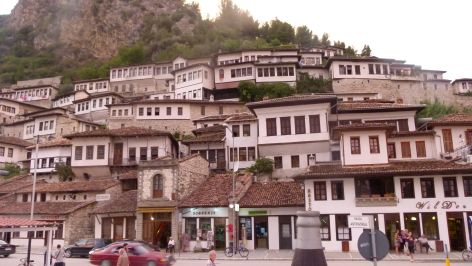
Hotel White City – great view of Mangalem from the balcony

The hotel White City serves breakfast on the balcony of the hird floor. From the balcony, there is a great view of Mangalem, the city under the castle. I can see where the name “white town of 1000 windows” comes from.

P1090270

.

Walking up to the castle hill

Above Mangalem is the city castle. On the way up we stop in the ethnological museum which is hosted in the house of the noble Xhokaxhi family.

P1090282

On the groundfloor there is an exhibition of clothes – noble ones made from silk embroidered with gold for the Pashas and plain white ones made out of wool for normal people. On the first floor the guest rooms with sofas, tea equipment and weapons have been arranged, as well as the kitchen and the rooms for the women.

We continue to the castle and pay our entrance fee.


Walking around the wall

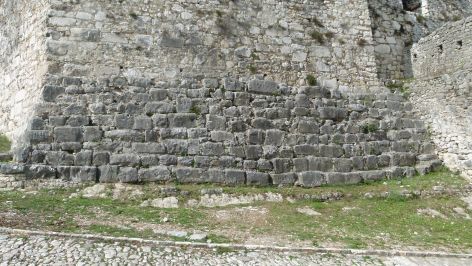
The castle was first built in Illyrian times, and their solid walls remain. In Illyrian days, Berat was called Atrantia. The names of one of the streets and a restaurant remind us of that.

P1090291

We walk around the castle walls. Berat saw changing rulers: the Bulgarians (they called Berat “Beli Grad”), the Byzantines (two times), Epirus (one of the streets is called after Mihal Komneini from Epirus) and the Serbs under Stefan Dušek. From those Christian times there are churches on the Berat castle – most of them are ruins today. This is the Shën Triada Church.

P1090300

For 500 years the Ottomans ruled over Berat… also their mosques are mostly in ruins. This is the Red Mosque.

P1090307

A lady sits in a room under the castle wall – she fabricates embroidery – one napkin takes a week and she earns perhaps 10 to  20 dollars by selling it.

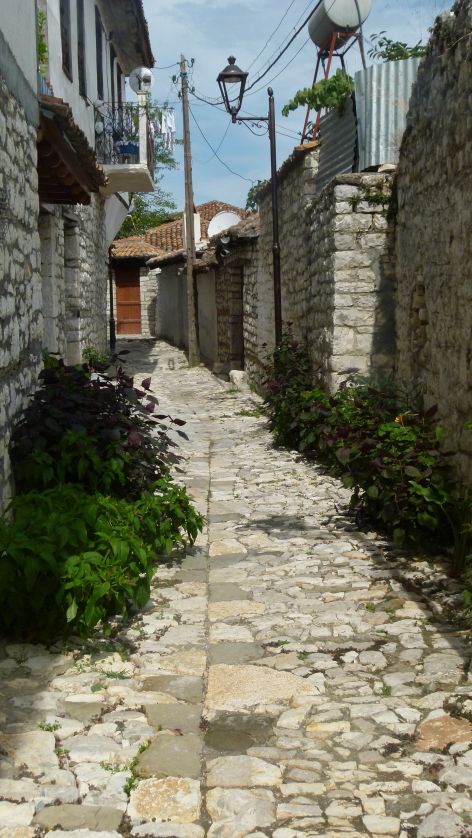
Hidden inside the castle walls is a city with narrow streets. The Turkish style houses are from the 18th/19th century.

P1090337

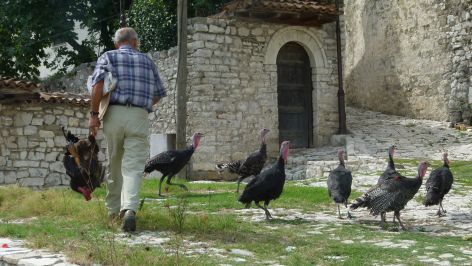
Also animals live here, cocks with their hens, sheep and also turkeys.

P1090328

.

Our highlight: The Onufri museum

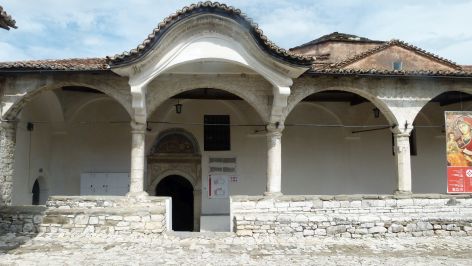
The Cathedral of St. Mary is now a museum. It takes its name from Onufri; he was an icon painter in the 16th century. On display are icons from him and from other icon painters.

P1090343

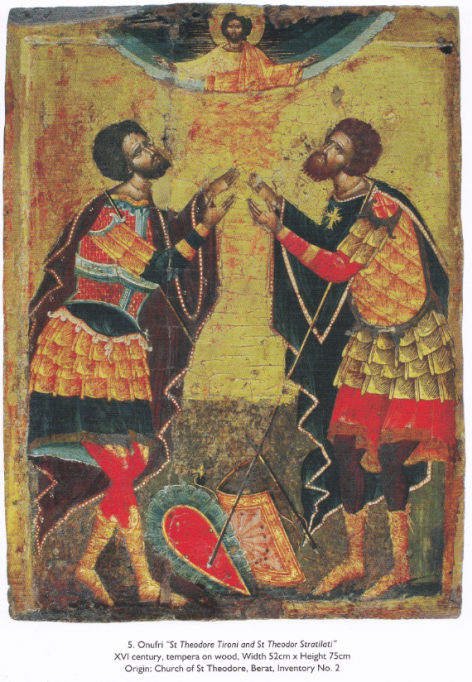
Anila has just started her tour with a Russian group. She explains the icons in English and the Russian tour leader translates for her group. Very professional. Father Onufri’s icons are vivid and adorned with a bright red colour – here are two Theodors.

Onufri_Theodor&Theodor

Source: Leon Cika and Ylli Drishti: “The icons of Berat”, Mali Preshti Printing house.

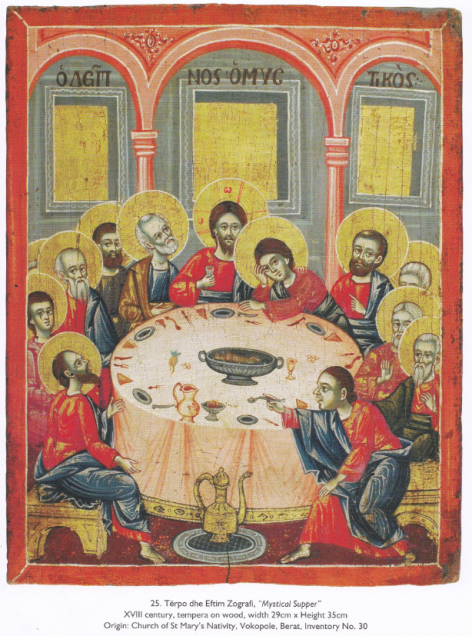
This is the Last Supper taking place at a round table with vessels, forks and knife in the Ottoman style.

Abendmahlamrundentisch

Source: Leon Cika and Ylli Drishti: “The icons of Berat”, Mali Preshti Printing house.

And here the icon painter added a mosque with a minaret, as a reference to the Ottoman rulers in the country.

Jungbrunnenmoschee

Source: Leon Cika and Ylli Drishti: “The icons of Berat”, Mali Preshti Printing house.


Lunch at Klea

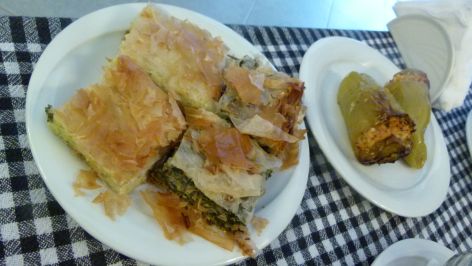
We have lunch in the Klea: Vegetable soup, Byrek with eggplant and spinach, musakka – everything home made and delicious.

P1090355

.

New town and Gorice

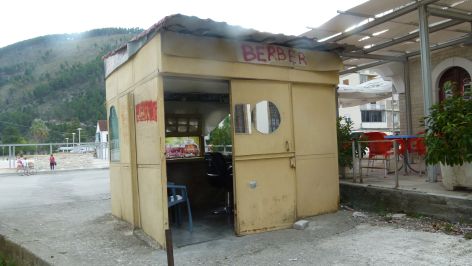
We stroll around the new town with the Bektashi centre and an orthodox church. I like this hairdresser, called “berber” in Albanian.

P1090362

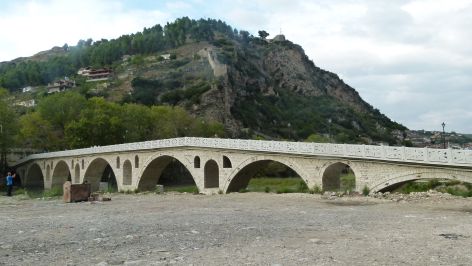
We cross the Ottoman bride to Gorice, …

P1090388

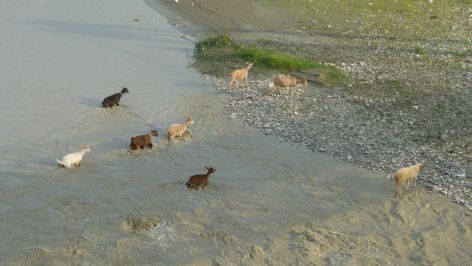
… accompanied by goats crossing the Osum river in the water.

P1090393

The small church of Saint Mehillit (from the 13/14th century) is unfortunately closed – this is the view from the castle hill.

P1090313

We finish off this day by walking along the busy main street of new Berat and climb the castle hill from behind. On the way up, we meet a elderly woman with friendly eyes that limps down the steep street. Ben has a chat with her. She wishes us a long life. Thank you.

We return to the Kea restaurant and guest house. In the garden we have a beer, a glass of red wine and some goat cheese. Excellent. Whenever I come back to Berat, I would like to stay in this guest house. I made an entry in Tripadvisor. Back at home, Ben called me to give me the “thank you” from the owners. It is me that has to say thank you!


Albania – Pogradec to Tirana

Breakfast experience communist style

The early morning view from the hotel balcony is romantic; sun rays are breaking through the clouds promising better weather for today.

P1100511

We stay at the Enkelana hotel that is a former communist place, large and cold. The breakfast is very sober with dry bread and coffee from the thermos flask.  But then the waitor is kind and brings me an espresso from the coffee bar downstairs.

Morning walk to Hoxha’s park and villa

Hoxha had owned a villa in a beautiful park, an hour’s foot walk away from Podgradec. It is now a public park.

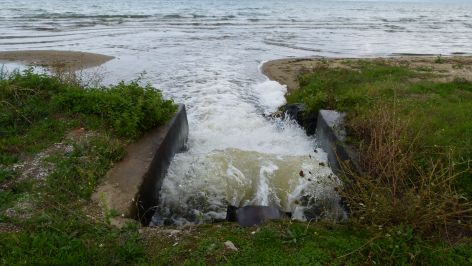
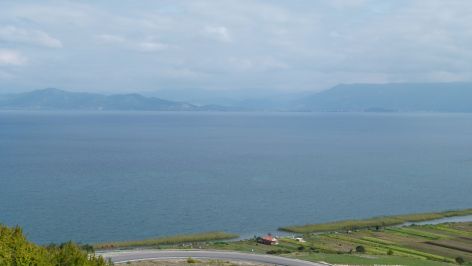
We walk to that park, along the lake Ohrid. The lake is a fragile eco system with endemic species that have survived for millions of years. I am shocked to find this tube letting sewage water into the lake, and at a high speed.


P1100521

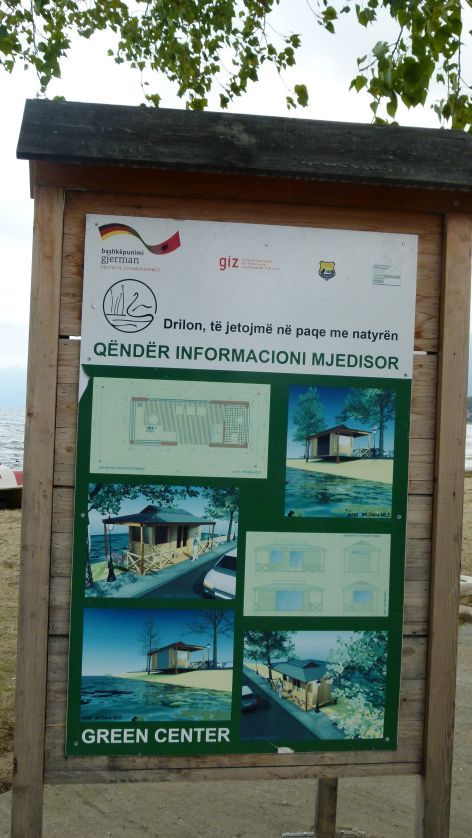
Not far from here is the “green center” from Germany.

P1100524

I hope they look into the sewage problem that is just 20m away from their stand.

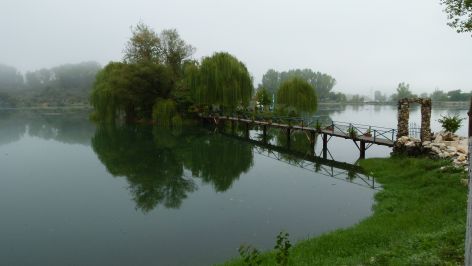
The park of Hoxha makes a nice walk along ponds with ducks and swans and between weeping willows.

Hoxha used to hunt here and additional ducks were provided, if needed.

P1100542

Along the lake Ohrid and into the mountains

We next start our journey back to Tirana following the Ohrid lake on the west side and then climbing uphill. We look back at the lake with Ohrid in the distance and say good bye – mirëu pafshim.

P1100548

The border to Macedonia is about 4km away. There is a field with about twenty mushroom bunkers built by Hoxha.

P1100550

On Via Egnatia and taking a rest at the Gjahtari restaurant

We cross the Jablanica hills and follow the river Shkumbin on the tracks of ancient Via Egnatia from Rome to Istanbul.

On the border of the Skumbim river, we stop at the Gjahtari restaurant. “Gjah” means “prey” and “tari” means “hunter” I am told. I also learn that “Gjah” is pronounced “DjaH” (the “h” is said, Albanians pronounce every letter).

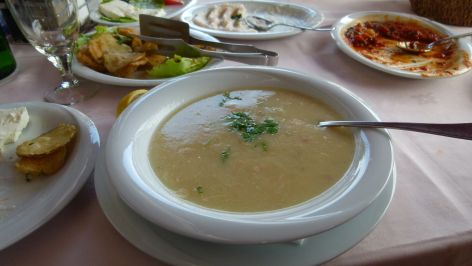
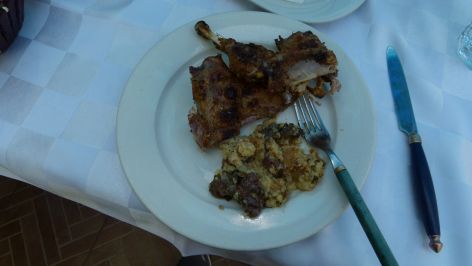
The restaurant is large and well visited. We eat Pershesh: This is chicken on bread with intestines, all prepared in an earthernware pot  that arrived at the table sizzling. The chicken was very crispy and tasty.

P1100554

The name of the river Shkumbin means “falling foam” in Albanian, when I understood this correctly.

Elbasan – old city within town wall

Elbasan is quite a welcoming town. The old city with its narrow streets hides behind the town wall.

P1100556

Behind the wall, we find a well kept restaurant for Turkish coffee.

P1100561

The garden is absolutely perfect, with flowers, bushes and trees, all well trimmed. A talented gardener has architected it.

This is St. Mary church. The Albanian flag is on top of the church tower.

P1100582

Ben wants to introduce me to the priest that refuses to report into the patriarch of Greece, but the gate is closed.

The mosque of Elbasan has been built in 1417. It is the oldest mosque in Albania. The Ottomans were only able to conquer the north of Albania after Skanderbeg’s death (1468). The mosque is closed and being renovated.

P1100596

We slender through the narrow streets…

P1100586

… carefully watching out not to be overrun by cars that are allowed here.

P1100576

To Tirana

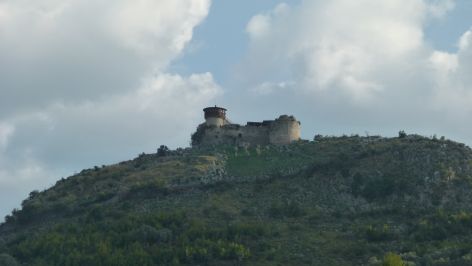
A motorway will connect Tirana and Elbasan, and it is partially ready. On the route we see the Petrelë castle that had been held by Mamica, the favorite sister of Skanderbeg – she was a brave supporter of his resisting the Ottomans.

P1100610

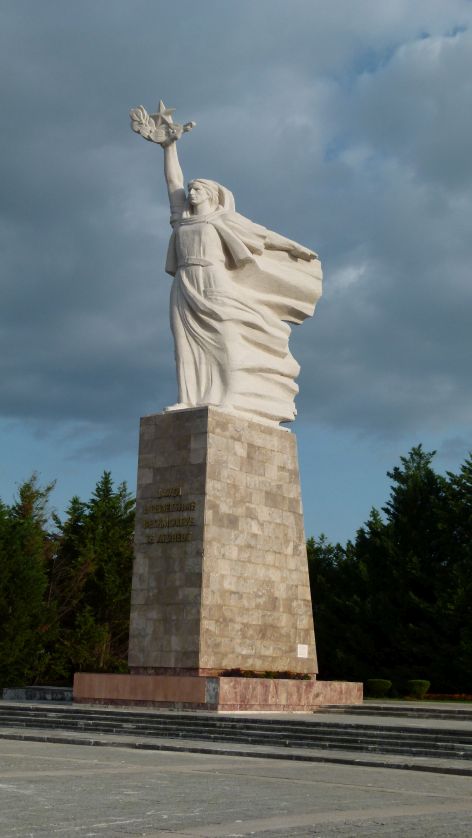
Before we enter Tirana, Ben stops at the statue of the Mother Albania.

P1100617

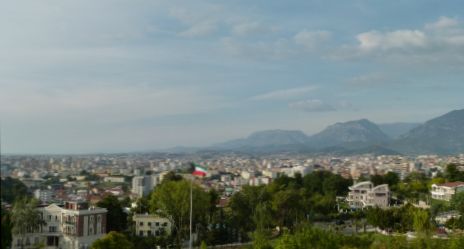
She guards over Tirana. We enjoy the view saying hello to Tirana, where my round tour through Albania will now finish.

P1100619

The 19 days were wonderful. We complete them with a dinner at the apartment of Ben’s family. His wife has prepared a delicious pite, yoghourt and sweet milk rice as a dessert. The one year old son has yoghourt and byrek in his face and looks very happy. So am I.

Faleminderit! Thank you!


Albania – Korça and Voskopaja

Tower of Korça with view

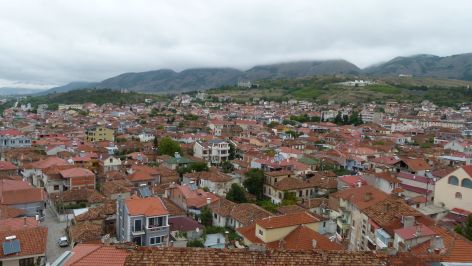
In the morning, we climb the rectangular tower in the city center to get an overview of Korça, located on 850m above sea level and surrounded by hills.

P1100283

Korça developed around 1800 after Voskopoja had decayed.

Next, we drive to Voskopaja that is located on about 1160m.

Walk around to Voskopoja

Located amidst soft hills, Voskopja was a cultural and economic center of the Ottoman empire in the 17th and 18th century. Around 1800 and then again in 1913 it was destroyed. It is a village now. This is the central square.

P1100290

We walk to the neck of Pasha, a hill on about 1600m above Voskopaja. We first follow a romantic creek that has made the path muddy. We find boletus…

P1100305

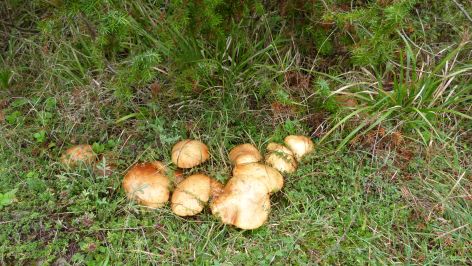
… and parasol mushrooms.

P1100302

If I were here with my camper, I would prepare a delicious risotto.

We reach a mountain lake.

P1100309

Sad. There was a restaurant and guest house here that had been built with much love for details such as a children’s playground and a fountain, but now it is decaying. The owner has given up.

Ever once in a while we have a view of Voskopaja.

P1100312

„By my memory, there is a path here”, Ben says and turns right. Yes, there IS a tiny path here, I would have never seen it. It is good to hike with a guy from the mountains that just feels, where he has to go. Ben now starts to pick up rubbish on the way… he wants his country to be cleaner. After about three hours we are back in Voskopaja.

Restaurant Taverna of Voskopoja

We are hungry and the Taverna is the obvious choice. We order Lakror (a pie with spinach and tomato/oignon)  and yoghurt from sheep milk.

P1100328

Delicious… I will have to look for the recipe.

There is a group of Albanians that now start to switch on local music – very, very, very loud. They dance to the music and enjoy it. I am happy to see them happy, but it is just too loud for me. No coffee here, we leave as quickly as we can.

Church St. Nicolas with frescoes

The church of St. Nicolas is closed.  Eventually we  find the key… the wife of the orthodox priest has it. She opens the gate.

P1100340

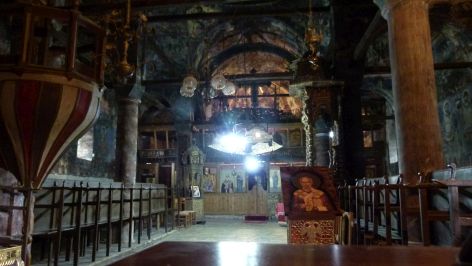
The church is beautiful with its frescoes.

P1100338

P1100337

Back to Korça and to museum of first school of Albania

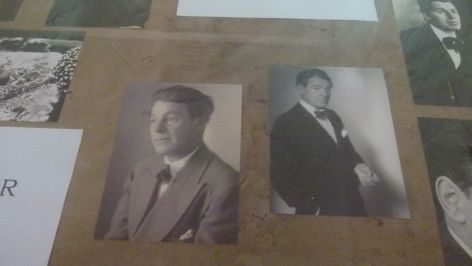
Around 1880 the first school was founded in Albania. Korça has a museum for that. It is not open. Ben rings the bell and a young guy opens.  He takes us around and adds insights to the explanations of Ben. I feel how proud both are that this school has defended teaching the Albanian language against all odds of suppression. The young guy working as a volunteer shows enthusiasm of the relicts that the museum has collected to illustrate the history. My highlight Is Alexander Moisiu, an Albanian actor who now is buried near Lugano in Switzerland.

P1100356

We later share a coffee with the young Albanian man from the museum. He makes a great impression on me. He is disabled, cannot walk well, but each morning he gets up at six to climb a mountain and train his muscles. He knows so much about world history, why is he not a teacher?

The park and the market of Korça

Korça is working hard to embellish their town. They have completed one of the most beautiful parks of Albania…

P1100362

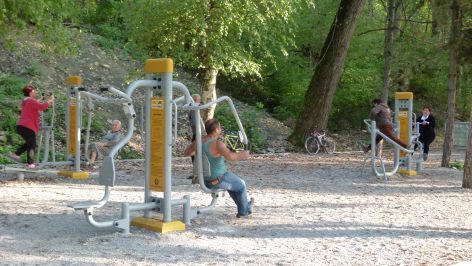
… even with a free open-air fitness center.

P1100365

They are also refurbishing their bazzaar. Work is going on everywhere, even at night. This is one of the edges that has been almost completed.

P1100368

I ask Ben, whether the people who have lived here before, can still afford to rent the renovated shops and houses. A Roma comes across us. He tells us the sad story of his people. They have lived here before, have sold second hand clothing, but now they will have to leave the market area and do not know yet, where to rebuild their business.

A light dinner at the Taverna of Korça

We wrap up our day with a light dinner, lime soup and salad, at the Taverna of Korça. “No, kos (yoghourt), I cannot serve you kos”, the waitor says. Last night he has given us his own kos, though it is not on the menu. But today he would like to eat his dinner himself… Very kind.


Albania – from Berat to Llogara Pass

Ardenica monastery – Skanderbeg’s wedding took place here

The Ardenica monastery is located on a hill near Fier. It is from the 13th or 14th  century. It is a romantic place: It is said that Skanderbeg got married here.

This is the church seen from the entrance to the monastery.

P1090424

The iconostasis is beautiful – the guardian allows me to take a picture, before the group of Italians comes and sees it (quick, they can be heard already).

P1090416

The pulpet is richly adorned.

P1090419

After a coffee break in a nice place below the monastery we continue to Apollonia.

Apollonia – with Arian, the archaelogist

When reaching Apollonia, Ben hands mw over to Arian, the archaeologist. “This is your dessert”, Ben says. Arian’s father was already an archaeologist, and he ended up with the same profession after having started with history and geography. Arian takes about one and a half hours to explain this “magna urbs et gravis”. It is an Ilyrian/hellenistic town that has later been expanded by the Romans.
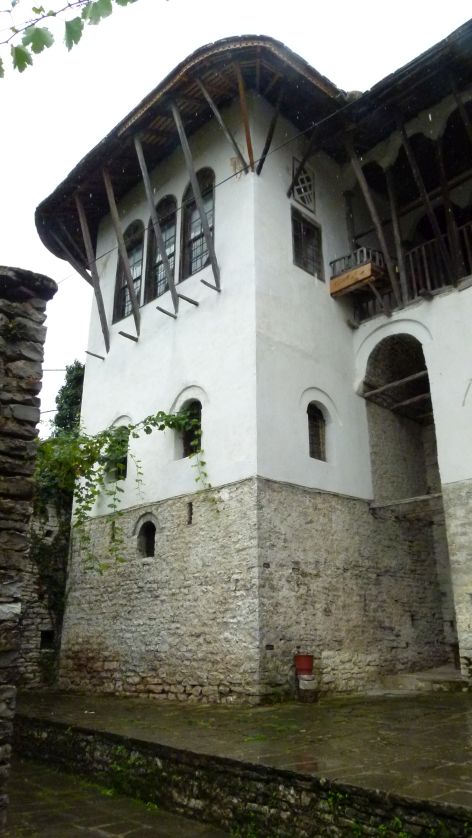
This is the Buleutorion or the house of the town council. It is the most famous structure of Apollonia.

P1090435

This is the Odeon. I like it, it is small and cosy, just right for concerts.

P1090434

The theatre with its round forms links the higher hellenistic with the lower Roman area of the city.
P1090446

Apollonia lost its importance, when in 234 AD an earth quake diverted the river which resulted in the port no longer being accessible to ships coming from the sea.
Turtles walk around freely here. This turtle first hid its head under the shield, but after a few friendly words it looked at me again.

P1090443

 Museum and St. Mary Church at Apollonia

Arian takes me to the museum. The orthodox priest stands at the entrance chatting. St. Mary church is again in use.

P1090451

The layout of the iconostasis follows strict rules. E.g. first icon left is St. Mary, second icon is the person that the church is dedicated to. As this church is for St. Mary, the second icon shows her as well.

P1090456

I light three candles for Ernst.

P1090461

We move on to the museum. On the balcony, Arian explains this infograph to us. The wonan is losing her husband, and she tries to hold him back, but he has to go into the underworld, where he takes the boat and ends up sitting at the bottom mourning and thinking of his wife that has remained on earth. Yes, I know how this woman and her husband feel.

P1090463

The museum is an excellent layout of the history of  Apollonia. From Illyrian times are this shield and the helmet.

P1090466

The Greek vases are beautifully painted.

P1090464

The Roman vessels are not decorated. I like this lamp.

P1090471

We say good-bye and thank you to Arian.

The Hoxhta and the German bunkers

Next we stop at the German bunkers. In 1944, Xhemali was four years old  and he brought eggs to the Germans sitting in these bunkers, because he felt sorry for the soldiers. Now he takes tourists to the bunkers by leading them across the fields.

P1090473

Still today, he is very hospitable and gives us two pomegranates. Here he is with his donkey.
P1090477

Chatting over lunch… the owner has lost his cattle

We have an excellent lunch near the road to Vlora. Above all I enjoyed the warm goat cheese with herbs on tomato, cucumber and oignons. Something to cook at home.
We hear that the manager has built up a farm, and after a heavy storm he lost everything. He had no insurance and had to start over again, Now he runs this restaurant that he has rented. Thank you for the delicious meal.

Vlora… the city of independence

It was in Vlora that Ismail Quemali has proclaimed the independence of Albania in 1912. He was born in Vlora and he is also buried here. This is his memorial.

P1090483

This is the mosque that some deem to have been drafted and/or built by Sinan.

P1090496

Sinan was THE architect of Suleyman the Great in the 16th century and some sources suggest that he was Albanian. I have seen and loved his mosques in Istanbul and in Damaskus. I like the harmony of the construction, but inside I am disappointed. Ben reminds mee of the communists that might have destroyed the decoration inside the mosque.

We visit the building that the first government selected to rule Albania after its foundation. The rooms  of  ministers are in still in place, modest and functional. The members were from all religions existing in Albania – great coexistence.

P1090503

The inviting hotel in the steep, rocky bay

I did not like Vlora. Too many high constructions have turned into “crying” houses  – skeletal structures that will never be completed. Dirt all over. At least they have started to redo the central square with tiles, trees and benches.

Then Ben shows to me, what an innovative guy has made out of a rocky bay: The Liro hotel and restaurant – does its bright yelllow color not look joyful and inviting.

P1090508

I would love to swim here. The water ist cristal clear.

P1090507

Continuing to Llogara pass

Now our car is climbing upwards to the Llogara pass.

P1090513

We stop at the Llogara Village resort. It is a yougoslawian style hotel with playgrounds for children and a minigolf area that serves as a zoo for deer. Great for children. Ben was here for the first time and he prefers the hotel Alpina.

P1090523

Tomorrow we plan to get up at six and go for an early morning walk to the pass and a nearby hill with a view of the Ionean Sea.


Albania – From Kruja to Berat

Our plan: Look at Kruja from above, visit Durres, taste wines near Berat and stay overnight in Berat.

.

Chatting with the Bektashi above Kruja

in the morning, we drive up to the rocks behind Kruja.

P1090152

On top we reach a crying house that has been built by the Bektashi and then abandoned. They have a small house and a cave below the edge, the Sari Selltik Sanctuary. A priest and a member of the Bektashi looking after the site are sitting on this terrace with a view of Kruja.

P1090184

We joint them and have a coffee. In Kruja, about 90% of the population belong to the Bektashi. This branch of shiit Islam emerged in Iran in the 13th century, and Ben is proud that they respected women’s rights already then.  They have Tekkes or temples in Kruja amd their world center is in Tirana.

We walk along the ridge and the view of Tirana up to Durres on the sea is very clear after the rain.

P1090185

.

The hidden valleys around Kruja

Behind the ridge is the world that, in the 14th century, Skanderbeg had defended with his army. It must have been here somewhere that, according to legend, Skanderbeg sent a herd of goats with candles on their horns to. The Ottomans believed, the army of Skanderbeg is retreating and followed the goats. Of course, they were attacked by Skanderbeg and his men from behind, which led to another of the more than 20 victories of the Albanians over the Ottomans.

P1090204

On the way down, we enter a narrow valley. Ben shows me the memorial of the 86 women who threw themselves to death, because they did not want to be raped by the Turks after Skanderbeg had died.

P1090213

.

Driving to Durres

The road to Durres leads through a plane that must have been fertile, but now houses are scattered all over. “There is no plan”, Ben comments. I think we should teach the Albanians, how to plan regional zones – for living, for agriculture, for small houses and for higher houses. All the crying houses along the road that will never be completed!

While driving, Ben tells me this story: A sheep, a goat and a dog take a taxi. The sheep gets out first and pays. Later the goat reaches its target point and runs away, without paying. The dog is the last to leave the taxi. He pays too much, and the driver gives him no change. Even today we observe this behavior, when a car comes: The sheep stay (having paid correctly),  the goats run away (having left the taxi without paying) and the dogs bark (having paid too much, they want their change back).

.

Durres – a city in uncontrolled growth, but with an old history

Durres shocks me with a large number of “crying” houses – ruins that will probably never be completed. They seem to have been built after the 90’s. Here is one example.

P1090254

The museum would show the old history of Durres, going back to Illyrian times. But the museum is closed. It is Monday again. I thought we have had Monday with closed museums already a week ago… but right, Mondays come back every week.

We visit the old townwall (destroyed only in 1913 and 1915)…

P1090236

… with the Venetian tower…

P1090244

and the amphitheater with the small Byzantine church sitting in the middle (covered with a white roof now).

P1090228

This alley has been tastefully built during the Italian occupation in the 1920s/30s.

P1090220

Durres has white sandy beaches. During communist times there were two storey houses at a distance from the coast line. Now there is a line of multistorey buildings along the water front, many uncompleted. What happens, when the sandy coast line recedes or when the next earthquake hits? These houses are literally built on sand.

We have lunch in a small Italian restaurant at the beach. I think that Spaghetti have always been normal in Albania, because the Italians ruled here in the 1920s/30s. Hence Spaghetti must have been known all the time. “Oh no,” says Ben, “in communist times you were in trouble, when you knew, how to prepare Spaghetti.”

As a dessert, Ben takes me to the 15th floor in one of the sky scrapers, near the port. We enjoy a great view over the city and to the mountains behind Durres – up to Kruja.

P1090255

.

From Durres to Berat

As we are getting closer to Berat, the landscape brightens up. No incomplete houses any more (that will never be complete). There is agriculture… olive groves, corn, fruit trees, green houses.

P1090266

Shortly before Berat, we stop at the Çobo winery. As the house shows, the owners – two brothers – are making good business. A tasting is going on in the garden.

P1090264

One of the two brothers guides me through their cellar. There are metallic tanks and barrels from French oak.

P1090259

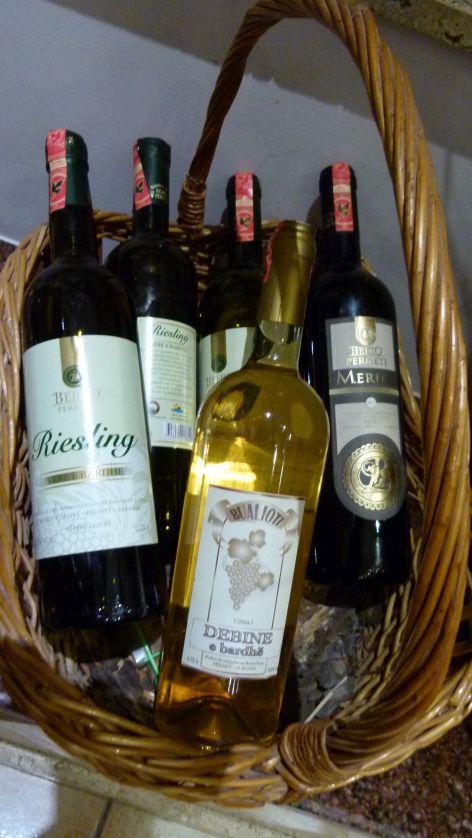
The wines are made from the autochthon grapes Shesh i bardhë (bardhë=white, reminds me of Chenin Blanc) and E bardha e Beratit (in Johnson 2006, reminds me of Verdejo), Shesh i Zi (reminds me of Cornalin, fruity nose, tannic on palate, 2013, Zi=black). We also try Kashmer (70% ich Shesh i Zi, blended with Cabernet Sauvignon and Merlot, 1 year oak, 2010) and E kuqja e Beratit (grape crossbred in communist times, 2011, soft, 25 Euro). They also have Raki me arra (Walnuss, brown, walnut can be felt) and we buy a bottle of Raki.

.

Arriving in Berat

From the winery it is only a  short drive to Berat, the white city of the 1000 windows and Unesco World heritage.

P1090269

I walk up to the castle. Then we have some light yoghurt in the restaurant Tomori (called after one of the mountains near Berat)… and another interesting day is over. I look forward to discovering Berat tomorrow.

Albania – from Prizren to Kruja

A short morning walk in Prizren

We say good morning to Prizren. The Hamam is being repaired.

P1090089

Nearby, in the parking lot of a tiny house, there is a car from Berlin. “Ick bin een Berlinaa..?” No, I do not think that this car is owned by a guy from Berlin. It is not “een Berlina”, but might be a Kosovian living in Berlin.

There is the star of the Jews at the minaret… I love the coexistence of religions.

P1090087

This small cobbled street leads to the Ottoman bridge.

P1090092

Back in the hotel Central, the owner invites us for a coffee… he wants me to meet two Swiss “girls”. They are ladies of my age. The daughter of the first lady is here with Kfor and has asked her to come. Her sister-in-law has just become widow 3 months ago; she loves to exchange with me, as I know, what she senses. We review our experience in Kosovo enjoying the relation of Switzerland to this country. “Have you read about the mass collision after a local car has overtaken?  Six Swiss cars were caught. Well, we do not think that there were Swiss inside those cars… “, we laugh.

On the motorway to Kukes

We take the motorway towards Albania. “Look, how well everything is made here, there was a proper quality check”, Ben says. Indeed, the motorway is perfect. On the Albanian side, the terrain is more difficult. Most bridges are only half completed. Kukes is where Ben comes from (actually from a mountain village two hours away- on foot). A car stops entering the motorway on an unpaved path and the driver shouts “hello Ben”, as he saw us taking photos.

P1090095

In Kukes, we visit the bar and garage of a relative of Ben.

P1090102

We have Boza, a local drink from Kukes, made with milk, wheat, corn and some sugar. Delicious and refreshing!

P1090101

Kukes to me looks like a sad town. During communist times, it has been far more prosperous, but now the city has lost some ten thousands inhabitants. Many houses are decaying. “This is the city center”, Ben says. I see an empty, unorderly area that they are planning to refurbish.

P1090113

When the plans are completed, it will look good… I keep my fingers crossed, because the scenery of Kukes  is great. The black (and deeper) Drin is joining with the white (and less deep) Drin . In the background are the Alps of Albania.

P1090106

A huge hotel is overlooking this scenery.  Ben has been in his hotel during communist times. But now the hotel has joined the large number of crying houses with dark windows.

P1090103

Ben dreams of opening up the shelter tunnels for tourists and offering hikes to the mountains.  Also the hospitality of Kukes could be of touristic value. It has hosted something like one million of refugees from Kosovo in 1999 and was named for the Nobel prize for peace, Ben tells me proudly. A memorial reminds of that.

On the motorway to Kruja

We continue on the motorway to Kruja. It pours with rain. We cross a tunnel that is about 5.5km long.

In lower Kruja, there is a memorial for George W. Bush. He has visited this town and supported the local industry. At least here they like this president.

Arriving in Kruja

Our car climbs uphill. Kruja lies on a “terrace” On about 1000m. Ben is happy and recites: “Kruja, oh blessed city, wait and wait for Skanderbeg, so he’s coming to liberate the motherland where he was born and where he was grown.” I can imagine now, how much the Ottomans attacking Kruja in “les tambours de la pluie” hated this place sitting in their tents (novel by Ismail Kadaré).

The Panorama Hotel has a great view of the Skanderbeg castle.  The rain has stopped and we have lunch with pepper.  There is a wedding on the ground floor. People dance in their traditional dresses.

P1090129

We walk through the Bazar that has been renewed with the help of European funds.

P1090132

We reach the castle and visit the Ethnological Museum in the house of The Toptani. Workshops are on the ground floor,  the living rooms for women and men on the second floor.

P1090146

Next we visit the Skanderbeg museum. We follow the story of this great leader that Skanderbeg was withstanding the Ottomans for 25 years, supported by his men and his favorite sister Mamica.

In the evening I enjoy sitting on balcony of my room with a phantastic view of Skanderbeg’s castle. With me is a glass of white house wine from the region.

P1090169