Ravenna: In search of Byzantine mosaics – Sant’Apollinare Nuovo and in Classe

Saint Apollinaris is said to have brought Christianity to Ravenna in the 1st century. Two basilicas are named after him, Sant’Apollinare Nuovo and Sant’Apollinare in Classe. “Nuovo” is the older church, already inaugurated in 504 as an ostrogothic Arian Basilica dedicated to Christ the Redeemer. Under Byzantine rule, this church became othodox-catholic, and in the 9th century the relics of Saint Apollinaris were transferred from Classe to Sant’Apollinare Nuovo – hence called “nuovo”. The original Basilica for Saint Apollinaris was built in Classe, near the port. It was consecrated in 549 by Maximian, when Ravenna was under Byzantine rule. Both basilicas are just wonderful – let us dicsover them.

But first let us recap again: In March 2018 we spent five days in Ravenna to see the town with its eight sites of UNESCO World Heritage:

  • two from the Western Roman Empire (402-476): the Mausoleum Galla Placidia and the Orthodox or Neonian Baptistery.
  • four from the Ostrogothic Rule (493-540): Theoderic’s Mausoleum, the Arian Baptistery, Sant’Apollinare Nuovo (remodeled during Byzantine times) and the Archbishop’s Chapel.
  • two from the Byzantine Rule (540-751): San Vitale and Sant’Apollinare in Classe (both started during Ostrogoth times, but inaugurated in Byzantine times).

.

Sant’Apollinare Nuovo

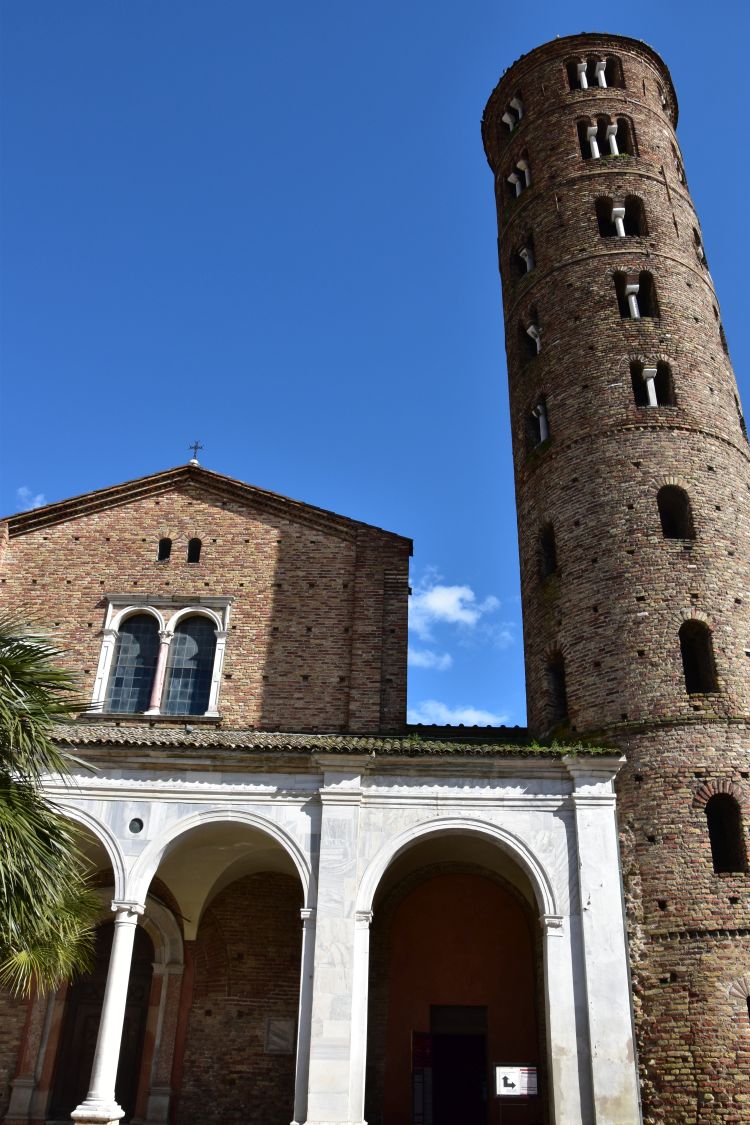
Yes, the older of the two basilicas named after Saint Apollinaris is called “Nuovo”. This is the view from outside. The bell tower is round with the typical double and triple windows. The narthex has been added later.

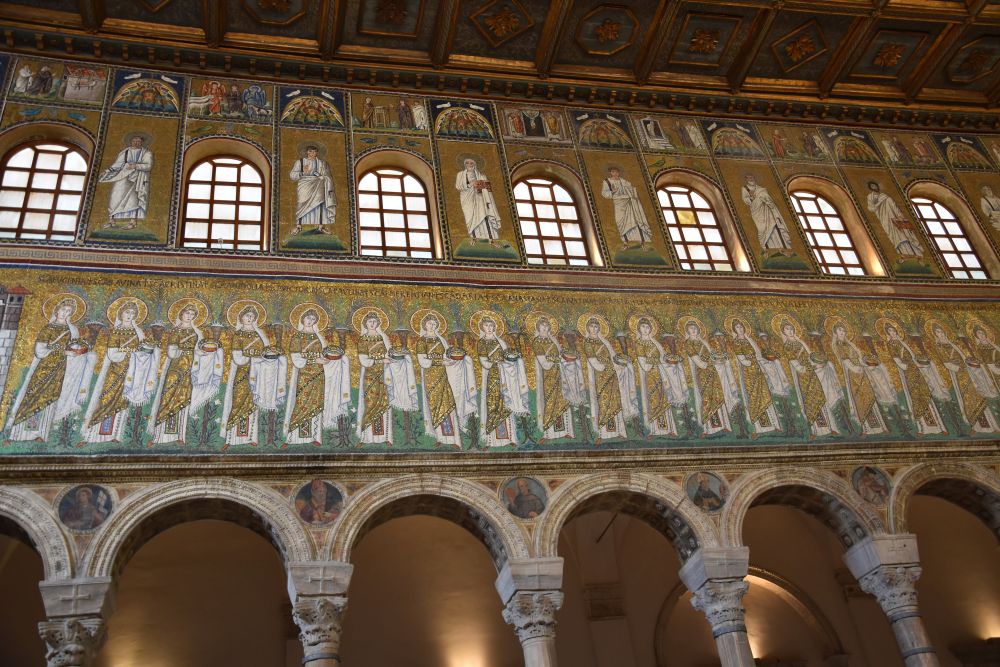
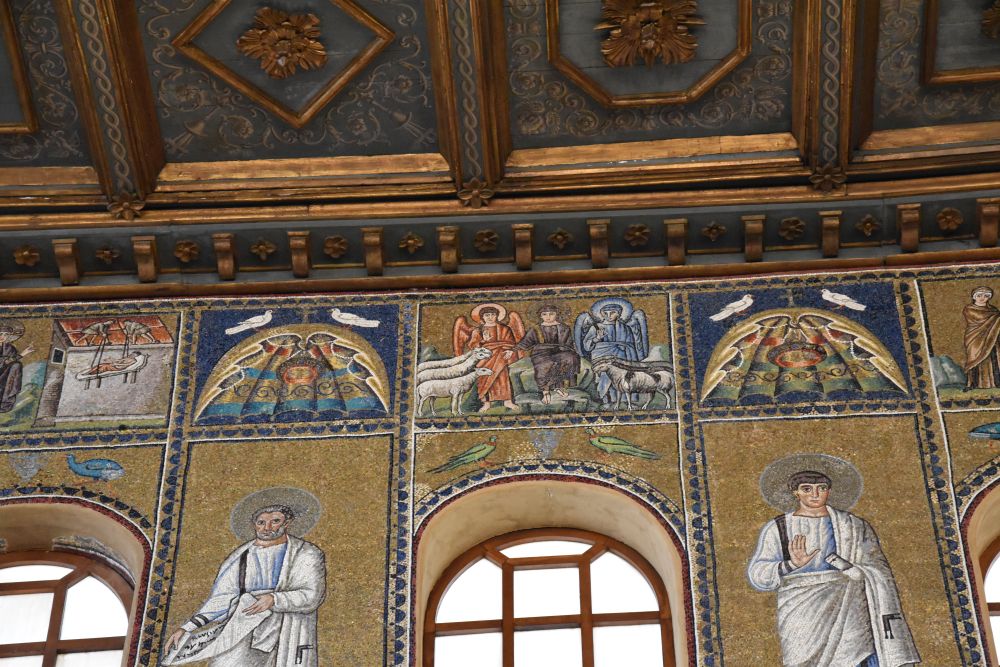
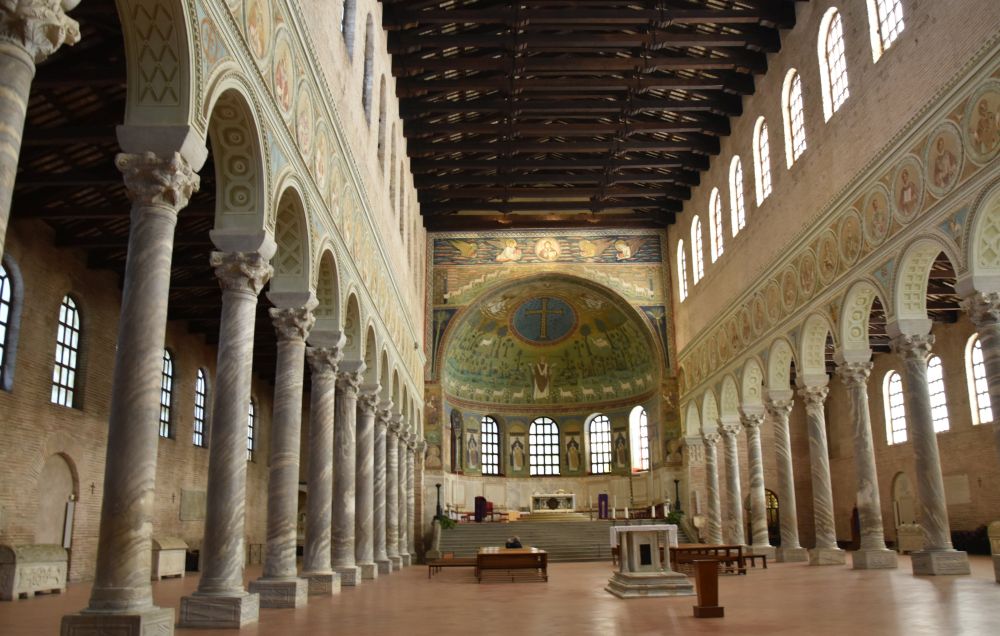
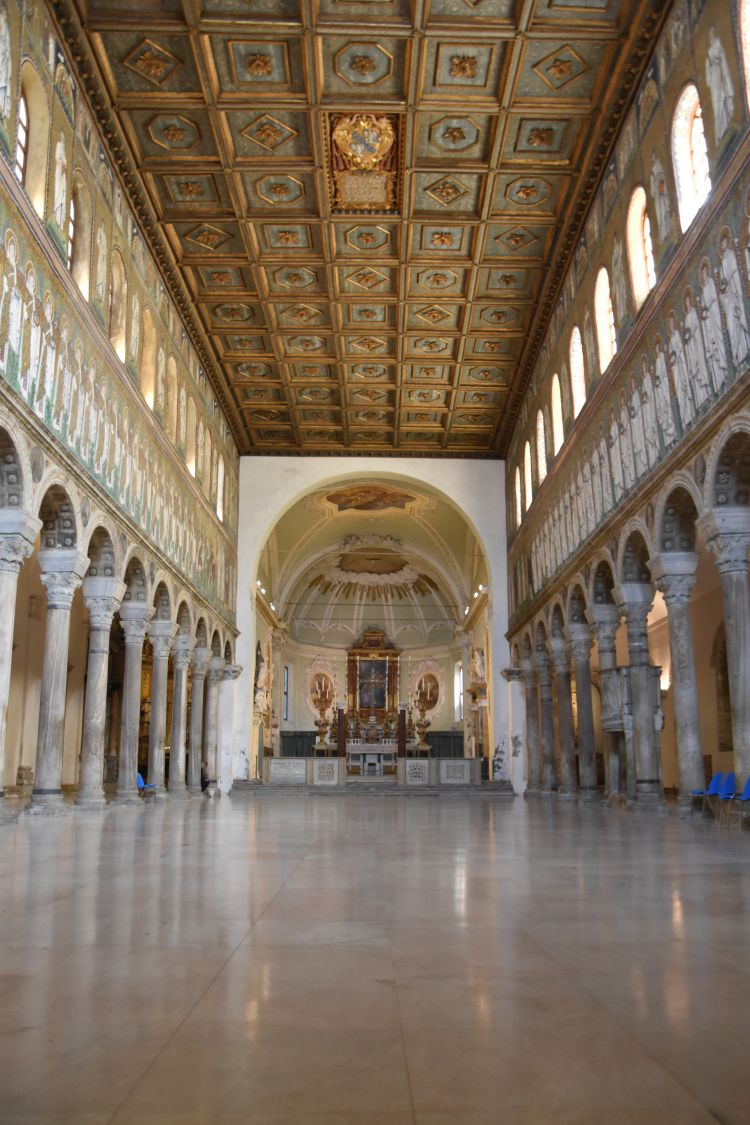
Inside the basilica measures 35mx21m. The nave is flanked with two rows of twelve columns in Greek marble. The mosaics are above the columns.

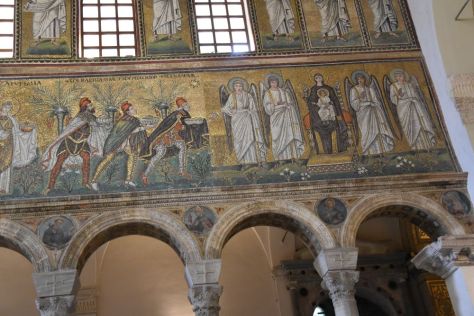
On the left hand side women martyrs are walking towards…

… Maria and Jesus with the three Magi.

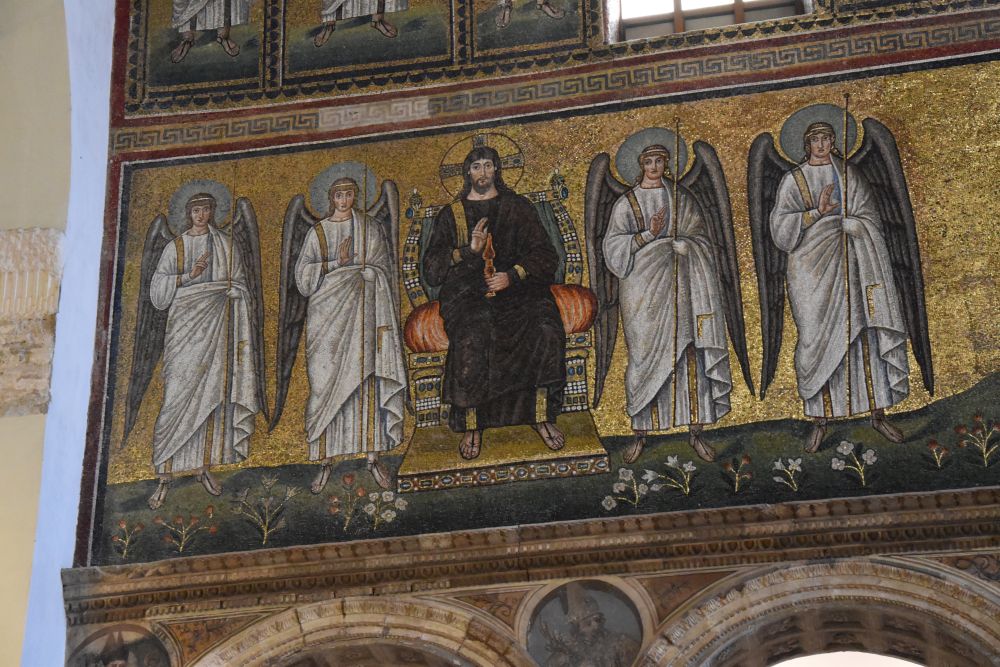
On the right hand side, martyrs are walking towards Christ sitting on his throne and flanked by four angels.

It is assumed that the processions of the martyrs have been added by the Byzantines. The former decoration of the Arians was different, perhaps a line of courtiers.

Above the processions are 26 panels that describe the life of Christ (13 on each side). The example below shows the healing of the lame and the separation of the sheep from the bucks.

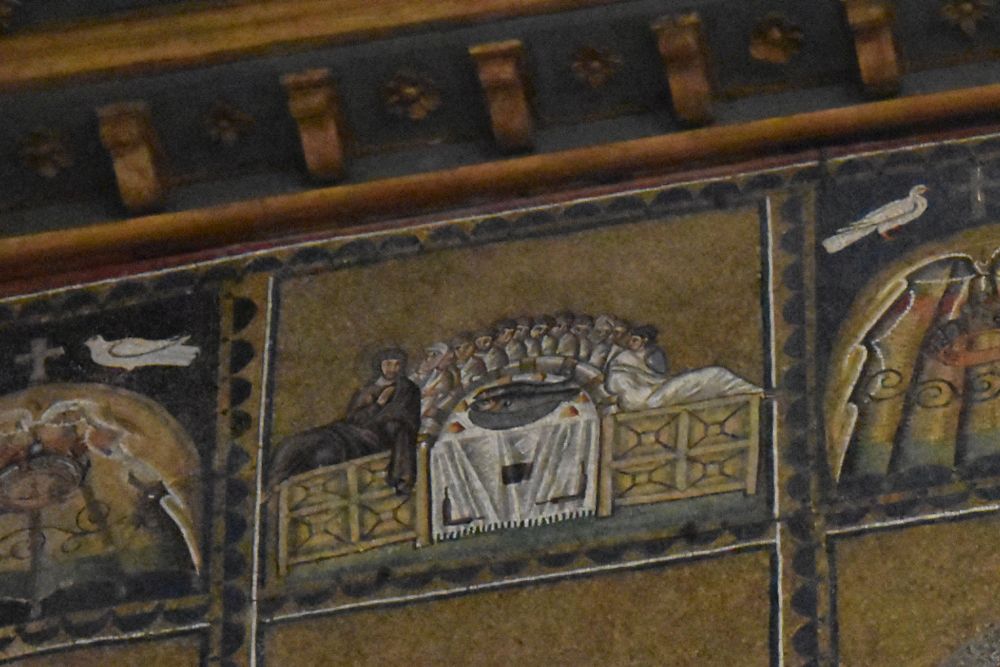
Most interesting is this Last Supper. Christ and the apostles are lying on long chairs as the Romans used to do for their meals. Never before have I seen such a “Roman” Last Supper. But why not? Why should the apostles and Christ not have behaved like the Romans, when eating?

Ursula and Leni intepret each of the 26 panels. It is like reading the Bible, and I have to admit, I read the stories from the Bible like people did at that time. With such beautiful mosaics it is a great pleasure to discover them and to enjoy, how the artists made the essence clear. For instance, a lame that carries his bed on his back has just been healed – it is simple and clear.

.

Sant’Apollinare in Classe

On a sunny day, we take out our car and drive south to Classe, the ancient port of Ravenna. Here we find the basilica originally dedicated to Saint Apollinaris, namely Sant’Apollinare in Classe.

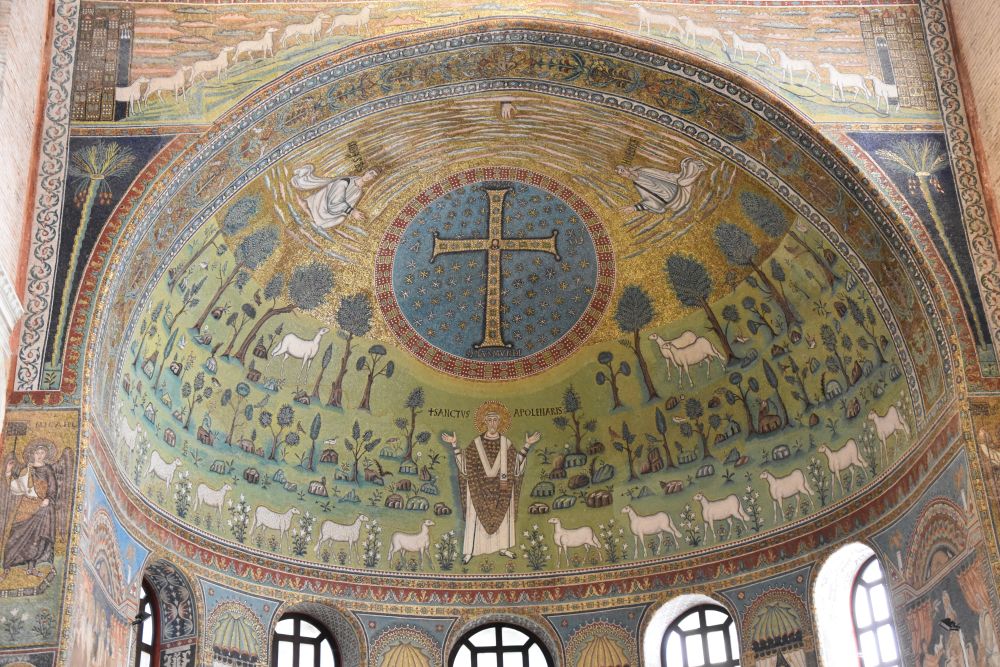
The nave is even larger, 55.5mx30.5m. The mosaic is in the choir.

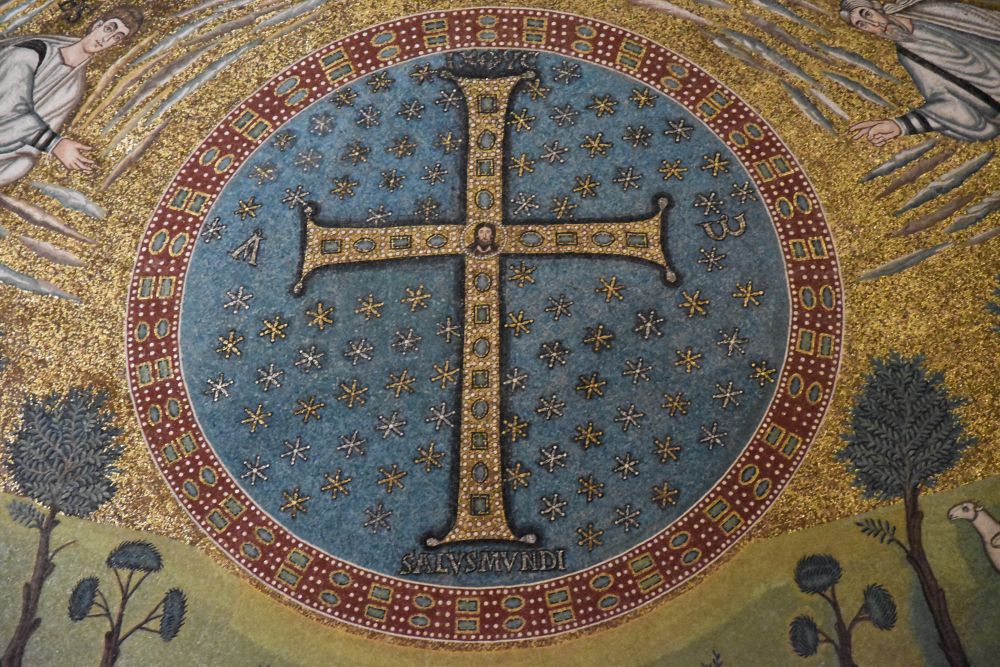
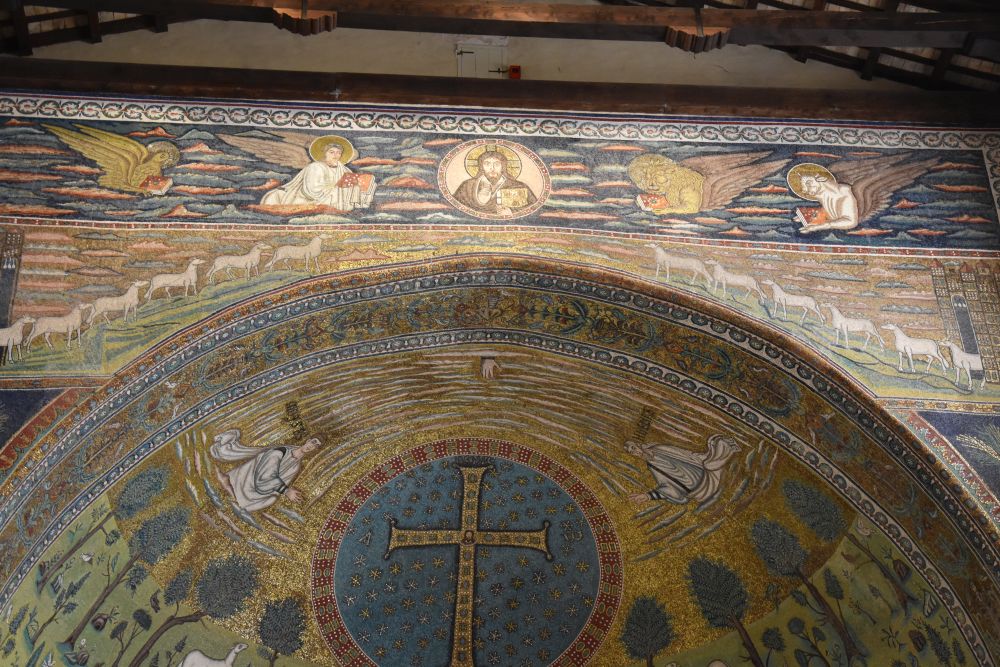
It shows Christ, symbolized by a cross. The cross is flanked by two angels. Below the cross stands Saint Apollinaris that the church has been dedicated for. He is preaching and talking to the audience in the church and to the sheep surrounding him on the meadow. Stones, trees, bushes, flowers and birds surround the Saint.

In the middle of the cross, there is a small portrait of Christ.

The evangelists are flying above the scene. I am surprised to see the bull of Lukas: It is portrayed from the side and from the front at the same time – very much like a Picasso painting. May be that Picasso has visited this Basilica as a young man?

The lion of Mark looks very, very gentle, but may be this is what his evangelium is about… a story that should convey joy.

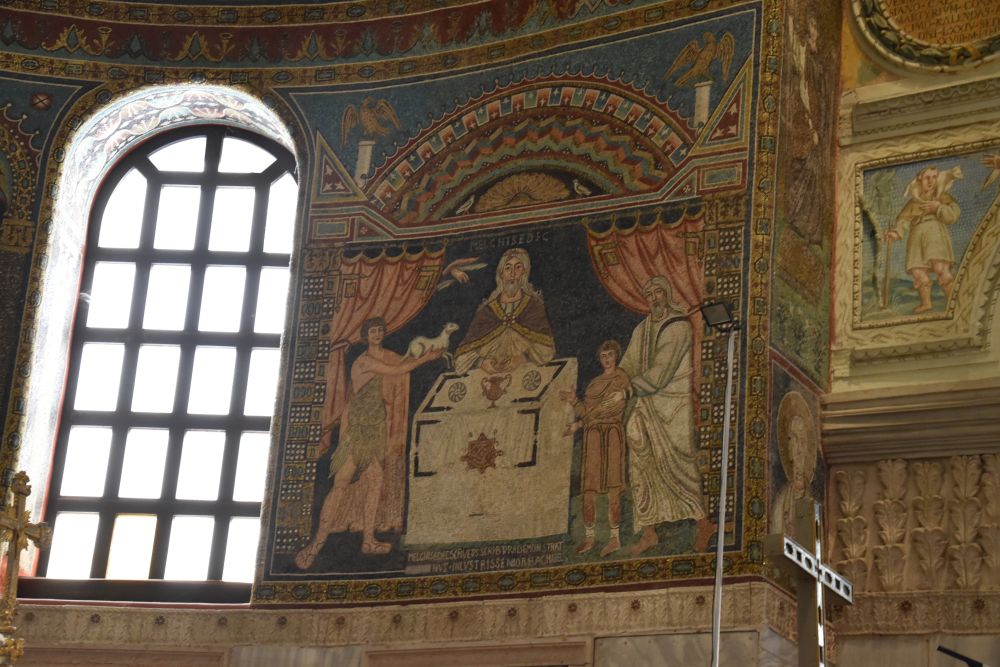
At the side we find three old acquaintances that we have come across in San Vitale: Abel sacrifying a sheep, Abraham about to sacrify his son Isaac and Melchisedec bringing wine and bread.

Beautiful, beautiful, just beautiful.

.

Taking a break from all that culture

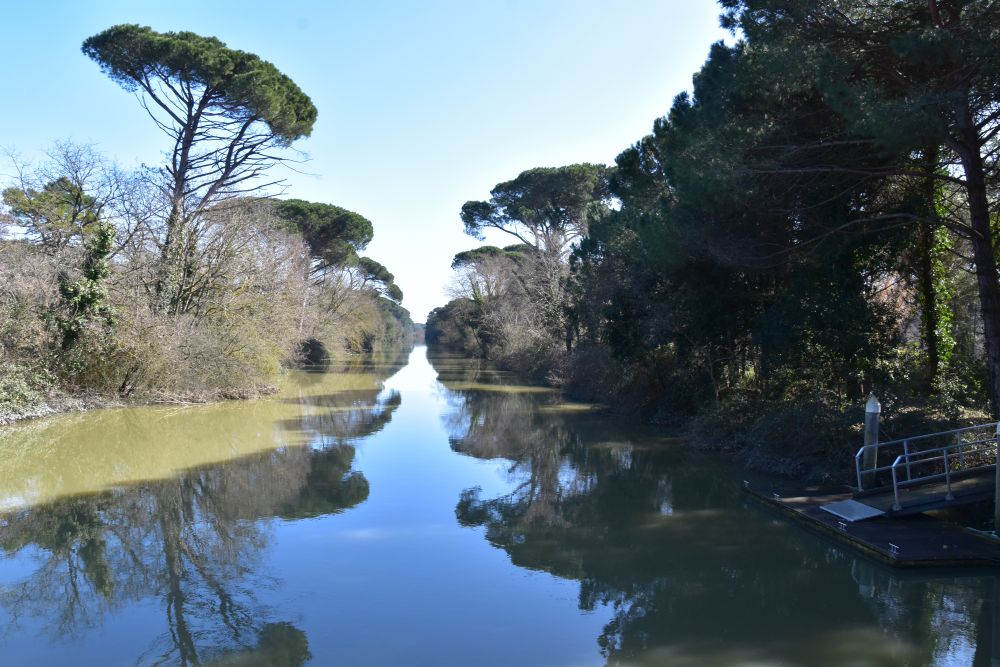
After all that culture we need a break and we benefit from the fact that the sun has started to warm Northern Italy. We drive to Fosso Ghaia and go for a walk in the pine forest.

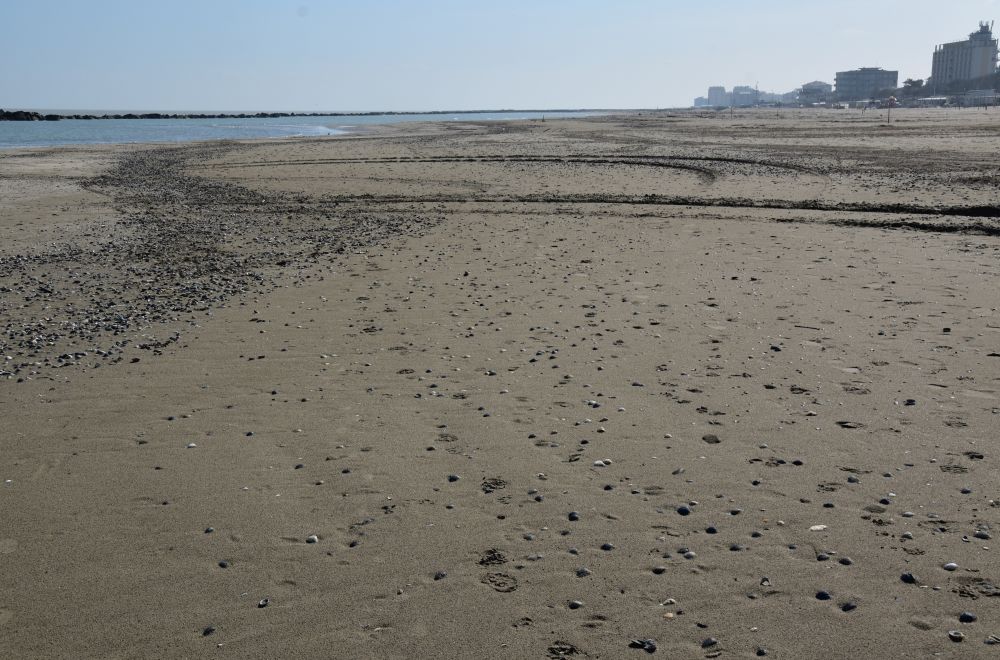
Then we drive to the Lidos or the beaches south of Ravenna. They are empty, empty and just empty. One lonely man is raking the sand. If he continues at that speed, he will never complete his work until Easter in about four weeks, when the first guests are expected and the beaches start to fill up with lines of arm chairs and umbrellas. I cannot imagine the crowd looking at this empty sand beach.

We find just one (only one) restaurant open. It is full with craftsmen. They may be repairing the many holiday chalets and appartments that have their shutters closed right now.

Back in Ravenna we have a farewell dinner in the restaurant Capello, where I can also buy wines from the Emilia Romagna. I take with me Sangiovese, Lambrusco and Albana. The area is known for excellent food. Names like Parma (ham and cheese), Modena (vinaigre) or Bologna (spaghetti sauce) are resonating with me. And there is also more culture to see here. Perhaps I should plan to return soon…

References:
Clementina Rizzardi: “Ravenna, Eight Monuments World Heritage”, Municipality of Ravenna
Carola Jäggi: Ravenna, “Kunst und Kultur einer spätantiken Residenzstadt”, Schnell+Steiner, Regensburg 2016
Jutta Dresken-Weiland: “Die frühchristlichen Mosaike von Ravenna”, Schnell+Steiner, Regensburg 2016.

Ravenna: In search of Byzantine mosaics – San Vitale

The Basilica San Vitale has been inaugurated during Byzantine Rule, by Bishop Maximian in 547. The Ostrogoths had  started building San Vitale in 526.

Let us recap: In March 2018 we spent five days in Ravenna to see the town with its eight sites of UNESCO World Heritage:

  • two from the Western Roman Empire (402-476): the Mausoleum Galla Placidia and the Orthodox or Neonian Baptistery.
  • four from the Ostrogothic Rule (493-540): Theoderic’s Mausoleum, the Arian Baptistery, Sant’Apollinare Nuovo (remodeled during Byzantine times) and the Archbishop’s Chapel.
  • two from the Byzantine Rule (540-751): San Vitale and Sant’Apollinare in Classe (both started during Ostrogoth times, but inaugurated in Byzantine times).

.

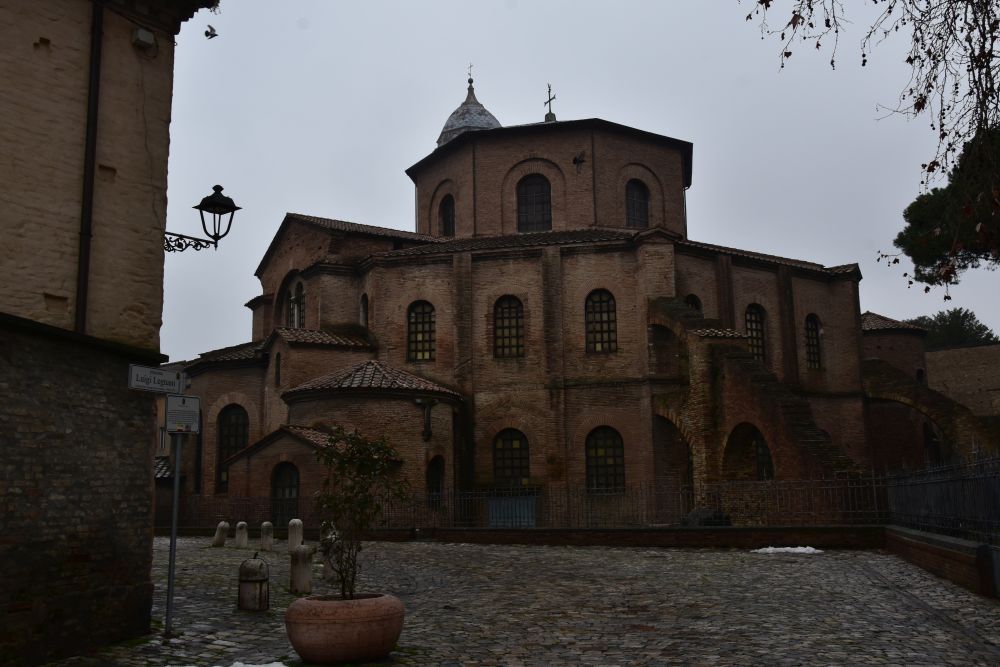
San Vitale is a beautiful octogonal building with mosaics in the choir

The building plan of San Vitale combines Roman and Byzantine elements. A Roman element is the use of clay pipes for the dome. A Byzantine element is the octogonal plan. Charlemagne liked the octogonal plan of San Vitale so much that he modeled his palatine chapel in Aachen after it (Rizzardi, p. 74 and Dresken-Weiland also mentions that).

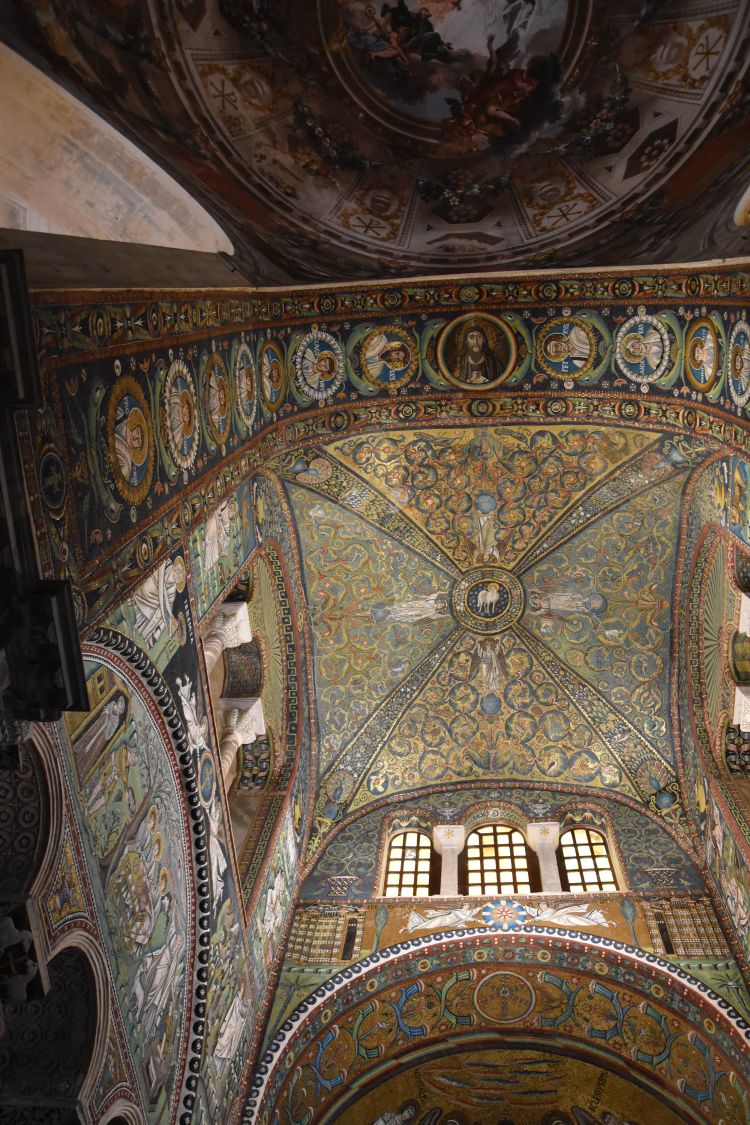
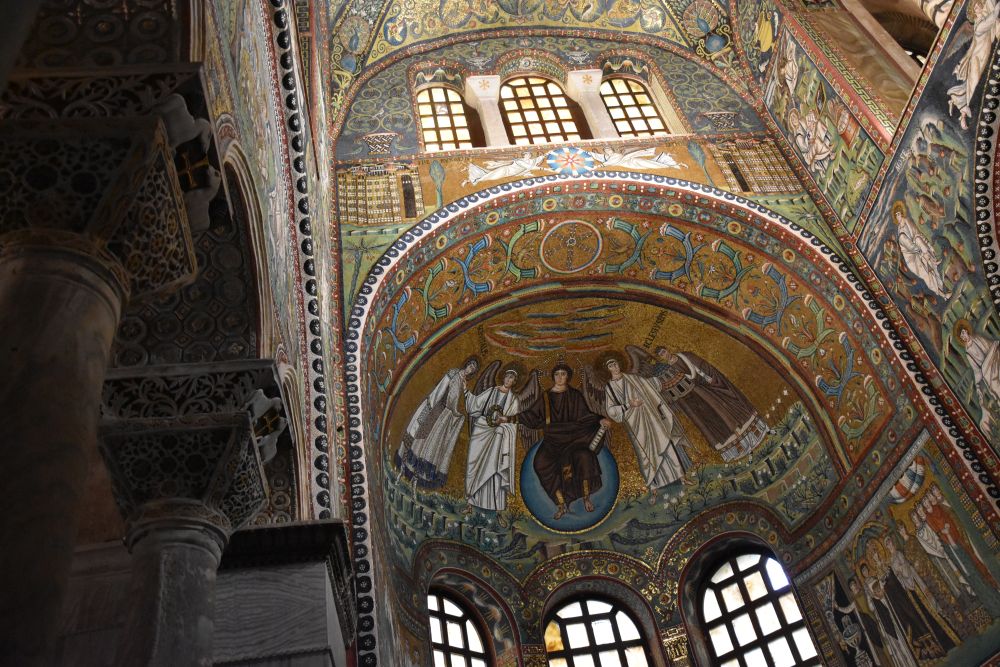
Inside the choir is beautifully decorated with mosaics. They are the best preserved Byzantine mosaics from Early Christianity (id est around 500, Rizzardi, p. 72).  Let us discover the San Vitale choir with the mosaics shining in green-blue-golden-white.

.

Central cupola of the choir topped by the Lamb of God

In the center of the cupola the Lamb of God or Agnus Dei looks down at us as a symbol for Christ. He is flanked by four angels that stand in beautifully decorated gardens with birds and animals. The portrait of Christ himself is in the arch, along with the portraits of the apostles – next to Christ Petrus (grey hair) and Paulus (bald head).

In the front niche sits Christ, flanked by the two archangels and then to the left San Vitale (his martyrium is said to have happened here) and to the right the Bishop Eclesius who initiated building the cathedral. They all stand on a meadow with flowers and birds.

.

Both sides of the choir are dedicated to the Byzantine emperor Justinian and his wife Theodora

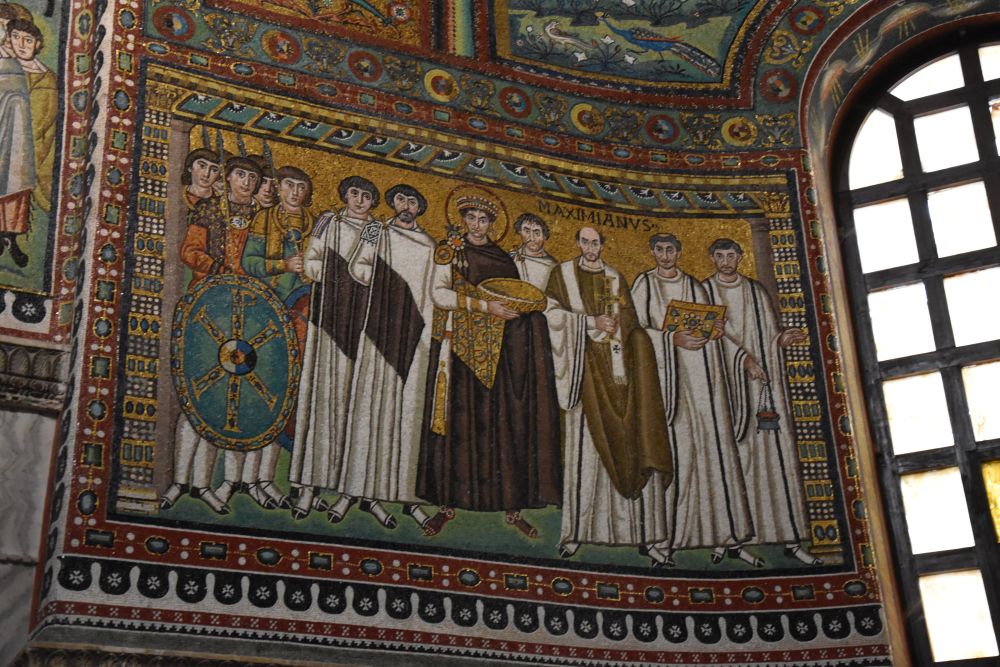
To the left of the choir there is a mosaic panel that shows the Byzantine Emperor Justinian in the middle amidst his men and warriors. The Bishop Maximianus who inaugurated San Vitale in 547 is labeled.
To the right stands his wife Theodora amidst her escort. She is said to be the daughter of a bear trainer and she became a very influential empress in Byzantium.
.

At the entrance to the choir: Biblical scenes

At the entrance to the choir there are two Biblical scenes.

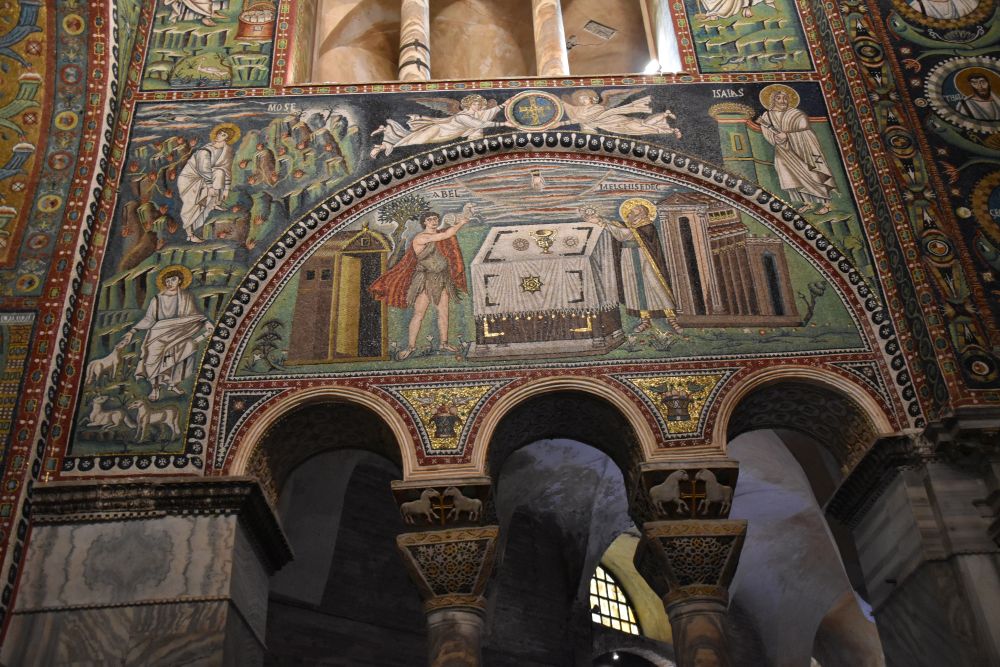
The first scene below shows Abel sacrificing a lamb and Melchisedec bringing bread and wine. To the left from the scene stands Moses as a good shepherd (caressing a sheep) and again Moses taking off his sandals to climb Mount Horeb where he finds the burning bush. To the right above the prophet Isaiah looks down at the scene with Abel and Melchisedec.

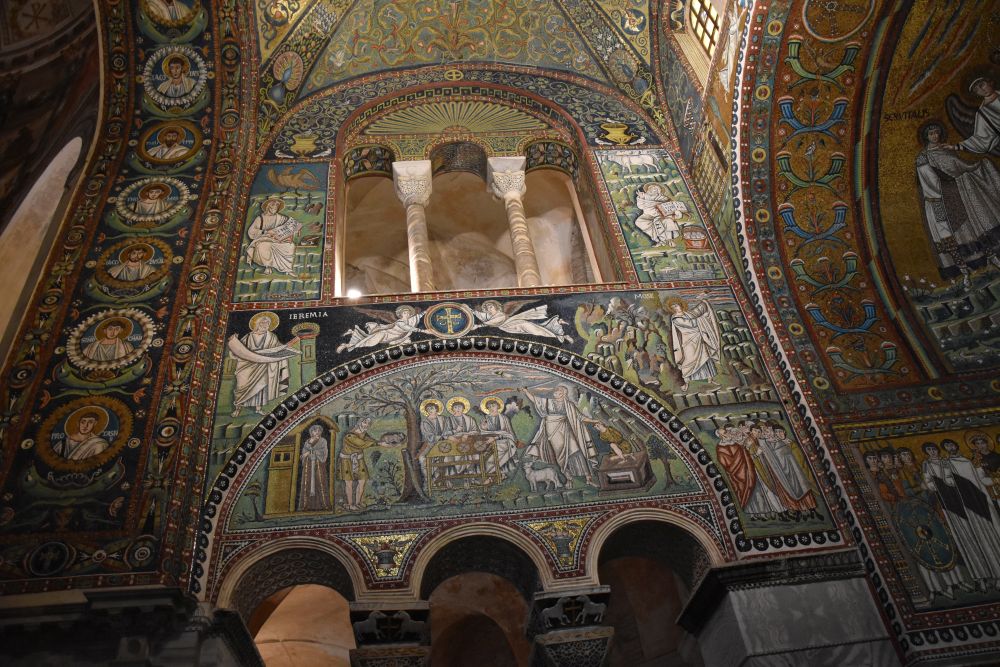
The second scene centers around Abraham. He is serving food to the three vagabonds that turned out to be angels. Three bread loaves are on the table and Abraham brings a lamb while his wife Sarah watches the guests from the doorstep. To the right, the hand of God is stopping Abraham from sacrificing his son Isaac. Above the scene are the prophet Jeremiah (left) and to the right Moses receiving the Ten Commandments.

Another overwhelming assemblance of mosaics in Ravenna after the baptisteries and the Mausoleum of Galla Placidia… and there will be more – we have not yet seen Sant’Apollinare Nuovo and Sant’Apollinare in Classe.

References:
Clementina Rizzardi: “Ravenna, Eight Monuments World Heritage”, Municipality of Ravenna
Carola Jäggi: Ravenna, “Kunst und Kultur einer spätantiken Residenzstadt”, Schnell+Steiner, Regensburg 2016
Jutta Dresken-Weiland: “Die frühchristlichen Mosaike von Ravenna”, Schnell+Steiner, Regensburg 2016.


Ravenna: Comparing the Ostrogothic Arian Baptistery and the Roman Orthodox Baptistery

Now I will tell you about the Ostrogothic Arian Baptistery and for comparison of the christening scene recall the Roman Orthodox (Neonian) Baptistery. To conclude, we will visit the Mausoleum of Theoderic to say good-bye to him and his Ostrogoths.

Let us recap: In March 2018 we spent five days in Ravenna to see the town with its eight sites of UNESCO World Heritage:

  • two from the Western Roman Empire (402-476): the Mausoleum Galla Placidia and the Orthodox or Neonian Baptistery.
  • four from the Ostrogothic Rule (493-540): Theoderic’s Mausoleum, the Arian Baptistery, Sant’Apollinare Nuovo (remodeled during Byzantine times) and the Archbishop’s Chapel.
  • two from the Byzantine Rule (540-751): San Vitale and Sant’Apollinare in Classe (both started during Ostrogoth times, but inaugurated in Byzantine times).

(In the fourth ostrogothic World Heritage which is the Archbishop’s Chapel with Christ as a warrior it is not allowed to take pictures).

.

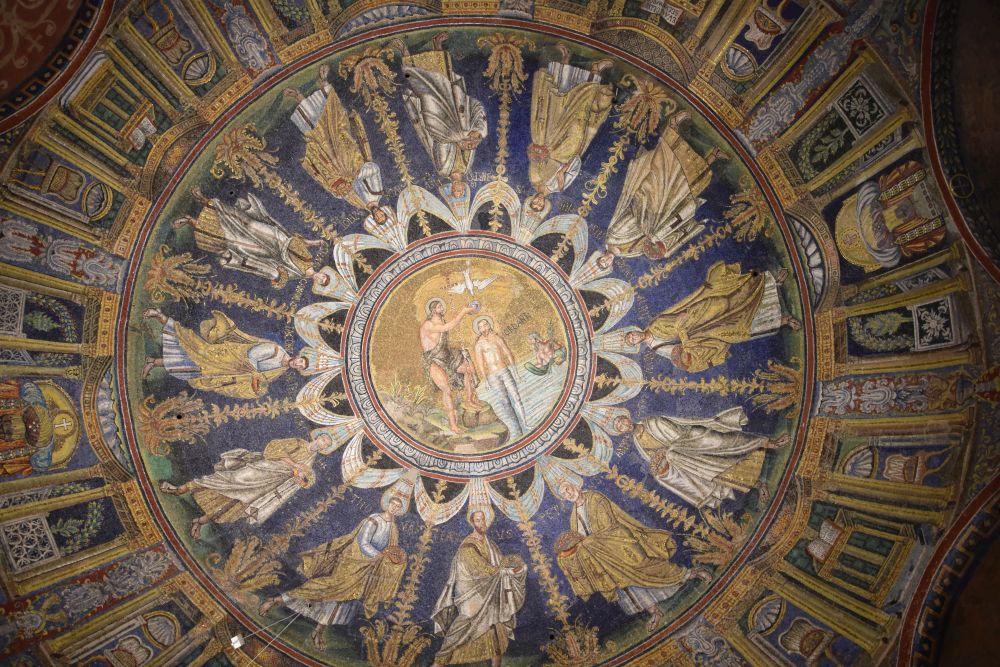
Let us return to the Orthodox (Neonian) Baptistery and compare the christening scene with the Arian baptistery

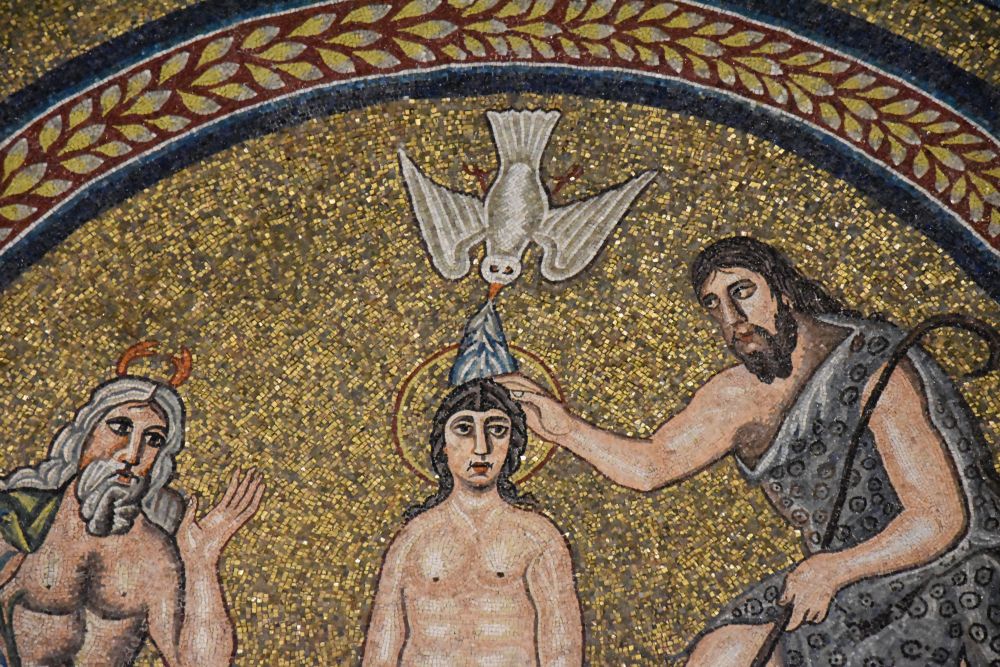
Remember the christening scene in the Orthodox Baptistery from my previous blog? Saint John holds a bowl to baptize Christ and the pigeon flies above – to me it seems to bless the water in the bowl. Historians assume that this christening scene has been altered later and that the scene in the Arian Baptistery reflects the original mosaic with Saint Joan holding his hand on Christ’s head and the Holy Spirit really flowing from the pigeon on to the head of Christ (see farther down).

By the way you can clearly discern the apostles Petrus with his grey hair (bottom left) and Paulus with his bald head (left from Petrus).

.

The Arian Baptistery – smaller and more intimate – again  just aaahhh

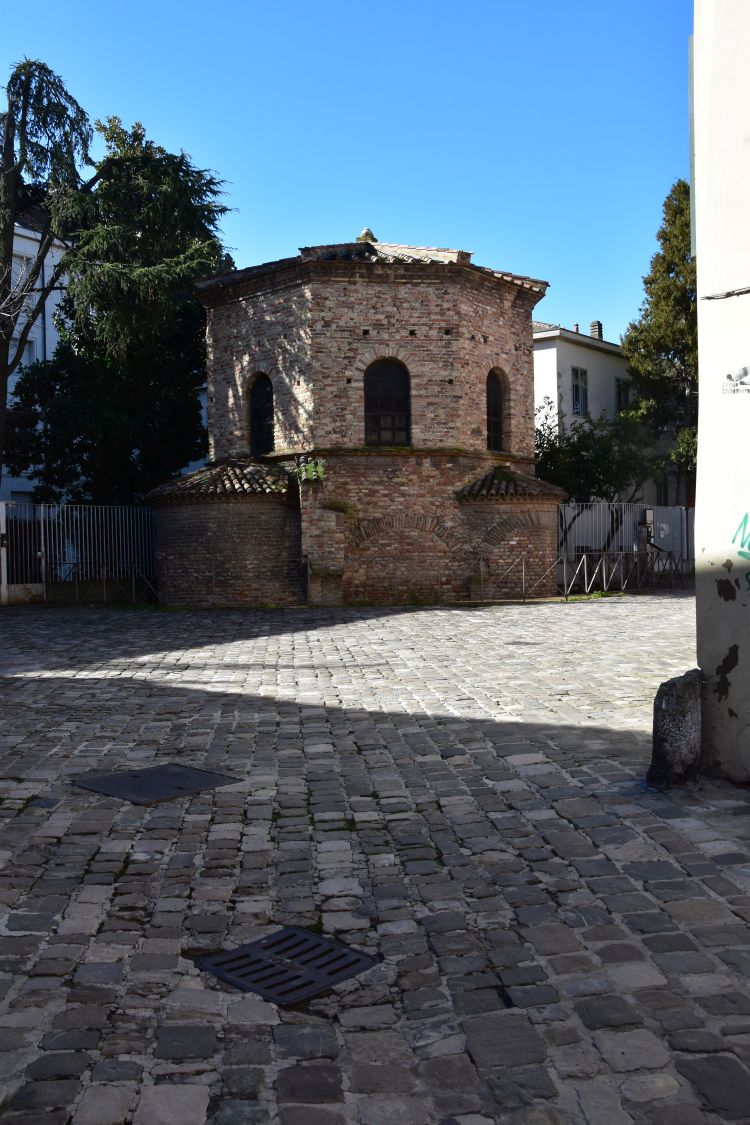
The Arian baptistery is smaller than the Orthodox Baptistery. The short absidioles at the bottom of the facade indicate that the building used to be much higher.

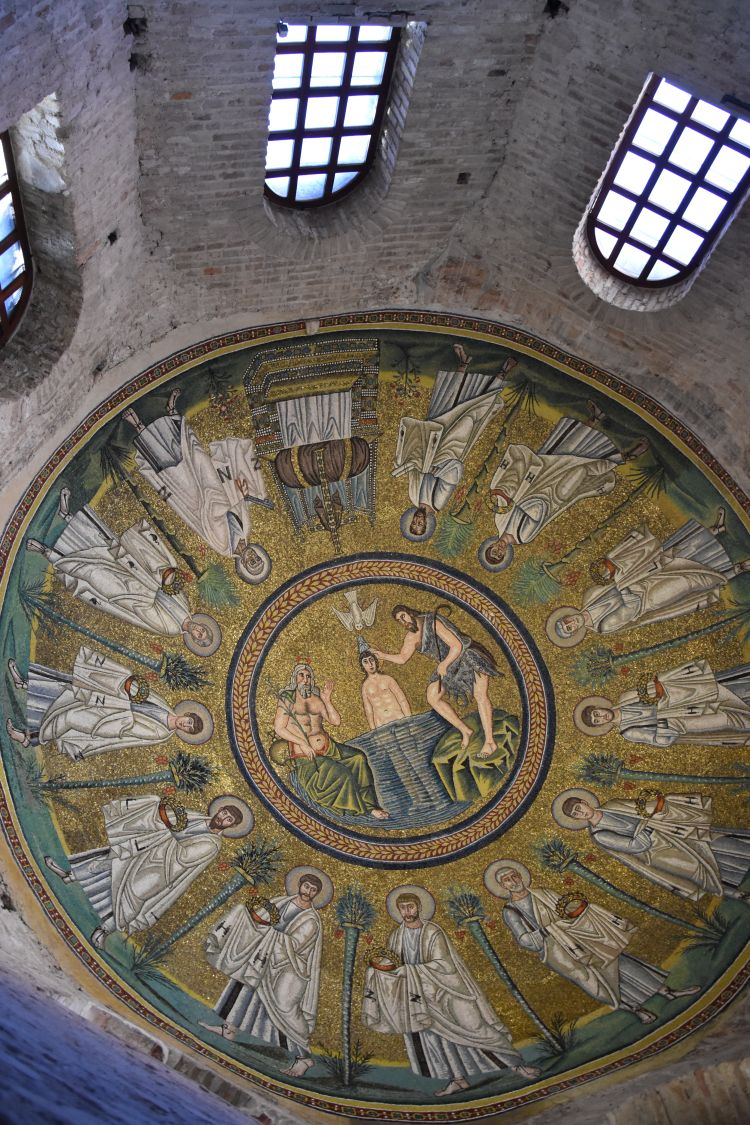
Inside I utter another “aaahhh”. The room is full of modest solemnity with the christening scene and the procession of the apostles in the cupola. The apostles move towards the throne of Christ, and Petrus (with his grey hair) as well as Paulus (with his bald head) are on both sides of the throne.

As mentioned abovem this christening scene is different from the one in the Orthodox Baptistery. In the Ariane Baptistery, Saint John holds his hand on Christ’s head and the pigeon pours Holy Spirit on to Christ’s head. Furthermore, Saint John, dressed in his fur coat, holds a walking stick instead of a cross. The god of the river Jordan is of the same size as the main figures and he has crabs on his head. The two scenes are very similar, but different, and the setup of the Arian Baptistery is deemed to be original. I love how gently Saint John looks at Christ.

The Arian Baptistery was built  around the year 500 by the Ostrogothic Arianic Christian community. The Ostrogothic king, Theoderic the Great, belonged to the Arianic community. Arians believe that Christ is the son of God, “but that he is distinct from the Father and therefore subordibate to him”, wikipedia explains, as opposed to the Orthodox-Catholics (still one church at that time) that believe in Trinity –  God, the Holy Spirit and Christ are one God in three divine persons. The Orthodox-Catholics declared the Arianic concept to be heretic and they persecuted them.

The Arianic community in Ravenna was small. This might explain, why their baptistery is smaller. Historians say that their mosaic had been completed in two stages. They conclude this from the fact that under the throne, the grey-headed apostle Petrus and the bald headed apostle Paulus as well as under the third apostle next to Paulus the lawn is of much darker green color than under all the other apostles. Only around the throne, there are flowers. And in addition the palm trees look different. The historians assume that, when the throne, Petrus, Paulus and the third apostle had been accomplished, the Arians run out of money – and only later they were able to complete the procession of the apostles.

I love the unostentatios solemnity of this small baptistery. Being baptized here must have been a great experience.

.

Good-bye Theoderic

I think that Theoderic was a very modern person. He is said to have been tolerant and cosmopolitic – I sense, as if he had lived through the times of Enlightment. In his mausoleum, we say good-bye to him.

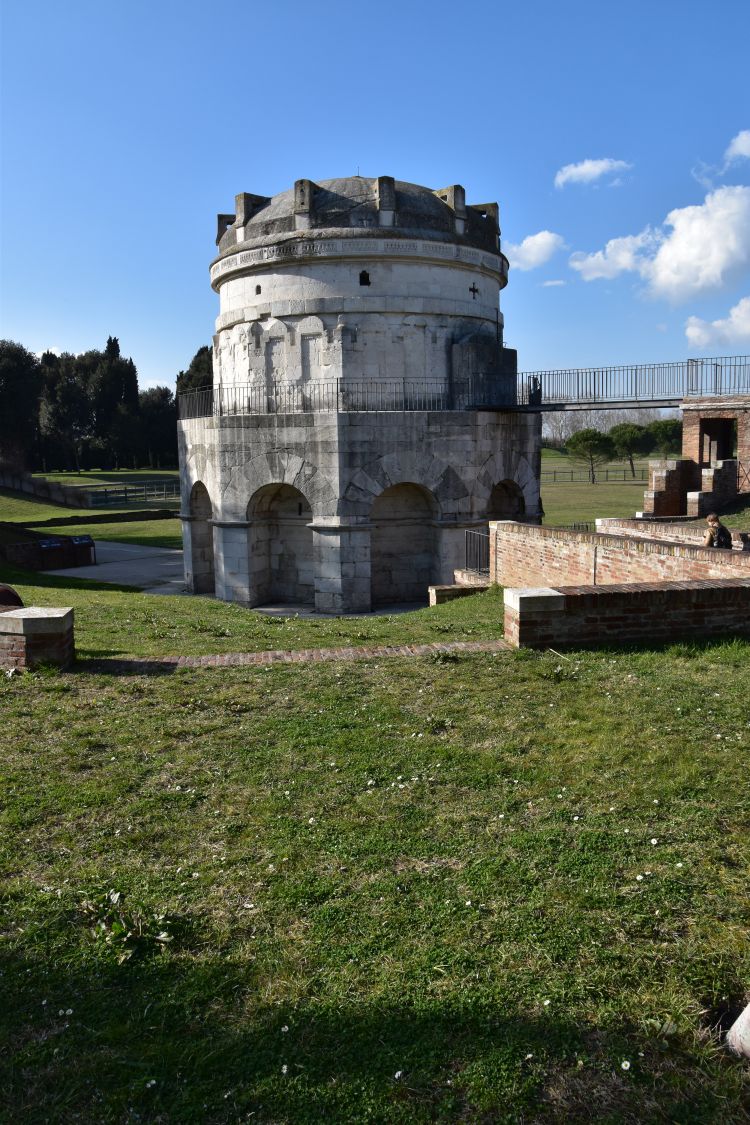
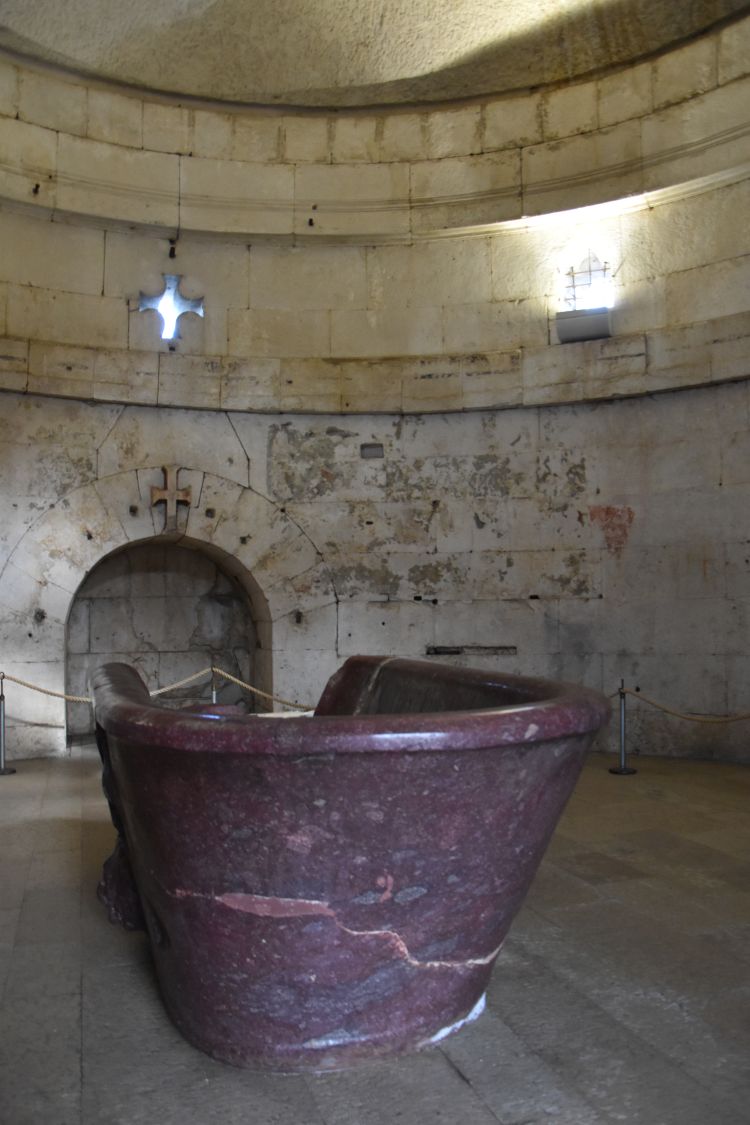
The mauseoleum is one of the eight monuments of Ravenna in the World Heritage List. It consists of carefully cut Istrian stone blocks and excels by its 10.76m monolithic dome weighing 230 tons (Source: Rizzardi). On the second floor stands the porphyry sarcophagus of – as historians think – Theoderic.

When the Byzantines took over in 540, they removed his body, because they were against Arianism. Why? A belief that allows for a tolerant and cosmopolitic attitude is wonderful – and I would love to see more of that right today.

References:
Clementina Rizzardi: “Ravenna, Eight Monuments World Heritage”, Municipality of Ravenna
Carola Jäggi: Ravenna, “Kunst und Kultur einer spätantiken Residenzstadt”, Schnell+Steiner, Regensburg 2016
Jutta Dresken-Weiland: “Die frühchristlichen Mosaike von Ravenna”, Schnell+Steiner, Regensburg 2016.

Ravenna: The heritage of Galla Placidia and Neone (Roman times)

Let us recap: In March 2018 we spent five days in Ravenna to see the town with its eight sites of UNESCO World Heritage:

  • two from the Western Roman Empire (402-476): the Mausoleum Galla Placidia and the Orthodox or Neonian Baptistery.
  • four from the Ostrogothic Rule (493-540): Theoderic’s Mausoleum, the Arian Baptistery, Sant’Apollinare Nuovo (remodeled during Byzantine times) and the Archbishop’s Chapel.
  • two from the Byzantine Rule (540-751): San Vitale and Sant’Apollinare in Classe (both started during Ostrogoth times, but inaugurated in Byzantine times).

Let us start with our impressions from Roman times, the Mausoleum of Galla Placidia and the Orthodox (Neonian) Baptistery. The latter we will compare later with the Arian Baptistery.


The Mausoleum of Galla Placidia – solemnity in blue and golden colors

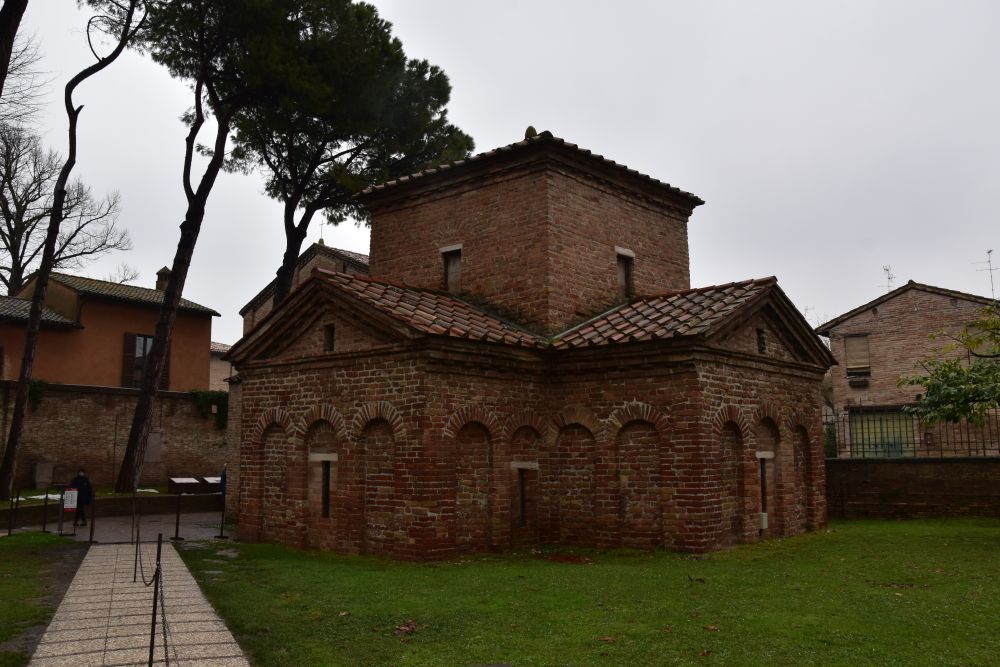
Galla Placidia was the daughter of Theodosius, the last emperor of the unified Roman Empire . In her second marriage Galla was the wife of Constantius, Magister Militum of Honorius, the first emperor of the Western Rome Empire (after the partition of Rome in 395). For some years Constantius ruled together with Honorius. Galla’s son, Valentianus III, became emperor of the Western Roman Empire in 425. Until 437 and until he was 18 years old, she managed the empire. During this time – in 425 – she had her mausoleum built. This is the outside view of the mausoleum with its four transepts. The transepts are ornated with blind columns and arcades.

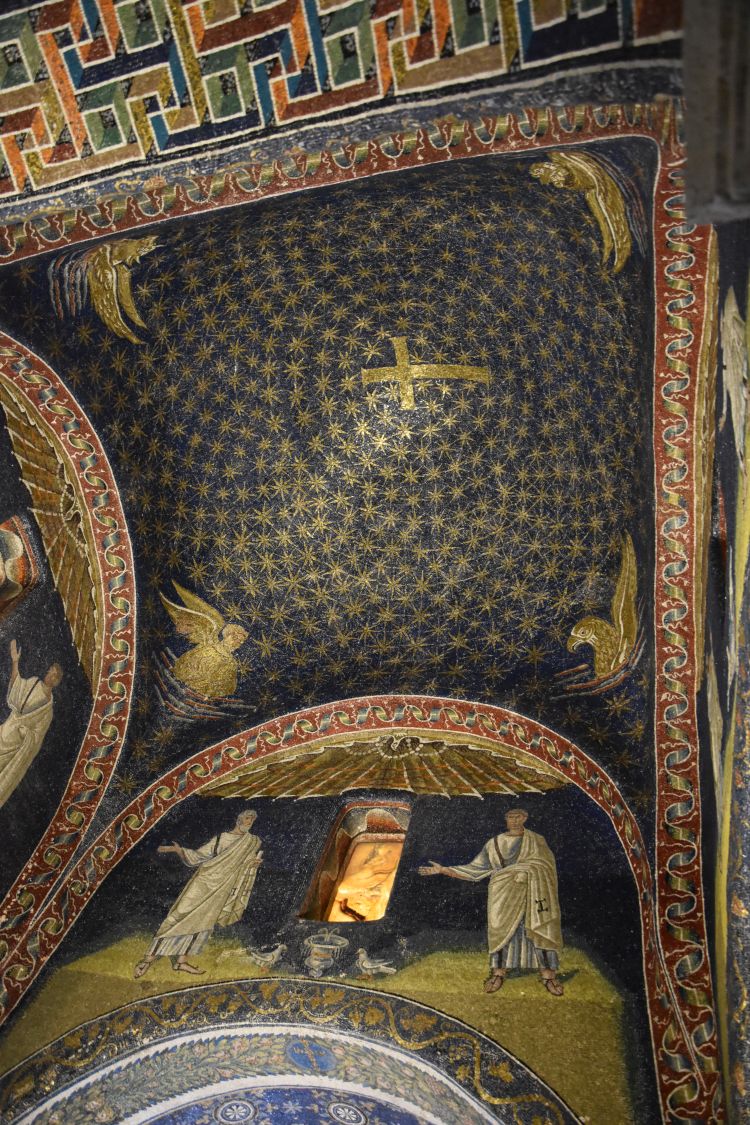
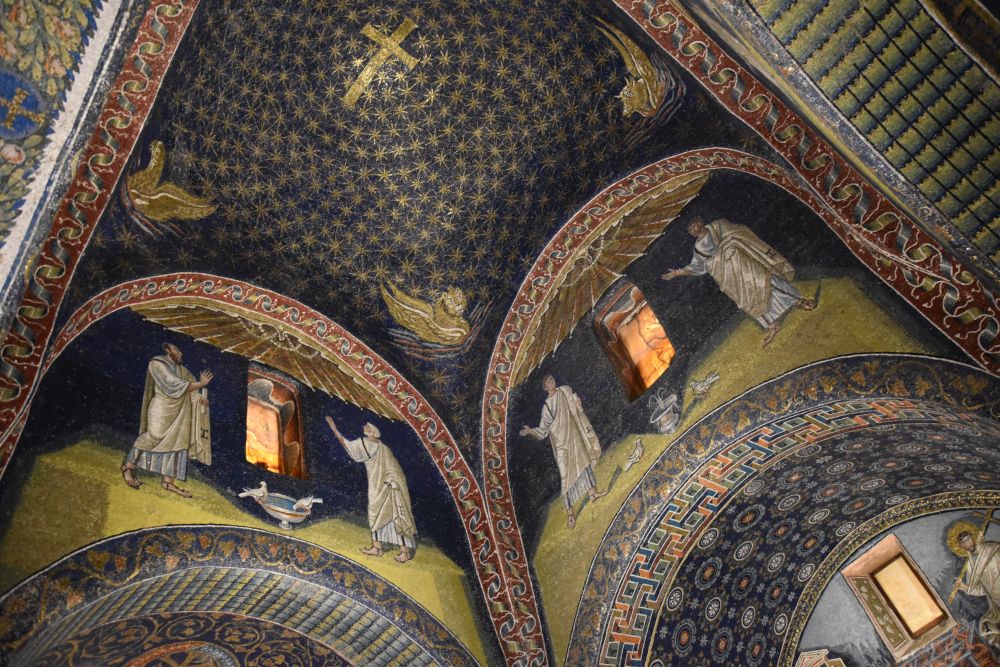
Inside, we find a solemn atmosphere primarily in the colors blue and golden. The cupola is a blue sky filled with stars, with the cross in the middle and the four evangelists in the corners. I love the decoration band around this sky full of stars.

Below the cupola there are four mosaics with two men, a fountain and pigeons. In two of the mosaics, the pigeons are drinking from the water. These two pigeons drinking water decorate many, many souvenirs in Ravenna – cups, plates, mouse pads, scarfs, tablecloths, t-shirts etc. The elegant men next to the pigeons have not been identified.

Two of the mosaics in the four transepts show deer drinking water alluding to the psalm “like a deer drinking from a stream, I reach out to you, my god.”

The third transept hosts the mosaic depicting Christ as the good shepherd – he is caressing one of his sheep – and the animal obviously enjoys that.

Last the fourth transept shows the martyr Laurentius or Lawrence moving towards his martyrium, the grill, which is next to a bookcase with the four gospels.

The decoration in primarily blue and golden colors creates a solemn atmosphere. Very, very beautiful. Galla Placidia was surely an intelligent woman, but in addition she had a good taste. We looked around and around, we checked out every detail and, after having stepped out, I had to go back to get another glance.

 .

The Orthodox or Neonian Baptistery – another “aaahhhh”

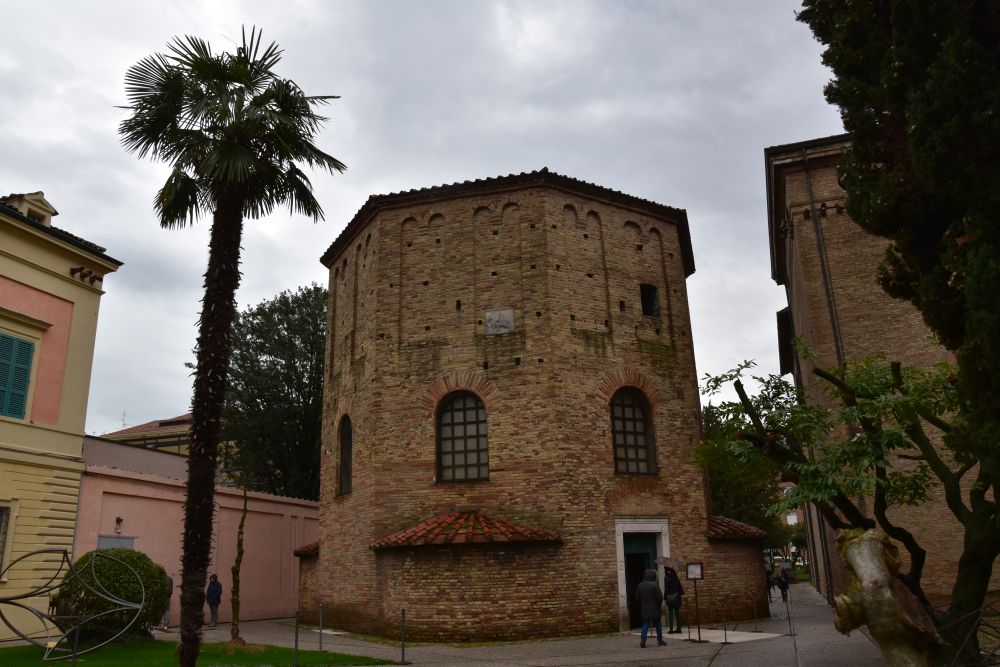
The Orthodox Baptistery is the second testimony of Ravenna as the capital of the Roman empire. It has been accomplished by Bishop Neone (450-476). This is why it is also called “the Neonian Baptistery”. The baptistery is what remains from the Basilica Ursiana which in the 18th century has been replaced by a new cathedral. This is the view from outside.

An interesting detail are the pilaster strips (Lisenen) and round-arch mouldings (Rundbogenfriese) – blind columns and arcades. This decoration has been in use in ancient Roman times, in Byzantium and in Ravenna. In Ravenna the Langobards picked it up and integrated it in their Lombardian architecture. From here the Romanesque architecture spread throughout Europe in the 11th century.

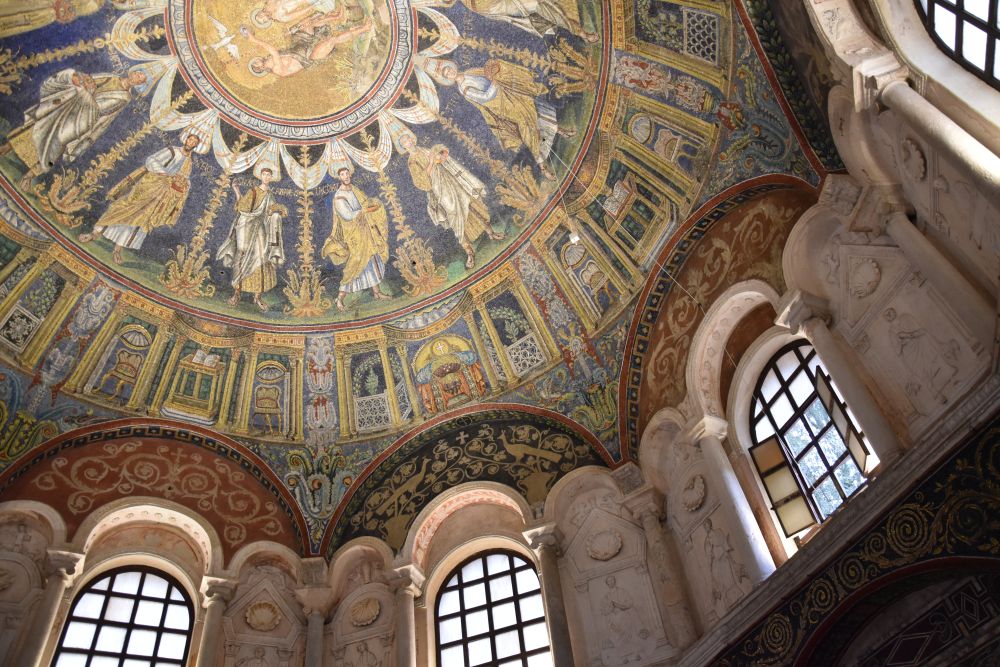
As this is a baptistery, the decoration centers around christening. The top of the cupola shows Christ standing in the river Jordan. He is being christened by Saint John, while the god of the river Jordan watches the procedure. Around this scene the apostles form a procession.

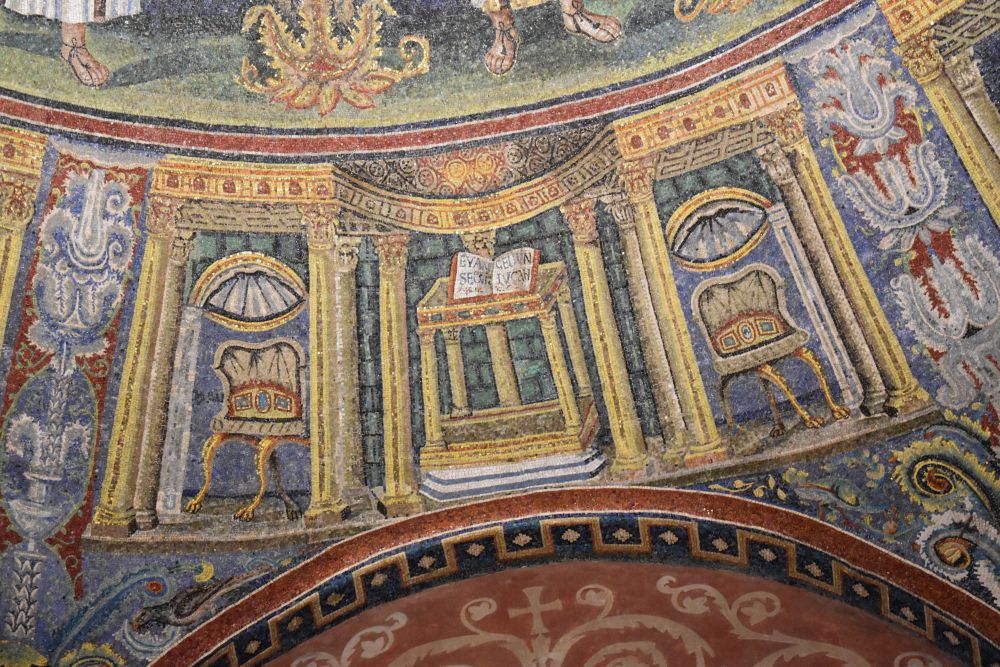
The outer circle contains a band of four double niche constructions alternating between a desk with the bible surrounded by two chairs (see below) and the throne of Christ in a garden (see above).

Windows give light to the baptistery. Next to the windows are plaster figures – perhaps prophets.

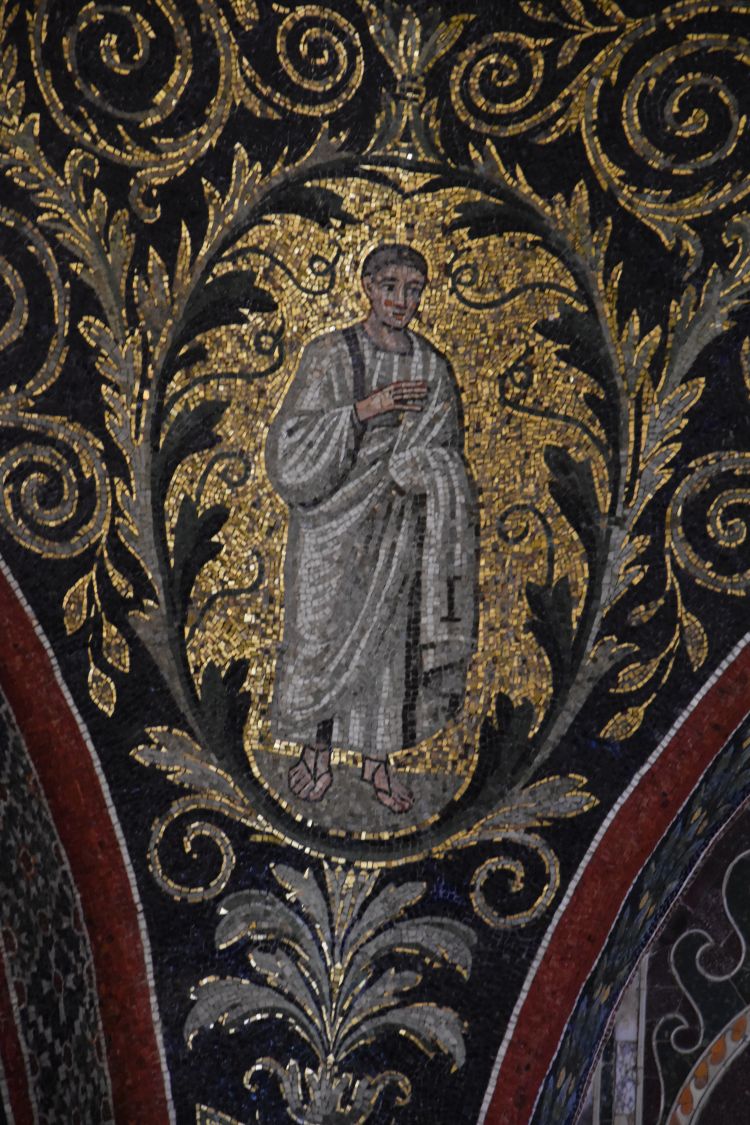
Below the windows are absidioles that once were much higher and contained (lost) mosaics showing biblical scenes. The spandrels connecting the absidioles are decorated with mosaics showing (unidentified) men sourrounded by blue and golden.

When entering the baptistery, I opened my mouth – aah – and just stared up at the cupola. Far away I heard a voice say something, but I did not listen. Only after some time I understood that this voice wanted me to show my ticket or buy one. A ticket? I came back to the world – oh yes, the cash point is inside the baptistery. The voice was very friendly, repeated “ticket please” and obviously enjoyed that I was so much overwhelmed by the beauty of the mosaics.

We will return to the scene of christening shown in the Orthodox Baptistery and compare it to the same scene in the Arian baptistery.

References:
Clementina Rizzardi: “Ravenna, Eight Monuments World Heritage”, Municipality of Ravenna
Carola Jäggi: Ravenna, “Kunst und Kultur einer spätantiken Residenzstadt”, Schnell+Steiner, Regensburg 2016
Jutta Dresken-Weiland: “Die frühchristlichen Mosaike von Ravenna”, Schnell+Steiner, Regensburg 2016.

Ravenna: My history overview

“No, no, I only visit Ravenna in winter,” Ursula says. I take a break from my favorite winter activities which relate to skiing, take out my car and off we go in the beginning of March 2018 to explore Ravenna and its eight UNESCO World Heritage Sites.

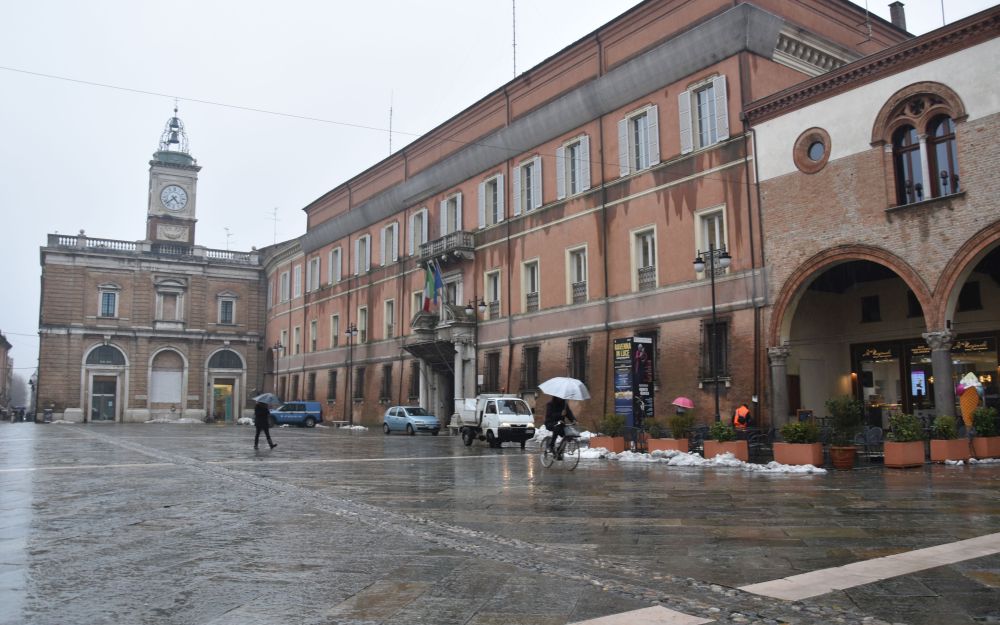
When we arrived in Ravenna in the first week of March, winter was still present, as the snow heaps on the Piazza del Popolo show.

It was very cold and it was raining. Even the cyclists used their umbrellas. Fortunately, by the end of our week in Ravenna, we could again sit outside to enjoy our Italian espresso in the warm sun.

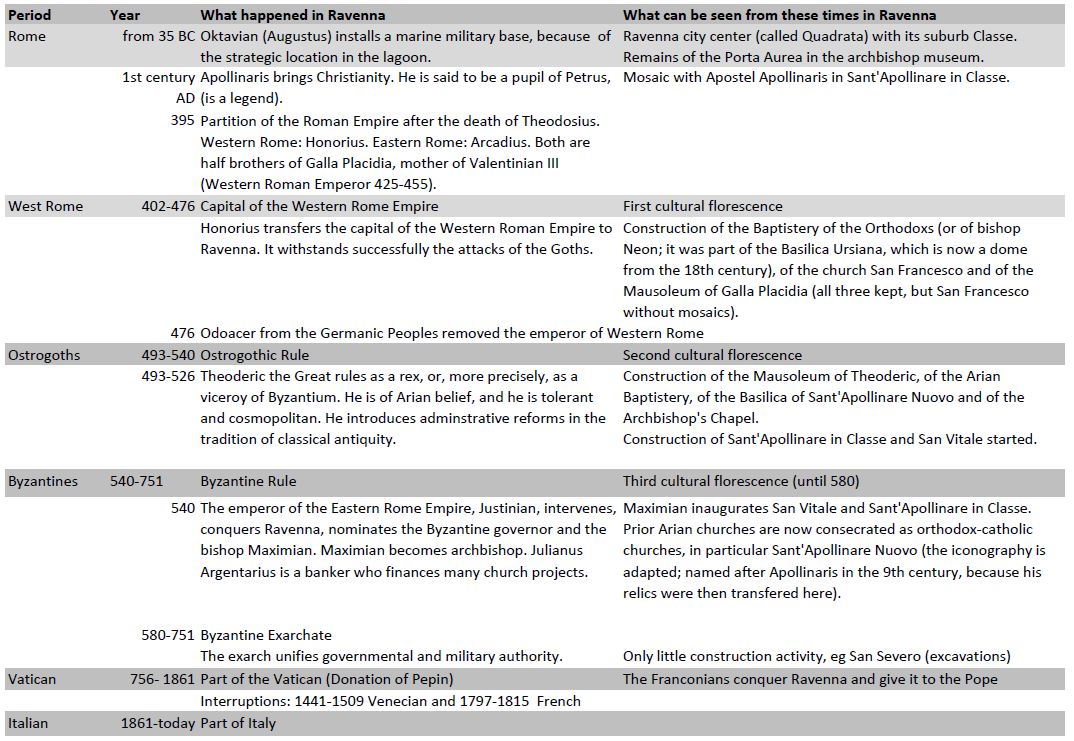
Before exploring the UNESCO World Heritage Sites of Ravenna, let us get an overview of Ravenna’s history. It may not be complete, as I am not a historian, but it helped me to navigate in Ravenna and understand the background of the sites we visited.

Source: See references below, and sometimes I would use Dr. Google to verify my understanding.

To summarize, the eight sites of UNESCO World Heritage at Ravenna are:

  • from the Western Roman Empire (402-476): Mausoleum Galla Placidia and the Baptistery of the Orthodoxs.
  • from the Ostrogothic Rule (493-540): Mausoleum of Theoderic, Arian Baptistery, Sant’Apollinare Nuovo (remodeled during Byzantine times) and the Archbishop’s Chapel.
  • from the Byzantine Rule (540-751): San Vitale and Sant’Apollinare in Classe (both started during Ostrogoth times, but then inaugurated in Byzantine times).

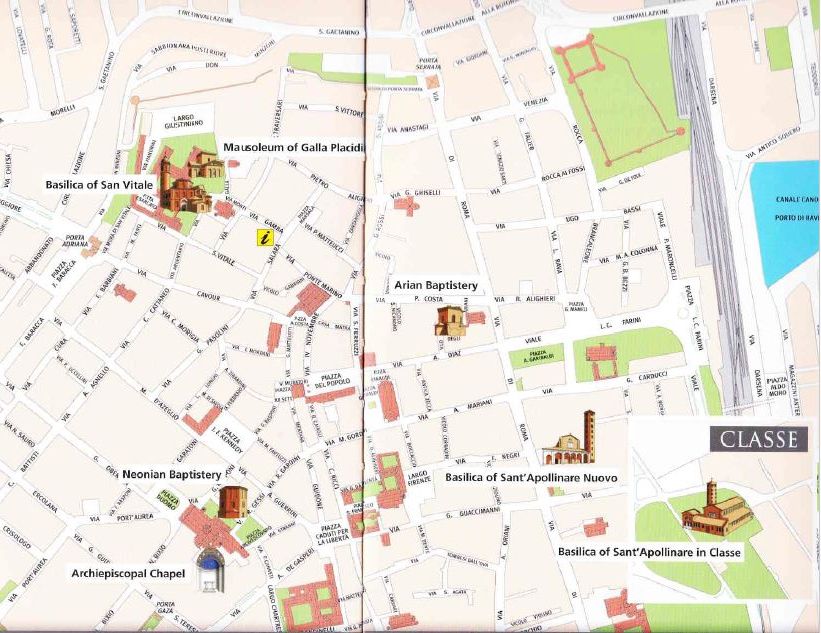
See, where you find the sites in Ravenna.

Source: Clementina Rizzardi: “Ravenna, Eight Monuments World Heritage”, Municipality of Ravenna.

Let us explore these eight UNESCO World Heritage Sites in the coming blogs.

References:
Clementina Rizzardi: “Ravenna, Eight Monuments World Heritage”, Municipality of Ravenna
Carola Jäggi: Ravenna, “Kunst und Kultur einer spätantiken Residenzstadt”, Schnell+Steiner, Regensburg 2016
Jutta Dresken-Weiland: “Die frühchristlichen Mosaike von Ravenna”, Schnell+Steiner, Regensburg 2016.


Basel Carnival 2018 – about the lantern exhibition: Eating insects, figugegl and hol’s dr Geier

Let us come back to the lantern exhibition 2018 on the Cathedral Square with some cheerful topics: Eating insects, Figugegl and hol’s dr Geier.

.

Eating insects

Eating insects – this is a new gourmet trend that can be well expressed in the masks and fancy costumes matching the lanterns.

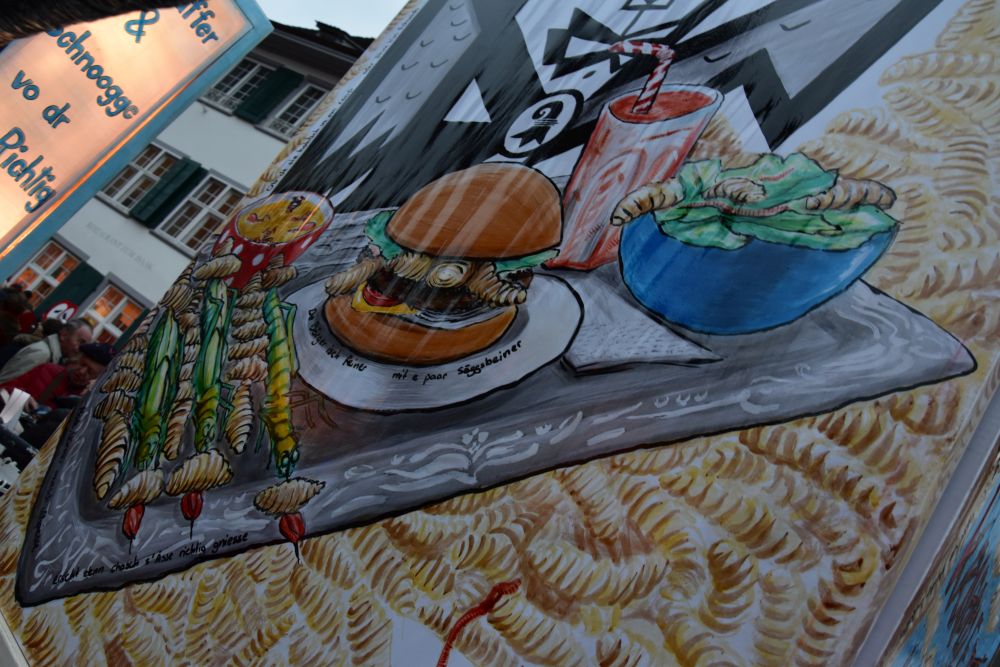
Look at this enticing menu made from insects. “Dä Börger isch feiner mit e paar Säggsbeiner” – “this (ham)-burger is more delicious with a few (animals with) six legs”.

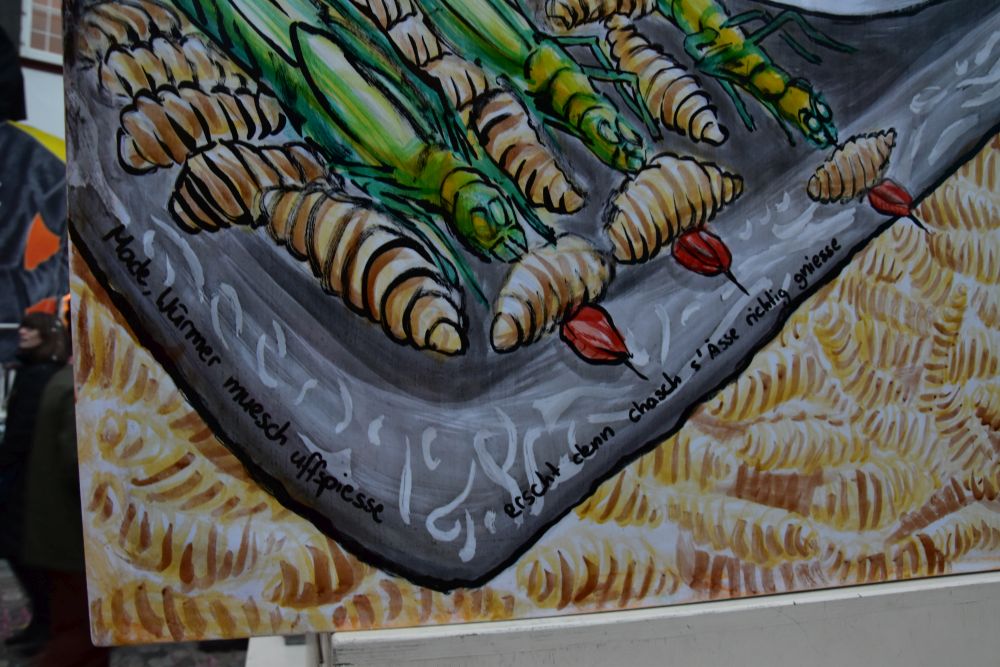
Enjoy the barbecue at the edge of the plate: “Made, Würmer muesch uffspiesse, erscht denn kasch s’Ässe richtig gniesse” – “grubs, worms – this is what you have to skewer, only then you can enjoy your meal.”

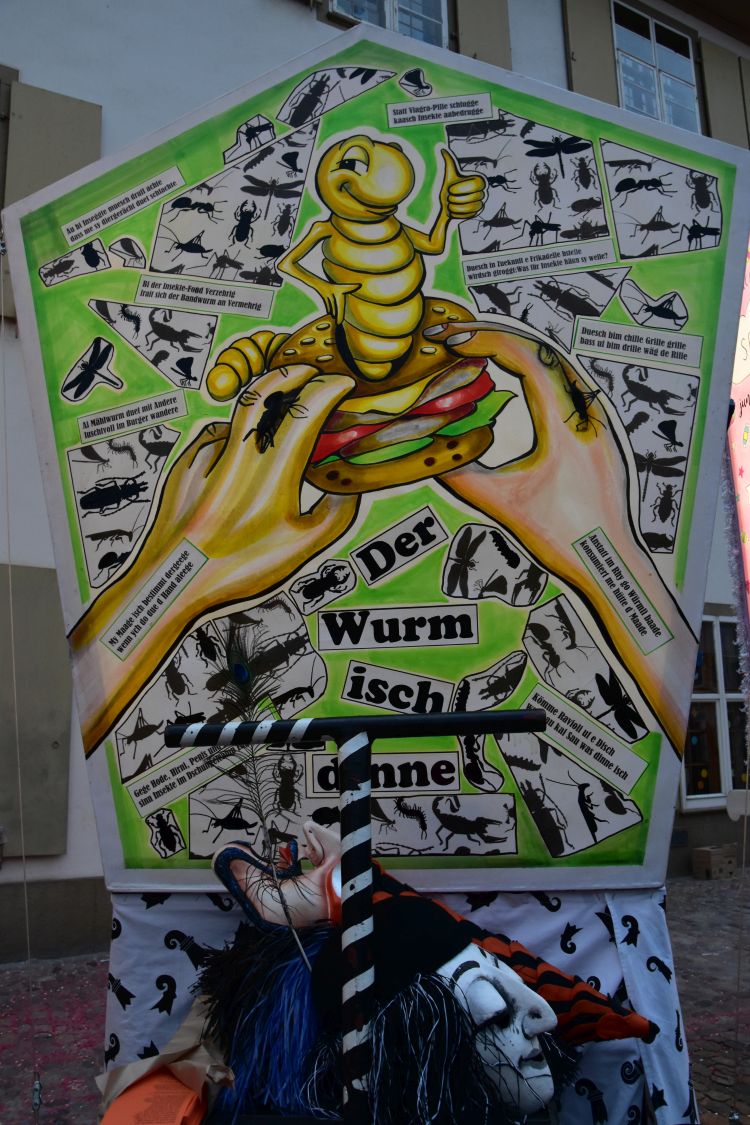
This lantern plays with the words: “Dr Wurm isch dinne” – “the worm is inside”. Yes, the worm is inside the meal, but in German this means at the same time: “This is, where the rub or the problem is”.

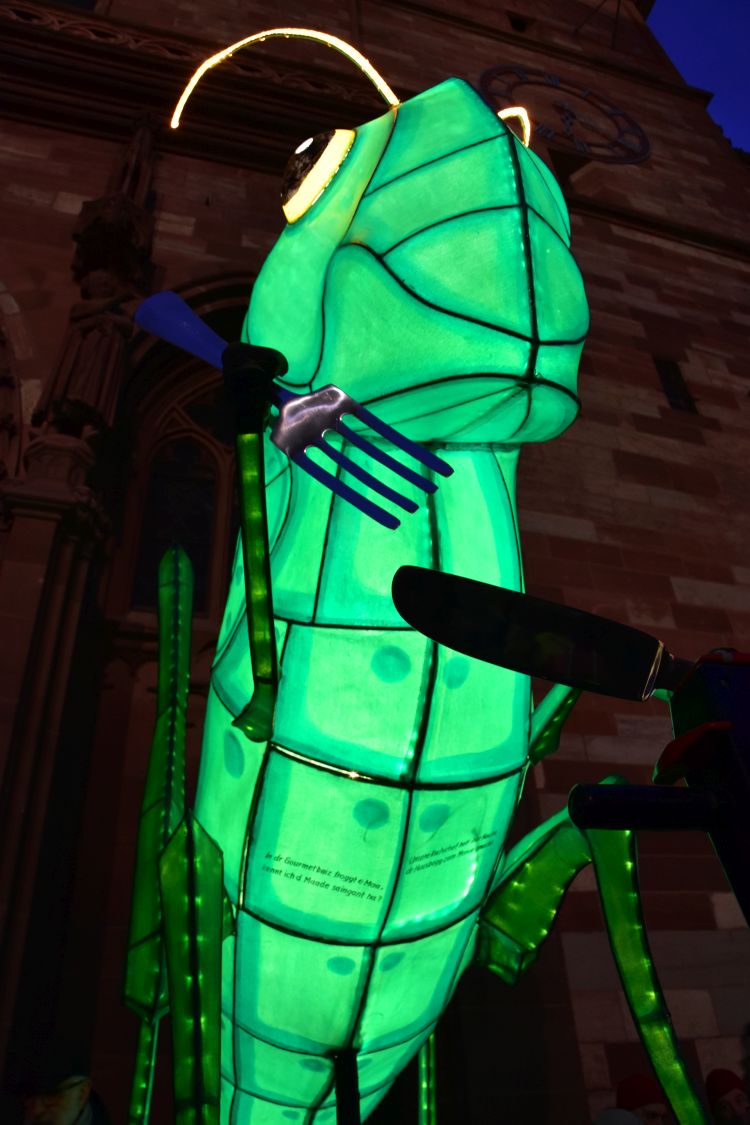
At the cortège, the Pfluderi were disguised as grasshoppers assembling around this huge grasshopper. The verse says: “In dr Gourmetbaiz froogt e Maa, könnt ich d’Made saignant ha” – “in the restaurant a guest asks, whether he could have the grub rare”.

.

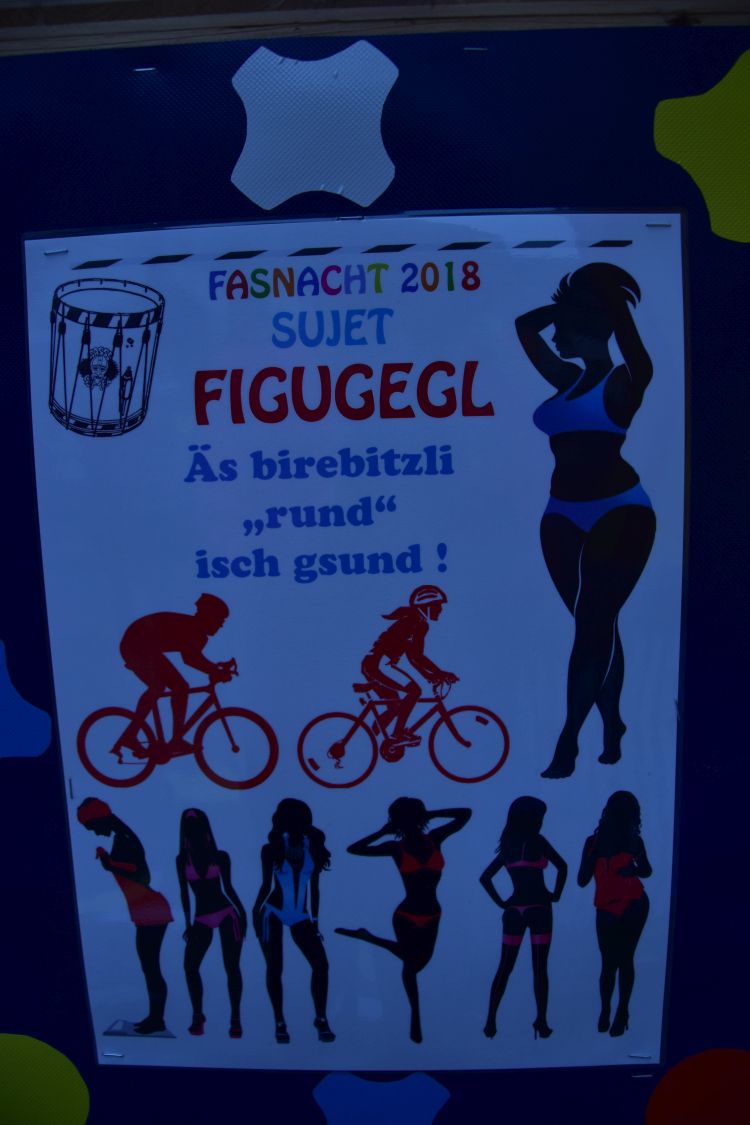
Figugegl

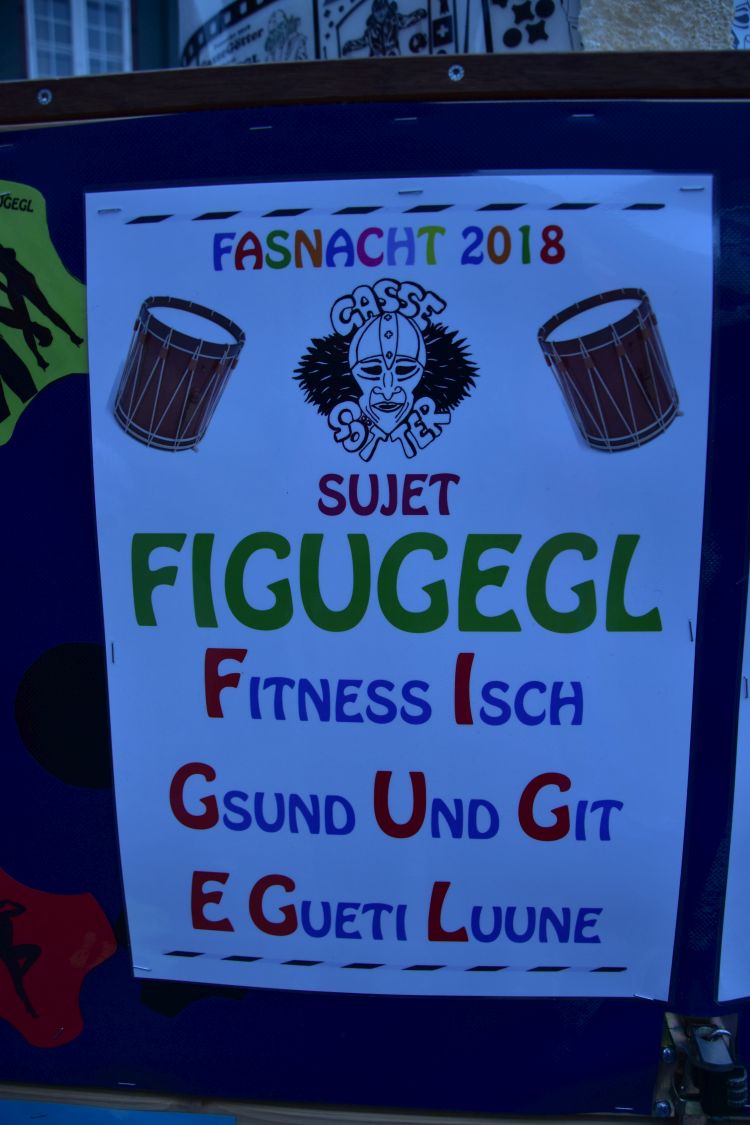
Many, many years ago, Figugegl was the publicity for Fondue, one of the Swiss national meals (melted cheese). Figugegl was an acronym: „Fondue isch guet und git e gueti Luune“ or “Fondue is good and gives good humour”. The Gassegotter replaced “Fondue” with “Fitness” which leads to “Fitness isch gsund und git e gueti Luune” or “Fitness is good and gives good humour”.

The Gassegotter comment the trend for extreme slimness by recommending that „äs birebitzli rund isch gsund“ or “a little bit “round” is healthy”.

.

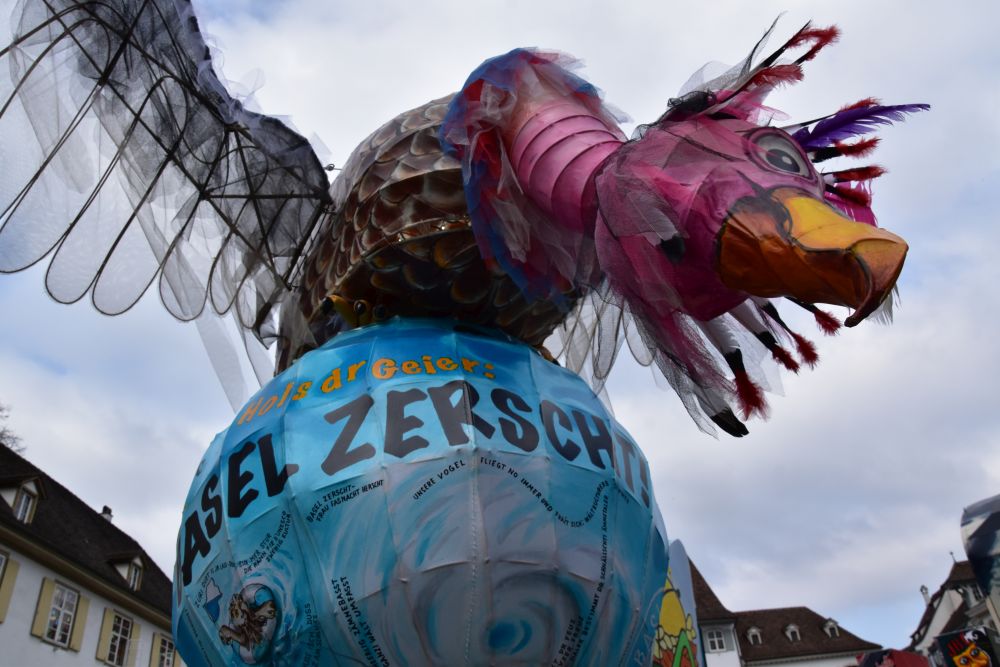
Hol’s dr Geier – Basel first

Trump says „USA first“. On this lantern I found „Basel zerscht“ or “Basel first” , along with – „hol’s dr geier“ or “the vulture may grab it”.

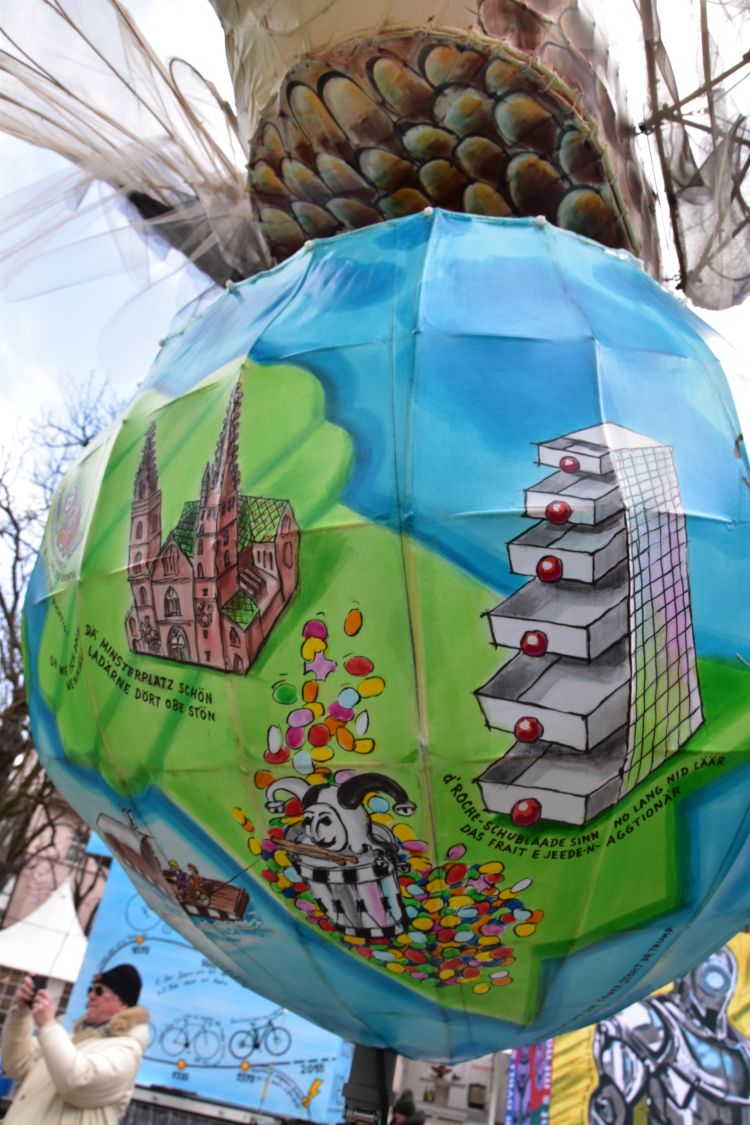
Well, the vulture might be a sign for bankruptcy, but… “D’Roche Schuublaade sin no lang nyt lär, das fräit e jede-n-Aggtionär“ or “the drawers of Roche will not be empty for many years, this makes every shareholder happy”.

In addition I find here a tought about the lantern exhibition at the Münsterplatz or Cathedral Square: „Dä Münschterplatzz (isch) schön, Ladärne dört obe schtön“ – “That Cathedral Square is beautiful – lanterns are standing up there.”

Yes I agree, the Cathedral Square is beautiful, in particular, when the lanterns are “up there”. And I agree: Basel first! – I look forward to next year’s lantern exhibition on Tuesday, March 12th 2019.


Basel Carnival 2018 – about the exhibition of lanterns: The world at risk

Let us come back to the lantern exhibition 2018 at the Cathedral Square. This time I will talk about the gloomy topic that largely dominated this year’s carnival: The world at risk.

This is, how the Giftschnaigge illustrate the subject “Risiko – risk” on their lantern: “D’Wält stoot uff em Spiil” – “The world is at stake”. The metapher for “at stake” in German is “auf dem Spiel” which relates to the politicians gambling. The punch with gambling only works in German.

Three politicians are on the lantern below, Kim Jong Un loving the United States (hm), Putin sitting on an innocent unicorn and Trump uttering something not very nice.

The Alte Stainlemer painted more abstract faces for Kim and Trump at PjöngJangeles alluding to the Olympic Games in South Korea and simultaneously to the competition about “Ballistic Games” between the two.

The other side of their lantern shows Kim and Trump competing to score. In the cortège or parade “incarnations” of the two competitors even perfomed their score mastering. In another “incarnation”, Trump and Kim played with a globe and from time to time placed it on a nuclear power plant tower.

The Schnurebegge say on their lantern: “Es dien die beide wirre Irre zünftig mit de Sääbel klirre” – “the two confused fools are jangling heavily with their swords”.

The group CCB (Central Club Basel) invented the new name “Corean Club Basel”. Kim presents a very explosive menu, it is “a bombe surprise”.

“Wenn die acht so wytermache, wird die Wält usenander krache” –  In case these eight guys will continue in this way, the world is going to break apart”. Do you recognize the eight faces that the Dupf Club assembeld in this balloon?

Some lanterns show visions of where we may end up, in case the politicians will continue in this way.

All very frightening, but this is what the Basel Carnival is about – discussing both cheerful AND gloomy topics. The Carnival acts as a catalyzer for good and bad feelings. In my next, third blog about the exhibition of lanterns, I will take up some more cheerful topics.

Basel and its Carnival – about the 2018 exhibition of lanterns: Fake news, digital world and sharing economy

Short overview of the Basler Fasnacht or Basel Carnival

This year the Basel Carnival took place from 19th to 21st of February 2018, for the first time as a Unesco World Heritage.

As always, it started with the Morgestraich – a word that cannot be translated. Look at this link from the Luzernerzeitung, to see how, on Monday at precisely 4 o’clock a.m., the lights go out, the drums and pipes start playing and the lanterns start to “walk” through the dark night. This is the magic moment that kicks off our “three extraordinary days”.The 2018 motto is: “D’Boscht goot ab” which means “we are kicking it off right”, but which in addition alludes to the post offices (Boscht) that are changing dramatically right now.

Many of the topics taken up at the 2018 Carnival were political. I will present some of the political and some of the more cheerful topics by strolling through the lantern exhibition at the Münsterplatz (Cathedral Square) which takes place all Tuesday and on Wednesday morning. During this time the Cliquen or carnival groups do not need their lanterns. They pick them up again later on Wednesday for the second parade or cortège. In the cortèges of Monday and Wednesday, the lanterns match the masks and the disguise to illustrate the topics selected by the groups.

Also the Schnitzelbanggsänger (some sort of minstrels) comment the events of the year. Here are two verses about fake news and about #metoo (both sung by Stächpalme which in biology is a holly. However, literally translated it is a “biting palm tree” alluding to the biting comments the Stächpalme makes).

Fake news:

Dr Trump het gnueg vom wysse Huus und wird neu Chef vo Twitter
Dr Pabscht hürootet d’Lindysey Vonn und landet hinter Gitter
D‘Merkel schtolkt dr Macron z’Nacht im Dussel – s’isch e Gruus,
D’Queen kifft mit em Butler – ich verfolg der Fake Niuus Bluus.

Trump is sick of the White House and now became head of Twitter,
the Pope marries Lindsey Vonn and ends up behind bars.
Merkel stalks Macron at night when drunk – it is just gloomy.
The Queen smokes weed with her Butler – I am following the Fake News Blues.

#metoo :

Jetzt goot’s em Santiglaus an Kraage.
die alt Frau Niggli isch am Klaage,
Er hege’re vor 80 Joor – sy heig das lang verdrängt -,
won‘r sy in Sagg geschteggt heg, ans lingge Schynbai aneglänggt.

Now Santa Clause has a problem.
Old Mrs Wicky is complaining,
it was 80 years ago – she has suppressed that for a long time -,
that, when pushing her in his sack, he touched her left shinbone.

During Carnival the weather was mostly clouded, sometimes sunny. It never rained. Temperatures were chilly, as the frozen Tingueley fountain shows.

Even the ducks avoided the water – simply too cold.

.

The exhibition of lanterns on Tuesday and on Wednesday morning

Our Cathedral from the 11th and 14th century is a great background for the lanterns exhibited at the Münsterplatz or Cathedral Square.

Let me start with the lanterns about fake news, the digital world and the sharing economy. Important details on the lanterns are the small verses – I will try to translate some of them.

.

Fake News

The Barbara Clique takes up the topic “Fake News” and transcribing it to our local dialect “alles glooge, feyk niuus” – “all lies – fake news”.

Their lantern is a big Pinocchio on one side.

Pinocchio’s long nose alludes to the fact that he often lies – and this is what fake news are about – lies.

The other side of the lantern shows all the well known politicians looking down into hell where Pinocchio is emerging.

These are some of the verses:  “Isch dr Trump am Twittere, isch die ganzi Wält am Zittere” – When Trump is twittering, the whole world is shivering”. And “Dr Trump froogt dr Erdogaan, lyydisch au an Greessewaan?” – Trump asks Erdogan, do you also suffer from delusions of grandeur?”

Walking around the lantern I find this verse: “S’git Lyt, die dien sich soo verbiege, dass sy nit mergge, dass sy liege” – some people are distorting their body so much that they do not notice that they are lying” (distorting alludes to lies).

And another small detail: “Do im Roothuus dien si liege, bis sich alli Bälgge biege” – “Here in (our) townhall they are lying that all beams are being distorted.” In our dialect (and also in German), “to lie, until the beams are being distorted” or “to lie, until you are distorted” means that you are REALLY lying.

The group Seibi Mysli (little mice from the Seibi or Barfüsser Square) transformed the alternative facts into our dialect: “Lätz geschwätzti Facts” or “Wrongly stated facts”. The verse says “do muesch dy frooge, verglemmi alles glooge” – you have to ask, what the deuce, all just lies” (“verglemmi” is a rather soft swearword in the Basel dialect, I am not sure, how to translate that into English).

And the washer women are complaining: “Mir Wöschfraue könne de News nümme draue” – We washer women can no longer trust the news”.

.

A digital world

Digital was another topic coming up – everything goes digital, even the war. But there are also more cheerful sides about digital, which are google omnipresent for searching and the Emojis.

The most innovative (and I assume, the most expensive) lantern was the globe made by the “d’Revoluzzer”. It is not a painted lantern, but it consists out of 40 screens that are changing scenes. The globe weighs more than a ton and is pulled on a cart. By the way, when you pronounce “digital” in Basel, it comes out like “digidal”.

Digital may end up in a digital war, as this gloomy figure illustrates grabbing everything in its way.

The young department of the group (Clique) Rätz show a more cheerful aspect of digital. They ask “Dänggsch no oder guuglisch scho?” – “Do you still think our do you already google?” “Google” is transcribed to “guugle” and is often used as a verb in our local dialect (Du guuglisch=you google).

Without thinking first, the Jungi Rätz comment that we often google everything such as “WorumWärWasWämWoWieWenn” – WhyWhoWhatWhomWhereHowWhen”.

The very small guys of the Naarebaschi (very small guys are “Binggis” in Basel) illustrate the topic “Emoji instead of ABC”. Maybe the Binggis hope that they do no longer have to learn, how to write, but can use Emoji instead. At the cortège (parade) they all came disguised as Emojis – a great topic for small guys or Binngis.

The lantern of the Binggis gives an overview of Emojis. I particularly like the brownish emoji with the happy face.

.

Sharing economy

The Wiehlmys or digging mice (I also found the “biological expression” “root vole”) propose to “rent a mouse” which in our dialect can be expressed as “Muuslehne”.

The verse on the cash says “Nyt me, was me nyt uuslehne kaa, fir Gäld kasch aifach alles ha” or “Nothing that you cannot rent, for money you can have everything.” Yes, I have heard that you can even rent sheep to cut your lawn…

 Let us put off some more lanterns of the Cathedral Square exihibition for some later blogs.


Home is not here or there, but inside yourself or nowhere


In 2017 I travelled and travelled. I soaked up culture and history. I met and found friends. I gathered souvenirs, my eyes wide open.

One souvenir is this lake called “Zypressenteich” near Nuremberg (Nürnberg) in Germany: An inviting yellow bench to sit on and just dream and reflect under trees covered with yellow leaves surrounding the mysterious lake hiding its ground.

It could have been here that Hermann Hesse thought about home (or in German: Heimat).

“Heimat ist nicht da oder dort, Heimat ist in Dir drinnen oder nirgends” which can be translated to “Home is not here or there, home is inside yourself or nowhere.” This struck me.

I must admit that, when travelling in 2017, I found my second home in Brandenburg, because everyone around me spoke like my mum. I have never experienced that before. I had found my second home in Brandenburg, while  my first roots are in Basel, the town of my dad, where I live.

Yes, I feel home in Basel and in Brandenburg… here and there… which gives me roots. But nevertheless I sense like Hermann Hesse that my real roots are not here and there, but home is inside myself. He may have used his words to warn from growing nationalism and growing rejection of everything outside.

While travelling, I sensed some signs of growing nationalism which I fear… Hermann Hesse came in right for me and motivated me to work on his thoughts my way, in German first, then trying to translate that.

.

Heimat ist in Dir drinnen oder nirgends

Warum Heimat da oder dort suchen?

Warum nach Heimat in der Geschichte forschen?

Warum für Heimat verbissen kämpfen?

Warum Fremde aus der Heimat sperren?

Warum?

Ist denn Heimat nicht in Dir drinnen – oder nirgendwo?

.

Home is inside yourself or nowhere

Why look for home here and there?

Why search for home in history?

Why fight for home like do-or-die?

Why lock out others from home?

Why?

Is home not inside yourself – or nowhere?

.

Родина внутри тебя или нигде
Почему ищут Родину тут или там?

Почему истоки Родины ищут в истории?

Почему сражаються ожесточённо за Родину?

Почему закрывать Родину чужим?

Почему?

Разве Родина не внутри тебя – или нигде.

.

Las raíces están en tí mismo o por ninguna parte

Porqué buscar las raíces por ahí o por allá ?

Porqué investigar las raíces en la historía ?

Porqué batirse por las raíces tan reñidamente ?

Porqué bloquear el ingreso de los extranjeros en nuestras raíces ?

Porqué ?

No es que nuestras raíces están en tí mismo o por ninguna parte ?

.

Well, for 2018 I do hope that we look for home inside ourselves and nowhere else!

.

Source: “Demian” (1919), requoted in the anthology about trees “Hermann Hesses Betrachtungen und Gedichte über Bäume” edited by the Insel Verlag.


Traveling around Berlin in Brandenburg – this is also a wine region, yes!

Brandenburg – wine region – are you serious? Yes I am.

Brandenburg is surrounding Berlin, and is located pretty far north in Germany. Too far north for wine, I always thought. But then I came across the book “Weinland Brandenburg” by Tom Wolf (be.bra Verlag Berlin 2016). Tom Wolf describes 31 vineyards in Brandenburg. Very interesting. I decided to explore some of them, when traveling in Brandenburg, the hinterland of my mother town Berlin.

.

Why are there wines in Brandenburg – so far north?

In early medieval times, Europe was christianized. As a consequence, monasteries were founded – also in Brandenburg. The monasteries needed wine for their cult and hence started to grow grapes for that, but perhaps the monks also enjoyed some of their wine from time to time.

It was Frederick the Great who stopped the wine production in Brandenburg in the early 18th century. He was of the opinion that potatoes are more useful – and he made his people cultivate potatoes instead of wine.  In addition there were more frequent frosts at that time that discouraged cultivating wine.

Shortly before the iron curtain fell and even more after the reunification of Germany, the tradition of cultivating wine took off again on some of the sunny hills that the monks had already selected earlier. Hills in Brandenburg are not high, but there are slopes that allow to produce wine, especially now with global warming. It may not be a Bordeaux or a Burgundy wine, but I found well made wine from biological production. Oh yes, some people say that wines from Brandenburg are sour – but I found them to be good companions for tasty local meals.

Let me tell you more about the monasteries and about the vineyards that we visited. Check out the book of Tom Wolf to find out more about 31 vineyards in Brandenburg.


Source: LBV Raumbeobachtung 2011

.

Potsdam: Frederick the Great had his own vineyard – nevertheless

Frederick the Great or, as we call him, der Alte Fritz, may have told his subjects to cultivate potatoes instead of wine, but… he had his own vineyard in Sanssouci – a patchwork of small greenhouses with stone walls and glass windows climbing up the hill to his intimate palace “Sanssouci”.

I had always thought that this wine garden in Potsdam is somewhat excentric… and now I know, cultivating wine here is not excentric, but it is an old tradition

.

Uckermark: Prenzlau – the monastery of the Dominicans  and the vineyard hanging on the town wall

Prenzlau (north of Berlin) is located on the northern shore of the Uckermark lake. The Dominicans founded a monastery here. In the former refectory some frescos have been renovated.

This beautifully carved altar shows the pastor with his sheep just arriving at the stable where Christ was born.

The monks needed wine for their cult and selected the town wall to capture the heat and light of the sun reflecting in the Uckermark lake. This southward looking slope is very warm, indeed. I could feel that even on a chilly day.

In 2013 the vineyard has been reinstalled for the LAGA which is a German garden exhibition (Landesgartenschau). The grapes planted are Regent (red) and Solaris (white). The wine is pressed in Pleisweiler in the Pfalz and can be bought in the tea- and wine house Gotzmann. (Tom Wolf, p. 207). Gotzmann was closed, when we were in Prenzlau, because it was a Sunday.

.

Lausitz/Spree: Welzow with a vineyard in the open cast mine and Dr. Martin Krause’s vineyard in Drebkau

We spent a few days in the Spreewald with its woods along ramifications of the Spree, where cucumbers become “Spreewaldgurken” in vinegar.

All of a sudden the forest opens and we see the open cast mine of Vattenfall near Welzow. A huge, huge desert. Villages had to  be sacrificed, one of them being Wolkenberg with a former tradition of wine growing. Vattenfall started to plant their deserted hole and local specialists are cultivating the wine called “Wolkenberg” that can now be tasted in local restaurants (Tom Wolf, p. 145). Well, Vattenfall undertakes a small effort to repair what they have destroyed. I just stopped to breathe, when I saw this naked landscape.

We selected the lookout point of Welzow, but from here, we could not see the vineyard.

Instead we found Dr. Martin Krause’s vineyard in Drebkau/Klein Ossnig.

Dr. Martin Krause has done research and found that about 50 winegrowers were active around Cottbus in the 16th century  There was a vineyard in Klein Ossnig that delivered wine to the monastery of Cottbus – look for the monks! (Tom Wolf, p. 163).

.

Fläming: Baruth and the Glashütte with the very special wine shop

In the southwest part of Brandenburg called “Fläming”, we visit the open air museum “Glashütte”. Beyond learning about how they made glass here, I buy three bottles of wine in the Weinsalon Glashütte:  Brandenburger Landwein from Zesch (Pinot white) and two bottles of Goldstaub with white wine made from the grapes Solaris and Helios that are common in this area. By the way, the wine saloon also offers wines from Moldovo and organizes events. A very inviting place.

Tom Wolf talks about the Weinberg Zesch that benefits from the lake of Zesch, not far from Baruth (p. 83). He also mentions the Mühlenberg in Baruth that produces the wine called “Goldstaub” – yes, there is a mill-wheel (Mühlrad) on the label (p. 89).

I have never tasted Solaris and Helios before and I am curious.

.

The monastery Lehnin and the vineyards in Werder one of them being the Wachtelberg

The monastery of Lehnin and the adjacent hospital are now run by deaconesses. By the way, this romanic monastery is called Le-H-nin (with an “h”).

The monastery owned various vineyards in Werder which is a quiet town spreading out widely on the shores of the Havel near Potsdam. The Wachtelberg was one of the vineyards and today it is a vineyard again. We found it amidst the houses of Werder. There is a wine bar (Weintiene) on top of the hill that is open in the afternoon.

Dr. Linicke started to grow wine in the late 80’s in the former GDR, but after the fall of the iron curtain, nobody was willing to buy wine from the “east”. In 1994 the wine production was restored, again involving Dr. Linicke (Tom Wolf, p. 33). Now he has installed the “Erlebniswanderweg Wachtelberg”: Each line of grapes is described in detail, like this line of Ruländer or Pinot Gris.

.

Wolanski and his Klosterhof Töplitz

Lara Wolanski does horse dressage and her father, Klaus Wolanski, started in 2007 to grow wine in Töplitz (Tom Wolf, p. 19). When we arrive at the Klosterhof, we find a message at the door: “Call me, I am happy to come”. Very soon a roaring noise announces the arrival of Klaus Wolanski. He comes on his small tractor and welcomes us with his black-white dog. He tells us that his wine production is based on biological principles. Here – so far north – the  grapes are not delicate, they do not need those strong pesticides, he says. There is grass in the vineyards that the sheep “cut”. The sheep also eat the leaves such that the grapes get more sun. They do not like the grapes, as long as they are sour, but – they would love them, once they are sweet. Hence these “helpers” have to stay outside now, in autumn.

We walk around in the area. There is a picnic place on top of the Töplitz hill. People used to flat land might be happy to recover from the steep ascent. And it must be a great place to celebrate.

We buy some wines – Riesling, Pinot Gris (both white) and Regent (red) – one bottle of Regent has matured in the barrel.

Annerös takes one bottle of Regent home. She drinks it with her husband, and they like it. Well made, they said. Soon after arriving at home, I shared the Grauburgunder or Pinot Gris with my neighbours. The wine was clean and freshly fruity – a  real “Ruländer”.

.

Not only wine, but also stronger stuff for the monks: The KlosterBruder

In the monastery of Zinna – also a Cistercian monastery founded in 1170 – they produce the “Zinnaer KlosterBruder” or “Zinna Monastery Brother”.  Right in the building under the clock.

It is a herb liquor that is supposed to be healthy (monks called their herb liquors “aqua vitae” (water of life) and used them as a medicine. The technique of distilling liquor has been known at least since the 12th century, perhaps even earlier.

There is a legend related to the “KlosterBruder”: A cavalier from the area was in love with a lady that was too noble for him. As he could not marry her, he went to the monastery, where he produced holy paintings with the face of his beloved noble lady. The abbot recognized the face and made him destroy his paintings. The monk obeyed and started to collect herbs. He invented the herb liquor “KlosterBruder” named after him and discovered that this drink made him feel cheerful and happy.

Herb liquors are not really my favourite drinks… To my opinion they taste like medicine.

But I like wine – and the wine culture in Brandenburg was a surprise for me. The wines make nice – though a bit unexpected – souvenirs from Brandenburg! And there are more vineyards to explore, when going back – at least 31 of them.

In addition, there is much more to see in Brandenburg – the early Slavic immigrants (Sorbs and Wends) and the ramifications of the rivers (Spreewald, Havelseen or Oderbruch). We found numerous castles (Wiesenburg, Eisenhardt, Lübbenau, the Fürst Pückler park with the duke’s castle or charming Sanssouci in Potsdam) and nice bigger and smaller cities (Bad Freienwalde, Jüterbog, Bad Belzig, Lübbenau or Brandenburg) with timbered houses and gothic churches and townhalls made out of brick (we call that German Backsteingotik – sometimes even Backsteinromanik). I will go there again. Perhaps for a bicycle tour.