On November 10th 2023, I visit Charlemagne’s octagonal Cathedral (the Aachen Cathedral). I sit inside the octagon and look into the cupola. To see this has been my dream of a lifetime.

I breathe in the atmosphere enjoying the perfect harmony of the octagon. Today is 11/10/2023. Was it not 13 years ago that Ernst and I got married, on 11/10/2010? Yes, right, exactly 13 years ago. — I light a candle for Ernst. He is in my heart.
Now, I explore the architecture of the Cathedral of Charlemagne.
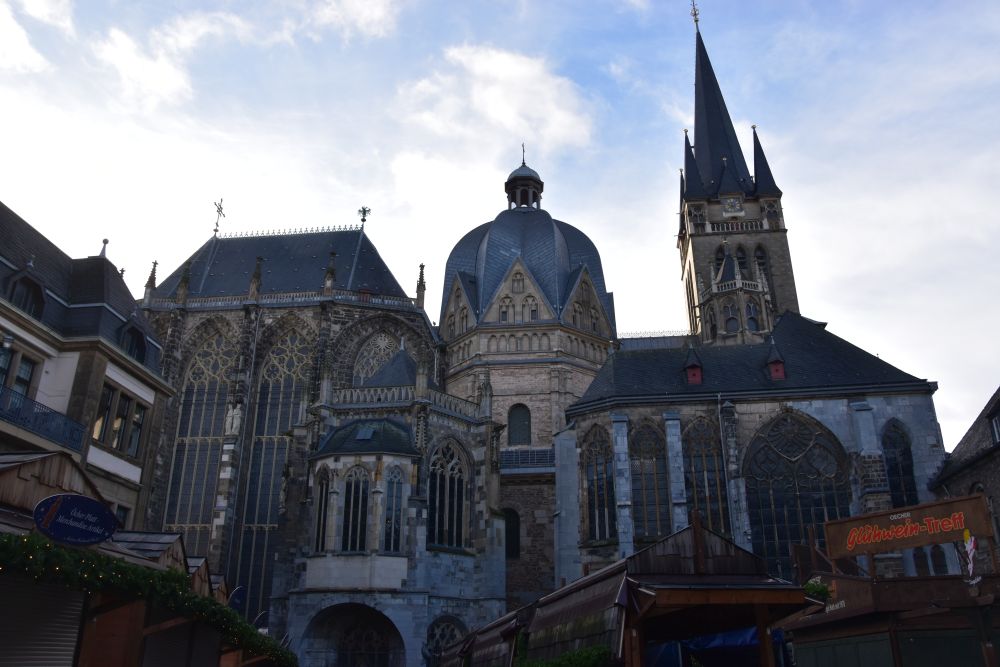
The Cathedral view from outside
When I approached Charlemagne’s cathedral, I was surprised. Where is the octagonal building that I have been looking forward to seeing? Oh, I understand, it almost disappears between larger buildings of gothic appearance surrounding it. The steep roof on the octagon looks a bit like a cream topping.
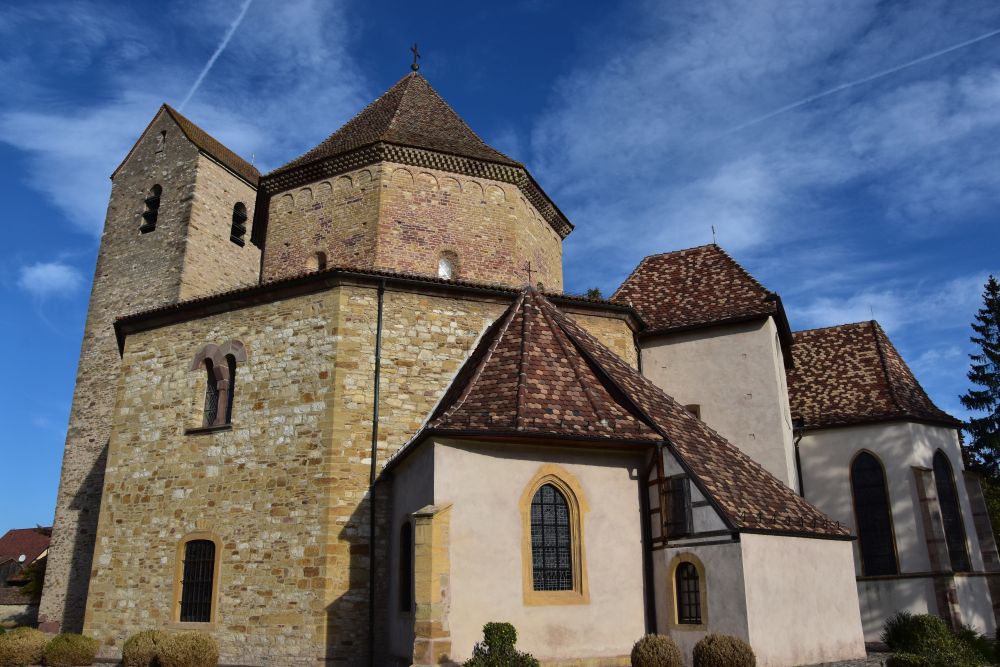
I had expected more resemblance to the abbey chapel of Ottmarsheim in the Alsace, inaugurated in 1049, two hundred years after Charlemagne’s Aachen Cathedral; Aachen was the model for Ottmarsheim. It is somehow Aachen’s “little sister”.
Around 800, Charlemagne conceived his cathedral as a modest and elegant building. This is what it looked like originally and what Rudolf von Altenburg (an ancestor of the Habsburg family) took as the model for Ottmarsheim.

Source: Walter Mars, p. 20
When travelling to Rome, Charlemagne saw San Vitale in Ravenna.
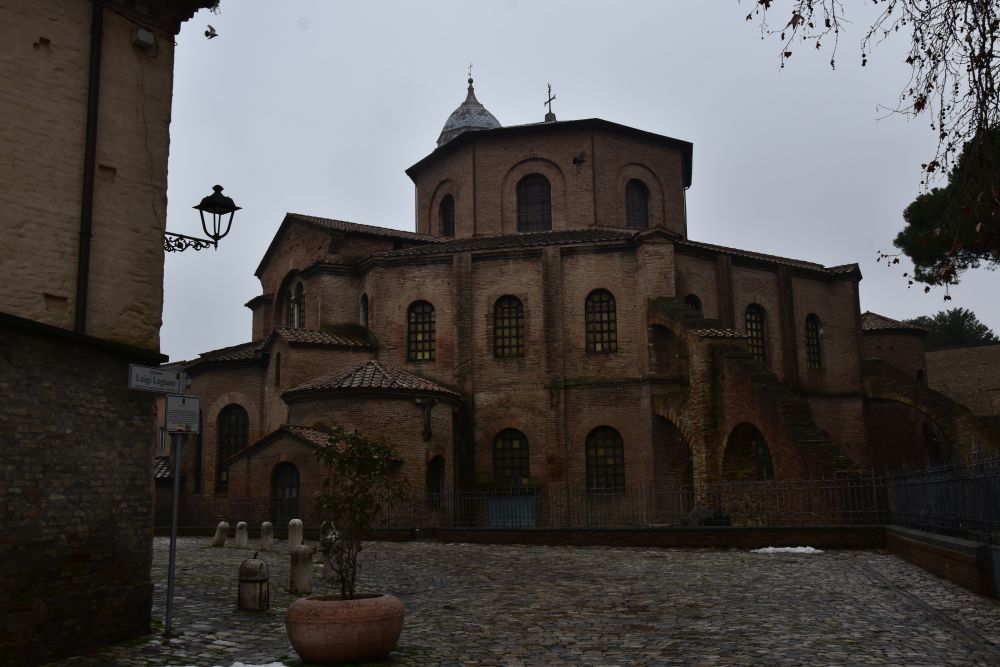
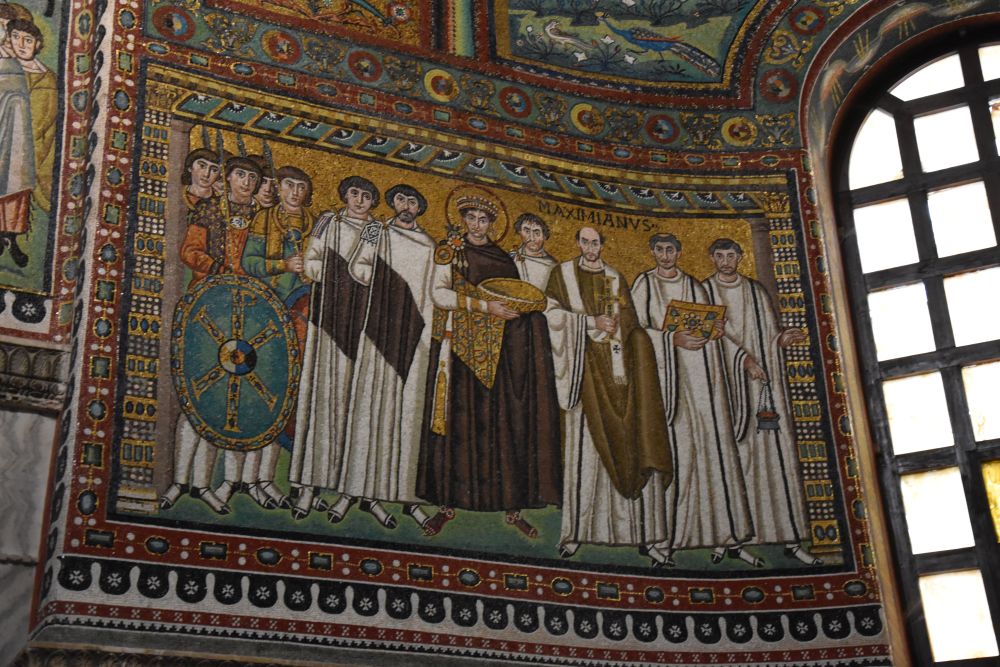
San Vitale was built under the Byzantine Rule of Justinian and was inaugurated by Bishop Maximianus in 547 AD. The mosaic shows Justinian (in the middle) and Bishop Maximianus (labeled).
San Vitale was an important inspiration for Charlemagne. Since Roman times no such domed structure building had been completed north of the Alps. 300 years after San Vitale, Charlemagne wanted to change that, and he hired craftsmen from Lombardy to have his Cathedral built, the first domed structure since Roman times north of the Alps.
He completed his octagonal Cathedral, and today it almost disappears between the mainly gothic extensions and under the baroque roof hood (“the cream topping”) that was added after Aachen’s city fire of 1656.
Charlemagne’s Cathedral inside – original and today
The interior of Charlemagne’s octagon is richly decorated today. This is the result of the renovations in Neo-byzantine style around 1900.

It seems to me that the renovators took up the atmosphere of San Vitale that has also been richly decorated, as my photo shows.
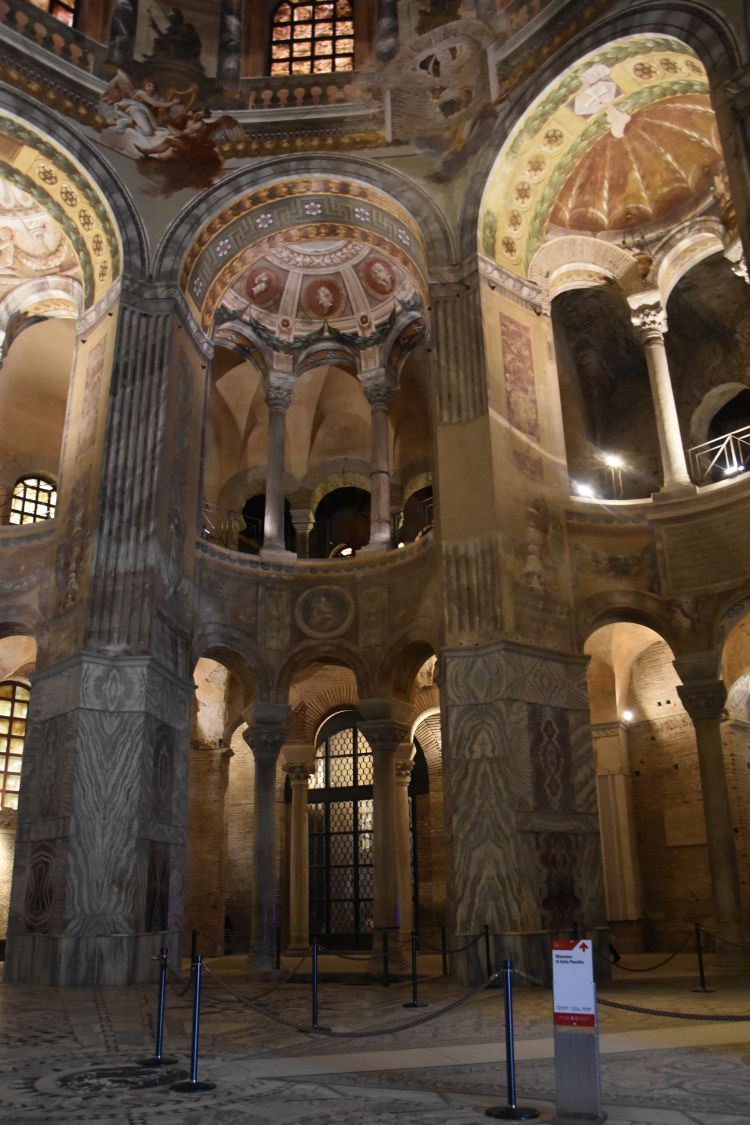
However, Charlemagne had taken a more modest approach. Whitewhashed columns interrupted by slim black columns and decorated with a gilt bronze fence.

Source: Walter Mars, p. 50 (this is what the historians think the octagon looked like after having been built)
I like the elegance of the original. Ottmarsheim is closer to the original not only outside, but also inside. The whitewashed walls and the open brickwork give it solemnity.
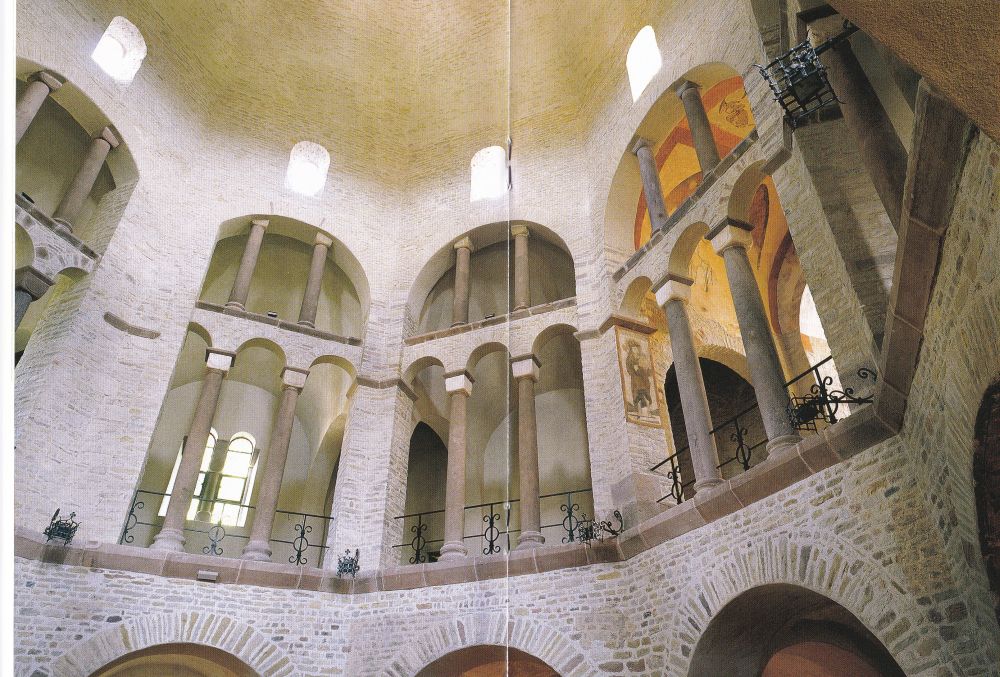
Source: Wörner and Wörner-Hasler, p. 19.
The original mosaic in the cupola of the Aachen Cathedral showed Christ on the throne, surrounded by the Twenty-Four Elders. They had left their seats to deposit their crowns in front of Christ.

Source: Walter Mars, p. 51, drawing by Ciampini made in 1699
Around 1700, the original mosaics were eliminated and the church interior became baroque.
In 1881, the baroque elements were removed and the cupola was decorated with the Neo-byzantine mosaic.
The artists kept the theme of the original: The Twenty-Four Elders stand around Christ and deposit their crowns. However there are no seats next to the Elders and the mosaic is more abundant.
Before the German emperor William II intervened in 1900, the interior of the Cathedral resembled the modest original of Charlemagne.
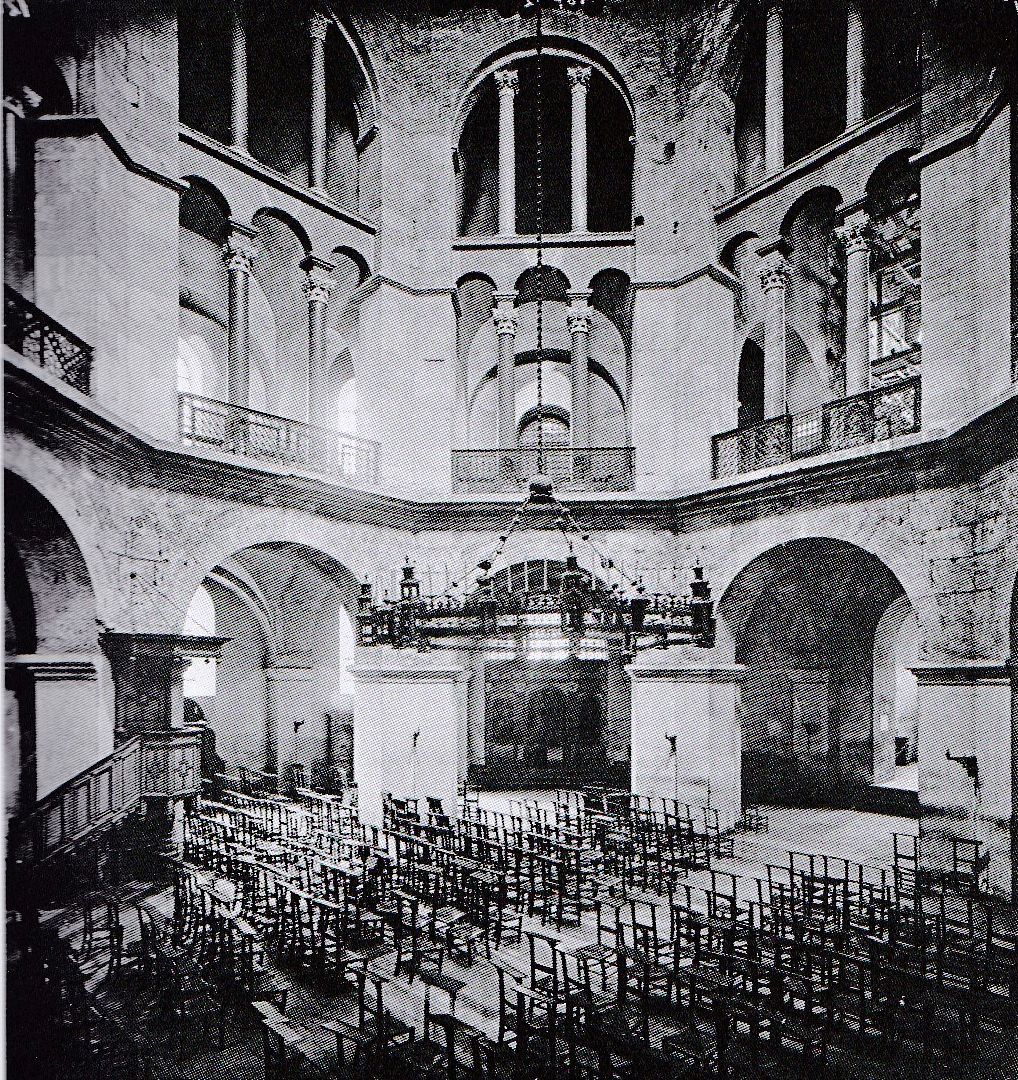
Source: Walter Mars, p. 53
After 1900, Emperor William II of Germany added the marble covering to the columns, arches and walls. In addition, he engaged his favourite artist Hermann Schaper to create mosaics immediately below the cupola. He added more men dressed in white. What an abundant Neo-byzantine decoration. Not at all, what Charlemagne had in mind.
Mars writes that the visitor is overwhelmed by the Wilhelmine pomp and will have difficulties to find the former dignity of the Carolingian original. I can only agree with Walter Mars (Walter Mars, p.47).
The choir – the most prominent Gothic addition to Charlemagne’s Cathedral
The most prominent Gothic addition to the Charlemagne’s octagonal Cathedral is the choir (1355-1414).
Building it required to destroy the original rectangular choir (see dotted line) and part of the octagon.

Source: Walter Mars, p. 83.
The choir with the large blue leaded windows creates the solemn atmosphere that I love in Gothic churches.
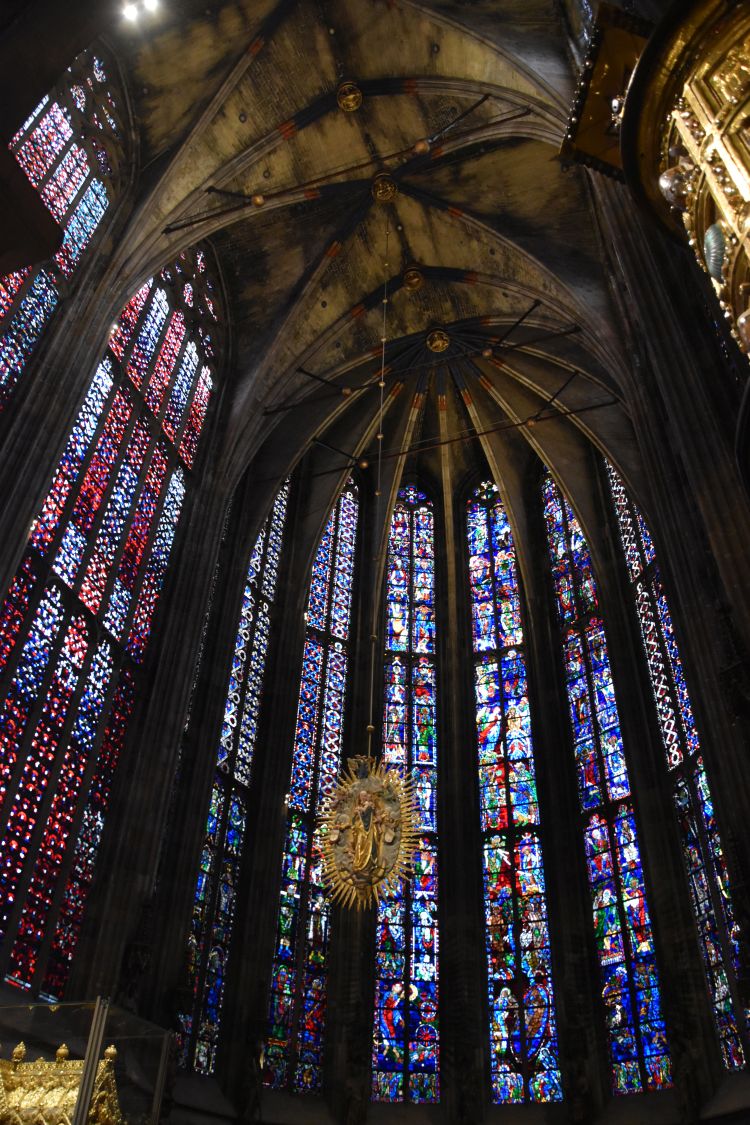
Two shrines decorate the choir: The Karlsschrein (shrine of Charlemagne, between 1182 and 1215) and the Marienschrein (shrine of Mary, 1238). The eagle lectern is from the 15th century.
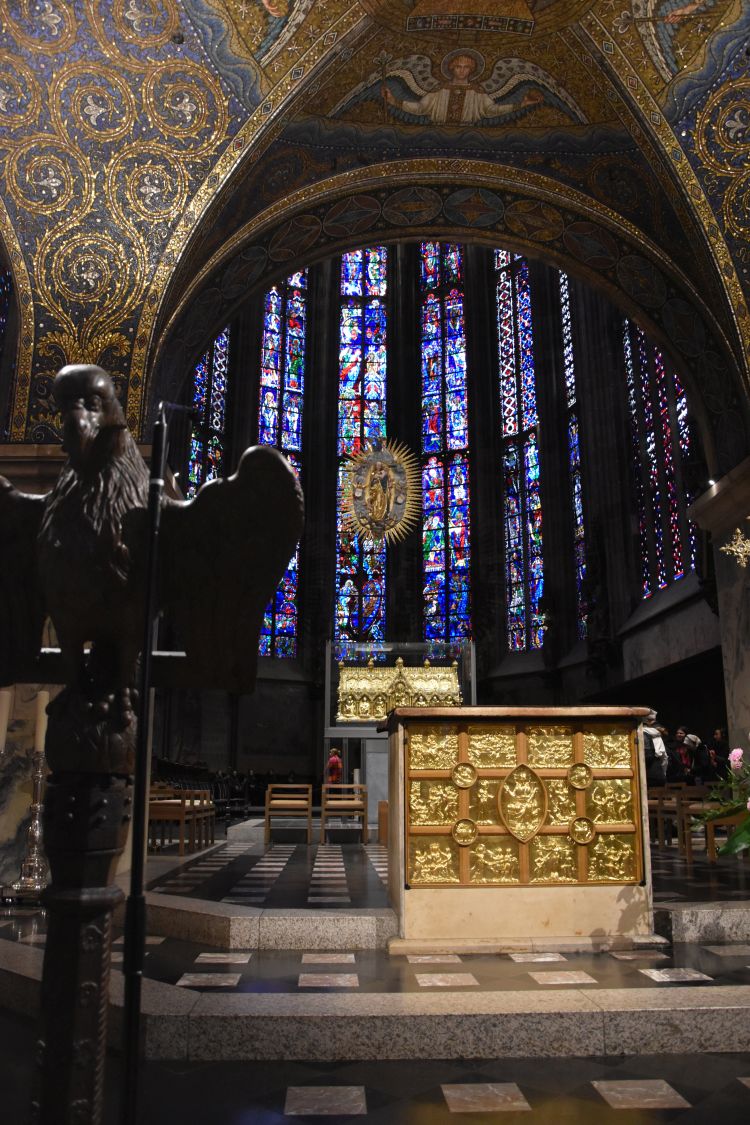
However to me, the choir seems like a foreign body to he original octagon. Furthermore the choir is locked for visitors that have not paid for the guided tour. I am not a friend of guided tours and feel somewhat unwelcome here.
I enter the other additions around the octagon, but they all leave me somewhat unimpressed. In my opinion, they do not go well with Charlemagne’s octagon Cathedral.
When leaving the cathedral, I conclude that the first emperor of Europe, Charlemagne, has created a very elegant cathedral, and the last emperor at Europe, William II, has overdone the renovation in Neo-byzantine style.
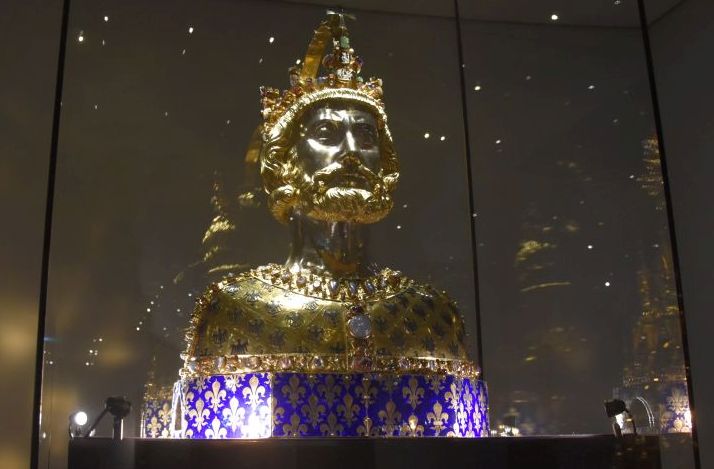
I say good-bye to Charlemagne who unifies the German Eagle with the French fleur de Lys on his reliquary bust, created in 1350 and exposed in the Aachen Cathedral Treasury.
I will soon return to the abbey chapel of Ottmarsheim. It is just a half an hour’s drive from my home.
Sources:
- Walter Mars, “Der Aachener Dom”, Schnell+Steiner Regensburg 2020 (an excellent book that I found in the friendly bookshop Schmetz am Dom just across the Cathedral)
- Hans Jakob Wörner und Judith Ottilie Wörner-Hasler, “Abteikirche Ottmarsheim”, Kunstverlag Josef Fink 2012
- J. Himmelspach, Ottmarsheim – église octogonale du XIe siècle”, Cliché Guillet-Lescuyer Lyon (no year indicated
- Wikipedia entry “Aachener Dom” https://de.wikipedia.org/wiki/Aachener_Dom
- https://petrapeters.ch/2018/04/19/ravenna-in-search-of-byzantine-mosaics-san-vitale/
- All photos with no source indicated are my own photos
 Petra Peters
I too have always wanted to see Aachen and I read your piece with interest. Maybe I will just go back to Ottermarshiem the church on the Rhine and admire it again instead. Happy New year!
Happy New Year to you as well. Enjoy Ottmarsheim; it is one of my favourite churches and in addition, it has nice frescos from the 15th century. To see some of them you need access to the gallery.
A very profound, convincing, and heartwarming essay. Impressive pictures, both the ones taken by Petra und the ones from other sources. And a fine concluding comment on real greatness (Charlemagne) and puffed-up pompous asses like William II.
I will treat myself to many more readings of this essay!
Thank you, Petra!
Greetings
Paul
A very profound, convincing, and heartwarming essay. Impressive pictures, both the ones taken by Petra und the ones from other sources. And a fine concluding comment on real greatness (Charlemagne) and puffed-up pompous asses like William II.
I will treat myself to many more readings of this essay!
Thank you, Petra!
Greetings
Paul