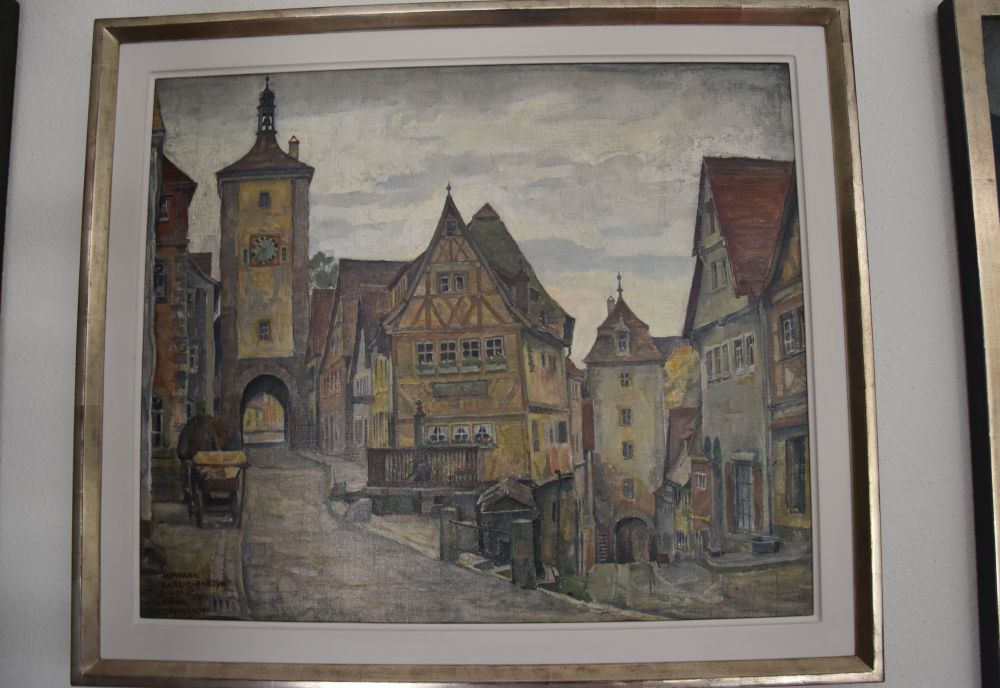
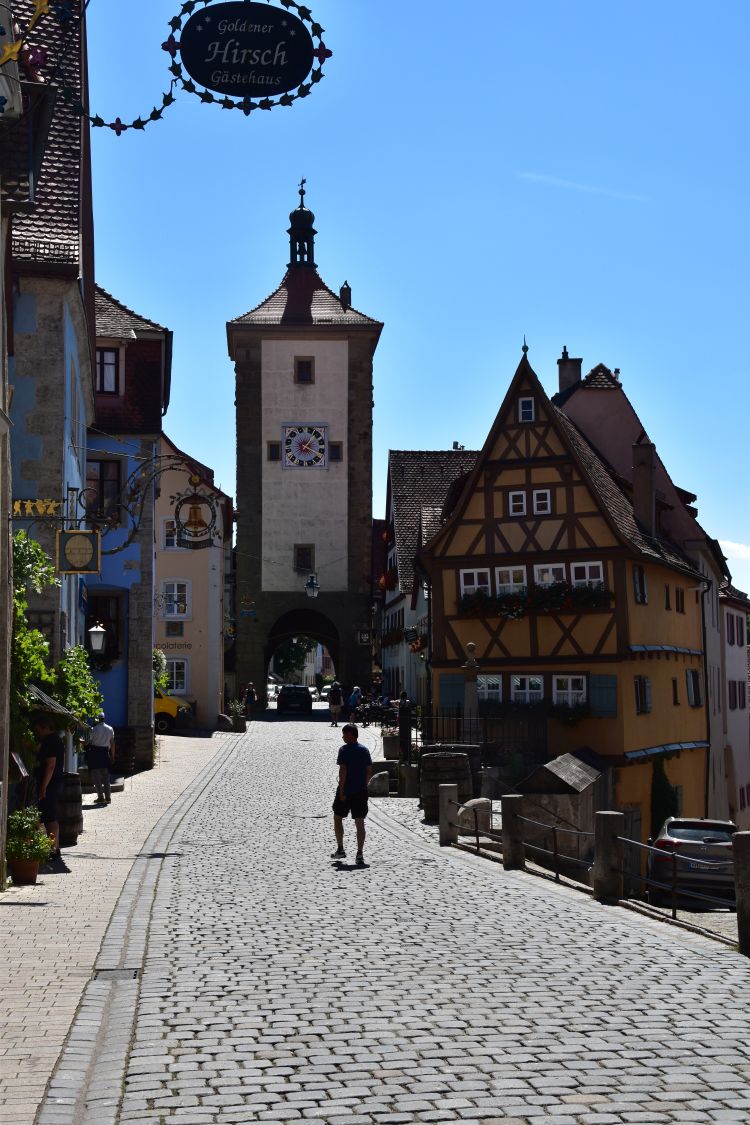
Rothenburg’s Plönlein, painted by Hermann Radzyk in 1942, looks different now – why?
In 1942, my grandfather painted the Plönlein of Rothenburg ob der Tauber. It is the small half-timbered house with the curved beams.
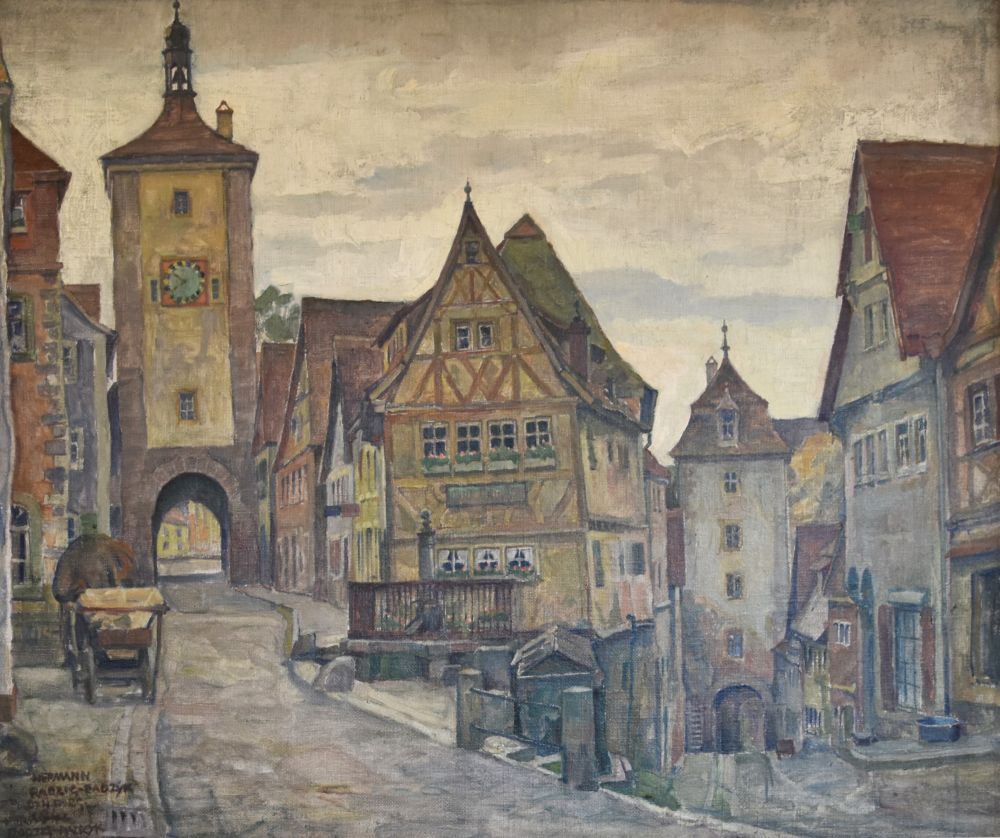
Look at my photo of the Plönlein. The architecture is different, the beams have been straightened.
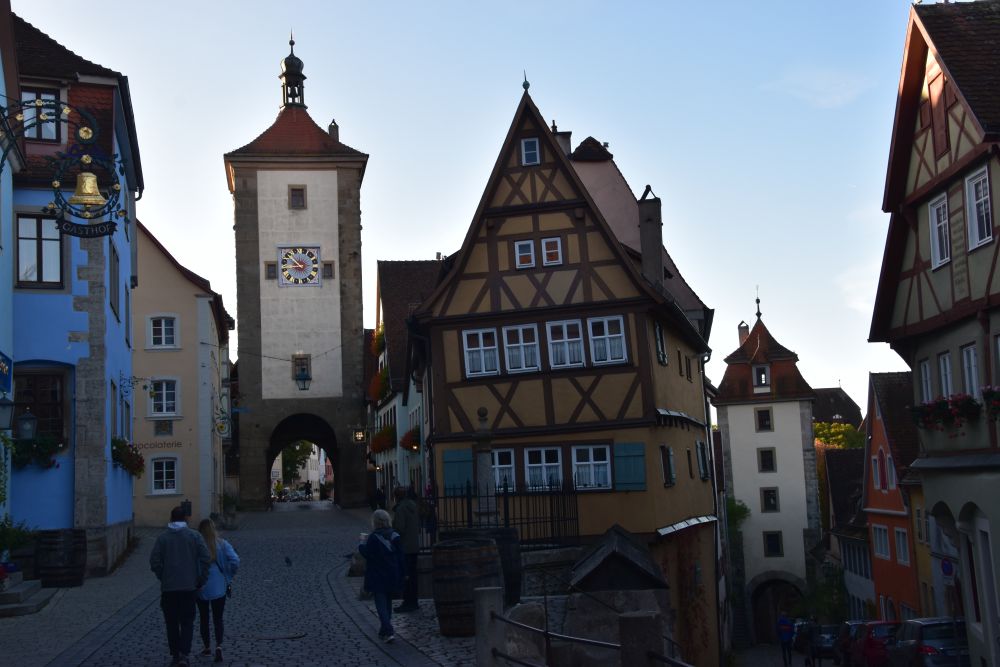
What has happened? Has the Plönlein been destroyed in World War II?
In World War II, 40% of the city of Rothenburg were destroyed. On Holy Saturday, 31st of March 1945, an American squadron set out to release their bombs near Rothenburg, but failed, because their target was in the fog. Fully loaded they were not able to land, and, on the way back, they released their bombs above Rothenburg. Bravely, the citizens of Rothenburg reconstructed their city in the medieval style (see “Rothenburg-unterm-hakenkreuz”).
I always suspected, also the Plönlein had been destroyed by the bomb attacks, but no, it was renovated after the war. I learnt that in October 2024, when I had breakfast in the Hotel Uhl next to the Plönlein. The owner’s father said that the Plönlein had not been affected by the bombs, though the house right across the street was damaged. The Plönlein was renovated in the 1950’s or 60’s, because the old beams were rotten. And now, the beams of the Plönlein are no longer curved, but straight. The tourists continue to like it.
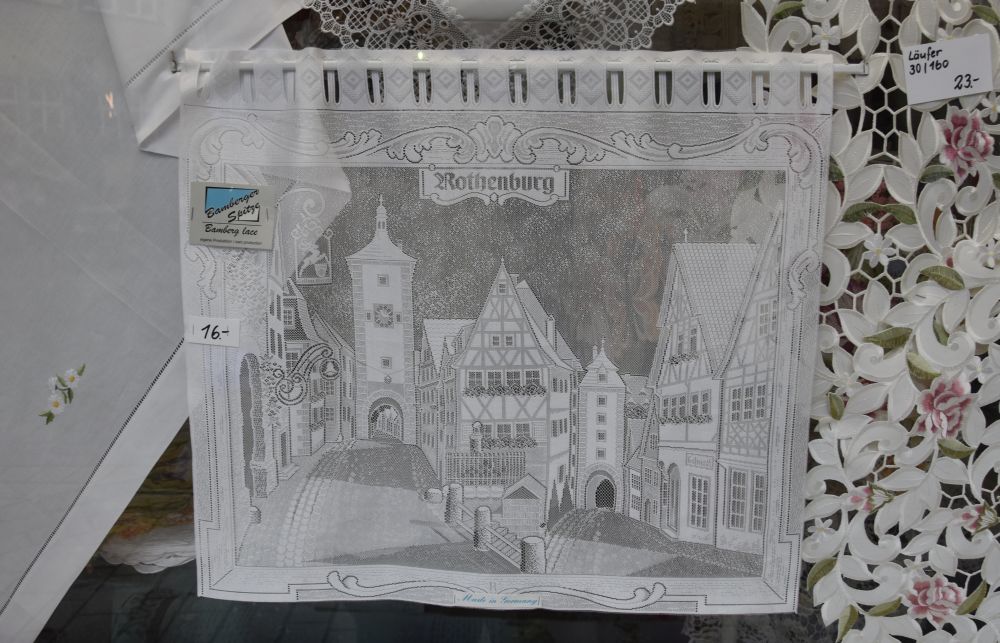
The Plönlein is the tourists’ favourite, and Plönlein souvenirs are in high demand
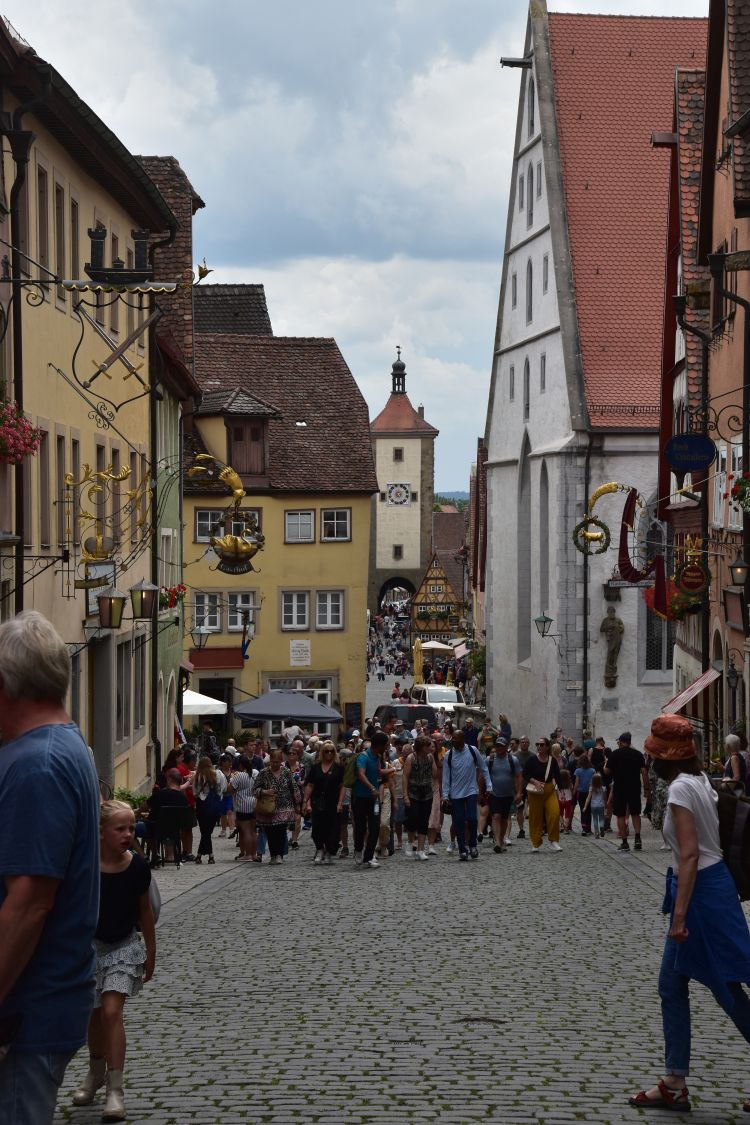
The Plönlein is THE attraction of Rothenburg. The Schmiedgasse is crowded with tourists. What would my grandfather say?
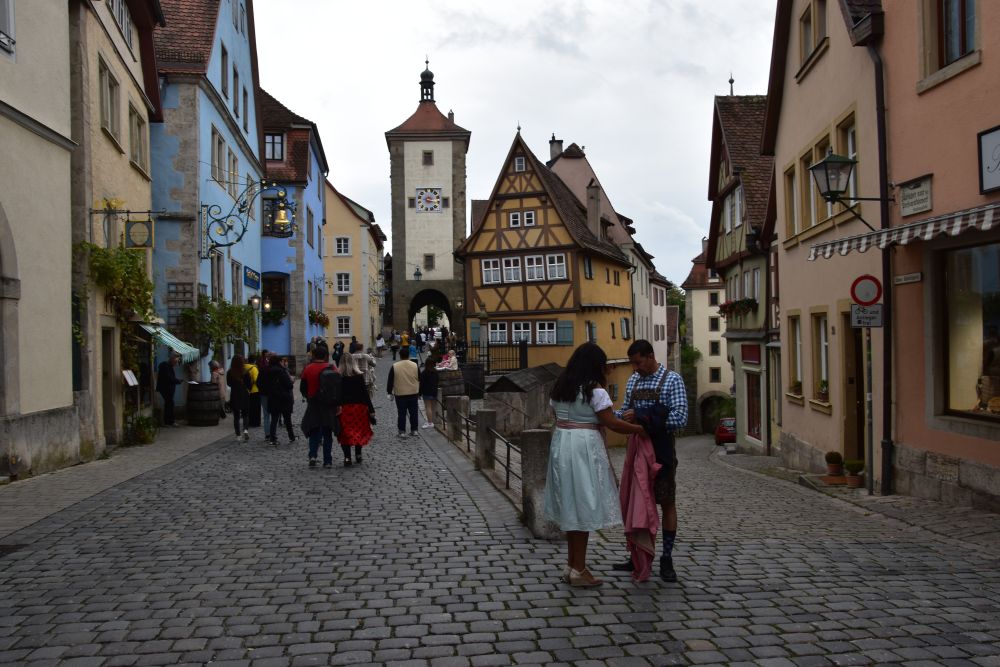
This Japanese couple dressed as Bavarians in dirndl and leather shorts (called “Krachlederne”) is getting ready to make a selfie in front of the Plönlein. They enjoy it, they laugh, and I smile with them.
Next to the Plönlein, the small restaurant Peking caters for Chinese tourists advertising their meals in Chinese.
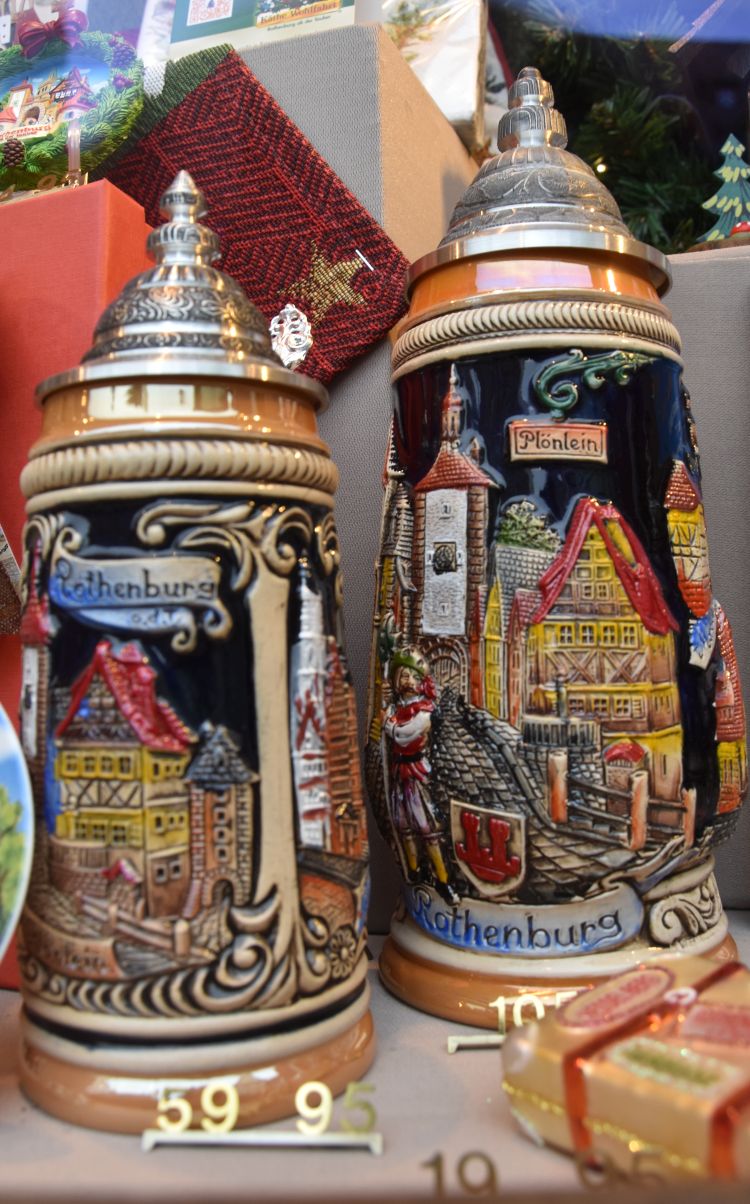
Souvenirs of the Plönlein are in high demand. They appear in the souvenir shops on curtains, …
… beer tankards, …
… ceramic tiles and plates, ….

… bags, T-shirts, key rings, fridge magnets, snow globes, framed photos or paintings … they are sold as small model houses… no limits to the phantasy and mostly at the brink of kitsch.
The market square: The “twin townhall” and medieval houses
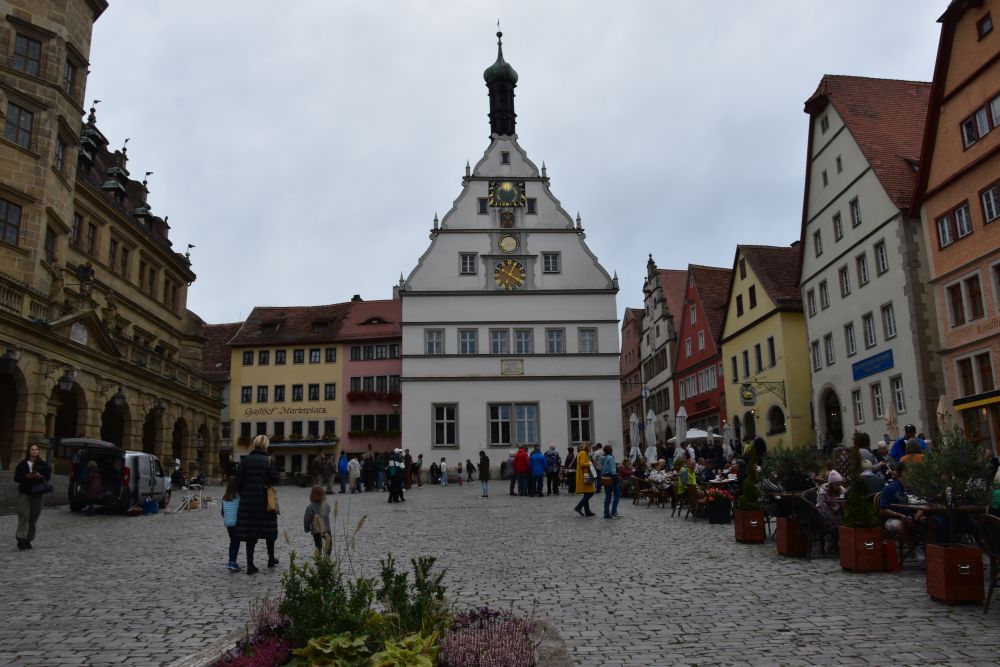
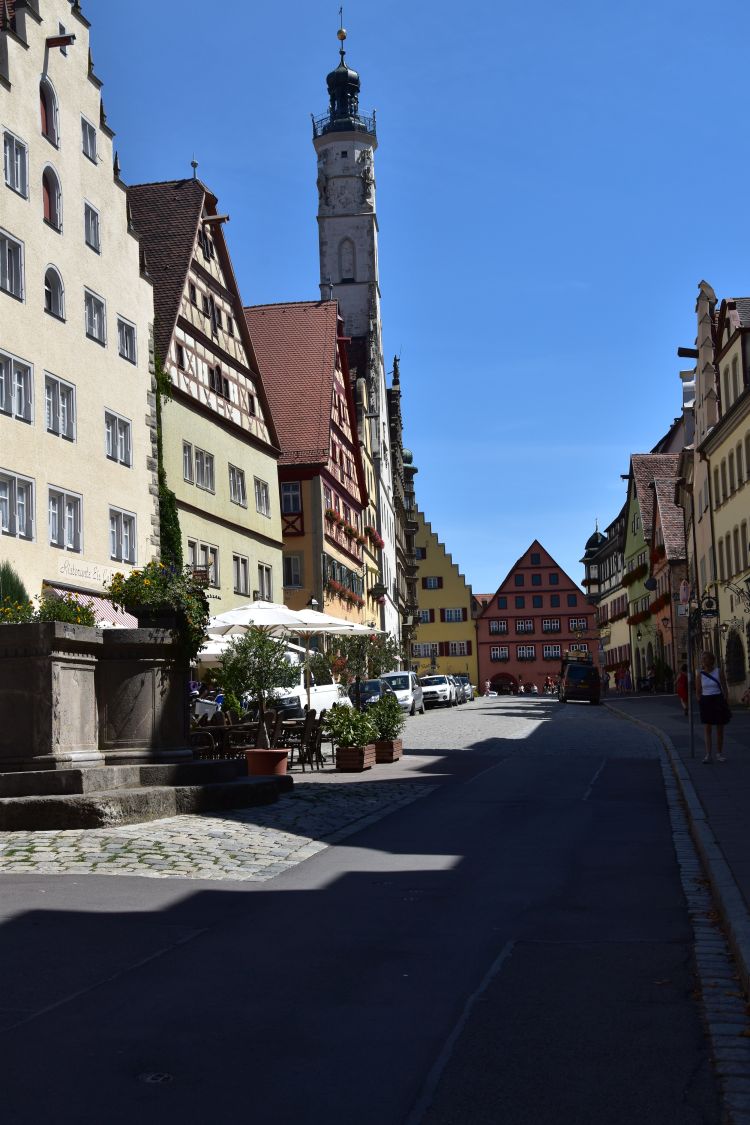
The centre of the city is the market square with the “twin townhall”. The white part with the tower is Gothic (built 1200-1400), the ochre part is Renaissance (16th century, constructed after the great city fire of 1501).
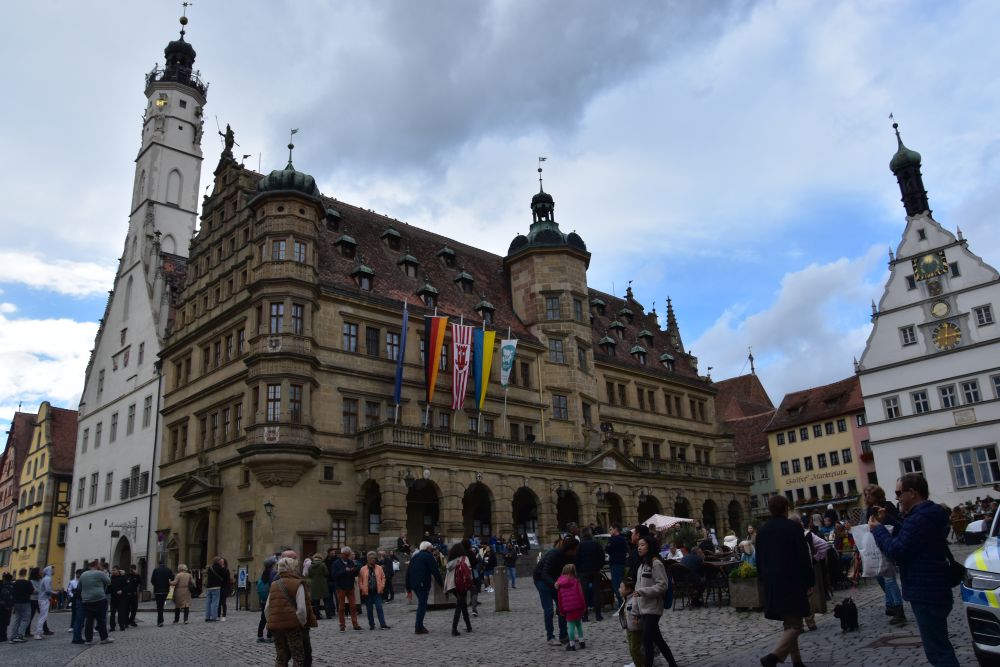
The Renaissance staircase disappears behind the gallery that has been added in the late 17th century.
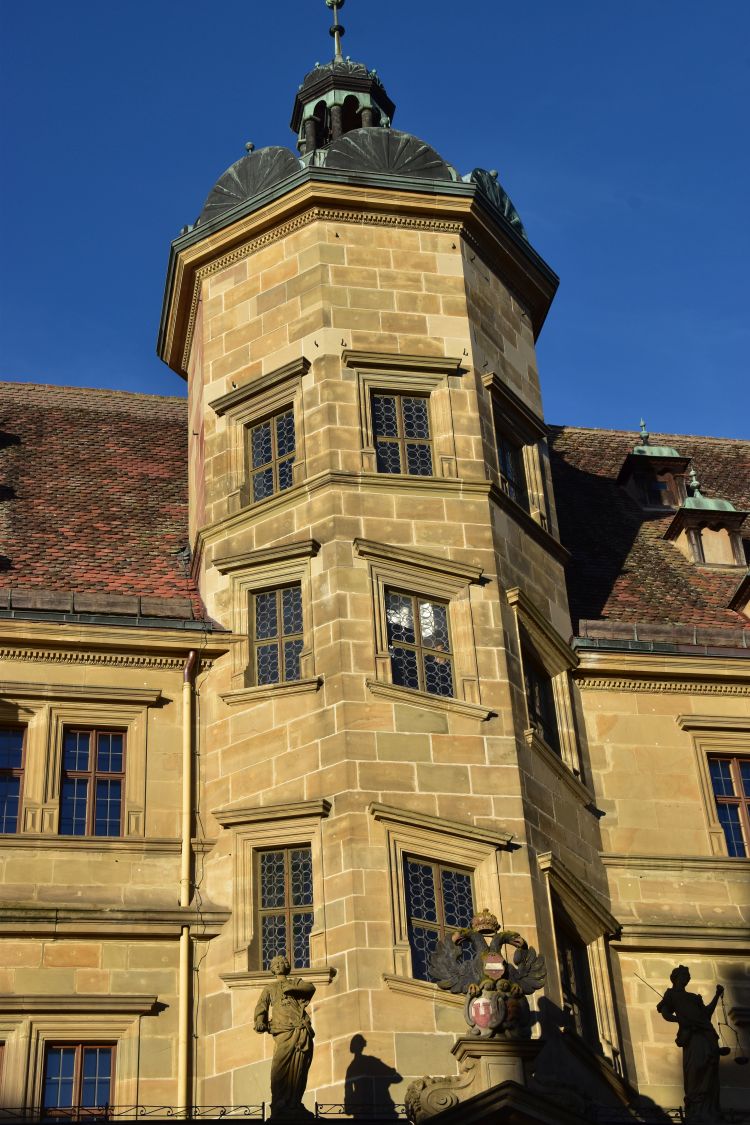
I climbed the Gothic white townhall tower. First I walked up comfortably in the Renaissance staircase. Next, in the old tower, the stairs became steeper and steeeper, and on top, I had to do almost rock climbing to lift myself from the last step on to the balcony platform. I took no photo, I stood in the mist, it was a rainy afternoon.
Across the townhall, these beautiful half-timbered houses line the market square; in the house labelled “Marien-Apotheke”, emperor Maximilian I was a prominent guest in 1513.
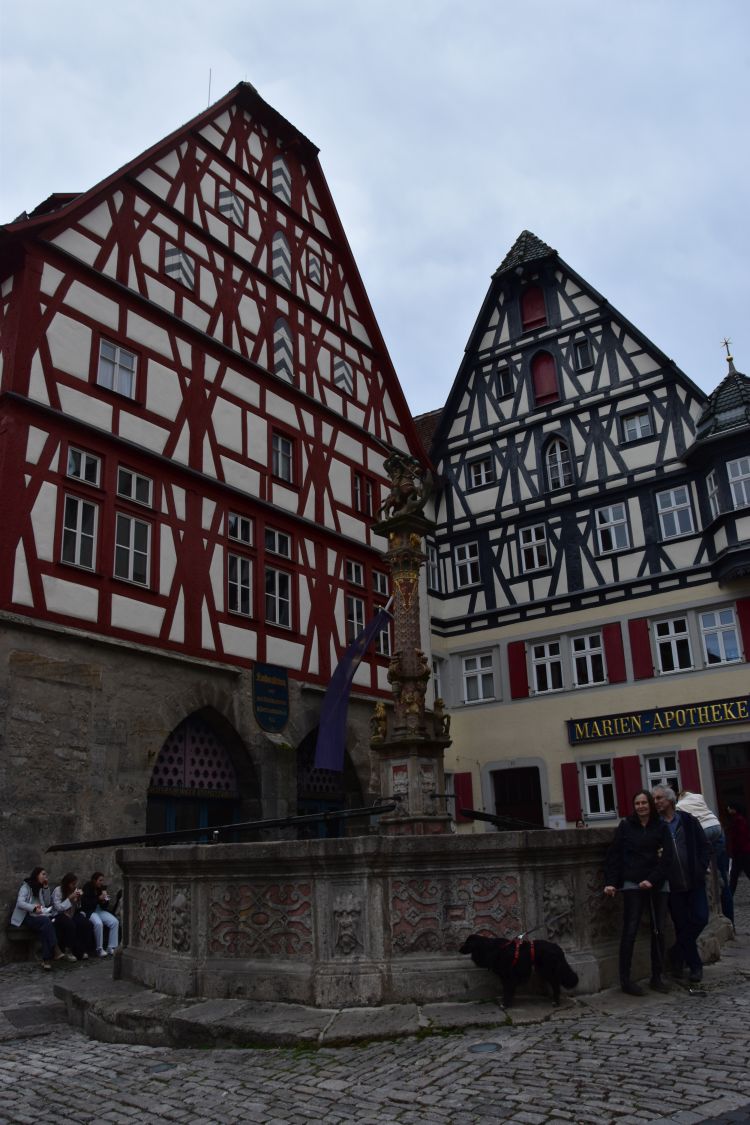
The other building is called Meat- and Dance-House. The Künstlerbund, founded in 1923, makes exhibitions here and, according to their website, they are open every day after 13.00. I was curious, but the door was closed. I could not find out, why. The Künstlerbund seems to be a secret association.
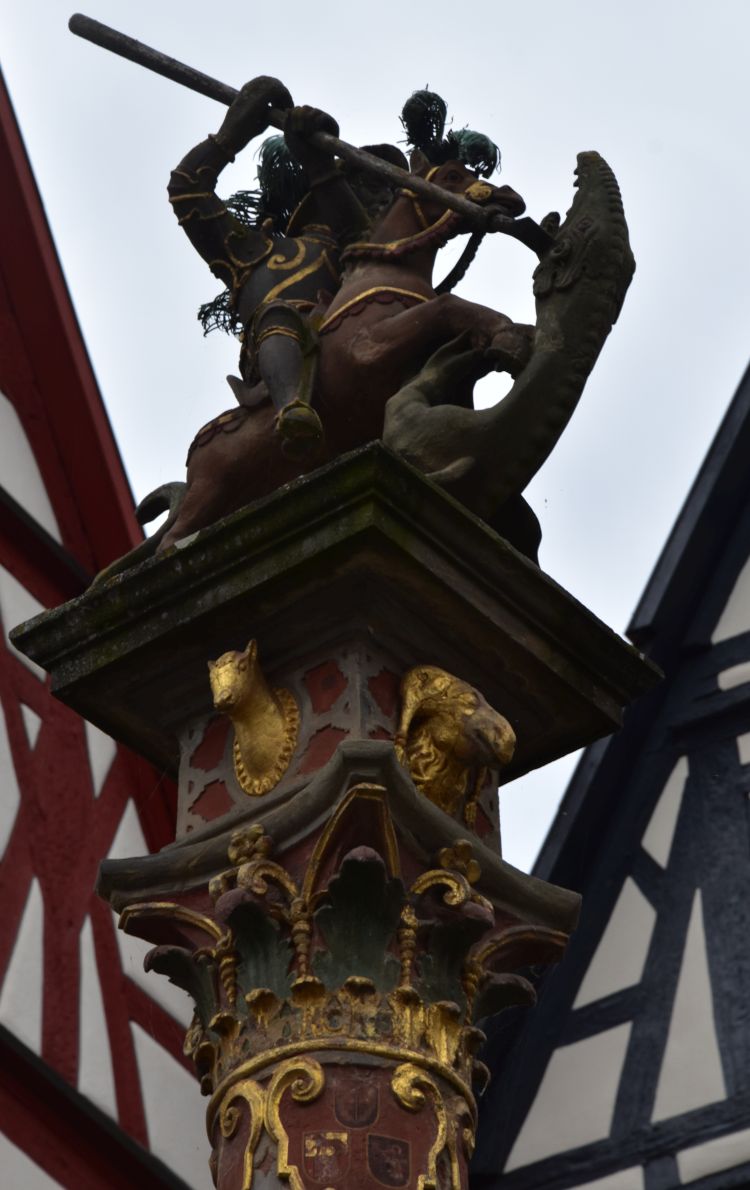
In front of these two half-timbered buildings, a fountain had been installed in 1446. In 1608, it had been replaced by the Renaissance fountain that we see today. Saint George fights the dragon.
The market square is lined with medieval houses, carefully rebuilt after the bomb attack of 1945. The building with the historical clocks is the Ratstrinkstube (something like an inn reserved for the councilmen). Field marshall Jean Tilly and old mayor Georg Nusch appear every full hour in the windows besides the clock. They illustrate, how, in the 30 years’ war, the old mayor saved the city by drinking a tankard of 3.25l of Franconian wine in one go.
Right below and behind me is the Renaissance Baumeisterhaus, the house of the main mason of Rothenburg. He built his house with the sculptures in 1596.

Impressive medieval marketing.
Inside I find a restaurant in a court, a wonderful atmosphere. However, the restaurant is good for people that like a lot of meat with dumplings, but hate vegetables. I found better restaurants at Rothenburg, such as the Butz or the Glocke.
The Saint James church with the Heiligkreuz altar of Riemenschneider
The Gothic St. James church, built between 1311 and 1484, became a Lutheran church, when Rothenburg joined the reformation in 1544.

A modern friendly Saint James with a smile on his lips invites the pilgrims to enter the church (sculptor: Steinacker, 2002; see Gussmann).
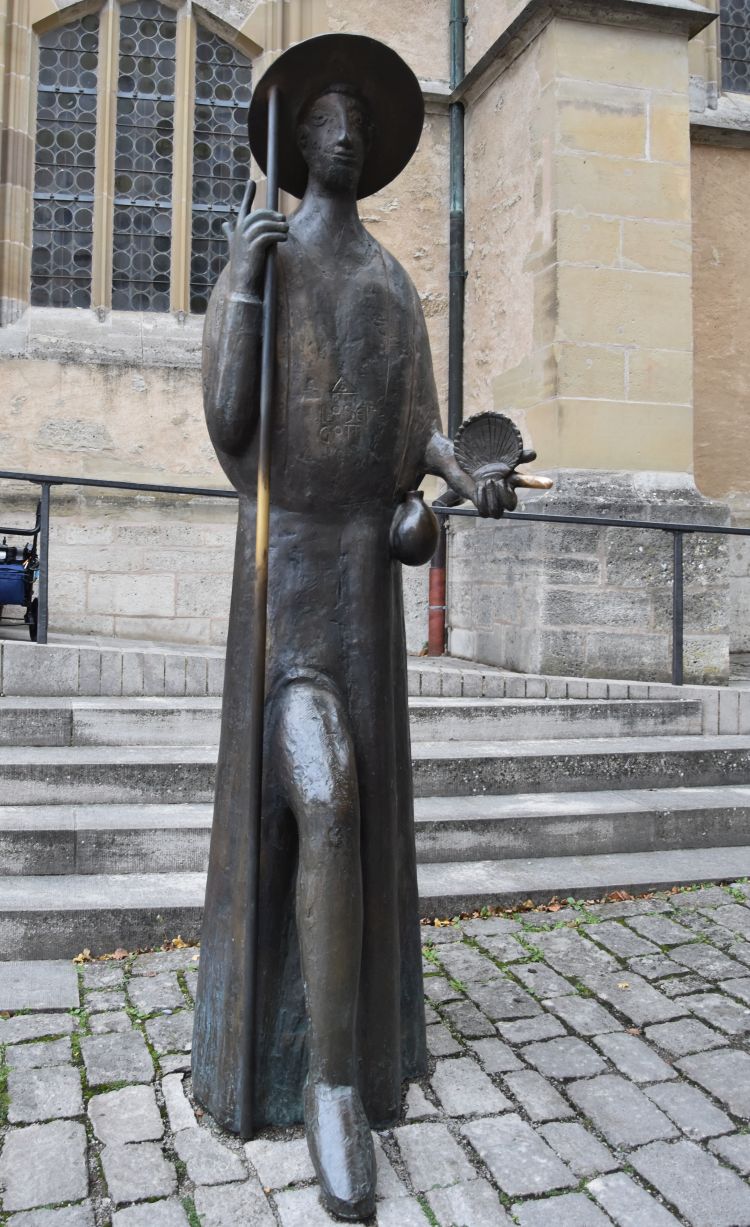
There are also some tourists who follow his invitation – like me. Inside the Gothic vaults seem to rise up to heaven.
In 1499 to 1505, Til Riemenschneider created the Heilig-Blut-Altar (Holy-Blood-Altar) for the west choir that crosses the Klingengasse. Riemenschneider was asked to build the altar for the relic of the Holy Blood; he placed the relic in the gilded cross of 1270; it is held by two angels. Below and in the centre, there are the Last Supper, the Garden Gethsemane and Jesus entering Jerusalem. The altar with its relic became an important pilgrimage site. It is unique that a protestant church contains a relic for the Catholics, it is a sign of reconciliation.
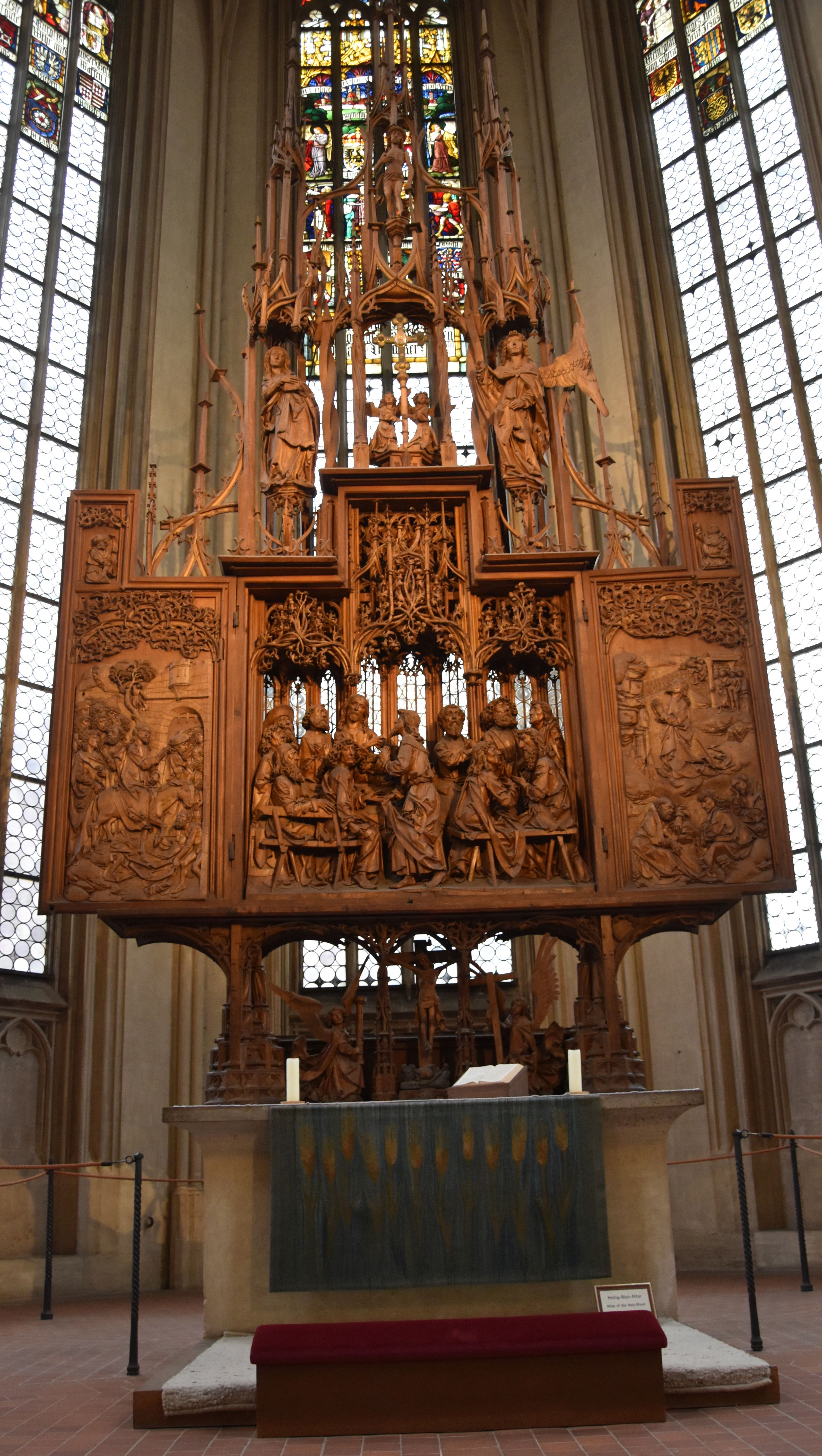
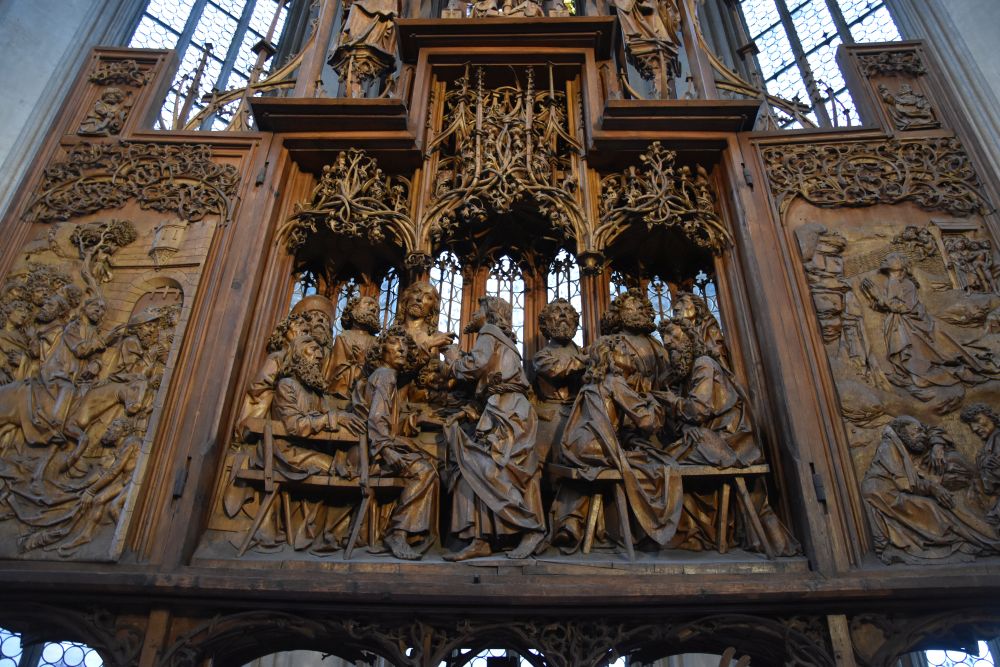
In the scene of the Last Super, Judas is in the centre, not Jesus. Jesus passes Judas the bread. It is the moment, where Jesus says: “One of you shall betray me”. I see the shock in the faces of the disciples. For instance, to the right, two of them seem to be debating: “No, it will not be me, I will not betray Jesus…”. However, the pastor Oliver Gussmann says that the disciples seem to take no interest in the scene with Judas and Jesus (https://youtu.be/An5XAw1fr78). He would perhaps say, the two debating just continue being focused on their intense debate. The unusual and vivid setting of the Last Supper is fascinating, the expressive faces of the disciples call our imagination and evoke our own interpretation. Riemenschneider had carved the figures out of limewood.
In the eastern choir, there is another gem: Friedrich Herlin was the construction manager of the “Twelve Apostles’ Altar” (Zwölfbotenaltar, 1466). It has its name from the Predella, where Jesus appears with the twelve apostles.
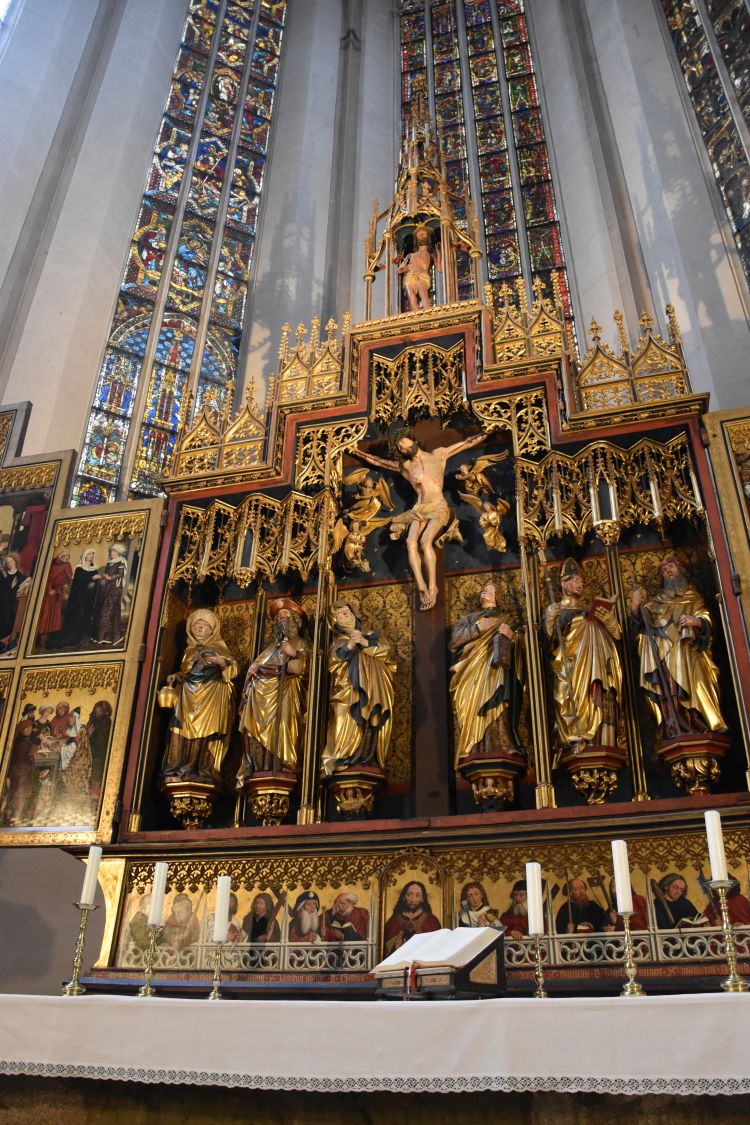
In the middle, we see the crucifixion scene with Maria, James and Elisabeth von Thüringen to the left and the disciple John, a bishop (perhaps Leonhard) and Antonius with his bell to the right (Rothenburg brochure, p. 22 and video of Gussmann).
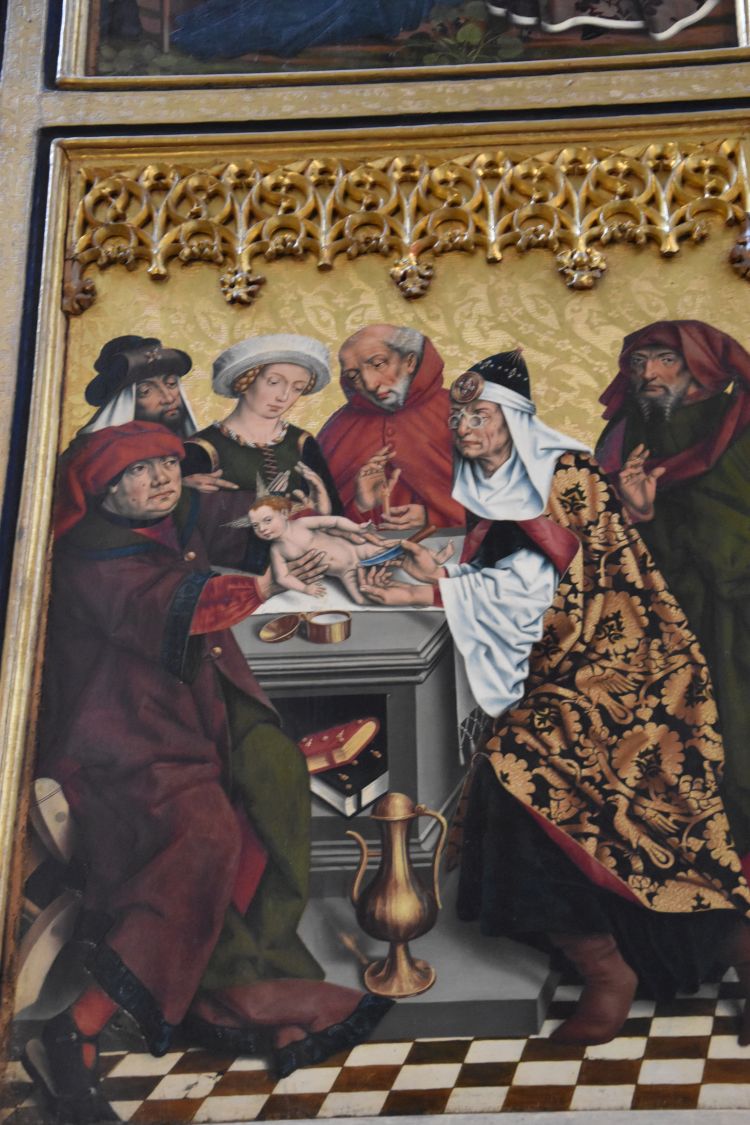
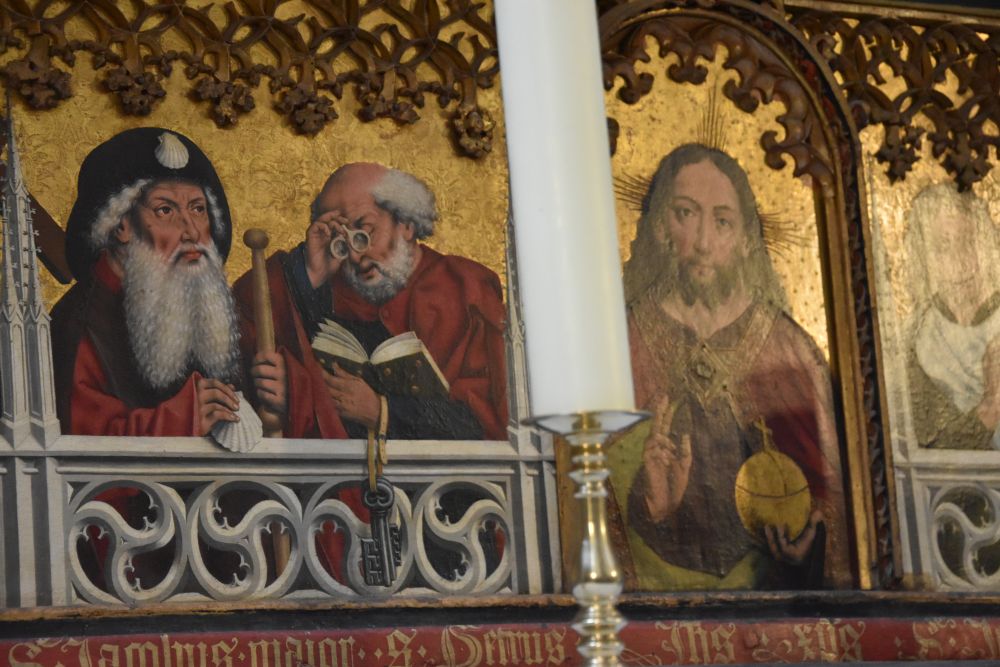
Herlin himself made the paintings on the side wings and the Predella. Some of Herlin’s figures wear glasses. When Herlin became older, he had problems to see the details; wearing glasses he could read and paint again (Gussmann). Herlin was so impressed that he gave glasses to some of the figures on the altar, for instance to the circumciser in the Circumcision scene.
Also Petrus in the Predella wears glasses; he is an elderly man and needs them for reading. Never before have I seen people wth glasses on a medieval altar.
The backside of the altar hides another amazing painting: The dead body of James is carried into Rothenburg ob der Tauber; on the market place of 1466 both parts of the “twin” townhall were still of Gothic style; this happened before the great fire of 1501.
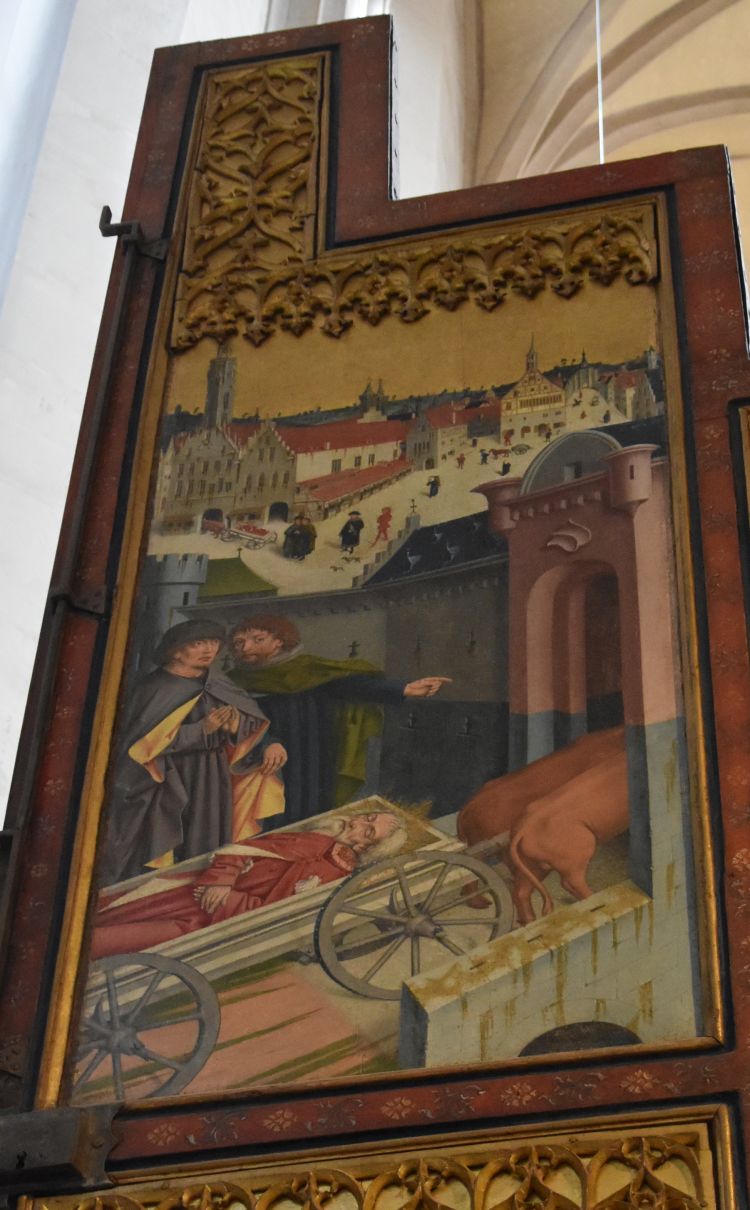
Of course, St. James entered Santiago de Compostella, but Herlin had never been there. The city he could paint best was Rothenburg.
The altar of the Coronation of the Virgin is attributed to the Riemenschneider school.

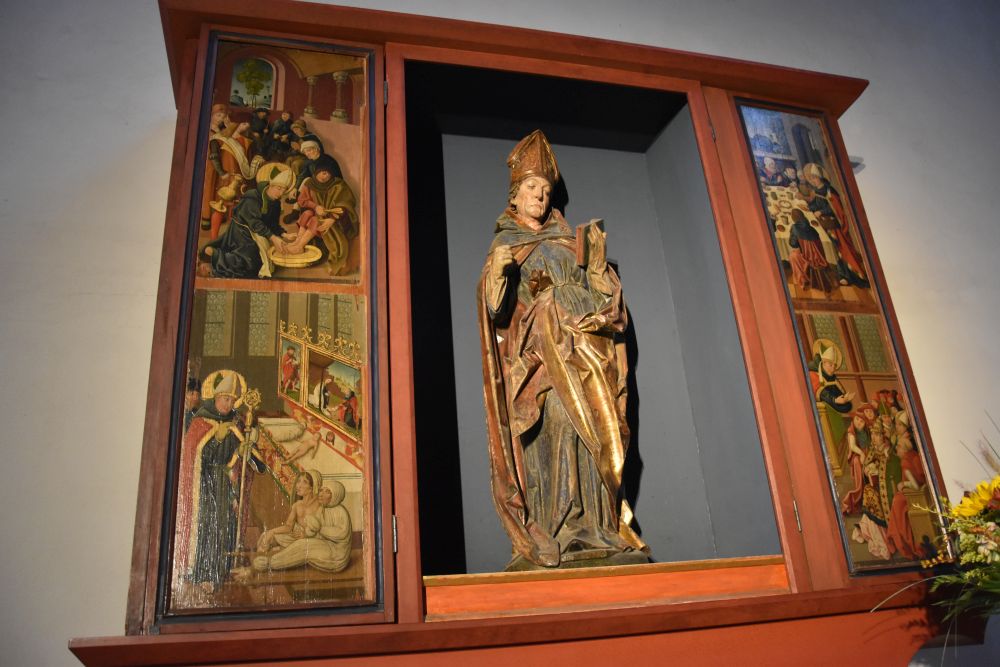
The Ludwig-von-Toulouse altar is from 1490; it is an early work of Til Riemenschneider. Louis de Toulouse was the bishop of Toulouse around 1300.
The windows in the main choir (from the late 14th) give a solemn atmosphere to the church. Gussmann explains them beautifully in his video. They were saved from the bomb attacks of 31st of March 1945, because the citizens had taken them off the church and had transferred them to a basement that withstood the bombs. Also the other treasures of this church survived the bombing there.
I say good-bye to Christoph carrying Jesus across the river…
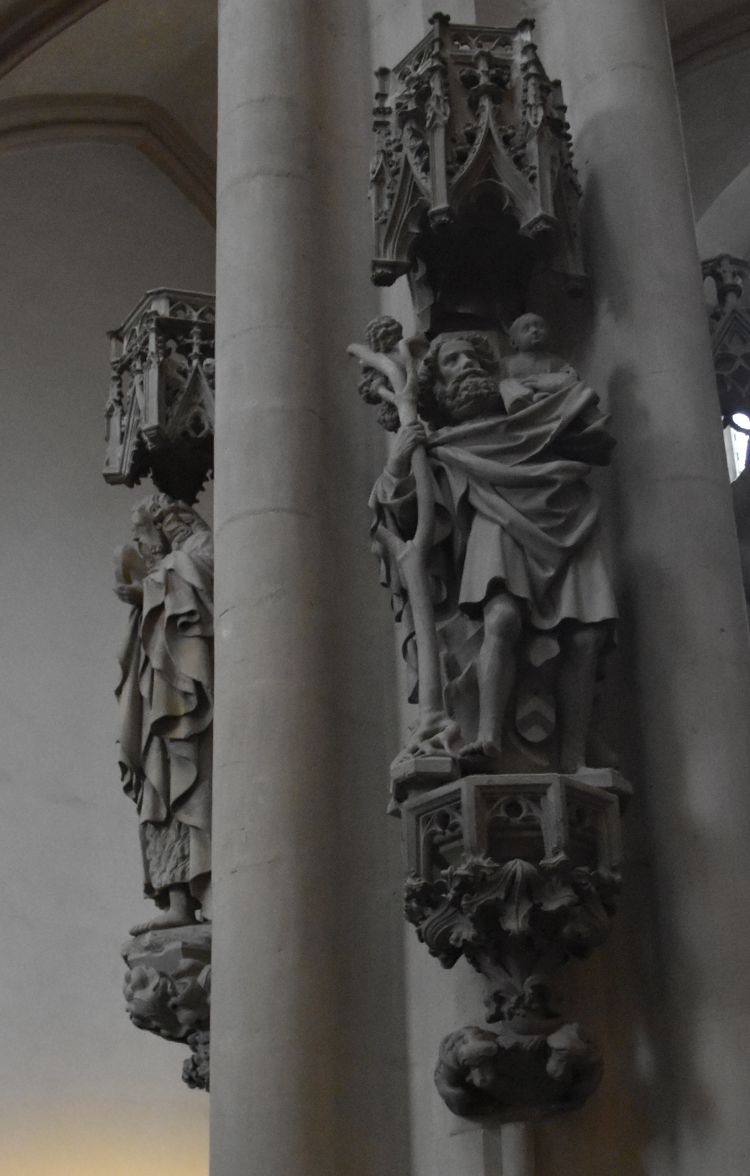
… and to St. James (now in Gothic style), …

… and I continue strolling through the city.
Some impressions from the streets with its medieval atmosphere
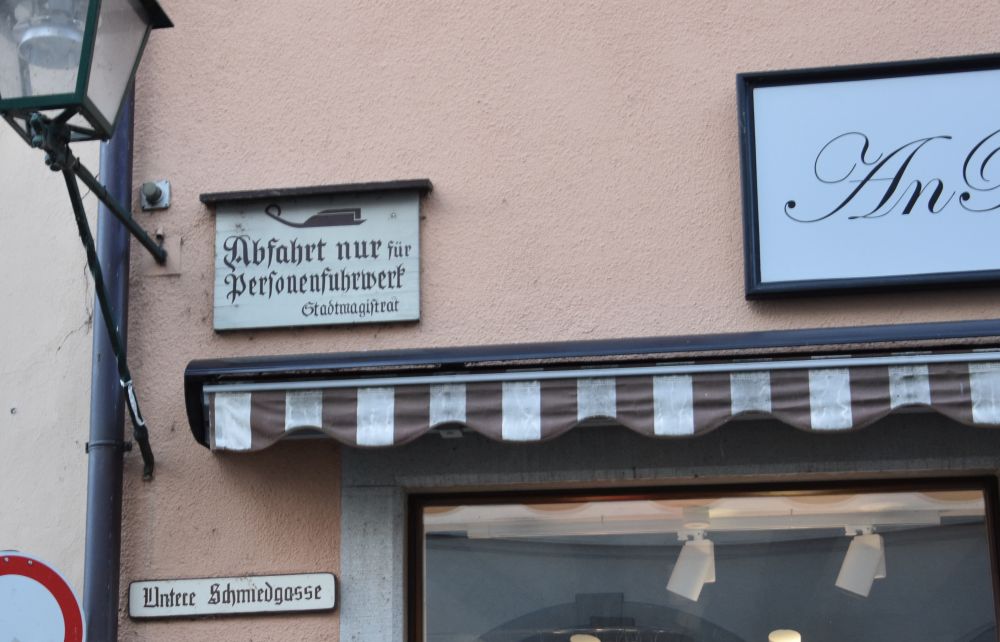
Descent is only allowed to carts carrying persons (Personenfuhrwerk). Pedestrians may also be allowed.
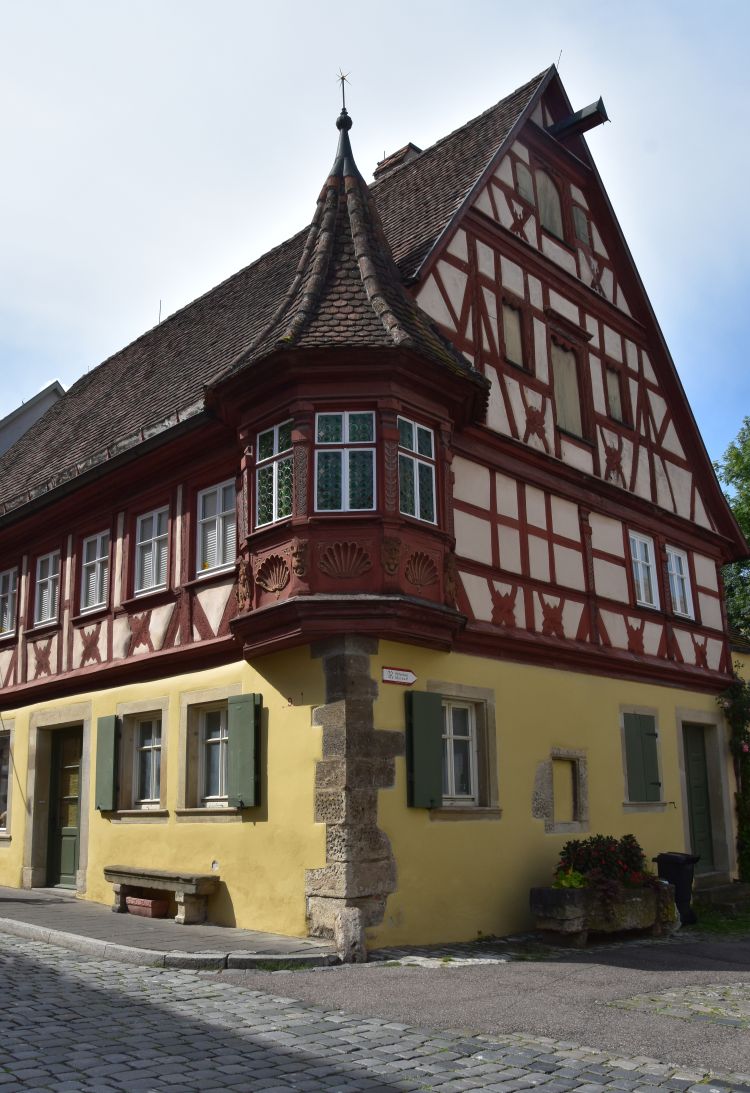
This oriel is called “Feuerleinserker” (oriel of the little fire), the house is from around 1600.
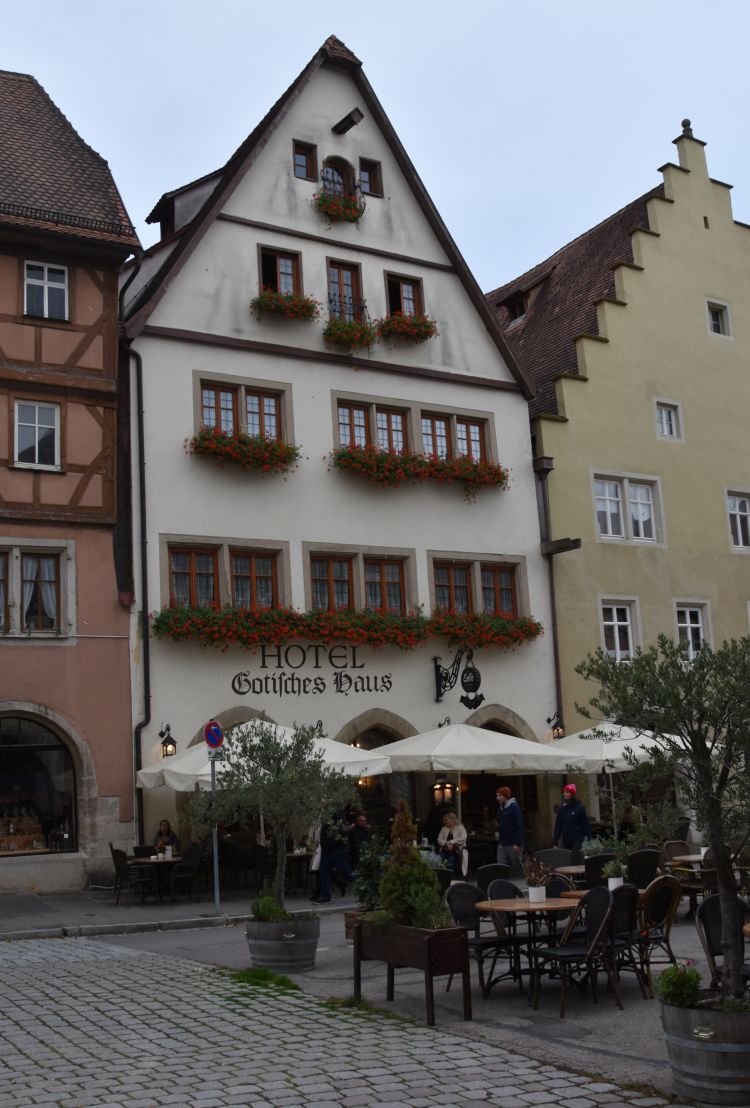
The Herrngasse was the noble address, where the patricians of the city once lived. Now it is lined with hotels, restaurants and shops, amongst them the hotel Gothic House.
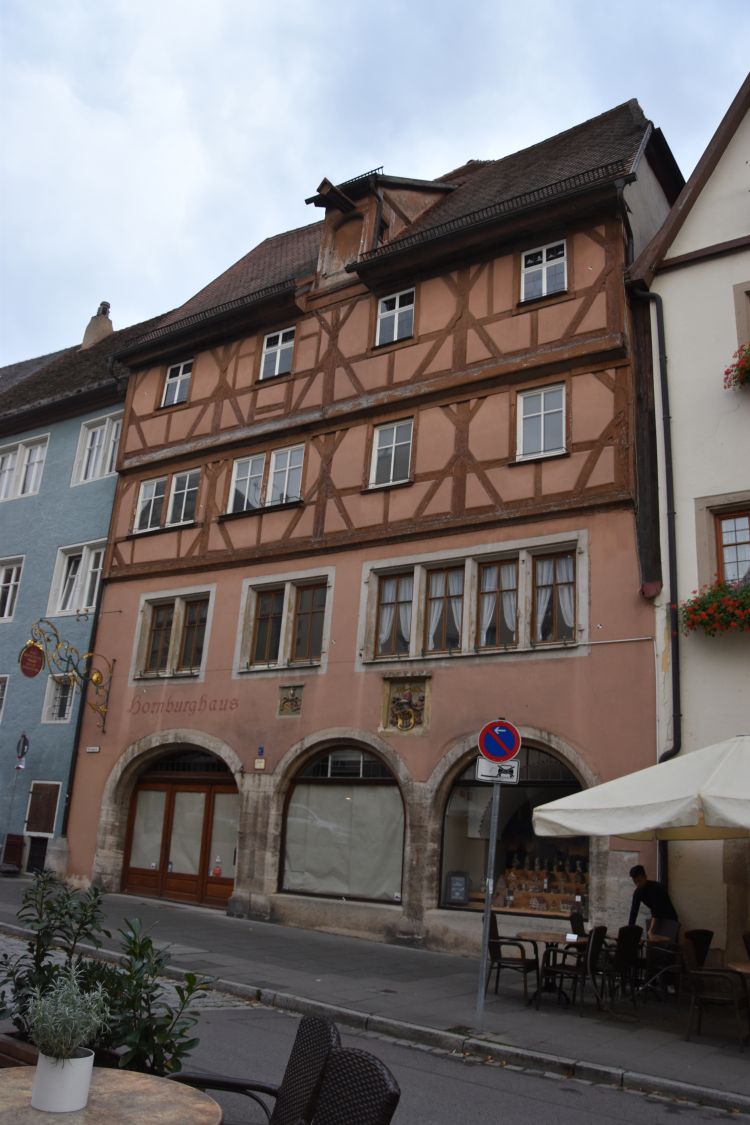
The neighbour, the Hornburg-Haus, is half-timbered. Some beams are from the year 1477. The house is in search of new shop tenants.
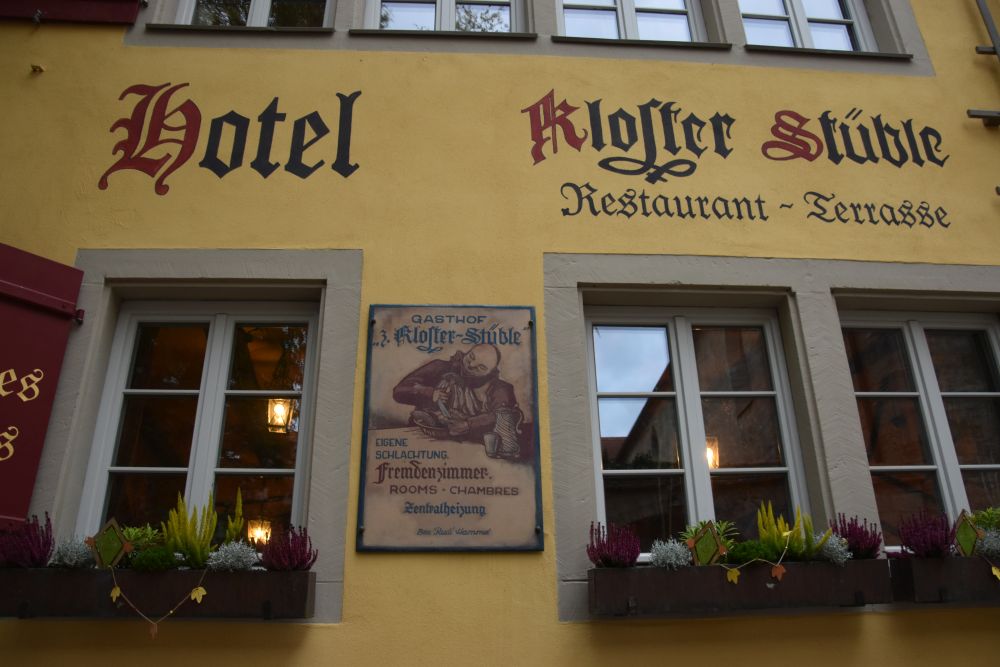
Around the corner, in the Klosterstüble, I had a delicious Bavarian-Franconian dinner with dumplings.
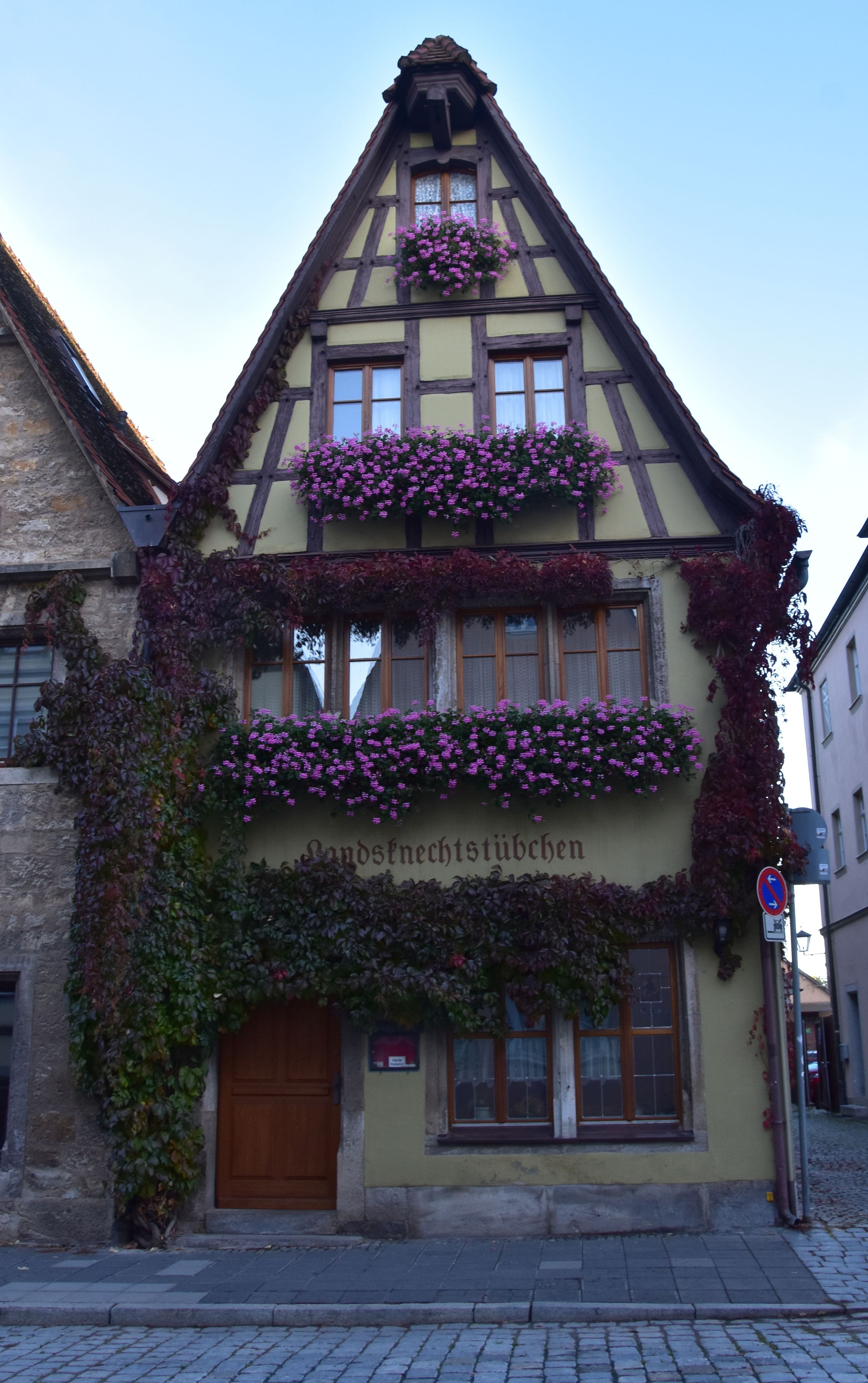
The Landsknechtstübchen is beautifully adorned with geraniums (A “Landsknecht” is a man at arms).
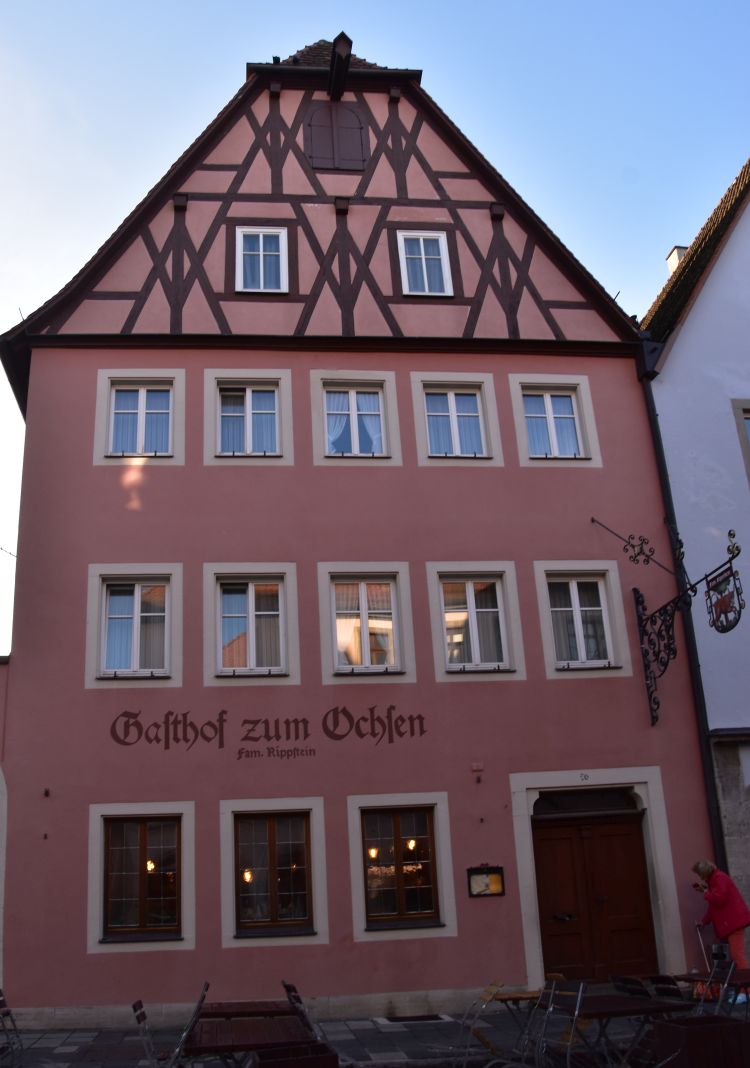
Across the street, the family owned restaurant Ochsen looks inviting.
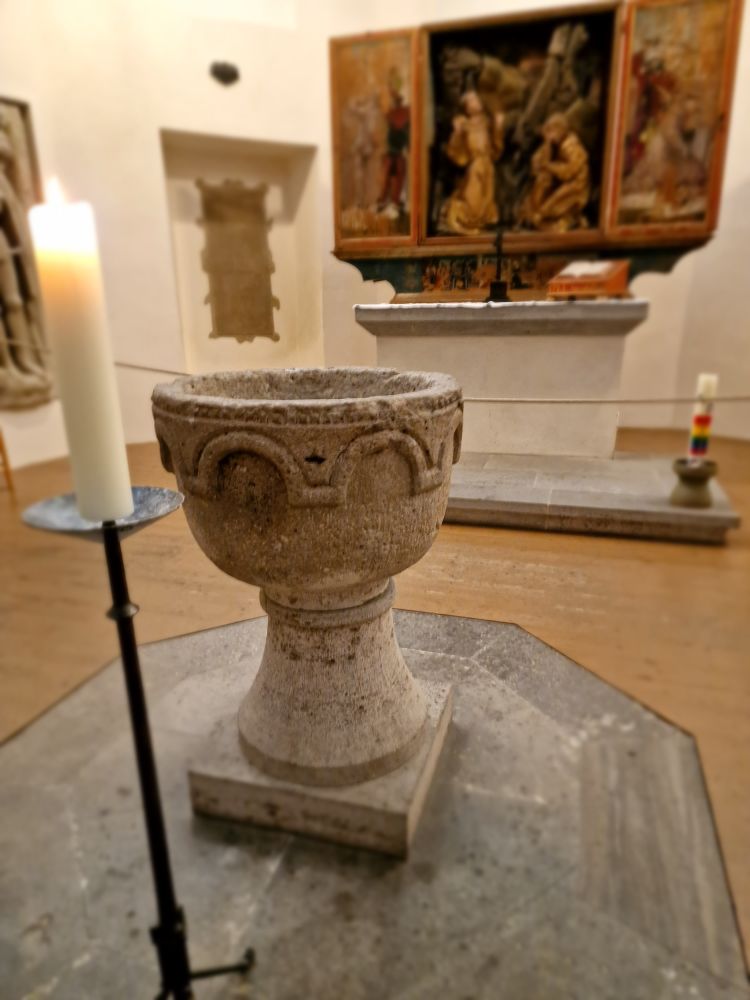
When strolling through the city, two more churches invited me for a visit. First the modest Franciscan church with the rood screen.

In the choir and behind the beautiful baptismal fountain, there is another small altar of Til Riemenschneidre showing the history of Franciscus.
Second, I enter the Gothic Church of Saint Wolfgang, the patron of the shepherds. It has been built into the city wall.
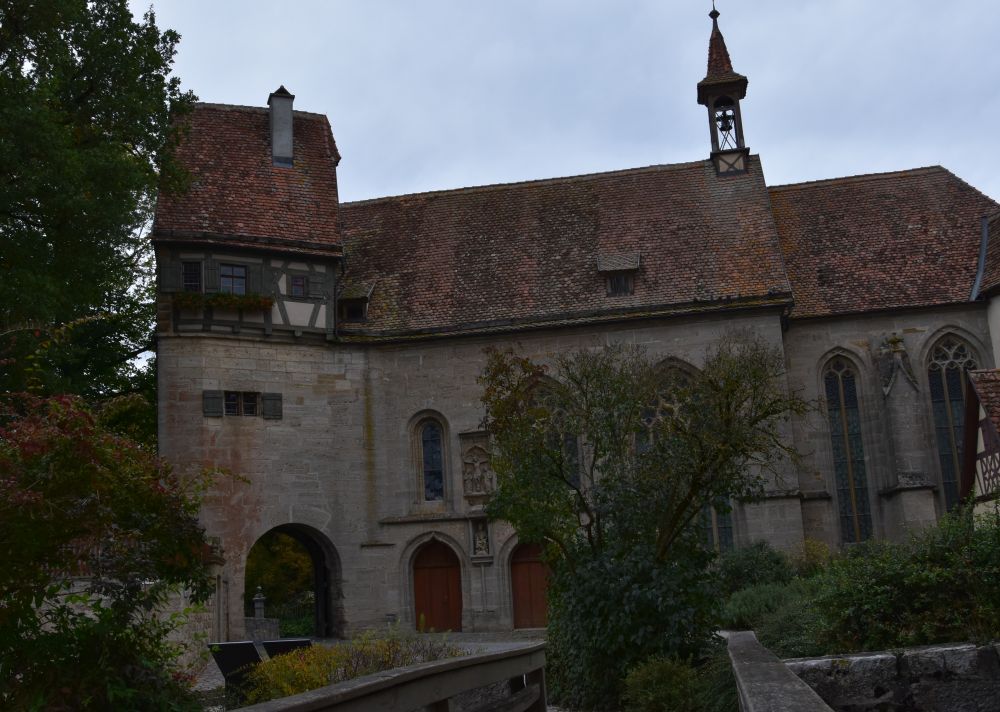
Three wonderful altars are inside.

From the choir, you can enter the wall and walk through a tunnel that ends up on the other side of the nave. Amazing.
The city wall and the Burggarten
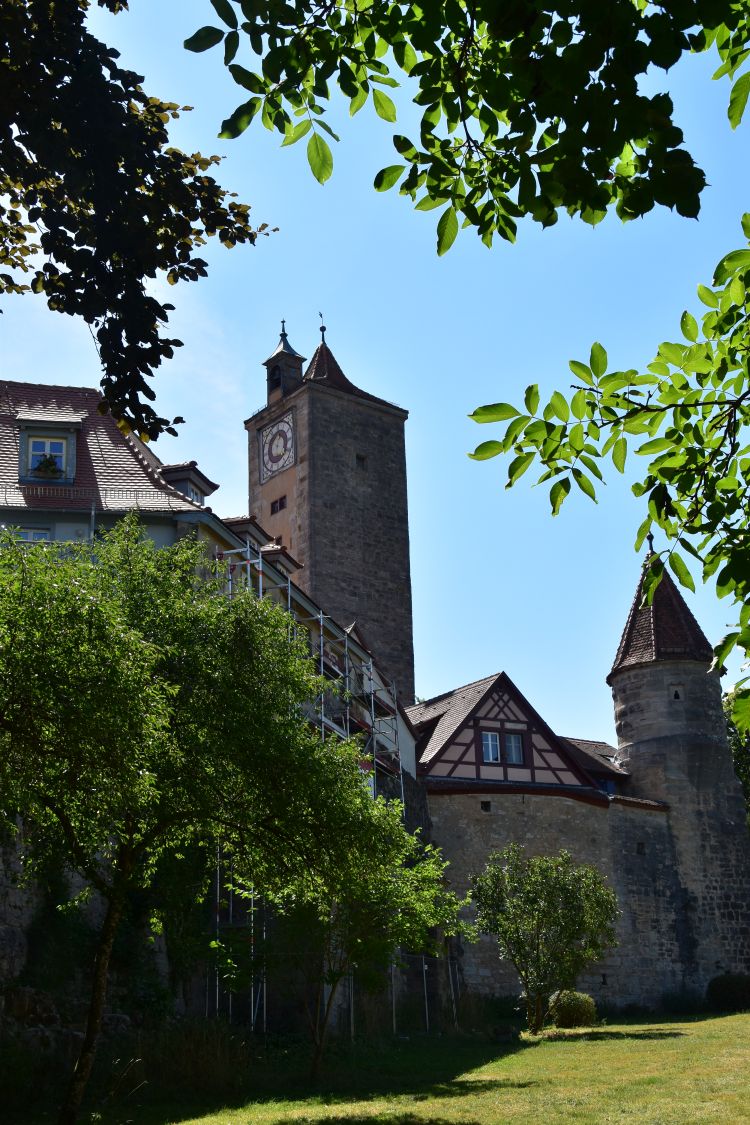
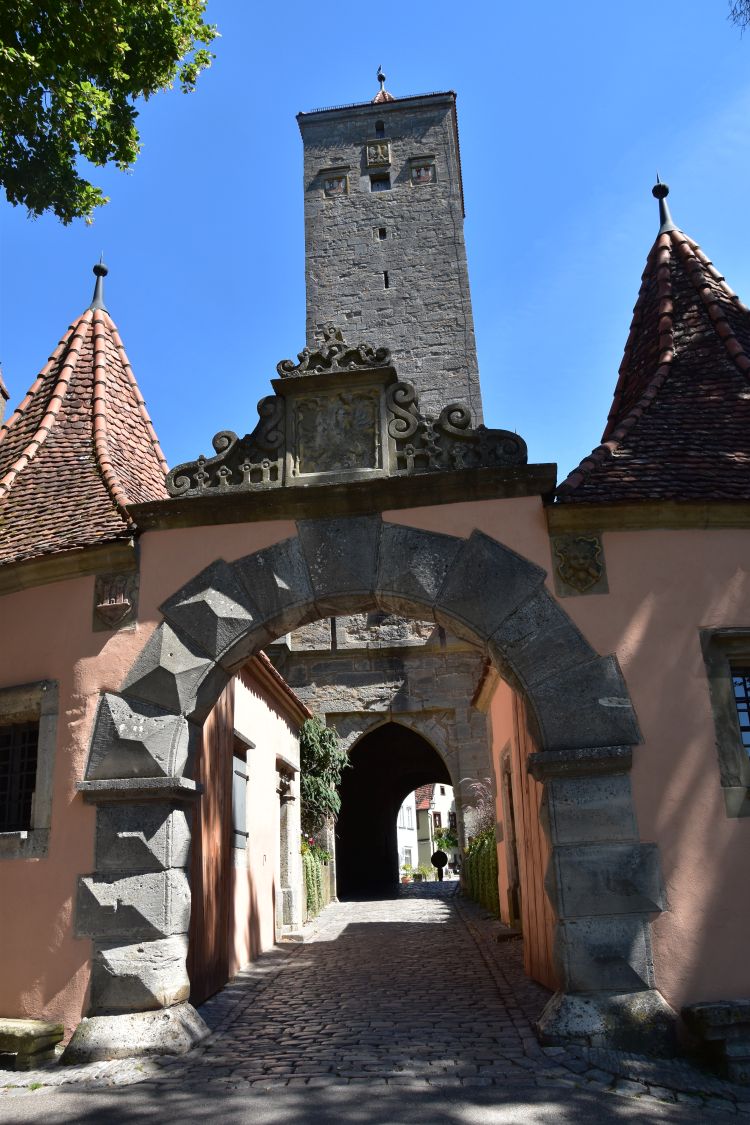
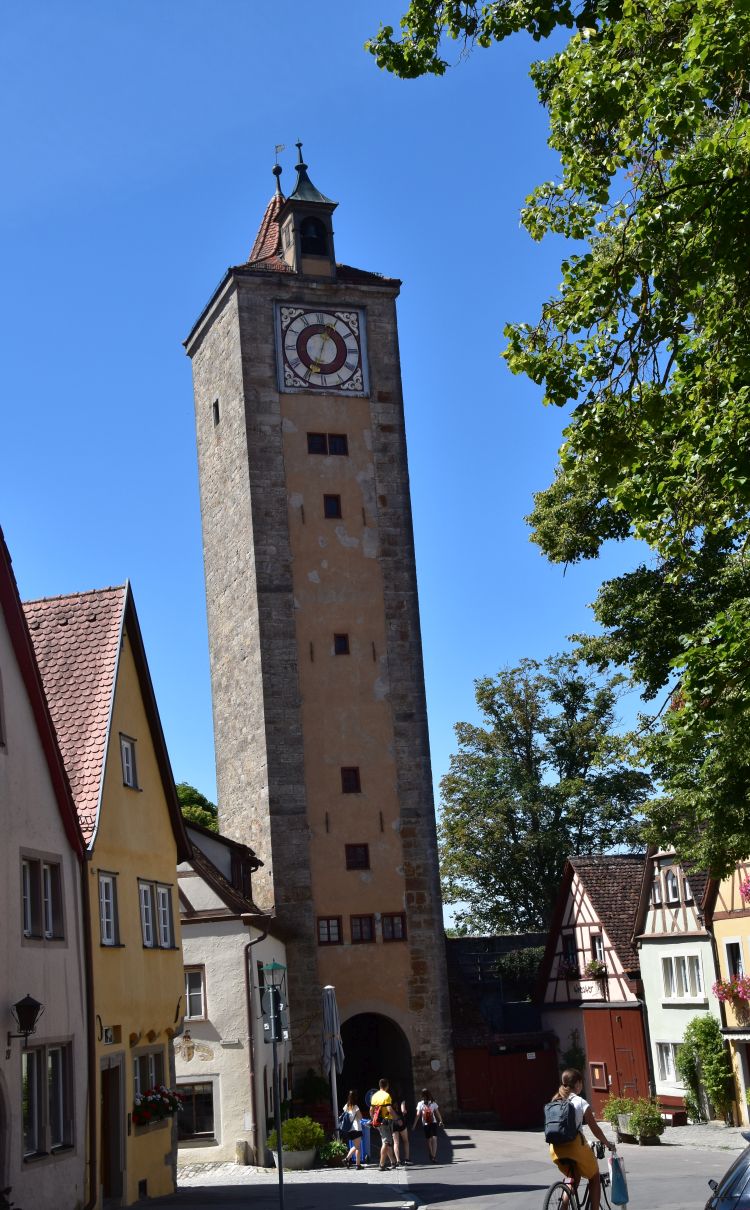
The city wall with the gates still today surrounds Rothenburg.
Walking along the moat west of the city centre…
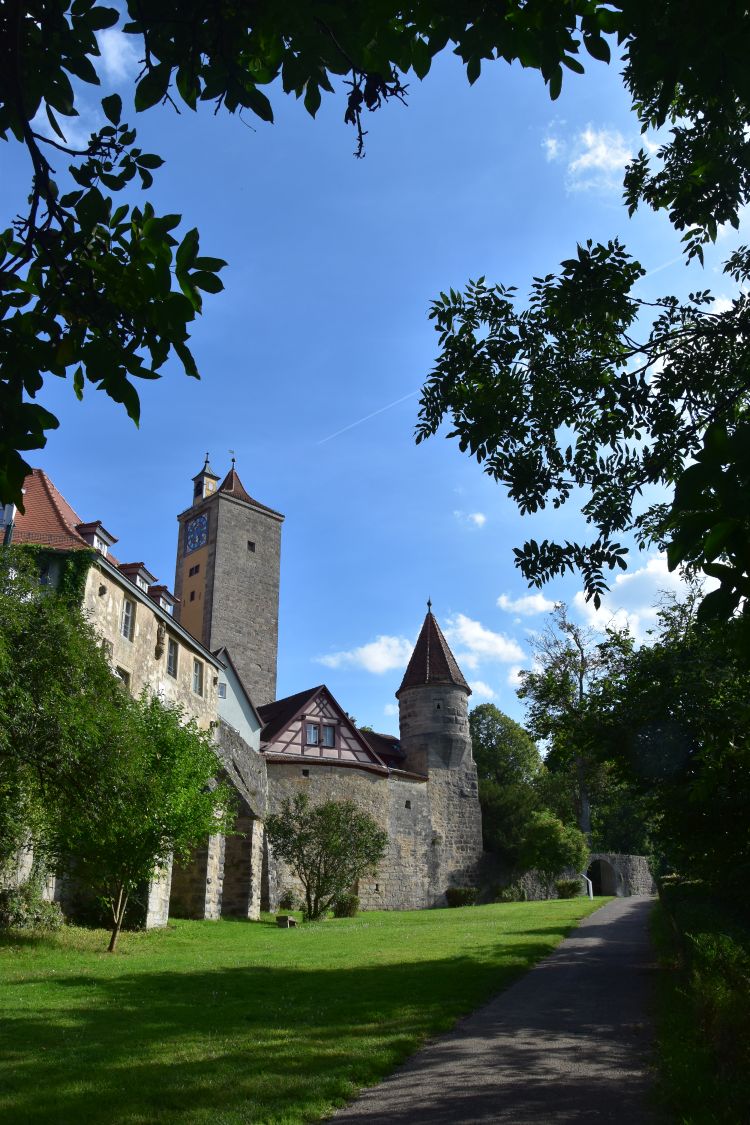
… takes me to the Burgtor, …

… where the Burggarten starts. Here, the Hohenstaufen had built their castle in the 12th century, after the dukes of Rothenburg had died out. The Staufen castle has disappeaered. Only a small chapel is left.
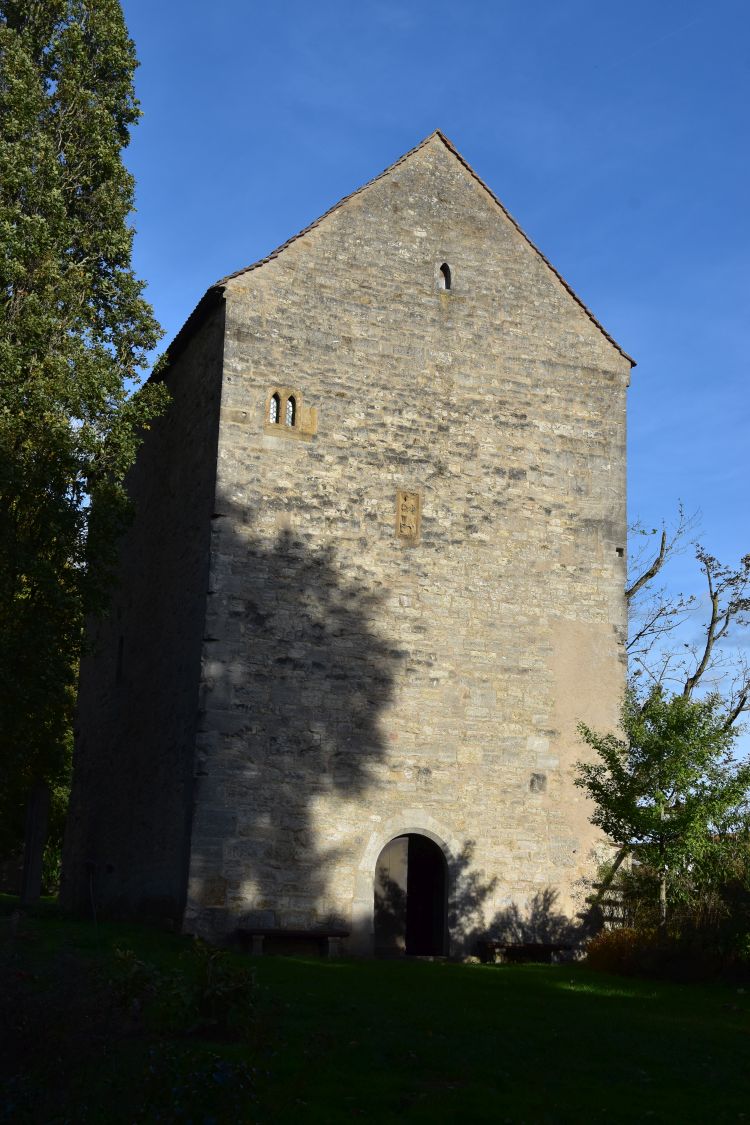
The Burggarten is well kept and romantic.
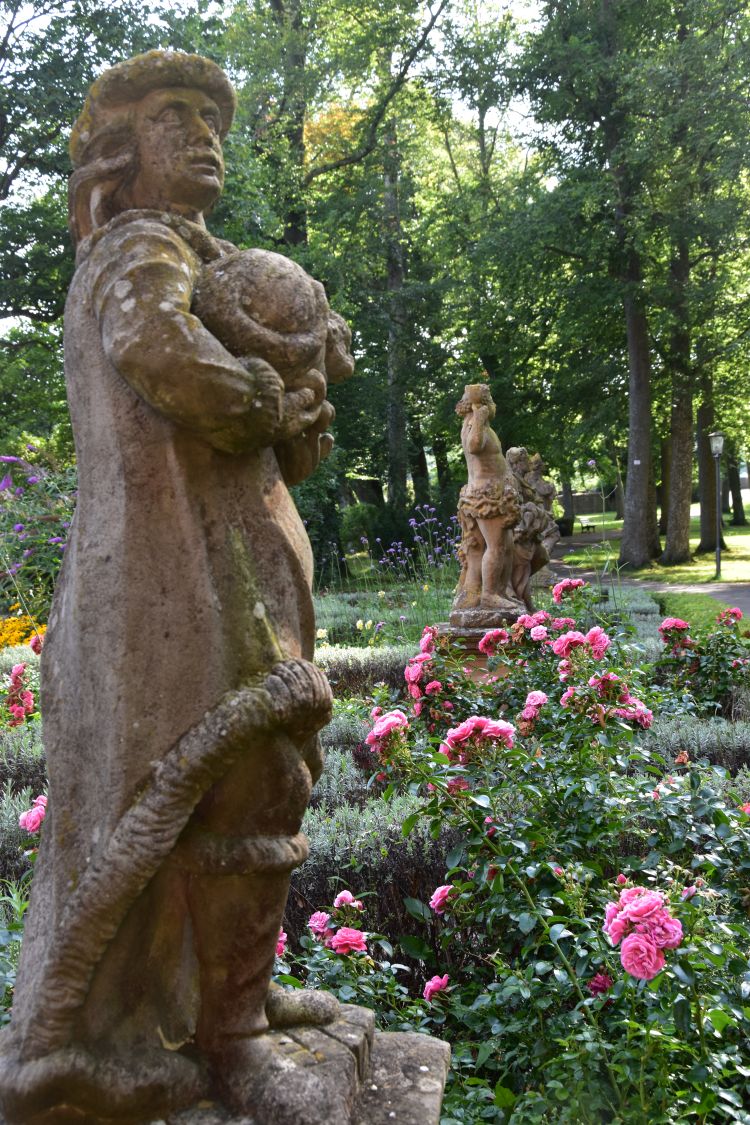
From the Burggarten, the southern part of the city line appears above the Tauber valley.

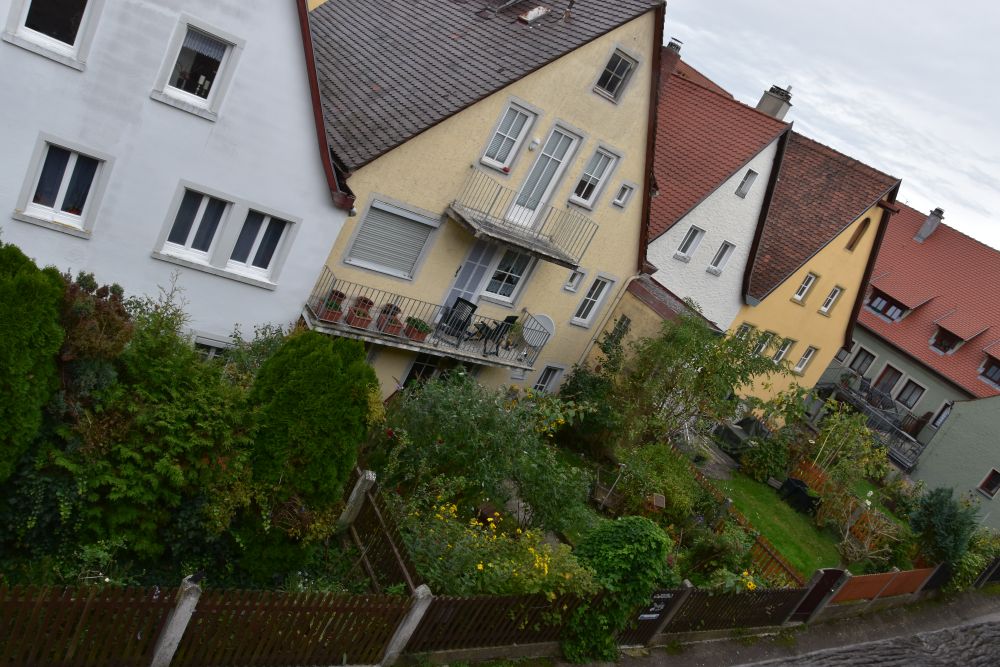
One morning, I did the wall walk all around the city. Homely corners…
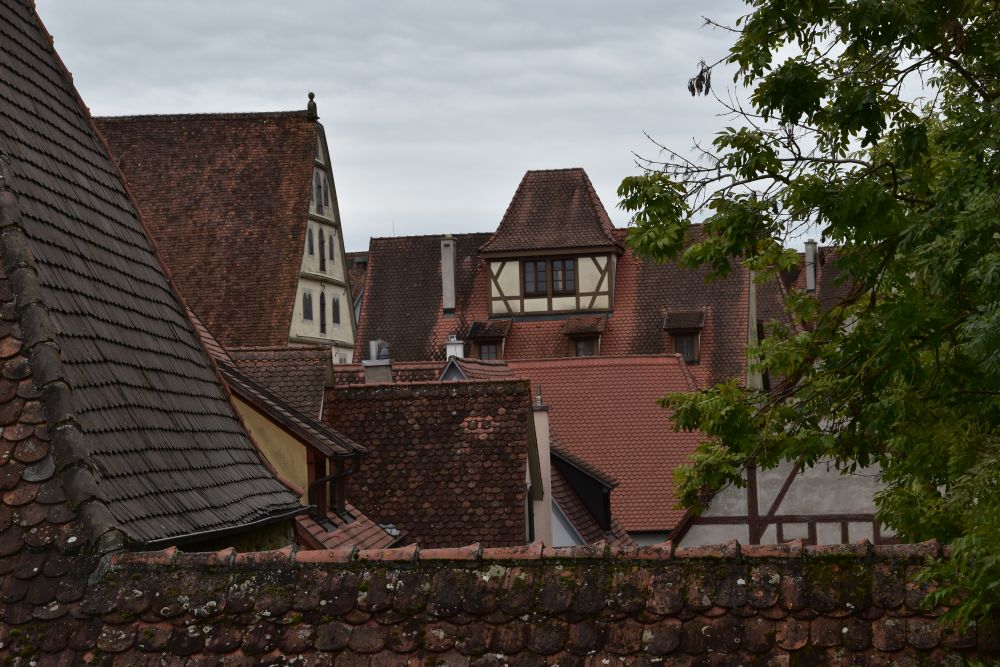
… and roof “landscapes” all along the walk.
More painters felt attracted by Rothenburg, as the museum in the former Dominican monastery tells us
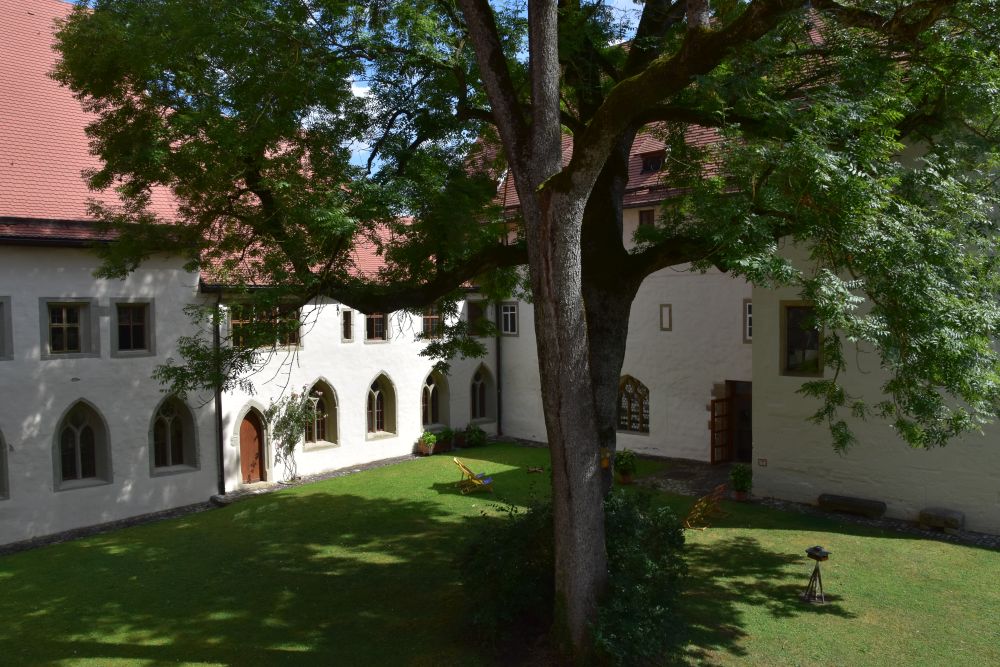
The museum in the former monastery of Dominican nuns lays out the history of Rothenburg ob der Tauber.
In the 19th century, various journals praise Rothenburg to be the ideal medieval city with its picturesque architecture. The message is heard in Germany and Europe. Painters from Germany, the Netherlands and England come to Rothenburg, and one department of the museum is dedicated to some of these painters. Hermann Radzyk was not the only painter that felt attracted by Rothenburg.
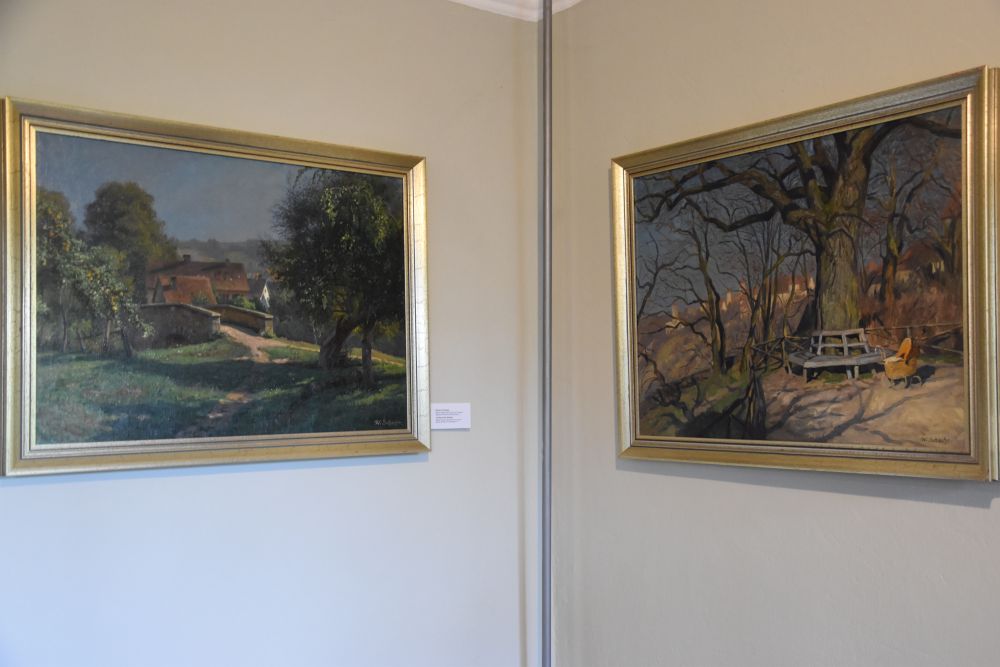
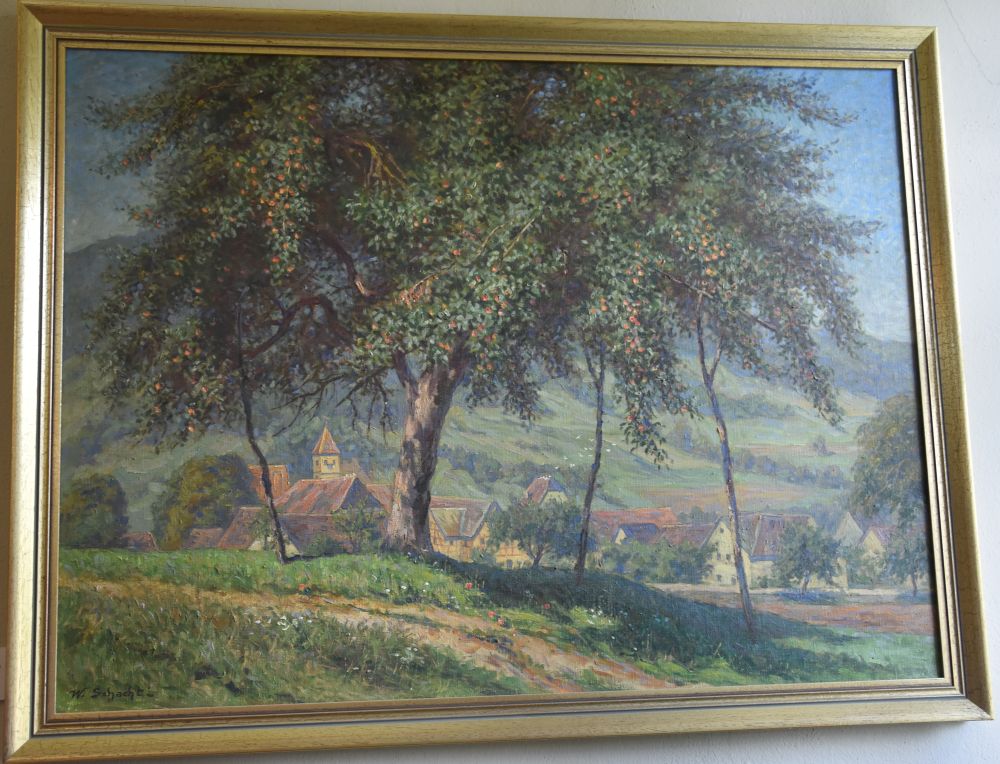
Most exhibits in the museum are paintings of Wilhelm Schacht (1872-1951). He painted the old brigde at Detwang (left), like my grandfather. On the second painting (right), we can faintly see Rothenburg behind the lime tree with the inviting bench.
This is another view of Detwang painted by Wilhelm Schacht, with the Romanic Saint Peter and Paul church.
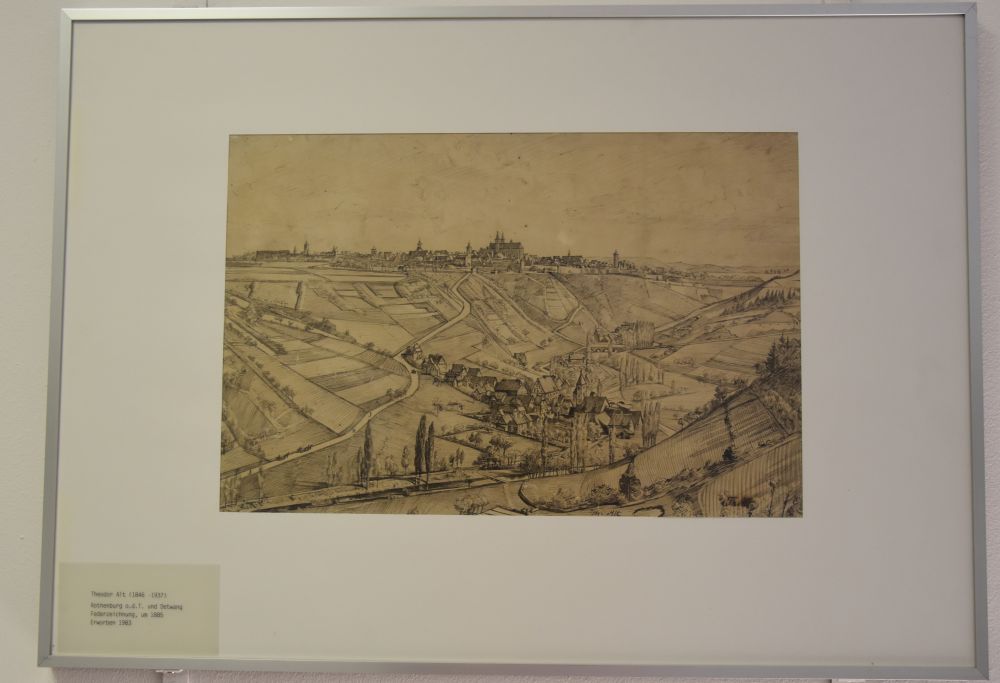
The pen drawing of Theodor Alt (1846-1937), a Franconian, shows Detwang in the valley and Rothenburg ob der Tauber above it.
Arthur Wasse (1854-1930) was born in Manchester, studied art in Germany and finally settled at Rothenburg. His picturesque “Häuser an der Klingengasse” was reused by Disney as a suggestion for the background of the film “Pinocchio”, as the panel in the museum says.

Elias Bancroft (1846-1924) from England painted the “Siebersturm, Rothenburg ob der Tauber”, with the still unrenovated Plönlein.

Martin Monickendamm (1874-1943) is a Dutch painter. He painted this overview of Rothenburg and called it “Rothenburg ob der Tauber (Das kleine Rothenburg)”.

In all I have been at Rothenburg ob der Tauber five times, always as short stop overs on my way to Berlin. The first time in the 1960’s with my best friend, the second time on a short afternoon stop over in August 2022 (then I found the location of the easel of my grandfather), the third time in October 2023 to explore the city more in detail, fourth in August 2024, when staying at its urban district Detwang to look for the moated castle, and fifth in October 2024 with a focus on St. James church. There is always something more to explore in this medieval city full of treasures and museums.
Let us say good-bye to Rothenburg ob der Tauber. Next, we will explore more treasures in the Tauber valley: The Celtic oppidum at Burgstall and the Church of Lord (Herrgottskirche) with Saint Mary’s altar by Tilman Riemenschneider.
Sources:
- http://www.rothenburg-unterm-hakenkreuz.de/ for a description of the bomb attacks in March 1945.
- Museum Rothenburg in the former Dominican monastery (explanations).
- Wolfgang Kootz, “Rothenburg ob der Tauber, Verlag & Desin Simon Sauer, Sinsheim 2020, (Rothenburg brochure”).
- https://youtu.be/An5XAw1fr78 (“St Jakob – Ein Gang durch die Kirche mit Pfarrer Oliver Gussmann”, “video Gussmann”).
- https://www.hotel-goldener-hirsch.de/en/places-of-interest/buildings-squares/town-hall-rothenburg-ob-der-tauber/.
- https://www.rothenburg.de/entdecken/top-10 (Tourismus Rothenburg ob der Tauber).
- https://de.wikipedia.org/wiki/Rothenburg_ob_der_Tauber (how Rothenburg became one of the models for a medieval German city).
- https://www.alt-rothenburg.de/start (Verein Alt-Rothenburg e.V.).
- https://www.rotour.de/kunst-im-zentrum (Stadtmagazin für Rothenburg ob der Tauber).
- https://www.deutschlandmalanders.com/die-uhr-der-ratstrinkstube-in-rothenburg-ob-der-tauber.
- Wiki entry for Friedrich Herlin (samples of his paintings, in particular Petrus wearing glasses and reading a book and the painting of Rothenburg in the year 1466).

 Petra Peters