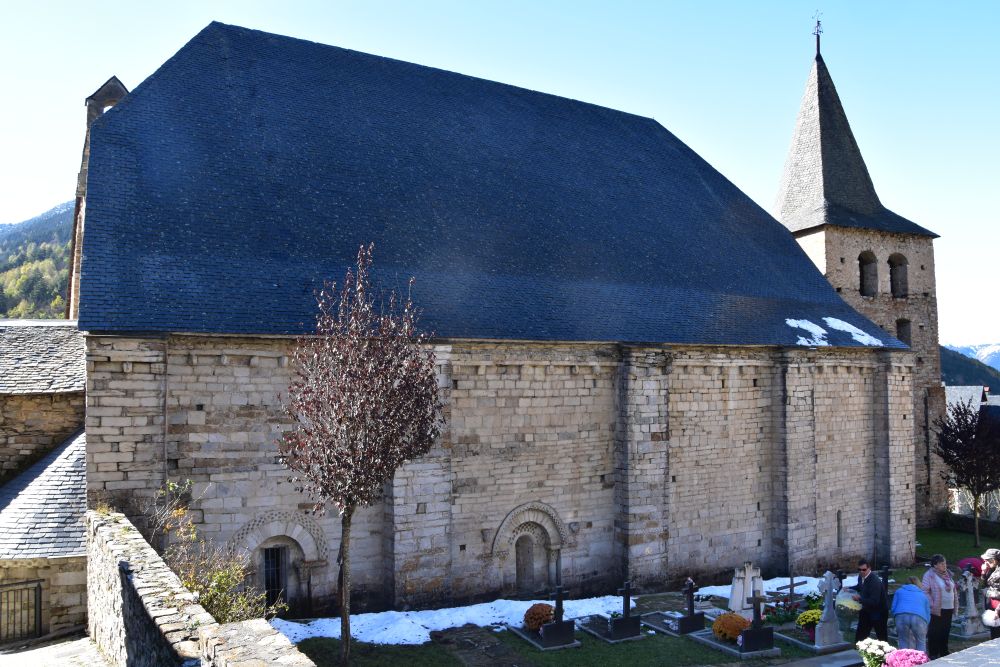
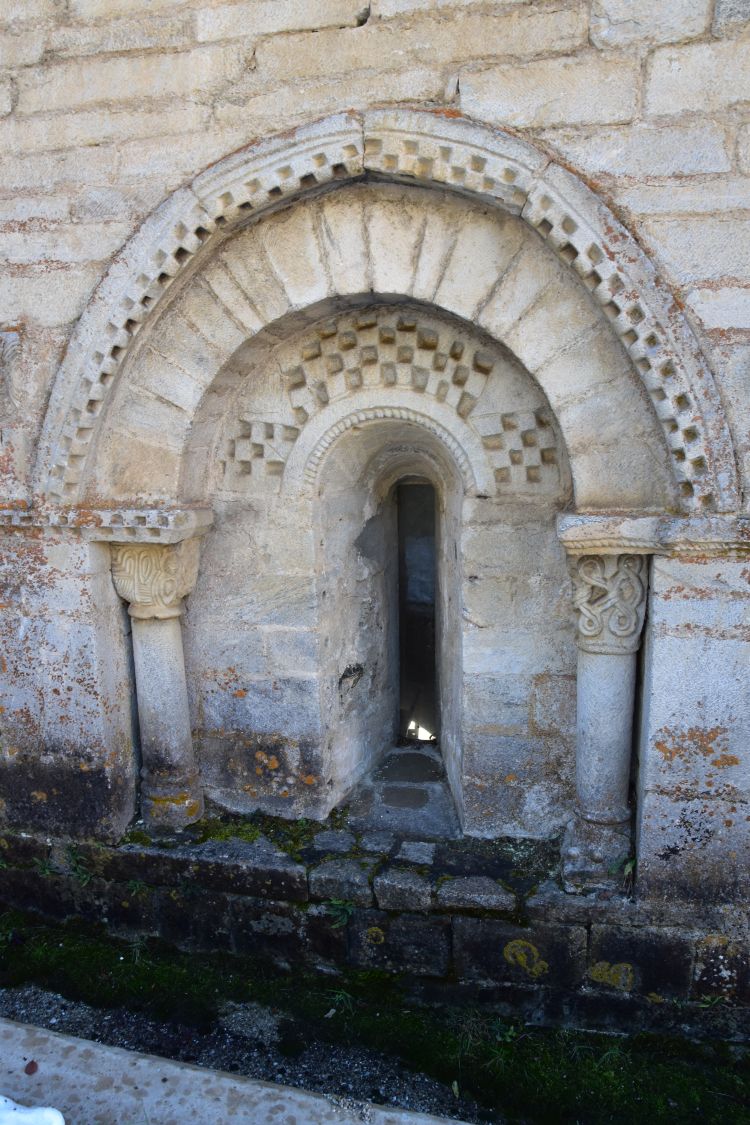
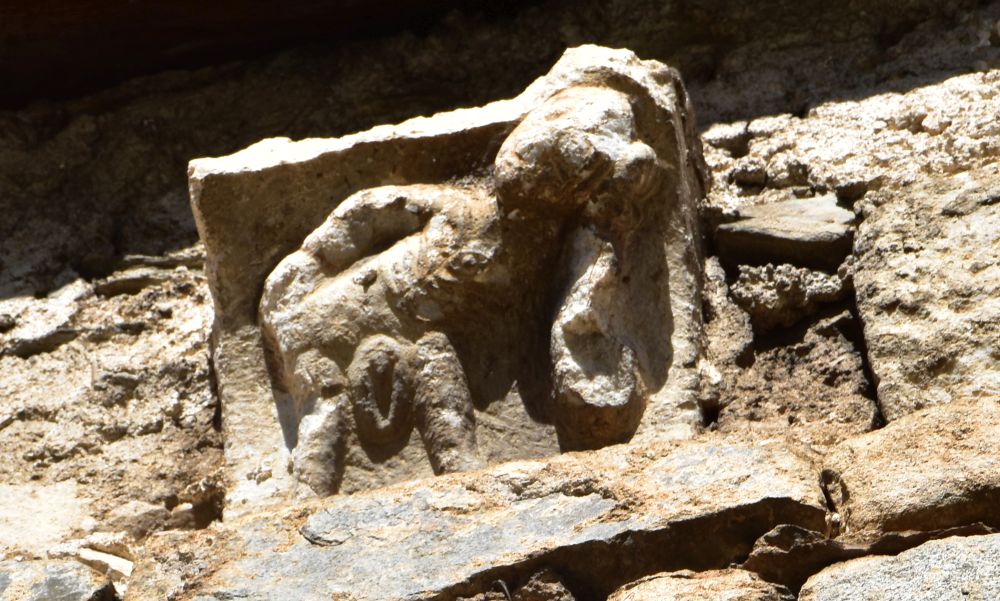
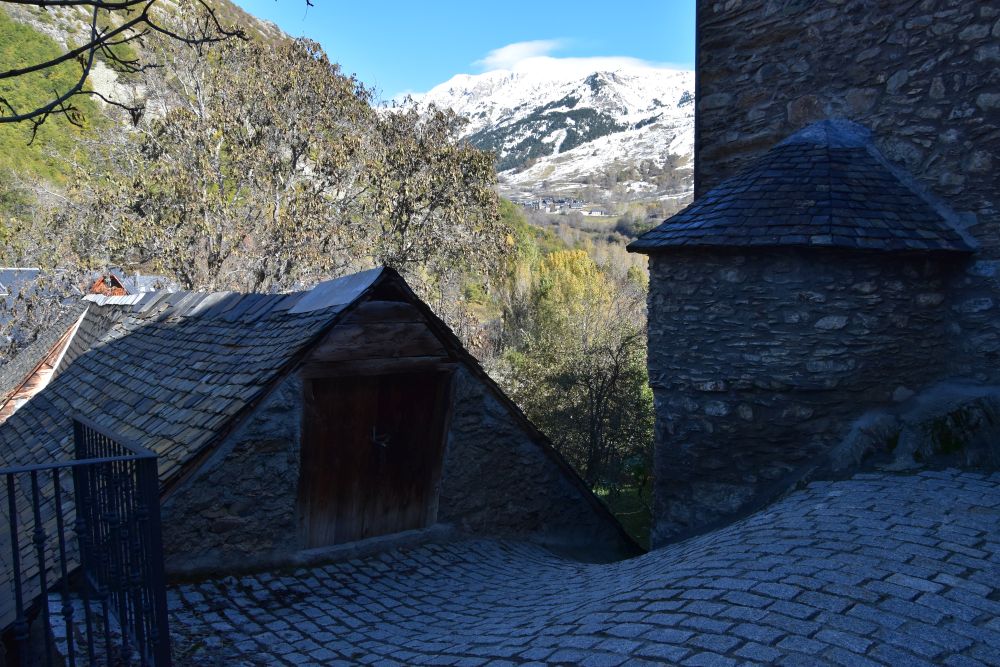
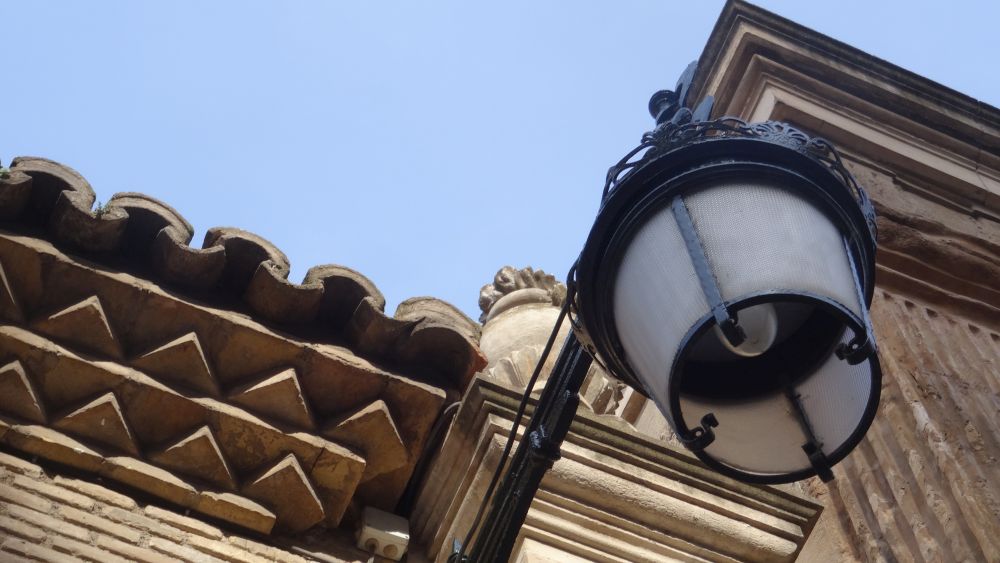
Exploring Morella with Perucho in mind

In November 2018 we spend three weeks not far from Tarragona.

After having crossed the mountains of the Maestrazgo with Perucho in mind, I now continue with Morella, also with Perucho in mind. 

Let us quickly recapitulate, what happened in the Maestrazgo and in Morella in Perucho’s novel “Las historias naturales”(see separate blog): In 1840, during the first Carlist War, the protagonist, liberal Antonio de Montpalau traverses the mountains of the Maestrazgo in search of the vampire, alias El Mochuelo, alias Onofro de Dip de Pratdip. Montpalau and his followers are captured by the conservative Carlist troups and taken to Morella, where the general of the Carlists, Ramón Cabrera, has his headquarter. Cabrera had been bitten by the vampire. Later Cabrera with his troups leaves Morella for Berga, where Montpalau will help Cabrera escape from the gloomy fate of becoming a vampire.

.

Morella – this eagle’s nest could well be the castle of King Arthur

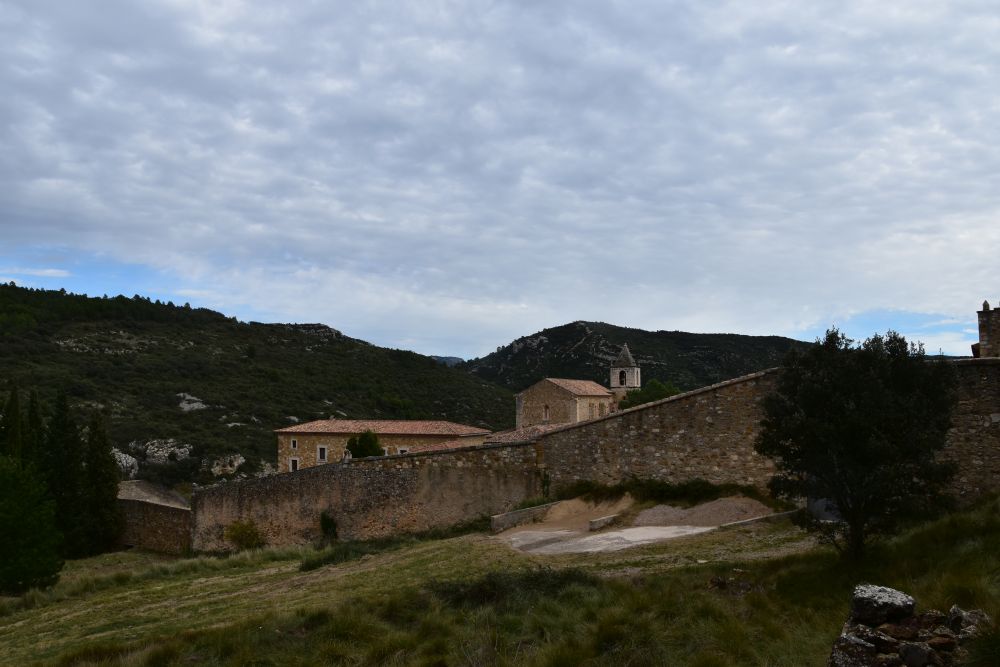
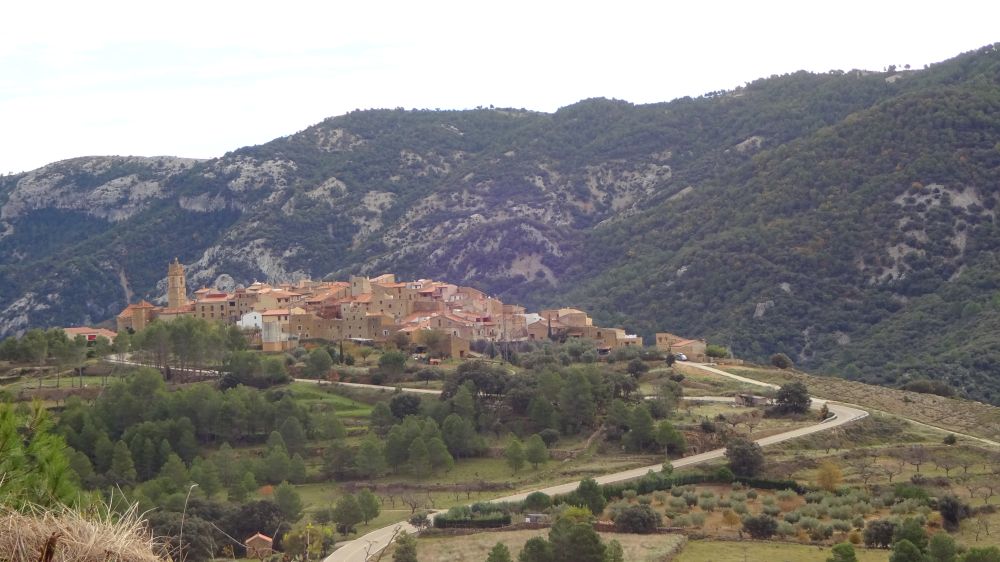
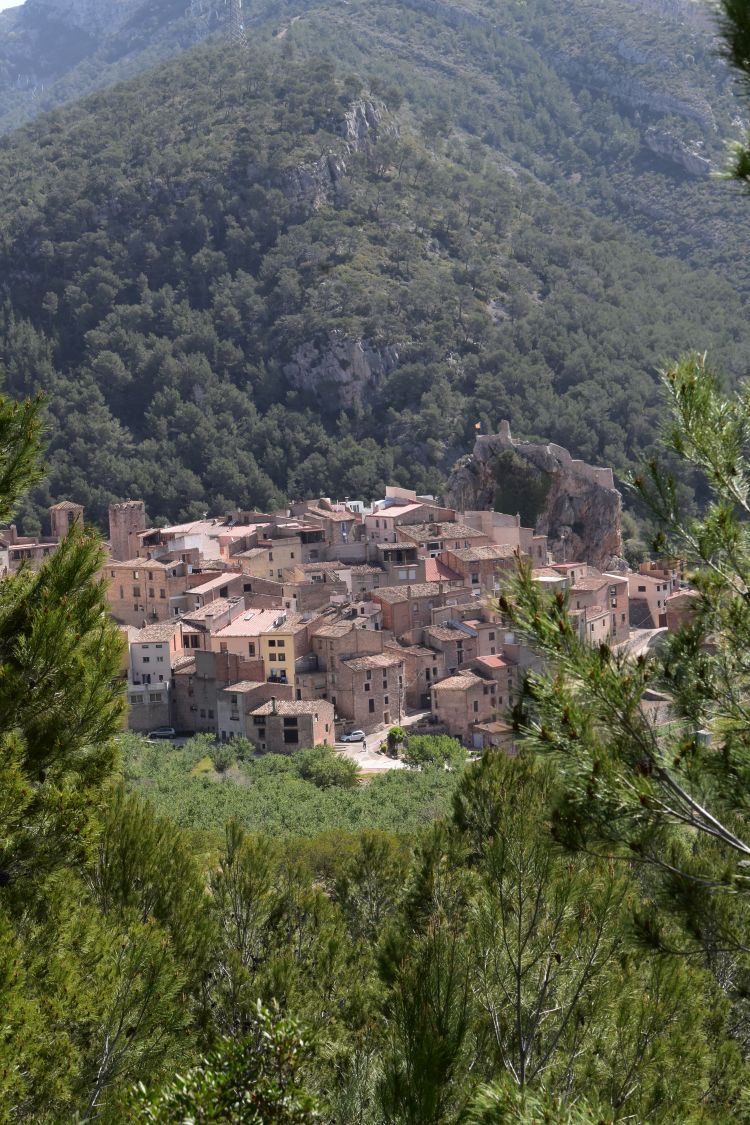
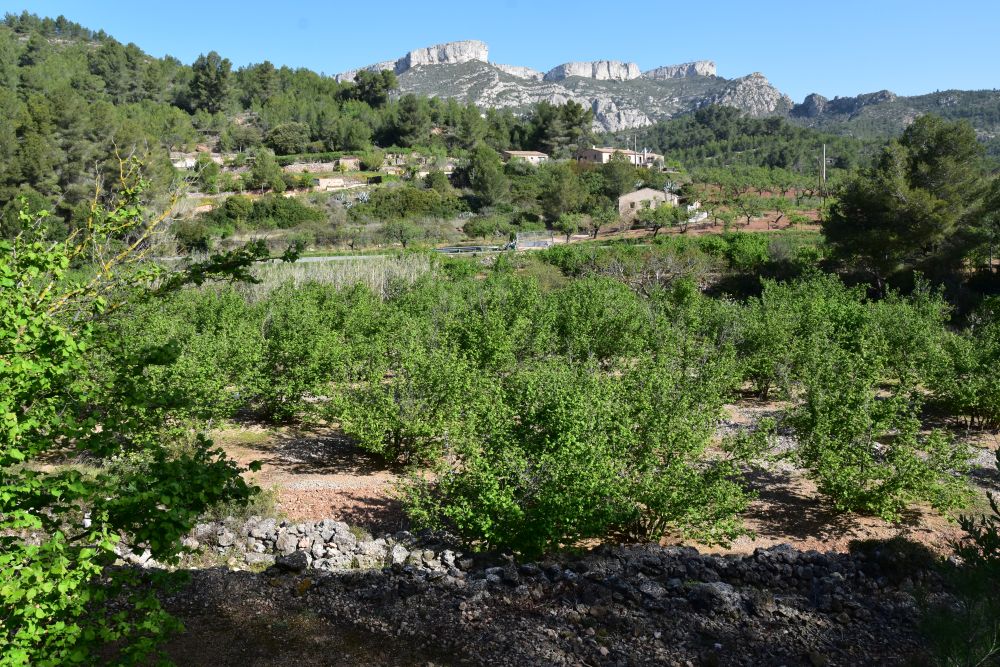
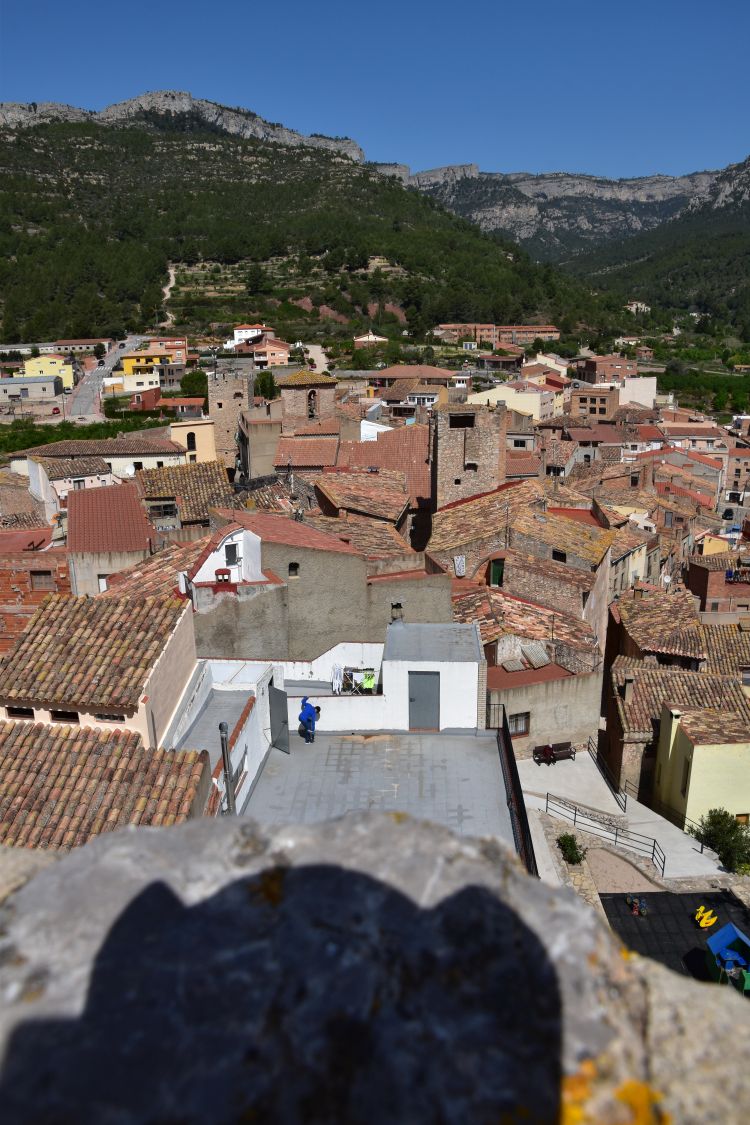
We descend from Port de Torre Miró. Approaching Morella from the north, we see the medieval city towered by the castle. Actually, the whole City, with the walls surrounding it, might be part of the castle.
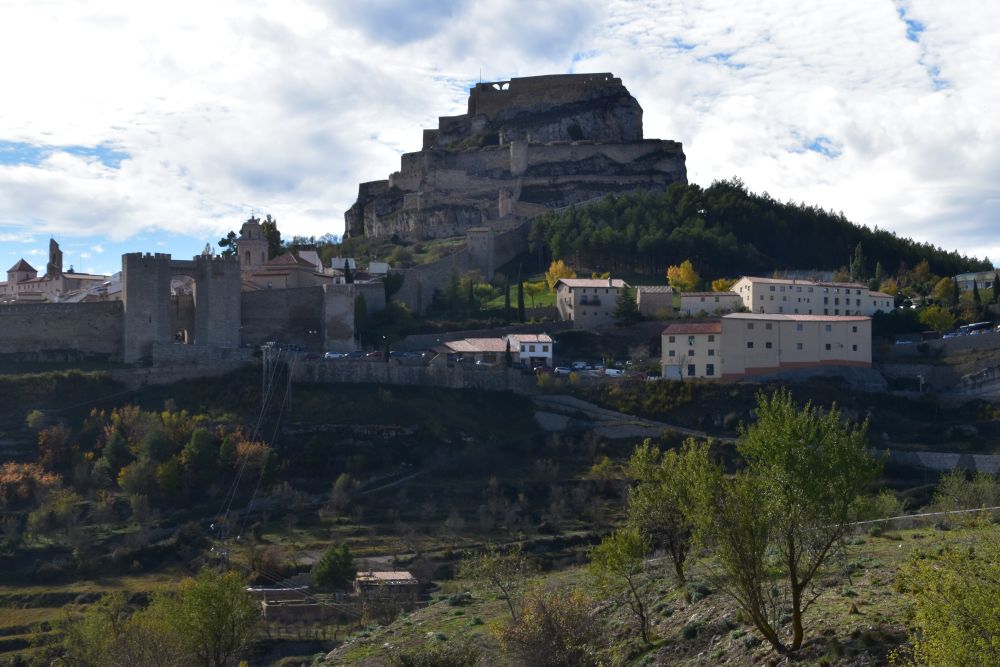
It looks like the nest of an eagle, as Perucho writes: “el escarpado nido de águilas realista” (p. 172, at that time occupied by the royal (realista) Carlists). Like Perucho, I could imagine King Arthur having resided here (p.181): “Llegando por la carretera de Monroyo…, uno cree estar ante de una de aquellas ciudades del Rey Arturo y de los caballeros de la Tabla Redonda, adecuadísima para albergar el Santo Grial”. (Arriving on the road from Monroyo…, one thinks to stand in front of one of those cities of King Arthur and His Knights of the Round Table, well suited to keep the Holy Grail). Furthermore, Perucho compares Morella to Mont Saint Michel in France, just without the sea around it.

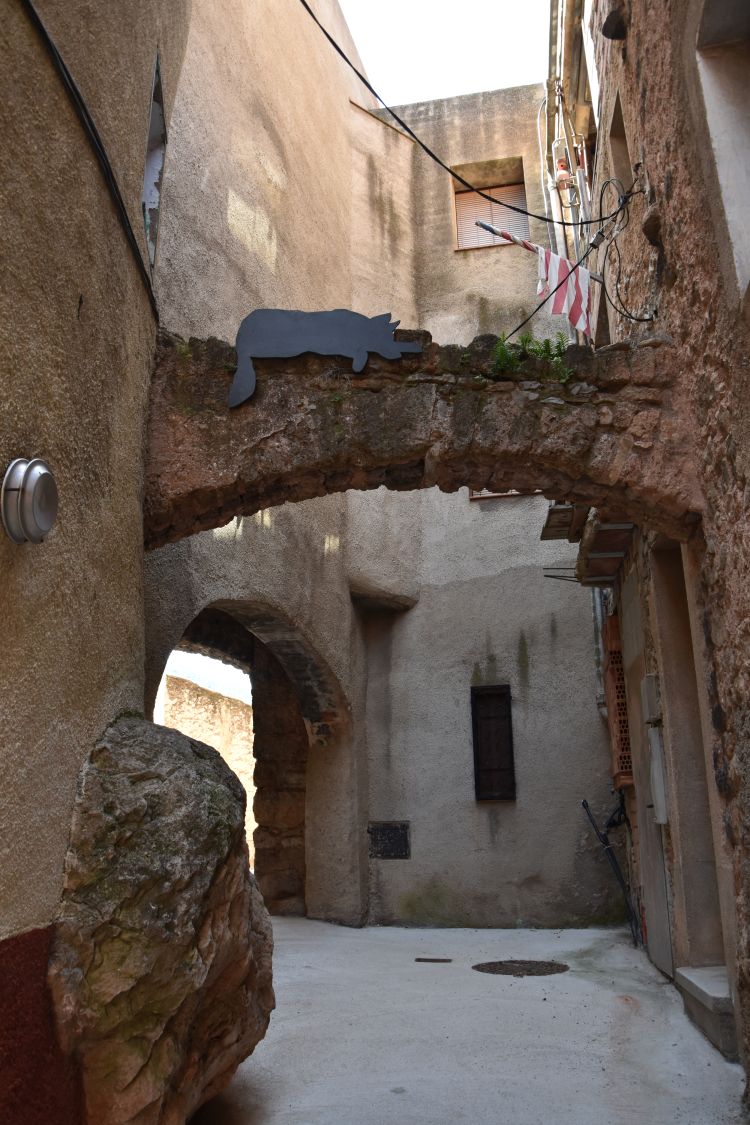
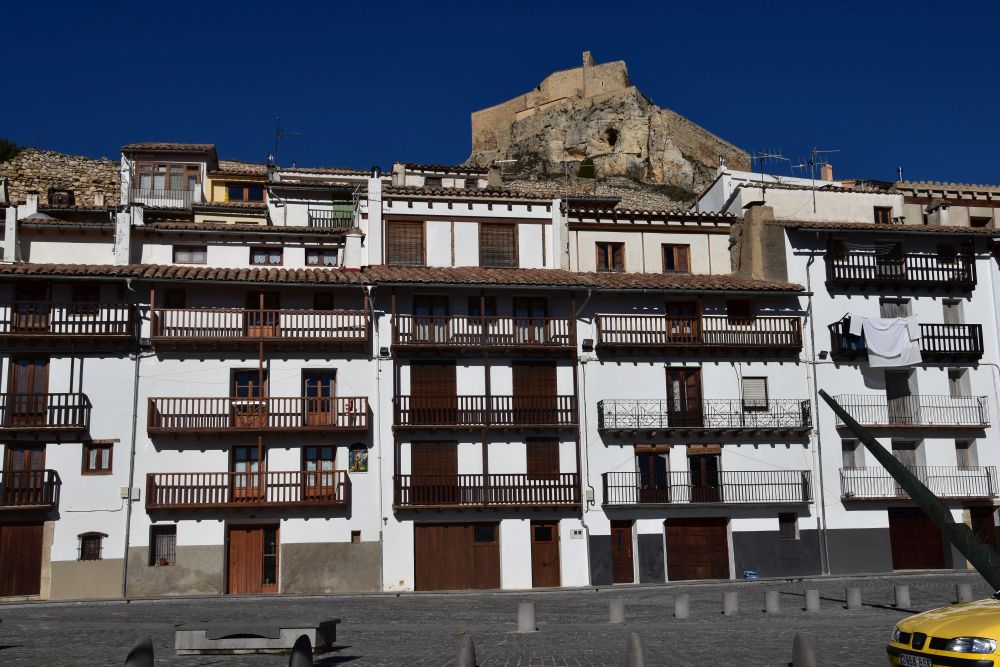
We park our car along the town wall and stroll through the narrow, cobbled streets. “Morella tiene mucho carácter,” Perucho says (p. 178, Morella has much character). It was an important city connecting the Ebro valley and the coastal planes around Valencia.

.

Strolling through the medieval city with its palaces

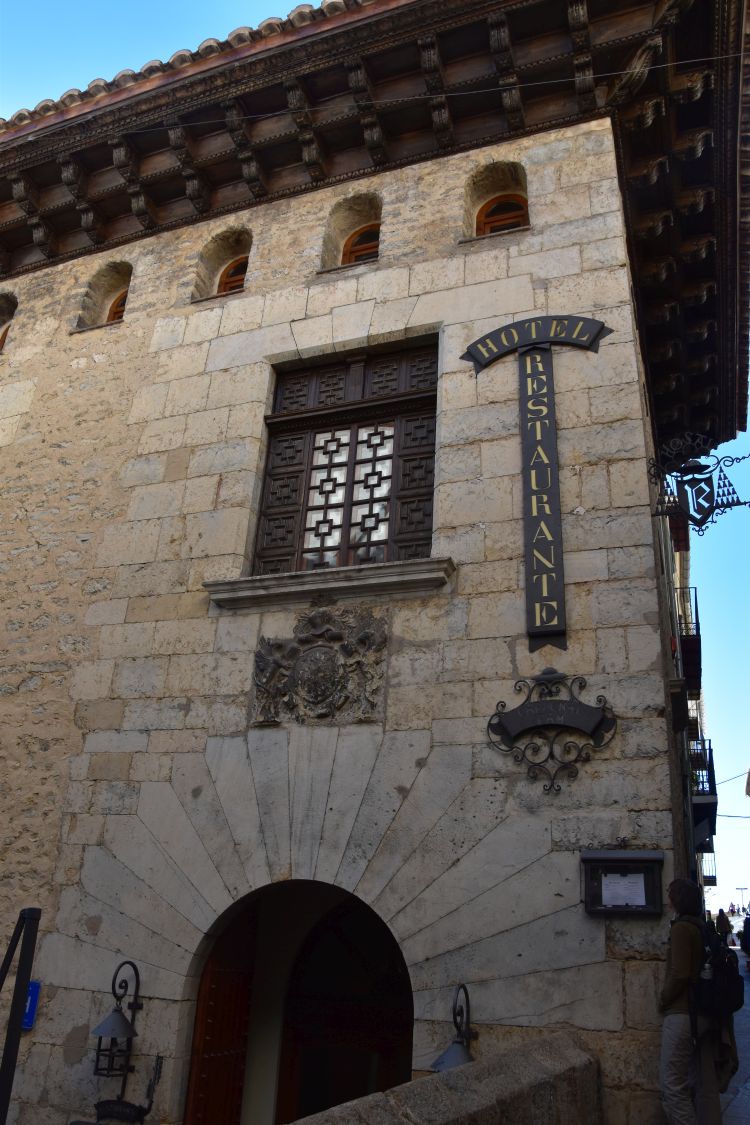
The strategic position of Morella is reflected in numerous palaces. The palace of the Cardinal Ram (built in the 15th century) is now a hotel.
Another Gothic palace has belonged to the Marquès de Cruilles.
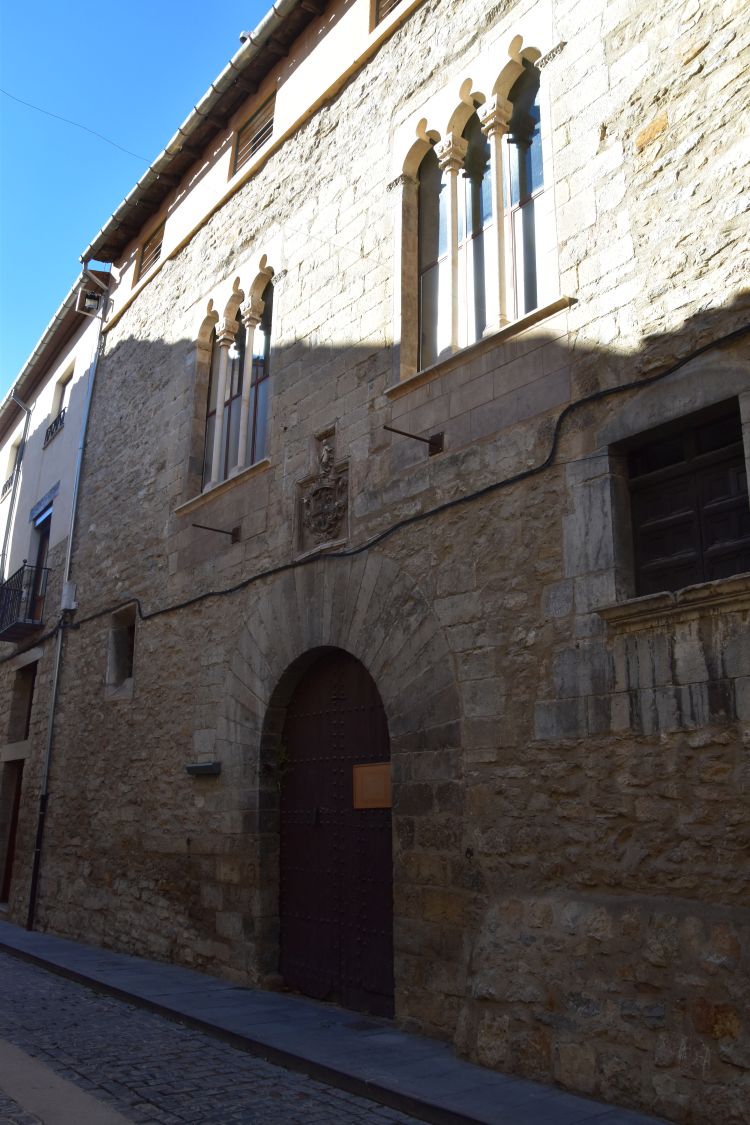
Next door is the Casa Rovira. In 1414, Vincent Ferrer, a famous Dominican friar and preacher from Valencia, stayed in this house on his way to meet the antipope Benedict XIII and the Spanish king Ferdinand I (Vincent wanted to convince the antipope to abdicate, in which he did not succeed). The hosts of the Casa Rovira agreed that for Vincent they would prepare a meal made out of the best they owned which was their son. When being served the meal, Vincent understood, what had happened, did not eat, but revived the son successfully – the boy now lacked only one finger, because the mother had tried the meal before serving it. Vincent Ferrer later became Sant Vincent. Legend mixed with reality, explained on these ceramic tiles.  

.

The church of Santa Maria la Mayor – also valued by Perucho

Now I look forward to seeing the famous apostle portal of the Gothic church Santa Maria La Mayor (built around 1300). Here it is, hidden because of renovation. Bad luck.
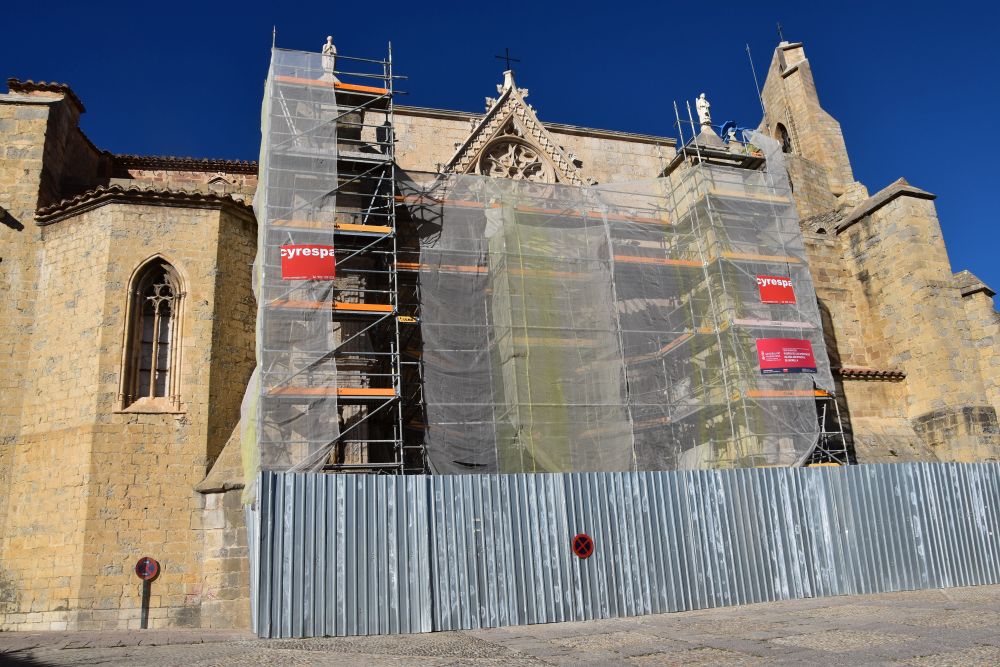
Next to it, the virgin’s gate is still waiting for renovation.

Perucho’s description of this church is very much to the point (p. 182): “La cathedral es una joya de piedra profusamente esculpida y con un coro construido de manera ingeniosa, en medio de la nave” (the cathedral is a jewel made out of stone lavishly sculptured and with a choir constructed in an ingenious manner, in the middle of the nave).

This is the ingeniously constructed choir elevated in the middle of the nave and decorated with the representation of the Last Judgment. 
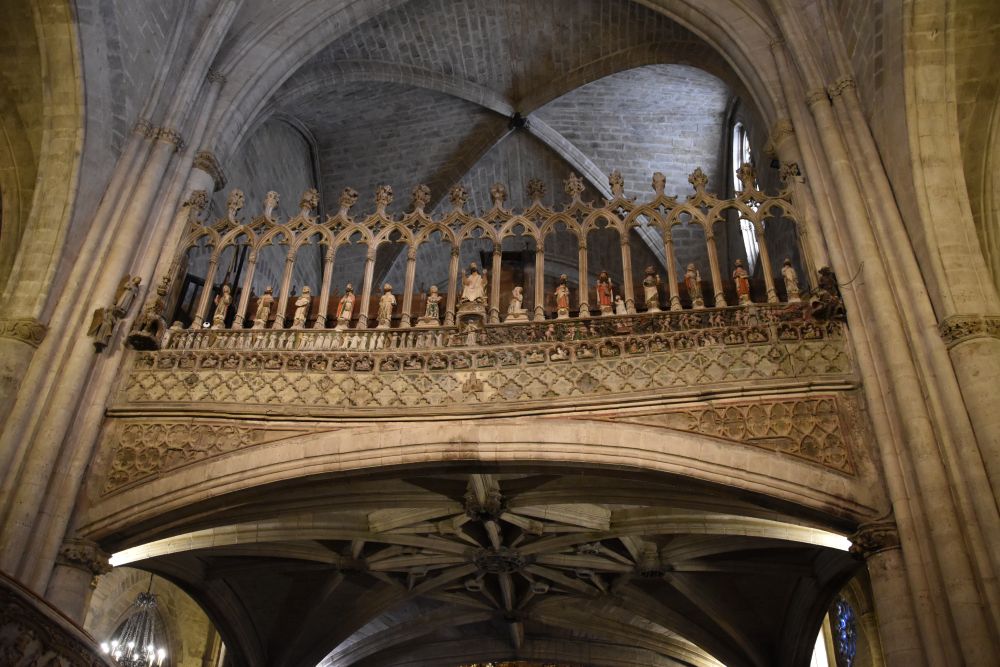
Spiral stairs with magnificent sculptures explaining the life of Jesus are leading up to the Choir.

.

The Convento San Francesco with its Danse Macabre

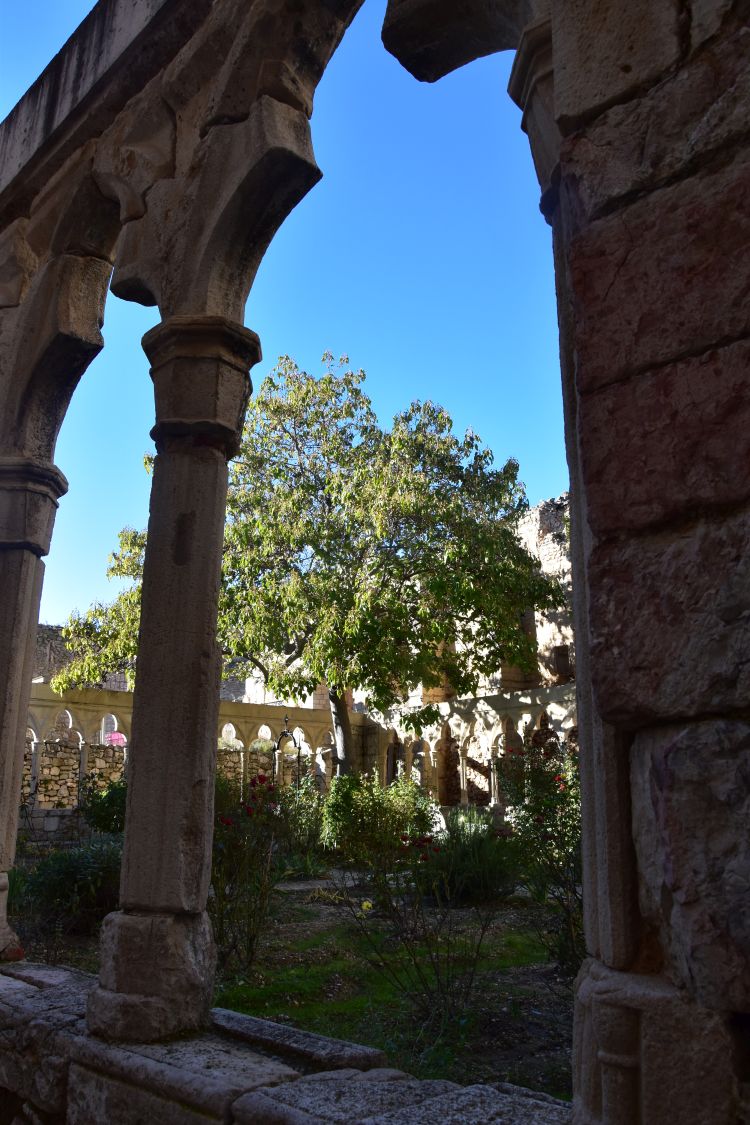
Above the cathedral we buy tickets for the Convento de San Francesc, now in ruins. This is the Gothic cloister.
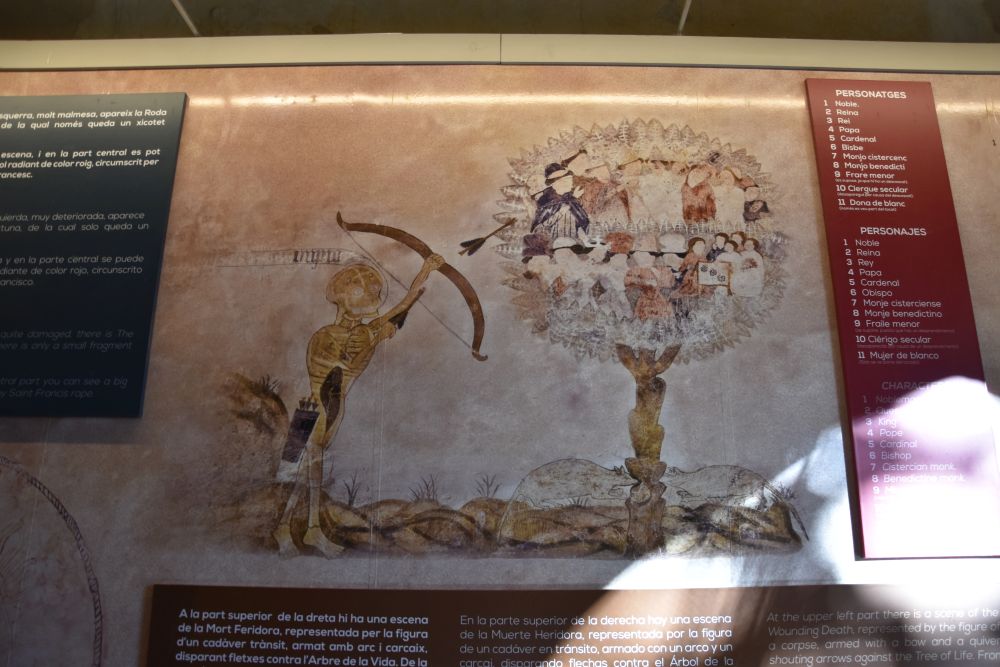
We admire the Danse Macabre. Every one will be the victim of godfather death – and they are all sitting on this tree. 
.

Climbing up to the castle with Cabrera in mind

High above the Convento San Francesc is the castle. The access is in the cloister. This is the castle seen through one of the arches of the cloister.

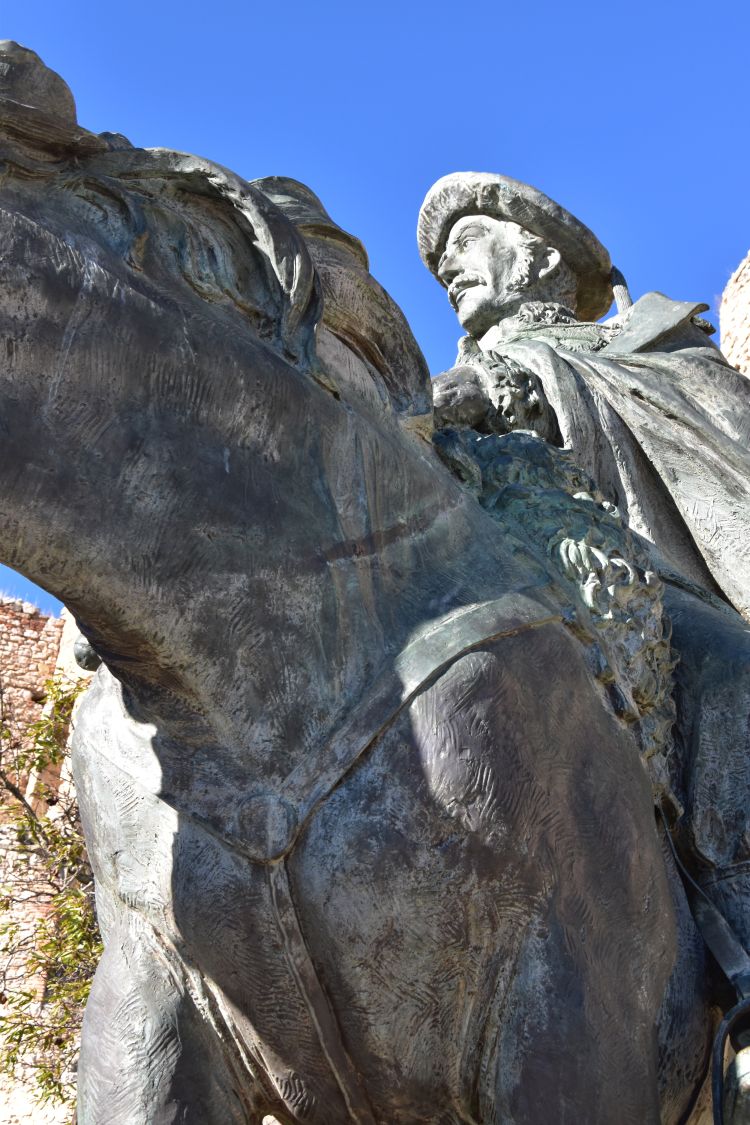
“Who is this man?” a family father asks, “ah, hm, Ramón Cabrera, okay”, and he makes selfies of Cabrera with his children and his wife. Yes, Ramón Cabrera, the Carlist leader, has the honour to greet visitors of the castle still today. The castle was his headquarter in the First Carlist War. Cabrera had the title “Count of Morella” and his surname was “the Tiger of the Maestrazgo”.
Walking up to the castle I notice that there is no direct way up. I have to go around the rock, until I reach these steep stairs with high steps. A young man approaching the top of these stairs sighs “Madre!” Come on, you are much younger than I am…
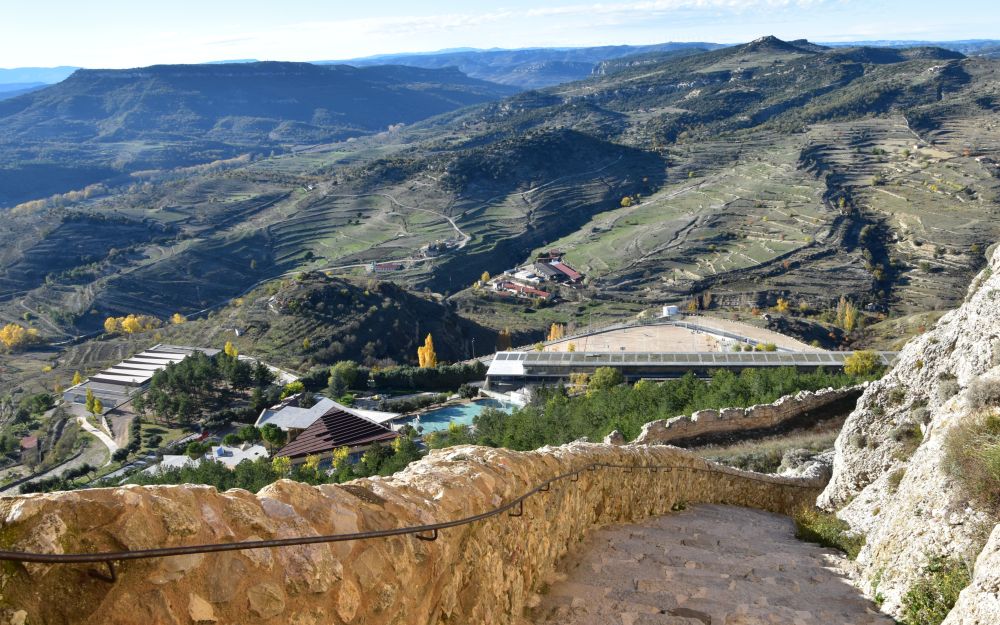
From the top of the castle I enjoy the gorgeous view. It is almost impossible to approach Morella without being noticed from here. And with the clever system of defensive walls protecting the castle on top of the steep rock, it seems almost unconquerable.

I can well imagine, how Cabrera and Montpalau sat on one of the terraces of the castle and had a coffee, with the magic view of the stone city at their feet: “Una tarde, mientras tomaban un café en una de las terrazas del castillo, con el mágico visto de la ciudad de piedras a sus pies, …” (p. 183).

Not much later after that coffee break, Cabrera left Morella with most of his troops to retreat north to Berga. They did so early in the morning. It was very cold then and they intended to reach the warmer Ebro valley as quickly as possible. “Cabrera y el ejército emprendieron la marcha al rayar el alba. Hacía un frío que pelaba, y la tropa… llevaba tapabocas. El Maestrazgo era una región terrible y necesitaban llegar a la cálida ribereña lo más pronto posible.” (p. 190). My guidebook says that temperatures in winter can feel as low as minus 20 degrees centogrades, as wind and frost are cumulating.

Soon after Cabrera had left Morella, Baldomero Espartero (who fought for the cause of Queen Isabel II) conquered the castle and elevated the conservative flag of the Queen on the castle.

Zooming I can see the medieval aqueduct from the 14th century that up to the 19th century provided Morella with water from the near mountains. I believe that I see a ditch behind the aqueduct.
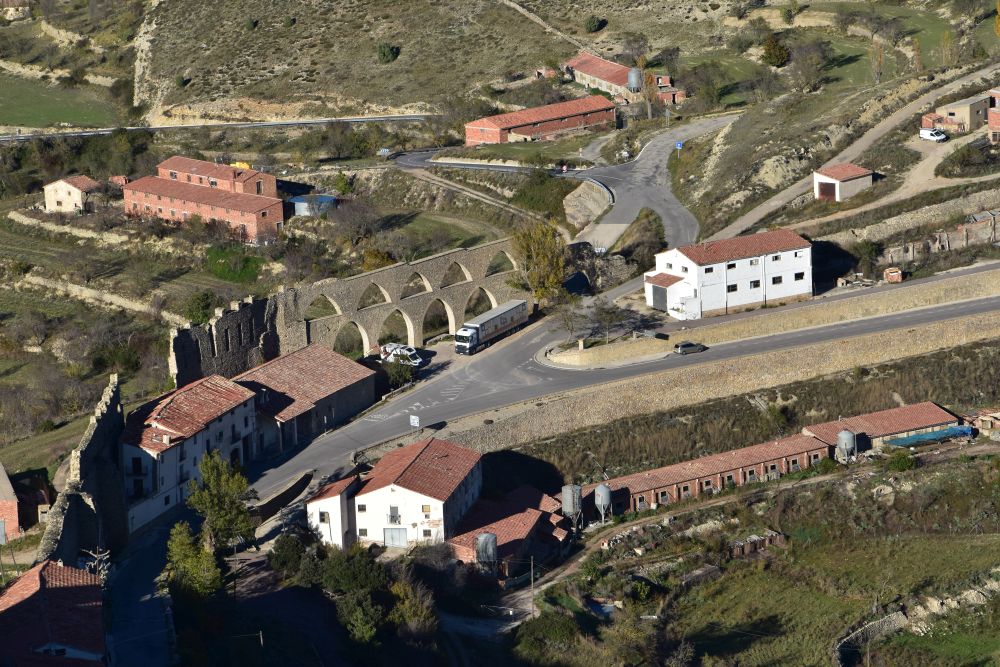
Now I understand, what Prince Lichnowsky experienced here, as described by Perucho. Lichnowsky was a nobleman from the Prussian Army that fought for the Carlists and Ramón Cabrera in the First Carlist War. Lichnowsky did not know that Espartero had taken over Morella in the meantime. He wanted to warn Cabrera of spies believing that Cabrera still resided in Morella. Lichnowsky approached the gate near the aqueduct. He noticed that he was received in a hostile manner. He retreated to one of the arches of the aqueduct. From here, he looked up and noticed the enemy’s flag wave on the castle. He understood, Espartero has conquered Morella and he, Lichnowsky, has to escape. He turned around, crossed the ditch to his right and disappeared towards Catalonia. (“El príncipe Lichnowsky… montó al caballo… y, a trote ligero, se dirigió a Morella… después de pasar bajo un arco del acueducto, llevaba, derecho, a la maciza puerta fortificida… Súbitamente vio como saltaban minúsculas salpicaduras de tierra a su alrededor… Oía las detonaciones agrias, … hacía dar la vuelta a su caballo. Encontró protección de uno de los pilares del acueducto, mientras una bala rebotaba contra la piedra, a un palmo de su cabeza. Entonces con mucho cuidado, miró hacia arriba. En la torre del castillo ondeaba la bandera de la reina… ¡Dio mío! Qué había pasado?… Lo urgente era escapar,… A la derecha se abría una barranca medio cubierto con matas de brezo florido. Espoleó a su caballo. El salto fue a la desesperada, cerrando los ojos y mientras sentía a la Muerte a su espalda… El Principe huía como un gamo hacia tierras de Catalunña…” (p. 229)).

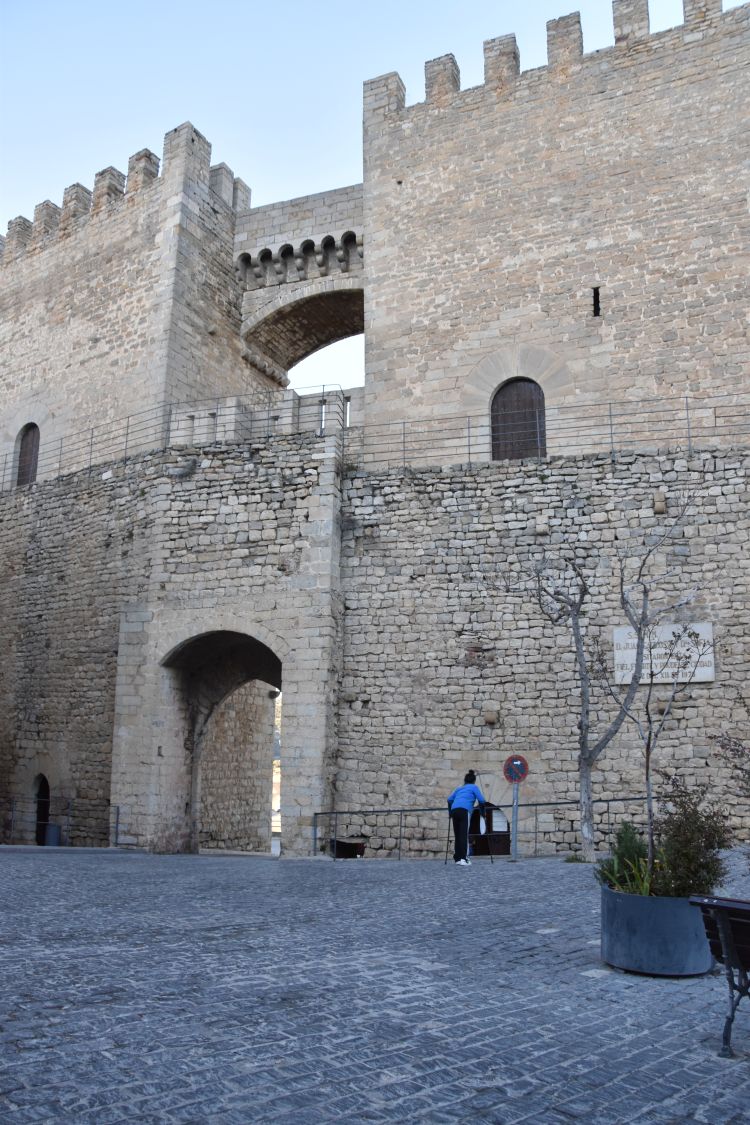
This is the gate closest to the aqueduct (seen from inside the city) that gave the unfriendly welcome to the Prince Lichnowsky.  
.

Wrapping up the visit of Morella

After having visited the castle, we walk back through the city…
… and evaluate the woven blankets with the typical pattern of Morella.
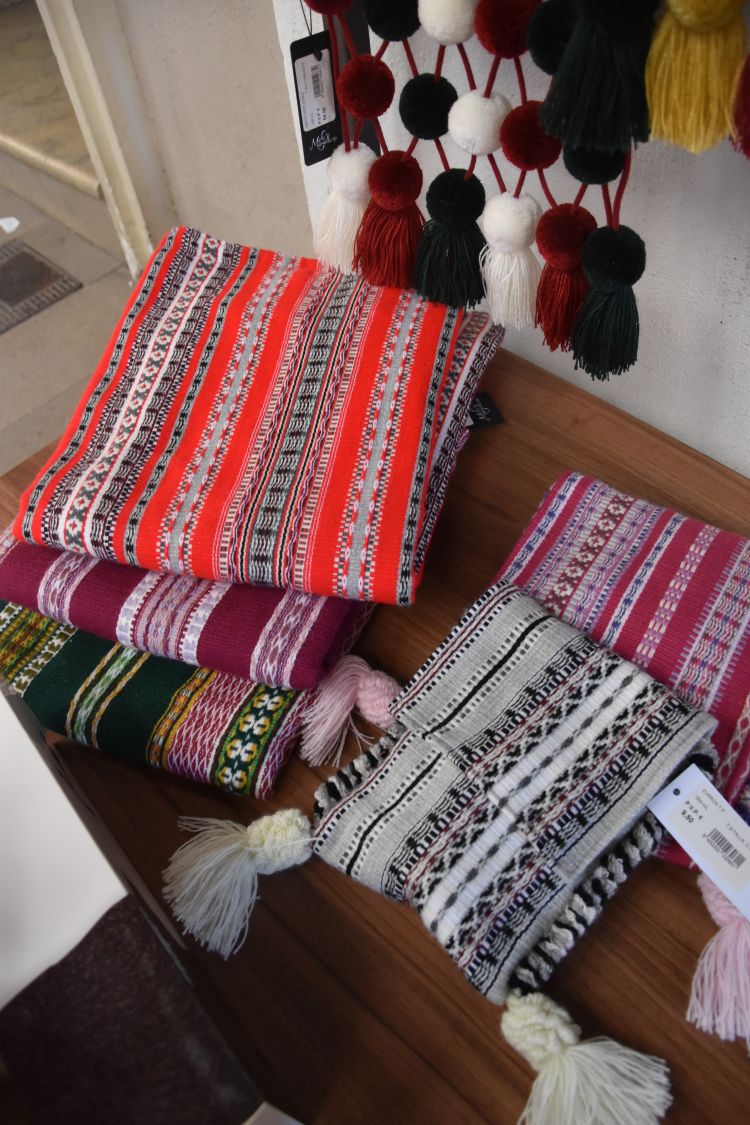
All blankets that we looked at, were made out of synthetic fiber containing some 10 or 20% of pure wool. Not what we had expected. We buy some sweet specialties instead, flaons and mantecados.

We stop at the beautiful townhall dating from the 15th century.

Inside the courtyard we find some giants (used at Corpus Christi) and a film of the Sexenni that the town celebrates every six years to commemorate the end of the plague in 1672.

We return to the town wall to pick up our car. We notice a heavy fine behind our wiper for having parked where only those authorised are allowed to, not foreigners like us. On this busy Saturday with many cars parked all over, we had not noticed the prohibition sign… but we find it okay to leave some money to support the ongoing renovation in this charming town.

In the evening we unpack our souvenirs, the flaons and the mantecados.
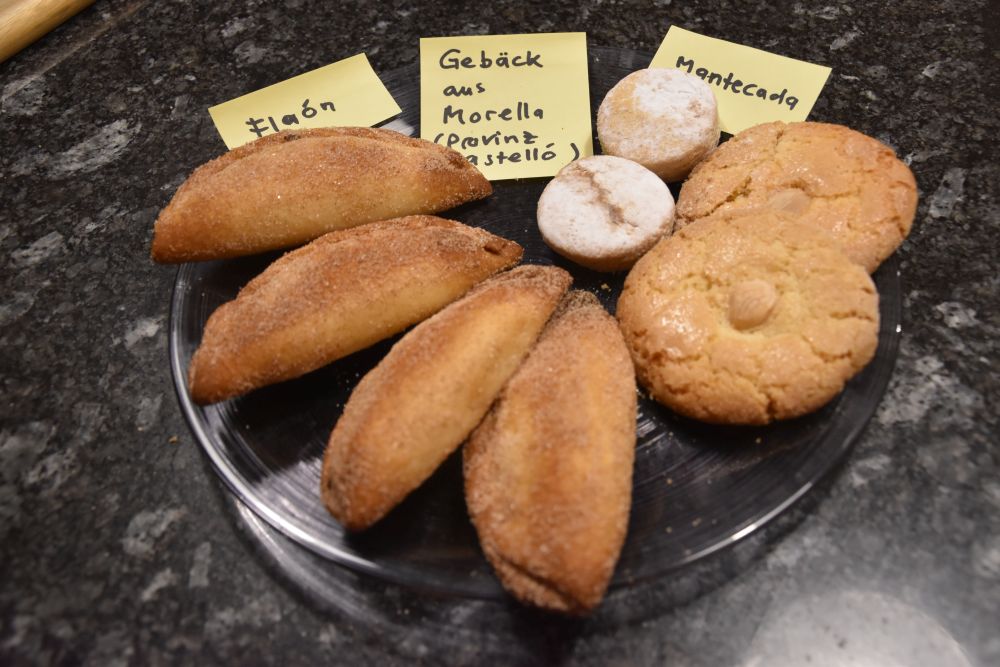
The sweets accompany our afternoon coffee times. From our selection of sweets, our favourites the larger mantecados with the almond in the middle.

Yes, Morella is worth a visit.


Sources:

David Navarro: “Morello”, Reihe Tourismus Spanien, Fisa Escudo de Oro.

Juan Perucho: “Las Historias Naturales”, Hurope, Barcelona 2003.

Morella in Wikipedia and tourist home site of Morella
 

The Maestrazgo: On the way to Morella with Perucho in mind

In November 2018 we spend three weeks not far from Tarragona.  

Having read “Las historias naturales” by Juan Perucho, I wanted to cross the mountains of the Maestrazgo and visit Morella.

Let us quickly recapitulate, what happened in the Maestrazgo and in Morella in Perucho’s novel “Las historias naturales”(see separate blog): In 1840, during the first Carlist War, the protagonist, liberal Antonio de Montpalau traverses the mountains of the Maestrazgo in search of the vampire, alias El Mochuelo, alias Onofro de Dip de Pratdip. Montpalau and his followers are captured by the conservative Carlist troups and taken to Morella, where the general of the Carlists, Ramón Cabrera, has his headquarter. Cabrera had been bitten by the vampire. Later Cabrera with his troups leaves Morella for Berga, where Montpalau will help Cabrera escape from the gloomy fate of becoming a vampire.

Now, let us follow the tracks of Perucho and Montpalau by crossing the Maestrazgo on the way to Morella.

.

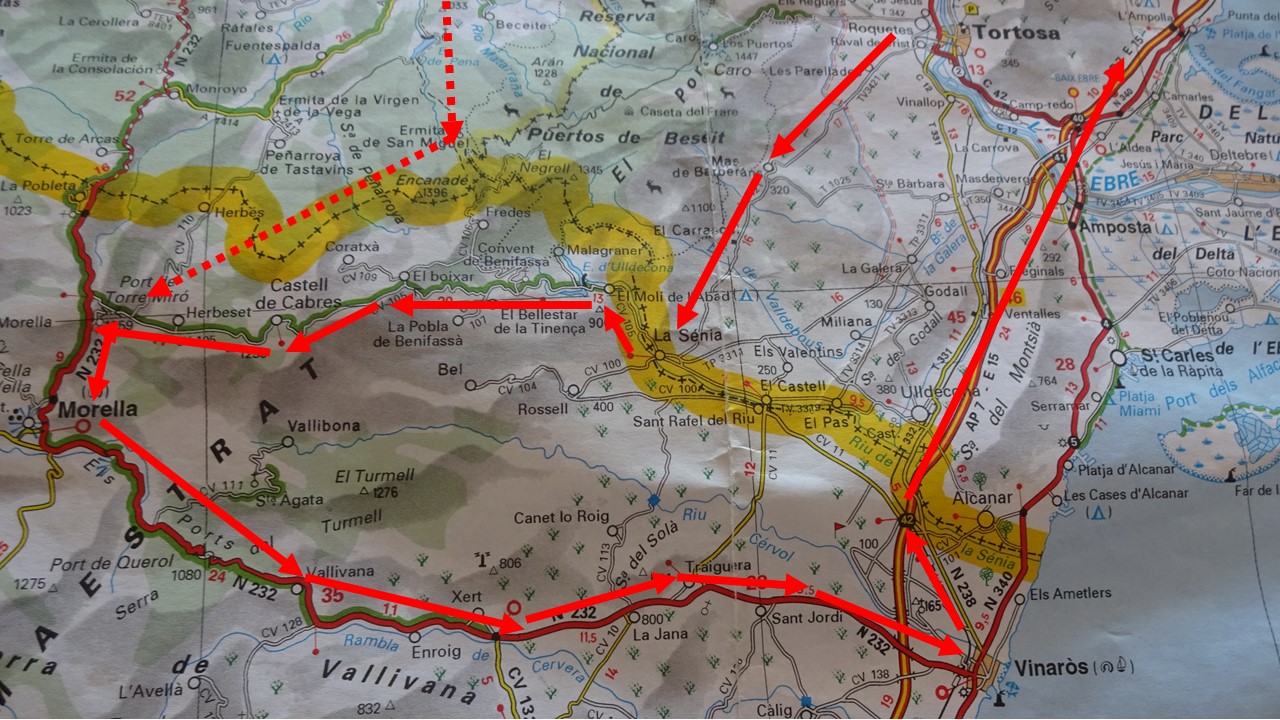
Our routes to Morella crossing the Maestrazgo mountains

Montpalau crossed the Maestrazgo mountains coming from Horta San Juan and Valderrobres (just outside the map above, see the dotted red line). We traversed them farther south starting at Tortosa (continuous red line leading to Morella).

Source: Street map Michelin “España Noreste”

.

Approaching the Maestrazgo mountains

This is, how Montpalau approached the Maestrazgo (p. 164): “En Horta de San Juan visitaron la plaza gótica porticada y el Convento de San Salvador… el aire era muy frío y tuvieron que abrocharse hasta el último botón de la levita. El paisaje había cambiado ahora; salvaje, grandioso y como telón de fondo, las altas montañas del Maestrazgo.” (In Horta de San Juan we visited the gothic main square and the monastery San Salvador… the air was very cold and they had to close their frock coats up to the last button. The landscape has now changed; wild and grand and with, in the background, the high mountains of the Maestrazgo).

We, however, ascend to the Maestrazgo mountains via Más de Barbera where we have a wonderful view of the Montsia mountains and of the Galera plane with its utterly tidy olive groves.

We take a coffee in the Lo Racò that would make a good stop for eating, recommended in Tripadvisor. Nearby we find a signboard that lays out enticing hiking paths.

.

The Maestrazgo mountains – fresh pristine air and wild barren landscape

We continue ascending to the village La Senia where we reach the Maestrazgo mountains. The road becomes narrow curving through wild rocks.


The Cistercian monastery Benifassà is closed and opens on Thursdays from one to three p.m., just two hours per week, not more. Very secluded.

The village of Benifassà looks like an aery – a nest for eagles – in a barren landscape.


The road winds up and down along a rocky mountain ridge. We are on about 1000m above sea level.  

We agree with Perucho and Montpalau (p. 165) “Era un paisaje de maravilla. A media que se ascendían se renovaba el aire, se hacía más puro, y un perfume salvaje de bosque y de animal en libertad se mezclaban curiosamente… Pasaron por debajo de grandes cascadas de agua ensorcedoras…; descubrieron cuevas… enormes… En verdad, el Maestrazgo era una tierra muy extraña y sorprendente…” (It was a marvellous landscape. As they climbed higher and higher, the air refreshed, became more pristine, and a perfume of wild forest and animal in freedom mixed up strangely… they passed under large and ear-deafening waterfalls; they discovered big caves… as a matter of fact the Maestrazgo was a strange and surprising area).

We reach a barren high plateau with some lonely farms dispersed on meagre meadows. Ever once in a while we see some cows, some sheep, some goats. We are alone here – like Montpalau and his friends in Perucho’s novel (p. 165): “Desde que se hallaban en el Maestrazgo no habían visto a nadie. Se acercaba el puesto del sol. Vieron una masía, medio abandonada… Decidieron de pasar la noche en la triste masía… “ (Since they had arrived in the Maestrazgo, they had not seen anyone. The sun was about to set. They saw a farm, half abandoned… They decided to stay in the desolate farm for the night…).

The next day, Montpalau and his followers succeeded to escape giant fleas that were attacking them… their weapons were branches of pine trees that they ignited and carried like torches. Very fancy… but perhaps… why not… I could almost imagine giant fleas jumping around us in this wild landscape and if they came, thanks to Montpalau, I would know, how to fight them – with ignited branches of pine trees..

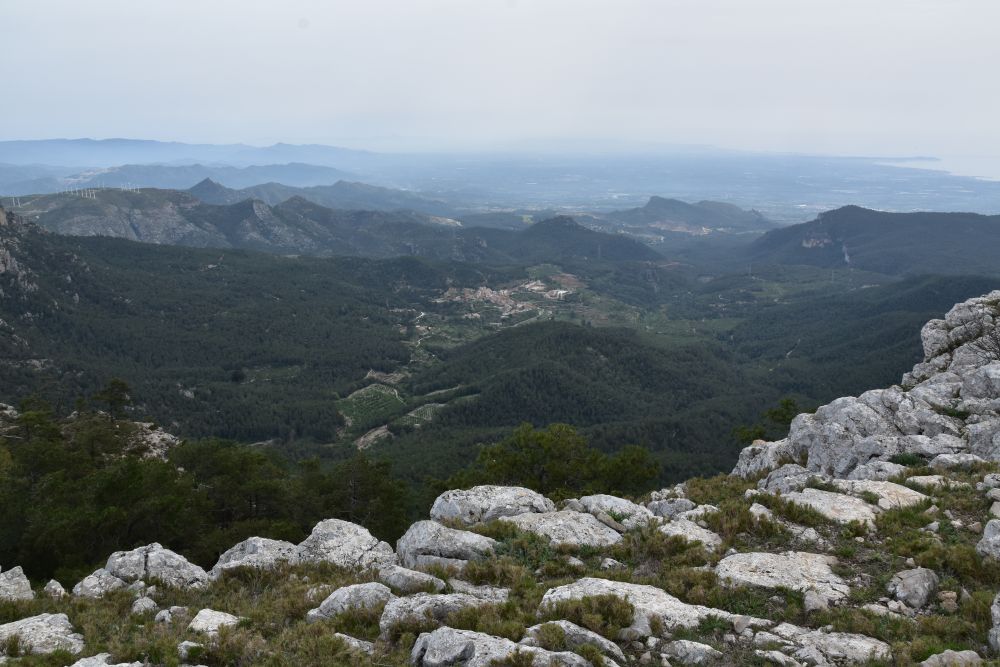
After more than two hours on narrow roads, we reach the Port de Torre Miró. We are now above the valley of Morella and enjoy the gigantic windmills and the view together with other tourists. We are no longer alone.
Mountains around us. Ursula captures them with a panoramic view.


We continue our way to Morella – and I will talk about this small and fortified in my next blog.
.

Source:

Juan Perucho: “Las Historias Naturales”, Hurope, Barcelona 2003.


The Ebro Delta is always worth a visit

Again and again we have visited the Ebro Delta, when staying in Catalonia. We love it for its rice fields changing with the seasons and for its natural reserve lagoons holding a variety of birds.

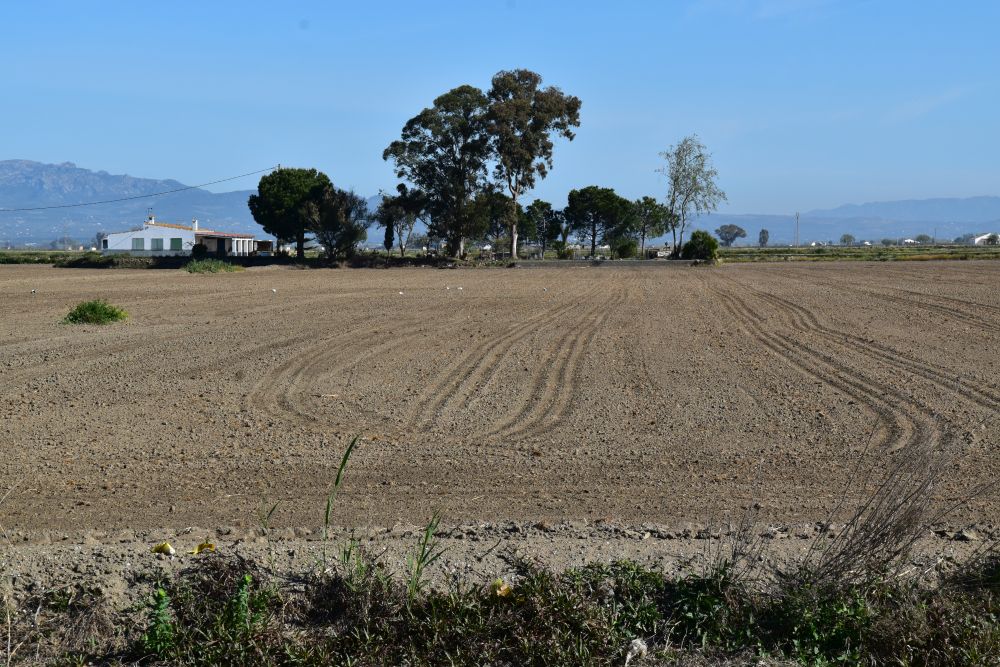
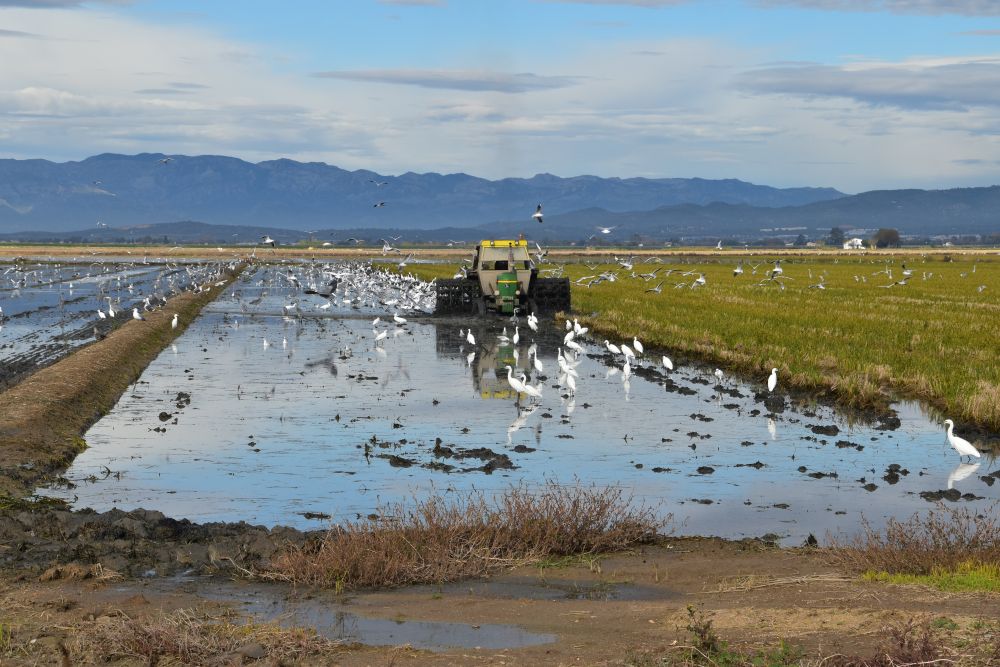
This is what the rice fields looked like in spring 2018, all fresh, brown, ready to be watered and to grow rice.

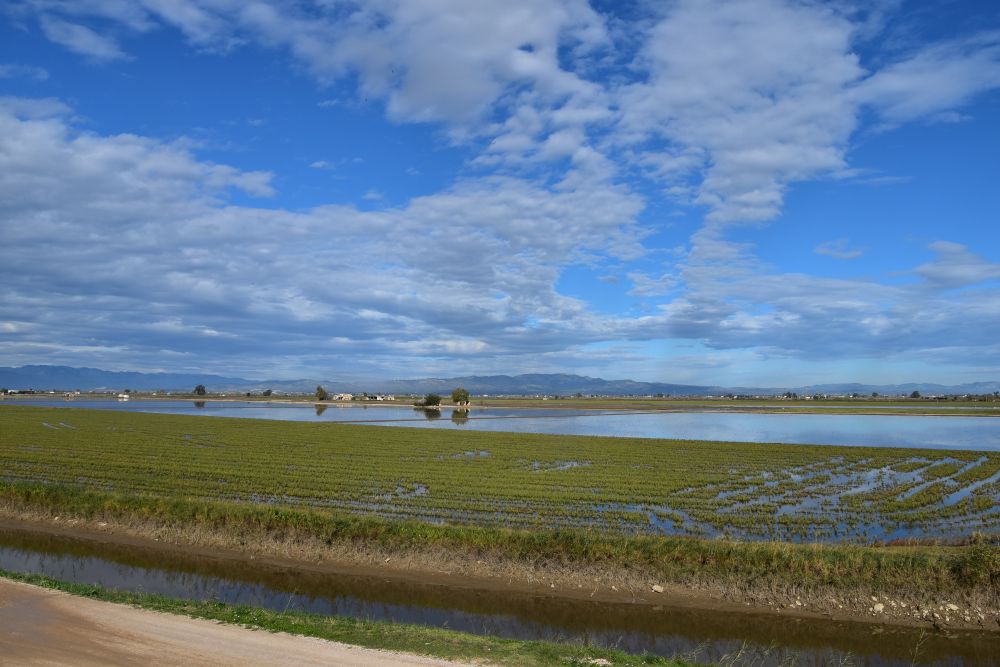
Now it is November 2018. The rice has been harvested. The green stubbles remain.

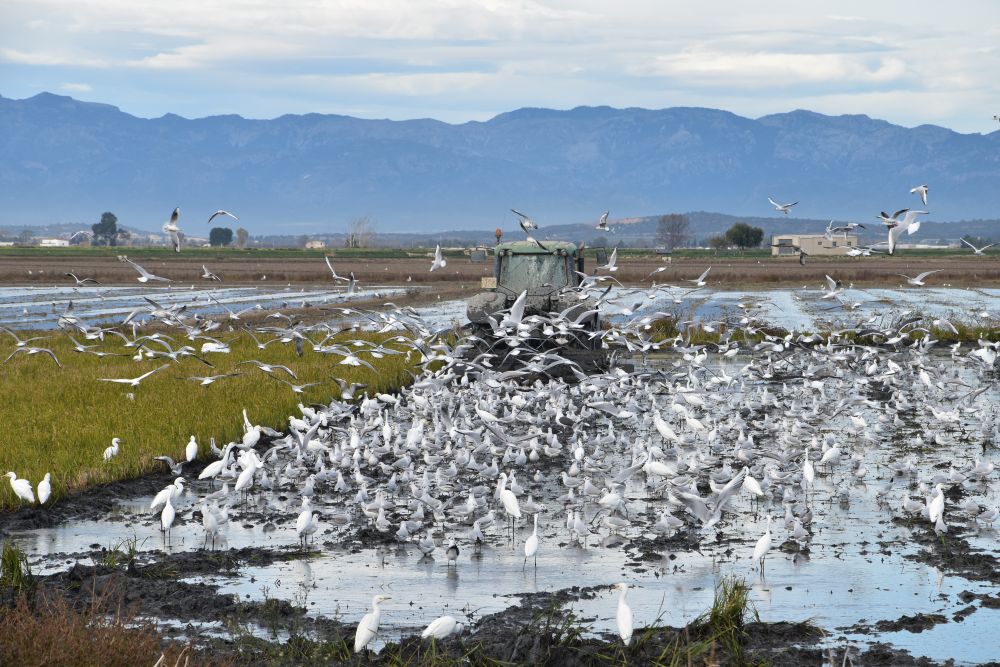
The tractors are ploughing up the harvested rice fields. The birds are following the tractors – do they catch the worms that come out of the ground or do they find residual rice grains?

Whatever they find, it must be worth it. The birds are not afraid of the tractor and neither is the tractor caring about them.  

As always, we buy rice and olive oil at the Fusta shop. The rice produced by the Cooperative del Delta is called “Bomba”. In Swiss German we would say “är isch e Bombe”, which means, “the rice is super”.

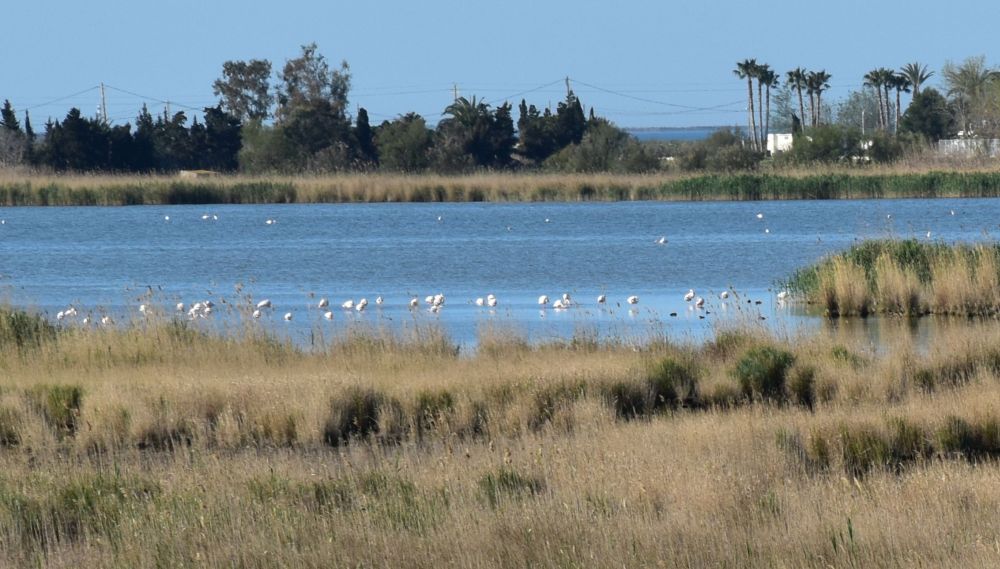
Near the Fusta, in the lagoon de l’Encanyissada, we saw many flamingos in spring.

They were busy picking food from the lagoon (these two small spots are flamingos).

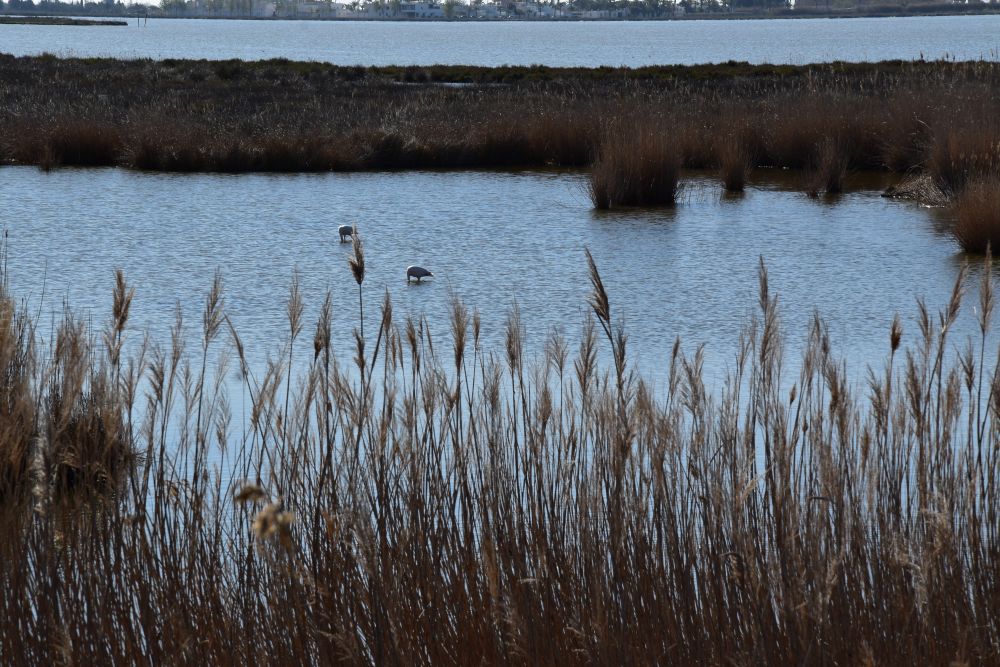
Not one flamingo now, in autumn, in the Encanyissada lagoon.

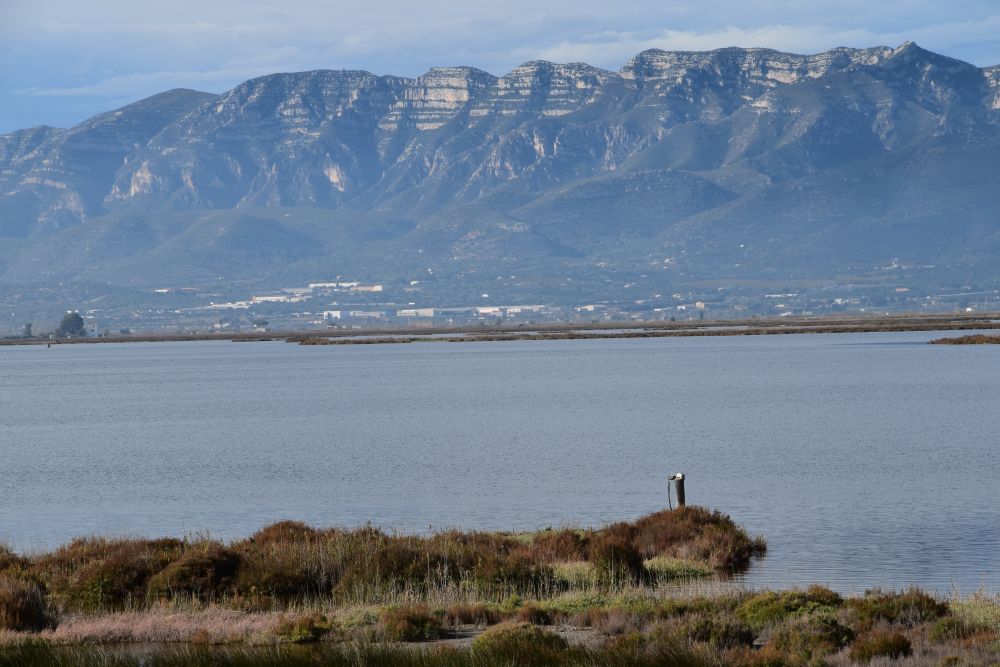
Instead, the layers of rock in the Montsià mountains behind the lagoon are very clear today.

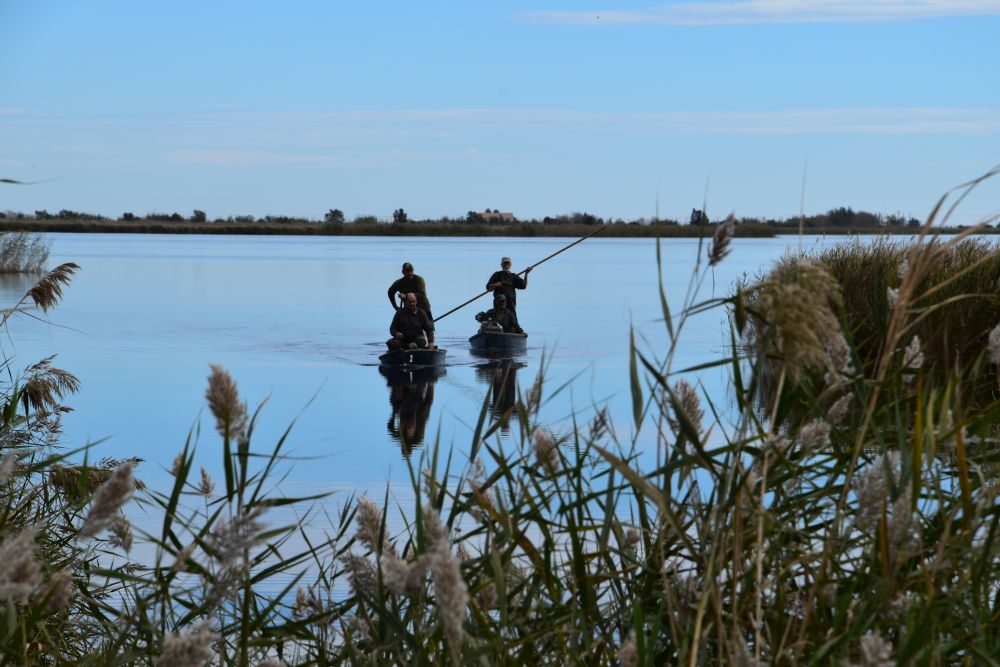
Hunters have taken out their boats to chase ducks. Now we understand, why we do not see one duck in this lagoon.

We meet a ranger that tells us that the ducks hide in the reed (because of the hunting going on) and that there is too much water in the lagoon for the flamingos. We should look for them at the lagoon of Tancada. We drive there. The Tancada lagoon is full of ducks. They have congregated where there are no hunters. No fotos of ducks – our cameras do not look like guns.

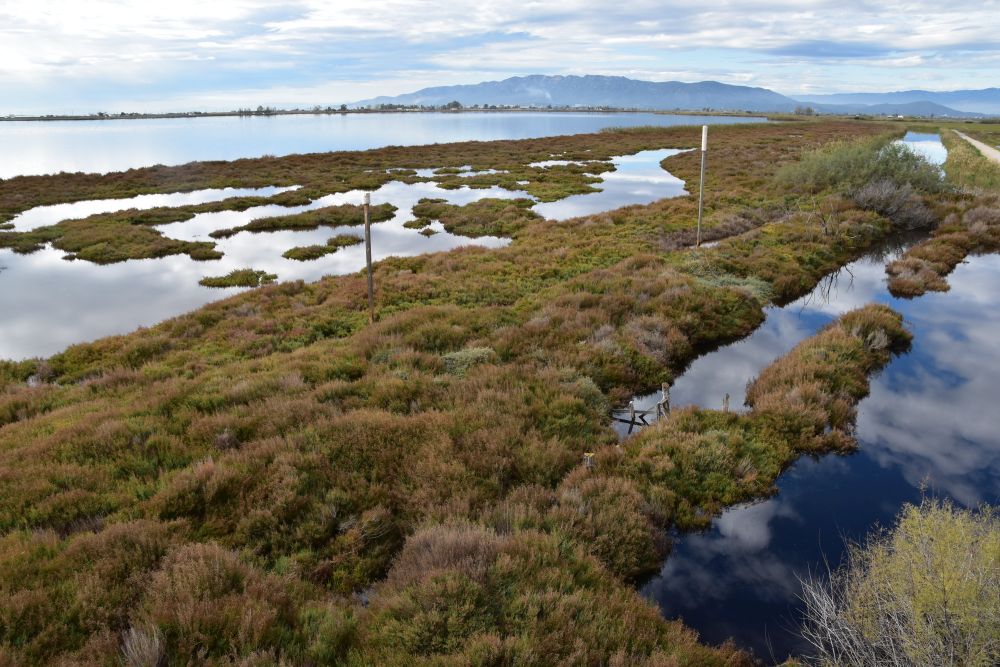
There are no flamingos either. We give up and just enjoy, how the sun plays with the colours of the reed…

… and how the clouds reflect in the water.

In spring, the water channels were full with black-winged stilts (Himantopus Himantopus or in German Stelzenläufer) with their long red legs.

None of them around now, in autumn.

Poble Nou (literally “new village”) is located near the lagoon de l’Encanyissada, behind the reeds.

We sometimes have lunch in one of the small bars at Poble Nou, but now it is twelve o’clock and far too early for lunch in Spain. We take our way back to Hospitalet and stop in Ametlla del Mar. At the port we have fresh sole fish which is a delicious close up of another excursion to the Ebro Delta.

Discovering the Val d’Aran: The origin of the Garonne

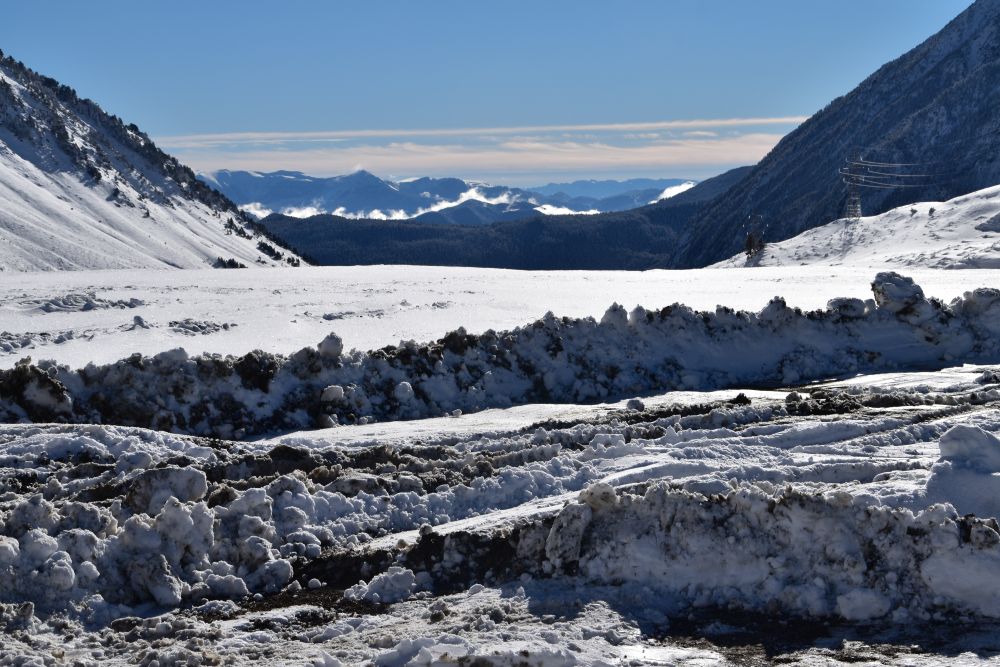
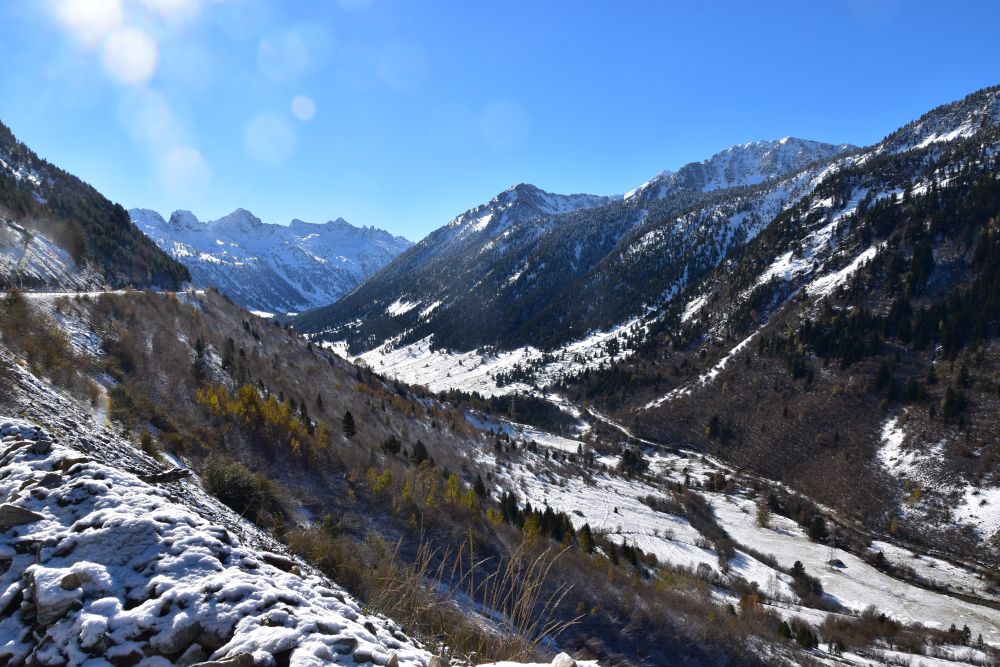
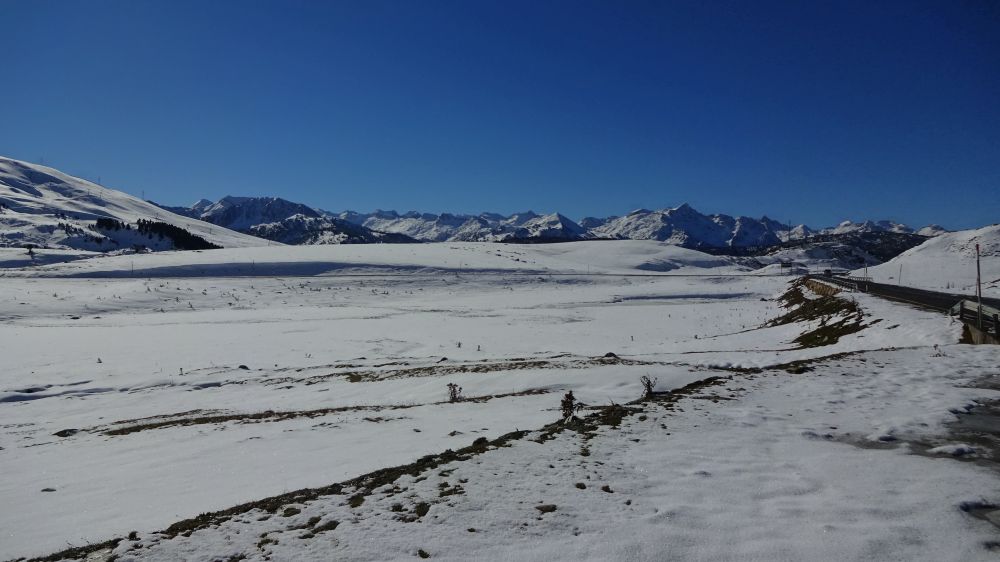
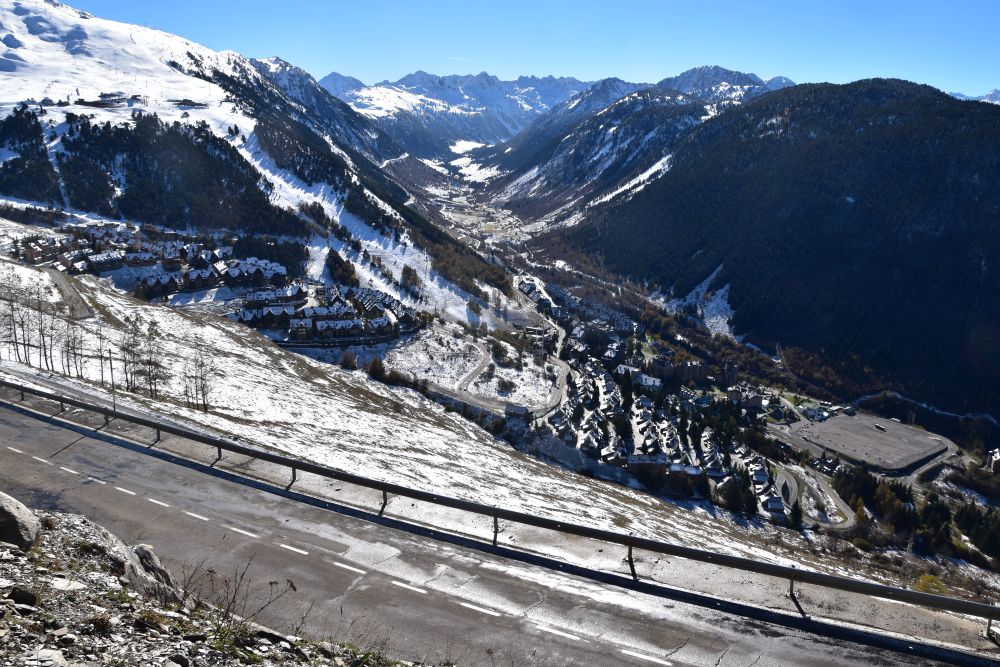
On 1st of November 2018, while staying in the Parador of Arties for four nights, sunshine and a blue sky are waking us up. By car we drive up to the Bonaigua Pass (2072 m above sea level). From here we have a beautiful view. The bad weather is rising from the valley and will reach us tomorrow. 

There is snow around us and – languishing – I watch some skiers walking up the hills, where the chairlifts have not yet started to run. “It was great”, one of the ski tourists tells me, “why have you left your skis in Switzerland?”

.

Where is the source of the Garonne?

The Garonne does not have just one source, but at least three. The first source is in the south, the second in the east and the third in the west of the Val d’Aran.

The first source in the south – the Rude-Garonne :

One traveller from the 19th century contends that the Rude-Garonne is THE source: « Toutes les artigas ou affluents de la vallée d’Aran se plaisent à se considérer comme la Garonne originelle, mais celle qui au moment semble étinceler au loin sur notre gauche a plus que tout autre droit à ce titre. Appelée la Garonne de Rude, elle a sa source dans les lacs de Sabouredo, sur la bordure nord du Parc d’Aigues Tortes» (Bessons, Tomme I, p. 192).

Exactly like for the traveller of the 19th century, the valley of the Rude- Garonne is also sparkling for us on our left, when we return from the Port de la Bonaigua to the Val d’Aran.

That former traveller contends that the Rude-Garonne is more entitled than other affluents to be called the origin of the Garonne, but it seems that he is not quite right – there are more sources.

The second source in the east – the Beret-Garonne:

The Beret-Garonne originates in the Uelh deth Garona on the Pla Beret (Uelh deth Garona means “Eye of the Garonne”).

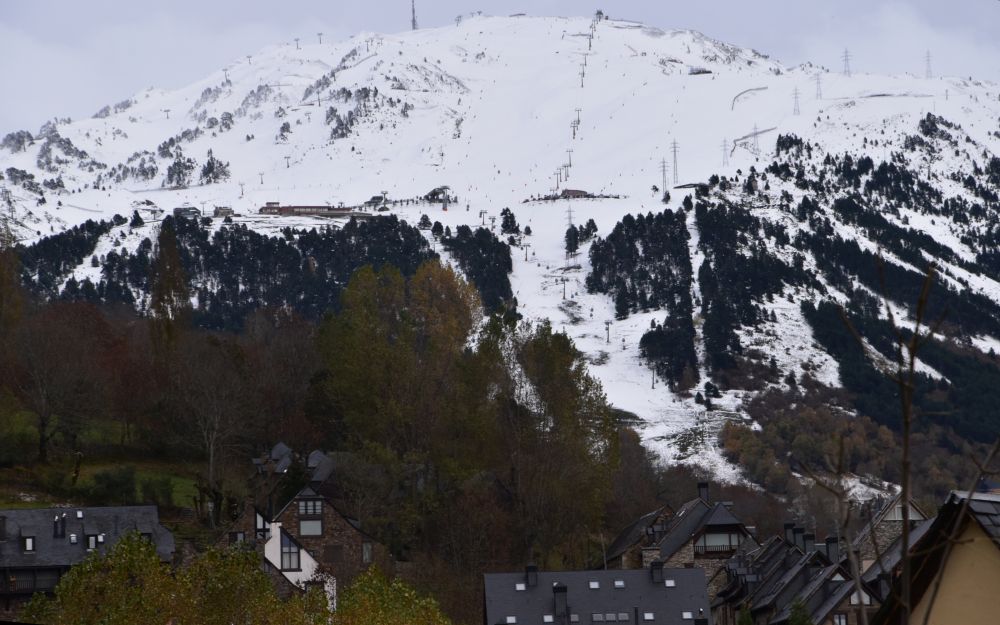
The Beret-Garonne joins the Rude-Garonne in Tredòs which was formerly the highest and last village in the valley. Above Tredòs are now located the ski resorts Baqueira and Beret, with the huge parking lot that must be filled with cars sparkling in the sun, once the winter season starts.

These are the ski pistes attracting so many tourists and even the king of Spain.

The third source in the west – from Pic Aneto and Jove’s eyes:

As Wikipedia writes, “the third thesis holds that the river rises on the slopes of Pic Aneto at 2300m above sea level and flows by way of a sink hole… (reemerging) at Uelhs deth Joèu (“Jove’s eyes”) in the Artiga de Lin.” It then joins the Rude-Beret-Garonne in Vielha.

.

The long way of the Garonne to the Atlantic

The Garonne starts as a Spanish (or more precisely as a Catalonian or even more precisely as an Aranese) river and crosses the border near the village Les at the Pont du Roi to become the third longest river of France (in all about 600km, from which 524km in France). I have come across the Garonne in Toulouse, near Moissac and in Bordeaux. North of Bordeaux, the Garonne joins the Dordogne and, now called Gironde, reflects the sun to warm the first-class vineyards of the Haut Médoc at sites such as Pauillac, St. Julien or St. Estèphe.

.

Dreaming of hiking in the Val d’Aran

I could imagine hiking in the Val d’Aran in summer or early autumn, along the Garonne, from village to village, from one 800 years old church to the next, up to the three sources of the Garonne, and up to the passes and mountain peaks, …

… to enjoy the landscape and the flora…

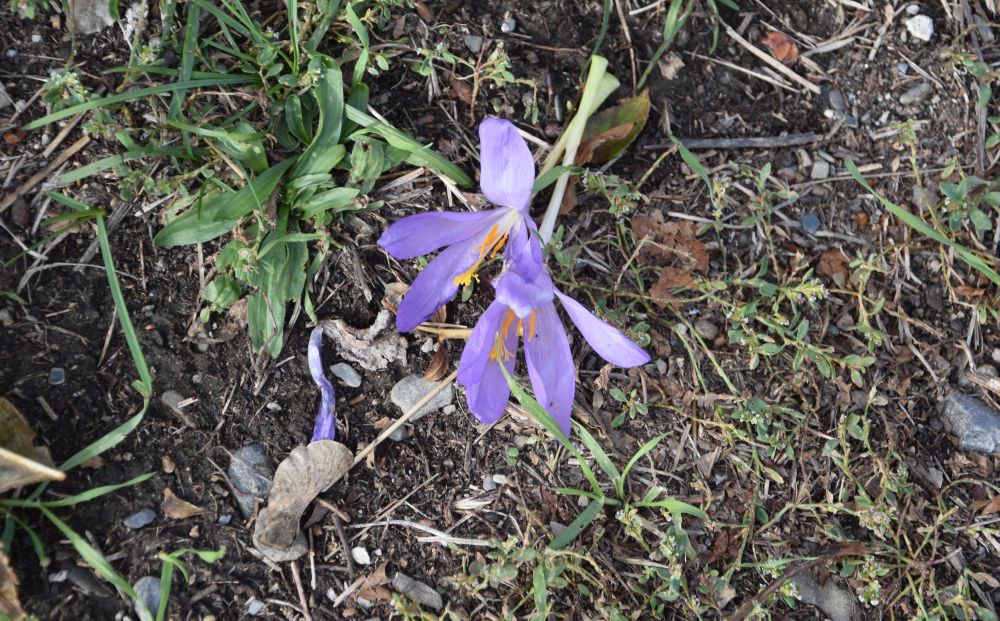
… that also reminds me of the Alps (here: autumn crocus found on a path along the Garonne).

.

The Val d’Aran is a new world that I have discovered

From how the people preserve their language, the Aranese, I understand that they have their own strong identity which differs from Catalonia. I am happy that Ursula had the idea to spend some days here. A fascinating world has opened up for me in the Val d’Aran.

In their two volumes named “sur les Chemins du Val d’Aran”, Madeleine & Françoise Besson describe their home valley that they love for the brave people and for three essential, natural riches.

The brave people they illustrate with a distant grand-mother of theirs, Maria Prades. After the first Carlist War, in 1840, her husband was imprisoned for smuggling (which was an important business then). Maria Prades was his young wife at that time. She decided to free her husband from prison. On foot she crossed the mountains, continued to Madrid, had an audience with Queen Isabel II and returned with a letter that liberated her husband.

The three essential, natural riches are the water that gives life and that has been mastered by the people; the abundant flora; and the chaplets of Romanesque churches hanging on the mountain slopes or placed in the villages that prove more than 800 years of religious verve. (« … trois richesses essentielles de la vallée… : l’eau qui lui donne la vie et que la vallée a su maîtriser ; la flore, l’une des plus abondantes des Pyrenées ; et le chapelet des églises romanes accrochées aux flancs des montagnes ou placées au cœur des villages et qui témoignent depuis plus de huit cents ans de l’élan spirituelle de la vallée» (Tomme II, p. 128).

Reading the books of Madeleine & Françoise Besson was a wonderful extension of our visiting the Val d’Aran.


Sources:

Madeleine & Françoise Besson : « Sur les chemins du Val d’Aran – Voyage autour d’Arties», Lacour 2005 (Bessons, Tome I)

Madeleine & Françoise Besson : « Sur les chemins du Val d’Aran – ses habitants, ses mots, ses fleurs», Lacour 2005 (Bessons, Tome II)

Discovering the language the Val d’Aran: Some insights into Aranese

When arriving in the Val d’Aran end of October 2018, I noticed announcements along the road that had a clear Romance touch, but they were neither French nor Spanish nor Catalann – they were different. For example:

  • Restaurant and others: Eth Triton, Tauèrna Urtau, Era Coquela, Apartementos deth Camin Reiau, Musèu dera Val d’Aran
  • Street names : Carrèr dera Hònt, Carrèr des Banhs, Carrèr Espitau, Carrèr deth Centre
  • Rivers : Arriu de Salient, Arriu de Valarties, Barranc des Pales, Saut deth pish

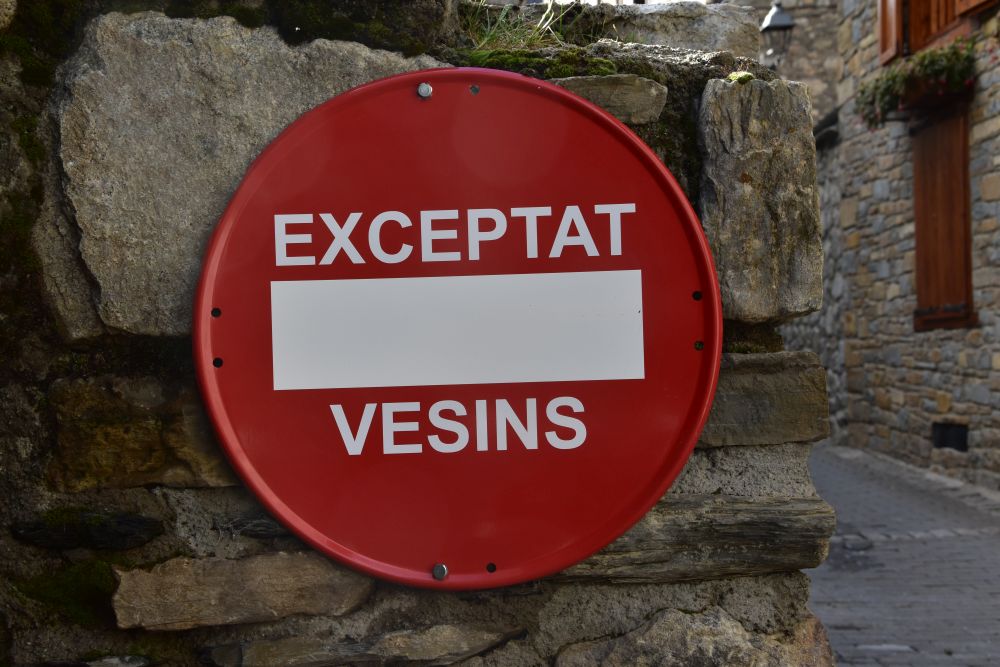
This sign is somewhat familiar and somewhat unfamiliar. “Neighbours” are “voisins” in French, “vecinos” in Spanish and “veís” in Catalan. Obviously, they are “vesins” in Aranese.

.

The origins of the Aranese language

The servant at the bar of our parador in Arties is from Barcelona. “Oh yes”, she says, “I can understand the people in the Val d’Aran, they speak a local dialect of Catalan.” “No, no, the language of the Val d’Aran is not a local dialect of Catalan, it is a different language deriving from Gasconian”, Ursula replies. Our servant frowns: “Really? That sounds interesting.”

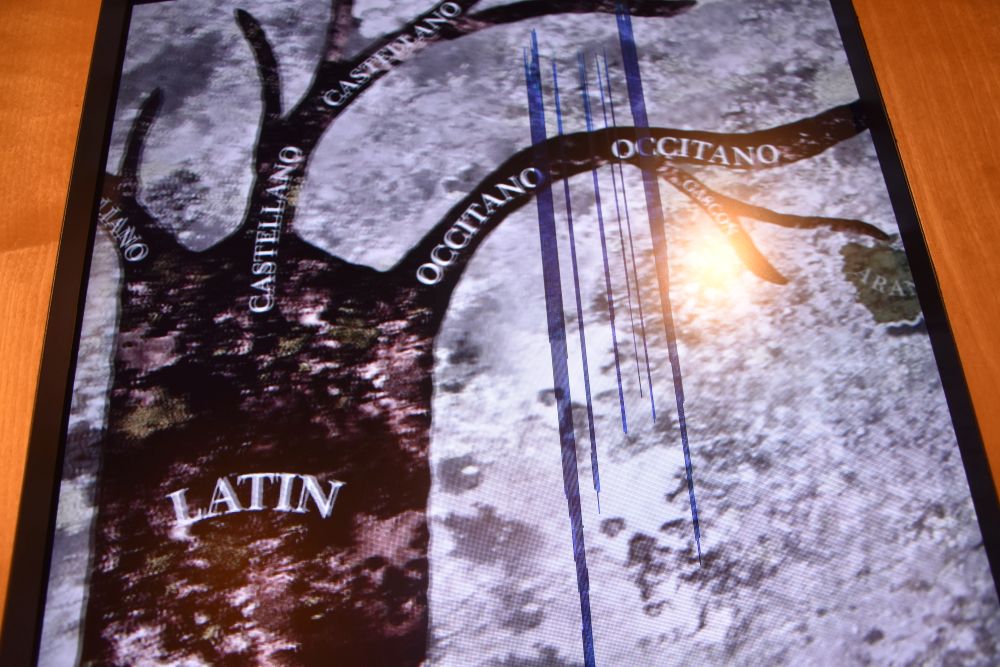
In the Musèu dera Val d’Aran in Vielha, the elegant lady at the reception desk switches seamlessly between French and Spanish. She proudly explains to us: “You will see the language tree in the video of our museum: Latin is the main trunk, the Occitan languages are one branch, then Gasconian branches off and from the Gasconian branch the Aranese language derives.” I tried to capture that tree flying by on the screen – Aranese can be seen on the very righthand side branching off from Gasconian.

“We, the people in the Val d’Aran are fluent in four languages, Aranese, Spanish, French and Catalonian”, the friendly lady at the museum reception adds. Madeleine and Françoise Besson confirm that the people here speak four languages, in former times even without having attended school: „… eux qui, pour les générations anciennes surtout, savent parler quatre idiomes: l‘aranais, le castillan, le français et le catalan. Un professeur de langue … se rappelle que sa grand-mère n‘était jamais allé à l‘école et parlait quatre langues (tome I, p. 35).“ Some speak in addition several local dialects of the neighbouring valleys.

 Let us approach the Aranese language to understand the expressions at the beginning of this blog.

.

Eth, era, deth, dera , des

What I first noticed were the words “eth”and “era” as well as “deth”, “dera” and “des”. They appeared in the names of streets and restaurants: Eth Triton, Era Coquela, Carrèr deth Centre, Musèus dera Val d’Aran, Barranc des Pales.

“Eth” and “Era” are the articles, masculine and feminine. They can be combined with “de” to make “of the”. Hence:

  • Eth Triton = The Triton
  • Era Coquela = The Saucepan/Casserole
  • Carrèr deth Centre = Street of the Centre
  • Musèus dera Val d’Aran = Museum of the Val d’Aran
  • Barranc des Pales = Canyon of the Shovels (Bessons, Tome II, p. 79; pales or pelles in French)

Actually “eth” and “era” derive from Latin “ille” and “illa” (Wikipedia).

.

About the orthography

In the past, Aranese was just spoken, but not written down. The people of the Val d’Aran had to agree, how to write their language. There were several approaches, that, if I understand correctly, were settled in 1982 (Conselh Generau d’Aran: “Normes ortografiques der Aranès”). Some rules are:

  • “lh” = Spanish or French “ll” (Vielha = Viella = central city of the Val d’Aran, calhau = caillou = pebble, familh = famiglia = famille)
  • “nh” = Spanish ñ/ni/ny or French “gn/in” (banhs = baños = bain = baths, senho = señor = seigneur)
  •  u = v between two vowels (escriuer = escribir = write, shivau = caballo = cheval = horse)
  • Final “l” becomes “u” (mau = mal = bad)

(Sometimes the Aranese word is closer to French, sometimes more to Spanish).

Now I understand

  • Carrèr des Banhs = street of the baths
  • Carrèr Espitau = street of the hospital
  • Arriu = river

Saut deth pish is composed of “saut” (= forest, related to Spanish “selva”) and “pish” = waterfall (in Spanish cascada). This must be the forest of the waterfall.

.

About the etymological correspondence if “f” and “h”

When I started to learn Spanish, I noticed that the Latin “f” often transformed to “h”, but remained “f” in French. Examples are:

  • formica (Latin) = hormiga (Spanish) = fourmi (French) = aunt
  • fornax (Latin) = horno (Spanish) = four (French) = oven
  • ferrum (Latin) = hierro (Spanish) = fer (French) = iron

…but not always:

  • Fons (Latin) = fuente (Spanish) = fontaine (French) = source or fountain


The Aranese language transformed “f” into “h” as well, but sometimes Spanish keeps the “f”:

  • hormiga (Aranese) =  hormiga (Spanish) = fourmi (French) = aunt
  • horn (Aranese) = horno (Spanish) = four (French) = oven
  • hont (Aranese) = fuente (Spanish) = font (French) = source/fountain
  • hum (Aranese) = humo (Spanish) = fumée (French) = smoke / fume
  • haria (Aranese) = harina (Spanish) = farine (French) = flour
  • haus (Aranese) = hoz (Spanish) = faucille (French) = sickle
  • huec (Aranese) = fuego (Spanish) = feu (French) = fire
  • hesta (Aranese) = fiesta (Spanish) = fête (French) = festivity
  • heira (Aranese) = feria (Spanish) = foire (French) = fair / exposition

but sometimes the “f” remains in Aranese:

  • forquilla (Aranese) = tenedor (Spanish) = fourchette (French) = fork
  • faucon (Aranese) = halcón(Spanish) = faucon (French) = falcon

and sometimes the Spanish word is totally different:

  • hormatge (Aranese) = queso (Spanish) = fromage (French) = cheese
  • horment (Aranese) = trigo (Spanish) = froment (French) = wheat

Now I understand that Carrèr dera Hònt is the Fountain street.

.

The Aranese – officially recognised by Catalonia

Since 2010, the Aranese has been one of three official languages in Catalonia, besides Catalan and Spanish. Since 1984 it has been taught at schools in the Val d’Aran. According to a census of 2008, about 80% of the inhabitants in the Val d’Aran understand Aranese and about 60% speak it s well. I do hope that the federalistic solution for the Aranese language will continue to flourish.


Discovering the Romanesque and early Gothic churches in the Val d’Aran

Discovering the Romanesque and early Gothic churches in the Val d’Aran

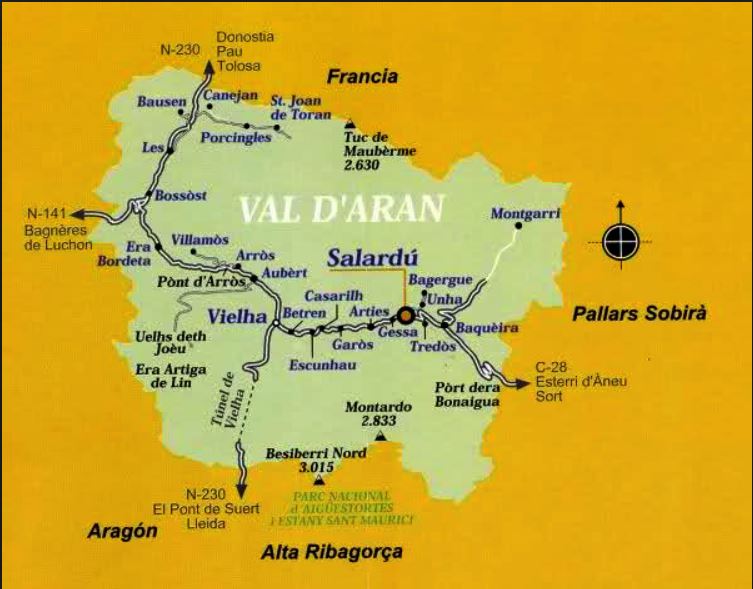
For end October/beginning November 2018 we had booked four nights in the Parador of Arties in the Val d’Aran. We found much to discover. Each mountain village has its own church and most of them are of Romanesque or early Gothic style.

Source: El valle de Aran

Besides Santa Maria in Arties, we have visited the churches of Vielha, Bossòst, Les, Escunhau, Salardú, Tredòs and Unha (main source: “Los caminos Pirenaicos del Arte Romanico”).

.

Vielha – Iglesia de Sant Miquèu

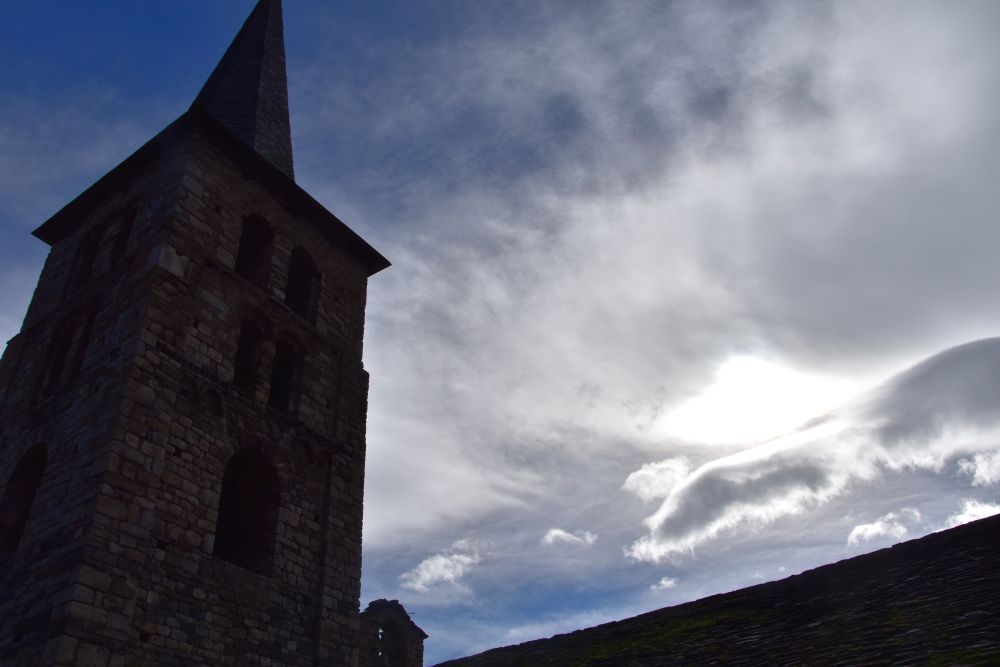
Vielha is the main town of the Aran valley. The octagonal tower of the church Sant Miquèu can be seen from far (early Gothic).

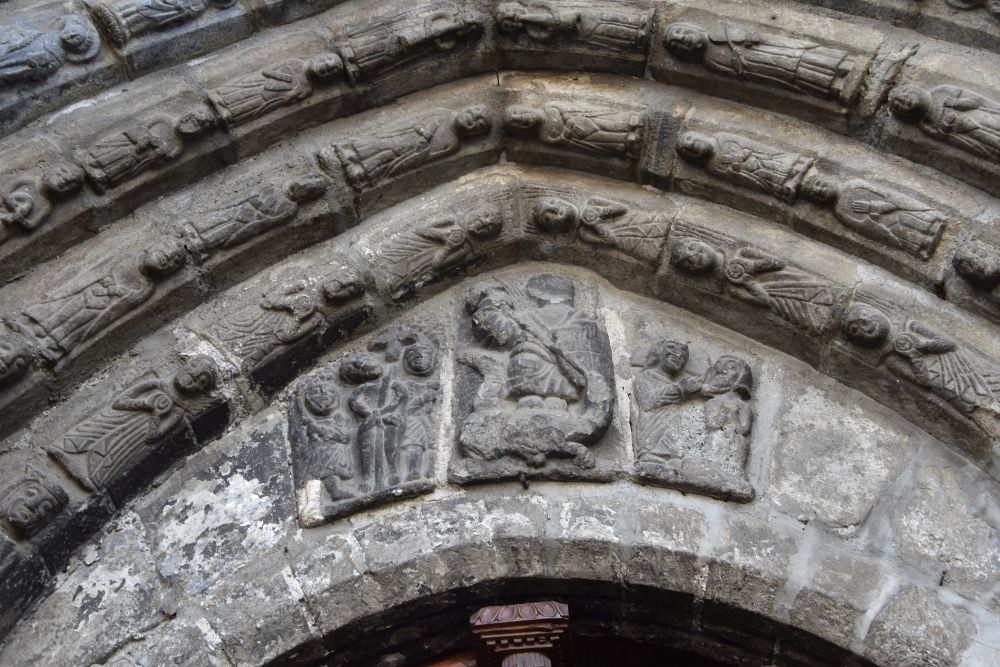
The portal is decorated with the Saint of the church, Michael who defeats the dragon-devil (early Gothic, 14th century). The five arcs of the portal contain sculptures to discover.  

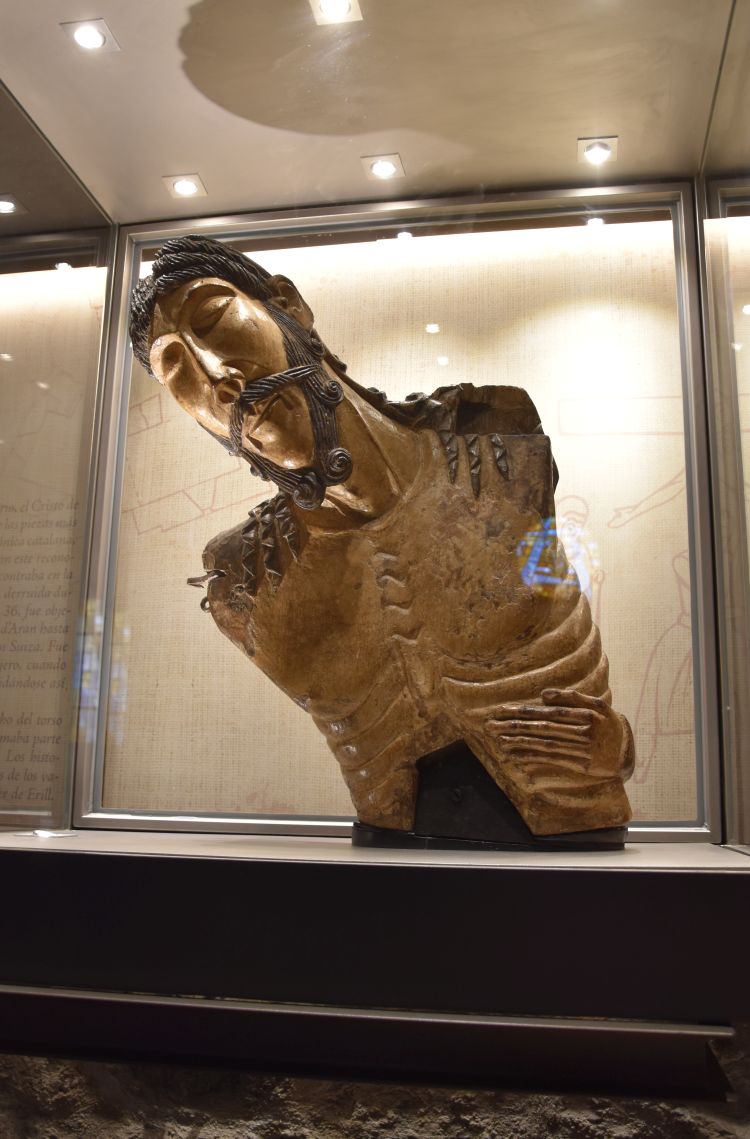
Inside the church we find the most precious treasure, the Christ of Mijaran. It is the only remaining part of a larger sculpture showing the deposition from the cross (12th century). It was crafted by master Erill from the Val de Boí. The Val de Boí is not far from here and last year we have visited their impressive Romanesque churches as well.

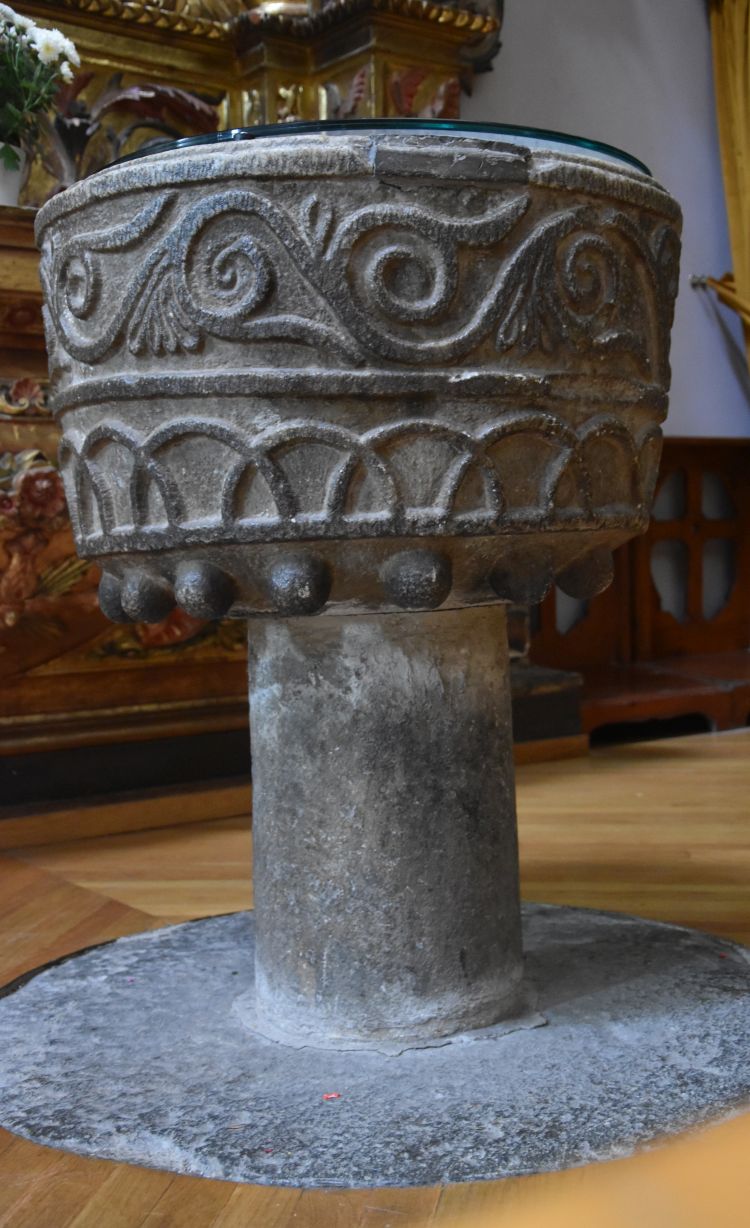
The Romanesque baptismal font is carefully decorated.

Inside the church are furthermore a gothic altar and gothic frescos.

.

Bossòst – Iglesia de la Mair de Diu dera Purificacion

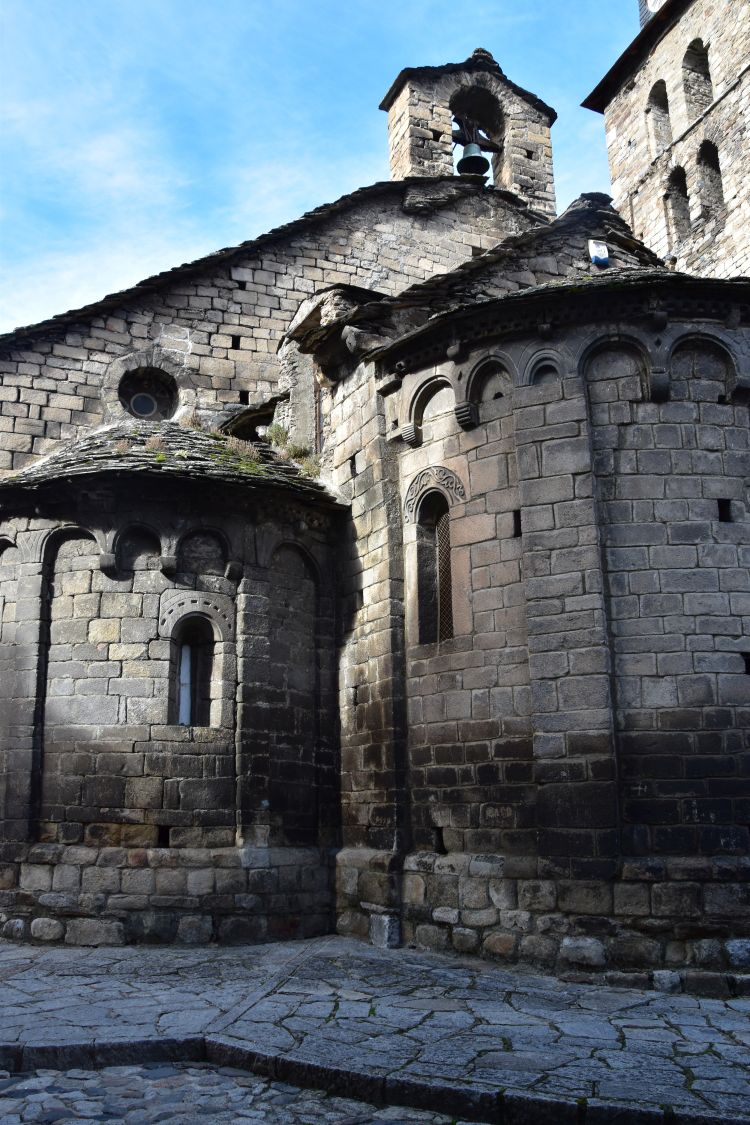
Bossòst is another village with narrow streets, neat houses with shingled roofs and a Romanesque church, the Iglesia de la Mair de Diu dera Puricifacion (12th century). The bell tower with its twin windows and the threefold apsis are typical of the Lombardian stlye.

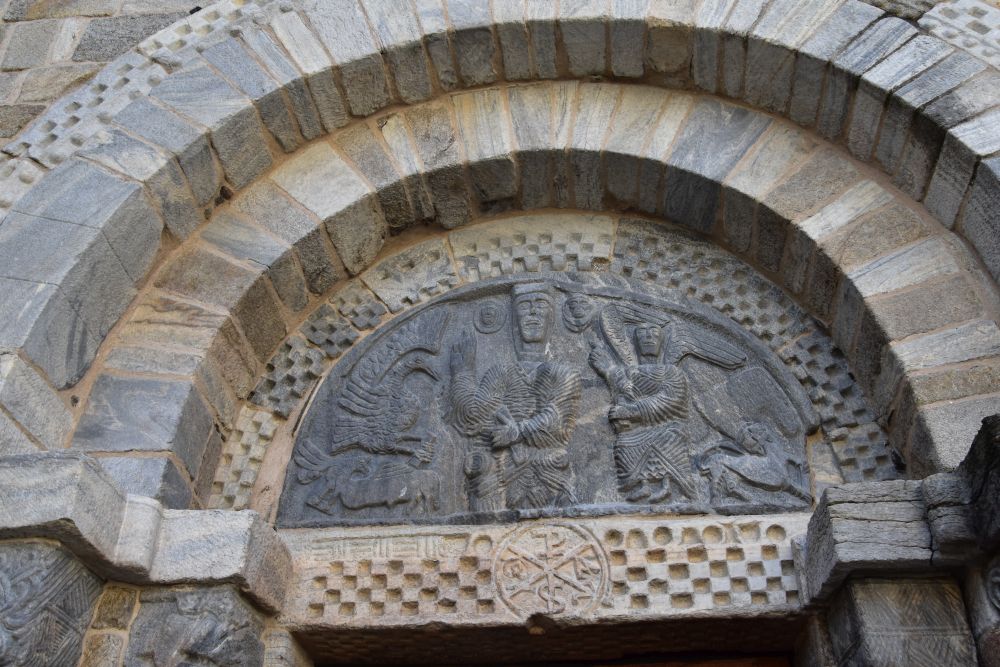
I particularly like the northern portal with Christ surrounded by the sun, the moon and the symbols of the evangelists.

The weather is about to change – the clouds shaped by the south wind are hanging above the belfry.

.

Les – Capilla de Sant Blas

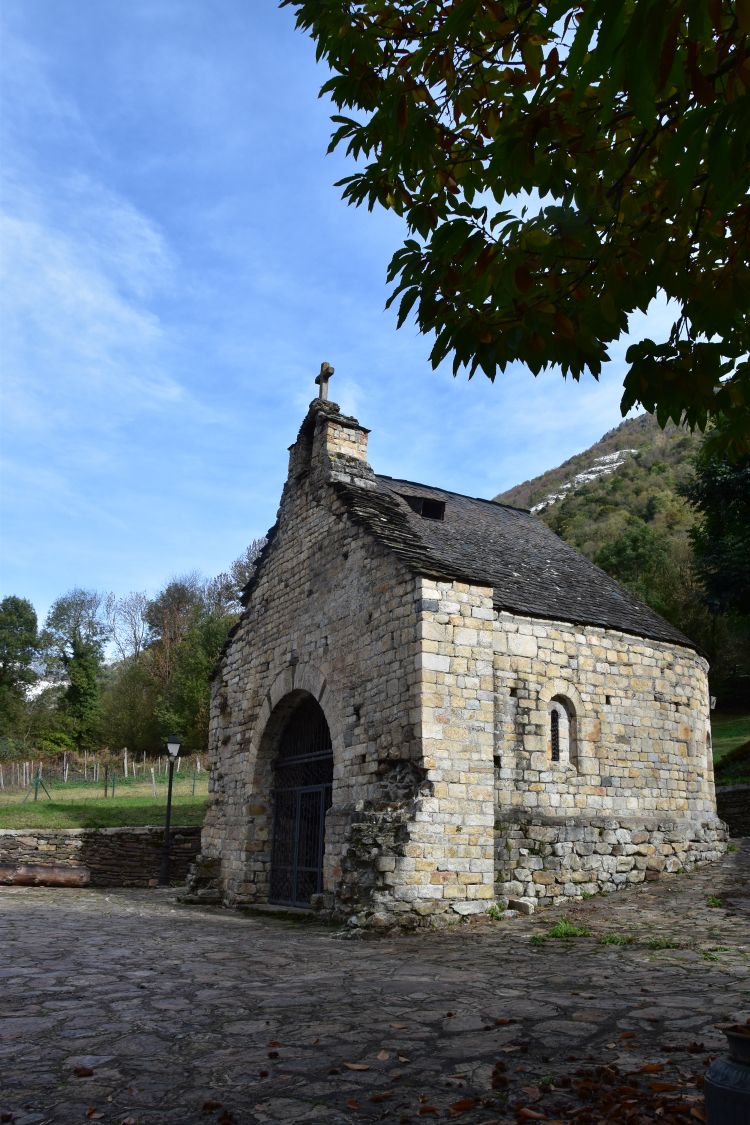
In the next village, Les, we find the small Romanesque chapel called after Saint Blasius. It could well be that once upon a time this chapel was part of a larger church.

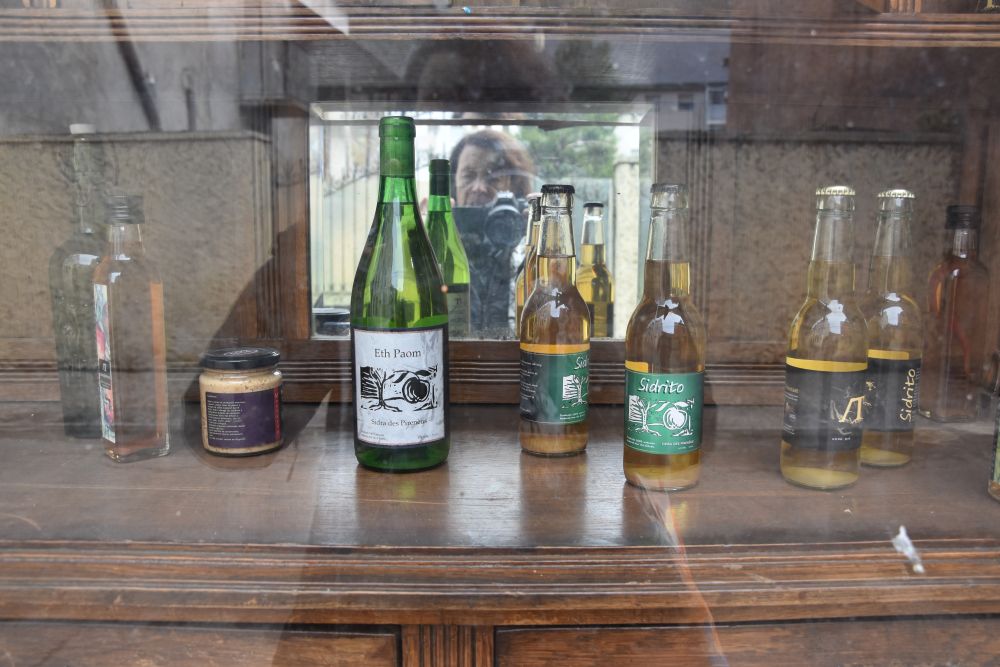
Strolling along the cobbled streets of Les, I find this shop that sells cider.

.

Escunhau – Iglesia de Sant Pèir

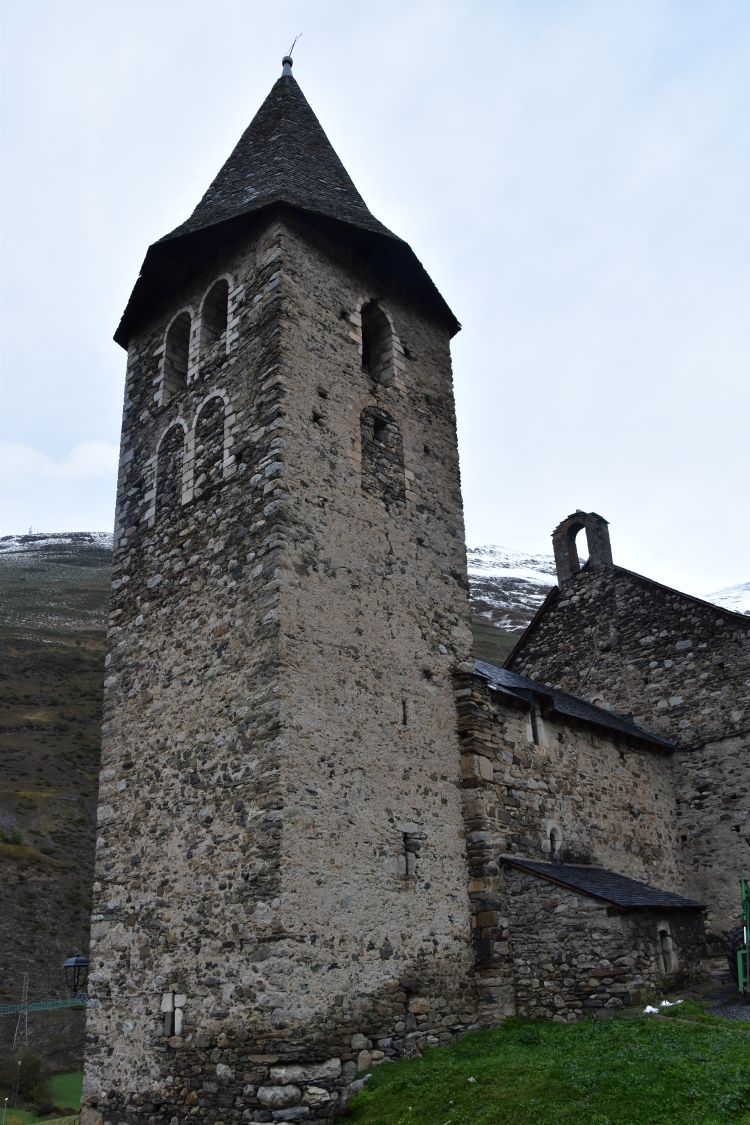
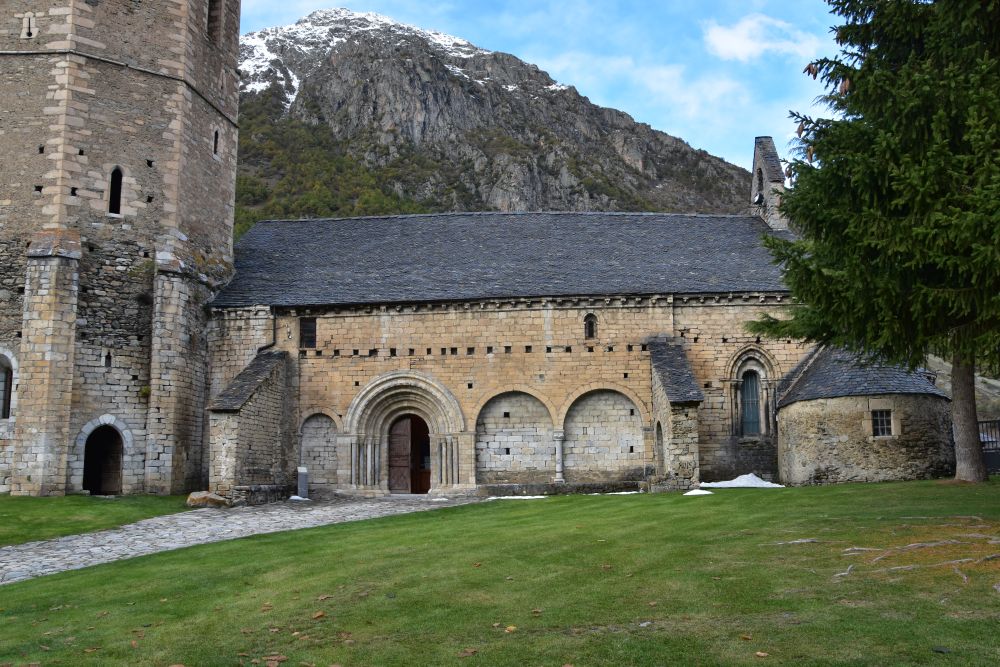
Just neighbouring Vielha, Escunhau is another one of those pretty villages. The Iglesia de Sant Pèir is above it.

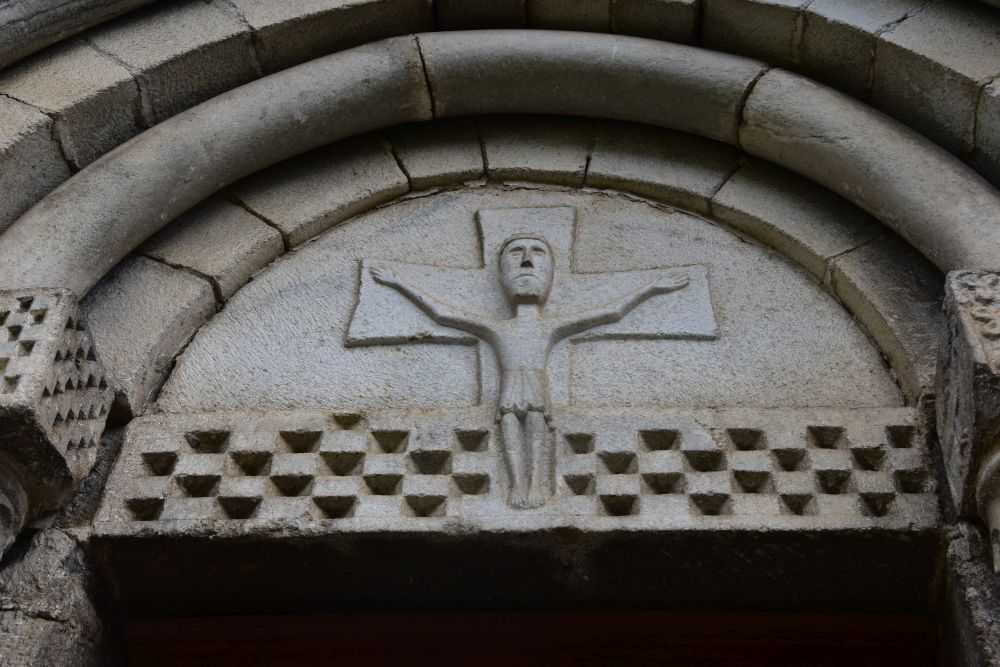
The main portal is decorated with this plain and elegant sculpture showing Christ crucified. Can it be that some architects of 20th century churches came here for inspiration? 

The cemetery has been decorated for 1st of November (All Saints).


Salardú: Iglesia de Sant Andrèu

The church of Salardú is named after Saint Andrew (13th century).

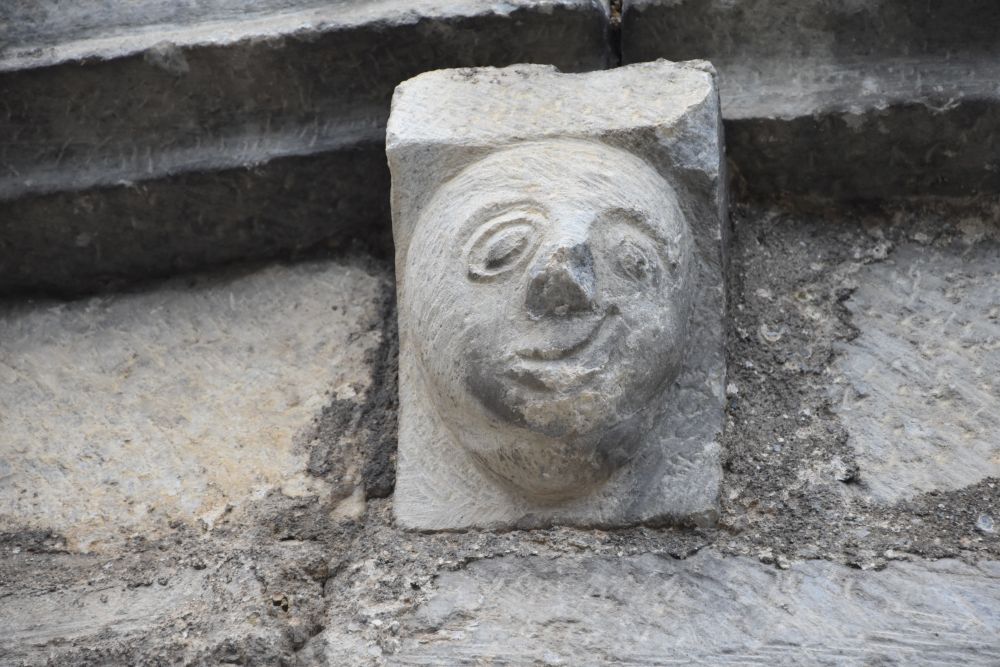
From the outside decoration, I above all like the “twinkling” face – it looks a bit like our “twinkle” emoticon.

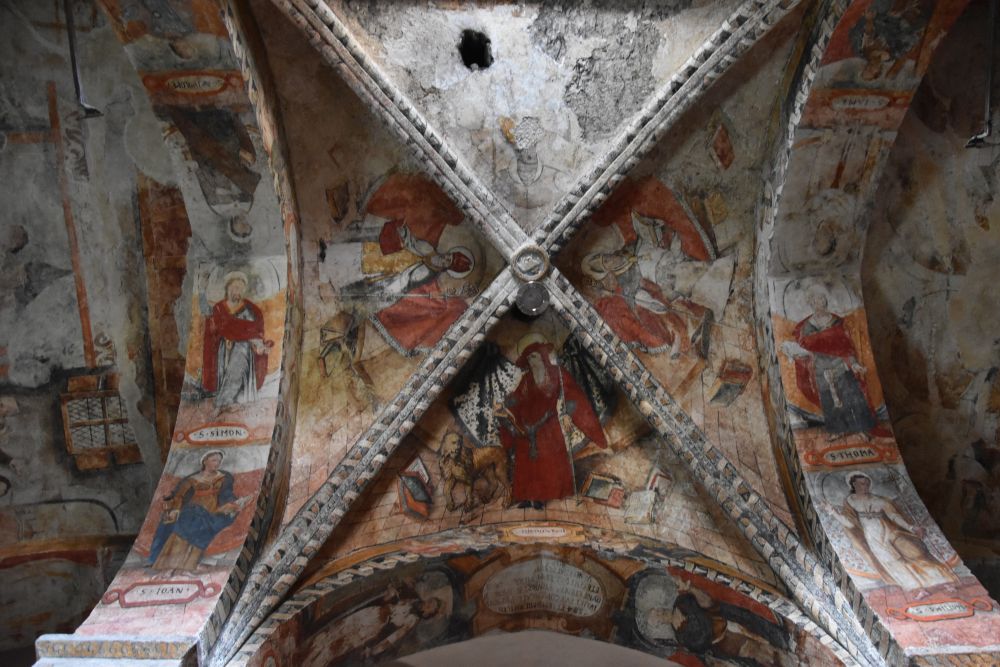
Inside the church we find early gothic vaults.

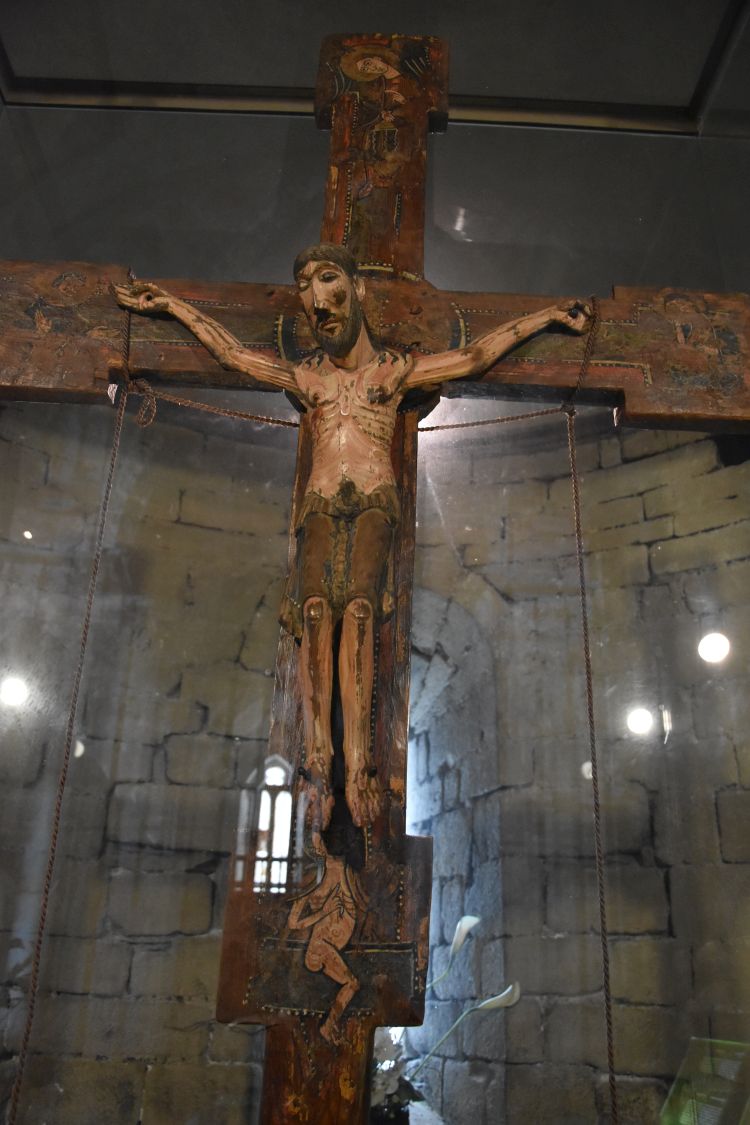
The highlight is the wooden cross with Christ of Salardú. It is attributed to the same master Erill from the Val de Boí as the Christ in Vielha. Under the feet of Christ, Adam is about to revive from his grave.

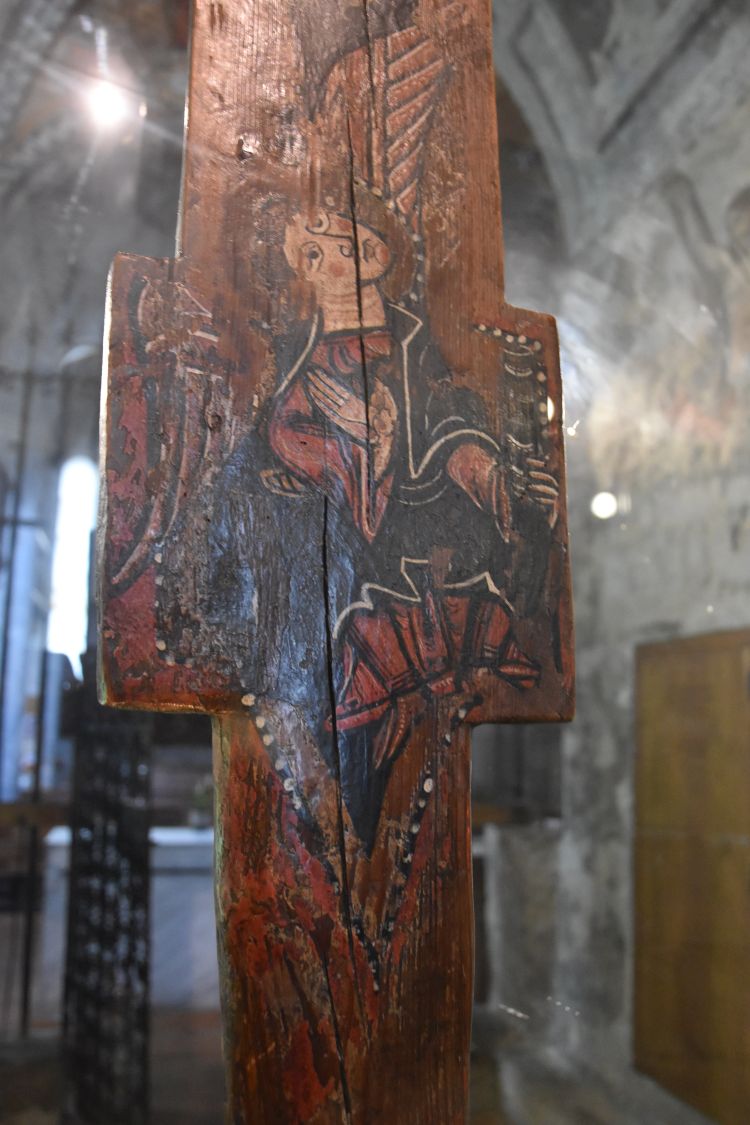
On the back of the cross this beautiful angel looks at us.

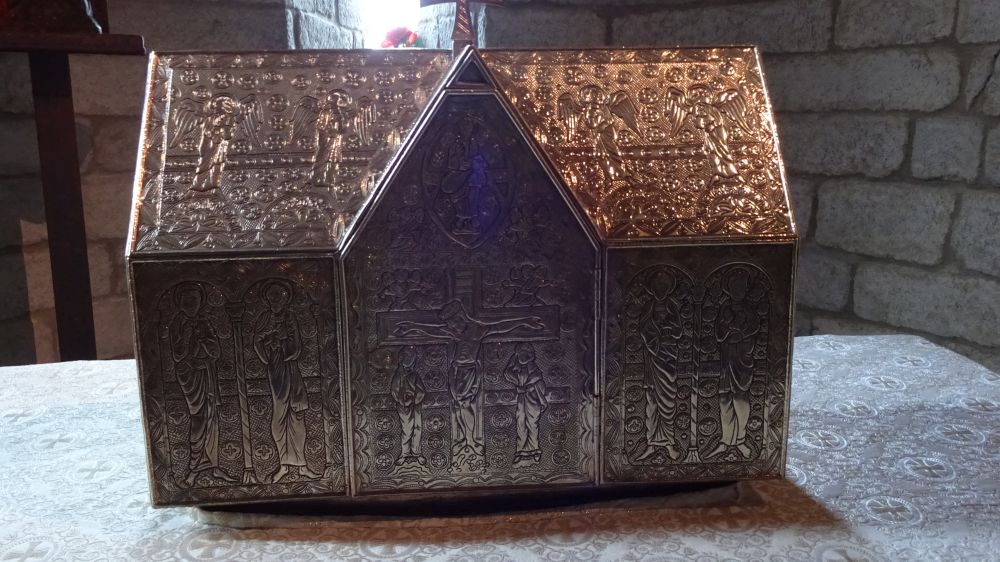
I was so fascinated by the wooden cross that I did not notice, what Ursula noticed… this shrine…

… and the sculpture of Maria with her child.

The presbyterium is decorated with frescos showing biblical scenes; they are from the 17th century – Renaissance.

.

Tredòs – Santa Maria de Cap d’Aran

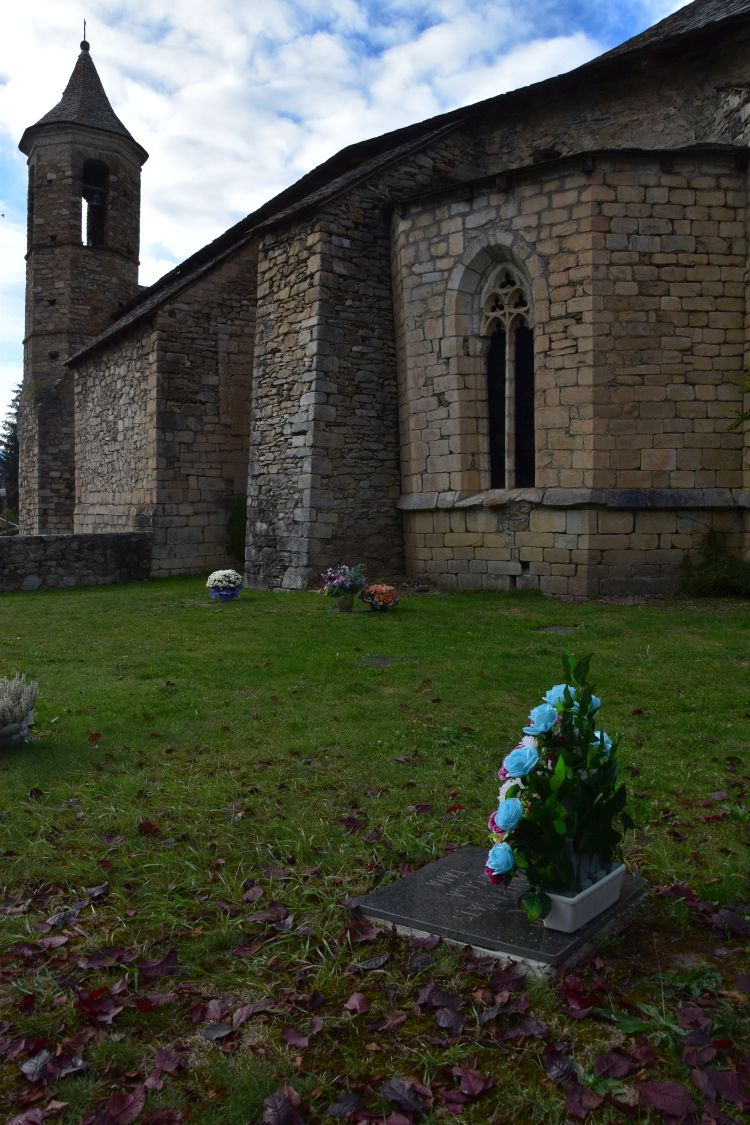
Tredòs is located in the upper part of the Val d’Aran. Their Romanesque church Santa Maria de Cap d’Aran from the 11th century is closed.  The inhabitants are busy decorating the tombs in the cemetery.

The paintings that once were inside this church are now in the Cloisters Museum of New York (this may sound unbelievable, but it is true).

The small window fortunately has remained here.

.

Unha – Iglesia de Santa Eulària

Our last church visited is Santa Eulària in Unha. The mountains make a wonderful background for the Lombardian apsis.

Under the roof, there are various small faces and figures. This figure seems to have a pain in his back.

We stroll through the narrow, cobbled streets of Unha and admire the shingled roofs.

Like all villages also Unha is still asleep waiting for the winter season to start and for the tourists to come. We find a bar open and we have an espresso on the balcony.

.

What a rich and well-kept culture in the rough mountains!

The Romanesque and early gothic churches are a rich and well-kept culture. The Val d’Aran is not the only valley with such a rich heritage at the border between Spain and France. To me the churches look like solid fortifications in the rough mountain valleys. The few ornaments are solemn and precious. They make the churches a wonderful place for worship.

It fascinates me to find the same style elements from Lombardy in the Pyrenées, in the Alps and even in Germany.  In the 11th century, the masters from Lombardy had exported their way of building churches throughout central Europe. Networking was successful, though the infrastructure for travelling was very, very basic.

I could imagine going back to the Val d’Aran and neighbouring Valleys and combine hiking with visiting more Romanesque and early Gothic churches.


Sources:

Conselh Generau d’Aran (Elisa Ros Barbosa): Er Art Romanic dera Val d’Aran, 2007

Pauline Chaboussou et alii: « Los caminos Pirenaicos del Arte Romanico”, Synidcat mixed du Pays Couserans, Anfigraf 2008


Discovering the charming Val d’Aran: Arties and its nobleman Portola

For end October/beginning November 2018 we had booked four nights at the Parador of Arties in the Val d’Aran.

The Val d’Aran belongs to Catalonia. It is located south of Toulouse in the Pyrenees. While most Spanish valleys in the Pyrenees are oriented towards Spain, the Val d’Aran faces north. In 1659, France under Louis XIV and Spain under Philip IV agreed that the Val d’Aran is to remain with Spain. However, in winter, the snow prohibited to access the Val d’Aran from the south. For being somewhat isolated, the valley has kept its own character which is different from Catalonia. There is much to discover such as Romanesque churches, the Aranese language, hiking paths in a rough landscape, the favourite ski resort of the king of Spain and the source(s) of the Garonne.

.

The former castle of the family Portolá – now the Parador – in snow and ice

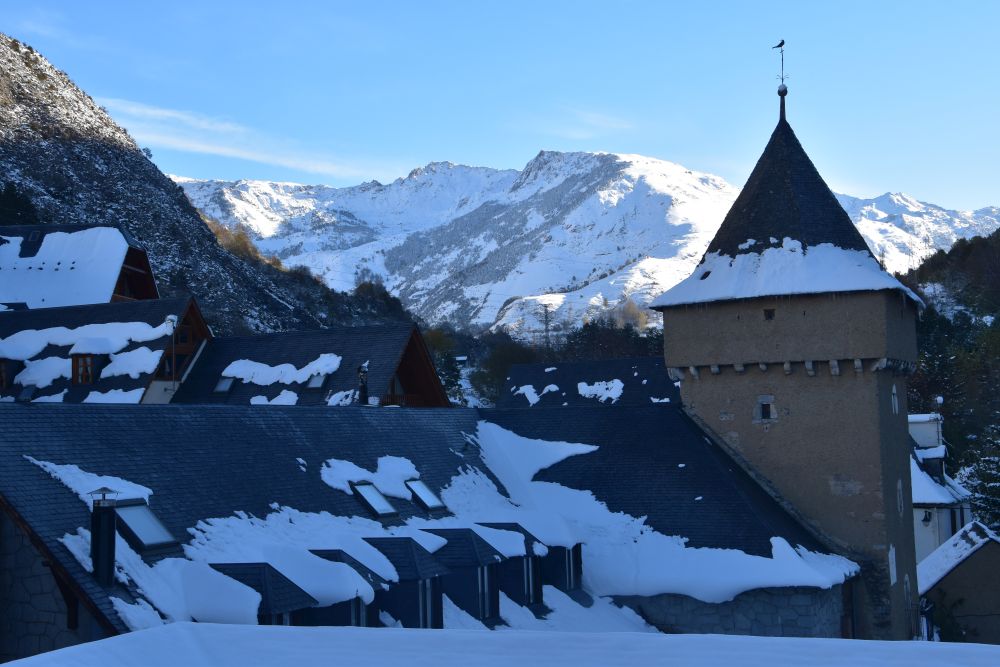
The Parador of Arties is a former castle of the noble family Portolà. From our room we can see the Montardo -THE mountain of the area (2883m). It is cold. All is covered with snow and the roof is icicled.

The tower reminds us of the fact that the parador once was a castle. In the background we can see the skiing area of Baquiera and Beret where the king of Spain practices skiing.

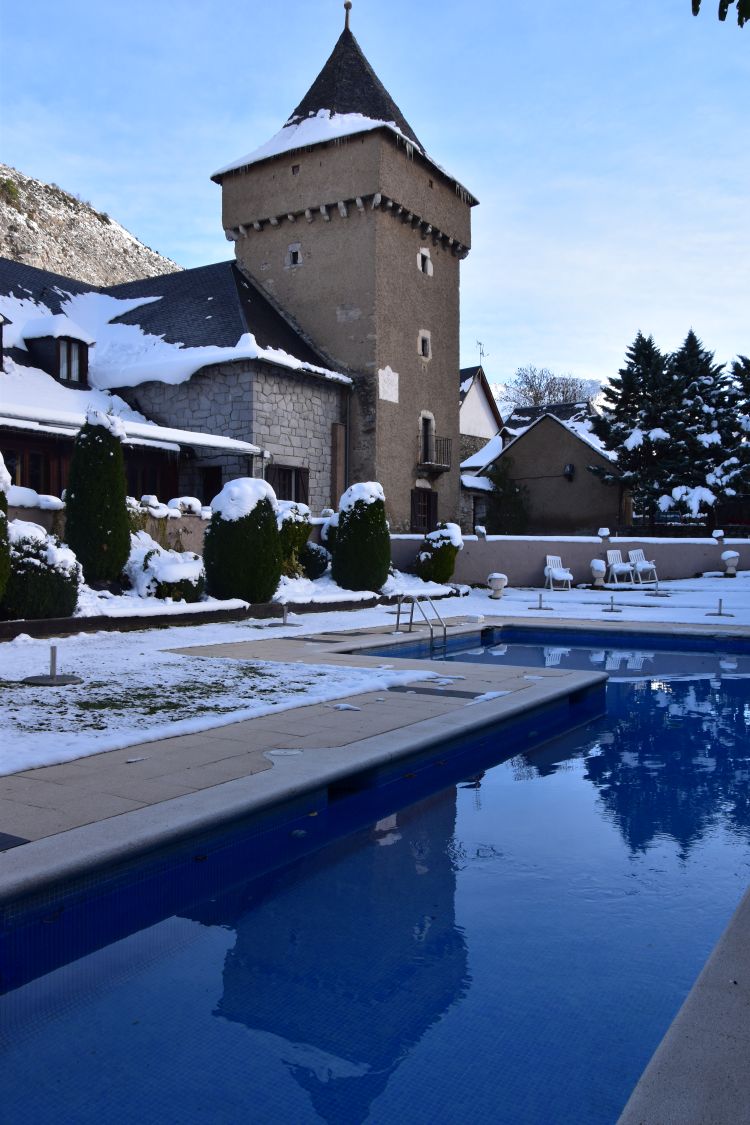
The tower reflects in the swimming pool that now does not seem to be inviting me for a swim.

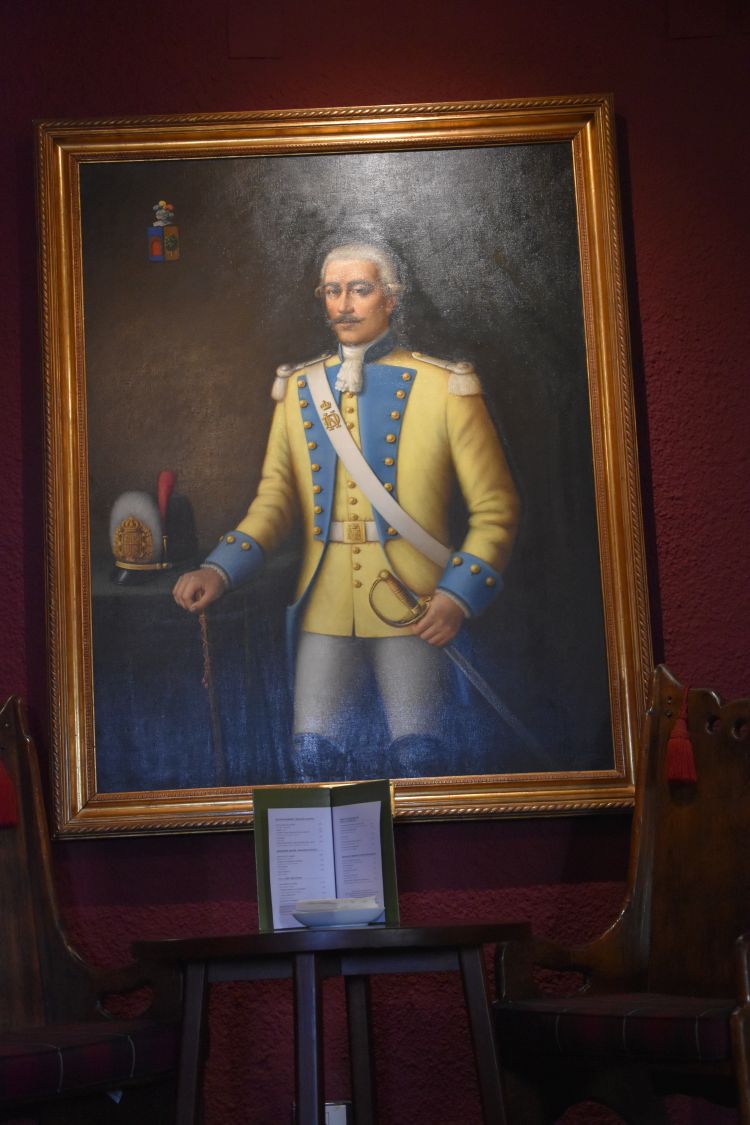
Arties is proud of their noble family Portolà with Gaspar de Portolà being their most famous representative (1723-1786). Starting from what is Baja California today, he discovered California, first San Francisco and then the Monterey Bay. An area in San Francisco, a valley and a city are called “Portola” in California.

Near the Tower of the Parador, there is a statue of Gaspar de Portola…

… and in the saloon of the Parador near the fireplace we found his portrait as well.

.

Arties on the Garonne, first covered by snow, then green again

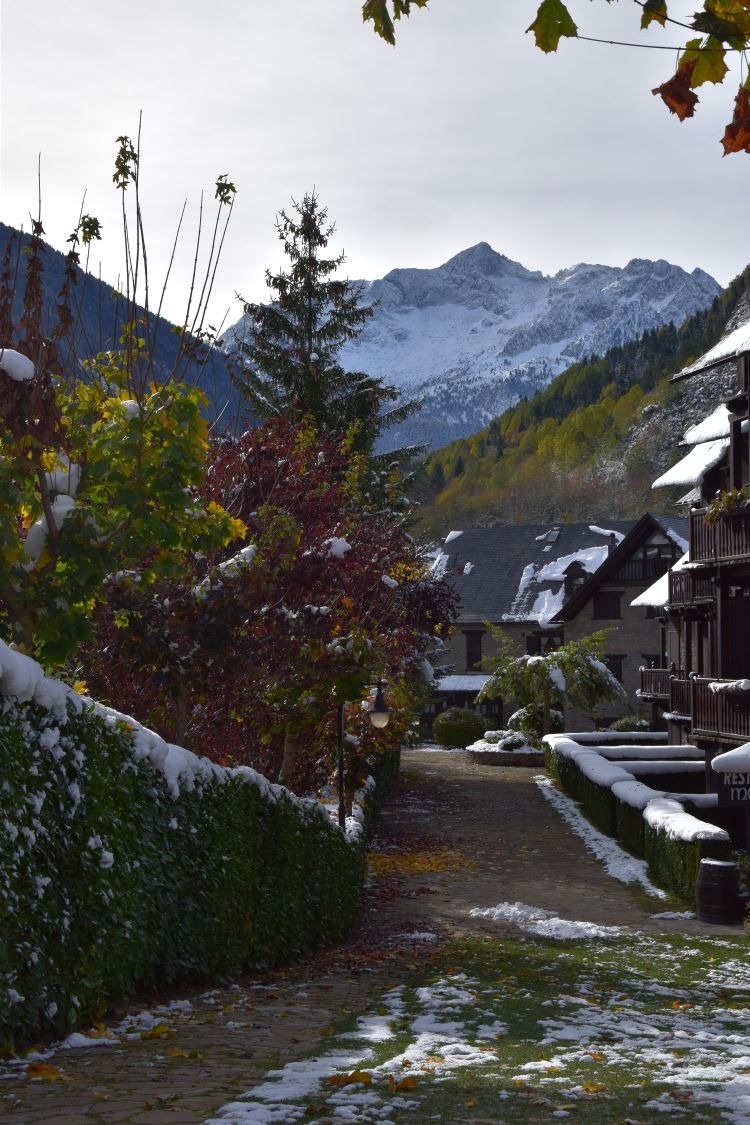
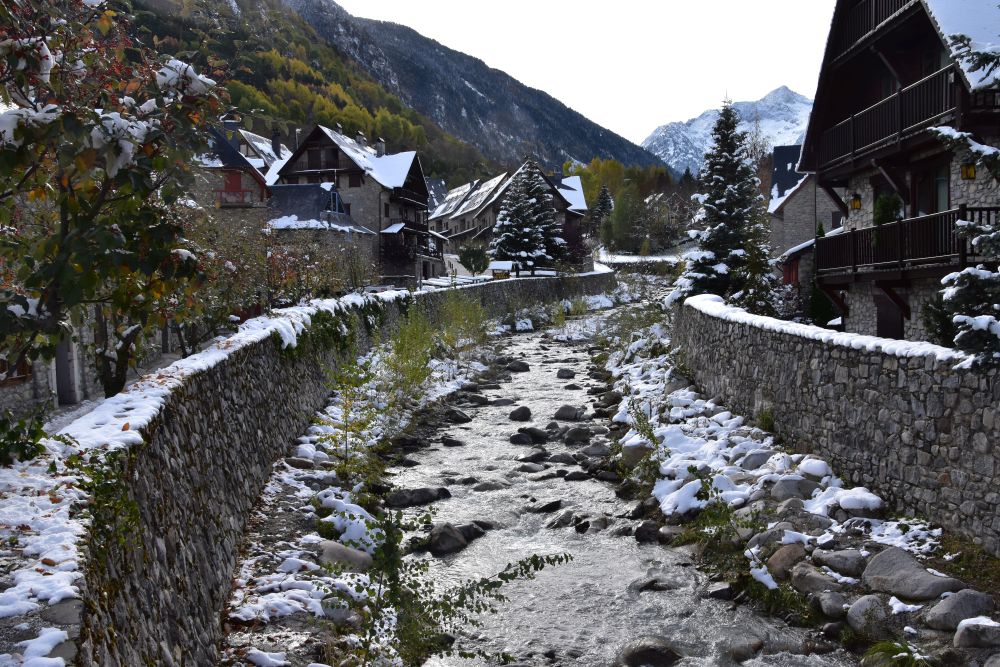
Walking through the village we discover neat stone houses covered with shingles, most of them with closed shutters. Many restaurants, now also closed, make us assume that this village will be busy, when the skiing season starts. The yellow autumn leaves reflect in the sun and contrast with the snow and the Montardo mountain.

The village Arties stretches along the Garonne that originates in the Val d’Aran to continue its way to France and to the Atlantic Ocean.

Every village in the Val d’Aran has its own small Romanesque or early Gothic church. In Arties it is the Església de Santa Maria from the 12th century. The threefold apsis is decorated with pilaster strips and arcades, as it is typical of the Lombardian style. The church is closed.

The second church of Arties in early gothic style is called “Sant Joan” (a day later the snow has disappeared). It is a museum now. 

The village of Arties is located where the rivers Garonne and Artigues join. 

Madeleine & Françoise Besson wrote two beautiful books about their home village Arties that starts, when the village, located between two rivers, was inundated in the 1960s after heavy rainfalls. The village was poor at that time, before tourism started. The Bessons also write about the impressions of the rough life and the brave mountain people that travellers from the 19th century reported.

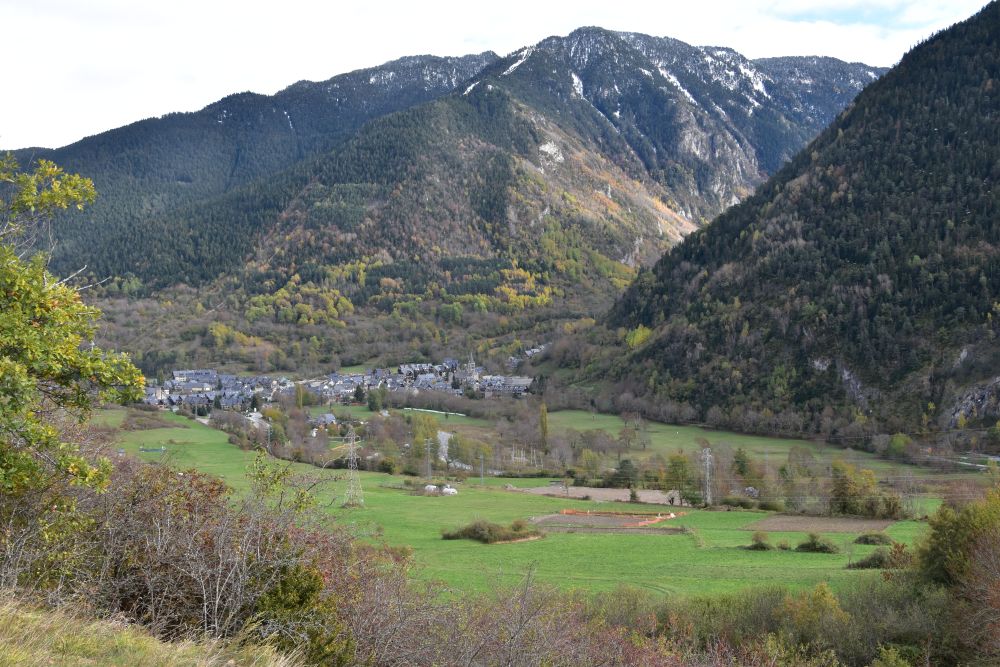
I captured the overview foto of Arties from the small Ermita de Sant Jaime.

Let me keep more Romanesque churches of the Aran valley for my coming blog. 


Sources:

  • Conselh Generau d’Aran (Elisa Ros Barbosa): Er Art Romanic dera Val d’Aran, 2007
  • Madeleine & Françoise Besson : « Sur les chemins du Val d’Aran – Voyage autour d’Arties – Tome I », Lacour 2005
  • Madeleine & Françoise Besson : « Sur les chemins du Val d’Aran – ses habitants, ses mots, ses fleurs  Tome II», Lacour 2005
  • Pauline Chaboussou et alii: « Los caminos Pirenaicos del Arte Romanico”, Synidcat mixed du Pays Couserans, Anfigraf 2008


Pratdip (Catalonia) and Perucho’s natural history of the vampire Dip


Again and again we traveled to Catalonia, south of Tarragona. Again and again we noticed the sign to the village Pratdip pointing to the mountains. One day, we followed them and we found Dip and Joan Perucho’s novel „natural history“ or in Spanish “las historias naturales”.

Let me tell you more about Pratdip and its vampire Dip.

.

Pratdip is a small village and the inhabitants are proud of their Dip

Pratdip is located in the mountains of Llaberia, some 40km southwest of Tarragona.

Narrow steep streets are overseen by the ruins of their castle that sits on a steep rock.

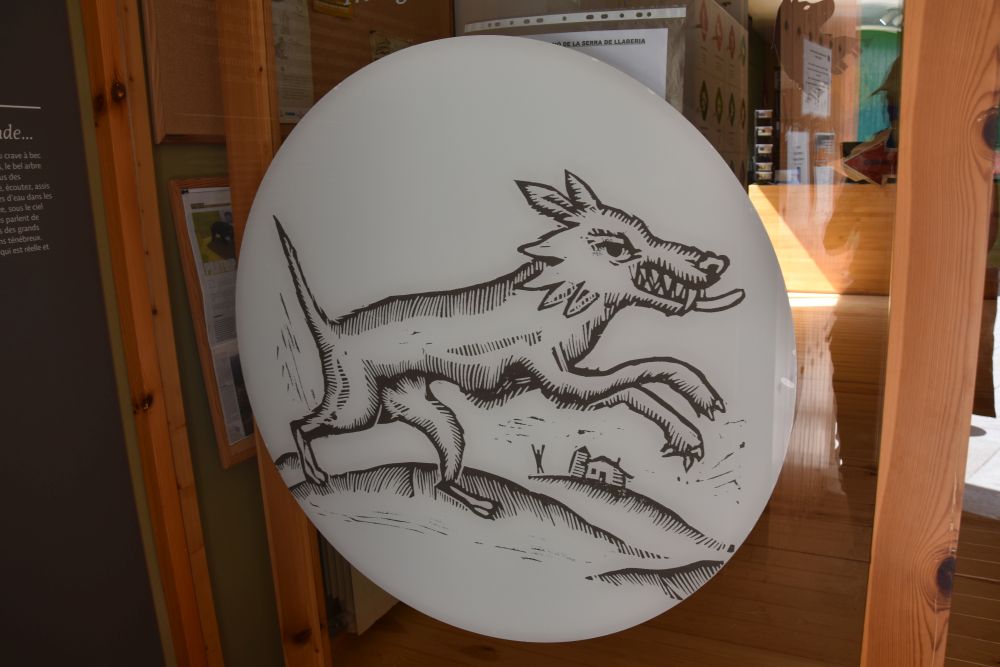
In the village there are various portraits of the vampire Dip in his incarnation as a dog-vampire (vampires can change their appearances rapidly).

When we enter the tourist office, we find another dip.

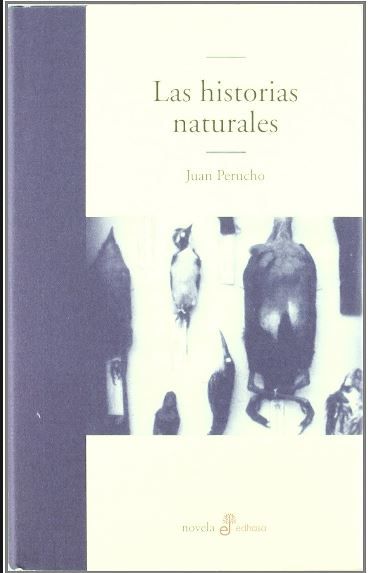
The assistant laughs: „You are looking for the vampire Dip“, she asks and proudly shows us the book of Joan Perucho with the title „Las historias naturales“. She adds: „Perucho tells you everything about the Dip and what he has done to Pratdip.“ The original version of the novel is in Catalan. I buy the Spanish version.

Then we walk to the hermitage of Santa Maria, along orchards with hazelnut trees…

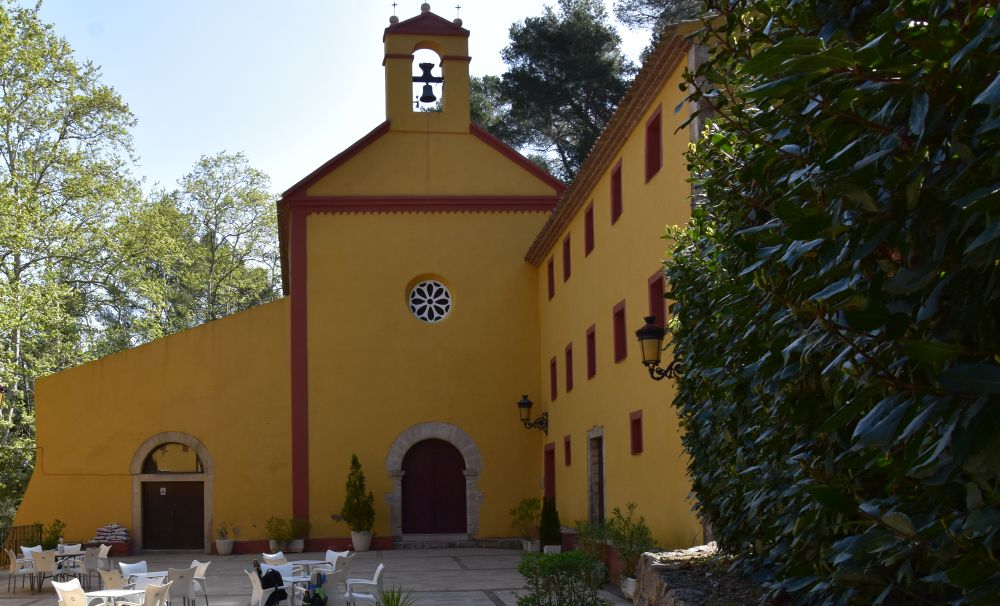
… and enjoy the hermitage Santa Marina in the mountains…

… where we find a friendly restaurant.

To round our excursion up, we climb the castle rock and enjoy the view.

.

Back at home: I enjoy reading „natural history“ by Joan Perucho to learn all about the dip

Back at home I read the novel of Joan Perucho. In his normal life, Perucho was a serious judge. When writing his „historias naturales“ or „natural history“, he must have twinkled with his eyes. The novel can be located somewhere between fable and reality and is full of humor. I could find five threads of interlaced actions.

  • First, the novel is about the vampire Dip –  his full name is Onofro de Dip. In the 13th century, he had owned the „meadows“ around Pratdip (hence the “prats of dip”). He traveled to Hungary to prepare the marriage for his king James I with Yolanda (or Violant) of Hungary (James and Violant are a historical fact). On the way to Hungary, Onofro de Dip fell in love with the lady vampire Meczyr who turned him into a vampire and „Non-Dead“ (No Muerto). He returned to Pratdip in the early 19th century and terrorized the village killing inhabitants every night. The current owner of Pratdip, Baroness Urpí, asks her brother, Marqués de La Gralla, for help (Gralla is a „real“ noble family from Barcelona; they owned a palace that no longer exists today). A friend of the Marqués de Gralla, the young natural scientist Antonio de Montpalau (an invented person), travels to Pratdip, neutralizes the vampire with the help of garlic, parsley and wooden crosses. Then he finds Dip’s grave in the castle and expulses Dip from Pratdip. Onofro de Dip morphs into the solo guerillero El Mochuelo (the Owl) fighting for the (conservative) Carlists and terrorizing the region of Tortosa and Berga. Montpalau pursues him, finds him finally in a crypta near Berga (castle Mataplana) and by speaking out some magic words, Montpalau makes Onofro de Dip die „properly“ and find his peace.
  • Second, the novel is the portrait of the higher society of the Barcelona area in the early 19th century. Montpalau as a young scientist belongs to that higher society. The members of the high society enjoy meeting in the Gralla palace, eating and discussing history, natural science, mathematics or music. As a reader you feel the luxury and shake your head about the sometimes detached, elitist or even absurd discussions. Once Frédéric Chopin and George Sand are invited to a banquet, as they stop over in Barcelona.
    Antonio de Montpalau is a scientist focused on classifying animals and plants around him. He is also interested in geography and geology. Before going to Pratdip, he  researches all literature available and he finds scientific literature about vampires that recommends using garlic, parsley, portulak, wooden crosses and mirrors to fight vampires (I can feel Perucho smile, when he lets Montpalau buy ten dozens of mirrors before leaving for Pratdip).
  • Third, the novel has a historical background: The year 1840 in the first Carlist War in which the male pretendent of the throne, Carl V, fought against his niece, the actual Queen Isabel II.
    • One one hand, the Carlists that fought for Carl V, were conservative. Their target was a federation of several states unified by the king of Spain and the catholic church as the only two common denominators of the federation, conserving, what Spain had been before. A man made constitution was not required in their eyes. Federation, of course, was welcomed by Catalonia (or also by the Basque region). Carlists were strong in Catalonia.
    • On the other hand, the followers of the actual Queen Isabel II were classified as liberals, as they based their ideas on the French Revolution. The wanted the separation of church and state, a centralized state based on the constitution (as set up in 1812, like France). The idea of the centralized state was not, what Catalonia strived for, but the high society in Barcelona, including Antonio de Montpalau, was liberal.
    • Some real persons give a realistic background, the most important being Ramón Cabrera. He was the outstanding leader of the conservative Carlists in Catalonia. His liberal (pro Isabel) opponent was Baldomero Espartero.  In 1840, Espartero defeated Cabrera and his Carlists in Berga not far from the Pyrenees.
    • Montpalau and Onofro de Dip interact with the real persons. Ramón Cabrera has been photographed wearing a large scarf around the collar of his shirt. Furthermore, he has been reported to feel ill, when trying to conquer Gandesa. Perucho tells us the reason. Cabrera attacked Gandesa at the time, when Dip morphed into the Carlist guerilla „El Mochuelo” that wanted to become a Carlist leader himself. He bit Cabrera such that he will become an immortal vampire. This is why Cabrera felt weak and this is why, he had to wear a large scarf (to hide the stitches of the vampire – twinkle). Perucho continues to describe that the liberal Antonio de Montpalau was captured by the conservative (Carlist) troups of Cabrera, how he could ease the symptoms of the bite for Cabrera and how finally Montpalau succeeded to free Cabrera from his gloomy destiny by making Onofro de Dip die properly – as described in the first thread of actions – in the crypta near Berga, just after the Carlist Cabrera had been fully defeated in Berga by the (pro Isabel) Espartero.
  • Fourth, the novel is a travel report about Catalonia in the early 19th century. Antonio de Montpalau, his nephew Novau and his coachman Amadeo travel from Barcelona via Villafranca, Reus and Falset to Pratdip. After having expulsed the vampire-Dip from Pratdip, they leave to pursue the vampire-El Mochuelo, cross the Ebro near Miravet, stay for some time in Gandesa, continue to Morella. Cabrera resides in Morella and Montpalau and his followers are captured here. Then as prisoners, they accompany Cabrera to Berga. Our travelers visit places of interest on the way (e.g. the monastery Vallbona de los Monges where the Queen Violant from Hungary has been buried), admire the beauty of the landscape, eat local specialties and drink delicious wines from Terra Alta. The travel reports are full of humor, e.g. about real places of interest such as the cathedral of Tarragona that they like though their travel handbook by (real) Alexandre Laborde does not recommend to visit it. Or about less real events: The three heroes meet giant fleas, but luckily Monpalau knows, how to escape them: They inflame branches of pine trees and carry them like torches (twinkle).
  • Fifth, it is a love story with a very, very happy end. While Antonio de Montpalau is fighting the Dip in Pratdip, he and Inés fall in love. Inés is the daughter of the baroness Urpí that has asked her brother, Marqués de Gralla, for help against the Dip. Montpalau has to leave his love to pursue the Dip.  A historian has encouraged Montpalau to do so, as he found (historic-scientific) sources that reveil, it is Montpalau’s fate to defeat the Dip (twinkle). After having vanquished the vampire Dip-El Mochuelo near Berga, Montpalau returns to Barcelona. At the palace of Marqués de Gralla he finds his love Inés (the Marqués‘ niece) waiting for him. What a happy end!
Perucho’s novel was the first book that I accomplished reading in Spanish. In the beginning, it was a bit of a tough start for me, because Perucho takes his time to set the stage. But then, when the action of neutralizing and chasing the Dip-El Mochuelo accelerates, what a pleasure! And it was even more pleasure to go back to the start to enjoy the setting of the stage, once I understood more about the historical background. The novel is full of humor and of fantasy with links to real history and geography. I did enjoy reading about many places in Catalonia that I know and that Perucho moves to the early 19th century presenting them with the eyes of Antonio Montpalau and his followers. And I did enjoy to learn more about Spanish history which helps to understand what is going on in Spain today.


Back in Saint Petersburg – visiting the Russian Museum Folk Art department – found the burial of the cat once more

The Russian Museum (Государственный Русский музей) is located in the neoclassical Mikhailovsky Palace. It opened in March 1898. The 400’000 exhibits are primarily based on the collections of Alexander III, the Russian artifacts of the Hermitage and the nationalization of private collections after the revolution of 1917. The museum gives an overview of Russian paintings and sculptures from the 11th to the 19th century and of Russian Folk Art. In addition the Benois Wing displays works of the early Russian avant-garde and its leading artists (i.e. late 19th and 20th century up to present).

I have been in the Russian Museum before, once in 2002 with Ernst and then alone in 2013. Now, when visiting Sankt Petersburg with Ursula in June 2017, we went twice and we bought the book “Russisches Museum: Museumsführer”, Palace Editions, Sankt Petersburg 2014. It gives an excellent overview of the museum and the history of Russian art.
Let us first go to the Folk Art department where we found a surprise – the mice burying the cat.
.

Burial of the cat in Russia – the same theme as in Tarragona

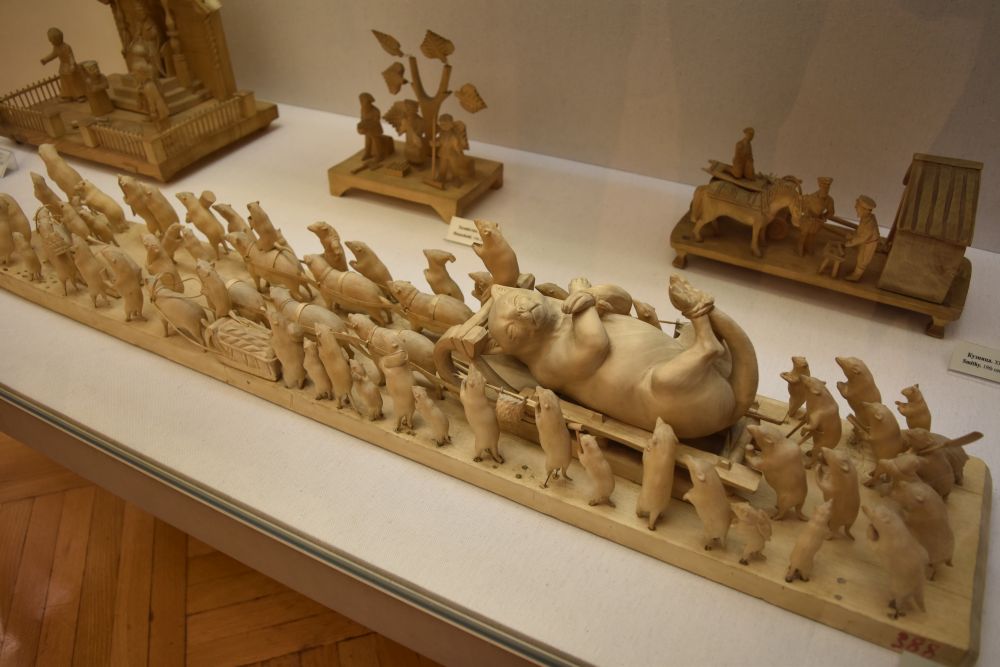
This small sculpture shows, how the mice buried the cat.

F.D. Yeroshkin: How the mice buried the cat, late 19th/early 20th century

This seems to be an important topic in Russia, as this second representation of the mice burying the cat shows.

Lubok: How the mice buried the cat, early 20th century copy (Lubok: popular print from literature, religious stories and popular tales)

The related Russian tale is: The cat was sleeping. The mice thought that the cat was dead and put it onto a sledge attaching its paws (just in case). They celebrated the death of the cat joyfully pulling the sledge to bury the cat. After some time the cat woke up, freed itself and ate the mice.

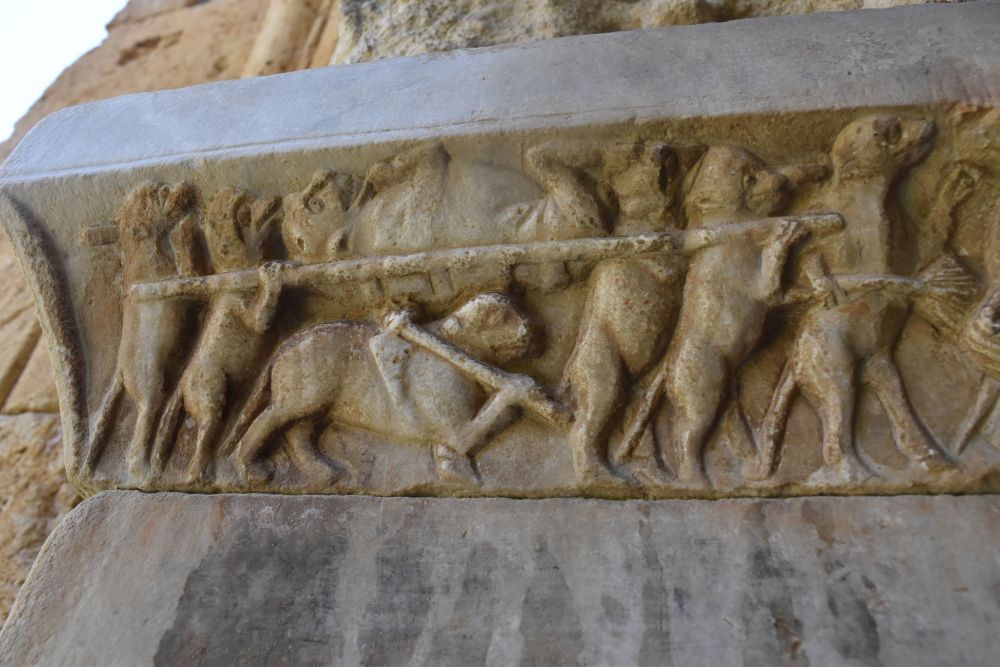
We found the same theme in the cloister of the Cathedral in Tarragona (Spain), except that there they say it  is rats (and not mice) that are trying to bury the cat.

The procession of the rats (my blog about our excursion to Tarragona).

A blog  on “Tarragona Experience” explains it well: The cat only pretends to be dead, then “wakes up” and eats the rats. This alludes to temptation: “Never think that you are in full control of a situation, it might change rapidly.” Thank you, Ivan Rodon, for clarifying this. Same theme, same story and – I assume – same morale in catholic Spain and in orthodox Russia.

.

Now I understand, what a “полотенце с петухом” or “a towel with the cock” looks like

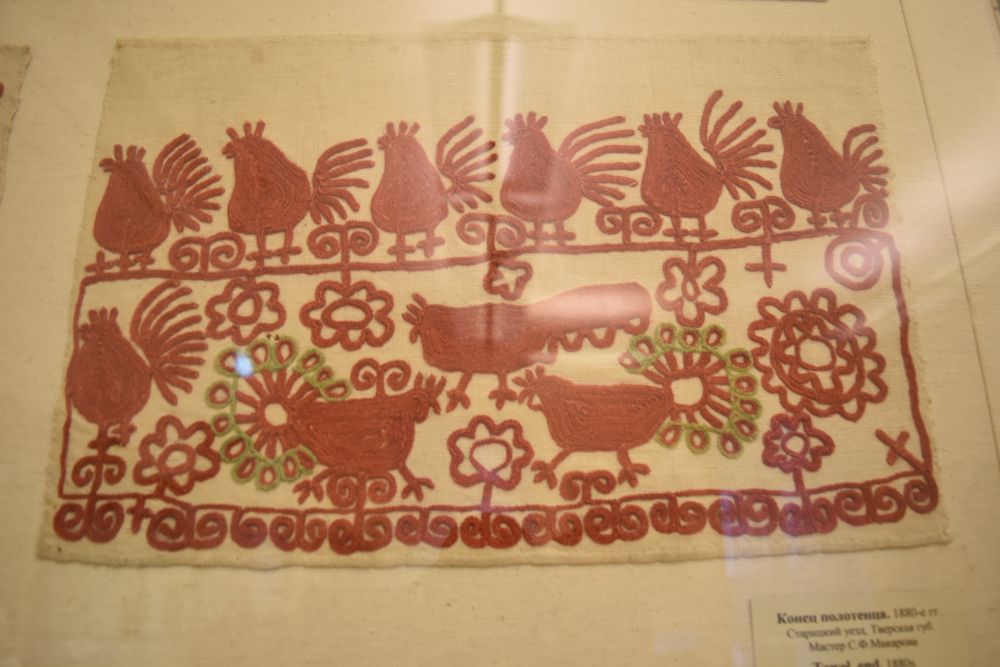
This towel with the cock amidst the hens opened my eyes.

Part of a towel, 1880

The towel opened my eyes, because it reminded me of “the towel with the cock” or “полотенце с петухом”. This is a very touching story that Bulgakow wrote about the time, when he was a young country doctor. By amputating one leg of a beautiful young lady, he saved her life (she had fallen into the brake). As a thank you she gave him a white towel with a red cock embroidered onto it. I had read Bulgakow’s short story many years ago, but only now I understand that the red cock must have looked like this cock standing amidst the hens.

.

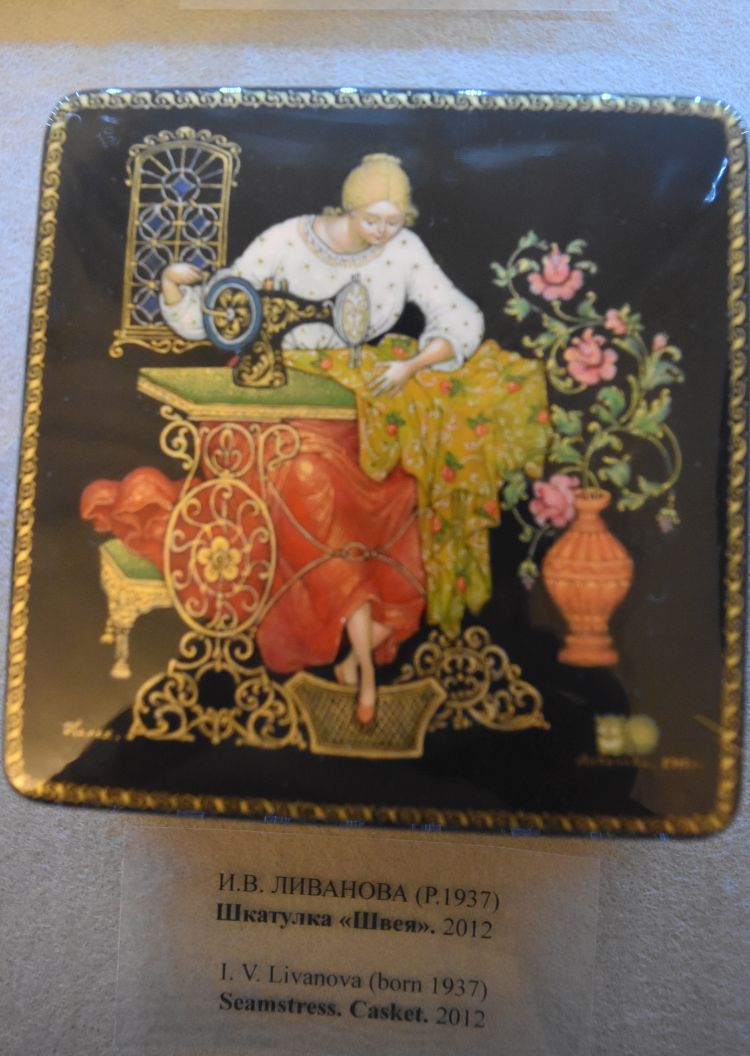
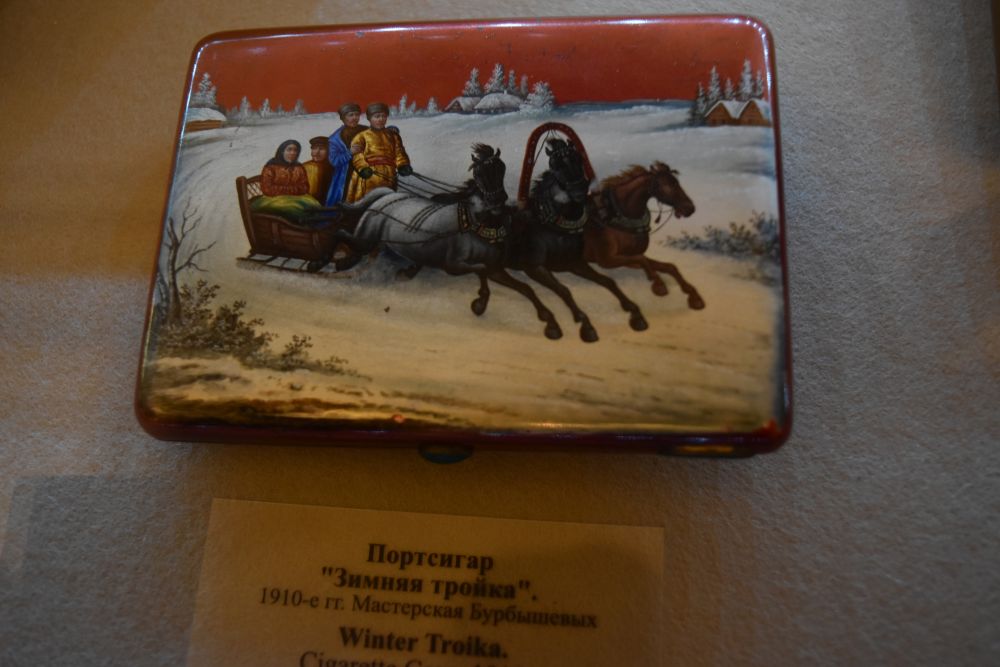
Good eyes needed to see all the details of these small lackerware boxes

The lackerware boxes are tiny and you need good eyes to see the miniature paintings. There are many of them. This is a lady sewing…

and this is a box for cigars showing a troika in the Russian winter.

.

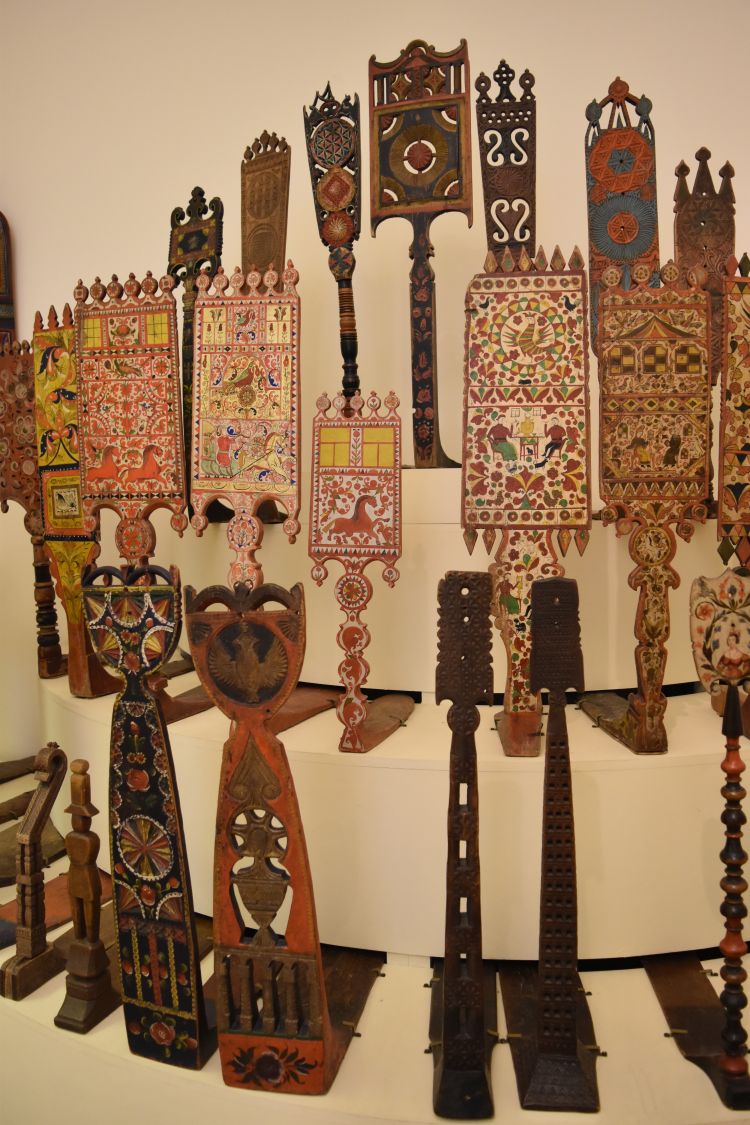
Russians in the villages are also masters in woodwork

These instruments are called прялка in Russian and the English equivalent is distaff . The spinner sat on the board and took the unspun material from the top of the vertical piece. The decoration shows  much care and skill…

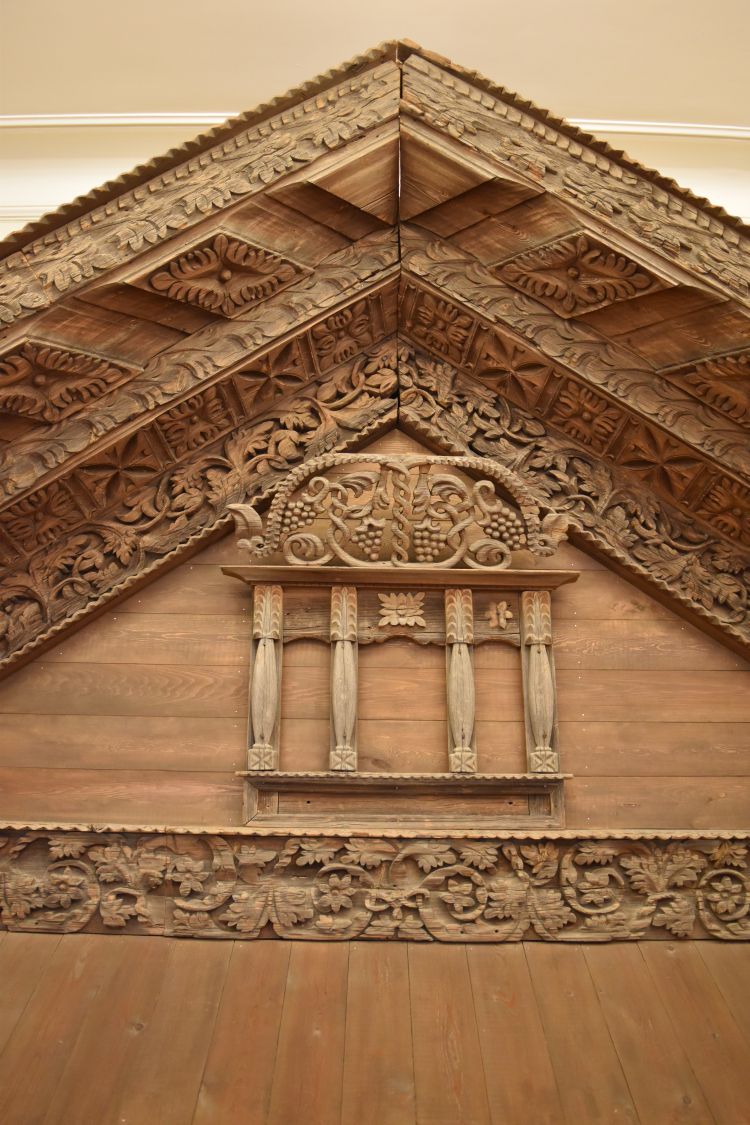
… as does this wonderfully carved gable.

There are many more exhibits from the daily life in Russian villages in the Folk Art department. I was here in 2002, in 2013, in 2017, and I would love to visit it again – there is always something new to discover.


In Catalonia (Spain): Excursion to Zaragoza

Zaragoza, the capital of Aragón is our longest excursion. It is a three hours’ drive from Hospitalet de l’Infant. In Hospitalet we spend a few days in the apartment of our friends end October until mid November 2016.

We start in sunny Hospitalet crossing the hills to reach the Ebro valley where the scenery is hidden in grey fog. After three hours, we park our car right in the center under the Plaza del Pilar. With Ursula we always first enter the Tourist Office to get some maps and advice about what to see. We are told that the old Islamic Palace and Parliament Seat (Aljaferia) is closed for renovation. That means our sightseeing will be restricted to the very city center.

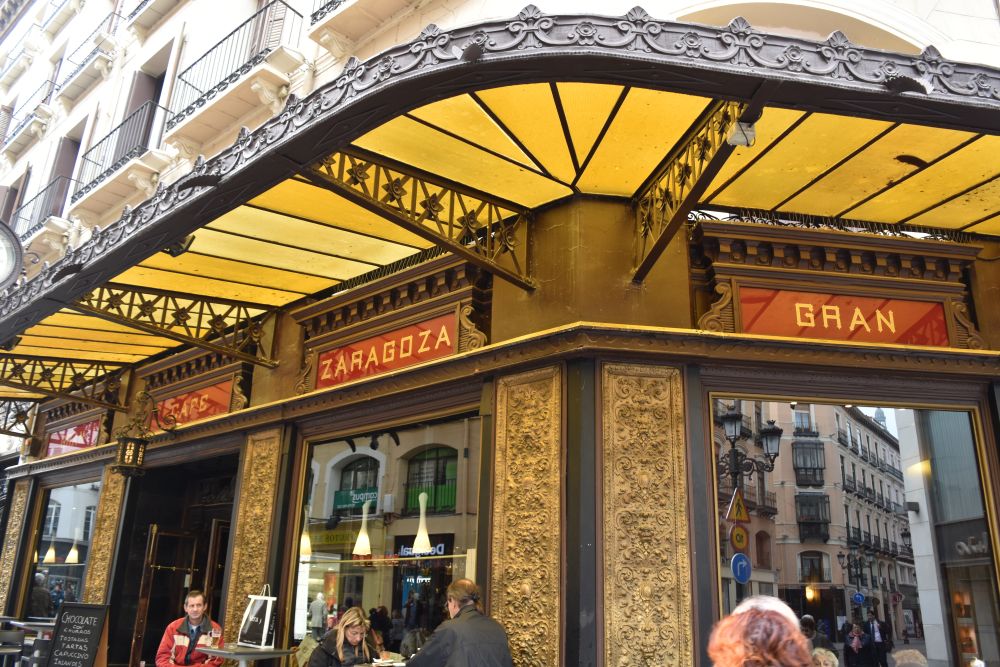
We feel like hot chocolate in the famous Gran Café. What a disappointment! We are served churros that are not fresh and melted chocolate that is dense and tepid. Well, it seems that this is how chocolate is made in Spain, but I do not think that “old” churros are a particular Spanish specialty. As for the chocolate drink it is a pity that Spain seems not to have adopted the Mexican way of preparing it – the Mexicans prepare much lighter chocolate using hot water.

aaa_1000-small

.

The Catedral-Basilica de Nuestra Señora de Pilar – an important stop on the Way of St. James

In front of the Catedral-Basilica de Nuestra Señora de Pilar four pilgrims are absorbed by their prayings. This cathedral is important on the Way of St. James. Right here, it is said, the Virgin Maria appeared to St. James (Jakob) on a pillar (in Spanish “pilar”) in 40 AD. In the hazy background, the Cathedral of Seo can be seen.

aaa_1015-small

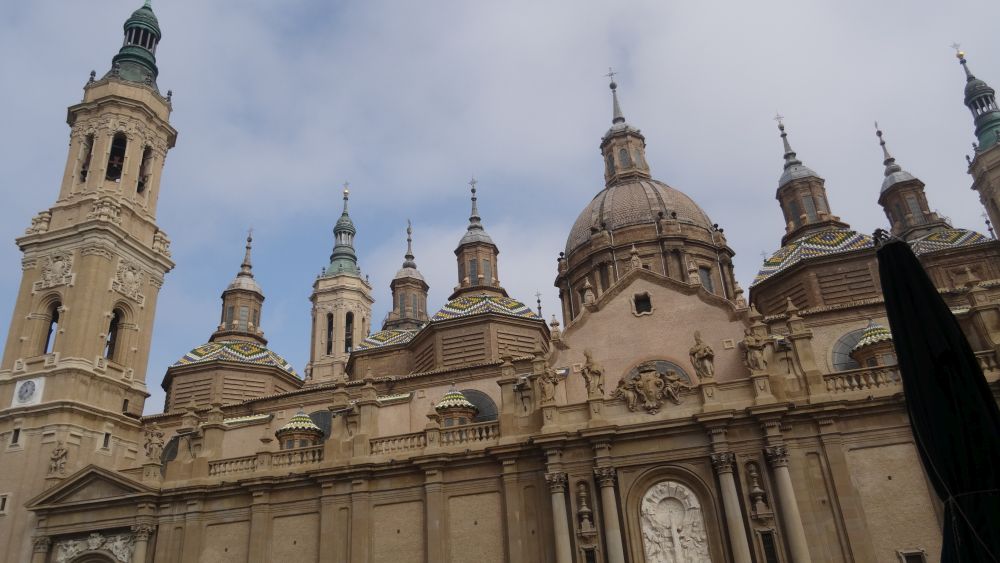
The Catedral-Basilica de Nuestra Señora de Pilar has been built in Baroque style in the late 17th century. Inside it is richly decorated. Some vaults (or domes) are painted with frescos by Francisco Goya. It is not allowed to take photos inside the cathedral. This is the view of the Cathedral of Pilar from the Plaza Pilar.

aaa_1091-croptot-small

Eleven vaults (or domes) decorate the roof of the cathedral.

dsc08878-small

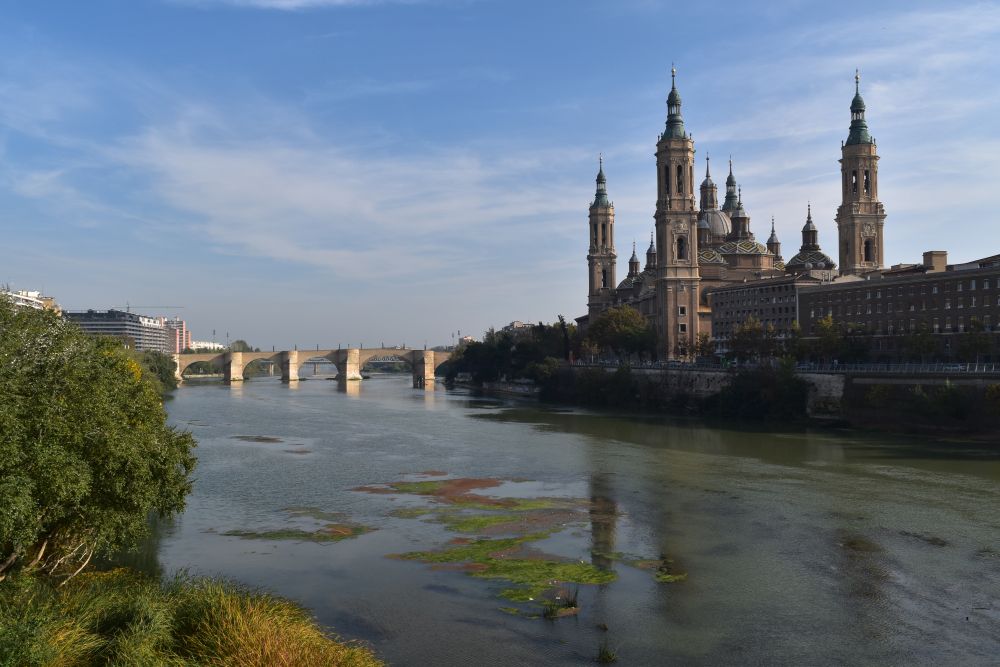
From the Ebro river we take more photos of the Cathedral of Pilar with the stone bridge.

aaa_1080-small

Fishing seems to be a rewarding activity here.

dsc08989-small


The Archbishop’s Catedral de Seo with Mudejar elements

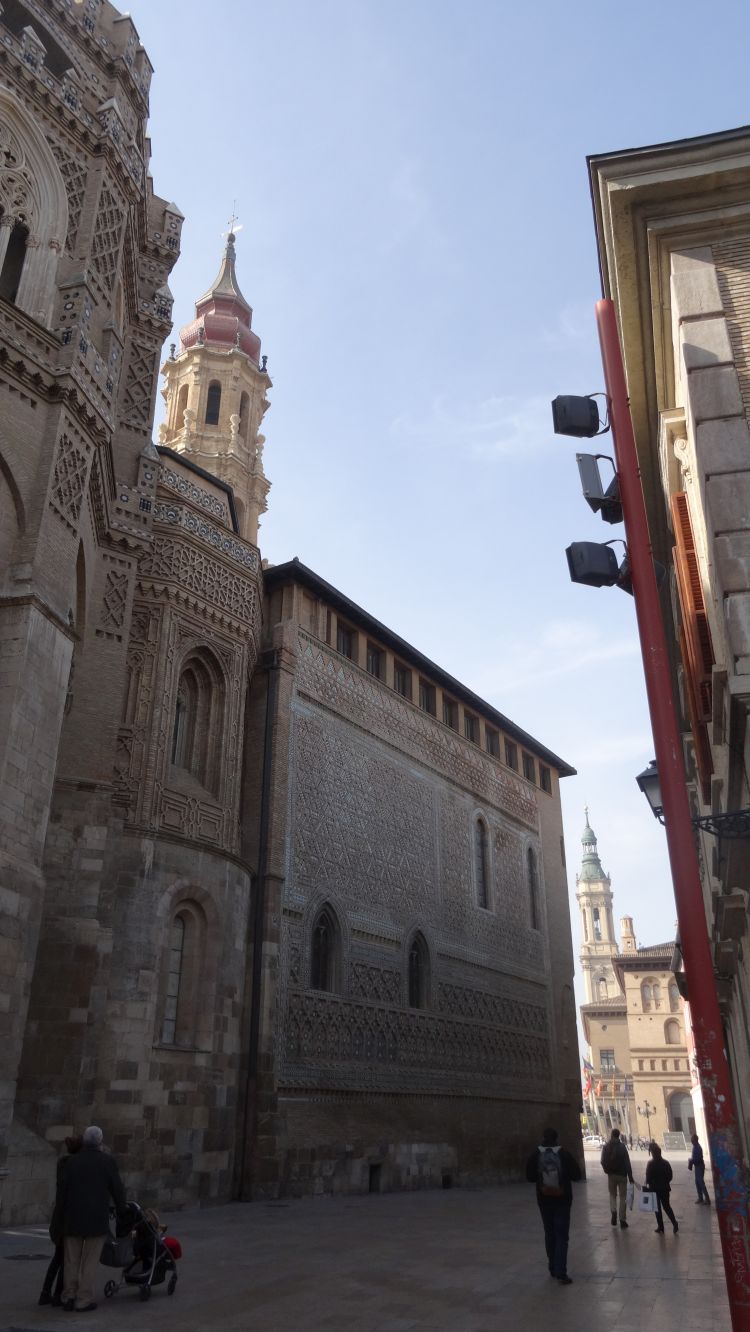
Also on the Plaza Pilar, there is the Archbishop Cathedral of Seo. The construction started in the 12th century (some Roman elements are left in the apsis), and it was newly built in the 14th century (hence primarily Gothic in style). The tower is the late 17th century work of an Italian architect. The Cathedral of Seo has been UNESCO world heritage since 2001.

dsc08911-small

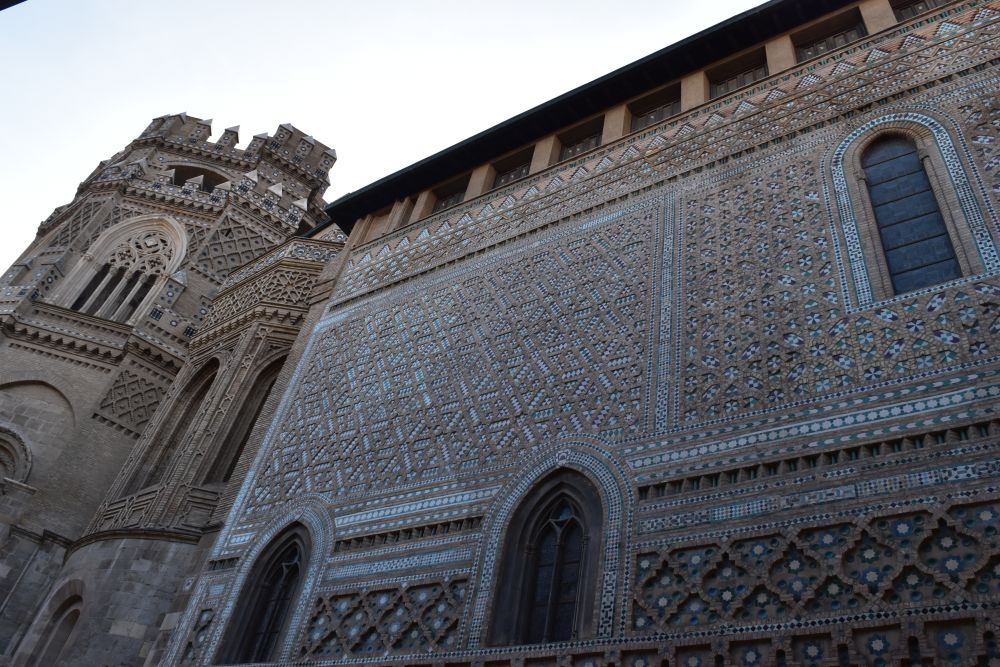
The northern wall is of fine Gothic-Mudejar style.

aaa_1026-small

Inside we find innumerable chapels – some of them of Renaissance and some of Baroque style. Each chapel is explained in detail. A nice detail: A statue of Joseph holding his baby – I saw that only in Tarragona before. One chapel is devoted to the young Domingo that was said to have been murdered by Jews – which was taken as a reason for pogroms. Later it was concluded that the crime never took place, which makes me feel bad. Why do we invent crimes and make someone guilty for them?


The Lonja (bourse) 

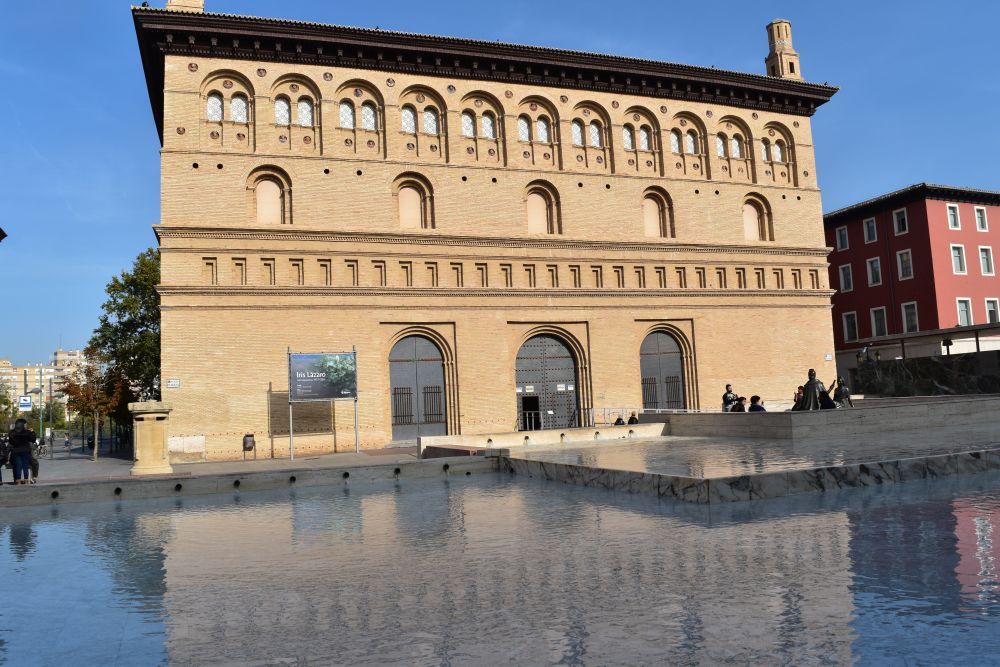
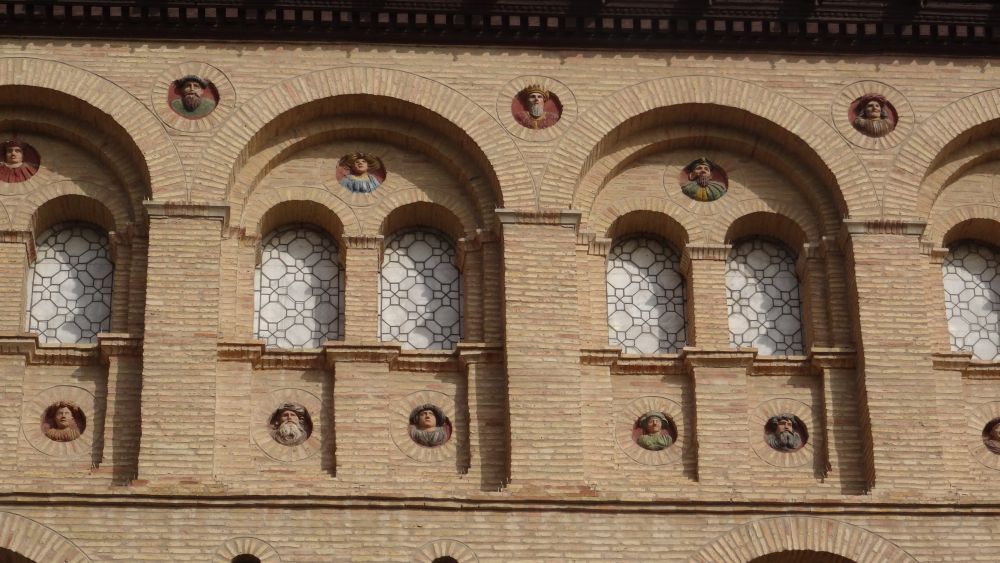
The Lonja (bourse) was built in the 16th century to provide a public space for traders that so far have used the churches for trading.

aaa_1040-small

It is Renaissance in style. Ursula focuses on some details of the façade.

dsc08899-small


Iglesia Parroquial de San Pablo

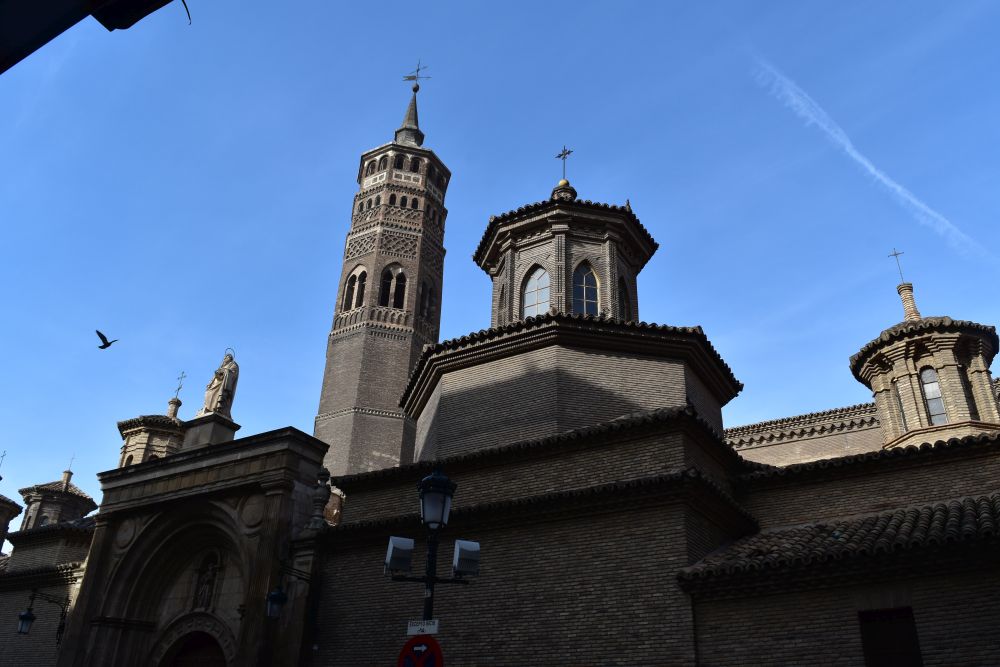
Outside of the old town wall we look for the Iglesia Parroquial de San Pablo from the 13/14th century. It contains Mudejar elements, in particular the octagonal tower. It has been UNESCO world heritage since 2001. Unfortunately, we find the church closed.

aaa_1061-small

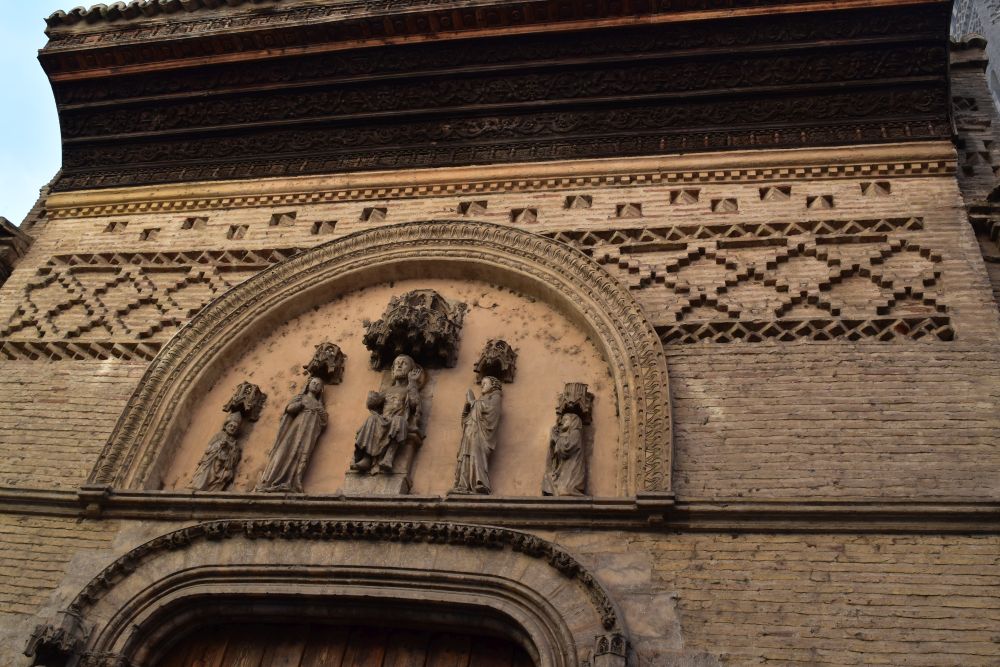
This is the Puerta Tramontana with Christ in the middle and Maria, Saint John and Saint Blasius. One of the saints cannot be identified.

aaa_1055-small

Ursula’s photographic eye spots the lamp with the ornaments.

dsc08959-small

In the Calle San Pablo we have delicious tapas in a friendly small bar. We have chat with the people from the area and with a lady from Vladivostok in Russia – far, far away from here.


More sights in the city center: The Central Market, the Roman Wall and the Museum of Goya

The Central Market was built in 1903. Plants on the roof add to the decoration. The market is now closed – it is afternoon.

aaa_1069-small

Across the market a shop sells traditional regional clothing.

aaa_1073-small

In front of the ruins of the Roman Wall, Augustus watches a carousel being demounted. Augustus gave his name to Zaragoza (Caesaraugusta).

aaa_1075-small

We finish visiting Zaragoza with the Museum of Francisco Goya (1746-1828). He is from Aragon. First, he painted for churches, then portraits at the court (pretty realistic portraits) and in his last years he made engravings of the war with France that was a nightmare for him (Zaragoza was occupied by the French from 1809-13). Goya is considered to be a predecessor of the Surrealists.

dsc09006-small

We take our car out of the garage (rather a spacious garage, if I remember right) and drive back home – another three hours. It was a long day. Zaragoza was worth visiting.