On the road at Pontgibaud near Clermont-Ferrand and the volcanos

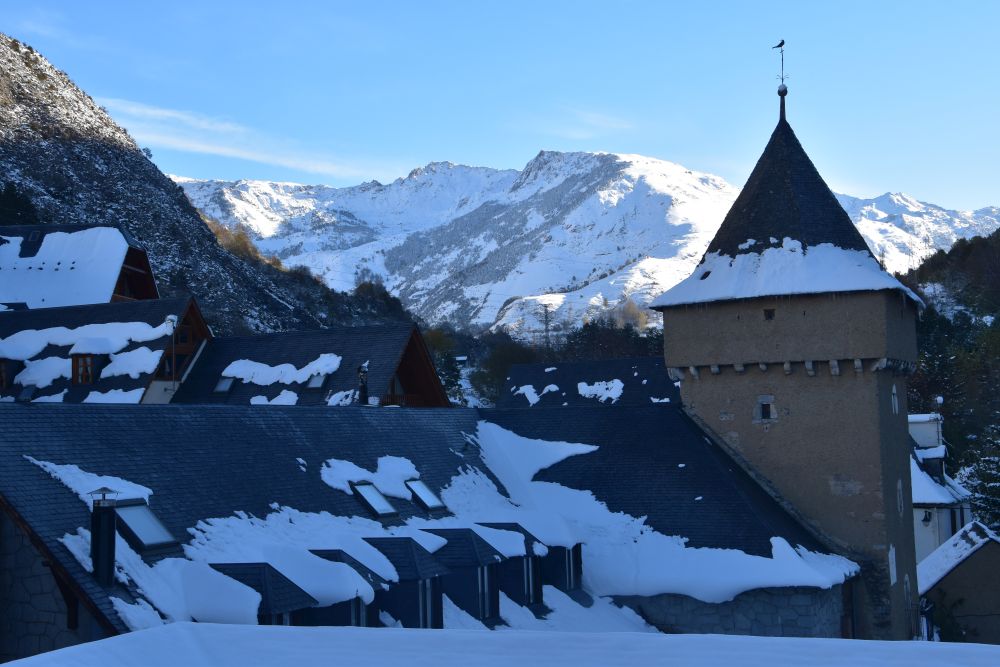
End of October 2018 we are on the road again. Our target is Spain. Clermont-Ferrand is located at about half the distance between Basel and the Pyrenées. We selected Pontgibaud close to the motorway to stay overnight. We discovered a nice small hotel and a nice small town stretched along the Sioule river. It counts some 800 inhabitants.
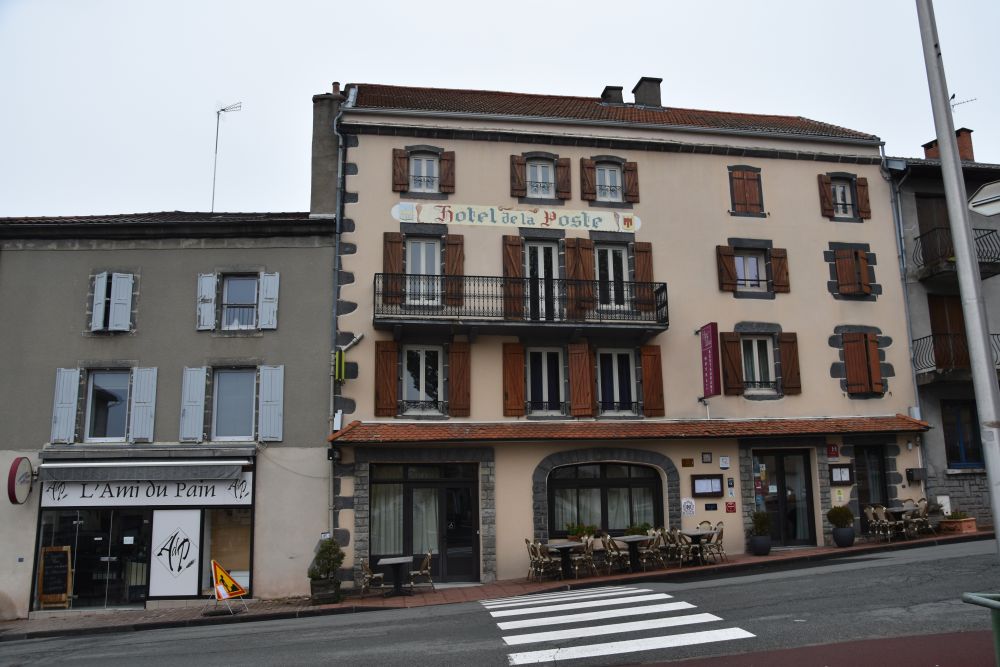
The Hotel de la Poste has just opened, because the owner expects spontaneous guests that get stuck in the snow announced. It snowed slightly, when we arrived.

We have dinner – I eat braised calf cheek – a plain and excellent meal.

In the morning, we find the sky covered, but there is no snowfall. We walk around the small town built using the black volcanic stones of the area . The dormant volcanos called “Puy” are not far. This is the townhall or hotel de ville ornated with the black volcanic stone.

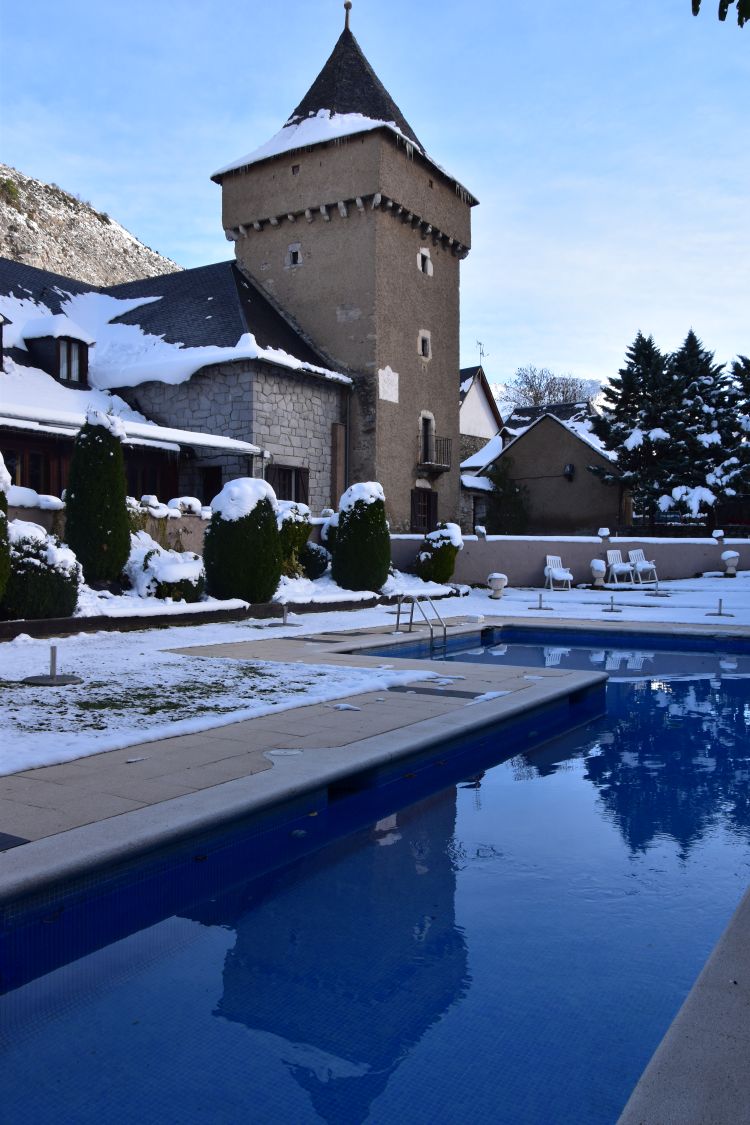
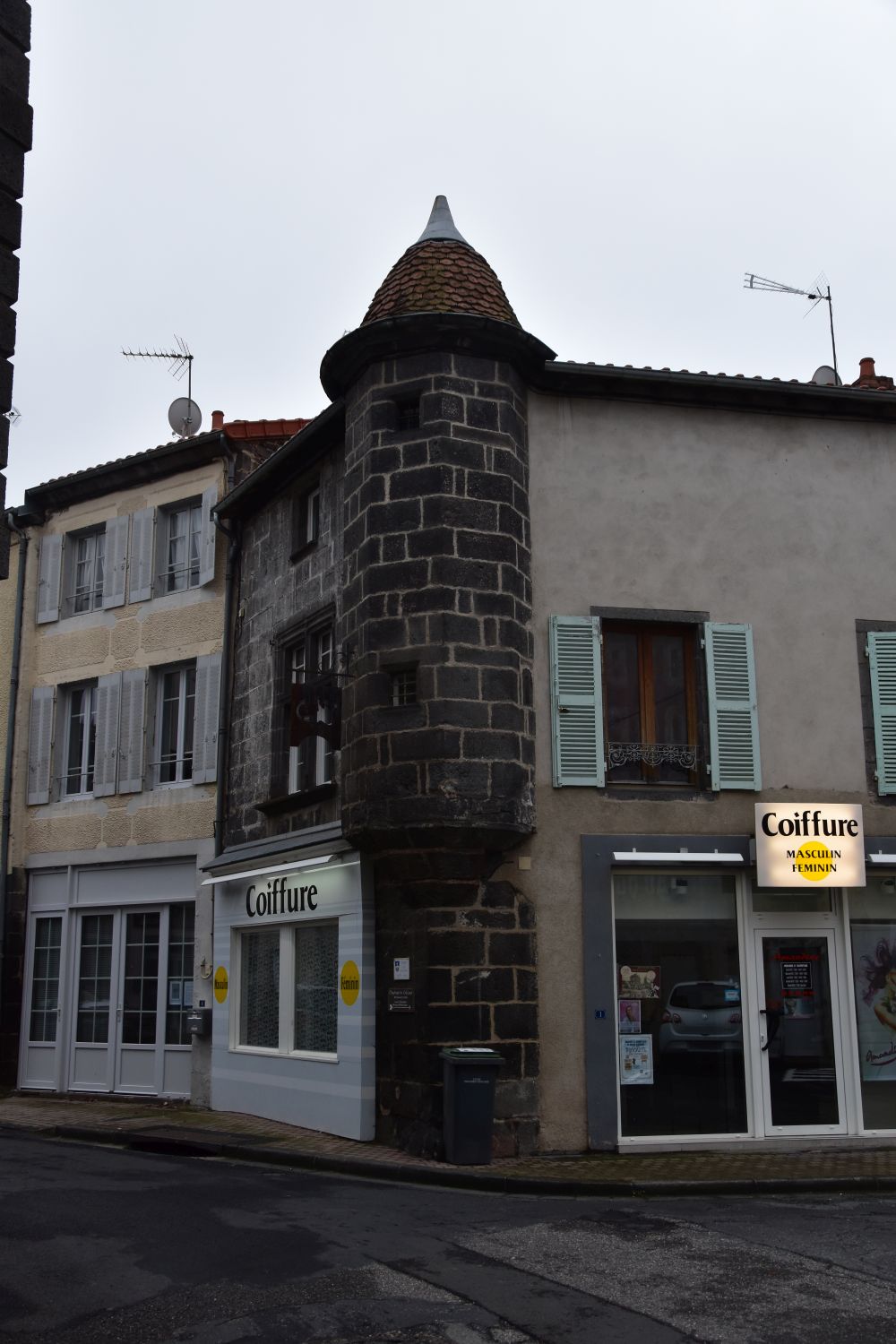
This house with its watch tower has been built in the 15th century. 

In pre-Roman, Roman and medieval times, lead was retrieved in the area. This might have been the reason for fortifying the town and buliding  the castle (Source: Städtische Wirtschaft im Mittelalter). The inhabitants of Pontgibaud are called Gibaldipontins.

From the town fortification, the city gate is left.

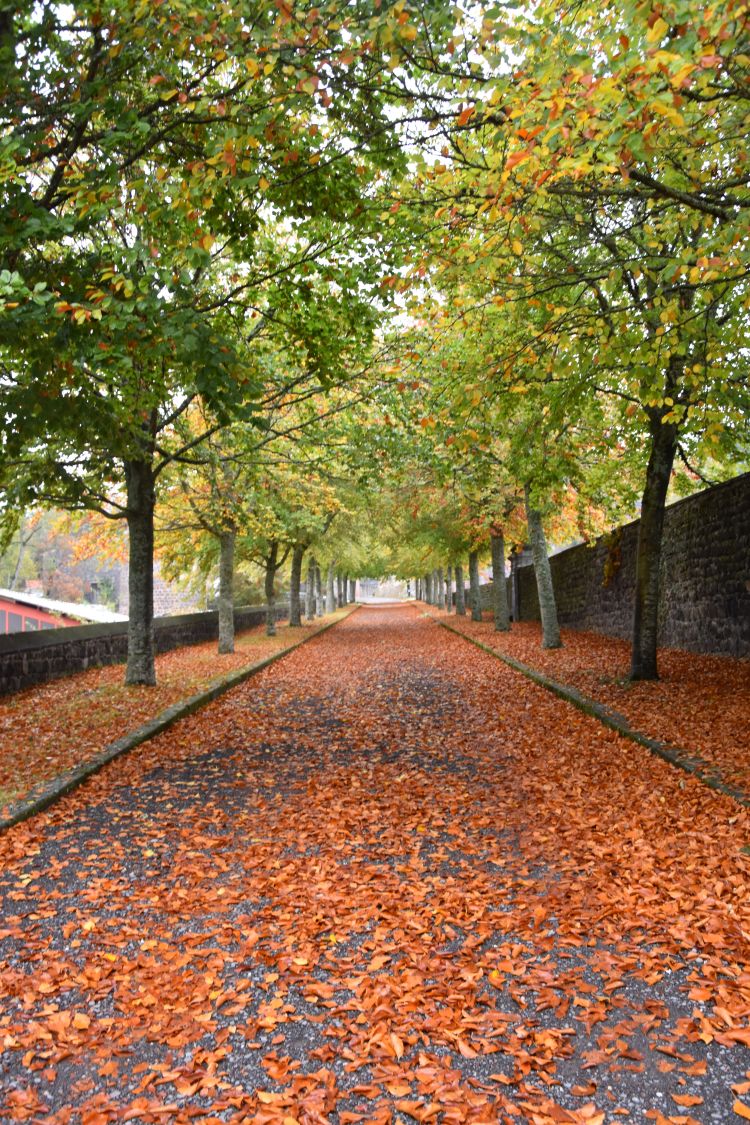
Across the gate starts the park of the Castle.

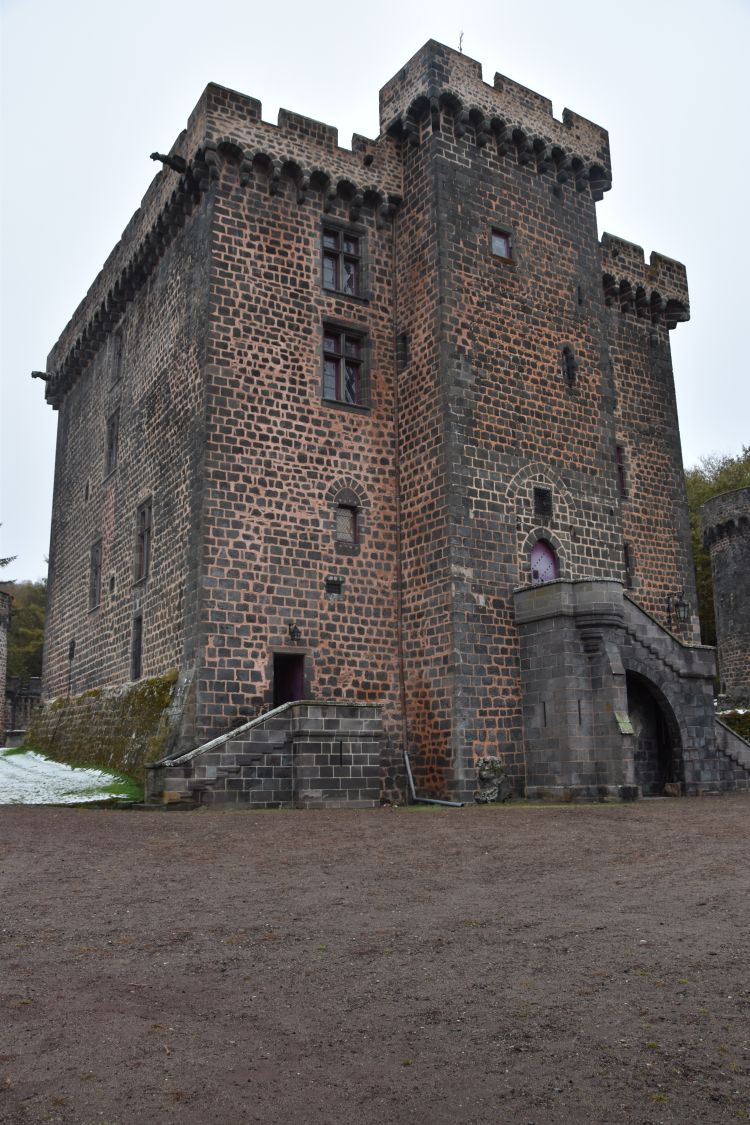
The Castle was built in the 12th and 15th century. 

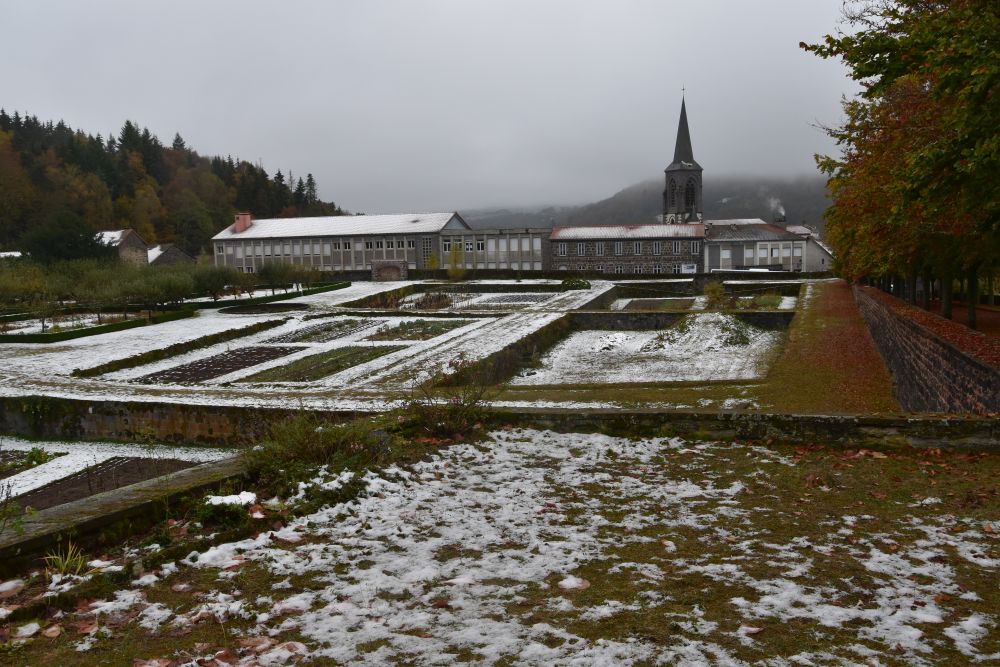
The park – now slightly powdered with snow – overlooks the small town with the church Saint Benoît from the 13th century.

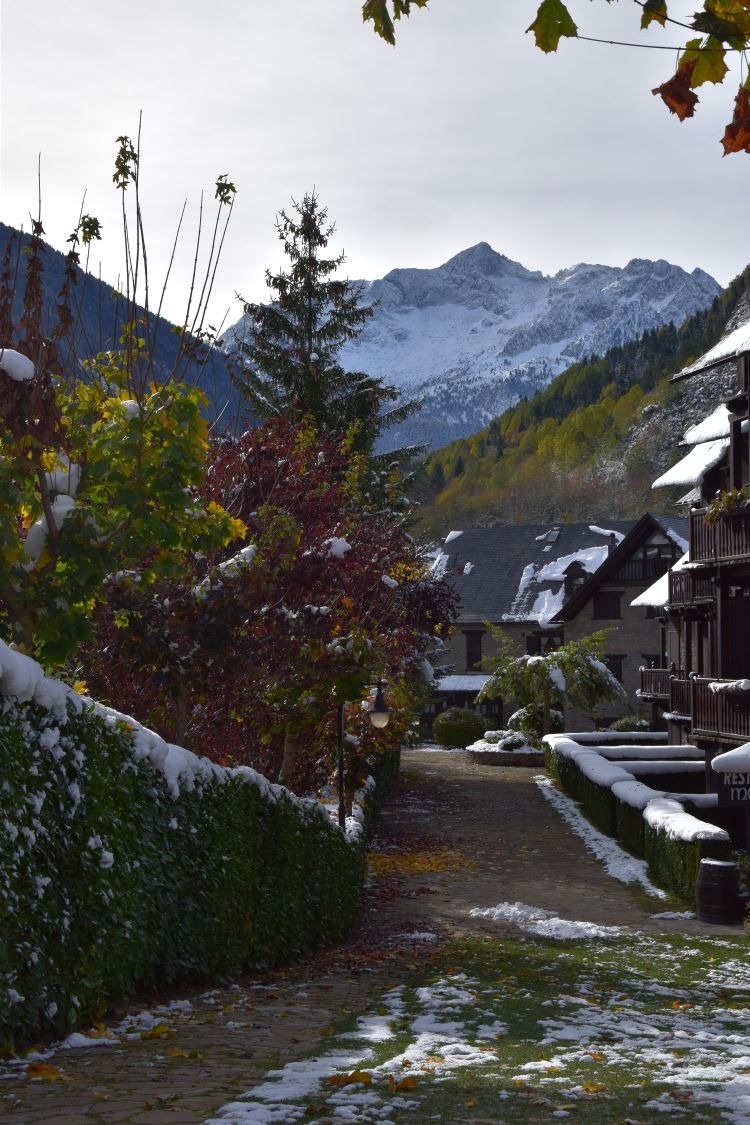
We say good-bye to this friendly small town and leave for the Val d’Aran in the Pyrenées. After having arrived in the Pyrenées in the evening, we hear that in Clermont-Ferrand traffic had been halted by a heavy blizzard. Good for the Hotel de la Poste at Pontgibaud that might now be full of guests that got stuck in the blizzard and decided to stop their journey.

The Albsteig – our four day hike in the Black Forest: From the Feldberg to St. Blasien

Beginning of October 2018, we are on the Albsteig hike that follows the creek “Alb” from its mouth up to its source. This is day #4.

.

Day #4: Herzogenhorn – Bernau and along the Bernauer Alb back to St. Blasien

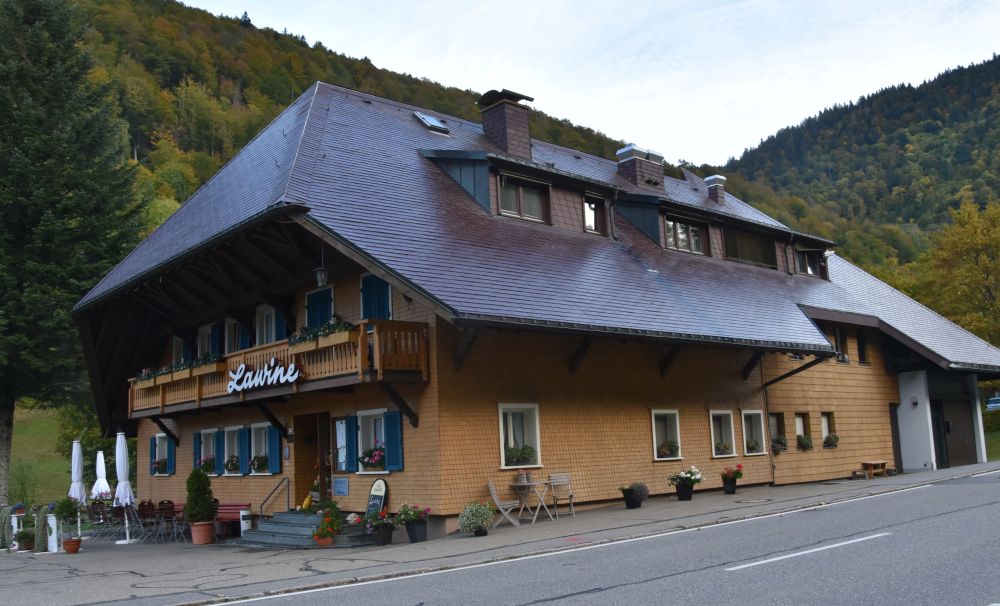
It is now Saturday and our fourth day hiking. After an excellent breakfast at the hotel Lawine we want to take the 8:48 bus back to the Feldberg. We wait at the bus stop next to the “Lawine”. Our watches show 8:48. No bus? Why? We check the timetable. A small “d” next to the Saturday 8:48 bus? Ah, we see, the Saturday 8:48 bus only runs between Christmas and March. It is a skiers’ bus. And now, with this warm weather the skiing season is far – it even seems unreal that there will be a skiing season this year. We wait for another half hour, more or less patiently (me a little less so, Richard a little more so), until the 9:18 bus arrives.

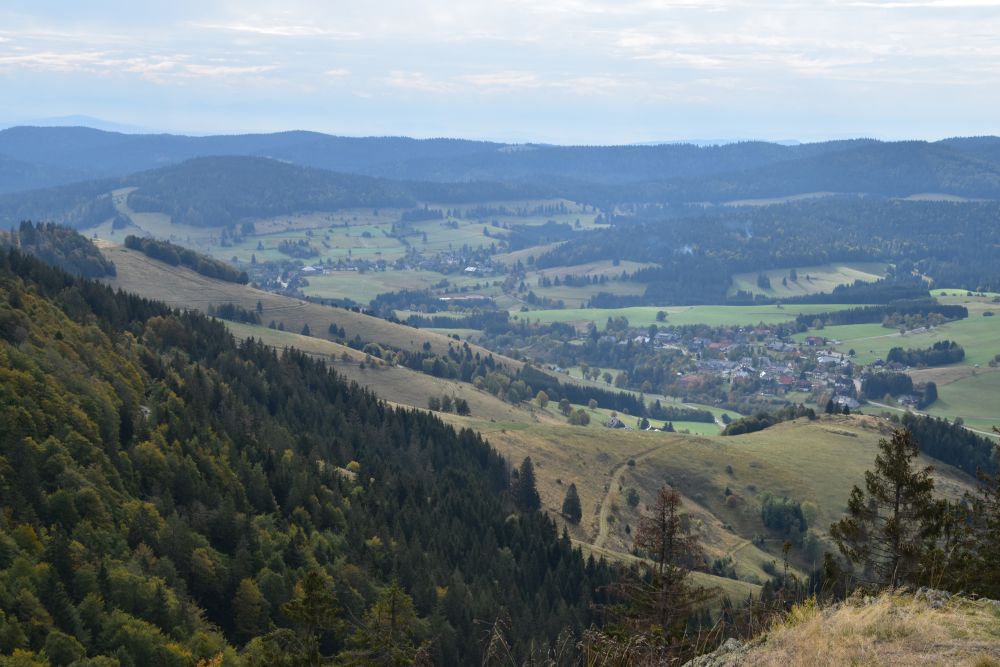
After having reached the Feldberg pass we head off to the Herzogenhorn (1415m). From the summit we see down to Bernau and to the hills that we know from winter, when doing cross country skiing here. Now I understand, the Herzogenhorn is the “Hausberg of Bernau” or “THE local mountain of Bernau”. Next winter,  I will have to look around more carefully to spot the Herzogenhorn and say hello to the “Hausberg” of Bernau.

The sky is less blue today, but the weather is still dry. The Albsteig squiggle leads us straight down to Bernau. We come closer and closer. As it is Saturday today, we meet many hikers.

In Bernau the path takes us to the Bernauer Alb that originates at the western slope of the Herzogenhorn (I was a little sad that I had not seen the sources). Near the Alb we play with the green color shades and the clouds.

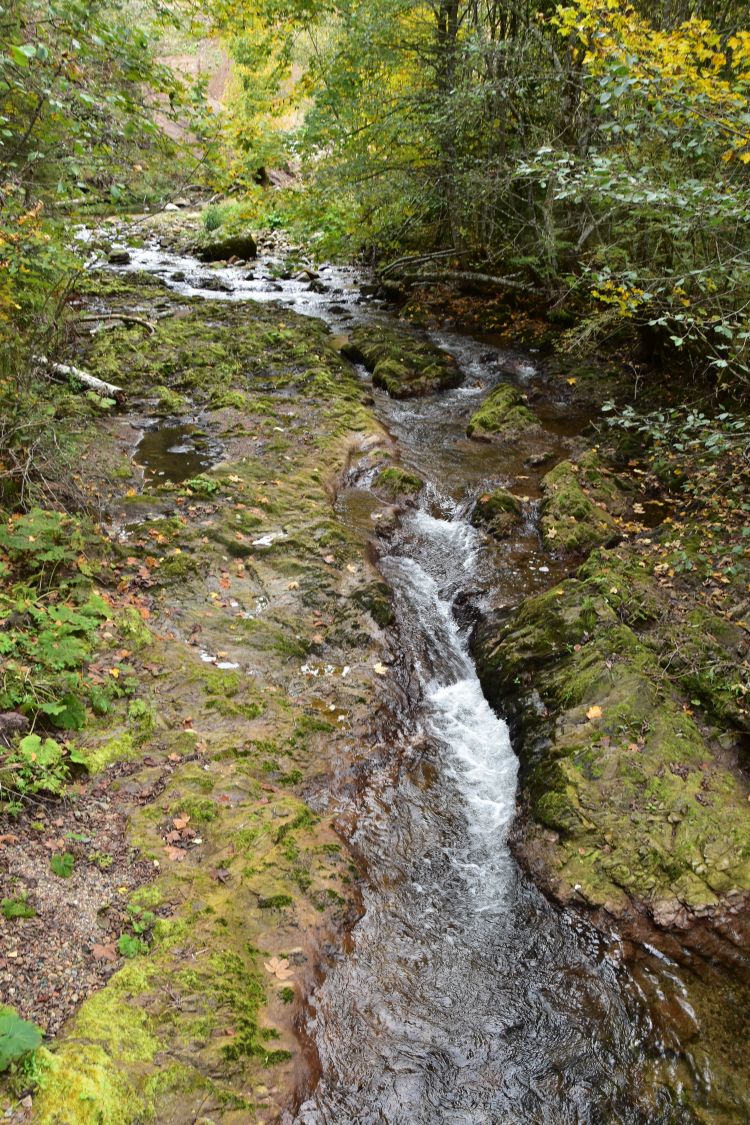
Then we take some impressions from the Bernauer Alb with us. When approaching St. Blasien, the Bernauer Alb becomes more romantic than it is around Bernau.

Near the sawmill “Glashof” the Bernauer Alb and the Menzenschwander Alb join to become THE Alb. Here we miss the squiggle Albsteig marking that would have taken us along the “merged” Alb. Instead we walk uphill to the “Untere Pulverbrücke” and from here down to St. Blasien. This was an involuntary loop – I think that the markings of the Albsteig could need some improvement near the Glashof.

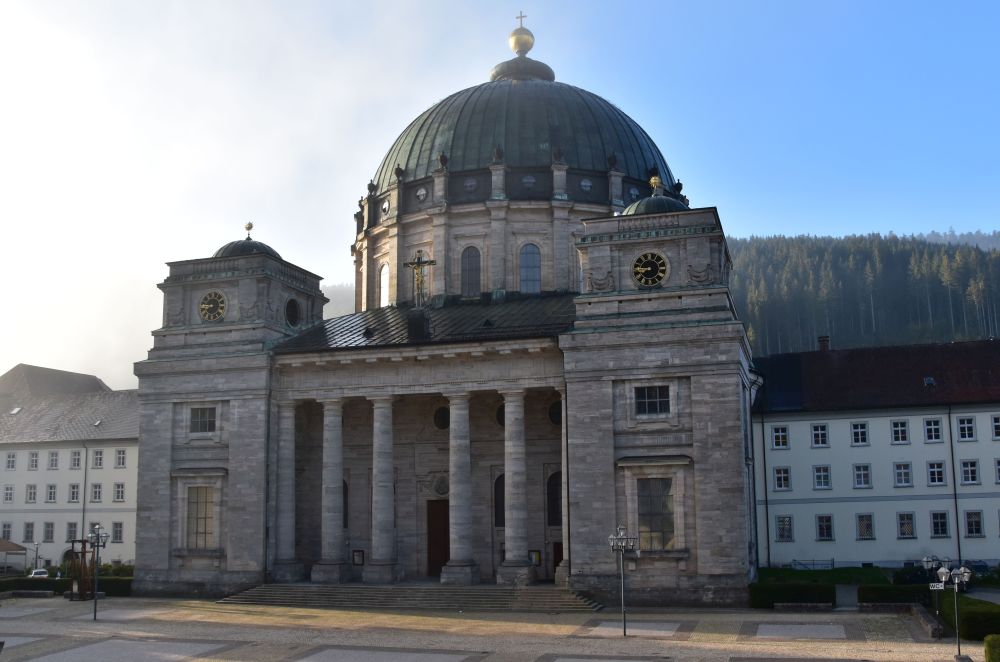
In St. Blasien, we are welcomed in the Domhotel. “How was it – here is your luggage – sure, have a seat on the terrasse…”. We enjoy another one of those excellent German coffees with cakes (Kaffee und Kuchen) and admire the dome of St. Blasien from the terrasse of the Domhotel.

At 17:30 we take the bus to Waldshut. What a great view from Höchenschwand to the Alps! From Waldshut we return to Basel by train. We are back at Basel at about half past seven p.m.. This was an efficient connection that our SBB timetable had revealed to us.

.

Conclusion: The Albsteig would be worth doing with a group, just with some slight modifications

The Albsteig was a great experience. Especially at the start on day #1 we forgot the time while taking photos. Would I return to do Albbruck – Immeneich with a group, I might consider taking a bus from Wilfingen to Immeneich, to allow spending the time along the romantic waterfalls and swirls on the way up to Wilfingen. Walking from Wilfingen to Immeneich was somewhat less interesting.

There were many more lovely spots with great views on the Albsteig trail on day #2 from Immeneich to St. Blasien. I particularly liked the views from Wolpadingen and from the Bildsteinfelsen. However, I would leave out the boring loop around the Albsee and up to Häusern and instead directly head to the waterfall above St. Blasien. This would leave more time in the romantic canyon and at the waterfall and perhaps in addition allow us to visit the dome of St. Blasien (which is a “must see”, when in St. Blasien).

On day #3 from St. Blasien to Menzenschwand, I enjoyed the hike to Menzenschwand and to the waterfall, but then I would climb immediately up to the Feldberg and leave out the boring loop back to Menzenschwand (on a higher level) and forego the goats’ meadow. If someone wants to add more kilometers, it is much more fun to do so at the top of the Feldberg, perhaps even walking up to the tower.

On day #4 going down along the Bernauer Alb I would consider taking the bus from Bernau to St. Blasien for those who do not want to continue all the way to St. Blasien on foot. However, the 20kms of day #4 are easier to overcome, because they are mostly downhill, after having climbed the Herzogenhorn in the morning.

All three hotels we stayed in (Zur Schmiede in Immeneich, Domhotel in St. Blasien and Lawine in Fahl) are only to be recommended and so is the company “Original Landreisen” that organized our tour at very short notice.

The Albsteig – our four day hike in the Black Forest: From St. Blasien to the Feldberg

Beginning of October 2018, we are on the Albsteig hike that follows the creek “Alb” from its mouth up to its source. This is day #3.

.

Day #3: From St. Blasien to the Feldberg

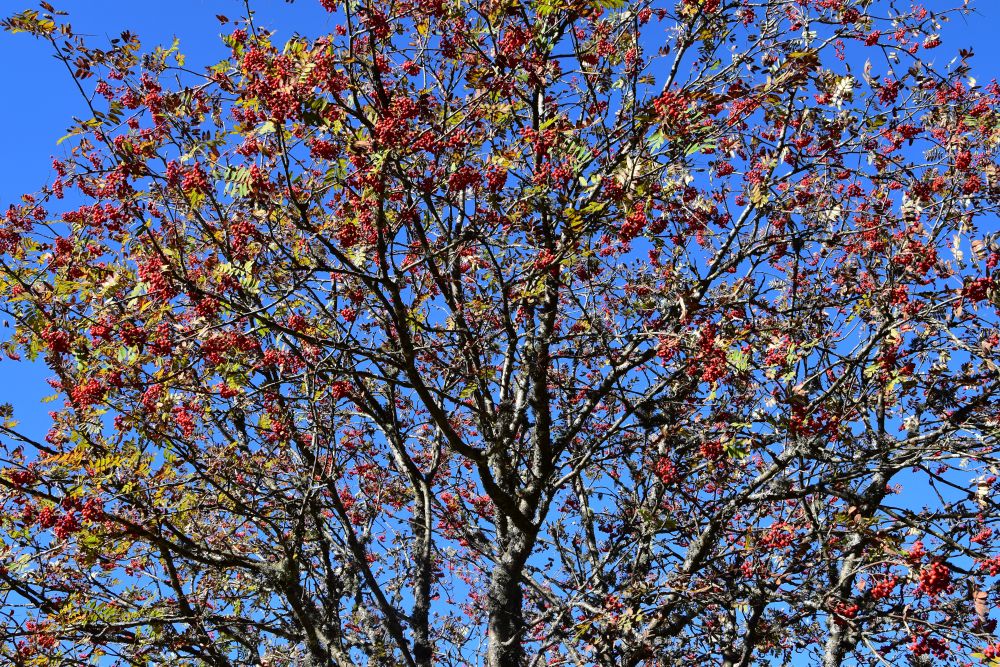
After an excellent breakfast at the Domhotel we start our third day walking.Today we will follow the creek Alb up to the sawmill “Glashof” and then continue along the Menzenschwander Alb up to the Feldberg.  It is another day with deep blue sky. The red berries of this sorbus tree above Menzenschwand contrast with the sky.

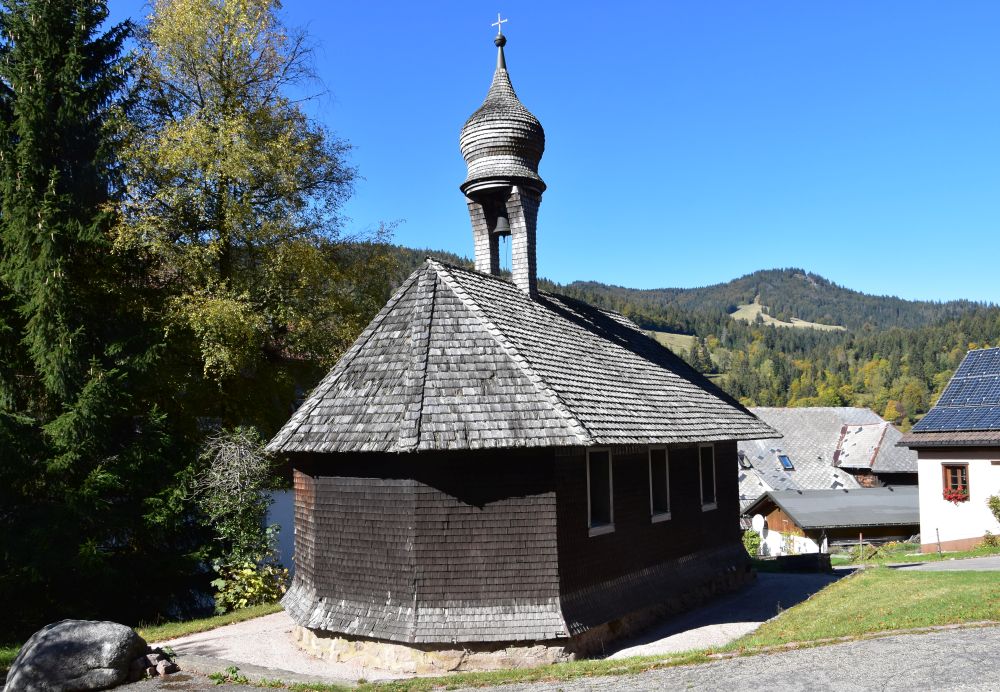
In Menzenschwand we find another wooden chapel. It is a few minutes after 12 o’clock.

An elderly lady opens the door, takes a red rope from a hook on the wall and devotedly rings the bell – for the midday (or shortly thereafter). I watch the scene standing in the doorway. The situation is to solemn to take a photo. “Yes, I do that every day at about midday”, she tells me in a friendly voice.

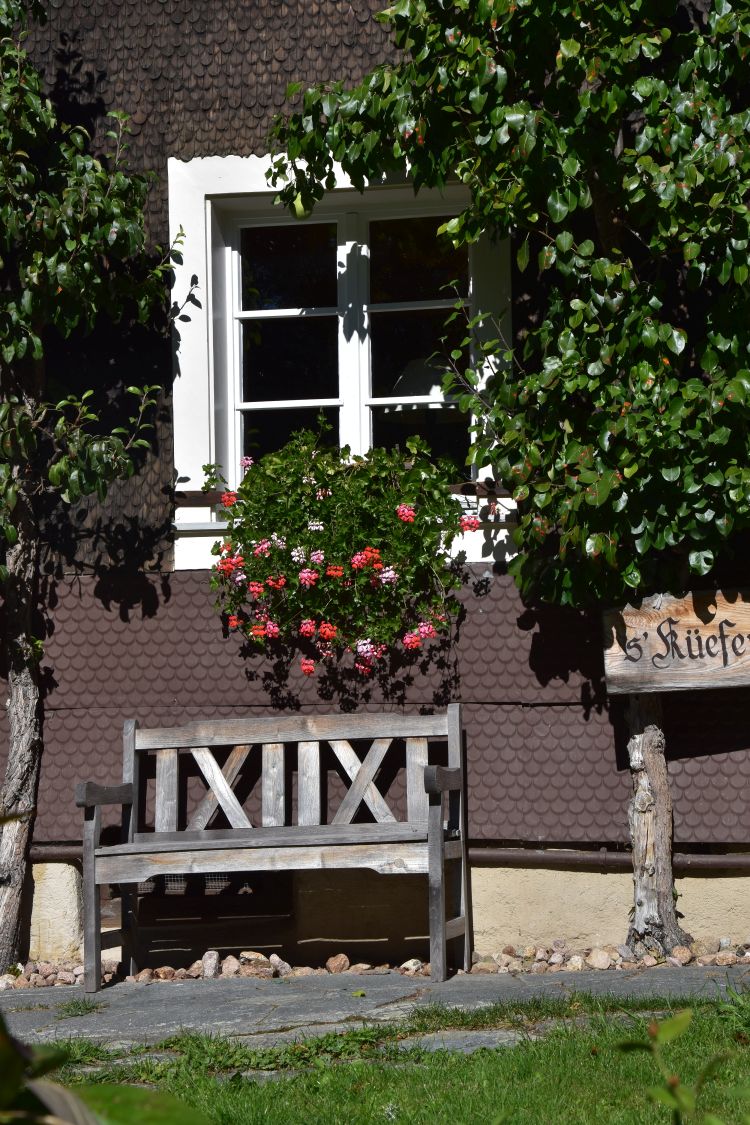
Menzenschwand is a romantic village with houses that are typical of the Black Forest.

I could imagine spending a few days here.

I have a long chat with a lady – also retired – that has decided to settle in Menzenschwand with her husband. They own a large house built in the local style of the Black Forest. She is working in her perfectly kept garden, while her three months old dog with still huge paws does not really trust me.

Radon has been found around Menzenschwand and the Radon Revitalbad promises to revitalise your body.

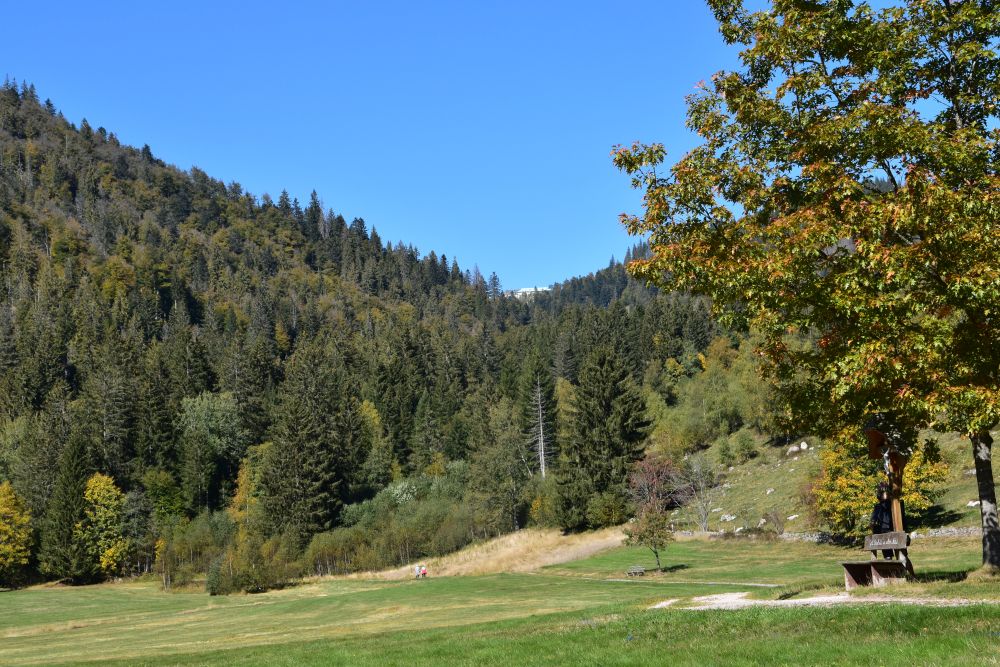
We walk to the end of the trough valley of Menzenschwand and see the Caritas House in  front of us in the saddle – it looks small from here – and we look forward to the waterfall of Menzenschwand and to then climbing uphill in the shady forest to the Feldberg.

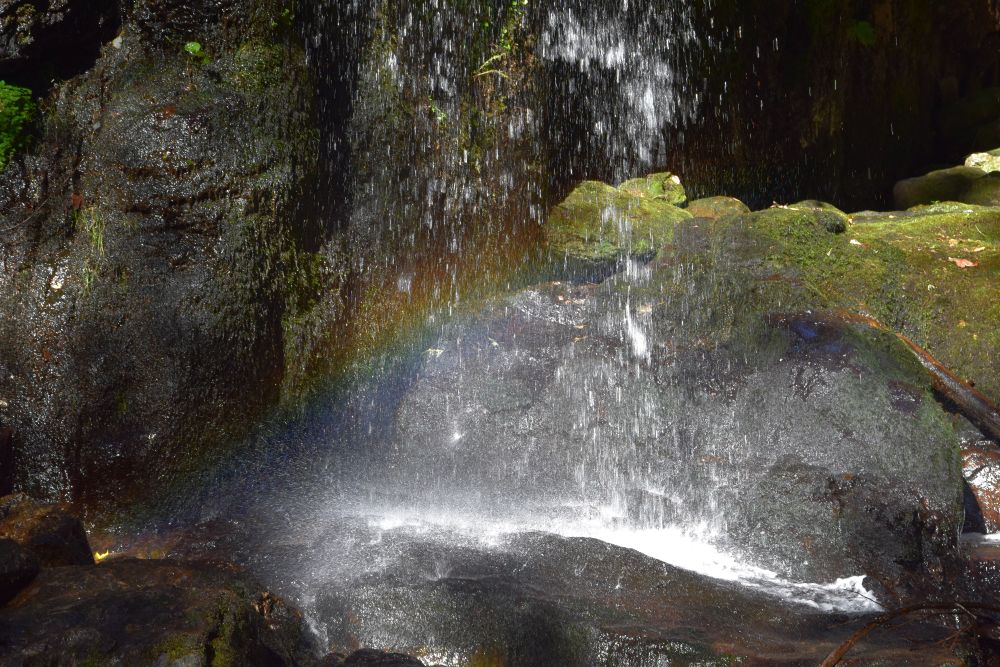
At the foot of the Feldberg there is the Menzenschwander Wasserfall. It can be accessed by car and is well visited. “Oh, look, a rainbow”, the tourists say, climbing up the steps along the canyon.

This rainbow reminds me of another waterfall that I have seen with Ernst almost 18 years ago. It was at the Iguazúfalls in Argentina, where we had this long discussion whether it is a small bucket of gold or just a treasure that you find where the rainbow hits the ground… I neither verified that this time.

From the bridge along the waterfall, I look back to the canyon, where the Menzenschwander Alb jumps from one pond to the next. The roof behind the canyon is a restaurant – but now it was too early for us for the great German tradition of coffee and cake or Kaffee und Kuchen.

Yes, the sun is shining and it is very, very warm. We see the slopes of the Feldberg and now really look forward to climbing uphill in the shade of the trees ahead of us. But, no, the Albsteig has a surprise for us. From the waterfall we have to turn right to the “gate of happiness” with a beautiful view back to Menzenschwand. The path then continues along the slopes and takes us almost back to Menzenschwand (on a higher level). Here the path turns sharply to take us uphill on a meadow with many goats and a billy goat in love (you could smell that). In front of us, we again see the Caritashouse in the saddle of the Feldberg. We get impatient, we want to go uphill now – but no, now the blue squiggle marking points down and back to the waterfall. At the end we have done a loop of almost 360 degrees at the foot of the Feldberg in the burning sun, just adding kilometers that were no fun. We have to overcome a second smaller loop back in the direction of the waterfall, until the Albstein squiggle finally leads us uphill towards the source of the Menzenschwander Alb. In the shady forest our mood brightens up again.

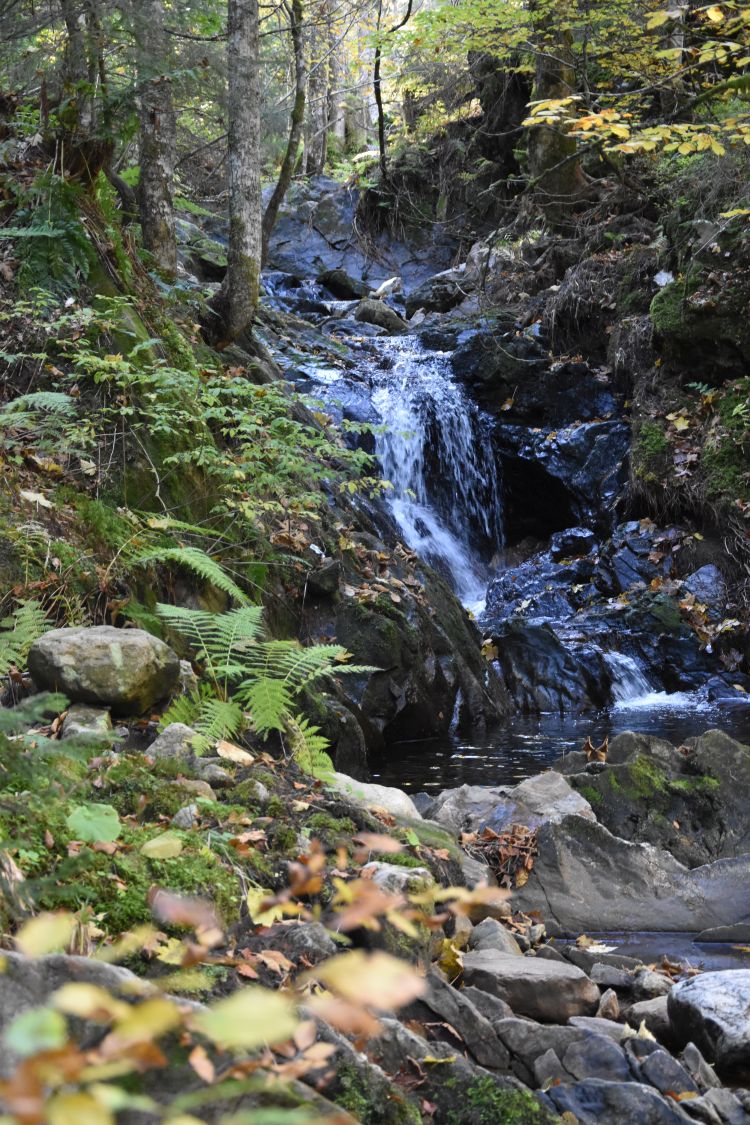
From this small waterfall, a zigzag path leads up to the source aera of the Alb. There are many small puddles in the ground… may be, one day, the architects of the Albsteig path will add an explanatory table about the source of the Alb which actually was the target of the Albsteig hike.

We reach the Feldberg area near the Menzenschwander Hütte (hut) and take the bus to the Hotel Lawine, where we find our luggage waiting for us. The hotel garden is still in the sun. We have German cake with a refreshing beer and a refreshing “Neuer Süsser” (new wine that has just started to ferment). Our evening meal is fresh trout from the Black Forest stuffed with mint herbs for the two of us – excellent. The restaurant is occupied up to the last table, with locals and tourists. Grand-ma (Oma) of the hotel Lawine goes from table to table using her walking frame to have a chat here an there, with her kind eyes. The boss is serving as well, together with a very agile servant from Croatia. Yes, the atmosphere is welcoming and very familial.

After our third long day, we again slept well in our cosy rooms.

The Albsteig – our four day hike in the Black Forest: From Immeneich to St. Blasien

Beginning of October 2018, we are on the Albsteig hike that follows the creek “Alb” from its mouth in Albbruck up to its source on the Feldberg. In my previous blog I have described day #1. Now I continue with …

.

Day #2: From Immeneich to St. Blasien

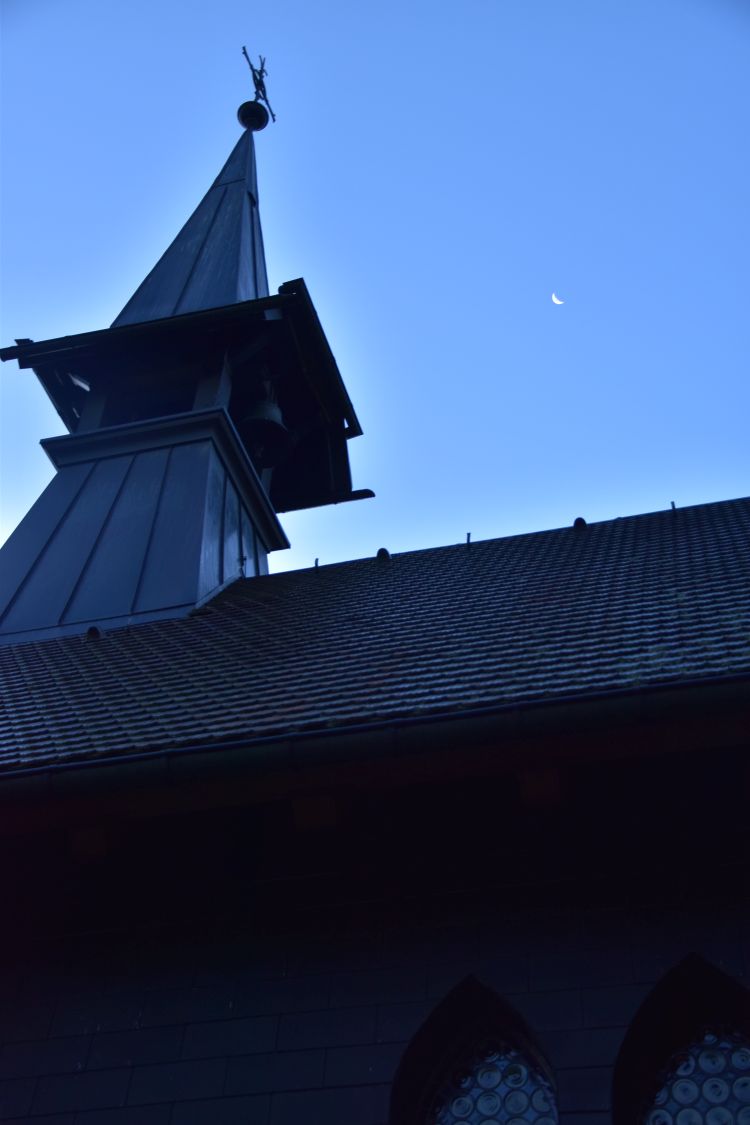
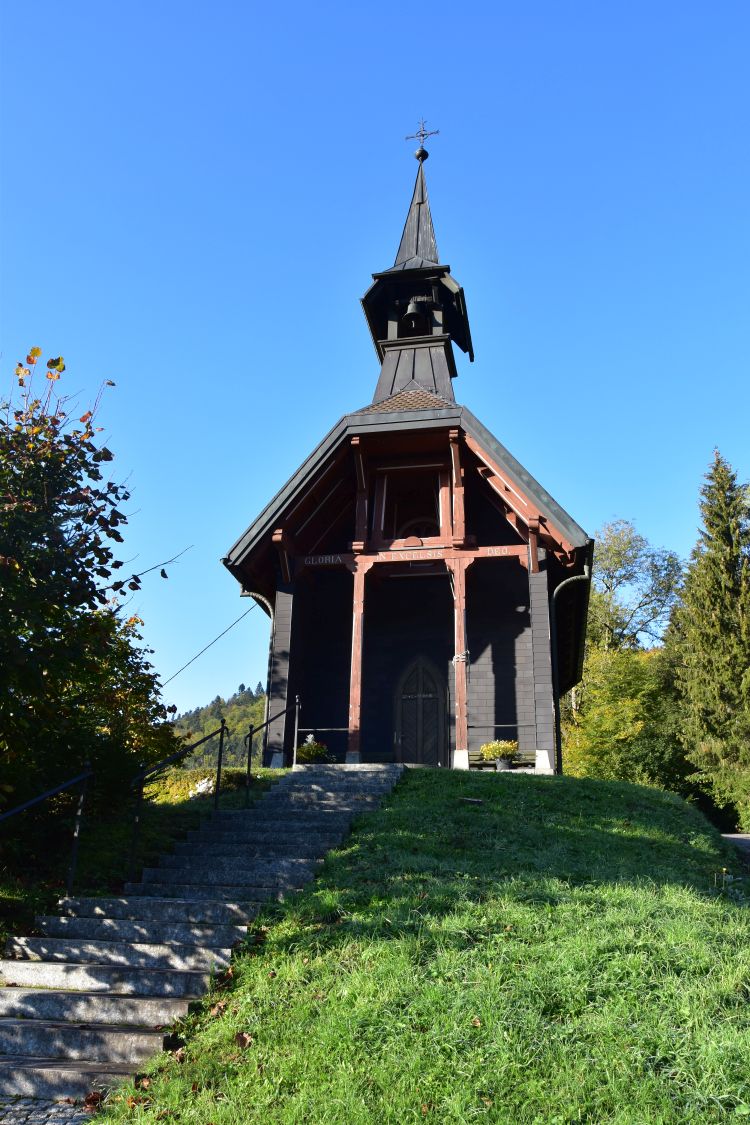
In the morning we get up early to take photos of the pretty wooden chapel of Immeneich (Bernhardskapelle built in 1895).

After a delicious breakfast in the hotel zur Schmiede, we start our second day hiking. Now the sun plays with the wooden chapel. The sky is blue, nothing but blue. Beautiful. We walk by the wooden church…

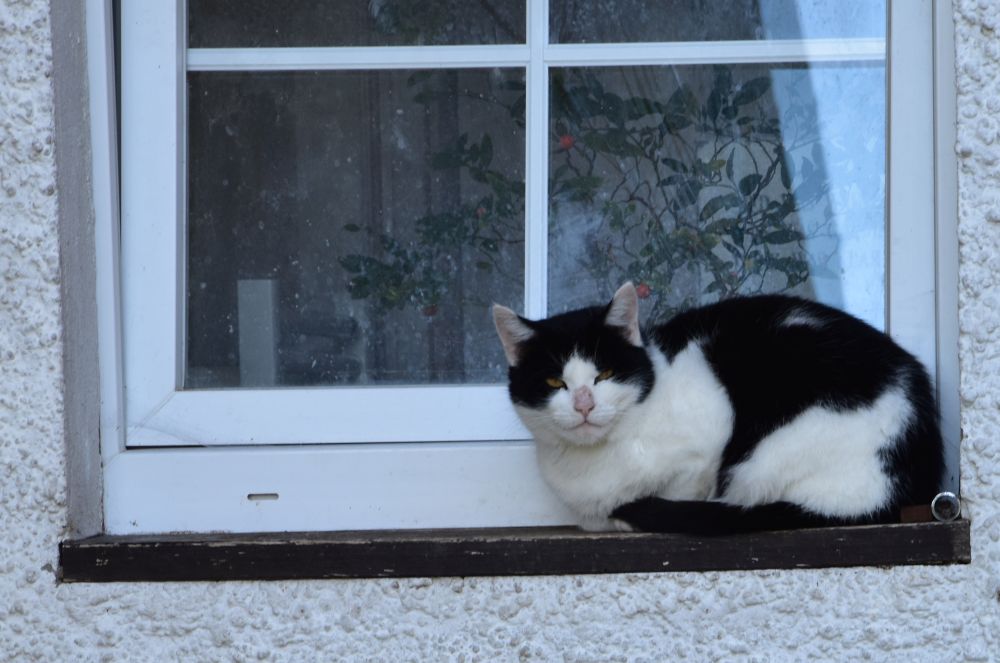
… and climb steeply uphill in the forest, on a narrow path. First the squiggle markings guide as well, but then they disapper – and so does the path. For some time, we stray looking for our Albsteig markings. Finally we reach a wider path that we follow southwards and slightly uphill. Oh, great, the houses of Wolpadingen appear behind the trees, and an Albsteig marking says that we are back on track. This cat welcomes us in Wolpadingen.

We continue to the summit of the Dachsberg. We are now at 950m. The view is hidden behind the trees of the forest that, as we learn, once formed the border between the dominion of St. Blasien and the area around Wolpadingen. In the dominion of St. Blasien, the farmers were in bondage, around Wolpadingen they were free. The whole region belonged to Habsburg until 1806.

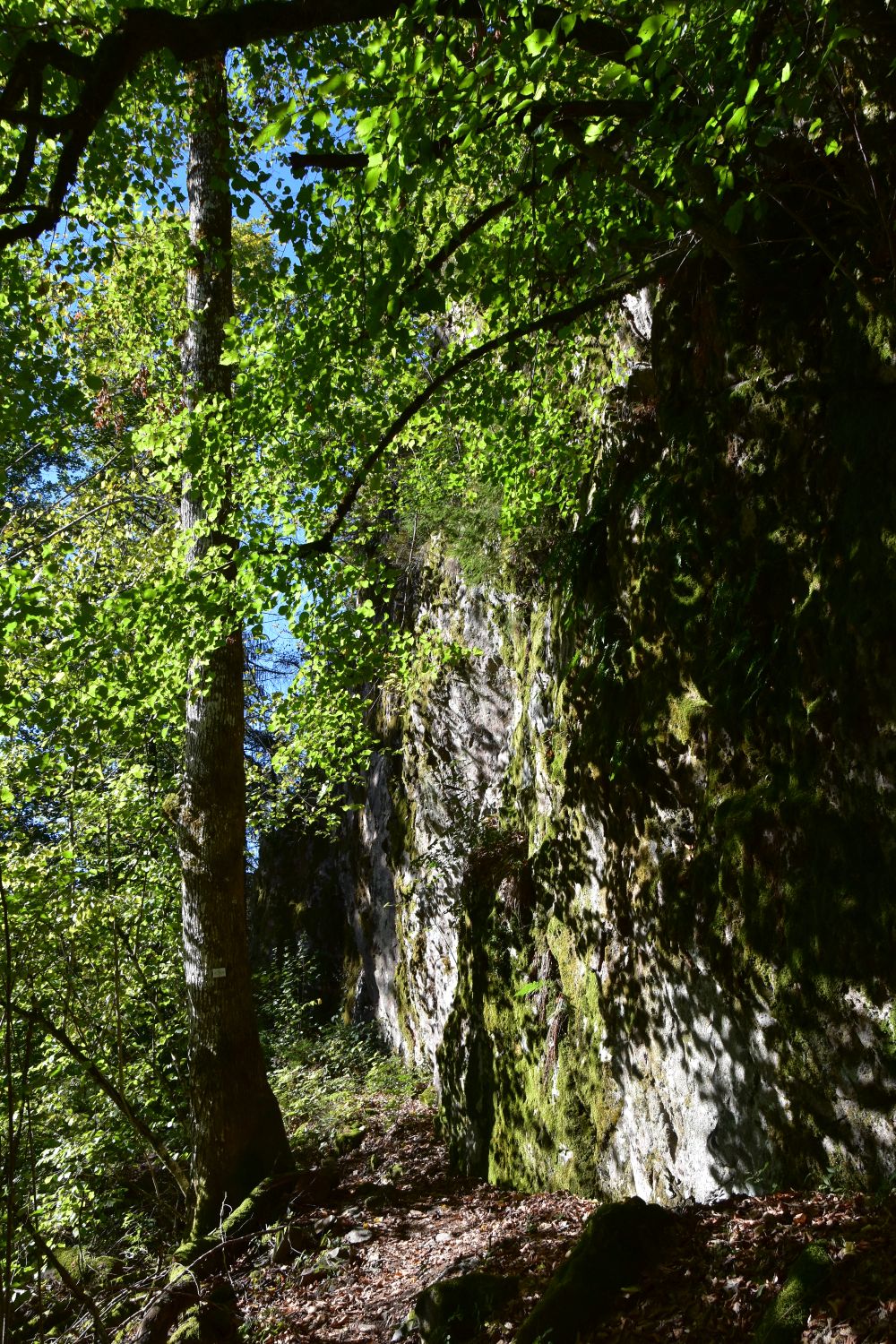
Now the path goes steeply down and creeps along the so-called Kalberfelsen.

We look into the blue sky and dream.

We climb steeply up again to the Bildsteinfelsen, where we have a gorgeous view into the Alb valley and the hills of the Black Forest. The temperatures allow us to sit down and enjoy the view. We sit here together with a mother and her daughter that are also doing the Albsteig, mum perhaps with more enthusiasm than her daughter.

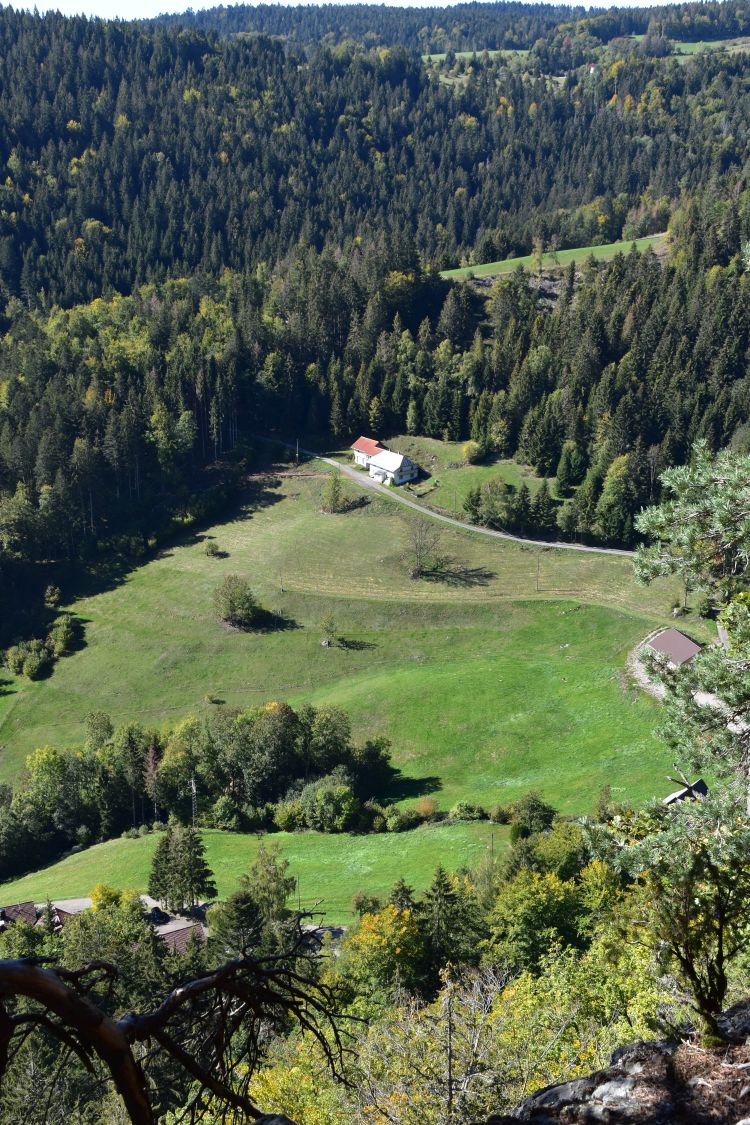
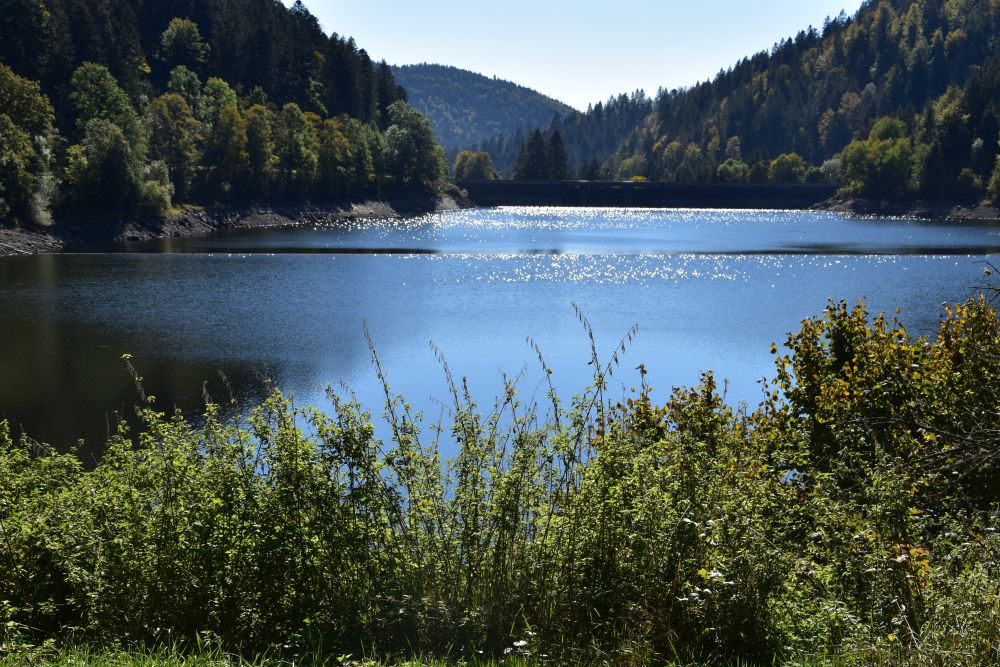
A steep path brings us down to a broader route that takes us to the Albsee. It is a barrier lake that has been constructed during the second World War. The sun plays with the blue water surface.

Following the Albsteig markings, we have to walk around the lake (almost 360 degrees) and then steeply up to Häusern (above the Albsee). Watch out, here is a skilift – there are signs warning us – very odd on this warm and sunny autumn day.

When about to enter Häusern, it takes us some time to understand that the Albsteig squiggles ask us to turn back to where we more or less came from and then continue on a tiny path around a rock. Finally we enter Häusern “from behind”. This loop seems superfluous to us – we do not enjoy adding “useless” kilometers.

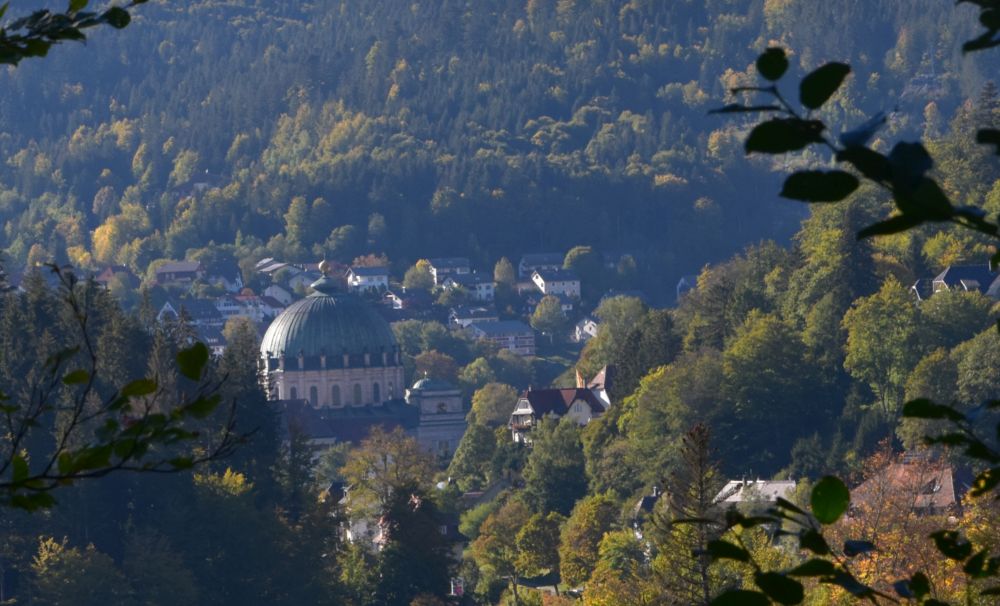
After having crossed Häusern, we walk above the Alb valley straight in the direction of our target, St. Blasien. Suddenly Richard exclaims: “Look – here – look.” Look at what? Aha, there is a small interruption in the line of trees “blocking” the view to the valley, and from here, we can see the dome of St. Blasien. Difficult to capture, there are always some leaves in the way… Also the tripod cannot change that.

A dome in the middle of the mountains? The monasterial tradition in St.Blasien goes back to the 9th century, when monks belonging to the community of Benedict settled here. Already then, some relics of Saint Blasius were transferred to St. Blasien (he died in 312 AD). In 1218 the monastery was acquired by Habsburg. In the course of the centuries the monastery had been destroyed and rebuilt several times. In the 18th century, it thrived. After another fire, the dome was rebuilt in early neo-classic style with the huge cupola. The new and prestigious dome was inaugurated in 1783. At that time, the cupola was the third largest in Europe. In the middle of the Black Forest! After another fire, the dome was restored again in 1888 (Source: Dom zu St. Blasien im Südschwarzwald, Kunstverlag Josef Fink, 2012).

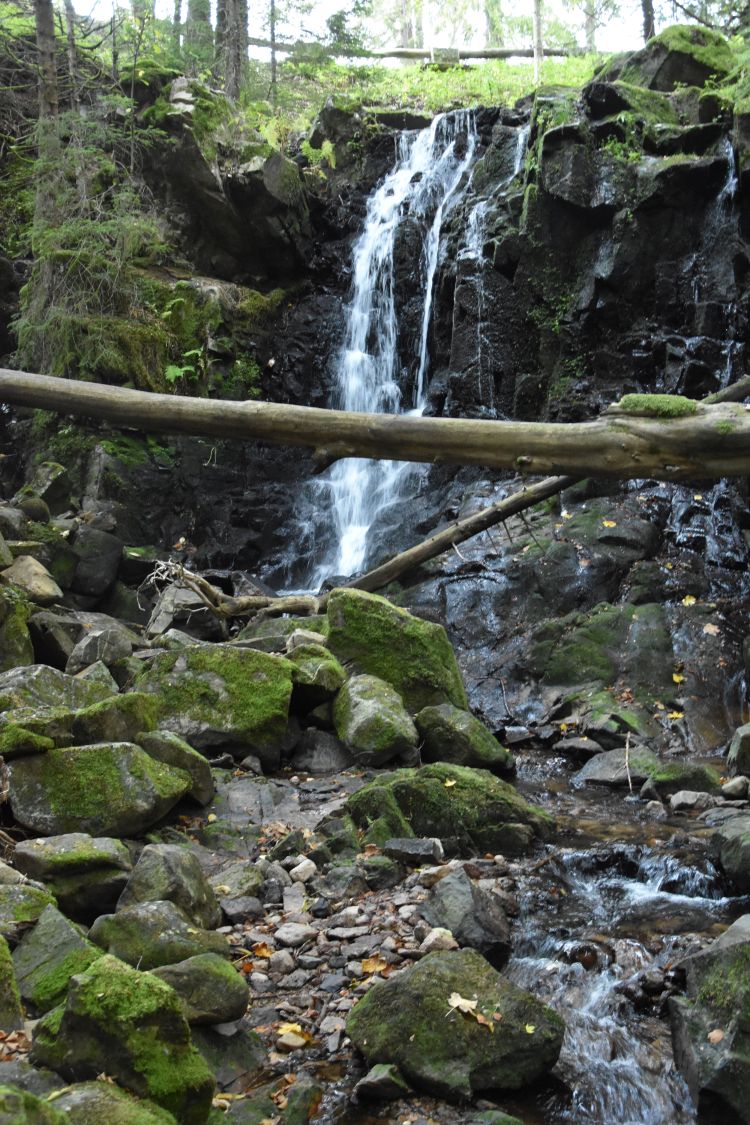
Just above St. Blasien we climb up a canyon full of chilly fresh air to find the finale for today, the Wildberg waterfall. However, this trunk is “disturbing” the view. While Richard installs himself underneath the trunk to take a photo of the waterfall without the obstacle,…

… I look back into the canyon where the water jumps from one pool to the next. I think we should come back to spend more time here, but now we are tired.

It is almost six pm and we take the fastest route down to St. Blasien. We stay in the Domhotel, just across the dome, where again our suitcases are waiting for us. We change and have an excellent dinner (deer with red cabbage and Spätzli for me and zander for Richard). After dinner, we take a photo of the dome of St. Blasien – this is the view from one of our rooms.

Also the second night I sleep well – all the walking and the savory dinner are doing us good.

The Albsteig – our four day hike in the Black Forest: From Albbruck to Immeneich

“Would you feel like joining me to do the Albsteig”, Richard asks me and he adds: “The Albsteig hike follows the creek “Alb” from its mouth up to its source”. The Alb? Yes, I know an Albtal or Alb valley that is close to Karlsruhe in the Northern Black Forest. My grand-ma used to collect mushrooms there – and as a child, I often joined her. “No, no”, Richard says, “there might be two “Alb” valleys in the Black Forest, the one of your grand’ma in the north, but THIS “Alb” valley originates on the Feldberg and ends in Albbruck (near Waldshut) where the Alb joins the Rhine river. The Albsteig has been opened last year and there was an article about it in the newspaper of Basel”. Oh, yes, good idea, I do feel like joining Richard.

On very short notice, Richard contacts “Original Reisen” in the beginning of October 2018. They book three hotels for three nights for us and send the Albsteig material to the Hotel Bahnhöfli in Albbruck. I buy 1:25’000 maps from Kompass that show all the relevant hiking markings of the area (I love to have the overview over a larger area, when hiking).

.

Day #1: From Albbruck to Immeneich

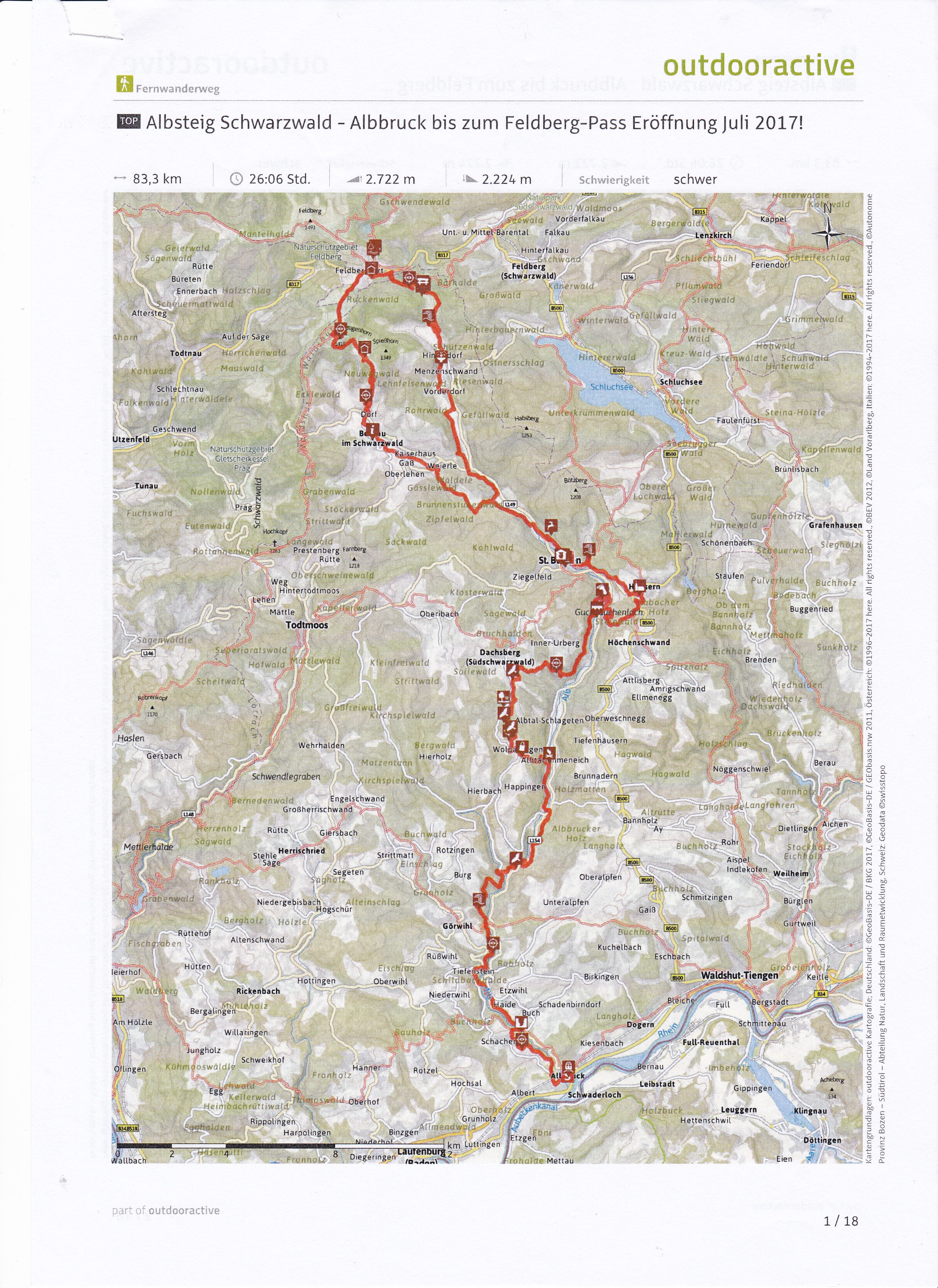
On a slightly grey Wednesday, we take the slow train from Basel to Albbruck. Mr. Berisha of the Hotel Bahnhöfli hands out the Albsteig material to us. Faleminderit. We stick the labels indicating our hotels to our small suitcases and leave them in the gangway. Over a cup of coffee we study our material. Detailed maps were included in the package. This overview map shows what we were up to: Albbruck – Immeneich – St. Blasien, then along the Menzenschwander Alb to the Feldberg and back along the Bernauer Alb to St. Blasien. All in all about 90km and 2700m uphill in four days.

Source: Material of Original Landreisen handed out to us for the Albsteig

“Look, we have to get used to the blue squiggle”, Richard says. This is the marking for the Albsteig.

We say good-bye and mirupafshim to Mr Berisha and the Bahnhöfli and start to walk following the blue squiggle. We are now at 324m above sea level.

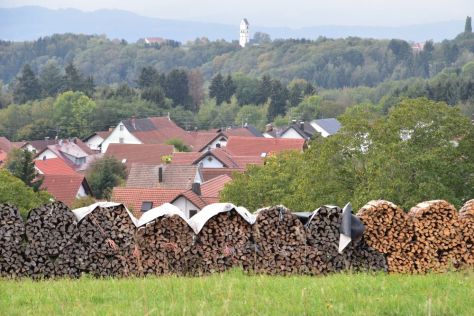
The path leads us gently uphill, on green meadows, well marked with the blue Albsteig squiggles. The first small village we encounter is Schachen. There is an alemannic style church in the background, as you find them everywhere around Basel.


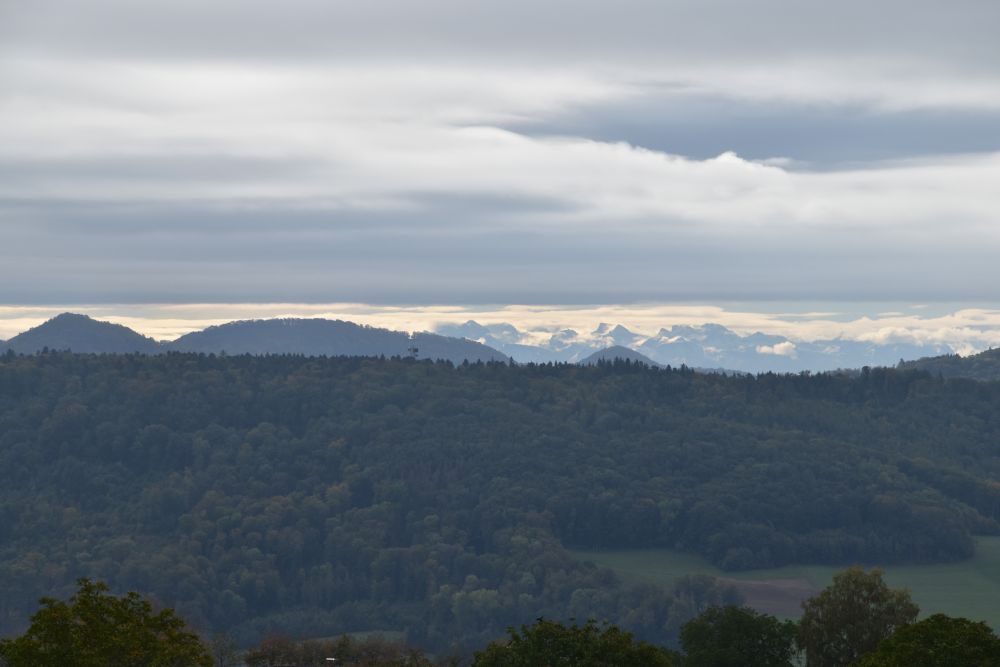
In the background we can see the Alps under grey clouds.

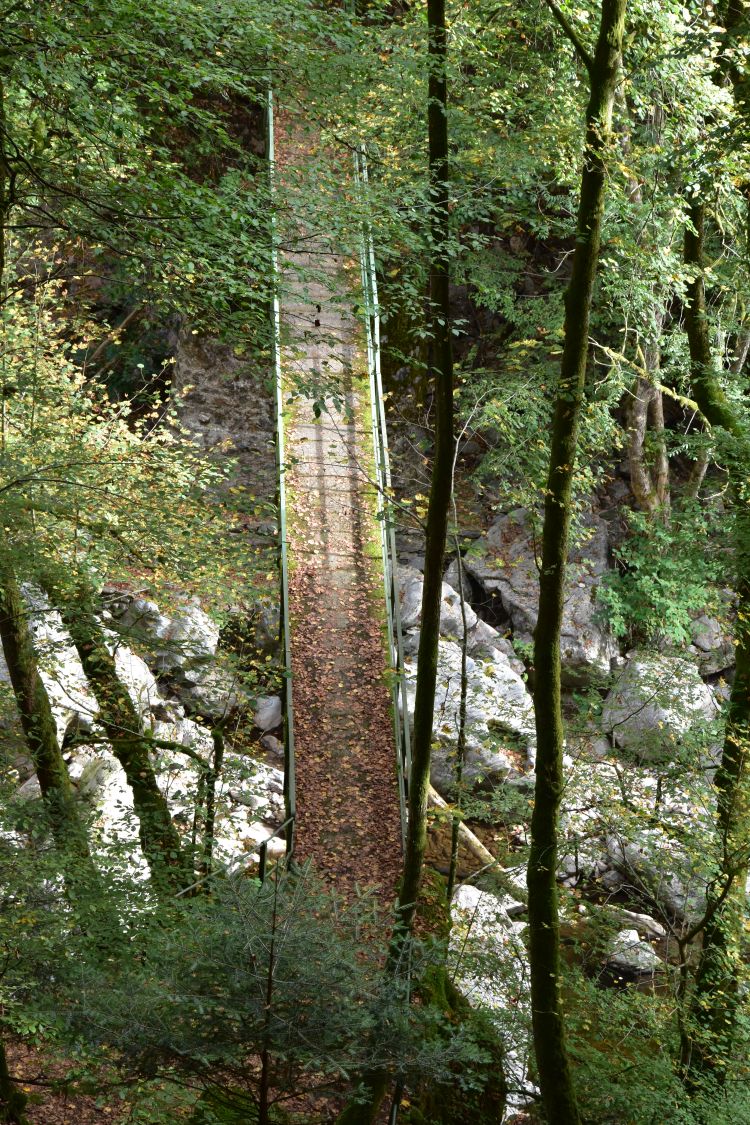
From Schachen, we walk steeply down to the Alb. There are pieces of gold on the narrow bridge – or it looks like it, as the leaves shine in the sun.

.

Underneath the bridge, the water is very clear and decorated with more pieces of gold.

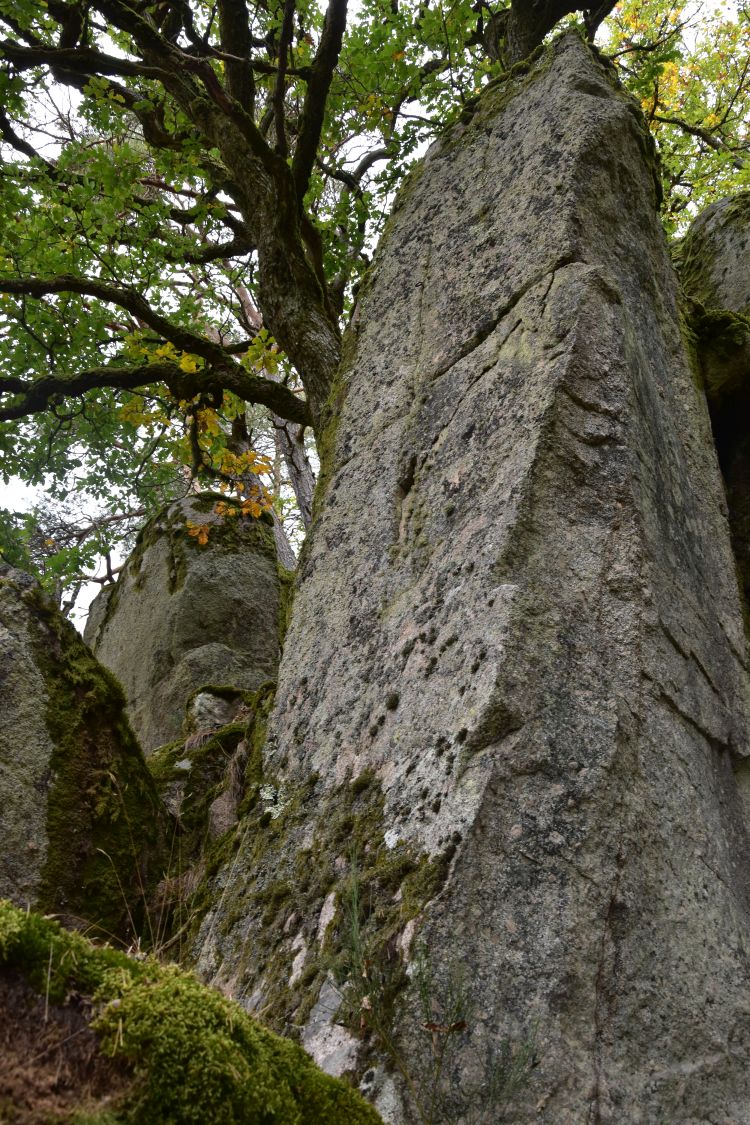
We walk uphill again and find rocks that the glaciers have left here about 10’000 to 20’000 years ago.

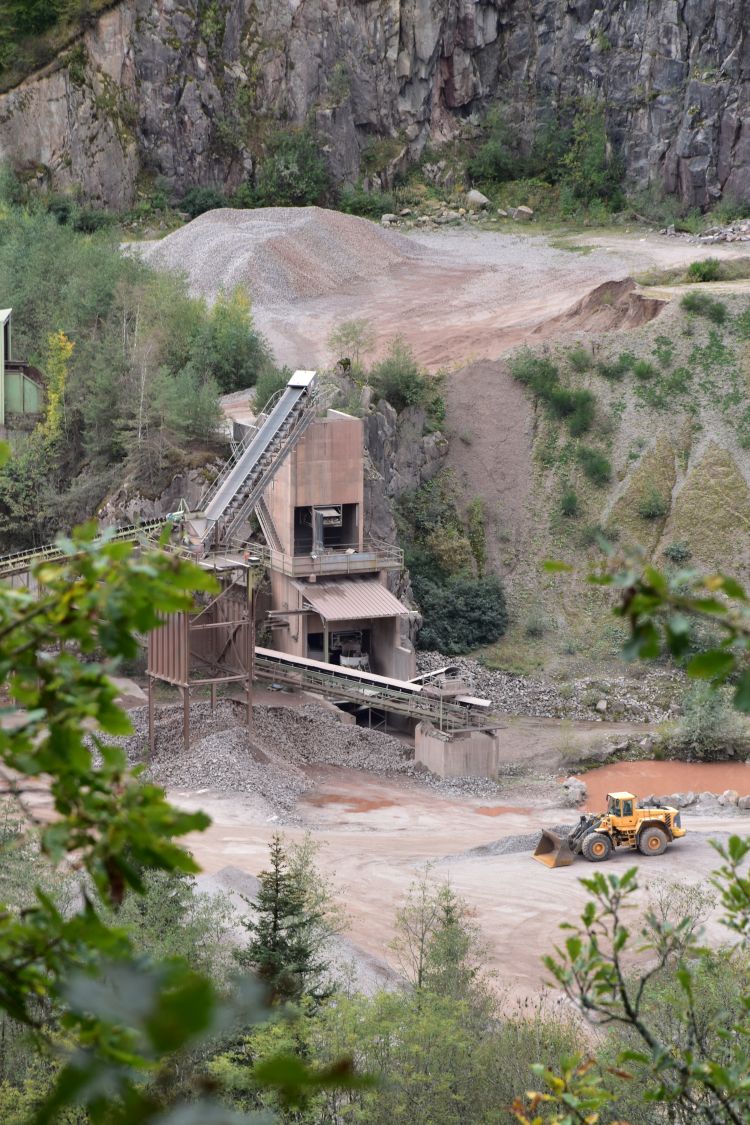
We come across the granite quarry of Tiefenstein which is a less romantic sight, but belongs to the Black Forest as well. Geologically spoken the Black Forest is a basement rock (covered with sandstone). The information table explains to us that retrieving granite here is a hundred year old tradition and the granite is used for building water barriers, stonewalls or streets.

Going up again, we reach the area around Görwihl. We come across another Albsteig hiker, who plans to sleep in a hotel at Göhrwil. It is the first hiker that we meet today. He has parked his car in St. Blasien, a good idea. For us it would be far too early to stay overnight here – it is only one o’clock.

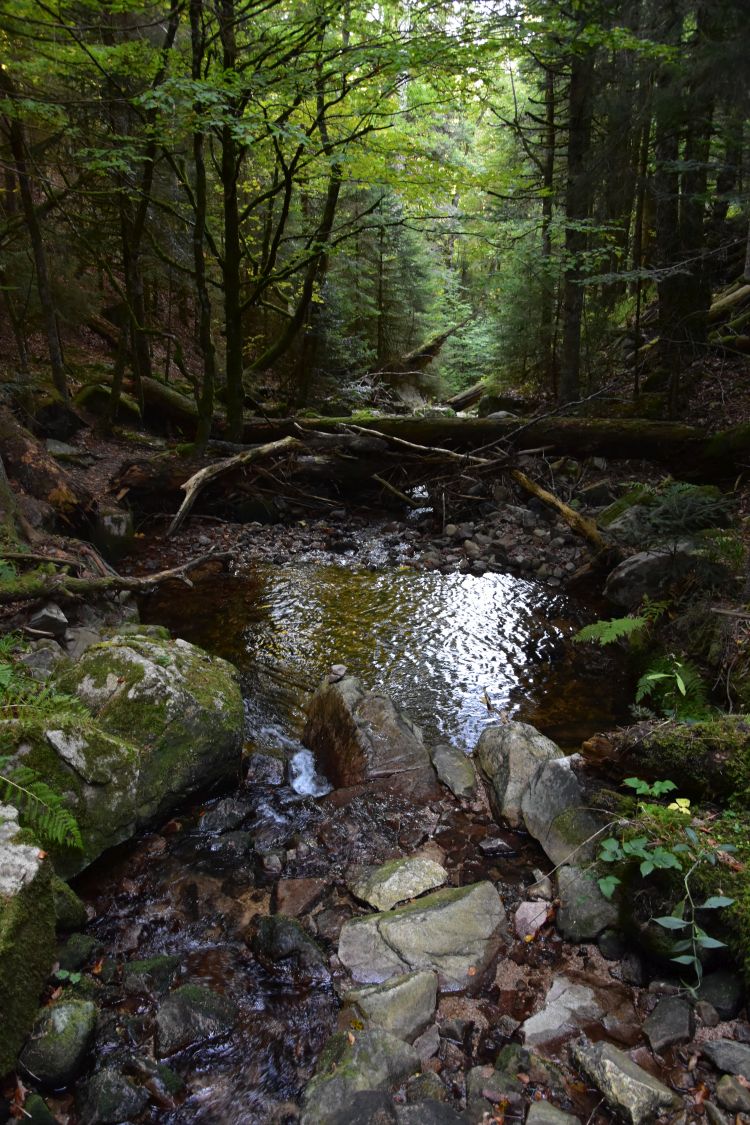
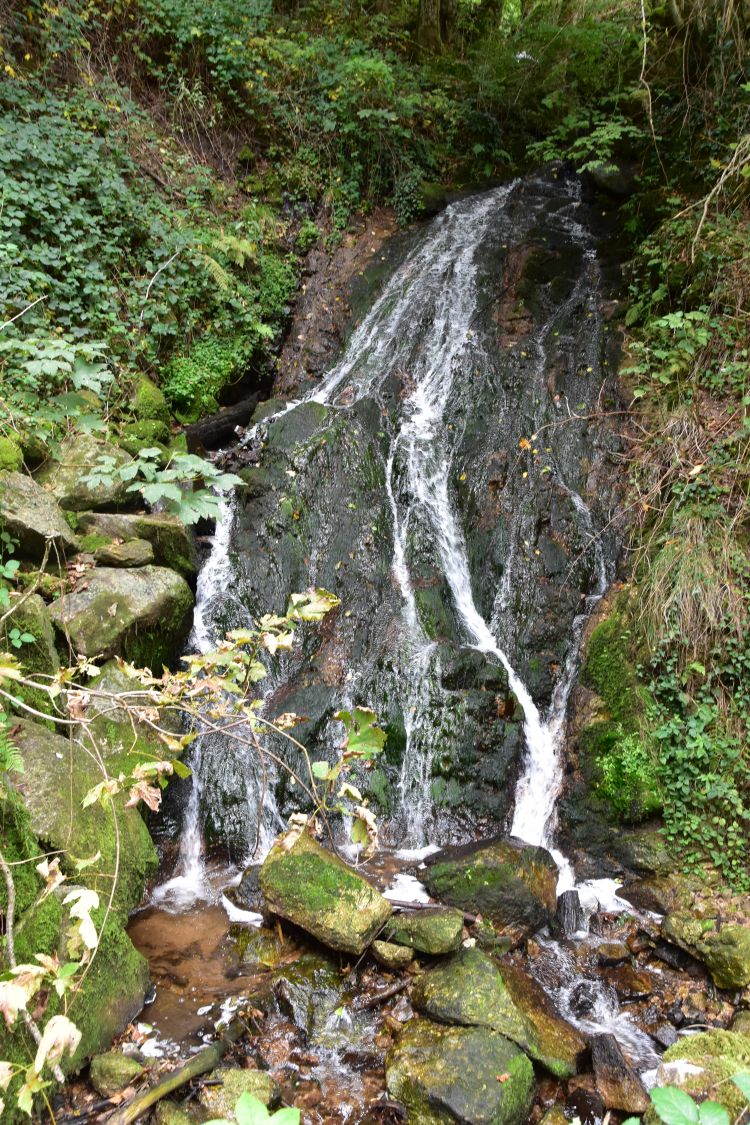
We enjoy this small waterfall belonging to a system of creeks called Wühre.

The path takes us down to the Alb again. Here I shoot this mysterious photo that a few days later I will use as a condolence card.

The trail climbs up again into the romantic Höllbach valley.

While Richard takes out his tripod to capture the Höllbach waterfall in his professional way, I study my 25’000 Kompass map. I discover that now it is almost 3 p.m. Since 9:30 a.m. we have done about half of our hike from Albbruck to Immeneich, where the hotel “zur Schmiede” is waiting for us. There has just been too much to see and too much worth taking photos of. As we want to reach our hotel before night, we decide to walk faster, just quickly stopping at the Teufelsküche with its swirls. A narrow trail climbs up again from the Teufelsküche and then follows the eastern slope of the Alb valley, always more or less on the same level.

Shortly before six, we see Immeneich in front of us. A lady with her dog asks: “Are you doing the Albsteig?”. At the entrance of Immeneich, an old man asks as well: “Are you doing the Albsteig?” The local people are proud of their Albsteig. They are very hospitable and we have a long chat with them.

In the hotel “zur Schmiede” we are welcomed by Mr Meili. Our suitcases are waiting for us. We change – it is great to dress up for the cosy restaurant. We enjoy dinner (deer and Spätzli for me, porcini for Richard, all with a  local wine from Auggen). Mr. Meili’s accent reveals that he is definitely not from the Black Forest. “I am from Zurich, I love to do hunting and I love the Black Forest”, he says. He does everything in his hotel – receptionist, cook and waitor – and we feel good here. We meet two couples from China that have booked this remote and quiet hotel over booking.com. Very clever choice! But sorry, no, we do not speak Chinese.

During the night we sleep well – it is quiet here.


Pratdip (Catalonia) and Perucho’s natural history of the vampire Dip


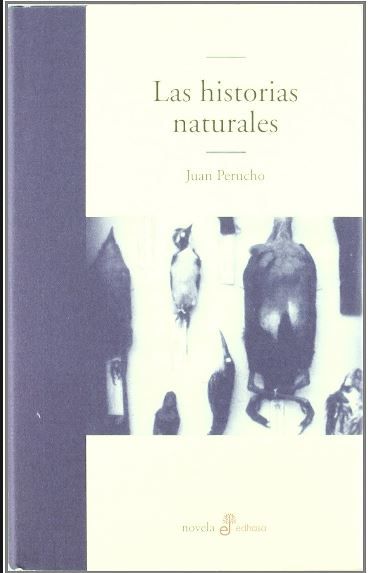
Again and again we traveled to Catalonia, south of Tarragona. Again and again we noticed the sign to the village Pratdip pointing to the mountains. One day, we followed them and we found Dip and Joan Perucho’s novel „natural history“ or in Spanish “las historias naturales”.

Let me tell you more about Pratdip and its vampire Dip.

.

Pratdip is a small village and the inhabitants are proud of their Dip

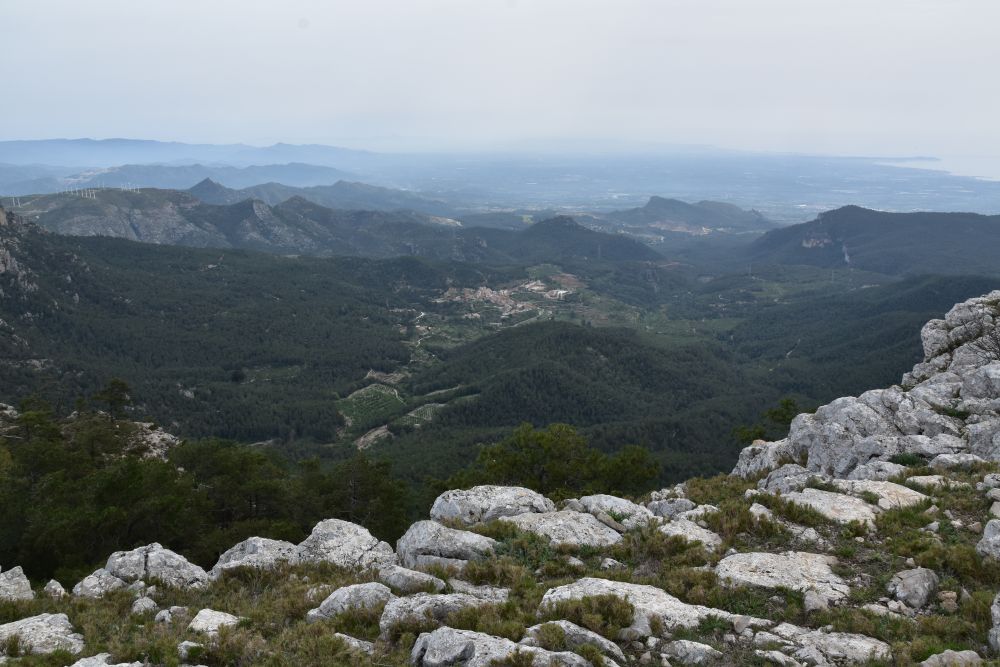
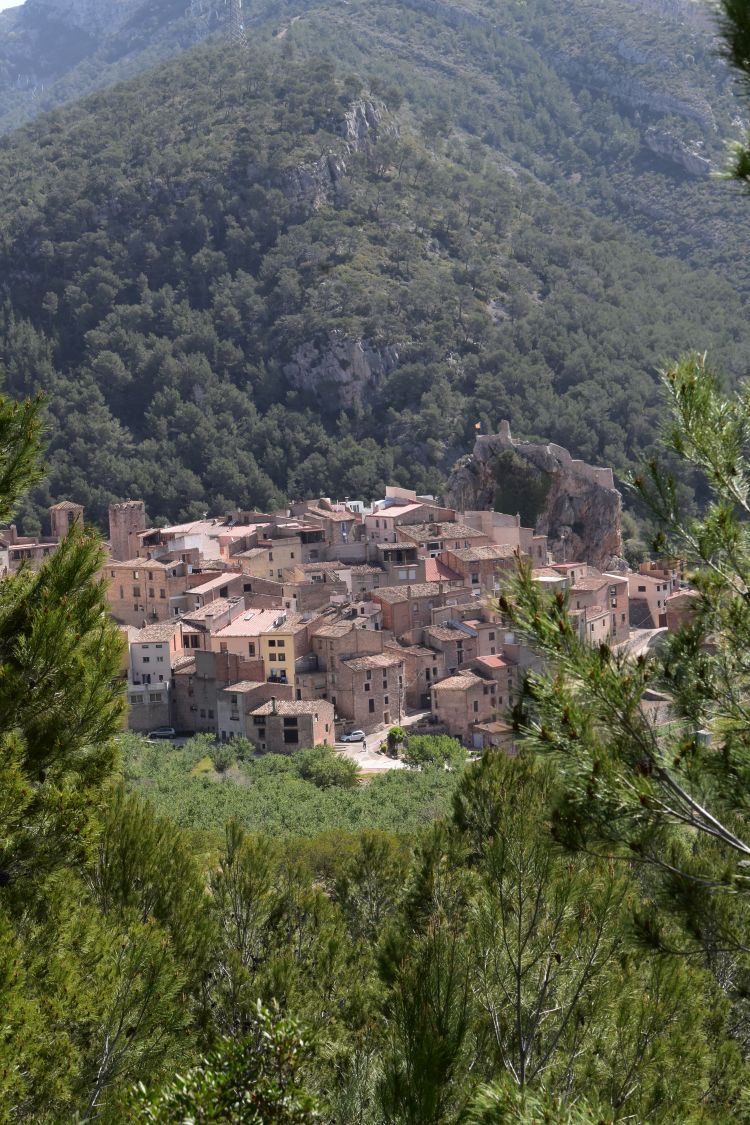
Pratdip is located in the mountains of Llaberia, some 40km southwest of Tarragona.

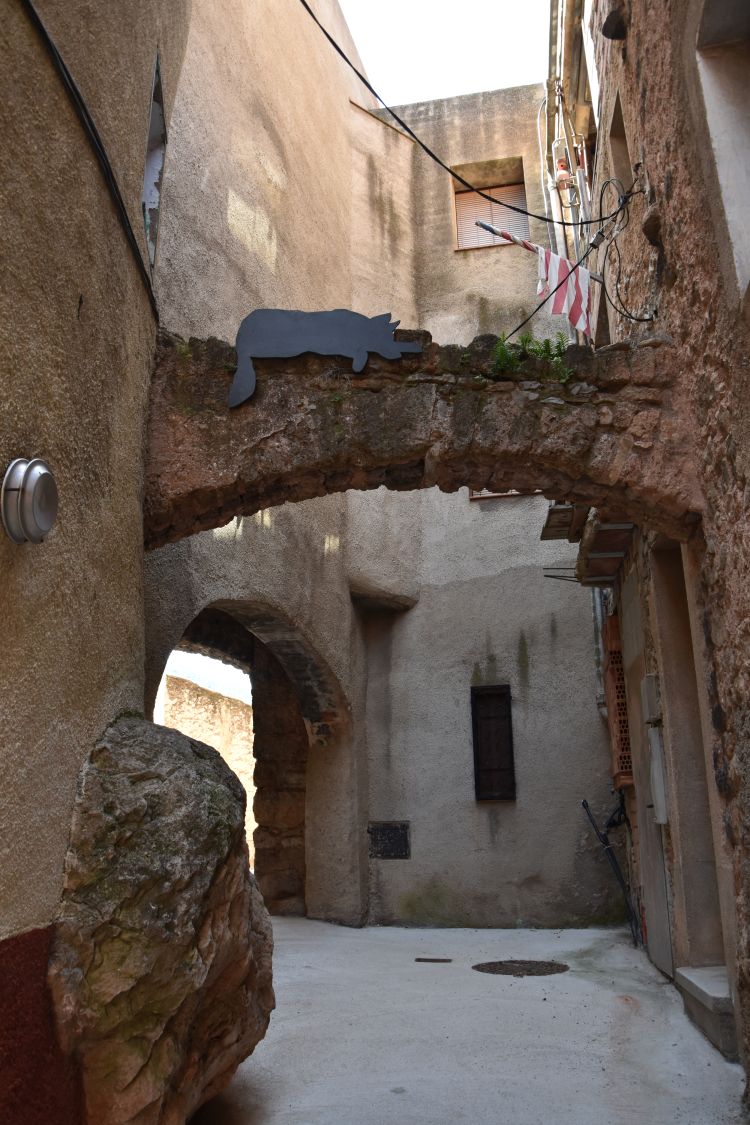
Narrow steep streets are overseen by the ruins of their castle that sits on a steep rock.

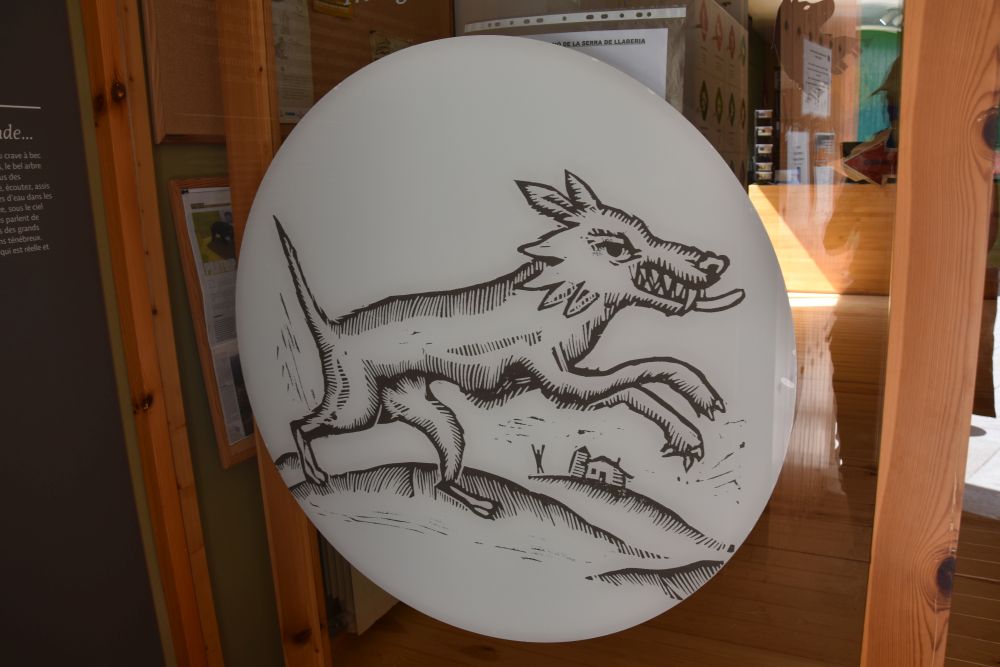
In the village there are various portraits of the vampire Dip in his incarnation as a dog-vampire (vampires can change their appearances rapidly).

When we enter the tourist office, we find another dip.

The assistant laughs: „You are looking for the vampire Dip“, she asks and proudly shows us the book of Joan Perucho with the title „Las historias naturales“. She adds: „Perucho tells you everything about the Dip and what he has done to Pratdip.“ The original version of the novel is in Catalan. I buy the Spanish version.

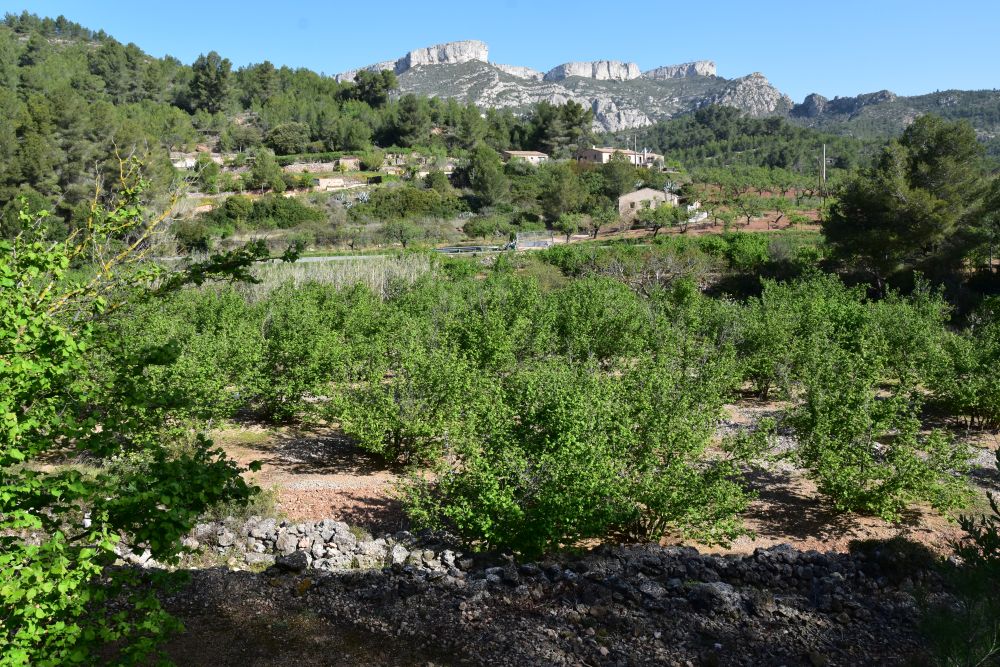
Then we walk to the hermitage of Santa Maria, along orchards with hazelnut trees…

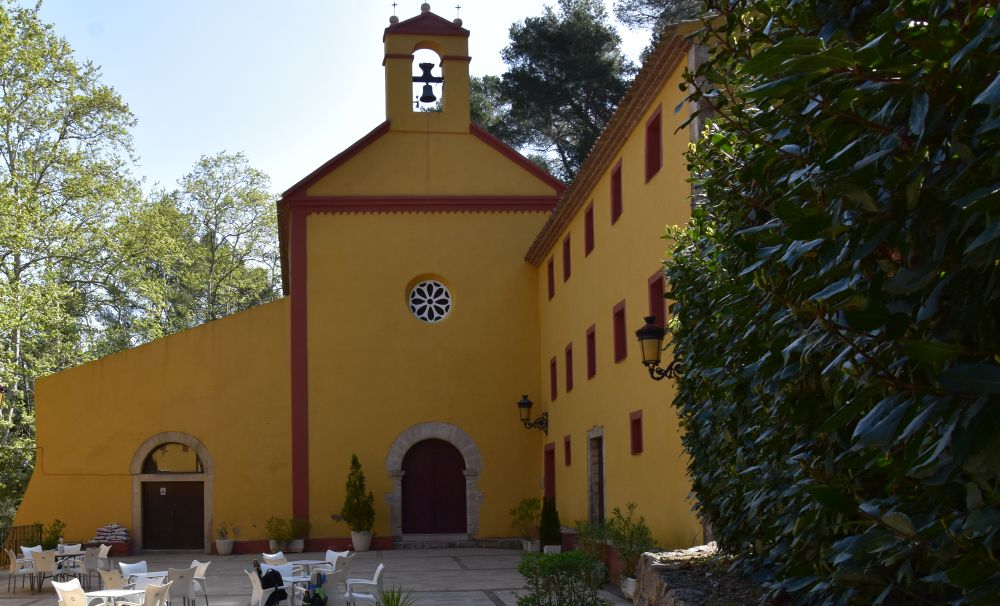
… and enjoy the hermitage Santa Marina in the mountains…

… where we find a friendly restaurant.

To round our excursion up, we climb the castle rock and enjoy the view.

.

Back at home: I enjoy reading „natural history“ by Joan Perucho to learn all about the dip

Back at home I read the novel of Joan Perucho. In his normal life, Perucho was a serious judge. When writing his „historias naturales“ or „natural history“, he must have twinkled with his eyes. The novel can be located somewhere between fable and reality and is full of humor. I could find five threads of interlaced actions.

  • First, the novel is about the vampire Dip –  his full name is Onofro de Dip. In the 13th century, he had owned the „meadows“ around Pratdip (hence the “prats of dip”). He traveled to Hungary to prepare the marriage for his king James I with Yolanda (or Violant) of Hungary (James and Violant are a historical fact). On the way to Hungary, Onofro de Dip fell in love with the lady vampire Meczyr who turned him into a vampire and „Non-Dead“ (No Muerto). He returned to Pratdip in the early 19th century and terrorized the village killing inhabitants every night. The current owner of Pratdip, Baroness Urpí, asks her brother, Marqués de La Gralla, for help (Gralla is a „real“ noble family from Barcelona; they owned a palace that no longer exists today). A friend of the Marqués de Gralla, the young natural scientist Antonio de Montpalau (an invented person), travels to Pratdip, neutralizes the vampire with the help of garlic, parsley and wooden crosses. Then he finds Dip’s grave in the castle and expulses Dip from Pratdip. Onofro de Dip morphs into the solo guerillero El Mochuelo (the Owl) fighting for the (conservative) Carlists and terrorizing the region of Tortosa and Berga. Montpalau pursues him, finds him finally in a crypta near Berga (castle Mataplana) and by speaking out some magic words, Montpalau makes Onofro de Dip die „properly“ and find his peace.
  • Second, the novel is the portrait of the higher society of the Barcelona area in the early 19th century. Montpalau as a young scientist belongs to that higher society. The members of the high society enjoy meeting in the Gralla palace, eating and discussing history, natural science, mathematics or music. As a reader you feel the luxury and shake your head about the sometimes detached, elitist or even absurd discussions. Once Frédéric Chopin and George Sand are invited to a banquet, as they stop over in Barcelona.
    Antonio de Montpalau is a scientist focused on classifying animals and plants around him. He is also interested in geography and geology. Before going to Pratdip, he  researches all literature available and he finds scientific literature about vampires that recommends using garlic, parsley, portulak, wooden crosses and mirrors to fight vampires (I can feel Perucho smile, when he lets Montpalau buy ten dozens of mirrors before leaving for Pratdip).
  • Third, the novel has a historical background: The year 1840 in the first Carlist War in which the male pretendent of the throne, Carl V, fought against his niece, the actual Queen Isabel II.
    • One one hand, the Carlists that fought for Carl V, were conservative. Their target was a federation of several states unified by the king of Spain and the catholic church as the only two common denominators of the federation, conserving, what Spain had been before. A man made constitution was not required in their eyes. Federation, of course, was welcomed by Catalonia (or also by the Basque region). Carlists were strong in Catalonia.
    • On the other hand, the followers of the actual Queen Isabel II were classified as liberals, as they based their ideas on the French Revolution. The wanted the separation of church and state, a centralized state based on the constitution (as set up in 1812, like France). The idea of the centralized state was not, what Catalonia strived for, but the high society in Barcelona, including Antonio de Montpalau, was liberal.
    • Some real persons give a realistic background, the most important being Ramón Cabrera. He was the outstanding leader of the conservative Carlists in Catalonia. His liberal (pro Isabel) opponent was Baldomero Espartero.  In 1840, Espartero defeated Cabrera and his Carlists in Berga not far from the Pyrenees.
    • Montpalau and Onofro de Dip interact with the real persons. Ramón Cabrera has been photographed wearing a large scarf around the collar of his shirt. Furthermore, he has been reported to feel ill, when trying to conquer Gandesa. Perucho tells us the reason. Cabrera attacked Gandesa at the time, when Dip morphed into the Carlist guerilla „El Mochuelo” that wanted to become a Carlist leader himself. He bit Cabrera such that he will become an immortal vampire. This is why Cabrera felt weak and this is why, he had to wear a large scarf (to hide the stitches of the vampire – twinkle). Perucho continues to describe that the liberal Antonio de Montpalau was captured by the conservative (Carlist) troups of Cabrera, how he could ease the symptoms of the bite for Cabrera and how finally Montpalau succeeded to free Cabrera from his gloomy destiny by making Onofro de Dip die properly – as described in the first thread of actions – in the crypta near Berga, just after the Carlist Cabrera had been fully defeated in Berga by the (pro Isabel) Espartero.
  • Fourth, the novel is a travel report about Catalonia in the early 19th century. Antonio de Montpalau, his nephew Novau and his coachman Amadeo travel from Barcelona via Villafranca, Reus and Falset to Pratdip. After having expulsed the vampire-Dip from Pratdip, they leave to pursue the vampire-El Mochuelo, cross the Ebro near Miravet, stay for some time in Gandesa, continue to Morella. Cabrera resides in Morella and Montpalau and his followers are captured here. Then as prisoners, they accompany Cabrera to Berga. Our travelers visit places of interest on the way (e.g. the monastery Vallbona de los Monges where the Queen Violant from Hungary has been buried), admire the beauty of the landscape, eat local specialties and drink delicious wines from Terra Alta. The travel reports are full of humor, e.g. about real places of interest such as the cathedral of Tarragona that they like though their travel handbook by (real) Alexandre Laborde does not recommend to visit it. Or about less real events: The three heroes meet giant fleas, but luckily Monpalau knows, how to escape them: They inflame branches of pine trees and carry them like torches (twinkle).
  • Fifth, it is a love story with a very, very happy end. While Antonio de Montpalau is fighting the Dip in Pratdip, he and Inés fall in love. Inés is the daughter of the baroness Urpí that has asked her brother, Marqués de Gralla, for help against the Dip. Montpalau has to leave his love to pursue the Dip.  A historian has encouraged Montpalau to do so, as he found (historic-scientific) sources that reveil, it is Montpalau’s fate to defeat the Dip (twinkle). After having vanquished the vampire Dip-El Mochuelo near Berga, Montpalau returns to Barcelona. At the palace of Marqués de Gralla he finds his love Inés (the Marqués‘ niece) waiting for him. What a happy end!

Perucho’s novel was the first book that I accomplished reading in Spanish. In the beginning, it was a bit of a tough start for me, because Perucho takes his time to set the stage. But then, when the action of neutralizing and chasing the Dip-El Mochuelo accelerates, what a pleasure! And it was even more pleasure to go back to the start to enjoy the setting of the stage, once I understood more about the historical background. The novel is full of humor and of fantasy with links to real history and geography. I did enjoy reading about many places in Catalonia that I know and that Perucho moves to the early 19th century presenting them with the eyes of Antonio Montpalau and his followers. And I did enjoy to learn more about Spanish history which helps to understand what is going on in Spain today.


Visiting Oberfranken and discovering their great porcelain tradition

Ah – I see – the roots of Rosenthal and Hutschenreuther are in Oberfranken!

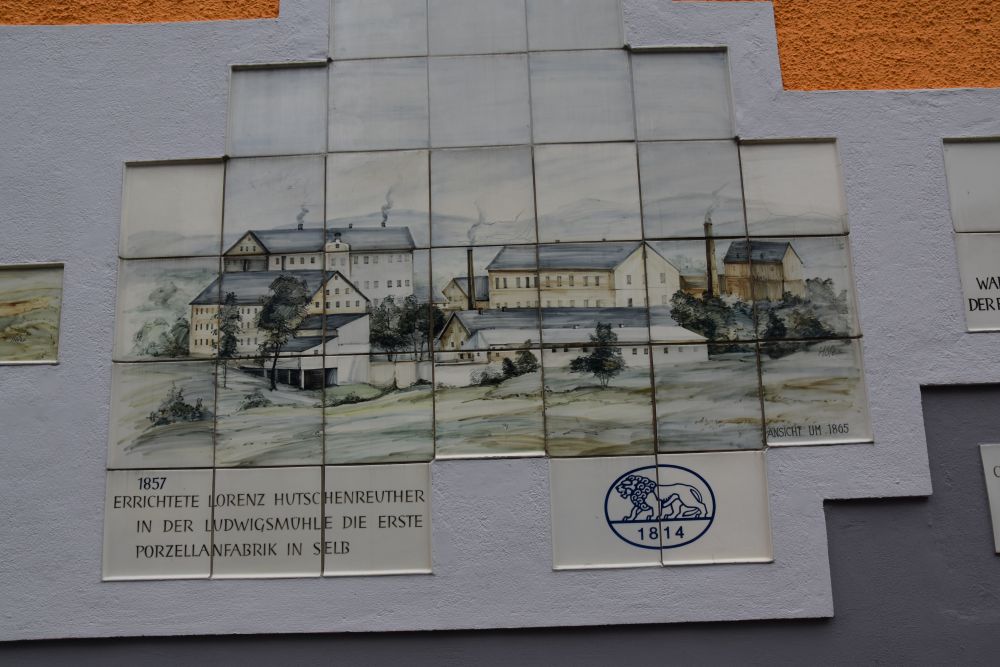
Always I have admired German porcelain. Not just Meissen, but also Rosenthal or Hutschenreuther. But I never thought about where the latter brands come from. I found out, when stopping over in Oberfranken. The family Hutschenreuther started producing porcelain in 1814. It was a love story, as Carolus M. Hutschenreuther married the daughter of the forest ranger. The ranger knew where to find the raw material for porcelain, caolin (or “white earth”). In 1857 Carolus’ son Lorenz founded his own porcelain factory in Selb, as this panel shows.

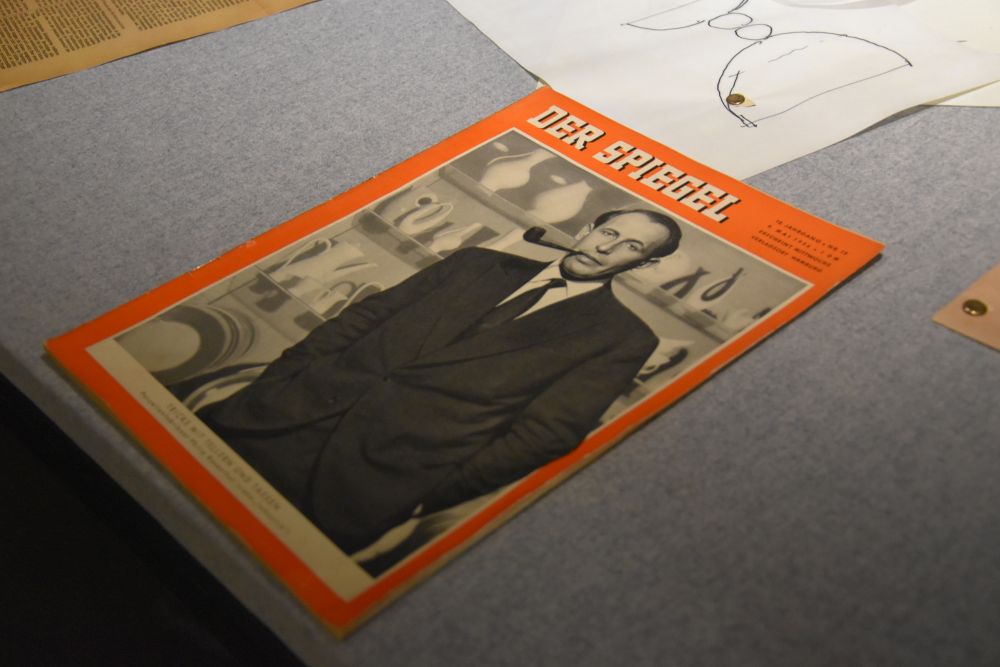
Around 1900, the family Rosenthal settled in Oberfranken and the brand “Rosenthal” emerged. In the 1950s, junior Philip Rosenthal returned and initiated the beautiful “studio-line”  that well-known arists like Walter Gropius contributed to. In 1956 the journal “Der Spiegel” had him on their front page and wrote about him.

Today, Rosenthal and Hutschenreuther belong to the Italian Sambonet-Paderno group.

.

Why did I travel to Schönwald in Oberfranken? – I love to meet my friends – and a friend of mine lives here

In June 2018, I am on the road again, with Vreni. Our target is Berlin, and about half way to Berlin lies Schönwald. Our friend Herbert, now retired, has returned to his hometown in Oberfranken. We look forward to seeing him and envisage a hike in the Fichtelgebirge, as we have hiked together so many times in the Swiss Alps. We expected that there is nothing else to do in this peripheral region of Germany, near the border with the Czech Republic.

.

Yes, indeed, Schönwald is close to the Czech Republic…

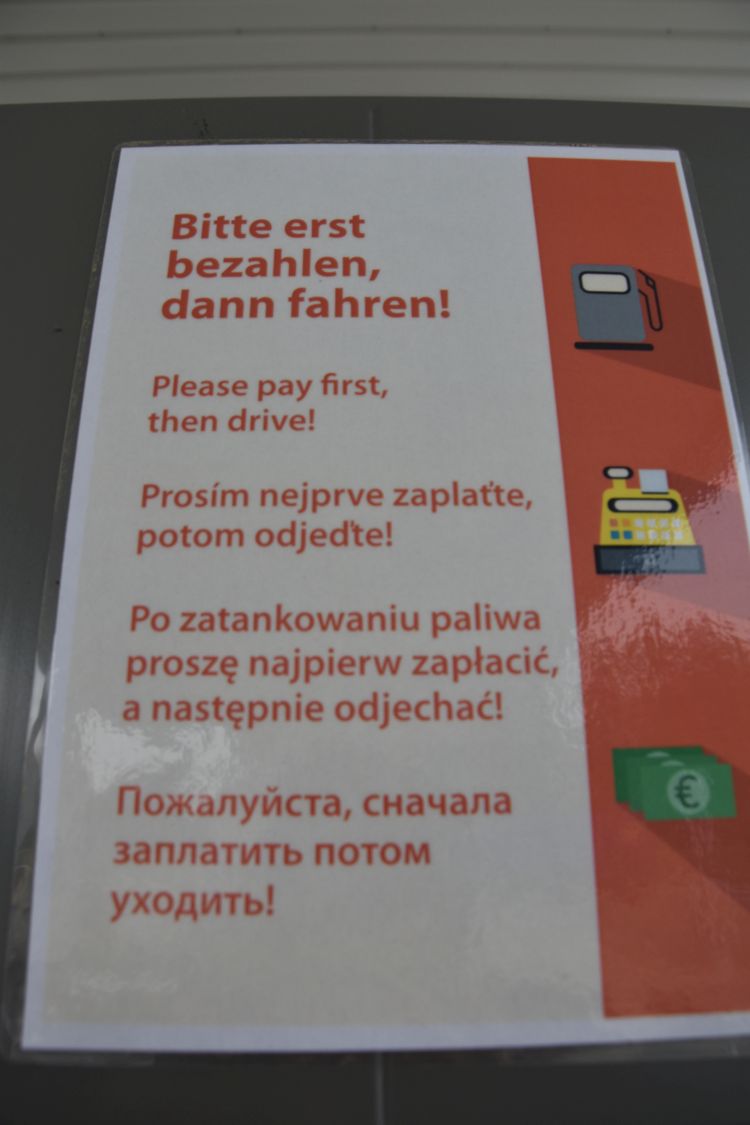
A few kilometers before reaching Schönwald, we stop at a gasoline station. The order to “pay first, then drive” is written in German, English, Czech, Polish and Russian.

This confirms that we are now very, very close to people with a slavic background.

.

… but what a surprise! There is more to Schönwald and Oberfranken than just hiking, namely the tradition of porcelain production

When leaving the motorway at Selb to reach Schönwald, we have to drive our car around a huge teapot. A teapot? Do they make teapots here? Yes!

Schönwald, Selb and more cities in Oberfranken built innovative factories using mechanisation in the 19th century and produced more than 90% of German porcelain. Today, they offer a culture tour (Kulturreise) on the tracks of porcelain in Oberfranken.

We plan for a museum day to explore porcelain. Hiking is no fun anyway, because it is raining heaviliy and in the mist we cannot see any of the peaks of the Fichtelgebirge, though Herbert points into their direction and names some of them. Hm, we see nothing but white clouds.

We have our first dinner in a small hotel at Schönwald. Herbert turns round the plate and shows proudly that it carries the label “Schönwald”. Yes, Schönwald has its own factory and label for award winning robust hotel porcelain.

.

Learning about mechanised porcelain production of the last two centuries in the Porzellanikon of Selb

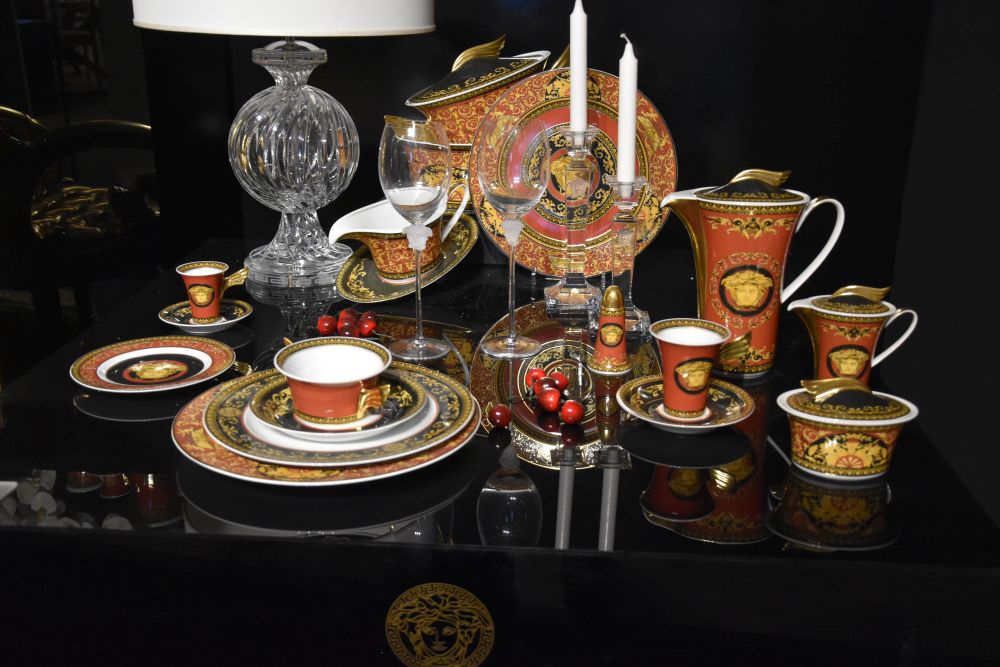
The city of Selb has opened one of their old porcelain factories under the label Porzellanikon. Visitors can explore the production of porcelain and enjoy the beauty of the tableware of Hutschenreuther, Rosenthal, Kahla or Villeroy & Boch, all connected up today.

Here is what I took with me – it may not be perfect, as I am not a porcelain specialist at all.

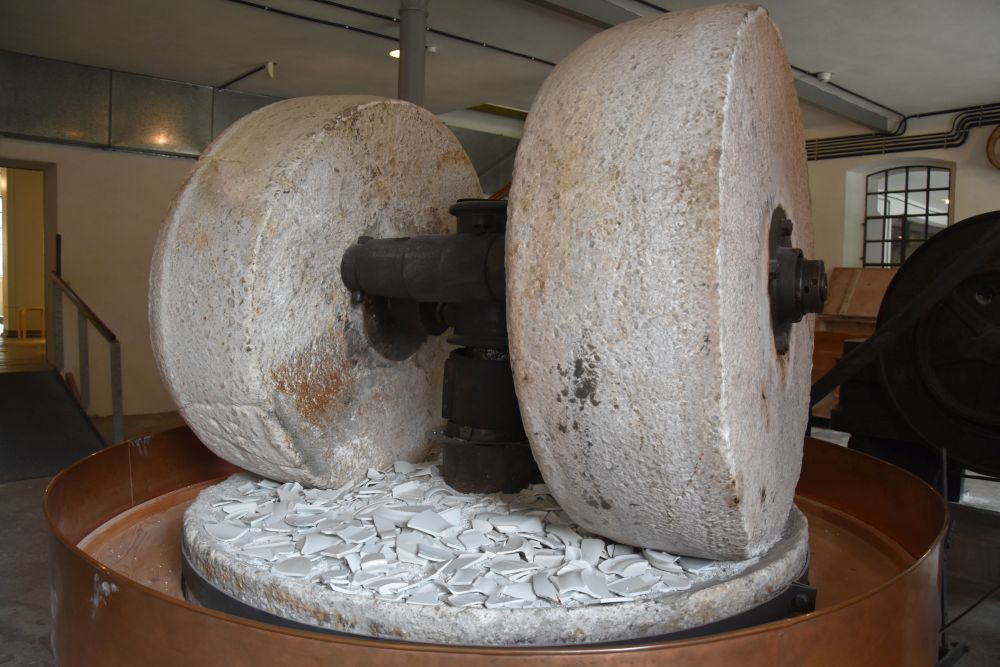
The production of porcelain starts with blocks of stone that have to be crushed in several consecutive steps, a process that starts with huge millstones.

Using rotary drums, the stone blocks are further crushed. Kaolin, quartz and feldspat and other components are then mixed with water. The water has to be pressed out again using filters.

The raw material to produce plates, platters or plain bowls looks like over-sized sausages.

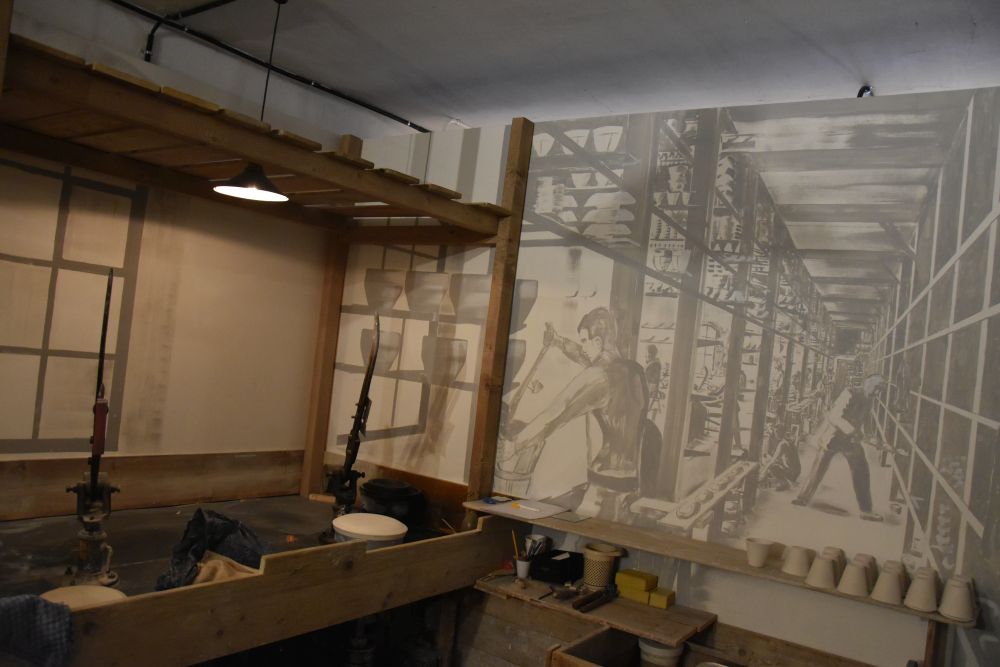
They are then formed using presses. Our friend Herbert worked here as a teenager to gain some pocket money.

For more complicated vessels such as this sugar bowl, liquid raw material is casted into a plaster mold. The sugar bowl forms itself near the plaster and when thick enough, the liquid in the middle is poured out and the bowl remains inside. I can hardly believe that this works.

The modeled porcelain pieces are then baked at high temperatures – the factory disposes of old kilns that we can walk into. As the photo above shows, the size of the sugar bowl is reduced considerably after having been baked.

.

At the end, we enjoy the exhibition of porcelain products

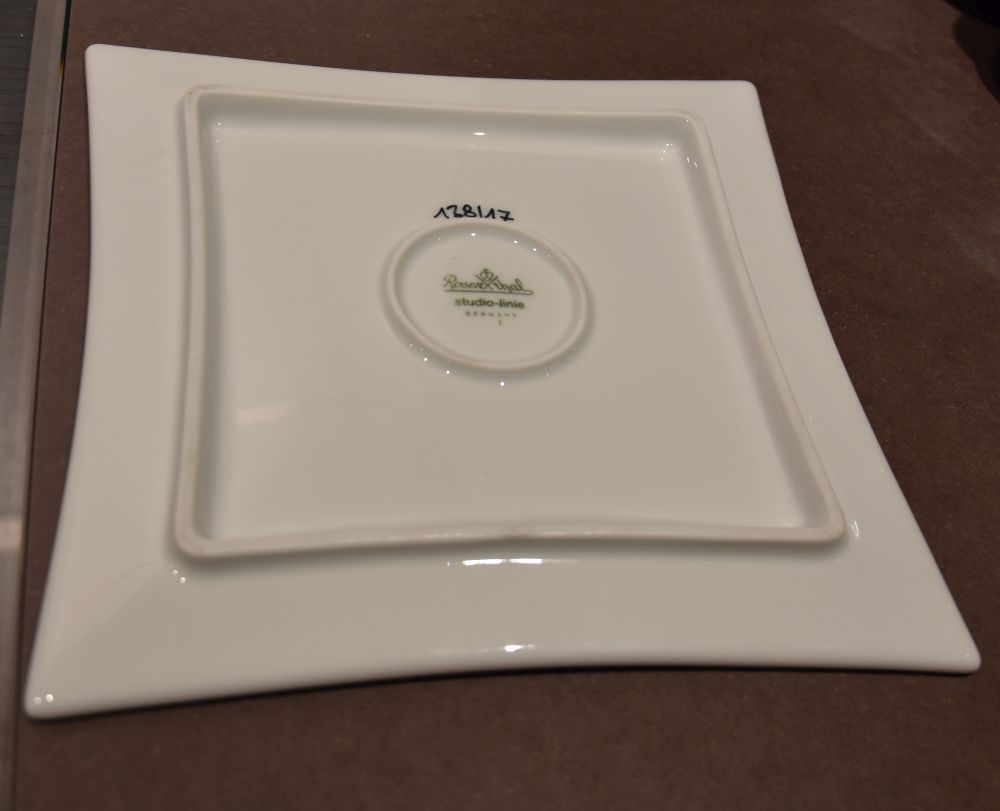
It is a real pleasure to look at the well designed pieces of porcelain in the exhibition of the Porzellanikon. Here is a plate from the studo-line of Rosenthal.

And yes, it is Rosenthal. Actually the people from this area have this habit of turning round the plates in restaurants.

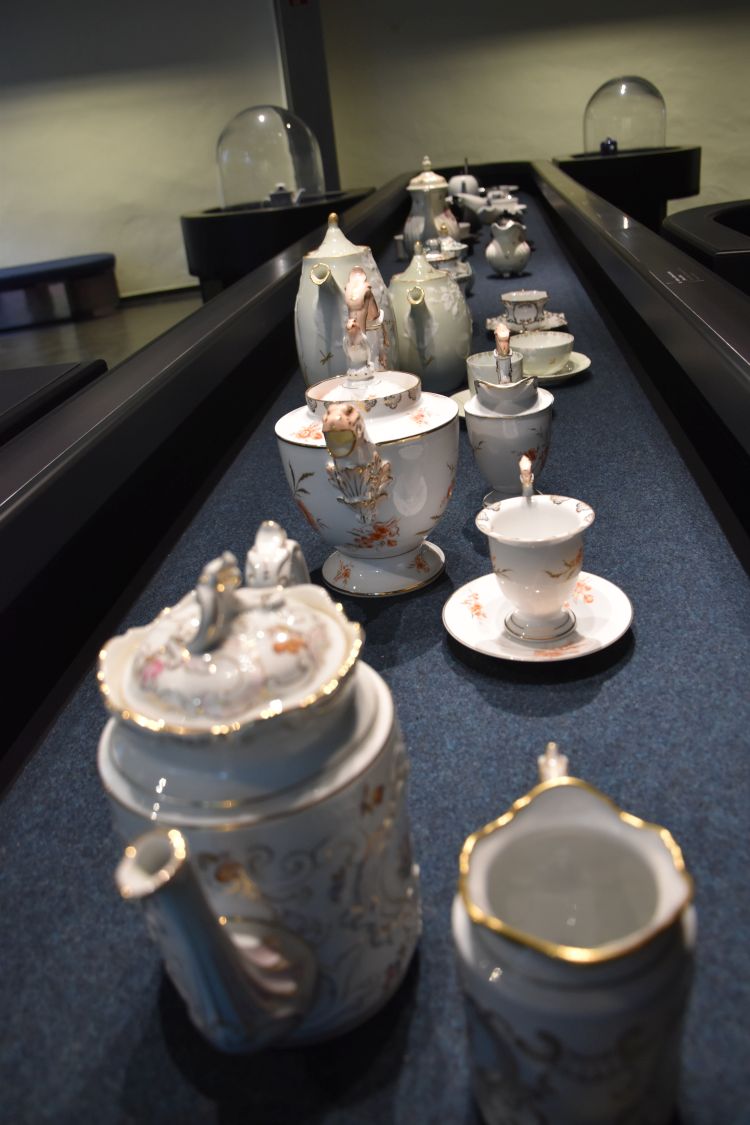
These two sets would make elegant coffee or tea tables.

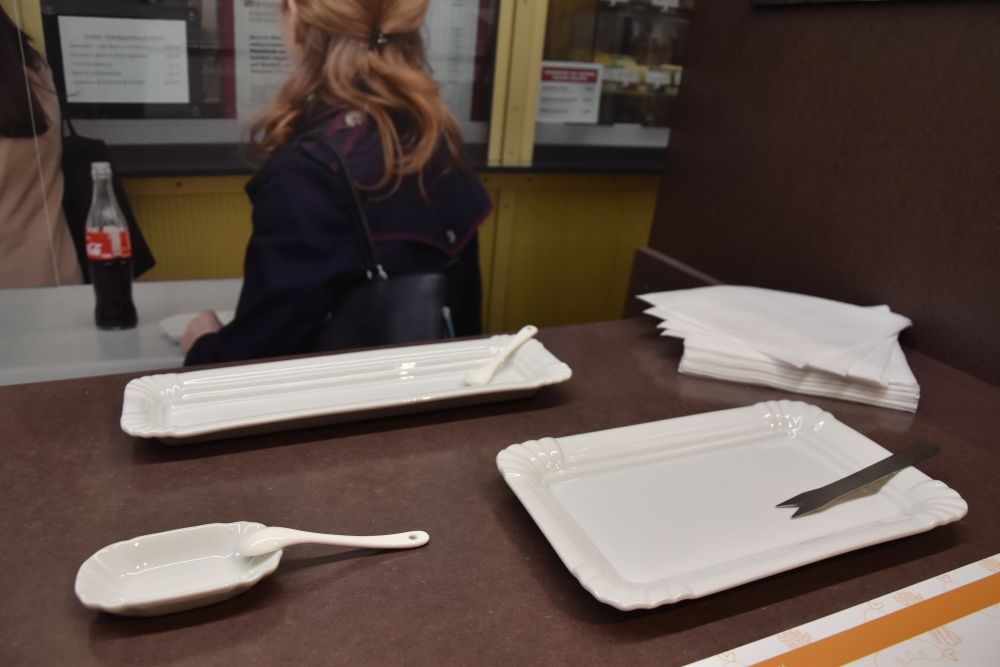
The factories were inventive and even made cardboard plates out of porcelain.

I do love this design for children – the humor in it makes me smile.

.

A walk through Selb

We end the day with a walk through the small town of Selb. They cherish their porcelain tradition with the unique porcelain street.

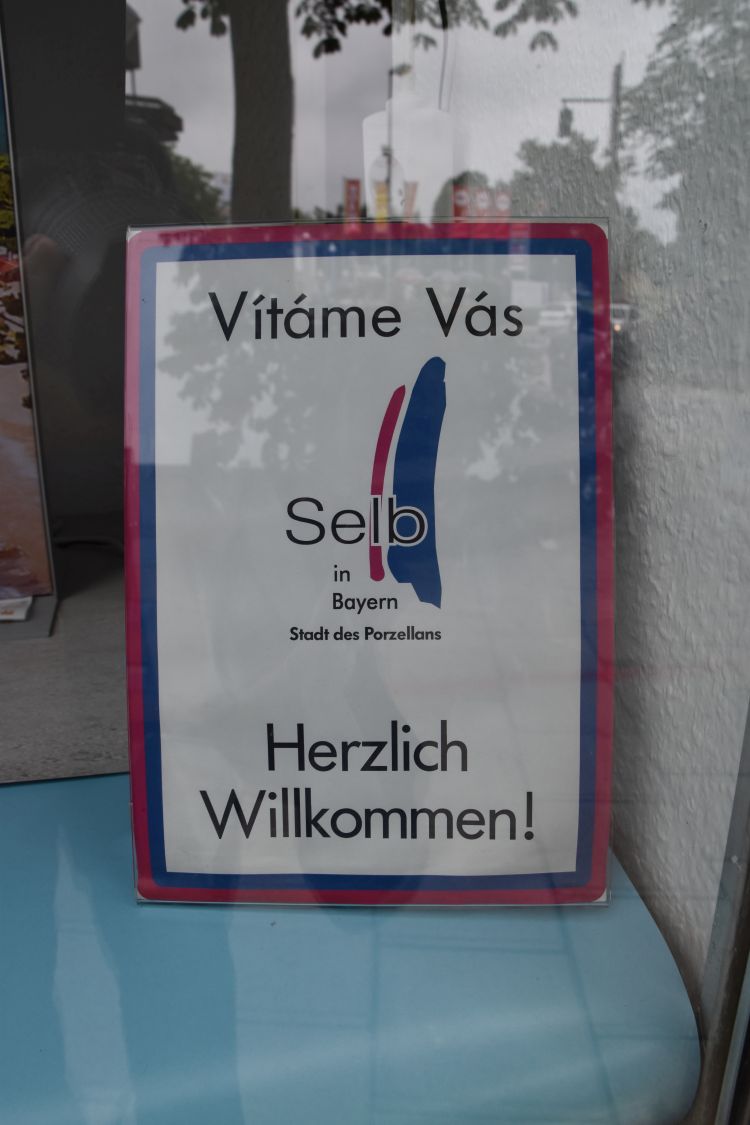
And again we find a slavic announcement – the small town of Selb wishes a “hearty welcome” in German and in Czech: Welcome to the town of porcelain in Bavaria.

Yes, thank you, Selb, Schönwald and Oberfranken. We felt welcome both, when meeting Herbert and when learning about porcelain. This experience was worth the stop over on our way to Berlin and we may return one day to see Herbert again and to explore more of the German porcelain culture.


Ravenna: In search of Byzantine mosaics – Sant’Apollinare Nuovo and in Classe

Saint Apollinaris is said to have brought Christianity to Ravenna in the 1st century. Two basilicas are named after him, Sant’Apollinare Nuovo and Sant’Apollinare in Classe. “Nuovo” is the older church, already inaugurated in 504 as an ostrogothic Arian Basilica dedicated to Christ the Redeemer. Under Byzantine rule, this church became othodox-catholic, and in the 9th century the relics of Saint Apollinaris were transferred from Classe to Sant’Apollinare Nuovo – hence called “nuovo”. The original Basilica for Saint Apollinaris was built in Classe, near the port. It was consecrated in 549 by Maximian, when Ravenna was under Byzantine rule. Both basilicas are just wonderful – let us dicsover them.

But first let us recap again: In March 2018 we spent five days in Ravenna to see the town with its eight sites of UNESCO World Heritage:

  • two from the Western Roman Empire (402-476): the Mausoleum Galla Placidia and the Orthodox or Neonian Baptistery.
  • four from the Ostrogothic Rule (493-540): Theoderic’s Mausoleum, the Arian Baptistery, Sant’Apollinare Nuovo (remodeled during Byzantine times) and the Archbishop’s Chapel.
  • two from the Byzantine Rule (540-751): San Vitale and Sant’Apollinare in Classe (both started during Ostrogoth times, but inaugurated in Byzantine times).

.

Sant’Apollinare Nuovo

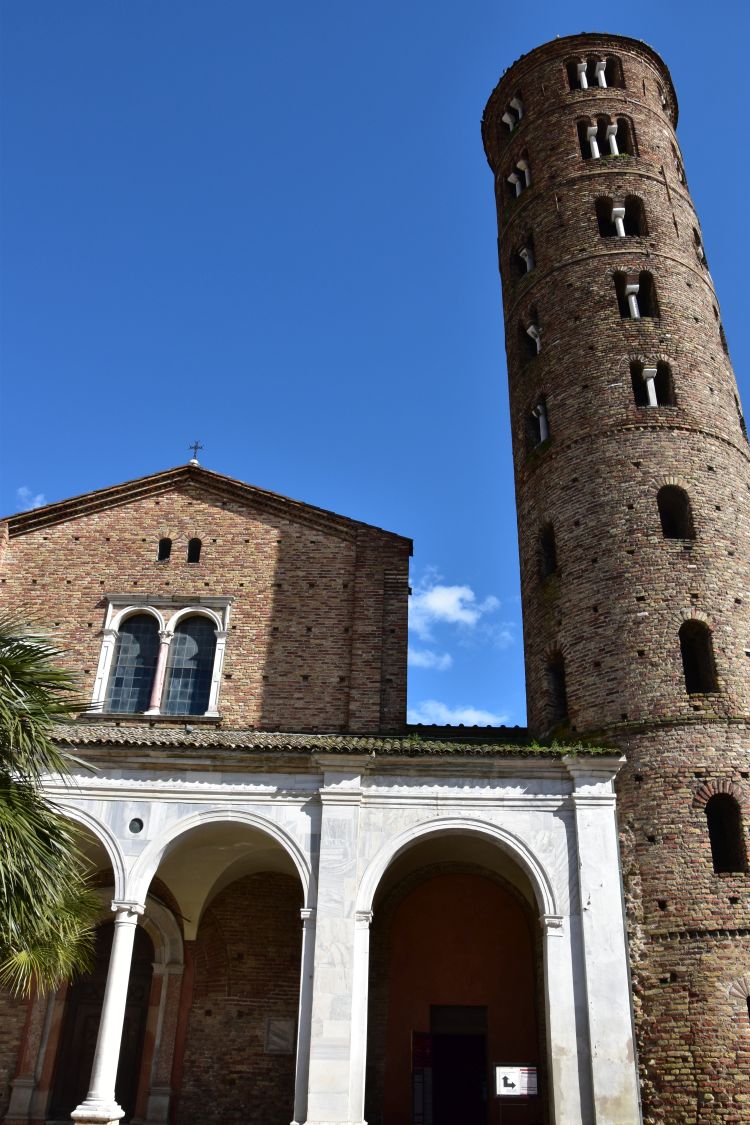
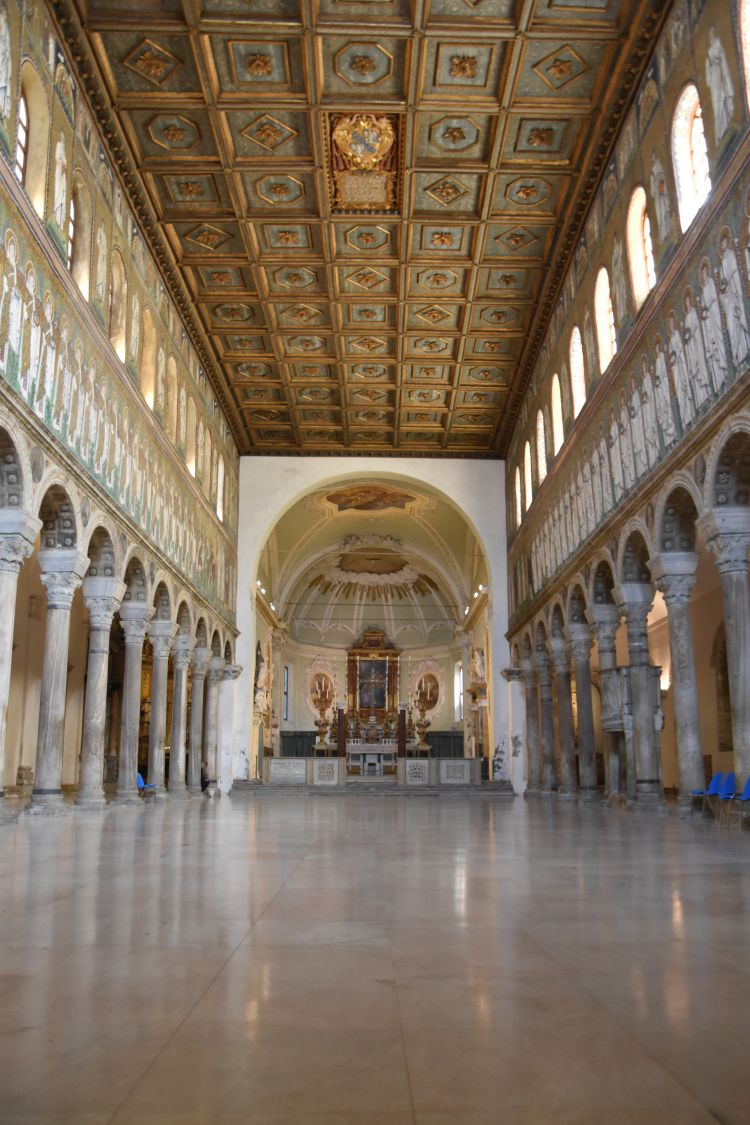
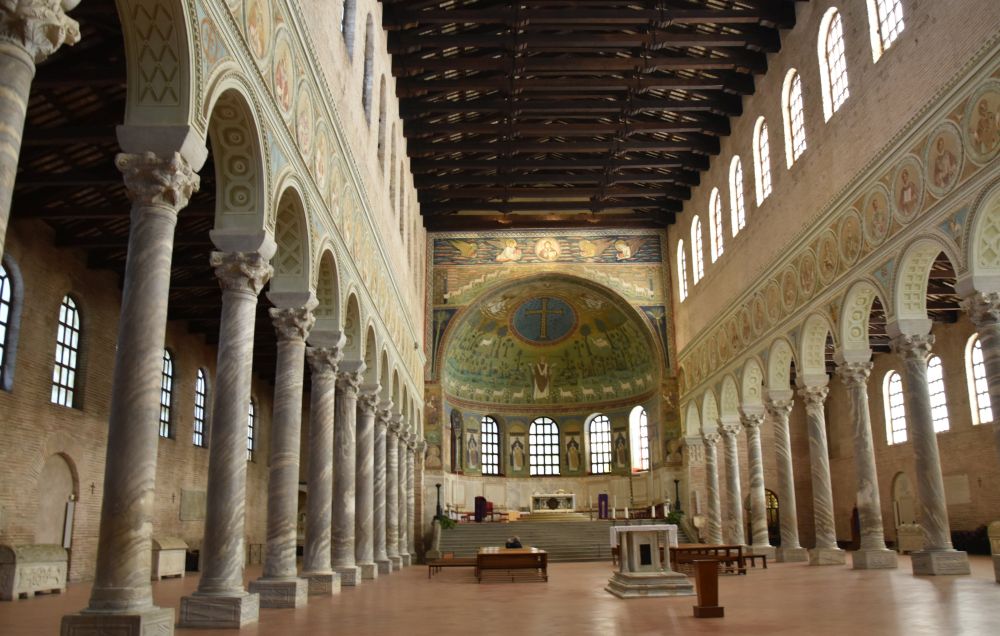
Yes, the older of the two basilicas named after Saint Apollinaris is called “Nuovo”. This is the view from outside. The bell tower is round with the typical double and triple windows. The narthex has been added later.

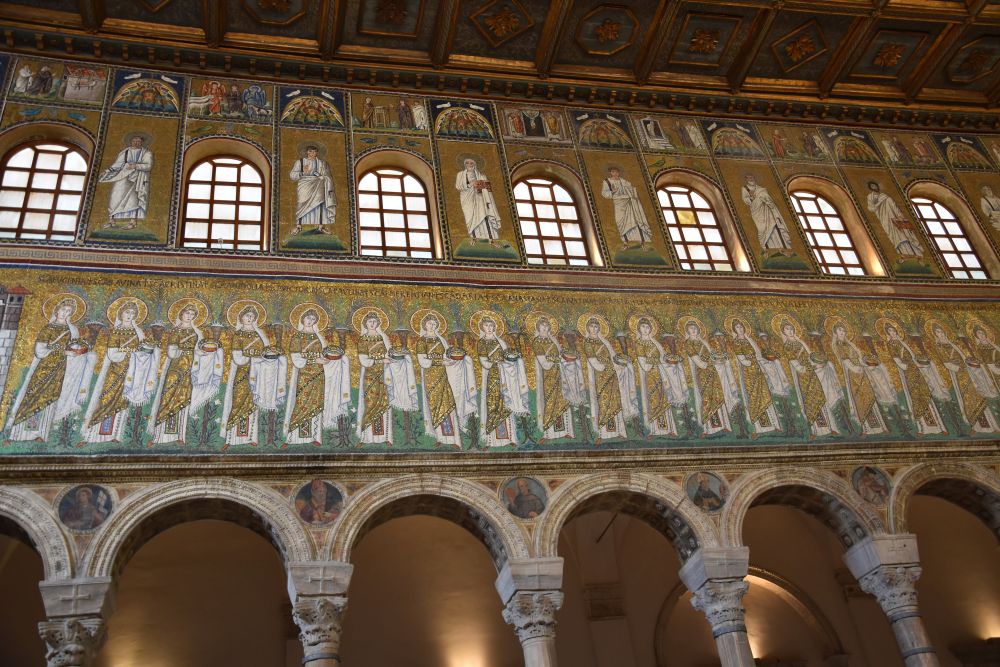
Inside the basilica measures 35mx21m. The nave is flanked with two rows of twelve columns in Greek marble. The mosaics are above the columns.

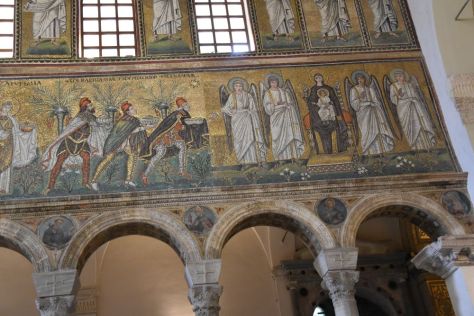
On the left hand side women martyrs are walking towards…

… Maria and Jesus with the three Magi.

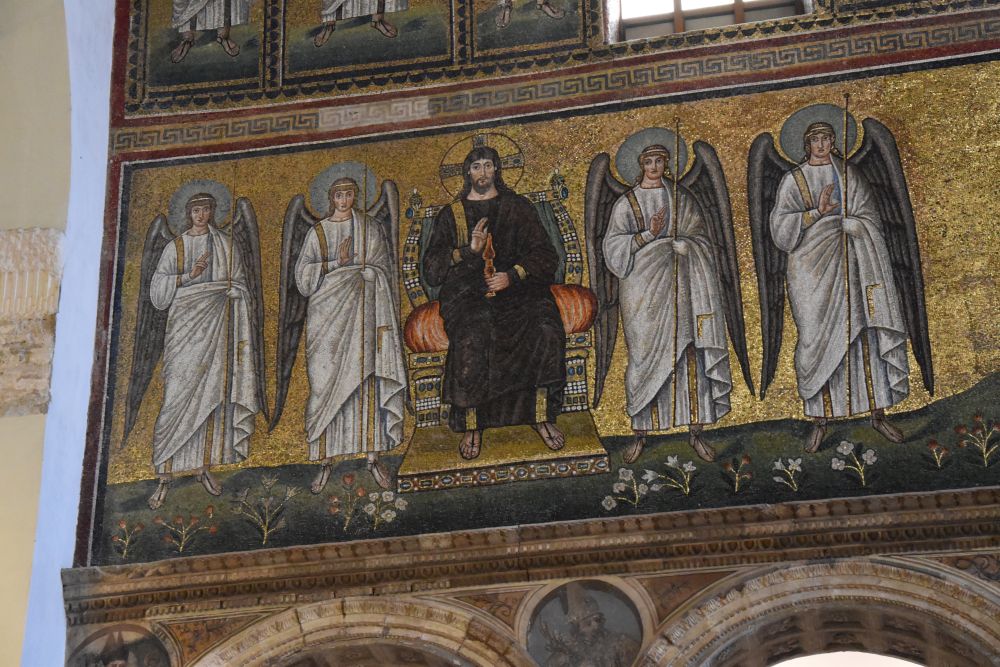
On the right hand side, martyrs are walking towards Christ sitting on his throne and flanked by four angels.

It is assumed that the processions of the martyrs have been added by the Byzantines. The former decoration of the Arians was different, perhaps a line of courtiers.

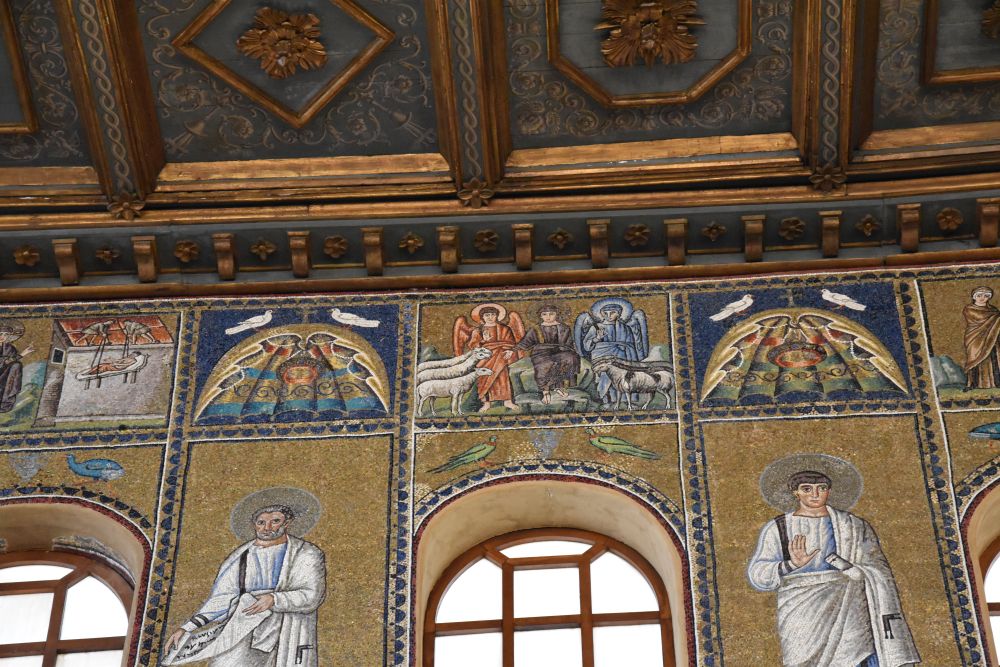
Above the processions are 26 panels that describe the life of Christ (13 on each side). The example below shows the healing of the lame and the separation of the sheep from the bucks.

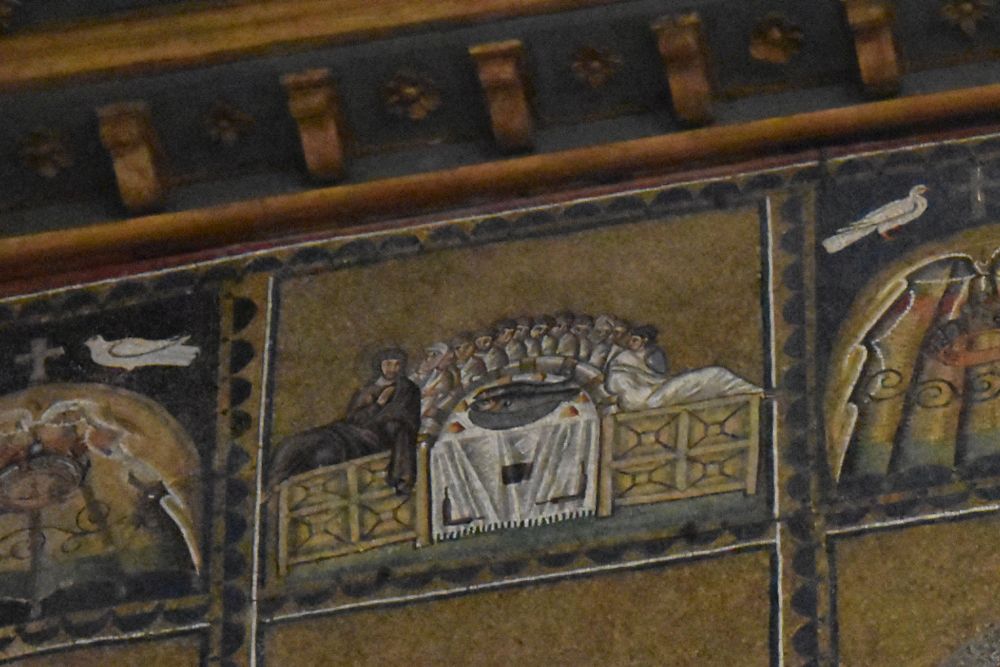
Most interesting is this Last Supper. Christ and the apostles are lying on long chairs as the Romans used to do for their meals. Never before have I seen such a “Roman” Last Supper. But why not? Why should the apostles and Christ not have behaved like the Romans, when eating?

Ursula and Leni intepret each of the 26 panels. It is like reading the Bible, and I have to admit, I read the stories from the Bible like people did at that time. With such beautiful mosaics it is a great pleasure to discover them and to enjoy, how the artists made the essence clear. For instance, a lame that carries his bed on his back has just been healed – it is simple and clear.

.

Sant’Apollinare in Classe

On a sunny day, we take out our car and drive south to Classe, the ancient port of Ravenna. Here we find the basilica originally dedicated to Saint Apollinaris, namely Sant’Apollinare in Classe.

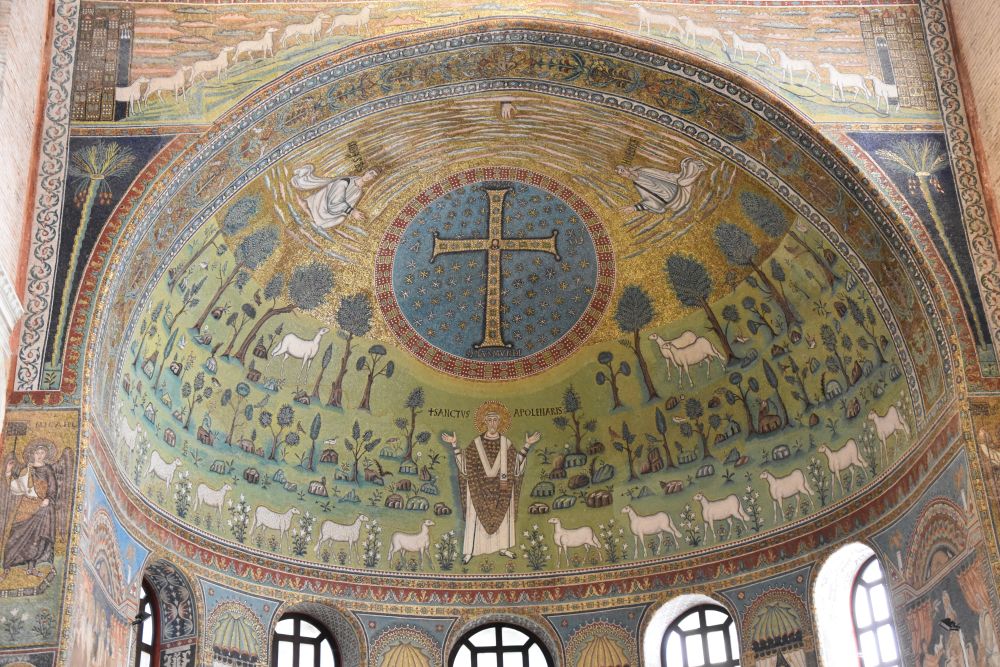
The nave is even larger, 55.5mx30.5m. The mosaic is in the choir.

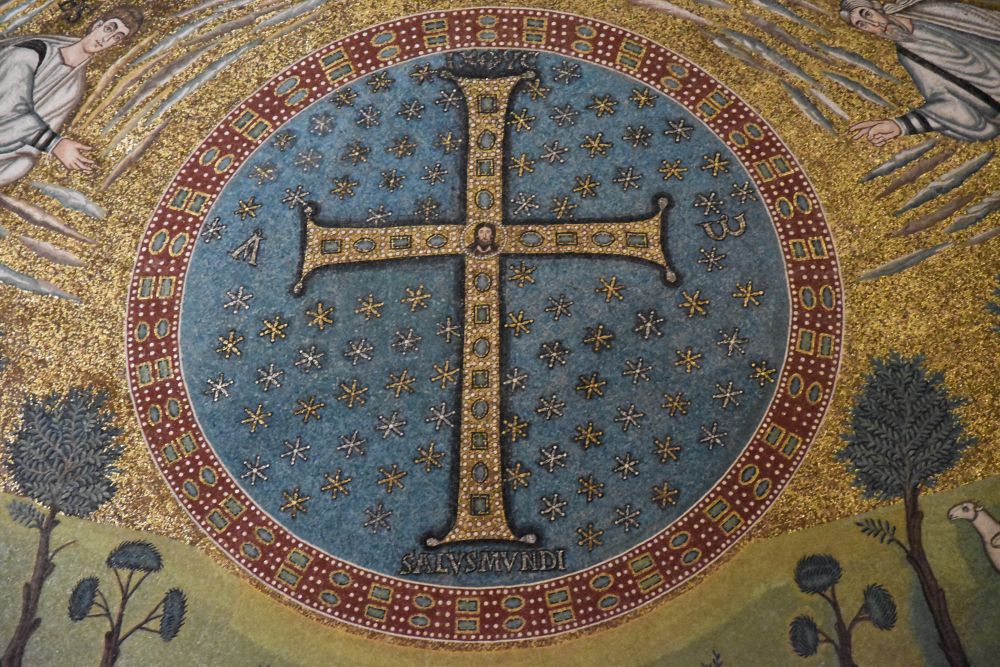
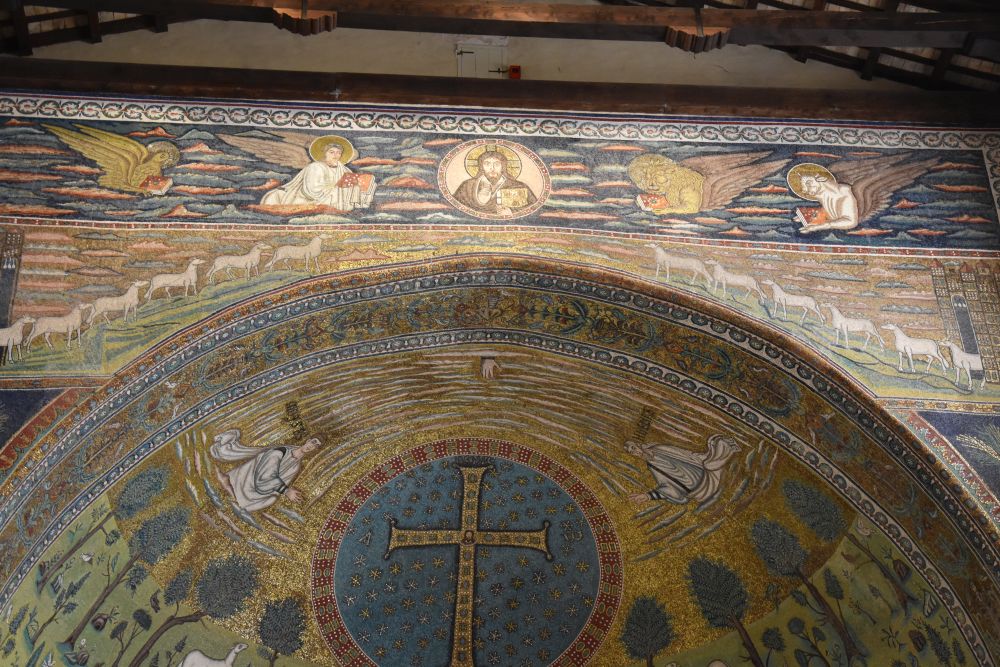
It shows Christ, symbolized by a cross. The cross is flanked by two angels. Below the cross stands Saint Apollinaris that the church has been dedicated for. He is preaching and talking to the audience in the church and to the sheep surrounding him on the meadow. Stones, trees, bushes, flowers and birds surround the Saint.

In the middle of the cross, there is a small portrait of Christ.

The evangelists are flying above the scene. I am surprised to see the bull of Lukas: It is portrayed from the side and from the front at the same time – very much like a Picasso painting. May be that Picasso has visited this Basilica as a young man?

The lion of Mark looks very, very gentle, but may be this is what his evangelium is about… a story that should convey joy.

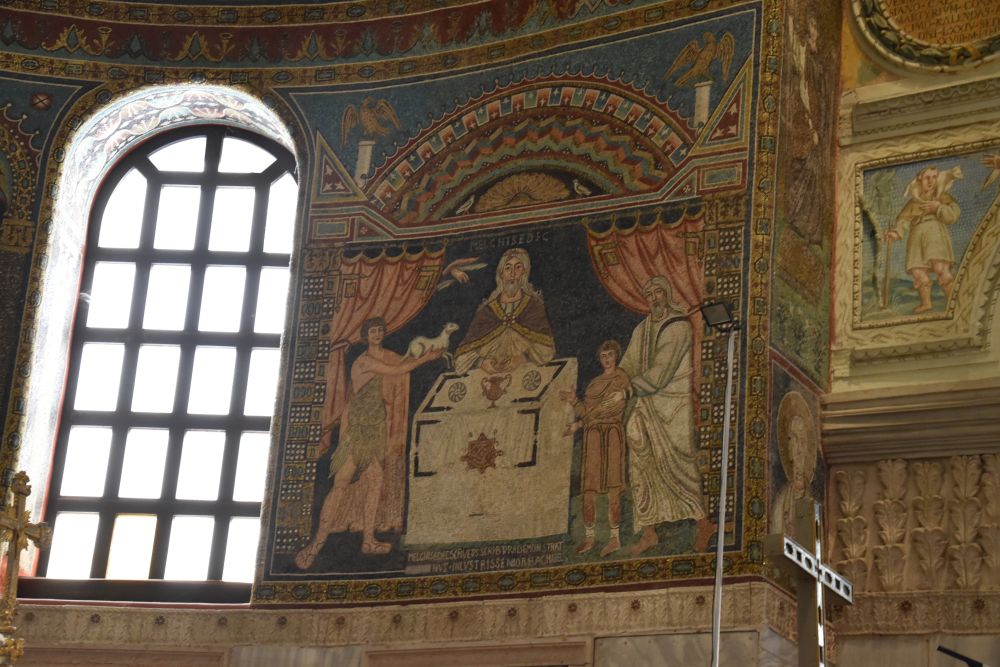
At the side we find three old acquaintances that we have come across in San Vitale: Abel sacrifying a sheep, Abraham about to sacrify his son Isaac and Melchisedec bringing wine and bread.

Beautiful, beautiful, just beautiful.

.

Taking a break from all that culture

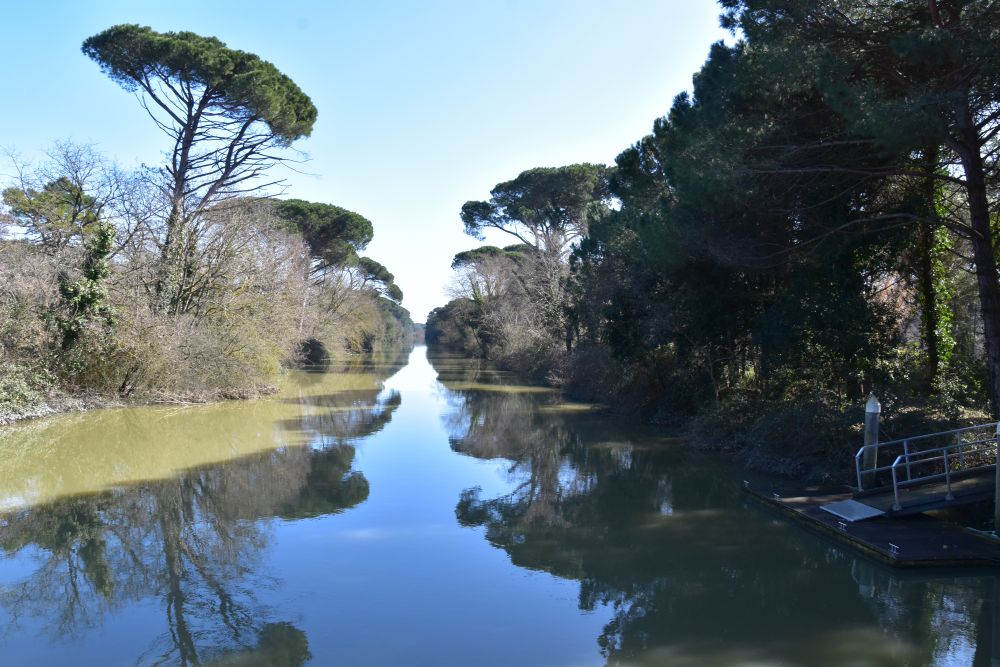
After all that culture we need a break and we benefit from the fact that the sun has started to warm Northern Italy. We drive to Fosso Ghaia and go for a walk in the pine forest.

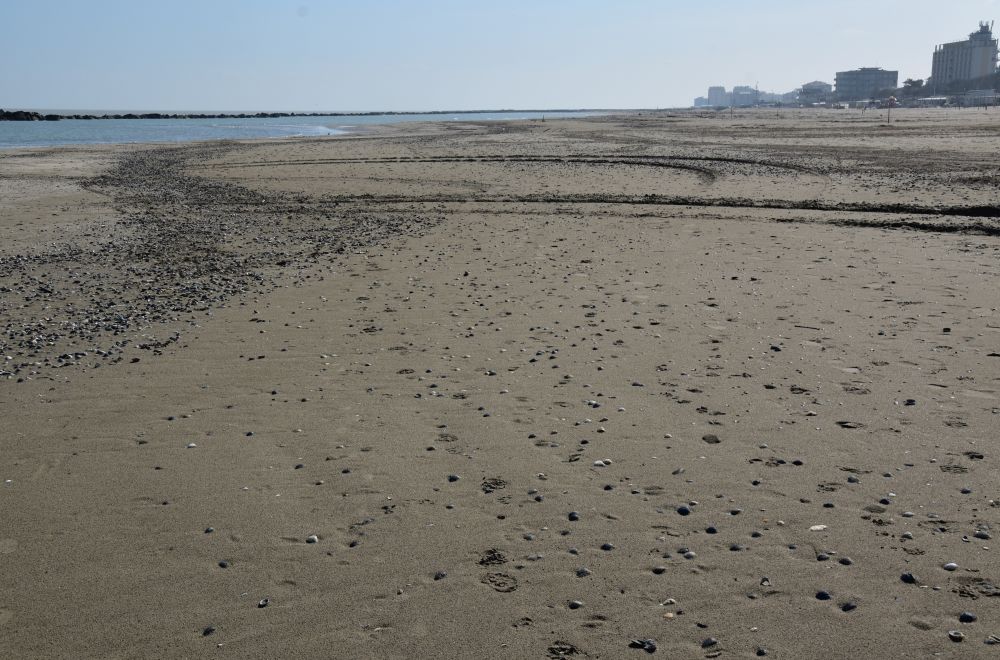
Then we drive to the Lidos or the beaches south of Ravenna. They are empty, empty and just empty. One lonely man is raking the sand. If he continues at that speed, he will never complete his work until Easter in about four weeks, when the first guests are expected and the beaches start to fill up with lines of arm chairs and umbrellas. I cannot imagine the crowd looking at this empty sand beach.

We find just one (only one) restaurant open. It is full with craftsmen. They may be repairing the many holiday chalets and appartments that have their shutters closed right now.

Back in Ravenna we have a farewell dinner in the restaurant Capello, where I can also buy wines from the Emilia Romagna. I take with me Sangiovese, Lambrusco and Albana. The area is known for excellent food. Names like Parma (ham and cheese), Modena (vinaigre) or Bologna (spaghetti sauce) are resonating with me. And there is also more culture to see here. Perhaps I should plan to return soon…

References:
Clementina Rizzardi: “Ravenna, Eight Monuments World Heritage”, Municipality of Ravenna
Carola Jäggi: Ravenna, “Kunst und Kultur einer spätantiken Residenzstadt”, Schnell+Steiner, Regensburg 2016
Jutta Dresken-Weiland: “Die frühchristlichen Mosaike von Ravenna”, Schnell+Steiner, Regensburg 2016.

Ravenna: In search of Byzantine mosaics – San Vitale

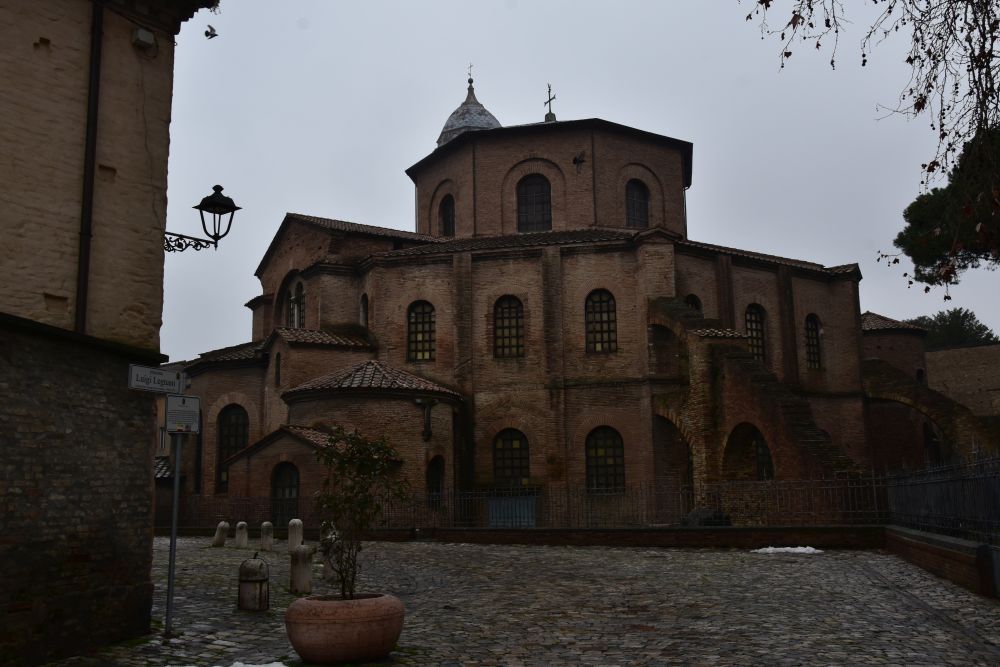
The Basilica San Vitale has been inaugurated during Byzantine Rule, by Bishop Maximian in 547. The Ostrogoths had  started building San Vitale in 526.

Let us recap: In March 2018 we spent five days in Ravenna to see the town with its eight sites of UNESCO World Heritage:

  • two from the Western Roman Empire (402-476): the Mausoleum Galla Placidia and the Orthodox or Neonian Baptistery.
  • four from the Ostrogothic Rule (493-540): Theoderic’s Mausoleum, the Arian Baptistery, Sant’Apollinare Nuovo (remodeled during Byzantine times) and the Archbishop’s Chapel.
  • two from the Byzantine Rule (540-751): San Vitale and Sant’Apollinare in Classe (both started during Ostrogoth times, but inaugurated in Byzantine times).

.

San Vitale is a beautiful octogonal building with mosaics in the choir

The building plan of San Vitale combines Roman and Byzantine elements. A Roman element is the use of clay pipes for the dome. A Byzantine element is the octogonal plan. Charlemagne liked the octogonal plan of San Vitale so much that he modeled his palatine chapel in Aachen after it (Rizzardi, p. 74 and Dresken-Weiland also mentions that).

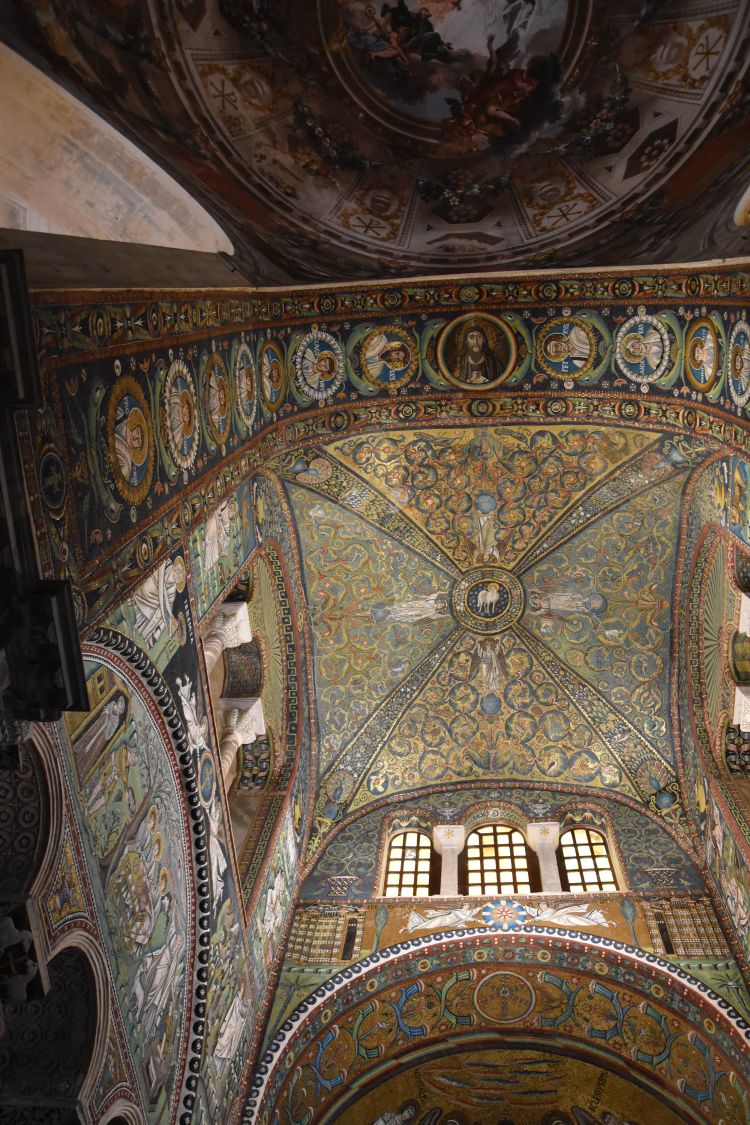
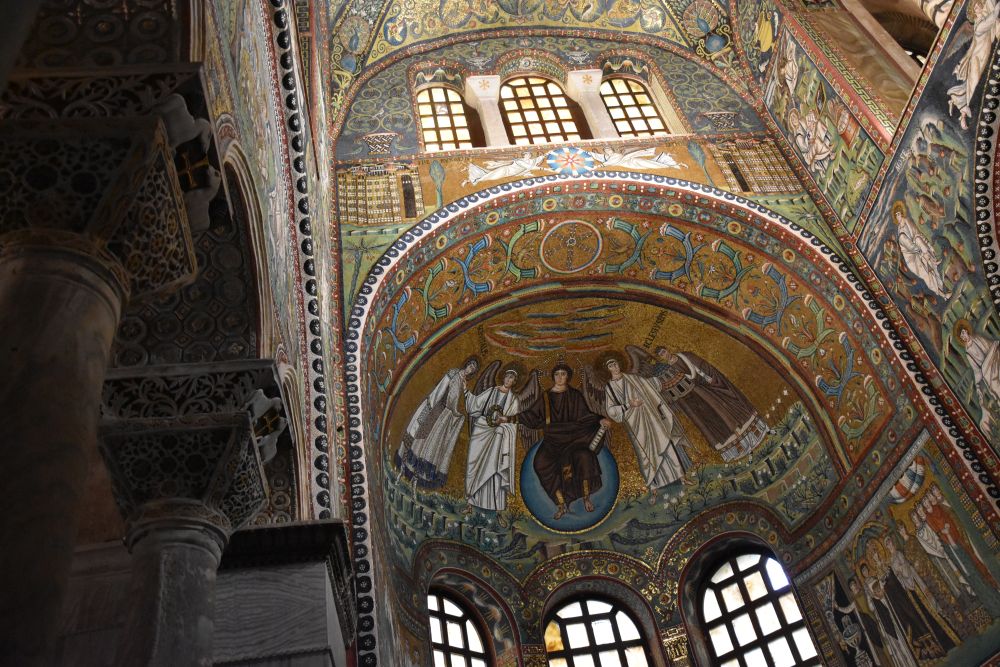
Inside the choir is beautifully decorated with mosaics. They are the best preserved Byzantine mosaics from Early Christianity (id est around 500, Rizzardi, p. 72).  Let us discover the San Vitale choir with the mosaics shining in green-blue-golden-white.

.

Central cupola of the choir topped by the Lamb of God

In the center of the cupola the Lamb of God or Agnus Dei looks down at us as a symbol for Christ. He is flanked by four angels that stand in beautifully decorated gardens with birds and animals. The portrait of Christ himself is in the arch, along with the portraits of the apostles – next to Christ Petrus (grey hair) and Paulus (bald head).

In the front niche sits Christ, flanked by the two archangels and then to the left San Vitale (his martyrium is said to have happened here) and to the right the Bishop Eclesius who initiated building the cathedral. They all stand on a meadow with flowers and birds.

.

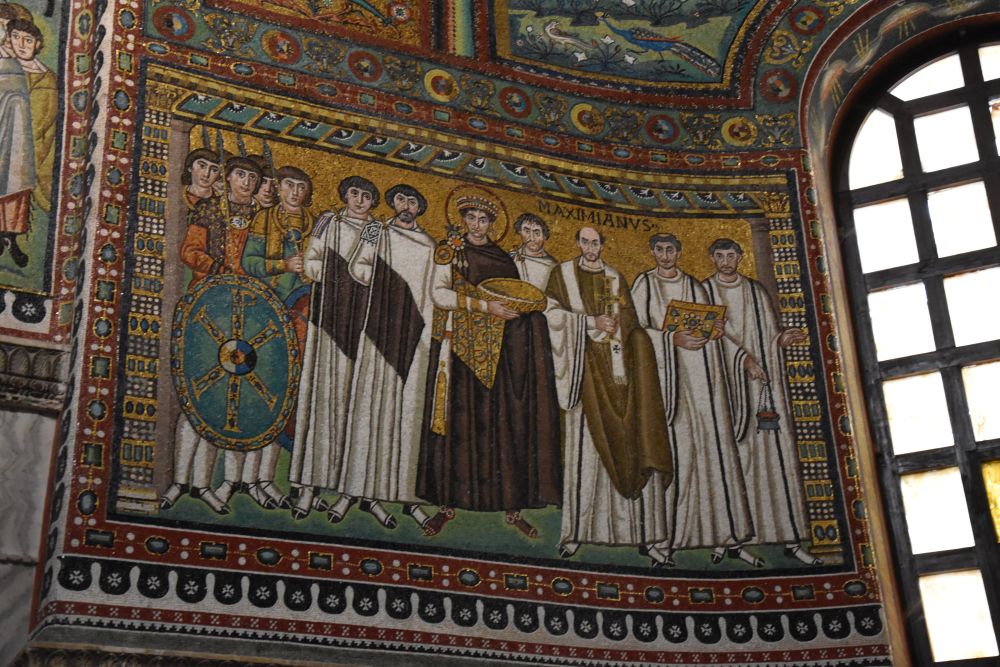
Both sides of the choir are dedicated to the Byzantine emperor Justinian and his wife Theodora

To the left of the choir there is a mosaic panel that shows the Byzantine Emperor Justinian in the middle amidst his men and warriors. The Bishop Maximianus who inaugurated San Vitale in 547 is labeled.

To the right stands his wife Theodora amidst her escort. She is said to be the daughter of a bear trainer and she became a very influential empress in Byzantium.

.

At the entrance to the choir: Biblical scenes

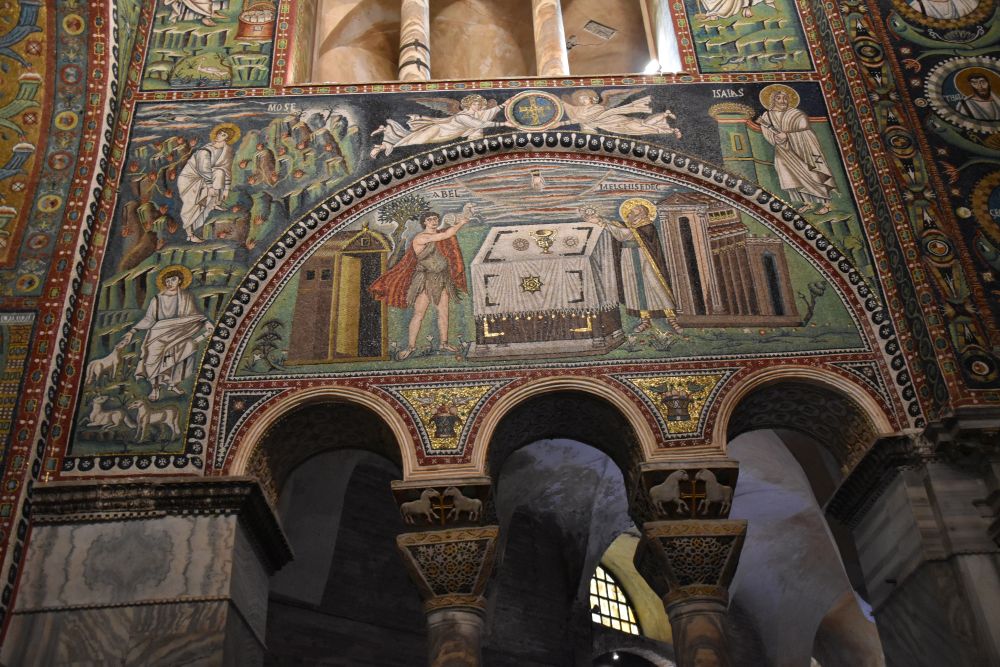
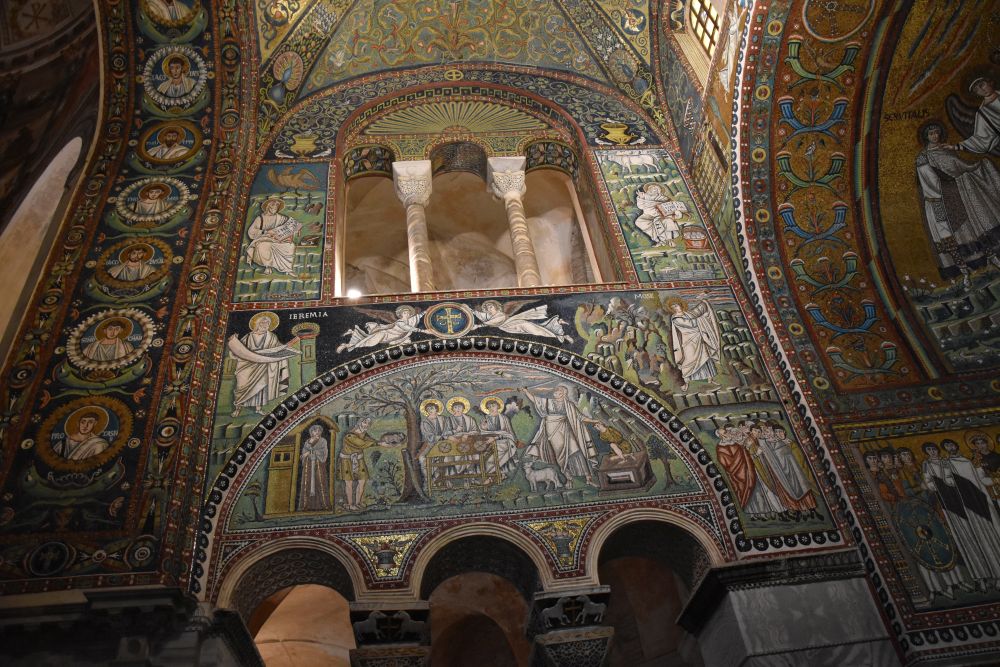
At the entrance to the choir there are two Biblical scenes.

The first scene below shows Abel sacrificing a lamb and Melchisedec bringing bread and wine. To the left from the scene stands Moses as a good shepherd (caressing a sheep) and again Moses taking off his sandals to climb Mount Horeb where he finds the burning bush. To the right above the prophet Isaiah looks down at the scene with Abel and Melchisedec.

The second scene centers around Abraham. He is serving food to the three vagabonds that turned out to be angels. Three bread loaves are on the table and Abraham brings a lamb while his wife Sarah watches the guests from the doorstep. To the right, the hand of God is stopping Abraham from sacrificing his son Isaac. Above the scene are the prophet Jeremiah (left) and to the right Moses receiving the Ten Commandments.

Another overwhelming assemblance of mosaics in Ravenna after the baptisteries and the Mausoleum of Galla Placidia… and there will be more – we have not yet seen Sant’Apollinare Nuovo and Sant’Apollinare in Classe.

References:
Clementina Rizzardi: “Ravenna, Eight Monuments World Heritage”, Municipality of Ravenna
Carola Jäggi: Ravenna, “Kunst und Kultur einer spätantiken Residenzstadt”, Schnell+Steiner, Regensburg 2016
Jutta Dresken-Weiland: “Die frühchristlichen Mosaike von Ravenna”, Schnell+Steiner, Regensburg 2016.


Ravenna: Comparing the Ostrogothic Arian Baptistery and the Roman Orthodox Baptistery

Now I will tell you about the Ostrogothic Arian Baptistery and for comparison of the christening scene recall the Roman Orthodox (Neonian) Baptistery. To conclude, we will visit the Mausoleum of Theoderic to say good-bye to him and his Ostrogoths.

Let us recap: In March 2018 we spent five days in Ravenna to see the town with its eight sites of UNESCO World Heritage:

  • two from the Western Roman Empire (402-476): the Mausoleum Galla Placidia and the Orthodox or Neonian Baptistery.
  • four from the Ostrogothic Rule (493-540): Theoderic’s Mausoleum, the Arian Baptistery, Sant’Apollinare Nuovo (remodeled during Byzantine times) and the Archbishop’s Chapel.
  • two from the Byzantine Rule (540-751): San Vitale and Sant’Apollinare in Classe (both started during Ostrogoth times, but inaugurated in Byzantine times).

(In the fourth ostrogothic World Heritage which is the Archbishop’s Chapel with Christ as a warrior it is not allowed to take pictures).

.

Let us return to the Orthodox (Neonian) Baptistery and compare the christening scene with the Arian baptistery

Remember the christening scene in the Orthodox Baptistery from my previous blog? Saint John holds a bowl to baptize Christ and the pigeon flies above – to me it seems to bless the water in the bowl. Historians assume that this christening scene has been altered later and that the scene in the Arian Baptistery reflects the original mosaic with Saint Joan holding his hand on Christ’s head and the Holy Spirit really flowing from the pigeon on to the head of Christ (see farther down).

By the way you can clearly discern the apostles Petrus with his grey hair (bottom left) and Paulus with his bald head (left from Petrus).

.

The Arian Baptistery – smaller and more intimate – again  just aaahhh

The Arian baptistery is smaller than the Orthodox Baptistery. The short absidioles at the bottom of the facade indicate that the building used to be much higher.

Inside I utter another “aaahhh”. The room is full of modest solemnity with the christening scene and the procession of the apostles in the cupola. The apostles move towards the throne of Christ, and Petrus (with his grey hair) as well as Paulus (with his bald head) are on both sides of the throne.

As mentioned abovem this christening scene is different from the one in the Orthodox Baptistery. In the Ariane Baptistery, Saint John holds his hand on Christ’s head and the pigeon pours Holy Spirit on to Christ’s head. Furthermore, Saint John, dressed in his fur coat, holds a walking stick instead of a cross. The god of the river Jordan is of the same size as the main figures and he has crabs on his head. The two scenes are very similar, but different, and the setup of the Arian Baptistery is deemed to be original. I love how gently Saint John looks at Christ.

The Arian Baptistery was built  around the year 500 by the Ostrogothic Arianic Christian community. The Ostrogothic king, Theoderic the Great, belonged to the Arianic community. Arians believe that Christ is the son of God, “but that he is distinct from the Father and therefore subordibate to him”, wikipedia explains, as opposed to the Orthodox-Catholics (still one church at that time) that believe in Trinity –  God, the Holy Spirit and Christ are one God in three divine persons. The Orthodox-Catholics declared the Arianic concept to be heretic and they persecuted them.

The Arianic community in Ravenna was small. This might explain, why their baptistery is smaller. Historians say that their mosaic had been completed in two stages. They conclude this from the fact that under the throne, the grey-headed apostle Petrus and the bald headed apostle Paulus as well as under the third apostle next to Paulus the lawn is of much darker green color than under all the other apostles. Only around the throne, there are flowers. And in addition the palm trees look different. The historians assume that, when the throne, Petrus, Paulus and the third apostle had been accomplished, the Arians run out of money – and only later they were able to complete the procession of the apostles.

I love the unostentatios solemnity of this small baptistery. Being baptized here must have been a great experience.

.

Good-bye Theoderic

I think that Theoderic was a very modern person. He is said to have been tolerant and cosmopolitic – I sense, as if he had lived through the times of Enlightment. In his mausoleum, we say good-bye to him.

The mauseoleum is one of the eight monuments of Ravenna in the World Heritage List. It consists of carefully cut Istrian stone blocks and excels by its 10.76m monolithic dome weighing 230 tons (Source: Rizzardi). On the second floor stands the porphyry sarcophagus of – as historians think – Theoderic.

When the Byzantines took over in 540, they removed his body, because they were against Arianism. Why? A belief that allows for a tolerant and cosmopolitic attitude is wonderful – and I would love to see more of that right today.

References:
Clementina Rizzardi: “Ravenna, Eight Monuments World Heritage”, Municipality of Ravenna
Carola Jäggi: Ravenna, “Kunst und Kultur einer spätantiken Residenzstadt”, Schnell+Steiner, Regensburg 2016
Jutta Dresken-Weiland: “Die frühchristlichen Mosaike von Ravenna”, Schnell+Steiner, Regensburg 2016.