Albania … hiking above Tirana on Mal Dajti

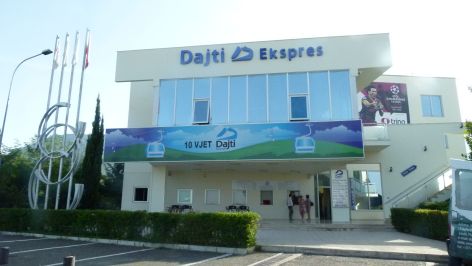
To the cable car, built by the Austrians, ten years ago

Doppelmayr from Austria has built the Dajti Express ten years ago.

P1080705

The cabins are very modern and comfy for six to eight people. I just wonder, why they need boxes for snow boards and skis… perhaps this was just the standard model?P1080754

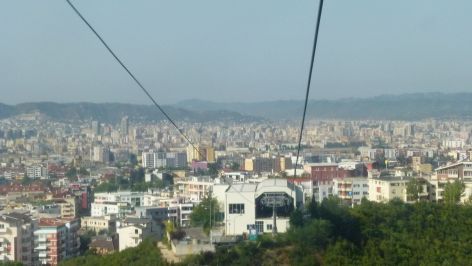
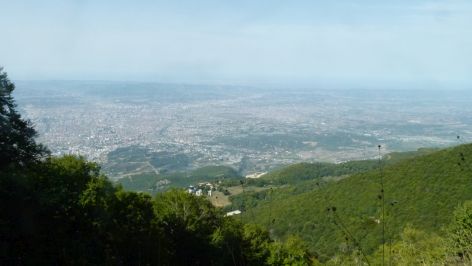
We enter the cabin and we have a view of Tirana with more than one million inhabitants.

P1080709

Walking to the top of Dajti… romantic forest, then gorgeous view

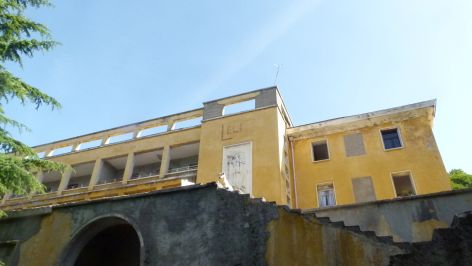
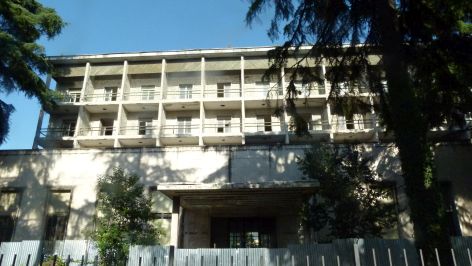
From the top station we head to the peak of Dajti. We first come across the former hotel for super achieving workers that had deserved a rest during communist times. The house is now decaying, joining the community of skeleton houses that always seem to me to be crying. One  window without glass has curtains, in another window there is laundry drying,  a dog is barking and a sign says “private”. Someone has decided to live here.

P1080715

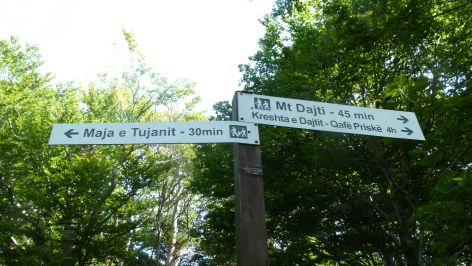
We walk through the forest, steeply uphill, for about half an hour, until we reach this sign.

P1080718

After another good half hour we reach the top of Dajti. We share an apple and enjoy the view of Tirana slowly being wrapped up in haze.

P1080719

The area on top has been reserved to the military… and to pine trees fighting to survive.

P1080721

Coming back down and heading for lunch

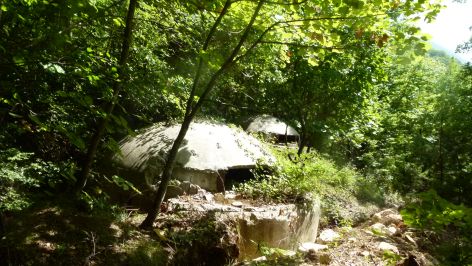
Coming back down, the bunkers catch my attention. Like mushrooms they are spotted all over in the forest. Hoxha has built 750’000 such bunkers, eager to protect Albania from invaders. Some bunkers are connected by tunnels.

P1080730

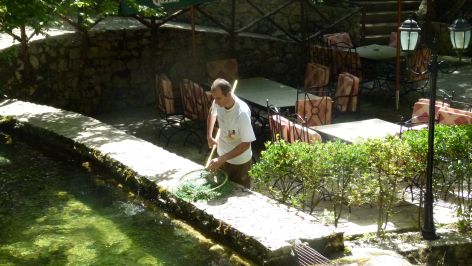
Two soldats guarding the area tell us that it is forbidden to walk here. And after a few friendly words they say good-bye to us. We continue and reach the restaurant Gurra e Perrise, a very romantic restaurant with huge fish ponds and the tables scattered around them.

P1080735

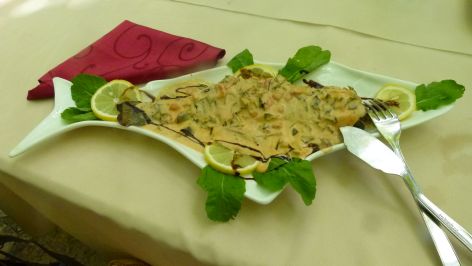
I have ordered a trout in salvia. My poor trout is being caught from the pond here…

P1080744

… and then served to me with a local red wine.

P1080748

Ben has the menu, lamb with potatoes.

P1080749

We take drinking water from the gurra, the well above the fish ponds.

On the way back, we stop in the Hotel Panorama with a wonderful panoramic view and with great hospitality. While I “powder my nose”, Ben talks with another guide helping out here today… they exchange business cards and discuss the fotos of all the political leaders that had come up here.

We ride back down to Tirana and have a rest from our walk. Later we will head for the National Museum; it is Tuesday today and the museum is scheduled to be open.

On the road to Albania… arriving in Tirana

Made it to Tirana with Lufthansa

First week of September – oh no – Lufthansa is on strike. Not again and not now! I have booked a tour with Jorik from albania2go – next week. But the strikes are canceled and on Monday 14th, “my” blue crane lands safely in Tirana. My guide, Ben, picks me up and, on the newly built boulevard connecting the airport with the city (built for the pope visiting Albania last year), he drives me to the hotel Vila60 that hides from the traffic behind houses with slightly decaying facades.

Mirë Dita to the welcoming Hotel Vila

The hotel is small, the front desk welcoming and the hotel room is tiny, but cosy. We have a small espresso Italian style, in the courtyard near the entrance. I practice saying hello, “mirë dita”.

Walking to Skanderbeg square… first impressions of this vibrant town

Along the river Lana (a useful landmark), the Abdyl Toptani (a pedestrian zone with busy little restaurants and some Illyrian excavations), we reach Skanderbeg square with the statue of this exceptional military leader withstanding the Ottomans for 25 years,

P1080700

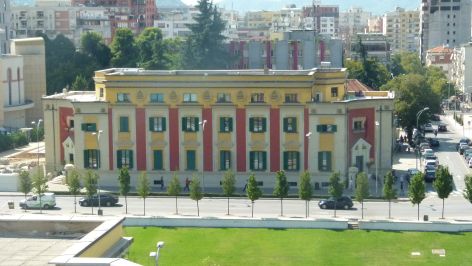
… the Italian style governmental buildings

P1080673

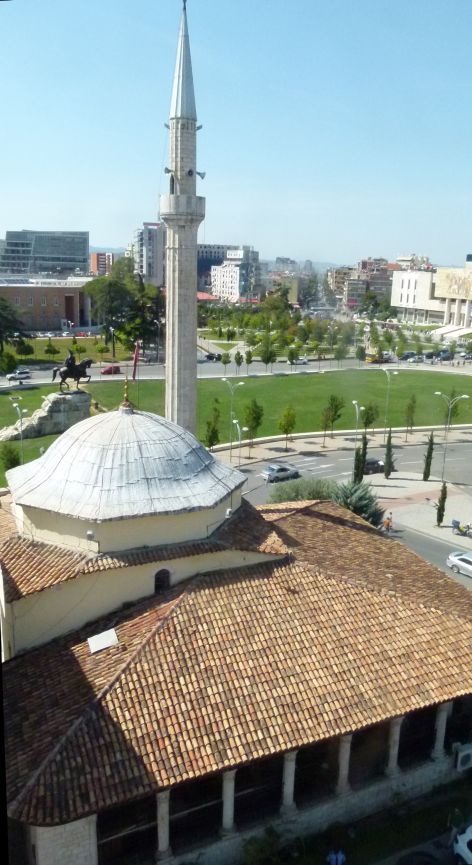
… and the Er’hem Bey Mosque from around 1800 with its bell tower. We climb the bell tower and see the mosque from above.

P1080671

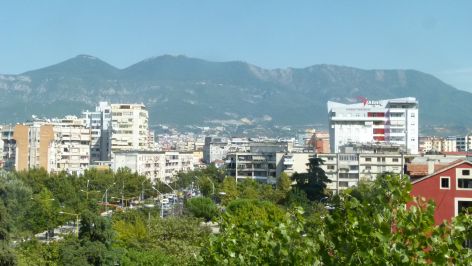
The mountain Dajti can be clearly seen at the horizon…  We decide to climb the mountain tomorrow (not using the cable car).

P1080675

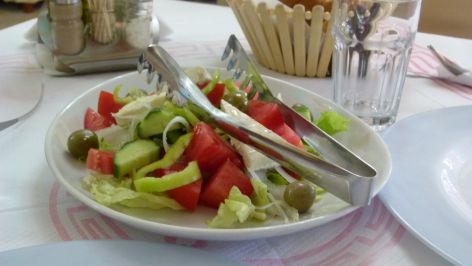
We say hello to the founder of the town, Pasha Mulleti, have lunch in a small restaurant (greek farmer salad, baked eggplant and lamb in a joghurt sauce).

P1080676

.

Walking south towards Blloku, the formerly closed area

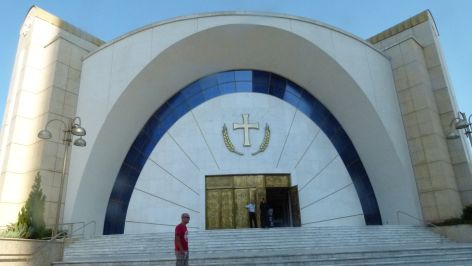
The newly built orthodox church is richly decorated.

P1080680

We head down to Blloku, the former closed area for functionaries, and have a glance at the villa of Hoxhta (now closed).

P1080685

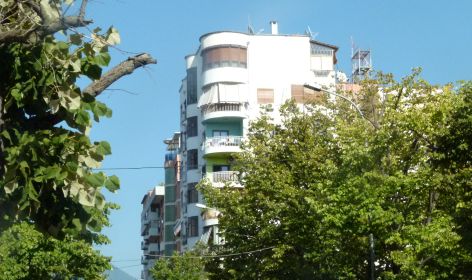
I am disappointed. What my guidebook calls a trendy area, seems to be a mess of large houses with decaying facades… and in between some small, old villas. Also Ben does no longer like to come here.

P1080686

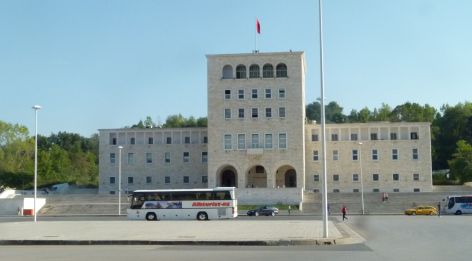
Impressive is the Mother Theresa Square, with the monumental university buildings and the archaeological museum.

P1080689

.

And following the boulevard of the national heroes back to Skanderberg square

“Do you know of a country, where the prime minister palace has no fence around it?” Ben asks proudly. Yes, I assume, Switzerland. “Okay, then Albania is the second country…”

But what is this? A huge house on the boulevard of national heroes, and it is decaying? Yes, this was the luxury hotel Dajti. The old stylish furniture has disappeared… and the hotel is just a ruin now.

P1080698

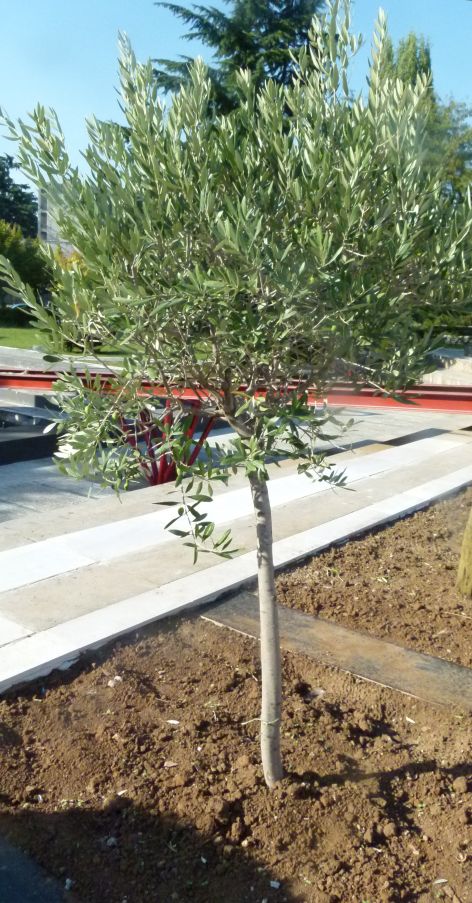
The pyramid is the memorial that the daughter of Hoxhta had built for her father. I am not so convinced, but I do like this small olive tree planted for peace… peace is what we need in this world, and Tirana has just hosted a congress about this topic. Wonderful.

P1080696

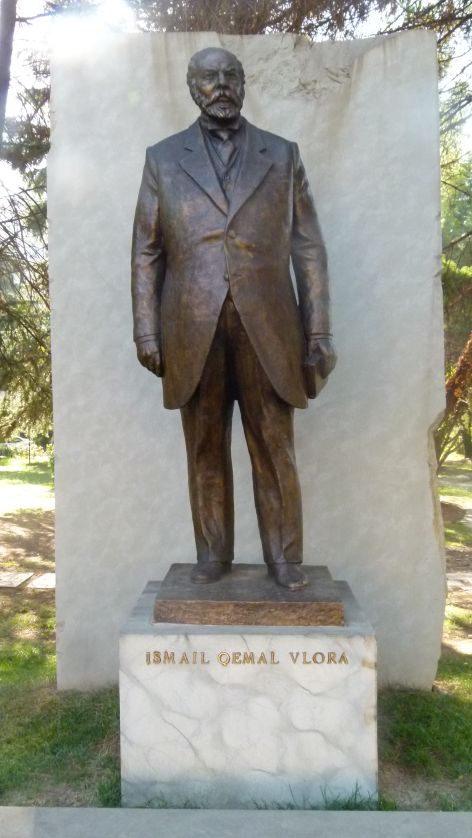
Qemal is another important statesman. He was very courageous and announced Albania as an independent nation in 1912.

P1080690

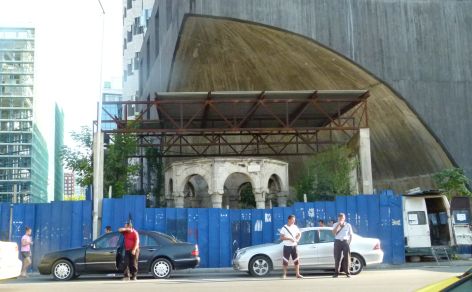
The Bektashi have their center in Albania… I am always impressed by the dervishes rotating and meditating. Here is a small tomb hidden under a huge building that left space for the Bektashi. As the blue walls show, it is now being renovated.

P1080701

The museum of national history is closed… it is Monday today. Oh yes, Mondays are always difficult for visiting museums. We will come back tomorrow to get an overview of the facts, as Ben points out (and I agree).

Ben takes me back to the hotel where I have a rest, on the charmingly furnsihed balcony near my room.

Thank you Lufthansa, for having stopped the strikes, and thank you, Ben, for sharing your enthusiasm for your country with me.

Albania – Ismail Kadaré and his “chronicle in stone” – 1941 to 1943

Continuation… the second world war in Gjirokaster, seen with the eyes of the child that Ismail Kadaré was. In 1941 he was five years old and he wrote his memories down in the novel “chronicle in stone”.

Changing hosts in Ismail’s town – and the beautiful black plane is back – bombing at the boy

After the Italians have left, the town is without government for 40 hours. Then the Greeks take over. After 70 hours the Italians are back and stay for 30 hours. The same story repeats several times. The citizens stay in their houses. But then the Greeks have left and the Italians do not come back. The citizens come out of their houses. The cows are back on the airport grazing.  Then the Greeks take over in town again and for now they stay. Gjergj Pula changes his name from Giorgio Pulo to Jorgos Pulos. The boy looks at the dark skin of the Greeks and wonders, whether they are gipsies.

All of a sudden there are planes in the air. Amongst them the black plane that Ismail had loved so much. The people are in the streets and so is the boy with his friend Ilir. The black plane throws bombs at them. The boys lie down in the open street – scared. Ismail thinks he lost his ears and his eyes and he is dead. After a while, all is quiet again. Ismail and his friend cry. Ismail cannot understand, why the beautiful black plane did this to him.

Greece was defeated and as refugees they leave the town asking for “psomi” which is “bread” in Greek. They boys, Ismail and Ilir, reflect whether in Poland and France they also say “psomi” for bread, as these two countries have also been defeated. It is cold and there is snow – winter 1940/41. The Italians come back, and Gjergj Pula changes his name back to Giorgio Pulo.

The vaults are no longer good enough, and the citizens hide in the castle

An engineer in a black cape (he must be a German – I am convinced about that with my German roots mixed into my Swiss roots) tests the walls of the vault with a knife and says that it is not safe enough for air raids. All vaults in the town are now deemed not to be safe enough. The plate “Air raid shelter for 90 persons” that Ismail had been so proud of is elimimated from the house of the Kadarés. The number of air raids by the English is augmenting. The citizens move into the castle above the town. Only Grand-Ma Selfixhe stays in the house of the Kadarés. The boy is scared, but she is confident that nothing will happen to her. Well, Ismail’s Grand-Ma remembers me very much of my own (Swiss) Grand-Ma, who survived serious air raids in Karlsruhe in Germany and also felt this trust that nothing will happen to her. I remember that I always felt safe, when as a little girl I was close to her.

Partisans are becoming active. The leader Enver Hoxha emerges and violence is increasing

The townhall is burning. The people are shocked: “The cadasters are burning”. “What are cadasters”, the boy and his friend Ilir ask. Javer explains that cadasters are  documents that show who owns what land, what fields and what houses. More such townhalls should be burnt, Javer says. The boys do not understand this. Ismail dreams that the fields and houses freed from ownership start to move and bend. Several suspects are arrested. I believe that Javer has joined the partisans and was the incendiary, but he escapes for now.

After a long summer with his Grand-Papa – (the parents of Ismail’s mother that live in the outskirts of Gjirokaster), Ismail returns back home in autumn 1941 and discovers that his town is empty and the doors are closed. Except the door to his home. His parents are shocked that he returns exactly now, because violence has escalated and also Gjergj Pula has been wounded.

In winter 1941/42, flyers from the communist party appear in town. Ismail recognizes the handwriting of Javer. People that “were against it”, are being arrested and deported in trucks. The town falls asleep – presumably without those that “were against it”… but… in the morning there are more flyers “against it” in town. Ismail and his friend Ilir climb a roof “to talk against it” paying attention not to be heard. They are six years old now.

More and  more people join the partisans, even Ismail’s aunt. The boys Ismail and Ilir play in a ruin. In the ruin, they find a notice in two languages: “Wanted: The dangerous communist Enver Hoxha. He is about 30 years old and tall…”. “This ruin was his house”, Ilir whispers to Ismail. At home, Xhexho says: “A new kind of war has surged, I do not exactly know, they call it something like the war of classes. In this war the brother kills his brother and the son his father. The worst is ahead of us.”

Xhexho is right. While the boys are playing in the street, they hear shooting. The town commander has been murdered. And in the night, they knock at the neighbor’s door and arrest Isa, the son who will be hanged later. Javer is also searched for. He goes into the house of his uncle, claims to regret all, and then shoots him down. Dead bodies are transported on a cart under a cover. The town is swimming in blood. The world around the boys Ismail and Ilir starts to decompose. The winter is cold and white. The boy is afraid of the white color, because he sees one word written on this white color: “Terror”.

Italy has surrendered and the partisans take over Gjorkaster violence is increasing even more

Refugees again. Italy has surrendered (in September 1943) and the Italian soldiers are leaving Gjirokaster. The town is dirty from clay and sludge. The partisans invade Gjirokaster in four crews, each crew carrying a read flag. The boy is surprised: The crews are small and come with a few mules that carry some munition and wounded persons. The partisans take over the town. A one armed partisan looks for non partisans in the neighboring houses, shoots them and is then shot by his commander, because he has also shot a girl that was not on the list.

The German occupation of Gjirokaster

In 1943, the Germans invade Albania from the south. The citizens flee the town and stay in a nearby village for some time. Only Grand-Ma stays in the house of the Kadarés.  While the citizens are in the village, the Germans arrive in front of the town. The partisans resist for three hours, until one citizen manages to raise a white flag. Now the German tanks enter the town. From their village, the refugees watch the town which is silent and dark in the night. On the next day, the citizens return to town. Dead bodies on the way. Among them friends of the family that had stayed in town. Grand-Ma is waiting in the house of the Kadarés. The boy looks at the German flag above the castle. Life is back in this town – now under German rule. But the ecosystem of the boys Ismail and Ilir has decomposed. In a way, Ismail was lucky: His parents and his Grandma Selfixhe have survived.

Ismail comes back many years later

Many years later, Ismail Kadaré returns back into his immortal grey town made out of stone. He feels that the cobblestones recognize him. Ismail’s ecosystem of people – Grand-Mother Selfixhe, Xhexho, Aunt Xhemo, Grand-Mama and Mother Pino – they do no longer exist. But Ismail feels that their shades are engraved for ever in this town made out of stone.

I can understand Ismail Kadaré. Whenever I come to places that I have been with my grand-parents, with my parents, with my husband, with persons I loved… I feel that they are engraved there – still being present for me and talking to me. I was lucky in my life to not have experienced such a war, but while growing older, the feeling of such places full of memories is very similar.

They say that Ismail Kadaré may be nominated for the nobel prize in literature and that his “chronicle in stone” may be his best book. So far I have only read this one book of Ismail Kadaré and I have been deeply touched by it.

Albania – Ismail Kadaré and his “chronicle in stone” – 1940

Ismail Kadaré – a child of Gjirokaster in World War II 

Ismail Kadaré was born in Gjirokaster in 1936. In his “chronicle in stone” he describes the events of the years 1940 to 1943 with the eyes of a child. The years were dramatic:

  • 1940 (Ismail is 4): After having invaded  Albania in 1939, the Italians build a military airport near Gjirokaster. In October Italy attacks Greece, and in December Greece – with the support of England –  conquers Gjirokaster. Gjirokaster is bombarded and the citizens hide in their vaults.
  • 1941 (Ismail is 5): With the help of the Germans, the Italians return to Gjirokaster in spring. The partisans emerge lead by Enver Hoxha (born in Gjirokaster in 1908). From the air raids, the citizens now hide in the castle.
  • 1943 (Ismail is 7): After Italy’s capitulation in September the Germans take over in Gjirokaster. Ismail Kadarés memories end now.

After school, Ismail studied in Tirana and Moscow and became a writer – and for some time he also participated in Enver Hoxha’s politics. The “chronicle in stone” was published in 1977. Describing the events seen by the eyes of a child allowed him to present thoughts he could not present otherwise in Enver Hoxha’s Albania. In a subtle way he was not fully in line with the regime.

I read the German translation by Joachim Röhm (Fischer Taschenbuchverlag). Let us look at how I experience some of the pictures that Ismail draws using the eyes of the child – 3 to 7 years old, if my calculations are correct.

Gjirokaster is the town made of stone climbing towards its castle

In the introduction Ismail takes the view of an adult person. He explains that his town is very steep, perhaps the steepest town in the world… it could happen that the basement of one house touched the roof of another house. It was a town made of stone. Ismail says that it was not easy to be a child in this town. – No, it was not easy – I understand that after having read his book.

The child’s view of the cistern and of the hatred between the river, the bridge, the wind, the mountains…

The houses in the town made of stone have cisterns to collect rain water. In a dark and stormy night, the rain drops land on the roof of the house – not yet knowing about their fate. Their fate is to get caught in the drainspout and to be captivated in the dark cistern, until mum lifts some of them into a bucket to clean the floors in the house. During the stormy night, the cistern fills with water – too much water. The boy shouts “huuuh” into the cistern, but it is angry and does not reply. With the aid of their neighbors the parents empty the cistern that has become a danger for the house. Now the cistern answers again, when the boy shouts “huuuh”. In the morning the river is flooding the road below the town, after having tried to get rid of the bridge. The child sees hatred between the river, the bridge, the wind, the mountains and the creeks attacking from the mountains – and between all this hatred is the town – all lonesome – with their stone walls that the boy loves. In the morning the boy sees a rainbow that makes peace between the elements, but Ismail is convinced that this is only a temporary peace.

How right the boy is! In 1940, there will be the fights between Italy and Greece. And there will be more fights in the following years.

The child is proud of the plate at the house of the Kadarés

It is end summer (I understand it is now 1940). The boy watches that everyone sews curtains. The Italians in town ask for “oscuramento”. One morning the boy discovers a metallic plate next to the door of their house: “Air raid shelter for 90 persons”. Passerbies read the plate. The boy smiles proudly at them: “Look, this is a house, it is stronger than all the other houses, it is the only one with such a plate.” The adults do not notice him. The boy goes down into the vault and admires the thick walls. With the first air raids, the windows in the upper rooms burst, but the vaults do not take notice of what happens outside. The boy is proud of his house with the safe vault that now has become the center of the quarter, as neighbors, guests and passerbies look for shelter from the ongoing air raids. As I understand it, the bombers are from England that supports Greece which has been atacked by Italy. One plane is shot and the citizens find the arm of an Englishman with a gold ring at his finger.

Even 1001 nights do not suffice to create Albania – the child listens to the debates in the vault

In the vault, the people debate nations, kingdoms and governments. Sometimes they mention “Albania”. The boy listens carefully trying to understand what Albania really looks like. “Is Albania everything around me, the farms, the bread, the clouds, the words – or only part of that”, the boy reflects. The former artillerist Avdo Barbamo says that a Dervish wanted to know from him, what he prefers, his family or Albania. “Albania, this is evident”, the artillerist answered. His reasoning: You create a familiy over night, after having met a woman in a café. But Albania? You do no create Albania in a night, even 1001 nights do not suffice. – Yes, Albania is a complicated piece of history, the people in the vault agree.

The child’s view of the Italian airport below the town

Also in summer 1940 the Italians have built an airport below the town. The boy has observed the process. The cows have disappeared. One day, a huge fleet of airplanes arrives frightening the citizens that have seen so many planes throw bombs. But these planes do not throw bombs – not here. The citizens come out from their vaults and watch the planes land on the airport. The  boy admires the parade of white planes. He is proud that Gjirokaster now also has planes. One morning, a huge black bomber stands between the white planes. It becomes the boy’s favorite airplane – he thought of it like a big friend. He watches the planes go south and he is alaways happy to see them come back. He cannot understand, why his parents are angry at those planes and at him admiring them. It is autumn 1940 and the Italians are attacking Greece.

But beginning of November the Italians give up the airport. The beautiful planes disappear, all the white planes and also the big black plane. They boy is sad and cries. Grand-ma Selfixhe cannot understand him: “The boy cries because of the airp… I can even not pronounce the name of this thing.” Also his parents do not understand their now almost 5 year old son. And the boy is sad.

… Let us continue later with the years 1941 to 1943.

Personalities of Albania I: Skanderbeg

Outstanding characters helped shape Albania

When diving into the history of Albania, I discovered personalities that helped form the national consciousness of Albania – beginning with the early Illyrian kings (Agron, Teuta or Gent) and ending with leaders of modern Albania after 1990  such as Sali Berisha, Fatos Nano and Edi Rama. I would like to learn more – and here I start with one outstanding character, Skanderbeg or Gjergj Kastrioti who lived from 1405 to 1468.

Skanderbeg’s merit: He withstood the Ottomans for 25 years

In his book “From Ottoman captive to Albanian hero” (2005), Harry Hodgkison’s described that the Ottomans strived to master Albania as a stepping stone to conquer Rome. But in Albania, they were halted by Gjergj Kastrioti nicknamed Skanderbeg:

“His assets were meagre, a fortress that lay like an eagle’s nest on the sheer side of a mountain, never more than twenty thousand armed men… and these were enough to hold the mightiest army of the world at bay for a quarter of a century, saving not only his own country from defeat, but with it the peninsula of Italy… almost three hundred years after his death General Wolfe, the hero of Quebec could speak of him as a commander who excels all the officers, ancient and modern, in the conduct of a small defensive army.”

Their totem, Harry writes, was the eagle from the mountains and they called themselves “Shqiptars” or “Sons of the Eagle”.  Do the Albanians still today think of themselves as the sons of the eagle, as the black eagle on red has become their national flag? (see also Skanderberg in wikipedia).

The background: An Ottoman captive recceives military formation, has a notion of honor and good lobbying skills

Oliver Jens Schmitt  wrote the biography “der neue Alexander auf dem Balkan” (2009), and he tells us that Skanderbeg’s father, Gjon Kastrioti, had to give Gjergj and two more sons to the Ottoman Court in Istanbul. Gjergj converted to the islam. His courage and military skills attracted the attention of the Sultan. Then he also received the nickname Skanderbeg (Alexander). For the Sultan he did service in the Balkan area. But when his father was killed by the Ottomans, Skanderbeg deserted and converted back to the catholic church. Also driven by the need to revenge his father, he started to fight the Ottomans. In Lezhë he united Albanian princes and tribe leaders – despite their quarrels – creating the League of Lezhë under his guidance. He applied guerilla tactics and also collaborated with the Hungarian Johann Hunyadi. The League succeeded to defeat the Ottomans several tmes, though outnumbered by the Turkish army. He was also supported by Italy (Naples and Rome brought money and weapons, but Naples rivaling with Venezia also created problems).

In the end, Skanderbeg hands his notion of honor over to his son

In 1468 Skanderbeg was affected by malaria. According to Renate Ndarurinze (“Albanien”, Trescher Verlag 2013), he embraced his son (then 12 years old) and warned him to beware of the Turks. He says: “Avoid being caught alive by the Turks. I know them well – they try to reeducate every man to fight his own clan and to subjugate his country. Then honor has to give way to shame. When you get into trouble, take your mother and leave the country. When you are grown up, come back and continue fighting. Keep shame away from our clan, because shame is worse than death (rough translation from the German text).”

The long lasting impact of Skanderbeg

Already in the 15th century Skanderbeg counted as a hero. Not only in Western Europe, but also for the Ottomans. When they found his grave, they made amulets of his bones hoping to benefit from his courage.

Skanderbeg’s uniting several tribes under his flag helped shape the national consciousness which eventually ended in the creation of Albania in 1912. Numerous street names, places and statues remind of him. Albanian and international writers have been inspired by him such as Fan Noli, Naim Frashëri, Ismael Kadare, Lord Byron or Voltaire. Vivaldi composed an opera. And with Sowjet-Albanian collaboration the film “The Great Warrior Skanderbeg” was directed by Sergei Yutkevich winning a price in Cannes in 1954 (Великий Воин).

Why have I not heard of Skanderbeg before? I now ordered the biographies written by Ismail Kadare and by Oliver Jens Schmitt.

Planning of being on the road again in 2014 – Albania?

What about visiting Albania?

Ursula asks me, whether I would like to join her and visit Albania.

Albania?  This nation is a white spot on my map. So far I have only related three facts with it:

  • When 8 to 9 years old  I spent one night reading the “Red Zora” by Kurt Held. Zora was from Albania and emigrated to Croatia to escape blood-vengeance against her family. Albania must be a country with tough rules, I thought, and these rules shaped Zora’s will to fight that I admired (see also the NZZ article of 2008).
  • During the cold war, I perceived Albania as a locked garden somewhere on the Dalmatian coast.
  • After the fall of the iron curtain I watched the hooting of the Kosovo Albanians celebrating their new nation. This is a people with commnon roots, and I noticed their will to fight that I had admired  Zora for.

I believe, it is a good idea to visit Albania now, as it is on the verge of change and, if the Albanians make good use of their will, the country has good chances.
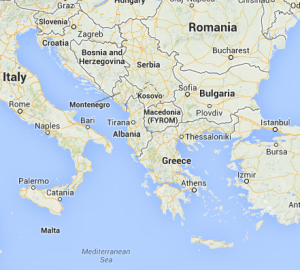
Map Google

Source: Google Maps

Diving into the history of Albania

To understand more of Albania, I dive into wikipedia  (Albania , history of Albania and Albian parliamentary election 2013). In addition I acquire the  book “Albanien” by Renate Ndarurinze (Trescher Verlag 2013). I discover that the nation of Albania has been founded in 1912 or just 101 years ago, in the same year that my father was born. On May 30th 1913, the Great Powers acknowledged Albania – and May 30th is my birthday. Why have I not known more about this country?

I always need structure, and this structure resonates with me: Prehistory, Antiquity, Middle Ages, Ottoman Rule ending with the first republic of Albania, World Wars and Interwar Period, Socialist Republic and Transformation towards Democracy. And these are the facts that I read from my sources.

Prehistory (until ca BC 800) – early development supported by natural resources

Early human traces were found in Albania, starting BC 100’000. Around BC 1000, there are  settlements of various Indo-European tribes including Illyrians that are claimed to be the ancestors of the Albanians (this is sometimes controversial). The Illyrians lived in fortified settlements, ran silver and copper mines, and traded.

Antiquity (ca BC 800 to AD 400) – flourishing Illyrian empires and Roman rule; border between Eastern and Western Rome dividing Albania

There are Greek colonies (from BC 600) and some flourishing Illyrian kingdoms from BC 500-200 (ruled e.g. by the kings Agron, Teuta or Gent). The Illyrians had agile galleys that threatened the Romans, and the Romans fought against them. Eventually emperor Augustus succeeded to integrate Illyria into the Roman empire (BC 27). The Via Egnatia becomes the shortest road to Byzantium.

When the Roman empire is divided up around 400 AD, the new border splits Albania, with the North going to the Western Roman and the South to the Byzantine Empire.

Middle Ages (5/6th – 15th century) – changing landlords and Albanians emerging as an ethnic group

Landlords in the Albanian territory are changing:

  • Until 1200 landlords are mainly Byzantine and Bulgaria, and there is also local Progon from Kruja who rules over the principality of Arbanon for about 20 years.
  • In 1054, the schisma divides Christianity into roman-catholic and orthodox. Northern Albania becomes roman-catholic and Southern Albania adopts the orthodox direction.
  • In 1204, the Fourth Cruisade results in Byzantine being expeled from Albania. There are new landlords: Sicily, Naples, Serbia and later Venezia. 1267 to 1272 Charles of Anjou from Naples calls himself “Rex Albania”.
  • After 1350, there are four family clans (the Ballsha, Topia, Muzakas und Zenebisht) leading their empires in Albania, Kosovo and parts of Epirus.  It is here and now, Wikipeda says, that the Albanian ethnic group seems to surge and become a majority, based on their nomadic culture and their shared language.
  • In 1398, the Ottomans win the Battle of Amselfeld in Kosovo and start to invade the Balkan (the Ottomans had crossed the Dardanelles in 1354 and then had steadily advanced through Greece towards the Balkan).
  • Skanderbeg withstands the Ottomans from 1443 to 1468. He is a national hero. His flag, the black eagle on red, will be the banner of modern Albania.
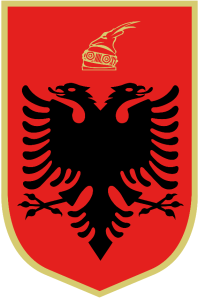
Flag

Source: Albian parliamentary election 2013

Ottoman rule – 1479 – 1912 (more than 400 years). In 1912, the republic of Albania is proclaimed

By 1479, all Albania is under Ottoman rule. Until 1800, there is peace in this Ottoman province called Sanjak. The districts are governed by local elites and governance is handed over within their families.  The Ottomans expect taxes and soldiers. In the 17th century, the Muslims are in majority, but they have a practical relation to religion: Some would go to the mosque and then to the church to be sure, they get it right (observation of Lord Byron in 1809).

After 1800, the Ottomans are “the sick man of the Bosphorus”. Two local families in Albania provide strong leaders. One of them, Ali Pasha in the south, becomes largely independent and develops the economy. The Ottomans hit back. In 1830, the commander of the Sultan in Albania invites the local leaders under the pretext to give them an award – and shoots them down. Excessive tax increases make the economy suffer. A new wave of emigration results.

After 1850, the Albanian national consciousness is surging – called “Rilindja” (ri-lindja=re-birth). Rilindja is driven by the elites and spiritual leaders. It surged despite the odds of social structures differing from North to South, the odds of the non existence of one religion supporting identification, the odds of the absence of a standard Albanian language with a standard alphabet and the odds of lackig schools teaching Albanian (90% of Albanians were illiterals). Amongst the elites, the brothers Frashëri stood out. After the Turkish-Russian War of 1878-81, parts of Albania are given to Bulgaria and Montenegro. Abdul Frashëri leads the League of Prizren. At the Congress of Berlin, he ask for an autonomous Albanian region within the Ottoman empire. As he is rejected by Bismarck, he fights and restablishes the Albanian province staying under Ottoman rule. But then the Ottomans destroy the league.

Around 1880, a standard Albanian script is emerging: Exil Albanians in Istanbul define “the Latin alphabet adapted to the Albanian language”. In 1887 the first school teaching in Albanian is founded and in 1908 the standard Albanian Latin script is agreed upon at the Congress of Manastir.

It is in 1899 that for the first time an independent Albanian nation is proclaimed by Sami Frashëri (Abdul’s brother). Sami publishes the politicial manifest Shqipëria: “ç’ka qenë, ç’është e ç’do të bëhet (Albania – what it was, what it is and what it will be)”. The third Frashëri brother, Naim, writes the biography of Skanderberg to strengthen the national consciousness of the Albanians.

After the first Balkan War (1912/13) the Ottomans are expeled from the Balkan. Albania is invaded by Montenegro, Serbia and Greece.  Under this pressure, Ismail Qemali and the leaders of the Albanian National Movement proclaim the republic of Albania in Vlora. The Great Powers accept Albania in May 1913, while assigning Kosovo to Serbia to please Russia and France.

World wars and interwar period – more landlords… Italy and Germany. Hoxha emerges

  • Already in 1914, Albania disappears from the map and then resurrects again in 1920.
  • Until 1939 it becomes more and more dependent on Italy and Mussolini. 1925-1939 Ahmet Zogu, later king Zog I of Albania, partially succeeds to modernize the country – with the help of Italy.
  • In 1939 the Italians occupy Albania and Zogu leaves the country.
  • In 1941 the Germans occupy Yugoslavia, Albania and Greece in their Balkan Campaign and create Great Albania (including Kosovo and parts of Macedonia and Montenegro). Resistence surges, led by the recently founded communist party under Enver Hoxha. He collaborates with Josip Broz Tito. In 1944 the Germans retreat from the Balkan.

Remarkable: In 1944 the Germans ask Albania to arrest and hand over Jews, but their government does not execute the orders for arrest and the population hides the Jews that are in danger. Religious tolerance prevails in Albania.

Socialist republic (1944-1990) – the long reign of Hoxha (40 years) with changing alliances

In 1944 Enver Hoxha and the communist party take over in Albania. Hoxha proclaims the Socialist Peoples Republic of Albania. The estates of the squires are distributed to the farmers.

  • 1944-1948 cooperation with Yugoslavia, until Stalin expels Yugoslavia from the Warsaw Pact membership.
  • 1948-1968 cooperation with the Soviet Union. These were the best years for Hoxha. With support of the Soviet Union, industry and water power stations are built and agriculture benefits from drying swamps and building irrigation. In 1967, Hoxha proclaims Albania to be the first atheistic nation of the world. After Stalin has died, Hoxha is not able to follow the reforms in the Soviet Union. Starting in 1961 there is less support from the Soviet Union and China’s support phases in.
  • 1968-1978 cooperation with China. Economy decays, as the investments of the Soviet Union can no longer be supported.
  • 1978-1990 Albanien’s solo. Hoxha is now paranoid and builds 700’000 bunkers to defend the country. In 1985, Hoxha dies and Ramiz Alia takes over.  With caution, he allows for more freedom.

Though Hoxha locked his country, installed his secrete police (Sigurimi), controled information, repeatedly killed whom he thought might be dangerous and installed cruel concentration camps, his achievements should also be mentioned: Forced education largely eliminated illiteracy, the university of Tirana was founded, public transportation was free (private cars were forbidden), health care improved and women’s rights were important to him. When cooperating with the Soviet Union, the economy advanced.

Transformation 1990 onwards – ziczacing towards democracy… and maturing on this path

Around 1990, the Albanians notice the changes in the Eastern Block and start to revolt – or ask for asylum in embassies.

  • Parties and elections start end 1990: As a second party, the Democratic Party of Albania (DPA) is founded, lead by the medical doctor Sali Berisha. More parties follow. In the first elections (1991), the Communists win again, in the second elections (1992) the DPA with Berisha is the winner. In 1997, the Socialist Party with Fatos Nano takes over, and after that it is again the DPA with Berisha, until 2009. Sometimes , the elections are reported to be fair, sometimes not. The elections of 2009 are very controversial. When in 2011 a video appears on youtube showing how the vice prime minister arranges a corrupt deal with the minister of economy, the situation explodes. There are uprisings in Tirana and other cities that end with violence. The next elections of 2013 are won by the Socialists Party with Edi Rama and Sali Berisha of the DPA accepts his defeat – a sign of growing democratic maturity in Albania.
  • Despite reforms, the economy does not really advance in the first years after 1990. In 1997 the situation explodes with the “pyramid scandal”: Investment banks had promised excessively high interest rates to the Albanians – and then went bankrupt. This leads to uprisings followed by new elections (at this point the Socialist Party takes over from the DPA). After having overcome the pyramid scandal, Albania has grown by 6 to 8% for several years.