Albania – from Valbona to Prizren in Kosovo

On the road to Kosovo – chats and stops

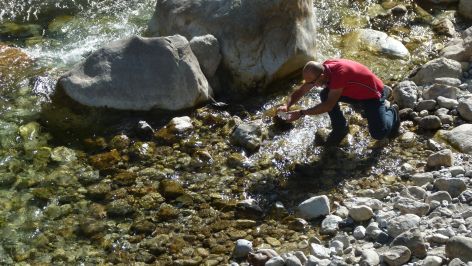
Ben stops. “Great morning light – I have to take a photo” … and he disappears in the river bed.

P1080974

I like that enthusiasm. Shortly afterwards, we stop in the middle of the road. A cousin of Ben enjoys seeing us. He gives us walnuts. We continue our way chatting and chatting.

Among other things, Ben tells me that as a small boy in the eighties, he was watching the airplanes in the sky followed by their white stripes, and he wondered what that was. Well, Albania was still locked up. In those days, each family was entitled to one portion of milk, bread and portions of more selected food. His uncle was alone, and they merged the portions; this was, how they had more to eat. Imagination helped to survive, in the mountain village near Kukes.

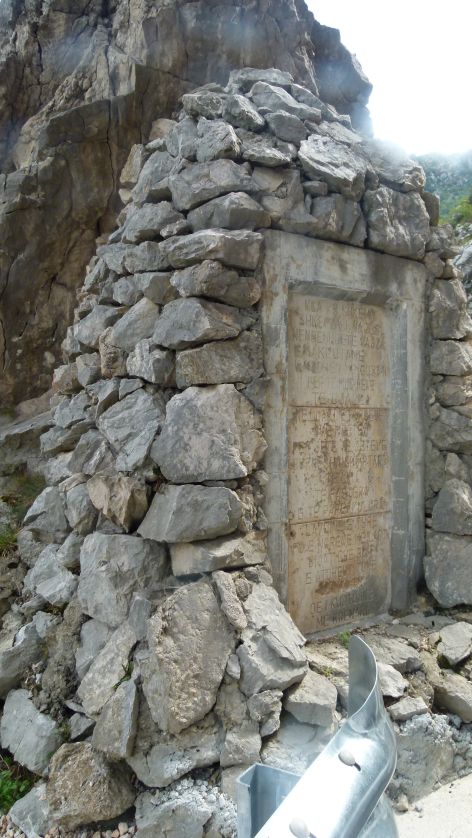
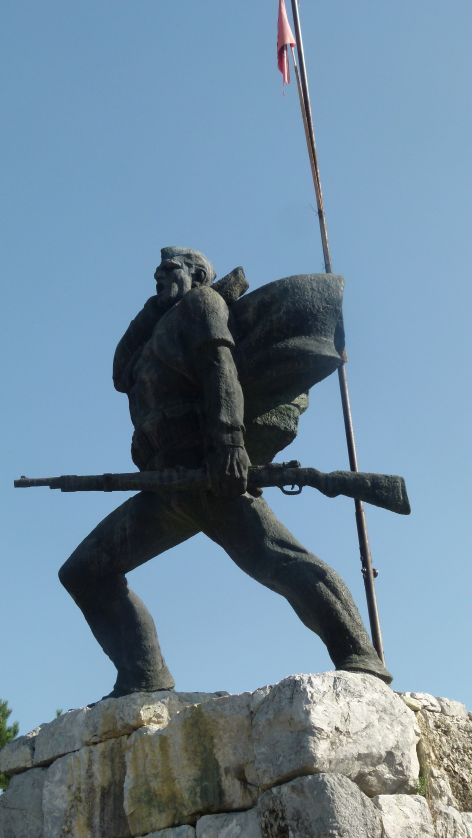
The monuments for partisans and heros from the 1940’s are omnipresent.

P1080984

Crossing the border to Kosovo and reaching Gjakova

Crossing the border to Kosovo is easy. Ben laughs: “Look, when they see a Swiss passport, they do not check it. There are so many Kosovo Albanians in Switzerland. Just think how many of them play in your football teams.” Yes, I know Shaqiri, and Ben corrects me: “no, no, he is not called Shakiri, but Shatschiri, “q” is “tsch”, also in Kosovo.”

Soon we reach Gjakova (gj to be pronounced dj). This town has suffered much in the 1999 war.

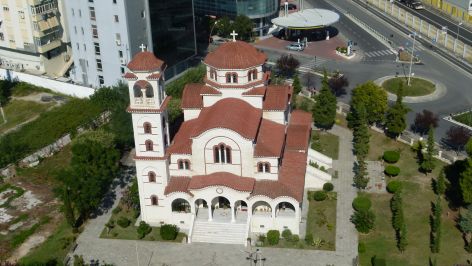
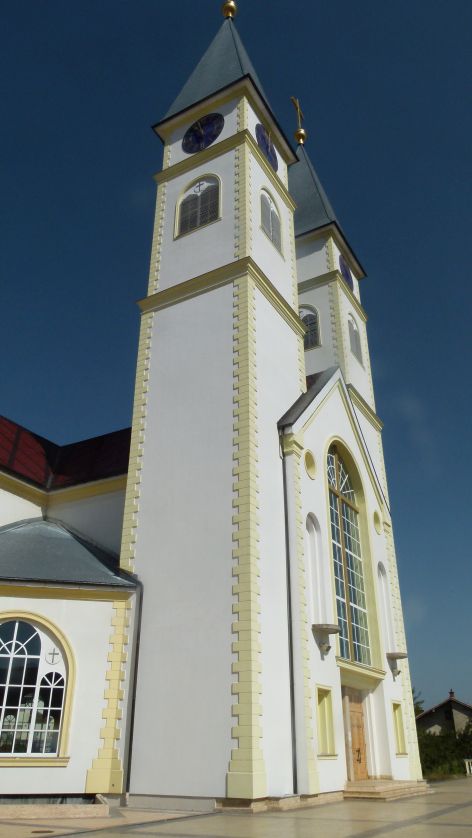
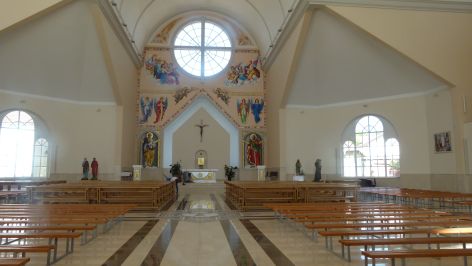
We stop at a catholic church that has recently been built with European support.

P1080999

Construction is still going on.

P1080996

The construction consultant is full of enthusiasm and tells us, e.g. where the organ will be located, where the tiles come from (Italy), who contributed funds (Europe) etc… The bells ring: It is eleven.

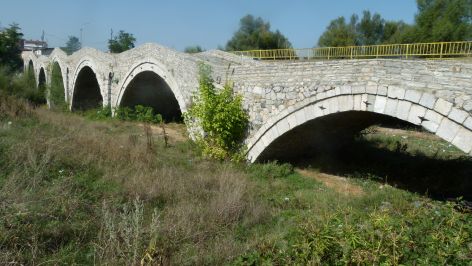
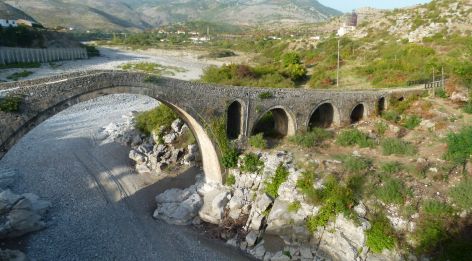
Near the church, there is an old Ottomoan bridge.

P1080986

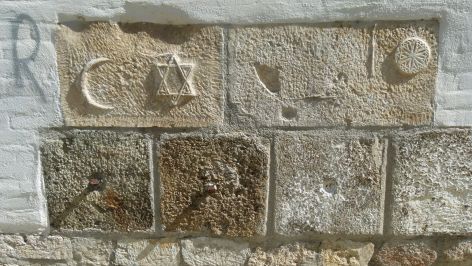
The clock tower seems to have been built by a Jewish architect, as the sign at the base suggests.

P1090003

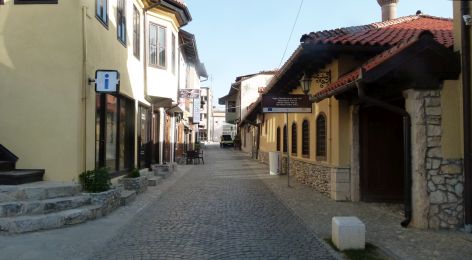
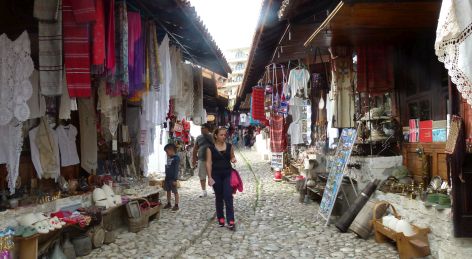
The town has perfectly rebuilt their bazar and city center – a pedestrian zone with cobbled streets.

P1090008

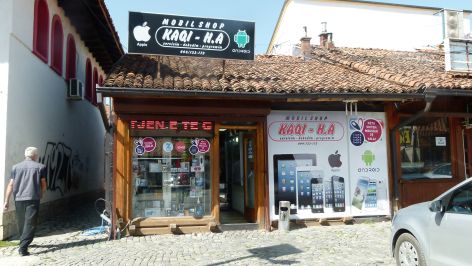
The shops are modern – we are parked in front of Apple and Android.

P1090001

We have a coffee at one of the bars. It is so modern that it only serves espresso and  no Turkish coffee.

Continuing to Prizren

The landscape is no longer rough mountains. It is flat and at places hilly. I see a sign pointing to the Stone Castle winery in The Rahovic valley. Something to try tonight.

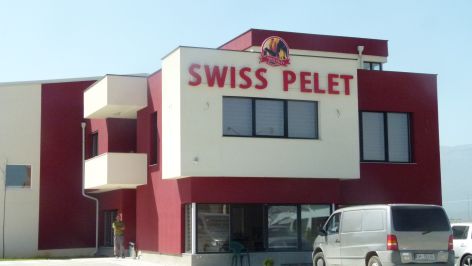
There is also some industry such as Swiss Pelet producing pellets.

P1090012

Discovering Prizren

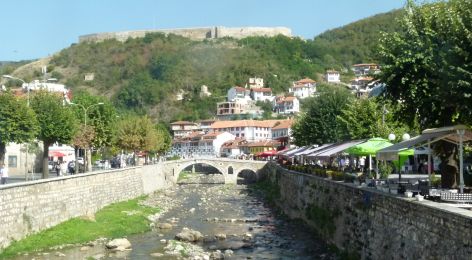
Prizren has a beautifully restored city center. There are many bridges, and one of them is an old Turkish bridge. Above town there is a castle.

P1090030

Along the river side and in the cobbled streets there are many restaurants and bars.

The Orthodox church and monastery are closed. Taking photos is forbidden. Policeman keep every one off the ground. The Roman Catholic church is being renovated, with European funds.

P1090020

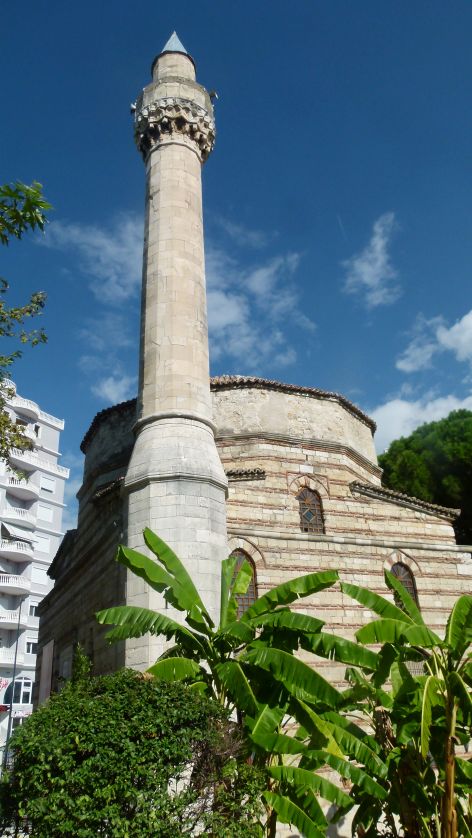
The Bajrakli Gazi Mehmet Pasha mosque from 1561 allows me to go in after the prayers. This is the cupola – beautiful.

P1090071

We walk up to the castle and meet Kfor soldiers from Germany. This reminds me, there has just been a cruel war here, in 1999. When walking through Prizren I forget this… so well restored is the old town. However (other than in Albania), there are many women wearing scarfs and long coats, some even only showing eyes. Though I see the black Skanderbeg eagle on red background in all souvenir shops, the flag of Kosovo is a star with six points, because Kosovo consists of six ethnics (Albanians, Serbs, Turks etc).

The museum of of the League of Prizren

Prizren played an important role in the formation of Albania. Kosovo was one of the four communities or Vilyats of Albania under Ottoman rule. In 1877 the League of Prizren was founded in Prizren. It defended the creation of an Albanian nation in the congress of Berlin, in 1878. Without success. When Albania was eventually founded in 1912, Kosovo with Prizren ended up with Serbia. In the second World War the Germans made it belong to Albania again. After the second World War, Kosovo was again given to Yugoslavia (that now also encompassed Serbia). In 1999 there was the cruel war with Serbia that ended with the creation of the nation of Kosovo.

P1090062

The league of Prizren had been founded in a building that later became the museum of the League. It was destroyed by the Serbs in 1999 and then has been carefully rebuilt. The museum shows the history of the League. Here are three men driving it (Unknown to us, Ymer Prizreni and Abdyl Frashëri).

P1090066

I understand that this League fought for Kosovo and for Albania. But… now they are two countries. After all that has happened, I hope for peace for the two  vibrant cities that I have seen in Kosovo, and for Kosovo.

The Beska or “Promise

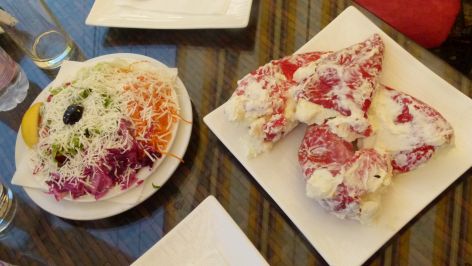
We finish off the day with dinner in the Beska. This restaurant is called “Promise” and it lives up to its promises. It deserves an entry in Tripadvisor. Why do we not, have any Kosovo Albanian restaurants in Basel? These paprika dishes, pita and yoghurt are simply delicious.

P1090075

P1090016

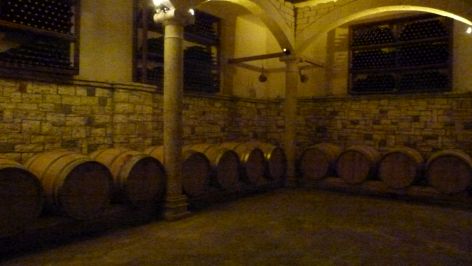
I have a small bottle of Stone Castle Cabernet Sauvignon which is a good match.

Great is the pond in he courtyard. Children love to watch the ducks that swimming and walking around between the tables.

Full of impressions I sleep well, despite the noise that comes from the river board… all Prizren is out on this warm and sunny Saturday evening.


Albania – hiking in the Valbona valley

The friendly guest house in Valbona

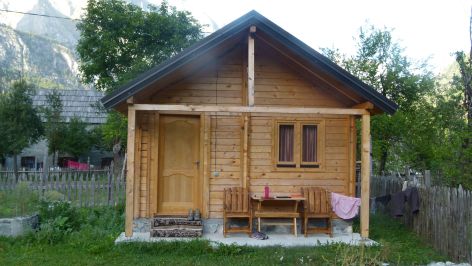
We sleep quietly in this small hut belonging to the Kol Gjoni guesthouse.

P1080964

The breakfast is delicious. Pancakes with home made honey and marmelade, eggs freshly collected from the hens and a Turkish coffee.
P1080901

Walking in the Valbona river bed

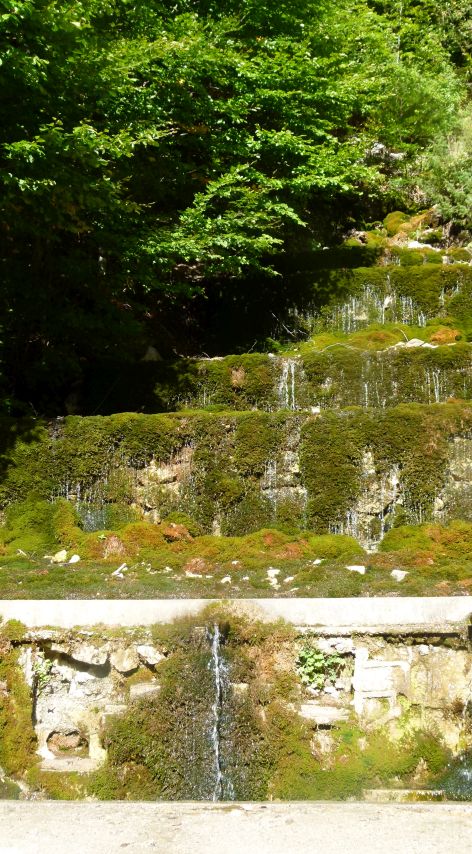
We leave around nine o’clock and get some drinking water at this well.

P1080910
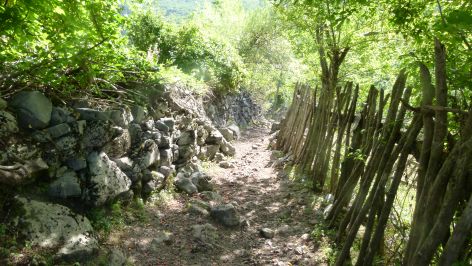
We turn to the marked hiking path,

P1080911

… and walk on the paved road and then in the stony bed of the Valbona river – ahead of us we see our target, the pass that connects Valbona and Teth.

P1080902

Upwards to the pass, with a surprise… Simoni’s bar

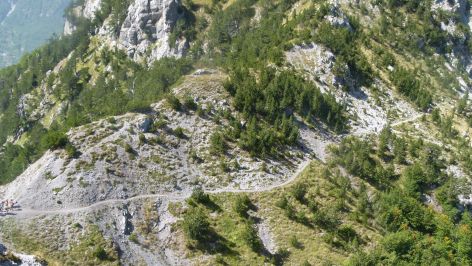
After about one and a half hours, our ascent starts on a narrow path.

P1080918
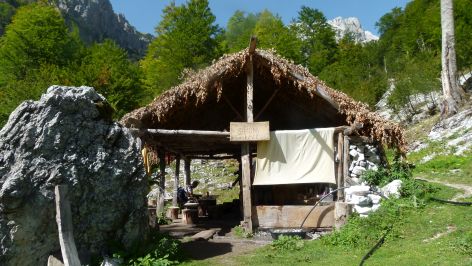
After another half hour, Ben whistles loudly to announce to Qsimoni that we are arriving. Qsimoni runs a coffee bar on a meadow in the middle of nowhere.

P1080927
Simoni’s Turkish coffee is delicious. He spends the summer here serving hikers. Why here? “Oh”, he says, “I once had a dream that I want to serve the public here. My elder brother helped me build the bar. And now I am here.” We love the place, chat with a Dutch couple, and then continue upwards.
P1080941

On the pass to Thet

Around one o’clock we reach the pass (Ben calls it “the neck”). There is a lot of activity here. Quite a few hikers came from Teth and now have lunch here. One group came with horses that carry their luggage. Brave animals. We climb to the highest point above the “neck”.

P1080946
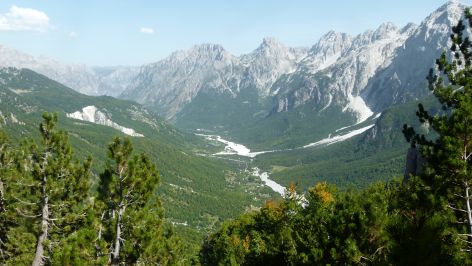
We eat our picnic (generous and delicious from our guesthouse) and enjoy the view down to the Teth valley and to the Valbona valley.

P1080950

Same way back to Valbona

We go back down, following the group with the horses.
image

Simoni’s bar is now busy. It is just the right place for a stop. I am astonsihed that so many people cross the mountains from Thet to Valbona. This is a secret to be passed on, when I am back home.
P1080957
I have another Turkish coffee and now I also take a Raki. Qsimoni is happy. It has been a good summer for him and he might look for a volunteer to help him next year, he says.

Around four o’clock we are back in our little hut. The farmer offers two large bowls of fresh yoghurt to us, and she spreads a blanket on the ground. Ben sits down legs crossed – this is how they do it here.

This has been a wonderful day walking for about five hours. Valbona is at 1000m and the pass at around 1800m.

Tomorrow, we will continue to Kosovo.


Albania – from Shkodra to Valbona

The Khomani ferry does not work, but there are small boats

From Shkodra we had planned to drive to the Komani ferry. But the ferry had stopped working. Not enough water in the Komani lake. But, where there is a problem, there is also a business opportunity that the locals catch: We find a bus transport to the ferry station, and from there, small boats take us to Fierze. With a couple from England, I jump into the bus, while their guide, Miguen, and Ben drive their cars to Fierze, the end stop of the ferries and now the boat.

Our bus takes a bumpy road through the mountains. As we overtake another bus, both drivers stop next to one another and have a chat, while blocking the road. Also, our bus driver never forgets to wave, when he meets a pedestrian or a worker along the road. I like that.

Onboarding to Annika

At the ferry station,…
P1080851
… we are directed to the boat Annika.

P1080847

It is already pretty occupied. In the middle of the boat are some bicycles and motorbikes. One mixed French-English couple bike around Albania with their two year old son. Courageous.

Three and a half hours – great scenery on a polluted lake

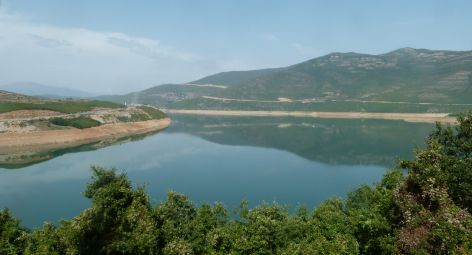
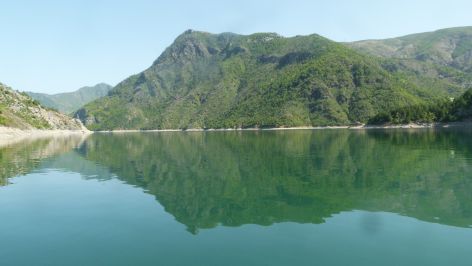
Three and a half hours we enjoy our boat ride along the Komani Lake. Here are some impressions of the beautiful scenery.
P1080851

P1080861

P1080869
If only this lake were cleaner. Plastic bottles and tins. A dirty foam spreads a smell that my nose does not really like. Some small fish jump across the water surface; they seem not to care. Is it true that all this mud comes from Kosovo? Perhaps we need some knowledge transfer from Switzerland to clean this lake?

The Komani lake has some critical spots, in particular, when it was narrow. An alarm would go off ever once in a while and we all had to sit down. I did not feel fully comfortable then. I could not fancy swim in this dirty lake, in case we hit a rock or a sand bank.

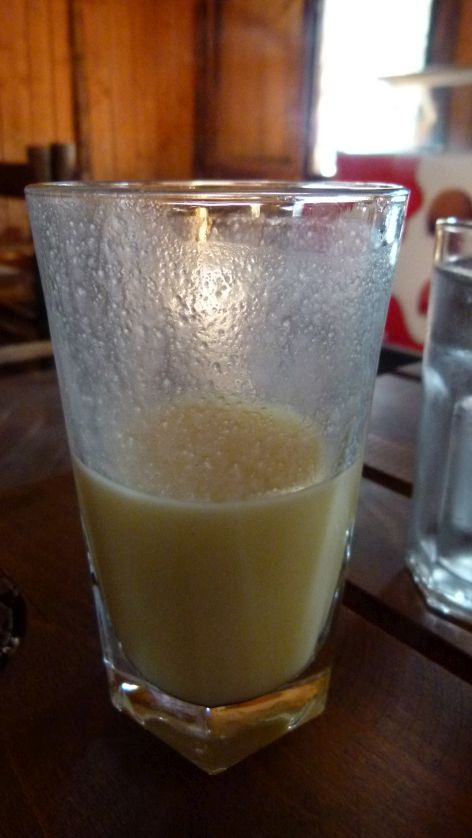
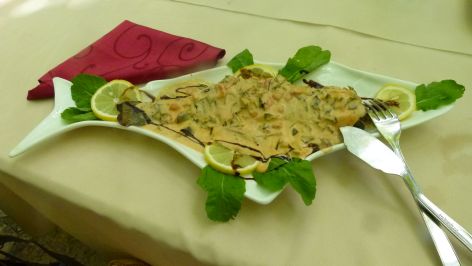
After three and a half hours we reach Our target port, Fierze. Ben and Miguen are waiting for us. We continue to Baijmar Curri for lunch at the Caka. I eat river trout. Ben gets a huge plate full of joghurt topped with the cream from cooked milk. The joghurt tastes sourish, almost like kefir. At the next table I observe, how two men and one woman receive a huge glass of Raki.

Bajmir Curri (to be pronounced “Surri”) was a partisan that had been killed by king Zogu. Hoxha had Topovka renamed after him. We quickly stop to greet Bajmir Curri.

The road to the Valbona valley has been newly made. We learn that “val” means “wave” in Albanian. Many girls are called Valbona in Albania, as Ben and Migen explain.

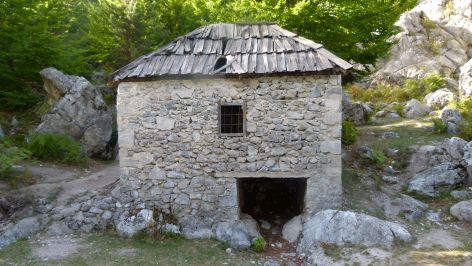
We stop at a mill from Chinese-communist times and at a second mill, nicely located on the wild Valbona river.

P1080876

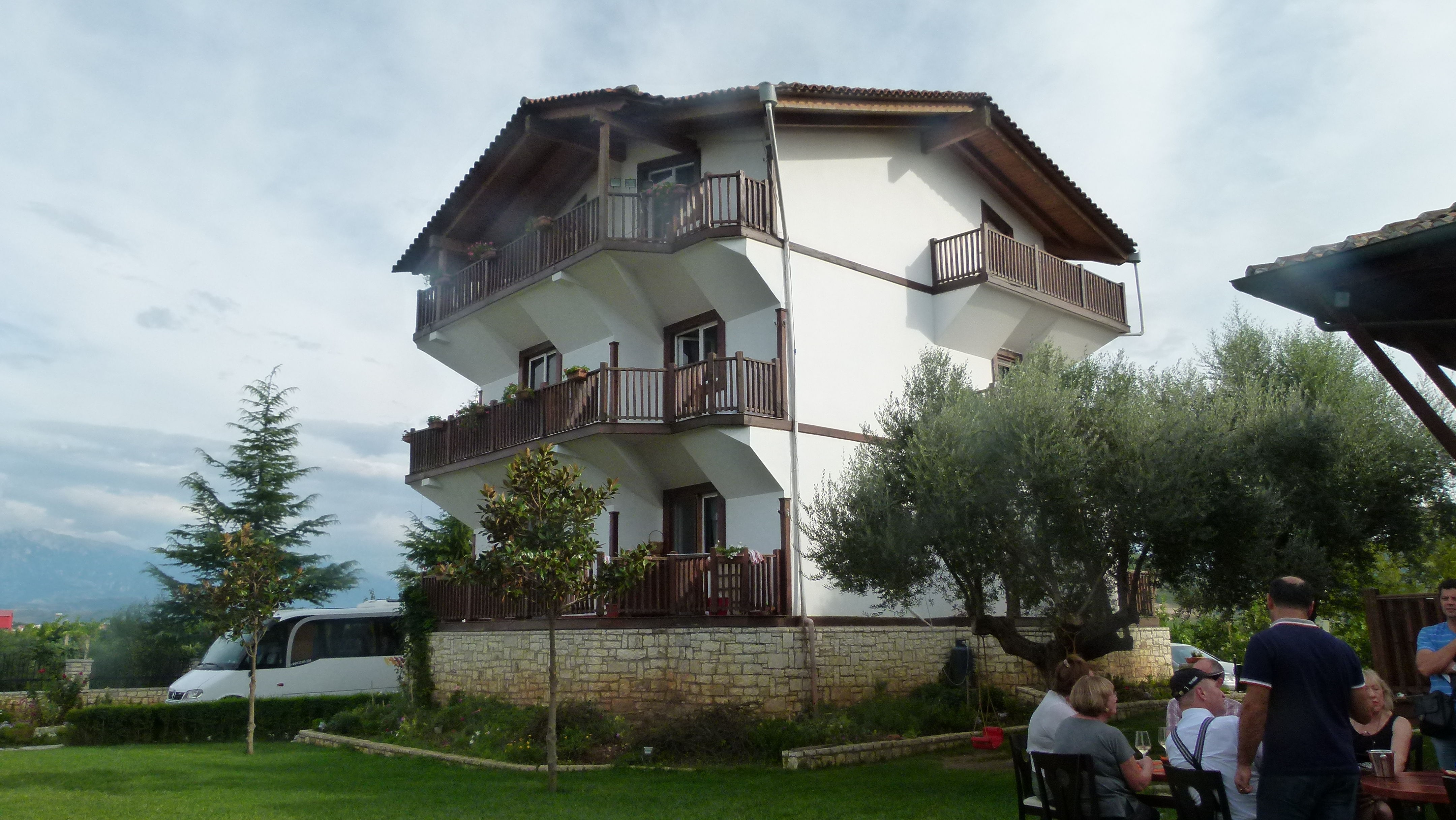
The welcoming Kol Gjoni guesthouse is a bit like a mountain hut.

image

We stay in a small wooden hut which is good, because the main house is full with two tour groups that plan to get up early to reach one of the peaks here the highest being Jezerca.

Gjoni is actually pronounced “Jonny” (gj=soft dsch). Jonny and his family welcome us with a cup of mountain tea.
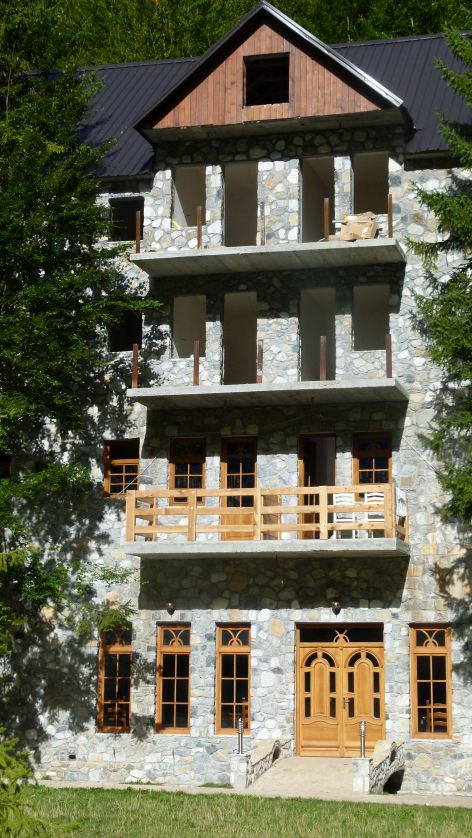
Refreshed we go for a walk. Some more guest houses and hotels have been built here. One of them claims to have five stars. Another hotel planned on five floors, but only two have been completed. A ghosty look.

P1080908

Johnny and his family serve local food. Dinner is a young goat that has been roasted by the neighbours. We enjoy it with a tasty salad, joghurt and potatoes.

Tomorrow we will go for a five hours’ walk. The weather is beautiful. I look forward to the hike.

Albania – from Tirana to Lezha and Shkodra

On my third day in Albania we travel from Tirana to Shkodra. Let me share a few impressions.
The Roman mosaics in Tirana

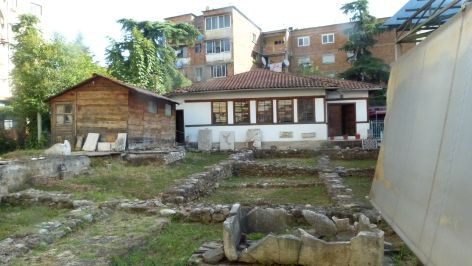
First we visit a small Roman excavation site in Tirana. The entry is free.
P1080764

I like the Roman mosaics…

P1080760

… and the fine reliefs.

P1080765

Driving to Lezha in the north west

Lezha is the place where in 1444 Skanderbeg united the leaders of North Albania to fight the Ottomans for 25 yeras. He has been buried here in St. Nicolas church. The church has decayed and is a memorial for him.

P1080773

Inside is a bust of Skanderbeg…

P1080780

… and along the walls are the emblems of the leaders that allied with him.

P1080778

Shkodra, surrounded by water and protected by the Rozafa castle

There is a nice legend about the Rozafa castle. A young mother agreed to be buried to support the construction, but not totally – with one eye she watched her baby, with one breast she fed it, with one hand she touched it and with the leg she moved the cradle. Ben buys a souvenir plate showing that for me.

P1080785

From the top there is a great view of the rivers joining here and of the lead mosque, now a ruin.

P1080790

Shkodra is overlooked by mountains.

P1080788

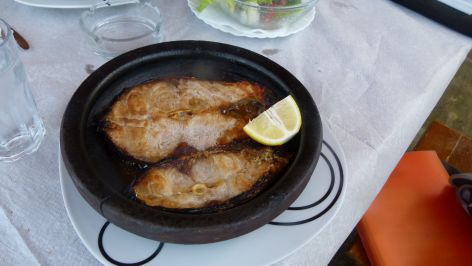
In a small restaurant on the border of the lake we eat carps.

P1080812

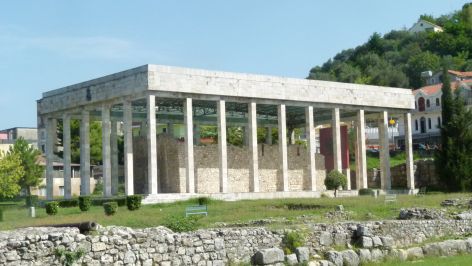
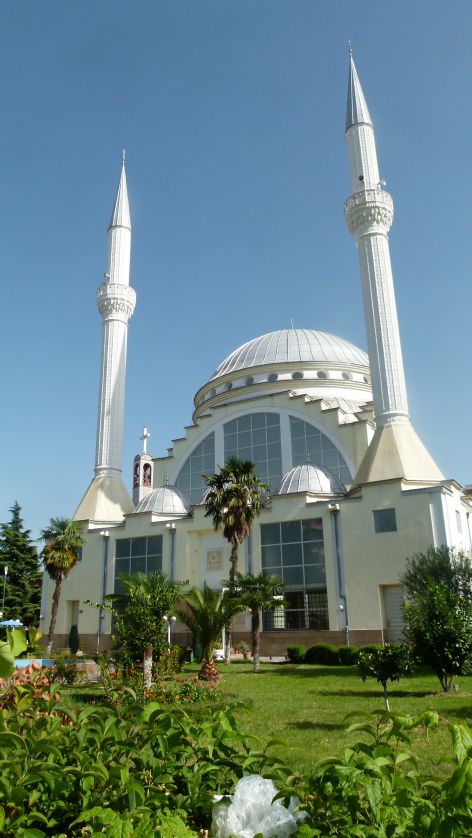
The mosque, the orthodox and the roman catholic churches are within 30m distance. This is religious coexistence which is usual in Albania.

P1080821

The first fotos of the Marubi museum are from 1858. Marubi had emigrated from Italy to Shkodra and founded the Marubi studios that were later taken over by locals.  The museum will soon move to the pedestrian zone and show more of the 500’000 fotos.  This is Marubi.

P1080823

After having visited the Marubi museum, we turn left, and are fined with 1000 Lek. There may be no sign, but turning left is forbidden here. We pay 800 Lek t the post office later. Paying immediately entitles for a discount. Interesting.

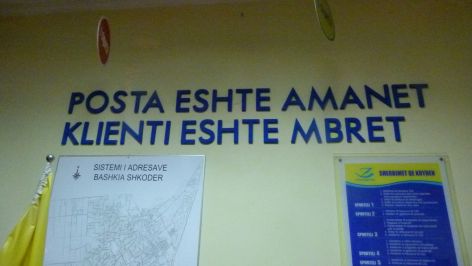
While Ben is paying I notice this sign… and I am proud to understand the second part: The clients are king. This is what the post strives for.

P1080839

We stay in the Hotel Tradita Geg&Tosk. The ambiance is a bit folksy. They are roasting a lamb in the fireplace. The garden is full with guests, the meals seem to be good.

P1080831

The guest are from all Europe. Some are from France and they came in their Deux Chevaux, driving all the way through Italy, Croatia and Montenegro.

P1080830

The Mesi bridge north of Shkodra is a masterpiece of Ottoman architecture.

P1080827

It stands next to a concrete bridge built in communist times… an ugly piece of architecture with a broken railing and iron “needles” standing out.

In the evening we visit the  pedestrian zone, with beautifully renovated houses  in the Italian and Austrian style, obviously with European funds.

P1080841

Matching the Italian style is the restaurant San Francisco that serves pasta. We finish the day enjoying the meal and the view from the balcony.

P1080844


In Albania – the National Museum

The National Museum… a good place to get a feeling for Albabian history and pride

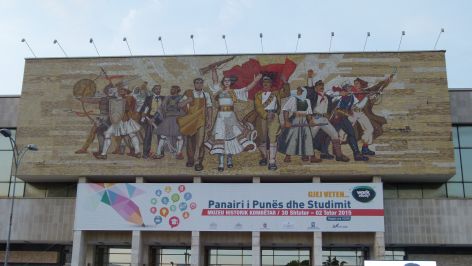
All my guide books recommend to visit the National Museum that overlooks the Skanderbeg square. Already the huge mosaic indicates that Albanians connect the roots of the present independent nation back to Ilyrian times. The museum has been built in 1981 and hence the mosaic ends with heroes from communist times.

P1100623

Scanning the milestones of emerging Albania

Ben, my Albanian guide, is proud of the museum and of his nation. I quickly understand… this visit will not be about updating details in my history table, but about feeling the milestones of the emergence of the Albanian nation, looked at with the eyes of the Albanians.

We start with the prehistoric times (even some 100’000 years ago). Copper, bronce age and iron age… the raw materials were extracted here, and with that the Illyrian culture emerged. The Early Illyrian kingdoms traded with the Greek towns such as Apolonia. The sea was called “detti ion) which means “our sea” in Albanian. Great exhibit: The mosaic with the Beauty of Durrës. Emperor Augustus eventually overcame the restisting Illyrians and created the Roman province of Illyricum.

Next the maps show the invasion of the peoples, Goths and Slavs. I can see some slavic names on the map from those times and also Albanian names of places in today’s Macedonia, Montenegro and Greece. My guide tells me, how those Albanian places have been renamed today. I can feel his enthusiasm for those places, but also I am happy to notice that Albania does not want to restore old borders.

The times of the changing rules, Byzantine, Serb, Bulgarian and Italian, we almost skip. Important milestone now are the Albanian principalities that sometimes already bear the name “Albania”.

Next important milestone is the invasion of the Ottomans after the battle of the Amselfeld in 1389 (Fushë Kosova in Albanian). What matters now is the resistance, first of Skanderbeg, the leader that deserves admiration, and then all the later uprisings that eventually led to the Rilindja, the emergence of the Latin script, the foundation of schools teaching in Albanian and eventually the proclamation of Albania in 1912, by Ismail Quemal.

What follows now, are the times of more foreign rulers, the reign of mbreti (king) Zog I, the growing influence of the Italians, the colonization in the second World War… I suffer, when I see the SS-flag. The partisans freed Albania which led to the next milestone: Communism under Hoxha. The museum documents, how Hoxha killed every one in his way, the opposition, the religious leaders, his followers… I am horrified by all the evidence on display.

The last station is the emergence of the democratic state with its first bumps, e.g. under Sali Berisha.

Much luck, Albania

My head is full of the Albanian milestones. I hope I understood them all well. I am happy to see the pride of Ben, mixed with pragmatism (we do not fight for the “lost” Albanian areas). I do wish luck to this nation at the verge to their future to … now hopefully… independence, democracy and economic thriving.

Albania … hiking above Tirana on Mal Dajti

To the cable car, built by the Austrians, ten years ago

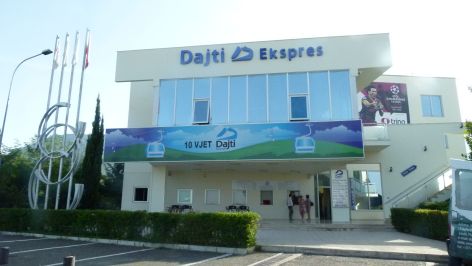
Doppelmayr from Austria has built the Dajti Express ten years ago.

P1080705

The cabins are very modern and comfy for six to eight people. I just wonder, why they need boxes for snow boards and skis… perhaps this was just the standard model?P1080754

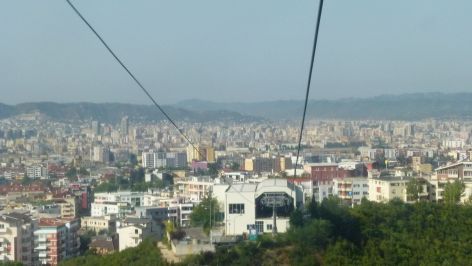
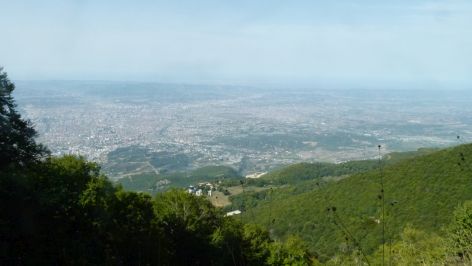
We enter the cabin and we have a view of Tirana with more than one million inhabitants.

P1080709

Walking to the top of Dajti… romantic forest, then gorgeous view

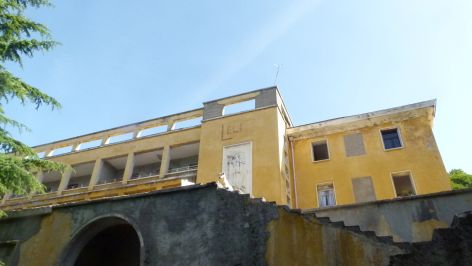
From the top station we head to the peak of Dajti. We first come across the former hotel for super achieving workers that had deserved a rest during communist times. The house is now decaying, joining the community of skeleton houses that always seem to me to be crying. One  window without glass has curtains, in another window there is laundry drying,  a dog is barking and a sign says “private”. Someone has decided to live here.

P1080715

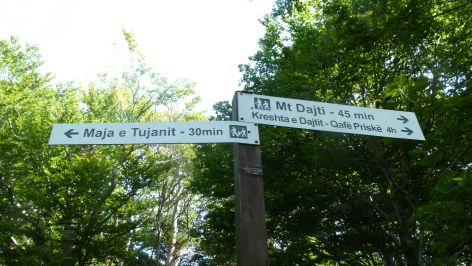
We walk through the forest, steeply uphill, for about half an hour, until we reach this sign.

P1080718

After another good half hour we reach the top of Dajti. We share an apple and enjoy the view of Tirana slowly being wrapped up in haze.

P1080719

The area on top has been reserved to the military… and to pine trees fighting to survive.

P1080721

Coming back down and heading for lunch

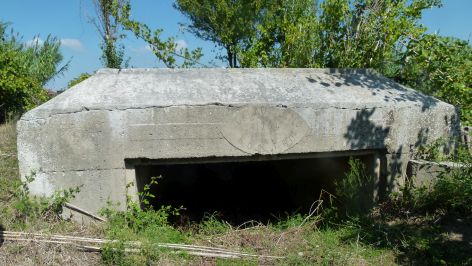
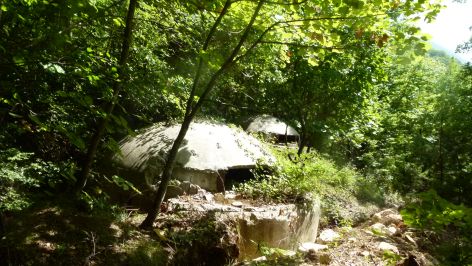
Coming back down, the bunkers catch my attention. Like mushrooms they are spotted all over in the forest. Hoxha has built 750’000 such bunkers, eager to protect Albania from invaders. Some bunkers are connected by tunnels.

P1080730

Two soldats guarding the area tell us that it is forbidden to walk here. And after a few friendly words they say good-bye to us. We continue and reach the restaurant Gurra e Perrise, a very romantic restaurant with huge fish ponds and the tables scattered around them.

P1080735

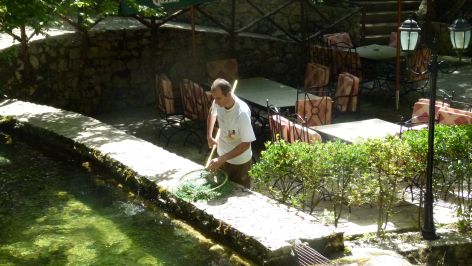
I have ordered a trout in salvia. My poor trout is being caught from the pond here…

P1080744

… and then served to me with a local red wine.

P1080748

Ben has the menu, lamb with potatoes.

P1080749

We take drinking water from the gurra, the well above the fish ponds.

On the way back, we stop in the Hotel Panorama with a wonderful panoramic view and with great hospitality. While I “powder my nose”, Ben talks with another guide helping out here today… they exchange business cards and discuss the fotos of all the political leaders that had come up here.

We ride back down to Tirana and have a rest from our walk. Later we will head for the National Museum; it is Tuesday today and the museum is scheduled to be open.

On the road to Albania… arriving in Tirana

Made it to Tirana with Lufthansa

First week of September – oh no – Lufthansa is on strike. Not again and not now! I have booked a tour with Jorik from albania2go – next week. But the strikes are canceled and on Monday 14th, “my” blue crane lands safely in Tirana. My guide, Ben, picks me up and, on the newly built boulevard connecting the airport with the city (built for the pope visiting Albania last year), he drives me to the hotel Vila60 that hides from the traffic behind houses with slightly decaying facades.

Mirë Dita to the welcoming Hotel Vila

The hotel is small, the front desk welcoming and the hotel room is tiny, but cosy. We have a small espresso Italian style, in the courtyard near the entrance. I practice saying hello, “mirë dita”.

Walking to Skanderbeg square… first impressions of this vibrant town

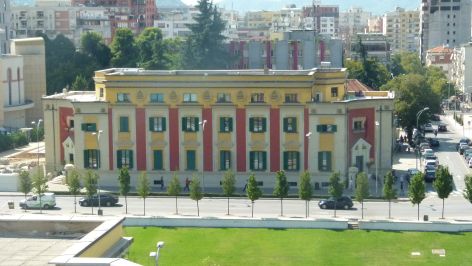
Along the river Lana (a useful landmark), the Abdyl Toptani (a pedestrian zone with busy little restaurants and some Illyrian excavations), we reach Skanderbeg square with the statue of this exceptional military leader withstanding the Ottomans for 25 years,

P1080700

… the Italian style governmental buildings

P1080673

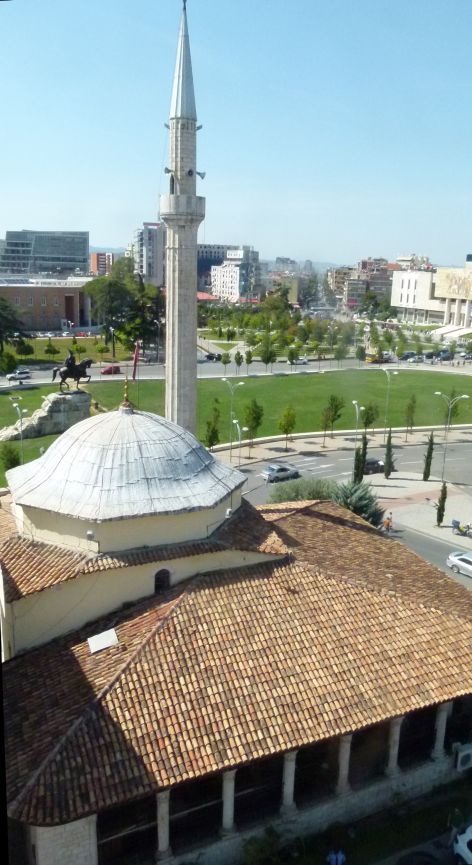
… and the Er’hem Bey Mosque from around 1800 with its bell tower. We climb the bell tower and see the mosque from above.

P1080671

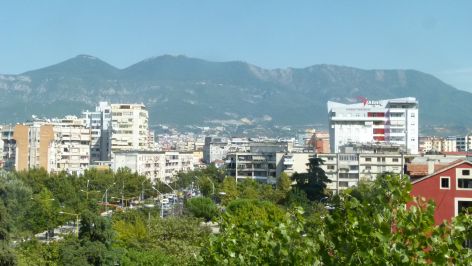
The mountain Dajti can be clearly seen at the horizon…  We decide to climb the mountain tomorrow (not using the cable car).

P1080675

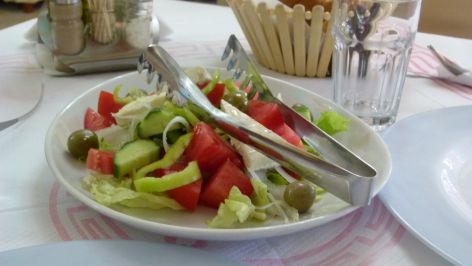
We say hello to the founder of the town, Pasha Mulleti, have lunch in a small restaurant (greek farmer salad, baked eggplant and lamb in a joghurt sauce).

P1080676

.

Walking south towards Blloku, the formerly closed area

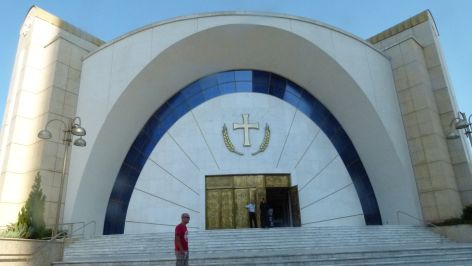
The newly built orthodox church is richly decorated.

P1080680

We head down to Blloku, the former closed area for functionaries, and have a glance at the villa of Hoxhta (now closed).

P1080685

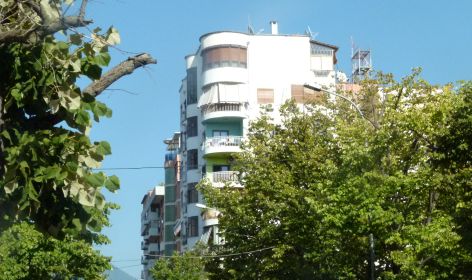
I am disappointed. What my guidebook calls a trendy area, seems to be a mess of large houses with decaying facades… and in between some small, old villas. Also Ben does no longer like to come here.

P1080686

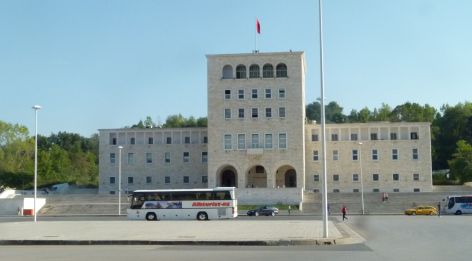
Impressive is the Mother Theresa Square, with the monumental university buildings and the archaeological museum.

P1080689

.

And following the boulevard of the national heroes back to Skanderberg square

“Do you know of a country, where the prime minister palace has no fence around it?” Ben asks proudly. Yes, I assume, Switzerland. “Okay, then Albania is the second country…”

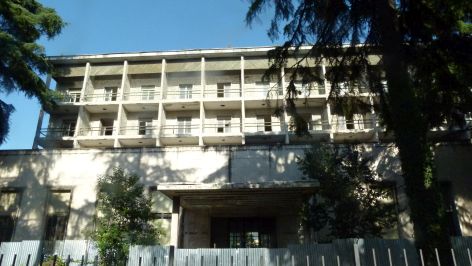
But what is this? A huge house on the boulevard of national heroes, and it is decaying? Yes, this was the luxury hotel Dajti. The old stylish furniture has disappeared… and the hotel is just a ruin now.

P1080698

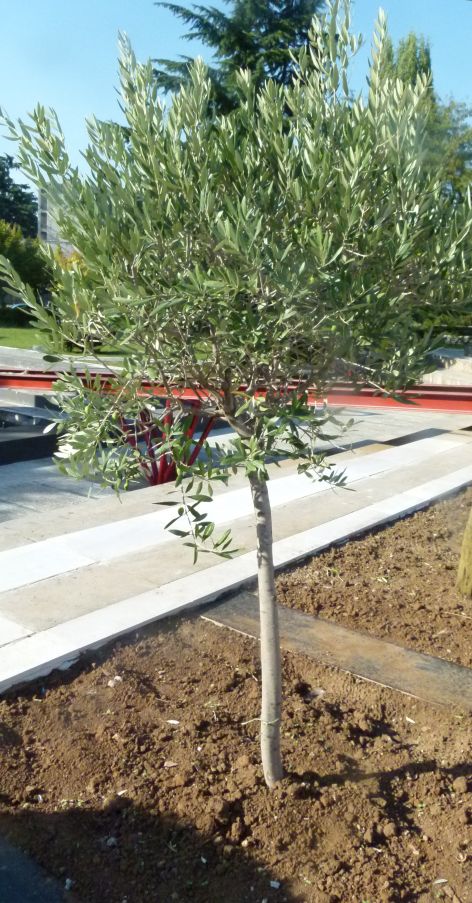
The pyramid is the memorial that the daughter of Hoxhta had built for her father. I am not so convinced, but I do like this small olive tree planted for peace… peace is what we need in this world, and Tirana has just hosted a congress about this topic. Wonderful.

P1080696

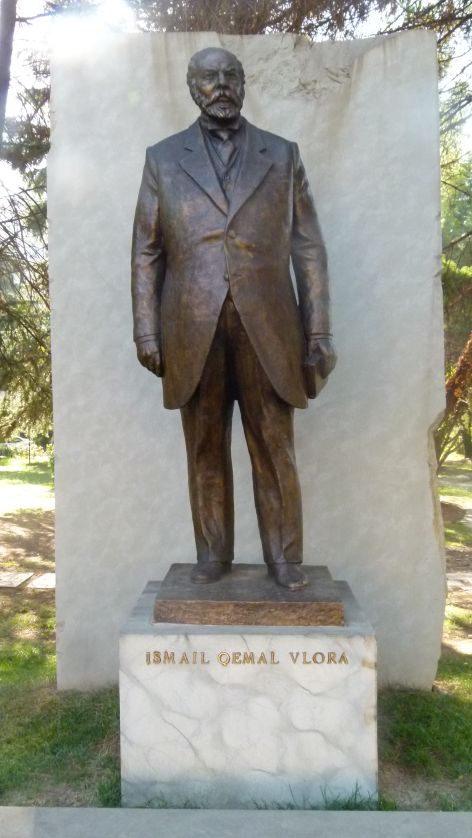
Qemal is another important statesman. He was very courageous and announced Albania as an independent nation in 1912.

P1080690

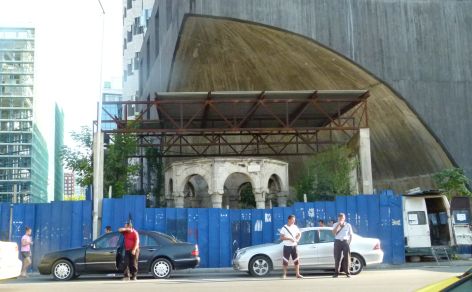
The Bektashi have their center in Albania… I am always impressed by the dervishes rotating and meditating. Here is a small tomb hidden under a huge building that left space for the Bektashi. As the blue walls show, it is now being renovated.

P1080701

The museum of national history is closed… it is Monday today. Oh yes, Mondays are always difficult for visiting museums. We will come back tomorrow to get an overview of the facts, as Ben points out (and I agree).

Ben takes me back to the hotel where I have a rest, on the charmingly furnsihed balcony near my room.

Thank you Lufthansa, for having stopped the strikes, and thank you, Ben, for sharing your enthusiasm for your country with me.

So much to discover around Basel – the Klus and the Burgengratweg

The Klus west of Aesch near Basel – wine and culture

West of Aesch near Basel there is a small valley with southward looking slopes that have a tradition of wine growing – it is the largest wine growing area around Basel. On the hills around the Klus valley there is culture – a dolmen tomb, an old cave and various castles (all ruins). The ruins south of the Klus valley are connected by the marked “Burgengratweg” (“ruin ridge path”), and there is another ruin north of the upper Klus, Frohberg, that is more difficult to reach out to.

aesch w pfeffingen

I like the Klus and check out the marked hiking paths and the more hidden unmarked paths to get ready to lead the Monday Nordic Walking group to the tomb and the castles. Thank you, Andreas and Helga, for uncovering the secrets of this valley to me.

.

The Dolmen tomb 

I start my walk above the vineyards in the forest following the yellow hiking signposts. A brown plate directs me to the dolmen tomb.

P1080419

Only the basis of the tomb is left and protected by a fence. Originally it has been covered with stone slabs and must have been some 2-2.5m high. It has been built around 2500-1500 BC (late stone age or bronze age).

P1080414

Nearby I have a wonderful view of the Klus vineyards and the forest hiding the ruins along the “Burgengratweg”. The Gempenplateau can be discerned in the background.

P1080421

.

Looking for the ruins defending the Klus

A narrow path takes me up to the ruin Frohberg that is well protected sitting on the top of an almost inaccessable rock. The castle has not been explored by archaeologists. They assume that it has been built by the Schaler family in the 13th century, perhaps as an additional stronghold against the family Münch that also owned a castle overlooking the Klus valley. Like most castles around Basel it has been destroyed in the 1356 earthquake and may not have been reconstructed. Later the bishop of Basel owned Frohberg with the farm Tschöpperli/Tschäpperli and gave it to the family Thierstein as a fief. They managed the farm from the nearby castle Pfeffingen.

P1080426

Today, the Tschäpperli farm is one of the renowned wine growers of the Klus.

P1080427

These are some of their vineyards.

P1080432

.

A short round hike on unmarked paths makes me discover the lama farm

I walk towards the Blattenpass and turn left on an unmarked path to cross the Bielgraben (“Biel ditch”). A beautiful panorama view of the Tschäpperli vineyards and a charming path under birch trees…

P1080431

… take me to this sign announcing llama xing. Llama xing – here in Switzerland! Yes, the farm “Obere Klus” has lamas – among other animals. The lamas are rented out for hikes.

P1080434

.

The narrow and sometimes exposed Burgengratweg (ruin ridge path)

About 50m down the valley I enter the Burgengratweg. There is warning: The path is not in good state, you go there on your own risk. Well, it is narrow, stony, with roots – pretty rough for standards around Basel, but there are more dangerous hiking paths in Switzerland. Each of the sights I will come across on the Burgengratweg has a plate that explains the history.

P1080436

After having crossed a small creek, I reach the Schalberghöhle (Schalberg cave). Flint stone tools and animal bones from 50’000 years ago  (“Moustérien” ) and from the late stone – and bronze age (about 3500BC and 1000 BC) have been found here.

P1080439

The first castle is Schalberg, built by the family Schaler (they have also built Frohberg). After the earthquake they rebuilt this castle. They later sold it to the bishop of Basel (1437) who gave it to the Thierstein family as a fief. Soon thereafter the castle must have been abandoned, as it is no longer mentioned in the archives.

P1080446

Also the second castle, Engenstein, belonged to the family Schaler. The castle was also called “Alt-” or “Vorder”-Schalberg. A dizzying iron ladder leads to a platform. It has been given up already in 1280, probably, because the family had built the “newer” Schalberg castle not far from here.

P1080451

The next castle, Münchsberg, built in the 13th century, belonged to the family Münch that later also sold the castle (with farms) to the bishop of Basel and received it back as a fief.

P1080456

The last castle on the Burgengratweg is Peffingen above Aesch and the namesake village Pfeffingen. Its origins go back to the 11th century. In the 12th century, the family Thierstein owned Pfeffingen (along with nearby Dorneck). From 1522 it belonged to the bishop of Basel; his bailey then lived here. In the late 18th century the castle was abandoned. It is currently being renovated.

As it starts to pour with rain, I leave the forest and the narrow, now slippery ruin ridge path.

.

Strolling through the vineyards and discovering innovative wine growers

In the rain I prefer to stroll through the vineyards. There is a round tour with posts explaining the business of wine growing throughout the year.

P1080409

Monika Fanti is a winegrower that also runs a small restaurant (“Winzerbaizli” or “little winery pub”). I like the names of her wines: “ilFANTIno”, “exKLUSivo”, “FANTIssimo” and “mySEELEdröpfli” (literally translated: “my soul droplet”). I take a leaflet with me announcing “Neus vo eus”, meaning “news from us” in the dialect of Basle Country.

neusvoeus

I plan to get back to this place. Some of the wines of Monika Fanti would be a great addition to my gift drawer – besides, of course, trying them out myself.

A few meters higher up I find “chez Mitz”, where I can hear laughing through one of the open windows – I think a Sunday brunch is going on. Teddy bears sit on the window sills looking down at the hikers.

Really, the Klus of Aesch is a charming corner! I look forward to the Monday walk with the group and I will surely come back more often.

Are e-cars for me? – Not yet, perhaps later and for one of them…

A friend of mine owns a Tesla Model S – is he a nerd or a visionary?

A friend of mine owns a Tesla Model S. He has studied physics, and I think, he is a bit of a techie-nerd. He tells me his stories about driving from Zurich to Chiasso (about 200km), hooking up his Tesla to a hotel plug, and then the hotel went black. No way to recharge the Tesla there, and he eventually found a camping site for that.  He seems to love that thrill. I am not convinced…

As I read more and more about e-cars, I start to change my mind: My friend  may be an early adopter of e-mobility that might well become a future trend.

Traditional car providers such as BMW, Nissan, VW, Mercedes, VW, Renault and even Chinese companies (such as BYD) develop their own e-cars. They would not do so, if they saw no business in it. The Tesla Model S, has recently been rated to be the second most sold luxury car after Mercedes in the US (Newsticker). The “world top 20 half year 2015” edition of ev-sales.blogspot.ch shows Nissan Leaf as the leader worldwide (25068 cars sold in Jan-Jun 2015), while in June 2015 Tesla leads the ranking with almost 5000 cars sold worldwide. Around 200’000 e-cars sold worldwide in Jan-Jun 2015 is of course still a small share of the overall car market.

Norwegia subsidizes e-cars giving them privileges such as the right to drive in the bus lane. As a consequence, the number of e-cars ramped up more than in other European countries, in towns, and also in remote northern areas (wikipedia and EV Norway). There must be potential, if waked up by the government. Other European countries are lagging, with Switzerland a bit more ahead: In Switzerland, growth rates of e-car sales are 44%, in particular Toyota and Tesla cars are well adopted (NZZ 29.07.2015: “Das E-Auto wird in Deutschland zum Fiasko”).

I am surely not a nerd. I just like to drive my “normal” combustion car that is reliable and also a bit of fun to drive. Are e-cars now becoming reliable and fun to drive, too, even for me? Let me summarize some of my impressions just from the viewpoint of a “normal” potential consumer.

.

Yes, I find that e-cars are cute to drive around, but the range is still a problem

At an event organized by one of our local electricity providers, I have the opportunity to gain hands-on experience with e-cars.

  • The Renault Twizy reminds me of the Deux Chevaux back in my university days. Minimalistic. The Twizy may be an attractive advertisement platform for companies or handy for the Pizza service. Not for me, I prefer my “normal” bike for short distances (not yet considering “e”-bikes that recently have become somewhat hype).
  • The BMW i3 is utterly elegant with a GPS showing the charging stations on the map. But why are there so many knobs to manage the car? Why is that not integrated in the electronic cockpit?
  • The Nissan Leaf and Renault Zoe are more sober, but handy to drive.
  • The e-Golf  feels like a VW Golf, very robust. VW might have had their current clients in mind, when designing their e-car. and they will surely recognize the experience.

All these cars have one problem: The e-charge is empty after 100 to 200 kms (depending on conditions, see Wikipedia entry and 10 Electric Vehicles with the best range in 2015), and recharging takes time. My combustion car can do 700km . Opportunities to load the e-car are still patchy (interesting concept: park & charge with map LEMnet).

Some time ago, I traveled in a KIA from Basel to a village near Baden, about 100kms. We start with a reserve for 160kms, reload the car at a normal 220V plug in Baden, find out that after five hours, it has only reloaded to give us 120km. We just about make it back home with 25km left to drive, with the car warning us about “low battery”. Fortunately the navigator shows the loading infrastructure available and hence longer journeys can be tackled with the KIA, but not without hazzle. That evening we took the cable from my garage to recharge the KIA.

Though the e-cars are comfortable and so much less noisy to drive, I would not replace my combustion car with any of them right now. I hear that BMW gives out combustion cars to BMW i3 owners, when they plan their vacation in Southern Europe.

.

Tesla Model S… THIS car IS different…

Some Tesla Model S drivers are attending the hands-on experience event. They take guests out to sit in their car and feel, what it is like. One of them invites me to a ride. Proudly (Tesla owners are fans of their cars) he shows me his cockpit screen. “Well”, I say “this is different, this is innovative… it reminds me of the battle between traditonal telephone companies and Microsoft around desktop collaboration in enterprises… the telephone solutions were “clumsy telephones” and the Microsoft solution was easier for us, because it worked like all the other software we did our jobs with.”

Tesla, I sense, is similar. It is a different paradigm. It is a car designed as “e” and with a modern “tablet feel”. The computer panel in the Tesla controls most of the functions that other e-cars still have a knob for. It is connected with the Internet and the navigation is based on Google maps. The interface has become “e”, not only the “fuel” of the car.

The driver notices my enthusiasm. “Do you want to drive?”  I drive uphill on the test run. After a while we stop and try out the navigation system. “London”, we enter as a target point, and after some thinking, the board computer spits out the route that minimizes the “fuel” and shows the Tesla loading stops (“super chargers” that are free). Other than in traditional e-cars, the Tesla cockpit also takes over the task of optimizing the route, and it is all based on Google maps that we are familiar with anyway. Then, the range of the Tesla is higher to start with – 10 Electric Vehicles with the best range in 2015 says 270 miles or about 350km.

When traveling in our KIA to Baden, we met my friend, the “techie-nerd”, who owns a Tesla. He mentions that since his experience with the hotel going black when trying to recharge his Tesla, the supercharger infrastructure has improved a lot. Frowning he looks at the front trunk of the KIA:”What is this? It looks like usual combustion car, why does the electric “engine” use up all this space – look at my front trunk”. He opens it, and it is empty – well – not really – his set of Tesla plugs are carefully stowed away in an edge of the empty trunk. “Yes, they have designed the Tesla from scratch”, my friend says.

I am impressed. The Tesla Model S is different… though the entry level is still high: Around 100’000 CHF. However, the total cost of ownership may come closer to traditional cars, as charging “fuel” is free. But it is still more expensive compared to e.g. the KIA that goes for about 27’000 CHF.

.

… but not yet for me… maybe in a few years…

Though the Tesla Model S is a tempting option to replace my combustion car, I still do not intend to acquire one right now considering the high entry level prize and the size of the model S (not really for small people like me). Maybe, my eyes permitting, I would reconsider buying a Tesla, when the smaller Tesla model 3 comes out and scaling lowers its entry level price.

But I am fascinated and want to learn more about the driving force behind Tesla, Elon Musk. He seems to be a visionary and challenging leader, like Steve Jobs was… I buy his biography.

So much to discover around Basel – Pratteln

My new mountain bike takes me to Pratteln and I discover who has been here before…

This year – 2015 – I bought a new mountain bike. I set out to explore more of the secrets around Basel to plan the nordic walking hikes that I am now guiding – with my eyes restored. My next target is Pratteln. This small town has published the excellent and very detailed “Heimatkunde Pratteln 2003” (Emmy Honnegger et alii) and a nice Website. I pick a few cherries that might add to the walking experience around Pratteln – I love to know more about the places that I am hiking to. And – any misinterpretations are my own fault – I am not a historian.

Karten Pratteln

Source: Bundesamt für Landestopographie 213T – Basel

.

Pratteln – why are you called “Pratteln”? Ah, you were a “small meadow” near Roman Augusta Raurica

The name “Pratteln” comes from the Latin “Prattelum”=small meadow. Pratellum was a suburban service center for the Roman town Augusta Raurica, with farms and crafts business. It seems that, after the Roman empire had collapsed, the Alemanni did not settle here before the 7th/8th century, and the population continued to speak a Roman language. If the Alemanni had settled here earlier, the alemannic second sound shift would have transformed “Pratteln”  to”Pfratzelen” (“Heimatkunde”) or “Pfrasseln” (wikipedia). I prefer “Pratteln”  to “Pfratzelen” or “Pfrasseln”. We Swiss just say “Braddele”.

The large farms surrounding Pratteln today indicate that it must have been a beautiful service center for Augusta Raurica. Here is Mayenfels above Pratteln that is now a school.

P1080404

.

There were settlements in Pratteln long before the Roman times – perhaps

To the south of Pratteln there is the “Hohle Gasse” – a very steep and even today mostly unpaved path that connects Pratteln with the “Chäppeli”.

P1080358

It was here that a school boy found a hand ax in 1974. The ax is older than any other ax found in Switzerland – the estimates I could find reach from 120’000 to 350’000 years (sources: “Heimatkunde”, p. 71 and Website of Kanton Basellandschaft). It is not clear, whether the glacier has transported the ax to this place or whether the owner really lived around Pratteln. Too long ago to know for sure.

Signs of settlements from stone, bronze and iron age have also been found around Pratteln (see Heimatkunde p. 72).

.

Medieval times: Monasteries and the noble family of Eptingen. Later owned by protestant Basel

Until around 900 AD the monastery of Murbach (Alsace) had possessions in Pratteln. Reminiscence today: The church of Pratteln is dedicated to Murbach’s patron, Saint Leodegar. The church was later sourrounded by a wall to protect it against the floods of the Talbach (Heimatkunde, p. 97, the wall is called “Kirchenbering”).

P1080381

Other reminiscences of those early days  can be found in the field names. For instance starting around 700 AD, forest areas were cleared to gain space for agriculture. These areas were then named Blözen (related with “entblössen”=to bare), Rüti (medieval German “ruiten”=to clear) or Stockmatt (when the thick roots (“Stock”) remained in the meadow (“Matt”)). Other names describe the topology: “Halden” is less steep than a “Rain” (Moderhalden and Blözenrain). “Goleten” points to a landslide that left stone blocks (My Ernst also said “Golete”). In the “Cholholz” – there was a charcoal burning site (Heimatkunde, p. 25f).

In the late 11th century the monastery of St. Alban, just east of the city  gates of Basel, was given possessions in Pratteln. St. Albanstrasse and St. Albanmatte in Pratteln remind us of this today.

In the late 13th century the noble family Eptinger settled in Pratteln (presumably it was a feud from Habsburg).  In the 13th century, they built two castles, one in Pratteln in the valley (surrounded by water) and a second one on the Madeln hill above Pratteln. After the 1356 earthquake, they rebuilt the castle in the valley. Owned by the government since 1773, it is no longer a water castle today, has been beautifully renovated in the 1960’s (see Ernst Zeugin) and is open for the public (guided tours).

P1080391

The castle on the Madeln hill (Madlechöpfli) has not been rebuilt after the earthquake. Today only the ditches can be distinguished on the hill, the remains of the ruins have been covered up in the 1930’s to protect them from further decay. No spectacular ruins for today’s hikers on the Madeln summit – just another picknick spot in the dense forest. But, when having a picknick on Madeln, beware of the Madlejäger or hunter of Madeln. He comes with twelve white dogs, when the weather is changing. He has suffered until these days, because he had killed the owner of Schauenburg to marry the widow (Heimatkunde, p. 318). Below, the “bosky” highest point on the mountain range in the background is the Madeln hill.

P1080406

In the 15th century, Hans Bernhard von Eptingen built the monastery of Schauenburg and a chapel with a hospice in the Geisswald just above Pratteln. The place is called “Chäppeli” which reminds us of Hans’ chapel that does no longer exist – after the reformation (1529) the stones have been reused to build the parochial house of Pratteln. The fountain is said to give curative water and the Geisswald seems to be an energy spot emitting 8000 Bovis (“Geiss” pointing to what we call Kraftort in German). This was a good place for a chapel and now it is a good place for a vast picknick and play ground. The foto shows the area with the fountain in the background.

P1080351

In 1521 the family Eptinger sold the castle and part of Pratteln to Basel – for 5000 Gulden. 1549 the Habsburgians gave up the rest for 3000 Gulden. However, with their coat of arms – an eagle with  red tongue and red claws –  the noble family Eptinger is omnipresent today, on banners, on the cars of the firebrigade, in gardens… everywhere. To differentiate their banner from the emblem of Eptingen (also a former possession of the Eptinger family), Pratteln has added a black frame.

I found the emblem on the little hut at the picknick spot “Chäppeli”.

P1080354

and everywhere in the center of Pratteln  that today, July 31st, is preapring for the Swiss national holiday on 1st of August.

P1080396

.

Modern times – salt and industrialization… and taking care of the medieval village center

In the early 19th century salt was found near Pratteln. This started the industrial development.

Based on a geological map, Peter Merian forecasted the chance of finding salt on the shores of the Rhine. Carl Christian Friedrich Glenck dug, found salt in 1836 (116m under the ground) and a year later, he opened the first saline factory. Now the Swiss Rhine Salines produce 450’000 tons of salt a year in the valley and on the adjacent hills of the Plateau Jura, south of Pratteln and Muttenz.

The presence of salt as an important component attracted chemical factories. From the motorway, I have always seen the signs of the “Säurefabrik” (“acid factory”) – now I know, the Säurefabrik came here in 1918 to combine salt with iron sulfur which results in salt – and sulfur acid (Heimatkunde, p. 107). And Ciba, Novartis, Sandoz and many more national and international enterprises form the industrial complex of Schweizerhalle between the railway and the Rhine river today – this sight is taken from Google Earth.

Schwei$zerhalle Google Earth

Source: Google Earth

Despite the industrial evolution, Pratteln kept its charming historical center and makes it worth a visit.

P1080405

.

Vineyards – first mentioned in 1284 and a pastor from the 17th century that must have loved the wine…

There are vineyards to the south of Pratteln. They were mentioned first in the books of the monastery of St. Alban in 1284. The production was then around 60’000 liters. In 1749 a historian praised the vines of Pratteln, “in particular the red wines are among the good and dense wines of our region (gut und kräftig).” (Heimatkunde, p. 170). In 1807 there were 47ha of vineyards (in the valley and on the hills). Now just about 6.7 ha are left, all on the eastward looking slopes of the Ebnet (see Weinbauverein Pratteln). There are two professional and  20 hobby wine growers producing about 60’000 bottles a year.

P1080344

One of the two professional wine growers runs the Leuengrund. It has a small restaurant (open from October to February; this is a Straussen- or Meienwirtschaft, announced by a bunch of flowers, a custom based on Charlemagne (768-814)). Find below the Leuengrund with its gorgeous view. I will come back here in autumn, when the restaurant is open.

P1080408

In the 17th century, the pastor Christoph Hagenbach (1596-1668) had a small half-timbered house built on the edge of the vineyards, overlooking the Rhine valley with the Black Forest and the Vosges. It was here that he prepared his sermons (perhaps the wine helped him find the right words). After him, this wonderful spot is called “Hagebächli”. Look at his cosy little house…

IMG_1573

…  and the view over Pratteln to the Dinkelberg beyond the Rhine river and the Vosges in the background to the left.

IMG_1574

.

Well, I am impressed by the history of Pratteln. I love to share it with the nordic walking group, when hiking here. Andreas and Helga, thank you for having opened my eyes for the secrets of my home region around Basel.