Just after having finished his studies at the Königliche Akadamische Hochschule der Bildenden Künste in Berlin, my grandfather Hermann Radzyk and his wife Helene travelled to Venice. My grandparents were a newly married young couple then.
My grandfather painted “Canal Grande, Venezia 1910”, signed Hermann Radzig-Radzyk; owned privately.
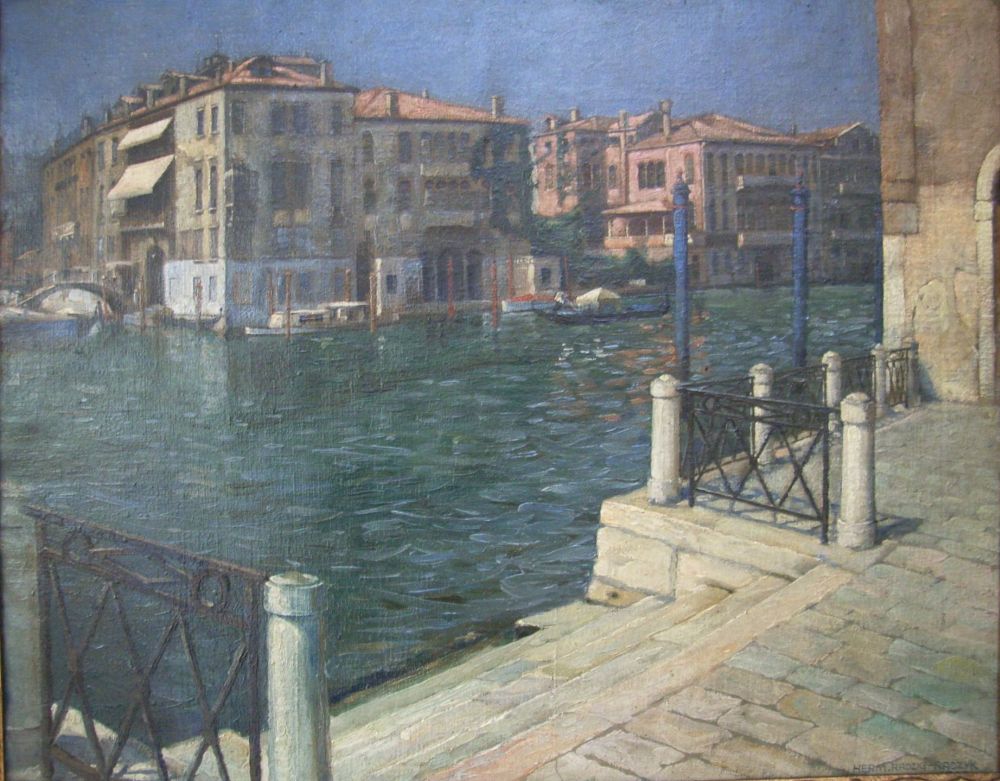
Hermann Radzyk sold the picture to the cousin of his wife Helene; perhaps it was also a gift within the family.
Where was the easel? I looked for a garden along the Canal Grande using Google Maps, but without result. I knew, more systematic searching is needed to find the location of the easel.
Later I located the place, where my grandfather put down his easel in 1910
One afternoon in December 2025, I searched using Google maps and found that my grandfather’s easel stood on the Fondamenta del Traghetto San Maurizio looking across the Canal Grande at the palaces next to the Rio de San Vio.
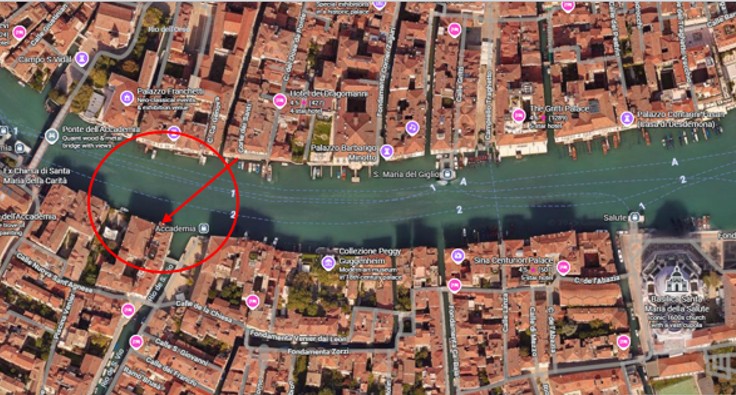
Let me tell you, how I found out, where my grandfather had put down his easel.
- First, I looked for something typical on the picture; well, what about the bridge just before the side channel enters the Canal Grande?
- Next I followed the Canal Grande on its long course (wiki entry for Venecia says, it is 4km) to find the side channels with a bridge near the mouth. Voilà, a bridge near the mouth… that fits for the Rio de San Vio.
- Across Canal Grande, I notice a platform. It is called Fondamenta del Traghetto San Maurizio. This is the platform, where my grandfather painted, as becomes clear by analyzing Google Street Views.
Look at the picture of my grandfather: The platform, where he stands, ends with a house that has a door arch and a bricked white edge. Google Street View today shows a house with a door arch and a bricked white edge, what a good match. Well, something like door bells have now been added next to the door, and the dark red colour of the wall has become brighter… but more than a hundred years have passed since then. The stone columns of the railing still have the same form as in 1910. Sure, the easel stood on Fondamenta del Traghetto San Maurizio.
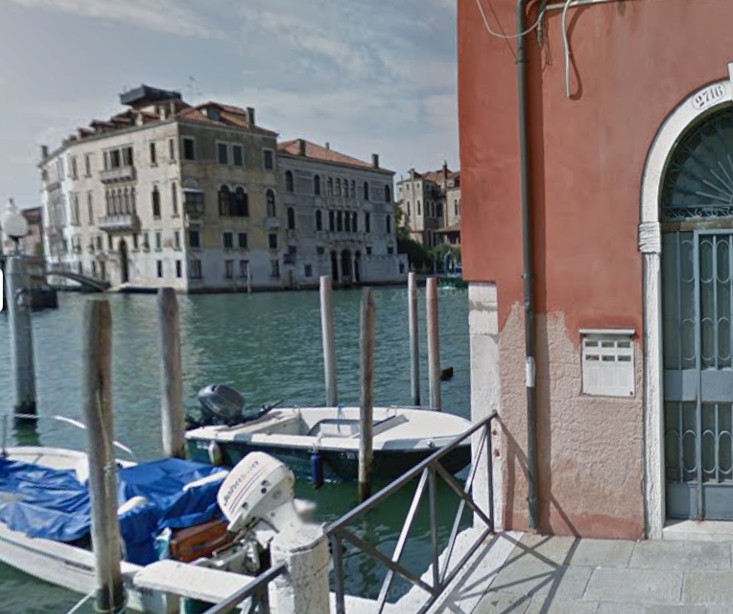
What about the palaces that my grandfather painted across the Canal Grande next to the Rio de S. Vio? Have they changed much? No, they can be identified on Google Street View today, including the garden between them.
The first two houses just next to the mouth of Rio de S. Vio have practically not changed since 1910. The first house still has an oriel and a window with two arches on the first floor; its colour has become more yellow today. The structure of the second house is also unchanged: Still the same arched gallery just above the water, the two side wings framing the steps to access the Canal Grande, the arched window lines with balustrades on the two upper floors. Just the colour has changed, the house is now cleanly white.

From the Fondamenta, Google Streets View provides a second panoramic view which allows to look more into Rio de S. Vio and more upstream beyond the garden. Street View shows no sun blinds above Rio de S. Vio; my grandfather had painted two sun blinds here; may be he painted on a hot summer day, and the Google Street View photographers were here on a less sunny day. The garden is also on the picture of my grandfather, and the houses behind the garden can be recognized still today.
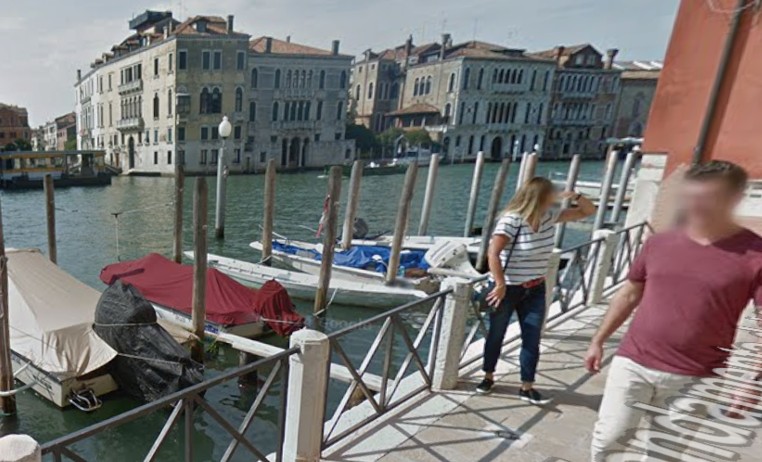
The second focus of Google Street View makes one major change clear: My grandfather had painted steps providing access to the channel; they have disappeared today; they have been replaced by a continuous railing. When virtually turning around with Street View, I can see that boats on the Canal Grande are now accessed on the opposite side of the Fondamenta del Traghetto S. Maurizio using a wooden catwalk.
The history of the picture “Canal Grande, Venezia, 1910”
The picture of Venice is owned by a distant cousin of mine (let me call her Cathy). A cousin of us (let me call him Hans) told Cathy, who Hermann Radzig-Radzyk was: “Hermann Radzyk (who signed as Hermann Radzig-Radzyk) was an artist in our family and the grandfather of our cousin, Petra. His wife (and Petra’s grandmother) was Helene Radzyk. Helene and your grandmother were cousins; they were friends and went to school together, in Lüneburg; Helene’s father was the director at the agriculture school. Your grandparents either bought the picture from Hermann and Helene Radzyk, or they received it as a gift.”
I visited Cathy a year ago. It is wonderful to meet (even distant) relatives for the first time and to discover similarities such as the same curls in our hair, similarities that remain though it was our grandmothers that were cousins.
We took the picture of Venice from the wall. This is how I found out that it was painted in 1910.

My cousin Cathy always thought, her grandparents had bought the picture as a souvenir, when travelling to Venice as a young couple. But no, it was painted in the family, as our cousin Hans had told her.
While Cathy lived in the Federal Republic of Germany, her grandmother lived in Perleberg in the former GDR; the painting of Venice was with Cathy’s grandmother, in Perleberg. When Cathy’s grandmother died in the 1960’s, Cathy travelled to Perleberg to settle the estate. An attorney told her that she had no right to the inheritance, because she had left the GDR as a student. “Okay, nothing to be done”, she said, ” but could I then just take the family baptismal bowl with me, as in our family, we have the tradition of engraving the name of each new-born child on it.” “Are you pregnant?”, the attorney asked. “Yes, I am expecting a daughter”, Cathy answered. “Well then”, the attorney answered, “you can renounce the inheritance in favour of your unborn daughter, as she did not leave the GDR on purpose.” And that is how the picture of my grandfather came to the Federal Republic of Germany and into Cathy’s house.
My 40-year-old memories of Venice – perhaps I will return one day
I was in Venice in May 1987, almost 40 years ago. At that time, I wrote a diary that I am looking at now. I read that after having arrived at the train station, we took the Vaporetto along Canal Grande to Academia to get to our hotel Americano in Calle Nuova San Agnese. Google Maps tells me that Calle Nuova San Agnese is just behind the houses and the garden that my grandfather painted in 1910. Well, 40 years ago, I did not know my grandfather’s picture, and nevertheless I was so close to it and to my grandparents. It is an almost transcendental feeling.
Perhaps I should return one day in order to consciously look at the Canal Grande that my grandfather has painted and to relive my memories of Venice from 40 years ago.
Sources:



 Petra Peters