In May/June 2023, I was in Silesia, looking for some places, where my grandfather Hermann Radzyk put up his easel a hundred years ago (as an artist he painted under the name of Hermann Radzig-Radzyk).
One painting I was looking for was the “Neumannskoppe” of 1919 (belongs to my sister and me).
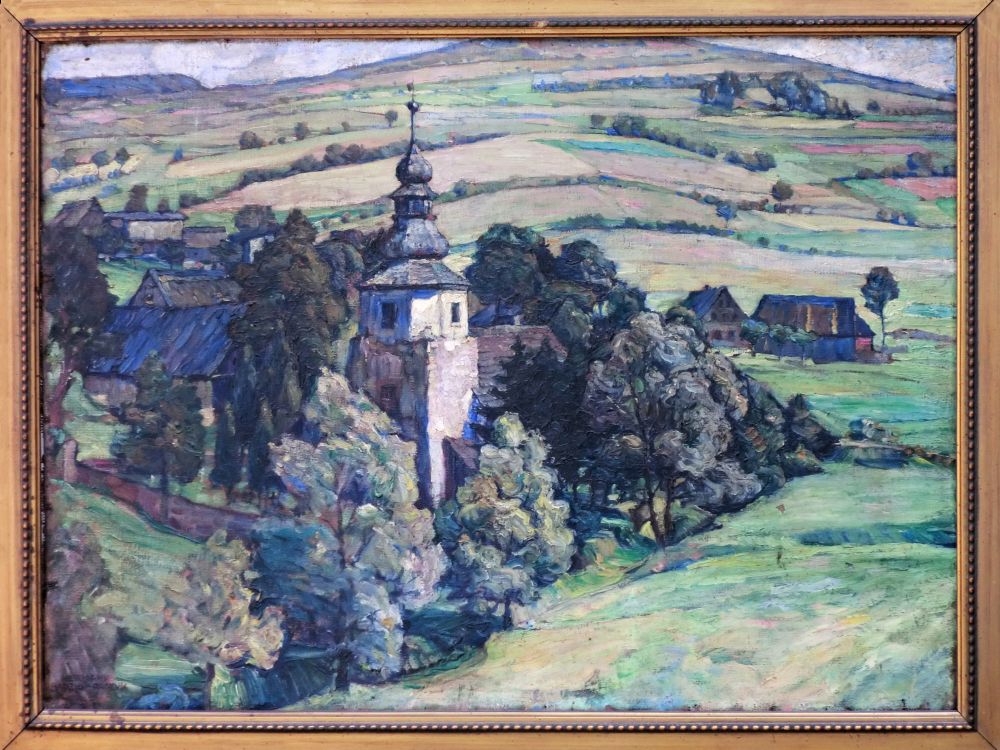
I know title and year from a letter of my mother to her best friend. I acquired the painting from a friend of the son of my mother’s best friend.
I solved the puzzle end of May 2023: To paint the “Neumannskoppe”, my grandfather had put his easel up at Rudolfswaldau, now Sierpnica. The mountain Neumannskoppe has become Niczyja. The wooden church with the baroque belfry is called Maria-Schnee-Kirche (Kościół Matki Bożej Śnieżnej, i.e. “Our Lady of the Snows”).
I was at Sierpnica end of May 2023 to see, what the church looks like today, and I took the photo from where the easel was (approximately).
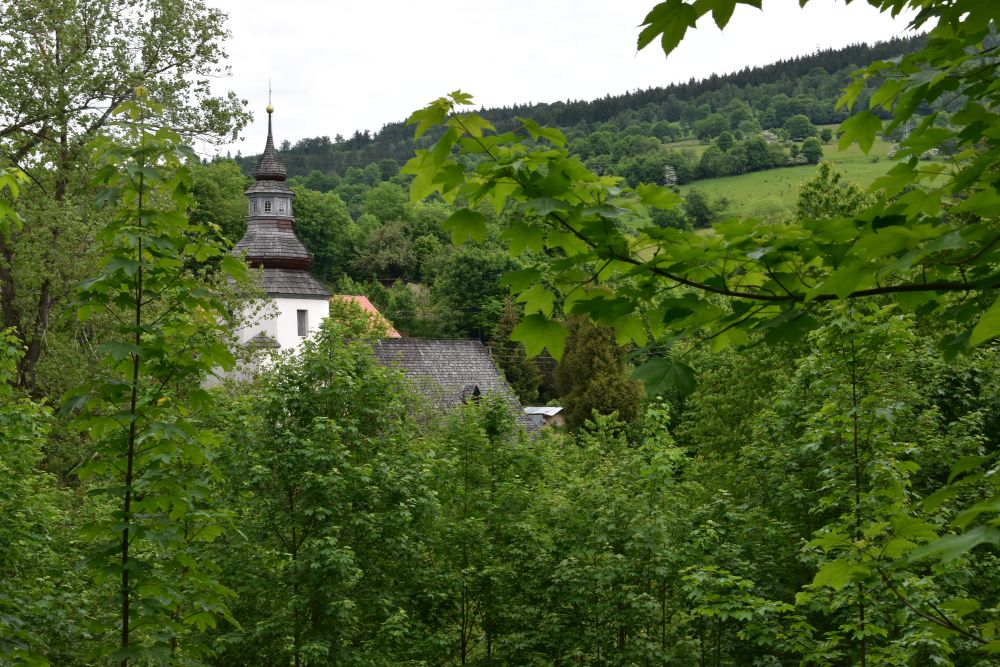
Today the church is hidden behind trees.
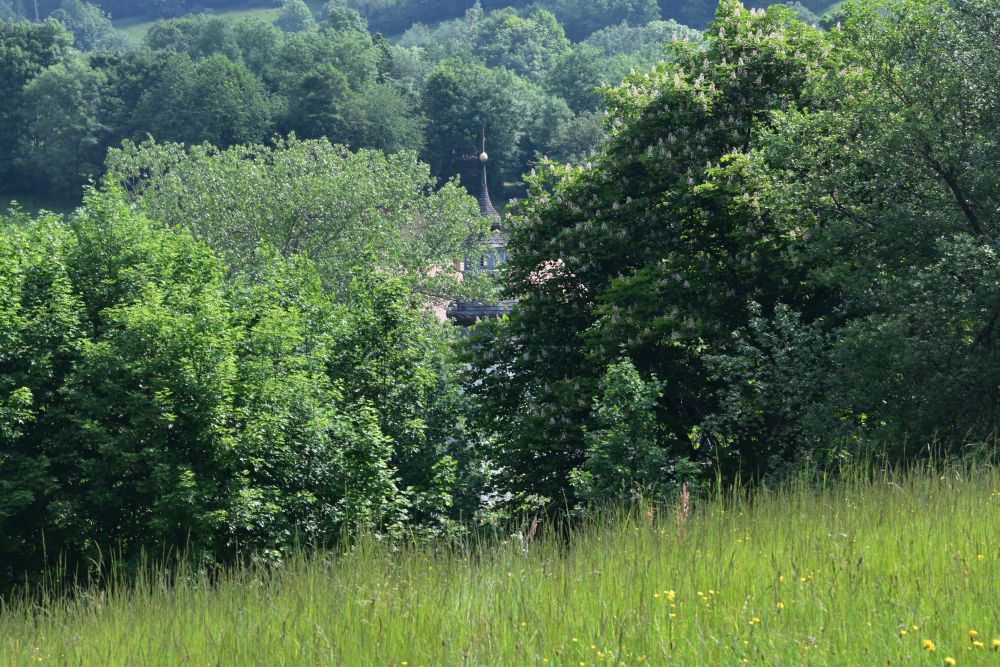
While taking my photos, I met Dziki who lives near the church. He gave me his winter photo. The trees without leaves allow to see more of the church that my grandfather painted.

Source: Photo taken by Dziki Domek.
Now let me tell you, how I solved the puzzle to find the easel for the painting “Neumannskoppe”.
Where is the Neumannskoppe?
I started by looking for the Neumannskoppe. I suspected, the Neumannskoppe is a mountain somewhere in Silesia. I entered “Neumannskoppe” in google maps – no result. I continued googling and googling “Neumannskoppe” combined with various terms… and after a lot of googling, I found this old German-Silesian advertisement for the “Grenzbaude im Eulengebirge” (boundary mountain hut in the Owl Mountains).

The advertisement says that the Grenzbaude is located between the “Neumannskoppe” and the “Hohe Eule” (1). Hence the “Neumannskoppe” is not far from the “Hohe Eule”. Googling “Hohe Eule”, I found the name “Wielka Sowa”, which is the highest mountain in the Góry Sowie (Owl Mountains).

Conclusion: The church with the Neumannskoppe is not far away from the Wielka Sowa. I asked Google to show me the churches around Wielka Sowa and I clicked on all of them.
At Sierpnica, I found the church that my grandfather had painted. It is now called Kościół Matki Bożej Śnieżnej, in German Maria-Schnee-Kirche.

Source: Marius Tyski, Church of our Lady of the Snows, Instagram, appeared in google maps about a year ago, in the meantime I can no longer find it there.
This is the location of the Kościół Matki Bożej Śnieżnej on my hiking map of the Owl Mountains, south west of the Wielka Sowa.
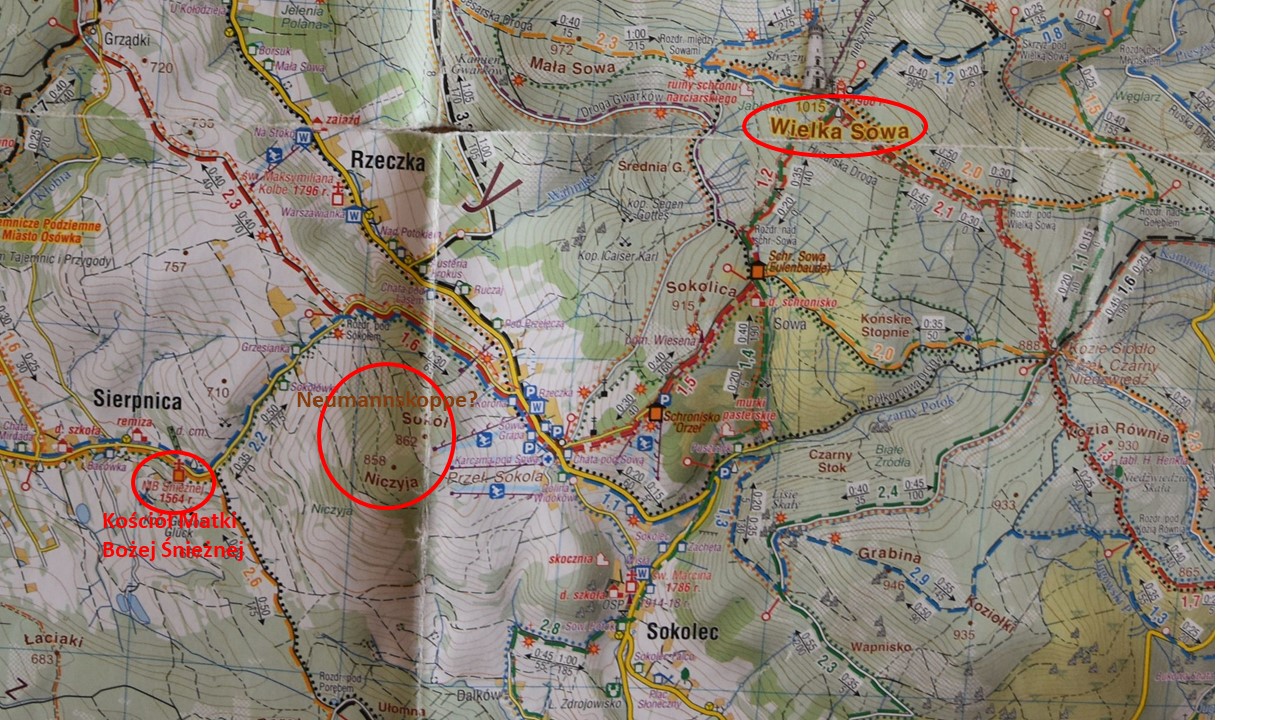
Source: Compass Góry Sowie, mapa turystyczna, scala 1:35’000
But where exactly is the Neumannskoppe? It must be either the peak Sokól or the peak Niczyja – this puzzle remained. I solved it at the hotel Lesny Dvor at Wolibórz (Volpersdorf) – we stayed here a few days. The Lesny Dvor had a German map whith the Neumannskoppe – and comparing with my hiking map, it becomes clear that the Neumannskoppe is now called Niczyja.
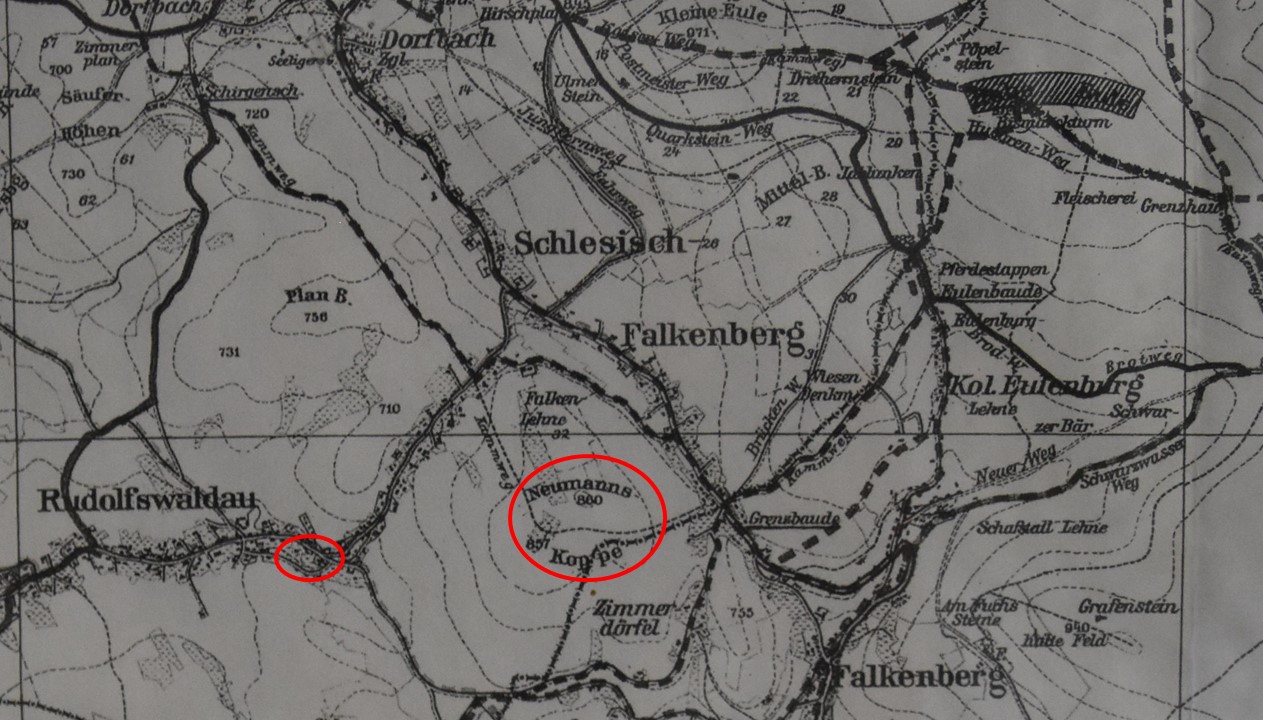
Source: German map that hangs in the hotel Lesny Dvor at Wolibórz
Niczyja (“nobody’s mountain”) is the approximate translation of “Neumannskoppe” (“new man’s mountain”).
My grandparents must have spent their vacation at Rudolfswaldau in 1919, when their daughter (my mother) was 3 years old. My grandfather took his easel, canvas and colours with him to paint the Maria-Schnee-Kirche in front of the Neumannskoppe. About a hundred years later, in May 2023, I was here as well – at Sierpnica – and solved the puzzle.
The church Lady of our Snows (Kościół Matki Bożej Śnieżnej) is a historical treasure
The church Kościół Matki Bożej Śnieżnej was built out of wood in the 16th century. It is one of many “Schrotholzkirchen” in Silesia (see https://de.wikipedia.org/wiki/Liste_der_Schrotholzkirchen_in_Niederschlesien).

It was a protestant church. After the War of 30 years, after 1648, it became a catholic church (the area belonged to catholic Austria at that time). In the 17th century, the tower burnt down, and the new baroque tower was built.
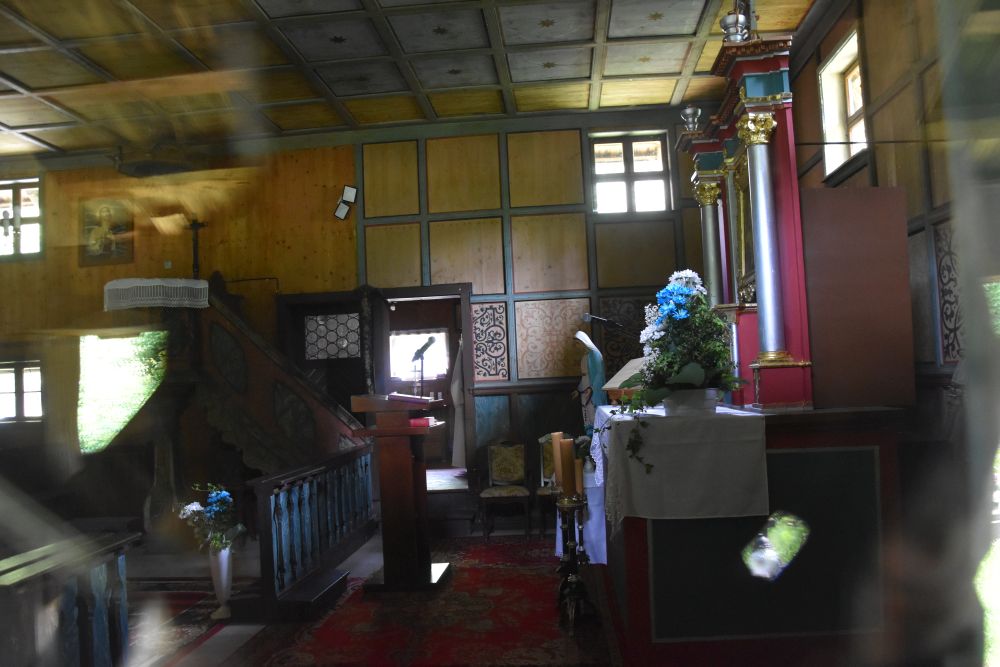
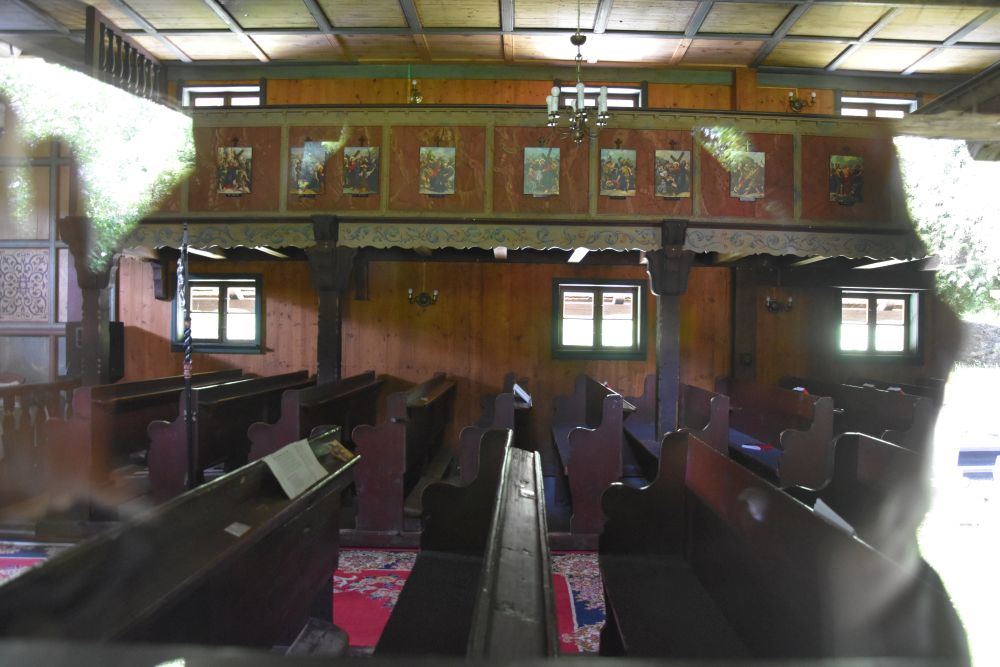
I could not enter the church, I could just look through the window and capture the interior with the altar…
… and the benches.
Visiting more wooden churches or Schrotholzkirchen might be another interesting target in Silesia.
Meeting today’s Silesians while wandering off the beaten tracks looking for the easel of my grandfather
When looking for the places, where my grandfather put up his easel, I usually wander off the beaten tourist tracks. At Sierpnica, I walked uphill on an unpaved path and through the adjoining meadow to get the view of the church from above. The tourists that visit the church, walk around it and leave again. They do not walk uphill to places, where they can hardly see the church. A car comes on the unpaved path and stops. “What are you doing HERE”, the driver asks me in fluent English. “Look at this”, and I show him my photo of my grandfather’s painting. “Yes, this IS the church,” he says. We exchange addresses and he sends me the winter photo of the church. Later, I enjoy the hospitality of Dziki. He invites me to his house and family. He shows me his photos from German times before 1945, when Sierpnica was still called Rudolfswaldau. He is proud of the German photos decorating his house. The German past is an integral part of his house.
This is not the only house in Silesia that keeps memories of the German past. Karolina Kuszyk wrote the beautiful book “In den Häusern der anderen – Spuren deutscher Vergangenheit in Westpolen” (2). She describes places, buildings and objects that the Germans – expelled after 1945 – left behind and that the Poles took over, most of them expelled from the eastern districts taken away from Poland in 1945. Touching biographies on both sides. Years later Germans return to see the places of their early youth or of their ancestors. Sometimes they find the houses and objects left behind 50-60 years ago and sometimes friendships arise between the former and the new owners.
My grandfather opens my eyes for Silesia from a hundred years ago, and following him opens doors to experience Silesia today.
Notes
- Footnote (1) More precisely, the Grenzbaude is located on the top of the pass between Neumannskoppe and Hohe Eule. It is called “Grenz”-Baude or “boundary hut”, because it is located on the boundary between the districts Glatz (now Klodzko) and Waldenburg (now Walbrzych). The advertisement says, it takes 50 minutes to walk to the Bismarck tower on the Hohe Eule. The Grenzbaude is proud to have electrical light and central heating. Above the Grenzbaude was the Grosssprungschanze or great ski jump.
- Footnote (2) Original title: “Poniemieckie”. German title translated to English “in the houses of the others – tracks of the German past in West Poland”, christoph-links-Verlag Berlin 5. Auflage 2023.






 Petra Peters